EP3145727B1 - Druckmedium - Google Patents
Druckmedium Download PDFInfo
- Publication number
- EP3145727B1 EP3145727B1 EP14892852.6A EP14892852A EP3145727B1 EP 3145727 B1 EP3145727 B1 EP 3145727B1 EP 14892852 A EP14892852 A EP 14892852A EP 3145727 B1 EP3145727 B1 EP 3145727B1
- Authority
- EP
- European Patent Office
- Prior art keywords
- gsm
- thin paper
- print medium
- paper substrate
- treatment coating
- Prior art date
- Legal status (The legal status is an assumption and is not a legal conclusion. Google has not performed a legal analysis and makes no representation as to the accuracy of the status listed.)
- Active
Links
Images

Classifications
-
- B—PERFORMING OPERATIONS; TRANSPORTING
- B41—PRINTING; LINING MACHINES; TYPEWRITERS; STAMPS
- B41M—PRINTING, DUPLICATING, MARKING, OR COPYING PROCESSES; COLOUR PRINTING
- B41M5/00—Duplicating or marking methods; Sheet materials for use therein
- B41M5/50—Recording sheets characterised by the coating used to improve ink, dye or pigment receptivity, e.g. for ink-jet or thermal dye transfer recording
- B41M5/52—Macromolecular coatings
- B41M5/5263—Macromolecular coatings characterised by the use of polymers obtained otherwise than by reactions only involving carbon-to-carbon unsaturated bonds
- B41M5/5272—Polyesters; Polycarbonates
-
- B—PERFORMING OPERATIONS; TRANSPORTING
- B41—PRINTING; LINING MACHINES; TYPEWRITERS; STAMPS
- B41J—TYPEWRITERS; SELECTIVE PRINTING MECHANISMS, i.e. MECHANISMS PRINTING OTHERWISE THAN FROM A FORME; CORRECTION OF TYPOGRAPHICAL ERRORS
- B41J2/00—Typewriters or selective printing mechanisms characterised by the printing or marking process for which they are designed
- B41J2/005—Typewriters or selective printing mechanisms characterised by the printing or marking process for which they are designed characterised by bringing liquid or particles selectively into contact with a printing material
- B41J2/0057—Typewriters or selective printing mechanisms characterised by the printing or marking process for which they are designed characterised by bringing liquid or particles selectively into contact with a printing material where an intermediate transfer member receives the ink before transferring it on the printing material
-
- B—PERFORMING OPERATIONS; TRANSPORTING
- B41—PRINTING; LINING MACHINES; TYPEWRITERS; STAMPS
- B41J—TYPEWRITERS; SELECTIVE PRINTING MECHANISMS, i.e. MECHANISMS PRINTING OTHERWISE THAN FROM A FORME; CORRECTION OF TYPOGRAPHICAL ERRORS
- B41J2/00—Typewriters or selective printing mechanisms characterised by the printing or marking process for which they are designed
- B41J2/005—Typewriters or selective printing mechanisms characterised by the printing or marking process for which they are designed characterised by bringing liquid or particles selectively into contact with a printing material
- B41J2/01—Ink jet
-
- B—PERFORMING OPERATIONS; TRANSPORTING
- B41—PRINTING; LINING MACHINES; TYPEWRITERS; STAMPS
- B41M—PRINTING, DUPLICATING, MARKING, OR COPYING PROCESSES; COLOUR PRINTING
- B41M5/00—Duplicating or marking methods; Sheet materials for use therein
- B41M5/50—Recording sheets characterised by the coating used to improve ink, dye or pigment receptivity, e.g. for ink-jet or thermal dye transfer recording
-
- B—PERFORMING OPERATIONS; TRANSPORTING
- B41—PRINTING; LINING MACHINES; TYPEWRITERS; STAMPS
- B41M—PRINTING, DUPLICATING, MARKING, OR COPYING PROCESSES; COLOUR PRINTING
- B41M5/00—Duplicating or marking methods; Sheet materials for use therein
- B41M5/50—Recording sheets characterised by the coating used to improve ink, dye or pigment receptivity, e.g. for ink-jet or thermal dye transfer recording
- B41M5/502—Recording sheets characterised by the coating used to improve ink, dye or pigment receptivity, e.g. for ink-jet or thermal dye transfer recording characterised by structural details, e.g. multilayer materials
- B41M5/508—Supports
-
- B—PERFORMING OPERATIONS; TRANSPORTING
- B41—PRINTING; LINING MACHINES; TYPEWRITERS; STAMPS
- B41M—PRINTING, DUPLICATING, MARKING, OR COPYING PROCESSES; COLOUR PRINTING
- B41M5/00—Duplicating or marking methods; Sheet materials for use therein
- B41M5/50—Recording sheets characterised by the coating used to improve ink, dye or pigment receptivity, e.g. for ink-jet or thermal dye transfer recording
- B41M5/52—Macromolecular coatings
-
- B—PERFORMING OPERATIONS; TRANSPORTING
- B41—PRINTING; LINING MACHINES; TYPEWRITERS; STAMPS
- B41M—PRINTING, DUPLICATING, MARKING, OR COPYING PROCESSES; COLOUR PRINTING
- B41M5/00—Duplicating or marking methods; Sheet materials for use therein
- B41M5/50—Recording sheets characterised by the coating used to improve ink, dye or pigment receptivity, e.g. for ink-jet or thermal dye transfer recording
- B41M5/52—Macromolecular coatings
- B41M5/5218—Macromolecular coatings characterised by inorganic additives, e.g. pigments, clays
-
- B—PERFORMING OPERATIONS; TRANSPORTING
- B41—PRINTING; LINING MACHINES; TYPEWRITERS; STAMPS
- B41M—PRINTING, DUPLICATING, MARKING, OR COPYING PROCESSES; COLOUR PRINTING
- B41M5/00—Duplicating or marking methods; Sheet materials for use therein
- B41M5/50—Recording sheets characterised by the coating used to improve ink, dye or pigment receptivity, e.g. for ink-jet or thermal dye transfer recording
- B41M5/52—Macromolecular coatings
- B41M5/5227—Macromolecular coatings characterised by organic non-macromolecular additives, e.g. UV-absorbers, plasticisers, surfactants
-
- B—PERFORMING OPERATIONS; TRANSPORTING
- B41—PRINTING; LINING MACHINES; TYPEWRITERS; STAMPS
- B41M—PRINTING, DUPLICATING, MARKING, OR COPYING PROCESSES; COLOUR PRINTING
- B41M5/00—Duplicating or marking methods; Sheet materials for use therein
- B41M5/50—Recording sheets characterised by the coating used to improve ink, dye or pigment receptivity, e.g. for ink-jet or thermal dye transfer recording
- B41M5/52—Macromolecular coatings
- B41M5/5236—Macromolecular coatings characterised by the use of natural gums, of proteins, e.g. gelatins, or of macromolecular carbohydrates, e.g. cellulose
-
- B—PERFORMING OPERATIONS; TRANSPORTING
- B41—PRINTING; LINING MACHINES; TYPEWRITERS; STAMPS
- B41M—PRINTING, DUPLICATING, MARKING, OR COPYING PROCESSES; COLOUR PRINTING
- B41M5/00—Duplicating or marking methods; Sheet materials for use therein
- B41M5/50—Recording sheets characterised by the coating used to improve ink, dye or pigment receptivity, e.g. for ink-jet or thermal dye transfer recording
- B41M5/52—Macromolecular coatings
- B41M5/5254—Macromolecular coatings characterised by the use of polymers obtained by reactions only involving carbon-to-carbon unsaturated bonds, e.g. vinyl polymers
-
- B—PERFORMING OPERATIONS; TRANSPORTING
- B41—PRINTING; LINING MACHINES; TYPEWRITERS; STAMPS
- B41M—PRINTING, DUPLICATING, MARKING, OR COPYING PROCESSES; COLOUR PRINTING
- B41M7/00—After-treatment of prints, e.g. heating, irradiating, setting of the ink, protection of the printed stock
-
- D—TEXTILES; PAPER
- D21—PAPER-MAKING; PRODUCTION OF CELLULOSE
- D21H—PULP COMPOSITIONS; PREPARATION THEREOF NOT COVERED BY SUBCLASSES D21C OR D21D; IMPREGNATING OR COATING OF PAPER; TREATMENT OF FINISHED PAPER NOT COVERED BY CLASS B31 OR SUBCLASS D21G; PAPER NOT OTHERWISE PROVIDED FOR
- D21H17/00—Non-fibrous material added to the pulp, characterised by its constitution; Paper-impregnating material characterised by its constitution
- D21H17/63—Inorganic compounds
- D21H17/66—Salts, e.g. alums
-
- D—TEXTILES; PAPER
- D21—PAPER-MAKING; PRODUCTION OF CELLULOSE
- D21H—PULP COMPOSITIONS; PREPARATION THEREOF NOT COVERED BY SUBCLASSES D21C OR D21D; IMPREGNATING OR COATING OF PAPER; TREATMENT OF FINISHED PAPER NOT COVERED BY CLASS B31 OR SUBCLASS D21G; PAPER NOT OTHERWISE PROVIDED FOR
- D21H17/00—Non-fibrous material added to the pulp, characterised by its constitution; Paper-impregnating material characterised by its constitution
- D21H17/71—Mixtures of material ; Pulp or paper comprising several different materials not incorporated by special processes
- D21H17/74—Mixtures of material ; Pulp or paper comprising several different materials not incorporated by special processes of organic and inorganic material
-
- D—TEXTILES; PAPER
- D21—PAPER-MAKING; PRODUCTION OF CELLULOSE
- D21H—PULP COMPOSITIONS; PREPARATION THEREOF NOT COVERED BY SUBCLASSES D21C OR D21D; IMPREGNATING OR COATING OF PAPER; TREATMENT OF FINISHED PAPER NOT COVERED BY CLASS B31 OR SUBCLASS D21G; PAPER NOT OTHERWISE PROVIDED FOR
- D21H19/00—Coated paper; Coating material
- D21H19/10—Coatings without pigments
-
- D—TEXTILES; PAPER
- D21—PAPER-MAKING; PRODUCTION OF CELLULOSE
- D21H—PULP COMPOSITIONS; PREPARATION THEREOF NOT COVERED BY SUBCLASSES D21C OR D21D; IMPREGNATING OR COATING OF PAPER; TREATMENT OF FINISHED PAPER NOT COVERED BY CLASS B31 OR SUBCLASS D21G; PAPER NOT OTHERWISE PROVIDED FOR
- D21H19/00—Coated paper; Coating material
- D21H19/10—Coatings without pigments
- D21H19/14—Coatings without pigments applied in a form other than the aqueous solution defined in group D21H19/12
- D21H19/18—Coatings without pigments applied in a form other than the aqueous solution defined in group D21H19/12 comprising waxes
-
- D—TEXTILES; PAPER
- D21—PAPER-MAKING; PRODUCTION OF CELLULOSE
- D21H—PULP COMPOSITIONS; PREPARATION THEREOF NOT COVERED BY SUBCLASSES D21C OR D21D; IMPREGNATING OR COATING OF PAPER; TREATMENT OF FINISHED PAPER NOT COVERED BY CLASS B31 OR SUBCLASS D21G; PAPER NOT OTHERWISE PROVIDED FOR
- D21H19/00—Coated paper; Coating material
- D21H19/10—Coatings without pigments
- D21H19/14—Coatings without pigments applied in a form other than the aqueous solution defined in group D21H19/12
- D21H19/20—Coatings without pigments applied in a form other than the aqueous solution defined in group D21H19/12 comprising macromolecular compounds obtained by reactions only involving carbon-to-carbon unsaturated bonds
- D21H19/22—Polyalkenes, e.g. polystyrene
-
- D—TEXTILES; PAPER
- D21—PAPER-MAKING; PRODUCTION OF CELLULOSE
- D21H—PULP COMPOSITIONS; PREPARATION THEREOF NOT COVERED BY SUBCLASSES D21C OR D21D; IMPREGNATING OR COATING OF PAPER; TREATMENT OF FINISHED PAPER NOT COVERED BY CLASS B31 OR SUBCLASS D21G; PAPER NOT OTHERWISE PROVIDED FOR
- D21H19/00—Coated paper; Coating material
- D21H19/10—Coatings without pigments
- D21H19/14—Coatings without pigments applied in a form other than the aqueous solution defined in group D21H19/12
- D21H19/34—Coatings without pigments applied in a form other than the aqueous solution defined in group D21H19/12 comprising cellulose or derivatives thereof
-
- D—TEXTILES; PAPER
- D21—PAPER-MAKING; PRODUCTION OF CELLULOSE
- D21H—PULP COMPOSITIONS; PREPARATION THEREOF NOT COVERED BY SUBCLASSES D21C OR D21D; IMPREGNATING OR COATING OF PAPER; TREATMENT OF FINISHED PAPER NOT COVERED BY CLASS B31 OR SUBCLASS D21G; PAPER NOT OTHERWISE PROVIDED FOR
- D21H19/00—Coated paper; Coating material
- D21H19/36—Coatings with pigments
- D21H19/44—Coatings with pigments characterised by the other ingredients, e.g. the binder or dispersing agent
- D21H19/54—Starch
-
- D—TEXTILES; PAPER
- D21—PAPER-MAKING; PRODUCTION OF CELLULOSE
- D21H—PULP COMPOSITIONS; PREPARATION THEREOF NOT COVERED BY SUBCLASSES D21C OR D21D; IMPREGNATING OR COATING OF PAPER; TREATMENT OF FINISHED PAPER NOT COVERED BY CLASS B31 OR SUBCLASS D21G; PAPER NOT OTHERWISE PROVIDED FOR
- D21H19/00—Coated paper; Coating material
- D21H19/36—Coatings with pigments
- D21H19/44—Coatings with pigments characterised by the other ingredients, e.g. the binder or dispersing agent
- D21H19/56—Macromolecular organic compounds or oligomers thereof obtained by reactions only involving carbon-to-carbon unsaturated bonds
- D21H19/60—Polyalkenylalcohols; Polyalkenylethers; Polyalkenylesters
-
- D—TEXTILES; PAPER
- D21—PAPER-MAKING; PRODUCTION OF CELLULOSE
- D21H—PULP COMPOSITIONS; PREPARATION THEREOF NOT COVERED BY SUBCLASSES D21C OR D21D; IMPREGNATING OR COATING OF PAPER; TREATMENT OF FINISHED PAPER NOT COVERED BY CLASS B31 OR SUBCLASS D21G; PAPER NOT OTHERWISE PROVIDED FOR
- D21H19/00—Coated paper; Coating material
- D21H19/36—Coatings with pigments
- D21H19/44—Coatings with pigments characterised by the other ingredients, e.g. the binder or dispersing agent
- D21H19/64—Inorganic compounds
-
- D—TEXTILES; PAPER
- D21—PAPER-MAKING; PRODUCTION OF CELLULOSE
- D21H—PULP COMPOSITIONS; PREPARATION THEREOF NOT COVERED BY SUBCLASSES D21C OR D21D; IMPREGNATING OR COATING OF PAPER; TREATMENT OF FINISHED PAPER NOT COVERED BY CLASS B31 OR SUBCLASS D21G; PAPER NOT OTHERWISE PROVIDED FOR
- D21H19/00—Coated paper; Coating material
- D21H19/72—Coated paper characterised by the paper substrate
-
- D—TEXTILES; PAPER
- D21—PAPER-MAKING; PRODUCTION OF CELLULOSE
- D21H—PULP COMPOSITIONS; PREPARATION THEREOF NOT COVERED BY SUBCLASSES D21C OR D21D; IMPREGNATING OR COATING OF PAPER; TREATMENT OF FINISHED PAPER NOT COVERED BY CLASS B31 OR SUBCLASS D21G; PAPER NOT OTHERWISE PROVIDED FOR
- D21H19/00—Coated paper; Coating material
- D21H19/80—Paper comprising more than one coating
-
- B—PERFORMING OPERATIONS; TRANSPORTING
- B41—PRINTING; LINING MACHINES; TYPEWRITERS; STAMPS
- B41J—TYPEWRITERS; SELECTIVE PRINTING MECHANISMS, i.e. MECHANISMS PRINTING OTHERWISE THAN FROM A FORME; CORRECTION OF TYPOGRAPHICAL ERRORS
- B41J2/00—Typewriters or selective printing mechanisms characterised by the printing or marking process for which they are designed
- B41J2/005—Typewriters or selective printing mechanisms characterised by the printing or marking process for which they are designed characterised by bringing liquid or particles selectively into contact with a printing material
- B41J2/01—Ink jet
- B41J2002/012—Ink jet with intermediate transfer member
Definitions
- Offset presses provide high quality text and images very efficiently and have become an industry standard. Because of the pervasiveness, the cost of the offset media is very low. Offset presses are efficient when large quantities of a single recurring image or page are desired. However, the presses become less desirable as quantities of a single image are reduced because with offset printing presses, each run is set up separately by the operator, thus causing an increase time and expense. Stated another way, offset printing can be less effective when variability of prints is desired, making other solutions more attractive in some circumstances.
- WO2013165882 refers to an inkjet receiving medium comprising a substrate and having a topmost layer coated thereon, where the coating composition has a solids content which comprises at least 30 wt% of one or more aqueous soluble salts of multivalent metal cations, and polymer particles having specific diameter and hardness.
- Pre-treatment compositions or coatings can generally be applied to various types of media to improve printing characteristics and attributes of an image.
- Such composition can be substantially colorless and can be formulated to interact with the colorant of certain ink compositions to improve printing characteristics.
- colorant deposited and precipitated on a surface of recording media can provide enhancements to image quality and other print characteristics, such as improved optical density or gamut, higher speed printing, or the like.
- coatings that may otherwise provide acceptable image quality still may not provide some of the other characteristics that would allow them to compete with offset printing.
- Durability, image fixation, and appropriate flatness of the printed media are also considerations when determining if a printed image has a competitive look and functionality compared to traditional offset press printed media.
- a print medium can include a thin paper substrate having weight ranging from 40 GSM to 150 GSM (grams per square meter), or from 40 GSM to 100 GSM, and a pre-treatment coating applied to the thin paper substrate at a weight ranging from 0.3 GSM to 15 GSM, or from 0.5 GSM to 10 GSM.
- the pre-treatment coating can include from 10 wt% to 80 wt% of a fixer, from 3 wt% to 50 wt% of a latex polymer, from 5 wt% to 30 wt% of a wax, and from 5 wt% to 50 wt% of a water holding agent.
- a printed article can include a thin paper substrate having weight ranging from 40 GSM to 150 GSM, or from 40 GSM to 100 GSM, and a pre-treatment coating applied to the thin paper substrate at a weight ranging from 0.3 GSM to 15 GSM, or from 0.5 GSM top 10 GSM.
- the pre-treatment coating can include from 10 wt% to 80 wt% of a fixer, from 3 wt% to 50 wt% of a latex polymer, from 5 wt% to 30 wt% of a wax, and from 5 wt% to 50 wt% of a water holding agent.
- the printed article can also include an aqueous inkjet ink printed on the pre-treatment coating.
- the printed article may exhibit no more than a 1.5 mm average height difference between unprinted areas and printed areas, or alternatively no more than 1.0 mm difference between unprinted areas and printed areas.
- the average height difference between the unprinted areas and printed areas when printed directly on the thin paper substrate are typically greater, e.g., 20% greater, 50% greater, or 100% greater.
- a method of inkjet printing can include inkjet printing an aqueous inkjet ink onto a print medium, the print medium including a thin paper substrate having weight ranging from 40 GSM to 150 GSM, or from 40 GSM to 100 GSM, and a pre-treatment coating applied to the thin paper substrate at a weight ranging from 0.3 GSM to 15 GSM, or from 0.5 GSM to 10 GSM.
- the pre-treatment coating can include from 10 wt% to 80 wt% of a fixer, from 3 wt% to 50 wt% of a latex polymer, from 5 wt% to 30 wt% of a wax, and from 5 wt% to 50 wt% of a water holding agent.
- Additional steps can include holding the aqueous inkjet ink in the pre-treatment coating a period of time before water from the inkjet ink contacts the thin paper substrate, and beginning to dry the inkjet ink using a heating element before the period of time expires.
- Examples of papers that can be used for the thin paper substrate include thin offset media, thin uncoated or coated paper media, such as Appleton Coated Utopia Book, Appleton Coated Utopia Thinbook, Appleton Coated Utopia GW Book, NewPage Sterling Ultra Book, NewPage Publishers Matte, NewPage New Era, or the like.
- This type of media is referred to herein as "thin paper” or “thin paper substrate” herein, with the word “substrate used in the context where the thin paper acts as a base for application of the pre-treatment coatings of the present disclosure.
- these types of media exist in rolls having a 40 GSM to 150 GSM (grams per square meter) weight.
- More specific exemplary weights may range from 40 GSM to 100 GSM, 50 GSM to 80 GSM, with two specific examples being about 60 or about 67 GSM.
- These papers can be uncoated, paper fibers with or without a surface sizing, or can be coated paper fibers with one or more coating layers to enhance paper and print performance.
- these thin paper substrates include primarily wood pulp and, in some instances, can have a very thin initial coating applied beneath the pre-treatment coatings of the present disclosure.
- publishing media is newsprint media which is a low-cost non-archival paper used to print newspapers, other publications, and advertisements.
- a second example is coated book paper which is used to print text books.
- offset media used for magazines and direct mailed advertising. Unlike newsprint, this media has some degree of gloss.
- the media gloss may be a result of calendaring the media between pinch rollers and/or a thin media coating. All of these papers perform well for their intended print method (offset printing), where very little water is applied to the paper, but perform very poorly for image quality and flatness when printed with Inkjet printers.
- the thin paper can be coated with primer or pre-treatment coating that includes a water holding agent for slowing water penetration into the media, a fixer such as a polyvalent salt (e.g., CaCl 2 ), a latex to assist with durability, and in some examples, wax beads to improve wet durability and dry durability.
- a fixer such as a polyvalent salt (e.g., CaCl 2 )
- a latex to assist with durability
- wax beads to improve wet durability and dry durability.
- a water-based inkjet ink can be printed on the coated media of the present disclosure, and printed media can be dried within 30 seconds, within 10 seconds, or within 5 seconds of printing the ink on the media substrate.
- the term "dried” is defined to mean dry enough to prevent water from contact the underlying thin paper medium at a sufficient amount to generate paper cockle of no more than 1.5 mm of height difference between printed an unprinted areas, or in some examples, no more than 1 mm, no more than 0.75 mm, or no more than 0.5 mm.
- the printing system includes an in-printer drying system and the drying section of the system begins to dry the ink within about 5 seconds, within 3 seconds, or within 1 second after printing takes place. Compared to many prior systems that print on thin paper media with inkjets, the resultant prints prepared on the coated media of the present disclosure can be very flat or essentially cockle-free.
- the print media, printed articles, and methods of the present technology provide the ability to use very low cost and thin publishing media in high speed inkjet printers while achieving high quality, flat, and durable prints.
- highly productive aqueous inkjet web presses can be used to effectively address publishing opportunities that may not have been practical in the past.
- the printable media of the present disclosure can be prepared using publishing media generally utilized for offset printing, which usually has a media weight of less than 150 GSM (grams per square meter) and includes a wood fiber pulp base.
- the pre-treatment coatings of the present disclosure can be applied to these thin paper substrates to increase holdout time as evaluated using the Hercules Sizing Test (HST), as described in Tappi method T530 as of the date of the present disclosure, by at least 1 second, or more typically, at least 3 seconds, at least 5 seconds, at least 10 seconds, at least 20 seconds, at least 30 seconds, or even at least 40 seconds.
- HST Hercules Sizing Test
- the HST is conducted by preparing a solution of water, dye, and formic acid, applying the solution on top of the respective media samples, and using an optical sensor to detect when the solution penetrates the paper.
- the concentration of formic acid used to test the media described herein is 1 wt%.
- the dye used is napththol green B and concentration of dye is 1.25 wt%.
- HST HST
- concentration of dye is 1.25 wt%.
- an increase in HST ( ⁇ HST) due to the pre-treatment over the thin paper substrate of as little as 1 second can be significant, particularly in inkjet printing systems that are designed to apply heat to the printed image beginning within about 10 seconds, within about 5 seconds, or within about 3 seconds of printing the inkjet ink onto the media substrate. Preventing even some water from reaching the thin paper substrate can significantly reduce paper cockle in some examples.
- increasing the holdout time by 1 second can be enough time, in some circumstances, to reduce the amount of water reaching the thin paper substrate by about 50% by weight.
- the ⁇ HST can be increased to 3 seconds, 5 seconds, 10 seconds, 20 seconds, 30 seconds, 40 seconds, etc., often, an even better result can be achieved, as the heating or drying element used to remove volatile solvent (e.g., water) from the ink will have more time to remove more fluid from the pre-treatment coating before it has an opportunity to reach the thin paper substrate.
- the amount of cockling that occurs is a function of the media properties, e.g., basis weight, stiffness, sizing, etc., as well as how much ink is printed, drying conditions, e.g., temperature, time between printing and drying, etc.
- the lower the basis weight of the paper the more susceptible it will be to cockling.
- water can be held off from thin paper substrate long enough to diminish the effect of cockling, even when a relatively large volume of ink is used and the print medium is relatively thin (less than 165 GSM which includes both the substrate and the coating).
- the more water holding agent applied the more water that can be held off or slowed down in the pre-treatment coating layer, allowing for higher ink levels to be printed while maintaining relative flatness.
- the pre-treatment coating can assist in leveling out these differences, regardless of what type of cockling would otherwise occur for a given type of ink or media.
- Increasing the amount of water holding agent can be accomplished by increasing the concentration of water holding agent in the pre-treatment coating, or by increasing the thickness of the pre-treatment coating, or both.
- concentration and/or layer thickness it is typical that a lower basis weight paper can be used and/or longer delays can be allowed between printing to drying.
- the pre-treatment coatings include a fixer, a latex polymer, a wax and a water holding agent.
- water holding agents include polyvinyl alcohol, polyacrylate, cellulose and cellulose derivatives, modified starches and starch derivatives, or silica gels.
- starches can be particularly useful.
- the water holding agents are materials that can interact with water through mechanisms such as hydrogen bonding. This interaction between the water in the ink and the water holding agent slows down the penetration of the water through to the paper fibers. The greater the degree of this interaction, the longer it takes for the water to reach the paper fibers. By minimizing the amount of water that reaches the paper fibers, the amount of cockling can be reduced, leading to flatter sheets after printing.
- natural starches or processed starches can be used.
- a starch can be processed and pelletted for use.
- An example of such a starch is sold under the trade name Ecosynthetix Ecosphere.
- the water holding agent can be present at any concentration effective for increasing the holding time of water or other volatile solvents expected to be present in the inkjet ink to be used therewith.
- a practical range can typically be from 5 dry weight percent (wt%) to 50 wt%, from 10 wt% to 40 wt%, or from 15 wt% to 35 wt%, for example.
- the dry weight percentage of a coating component is based upon the weight percentage of the component after the coating has been applied and volatile constituents have been dried from the coating. This is the case for all weight percents herein unless the context specifically indicates otherwise, i.e., the presence of a volatile constituent is present.
- this component can be a polyvalent metal salt.
- the polyvalent metal salt can be a divalent or a higher polyvalent metallic ion and anion.
- the polyvalent metal salt components can be soluble in water.
- polyvalent metallic ions include divalent metallic ions, such as Ca 2+ , Cu 2+ , Ni 2+ , Mg 2+ , Zn 2+ and Ba 2+ ; and trivalent metallic ions, such as Al 3+ , Fe 3+ and Cr 3+ .
- the polyvalent metallic ion can be Ca 2+ , Mg 2+ or Zn 2+ .
- the polyvalent metallic ions can be Ca 2+ .
- anions include Cl - , I - , Br - , NO 3 - or RCOO - (where R is H or any hydrocarbon chain).
- the polyvalent metal salt anion can be a chloride (Cl - ) or acetate (CH 3 COO - ).
- the polyvalent metal salt can include divalent or other polyvalent metallic ions and nitrate or carboxylate ions.
- the carboxylate ions can be derived from a saturated aliphatic monocarboxylic acid having 1 to 6 carbon atoms or a carbocyclic monocarboxylic acid having 7 to 11 carbon atoms.
- saturated aliphatic monocarboxylic acid having 1 to 6 carbon atoms may include formic acid, acetic acid, propionic acid, butyric acid, isobutyric acid, valeric acid, isovaleric acid, pivalic acid, and/or hexanoic acid.
- the fixer can be a polyvalent metal salt including calcium chloride, calcium nitrate, magnesium nitrate, magnesium acetate, and/or zinc acetate.
- the polyvalent metal salt can be calcium chloride or calcium nitrate (CaCl 2 or Ca(NO 3 ) 2 ). In one additional specific aspect, the polyvalent metal salt can be calcium chloride (CaCl 2 ).
- the fixer can be present in the pre-treatment coating at a concentration ranging from 10 wt% to 80 wt%, based on the solids content (after the solvent has been removed when coated).
- the fixer can be present in an amount ranging from 30 wt% to 80 wt%, and in one aspect, 40 wt% to 70 wt%. It is understood that these ranges are not intended to be limiting and that the amounts can be adjusted for the desired application. Having a relatively high concentration of fixer has been found to be particularly advantageous with certain media types, such as highly porous or open cell media, but this can be determined on a case by case basis.
- the pre-treatment coating can also include a latex.
- latex can be used interchangeable with “latex particle” and refer to polymeric masses that are dispersed in a fluid.
- the latex particle can be made of polymers and copolymers including acrylic polymers or copolymers, vinyl acetate polymers or copolymers, polyester polymers or copolymers, vinylidene chloride polymers or copolymers, butadiene polymers or copolymers, styrenebutadiene polymers or copolymers, acrylonitrile-butadiene polymers or copolymers, or the like.
- the latex particle can include a vinyl acetate-based polymer, an acrylic polymer, a styrene polymer, a styrenebutadiene (SBR)-based polymer, a polyester-based polymer, a vinyl chloride-based polymer, an acid-based polymer, or the like.
- the latex particle can be a polymer or a copolymer including acrylic polymers, vinyl-acrylic copolymers, or acrylic-polyurethane copolymers.
- the latex particle can be cationic acrylate latex.
- the latex particles can have a weight average molecular weight (Mw) of 5,000 Mw to 1,00,000 Mw. In one example, the latex particles can range from 150,000 Mw to 500,000 Mw. In some examples, the average particle size of the latex particles can be from 10 nm to 1 ⁇ m and, as other examples, from 10 nm to 500 nm, and in yet other examples, from 50 nm to 250 nm.
- the particle size distribution of the latex is not particularly limited, and either latex having a broad particle size distribution or latex having a mono-dispersed particle size distribution may be used. It is also possible to use two or more kinds of polymeric fine particles, each having a mono-dispersed particle size distribution in combination, and this would be included when referring to a latex herein.
- the Tg of the latex can be from about -25 °C to 150 °C. In one example, the Tg of the latex can be less than 100 °C. In one aspect, the Tg of the latex can range from, from -25 °C to 80 °C, and in one specific aspect, can range from -25 °C to 25 °C.
- the glass transition temperature (Tg) parameter can be measured by Differential Scanning Calorimetry (DSC).
- DSC Differential Scanning Calorimetry
- the present latex can function to assist in providing durability and smudge resistance to the inkjet ink once it is printed on the print medium.
- the latex particles can be included in the pre-treatment coating at a concentration ranging from 3 wt% to 50 wt%, based on the solids content of the pre-treatment coating after any coating solvent has been removed, e.g., after the coating is dried on the thin paper substrate.
- the latex particles can be present in an amount ranging from 3 wt% to 50 wt%, and in one aspect, 5 wt% to 20 wt%. It is understood that these ranges are not intended to be limiting and that the amounts can be adjusted for the desired application.
- the pre-treatment coating also includes a wax.
- the wax can be selected based on various printing factors such as compatibility, particle size, melting point, etc.
- waxes are available as wax emulsions.
- Wax emulsions are commercially available from a number of vendors, for example Keim-Additec, Lubrizol, Michelman, and BYK Chemie.
- Wax emulsions useful for the present compositions can include but are not limited to: Lubrizol: LiquilubeTM 411, LiquilubeTM 405, LiquilubeTM 488, LiquilubeTM 443, LiquilubeTM 454; Michelman: ME80825, ME48040, ME98040M1, ME61335, ME90842, ME91240, ML160; Keim-Additec: Ultralube® E-521/20, Ultralube® E-7093, Ultralube® 7095/1, Ultralube® E-8046, Ultralube® D806, Ultralube® E-502V, Ultralube® E-842N: Byk: Aquacer® 2650, Aquacer® 507, Aquacer® 533, Aquacer® 515, Aquacer® 537, AquaslipTM 671, AquaslipTM 942; Arkema: Orgasol® 2001 EXD NAT1, 3501 EXD NAT 1; Elementis: Slip-ayd® SL300, Slip-ay
- Wax suspended in water includes, but is not limited to, particles of a synthetic wax, a natural wax, a combination of a synthetic wax and a natural wax, a combination of two or more different synthetic waxes, or a combination of two or more different natural waxes, for example.
- the synthetic wax includes, but is not limited to, polyethylene, polypropylene, polybutadiene, polytetrafluoroethylene, polyvinylfluoride, polyvinyldiene fluoride, polychlorotrifluoroethylene, perfluoroalkoxy polymer, perfluoropolyether, polyurethane, polyethylenechlorotrifluoroethylene, polyethylene-vinyl acetate, epoxy resin, silicone resin, polyamide resin, polyamide, or polyester resin.
- the natural wax includes, but is not limited to, carnauba wax, paraffin wax, montan wax, candelilla wax, ouricury wax, sufarcane wax, retamo wax, or beeswax.
- the wax can be a polyethylene wax.
- the wax can have a melting point ranging from 60°C to 150°C.
- the wax is present in the pre-treatment coating at a concentration ranging from 5 wt% to 30 wt%. In one example, the wax may be present in the range of 5 wt% to 20 wt%. In another example, the wax can be present ranging from 10 wt% to 20 wt%, and in one aspect, 11 wt% to 17 wt%.
- these weight percentages of the wax are based on a total amount present in the pre-treatment coating after removal of any evaporable solvent. Thus, they are intended to be weight percentages by solids once the pre-treatment coating is applied to the media substrate and the evaporable solvent (e.g., water) is driven off, i.e. the final wt% on the coated media substrate.
- the evaporable solvent e.g., water
- the pre-treatment coating can contain surfactants.
- suitable surfactants include nonionic surfactant, cationic surfactant, and combinations thereof.
- the surfactant can be a nonionic surfactant.
- the surfactant can be a nonionic surfactant including nonionic fluorosurfactant, nonionic acetylenic diol surfactant, nonionic ethoxylated alcohol surfactant, and combinations thereof.
- fluorinated surfactants such as those from the Zonyl® family (e.g., Zonyl® FSO and Zonyl® FSN surfactants), manufactured by E.I. DuPont de Nemours and Company,
- Alkoxylated surfactant such as Tego® Wet 510 manufactured from Evonik
- fluorinated PolyFox® nonionic surfactants
- Suitable cationic surfactants that may be used in the pre-treatment composition include long chain amines and/or their salts, acrylated diamines, polyamines and/or their salts, quaternary ammonium salts, polyoxyethylenated long-chain amines, quaternized polyoxyethylenated long-chain amines, and/or combinations thereof.
- the surfactant if present, can be included in the pre-treatment coating at from about 0.05 wt% to about 1.5 wt%. In one example, the surfactant can be present in an amount ranging from about 0.1 wt% to about 1 wt%. In one aspect, the surfactant can be present in an amount ranging from about 0.2 wt% to about 0.6 wt%.
- additives can be added to the pre-treatment matrix including cross-linkers, defoamers, plasticizers, fillers, stabilizers, dispersants, biocides, optical brighteners, binders, viscosity modifiers, leveling agents, UV absorbers, anti-ozonants, etc.
- Such additives can be present in the pre-treatment compositions in amounts from 0.01 wt% to 20 wt%.
- a cross-linker can be present to cross-link the binder.
- General coating methods include slot-die coating, rod coating such as Mayer rod coating, blade coating, gravure coating, knife-over-roll coating, cascade coating, curtain coating, and the like.
- the pre-treatment coatings can be applied at a basis weight of 0.1 GSM to 10 GSM.
- the basis weight can be from 1 GSM to 6 GSM, and in one aspect, from 1 GSM to 4 GSM.
- the present pre-treatment coatings initially include water and/or other volatile solvents allowing for processability, which can be removed via drying or over time.
- the present pre-treatment coatings are generally used in conjunction with an inkjet ink.
- inkjet inks generally include a colorant dispersed or dissolved in an ink vehicle.
- liquid vehicle or “ink vehicle” refers to the liquid fluid in which a colorant is placed to form an ink.
- ink vehicles are well known in the art, and a wide variety of ink vehicles may be used with the systems and methods of the present disclosure.
- ink vehicles may include a mixture of a variety of different agents, including, surfactants, solvents, co-solvents, anti-kogation agents, buffers, biocides, sequestering agents, viscosity modifiers, surface- active agents, water, etc.
- the liquid vehicle can carry solid additives such as polymers, latexes, UV curable materials, plasticizers, etc.
- the colorant discussed herein can include a pigment and/or dye.
- dye refers to compounds or molecules that impart color to an ink vehicle.
- dye includes molecules and compounds that absorb electromagnetic radiation or certain wavelengths thereof.
- dyes include those that fluoresce and those that absorb certain wavelengths of visible light.
- dyes are water soluble.
- pigment generally includes pigment colorants, magnetic particles, aluminas, silicas, and/or other ceramics, organo-metallics or other opaque particles.
- the colorant can be a pigment.
- a pigment can be dispersed by a separate dispersing agent, or it can be self-dispersed having a small molecule, oligomer, or polymer attached to a surface thereof to provide appropriate dispersion on the inkjet ink.
- Typical ink vehicle formulations can include water, and can further include co-solvents present in total at from 0.1 wt% to 40 wt%, depending on the jetting architecture, though amounts outside of this range can also be used. Further, additional non-ionic, cationic, and/or anionic surfactants can be present, ranging from 0.01 wt% to 10 wt%. In addition to the colorant, the balance of the formulation can be purified water, and the inkjet ink can optionally also include a latex.
- additives may be employed to enhance the properties of the ink composition for specific applications.
- these additives are those added to inhibit the growth of harmful microorganisms.
- These additives may be biocides, fungicides, and other microbial agents, which are routinely used in ink formulations.
- suitable microbial agents include, but are not limited to, NUOSEPT® (Nudex, Inc.), UCARCIDETM (Union carbide Corp.), VANCIDE® (R.T. Vanderbilt Co.), PROXEL® (ICI America), and combinations thereof.
- Sequestering agents such as EDTA (ethylene diamine tetra acetic acid) may be included to eliminate the deleterious effects of heavy metal impurities, and buffer solutions may be used to control the pH of the ink. From 0 wt% to 2 wt%, for example, can be used. Viscosity modifiers and buffers may also be present, as well as other additives known to those skilled in the art to modify properties of the ink as desired. Such additives can be present at from 0 wt% to 20 wt%.
- EDTA ethylene diamine tetra acetic acid
- a numerical range with a lower end of "0" can include a sub-range using "0.1" as the lower end point.
- Each pre-treatment coating composition can be prepared using enough water (or other evaporable solvent or solvent system) suitable to provide a coating viscosity for application using a blade or other coating device.
- the six pre-treatment coatings of Table 1 were applied to a thin media substrate (40 Pound Appleton Coated Utopia Book Text Paper; 60 GSM) that is otherwise highly susceptible to water permeation.
- a thin media substrate 40 Pound Appleton Coated Utopia Book Text Paper; 60 GSM
- Each pre-treatment coating (C1-C6) was coated on various samples of the media substrate at three different thicknesses (1 GSM, 2GSM, and 3 GSM).
- a sizing test was conducted on each coated sample, as well as on a sample of the thin media substrate without pre-treatment coating applied thereto.
- the sizing test used is known in the art as "the Hercules Sizing Test” or “HST.”
- HST is conducted by preparing a solution of water, dye, and formic acid; applying the solution on top of the respective media samples; and using an optical sensor to detect when the solution penetrates the paper.
- the concentration of formic acid used in this example was 1 wt%.
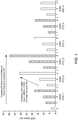
- the dye used was naphthol green B, and the concentration of dye used in this example was 1.25 wt%. Essentially, the longer the time it takes the solution to penetrate onto the back side of the media, the better the water holdout performance. The results of this test are provided in FIG.
- the first bar depicts the data for the uncoated thin paper substrate as baseline, i.e. less than 5 seconds.
- the next three bars labeled PTC 1 (or pre-treatment coating 1) in FIG. 1 correspond to the use of the C1 pre-treatment coating taken from Table 1 with coating weights of 1, 2, and 3 GSM. As can be seen, the addition of the pre-treatment coating increased the HST value substantially.
- the remaining bars depict HST values for the remaining pre-treatment coatings of Table 1 applied at various thicknesses.
- the water holding agent which in these examples was a starch
- the pre-treatment coating interacted with the water and slowed its penetration into and through the paper.
- Any increased value in holdout time using the Hercules Sizing Test ( ⁇ HST measured in seconds) compared to the holdout time of untreated paper indicated that water holding agent is slowing the penetration into the paper.
- Increasing the amount of the water holding agent, either through higher coat weight applied, or higher concentration in the pre-treatment coating, or a combination of these two methods when applied to the paper can increase the ⁇ HST, slowing water penetration.
- the increase of holdout time compared to the thin paper substrate without a pre-treatment coating was shown to be as high as a ⁇ HST of about 35 seconds in one example.
- a ⁇ HST of about 3 seconds (which represents 3 seconds before the water reaches the base substrate) was achieved.
- slowing the water penetration through a pre-treatment coating can be favorable to merely slowing water penetration through the paper fibers per se , although both can lead to increased water holdout time.
- the slower penetration of the formic acid solutions (as well as aqueous inkjet inks) through the pre-treatment coating can lead to less water reaching the paper fibers in the first place, providing benefits including reducing paper cockle induced by wetting of the fibers.
- a thin paper substrate (45 pound Appleton Coated Utopia 3) was coated with a coating composition of Example 1 (specifically pre-treating coating C1 was used) at two different coat weights (1.5 GSM and 0.8 GSM).
- a media substrate from the same company, but which is specifically designed for inkjet ink printing was also obtained for testing (45 pound Appleton Coated InkJet), as a commercially available inkjet paper would be expected to perform acceptably with inkjet inks.
- a checkerboard pattern was printed using an HP Inkjet Web Press using a commercially available ink available from Hewlett Packard Company having Part No.
- Two formulations were prepared that included polyvinyl alcohol (Weight Average Molecular Weight: 205,000 Mw and 27,000 Mw) samples at 20 parts by weight admixed with precipitated calcium carbonate at 100 parts by weight for the purpose of testing water holdout of these two polyvinyl alcohol samples.
- These pre-treatment coatings were applied to a thin paper substrate (40 Pound Appleton Coated Utopia Book Text Paper; 60 GSM) at coat weights of 1 GSM, 2 GSM, 4 GSM, and 6 GSM.
- the paper without a pre-treatment coating had an HST value of 6.7.
- the average ⁇ HST value for the 205K PVA was as follows: A 1 GSM applied pre-treatment coating weight resulted in a ⁇ HST value of 6.8; A 2 GSM applied coating weight resulted in a ⁇ HST value of 15.8; A 4 GSM applied coating weight resulted in a ⁇ HST value of 34.1; and A 6 GSM applied coating weight resulted in a ⁇ HST value of 48.4.
- the average ⁇ HST value for the 27K Mw PVA was as follows: A 1 GSM applied coating weight resulted in a ⁇ HST value of 9.12; A 2 GSM applied coating weight resulted in a ⁇ HST value of 20.8; A 4 GSM applied coating weight resulted in a ⁇ HST value of 31.9; and A 6 GSM applied coating weight resulted in a ⁇ HST value of 40.4. As can be seen from these values, the water holdout time for PVA is comparable in effectiveness to the starches tested in Example 2.
Landscapes
- Chemical & Material Sciences (AREA)
- Inorganic Chemistry (AREA)
- Chemical Kinetics & Catalysis (AREA)
- Health & Medical Sciences (AREA)
- Life Sciences & Earth Sciences (AREA)
- General Health & Medical Sciences (AREA)
- Molecular Biology (AREA)
- Ink Jet Recording Methods And Recording Media Thereof (AREA)
- Application Of Or Painting With Fluid Materials (AREA)
- Paper (AREA)
Claims (12)
- Druckmedium, Folgendes umfassend:ein dünnes Papiersubstrat mit einem Basisgewicht im Bereich von 40 GMS bis 150 GSM; undeine Vorbehandlungsbeschichtung, die auf das dünne Papiersubstrat mit von 0,3 GSM bis 15 GSM aufgebracht ist, wobei die Vorbehandlungsbeschichtung Folgendes umfasst:von 10 Gew.-% bis 80 Gew.-% eines Fixiermittels;von 3 Gew.-% bis 50 Gew.-% eines Latexpolymers, von 5 Gew.-% bis 30 Gew.-% eines Wachses undvon 5 Gew.-% bis 50 Gew.-% eines Wasserhaltemittels, wobei das Haltemittel ein Polyacrylat, eine Cellulose, eine Stärke, ein Silicagel, ein Derivat davon oder eine Kombination davon ist.
- Druckmedium nach Anspruch 1, wobei das Wasserhaltemittel eine Stärke ist.
- Druckmedium nach Anspruch 1, wobei das Fixiermittel ein polyvalentes Salz ist.
- Druckmedium nach Anspruch 1, wobei das Latexpolymer aus der Gruppe aus Polyacrylaten, Polyvinylen, Polyurethanen, Ethylenvinylacetaten, Styrolacrylcopolymeren, Styrolbutadienen, Polymethacrylaten, Polyacrylsäuren, Polymethacrylsäuren und Kombinationen davon ausgewählt ist.
- Druckmedium nach Anspruch 1, wobei das dünne Papiersubstrat ein unbeschichtetes oder beschichtetes Papier auf Holzfaserstoffbasis ist.
- Druckmedium nach Anspruch 1 mit einem Anstieg des gemessenen Wertes für einen Hercules-Dimensionierungstest, oder ΔHST, von 2 Sekunden, wobei das dünne Papiersubstrat nach dem Beschichten mit dem Papiermedium verglichen wird.
- Druckmedium nach Anspruch 1, wobei das dünne Papiersubstrat ein Basisgewicht im Bereich von 40 GSM bis 100 GSM aufweist.
- Gedrucktes Erzeugnis, Folgendes umfassend:ein dünnes Papiersubstrat mit einem Basisgewicht von 40 GSM bis 150 GSM;eine auf das dünne Papiersubstrat aufgebrachte Vorbehandlungsbeschichtung mit von 0,3 GSM bis 15 GSM, wobei die Vorbehandlungsbeschichtung von 10 Gew.-% bis 80 Gew.-% eines Fixiermittels, von 3 Gew.-% bis 50 Gew.-% eines Latexpolymers, von 5 Gew.-% bis 30 Gew.-% eines Wachses und 5 Gew.-% bis 50 Gew.-% eines Wasserhaltemittels umfasst, wobei das Haltemittel ein Polyacrylat, eine Cellulose, eine Stärke, ein Silicagel, ein Derivat davon oder eine Kombination davon ist; undeine wässrige Tintenstrahltinte, die auf die Vorbehandlungsbeschichtung gedruckt ist, wobei das gedruckte Erzeugnis nach dem Trocknen der wässrigen Tintenstrahltinte nicht mehr als eine 1,5 mm Höhendifferenz zwischen unbedruckten Bereichen und bedruckten Bereichen aufzeigt.
- Bedrucktes Erzeugnis nach Anspruch 8, wobei das gedruckte Erzeugnis nicht mehr als eine 1,0 mm Höhendifferenz zwischen unbedruckten Bereichen und bedruckten Bereichen aufzeigt.
- Tintenstrahldruckverfahren, Folgendes umfassend:Tintenstrahldrucken einer wässrigen Tintenstrahltinte auf ein Druckmedium, wobei das Druckmedium ein dünnes Papiersubstrat mit einem Basisgewicht von 40 GSM bis 150 GSM und eine auf das dünne Papiersubstrat aufgebrachten Vorbehandlungsbeschichtung mit von 0,3 GSM bis 15 GSM umfasst, wobei die Vorbehandlungsbeschichtung von 10 Gew.-% bis 80 Gew.-% eines Fixiermittels, von 3 Gew.-% bis 50 Gew.-% eines Latexpolymers, von 5 Gew.-% bis 30 Gew.-% eines Wachses und 5 Gew.-% bis 50 Gew.-% eines Wasserhaltemittels umfasst, wobei das Haltemittel ein Polyacrylat, eine Cellulose, eine Stärke, ein Silicagel, ein Derivat davon oder eine Kombination davon ist;Halten der wässrigen Tintenstrahltinte in der Vorbehandlungsbeschichtung über einen Zeitraum, bevor ein verdampfbares Lösungsmittel aus der Tintenstrahltinte das dünne Papiersubstrat berührt; undBeginnen des Trocknens der Tinte unter Verwendung eines Heizelements, bevor der Zeitraum abläuft.
- Verfahren nach Anspruch 10, wobei der Schritt des Beginnens des Trocknens der Tintenstrahltinte innerhalb von 3 Sekunden auftritt.
- Verfahren nach Anspruch 10, wobei der Schritt des Haltens der wässrigen Tintenstrahltinte wenigstens 2 Sekunden beträgt.
Applications Claiming Priority (1)
| Application Number | Priority Date | Filing Date | Title |
|---|---|---|---|
| PCT/US2014/038715 WO2015178891A1 (en) | 2014-05-20 | 2014-05-20 | Print medium |
Publications (3)
| Publication Number | Publication Date |
|---|---|
| EP3145727A4 EP3145727A4 (de) | 2017-03-29 |
| EP3145727A1 EP3145727A1 (de) | 2017-03-29 |
| EP3145727B1 true EP3145727B1 (de) | 2019-08-14 |
Family
ID=54554420
Family Applications (1)
| Application Number | Title | Priority Date | Filing Date |
|---|---|---|---|
| EP14892852.6A Active EP3145727B1 (de) | 2014-05-20 | 2014-05-20 | Druckmedium |
Country Status (3)
| Country | Link |
|---|---|
| US (1) | US10071585B2 (de) |
| EP (1) | EP3145727B1 (de) |
| WO (1) | WO2015178891A1 (de) |
Families Citing this family (3)
| Publication number | Priority date | Publication date | Assignee | Title |
|---|---|---|---|---|
| EP3507752A4 (de) | 2016-08-17 | 2019-11-27 | Maman, Arnon | Zählerablesevorrichtung und -system |
| US11767445B2 (en) | 2019-09-12 | 2023-09-26 | Hewlett-Packard Development Company, L.P. | Pre-treatments for packaging print media |
| EP4373896B1 (de) * | 2021-07-19 | 2024-12-25 | Agfa Nv | Vorbehandlungszusammensetzung für tintenstrahldruck |
Family Cites Families (17)
| Publication number | Priority date | Publication date | Assignee | Title |
|---|---|---|---|---|
| US6140406A (en) | 1996-06-28 | 2000-10-31 | Consolidated Papers, Inc. | High solids interactive coating composition, ink jet recording medium, and method |
| EP1184191A1 (de) * | 2000-09-04 | 2002-03-06 | Stora Enso North America Corporation | Interaktive Beschichtungszusammensetzung mit hohem Feststoffanteil, Tintenstrahlaufzeichnungsmedium und Herstellungsverfahren derselben |
| US20020182376A1 (en) | 2001-03-27 | 2002-12-05 | Debabrata Mukherjee | Novel universal ink jet recording medium |
| US20100233391A1 (en) | 2006-01-30 | 2010-09-16 | Yasuyuki Kumada | Ink- Jet Recording Medium |
| US20070237910A1 (en) * | 2006-04-07 | 2007-10-11 | Xiaoqi Zhou | Media sheet |
| US8425993B2 (en) | 2006-10-03 | 2013-04-23 | Hewlett-Packard Development Company, L.P. | Print media and methods for making the same |
| JP5106246B2 (ja) * | 2008-05-23 | 2012-12-26 | 富士フイルム株式会社 | インクジェット記録方法及び装置 |
| WO2009146416A1 (en) | 2008-05-29 | 2009-12-03 | International Paper Company | Fast dry coated inkjet paper |
| KR101595251B1 (ko) * | 2008-12-08 | 2016-02-18 | 삼성전자주식회사 | 전자사진용 토너 및 그의 제조 방법 |
| US20100159164A1 (en) | 2008-12-18 | 2010-06-24 | Zhiyi Zhang | Inkjet printing paper |
| EP2414171B1 (de) * | 2009-04-03 | 2016-03-23 | Hewlett-Packard Development Company, L.P. | Medien für tintestrahlrollendruck |
| KR20110021201A (ko) | 2009-08-25 | 2011-03-04 | 삼성전자주식회사 | 잉크젯 기록장치용 코팅액, 상기 잉크젯 기록장치용 코팅액 및 잉크 조성물을 포함하는 잉크 세트, 및 상기 잉크 세트를 포함하는 잉크젯 기록장치 |
| JP5592995B2 (ja) | 2010-06-14 | 2014-09-17 | ヒューレット−パッカード デベロップメント カンパニー エル.ピー. | 前処理組成物 |
| US9278515B2 (en) * | 2010-06-14 | 2016-03-08 | Hewlett-Packard Development Company, L.P. | Printing method |
| JP4956666B2 (ja) | 2010-08-04 | 2012-06-20 | 大日本印刷株式会社 | インクジェット記録方法 |
| KR102049349B1 (ko) * | 2012-04-13 | 2019-12-04 | 벌소우 페이퍼 홀딩 엘엘씨 | 잉크젯 인쇄용 기록 매체 |
| US9067448B2 (en) * | 2012-05-02 | 2015-06-30 | Eastman Kodak Company | Pre-treatment composition for inkjet printing |
-
2014
- 2014-05-20 EP EP14892852.6A patent/EP3145727B1/de active Active
- 2014-05-20 US US15/303,115 patent/US10071585B2/en active Active
- 2014-05-20 WO PCT/US2014/038715 patent/WO2015178891A1/en not_active Ceased
Non-Patent Citations (1)
| Title |
|---|
| None * |
Also Published As
| Publication number | Publication date |
|---|---|
| WO2015178891A1 (en) | 2015-11-26 |
| EP3145727A4 (de) | 2017-03-29 |
| US20170036473A1 (en) | 2017-02-09 |
| US10071585B2 (en) | 2018-09-11 |
| EP3145727A1 (de) | 2017-03-29 |
Similar Documents
| Publication | Publication Date | Title |
|---|---|---|
| EP2762533B1 (de) | Vorbehandlungsbeschichtung | |
| EP2951026B1 (de) | Vorbehandlungsbeschichtung | |
| EP2762534B1 (de) | Vorbehandlungsbeschichtung | |
| EP2951253B1 (de) | Quellbare vorbehandlungsbeschichtung | |
| US10414937B2 (en) | Pre-treatment coating compositions | |
| EP3265320B1 (de) | Grundierungszusammensetzungen | |
| EP3145727B1 (de) | Druckmedium | |
| EP3265319B1 (de) | Grundierungszusammensetzungen | |
| US20180086935A1 (en) | Primer compositions | |
| US10759963B2 (en) | Pre-treatment coating compositions | |
| US11767445B2 (en) | Pre-treatments for packaging print media | |
| EP3294561B1 (de) | Dimensionierungszusammensetzungen | |
| EP3908413B1 (de) | Bedruckbares aufzeichnungsmedium | |
| EP2109544A1 (de) | Verfahren zur herstellung von druckpapier und gemischzusammensetzung | |
| JP2006168145A (ja) | インクジェット記録シート |
Legal Events
| Date | Code | Title | Description |
|---|---|---|---|
| STAA | Information on the status of an ep patent application or granted ep patent |
Free format text: STATUS: THE INTERNATIONAL PUBLICATION HAS BEEN MADE |
|
| PUAI | Public reference made under article 153(3) epc to a published international application that has entered the european phase |
Free format text: ORIGINAL CODE: 0009012 |
|
| STAA | Information on the status of an ep patent application or granted ep patent |
Free format text: STATUS: REQUEST FOR EXAMINATION WAS MADE |
|
| 17P | Request for examination filed |
Effective date: 20161007 |
|
| A4 | Supplementary search report drawn up and despatched |
Effective date: 20170215 |
|
| AK | Designated contracting states |
Kind code of ref document: A1 Designated state(s): AL AT BE BG CH CY CZ DE DK EE ES FI FR GB GR HR HU IE IS IT LI LT LU LV MC MK MT NL NO PL PT RO RS SE SI SK SM TR |
|
| AX | Request for extension of the european patent |
Extension state: BA ME |
|
| DAX | Request for extension of the european patent (deleted) | ||
| STAA | Information on the status of an ep patent application or granted ep patent |
Free format text: STATUS: EXAMINATION IS IN PROGRESS |
|
| 17Q | First examination report despatched |
Effective date: 20171123 |
|
| GRAP | Despatch of communication of intention to grant a patent |
Free format text: ORIGINAL CODE: EPIDOSNIGR1 |
|
| STAA | Information on the status of an ep patent application or granted ep patent |
Free format text: STATUS: GRANT OF PATENT IS INTENDED |
|
| INTG | Intention to grant announced |
Effective date: 20190308 |
|
| RAP1 | Party data changed (applicant data changed or rights of an application transferred) |
Owner name: HEWLETT-PACKARD DEVELOPMENT COMPANY, L.P. |
|
| GRAS | Grant fee paid |
Free format text: ORIGINAL CODE: EPIDOSNIGR3 |
|
| GRAA | (expected) grant |
Free format text: ORIGINAL CODE: 0009210 |
|
| STAA | Information on the status of an ep patent application or granted ep patent |
Free format text: STATUS: THE PATENT HAS BEEN GRANTED |
|
| AK | Designated contracting states |
Kind code of ref document: B1 Designated state(s): AL AT BE BG CH CY CZ DE DK EE ES FI FR GB GR HR HU IE IS IT LI LT LU LV MC MK MT NL NO PL PT RO RS SE SI SK SM TR |
|
| REG | Reference to a national code |
Ref country code: GB Ref legal event code: FG4D |
|
| REG | Reference to a national code |
Ref country code: CH Ref legal event code: EP Ref country code: AT Ref legal event code: REF Ref document number: 1166570 Country of ref document: AT Kind code of ref document: T Effective date: 20190815 |
|
| REG | Reference to a national code |
Ref country code: IE Ref legal event code: FG4D |
|
| REG | Reference to a national code |
Ref country code: DE Ref legal event code: R096 Ref document number: 602014051968 Country of ref document: DE |
|
| REG | Reference to a national code |
Ref country code: NL Ref legal event code: MP Effective date: 20190814 |
|
| REG | Reference to a national code |
Ref country code: LT Ref legal event code: MG4D |
|
| PG25 | Lapsed in a contracting state [announced via postgrant information from national office to epo] |
Ref country code: PT Free format text: LAPSE BECAUSE OF FAILURE TO SUBMIT A TRANSLATION OF THE DESCRIPTION OR TO PAY THE FEE WITHIN THE PRESCRIBED TIME-LIMIT Effective date: 20191216 Ref country code: BG Free format text: LAPSE BECAUSE OF FAILURE TO SUBMIT A TRANSLATION OF THE DESCRIPTION OR TO PAY THE FEE WITHIN THE PRESCRIBED TIME-LIMIT Effective date: 20191114 Ref country code: SE Free format text: LAPSE BECAUSE OF FAILURE TO SUBMIT A TRANSLATION OF THE DESCRIPTION OR TO PAY THE FEE WITHIN THE PRESCRIBED TIME-LIMIT Effective date: 20190814 Ref country code: NO Free format text: LAPSE BECAUSE OF FAILURE TO SUBMIT A TRANSLATION OF THE DESCRIPTION OR TO PAY THE FEE WITHIN THE PRESCRIBED TIME-LIMIT Effective date: 20191114 Ref country code: FI Free format text: LAPSE BECAUSE OF FAILURE TO SUBMIT A TRANSLATION OF THE DESCRIPTION OR TO PAY THE FEE WITHIN THE PRESCRIBED TIME-LIMIT Effective date: 20190814 Ref country code: NL Free format text: LAPSE BECAUSE OF FAILURE TO SUBMIT A TRANSLATION OF THE DESCRIPTION OR TO PAY THE FEE WITHIN THE PRESCRIBED TIME-LIMIT Effective date: 20190814 Ref country code: HR Free format text: LAPSE BECAUSE OF FAILURE TO SUBMIT A TRANSLATION OF THE DESCRIPTION OR TO PAY THE FEE WITHIN THE PRESCRIBED TIME-LIMIT Effective date: 20190814 Ref country code: LT Free format text: LAPSE BECAUSE OF FAILURE TO SUBMIT A TRANSLATION OF THE DESCRIPTION OR TO PAY THE FEE WITHIN THE PRESCRIBED TIME-LIMIT Effective date: 20190814 |
|
| REG | Reference to a national code |
Ref country code: AT Ref legal event code: MK05 Ref document number: 1166570 Country of ref document: AT Kind code of ref document: T Effective date: 20190814 |
|
| PG25 | Lapsed in a contracting state [announced via postgrant information from national office to epo] |
Ref country code: AL Free format text: LAPSE BECAUSE OF FAILURE TO SUBMIT A TRANSLATION OF THE DESCRIPTION OR TO PAY THE FEE WITHIN THE PRESCRIBED TIME-LIMIT Effective date: 20190814 Ref country code: ES Free format text: LAPSE BECAUSE OF FAILURE TO SUBMIT A TRANSLATION OF THE DESCRIPTION OR TO PAY THE FEE WITHIN THE PRESCRIBED TIME-LIMIT Effective date: 20190814 Ref country code: GR Free format text: LAPSE BECAUSE OF FAILURE TO SUBMIT A TRANSLATION OF THE DESCRIPTION OR TO PAY THE FEE WITHIN THE PRESCRIBED TIME-LIMIT Effective date: 20191115 Ref country code: LV Free format text: LAPSE BECAUSE OF FAILURE TO SUBMIT A TRANSLATION OF THE DESCRIPTION OR TO PAY THE FEE WITHIN THE PRESCRIBED TIME-LIMIT Effective date: 20190814 Ref country code: RS Free format text: LAPSE BECAUSE OF FAILURE TO SUBMIT A TRANSLATION OF THE DESCRIPTION OR TO PAY THE FEE WITHIN THE PRESCRIBED TIME-LIMIT Effective date: 20190814 Ref country code: IS Free format text: LAPSE BECAUSE OF FAILURE TO SUBMIT A TRANSLATION OF THE DESCRIPTION OR TO PAY THE FEE WITHIN THE PRESCRIBED TIME-LIMIT Effective date: 20191214 |
|
| PG25 | Lapsed in a contracting state [announced via postgrant information from national office to epo] |
Ref country code: TR Free format text: LAPSE BECAUSE OF FAILURE TO SUBMIT A TRANSLATION OF THE DESCRIPTION OR TO PAY THE FEE WITHIN THE PRESCRIBED TIME-LIMIT Effective date: 20190814 |
|
| PG25 | Lapsed in a contracting state [announced via postgrant information from national office to epo] |
Ref country code: PL Free format text: LAPSE BECAUSE OF FAILURE TO SUBMIT A TRANSLATION OF THE DESCRIPTION OR TO PAY THE FEE WITHIN THE PRESCRIBED TIME-LIMIT Effective date: 20190814 Ref country code: EE Free format text: LAPSE BECAUSE OF FAILURE TO SUBMIT A TRANSLATION OF THE DESCRIPTION OR TO PAY THE FEE WITHIN THE PRESCRIBED TIME-LIMIT Effective date: 20190814 Ref country code: DK Free format text: LAPSE BECAUSE OF FAILURE TO SUBMIT A TRANSLATION OF THE DESCRIPTION OR TO PAY THE FEE WITHIN THE PRESCRIBED TIME-LIMIT Effective date: 20190814 Ref country code: IT Free format text: LAPSE BECAUSE OF FAILURE TO SUBMIT A TRANSLATION OF THE DESCRIPTION OR TO PAY THE FEE WITHIN THE PRESCRIBED TIME-LIMIT Effective date: 20190814 Ref country code: RO Free format text: LAPSE BECAUSE OF FAILURE TO SUBMIT A TRANSLATION OF THE DESCRIPTION OR TO PAY THE FEE WITHIN THE PRESCRIBED TIME-LIMIT Effective date: 20190814 Ref country code: AT Free format text: LAPSE BECAUSE OF FAILURE TO SUBMIT A TRANSLATION OF THE DESCRIPTION OR TO PAY THE FEE WITHIN THE PRESCRIBED TIME-LIMIT Effective date: 20190814 |
|
| PG25 | Lapsed in a contracting state [announced via postgrant information from national office to epo] |
Ref country code: CZ Free format text: LAPSE BECAUSE OF FAILURE TO SUBMIT A TRANSLATION OF THE DESCRIPTION OR TO PAY THE FEE WITHIN THE PRESCRIBED TIME-LIMIT Effective date: 20190814 Ref country code: SM Free format text: LAPSE BECAUSE OF FAILURE TO SUBMIT A TRANSLATION OF THE DESCRIPTION OR TO PAY THE FEE WITHIN THE PRESCRIBED TIME-LIMIT Effective date: 20190814 Ref country code: IS Free format text: LAPSE BECAUSE OF FAILURE TO SUBMIT A TRANSLATION OF THE DESCRIPTION OR TO PAY THE FEE WITHIN THE PRESCRIBED TIME-LIMIT Effective date: 20200224 Ref country code: SK Free format text: LAPSE BECAUSE OF FAILURE TO SUBMIT A TRANSLATION OF THE DESCRIPTION OR TO PAY THE FEE WITHIN THE PRESCRIBED TIME-LIMIT Effective date: 20190814 |
|
| REG | Reference to a national code |
Ref country code: DE Ref legal event code: R097 Ref document number: 602014051968 Country of ref document: DE |
|
| PLBE | No opposition filed within time limit |
Free format text: ORIGINAL CODE: 0009261 |
|
| STAA | Information on the status of an ep patent application or granted ep patent |
Free format text: STATUS: NO OPPOSITION FILED WITHIN TIME LIMIT |
|
| PG2D | Information on lapse in contracting state deleted |
Ref country code: IS |
|
| 26N | No opposition filed |
Effective date: 20200603 |
|
| PG25 | Lapsed in a contracting state [announced via postgrant information from national office to epo] |
Ref country code: SI Free format text: LAPSE BECAUSE OF FAILURE TO SUBMIT A TRANSLATION OF THE DESCRIPTION OR TO PAY THE FEE WITHIN THE PRESCRIBED TIME-LIMIT Effective date: 20190814 |
|
| PG25 | Lapsed in a contracting state [announced via postgrant information from national office to epo] |
Ref country code: CH Free format text: LAPSE BECAUSE OF NON-PAYMENT OF DUE FEES Effective date: 20200531 Ref country code: MC Free format text: LAPSE BECAUSE OF FAILURE TO SUBMIT A TRANSLATION OF THE DESCRIPTION OR TO PAY THE FEE WITHIN THE PRESCRIBED TIME-LIMIT Effective date: 20190814 Ref country code: LI Free format text: LAPSE BECAUSE OF NON-PAYMENT OF DUE FEES Effective date: 20200531 |
|
| REG | Reference to a national code |
Ref country code: BE Ref legal event code: MM Effective date: 20200531 |
|
| PG25 | Lapsed in a contracting state [announced via postgrant information from national office to epo] |
Ref country code: LU Free format text: LAPSE BECAUSE OF NON-PAYMENT OF DUE FEES Effective date: 20200520 |
|
| PG25 | Lapsed in a contracting state [announced via postgrant information from national office to epo] |
Ref country code: IE Free format text: LAPSE BECAUSE OF NON-PAYMENT OF DUE FEES Effective date: 20200520 |
|
| PG25 | Lapsed in a contracting state [announced via postgrant information from national office to epo] |
Ref country code: BE Free format text: LAPSE BECAUSE OF NON-PAYMENT OF DUE FEES Effective date: 20200531 |
|
| PG25 | Lapsed in a contracting state [announced via postgrant information from national office to epo] |
Ref country code: MT Free format text: LAPSE BECAUSE OF FAILURE TO SUBMIT A TRANSLATION OF THE DESCRIPTION OR TO PAY THE FEE WITHIN THE PRESCRIBED TIME-LIMIT Effective date: 20190814 Ref country code: CY Free format text: LAPSE BECAUSE OF FAILURE TO SUBMIT A TRANSLATION OF THE DESCRIPTION OR TO PAY THE FEE WITHIN THE PRESCRIBED TIME-LIMIT Effective date: 20190814 |
|
| PG25 | Lapsed in a contracting state [announced via postgrant information from national office to epo] |
Ref country code: MK Free format text: LAPSE BECAUSE OF FAILURE TO SUBMIT A TRANSLATION OF THE DESCRIPTION OR TO PAY THE FEE WITHIN THE PRESCRIBED TIME-LIMIT Effective date: 20190814 |
|
| PGFP | Annual fee paid to national office [announced via postgrant information from national office to epo] |
Ref country code: FR Payment date: 20230420 Year of fee payment: 10 Ref country code: DE Payment date: 20230419 Year of fee payment: 10 |
|
| PGFP | Annual fee paid to national office [announced via postgrant information from national office to epo] |
Ref country code: GB Payment date: 20230420 Year of fee payment: 10 |
|
| REG | Reference to a national code |
Ref country code: DE Ref legal event code: R119 Ref document number: 602014051968 Country of ref document: DE |
|
| GBPC | Gb: european patent ceased through non-payment of renewal fee |
Effective date: 20240520 |
|
| PG25 | Lapsed in a contracting state [announced via postgrant information from national office to epo] |
Ref country code: DE Free format text: LAPSE BECAUSE OF NON-PAYMENT OF DUE FEES Effective date: 20241203 |
|
| PG25 | Lapsed in a contracting state [announced via postgrant information from national office to epo] |
Ref country code: FR Free format text: LAPSE BECAUSE OF NON-PAYMENT OF DUE FEES Effective date: 20240531 |
|
| PG25 | Lapsed in a contracting state [announced via postgrant information from national office to epo] |
Ref country code: GB Free format text: LAPSE BECAUSE OF NON-PAYMENT OF DUE FEES Effective date: 20240520 |