EP3146228B2 - Support de frein - Google Patents
Support de frein Download PDFInfo
- Publication number
- EP3146228B2 EP3146228B2 EP15723909.6A EP15723909A EP3146228B2 EP 3146228 B2 EP3146228 B2 EP 3146228B2 EP 15723909 A EP15723909 A EP 15723909A EP 3146228 B2 EP3146228 B2 EP 3146228B2
- Authority
- EP
- European Patent Office
- Prior art keywords
- engagement
- section
- guide
- carrier unit
- axis
- Prior art date
- Legal status (The legal status is an assumption and is not a legal conclusion. Google has not performed a legal analysis and makes no representation as to the accuracy of the status listed.)
- Active
Links
Images

Classifications
-
- B—PERFORMING OPERATIONS; TRANSPORTING
- B60—VEHICLES IN GENERAL
- B60T—VEHICLE BRAKE CONTROL SYSTEMS OR PARTS THEREOF; BRAKE CONTROL SYSTEMS OR PARTS THEREOF, IN GENERAL; ARRANGEMENT OF BRAKING ELEMENTS ON VEHICLES IN GENERAL; PORTABLE DEVICES FOR PREVENTING UNWANTED MOVEMENT OF VEHICLES; VEHICLE MODIFICATIONS TO FACILITATE COOLING OF BRAKES
- B60T17/00—Component parts, details, or accessories of power brake systems not covered by groups B60T8/00, B60T13/00 or B60T15/00, or presenting other characteristic features
- B60T17/08—Brake cylinders other than ultimate actuators
- B60T17/088—Mounting arrangements
-
- F—MECHANICAL ENGINEERING; LIGHTING; HEATING; WEAPONS; BLASTING
- F16—ENGINEERING ELEMENTS AND UNITS; GENERAL MEASURES FOR PRODUCING AND MAINTAINING EFFECTIVE FUNCTIONING OF MACHINES OR INSTALLATIONS; THERMAL INSULATION IN GENERAL
- F16D—COUPLINGS FOR TRANSMITTING ROTATION; CLUTCHES; BRAKES
- F16D65/00—Parts or details
- F16D65/02—Braking members; Mounting thereof
-
- F—MECHANICAL ENGINEERING; LIGHTING; HEATING; WEAPONS; BLASTING
- F16—ENGINEERING ELEMENTS AND UNITS; GENERAL MEASURES FOR PRODUCING AND MAINTAINING EFFECTIVE FUNCTIONING OF MACHINES OR INSTALLATIONS; THERMAL INSULATION IN GENERAL
- F16D—COUPLINGS FOR TRANSMITTING ROTATION; CLUTCHES; BRAKES
- F16D51/00—Brakes with outwardly-movable braking members co-operating with the inner surface of a drum or the like
-
- B—PERFORMING OPERATIONS; TRANSPORTING
- B60—VEHICLES IN GENERAL
- B60T—VEHICLE BRAKE CONTROL SYSTEMS OR PARTS THEREOF; BRAKE CONTROL SYSTEMS OR PARTS THEREOF, IN GENERAL; ARRANGEMENT OF BRAKING ELEMENTS ON VEHICLES IN GENERAL; PORTABLE DEVICES FOR PREVENTING UNWANTED MOVEMENT OF VEHICLES; VEHICLE MODIFICATIONS TO FACILITATE COOLING OF BRAKES
- B60T1/00—Arrangements of braking elements, i.e. of those parts where braking effect occurs specially for vehicles
-
- B—PERFORMING OPERATIONS; TRANSPORTING
- B60—VEHICLES IN GENERAL
- B60T—VEHICLE BRAKE CONTROL SYSTEMS OR PARTS THEREOF; BRAKE CONTROL SYSTEMS OR PARTS THEREOF, IN GENERAL; ARRANGEMENT OF BRAKING ELEMENTS ON VEHICLES IN GENERAL; PORTABLE DEVICES FOR PREVENTING UNWANTED MOVEMENT OF VEHICLES; VEHICLE MODIFICATIONS TO FACILITATE COOLING OF BRAKES
- B60T17/00—Component parts, details, or accessories of power brake systems not covered by groups B60T8/00, B60T13/00 or B60T15/00, or presenting other characteristic features
-
- F—MECHANICAL ENGINEERING; LIGHTING; HEATING; WEAPONS; BLASTING
- F16—ENGINEERING ELEMENTS AND UNITS; GENERAL MEASURES FOR PRODUCING AND MAINTAINING EFFECTIVE FUNCTIONING OF MACHINES OR INSTALLATIONS; THERMAL INSULATION IN GENERAL
- F16D—COUPLINGS FOR TRANSMITTING ROTATION; CLUTCHES; BRAKES
- F16D65/00—Parts or details
- F16D65/005—Components of axially engaging brakes not otherwise provided for
- F16D65/0056—Brake supports
-
- F—MECHANICAL ENGINEERING; LIGHTING; HEATING; WEAPONS; BLASTING
- F16—ENGINEERING ELEMENTS AND UNITS; GENERAL MEASURES FOR PRODUCING AND MAINTAINING EFFECTIVE FUNCTIONING OF MACHINES OR INSTALLATIONS; THERMAL INSULATION IN GENERAL
- F16D—COUPLINGS FOR TRANSMITTING ROTATION; CLUTCHES; BRAKES
- F16D51/00—Brakes with outwardly-movable braking members co-operating with the inner surface of a drum or the like
- F16D2051/001—Parts or details of drum brakes
- F16D2051/003—Brake supports
Definitions
- the present invention relates to a carrier unit for use in braking systems of motor vehicles, preferably commercial vehicles.
- Carrier units are known from the prior art in that cast brake carriers are usually provided, to which the various assemblies of the vehicle brake can be fixed and are connected to, for example, the axle via the brake carrier.
- the brake carriers known from the prior art generally have the disadvantage that they are heavy and require a lot of assembly effort due to the large number of components to be assembled.
- These additional adapter elements increase the installation space requirement and, on the other hand, also create a large number of vulnerable connection points through which, for example, dirt and liquids can get into the interior of the expanding wedge unit. There is therefore a significant need for improvement in terms of compactness, susceptibility to errors and the assembly of a braking system.
- the WO 2013/087737 A1 shows a brake carrier of a drum brake with a carrier unit which has a first connection section on which a brake cylinder can be fixed and has a second connection section on which a converter unit can be fixed.
- the US-5,613,577 A shows a disc brake of a vehicle, which can be operated hydraulically.
- DE 25 50 855 A1 and WO 2013/087731 A1 show braking devices of drum brakes, in which an expanding wedge unit is attached to a chassis via a brake carrier.
- the object of the present invention is to provide a carrier unit which simplifies the assembly of the brake system, saves weight and installation space and reduces the susceptibility of the brake system to errors.
- the carrier unit comprises a first flange section, a second flange section and a guide section, the first flange section having a first engagement geometry for fixing the carrier unit on a chassis, the second flange section having a second engagement geometry for fixing a brake cylinder, the guide section being adjacent to the second Flange section is arranged and has a guide geometry for guiding a guide element along a guide axis, wherein an expanding wedge unit is provided adjacent to the guide section and wherein the expanding wedge unit has a housing which is formed in one piece with the guide section.
- An essential feature of the carrier unit is that an expanding wedge unit is formed integrally with the carrier unit, in particular the housing of the expanding wedge unit being formed in one piece with the correspondingly adjacent section of the carrier unit.
- the guide section of the carrier unit is provided adjacent to the housing of the carrier unit.
- the guide section is a section of the carrier unit which is at least partially hollow-body-shaped and in which a guide element is arranged such that it can be displaced along a guide axis.
- the guide element is particularly preferably used to transmit a braking force, which leads from a brake cylinder flanged to the second flange section to a corresponding expanding wedge mechanism, which is arranged in the expanding wedge unit.
- the guide section also has the function of shielding both the geometry of the expanding wedge unit and the guide element as well as the brake cylinder against the ingress of dirt, foreign bodies and liquids.
- the first flange section has a first engagement geometry for fixing the carrier unit to a chassis, the first engagement geometry preferably being a standardized engagement geometry which can be brought into engagement as standard on chassis of different commercial vehicles or commercial vehicle types.
- the second engagement geometry of the second flange section is also a standardized interface for defining a brake cylinder, which is characterized in particular by preferably two engagement geometries that are provided at a certain, standardized distance from one another.
- the carrier unit can therefore advantageously be integrated into existing brake systems, whereby the previously used brake cylinder can continue to be used.
- the second flange section is formed in one piece with the guide section.
- the second flange section is preferably designed as a one-piece cast part together with the guide section, whereby subsequent assembly of the second flange section on the guide section can advantageously be avoided and at the same time wall or cross-sectional geometries can be used which provide particularly good force transmission while at the same time being less Allow wall thickness. Due to the one-piece design of the second flange section and the guide section, the weight of the carrier unit can be reduced and the assembly effort for attaching a brake cylinder to the carrier unit can be significantly reduced because a fitter only has one component must handle.
- the carrier unit has a holding section which borders the first flange section and the guide section and extends essentially along a holding axis, wherein the first flange section, the holding section and the guide section are formed in one piece with one another.
- the holding section preferably serves to position the guide section and thus also the first flange section integrally connected to the guide section and the expanding wedge unit integrally connected to the guide section relative to the chassis.
- the holding section has an extension along a holding axis, the extension of the holding section along the holding axis, or parallel to the holding axis, preferably being its greatest extent.
- force flow-optimized outer geometries of the holding section are provided, that is to say preferably rounded outer geometries, on which advantageously only a slight notch effect occurs when the first flange section and the holding section are subjected to bending stress.
- the required wall thicknesses can be reduced, the weight can be reduced and the required forces and moments can still be transmitted.
- the holding axis is transverse, preferably perpendicular to the guide axis.
- the arrangement of the holding section with the resulting direction along which the holding axis runs defines a precise positioning of the force transmission direction from the brake cylinder to the expanding wedge unit.
- the vertical alignment of the holding section with its holding axis and the guide section with the guide axis to one another particularly preferably ensures a uniform force transmission in the event of bending stress, which is transmitted to the carrier unit by the relatively heavy brake cylinder or which is transmitted to the expanding wedge unit through vibrations, for example of the brake shoes.
- the first engagement geometry extends essentially along an engagement axis, with the holding axis being pivoted at an angle to the engagement axis and with the angle being less than 90°. It is further preferred that the engagement axis along which the engagement geometry extends or along which the engagement geometry can advantageously be brought into engagement with the chassis of a commercial vehicle is arranged essentially parallel to an axial direction of the chassis, for example parallel to the direction of rotation of the vehicle wheels .
- the term “substantially” means that smaller deviations, for example caused by manufacturing tolerances, are evaluated as parallel in the context of the present invention.
- the carrier unit is advantageously fixed to the chassis of the commercial vehicle along the engagement axis, which advantageously runs parallel to the axial direction, with particularly preferably good accessibility of the corresponding fastening means along the engagement axis. Furthermore, the holding axis is pivoted at an angle to the engagement axis, this angle being less than 90°. The angle is particularly preferably measured on the side of the carrier unit on which the expanding wedge unit is located.
- the holding axis By arranging the holding axis obliquely relative to the engagement axis, it is possible to allow the upper part of the carrier unit, that is to say the area consisting of the expanding wedge unit, guide section and second flange section, to protrude into the interior of a brake drum in order to engage the expanding wedge unit there with the respectively provided To be able to bring brake shoes.
- the brake cylinder is also arranged at a sufficient distance from the axis of the commercial vehicle, so that no damage occurs due to vibrations in the chassis system and contact between the brake cylinder and adjacent geometries of the chassis.
- the angle between the engagement axis and the holding axis is determined as an angle between the projections of the engagement axis and the holding axis on a cutting plane, preferably running through the guide section .
- the angle is in the range of 45° to 89°, preferably in the range of 60° to 85° and particularly preferably about 70° to 85°.
- the relatively wide range of 45° to 89° is preferred for carrier units that are designed to fix a particularly large number of different brake cylinders. It has been shown that in this range from 45° to 89°, all brake cylinders currently available on the market can be easily integrated into a brake system with a carrier unit according to the invention, without having to fear damage caused by hitting adjacent chassis geometries.
- the particularly preferred range of 60° to 85° has proven to be advantageous because in this way a particularly compact design of the carrier unit is achieved, on the one hand ensuring a sufficient distance between a brake cylinder fixed to the second flange section and the adjacent chassis geometries and on the other hand Extension of the holding section can be chosen to be relatively small and weight can be saved in this way.
- the particularly preferred range of 70° to 85° has proven to be advantageous for use with expanding wedge brake units, since an optimal arrangement of the upper region of the carrier unit relative to the first engagement geometry or relative to the first flange section can be achieved here, on the one hand while saving weight and, on the other hand, integrating a carrier unit into the braking system of a commercial vehicle with the simplest possible assembly.
- the first engagement geometry can advantageously be brought into positive engagement with a corresponding section of the chassis indirectly and/or directly.
- An indirect positive engagement is particularly preferably produced by a bolt or a screw connection.
- a direct form-fitting engagement can preferably be produced by a projection on the first flange section or the first engagement geometry, which engages in a form-fitting manner in a corresponding recess geometry on the corresponding section of the chassis, for example to secure the carrier unit relative to the chassis against rotation about the engagement axis.
- a form-fitting connection of the carrier unit to the chassis is preferred in order, firstly, to ensure that the carrier unit can be dismantled from the chassis and, secondly, to be able to avoid the thermal stresses and structural damage that occur with a hitherto usual welded connection of the brake carrier to the chassis axle.
- a securing element which can be brought into positive engagement with the first engagement geometry along the engagement axis, the securing element being accessible from the side of the carrier unit on which the expanding wedge unit is located.
- the securing element is preferably a screw or a threaded bolt and is advantageously accessible from the side of the carrier unit on which the expanding wedge unit is located.
- the securing element is preferably accessible from the outside of the chassis, that is, after the wheel and the brake drum of the brake unit have been dismantled from the chassis, the carrier unit can be easily dismantled from the outside by loosening the securing element.
- the securing element can also be designed as a nut, which can be brought into engagement with a first engagement geometry designed, for example, as a threaded rod.
- a further securing element can be accessible from the side of the carrier unit on which the second flange section is located.
- the carrier unit can be dismantled from or mounted on the wheel or the brake drum of the brake system without prior dismantling, it is preferred to arrange the securing element on the side of the carrier unit on which the second flange section is located.
- the securing element is preferably accessible from the inside of the chassis, with the first flange section and the first engagement geometry advantageously being arranged away from the axle body and other components of the chassis in such a way that there is enough space for the use of a torque wrench or a compressed air-operated screwdriver is available.
- the first engagement geometry is particularly preferably designed as a threaded hole.
- the assembly of the carrier unit on the chassis of a commercial vehicle is simplified, since only one screw has to be brought into engagement with an engagement geometry in order to fix the carrier unit on the chassis.
- a self-locking ISO thread is advantageously provided as the thread type for the first engagement geometry.
- the first engagement geometry is preferably designed as a threaded bolt and is preferably designed in one piece with the first flange section. Even with this alternatively provided embodiment of the first engagement geometry, the number of individual parts required for assembly of the carrier unit can be reduced and thus not only weight but also assembly time can be saved.
- the first flange section has two engagement geometries which are arranged spaced apart from one another, the engagement axes of the respective engagement geometries running parallel to one another.
- at least two first engagement geometries are provided.
- the distance between the engagement geometries is preferably smaller than the extent of the holding section along the holding axis. This preferred dimensioning of the distance between the first engagement geometries relative to the extent of the one or at least two holding sections provided provides a favorable compromise between the weight resulting from the additional material and at the same time sufficiently securing the carrier unit against rotation relative to the chassis.
- Two holding sections are advantageously provided, which are separated from one another by a free space, the average cross-sectional area of the holding sections being in a ratio of 0.2 to 1.3, preferably from 0.3 to 0.9 and particularly preferably of approximately 0. 5 to 0.8 to the mean cross-sectional area of the free space.
- the average cross-sectional area of the holding sections is preferably the sum of the cross-sectional areas of the individual holding sections in a cross section through the carrier unit, in which the average cross-sectional thickness or width of the holding section is selected along the engagement axis the engagement geometry located adjacent to the holding section is present.
- the cross-sectional area of the free space is preferably determined in the same cutting plane through the carrier unit as the cross-sectional area of the holding sections.
- the ratio of the two cross-sectional areas to one another is an expression of how “solid” the holding sections are.
- the carrier unit is to have a relatively compact design, takes up little installation space and is to have a small distance between the holding sections from one another, the free space is relatively small compared to the holding sections, so that the ratio can increase up to 1.3.
- a range of approximately 0.5 to 0.8 has proven to be a favorable compromise between a lightweight design and a sufficiently high strength of the holding sections of the support unit, with the best results being achieved within the scope of the present invention in this ratio range.
- the housing of the expanding wedge unit is made of nodular cast iron.
- the design made of nodular cast iron allows, on the one hand, a precise design of the corresponding external or internal geometries of the expanding wedge unit and, on the other hand, a favorable connection by, for example, casting the housing of the expanding wedge unit onto the corresponding guide section of the carrier unit, which can be made from a cheaper, comparatively less solid material can be used as ductile iron.
- the entire carrier unit is designed together with the housing of the expanding wedge unit as a nodular cast iron component.
- the carrier unit advantageously has no more than four first engagement geometries, preferably no more than two first engagement geometries.
- the preferred reduction in the number of first engagement geometries reduces the assembly effort.
- the expanding wedge unit 8 with its housing 82 is only partially cut and otherwise shown in a very simplified manner.
- the carrier unit Adjacent to the housing 82 of the expanding wedge unit 8, the carrier unit has a guide section 26, in which a guide element 4 is displaceably arranged and guided along the guide axis F.
- the guide section 26 in particular has a guide geometry 27, which is particularly preferably designed as a cylindrical cavity in the guide section 26 and secures the guide element 4 against displacement transversely to the guide axis F and facilitates sliding of the guide element 4.
- the carrier unit 2 has a second flange section 24, on which a brake cylinder 6 can be fixed, or is preferably fixed.
- the housing 82 of the expanding wedge unit 8, the guide section 26 and the second flange section 24 are formed in one piece with a holding section 28, the holding section extending essentially along a holding axis H.
- the holding section 28 serves to position the upper part of the carrier unit 2 relative to a chassis of the commercial vehicle shown in the lower area of the picture.
- the carrier unit has a first flange section 22, which can be secured indirectly and/or directly to the chassis of the commercial vehicle via a first engagement geometry 23.
- the preferred embodiment shown is, for example, a corresponding section of the chassis, which is fork-shaped.
- the first flange section 22 of the carrier unit 2 can be inserted into this section of the chassis and can then be secured with a screw 10 via the first engagement geometry 23 designed as a through hole.
- the first engagement geometry 23 advantageously extends essentially along an engagement axis E, the engagement axis E being advantageously aligned parallel to an axial direction of the commercial vehicle in order to be able to fix the carrier unit 2 along this axial direction on the commercial vehicle.
- the cross section of the first engagement geometry 23 is essentially constant along the engagement axis E, with smaller deviations, such as those in the case of a thread, being considered to be essentially constant.
- the holding axis H is pivoted at an angle ⁇ to the engagement axis E, whereby the upper region of the carrier unit 2 and particularly preferably the expanding wedge unit 8 are arranged offset to the left in the figure relative to the first flange section 22.
- the left area is the in Fig. 1
- Carrier unit 2 shown provides the arrangement of the brake shoes and the surrounding brake drum (both not shown). Due to the inclined position of the holding axis H relative to the engagement axis E, the brake cylinder 6 arranged on the right side of the figure is further pivoted upwards in the figure and is thus further spaced from the engagement axis E. The pivoting of the holding axis H relative to the engagement axis E thus ensures optimal placement of the carrier unit 2 within a braking system in relation to the neighboring components of the chassis.
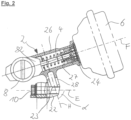
- Fig. 2 shows a further sectional view of a preferred embodiment of the carrier unit 2 according to the invention, in contrast to that in Fig. 1
- the carrier unit 2 has two holding sections 28, each of which is provided essentially parallel to one another between the guide section 26 and the first flange section 22 of the carrier unit.
- the first engagement section 23 is designed as a threaded hole into which a securing element 10 can be reached from the side of the carrier unit 2 on which the expanding wedge unit 8 is located.
- the securing element 10 can be reached if the preferably in the left part of Fig. 2 arranged brake drum (not shown) was dismantled from the brake system.
- the second flange section 24 advantageously has an extension parallel to the guide axis F of approximately up to 30 mm, particularly preferably of 14 - 16 mm, with the required strength being achieved for the areas tested in the context of the present invention and at the same time the weight proportion of the second Flange section 24 could be kept low.
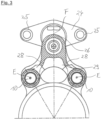
- Fig. 3 shows a sectional view of the already in Fig. 2 illustrated preferred embodiment of the carrier unit 2, wherein in Fig. 3 the cutting plane runs transversely to the engagement axis E.
- the carrier unit 2 not only has at least one, preferably two holding sections 28 offset along the engagement plane E, but also preferably two holding sections 28 are provided transversely to the engagement direction E, offset from one another.
- the preferred embodiment shown thus results in at least two, preferably four individual holding sections 28, which are spaced apart from one another.
- the carrier unit 2 has two first flange sections 22, which are spaced apart from one another and can each be fixed to a corresponding geometry of the chassis of the commercial vehicle provided for this purpose.
- the cylindrical shape of the guide geometry 27 of the guide section 26 can be seen, in which the guide element 4 is displaceably arranged.
- the connection of the holding sections 28 to the guide section 26 and the respective first flange section 22 is characterized by rounded external geometries, which allow a particularly favorable flow of force and avoid notch effects.
- the second flange section 24 can be seen, which preferably has two spaced-apart second engagement geometries, which are advantageously designed as through holes through which a corresponding bolt can be inserted and in this way a brake cylinder with two fastening points can be fixed to the second flange section 24.
- the two second engagement geometries 25 are at a distance from each other which is in a ratio of 0.9 - 1.1, preferably 0.95 - 1.05 to the distance between the two first engagement geometries 23.
- the distance between the two second engagement geometries 25 is essentially equal to the distance between the first engagement geometries 23 from one another.
Landscapes
- Engineering & Computer Science (AREA)
- General Engineering & Computer Science (AREA)
- Mechanical Engineering (AREA)
- Transportation (AREA)
- Braking Arrangements (AREA)
- Body Structure For Vehicles (AREA)
Claims (12)
- Unité de support (2) comportant une première portion de bride (22), une seconde portion de bride (24) et une portion de guidage (26),
dans laquellela première portion de bride (22) présente une première géométrie d'engagement (23) pour immobiliser l'unité de support (2) sur un train de roulement,la seconde portion de bride (24) présente une seconde géométrie d'engagement (25) pour immobiliser un cylindre de frein (6),la portion de guidage (26) est agencée au voisinage de la seconde portion de bride (24) et présente une géométrie de guidage (27) pour guider un élément de guidage (4) le long d'un axe de guidage (F),un ensemble à coin d'écartement (8) est prévu au voisinage de la portion de guidage (26),caractérisée en ce quel'ensemble à coin d'écartement (8) présente un boîtier (82) qui est réalisé d'un seul tenant avec la portion de guidage (26),l'unité de support (2) comprend une portion de retenue (28) qui est adjacente à la première portion de bride (22) et à la portion de guidage (26) et qui s'étend sensiblement le long d'un axe de retenue (H),la première portion de bride (22), la portion de retenue (28) et la portion de guidage (24) sont réalisées d'un seul tenant les unes avec les autres,la première géométrie d'engagement (23) s'étend sensiblement le long d'un axe d'engagement (E),l'axe de retenue (H) est pivoté d'un angle (α) par rapport à l'axe d'engagement (E), l'angle (α) étant inférieur à 90°. - Unité de support (2) comportant une première portion de bride (22), une seconde portion de bride (24) et une portion de guidage (26),
dans laquellela première portion de bride (22) présente une première géométrie d'engagement (23) pour immobiliser l'unité de support (2) sur un train de roulement,la seconde portion de bride (24) présente une seconde géométrie d'engagement (25) pour immobiliser un cylindre de frein (6),la portion de guidage (26) est agencée au voisinage de la seconde portion de bride (24) et présente une géométrie de guidage (27) pour guider un élément de guidage (4) le long d'un axe de guidage (F),un ensemble à coin d'écartement (8) est prévu au voisinage de la portion de guidage (26),caractérisée en ce quel'ensemble à coin d'écartement (8) présente un boîtier (82) qui est réalisé d'un seul tenant avec la portion de guidage (26),il est prévu un élément de blocage (10) qui peut être amené en engagement par coopération de formes avec la première géométrie d'engagement le long de l'axe d'engagement (E),l'élément de blocage (10) est accessible depuis le côté de l'unité de support (2) sur lequel se situe l'ensemble à coin d'écartement (8). - Unité de support (2) comportant une première portion de bride (22), une seconde portion de bride (24) et une portion de guidage (26),
dans laquellela première portion de bride (22) présente une première géométrie d'engagement (23) pour immobiliser l'unité de support (2) sur un train de roulement,la seconde portion de bride (24) présente une seconde géométrie d'engagement (25) pour immobiliser un cylindre de frein (6),la portion de guidage (26) est agencée au voisinage de la seconde portion de bride (24) et présente une géométrie de guidage (27) pour guider un élément de guidage (4) le long d'un axe de guidage (F),un ensemble à coin d'écartement (8) est prévu au voisinage de la portion de guidage (26),caractérisée en ce quel'ensemble à coin d'écartement (8) présente un boîtier (82) qui est réalisé d'un seul tenant avec la portion de guidage (26),la première portion de bride (22) présente deux géométries d'engagement (23) qui sont agencées à distance l'une de l'autre,les axes d'engagement (E) des géométries d'engagement (23) s'étendent parallèlement l'un à l'autre. - Unité de support (2) selon l'une des revendications précédentes,
dans laquelle la seconde portion de bride (24) est réalisée d'un seul tenant avec la portion de guidage (26). - Unité de support (2) selon l'une des revendications 2, 3 ou 4,comprenant une portion de retenue (28) qui est adjacente à la première portion de bride (22) et à la portion de guidage (26) et qui s'étend sensiblement le long d'un axe de retenue (H),la première portion de bride (22), la portion de retenue (28) et la portion de guidage (24) sont réalisées d'un seul tenant les unes avec les autres.
- Unité de support (2) selon la revendication 5,
dans laquelle l'axe de retenue (H) est transversal par rapport à l'axe de guidage (F). - Unité de support (2) selon la revendication 5 ou 6,dans laquelle la première géométrie d'engagement (23) s'étend sensiblement le long d'un axe d'engagement (E),l'axe de retenue (H) est pivoté d'un angle (α) par rapport à l'axe d'engagement (E), l'angle (α) étant inférieur à 90°.
- Unité de support (2) selon la revendication 7,
dans laquelle l'angle (α) est dans la plage de 45° à 89°, de préférence dans la plage de 60° à 85° et de manière particulièrement préférée d'environ 70° à 85°. - Unité de support selon l'une des revendications 1, 3 ou 4 à 8,
dans laquelleil est prévu un élément de blocage (10) qui peut être amené en engagement par coopération de formes avec la première géométrie d'engagement le long de l'axe d'engagement (E),l'élément de blocage (10) est accessible depuis le côté de l'unité de support (2) sur lequel se situe l'ensemble à coin d'écartement (8). - Unité de support (2) selon l'une des revendications 1, 2 ou 4 à 9,
dans laquellela première portion de bride (22) présente deux géométries d'engagement (23) qui sont agencées à distance l'une de l'autre,les axes d'engagement (E) des géométries d'engagement (23) s'étendent parallèlement l'un à l'autre. - Unité de support (2) selon la revendication 10,
dans laquelleil est prévu deux portions de retenue (28) qui sont séparées l'une de l'autre par un espace libre (29),la surface de section transversale moyenne des portions de retenue (28) est dans une relation de 0,2 à 1,3, de préférence de 0,3 à 0,9 et de manière particulièrement préférée d'environ 0,5 à 0,8 par rapport à la surface de section transversale moyenne de l'espace libre (29). - Unité de support (2) selon l'une des revendications précédentes, comprenant pas plus de quatre premières géométries d'engagement (23), de préférence pas plus de deux premières géométries d'engagement (23).
Priority Applications (1)
| Application Number | Priority Date | Filing Date | Title |
|---|---|---|---|
| PL15723909T PL3146228T3 (pl) | 2014-05-20 | 2015-05-18 | Jednostka nośna |
Applications Claiming Priority (2)
| Application Number | Priority Date | Filing Date | Title |
|---|---|---|---|
| DE102014209502.6A DE102014209502B4 (de) | 2014-05-20 | 2014-05-20 | Trägereinheit |
| PCT/EP2015/060850 WO2015177073A1 (fr) | 2014-05-20 | 2015-05-18 | Ensemble support |
Publications (3)
| Publication Number | Publication Date |
|---|---|
| EP3146228A1 EP3146228A1 (fr) | 2017-03-29 |
| EP3146228B1 EP3146228B1 (fr) | 2017-09-13 |
| EP3146228B2 true EP3146228B2 (fr) | 2024-01-17 |
Family
ID=53199977
Family Applications (1)
| Application Number | Title | Priority Date | Filing Date |
|---|---|---|---|
| EP15723909.6A Active EP3146228B2 (fr) | 2014-05-20 | 2015-05-18 | Support de frein |
Country Status (10)
| Country | Link |
|---|---|
| US (1) | US10232837B2 (fr) |
| EP (1) | EP3146228B2 (fr) |
| CN (1) | CN106460972B (fr) |
| AU (1) | AU2015263261B2 (fr) |
| CA (1) | CA2949578C (fr) |
| DE (1) | DE102014209502B4 (fr) |
| MX (1) | MX373346B (fr) |
| PL (1) | PL3146228T3 (fr) |
| RU (1) | RU2651450C1 (fr) |
| WO (1) | WO2015177073A1 (fr) |
Citations (5)
| Publication number | Priority date | Publication date | Assignee | Title |
|---|---|---|---|---|
| US3322241A (en) † | 1966-01-24 | 1967-05-30 | Rockwell Standard Co | Brake system |
| DE2550855A1 (de) † | 1974-11-15 | 1976-05-20 | Girling Ltd | Betaetigungsvorrichtung fuer fahrzeugbremsen |
| US4621713A (en) † | 1984-02-29 | 1986-11-11 | Societe Anonyme D.B.A. | Actuating mechanism for a disc brake |
| DE102011088847A1 (de) † | 2011-12-16 | 2013-06-20 | Saf-Holland Gmbh | Bremssystem einer Trommelbremse |
| WO2013087737A1 (fr) † | 2011-12-16 | 2013-06-20 | Saf-Holland Gmbh | Support de frein |
Family Cites Families (24)
| Publication number | Priority date | Publication date | Assignee | Title |
|---|---|---|---|---|
| US3136227A (en) * | 1960-08-29 | 1964-06-09 | Rockwell Standard Co | Brake operating mechanism |
| US3269492A (en) * | 1963-06-06 | 1966-08-30 | Rockwell Standard Co | Guide and centering means for a brake actuating rod |
| GB1152938A (en) * | 1967-03-02 | 1969-05-21 | Teves Gmbh Alfred | Improvements in or relating to Disc Brakes |
| US3599763A (en) * | 1970-01-26 | 1971-08-17 | Bendix Corp | Anchor piston for wedge brake |
| GB1418630A (en) | 1971-12-16 | 1975-12-24 | Automotive Prod Co Ltd | Internal shoe drum brakes and to fluid pressure braking systems including such brakes |
| GB2015098B (en) * | 1978-02-22 | 1982-04-28 | Girling Ltd | Drum brakes for vehicles |
| BR8005530A (pt) * | 1979-08-31 | 1981-03-17 | Lucas Industries Ltd | Freio de tambor-sapatas internas para veiculo |
| AU545708B2 (en) * | 1980-12-09 | 1985-07-25 | Automotive Products Ltd. | Hydraulic wheel cylinder assemblies |
| US4519482A (en) * | 1982-02-05 | 1985-05-28 | Allied Corporation | Wedge actuated drum brake assembly |
| US4445597A (en) * | 1982-06-17 | 1984-05-01 | Eaton Corporation | Spider assembly for drum brake |
| FR2590219B1 (fr) * | 1985-11-20 | 1991-02-01 | Bendix France | Dispositif de freinage electrique pour vehicule |
| GB8927638D0 (en) * | 1989-12-07 | 1990-02-07 | Rubery Owen Rockwell Ltd | Brake assemblies |
| CA2030315A1 (fr) * | 1990-06-26 | 1991-12-27 | Sung J. Cho | Systeme de freinage a joint a croisillon |
| US5613577A (en) | 1994-12-09 | 1997-03-25 | Ford Motor Company | Automotive disc brake with improved caliper assembly |
| US6247560B1 (en) | 1996-12-12 | 2001-06-19 | Federal-Mogul Technology Limited | Slidable brake disc system |
| JP2001107999A (ja) * | 1999-10-07 | 2001-04-17 | Nisshinbo Ind Inc | ドラムブレーキ装置 |
| RU2340484C1 (ru) * | 2007-06-19 | 2008-12-10 | Открытое акционерное общество "РИТМ" ТПТА | Тройник для тормозной магистрали подвижного состава |
| US20100193303A1 (en) * | 2009-02-05 | 2010-08-05 | Bendix Spicer Foundation Brake Llc | Brake spider weldment and anchor pin assembly |
| DE102011088848B4 (de) * | 2011-12-16 | 2015-05-13 | Saf-Holland Gmbh | Bremssystem für Nutzfahrzeuge |
| SE537115C2 (sv) * | 2012-07-05 | 2015-01-20 | Scania Cv Ab | Lagerkonsolkonfiguration för trumbroms och metod för montering av en lagerkonsolkonfiguration |
| EP3019358A4 (fr) * | 2013-07-12 | 2017-04-26 | Hendrickson USA, L.L.C. | Support de frein d'axe pour un axe à paroi mince |
| US9677628B2 (en) * | 2013-09-16 | 2017-06-13 | Arvinmeritor Technology, Llc | Drum brake assembly and method of manufacture |
| GB2524876A (en) * | 2014-02-14 | 2015-10-07 | Tse Brakes Inc | Pivoting air chamber for braking system |
| US9574626B1 (en) * | 2015-07-28 | 2017-02-21 | Bendix Spicer Foundation Brake Llc | Rigid bracket assembly for mounting a brake assembly and brake actuator |
-
2014
- 2014-05-20 DE DE102014209502.6A patent/DE102014209502B4/de not_active Expired - Fee Related
-
2015
- 2015-05-18 RU RU2016148464A patent/RU2651450C1/ru not_active IP Right Cessation
- 2015-05-18 MX MX2016015224A patent/MX373346B/es active IP Right Grant
- 2015-05-18 US US15/312,112 patent/US10232837B2/en not_active Expired - Fee Related
- 2015-05-18 PL PL15723909T patent/PL3146228T3/pl unknown
- 2015-05-18 WO PCT/EP2015/060850 patent/WO2015177073A1/fr not_active Ceased
- 2015-05-18 CN CN201580027272.3A patent/CN106460972B/zh not_active Expired - Fee Related
- 2015-05-18 CA CA2949578A patent/CA2949578C/fr not_active Expired - Fee Related
- 2015-05-18 AU AU2015263261A patent/AU2015263261B2/en not_active Ceased
- 2015-05-18 EP EP15723909.6A patent/EP3146228B2/fr active Active
Patent Citations (5)
| Publication number | Priority date | Publication date | Assignee | Title |
|---|---|---|---|---|
| US3322241A (en) † | 1966-01-24 | 1967-05-30 | Rockwell Standard Co | Brake system |
| DE2550855A1 (de) † | 1974-11-15 | 1976-05-20 | Girling Ltd | Betaetigungsvorrichtung fuer fahrzeugbremsen |
| US4621713A (en) † | 1984-02-29 | 1986-11-11 | Societe Anonyme D.B.A. | Actuating mechanism for a disc brake |
| DE102011088847A1 (de) † | 2011-12-16 | 2013-06-20 | Saf-Holland Gmbh | Bremssystem einer Trommelbremse |
| WO2013087737A1 (fr) † | 2011-12-16 | 2013-06-20 | Saf-Holland Gmbh | Support de frein |
Non-Patent Citations (2)
| Title |
|---|
| Auszug aus Wikipedia : "Fahrwerk " † |
| Prüfungsbescheid des DPMA vom 18 Januar 2019 † |
Also Published As
| Publication number | Publication date |
|---|---|
| PL3146228T3 (pl) | 2018-03-30 |
| AU2015263261A1 (en) | 2016-12-15 |
| US20170120883A1 (en) | 2017-05-04 |
| AU2015263261B2 (en) | 2017-07-13 |
| MX373346B (es) | 2020-07-06 |
| WO2015177073A1 (fr) | 2015-11-26 |
| US10232837B2 (en) | 2019-03-19 |
| EP3146228A1 (fr) | 2017-03-29 |
| CN106460972B (zh) | 2018-10-09 |
| DE102014209502B4 (de) | 2020-12-10 |
| DE102014209502A1 (de) | 2015-11-26 |
| CN106460972A (zh) | 2017-02-22 |
| CA2949578A1 (fr) | 2015-11-26 |
| MX2016015224A (es) | 2017-03-23 |
| EP3146228B1 (fr) | 2017-09-13 |
| CA2949578C (fr) | 2018-10-30 |
| RU2651450C1 (ru) | 2018-04-19 |
Similar Documents
| Publication | Publication Date | Title |
|---|---|---|
| EP2529131B1 (fr) | Frein à disque | |
| EP3057395B1 (fr) | Pointe de soc ou combinaison d'outil ayant une pointe de soc | |
| EP3649354B1 (fr) | Système de fixation d'un axe de pivotement à un châssis de véhicule | |
| EP1829716B1 (fr) | Attelage pour véhicules automobiles | |
| DE69011279T2 (de) | Räder mit eingebauten Bremsscheiben. | |
| EP2903838B1 (fr) | Unité de direction | |
| WO2017178247A1 (fr) | Agencement d'une structure de fixation sur un élément structural d'un véhicule automobile muni d'un élément d'insertion à base de fibres | |
| EP3606767B1 (fr) | Système d'essieu | |
| DE102019002874A1 (de) | Befestigung für einen Lenker einer Radaufhängung eines Kraftfahrzeugs sowie Kraftfahrzeug | |
| DE19602927A1 (de) | Tragrahmen, insbesondere für zugmittelbetriebene Hebezeuge | |
| EP3109499B1 (fr) | Frein a disque, en particulier pour vehicules utilitaires | |
| EP3191326B1 (fr) | Unité d'essieu | |
| EP3146228B1 (fr) | Support de frein | |
| DE102005059247B4 (de) | Bremsvorrichtung | |
| DE69514215T2 (de) | Spielfreie Zugstangenanordnung für einen Güterwagon | |
| DE10212671B4 (de) | Kegelradausgleichsgetriebe | |
| EP3512731B1 (fr) | Système d'essieu | |
| EP1903219B1 (fr) | Dispositif pour la fixation d'un composant sur un élément de support | |
| DE102012112362C5 (de) | Ventil mit einer Befestigungseinrichtung | |
| WO2018229043A1 (fr) | Corps de bague de friction, ensemble de bagues de friction à agencer sur l'âme de roue d'une roue ferroviaire, ainsi que frein de roue ferroviaire | |
| DE102007017700A1 (de) | Verliersicherung für eine Nutmutter bei einer Welle-Nabe-Verbindung | |
| EP3625474B1 (fr) | Freinage à disque d'un véhicule utilitaire | |
| DE102016117164B4 (de) | Achssystem | |
| DE102020006379A1 (de) | Scheibenbremse und Herstellungsverfahren für eine Scheibenbremse | |
| WO2015107033A1 (fr) | Béquille de sécurité |
Legal Events
| Date | Code | Title | Description |
|---|---|---|---|
| STAA | Information on the status of an ep patent application or granted ep patent |
Free format text: STATUS: THE INTERNATIONAL PUBLICATION HAS BEEN MADE |
|
| PUAI | Public reference made under article 153(3) epc to a published international application that has entered the european phase |
Free format text: ORIGINAL CODE: 0009012 |
|
| STAA | Information on the status of an ep patent application or granted ep patent |
Free format text: STATUS: REQUEST FOR EXAMINATION WAS MADE |
|
| 17P | Request for examination filed |
Effective date: 20161209 |
|
| AK | Designated contracting states |
Kind code of ref document: A1 Designated state(s): AL AT BE BG CH CY CZ DE DK EE ES FI FR GB GR HR HU IE IS IT LI LT LU LV MC MK MT NL NO PL PT RO RS SE SI SK SM TR |
|
| AX | Request for extension of the european patent |
Extension state: BA ME |
|
| GRAP | Despatch of communication of intention to grant a patent |
Free format text: ORIGINAL CODE: EPIDOSNIGR1 |
|
| STAA | Information on the status of an ep patent application or granted ep patent |
Free format text: STATUS: GRANT OF PATENT IS INTENDED |
|
| DAV | Request for validation of the european patent (deleted) | ||
| DAX | Request for extension of the european patent (deleted) | ||
| INTG | Intention to grant announced |
Effective date: 20170529 |
|
| GRAS | Grant fee paid |
Free format text: ORIGINAL CODE: EPIDOSNIGR3 |
|
| GRAA | (expected) grant |
Free format text: ORIGINAL CODE: 0009210 |
|
| STAA | Information on the status of an ep patent application or granted ep patent |
Free format text: STATUS: THE PATENT HAS BEEN GRANTED |
|
| AK | Designated contracting states |
Kind code of ref document: B1 Designated state(s): AL AT BE BG CH CY CZ DE DK EE ES FI FR GB GR HR HU IE IS IT LI LT LU LV MC MK MT NL NO PL PT RO RS SE SI SK SM TR |
|
| REG | Reference to a national code |
Ref country code: GB Ref legal event code: FG4D Free format text: NOT ENGLISH |
|
| REG | Reference to a national code |
Ref country code: CH Ref legal event code: EP |
|
| REG | Reference to a national code |
Ref country code: IE Ref legal event code: FG4D Free format text: LANGUAGE OF EP DOCUMENT: GERMAN |
|
| REG | Reference to a national code |
Ref country code: AT Ref legal event code: REF Ref document number: 928468 Country of ref document: AT Kind code of ref document: T Effective date: 20171015 |
|
| REG | Reference to a national code |
Ref country code: DE Ref legal event code: R096 Ref document number: 502015001906 Country of ref document: DE |
|
| REG | Reference to a national code |
Ref country code: SE Ref legal event code: TRGR |
|
| REG | Reference to a national code |
Ref country code: NL Ref legal event code: MP Effective date: 20170913 |
|
| REG | Reference to a national code |
Ref country code: LT Ref legal event code: MG4D |
|
| PG25 | Lapsed in a contracting state [announced via postgrant information from national office to epo] |
Ref country code: FI Free format text: LAPSE BECAUSE OF FAILURE TO SUBMIT A TRANSLATION OF THE DESCRIPTION OR TO PAY THE FEE WITHIN THE PRESCRIBED TIME-LIMIT Effective date: 20170913 Ref country code: HR Free format text: LAPSE BECAUSE OF FAILURE TO SUBMIT A TRANSLATION OF THE DESCRIPTION OR TO PAY THE FEE WITHIN THE PRESCRIBED TIME-LIMIT Effective date: 20170913 Ref country code: LT Free format text: LAPSE BECAUSE OF FAILURE TO SUBMIT A TRANSLATION OF THE DESCRIPTION OR TO PAY THE FEE WITHIN THE PRESCRIBED TIME-LIMIT Effective date: 20170913 Ref country code: NO Free format text: LAPSE BECAUSE OF FAILURE TO SUBMIT A TRANSLATION OF THE DESCRIPTION OR TO PAY THE FEE WITHIN THE PRESCRIBED TIME-LIMIT Effective date: 20171213 |
|
| PG25 | Lapsed in a contracting state [announced via postgrant information from national office to epo] |
Ref country code: LV Free format text: LAPSE BECAUSE OF FAILURE TO SUBMIT A TRANSLATION OF THE DESCRIPTION OR TO PAY THE FEE WITHIN THE PRESCRIBED TIME-LIMIT Effective date: 20170913 Ref country code: GR Free format text: LAPSE BECAUSE OF FAILURE TO SUBMIT A TRANSLATION OF THE DESCRIPTION OR TO PAY THE FEE WITHIN THE PRESCRIBED TIME-LIMIT Effective date: 20171214 Ref country code: BG Free format text: LAPSE BECAUSE OF FAILURE TO SUBMIT A TRANSLATION OF THE DESCRIPTION OR TO PAY THE FEE WITHIN THE PRESCRIBED TIME-LIMIT Effective date: 20171213 Ref country code: ES Free format text: LAPSE BECAUSE OF FAILURE TO SUBMIT A TRANSLATION OF THE DESCRIPTION OR TO PAY THE FEE WITHIN THE PRESCRIBED TIME-LIMIT Effective date: 20170913 Ref country code: RS Free format text: LAPSE BECAUSE OF FAILURE TO SUBMIT A TRANSLATION OF THE DESCRIPTION OR TO PAY THE FEE WITHIN THE PRESCRIBED TIME-LIMIT Effective date: 20170913 |
|
| PG25 | Lapsed in a contracting state [announced via postgrant information from national office to epo] |
Ref country code: NL Free format text: LAPSE BECAUSE OF FAILURE TO SUBMIT A TRANSLATION OF THE DESCRIPTION OR TO PAY THE FEE WITHIN THE PRESCRIBED TIME-LIMIT Effective date: 20170913 |
|
| PG25 | Lapsed in a contracting state [announced via postgrant information from national office to epo] |
Ref country code: CZ Free format text: LAPSE BECAUSE OF FAILURE TO SUBMIT A TRANSLATION OF THE DESCRIPTION OR TO PAY THE FEE WITHIN THE PRESCRIBED TIME-LIMIT Effective date: 20170913 |
|
| REG | Reference to a national code |
Ref country code: FR Ref legal event code: PLFP Year of fee payment: 4 |
|
| PG25 | Lapsed in a contracting state [announced via postgrant information from national office to epo] |
Ref country code: SK Free format text: LAPSE BECAUSE OF FAILURE TO SUBMIT A TRANSLATION OF THE DESCRIPTION OR TO PAY THE FEE WITHIN THE PRESCRIBED TIME-LIMIT Effective date: 20170913 Ref country code: IS Free format text: LAPSE BECAUSE OF FAILURE TO SUBMIT A TRANSLATION OF THE DESCRIPTION OR TO PAY THE FEE WITHIN THE PRESCRIBED TIME-LIMIT Effective date: 20180113 Ref country code: SM Free format text: LAPSE BECAUSE OF FAILURE TO SUBMIT A TRANSLATION OF THE DESCRIPTION OR TO PAY THE FEE WITHIN THE PRESCRIBED TIME-LIMIT Effective date: 20170913 Ref country code: IT Free format text: LAPSE BECAUSE OF FAILURE TO SUBMIT A TRANSLATION OF THE DESCRIPTION OR TO PAY THE FEE WITHIN THE PRESCRIBED TIME-LIMIT Effective date: 20170913 Ref country code: EE Free format text: LAPSE BECAUSE OF FAILURE TO SUBMIT A TRANSLATION OF THE DESCRIPTION OR TO PAY THE FEE WITHIN THE PRESCRIBED TIME-LIMIT Effective date: 20170913 |
|
| REG | Reference to a national code |
Ref country code: DE Ref legal event code: R026 Ref document number: 502015001906 Country of ref document: DE |
|
| PLBI | Opposition filed |
Free format text: ORIGINAL CODE: 0009260 |
|
| PLAX | Notice of opposition and request to file observation + time limit sent |
Free format text: ORIGINAL CODE: EPIDOSNOBS2 |
|
| PLAB | Opposition data, opponent's data or that of the opponent's representative modified |
Free format text: ORIGINAL CODE: 0009299OPPO |
|
| 26 | Opposition filed |
Opponent name: KNOTT GMBH Effective date: 20180612 |
|
| PLBB | Reply of patent proprietor to notice(s) of opposition received |
Free format text: ORIGINAL CODE: EPIDOSNOBS3 |
|
| PG25 | Lapsed in a contracting state [announced via postgrant information from national office to epo] |
Ref country code: DK Free format text: LAPSE BECAUSE OF FAILURE TO SUBMIT A TRANSLATION OF THE DESCRIPTION OR TO PAY THE FEE WITHIN THE PRESCRIBED TIME-LIMIT Effective date: 20170913 |
|
| R26 | Opposition filed (corrected) |
Opponent name: KNOTT GMBH Effective date: 20180612 |
|
| PG25 | Lapsed in a contracting state [announced via postgrant information from national office to epo] |
Ref country code: MT Free format text: LAPSE BECAUSE OF FAILURE TO SUBMIT A TRANSLATION OF THE DESCRIPTION OR TO PAY THE FEE WITHIN THE PRESCRIBED TIME-LIMIT Effective date: 20170913 |
|
| REG | Reference to a national code |
Ref country code: CH Ref legal event code: PL |
|
| REG | Reference to a national code |
Ref country code: BE Ref legal event code: MM Effective date: 20180531 |
|
| PG25 | Lapsed in a contracting state [announced via postgrant information from national office to epo] |
Ref country code: MC Free format text: LAPSE BECAUSE OF FAILURE TO SUBMIT A TRANSLATION OF THE DESCRIPTION OR TO PAY THE FEE WITHIN THE PRESCRIBED TIME-LIMIT Effective date: 20170913 |
|
| REG | Reference to a national code |
Ref country code: IE Ref legal event code: MM4A |
|
| PG25 | Lapsed in a contracting state [announced via postgrant information from national office to epo] |
Ref country code: CH Free format text: LAPSE BECAUSE OF NON-PAYMENT OF DUE FEES Effective date: 20180531 Ref country code: LI Free format text: LAPSE BECAUSE OF NON-PAYMENT OF DUE FEES Effective date: 20180531 |
|
| PG25 | Lapsed in a contracting state [announced via postgrant information from national office to epo] |
Ref country code: LU Free format text: LAPSE BECAUSE OF NON-PAYMENT OF DUE FEES Effective date: 20180518 |
|
| PG25 | Lapsed in a contracting state [announced via postgrant information from national office to epo] |
Ref country code: IE Free format text: LAPSE BECAUSE OF NON-PAYMENT OF DUE FEES Effective date: 20180518 |
|
| PG25 | Lapsed in a contracting state [announced via postgrant information from national office to epo] |
Ref country code: BE Free format text: LAPSE BECAUSE OF NON-PAYMENT OF DUE FEES Effective date: 20180531 |
|
| PGFP | Annual fee paid to national office [announced via postgrant information from national office to epo] |
Ref country code: SE Payment date: 20190513 Year of fee payment: 8 |
|
| PGFP | Annual fee paid to national office [announced via postgrant information from national office to epo] |
Ref country code: GB Payment date: 20190523 Year of fee payment: 5 |
|
| PG25 | Lapsed in a contracting state [announced via postgrant information from national office to epo] |
Ref country code: PT Free format text: LAPSE BECAUSE OF FAILURE TO SUBMIT A TRANSLATION OF THE DESCRIPTION OR TO PAY THE FEE WITHIN THE PRESCRIBED TIME-LIMIT Effective date: 20170913 |
|
| PG25 | Lapsed in a contracting state [announced via postgrant information from national office to epo] |
Ref country code: HU Free format text: LAPSE BECAUSE OF FAILURE TO SUBMIT A TRANSLATION OF THE DESCRIPTION OR TO PAY THE FEE WITHIN THE PRESCRIBED TIME-LIMIT; INVALID AB INITIO Effective date: 20150518 Ref country code: RO Free format text: LAPSE BECAUSE OF FAILURE TO SUBMIT A TRANSLATION OF THE DESCRIPTION OR TO PAY THE FEE WITHIN THE PRESCRIBED TIME-LIMIT Effective date: 20170913 Ref country code: CY Free format text: LAPSE BECAUSE OF FAILURE TO SUBMIT A TRANSLATION OF THE DESCRIPTION OR TO PAY THE FEE WITHIN THE PRESCRIBED TIME-LIMIT Effective date: 20170913 Ref country code: MK Free format text: LAPSE BECAUSE OF NON-PAYMENT OF DUE FEES Effective date: 20170913 |
|
| PG25 | Lapsed in a contracting state [announced via postgrant information from national office to epo] |
Ref country code: AL Free format text: LAPSE BECAUSE OF FAILURE TO SUBMIT A TRANSLATION OF THE DESCRIPTION OR TO PAY THE FEE WITHIN THE PRESCRIBED TIME-LIMIT Effective date: 20170913 |
|
| PGFP | Annual fee paid to national office [announced via postgrant information from national office to epo] |
Ref country code: FR Payment date: 20200519 Year of fee payment: 6 Ref country code: TR Payment date: 20200515 Year of fee payment: 6 |
|
| APBM | Appeal reference recorded |
Free format text: ORIGINAL CODE: EPIDOSNREFNO |
|
| APBP | Date of receipt of notice of appeal recorded |
Free format text: ORIGINAL CODE: EPIDOSNNOA2O |
|
| APAH | Appeal reference modified |
Free format text: ORIGINAL CODE: EPIDOSCREFNO |
|
| PG25 | Lapsed in a contracting state [announced via postgrant information from national office to epo] |
Ref country code: SI Free format text: LAPSE BECAUSE OF NON-PAYMENT OF DUE FEES Effective date: 20180518 |
|
| APBQ | Date of receipt of statement of grounds of appeal recorded |
Free format text: ORIGINAL CODE: EPIDOSNNOA3O |
|
| GBPC | Gb: european patent ceased through non-payment of renewal fee |
Effective date: 20200518 |
|
| PG25 | Lapsed in a contracting state [announced via postgrant information from national office to epo] |
Ref country code: GB Free format text: LAPSE BECAUSE OF NON-PAYMENT OF DUE FEES Effective date: 20200518 |
|
| REG | Reference to a national code |
Ref country code: AT Ref legal event code: MM01 Ref document number: 928468 Country of ref document: AT Kind code of ref document: T Effective date: 20200518 |
|
| PG25 | Lapsed in a contracting state [announced via postgrant information from national office to epo] |
Ref country code: AT Free format text: LAPSE BECAUSE OF NON-PAYMENT OF DUE FEES Effective date: 20200518 |
|
| REG | Reference to a national code |
Ref country code: SE Ref legal event code: EUG |
|
| PG25 | Lapsed in a contracting state [announced via postgrant information from national office to epo] |
Ref country code: SE Free format text: LAPSE BECAUSE OF NON-PAYMENT OF DUE FEES Effective date: 20210519 |
|
| PG25 | Lapsed in a contracting state [announced via postgrant information from national office to epo] |
Ref country code: FR Free format text: LAPSE BECAUSE OF NON-PAYMENT OF DUE FEES Effective date: 20210531 |
|
| PG25 | Lapsed in a contracting state [announced via postgrant information from national office to epo] |
Ref country code: PL Free format text: LAPSE BECAUSE OF NON-PAYMENT OF DUE FEES Effective date: 20200518 |
|
| APAH | Appeal reference modified |
Free format text: ORIGINAL CODE: EPIDOSCREFNO |
|
| P01 | Opt-out of the competence of the unified patent court (upc) registered |
Effective date: 20230505 |
|
| APBU | Appeal procedure closed |
Free format text: ORIGINAL CODE: EPIDOSNNOA9O |
|
| PUAH | Patent maintained in amended form |
Free format text: ORIGINAL CODE: 0009272 |
|
| STAA | Information on the status of an ep patent application or granted ep patent |
Free format text: STATUS: PATENT MAINTAINED AS AMENDED |
|
| 27A | Patent maintained in amended form |
Effective date: 20240117 |
|
| AK | Designated contracting states |
Kind code of ref document: B2 Designated state(s): AL AT BE BG CH CY CZ DE DK EE ES FI FR GB GR HR HU IE IS IT LI LT LU LV MC MK MT NL NO PL PT RO RS SE SI SK SM TR |
|
| REG | Reference to a national code |
Ref country code: DE Ref legal event code: R102 Ref document number: 502015001906 Country of ref document: DE |
|
| PGFP | Annual fee paid to national office [announced via postgrant information from national office to epo] |
Ref country code: DE Payment date: 20250221 Year of fee payment: 11 |