EP3147327B1 - Wasserdispersionsartige harzzusammensetzung, harzzusammensetzung für eine thermosensitive aufzeichnungsschicht, harzzusammensetzung für schutzschicht und wärmeempfindliches aufzeichnungsmaterial - Google Patents
Wasserdispersionsartige harzzusammensetzung, harzzusammensetzung für eine thermosensitive aufzeichnungsschicht, harzzusammensetzung für schutzschicht und wärmeempfindliches aufzeichnungsmaterial Download PDFInfo
- Publication number
- EP3147327B1 EP3147327B1 EP15795630.1A EP15795630A EP3147327B1 EP 3147327 B1 EP3147327 B1 EP 3147327B1 EP 15795630 A EP15795630 A EP 15795630A EP 3147327 B1 EP3147327 B1 EP 3147327B1
- Authority
- EP
- European Patent Office
- Prior art keywords
- parts
- resin composition
- thermal recording
- mass
- monomer component
- Prior art date
- Legal status (The legal status is an assumption and is not a legal conclusion. Google has not performed a legal analysis and makes no representation as to the accuracy of the status listed.)
- Active
Links
Images
Classifications
-
- B—PERFORMING OPERATIONS; TRANSPORTING
- B41—PRINTING; LINING MACHINES; TYPEWRITERS; STAMPS
- B41M—PRINTING, DUPLICATING, MARKING, OR COPYING PROCESSES; COLOUR PRINTING
- B41M5/00—Duplicating or marking methods; Sheet materials for use therein
- B41M5/26—Thermography ; Marking by high energetic means, e.g. laser otherwise than by burning, and characterised by the material used
- B41M5/30—Thermography ; Marking by high energetic means, e.g. laser otherwise than by burning, and characterised by the material used using chemical colour formers
- B41M5/337—Additives; Binders
- B41M5/3372—Macromolecular compounds
-
- B—PERFORMING OPERATIONS; TRANSPORTING
- B41—PRINTING; LINING MACHINES; TYPEWRITERS; STAMPS
- B41M—PRINTING, DUPLICATING, MARKING, OR COPYING PROCESSES; COLOUR PRINTING
- B41M5/00—Duplicating or marking methods; Sheet materials for use therein
- B41M5/26—Thermography ; Marking by high energetic means, e.g. laser otherwise than by burning, and characterised by the material used
- B41M5/30—Thermography ; Marking by high energetic means, e.g. laser otherwise than by burning, and characterised by the material used using chemical colour formers
- B41M5/337—Additives; Binders
-
- B—PERFORMING OPERATIONS; TRANSPORTING
- B41—PRINTING; LINING MACHINES; TYPEWRITERS; STAMPS
- B41M—PRINTING, DUPLICATING, MARKING, OR COPYING PROCESSES; COLOUR PRINTING
- B41M5/00—Duplicating or marking methods; Sheet materials for use therein
- B41M5/26—Thermography ; Marking by high energetic means, e.g. laser otherwise than by burning, and characterised by the material used
- B41M5/40—Thermography ; Marking by high energetic means, e.g. laser otherwise than by burning, and characterised by the material used characterised by the base backcoat, intermediate, or covering layers, e.g. for thermal transfer dye-donor or dye-receiver sheets; Heat, radiation filtering or absorbing means or layers; combined with other image registration layers or compositions; Special originals for reproduction by thermography
- B41M5/42—Intermediate, backcoat, or covering layers
- B41M5/44—Intermediate, backcoat, or covering layers characterised by the macromolecular compounds
-
- C—CHEMISTRY; METALLURGY
- C08—ORGANIC MACROMOLECULAR COMPOUNDS; THEIR PREPARATION OR CHEMICAL WORKING-UP; COMPOSITIONS BASED THEREON
- C08F—MACROMOLECULAR COMPOUNDS OBTAINED BY REACTIONS ONLY INVOLVING CARBON-TO-CARBON UNSATURATED BONDS
- C08F220/00—Copolymers of compounds having one or more unsaturated aliphatic radicals, each having only one carbon-to-carbon double bond, and only one being terminated by only one carboxyl radical or a salt, anhydride ester, amide, imide or nitrile thereof
- C08F220/02—Monocarboxylic acids having less than ten carbon atoms; Derivatives thereof
- C08F220/42—Nitriles
- C08F220/44—Acrylonitrile
-
- C—CHEMISTRY; METALLURGY
- C08—ORGANIC MACROMOLECULAR COMPOUNDS; THEIR PREPARATION OR CHEMICAL WORKING-UP; COMPOSITIONS BASED THEREON
- C08F—MACROMOLECULAR COMPOUNDS OBTAINED BY REACTIONS ONLY INVOLVING CARBON-TO-CARBON UNSATURATED BONDS
- C08F265/00—Macromolecular compounds obtained by polymerising monomers on to polymers of unsaturated monocarboxylic acids or derivatives thereof as defined in group C08F20/00
- C08F265/02—Macromolecular compounds obtained by polymerising monomers on to polymers of unsaturated monocarboxylic acids or derivatives thereof as defined in group C08F20/00 on to polymers of acids, salts or anhydrides
-
- C—CHEMISTRY; METALLURGY
- C08—ORGANIC MACROMOLECULAR COMPOUNDS; THEIR PREPARATION OR CHEMICAL WORKING-UP; COMPOSITIONS BASED THEREON
- C08F—MACROMOLECULAR COMPOUNDS OBTAINED BY REACTIONS ONLY INVOLVING CARBON-TO-CARBON UNSATURATED BONDS
- C08F265/00—Macromolecular compounds obtained by polymerising monomers on to polymers of unsaturated monocarboxylic acids or derivatives thereof as defined in group C08F20/00
- C08F265/08—Macromolecular compounds obtained by polymerising monomers on to polymers of unsaturated monocarboxylic acids or derivatives thereof as defined in group C08F20/00 on to polymers of nitriles
-
- C—CHEMISTRY; METALLURGY
- C08—ORGANIC MACROMOLECULAR COMPOUNDS; THEIR PREPARATION OR CHEMICAL WORKING-UP; COMPOSITIONS BASED THEREON
- C08F—MACROMOLECULAR COMPOUNDS OBTAINED BY REACTIONS ONLY INVOLVING CARBON-TO-CARBON UNSATURATED BONDS
- C08F265/00—Macromolecular compounds obtained by polymerising monomers on to polymers of unsaturated monocarboxylic acids or derivatives thereof as defined in group C08F20/00
- C08F265/10—Macromolecular compounds obtained by polymerising monomers on to polymers of unsaturated monocarboxylic acids or derivatives thereof as defined in group C08F20/00 on to polymers of amides or imides
-
- C—CHEMISTRY; METALLURGY
- C08—ORGANIC MACROMOLECULAR COMPOUNDS; THEIR PREPARATION OR CHEMICAL WORKING-UP; COMPOSITIONS BASED THEREON
- C08L—COMPOSITIONS OF MACROMOLECULAR COMPOUNDS
- C08L101/00—Compositions of unspecified macromolecular compounds
- C08L101/02—Compositions of unspecified macromolecular compounds characterised by the presence of specified groups, e.g. terminal or pendant functional groups
- C08L101/06—Compositions of unspecified macromolecular compounds characterised by the presence of specified groups, e.g. terminal or pendant functional groups containing oxygen atoms
- C08L101/08—Carboxyl groups
-
- C—CHEMISTRY; METALLURGY
- C08—ORGANIC MACROMOLECULAR COMPOUNDS; THEIR PREPARATION OR CHEMICAL WORKING-UP; COMPOSITIONS BASED THEREON
- C08L—COMPOSITIONS OF MACROMOLECULAR COMPOUNDS
- C08L33/00—Compositions of homopolymers or copolymers of compounds having one or more unsaturated aliphatic radicals, each having only one carbon-to-carbon double bond, and only one being terminated by only one carboxyl radical, or of salts, anhydrides, esters, amides, imides or nitriles thereof; Compositions of derivatives of such polymers
- C08L33/04—Homopolymers or copolymers of esters
- C08L33/14—Homopolymers or copolymers of esters of esters containing halogen, nitrogen, sulfur, or oxygen atoms in addition to the carboxy oxygen
-
- C—CHEMISTRY; METALLURGY
- C08—ORGANIC MACROMOLECULAR COMPOUNDS; THEIR PREPARATION OR CHEMICAL WORKING-UP; COMPOSITIONS BASED THEREON
- C08L—COMPOSITIONS OF MACROMOLECULAR COMPOUNDS
- C08L33/00—Compositions of homopolymers or copolymers of compounds having one or more unsaturated aliphatic radicals, each having only one carbon-to-carbon double bond, and only one being terminated by only one carboxyl radical, or of salts, anhydrides, esters, amides, imides or nitriles thereof; Compositions of derivatives of such polymers
- C08L33/24—Homopolymers or copolymers of amides or imides
- C08L33/26—Homopolymers or copolymers of acrylamide or methacrylamide
-
- C—CHEMISTRY; METALLURGY
- C08—ORGANIC MACROMOLECULAR COMPOUNDS; THEIR PREPARATION OR CHEMICAL WORKING-UP; COMPOSITIONS BASED THEREON
- C08L—COMPOSITIONS OF MACROMOLECULAR COMPOUNDS
- C08L51/00—Compositions of graft polymers in which the grafted component is obtained by reactions only involving carbon-to-carbon unsaturated bonds; Compositions of derivatives of such polymers
-
- C—CHEMISTRY; METALLURGY
- C08—ORGANIC MACROMOLECULAR COMPOUNDS; THEIR PREPARATION OR CHEMICAL WORKING-UP; COMPOSITIONS BASED THEREON
- C08L—COMPOSITIONS OF MACROMOLECULAR COMPOUNDS
- C08L51/00—Compositions of graft polymers in which the grafted component is obtained by reactions only involving carbon-to-carbon unsaturated bonds; Compositions of derivatives of such polymers
- C08L51/003—Compositions of graft polymers in which the grafted component is obtained by reactions only involving carbon-to-carbon unsaturated bonds; Compositions of derivatives of such polymers grafted on to macromolecular compounds obtained by reactions only involving unsaturated carbon-to-carbon bonds
-
- C—CHEMISTRY; METALLURGY
- C09—DYES; PAINTS; POLISHES; NATURAL RESINS; ADHESIVES; COMPOSITIONS NOT OTHERWISE PROVIDED FOR; APPLICATIONS OF MATERIALS NOT OTHERWISE PROVIDED FOR
- C09D—COATING COMPOSITIONS, e.g. PAINTS, VARNISHES OR LACQUERS; FILLING PASTES; CHEMICAL PAINT OR INK REMOVERS; INKS; CORRECTING FLUIDS; WOODSTAINS; PASTES OR SOLIDS FOR COLOURING OR PRINTING; USE OF MATERIALS THEREFOR
- C09D151/00—Coating compositions based on graft polymers in which the grafted component is obtained by reactions only involving carbon-to-carbon unsaturated bonds; Coating compositions based on derivatives of such polymers
- C09D151/003—Coating compositions based on graft polymers in which the grafted component is obtained by reactions only involving carbon-to-carbon unsaturated bonds; Coating compositions based on derivatives of such polymers grafted on to macromolecular compounds obtained by reactions only involving unsaturated carbon-to-carbon bonds
-
- B—PERFORMING OPERATIONS; TRANSPORTING
- B41—PRINTING; LINING MACHINES; TYPEWRITERS; STAMPS
- B41M—PRINTING, DUPLICATING, MARKING, OR COPYING PROCESSES; COLOUR PRINTING
- B41M2205/00—Printing methods or features related to printing methods; Location or type of the layers
- B41M2205/04—Direct thermal recording [DTR]
-
- B—PERFORMING OPERATIONS; TRANSPORTING
- B41—PRINTING; LINING MACHINES; TYPEWRITERS; STAMPS
- B41M—PRINTING, DUPLICATING, MARKING, OR COPYING PROCESSES; COLOUR PRINTING
- B41M2205/00—Printing methods or features related to printing methods; Location or type of the layers
- B41M2205/40—Cover layers; Layers separated from substrate by imaging layer; Protective layers; Layers applied before imaging
-
- C—CHEMISTRY; METALLURGY
- C08—ORGANIC MACROMOLECULAR COMPOUNDS; THEIR PREPARATION OR CHEMICAL WORKING-UP; COMPOSITIONS BASED THEREON
- C08L—COMPOSITIONS OF MACROMOLECULAR COMPOUNDS
- C08L2201/00—Properties
- C08L2201/54—Aqueous solutions or dispersions
Definitions
- the present invention relates to an aqueous dispersion resin composition, a resin composition for a thermal recording layer, a resin composition for a protection layer, and a thermal recording material.
- the present invention relates to an aqueous dispersion resin composition, a resin composition for a thermal recording layer containing the aqueous dispersion resin composition, a resin composition for a protection layer containing the aqueous dispersion resin composition, and furthermore, a thermal recording material produced by using the resin composition for a thermal recording layer and the resin composition for a protection layer.
- Thermal recording materials are formed by laminating a thermal recording layer and a protection layer sequentially on a support layer such as paper and a plastic film, and are widely used as, for example, facsimile, and print sheet.
- the thermal recording layer and the protection layer of such a thermal recording material are formed from a resin material such as acrylic resin.
- a resin material such as acrylic resin.
- Patent Document 1 has proposed a core-shell type copolymer emulsion produced by copolymerizing 90 parts of methacrylamide and 10 parts of methacrylic acid in the presence of seed emulsion produced by 46 parts of acrylonitrile, 46 parts of butyl acrylate, 5 parts of 2-hydroxyethyl methacrylate, and 3 parts of methacrylic acid (Production Example C).
- thermo recording material with excellent running stability (anti-sticking properties) and durability (heat resistance, plasticizer resistance, anti-blocking, water resistance, solvent resistance, oil resistance) can be produced.
- curtain coating for the methods for forming the thermal recording layer and the protection layer using the copolymer emulsion, for example, curtain coating is known: in curtain coating, a copolymer emulsion is allowed to fall in the form of curtain while a support layer is passed through the liquid.
- Patent Document 1 Japanese Unexamined Patent Publication No. Hei 5-69665
- thermosensitive recording material which includes a base, a thermosensitive recording layer formed on the base, and a protective layer formed on the thermosensitive recording layer, wherein the protective layer is formed from a mixture that contains an emulsion (a) containing particles formed of a hydrophobic polymer (1) and a hydrophilic polymer (2); and a non-crosslinking urea compound (b).
- the hydrophobic polymer (1) contains an acrylonitrile-derived constitutional unit.
- US 2008/071039 relates to a protective material for a heat sensitive paper, which is an emulsion including water, a water soluble polymer (A), and a hydrophobic polymer (B), at least one of (A) and (B) containing a structural unit derived from a monomer (C) having a sulfonic acid group or a salt thereof.
- JP 2000-027097 describes a backside treating agent for releasing paper exhibiting good solvent resistance, blocking resistance and heat resistance when coated on paper, film or cloth.
- This backside treating agent is obtained by including an aqueous emulsion composition having two-layer structure obtained by polymerizing at least one kind of aqueous vinyl-based monomer component II including 50-100 wt.% (meth)acrylamide in the presence of seed emulsion I of which seeds are a copolymer including 10-50 wt.% (meth)acrylonitrile based on the total copolymerizable monomers.
- JP H06-73139 describes the preparation of a particle having layers having mutually prescribed different refractive indexes by forming outer layers on a specific core particle under a specific condition, and subsequently swelling the particles.
- Cited Document 1 the copolymer emulsion described in Cited Document 1 has insufficient spinnability, and when curtain coating is used, improvement in application properties may be demanded.
- An object of the present invention is to provide a thermal recording material with excellent running stability and durability, and furthermore, an aqueous dispersion resin composition with excellent spinnability, a resin composition for a thermal recording layer containing the aqueous dispersion resin composition, a resin composition for a protection layer containing the aqueous dispersion resin composition, and a thermal recording material produced by using the resin composition for a thermal recording layer and the resin composition for a protection layer.
- the present invention includes,
- aqueous dispersion resin composition resin composition for a thermal recording layer, and resin composition for a protection layer of the present invention allows for thermal recording material with excellent running stability and durability, and furthermore excellent spinnability.
- thermal recording material of the present invention has excellent running stability and durability.
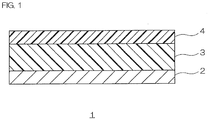
- FIG. 1 is a schematic diagram illustrating an embodiment of the thermal recording material of the present invention.
- An aqueous dispersion resin composition of the present invention contains a first polymer produced by polymerizing a first monomer component and a second polymer produced by polymerizing a second monomer component.
- the first monomer component contains, as an essential component, (meth)acrylamide.
- (Meth)acryl include acryl and methacryl (the same applies to the following).
- the first monomer component preferably contains methacrylamide. This allows for improvement in heat resistance (anti-sticking properties), plasticizer resistance, and solvent resistance.
- the first monomer component can contain, as an optional component, a copolymerizable monomer that is copolymerizable with (meth)acrylamide (hereinafter referred to as first copolymerizable monomer).
- Examples of the first copolymerizable monomer include alkyl (meth)acrylate, functional group-containing vinyl monomers, vinyl esters, aromatic vinyl monomers, N-substituted unsaturatedcarboxylic acid amides, heterocyclic vinyl compounds, vinylidene halide compounds, ⁇ -olefins, and dienes.
- alkyl (meth)acrylate examples include alkyl (meth)acrylate having an alkyl moiety with 1 to 8 carbon atoms, including methyl (meth)acrylate, ethyl (meth)acrylate, n-butyl (meth)acrylate, and 2-ethylhexyl (meth)acrylate.
- Examples of the functional group-containing vinyl monomer include a carboxy group-containing vinyl monomer, a hydroxyl group-containing vinyl monomer, an amino group-containing vinyl monomer, a glycidyl group-containing vinyl monomer, a cyano group-containing vinyl monomer, a sulfonic acid group-containing vinyl monomer and its salt, an acetoacetoxy group-containing vinyl monomer, and a phosphoric acid group-containing compound.
- carboxy group-containing vinyl monomer examples include (meth)acrylic acid, maleic anhydride, fumaric acid, itaconic acid, and crotonic acid.
- hydroxyl group-containing vinyl monomer examples include 2-hydroxyethyl (meth)acrylate and 2-hydroxypropyl (meth)acrylate.
- amino group-containing vinyl monomer examples include 2-aminoethyl (meth)acrylate, 2-(N-methylamino) ethyl (meth)acrylate, and 2-(N,N-dimethylamino) ethyl (meth)acrylate.
- Examples of the glycidyl group-containing vinyl monomer include glycidyl (meth)acrylate.
- Examples of the cyano group-containing vinyl monomer include (meth)acrylonitrile.
- Examples of the sulfonic acid group-containing vinyl monomer include allylsulfonic acid and methallylsulfonic acid.
- the salt thereof includes, for example, alkali metal salt such as sodium salt, potassium salt, and for example, ammonium salt of the above-described sulfonic acid group-containing vinyl monomer.
- alkali metal salt such as sodium salt, potassium salt
- sodium allylsulfonate, sodium methallylsulfonate, and methallylsulfonic acid ammonium are used.
- acetoacetoxy group-containing vinyl monomer examples include acetoacetoxyethyl (meth)acrylate.
- phosphoric acid group-containing compound for example, 2-methacryloyloxyethyl acid phosphate is used.
- vinyl esters examples include vinyl acetate and vinyl propionate.
- aromatic vinyl monomer examples include styrene, ⁇ -methylstyrene, and divinylbenzene.
- N-substituted unsaturated carboxylic acid amide examples include N-methylol (meth)acrylamide.
- heterocyclic vinyl compound examples include vinylpyrrolidone.
- Examples of the vinylidene halide compound include vinylidene chloride and vinylidene fluoride.
- ⁇ -olefins examples include ethylene and propylene.
- dienes examples include butadiene.
- Examples of the first copolymerizable monomer include a crosslinking vinyl monomer.
- crosslinking vinyl monomer examples include a compound containing two or more vinyl groups, including methylenebis(meth)acrylamide, divinylbenzene, and polyethylene glycol chain containing di (meth)acrylate.
- These first copolymerizable monomers may be used singly or in combination of two or more.
- a functional group-containing vinyl monomer preferably, an aromatic vinyl monomer, or a combination thereof is used, and more preferably, a functional group-containing vinyl monomer is used singly.
- a carboxy group-containing vinyl monomer, a hydroxyl group-containing vinyl monomer, a sulfonic acid group-containing vinyl monomer, or a combination thereof is used, even more preferably, a carboxy group-containing vinyl monomer, a hydroxyl group-containing vinyl monomer, or a combination thereof is used, and particularly preferably, (meth)acrylic acid, 2-hydroxyethyl (meth)acrylate, or a combination thereof is used.
- (meth)acryl includes acryl and methacryl; however, in the first monomer component, in view of water resistance, preferably, methacryl is used.
- the (meth)acrylamide content and the first copolymerizable monomer content relative to 100 parts by mass of the first monomer component are as follows.
- the (meth)acrylamide content relative to 100 parts by mass of the first monomer component is, for example, 50 parts by mass or more, preferably 70 parts by mass or more, and for example, 100 parts by mass or less, preferably 85 parts by mass or less.
- the first copolymerizable monomer content relative to 100 parts by mass of the first monomer component is, for example, 0 part by mass or more, preferably 15 parts by mass or more, and for example, 50 parts by mass or less, preferably 30 parts by mass or less.
- the first monomer component may be composed of only (meth)acrylamide without containing the first copolymerizable monomer, or the first monomer component may be composed of a combination of the (meth)acrylamide and the first copolymerizable monomer at the above-described ratio.
- the (meth)acrylamide and the first copolymerizable monomer are used in combination at the above-described ratio.
- the (meth)acrylamide content and the first copolymerizable monomer content in the above-described range allows for production of a thermal recording material with excellent durability (particularly heat resistance, solvent resistance, and plasticizer resistance).
- the content of the sulfonic acid group-containing vinyl monomer and/or its salt relative to 100 parts by mass of a total of the first monomer component is, for example, 0.01 parts by mass or more, preferably 0.2 parts by mass or more, and for example, 20 parts by mass or less, preferably 5 parts by mass or less, more preferably 1 part by mass or less.
- the viscosity can be reduced while suppressing reduction in the molecular weight of the first polymer, and workability can be improved.
- Polymerization of the first monomer component is not particularly limited, and a known polymerization method is used. For example, water, a first monomer component, and a polymerization initiator are blended, and the first monomer component is polymerized in water.
- the polymerization initiator is not particularly limited, and examples thereof include water soluble initiators such as persulfate (ammonium persulfate, potassium persulfate, etc.), hydrogen peroxide, organic hydroperoxide, and 4,4'-azobis(4-cyanovaleric acid); oil-soluble initiators such as benzoyl peroxide and azobisisobutyronitrile; and redox initiators. These polymerization initiators may be used singly or in combination of two or more.
- water soluble initiators such as persulfate (ammonium persulfate, potassium persulfate, etc.), hydrogen peroxide, organic hydroperoxide, and 4,4'-azobis(4-cyanovaleric acid)
- oil-soluble initiators such as benzoyl peroxide and azobisisobutyronitrile
- redox initiators may be used singly or in combination of two or more.
- the mixing ratio of the polymerization initiator is set suitably in accordance with the purpose and application, and is, for example, 0.1 parts by mass or more, and for example, 20 parts by mass or less, preferably 10 parts by mass or less relative to 100 parts by mass of the first monomer component.
- the polymerization conditions are as follows: under normal pressure, the polymerization temperature is, for example, 30°C or more, preferably 50°C or more, and for example, 95°C or less, preferably 85°C or less.
- the polymerization time is, for example, 1 hour or more, preferably 2 hours or more, and for example, 30 hours or less, preferably 20 hours or less.
- an emulsifier surfactant
- known additives can be blended at a suitable ratio, including a pH adjustment agent, sequestrants such as for example, ethylenediaminetetra acetic acid and its salt, and molecular weight modifiers (chain transfer agent) such as for example, mercaptans, and low molecular weight halogen compounds.
- the first polymer has a weight-average molecular weight of, based on polystyrene standard calibration in gel permeation chromatography (GPC) measurement, for example, 5000 or more, preferably 10000 or more, and for example, 1000000 or less, preferably 500000 or less.
- GPC gel permeation chromatography
- the second monomer component contains, as an essential component, a carboxy group-containing vinyl monomer and (meth)acrylonitrile.
- carboxy group-containing vinyl monomer examples include the carboxy group-containing vinyl monomer given as examples for the above-described first copolymerizable monomer, and to be specific, examples thereof include, ethylenic unsaturated monobasic carboxylic acid such as (meth)acrylic acid and crotonic acid, and their alkylesters; and ethylenic unsaturated dibasic carboxylic acid such as itaconic acid, maleic acid, fumaric acid, and their alkylesters.
- ethylenic unsaturated monobasic carboxylic acid such as (meth)acrylic acid and crotonic acid, and their alkylesters
- ethylenic unsaturated dibasic carboxylic acid such as itaconic acid, maleic acid, fumaric acid, and their alkylesters.
- carboxy group-containing vinyl monomers may be used singly or in combination of two or more.
- carboxy group-containing vinyl monomer preferably, ethylenic unsaturated monobasic carboxylic acid is used, more preferably, (meth)acrylic acid is used, and in view of improvement in water resistance, even more preferably, methacrylic acid is used.
- the second monomer component contain, as an additional component, at least (meth)acrylonitrile and optionally a further copolymerizable monomer that is copolymerizable with carboxy group-containing vinyl monomer (hereinafter referred to as second copolymerizable monomer(s)).
- Examples of the further second copolymerizable monomer include the above-described alkyl (meth)acrylate, the above-described functional group-containing vinyl monomer (excluding the carboxy group-containing vinyl monomer), the above-described vinyl esters, the above-described aromatic vinyl monomers, the above-described N-substituted unsaturated carboxylic acid amide, the above-described heterocyclic vinyl compound, the above-described vinylidene halide compound, the above-described ⁇ -olefins, the above-described dienes, and the above-described crosslinking vinyl monomer.
- Examples of the further second copolymerizable monomer further include, as the functional group-containing vinyl monomer, an amide group-containing vinyl monomer such as (meth)acrylamide.
- These second copolymerizable monomers further to the (meth)acrylonitrile may be used singly or in combination of two or more.
- alkyl (meth)acrylate particularly preferably, methyl (meth)acrylate and n-butyl (meth)acrylate are used in combination
- functional group-containing vinyl monomers and aromatic vinyl monomers are used, more preferably, these are used in combination, even more preferably, alkyl (meth)acrylate and a functional group-containing vinyl monomer are used in combination.
- the carboxy group-containing vinyl monomer content and the second copolymerizable monomer content relative to 100 parts by mass of the second monomer component are as follows: the carboxy group-containing vinyl monomer content relative to 100 parts by mass of the second monomer component is 4 parts by mass or more, preferably 4.5 parts by mass or more, and 10 parts by mass or less.
- the second copolymerizable monomer content relative to 100 parts by mass of the second monomer component is 90 parts by mass or more, and 96 parts by mass or less, preferably 95.5 parts by mass or less.
- the carboxy group-containing vinyl monomer content and the second copolymerizable monomer content within the above-described range allows for production of a thermal recording material with excellent swellability, easy film-forming, and excellent durability (water resistance solvent resistance), and allows for production of an aqueous dispersion resin composition with excellent spinnability.
- the (meth)acrylonitrile content relative to 100 parts by mass of the second monomer component is, 15 parts by mass or more, preferably 30 parts by mass or more, more preferably 40 parts by mass or more, and 90 parts by mass or less, preferably 80 parts by mass or less.
- the second monomer component contains (meth)acrylonitrile at the above-described ratio, a thermal recording material with excellent durability (particularly, heat resistance, solvent resistance, plasticizer resistance, and oil resistance) can be produced.
- the content of the sulfonic acid group-containing vinyl monomer and/or its salt relative to 100 parts by mass of a total of the second monomer component is, for example, 0.01 parts by mass or more, preferably 0.2 parts by mass or more, and for example, 20 parts by mass or less, preferably 5 parts by mass or less, more preferably 1 part by mass or less.
- the content of the sulfonic acid group-containing vinyl monomer and/or its salt within the above-described range allows for reduction in the viscosity while suppressing the reduction of the molecular weight of the second polymer, and allows for improvement in workability.
- Polymerization of the second monomer component is not particularly limited, and a known polymerization method is used.
- water the second monomer component is blended with the polymerization initiator, and the second monomer component is polymerized in water.
- the polymerization initiator is not particularly limited, and those polymerization initiators given as examples of the above-described first monomer component are used. These polymerization initiators may be used singly or in combination of two or more.
- the mixing ratio of the polymerization initiator is set suitably in accordance with the purpose and application, and the mixing ratio of the polymerization initiator relative to 100 parts by mass of the second monomer component is, for example, 0.1 parts by mass or more, 20 parts by mass or less.
- the polymerization conditions are as follows: under normal pressure, the polymerization temperature is, for example, 30°C or more, preferably 50°C or more, and for example, 95°C or less, preferably 85°C or less.
- the polymerization time is, for example, 1 hour or more, preferably 2 hours or more, and for example, 30 hours or less, preferably 20 hours or less.
- the above-described emulsifier surfactant
- the emulsifier examples include an anionic surfactant, a cationic surfactant, and a nonionic surfactant, and preferably, an anionic surfactant and a nonionic surfactant are used.
- examples include anionic surfactants such as higher alcohol sulfate, alkylbenzene sulfonate (dodecylbenzenesulfonate, etc.), aliphatic sulfonate, and alkyldiphenylether sulfonate; and nonionic surfactants such as alkylester, alkylphenylether, and alkylether of polyethylene glycol.
- emulsifiers may be used singly or in combination of two or more.
- the mixing ratio of the emulsifier is set suitably in accordance with the purpose and application.
- known additives can be blended at a suitable ratio, including, for example, pH adjustment agents, for example, sequestrants such as ethylenediaminetetraacetic acid and its salt, and for example, molecular weight modifiers (chain transfer agent) such as mercaptans and low molecular weight halogen compounds.
- pH adjustment agents for example, sequestrants such as ethylenediaminetetraacetic acid and its salt
- molecular weight modifiers chain transfer agent
- mercaptans chain transfer agent
- the second polymer contains carboxy groups derived from the carboxy group-containing vinyl monomer of the second monomer component, and the carboxy group is neutralized by a neutralizing agent, and salificated.
- the neutralizing agent is added, and at a predetermined temperature of 40°C or more, the temperature is kept for 30 minutes or more.
- the carboxy groups in the second polymer are neutralized in this manner (swelling and softening treatment).
- the neutralizing agent examples include alkali metalhydroxide (sodium hydroxide, potassium hydroxide, etc.), amines, and ammonia.
- the neutralizing agent is preferably used as a salt-containing water, to be specific, as an aqueous solution of alkali metalhydroxide and ammonia water. These neutralizing agents may be used singly or in combination of two or more.
- ammonia is used for the neutralizing agent.
- the mixing ratio of the neutralizing agent relative to 100 mol of the carboxy group-containing vinyl monomer contained in the second monomer component is, for example, 20 mol or more, preferably 25 mol or more, more preferably 30 mol or more, and for example, 200 mol or less, preferably 150 mol or less, more preferably 120 mol or less.
- the temperature to be kept is 40°C or more, preferably 50°C or more, and for example, 90°C or less, preferably 80°C or less.
- the temperature is kept for 30 minutes or more, preferably 1 hour or more, and for example, 12 hours or less, preferably 10 hours or less.
- carboxy group is neutralized and carboxylic acid salt is formed.
- carboxylic acid salt is formed.
- ammonia water is used as the neutralizing agent, neutralization of the carboxy group forms ammonium salt.
- the thermal recording material with excellent running stability and durability can be produced, and furthermore, an aqueous dispersion resin composition with excellent spinnability can be produced.
- neutralizing agent counter cation
- various analyzers such as a FT-IR device, a thermal decomposition GC-MS device, a head space GC-MS device, and an element analyzer, neutralization of the carboxy group can be confirmed.
- the second polymer has a weight-average molecular weight measured by polystyrene standard calibration with gel permeation chromatography (GPC) of, for example, 10000 or more, preferably 50000 or more, and for example, 2000000 or less, preferably 1000000 or less.
- GPC gel permeation chromatography
- the second polymer has a solubility parameter (SP value) of, for example, 9.5 (cal/cm 3 ) 1/2 or more, and for example, 13 (cal/cm 3 ) 1/2 or less.
- SP value solubility parameter
- (meth)acrylonitrile is used, preferably 10.8 (cal/cm 3 ) 1/2 or more.
- solubility parameter (SP value) within the above-described range, anti-blocking and adhesiveness can be improved.
- the second polymer has a glass transition temperature of, for example, 20°C or more, preferably 25°C or more, and for example, 130°C or less, preferably 125°C or less.
- (meth)acrylonitrile is used, preferably, 30°C or more, 130°C or less.
- the second polymer has a glass transition temperature within the above-described range, film-forming properties and durability (heat resistance) can be improved.
- the values calculated by a calculation software CHEOPS version 4.0 of Million Zillion Software are used.
- the calculation method used in the calculation software is the method described in Computational Materials Science of Polymers (A.A.Askadskii, Cambridge Intl Science Pub (2005/12/30)) Chapter XII (the same applies in the following).
- the aqueous dispersion resin composition is not particularly limited as long as the above-described first polymer and the above-described second polymer are contained, and for example, the aqueous dispersion resin composition can be produced by separately producing the first polymer and the second polymer by the above-described method, and then mixing them.
- the first polymer content and the second polymer content are as follows: the first polymer content relative to 100 parts by mass of the second polymer is, for example, 5 parts by mass or more, preferably 10 parts by mass or more, and for example, 500 parts by mass or less, preferably 200 parts by mass or less.
- an aqueous dispersion resin composition can be produced with excellent workability, and running stability and durability can be improved.
- the aqueous dispersion resin composition has a solid content concentration of, for example, 10 mass% or more, preferably 15 mass% or more, and for example, 60 mass% or less, preferably 50 mass% or less.
- the aqueous dispersion resin composition has a pH of, for example, 5.5 or more, preferably 6.0 or more, and for example, 11 or less, preferably 10 or less.
- first the first polymer is produced, and the second polymer is produced in the presence of the produced first polymer.
- the second polymer can be produced, and the first polymer can be produced in the presence of the second polymer produced.
- the first polymer is produced, and the second polymer is produced in the presence of the produced first polymer, or first the second polymer is produced, and the first polymer is produced in the presence of the produced second polymer.
- the aqueous dispersion resin composition can be produced as particles (core-shell particles) in which the second polymer is covered with the first polymer.
- the second polymer is produced, and the first polymer is produced in the presence of the produced second polymer.
- aqueous dispersion resin composition By producing the aqueous dispersion resin composition as core-shell particles, running stability and durability can be improved.
- core-shell particles in which the core polymer is partially covered with the shell polymer are produced.
- a thermal recording material with excellent running stability and durability can be produced, and furthermore, excellent spinnability can be achieved.
- the aqueous dispersion resin composition can further contain a non-crosslinking urea compound.
- the non-crosslinking urea compound has a molecular weight of 1000 or less, and is defined as a urea compound that does not form a crosslinking structure with the above-described first polymer and the above-described second polymer.
- non-crosslinking urea compound examples include, for example, urea or urea derivative having one or less methylol group in its molecule.
- non-crosslinking urea compound for example, a compound represented by formula (1) or (2) below is used.
- R 1 to R 4 independently represents a hydrogen atom, or a Cl to C12 alkyl group which may have a hydroxyl group, and two or more of R 1 to R 4 do not have hydroxyl groups simultaneously.
- R 1 to R 4 independently represents a hydrogen atom, or a Cl to C12 alkyl group which may have a hydroxyl group, and two or more of R 1 to R 4 do not have hydroxyl groups simultaneously.
- R 1 to R 4 independently represents a hydrogen atom, or a C1 to C12 alkyl group which may have a hydroxyl group such as, for example, straight chain alkyl groups such as a methyl group, ethyl group, n-propyl group, n-butyl group, and n-hexyl, for example, branched alkyl groups such as an i-propyl group, i-butyl group, and t-butyl group, and monohydroxy alkyl groups such as 2-hydroxyethyl group and 3-hydroxypropyl group.
- a hydroxyl group such as, for example, straight chain alkyl groups such as a methyl group, ethyl group, n-propyl group, n-butyl group, and n-hexyl, for example, branched alkyl groups such as an i-propyl group, i-butyl group, and t-butyl group, and monohydroxy alkyl groups such
- R 1 to R 4 preferably, a hydrogen atom and an alkyl group having 1 to 9 carbon atoms are used, even more preferably, a hydrogen atom, a methyl group, and an ethyl group are used.
- R 1 to R 4 does not have a hydroxyl group simultaneously. That is, when one of R 1 to R 4 is a C1 to C12 alkyl group having a hydroxyl group, the remaining three of them are hydrogen atoms, or a C1 to C12 alkyl group having no hydroxyl group.
- two of R 1 to R 4 are alkyl groups having 1 to 12 carbon atoms and having no hydroxyl group, and the remaining two are hydrogen atoms; one of R 1 to R 4 is a C1 to C12 alkyl group having a hydroxyl group, and the remaining three are hydrogen atoms; or all of R 1 to R 4 are hydrogen atoms.
- two of R 1 to R 4 are C1 to C12 alkyl groups having no hydroxyl group, and the remaining two are hydrogen atoms, or all of R 1 to R 4 are hydrogen atoms. In even more preferable embodiment, two of R 1 to R 4 are C1 to C12 alkyl group having no hydroxyl group, and the remaining two are hydrogen atoms.
- non-crosslinking urea compound examples include urea; monoalkylurea such as 1-alkyl urea; dialkyl ureas such as 1,1-dialkylurea, and 1,3-dialkylurea; hydroxyl alkyl ureas such as 1-hydroxyalkylurea; and urea derivatives such as biuret substances of the above-described monoalkylurea, the above-described dialkylurea, and the above-described hydroxyalkylurea.
- monoalkylurea such as 1-alkyl urea
- dialkyl ureas such as 1,1-dialkylurea, and 1,3-dialkylurea
- hydroxyl alkyl ureas such as 1-hydroxyalkylurea
- urea derivatives such as biuret substances of the above-described monoalkylurea, the above-described dialkylurea, and the above-described hydroxyalkylurea.
- Examples of the 1-monoalkylurea include 1-methylurea and 1-ethylurea, and preferably, 1-methylurea is used.
- 1,1-dialkylurea examples include 1,1-dimethylurea and 1,1-diethylurea, and preferably 1,1-dimethylurea is used.
- 1,3-dialkylurea examples include 1,3-dimethylurea and 1,3-diethylurea, and preferably, 1,3-dimethylurea is used.
- Examples of the 1-hydroxyalkylurea include 1-(2-hydroxyethyl) urea and 1-(3-hydroxypropyl) urea.
- biuret substances of urea examples include biuret (urea dimer, C 2 H 5 N 3 O 2 ) and N,N-dimethylbiuret, and preferably, biuret (urea dimer, C 2 H 5 N 3 O 2 ) is used.
- urea compound preferably urea, 1-alkylurea, 1,1-dialkylurea, 1,3-dialkylurea, 1-hydroxyalkylurea, and biuret (urea dimer, C 2 H 5 N 3 O 2 ), more preferably, urea, 1,1-dialkylurea, and 1,3-dialkylurea are used. Even more preferably, urea, 1,1-dimethylurea, or 1,3-dimethylurea is used.
- aqueous dispersion resin composition containing a non-crosslinking urea compound allows for improvement in water resistance and plasticizer resistance.
- the mixing ratio of the non-crosslinking urea compound relative to 100 parts by mass of a total amount of the first polymer and the second polymer (solid content) is, for example, 0.1 parts by mass or more, preferably 1 part by mass or more, more preferably 2 parts by mass or more, further preferably 5 parts by mass or more, and for example, 50 parts by mass or less, preferably 40 parts by mass or less, more preferably 30 parts by mass or less, further preferably 20 parts by mass or less.
- the mixing ratio of the non-crosslinking urea compound within the above-described range allows for improvement in water resistance and plasticizer resistance.
- the aqueous dispersion resin composition can further contain other polymers (polymer excluding the first polymer and the second polymer) and a filler.
- Examples of the other polymers include polyolefin resin, and to be specific, homopolymer and copolymers of ⁇ -olefin having 2 to 16 carbon atoms (e.g., ethylene, propylene, 1-butene, 3-methyl-1-butene, 4-methyl-1-pentene, 3-methyl-1-pentene, 1-heptene, 1-hexene, 1-octene, 1-decene, 1-dodecene, etc.).
- homopolymers and copolymers of ethylene, propylene, and/or 1-butene are used.
- the mixing ratio of the other polymer is set suitably in accordance with the purpose and application.
- the mixing ratio of the polyolefin resin relative to 100 parts by mass of a total amount of the first polymer and the second polymer is, for example, 0.5 parts by mass or more, preferably 2 parts by mass or more, more preferably 3 parts by mass or more, even more preferably 5 parts by mass or more, and for example, 50 parts by mass or less, preferably 40 parts by mass or less, more preferably 35 parts by mass or less, even more preferably 30 parts by mass or less.
- filler examples include inorganic fillers such as calcium carbonate, magnesium carbonate, kaolin, talc, clay, aluminum hydroxide, barium sulfate, silicon oxide, titanium oxide, zinc oxide, and colloidal silica; and organic fine particles such as urea-formalin resin and polystyrene micropowder. These fillers may be used singly or in combination of two or more.
- the mixing ratio of the filler is set suitably in accordance with the purpose and application.
- the aqueous dispersion resin composition can contain known additives in a range that does not hinder the excellent effects of the present invention, including, lubricants (lubricant excluding polyolefin resin) such as higher fatty acid metal salt and higher fatty acid amide; cross-linking agents (water resistant agent) such as ammonium zirconium carbonate, polyamide epichlorohydrin and modified substance thereof; a film-forming auxiliary agent; an ultraviolet absorber; an antioxidant; an antifoaming agent; a wetting agent; a viscosity adjustment agent; and other auxiliary agents.
- lubricants excluding polyolefin resin
- cross-linking agents water resistant agent
- an ultraviolet absorber an antioxidant
- an antifoaming agent a wetting agent
- a viscosity adjustment agent and other auxiliary agents.
- the additive content is set suitably in accordance with the purpose and application.
- aqueous dispersion resin composition allows for production of thermal recording material with excellent running stability and durability, and furthermore, excellent spinnability.
- the aqueous dispersion resin composition can be suitably used as a resin composition for a thermal recording layer for forming a thermal recording layer and a resin composition for a protection layer for forming a protection layer in a thermal recording material including a support layer, a thermal recording layer, and a protection layer.
- a thermal recording material 1 includes a support layer 2, a thermal recording layer 3 laminated on one side in the thickness direction of the support layer 2, and a protection layer 4 laminated on one side in the thickness direction of the thermal recording layer 3.
- Examples of the support layer 2 include paper and a plastic sheet.
- the thickness of the support layer 2 is set suitably in accordance with the purpose and application.
- the thermal recording layer 3 is formed as a cured product of the resin composition for a thermal recording layer.
- the resin composition for a thermal recording layer contains, for example, the above-described aqueous dispersion resin composition, a dye, and a developer.
- the dye examples include known basic organic dyes such as a fluoran organic dye, a triallylmethane organic dye, and a phenoxazine organic dye.
- the developer is not particularly limited, and examples thereof include known developers such as a phenolic compound and aromatic carboxylic acid.
- the mixing ratio of the developer relative to 100 parts by mass of the dye is, for example, 100 parts by mass or more, and for example, 3000 parts by mass or less.
- a resin composition for a thermal recording layer is produced.
- an aqueous resin composition e.g., polyvinyl alcohol, etc.
- a resin composition for a thermal recording layer can be produced.
- the mixing ratio in the resin composition for a thermal recording layer is not particularly limited, but the aqueous dispersion resin composition solid content relative to 100 parts by mass of a total amount of the dye and the developer is, for example, 5 parts by mass or more, preferably 10 parts by mass or more, and for example, 30 parts by mass or less, preferably 20 parts by mass or less.
- the resin composition for a thermal recording layer can contain, as necessary, inorganic pigment such as calcium carbonate, talc, and kaolin; and sensitizers such as benzophenone ultraviolet absorber, triazole ultraviolet absorber, wax, and fatty acid amide at a suitable ratio depending on its purpose and use.
- inorganic pigment such as calcium carbonate, talc, and kaolin
- sensitizers such as benzophenone ultraviolet absorber, triazole ultraviolet absorber, wax, and fatty acid amide at a suitable ratio depending on its purpose and use.
- the resin composition for a thermal recording layer is applied to the support layer 2 so that it has a thickness of, for example, 2 to 20g/m 2 by a known coating method such as curtain coating, roll coating, and blade coating, preferably, by curtain coating in view of improvement in production efficiency, and then dried and cured.
- a known coating method such as curtain coating, roll coating, and blade coating, preferably, by curtain coating in view of improvement in production efficiency, and then dried and cured.
- the carboxylic acid salt e.g., ammonium salt
- the carboxylic acid salt contained the second polymer in the above-described aqueous dispersion resin composition returns to the carboxy group, thereby forming the thermal recording layer 3.
- the conditions for drying and curing are suitably set in accordance with, for example, the formulation of the resin composition for a thermal recording layer.
- the protection layer 4 is formed as a cured product of the resin composition for a protection layer.
- the above-described aqueous dispersion resin composition can be used as is.
- the resin composition for a protection layer is applied to the thermal recording layer 3 so that it has a thickness of, for example, 1 to 10g/M 2 by a known coating methods such as curtain coating, roll coating, and blade coating, and preferably by curtain coating in view of improvement in production efficiency, and dried and cured.
- the carboxylic acid salt e.g., ammonium salt
- the carboxylic acid salt contained in the second polymer in the above-described aqueous dispersion resin composition returns to the carboxy group, thereby forming the protection layer 4.
- the conditions for drying and curing are suitably set in accordance with, for example, formulation of the resin composition for a protection layer.
- the produced thermal recording material has excellent running stability and durability.
- both of the thermal recording layer 3 and the protection layer 4 are formed from the above-described aqueous dispersion resin composition in the thermal recording material 1.
- only one of the thermal recording layer 3 or the protection layer 4 can be formed from the above-described aqueous dispersion resin composition.
- the thermal recording layer 3 or the protection layer 4 that is not formed from the above-described aqueous dispersion resin composition is formed from a known method.
- the thermal recording material 1 is composed of a support layer 2, a thermal recording layer 3, and a protection layer 4, but an intermediate layer (not shown) can be interposed between, for example, the support layer 2 and the thermal recording layer 3, or between the thermal recording layer 3 and the protection layer 4.
- the present invention is described in further detail in the following with reference to Examples and Comparative Examples, but the present invention is not limited to these Examples.
- the “parts” and “%” are based on mass unless otherwise specified.
- the specific numeral values such as the mixing ratio (content), physical property value, and parameter used in description below can be replaced with the corresponding mixing ratio (content), the physical property value, and parameter, that is, the upper limit value (numeral values defined with “or less”, “less than”) or the lower limit value (numeral values defined with "or more", “more than”) of the corresponding description used in the above-described "DESCRIPTION OF EMBODIMENTS".
- a separable flask equipped with a mixer and a reflux condenser was charged with 60 parts of deionized water, 0.1 parts of sodium dodecylbenzene sulphonate, and 1.0 part of potassium persulfate, and after nitrogen gas replacement, the temperature was increased to 75°C. Then, an emulsion of the following composition (mixture of second monomer component, water, and emulsifier) was added continuously for about 4 hours, and then the mixture was allowed to stand at 75°C for about 4 hours to complete polymerization, thereby producing a seed emulsion having a solid content of about 50%.
- Acrylonitrile 55 parts n-Butyl acrylate 30 parts Methacrylic acid 10 parts Methyl methacrylate 5 parts Sodium dodecylbenzene sulphonate 0.3 parts Deionized water 40 parts
- aqueous dispersion resin composition having a pH adjusted to about 8.0 and having a solid content of about 20%.
- a separable flask equipped with a mixer, and a reflux condenser was charged with 100 parts of deionized water, 0.1 parts of sodium dodecylbenzene sulphonate, and 1.0 part of potassium persulfate, and after nitrogen gas replacement, the temperature was increased to 75°C. Then, an emulsion of the following composition (mixture of second monomer component, water, and emulsifier) was added continuously for about 4 hours, and then the mixture was allowed to stand at 75°C for about 4 hours to complete polymerization, thereby producing a seed emulsion having a solid content of about 40%.
- aqueous dispersion resin composition having a pH adjusted to about 7.0 and having a solid content of about 25%.
- aqueous dispersion resin composition having a pH adjusted to about 6.0 and having a solid content of about 25%.
- a separable flask equipped with a mixer, and a reflux condenser was charged with 110 parts of deionized water, 0.1 parts of sodium dodecylbenzene sulphonate, and 1.0 part of potassium persulfate, and after nitrogen gas replacement, the temperature was increased to 70°C. Then, an emulsion of the following composition (mixture of second monomer component, water, and emulsifier) was added continuously for about 4 hours, and then the mixture was allowed to stand at 75°C for about 4 hours to complete polymerization, thereby producing a seed emulsion having a solid content of about 40%.
- the temperature was cooled to 40°C or less, and ammonia water was added for alkalization.
- the mixture was not allowed to stand at 40°C or more.
- the aqueous dispersion resin composition having a pH adjusted to about 9.0 and having a solid content of about 20% was produced in this manner.
- a separable flask equipped with a mixer and a reflux condenser was charged with 370 parts of deionized water, and after nitrogen gas replacement, the temperature was increased to 70°C. Then, after adding 1.0 part of ammonium persulfate, the mixture of the composition below (mixture of first monomer component and water) was continuously added for 2 hours while stirring. Thereafter, the mixture was allowed to stand for 2 hours to complete polymerization, thereby producing an aqueous solution of copolymer resin having a solid content of about 15%.
- the temperature was cooled to 40°C or less, and ammonia water was added for alkalization.
- the mixture was not allowed to stand at 40°C or more.
- the aqueous dispersion resin composition having a pH adjusted to about 9.0 and having a solid content of about 23% was produced in this manner.
- a separable flask equipped with a mixer and a reflux condenser was charged with 300 parts of deionized water, and 0.5 parts of sodium dodecyl sulfate, and after nitrogen gas replacement, the temperature was increased to 75°C. Then, 0.5 parts of potassium persulfate was added, and an emulsion of the following composition (mixture of second monomer component, water, and emulsifier) was added continuously for about 4 hours. Thereafter, the mixture was aged at 75°C for 2 hours, thereby completing polymerization.
- Acrylonitrile 45 parts Butyl acrylate 25 parts Methyl methacrylate 15 parts Methacrylic acid 10 parts Styrene 5 parts Sodium dodecyl sulfate 0.3 parts Deionized water 80 parts
- aqueous dispersion resin composition having a pH adjusted to about 8.0 and having a solid content of about 18%.
- An aqueous dispersion resin composition was produced in the same manner as in Example 1, except that after ammonia water was added for alkalization, the mixture was not allowed to stand at the temperature.
- aqueous dispersion resin composition solid content about 20%
- deionized water was added for dilution, and then 6.2 parts of 65% clay slurry dispersed as a filler in advance (manufactured by Engelhard Corporation, UW-90) (solid content based, 20 mass% relative to solid content in aqueous dispersion resin composition), 5 parts of a polyolefin copolymer emulsion with 40% solid content concentration (manufactured by Mitsui Chemicals, Inc., CHEMIPEARL W400) (solid content based, 10 mass% relative to the solid content in the aqueous dispersion resin composition), and 9.2 parts of 13% aqueous solution of an ammonium zirconium carbonate as a cross-linking agent (manufactured by DAIICHI KIGENSO KAGAKU KOGYO CO., LTD., Zircosol AC-7) (solid content based, 6 mass% relative to
- the mixture was applied to a commercially available thermal word processing paper with no surface treatment in a dried mass of 3g/m 2 with a bar coater, and thereafter dried (after forcefully drying at 50°C for 60 seconds, cured at 40°C for 16 hours), thereby producing a thermal recording material.
- Example 2 To 100 parts of the aqueous dispersion resin composition produced in Example 2 (solid content about 25%), 76 parts of deionized water was added for dilution, and 6.2 parts of polyolefin copolymer emulsion with 40% solid content concentration (manufactured by Mitsui Chemicals, Inc., CHEMIPEARL W4005) (solid content based, 5 mass% relative to solid content in aqueous dispersion resin composition), and 19.1 parts of a 13% aqueous solution of ammonium zirconium carbonate as a cross-linking agent (manufactured by DAIICHI KIGENSO KAGAKU KOGYO CO., LTD., Zircosol AC-7) (solid content based, 10 mass% relative to the solid content in the aqueous dispersion resin composition) were mixed homogeneously.
- the mixture was applied to a commercially available thermal word processing paper with no surface treatment in a dried mass of 3g/m 2 with a bar coater, and thereafter dried (after forcefully drying at 50°C for 60 seconds, cured at 40°C for 16 hours), thereby producing a thermal recording material.
- Example 3 To 100 parts of the aqueous dispersion resin composition produced in Example 3 (solid content about 25%), 94 parts of deionized water was added for dilution, and then as a filler, 8.4 parts of 60% calcium carbonate slurry (manufactured by OKUTAMA KOGYO CO.,LTD., Tama Pearl TP-123CS) (solid content based, 20 mass% relative to solid content in aqueous dispersion resin composition), 6.3 parts of polyolefin copolymer emulsion with 40% solid content concentration (manufactured by Mitsui Chemicals, Inc., CHEMIPEARL W401) (solid content based, 5 mass% relative to solid content in aqueous dispersion resin composition), and 6 parts of a 25% aqueous solution of polyamide epichlorohydrin modified product as a cross-linking agent (manufactured by SEIKO PMC CORPORATION, WS4024) (solid content based, 6 mass% relative to solid content in
- the mixture was applied to a commercially available thermal word processing paper with no surface treatment in a dried mass of 3g/m 2 with a bar coater, and thereafter dried (after forcefully drying at 50°C for 60 seconds, cured at 40°C for 16 hours), thereby producing a thermal recording material.
- the mixture was applied to a commercially available thermal word processing paper with no surface treatment in a dried mass of 3g/m 2 with a bar coater, and thereafter dried (after forcefully drying at 50°C for 60 seconds, cured at 40°C for 16 hours), thereby producing a thermal recording material.
- the mixture was applied to a commercially available thermal word processing paper with no surface treatment in a dried mass of 3g/m 2 with a bar coater, and thereafter dried (after forcefully drying at 50°C for 60 seconds, cured at 40°C for 16 hours), thereby producing a thermal recording material.
- the mixture was applied to a commercially available thermal word processing paper with no surface treatment in a dried mass of 3g/m 2 with a bar coater, and thereafter dried (after forcefully drying at 50°C for 60 seconds, cured at 40°C for 16 hours), thereby producing a thermal recording material.
- a thermal recording material was produced in the same manner as in Example 4, except that the dispersion resin composition produced in Example 2 was used, and its solid content was based.
- a thermal recording material was produced in the same manner as in Example 4, except that the dispersion resin composition produced in Comparative Example 1 was used, and its solid content was based.
- a thermal recording material was produced in the same manner as in Example 4, except that the dispersion resin composition produced in Comparative Example 2 was used, and its solid content was based.
- a thermal recording material was produced in the same manner as in Example 4, except that the dispersion resin composition produced in Comparative Example 3 was used, and its solid content was based.
- a thermal recording material was produced in the same manner as in Example 4, except that the dispersion resin composition produced in Comparative Example 4 was used, and its solid content was based.
- a thermal recording material was produced in the same manner as in Example 3, except that the dispersion resin composition produced in Comparative Example 1 was used, and its solid content was based.
- a thermal recording material was produced in the same manner as in Example 3, except that the dispersion resin composition produced in Comparative Example 2 was used, and its solid content was based.
- Table 2 shows the results of Examples 4 to 6 and Comparative Examples 5 to 7.
- Table 3 shows the results of Example 7 and Comparative Examples 8 to 11, and Table 3 also shows the results of Example 4, which has the same production method of the thermal recording material.
- Table 4 shows Comparative Examples 12 to 13, and also shows the results of Example 6 which has the same production method of the thermal recording material.
- an aqueous dispersion resin composition with its solid content adjusted so that B type viscosity (60 revolution) was about 250 mPa • s was sealed between circular plates with a diameter of 4 mm (gap 2 mm); the upper plate was pulled up by 6 mm with a speed of 300 mm/s and kept, and the time from the start of the pulling up of the plate until the polymer filament undergoes breaking was measured.
- a pattern image of solid black print was made with the following conditions, and the degree of the sound (cracking sound) at that time and smudges on the head were evaluated comprehensively.
- the image was made in the same manner as described above, and a transparent polyvinyl chloride adhesive tape (manufactured by NITTO DENKO CORPORATION) was stuck on the image portion, and removed after leaving it at 40°C for 72 hours.
- the concentration before and after sticking the transparent polyvinyl chloride adhesive tape was measured with a Macbeth concentration meter, and retention of the printing concentration was determined.
- the thermal recording material was immersed in water, and after allowing the thermal recording material to stand at 23°C for 24 hours, removal of the applied surface was visually checked. Evaluation criteria are shown below. Good: No removal of applied surface was observed. Average: Slight removal of applied surface, but practically no problem. Bad: Removal of the applied surface occurred.
- a line was drawn with an oil-based marker on the applied surface of the thermal recording material, and the degree of color development was visually observed. Evaluation criteria are shown below. Good: No color development was observed on the thermal recording layer. Average: Slight color development was observed on the thermal recording layer, but practically no problem. Bad : Coloring was observed on the thermal recording layer.
Landscapes
- Chemical & Material Sciences (AREA)
- Chemical Kinetics & Catalysis (AREA)
- Organic Chemistry (AREA)
- Medicinal Chemistry (AREA)
- Polymers & Plastics (AREA)
- Health & Medical Sciences (AREA)
- Optics & Photonics (AREA)
- Physics & Mathematics (AREA)
- General Chemical & Material Sciences (AREA)
- Life Sciences & Earth Sciences (AREA)
- Engineering & Computer Science (AREA)
- Materials Engineering (AREA)
- Wood Science & Technology (AREA)
- Heat Sensitive Colour Forming Recording (AREA)
- Compositions Of Macromolecular Compounds (AREA)
- Graft Or Block Polymers (AREA)
Claims (13)
- Wässrige Dispersionsharzzusammensetzung, umfassend
ein erstes Polymer, hergestellt durch Polymerisation einer ersten Monomerkomponente, die (Meth)acrylamid enthält, und
ein zweites Polymer, hergestellt durch Polymerisation einer zweiten Monomerkomponente, die ein Carboxygruppen-enthaltendes Vinylmonomer und (Meth)acrylnitril enthält,
wobei die Zusammensetzung ein Core-Shell-Partikel ist, in welchem das zweite Polymer mit dem ersten Polymer bedeckt ist,
wobei mindestens ein Teil der Carboxygruppe in dem zweiten Polymer durch Zugabe eines Neutralisationsmittels nach der Polymerisation der zweiten Monomerkomponente und durch Aufrechterhaltung einer Temperatur von 40°C oder mehr für 30 Minuten oder mehr neutralisiert wird,
wobei der Gehalt an Carboxygruppen-enthaltendem Vinylmonomer in der zweiten Monomerkomponente, bezogen auf 100 Massenteile der zweiten Monomerkomponente, 4 Massenteile oder mehr und 10 Massenteile oder weniger beträgt, und
wobei der Gehalt an (Meth)acrylnitril in der zweiten Monomerkomponente, bezogen auf 100 Massenteile der zweiten Monomerkomponente, 15 Massenteile oder mehr und 90 Massenteile oder weniger beträgt. - Wässrige Dispersionsharzzusammensetzung gemäß Anspruch 1, wobei der Gehalt an (Meth)acrylamid, bezogen auf 100 Massenteile der ersten Monomerkomponente, 50 Massenteile oder mehr und 100 Massenteile oder weniger beträgt.
- Wässrige Dispersionsharzzusammensetzung gemäß Anspruch 1 oder 2, wobei die erste Monomerkomponente ferner ein Carboxygruppen-enthaltendes Vinylmonomer und/oder ein Hydroxylgruppen-enthaltendes Vinylmonomer enthält.
- Wässrige Dispersionsharzzusammensetzung gemäß mindestens einem der Ansprüche 1 bis 3, wobei der Gehalt an erstem Polymer, bezogen auf 100 Massenteile des zweiten Polymers, 5 Massenteile oder mehr und 500 Massenteile oder weniger beträgt.
- Wässrige Dispersionsharzzusammensetzung gemäß mindestens einem der Ansprüche 1 bis 4, wobei das Carbonsäuresalz, das durch Neutralisation mindestens eines Teils der Carboxygruppe gebildet wird, ein Ammoniumsalz ist.
- Wässrige Dispersionsharzzusammensetzung gemäß mindestens einem der Ansprüche 1 bis 5, wobei die erste Monomerkomponente und/oder die zweite Monomerkomponente ferner ein Sulfonsäuregruppen-enthaltendes Vinylmonomer und/oder dessen Salz enthält.
- Wässrige Dispersionsharzzusammensetzung gemäß Anspruch 6, wobei, wenn die erste Monomerkomponente das Sulfonsäuregruppen-enthaltende Vinylmonomer und/oder dessen Salz enthält, der Gehalt davon, bezogen auf 100 Massenteile der Gesamtmenge der ersten Monomerkomponente, 0,01 Massenteile oder mehr und 20 Massenteile oder weniger beträgt, und
wenn die zweite Monomerkomponente das Sulfonsäuregruppen-enthaltende Vinylmonomer und/oder dessen Salz enthält, der Gehalt davon, bezogen auf 100 Massenteile der Gesamtmenge der zweiten Monomerkomponente, 0,01 Massenteile oder mehr und 20 Massenteile oder weniger beträgt. - Harzzusammensetzung für eine thermische Aufzeichnungsschicht, wobei die Harzzusammensetzung für eine thermische Aufzeichnungsschicht eines thermischen Aufzeichnungsmaterials, das eine Trägerschicht, eine thermische Aufzeichnungsschicht und eine Schutzschicht umfasst, verwendet wird; und
wobei die Harzzusammensetzung für eine thermische Aufzeichnungsschicht die wässrige Dispersionsharzzusammensetzung gemäß mindestens einem der Ansprüche 1 bis 7 umfasst. - Harzzusammensetzung für eine Schutzschicht, wobei die Harzzusammensetzung für eine Schutzschicht eines thermischen Aufzeichnungsmaterials verwendet wird,
wobei das thermische Aufzeichnungsmaterial eine Trägerschicht, eine thermische Aufzeichnungsschicht und eine Schutzschicht umfasst, und
wobei die Harzzusammensetzung für eine Schutzschicht die wässrige Dispersionsharzzusammensetzung gemäß mindestens einem der Ansprüche 1 bis 7 umfasst. - Thermisches Aufzeichnungsmaterial, umfassend eine Trägerschicht,eine thermische Aufzeichnungsschicht, die auf einer Seite in Dickenrichtung der Trägerschicht laminiert ist, undeine Schutzschicht, die auf einer Seite in Dickenrichtung der thermischen Aufzeichnungsschicht laminiert ist,wobei die thermische Aufzeichnungsschicht ein gehärtetes Produkt der Harzzusammensetzung für eine thermische Aufzeichnungsschicht gemäß Anspruch 8 umfasst.
- Thermisches Aufzeichnungsmaterial gemäß Anspruch 10, hergestellt durch Aufbringen der Harzzusammensetzung für eine thermische Aufzeichnungsschicht auf die Trägerschicht mittels Vorhangbeschichtung,
Aushärten der Harzzusammensetzung für eine thermische Aufzeichnungsschicht zur Bildung der thermischen Aufzeichnungsschicht, und
Laminieren der Schutzschicht auf die thermische Aufzeichnungsschicht. - Thermisches Aufzeichnungsmaterial umfassend eine Trägerschicht,
eine thermische Aufzeichnungsschicht, die auf einer Seite in Dickenrichtung der Trägerschicht laminiert ist, und
eine Schutzschicht, die auf einer Seite in Dickenrichtung der thermischen Aufzeichnungsschicht laminiert ist,
wobei die Schutzschicht ein gehärtetes Produkt der Harzzusammensetzung für eine Schutzschicht gemäß Anspruch 9 umfasst. - Thermisches Aufzeichnungsmaterial gemäß Anspruch 12, hergestellt durch Laminieren der thermischen Aufzeichnungsschicht auf die Trägerschicht,
gefolgt von Aufbringen der Harzzusammensetzung für eine Schutzschicht auf die thermische Aufzeichnungsschicht mittels Vorhangbeschichtung und
Aushärten der Harzzusammensetzung für eine Schutzschicht.
Applications Claiming Priority (2)
| Application Number | Priority Date | Filing Date | Title |
|---|---|---|---|
| JP2014103930 | 2014-05-20 | ||
| PCT/JP2015/064232 WO2015178354A1 (ja) | 2014-05-20 | 2015-05-18 | 水分散型樹脂組成物、感熱記録層用樹脂組成物、保護層用樹脂組成物および感熱記録材料 |
Publications (3)
| Publication Number | Publication Date |
|---|---|
| EP3147327A1 EP3147327A1 (de) | 2017-03-29 |
| EP3147327A4 EP3147327A4 (de) | 2017-12-27 |
| EP3147327B1 true EP3147327B1 (de) | 2020-08-19 |
Family
ID=54554023
Family Applications (1)
| Application Number | Title | Priority Date | Filing Date |
|---|---|---|---|
| EP15795630.1A Active EP3147327B1 (de) | 2014-05-20 | 2015-05-18 | Wasserdispersionsartige harzzusammensetzung, harzzusammensetzung für eine thermosensitive aufzeichnungsschicht, harzzusammensetzung für schutzschicht und wärmeempfindliches aufzeichnungsmaterial |
Country Status (6)
| Country | Link |
|---|---|
| US (1) | US10226956B2 (de) |
| EP (1) | EP3147327B1 (de) |
| JP (1) | JP6396444B2 (de) |
| KR (1) | KR20160142874A (de) |
| CN (1) | CN106414602B (de) |
| WO (1) | WO2015178354A1 (de) |
Families Citing this family (3)
| Publication number | Priority date | Publication date | Assignee | Title |
|---|---|---|---|---|
| JP6988763B2 (ja) * | 2017-10-30 | 2022-01-05 | 荒川化学工業株式会社 | 水性プレコートメタル塗料用樹脂 |
| JP7221097B2 (ja) * | 2019-03-18 | 2023-02-13 | 三井化学株式会社 | 水分散型樹脂組成物、感熱記録層用樹脂組成物、および、保護層用樹脂組成物 |
| JP7636865B2 (ja) * | 2020-03-17 | 2025-02-27 | 三井化学株式会社 | 積層体の製造方法および感熱記録材料の製造方法 |
Family Cites Families (11)
| Publication number | Priority date | Publication date | Assignee | Title |
|---|---|---|---|---|
| US2300920A (en) | 1938-06-07 | 1942-11-03 | Johanna Auguste Asta Heuer | Interpolymers of vinyl sulphonic acid with another vinyl compound and aqueous emulsions thereof |
| JPS5632513A (en) | 1979-06-26 | 1981-04-02 | Rohm & Haas | Manufacture of aqueous dispersion of nonnwatersoluble core*sheath pigment like polymer granular body |
| CA1180474A (en) | 1979-06-26 | 1985-01-02 | Alexander Kowalski | Sequential heteropolymer dispersion and a particulate material obtainable therefrom useful in coating compositions as a thickening and/or opacifying agent |
| FI910991A7 (fi) | 1989-07-10 | 1991-02-28 | Mitsui Toatsu Chemicals Incorporated | Vesipitoinen emulsio |
| JP2953630B2 (ja) | 1989-12-28 | 1999-09-27 | 三井化学株式会社 | 感熱記録材料 |
| JP2790381B2 (ja) | 1990-02-03 | 1998-08-27 | 三井化学株式会社 | 有芯多層構造エマルション粒子 |
| JP3313150B2 (ja) * | 1992-08-28 | 2002-08-12 | 三井化学株式会社 | 有芯多層構造エマルション粒子の製造方法 |
| JPH1036458A (ja) * | 1996-07-30 | 1998-02-10 | Mitsui Petrochem Ind Ltd | 水性ポリマー組成物 |
| JP2000027097A (ja) * | 1999-05-24 | 2000-01-25 | Mitsui Chemicals Inc | 水性エマルションを用いた剥離紙の背面処理剤 |
| ATE458622T1 (de) | 2004-09-10 | 2010-03-15 | Mitsui Chemicals Inc | Schutzmaterial für wärmeaufzeichnungspapier |
| WO2009048016A1 (ja) | 2007-10-10 | 2009-04-16 | Mitsui Chemicals, Inc. | 感熱記録材料 |
-
2015
- 2015-05-18 EP EP15795630.1A patent/EP3147327B1/de active Active
- 2015-05-18 CN CN201580024209.4A patent/CN106414602B/zh active Active
- 2015-05-18 JP JP2016521097A patent/JP6396444B2/ja active Active
- 2015-05-18 KR KR1020167031109A patent/KR20160142874A/ko not_active Ceased
- 2015-05-18 US US15/310,316 patent/US10226956B2/en active Active
- 2015-05-18 WO PCT/JP2015/064232 patent/WO2015178354A1/ja not_active Ceased
Non-Patent Citations (1)
| Title |
|---|
| None * |
Also Published As
| Publication number | Publication date |
|---|---|
| US10226956B2 (en) | 2019-03-12 |
| JPWO2015178354A1 (ja) | 2017-04-20 |
| EP3147327A1 (de) | 2017-03-29 |
| CN106414602A (zh) | 2017-02-15 |
| WO2015178354A1 (ja) | 2015-11-26 |
| JP6396444B2 (ja) | 2018-09-26 |
| CN106414602B (zh) | 2019-04-09 |
| US20170151821A1 (en) | 2017-06-01 |
| EP3147327A4 (de) | 2017-12-27 |
| KR20160142874A (ko) | 2016-12-13 |
Similar Documents
| Publication | Publication Date | Title |
|---|---|---|
| CN101296800B (zh) | 热敏记录材料 | |
| EP3147327B1 (de) | Wasserdispersionsartige harzzusammensetzung, harzzusammensetzung für eine thermosensitive aufzeichnungsschicht, harzzusammensetzung für schutzschicht und wärmeempfindliches aufzeichnungsmaterial | |
| EP2210744B1 (de) | Wärmeempfindliches aufzeichnungsmaterial | |
| JP3838951B2 (ja) | 感熱記録材料 | |
| CN100519220C (zh) | 热敏纸用保护材料 | |
| EP2979889B1 (de) | Zusammensetzung für schutzschichten und wärmeempfindliches aufzeichnungsmaterial | |
| JP7221097B2 (ja) | 水分散型樹脂組成物、感熱記録層用樹脂組成物、および、保護層用樹脂組成物 | |
| JP7636865B2 (ja) | 積層体の製造方法および感熱記録材料の製造方法 | |
| EP0376318B1 (de) | Wärmeempfindliches Aufzeichnungsmaterial |
Legal Events
| Date | Code | Title | Description |
|---|---|---|---|
| STAA | Information on the status of an ep patent application or granted ep patent |
Free format text: STATUS: THE INTERNATIONAL PUBLICATION HAS BEEN MADE |
|
| PUAI | Public reference made under article 153(3) epc to a published international application that has entered the european phase |
Free format text: ORIGINAL CODE: 0009012 |
|
| STAA | Information on the status of an ep patent application or granted ep patent |
Free format text: STATUS: REQUEST FOR EXAMINATION WAS MADE |
|
| 17P | Request for examination filed |
Effective date: 20161115 |
|
| AK | Designated contracting states |
Kind code of ref document: A1 Designated state(s): AL AT BE BG CH CY CZ DE DK EE ES FI FR GB GR HR HU IE IS IT LI LT LU LV MC MK MT NL NO PL PT RO RS SE SI SK SM TR |
|
| AX | Request for extension of the european patent |
Extension state: BA ME |
|
| DAV | Request for validation of the european patent (deleted) | ||
| DAX | Request for extension of the european patent (deleted) | ||
| A4 | Supplementary search report drawn up and despatched |
Effective date: 20171129 |
|
| RIC1 | Information provided on ipc code assigned before grant |
Ipc: C08L 33/26 20060101ALI20171123BHEP Ipc: C08L 101/08 20060101ALI20171123BHEP Ipc: C09D 151/00 20060101ALN20171123BHEP Ipc: C08F 265/02 20060101ALI20171123BHEP Ipc: C08F 265/10 20060101ALI20171123BHEP Ipc: C08L 51/00 20060101AFI20171123BHEP Ipc: B41M 5/44 20060101ALN20171123BHEP Ipc: C08L 33/14 20060101ALI20171123BHEP Ipc: B41M 5/337 20060101ALI20171123BHEP Ipc: C08F 265/08 20060101ALI20171123BHEP |
|
| STAA | Information on the status of an ep patent application or granted ep patent |
Free format text: STATUS: EXAMINATION IS IN PROGRESS |
|
| 17Q | First examination report despatched |
Effective date: 20180724 |
|
| GRAP | Despatch of communication of intention to grant a patent |
Free format text: ORIGINAL CODE: EPIDOSNIGR1 |
|
| STAA | Information on the status of an ep patent application or granted ep patent |
Free format text: STATUS: GRANT OF PATENT IS INTENDED |
|
| RIC1 | Information provided on ipc code assigned before grant |
Ipc: C09D 151/00 20060101ALN20200217BHEP Ipc: C08F 265/08 20060101ALI20200217BHEP Ipc: B41M 5/337 20060101ALI20200217BHEP Ipc: C08L 101/08 20060101ALI20200217BHEP Ipc: C08F 265/10 20060101ALI20200217BHEP Ipc: C08L 51/00 20060101AFI20200217BHEP Ipc: C08L 33/26 20060101ALI20200217BHEP Ipc: C08F 265/02 20060101ALI20200217BHEP Ipc: C08L 33/14 20060101ALI20200217BHEP Ipc: C08F 220/44 20060101ALI20200217BHEP Ipc: B41M 5/44 20060101ALN20200217BHEP |
|
| INTG | Intention to grant announced |
Effective date: 20200305 |
|
| GRAS | Grant fee paid |
Free format text: ORIGINAL CODE: EPIDOSNIGR3 |
|
| GRAA | (expected) grant |
Free format text: ORIGINAL CODE: 0009210 |
|
| STAA | Information on the status of an ep patent application or granted ep patent |
Free format text: STATUS: THE PATENT HAS BEEN GRANTED |
|
| AK | Designated contracting states |
Kind code of ref document: B1 Designated state(s): AL AT BE BG CH CY CZ DE DK EE ES FI FR GB GR HR HU IE IS IT LI LT LU LV MC MK MT NL NO PL PT RO RS SE SI SK SM TR |
|
| REG | Reference to a national code |
Ref country code: CH Ref legal event code: EP |
|
| REG | Reference to a national code |
Ref country code: DE Ref legal event code: R096 Ref document number: 602015057778 Country of ref document: DE |
|
| REG | Reference to a national code |
Ref country code: AT Ref legal event code: REF Ref document number: 1303901 Country of ref document: AT Kind code of ref document: T Effective date: 20200915 |
|
| REG | Reference to a national code |
Ref country code: IE Ref legal event code: FG4D |
|
| REG | Reference to a national code |
Ref country code: FI Ref legal event code: FGE |
|
| REG | Reference to a national code |
Ref country code: LT Ref legal event code: MG4D |
|
| REG | Reference to a national code |
Ref country code: NL Ref legal event code: MP Effective date: 20200819 |
|
| PG25 | Lapsed in a contracting state [announced via postgrant information from national office to epo] |
Ref country code: LT Free format text: LAPSE BECAUSE OF FAILURE TO SUBMIT A TRANSLATION OF THE DESCRIPTION OR TO PAY THE FEE WITHIN THE PRESCRIBED TIME-LIMIT Effective date: 20200819 Ref country code: PT Free format text: LAPSE BECAUSE OF FAILURE TO SUBMIT A TRANSLATION OF THE DESCRIPTION OR TO PAY THE FEE WITHIN THE PRESCRIBED TIME-LIMIT Effective date: 20201221 Ref country code: GR Free format text: LAPSE BECAUSE OF FAILURE TO SUBMIT A TRANSLATION OF THE DESCRIPTION OR TO PAY THE FEE WITHIN THE PRESCRIBED TIME-LIMIT Effective date: 20201120 Ref country code: BG Free format text: LAPSE BECAUSE OF FAILURE TO SUBMIT A TRANSLATION OF THE DESCRIPTION OR TO PAY THE FEE WITHIN THE PRESCRIBED TIME-LIMIT Effective date: 20201119 Ref country code: SE Free format text: LAPSE BECAUSE OF FAILURE TO SUBMIT A TRANSLATION OF THE DESCRIPTION OR TO PAY THE FEE WITHIN THE PRESCRIBED TIME-LIMIT Effective date: 20200819 Ref country code: HR Free format text: LAPSE BECAUSE OF FAILURE TO SUBMIT A TRANSLATION OF THE DESCRIPTION OR TO PAY THE FEE WITHIN THE PRESCRIBED TIME-LIMIT Effective date: 20200819 Ref country code: NO Free format text: LAPSE BECAUSE OF FAILURE TO SUBMIT A TRANSLATION OF THE DESCRIPTION OR TO PAY THE FEE WITHIN THE PRESCRIBED TIME-LIMIT Effective date: 20201119 |
|
| REG | Reference to a national code |
Ref country code: AT Ref legal event code: MK05 Ref document number: 1303901 Country of ref document: AT Kind code of ref document: T Effective date: 20200819 |
|
| PG25 | Lapsed in a contracting state [announced via postgrant information from national office to epo] |
Ref country code: PL Free format text: LAPSE BECAUSE OF FAILURE TO SUBMIT A TRANSLATION OF THE DESCRIPTION OR TO PAY THE FEE WITHIN THE PRESCRIBED TIME-LIMIT Effective date: 20200819 Ref country code: NL Free format text: LAPSE BECAUSE OF FAILURE TO SUBMIT A TRANSLATION OF THE DESCRIPTION OR TO PAY THE FEE WITHIN THE PRESCRIBED TIME-LIMIT Effective date: 20200819 Ref country code: RS Free format text: LAPSE BECAUSE OF FAILURE TO SUBMIT A TRANSLATION OF THE DESCRIPTION OR TO PAY THE FEE WITHIN THE PRESCRIBED TIME-LIMIT Effective date: 20200819 Ref country code: LV Free format text: LAPSE BECAUSE OF FAILURE TO SUBMIT A TRANSLATION OF THE DESCRIPTION OR TO PAY THE FEE WITHIN THE PRESCRIBED TIME-LIMIT Effective date: 20200819 Ref country code: IS Free format text: LAPSE BECAUSE OF FAILURE TO SUBMIT A TRANSLATION OF THE DESCRIPTION OR TO PAY THE FEE WITHIN THE PRESCRIBED TIME-LIMIT Effective date: 20201219 |
|
| PG25 | Lapsed in a contracting state [announced via postgrant information from national office to epo] |
Ref country code: EE Free format text: LAPSE BECAUSE OF FAILURE TO SUBMIT A TRANSLATION OF THE DESCRIPTION OR TO PAY THE FEE WITHIN THE PRESCRIBED TIME-LIMIT Effective date: 20200819 Ref country code: RO Free format text: LAPSE BECAUSE OF FAILURE TO SUBMIT A TRANSLATION OF THE DESCRIPTION OR TO PAY THE FEE WITHIN THE PRESCRIBED TIME-LIMIT Effective date: 20200819 Ref country code: SM Free format text: LAPSE BECAUSE OF FAILURE TO SUBMIT A TRANSLATION OF THE DESCRIPTION OR TO PAY THE FEE WITHIN THE PRESCRIBED TIME-LIMIT Effective date: 20200819 Ref country code: DK Free format text: LAPSE BECAUSE OF FAILURE TO SUBMIT A TRANSLATION OF THE DESCRIPTION OR TO PAY THE FEE WITHIN THE PRESCRIBED TIME-LIMIT Effective date: 20200819 Ref country code: CZ Free format text: LAPSE BECAUSE OF FAILURE TO SUBMIT A TRANSLATION OF THE DESCRIPTION OR TO PAY THE FEE WITHIN THE PRESCRIBED TIME-LIMIT Effective date: 20200819 |
|
| REG | Reference to a national code |
Ref country code: DE Ref legal event code: R097 Ref document number: 602015057778 Country of ref document: DE |
|
| PG25 | Lapsed in a contracting state [announced via postgrant information from national office to epo] |
Ref country code: AL Free format text: LAPSE BECAUSE OF FAILURE TO SUBMIT A TRANSLATION OF THE DESCRIPTION OR TO PAY THE FEE WITHIN THE PRESCRIBED TIME-LIMIT Effective date: 20200819 Ref country code: AT Free format text: LAPSE BECAUSE OF FAILURE TO SUBMIT A TRANSLATION OF THE DESCRIPTION OR TO PAY THE FEE WITHIN THE PRESCRIBED TIME-LIMIT Effective date: 20200819 Ref country code: ES Free format text: LAPSE BECAUSE OF FAILURE TO SUBMIT A TRANSLATION OF THE DESCRIPTION OR TO PAY THE FEE WITHIN THE PRESCRIBED TIME-LIMIT Effective date: 20200819 |
|
| PLBE | No opposition filed within time limit |
Free format text: ORIGINAL CODE: 0009261 |
|
| STAA | Information on the status of an ep patent application or granted ep patent |
Free format text: STATUS: NO OPPOSITION FILED WITHIN TIME LIMIT |
|
| PG25 | Lapsed in a contracting state [announced via postgrant information from national office to epo] |
Ref country code: SK Free format text: LAPSE BECAUSE OF FAILURE TO SUBMIT A TRANSLATION OF THE DESCRIPTION OR TO PAY THE FEE WITHIN THE PRESCRIBED TIME-LIMIT Effective date: 20200819 |
|
| 26N | No opposition filed |
Effective date: 20210520 |
|
| PG25 | Lapsed in a contracting state [announced via postgrant information from national office to epo] |
Ref country code: IT Free format text: LAPSE BECAUSE OF FAILURE TO SUBMIT A TRANSLATION OF THE DESCRIPTION OR TO PAY THE FEE WITHIN THE PRESCRIBED TIME-LIMIT Effective date: 20200819 |
|
| PG25 | Lapsed in a contracting state [announced via postgrant information from national office to epo] |
Ref country code: SI Free format text: LAPSE BECAUSE OF FAILURE TO SUBMIT A TRANSLATION OF THE DESCRIPTION OR TO PAY THE FEE WITHIN THE PRESCRIBED TIME-LIMIT Effective date: 20200819 |
|
| REG | Reference to a national code |
Ref country code: CH Ref legal event code: PL |
|
| GBPC | Gb: european patent ceased through non-payment of renewal fee |
Effective date: 20210518 |
|
| PG25 | Lapsed in a contracting state [announced via postgrant information from national office to epo] |
Ref country code: CH Free format text: LAPSE BECAUSE OF NON-PAYMENT OF DUE FEES Effective date: 20210531 Ref country code: MC Free format text: LAPSE BECAUSE OF FAILURE TO SUBMIT A TRANSLATION OF THE DESCRIPTION OR TO PAY THE FEE WITHIN THE PRESCRIBED TIME-LIMIT Effective date: 20200819 Ref country code: LI Free format text: LAPSE BECAUSE OF NON-PAYMENT OF DUE FEES Effective date: 20210531 Ref country code: LU Free format text: LAPSE BECAUSE OF NON-PAYMENT OF DUE FEES Effective date: 20210518 |
|
| REG | Reference to a national code |
Ref country code: BE Ref legal event code: MM Effective date: 20210531 |
|
| PG25 | Lapsed in a contracting state [announced via postgrant information from national office to epo] |
Ref country code: IE Free format text: LAPSE BECAUSE OF NON-PAYMENT OF DUE FEES Effective date: 20210518 Ref country code: GB Free format text: LAPSE BECAUSE OF NON-PAYMENT OF DUE FEES Effective date: 20210518 |
|
| PG25 | Lapsed in a contracting state [announced via postgrant information from national office to epo] |
Ref country code: BE Free format text: LAPSE BECAUSE OF NON-PAYMENT OF DUE FEES Effective date: 20210531 |
|
| PG25 | Lapsed in a contracting state [announced via postgrant information from national office to epo] |
Ref country code: HU Free format text: LAPSE BECAUSE OF FAILURE TO SUBMIT A TRANSLATION OF THE DESCRIPTION OR TO PAY THE FEE WITHIN THE PRESCRIBED TIME-LIMIT; INVALID AB INITIO Effective date: 20150518 |
|
| PG25 | Lapsed in a contracting state [announced via postgrant information from national office to epo] |
Ref country code: CY Free format text: LAPSE BECAUSE OF FAILURE TO SUBMIT A TRANSLATION OF THE DESCRIPTION OR TO PAY THE FEE WITHIN THE PRESCRIBED TIME-LIMIT Effective date: 20200819 |
|
| PG25 | Lapsed in a contracting state [announced via postgrant information from national office to epo] |
Ref country code: MK Free format text: LAPSE BECAUSE OF FAILURE TO SUBMIT A TRANSLATION OF THE DESCRIPTION OR TO PAY THE FEE WITHIN THE PRESCRIBED TIME-LIMIT Effective date: 20200819 |
|
| PG25 | Lapsed in a contracting state [announced via postgrant information from national office to epo] |
Ref country code: MT Free format text: LAPSE BECAUSE OF FAILURE TO SUBMIT A TRANSLATION OF THE DESCRIPTION OR TO PAY THE FEE WITHIN THE PRESCRIBED TIME-LIMIT Effective date: 20200819 |
|
| PGFP | Annual fee paid to national office [announced via postgrant information from national office to epo] |
Ref country code: FI Payment date: 20250526 Year of fee payment: 11 |
|
| PGFP | Annual fee paid to national office [announced via postgrant information from national office to epo] |
Ref country code: DE Payment date: 20250521 Year of fee payment: 11 |
|
| PGFP | Annual fee paid to national office [announced via postgrant information from national office to epo] |
Ref country code: FR Payment date: 20250528 Year of fee payment: 11 |
|
| PG25 | Lapsed in a contracting state [announced via postgrant information from national office to epo] |
Ref country code: TR Free format text: LAPSE BECAUSE OF FAILURE TO SUBMIT A TRANSLATION OF THE DESCRIPTION OR TO PAY THE FEE WITHIN THE PRESCRIBED TIME-LIMIT Effective date: 20200819 |