EP3147340A1 - Klebemittel und verbindungsstruktur - Google Patents
Klebemittel und verbindungsstruktur Download PDFInfo
- Publication number
- EP3147340A1 EP3147340A1 EP15796698.7A EP15796698A EP3147340A1 EP 3147340 A1 EP3147340 A1 EP 3147340A1 EP 15796698 A EP15796698 A EP 15796698A EP 3147340 A1 EP3147340 A1 EP 3147340A1
- Authority
- EP
- European Patent Office
- Prior art keywords
- adhesive agent
- pts
- mass
- agent according
- solder particles
- Prior art date
- Legal status (The legal status is an assumption and is not a legal conclusion. Google has not performed a legal analysis and makes no representation as to the accuracy of the status listed.)
- Withdrawn
Links
Images



Classifications
-
- C—CHEMISTRY; METALLURGY
- C09—DYES; PAINTS; POLISHES; NATURAL RESINS; ADHESIVES; COMPOSITIONS NOT OTHERWISE PROVIDED FOR; APPLICATIONS OF MATERIALS NOT OTHERWISE PROVIDED FOR
- C09J—ADHESIVES; NON-MECHANICAL ASPECTS OF ADHESIVE PROCESSES IN GENERAL; ADHESIVE PROCESSES NOT PROVIDED FOR ELSEWHERE; USE OF MATERIALS AS ADHESIVES
- C09J163/00—Adhesives based on epoxy resins; Adhesives based on derivatives of epoxy resins
-
- C—CHEMISTRY; METALLURGY
- C08—ORGANIC MACROMOLECULAR COMPOUNDS; THEIR PREPARATION OR CHEMICAL WORKING-UP; COMPOSITIONS BASED THEREON
- C08F—MACROMOLECULAR COMPOUNDS OBTAINED BY REACTIONS ONLY INVOLVING CARBON-TO-CARBON UNSATURATED BONDS
- C08F220/00—Copolymers of compounds having one or more unsaturated aliphatic radicals, each having only one carbon-to-carbon double bond, and only one being terminated by only one carboxyl radical or a salt, anhydride ester, amide, imide or nitrile thereof
- C08F220/02—Monocarboxylic acids having less than ten carbon atoms; Derivatives thereof
- C08F220/10—Esters
- C08F220/12—Esters of monohydric alcohols or phenols
- C08F220/16—Esters of monohydric alcohols or phenols of phenols or of alcohols containing two or more carbon atoms
- C08F220/18—Esters of monohydric alcohols or phenols of phenols or of alcohols containing two or more carbon atoms with acrylic or methacrylic acids
- C08F220/1802—C2-(meth)acrylate, e.g. ethyl (meth)acrylate
-
- C—CHEMISTRY; METALLURGY
- C08—ORGANIC MACROMOLECULAR COMPOUNDS; THEIR PREPARATION OR CHEMICAL WORKING-UP; COMPOSITIONS BASED THEREON
- C08G—MACROMOLECULAR COMPOUNDS OBTAINED OTHERWISE THAN BY REACTIONS ONLY INVOLVING UNSATURATED CARBON-TO-CARBON BONDS
- C08G59/00—Polycondensates containing more than one epoxy group per molecule; Macromolecules obtained by polymerising compounds containing more than one epoxy group per molecule using curing agents or catalysts which react with the epoxy groups
- C08G59/18—Macromolecules obtained by polymerising compounds containing more than one epoxy group per molecule using curing agents or catalysts which react with the epoxy groups ; e.g. general methods of curing
- C08G59/20—Macromolecules obtained by polymerising compounds containing more than one epoxy group per molecule using curing agents or catalysts which react with the epoxy groups ; e.g. general methods of curing characterised by the epoxy compounds used
- C08G59/22—Di-epoxy compounds
- C08G59/24—Di-epoxy compounds carbocyclic
-
- C—CHEMISTRY; METALLURGY
- C08—ORGANIC MACROMOLECULAR COMPOUNDS; THEIR PREPARATION OR CHEMICAL WORKING-UP; COMPOSITIONS BASED THEREON
- C08G—MACROMOLECULAR COMPOUNDS OBTAINED OTHERWISE THAN BY REACTIONS ONLY INVOLVING UNSATURATED CARBON-TO-CARBON BONDS
- C08G59/00—Polycondensates containing more than one epoxy group per molecule; Macromolecules obtained by polymerising compounds containing more than one epoxy group per molecule using curing agents or catalysts which react with the epoxy groups
- C08G59/18—Macromolecules obtained by polymerising compounds containing more than one epoxy group per molecule using curing agents or catalysts which react with the epoxy groups ; e.g. general methods of curing
- C08G59/68—Macromolecules obtained by polymerising compounds containing more than one epoxy group per molecule using curing agents or catalysts which react with the epoxy groups ; e.g. general methods of curing characterised by the catalysts used
- C08G59/70—Chelates
-
- C—CHEMISTRY; METALLURGY
- C09—DYES; PAINTS; POLISHES; NATURAL RESINS; ADHESIVES; COMPOSITIONS NOT OTHERWISE PROVIDED FOR; APPLICATIONS OF MATERIALS NOT OTHERWISE PROVIDED FOR
- C09J—ADHESIVES; NON-MECHANICAL ASPECTS OF ADHESIVE PROCESSES IN GENERAL; ADHESIVE PROCESSES NOT PROVIDED FOR ELSEWHERE; USE OF MATERIALS AS ADHESIVES
- C09J11/00—Features of adhesives not provided for in group C09J9/00, e.g. additives
- C09J11/02—Non-macromolecular additives
- C09J11/04—Non-macromolecular additives inorganic
-
- C—CHEMISTRY; METALLURGY
- C09—DYES; PAINTS; POLISHES; NATURAL RESINS; ADHESIVES; COMPOSITIONS NOT OTHERWISE PROVIDED FOR; APPLICATIONS OF MATERIALS NOT OTHERWISE PROVIDED FOR
- C09J—ADHESIVES; NON-MECHANICAL ASPECTS OF ADHESIVE PROCESSES IN GENERAL; ADHESIVE PROCESSES NOT PROVIDED FOR ELSEWHERE; USE OF MATERIALS AS ADHESIVES
- C09J11/00—Features of adhesives not provided for in group C09J9/00, e.g. additives
- C09J11/02—Non-macromolecular additives
- C09J11/06—Non-macromolecular additives organic
-
- C—CHEMISTRY; METALLURGY
- C09—DYES; PAINTS; POLISHES; NATURAL RESINS; ADHESIVES; COMPOSITIONS NOT OTHERWISE PROVIDED FOR; APPLICATIONS OF MATERIALS NOT OTHERWISE PROVIDED FOR
- C09J—ADHESIVES; NON-MECHANICAL ASPECTS OF ADHESIVE PROCESSES IN GENERAL; ADHESIVE PROCESSES NOT PROVIDED FOR ELSEWHERE; USE OF MATERIALS AS ADHESIVES
- C09J133/00—Adhesives based on homopolymers or copolymers of compounds having one or more unsaturated aliphatic radicals, each having only one carbon-to-carbon double bond, and at least one being terminated by only one carboxyl radical, or of salts, anhydrides, esters, amides, imides, or nitriles thereof; Adhesives based on derivatives of such polymers
-
- C—CHEMISTRY; METALLURGY
- C09—DYES; PAINTS; POLISHES; NATURAL RESINS; ADHESIVES; COMPOSITIONS NOT OTHERWISE PROVIDED FOR; APPLICATIONS OF MATERIALS NOT OTHERWISE PROVIDED FOR
- C09J—ADHESIVES; NON-MECHANICAL ASPECTS OF ADHESIVE PROCESSES IN GENERAL; ADHESIVE PROCESSES NOT PROVIDED FOR ELSEWHERE; USE OF MATERIALS AS ADHESIVES
- C09J133/00—Adhesives based on homopolymers or copolymers of compounds having one or more unsaturated aliphatic radicals, each having only one carbon-to-carbon double bond, and at least one being terminated by only one carboxyl radical, or of salts, anhydrides, esters, amides, imides, or nitriles thereof; Adhesives based on derivatives of such polymers
- C09J133/04—Homopolymers or copolymers of esters
-
- C—CHEMISTRY; METALLURGY
- C09—DYES; PAINTS; POLISHES; NATURAL RESINS; ADHESIVES; COMPOSITIONS NOT OTHERWISE PROVIDED FOR; APPLICATIONS OF MATERIALS NOT OTHERWISE PROVIDED FOR
- C09J—ADHESIVES; NON-MECHANICAL ASPECTS OF ADHESIVE PROCESSES IN GENERAL; ADHESIVE PROCESSES NOT PROVIDED FOR ELSEWHERE; USE OF MATERIALS AS ADHESIVES
- C09J133/00—Adhesives based on homopolymers or copolymers of compounds having one or more unsaturated aliphatic radicals, each having only one carbon-to-carbon double bond, and at least one being terminated by only one carboxyl radical, or of salts, anhydrides, esters, amides, imides, or nitriles thereof; Adhesives based on derivatives of such polymers
- C09J133/04—Homopolymers or copolymers of esters
- C09J133/06—Homopolymers or copolymers of esters of esters containing only carbon, hydrogen and oxygen, the oxygen atom being present only as part of the carboxyl radical
- C09J133/062—Copolymers with monomers not covered by C09J133/06
- C09J133/066—Copolymers with monomers not covered by C09J133/06 containing -OH groups
-
- C—CHEMISTRY; METALLURGY
- C09—DYES; PAINTS; POLISHES; NATURAL RESINS; ADHESIVES; COMPOSITIONS NOT OTHERWISE PROVIDED FOR; APPLICATIONS OF MATERIALS NOT OTHERWISE PROVIDED FOR
- C09J—ADHESIVES; NON-MECHANICAL ASPECTS OF ADHESIVE PROCESSES IN GENERAL; ADHESIVE PROCESSES NOT PROVIDED FOR ELSEWHERE; USE OF MATERIALS AS ADHESIVES
- C09J133/00—Adhesives based on homopolymers or copolymers of compounds having one or more unsaturated aliphatic radicals, each having only one carbon-to-carbon double bond, and at least one being terminated by only one carboxyl radical, or of salts, anhydrides, esters, amides, imides, or nitriles thereof; Adhesives based on derivatives of such polymers
- C09J133/04—Homopolymers or copolymers of esters
- C09J133/06—Homopolymers or copolymers of esters of esters containing only carbon, hydrogen and oxygen, the oxygen atom being present only as part of the carboxyl radical
- C09J133/08—Homopolymers or copolymers of acrylic acid esters
-
- C—CHEMISTRY; METALLURGY
- C09—DYES; PAINTS; POLISHES; NATURAL RESINS; ADHESIVES; COMPOSITIONS NOT OTHERWISE PROVIDED FOR; APPLICATIONS OF MATERIALS NOT OTHERWISE PROVIDED FOR
- C09J—ADHESIVES; NON-MECHANICAL ASPECTS OF ADHESIVE PROCESSES IN GENERAL; ADHESIVE PROCESSES NOT PROVIDED FOR ELSEWHERE; USE OF MATERIALS AS ADHESIVES
- C09J133/00—Adhesives based on homopolymers or copolymers of compounds having one or more unsaturated aliphatic radicals, each having only one carbon-to-carbon double bond, and at least one being terminated by only one carboxyl radical, or of salts, anhydrides, esters, amides, imides, or nitriles thereof; Adhesives based on derivatives of such polymers
- C09J133/18—Homopolymers or copolymers of nitriles
- C09J133/20—Homopolymers or copolymers of acrylonitrile
-
- C—CHEMISTRY; METALLURGY
- C09—DYES; PAINTS; POLISHES; NATURAL RESINS; ADHESIVES; COMPOSITIONS NOT OTHERWISE PROVIDED FOR; APPLICATIONS OF MATERIALS NOT OTHERWISE PROVIDED FOR
- C09J—ADHESIVES; NON-MECHANICAL ASPECTS OF ADHESIVE PROCESSES IN GENERAL; ADHESIVE PROCESSES NOT PROVIDED FOR ELSEWHERE; USE OF MATERIALS AS ADHESIVES
- C09J9/00—Adhesives characterised by their physical nature or the effects produced, e.g. glue sticks
- C09J9/02—Electrically-conducting adhesives
-
- H—ELECTRICITY
- H01—ELECTRIC ELEMENTS
- H01R—ELECTRICALLY-CONDUCTIVE CONNECTIONS; STRUCTURAL ASSOCIATIONS OF A PLURALITY OF MUTUALLY-INSULATED ELECTRICAL CONNECTING ELEMENTS; COUPLING DEVICES; CURRENT COLLECTORS
- H01R11/00—Individual connecting elements providing two or more spaced connecting locations for conductive members which are, or may be, thereby interconnected, e.g. end pieces for wires or cables supported by the wire or cable and having means for facilitating electrical connection to some other wire, terminal, or conductive member, blocks of binding posts
- H01R11/01—Individual connecting elements providing two or more spaced connecting locations for conductive members which are, or may be, thereby interconnected, e.g. end pieces for wires or cables supported by the wire or cable and having means for facilitating electrical connection to some other wire, terminal, or conductive member, blocks of binding posts characterised by the form or arrangement of the conductive interconnection between the connecting locations
-
- H—ELECTRICITY
- H01—ELECTRIC ELEMENTS
- H01R—ELECTRICALLY-CONDUCTIVE CONNECTIONS; STRUCTURAL ASSOCIATIONS OF A PLURALITY OF MUTUALLY-INSULATED ELECTRICAL CONNECTING ELEMENTS; COUPLING DEVICES; CURRENT COLLECTORS
- H01R4/00—Electrically-conductive connections between two or more conductive members in direct contact, i.e. touching one another; Means for effecting or maintaining such contact; Electrically-conductive connections having two or more spaced connecting locations for conductors and using contact members penetrating insulation
- H01R4/04—Electrically-conductive connections between two or more conductive members in direct contact, i.e. touching one another; Means for effecting or maintaining such contact; Electrically-conductive connections having two or more spaced connecting locations for conductors and using contact members penetrating insulation using electrically conductive adhesives
-
- H—ELECTRICITY
- H05—ELECTRIC TECHNIQUES NOT OTHERWISE PROVIDED FOR
- H05K—PRINTED CIRCUITS; CASINGS OR CONSTRUCTIONAL DETAILS OF ELECTRIC APPARATUS; MANUFACTURE OF ASSEMBLAGES OF ELECTRICAL COMPONENTS
- H05K1/00—Printed circuits
- H05K1/02—Details
- H05K1/0201—Thermal arrangements, e.g. for cooling, heating or preventing overheating
- H05K1/0203—Cooling of mounted components
-
- H—ELECTRICITY
- H05—ELECTRIC TECHNIQUES NOT OTHERWISE PROVIDED FOR
- H05K—PRINTED CIRCUITS; CASINGS OR CONSTRUCTIONAL DETAILS OF ELECTRIC APPARATUS; MANUFACTURE OF ASSEMBLAGES OF ELECTRICAL COMPONENTS
- H05K1/00—Printed circuits
- H05K1/02—Details
- H05K1/11—Printed elements for providing electric connections to or between printed circuits
-
- H—ELECTRICITY
- H05—ELECTRIC TECHNIQUES NOT OTHERWISE PROVIDED FOR
- H05K—PRINTED CIRCUITS; CASINGS OR CONSTRUCTIONAL DETAILS OF ELECTRIC APPARATUS; MANUFACTURE OF ASSEMBLAGES OF ELECTRICAL COMPONENTS
- H05K1/00—Printed circuits
- H05K1/18—Printed circuits structurally associated with non-printed electric components
- H05K1/181—Printed circuits structurally associated with non-printed electric components associated with surface mounted components
-
- H—ELECTRICITY
- H05—ELECTRIC TECHNIQUES NOT OTHERWISE PROVIDED FOR
- H05K—PRINTED CIRCUITS; CASINGS OR CONSTRUCTIONAL DETAILS OF ELECTRIC APPARATUS; MANUFACTURE OF ASSEMBLAGES OF ELECTRICAL COMPONENTS
- H05K3/00—Apparatus or processes for manufacturing printed circuits
- H05K3/30—Assembling printed circuits with electric components, e.g. with resistors
- H05K3/32—Assembling printed circuits with electric components, e.g. with resistors electrically connecting electric components or wires to printed circuits
-
- H—ELECTRICITY
- H05—ELECTRIC TECHNIQUES NOT OTHERWISE PROVIDED FOR
- H05K—PRINTED CIRCUITS; CASINGS OR CONSTRUCTIONAL DETAILS OF ELECTRIC APPARATUS; MANUFACTURE OF ASSEMBLAGES OF ELECTRICAL COMPONENTS
- H05K3/00—Apparatus or processes for manufacturing printed circuits
- H05K3/30—Assembling printed circuits with electric components, e.g. with resistors
- H05K3/32—Assembling printed circuits with electric components, e.g. with resistors electrically connecting electric components or wires to printed circuits
- H05K3/321—Assembling printed circuits with electric components, e.g. with resistors electrically connecting electric components or wires to printed circuits by conductive adhesives
- H05K3/323—Assembling printed circuits with electric components, e.g. with resistors electrically connecting electric components or wires to printed circuits by conductive adhesives by applying an anisotropic conductive adhesive layer over an array of pads
-
- H—ELECTRICITY
- H05—ELECTRIC TECHNIQUES NOT OTHERWISE PROVIDED FOR
- H05K—PRINTED CIRCUITS; CASINGS OR CONSTRUCTIONAL DETAILS OF ELECTRIC APPARATUS; MANUFACTURE OF ASSEMBLAGES OF ELECTRICAL COMPONENTS
- H05K3/00—Apparatus or processes for manufacturing printed circuits
- H05K3/30—Assembling printed circuits with electric components, e.g. with resistors
- H05K3/32—Assembling printed circuits with electric components, e.g. with resistors electrically connecting electric components or wires to printed circuits
- H05K3/34—Assembling printed circuits with electric components, e.g. with resistors electrically connecting electric components or wires to printed circuits by soldering
-
- H—ELECTRICITY
- H05—ELECTRIC TECHNIQUES NOT OTHERWISE PROVIDED FOR
- H05K—PRINTED CIRCUITS; CASINGS OR CONSTRUCTIONAL DETAILS OF ELECTRIC APPARATUS; MANUFACTURE OF ASSEMBLAGES OF ELECTRICAL COMPONENTS
- H05K3/00—Apparatus or processes for manufacturing printed circuits
- H05K3/38—Improvement of the adhesion between the insulating substrate and the metal
- H05K3/386—Improvement of the adhesion between the insulating substrate and the metal by the use of an organic polymeric bonding layer, e.g. adhesive
-
- H—ELECTRICITY
- H01—ELECTRIC ELEMENTS
- H01R—ELECTRICALLY-CONDUCTIVE CONNECTIONS; STRUCTURAL ASSOCIATIONS OF A PLURALITY OF MUTUALLY-INSULATED ELECTRICAL CONNECTING ELEMENTS; COUPLING DEVICES; CURRENT COLLECTORS
- H01R12/00—Structural associations of a plurality of mutually-insulated electrical connecting elements, specially adapted for printed circuits, e.g. printed circuit boards [PCB], flat or ribbon cables, or like generally planar structures, e.g. terminal strips, terminal blocks; Coupling devices specially adapted for printed circuits, flat or ribbon cables, or like generally planar structures; Terminals specially adapted for contact with, or insertion into, printed circuits, flat or ribbon cables, or like generally planar structures
- H01R12/70—Coupling devices
- H01R12/7005—Guiding, mounting, polarizing or locking means; Extractors
- H01R12/7011—Locking or fixing a connector to a PCB
- H01R12/707—Soldering or welding
-
- H—ELECTRICITY
- H05—ELECTRIC TECHNIQUES NOT OTHERWISE PROVIDED FOR
- H05K—PRINTED CIRCUITS; CASINGS OR CONSTRUCTIONAL DETAILS OF ELECTRIC APPARATUS; MANUFACTURE OF ASSEMBLAGES OF ELECTRICAL COMPONENTS
- H05K2201/00—Indexing scheme relating to printed circuits covered by H05K1/00
- H05K2201/10—Details of components or other objects attached to or integrated in a printed circuit board
- H05K2201/10007—Types of components
- H05K2201/10106—Light emitting diode [LED]
Definitions
- the present disclosure relates to an adhesive agent for electrically connecting respective electronic components, and more particularly relates to an adhesive agent for connecting a heat-generating electronic component to a wiring board along with dissipating heat of the electronic component and a connection structure in which the electronic component is connected to the wiring board.
- ACF anisotropic conductive film
- the adhesive agent In addition to bonding difficulties, in order to sufficiently dissipate heat from a heat-generating electronic component such as an LED product, the adhesive agent must contain a heat-dissipating material; containing the heat-dissipating material lowers adhesive agent component content which leads to difficulties in maintaining sufficient adhesive strength.
- materials such as inorganic fillers and metal fillers used as the heat-dissipating material added to the adhesive agent become spacers which preclude making the adhesive agent layer thin.
- an object of the present disclosure is to provide an adhesive agent having excellent bonding properties with respect to oxide films and excellent heat-dissipation properties for dissipating heat from an electronic component to the exterior and a connection structure using the same.
- an adhesive agent according to the present disclosure comprises a resin binder containing solder particles.
- a connection structure comprises a substrate having a wiring pattern; an anisotropic conductive film formed on electrodes of the wiring pattern; and a heat-generating electronic component mounted on the anisotropic conductive film; wherein the anisotropic conductive film contains a resin binder and solder particles, and the solder particles are metal-bonded to terminal portions of the electronic component.
- an adhesive agent according to the present disclosure comprises an alicyclic epoxy compound or a hydrogenated epoxy compound, a cationic catalyst, an acrylic resin having a weight-average molecular weight of 50,000 to 900,000 and solder particles; wherein the acrylic resin contains an acrylic acid at 0.5 to 10 wt% and an acrylic acid ester having a hydroxyl group at 0.5 to 10 wt%.
- a connection structure comprises: a substrate having a wiring pattern which has an oxide formed on a surface thereof; an anisotropic conductive film formed on electrodes of the wiring pattern; and an electronic component mounted on the anisotropic conductive film; wherein the anisotropic conductive film is a cured product of an anisotropic conductive adhesive containing an alicyclic epoxy compound or a hydrogenated epoxy compound, a cationic catalyst, an acrylic resin having a weight-average molecular weight of 50,000 to 900,000, conductive particles and solder particles, the acrylic resin containing an acrylic acid at 0.5 to 10 wt% and an acrylic acid ester having a hydroxyl group at 0.5 to 10 wt%.
- the solder particles in the resin binder metal bonding with terminal portions of the electronic component in addition to obtaining excellent adhesive strength between an adhesive agent layer and the electronic component, heat generated within the electronic component diffuses into the metal bonded solder particles, thereby enabling increased heat dissipation efficiency. Furthermore, according to the present disclosure, blending the acrylic resin containing an acrylic acid ester having a hydroxyl group enables bonding with the entire cured product to an oxide film and achieves excellent adhesive strength along with sufficiently ensuring bonding strength with the solder particles.
- An adhesive agent according to the present disclosure contains an alicyclic epoxy compound or a hydrogenated epoxy compound, a cationic catalyst, an acrylic resin having a weight-average molecular weight of 50,000 to 900,000 and solder particles; the acrylic resin contains an acrylic acid at 0.5 to 10 wt% and an acrylic acid ester having a hydroxyl group at 0.5 to 10 wt%.
- FIG 1 is a cross-sectional view illustrating a sea-island model of an interface of the adhesive agent and an oxide film with the epoxy compound as the sea and the acrylic resin as the island.
- This sea-island model is a cured product model illustrating a state of contact between an island of acrylic resin 13 dispersed in a sea of epoxy compound 12 and an oxide film 11 a of a wiring 11.
- acrylic acid in the acrylic resin reacts with the epoxy compound which, in addition to generating connections between the island of acrylic resin 13 and the sea of epoxy compound 12, roughens the surface of the oxide film 11a such that an anchor effect with the sea of epoxy compound 12 is improved. Furthermore, the acrylic acid ester having a hydroxyl group contained in the acrylic resin achieves electrostatic adhesive strength with the wiring 11 due to the polarity of the hydroxyl group. Thus, with respect to the oxide film 11a, by bonding with the entire cured product of the island of acrylic resin 13 and the sea of epoxy compound 12, excellent adhesive strength is obtainable.
- FIG. 2 is a cross-sectional view illustrating behavior of the solder particles contained in the adhesive agent.
- Solder particles 1, as illustrated in FIG. 2 are added along with conductive particles 2, as will be described hereinbelow, into a resin binder 3 having the configuration described above.
- the solder particles 1 are dispersed along with the conductive particles 2 so as to be disposed between electrodes 10 of the LED element and the wiring 11 of the aluminum wiring board and are melted in a compression-bonding step to become a melted solder 1 a.
- the electrodes 10 of the LED element comprise Au or Au-Sn.
- the solder particles 1 melt when heated to or above a melting point and solidify into an approximately columnar shape when cooled to or below a solidifying point so that an end surface 1b on one side is metal bonded to the electrodes 10.
- metal bonding of the solder particles 1 to the wiring 11 is not possible. This is because existence of the oxide film 11a formed of aluminum oxide on the wiring 11 precludes metal bonding of the melted solder 1a to the wiring 11 of the aluminum wiring board in typical compression-bonding steps. Accordingly, the melted solder 1a does not contribute to electrical connection between the electrodes 10 of the LED element and the wiring 11.
- the electrodes 10 and the melted solder 1a are formed into one structure. Consequently, adhesive strength between the LED element and the adhesive agent is increased.
- the LED element 10 and the adhesive agent only make contact within a two-dimensional surface; however, the structure of the electrodes 10 of the LED element and the melted solder 1a has a three-dimensional configuration which results in increased bonding area between the electrodes 10 and the adhesive agent.
- the melted solder 1a bonded to a portion of the electrodes 10 functions as a pile (anchor) in the adhesive agent, thereby enabling bonding strength improvements between the electrodes 10 and the adhesive agent.
- metal bonding of the melted solder 1a with the electrodes 10 leads to surface contact, in contrast to other particles used as heat-dissipating material which make point contact, enabling dissipation of heat from the LED element side via the melted solder 1a, and thus drastically improving heat-dissipation properties.
- the contact surface with the wiring 11 is via the oxide film 11 a, surface contact of the melted solder 1 a facilitates heat conduction, thereby enabling further improvements in heat-dissipation properties. It should be noted that comparison with other heat-dissipating materials will be further described in detail in the examples and comparative examples.
- the solder particles 1 can be selected as appropriate in accordance with electrode material and connection conditions from, for example, as defined in JIS Z 3282-1999, Sn-Pb, Pb-Sn-Sb, Sn-Sb, Sn-Pb-Bi, Bi-Sn, Sn-Cu, Sn-Pb-Cu, Sn-In, Sn-Ag, Sn-Pb-Ag and Pb-Ag types, among others.
- shape of the solder particles 1 can be selected as appropriate from granular shapes and flake shapes, among others.
- an average particle diameter (D50) of the solder particles 1 is preferably 3 or more and less than 30 ⁇ m and blending amount of the solder particles 1 is preferably 50 or more and less than 150 pts. mass. This is because if the blending amount is insufficient, the anchor effect described above cannot be expected; if the blending amount is excessive, there is relatively less of the resin binder 3, which degrades adhesive strength of the adhesive agent.
- the solder particles 1 preferably have a melting point which is equal to or lower than a temperature for mounting. Using solder particles 1 having such a melting point enables fusing of the solder particles 1 by heating during mounting (compression-bonding step), thereby eliminating the need to add a heating step for the sole purpose of fusing the solder particles 1. Thus, the solder particles 1 can be melted with curing of the adhesive agent. Furthermore, formation of the melted solder 1a thus does not cause excessive heat stress in the LED element or substrate. For example, in the case of bonding an LED element to a resin substrate which uses aluminum wiring, in view of heat tolerance of the resin substrate and in order to mount at 180°C, a melting point of 180°C or less is preferable in this case.
- alicyclic epoxy compounds having two or more epoxy groups per molecule may be in a liquid or solid state.
- examples include 3,4-epoxycyclohexenylmethyl-3', 4'-epoxycyclohexene carboxylate and glycidyl hexahydrobisphenol A.
- 3,4-epoxycyclohexenylmethyl-3', 4'-epoxycyclohexene carboxylate is preferably used.
- hydrogenated epoxy compound hydrogenated products of the above-described alicyclic epoxy compounds as well as known hydrogenated epoxy compounds such as bisphenol A types and bisphenol F types, among others, may be used.
- Alicyclic epoxy compounds and hydrogenated epoxy compounds may be used individually or in a combination of two or more. In addition to these epoxy compounds, so long as effects of the present disclosure are not impaired, other epoxy compounds may be additionally used. Examples include glycidyl ethers obtained by reacting epichlorohydrin with polyhydric phenols such as bisphenol A, bisphenol F, bisphenol S, tetramethyl bisphenol A, diaryl bisphenol A, hydroquinone, catechol, resorcinol, cresol, tetrabromobisphenol A, trihydroxybiphenyl, benzophenone, bisresorcinol, bisphenol hexaflouroacetone, tetramethyl bisphenol A, tetramethyl bisphenol F, tris(hydroxyphenyl)methane, bixylenol, phenol novolac, and cresol novalac; polyglycidyl ethers obtained by reacting epichlorohydrin with polyhydric aliphatic alcohols such as g
- cationic catalyst examples include latent cationic curing agents such as aluminum chelate-type latent curing agent, imidazole-type latent curing agent and sulfonium-type latent curing agent.
- latent cationic curing agents such as aluminum chelate-type latent curing agent, imidazole-type latent curing agent and sulfonium-type latent curing agent.
- aluminum chelate-type latent curing agent having excellent rapid curing properties is preferably used.
- content of the cationic catalyst with respect to 100 pts. mass of epoxy compound is preferably 0.1 to 30 pts. mass and more preferably 0.5 to 20 pts. mass.
- the acrylic resin has a weight-average molecular weight of 50,000 to 900,000.
- size of the island of acrylic resin 13 relates to the weight-average molecular weight of the acrylic resin, a weight-average molecular weight of the acrylic resin of 50,000 to 900,000 enables the island of acrylic resin 13 brought into contact with the oxide film 11a to be an appropriate size.
- the weight-average molecular weight of the acrylic resin being less than 50,000, contact surface area of the island of acrylic resin 13 with the oxide film 11a is small and adhesive strength improvement effects are unobtainable.
- the island of acrylic resin 13 is large and the cured product of the island of acrylic resin 13 and the sea of epoxy compound 12 is not bonded as an entirety to the oxide film 11a, thus degrading adhesive strength.
- the acrylic resin contains the acrylic acid at 0.5 to 10 wt% and more preferably at 1 to 5 wt%.
- content of acrylic acid in the acrylic resin being 0.5 to 10 wt%, in addition to reaction with the epoxy compound generating connections between the island of acrylic resin 13 and the sea of epoxy compound 12, the surface of the oxide film 11 a is roughened so as to improve the anchor effect with the sea of epoxy compound 12.
- the acrylic resin contains acrylic acid ester having a hydroxyl group at 0.5 to 10 wt% and more preferably at 1 to 5 wt%.
- content of the acrylic acid ester having a hydroxyl group in the acrylic resin being 0.5 to 10 wt%, electrostatic adhesive force with the wiring 11 is obtained due to polarity of the hydroxyl group.
- acrylic acid ester having a hydroxyl group examples include 2-hydroxyethyl methacrylate, 2-hydroxypropyl methacrylate, 2-hydroxyethyl acrylate and 2-hydroxypropyl acrylate.
- 2-hydroxyethyl methacrylate having excellent adhesive strength with oxide films is preferably used.
- the acrylic resin contains acrylic acid ester without a hydroxyl group.
- acrylic acid ester without a hydroxyl group include butyl acrylate, ethyl acrylate and acrylonitrile.
- content of the acrylic resin with respect to 100 pts. mass of the epoxy compound is preferably 1 to 10 pts. mass and more preferably 1 to 5 pts. mass.
- content of the acrylic resin with respect to 100 pts. mass of the epoxy compound being 1 to 10 pts. mass, it is possible to obtain a cured product in which the island of acrylic resin 13 is dispersed at a favorable density in the sea of epoxy compound 12.
- the adhesive agent according to the present disclosure may additionally contain a silane coupling agent as an additional component to improve adhesion at interfaces with inorganic materials.
- silane coupling agent include epoxy-type, methacryloxy-type, amino-type, vinyl-type, mercapto/sulfide-type and ureido-type, among others; these may be used individually or in a combination of two or more.
- an epoxy-type silane coupling agent is preferably used.
- the adhesive agent may contain an inorganic filler to control fluidity and improve particle trapping rates.
- an inorganic filler examples include, without particular limitation, silica, talc, titanium oxide, calcium carbonate and magnesium oxide, among others.
- Such an inorganic filler may be used as appropriate according to stress relief purposes in the connection structure connected by the adhesive agent.
- softeners such as thermoplastic resins and rubber components may also be blended.
- the adhesive agent may be an anisotropic conductive adhesive agent containing conductive particles.
- conductive particles known conductive particles may be used. Examples include particles of metals or metal alloys such as those of nickel, iron, copper, aluminum, tin, lead, chromium, cobalt, silver or gold and particles such as those of metal oxides, carbon, graphite, glass, ceramic and plastic coated with metal, or these particles having a further coating of a thin electrically-insulating film, among others.
- examples of usable resin particles include those of epoxy resin, phenol resin, acrylic resin, acrylonitrile-styrene (AS) resin, benzoguanamine resin, divinylbenzene-type resin and styrene-type resin, among others.
- the average particle diameter of the conductive particles is typically 1 to 10 ⁇ m and more preferably 2 to 6 ⁇ m. Furthermore, average particle density of the conductive particles in the adhesive agent component, in view of connection reliability and insulating properties, is preferably 1,000 to 100,000 particles/mm 2 and more preferably 30,000 to 80,000 particles/mm 2 . Herein, content of the conductive particles is preferably 1 to 20 pts. mass.
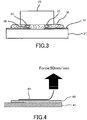
- FIG. 3 is a cross-sectional view illustrating an LED element which is a heat-generating electronic component as one example of a connection structure.
- the connection structure comprises a substrate 21 having a wiring pattern 22, an anisotropic conductive film 30 formed on electrodes of the wiring pattern 22, and a light-emitting element 23 mounted on the anisotropic conductive film 30; the anisotropic conductive film 30 comprises a cured product of the anisotropic conductive adhesive agent described above.
- This light-emitting device is obtained by applying the anisotropic conductive adhesive agent described above between the wiring pattern 22 on the substrate 21 and connection-use bumps 26 formed on each of an n-electrode 24 and a p-electrode 25 of an LED element as the light-emitting element 23 and flip-chip mounting the light-emitting element 23 to the substrate 21.
- the bumps 26 described herein have a plating such as of Au or Au-Sn alloy. Accordingly, the bumps 26 correspond to the electrodes 10 illustrated in FIG. 2 , and the solder particles 1 are metal bonded to the bumps 26.
- a substrate having a wiring pattern comprising aluminum can be favorably used. Cost reductions for LED products are thereby enabled.
- transparent substrates having a transparent conductive film such as those of ITO can be favorably used.
- ITO indium tin oxide
- PET polyethylene terephthalate
- the light-emitting element 23 may be entirely covered by sealing with a transparent molded resin having good heat-dissipation properties. Furthermore, a light reflecting layer may be provided in the light-emitting element 23. Still further, as the light-emitting element, in addition to LED elements, so long as the effects of the present disclosure are not impaired, known heat-generating electronic components may be used.
- each variety of anisotropic conductive adhesive agent was manufactured and LED mounting samples were manufactured in which LED elements were mounted onto substrates using these anisotropic conductive adhesive agents; existence of alloy formation between the terminal portions of the LED elements and the solder particles, thermal resistance and adhesive strength with aluminum were evaluated. It should be noted that the present disclosure is not limited to these examples.
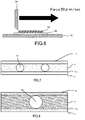
- Anisotropic conductive adhesive agent was applied at a thickness of 100 ⁇ m onto a white plate comprising ceramic to which a 1.5 x 10 mm aluminum piece was thermocompression bonded under conditions of 180°C, 1.5 N and 30 sec to manufacture bonded structures.
- the aluminum pieces of the bonded structures were peeled at a peel speed of 50 mm/sec in the 90° y-axis direction, and the maximum peel strength required to peel was measured.
- LED mounting samples were manufactured.
- a plurality of wiring boards 51 having a 50 ⁇ m pitch 50 ⁇ m Al wiring, 25 ⁇ m PI (polyimide) layer and 50 ⁇ m Al base
- 10 ⁇ g of an anisotropic conductive adhesive agent 50 was applied to each of the wiring boards 51.
- LED chips 52 manufactured by Cree, Inc. (trade name: DA3547, maximum rating: 150 mA, size: 0.35 x 0.46 mm) were mounted, a thermocompression tool 53 was used in flip-chip mounting to obtain LED mounting samples.
- bonding strength of each of the LED mounting samples was measured by using a die shear strength tester under conditions of 25°C and a shearing velocity of 20 ⁇ m/sec for a tool 54.
- an adhesive agent comprising 100 pts. mass of alicyclic epoxy compound (product name: CELLOXIDE 2021P, manufacturer: DAICEL CORPORATION), 5 pts. mass latent cationic curing agent (aluminum chelate-type latent curing agent) and 3 pts. mass of acrylic resin (15 wt% butyl acrylate (BA), 63 wt% ethyl acrylate (EA), 20 wt% acrylonitrile (AN), 1 wt% acrylic acid (AA) and 1 wt% 2-hydroxyethyl methacrylate (HEMA), weight-average molecular weight: 700,000), 30 pts.
- BA butyl acrylate
- EA 63 wt% ethyl acrylate
- AN wt% acrylonitrile
- AA acrylic acid
- HEMA 2-hydroxyethyl methacrylate
- mass solder particles having a solder melting point of 150°C and 10 pts.
- mass conductive particles product name: AUL 704, manufacturer: SEKISUI CHEMICAL CO., LTD.
- curing conditions in manufacturing LED mounting samples were 180°C, 1.5 N and 30 sec.
- solder particles used in each of the examples had an average particle diameter of 5 ⁇ m; 7 ⁇ m, 10 ⁇ m, 12 ⁇ m and 25 ⁇ m. Because no significant difference was found between particle diameters in the above-described range, results for individual particle diameters have been omitted; however, the results of the present examples can be obtained by using particle diameters that are at least within the above-described range. This is also the same in the following examples and comparative examples in which solder particles are blended.
- Example 1 Each evaluation result for Example 1 is represented in Table 1. Alloy formation was confirmed, thermal resistance was 17 (K/W), and peel strength was 4.0 N. Furthermore, die sheer strength of the LED mounting samples was 8.5 N. Accordingly, overall evaluation was OK.
- an anisotropic conductive adhesive agent was manufactured as in Example 1.
- Example 2 Each evaluation result for Example 2 is represented in Table 1. Alloy formation was confirmed, thermal resistance was 16 (K/W), and peel strength was 4.0 N. Furthermore, die sheer strength of the LED mounting samples was 8.5 N. Accordingly, overall evaluation was OK.
- an anisotropic conductive adhesive agent was manufactured as in Example 1.
- Example 3 Each evaluation result for Example 3 is represented in Table 1. Alloy formation was confirmed, thermal resistance was 16 (K/W), and peel strength was 4.0 N. Furthermore, die sheer strength of the LED mounting samples was 8.5 N. Accordingly, overall evaluation was OK.
- an anisotropic conductive adhesive agent was manufactured as in Example 1.
- Example 4 Each evaluation result for Example 4 is represented in Table 1. Alloy formation was confirmed, thermal resistance was 15 (K/W), and peel strength was 4.0 N. Furthermore, die sheer strength of the LED mounting samples was 8.5 N. Accordingly, overall evaluation was OK.
- an anisotropic conductive adhesive agent was manufactured as in Example 1.
- Example 5 Each evaluation result for Example 5 is represented in Table 1. Alloy formation was confirmed, thermal resistance was 16 (K/W), and peel strength was 4.0 N. Furthermore, die sheer strength of the LED mounting samples was 8.5 N. Accordingly, overall evaluation was OK.
- an anisotropic conductive adhesive agent was manufactured as in Example 1.
- Example 6 Each evaluation result for Example 6 is represented in Table 1. Alloy formation was confirmed, thermal resistance was 16 (K/W), and peel strength was 4.0 N. Furthermore, die sheer strength of the LED mounting samples was 8.5 N. Accordingly, overall evaluation was OK.
- an anisotropic conductive adhesive agent was manufactured as in Example 1.
- an anisotropic conductive adhesive agent was manufactured as in Example 1.
- an anisotropic conductive adhesive agent was manufactured as in Example 1.
- an anisotropic conductive adhesive agent was manufactured as in Example 1.
- an anisotropic conductive adhesive agent was manufactured as in Example 1.
- an anisotropic conductive adhesive agent was manufactured as in Example 1.
- an anisotropic conductive adhesive agent was manufactured as in Example 1.
- an anisotropic conductive adhesive agent was manufactured as in Example 1.
- an anisotropic conductive adhesive agent was manufactured as in Example 1.
- an anisotropic conductive adhesive agent was manufactured as in Example 1.
- an anisotropic conductive adhesive agent was manufactured as in Example 1.
- an anisotropic conductive adhesive agent was manufactured as in Example 1.
- an anisotropic conductive adhesive agent was manufactured as in Example 1.
- an anisotropic conductive adhesive agent was manufactured as in Example 1.
- Example 1 An anisotropic conductive adhesive agent was manufactured as in Example 1.
- Example 1 An anisotropic conductive adhesive agent was manufactured as in Example 1.
- Example 1 Other than that a Cu powder, which is a heat-dissipating material, having an average particle diameter of 10 ⁇ m was blended at 60 pts. mass instead of solder particles, an anisotropic conductive adhesive agent was manufactured as in Example 1.
- Example 1 Other than that a Cu powder, which is a heat-dissipating material, having an average particle diameter of 10 ⁇ m was blended at 150 pts. mass instead of solder particles, an anisotropic conductive adhesive agent was manufactured as in Example 1.
- Example 1 Other than that a diamond powder, which is a heat-dissipating material, having an average particle diameter of 0.3 ⁇ m was blended at 60 pts. mass instead of solder particles, an anisotropic conductive adhesive agent was manufactured as in Example 1.
- Example 1 Other than that a diamond powder, which is a heat-dissipating material, having an average particle diameter of 0.3 ⁇ m was blended at 150 pts. mass instead of solder particles, an anisotropic conductive adhesive agent was manufactured as in Example 1.
- the case of adding Cu particles as a heat-dissipating material will be considered.
- the Cu particles 62 do not melt easily compared to the solder particles, the particle shapes thereof are maintained and make point contact with the electrodes 10 as in the case of the aluminum nitride particles 61.
- the Cu particles 62 have a very large particle diameter, thickness of the adhesive agent is increased. Even when using Cu particles having high thermal conductivity, thickness of the adhesive agent layer impairs heat-dissipation for the entire adhesive agent layer and desired heat-dissipation properties are unobtainable.
- resin binder heat-dissipation properties are expressed in FIG. 10 for reference.
- Prepared resin examples include a resin A having a thermal conductivity of 10 W/mK, a resin B having a thermal conductivity of 30 W/mK, a resin C having a thermal conductivity of 50 W/mK and a resin D having a thermal conductivity of 70 W/mK.
- a resin A having a thermal conductivity of 10 W/mK a resin B having a thermal conductivity of 30 W/mK
- a resin C having a thermal conductivity of 50 W/mK
- a resin D having a thermal conductivity of 70 W/mK.
- thermal resistance is defined as layer thickness / (adhesion area * thermal conductivity), and an excessively high layer thickness leads to high thermal resistance, it can be understood that a large particle diameter of the heat-dissipating material would increase layer thickness and thus be unfavorable.
- Anisotropic conductive adhesive agent was applied at a thickness of 100 ⁇ m onto a white plate comprising ceramic to which a 1.5 x 10 mm aluminum piece was thermocompression bonded under conditions of 180°C, 1.5 N and 30 sec to manufacture bonded structures.
- the aluminum pieces of the bonded structures were peeled at a peel speed of 50 mm/sec in the 90° y-axis direction, and the maximum peel strength required to peel was measured.
- LED mounting samples were manufactured.
- a plurality of wiring boards 51 having a 50 ⁇ m pitch 50 ⁇ m Al wiring, 25 ⁇ m PI (polyimide) layer, 50 ⁇ m Al base
- 10 ⁇ g of anisotropic conductive adhesive agent 50 was applied to each of the wiring boards 51.
- LED chips 52 manufactured by Cree, Inc. (trade name: DA3547, maximum rating: 150 mA, size: 0.35 x 0.46 mm) were mounted, a thermocompression tool 53 was used in flip-chip mounting to obtain LED mounting samples.
- bonding strength of each of the LED mounting samples was measured by using a die shear strength tester under conditions of 25°C and a shearing velocity of 20 ⁇ m/sec for a tool 54.
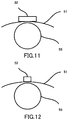
- a test was performed in which each of the LED mounting samples were bent by pressing a side surface of a cylindrical test roller 55 thereagainst before measuring electrical resistance.
- the LED chip 52 being approximately rectangular, as illustrated in FIG. 11 , a test in which the wiring board 51 was bent so as to be rounded in the longitudinal direction (x-axis direction) of the LED chip 52 and, as illustrated in FIG. 12 , a test in which the wiring board 51 was bent so as to be rounded in the transverse direction (y-axis direction) of the LED chip 52 were each performed once.
- a smaller radius (R) of the test roller 55 corresponds to higher bending stress in each of the LED mounting samples
- a plurality of radii were employed in each of the tests.
- binder A into an adhesive agent comprising 100 pts. mass of alicyclic epoxy compound (product name: CELLOXIDE 2021P, manufacturer: DAICEL CORPORATION), 5 pts. mass latent cationic curing agent (aluminum chelate-type latent curing agent) and 3 pts. mass of acrylic resin (15 wt% butyl acrylate (BA), 63 wt% ethyl acrylate (EA), 20 wt% acrylonitrile (AN), 1 wt% acrylic acid (AA) and 1 wt% 2-hydroxyethyl methacrylate (HEMA), weight-average molecular weight: 700,000), 30 pts.
- BA butyl acrylate
- EA 63 wt% ethyl acrylate
- AN wt% acrylonitrile
- AA acrylic acid
- HEMA 2-hydroxyethyl methacrylate
- mass solder particles having a solder melting point of 150°C and 10 pts.
- mass conductive particles product name: AUL 704, manufacturer: SEKISUI CHEMICAL CO., LTD.
- curing conditions in manufacturing LED mounting samples were 180°C, 1.5 N and 30 sec.
- solder particles used in each of the examples had an average particle diameter of 5 ⁇ m, 7 ⁇ m, 10 ⁇ m, 12 ⁇ m and 25 ⁇ m. Because no significant difference was found between particle diameters in the above-described range, results for individual particle diameters have been omitted; however, the results of the present examples can be obtained by using particle diameters that are at least within the above-described range. This is also the same in the following examples and comparative examples in which solder particles are blended.
- Example 7 Each evaluation result for Example 7 is represented in Table 4.
- Initial peel strength was 4.0 N.
- initial die sheer strength of the LED mounting samples was 8.5 N.
- conduction was evaluated as G; evaluation after the bending test resulted in G for the 20 mm, G for the 10 mm and G for the 6 mm diameter test rollers. Accordingly, overall evaluation was OK.
- an anisotropic conductive adhesive agent was manufactured as in Example 7.
- Initial peel strength was 4.0 N. Furthermore, initial die sheer strength of the LED mounting samples was 8.5 N. Moreover, for the LED mounting samples, before the bending test, initial conduction was evaluated as G, after 1,000 cycles of the thermal cycle test, conduction was evaluated as G; evaluation after the bending test resulted in G for the 20 mm, G for the 10 mm and G for the 6 mm diameter test roller. Accordingly, overall evaluation was OK.
- an anisotropic conductive adhesive agent was manufactured as in Example 7.
- Example 9 Each evaluation result for Example 9 is represented in Table 4.
- Initial peel strength was 4.0 N.
- initial die sheer strength of the LED mounting samples was 8.5 N.
- conduction was evaluated as G; evaluation after the bending test resulted in G for the 20 mm, G for the 10 mm and G for the 6 mm diameter test rollers. Accordingly, overall evaluation was OK.
- an anisotropic conductive adhesive agent was manufactured as in Example 7.
- Example 10 Each evaluation result for Example 10 is represented in Table 4.
- Initial peel strength was 4.0 N.
- initial die sheer strength of the LED mounting samples was 8.5 N.
- conduction was evaluated as G; evaluation after the bending test resulted in G for the 20 mm, G for the 10 mm and G for the 6 mm diameter test rollers. Accordingly, overall evaluation was OK.
- an anisotropic conductive adhesive agent was manufactured as in Example 7.
- Each evaluation result for Comparative Example 21 is represented in Table 4.
- Initial peel strength was 4.0 N.
- initial die sheer strength of the LED mounting samples was 8.5 N.
- conduction was evaluated as G; evaluation after the bending test resulted in G for the 20 mm, F for the 10 mm and F for the 6 mm diameter test rollers. Accordingly, overall evaluation was NG.
- an anisotropic conductive adhesive agent was manufactured as in Example 7.
- Each evaluation result for Comparative Example 22 is represented in Table 4.
- Initial peel strength was 1.2 N.
- initial die sheer strength of the LED mounting samples was 2.0 N.
- initial conduction was evaluated as G, after 1,000 cycles of the thermal cycle test, conduction was evaluated as F; evaluation after the bending test resulted in F for the 20 mm, F for the 10 mm and F for the 6 mm diameter test rollers. Accordingly, overall evaluation was NG.
- an anisotropic conductive adhesive agent was manufactured as in Example 7.
- Each evaluation result for Comparative Example 23 is represented in Table 4.
- Initial peel strength was 1.2 N.
- initial die sheer strength of the LED mounting samples was 2.0 N.
- initial conduction was evaluated as G, after 1,000 cycles of the thermal cycle test, conduction was evaluated as F; evaluation after the bending test resulted in F for the 20 mm, F for the 10 mm and F for the 6 mm diameter test rollers. Accordingly, overall evaluation was NG.
- an anisotropic conductive adhesive agent was manufactured as in Example 7.
- Each evaluation result for Comparative Example 24 is represented in Table 4.
- Initial peel strength was 4.0 N.
- initial die sheer strength of the LED mounting samples was 8.5 N.
- initial conduction was evaluated as G, after 1,000 cycles of the thermal cycle test, conduction was evaluated as F; evaluation after the bending test resulted in F for the 20 mm, F for the 10 mm and F for the 6 mm diameter test rollers. Accordingly, overall evaluation was NG.
- an anisotropic conductive adhesive agent was manufactured as in Example 7.
- Each evaluation result for Comparative Example 25 is represented in Table 4.
- Initial peel strength was 4.0 N.
- initial die sheer strength of the LED mounting samples was 8.5 N.
- initial conduction was evaluated as G, after 1,000 cycles of the thermal cycle test, conduction was evaluated as F; evaluation after the bending test resulted in F for the 20 mm, F for the 10 mm and F for the 6 mm diameter test rollers. Accordingly, overall evaluation was NG.
- an anisotropic conductive adhesive agent was manufactured as in Example 7.
- Each evaluation result for Comparative Example 26 is represented in Table 4.
- Initial peel strength was 1.2 N.
- initial die sheer strength of the LED mounting samples was 2.0 N.
- conduction was evaluated as G; after 1,000 cycles of the thermal cycle test, conduction was evaluated as G; evaluation after the bending test resulted in G for the 20 mm, F for the 10 mm and F for the 6 mm diameter test rollers. Accordingly, overall evaluation was NG.
- an adhesive agent comprising 50 pts. mass of alicyclic epoxy compound (product name: CELLOXIDE 2021P, manufacturer: DAICEL CORPORATION), 40 pts. mass of acid anhydride curing agent (methylhexahydrophthalic anhydride), 3 pts. mass acrylic resin (BA: 15 wt%, EA: 63 wt%, AN: 20 wt% AA: 1 wt% and HEMA: 1 wt%, Mw: 200,000), 10 pts. mass of conductive particles (product name: AUL 704, manufacturer: SEKISUI CHEMICAL CO., LTD.) were dispersed to manufacture an anisotropic conductive adhesive agent. Solder particles were not added. Furthermore, curing conditions in manufacturing LED mounting samples were 230°C, 1.5 N and 30 sec.
- Each evaluation result for Comparative Example 27 is represented in Table 5.
- Initial peel strength was less than 0.5 N.
- initial die sheer strength of the LED mounting samples was 3.8 N.
- initial conduction was evaluated as G, after 1,000 cycles of the thermal cycle test, conduction was evaluated as F; evaluation after the bending test resulted in F for the 20 mm, F for the 10 mm and F for the 6 mm diameter test rollers. Accordingly, overall evaluation was NG.
- an anisotropic conductive adhesive agent was manufactured as in Example 27.
- Each evaluation result for Comparative Example 28 is represented in Table 5.
- Initial peel strength was less than 0.5 N.
- initial die sheer strength of the LED mounting samples was 3.8 N.
- initial conduction was evaluated as G, after 1,000 cycles of the thermal cycle test, conduction was evaluated as F; evaluation after the bending test resulted in F for the 20 mm, F for the 10 mm and F for the 6 mm diameter test rollers. Accordingly, overall evaluation was NG.
- a binder C other than that 100 pts. mass of cycloolefin was used instead of the alicyclic epoxy compound, an anisotropic conductive adhesive agent was manufactured as in Example 7. Solder particles were not added. Furthermore, curing conditions in manufacturing LED mounting samples were 180°C, 1.5 N, and 240 sec.
- Each evaluation result for Comparative Example 29 is represented in Table 5.
- Initial peel strength was 1.4 N.
- initial die sheer strength of the LED mounting samples was 7.2 N.
- initial conduction was evaluated as G, after 1,000 cycles of the thermal cycle test, conduction was evaluated as F; evaluation after the bending test resulted in F for the 20 mm, F for the 10 mm and F for the 6 mm diameter test rollers. Accordingly, overall evaluation was NG.
- Example 29 Other than that solder particles having a melting point of 170°C were blended at 80 pts. mass, an anisotropic conductive adhesive agent was manufactured-as in Example 29.
- Each evaluation result for Comparative Example 30 is represented in Table 5.
- Initial peel strength was 1.4 N.
- initial die sheer strength of the LED mounting samples was 7.2 N.
- initial conduction was evaluated as G, after 1,000 cycles of the thermal cycle test, conduction was evaluated as F; evaluation after the bending test resulted in F for the 20 mm, F for the 10 mm and F for the 6 mm diameter test rollers. Accordingly, overall evaluation was NG.
- a binder D other than that a bisphenol F type epoxy compound was used instead of the alicyclic epoxy compound, an anion curing agent (amine curing agent) was used instead of the latent cationic curing agent, and the acrylic resin was not blended, an anisotropic conductive adhesive agent was manufactured as in Example 7. Solder particles were not added. Furthermore, curing conditions in manufacturing LED mounting samples were 150°C, 1.5 N and 30 sec.
- Each evaluation result for Comparative Example 31 is represented in Table 5.
- Initial peel strength was 2.5 N.
- initial die sheer strength of the LED mounting samples was 7.1 N.
- conduction was evaluated as G; after 1,000 cycles of the thermal cycle test, conduction was evaluated as F; evaluation after the bending test resulted in G for the 20 mm, F for the 10 mm and F for the 6 mm diameter test rollers. Accordingly, overall evaluation was NG.
- an anisotropic conductive adhesive agent was manufactured as in Example 31.
- Each evaluation result for Comparative Example 32 is represented in Table 5.
- Initial peel strength was 2.5 N.
- initial die sheer strength of the LED mounting samples was 7.1 N.
- conduction was evaluated as G; after 1,000 cycles of the thermal cycle test, conduction was evaluated as F; evaluation after the bending test resulted in G for the 20 mm, F for the 10 mm and F for the 6 mm diameter test rollers. Accordingly, overall evaluation was NG.
- Comparative Examples 22 and 23 because an excessive amount of the solder particles was blended, although melted solder formation occurred, adhesive strength between the aluminum wiring board and the anisotropic conductive adhesive agent was degraded and adhesive strength between the anisotropic conductive adhesive agent and the LED element was degraded so that conduction reliability was low in the bending test.
Landscapes
- Chemical & Material Sciences (AREA)
- Organic Chemistry (AREA)
- Engineering & Computer Science (AREA)
- Microelectronics & Electronic Packaging (AREA)
- Manufacturing & Machinery (AREA)
- Medicinal Chemistry (AREA)
- Polymers & Plastics (AREA)
- Health & Medical Sciences (AREA)
- Chemical Kinetics & Catalysis (AREA)
- Inorganic Chemistry (AREA)
- Adhesives Or Adhesive Processes (AREA)
- Led Device Packages (AREA)
- Conductive Materials (AREA)
- Non-Insulated Conductors (AREA)
Applications Claiming Priority (3)
| Application Number | Priority Date | Filing Date | Title |
|---|---|---|---|
| JP2014107167A JP6430148B2 (ja) | 2014-05-23 | 2014-05-23 | 接着剤及び接続構造体 |
| JP2014107168A JP6419457B2 (ja) | 2014-05-23 | 2014-05-23 | 接着剤及び接続構造体 |
| PCT/JP2015/064746 WO2015178482A1 (ja) | 2014-05-23 | 2015-05-22 | 接着剤及び接続構造体 |
Publications (2)
| Publication Number | Publication Date |
|---|---|
| EP3147340A1 true EP3147340A1 (de) | 2017-03-29 |
| EP3147340A4 EP3147340A4 (de) | 2018-01-03 |
Family
ID=54554141
Family Applications (1)
| Application Number | Title | Priority Date | Filing Date |
|---|---|---|---|
| EP15796698.7A Withdrawn EP3147340A4 (de) | 2014-05-23 | 2015-05-22 | Klebemittel und verbindungsstruktur |
Country Status (6)
| Country | Link |
|---|---|
| US (1) | US10435601B2 (de) |
| EP (1) | EP3147340A4 (de) |
| KR (1) | KR102368748B1 (de) |
| CN (1) | CN106459717B (de) |
| TW (1) | TWI693267B (de) |
| WO (1) | WO2015178482A1 (de) |
Families Citing this family (4)
| Publication number | Priority date | Publication date | Assignee | Title |
|---|---|---|---|---|
| JP6791626B2 (ja) * | 2015-12-14 | 2020-11-25 | デクセリアルズ株式会社 | 熱硬化性接着シート、及び半導体装置の製造方法 |
| JP6922918B2 (ja) * | 2016-08-22 | 2021-08-18 | 株式会社村田製作所 | セラミック基板及び電子部品内蔵モジュール |
| JP2020105268A (ja) * | 2018-12-26 | 2020-07-09 | スリーエム イノベイティブ プロパティズ カンパニー | 帯電防止性積層体及び帯電防止性接着剤 |
| KR102291784B1 (ko) * | 2019-12-16 | 2021-08-24 | 주식회사 노피온 | 열가소성 수지를 포함하는 군집형 이방성 도전 접착 필름, 이를 이용한 솔더 범프의 형성방법 및 접합구조체의 제조방법 |
Family Cites Families (19)
| Publication number | Priority date | Publication date | Assignee | Title |
|---|---|---|---|---|
| JP2004109943A (ja) * | 2002-09-20 | 2004-04-08 | Ricoh Co Ltd | 画像形成装置 |
| KR101350531B1 (ko) * | 2005-07-11 | 2014-01-10 | 데쿠세리아루즈 가부시키가이샤 | 열경화형 에폭시 수지 조성물 |
| CN101529590B (zh) | 2006-10-31 | 2012-03-21 | 住友电木株式会社 | 半导体电子部件及使用该部件的半导体装置 |
| JP5143449B2 (ja) * | 2007-03-02 | 2013-02-13 | 株式会社ダイセル | 熱又は活性エネルギー線硬化型接着剤 |
| KR20090129478A (ko) * | 2007-03-19 | 2009-12-16 | 나믹스 가부시끼가이샤 | 이방성 도전 페이스트 |
| CN101971312A (zh) * | 2008-03-14 | 2011-02-09 | 住友电木株式会社 | 用于形成半导体元件粘接膜的树脂清漆、半导体元件粘接膜和半导体装置 |
| JP5499448B2 (ja) | 2008-07-16 | 2014-05-21 | デクセリアルズ株式会社 | 異方性導電接着剤 |
| JP4360446B1 (ja) * | 2008-10-16 | 2009-11-11 | 住友ベークライト株式会社 | 半導体装置の製造方法及び半導体装置 |
| US8962986B2 (en) * | 2009-10-15 | 2015-02-24 | Hitachi Chemical Company, Ltd. | Conductive adhesive, solar cell, method for manufacturing solar cell, and solar cell module |
| JP5540916B2 (ja) | 2010-06-15 | 2014-07-02 | デクセリアルズ株式会社 | 接続構造体の製造方法 |
| JP4976531B2 (ja) * | 2010-09-06 | 2012-07-18 | 日東電工株式会社 | 半導体装置用フィルム |
| JP5630451B2 (ja) * | 2011-02-23 | 2014-11-26 | 信越化学工業株式会社 | 接着剤組成物及び接着性ドライフィルム |
| JP5609716B2 (ja) | 2011-03-07 | 2014-10-22 | デクセリアルズ株式会社 | 光反射性異方性導電接着剤及び発光装置 |
| JP2013054852A (ja) | 2011-09-01 | 2013-03-21 | Sekisui Chem Co Ltd | 導電性粒子、導電性粒子の製造方法、異方性導電材料及び接続構造体 |
| JP5912741B2 (ja) | 2012-03-27 | 2016-04-27 | 日東電工株式会社 | 接合シート、電子部品およびその製造方法 |
| JP2013221143A (ja) | 2012-04-19 | 2013-10-28 | Asahi Kasei E-Materials Corp | 熱硬化性樹脂組成物及びこれを用いた導電性ペースト |
| JP2014065766A (ja) | 2012-09-24 | 2014-04-17 | Dexerials Corp | 異方性導電接着剤 |
| JP6061644B2 (ja) * | 2012-09-24 | 2017-01-18 | 株式会社タムラ製作所 | 異方性導電性ペーストおよびそれを用いたプリント配線基板 |
| JP6176910B2 (ja) * | 2012-09-24 | 2017-08-09 | デクセリアルズ株式会社 | 接続構造体の製造方法 |
-
2015
- 2015-05-22 EP EP15796698.7A patent/EP3147340A4/de not_active Withdrawn
- 2015-05-22 WO PCT/JP2015/064746 patent/WO2015178482A1/ja not_active Ceased
- 2015-05-22 TW TW104116412A patent/TWI693267B/zh active
- 2015-05-22 US US15/301,836 patent/US10435601B2/en active Active
- 2015-05-22 CN CN201580026911.4A patent/CN106459717B/zh active Active
- 2015-05-22 KR KR1020167029971A patent/KR102368748B1/ko active Active
Also Published As
| Publication number | Publication date |
|---|---|
| TWI693267B (zh) | 2020-05-11 |
| KR20170012206A (ko) | 2017-02-02 |
| WO2015178482A1 (ja) | 2015-11-26 |
| CN106459717B (zh) | 2021-01-15 |
| CN106459717A (zh) | 2017-02-22 |
| TW201610056A (zh) | 2016-03-16 |
| US20170114255A1 (en) | 2017-04-27 |
| US10435601B2 (en) | 2019-10-08 |
| KR102368748B1 (ko) | 2022-02-28 |
| EP3147340A4 (de) | 2018-01-03 |
Similar Documents
| Publication | Publication Date | Title |
|---|---|---|
| EP3045508A1 (de) | Haftstoff und lichtemittierende vorrichtung | |
| CN102823084B (zh) | 发光装置的制造方法 | |
| KR101035864B1 (ko) | 이방성 도전막 및 그 제조방법과 접합체 | |
| TWI647886B (zh) | Anisotropic conductive film, connection structure, connection structure manufacturing method and connection method | |
| KR101380454B1 (ko) | 도전 재료 및 접속 구조체 | |
| EP2899244A1 (de) | Anisotroper leitfähiger klebstoff und verbindungsstruktur | |
| CN101828434A (zh) | 粘接剂组合物和使用其的电路连接材料、以及电路部件的连接方法和电路连接体 | |
| US10435601B2 (en) | Adhesive agent and connection structure | |
| KR20070116661A (ko) | 이방 도전성 구조체 | |
| EP2592127B1 (de) | Anisotropes leitfähiges haftmittel, verfahren zu dessen herstellung, verbindungsstruktur und verfahren zu deren herstellung | |
| TWI842669B (zh) | 接著劑膜 | |
| JP2010067360A (ja) | 異方性導電膜およびその使用方法 | |
| JP2011100605A (ja) | 回路接続材料及び、これを用いた回路部材の接続構造 | |
| JP6430148B2 (ja) | 接着剤及び接続構造体 | |
| TW201621924A (zh) | 各向異性導電薄膜、及其連接方法 | |
| JP5956362B2 (ja) | 異方性導電フィルム、接続方法、及び接合体 | |
| TWI789406B (zh) | 導電性接著劑組成物及使用其的連接結構體、製造連接結構體的方法 | |
| KR102758192B1 (ko) | 접착제 조성물 | |
| CN1439685A (zh) | 粘接剂、粘接薄膜以及电气装置 | |
| JP6419457B2 (ja) | 接着剤及び接続構造体 | |
| JP2025077368A (ja) | 導電性樹脂組成物 | |
| JP2023121608A (ja) | 異方性導電フィルム、接続構造体および接続構造体の製造方法 |
Legal Events
| Date | Code | Title | Description |
|---|---|---|---|
| PUAI | Public reference made under article 153(3) epc to a published international application that has entered the european phase |
Free format text: ORIGINAL CODE: 0009012 |
|
| 17P | Request for examination filed |
Effective date: 20161110 |
|
| AK | Designated contracting states |
Kind code of ref document: A1 Designated state(s): AL AT BE BG CH CY CZ DE DK EE ES FI FR GB GR HR HU IE IS IT LI LT LU LV MC MK MT NL NO PL PT RO RS SE SI SK SM TR |
|
| AX | Request for extension of the european patent |
Extension state: BA ME |
|
| DAV | Request for validation of the european patent (deleted) | ||
| DAX | Request for extension of the european patent (deleted) | ||
| A4 | Supplementary search report drawn up and despatched |
Effective date: 20171201 |
|
| RIC1 | Information provided on ipc code assigned before grant |
Ipc: C09J 163/00 20060101AFI20171128BHEP Ipc: H05K 3/34 20060101ALI20171128BHEP Ipc: H05K 3/32 20060101ALI20171128BHEP Ipc: C09J 11/06 20060101ALI20171128BHEP Ipc: C09J 11/04 20060101ALI20171128BHEP Ipc: H01R 11/01 20060101ALI20171128BHEP Ipc: C09J 133/04 20060101ALI20171128BHEP Ipc: C09J 133/00 20060101ALI20171128BHEP |
|
| 17Q | First examination report despatched |
Effective date: 20180731 |
|
| STAA | Information on the status of an ep patent application or granted ep patent |
Free format text: STATUS: THE APPLICATION IS DEEMED TO BE WITHDRAWN |
|
| 18D | Application deemed to be withdrawn |
Effective date: 20201014 |