EP3148351B1 - Phytochemisch verbessertes wasser - Google Patents
Phytochemisch verbessertes wasser Download PDFInfo
- Publication number
- EP3148351B1 EP3148351B1 EP14893706.3A EP14893706A EP3148351B1 EP 3148351 B1 EP3148351 B1 EP 3148351B1 EP 14893706 A EP14893706 A EP 14893706A EP 3148351 B1 EP3148351 B1 EP 3148351B1
- Authority
- EP
- European Patent Office
- Prior art keywords
- bacopa
- fluid
- centella
- aerial
- water
- Prior art date
- Legal status (The legal status is an assumption and is not a legal conclusion. Google has not performed a legal analysis and makes no representation as to the accuracy of the status listed.)
- Active
Links
Images





Classifications
-
- A—HUMAN NECESSITIES
- A61—MEDICAL OR VETERINARY SCIENCE; HYGIENE
- A61K—PREPARATIONS FOR MEDICAL, DENTAL OR TOILETRY PURPOSES
- A61K36/00—Medicinal preparations of undetermined constitution containing material from algae, lichens, fungi or plants, or derivatives thereof, e.g. traditional herbal medicines
- A61K36/18—Magnoliophyta (angiosperms)
- A61K36/185—Magnoliopsida (dicotyledons)
- A61K36/68—Plantaginaceae (Plantain Family)
-
- A—HUMAN NECESSITIES
- A23—FOODS OR FOODSTUFFS; TREATMENT THEREOF, NOT COVERED BY OTHER CLASSES
- A23L—FOODS, FOODSTUFFS OR NON-ALCOHOLIC BEVERAGES, NOT OTHERWISE PROVIDED FOR; PREPARATION OR TREATMENT THEREOF
- A23L33/00—Modifying nutritive qualities of foods; Dietetic products; Preparation or treatment thereof
- A23L33/10—Modifying nutritive qualities of foods; Dietetic products; Preparation or treatment thereof using additives
- A23L33/105—Plant extracts, their artificial duplicates or their derivatives
-
- A—HUMAN NECESSITIES
- A23—FOODS OR FOODSTUFFS; TREATMENT THEREOF, NOT COVERED BY OTHER CLASSES
- A23L—FOODS, FOODSTUFFS OR NON-ALCOHOLIC BEVERAGES, NOT OTHERWISE PROVIDED FOR; PREPARATION OR TREATMENT THEREOF
- A23L33/00—Modifying nutritive qualities of foods; Dietetic products; Preparation or treatment thereof
- A23L33/10—Modifying nutritive qualities of foods; Dietetic products; Preparation or treatment thereof using additives
- A23L33/16—Inorganic salts, minerals or trace elements
-
- A—HUMAN NECESSITIES
- A23—FOODS OR FOODSTUFFS; TREATMENT THEREOF, NOT COVERED BY OTHER CLASSES
- A23L—FOODS, FOODSTUFFS OR NON-ALCOHOLIC BEVERAGES, NOT OTHERWISE PROVIDED FOR; PREPARATION OR TREATMENT THEREOF
- A23L33/00—Modifying nutritive qualities of foods; Dietetic products; Preparation or treatment thereof
- A23L33/20—Reducing nutritive value; Dietetic products with reduced nutritive value
- A23L33/21—Addition of substantially indigestible substances, e.g. dietary fibres
-
- A—HUMAN NECESSITIES
- A61—MEDICAL OR VETERINARY SCIENCE; HYGIENE
- A61K—PREPARATIONS FOR MEDICAL, DENTAL OR TOILETRY PURPOSES
- A61K31/00—Medicinal preparations containing organic active ingredients
- A61K31/70—Carbohydrates; Sugars; Derivatives thereof
- A61K31/7042—Compounds having saccharide radicals and heterocyclic rings
- A61K31/7048—Compounds having saccharide radicals and heterocyclic rings having oxygen as a ring hetero atom, e.g. leucoglucosan, hesperidin, erythromycin, nystatin, digitoxin or digoxin
-
- A—HUMAN NECESSITIES
- A61—MEDICAL OR VETERINARY SCIENCE; HYGIENE
- A61K—PREPARATIONS FOR MEDICAL, DENTAL OR TOILETRY PURPOSES
- A61K36/00—Medicinal preparations of undetermined constitution containing material from algae, lichens, fungi or plants, or derivatives thereof, e.g. traditional herbal medicines
- A61K36/18—Magnoliophyta (angiosperms)
- A61K36/185—Magnoliopsida (dicotyledons)
- A61K36/23—Apiaceae or Umbelliferae (Carrot family), e.g. dill, chervil, coriander or cumin
-
- A—HUMAN NECESSITIES
- A61—MEDICAL OR VETERINARY SCIENCE; HYGIENE
- A61K—PREPARATIONS FOR MEDICAL, DENTAL OR TOILETRY PURPOSES
- A61K36/00—Medicinal preparations of undetermined constitution containing material from algae, lichens, fungi or plants, or derivatives thereof, e.g. traditional herbal medicines
- A61K36/18—Magnoliophyta (angiosperms)
- A61K36/185—Magnoliopsida (dicotyledons)
- A61K36/80—Scrophulariaceae (Figwort family)
-
- A—HUMAN NECESSITIES
- A61—MEDICAL OR VETERINARY SCIENCE; HYGIENE
- A61K—PREPARATIONS FOR MEDICAL, DENTAL OR TOILETRY PURPOSES
- A61K9/00—Medicinal preparations characterised by special physical form
- A61K9/0012—Galenical forms characterised by the site of application
- A61K9/0053—Mouth and digestive tract, i.e. intraoral and peroral administration
-
- A—HUMAN NECESSITIES
- A61—MEDICAL OR VETERINARY SCIENCE; HYGIENE
- A61P—SPECIFIC THERAPEUTIC ACTIVITY OF CHEMICAL COMPOUNDS OR MEDICINAL PREPARATIONS
- A61P3/00—Drugs for disorders of the metabolism
- A61P3/02—Nutrients, e.g. vitamins, minerals
-
- A—HUMAN NECESSITIES
- A61—MEDICAL OR VETERINARY SCIENCE; HYGIENE
- A61P—SPECIFIC THERAPEUTIC ACTIVITY OF CHEMICAL COMPOUNDS OR MEDICINAL PREPARATIONS
- A61P43/00—Drugs for specific purposes, not provided for in groups A61P1/00-A61P41/00
-
- C—CHEMISTRY; METALLURGY
- C02—TREATMENT OF WATER, WASTE WATER, SEWAGE, OR SLUDGE
- C02F—TREATMENT OF WATER, WASTE WATER, SEWAGE, OR SLUDGE
- C02F1/00—Treatment of water, waste water, or sewage
- C02F1/30—Treatment of water, waste water, or sewage by irradiation
- C02F1/32—Treatment of water, waste water, or sewage by irradiation with ultraviolet light
-
- C—CHEMISTRY; METALLURGY
- C02—TREATMENT OF WATER, WASTE WATER, SEWAGE, OR SLUDGE
- C02F—TREATMENT OF WATER, WASTE WATER, SEWAGE, OR SLUDGE
- C02F1/00—Treatment of water, waste water, or sewage
- C02F1/44—Treatment of water, waste water, or sewage by dialysis, osmosis or reverse osmosis
- C02F1/444—Treatment of water, waste water, or sewage by dialysis, osmosis or reverse osmosis by ultrafiltration or microfiltration
-
- C—CHEMISTRY; METALLURGY
- C02—TREATMENT OF WATER, WASTE WATER, SEWAGE, OR SLUDGE
- C02F—TREATMENT OF WATER, WASTE WATER, SEWAGE, OR SLUDGE
- C02F1/00—Treatment of water, waste water, or sewage
- C02F1/72—Treatment of water, waste water, or sewage by oxidation
- C02F1/78—Treatment of water, waste water, or sewage by oxidation with ozone
-
- A—HUMAN NECESSITIES
- A23—FOODS OR FOODSTUFFS; TREATMENT THEREOF, NOT COVERED BY OTHER CLASSES
- A23L—FOODS, FOODSTUFFS OR NON-ALCOHOLIC BEVERAGES, NOT OTHERWISE PROVIDED FOR; PREPARATION OR TREATMENT THEREOF
- A23L2/00—Non-alcoholic beverages; Dry compositions or concentrates therefor; Preparation or treatment thereof
-
- A—HUMAN NECESSITIES
- A23—FOODS OR FOODSTUFFS; TREATMENT THEREOF, NOT COVERED BY OTHER CLASSES
- A23L—FOODS, FOODSTUFFS OR NON-ALCOHOLIC BEVERAGES, NOT OTHERWISE PROVIDED FOR; PREPARATION OR TREATMENT THEREOF
- A23L2/00—Non-alcoholic beverages; Dry compositions or concentrates therefor; Preparation or treatment thereof
- A23L2/38—Other non-alcoholic beverages
-
- A—HUMAN NECESSITIES
- A23—FOODS OR FOODSTUFFS; TREATMENT THEREOF, NOT COVERED BY OTHER CLASSES
- A23L—FOODS, FOODSTUFFS OR NON-ALCOHOLIC BEVERAGES, NOT OTHERWISE PROVIDED FOR; PREPARATION OR TREATMENT THEREOF
- A23L2/00—Non-alcoholic beverages; Dry compositions or concentrates therefor; Preparation or treatment thereof
- A23L2/52—Adding ingredients
-
- A—HUMAN NECESSITIES
- A23—FOODS OR FOODSTUFFS; TREATMENT THEREOF, NOT COVERED BY OTHER CLASSES
- A23L—FOODS, FOODSTUFFS OR NON-ALCOHOLIC BEVERAGES, NOT OTHERWISE PROVIDED FOR; PREPARATION OR TREATMENT THEREOF
- A23L33/00—Modifying nutritive qualities of foods; Dietetic products; Preparation or treatment thereof
- A23L33/10—Modifying nutritive qualities of foods; Dietetic products; Preparation or treatment thereof using additives
-
- A—HUMAN NECESSITIES
- A23—FOODS OR FOODSTUFFS; TREATMENT THEREOF, NOT COVERED BY OTHER CLASSES
- A23V—INDEXING SCHEME RELATING TO FOODS, FOODSTUFFS OR NON-ALCOHOLIC BEVERAGES AND LACTIC OR PROPIONIC ACID BACTERIA USED IN FOODSTUFFS OR FOOD PREPARATION
- A23V2002/00—Food compositions, function of food ingredients or processes for food or foodstuffs
-
- A—HUMAN NECESSITIES
- A23—FOODS OR FOODSTUFFS; TREATMENT THEREOF, NOT COVERED BY OTHER CLASSES
- A23V—INDEXING SCHEME RELATING TO FOODS, FOODSTUFFS OR NON-ALCOHOLIC BEVERAGES AND LACTIC OR PROPIONIC ACID BACTERIA USED IN FOODSTUFFS OR FOOD PREPARATION
- A23V2200/00—Function of food ingredients
- A23V2200/30—Foods, ingredients or supplements having a functional effect on health
- A23V2200/322—Foods, ingredients or supplements having a functional effect on health having an effect on the health of the nervous system or on mental function
-
- A—HUMAN NECESSITIES
- A23—FOODS OR FOODSTUFFS; TREATMENT THEREOF, NOT COVERED BY OTHER CLASSES
- A23V—INDEXING SCHEME RELATING TO FOODS, FOODSTUFFS OR NON-ALCOHOLIC BEVERAGES AND LACTIC OR PROPIONIC ACID BACTERIA USED IN FOODSTUFFS OR FOOD PREPARATION
- A23V2250/00—Food ingredients
- A23V2250/15—Inorganic Compounds
- A23V2250/156—Mineral combination
- A23V2250/1578—Calcium
-
- A—HUMAN NECESSITIES
- A23—FOODS OR FOODSTUFFS; TREATMENT THEREOF, NOT COVERED BY OTHER CLASSES
- A23V—INDEXING SCHEME RELATING TO FOODS, FOODSTUFFS OR NON-ALCOHOLIC BEVERAGES AND LACTIC OR PROPIONIC ACID BACTERIA USED IN FOODSTUFFS OR FOOD PREPARATION
- A23V2250/00—Food ingredients
- A23V2250/15—Inorganic Compounds
- A23V2250/156—Mineral combination
- A23V2250/16—Potassium
-
- A—HUMAN NECESSITIES
- A23—FOODS OR FOODSTUFFS; TREATMENT THEREOF, NOT COVERED BY OTHER CLASSES
- A23V—INDEXING SCHEME RELATING TO FOODS, FOODSTUFFS OR NON-ALCOHOLIC BEVERAGES AND LACTIC OR PROPIONIC ACID BACTERIA USED IN FOODSTUFFS OR FOOD PREPARATION
- A23V2250/00—Food ingredients
- A23V2250/15—Inorganic Compounds
- A23V2250/156—Mineral combination
- A23V2250/1614—Sodium
-
- A—HUMAN NECESSITIES
- A23—FOODS OR FOODSTUFFS; TREATMENT THEREOF, NOT COVERED BY OTHER CLASSES
- A23V—INDEXING SCHEME RELATING TO FOODS, FOODSTUFFS OR NON-ALCOHOLIC BEVERAGES AND LACTIC OR PROPIONIC ACID BACTERIA USED IN FOODSTUFFS OR FOOD PREPARATION
- A23V2250/00—Food ingredients
- A23V2250/20—Natural extracts
- A23V2250/21—Plant extracts
-
- A—HUMAN NECESSITIES
- A23—FOODS OR FOODSTUFFS; TREATMENT THEREOF, NOT COVERED BY OTHER CLASSES
- A23V—INDEXING SCHEME RELATING TO FOODS, FOODSTUFFS OR NON-ALCOHOLIC BEVERAGES AND LACTIC OR PROPIONIC ACID BACTERIA USED IN FOODSTUFFS OR FOOD PREPARATION
- A23V2250/00—Food ingredients
- A23V2250/20—Natural extracts
- A23V2250/21—Plant extracts
- A23V2250/2132—Other phenolic compounds, polyphenols
-
- A—HUMAN NECESSITIES
- A61—MEDICAL OR VETERINARY SCIENCE; HYGIENE
- A61K—PREPARATIONS FOR MEDICAL, DENTAL OR TOILETRY PURPOSES
- A61K2236/00—Isolation or extraction methods of medicinal preparations of undetermined constitution containing material from algae, lichens, fungi or plants, or derivatives thereof, e.g. traditional herbal medicine
-
- A—HUMAN NECESSITIES
- A61—MEDICAL OR VETERINARY SCIENCE; HYGIENE
- A61K—PREPARATIONS FOR MEDICAL, DENTAL OR TOILETRY PURPOSES
- A61K2236/00—Isolation or extraction methods of medicinal preparations of undetermined constitution containing material from algae, lichens, fungi or plants, or derivatives thereof, e.g. traditional herbal medicine
- A61K2236/30—Extraction of the material
-
- A—HUMAN NECESSITIES
- A61—MEDICAL OR VETERINARY SCIENCE; HYGIENE
- A61K—PREPARATIONS FOR MEDICAL, DENTAL OR TOILETRY PURPOSES
- A61K2236/00—Isolation or extraction methods of medicinal preparations of undetermined constitution containing material from algae, lichens, fungi or plants, or derivatives thereof, e.g. traditional herbal medicine
- A61K2236/50—Methods involving additional extraction steps
- A61K2236/53—Liquid-solid separation, e.g. centrifugation, sedimentation or crystallization
-
- A—HUMAN NECESSITIES
- A61—MEDICAL OR VETERINARY SCIENCE; HYGIENE
- A61K—PREPARATIONS FOR MEDICAL, DENTAL OR TOILETRY PURPOSES
- A61K2300/00—Mixtures or combinations of active ingredients, wherein at least one active ingredient is fully defined in groups A61K31/00 - A61K41/00
Definitions
- Water is the major constituent of the human body and makes 60% of the body weight in adults and 75% in children. Water carries nutrients to the cells, removes toxins out of vital organs and provides a moist environment for ear, nose throat and intestines.
- the institute of Medicine (2004) recommends a fluid intake of 125 ounces (15 cups) for men and 91 ounces (1 1 cups) for women daily under normal conditions. The fluid intake recommendation is higher for those engaged in exercise, in hot weather, or in illnesses with fever, vomiting or diarrhea. Approximately 80% of fluid intake comes from drinking water and other beverages, and the remaining 20% comes from food.
- Dehydration due to lack of adequate fluid intake is a serious health care issue requiring emergency care, hospitalization and may even lead to death.
- the elderly, children, individuals engaged in vigorous exercise or sports, and those exposed to hot weather are particularly vulnerable to dehydration. Dehydration in the elderly can worsen memory functions. Ensuring adequate fluid intake through increased water consumption is encouraged by health care professionals.
- a large number of harmful pollutants and trace amounts of pharmaceutical drugs are detected in tap water.
- Concerns about the safety and purity of tap and well water has led to the wide spread popularity of bottled water. In the near future sales of bottled water are expected to surpass those of carbonated soft drinks (New York Times, October 28, 2013).
- a variety of water brands are currently available in the market.
- the bottled water industry is largely self-regulating and bottled water usually contains many of the same pollutants found in tap water.
- the bottled water market is currently growing at a rapid rate with an annual sale of $ 15 billion in US and $50 billion globally.
- Drinking water provides an important source of mineral intake necessary for optimal health.
- Some bottled waters may be deficient in essential minerals like calcium, magnesium and sodium ( Azoulay A; et al, Comparison of the mineral content of tap water and bottled waters. J. Gen. Intern. Med. 16:168-175, 2001 )
- specialty bottled waters are also being marketed: alkaline water, mineral water, vitamin water, energy water, fiber water, antioxidant water, energy water, flavored water, and others with natural and health promoting constituents.
- Plants are not only the main source of food nutrients, but also a prominent source of bioactive phytochemicals.
- Phytochemicals are produced during the natural course of plant growth and development and serve as plant defense mechanisms against environmental stressful conditions, and protection against microorganisms, insects or herbivores.
- Phytochemicals such as carotenoids, phenolics, alkaloids, and organosulfur compounds are currently marketed for various health benefits.
- Phytonutrients from many indigenous plants are being evaluated for antimicrobial, anticancer, immune stimulating, cardioprotective and brain enhancing effects.
- Many plants contain several distinct phytochemicals which may interact with multiple biological targets and produce numerous health benefits for humans.
- Nonlimiting examples of plants with health-improving phytochemicals include bacopa (Bacopa monniera), gotu kola (Centella asiatica), cattail (typha sup.), duckweed (Lemna minor), lemon grass ( Cymbopogon citratus), lotus, mint aquatic, Pennywort (Hydrocotyle spp), taro (Colocasia spp), Vietnamese cilantro, water celery, water chestnuts, water spinach, watercress and numerous others listed by Bhagyaleena and Gopalan. ( Bhagyaleena & Gopalan, Aquatic medicinal plants in ponds of Palakkad, India, India. IOSR Journal of pharmacy and biological sciences. 2 (3):29-35, 2012 ).
- phytochemicals may not possess the biological benefits of the whole plant. More than 80% of currently used drugs are derived from natural sources or modified versions of natural products. Examples of plant-derived medications include aspirin, taxol, nicotine, statins, but many of these are synthesized now. ( Harvey, AL; Natural products in drug discovery. Drug discovery today. 13 (19-20): 894-901, 2008 ).
- Flavonoids are the largest group of polyphenols, with over 2000 individual flavonoids known. These compounds can be segregated based on molecular structure such as anthocyanins and anthoxantins, with anthoxantins further divided into flavonols, flavans, flavanols, flavones and isoflavones (For a listing of common flavonoids, see, Ramassamy, Emerging role of polyphenolic compounds in the treatment of neurodegenerative diseases: a review of their intracellular targets. Eur J Pharmacol. 2006 Sep 1;545(1):51-64Epub 2006 Jun 17 ).
- Flavonoids are commonly hydroxylated, methoxylated, and/or glycosylated, with typically one sugar molecule, though up to three have been noted ( Ramassamy, Emerging role of polyphenolic compounds in the treatment of neurodegenerative diseases: a review of their intracellular targets. Eur J Pharmacol. 2006 Sep 1;545(1):51-64Epub 2006 Jun 17 ). After absorption, flavonoids from plant sources can cross the blood-brain barrier to provide neurological benefits. ( William & Spencer, Flavonoids, cognition, and dementia: Actions, mechanisms, and potential therapeutic utility for Alzheimer disease. Free Radic Biol Med. 2012 Jan 1;52(1):35-45 ).
- flavonoids actually accumulate in areas of the brain that are critical for neural functioning and memory.
- Andres-Lacueva, et al. Anthocyanins in aged blueberry-fed rats are found centrally and may enhance memory. Nutr Neurosci. 2005 Apr;8(2):111-20 ).
- antioxidant activity may not be the only mechanism for flavonoid benefit to the central nervous system, but the neurological benefits may also be due to modification of intracellular signaling pathways in brain cells, effects on peripheral and cerebral vascular system promoting blood flow and nutrient supply, and an ability to reduce neuronal damage from toxic compounds and inflammatory processes.
- flavonoids play a key role in brain health as a number of cardiovascular risk factors are associated with dementia.
- Flavonoids promote endothelial function, enhance the production of nitric oxide, regulate blood pressure, and decrease inflammation, all of which facilitate better cerebral blood flow and neuronal function.
- Several human studies have demonstrated the association between the consumption of polyphenol-rich foods and a delay in the onset of Alzheimer's disease ( Ramassamy, Emerging role of polyphenolic compounds in the treatment of neurodegenerative diseases: a review of their intracellular targets. Eur J Pharmacol. 2006 Sep 1;545(1):51-64Epub 2006 Jun 17 ).
- Saponins are amphipathic glycosides that are defined by the soap-like foaming properties they possess when shaken in an aqueous solution.
- Saponins act as anti-feedants, and to protect the plant against microbes and fungi.
- the saponins enhance nutrient absorption and aid in animal digestion.
- saponins taste bitter, i.e. have poor palatability, or can possess life-threatening animal toxicity, such as insect-, fish- and cold-blooded organism-toxicity at certain concentrations.
- saponins There is evidence of the presence of saponins in traditional medicine preparations. Current dietary supplements and nutriceuticals companies are marketing saponins for their health benefits.
- Centella asiatica is an herbaceous plant found in Asia, Eastern Europe, South Africa, and the South Pacific in tropical and subtropical regions, or in rocky elevations, depending on the species. Extracts of CA have been used in folk medicine for thousands of years, for skin diseases such as leprosy, lupus, varicose ulcers, eczema, psoriasis, as well as genitourinary disease, diarrhea, anxiety, and cognition improvement ( Gohil, et al., Pharmacological review on Centella asiatica: a potential herbal cure-all. Indian J Pharm Sci. 2010 Sep;72(5):546-56 ).
- CA extracts tested on mouse models show increased cell proliferation and collagen synthesis at the wound site, supporting claims of wound healing.
- Other CA phytochemicals showed antidepressant activity during mouse stress tests, indicating CA possesses CNS and uterorelaxant actions, and have shown anticonvulsant effects ( Gohil, et al., Pharmacological review on Centella asiatica: a potential herbal cure-all. Indian J Pharm Sci. 2010 Sep;72(5):546-56 ).
- Bacopa monniera (Bacopa, BM) and the similar plant, Bacopa floribunda which has pharmacological profiles identical to Bacopa monnieri ( Gubbannavar, et al., A comparative pharmacognostical and preliminary physico-chemical analysis of stem and leaf of Bacopa monnieri and bacopa floribunda. Ayu 34: 95-102, 2013 ) grow naturally in marshy wet soil in tropical and subtropical climates. The entire plant is used medicinally.
- BM has been used in Ayurvedic system of medicine for over 3000 years, as a brain tonic to enhance memory, learning and concentration, and treatment of anxiety, epilepsy, heart disease, respiratory problems, irritable bowel and gastric ulcers.
- Kongkeaw, et al. Metaanalysis of randomized controlled trials on cognitive effects of Bacopa monnieri extract. J.
- WO2011016027 discloses a system for the production of enhanced water from desalinated water using a water enhancing assemblage of aquatic plants, including Bacopa, and microorganisms. It discusses taking desalinated water and running it through artificial wetlands to remove or add certain compounds. However, it does not disclose either adding aerial/ leafy sections of plant to a liquid, or storing it at low temperature.
- DE10106748 describes treating Myrobalan fruits in salt water to make them palatable using fresh juice and/or dry powder of Centella asiatica and Bacopa monnieri. It discloses storing a dormant plant part, which is a method of pickling fruits, rendering the fruit inert, i.e. not alive whereas the present invention provides live aerial or leafy sections of Centella, Bacopa, or both.
- Centella asiatica While the name Brahmi has been occasionally used to describe Centella asiatica (Gotu Kola) as well as Bacopa monniera, and the fact that both plants have a protective effect on brain functions including memory, taxonomically Bacopa monnieri (BM) and Centella asiatica (CA) are from totally different plant families (scrophiulariaceae and apiaceae respectively). Further these two plants are distinct in their physical features and chemical composition.
- BM taxonomically Bacopa monnieri
- CA Centella asiatica
- compositions and methods for enhancing memory are insufficient.
- drugs used for Alzheimer's disease have shown a lack of efficacy in patients, and do not prevent memory loss.
- such compounds are not approved for the aging general population.
- Natural compounds, such as gingko biloba, have been found not effective in enhancing memory.
- a method for preparing a phytochemical-fortified fluid using sections of Bacopa, or a combination of Bacopa and Centella is provided.
- the plant material which in some embodiments is the aerial sections or leafy sections of the plant, were found to excrete phytochemicals.
- the aerial sections of Bacopa or Centella are optionally collected at a distance of between 8 and10 cm from the apex of the branch, such as at 8.25 cm, 8.5 cm, 8.75cm, 9 cm, 9.25 cm, 9.5 cm, or 9.75 cm. Accordingly, useful ranges may be in from any of the indicated values.
- the aerial or leafy sections of Bacopa or Centella are optionally added to the fluid at between 1 g and 4 g per 100 ml of fluid.
- Examples include 1 .25 g, 1.5 g, 1.75 g, 2 g, 2.25 g, 2.5 g, 2.75 g, 3 g, 3.25 g, 3.5 g, and 3.75 g.
- useful ranges may be in from any of the indicated values.
- the plant material was placed into a fluid having at least trace amounts of minerals, which were found to increase plant survival and longevity during experimentation.
- Useful minerals include sodium, calcium, and potassium. Testing showed that an approximate neutral or alkaline pH, such as a pH of at least 6.5, enhances plant survival. Examples of useful pH values include a pH of between 7 and 7.8, such as 7, 7.2, 7.4, 7.5, 7.6, 7.8, and ranges between these values such as between 7.2 and 7.6.
- the plant was stored in fluid at about 1.7°C, such as at 1.6°C, 1.75°C, 1.8°C, 2°C, 2.5°C, 3°C, 3.5°C, 4°C, 4.5°C, 5°C, 5.5°C, 6°C, 6.5°C, 7°C, 7.5°C, 8°C, 8.5°C, 9°C, 9.5°C, and 10°C. Accordingly, useful ranges may be in from any of the indicated values.
- Such storage resulted in a release of phytochemicals, which have been shown to produce health benefits, from the plant into the storage fluid, such as water.
- Pretreatment with a natural preservative was found to increase survival time.
- the plant material is treated with a preservative prior to adding to the fluid.
- the present invention is useful for enhancing memory and health in animals, and specifically in humans. Additionally, the fortified fluids also enhance alertness, which is especially important for drivers, pilots, air traffic controllers, shift workers, and those suffering from jet lag.
- the pharmacological effects of BM have been attributed to the presence of several alkaloids, saponins and sterols.
- BM The biological actions of BM are primarily due to the major constituents like Bacoside A3, Bacopaside II, Bacopaside X, Bacosaponin C, and Bacopaside I ( Shinomol; et al; Exploring the role of Brahmi (Bacopa Monnieri and Centella asiatica) in brain function and therapy. Recent patents on endocrine, metabolic and immune drug discovery. 5:33-49, 2011 ). Originally isolated Bacoside A is a mixture of Bacoside A3, Bacopaside II, Bacopaside X, and Bacosaponin C. BM is safe in recommended doses and no side effects have been reported. Alcoholic extracts of CA have not shown any toxicity at doses of 350 mg/kg when IP. given to rats. Reported adverse effects include Gl upset and nausea. CA should be avoided during pregnancy due to its emmenagogue action.
- the phytochemicals are optionally provided as crude herb or extract. Doses of the crude herb are recommended at 0.5 to 6.0 g daily. As such, the herb or herbs are optionally added at 0.5g, 1.0g, 1.5g, 2.0g, 2.5g, 3.0g, 3.5g, 4.0 g, 4.5g, 5.0g, 5.5g, or 6.0g. However, one of skill in the art will appreciate useful ranges may be in from any of the indicated values.
- the recommended dose of the extract standardized for asiaticoside, Asiatic acid, and madecassic acid is 60-120 mg.
- recommended dosages of BM are 5-12 g per day for adults and 2.5-6 g for children of a BM powder, or 200-400 mg per day for adults and 100-200 mg for children of BM extract.
- LD 50 of BM extracts administered orally to rats was 5g/kg for aqueous extracts and 17g/kg for alcohol extracts ( Martis & Rao, Neuropharmacological activity of Herpestis monniera. Fitotherapia 1992;63:399-404 ).
- Typical dose of CA extract is about 600 mg of dried leaves or 300-680mg capsules, ( Gohil, et al., Pharmacological review on Centella asiatica: a potential herbal cure-all. Indian J Pharm Sci.
- Dosages of bacoside A3 are optionally at 0.40 to 0.60 mg per 100 ml of water, such as 0.0043 mg/ml, 0.0045 mg/ml, 0.00475 mg/ml, 0.0050 mg/ml, 0.00525 mg/ml, 0.0055 mg/ml, 0.0056 mg/ml, 0.00575 mg/ml, or 0.0060mg/ml.
- Bacopaside II is optionally provided at 1.75 to 2.50 mg per 100 ml of water, such as 0.020 mg/ml, 0.0215 mg/ml, 0.022 mg/ml, 0.0225 mg/ml, 0.023 mg/ml, 0.0235 mg/ml, 0.024 mg/ml, 0.0243 mg/ml, 0.025 mg/ml.
- Bacopaside X is optionally provided at 0.30 to 0.85 mg per 100 ml, such as 0.0032 mg/ml, 0.00325 mg/ml, 0.0035 mg/ml, 0.00375 mg/ml, 0.0040 mg/ml, 0.00425 mg/ml, 0.0045 mg/ml, 0.00475 mg/ml, 0.005 mg/ml, 0.00525 mg/ml, 0.0055 mg/ml, 0.00575 mg/ml, 0.006 mg/ml, 0.00625 mg/ml, 0.0065 mg/ml, 0.00675 mg/ml, 0.0070 mg/ml, 0.00725 mg/ml, 0.0075 mg/ml, 0.008 mg/ml, 0.0081 mg/ml, or 0.0085 mg/ml.
- Bacosaporin C is optionally provided at 0.70 to 1.0 mg per 100 ml of water.
- dosages include 0.0070 mg/ml, 0.0072 mg/ml, 0.00725 mg/ml, 0.0075 mg/ml, 0.00775 mg/ml, 0.0080 mg/ml, 0.00825 mg/ml, 0.0085 mg/ml, 0.00875 mg/ml, 0.0090 mg/ml, 0.00925 mg/ml, 0.0095 mg/ml, 0.0096 mg/ml, 0.00975 mg/ml, and 1.0 mg/ml.
- useful ranges may fall within any of the indicated values.
- the fortified fluid of the invention may be further enhanced by adding at least one processed phytochemical source to the fluid after extraction of chemicals from the plant material.
- processed phytochemical sources include powdered Bacopa, powdered Centella, powdered aerial plant parts of Bacopa, powdered aerial plant parts of Centella, water extracts of Bacopa, water extracts of Centella, alcohol extracts of Bacopa, alcohol extracts of Centella, dried aerial plant parts of Bacopa, and dried aerial plant parts of Centella.
- the drink may be flavored.
- flavorings include berry flavor, fruit flavor, spice flavor, coffee flavor, and tea flavor.
- the flavoring can be enhanced with sweeteners, either artificial or natural, vitamins, minerals, fiber, and spices.
- artificial sweeteners include sucralose, aspartame, combinations of dextrose aspartamine and maltodextrin, cyclamate, saccharin, neotame, acefultame potassium, alitame, sodium cyclamate, glucin, and D-tagatose.
- natural sweeteners include, mogroside, stevia or other stecioside, sucrose, mannitol, brassein, curculin, erythritol, glycerol, clycrrhizin, inulin, isomalt, lactitol, miraculin, monatin, monellin, pentadin, sorbitol, thaumain, xylitol, and honey.
- the concentration of artificial sweetener is optionally 1 x 10 5 to 2 x 10 1 g/L. Where natural sweetener is used, the concentration of the sweetener is optionally up to 1.46 x 10 1 M
- One or more salts are optionally added, such as at least one non-toxic mineral salt.
- Examples include the minerals Ca, Na, Mg, V, K, Cr, Mn, Co, Cu, Zn, As, Mo and Se associated with an ion of chlorine, sulfate, iodine, bromine, bicarbonate, or other known ion in the art.
- Examples include sodium chloride, zinc sulfide, potassium iodine.
- the salt is optionally between 1 x 10 1 mg/L and 2 x 10 2 mg/L. Examples of concentrations include up to 500mg/L.
- the drink is carbonated, such as by dissolving carbon dioxide in the drink.
- the fortified fluid is designed to promote adequate water and fluid intake, such as by animals and more particularly by humans.
- Bacopa or "BM” refers to Bacopa monnieri, a small creeping herb with numerous branches, small fleshy, oblong leaves and light purple flowers. It grows in wet and sandy areas in tropical regions. Common names for the plant include Brahmi, bacopa, and water hyssop. The term is meant to include, in its broadest sense, Bacopa monnieri (L.) Wettst., Bacopa monniera (L.) Pennell yes, Herpestis monniera L. Kunth, Lysimachia monnieri L. Cent, Gratiola monnieri (L.) L, and/or Monniera cuneifolia Michaux.
- Centella or "CA” refers to Centella asiatica, a small creeping perennial herbal plant found in wet tropical and subtropical regions. The plant has slender, long stems with rounded leaves and reddish-green stolons. The herb is also known as Indian (or Asiatic) pennywort, Gotu kola, tiger herb, sarswathi aku, muththil, kudangal, thankuni, mandukaparni, ondelaga, vallaarai, brahmi booti (or brahmabuti), along with a variety of other regional names.
- trace amounts refers to compounds at a concentration of at least 0.01 mg/L to about 300 mg/L.
- minerals refer to elements or chemical compounds that are naturally occurring and normally crystalline and stable at room temperature, and which are required by living organisms for growth or maintenance.
- apex of the branch means the tip, i.e. the extreme end, or the growing point of a branch.
- substantially means largely if not wholly that which is specified but so close that the difference is insignificant, and such differences do not influence the functional properties of the term beyond the normal tolerances permitted by one of skill in the art. In some embodiments, “substantially” means that the differences do not vary by more than 10% or less.
- Seedlings of BM & CA were obtained from commercial suppliers. The plants were identified and grown in the summer rainy season (May- September) in Florida, USA. The seedlings were grown in containers filled with clean, pollutant-free soil with abundant supply of water and sun exposure. The soil was kept moist and wet with additional water as necessary. At 4 months of age BM shoots containing the leaves (aerial parts at 8-10 cm from the apex) were cut with sterile scissors. For CA, a leaf with a 5 cm stem was trimmed. The plant samples were inspected, rinsed with tap water 5 times to remove adhering soil and other extraneous particles. The plant material was rinsed twice with sterile distilled water. The water was drained and the plant material was again rinsed with sterile distilled water, spread on paper towel and gently blotted to remove any adhering moisture. The plant samples were immediately weighed and placed in bottled drinking water using sterile forceps.
- Bacopa (BM) and Centella (CA) samples were either processed as in Example 1 or processed as discussed in Example 1 followed by soaking in 0.2% sorbic acid (natural antibacterial agent approved for food processing) for 15 minutes, to confirm antibacterial processing will not affect the phytochemicals.
- Bacopa (BM) and Centella (CA) were added at 1-4 g per 100 ml to distilled or other test samples of water, in a bottle. The bottles were capped and kept at room temperature (72°F, 22.2°C) or in the refrigerator (35°F, 1.7°C) for 16 weeks, or until the plant sample died. The viability of the plant material was periodically checked. The plant survival was estimated by physical and morphological characteristics (leaf and stem color: green, yellow, brown; number of leaves shed; odor, and clarity of water.).
- the plant survival in distilled water was poor, lasting less than two weeks. Survival was optimal in presence of small amounts of trace elements in the water, namely 2-20 mg/L of calcium, 4-15 mg/L of magnesium, 5-20 mg/L of sodium, 0.2-6.0 mg/L of potassium, 5-15 mg/L of chloride, and 100-200 mg/L of bicarbonate. Testing showed most brands of bottled drinking water possess levels of electrolytes comparable to these amounts.
- Centella samples are expected to respond in a similar fashion.
- liquid samples 50-200 ml were freeze dried. The material was re-dissolved in 8 ml methanol and transferred to a 10 ml volumetric flask. The container was rinsed again with 2 ml methanol. The combined solution was adjusted to a volume of 10 ml, mixed thoroughly and filtered using 0.45 ⁇ m PTEF filter. The filtered sample was subjected to liquid chromatography analysis.
- the phytochemical levels were quantified by HPLC method previously described ( Phrompittayarat W, Jetiyanon K, et al; Influence of seasons, different plant parts, and plant growth stages on saponin quantity and distribution in Bacopa Monnieri. Songklanakarin J. Sci. Technol. 33(2), 193-199, 2011 ).
- HPLC method was validated for linearity, limit of detection, precision and accuracy. The accuracy of the method was determined by analyzing the prepared sample following addition of known amounts of standard saponins.
- the major phytochemicals detected in the plant material were saponins; Bacopaside A3, Bacopaside X, Bacopaside II, Bacosaponin C and small amounts of Bacopaside IV and Bacopaside V, as seen in Table 1.
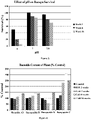
- the levels of saponins in the water increased with storage time in refrigerator. About 2-4% of the plant saponins were released into the water. The low level of saponins in the water ensures safety.
- Table 1 Bacopa saponin levels in untreated plant material (control) and following maintenance in water at room temperature (72°F, 22.2°C) or cold temperature (refrigerator at 35°F, 1.7°C). The plant material was removed at the end of various time periods and analyzed for Bacopa saponin levels.
- Plants increase the production certain phytochemicals in response to stressful conditions.
- the increase in bacopa levels when exposed to cold temperatures may be a natural response to stress. This is similar to the increase in the level of the stress hormone cortisol in humans on cold exposure ( Ge Kunststoffter, et al., Cortisol and Ghrelin concentrations following a cold pressor test in overweight individuals with and without night eating. Int'I J Obesity (Lond), 37:1104-1108, 2013 ).
- Testing of phytochemical release over time on Bacopa indicated the plant sample steadily increases phytochemical release for bacoside A3 and bacopaside II, as seen in Figure 4 .
- release of bacopaside X decreased during storage at 1.7°C through 8 weeks, then spiked at week 16.
- Centella samples are expected to respond in a similar fashion and produce similar types of phytochemicals at similar levels.
- Samples of freshly collected and cleaned samples of Bacopa (BM) and Centella (CA) were added at 1-4 gm per 100 ml to electrolyte-water, pH 7 in bottles.
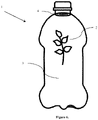
- the plant can be maintained in the fluid as free floating or can be enclosed in plastic mesh tubing in a manner to prevent unintentional ingestion of the plant. Examples are shown in Figures 6 through 12 .
- Plant material 2 is placed into water bottle 1 and submerged in fluid 3.
- Mesh filter 4 is then fixed to the neck of bottle 1, thereby preventing plant material 2 from exiting the body of bottle 1, as seen in Figure 6 .
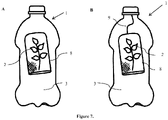
- plant material 2 is placed into mesh bag 8 and placed into bottle 1, as seen in Figure 7(A) .
- Mesh bag 8 can optionally be attached to the cap of bottle 1 by cord 9, as seen in Figure 7(B) .
- Plant material 2 may also be placed into bottle 1 and contained in the base of bottle 1 using mesh filter 12, as seen in Figure 8 .
- Mesh filter 12 is optionally fixed by heat sealing, pressure fitting, or snapping into place. Fluid 3 is then added to bottle 1 and allowed to extract the phytochemicals from plant material 2.
- Bottle 1 can alternatively include hook 15 fixed to the base of the bottle using means known in the art. Examples include thermal welding and sonic welding. Plant material 2 is attached to hook 15 and fluid 3 added to bottle 1, as seen in Figure 9 .
- mount 20 is formed on the base of bottle 1, as seen in Figure 10 . Mount 20 may be formed during manufacture of bottle 1 or may be attached by means such as thermal welding or sonic welding. In some variations, plant material 2 is embedded in mount 20 prior to fixing mount 20 in bottle 1. Plant material 2 may alternatively be contained in bottle 1 by funnel or conical mesh 25, as seen in Figure 11 .
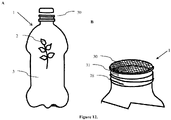
- mountable mesh 30 may be affixed to bottle 1, as seen in Figure 12 . Mountable mesh 30 comprises a mesh filter having clip 31 adapted to snap onto bottle lip 28, as seen in Figures 12(A) and (B) . This allows the user to apply the mesh prior to consumption.
- the bottles were capped and stored at a temperature sufficient to permit extraction of the phytochemicals.
- the bottles were stored at (35°F, 1.7°C).
- BM or CA plant material, or a combination was allowed to steep in water for at least 2 weeks.
- Phytochemical levels can be further enhanced from the levels obtained in Examples 1-5 by having the consumer ingest the plant material along with the liquid. Fortified liquid was prepared as described in Example 5. During consumption of the fortified liquid, the consumer collects the plant material from the container and masticates the plant material, thereby freeing up additional phytochemicals in the plant. Alternatively, the plant material is homogenized with the liquid just prior to consumption.
- the plant material is optionally homogenized using a blender, other bladed mixer, or other homogenizing device, such as sonicators and ultrasonic treatment.
- a blender blade is rotatably fixed to the base of bottle 1.
- homogenizer blade 40 is fixed to electric motor 41 via a sealed shaft.
- Battery 44 is electrically connected to electric motor 41 as would be evident to one of skill in the art.
- Activator button 42 or other means known in the art, is disposed in the electrical circuit between battery 44 and electric motor 41, allowing the consumer to activate the homogenizer blade 40 by closing the circuit.
- homogenizer blade 40 is operated by other mechanical means, such as by hand crank, placing bottle 1 onto a motorized device, such as a blender, food processor, or similar device.
Landscapes
- Health & Medical Sciences (AREA)
- Life Sciences & Earth Sciences (AREA)
- Chemical & Material Sciences (AREA)
- Natural Medicines & Medicinal Plants (AREA)
- Engineering & Computer Science (AREA)
- Mycology (AREA)
- Veterinary Medicine (AREA)
- Public Health (AREA)
- General Health & Medical Sciences (AREA)
- Animal Behavior & Ethology (AREA)
- Medicinal Chemistry (AREA)
- Pharmacology & Pharmacy (AREA)
- Nutrition Science (AREA)
- Epidemiology (AREA)
- Botany (AREA)
- Food Science & Technology (AREA)
- Polymers & Plastics (AREA)
- Organic Chemistry (AREA)
- Alternative & Traditional Medicine (AREA)
- Biotechnology (AREA)
- Medical Informatics (AREA)
- Microbiology (AREA)
- Hydrology & Water Resources (AREA)
- Water Supply & Treatment (AREA)
- Environmental & Geological Engineering (AREA)
- Molecular Biology (AREA)
- Physiology (AREA)
- Toxicology (AREA)
- Inorganic Chemistry (AREA)
- General Chemical & Material Sciences (AREA)
- Nuclear Medicine, Radiotherapy & Molecular Imaging (AREA)
- Bioinformatics & Cheminformatics (AREA)
- Chemical Kinetics & Catalysis (AREA)
- Diabetes (AREA)
- Hematology (AREA)
- Obesity (AREA)
- Medicines Containing Plant Substances (AREA)
- Pharmaceuticals Containing Other Organic And Inorganic Compounds (AREA)
- Coloring Foods And Improving Nutritive Qualities (AREA)
- Agricultural Chemicals And Associated Chemicals (AREA)
Claims (17)
- Verfahren zum Herstellen einer phytochemisch verbesserten Flüssigkeit, das die Schritte umfasst:Erhalten von unbehandelten, lebenden oberirdischen oder Blattabschnitten von Bacopa oder einer Kombination von Bacopa und Centella;Erhalten einer Flüssigkeit mit zumindest 0,01 mg/L Mineralien;wobei die Mineralien zumindest Natrium, Calcium und Kalium sind;wobei die Flüssigkeit einen pH-Wert von 5,5 oder höher aufweist;Platzieren der oberirdischen oder Blattabschnitte von Bacopa oder einer Kombination von Bacopa und Centella in der Flüssigkeit, um eine Extraktionsflüssigkeit zu bilden;Lagern der Extraktionsflüssigkeit mit den oberirdischen oder Blattabschnitten bei einer kalten Temperatur wie z. B. bei 1,6 °C, 1,75 °C, 1,8 °C, 2 °C, 2,5 °C, 3 °C, 3,5 °C, 4 °C, 4,5 °C, 5 °C, 5,5 °C, 6 °C, 6,5 °C, 7 °C, 7,5 °C, 8 °C, 8,5 °C, 9 °C, 9,5 °C und 10 °C für zumindest 2 Wochen.
- Verfahren zum Stimulieren der Produktion von Phytochemikalien in medizinischen Pflanzen, das umfasst:Erhalten zumindest eines unbehandelten, lebenden oberirdischen oder Blattabschnitts von Bacopa oder einer Kombination von Bacopa und Centella;Erhalten einer Flüssigkeit mit zumindest 0,01 mg/L Mineralien;wobei die Mineralien zumindest Natrium, Calcium und Kalium sind;wobei die Flüssigkeit einen pH-Wert von 5,5 oder höher aufweist;Platzieren der oberirdischen oder Blattabschnitte von Bacopa oder einer Kombination von Bacopa und Centella in der Flüssigkeit, um eine Extraktionsflüssigkeit zu bilden;Lagern der Extraktionsflüssigkeit mit den oberirdischen oder Blattabschnitten bei einer kalten Temperatur wie z. B. bei 1,6 °C, 1,75 °C, 1,8 °C, 2 °C, 2,5 °C, 3 °C, 3,5 °C, 4 °C, 4,5 °C, 5 °C, 5,5 °C, 6 °C, 6,5 °C, 7 °C, 7,5 °C, 8 °C, 8,5 °C, 9 °C, 9,5 °C und 10 °C für zumindest 2 Wochen.
- Verfahren nach Anspruch 1, wobei die oberirdischen Abschnitte von Bacopa oder Centella in einem Abstand von 8 bis 10 cm von der Spitze des Zweigs gesammelt werden.
- Verfahren nach Anspruch 1oder 2, wobei die Extraktionsflüssigkeit bei 1,7 °C gelagert wird.
- Verfahren nach Anspruch 1oder 2, wobei die Extraktionsflüssigkeit einen pH-Wert zwischen 7 und 7,8 aufweist.
- Verfahren nach Anspruch 5, wobei die Extraktionsflüssigkeit einen pH-Wert von 7 oder 7,8 aufweist.
- Verfahren nach Anspruch 1oder 2, wobei die oberirdischen oder Blattabschnitte von Bacopa oder einer Kombination von Bacopa und Centella zu zwischen 1g und 4 g pro 100 ml Flüssigkeit zugesetzt werden.
- Verfahren nach Anspruch 1, das ferner das Zusetzen von Ballaststoff zu der Extraktionsflüssigkeit oder Flüssigkeit umfasst.
- Verfahren nach Anspruch 1, das ferner das Zusetzen von Aroma zu der Extraktionsflüssigkeit oder Flüssigkeit umfasst.
- Verfahren nach Anspruch 9, wobei das Aroma Beerenaroma, Fruchtaroma, Gewürzaroma, Kaffeearoma, Teearoma, Vitamine, Mineralien, Faser, Gewürze, Sucralose, Aspartam, eine Kombination von Dextroseaspartamin und Maltodextrin, Cyclamat, Saccharin, Neotam, Acefultamkalium, Alitam, Natriumcyclamat, Glucin, D-Tagatose, Mogrosid, Steviasteviosid, Saccharose, Mannit, Brassein, Curculin, Erythrit, Glycerin, Clycrrhizin, Inulin, Isomalt, Lactitol, Miraculin, Monatin, Monellin, Pentadin, Sorbit, Thaumatin, Xylit und Honig ist.
- Verfahren nach Anspruch 9, wobei die Konzentration eines künstlichen Süßstoffs zwischen 1x 10⁵ und 2 x 101 g/L beträgt oder wobei die Konzentration eines natürlichen Süßstoffs 1,46 x 101 M beträgt.
- Verfahren nach Anspruch 1oder 2, wobei die Mineralien durch Mineralsalze bereitgestellt werden, und wobei die Mineralsalze CaCl2, NaCl, MgCl2, VCl, KCl, CrCl, MnCl2, CoCl, CuCl, ZnCl2, MoCl, SeCl, CaSO4, Na2SO4, MgSO4, VSO4,KSO4, Cr2SO4, MnSO4, CoSO4, Cu2SO4, ZnSO4, Mo2SO4, SeSO4, CaI2, NaI, MgI2, VI, KI, CrI, MnI2, CoI, CuI, ZnI2, MoI, SeI, CaBr2, NaBr, MgBr2, Vbr, KBr, CrBr, MnBr2, CoBr, CuBr, ZnBr2, MoBr oder SeBr sind.
- Verfahren nach Anspruch 12, wobei das Mineralsalz zu zwischen 1x 101 mg/L und 2 x 10² mg/L hinzugefügt wird.
- Verfahren nach Anspruch 13, wobei die Mineralsalze zumindest einen Mineralstoff bereitstellen, wobei der Mineralstoff zwischen 2 mg/L und 20 mg/L Calcium, zwischen 4 mg/L und 15 mg/L Magnesium, zwischen 5 mg/L und 20 mg/L Natrium, zwischen 0,2 mg/L und 6,0 mg/L Kalium, zwischen 5 mg/L und 15 mg/L Chlorid oder zwischen 100 mg/L und 200 mg/L Bicarbonat ist.
- Verfahren nach Anspruch 1, das ferner das Karbonisieren der Extraktionsflüssigkeit umfasst.
- Verfahren nach Anspruch 1, das ferner umfasst:Verbessern der phytochemischen Niveaus durch Zusetzen zumindest einer prozessierten phytochemischen Quelle;wobei die prozessierte phytochemische Quelle pulverförmige Bacopa, pulverförmige Centella, pulverförmige oberirdische Pflanzenteile von Bacopa, pulverförmige oberirdische Pflanzenteile von Centella, Wasserextrakte von Bacopa, Wasserextrakte von Centella, Alkoholextrakte von Bacopa, Alkoholextrakte von Centella, getrocknete oberirdische Pflanzenteile von Bacopa oder getrocknete oberirdische Pflanzenteile von Centella ist.
- Verfahren nach Anspruch 1, das ferner umfasst:Platzieren der Flüssigkeit und der oberirdischen oder Blattabschnitte von Bacopa oder einer Kombination von Bacopa und Centella in einem Lagerbehälter;wobei ein Homogenisator in dem Lagerbehälter angeordnet ist, und wobei der Homogenisator ein elektrisches Mischgerät, ein mechanisches Mischgerät oder ein Schallgerät ist;wobei das elektrische Mischgerät ferner umfasst:ein Homogenisatorblatt, das drehbar an dem Lagerbehälter fixiert ist;einen Elektromotor, der entlang der Drehachse des Homogenisatorblatts angeordnet ist;eine Energiequelle, die mit dem Elektromotor in elektrischer Verbindung steht;einen Schalter, einen Kippschalter, einen Momentschalter oder einen Knopf, der so ausgelegt ist, dass er den Fluss von Elektrizität von der Energiequelle zu dem Elektromotor steuert;wobei das mechanische Mischgerät ferner umfasst:ein Homogenisatorblatt, das drehbar an dem Lagerbehälter fixiert ist;eine Handkurbel oder eine Welle, die so ausgelegt ist, dass sie mechanische Eingaben von einer externen Quelle empfängt; undwobei das Schallgerät ferner umfasst:einen Ultraschallstab oder eine Ultraschallgabel;eine Energiequelle, die mit dem Ultraschallstab oder der Ultraschallgabel in elektrischer Verbindung steht;einen Schalter, einen Kippschalter, einen Momentschalter oder einen Knopf, der so ausgelegt ist, dass er den Fluss von Elektrizität von der Energiequelle zu dem Ultraschallstab oder der Ultraschallgabel steuert.
Priority Applications (1)
| Application Number | Priority Date | Filing Date | Title |
|---|---|---|---|
| PL14893706T PL3148351T3 (pl) | 2014-06-02 | 2014-06-02 | Woda wzbogacona fitochemicznie |
Applications Claiming Priority (1)
| Application Number | Priority Date | Filing Date | Title |
|---|---|---|---|
| PCT/US2014/040489 WO2015187120A1 (en) | 2014-06-02 | 2014-06-02 | Phytochemical enhanced water |
Publications (3)
| Publication Number | Publication Date |
|---|---|
| EP3148351A1 EP3148351A1 (de) | 2017-04-05 |
| EP3148351A4 EP3148351A4 (de) | 2018-01-10 |
| EP3148351B1 true EP3148351B1 (de) | 2022-03-30 |
Family
ID=54767068
Family Applications (1)
| Application Number | Title | Priority Date | Filing Date |
|---|---|---|---|
| EP14893706.3A Active EP3148351B1 (de) | 2014-06-02 | 2014-06-02 | Phytochemisch verbessertes wasser |
Country Status (12)
| Country | Link |
|---|---|
| US (1) | US10918688B2 (de) |
| EP (1) | EP3148351B1 (de) |
| JP (1) | JP6444434B2 (de) |
| CN (1) | CN106659200B (de) |
| AU (1) | AU2014396209B2 (de) |
| CA (1) | CA2950113C (de) |
| ES (1) | ES2914673T3 (de) |
| IL (1) | IL249318B (de) |
| MX (1) | MX388369B (de) |
| PL (1) | PL3148351T3 (de) |
| RU (1) | RU2647901C1 (de) |
| WO (1) | WO2015187120A1 (de) |
Families Citing this family (3)
| Publication number | Priority date | Publication date | Assignee | Title |
|---|---|---|---|---|
| TWI702913B (zh) * | 2018-11-15 | 2020-09-01 | 泓發樂活氏水科技服務股份有限公司 | 一種調製飲品的方法、水濃縮液及其飲品 |
| US11617381B2 (en) * | 2020-06-26 | 2023-04-04 | The Coca-Cola Company | Systems and methods for bottling still flavored water |
| CN113511568A (zh) * | 2021-05-24 | 2021-10-19 | 张美洁 | 一种防止病毒交叉感染的医疗疾控装置 |
Family Cites Families (22)
| Publication number | Priority date | Publication date | Assignee | Title |
|---|---|---|---|---|
| JPS6342789A (ja) * | 1986-08-07 | 1988-02-23 | Toshio Masuda | 活性化水 |
| ES2020652A6 (es) * | 1990-07-17 | 1991-08-16 | Andromaco Lab | Procedimiento de obtencion de un producto de naturaleza oligosacaridica con actividad estimuladora de la reparacion tisular. |
| JPH05344825A (ja) * | 1991-04-08 | 1993-12-27 | Toshiyuki Ota | 植物の保存法 |
| JPH0678631A (ja) * | 1992-09-04 | 1994-03-22 | Sanyo Electric Co Ltd | バラの切り花の貯蔵方法 |
| US6261565B1 (en) * | 1996-03-13 | 2001-07-17 | Archer Daniels Midland Company | Method of preparing and using isoflavones |
| AUPP254598A0 (en) * | 1998-03-23 | 1998-04-23 | Quality Wheat Crc Limited | Food colouring and method for producing same |
| DE10106748A1 (de) | 2001-02-14 | 2002-09-05 | Udo Stanglmeier | Verfahren zur Frischhaltung und Geschmacksverbesserung von Myrobalanen (Steinfrüchte von Terminalia edulis, chebula, bellerica u. a.) zur Nutzbarmachung für Nahrungsergänzungszwecke |
| DE20122059U1 (de) * | 2001-02-14 | 2004-04-01 | Stanglmeier, Udo | Neuartiger verdauungsfördernder Fruchtwein aus Myrobalan-Steinfrüchten |
| DE60215060T2 (de) * | 2002-12-13 | 2007-04-05 | Gobind Prasad Dubey | Kräuterpräparat zur behandlung von herz-kreislauf- sowie neurologischen erkrankungen |
| CN1433974A (zh) * | 2003-03-08 | 2003-08-06 | 黄美凤 | 生物免疫调控健康饮水及其生产方法 |
| US9265808B2 (en) * | 2004-03-23 | 2016-02-23 | Lifeline Nutraceuticals Corporation | Compositions for alleviating inflammation and oxidative stress in a mammal |
| US20050209445A1 (en) | 2004-11-30 | 2005-09-22 | Gokaraju Ganga R | Process for producing enriched fractions containing upto 100% of bacoside a and bacoside b from plant materials of bacopa species |
| US7923041B2 (en) * | 2005-02-03 | 2011-04-12 | Signum Biosciences, Inc. | Compositions and methods for enhancing cognitive function |
| WO2006117795A1 (en) * | 2005-05-03 | 2006-11-09 | Raju Gokaraju Ganga | A process for producing enriched fractions containing upto 100% of bacopasaponins from the plant materials of bacopa species |
| JP2007295907A (ja) * | 2006-04-27 | 2007-11-15 | Sky International:Kk | コタラヒンブツを含有する健康食品 |
| JP2008074785A (ja) * | 2006-09-22 | 2008-04-03 | Asahi Breweries Ltd | 脳機能改善組成物 |
| US9101161B2 (en) * | 2006-11-02 | 2015-08-11 | The Coca-Cola Company | High-potency sweetener composition with phytoestrogen and compositions sweetened therewith |
| GB0909318D0 (en) * | 2009-06-01 | 2009-07-15 | Univ Nac Del Litoral | Methods and compositions for stress tolerance in plants |
| WO2011016027A1 (en) | 2009-08-02 | 2011-02-10 | Yael Ben Zvi | Phytoremediation for desalinated water post-processing |
| KR101103589B1 (ko) * | 2009-09-03 | 2012-01-09 | 단국대학교 산학협력단 | 파이토케미컬 함량이 증가되고, 항산화능이 향상된 모시대 추출물의 제조방법 |
| HRP20201664T1 (hr) * | 2012-01-01 | 2020-12-25 | Botanical Water Technologies Ip Ltd | Postupak za pripremu biljnih napitaka |
| WO2013183065A2 (en) * | 2012-06-06 | 2013-12-12 | Ramaswamy Rajendran | Extraction of phytochemicals from plant matter |
-
2014
- 2014-06-02 CN CN201480079517.2A patent/CN106659200B/zh not_active Expired - Fee Related
- 2014-06-02 JP JP2016570073A patent/JP6444434B2/ja active Active
- 2014-06-02 WO PCT/US2014/040489 patent/WO2015187120A1/en not_active Ceased
- 2014-06-02 EP EP14893706.3A patent/EP3148351B1/de active Active
- 2014-06-02 PL PL14893706T patent/PL3148351T3/pl unknown
- 2014-06-02 MX MX2016015848A patent/MX388369B/es unknown
- 2014-06-02 AU AU2014396209A patent/AU2014396209B2/en not_active Ceased
- 2014-06-02 ES ES14893706T patent/ES2914673T3/es active Active
- 2014-06-02 RU RU2016147221A patent/RU2647901C1/ru not_active IP Right Cessation
- 2014-06-02 CA CA2950113A patent/CA2950113C/en active Active
-
2015
- 2015-09-09 US US14/848,372 patent/US10918688B2/en active Active
-
2016
- 2016-11-30 IL IL249318A patent/IL249318B/en active IP Right Grant
Also Published As
| Publication number | Publication date |
|---|---|
| IL249318A0 (en) | 2017-02-28 |
| MX388369B (es) | 2025-03-19 |
| AU2014396209A1 (en) | 2016-12-22 |
| CN106659200A (zh) | 2017-05-10 |
| IL249318B (en) | 2019-07-31 |
| JP2017522007A (ja) | 2017-08-10 |
| CA2950113C (en) | 2021-05-18 |
| ES2914673T3 (es) | 2022-06-15 |
| EP3148351A1 (de) | 2017-04-05 |
| US10918688B2 (en) | 2021-02-16 |
| MX2016015848A (es) | 2017-06-28 |
| PL3148351T3 (pl) | 2022-06-06 |
| US20160235801A1 (en) | 2016-08-18 |
| AU2014396209B2 (en) | 2018-03-29 |
| CA2950113A1 (en) | 2015-12-10 |
| CN106659200B (zh) | 2021-03-12 |
| RU2647901C1 (ru) | 2018-03-21 |
| EP3148351A4 (de) | 2018-01-10 |
| WO2015187120A1 (en) | 2015-12-10 |
| JP6444434B2 (ja) | 2018-12-26 |
Similar Documents
| Publication | Publication Date | Title |
|---|---|---|
| Al-Qudah et al. | Lemon as a source of functional and medicinal ingredient: A review | |
| US20080038367A1 (en) | Nutritional supplement compositions and methods of preparing | |
| Pérez et al. | Chemistry of Natural Antioxidants and Studies | |
| Arawande et al. | Nutritional and phytochemical compositions of fireweed (Crassocephalum crepidioides). | |
| Okwu | Nigerian medicinal plants I | |
| AU2014396209B2 (en) | Phytochemical enhanced water | |
| Alexey et al. | Orange (lat. Cītrus× sinēnsis) | |
| CN101978892A (zh) | 一种竹醋解酒饮料及其制备方法 | |
| KR101393598B1 (ko) | 숙취해소용 건강식품 조성물 | |
| KR102136053B1 (ko) | 허브추출물을 유효성분으로 하는 숙취해소용 조성물 및 이를 함유하는 음료 | |
| Banerjee et al. | Role of the Indian spice cardamom (Elettaria cardamomum) in natural and herbal medicine | |
| RU2532927C2 (ru) | Напиток безалкогольный | |
| WO2019035785A2 (en) | FRUIT BEVERAGE ENRICHED WITH NANOEMULSIFIED ESSENTIAL OILS | |
| Ajuru et al. | Qualitative and quantitative phytochemical screening of some species of Lamiaceae in Rivers State, Nigeria | |
| Ravindran et al. | Other herbs and spices: achiote to Szechuan pepper | |
| KR20200142768A (ko) | 한방 추출물을 포함하는 숙취 해소용 조성물 | |
| HK1237598A1 (en) | Phytochemical enhanced water | |
| HK1237598B (zh) | 植物化学物质强化的水 | |
| Suse et al. | Development of healthy chocolate coated coconut balls by using herbal powders | |
| KR20210099747A (ko) | 벌나무 추출액을 주재로 한 건강음료 및 그 제조방법 | |
| Zakerimehr et al. | Investigation of pharmaceutical and Antioxidant Effects of Citrus aurantium L. in North of IRAN | |
| KR20030079289A (ko) | 숙취해소용 탄산음료 제조방법 및 그 조성물. | |
| Lim | Opuntia ficus-indica | |
| CN104413504A (zh) | 一种中草药解酒保健品及制备方法 | |
| Kumar et al. | and Vegetables for Attaining Zero Hunger |
Legal Events
| Date | Code | Title | Description |
|---|---|---|---|
| STAA | Information on the status of an ep patent application or granted ep patent |
Free format text: STATUS: THE INTERNATIONAL PUBLICATION HAS BEEN MADE |
|
| PUAI | Public reference made under article 153(3) epc to a published international application that has entered the european phase |
Free format text: ORIGINAL CODE: 0009012 |
|
| STAA | Information on the status of an ep patent application or granted ep patent |
Free format text: STATUS: REQUEST FOR EXAMINATION WAS MADE |
|
| 17P | Request for examination filed |
Effective date: 20161205 |
|
| AK | Designated contracting states |
Kind code of ref document: A1 Designated state(s): AL AT BE BG CH CY CZ DE DK EE ES FI FR GB GR HR HU IE IS IT LI LT LU LV MC MK MT NL NO PL PT RO RS SE SI SK SM TR |
|
| AX | Request for extension of the european patent |
Extension state: BA ME |
|
| DAX | Request for extension of the european patent (deleted) | ||
| REG | Reference to a national code |
Ref country code: DE Ref legal event code: R079 Ref document number: 602014083057 Country of ref document: DE Free format text: PREVIOUS MAIN CLASS: A23L0033100000 Ipc: A61K0036230000 |
|
| A4 | Supplementary search report drawn up and despatched |
Effective date: 20171207 |
|
| RIC1 | Information provided on ipc code assigned before grant |
Ipc: C02F 1/32 20060101ALI20171201BHEP Ipc: A61K 36/23 20060101AFI20171201BHEP Ipc: A23L 33/10 20160101ALI20171201BHEP Ipc: A61K 36/68 20060101ALI20171201BHEP |
|
| STAA | Information on the status of an ep patent application or granted ep patent |
Free format text: STATUS: EXAMINATION IS IN PROGRESS |
|
| 17Q | First examination report despatched |
Effective date: 20200319 |
|
| GRAP | Despatch of communication of intention to grant a patent |
Free format text: ORIGINAL CODE: EPIDOSNIGR1 |
|
| STAA | Information on the status of an ep patent application or granted ep patent |
Free format text: STATUS: GRANT OF PATENT IS INTENDED |
|
| INTG | Intention to grant announced |
Effective date: 20211022 |
|
| GRAS | Grant fee paid |
Free format text: ORIGINAL CODE: EPIDOSNIGR3 |
|
| GRAA | (expected) grant |
Free format text: ORIGINAL CODE: 0009210 |
|
| STAA | Information on the status of an ep patent application or granted ep patent |
Free format text: STATUS: THE PATENT HAS BEEN GRANTED |
|
| AK | Designated contracting states |
Kind code of ref document: B1 Designated state(s): AL AT BE BG CH CY CZ DE DK EE ES FI FR GB GR HR HU IE IS IT LI LT LU LV MC MK MT NL NO PL PT RO RS SE SI SK SM TR |
|
| REG | Reference to a national code |
Ref country code: GB Ref legal event code: FG4D |
|
| REG | Reference to a national code |
Ref country code: CH Ref legal event code: EP |
|
| REG | Reference to a national code |
Ref country code: DE Ref legal event code: R096 Ref document number: 602014083057 Country of ref document: DE |
|
| REG | Reference to a national code |
Ref country code: AT Ref legal event code: REF Ref document number: 1478558 Country of ref document: AT Kind code of ref document: T Effective date: 20220415 |
|
| REG | Reference to a national code |
Ref country code: IE Ref legal event code: FG4D |
|
| REG | Reference to a national code |
Ref country code: ES Ref legal event code: FG2A Ref document number: 2914673 Country of ref document: ES Kind code of ref document: T3 Effective date: 20220615 |
|
| REG | Reference to a national code |
Ref country code: LT Ref legal event code: MG9D |
|
| PG25 | Lapsed in a contracting state [announced via postgrant information from national office to epo] |
Ref country code: SE Free format text: LAPSE BECAUSE OF FAILURE TO SUBMIT A TRANSLATION OF THE DESCRIPTION OR TO PAY THE FEE WITHIN THE PRESCRIBED TIME-LIMIT Effective date: 20220330 Ref country code: RS Free format text: LAPSE BECAUSE OF FAILURE TO SUBMIT A TRANSLATION OF THE DESCRIPTION OR TO PAY THE FEE WITHIN THE PRESCRIBED TIME-LIMIT Effective date: 20220330 Ref country code: NO Free format text: LAPSE BECAUSE OF FAILURE TO SUBMIT A TRANSLATION OF THE DESCRIPTION OR TO PAY THE FEE WITHIN THE PRESCRIBED TIME-LIMIT Effective date: 20220630 Ref country code: LT Free format text: LAPSE BECAUSE OF FAILURE TO SUBMIT A TRANSLATION OF THE DESCRIPTION OR TO PAY THE FEE WITHIN THE PRESCRIBED TIME-LIMIT Effective date: 20220330 Ref country code: HR Free format text: LAPSE BECAUSE OF FAILURE TO SUBMIT A TRANSLATION OF THE DESCRIPTION OR TO PAY THE FEE WITHIN THE PRESCRIBED TIME-LIMIT Effective date: 20220330 Ref country code: BG Free format text: LAPSE BECAUSE OF FAILURE TO SUBMIT A TRANSLATION OF THE DESCRIPTION OR TO PAY THE FEE WITHIN THE PRESCRIBED TIME-LIMIT Effective date: 20220630 |
|
| REG | Reference to a national code |
Ref country code: NL Ref legal event code: MP Effective date: 20220330 |
|
| REG | Reference to a national code |
Ref country code: AT Ref legal event code: MK05 Ref document number: 1478558 Country of ref document: AT Kind code of ref document: T Effective date: 20220330 |
|
| PG25 | Lapsed in a contracting state [announced via postgrant information from national office to epo] |
Ref country code: LV Free format text: LAPSE BECAUSE OF FAILURE TO SUBMIT A TRANSLATION OF THE DESCRIPTION OR TO PAY THE FEE WITHIN THE PRESCRIBED TIME-LIMIT Effective date: 20220330 Ref country code: GR Free format text: LAPSE BECAUSE OF FAILURE TO SUBMIT A TRANSLATION OF THE DESCRIPTION OR TO PAY THE FEE WITHIN THE PRESCRIBED TIME-LIMIT Effective date: 20220701 Ref country code: FI Free format text: LAPSE BECAUSE OF FAILURE TO SUBMIT A TRANSLATION OF THE DESCRIPTION OR TO PAY THE FEE WITHIN THE PRESCRIBED TIME-LIMIT Effective date: 20220330 |
|
| PG25 | Lapsed in a contracting state [announced via postgrant information from national office to epo] |
Ref country code: NL Free format text: LAPSE BECAUSE OF FAILURE TO SUBMIT A TRANSLATION OF THE DESCRIPTION OR TO PAY THE FEE WITHIN THE PRESCRIBED TIME-LIMIT Effective date: 20220330 |
|
| PG25 | Lapsed in a contracting state [announced via postgrant information from national office to epo] |
Ref country code: SM Free format text: LAPSE BECAUSE OF FAILURE TO SUBMIT A TRANSLATION OF THE DESCRIPTION OR TO PAY THE FEE WITHIN THE PRESCRIBED TIME-LIMIT Effective date: 20220330 Ref country code: SK Free format text: LAPSE BECAUSE OF FAILURE TO SUBMIT A TRANSLATION OF THE DESCRIPTION OR TO PAY THE FEE WITHIN THE PRESCRIBED TIME-LIMIT Effective date: 20220330 Ref country code: RO Free format text: LAPSE BECAUSE OF FAILURE TO SUBMIT A TRANSLATION OF THE DESCRIPTION OR TO PAY THE FEE WITHIN THE PRESCRIBED TIME-LIMIT Effective date: 20220330 Ref country code: PT Free format text: LAPSE BECAUSE OF FAILURE TO SUBMIT A TRANSLATION OF THE DESCRIPTION OR TO PAY THE FEE WITHIN THE PRESCRIBED TIME-LIMIT Effective date: 20220801 Ref country code: EE Free format text: LAPSE BECAUSE OF FAILURE TO SUBMIT A TRANSLATION OF THE DESCRIPTION OR TO PAY THE FEE WITHIN THE PRESCRIBED TIME-LIMIT Effective date: 20220330 Ref country code: CZ Free format text: LAPSE BECAUSE OF FAILURE TO SUBMIT A TRANSLATION OF THE DESCRIPTION OR TO PAY THE FEE WITHIN THE PRESCRIBED TIME-LIMIT Effective date: 20220330 Ref country code: AT Free format text: LAPSE BECAUSE OF FAILURE TO SUBMIT A TRANSLATION OF THE DESCRIPTION OR TO PAY THE FEE WITHIN THE PRESCRIBED TIME-LIMIT Effective date: 20220330 |
|
| PG25 | Lapsed in a contracting state [announced via postgrant information from national office to epo] |
Ref country code: IS Free format text: LAPSE BECAUSE OF FAILURE TO SUBMIT A TRANSLATION OF THE DESCRIPTION OR TO PAY THE FEE WITHIN THE PRESCRIBED TIME-LIMIT Effective date: 20220730 Ref country code: AL Free format text: LAPSE BECAUSE OF FAILURE TO SUBMIT A TRANSLATION OF THE DESCRIPTION OR TO PAY THE FEE WITHIN THE PRESCRIBED TIME-LIMIT Effective date: 20220330 |
|
| REG | Reference to a national code |
Ref country code: DE Ref legal event code: R097 Ref document number: 602014083057 Country of ref document: DE |
|
| PG25 | Lapsed in a contracting state [announced via postgrant information from national office to epo] |
Ref country code: MC Free format text: LAPSE BECAUSE OF FAILURE TO SUBMIT A TRANSLATION OF THE DESCRIPTION OR TO PAY THE FEE WITHIN THE PRESCRIBED TIME-LIMIT Effective date: 20220330 Ref country code: DK Free format text: LAPSE BECAUSE OF FAILURE TO SUBMIT A TRANSLATION OF THE DESCRIPTION OR TO PAY THE FEE WITHIN THE PRESCRIBED TIME-LIMIT Effective date: 20220330 |
|
| REG | Reference to a national code |
Ref country code: CH Ref legal event code: PL |
|
| PLBE | No opposition filed within time limit |
Free format text: ORIGINAL CODE: 0009261 |
|
| STAA | Information on the status of an ep patent application or granted ep patent |
Free format text: STATUS: NO OPPOSITION FILED WITHIN TIME LIMIT |
|
| REG | Reference to a national code |
Ref country code: BE Ref legal event code: MM Effective date: 20220630 |
|
| GBPC | Gb: european patent ceased through non-payment of renewal fee |
Effective date: 20220630 |
|
| 26N | No opposition filed |
Effective date: 20230103 |
|
| PG25 | Lapsed in a contracting state [announced via postgrant information from national office to epo] |
Ref country code: LU Free format text: LAPSE BECAUSE OF NON-PAYMENT OF DUE FEES Effective date: 20220602 Ref country code: LI Free format text: LAPSE BECAUSE OF NON-PAYMENT OF DUE FEES Effective date: 20220630 Ref country code: IE Free format text: LAPSE BECAUSE OF NON-PAYMENT OF DUE FEES Effective date: 20220602 Ref country code: CH Free format text: LAPSE BECAUSE OF NON-PAYMENT OF DUE FEES Effective date: 20220630 |
|
| PG25 | Lapsed in a contracting state [announced via postgrant information from national office to epo] |
Ref country code: SI Free format text: LAPSE BECAUSE OF FAILURE TO SUBMIT A TRANSLATION OF THE DESCRIPTION OR TO PAY THE FEE WITHIN THE PRESCRIBED TIME-LIMIT Effective date: 20220330 Ref country code: GB Free format text: LAPSE BECAUSE OF NON-PAYMENT OF DUE FEES Effective date: 20220630 Ref country code: BE Free format text: LAPSE BECAUSE OF NON-PAYMENT OF DUE FEES Effective date: 20220630 |
|
| PG25 | Lapsed in a contracting state [announced via postgrant information from national office to epo] |
Ref country code: HU Free format text: LAPSE BECAUSE OF FAILURE TO SUBMIT A TRANSLATION OF THE DESCRIPTION OR TO PAY THE FEE WITHIN THE PRESCRIBED TIME-LIMIT; INVALID AB INITIO Effective date: 20140602 |
|
| PG25 | Lapsed in a contracting state [announced via postgrant information from national office to epo] |
Ref country code: MK Free format text: LAPSE BECAUSE OF FAILURE TO SUBMIT A TRANSLATION OF THE DESCRIPTION OR TO PAY THE FEE WITHIN THE PRESCRIBED TIME-LIMIT Effective date: 20220330 Ref country code: CY Free format text: LAPSE BECAUSE OF FAILURE TO SUBMIT A TRANSLATION OF THE DESCRIPTION OR TO PAY THE FEE WITHIN THE PRESCRIBED TIME-LIMIT Effective date: 20220330 |
|
| PGFP | Annual fee paid to national office [announced via postgrant information from national office to epo] |
Ref country code: DE Payment date: 20240628 Year of fee payment: 11 |
|
| PGFP | Annual fee paid to national office [announced via postgrant information from national office to epo] |
Ref country code: FR Payment date: 20240529 Year of fee payment: 11 |
|
| PGFP | Annual fee paid to national office [announced via postgrant information from national office to epo] |
Ref country code: PL Payment date: 20240529 Year of fee payment: 11 |
|
| PG25 | Lapsed in a contracting state [announced via postgrant information from national office to epo] |
Ref country code: MT Free format text: LAPSE BECAUSE OF FAILURE TO SUBMIT A TRANSLATION OF THE DESCRIPTION OR TO PAY THE FEE WITHIN THE PRESCRIBED TIME-LIMIT Effective date: 20220330 |
|
| PGFP | Annual fee paid to national office [announced via postgrant information from national office to epo] |
Ref country code: IT Payment date: 20240627 Year of fee payment: 11 |
|
| PGFP | Annual fee paid to national office [announced via postgrant information from national office to epo] |
Ref country code: ES Payment date: 20240708 Year of fee payment: 11 |
|
| PG25 | Lapsed in a contracting state [announced via postgrant information from national office to epo] |
Ref country code: TR Free format text: LAPSE BECAUSE OF FAILURE TO SUBMIT A TRANSLATION OF THE DESCRIPTION OR TO PAY THE FEE WITHIN THE PRESCRIBED TIME-LIMIT Effective date: 20220330 |
|
| REG | Reference to a national code |
Ref country code: DE Ref legal event code: R119 Ref document number: 602014083057 Country of ref document: DE |
|
| PG25 | Lapsed in a contracting state [announced via postgrant information from national office to epo] |
Ref country code: DE Free format text: LAPSE BECAUSE OF NON-PAYMENT OF DUE FEES Effective date: 20260101 |
|
| PG25 | Lapsed in a contracting state [announced via postgrant information from national office to epo] |
Ref country code: IT Free format text: LAPSE BECAUSE OF NON-PAYMENT OF DUE FEES Effective date: 20250602 |
|
| PG25 | Lapsed in a contracting state [announced via postgrant information from national office to epo] |
Ref country code: FR Free format text: LAPSE BECAUSE OF NON-PAYMENT OF DUE FEES Effective date: 20250630 |