EP3150724A1 - Séquençage d'acide nucléique assisté par particules - Google Patents
Séquençage d'acide nucléique assisté par particules Download PDFInfo
- Publication number
- EP3150724A1 EP3150724A1 EP16197694.9A EP16197694A EP3150724A1 EP 3150724 A1 EP3150724 A1 EP 3150724A1 EP 16197694 A EP16197694 A EP 16197694A EP 3150724 A1 EP3150724 A1 EP 3150724A1
- Authority
- EP
- European Patent Office
- Prior art keywords
- nucleic acid
- particles
- target nucleic
- probes
- particle
- Prior art date
- Legal status (The legal status is an assumption and is not a legal conclusion. Google has not performed a legal analysis and makes no representation as to the accuracy of the status listed.)
- Withdrawn
Links
Images



Classifications
-
- C—CHEMISTRY; METALLURGY
- C12—BIOCHEMISTRY; BEER; SPIRITS; WINE; VINEGAR; MICROBIOLOGY; ENZYMOLOGY; MUTATION OR GENETIC ENGINEERING
- C12Q—MEASURING OR TESTING PROCESSES INVOLVING ENZYMES, NUCLEIC ACIDS OR MICROORGANISMS; COMPOSITIONS OR TEST PAPERS THEREFOR; PROCESSES OF PREPARING SUCH COMPOSITIONS; CONDITION-RESPONSIVE CONTROL IN MICROBIOLOGICAL OR ENZYMOLOGICAL PROCESSES
- C12Q1/00—Measuring or testing processes involving enzymes, nucleic acids or microorganisms; Compositions therefor; Processes of preparing such compositions
- C12Q1/68—Measuring or testing processes involving enzymes, nucleic acids or microorganisms; Compositions therefor; Processes of preparing such compositions involving nucleic acids
- C12Q1/6809—Methods for determination or identification of nucleic acids involving differential detection
-
- B—PERFORMING OPERATIONS; TRANSPORTING
- B01—PHYSICAL OR CHEMICAL PROCESSES OR APPARATUS IN GENERAL
- B01L—CHEMICAL OR PHYSICAL LABORATORY APPARATUS FOR GENERAL USE
- B01L3/00—Containers or dishes for laboratory use, e.g. laboratory glassware; Droppers
- B01L3/50—Containers for the purpose of retaining a material to be analysed, e.g. test tubes
- B01L3/502—Containers for the purpose of retaining a material to be analysed, e.g. test tubes with fluid transport, e.g. in multi-compartment structures
- B01L3/5027—Containers for the purpose of retaining a material to be analysed, e.g. test tubes with fluid transport, e.g. in multi-compartment structures by integrated microfluidic structures, i.e. dimensions of channels and chambers are such that surface tension forces are important, e.g. lab-on-a-chip
- B01L3/502761—Containers for the purpose of retaining a material to be analysed, e.g. test tubes with fluid transport, e.g. in multi-compartment structures by integrated microfluidic structures, i.e. dimensions of channels and chambers are such that surface tension forces are important, e.g. lab-on-a-chip specially adapted for handling suspended solids or molecules independently from the bulk fluid flow, e.g. for trapping or sorting beads or physically stretching molecules
-
- C—CHEMISTRY; METALLURGY
- C12—BIOCHEMISTRY; BEER; SPIRITS; WINE; VINEGAR; MICROBIOLOGY; ENZYMOLOGY; MUTATION OR GENETIC ENGINEERING
- C12Q—MEASURING OR TESTING PROCESSES INVOLVING ENZYMES, NUCLEIC ACIDS OR MICROORGANISMS; COMPOSITIONS OR TEST PAPERS THEREFOR; PROCESSES OF PREPARING SUCH COMPOSITIONS; CONDITION-RESPONSIVE CONTROL IN MICROBIOLOGICAL OR ENZYMOLOGICAL PROCESSES
- C12Q1/00—Measuring or testing processes involving enzymes, nucleic acids or microorganisms; Compositions therefor; Processes of preparing such compositions
- C12Q1/68—Measuring or testing processes involving enzymes, nucleic acids or microorganisms; Compositions therefor; Processes of preparing such compositions involving nucleic acids
- C12Q1/6813—Hybridisation assays
- C12Q1/6834—Enzymatic or biochemical coupling of nucleic acids to a solid phase
-
- C—CHEMISTRY; METALLURGY
- C12—BIOCHEMISTRY; BEER; SPIRITS; WINE; VINEGAR; MICROBIOLOGY; ENZYMOLOGY; MUTATION OR GENETIC ENGINEERING
- C12Q—MEASURING OR TESTING PROCESSES INVOLVING ENZYMES, NUCLEIC ACIDS OR MICROORGANISMS; COMPOSITIONS OR TEST PAPERS THEREFOR; PROCESSES OF PREPARING SUCH COMPOSITIONS; CONDITION-RESPONSIVE CONTROL IN MICROBIOLOGICAL OR ENZYMOLOGICAL PROCESSES
- C12Q1/00—Measuring or testing processes involving enzymes, nucleic acids or microorganisms; Compositions therefor; Processes of preparing such compositions
- C12Q1/68—Measuring or testing processes involving enzymes, nucleic acids or microorganisms; Compositions therefor; Processes of preparing such compositions involving nucleic acids
- C12Q1/6869—Methods for sequencing
-
- C—CHEMISTRY; METALLURGY
- C12—BIOCHEMISTRY; BEER; SPIRITS; WINE; VINEGAR; MICROBIOLOGY; ENZYMOLOGY; MUTATION OR GENETIC ENGINEERING
- C12Q—MEASURING OR TESTING PROCESSES INVOLVING ENZYMES, NUCLEIC ACIDS OR MICROORGANISMS; COMPOSITIONS OR TEST PAPERS THEREFOR; PROCESSES OF PREPARING SUCH COMPOSITIONS; CONDITION-RESPONSIVE CONTROL IN MICROBIOLOGICAL OR ENZYMOLOGICAL PROCESSES
- C12Q1/00—Measuring or testing processes involving enzymes, nucleic acids or microorganisms; Compositions therefor; Processes of preparing such compositions
- C12Q1/68—Measuring or testing processes involving enzymes, nucleic acids or microorganisms; Compositions therefor; Processes of preparing such compositions involving nucleic acids
- C12Q1/6869—Methods for sequencing
- C12Q1/6874—Methods for sequencing involving nucleic acid arrays, e.g. sequencing by hybridisation
-
- B—PERFORMING OPERATIONS; TRANSPORTING
- B01—PHYSICAL OR CHEMICAL PROCESSES OR APPARATUS IN GENERAL
- B01L—CHEMICAL OR PHYSICAL LABORATORY APPARATUS FOR GENERAL USE
- B01L2200/00—Solutions for specific problems relating to chemical or physical laboratory apparatus
- B01L2200/10—Integrating sample preparation and analysis in single entity, e.g. lab-on-a-chip concept
Definitions
- This invention relates generally to particle-assisted nucleic acid sequencing.
- the nucleic acid sequencing is performed in a microfluidic system.
- This invention relates generally to particle-assisted nucleic acid sequencing.
- the nucleic acid sequencing is performed in a microfluidic system.
- the subject matter of the present invention involves, in some cases, interrelated products, alternative solutions to a particular problem, and/or a plurality of different uses of one or more systems and/or articles.
- the method includes acts of providing a plurality of particles, at least some of which have nucleic acid probes fastened thereto. In some cases, at least some of the particles are distinguishable from some other particles. In one embodiment, the distinguishable particles have distinguishable nucleic acid probes fastened thereto, and in some cases, the nucleic acid probes are different from other nucleic acids probes fastened to other particles.
- the method may also include acts of exposing a target nucleic acid to the plurality of particles, determining binding of the distinguishable particles to the target nucleic acid, and at least partially determining a sequence of the target nucleic acid based on the binding of the particles.
- Another aspect of the invention is directed to a method including acts of providing a plurality of particles, at least some of which have nucleic acid probes fastened thereto, providing a plurality of substantially identical copies of a target nucleic acid, exposing copies of the target nucleic acid to different subsets of the plurality of particles, and for each of the copies, determining binding of the particles to the target nucleic acid.
- particles then may flow into an area where the association (if any) between the target and the particles can be determined. For example, the particles may flow past detector 140 as shown in FIG. 2 . If target nucleic acid 20 is associated with a signaling entity (not shown) and particles 141, 142, and 143 are each associated with different identification entities (e.g., as described in more detail below), then the determination of the association of the signaling entity with each of the identification entities can be used to determine the association of the target nucleic acid 20 with the particles 141, 142, and/or 143.
- a signaling entity not shown
- particles 141, 142, and 143 are each associated with different identification entities (e.g., as described in more detail below)
- the determination of the association of the signaling entity with each of the identification entities can be used to determine the association of the target nucleic acid 20 with the particles 141, 142, and/or 143.
- a hybridization spectrum 190 can be produced by identifying particles 141, 142, and 143 as having hybridized with the target nucleic acid 20.
- particles 141, 142, and 143 may each be distinguishable in some fashion (e.g., having different fluorescence properties), and the association between particle 141 and sequence 160, particle 142 and sequence 170, and particle 143 and sequence 180 may be recorded, e.g., on a computer.
- a particle can contain a single nucleic acid probe fastened to the surface (although the particle may contain many identical copies of this single nucleic acid probe), identification of the set of particles associated with both a signaling entity and an identification entity allows the nucleic acid probe sequences associated with a target nucleic acid to be determined.
- nucleic acid probe sequences 160, 170, and 180 known to be associated with each respective particle, can be used to reconstruct nucleic acid sequence 200, which is complementary to the corresponding portion of the target nucleic acid sequence 201, as is illustrated in FIG. 3 .
- the droplet then can contain some or all of the members of particle library 30 and the target nucleic acids.
- the hybridization process and analysis can proceed as described herein.
- nucleic acid probe sequences within the nucleic acid probe may be contiguous, or the sequence may be noncontiguous. For instance, there may be universal residues or gaps present within the probe sequence. Additionally, secondary structures such as hairpins, loops, etc. may be present in some cases, which may be used to create a noncontiguous sequence.
- a nucleic acid probe may have a first and second region that are at least substantially complementary to a contiguous sequence of the target nucleic acid and are separated by a third region that is not complementary to the contiguous sequence of the target nucleic acid. The nucleic acid probe may hybridize to the target nucleic acid such that the third region forms a hairpin, thereby allowing the first and second regions to hybridize to the contiguous target nucleic acid sequence in a noncontiguous fashion.
- the particle may be any solid entity that can be dispersed in a fluid.
- the particles may be prepared such that some or all of the particles each have only one nucleic acid probe sequence fastened to the particle, although multiple copies of the nucleic acid probe may be fastened to the particle. In other embodiments, however, more than one nucleic acid probe sequence may be present in the nucleic acid probes fastened to a given particle.
- different particles may independently have the same or different nucleic acid probe sequence (e.g., such that there is some redundancy so that not each particle in a given population or collection of particles is necessarily unique).
- a particle may be solid, i.e. a continuous material or mixture of materials.
- the particle may have a core-shell structure where, for example, the core comprise one material and the shell comprises a second material.
- the core may be a solid, a liquid, a gel, or mixtures thereof.
- the particle may be hollow.
- the surface of a first particle may have fastened thereto a plurality of nucleic acid probes of a first sequence (i.e., essentially all of the nucleic acid probes fastened to the first particle have identical sequences)
- the surface of a second particle may have fastened thereto a plurality of nucleic acid probes of a second sequence (i.e., essentially all of the nucleic acid probes fastened to the second particle have identical sequences)
- a first sequence i.e., essentially all of the nucleic acid probes fastened to the first particle have identical sequences
- the surface of a second particle may have fastened thereto a plurality of nucleic acid probes of a second sequence (i.e., essentially all of the nucleic acid probes fastened to the second particle have identical sequences)
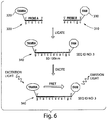
- Target nucleic acid 20 comprising the first 161 and second 162 nucleic acid probes may then be exposed to a ligase and ligated together to form a nucleic acid oligomer.
- the first and the second nucleic acid probes do not hybridize adjacent to each other on the target nucleic acid.
- no substantial ligation of the nucleic acid probes will occur.
- one or both of the nucleic acid probes will not hybridize to the target nucleic acid (e.g., the sequence is not substantially complimentary), and no ligation will occur between the first nucleic acid probe and the second nucleic acid probe.
- the first and the second nucleic acid may have sequences which are substantially complimentary with the target nucleic acid but the sequences are not adjacent to each other (e.g., one or more residues may be present in the target nucleic acid probe between the sequence complimentary to the first and the second nucleic acid probes).
- the first group and the second group of nucleic acid probes may be substantially similar or different.
- the first group and the second group of nucleic acids may be substantially similar if the first group and the second group comprises at least a portion of all possible 3-mers, but may differ in that they comprise differing signaling entities or the signaling entity is located at differing positions (e.g., 3'-end vs. 5'-end).
- the first group of distinguishable identification elements and the second group of distinguishable identification elements may be the substantially similar or different.
- two 6-mer sequences may be ligated together, where each of the 6-mer sequences contains three naturally-occurring residues and three universal residues; thus, there will be 4 3 possible first nucleic acid probes and 4 3 possible second nucleic acid probes that can be ligated together, and identification of the ligation between the first and second nucleic acid probes can be used to identify a sequence of 6 nucleic acids, even though each of the first and second nucleic acid probes binds to the target nucleic acid with the affinity of a 6-mer, not a 3-mer, due to the presence of the three universal residues.
- a particle may have fastened to the surface a first nucleic acid probe 161 containing a first signaling entity 210 and a second nucleic probe 162 containing a second signaling entity 220, the sequence of the first nucleic acid probe being different from the sequence of the second nucleic acid probe.
- the library may contain sequences that have roughly the same number of residues, for example, around 4 residues, around 5 residues, around 6 residues, around 7 residues, etc.
- the library of nucleic acid probes may be prepared using any suitable technique, and may be produced using manual techniques or automated, e.g., using a robotic apparatus.
- a first particle may be distinguished from a second particle using a first identification entity associated with the first particle and a second identification entity associated with the second particle, where the first and second identification entities are distinguishable in some fashion.
- the plurality of particles contains at least one unique nucleic acid probe, at least 2 unique nucleic acid probes, at least 5 unique nucleic acid probes, at least 10 unique nucleic acid probes, at least 50 unique nucleic acid probes, least 100 unique nucleic acid probes, at least 120 unique nucleic acid probes, at least 200 unique nucleic acid probes, at least 500 unique nucleic acid probes, at least 1,000 unique nucleic acid probes, at least 4,000 unique nucleic acid probes, at least 16,000 unique nucleic acid probes, at least 65,000 unique nucleic acid probes, etc.
- the sequence of a target nucleic acid may be determined by determining the association (or the non-association) of the target nucleic acid to one of a plurality of distinguishable particles having attached nucleic acid probes.
- the target nucleic acid may be bound to the nucleic acid probe when they form a relatively stable duplex by hydrogen bonding under experimental conditions. Relatively stable hydrogen bonding may be formed due to Watson-Crick complementarity (e.g., A matches T, but not G or C G matches C, but not A or T) and/or other effects such as GC wobble, or other associations caused by locked nucleic acids or universal bases, as discussed herein.
- suitable methods for determining the sequence of a target nucleic acid include sequencing by hybridization techniques that are known to those of ordinary skill in the art.
- a target nucleic acid may associate with a certain set of nucleic acid probes fastened to particles, leading to a characteristic "hybridization" pattern.
- Each positive association (or hybridization) event in a given sample provides information about the target nucleic acid.
- the target nucleic acid may be sequenced without determination of exactly where any particular nucleic acid probe associates with the target nucleic acid. Algorithms and software have been developed for target nucleic acid reconstruction, based on the hybridization pattern, and are known to those skilled in the art.
- analysis of a hybridization pattern may provide a "fingerprint" labeling of the target nucleic acid sequence, without specifically determining the target nucleic acid sequence itself.
- the pattern of hybridization may also be manually or computer analyzed.
- any suitable determination method can be used to determine the identification entities and/or the signaling entities, depending on the application. As mentioned, the determination may occur using techniques such as radioactivity, fluorescence, phosphorescence, light scattering, light absorption, fluorescence polarization, or the like. Many detectors that operate using such principles are commercially available. The detector may be used to determine at least one of the signaling entities and/or identification entities that may be present, and in some cases, more than one detector may be used.
- the particles flow past a detector single file.
- the droplet may be deformed such that the particles contained within the droplet pass the detector single file.
- a droplet may be deformed by passing it through a channel that has a constriction such that the cross-sectional area of the constriction is smaller than the cross-sectional area of the droplet when the droplet is in free solution.
- the droplet is deformed such that substantially all of the signaling entities and/or identification entities are arranged single file within the droplet.
- the signaling entities and/or identification entities may be arranged within a channel such that no line drawn from a first wall of the channel, normal to the first wall, to a second wall of the channel intersects more than one particle.
- the detection may be parallelized, i.e., a number of signaling entities and/or identification entities may be simultaneously determined within one channel and/or within a plurality of channels.
- a timing device may be used to synchronize detection of the parallel paths.
- parallelized detection is the use of a camera positioned so as to be able to image more than one channel, e.g., simultaneously.
- the camera may be, for example, a linescan camera, a 2D CCD camera, or the like. Additional devices and methods suitable for use in the present invention can be found in U.S. Application Serial No. 61/008,862 entitled "Systems and Methods for Nucleic Acid Sequencing," filed December 21, 2007, and U.S. Application Serial No.
- particles may be determined by determining a signal of a position relative to a reference spot. That is, each particle may be related to a references spot and a determination of the signal of a particle may be determined by relation to the reference spot.
- Production of a reference spot may be accomplished, for example, by shining a light on the surface of the particles such that glare is produced for each particle. This may allow for the detector to determine a relative location for each particle, and thereby determine a signal each particle, as described more herein.
- At least one image may be processed by using a simple intensity threshold programs to determine the particle glares on each particle.
- the software can compute, or human input may be used, to determine the angle and/or the distance between a particle glare and the center of the particle.
- the angle and/or distance between a particle glare and the center of the particle may be recorded a single time.
- a “droplet,” as used herein, is an isolated portion of a first fluid that is completely surrounded by a second fluid. It is to be noted that a droplet is not necessarily spherical, but may assume other shapes as well, for example, depending on the external environment. In one embodiment, the droplet has a minimum cross-sectional dimension that is substantially equal to the largest dimension of the channel perpendicular to fluid flow in which the droplet is located. The diameter of a droplet, in a non-spherical droplet, is the diameter of a perfect mathematical sphere having the same volume as the non-spherical droplet.
- the fluidic droplets may be created using any suitable technique, such as those disclosed in U.S. Patent Application Serial No.
- the "average diameter" of a population of droplets is the arithmetic average of the diameters of the droplets. Those of ordinary skill in the art will be able to determine the average diameter of a population of droplets, for example, using laser light scattering or other known techniques. As non-limiting examples, the average diameter of a droplet may be less than about 1 mm, less than about 500 micrometers, less than about 200 micrometers, less than about 100 micrometers, less than about 75 micrometers, less than about 50 micrometers, less than about 25 micrometers, less than about 10 micrometers, or less than about 5 micrometers.
- droplets containing the nucleic acids can be produced in parallel.
- a microfluidic device may be used to allow for parallel creation of a library of droplets containing target nucleic acids.
- a microfluidic drop maker may be replicated many times on a single chip, and each drop maker may be used to droplets containing target nucleic acids.
- Non-limiting examples of techniques of producing droplets of fluid surrounded by a liquid are described in U.S. Patent Application Serial No. 11/024,228, filed December 28, 2004 , entitled “Method and Apparatus for Fluid Dispersion," published as U.S. Patent Application Publication No. 2005/0172476 on August 11, 2005 ; U.S. Patent Application Serial No.
- the surface tension of the droplets, relative to the size of the droplets may prevent fusion or coalescence of the droplets from occurring.
- two droplets may be given opposite electrical charges (i.e., positive and negative charges, not necessarily of the same magnitude), which may increase the electrical interaction of the two droplets such that fusion or coalescence of the droplets can occur.
- Electrical charges (positive or negative) may be imparted onto droplets through the use of Taylor cones, or through any other suitable techniques. For instance, an electric field may be imposed on a reactor containing the droplets, the droplets may be passed through a capacitor, a chemical reaction may occur to cause the droplets to become charged, flowing the droplets over a region with opposite wetting properties, etc.
- two or more droplets may be fused, manipulated and/or coalesced using Couette shear cells, shaken emulsions, and/or membrane emulsification.
- two or more droplets may be fused, manipulated and/or coalesced into one droplet using electric and/or magnetic fields, e.g., from one or more field-generating components contained within a substrate.
- electric and/or magnetic fields e.g., from one or more field-generating components contained within a substrate.
- the "cross-sectional dimension" of the channel is measured perpendicular to the direction of fluid flow.
- Most fluid channels in components of the invention have maximum cross-sectional dimensions less than 2 mm, and in some cases, less than 1 mm.
- all fluid channels containing embodiments of the invention are microfluidic or have a largest cross sectional dimension of no more than 2 mm or 1 mm.
- the fluid channels may be formed in part by a single component (e.g. an etched substrate or molded unit).
- larger channels, tubes, chambers, reservoirs, etc. can be used to store fluids in bulk and to deliver fluids to components of the invention.
- the maximum cross-sectional dimension of the channel(s) containing embodiments of the invention are less than 500 microns, less than 200 microns, less than 100 microns, less than 50 microns, or less than 25 microns.
- a “channel,” as used herein, means a feature on or in an article (substrate) that at least partially directs the flow of a fluid.
- the channel can have any cross-sectional shape (circular, oval, triangular, irregular, square or rectangular, or the like) and can be covered or uncovered. In embodiments where it is completely covered, at least one portion of the channel can have a cross-section that is completely enclosed, or the entire channel may be completely enclosed along its entire length with the exception of its inlet(s) and outlet(s).
- a channel may also have an aspect ratio (length to average cross sectional dimension) of at least 2:1, more typically at least 3:1, 5:1, or 10:1 or more.
- Non-limiting examples of microfluidic systems that may be used with the present invention are disclosed in U.S. Patent Application Serial No. 11/246,911, filed October 7, 2005 , entitled “Formation and Control of Fluidic Species,” published as U.S. Patent Application Publication No. 2006/0163385 on July 27, 2006 ; U.S. Patent Application Serial No. 11/024,228, filed December 28, 2004 , entitled “Method and Apparatus for Fluid Dispersion,” published as U.S. Patent Application Publication No. 2005/0172476 on August 11, 2005 ; U.S. Patent Application Serial No. 11/360,845, filed February 23,2006 , entitled "Electronic Control of Fluidic Species,” published as U.S. Patent Application Publication No.
- Each reaction contained 20 microliters of 1X ligase buffer, 400 Units of T4 DNA ligase, 100 nM of a nucleic acid probe selected from nucleic acid probes 500-560, 200 nM of target 400, 100 nm of probe 410, and 1 mg/mL BSA. Following incubation, 20 microliters of a stop solution were added to quench the reaction. The stop solution contained 50 mM EDTA, 85% v/v formamide, and 0.005% bromophenol blue. The reactions were analyzed by denaturing polyacrylamide gel electrophoresis (PAGE) at 350 volts for 1 hour, stained with 1X SYBR Gold in TBE buffer, and visualized with UV light.
- PAGE denaturing polyacrylamide gel electrophoresis
- Position 710 indicates the position of target 400
- position 720 indicates the position of ligation products of nucleic acid probes 510-560 and probe 410
- position 730 indicates the position of non-ligated probe 410.
- the amount of free ligation product greatly outweighed the amount of free probe 410 indicating that ligation of a 6-mer with a terminal mismatch occurred with relatively high efficiency but that some non-ligated probe 410 remained.
Landscapes
- Chemical & Material Sciences (AREA)
- Life Sciences & Earth Sciences (AREA)
- Organic Chemistry (AREA)
- Proteomics, Peptides & Aminoacids (AREA)
- Health & Medical Sciences (AREA)
- Engineering & Computer Science (AREA)
- Zoology (AREA)
- Wood Science & Technology (AREA)
- Analytical Chemistry (AREA)
- Physics & Mathematics (AREA)
- General Health & Medical Sciences (AREA)
- Biochemistry (AREA)
- Biotechnology (AREA)
- Microbiology (AREA)
- Immunology (AREA)
- Biophysics (AREA)
- Bioinformatics & Cheminformatics (AREA)
- General Engineering & Computer Science (AREA)
- Molecular Biology (AREA)
- Genetics & Genomics (AREA)
- Fluid Mechanics (AREA)
- Dispersion Chemistry (AREA)
- Hematology (AREA)
- Clinical Laboratory Science (AREA)
- Chemical Kinetics & Catalysis (AREA)
- Measuring Or Testing Involving Enzymes Or Micro-Organisms (AREA)
Priority Applications (2)
| Application Number | Priority Date | Filing Date | Title |
|---|---|---|---|
| EP17194710.4A EP3290531B1 (fr) | 2008-12-19 | 2009-12-18 | Séquençage d'acide nucléique assisté par particules |
| EP19183247.6A EP3587594B1 (fr) | 2008-12-19 | 2009-12-18 | Séquençage d'acide nucléique assisté par particules |
Applications Claiming Priority (2)
| Application Number | Priority Date | Filing Date | Title |
|---|---|---|---|
| US13920708P | 2008-12-19 | 2008-12-19 | |
| EP09804166.8A EP2373812B1 (fr) | 2008-12-19 | 2009-12-18 | Séquençage d'acides nucléiques aidé par particules |
Related Parent Applications (1)
| Application Number | Title | Priority Date | Filing Date |
|---|---|---|---|
| EP09804166.8A Division EP2373812B1 (fr) | 2008-12-19 | 2009-12-18 | Séquençage d'acides nucléiques aidé par particules |
Related Child Applications (2)
| Application Number | Title | Priority Date | Filing Date |
|---|---|---|---|
| EP19183247.6A Division EP3587594B1 (fr) | 2008-12-19 | 2009-12-18 | Séquençage d'acide nucléique assisté par particules |
| EP17194710.4A Division EP3290531B1 (fr) | 2008-12-19 | 2009-12-18 | Séquençage d'acide nucléique assisté par particules |
Publications (1)
| Publication Number | Publication Date |
|---|---|
| EP3150724A1 true EP3150724A1 (fr) | 2017-04-05 |
Family
ID=41697698
Family Applications (4)
| Application Number | Title | Priority Date | Filing Date |
|---|---|---|---|
| EP19183247.6A Active EP3587594B1 (fr) | 2008-12-19 | 2009-12-18 | Séquençage d'acide nucléique assisté par particules |
| EP17194710.4A Active EP3290531B1 (fr) | 2008-12-19 | 2009-12-18 | Séquençage d'acide nucléique assisté par particules |
| EP09804166.8A Active EP2373812B1 (fr) | 2008-12-19 | 2009-12-18 | Séquençage d'acides nucléiques aidé par particules |
| EP16197694.9A Withdrawn EP3150724A1 (fr) | 2008-12-19 | 2009-12-18 | Séquençage d'acide nucléique assisté par particules |
Family Applications Before (3)
| Application Number | Title | Priority Date | Filing Date |
|---|---|---|---|
| EP19183247.6A Active EP3587594B1 (fr) | 2008-12-19 | 2009-12-18 | Séquençage d'acide nucléique assisté par particules |
| EP17194710.4A Active EP3290531B1 (fr) | 2008-12-19 | 2009-12-18 | Séquençage d'acide nucléique assisté par particules |
| EP09804166.8A Active EP2373812B1 (fr) | 2008-12-19 | 2009-12-18 | Séquençage d'acides nucléiques aidé par particules |
Country Status (3)
| Country | Link |
|---|---|
| US (3) | US8748094B2 (fr) |
| EP (4) | EP3587594B1 (fr) |
| WO (1) | WO2010080134A1 (fr) |
Families Citing this family (123)
| Publication number | Priority date | Publication date | Assignee | Title |
|---|---|---|---|---|
| US20060078893A1 (en) | 2004-10-12 | 2006-04-13 | Medical Research Council | Compartmentalised combinatorial chemistry by microfluidic control |
| GB0307428D0 (en) * | 2003-03-31 | 2003-05-07 | Medical Res Council | Compartmentalised combinatorial chemistry |
| GB0307403D0 (en) * | 2003-03-31 | 2003-05-07 | Medical Res Council | Selection by compartmentalised screening |
| US20050221339A1 (en) * | 2004-03-31 | 2005-10-06 | Medical Research Council Harvard University | Compartmentalised screening by microfluidic control |
| US7968287B2 (en) * | 2004-10-08 | 2011-06-28 | Medical Research Council Harvard University | In vitro evolution in microfluidic systems |
| EP2363205A3 (fr) | 2006-01-11 | 2014-06-04 | Raindance Technologies, Inc. | Dispositifs Microfluidiques Et Leurs Procédés D'utilisation Dans La Formation Et Le Contrôle De Nanoréacteurs |
| US9562837B2 (en) | 2006-05-11 | 2017-02-07 | Raindance Technologies, Inc. | Systems for handling microfludic droplets |
| EP2530168B1 (fr) | 2006-05-11 | 2015-09-16 | Raindance Technologies, Inc. | Dispositifs microfluidiques |
| EP2077912B1 (fr) | 2006-08-07 | 2019-03-27 | The President and Fellows of Harvard College | Tensioactifs fluorocarbonés stabilisateurs d'émulsions |
| US8772046B2 (en) | 2007-02-06 | 2014-07-08 | Brandeis University | Manipulation of fluids and reactions in microfluidic systems |
| US9029085B2 (en) | 2007-03-07 | 2015-05-12 | President And Fellows Of Harvard College | Assays and other reactions involving droplets |
| WO2008130623A1 (fr) | 2007-04-19 | 2008-10-30 | Brandeis University | Manipulation de fluides, composants fluidiques et réactions dans des systèmes microfluidiques |
| EP2235210B1 (fr) | 2007-12-21 | 2015-03-25 | President and Fellows of Harvard College | Procédés de séquençage d'acides nucléiques |
| US12038438B2 (en) | 2008-07-18 | 2024-07-16 | Bio-Rad Laboratories, Inc. | Enzyme quantification |
| WO2010009365A1 (fr) | 2008-07-18 | 2010-01-21 | Raindance Technologies, Inc. | Bibliothèque de gouttelettes |
| US20110218123A1 (en) | 2008-09-19 | 2011-09-08 | President And Fellows Of Harvard College | Creation of libraries of droplets and related species |
| EP3587594B1 (fr) | 2008-12-19 | 2022-04-13 | President and Fellows of Harvard College | Séquençage d'acide nucléique assisté par particules |
| US8528589B2 (en) | 2009-03-23 | 2013-09-10 | Raindance Technologies, Inc. | Manipulation of microfluidic droplets |
| US10520500B2 (en) | 2009-10-09 | 2019-12-31 | Abdeslam El Harrak | Labelled silica-based nanomaterial with enhanced properties and uses thereof |
| EP3842150A1 (fr) | 2009-10-27 | 2021-06-30 | President and Fellows of Harvard College | Techniques de création de gouttelettes |
| EP2517025B1 (fr) | 2009-12-23 | 2019-11-27 | Bio-Rad Laboratories, Inc. | Procédés pour réduire l'échange de molécules entre des gouttelettes |
| US9399797B2 (en) | 2010-02-12 | 2016-07-26 | Raindance Technologies, Inc. | Digital analyte analysis |
| US9366632B2 (en) | 2010-02-12 | 2016-06-14 | Raindance Technologies, Inc. | Digital analyte analysis |
| US10351905B2 (en) | 2010-02-12 | 2019-07-16 | Bio-Rad Laboratories, Inc. | Digital analyte analysis |
| JP5934657B2 (ja) | 2010-02-12 | 2016-06-15 | レインダンス テクノロジーズ, インコーポレイテッド | デジタル検体分析 |
| WO2012045012A2 (fr) | 2010-09-30 | 2012-04-05 | Raindance Technologies, Inc. | Dosages sandwich dans des gouttelettes |
| JP6096672B2 (ja) | 2010-12-07 | 2017-03-15 | ヌビオ,インコーポレイテッド | 検出体、プローブ、および阻害剤を用いた核酸標的検出 |
| WO2012087350A2 (fr) | 2010-12-21 | 2012-06-28 | President And Fellows Of Harvard College | Techniques de séchage par atomisation |
| EP3859011A1 (fr) | 2011-02-11 | 2021-08-04 | Bio-Rad Laboratories, Inc. | Procédés permettant de former des gouttelettes mélangées |
| EP2675819B1 (fr) | 2011-02-18 | 2020-04-08 | Bio-Rad Laboratories, Inc. | Compositions et méthodes de marquage moléculaire |
| AU2012236713B2 (en) | 2011-03-30 | 2016-11-24 | Bio-Rad Laboratories, Inc. | Injection of multiple volumes into or out of droplets |
| EP2691540B1 (fr) | 2011-03-31 | 2016-01-20 | GnuBIO, Inc. | Gestion de variation dans des mesures d'intensité spectroscopique par utilisation de composant de référence |
| CA2841425C (fr) | 2011-03-31 | 2018-05-01 | Gnubio, Inc. | Detection et mesure spectroscopiques pouvant etre mises a l'echelle |
| US8841071B2 (en) | 2011-06-02 | 2014-09-23 | Raindance Technologies, Inc. | Sample multiplexing |
| DE202012013668U1 (de) | 2011-06-02 | 2019-04-18 | Raindance Technologies, Inc. | Enzymquantifizierung |
| US8658430B2 (en) | 2011-07-20 | 2014-02-25 | Raindance Technologies, Inc. | Manipulating droplet size |
| EP3604555B1 (fr) * | 2011-10-14 | 2024-12-25 | President and Fellows of Harvard College | Séquençage par assemblage de structure |
| WO2014163886A1 (fr) | 2013-03-12 | 2014-10-09 | President And Fellows Of Harvard College | Procédé de génération d'une matrice tridimensionnelle contenant des acides nucléiques |
| EP4491741B1 (fr) | 2011-12-22 | 2025-10-15 | President And Fellows Of Harvard College | Compositions et procédés de détection d'analyte |
| ES2991004T3 (es) | 2011-12-22 | 2024-12-02 | Harvard College | Métodos para la detección de analitos |
| EP3305918B1 (fr) | 2012-03-05 | 2020-06-03 | President and Fellows of Harvard College | Procédés de séquençage épigénétiques |
| US9914967B2 (en) | 2012-06-05 | 2018-03-13 | President And Fellows Of Harvard College | Spatial sequencing of nucleic acids using DNA origami probes |
| US11591637B2 (en) | 2012-08-14 | 2023-02-28 | 10X Genomics, Inc. | Compositions and methods for sample processing |
| US10584381B2 (en) | 2012-08-14 | 2020-03-10 | 10X Genomics, Inc. | Methods and systems for processing polynucleotides |
| US10273541B2 (en) | 2012-08-14 | 2019-04-30 | 10X Genomics, Inc. | Methods and systems for processing polynucleotides |
| US9701998B2 (en) | 2012-12-14 | 2017-07-11 | 10X Genomics, Inc. | Methods and systems for processing polynucleotides |
| US10752949B2 (en) | 2012-08-14 | 2020-08-25 | 10X Genomics, Inc. | Methods and systems for processing polynucleotides |
| US10323279B2 (en) | 2012-08-14 | 2019-06-18 | 10X Genomics, Inc. | Methods and systems for processing polynucleotides |
| US9951386B2 (en) | 2014-06-26 | 2018-04-24 | 10X Genomics, Inc. | Methods and systems for processing polynucleotides |
| US10221442B2 (en) | 2012-08-14 | 2019-03-05 | 10X Genomics, Inc. | Compositions and methods for sample processing |
| JP6367196B2 (ja) | 2012-08-14 | 2018-08-01 | テンエックス・ジェノミクス・インコーポレイテッド | マイクロカプセル組成物および方法 |
| EP2895591A4 (fr) | 2012-09-12 | 2016-10-12 | Gnubio Inc | Système microfluidique intégré, procédé et coffret de réalisation d'essais |
| GB201217772D0 (en) * | 2012-10-04 | 2012-11-14 | Base4 Innovation Ltd | Sequencing method |
| EP3567116A1 (fr) | 2012-12-14 | 2019-11-13 | 10X Genomics, Inc. | Procédés et systèmes de traitement de polynucléotides |
| US10533221B2 (en) | 2012-12-14 | 2020-01-14 | 10X Genomics, Inc. | Methods and systems for processing polynucleotides |
| CN105074303B (zh) | 2013-01-25 | 2018-04-10 | 基纽拜奥股份有限公司 | 实施液滴膨胀的系统和方法 |
| KR102190198B1 (ko) | 2013-02-08 | 2020-12-14 | 10엑스 제노믹스, 인크. | 폴리뉴클레오티드 바코드 생성 |
| US9766261B2 (en) | 2013-05-29 | 2017-09-19 | Bio-Rad Laboratories, Inc. | Low cost optical high speed discrete measurement system |
| EP3004391B1 (fr) | 2013-05-29 | 2019-03-27 | Bio-Rad Laboratories, Inc. | Procédés de séquençages dans un système microfluidique en émulsion |
| SG10201710030QA (en) | 2013-06-04 | 2018-01-30 | Harvard College | Rna-guided transcriptional regulation |
| WO2015031528A1 (fr) | 2013-08-27 | 2015-03-05 | Gnubio, Inc. | Dispositifs microfluidiques et leurs procédés d'utilisation |
| US10395758B2 (en) | 2013-08-30 | 2019-08-27 | 10X Genomics, Inc. | Sequencing methods |
| US9555411B2 (en) | 2013-09-30 | 2017-01-31 | Gnubio, Inc. | Microfluidic cartridge devices and methods of use and assembly |
| US11901041B2 (en) | 2013-10-04 | 2024-02-13 | Bio-Rad Laboratories, Inc. | Digital analysis of nucleic acid modification |
| WO2015069634A1 (fr) | 2013-11-08 | 2015-05-14 | President And Fellows Of Harvard College | Microparticules, procédés pour leur préparation et leur utilisation |
| US10130950B2 (en) | 2013-11-27 | 2018-11-20 | Bio-Rad Laboratories, Inc. | Microfluidic droplet packing |
| US9944977B2 (en) | 2013-12-12 | 2018-04-17 | Raindance Technologies, Inc. | Distinguishing rare variations in a nucleic acid sequence from a sample |
| US9824068B2 (en) | 2013-12-16 | 2017-11-21 | 10X Genomics, Inc. | Methods and apparatus for sorting data |
| US11193176B2 (en) | 2013-12-31 | 2021-12-07 | Bio-Rad Laboratories, Inc. | Method for detecting and quantifying latent retroviral RNA species |
| CA2943624A1 (fr) | 2014-04-10 | 2015-10-15 | 10X Genomics, Inc. | Dispositifs fluidiques, systemes et procedes permettant d'encapsuler et de separer des reactifs, et leurs applications |
| LT3134536T (lt) * | 2014-04-21 | 2020-05-11 | President And Fellows Of Harvard College | Sistemos ir būdai, skirti nukleorūgščių brūkšniniam kodavimui |
| US12312640B2 (en) | 2014-06-26 | 2025-05-27 | 10X Genomics, Inc. | Analysis of nucleic acid sequences |
| WO2015200869A1 (fr) | 2014-06-26 | 2015-12-30 | 10X Genomics, Inc. | Analyse de séquences d'acides nucléiques |
| EP4574974A3 (fr) | 2014-06-26 | 2025-10-08 | 10x Genomics, Inc. | Procédés d'analyse d'acides nucléiques à partir de cellules individuelles ou de populations cellulaires |
| JP2017526046A (ja) | 2014-06-26 | 2017-09-07 | 10エックス ゲノミクス,インコーポレイテッド | 核酸配列アセンブルのプロセス及びシステム |
| WO2016004022A2 (fr) | 2014-06-30 | 2016-01-07 | Gnubio, Inc. | Pcr activé par contact thermique flottant |
| US10179932B2 (en) | 2014-07-11 | 2019-01-15 | President And Fellows Of Harvard College | Methods for high-throughput labelling and detection of biological features in situ using microscopy |
| WO2016069939A1 (fr) | 2014-10-29 | 2016-05-06 | 10X Genomics, Inc. | Procédés et compositions de séquençage ciblé d'acides nucléiques |
| US9975122B2 (en) | 2014-11-05 | 2018-05-22 | 10X Genomics, Inc. | Instrument systems for integrated sample processing |
| CN107427808B (zh) | 2015-01-12 | 2020-10-23 | 10X基因组学有限公司 | 用于制备核酸测序文库的方法和系统以及用其制备的文库 |
| WO2016115273A1 (fr) | 2015-01-13 | 2016-07-21 | 10X Genomics, Inc. | Systèmes et procédés de visualisation d'informations de variation structurelle et de phasage |
| CN107208156B (zh) | 2015-02-09 | 2021-10-08 | 10X基因组学有限公司 | 用于使用变异识别数据来确定结构变异和定相的系统和方法 |
| CN107532202A (zh) | 2015-02-24 | 2018-01-02 | 10X 基因组学有限公司 | 用于靶向核酸序列覆盖的方法 |
| EP3262407B1 (fr) | 2015-02-24 | 2023-08-30 | 10X Genomics, Inc. | Procédés et systèmes de traitement de cloisonnement |
| WO2016149096A1 (fr) | 2015-03-13 | 2016-09-22 | President And Fellows Of Harvard College | Détermination de cellules à l'aide d'amplification |
| EP3283629A4 (fr) | 2015-04-17 | 2018-08-29 | President and Fellows of Harvard College | Systèmes de codes barres et procédés de séquençage de gènes et autres applications |
| US10647981B1 (en) | 2015-09-08 | 2020-05-12 | Bio-Rad Laboratories, Inc. | Nucleic acid library generation methods and compositions |
| EP3362032A4 (fr) | 2015-10-13 | 2019-05-01 | President and Fellows of Harvard College | Systèmes et procédés de fabrication et d'utilisation de microsphères de gel |
| DE102015014049A1 (de) * | 2015-10-30 | 2017-05-04 | Audi Ag | Steuergeräte-Update im Kraftfahrzeug |
| WO2017079406A1 (fr) | 2015-11-03 | 2017-05-11 | President And Fellows Of Harvard College | Procédé et appareil pour imagerie volumétrique d'une matrice tridimensionnelle contenant des acides nucléiques |
| SG10202108763UA (en) | 2015-12-04 | 2021-09-29 | 10X Genomics Inc | Methods and compositions for nucleic acid analysis |
| SG11201806757XA (en) | 2016-02-11 | 2018-09-27 | 10X Genomics Inc | Systems, methods, and media for de novo assembly of whole genome sequence data |
| WO2017184707A1 (fr) | 2016-04-19 | 2017-10-26 | President And Fellows Of Harvard College | Systèmes et procédés basés sur l'immobilisation en vue de l'analyse génétique et à d'autres applications |
| AU2017257624B2 (en) | 2016-04-25 | 2023-05-25 | President And Fellows Of Harvard College | Hybridization chain reaction methods for in situ molecular detection |
| WO2017197343A2 (fr) | 2016-05-12 | 2017-11-16 | 10X Genomics, Inc. | Filtres microfluidiques sur puce |
| WO2017197338A1 (fr) | 2016-05-13 | 2017-11-16 | 10X Genomics, Inc. | Systèmes microfluidiques et procédés d'utilisation |
| GB2569252A (en) | 2016-08-31 | 2019-06-12 | Harvard College | Methods of combining the detection of biomolecules into a single assay using fluorescent in situ sequencing |
| JP7239465B2 (ja) | 2016-08-31 | 2023-03-14 | プレジデント アンド フェローズ オブ ハーバード カレッジ | 蛍光in situ配列決定による検出のための核酸配列ライブラリの作製法 |
| WO2018067789A1 (fr) * | 2016-10-07 | 2018-04-12 | President And Fellows Of Harvard College | Dispositif d'affichage en hydrogel |
| KR102476709B1 (ko) | 2016-11-21 | 2022-12-09 | 나노스트링 테크놀로지스, 인크. | 화학적 조성물 및 이것을 사용하는 방법 |
| US10550429B2 (en) | 2016-12-22 | 2020-02-04 | 10X Genomics, Inc. | Methods and systems for processing polynucleotides |
| US10011872B1 (en) | 2016-12-22 | 2018-07-03 | 10X Genomics, Inc. | Methods and systems for processing polynucleotides |
| US10815525B2 (en) | 2016-12-22 | 2020-10-27 | 10X Genomics, Inc. | Methods and systems for processing polynucleotides |
| EP4310183B1 (fr) | 2017-01-30 | 2025-07-09 | 10X Genomics, Inc. | Procédés et systèmes de codage à barres de cellules uniques à base de gouttelettes |
| US12264411B2 (en) | 2017-01-30 | 2025-04-01 | 10X Genomics, Inc. | Methods and systems for analysis |
| US11185568B2 (en) | 2017-04-14 | 2021-11-30 | President And Fellows Of Harvard College | Methods for generation of cell-derived microfilament network |
| CN110870018B (zh) | 2017-05-19 | 2024-11-22 | 10X基因组学有限公司 | 用于分析数据集的系统和方法 |
| CN109526228B (zh) | 2017-05-26 | 2022-11-25 | 10X基因组学有限公司 | 转座酶可接近性染色质的单细胞分析 |
| US10844372B2 (en) | 2017-05-26 | 2020-11-24 | 10X Genomics, Inc. | Single cell analysis of transposase accessible chromatin |
| FR3072097B1 (fr) * | 2017-10-05 | 2021-10-22 | Centre Nat Rech Scient | Procede de detection de molecules d'acides nucleiques par hyperthermie magnetique et ensemble permettant une telle detection |
| CN111051523B (zh) | 2017-11-15 | 2024-03-19 | 10X基因组学有限公司 | 功能化凝胶珠 |
| US10829815B2 (en) | 2017-11-17 | 2020-11-10 | 10X Genomics, Inc. | Methods and systems for associating physical and genetic properties of biological particles |
| WO2019126466A1 (fr) * | 2017-12-22 | 2019-06-27 | Rootpath Genomics, Inc. | Compositions et méthodes pour code à barres |
| WO2019195166A1 (fr) | 2018-04-06 | 2019-10-10 | 10X Genomics, Inc. | Systèmes et procédés de contrôle de qualité dans un traitement de cellules uniques |
| JP7525402B2 (ja) | 2018-05-14 | 2024-07-30 | ナノストリング テクノロジーズ,インコーポレイティド | 化学的組成物とそれを利用する方法 |
| EP3836967A4 (fr) | 2018-07-30 | 2022-06-15 | ReadCoor, LLC | Procédés et systèmes de traitement ou d'analyse d'échantillons |
| CN116144706A (zh) | 2018-08-13 | 2023-05-23 | 根路径基因组学公司 | 成对的二分免疫受体多核苷酸的高通量克隆及其应用 |
| WO2020076976A1 (fr) | 2018-10-10 | 2020-04-16 | Readcoor, Inc. | Indexation moléculaire spatiale tridimensionnelle |
| US11358137B2 (en) | 2018-12-26 | 2022-06-14 | Industrial Technology Research Institute | Tubular structure for producing droplets and method for producing droplets |
| EP3947436A4 (fr) | 2019-04-05 | 2022-12-28 | Rootpath Genomics, Inc. | Compositions et procédés pour l'assemblage de gènes récepteurs de lymphocytes t |
| CN115362264A (zh) | 2020-01-29 | 2022-11-18 | 10X基因组学有限公司 | 用于分析物检测的组合物和方法 |
| US12421558B2 (en) | 2020-02-13 | 2025-09-23 | 10X Genomics, Inc. | Systems and methods for joint interactive visualization of gene expression and DNA chromatin accessibility |
| US20220049303A1 (en) | 2020-08-17 | 2022-02-17 | Readcoor, Llc | Methods and systems for spatial mapping of genetic variants |
Citations (14)
| Publication number | Priority date | Publication date | Assignee | Title |
|---|---|---|---|---|
| US5202231A (en) | 1987-04-01 | 1993-04-13 | Drmanac Radoje T | Method of sequencing of genomes by hybridization of oligonucleotide probes |
| WO1999009217A1 (fr) * | 1997-08-15 | 1999-02-25 | Hyseq, Inc. | Procedes et compositions de detection ou de quantification d'especes d'acides nucleiques |
| WO2000050172A1 (fr) * | 1999-02-23 | 2000-08-31 | Caliper Technologies Corp. | Manipulation de microparticules dans des systemes microfluidiques |
| WO2000056937A2 (fr) * | 1999-03-25 | 2000-09-28 | Hyseq, Inc. | Procedes et materiaux permettant l'analyse des sequences par hybridation dans un environnement en solution |
| WO2001014589A2 (fr) * | 1999-08-20 | 2001-03-01 | Luminex Corporation | Technologie des reseaux liquides |
| US20030039978A1 (en) * | 2001-08-27 | 2003-02-27 | Hannah Eric C. | Electron induced fluorescent method for nucleic acid sequencing |
| US20030108897A1 (en) * | 1997-01-16 | 2003-06-12 | Drmanac Radoje T. | Methods and compositions for detection or quantification of nucleic acid species |
| US20050172476A1 (en) | 2002-06-28 | 2005-08-11 | President And Fellows Of Havard College | Method and apparatus for fluid dispersion |
| US20060020371A1 (en) | 2004-04-13 | 2006-01-26 | President And Fellows Of Harvard College | Methods and apparatus for manipulation and/or detection of biological samples and other objects |
| WO2006078841A1 (fr) | 2005-01-21 | 2006-07-27 | President And Fellows Of Harvard College | Systemes et procedes de formation de gouttelettes fluidiques encapsulees dans des particules telles que des particules colloidales |
| US20060163385A1 (en) | 2003-04-10 | 2006-07-27 | Link Darren R | Formation and control of fluidic species |
| WO2006096571A2 (fr) | 2005-03-04 | 2006-09-14 | President And Fellows Of Harvard College | Procede et dispositif permettant de former des emulsions multiples |
| US20070003442A1 (en) | 2003-08-27 | 2007-01-04 | President And Fellows Of Harvard College | Electronic control of fluidic species |
| US20070054119A1 (en) | 2005-03-04 | 2007-03-08 | Piotr Garstecki | Systems and methods of forming particles |
Family Cites Families (131)
| Publication number | Priority date | Publication date | Assignee | Title |
|---|---|---|---|---|
| US2422804A (en) | 1946-01-26 | 1947-06-24 | Walter H Schroeder | Kite |
| US4916070A (en) | 1986-04-14 | 1990-04-10 | The General Hospital Corporation | Fibrin-specific antibodies and method of screening for the antibodies |
| US5525464A (en) * | 1987-04-01 | 1996-06-11 | Hyseq, Inc. | Method of sequencing by hybridization of oligonucleotide probes |
| US5149625A (en) | 1987-08-11 | 1992-09-22 | President And Fellows Of Harvard College | Multiplex analysis of DNA |
| AU3816993A (en) | 1992-03-19 | 1993-10-21 | Regents Of The University Of California, The | Multiple tag labeling method for DNA sequencing |
| US5512131A (en) | 1993-10-04 | 1996-04-30 | President And Fellows Of Harvard College | Formation of microstamped patterns on surfaces and derivative articles |
| US20030044777A1 (en) | 1993-10-28 | 2003-03-06 | Kenneth L. Beattie | Flowthrough devices for multiple discrete binding reactions |
| US5834252A (en) | 1995-04-18 | 1998-11-10 | Glaxo Group Limited | End-complementary polymerase reaction |
| WO1996029629A2 (fr) | 1995-03-01 | 1996-09-26 | President And Fellows Of Harvard College | Procede d'impression par microcontact sur des surfaces et articles obtenus par ce procede |
| ATE466109T1 (de) | 1995-06-07 | 2010-05-15 | Solexa Inc | Verfahren zur verbesserung der effizienz der polynukleotidsequenzierung |
| EP0832287B1 (fr) | 1995-06-07 | 2007-10-10 | Solexa, Inc | Marqueurs oligonuclotidiques servant a trier et a identifier |
| US5851769A (en) | 1995-09-27 | 1998-12-22 | The Regents Of The University Of California | Quantitative DNA fiber mapping |
| US5736330A (en) | 1995-10-11 | 1998-04-07 | Luminex Corporation | Method and compositions for flow cytometric determination of DNA sequences |
| US6051377A (en) | 1995-11-30 | 2000-04-18 | Pharmaseq, Inc. | Multiplex assay for nucleic acids employing transponders |
| US6001571A (en) | 1995-11-30 | 1999-12-14 | Mandecki; Wlodek | Multiplex assay for nucleic acids employing transponders |
| US5736332A (en) | 1995-11-30 | 1998-04-07 | Mandecki; Wlodek | Method of determining the sequence of nucleic acids employing solid-phase particles carrying transponders |
| US6355198B1 (en) | 1996-03-15 | 2002-03-12 | President And Fellows Of Harvard College | Method of forming articles including waveguides via capillary micromolding and microtransfer molding |
| US20050042625A1 (en) | 1997-01-15 | 2005-02-24 | Xzillion Gmbh & Co. | Mass label linked hybridisation probes |
| US6297006B1 (en) | 1997-01-16 | 2001-10-02 | Hyseq, Inc. | Methods for sequencing repetitive sequences and for determining the order of sequence subfragments |
| US6391622B1 (en) | 1997-04-04 | 2002-05-21 | Caliper Technologies Corp. | Closed-loop biochemical analyzers |
| US6143496A (en) | 1997-04-17 | 2000-11-07 | Cytonix Corporation | Method of sampling, amplifying and quantifying segment of nucleic acid, polymerase chain reaction assembly having nanoliter-sized sample chambers, and method of filling assembly |
| EP0985142A4 (fr) | 1997-05-23 | 2006-09-13 | Lynx Therapeutics Inc | Systeme et appareil destines au traitement sequentiel des analytes |
| US20040241759A1 (en) | 1997-06-16 | 2004-12-02 | Eileen Tozer | High throughput screening of libraries |
| ES2283936T3 (es) | 1997-07-07 | 2007-11-01 | Medical Research Council | Procedimiento de clasificacion in vitro. |
| GB9714716D0 (en) | 1997-07-11 | 1997-09-17 | Brax Genomics Ltd | Characterising nucleic acids |
| WO1999014368A2 (fr) | 1997-09-15 | 1999-03-25 | Whitehead Institute For Biomedical Research | Procede et appareil pour le traitement d'un echantillon d'analyte biomoleculaire au moyen d'un dispositif microfabrique |
| US20020092767A1 (en) | 1997-09-19 | 2002-07-18 | Aclara Biosciences, Inc. | Multiple array microfluidic device units |
| US6103537A (en) | 1997-10-02 | 2000-08-15 | Aclara Biosciences, Inc. | Capillary assays involving separation of free and bound species |
| CA2305449A1 (fr) | 1997-10-10 | 1999-04-22 | President & Fellows Of Harvard College | Amplification par replique de reseaux d'acides nucleiques |
| US6511803B1 (en) | 1997-10-10 | 2003-01-28 | President And Fellows Of Harvard College | Replica amplification of nucleic acid arrays |
| US6485944B1 (en) | 1997-10-10 | 2002-11-26 | President And Fellows Of Harvard College | Replica amplification of nucleic acid arrays |
| JP4357112B2 (ja) | 1997-10-14 | 2009-11-04 | ルミネックス コーポレイション | 精密蛍光染色された粒子及びその製造及び使用方法 |
| WO1999064867A1 (fr) | 1997-12-04 | 1999-12-16 | Amersham Pharmacia Biotech Uk Limited | Procede pour dosages multiples |
| AU3555599A (en) | 1998-04-13 | 1999-11-01 | Luminex Corporation | Liquid labeling with fluorescent microparticles |
| EP1102864B1 (fr) | 1998-08-07 | 2006-05-24 | Cellay LLC | Microgouttelettes de gel utilisees en analyse genetique |
| US6489096B1 (en) * | 1998-10-15 | 2002-12-03 | Princeton University | Quantitative analysis of hybridization patterns and intensities in oligonucleotide arrays |
| WO2000026412A1 (fr) | 1998-11-02 | 2000-05-11 | Kenneth Loren Beattie | Analyse d'acides nucleiques par hybridation en tandem ciblee sur des sequences |
| GB9900298D0 (en) | 1999-01-07 | 1999-02-24 | Medical Res Council | Optical sorting method |
| US6635419B1 (en) | 1999-02-16 | 2003-10-21 | Applera Corporation | Polynucleotide sequencing method |
| US6908737B2 (en) | 1999-04-15 | 2005-06-21 | Vitra Bioscience, Inc. | Systems and methods of conducting multiplexed experiments |
| WO2000068671A2 (fr) | 1999-05-12 | 2000-11-16 | Aclara Biosciences, Inc. | Detection multiplex de fluorescence dans des dispositifs microfluidiques |
| US6524456B1 (en) | 1999-08-12 | 2003-02-25 | Ut-Battelle, Llc | Microfluidic devices for the controlled manipulation of small volumes |
| US6982146B1 (en) | 1999-08-30 | 2006-01-03 | The United States Of America As Represented By The Department Of Health And Human Services | High speed parallel molecular nucleic acid sequencing |
| EP2365096A1 (fr) * | 2000-03-22 | 2011-09-14 | Life Technologies Corporation | Procédés d'utilisation de nano-cristaux semi-conducteurs dans des analyses d'acide nucléique de billes |
| US6800298B1 (en) | 2000-05-11 | 2004-10-05 | Clemson University | Biological lubricant composition and method of applying lubricant composition |
| US6645432B1 (en) | 2000-05-25 | 2003-11-11 | President & Fellows Of Harvard College | Microfluidic systems including three-dimensionally arrayed channel networks |
| US6632606B1 (en) | 2000-06-12 | 2003-10-14 | Aclara Biosciences, Inc. | Methods for single nucleotide polymorphism detection |
| US7892854B2 (en) | 2000-06-21 | 2011-02-22 | Bioarray Solutions, Ltd. | Multianalyte molecular analysis using application-specific random particle arrays |
| WO2002023163A1 (fr) | 2000-09-15 | 2002-03-21 | California Institute Of Technology | Dispositifs a debit transversal microfabriques et procedes associes |
| IL150020A0 (en) | 2000-10-10 | 2002-12-01 | Diversa Corp | High throughput or capillary-based screening for a bioactivity or biomolecule |
| DE60211857T2 (de) | 2001-02-23 | 2006-12-21 | Japan Science And Technology Agency, Kawaguchi | Verfahren zur herstellung einer emulsion und vorrichtung dafür |
| US7572642B2 (en) * | 2001-04-18 | 2009-08-11 | Ambrigen, Llc | Assay based on particles, which specifically bind with targets in spatially distributed characteristic patterns |
| WO2002097122A1 (fr) | 2001-05-26 | 2002-12-05 | One Cell Systems, Inc. | Secretion de proteines par des cellules encapsulees |
| US6613523B2 (en) | 2001-06-29 | 2003-09-02 | Agilent Technologies, Inc. | Method of DNA sequencing using cleavable tags |
| CA2466164A1 (fr) | 2001-10-30 | 2003-05-08 | Nanomics Biosystems Pty, Ltd. | Dispositif et procedes de synthese dirigee de bibliotheques chimiques |
| US20030099954A1 (en) * | 2001-11-26 | 2003-05-29 | Stefan Miltenyi | Apparatus and method for modification of magnetically immobilized biomolecules |
| CA2470950A1 (fr) * | 2001-12-21 | 2003-07-03 | Pamgene B.V. | Normalisation de donnees de jeux ordonnes d'echantillons basee sur l'hybridation avec une reference interne |
| US20030170698A1 (en) | 2002-01-04 | 2003-09-11 | Peter Gascoyne | Droplet-based microfluidic oligonucleotide synthesis engine |
| US7129091B2 (en) | 2002-05-09 | 2006-10-31 | University Of Chicago | Device and method for pressure-driven plug transport and reaction |
| US7901939B2 (en) | 2002-05-09 | 2011-03-08 | University Of Chicago | Method for performing crystallization and reactions in pressure-driven fluid plugs |
| IL151660A0 (en) | 2002-09-09 | 2003-04-10 | Univ Ben Gurion | Method for isolating and culturing unculturable microorganisms |
| CA2513889A1 (fr) | 2003-01-29 | 2004-08-19 | 454 Corporation | Sequencage a double extremite |
| US7041481B2 (en) | 2003-03-14 | 2006-05-09 | The Regents Of The University Of California | Chemical amplification based on fluid partitioning |
| US20060078893A1 (en) | 2004-10-12 | 2006-04-13 | Medical Research Council | Compartmentalised combinatorial chemistry by microfluidic control |
| GB0307403D0 (en) | 2003-03-31 | 2003-05-07 | Medical Res Council | Selection by compartmentalised screening |
| GB0307428D0 (en) | 2003-03-31 | 2003-05-07 | Medical Res Council | Compartmentalised combinatorial chemistry |
| WO2004102204A1 (fr) | 2003-05-16 | 2004-11-25 | Global Technologies (Nz) Ltd | Methode et appareil de melange d'un echantillon et d'un reactif dans un liquide de suspension |
| DE112004001376D2 (de) | 2003-05-19 | 2006-04-13 | Knoell Hans Forschung Ev | Vorrichtung und Verfahren zur Strukturierung von Flüssigkeiten und zum zudosieren von Reaktionsflüssigkeiten zu in Separationsmedium eingebetteten Flüssigkeitskompartimenten |
| JP3875653B2 (ja) | 2003-06-05 | 2007-01-31 | 正昭 川橋 | 小滴の状態計測装置、及び状態計測方法 |
| CA2531105C (fr) | 2003-07-05 | 2015-03-17 | The Johns Hopkins University | Procede et compositions de detection et d'enumeration de variations genetiques |
| US8796030B2 (en) * | 2003-07-12 | 2014-08-05 | Parallel Synthesis Technologies, Inc. | Methods for optically encoding an object with upconverting materials and compositions used therein |
| WO2005049787A2 (fr) | 2003-11-24 | 2005-06-02 | Yeda Research And Development Co.Ltd. | Compositions et procedes de tri in vitro de banques moleculaires et cellulaires |
| US20050181379A1 (en) | 2004-02-18 | 2005-08-18 | Intel Corporation | Method and device for isolating and positioning single nucleic acid molecules |
| AU2005216549A1 (en) | 2004-02-27 | 2005-09-09 | President And Fellows Of Harvard College | Polony fluorescent in situ sequencing beads |
| US20050221339A1 (en) | 2004-03-31 | 2005-10-06 | Medical Research Council Harvard University | Compartmentalised screening by microfluidic control |
| US7799553B2 (en) | 2004-06-01 | 2010-09-21 | The Regents Of The University Of California | Microfabricated integrated DNA analysis system |
| US7892731B2 (en) | 2004-10-01 | 2011-02-22 | Radix Biosolutions, Ltd. | System and method for inhibiting the decryption of a nucleic acid probe sequence used for the detection of a specific nucleic acid |
| US7968287B2 (en) | 2004-10-08 | 2011-06-28 | Medical Research Council Harvard University | In vitro evolution in microfluidic systems |
| US9492400B2 (en) | 2004-11-04 | 2016-11-15 | Massachusetts Institute Of Technology | Coated controlled release polymer particles as efficient oral delivery vehicles for biopharmaceuticals |
| WO2006051552A2 (fr) | 2004-11-15 | 2006-05-18 | Yeda Research And Development Co. Ltd. At The Weizmann Institute Of Science | Evolution et selection dirigees utilisant la compartimentalisation in vitro |
| KR101544351B1 (ko) | 2005-02-18 | 2015-08-13 | 캐논 유.에스. 라이프 사이언시즈, 인크. | 유기체의 게놈 dna를 확인하기 위한 장치 및 방법 |
| JP2006289250A (ja) | 2005-04-08 | 2006-10-26 | Kao Corp | マイクロミキサー及びそれを用いた流体混合方法 |
| JP2006349060A (ja) | 2005-06-16 | 2006-12-28 | Ntn Corp | ボールねじ |
| WO2007002490A2 (fr) | 2005-06-22 | 2007-01-04 | The Research Foundation Of State University Of New York | Electrophorese capillaire en deux dimensions massivement parallele |
| WO2007024840A2 (fr) | 2005-08-22 | 2007-03-01 | Critical Therapeutics, Inc. | Methode de quantification d'acides nucleiques |
| US7932037B2 (en) | 2007-12-05 | 2011-04-26 | Perkinelmer Health Sciences, Inc. | DNA assays using amplicon probes on encoded particles |
| EP2363205A3 (fr) | 2006-01-11 | 2014-06-04 | Raindance Technologies, Inc. | Dispositifs Microfluidiques Et Leurs Procédés D'utilisation Dans La Formation Et Le Contrôle De Nanoréacteurs |
| WO2007087312A2 (fr) | 2006-01-23 | 2007-08-02 | Population Genetics Technologies Ltd. | Décompte moléculaire |
| WO2007089541A2 (fr) | 2006-01-27 | 2007-08-09 | President And Fellows Of Harvard College | Coalescence de gouttelettes fluidiques |
| JP4921829B2 (ja) | 2006-03-30 | 2012-04-25 | 株式会社東芝 | 微粒子の製造装置、乳化剤保持部、微粒子の製造方法および分子膜の製造方法 |
| US20090181864A1 (en) | 2006-03-31 | 2009-07-16 | Nam Trung Nguyen | Active control for droplet-based microfluidics |
| JP2009538123A (ja) | 2006-04-19 | 2009-11-05 | アプライド バイオシステムズ, エルエルシー | ゲル非含有ビーズベースの配列決定のための試薬、方法およびライブラリー |
| JP4774517B2 (ja) | 2006-04-28 | 2011-09-14 | 国立大学法人埼玉大学 | 粒子計測装置および方法 |
| US7811603B2 (en) | 2006-05-09 | 2010-10-12 | The Regents Of The University Of California | Microfluidic device for forming monodisperse lipoplexes |
| EP2530168B1 (fr) * | 2006-05-11 | 2015-09-16 | Raindance Technologies, Inc. | Dispositifs microfluidiques |
| CA2653095C (fr) | 2006-05-22 | 2013-07-16 | Nanostring Technologies, Inc. | Systeme et procedes pour analyser des nanoreporteurs |
| WO2007140015A2 (fr) | 2006-05-26 | 2007-12-06 | Althea Technologies, Inc | Analyse biochimique de cellules partagées |
| FR2901717A1 (fr) | 2006-05-30 | 2007-12-07 | Centre Nat Rech Scient | Procede de traitement de gouttes dans un circuit microfluidique. |
| CA2656022C (fr) | 2006-06-19 | 2017-10-17 | The Johns Hopkins University | Pcr de molecule unique sur des microparticules dans des emulsions d'eau dans l'huile |
| EP2077912B1 (fr) | 2006-08-07 | 2019-03-27 | The President and Fellows of Harvard College | Tensioactifs fluorocarbonés stabilisateurs d'émulsions |
| US8841116B2 (en) * | 2006-10-25 | 2014-09-23 | The Regents Of The University Of California | Inline-injection microdevice and microfabricated integrated DNA analysis system using same |
| EP2518162B1 (fr) | 2006-11-15 | 2018-03-07 | Biospherex LLC | Séquençage multiétiquette et analyse écogénomique |
| US8338166B2 (en) | 2007-01-04 | 2012-12-25 | Lawrence Livermore National Security, Llc | Sorting, amplification, detection, and identification of nucleic acid subsequences in a complex mixture |
| US20080176768A1 (en) | 2007-01-23 | 2008-07-24 | Honeywell Honeywell International | Hydrogel microarray with embedded metal nanoparticles |
| FI20075124A0 (fi) * | 2007-02-21 | 2007-02-21 | Valtion Teknillinen | Menetelmä ja testikitti nukleotidivariaatioiden toteamiseksi |
| US9029085B2 (en) | 2007-03-07 | 2015-05-12 | President And Fellows Of Harvard College | Assays and other reactions involving droplets |
| EP2136786B8 (fr) | 2007-03-28 | 2012-11-14 | President and Fellows of Harvard College | Dispositif de formation de gouttelettes |
| US20100130369A1 (en) | 2007-04-23 | 2010-05-27 | Advanced Liquid Logic, Inc. | Bead-Based Multiplexed Analytical Methods and Instrumentation |
| US20100255556A1 (en) | 2007-06-29 | 2010-10-07 | President And Fellows Of Harvard College | Methods and apparatus for manipulation of fluidic species |
| WO2009011808A1 (fr) | 2007-07-13 | 2009-01-22 | President And Fellows Of Harvard College | Sélection basée sur des gouttelettes |
| EP2235210B1 (fr) | 2007-12-21 | 2015-03-25 | President and Fellows of Harvard College | Procédés de séquençage d'acides nucléiques |
| JP5468271B2 (ja) | 2008-02-08 | 2014-04-09 | 花王株式会社 | 微粒子分散液の製造方法 |
| WO2010009365A1 (fr) | 2008-07-18 | 2010-01-21 | Raindance Technologies, Inc. | Bibliothèque de gouttelettes |
| US20110218123A1 (en) | 2008-09-19 | 2011-09-08 | President And Fellows Of Harvard College | Creation of libraries of droplets and related species |
| US9156010B2 (en) | 2008-09-23 | 2015-10-13 | Bio-Rad Laboratories, Inc. | Droplet-based assay system |
| EP3587594B1 (fr) | 2008-12-19 | 2022-04-13 | President and Fellows of Harvard College | Séquençage d'acide nucléique assisté par particules |
| EP4019977B1 (fr) | 2009-06-26 | 2024-11-20 | President and Fellows of Harvard College | Injection de fluide |
| EP3842150A1 (fr) | 2009-10-27 | 2021-06-30 | President and Fellows of Harvard College | Techniques de création de gouttelettes |
| US10207240B2 (en) | 2009-11-03 | 2019-02-19 | Gen9, Inc. | Methods and microfluidic devices for the manipulation of droplets in high fidelity polynucleotide assembly |
| US8835358B2 (en) | 2009-12-15 | 2014-09-16 | Cellular Research, Inc. | Digital counting of individual molecules by stochastic attachment of diverse labels |
| EP2517025B1 (fr) | 2009-12-23 | 2019-11-27 | Bio-Rad Laboratories, Inc. | Procédés pour réduire l'échange de molécules entre des gouttelettes |
| CA2767182C (fr) | 2010-03-25 | 2020-03-24 | Bio-Rad Laboratories, Inc. | Generation de gouttelettes pour dosages sur gouttelettes |
| US9064712B2 (en) | 2010-08-12 | 2015-06-23 | Freescale Semiconductor Inc. | Monolithic microwave integrated circuit |
| EP2625320B1 (fr) | 2010-10-08 | 2019-03-27 | President and Fellows of Harvard College | Établissement à haut débit d'un code-barres de cellules simples |
| EP2675819B1 (fr) | 2011-02-18 | 2020-04-08 | Bio-Rad Laboratories, Inc. | Compositions et méthodes de marquage moléculaire |
| EP2753715A4 (fr) | 2011-09-09 | 2015-05-20 | Univ Leland Stanford Junior | Procédés permettant d'obtenir une séquence |
| US9968901B2 (en) | 2012-05-21 | 2018-05-15 | The Scripps Research Institute | Methods of sample preparation |
| JP6367196B2 (ja) | 2012-08-14 | 2018-08-01 | テンエックス・ジェノミクス・インコーポレイテッド | マイクロカプセル組成物および方法 |
| US20150005200A1 (en) | 2012-08-14 | 2015-01-01 | 10X Technologies, Inc. | Compositions and methods for sample processing |
| US20140378349A1 (en) | 2012-08-14 | 2014-12-25 | 10X Technologies, Inc. | Compositions and methods for sample processing |
| KR102190198B1 (ko) | 2013-02-08 | 2020-12-14 | 10엑스 제노믹스, 인크. | 폴리뉴클레오티드 바코드 생성 |
-
2009
- 2009-12-18 EP EP19183247.6A patent/EP3587594B1/fr active Active
- 2009-12-18 EP EP17194710.4A patent/EP3290531B1/fr active Active
- 2009-12-18 EP EP09804166.8A patent/EP2373812B1/fr active Active
- 2009-12-18 US US13/139,326 patent/US8748094B2/en active Active
- 2009-12-18 EP EP16197694.9A patent/EP3150724A1/fr not_active Withdrawn
- 2009-12-18 WO PCT/US2009/006649 patent/WO2010080134A1/fr not_active Ceased
-
2014
- 2014-04-28 US US14/262,895 patent/US20140303039A1/en not_active Abandoned
-
2017
- 2017-02-08 US US15/427,511 patent/US10457977B2/en active Active
Patent Citations (14)
| Publication number | Priority date | Publication date | Assignee | Title |
|---|---|---|---|---|
| US5202231A (en) | 1987-04-01 | 1993-04-13 | Drmanac Radoje T | Method of sequencing of genomes by hybridization of oligonucleotide probes |
| US20030108897A1 (en) * | 1997-01-16 | 2003-06-12 | Drmanac Radoje T. | Methods and compositions for detection or quantification of nucleic acid species |
| WO1999009217A1 (fr) * | 1997-08-15 | 1999-02-25 | Hyseq, Inc. | Procedes et compositions de detection ou de quantification d'especes d'acides nucleiques |
| WO2000050172A1 (fr) * | 1999-02-23 | 2000-08-31 | Caliper Technologies Corp. | Manipulation de microparticules dans des systemes microfluidiques |
| WO2000056937A2 (fr) * | 1999-03-25 | 2000-09-28 | Hyseq, Inc. | Procedes et materiaux permettant l'analyse des sequences par hybridation dans un environnement en solution |
| WO2001014589A2 (fr) * | 1999-08-20 | 2001-03-01 | Luminex Corporation | Technologie des reseaux liquides |
| US20030039978A1 (en) * | 2001-08-27 | 2003-02-27 | Hannah Eric C. | Electron induced fluorescent method for nucleic acid sequencing |
| US20050172476A1 (en) | 2002-06-28 | 2005-08-11 | President And Fellows Of Havard College | Method and apparatus for fluid dispersion |
| US20060163385A1 (en) | 2003-04-10 | 2006-07-27 | Link Darren R | Formation and control of fluidic species |
| US20070003442A1 (en) | 2003-08-27 | 2007-01-04 | President And Fellows Of Harvard College | Electronic control of fluidic species |
| US20060020371A1 (en) | 2004-04-13 | 2006-01-26 | President And Fellows Of Harvard College | Methods and apparatus for manipulation and/or detection of biological samples and other objects |
| WO2006078841A1 (fr) | 2005-01-21 | 2006-07-27 | President And Fellows Of Harvard College | Systemes et procedes de formation de gouttelettes fluidiques encapsulees dans des particules telles que des particules colloidales |
| WO2006096571A2 (fr) | 2005-03-04 | 2006-09-14 | President And Fellows Of Harvard College | Procede et dispositif permettant de former des emulsions multiples |
| US20070054119A1 (en) | 2005-03-04 | 2007-03-08 | Piotr Garstecki | Systems and methods of forming particles |
Also Published As
| Publication number | Publication date |
|---|---|
| US10457977B2 (en) | 2019-10-29 |
| US20140303039A1 (en) | 2014-10-09 |
| EP2373812A1 (fr) | 2011-10-12 |
| US20120015822A1 (en) | 2012-01-19 |
| US8748094B2 (en) | 2014-06-10 |
| EP3587594B1 (fr) | 2022-04-13 |
| EP3290531B1 (fr) | 2019-07-24 |
| US20170183715A1 (en) | 2017-06-29 |
| EP3290531A1 (fr) | 2018-03-07 |
| EP2373812B1 (fr) | 2016-11-09 |
| EP3587594A1 (fr) | 2020-01-01 |
| WO2010080134A1 (fr) | 2010-07-15 |
Similar Documents
| Publication | Publication Date | Title |
|---|---|---|
| US10457977B2 (en) | Particle-assisted nucleic acid sequencing | |
| US12461094B2 (en) | Compositions and methods for molecular labeling | |
| US10633701B2 (en) | Systems and methods for nucleic acid sequencing | |
| ES2430853T3 (es) | Análisis miniaturizado de alto rendimiento de ácidos nucleicos | |
| JP2010193885A (ja) | ハイスループット核酸分析のためのビーズ | |
| JP2010537643A (ja) | 代替的な核酸配列決定法 | |
| US9422602B2 (en) | Methods and compositions for determining nucleic acid degradation | |
| EP4058597B1 (fr) | Systèmes, procédés et compositions pour générer des informations multi-omiques à partir de cellules uniques | |
| CN107532205A (zh) | 模板的表面连环化 | |
| US20100298170A1 (en) | Methods and systems for introducing functional polynucleotides into a target polynucleotide | |
| WO2024151940A1 (fr) | Détermination d'acide nucléique numérique hautement multiplexée à l'aide d'une température de fusion | |
| HK1149298B (en) | Methods for nucleic acid sequencing |
Legal Events
| Date | Code | Title | Description |
|---|---|---|---|
| PUAI | Public reference made under article 153(3) epc to a published international application that has entered the european phase |
Free format text: ORIGINAL CODE: 0009012 |
|
| STAA | Information on the status of an ep patent application or granted ep patent |
Free format text: STATUS: REQUEST FOR EXAMINATION WAS MADE |
|
| 17P | Request for examination filed |
Effective date: 20161108 |
|
| AC | Divisional application: reference to earlier application |
Ref document number: 2373812 Country of ref document: EP Kind code of ref document: P |
|
| AK | Designated contracting states |
Kind code of ref document: A1 Designated state(s): AT BE BG CH CY CZ DE DK EE ES FI FR GB GR HR HU IE IS IT LI LT LU LV MC MK MT NL NO PL PT RO SE SI SK SM TR |
|
| STAA | Information on the status of an ep patent application or granted ep patent |
Free format text: STATUS: THE APPLICATION IS DEEMED TO BE WITHDRAWN |
|
| 18D | Application deemed to be withdrawn |
Effective date: 20171006 |