EP3168347B1 - Textile jacquard similaire à un textile tissé pour enveloppe de matelas et procédé de tricotage associé - Google Patents
Textile jacquard similaire à un textile tissé pour enveloppe de matelas et procédé de tricotage associé Download PDFInfo
- Publication number
- EP3168347B1 EP3168347B1 EP16197077.7A EP16197077A EP3168347B1 EP 3168347 B1 EP3168347 B1 EP 3168347B1 EP 16197077 A EP16197077 A EP 16197077A EP 3168347 B1 EP3168347 B1 EP 3168347B1
- Authority
- EP
- European Patent Office
- Prior art keywords
- feeder
- dial
- needles
- knitting
- cylinder
- Prior art date
- Legal status (The legal status is an assumption and is not a legal conclusion. Google has not performed a legal analysis and makes no representation as to the accuracy of the status listed.)
- Active
Links
Images




Classifications
-
- D—TEXTILES; PAPER
- D04—BRAIDING; LACE-MAKING; KNITTING; TRIMMINGS; NON-WOVEN FABRICS
- D04B—KNITTING
- D04B9/00—Circular knitting machines with independently-movable needles
- D04B9/26—Circular knitting machines with independently-movable needles for producing patterned fabrics
- D04B9/38—Circular knitting machines with independently-movable needles for producing patterned fabrics with stitch patterns
-
- D—TEXTILES; PAPER
- D04—BRAIDING; LACE-MAKING; KNITTING; TRIMMINGS; NON-WOVEN FABRICS
- D04B—KNITTING
- D04B1/00—Weft knitting processes for the production of fabrics or articles not dependent on the use of particular machines; Fabrics or articles defined by such processes
- D04B1/10—Patterned fabrics or articles
- D04B1/12—Patterned fabrics or articles characterised by thread material
- D04B1/123—Patterned fabrics or articles characterised by thread material with laid-in unlooped yarn, e.g. fleece fabrics
-
- D—TEXTILES; PAPER
- D04—BRAIDING; LACE-MAKING; KNITTING; TRIMMINGS; NON-WOVEN FABRICS
- D04B—KNITTING
- D04B1/00—Weft knitting processes for the production of fabrics or articles not dependent on the use of particular machines; Fabrics or articles defined by such processes
- D04B1/10—Patterned fabrics or articles
- D04B1/102—Patterned fabrics or articles with stitch pattern
-
- D—TEXTILES; PAPER
- D04—BRAIDING; LACE-MAKING; KNITTING; TRIMMINGS; NON-WOVEN FABRICS
- D04B—KNITTING
- D04B9/00—Circular knitting machines with independently-movable needles
- D04B9/06—Circular knitting machines with independently-movable needles with needle cylinder and dial for ribbed goods
- D04B9/08—Circular knitting machines with independently-movable needles with needle cylinder and dial for ribbed goods for interlock goods
-
- D—TEXTILES; PAPER
- D10—INDEXING SCHEME ASSOCIATED WITH SUBLASSES OF SECTION D, RELATING TO TEXTILES
- D10B—INDEXING SCHEME ASSOCIATED WITH SUBLASSES OF SECTION D, RELATING TO TEXTILES
- D10B2403/00—Details of fabric structure established in the fabric forming process
- D10B2403/02—Cross-sectional features
- D10B2403/023—Fabric with at least two, predominantly unlinked, knitted or woven plies interlaced with each other at spaced locations or linked to a common internal co-extensive yarn system
-
- D—TEXTILES; PAPER
- D10—INDEXING SCHEME ASSOCIATED WITH SUBLASSES OF SECTION D, RELATING TO TEXTILES
- D10B—INDEXING SCHEME ASSOCIATED WITH SUBLASSES OF SECTION D, RELATING TO TEXTILES
- D10B2503/00—Domestic or personal
- D10B2503/06—Bed linen
Definitions
- the present invention relates to a method of knitting double-sided jacquard fabrics, and relates more particularly to a jacquard fabric for a mattress ticking (which is called a "bed cover" in Japan) used for a bedding mattress.
- This conventional technique publication describes a fabric having at least one of: (a) a knit welt 1 ⁇ 1 long stitch jacquard pattern; (b) a knit tack 1 ⁇ 1 piqué long stitch jacquard pattern; and (c) a knit welt jacquard pattern of at least two colors appearing on the front surface of the fabric, and a method for manufacturing such fabric.
- the fabric described in JP 2003-286636A is a spacer fabric, which is too thick and does not have a soft texture, and is thus not suitable for a mattress ticking fabric used for a bedding mattress.
- a stretchable fabric that has a soft texture, a tight knitting structure, and similar body to woven fabric is desired.
- a method of knitting a mattress ticking (on which the preamble of claim 1 is based) is disclosed in patent EP 1975294 A1 .
- the method involves knitting double jersey fabric on a double jacquard circular knitting machine. Yarns used to form blisters are, in areas where they are not knitting a blister, periodically knitted on dial needles to form stitches on the back of the fabric.
- a further method for knitting fashion or industrial fabrics on a double needle bed circular knitting machine is disclosed in patent GB2233989 .
- the method provides a double needle bed fabric in which inlay yarn is 'interlaced' or 'woven' into the fabric during the knitting cycle.
- the present invention has been made to solve the foregoing problem, and aims to provide a jacquard fabric for a mattress ticking to be used for a bedding mattress, and a method for knitting this jacquard fabric.
- the inventors knitted a variety of fabrics through trial and error in order to obtain a fabric suitable for a jacquard fabric for a mattress ticking, and reached the present invention.
- the present invention is a method for producing a background structure in a jacquard fabric for a mattress ticking using a double-sided needle selection circular knitting machine of a rib gating type, the method by which a suitable pattern is created by means of computer-based needle selection on a cylinder side, a suitable pattern is also created by means of computer-based needle selection on a dial side, and a suitable knitting structure is made in a suitable part by combining the pattern obtained on the cylinder side with the pattern obtained on the dial side, the method including:
- the "background structure" is a plain part of the fabric.
- dial needles can be selected in place of the cylinder needles.
- a jacquard pattern is formed on a dial side at the third feeder, the sixth feeder, the ninth feeder, and the twelfth feeder, and a blister pattern is formed on a cylinder side at the other feeders
- lay-in yarn is inserted between the first feeder and the second feeder, between the fourth feeder and the fifth feeder, between the seventh feeder and the eighth feeder, and between the tenth feeder and the eleventh feeder.
- a ratio of the number of stitches between the jacquard pattern and the blister pattern in the jacquard structure is 1:2.
- the background structure which is a plain part
- the jacquard structure which is a pattern part
- a stretchable fabric that has a soft texture, a tight knitting structure, and similar strength to woven fabric is obtained.
- a jacquard pattern using bright yarn on a front surface and a blister pattern corresponding to the jacquard pattern on a back surface, a glossy jacquard pattern and a tubular blister pattern are obtained respectively on the front surface and the back surface, and a fabric that is most suitable for a mattress ticking with a good design is obtained.
- a woven fabric-like jacquard fabric for a mattress ticking in Embodiment 1 is a fabric knitted using a computer-based double knit circular knitting machine (V-LEC6DSIB/36 inches/28 gauges/60 feeders; manufactured by Precision Fukuhara Works, Ltd.). Due to using a double-sided needle selection circular knitting machine, it is possible to create a suitable pattern with computer-based needle selection on a cylinder side and create a suitable pattern with computer-based needle selection on a dial side, and to make a suitable knitting structure in a suitable part by combining the pattern obtained on the cylinder side with the pattern obtained on the dial side.
- V-LEC6DSIB/36 inches/28 gauges/60 feeders manufactured by Precision Fukuhara Works, Ltd.
- the arrangement type of cylinder needles and dial needles is rib gating.
- a needle B, a needle C, a needle D, and a needle E are arranged in this order from right to left
- the dial needles a needle B, a needle C, a needle D, and a needle E are arranged in this order from right to left.
- These needles are set such that each cylinder needle B is rib gated with respect to the corresponding dial needles E and B.
- Embodiment 1 bright polyester yarn is knitted at feeders 3, 6, 9, 12, and so on, and a desired pattern is formed with a jacquard pattern on the dial side.
- a tubular stitched part of a blister pattern is formed and knitted with spun polyester yarn.
- Lay-in yarn is inserted as a filling material in the tubular stitched part, and knitting is performed with spun polyester yarn.
- FIG. 1A is an exploded fabric diagram showing a background structure in Embodiment 1.
- the cylinder needles B and C knit, and the cylinder needles D and E welt. Meanwhile, the dial needles C and D knit, and the dial needles E and B welt.
- the cylinder needles D and E knit, and the cylinder needles B and C welt. Meanwhile, the dial needles E and B knit, and the dial needles C and D welt.
- lay-in yarn is inserted between verges of the cylinder and the dial, between the first feeder and the second feeder.
- the cylinder needles B and E knit, and the cylinder needles C and D welt. Meanwhile, the dial needles B and C knit, and the dial needles D and E welt.
- lay-in yarn is inserted between verges of the cylinder and the dial, between the fourth feeder and the fifth feeder.
- the cylinder needles B and D knit, and the cylinder needles C and E welt. Meanwhile, all dial needles welt.
- the cylinder needles D and E knit, and the cylinder needles B and C welt. Meanwhile, the dial needles E and B knit, and the dial needles C and D welt.
- the cylinder needles B and C knit, and the cylinder needles D and E welt. Meanwhile, the dial needles C and D knit, and the dial needles E and B welt.
- lay-in yarn is inserted between verges of the cylinder and the dial, between the seventh feeder and the eighth feeder.
- the cylinder needles C and D knit, and the cylinder needles B and E welt At the tenth feeder, the cylinder needles C and D knit, and the cylinder needles B and E welt. Meanwhile, the dial needles D and E knit, and the dial needles B and C welt.
- the cylinder needles B and E knit, and the cylinder needles C and D welt. Meanwhile, the dial needles B and C knit, and the dial needles D and E welt.
- lay-in yarn is inserted between verges of the cylinder and the dial, between the tenth feeder and the eleventh feeder.
- FIG. 1B is an exploded fabric diagram in which a jacquard structure is caused to appear based on the background structure in Embodiment 1.
- the cylinder needles B and C knit, and the cylinder needles D and E welt. Meanwhile, the dial needles C and D knit, and the dial needles E and B welt.
- the cylinder needles D and E knit, and the cylinder needles B and C welt. Meanwhile, the dial needles E and B knit, and the dial needles C and D welt.
- lay-in yarn is inserted between verges of the cylinder and the dial, between the first feeder and the second feeder.
- the cylinder needles opposing dial needles in an area for knitting the jacquard structure welt.
- the cylinder needles C and E knit, and the cylinder needles B and D welt.
- the dial needles B and D in an area for knitting the jacquard structure knit.
- all dial needles welt In the other area, all dial needles welt.
- the cylinder needles B and E knit, and the cylinder needles C and D welt. Meanwhile, the dial needles B and C knit, and the dial needles D and E welt.
- lay-in yarn is inserted between verges of the cylinder and the dial, between the fourth feeder and the fifth feeder.
- the cylinder needles opposing dial needles in an area for knitting the jacquard structure welt.
- the cylinder needles B and D knit, and the cylinder needles C and E welt.
- the dial needles C and E in the area for knitting the jacquard structure knit.
- all dial needles welt In the other area, all dial needles welt.
- the cylinder needles D and E knit, and the cylinder needles B and C welt. Meanwhile, the dial needles E and B knit, and the dial needles C and D welt.
- the cylinder needles B and C knit, and the cylinder needles D and E welt. Meanwhile, the dial needles C and D knit, and the dial needles E and B welt.
- lay-in yarn is inserted between verges of the cylinder and the dial, between the seventh feeder and the eighth feeder.
- the cylinder needles opposing dial needles in an area for knitting the jacquard structure welt.
- the cylinder needles C and E knit, and the cylinder needles B and D welt.
- the dial needles B and D in the area for knitting the jacquard structure knit.
- all dial needles welt In the other area, all dial needles welt.
- the cylinder needles C and D knit, and the cylinder needles B and E welt At the tenth feeder, the cylinder needles C and D knit, and the cylinder needles B and E welt. Meanwhile, the dial needles D and E knit, and the dial needles B and C welt.
- the cylinder needles B and E knit, and the cylinder needles C and D welt. Meanwhile, the dial needles B and C knit, and the dial needles D and E welt.
- lay-in yarn is inserted between verges of the cylinder and the dial, between the tenth feeder and the eleventh feeder.
- the cylinder needles opposing dial needles in an area for knitting the jacquard structure welt.
- the cylinder needles B and D knit, and the cylinder needles C and E welt.
- the dial needles C and E in the area for knitting the jacquard structure knit.
- all dial needles welt In the other area, all dial needles welt.
- the jacquard pattern and blister pattern are caused to appear respectively on the dial side and the cylinder side in the above example, the jacquard pattern and the blister pattern may also be caused to appear respectively on the cylinder side and the dial side.
- the patterns may be horizontally reversed.
- FIG. 2A is an expanded pattern diagram of the fabric knitted based on the background structure in Embodiment 1 as viewed from the cylinder side and the dial side.
- FIG. 2B is an expanded pattern diagram of the fabric knitted based on the jacquard structure in Embodiment 1 as viewed from the cylinder side and the dial side. Shaded positions of the jacquard structure on the dial side in FIG. 2B correspond to the positions of the jacquard structure shown in FIG. 1B .
- FIG. 3 is an exploded fabric diagram showing a jacquard structure in which three threads at the first feeder to the third feeder in Embodiment 1 are overlaid.
- the ratio of the number of stitches between the jacquard pattern and the blister pattern in this jacquard structure is 1:2, and the bulge of the tubular stitched part of the blister pattern increases.
- the fabric in Embodiment 1, a phenomenon in which the external appearance of the cloth undulates has been eliminated.
- the fabric has similar strength to woven fabric due to an irregular twill pattern as shown in the expanded pattern diagram on the dial side, as well as a knitting structure having a strong texture, and is a fabric having a soft texture, which is most suitable for a jacquard fabric for a mattress ticking.
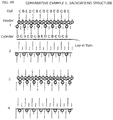
- Comparative Example 1 the circular knitting machine described in Embodiment 1 is used for knitting.
- bright polyester yarn is knitted at feeders 2, 6, 10, ..., and a desired pattern is formed with a jacquard pattern on the dial side.
- a tubular stitched part of a blister pattern is formed and knitted with spun polyester yarn.
- Lay-in yarn is inserted to serve as a filling material in the tubular stitched part, and spun polyester yarn is used thereas.
- FIG. 4A is an exploded fabric diagram at the time of knitting a background structure in Comparative Example 1.
- the cylinder needles B and D knit, and the cylinder needles C and E welt. Meanwhile, all dial needles knit.
- lay-in yarn is inserted between verges of the cylinder and the dial, between the first feeder and the second feeder.
- FIG. 4B is an exploded fabric diagram in which a jacquard structure is caused to appear based on the background structure in Comparative Example 1.
- the cylinder needles B and D knit, and the cylinder needles C and E welt. Meanwhile, the dial needles in an area for knitting the jacquard structure at the second feeder welt, and all the other dial needles knit.
- the cylinder needles B and D knit, and the cylinder needles C and E welt. Meanwhile, the dial needles C and E in an area for knitting the jacquard structure knit, and all the other dial needles welt.
- lay-in yarn is inserted between verges of the cylinder and the dial, between the first feeder and the second feeder.
- the cylinder needles C and E knit, and the cylinder needles B and D welt. Meanwhile, the dial needles in the area for knitting the jacquard structure at the second feeder welt, and all other dial needles knit.
- the cylinder needles B and D knit, and the cylinder needles C and E welt. Meanwhile, the dial needles in an area for knitting the jacquard structure at the sixth feeder welt, and all the other dial needles knit.
- the cylinder needles B and D knit, and the cylinder needles C and E welt. Meanwhile, the dial needles B and D in the area for knitting the jacquard structure knit, and all the other dial needles welt.
- lay-in yarn is inserted between verges of the cylinder and the dial, between the fifth feeder and the sixth feeder.
- the cylinder needles C and E knit, and the cylinder needles B and D welt. Meanwhile, the dial needles in the area for knitting the jacquard structure at the sixth feeder welt, and all the other dial needles knit.
- the cylinder needles C and E knit, and the cylinder needles B and D welt. Meanwhile, all dial needles welt.
- FIG. 5A is an expanded pattern diagram of the fabric knitted based on the background structure in Comparative Example 1 as viewed from the cylinder side and the dial side.
- FIG. 5B is an expanded pattern diagram of the fabric knitted based on the jacquard structure in Comparative Example 1 as viewed from the cylinder side and the dial side.
- Comparative Example 2 the circular knitting machine described in Embodiment 1 is used for knitting.
- bright polyester yarn is knitted at feeders 2, 6, 10, ..., and a desired pattern is formed with a jacquard pattern on the dial side.
- a tubular stitched part of a blister pattern is formed and knitted with spun polyester yarn.
- Lay-in yarn is inserted to serve as a filling material in the tubular stitched part, and spun polyester yarn is used thereas.
- FIG. 6A is an exploded fabric diagram at the time of knitting a background structure in Comparative Example 2.
- the cylinder needles B knit, and the cylinder needles C, D, and E welt. Meanwhile, the dial needles D and E knit, and the dial needles B and C welt.
- the cylinder needles B knit, and the cylinder needles C, D, and E welt. Meanwhile, the dial needles B and C knit, and the dial needles D and E welt.
- lay-in yarn is inserted between verges of the cylinder and the dial, between the first feeder and the second feeder.
- the cylinder needles B, C, and D knit, and the cylinder needles E welt. Meanwhile, all dial needles welt.
- the cylinder needles E knit, and the cylinder needles B, C, and D welt. Meanwhile, the dial needles B and E knit, and the dial needles C and D welt.
- lay-in yarn is inserted between verges of the cylinder and the dial, between the fourth feeder and the fifth feeder.
- the cylinder needles B, C, and E knit, and the cylinder needles D welt. Meanwhile, all dial needles welt.
- the cylinder needles D knit, and the cylinder needles B, C, and E welt. Meanwhile, the dial needles B and C knit, and the dial needles D and E welt.
- the cylinder needles D knit, and the cylinder needles B, C, and E welt are connected to the dial needles D and E knit, and the dial needles B and C welt.
- lay-in yarn is inserted between verges of the cylinder and the dial, between the seventh feeder and the eighth feeder.
- the cylinder needles B, D, and E knit, and the cylinder needles C welt. Meanwhile, all dial needles welt.
- the cylinder needles C knit, and the cylinder needles B, D, and E welt. Meanwhile, the dial needles B and E knit, and the dial needles C and D welt.
- the cylinder needles C knit, and the cylinder needles B, D, and E welt. Meanwhile, the dial needles C and D knit, and the dial needles B and E welt.
- lay-in yarn is inserted between verges of the cylinder and the dial, between the tenth feeder and the eleventh feeder.
- FIG. 6B is an exploded fabric diagram in which a jacquard structure is caused to appear based on the background structure in Comparative Example 2.
- the cylinder needles B and D knit, and the cylinder needles C and E welt.
- the dial needles in the area for knitting the jacquard structure at the previous feeder welt.
- the dial needles D and E knit, and the dial needles B and C welt.
- the cylinder needles C and E knit, and the cylinder needles B and D welt.
- the cylinder needles B knit, and the cylinder needles C, D, and E welt.
- the dial needles in the area for knitting the jacquard structure at the third feeder welt.
- the dial needles B and C knit, and the dial needles D and E welt.
- lay-in yarn is inserted between verges of the cylinder and the dial, between the first feeder and the second feeder.
- the cylinder needles C and E knit, and the cylinder needles B and D welt In the other area, the cylinder needles B, C, and D knit, and the cylinder needles E welt. Meanwhile, in the area for knitting the jacquard structure, the dial needles B and D knit, and the dial needles C and E welt. All the other dial needles welt.
- the cylinder needles C and E knit, and the cylinder needles B and D welt.
- the dial needles in the area for knitting the jacquard structure at the third feeder welt.
- the dial needles C and D knit, and the dial needles B and E welt.
- the cylinder needles B and D knit, and the cylinder needles C and E welt In an area for knitting the jacquard structure at the sixth feeder, the cylinder needles B and D knit, and the cylinder needles C and E welt. In the other area, the cylinder needles E knit, and the cylinder needles B, C, and D welt. Meanwhile, the dial needles in the area for knitting the jacquard structure at the sixth feeder welt. In the other area, the dial needles B and E knit, and the dial needles C and D welt.
- lay-in yarn is inserted between verges of the cylinder and the dial, between the fourth feeder and the fifth feeder.
- the cylinder needles B and D knit, and the cylinder needles C and E welt In the other area, the cylinder needles B, C, and E knit, and the cylinder needles D welt. Meanwhile, in the area for knitting the jacquard structure, the dial needles C and E knit, and the dial needles B and D welt. All the other dial needles welt.
- the cylinder needles B and D knit, and the cylinder needles C and E welt.
- the dial needles in the area for knitting the jacquard structure at the sixth feeder welt.
- the dial needles B and C knit, and the dial needles D and E welt.
- the cylinder needles C and E knit, and the cylinder needles B and D welt in an area for knitting the jacquard structure at the ninth feeder, the cylinder needles C and E knit, and the cylinder needles B and D welt.
- the dial needles in the area for knitting the jacquard structure at the ninth feeder welt.
- the dial needles D and E knit, and the dial needles B and C welt in the other area, the dial needles D and E knit, and the dial needles B and C welt.
- lay-in yarn is inserted between verges of the cylinder and the dial, between the seventh feeder and the eighth feeder.
- the cylinder needles C and E knit, and the cylinder needles B and D welt In the other area, the cylinder needles B, D, and E knit, and the cylinder needles C welt. Meanwhile, in the area for knitting the jacquard structure, the dial needles B and D knit, and the dial needles C and E welt. All the other dial needles welt.
- the cylinder needles C and E knit, and the cylinder needles B and D welt.
- the dial needles in the area for knitting the jacquard structure at the ninth feeder welt.
- the dial needles B and E knit, and the dial needles C and D welt.
- the cylinder needles B and D knit, and the cylinder needles C and E welt.
- the dial needles in an area for knitting the jacquard structure at the twelfth feeder welt.
- the dial needles C and D knit, and the dial needles B and E welt.
- lay-in yarn is inserted between verges of the cylinder and the dial, between the tenth feeder and the eleventh feeder.
- the cylinder needles B and D knit, and the cylinder needles C and E welt.
- the cylinder needles C, D, and E knit, and the cylinder needles B welt.
- the dial needles C and E in the area for knitting the jacquard structure knit. In the other area, all dial needles welt.
- FIG. 7A is an expanded pattern diagram of the fabric knitted based on the background structure in Comparative Example 2 as viewed from the cylinder side and the dial side.
- FIG. 7B is an expanded pattern diagram of the fabric knitted based on the jacquard structure in Comparative Example 2 as viewed from the cylinder side and the dial side.
- This fabric in Comparative Example 2 has a considerably course texture, and is not suitable for a jacquard fabric for a mattress ticking.
Landscapes
- Engineering & Computer Science (AREA)
- Textile Engineering (AREA)
- Knitting Of Fabric (AREA)
- Knitting Machines (AREA)
- Mattresses And Other Support Structures For Chairs And Beds (AREA)
Claims (8)
- Procédé pour produire une structure de fond dans un tissu jacquard pour un coutil à matelas grâce à l'utilisation d'une machine de tricotage circulaire à sélection d'aiguilles double face de type à coupe transversale de côtes, le procédé par lequel un motif approprié est créé au moyen d'une sélection d'aiguilles informatisée sur un côté cylindre, un motif approprié est également créé au moyen d'une sélection d'aiguilles informatisée sur un côté plateau, et une structure de tricotage appropriée est effectuée dans une partie appropriée en combinant le motif obtenu sur le côté cylindre avec le motif obtenu sur le côté plateau, caractérisé en ce que le procédé comprend :dans un sens de rangée à partir d'une aiguille servant de référence,au niveau d'un premier alimentateur, répétition d'un processus de tricotage avec deux aiguilles de cylindre consécutives, bordurage avec une aiguille de plateau opposée, et ensuite tricotage avec deux aiguilles de plateau consécutives ;au niveau d'un deuxième alimentateur, répétition d'un processus de bordurage avec une aiguille de cylindre, tricotage avec deux aiguilles de plateau opposées consécutives, tricotage avec deux aiguilles de cylindre opposées consécutives, et ensuite bordurage avec une aiguille de plateau opposée ;au niveau d'un troisième alimentateur, répétition d'un processus de tricotage avec une aiguille de cylindre, et ensuite bordurage avec une aiguille de cylindre ;au niveau d'un quatrième alimentateur, répétition d'un processus de tricotage avec une aiguille de plateau, tricotage avec deux aiguilles de cylindre opposées consécutives, bordurage avec une aiguille de plateau opposée, et ensuite tricotage avec une aiguille de plateau ;au niveau d'un cinquième alimentateur, répétition d'un processus de tricotage avec une aiguille de cylindre, bordurage avec une aiguille de plateau opposée, tricotage avec deux aiguilles de plateau consécutives, et ensuite tricotage avec une aiguille de cylindre opposée ;au niveau d'un sixième alimentateur, répétition d'un processus de tricotage avec une aiguille de cylindre, et ensuite bordurage avec une aiguille de cylindre ;au niveau d'un septième alimentateur, réalisation du même processus tel que celui au niveau du deuxième alimentateur ;au niveau d'un huitième alimentateur, réalisation du même processus tel que celui au niveau du premier alimentateur ;au niveau d'un neuvième alimentateur, réalisation du même processus tel que celui au niveau du troisième alimentateur ;au niveau d'un dixième alimentateur, réalisation du même processus tel que celui au niveau du cinquième alimentateur ;au niveau d'un onzième alimentateur, réalisation du même processus tel que celui au niveau du quatrième alimentateur ;au niveau d'un douzième alimentateur, réalisation du même processus tel que celui au niveau du sixième alimentateur ; etpar la suite répétition des processus ci-dessus dans un sens d'alimentateur.
- Procédé pour produire une structure de fond dans un tissu jacquard pour un coutil à matelas grâce à l'utilisation d'une machine de tricotage circulaire à sélection d'aiguilles double face de type à coupe transversale de côtes, le procédé par lequel un motif approprié est créé au moyen d'une sélection d'aiguilles informatisée sur un côté cylindre, un motif approprié est également créé au moyen d'une sélection d'aiguilles informatisée sur un côté plateau, et une structure de tricotage appropriée est effectuée dans une partie appropriée en combinant le motif obtenu sur le côté cylindre avec le motif obtenu sur le côté plateau, caractérisé en ce que le procédé comprend : dans un sens de rangée à partir d'une aiguille servant de référence, au niveau d'un premier alimentateur, répétition d'un processus de tricotage avec deux aiguilles de cylindre consécutives, bordurage avec une aiguille de plateau opposée, et ensuite tricotage avec deux aiguilles de plateau consécutives ; au niveau d'un deuxième alimentateur, répétition d'un processus de bordurage avec une aiguille de cylindre, tricotage avec deux aiguilles de plateau opposées consécutives, tricotage avec deux aiguilles de cylindre opposées consécutives, et ensuite bordurage avec une aiguille de plateau opposée ; au niveau d'un troisième alimentateur, répétition d'un processus de tricotage avec une aiguille de plateau, et ensuite bordurage avec une aiguille de plateau ; au niveau d'un quatrième alimentateur, répétition d'un processus de tricotage avec une aiguille de plateau, tricotage avec deux aiguilles de cylindre opposées consécutives, bordurage avec une aiguille de plateau opposée, et ensuite tricotage avec une aiguille de plateau ; au niveau d'un cinquième alimentateur, répétition d'un processus de tricotage avec une aiguille de cylindre, bordurage avec une aiguille de plateau opposée, tricotage avec deux aiguilles de plateau consécutives, et ensuite tricotage avec une aiguille de cylindre opposée ; au niveau d'un sixième alimentateur, répétition d'un processus de tricotage avec une aiguille de plateau, et ensuite bordurage avec une aiguille de plateau ; au niveau d'un septième alimentateur, réalisation du même processus tel que celui au niveau du deuxième alimentateur ; au niveau d'un huitième alimentateur, réalisation du même processus tel que celui au niveau du premier alimentateur ; au niveau d'un neuvième alimentateur, réalisation du même processus tel que celui au niveau du troisième alimentateur ; au niveau d'un dixième alimentateur, réalisation du même processus tel que celui au niveau du cinquième alimentateur ; au niveau d'un onzième alimentateur, réalisation du même processus tel que celui au niveau du quatrième alimentateur ; au niveau d'un douzième alimentateur, réalisation du même processus tel que celui au niveau du sixième alimentateur ; et par la suite répétition des processus ci-dessus dans un sens d'alimentateur.
- Procédé pour produire une structure jacquard dans un tissu jacquard pour un coutil à matelas, comprenant : la formation d'un motif jacquard sur un côté plateau au niveau du troisième alimentateur, du sixième alimentateur, du neuvième alimentateur, et du douzième alimentateur, et la formation d'un motif à cloques sur un côté cylindre au niveau des autres alimentateurs, dans un processus de mise en œuvre du procédé pour la production d'une structure de fond dans un tissu jacquard pour un coutil à matelas selon la revendication 1.
- Procédé pour produire une structure jacquard dans un tissu jacquard pour un coutil à matelas, comprenant : la formation d'un motif jacquard sur un côté cylindre au niveau du troisième alimentateur, du sixième alimentateur, du neuvième alimentateur, et du douzième alimentateur, et la formation d'un motif à cloques sur un côté plateau au niveau des autres alimentateurs, dans un processus de mise en œuvre du procédé pour la production d'une structure de fond dans un tissu jacquard pour un coutil à matelas selon la revendication 2.
- Procédé pour produire une structure jacquard dans un tissu jacquard pour un coutil à matelas selon la revendication 3 ou 4, dans lequel un rapport du nombre de mailles entre le motif jacquard et le motif à cloques est de 1:2.
- Procédé pour produire un tissu jacquard pour un coutil à matelas qui est une combinaison du procédé pour produire une structure de fond selon la revendication 1 et le procédé pour produire une structure jacquard selon la revendication 5.
- Procédé pour produire un tissu jacquard pour un coutil à matelas qui est une combinaison du procédé pour produire une structure de fond selon la revendication 2 et le procédé pour produire une structure jacquard selon la revendication 5.
- Procédé pour produire un tissu jacquard pour un coutil à matelas selon les revendications 6 à 7, comprenant en outre : l'insertion d'un fil de cordage entre le premier alimentateur et le deuxième alimentateur, entre le quatrième alimentateur et le cinquième alimentateur, entre le septième alimentateur et le huitième alimentateur, et entre le dixième alimentateur et le onzième alimentateur.
Priority Applications (1)
| Application Number | Priority Date | Filing Date | Title |
|---|---|---|---|
| PL16197077T PL3168347T3 (pl) | 2015-11-09 | 2016-11-03 | Materiał żakardowy podobny do tkaniny do wsypy materacowej oraz sposób jego dziania |
Applications Claiming Priority (1)
| Application Number | Priority Date | Filing Date | Title |
|---|---|---|---|
| JP2015219843A JP2017089047A (ja) | 2015-11-09 | 2015-11-09 | 織物調マットレス・ティッキング用ジャカード編地及びその編成方法 |
Publications (2)
| Publication Number | Publication Date |
|---|---|
| EP3168347A1 EP3168347A1 (fr) | 2017-05-17 |
| EP3168347B1 true EP3168347B1 (fr) | 2021-08-18 |
Family
ID=57226853
Family Applications (1)
| Application Number | Title | Priority Date | Filing Date |
|---|---|---|---|
| EP16197077.7A Active EP3168347B1 (fr) | 2015-11-09 | 2016-11-03 | Textile jacquard similaire à un textile tissé pour enveloppe de matelas et procédé de tricotage associé |
Country Status (9)
| Country | Link |
|---|---|
| US (1) | US10174445B2 (fr) |
| EP (1) | EP3168347B1 (fr) |
| JP (1) | JP2017089047A (fr) |
| CN (1) | CN106987993B (fr) |
| ES (1) | ES2890527T3 (fr) |
| MX (1) | MX368329B (fr) |
| PL (1) | PL3168347T3 (fr) |
| PT (1) | PT3168347T (fr) |
| TW (1) | TWI774647B (fr) |
Families Citing this family (6)
| Publication number | Priority date | Publication date | Assignee | Title |
|---|---|---|---|---|
| US20140317833A1 (en) * | 2006-12-01 | 2014-10-30 | Nike, Inc. | Sock And A Method For Its Manufacture |
| JP2018061632A (ja) * | 2016-10-12 | 2018-04-19 | モナーク・ニッティング・マシナリー・(ユーケー)・リミテッドMonarch Knitting Machinery (Uk) Limited | 織物調マットレス・ティッキング用ジャカード編地及びその編成方法 |
| CN110872738B (zh) * | 2018-08-31 | 2021-12-28 | 贝卡特德思丽创新有限公司 | 针织方法 |
| WO2020043729A1 (fr) | 2018-08-31 | 2020-03-05 | Bekaertdeslee Innovation Bvba | Procédé de tricotage |
| EP4022115A4 (fr) * | 2019-08-28 | 2023-06-21 | NIKE Innovate C.V. | Tricot double présentant des fils d'insertion texturés |
| US12351953B2 (en) * | 2023-02-20 | 2025-07-08 | Bekaertdeslee Innovation Bvba | Double selection fabric and methods of making |
Family Cites Families (18)
| Publication number | Priority date | Publication date | Assignee | Title |
|---|---|---|---|---|
| GB1451897A (en) * | 1973-01-10 | 1976-10-06 | Iws Nominee Co Ltd | Knitting |
| US3986374A (en) * | 1974-11-14 | 1976-10-19 | Goscote Engineering Limited | Welf knitted fabric simulating woven cloth |
| US4125001A (en) * | 1975-12-15 | 1978-11-14 | Austen Bryars Of London, Inc. | Multi-gauge knit fabric with inlay |
| USRE30638E (en) * | 1979-11-14 | 1981-06-09 | Austen Bryars Of London, Inc. | Multi-gauge knit fabric with fleece inlay yarn |
| GB8822637D0 (en) * | 1988-09-27 | 1988-11-02 | Gen Motors Corp | Knitted fabric |
| GB2233989B (en) * | 1989-07-11 | 1993-12-01 | Courtaulds Plc | Structured knitted fabrics |
| ITCO990018A1 (it) * | 1999-05-24 | 2000-11-24 | Franco Sciacca | Metodo e apparecchiatura per produrre automaticamente articoli tubolari di maglieria forniti di almeno una bretella spallina passante e o si |
| ITCO990031A1 (it) * | 1999-11-15 | 2001-05-15 | Franco Sciacca | Metodo ed apparecchiatura per la produzione di articoli tridimensionali di maglieria e calzetteria e prodotti risultanti. |
| CA2363425A1 (fr) * | 2001-11-20 | 2003-05-20 | Francois Masse | Tissu a construction tricot |
| JP2003286636A (ja) | 2002-03-26 | 2003-10-10 | Precision Fukuhara Works Ltd | ジャガードダンボールニット編地、及びその編成方法 |
| CN200974887Y (zh) * | 2006-02-20 | 2007-11-14 | 金一平 | 一种纸线和纱线混纺交织的织物 |
| EP1975294B2 (fr) * | 2007-03-27 | 2021-03-10 | Lava BVBA | Procédé pour tricoter un tissu à double jersey sur une machine à tricoter circulaire à jacquard doublee |
| DK2251468T3 (da) | 2009-05-15 | 2011-08-29 | Mattes & Ammann Gmbh & Co Kg | Madrasbetrækstof i form af et dobbeltlagen med en for og bagside og med eller uden fyldtråd |
| JP2012046842A (ja) * | 2010-08-26 | 2012-03-08 | Shima Seiki Mfg Ltd | 天竺ジャカード柄を備える筒状編地およびその編成方法 |
| DE102011000398B3 (de) * | 2011-01-28 | 2012-04-26 | Terrot Gmbh | Strickware mit Lochstruktur, Verfahren zu deren Herstellung und Funktionstextilie |
| CN202925256U (zh) * | 2012-07-18 | 2013-05-08 | 杭州田野提花织造有限公司 | 用于床垫的阻燃纬编针织提花织物 |
| CN102776686B (zh) * | 2012-07-24 | 2013-09-11 | 宁波慈星股份有限公司 | 一种鼓波提花花型的小图编织法 |
| US9732451B2 (en) * | 2015-11-05 | 2017-08-15 | Pai Lung Machinery Mill Co., Ltd. | Fine knitwear of circular knitting machines with air permeable holes |
-
2015
- 2015-11-09 JP JP2015219843A patent/JP2017089047A/ja active Pending
-
2016
- 2016-11-03 EP EP16197077.7A patent/EP3168347B1/fr active Active
- 2016-11-03 ES ES16197077T patent/ES2890527T3/es active Active
- 2016-11-03 PT PT16197077T patent/PT3168347T/pt unknown
- 2016-11-03 PL PL16197077T patent/PL3168347T3/pl unknown
- 2016-11-07 MX MX2016014586A patent/MX368329B/es active IP Right Grant
- 2016-11-07 TW TW105136076A patent/TWI774647B/zh active
- 2016-11-08 US US15/346,429 patent/US10174445B2/en active Active
- 2016-11-08 CN CN201610983520.8A patent/CN106987993B/zh active Active
Also Published As
| Publication number | Publication date |
|---|---|
| US20170130376A1 (en) | 2017-05-11 |
| US10174445B2 (en) | 2019-01-08 |
| CN106987993B (zh) | 2019-10-22 |
| EP3168347A1 (fr) | 2017-05-17 |
| TWI774647B (zh) | 2022-08-21 |
| JP2017089047A (ja) | 2017-05-25 |
| TW201723257A (zh) | 2017-07-01 |
| MX2016014586A (es) | 2018-05-07 |
| CN106987993A (zh) | 2017-07-28 |
| MX368329B (es) | 2019-09-27 |
| PT3168347T (pt) | 2021-10-01 |
| PL3168347T3 (pl) | 2022-01-10 |
| ES2890527T3 (es) | 2022-01-20 |
Similar Documents
| Publication | Publication Date | Title |
|---|---|---|
| EP3312324B1 (fr) | Procédé de tricotage d'un textile jacquard similaire à un étoffe tissé pour enveloppe de matelas | |
| EP3168347B1 (fr) | Textile jacquard similaire à un textile tissé pour enveloppe de matelas et procédé de tricotage associé | |
| EP3818204B1 (fr) | Procédé de tricotage | |
| CN112609306B (zh) | 一种全成型横机服装的夹位结构编织方法及其夹位结构 | |
| US11434588B2 (en) | Knitted spacer fabric | |
| CN101487164A (zh) | 一种经编提花无缝织物的编织方法 | |
| EP0822280A3 (fr) | Procédé de tricotage d'un rapport jacquard en jersey double dans un tricot tubulaire | |
| US20150075227A1 (en) | Knitted fabric with reduced cracks, knitting method therefor, and design system using the knitting method | |
| EP3040459B1 (fr) | Tricot molletonné double | |
| EP0361854B1 (fr) | Procédé de tricotage | |
| KR101449912B1 (ko) | 편성포의 편성방법 및 편성포 | |
| CN111321509A (zh) | 一种两针板横机三层独立针织物组织及其编织方法 | |
| KR102080798B1 (ko) | 기능성 원단용 환편기의 편성방법 및 장치 | |
| EP2748360B1 (fr) | Vêtement tricoté ou partie de celui-ci et procédé de fabrication correspondant | |
| WO2020043729A1 (fr) | Procédé de tricotage | |
| CN209816407U (zh) | 针织织片的包边条结构 | |
| US3505834A (en) | Method of producing a net stocking on a single feed machine | |
| CN114836892A (zh) | 一种袜跟的编织方法及袜跟 | |
| CN104746227A (zh) | 编织物的编织方法以及编织物的制造方法 | |
| EP1317574A1 (fr) | Vetement | |
| JP2013159862A (ja) | ニットウェア | |
| WO2003042443A1 (fr) | Procede de fabrication d'un article textile | |
| WO2006106330A1 (fr) | Tissu en maille et procede de tricotage |
Legal Events
| Date | Code | Title | Description |
|---|---|---|---|
| PUAI | Public reference made under article 153(3) epc to a published international application that has entered the european phase |
Free format text: ORIGINAL CODE: 0009012 |
|
| STAA | Information on the status of an ep patent application or granted ep patent |
Free format text: STATUS: THE APPLICATION HAS BEEN PUBLISHED |
|
| AK | Designated contracting states |
Kind code of ref document: A1 Designated state(s): AL AT BE BG CH CY CZ DE DK EE ES FI FR GB GR HR HU IE IS IT LI LT LU LV MC MK MT NL NO PL PT RO RS SE SI SK SM TR |
|
| AX | Request for extension of the european patent |
Extension state: BA ME |
|
| STAA | Information on the status of an ep patent application or granted ep patent |
Free format text: STATUS: REQUEST FOR EXAMINATION WAS MADE |
|
| 17P | Request for examination filed |
Effective date: 20171116 |
|
| RBV | Designated contracting states (corrected) |
Designated state(s): AL AT BE BG CH CY CZ DE DK EE ES FI FR GB GR HR HU IE IS IT LI LT LU LV MC MK MT NL NO PL PT RO RS SE SI SK SM TR |
|
| GRAP | Despatch of communication of intention to grant a patent |
Free format text: ORIGINAL CODE: EPIDOSNIGR1 |
|
| STAA | Information on the status of an ep patent application or granted ep patent |
Free format text: STATUS: GRANT OF PATENT IS INTENDED |
|
| INTG | Intention to grant announced |
Effective date: 20210312 |
|
| GRAS | Grant fee paid |
Free format text: ORIGINAL CODE: EPIDOSNIGR3 |
|
| GRAJ | Information related to disapproval of communication of intention to grant by the applicant or resumption of examination proceedings by the epo deleted |
Free format text: ORIGINAL CODE: EPIDOSDIGR1 |
|
| GRAL | Information related to payment of fee for publishing/printing deleted |
Free format text: ORIGINAL CODE: EPIDOSDIGR3 |
|
| STAA | Information on the status of an ep patent application or granted ep patent |
Free format text: STATUS: REQUEST FOR EXAMINATION WAS MADE |
|
| GRAP | Despatch of communication of intention to grant a patent |
Free format text: ORIGINAL CODE: EPIDOSNIGR1 |
|
| STAA | Information on the status of an ep patent application or granted ep patent |
Free format text: STATUS: GRANT OF PATENT IS INTENDED |
|
| INTC | Intention to grant announced (deleted) | ||
| GRAA | (expected) grant |
Free format text: ORIGINAL CODE: 0009210 |
|
| STAA | Information on the status of an ep patent application or granted ep patent |
Free format text: STATUS: THE PATENT HAS BEEN GRANTED |
|
| INTG | Intention to grant announced |
Effective date: 20210630 |
|
| AK | Designated contracting states |
Kind code of ref document: B1 Designated state(s): AL AT BE BG CH CY CZ DE DK EE ES FI FR GB GR HR HU IE IS IT LI LT LU LV MC MK MT NL NO PL PT RO RS SE SI SK SM TR |
|
| REG | Reference to a national code |
Ref country code: GB Ref legal event code: FG4D |
|
| REG | Reference to a national code |
Ref country code: CH Ref legal event code: EP |
|
| REG | Reference to a national code |
Ref country code: DE Ref legal event code: R096 Ref document number: 602016062307 Country of ref document: DE |
|
| REG | Reference to a national code |
Ref country code: IE Ref legal event code: FG4D Ref country code: AT Ref legal event code: REF Ref document number: 1421735 Country of ref document: AT Kind code of ref document: T Effective date: 20210915 |
|
| REG | Reference to a national code |
Ref country code: PT Ref legal event code: SC4A Ref document number: 3168347 Country of ref document: PT Date of ref document: 20211001 Kind code of ref document: T Free format text: AVAILABILITY OF NATIONAL TRANSLATION Effective date: 20210927 |
|
| REG | Reference to a national code |
Ref country code: LT Ref legal event code: MG9D |
|
| REG | Reference to a national code |
Ref country code: NL Ref legal event code: FP |
|
| REG | Reference to a national code |
Ref country code: AT Ref legal event code: MK05 Ref document number: 1421735 Country of ref document: AT Kind code of ref document: T Effective date: 20210818 |
|
| REG | Reference to a national code |
Ref country code: ES Ref legal event code: FG2A Ref document number: 2890527 Country of ref document: ES Kind code of ref document: T3 Effective date: 20220120 |
|
| PG25 | Lapsed in a contracting state [announced via postgrant information from national office to epo] |
Ref country code: RS Free format text: LAPSE BECAUSE OF FAILURE TO SUBMIT A TRANSLATION OF THE DESCRIPTION OR TO PAY THE FEE WITHIN THE PRESCRIBED TIME-LIMIT Effective date: 20210818 Ref country code: SE Free format text: LAPSE BECAUSE OF FAILURE TO SUBMIT A TRANSLATION OF THE DESCRIPTION OR TO PAY THE FEE WITHIN THE PRESCRIBED TIME-LIMIT Effective date: 20210818 Ref country code: HR Free format text: LAPSE BECAUSE OF FAILURE TO SUBMIT A TRANSLATION OF THE DESCRIPTION OR TO PAY THE FEE WITHIN THE PRESCRIBED TIME-LIMIT Effective date: 20210818 Ref country code: LT Free format text: LAPSE BECAUSE OF FAILURE TO SUBMIT A TRANSLATION OF THE DESCRIPTION OR TO PAY THE FEE WITHIN THE PRESCRIBED TIME-LIMIT Effective date: 20210818 Ref country code: BG Free format text: LAPSE BECAUSE OF FAILURE TO SUBMIT A TRANSLATION OF THE DESCRIPTION OR TO PAY THE FEE WITHIN THE PRESCRIBED TIME-LIMIT Effective date: 20211118 Ref country code: AT Free format text: LAPSE BECAUSE OF FAILURE TO SUBMIT A TRANSLATION OF THE DESCRIPTION OR TO PAY THE FEE WITHIN THE PRESCRIBED TIME-LIMIT Effective date: 20210818 Ref country code: NO Free format text: LAPSE BECAUSE OF FAILURE TO SUBMIT A TRANSLATION OF THE DESCRIPTION OR TO PAY THE FEE WITHIN THE PRESCRIBED TIME-LIMIT Effective date: 20211118 Ref country code: FI Free format text: LAPSE BECAUSE OF FAILURE TO SUBMIT A TRANSLATION OF THE DESCRIPTION OR TO PAY THE FEE WITHIN THE PRESCRIBED TIME-LIMIT Effective date: 20210818 |
|
| PG25 | Lapsed in a contracting state [announced via postgrant information from national office to epo] |
Ref country code: LV Free format text: LAPSE BECAUSE OF FAILURE TO SUBMIT A TRANSLATION OF THE DESCRIPTION OR TO PAY THE FEE WITHIN THE PRESCRIBED TIME-LIMIT Effective date: 20210818 Ref country code: GR Free format text: LAPSE BECAUSE OF FAILURE TO SUBMIT A TRANSLATION OF THE DESCRIPTION OR TO PAY THE FEE WITHIN THE PRESCRIBED TIME-LIMIT Effective date: 20211119 |
|
| PG25 | Lapsed in a contracting state [announced via postgrant information from national office to epo] |
Ref country code: DK Free format text: LAPSE BECAUSE OF FAILURE TO SUBMIT A TRANSLATION OF THE DESCRIPTION OR TO PAY THE FEE WITHIN THE PRESCRIBED TIME-LIMIT Effective date: 20210818 |
|
| REG | Reference to a national code |
Ref country code: DE Ref legal event code: R097 Ref document number: 602016062307 Country of ref document: DE |
|
| PG25 | Lapsed in a contracting state [announced via postgrant information from national office to epo] |
Ref country code: SM Free format text: LAPSE BECAUSE OF FAILURE TO SUBMIT A TRANSLATION OF THE DESCRIPTION OR TO PAY THE FEE WITHIN THE PRESCRIBED TIME-LIMIT Effective date: 20210818 Ref country code: SK Free format text: LAPSE BECAUSE OF FAILURE TO SUBMIT A TRANSLATION OF THE DESCRIPTION OR TO PAY THE FEE WITHIN THE PRESCRIBED TIME-LIMIT Effective date: 20210818 Ref country code: EE Free format text: LAPSE BECAUSE OF FAILURE TO SUBMIT A TRANSLATION OF THE DESCRIPTION OR TO PAY THE FEE WITHIN THE PRESCRIBED TIME-LIMIT Effective date: 20210818 Ref country code: CZ Free format text: LAPSE BECAUSE OF FAILURE TO SUBMIT A TRANSLATION OF THE DESCRIPTION OR TO PAY THE FEE WITHIN THE PRESCRIBED TIME-LIMIT Effective date: 20210818 Ref country code: AL Free format text: LAPSE BECAUSE OF FAILURE TO SUBMIT A TRANSLATION OF THE DESCRIPTION OR TO PAY THE FEE WITHIN THE PRESCRIBED TIME-LIMIT Effective date: 20210818 |
|
| PLBE | No opposition filed within time limit |
Free format text: ORIGINAL CODE: 0009261 |
|
| STAA | Information on the status of an ep patent application or granted ep patent |
Free format text: STATUS: NO OPPOSITION FILED WITHIN TIME LIMIT |
|
| PG25 | Lapsed in a contracting state [announced via postgrant information from national office to epo] |
Ref country code: MC Free format text: LAPSE BECAUSE OF FAILURE TO SUBMIT A TRANSLATION OF THE DESCRIPTION OR TO PAY THE FEE WITHIN THE PRESCRIBED TIME-LIMIT Effective date: 20210818 |
|
| REG | Reference to a national code |
Ref country code: CH Ref legal event code: PL |
|
| 26N | No opposition filed |
Effective date: 20220519 |
|
| PG25 | Lapsed in a contracting state [announced via postgrant information from national office to epo] |
Ref country code: LU Free format text: LAPSE BECAUSE OF NON-PAYMENT OF DUE FEES Effective date: 20211103 |
|
| PG25 | Lapsed in a contracting state [announced via postgrant information from national office to epo] |
Ref country code: SI Free format text: LAPSE BECAUSE OF FAILURE TO SUBMIT A TRANSLATION OF THE DESCRIPTION OR TO PAY THE FEE WITHIN THE PRESCRIBED TIME-LIMIT Effective date: 20210818 Ref country code: LI Free format text: LAPSE BECAUSE OF NON-PAYMENT OF DUE FEES Effective date: 20211130 Ref country code: CH Free format text: LAPSE BECAUSE OF NON-PAYMENT OF DUE FEES Effective date: 20211130 |
|
| PG25 | Lapsed in a contracting state [announced via postgrant information from national office to epo] |
Ref country code: IE Free format text: LAPSE BECAUSE OF NON-PAYMENT OF DUE FEES Effective date: 20211103 |
|
| PG25 | Lapsed in a contracting state [announced via postgrant information from national office to epo] |
Ref country code: FR Free format text: LAPSE BECAUSE OF NON-PAYMENT OF DUE FEES Effective date: 20211130 |
|
| PG25 | Lapsed in a contracting state [announced via postgrant information from national office to epo] |
Ref country code: HU Free format text: LAPSE BECAUSE OF FAILURE TO SUBMIT A TRANSLATION OF THE DESCRIPTION OR TO PAY THE FEE WITHIN THE PRESCRIBED TIME-LIMIT; INVALID AB INITIO Effective date: 20161103 |
|
| P01 | Opt-out of the competence of the unified patent court (upc) registered |
Effective date: 20230322 |
|
| PG25 | Lapsed in a contracting state [announced via postgrant information from national office to epo] |
Ref country code: CY Free format text: LAPSE BECAUSE OF FAILURE TO SUBMIT A TRANSLATION OF THE DESCRIPTION OR TO PAY THE FEE WITHIN THE PRESCRIBED TIME-LIMIT Effective date: 20210818 |
|
| PG25 | Lapsed in a contracting state [announced via postgrant information from national office to epo] |
Ref country code: MK Free format text: LAPSE BECAUSE OF FAILURE TO SUBMIT A TRANSLATION OF THE DESCRIPTION OR TO PAY THE FEE WITHIN THE PRESCRIBED TIME-LIMIT Effective date: 20210818 |
|
| PG25 | Lapsed in a contracting state [announced via postgrant information from national office to epo] |
Ref country code: MT Free format text: LAPSE BECAUSE OF FAILURE TO SUBMIT A TRANSLATION OF THE DESCRIPTION OR TO PAY THE FEE WITHIN THE PRESCRIBED TIME-LIMIT Effective date: 20210818 |
|
| PGFP | Annual fee paid to national office [announced via postgrant information from national office to epo] |
Ref country code: GB Payment date: 20250924 Year of fee payment: 10 |
|
| PGFP | Annual fee paid to national office [announced via postgrant information from national office to epo] |
Ref country code: PT Payment date: 20251022 Year of fee payment: 10 |
|
| PGFP | Annual fee paid to national office [announced via postgrant information from national office to epo] |
Ref country code: NL Payment date: 20251119 Year of fee payment: 10 |
|
| PGFP | Annual fee paid to national office [announced via postgrant information from national office to epo] |
Ref country code: DE Payment date: 20251118 Year of fee payment: 10 |
|
| PGFP | Annual fee paid to national office [announced via postgrant information from national office to epo] |
Ref country code: IT Payment date: 20251128 Year of fee payment: 10 |
|
| PGFP | Annual fee paid to national office [announced via postgrant information from national office to epo] |
Ref country code: BE Payment date: 20251118 Year of fee payment: 10 Ref country code: TR Payment date: 20251030 Year of fee payment: 10 |
|
| PGFP | Annual fee paid to national office [announced via postgrant information from national office to epo] |
Ref country code: PL Payment date: 20251031 Year of fee payment: 10 |
|
| PGFP | Annual fee paid to national office [announced via postgrant information from national office to epo] |
Ref country code: RO Payment date: 20251028 Year of fee payment: 10 |
|
| PGFP | Annual fee paid to national office [announced via postgrant information from national office to epo] |
Ref country code: ES Payment date: 20251216 Year of fee payment: 10 |
|
| REG | Reference to a national code |
Ref country code: DE Ref legal event code: R082 Ref document number: 602016062307 Country of ref document: DE Representative=s name: DR. RIEBLING & PARTNER PATENTANWAELTE MBB, DE |