EP3177598B1 - Makrocyclische komplexe, verfahren zu deren herstellung und verwendung als pet-kontrastmittel - Google Patents
Makrocyclische komplexe, verfahren zu deren herstellung und verwendung als pet-kontrastmittel Download PDFInfo
- Publication number
- EP3177598B1 EP3177598B1 EP15750269.1A EP15750269A EP3177598B1 EP 3177598 B1 EP3177598 B1 EP 3177598B1 EP 15750269 A EP15750269 A EP 15750269A EP 3177598 B1 EP3177598 B1 EP 3177598B1
- Authority
- EP
- European Patent Office
- Prior art keywords
- compound
- formula
- solution
- mmol
- group
- Prior art date
- Legal status (The legal status is an assumption and is not a legal conclusion. Google has not performed a legal analysis and makes no representation as to the accuracy of the status listed.)
- Active
Links
- 0 C*(C)**(*)**(*)**(*)N Chemical compound C*(C)**(*)**(*)**(*)N 0.000 description 4
Images

Classifications
-
- C—CHEMISTRY; METALLURGY
- C07—ORGANIC CHEMISTRY
- C07D—HETEROCYCLIC COMPOUNDS
- C07D257/00—Heterocyclic compounds containing rings having four nitrogen atoms as the only ring hetero atoms
- C07D257/02—Heterocyclic compounds containing rings having four nitrogen atoms as the only ring hetero atoms not condensed with other rings
-
- A—HUMAN NECESSITIES
- A61—MEDICAL OR VETERINARY SCIENCE; HYGIENE
- A61P—SPECIFIC THERAPEUTIC ACTIVITY OF CHEMICAL COMPOUNDS OR MEDICINAL PREPARATIONS
- A61P19/00—Drugs for skeletal disorders
-
- C—CHEMISTRY; METALLURGY
- C07—ORGANIC CHEMISTRY
- C07D—HETEROCYCLIC COMPOUNDS
- C07D487/00—Heterocyclic compounds containing nitrogen atoms as the only ring hetero atoms in the condensed system, not provided for by groups C07D451/00 - C07D477/00
- C07D487/02—Heterocyclic compounds containing nitrogen atoms as the only ring hetero atoms in the condensed system, not provided for by groups C07D451/00 - C07D477/00 in which the condensed system contains two hetero rings
- C07D487/08—Bridged systems
-
- C—CHEMISTRY; METALLURGY
- C07—ORGANIC CHEMISTRY
- C07F—ACYCLIC, CARBOCYCLIC OR HETEROCYCLIC COMPOUNDS CONTAINING ELEMENTS OTHER THAN CARBON, HYDROGEN, HALOGEN, OXYGEN, NITROGEN, SULFUR, SELENIUM OR TELLURIUM
- C07F1/00—Compounds containing elements of Groups 1 or 11 of the Periodic Table
- C07F1/08—Copper compounds
Definitions
- the present invention also concerns a kit comprising components necessary for forming said macrocyclic complexes.
- the present invention also concerns said novel macrocyclic complexes useful as diagnostic agents, in particular in Positron Emission Tomography (PET) imaging, and specifically for the diagnosis and/or the therapeutic follow-up of diseases associated with a deregulation of the proteoglycan concentration.
- PET Positron Emission Tomography
- proteoglycans constitutes a physiopathological biomarker of several cartilage degenerative pathologies such as osteoarthritis, arthritis, intervertebral disk diseases as well as aneurysm or aortic dissection. Overexpression of proteoglycans is also encountered in chondrosarcoma, a malignant tumor composed of cartilage-producing cells.
- imaging techniques such as Single-Photon Emission Computed Tomography (SPECT, or less commonly, SPET) or Positron Emission Tomography (PET), eventually combined with X-ray Computed Tomography (SPECT-CT or PET-CT), only provide indirect information of the cartilage degradation during the late stages of the disease, namely the inflammation and alteration of the subchondral bone steps ( Tremoda et al., EJNMMI Res. 2011, 1, 11 ).
- Cancerous cartilage diseases i.e. chondrosarcoma
- chondrosarcoma represent 25% of the total primary malignant bone tumors diagnosed in humans.
- the tumor develops from chondrocytes and is thus rich in proteoglycans (PG). It can be found in multiple histological forms (grades 1, 2 or 3) which differ in terms of treatment and prognosis.
- the 5-year survival is 80 % for chondrosarcoma of grade 1, 50% for chondrosacoma of grade 2, and only 20% for chondrosarcoma of grade 3 ( Angelini et al., J. Surg. Oncol. 2012, 106, 929-937 ).
- radiotracers currently available such as 201 Tl, 99m Tc-MIBI, 99m Tc-Tetrofosmin, 99m Tc-DMSA(V) and 18 F-FDG, provide indirect evaluations of the pathology, and have demonstrated their limitations for imaging chondrosarcoma with low cellularity and vascularity ( Brenner et al., Eur. J. Nucl. Med. Mol. Imaging 2004, 31, 189-195 ; Murata et al., Ann. Nucl. Med. 2008, 22, 221-224 ; Douis et al., Skeletal Radiol. 2013, 42, 611 ). Therefore, there is an urgent need for markers that characterize biologic phenotypic features of the tumor to guide clinical decision making ( Riedel et al., Curr. Treat. Options Oncol. 2009, 10, 94-106 ).
- Proteoglycans constitute with collagen the essential biochemical components of the extracellular matrix (ECM) of connective tissues as cartilage.
- the proteoglycan matrix of chondrosarcoma is composed mainly of aggrecan-type proteoglycans.
- Aggrecan is a macromolecule made up of a core protein substituted with covalently linked glycosaminoglycan (GAG) chains.
- IVD intervertebral discs
- Healthy IVD are comprised of three different areas: Annulus Fibrosus (AF) which surrounds the Nucleus Pulposus (NP), and the vertebral end plates embedding the AF and NP ( Urban et al., Arthritis Research and therapy 2003, 5, 120-130 ).
- AF Annulus Fibrosus
- NP Nucleus Pulposus
- the few cells found in IVD are similar to articular chondrocytes, while the ECM of IVD and hyaline cartilage share the same main components: collagen and PG.
- PG As for articular cartilage, most of the PG found in IVD are aggrecans.
- Remodeling of both cells and PG of NP is considered to be relevant biomarkers of IVD degeneration at earlier stages of pathologies, associated with lumbar pain. Indeed, during IVD degeneration, the NP is the first component affected with i) an alteration and remodeling of the PG content leading to dehydration and disorganization of the ECM, and ii) a decrease of cell density ( Lyons et al., Biochim. Biophys. Acta 1981, 673, 443-453 ; Antoniou et al., J. Clin. Invest.
- imaging techniques conventionally used for the evaluation of this disease also provide anatomic information (calcifications, radial cracks, disc pinching%) only at very late stage ( Sether et al., Radiology 1990, 177, 385-388 ; Pfirrmann et al., Spine 2001, 26, 1873-1878 ; Finch et al., Nat. Clin. Pract. Rheumatol. 2006, 2, 554-561 ).
- measuring PG disorders could permit early diagnosis and also assessment of extent, longitudinal follow-up of treated patients and evaluation of new therapies.
- French patent application FR 2 795 412 A1 discloses compounds with a strong affinity for cartilage tissues containing quaternary ammonium function of the following formula: wherein M represents a molecule useful in the treatment or diagnosis of diseases caused by cartilage damage, notably as radiotracer. More specifically, this document reports 99m Tc-NTP 15-5 complex having the following formula: which exhibits a high uptake in the PG-rich tissues after intravenous injection (i.v.). Since this statement has been reinforced by articular cartilage imaging ( Ollier et al., J. Nucl. Med. 2001, 42, 141-145 ; Miot-Noirault et al., Eur. J. Nucl. Med. Mol.
- SPECT imaging is limited in terms of sensitivity and quantitative performances and thus is little suitable for early diagnosis and/or follow-up of pathologies involving cartilage degeneration such as osteoarthritis, arthritis or chondrosarcoma.
- Radiotracers for PET imaging require radioisotope elements that emit positrons, whose annihilate to produce two photons with opposite direction.
- Radioisotope elements used for radiotracers within PET include notably 124 I, 68 Ga, 64 Cu, 18 F, 15 O, 13 N, or 11 C ( Serdons, K, Verbruggen, A, Bormans, G.M. Developing new molecular imaging probes for PET. Methods 2009, 48, 104-111 ).
- radioactive compounds could be used to explore physiological and pathological processes within the limits of several requirements, notably in terms of specific binding to target tissues, thermodynamic stability, in vivo kinetic inertness, adequate elimination (such as urinary clearance), low non-specific uptake in non-target tissues, availability, toxicity and appropriate radioactive isotope so as to ensure good target to non-target contrast.
- WO 01/100621 discloses that the compound 99m Tc-NTP15- 5 can be used for cartilage imaging.
- the present invention thus aims to provide new compounds that show a strong affinity for proteoglycans and are useful as diagnostic agents for PET imaging.
- Another aim of the present invention is to provide said compounds for use as a diagnostic agent.
- a further aim of the present invention is to provide pharmaceutical compositions, notably diagnostic agents, comprising said compounds.
- a further aim of the present invention is to provide solution, such as aqueous solution, comprising said compounds.
- Yet another aim of the present invention is to provide said compounds for use in the diagnosis and/or the therapeutic follow-up and/or the treatment of diseases associated with deregulation of the proteoglycan concentration.
- a further aim of the present invention is to provide a process for the preparation of said compounds.
- a further aim of the present invention is to provide a kit for preparing said compounds.
- the invention is based on the finding that QA attached to polyazamacrocycles have a strong affinity towards proteoglycans and form with 64 Cu, radiolabelled complexes which are useful as diagnostic agents for PET imaging.
- the inventors advantageously found that the macrocyclic ligands of the invention, for some of them used for 99m Tc complexation, are also very useful for the chelating of 64 Cu leading to thermodynamically and kinetically stable radiocopper complexes in vivo.
- the compounds of the invention ensure good target to non-target contrast, are rapidly eliminating from the body (good urinary clearance), specifically target proteoglycans. They advantageously allow a fast and a high uptake on cartilages (target organs), and low or undetectable uptake in non-target organs.
- the compounds of the invention are thus particularly suitable as diagnostic agent for PET imaging.
- nX m- in the compounds of formula (I) depends on the nature of the buffer solution used for preparing the compounds of formula (I) and/or the nature of X of the n'X m'- moiety in the compounds of formula (I') as defined later in the description.
- the compounds of formula (II) correspond to compounds of formula (I) wherein t is 1.
- the present invention also relates to compounds of formula (III): wherein R 1 , R 2 , R 3 , R 4 , R 5 , R 6 , R 7 , Y, n, X, m and u are as defined above, or their pharmaceutically acceptable salts, or hydrates.
- nX m- is as defined above, and in particular X m- is selected from chloride ions, citrate ions and mixtures thereof.
- nX m- is 3Cl - or C 6 H 5 O 7 3- .
- the present invention also relates to compounds of formula (IV): wherein R 1 , R 2 , R 3 , R 4 , R 5 , R 6 , Y, n, X, m, B 1 , B 2 , B 4 , r and u are as defined above, or their pharmaceutically acceptable salts, or hydrates.
- the present invention also relates to compounds of formula (V): wherein R 1 , R 2 , R 3 , R 4 , R 5 , R 6 , Y, n, X, m and u are as defined above, or their pharmaceutically acceptable salts, or hydrates.
- the present invention also relates to compounds of formula (VI): wherein R 1 , R 2 , R 3 , R 4 , R 5 , R 6 , Y, n, X, m and u are as defined above, or their pharmaceutically acceptable salts, or hydrates.
- the compounds of formula (VI) correspond to compounds of formula (I) wherein B 1 and B 4 represent -CH 2 CH 2 -, and B 2 and B 3 represent -CH 2 CH 2 -CH 2 -.
- R 4 , R 5 or R 6 is -(CH 2 ) p COOR', R' representing H, an alkyl group linear or branched comprising from 1 to 10 carbon atoms, or an aryl group comprising from 6 to 20 carbon atoms.
- R' represents H.
- R' represents an alkyl group linear or branched comprising from 1 to 10 carbon atoms, more preferably from 1 to 4 carbon atoms such as -C(CH 3 ) 3 .
- R 4 , R 5 or R 6 represents -(CH 2 ) q Ar, Ar representing an aryl group comprising from 6 to 20 carbon atoms.
- Ar is a phenyl group.
- R 4 , R 5 or R 6 represents -CH2Ph, with Ph representing a phenyl group.
- q is an integer comprised from 0 to 10, preferably from 0 to 5, and more preferably from 1 to 2. In particular, q is 1.
- p is an integer comprised from 0 to 10, preferably from 0 to 5, and more preferably from 1 to 2. In particular, p is 1.
- R 4 and R 5 form together, with the nitrogen atoms carrying them, a heterocycle group comprising from 4 to 20 atoms, said heterocycle group optionally comprising at least one heteroatom chosen from O, N and S.
- R 4 and R 5 form together, with the nitrogen atoms carrying them, a heterocycle group comprising from 6 to 10 atoms, and more preferably comprising 6 atoms (including the two nitrogen atoms carrying R 4 and R 5 ).
- R 4 and R 5 form together, with the nitrogen atoms carrying them, a heterocycle group comprising from 9 to 40 atoms, said heterocycle group optionally comprising at least one heteroatom chosen from O, N and S.
- R 4 and R 6 form together, with the nitrogen atoms carrying them, a heterocycle group comprising from 9 to 20 atoms.
- B 1 , B 2 and B 4 are identical.
- B 1 , B 2 and B 4 are different.
- B 1 , B 2 or B 4 represents an alkylene group comprising from 2 to 10 carbon atoms, preferably from 2 to 5, and more preferably from 2 to 3 carbon atoms, said alkylene group being linear or branched.
- t is an integer comprised from 0 to 10, preferably from 0 to 5. In particular, t is 0. In particular, t is 1.
- s is an integer comprised from 0 to 10, preferably from 1 to 5. In particular, s is 1, 2 or 3.
- r is an integer comprised from 0 to 10, preferably from 1 to 5.
- r is 1, 2 or 3, and more preferably r is 2.
- R 7 is H.
- R 7 is - (CH 2 ) p COOR', R' representing H, an alkyl group linear or branched comprising from 1 to 10 carbon atoms, or an aryl group comprising from 6 to 20 carbon atoms.
- R' represents H.
- R' represents an alkyl group linear or branched comprising from 1 to 10 carbon atoms, more preferably from 1 to 4 carbon atoms such as -C (CH3)3.
- R 7 represents -(CH 2 ) q Ar, Ar representing an aryl group comprising from 6 to 20 carbon atoms.
- Ar is a phenyl group.
- R 7 represents -CH 2 Ph, with Ph representing a phenyl group.
- R 7 represents an alkyl group linear or branched comprising from 1 to 10 carbon atoms, preferably from 1 to 6 carbon atoms.
- B 3 is: R 7 being as defined above.
- B 3 is:
- Y represents an alkylene group comprising from 1 to 10 carbon atoms, preferably from 1 to 6, and more preferably from 2 to 5 carbon atoms.
- Y represents a propylene group.
- R 1 , R 2 and R 3 are identical.
- R 1 , R 2 and R 3 are different.
- R 1 , R 2 and R 3 represent, independently of each other, an alkyl group, linear or branched, comprising from 1 to 10 carbon atoms.
- R 1 represents an ethyl group.
- R 2 represents an ethyl group.
- R 3 represents an ethyl group.
- R 1 , R 2 and R 3 represent, independently of each other, an aryl group comprising from 6 to 20 carbon atoms.
- R 1 , R 2 and R 3 together with the nitrogen atom carrying them, form a saturated or unsaturated nitrogen-containing heterocycle, said heterocycle being optionally substituted, chosen from the group consisting of: pyrrolidine, imidazolidine, pyrazolidine, piperidine, piperazine, morpholine, pyrrole, pyrazole, imidazole, pyridine, pyrimidine, pyrazine.
- u is 2.
- n represents an integer comprised from 1 to 6, preferably from 1 to 4. In particular, n is 3.
- m represents an integer comprised from 1 to 3. In particular, m is 1.
- total charge of the compound of formula (I) it is means in the present invention, the “overall charge” of the compound of formula (I). Such compounds are neutral or also called uncharged compounds. The same applies for compounds of formula (II), (III), (IV), (V) or (VI).
- x m- is an anion.
- x m- is a conjugate base of an organic or an inorganic acid.
- the inorganic acid is chosen from the group consisting in: sulfuric acid, hydrochloric acid, phosphoric acid.
- the inorganic acid is hydrochloric acid.
- the organic acid is chosen from the group consisting in: citric acid, acetic acid, formic acid, benzoic acid, salicylic acid, oxalic acid, glycolic acid, lactic acid, glutaric acid and sulfonic acid.
- X represents a halogen, in particular X represents Cl.
- X m- is Cl - .
- nX m- is as defined above, and in particular X m- is selected from chloride ions, citrate ions and mixtures thereof.
- nX m- is 3Cl - or C 6 H 5 O 7 3- .
- alkyl means a saturated or unsaturated aliphatic hydrocarbon group which may be straight or branched having 1 to 24 carbon atoms in the chain. Preferred alkyl groups have 1 to 6 carbon atoms in the chain.
- the alkyl group is a methyl, a propyl, a butyl, a tertiobutyl, a pentyl or an isopropyl.
- alkoxy refers to an -O-alkyl radical.
- aryl refers to an aromatic monocyclic or bicyclic hydrocarbon ring system having 6 to 20 carbons, wherein any ring atom capable of substitution may be substituted by a substituent.
- aryl moieties include, but are not limited to, phenyl, naphthyl, and anthracenyl.
- halo refers to the atoms of the group 17 of the periodic table (halogens) and includes in particular fluorine, chlorine, bromine, and iodine atom.
- heterocycle refers to a nonaromatic 3-40 membered monocyclic, 7-40 membered bicyclic, having 1-3 heteroatoms if monocyclic, 1-6 heteroatoms if bicyclic, said heteroatoms selected from O, N, or S (e. g., carbon atoms and 1-3 or 1-6 heteroatoms of N, O, or S if monocyclic or bicyclic, respectively), wherein any ring atom capable of substitution may be substituted by a substituent.
- heterocycle examples include pyrrolidine, imidazolidine, pyrazolidine, piperidine, piperazine, morpholine, pyrrole, pyrazole, imidazole, pyridine, pyrimidine or pyrazine.
- heteroaryl refers to an aromatic 5-8 membered monocyclic, 8-12 membered bicyclic, having 1-3 heteroatoms if monocyclic, 1-6 heteroatoms if bicyclic, said heteroatoms selected from O, N, or S (e.g., carbon atoms and 1-3 or 1-6 heteroatoms of N, O, or S if monocyclic or bicyclic, respectively), wherein any ring atom capable of substitution may be substituted by a substituent.
- heteroaryl mention may be made of pyridine.
- substituted refers to a group "substituted” on an alkyl, cycloalkyl, heterocyclyl, aryl, aralkyl or heteroaryl group at any atom of that group.
- Suitable substituents include, without limitation, alkyl, alkenyl, alkynyl, alkoxy, halo, hydroxy, cyano, nitro, amino, SO 3 H, sulphate, phosphate, perfluoroalkyl, perfluoroalkoxy, methylenedioxy, ethylenedioxy, carboxyl, oxo, thioxo, imino (alkyl, aryl, aralkyl), S(O) n alkyl (where n is 0-2), S(O) n aryl (where n is 0-2), S(O) n heteroaryl (where n is 0-2), S(O) n heterocyclyl (where n is 0- 2),
- pharmaceutically acceptable salts refers to salts that retain the desired biological activity of the above-identified compounds, and include pharmaceutically acceptable acid addition salts and base addition salts.
- Suitable pharmaceutically acceptable acid addition salts of compounds of Formula (I) may be prepared from an inorganic acid or from an organic acid. Examples of such inorganic acids are hydrochloric, sulfuric, and phosphoric acid.
- Appropriate organic acids may be selected from aliphatic, cycloaliphatic, aromatic, heterocyclic carboxylic and sulfonic classes of organic acids, examples of which are formic, acetic, propionic, succinic, glycolic, gluconic, lactic, malic, tartaric, citric, fumaric, maleic, alkyl sulfonic and arylsulfonic. Additional information on pharmaceutically acceptable salts can be found in Remington's Pharmaceutical Sciences, 19th Edition, Mack Publishing Co., Easton, PA 1995 . In the case of agents that are solids, it is understood by those skilled in the art that the inventive compounds, agents and salts may exist in different crystalline or polymorphic forms, all of which are intended to be within the scope of the present invention and specified formulae.
- pharmaceutically or “pharmaceutically acceptable” refer to molecular entities and compositions that do not produce an adverse, allergic or other untoward reaction when administered to an animal, or a human, as appropriate.
- pharmaceutically acceptable vehicle includes any diluents, adjuvants, excipients, or vehicles, such as preserving agents, fillers, disintegrating agents, wetting agents, emulsifying agents, suspending agents, solvents, dispersion media, coatings, antibacterial and antifungal agents, isotonic and absorption delaying agents and the like.
- preserving agents such as preserving agents, fillers, disintegrating agents, wetting agents, emulsifying agents, suspending agents, solvents, dispersion media, coatings, antibacterial and antifungal agents, isotonic and absorption delaying agents and the like.
- preserving agents such as preserving agents, fillers, disintegrating agents, wetting agents, emulsifying agents, suspending agents, solvents, dispersion media, coatings, antibacterial and antifungal agents, isotonic and absorption delaying agents and the like.
- preserving agents such as preserving agents, fillers, disintegrating agents, wetting agents, emulsifying agents, suspending agents, solvents
- the compounds of formula (I) are also called “complexes”, “macrocyclic complexes”, “polyazamacrocycles”, “radiotracers”, “radiomarkers”, “radiolabelled compounds”.
- the solution is an aqueous solution.
- the solution comprises a mixture of a compound of formula (I) and their pharmaceutical acceptable salts, such as their hydrochloride salts.
- the pharmaceutically acceptable salts of the compound of formula (I) are such that the 64 Cu is always chelated in said compound.
- the compound of formula (I) may be a compound of formula (II), (III), (IV), (V) or (VI).
- the present invention also relates to the process of preparation of the compound of formula (I) as defined above, comprising reacting a compound of formula (I'): with 64 Cu in solution, wherein :
- the process comprises reacting a compound of formula (I) with 64 Cu in aqueous solution.
- the process of the invention comprises reacting:
- the present invention also concerns a solution susceptible to be obtained according to the process above-mentioned.
- said solution comprises a compound of formula (I), optionally mixed with at least one of its pharmaceutically acceptable salts, such as its hydrochloride salts.
- the present also concerns the intermediates compounds of formula (I'), which are in particular chosen in the group consisting of: or their pharmaceutically acceptable salts thereof, such as their hydrochloride salts.
- hydrochloride salts of compounds of formulae (I'a), (I'b), (I'd), (I'e), (I'f), (I'g), (I'h) and (I'i), are tetrachloride salts.
- compounds of formulae (I'a) and (I'd) are in the form of their tetrachloride salts.
- the present invention also concerns the process of preparation of a compound of formula (I'a), said process comprising:
- the present invention also concerns the process of preparation of a compound of formula (I'b), said process comprising:
- the present invention also concerns the process of preparation of a compound of formula (I'c), said process comprising:
- the present invention also concerns the process of preparation of a compound of formula (I'e), said process comprising:
- the present invention also concerns the process of preparation of a compound of formula (I'f), said process comprising:
- the present invention also concerns the process of preparation of a compound of formula (I'i), said process comprising:
- the compounds of formulae (I'a), (I'b), (I'd), (I'e), (I'f), (I'g), (I'h) and (I'i), may be transformed into their hydrochloride salts by acidification with HCI.
- such compounds are dissolved in acidic solution.
- the present invention also concerns a kit comprising:
- the compound of formula (I') or its pharmaceutically acceptable salt is in aqueous solution.
- the buffer solution is a buffer aqueous solution.
- 64 Cu is in the form of [ 64 Cu]CuCl 2 in an aqueous solution, in particular in of hydrochloride acid solution (0.1 M).
- the present invention also concerns pharmaceutical compositions comprising as active principle, a compound of formula (I), (II), (III), (IV), (V) or (VI), and a pharmaceutically acceptable vehicle or excipient.
- the present invention also relates to a compound of formula (I), (II), (III), (IV), (V) or (VI), or one of its pharmaceutically acceptable salts, for use as a diagnostic agent in PET imaging, in particular in PET-CT imaging.
- the present invention also concerns a solution comprising a compound of formula (I) as defined above, their pharmaceutically acceptable salts, or their mixtures thereof, for use as a diagnostic agent in PET imaging, in particular in PET-CT imaging.
- the solution or the pharmaceutical composition above-mentioned for PET imaging may be administered by conventional parenteral means such as i.v. administration, and the dosage thereof is determined depending on a radioactivity level at which imaging is considered possible, in view for example of the age and body weight of a patient.
- the diseases associated with the deregulation of the proteoglycan concentration are selected from the group consisting in: osteoarthritis, arthritis, chondrosarcoma, aneurism, aortic dissection, intervertebral discs degeneration.
- Similar compounds of the compounds of formula (I) may also be prepared with other copper isotopes, such as 67 Cu.
- Such compounds may be obtained by reacting compounds of formula (I') according to the invention, with a solution comprising 67 Cu.
- Such compounds may have for example the following formula: wherein R 1 , R 2 , R 3 , R 4 , R 5 , R 6 , R 7 , B 1 , B 2 , B 3 , B 4 , Y, n, X, m and u are as defined in claim 1,
- HPLC-ELSD evaporative light scattering detector
- Electrospray ionization mass spectra were obtained on an Esquire-LC instrument (Bruker Daltonics, Hor Victoria, France). The samples were analyzed in methanol in positive mode at final concentration comprised between 1.0 and 10.0 pmol. ⁇ L -1 . ESI-MS spectra were recorded by averaging of 10 spectra.
- Radiolabelling can be performed from both hydrochloride salt or freebase form of the ligands.
- the freebase was converted into the hydrochloride form by treating with hydrogen chloride 2 M in diethyl ether for 1 h at room temperature. After evaporation under vacuum, hydrochloride form was obtained in quantitative yield.
- Hydrochloride form was converted into the freebase by treating with an excess of potassium carbonate in acetone. The resulting suspension was stirred for 1 h at room temperature, filtered to remove solid and evaporated. The residue was diluted in ethanol and passed through a strong anion exchange resin (DOWEX 1X8 chloride form, 200-400 mesh) eluted with ethanol. After evaporation under vacuum, freebase form was obtained in nearly quantitative yield.
- DOWEX 1X8 chloride form 200-400 mesh
- Pentatosylated compound 1 (15.25 g, 15.46 mmol) was dissolved in concentrated sulfuric acid (125 mL). The mixture was stirred at 120°C for 48 h. After cooling to room temperature, the mixture was added dropwise under vigorous stirring to a solution of methanol/ether (250 mL, 50/50, v/v) at 0°C. The grey precipitate obtained (pentahydrosulfate derivative) was filtered, washed with methanol/ether (3 x 75 mL, 50/50, v/v) and dried.
- the residue was purified by column chromatography on alumina with acetone/ethanol/ammonium hydroxide solution (90/10/1 to 70/30/1, v/v/v) as eluent.
- the oily residue was dissolved in ethanol (3 mL) and passed through a strong anion exchange resin (type DOWEX 1X8 chloride form, 200-400 mesh) eluted with ethanol.
- Radionuclidic purity for 64 Cu was measured using a calibrated high purity Ge detector and was found to be better than 99 % ( Amiot M. N. et al. Nucl. Instrum. Methods Phys. Res. A 2012, 684, 97-104 ).
- Radiochemical purity and composition of 64 Cu-complexes were controlled by radio-TLC on glass microfiber chromatography paper impregnated with a silica gel (Agilent ITLC-SG) using a mobile phase 5 M ammonium acetate/methanol solution at variable ratio (70/30 to 30/70 preferentially 50/50, v/v).
- An aliquot (2 ⁇ L) of the crude mixture was deposited on ITLC-SG plate.
- Radiolabelled compounds were i.v. administered in the caudal vein of animals being anesthetized of mixture of ketamine (58 mg/kg i.p.) (Imal desperate 500®) and xylazine (6 mg/kg i.p.) (Rompun® 2%, Bayer, France).
- In vivo imaging consisted in a 5 bed-positions acquisition, for a total time of 50 min with an energy window set at 250-700 keV, and using a small animal dedicated device (Explore Vista®, GE Healthcare).
- Image reconstruction used an ordered-subset expectation maximization (FORE/2D OSEM) method including corrections for scanner dead time and scattered radiation. Scans were quantitatively analyzed using eXplore VISTA® workspace.
- a comparative in vivo PET imaging was carried out with the radiolabeled compound 64 Cu-2 and 99m Tc-NTP 15-5.
- the in vivo imaging was determined in 3 healthy New Zealand rabbits (14 weeks old, 3.5 kg weight, Charles River, France), being randomly divided into two groups:
- SPECT For SPECT, 32 projections were acquired, with the duration of each projection being 20 s.
- CT 2-mm thick CT slices (80 kV, 30 mAs,) were acquired and automatically fused with SPECT slices.
- CT 2-mm thick CT slices (120 kV, 30 mAs,) were acquired and automatically fused with PET slices.
- Biodistribution were determined in 36 healthy New Zealand rabbits (18 males and 18 females, 14 weeks old, 3.5 kg weight, Charles River, France), being randomly divided into two groups:
- the compounds were i.v. administered to anesthetized animals (ketamine / xylazine by intramuscular route) in the marginal ear vein.
- mice At selected time points after injection (15 min, 1h, 3h, 6h, 20h after injection), animals (3 animals/time point/compound) were sacrificed by a lethal i.v. dose of pentobarbital. Organs of interest were dissected, weighed and their radioactivity measured using a gamma counter (Model 1480 Wizard, Perkin Elmer Life Sciences, Boston, USA). After radioactive decay correction, results were expressed for each organ as % injected dose per gram (%ID/g) and averaged per group and per time point.
- %ID/g % injected dose per gram
- the 64 Cu-2 of the invention advantageously allows a faster and higher uptake into the cartilages (which are the target organs) compared to 99m Tc-NTP 15-5. More particularly, a higher cartilage/muscle and cartilage/Bone ratios are obtained with 64 Cu-2 compared to 99m Tc-NTP 15-5. These ratios are at the origin of a highly contrasted imaging from 15 min to 24h pi of 64 Cu-2.
- 64 Cu-2 was observed to rapidly accumulate in cartilage as early as 15 min p.i. For each time investigated, 64 Cu-2 accumulated in cartilage at higher levels than 99m Tc-NTP 15-5. Moreover, cartilage retention could be still imaged in vivo at 24h p.i. with 64 Cu-2, whereas no satisfying images could be acquired after 6h pi with 99m Tc-NTP 15-5.
- liver accumulation Differences in liver accumulation were observed between 64 Cu-2 and 99m Tc-NTP 15-5 ( figure 2 and data extracted from tables 3 and 4).
- the liver uptake is clearly low for the studied compounds, which indicates that 64 Cu-2 is stable given that the in vivo release of 64 Cu from transchelation or transmetalation is negligible.
- liver accumulation appeared to be shorter with 64 Cu-2, which is clearly required for imaging agents.
- kidneys Moreover, accumulation in kidneys was observed to be significantly higher with 64 Cu-2 respectively to 99m Tc-NTP 15-5.
- the accumulation in kidneys is notably interesting as it indicates a high/rapid urinary elimination of 64 Cu-2.
- Radiolabelled compounds were i.v. administered in the caudal vein of animals being anesthetized of mixture of ketamine (58 mg/kg i.p.) (Imal desperate 500®) and xylazine (6 mg/kg i.p.) (Rompun® 2%, Bayer, France).
- the uptake of 64 Cu-5 in liver is advantageously undetectable compared to 99m Tc-NTPC, which notably indicates that 64 Cu-5 is stable as Cu is not released.
Landscapes
- Chemical & Material Sciences (AREA)
- Organic Chemistry (AREA)
- Health & Medical Sciences (AREA)
- Nuclear Medicine, Radiotherapy & Molecular Imaging (AREA)
- Pharmacology & Pharmacy (AREA)
- Chemical Kinetics & Catalysis (AREA)
- General Chemical & Material Sciences (AREA)
- Medicinal Chemistry (AREA)
- Bioinformatics & Cheminformatics (AREA)
- Engineering & Computer Science (AREA)
- Physical Education & Sports Medicine (AREA)
- Life Sciences & Earth Sciences (AREA)
- Animal Behavior & Ethology (AREA)
- General Health & Medical Sciences (AREA)
- Public Health (AREA)
- Veterinary Medicine (AREA)
- Medicines Containing Antibodies Or Antigens For Use As Internal Diagnostic Agents (AREA)
Claims (14)
- Verbindung der Formel (I):
 - R4, R5 und R6 unabhängig voneinander ausgewählt sind aus der Gruppe bestehend aus H, -(CH2)pCOOR', -(CH2)qAr, -(CH2)qHet, wobei:- R' H, eine lineare oder verzweigte Alkylgruppe umfassend von 1 bis 10 Kohlenstoffatome repräsentiert,- p 1 ist;- q 1 ist.- Ar eine Phenylgruppe repräsentiert;- Het eine 2-Pyridyl-Gruppe repräsentiert;R1, R2 und R3 eine Ethylgruppe repräsentieren;
oder R4 und R5 gemeinsam mit den Stickstoffatomen, die sie tragen, eine Heterozyklusgruppe umfassend 6 Atome bilden können;- B1, B2 und B4 unabhängig voneinander eine C2 oder C3 lineare Alkylengruppe repräsentieren.- B3 - Y ein Propylen repräsentiert;- u 2 repräsentiert;- n 3 repräsentiert;- Xm- eine konjugierte Base einer Säure ist, m 1 repräsentiert;wobei n, m und u so gewählt sind, dass die Gesamtladung der Verbindung der Formel (I) null ist,
oder ihre pharmazeutisch annehmbaren Salze oder Hydrate. - Verbindung gemäß Anspruch 1, mit der folgenden Formel (II):
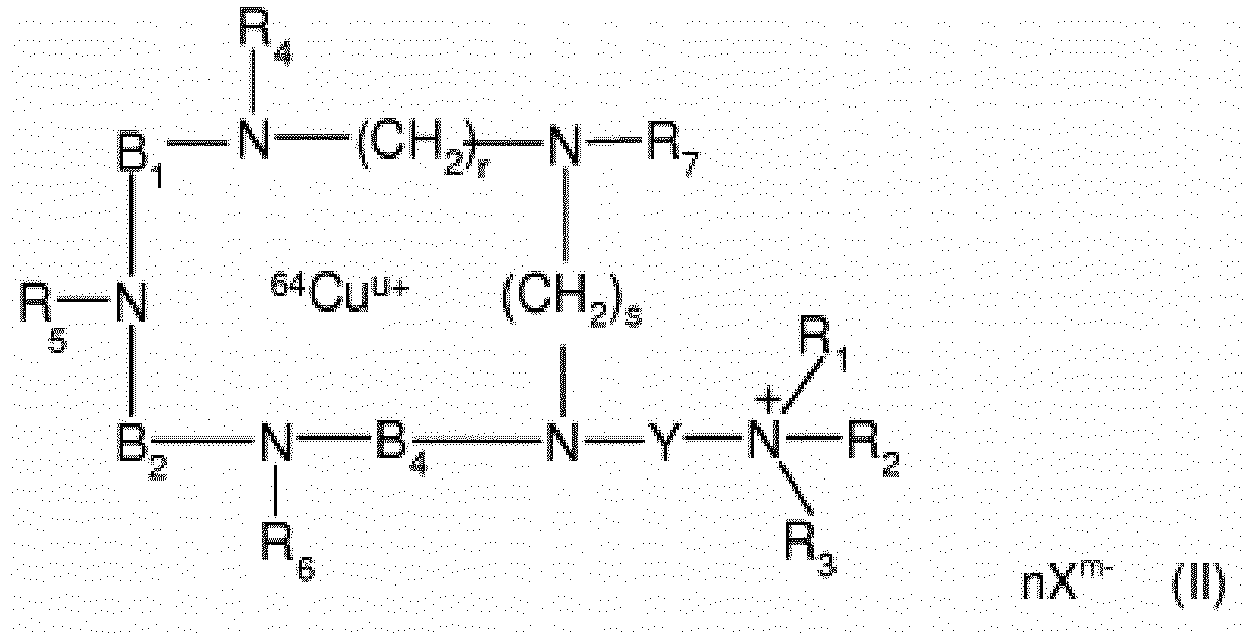
oder ihre pharmazeutisch annehmbaren Salze oder Hydrate. - Verbindung gemäß einem von Anspruch 1 oder 2, mit der folgenden Formel (III):

oder ihre pharmazeutisch annehmbaren Salze oder Hydrate. - Verbindung gemäß Anspruch 3, mir der folgenden Formel:
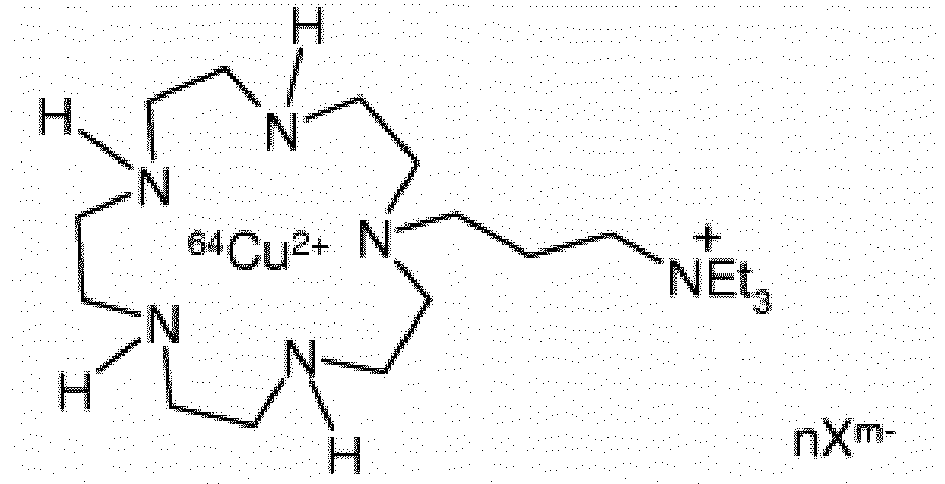
- Verbindung gemäß Anspruch 1, mit der folgenden Formel (IV):

oder ihre pharmazeutisch annehmbaren Salze oder Hydrate. - Verbindung gemäß Anspruch 5, mit einer der folgenden Formeln (V) und (VI):


oder ihre pharmazeutisch annehmbaren Salze oder Hydrate. - Verbindung gemäß Anspruch 6, ausgewählt aus der Gruppe bestehend aus:


- Verfahren zur Herstellung der Verbindung gemäß Formel (I) gemäß Anspruch 1, umfassend das Umsetzen einer Verbindung der Formel (I'):
 - R1, R2, R3, R4, R5, R6, Y, X, B1, B2, B3 und B4 wie in Anspruch 1 definiert sind; und- n' eine ganze Zahl von 0 bis 6 repräsentiert;- m' eine ganze Zahl von 1 bis 3 repräsentiert.
 - Verbindung der Formel (I') gemäß Anspruch 8, ausgewählt aus der Gruppe bestehend aus:


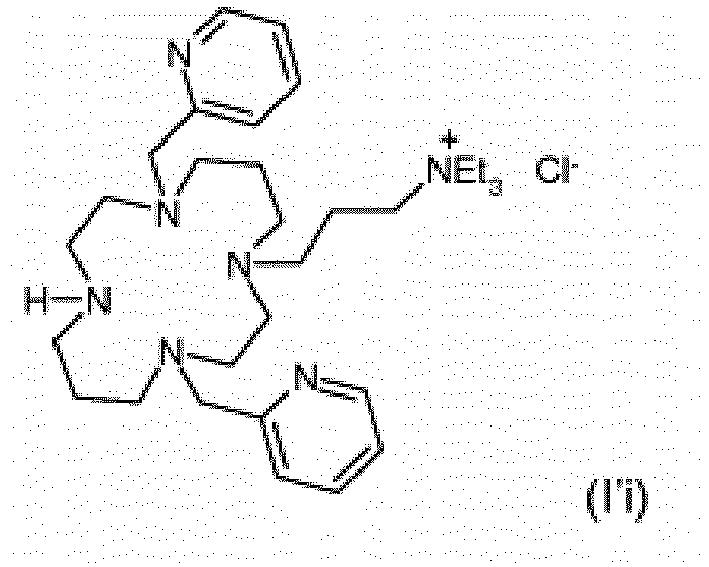
- Ein Kit, umfassend:a) eine Verbindung der Formel (I'):
 b) eine Pufferlösung pH = 6 (0,1 M)c) 64Cu in Lösung.
 - Pharmazeutische Zusammensetzung, die als Wirkstoff eine Verbindung wie in einem der Ansprüche 1 bis 7 definiert und einen pharmazeutisch annehmbaren Träger oder Hilfsstoff umfasst.
- Lösung umfassend eine Verbindung gemäß einem der Ansprüche 1 bis 7, ihre pharmazeutisch annehmbaren Salze oder ihre Mischungen davon umfasst.
- Eine Verbindung wie in einem der Ansprüche 1 bis 7 definiert oder eines ihrer pharmazeutisch annehmbaren Salze zur Verwendung als diagnostisches Mittel in der PET-Bildgebung.
- Die Verbindung zur Verwendung gemäß Anspruch 13 zur Diagnose und/oder zur therapeutischen Nachbehandlung und/oder zur Behandlung von Erkrankungen, die mit der Deregulierung der Proteoglykan-Konzentration in Verbindung stehen, wie Osteoarthritis, Arthritis, Chondrosarkom, Aneurysma, Aortendissektion, Bandscheibendegeneration.
Applications Claiming Priority (2)
| Application Number | Priority Date | Filing Date | Title |
|---|---|---|---|
| EP14306211 | 2014-07-28 | ||
| PCT/EP2015/067318 WO2016016272A1 (en) | 2014-07-28 | 2015-07-28 | Macrocyclic complexes, their process of preparation and use as pet imaging agents |
Publications (2)
| Publication Number | Publication Date |
|---|---|
| EP3177598A1 EP3177598A1 (de) | 2017-06-14 |
| EP3177598B1 true EP3177598B1 (de) | 2019-08-28 |
Family
ID=51298676
Family Applications (1)
| Application Number | Title | Priority Date | Filing Date |
|---|---|---|---|
| EP15750269.1A Active EP3177598B1 (de) | 2014-07-28 | 2015-07-28 | Makrocyclische komplexe, verfahren zu deren herstellung und verwendung als pet-kontrastmittel |
Country Status (3)
| Country | Link |
|---|---|
| US (1) | US10351539B2 (de) |
| EP (1) | EP3177598B1 (de) |
| WO (1) | WO2016016272A1 (de) |
Families Citing this family (2)
| Publication number | Priority date | Publication date | Assignee | Title |
|---|---|---|---|---|
| CN108794417A (zh) * | 2018-08-04 | 2018-11-13 | 许昌恒生制药有限公司 | 一种医疗诊断造影剂中间体的制备方法 |
| CN112996764B (zh) * | 2018-11-12 | 2023-11-21 | 伯拉考成像股份公司 | 螯合aazta缀合物及其配合物 |
Family Cites Families (1)
| Publication number | Priority date | Publication date | Assignee | Title |
|---|---|---|---|---|
| FR2795412B1 (fr) * | 1999-06-23 | 2001-07-13 | Adir | Nouveaux derives d'ammonium quaternaire, leur procede de preparation et les compositions pharmaceutiques qui les contiennent |
-
2015
- 2015-07-28 WO PCT/EP2015/067318 patent/WO2016016272A1/en not_active Ceased
- 2015-07-28 US US15/329,622 patent/US10351539B2/en active Active
- 2015-07-28 EP EP15750269.1A patent/EP3177598B1/de active Active
Non-Patent Citations (1)
| Title |
|---|
| None * |
Also Published As
| Publication number | Publication date |
|---|---|
| US20170210714A1 (en) | 2017-07-27 |
| US10351539B2 (en) | 2019-07-16 |
| WO2016016272A1 (en) | 2016-02-04 |
| EP3177598A1 (de) | 2017-06-14 |
Similar Documents
| Publication | Publication Date | Title |
|---|---|---|
| EP2257315B1 (de) | Kontrastmittel für anwendungen einschliesslich perfusionsbildgebung | |
| WO2020065045A1 (en) | Labeled inhibitors of prostate specific membrane antigen (psma), their use as imaging agents and pharmaceutical agents for the treatment of psma-expressing cancers | |
| US12447217B2 (en) | Fibroblast activation protein (FAP) inhibitors, FAP conjugates, and diagnostic and therapeutic uses thereof | |
| JP2024502341A (ja) | デュアルモード放射性トレーサーおよびその療法 | |
| EP2841402B1 (de) | Markierte chinoxalin-derivate als multimodale radiopharmazeutika und ihre vorläufer | |
| EP3177598B1 (de) | Makrocyclische komplexe, verfahren zu deren herstellung und verwendung als pet-kontrastmittel | |
| AU2022328455A1 (en) | Radiopharmaceuticals, methods for the production thereof, and uses in treatment, diagnosis and imaging diseases | |
| Vidal et al. | Development of a freeze-dried kit formulation for the preparation of 99mTc-NTP 15-5, a radiotracer for scintigraphic imaging of proteoglycans | |
| Singh et al. | A homodimeric bivalent radioligand derived from 1-(2-methoxyphenyl) piperazine with high affinity for in vivo 5-HT1A receptor imaging | |
| US20250215027A1 (en) | Diphosphine compounds and complexes | |
| AU2015200027B2 (en) | Contrast agents for applications including perfusion imaging | |
| HK40127186A (zh) | 成纤维细胞激活蛋白(fap)抑制剂、fap缀合物及其诊断和治疗用途 | |
| HK1151458B (en) | Contrast agents for applications including perfusion imaging | |
| HK1151458A (en) | Contrast agents for applications including perfusion imaging | |
| HK1207852B (en) | Labelled quinoxaline derivatives as multimodal radiopharmaceuticals and their precursors |
Legal Events
| Date | Code | Title | Description |
|---|---|---|---|
| STAA | Information on the status of an ep patent application or granted ep patent |
Free format text: STATUS: THE INTERNATIONAL PUBLICATION HAS BEEN MADE |
|
| PUAI | Public reference made under article 153(3) epc to a published international application that has entered the european phase |
Free format text: ORIGINAL CODE: 0009012 |
|
| STAA | Information on the status of an ep patent application or granted ep patent |
Free format text: STATUS: REQUEST FOR EXAMINATION WAS MADE |
|
| 17P | Request for examination filed |
Effective date: 20170228 |
|
| AK | Designated contracting states |
Kind code of ref document: A1 Designated state(s): AL AT BE BG CH CY CZ DE DK EE ES FI FR GB GR HR HU IE IS IT LI LT LU LV MC MK MT NL NO PL PT RO RS SE SI SK SM TR |
|
| AX | Request for extension of the european patent |
Extension state: BA ME |
|
| DAV | Request for validation of the european patent (deleted) | ||
| DAX | Request for extension of the european patent (deleted) | ||
| STAA | Information on the status of an ep patent application or granted ep patent |
Free format text: STATUS: EXAMINATION IS IN PROGRESS |
|
| 17Q | First examination report despatched |
Effective date: 20171215 |
|
| GRAP | Despatch of communication of intention to grant a patent |
Free format text: ORIGINAL CODE: EPIDOSNIGR1 |
|
| STAA | Information on the status of an ep patent application or granted ep patent |
Free format text: STATUS: GRANT OF PATENT IS INTENDED |
|
| INTG | Intention to grant announced |
Effective date: 20190320 |
|
| GRAS | Grant fee paid |
Free format text: ORIGINAL CODE: EPIDOSNIGR3 |
|
| GRAA | (expected) grant |
Free format text: ORIGINAL CODE: 0009210 |
|
| STAA | Information on the status of an ep patent application or granted ep patent |
Free format text: STATUS: THE PATENT HAS BEEN GRANTED |
|
| AK | Designated contracting states |
Kind code of ref document: B1 Designated state(s): AL AT BE BG CH CY CZ DE DK EE ES FI FR GB GR HR HU IE IS IT LI LT LU LV MC MK MT NL NO PL PT RO RS SE SI SK SM TR |
|
| REG | Reference to a national code |
Ref country code: GB Ref legal event code: FG4D |
|
| REG | Reference to a national code |
Ref country code: CH Ref legal event code: EP |
|
| REG | Reference to a national code |
Ref country code: AT Ref legal event code: REF Ref document number: 1172237 Country of ref document: AT Kind code of ref document: T Effective date: 20190915 |
|
| REG | Reference to a national code |
Ref country code: IE Ref legal event code: FG4D |
|
| REG | Reference to a national code |
Ref country code: DE Ref legal event code: R096 Ref document number: 602015036747 Country of ref document: DE |
|
| REG | Reference to a national code |
Ref country code: NL Ref legal event code: MP Effective date: 20190828 |
|
| REG | Reference to a national code |
Ref country code: LT Ref legal event code: MG4D |
|
| PG25 | Lapsed in a contracting state [announced via postgrant information from national office to epo] |
Ref country code: PT Free format text: LAPSE BECAUSE OF FAILURE TO SUBMIT A TRANSLATION OF THE DESCRIPTION OR TO PAY THE FEE WITHIN THE PRESCRIBED TIME-LIMIT Effective date: 20191230 Ref country code: FI Free format text: LAPSE BECAUSE OF FAILURE TO SUBMIT A TRANSLATION OF THE DESCRIPTION OR TO PAY THE FEE WITHIN THE PRESCRIBED TIME-LIMIT Effective date: 20190828 Ref country code: LT Free format text: LAPSE BECAUSE OF FAILURE TO SUBMIT A TRANSLATION OF THE DESCRIPTION OR TO PAY THE FEE WITHIN THE PRESCRIBED TIME-LIMIT Effective date: 20190828 Ref country code: SE Free format text: LAPSE BECAUSE OF FAILURE TO SUBMIT A TRANSLATION OF THE DESCRIPTION OR TO PAY THE FEE WITHIN THE PRESCRIBED TIME-LIMIT Effective date: 20190828 Ref country code: HR Free format text: LAPSE BECAUSE OF FAILURE TO SUBMIT A TRANSLATION OF THE DESCRIPTION OR TO PAY THE FEE WITHIN THE PRESCRIBED TIME-LIMIT Effective date: 20190828 Ref country code: BG Free format text: LAPSE BECAUSE OF FAILURE TO SUBMIT A TRANSLATION OF THE DESCRIPTION OR TO PAY THE FEE WITHIN THE PRESCRIBED TIME-LIMIT Effective date: 20191128 Ref country code: NL Free format text: LAPSE BECAUSE OF FAILURE TO SUBMIT A TRANSLATION OF THE DESCRIPTION OR TO PAY THE FEE WITHIN THE PRESCRIBED TIME-LIMIT Effective date: 20190828 Ref country code: NO Free format text: LAPSE BECAUSE OF FAILURE TO SUBMIT A TRANSLATION OF THE DESCRIPTION OR TO PAY THE FEE WITHIN THE PRESCRIBED TIME-LIMIT Effective date: 20191128 |
|
| PG25 | Lapsed in a contracting state [announced via postgrant information from national office to epo] |
Ref country code: LV Free format text: LAPSE BECAUSE OF FAILURE TO SUBMIT A TRANSLATION OF THE DESCRIPTION OR TO PAY THE FEE WITHIN THE PRESCRIBED TIME-LIMIT Effective date: 20190828 Ref country code: ES Free format text: LAPSE BECAUSE OF FAILURE TO SUBMIT A TRANSLATION OF THE DESCRIPTION OR TO PAY THE FEE WITHIN THE PRESCRIBED TIME-LIMIT Effective date: 20190828 Ref country code: AL Free format text: LAPSE BECAUSE OF FAILURE TO SUBMIT A TRANSLATION OF THE DESCRIPTION OR TO PAY THE FEE WITHIN THE PRESCRIBED TIME-LIMIT Effective date: 20190828 Ref country code: IS Free format text: LAPSE BECAUSE OF FAILURE TO SUBMIT A TRANSLATION OF THE DESCRIPTION OR TO PAY THE FEE WITHIN THE PRESCRIBED TIME-LIMIT Effective date: 20191228 Ref country code: RS Free format text: LAPSE BECAUSE OF FAILURE TO SUBMIT A TRANSLATION OF THE DESCRIPTION OR TO PAY THE FEE WITHIN THE PRESCRIBED TIME-LIMIT Effective date: 20190828 Ref country code: GR Free format text: LAPSE BECAUSE OF FAILURE TO SUBMIT A TRANSLATION OF THE DESCRIPTION OR TO PAY THE FEE WITHIN THE PRESCRIBED TIME-LIMIT Effective date: 20191129 |
|
| REG | Reference to a national code |
Ref country code: AT Ref legal event code: MK05 Ref document number: 1172237 Country of ref document: AT Kind code of ref document: T Effective date: 20190828 |
|
| PG25 | Lapsed in a contracting state [announced via postgrant information from national office to epo] |
Ref country code: TR Free format text: LAPSE BECAUSE OF FAILURE TO SUBMIT A TRANSLATION OF THE DESCRIPTION OR TO PAY THE FEE WITHIN THE PRESCRIBED TIME-LIMIT Effective date: 20190828 |
|
| PG25 | Lapsed in a contracting state [announced via postgrant information from national office to epo] |
Ref country code: DK Free format text: LAPSE BECAUSE OF FAILURE TO SUBMIT A TRANSLATION OF THE DESCRIPTION OR TO PAY THE FEE WITHIN THE PRESCRIBED TIME-LIMIT Effective date: 20190828 Ref country code: AT Free format text: LAPSE BECAUSE OF FAILURE TO SUBMIT A TRANSLATION OF THE DESCRIPTION OR TO PAY THE FEE WITHIN THE PRESCRIBED TIME-LIMIT Effective date: 20190828 Ref country code: PL Free format text: LAPSE BECAUSE OF FAILURE TO SUBMIT A TRANSLATION OF THE DESCRIPTION OR TO PAY THE FEE WITHIN THE PRESCRIBED TIME-LIMIT Effective date: 20190828 Ref country code: EE Free format text: LAPSE BECAUSE OF FAILURE TO SUBMIT A TRANSLATION OF THE DESCRIPTION OR TO PAY THE FEE WITHIN THE PRESCRIBED TIME-LIMIT Effective date: 20190828 Ref country code: RO Free format text: LAPSE BECAUSE OF FAILURE TO SUBMIT A TRANSLATION OF THE DESCRIPTION OR TO PAY THE FEE WITHIN THE PRESCRIBED TIME-LIMIT Effective date: 20190828 Ref country code: IT Free format text: LAPSE BECAUSE OF FAILURE TO SUBMIT A TRANSLATION OF THE DESCRIPTION OR TO PAY THE FEE WITHIN THE PRESCRIBED TIME-LIMIT Effective date: 20190828 |
|
| PG25 | Lapsed in a contracting state [announced via postgrant information from national office to epo] |
Ref country code: SM Free format text: LAPSE BECAUSE OF FAILURE TO SUBMIT A TRANSLATION OF THE DESCRIPTION OR TO PAY THE FEE WITHIN THE PRESCRIBED TIME-LIMIT Effective date: 20190828 Ref country code: SK Free format text: LAPSE BECAUSE OF FAILURE TO SUBMIT A TRANSLATION OF THE DESCRIPTION OR TO PAY THE FEE WITHIN THE PRESCRIBED TIME-LIMIT Effective date: 20190828 Ref country code: IS Free format text: LAPSE BECAUSE OF FAILURE TO SUBMIT A TRANSLATION OF THE DESCRIPTION OR TO PAY THE FEE WITHIN THE PRESCRIBED TIME-LIMIT Effective date: 20200224 Ref country code: CZ Free format text: LAPSE BECAUSE OF FAILURE TO SUBMIT A TRANSLATION OF THE DESCRIPTION OR TO PAY THE FEE WITHIN THE PRESCRIBED TIME-LIMIT Effective date: 20190828 |
|
| REG | Reference to a national code |
Ref country code: DE Ref legal event code: R097 Ref document number: 602015036747 Country of ref document: DE |
|
| PLBE | No opposition filed within time limit |
Free format text: ORIGINAL CODE: 0009261 |
|
| STAA | Information on the status of an ep patent application or granted ep patent |
Free format text: STATUS: NO OPPOSITION FILED WITHIN TIME LIMIT |
|
| PG2D | Information on lapse in contracting state deleted |
Ref country code: IS |
|
| 26N | No opposition filed |
Effective date: 20200603 |
|
| PG25 | Lapsed in a contracting state [announced via postgrant information from national office to epo] |
Ref country code: SI Free format text: LAPSE BECAUSE OF FAILURE TO SUBMIT A TRANSLATION OF THE DESCRIPTION OR TO PAY THE FEE WITHIN THE PRESCRIBED TIME-LIMIT Effective date: 20190828 |
|
| PG25 | Lapsed in a contracting state [announced via postgrant information from national office to epo] |
Ref country code: MC Free format text: LAPSE BECAUSE OF FAILURE TO SUBMIT A TRANSLATION OF THE DESCRIPTION OR TO PAY THE FEE WITHIN THE PRESCRIBED TIME-LIMIT Effective date: 20190828 |
|
| REG | Reference to a national code |
Ref country code: CH Ref legal event code: PL |
|
| GBPC | Gb: european patent ceased through non-payment of renewal fee |
Effective date: 20200728 |
|
| REG | Reference to a national code |
Ref country code: BE Ref legal event code: MM Effective date: 20200731 |
|
| PG25 | Lapsed in a contracting state [announced via postgrant information from national office to epo] |
Ref country code: LU Free format text: LAPSE BECAUSE OF NON-PAYMENT OF DUE FEES Effective date: 20200728 Ref country code: LI Free format text: LAPSE BECAUSE OF NON-PAYMENT OF DUE FEES Effective date: 20200731 Ref country code: CH Free format text: LAPSE BECAUSE OF NON-PAYMENT OF DUE FEES Effective date: 20200731 Ref country code: GB Free format text: LAPSE BECAUSE OF NON-PAYMENT OF DUE FEES Effective date: 20200728 |
|
| PG25 | Lapsed in a contracting state [announced via postgrant information from national office to epo] |
Ref country code: BE Free format text: LAPSE BECAUSE OF NON-PAYMENT OF DUE FEES Effective date: 20200731 |
|
| PG25 | Lapsed in a contracting state [announced via postgrant information from national office to epo] |
Ref country code: IE Free format text: LAPSE BECAUSE OF NON-PAYMENT OF DUE FEES Effective date: 20200728 |
|
| PG25 | Lapsed in a contracting state [announced via postgrant information from national office to epo] |
Ref country code: MT Free format text: LAPSE BECAUSE OF FAILURE TO SUBMIT A TRANSLATION OF THE DESCRIPTION OR TO PAY THE FEE WITHIN THE PRESCRIBED TIME-LIMIT Effective date: 20190828 Ref country code: CY Free format text: LAPSE BECAUSE OF FAILURE TO SUBMIT A TRANSLATION OF THE DESCRIPTION OR TO PAY THE FEE WITHIN THE PRESCRIBED TIME-LIMIT Effective date: 20190828 |
|
| PG25 | Lapsed in a contracting state [announced via postgrant information from national office to epo] |
Ref country code: MK Free format text: LAPSE BECAUSE OF FAILURE TO SUBMIT A TRANSLATION OF THE DESCRIPTION OR TO PAY THE FEE WITHIN THE PRESCRIBED TIME-LIMIT Effective date: 20190828 |
|
| PGFP | Annual fee paid to national office [announced via postgrant information from national office to epo] |
Ref country code: DE Payment date: 20250722 Year of fee payment: 11 |
|
| PGFP | Annual fee paid to national office [announced via postgrant information from national office to epo] |
Ref country code: FR Payment date: 20250722 Year of fee payment: 11 |