EP3190084A1 - Graphène partiellement oxydé et son procédé de préparation - Google Patents
Graphène partiellement oxydé et son procédé de préparation Download PDFInfo
- Publication number
- EP3190084A1 EP3190084A1 EP15867284.0A EP15867284A EP3190084A1 EP 3190084 A1 EP3190084 A1 EP 3190084A1 EP 15867284 A EP15867284 A EP 15867284A EP 3190084 A1 EP3190084 A1 EP 3190084A1
- Authority
- EP
- European Patent Office
- Prior art keywords
- graphene
- partially oxidized
- pogf
- graphite
- preparing
- Prior art date
- Legal status (The legal status is an assumption and is not a legal conclusion. Google has not performed a legal analysis and makes no representation as to the accuracy of the status listed.)
- Withdrawn
Links
- OKTJSMMVPCPJKN-UHFFFAOYSA-N Carbon Chemical compound [C] OKTJSMMVPCPJKN-UHFFFAOYSA-N 0.000 title claims abstract description 249
- 229910021389 graphene Inorganic materials 0.000 title claims abstract description 136
- 238000002360 preparation method Methods 0.000 title description 3
- 239000010439 graphite Substances 0.000 claims abstract description 93
- 229910002804 graphite Inorganic materials 0.000 claims abstract description 92
- 238000000034 method Methods 0.000 claims abstract description 50
- 238000007254 oxidation reaction Methods 0.000 claims description 33
- 230000003647 oxidation Effects 0.000 claims description 28
- 229910052799 carbon Inorganic materials 0.000 claims description 26
- 239000012527 feed solution Substances 0.000 claims description 24
- QAOWNCQODCNURD-UHFFFAOYSA-N Sulfuric acid Chemical compound OS(O)(=O)=O QAOWNCQODCNURD-UHFFFAOYSA-N 0.000 claims description 16
- XOJVVFBFDXDTEG-UHFFFAOYSA-N Norphytane Natural products CC(C)CCCC(C)CCCC(C)CCCC(C)C XOJVVFBFDXDTEG-UHFFFAOYSA-N 0.000 claims description 15
- QVGXLLKOCUKJST-UHFFFAOYSA-N atomic oxygen Chemical compound [O] QVGXLLKOCUKJST-UHFFFAOYSA-N 0.000 claims description 15
- 229910052760 oxygen Inorganic materials 0.000 claims description 15
- 239000001301 oxygen Substances 0.000 claims description 15
- ZMXDDKWLCZADIW-UHFFFAOYSA-N N,N-Dimethylformamide Chemical compound CN(C)C=O ZMXDDKWLCZADIW-UHFFFAOYSA-N 0.000 claims description 12
- SECXISVLQFMRJM-UHFFFAOYSA-N N-Methylpyrrolidone Chemical compound CN1CCCC1=O SECXISVLQFMRJM-UHFFFAOYSA-N 0.000 claims description 12
- ZWEHNKRNPOVVGH-UHFFFAOYSA-N 2-Butanone Chemical compound CCC(C)=O ZWEHNKRNPOVVGH-UHFFFAOYSA-N 0.000 claims description 10
- XLYOFNOQVPJJNP-UHFFFAOYSA-N water Substances O XLYOFNOQVPJJNP-UHFFFAOYSA-N 0.000 claims description 9
- LFQSCWFLJHTTHZ-UHFFFAOYSA-N Ethanol Chemical compound CCO LFQSCWFLJHTTHZ-UHFFFAOYSA-N 0.000 claims description 8
- GRYLNZFGIOXLOG-UHFFFAOYSA-N Nitric acid Chemical compound O[N+]([O-])=O GRYLNZFGIOXLOG-UHFFFAOYSA-N 0.000 claims description 8
- 229910017604 nitric acid Inorganic materials 0.000 claims description 8
- ATHHXGZTWNVVOU-UHFFFAOYSA-N N-methylformamide Chemical compound CNC=O ATHHXGZTWNVVOU-UHFFFAOYSA-N 0.000 claims description 7
- CSCPPACGZOOCGX-UHFFFAOYSA-N Acetone Chemical compound CC(C)=O CSCPPACGZOOCGX-UHFFFAOYSA-N 0.000 claims description 6
- XEKOWRVHYACXOJ-UHFFFAOYSA-N Ethyl acetate Chemical compound CCOC(C)=O XEKOWRVHYACXOJ-UHFFFAOYSA-N 0.000 claims description 6
- LYCAIKOWRPUZTN-UHFFFAOYSA-N Ethylene glycol Chemical compound OCCO LYCAIKOWRPUZTN-UHFFFAOYSA-N 0.000 claims description 6
- KFZMGEQAYNKOFK-UHFFFAOYSA-N Isopropanol Chemical compound CC(C)O KFZMGEQAYNKOFK-UHFFFAOYSA-N 0.000 claims description 6
- OKKJLVBELUTLKV-UHFFFAOYSA-N Methanol Chemical compound OC OKKJLVBELUTLKV-UHFFFAOYSA-N 0.000 claims description 6
- 238000001237 Raman spectrum Methods 0.000 claims description 6
- JFDZBHWFFUWGJE-UHFFFAOYSA-N benzonitrile Chemical compound N#CC1=CC=CC=C1 JFDZBHWFFUWGJE-UHFFFAOYSA-N 0.000 claims description 6
- 239000002904 solvent Substances 0.000 claims description 6
- IAZDPXIOMUYVGZ-UHFFFAOYSA-N Dimethylsulphoxide Chemical compound CS(C)=O IAZDPXIOMUYVGZ-UHFFFAOYSA-N 0.000 claims description 5
- CYSGHNMQYZDMIA-UHFFFAOYSA-N 1,3-Dimethyl-2-imidazolidinon Chemical compound CN1CCN(C)C1=O CYSGHNMQYZDMIA-UHFFFAOYSA-N 0.000 claims description 4
- HEDRZPFGACZZDS-UHFFFAOYSA-N Chloroform Chemical compound ClC(Cl)Cl HEDRZPFGACZZDS-UHFFFAOYSA-N 0.000 claims description 4
- FXHOOIRPVKKKFG-UHFFFAOYSA-N N,N-Dimethylacetamide Chemical compound CN(C)C(C)=O FXHOOIRPVKKKFG-UHFFFAOYSA-N 0.000 claims description 4
- LRHPLDYGYMQRHN-UHFFFAOYSA-N N-Butanol Chemical compound CCCCO LRHPLDYGYMQRHN-UHFFFAOYSA-N 0.000 claims description 4
- WPPOGHDFAVQKLN-UHFFFAOYSA-N N-Octyl-2-pyrrolidone Chemical compound CCCCCCCCN1CCCC1=O WPPOGHDFAVQKLN-UHFFFAOYSA-N 0.000 claims description 4
- JUJWROOIHBZHMG-UHFFFAOYSA-N Pyridine Chemical compound C1=CC=NC=C1 JUJWROOIHBZHMG-UHFFFAOYSA-N 0.000 claims description 4
- SMWDFEZZVXVKRB-UHFFFAOYSA-N Quinoline Chemical compound N1=CC=CC2=CC=CC=C21 SMWDFEZZVXVKRB-UHFFFAOYSA-N 0.000 claims description 4
- WYURNTSHIVDZCO-UHFFFAOYSA-N Tetrahydrofuran Chemical compound C1CCOC1 WYURNTSHIVDZCO-UHFFFAOYSA-N 0.000 claims description 4
- SESFRYSPDFLNCH-UHFFFAOYSA-N benzyl benzoate Chemical compound C=1C=CC=CC=1C(=O)OCC1=CC=CC=C1 SESFRYSPDFLNCH-UHFFFAOYSA-N 0.000 claims description 4
- QARVLSVVCXYDNA-UHFFFAOYSA-N bromobenzene Chemical compound BrC1=CC=CC=C1 QARVLSVVCXYDNA-UHFFFAOYSA-N 0.000 claims description 4
- MVPPADPHJFYWMZ-UHFFFAOYSA-N chlorobenzene Chemical compound ClC1=CC=CC=C1 MVPPADPHJFYWMZ-UHFFFAOYSA-N 0.000 claims description 4
- JHIVVAPYMSGYDF-UHFFFAOYSA-N cyclohexanone Chemical compound O=C1CCCCC1 JHIVVAPYMSGYDF-UHFFFAOYSA-N 0.000 claims description 4
- 239000000463 material Substances 0.000 claims description 4
- BDAGIHXWWSANSR-UHFFFAOYSA-N methanoic acid Natural products OC=O BDAGIHXWWSANSR-UHFFFAOYSA-N 0.000 claims description 4
- 230000001590 oxidative effect Effects 0.000 claims description 4
- WHNWPMSKXPGLAX-UHFFFAOYSA-N N-Vinyl-2-pyrrolidone Chemical compound C=CN1CCCC1=O WHNWPMSKXPGLAX-UHFFFAOYSA-N 0.000 claims description 3
- 239000003929 acidic solution Substances 0.000 claims description 3
- WUOACPNHFRMFPN-SECBINFHSA-N (S)-(-)-alpha-terpineol Chemical compound CC1=CC[C@@H](C(C)(C)O)CC1 WUOACPNHFRMFPN-SECBINFHSA-N 0.000 claims description 2
- NJPQAIBZIHNJDO-UHFFFAOYSA-N 1-dodecylpyrrolidin-2-one Chemical compound CCCCCCCCCCCCN1CCCC1=O NJPQAIBZIHNJDO-UHFFFAOYSA-N 0.000 claims description 2
- POAOYUHQDCAZBD-UHFFFAOYSA-N 2-butoxyethanol Chemical compound CCCCOCCO POAOYUHQDCAZBD-UHFFFAOYSA-N 0.000 claims description 2
- ZNQVEEAIQZEUHB-UHFFFAOYSA-N 2-ethoxyethanol Chemical compound CCOCCO ZNQVEEAIQZEUHB-UHFFFAOYSA-N 0.000 claims description 2
- 229940093475 2-ethoxyethanol Drugs 0.000 claims description 2
- YTTFFPATQICAQN-UHFFFAOYSA-N 2-methoxypropan-1-ol Chemical compound COC(C)CO YTTFFPATQICAQN-UHFFFAOYSA-N 0.000 claims description 2
- OSWFIVFLDKOXQC-UHFFFAOYSA-N 4-(3-methoxyphenyl)aniline Chemical compound COC1=CC=CC(C=2C=CC(N)=CC=2)=C1 OSWFIVFLDKOXQC-UHFFFAOYSA-N 0.000 claims description 2
- NLHHRLWOUZZQLW-UHFFFAOYSA-N Acrylonitrile Chemical compound C=CC#N NLHHRLWOUZZQLW-UHFFFAOYSA-N 0.000 claims description 2
- OVKDFILSBMEKLT-UHFFFAOYSA-N alpha-Terpineol Natural products CC(=C)C1(O)CCC(C)=CC1 OVKDFILSBMEKLT-UHFFFAOYSA-N 0.000 claims description 2
- 229940088601 alpha-terpineol Drugs 0.000 claims description 2
- 229960002903 benzyl benzoate Drugs 0.000 claims description 2
- MHDVGSVTJDSBDK-UHFFFAOYSA-N dibenzyl ether Chemical compound C=1C=CC=CC=1COCC1=CC=CC=C1 MHDVGSVTJDSBDK-UHFFFAOYSA-N 0.000 claims description 2
- 235000019253 formic acid Nutrition 0.000 claims description 2
- PZYDAVFRVJXFHS-UHFFFAOYSA-N n-cyclohexyl-2-pyrrolidone Chemical compound O=C1CCCN1C1CCCCC1 PZYDAVFRVJXFHS-UHFFFAOYSA-N 0.000 claims description 2
- UMJSCPRVCHMLSP-UHFFFAOYSA-N pyridine Natural products COC1=CC=CN=C1 UMJSCPRVCHMLSP-UHFFFAOYSA-N 0.000 claims description 2
- 238000000265 homogenisation Methods 0.000 abstract description 27
- 238000004299 exfoliation Methods 0.000 abstract description 20
- 239000003960 organic solvent Substances 0.000 abstract description 5
- 230000009467 reduction Effects 0.000 abstract description 3
- 239000002270 dispersing agent Substances 0.000 description 13
- 230000000052 comparative effect Effects 0.000 description 12
- 239000010410 layer Substances 0.000 description 12
- 230000008569 process Effects 0.000 description 12
- 239000000243 solution Substances 0.000 description 11
- 238000006243 chemical reaction Methods 0.000 description 9
- 239000011229 interlayer Substances 0.000 description 9
- 239000006185 dispersion Substances 0.000 description 8
- 238000004833 X-ray photoelectron spectroscopy Methods 0.000 description 7
- 230000036961 partial effect Effects 0.000 description 7
- 239000002994 raw material Substances 0.000 description 7
- 230000035484 reaction time Effects 0.000 description 7
- 239000000523 sample Substances 0.000 description 7
- 230000007547 defect Effects 0.000 description 6
- 238000001878 scanning electron micrograph Methods 0.000 description 6
- 239000002253 acid Substances 0.000 description 5
- 230000008901 benefit Effects 0.000 description 5
- 239000012153 distilled water Substances 0.000 description 5
- 238000001035 drying Methods 0.000 description 5
- 238000004519 manufacturing process Methods 0.000 description 5
- 239000002245 particle Substances 0.000 description 5
- 238000004458 analytical method Methods 0.000 description 4
- 230000003247 decreasing effect Effects 0.000 description 4
- 238000000921 elemental analysis Methods 0.000 description 4
- 238000005259 measurement Methods 0.000 description 4
- 230000002829 reductive effect Effects 0.000 description 4
- YXFVVABEGXRONW-UHFFFAOYSA-N Toluene Chemical compound CC1=CC=CC=C1 YXFVVABEGXRONW-UHFFFAOYSA-N 0.000 description 3
- 230000002687 intercalation Effects 0.000 description 3
- 238000009830 intercalation Methods 0.000 description 3
- 239000011259 mixed solution Substances 0.000 description 3
- 239000000203 mixture Substances 0.000 description 3
- 229920000036 polyvinylpyrrolidone Polymers 0.000 description 3
- 235000013855 polyvinylpyrrolidone Nutrition 0.000 description 3
- 238000006722 reduction reaction Methods 0.000 description 3
- 239000000126 substance Substances 0.000 description 3
- 238000003917 TEM image Methods 0.000 description 2
- 238000002441 X-ray diffraction Methods 0.000 description 2
- 238000004220 aggregation Methods 0.000 description 2
- 125000004432 carbon atom Chemical group C* 0.000 description 2
- 238000005119 centrifugation Methods 0.000 description 2
- 238000002485 combustion reaction Methods 0.000 description 2
- 239000002131 composite material Substances 0.000 description 2
- 150000001875 compounds Chemical class 0.000 description 2
- 230000000694 effects Effects 0.000 description 2
- 150000002118 epoxides Chemical class 0.000 description 2
- 239000012528 membrane Substances 0.000 description 2
- 239000003495 polar organic solvent Substances 0.000 description 2
- 239000001267 polyvinylpyrrolidone Substances 0.000 description 2
- 238000011085 pressure filtration Methods 0.000 description 2
- 239000002356 single layer Substances 0.000 description 2
- 238000000527 sonication Methods 0.000 description 2
- 230000003746 surface roughness Effects 0.000 description 2
- 238000001291 vacuum drying Methods 0.000 description 2
- 238000003828 vacuum filtration Methods 0.000 description 2
- GSNUFIFRDBKVIE-UHFFFAOYSA-N DMF Natural products CC1=CC=C(C)O1 GSNUFIFRDBKVIE-UHFFFAOYSA-N 0.000 description 1
- 240000003936 Plumbago auriculata Species 0.000 description 1
- XUIMIQQOPSSXEZ-UHFFFAOYSA-N Silicon Chemical compound [Si] XUIMIQQOPSSXEZ-UHFFFAOYSA-N 0.000 description 1
- 230000002411 adverse Effects 0.000 description 1
- 239000002585 base Substances 0.000 description 1
- 230000002902 bimodal effect Effects 0.000 description 1
- 230000000903 blocking effect Effects 0.000 description 1
- 150000001721 carbon Chemical group 0.000 description 1
- 239000003575 carbonaceous material Substances 0.000 description 1
- 125000003178 carboxy group Chemical group [H]OC(*)=O 0.000 description 1
- 150000001732 carboxylic acid derivatives Chemical class 0.000 description 1
- 238000005266 casting Methods 0.000 description 1
- 230000008859 change Effects 0.000 description 1
- 239000003638 chemical reducing agent Substances 0.000 description 1
- 239000004020 conductor Substances 0.000 description 1
- 239000013078 crystal Substances 0.000 description 1
- 239000003085 diluting agent Substances 0.000 description 1
- 238000009826 distribution Methods 0.000 description 1
- 238000005516 engineering process Methods 0.000 description 1
- IDGUHHHQCWSQLU-UHFFFAOYSA-N ethanol;hydrate Chemical compound O.CCO IDGUHHHQCWSQLU-UHFFFAOYSA-N 0.000 description 1
- 230000001747 exhibiting effect Effects 0.000 description 1
- 230000017525 heat dissipation Effects 0.000 description 1
- 125000004356 hydroxy functional group Chemical group O* 0.000 description 1
- 229910052500 inorganic mineral Inorganic materials 0.000 description 1
- 239000012212 insulator Substances 0.000 description 1
- 230000003993 interaction Effects 0.000 description 1
- 150000002500 ions Chemical class 0.000 description 1
- 239000007788 liquid Substances 0.000 description 1
- 239000002932 luster Substances 0.000 description 1
- 239000002184 metal Substances 0.000 description 1
- 238000003801 milling Methods 0.000 description 1
- 239000011707 mineral Substances 0.000 description 1
- GINQYTLDMNFGQP-UHFFFAOYSA-N n,n-dimethylformamide;methylsulfinylmethane Chemical compound CS(C)=O.CN(C)C=O GINQYTLDMNFGQP-UHFFFAOYSA-N 0.000 description 1
- 239000003921 oil Substances 0.000 description 1
- QNXIYXGRPXRGOB-UHFFFAOYSA-N oxolane;propan-2-one Chemical compound CC(C)=O.C1CCOC1 QNXIYXGRPXRGOB-UHFFFAOYSA-N 0.000 description 1
- 238000000053 physical method Methods 0.000 description 1
- 238000009832 plasma treatment Methods 0.000 description 1
- 239000011148 porous material Substances 0.000 description 1
- 239000010453 quartz Substances 0.000 description 1
- 239000011541 reaction mixture Substances 0.000 description 1
- 239000004065 semiconductor Substances 0.000 description 1
- 229910052710 silicon Inorganic materials 0.000 description 1
- 239000010703 silicon Substances 0.000 description 1
- VYPSYNLAJGMNEJ-UHFFFAOYSA-N silicon dioxide Inorganic materials O=[Si]=O VYPSYNLAJGMNEJ-UHFFFAOYSA-N 0.000 description 1
- 239000002002 slurry Substances 0.000 description 1
- 238000004528 spin coating Methods 0.000 description 1
- 239000000758 substrate Substances 0.000 description 1
- YLQBMQCUIZJEEH-UHFFFAOYSA-N tetrahydrofuran Natural products C=1C=COC=1 YLQBMQCUIZJEEH-UHFFFAOYSA-N 0.000 description 1
- 230000003313 weakening effect Effects 0.000 description 1
Images




Classifications
-
- C—CHEMISTRY; METALLURGY
- C01—INORGANIC CHEMISTRY
- C01B—NON-METALLIC ELEMENTS; COMPOUNDS THEREOF; METALLOIDS OR COMPOUNDS THEREOF NOT COVERED BY SUBCLASS C01C
- C01B32/00—Carbon; Compounds thereof
- C01B32/15—Nano-sized carbon materials
- C01B32/182—Graphene
- C01B32/198—Graphene oxide
-
- C—CHEMISTRY; METALLURGY
- C01—INORGANIC CHEMISTRY
- C01B—NON-METALLIC ELEMENTS; COMPOUNDS THEREOF; METALLOIDS OR COMPOUNDS THEREOF NOT COVERED BY SUBCLASS C01C
- C01B32/00—Carbon; Compounds thereof
- C01B32/15—Nano-sized carbon materials
- C01B32/182—Graphene
- C01B32/184—Preparation
- C01B32/19—Preparation by exfoliation
- C01B32/192—Preparation by exfoliation starting from graphitic oxides
-
- C—CHEMISTRY; METALLURGY
- C01—INORGANIC CHEMISTRY
- C01B—NON-METALLIC ELEMENTS; COMPOUNDS THEREOF; METALLOIDS OR COMPOUNDS THEREOF NOT COVERED BY SUBCLASS C01C
- C01B32/00—Carbon; Compounds thereof
- C01B32/15—Nano-sized carbon materials
- C01B32/182—Graphene
- C01B32/184—Preparation
-
- C—CHEMISTRY; METALLURGY
- C01—INORGANIC CHEMISTRY
- C01B—NON-METALLIC ELEMENTS; COMPOUNDS THEREOF; METALLOIDS OR COMPOUNDS THEREOF NOT COVERED BY SUBCLASS C01C
- C01B32/00—Carbon; Compounds thereof
- C01B32/20—Graphite
- C01B32/21—After-treatment
- C01B32/23—Oxidation
-
- B—PERFORMING OPERATIONS; TRANSPORTING
- B82—NANOTECHNOLOGY
- B82Y—SPECIFIC USES OR APPLICATIONS OF NANOSTRUCTURES; MEASUREMENT OR ANALYSIS OF NANOSTRUCTURES; MANUFACTURE OR TREATMENT OF NANOSTRUCTURES
- B82Y30/00—Nanotechnology for materials or surface science, e.g. nanocomposites
-
- B—PERFORMING OPERATIONS; TRANSPORTING
- B82—NANOTECHNOLOGY
- B82Y—SPECIFIC USES OR APPLICATIONS OF NANOSTRUCTURES; MEASUREMENT OR ANALYSIS OF NANOSTRUCTURES; MANUFACTURE OR TREATMENT OF NANOSTRUCTURES
- B82Y40/00—Manufacture or treatment of nanostructures
-
- C—CHEMISTRY; METALLURGY
- C01—INORGANIC CHEMISTRY
- C01B—NON-METALLIC ELEMENTS; COMPOUNDS THEREOF; METALLOIDS OR COMPOUNDS THEREOF NOT COVERED BY SUBCLASS C01C
- C01B2204/00—Structure or properties of graphene
- C01B2204/04—Specific amount of layers or specific thickness
-
- C—CHEMISTRY; METALLURGY
- C01—INORGANIC CHEMISTRY
- C01B—NON-METALLIC ELEMENTS; COMPOUNDS THEREOF; METALLOIDS OR COMPOUNDS THEREOF NOT COVERED BY SUBCLASS C01C
- C01B2204/00—Structure or properties of graphene
- C01B2204/20—Graphene characterized by its properties
- C01B2204/32—Size or surface area
-
- C—CHEMISTRY; METALLURGY
- C01—INORGANIC CHEMISTRY
- C01P—INDEXING SCHEME RELATING TO STRUCTURAL AND PHYSICAL ASPECTS OF SOLID INORGANIC COMPOUNDS
- C01P2002/00—Crystal-structural characteristics
- C01P2002/70—Crystal-structural characteristics defined by measured X-ray, neutron or electron diffraction data
- C01P2002/72—Crystal-structural characteristics defined by measured X-ray, neutron or electron diffraction data by d-values or two theta-values, e.g. as X-ray diagram
-
- C—CHEMISTRY; METALLURGY
- C01—INORGANIC CHEMISTRY
- C01P—INDEXING SCHEME RELATING TO STRUCTURAL AND PHYSICAL ASPECTS OF SOLID INORGANIC COMPOUNDS
- C01P2002/00—Crystal-structural characteristics
- C01P2002/80—Crystal-structural characteristics defined by measured data other than those specified in group C01P2002/70
- C01P2002/82—Crystal-structural characteristics defined by measured data other than those specified in group C01P2002/70 by IR- or Raman-data
-
- C—CHEMISTRY; METALLURGY
- C01—INORGANIC CHEMISTRY
- C01P—INDEXING SCHEME RELATING TO STRUCTURAL AND PHYSICAL ASPECTS OF SOLID INORGANIC COMPOUNDS
- C01P2004/00—Particle morphology
- C01P2004/01—Particle morphology depicted by an image
- C01P2004/03—Particle morphology depicted by an image obtained by SEM
-
- C—CHEMISTRY; METALLURGY
- C01—INORGANIC CHEMISTRY
- C01P—INDEXING SCHEME RELATING TO STRUCTURAL AND PHYSICAL ASPECTS OF SOLID INORGANIC COMPOUNDS
- C01P2004/00—Particle morphology
- C01P2004/01—Particle morphology depicted by an image
- C01P2004/04—Particle morphology depicted by an image obtained by TEM, STEM, STM or AFM
-
- Y—GENERAL TAGGING OF NEW TECHNOLOGICAL DEVELOPMENTS; GENERAL TAGGING OF CROSS-SECTIONAL TECHNOLOGIES SPANNING OVER SEVERAL SECTIONS OF THE IPC; TECHNICAL SUBJECTS COVERED BY FORMER USPC CROSS-REFERENCE ART COLLECTIONS [XRACs] AND DIGESTS
- Y10—TECHNICAL SUBJECTS COVERED BY FORMER USPC
- Y10S—TECHNICAL SUBJECTS COVERED BY FORMER USPC CROSS-REFERENCE ART COLLECTIONS [XRACs] AND DIGESTS
- Y10S977/00—Nanotechnology
- Y10S977/70—Nanostructure
- Y10S977/734—Fullerenes, i.e. graphene-based structures, such as nanohorns, nanococoons, nanoscrolls or fullerene-like structures, e.g. WS2 or MoS2 chalcogenide nanotubes, planar C3N4, etc.
-
- Y—GENERAL TAGGING OF NEW TECHNOLOGICAL DEVELOPMENTS; GENERAL TAGGING OF CROSS-SECTIONAL TECHNOLOGIES SPANNING OVER SEVERAL SECTIONS OF THE IPC; TECHNICAL SUBJECTS COVERED BY FORMER USPC CROSS-REFERENCE ART COLLECTIONS [XRACs] AND DIGESTS
- Y10—TECHNICAL SUBJECTS COVERED BY FORMER USPC
- Y10S—TECHNICAL SUBJECTS COVERED BY FORMER USPC CROSS-REFERENCE ART COLLECTIONS [XRACs] AND DIGESTS
- Y10S977/00—Nanotechnology
- Y10S977/84—Manufacture, treatment, or detection of nanostructure
- Y10S977/842—Manufacture, treatment, or detection of nanostructure for carbon nanotubes or fullerenes
Definitions
- the present invention relates to a partially oxidized graphene and a method for preparing the same.
- Graphene is a semimetallic material where carbon atoms form an arrangement connected in a hexagonal shape by two-dimensional sp2 bonding while having a thickness corresponding to a carbon atom layer. Recently, it has been reported that the properties of a graphene sheet having one carbon atomic layer were evaluated, and as a result, the graphene sheet may show very excellent electrical conductivity of electron mobility of about 50,000 cm 2 /Vs or more.
- graphene has the properties of structural and chemical stability and excellent thermal conductivity.
- graphene is consisting of only carbon which is a relatively light element, and thus, easy to be processed in one-dimensional or two-dimensional nano-patterns. Due to such electrical, structural, chemical and economical properties, graphene is expected to replace a silicon-based semiconductor technology and a transparent electrode in the future, and especially, is possible to be applied to a flexible electronic device field due to excellent mechanical properties.
- the former method may generate a number of defects on finally prepared graphene, in the course of obtaining graphene by proceeding with exfoliating by oxidation of graphite, and reducing a graphene oxide obtained therefrom again to obtain graphene. This may adversely affect the properties of finally prepared graphene.
- the latter method also requires further processes such as using and treating the intercalation compound, and thus, the overall process is complicated, the yield is insufficient, and the economics of the process may be poor. Moreover, it is not easy to obtain a graphene sheet or flake having a large area in such a method.
- the present invention provides a partially oxidized graphene satisfying the following conditions:
- the present invention also provides a method for preparing a partially oxidized graphene, comprising a step of passing a feed solution including partially oxidized graphite through a high-pressure homogenizer including an inlet, an outlet, and a micro-channel that connects between the inlet and the outlet and has a diameter in a micrometer scale, wherein the partially oxidized graphene has an oxygen/carbon (O/C) atomic ratio of 5 to 20%.
- a feed solution including partially oxidized graphite through a high-pressure homogenizer including an inlet, an outlet, and a micro-channel that connects between the inlet and the outlet and has a diameter in a micrometer scale, wherein the partially oxidized graphene has an oxygen/carbon (O/C) atomic ratio of 5 to 20%.
- O/C oxygen/carbon
- graphite as used herein is a material also called black lead or plumbago, and is a mineral belonging to a hexagonal system having a crystal structure such as quartz, and has black color and metallic luster.
- Graphite has a layered, planar structure, and a single layer of graphite is called “graphene” that tries to produce in the present invention, and thus graphite is a main raw material for the production of graphene.
- high-pressure homogenization method In order to exfoliate graphene from graphite, it is necessary to apply energy that can overcome the ⁇ - ⁇ interaction between stacked graphenes.
- high-pressure homogenization method is used as described later.
- the high-pressure homogenization method can apply a strong shear force to graphite, and thus the exfoliation efficiency of graphene is excellent, but if the graphite in the feed solution used for high-pressure homogenization is not sufficiently dispersed, there is a problem that the exfoliation efficiency is decreased.
- the interlayer spacing of graphite is wider than that of pristine graphite.
- a method of oxidizing graphite with a strong acid to introduce a large amount of oxygen-functional group such as hydroxy, epoxide or carboxylic acid into the basal plane and edge and weakening the attraction between graphene layers to thereby exfoliate graphene is known.
- a partially oxidized graphite is used instead of the graphite oxide as described above.
- partially oxidized graphite refers to graphite having an oxygen/carbon (O/C) atomic ratio of 5 to 20%, and is distinguished from graphite oxide having an oxygen/carbon atomic ratio of 25 to 50% that is produced by oxidizing graphite with a strong acid as in Hummer's method.
- O/C oxygen/carbon
- the reason for using the partially oxidized graphite instead of the graphite oxide in the present invention is as follows.
- graphene exfoliated from the partially oxidized graphite can maintain the inherent characteristics of graphene such as high electrical conductivity to a considerable extent, as compared to graphene exfoliated from graphite oxide. Therefore, there is an advantage that a reduction step after exfoliation of graphene is not required.
- the interlayer attraction is weak due to the oxygen-functional group introduced into the partially oxidized graphite, it is advantageous for exfoliation of graphene by high pressure homogenization compared to pristine graphite, and there is an advantage that the occurrence of defects during exfoliation are greatly reduced. Further, as described later, the degree of oxidation can be easily adjusted by controlling the oxidation condition of the partially oxidized graphite.
- the oxygen-functional group of exfoliated graphene forms a repulsive force between graphenes and thus the dispersibility in various organic solvents is excellent and a dispersant may not be used during graphene applications.
- a dispersant for example, polyvinyl pyrrolidone
- the dispersant In the graphene film produced from such a dispersion solution, the dispersant generates a contact resistance with graphene to increase sheet resistance.
- a stable graphene dispersion solution can be produced without using such dispersant.
- the partially oxidized graphite according to the present invention is a raw material for the production of partially oxidized graphene, and has an oxygen/carbon (O/C) atomic ratio of 5 to 20%.
- the oxygen/carbon atomic ratio can be measured by elemental analysis by combustion or XPS (X-ray photoelectron spectrometry) analysis.
- the partially oxidized graphite may be prepared by oxidizing a pristine graphite with at least one acidic solution selected from the group consisting of nitric acid and sulfuric acid.
- the acid solution is a mixed solution of nitric acid and sulfuric acid, and it is preferable that nitric acid and sulfuric acid are mixed in a volume ratio (nitric acid: sulfuric acid) of 4:1 to 1:4.
- the oxygen/carbon atomic ratio can be controlled within the above range under a mild oxidation condition as compared with the conventional Hummer's method.
- An oxygen-functional group is introduced into the graphite by the oxidation, whereby the interlayer attraction of graphite is weakened and thus the interlayer spacing is widened.
- the degree of oxidation of graphite is affected by the oxidation temperature and the oxidation time.
- the oxidation temperature is preferably 60 to 110°C in order to adjust the oxygen/carbon atomic ratio within the above range.
- the oxidation time is preferably 2 to 30 hours.
- a step of recovering and drying partially oxidized graphite may be further included.
- the recovering step may be carried out by a centrifugation, a vacuum filtration or a pressure filtration. Further, the drying step can be carried out by vacuum drying at a temperature of about 30 to 200°C.
- feed solution means a solution containing the partially oxidized graphite, which is a solution introduced into a high-pressure homogenizer described below.
- the concentration of the partially oxidized graphite in the feed solution is preferably 0.05 to 100 mg/mL. When it is less than 0.05 mg/mL, the concentration is too low, and thereby the exfoliation efficiency of graphene is decreased. When it exceeds 100 mg/mL, the concentration is too high, which may cause problems such as blocking the flow channel of the high-pressure homogenizer.
- the solvent of the feed solution one or more selected from the group consisting of water, NMP (N-methyl-2-pyrrolidone), acetone, DMF (N,N-dimethylformamide), DMSO (dimethyl sulfoxide), CHP (cyclohexyl-pyrrolidinone), N12P (N-dodecyl-pyrrolidone), benzyl benzoate, N8P (N-octyl-pyrrolidone), DMEU (dimethyl-imidazolidinone), cyclohexanone, DMA(dimethylacetamide), NMF(N-methyl formamide), bromobenzene, chloroform, chlorobenzene, benzonitrile, quinoline, benzyl ether, ethanol, isopropyl alcohol, methanol, butanol, 2-ethoxyethanol, 2-butoxyethanol, 2-methoxypropanol, THF (tetrahydrofuran), ethylene glycol
- the repulsive force between graphenes is formed by the oxygen-functional group introduced into the partially oxidized graphite, the degree of dispersion in the feed solution is excellent. Therefore, it is possible to sufficiently use the feed solution for high-pressure homogenization, especially without using a dispersant.
- This is a step of subjecting the feed solution to high-pressure homogenization to exfoliate graphene from expanded graphite in the feed solution.
- high-pressure homogenization refers to applying a high pressure to a micro-channel having a diameter in a micrometer scale, and applying a strong shear force to the material passing through it.
- the high-pressure homogenization is performed using a high-pressure homogenizer including an inlet, an outlet, and a micro-channel that connects between the inlet and the outlet and has a diameter in a micrometer scale.
- the interlayer attraction is weak due to the oxygen-functional group introduced into the partially oxidized graphite, it is advantageous in exfoliating graphene by high-pressure homogenization compared with a pristine graphite. Further, since the interlayer attraction is weak and the graphene layer is not ruptured during the exfoliation, the exfoliation of large-size graphene is possible.
- the micro-channel has preferably a diameter of 50 to 300 ⁇ m. Further, it is preferable that the feed solution is introduced in the inlet of the high-pressure homogenizer under application of a pressure of 500 to 3000 bar and passed through the micro-channel.
- the feed solution that has passed through the micro-channel can be reintroduced into the inlet of the high-pressure homogenizer, whereby graphene can be additionally exfoliated.
- the reintroducing may be repeated twice to ten times.
- the reintroducing can be carried out by repeatedly using the high-pressure homogenizer used or by using a plurality of high-pressure homogenizers.
- the reintroducing may be separately performed by each process, or performed continuously.
- the method may further include a step of recovering and drying graphene from the dispersion solution of graphene recovered in the outlet.
- the recovering may be carried out by centrifugation, vacuum filtration or pressure filtration. Further, the drying may be carried out by vacuum drying at a temperature of about 30 to 200°C.
- the partially oxidized graphene produced according to the present invention has an oxygen/carbon (O/C) atomic ratio of 5 to 20%, which corresponds to an oxygen/carbon atomic ratio of the partially oxidized graphite used.
- an oxygen/carbon atomic ratio of the partially oxidized graphene may be measured by elemental analysis by combustion or XPS (X-ray photoelectron spectrometry) analysis.
- the oxygen-functional group of the partially oxidized graphene forms a repulsive force between graphenes, it has excellent dispersibility in various organic solvents. Accordingly, there is an advantage that a dispersant may not be used during graphene applications.
- the partially oxidized graphene produced according to the present invention is characterized in that a ratio of D/G in the Raman spectra is 0.12 to 0.5.
- the ratio of D/G in the Raman spectra is the result of measurement of the disordered carbon, which means sp3/sp2 carbon ratio. Therefore, the larger the value of D/G ratio, the higher the degree of change of sp2 carbon of pristine graphene to sp3 carbon, which means that the characteristic inherent to pristine graphene is deteriorated.
- the D/G ratio is about 1 and does not have the inherent properties of graphene, such as high electrical conductivity.
- the partially oxidized graphene of the present invention exhibits significantly lower D/G values than the above graphene oxide, and therefore maintain the inherent characteristics of graphene to a large extent.
- the partially oxidized graphene produced according to the present invention has a lateral size of 100 nm to 20 ⁇ m.
- the "lateral size" of the partially oxidized graphene can be defined as the longest distance of the linear distance connecting arbitrary two points on the plane of each particle, when each particle of partially oxidized graphene is viewed on a plane having the widest area.
- the partially oxidized graphite has weak interlayer attraction and thus is not ruptured because the graphene layer is exfoliated, so that the exfoliation of large-area graphene as described above is possible.
- the partially oxidized graphene produced according to the present invention is characterized by having a thickness of 0.34 nm to 30 nm.
- the thickness of the partially oxidized graphene means the number of graphene layers, In the present invention, since the exfoliation efficiency of graphene is high, graphene having about 90 layers in a single layer can be produced.
- the partially oxidized graphene thus produced may be re-dispersed in various solvents and used for various purposes.
- the oxygen-functional group forms a repulsive force between the partially oxidized graphenes, and has excellent dispersibility in various organic solvents, so that a dispersant may not be used in various applications. Therefore, it is possible to avoid a decrease in graphene characteristics due to the use of a dispersant, for example, an increase in sheet resistance in a graphene film.
- the application of the graphene may include conventional graphene applications and uses such as a conductive paste composition, a conductive ink composition, a composition for forming a heat dissipation substrate, an electrically conductive composite, a composite for EMI shielding, a conductive material or slurry for a battery, and the like.
- the partially oxidized graphene and the preparation method thereof according to the present invention has features that, by subjecting the partially oxidized graphite to a high pressure homogenization, the exfoliation efficiency is excellent, the inherent characteristics of graphene is maintained even without using a reduction step after exfoliation, the dispersibility thereof in organic solvents is excellent, and thus the invention can be applied to various fields.
- Each of the partially oxidized graphite prepared in the step 1 was dispersed in 500 mL of distilled water to prepare a partially oxidized graphite feed solution having a concentration of 5 mg/mL.
- the feed solution was fed to the inlet of the high pressure homogenizer.
- the high-pressure homogenizer has a structure including an inlet of the raw material, an outlet of the exfoliated product, and a micro-channel that connects between the inlet and the outlet and has a diameter in a micrometer scale.
- the feed solution was introduced in the inlet while applying high-pressure of 1,600 bar, and a high shear force was applied while passing through a micro-channel having a diameter of 75 ⁇ m.
- Pristine graphite (BNB 90) was dispersed in 500 mL of distilled water to prepare a graphite feed solution having a concentration of 5 mg/mL.
- the feed solution was subjected to a high pressure homogenization process in the same manner as in step 2 of the above example, and each sample was named 'G-(number of times of passage through high pressure homogenizer)'.
- Pristine graphite (BNB 90) was dispersed in 500 mL of distilled water containing 0.5 g of PVP (polyvinylpyrrolidone, weight average molecular weight: 58 K) to prepare a graphite feed solution having a concentration of 5 mg/mL.
- the feed solution was subjected to high pressure homogenization in the same manner as in step 2 of the above Example, and each sample was named 'GP-(number of times of passage through high pressure homogenizer)'.
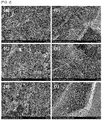
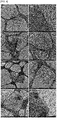
- Pristine graphite was partially oxidized in a mixed solution of sulfuric acid and nitric acid, and the basal plane and edge of graphite were partially oxidized to introduce an oxygen-functional group into graphite.
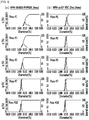
- a peak shift was observed at low angle at the initial peak position (26.35°) of BNB90 due to the introduced oxygen-functional group or acid ion intercalation, etc. and broadening of FWHM was also observed.
- the reaction temperature increased from 75°C ( FIGS. 1(c) and 1(d) ) to 90°C ( FIGS. 1 (e) and 1(f)
- the degree of partial oxidation increased and thereby more peak shift also occurred.
- the reaction time was shortened from 20 hours ( FIGS. 1 (e) and 1(f) ) to 3 hours ( FIGS. 1(g) and 1(h) )
- the degree of partial oxidation decreased and thereby less peak shift occurred.
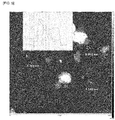
- the poGF-75-20-10 prepared in the above Example was diluted 5-fold, subjected to oxygen-plasma treatment, followed by spin-coating on Si wafer, and AFM was measured. The results were shown in FIG. 5 .
- the thicknesses of graphene measured at positions 1, 2 and 3 shown in FIG. 5 were measured to be 6.052 nm, 5.260 nm and 4.363 nm, respectively. From this, the overall thickness of graphene is expected to be about 5-10 nm.
- the oxygen-functional group mainly formed was an epoxide and a carboxyl group.
- the ratio of carbon atoms ((C2 + C3)/C1) produced by partial oxidation exhibited about six times higher than G-10, and as a result, an oxygen-functional group was effectively introduced due to the partial oxidation.
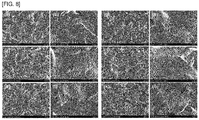
- the graphene particle size (lateral size) of each of poGF-75-20-1, poGF-75-20-3, poGF-75-20-5, poGF-75-20-7, poGF-75-20-10, GP-1, GP-3, GP-5, GP-7 and GP-10 prepared in the Example and Comparative Example was analyzed, and the results were shown in FIG 9 .
- peroxidized product graphene oxide prepared by the Hummer's method exhibits the characteristics of an insulator, and thus an additional thermal or chemical reduction process is required to impart an electrical conductivity.
- graphene exfoliated from the partially oxidized graphite as in the present invention could maintain a considerable part of the electrical conductivity, and as shown in Table 5 above, there was a difference depending on the degree of oxidation, but it exhibited generally low sheet resistance.
- the use of a dispersant is essential for producing a stable dispersion solution.
- the dispersant causes a contact resistance between graphenes to increase the sheet resistance of the graphene film. This could be confirmed from GP-10 shown in Table 5 above.
- graphene exfoliated from the partially oxidized graphite as in the present invention could produce a stable dispersion solution without using a dispersant, and therefore, the problem of contact resistance by the dispersant does not occur, thereby exhibiting low sheet resistance as shown in Table 5 above.
- each of poGF-85-20-10, poGF-95-20-10 and poGF-95-3-10 prepared in the Example was filtered under vacuum to recover graphene and dried at 55°C for 2 days.
- 1.0 g of each dried graphene was added to 3 mL of the solvent shown in Table 6, followed by bath sonication for 1 hour, and the degree of redispersion was observed by a naked eye.
- the criteria of judgment by a naked eye was determined through the residual amount of graphene not dispersed on the bottom after bath sonication, and the results were shown in FIG. 10 and Table 6 below.
- the dispersibility in various polar organic solvents was increased according to the degree of oxidation.
- the dispersibility was excellent in polar organic solvents such as water, NMP, DMF and DMSO.
- the dispersibility was excellent even in EtOH, IPA, acetone and THF.
Landscapes
- Chemical & Material Sciences (AREA)
- Organic Chemistry (AREA)
- Inorganic Chemistry (AREA)
- Engineering & Computer Science (AREA)
- Materials Engineering (AREA)
- Nanotechnology (AREA)
- Life Sciences & Earth Sciences (AREA)
- General Life Sciences & Earth Sciences (AREA)
- Geology (AREA)
- Carbon And Carbon Compounds (AREA)
Applications Claiming Priority (2)
| Application Number | Priority Date | Filing Date | Title |
|---|---|---|---|
| KR1020140179764A KR20160071939A (ko) | 2014-12-12 | 2014-12-12 | 부분 산화 그래핀 및 이의 제조 방법 |
| PCT/KR2015/013606 WO2016093663A1 (fr) | 2014-12-12 | 2015-12-11 | Graphène partiellement oxydé et son procédé de préparation |
Publications (2)
| Publication Number | Publication Date |
|---|---|
| EP3190084A1 true EP3190084A1 (fr) | 2017-07-12 |
| EP3190084A4 EP3190084A4 (fr) | 2017-12-13 |
Family
ID=56107758
Family Applications (1)
| Application Number | Title | Priority Date | Filing Date |
|---|---|---|---|
| EP15867284.0A Withdrawn EP3190084A4 (fr) | 2014-12-12 | 2015-12-11 | Graphène partiellement oxydé et son procédé de préparation |
Country Status (5)
| Country | Link |
|---|---|
| US (1) | US20170217775A1 (fr) |
| EP (1) | EP3190084A4 (fr) |
| KR (1) | KR20160071939A (fr) |
| CN (1) | CN107001047A (fr) |
| WO (1) | WO2016093663A1 (fr) |
Families Citing this family (17)
| Publication number | Priority date | Publication date | Assignee | Title |
|---|---|---|---|---|
| CN107879337B (zh) * | 2017-11-14 | 2023-12-26 | 常州第六元素材料科技股份有限公司 | 制备氧化石墨烯的方法及其设备 |
| CN107857257B (zh) * | 2017-11-23 | 2019-11-19 | 深圳市大族元亨光电股份有限公司 | 单层石墨烯分散液的制备方法 |
| CN111542953B (zh) * | 2018-01-26 | 2024-08-23 | 株式会社Lg新能源 | 导电剂、包括该导电剂的用于形成电极的浆料、电极和使用该电极制造的锂二次电池 |
| CN108628038B (zh) * | 2018-06-28 | 2021-02-26 | 京东方科技集团股份有限公司 | 发光晶体管及其发光方法、阵列基板和显示装置 |
| US12406992B2 (en) | 2018-10-08 | 2025-09-02 | Sicona Battery Technologies Pty Ltd | Dispersible edge functionalised graphene platelets |
| KR102123592B1 (ko) | 2018-10-11 | 2020-06-16 | 국방과학연구소 | Hemt 소자 및 이의 제조 방법 |
| GB2581355B (en) * | 2019-02-13 | 2022-11-30 | Altered Carbon Ltd | Aqueous ink comprising polyvinyl pyrrolidone and graphene material |
| ES3017700T3 (en) * | 2019-02-27 | 2025-05-13 | Fundacio Inst Catala De Nanociencia I Nanotecnologia Icn2 | Amorphous highly porous reduced graphene oxide film and its applications |
| WO2020229882A1 (fr) * | 2019-05-16 | 2020-11-19 | Arcelormittal | Méthode de fabrication d'oxyde de graphène réduit à partir de graphite kish expansé |
| KR102807739B1 (ko) * | 2019-11-01 | 2025-05-14 | 주식회사 엘지에너지솔루션 | 음극 활물질, 이의 제조방법, 이를 포함하는 음극 및 이차전지 |
| CN113845110A (zh) * | 2020-06-28 | 2021-12-28 | 东丽先端材料研究开发(中国)有限公司 | 防腐涂料用氧化石墨烯及其制备方法,和防腐涂料 |
| US12137546B2 (en) * | 2020-11-17 | 2024-11-05 | The Regents Of The University Of California | Electromagnetic and thermal shields with low-dimensional materials |
| KR20220125032A (ko) | 2021-03-04 | 2022-09-14 | 국방과학연구소 | Hemt 소자 및 이의 제조 방법 |
| CN114572969B (zh) * | 2022-02-11 | 2023-08-18 | 中国科学技术大学先进技术研究院 | 微流控反应系统及制备还原氧化石墨烯的方法 |
| CN114572977B (zh) * | 2022-02-11 | 2023-07-18 | 中国科学技术大学先进技术研究院 | 光谱监测制备氧化石墨烯的系统及方法 |
| CN115139578A (zh) * | 2022-06-08 | 2022-10-04 | 安徽宇航派蒙健康科技股份有限公司 | 石墨烯导热膜及其制备方法 |
| CN115057435B (zh) * | 2022-08-03 | 2023-07-21 | 山东海科创新研究院有限公司 | 一种循环利用浓硫酸制备氧化石墨烯的方法及其所得产品的应用 |
Family Cites Families (6)
| Publication number | Priority date | Publication date | Assignee | Title |
|---|---|---|---|---|
| US8216541B2 (en) * | 2008-09-03 | 2012-07-10 | Nanotek Instruments, Inc. | Process for producing dispersible and conductive nano graphene platelets from non-oxidized graphitic materials |
| US20110189452A1 (en) * | 2009-07-31 | 2011-08-04 | Vorbeck Materials Corp. | Crosslinked Graphene and Graphite Oxide |
| WO2012145911A1 (fr) * | 2011-04-28 | 2012-11-01 | 中国科学院宁波材料技术与工程研究所 | Procédé de préparation de graphène |
| US20130266501A1 (en) * | 2011-07-05 | 2013-10-10 | Rutgers, The State University Of New Jersey | Direct Production of Large and Highly Conductive Low-Oxygen Graphene Sheets and Monodispersed Low-Oxygen Graphene Nanosheets |
| KR101297423B1 (ko) * | 2011-11-30 | 2013-08-14 | 한국전기연구원 | 양이온-파이 상호작용에 의해 고농도 분산된 산화 그래핀 환원물 및 그 제조방법 |
| US20140079932A1 (en) * | 2012-09-04 | 2014-03-20 | The Trustees Of Princeton University | Nano-graphene and nano-graphene oxide |
-
2014
- 2014-12-12 KR KR1020140179764A patent/KR20160071939A/ko not_active Ceased
-
2015
- 2015-12-11 US US15/518,525 patent/US20170217775A1/en not_active Abandoned
- 2015-12-11 WO PCT/KR2015/013606 patent/WO2016093663A1/fr not_active Ceased
- 2015-12-11 CN CN201580061384.0A patent/CN107001047A/zh not_active Withdrawn
- 2015-12-11 EP EP15867284.0A patent/EP3190084A4/fr not_active Withdrawn
Also Published As
| Publication number | Publication date |
|---|---|
| CN107001047A (zh) | 2017-08-01 |
| EP3190084A4 (fr) | 2017-12-13 |
| US20170217775A1 (en) | 2017-08-03 |
| KR20160071939A (ko) | 2016-06-22 |
| WO2016093663A1 (fr) | 2016-06-16 |
Similar Documents
| Publication | Publication Date | Title |
|---|---|---|
| EP3190084A1 (fr) | Graphène partiellement oxydé et son procédé de préparation | |
| KR101666478B1 (ko) | 그래핀의 제조 방법과, 그래핀의 분산 조성물 | |
| EP3056469B1 (fr) | Procédé de production de graphène | |
| US10472242B2 (en) | Method for preparing graphene by using high speed homogenization pretreatment and high pressure homogenation | |
| KR102150818B1 (ko) | MXene 입자 재료, 슬러리, 이차 전지, 투명 전극, MXene 입자 재료의 제조 방법 | |
| EP2616392B1 (fr) | Procédé électrochimique pour la synthèse de graphène | |
| WO2015099457A1 (fr) | Procédé de production de graphène | |
| WO2015099378A1 (fr) | Procédé de production de graphène, et composition de dispersion de graphène | |
| KR102086764B1 (ko) | 그래핀의 제조 방법 | |
| KR101573241B1 (ko) | 3차원 그래핀 구조체 및 이를 이용한 전극 제조방법 | |
| KR102049575B1 (ko) | 폴리에틸렌옥사이드계 분산제를 사용하는 그래핀 제조 방법 | |
| KR20210128177A (ko) | 그래핀의 제조방법 | |
| KR20150095420A (ko) | 양친성 유기분자를 이용한 액상 그래핀 나노플레이트 제조방법 | |
| Zeng et al. | Homogeneous dispersion of high-conductive reduced graphene oxide sheets for polymethylmethacrylate nanocomposites | |
| KR20170067475A (ko) | 그래핀 분산액의 제조 방법 | |
| KR20170037461A (ko) | 그래핀 및 이의 제조 방법 | |
| KR20160131660A (ko) | 그래핀 제조 방법 | |
| CN117758102A (zh) | 一种基于石墨烯限域生长的制备高质量石墨烯-铜复合粉体及其高强高导复合材料的方法 |
Legal Events
| Date | Code | Title | Description |
|---|---|---|---|
| STAA | Information on the status of an ep patent application or granted ep patent |
Free format text: STATUS: THE INTERNATIONAL PUBLICATION HAS BEEN MADE |
|
| PUAI | Public reference made under article 153(3) epc to a published international application that has entered the european phase |
Free format text: ORIGINAL CODE: 0009012 |
|
| STAA | Information on the status of an ep patent application or granted ep patent |
Free format text: STATUS: REQUEST FOR EXAMINATION WAS MADE |
|
| 17P | Request for examination filed |
Effective date: 20170407 |
|
| AK | Designated contracting states |
Kind code of ref document: A1 Designated state(s): AL AT BE BG CH CY CZ DE DK EE ES FI FR GB GR HR HU IE IS IT LI LT LU LV MC MK MT NL NO PL PT RO RS SE SI SK SM TR |
|
| AX | Request for extension of the european patent |
Extension state: BA ME |
|
| A4 | Supplementary search report drawn up and despatched |
Effective date: 20171113 |
|
| RIC1 | Information provided on ipc code assigned before grant |
Ipc: B82Y 30/00 20110101ALI20171107BHEP Ipc: B82Y 40/00 20110101ALI20171107BHEP Ipc: C01B 32/192 20170101AFI20171107BHEP |
|
| STAA | Information on the status of an ep patent application or granted ep patent |
Free format text: STATUS: THE APPLICATION HAS BEEN WITHDRAWN |
|
| 18W | Application withdrawn |
Effective date: 20180212 |
|
| DAV | Request for validation of the european patent (deleted) | ||
| DAX | Request for extension of the european patent (deleted) |