EP3190482B1 - Elektronische vorrichtung, zeicheneingabemodul und verfahren zur auswahl von zeichen daraus - Google Patents
Elektronische vorrichtung, zeicheneingabemodul und verfahren zur auswahl von zeichen daraus Download PDFInfo
- Publication number
- EP3190482B1 EP3190482B1 EP16191121.9A EP16191121A EP3190482B1 EP 3190482 B1 EP3190482 B1 EP 3190482B1 EP 16191121 A EP16191121 A EP 16191121A EP 3190482 B1 EP3190482 B1 EP 3190482B1
- Authority
- EP
- European Patent Office
- Prior art keywords
- character
- key
- action
- user
- characters
- Prior art date
- Legal status (The legal status is an assumption and is not a legal conclusion. Google has not performed a legal analysis and makes no representation as to the accuracy of the status listed.)
- Active
Links
Images


Classifications
-
- G—PHYSICS
- G06—COMPUTING OR CALCULATING; COUNTING
- G06F—ELECTRIC DIGITAL DATA PROCESSING
- G06F3/00—Input arrangements for transferring data to be processed into a form capable of being handled by the computer; Output arrangements for transferring data from processing unit to output unit, e.g. interface arrangements
- G06F3/01—Input arrangements or combined input and output arrangements for interaction between user and computer
- G06F3/02—Input arrangements using manually operated switches, e.g. using keyboards or dials
- G06F3/023—Arrangements for converting discrete items of information into a coded form, e.g. arrangements for interpreting keyboard generated codes as alphanumeric codes, operand codes or instruction codes
- G06F3/0233—Character input methods
- G06F3/0234—Character input methods using switches operable in different directions
-
- G—PHYSICS
- G06—COMPUTING OR CALCULATING; COUNTING
- G06F—ELECTRIC DIGITAL DATA PROCESSING
- G06F3/00—Input arrangements for transferring data to be processed into a form capable of being handled by the computer; Output arrangements for transferring data from processing unit to output unit, e.g. interface arrangements
- G06F3/01—Input arrangements or combined input and output arrangements for interaction between user and computer
- G06F3/02—Input arrangements using manually operated switches, e.g. using keyboards or dials
- G06F3/023—Arrangements for converting discrete items of information into a coded form, e.g. arrangements for interpreting keyboard generated codes as alphanumeric codes, operand codes or instruction codes
- G06F3/0233—Character input methods
- G06F3/0237—Character input methods using prediction or retrieval techniques
-
- H—ELECTRICITY
- H04—ELECTRIC COMMUNICATION TECHNIQUE
- H04M—TELEPHONIC COMMUNICATION
- H04M2250/00—Details of telephonic subscriber devices
- H04M2250/70—Details of telephonic subscriber devices methods for entering alphabetical characters, e.g. multi-tap or dictionary disambiguation
Definitions
- the present invention relates to a character input or character selection method and a device implementing the method. More particularly, the invention relates to an electronic device having a character input interface, to a method for selecting characters, and to a character input module.
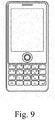
- a conventional mobile phone (as shown in Fig. 9 ), or other sorts of handheld devices such as PDA, is not allowed to be equipped with as many keys as possible due to size limitations. Therefore, using a single key to enter two or more categories of characters, e.g. Chinese ZhuYin characters (phonetic spelling of Chinese characters), numeric characters (numbers), Roman alphabetic characters (letters) or special symbols, is very common for such devices. Moreover, each character system contains two or more characters or symbols. As such, to switch among all the character input modes, e.g. number, ZhuYin and alphabetic input modes, the user needs to perform additional key-pressing operation for switching to another input mode or selecting desired characters.
- the user cannot enter a character of different category continuously with the same key when using a prior art device; rather, he or she is required to first select a different character input mode before pressing that key to input characters. Also, to select one out of many characters using a prior art device, the user needs to press the same key plural times before seeing the desired character show up on the display.
- the keys on which plural categories of characters are shown are generally of a quite small size. It is difficult for the user to see how many presses it takes for the desired character to show up.
- PCT patent publication no. WO2007/084078A1 discloses a portable device adapted keypad equipped with sensors or sensing structures for perceiving a finger's presence, which allows a single manual movement applied to a button to select any one of the characters overlaid on the button. Said button may be provided with four definite input options due to its tilt capability and sensor configuration. Also, PCT patent publication no.
- WO2007/057918 A1 discloses a hand-held device provided with specific keypad layout including an alphanumeric keypad having multiple quad keys and multiple dual keys as well as a navigation keypad having multiple dual keys and single-function keys, wherein each of said quad keys can be operated by manually pressing on any of the four corners whereby the electric contact below the corner can be activated.
- US patent publication no. US2007200828A1 discloses a keypad including several multi-portion keys each of which having two key-portions in one single key area corresponding to two inputs, and said multi-portion key is provided with pivot mechanism such that the key can be manually operated to selectively activate switches under the key in order to complete an electrical connection associated with the input.
- An electronic device of the present invention relates to an electronic device having a character input interface.
- the character input interface may be embodied in a physical keypad.
- Fig. 1 is a schematic view that shows operating an electronic device of the present invention.
- This exemplary embodiment illustrates a mobile phone with a physical keypad, which embodies a character input interface.
- the electronic device of the present invention is not limited to a mobile phone; it may be a personal digital assistant (PDA) or a portable computer, etc.
- the mobile phone 10 comprises a display unit 11 and a keypad 21.
- the keypad 21 has a plurality of keys, and each key has a plurality of characters marked thereon.
- the characters marked thereon include plural ones of the same category; the characters may also include single or plural ones of different categories.
- alphabetic characters and numeric character which belong to different categories, are marked on the key that the user's finger points to.
- the alphabetic characters include characters "T" and "Y", and the numeric character includes a character "2".
- the display unit 11 of the mobile phone 10 has a character selection area 13 and a character input area 14, as shown in Fig. 1 .
- the character selection area 13 is located near the bottom of the screen, and the character input area 14 displays the selected characters at the position where the cursor shows up.
- the plurality of characters marked on that key will be displayed on the character selection area 13 of the display unit 11.
- one of the displayed characters will be highlighted as a preselected character.
- signs or symbols indicating shifting directions are displayed among the plurality of characters on the character selection area 13, guiding the user to select a character according to the shifting direction.
- the key that the user's finger touches makes the characters "T” "Y” and "2", which are marked on that key, to be displayed on the character selection area 13.
- the displayed character "2" is highlighted by a block 16, indicating it is a preselected character; the left arrow indicates the direction to select the character "T”, and the right arrow indicates the direction to select the character "Y”.
- the arrangement of displayed characters and the preselected character can be determined according to the previously entered character. If a numeric character is entered through the previous key, then the numeric one among the characters associated with the present key will be highlighted as the preselected character. Similarly, if an alphabetic character is entered through the previous key, one of the alphabetic characters associated with the present key will be determined as the preselected character according to a predictive text input method. As shown in Fig. 1 , the arrangement of displayed characters may be "2 ⁇ ⁇ Y" or "T ⁇ ⁇ 2", according to the previously entered character or according to the input mode.
- a sensor unit 22 (see Fig. 5 ) is disposed beneath the keypad 21. Therefore, when the user's finger points to one of the keys on the keypad 21, the sensor unit 22 will sense an action on that key.
- the action may be embodied by different means, as will be further described below.
- the action is embodied by approaching a key with a finger, and as the sensor unit 22 confirms the action occurs, the character selection area 13 of the display unit 11 will display the characters marked on the approached key.
- the action is embodied by touching a key, which may be done by a finger or by a stylus like touch pen, and as the sensor unit 22 confirms the action occurs, the character selection area 13 of the display unit 11 will display the characters marked on the touched key.
- the user can perform a shifting motion according to the direction signs or symbols displayed on the character selection area 13, as shown in Fig. 2 .
- the character selection area 13 displays the plurality of characters associated with that key. Afterwards, when the finger shifts right, the character "Y" is selected and entered, and the character input area 14 of the display unit 11 will display the character "Y”. When the finger shifts left, the character "T” is selected and entered, and the character input area 14 of the display unit 11 will display the character "T”. When the finger shifts down, the character "2" is selected and entered, and the character input area 14 of the display unit 11 will display the character "2".
- the user may press or click the key directly with a finger, and the character "2" will be displayed on the character input area 14.
- the user may touch the key directly, and after the touch ends, the character "2" will be displayed on the character input area 14.
- each key of the keypad 21 has plural characters of different categories marked thereon.
- Fig. 3A there are numeric, ZhuYin and alphabetic characters marked on the key, wherein the numeric character includes a character “3”, the ZhuYin character includes plural characters “ ", “ “ and “ “”, and the alphabetic character includes plural characters “D”, "E” and “F”.
- the finger approaches or touches the key shown in Fig. 3A all the characters marked on the key, including “F”, “E”, “D”, “3”, “ “, “ “ and “”, will be displayed on the character selection area 13.
- the character "3" is determined as the preselected character; a left arrow and a right arrow are also displayed to indicate shifting directions.
- the user can perform a character selection process with the key as indicated in Fig. 3C .
- the character " " is selected; when the finger shifts right twice, the character " " is selected; when the finger shifts right three times, the character " " is selected; when the finger shifts left once, the character “D” is selected; when the finger shifts left twice, the character “E” is selected; when the finger shifts left three times, the character “F” is selected; and when the finger shifts down once, the character "3” is selected.
- the selected character will be entered and displayed on the character input area 14.
- the keypad 21 may be implemented and displayed on the display unit 11 as a virtual keypad, which has a touch screen that embodies the sensor unit.
- the character selection area 13 of the display unit 11 will display the corresponding characters. Then, the user can select one of the characters easily by shifting the finger or the stylus to a direction on the touch screen.
- an electronic device comprises a character input module 20, a control unit 12 and a display unit 11, wherein the character input module 20 comprises a keypad 21, a sensor unit 22 and a character output unit 23.
- the keypad 21 incudes a plurality of keys, each key having a plurality of characters marked thereon, as shown in Fig. 1 and Fig. 3A .
- the sensor unit 22 is configured for sensing an action on the key and the shifting direction of the action; then, in response to the shifting direction, the sensor unit 22 sends a first signal to the character output unit 23.
- the character output unit 23 analyzes the first signal and then outputs a corresponding code to the selected character to the control unit 12.
- the control unit 12 sends the corresponding code to the display unit 11 so that the selected character can be displayed on the character input area 14 of the display unit 11.
- the sensor unit 22 After the sensor unit 22 senses and confirms an action has occurred on a key, the sensor unit 22 generates a second signal and sends it to the character output unit 23.
- the character output unit 23 analyzes the second signal and then sends a corresponding key code to the control unit 12.
- the control unit 12 makes all of the characters associated with that key to be displayed on the character selection area 13 of the display unit 11, and determines a character to be the preselected character at the same time. Accordingly, the user performs a shifting motion according to the direction signs or symbols displayed on the character selection area 13. Then, the sensor unit 22 senses the shifting motion and sends the first signal to the character output unit 23.
- the character output unit 23 analyzes the first signal and sends a corresponding code of the selected character to the control unit 12.
- the character output unit 23 or the control unit 12 can determine an input mode or a preselected character for a following key according the selected character.
- the character output unit 23 may be embodied by an application-specific integrated circuit (ASIC).
- ASIC application-specific integrated circuit
- the signal analysis or other functionalities of the character output unit 23 may be implemented by the control unit 12, so that the circuits and components inside the electronic device are further integrated, which helps to reduce the cost and size of the device.
- the keypad 21 comprises a mode key (not shown) for selecting one of the character input modes; as a result, the key following the mode key operation will select one of the characters from the same category according to the selected input mode.
- a mode key (not shown) for selecting one of the character input modes; as a result, the key following the mode key operation will select one of the characters from the same category according to the selected input mode.
- a third signal is generated by the sensor unit 22 and sent to the character output unit 23.
- the character output unit 23 analyzes the third signal associated with the mode key and then sends its key code to the control unit 12. Based on the received key code, the control unit 12 makes the character selection area 13 of the display unit 11 display plural character input modes, such as ZhuYin, numeric and alphabetic input modes, and display shifting directions as well.
- the sensor unit 22 When the user performs a shifting motion according to the shifting directions shown on the character selection area 13, the sensor unit 22 then senses the shifting motion and sends a fourth signal to the character output unit 23.
- the character output unit 23 may analyze the fourth signal and then sends a corresponding code of the selected input mode to the control unit 12, so that it can further determine an input mode for the following key according to the selected input mode.
- the character output unit 23 may analyze the fourth signal to determine a selected input mode, based on which the character output unit 23 can further determine a character input mode for the following key.
- the sensor unit 22 may be embodied by a camera module.
- the camera module captures images from top of the keypad 21.
- the character output unit 23 then receives the images of operating the keypad 21 from the camera module.
- the character output unit 23 can send the key code of that key and the short code of the selected character to the control unit 12.
- the sensor unit 22 is disposed beneath the keypad 21.
- the keypad 21 includes a plurality of keys, and technically, the embodiment of the sensor unit 22 includes a direction sensing board 221 and a membrane circuit board 222, and the two boards 221 and 222 are electrically connected to the character output unit 23 respectively.
- the direction sensing board 221, disposed beneath the keypad 21, spreads throughout all of its keys to sense shifting motions occurring on any of the keys and sends a first signal to the character output unit 23.
- the direction sensing board 221 is embodied by a capacitive touch sensor. In other embodiments of the invention, however, the direction sensing board 221 spreading beneath the keypad 21 throughout all of its keys may be embodied by a resistive touch sensor, surface acoustic wave touch sensor, or infrared touch sensor.
- the membrane circuit board 222 of the sensor unit 22 comprises a plurality of metal dome switches 224, each of which corresponds to a key on the keypad 21. In response to a press on the key, the metal dome switches 224 enables the sensor unit 22 to send a signal to the character output unit 23.
- FIG. 6A a sectional view illustrating the combination of the keypad 21 and the sensor unit 22 in Fig. 5 is shown.
- Each key of the keypad 21 has a protruding post 24 configured underneath, which projects through a hole 25 on the direction sensing board 221; the hole 25 corresponds to the key of the keypad 21, as shown in Fig. 5 .
- the protruding post 24 connects against a metal dome switch 224 on the membrane circuit board 222. When the user presses or clicks the key, the corresponding metal dome switch 224 will enable electrical connection in response to the action, so that the character output unit 23 will recognize which key has been pressed.
- the direction sensing board 221 is preferably a capacitive touch sensor configured beneath the keypad 21; however, each key of the keypad 21 does not have a protruding post configured underneath, and the direction sensing board 221 does not contain any holes.
- a pad 223 disposed between the direction sensing board 221 and the membrane circuit board 222 is added.
- a protruding point 225 is formed on a surface of pad 223 that faces the membrane circuit board 222, the protruding point 225 corresponding to both a key and a metal dome switch 224 in position.
- the direction sensing board 221 When the user uses a finger to approach or touch a key, the direction sensing board 221 will sense the action of approaching or touching and then send a signal to the character output unit 23. Thus, the display unit 11 will display the plurality of characters associated with that key on the character selection area. When the user's finger performs a shifting motion on the key, the direction sensing board 221 will sense the shifting motion and send another signal to the character output unit 23. In consequence, one of the character which corresponds to the shifting motion will be highlighted by said block around it, meaning the desired character is selected.
- the corresponding protruding point 225 of the pad 223 will actuate the metal dome switch 224 to make electrical connection, which allows the character output unit 23 to recognize which key has been pressed. Accordingly, the selected character is entered and displayed on the character input area of the display unit 11.
- the user's finger presses the surface of one key first, which causes a corresponding metal dome switch 224 to make electrical connection and send a signal; in consequence, the display unit 11 will display the plurality of characters associated with that key on the character selection area. Then, the user's finger performs a shifting motion on the key; the direction sensing board 221 senses the shifting motion and sends another signal to the character output unit 23, causing a character which corresponds to the shifting motion shown on the display unit 11 to be selected with said block around it. Finally, the user's finger leaves the surface of the key (meaning the finger touch on the key has finished), and the selected character is entered and displayed on the character input area of the display unit 11.
- Fig. 7 is a flowchart showing the method steps of the present invention.
- the method includes steps 100 to 206.
- step 100 is determining an input mode for a following key
- steps 201 to 204 are basically operating a single key to select different characters from the same category - for example, selecting one of the ZhuYin characters in the ZhuYin input mode, or selecting one of the letters in the alphabetic input mode.
- steps 201 to 205 By repeating steps 201 to 205, a string of characters that belong to the same category can be input.
- step 206 may include completing the character string according to a predictive text input method and displaying a list of candidate characters.
- step 100 is determining a preselected character for a following key
- steps 201 to 204 are basically operating a single key to select different characters from different categories - for example, selecting a character among the ZhuYin characters, or selecting a letter among the alphabetic letters.
- steps 201 to 205 a string of characters that belong to different categories can be input.
- step 206 English letters or Chinese characters may be input by completing the character string according to a predictive text input method.
- Step 100 is determining an input mode or a preselected character for a following key.
- step 201 is continuously sensing an action on any key of the keypad; when the user points to a first key and the action is sensed and confirmed by the sensor unit, the process will move on to step 202.
- Step 202 is displaying the plurality of characters associated with the first key on the character selection area of the display unit 11.
- step 203 is further sensing the shifting motion of the action on the first key; after the shifting moion is confirmed, the process will move on to step 204.
- Step 204 is selecting one of the characters associated with the first key in response to the shifting motion of the action.
- Step 204 further comprises displaying the selected character on the character input area of the display unit.
- step 205 during which operating a single key is performed serially, an input mode or a preselected character for a following key is determined according to the previously selected character. Therefore, the time needed for operating a single key is reduced, and it would also require fewer numbers of mode-switching times.
- Fig. 8 is a flowchart showing the steps of determining a character input mode according to the method of the present invention.
- the keypad 21 comprises a mode key for switching among a plurality of character input modes.
- Steps 101 to 105 will be elaborated further below.
- Step 101 is continuously sensing an action on the mode key.
- Step 102 is displaying all the character input modes from which the user could select one on the character selection area of the display unit.
- Step 103 is further sensing and confirming a shifting motion of the action on the mode key.
- Step 104 is selecting one from the plurality of character input modes in response to the shifting motion of the action.
- step 105 is determining the character input mode, according to the selected input mode, for the key following the mode key operation.
Landscapes
- Engineering & Computer Science (AREA)
- General Engineering & Computer Science (AREA)
- Theoretical Computer Science (AREA)
- Human Computer Interaction (AREA)
- Physics & Mathematics (AREA)
- General Physics & Mathematics (AREA)
- Input From Keyboards Or The Like (AREA)
Claims (10)
- Verfahren zum Auswählen von Zeichen, das umfasst:Erfassen einer Benutzerannäherungshandlung oder einer Benutzerberührungshandlung an einer ersten Taste (201), wobei auf der ersten Taste ein erstes Zeichen, das zu einer ersten Kategorie gehört, und ein zweites Zeichen, das zu einer zweiten Kategorie gehört, markiert sind;Anzeigen des ersten Zeichens und des zweiten Zeichens auf einer Anzeigeeinheit (11) in Reaktion auf die Benutzerannäherungshandlung oder die Benutzerberührungshandlung (202), wobei das erste Zeichen als vorausgewählt hervorgehoben wird (16) und das zweite Zeichen nicht hervorgehoben wird; und dadurch gekennzeichnet, dass das Verfahren umfasst:Erfassen einer Fingerverschiebungsbewegung des Benutzers an der ersten Taste (203) nach der Benutzerannäherungshandlung oder der Benutzerberührungshandlung an der ersten Taste;Auswählen und Eingeben des zweiten Zeichens in Reaktion auf die Fingerverschiebungsbewegung des Benutzers (204), wenn die Fingerverschiebungsbewegung des Benutzers entlang einer Richtung, die dem zweiten Zeichen entspricht, stattfindet;Bestimmen eines dritten Zeichens als vorausgewählt in Reaktion auf eine andere Benutzerannäherungshandlung oder Benutzerberührungshandlung an einer zweiten Taste gemäß einem vorhersagenden Texteingabeverfahren, wenn das zweite Zeichen durch die erste Taste eingegeben wird, wobei das zweite Zeichen der ersten Taste und das dritte Zeichen der zweiten Taste zur zweiten Kategorie gehören, die von der ersten Kategorie verschieden ist, und das bestimmte dritte Zeichen als vorausgewählt angezeigt wird und danach über eine weitere Benutzerannäherungshandlung oder Benutzerberührungshandlung ausgewählt und eingegeben wird.
- Verfahren nach Anspruch 1, wobei das für die zweite Taste bestimmte dritte Zeichen hervorgehoben wird.
- Verfahren nach Anspruch 1, wobei die Kategorie eine Gruppe von alphabetischen Zeichen, Zahlen oder ZhuYin-Zeichen ist.
- Verfahren nach Anspruch 1, wobei das erste Zeichen eine Zahl ist, das zweite Zeichen und das dritte Zeichen alphabetische Zeichen sind.
- Verfahren nach Anspruch 1, wobei der Schritt des Anzeigens des ersten Zeichens und des zweiten Zeichens ferner umfasst:
Anzeigen mindestens eines Richtungssymbols, um eine Richtung zum Auswählen eines Zeichens anzugeben. - Verfahren nach Anspruch 1, wobei vor dem Schritt des Erfassens einer Benutzerannäherungshandlung oder einer Benutzerberührungshandlung an einer ersten Taste das Verfahren ferner umfasst:
Bestimmen eines Eingabemodus für die erste Taste (100). - Verfahren nach Anspruch 6, wobei der Schritt des Bestimmens eines Eingabemodus für die erste Taste ferner umfasst:Erfassen einer Handlung an einer vierten Taste, wobei die vierte Taste einer Vielzahl von Eingabemodi entspricht;Anzeigen der Vielzahl von Eingabemodi auf der Anzeigeeinheit in Reaktion auf die Handlung an der vierten Taste;Erfassen einer Verschiebungsbewegung der Handlung an der vierten Taste; undAuswählen von einem der Vielzahl von Eingabemodi, denen die vierte Taste entspricht, als Eingabemodus für die erste Taste in Reaktion auf die Verschiebungsbewegung der Handlung.
- Zeicheneingabemodul, das umfasst:ein Tastenfeld (21) mit mindestens zwei Tasten, wobei auf den Tasten eine Vielzahl von Zeichen markiert ist;eine Sensoreinheit (22), die unterhalb des Tastenfeldes (21) angeordnet ist, um eine Benutzerannäherungshandlung oder eine Benutzerberührungshandlung an der Taste zu erfassen und ein erstes Signal in Reaktion auf eine Fingerverschiebungsbewegung des Benutzers zu erzeugen; undeine Zeichenausgabeschaltung (23), die mit der Sensoreinheit (22) elektrisch verbunden ist, wobei die Zeichenausgabeschaltung (23) einen Code, der einem der Vielzahl von Zeichen entspricht, gemäß dem ersten Signal ausgibt;wobei das Zeicheneingabemodul dazu ausgelegt ist, das Verfahren zum Auswählen von Zeichen nach Anspruch 1 zu implementieren.
- Modul nach Anspruch 8, wobei die Sensoreinheit (22) ferner umfasst:
eine Leiterplatte (222) mit einem Schalter für jede Taste, wobei jeder Schalter auf einen Druck auf seine entsprechende Taste durch Erzeugen eines zweiten Signals reagiert. - Modul nach Anspruch 9, wobei die Zeichenausgabeschaltung (23) den Code, der einem der Vielzahl von Zeichen entspricht, gemäß dem ersten und dem zweiten Signal ausgibt.
Applications Claiming Priority (2)
| Application Number | Priority Date | Filing Date | Title |
|---|---|---|---|
| TW096150471A TWI390427B (zh) | 2007-12-27 | 2007-12-27 | Electronic device, symbol input module and its symbol selection method |
| EP08172975A EP2079005A3 (de) | 2007-12-27 | 2008-12-29 | Elektronische Vorrichtung, Zeicheneingabemodul und Verfahren zur Auswahl von Zeichen daraus |
Related Parent Applications (1)
| Application Number | Title | Priority Date | Filing Date |
|---|---|---|---|
| EP08172975A Division EP2079005A3 (de) | 2007-12-27 | 2008-12-29 | Elektronische Vorrichtung, Zeicheneingabemodul und Verfahren zur Auswahl von Zeichen daraus |
Publications (2)
| Publication Number | Publication Date |
|---|---|
| EP3190482A1 EP3190482A1 (de) | 2017-07-12 |
| EP3190482B1 true EP3190482B1 (de) | 2020-07-22 |
Family
ID=40546104
Family Applications (2)
| Application Number | Title | Priority Date | Filing Date |
|---|---|---|---|
| EP16191121.9A Active EP3190482B1 (de) | 2007-12-27 | 2008-12-29 | Elektronische vorrichtung, zeicheneingabemodul und verfahren zur auswahl von zeichen daraus |
| EP08172975A Withdrawn EP2079005A3 (de) | 2007-12-27 | 2008-12-29 | Elektronische Vorrichtung, Zeicheneingabemodul und Verfahren zur Auswahl von Zeichen daraus |
Family Applications After (1)
| Application Number | Title | Priority Date | Filing Date |
|---|---|---|---|
| EP08172975A Withdrawn EP2079005A3 (de) | 2007-12-27 | 2008-12-29 | Elektronische Vorrichtung, Zeicheneingabemodul und Verfahren zur Auswahl von Zeichen daraus |
Country Status (3)
| Country | Link |
|---|---|
| US (1) | US8253690B2 (de) |
| EP (2) | EP3190482B1 (de) |
| TW (1) | TWI390427B (de) |
Families Citing this family (12)
| Publication number | Priority date | Publication date | Assignee | Title |
|---|---|---|---|---|
| US9780781B2 (en) * | 2010-09-28 | 2017-10-03 | Blackberry Limited | Multi-action capacitive switch and methods of use |
| KR20120033918A (ko) * | 2010-09-30 | 2012-04-09 | 삼성전자주식회사 | 터치스크린을 구비한 휴대용 단말기의 입력 방법 및 장치 |
| EP2672372B1 (de) * | 2011-04-11 | 2018-05-30 | Huawei Device (Dongguan) Co., Ltd. | Informationsverarbeitungsverfahren und endgerät |
| JP2012248061A (ja) * | 2011-05-30 | 2012-12-13 | Ntt Docomo Inc | 情報処理装置、キー入力方法及びプログラム |
| US8922490B2 (en) * | 2011-06-03 | 2014-12-30 | Apple Inc. | Device, method, and graphical user interface for entering alternate characters with a physical keyboard |
| US20130106699A1 (en) * | 2011-10-26 | 2013-05-02 | Research In Motion Limited | Portable electronic device and method of character entry |
| CN103164412B (zh) | 2011-12-09 | 2017-10-13 | 阿里巴巴集团控股有限公司 | 通过图形编码访问网络信息的方法、客户端装置及服务器 |
| USD684556S1 (en) * | 2012-11-30 | 2013-06-18 | Research In Motion Limited | Handheld electronic device |
| TWI603255B (zh) * | 2014-05-05 | 2017-10-21 | 志勇無限創意有限公司 | 手持裝置及其輸入方法 |
| US9563358B2 (en) * | 2014-06-30 | 2017-02-07 | Blackberry Limited | Electronic device and method for rendering secondary characters |
| US9612664B2 (en) | 2014-12-01 | 2017-04-04 | Logitech Europe S.A. | Keyboard with touch sensitive element |
| KR20160143029A (ko) * | 2015-06-04 | 2016-12-14 | 엘지전자 주식회사 | 이동 단말기 |
Family Cites Families (15)
| Publication number | Priority date | Publication date | Assignee | Title |
|---|---|---|---|---|
| JPH0887367A (ja) * | 1994-07-20 | 1996-04-02 | Fujitsu Ltd | キーコード出力装置及びキーボード |
| US6882869B1 (en) * | 2000-12-19 | 2005-04-19 | Cisco Technology, Inc. | Device, methods, and user interface for providing optimized entry of alphanumeric text |
| JP4084582B2 (ja) * | 2001-04-27 | 2008-04-30 | 俊司 加藤 | タッチ式キー入力装置 |
| GB0112870D0 (en) | 2001-05-25 | 2001-07-18 | Koninkl Philips Electronics Nv | Text entry method and device therefore |
| KR20030073477A (ko) * | 2002-03-11 | 2003-09-19 | 엘지전자 주식회사 | 문자 입력장치 및 방법 |
| WO2003107165A1 (en) * | 2002-06-12 | 2003-12-24 | Nokia Corporation | Mobile communication device having a keyboard including a keypad |
| KR100630048B1 (ko) * | 2002-11-14 | 2006-09-27 | 삼성전자주식회사 | 이동 단말기의 문자 입력 장치 및 방법 |
| JP4459725B2 (ja) | 2003-07-08 | 2010-04-28 | 株式会社エヌ・ティ・ティ・ドコモ | 入力キー及び入力装置 |
| US7320111B2 (en) * | 2004-12-01 | 2008-01-15 | Oded Volovitz | Method for assigning large sets of characters in different modes to keys of a number keypad for low keypress-data-entry ratio |
| TWI271645B (en) | 2005-04-19 | 2007-01-21 | Elan Microelectronics Corp | Capacitive touchpad with a physical key function |
| US20090179780A1 (en) * | 2005-09-09 | 2009-07-16 | Mohan Tambe | Hand-held thumb touch typable ascii/unicode keypad for a remote, mobile telephone or a pda |
| TWI292858B (en) | 2005-09-13 | 2008-01-21 | Asustek Comp Inc | Electronic peripheral device |
| JPWO2007043222A1 (ja) * | 2005-10-07 | 2009-04-16 | パナソニック株式会社 | 入力装置及びそれを備えた携帯端末 |
| US20070200828A1 (en) * | 2006-02-27 | 2007-08-30 | Peter Skillman | Small form-factor key design for keypads of mobile computing devices |
| WO2007084078A1 (en) * | 2006-04-22 | 2007-07-26 | Simlab Inventions & Consultancy Private Limited | A keyboard for a mobile phone or other portable communication devices |
-
2007
- 2007-12-27 TW TW096150471A patent/TWI390427B/zh active
-
2008
- 2008-12-29 EP EP16191121.9A patent/EP3190482B1/de active Active
- 2008-12-29 EP EP08172975A patent/EP2079005A3/de not_active Withdrawn
- 2008-12-29 US US12/318,368 patent/US8253690B2/en active Active
Non-Patent Citations (1)
| Title |
|---|
| None * |
Also Published As
| Publication number | Publication date |
|---|---|
| US8253690B2 (en) | 2012-08-28 |
| EP3190482A1 (de) | 2017-07-12 |
| EP2079005A3 (de) | 2010-01-06 |
| TW200928873A (en) | 2009-07-01 |
| EP2079005A2 (de) | 2009-07-15 |
| TWI390427B (zh) | 2013-03-21 |
| US20090179860A1 (en) | 2009-07-16 |
Similar Documents
| Publication | Publication Date | Title |
|---|---|---|
| EP3190482B1 (de) | Elektronische vorrichtung, zeicheneingabemodul und verfahren zur auswahl von zeichen daraus | |
| Rekimoto et al. | PreSense: interaction techniques for finger sensing input devices | |
| JP3630153B2 (ja) | 情報表示入力装置及び情報表示入力方法、並びに情報処理装置 | |
| US7336263B2 (en) | Method and apparatus for integrating a wide keyboard in a small device | |
| US8351992B2 (en) | Portable electronic apparatus, and a method of controlling a user interface thereof | |
| TWI420889B (zh) | 符號輸入用電子裝置與方法 | |
| EP2112586A1 (de) | Verfahren zur Bedienung einer Benutzeroberfläche und computerlesbares Medium und tragbare Vorrichtung | |
| JP2005317041A (ja) | 情報処理装置、情報処理方法、及びプログラム | |
| JP2004355606A (ja) | 情報処理装置、情報処理方法、及びプログラム | |
| CN102163120A (zh) | 图标的突出选择提示 | |
| KR20070091531A (ko) | 이동 핸드셋에서의 네비게이션 방법 및 그 이동 핸드셋 | |
| EP1832958A2 (de) | Berührungsempfindliches Bilddurchlaufsystem und -verfahren | |
| KR101284771B1 (ko) | 휴대용 단말기에서 문자 입력을 위한 장치 및 방법 | |
| US7060924B1 (en) | Dual tactility keypad switch | |
| JP2004220536A (ja) | 情報処理装置の入力装置 | |
| US20100234074A1 (en) | Keypad emulation | |
| KR101744124B1 (ko) | 문자 출력 영역에서 입력과 출력의 듀얼 기능을 하는 문자 인식 장치 및 그 방법 | |
| US20060248457A1 (en) | Input device | |
| JP4907296B2 (ja) | 入力装置 | |
| RU84658U1 (ru) | Система ввода матричной клавиатуры (варианты) | |
| JP2016218890A (ja) | 電子機器および入力方法 | |
| KR20100046376A (ko) | 터치스크린을 이용한 한글 입력 장치 및 한글 입력 방법 | |
| CN101587418A (zh) | 使用者界面的操作方法、电脑可读取媒体以及可携式装置 | |
| JP2010072678A (ja) | 入力装置 | |
| JP2009205344A (ja) | 情報入力装置 |
Legal Events
| Date | Code | Title | Description |
|---|---|---|---|
| PUAI | Public reference made under article 153(3) epc to a published international application that has entered the european phase |
Free format text: ORIGINAL CODE: 0009012 |
|
| STAA | Information on the status of an ep patent application or granted ep patent |
Free format text: STATUS: THE APPLICATION HAS BEEN PUBLISHED |
|
| AC | Divisional application: reference to earlier application |
Ref document number: 2079005 Country of ref document: EP Kind code of ref document: P |
|
| AK | Designated contracting states |
Kind code of ref document: A1 Designated state(s): AT BE BG CH CY CZ DE DK EE ES FI FR GB GR HR HU IE IS IT LI LT LU LV MC MT NL NO PL PT RO SE SI SK TR |
|
| AX | Request for extension of the european patent |
Extension state: AL BA MK RS |
|
| STAA | Information on the status of an ep patent application or granted ep patent |
Free format text: STATUS: REQUEST FOR EXAMINATION WAS MADE |
|
| 17P | Request for examination filed |
Effective date: 20180112 |
|
| RBV | Designated contracting states (corrected) |
Designated state(s): AT BE BG CH CY CZ DE DK EE ES FI FR GB GR HR HU IE IS IT LI LT LU LV MC MT NL NO PL PT RO SE SI SK TR |
|
| RBV | Designated contracting states (corrected) |
Designated state(s): AT BE BG CH CY CZ DE DK EE ES FI FR GB GR HR HU IE IS IT LI LT LU LV MC MT NL NO PL PT RO SE SI SK TR |
|
| STAA | Information on the status of an ep patent application or granted ep patent |
Free format text: STATUS: EXAMINATION IS IN PROGRESS |
|
| 17Q | First examination report despatched |
Effective date: 20180416 |
|
| GRAP | Despatch of communication of intention to grant a patent |
Free format text: ORIGINAL CODE: EPIDOSNIGR1 |
|
| STAA | Information on the status of an ep patent application or granted ep patent |
Free format text: STATUS: GRANT OF PATENT IS INTENDED |
|
| INTG | Intention to grant announced |
Effective date: 20200311 |
|
| GRAS | Grant fee paid |
Free format text: ORIGINAL CODE: EPIDOSNIGR3 |
|
| GRAA | (expected) grant |
Free format text: ORIGINAL CODE: 0009210 |
|
| STAA | Information on the status of an ep patent application or granted ep patent |
Free format text: STATUS: THE PATENT HAS BEEN GRANTED |
|
| AC | Divisional application: reference to earlier application |
Ref document number: 2079005 Country of ref document: EP Kind code of ref document: P |
|
| AK | Designated contracting states |
Kind code of ref document: B1 Designated state(s): AT BE BG CH CY CZ DE DK EE ES FI FR GB GR HR HU IE IS IT LI LT LU LV MC MT NL NO PL PT RO SE SI SK TR |
|
| REG | Reference to a national code |
Ref country code: GB Ref legal event code: FG4D |
|
| REG | Reference to a national code |
Ref country code: CH Ref legal event code: EP |
|
| REG | Reference to a national code |
Ref country code: DE Ref legal event code: R096 Ref document number: 602008063042 Country of ref document: DE |
|
| REG | Reference to a national code |
Ref country code: AT Ref legal event code: REF Ref document number: 1294021 Country of ref document: AT Kind code of ref document: T Effective date: 20200815 |
|
| REG | Reference to a national code |
Ref country code: IE Ref legal event code: FG4D |
|
| REG | Reference to a national code |
Ref country code: NL Ref legal event code: FP |
|
| REG | Reference to a national code |
Ref country code: LT Ref legal event code: MG4D |
|
| REG | Reference to a national code |
Ref country code: AT Ref legal event code: MK05 Ref document number: 1294021 Country of ref document: AT Kind code of ref document: T Effective date: 20200722 |
|
| PG25 | Lapsed in a contracting state [announced via postgrant information from national office to epo] |
Ref country code: NO Free format text: LAPSE BECAUSE OF FAILURE TO SUBMIT A TRANSLATION OF THE DESCRIPTION OR TO PAY THE FEE WITHIN THE PRESCRIBED TIME-LIMIT Effective date: 20201022 Ref country code: FI Free format text: LAPSE BECAUSE OF FAILURE TO SUBMIT A TRANSLATION OF THE DESCRIPTION OR TO PAY THE FEE WITHIN THE PRESCRIBED TIME-LIMIT Effective date: 20200722 Ref country code: HR Free format text: LAPSE BECAUSE OF FAILURE TO SUBMIT A TRANSLATION OF THE DESCRIPTION OR TO PAY THE FEE WITHIN THE PRESCRIBED TIME-LIMIT Effective date: 20200722 Ref country code: ES Free format text: LAPSE BECAUSE OF FAILURE TO SUBMIT A TRANSLATION OF THE DESCRIPTION OR TO PAY THE FEE WITHIN THE PRESCRIBED TIME-LIMIT Effective date: 20200722 Ref country code: LT Free format text: LAPSE BECAUSE OF FAILURE TO SUBMIT A TRANSLATION OF THE DESCRIPTION OR TO PAY THE FEE WITHIN THE PRESCRIBED TIME-LIMIT Effective date: 20200722 Ref country code: PT Free format text: LAPSE BECAUSE OF FAILURE TO SUBMIT A TRANSLATION OF THE DESCRIPTION OR TO PAY THE FEE WITHIN THE PRESCRIBED TIME-LIMIT Effective date: 20201123 Ref country code: AT Free format text: LAPSE BECAUSE OF FAILURE TO SUBMIT A TRANSLATION OF THE DESCRIPTION OR TO PAY THE FEE WITHIN THE PRESCRIBED TIME-LIMIT Effective date: 20200722 Ref country code: GR Free format text: LAPSE BECAUSE OF FAILURE TO SUBMIT A TRANSLATION OF THE DESCRIPTION OR TO PAY THE FEE WITHIN THE PRESCRIBED TIME-LIMIT Effective date: 20201023 Ref country code: SE Free format text: LAPSE BECAUSE OF FAILURE TO SUBMIT A TRANSLATION OF THE DESCRIPTION OR TO PAY THE FEE WITHIN THE PRESCRIBED TIME-LIMIT Effective date: 20200722 Ref country code: BG Free format text: LAPSE BECAUSE OF FAILURE TO SUBMIT A TRANSLATION OF THE DESCRIPTION OR TO PAY THE FEE WITHIN THE PRESCRIBED TIME-LIMIT Effective date: 20201022 |
|
| PG25 | Lapsed in a contracting state [announced via postgrant information from national office to epo] |
Ref country code: IS Free format text: LAPSE BECAUSE OF FAILURE TO SUBMIT A TRANSLATION OF THE DESCRIPTION OR TO PAY THE FEE WITHIN THE PRESCRIBED TIME-LIMIT Effective date: 20201122 Ref country code: PL Free format text: LAPSE BECAUSE OF FAILURE TO SUBMIT A TRANSLATION OF THE DESCRIPTION OR TO PAY THE FEE WITHIN THE PRESCRIBED TIME-LIMIT Effective date: 20200722 Ref country code: LV Free format text: LAPSE BECAUSE OF FAILURE TO SUBMIT A TRANSLATION OF THE DESCRIPTION OR TO PAY THE FEE WITHIN THE PRESCRIBED TIME-LIMIT Effective date: 20200722 |
|
| REG | Reference to a national code |
Ref country code: DE Ref legal event code: R097 Ref document number: 602008063042 Country of ref document: DE |
|
| PG25 | Lapsed in a contracting state [announced via postgrant information from national office to epo] |
Ref country code: IT Free format text: LAPSE BECAUSE OF FAILURE TO SUBMIT A TRANSLATION OF THE DESCRIPTION OR TO PAY THE FEE WITHIN THE PRESCRIBED TIME-LIMIT Effective date: 20200722 Ref country code: EE Free format text: LAPSE BECAUSE OF FAILURE TO SUBMIT A TRANSLATION OF THE DESCRIPTION OR TO PAY THE FEE WITHIN THE PRESCRIBED TIME-LIMIT Effective date: 20200722 Ref country code: RO Free format text: LAPSE BECAUSE OF FAILURE TO SUBMIT A TRANSLATION OF THE DESCRIPTION OR TO PAY THE FEE WITHIN THE PRESCRIBED TIME-LIMIT Effective date: 20200722 Ref country code: DK Free format text: LAPSE BECAUSE OF FAILURE TO SUBMIT A TRANSLATION OF THE DESCRIPTION OR TO PAY THE FEE WITHIN THE PRESCRIBED TIME-LIMIT Effective date: 20200722 Ref country code: CZ Free format text: LAPSE BECAUSE OF FAILURE TO SUBMIT A TRANSLATION OF THE DESCRIPTION OR TO PAY THE FEE WITHIN THE PRESCRIBED TIME-LIMIT Effective date: 20200722 |
|
| PLBE | No opposition filed within time limit |
Free format text: ORIGINAL CODE: 0009261 |
|
| STAA | Information on the status of an ep patent application or granted ep patent |
Free format text: STATUS: NO OPPOSITION FILED WITHIN TIME LIMIT |
|
| 26N | No opposition filed |
Effective date: 20210423 |
|
| PG25 | Lapsed in a contracting state [announced via postgrant information from national office to epo] |
Ref country code: SK Free format text: LAPSE BECAUSE OF FAILURE TO SUBMIT A TRANSLATION OF THE DESCRIPTION OR TO PAY THE FEE WITHIN THE PRESCRIBED TIME-LIMIT Effective date: 20200722 |
|
| REG | Reference to a national code |
Ref country code: CH Ref legal event code: PL |
|
| PG25 | Lapsed in a contracting state [announced via postgrant information from national office to epo] |
Ref country code: SI Free format text: LAPSE BECAUSE OF FAILURE TO SUBMIT A TRANSLATION OF THE DESCRIPTION OR TO PAY THE FEE WITHIN THE PRESCRIBED TIME-LIMIT Effective date: 20200722 Ref country code: MC Free format text: LAPSE BECAUSE OF FAILURE TO SUBMIT A TRANSLATION OF THE DESCRIPTION OR TO PAY THE FEE WITHIN THE PRESCRIBED TIME-LIMIT Effective date: 20200722 |
|
| REG | Reference to a national code |
Ref country code: BE Ref legal event code: MM Effective date: 20201231 |
|
| PG25 | Lapsed in a contracting state [announced via postgrant information from national office to epo] |
Ref country code: IE Free format text: LAPSE BECAUSE OF NON-PAYMENT OF DUE FEES Effective date: 20201229 Ref country code: LU Free format text: LAPSE BECAUSE OF NON-PAYMENT OF DUE FEES Effective date: 20201229 |
|
| PG25 | Lapsed in a contracting state [announced via postgrant information from national office to epo] |
Ref country code: LI Free format text: LAPSE BECAUSE OF NON-PAYMENT OF DUE FEES Effective date: 20201231 Ref country code: CH Free format text: LAPSE BECAUSE OF NON-PAYMENT OF DUE FEES Effective date: 20201231 |
|
| PG25 | Lapsed in a contracting state [announced via postgrant information from national office to epo] |
Ref country code: TR Free format text: LAPSE BECAUSE OF FAILURE TO SUBMIT A TRANSLATION OF THE DESCRIPTION OR TO PAY THE FEE WITHIN THE PRESCRIBED TIME-LIMIT Effective date: 20200722 Ref country code: MT Free format text: LAPSE BECAUSE OF FAILURE TO SUBMIT A TRANSLATION OF THE DESCRIPTION OR TO PAY THE FEE WITHIN THE PRESCRIBED TIME-LIMIT Effective date: 20200722 Ref country code: CY Free format text: LAPSE BECAUSE OF FAILURE TO SUBMIT A TRANSLATION OF THE DESCRIPTION OR TO PAY THE FEE WITHIN THE PRESCRIBED TIME-LIMIT Effective date: 20200722 |
|
| PG25 | Lapsed in a contracting state [announced via postgrant information from national office to epo] |
Ref country code: BE Free format text: LAPSE BECAUSE OF NON-PAYMENT OF DUE FEES Effective date: 20201231 |
|
| P01 | Opt-out of the competence of the unified patent court (upc) registered |
Effective date: 20230602 |
|
| PGFP | Annual fee paid to national office [announced via postgrant information from national office to epo] |
Ref country code: NL Payment date: 20251112 Year of fee payment: 18 |
|
| PGFP | Annual fee paid to national office [announced via postgrant information from national office to epo] |
Ref country code: DE Payment date: 20251104 Year of fee payment: 18 |
|
| PGFP | Annual fee paid to national office [announced via postgrant information from national office to epo] |
Ref country code: GB Payment date: 20251114 Year of fee payment: 18 |
|
| PGFP | Annual fee paid to national office [announced via postgrant information from national office to epo] |
Ref country code: FR Payment date: 20251117 Year of fee payment: 18 |