EP3200916B1 - Catalyseur d'hydroisomérisation fabriqué au moyen de supports à base d'alumine présentant un volume élevé de nanopores et procédé d'hydroisomérisation - Google Patents
Catalyseur d'hydroisomérisation fabriqué au moyen de supports à base d'alumine présentant un volume élevé de nanopores et procédé d'hydroisomérisation Download PDFInfo
- Publication number
- EP3200916B1 EP3200916B1 EP15774832.8A EP15774832A EP3200916B1 EP 3200916 B1 EP3200916 B1 EP 3200916B1 EP 15774832 A EP15774832 A EP 15774832A EP 3200916 B1 EP3200916 B1 EP 3200916B1
- Authority
- EP
- European Patent Office
- Prior art keywords
- hydroisomerization
- catalyst
- alumina
- volume
- range
- Prior art date
- Legal status (The legal status is an assumption and is not a legal conclusion. Google has not performed a legal analysis and makes no representation as to the accuracy of the status listed.)
- Active
Links
Images



Classifications
-
- B—PERFORMING OPERATIONS; TRANSPORTING
- B01—PHYSICAL OR CHEMICAL PROCESSES OR APPARATUS IN GENERAL
- B01J—CHEMICAL OR PHYSICAL PROCESSES, e.g. CATALYSIS OR COLLOID CHEMISTRY; THEIR RELEVANT APPARATUS
- B01J35/00—Catalysts, in general, characterised by their form or physical properties
- B01J35/60—Catalysts, in general, characterised by their form or physical properties characterised by their surface properties or porosity
- B01J35/66—Pore distribution
-
- B—PERFORMING OPERATIONS; TRANSPORTING
- B01—PHYSICAL OR CHEMICAL PROCESSES OR APPARATUS IN GENERAL
- B01J—CHEMICAL OR PHYSICAL PROCESSES, e.g. CATALYSIS OR COLLOID CHEMISTRY; THEIR RELEVANT APPARATUS
- B01J21/00—Catalysts comprising the elements, oxides, or hydroxides of magnesium, boron, aluminium, carbon, silicon, titanium, zirconium, or hafnium
- B01J21/02—Boron or aluminium; Oxides or hydroxides thereof
- B01J21/04—Alumina
-
- B—PERFORMING OPERATIONS; TRANSPORTING
- B01—PHYSICAL OR CHEMICAL PROCESSES OR APPARATUS IN GENERAL
- B01J—CHEMICAL OR PHYSICAL PROCESSES, e.g. CATALYSIS OR COLLOID CHEMISTRY; THEIR RELEVANT APPARATUS
- B01J29/00—Catalysts comprising molecular sieves
-
- B—PERFORMING OPERATIONS; TRANSPORTING
- B01—PHYSICAL OR CHEMICAL PROCESSES OR APPARATUS IN GENERAL
- B01J—CHEMICAL OR PHYSICAL PROCESSES, e.g. CATALYSIS OR COLLOID CHEMISTRY; THEIR RELEVANT APPARATUS
- B01J29/00—Catalysts comprising molecular sieves
- B01J29/04—Catalysts comprising molecular sieves having base-exchange properties, e.g. crystalline zeolites
- B01J29/06—Crystalline aluminosilicate zeolites; Isomorphous compounds thereof
- B01J29/70—Crystalline aluminosilicate zeolites; Isomorphous compounds thereof of types characterised by their specific structure not provided for in groups B01J29/08 - B01J29/65
- B01J29/72—Crystalline aluminosilicate zeolites; Isomorphous compounds thereof of types characterised by their specific structure not provided for in groups B01J29/08 - B01J29/65 containing iron group metals, noble metals or copper
- B01J29/74—Noble metals
-
- B—PERFORMING OPERATIONS; TRANSPORTING
- B01—PHYSICAL OR CHEMICAL PROCESSES OR APPARATUS IN GENERAL
- B01J—CHEMICAL OR PHYSICAL PROCESSES, e.g. CATALYSIS OR COLLOID CHEMISTRY; THEIR RELEVANT APPARATUS
- B01J29/00—Catalysts comprising molecular sieves
- B01J29/04—Catalysts comprising molecular sieves having base-exchange properties, e.g. crystalline zeolites
- B01J29/06—Crystalline aluminosilicate zeolites; Isomorphous compounds thereof
- B01J29/70—Crystalline aluminosilicate zeolites; Isomorphous compounds thereof of types characterised by their specific structure not provided for in groups B01J29/08 - B01J29/65
- B01J29/72—Crystalline aluminosilicate zeolites; Isomorphous compounds thereof of types characterised by their specific structure not provided for in groups B01J29/08 - B01J29/65 containing iron group metals, noble metals or copper
- B01J29/74—Noble metals
- B01J29/7461—MRE-type, e.g. ZSM-48
-
- B—PERFORMING OPERATIONS; TRANSPORTING
- B01—PHYSICAL OR CHEMICAL PROCESSES OR APPARATUS IN GENERAL
- B01J—CHEMICAL OR PHYSICAL PROCESSES, e.g. CATALYSIS OR COLLOID CHEMISTRY; THEIR RELEVANT APPARATUS
- B01J29/00—Catalysts comprising molecular sieves
- B01J29/04—Catalysts comprising molecular sieves having base-exchange properties, e.g. crystalline zeolites
- B01J29/06—Crystalline aluminosilicate zeolites; Isomorphous compounds thereof
- B01J29/70—Crystalline aluminosilicate zeolites; Isomorphous compounds thereof of types characterised by their specific structure not provided for in groups B01J29/08 - B01J29/65
- B01J29/72—Crystalline aluminosilicate zeolites; Isomorphous compounds thereof of types characterised by their specific structure not provided for in groups B01J29/08 - B01J29/65 containing iron group metals, noble metals or copper
- B01J29/74—Noble metals
- B01J29/7492—MTT-type, e.g. ZSM-23, KZ-1, ISI-4 or EU-13
-
- B—PERFORMING OPERATIONS; TRANSPORTING
- B01—PHYSICAL OR CHEMICAL PROCESSES OR APPARATUS IN GENERAL
- B01J—CHEMICAL OR PHYSICAL PROCESSES, e.g. CATALYSIS OR COLLOID CHEMISTRY; THEIR RELEVANT APPARATUS
- B01J35/00—Catalysts, in general, characterised by their form or physical properties
-
- B—PERFORMING OPERATIONS; TRANSPORTING
- B01—PHYSICAL OR CHEMICAL PROCESSES OR APPARATUS IN GENERAL
- B01J—CHEMICAL OR PHYSICAL PROCESSES, e.g. CATALYSIS OR COLLOID CHEMISTRY; THEIR RELEVANT APPARATUS
- B01J35/00—Catalysts, in general, characterised by their form or physical properties
- B01J35/30—Catalysts, in general, characterised by their form or physical properties characterised by their physical properties
- B01J35/31—Density
-
- B—PERFORMING OPERATIONS; TRANSPORTING
- B01—PHYSICAL OR CHEMICAL PROCESSES OR APPARATUS IN GENERAL
- B01J—CHEMICAL OR PHYSICAL PROCESSES, e.g. CATALYSIS OR COLLOID CHEMISTRY; THEIR RELEVANT APPARATUS
- B01J35/00—Catalysts, in general, characterised by their form or physical properties
- B01J35/60—Catalysts, in general, characterised by their form or physical properties characterised by their surface properties or porosity
- B01J35/61—Surface area
- B01J35/615—100-500 m2/g
-
- B—PERFORMING OPERATIONS; TRANSPORTING
- B01—PHYSICAL OR CHEMICAL PROCESSES OR APPARATUS IN GENERAL
- B01J—CHEMICAL OR PHYSICAL PROCESSES, e.g. CATALYSIS OR COLLOID CHEMISTRY; THEIR RELEVANT APPARATUS
- B01J35/00—Catalysts, in general, characterised by their form or physical properties
- B01J35/60—Catalysts, in general, characterised by their form or physical properties characterised by their surface properties or porosity
- B01J35/63—Pore volume
- B01J35/633—Pore volume less than 0.5 ml/g
-
- B—PERFORMING OPERATIONS; TRANSPORTING
- B01—PHYSICAL OR CHEMICAL PROCESSES OR APPARATUS IN GENERAL
- B01J—CHEMICAL OR PHYSICAL PROCESSES, e.g. CATALYSIS OR COLLOID CHEMISTRY; THEIR RELEVANT APPARATUS
- B01J35/00—Catalysts, in general, characterised by their form or physical properties
- B01J35/60—Catalysts, in general, characterised by their form or physical properties characterised by their surface properties or porosity
- B01J35/63—Pore volume
- B01J35/635—0.5-1.0 ml/g
-
- B—PERFORMING OPERATIONS; TRANSPORTING
- B01—PHYSICAL OR CHEMICAL PROCESSES OR APPARATUS IN GENERAL
- B01J—CHEMICAL OR PHYSICAL PROCESSES, e.g. CATALYSIS OR COLLOID CHEMISTRY; THEIR RELEVANT APPARATUS
- B01J35/00—Catalysts, in general, characterised by their form or physical properties
- B01J35/60—Catalysts, in general, characterised by their form or physical properties characterised by their surface properties or porosity
- B01J35/63—Pore volume
- B01J35/638—Pore volume more than 1.0 ml/g
-
- B—PERFORMING OPERATIONS; TRANSPORTING
- B01—PHYSICAL OR CHEMICAL PROCESSES OR APPARATUS IN GENERAL
- B01J—CHEMICAL OR PHYSICAL PROCESSES, e.g. CATALYSIS OR COLLOID CHEMISTRY; THEIR RELEVANT APPARATUS
- B01J35/00—Catalysts, in general, characterised by their form or physical properties
- B01J35/60—Catalysts, in general, characterised by their form or physical properties characterised by their surface properties or porosity
- B01J35/64—Pore diameter
- B01J35/647—2-50 nm
-
- C—CHEMISTRY; METALLURGY
- C10—PETROLEUM, GAS OR COKE INDUSTRIES; TECHNICAL GASES CONTAINING CARBON MONOXIDE; FUELS; LUBRICANTS; PEAT
- C10G—CRACKING HYDROCARBON OILS; PRODUCTION OF LIQUID HYDROCARBON MIXTURES, e.g. BY DESTRUCTIVE HYDROGENATION, OLIGOMERISATION, POLYMERISATION; RECOVERY OF HYDROCARBON OILS FROM OIL-SHALE, OIL-SAND, OR GASES; REFINING MIXTURES MAINLY CONSISTING OF HYDROCARBONS; REFORMING OF NAPHTHA; MINERAL WAXES
- C10G45/00—Refining of hydrocarbon oils using hydrogen or hydrogen-generating compounds
- C10G45/58—Refining of hydrocarbon oils using hydrogen or hydrogen-generating compounds to change the structural skeleton of some of the hydrocarbon content without cracking the other hydrocarbons present, e.g. lowering pour point; Selective hydrocracking of normal paraffins
- C10G45/60—Refining of hydrocarbon oils using hydrogen or hydrogen-generating compounds to change the structural skeleton of some of the hydrocarbon content without cracking the other hydrocarbons present, e.g. lowering pour point; Selective hydrocracking of normal paraffins characterised by the catalyst used
- C10G45/64—Refining of hydrocarbon oils using hydrogen or hydrogen-generating compounds to change the structural skeleton of some of the hydrocarbon content without cracking the other hydrocarbons present, e.g. lowering pour point; Selective hydrocracking of normal paraffins characterised by the catalyst used containing crystalline alumino-silicates, e.g. molecular sieves
-
- C—CHEMISTRY; METALLURGY
- C10—PETROLEUM, GAS OR COKE INDUSTRIES; TECHNICAL GASES CONTAINING CARBON MONOXIDE; FUELS; LUBRICANTS; PEAT
- C10M—LUBRICATING COMPOSITIONS; USE OF CHEMICAL SUBSTANCES EITHER ALONE OR AS LUBRICATING INGREDIENTS IN A LUBRICATING COMPOSITION
- C10M101/00—Lubricating compositions characterised by the base-material being a mineral or fatty oil
- C10M101/02—Petroleum fractions
-
- C—CHEMISTRY; METALLURGY
- C10—PETROLEUM, GAS OR COKE INDUSTRIES; TECHNICAL GASES CONTAINING CARBON MONOXIDE; FUELS; LUBRICANTS; PEAT
- C10G—CRACKING HYDROCARBON OILS; PRODUCTION OF LIQUID HYDROCARBON MIXTURES, e.g. BY DESTRUCTIVE HYDROGENATION, OLIGOMERISATION, POLYMERISATION; RECOVERY OF HYDROCARBON OILS FROM OIL-SHALE, OIL-SAND, OR GASES; REFINING MIXTURES MAINLY CONSISTING OF HYDROCARBONS; REFORMING OF NAPHTHA; MINERAL WAXES
- C10G2300/00—Aspects relating to hydrocarbon processing covered by groups C10G1/00 - C10G99/00
- C10G2300/70—Catalyst aspects
Definitions
- the present invention is directed to an improved finished hydroisomerization catalyst manufactured from a first high nanopore volume (HNPV) alumina having a broad pore size distribution (BPSD), and a second HNPV alumina having narrow pore size distribution (NPSD).
- HNPV high nanopore volume
- BPSD broad pore size distribution
- NPSD narrow pore size distribution
- Their combination yields a HNPV base extrudate having a low particle density as compared to a conventional base extrudates.
- the base extrudate is formed from the two HNPV aluminas and a molecular sieve suitable for base oil production.
- Finished hydroisomerization catalysts employing the HNPV base extrudate produce lubricating base oils in higher yields and quality, as compared to conventional hydroisomerization catalysts.
- Catalytic hydroprocessing refers to petroleum refining processes in which a hydrocarbon feedstock is brought into contact with hydrogen and a catalyst, at a higher temperature and pressure, for the purpose of removing undesirable impurities and/or converting the feedstock to an improved product.
- US2011/192766 A1 relates to catalysts for use in dewaxing and other hydrocarbon conversion processes.
- US2011/000824 A1 discloses methods for hydroprocessing a carbonaceous feedstock.
- Hydroisomerization is an important refining process used to catalytically dewax hydrocarbon feedstocks to improve the low temperature properties of lubricating base oil and fuel fractions.
- Catalytic dewaxing removes long chain n-paraffins from the feedstock which, if otherwise not removed, have a negative impact on the pour and cloud points of the fractions; however, dewaxing also lowers the Viscosity Index (VI) of the base oil fraction as well.
- VI Viscosity Index
- a high VI is necessary to provide the base oil with temperature range insensitivity, meaning the base oil is capable of providing lubricity at both low and high temperatures.
- Refiners operating a catalytic dewaxing unit wish to maximize yields and meet the target product specifications (VI, pour point), while minimizing the reactor temperature (which corresponds to costly hydrogen consumption and VI reduction at higher temperatures) and light ends (C 4 - ) production.
- Lubricating base oil distillate fractions are generally referred to as neutrals, e.g. heavy neutral, medium neutral and light neutral.
- the American Petroleum Institute (API) classifies finished lubricating base oils into groups.
- API Group II base oils have a saturates content of 90 wt.% or greater, a sulfur content of not more than 0.03 wt.% and a VI of greater than 80 but less than 120.
- API Group III base oils are the same as Group II base oils except the VI is at least 120.
- conventional hydroisomerization catalysts are composed of (1) at least one molecular sieve suitable for isomerizing long-chain n-paraffins; (2) a binding material (also referred to as the "support material") such as alumina, titania, silica, etc; and (3) one or more active hydrogenation/dehydrogenation metals selected from Groups 6 and 8 - 10 of the Periodic Table, particularly platinum and palladium.
- the hydroisomerization process There are two broad classes of reactions that occur in the hydroisomerization process.
- the first class of reactions involves hydrogenation/dehydrogenation, in which aromatic impurities are removed from the feedstock by saturation.
- the second class of reactions involves isomerization, in which long chain n-paraffins are isomerized to their branched counterparts.
- Hydroisomerization catalysts are bifunctional: hydrotreating is facilitated by the hydrogenation function provided by the metal components, and the isomerization reaction is facilitated by the acidic molecular sieve components. Both reactions need the presence of high pressure hydrogen.
- the wax molecules undergo series of hydroconversions: hydroisomerization, redistribution of branches and secondary hydroisomerization.
- the process starts with increasing the degree of branching through consecutive hydroisomerization accompanied by redistribution of branches.
- degree of branching increases, the probability of cracking increases, which will result in formation of fuels and decrease in lube yield.
- the improvement in porosity of the hydroisomerization catalyst favors minimizing the formation of hydroisomerization transition species by lowering the residence time and by increasing the sweeping efficiency, thus decreases the probability of cracking. This leads to the enhancement in the hydroisomerization performance.
- the present invention is directed to an improved finished hydroisomerization catalyst manufactured from a high nanopore volume (HNPV) base extrudate.
- the HNPV base extrudate is manufactured from (1) a first HNPV alumina having a broad pore size distribution, (2) a second HNPV alumina having narrow pore size distribution, and (3) a molecular sieve suitable for base oil production.
- the finished hydroisomerization catalysts employing the novel combination of HNPV aluminas exhibit improved hydrogen efficiency, and greater product yield and quality as compared to conventional hydroisomerization catalysts containing conventional alumina components.
- This unique combination of support materials provides for a finished hydroisomerization catalyst that is particularly suited for hydroprocessing disadvantaged feedstocks.
- Periodic Table refers to the version of IUPAC Periodic Table of the Elements dated June 22, 2007, and the numbering scheme for the Periodic Table Groups is as described in Chemical and Engineering News, 63(5), 27 (1985 ).
- Hydroprocessing or “hydroconversion” refers to a process in which a carbonaceous feedstock is brought into contact with hydrogen and a catalyst, at a higher temperature and pressure, for the purpose of removing undesirable impurities and/or converting the feedstock to a desired product.
- processes include, but not limited to, methanation, water gas shift reactions, hydrogenation, hydrotreating, hydrodesulphurization, hydrodenitrogenation, hydrodemetallation, hydrodearomatization, hydroisomerization, hydrodewaxing and hydroisomerization including selective hydroisomerization.
- the products of hydroprocessing can show improved physical properties such as improved viscosities, viscosity indices, saturates content, low temperature properties, volatilities and depolarization.
- Hydroroisomerization refers to a process in which hydrogenation and accompanies the isomerization of n-paraffinic hydrocarbons into their branched counterparts.
- Hydrocarbonaceous means a compound or substance that contains hydrogen and carbon atoms, but which can include heteroatoms such as oxygen, sulfur or nitrogen.
- LHSV liquid hourly space velocity
- SCF/BBL (or scf/bbl, or scfb or SCFB) refers to a unit of standard cubic foot of gas (N 2 , H 2 , etc.) per barrel of hydrocarbon feed.
- Nanopore means pores having a diameter between 2 nm and 50 nm, inclusive.
- the present invention is an hydroisomerization catalyst as defined in claim 1 and a process for hydroisomerization as defined in claim 6.
- the first HNPV alumina component is characterized as broad pore size distribution (BPSD), as compared to an alumina base used in conventional hydroisomerization catalysts.
- BPSD broad pore size distribution
- the HNPV, BPSD alumina used in the manufacture the finished hydroisomerization catalyst described herein have a PSD characterized by a full width at half-maximum (FWHM, normalized to pore volume) of 15 to 25 nm•g/cc, and a NPV (2 nm - 50 nm) of 0.7 to 2 cc/g.
- FWHM full width at half-maximum
- the HNPV, NPSD alumina used in the manufacture the finished hydroisomerization catalyst described herein has a full width at half-maximum (FWHM, normalized to pore volume) of 5 to 15 nm•g/cc and a NPV (2-50 nm) of 0.7 to 2 cc/g.
- HNPV alumina support components used in the hydroisomerization catalysts of the present invention, and base extrudates formed from these components, are characterized as having the properties described in Tables 2 and 3 below, respectively.
- BPSD 1 st HNPV alumina support
- NPSD 2 nd HNPV alumina support
- the HNPV alumina supports are combined with the molecular sieve to form a HNPV base extrudate having a bimodal PSD suitable for hydroisomerizing n-paraffins while minimizing the conversion of the hydrocarbon molecules to fuels.
- a pore size distribution plot for the bimodal PSD HNPV base will indicate a maximum peak with a shoulder located at a pore size between 7 and 14 nm.
- the improvement in porosity of the hydroisomerization catalyst favors minimizing the formation of hydroisomerization transition species by lowering the residence time and by increasing the sweeping efficiency, thus decreases the probability of hydrocracking. This leads to the enhancement in the hydroisomerization selectivity.
- Finished hydroisomerization catalysts manufactured using the bimodal PSD HNPV base extrudate of the present invention exhibit improved hydrogen efficiency, and greater product yield and quality as compared to conventional hydroisomerization catalysts containing pure conventional alumina components.
- the amount of the HNPV, BPSD alumina component in the finished hydroisomerization catalyst is from 10 wt.% to 60 wt.% based on the bulk dry weight of the hydroisomerization catalyst. In one subembodiment, the amount of the HNPV, BPSD alumina component in the hydroisomerization catalyst is from 20 wt.% to 40 wt.% based on the bulk dry weight of the finished hydroisomerization catalyst.
- the amount of the HNPV, NPSD alumina component in the finished hydroisomerization catalyst is from 10 wt.% to 60 wt.% based on the bulk dry weight of the hydroisomerization catalyst. In one subembodiment, the amount of the HNPV, NPSD alumina component in the hydroisomerization catalyst is from 10 wt.% to 30 wt.% based on the bulk dry weight of the finished hydroisomerization catalyst
- the hydroisomerization catalyst contains one or more medium pore molecular sieves selected from the group consisting of MFI, MEL, TON, MTT, *MRE, FER, AEL and EUO-type molecular sieves, and mixtures thereof.
- the molecular sieve is selected from the group consisting of SSZ-32, small crystal SSZ-32, ZSM-23, ZSM-48, MCM-22, ZSM-5, ZSM-12, ZSM-22, ZSM-35 and MCM-68-type molecular sieves, and mixtures thereof.
- the one or more molecular sieves selected from the group consisting of molecular sieves having a *MRE framework topology, molecular sieves having a MTT framework topology, and mixtures thereof.
- the amount of molecular sieve material in the finished hydroisomerization catalyst is from 20 wt.% to 80 wt.% based on the bulk dry weight of the hydroisomerization catalyst. In one subembodiment, the amount of molecular sieve material in the finished hydroisomerization catalyst is from 30 wt.% to 70 wt.%.
- the finished hydroisomerization catalyst of the present invention contains one or more hydrogenation metals.
- each metal employed is selected from the group consisting of elements from Groups 8 through 10 of the Periodic Table, and mixtures thereof.
- each metal is selected from the group consisting of platinum (Pt), palladium (Pd), and mixtures thereof.
- the total amount of metal oxide material in the finished hydroisomerization catalyst is from 0.1 wt.% to 1.5 wt.% based on the bulk dry weight of the hydroisomerization catalyst.
- the hydroisomerization catalyst contains from 0.3 wt.% to 1.2 wt.% of platinum oxide based on the bulk dry weight of the hydroisomerization catalyst.
- the finished hydroisomerization catalyst of the present invention may contain one or more promoters selected from the group consisting of magnesium (Mg), calcium (Ca), strontium (Sr), barium (Ba), potassium (K), lanthanum (La), praseodymium (Pr), neodymium (Nd), chromium (Cr), and mixtures thereof.
- the amount of promoter in the hydroisomerization catalyst is from 0 wt.% to 10 wt.% based on the bulk dry weight of the hydroisomerization catalyst.
- a catalyst of the present invention contains from 0.5 to about 3.5 wt% of Mg. While not being bound by theory, such metals may effectively reduce the number of acid sites on the molecular sieve of the metal-modified hydroisomerization catalyst, thereby increasing the catalyst's selectivity for isomerization of n-paraffins in the feed.
- hydroisomerization catalyst of the present invention is prepared by:
- the extrudate base Prior to impregnation, the extrudate base is dried at temperature between 90°C and 150°C (194°F - 302°F) for 1 - 12 hours, followed by calcination at one or more temperatures between 199°C and 593°C (390°F - 1100°F).
- the impregnation solution is made by dissolving metal precursors in deionized water. The concentration of the solution was determined by the pore volume of the support and metal loading.
- the support is exposed to the impregnation solution for 0.1-10 hours.
- the catalyst is dried at one or more temperatures in the range of 38°C - 149°C (100°F - 300°F) for 0.1-10 hours.
- the catalyst is further calcined at one or more temperatures in the range of 316°C - 649°C (600°F - 1200°F), with the presence of sufficient air flow, for 0.1 - 10 hours.
- the finished hydroisomerization catalysts employing using the novel combination of the alumina components exhibit improved hydrogen efficiency, and greater product yield and quality as compared to conventional hydroisomerization catalysts containing conventional alumina components.
- This unique combination of the alumina supports provides for a finished hydroisomerization catalyst that is particularly suited for hydroprocessing disadvantaged feedstocks.
- the catalyst of the present invention can be used alone or in combination with other conventional hydroisomerization catalysts.
- Conventional catalyst 1 was prepared using 55 wt. % pseudo-boehmite alumina according to the method disclosed in US 8,790,507 B2 to Krishna et al. , granted on July 29, 2014. The dried and calcined extrudate was impregnated with a solution containing platinum. The overall platinum loading was 0.325 wt.%.
- Catalyst 2 was prepared as described for conventional catalyst 1 by partially replacing the conventional alumina with a 37.5 wt.% HNPV alumina powder having a broad pore size distribution (BPSD).
- BPSD broad pore size distribution
- Catalyst 3 was prepared as described for conventional catalyst 1 except that conventional alumina was not used, and instead 20 wt.% of a HNPV alumina having a narrow pore size distribution (NPSD) and 35 wt.% of a HNPV alumina having a BPSD were used as the binding material.
- NPSD narrow pore size distribution
- the properties of the NPSD HNPV alumina are described in Table 5 below.
- Catalysts 1, 2 and 3 were used to hydroisomerize a light neutral vacuum gas oil (VGO) hydrocrackate feedstock having the properties outlined in Table 9 below.
- VGO light neutral vacuum gas oil
- Table 9 Feedstock Properties gravity, °API 34 S, wt% 6 viscosity index at 100°C (cSt) 3.92 viscosity index at 70°C (cSt) 7.31 wax, wt% 12.9 DWO VI 101 DWO Vis@100C, cSt 4.08 DWO Vis@40C, cSt 20.1 Distillation Temperature (wt%), °F (°C) 0.5 536 (280) 5 639 (337) 10 674 (357) 30 735 (391) 50 769 (409) 70 801 (427) 90 849 (454) 95 871 (466) 99.5 910 (488)
- the reaction was performed in a micro unit equipped with two fix bed reactor. The run was operated under 2100 psig total pressure. Prior to the introduction of feed, the catalysts were activated by a standard reduction procedure. The feed was passed through the hydroisomerization reactor at a liquid hour space velocity (LHSV) of 2, and then was hydrofinished in the 2nd reactor as described in US 8790507B2 , which was loaded with a Pd/Pt catalyst to further improve the lube product quality. The hydrogen to oil ratio was about 3000 scfb. The lube product was separated from fuels through the distillation section.
- LHSV liquid hour space velocity
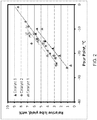
- Figure 2 is a plot of the lube yield as a function of the product pour point for the three catalysts.
- Figure 3 is a plot of visocosity index (VI) as a function of the product pour point for the three catalysts.
- Figure 4 is a plot of the product pour point as a function of reaction temperature (cat. temperature) for the three catalysts.
- Catalyst 1 and 3 were about 10°F more active than Catalyst 2.
Landscapes
- Chemical & Material Sciences (AREA)
- Engineering & Computer Science (AREA)
- Organic Chemistry (AREA)
- Chemical Kinetics & Catalysis (AREA)
- Materials Engineering (AREA)
- Crystallography & Structural Chemistry (AREA)
- Oil, Petroleum & Natural Gas (AREA)
- General Chemical & Material Sciences (AREA)
- Catalysts (AREA)
- Production Of Liquid Hydrocarbon Mixture For Refining Petroleum (AREA)
- Nanotechnology (AREA)
Claims (10)
- Un catalyseur d'hydroisomérisation, comprenant:
un extrudat de base comprenantau moins un tamis moléculaire sélectif vis-à-vis de l'isomérisation de n-paraffines,une première alumine ayant un volume de nanopores élevé et une distribution de la taille des pores caractérisée par une largeur totale à mi-hauteur, normalisée au volume des pores, de 15 à 25 nm·g/cc, etune deuxième alumine ayant un volume de nanopores élevé et une distribution de la taille des pores caractérisée par une largeur totale à mi-hauteur, normalisée au volume des pores, de 5 à 15 nm·g/cc;dans lequel la première et la deuxième alumine ont un volume de nanopores et une distribution de la taille des pores compris entre 0,7 à 2 cc/g dans l'intervalle allant de 2 nm à 50 nm;le catalyseur comprenant en outre au moins un métal choisi parmi le groupe constitué en les éléments de Groupe 6 et des Groupes 8 à 10 du Tableau Périodique,dans lequel la distribution de la taille des pores est mésurée conformément au procédé décrit ici. - Le catalyseur d'hydroisomérisation selon la revendication 1, dans lequel l'extrudat de base a un volume de nanopores compris entre 0,25 à 0,4 cc/g dans l'intervalle allant de 6 nm à 11 nm, un volume de nanopores compris entre 0,1 à 0,3 cc/g dans l'intervalle allant de 11 nm à 20 nm et un volume de nanopores compris entre 0,04 à 0,1 cc/g dans l'intervalle allant de 20 nm à 50 nm.
- Le catalyseur d'hydroisomérisation selon la revendication 1, dans lequel l'extrudat de base a un volume total de nanopores compris entre 0,7 à 1,2 cc/g dans l'intervalle allant de 2 nm à 50 nm.
- Le catalyseur d'hydroisomérisation selon la revendication 1, dans lequel l'extrudat de base a un volume de nanopores compris entre 0,25 à 0,4 cc/g dans l'intervalle allant de 6 nm à 11 nm.
- Le catalyseur d'hydroisomérisation selon la revendication 1, dans lequel l'extrudat de base a une densité de particules de 0,75 à 0,95 g/cc.
- Un procédé pour l'hydroisomérisation d'une charge d'alimentation hydrocarbonée, comprenant la mise en contact de la charge d'alimentation avec un catalyseur d'hydroisomérisation dans des conditions d'hydroisomérisation afin de produire un effluent hydroisomérisé;
le catalyseur d'hydroisomérisation comprenantun extrudat de base comprenantau moins un tamis moléculaire sélectif vis-à-vis de l'isomérisation de n-paraffines,une première alumine ayant un volume de nanopores élevé et une distribution de la taille des pores caractérisée par une largeur totale à mi-hauteur, normalisée au volume des pores, de 15 à 25 nm·g/cc, etune deuxième alumine ayant un volume de nanopores élevé et une distribution de la taille des pores caractérisée par une largeur totale à mi-hauteur, normalisée au volume des pores, de 5 à 15 nm·g/cc;dans lequel la première et la deuxième alumine ont un volume de nanopores et une distribution de la taille des pores compris entre 0,7 à 2 cc/g dans l'intervalle allant de 2 nm à 50 nm;le catalyseur comprenant en outre au moins un métal choisi parmi le groupe constitué en les éléments de Groupe 6 et des Groupes 8 à 10 du Tableau Périodique,dans lequel la distribution de la taille des pores est mésurée conformément au procédé décrit ici. - Le procédé selon la revendication 6, dans lequel l'extrudat de base a un volume de nanopores compris entre 0,25 à 0,4 cc/g dans l'intervalle allant de 6 nm à 11 nm, un volume de nanopores compris entre 0,1 à 0,3 cc/g dans l'intervalle allant de 11 nm à 20 nm et un volume de nanopores compris entre 0,04 à 0,1 cc/g dans l'intervalle allant de 20 nm à 50 nm.
- Le procédé selon la revendication 6, dans lequel l'extrudat de base a un volume total de nanopores compris entre 0,7 à 1,2 cc/g dans l'intervalle allant de 2 nm à 50 nm.
- Le procédé selon la revendication 6, dans lequel l'extrudat de base a un volume de nanopores compris entre 0,25 à 0,4 cc/g dans l'intervalle allant de 6 nm à 11 nm.
- Le procédé selon la revendication 6, dans lequel l'extrudat de base a une densité de particules de 0,75 à 0,95 g/cc.
Applications Claiming Priority (2)
| Application Number | Priority Date | Filing Date | Title |
|---|---|---|---|
| US201462057360P | 2014-09-30 | 2014-09-30 | |
| PCT/US2015/051611 WO2016053705A1 (fr) | 2014-09-30 | 2015-09-23 | Catalyseur d'hydroisomérisation fabriqué au moyen de supports à base d'alumine présentant un volume élevé de nanopores |
Publications (2)
| Publication Number | Publication Date |
|---|---|
| EP3200916A1 EP3200916A1 (fr) | 2017-08-09 |
| EP3200916B1 true EP3200916B1 (fr) | 2020-01-08 |
Family
ID=54249656
Family Applications (1)
| Application Number | Title | Priority Date | Filing Date |
|---|---|---|---|
| EP15774832.8A Active EP3200916B1 (fr) | 2014-09-30 | 2015-09-23 | Catalyseur d'hydroisomérisation fabriqué au moyen de supports à base d'alumine présentant un volume élevé de nanopores et procédé d'hydroisomérisation |
Country Status (7)
| Country | Link |
|---|---|
| US (1) | US9616419B2 (fr) |
| EP (1) | EP3200916B1 (fr) |
| KR (1) | KR102678624B1 (fr) |
| CN (1) | CN107073442B (fr) |
| RU (1) | RU2720007C2 (fr) |
| WO (1) | WO2016053705A1 (fr) |
| ZA (1) | ZA201702381B (fr) |
Families Citing this family (7)
| Publication number | Priority date | Publication date | Assignee | Title |
|---|---|---|---|---|
| WO2019213050A1 (fr) | 2018-05-01 | 2019-11-07 | Novvi Llc | Mélange d'hydrocarbures présentant une structure de ramification unique |
| US10961167B2 (en) | 2018-09-20 | 2021-03-30 | Novvi Llc | Process for preparing hydrocarbon mixture exhibiting unique branching structure |
| WO2020222171A1 (fr) | 2019-05-01 | 2020-11-05 | Chevron U.S.A. Inc. | Huile de base provenant de nao par oligomérisation et hydroisomérisation de catalyseur ionique |
| CN113966319B (zh) | 2019-05-01 | 2023-12-19 | 雪佛龙美国公司 | 通过离子催化剂低聚的基础油合成及低聚催化剂无水分离 |
| WO2021028877A1 (fr) | 2019-08-14 | 2021-02-18 | Chevron U.S.A. Inc. | Procédé pour améliorer les performances d'un moteur avec des compositions lubrifiantes renouvelables |
| US11865527B2 (en) | 2021-01-13 | 2024-01-09 | Chevron U.S.A. Inc. | Hydroisomerization catalysts |
| US20230092322A1 (en) | 2021-09-09 | 2023-03-23 | Chevron U.S.A. Inc. | Renewable Based E-Drive Fluids |
Family Cites Families (12)
| Publication number | Priority date | Publication date | Assignee | Title |
|---|---|---|---|---|
| EP0497436B1 (fr) * | 1988-03-23 | 1997-09-03 | Engelhard Corporation | Préparation d'un support pour un catalyseur d'hydrotraitement |
| EP0666894B2 (fr) * | 1992-10-28 | 2000-11-15 | Shell Internationale Researchmaatschappij B.V. | Procede de preparation d'huiles de base lubrifiantes |
| CN100486942C (zh) * | 2004-06-29 | 2009-05-13 | 中国石油化工股份有限公司 | 一种烃加氢转化催化剂 |
| JP2010535620A (ja) * | 2007-08-06 | 2010-11-25 | シエル・インターナシヨナル・リサーチ・マートスハツペイ・ベー・ヴエー | 炭化水素原料の接触水素化処理において有用な組成物、このような触媒の製造方法、およびこのような触媒の使用方法 |
| US9187702B2 (en) * | 2009-07-01 | 2015-11-17 | Chevron U.S.A. Inc. | Hydroprocessing catalyst and method of making the same |
| US8840779B2 (en) * | 2010-02-09 | 2014-09-23 | Exxonmobil Research And Engineering Company | Dewaxing catalysts |
| US8790507B2 (en) | 2010-06-29 | 2014-07-29 | Chevron U.S.A. Inc. | Catalytic processes and systems for base oil production using zeolite SSZ-32x |
| US8617387B2 (en) | 2010-06-29 | 2013-12-31 | Chevron U.S.A. Inc. | Catalytic processes and systems for base oil production from light feedstock |
| US8475648B2 (en) | 2010-06-29 | 2013-07-02 | Chevron U.S.A. Inc. | Catalytic processes and systems for base oil production from heavy feedstock |
| CN102441415B (zh) * | 2010-10-13 | 2013-08-28 | 中国石油化工股份有限公司 | 烷烃临氢异构化催化剂及其制备方法和应用 |
| KR101249482B1 (ko) * | 2011-02-10 | 2013-04-01 | 포항공과대학교 산학협력단 | 이성체화용 촉매, 그 제조 방법 및 그것을 이용한 이성체화 방법 |
| EP4570374A3 (fr) * | 2014-04-24 | 2025-07-02 | Chevron U.S.A. Inc. | Catalyseur d'hydrocraquage de distillat moyen avec un extrudat de base ayant un volume de nanopore élevé |
-
2015
- 2015-09-23 EP EP15774832.8A patent/EP3200916B1/fr active Active
- 2015-09-23 WO PCT/US2015/051611 patent/WO2016053705A1/fr not_active Ceased
- 2015-09-23 US US14/862,358 patent/US9616419B2/en active Active
- 2015-09-23 KR KR1020177011037A patent/KR102678624B1/ko active Active
- 2015-09-23 CN CN201580060547.3A patent/CN107073442B/zh active Active
- 2015-09-23 RU RU2017114376A patent/RU2720007C2/ru active
-
2017
- 2017-04-04 ZA ZA2017/02381A patent/ZA201702381B/en unknown
Non-Patent Citations (1)
| Title |
|---|
| None * |
Also Published As
| Publication number | Publication date |
|---|---|
| RU2720007C2 (ru) | 2020-04-23 |
| EP3200916A1 (fr) | 2017-08-09 |
| ZA201702381B (en) | 2018-09-26 |
| CN107073442B (zh) | 2020-07-07 |
| US20160089666A1 (en) | 2016-03-31 |
| US9616419B2 (en) | 2017-04-11 |
| KR102678624B1 (ko) | 2024-06-27 |
| RU2017114376A (ru) | 2018-11-02 |
| RU2017114376A3 (fr) | 2018-11-02 |
| CN107073442A (zh) | 2017-08-18 |
| KR20170066455A (ko) | 2017-06-14 |
| WO2016053705A1 (fr) | 2016-04-07 |
Similar Documents
| Publication | Publication Date | Title |
|---|---|---|
| EP3200916B1 (fr) | Catalyseur d'hydroisomérisation fabriqué au moyen de supports à base d'alumine présentant un volume élevé de nanopores et procédé d'hydroisomérisation | |
| US8475648B2 (en) | Catalytic processes and systems for base oil production from heavy feedstock | |
| CA2946285C (fr) | Catalyseur d'hydrocraquage de distillat moyen a extrudat de base ayant un volume de nanopore eleve | |
| CN107922858A (zh) | 润滑油基础油的制造方法 | |
| CN105247016B (zh) | 润滑油基础油的制造方法 | |
| SG186052A1 (en) | Catalytic processes and systems for base oil production from light feedstock | |
| US20160089664A1 (en) | Hydroisomerization catalyst with a base extrudate having a high total nanopore volume | |
| WO2014157385A1 (fr) | Huile de base d'huile lubrifiante et procédé pour la produire | |
| WO2014054439A1 (fr) | Procédé de production d'huile de base de lubrifiant et huile de base de lubrifiant | |
| CN105264053B (zh) | 润滑油基础油和其制造方法、电绝缘油 | |
| US20160089665A1 (en) | Hydroisomerization catalyst with a base extrudate having a low particle density | |
| WO2022103915A1 (fr) | Catalyseur à volume nanoporeux élevé et processus utilisant ssz-91 | |
| US20160089663A1 (en) | Hydroisomerization catalyst with a base extrudate having a high nanopore volume | |
| CN104245896B (zh) | 润滑油用基础油的制造方法 | |
| EP4204519A1 (fr) | Procédé et système de production d'une huile de base | |
| US12486465B2 (en) | Method for producing high quality base oils using multiple stage processing | |
| CN104245895B (zh) | 润滑油用基础油的制造方法 | |
| US20220288565A1 (en) | High nanopore volume hydrotreating catalyst and process |
Legal Events
| Date | Code | Title | Description |
|---|---|---|---|
| STAA | Information on the status of an ep patent application or granted ep patent |
Free format text: STATUS: THE INTERNATIONAL PUBLICATION HAS BEEN MADE |
|
| PUAI | Public reference made under article 153(3) epc to a published international application that has entered the european phase |
Free format text: ORIGINAL CODE: 0009012 |
|
| STAA | Information on the status of an ep patent application or granted ep patent |
Free format text: STATUS: REQUEST FOR EXAMINATION WAS MADE |
|
| 17P | Request for examination filed |
Effective date: 20170405 |
|
| AK | Designated contracting states |
Kind code of ref document: A1 Designated state(s): AL AT BE BG CH CY CZ DE DK EE ES FI FR GB GR HR HU IE IS IT LI LT LU LV MC MK MT NL NO PL PT RO RS SE SI SK SM TR |
|
| AX | Request for extension of the european patent |
Extension state: BA ME |
|
| DAV | Request for validation of the european patent (deleted) | ||
| DAX | Request for extension of the european patent (deleted) | ||
| REG | Reference to a national code |
Ref country code: DE Ref legal event code: R079 Ref document number: 602015045212 Country of ref document: DE Free format text: PREVIOUS MAIN CLASS: B01J0035100000 Ipc: B01J0021040000 |
|
| GRAP | Despatch of communication of intention to grant a patent |
Free format text: ORIGINAL CODE: EPIDOSNIGR1 |
|
| STAA | Information on the status of an ep patent application or granted ep patent |
Free format text: STATUS: GRANT OF PATENT IS INTENDED |
|
| RIC1 | Information provided on ipc code assigned before grant |
Ipc: B01J 29/74 20060101ALI20190621BHEP Ipc: B01J 35/00 20060101ALI20190621BHEP Ipc: B01J 21/04 20060101AFI20190621BHEP Ipc: C10G 45/64 20060101ALI20190621BHEP Ipc: B01J 35/10 20060101ALI20190621BHEP |
|
| INTG | Intention to grant announced |
Effective date: 20190726 |
|
| GRAS | Grant fee paid |
Free format text: ORIGINAL CODE: EPIDOSNIGR3 |
|
| GRAA | (expected) grant |
Free format text: ORIGINAL CODE: 0009210 |
|
| STAA | Information on the status of an ep patent application or granted ep patent |
Free format text: STATUS: THE PATENT HAS BEEN GRANTED |
|
| AK | Designated contracting states |
Kind code of ref document: B1 Designated state(s): AL AT BE BG CH CY CZ DE DK EE ES FI FR GB GR HR HU IE IS IT LI LT LU LV MC MK MT NL NO PL PT RO RS SE SI SK SM TR |
|
| REG | Reference to a national code |
Ref country code: GB Ref legal event code: FG4D |
|
| REG | Reference to a national code |
Ref country code: CH Ref legal event code: EP |
|
| REG | Reference to a national code |
Ref country code: DE Ref legal event code: R096 Ref document number: 602015045212 Country of ref document: DE |
|
| REG | Reference to a national code |
Ref country code: IE Ref legal event code: FG4D |
|
| REG | Reference to a national code |
Ref country code: AT Ref legal event code: REF Ref document number: 1222012 Country of ref document: AT Kind code of ref document: T Effective date: 20200215 |
|
| REG | Reference to a national code |
Ref country code: NL Ref legal event code: FP |
|
| REG | Reference to a national code |
Ref country code: LT Ref legal event code: MG4D |
|
| PG25 | Lapsed in a contracting state [announced via postgrant information from national office to epo] |
Ref country code: FI Free format text: LAPSE BECAUSE OF FAILURE TO SUBMIT A TRANSLATION OF THE DESCRIPTION OR TO PAY THE FEE WITHIN THE PRESCRIBED TIME-LIMIT Effective date: 20200108 Ref country code: NO Free format text: LAPSE BECAUSE OF FAILURE TO SUBMIT A TRANSLATION OF THE DESCRIPTION OR TO PAY THE FEE WITHIN THE PRESCRIBED TIME-LIMIT Effective date: 20200408 Ref country code: RS Free format text: LAPSE BECAUSE OF FAILURE TO SUBMIT A TRANSLATION OF THE DESCRIPTION OR TO PAY THE FEE WITHIN THE PRESCRIBED TIME-LIMIT Effective date: 20200108 Ref country code: LT Free format text: LAPSE BECAUSE OF FAILURE TO SUBMIT A TRANSLATION OF THE DESCRIPTION OR TO PAY THE FEE WITHIN THE PRESCRIBED TIME-LIMIT Effective date: 20200108 Ref country code: PT Free format text: LAPSE BECAUSE OF FAILURE TO SUBMIT A TRANSLATION OF THE DESCRIPTION OR TO PAY THE FEE WITHIN THE PRESCRIBED TIME-LIMIT Effective date: 20200531 |
|
| PG25 | Lapsed in a contracting state [announced via postgrant information from national office to epo] |
Ref country code: BG Free format text: LAPSE BECAUSE OF FAILURE TO SUBMIT A TRANSLATION OF THE DESCRIPTION OR TO PAY THE FEE WITHIN THE PRESCRIBED TIME-LIMIT Effective date: 20200408 Ref country code: GR Free format text: LAPSE BECAUSE OF FAILURE TO SUBMIT A TRANSLATION OF THE DESCRIPTION OR TO PAY THE FEE WITHIN THE PRESCRIBED TIME-LIMIT Effective date: 20200409 Ref country code: LV Free format text: LAPSE BECAUSE OF FAILURE TO SUBMIT A TRANSLATION OF THE DESCRIPTION OR TO PAY THE FEE WITHIN THE PRESCRIBED TIME-LIMIT Effective date: 20200108 Ref country code: SE Free format text: LAPSE BECAUSE OF FAILURE TO SUBMIT A TRANSLATION OF THE DESCRIPTION OR TO PAY THE FEE WITHIN THE PRESCRIBED TIME-LIMIT Effective date: 20200108 Ref country code: IS Free format text: LAPSE BECAUSE OF FAILURE TO SUBMIT A TRANSLATION OF THE DESCRIPTION OR TO PAY THE FEE WITHIN THE PRESCRIBED TIME-LIMIT Effective date: 20200508 Ref country code: HR Free format text: LAPSE BECAUSE OF FAILURE TO SUBMIT A TRANSLATION OF THE DESCRIPTION OR TO PAY THE FEE WITHIN THE PRESCRIBED TIME-LIMIT Effective date: 20200108 |
|
| REG | Reference to a national code |
Ref country code: DE Ref legal event code: R097 Ref document number: 602015045212 Country of ref document: DE |
|
| PG25 | Lapsed in a contracting state [announced via postgrant information from national office to epo] |
Ref country code: ES Free format text: LAPSE BECAUSE OF FAILURE TO SUBMIT A TRANSLATION OF THE DESCRIPTION OR TO PAY THE FEE WITHIN THE PRESCRIBED TIME-LIMIT Effective date: 20200108 Ref country code: SK Free format text: LAPSE BECAUSE OF FAILURE TO SUBMIT A TRANSLATION OF THE DESCRIPTION OR TO PAY THE FEE WITHIN THE PRESCRIBED TIME-LIMIT Effective date: 20200108 Ref country code: CZ Free format text: LAPSE BECAUSE OF FAILURE TO SUBMIT A TRANSLATION OF THE DESCRIPTION OR TO PAY THE FEE WITHIN THE PRESCRIBED TIME-LIMIT Effective date: 20200108 Ref country code: RO Free format text: LAPSE BECAUSE OF FAILURE TO SUBMIT A TRANSLATION OF THE DESCRIPTION OR TO PAY THE FEE WITHIN THE PRESCRIBED TIME-LIMIT Effective date: 20200108 Ref country code: SM Free format text: LAPSE BECAUSE OF FAILURE TO SUBMIT A TRANSLATION OF THE DESCRIPTION OR TO PAY THE FEE WITHIN THE PRESCRIBED TIME-LIMIT Effective date: 20200108 Ref country code: EE Free format text: LAPSE BECAUSE OF FAILURE TO SUBMIT A TRANSLATION OF THE DESCRIPTION OR TO PAY THE FEE WITHIN THE PRESCRIBED TIME-LIMIT Effective date: 20200108 Ref country code: DK Free format text: LAPSE BECAUSE OF FAILURE TO SUBMIT A TRANSLATION OF THE DESCRIPTION OR TO PAY THE FEE WITHIN THE PRESCRIBED TIME-LIMIT Effective date: 20200108 |
|
| PLBE | No opposition filed within time limit |
Free format text: ORIGINAL CODE: 0009261 |
|
| STAA | Information on the status of an ep patent application or granted ep patent |
Free format text: STATUS: NO OPPOSITION FILED WITHIN TIME LIMIT |
|
| REG | Reference to a national code |
Ref country code: AT Ref legal event code: MK05 Ref document number: 1222012 Country of ref document: AT Kind code of ref document: T Effective date: 20200108 |
|
| 26N | No opposition filed |
Effective date: 20201009 |
|
| REG | Reference to a national code |
Ref country code: DE Ref legal event code: R082 Ref document number: 602015045212 Country of ref document: DE Representative=s name: HL KEMPNER PATENTANWAELTE, SOLICITORS (ENGLAND, DE Ref country code: DE Ref legal event code: R082 Ref document number: 602015045212 Country of ref document: DE Representative=s name: HL KEMPNER PATENTANWALT, RECHTSANWALT, SOLICIT, DE Ref country code: DE Ref legal event code: R082 Ref document number: 602015045212 Country of ref document: DE Representative=s name: HL KEMPNER PARTG MBB, DE |
|
| PG25 | Lapsed in a contracting state [announced via postgrant information from national office to epo] |
Ref country code: AT Free format text: LAPSE BECAUSE OF FAILURE TO SUBMIT A TRANSLATION OF THE DESCRIPTION OR TO PAY THE FEE WITHIN THE PRESCRIBED TIME-LIMIT Effective date: 20200108 |
|
| PG25 | Lapsed in a contracting state [announced via postgrant information from national office to epo] |
Ref country code: SI Free format text: LAPSE BECAUSE OF FAILURE TO SUBMIT A TRANSLATION OF THE DESCRIPTION OR TO PAY THE FEE WITHIN THE PRESCRIBED TIME-LIMIT Effective date: 20200108 Ref country code: PL Free format text: LAPSE BECAUSE OF FAILURE TO SUBMIT A TRANSLATION OF THE DESCRIPTION OR TO PAY THE FEE WITHIN THE PRESCRIBED TIME-LIMIT Effective date: 20200108 |
|
| PG25 | Lapsed in a contracting state [announced via postgrant information from national office to epo] |
Ref country code: MC Free format text: LAPSE BECAUSE OF FAILURE TO SUBMIT A TRANSLATION OF THE DESCRIPTION OR TO PAY THE FEE WITHIN THE PRESCRIBED TIME-LIMIT Effective date: 20200108 |
|
| REG | Reference to a national code |
Ref country code: CH Ref legal event code: PL |
|
| REG | Reference to a national code |
Ref country code: BE Ref legal event code: MM Effective date: 20200930 |
|
| PG25 | Lapsed in a contracting state [announced via postgrant information from national office to epo] |
Ref country code: LU Free format text: LAPSE BECAUSE OF NON-PAYMENT OF DUE FEES Effective date: 20200923 |
|
| PG25 | Lapsed in a contracting state [announced via postgrant information from national office to epo] |
Ref country code: BE Free format text: LAPSE BECAUSE OF NON-PAYMENT OF DUE FEES Effective date: 20200930 Ref country code: CH Free format text: LAPSE BECAUSE OF NON-PAYMENT OF DUE FEES Effective date: 20200930 Ref country code: LI Free format text: LAPSE BECAUSE OF NON-PAYMENT OF DUE FEES Effective date: 20200930 Ref country code: IE Free format text: LAPSE BECAUSE OF NON-PAYMENT OF DUE FEES Effective date: 20200923 |
|
| PG25 | Lapsed in a contracting state [announced via postgrant information from national office to epo] |
Ref country code: TR Free format text: LAPSE BECAUSE OF FAILURE TO SUBMIT A TRANSLATION OF THE DESCRIPTION OR TO PAY THE FEE WITHIN THE PRESCRIBED TIME-LIMIT Effective date: 20200108 Ref country code: MT Free format text: LAPSE BECAUSE OF FAILURE TO SUBMIT A TRANSLATION OF THE DESCRIPTION OR TO PAY THE FEE WITHIN THE PRESCRIBED TIME-LIMIT Effective date: 20200108 Ref country code: CY Free format text: LAPSE BECAUSE OF FAILURE TO SUBMIT A TRANSLATION OF THE DESCRIPTION OR TO PAY THE FEE WITHIN THE PRESCRIBED TIME-LIMIT Effective date: 20200108 |
|
| PG25 | Lapsed in a contracting state [announced via postgrant information from national office to epo] |
Ref country code: MK Free format text: LAPSE BECAUSE OF FAILURE TO SUBMIT A TRANSLATION OF THE DESCRIPTION OR TO PAY THE FEE WITHIN THE PRESCRIBED TIME-LIMIT Effective date: 20200108 Ref country code: AL Free format text: LAPSE BECAUSE OF FAILURE TO SUBMIT A TRANSLATION OF THE DESCRIPTION OR TO PAY THE FEE WITHIN THE PRESCRIBED TIME-LIMIT Effective date: 20200108 |
|
| P01 | Opt-out of the competence of the unified patent court (upc) registered |
Effective date: 20230522 |
|
| PGFP | Annual fee paid to national office [announced via postgrant information from national office to epo] |
Ref country code: DE Payment date: 20240730 Year of fee payment: 10 |
|
| PGFP | Annual fee paid to national office [announced via postgrant information from national office to epo] |
Ref country code: GB Payment date: 20240801 Year of fee payment: 10 |
|
| PGFP | Annual fee paid to national office [announced via postgrant information from national office to epo] |
Ref country code: FR Payment date: 20240808 Year of fee payment: 10 |
|
| PGFP | Annual fee paid to national office [announced via postgrant information from national office to epo] |
Ref country code: IT Payment date: 20240812 Year of fee payment: 10 |
|
| PGFP | Annual fee paid to national office [announced via postgrant information from national office to epo] |
Ref country code: NL Payment date: 20250814 Year of fee payment: 11 |