EP3201065B1 - Chariot à plateforme - Google Patents
Chariot à plateforme Download PDFInfo
- Publication number
- EP3201065B1 EP3201065B1 EP15771614.3A EP15771614A EP3201065B1 EP 3201065 B1 EP3201065 B1 EP 3201065B1 EP 15771614 A EP15771614 A EP 15771614A EP 3201065 B1 EP3201065 B1 EP 3201065B1
- Authority
- EP
- European Patent Office
- Prior art keywords
- platform trolley
- locking device
- platform
- locking
- feet
- Prior art date
- Legal status (The legal status is an assumption and is not a legal conclusion. Google has not performed a legal analysis and makes no representation as to the accuracy of the status listed.)
- Not-in-force
Links
- 238000004519 manufacturing process Methods 0.000 claims description 30
- 238000001514 detection method Methods 0.000 claims description 17
- 238000000034 method Methods 0.000 claims description 12
- 230000011664 signaling Effects 0.000 claims description 10
- 230000003287 optical effect Effects 0.000 claims description 7
- 238000009434 installation Methods 0.000 claims description 6
- 238000005553 drilling Methods 0.000 description 6
- 230000033001 locomotion Effects 0.000 description 4
- 240000006829 Ficus sundaica Species 0.000 description 1
- 240000000528 Ricinus communis Species 0.000 description 1
- 235000004443 Ricinus communis Nutrition 0.000 description 1
- 230000003247 decreasing effect Effects 0.000 description 1
- 230000000694 effects Effects 0.000 description 1
- 238000005516 engineering process Methods 0.000 description 1
- ZINJLDJMHCUBIP-UHFFFAOYSA-N ethametsulfuron-methyl Chemical compound CCOC1=NC(NC)=NC(NC(=O)NS(=O)(=O)C=2C(=CC=CC=2)C(=O)OC)=N1 ZINJLDJMHCUBIP-UHFFFAOYSA-N 0.000 description 1
- 230000002349 favourable effect Effects 0.000 description 1
- 238000009776 industrial production Methods 0.000 description 1
- 238000003780 insertion Methods 0.000 description 1
- 230000037431 insertion Effects 0.000 description 1
- 238000003754 machining Methods 0.000 description 1
- 230000035515 penetration Effects 0.000 description 1
- 230000002195 synergetic effect Effects 0.000 description 1
Images





Classifications
-
- B—PERFORMING OPERATIONS; TRANSPORTING
- B62—LAND VEHICLES FOR TRAVELLING OTHERWISE THAN ON RAILS
- B62B—HAND-PROPELLED VEHICLES, e.g. HAND CARTS OR PERAMBULATORS; SLEDGES
- B62B5/00—Accessories or details specially adapted for hand carts
- B62B5/04—Braking mechanisms; Locking devices against movement
- B62B5/049—Braking mechanisms; Locking devices against movement locking against movement by contacting the floor or a wall
-
- B—PERFORMING OPERATIONS; TRANSPORTING
- B62—LAND VEHICLES FOR TRAVELLING OTHERWISE THAN ON RAILS
- B62B—HAND-PROPELLED VEHICLES, e.g. HAND CARTS OR PERAMBULATORS; SLEDGES
- B62B5/00—Accessories or details specially adapted for hand carts
- B62B5/06—Hand moving equipment, e.g. handle bars
- B62B5/064—Hand moving equipment, e.g. handle bars adaptable for different users, e.g. by means of pivoting elements
- B62B5/065—Hand moving equipment, e.g. handle bars adaptable for different users, e.g. by means of pivoting elements by means of telescopic elements
-
- B—PERFORMING OPERATIONS; TRANSPORTING
- B62—LAND VEHICLES FOR TRAVELLING OTHERWISE THAN ON RAILS
- B62B—HAND-PROPELLED VEHICLES, e.g. HAND CARTS OR PERAMBULATORS; SLEDGES
- B62B2205/00—Hand-propelled vehicles or sledges being foldable or dismountable when not in use
- B62B2205/14—Retractable wheels
Definitions
- the present invention relates to a platform trolley for the location-flexible installation of production means and a corresponding method for the local fixing of a movable platform trolley.
- platform trucks which can carry a wide variety of production means, such as measuring equipment, assembly aids, manipulators or the like, and which can usually be driven manually to their place of use within a short time and put into operation there.
- the platform cars are locked on site with the ground in order to have a secure footing and as exact as possible defined position for the duration of the mission. Due to the interlocking with the ground platform trucks can introduce the forces of the means of production into the ground, without the danger that the platform cars are shifted by the forces. Furthermore, the platform car can be electrically connected and networked with the environment data technology.
- a spatially flexible measuring carriage for processing stations according to the preamble of claim 1 is known.
- the measuring carriage is equipped with a positioning device in the form of an indexing device.
- the measuring carriage on index pins, which cooperate with three or more spatially distributed, arranged in the bottom index images.
- the index pins have radially projecting, rotatable guide rollers at their ends, which undercut by lateral movements of the measuring carriage with the correspondingly shaped Indexaidn can get into engagement.
- the locking of the measuring carriage on the ground is therefore particularly stable but the locking process is not particularly comfortable.
- a carriage for sheet-shaped objects which has a downwardly extendable from the carriage braking device.
- the patent CH 279881 A discloses a mobile table that can be moved by means of rollers. Here, the rollers can be moved by means of a lever mechanism down to lift the table from his legs.
- a motorized golf cart is known, which has a brake in the form of a pointed rod, which can penetrate into the bottom of the golf course.
- a platform truck for a location-flexible installation of measuring devices, assembly aids or manipulators comprising a downwardly out of the platform trolley extendable stakeout, the platform carriage is moved with retracted stake out and locked in the extended stake out with the ground.
- a staking device which can be retracted and extended from the platform carriage, the location fixation of the platform cart can be carried out in a very simple and convenient manner. In particular, no pivoting movements of the platform carriage are necessary. It has been recognized by the inventors that due to the weight of the platform truck for most applications, in addition to the stakeout no further anti-tipper is necessary.
- the staking device has two vertically movable Absteckstangen, with at least one arranged in or on the ground locking means are latched.
- the stake-out rod can have a variety of profiles here.
- the Absteckstange on a round profile Preferably, there are also square or other familiar profiles as a profile of the stake-out conceivable.
- the Absteckstange may also be hollow, thus correspond to a round tube or hollow profiles of square or other known profiles.
- the locking is essentially free of play, so that the platform car occupies a well-defined position at the site. As locking means are openings in the floor, essays on the floor, pins, sleeves, housings or other geometrically defined elements into consideration.
- the staking device further comprises two Absteckstangen, which are interconnected by means of a handle bar.
- two Absetzstangen an improved positional positioning of the platform car is achieved compared to only one locking position. Due to the connection of the two Absetzstangen means of a handle bar, both Absetzstangen can be simultaneously manually extended and retracted. Furthermore, the upper part of the stakeout can be used as a handle for moving the platform car.
- the handle bar is displaced in the direction of the platform carriage when the staking device is extended. This advantageously shortens the upwardly protruding free length of the handle when the platform carriage is locked in the ground. Thus, the available range of motion of the means of production is maximized.
- the staking device may preferably have latching elements, with which the staking device can be fixed at different height positions with respect to the platform trolley.
- the stakeout can be set for moving the platform car as a handle on an ergonomically favorable for the operator height.
- the locking elements it is possible by the locking elements to mechanically fix the locking device in its extended, locked in the ground position, which increases the stability of the platform car.
- the platform carriage further comprises a position detection element for detecting the position of the stakeout device.
- the position detection element By the position detection element, the position of the stakeout can be detected to ensure that the stakeout is locked correctly in the ground.
- the detection result may be signaled to the user, e.g. visually and it can be signaled to the control of the production means to lock it in case of improper latching. Cases of insufficient locking or completely unlocked platform car can thus be avoided with high security.
- the position detection element may comprise an electrical sensor and / or an optical sensor and / or a mechanical sensor and / or a geometric element.
- the position detection element can be designed differently depending on the application.
- a mechanical sensor for example, a mechanical signaling of the position of the stakeout, for example by a protruding signal pin, possible.
- Optical sensors are particularly easy to control, e.g. by interrupting a beam path, but can easily contaminate in harsh production environments. Electrical sensors, such as switches, are inexpensive but usually require mechanical control.
- the position detection element can also be formed as a geometric element, based on which the user recognizes that the stakeout device is fully engaged. For example, the top of the locking elements of the stakeout can serve as a geometric element by indicating the user by engaging at a defined height, the sufficient locking in the ground.
- the position detection element may preferably comprise an electrical proximity sensor which cooperates with an indexing element of the staking device.
- An electrical proximity sensor responds to the presence of a metallic object and therefore does not require direct mechanical actuation. It is therefore easy to control, less susceptible to wear and also works in harsh, pollution-prone production environments.
- the platform cart may preferably further comprise a signaling element which signals the extended position of the staking device. This can be the User the lock state can be safely displayed.
- the signaling element may preferably be an optical display, in particular a light column.
- the display of the locking state can preferably be carried out optically by a light column, which indicates an unlocked state, for example, by a red light signal and a securely locked state of the platform car by a green light signal.
- the platform truck may preferably further comprise a transport unit for moving the platform carriage, wherein the transport unit has height-movable rollers and feet, wherein the platform carriage is moved with downwardly extended rollers with the rollers and stands up with rollers retracted with the feet on the ground.
- the platform truck With height-adjustable wheels, the platform truck can easily be moved to change position and stand upright on feet on the floor when the rollers are retracted upwards.
- the latched in the ground and standing on the feet platform car has a very safe footing and in particular a well-defined height, which is not the case with cars that are on wheels. Rollers can easily become dirty and damaged during operation and thus have no defined height in practice.
- the platform carriage may further comprise a transport unit for moving the platform carriage, wherein the transport unit has rollers and height-adjustable feet, wherein the platform carriage is moved in upwardly retracted feet with the rollers and stands up with downwardly extended feet with them on the ground.
- the platform truck can also be equipped with height-adjustable feet. Then the platform carriage can be raised at the processing position by means of the feet so far that the rollers no longer touch the ground and the platform car is safely on the feet.
- the platform truck may preferably further comprise a height drive with a hand crank for manually moving the height-adjustable rollers or the height-adjustable feet.
- a height adjustment with a hand crank is particularly robust and for a manual height adjustment of the rollers or the Stand even with a high weight of the platform car with production means particularly well suited.
- the platform truck may further preferably an electric unit, for power supply and control of a production means and / or a pneumatic unit, for supplying a production means with compressed air; and / or have a functional plate for mechanical fixation of a production means.
- the platform truck thus provides the complete infrastructure for the use of the means of production in a mobile way.
- the staking device is also designed as a handle for moving the platform carriage and the step of positioning the platform carriage is carried out with the aid of the staking device. This results in a synergistic use the stakeout, on the one hand as Verrastungsmittel the platform car and the other as a handle for moving the same.
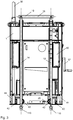
- FIGS. 1 and 2 show a platform truck 1 for a location-flexible installation of production means 120, which in Fig. 2 are shown only schematically.
- the platform truck 1 has a transport unit 40, an electrical unit 60, a pneumatic unit 70 and a mounting plate 80.
- the transport unit 40 is used for moving the platform carriage 1 and has for this purpose rollers 42, in particular castors (s. FIG. 3 ), on.
- the electric unit 60 is used for power supply and Control of a production means 120, which can be mechanically fixed on the function plate 80.
- As a functional means 120 for example, measuring and testing means and manipulators, handling equipment or similar means of production 120 come into consideration. These can be supplied via the electric unit 60 with the necessary electrical power and, if necessary, also be controlled electronically.
- the platform carriage 1 can be equipped with a pneumatic unit 70, which supplies the means of production 120 with compressed air.
- the pneumatic unit 70 can also be omitted if no compressed air supply is necessary.
- the transport unit 40 the platform cart 100 can be moved freely in the production hall in order to flexibly place the production means 120 in different positions as required. For this purpose, a worker can move the platform carriage 1 on his rollers 42 free.
- the platform truck 1 further has a staking device 10, which serves for the local fixing of the platform carriage 1 at the desired processing position.
- the stakeout device 10 can advantageously also serve as a handle for the convenient operation of the platform truck 1.
- the platform carriage 1 has a signaling element 30 in the form of an optical display, in particular a light column.
- the signaling element 30 can serve to indicate the operating state of the production means 120; on the other hand, it can also indicate whether or not the platform carriage is securely fixed at its processing position.
- the platform car 1 also feet 44, which are preferably adjustable in height, so that the function plate 80 forms a horizontal plane when the platform car 1 stands by means of feet 44 on the ground.
- FIG. 3 shows a section along the line AA Fig. 2 by the platform car 1 after FIG. 1 and 2 , wherein the elements of the staking device 10 can be seen in more detail.
- the staking device 10 comprises two vertically with respect to the platform carriage 1 movable Absteckstangen 12, 14 and a handle bar 16 which connects the Absteckstange 12, 14 at their upper exposed end together.
- the stakeout device 10 therefore advantageously forms a U-shaped arrangement which protrudes freely from the top of the housing of the platform carriage 1 and thus serves as a handle for moving the platform carriage 1.
- the Absteckstangen 12, 14 each form a mandrel 19, each of which can preferably penetrate almost free of play in a corresponding recessed in the ground locking means 110 to lock the Absteckvorides 10 to the bottom 100.
- the locking means 110 are preferably designed as ground sleeves. However, other types of locking means 110 are possible, which allow a geometric positioning of the Absteckstangen 12, 14. For easy insertion of the Absteckstangen 12, 14 in or on the locking means 110, the mandrels 19 are chamfered at its lower end. The extension and retraction of the staking device 10 can be done manually by the operator moves the two Absteckstangen 12,14 together over the handle 16 and down.
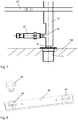
- the position of the staking device 10 can be detected by means of a position detection element 20.
- the position detection element 20 may comprise an electrical sensor and / or an optical sensor and / or a mechanical sensor and / or a geometric element 17.
- the position detection element 20 used is an electrical proximity sensor which cooperates with an indexing element 18 of the staking device 10.
- the indexing element 18 is formed as a projection at the lower end of the movable Absteckstange 12 which protrudes laterally substantially perpendicular to the direction of movement of the Absteckvorraum 10.
- the proximity sensor 20 can detect whether or not the protrusion 18 is opposed to it when the stake-out device 10 is moved up and down.
- the bottom sleeve is shown as a locking means 110 at a distance from the components of the platform carriage 1 in order to better explain the operating principle.
- the mandrel 19 is shown within the bottom sleeve 110 when the stake-out device 10 is extended and when the indexing element 18 is opposite the position-detecting element 20.
- the position detection element 20 can detect in particular the fully latched position of the staking device 10.
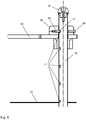
- FIG. 5 shows a sectional view of the staking device 10 from the side when passing through the function plate 80, through a lower plate 72 of the pneumatic unit 70 and through a lower plate 62 of the electric unit 60.
- the staking device 10 with equipped with a number of laterally arranged on one of the Absteckstangen 12,14 locking elements 11, through which the Absteckvorraum 10 can be adjusted in height and fixed.
- the latching elements 11 are formed as latching grooves, which cooperate with a latching device 82 which is arranged on the function plate 80. Details of the locking elements 11 and the locking device 82 are in Fig. 6 seen.
- the latching device 82 preferably has a spring-mounted latching clip 84, which can engage in one of the latching elements or latching grooves 11.
- the staking device 10 When engaged, the staking device 10 is set as a handle in height. The operator can release the engagement of the latching clip 84 by pressure on an unlocking surface 86 of the latching clip 84, so that the plug-in device 10 is height-adjustable. Thus, the height of the handle can be adjusted individually to an ergonomically suitable height for each user.
- the staking device 10 can also be detected in its locked in or on the ground position, so as to continue to increase the stability during use of the production means 120. In this case, the latching device 82 locks with the uppermost detent groove 17, which also signals the user at the same time, in the sense of a geometric element, that the staking device 10 is sufficiently locked to the floor 100.
- FIG. 8 shows a drilling template 90 for drilling of precisely spaced holes for the formed as a ground socket locking elements 110.
- the drilling template 90 in particular the exact distance of the locking elements 110 is set to each other.
- a first vertical hole is first drilled into the hall floor at a defined position, then the drilling template 90 is applied to the first hole and the drill mandrel 92 is inserted through one of the drill holes 94 in the previously drilled first hole. Then, guided by the other bore opening 94, a precisely spaced second hole for a second locking element 110 in the hall floor be bored.
- the bore spacing is 330 mm, the diameter of the holes 35 mm and the drilling depth 40 mm.
- FIGS. 9A to 9C show three different steps of the method for locating a movable platform cart 1 .
- the platform car 1 driven by the stakeout 10 as a handle to the desired processing position.
- the staking device 10 moved down from the platform carriage 1, so that the mandrel-shaped end 19 of the respective vertically movable Absteckstangen 12, 14 penetrates into the corresponding locking element 110. If the penetration depth is deep enough, the indexing element 18 on one of the Absteckstangen 12,14 enters the detection area of the position detection element 20.
- the position detection element 20 can then detect the sufficiently extended position of the staking device 10, for example, to signal the operator.
- the platform car 1 has taken a well-defined local position for using the production means 120 attached thereto. When locked in the ground 100 or locking device 10, the platform car 1 can not be moved.
- the height-adjustable wheels 42 by means of a height drive 50 move upwards so that the platform carriage 1 moves down until it rests with its feet 44 on the floor 100.
- the rollers 42 are preferably raised so far that they no longer touch the ground 100, so that the entire weight of the platform truck 1 on the feet 44 loads.
- position of the platform car 1 due to its locking by the stakeout 10 in or on the ground 100 and the secure position on the feet 44 a stationary position and can absorb high lateral and tilting forces. Accordingly, mounted on the platform car 1 production means 120 can muster sufficiently high forces for the desired activity.
- the height drive 50 is preferably operated manually by means of a hand crank 52.
- the rollers 42 are not vertically movable and instead the feet 44. Accordingly, to determine a safe Stands of the platform carriage 1, the feet 44 extended by means of the height drive 50 toward the ground until the platform carriage 1 is raised and the rollers 42 no longer touch the ground.
Landscapes
- Engineering & Computer Science (AREA)
- Chemical & Material Sciences (AREA)
- Combustion & Propulsion (AREA)
- Transportation (AREA)
- Mechanical Engineering (AREA)
- Handcart (AREA)
Claims (12)
- Chariot à plateforme (1) pour une mise en oeuvre mobile de moyens de mesure, d'auxiliaires de montage ou de manipulateurs (120), comprenant un dispositif d'implantation (10) sortant vers le bas hors du chariot à plateforme, dans lequel le chariot à plateforme (1) est déplaçable avec le dispositif d'implantation (10) rentré et peut être verrouillé au sol (100) avec le dispositif de verrouillage (10) sorti, dans lequel le dispositif d'implantation (10) comporte deux barres d'implantation mobiles verticalement (12, 14) qui sont verrouillables avec des moyens de verrouillage (110) disposés dans ou sur le sol, caractérisé en ce que les deux barres d'implantation (12, 14) sont reliées entre elles au moyen d'une barre de préhension (16).
- Chariot à plateforme selon la revendication 1, dans lequel la barre de préhension (16) est déplacée en direction du chariot à plateforme (1) lorsque le dispositif d'implantation (10) est sorti.
- Chariot à plateforme selon l'une des revendications 1 et 2, dans lequel le dispositif d'implantation (10) comporte des éléments de verrouillage (11) à l'aide desquels le dispositif d'implantation (10) peut être immobilisé dans différentes positions en hauteur par rapport au chariot à plateforme (1).
- Chariot à plateforme selon l'une des revendications 1 à 3, comprenant en outre un élément de reconnaissance de position (20) pour détecter la position du dispositif d'implantation (10).
- Chariot à plateforme selon la revendication 4, dans lequel l'élément de reconnaissance de position (20) comprend :a. un capteur électrique ; et/oub. un capteur électrique ; et/ouc. un capteur mécanique ; et/oud. un élément géométrique (17).
- Chariot à plateforme selon l'une des revendications 4 ou 5, dans lequel l'élément de reconnaissance de position (20) comprend un capteur électrique de proximité qui coopère avec un élément d'indexation (18) du dispositif d'implantation (10).
- Chariot à plateforme selon l'une des revendications 1 à 6, comprenant en outre un élément de signalisation (30) qui signale la position sortie du dispositif d'implantation (10), l'élément de signalisation (30) étant de préférence un indicateur optique, en particulier une colonne lumineuse.
- Chariot à plateforme selon une des revendications 1 à 7, comprenant en outre une unité de transport (40) pour déplacer le chariot à plateforme (1),a. dans lequel l'unité de transport (40) comporte des roulettes déplaçables en hauteur (42) et des pieds (44), le chariot à plateforme (1) pouvant, lorsque les roulettes (42) sont sorties vers le bas, être déplacé avec les roulettes (42) et, lorsque les roulettes (42) sont rentrées vers le haut, reposant sur le sol (100) par les pieds (44) ; et/oub. dans lequel l'unité de transport (40) comporte des roulettes (42) et des pieds déplaçables en hauteur (44), le chariot à plateforme (1) pouvant, lorsque les pieds (44) sont rentrés vers le haut, être déplacé avec les roulettes (42) et, lorsque les pieds (44) sont sortis vers le bas, reposant sur le sol (100) par ceux-ci.
- Chariot à plateforme selon la revendication 8, comprenant en outre un entraînement en hauteur (50) avec une manivelle (52) pour déplacer manuellement les roulettes déplaçables en hauteur (42) ou les pieds déplaçables en hauteur (44).
- Chariot à plateforme selon l'une des revendications 1 à 9, comprenant en outre :a. une unité électrique (60) pour l'alimentation électrique et la commande d'un moyen de production (120) ; et/oub. une unité pneumatique (70) pour alimenter un moyen de production (120) en air comprimé ; et/ouc. un plateau fonctionnel (80) pour la fixation mécanique d'un moyen de production (120).
- Procédé d'immobilisation locale d'un chariot à plateforme mobile (1) pour des moyens de mesure, des auxiliaires de montage ou des manipulateurs (120), comprenant un dispositif d'implantation (10) qui sort vers le bas hors du chariot à plateforme (1) et qui comporte deux barres d'implantation mobiles verticalement (12, 14) qui sont reliées entre elles au moyen d'une barre de préhension (16), dans lequel le chariot à plateforme (1) est déplaçable avec le dispositif d'implantation (10) rentré et peut être verrouillé au sol (100) avec le dispositif de verrouillage (10) sorti, le procédé comprenant les étapes suivantes :a. positionnement du chariot à plateforme (1) dans une position de travail au moyen de la position de base (16) du dispositif d'implantation (10) ;b. sortie simultanée des deux barres d'implantation mobiles verticalement (12, 14) du dispositif d'implantation (10) vers le bas hors du chariot à plateforme (1) ; etc. verrouillage des deux barres d'implantation (12, 14) du dispositif d'implantation (10) avec le sol (100).
- Procédé selon la revendication 11, comprenant en outre l'étape suivante :d. signalisation de la position verrouillée du dispositif d'implantation (1).
Applications Claiming Priority (2)
| Application Number | Priority Date | Filing Date | Title |
|---|---|---|---|
| DE102014220067.9A DE102014220067A1 (de) | 2014-10-02 | 2014-10-02 | Plattformwagen |
| PCT/EP2015/072703 WO2016050914A2 (fr) | 2014-10-02 | 2015-10-01 | Chariot à plateforme |
Publications (2)
| Publication Number | Publication Date |
|---|---|
| EP3201065A2 EP3201065A2 (fr) | 2017-08-09 |
| EP3201065B1 true EP3201065B1 (fr) | 2019-02-27 |
Family
ID=54207525
Family Applications (1)
| Application Number | Title | Priority Date | Filing Date |
|---|---|---|---|
| EP15771614.3A Not-in-force EP3201065B1 (fr) | 2014-10-02 | 2015-10-01 | Chariot à plateforme |
Country Status (3)
| Country | Link |
|---|---|
| EP (1) | EP3201065B1 (fr) |
| DE (1) | DE102014220067A1 (fr) |
| WO (1) | WO2016050914A2 (fr) |
Families Citing this family (2)
| Publication number | Priority date | Publication date | Assignee | Title |
|---|---|---|---|---|
| CN107063023B (zh) * | 2016-07-29 | 2023-04-07 | 上海市建筑装饰工程集团有限公司 | 三维放样平台 |
| WO2018165038A1 (fr) * | 2017-03-06 | 2018-09-13 | Miso Robotics, Inc. | Système de préparation d'aliments à réalité augmentée et procédés associés |
Family Cites Families (7)
| Publication number | Priority date | Publication date | Assignee | Title |
|---|---|---|---|---|
| CH279881A (de) * | 1950-04-22 | 1951-12-31 | Blatter Ernst | Fahrbarer Tisch, insbesondere Werkbank. |
| US2772113A (en) * | 1953-11-27 | 1956-11-27 | Berard Henry | Motorized carrier for multiple golf bags |
| GB1078966A (en) * | 1965-05-05 | 1967-08-09 | Autoset Production Ltd | Improvements relating to wheeled vehicles |
| US4302025A (en) * | 1980-02-22 | 1981-11-24 | Kansa Corporation | Paper sheet material handling cart having central brake assembly |
| EP0919490B1 (fr) * | 1997-11-25 | 2003-07-02 | Euroecoenvase, S.L. | Récipient pliable |
| AT3733U1 (de) * | 1999-05-18 | 2000-07-25 | Lbw Verwaltungs Und Beteiligun | Transportwagen |
| DE20312581U1 (de) * | 2003-08-14 | 2004-07-15 | Kuka Schweissanlagen Gmbh | Positioniereinrichtung |
-
2014
- 2014-10-02 DE DE102014220067.9A patent/DE102014220067A1/de not_active Ceased
-
2015
- 2015-10-01 WO PCT/EP2015/072703 patent/WO2016050914A2/fr not_active Ceased
- 2015-10-01 EP EP15771614.3A patent/EP3201065B1/fr not_active Not-in-force
Non-Patent Citations (1)
| Title |
|---|
| None * |
Also Published As
| Publication number | Publication date |
|---|---|
| WO2016050914A2 (fr) | 2016-04-07 |
| WO2016050914A3 (fr) | 2016-06-09 |
| EP3201065A2 (fr) | 2017-08-09 |
| DE102014220067A1 (de) | 2016-04-07 |
Similar Documents
| Publication | Publication Date | Title |
|---|---|---|
| EP2316778B1 (fr) | Dispositif et procédé de disposition d'une unité de levage pour le levage de véhicules | |
| EP3077784B1 (fr) | Ensemble et procédé d'essai de mécanismes de manoeuvre d'aiguilles | |
| WO2013186096A1 (fr) | Procédé et système de montage de composants d'ascenseur | |
| DE202010006391U1 (de) | Winkelmessvorrichtung für Abkantpressen | |
| EP2593333B1 (fr) | Véhicule modulaire | |
| DE3620964C2 (fr) | ||
| EP2696008A2 (fr) | Echafaudage télescopable et procédé de fonctionnement d'un échafaudage télescopable | |
| EP3045083A1 (fr) | Sommiers à lattes dote d'un cadre et d'un dispositif de mesure | |
| DE102011014695A1 (de) | Verfahren und Vorrichtung zur Montage wenigstens eines Sitzes in ein Luftfahrzeug | |
| EP3201065A2 (fr) | Chariot à plateforme | |
| EP0321915B1 (fr) | Dispositif pour le déplacement de panneaux muraux composés de préférence par une pluralité d'éléments individuels | |
| WO2010013082A1 (fr) | Palette avec mécanisme de roulement mobile | |
| DE60215715T2 (de) | Vorrichtung zur automatischen Bewegung von Fahrzeugen entlang einer Führungsbahn einer Hebebühne | |
| DE3106137C2 (fr) | ||
| DE202018101149U1 (de) | Hebevorrichtung für landwirtschaftliche Nutzfahrzeuge | |
| DE102021000494B3 (de) | Verriegelungsvorrichtung und fahrerloses Transportfahrzeug | |
| WO2011160607A1 (fr) | Dispositif de manipulation pour un support de bobine | |
| DE202010016056U1 (de) | Mast mit einem verfahrbaren Wagen und einer Nutzeinrichtung an diesem | |
| DE202005016950U1 (de) | Hebebühne mit Gabel | |
| EP2857232A2 (fr) | Attelage réglable en hauteur | |
| EP3315217B1 (fr) | Dispositif de nettoyage à haute pression automatisé pour composants sales | |
| DE102015106954A1 (de) | Sperrbalken | |
| DE102018132905B4 (de) | Vorrichtung zum Verschließen oder Überbrücken einer Bodenaussparung und Verfahren hierzu | |
| DE3244318A1 (de) | Hebeeinrichtung fuer ein kraftfahrzeug oder dergl. | |
| DE102007054836A1 (de) | Vorrichtung und Verfahren zum Transportieren einer Last |
Legal Events
| Date | Code | Title | Description |
|---|---|---|---|
| STAA | Information on the status of an ep patent application or granted ep patent |
Free format text: STATUS: THE INTERNATIONAL PUBLICATION HAS BEEN MADE |
|
| PUAI | Public reference made under article 153(3) epc to a published international application that has entered the european phase |
Free format text: ORIGINAL CODE: 0009012 |
|
| STAA | Information on the status of an ep patent application or granted ep patent |
Free format text: STATUS: REQUEST FOR EXAMINATION WAS MADE |
|
| 17P | Request for examination filed |
Effective date: 20170426 |
|
| AK | Designated contracting states |
Kind code of ref document: A2 Designated state(s): AL AT BE BG CH CY CZ DE DK EE ES FI FR GB GR HR HU IE IS IT LI LT LU LV MC MK MT NL NO PL PT RO RS SE SI SK SM TR |
|
| AX | Request for extension of the european patent |
Extension state: BA ME |
|
| DAV | Request for validation of the european patent (deleted) | ||
| DAX | Request for extension of the european patent (deleted) | ||
| RIN1 | Information on inventor provided before grant (corrected) |
Inventor name: LACHNER, JOHANNES Inventor name: STOCKSCHLAEDER, JULIAN Inventor name: ZUNKE, RICHARD |
|
| GRAP | Despatch of communication of intention to grant a patent |
Free format text: ORIGINAL CODE: EPIDOSNIGR1 |
|
| STAA | Information on the status of an ep patent application or granted ep patent |
Free format text: STATUS: GRANT OF PATENT IS INTENDED |
|
| INTG | Intention to grant announced |
Effective date: 20180918 |
|
| GRAS | Grant fee paid |
Free format text: ORIGINAL CODE: EPIDOSNIGR3 |
|
| GRAA | (expected) grant |
Free format text: ORIGINAL CODE: 0009210 |
|
| STAA | Information on the status of an ep patent application or granted ep patent |
Free format text: STATUS: THE PATENT HAS BEEN GRANTED |
|
| AK | Designated contracting states |
Kind code of ref document: B1 Designated state(s): AL AT BE BG CH CY CZ DE DK EE ES FI FR GB GR HR HU IE IS IT LI LT LU LV MC MK MT NL NO PL PT RO RS SE SI SK SM TR |
|
| REG | Reference to a national code |
Ref country code: GB Ref legal event code: FG4D Free format text: NOT ENGLISH |
|
| REG | Reference to a national code |
Ref country code: CH Ref legal event code: EP |
|
| REG | Reference to a national code |
Ref country code: AT Ref legal event code: REF Ref document number: 1100895 Country of ref document: AT Kind code of ref document: T Effective date: 20190315 |
|
| REG | Reference to a national code |
Ref country code: IE Ref legal event code: FG4D Free format text: LANGUAGE OF EP DOCUMENT: GERMAN |
|
| REG | Reference to a national code |
Ref country code: DE Ref legal event code: R096 Ref document number: 502015008157 Country of ref document: DE |
|
| REG | Reference to a national code |
Ref country code: NL Ref legal event code: MP Effective date: 20190227 |
|
| REG | Reference to a national code |
Ref country code: LT Ref legal event code: MG4D |
|
| PG25 | Lapsed in a contracting state [announced via postgrant information from national office to epo] |
Ref country code: FI Free format text: LAPSE BECAUSE OF FAILURE TO SUBMIT A TRANSLATION OF THE DESCRIPTION OR TO PAY THE FEE WITHIN THE PRESCRIBED TIME-LIMIT Effective date: 20190227 Ref country code: NO Free format text: LAPSE BECAUSE OF FAILURE TO SUBMIT A TRANSLATION OF THE DESCRIPTION OR TO PAY THE FEE WITHIN THE PRESCRIBED TIME-LIMIT Effective date: 20190527 Ref country code: SE Free format text: LAPSE BECAUSE OF FAILURE TO SUBMIT A TRANSLATION OF THE DESCRIPTION OR TO PAY THE FEE WITHIN THE PRESCRIBED TIME-LIMIT Effective date: 20190227 Ref country code: PT Free format text: LAPSE BECAUSE OF FAILURE TO SUBMIT A TRANSLATION OF THE DESCRIPTION OR TO PAY THE FEE WITHIN THE PRESCRIBED TIME-LIMIT Effective date: 20190627 Ref country code: LT Free format text: LAPSE BECAUSE OF FAILURE TO SUBMIT A TRANSLATION OF THE DESCRIPTION OR TO PAY THE FEE WITHIN THE PRESCRIBED TIME-LIMIT Effective date: 20190227 |
|
| PG25 | Lapsed in a contracting state [announced via postgrant information from national office to epo] |
Ref country code: LV Free format text: LAPSE BECAUSE OF FAILURE TO SUBMIT A TRANSLATION OF THE DESCRIPTION OR TO PAY THE FEE WITHIN THE PRESCRIBED TIME-LIMIT Effective date: 20190227 Ref country code: RS Free format text: LAPSE BECAUSE OF FAILURE TO SUBMIT A TRANSLATION OF THE DESCRIPTION OR TO PAY THE FEE WITHIN THE PRESCRIBED TIME-LIMIT Effective date: 20190227 Ref country code: NL Free format text: LAPSE BECAUSE OF FAILURE TO SUBMIT A TRANSLATION OF THE DESCRIPTION OR TO PAY THE FEE WITHIN THE PRESCRIBED TIME-LIMIT Effective date: 20190227 Ref country code: GR Free format text: LAPSE BECAUSE OF FAILURE TO SUBMIT A TRANSLATION OF THE DESCRIPTION OR TO PAY THE FEE WITHIN THE PRESCRIBED TIME-LIMIT Effective date: 20190528 Ref country code: HR Free format text: LAPSE BECAUSE OF FAILURE TO SUBMIT A TRANSLATION OF THE DESCRIPTION OR TO PAY THE FEE WITHIN THE PRESCRIBED TIME-LIMIT Effective date: 20190227 Ref country code: IS Free format text: LAPSE BECAUSE OF FAILURE TO SUBMIT A TRANSLATION OF THE DESCRIPTION OR TO PAY THE FEE WITHIN THE PRESCRIBED TIME-LIMIT Effective date: 20190627 Ref country code: BG Free format text: LAPSE BECAUSE OF FAILURE TO SUBMIT A TRANSLATION OF THE DESCRIPTION OR TO PAY THE FEE WITHIN THE PRESCRIBED TIME-LIMIT Effective date: 20190527 |
|
| PG25 | Lapsed in a contracting state [announced via postgrant information from national office to epo] |
Ref country code: EE Free format text: LAPSE BECAUSE OF FAILURE TO SUBMIT A TRANSLATION OF THE DESCRIPTION OR TO PAY THE FEE WITHIN THE PRESCRIBED TIME-LIMIT Effective date: 20190227 Ref country code: DK Free format text: LAPSE BECAUSE OF FAILURE TO SUBMIT A TRANSLATION OF THE DESCRIPTION OR TO PAY THE FEE WITHIN THE PRESCRIBED TIME-LIMIT Effective date: 20190227 Ref country code: ES Free format text: LAPSE BECAUSE OF FAILURE TO SUBMIT A TRANSLATION OF THE DESCRIPTION OR TO PAY THE FEE WITHIN THE PRESCRIBED TIME-LIMIT Effective date: 20190227 Ref country code: CZ Free format text: LAPSE BECAUSE OF FAILURE TO SUBMIT A TRANSLATION OF THE DESCRIPTION OR TO PAY THE FEE WITHIN THE PRESCRIBED TIME-LIMIT Effective date: 20190227 Ref country code: RO Free format text: LAPSE BECAUSE OF FAILURE TO SUBMIT A TRANSLATION OF THE DESCRIPTION OR TO PAY THE FEE WITHIN THE PRESCRIBED TIME-LIMIT Effective date: 20190227 Ref country code: IT Free format text: LAPSE BECAUSE OF FAILURE TO SUBMIT A TRANSLATION OF THE DESCRIPTION OR TO PAY THE FEE WITHIN THE PRESCRIBED TIME-LIMIT Effective date: 20190227 Ref country code: SK Free format text: LAPSE BECAUSE OF FAILURE TO SUBMIT A TRANSLATION OF THE DESCRIPTION OR TO PAY THE FEE WITHIN THE PRESCRIBED TIME-LIMIT Effective date: 20190227 Ref country code: AL Free format text: LAPSE BECAUSE OF FAILURE TO SUBMIT A TRANSLATION OF THE DESCRIPTION OR TO PAY THE FEE WITHIN THE PRESCRIBED TIME-LIMIT Effective date: 20190227 |
|
| REG | Reference to a national code |
Ref country code: DE Ref legal event code: R097 Ref document number: 502015008157 Country of ref document: DE |
|
| PG25 | Lapsed in a contracting state [announced via postgrant information from national office to epo] |
Ref country code: PL Free format text: LAPSE BECAUSE OF FAILURE TO SUBMIT A TRANSLATION OF THE DESCRIPTION OR TO PAY THE FEE WITHIN THE PRESCRIBED TIME-LIMIT Effective date: 20190227 Ref country code: SM Free format text: LAPSE BECAUSE OF FAILURE TO SUBMIT A TRANSLATION OF THE DESCRIPTION OR TO PAY THE FEE WITHIN THE PRESCRIBED TIME-LIMIT Effective date: 20190227 |
|
| PLBE | No opposition filed within time limit |
Free format text: ORIGINAL CODE: 0009261 |
|
| STAA | Information on the status of an ep patent application or granted ep patent |
Free format text: STATUS: NO OPPOSITION FILED WITHIN TIME LIMIT |
|
| 26N | No opposition filed |
Effective date: 20191128 |
|
| PG25 | Lapsed in a contracting state [announced via postgrant information from national office to epo] |
Ref country code: SI Free format text: LAPSE BECAUSE OF FAILURE TO SUBMIT A TRANSLATION OF THE DESCRIPTION OR TO PAY THE FEE WITHIN THE PRESCRIBED TIME-LIMIT Effective date: 20190227 |
|
| PG25 | Lapsed in a contracting state [announced via postgrant information from national office to epo] |
Ref country code: TR Free format text: LAPSE BECAUSE OF FAILURE TO SUBMIT A TRANSLATION OF THE DESCRIPTION OR TO PAY THE FEE WITHIN THE PRESCRIBED TIME-LIMIT Effective date: 20190227 |
|
| REG | Reference to a national code |
Ref country code: DE Ref legal event code: R119 Ref document number: 502015008157 Country of ref document: DE |
|
| PG25 | Lapsed in a contracting state [announced via postgrant information from national office to epo] |
Ref country code: MC Free format text: LAPSE BECAUSE OF FAILURE TO SUBMIT A TRANSLATION OF THE DESCRIPTION OR TO PAY THE FEE WITHIN THE PRESCRIBED TIME-LIMIT Effective date: 20190227 |
|
| REG | Reference to a national code |
Ref country code: CH Ref legal event code: PL |
|
| PG25 | Lapsed in a contracting state [announced via postgrant information from national office to epo] |
Ref country code: LU Free format text: LAPSE BECAUSE OF NON-PAYMENT OF DUE FEES Effective date: 20191001 Ref country code: CH Free format text: LAPSE BECAUSE OF NON-PAYMENT OF DUE FEES Effective date: 20191031 Ref country code: DE Free format text: LAPSE BECAUSE OF NON-PAYMENT OF DUE FEES Effective date: 20200501 Ref country code: LI Free format text: LAPSE BECAUSE OF NON-PAYMENT OF DUE FEES Effective date: 20191031 |
|
| REG | Reference to a national code |
Ref country code: BE Ref legal event code: MM Effective date: 20191031 |
|
| PG25 | Lapsed in a contracting state [announced via postgrant information from national office to epo] |
Ref country code: BE Free format text: LAPSE BECAUSE OF NON-PAYMENT OF DUE FEES Effective date: 20191031 |
|
| GBPC | Gb: european patent ceased through non-payment of renewal fee |
Effective date: 20191001 |
|
| PG25 | Lapsed in a contracting state [announced via postgrant information from national office to epo] |
Ref country code: FR Free format text: LAPSE BECAUSE OF NON-PAYMENT OF DUE FEES Effective date: 20191031 Ref country code: GB Free format text: LAPSE BECAUSE OF NON-PAYMENT OF DUE FEES Effective date: 20191001 Ref country code: IE Free format text: LAPSE BECAUSE OF NON-PAYMENT OF DUE FEES Effective date: 20191001 |
|
| PG25 | Lapsed in a contracting state [announced via postgrant information from national office to epo] |
Ref country code: CY Free format text: LAPSE BECAUSE OF FAILURE TO SUBMIT A TRANSLATION OF THE DESCRIPTION OR TO PAY THE FEE WITHIN THE PRESCRIBED TIME-LIMIT Effective date: 20190227 |
|
| PG25 | Lapsed in a contracting state [announced via postgrant information from national office to epo] |
Ref country code: HU Free format text: LAPSE BECAUSE OF FAILURE TO SUBMIT A TRANSLATION OF THE DESCRIPTION OR TO PAY THE FEE WITHIN THE PRESCRIBED TIME-LIMIT; INVALID AB INITIO Effective date: 20151001 Ref country code: MT Free format text: LAPSE BECAUSE OF FAILURE TO SUBMIT A TRANSLATION OF THE DESCRIPTION OR TO PAY THE FEE WITHIN THE PRESCRIBED TIME-LIMIT Effective date: 20190227 |
|
| REG | Reference to a national code |
Ref country code: AT Ref legal event code: MM01 Ref document number: 1100895 Country of ref document: AT Kind code of ref document: T Effective date: 20201001 |
|
| PG25 | Lapsed in a contracting state [announced via postgrant information from national office to epo] |
Ref country code: AT Free format text: LAPSE BECAUSE OF NON-PAYMENT OF DUE FEES Effective date: 20201001 |
|
| PG25 | Lapsed in a contracting state [announced via postgrant information from national office to epo] |
Ref country code: MK Free format text: LAPSE BECAUSE OF FAILURE TO SUBMIT A TRANSLATION OF THE DESCRIPTION OR TO PAY THE FEE WITHIN THE PRESCRIBED TIME-LIMIT Effective date: 20190227 |
|
| P01 | Opt-out of the competence of the unified patent court (upc) registered |
Effective date: 20230528 |