EP3201251B1 - Neue phenolische polymere und verfahren zur herstellung davon - Google Patents
Neue phenolische polymere und verfahren zur herstellung davon Download PDFInfo
- Publication number
- EP3201251B1 EP3201251B1 EP15771994.9A EP15771994A EP3201251B1 EP 3201251 B1 EP3201251 B1 EP 3201251B1 EP 15771994 A EP15771994 A EP 15771994A EP 3201251 B1 EP3201251 B1 EP 3201251B1
- Authority
- EP
- European Patent Office
- Prior art keywords
- group
- formula
- radical
- compound
- alkyl group
- Prior art date
- Legal status (The legal status is an assumption and is not a legal conclusion. Google has not performed a legal analysis and makes no representation as to the accuracy of the status listed.)
- Active
Links
Classifications
-
- C—CHEMISTRY; METALLURGY
- C08—ORGANIC MACROMOLECULAR COMPOUNDS; THEIR PREPARATION OR CHEMICAL WORKING-UP; COMPOSITIONS BASED THEREON
- C08G—MACROMOLECULAR COMPOUNDS OBTAINED OTHERWISE THAN BY REACTIONS ONLY INVOLVING UNSATURATED CARBON-TO-CARBON BONDS
- C08G59/00—Polycondensates containing more than one epoxy group per molecule; Macromolecules obtained by polymerising compounds containing more than one epoxy group per molecule using curing agents or catalysts which react with the epoxy groups
- C08G59/18—Macromolecules obtained by polymerising compounds containing more than one epoxy group per molecule using curing agents or catalysts which react with the epoxy groups ; e.g. general methods of curing
- C08G59/20—Macromolecules obtained by polymerising compounds containing more than one epoxy group per molecule using curing agents or catalysts which react with the epoxy groups ; e.g. general methods of curing characterised by the epoxy compounds used
- C08G59/22—Di-epoxy compounds
- C08G59/24—Di-epoxy compounds carbocyclic
- C08G59/245—Di-epoxy compounds carbocyclic aromatic
-
- C—CHEMISTRY; METALLURGY
- C08—ORGANIC MACROMOLECULAR COMPOUNDS; THEIR PREPARATION OR CHEMICAL WORKING-UP; COMPOSITIONS BASED THEREON
- C08G—MACROMOLECULAR COMPOUNDS OBTAINED OTHERWISE THAN BY REACTIONS ONLY INVOLVING UNSATURATED CARBON-TO-CARBON BONDS
- C08G73/00—Macromolecular compounds obtained by reactions forming a linkage containing nitrogen with or without oxygen or carbon in the main chain of the macromolecule, not provided for in groups C08G12/00 - C08G71/00
-
- C—CHEMISTRY; METALLURGY
- C08—ORGANIC MACROMOLECULAR COMPOUNDS; THEIR PREPARATION OR CHEMICAL WORKING-UP; COMPOSITIONS BASED THEREON
- C08F—MACROMOLECULAR COMPOUNDS OBTAINED BY REACTIONS ONLY INVOLVING CARBON-TO-CARBON UNSATURATED BONDS
- C08F112/00—Homopolymers of compounds having one or more unsaturated aliphatic radicals, each having only one carbon-to-carbon double bond, and at least one being terminated by an aromatic carbocyclic ring
- C08F112/34—Monomers containing two or more unsaturated aliphatic radicals
-
- C—CHEMISTRY; METALLURGY
- C08—ORGANIC MACROMOLECULAR COMPOUNDS; THEIR PREPARATION OR CHEMICAL WORKING-UP; COMPOSITIONS BASED THEREON
- C08F—MACROMOLECULAR COMPOUNDS OBTAINED BY REACTIONS ONLY INVOLVING CARBON-TO-CARBON UNSATURATED BONDS
- C08F116/00—Homopolymers of compounds having one or more unsaturated aliphatic radicals, each having only one carbon-to-carbon double bond, and at least one being terminated by an alcohol, ether, aldehydo, ketonic, acetal or ketal radical
- C08F116/12—Homopolymers of compounds having one or more unsaturated aliphatic radicals, each having only one carbon-to-carbon double bond, and at least one being terminated by an alcohol, ether, aldehydo, ketonic, acetal or ketal radical by an ether radical
-
- C—CHEMISTRY; METALLURGY
- C08—ORGANIC MACROMOLECULAR COMPOUNDS; THEIR PREPARATION OR CHEMICAL WORKING-UP; COMPOSITIONS BASED THEREON
- C08F—MACROMOLECULAR COMPOUNDS OBTAINED BY REACTIONS ONLY INVOLVING CARBON-TO-CARBON UNSATURATED BONDS
- C08F118/00—Homopolymers of compounds having one or more unsaturated aliphatic radicals, each having only one carbon-to-carbon double bond, and at least one being terminated by an acyloxy radical of a saturated carboxylic acid, of carbonic acid or of a haloformic acid
- C08F118/02—Esters of monocarboxylic acids
- C08F118/12—Esters of monocarboxylic acids with unsaturated alcohols containing three or more carbon atoms
-
- C—CHEMISTRY; METALLURGY
- C08—ORGANIC MACROMOLECULAR COMPOUNDS; THEIR PREPARATION OR CHEMICAL WORKING-UP; COMPOSITIONS BASED THEREON
- C08G—MACROMOLECULAR COMPOUNDS OBTAINED OTHERWISE THAN BY REACTIONS ONLY INVOLVING UNSATURATED CARBON-TO-CARBON BONDS
- C08G59/00—Polycondensates containing more than one epoxy group per molecule; Macromolecules obtained by polymerising compounds containing more than one epoxy group per molecule using curing agents or catalysts which react with the epoxy groups
- C08G59/02—Polycondensates containing more than one epoxy group per molecule
- C08G59/10—Polycondensates containing more than one epoxy group per molecule of polyamines with epihalohydrins or precursors thereof
-
- C—CHEMISTRY; METALLURGY
- C08—ORGANIC MACROMOLECULAR COMPOUNDS; THEIR PREPARATION OR CHEMICAL WORKING-UP; COMPOSITIONS BASED THEREON
- C08G—MACROMOLECULAR COMPOUNDS OBTAINED OTHERWISE THAN BY REACTIONS ONLY INVOLVING UNSATURATED CARBON-TO-CARBON BONDS
- C08G61/00—Macromolecular compounds obtained by reactions forming a carbon-to-carbon link in the main chain of the macromolecule
- C08G61/02—Macromolecular compounds containing only carbon atoms in the main chain of the macromolecule, e.g. polyxylylenes
-
- C—CHEMISTRY; METALLURGY
- C08—ORGANIC MACROMOLECULAR COMPOUNDS; THEIR PREPARATION OR CHEMICAL WORKING-UP; COMPOSITIONS BASED THEREON
- C08G—MACROMOLECULAR COMPOUNDS OBTAINED OTHERWISE THAN BY REACTIONS ONLY INVOLVING UNSATURATED CARBON-TO-CARBON BONDS
- C08G61/00—Macromolecular compounds obtained by reactions forming a carbon-to-carbon link in the main chain of the macromolecule
- C08G61/12—Macromolecular compounds containing atoms other than carbon in the main chain of the macromolecule
-
- C—CHEMISTRY; METALLURGY
- C08—ORGANIC MACROMOLECULAR COMPOUNDS; THEIR PREPARATION OR CHEMICAL WORKING-UP; COMPOSITIONS BASED THEREON
- C08G—MACROMOLECULAR COMPOUNDS OBTAINED OTHERWISE THAN BY REACTIONS ONLY INVOLVING UNSATURATED CARBON-TO-CARBON BONDS
- C08G63/00—Macromolecular compounds obtained by reactions forming a carboxylic ester link in the main chain of the macromolecule
- C08G63/02—Polyesters derived from hydroxycarboxylic acids or from polycarboxylic acids and polyhydroxy compounds
- C08G63/12—Polyesters derived from hydroxycarboxylic acids or from polycarboxylic acids and polyhydroxy compounds derived from polycarboxylic acids and polyhydroxy compounds
- C08G63/16—Dicarboxylic acids and dihydroxy compounds
- C08G63/18—Dicarboxylic acids and dihydroxy compounds the acids or hydroxy compounds containing carbocyclic rings
- C08G63/181—Acids containing aromatic rings
- C08G63/185—Acids containing aromatic rings containing two or more aromatic rings
-
- C—CHEMISTRY; METALLURGY
- C08—ORGANIC MACROMOLECULAR COMPOUNDS; THEIR PREPARATION OR CHEMICAL WORKING-UP; COMPOSITIONS BASED THEREON
- C08G—MACROMOLECULAR COMPOUNDS OBTAINED OTHERWISE THAN BY REACTIONS ONLY INVOLVING UNSATURATED CARBON-TO-CARBON BONDS
- C08G63/00—Macromolecular compounds obtained by reactions forming a carboxylic ester link in the main chain of the macromolecule
- C08G63/02—Polyesters derived from hydroxycarboxylic acids or from polycarboxylic acids and polyhydroxy compounds
- C08G63/12—Polyesters derived from hydroxycarboxylic acids or from polycarboxylic acids and polyhydroxy compounds derived from polycarboxylic acids and polyhydroxy compounds
- C08G63/16—Dicarboxylic acids and dihydroxy compounds
- C08G63/18—Dicarboxylic acids and dihydroxy compounds the acids or hydroxy compounds containing carbocyclic rings
- C08G63/19—Hydroxy compounds containing aromatic rings
- C08G63/193—Hydroxy compounds containing aromatic rings containing two or more aromatic rings
-
- C—CHEMISTRY; METALLURGY
- C08—ORGANIC MACROMOLECULAR COMPOUNDS; THEIR PREPARATION OR CHEMICAL WORKING-UP; COMPOSITIONS BASED THEREON
- C08G—MACROMOLECULAR COMPOUNDS OBTAINED OTHERWISE THAN BY REACTIONS ONLY INVOLVING UNSATURATED CARBON-TO-CARBON BONDS
- C08G63/00—Macromolecular compounds obtained by reactions forming a carboxylic ester link in the main chain of the macromolecule
- C08G63/02—Polyesters derived from hydroxycarboxylic acids or from polycarboxylic acids and polyhydroxy compounds
- C08G63/12—Polyesters derived from hydroxycarboxylic acids or from polycarboxylic acids and polyhydroxy compounds derived from polycarboxylic acids and polyhydroxy compounds
- C08G63/16—Dicarboxylic acids and dihydroxy compounds
- C08G63/18—Dicarboxylic acids and dihydroxy compounds the acids or hydroxy compounds containing carbocyclic rings
- C08G63/199—Acids or hydroxy compounds containing cycloaliphatic rings
-
- C—CHEMISTRY; METALLURGY
- C08—ORGANIC MACROMOLECULAR COMPOUNDS; THEIR PREPARATION OR CHEMICAL WORKING-UP; COMPOSITIONS BASED THEREON
- C08G—MACROMOLECULAR COMPOUNDS OBTAINED OTHERWISE THAN BY REACTIONS ONLY INVOLVING UNSATURATED CARBON-TO-CARBON BONDS
- C08G63/00—Macromolecular compounds obtained by reactions forming a carboxylic ester link in the main chain of the macromolecule
- C08G63/02—Polyesters derived from hydroxycarboxylic acids or from polycarboxylic acids and polyhydroxy compounds
- C08G63/12—Polyesters derived from hydroxycarboxylic acids or from polycarboxylic acids and polyhydroxy compounds derived from polycarboxylic acids and polyhydroxy compounds
- C08G63/52—Polycarboxylic acids or polyhydroxy compounds in which at least one of the two components contains aliphatic unsaturation
- C08G63/54—Polycarboxylic acids or polyhydroxy compounds in which at least one of the two components contains aliphatic unsaturation the acids or hydroxy compounds containing carbocyclic rings
- C08G63/547—Hydroxy compounds containing aromatic rings
-
- C—CHEMISTRY; METALLURGY
- C08—ORGANIC MACROMOLECULAR COMPOUNDS; THEIR PREPARATION OR CHEMICAL WORKING-UP; COMPOSITIONS BASED THEREON
- C08G—MACROMOLECULAR COMPOUNDS OBTAINED OTHERWISE THAN BY REACTIONS ONLY INVOLVING UNSATURATED CARBON-TO-CARBON BONDS
- C08G63/00—Macromolecular compounds obtained by reactions forming a carboxylic ester link in the main chain of the macromolecule
- C08G63/66—Polyesters containing oxygen in the form of ether groups
- C08G63/668—Polyesters containing oxygen in the form of ether groups derived from polycarboxylic acids and polyhydroxy compounds
- C08G63/672—Dicarboxylic acids and dihydroxy compounds
-
- C—CHEMISTRY; METALLURGY
- C08—ORGANIC MACROMOLECULAR COMPOUNDS; THEIR PREPARATION OR CHEMICAL WORKING-UP; COMPOSITIONS BASED THEREON
- C08G—MACROMOLECULAR COMPOUNDS OBTAINED OTHERWISE THAN BY REACTIONS ONLY INVOLVING UNSATURATED CARBON-TO-CARBON BONDS
- C08G63/00—Macromolecular compounds obtained by reactions forming a carboxylic ester link in the main chain of the macromolecule
- C08G63/78—Preparation processes
- C08G63/82—Preparation processes characterised by the catalyst used
-
- C—CHEMISTRY; METALLURGY
- C08—ORGANIC MACROMOLECULAR COMPOUNDS; THEIR PREPARATION OR CHEMICAL WORKING-UP; COMPOSITIONS BASED THEREON
- C08G—MACROMOLECULAR COMPOUNDS OBTAINED OTHERWISE THAN BY REACTIONS ONLY INVOLVING UNSATURATED CARBON-TO-CARBON BONDS
- C08G63/00—Macromolecular compounds obtained by reactions forming a carboxylic ester link in the main chain of the macromolecule
- C08G63/78—Preparation processes
- C08G63/82—Preparation processes characterised by the catalyst used
- C08G63/83—Alkali metals, alkaline earth metals, beryllium, magnesium, copper, silver, gold, zinc, cadmium, mercury, manganese, or compounds thereof
-
- C—CHEMISTRY; METALLURGY
- C08—ORGANIC MACROMOLECULAR COMPOUNDS; THEIR PREPARATION OR CHEMICAL WORKING-UP; COMPOSITIONS BASED THEREON
- C08G—MACROMOLECULAR COMPOUNDS OBTAINED OTHERWISE THAN BY REACTIONS ONLY INVOLVING UNSATURATED CARBON-TO-CARBON BONDS
- C08G63/00—Macromolecular compounds obtained by reactions forming a carboxylic ester link in the main chain of the macromolecule
- C08G63/78—Preparation processes
- C08G63/82—Preparation processes characterised by the catalyst used
- C08G63/85—Germanium, tin, lead, arsenic, antimony, bismuth, titanium, zirconium, hafnium, vanadium, niobium, tantalum, or compounds thereof
-
- C—CHEMISTRY; METALLURGY
- C08—ORGANIC MACROMOLECULAR COMPOUNDS; THEIR PREPARATION OR CHEMICAL WORKING-UP; COMPOSITIONS BASED THEREON
- C08G—MACROMOLECULAR COMPOUNDS OBTAINED OTHERWISE THAN BY REACTIONS ONLY INVOLVING UNSATURATED CARBON-TO-CARBON BONDS
- C08G69/00—Macromolecular compounds obtained by reactions forming a carboxylic amide link in the main chain of the macromolecule
- C08G69/02—Polyamides derived from amino-carboxylic acids or from polyamines and polycarboxylic acids
- C08G69/26—Polyamides derived from amino-carboxylic acids or from polyamines and polycarboxylic acids derived from polyamines and polycarboxylic acids
-
- C—CHEMISTRY; METALLURGY
- C08—ORGANIC MACROMOLECULAR COMPOUNDS; THEIR PREPARATION OR CHEMICAL WORKING-UP; COMPOSITIONS BASED THEREON
- C08G—MACROMOLECULAR COMPOUNDS OBTAINED OTHERWISE THAN BY REACTIONS ONLY INVOLVING UNSATURATED CARBON-TO-CARBON BONDS
- C08G69/00—Macromolecular compounds obtained by reactions forming a carboxylic amide link in the main chain of the macromolecule
- C08G69/02—Polyamides derived from amino-carboxylic acids or from polyamines and polycarboxylic acids
- C08G69/26—Polyamides derived from amino-carboxylic acids or from polyamines and polycarboxylic acids derived from polyamines and polycarboxylic acids
- C08G69/32—Polyamides derived from amino-carboxylic acids or from polyamines and polycarboxylic acids derived from polyamines and polycarboxylic acids from aromatic diamines and aromatic dicarboxylic acids with both amino and carboxylic groups aromatically bound
-
- C—CHEMISTRY; METALLURGY
- C08—ORGANIC MACROMOLECULAR COMPOUNDS; THEIR PREPARATION OR CHEMICAL WORKING-UP; COMPOSITIONS BASED THEREON
- C08G—MACROMOLECULAR COMPOUNDS OBTAINED OTHERWISE THAN BY REACTIONS ONLY INVOLVING UNSATURATED CARBON-TO-CARBON BONDS
- C08G2261/00—Macromolecular compounds obtained by reactions forming a carbon-to-carbon link in the main chain of the macromolecule
- C08G2261/10—Definition of the polymer structure
- C08G2261/14—Side-groups
- C08G2261/142—Side-chains containing oxygen
- C08G2261/1424—Side-chains containing oxygen containing ether groups, including alkoxy
-
- C—CHEMISTRY; METALLURGY
- C08—ORGANIC MACROMOLECULAR COMPOUNDS; THEIR PREPARATION OR CHEMICAL WORKING-UP; COMPOSITIONS BASED THEREON
- C08G—MACROMOLECULAR COMPOUNDS OBTAINED OTHERWISE THAN BY REACTIONS ONLY INVOLVING UNSATURATED CARBON-TO-CARBON BONDS
- C08G2261/00—Macromolecular compounds obtained by reactions forming a carbon-to-carbon link in the main chain of the macromolecule
- C08G2261/30—Monomer units or repeat units incorporating structural elements in the main chain
- C08G2261/34—Monomer units or repeat units incorporating structural elements in the main chain incorporating partially-aromatic structural elements in the main chain
- C08G2261/342—Monomer units or repeat units incorporating structural elements in the main chain incorporating partially-aromatic structural elements in the main chain containing only carbon atoms
- C08G2261/3422—Monomer units or repeat units incorporating structural elements in the main chain incorporating partially-aromatic structural elements in the main chain containing only carbon atoms conjugated, e.g. PPV-type
-
- C—CHEMISTRY; METALLURGY
- C08—ORGANIC MACROMOLECULAR COMPOUNDS; THEIR PREPARATION OR CHEMICAL WORKING-UP; COMPOSITIONS BASED THEREON
- C08G—MACROMOLECULAR COMPOUNDS OBTAINED OTHERWISE THAN BY REACTIONS ONLY INVOLVING UNSATURATED CARBON-TO-CARBON BONDS
- C08G2261/00—Macromolecular compounds obtained by reactions forming a carbon-to-carbon link in the main chain of the macromolecule
- C08G2261/30—Monomer units or repeat units incorporating structural elements in the main chain
- C08G2261/34—Monomer units or repeat units incorporating structural elements in the main chain incorporating partially-aromatic structural elements in the main chain
- C08G2261/344—Monomer units or repeat units incorporating structural elements in the main chain incorporating partially-aromatic structural elements in the main chain containing heteroatoms
-
- C—CHEMISTRY; METALLURGY
- C08—ORGANIC MACROMOLECULAR COMPOUNDS; THEIR PREPARATION OR CHEMICAL WORKING-UP; COMPOSITIONS BASED THEREON
- C08G—MACROMOLECULAR COMPOUNDS OBTAINED OTHERWISE THAN BY REACTIONS ONLY INVOLVING UNSATURATED CARBON-TO-CARBON BONDS
- C08G2261/00—Macromolecular compounds obtained by reactions forming a carbon-to-carbon link in the main chain of the macromolecule
- C08G2261/40—Polymerisation processes
- C08G2261/41—Organometallic coupling reactions
- C08G2261/419—Acyclic diene metathesis [ADMET]
Definitions
- the present invention concerns the use of specific phenolic monomers for the preparation of polymers.
- the present invention also relates to new phenolic polymers, in particular polyesters, polyamides, epoxy resins and unsaturated polyesters, and preparation processes thereof.
- Aromatic compounds constitute basic chemicals to manufacture everyday life items. Indeed, they play a key role in pharmaceutical, perfumes, dyestuff and polymer industries. In plastic industry, aromatic units offer rigidity, hydrophobicity and fire resistance to the derived polymers. Aromatic polyesters, such as polyalkyleneterephtalate are widely commercially used, especially in food packaging and textile field due to their good thermomechanical properties. Aromatic polyamides, such as Kevlar constitute high performance polymers thanks to their high stability and rigidity. Finally, phenolic compounds constitute a widely used raw material. For instance, Bisphenol A is an important monomer for the synthesis of polycarbonates, epoxy resins and a popular plasticizer for thermoplastic polymers.
- Phenolic polymers are difficult to prepare as it is not easy to prepare appropriate monomers with a sufficient purity.
- the high purity of the monomers is a pre-requisite to the synthesis of high molar mass polymer.
- the aim of the present invention is to provide new phenolic thermoplastic polymers for use in numerous applications, as fibers, films, foams, composites, adhesives, coatings, etc...
- the latter exhibit high thermal stability, high glass transition temperature and high mechanical properties.
- the presence of remaining phenolic functions onto the polymer skeleton also brings other properties to these materials such as anti-bacterial activity.
- the present invention relates to the use of a compound having the following formula (I): wherein:
- the present invention is based on the fact that the compounds of formula (I) may be used as monomers suitable to be used for subsequent polymerization.
- the compound of formula (I) has one of the following formulae (I-1), (I-2), (I-3), (I-4), (I-5) or (I-6): wherein:
- the present invention also relates to a polymer susceptible to be obtained by polymerization of the compound of formula (I) as defined above.
- a polymer susceptible to be obtained by polymerization of the compound of formula (I) as defined above is obtained by implementing a polymerization step according to the polymerization methods well-known in the art of the compound of formula (I) as defined above.
- the present invention also relates to a polymer susceptible to be obtained by polymerization of the compound of formula (I) as defined above, and of a monomer chosen from the group consisting of: diacids, diesters, diamines, and epoxy compounds.
- the diacids and the diesters are selected from the compounds having the following formula (V): R b OOC-A 1 -COOR b (V) wherein:
- the diamines are selected from the compounds having the following formula (VII): H 2 N-A 2 -NH 2 (VII) wherein A 2 is chosen from the group consisting of:
- the diamines are selected from the compounds having the following formula (X): H 2 N-A 3 -NH 2 (X) wherein A 3 is a radical of formula -B" 1 -B" 2 - wherein:
- the present invention also relates to a polymer susceptible to be obtained by polymerization of the compound of formula (I) as defined above, comprising at least one repetitive unit U, said unit U comprising a moiety having the following formula (III): wherein:
- the repetitive unit U as defined above may comprise other moieties or other functional group(s) linked to the moiety of formula (III).
- R 1 and R 2 are chosen from the (C 1 -C 6 )alkoxy groups.
- R 1 and R 2 represent a methoxy group.
- the present invention relates to a polymer as defined above comprising at least one repetitive unit U, wherein said unit U comprises a moiety having the formula (III-a):
- the present invention relates to a polymer as defined above comprising at least one repetitive unit U, wherein said unit U comprises a moiety having the formula (III-b):
- the present invention also relates to a compound having the following formula (IV): wherein:
- n is greater than 2, preferably greater than 5, and in particular greater than 10.
- the compounds of formula (IV) are compounds which are susceptible to be obtained by polymerization of a compound of formula (I) and a diacid or a diester.
- the repetitive unit U has the following formula (U-1): wherein OR 6 corresponds to the R 1 group of the moiety of formula (III), and A 1 , R 6 and R 2 are as defined above.
- the repetitive units U comprise the moiety of formula (III) as defined above, which is linked on one side to a methylene radical and on the other side to a -CH 2 -O-C(O)-A 1 -C(O)-O- radical.
- the compound of formula (IV) is a polymer which possesses n units U having the formula (U-1), which comprise the moiety of formula (III-1): wherein R 2 and R 6 are as defined above.
- the bond wherein the sign is present means that said bond is linked to another moiety, for example another functional group.
- polymer having the following formula (IV) may be written as follows:
- R 2 is a methoxy group.
- R 6 is a methyl group.
- the present invention concerns a compound having the following formula (IV-1): wherein A 1 and n are as defined above.
- a 1 is a (C 2 -C 10 )alkylene radical, more particularly an octylene radical or an ethylene radical.
- a 1 is a (C 3 -C 12 )cycloalkylene radical, optionally substituted by at least one (C 1 -C 10 )alkyl group.
- a 1 is a (C 2 -C 30 )alkenylene radical.
- a 1 is an arylene radical comprising from 6 to 14 carbon atoms, optionally substituted in ortho, meta or para with a (C 1 -C 10 )alkyl group.
- a 1 represents a phenylene radical.
- a 1 is a heteroarylene radical comprising from 5 to 14 carbon atoms and at least one heteroatom chosen from O, S and N, optionally substituted in ortho, meta or para with a (C 1 -C 10 )alkyl group.
- a 1 represents:
- a 1 is a radical of formula -B 1 -B 2 -B 3 - wherein:
- a 1 is:
- a 1 is a radical of formula -B 4 -B 5 -, wherein B 4 and B 5 , identical or different, are chosen from the arylene radicals comprising from 6 to 14 carbon atoms, optionally substituted in ortho, meta or para with one or several substituents chosen from the (C 1 -C 6 )alkoxy groups.
- a 1 is:
- n is an integer varying from 2 to 130. According to a preferred embodiment, in formula (IV) or (IV-1), n is greater than 5, and in particular greater than 10.
- the present invention also concerns a process for preparing a compound having formula (IV) or (IV-1), said process comprising at least one step of polymerization of:
- the polymerization step is carried out in the presence of a catalyst chosen from the group consisting of: 5,7-triazabicyclo[4.4.0]dec-5-ene (TBD), zinc acetate (ZnAc), Ti(OBu) 4 , dibutyl tin oxide (DBTO), and mixtures thereof.
- a catalyst chosen from the group consisting of: 5,7-triazabicyclo[4.4.0]dec-5-ene (TBD), zinc acetate (ZnAc), Ti(OBu) 4 , dibutyl tin oxide (DBTO), and mixtures thereof.
- the polymerization step is carried out at a temperature comprised between 80°C and 250°C, preferably between 120°C and 200°C.
- the catalyst may be used from 0.1% to 10% molar, preferably from 0.5% to 5% molar. Most preferably, the catalyst is Ti(OBu) 4 , and is used at 0.5% molar.
- the compound having the following formula (I-1) has the following formula (I-1-1):
- the compound of formula (V) has the following formula (V-1): HOOC-A 1 -COOH (V-1) wherein A 1 is as defined above.
- the compound of formula (V) has the following formula (V-2): R b OOC-A 1 -COOR b (V-2) wherein A 1 is as defined above, and R b is a (C 1 -C 6 )alkyl group.
- preferred compounds of formula (V-1) are chosen from the following compounds:
- preferred compounds of formula (V-2) are chosen from the following compounds:
- the present invention also relates to a compound having the following formula (IV-bis): wherein:
- n is greater than 2, preferably greater than 5, and in particular greater than 10.
- the compounds of formula (IV-bis) are polymers which are susceptible to be obtained by polymerization of a compound of formula (I) and a diol.
- the repetitive unit U has the following formula (U-2): wherein OR 6 corresponds to the R 1 group of the moiety of formula (III), A 4 , R 6 and R 2 being as defined above.
- the compound of formula (IV-bis) is a polymer which possesses n units U having the formula (U-2), which comprise the moiety of formula (III-1): wherein R 2 and R 6 are as defined above.
- R 2 is a methoxy group.
- R 6 is a methyl group.
- the present invention relates to a compound having the following formula (IV-bis-1): wherein A 4 and n are as defined above.
- the compound of formula (IV-bis-1) corresponds to a polymer of formula (IV-bis) wherein: R 2 is methoxy and R 6 is methyl.
- a 4 represents a decylene radical.
- the present invention also concerns a process for preparing a compound having the formula (IV-bis) or (IV-bis-1) as defined above, comprising at least one step of polymerization of:
- the polymerization step is carried out in the presence of a catalyst chosen from the group consisting of: 5,7-triazabicyclo[4.4.0]dec-5-ene (TBD), zinc acetate (ZnAc), Ti(OBu) 4 , dibutyl tin oxide (DBTO), and mixtures thereof.
- a catalyst chosen from the group consisting of: 5,7-triazabicyclo[4.4.0]dec-5-ene (TBD), zinc acetate (ZnAc), Ti(OBu) 4 , dibutyl tin oxide (DBTO), and mixtures thereof.
- the polymerization step is carried out at a temperature comprised between 80°C and 250°C, preferably between 120°C and 200°C.
- the catalyst may be used from 0.1% to 10% molar, preferably from 0.5% to 5% molar. Most preferably, the catalyst is Ti(OBu) 4 , and is used at 0.5% molar.
- the compound having the following formula (I-2) has the following formula (I-2-1):
- the compound of formula (I-2-1) corresponds to a compound of formula (I-2) wherein R 2 is methoxy and R 6 is methyl.
- the compound of formula (VIII) is:
- the present invention also relates to a compound having the following formula (VI): wherein:
- n is greater than 2, preferably greater than 5, and in particular greater than 10.
- the compounds of formula (VI) are polymers which are susceptible to be obtained by polymerization of a compound of formula (I) and a diamine.
- the repetitive unit U has the following formula (U-3): wherein OR 6 corresponds to the R 1 group of the moiety of formula (III), A 2 , R 6 and R 2 being as defined above.
- the polymer of formula (VI) possesses n units U having the formula (U-3), which comprise the moiety of formula (III-1):
- R 2 is a methoxy group.
- R 6 is a methyl group.
- the present invention relates to a polymer having the following formula (VI-1): wherein A 2 and n are as defined above.
- the polymer of formula (VI-1) corresponds to a polymer of formula (VI) wherein R 2 is methoxy and R 6 is methyl.
- the present invention also relates to a compound having the following formula (XII): wherein:
- n is greater than 2, preferably greater than 5, and in particular greater than 10.
- the compounds of formula (XII) are polymers which are susceptible to be obtained by polymerization of a compound of formula (I-6) and a diamine.
- the polymer of formula (VI) possesses n units U having the formula (U-3-1), which comprise the moiety of formula (III-1-1): wherein R 2 and R 7 are as defined above.
- R 2 is a methoxy group.
- R 7 is H.
- a 2 is a (C 2 -C 10 )alkylene radical, more particularly a hexylene radical or a decylene radical.
- a 2 is a (C 3 -C 12 )cycloalkylene radical, optionally substituted by at least one (C 1 -C 10 )alkyl group.
- a 2 is a (C 2 -C 30 )alkenylene radical.
- a 2 is an arylene radical comprising from 6 to 14 carbon atoms, optionally substituted in ortho, meta or para with a (C 1 -C 10 )alkyl group, in particular a phenylene.
- a 2 is a heteroarylene radical comprising from 5 to 14 carbon atoms and at least one heteroatom chosen from O, S, and N, optionally substituted in ortho, meta or para with a (C 1 -C 10 )alkyl group.
- a 2 is a radical of formula -B' 1 -B' 2 -B' 3 - wherein:
- a 2 is:
- the present invention also relates to a process for preparing a polymer having the formulae (VI) or (VI-1) as defined above, comprising at least one step of polymerization of:
- the polymerization step is carried out at a temperature comprised between 60°C and 250°C, preferably between 80°C and 240°C.
- the polymerization step is carried out in presence of an equimolar quantity of the compounds of formula (I-3) and the diamine of formula (VII).
- the compound having the following formula (I-3), used in the above-mentioned process has the following formula (I-3-1):
- the compound of formula (VII) has the following formula (VII-1): H 2 N-(CH 2 ) p -NH 2 (VII-1) wherein p is an integer comprised from 1 to 20, preferably from 2 to 12.
- the compound of formula (VII-1) is chosen from the following compounds:
- the compound of formula (VII) has the following formula (VII-2) : wherein q is an integer comprised from 1 to 20, preferably from 1 to 10.
- the compound of formula (VII-2) is as follows:
- the present invention also relates to a process for preparing a polymer having the formulae (XII) as defined above, comprising at least one step of polymerization of a compound having the formula (I-6) as defined above, and a diamine of formula (VII) H 2 N-A 2 -NH 2 , A 2 being as defined above.
- the present invention also relates to a polymer having a repetitive unit comprising a moiety having the following formula (IX): wherein:
- the present invention also relates to the process for preparing a polymer comprising repetitive units containing a moiety having the formula (IX) as defined above, comprising at least one step of polymerization of:
- the polymerization step is carried out at a temperature comprised between 60°C and 250°C, preferably between 80°C and 200°C.
- a preferred compound of formula (I-4) has the following formula (I-4-1):
- a preferred diamine of formula (X) has the following formula:
- the present invention also relates to a compound having the following formula (XI-A) or (XI-B): wherein:
- the repetitive unit U has the following formula (U-4): wherein OR 6 corresponds to the R 1 group of the moiety of formula (III), Y and R 2 being as defined above.
- the compound of formula (XI-A) is a polymer which possesses n units U having the formula (U-4), which comprise the moiety of formula (III-1) as defined above.
- R 2 is a methoxy group.
- R 6 is a methyl group.
- R 8 is a (C 1 -C 6 )alkoxy group, in particular a methoxy group.
- R 8 is a (C 1 -C 10 )alkyl group, in particular a methyl group.
- the present invention relates to a polymer having the following formula (XI-A-1) or (XI-B-1): wherein Y, R 8 and n are as defined above.
- Y is a bond.
- Y is a (C 1 -C 10 )alkylene group, in particular a methylene group.
- Y is a radical -COOR c - or -R c OOC-, R c being as defined above and being in particular a nonylene radical.
- R 8 is a (C 1 -C 10 )alkyl group, in particular a methyl group.
- the present invention also relates to a process for preparing a compound having the formulae (XI-A) or (XI-B), comprising at least one step of polymerization of a compound having the following formula (I-5): wherein:
- the polymerization step is carried out in the presence of a Grubbs catalyst.
- These Grubbs catalysts are a series of transition metal carbene complexes used in particular as catalysts for olefin metathesis.
- the main advantage of these catalysts is their compatibility with different functional groups.
- the activity of these catalysts in acyclic diene metathesis polymerization (ADMET) has been widely demonstrated in a large number of publications. Such catalysts are well known from the skilled person.
- the catalyst may be used from 0.1% to 10% molar, preferably from 0.5% to 5% molar. Most preferably, the catalyst is used at 2% molar.
- the polymerization step is carried out at a temperature comprised between 60°C and 130°C, preferably between 80°C and 120°C.
- R 2 is a methoxy group.
- a preferred compound of formula (I-5) has the following formula (I-5-1): R 9 and R' 7 being a defined above.
- R' 7 is a (C 1 -C 10 )alkyl group, in particular a methyl group.
- Preferred compounds of formula (I-5) are chosen from the group consisting of:
- (C x -C y )alkyl means a saturated aliphatic hydrocarbon group, which may be straight or branched, having x to y carbon atoms in the chain.
- Preferred alkyl groups have 1 to about 12, preferably 1 to 10, and more preferably 1 to 6, carbon atoms in the chain.
- the following alkyl groups may be cited as example: methyl, ethyl, propyl, butyl, pentyl, hexyl, heptyl, octyl, nonyl, decyl, dodecyl.
- (C x -C y )alkylene refers to a divalent saturated aliphatic hydrocarbon radical, comprising from x to y carbon atoms, having preferably from 1 to 20, in particular 1 to 12 carbon atoms, and more preferably 2 to 10 carbon atoms.
- said radical When said radical is linear, it may be represented by the formula (CH 2 ) m wherein m is an integer varying from 1 to 12, and preferably from 2 to 10.
- alkylene may be cited as example: methylene, ethylene, propylene, butylene, pentylene, hexylene, heptylene, octylene, nonylene, decylene, dodecylene.
- (C x -C y )alkenyl means an aliphatic hydrocarbon group containing a carbon-carbon double bond and which may be straight or branched having x to y carbon atoms in the chain.
- Preferred alkenyl groups have 2 to 12 carbon atoms in the chain; and more preferably about 2 to 10 or 2 to 6 carbon atoms in the chain.
- Exemplary alkenyl groups include for example ethenyl, propenyl, n -butenyl, i -butenyl, 3-methylbut-2-enyl, n -pentenyl, heptenyl, octenyl, nonenyl, decenyl.
- alkenylene means a hydrocarbon radical having at least one carbon-carbon double bond (straight chain or branched) wherein a hydrogen atom is removed from each of the terminal carbons such as ethenylene, propenylene, and the like.
- (C x -C y )aryl refers to an aromatic monocyclic or bicyclic hydrocarbon ring system having from x to y carbon atoms, preferably from 6 to 14, and more preferably 6 to 10, carbons atoms, wherein any ring atom capable of substitution may be substituted by a substituent.
- aryl moieties include, but are not limited to, phenyl, naphthyl, and anthracenyl.
- arylene refers to a radical derived from arene wherein two hydrogen atoms from the cycle have been deleted.
- the phenylene radical may be cited.
- cycloalkyl represents a non-aromatic monocyclic or bicyclic ring system having in particular from 3 to 12 carbon atoms.
- cyclobutyl, cyclopentyl, cyclohexyl, cyclooctyl may be cited.
- cycloalkylene refers to a divalent, saturated or partially unsaturated, non-aromatic monocyclic, bicyclic ring system having in particular from 3 to 12 carbon atoms, such as cyclobutylene, cyclopentylene, cyclohexylene.
- heteroaryl means a 5- to 14-, preferably a 5- to 10-, membered aromatic or partially saturated hetero mono- or bi-cyclic ring which consists of from 1 to 4 heteroatoms independently selected from the group consisting of sulfur atoms, oxygen atoms and nitrogen atoms including, but not limited to, pyrazolyl, furyl, thienyl, oxazolyl, tetrazolyl, thiazolyl, imidazolyl, thiadiazolyl, pyridyl, pyrimidinyl, pyrrolyl, thiophenyl, pyrazinyl, pyridazinyl, isooxazolyl, isothiazolyl, triazolyl, furazanyl, indolinyl, benzothienyl, benzofuranyl, benzoimidazolinyl, quinolinyl, tetrahydroquinolinyl, and the like
- heteroarylene refers to a divalent heteroaryl as defined above.
- alkoxy means an alkyl-O- group wherein the alkyl group is as herein described.
- exemplary alkoxy groups include methoxy, ethoxy, n- propoxy, i -propoxy, n -butoxy and heptoxy.
- the compounds of the invention such as those having one of the formulae (IV), (IV-bis), (VI), (XI-A) or (XI-B), may also be named 'polymers', especially as they comprise the repetition of n repetitive units.
- Polarclean methyl-5-(dimethylamino)-2-methyl-5-oxopentanoate
- Pripol Pripol
- Maleic acid, terephtalic acid and Isophorone diamine were respectively purchased at Merck, Prolabo and Fisher.
- Table 1 Thermomechanical properties of polymers from methylated divanillyl diol and different diacids Diol Diacid Catalyst T g (°C) a TD5% (°C) b Polymer TiOBu 4 0,5% 19 297 P1 -5 284 P2 13 260 P3 90 270 P4 97 240 P5 113 260 P6 140 260 P7 a T g (glass transition temperature) determined by DSC second heating cycle b TD5% (Temperature of 5% degradation) determined by TGA.
- DSC Differential Scanning Calorimetry
- TGA Thermogravimetric analyses
- Methylated divanillic diol (1 equivalent) and dimethyl sebacate (1 equivalent) were stirred at 160 °C for 2 h under nitrogen flow and at 200 °C under vaccum for 6 h in the presence of 2 mol% of catalyst (titanium butoxide, zinc acetate or dibutyltin oxide) or in the presence of 0.5 mol% of titanium butoxide.
- catalyst titanium butoxide, zinc acetate or dibutyltin oxide
- methylated divanillic diol (1 equivalent) and dimethyl sebacate (1 equivalent) were stirred at 120 °C for 24 h in the presence of 10 mol% of TBD.
- Table 2 Properties of polymers from methylated divanillyl diol and methyl sebacate using different catalysts Diol Methylsebacate (diester) Catalyst (% by mol) T g (°C) a TD5% (°C) c M n b (g/mol) b ⁇ TBD 10% 14 299 33000 1.6 TiOBu 4 0,5% 34 319 65000 2.1 TiOBu 4 2% 36 301 30000 2 ZnAc 2% 45 311 43000 1.8 DBTO 2% 25 319 44000 1.9 a determined by DSC second heating cycle b determined by SEC in DMF / DMSO 80 / 20 c determined by TGA. (TD5%: Temperature of 5% degradation)
- DSC Differential Scanning Calorimetry
- TGA Thermogravimetric analyses
- Methylated dimethyl vanillate (1 equivalent) and 1,10-decanediol (1 equivalent) were stirred at 160 °C for 2 h under nitrogen flow and at 200 °C under vaccum for 6 h in the presence of 2 mol% of catalyst (titanium butoxide, zinc acetate or dibutyltin oxide) or in the presence of 0.5 mol% of titanium butoxide.
- catalyst titanium butoxide, zinc acetate or dibutyltin oxide
- methylated dimethyl vanillate (1 equivalent) and 1,10-decanediol (1 equivalent) were stirred at 120 °C for 24 h in the presence of 10 mol% of TBD.
- Table 3 Properties of polymers obtained from methylated dimethylvanillate and decanediol using different catalysts Methylated dimethyldivanilate Decanediol Catalyst (mol%) T g (°C) a TD5% (°C) c M n (g/mol) b ⁇ TiOBu 4 2% 38 273 11000 1.3 DBTO 2% 43 319 12000 1.6 TBD 10% 36 253 3000 1.2 ZnAc 2% 13 205 3000 1.0 TiOBu 4 0,5% 32 300 20000 1.7 a determined by DSC second heating cycle b determined by SEC in DMF / DMSO 80 / 20 c determined by TGA. Temperature of 5% degradation
- DSC Differential Scanning Calorimetry
- TGA Thermogravimetric analyses
- the polymers P'1 to P'8 possess a structure similar to the one of polymers P1 to P8, except that the value of the repetitive units (n) differs, leading to polymers with various properties.
- DSC Differential Scanning Calorimetry
- TGA Thermogravimetric analyses
- the mechanical properties were measured with a dynamic mechanical thermal analyzer DMA RSA 3 (TA instrument).
- the sample temperature was modulated from -80 °C to 220 °C, depending on the sample at a heating rate of 5 °C/min.
- the measurements were perfonrmed in a 3-point bending mode at a frequency of 1 Hz, an initial static force varying between 0.1 and 0.5 N and a strain sweep of 0.1%.
- DSC Differential Scanning Calorimetry
- DMA RSA 3 (TA instrument).
- the sample temperature was modulated from -80°C to 220°C, depending on the sample at a heating rate of 5°C/min.
- the measurements were perfonrmed in a 3-point bending mode at a frequency of 1 Hz, an initial static force varying between 0.1 and 0.5 N and a strain sweep of 0.1%.
- DSC Differential Scanning Calorimetry
- TGA Thermogravimetric analyses
- Unsaturated dimer (0.22 mmol) was dissolved in 1 mL of Polarclean. Grubbs catalyst (2% mol) was added to the flask. The flask was heated at 80°C under vacuum for 18h. Then 1 mL of ethyl vinyl ether was introduced to the flask to quench the reaction. The final polymer was diffolved into 1 mL of THF and reprecipitated in cold methanol.
- the catalysts mentioned in table 7 are the following:
- DSC Differential Scanning Calorimetry
- TGA Thermogravimetric analyses
- the polyimines of formula (XII) as mentioned above are prepared by reacting divanilline with a diamine.
- the monomers are mixed in stoichiometric amounts in the presence of a solvent (toluene, CH 3 Cl) (5 mg/mL).
- a solvent toluene, CH 3 Cl
- the mixture of the monomers in the solvent is heated at reflux for 3 days in a Dean-Stark apparatus.
- the polymer thus obtained is washed with methanol and fractionated with a Soxhlet extractor.
- R being H.
- the same method could be carried out by using microwaves.
Landscapes
- Chemical & Material Sciences (AREA)
- Health & Medical Sciences (AREA)
- Chemical Kinetics & Catalysis (AREA)
- Medicinal Chemistry (AREA)
- Polymers & Plastics (AREA)
- Organic Chemistry (AREA)
- Organic Low-Molecular-Weight Compounds And Preparation Thereof (AREA)
- Polyamides (AREA)
Claims (14)
- Verwendung einer Verbindung mit der folgenden Formel (I):
 - R1 H oder eine OR7-Gruppe ist, wobei R7 H, eine (C1-C10)-Alkylgruppe oder eine (C2-C6)-Alkenylgruppe ist;- R2 eine (C1-C6)-Alkoxygruppe ist;- R3 H oder ein Rest der Formel (II)
 - R4 eine (C1-C6)-Alkoxygruppe oder ein Rest X ist, ausgewählt aus der Gruppe bestehend aus: (C2-C6)-Alkenylgruppen, (C1-C10)-Alkylgruppe, -COOH, -CH2OH und -COORa, wobei Ra eine (C1-C6)-Alkylgruppe oder eine (C2-C12)-Alkenylgruppe ist;und wobei:- wenn R1 H ist, R3 dann eine Gruppe der Formel (II) und R4 eine (C1-C6)-Alkoxygruppe ist, und- wenn R1 eine OR7-Gruppe ist, dann R3 H und R4 wie zuvor definiert X ist,für die Herstellung eines Polymers.
 - Verbindung, die durch Polymerisation der Verbindung mit der Formel (I), wie in Anspruch 1 definiert, und eines Monomers, ausgewählt aus der Gruppe bestehend aus Disäuren, Diestern, Diaminen und Epoxyverbindungen erhalten werden kann.
- Verbindung nach Anspruch 2 mit der folgenden Formel (IV):
 - A1 ausgewählt ist aus der Gruppe bestehend aus:∘ einem (C2-C10)-Alkylenrest;∘ einem (C3-C12)-Cycloalkylenrest, gegebenenfalls substituiert durch mindestens eine (C1-C10)-Alkylgruppe;∘ einem (C2-C30)-Alkenylenrest;∘ einem Arylenrest mit 6 bis 14 Kohlenstoffatomen, gegebenenfalls substituiert in ortho, meta oder para mit einer (C1-C10)-Alkylgruppe;∘ einem Heteroarylenrest mit 5 bis 14 Kohlenstoffatomen und mindestens einem Heteroatom, ausgewählt aus O, S und N, gegebenenfalls substituiert in ortho, meta oder para mit einer (C1-C10)-Alkylgruppe; und∘ einem Rest der Formel -B1-B2-B3-, wobei:• B2 ein (C3-C12)-Cycloalkylenrest ist, in dem ein oder mehrere Kohlenstoffatom(e) gegebenenfalls durch mindestens eine (C1-C10)-Alkylgruppe substituiert sind, und• B1 und B3, die gleich oder verschieden sind, aus den (C2-C15)-Alkylenresten ausgewählt werden;∘ einem Rest der Formel -B4-B5-, wobei B4 und B5, die gleich oder verschieden sind, aus den Arylenresten mit 6 bis 14 Kohlenstoffatomen ausgewählt sind, gegebenenfalls substituiert in ortho, meta oder para mit einem oder mehreren Substituenten, die aus den (C1-C6)-Alkoxygruppen ausgewählt sind;- R2 eine (C1-C6)-Alkoxygruppe ist;- R6 eine (C1-C6)-Alkylgruppe ist; und- n eine ganze Zahl von 1 bis 130 ist.
 - Verfahren zum Herstellen einer Verbindung nach Anspruch 3, umfassend mindestens einen Schritt der Polymerisation von:- einer Verbindung mit der folgenden Formel (I-1):
 - und einer Verbindung mit der Formel (V) RbOOC-A1-COORb, wobei A1 wie in Anspruch 4 definiert ist und Rb H oder eine (C1-C6)-Alkylgruppe ist.
 - Verfahren nach Anspruch 4, wobei der Polymerisationsschritt wird in Anwesenheit eines Katalysators durchgeführt wird, der ausgewählt ist aus der Gruppe bestehend aus: 5,7-Triazabicyclo[4.4.0]dec-5-en (TBD), Zinkacetat (ZnAc), Ti(OBu)4, Dibutylzinnoxid (DBTO) und Mischungen davon.
- Verbindung nach Anspruch 2 mit der folgenden Formel (IV-bis):
 - A4 ein (C2-C10)-Alkylenrest ist;- R2 eine (C1-C6)-Alkoxygruppe ist;- R6 eine (C1-C6)-Alkylgruppe ist; und- n eine ganze Zahl von 1 bis 40 ist.
 - Verfahren zum Herstellen einer Verbindung nach Anspruch 6, umfassend mindestens einen Schritt der Polymerisation von:- einer Verbindung mit der folgenden Formel (I-2):
 - und einer Verbindung mit der Formel (VIII):
HO-A4-OH (VIII)
wobei A4 wie in Anspruch 8 definiert ist. - Verfahren nach Anspruch 7, wobei der Polymerisationsschritt in Anwesenheit eines Katalysators durchgeführt wird, der ausgewählt ist aus der Gruppe bestehend aus: 5,7-Triazabicyclo[4.4.0]dec-5-en (TBD), Zinkacetat (ZnAc), Ti(OBu)4, Dibutylzinnoxid (DBTO) und Mischungen davon.
- Verbindung nach Anspruch 2 mit der folgenden Formel (VI):
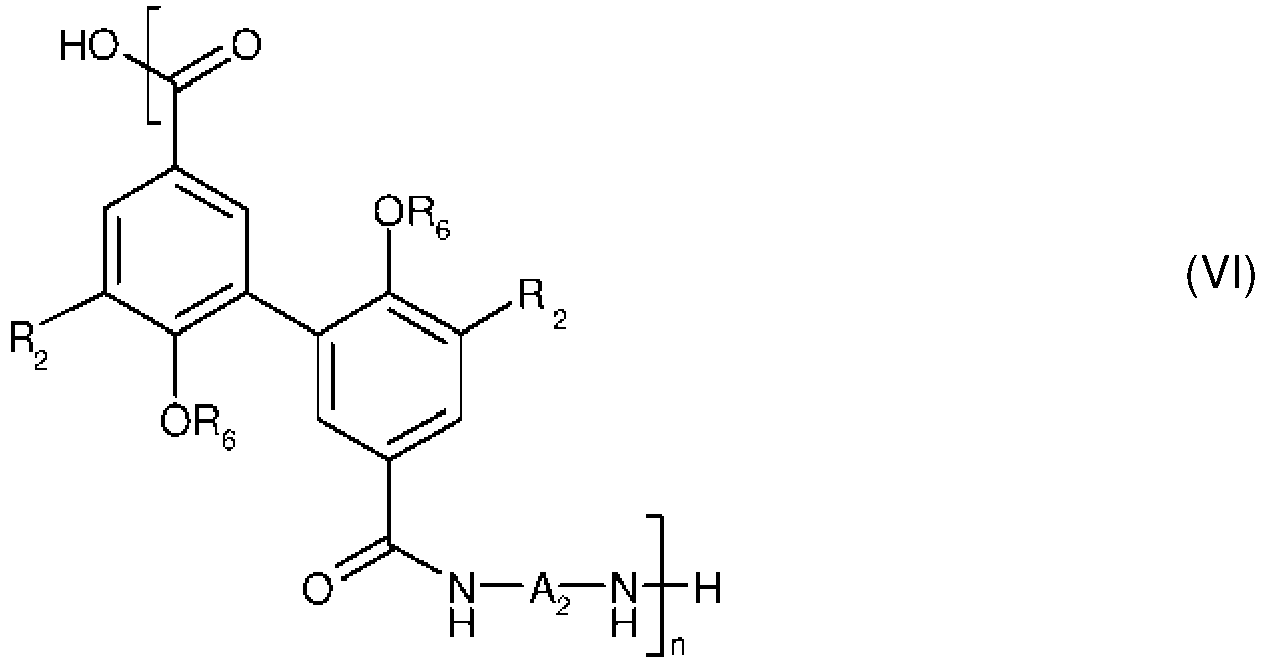 - A2 ausgewählt ist aus der Gruppe bestehend aus:∘ einem (C2-C10)-Alkylenrest;∘ einem (C3-C12)-Cycloalkylenrest, gegebenenfalls substituiert durch mindestens eine (C1-C10)-Alkylgruppe;∘ einem (C2-C30)-Alkenylenrest;∘ einem Arylenrest mit 6 bis 14 Kohlenstoffatomen, gegebenenfalls substituiert in ortho, meta oder para mit einer (C1-C10)-Alkylgruppe;∘ einem Heteroarylenrest mit 5 bis 14 Kohlenstoffatomen und mindestens einem Heteroatom, ausgewählt aus O, S und N, gegebenenfalls substituiert in ortho, meta oder para mit einer (C1-C10)-Alkylgruppe; und∘ einem Rest der Formel-B'1-B'2-B'3-, wobei:• B'2 ein (C1-C10)-Alkylenrest und• B'1 und B'3, die gleich oder verschieden sind, aus den Arylenresten mit 6 bis 14 Kohlenstoffatomen ausgewählt sind, gegebenenfalls substituiert in ortho, meta oder para mit einer (C1-C10)-Alkylgruppe;- R2 eine (C1-C6)-Alkoxygruppe ist;- R6 eine (C1-C6)-Alkylgruppe ist; und- n eine ganze Zahl von 1 bis 100 ist.
 - Verfahren zum Herstellen einer Verbindung nach Anspruch 9, umfassend mindestens einen Schritt der Polymerisation von:- einer Verbindung mit der folgenden Formel (I-3):
 - und ein Diamin mit der Formel (VII) H2N-A2-NH2, A2 wie in Anspruch 9 definiert ist.
 - Verfahren zum Herstellen einer Verbindung nach Anspruch 2, umfassend mindestens einen Schritt der Polymerisation von:- einer Verbindung mit der folgenden Formel (I-4):
 . wobei R2 eine (C1-C6)-Alkoxygruppe ist;. k eine ganze Zahl von 1 bis 6 ist,. R' eine (C1-C6)-Alkoxygruppe ist;- und einem Diamin mit der Formel (X) H2N-A3-NH2, wobei A3 ein Rest mit der Formel -B"1-B"2- ist, wobei:• B"1 ein (C3-C12)-Cycloalkylenrest ist, in dem ein oder mehrere Kohlenstoffatom(e) gegebenenfalls durch mindestens eine (C1-C10)-Alkylgruppe substituiert ist oder sind, und• B"2 ein (C1-C10)-Alkylenrest ist.
 - Verbindung nach Anspruch 2 mit folgender Formel (XI-A) oder (XI-B):
 - R2 eine (C1-C6)-Alkoxygruppe ist;- R6 eine (C1-C10)-Alkylgruppe ist;- Y ausgewählt ist aus der Gruppe bestehend aus: einer Bindung, einem (C1-C10)-Alkylenrest, einem Rest -C(O)O-Rc- und -Rc-O(O)C-, wobei Rc ein (C1-C10)-Alkylenrest ist;- R8 eine (C1-C6)-Alkoxygruppe oder eine (C1-C10)-Alkylgruppe ist; und- n eine ganze Zahl von 10 bis 120 ist.
 - Verfahren zum Herstellen einer Verbindung nach Anspruch 12, umfassend mindestens einen Schritt der Polymerisation von einer Verbindung mit der folgenden Formel (I-5):
 - R2 wie definiert in Anspruch 12 ist; und- R'7 ausgewählt ist aus der Gruppe bestehend aus: (C1-C10)-Alkylgruppen und (C2-C6)-Alkenylgruppen und- R9 ausgewählt ist aus der Gruppe bestehend aus: (C1-C10)-Alkylgruppen, (C2-C6)-Alkenylgruppen und -COORa-Gruppen, wobei Ra eine (C2-C12)-Alkenylgruppe ist, wobei, wenn R7 eine Alkylgruppe ist, R9 dann aus den (C2-C6)-Alkenylgruppen und-COORa-Gruppen ausgewählt ist, und, wenn R7 eine Alkenylgruppe ist, R9 dann eine Alkylgruppe ist.
 - Verfahren nach Anspruch 13, wobei der Schritt der Polymerisation in Anwesenheit eines Grubbs-Katalysators durchgeführt wird.
Applications Claiming Priority (2)
| Application Number | Priority Date | Filing Date | Title |
|---|---|---|---|
| EP14306563.9A EP3002303A1 (de) | 2014-10-03 | 2014-10-03 | Neue phenolische Polymere und Verfahren zur Herstellung davon |
| PCT/EP2015/072958 WO2016050989A1 (en) | 2014-10-03 | 2015-10-05 | New phenolic polymers and preparation processes thereof |
Publications (2)
| Publication Number | Publication Date |
|---|---|
| EP3201251A1 EP3201251A1 (de) | 2017-08-09 |
| EP3201251B1 true EP3201251B1 (de) | 2024-04-24 |
Family
ID=51795586
Family Applications (2)
| Application Number | Title | Priority Date | Filing Date |
|---|---|---|---|
| EP14306563.9A Withdrawn EP3002303A1 (de) | 2014-10-03 | 2014-10-03 | Neue phenolische Polymere und Verfahren zur Herstellung davon |
| EP15771994.9A Active EP3201251B1 (de) | 2014-10-03 | 2015-10-05 | Neue phenolische polymere und verfahren zur herstellung davon |
Family Applications Before (1)
| Application Number | Title | Priority Date | Filing Date |
|---|---|---|---|
| EP14306563.9A Withdrawn EP3002303A1 (de) | 2014-10-03 | 2014-10-03 | Neue phenolische Polymere und Verfahren zur Herstellung davon |
Country Status (4)
| Country | Link |
|---|---|
| US (1) | US10053540B2 (de) |
| EP (2) | EP3002303A1 (de) |
| CA (1) | CA2963310C (de) |
| WO (1) | WO2016050989A1 (de) |
Family Cites Families (10)
| Publication number | Priority date | Publication date | Assignee | Title |
|---|---|---|---|---|
| CH373401A (de) * | 1958-12-02 | 1963-11-30 | Inventa Ag | Verfahren zur Herstellung von 4,4'-Bisoxy-3,3'-dimethoxy-1,1'-diphenyl-äthan |
| US3453237A (en) * | 1959-07-21 | 1969-07-01 | Eastman Kodak Co | Light-sensitive polymers having a linear chain containing the styryl ketone group |
| BE592732A (de) * | 1959-08-21 | |||
| US3288755A (en) * | 1964-02-19 | 1966-11-29 | Inventa Ag | Process for the manufacture of copolyetheresters |
| JPS5110876B2 (de) * | 1973-07-02 | 1976-04-07 | ||
| US20050182203A1 (en) * | 2004-02-18 | 2005-08-18 | Yuuichi Sugano | Novel cyanate ester compound, flame-retardant resin composition, and cured product thereof |
| FR2947278B1 (fr) * | 2009-06-30 | 2012-06-22 | Rhodia Operations | Composition polyamide modifiee comprenant au moins un compose phenolique |
| US20130017397A1 (en) * | 2010-03-30 | 2013-01-17 | Mitsubishi Plastics, Inc. | Polyester film |
| WO2014051251A1 (en) | 2012-09-28 | 2014-04-03 | Industrial Cooperation Foundation Chonbuk National University | Pvax copolymer and pvax microparticles comprising the same |
| CN103467726B (zh) * | 2013-07-22 | 2015-09-09 | 南开大学 | 基于10-十一碳烯酸和香草酸制备可降解聚酯的方法 |
-
2014
- 2014-10-03 EP EP14306563.9A patent/EP3002303A1/de not_active Withdrawn
-
2015
- 2015-10-05 WO PCT/EP2015/072958 patent/WO2016050989A1/en not_active Ceased
- 2015-10-05 CA CA2963310A patent/CA2963310C/en active Active
- 2015-10-05 EP EP15771994.9A patent/EP3201251B1/de active Active
- 2015-10-10 US US15/516,359 patent/US10053540B2/en active Active
Also Published As
| Publication number | Publication date |
|---|---|
| WO2016050989A1 (en) | 2016-04-07 |
| CA2963310C (en) | 2022-11-15 |
| EP3201251A1 (de) | 2017-08-09 |
| EP3002303A1 (de) | 2016-04-06 |
| CA2963310A1 (en) | 2016-04-07 |
| US10053540B2 (en) | 2018-08-21 |
| US20170260329A1 (en) | 2017-09-14 |
Similar Documents
| Publication | Publication Date | Title |
|---|---|---|
| Fache et al. | Amine hardeners and epoxy cross-linker from aromatic renewable resources | |
| Sun et al. | Bimetallic lanthanide amido complexes as highly active initiators for the ring-opening polymerization of lactides | |
| WO2010101882A1 (en) | Thermosetting ring-opening metathesis polymerization materials with thermally degradable linkages | |
| Sung et al. | Zinc and magnesium complexes incorporated by bis (amine) benzotriazole phenoxide ligand: Synthesis, characterization, photoluminescent properties and catalysis for ring-opening polymerization of lactide | |
| Kiskan et al. | Synthesis and characterization of thermally curable polyacetylenes by polymerization of propargyl benzoxazine using rhodium catalyst | |
| JP6246225B2 (ja) | 液状スズ(ii)アルコキシドの製造方法 | |
| EP3207077B1 (de) | Neue verzweigte polymere, deren herstellungsverfahren und verwendungen davon | |
| Yoo et al. | Synthesis of the first poly (diaminosulfide) s and an investigation of their applications as drug delivery vehicles | |
| Bernhard et al. | Synthesis of levulinic acid based poly (amine-co-ester) s | |
| Moon et al. | Sugar‐Derived Poly (β‐thioester) s as a Biomedical Scaffold | |
| Chuang et al. | Synthesis, characterization, and catalytic activity of sodium ketminiate complexes toward the ring-opening polymerization of L-lactide | |
| Kossmehl et al. | Cross‐linking reactions on polyamides by bis‐and tris (maleimide) s | |
| JP5385108B2 (ja) | ベチュリンから得られるポリマー及びその製造法 | |
| US20180072842A1 (en) | Hydrocarbon polymers comprising two exo-vinylene cyclic carbonate terminal groups | |
| JP5460840B2 (ja) | ベチュリンから得られるポリマー及びその製造法 | |
| CN104311582B (zh) | 一种席夫碱锌化合物、其制备方法及聚乳酸的制备方法 | |
| US20170369637A1 (en) | Hydrocarbonated polymers with two alcoxysilane end groups | |
| EP3201251B1 (de) | Neue phenolische polymere und verfahren zur herstellung davon | |
| CN108864166B (zh) | 一种噁唑啉金属化合物、其制备方法及其作为催化剂的应用 | |
| CN107417739B (zh) | 一种希夫碱铁化合物、其制备方法及其作为催化剂的应用 | |
| KRICHELDORF* et al. | New polymer syntheses 98. Hyperbranched poly (ester-amide) s derived from naturally occurring monomers | |
| Wang et al. | Mono-, di-and tetra-zinc complexes derived from an amino-benzotriazole phenolate ligand containing a bulkier N-alkyl pendant arm: synthesis, structure and catalysis for ring-opening polymerization of cyclic esters | |
| CN102250131A (zh) | β-酮二亚胺基二烷氧基铝配合物和其制备方法及其在ε-己内酯开环聚合中的应用 | |
| JPH05287061A (ja) | 液晶ポリマー組成物 | |
| EP0171707A2 (de) | Verfahren zur Herstellung von Polyimidestern der Trimellitsäure |
Legal Events
| Date | Code | Title | Description |
|---|---|---|---|
| STAA | Information on the status of an ep patent application or granted ep patent |
Free format text: STATUS: THE INTERNATIONAL PUBLICATION HAS BEEN MADE |
|
| PUAI | Public reference made under article 153(3) epc to a published international application that has entered the european phase |
Free format text: ORIGINAL CODE: 0009012 |
|
| STAA | Information on the status of an ep patent application or granted ep patent |
Free format text: STATUS: REQUEST FOR EXAMINATION WAS MADE |
|
| 17P | Request for examination filed |
Effective date: 20170410 |
|
| AK | Designated contracting states |
Kind code of ref document: A1 Designated state(s): AL AT BE BG CH CY CZ DE DK EE ES FI FR GB GR HR HU IE IS IT LI LT LU LV MC MK MT NL NO PL PT RO RS SE SI SK SM TR |
|
| AX | Request for extension of the european patent |
Extension state: BA ME |
|
| RIN1 | Information on inventor provided before grant (corrected) |
Inventor name: CRAMAIL, HENRI Inventor name: GRAU, ETIENNE Inventor name: GRELIER, STEPHANE Inventor name: CARLOTTI, STEPHANE Inventor name: LLEVOT, AUDREY |
|
| DAV | Request for validation of the european patent (deleted) | ||
| DAX | Request for extension of the european patent (deleted) | ||
| STAA | Information on the status of an ep patent application or granted ep patent |
Free format text: STATUS: EXAMINATION IS IN PROGRESS |
|
| 17Q | First examination report despatched |
Effective date: 20201002 |
|
| GRAP | Despatch of communication of intention to grant a patent |
Free format text: ORIGINAL CODE: EPIDOSNIGR1 |
|
| STAA | Information on the status of an ep patent application or granted ep patent |
Free format text: STATUS: GRANT OF PATENT IS INTENDED |
|
| INTG | Intention to grant announced |
Effective date: 20231201 |
|
| GRAS | Grant fee paid |
Free format text: ORIGINAL CODE: EPIDOSNIGR3 |
|
| GRAA | (expected) grant |
Free format text: ORIGINAL CODE: 0009210 |
|
| STAA | Information on the status of an ep patent application or granted ep patent |
Free format text: STATUS: THE PATENT HAS BEEN GRANTED |
|
| AK | Designated contracting states |
Kind code of ref document: B1 Designated state(s): AL AT BE BG CH CY CZ DE DK EE ES FI FR GB GR HR HU IE IS IT LI LT LU LV MC MK MT NL NO PL PT RO RS SE SI SK SM TR |
|
| REG | Reference to a national code |
Ref country code: GB Ref legal event code: FG4D |
|
| REG | Reference to a national code |
Ref country code: CH Ref legal event code: EP |
|
| REG | Reference to a national code |
Ref country code: DE Ref legal event code: R096 Ref document number: 602015088439 Country of ref document: DE |
|
| REG | Reference to a national code |
Ref country code: IE Ref legal event code: FG4D |
|
| REG | Reference to a national code |
Ref country code: LT Ref legal event code: MG9D |
|
| REG | Reference to a national code |
Ref country code: NL Ref legal event code: FP |
|
| REG | Reference to a national code |
Ref country code: AT Ref legal event code: MK05 Ref document number: 1679530 Country of ref document: AT Kind code of ref document: T Effective date: 20240424 |
|
| PG25 | Lapsed in a contracting state [announced via postgrant information from national office to epo] |
Ref country code: IS Free format text: LAPSE BECAUSE OF FAILURE TO SUBMIT A TRANSLATION OF THE DESCRIPTION OR TO PAY THE FEE WITHIN THE PRESCRIBED TIME-LIMIT Effective date: 20240824 |
|
| PG25 | Lapsed in a contracting state [announced via postgrant information from national office to epo] |
Ref country code: BG Free format text: LAPSE BECAUSE OF FAILURE TO SUBMIT A TRANSLATION OF THE DESCRIPTION OR TO PAY THE FEE WITHIN THE PRESCRIBED TIME-LIMIT Effective date: 20240424 |
|
| PG25 | Lapsed in a contracting state [announced via postgrant information from national office to epo] |
Ref country code: HR Free format text: LAPSE BECAUSE OF FAILURE TO SUBMIT A TRANSLATION OF THE DESCRIPTION OR TO PAY THE FEE WITHIN THE PRESCRIBED TIME-LIMIT Effective date: 20240424 Ref country code: FI Free format text: LAPSE BECAUSE OF FAILURE TO SUBMIT A TRANSLATION OF THE DESCRIPTION OR TO PAY THE FEE WITHIN THE PRESCRIBED TIME-LIMIT Effective date: 20240424 |
|
| PG25 | Lapsed in a contracting state [announced via postgrant information from national office to epo] |
Ref country code: GR Free format text: LAPSE BECAUSE OF FAILURE TO SUBMIT A TRANSLATION OF THE DESCRIPTION OR TO PAY THE FEE WITHIN THE PRESCRIBED TIME-LIMIT Effective date: 20240725 |
|
| PG25 | Lapsed in a contracting state [announced via postgrant information from national office to epo] |
Ref country code: PT Free format text: LAPSE BECAUSE OF FAILURE TO SUBMIT A TRANSLATION OF THE DESCRIPTION OR TO PAY THE FEE WITHIN THE PRESCRIBED TIME-LIMIT Effective date: 20240826 |
|
| PG25 | Lapsed in a contracting state [announced via postgrant information from national office to epo] |
Ref country code: ES Free format text: LAPSE BECAUSE OF FAILURE TO SUBMIT A TRANSLATION OF THE DESCRIPTION OR TO PAY THE FEE WITHIN THE PRESCRIBED TIME-LIMIT Effective date: 20240424 |
|
| PG25 | Lapsed in a contracting state [announced via postgrant information from national office to epo] |
Ref country code: AT Free format text: LAPSE BECAUSE OF FAILURE TO SUBMIT A TRANSLATION OF THE DESCRIPTION OR TO PAY THE FEE WITHIN THE PRESCRIBED TIME-LIMIT Effective date: 20240424 |
|
| PG25 | Lapsed in a contracting state [announced via postgrant information from national office to epo] |
Ref country code: PL Free format text: LAPSE BECAUSE OF FAILURE TO SUBMIT A TRANSLATION OF THE DESCRIPTION OR TO PAY THE FEE WITHIN THE PRESCRIBED TIME-LIMIT Effective date: 20240424 |
|
| PG25 | Lapsed in a contracting state [announced via postgrant information from national office to epo] |
Ref country code: LV Free format text: LAPSE BECAUSE OF FAILURE TO SUBMIT A TRANSLATION OF THE DESCRIPTION OR TO PAY THE FEE WITHIN THE PRESCRIBED TIME-LIMIT Effective date: 20240424 |
|
| PG25 | Lapsed in a contracting state [announced via postgrant information from national office to epo] |
Ref country code: PT Free format text: LAPSE BECAUSE OF FAILURE TO SUBMIT A TRANSLATION OF THE DESCRIPTION OR TO PAY THE FEE WITHIN THE PRESCRIBED TIME-LIMIT Effective date: 20240826 Ref country code: PL Free format text: LAPSE BECAUSE OF FAILURE TO SUBMIT A TRANSLATION OF THE DESCRIPTION OR TO PAY THE FEE WITHIN THE PRESCRIBED TIME-LIMIT Effective date: 20240424 Ref country code: NO Free format text: LAPSE BECAUSE OF FAILURE TO SUBMIT A TRANSLATION OF THE DESCRIPTION OR TO PAY THE FEE WITHIN THE PRESCRIBED TIME-LIMIT Effective date: 20240724 Ref country code: LV Free format text: LAPSE BECAUSE OF FAILURE TO SUBMIT A TRANSLATION OF THE DESCRIPTION OR TO PAY THE FEE WITHIN THE PRESCRIBED TIME-LIMIT Effective date: 20240424 Ref country code: IS Free format text: LAPSE BECAUSE OF FAILURE TO SUBMIT A TRANSLATION OF THE DESCRIPTION OR TO PAY THE FEE WITHIN THE PRESCRIBED TIME-LIMIT Effective date: 20240824 Ref country code: HR Free format text: LAPSE BECAUSE OF FAILURE TO SUBMIT A TRANSLATION OF THE DESCRIPTION OR TO PAY THE FEE WITHIN THE PRESCRIBED TIME-LIMIT Effective date: 20240424 Ref country code: GR Free format text: LAPSE BECAUSE OF FAILURE TO SUBMIT A TRANSLATION OF THE DESCRIPTION OR TO PAY THE FEE WITHIN THE PRESCRIBED TIME-LIMIT Effective date: 20240725 Ref country code: FI Free format text: LAPSE BECAUSE OF FAILURE TO SUBMIT A TRANSLATION OF THE DESCRIPTION OR TO PAY THE FEE WITHIN THE PRESCRIBED TIME-LIMIT Effective date: 20240424 Ref country code: ES Free format text: LAPSE BECAUSE OF FAILURE TO SUBMIT A TRANSLATION OF THE DESCRIPTION OR TO PAY THE FEE WITHIN THE PRESCRIBED TIME-LIMIT Effective date: 20240424 Ref country code: BG Free format text: LAPSE BECAUSE OF FAILURE TO SUBMIT A TRANSLATION OF THE DESCRIPTION OR TO PAY THE FEE WITHIN THE PRESCRIBED TIME-LIMIT Effective date: 20240424 Ref country code: AT Free format text: LAPSE BECAUSE OF FAILURE TO SUBMIT A TRANSLATION OF THE DESCRIPTION OR TO PAY THE FEE WITHIN THE PRESCRIBED TIME-LIMIT Effective date: 20240424 Ref country code: RS Free format text: LAPSE BECAUSE OF FAILURE TO SUBMIT A TRANSLATION OF THE DESCRIPTION OR TO PAY THE FEE WITHIN THE PRESCRIBED TIME-LIMIT Effective date: 20240724 |
|
| PG25 | Lapsed in a contracting state [announced via postgrant information from national office to epo] |
Ref country code: DK Free format text: LAPSE BECAUSE OF FAILURE TO SUBMIT A TRANSLATION OF THE DESCRIPTION OR TO PAY THE FEE WITHIN THE PRESCRIBED TIME-LIMIT Effective date: 20240424 |
|
| PG25 | Lapsed in a contracting state [announced via postgrant information from national office to epo] |
Ref country code: EE Free format text: LAPSE BECAUSE OF FAILURE TO SUBMIT A TRANSLATION OF THE DESCRIPTION OR TO PAY THE FEE WITHIN THE PRESCRIBED TIME-LIMIT Effective date: 20240424 |
|
| PG25 | Lapsed in a contracting state [announced via postgrant information from national office to epo] |
Ref country code: CZ Free format text: LAPSE BECAUSE OF FAILURE TO SUBMIT A TRANSLATION OF THE DESCRIPTION OR TO PAY THE FEE WITHIN THE PRESCRIBED TIME-LIMIT Effective date: 20240424 |
|
| PG25 | Lapsed in a contracting state [announced via postgrant information from national office to epo] |
Ref country code: SK Free format text: LAPSE BECAUSE OF FAILURE TO SUBMIT A TRANSLATION OF THE DESCRIPTION OR TO PAY THE FEE WITHIN THE PRESCRIBED TIME-LIMIT Effective date: 20240424 Ref country code: RO Free format text: LAPSE BECAUSE OF FAILURE TO SUBMIT A TRANSLATION OF THE DESCRIPTION OR TO PAY THE FEE WITHIN THE PRESCRIBED TIME-LIMIT Effective date: 20240424 |
|
| REG | Reference to a national code |
Ref country code: DE Ref legal event code: R097 Ref document number: 602015088439 Country of ref document: DE |
|
| PG25 | Lapsed in a contracting state [announced via postgrant information from national office to epo] |
Ref country code: SM Free format text: LAPSE BECAUSE OF FAILURE TO SUBMIT A TRANSLATION OF THE DESCRIPTION OR TO PAY THE FEE WITHIN THE PRESCRIBED TIME-LIMIT Effective date: 20240424 |
|
| PG25 | Lapsed in a contracting state [announced via postgrant information from national office to epo] |
Ref country code: SM Free format text: LAPSE BECAUSE OF FAILURE TO SUBMIT A TRANSLATION OF THE DESCRIPTION OR TO PAY THE FEE WITHIN THE PRESCRIBED TIME-LIMIT Effective date: 20240424 Ref country code: SK Free format text: LAPSE BECAUSE OF FAILURE TO SUBMIT A TRANSLATION OF THE DESCRIPTION OR TO PAY THE FEE WITHIN THE PRESCRIBED TIME-LIMIT Effective date: 20240424 Ref country code: RO Free format text: LAPSE BECAUSE OF FAILURE TO SUBMIT A TRANSLATION OF THE DESCRIPTION OR TO PAY THE FEE WITHIN THE PRESCRIBED TIME-LIMIT Effective date: 20240424 Ref country code: EE Free format text: LAPSE BECAUSE OF FAILURE TO SUBMIT A TRANSLATION OF THE DESCRIPTION OR TO PAY THE FEE WITHIN THE PRESCRIBED TIME-LIMIT Effective date: 20240424 Ref country code: DK Free format text: LAPSE BECAUSE OF FAILURE TO SUBMIT A TRANSLATION OF THE DESCRIPTION OR TO PAY THE FEE WITHIN THE PRESCRIBED TIME-LIMIT Effective date: 20240424 Ref country code: CZ Free format text: LAPSE BECAUSE OF FAILURE TO SUBMIT A TRANSLATION OF THE DESCRIPTION OR TO PAY THE FEE WITHIN THE PRESCRIBED TIME-LIMIT Effective date: 20240424 |
|
| PLBE | No opposition filed within time limit |
Free format text: ORIGINAL CODE: 0009261 |
|
| STAA | Information on the status of an ep patent application or granted ep patent |
Free format text: STATUS: NO OPPOSITION FILED WITHIN TIME LIMIT |
|
| 26N | No opposition filed |
Effective date: 20250127 |
|
| PG25 | Lapsed in a contracting state [announced via postgrant information from national office to epo] |
Ref country code: SI Free format text: LAPSE BECAUSE OF FAILURE TO SUBMIT A TRANSLATION OF THE DESCRIPTION OR TO PAY THE FEE WITHIN THE PRESCRIBED TIME-LIMIT Effective date: 20240424 |
|
| REG | Reference to a national code |
Ref country code: CH Ref legal event code: PL |
|
| PG25 | Lapsed in a contracting state [announced via postgrant information from national office to epo] |
Ref country code: MC Free format text: LAPSE BECAUSE OF FAILURE TO SUBMIT A TRANSLATION OF THE DESCRIPTION OR TO PAY THE FEE WITHIN THE PRESCRIBED TIME-LIMIT Effective date: 20240424 |
|
| PG25 | Lapsed in a contracting state [announced via postgrant information from national office to epo] |
Ref country code: LU Free format text: LAPSE BECAUSE OF NON-PAYMENT OF DUE FEES Effective date: 20241005 |
|
| PG25 | Lapsed in a contracting state [announced via postgrant information from national office to epo] |
Ref country code: CH Free format text: LAPSE BECAUSE OF NON-PAYMENT OF DUE FEES Effective date: 20241031 |
|
| PG25 | Lapsed in a contracting state [announced via postgrant information from national office to epo] |
Ref country code: SE Free format text: LAPSE BECAUSE OF FAILURE TO SUBMIT A TRANSLATION OF THE DESCRIPTION OR TO PAY THE FEE WITHIN THE PRESCRIBED TIME-LIMIT Effective date: 20240424 |
|
| PG25 | Lapsed in a contracting state [announced via postgrant information from national office to epo] |
Ref country code: IE Free format text: LAPSE BECAUSE OF NON-PAYMENT OF DUE FEES Effective date: 20241005 |
|
| PGFP | Annual fee paid to national office [announced via postgrant information from national office to epo] |
Ref country code: NL Payment date: 20251021 Year of fee payment: 11 |
|
| PGFP | Annual fee paid to national office [announced via postgrant information from national office to epo] |
Ref country code: DE Payment date: 20251021 Year of fee payment: 11 |
|
| PGFP | Annual fee paid to national office [announced via postgrant information from national office to epo] |
Ref country code: GB Payment date: 20251024 Year of fee payment: 11 |
|
| PGFP | Annual fee paid to national office [announced via postgrant information from national office to epo] |
Ref country code: IT Payment date: 20251024 Year of fee payment: 11 |
|
| PGFP | Annual fee paid to national office [announced via postgrant information from national office to epo] |
Ref country code: FR Payment date: 20251030 Year of fee payment: 11 |
|
| REG | Reference to a national code |
Ref country code: DE Ref legal event code: R081 Ref document number: 602015088439 Country of ref document: DE Owner name: ARIANEGROUP SAS, FR Free format text: FORMER OWNERS: CENTRE NATIONAL DE LA RECHERCHE SCIENTIFIQUE (C.N.R.S.), PARIS, FR; INSTITUT POLYTECHNIQUE DE BORDEAUX, TALENCE, FR; UNIVERSITE DE BORDEAUX, BORDEAUX, FR Ref country code: DE Ref legal event code: R082 Ref document number: 602015088439 Country of ref document: DE |
|
| PGFP | Annual fee paid to national office [announced via postgrant information from national office to epo] |
Ref country code: BE Payment date: 20251021 Year of fee payment: 11 |
|
| PG25 | Lapsed in a contracting state [announced via postgrant information from national office to epo] |
Ref country code: CY Free format text: LAPSE BECAUSE OF FAILURE TO SUBMIT A TRANSLATION OF THE DESCRIPTION OR TO PAY THE FEE WITHIN THE PRESCRIBED TIME-LIMIT; INVALID AB INITIO Effective date: 20151005 |
|
| REG | Reference to a national code |
Ref country code: GB Ref legal event code: 732E Free format text: REGISTERED BETWEEN 20260129 AND 20260204 |
|
| PG25 | Lapsed in a contracting state [announced via postgrant information from national office to epo] |
Ref country code: HU Free format text: LAPSE BECAUSE OF FAILURE TO SUBMIT A TRANSLATION OF THE DESCRIPTION OR TO PAY THE FEE WITHIN THE PRESCRIBED TIME-LIMIT; INVALID AB INITIO Effective date: 20151005 |