EP3202101B1 - Verfahren, vorrichtungen und systeme zur übertragung hybrider automatischer wiederholungsanfragen unter verwendung von kanälen in einem unlizenzierten gemeinsam genutzten medium - Google Patents
Verfahren, vorrichtungen und systeme zur übertragung hybrider automatischer wiederholungsanfragen unter verwendung von kanälen in einem unlizenzierten gemeinsam genutzten medium Download PDFInfo
- Publication number
- EP3202101B1 EP3202101B1 EP15750179.2A EP15750179A EP3202101B1 EP 3202101 B1 EP3202101 B1 EP 3202101B1 EP 15750179 A EP15750179 A EP 15750179A EP 3202101 B1 EP3202101 B1 EP 3202101B1
- Authority
- EP
- European Patent Office
- Prior art keywords
- feedback
- subframe
- circuitry
- data transmission
- enb
- Prior art date
- Legal status (The legal status is an assumption and is not a legal conclusion. Google has not performed a legal analysis and makes no representation as to the accuracy of the status listed.)
- Active
Links
Images




Classifications
-
- H—ELECTRICITY
- H04—ELECTRIC COMMUNICATION TECHNIQUE
- H04L—TRANSMISSION OF DIGITAL INFORMATION, e.g. TELEGRAPHIC COMMUNICATION
- H04L1/00—Arrangements for detecting or preventing errors in the information received
- H04L1/12—Arrangements for detecting or preventing errors in the information received by using return channel
- H04L1/16—Arrangements for detecting or preventing errors in the information received by using return channel in which the return channel carries supervisory signals, e.g. repetition request signals
- H04L1/18—Automatic repetition systems, e.g. Van Duuren systems
- H04L1/1812—Hybrid protocols; Hybrid automatic repeat request [HARQ]
-
- H—ELECTRICITY
- H04—ELECTRIC COMMUNICATION TECHNIQUE
- H04L—TRANSMISSION OF DIGITAL INFORMATION, e.g. TELEGRAPHIC COMMUNICATION
- H04L1/00—Arrangements for detecting or preventing errors in the information received
- H04L1/12—Arrangements for detecting or preventing errors in the information received by using return channel
- H04L1/16—Arrangements for detecting or preventing errors in the information received by using return channel in which the return channel carries supervisory signals, e.g. repetition request signals
- H04L1/18—Automatic repetition systems, e.g. Van Duuren systems
- H04L1/1867—Arrangements specially adapted for the transmitter end
- H04L1/1893—Physical mapping arrangements
-
- H—ELECTRICITY
- H04—ELECTRIC COMMUNICATION TECHNIQUE
- H04L—TRANSMISSION OF DIGITAL INFORMATION, e.g. TELEGRAPHIC COMMUNICATION
- H04L27/00—Modulated-carrier systems
- H04L27/0006—Assessment of spectral gaps suitable for allocating digitally modulated signals, e.g. for carrier allocation in cognitive radio
-
- H—ELECTRICITY
- H04—ELECTRIC COMMUNICATION TECHNIQUE
- H04L—TRANSMISSION OF DIGITAL INFORMATION, e.g. TELEGRAPHIC COMMUNICATION
- H04L5/00—Arrangements affording multiple use of the transmission path
- H04L5/0001—Arrangements for dividing the transmission path
- H04L5/0003—Two-dimensional division
- H04L5/0005—Time-frequency
- H04L5/0007—Time-frequency the frequencies being orthogonal, e.g. OFDM(A) or DMT
-
- H—ELECTRICITY
- H04—ELECTRIC COMMUNICATION TECHNIQUE
- H04L—TRANSMISSION OF DIGITAL INFORMATION, e.g. TELEGRAPHIC COMMUNICATION
- H04L5/00—Arrangements affording multiple use of the transmission path
- H04L5/003—Arrangements for allocating sub-channels of the transmission path
- H04L5/0053—Allocation of signalling, i.e. of overhead other than pilot signals
- H04L5/0055—Physical resource allocation for ACK/NACK
-
- H—ELECTRICITY
- H04—ELECTRIC COMMUNICATION TECHNIQUE
- H04L—TRANSMISSION OF DIGITAL INFORMATION, e.g. TELEGRAPHIC COMMUNICATION
- H04L5/00—Arrangements affording multiple use of the transmission path
- H04L5/14—Two-way operation using the same type of signal, i.e. duplex
-
- H—ELECTRICITY
- H04—ELECTRIC COMMUNICATION TECHNIQUE
- H04W—WIRELESS COMMUNICATION NETWORKS
- H04W72/00—Local resource management
- H04W72/02—Selection of wireless resources by user or terminal
-
- H—ELECTRICITY
- H04—ELECTRIC COMMUNICATION TECHNIQUE
- H04L—TRANSMISSION OF DIGITAL INFORMATION, e.g. TELEGRAPHIC COMMUNICATION
- H04L27/00—Modulated-carrier systems
- H04L27/001—Modulated-carrier systems using chaotic signals
-
- H—ELECTRICITY
- H04—ELECTRIC COMMUNICATION TECHNIQUE
- H04W—WIRELESS COMMUNICATION NETWORKS
- H04W28/00—Network traffic management; Network resource management
- H04W28/02—Traffic management, e.g. flow control or congestion control
- H04W28/06—Optimizing the usage of the radio link, e.g. header compression, information sizing, discarding information
Definitions
- Implementations of the claimed invention generally relate to the field of wireless communications, and in particular, utilizing unlicensed spectrum in Long Term Evolution (LTE) wireless communications networks.
- LTE Long Term Evolution
- LTE Long Term Evolution
- LTE-U Long Term Evolution
- LAA Licensed-Assisted Access
- the unlicensed spectrum includes frequencies in the 5GHz band.
- LTE-U The basic premise of LTE-U is to extend the LTE protocols into the unlicensed spectrum in order to supplement data traffic in the licensed spectrum. Because wireless network operators deploy their LTE systems in their corresponding licensed spectrum, data transmission and related acknowledgement feedback do not typically require any contention mechanisms. However, since the unlicensed spectrum can be shared by more than one wireless network operator, as well as other radio access technologies (for example, Wi-Fi), sharing and contention mechanisms may be required to deploy LTE in the unlicensed spectrum.
- radio access technologies for example, Wi-Fi
- the aforementioned contention mechanisms can be employed to transmit downlink and/or uplink data using the unlicensed spectrum.
- QoS quality of service
- HARQ hybrid automatic repeat request
- ACK acknowledgenowledgement
- the transmission of HARQ-ACK feedback over licensed channel will likely induce significant overheads. Therefore, the use of unlicensed band for HARQ-ACK feedback transmission may be advantageous.
- LTE will be deployed as a Stand-Alone (SA) carrier in the unlicensed band. Therefore, new mechanisms may be required to transmit HARQ-ACK information in the unlicensed band.
- SA Stand-Alone
- US 2014/0112289 A1 relates to a method for transmitting a signal to an unlicensed band of a base station in a wireless communication system.
- the method comprises the steps of: transmitting at least one of a preamble and a reservation signal, if it is determined through carrier sensing that the unlicensed band is available; and transmitting a PDSCH on the unlicensed band immediately after the transmission of at least one of the preamble and the reservation signal.
- the preamble enables a terminal to acquire reception synchronization for at least one of the reservation signal and the PDSCH.
- US 2013/0225184 A1 discloses a system for operating a communications controller for a group of user equipments engaged in a direct mobile communication (DMC) link in a wireless communications system.
- the communications controller is configured to allocate a set of subframes in one periodic group of subframes to the group of UEs for the DMC link, signal the set of allocated subframes to the group of UEs, and transmit parameters related to a group of HARQ processes of the DMC link.
- the communication controller uses HARQ processes for cellular UE transmission that are determined independently from HARQ processes of the group of HARQ processes for the DMC link, and the parameters are configured to enable the group of UEs to manage the group of HARQ processes for the DMC link.
- 3GPP Tdoc. R1-144042 "Candidate solutions for LAA operation"
- 3GPP TSG RAN WG1 Meeting #78bis, October 2014 relates to discuss potential candidate solutions for licensed-assisted access (LAA) operation in terms of radio access scheme for coexistence with other systems/operators and the relevant improvement for reliable operation/resource utilization in unlicensed band.
- LAA licensed-assisted access
- a and/or B means (A), (B), or (A and B).
- the phrases “A/B” and “A or B” mean (A), (B), or (A and B), similar to the phrase “A and/or B”.
- the phrase “at least one of A and B” means (A), (B), or (A and B).
- example embodiments may be described as a process depicted as a flowchart, a flow diagram, a data flow diagram, a structure diagram, or a block diagram. Although a flowchart may describe the operations as a sequential process, many of the operations may be performed in parallel, concurrently, or simultaneously. In addition, the order of the operations may be re-arranged.
- a process may be terminated when its operations are completed, but may also have additional steps not included in the figure(s).
- a process may correspond to a method, a function, a procedure, a subroutine, a subprogram, and the like. When a process corresponds to a function, its termination may correspond to a return of the function to the calling function and/or the main function.
- circuitry refers to, is part of, or includes hardware components such as an Application Specific Integrated Circuit (ASIC), an electronic circuit, a logic circuit, a processor (shared, dedicated, or group) and/or memory (shared, dedicated, or group) that are configured to provide the described functionality.
- ASIC Application Specific Integrated Circuit
- the circuitry may execute one or more software or firmware programs to provide at least some of the described functionality.
- Example embodiments may be described in the general context of computer-executable instructions, such as program code, software modules, and/or functional processes, being executed by one or more of the aforementioned circuitry.
- the program code, software modules, and/or functional processes may include routines, programs, objects, components, data structures, etc. that perform particular tasks or implement particular data types.
- the program code, software modules, and/or functional processes discussed herein may be implemented using existing hardware in existing communication networks. For example, program code, software modules, and/or functional processes discussed herein may be implemented using existing hardware at existing network elements or control nodes.
- the term "user equipment” may be considered synonymous to, and may hereafter be occasionally referred to, as a client, mobile, mobile device, mobile terminal, user terminal, mobile unit, mobile station, mobile user, UE, subscriber, user, remote station, access agent, user agent, receiver, etc., and may describe a remote user of network resources in a communications network.
- the term “user equipment” may include any type of wireless/wired device such as consumer electronics devices, cellular phones, smart phones, tablet personal computers, wearable computing devices, personal digital assistants (PDAs), desktop computers, and laptop computers, for example.
- network element may be considered synonymous to and/or referred to as a networked computer, networking hardware, network equipment, router, switch, hub, bridge, radio network controller, radio access network device, gateway, and/or any other like device.
- network element may describe a physical computing device of a wired or wireless communication network and configured to host a virtual machine.
- network element may describe equipment that provides radio baseband functions for data and/or voice connectivity between a network and one or more users.
- network element may be considered synonymous to and/or referred to as a "base station”.
- base station may be considered synonymous to and/or referred to as a Node B, an enhanced or evolved Node B (eNB), base transceiver station (BTS), access point (AP), etc. and may describe equipment that provides the radio baseband functions for data and/or voice connectivity between a network and one or more users.
- eNB enhanced or evolved Node B
- BTS base transceiver station
- AP access point
- channel may refer to any transmission medium, either tangible or intangible, which is used to communicate data or a data stream.
- channel may be synonymous with and/or equivalent to "communications channel”, “data communications channel”, “transmission channel”, “data transmission channel”, “access channel”, “data access channel”, “link”, “data link”, “carrier”, “radiofrequency carrier”, and/or any other like term denoting a pathway or medium through which data is communicated.
- Example embodiments are generally directed towards the design of Long Term Evolution - Unlicensed (LTE-U) and Licensed-Assisted Access (LAA) as a Stand-Alone (SA) carrier in the unlicensed spectrum, and more specifically, example embodiments are directed towards new hybrid automatic repeat request (HARQ) feedback mechanisms that may be used for data transmissions in an unlicensed shared medium.
- LTE-U Long Term Evolution - Unlicensed
- LAA Licensed-Assisted Access
- SA Stand-Alone
- HARQ new hybrid automatic repeat request
- FIG. 1 illustrates an example of a communications network 100, according to an example embodiment.
- Communications network 100 includes user equipments (UEs) 105, e Node B (eNB) 110, and core network 115.
- UEs user equipments
- eNB e Node B
- core network 115 core network 115.
- each of the UEs 105 may be physical hardware devices that are capable of running one or more applications and capable of connecting with a network element (for example, BSs 110) via a wireless interface.
- UE 105 may include a transmitter/receiver (or alternatively, a transceiver), memory, one or more processors, and/or other like components.
- UE 105 may be configured to send/receive data to/from at least one of the BSs 110 (collectively referred to as "eNB 110").
- UE 105 may be designed to sequentially and automatically carry out a sequence of arithmetic or logical operations; equipped to record/store digital data on a machine readable medium; and transmit and receive digital data via base station 110.
- UE 105 may include wireless phones or smartphones, laptop personal computers (PCs), tablet PCs, wearable computing devices, and/or any other physical or logical device capable of recording, storing, and/or transferring digital data via base station 110 and/or any other like network element.
- the wireless transmitter/receiver (or alternatively, a transceiver) included in the UE 105 is configured to operate in accordance with one or more wireless communications protocols and/or one or more cellular phone communications protocols.
- UE 105 may be configured to operate in accordance with the 3rd Generation Partnership Project (3GPP) Long Term Evolution-Advanced (LTE-A) standards and/or any other wireless communication protocols, including RF-based, optical (visible/invisible), and so forth.
- 3GPP 3rd Generation Partnership Project
- LTE-A Long Term Evolution-Advanced
- the UE 105 may be configured to communicate data (for example, transmit and receive) data over a licensed shared medium (also referred to as the "licensed spectrum” and/or the “licensed band”) and an unlicensed shared medium (also referred to as the "unlicensed spectrum” and/or the “unlicensed band”).
- the licensed spectrum may include channels that operate in the frequency range of approximately 400 MHz to approximately 3.8 GHz, whereas the unlicensed spectrum may include the 5 GHz band.
- the UE 105 may be configured to perform one or more known medium-sensing operations and/or carrier-sensing operations in order to determine whether one or more channels in the unlicensed spectrum is unavailable or otherwise occupied.
- eNB 110 is a hardware computing device configured to provide wireless communication services to mobile devices (for example, UE 105) within a geographic area or cell coverage area associated with eNB 110.
- the eNB 110 may provide wireless communication services to UE 105 via a link for each UE 105.
- Links between eNB 110 and a UE 105 may include one or more downlink (or forward) channels for transmitting information from eNB 110 to UE 105 and one or more uplink (or reverse) channels for transmitting information from UE 105 to the eNB 110.
- the channels may include the Physical Downlink Shared Channel (PDSCH), Physical Downlink Control Channel (PDCCH), Physical HARQ Indicator Channel (PHICH), Physical Control Format Indicator Channel (PCFICH), Physical Broadcast Channel (PBCH), Physical Uplink Shared Channel (PUSCH), Physical Uplink Control Channel (PUCCH), Physical Random Access Channel (PRACH), and/or any other like communications channels or links used to transmit/receive data.
- PDSCH Physical Downlink Shared Channel
- PDCCH Physical Downlink Control Channel
- PHICH Physical HARQ Indicator Channel
- PCFICH Physical Control Format Indicator Channel
- PBCH Physical Broadcast Channel
- PUSCH Physical Uplink Shared Channel
- PUCCH Physical Uplink Control Channel
- PRACH Physical Random Access Channel
- BSs 110 include a transmitter/receiver (or alternatively, a transceiver) connected to one or more antennas, one or more memory devices, one or more processors, and/or other like components.
- the one or more transmitters/receivers may be configured to transmit/receive data signals to/from one or more UEs 105 within its cell coverage area via one or more links that may be associated with a transmitter and a receiver.
- BSs 110 may be configured to operate a channel access method, such as code division multiple access (CDMA), orthogonal frequency-division multiple access (OFDMA), frequency division multiple access (FDMA), time division multiple access (TDMA), packet mode multiple-access, space division multiple access (SDMA), and/or any other like channel access methods or combinations thereof.
- CDMA code division multiple access
- OFDMA orthogonal frequency-division multiple access
- FDMA frequency division multiple access
- TDMA time division multiple access
- SDMA space division multiple access
- eNB 110 may employ Evolved Universal Terrestrial Radio Access (E-UTRA) protocols (for example, OFDMA for downlink communications and single carrier frequency-division multiple access (SC-FDMA) for uplink communications) to connect with, or otherwise communicate with, UEs 105.
- E-UTRA Evolved Universal Terrestrial Radio Access
- SC-FDMA single carrier frequency-division multiple access
- eNB 110 may be configured to perform medium-sensing operations, carrier sensing operations, and/or one or more collision detection methods, such as a carrier sense multiple access (CSMA) protocol, which is a probabilistic Media Access Control (MAC) protocol in which a device verifies the absence of other traffic before transmitting on a shared transmission medium.
- CSMA carrier sense multiple access
- the CSMA protocol may employ a collision avoidance protocol, in which a device only transmits when a channel is sensed to be idle.
- the CSMA protocol may employ a collision detection (CD) protocol, in which a device terminates a transmission as soon as a collision is detected.
- CD collision detection
- embodiments are not limited to the collision detection methods described above and may encompass any type of collision detection method.
- the CSMA protocol may be enhanced with a Request-to-Send/Clear-to-Send (RTS/CTS) protocol, in which a device wishing to send data initiates the process by sending a request to send frame (RTS) and the destination device replies with a clear to send frame (CTS).
- RTS/CTS Request-to-Send/Clear-to-Send
- eNB 110 may be part of a Radio Access Network (RAN), other Radio Access Technology (RAT), etc. that may include the eNB 110 and/or a Radio Network Controller (RNC) (not shown).
- the RAN may be referred to as an evolved UMTS Terrestrial Radio Access Network (E-UTRAN).
- the RNC may be a hardware computing device that carries out radio resource management as well as mobility management functions in the communications network 100.
- the RNC may include a transmitter/receiver (or alternatively, a transceiver) connected to one or more antennas, memory, one or more processors, and/or other like components.
- the eNB 110 and a RNC may reside on the same physical hardware device.
- the RNC may control the eNB 110 and may communicate (for example, transmit and receive) information to/from core network 115.
- RNCs and their typical functionality are generally well-known, and thus, a further detailed description of the typical functionality of RNC 115 is omitted.
- core network 115 may include one or more hardware devices that provide various telecommunications services to mobile devices (for example, UE 105), which may be connected to the core network 115 via a base station (for example, eNB 110).
- core network 115 may comprise components of the System Architecture Evolution (SAE) with an Evolved Packet Core (EPC) as described by 3GPP Technical Specifications.
- SAE System Architecture Evolution
- EPC Evolved Packet Core
- core network 115 may include components such as a Mobility Management Entity (MME), Serving Gateway (SGW), Packet Data Network (PDN) Gateway (PGW), Home Subscriber Server (HSS), Access Network Discovery and Selection Function (ANDSF), Evolved Packet Data Gateway (ePDG), and/or other like components as are known.
- MME Mobility Management Entity
- SGW Serving Gateway
- PDN Packet Data Network
- PGW Packet Data Network Gateway
- HSS Home Subscriber Server
- ANDSF Access Network Discovery and Selection Function
- ePDG Evolved Packet Data Gateway
- the UEs 105 and the eNB may be configured to operate in accordance with the automatic repeat request (ARQ) or hybrid ARQ (HARQ) protocols such that UEs 105 may transmit feedback or a feedback message/signal in response to receiving a data transmission from the eNB 110.
- ARQ automatic repeat request
- HARQ hybrid ARQ
- a data transmission may be carried by transport blocks that may be sent over a downlink physical data channel (for example, the PDSCH).
- Scheduling information of the data transmission including its resource allocation in one or more subframes and its modulation and coding scheme, may be included in a physical control channel (for example, the PDCCH).
- the UE 105 may decode the messages in the physical control channel and if the UE 105 determines that it has been assigned to a physical data channel, the UE 105 will decode the data transmission according to the scheduling information decoded from the physical control channel.
- the feedback may be in the form of a HARQ-acknowledgement (ACK) message or a HARQ-negative acknowledgement (NACK) message.
- the UE 105 may transmit the HARQ-ACK message in response to properly decoding and/or demodulating the data transmission received from the eNB 110 over the physical data channel.
- the HARQ-ACK message may indicate to the eNB that a next scheduled data transmission may be transmitted to the UE 105 over the same physical data channel or a different physical data channel.
- the UE 105 may transmit the HARQ-NACK message in response to an improper or unsuccessful decoding and/or demodulating of the data transmission received from the eNB 110 over the physical data channel.
- the HARQ-NACK message may indicate to the eNB 110 that the previously transmitted data transmission should be retransmitted to the UE 105 over the same or different physical data channel.
- the UEs 105 may transmit the feedback in an uplink transmission that includes the HARQ-ACK/NACK, when the received data transmission is successfully/unsuccessfully decoded.
- the UE 105 may transmit the feedback over a physical control channel (e.g. the PUCCH) or a physical data channel (for example, the PUSCH).
- a physical control channel e.g. the PUCCH
- a physical data channel for example, the PUSCH
- the UE 105 may encode or otherwise embedded the ACK/NACK information into the PUSCH transmission, or the UE 105 may encode or otherwise embedded the ACK/NACK information into a separate ACK/NACK feedback message that the UE 105 transmits over the PUCCH.
- FIG. 1 shows a single base station (for example, eNB 110) serving two mobile devices (for example, UEs 105), it should be noted that in various example embodiments, communications network 100 may include many more base stations serving many more user terminals than those shown in FIG. 1 . Additionally, it should be noted that multiple base stations may be included in one RAN or RAT (not shown). It should also be noted that communications network 100 may include many more network devices as defined by the LTE standard and/or any other like wireless communications standard. However, it is not necessary that all of these generally conventional components be shown in order to understand the example embodiments as described herein.
- FIG. 2 illustrates the components of UE 105 and eNB 110 that may be employed by communications networks 100, in accordance with various example embodiments.
- the UE 105 includes feedback circuitry 205, transmitter circuitry 210, and receiver circuitry 215.
- eNB 110 includes processing circuitry 220, transmitter circuitry 225, and receiver circuitry 230.
- the transmitter circuitry 210 and the receiver circuitry 215 may be coupled with one or more antennas to facilitate over-the-air transmissions with, for example, the eNB 110.
- the transmitter circuitry 210 may be configured to receive digital data from one or more components of UE 105, and convert the received digital data into an analog signal for transmission over an air interface by way of the one or more antennas.
- the receiver circuitry 215 may be any type of hardware device that can receive and convert a signal from a modulated radio wave into usable information, such as digital data.
- Receiver circuitry 215 may be coupled with the one or more antennas in order to capture the radio waves.
- Receiver circuitry 215 may be configured to send digital data converted from a captured radio wave to one or more other components of the UE 105.
- the UE the transmitter circuitry 210 and the receiver circuitry 215 may be coupled to the feedback circuitry 205.
- the feedback circuitry 205 may also be referred to as processing circuitry 205.
- the feedback circuitry 205 may be configured to perform feedback operations described herein with respect to the UE 105.
- the components of the UE 105 circuitry may be configured to perform operations similar to those described elsewhere in the present disclosure with respect to a UE 105.
- circuitry may refer to, be part of, or include an Application Specific Integrated Circuit (ASIC), an electronic circuit, a processor (shared, dedicated, or group), and/or memory (shared, dedicated, or group) that execute one or more software or firmware programs, a combinational logic circuit, and/or other suitable hardware components that provide the described functionality.
- ASIC Application Specific Integrated Circuit
- the electronic device circuitry may be implemented in, or functions associated with the circuitry may be implemented by, one or more software or firmware modules in combination with one or more hardware devices.
- the eNB 110 circuitry may include transmitter circuitry 225 and receiver circuitry 230 coupled to processing circuitry 220.
- the transmitter circuitry 225 and the receiver circuitry 230 may be the same or similar to the transmitter circuitry 210 and the receiver circuitry 215 as described with regard to UE 105, or the transmitter circuitry 225 and the receiver circuitry 230 may operate in a same or similar fashion as described with regard to the transmitter circuitry 210 and the receiver circuitry 215 of the UE 105.
- the transmitter circuitry 225 and receiver circuitry 230 may be coupled with one or more antennas to provide over the air communications with, for example, the UE 105.
- the eNB 110 may be configured to communicate over a backhaul communication link with other network entities such as, for example, entities within an evolved packet core (EPC) of a wireless communications system (for example, entities within the core network 115).
- the processing circuitry 220 may control and/or schedule the transmission of data to/from the UE 105 in accordance with the various example embodiments described herein.
- the components of the eNB 110 circuitry may be configured to perform operations similar to those described elsewhere in this disclosure with respect to the eNB 110.
- circuitry may refer to, be part of, or include an Application Specific Integrated Circuit (ASIC), an electronic circuit, a processor (shared, dedicated, or group), and/or memory (shared, dedicated, or group) that execute one or more software or firmware programs, a combinational logic circuit, and/or other suitable hardware components that provide the described functionality.
- ASIC Application Specific Integrated Circuit
- the electronic device circuitry may be implemented in, or functions associated with the circuitry may be implemented by, one or more software or firmware modules in combination with one or more hardware devices.
- FIG. 3 illustrates the components of a computing system 300 that may implement the example embodiments disclosed herein, in accordance with various example embodiments.
- FIG. 3 illustrates various components of the computing system 300, the embodiments described herein may be implemented into a system using any suitably configured hardware and/or software.
- FIG. 3 illustrates, for one example embodiment, computing system 300 comprising radio frequency (RF) circuitry 305, baseband circuitry 310, application circuitry 315, memory/storage 320, display 325, camera 330, sensor 335, and input/output (I/O) interface 340, coupled with each other at least as shown by FIG. 3 .
- RF radio frequency
- the application circuitry 315 may include circuitry such as, but not limited to, one or more single-core or multi-core processors.
- the processor(s) may include any combination of general-purpose processors and dedicated processors (for example, graphics processors, application processors, etc.).
- the processors may be coupled with memory/storage 320 and configured to execute instructions stored in the memory/storage 320 to enable various applications and/or operating systems running on the system.
- Memory/storage 320 may be a hardware device configured to store an operating system and program code for one or more software components, such as program code for performing operations for carrying out the various example embodiments described herein. Memory/storage 320 may be used to load and store data and/or instructions. Memory/storage for one embodiment may include any combination of suitable volatile memory (for example, dynamic random access memory (DRAM)) and/or non-volatile memory (for example, flash memory). The program code and/or software components may also be loaded from a separate computer readable storage medium into memory/storage 320 using a drive mechanism (not shown).
- DRAM dynamic random access memory
- flash memory for example, flash memory
- Such separate computer readable storage medium may include a memory card, memory stick, removable flash drive, sim card, CD-ROM/DVD disc, and/or other like computer readable storage medium (not shown).
- software components may be loaded into memory/storage 320 from an external device or system via I/O interface 340.
- the baseband circuitry 310 may include circuitry such as, but not limited to, one or more single-core or multi-core processors.
- the processor(s) may include a baseband processor.
- the baseband circuitry may handle various radio control functions that enables communication with one or more radio networks via the RF circuitry 305. It should be noted that in various embodiments, the base band circuitry may include radio control circuitry or otherwise operate radio control circuitry to perform the various radio control functions. In various embodiments, the radio control circuitry may utilize the baseband processor to perform at least some of the radio control functions.
- the radio control functions may include, but are not limited to, signal modulation, encoding, decoding, radio frequency shifting, etc. In some embodiments, the baseband circuitry 310 may provide for communication compatible with one or more radio technologies.
- the baseband circuitry may support communication with an evolved universal terrestrial radio access network (EUTRAN) and/or other wireless metropolitan area networks (WMAN), a wireless local area network (WLAN), a wireless personal area network (WPAN).
- EUTRAN evolved universal terrestrial radio access network
- WMAN wireless metropolitan area networks
- WLAN wireless local area network
- WPAN wireless personal area network
- Embodiments in which the baseband circuitry 310 is configured to support radio communications of more than one wireless protocol may be referred to as multi-mode baseband circuitry.
- baseband circuitry 310 may include circuitry to operate with signals that are not strictly considered as being in a baseband frequency.
- baseband circuitry 310 may include circuitry to operate with signals having an intermediate frequency, which is between a baseband frequency and a radio frequency.
- RF circuitry 305 may enable communication with wireless networks using modulated electromagnetic radiation through a non-solid medium.
- the RF circuitry 305 may include switches, filters, amplifiers, etc. to facilitate the communication with the wireless network.
- RF circuitry 305 may include circuitry to operate with signals that are not strictly considered as being in a radio frequency.
- RF circuitry 305 may include circuitry to operate with signals having an intermediate frequency, which is between a baseband frequency and a radio frequency.
- the transmitter circuitry, processing circuitry, or receiver circuitry discussed above with respect to the UE 105 or eNB 110 may be embodied in whole or in part in one or more of the RF circuitry 305, the baseband circuitry 310, and/or the application circuitry 315.
- the term "circuitry” may refer to, be part of, or include an Application Specific Integrated Circuit (ASIC), an electronic circuit, a processor (shared, dedicated, or group), and/or memory (shared, dedicated, or group) that execute one or more software or firmware programs, a combinational logic circuit, and/or other suitable hardware components that provide the described functionality.
- the electronic device circuitry may be implemented in, or functions associated with the circuitry may be implemented by, one or more software or firmware modules.
- the constituent components of the baseband circuitry 310, the application circuitry 315, and/or the memory/storage 320 may be implemented together on a system on a chip (SOC).
- SOC system on a chip
- the I/O interface 340 may include one or more user interfaces designed to enable user interaction with the system and/or peripheral component interfaces designed to enable peripheral component interaction with the system.
- User interfaces may include, but are not limited to a physical keyboard or keypad, a touchpad, a speaker, a microphone, etc.
- Peripheral component interfaces may include, but are not limited to, a non-volatile memory port, a universal serial bus (USB) port, an audio jack, and a power supply interface.
- USB universal serial bus
- sensor 335 may include one or more sensing devices to determine environmental conditions and/or location information related to the system.
- the sensors 335 may include, but are not limited to, a gyro sensor, an accelerometer, a proximity sensor, an ambient light sensor, and a positioning unit.
- the positioning unit may also be part of, or interact with, the baseband circuitry 310 and/or RF circuitry 305 to communicate with components of a positioning network (for example, a global positioning system (GPS) satellite).
- GPS global positioning system
- the display 325 may include a display (for example, a liquid crystal display, a touch screen display, etc.).
- the computing system 300 may be a mobile computing device such as, but not limited to, a laptop computing device, a tablet computing device, a netbook, an ultrabook, a smartphone, a wearable computing device, etc. In various embodiments, computing system 300 may have more or less components, and/or different architectures.
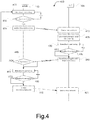
- FIG. 4 illustrates a process 400 that shows the actions taken by the devices of the communications network of FIG. 1 , in accordance with various example embodiments.
- the process 400 may be used to provide feedback for a data transmission that is communicated over an unlicensed shared medium.
- the operations of process 400 will be described as being performed by the UE 105 and the eNB 110, which are described with respect to FIGS. 1-3 .
- other similar devices may operate the process 400 as described below. While particular examples and orders of operations are illustrated in FIG. 4 , in various embodiments, these operations may be re-ordered, broken into additional operations, combined, and/or omitted altogether.
- the eNB 110 may perform a medium-sensing operation.
- a channel sensing mechanism may be employed to determine an empty and/or unoccupied channel before transmitting the feedback in the unlicensed band. This may be referred to as a "listen-before-talk” (LBT) contention mechanism.
- LBT listen-before-talk
- the term “medium sensing” may also be referred to as “carrier sensing”, “channel sensing”, LBT, and the like.
- the UE 110 In order to ensure reliable reception of the feedback data (for example, HARQ-ACK, HARQ-NACK, etc.), as well as reducing collisions with transmission from other RATs and/or Wi-Fi devices operating in the 5 GHz band, the UE 110 first senses the medium. It should be noted that FIG. 4 illustrates one possible embodiment of this mechanism, and according to various embodiments, the eNB 110 may perform a medium-sensing operation over multiple unlicensed channels to detect or otherwise determine an empty channel in an unlicensed shared medium.
- the feedback data for example, HARQ-ACK, HARQ-NACK, etc.
- the eNB 110 determines whether the medium is empty. If the eNB 110 determines that the medium is not empty (for example, that a channel of the unlicensed spectrum is occupied), then the eNB 110 proceeds back to operation 405 to perform the medium-sensing operation for one or more other channels in the unlicensed spectrum that may be unoccupied. If the eNB 110 determines that the medium is empty or unoccupied, then the eNB 110 proceeds to operation 415 to transmit a data transmission to the UE 105 over the detected channel in the unlicensed spectrum.
- the UE 105 receives the data transmission from the eNB 110.
- the UE 105 performs demodulation and/or decoding operations. Many methods for demodulating and/or decoding data transmissions are generally well-known, and thus, a further detailed description of the methods for demodulating and/or decoding data transmissions is omitted.
- the UE 105 performs a medium-sensing operation.
- the medium-sensing operation performed by the UE 105 may be the same or similar to the medium-sensing operation described previously with regard to operation 405. If the UE 105 determines that the medium is not empty (for example, that a channel of the medium is occupied), then the UE 105 proceeds back to operation 430 to perform the medium-sensing operation for one or more other channels in the unlicensed spectrum that may be unoccupied.
- the UE 105 determines that the medium is empty or unoccupied, then the UE 105 proceeds to operations 340 to transmit a feedback (for example, HARQ-ACK, HARQ-NACK, etc.) associated with the data transmission to the eNB 110.
- a feedback for example, HARQ-ACK, HARQ-NACK, etc.
- the UE 105 once the UE 105 detects or otherwise determines an empty channel on the unlicensed spectrum, it will transmit feedback information over it.
- the empty channel may be the same channel in which the UE 105 received the data transmission from the eNB 110, or the UE 105 may use an empty channel that is different than the channel in which the UE 105 received the data transmission from the eNB 110.
- the UE 105 may use the PUCCH or the PUSCH to transmit HARQ-ACK/NACK feedback.
- a PUCCH transmission is usually only allowed on a primary cell (PCell) and a secondary cell (SCell) for a dual connectivity scenario.
- M number of PUCCH channels that operate on different carriers in the unlicensed band may be semi-statically configured by a higher layer signaling for each LTE-U capable UEs (for example, UEs 105).
- the UE 105 selects one available PUCCH channel from the M number of PUCCH channels that may be detected according to the medium/carrier sensing operation.
- the eNB 110 may dynamically configure the number of M values that each of the UEs 105 may use for selecting the PUCCH channels.
- the UE 105 may also detect or otherwise determine an empty channel for transmitting feedback on an unlicensed band that is different than the unlicensed band that was used by the eNB 110 to transmit the data transmission.
- the eNB 110 receives the feedback message from the UE 105 and determines whether the feedback is one of a HARQ-ACK message or a HARQ-NACK message. If at operation 445, the eNB 110 determines that the feedback is a HARQ-ACK message, then eNB 110 proceeds back to operation 405 to perform a medium-sensing operation for transmission of a new data transmission. If at operation 445, the eNB 110 determines that the feedback is a HARQ-NACK message or a discontinuous transmission (DTX) message, then eNB 110 proceeds to operation 450 to perform a medium-sensing operation.
- DTX discontinuous transmission
- the medium-sensing operation may be the same or similar as the medium-sensing operation performed at operations 405 and 430.
- the eNB 110 determines whether the medium is empty. If the eNB 110 determines that the medium is not empty (for example, that a channel of the medium is occupied), then the eNB 110 proceeds back to operation 450 to perform the medium-sensing operation for one or more other channels in the unlicensed spectrum that may be unoccupied. If the eNB 110 determines that the medium is empty or unoccupied, then the eNB 110 proceeds to operation 460 to retransmit the data transmission to the UE 105 over the detected channel in the unlicensed spectrum. At operation 465 the UE 105 receives the data retransmission from the eNB 110.
- FIG. 5 illustrates a process 500 for flexible feedback timing mechanism, in accordance with various example embodiments.
- the operations of process 500 will be described as being performed by the UE 105, which is described with respect to FIGS. 1-3 .
- other similar devices may operate the process 500 as described below. While particular examples and orders of operations are illustrated in FIG. 5 , in various embodiments, these operations may be re-ordered, broken into additional operations, combined, and/or omitted altogether.
- process 500 provides a flexible HARQ-ACK feedback timing mechanism to ensure the aforementioned latency requirements.
- the UE 105 may define a fixed timing relation between a data transmission and a feedback transmission.
- a timing relation between the reception of a data transmission and a transmit time for a feedback transmission is made as short as possible while also considering tradeoffs between latency and receiver processing complexity.
- a fixed timing relation between the reception of data transmissions in a downlink channel and transmission of corresponding feedback messages in an uplink channel is delineated by the current LTE standards.
- a frequency-division duplexing (also referred to as a "FDD deployment")
- FDD frequency-division duplexing
- a data transmission is transmitted on a downlink (for example, PDSCH) subframe n by a base station (for example, eNB 110)
- a user equipment for example, UE 105
- HARQ-ACK/NACK transmission on corresponding n+4 uplink (for example, PUCCH, PUSCH, etc.) subframe.
- TDD time-division duplexing
- a data transmission is transmitted on a downlink (for example, PDSCH) subframe n by a base station (for example, eNB 110)
- a user equipment for example, UE 105
- HARQ-ACK/NACK transmission on corresponding uplink (for example, PUCCH, PUSCH, etc.) subframe n+k, where the value of k is predefined value, for example, as defined in in 3GPP's technical specification (TS) 36.213.
- TS technical specification
- the time period between the reception of a data transmission and the transmission of a feedback message may be referred to as a "transmission window.” Since the timing relation between the reception of a data transmission over the PDSCH and the transmit time for the corresponding HARQ-ACK/NACK transmission is fixed (for example, a "fixed transmission window") for transmission in the licensed spectrum, the base station may already know of the corresponding uplink channel on which the HARQ-ACK/NACK is intended.
- each subframe is 1 millisecond (ms) and/or 2 resource blocks (RBs) long
- the fixed transmission window for TDD deployments is 4 ms and/or 8 RBs long
- the fixed transmission window for FDD deployments is k ms and/or (2*k) RBs long.
- the UE 105 determines the fixed timing relation between the data transmission and the feedback transmission, such as n to n+4 for FDD deployments and n to n+k for TDD deployments, in order to determine whether it is feasible to transmit the feedback using the fixed transmission window.
- the UE 105 may determine whether the predefined feedback resource is available for transmitting the feedback transmission.
- the predefined feedback resource may be a subframe or RB for which a feedback is intended to be transmitted on (for example, the n+k subframe for TDD deployments or the n+4 subframe for FDD deployments).
- the UE 105 may perform various signaling operations with the eNB 110 in order to determine if another transmission is scheduled to be transmitted using the predefined resource.
- the UE 105 may perform a medium-sensing operation in order to determine if another transmission is scheduled to be transmitted using the predefined resource in order to determine whether the predetermined feedback resource is available or not. If at operation 510 the UE 105 determines that the predefined feedback resource is available or unoccupied, then the UE 105 may proceed to operation 535 to transmit the feedback transmission using the predefined feedback resource. If at operation 510 the UE determines that the predefined feedback resource is not available or is otherwise occupied, then the UE 105 may proceed to operation 515 to perform a medium-sensing operation to detect an unoccupied feedback resource for transmitting the feedback transmission.
- the UE 105 may perform the medium-sensing operation.
- the medium-sensing operation may be the same or similar as the medium-sensing operation as previously discussed herein. It should be noted that, when utilizing the unlicensed spectrum, the timing relationship between data transmissions transmitted over the PDSCH and the corresponding HARQ-ACK/NACK feedback may not be guaranteed due to the potential of collisions and/or interruptions caused by other data packets. Therefore, when utilizing the unlicensed spectrum, a base station may not receive the HARQ-ACK/NACK feedback for which a PDSCH data transmission is intended. Accordingly, in various example embodiments, an expanding transmission window (also referred to as a "flexible transmission window”) is introduced.
- the corresponding feedback can be transmitted on an uplink subframe n + 4 ⁇ 1 for FDD deployments, and on subframe n + k ⁇ 1 for TDD deployments.
- the value of k is pre-defined in, for example, TS 36.213.
- the value of 1 is an integer number (for example, 0, 1,2,..., etc.).
- the eNB 110 when a HARQ-ACK/NACK feedback transmission is transmitted on an unlicensed band, in various embodiments the eNB 110 will look for or otherwise detect the feedback transmission within a range of subframes, such as from n to n + 4 ⁇ 1 for FDD deployments and from n to n + k ⁇ 1 for TDD deployments, instead of just looking for one subframe (for example, the predefined feedback resource).
- the range or value of 1 could be predefined at the eNB 110, whereby 1 is selected by a wireless network operator according to one or more design choices and/or based on one or more empirical studies.
- the value of 1 may be chosen or otherwise determined by the UE 105 (for example, as discussed with regard to operation 525) and communicated to the eNB 110 using higher layer signaling than the transmission of the feedback.
- the UE 105 may determine whether another feedback resource is available for transmitting the feedback transmission. If at operation 520 the UE determines that the other feedback resource is not available, then the UE 105 proceeds back to operation 515 to perform the medium-sensing operation to detect another unoccupied feedback resource in the unlicensed spectrum. If at operation 510 the UE determines that other feedback resources are available, then the UE 105 proceeds to operation 525 to select an unoccupied one of the available feedback resources.
- the UE 105 may select an unoccupied feedback resource for transmitting the feedback transmission. Because the UE 105 may have to perform multiple medium-sensing operations at operation 520, in various embodiments the UE 105 may start a HARQ-ACK/NACK feedback timer once the HARQ-ACK/NACK feedback is not transmitted according to the fixed timing relation or fixed transmission window. The HARQ-ACK/NACK feedback timer may expire once the UE 105 selects a feedback resource for transmitting the feedback. Once the HARQ-ACK/NACK feedback timer expires, the UE 105 may discard the suspending HARQ-ACK/NACK information.
- the eNB 110 may perform HARQ-ACK/NACK/DTX detection within a range of uplink subframes, where the range of uplink subframes is based on the HARQ-ACK/NACK feedback timer length at the UE 105.
- the HARQ-ACK/NACK feedback timer length may be communicated to the eNB 110 using higher layer signaling than the transmission of the feedback.
- the eNB 110 may then reconfigure semi-static resources (for example, carrier index, band number, and/or different power control parameters) for the HARQ-ACK/NACK feedback for the UE 105.
- the UE 105 may transmit the feedback on the selected resource.
- FIG. 6 illustrates a feedback message 600 including multiplexed HARQ process numbers (HPNs) along with ACK/NACK bits, in accordance with various example embodiments.
- FIG. 7 illustrates an implicit representation of HPNs by fixing the HARQ ACK/NACK position for different HPNs, in accordance with various example embodiments.
- the flexible timing relation as discussed with regard to FIG. 5 may cause ambiguity and/or potential PUCCH resource collision between different HARQ processes at the eNB 110.
- various example embodiments provide that the HARQ-ACK/NACK bits associated with one or more HARQ Process Numbers (HPNs) may be multiplexed with the HPNs, such that the ACK/NACK bits and the HPNs may be combined into a single message and transmitted on an available uplink subframe.
- HPNs HARQ Process Numbers
- the HPNs associated with one or more ACK/NACK bits may indicate a HARQ process to be used for decoding the ACK/NACK bits and/or an order in which to process the ACK/NACK bits.
- uplink and downlink HARQ-ACK/NACK feedback messages should only contain ACK/NACK bits.
- the fixed timing relationship between the downlink (for example, PDSCH) and HARQ-ACK/NACK feedback is not guaranteed due to potential collisions or potential interruptions by other packets in the unlicensed band, there may be confusion on HARQ-ACK/NACK feedback for which a data transmission is intended.
- FIG. 6 shows one example embodiment of a multiplexed feedback message that includes the HPNs along with ACK/NACK bits.
- a 3-bit process number is used for FDD deployments.
- a 4-bit HPN can be used.
- the HPNs may be added after the ACK/NACK bits.
- the HPNs can precede the ACK/NACK bits. From these HPN bits, the eNB 110 may determine the HARQ process number.
- the modified bit patterns including HPNs may use the PUCCH format 3 or use another format. It should be noted that multiplexing the HPNs along with ACK/NACK bits may allow for the transmission of a flexible number of ACK/NACK bits in each feedback message, where the number of bits transmitted in a particular feedback transmission (for example, a PUCCH transmission or a PUSCH transmission) can be determined implicitly from the number of missed feedback transmission opportunities (for example, a number of times that the UE 105 was unable to transmit feedback due to an occupied channel and/or subframe in the unlicensed spectrum).
- a particular feedback transmission for example, a PUCCH transmission or a PUSCH transmission
- missed feedback transmission opportunities for example, a number of times that the UE 105 was unable to transmit feedback due to an occupied channel and/or subframe in the unlicensed spectrum.
- the HPNs of a transmitted ACK/NACK can be calculated or otherwise determined at the eNB 110 by fixing the position of each HBN bit within the feedback transmission message.
- the UE 105 may not have to transmit the HBNs to the eNB 110.
- FIG. 8 illustrates a timing diagram 800 for transmission of delayed feedback at different subframe locations, in accordance with various example embodiments.
- timing diagram 800 illustrates the transmission of delayed HARQ-ACK/NACK feedback at a different positions on a new subframe. For example, if the PUCCH transmission is used for HARQ-ACK feedback (as is illustrated be FIG.
- the PUCCH resources transmission may be determined by either explicit signaling by the UE 105 or implicitly by the eNB 110 (for example, as a function of a first control channel element (CCE) index in case of PUCCH format 1a or format 1b).
- CCE first control channel element
- Uplink (for example, PUCCH) resources that are mapped to a first HARQ-ACK/NACK feedback intended for a first downlink (for example, PDSCH) transmission at a predefined first subframe may be occupied by a second HARQ-ACK/NACK feedback intended for a second PDSCH transmission at the predefined first subframe. Since the mapped PUCCH resources may be not available for the first HARQ-ACK/NACK feedback transmission, a transmission of the first HARQ-ACK/NACK feedback transmission may be delayed. According to various embodiments, a new PUCCH region may be defined for the delayed HARQ-ACK/NACK feedback.
- the timing diagram 800 shows subframe k, subframe k+1, and subframe k+2, each of which is 1 milliseconds (ms) long.
- Each subframe k, k+1, and k+2 includes 2 slots, where each slot is 0.5 ms.
- Each slot includes 1 resource block (RB) and each subframe includes 2 RBs.
- the RBs in the licensed spectrum may be labeled as RB0, RBI, RB2,...RBk+r+n-1, and the RBs in the unlicensed spectrum may be labeled as N RB UL ⁇ k-1 ... N RB UL ⁇ 1 .
- the subframes of timing diagram 800 may be included in a type 1 frame for FDD deployments or a type 2 frame for TDD deployments.
- the unlicensed medium is busy during subframe k and subframe k+1. Therefore, uplink transmission of feedback 805 may not be possible in subframe k and uplink transmission of feedback 810 may not be possible in subframe k+1.
- the unlicensed medium is empty and the UE 105 has an opportunity to perform uplink transmission for feedback 805 and feedback 810. Therefore, the feedback transmissions for feedback 805 and feedback 810 intended to be transmitted during subframe k and subframe k+1, respectively, may both be transmitted in subframe k+2.
- subframe k+2 has its own associated feedback 815 scheduled for transmission in the reserved PUCCH region as shown in FIG. 8 .
- a new PUCCH resource offset may be introduced.
- the PUCCH region from subframe k and k+1 can be shifted to start from a different RB position or a PUCCH resource index in subframe k+2 as shown in FIG. 8 .
- the resource position will be shifted by a resource offset.
- the offset values 1 and r and the number of additional subframes that may be allocated to feedback transmissions can be signaled using higher layer signaling than the signaling used for transmitting the feedback.
- FIG. 9 illustrates various state tables of a receiver state showing various states of the receiver based on received feedback according to a modified feedback transmission mechanism, in accordance with various example embodiments.
- the modified feedback transmission mechanism shown by FIG. 9 may be referred to as a "default NACK mode" for feedback transmission.
- feedback messages may be transmitted in response to both a proper decoding and/or demodulation of a data transmission (for example, ACK) and an improper decoding and/or demodulation of a data transmission (for example, NACK).
- ACK a data transmission
- NACK an improper decoding and/or demodulation of a data transmission
- a default NACK state can be used to reduce a number of feedback transmissions made by the UE 105. In such embodiments, if a received signal or data transmission is not decoded correctly (for example, NACK state), then the UE 105 will refrain from transmitting any feedback or other like acknowledgement signal.
- the absence of an acknowledgement signal at the UE 105 may be interpreted to be in a NACK state, and the eNB 110 may retransmit the data transmission.
- the eNB 110 may assume that the UE 105 is in a NACK state and the eNB 110 may retransmit the data transmission. If on the other hand, the received signal is decoded correctly, UE 105 may transmit HARQ-ACK signal to the eNB 110.
- each of tables 1-3 show as examples, a receiver (for example, UE 105) state for an FDD single carrier when using the current LTE specifications for feedback mechanisms in comparison with receiver states for FDD single carrier feedback when using the default NACK state mechanism of various example embodiments.
- the term "ACK” in each of tables 1-3 signifies a state of the receiver in response to a proper decoding and/or demodulation operation of at least one portion of a data transmission
- the term "NACK" in each of tables 1-3 signifies a state of the receiver in response to an improper decoding and/or demodulation operation of at least one portion of a data transmission.
- a value of "1" in a feedback message sent by the receiver may indicate that the receiver is in an ACK state for at least one portion of a data transmission
- a value of "0" in a feedback message sent by the receiver may indicate that the receiver is in a NACK state for at least one portion of a data transmission
- a value of "X" may indicate that no feedback data is sent by the receiver.
- Table 1 shows the receiver states for a 1 bit feedback transmission protocol in an FDD deployment, according to an example embodiment.
- the receiver may send a feedback message including a bit value of "1" indicating that the receiver is in the ACK state (for example, that the receiver properly decoded and/or demodulated a data transmission), and the receiver may send a feedback message including a bit value of "0" indicating that the receiver is in the NACK state (for example, that the receiver did not properly decoded and/or demodulated a data transmission).
- the receiver may send a feedback message including a bit value of "1" indicating that the receiver is in the ACK state (for example, that the receiver properly decoded and/or demodulated a data transmission), and the receiver does not send a feedback message indicating that the receiver is in the NACK state (for example, that the transmitter assumes that the receiver is in the NACK state).
- Table 1 also indicates that, by not sending the NACK feedback, 1 bit feedback transmission protocol according to this example embodiment should provide an overhead reduction of approximately 50%.
- Table 2 shows the receiver states for a 2 bit feedback transmission protocol, according to a first example embodiment.
- the example embodiment shown by table 2 may be used for networks employing HARQ with soft combining, wherein incorrectly received coded data blocks may be stored in a buffer at the receiver rather than being discarded by the receiver.
- soft combining when a retransmitted block is received at the receiver, the retransmitted block may be combined with the stored block.
- the receiver may send a feedback message including a bit value of "1,1" indicating that the receiver is in the ACK state for two portions of a received data transmission (for example, that the receiver properly decoded and/or demodulated two portions of a data transmission); the receiver may send a feedback message including a bit value of "1,0" indicating that the receiver is in the ACK state for a first portion of a received data transmission and a NACK state for a second portion of the data transmission (for example, that the receiver did not properly decode and/or demodulate the second portion of the data transmission and would like the transmitter to retransmit the second portion of the data transmission); the receiver may send a feedback message including a bit value of "0,1" indicating that the receiver is in the NACK state for a first portion of a received data transmission and in the ACK state for a second portion of the data transmission (for example, that the receiver did not properly decode and/or demodulate
- the receiver may send a feedback message including a bit value of "1,1" indicating that the receiver is in the ACK state for two portions of a received data transmission (for example, that the receiver properly decode and/or demodulate two portions of a data transmission); the receiver may send a feedback message including a bit value of "1,0" indicating that the receiver is in the ACK state for a first portion of a received data transmission and a NACK state for a second portion of the data transmission (for example, that the receiver did not properly decode and/or demodulate the second portion of the data transmission and would like the transmitter to retransmit the second portion of the data transmission); the receiver may send a feedback message including a bit value of "0,1" indicating that the receiver is in the NACK state for a first portion of a received data transmission and in the ACK state for a second portion of the data transmission (for example, that the receiver did not properly decode and/or demodulate the first portion of the data transmission).
- Table 3 shows the receiver states for a 2-bit feedback transmission protocol, according to a second example embodiment.
- Table 3 shows the same 2-bit feedback transmissions under the current LTE specifications as described previously with regard to table 2.
- the receiver may send a feedback message including a bit value of "1" indicating that the receiver is in the ACK state for a received data transmission in a same or similar manner as discussed previously with regard to the example embodiment shown by table 1.
- the receiver according to the second example embodiment does not send any feedback message when any portion of a data transmission is improperly decoded and/or demodulated, which is indicated by the value "X" in each of the third through fourth rows of the "Receiver Feedback (example embodiment)" column of table 3.
- the transmitter assumes that the receiver is in the NACK state whenever any portion of a data transmission is not properly decoded and/or demodulated).
- Table 3 also indicates that, by not sending the NACK feedback when any portion of a data transmission is improperly decoded and/or demodulated, the 2-bit feedback transmission protocol according to the second example embodiment should provide an overhead reduction of approximately 75%.
- the second example embodiment for the 2-bit feedback transmission protocol may result in more data retransmission by the transmitter.
- HARQ-ACK feedback may only be transmitted when a UE correctly receives control signaling related to a downlink transmission over a shared channel (for example, DLSCH) intended for the UE on one of the downlink control channels (for example, one of the PDCCHs). If no valid DLSCH related control signaling is detected by the UE, no feedback signal is transmitted to the eNB, which is known as DTX. Therefore, in typical LTE systems, at the eNB, a three state detection of an ACK state, a NACK state, and a DTX state is performed.
- the eNB 110 may not be able to determine whether the UE 105 is in the NACK state or the DTX state.
- a retransmission may occur when the UE 105 is in either the NACK state or the DTX state in a similar fashion as the PUCCH format 3 transmissions.
- FIG. 10 illustrates a process 1000 that shows the actions taken by the devices of the communications network of FIG. 1 , in accordance with various example embodiments.
- the eNB 110 may end up retransmitting the data transmission even though the data retransmission may not be necessary.
- various example embodiments provide for the combination of the previously discussed flexible transmission window example embodiments with the default NACK mode example embodiments.
- the combination of these example embodiments may be based on a wireless network operators network design choices.
- the UE 105 may transmit the feedback data within a range of subframes, and the eNB 110 may look for the feedback information within the range of subframes. If ACK data is not available within the range of subframes, the eNB 110 may consider the UE 105 to be in a NACK state and retransmit a data transmission.
- the eNB 110 transmits a first data transmission to the UE 105.
- the UE 105 successfully decodes and/or demodulates the first data transmission.
- the UE 105 attempts to transmit HARQ-ACK feedback that is intended for the first data transmission.
- the UE 105 may perform a medium-sensing operation in order to determine whether one of the subframes of the range of subframes is busy or otherwise occupied. In such embodiments, the UE 105 may continue to perform the medium-sensing operations until the UE 105 detects an available sub frame. Each time the UE 105 performs a medium-sensing operation may be considered an attempt to transmit feedback data. As shown, the UE 105 attempts to transmit the ACK feedback twice (for example, ACK attempt 1 and ACK attempt 2 as shown) and determines that the medium is busy at operation 1020.
- the first attempt may include detecting whether the predefined subframe for the fixed transmission window is available or otherwise unoccupied.
- the UE 105 may scan for available or unoccupied subframes in the unlicensed spectrum according to the example embodiments previously discussed. Furthermore, in some embodiments, the UE may scan for available or unoccupied subframes in an unlicensed spectrum that is different than the unlicensed spectrum used for transmitting the data transmission. Referring back to operation 1015, on the third attempt or third medium-sensing operation (for example, ACK attempt 3 as shown), the UE 105 detects an available subframe of the range of subframes and transmits the ACK feedback on the available subframe.
- the third attempt or third medium-sensing operation for example, ACK attempt 3 as shown
- the eNB 110 scans the range of subframes for the ACK transmission that is intended for the first data transmission. Because the UE 105 was able to transmit the ACK feedback on a subframe within the range of subframes, and/or the eNB 110 obtained the ACK feedback within the desired time period for obtaining feedback, at operation 1030 the eNB 110 transmits a second data transmission to the UE 105.
- the UE 105 does not properly decode and/or demodulate the second data transmission, and thus, the UE 105 does not transmit NACK feedback or any other like feedback message or signal for the second data transmission.
- the eNB 110 scans for ACK feedback for the second data transmission. Because the UE 105 was unable to transmit the ACK feedback on any of the subframes within the range of subframes, and/or the eNB 110 did not obtain feedback within the desired time period for obtaining feedback, at operation 1045 the eNB 110 retransmits the second data transmission to the UE 105.
- the described example embodiments pertain to transmitting feedback in an uplink channel in response to receiving downlink data transmissions in an unlicensed shared medium.
- the example embodiments described herein above may be extended to to uplink data transmissions and corresponding feedback transmission transmitted in over a downlink channel in an unlicensed shared medium.
Landscapes
- Engineering & Computer Science (AREA)
- Signal Processing (AREA)
- Computer Networks & Wireless Communication (AREA)
- Physics & Mathematics (AREA)
- Health & Medical Sciences (AREA)
- General Health & Medical Sciences (AREA)
- Spectroscopy & Molecular Physics (AREA)
- Mobile Radio Communication Systems (AREA)
Claims (15)
- Vorrichtung für die Verwendung in einem Anwendergerät (105), die Folgendes umfasst:eine Funksteuerschaltung (310), die ausgelegt ist, eine Datenübertragung von einem entwickelten Knoten B, eNB, (110) zu demodulieren und zu decodieren; undeine Verarbeitungsschaltung (315), die an die Funksteuerschaltung (310) gekoppelt ist, wobei die Verarbeitungsschaltung (315) bereitgestellt ist zum:Empfangen der Datenübertragung von der Funksteuerschaltung (310); undErzeugen einer Bestätigungsrückmeldung anhand dessen, ob die Datenübertragung korrekt demoduliert und decodiert wurde;wobei die Funksteuerschaltung (310) ferner ausgelegt ist, die Funkfrequenzschaltung (305) zu steuern, die ausgelegt ist, zu bestimmen, ob ein physikalischer Kanal in einem nicht lizensierten gemeinsam genutzten Medium unbesetzt ist, und die Bestätigungsrückmeldung an den eNB (110) über den physikalischen Kanal in dem nicht lizensierten gemeinsam genutzten Medium zu senden, wenn gemäß der Bestimmung der physikalische Kanal unbesetzt ist;dadurch gekennzeichnet, dassdie Bestätigungsrückmeldung eine Rückmeldungsprozessnummer enthält, um den Abgleich der Bestätigungsrückmeldung mit der Datenübertragung zu vereinfachen; unddie Verarbeitungsschaltung (315) ausgelegt ist zum:Bestimmen eines Übertragungsfensters anhand einer festen Zeitbeziehung, wenn bestimmt wird, dass ein erster Unterrahmen der mehreren Unterrahmen unbesetzt ist, wobei die feste Zeitbeziehung eine im Voraus definierte Sendezeit zum Senden der Bestätigungsrückmeldung gemäß einer Empfangszeit der empfangenen Datenübertragung ist; undAuswählen des ersten Unterrahmens, wenn bestimmt wird, dass der erste Unterrahmen unbesetzt ist, Erweitern des Übertragungsfensters, wenn bestimmt wird, dass der erste Unterrahmen besetzt ist, und Auswählen des zweiten Unterrahmens der mehreren Unterrahmen, der sich innerhalb des erweiterten Übertragungsfensters befindet, um die Bestätigungsrückmeldung zu senden; unddie Funksteuerschaltung (310) ausgelegt ist, die Funkfrequenzschaltung (305) zu steuern, die ausgelegt ist, die Bestätigungsrückmeldung über den ausgewählten einen des ersten Unterrahmens und des zweiten Unterrahmens während des Übertragungsfensters zu senden.
- Vorrichtung nach Anspruch 1, wobei der physikalische Kanal ein physikalischer Aufwärtsstreckensteuerkanal, PUCCH, oder ein physikalischer gemeinsam genutzter Aufwärtsstreckenkanal, PUSCH, ist.
- Vorrichtung nach Anspruch 1, wobei die Verarbeitungsschaltung (315) ausgelegt ist, den zweiten Unterrahmen gemäß n + 4 + l in einem Frequenzduplexeinsatz, FDD-Einsatz, und n + k + l in einem Zeitduplex-Einsatz, TDD-Einsatz, zu bestimmen, wobei n eine Unterrahmennummer des ersten Unterrahmens ist, k eine im Voraus definierte Nummer ist und l ein Übertragungsfenstererweiterungsfaktor ist.
- Vorrichtung nach einem der Ansprüche 1 bis 3, wobei die Verarbeitungsschaltung (315) ausgelegt ist, einen Zeitgeber als Reaktion auf die Bestimmung, dass der erste Unterrahmen besetzt ist, zu starten, wobei ein Wert des Zeitgebers auf einer Größe des erweiterten Übertragungsfensters beruht, zu bestimmen, ob der zweite Unterahmen unbesetzt ist, und die Bestätigungsrückmeldung zu verwerfen, wenn der Zeitgeber abgelaufen ist und wenn bestimmt wird, dass der zweite Unterrahmen besetzt ist.
- Vorrichtung nach einem der Ansprüche 1 bis 4, wobei
die Verarbeitungsschaltung (315) ausgelegt ist, eine erste Betriebsmittelblockposition eines ersten Unterrahmens des physikalischen Kanals zum Senden der Rückmeldung anhand einer durch die Verarbeitungsschaltung (315) ausgeführten Bestimmung, dass der erste Unterrahmen besetzt ist, zu einer zweiten Betriebsmittelblockposition eines zweiten Unterrahmens des physikalischen Kanals zu verschieben; und
die Funksteuerschaltung (310) ausgelegt ist, die Steuerfunkfrequenzschaltung (305) zu steuern, die ausgelegt ist, die Rückmeldung für die empfangene Datenübertragung auf der zweiten Betriebsmittelblockposition des zweiten Unterahmens mit einer anderen Rückmeldung für eine andere Datenübertragung in einer ersten Betriebsmittelblockposition des zweiten Unterrahmens zu senden. - Vorrichtung nach Anspruch 5, wobei die Verarbeitungsschaltung (315) ausgelegt ist, die erste Betriebsmittelblockposition des ersten Unterrahmens zu der zweiten Betriebsmittelblockposition des zweiten Unterrahmens gemäß einem Betriebsmittelversatz zu verschieben, und
die Funksteuerschaltung (310) ausgelegt ist, die Funkfrequenzschaltung (305) zu steuern, die ausgelegt ist, den Betriebsmittelversatz an den eNB (110) unter Verwendung einer Signalisierung höherer Schicht als eine Signalisierung, die für die Übertragung der Rückmeldung verwendet wird, zu senden. - Vorrichtung nach einem der Ansprüche 1 bis 6, wobei die Verarbeitungsschaltung (315)ausgelegt ist, die Rückmeldung mit Rückmeldungsprozessnummern zu multiplexieren, so dass die Funksteuerschaltung (310) ausgelegt ist, die Funkfrequenzschaltung (305) zu steuern, die ausgelegt ist, die Rückmeldungsprozessnummern mit der Rückmeldung zu senden, und wobei, um die Rückmeldung mit den Rückmeldungsprozessnummern zu multiplexieren, die Verarbeitungsschaltung (315) ausgelegt ist, die Rückmeldungsprozessnummern nach Rückmeldungsbits der Rückmeldung oder vor den Rückmeldungsbits von Rückmeldung der Rückmeldung zu positionieren.

- Vorrichtung für die Verwendung in einem entwickelten Knoten B, eNB, (110), die Folgendes umfasst:eine Funksteuerschaltung (310), die ausgelegt ist, eine Funkfrequenzschaltung (305) zu steuern, die ausgelegt ist, eine Bestätigungsrückmeldung von einem Anwendergerät über einen physikalischen Aufwärtsstreckenkanal in einem nicht lizensierten gemeinsam genutzten Medium zu empfangen; undeine Verarbeitungsschaltung (315), die an die Funksteuerschaltung (310) gekoppelt ist, wobei die Verarbeitungsschaltung (315) ausgelegt ist, die Bestätigungsrückmeldung mit einem entsprechenden von mehreren Abwärtsstreckenkanälen in dem nicht lizensierten gemeinsam genutzten Medium anhand von Rückmeldungsprozessnummern, die in der Rückmeldung enthalten sind, abzugleichen,wobei die Funksteuerschaltung (310) ferner ausgelegt ist, die Funkfrequenzschaltung (305) zu steuern, die ausgelegt ist, zu bestimmen, ob der entsprechende der physikalischen Abwärtsstreckenkanäle in dem nicht lizensierten gemeinsam genutzten Medium unbesetzt ist, und die Funkfrequenzschaltung (305) zu steuern, die ausgelegt ist, eine Datenübertragung an das Anwendergerät über den entsprechenden der physikalischen Kanäle neu zu senden, wenn der physikalische Abwärtsstreckenkanal gemäß der Bestimmung unbesetzt ist.
- Vorrichtung nach Anspruch 8, wobei die Funksteuerschaltung (310) ausgelegt ist, die Funkfrequenzschaltung (305) zu steuern, die ausgelegt ist, die Rückmeldung innerhalb eines gewünschten Bereichs von Aufwärtsstreckenunterrahmen zu detektieren, um die Bestätigungsrückmeldung zu empfangen.
- Vorrichtung nach Anspruch 8 oder 9, wobei der physikalische Aufwärtsstreckenkanal ein PUCCH oder ein PUSCH ist.
- Vorrichtung nach einem der Ansprüche 8 bis 10, wobei die Rückmeldungsprozessnummern drei Bits in einem FDD-Einsatz umfassen und die Rückmeldungsprozessnummern vier Bits in einem TDD-Einsatz umfassen.
- Vorrichtung nach einem der Ansprüche 8 bis 13, wobei die Rückmeldung Rückmeldungsbits und Rückmeldungsprozessnummern umfasst, wobei die Rückmeldungsprozessnummern vor den Rückmeldungsbits oder nach den Rückmeldungsbits positioniert sind, und der entsprechende der mehreren Abwärtsstreckenkanäle anhand der Rückmeldungsprozessnummern bestimmt wird und
wobei der entsprechende der mehreren Abwärtsstreckenkanäle anhand einer definierten Rückmeldungsbitposition für jedes der Rückmeldungsbits anhand einer vorbestimmten Reihenfolge für die Rückmeldungsprozessnummern bestimmt wird. - Vorrichtung nach einem der Ansprüche 8 bis 12, wobei die Rückmeldung eine flexible Anzahl von Rückmeldungsbits umfasst, so dass die Rückmeldung eine andere Anzahl von Rückmeldungsbits als eine Anzahl von Rückmeldungsbits einer anderen Rückmeldung umfasst.
- Computerimplementiertes Verfahren zum Liefern einer Rückmeldung für Datenübertragungen in einem nicht lizensierten gemeinsam genutzten Medium, wobei das Verfahren Folgendes umfasst:Demodulieren und Decodieren einer von einem entwickelten Knoten B, eNB, (110) empfangenen Datenübertragung,Erzeugen einer Bestätigungsrückmeldung anhand dessen, ob die Datenübertragung eine korrekt demodulierte und decodierte oder eine nicht korrekt demodulierte und decodierte Datenübertragung ist;Bestimmen, ob ein physikalischer Kanal in dem nicht lizensierten gemeinsam genutzten Medium unbesetzt ist; undSenden der Bestätigungsrückmeldung an den eNB (110) über den physikalischen Kanal, wenn der physikalische Kanal gemäß der Bestimmung unbesetzt ist,dadurch gekennzeichnet, dass
die Bestätigungsrückmeldung eine Rückmeldungsprozessnummer enthält, um ein Abgleichen der Bestätigungsrückmeldung mit der Datenübertragung zu vereinfachen; unddas Verfahren ferner Folgendes umfasst:Bestimmen eines Übertragungsfensters anhand einer festen Zeitbeziehung, wenn bestimmt wird, dass ein erster Unterrahmen der mehreren Unterrahmen unbesetzt ist, wobei die feste Zeitbeziehung eine im Voraus definierte Sendezeit für das Senden der Rückmeldung gemäß einer Empfangszeit der empfangenen Datenübertragung ist;Auswählen des ersten Unterrahmens, wenn bestimmt wird, dass der erste Unterrahmen unbesetzt ist;Erweitern des Übertragungsfensters, wenn bestimmt wird, dass der erste Unterrahmen besetzt ist;Auswählen des zweiten Unterahmens der mehreren Unterrahmen, der innerhalb des erweiterten Übertragungsfensters ist, zum Senden der Rückmeldung; undSenden der Rückmeldung über den ausgewählten des ersten Unterrahmens und des zweiten Unterrahmens während des Übertragungsfensters. - Mindestens ein nicht transitorisches computerlesbares Medium, das Anweisungen enthält, um zu bewirken, dass eine Rechenvorrichtung als Reaktion auf die Ausführung der Anweisungen durch die Rechenvorrichtung das Verfahren nach Anspruch 14 ausführt.
Applications Claiming Priority (3)
| Application Number | Priority Date | Filing Date | Title |
|---|---|---|---|
| US201462059747P | 2014-10-03 | 2014-10-03 | |
| US14/671,872 US10158473B2 (en) | 2014-10-03 | 2015-03-27 | Methods, apparatuses, and systems for transmitting hybrid automatic repeat request transmissions using channels in an unlicensed shared medium |
| PCT/US2015/041835 WO2016053451A1 (en) | 2014-10-03 | 2015-07-23 | Methods, apparatuses, and systems for transmitting hybrid automatic repeat request transmissions using channels in an unlicensed shared medium |
Publications (2)
| Publication Number | Publication Date |
|---|---|
| EP3202101A1 EP3202101A1 (de) | 2017-08-09 |
| EP3202101B1 true EP3202101B1 (de) | 2020-03-04 |
Family
ID=53836212
Family Applications (1)
| Application Number | Title | Priority Date | Filing Date |
|---|---|---|---|
| EP15750179.2A Active EP3202101B1 (de) | 2014-10-03 | 2015-07-23 | Verfahren, vorrichtungen und systeme zur übertragung hybrider automatischer wiederholungsanfragen unter verwendung von kanälen in einem unlizenzierten gemeinsam genutzten medium |
Country Status (5)
| Country | Link |
|---|---|
| US (1) | US10158473B2 (de) |
| EP (1) | EP3202101B1 (de) |
| JP (1) | JP6423087B2 (de) |
| CN (1) | CN107005509B (de) |
| WO (1) | WO2016053451A1 (de) |
Families Citing this family (36)
| Publication number | Priority date | Publication date | Assignee | Title |
|---|---|---|---|---|
| JP6276415B2 (ja) * | 2014-11-07 | 2018-02-07 | 京セラ株式会社 | 基地局、ユーザ端末及びプロセッサ |
| WO2016119207A1 (en) * | 2015-01-30 | 2016-08-04 | Telefonaktiebolaget Lm Ericsson (Publ) | Harq/csi ack feedback method over unlicensed carriers |
| EP3306977B1 (de) * | 2015-06-03 | 2020-08-05 | LG Electronics Inc. | Verfahren und vorrichtung zur übertragung der anzeige der verfügbarkeit von wlan-offloading |
| WO2017061662A1 (ko) * | 2015-10-07 | 2017-04-13 | 엘지전자 주식회사 | 무선 통신 시스템에서 harq를 사용하여 재전송 데이터를 전송하는 방법 및 장치 |
| JP6633889B2 (ja) * | 2015-10-29 | 2020-01-22 | Kddi株式会社 | 基地局装置、端末装置、通信方法及びプログラム |
| US10091815B2 (en) * | 2015-11-25 | 2018-10-02 | Qualcomm Incorporated | User equipment silencing based on clear channel assessment in shared spectrum |
| US10631323B2 (en) * | 2015-12-08 | 2020-04-21 | Qualcomm Incorporated | Delayed control feedback in a time division duplex carrier utilizing common bursts |
| MX2018009681A (es) * | 2016-02-18 | 2018-09-11 | Ericsson Telefon Ab L M | Un metodo para determinar parametros para transmitir en un canal de control de enlace ascendente. |
| JP2019515569A (ja) | 2016-05-04 | 2019-06-06 | 華為技術有限公司Huawei Technologies Co.,Ltd. | ライセンス補助アクセスlaaシステムに基づくアップリンク送信方法、および装置 |
| EP3448100B1 (de) * | 2016-05-10 | 2020-09-09 | Huawei Technologies Co., Ltd. | Verfahren zur übertragung von uplink-informationen, basisstation und benutzergerät |
| JP6899460B2 (ja) * | 2016-05-13 | 2021-07-07 | パナソニック インテレクチュアル プロパティ コーポレーション オブ アメリカPanasonic Intellectual Property Corporation of America | 短レイテンシ高速再送信トリガ |
| CN107371243B (zh) * | 2016-05-13 | 2019-07-12 | 华为技术有限公司 | 一种资源确定方法、相关设备及系统 |
| EP3455971B1 (de) | 2016-05-13 | 2021-11-17 | Panasonic Intellectual Property Corporation of America | Schnelle wiederübertragungsauslösung mit kurzer latenzzeit |
| CN107567033A (zh) * | 2016-06-30 | 2018-01-09 | 展讯通信(上海)有限公司 | 用户设备及下行数据的harq反馈方法 |
| US10517021B2 (en) | 2016-06-30 | 2019-12-24 | Evolve Cellular Inc. | Long term evolution-primary WiFi (LTE-PW) |
| CN107566097B (zh) * | 2016-06-30 | 2020-12-25 | 展讯通信(上海)有限公司 | 用户设备及下行数据的harq反馈方法 |
| CN116015567B (zh) * | 2016-08-10 | 2025-03-11 | 交互数字专利控股公司 | 降低等待时间的系统中的定时提前和处理能力 |
| US11212765B2 (en) | 2016-09-30 | 2021-12-28 | Telefonaktiebolaget Lm Ericsson (Publ) | Systems and methods for synchronous control of HARQ configurations |
| EP3513520A4 (de) | 2016-10-13 | 2020-05-13 | Telefonaktiebolaget LM Ericsson (publ) | Verfahren, vorrichtung und computerprogramm für datenübertragungsfeedback in einem drahtloskommunikationssystem |
| CN108289015B (zh) * | 2017-01-09 | 2023-04-07 | 北京三星通信技术研究有限公司 | 发送harq-ack/nack的方法和设备及下行传输方法和设备 |
| CN116405165A (zh) | 2017-01-09 | 2023-07-07 | 北京三星通信技术研究有限公司 | 发送harq-ack/nack的方法和设备及下行传输方法和设备 |
| US11683130B2 (en) * | 2017-05-05 | 2023-06-20 | Telefonaktiebolaget Lm Ericsson (Publ) | Method and device for transmitting feedback information |
| KR102439542B1 (ko) * | 2017-06-23 | 2022-09-02 | 삼성전자 주식회사 | 무선 통신 시스템에서 상향링크 제어 채널 송수신 방법 및 장치 |
| KR102333690B1 (ko) | 2017-07-25 | 2021-12-01 | 삼성전자주식회사 | 시분할 방식을 채용하는 무선 통신 시스템에서 신호를 샘플링하기 위한 장치 및 방법 |
| US11863315B2 (en) * | 2017-12-04 | 2024-01-02 | Qualcomm Incorporated | Techniques and apparatuses for avoiding collisions on an uplink data channel and a cell-specific or UE-specific uplink control channel |
| US11044675B2 (en) * | 2018-02-13 | 2021-06-22 | Idac Holdings, Inc. | Methods, apparatuses and systems for adaptive uplink power control in a wireless network |
| EP3793151A4 (de) * | 2018-05-11 | 2022-01-05 | Ntt Docomo, Inc. | Benutzerendgerät und drahtlose basisstation |
| CN111970096B (zh) | 2018-07-12 | 2022-03-29 | 上海朗帛通信技术有限公司 | 一种被用于无线通信的用户设备、基站中的方法和装置 |
| WO2020069088A2 (en) * | 2018-09-28 | 2020-04-02 | Intel Corporation | Improved groupcast and unicast in new radio vehicle-to-everything (v2x) communication |
| EP3903435B1 (de) * | 2018-12-28 | 2024-07-03 | Lenovo (Beijing) Limited | Harq-ack-übertragung auf unlizenziertem spektrum |
| US11412497B2 (en) | 2019-03-27 | 2022-08-09 | Electronics And Telecommunications Research Institute | Method and apparatus for transmitting or receiving uplink feedback information in communication system |
| FR3095565A1 (fr) * | 2019-04-26 | 2020-10-30 | Orange | Procédés de communication entre un terminal et une station de base, terminal, station de base et programme d’ordinateur correspondants. |
| CN114097189B (zh) * | 2019-06-20 | 2024-09-17 | 苹果公司 | 无线通信系统中的harq-ack传输和重传 |
| CN114424671A (zh) * | 2019-09-26 | 2022-04-29 | 华为技术有限公司 | 聚合多个无线通信信道实现灵活全双工通信的方法和装置 |
| CN114586462A (zh) * | 2019-10-31 | 2022-06-03 | 华为技术有限公司 | 一种混合自动重传请求反馈方法及装置 |
| US12133235B2 (en) * | 2019-11-07 | 2024-10-29 | Sharp Kabushiki Kaisha | User equipments, base stations and methods for activation and release of multiple configured grants |
Family Cites Families (11)
| Publication number | Priority date | Publication date | Assignee | Title |
|---|---|---|---|---|
| CN100555928C (zh) * | 2005-11-03 | 2009-10-28 | 北京信威通信技术股份有限公司 | 一种基于正交频分复用的混合自动请求重传的方法 |
| CN102123019B (zh) * | 2010-01-11 | 2015-11-25 | 三星电子株式会社 | 针对无线通信系统的下行数据传输执行ack/nack反馈的方法 |
| CN102377537B (zh) * | 2010-08-10 | 2014-07-09 | 电信科学技术研究院 | 一种上行控制信息uci传输和接收方法及设备 |
| WO2013006006A2 (ko) | 2011-07-07 | 2013-01-10 | 엘지전자 주식회사 | 무선통신시스템에서 신호 전송 방법 및 장치 |
| US9351166B2 (en) * | 2012-01-25 | 2016-05-24 | Fortinet, Inc. | Blocking communication between rogue devices on wireless local access networks (WLANS) |
| US9209945B2 (en) | 2012-02-27 | 2015-12-08 | Futurewei Technologies, Inc. | System and method for hybrid automatic repeat request timing for device-to-device communication overlaid on a cellular network |
| US9526091B2 (en) * | 2012-03-16 | 2016-12-20 | Intel Corporation | Method and apparatus for coordination of self-optimization functions in a wireless network |
| CN110176979B (zh) * | 2013-09-27 | 2020-10-27 | 中兴通讯股份有限公司 | 一种频谱聚合的数据发送方法及装置 |
| JP6742240B2 (ja) * | 2014-07-03 | 2020-08-19 | シャープ株式会社 | 基地局装置、端末装置、および通信方法 |
| US9819467B2 (en) * | 2014-08-08 | 2017-11-14 | Qualcomm Incorporated | Communicating feedback in listen-before-talk (LBT) wireless networks |
| CN107079334A (zh) | 2014-09-25 | 2017-08-18 | 株式会社Ntt都科摩 | 用户终端、无线基站以及无线通信方法 |
-
2015
- 2015-03-27 US US14/671,872 patent/US10158473B2/en not_active Expired - Fee Related
- 2015-07-23 CN CN201580046399.XA patent/CN107005509B/zh not_active Expired - Fee Related
- 2015-07-23 EP EP15750179.2A patent/EP3202101B1/de active Active
- 2015-07-23 WO PCT/US2015/041835 patent/WO2016053451A1/en not_active Ceased
- 2015-07-23 JP JP2017517322A patent/JP6423087B2/ja not_active Expired - Fee Related
Non-Patent Citations (1)
| Title |
|---|
| None * |
Also Published As
| Publication number | Publication date |
|---|---|
| CN107005509B (zh) | 2020-09-29 |
| JP2017536006A (ja) | 2017-11-30 |
| US20160099799A1 (en) | 2016-04-07 |
| CN107005509A (zh) | 2017-08-01 |
| US10158473B2 (en) | 2018-12-18 |
| JP6423087B2 (ja) | 2018-11-14 |
| WO2016053451A1 (en) | 2016-04-07 |
| EP3202101A1 (de) | 2017-08-09 |
Similar Documents
| Publication | Publication Date | Title |
|---|---|---|
| EP3202101B1 (de) | Verfahren, vorrichtungen und systeme zur übertragung hybrider automatischer wiederholungsanfragen unter verwendung von kanälen in einem unlizenzierten gemeinsam genutzten medium | |
| RU2735689C1 (ru) | Автономная передача управляющей информации восходящей линии связи | |
| CN107534948B (zh) | 用于无争用上行链路同步的装置 | |
| EP3412106B1 (de) | Autonome aufwärtsstreckenübertragung in einem unlizenzierten frequenzspektrum | |
| AU2017240370B2 (en) | Hybrid automatic repeat request timing for reduced transmission time intervals | |
| JP7101726B2 (ja) | データ送信を扱うためのワイヤレス通信デバイス、ネットワークノード及び方法 | |
| CN105515742B (zh) | 处理非执照小区中的服务的通信装置 | |
| JP7272791B2 (ja) | 端末、無線通信方法及びシステム | |
| EP3240214A1 (de) | Verfahren für uplink-übertragung in einem nicht lizenzierten band und vorrichtung damit | |
| US10972230B2 (en) | Method and apparatus for sending feedback using two-stage uplink scheduling | |
| EP3624409A1 (de) | Entfernte vorrichtung einer basisstation, basisstation und direktzugriffsverfahren | |
| WO2018059528A1 (en) | Autonomous uplink in multefire | |
| WO2018058597A1 (en) | Multefire autonomous uplink channel clearance signaling | |
| HK1241597A1 (en) | Method, apparatus, and system for data transmission in unlicensed shared medium | |
| CN120712870A (zh) | 信道占用时间中断避免 | |
| HK1241597B (zh) | 用於未授权共享介质中的数据传输的方法、装置和系统 |
Legal Events
| Date | Code | Title | Description |
|---|---|---|---|
| STAA | Information on the status of an ep patent application or granted ep patent |
Free format text: STATUS: THE INTERNATIONAL PUBLICATION HAS BEEN MADE |
|
| PUAI | Public reference made under article 153(3) epc to a published international application that has entered the european phase |
Free format text: ORIGINAL CODE: 0009012 |
|
| STAA | Information on the status of an ep patent application or granted ep patent |
Free format text: STATUS: REQUEST FOR EXAMINATION WAS MADE |
|
| 17P | Request for examination filed |
Effective date: 20170302 |
|
| AK | Designated contracting states |
Kind code of ref document: A1 Designated state(s): AL AT BE BG CH CY CZ DE DK EE ES FI FR GB GR HR HU IE IS IT LI LT LU LV MC MK MT NL NO PL PT RO RS SE SI SK SM TR |
|
| AX | Request for extension of the european patent |
Extension state: BA ME |
|
| RIN1 | Information on inventor provided before grant (corrected) |
Inventor name: HAN, SEUNGHEE Inventor name: HE, HONG Inventor name: BASHAR, SHAFI Inventor name: FWU, JONG-KAE |
|
| DAV | Request for validation of the european patent (deleted) | ||
| DAX | Request for extension of the european patent (deleted) | ||
| REG | Reference to a national code |
Ref country code: DE Ref legal event code: R079 Ref document number: 602015048192 Country of ref document: DE Free format text: PREVIOUS MAIN CLASS: H04L0027000000 Ipc: H04L0005000000 |
|
| GRAP | Despatch of communication of intention to grant a patent |
Free format text: ORIGINAL CODE: EPIDOSNIGR1 |
|
| STAA | Information on the status of an ep patent application or granted ep patent |
Free format text: STATUS: GRANT OF PATENT IS INTENDED |
|
| RIC1 | Information provided on ipc code assigned before grant |
Ipc: H04L 5/00 20060101AFI20190927BHEP Ipc: H04L 27/00 20060101ALI20190927BHEP Ipc: H04W 72/02 20090101ALI20190927BHEP Ipc: H04W 28/06 20090101ALN20190927BHEP |
|
| INTG | Intention to grant announced |
Effective date: 20191017 |
|
| GRAS | Grant fee paid |
Free format text: ORIGINAL CODE: EPIDOSNIGR3 |
|
| GRAA | (expected) grant |
Free format text: ORIGINAL CODE: 0009210 |
|
| STAA | Information on the status of an ep patent application or granted ep patent |
Free format text: STATUS: THE PATENT HAS BEEN GRANTED |
|
| AK | Designated contracting states |
Kind code of ref document: B1 Designated state(s): AL AT BE BG CH CY CZ DE DK EE ES FI FR GB GR HR HU IE IS IT LI LT LU LV MC MK MT NL NO PL PT RO RS SE SI SK SM TR |
|
| REG | Reference to a national code |
Ref country code: GB Ref legal event code: FG4D |
|
| REG | Reference to a national code |
Ref country code: CH Ref legal event code: EP |
|
| REG | Reference to a national code |
Ref country code: AT Ref legal event code: REF Ref document number: 1241635 Country of ref document: AT Kind code of ref document: T Effective date: 20200315 |
|
| REG | Reference to a national code |
Ref country code: DE Ref legal event code: R096 Ref document number: 602015048192 Country of ref document: DE |
|
| REG | Reference to a national code |
Ref country code: IE Ref legal event code: FG4D |
|
| REG | Reference to a national code |
Ref country code: NL Ref legal event code: FP |
|
| PG25 | Lapsed in a contracting state [announced via postgrant information from national office to epo] |
Ref country code: RS Free format text: LAPSE BECAUSE OF FAILURE TO SUBMIT A TRANSLATION OF THE DESCRIPTION OR TO PAY THE FEE WITHIN THE PRESCRIBED TIME-LIMIT Effective date: 20200304 Ref country code: NO Free format text: LAPSE BECAUSE OF FAILURE TO SUBMIT A TRANSLATION OF THE DESCRIPTION OR TO PAY THE FEE WITHIN THE PRESCRIBED TIME-LIMIT Effective date: 20200604 Ref country code: FI Free format text: LAPSE BECAUSE OF FAILURE TO SUBMIT A TRANSLATION OF THE DESCRIPTION OR TO PAY THE FEE WITHIN THE PRESCRIBED TIME-LIMIT Effective date: 20200304 |
|
| PG25 | Lapsed in a contracting state [announced via postgrant information from national office to epo] |
Ref country code: BG Free format text: LAPSE BECAUSE OF FAILURE TO SUBMIT A TRANSLATION OF THE DESCRIPTION OR TO PAY THE FEE WITHIN THE PRESCRIBED TIME-LIMIT Effective date: 20200604 Ref country code: SE Free format text: LAPSE BECAUSE OF FAILURE TO SUBMIT A TRANSLATION OF THE DESCRIPTION OR TO PAY THE FEE WITHIN THE PRESCRIBED TIME-LIMIT Effective date: 20200304 Ref country code: LV Free format text: LAPSE BECAUSE OF FAILURE TO SUBMIT A TRANSLATION OF THE DESCRIPTION OR TO PAY THE FEE WITHIN THE PRESCRIBED TIME-LIMIT Effective date: 20200304 Ref country code: GR Free format text: LAPSE BECAUSE OF FAILURE TO SUBMIT A TRANSLATION OF THE DESCRIPTION OR TO PAY THE FEE WITHIN THE PRESCRIBED TIME-LIMIT Effective date: 20200605 Ref country code: HR Free format text: LAPSE BECAUSE OF FAILURE TO SUBMIT A TRANSLATION OF THE DESCRIPTION OR TO PAY THE FEE WITHIN THE PRESCRIBED TIME-LIMIT Effective date: 20200304 |
|
| REG | Reference to a national code |
Ref country code: LT Ref legal event code: MG4D |
|
| PG25 | Lapsed in a contracting state [announced via postgrant information from national office to epo] |
Ref country code: EE Free format text: LAPSE BECAUSE OF FAILURE TO SUBMIT A TRANSLATION OF THE DESCRIPTION OR TO PAY THE FEE WITHIN THE PRESCRIBED TIME-LIMIT Effective date: 20200304 Ref country code: SM Free format text: LAPSE BECAUSE OF FAILURE TO SUBMIT A TRANSLATION OF THE DESCRIPTION OR TO PAY THE FEE WITHIN THE PRESCRIBED TIME-LIMIT Effective date: 20200304 Ref country code: SK Free format text: LAPSE BECAUSE OF FAILURE TO SUBMIT A TRANSLATION OF THE DESCRIPTION OR TO PAY THE FEE WITHIN THE PRESCRIBED TIME-LIMIT Effective date: 20200304 Ref country code: IS Free format text: LAPSE BECAUSE OF FAILURE TO SUBMIT A TRANSLATION OF THE DESCRIPTION OR TO PAY THE FEE WITHIN THE PRESCRIBED TIME-LIMIT Effective date: 20200704 Ref country code: PT Free format text: LAPSE BECAUSE OF FAILURE TO SUBMIT A TRANSLATION OF THE DESCRIPTION OR TO PAY THE FEE WITHIN THE PRESCRIBED TIME-LIMIT Effective date: 20200729 Ref country code: RO Free format text: LAPSE BECAUSE OF FAILURE TO SUBMIT A TRANSLATION OF THE DESCRIPTION OR TO PAY THE FEE WITHIN THE PRESCRIBED TIME-LIMIT Effective date: 20200304 Ref country code: CZ Free format text: LAPSE BECAUSE OF FAILURE TO SUBMIT A TRANSLATION OF THE DESCRIPTION OR TO PAY THE FEE WITHIN THE PRESCRIBED TIME-LIMIT Effective date: 20200304 Ref country code: LT Free format text: LAPSE BECAUSE OF FAILURE TO SUBMIT A TRANSLATION OF THE DESCRIPTION OR TO PAY THE FEE WITHIN THE PRESCRIBED TIME-LIMIT Effective date: 20200304 Ref country code: ES Free format text: LAPSE BECAUSE OF FAILURE TO SUBMIT A TRANSLATION OF THE DESCRIPTION OR TO PAY THE FEE WITHIN THE PRESCRIBED TIME-LIMIT Effective date: 20200304 |
|
| REG | Reference to a national code |
Ref country code: AT Ref legal event code: MK05 Ref document number: 1241635 Country of ref document: AT Kind code of ref document: T Effective date: 20200304 |
|
| REG | Reference to a national code |
Ref country code: DE Ref legal event code: R097 Ref document number: 602015048192 Country of ref document: DE |
|
| PLBE | No opposition filed within time limit |
Free format text: ORIGINAL CODE: 0009261 |
|
| STAA | Information on the status of an ep patent application or granted ep patent |
Free format text: STATUS: NO OPPOSITION FILED WITHIN TIME LIMIT |
|
| PG25 | Lapsed in a contracting state [announced via postgrant information from national office to epo] |
Ref country code: IT Free format text: LAPSE BECAUSE OF FAILURE TO SUBMIT A TRANSLATION OF THE DESCRIPTION OR TO PAY THE FEE WITHIN THE PRESCRIBED TIME-LIMIT Effective date: 20200304 Ref country code: DK Free format text: LAPSE BECAUSE OF FAILURE TO SUBMIT A TRANSLATION OF THE DESCRIPTION OR TO PAY THE FEE WITHIN THE PRESCRIBED TIME-LIMIT Effective date: 20200304 Ref country code: AT Free format text: LAPSE BECAUSE OF FAILURE TO SUBMIT A TRANSLATION OF THE DESCRIPTION OR TO PAY THE FEE WITHIN THE PRESCRIBED TIME-LIMIT Effective date: 20200304 |
|
| 26N | No opposition filed |
Effective date: 20201207 |
|
| PG25 | Lapsed in a contracting state [announced via postgrant information from national office to epo] |
Ref country code: SI Free format text: LAPSE BECAUSE OF FAILURE TO SUBMIT A TRANSLATION OF THE DESCRIPTION OR TO PAY THE FEE WITHIN THE PRESCRIBED TIME-LIMIT Effective date: 20200304 Ref country code: MC Free format text: LAPSE BECAUSE OF FAILURE TO SUBMIT A TRANSLATION OF THE DESCRIPTION OR TO PAY THE FEE WITHIN THE PRESCRIBED TIME-LIMIT Effective date: 20200304 Ref country code: PL Free format text: LAPSE BECAUSE OF FAILURE TO SUBMIT A TRANSLATION OF THE DESCRIPTION OR TO PAY THE FEE WITHIN THE PRESCRIBED TIME-LIMIT Effective date: 20200304 |
|
| REG | Reference to a national code |
Ref country code: CH Ref legal event code: PL |
|
| GBPC | Gb: european patent ceased through non-payment of renewal fee |
Effective date: 20200723 |
|
| REG | Reference to a national code |
Ref country code: BE Ref legal event code: MM Effective date: 20200731 |
|
| PG25 | Lapsed in a contracting state [announced via postgrant information from national office to epo] |
Ref country code: CH Free format text: LAPSE BECAUSE OF NON-PAYMENT OF DUE FEES Effective date: 20200731 Ref country code: GB Free format text: LAPSE BECAUSE OF NON-PAYMENT OF DUE FEES Effective date: 20200723 Ref country code: LI Free format text: LAPSE BECAUSE OF NON-PAYMENT OF DUE FEES Effective date: 20200731 Ref country code: LU Free format text: LAPSE BECAUSE OF NON-PAYMENT OF DUE FEES Effective date: 20200723 Ref country code: FR Free format text: LAPSE BECAUSE OF NON-PAYMENT OF DUE FEES Effective date: 20200731 |
|
| PG25 | Lapsed in a contracting state [announced via postgrant information from national office to epo] |
Ref country code: BE Free format text: LAPSE BECAUSE OF NON-PAYMENT OF DUE FEES Effective date: 20200731 |
|
| REG | Reference to a national code |
Ref country code: NL Ref legal event code: PD Owner name: INTEL CORPORATION; US Free format text: DETAILS ASSIGNMENT: CHANGE OF OWNER(S), ASSIGNMENT; FORMER OWNER NAME: INTEL IP CORPORATION Effective date: 20210623 |
|
| PG25 | Lapsed in a contracting state [announced via postgrant information from national office to epo] |
Ref country code: IE Free format text: LAPSE BECAUSE OF NON-PAYMENT OF DUE FEES Effective date: 20200723 |
|
| REG | Reference to a national code |
Ref country code: DE Ref legal event code: R081 Ref document number: 602015048192 Country of ref document: DE Owner name: INTEL CORPORATION, SANTA CLARA, US Free format text: FORMER OWNER: INTEL IP CORPORATION, SANTA CLARA, CA, US |
|
| PG25 | Lapsed in a contracting state [announced via postgrant information from national office to epo] |
Ref country code: TR Free format text: LAPSE BECAUSE OF FAILURE TO SUBMIT A TRANSLATION OF THE DESCRIPTION OR TO PAY THE FEE WITHIN THE PRESCRIBED TIME-LIMIT Effective date: 20200304 Ref country code: MT Free format text: LAPSE BECAUSE OF FAILURE TO SUBMIT A TRANSLATION OF THE DESCRIPTION OR TO PAY THE FEE WITHIN THE PRESCRIBED TIME-LIMIT Effective date: 20200304 Ref country code: CY Free format text: LAPSE BECAUSE OF FAILURE TO SUBMIT A TRANSLATION OF THE DESCRIPTION OR TO PAY THE FEE WITHIN THE PRESCRIBED TIME-LIMIT Effective date: 20200304 |
|
| PG25 | Lapsed in a contracting state [announced via postgrant information from national office to epo] |
Ref country code: MK Free format text: LAPSE BECAUSE OF FAILURE TO SUBMIT A TRANSLATION OF THE DESCRIPTION OR TO PAY THE FEE WITHIN THE PRESCRIBED TIME-LIMIT Effective date: 20200304 Ref country code: AL Free format text: LAPSE BECAUSE OF FAILURE TO SUBMIT A TRANSLATION OF THE DESCRIPTION OR TO PAY THE FEE WITHIN THE PRESCRIBED TIME-LIMIT Effective date: 20200304 |
|
| P01 | Opt-out of the competence of the unified patent court (upc) registered |
Effective date: 20230518 |
|
| PGFP | Annual fee paid to national office [announced via postgrant information from national office to epo] |
Ref country code: NL Payment date: 20240214 Year of fee payment: 10 |
|
| PGFP | Annual fee paid to national office [announced via postgrant information from national office to epo] |
Ref country code: DE Payment date: 20240618 Year of fee payment: 10 |
|
| REG | Reference to a national code |
Ref country code: DE Ref legal event code: R119 Ref document number: 602015048192 Country of ref document: DE |
|
| REG | Reference to a national code |
Ref country code: NL Ref legal event code: MM Effective date: 20250801 |
|
| PG25 | Lapsed in a contracting state [announced via postgrant information from national office to epo] |
Ref country code: DE Free format text: LAPSE BECAUSE OF NON-PAYMENT OF DUE FEES Effective date: 20260203 |
|
| PG25 | Lapsed in a contracting state [announced via postgrant information from national office to epo] |
Ref country code: NL Free format text: LAPSE BECAUSE OF NON-PAYMENT OF DUE FEES Effective date: 20250801 |