EP3203566B1 - Gelpolymerelektrolyt und lithiumsekundärbatterie damit - Google Patents
Gelpolymerelektrolyt und lithiumsekundärbatterie damit Download PDFInfo
- Publication number
- EP3203566B1 EP3203566B1 EP15848091.3A EP15848091A EP3203566B1 EP 3203566 B1 EP3203566 B1 EP 3203566B1 EP 15848091 A EP15848091 A EP 15848091A EP 3203566 B1 EP3203566 B1 EP 3203566B1
- Authority
- EP
- European Patent Office
- Prior art keywords
- compound
- carbonate
- polymer electrolyte
- gel polymer
- composition
- Prior art date
- Legal status (The legal status is an assumption and is not a legal conclusion. Google has not performed a legal analysis and makes no representation as to the accuracy of the status listed.)
- Active
Links
- 0 *C1CCCCC1 Chemical compound *C1CCCCC1 0.000 description 1
Images

Classifications
-
- H—ELECTRICITY
- H01—ELECTRIC ELEMENTS
- H01M—PROCESSES OR MEANS, e.g. BATTERIES, FOR THE DIRECT CONVERSION OF CHEMICAL ENERGY INTO ELECTRICAL ENERGY
- H01M10/00—Secondary cells; Manufacture thereof
- H01M10/05—Accumulators with non-aqueous electrolyte
- H01M10/056—Accumulators with non-aqueous electrolyte characterised by the materials used as electrolytes, e.g. mixed inorganic/organic electrolytes
- H01M10/0564—Accumulators with non-aqueous electrolyte characterised by the materials used as electrolytes, e.g. mixed inorganic/organic electrolytes the electrolyte being constituted of organic materials only
- H01M10/0565—Polymeric materials, e.g. gel-type or solid-type
-
- C—CHEMISTRY; METALLURGY
- C08—ORGANIC MACROMOLECULAR COMPOUNDS; THEIR PREPARATION OR CHEMICAL WORKING-UP; COMPOSITIONS BASED THEREON
- C08G—MACROMOLECULAR COMPOUNDS OBTAINED OTHERWISE THAN BY REACTIONS ONLY INVOLVING UNSATURATED CARBON-TO-CARBON BONDS
- C08G73/00—Macromolecular compounds obtained by reactions forming a linkage containing nitrogen with or without oxygen or carbon in the main chain of the macromolecule, not provided for in groups C08G12/00 - C08G71/00
- C08G73/02—Polyamines
- C08G73/024—Polyamines containing oxygen in the form of ether bonds in the main chain
-
- H—ELECTRICITY
- H01—ELECTRIC ELEMENTS
- H01M—PROCESSES OR MEANS, e.g. BATTERIES, FOR THE DIRECT CONVERSION OF CHEMICAL ENERGY INTO ELECTRICAL ENERGY
- H01M10/00—Secondary cells; Manufacture thereof
- H01M10/05—Accumulators with non-aqueous electrolyte
- H01M10/052—Li-accumulators
-
- H—ELECTRICITY
- H01—ELECTRIC ELEMENTS
- H01M—PROCESSES OR MEANS, e.g. BATTERIES, FOR THE DIRECT CONVERSION OF CHEMICAL ENERGY INTO ELECTRICAL ENERGY
- H01M10/00—Secondary cells; Manufacture thereof
- H01M10/05—Accumulators with non-aqueous electrolyte
- H01M10/052—Li-accumulators
- H01M10/0525—Rocking-chair batteries, i.e. batteries with lithium insertion or intercalation in both electrodes; Lithium-ion batteries
-
- H—ELECTRICITY
- H01—ELECTRIC ELEMENTS
- H01M—PROCESSES OR MEANS, e.g. BATTERIES, FOR THE DIRECT CONVERSION OF CHEMICAL ENERGY INTO ELECTRICAL ENERGY
- H01M4/00—Electrodes
- H01M4/02—Electrodes composed of, or comprising, active material
- H01M4/36—Selection of substances as active materials, active masses, active liquids
- H01M4/48—Selection of substances as active materials, active masses, active liquids of inorganic oxides or hydroxides
- H01M4/52—Selection of substances as active materials, active masses, active liquids of inorganic oxides or hydroxides of nickel, cobalt or iron
- H01M4/525—Selection of substances as active materials, active masses, active liquids of inorganic oxides or hydroxides of nickel, cobalt or iron of mixed oxides or hydroxides containing iron, cobalt or nickel for inserting or intercalating light metals, e.g. LiNiO2, LiCoO2 or LiCoOxFy
-
- H—ELECTRICITY
- H01—ELECTRIC ELEMENTS
- H01M—PROCESSES OR MEANS, e.g. BATTERIES, FOR THE DIRECT CONVERSION OF CHEMICAL ENERGY INTO ELECTRICAL ENERGY
- H01M4/00—Electrodes
- H01M4/02—Electrodes composed of, or comprising, active material
- H01M4/36—Selection of substances as active materials, active masses, active liquids
- H01M4/58—Selection of substances as active materials, active masses, active liquids of inorganic compounds other than oxides or hydroxides, e.g. sulfides, selenides, tellurides, halogenides or LiCoFy; of polyanionic structures, e.g. phosphates, silicates or borates
- H01M4/583—Carbonaceous material, e.g. graphite-intercalation compounds or CFx
- H01M4/587—Carbonaceous material, e.g. graphite-intercalation compounds or CFx for inserting or intercalating light metals
-
- C—CHEMISTRY; METALLURGY
- C08—ORGANIC MACROMOLECULAR COMPOUNDS; THEIR PREPARATION OR CHEMICAL WORKING-UP; COMPOSITIONS BASED THEREON
- C08G—MACROMOLECULAR COMPOUNDS OBTAINED OTHERWISE THAN BY REACTIONS ONLY INVOLVING UNSATURATED CARBON-TO-CARBON BONDS
- C08G2220/00—Compositions for preparing gels other than hydrogels, aerogels and xerogels
-
- H—ELECTRICITY
- H01—ELECTRIC ELEMENTS
- H01M—PROCESSES OR MEANS, e.g. BATTERIES, FOR THE DIRECT CONVERSION OF CHEMICAL ENERGY INTO ELECTRICAL ENERGY
- H01M2300/00—Electrolytes
- H01M2300/0085—Immobilising or gelification of electrolyte
-
- Y—GENERAL TAGGING OF NEW TECHNOLOGICAL DEVELOPMENTS; GENERAL TAGGING OF CROSS-SECTIONAL TECHNOLOGIES SPANNING OVER SEVERAL SECTIONS OF THE IPC; TECHNICAL SUBJECTS COVERED BY FORMER USPC CROSS-REFERENCE ART COLLECTIONS [XRACs] AND DIGESTS
- Y02—TECHNOLOGIES OR APPLICATIONS FOR MITIGATION OR ADAPTATION AGAINST CLIMATE CHANGE
- Y02E—REDUCTION OF GREENHOUSE GAS [GHG] EMISSIONS, RELATED TO ENERGY GENERATION, TRANSMISSION OR DISTRIBUTION
- Y02E60/00—Enabling technologies; Technologies with a potential or indirect contribution to GHG emissions mitigation
- Y02E60/10—Energy storage using batteries
Definitions
- the present invention relates to a gel polymer electrolyte and a secondary battery comprising the same.
- lithium secondary batteries having high energy density and voltage have been commercialized and widely used.
- a positive electrode active material of a lithium secondary battery lithium metal oxides have been used, and as a negative electrode active material, lithium metal, lithium alloys, crystalline or amorphous carbon or carbon complexes have been used.
- a secondary battery is manufactured by applying the active material on a current collector to proper thickness and length or applying the active material itself in a film form, and winding or laminating the result with a separator, which is an insulator, to form an electrode group, then placing the result in a can or a container similar thereto, and then injecting a liquid electrolyte thereto.
- electrolytes for electrochemical devices such as batteries using an electrochemical reaction and electric double layer capacitors
- electrolytes in a liquid state particular, ion conducting organic liquid electrolytes dissolving salts in non-aqueous organic solvents have been mainly used in the art.
- lithium secondary batteries have a problem of expanding a battery thickness during charge and discharge since gas is generated inside the battery due to carbonate organic solvent decomposition and/or a side reaction between an organic solvent and electrodes, and during high temperature storage, such a reaction accelerates leading to an increase in the amount of gas generation.
- the gas continuously generated as above induces an internal pressure increase in the battery and causes a phenomenon of deforming the center of a specific surface in the battery such as rising of a square shape battery in a specific direction, and also causes a problem of an electrode reaction not being able to identically occur over the whole electrode surface due to local differences in the adhesion in the electrode surface inside the battery. Accordingly, decline in the battery performance and safety is inevitably resulted.
- the present invention is directed to providing a composition for a gel polymer electrolyte capable of enhancing a battery capacity property as well as enhancing a battery lifespan by comprising a mixed compound in a liquid electrolyte, and a lithium secondary battery comprising the same.
- One embodiment of the present invention provides a composition for a gel polymer electrolyte comprising a liquid electrolyte solvent, a lithium salt, a polymerization initiator and a mixed compound of a first compound and a second compound, wherein the first compound is an amine-based compound comprising polyethylene glycol as a functional group, and the second compound is an epoxy-based compound, and a weight ratio of the first compound and the second compound is 1:0.2 to 0.6.
- Another embodiment of the present invention provides a lithium secondary battery comprising a positive electrode, a negative electrode, a separator and a gel polymer electrolyte, wherein the gel polymer electrolyte is formed by polymerizing the composition for a gel polymer electrolyte.
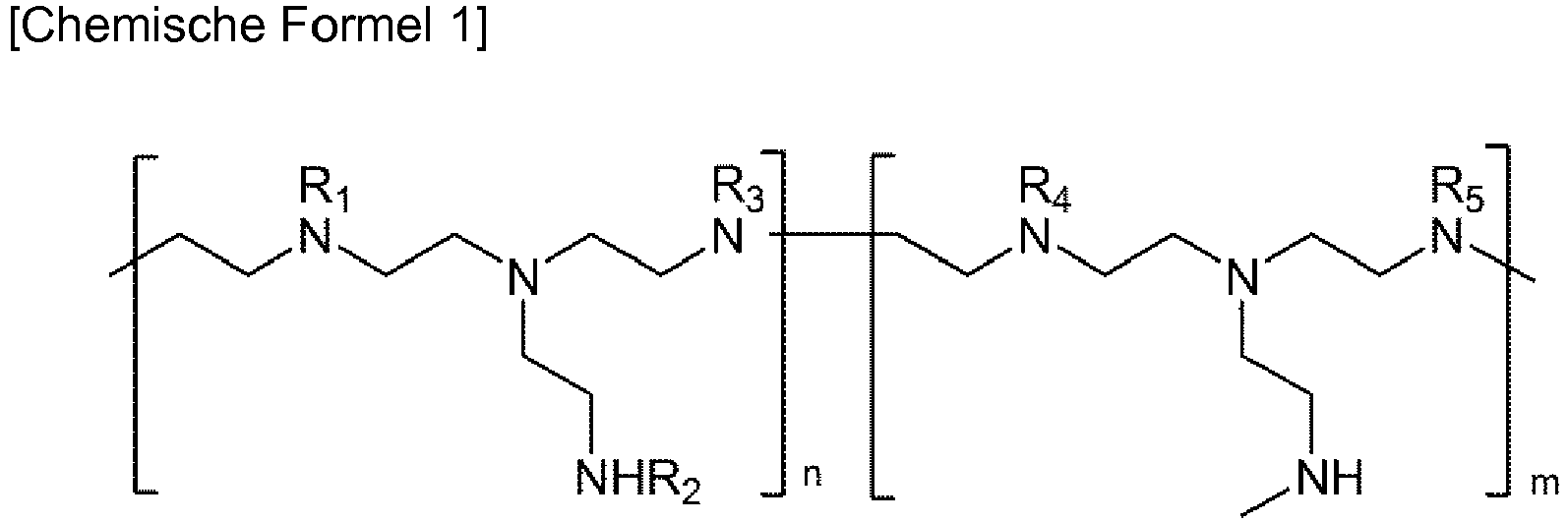
- the gel polymer electrolyte may comprise oligomers represented by the following Chemical Formulae 1 and 2.
- n and m are each an integer of 1 to 20
- R 1 to R 5 are each independently hydrogen or -CO(CH 2 ) 3 COO-(CH 2 CH 2 O)x-CH 3
- x is an integer of 1 to 100
- at least 3 or more of R 1 to R 5 are -CO(CH 2 ) 3 COO-(CH 2 CH 2 O) x -CH 3 .
- a is an integer of 1 to 100.
- a composition for a gel polymer electrolyte of the present invention exhibits, when used in a lithium secondary battery, excellent high temperature storability and is capable of enhancing a battery capacity property as well as enhancing a battery lifespan by readily inducing a hopping phenomenon.
- a composition for a gel polymer electrolyte comprises a liquid electrolyte solvent, a lithium salt, a polymerization initiator, and a mixed compound of a first compound and a second compound, wherein the first compound is an amine-based compound comprising polyethylene glycol as a functional group, and the second compound is an epoxy-based compound, and a weight ratio of the first compound and the second compound is 1:0.2 to 0.6.
- the first compound may specifically be polyimine comprising ethylene glycol, and examples thereof may comprise poly(ethylene imine)-graft-poly(ethylene glycol) (PEI-PEG) and the like.
- the second compound may be polyethylene glycol having two or more epoxy groups and examples thereof may comprise polyethylene diglycidyl ether and the like.
- solubility for the composition for a gel polymer electrolyte increases and the mixed compound may be stably fixed and present on a gel structure inside the gel polymer electrolyte, and by mixing the second compound comprising an epoxy-based compound thereto, a hopping phenomenon of FIG. 1 to be described later is more readily performed, and as a result, ion mobility of the gel polymer electrolyte produced from the polymerization reaction increases and an output property may be enhanced.
- the first compound may be comprised in an amount of 1% by weight to 15% by weight, specifically 3% by weight to 12% by weight and more specifically 4% by weight to 10% by weight with respect to the total weight of the composition for a gel polymer electrolyte.
- the first compound When the first compound is comprised in 1% by weight or greater with respect to the total weight of the composition for a gel polymer electrolyte, gelation of the composition for a gel polymer electrolyte may be more smoothly accomplished, and an increase in the battery thickness may decrease during high temperature storage due to enhancement in the high temperature storage property. The tendency is more striking when the content is specifically 3% by weight and more specifically 4% by weight.
- the first compound when the first compound is comprised in 15% by weight or less with respect to the total weight of the composition for a gel polymer electrolyte, an increase in the battery resistance caused by the excess content may be prevented while exhibiting effects of enhancing gelation and a high temperature storage property described above.
- the weight ratio of the first compound and the second compound is 1:0.2 to 0.6, and specifically 1:0.25 to 0.5.
- the first compound and the second compound satisfy a weight ratio of 1:0.2 to 0.6, gelation of the composition for a gel polymer electrolyte may be more smoothly accomplished, and an increase in the battery thickness may decrease since a high temperature storage property is enhanced, and a hopping phenomenon is more readily performed, and as a result, ion mobility of the gel polymer electrolyte produced from the polymerization reaction increases and an output property may be enhanced.
- the mixed compound in the composition for a gel polymer electrolyte when comprising the mixed compound in the composition for a gel polymer electrolyte, precipitation of metals in a negative electrode may be reduced since metal ions eluted from a positive electrode bond with the mixed compound, unlike cases using general liquid electrolytes in which metals ions eluted from a positive electrode are precipitated in a negative electrode. Accordingly, charge and discharge efficiency of a lithium secondary battery may be enhanced, and a favorable cycle property may be exhibited. Moreover, when using a composition for a gel polymer electrolyte comprising a monomer having the functional group in a lithium secondary battery, risks of leakage is small and a flame retarding property is obtained, which leads to enhancement in the battery stability.
- the mixed compound of the first compound and the second compound may be comprised in 0.1% by weight to 10% by weight, and preferably in 0.5% by weight to 5% by weight with respect to the total weight of the composition for a gel polymer electrolyte.
- the mixed compound is comprised in less than 0.1% by weight, gelation is difficult to be obtained and therefore, properties of the gel polymer electrolyte are difficult to be exhibited, and when the mixed compound is comprised in greater than 10% by weight, monomers are excessively comprised causing an increase in the resistance, and consequently, battery performance may decline.
- a polymerizable monomer may be prepared by mixing the first compound and the second compound and reacting the result for 2 minutes to 12 hours in a temperature range of 30°C to 100°C.
- the content ratio of a monomer having a functional group and a branched monomer may be from 1:18 to 1:75 in a weight ratio, but the ratio is not limited thereto.
- Examples of the ionizable lithium salt comprised in the composition for an electrolyte according to one embodiment of the present invention may comprise, but are not limited to, any one selected from the group consisting of LiPF 6 , LiBF 4 , LiSbF 6 , LiAsF 6 , LiClO 4 , LiN(C 2 F 5 SO 2 ) 2 , LiN(CF 3 SO 2 ) 2 , CF 3 SO 3 Li, LiC(CF 3 SO 2 ) 3 and LiC 4 BO 8 , or a mixture of two or more thereof.
- liquid electrolyte solvent used according to one embodiment of the present invention those commonly used in liquid electrolytes for a lithium secondary battery may be used without limit, and for example, ether, ester, amide, linear carbonate, cyclic carbonate or the like may be used either alone or as a mixture of two or more thereof.
- carbonate compounds such as cyclic carbonate, linear carbonate or a mixture thereof may be typically comprised.
- cyclic carbonate compound may comprise any one selected from the group consisting of ethylene carbonate (EC), propylene carbonate(PC), 1,2-butylene carbonate, 2,3-butylene carbonate, 1,2-pentylene carbonate, 2,3-pentylene carbonate, vinylene carbonate, and halides thereof, or a mixture of two or more types thereof.
- linear carbonate compound may comprise, but are not limited to, any one selected from the group consisting of dimethyl carbonate (DMC), diethyl carbonate (DEC), dipropyl carbonate (DPC), ethylmethyl carbonate (EMC), methylpropyl carbonate (MPC) and ethylpropyl carbonate (EPC), or a mixture of two or more thereof.
- DMC dimethyl carbonate
- DEC diethyl carbonate
- DPC dipropyl carbonate
- EMC ethylmethyl carbonate
- MPC methylpropyl carbonate
- EPC methylpropyl carbonate
- EPC methylpropyl carbonate
- propylene carbonate and ethylene carbonate that are cyclic carbonate may be preferably used since they are highly viscous organic solvents and have a high dielectric constant, and therefore, favorably dissociate lithium salts in a liquid electrolyte, and mixing low viscous and low dielectric constant linear carbonate such as ethylmethyl carbonate, diethyl carbonate or dimethyl carbonate to such cyclic carbonate in a proper ratio is more preferable since liquid electrolytes having high electric conductivity is capable of being prepared.
- any one selected from the group consisting of methyl acetate, ethyl acetate, propyl acetate, methyl propionate, ethyl propionate, ⁇ -butyrolactone, ⁇ -valerolactone, ⁇ -caprolactone, ⁇ -valerolactone and ⁇ -caprolactone, or a mixture of two or more thereof may be used, however, the ester is not limited thereto.
- polymerization initiators known in the art may be used as the polymerization initiator.
- Nonlimiting examples of the polymerization initiator may comprise, but are not limited to, organic peroxides such as benzoyl peroxide, acetyl peroxide, dilauryl peroxide, di-tert-butyl peroxide, t-butyl peroxy-2-ethylhexanoate, cumyl hydroperoxide and hydrogen peroxide; hydroperoxides; and azo compounds such as 2,2'-azobis(2-cyanobutane), 2,2'-azobis(methyl butyronitrile), 2,2'-azobis(iso-butyronitrile) (AIBN) and 2,2'-azobisdimethyl-valeronitrile (AMVN).
- organic peroxides such as benzoyl peroxide, acetyl peroxide, dilauryl peroxide, di-tert-butyl peroxide, t-butyl peroxy-2-ethylhexanoate, cumyl hydroperoxide and hydrogen
- the polymerization initiator may form radicals by being decomposed by heat, as nonlimiting examples, heat of 30°C to 100°C or decomposed at room temperature (5°C to 30°C), and react with a polymerizable monomer by free-radical polymerization to form a gel polymer electrolyte.
- the polymerization initiator may be used in an amount of 0.01% by weight to 2% by weight with respect to the total weight of the composition for a gel polymer electrolyte.
- the polymerization initiator being used in greater than 2% by weight is disadvantageous in that gelation may occur too quickly during the injection of the composition for a gel polymer electrolyte into a battery, or unreacted initiator remains having an adverse effect on the battery performance later, and the polymerization initiator being used in less than 0.01% by weight has a problem in that gelation does not readily occur.
- composition for a gel polymer electrolyte according to one embodiment of the present invention may selectively contain other additives and the like known in the art in addition to the above-described components.
- Another embodiment of the present invention provides a lithium secondary battery comprising a positive electrode; a negative electrode; a separator; and a gel polymer electrolyte, wherein the gel polymer electrolyte is formed by polymerizing the composition for a gel polymer electrolyte.
- the gel polymer electrolyte according to one embodiment of the present invention may be formed by polymerizing the composition for a gel polymer electrolyte using common methods known in the art.
- the gel polymer electrolyte may be formed by in-situ polymerization of the composition for a gel polymer electrolyte inside a secondary battery.
- a more preferred embodiment may comprise (a) inserting an electrode assembly formed with a positive electrode, a negative electrode, and a separator provided between the positive electrode and the negative electrode into a battery case, and (b) forming a gel polymer electrolyte by injecting the composition for a gel polymer electrolyte according to the present invention to the battery case and then polymerizing the composition.
- the in-situ polymerization reaction inside a lithium secondary battery may be progressed through thermal polymerization.
- the polymerization may take approximately 2 minutes to 12 hours, and a thermal polymerization temperature may be from 30°C to 100°C.
- a gel polymer electrolyte is formed after going through gelation using such a polymerization reaction. Specifically, an oligomer in which polymerizable monomers are cross-linked to each other by the polymerization reaction is formed, and a liquid electrolyte in which electrolyte salts are dissociated in a liquid electrolyte solvent may be uniformly impregnated into the formed oligomer.
- the oligomer according to one embodiment of the present invention may have a mixed form of oligomers represented by the following Chemical Formulae 1 and 2.
- n and m are each an integer of 1 to 20
- R 1 to R 5 are each independently hydrogen or -CO(CH 2 ) 3 COO-(CH 2 CH 2 O)x-CH 3
- x is an integer of 1 to 100
- at least 3 or more of R 1 to R 5 are -CO(CH 2 ) 3 COO-(CH 2 CH 2 O) x -CH 3 .
- a is an integer of 1 to 100.
- the lithium secondary battery according to one embodiment of the present invention has a charging voltage in a range of 3.0 V to 5.0 V, and a capacity property of the lithium secondary battery is excellent in both general voltage and high voltage regions.
- electrodes of the lithium secondary battery may be formed using common methods known in the art. For example, after preparing slurry by mixing a solvent, and as necessary, a binder, a conductor and a dispersion agent to an electrode active material and stirring the result, the slurry is applied (coated) on a current collector made of metal, and the result is compressed and dried to prepare an electrode.
- compounds that may be used at a general voltage or a high voltage, and capable of reversibly intercalating/deintercalating lithium may be used as the positive electrode active material without limit.
- sulfides, selenides and halides and the like may be also comprised in addition to such oxides.
- carbon materials capable of intercalating and deintercalating lithium ions, lithium metal, silicon, tin or the like may be commonly used as the negative electrode active material.
- Carbon materials may be preferably used, and low crystalline carbon, high crystalline carbon and the like may all be used as the carbon material.
- Low crystalline carbon may typically comprise soft carbon and hard carbon
- high crystalline carbon may typically comprise natural graphite, Kish graphite, pyrolytic carbon, mesophase pitch based carbon fiber, meso-carbon microbeads, mesophase pitches, and high-temperature baked carbon such as petroleum or coal tar pitch derived cokes.
- the positive electrode and/or the negative electrode may be prepared by preparing slurry through mixing a binder, a solvent, and as necessary, a conductor and a dispersion agent that may be commonly used and then stirring the result, and applying the slurry on a current collector and compressing the result.
- binder various types of binder polymers such as a polyvinylidene fluoride-hexafluoropropylene copolymer (PVDF-co-HEP), polyvinylidene fluoride, polyacrylonitrile, polymethyl methacrylate, polyvinyl alcohol, carboxymethylcellulose (CMC), starch, hydroxypropylcellulose, regenerated cellulose, polyvinylpyrrolidone, tetrafluoroethylene, polyethylene, polypropylene, polyacrylic acid, an ethylene-propylenediene monomer (EPDM), a sulfonated EPDM, styrene-butadiene rubber (SBR), fluorine rubber and various copolymers may be used.
- PVDF-co-HEP polyvinylidene fluoride-hexafluoropropylene copolymer
- SBR styrene-butadiene rubber
- separator common porous polymer films used as separators in the art, for example, a porous polymer film prepared with a polyolefin-based polymer such as an ethylene homopolymer, a propylene homopolymer, an ethylene/butene copolymer, an ethylene/hexene copolymer and an ethylene/methacrylate copolymer may be used either alone or as laminates thereof, or common porous non-woven fabrics, for example, non-woven fabrics made of high melting point glass fiber, polyethylene terephthalate fiber or the like may be used, however, the separator is not limited thereto.
- a porous polymer film prepared with a polyolefin-based polymer such as an ethylene homopolymer, a propylene homopolymer, an ethylene/butene copolymer, an ethylene/hexene copolymer and an ethylene/methacrylate copolymer
- common porous non-woven fabrics for example, non-woven fabrics made
- An appearance of the lithium secondary battery according to one embodiment of the present invention is not particularly limited, and a cylinder-type, a square-type, a pouch-type or a coin-type using a can, or the like, may be comprised.
- EC ethylene carbonate
- EMC ethylmethyl carbonate
- composition for an electrolyte With respect to the total weight of the composition for an electrolyte with the weight of the liquid electrolyte, 0.25% by weight of t-butyl peroxy-2-ethyl hexanoate was added thereto as a polymerization initiator, and 2% by weight of poly(ethylene imine)-graft-poly(ethylene glycol) (PEI-PEG) was added thereto as a first compound, and polyethylene glycol diglycidyl ether was added thereto as a second compound in an amount of 1/3% by weight with respect to the first compound.
- PEI-PEG poly(ethylene imine)-graft-poly(ethylene glycol)
- a composition for a gel polymer electrolyte was prepared in the same manner as in Example 1, except that poly(ethylene imine)-graft-poly(ethylene glycol) (PEI-PEG) was used in an amount of 5% by weight as the first compound, and polyethylene glycol diglycidyl ether was used as the second compound in an amount of 1/3% by weight with respect to the first compound.
- PEI-PEG poly(ethylene imine)-graft-poly(ethylene glycol)
- a composition for a gel polymer electrolyte was prepared in the same manner as in Example 1, except that poly(ethylene imine) (PEI) was used instead of poly(ethylene imine)-graft-poly(ethylene glycol) (PEI-PEG) as the first compound.
- PEI poly(ethylene imine)
- PEI-PEG poly(ethylene imine)-graft-poly(ethylene glycol)
- a composition for a gel polymer electrolyte was prepared in the same manner as in Example 2, except that poly(ethylene imine) (PEI) was used instead of poly(ethylene imine)-graft-poly(ethylene glycol) (PEI-PEG) as the first compound.
- PEI poly(ethylene imine)
- PEI-PEG poly(ethylene imine)-graft-poly(ethylene glycol)
- Positive electrode mixture slurry was prepared by adding 94% by weight of LiCoO 2 as a positive electrode active material, 3% by weight of carbon black as a conductor and 3% by weight of PVdF as a binder to N-methyl-2-pyrrolidone (NMP), a solvent.
- NMP N-methyl-2-pyrrolidone
- the positive electrode mixture slurry was applied on an aluminum (Al) thin film, a positive electrode current collector, having a thickness of approximately 20 ⁇ m, and the result was dried and roll pressed to prepare a positive electrode.
- Negative electrode mixture slurry was prepared by adding 96% by weight of carbon powder as a negative electrode active material, 3% by weight of PVdF as a binder, and 1% by weight of carbon black as a conductor to NMP, a solvent.
- the negative electrode mixture slurry was applied on a copper (Cu) thin film, a negative electrode current collector, having a thickness of 10 ⁇ m, and the result was dried and roll pressed to prepare a negative electrode.
- a battery was assembled using the positive electrode, the negative electrode and a separator formed with three layers of polypropylene/polyethylene/polypropylene (PP/PE/PP), and the composition for a gel polymer electrolyte prepared in Example 1 was injected to the assembled battery. Then the result was heated for 20 minutes to 30 minutes at 80°C to manufacture a secondary battery.
- PP/PE/PP polypropylene/polyethylene/polypropylene
- the composition for a gel polymer electrolyte comprising a mixed compound using poly(ethylene imine)-graft-poly(ethylene glycol) (PEI-PEG) as the first compound and polyethylene glycol diglycidyl ether as the second compound all experienced smooth gelation in both cases of having the first compound content of 2% by weight and the second compound content of 1/3% by weight with respect to the first compound (Example 1), and having the first compound content of 5% by weight and the second compound content of 1/3% by weight with respect to the first compound.
- PEI-PEG poly(ethylene imine)-graft-poly(ethylene glycol)
- composition for a gel polymer electrolyte comprising a mixed compound using poly(ethylene imine) (PEI) as the first compound and polyethylene glycol diglycidyl ether as the second compound experienced smooth gelation in Example 3 having the first compound content of 2% by weight and the second compound content of 1/3% by weight with respect to the first compound, but no gelation occurred in Example 4 having the first compound content of 5% by weigh and the second compound content of 1/3% by weight with respect to the first compound.
- PEI poly(ethylene imine)
- Example 5 Each of the secondary batteries manufactured in Examples 5 to 7 was charged with a rate (C-rate) of 0.1 C (unit: mA/g) until the voltage reached 4.4 V, and was further charged until the current reached 0.05 C under a constant voltage condition of 4.4 V. After that, the batteries were rested for 10 minutes. Subsequently, each of the batteries was discharged with a rate of 0.3 C until the voltage reached 2.8 V. Each discharge capacity was measured and the results are shown in Table 2, and as for the battery of Example 8 experiencing no gelation, no tests were carried out. [Table 2] Designed Capacity Example 5 Example 6 Example 7 0.3 C Discharge 37.8 mAh 36.1 mAh 35.7 mAh 35.2 mAh
- the secondary batteries using the composition for a gel polymer electrolyte comprising a mixed compound of the first compound and the second compound exhibited an excellent capacity property, and particularly, when comprising poly(ethylene imine)-graft-poly(ethylene glycol) (PEI-PEG), an amine-based compound that comprises a polyethylene glycol functional group, as the first compound (Example 5), a more superior capacity property was exhibited compared to when comprising poly(ethylene imine) (PEI), an amine-based compound that does not comprise a polyethylene glycol functional group, (Example 7), even when the first compound content and the second compound content were the same.
- PEI-PEG poly(ethylene imine)-graft-poly(ethylene glycol)
- Example 5 a more superior capacity property was exhibited compared to when comprising poly(ethylene imine) (PEI), an amine-based compound that does not comprise a polyethylene glycol functional group, (Example 7), even when the first compound content and the second compound content were the same.
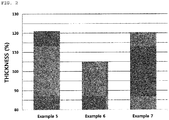
- each of the secondary batteries manufactured in Examples 5 to 7 was placed in a chamber at a temperature of 60°C, and stored for 3 weeks. The thicknesses were measured again, compared with the thicknesses prior to the storage, and then calculated. The results are shown in FIG. 2 .
- the secondary battery gelated using poly(ethylene imine)-graft-poly(ethylene glycol) (PEI-PEG), an amine-based compound that comprises a polyethylene glycol functional group, as the first compound (Example 6) had a reduced thickness increase during the high temperature storage and thereby exhibited excellent high temperature storage efficiency compared to the secondary battery gelated using poly(ethylene imine) (PEI), an amine-based compound that does not comprise a polyethylene glycol functional group (Example 7).
Landscapes
- Chemical & Material Sciences (AREA)
- Chemical Kinetics & Catalysis (AREA)
- Electrochemistry (AREA)
- General Chemical & Material Sciences (AREA)
- Engineering & Computer Science (AREA)
- Manufacturing & Machinery (AREA)
- Inorganic Chemistry (AREA)
- Condensed Matter Physics & Semiconductors (AREA)
- Physics & Mathematics (AREA)
- General Physics & Mathematics (AREA)
- Dispersion Chemistry (AREA)
- Materials Engineering (AREA)
- Polymers & Plastics (AREA)
- Organic Chemistry (AREA)
- Medicinal Chemistry (AREA)
- Health & Medical Sciences (AREA)
- Secondary Cells (AREA)
- Conductive Materials (AREA)
- Battery Electrode And Active Subsutance (AREA)
Claims (10)
- Zusammensetzung für einen Gelpolymerelektrolyten, umfassend ein flüssiges Elektrolyt-Lösungsmittel, ein Lithiumsalz, einen Polymerisationsinitiator und eine gemischte Verbindung aus einer ersten Verbindung und einer zweiten Verbindung,
wobei die erste Verbindung eine Verbindung auf Aminbasis ist, die Polyethylenglykol als funktionelle Gruppe umfasst, und die zweite Verbindung eine Verbindung auf Epoxidbasis ist, und
das Gewichtsverhältnis der ersten Verbindung zur zweiten Verbindung 1:0,2 bis 0,6 beträgt. - Zusammensetzung für einen Gelpolymerelektrolyten gemäss Anspruch 1, wobei die gemischte Verbindung in einer Menge von 0,1 bis 10 Gew.%, bezogen auf das Gesamtgewicht der Zusammensetzung, umfasst ist.
- Zusammensetzung für einen Gelpolymerelektrolyten gemäss Anspruch 1, wobei das Lithiumsalz irgendeines, ausgewählt aus der Gruppe bestehend aus LiPF6, LiBF4, LiSbF6, LiAsF6, LiClO4, LiN(C2F5SO2)2, LiN(CF3SO2)2, CF3SO3Li, LiC(CF3SO2)3 und LiC4BO8 oder eine Mischung von zwei oder mehr davon ist.
- Zusammensetzung für einen Gelpolymerelektrolyten gemäss Anspruch 1, wobei das flüssige Elektrolyt-Lösungsmittel geradkettiges Carbonat, cyclisches Carbonat oder eine Kombination davon ist.
- Zusammensetzung für einen Gelpolymerelektrolyten gemäss Anspruch 4, wobei das geradkettige Carbonat irgendeines, ausgewählt aus der Gruppe bestehend aus Dimethylcarbonat, Diethylcarbonat, Dipropylcarbonat, Ethylmethylcarbonat, Methylpropylcarbonat und Ethylpropylcarbonat, oder eine Mischung von zwei oder mehr Arten davon umfasst und das cyclische Carbonat irgendeines, ausgewählt aus der Gruppe bestehend aus Ethylencarbonat, Propylencarbonat, 1,2-Butylencarbonat, 2,3-Butylencarbonat, 1,2-Pentylencarbonat, 2,3-Pentylencarbonat, Vinylencarbonat und Halogeniden davon, oder eine Mischung von zwei oder mehr Arten davon umfasst.
- Zusammensetzung für einen Gelpolymerelektrolyten gemäss Anspruch 1, wobei der Polymerisationsinitiator eine oder mehrere Arten, ausgewählt aus der Gruppe bestehend aus organischen Peroxiden, wie Benzoylperoxid, Acetylperoxid, Dilaurylperoxid, Di-tert-butylperoxid, t-Butylperoxy-2-ethyl-hexanoat, Cumylhydroperoxid und Wasserstoffperoxid; Hydroperoxiden und Azoverbindungen, wie 2,2'-Azobis(2-cyanobutan), 2,2'-Azobis(methylbutyronitril), 2,2'-Azobis(isobutyronitril) (AIBN) und 2,2'-Azobisdimethyl-valeronitril (AMVN), ist.
- Lithium-Sekundärbatterie, umfassend eine positive Elektrode; eine negative Elektrode; einen Separator und einen Gelpolymerelektrolyten,
wobei der Gelpolymerelektrolyt durch Polymerisieren der Zusammensetzung für einen Gelpolymerelektrolyten gemäss Anspruch 1 gebildet ist. - Lithium-Sekundärbatterie gemäss Anspruch 7, wobei der Gelpolymerelektrolyt Oligomere der nachstehenden Chemischen Formeln 1 und 2 umfasst:

- Lithium-Sekundärbatterie gemäss Anspruch 7, die eine Ladespannung von 3,0 bis 5,0 V aufweist.
- Lithium-Sekundärbatterie gemäss Anspruch 7, wobei die positive Elektrode ein positives Elektrodenaktivmaterial umfasst und das positive Elektrodenaktivmaterial irgendeines, ausgewählt aus der Gruppe bestehend aus LiCoO2, LiNiO2, LiMnO2, LiMn2O4, LiNi1-yCoyO2 (O=y<1), LiCo1-yMnyO2 (O=y<1), LiNi1-yMnyO2 (O=y<1) und Li[NiaCobMnc]O2 (0<a, b, c=1, a+b+c=1) oder eine Mischung von zwei oder mehr davon ist.
Applications Claiming Priority (2)
| Application Number | Priority Date | Filing Date | Title |
|---|---|---|---|
| KR20140133469 | 2014-10-02 | ||
| PCT/KR2015/010416 WO2016053041A1 (ko) | 2014-10-02 | 2015-10-01 | 겔 폴리머 전해질 및 이를 포함하는 리튬 이차전지 |
Publications (3)
| Publication Number | Publication Date |
|---|---|
| EP3203566A1 EP3203566A1 (de) | 2017-08-09 |
| EP3203566A4 EP3203566A4 (de) | 2017-08-09 |
| EP3203566B1 true EP3203566B1 (de) | 2018-08-22 |
Family
ID=55801164
Family Applications (1)
| Application Number | Title | Priority Date | Filing Date |
|---|---|---|---|
| EP15848091.3A Active EP3203566B1 (de) | 2014-10-02 | 2015-10-01 | Gelpolymerelektrolyt und lithiumsekundärbatterie damit |
Country Status (5)
| Country | Link |
|---|---|
| US (1) | US10276893B2 (de) |
| EP (1) | EP3203566B1 (de) |
| JP (1) | JP6612859B2 (de) |
| KR (1) | KR101797295B1 (de) |
| CN (1) | CN106797053B (de) |
Families Citing this family (20)
| Publication number | Priority date | Publication date | Assignee | Title |
|---|---|---|---|---|
| KR102229445B1 (ko) | 2017-04-04 | 2021-03-17 | 주식회사 엘지화학 | 분리막 및 이를 포함하는 리튬-황 전지 |
| KR102657448B1 (ko) | 2017-07-26 | 2024-04-16 | 주식회사 엘지에너지솔루션 | 이차전지용 고분자 전해질 및 이를 포함하는 리튬 이차전지 |
| KR102328255B1 (ko) | 2017-11-16 | 2021-11-18 | 주식회사 엘지에너지솔루션 | 리튬-황 전지용 양극 및 이의 제조방법 |
| KR102255536B1 (ko) * | 2017-11-30 | 2021-05-25 | 주식회사 엘지에너지솔루션 | 젤 폴리머 전해질용 조성물, 이로부터 제조되는 젤 폴리머 전해질 및 이를 포함하는 리튬 이차 전지 |
| KR102217108B1 (ko) * | 2017-11-30 | 2021-02-18 | 주식회사 엘지화학 | 젤 폴리머 전해질용 조성물, 이로부터 제조되는 젤 폴리머 전해질 및 이를 포함하는 리튬 이차 전지 |
| KR102288126B1 (ko) * | 2017-12-01 | 2021-08-11 | 주식회사 엘지에너지솔루션 | 겔 폴리머 전해질 조성물 및 이를 포함하는 리튬 이차전지 |
| US10505224B2 (en) | 2017-12-28 | 2019-12-10 | Industrial Technology Research Institute | Electrolyte, composition for electrolyte and lithium battery employing the same |
| KR102338540B1 (ko) | 2018-04-10 | 2021-12-14 | 주식회사 엘지에너지솔루션 | 리튬 이차 전지 및 이의 제조방법 |
| ES3062842T3 (en) * | 2018-04-27 | 2026-04-14 | Lg Energy Solution Ltd | Lithium secondary battery and manufacturing method thereof |
| KR102434068B1 (ko) * | 2018-04-27 | 2022-08-19 | 주식회사 엘지에너지솔루션 | 리튬 이차 전지용 분리막 및 이를 포함하는 리튬 이차 전지 |
| KR102093129B1 (ko) * | 2018-07-09 | 2020-03-25 | 울산과학기술원 | 가교된 고분자를 포함하는 겔 전해질 및 그 제조방법 |
| KR102428263B1 (ko) * | 2019-11-25 | 2022-08-02 | 울산과학기술원 | 가교된 고분자를 포함하는 복합 고체 전해질 및 이의 제조방법 |
| WO2021112287A1 (ko) * | 2019-12-05 | 2021-06-10 | 울산과학기술원 | 가교된 고분자를 포함하는 겔 전해질 및 그 제조방법 |
| US12355102B2 (en) * | 2020-10-08 | 2025-07-08 | Ut-Battelle, Llc | Method of manufacturing a thin film composite solid electrolyte |
| CN115528242B (zh) * | 2021-06-24 | 2025-09-09 | 深圳市比亚迪锂电池有限公司 | 聚合物保护膜、金属锂负极、锂电池及车辆 |
| KR102799060B1 (ko) | 2021-12-30 | 2025-04-21 | 코오롱인더스트리 주식회사 | 이온전도성 파이공액계 고분자, 고체 고분자 전해질 조성물, 이로부터 형성된 고체 고분자 전해질 및 이를 포함하는 리튬 이차전지 |
| KR102839444B1 (ko) | 2021-12-30 | 2025-07-25 | 코오롱인더스트리 주식회사 | 이온전도성 파이공액계 고분자, 고체 고분자 전해질 조성물, 이로부터 형성된 고체 고분자 전해질 및 이를 포함하는 리튬 이차전지 |
| KR102695915B1 (ko) * | 2022-03-31 | 2024-08-19 | 주식회사 엘지에너지솔루션 | 가교 시간이 단축된 겔 폴리머 전해질 조성물, 이를 포함하는 이차전지와 이차전지의 제조방법 |
| KR102860108B1 (ko) | 2023-06-30 | 2025-09-16 | 건국대학교 글로컬산학협력단 | 다중 에폭시기 기반 리튬이온전지용 겔 고분자 전해질의 제조방법 및 이에 따라 제조된 겔 고분자 전해질 |
| KR20250040232A (ko) | 2023-09-15 | 2025-03-24 | 건국대학교 글로컬산학협력단 | 리튬이온전지용 고체 고분자 전해질의 인시츄 제조방법 및 이에 따라 제조된 고체 고분자 전해질 |
Family Cites Families (23)
| Publication number | Priority date | Publication date | Assignee | Title |
|---|---|---|---|---|
| JPH0384807A (ja) * | 1989-08-28 | 1991-04-10 | Yuasa Battery Co Ltd | 高分子固体電解質 |
| JPH0869817A (ja) * | 1994-05-13 | 1996-03-12 | Gould Electron Inc | デンドリマー構造を有するポリマー電解質 |
| US5429793A (en) | 1994-05-17 | 1995-07-04 | Institute Of Gas Technology | Scaleable process for producing Ni-Al ODS anode |
| JP4562896B2 (ja) * | 1999-11-22 | 2010-10-13 | 日立マクセル株式会社 | ゲルポリマー電解質および二次電池 |
| US6562520B1 (en) | 1999-11-22 | 2003-05-13 | Hitachi Maxell, Ltd. | Polymer electrolyte and rechargeable cell comprising the same |
| ATE346387T1 (de) * | 2000-12-29 | 2006-12-15 | Univ Oklahoma | Leitendes elektrolyt auf basis von polyaminen |
| KR100394077B1 (ko) * | 2001-03-13 | 2003-08-06 | 한국화학연구원 | 폴리알킬렌 옥시드계 고체 고분자 전해질 조성물 |
| KR100399788B1 (ko) * | 2001-08-17 | 2003-09-29 | 삼성에스디아이 주식회사 | 졸 형태의 고분자 전해질 및 이를 채용한 리튬 전지 |
| KR100522685B1 (ko) | 2001-08-25 | 2005-10-19 | 삼성에스디아이 주식회사 | 겔 형태의 고분자 전해질 및 이를 채용한 리튬 전지 |
| JP2003187637A (ja) * | 2001-09-21 | 2003-07-04 | Daiso Co Ltd | 高分子ゲル電解質を用いた素子 |
| JP2004214041A (ja) * | 2003-01-06 | 2004-07-29 | Nitto Denko Corp | ゲル電解質とこれを用いる非水電解質電池 |
| KR101102729B1 (ko) | 2007-05-23 | 2012-01-05 | 주식회사 엘지화학 | 겔 폴리머 전해질 및 이를 포함하는 전기화학소자 |
| JP5529717B2 (ja) | 2009-12-09 | 2014-06-25 | 株式会社日本触媒 | 電解質材料並びにそれを用いた電池用材料及び二次電池 |
| KR101087849B1 (ko) * | 2010-03-16 | 2011-11-30 | 한양대학교 산학협력단 | 인시츄 화학 가교반응에 의해 제조되는 겔 고분자 전해질을 포함하는 염료감응 태양전지 및 그 제조방법 |
| KR101911431B1 (ko) | 2011-11-25 | 2018-10-25 | 삼성전자주식회사 | 전해액 조성물, 겔 고분자 전해질 및 이를 포함하는 리튬 전지 |
| KR101381873B1 (ko) | 2012-04-13 | 2014-04-14 | 한국과학기술연구원 | 고분자 젤 전해질 조성물, 이의 제조방법 및 이를 포함하는 염료감응 태양전지 |
| KR101548789B1 (ko) * | 2012-12-21 | 2015-09-01 | 주식회사 엘지화학 | 케이블형 이차전지 및 이의 제조 방법 |
| EP2784867B1 (de) | 2013-01-28 | 2016-11-23 | LG Chem, Ltd. | Hochspannungs-lithiumsekundärbatterie |
| KR101633966B1 (ko) | 2013-01-28 | 2016-06-27 | 주식회사 엘지화학 | 겔 폴리머 전해질용 조성물 및 이를 포함하는 리튬 이차 전지 |
| KR101641763B1 (ko) | 2013-01-28 | 2016-07-21 | 주식회사 엘지화학 | 고전압 리튬 이차 전지 |
| KR101346414B1 (ko) | 2013-02-15 | 2014-01-16 | 한양대학교 산학협력단 | 겔 폴리머 전해질 및 이를 이용한 리튬이차전지 |
| CN103474697B (zh) * | 2013-09-10 | 2016-09-07 | 东莞新能源科技有限公司 | 一种凝胶聚合物锂离子电池 |
| CN103872379B (zh) * | 2014-03-21 | 2017-04-26 | 东莞新能源科技有限公司 | 锂离子电池凝胶电解液 |
-
2015
- 2015-10-01 JP JP2017517750A patent/JP6612859B2/ja active Active
- 2015-10-01 KR KR1020150138643A patent/KR101797295B1/ko active Active
- 2015-10-01 EP EP15848091.3A patent/EP3203566B1/de active Active
- 2015-10-01 CN CN201580053802.1A patent/CN106797053B/zh active Active
- 2015-10-01 US US15/516,146 patent/US10276893B2/en active Active
Non-Patent Citations (1)
| Title |
|---|
| None * |
Also Published As
| Publication number | Publication date |
|---|---|
| CN106797053A (zh) | 2017-05-31 |
| JP6612859B2 (ja) | 2019-11-27 |
| EP3203566A1 (de) | 2017-08-09 |
| EP3203566A4 (de) | 2017-08-09 |
| US10276893B2 (en) | 2019-04-30 |
| JP2017530533A (ja) | 2017-10-12 |
| KR101797295B1 (ko) | 2017-11-13 |
| KR20160040113A (ko) | 2016-04-12 |
| CN106797053B (zh) | 2019-05-28 |
| US20170309956A1 (en) | 2017-10-26 |
Similar Documents
| Publication | Publication Date | Title |
|---|---|---|
| US10276893B2 (en) | Gel polymer electrolyte and lithium secondary battery comprising the same | |
| KR102227811B1 (ko) | 리튬 이차전지용 전해질 및 이를 포함하는 리튬 이차전지 | |
| KR102270873B1 (ko) | 젤 폴리머 전해질용 조성물 및 이를 포함하는 젤 폴리머 전해질 및 리튬 이차 전지 | |
| KR20140097026A (ko) | 겔 폴리머 전해질용 조성물 및 이를 포함하는 리튬 이차 전지 | |
| KR20170110995A (ko) | 비수성 전해액 및 이를 포함하는 리튬 이차전지 | |
| KR101545432B1 (ko) | 리튬 이차 전지 | |
| US12062756B2 (en) | Composition for gel polymer electrolyte, gel polymer electrolyte prepared therefrom, and lithium secondary battery including the same | |
| KR101641763B1 (ko) | 고전압 리튬 이차 전지 | |
| US20140220427A1 (en) | Composition for gel polymer electrolyte and lithium secondary battery including the same | |
| CN108028424A (zh) | 用于凝胶聚合物电解质的组合物、由其制备的凝胶聚合物电解质和包括该凝胶聚合物电解质的电化学装置 | |
| KR102287767B1 (ko) | 이차 전지용 분리막 및 이를 포함하는 리튬 이차 전지 | |
| KR102489655B1 (ko) | 고체 고분자 전해질 전구체 조성물, 고체 고분자 전해질 및 이를 포함하는 전고체 전지 | |
| KR20190112656A (ko) | 파우치형 이차전지의 제조 방법 | |
| US20160322668A1 (en) | Nonaqueous electrolyte lithium secondary battery | |
| KR20170038543A (ko) | 비수성 전해액 및 이를 포함하는 리튬 이차전지 | |
| KR102434069B1 (ko) | 리튬 이차 전지용 전해질 | |
| KR102325037B1 (ko) | 리튬 이차 전지 및 이의 제조방법 | |
| KR102275863B1 (ko) | 리튬 이차 전지용 전극 및 이를 포함하는 리튬 이차 전지 | |
| KR20170038736A (ko) | 비수성 전해액 및 이를 포함하는 리튬 이차전지 | |
| KR20190054981A (ko) | 겔 폴리머 전해질용 조성물, 이로부터 제조된 겔 폴리머 전해질 및 이를 포함하는 리튬 이차 전지 | |
| KR20190064257A (ko) | 젤 폴리머 전해질용 조성물, 이로부터 제조되는 젤 폴리머 전해질 및 이를 포함하는 리튬 이차 전지 | |
| KR20190064282A (ko) | 젤 폴리머 전해질용 조성물, 이로부터 제조되는 젤 폴리머 전해질 및 이를 포함하는 리튬 이차 전지 | |
| KR20190064260A (ko) | 젤 폴리머 전해질용 조성물, 이로부터 제조되는 젤 폴리머 전해질 및 이를 포함하는 리튬 이차 전지 | |
| KR102298292B1 (ko) | 겔 폴리머 전해질 조성물, 이에 의해 제조된 겔 폴리머 전해질, 및 이를 포함하는 리튬 이차전지 | |
| KR20190064259A (ko) | 젤 폴리머 전해질용 조성물, 이로부터 제조되는 젤 폴리머 전해질 및 이를 포함하는 리튬 이차 전지 |
Legal Events
| Date | Code | Title | Description |
|---|---|---|---|
| PUAI | Public reference made under article 153(3) epc to a published international application that has entered the european phase |
Free format text: ORIGINAL CODE: 0009012 |
|
| 17P | Request for examination filed |
Effective date: 20170329 |
|
| A4 | Supplementary search report drawn up and despatched |
Effective date: 20170710 |
|
| AK | Designated contracting states |
Kind code of ref document: A1 Designated state(s): AL AT BE BG CH CY CZ DE DK EE ES FI FR GB GR HR HU IE IS IT LI LT LU LV MC MK MT NL NO PL PT RO RS SE SI SK SM TR |
|
| AX | Request for extension of the european patent |
Extension state: BA ME |
|
| DAV | Request for validation of the european patent (deleted) | ||
| DAX | Request for extension of the european patent (deleted) | ||
| GRAP | Despatch of communication of intention to grant a patent |
Free format text: ORIGINAL CODE: EPIDOSNIGR1 |
|
| INTG | Intention to grant announced |
Effective date: 20180524 |
|
| GRAS | Grant fee paid |
Free format text: ORIGINAL CODE: EPIDOSNIGR3 |
|
| AK | Designated contracting states |
Kind code of ref document: B1 Designated state(s): AL AT BE BG CH CY CZ DE DK EE ES FI FR GB GR HR HU IE IS IT LI LT LU LV MC MK MT NL NO PL PT RO RS SE SI SK SM TR |
|
| REG | Reference to a national code |
Ref country code: GB Ref legal event code: FG4D |
|
| GRAA | (expected) grant |
Free format text: ORIGINAL CODE: 0009210 |
|
| REG | Reference to a national code |
Ref country code: CH Ref legal event code: EP |
|
| REG | Reference to a national code |
Ref country code: DE Ref legal event code: R096 Ref document number: 602015015283 Country of ref document: DE |
|
| REG | Reference to a national code |
Ref country code: AT Ref legal event code: REF Ref document number: 1033516 Country of ref document: AT Kind code of ref document: T Effective date: 20180915 |
|
| REG | Reference to a national code |
Ref country code: IE Ref legal event code: FG4D |
|
| REG | Reference to a national code |
Ref country code: FR Ref legal event code: PLFP Year of fee payment: 4 |
|
| REG | Reference to a national code |
Ref country code: NL Ref legal event code: MP Effective date: 20180822 |
|
| REG | Reference to a national code |
Ref country code: LT Ref legal event code: MG4D |
|
| PG25 | Lapsed in a contracting state [announced via postgrant information from national office to epo] |
Ref country code: FI Free format text: LAPSE BECAUSE OF FAILURE TO SUBMIT A TRANSLATION OF THE DESCRIPTION OR TO PAY THE FEE WITHIN THE PRESCRIBED TIME-LIMIT Effective date: 20180822 Ref country code: RS Free format text: LAPSE BECAUSE OF FAILURE TO SUBMIT A TRANSLATION OF THE DESCRIPTION OR TO PAY THE FEE WITHIN THE PRESCRIBED TIME-LIMIT Effective date: 20180822 Ref country code: NL Free format text: LAPSE BECAUSE OF FAILURE TO SUBMIT A TRANSLATION OF THE DESCRIPTION OR TO PAY THE FEE WITHIN THE PRESCRIBED TIME-LIMIT Effective date: 20180822 Ref country code: LT Free format text: LAPSE BECAUSE OF FAILURE TO SUBMIT A TRANSLATION OF THE DESCRIPTION OR TO PAY THE FEE WITHIN THE PRESCRIBED TIME-LIMIT Effective date: 20180822 Ref country code: SE Free format text: LAPSE BECAUSE OF FAILURE TO SUBMIT A TRANSLATION OF THE DESCRIPTION OR TO PAY THE FEE WITHIN THE PRESCRIBED TIME-LIMIT Effective date: 20180822 Ref country code: BG Free format text: LAPSE BECAUSE OF FAILURE TO SUBMIT A TRANSLATION OF THE DESCRIPTION OR TO PAY THE FEE WITHIN THE PRESCRIBED TIME-LIMIT Effective date: 20181122 Ref country code: GR Free format text: LAPSE BECAUSE OF FAILURE TO SUBMIT A TRANSLATION OF THE DESCRIPTION OR TO PAY THE FEE WITHIN THE PRESCRIBED TIME-LIMIT Effective date: 20181123 Ref country code: NO Free format text: LAPSE BECAUSE OF FAILURE TO SUBMIT A TRANSLATION OF THE DESCRIPTION OR TO PAY THE FEE WITHIN THE PRESCRIBED TIME-LIMIT Effective date: 20181122 Ref country code: IS Free format text: LAPSE BECAUSE OF FAILURE TO SUBMIT A TRANSLATION OF THE DESCRIPTION OR TO PAY THE FEE WITHIN THE PRESCRIBED TIME-LIMIT Effective date: 20181222 |
|
| REG | Reference to a national code |
Ref country code: AT Ref legal event code: MK05 Ref document number: 1033516 Country of ref document: AT Kind code of ref document: T Effective date: 20180822 |
|
| PG25 | Lapsed in a contracting state [announced via postgrant information from national office to epo] |
Ref country code: HR Free format text: LAPSE BECAUSE OF FAILURE TO SUBMIT A TRANSLATION OF THE DESCRIPTION OR TO PAY THE FEE WITHIN THE PRESCRIBED TIME-LIMIT Effective date: 20180822 Ref country code: AL Free format text: LAPSE BECAUSE OF FAILURE TO SUBMIT A TRANSLATION OF THE DESCRIPTION OR TO PAY THE FEE WITHIN THE PRESCRIBED TIME-LIMIT Effective date: 20180822 Ref country code: LV Free format text: LAPSE BECAUSE OF FAILURE TO SUBMIT A TRANSLATION OF THE DESCRIPTION OR TO PAY THE FEE WITHIN THE PRESCRIBED TIME-LIMIT Effective date: 20180822 |
|
| PG25 | Lapsed in a contracting state [announced via postgrant information from national office to epo] |
Ref country code: CZ Free format text: LAPSE BECAUSE OF FAILURE TO SUBMIT A TRANSLATION OF THE DESCRIPTION OR TO PAY THE FEE WITHIN THE PRESCRIBED TIME-LIMIT Effective date: 20180822 Ref country code: IT Free format text: LAPSE BECAUSE OF FAILURE TO SUBMIT A TRANSLATION OF THE DESCRIPTION OR TO PAY THE FEE WITHIN THE PRESCRIBED TIME-LIMIT Effective date: 20180822 Ref country code: ES Free format text: LAPSE BECAUSE OF FAILURE TO SUBMIT A TRANSLATION OF THE DESCRIPTION OR TO PAY THE FEE WITHIN THE PRESCRIBED TIME-LIMIT Effective date: 20180822 Ref country code: RO Free format text: LAPSE BECAUSE OF FAILURE TO SUBMIT A TRANSLATION OF THE DESCRIPTION OR TO PAY THE FEE WITHIN THE PRESCRIBED TIME-LIMIT Effective date: 20180822 Ref country code: AT Free format text: LAPSE BECAUSE OF FAILURE TO SUBMIT A TRANSLATION OF THE DESCRIPTION OR TO PAY THE FEE WITHIN THE PRESCRIBED TIME-LIMIT Effective date: 20180822 Ref country code: EE Free format text: LAPSE BECAUSE OF FAILURE TO SUBMIT A TRANSLATION OF THE DESCRIPTION OR TO PAY THE FEE WITHIN THE PRESCRIBED TIME-LIMIT Effective date: 20180822 Ref country code: PL Free format text: LAPSE BECAUSE OF FAILURE TO SUBMIT A TRANSLATION OF THE DESCRIPTION OR TO PAY THE FEE WITHIN THE PRESCRIBED TIME-LIMIT Effective date: 20180822 |
|
| REG | Reference to a national code |
Ref country code: DE Ref legal event code: R097 Ref document number: 602015015283 Country of ref document: DE |
|
| PG25 | Lapsed in a contracting state [announced via postgrant information from national office to epo] |
Ref country code: SK Free format text: LAPSE BECAUSE OF FAILURE TO SUBMIT A TRANSLATION OF THE DESCRIPTION OR TO PAY THE FEE WITHIN THE PRESCRIBED TIME-LIMIT Effective date: 20180822 Ref country code: DK Free format text: LAPSE BECAUSE OF FAILURE TO SUBMIT A TRANSLATION OF THE DESCRIPTION OR TO PAY THE FEE WITHIN THE PRESCRIBED TIME-LIMIT Effective date: 20180822 Ref country code: SM Free format text: LAPSE BECAUSE OF FAILURE TO SUBMIT A TRANSLATION OF THE DESCRIPTION OR TO PAY THE FEE WITHIN THE PRESCRIBED TIME-LIMIT Effective date: 20180822 |
|
| REG | Reference to a national code |
Ref country code: CH Ref legal event code: PL |
|
| REG | Reference to a national code |
Ref country code: BE Ref legal event code: MM Effective date: 20181031 |
|
| PG25 | Lapsed in a contracting state [announced via postgrant information from national office to epo] |
Ref country code: MC Free format text: LAPSE BECAUSE OF FAILURE TO SUBMIT A TRANSLATION OF THE DESCRIPTION OR TO PAY THE FEE WITHIN THE PRESCRIBED TIME-LIMIT Effective date: 20180822 Ref country code: LU Free format text: LAPSE BECAUSE OF NON-PAYMENT OF DUE FEES Effective date: 20181001 |
|
| PLBE | No opposition filed within time limit |
Free format text: ORIGINAL CODE: 0009261 |
|
| STAA | Information on the status of an ep patent application or granted ep patent |
Free format text: STATUS: NO OPPOSITION FILED WITHIN TIME LIMIT |
|
| REG | Reference to a national code |
Ref country code: IE Ref legal event code: MM4A |
|
| 26N | No opposition filed |
Effective date: 20190523 |
|
| PG25 | Lapsed in a contracting state [announced via postgrant information from national office to epo] |
Ref country code: SI Free format text: LAPSE BECAUSE OF FAILURE TO SUBMIT A TRANSLATION OF THE DESCRIPTION OR TO PAY THE FEE WITHIN THE PRESCRIBED TIME-LIMIT Effective date: 20180822 Ref country code: BE Free format text: LAPSE BECAUSE OF NON-PAYMENT OF DUE FEES Effective date: 20181031 Ref country code: CH Free format text: LAPSE BECAUSE OF NON-PAYMENT OF DUE FEES Effective date: 20181031 Ref country code: LI Free format text: LAPSE BECAUSE OF NON-PAYMENT OF DUE FEES Effective date: 20181031 |
|
| PG25 | Lapsed in a contracting state [announced via postgrant information from national office to epo] |
Ref country code: IE Free format text: LAPSE BECAUSE OF NON-PAYMENT OF DUE FEES Effective date: 20181001 |
|
| PG25 | Lapsed in a contracting state [announced via postgrant information from national office to epo] |
Ref country code: MT Free format text: LAPSE BECAUSE OF NON-PAYMENT OF DUE FEES Effective date: 20181001 |
|
| PG25 | Lapsed in a contracting state [announced via postgrant information from national office to epo] |
Ref country code: TR Free format text: LAPSE BECAUSE OF FAILURE TO SUBMIT A TRANSLATION OF THE DESCRIPTION OR TO PAY THE FEE WITHIN THE PRESCRIBED TIME-LIMIT Effective date: 20180822 |
|
| PG25 | Lapsed in a contracting state [announced via postgrant information from national office to epo] |
Ref country code: PT Free format text: LAPSE BECAUSE OF FAILURE TO SUBMIT A TRANSLATION OF THE DESCRIPTION OR TO PAY THE FEE WITHIN THE PRESCRIBED TIME-LIMIT Effective date: 20180822 |
|
| PG25 | Lapsed in a contracting state [announced via postgrant information from national office to epo] |
Ref country code: MK Free format text: LAPSE BECAUSE OF NON-PAYMENT OF DUE FEES Effective date: 20180822 Ref country code: HU Free format text: LAPSE BECAUSE OF FAILURE TO SUBMIT A TRANSLATION OF THE DESCRIPTION OR TO PAY THE FEE WITHIN THE PRESCRIBED TIME-LIMIT; INVALID AB INITIO Effective date: 20151001 Ref country code: CY Free format text: LAPSE BECAUSE OF FAILURE TO SUBMIT A TRANSLATION OF THE DESCRIPTION OR TO PAY THE FEE WITHIN THE PRESCRIBED TIME-LIMIT Effective date: 20180822 |
|
| P01 | Opt-out of the competence of the unified patent court (upc) registered |
Effective date: 20230408 |
|
| REG | Reference to a national code |
Ref country code: DE Ref legal event code: R081 Ref document number: 602015015283 Country of ref document: DE Owner name: LG ENERGY SOLUTION, LTD., KR Free format text: FORMER OWNER: LG CHEM. LTD., SEOUL, KR |
|
| REG | Reference to a national code |
Ref country code: GB Ref legal event code: 732E Free format text: REGISTERED BETWEEN 20230824 AND 20230831 |
|
| PGFP | Annual fee paid to national office [announced via postgrant information from national office to epo] |
Ref country code: GB Payment date: 20250922 Year of fee payment: 11 |
|
| PGFP | Annual fee paid to national office [announced via postgrant information from national office to epo] |
Ref country code: FR Payment date: 20250925 Year of fee payment: 11 |
|
| PGFP | Annual fee paid to national office [announced via postgrant information from national office to epo] |
Ref country code: DE Payment date: 20250922 Year of fee payment: 11 |