EP3204007B1 - Composés de la triazolopyridine et méthodes pour le traitement de la fibrose kystique - Google Patents
Composés de la triazolopyridine et méthodes pour le traitement de la fibrose kystique Download PDFInfo
- Publication number
- EP3204007B1 EP3204007B1 EP15849360.1A EP15849360A EP3204007B1 EP 3204007 B1 EP3204007 B1 EP 3204007B1 EP 15849360 A EP15849360 A EP 15849360A EP 3204007 B1 EP3204007 B1 EP 3204007B1
- Authority
- EP
- European Patent Office
- Prior art keywords
- substituted
- aryl
- compound
- alkyl
- alkenyl
- Prior art date
- Legal status (The legal status is an assumption and is not a legal conclusion. Google has not performed a legal analysis and makes no representation as to the accuracy of the status listed.)
- Active
Links
Classifications
-
- C—CHEMISTRY; METALLURGY
- C07—ORGANIC CHEMISTRY
- C07D—HETEROCYCLIC COMPOUNDS
- C07D471/00—Heterocyclic compounds containing nitrogen atoms as the only ring hetero atoms in the condensed system, at least one ring being a six-membered ring with one nitrogen atom, not provided for by groups C07D451/00 - C07D463/00
- C07D471/02—Heterocyclic compounds containing nitrogen atoms as the only ring hetero atoms in the condensed system, at least one ring being a six-membered ring with one nitrogen atom, not provided for by groups C07D451/00 - C07D463/00 in which the condensed system contains two hetero rings
- C07D471/04—Ortho-condensed systems
-
- A—HUMAN NECESSITIES
- A61—MEDICAL OR VETERINARY SCIENCE; HYGIENE
- A61K—PREPARATIONS FOR MEDICAL, DENTAL OR TOILETRY PURPOSES
- A61K31/00—Medicinal preparations containing organic active ingredients
- A61K31/33—Heterocyclic compounds
- A61K31/395—Heterocyclic compounds having nitrogen as a ring hetero atom, e.g. guanethidine or rifamycins
- A61K31/41—Heterocyclic compounds having nitrogen as a ring hetero atom, e.g. guanethidine or rifamycins having five-membered rings with two or more ring hetero atoms, at least one of which being nitrogen, e.g. tetrazole
- A61K31/4196—1,2,4-Triazoles
-
- A—HUMAN NECESSITIES
- A61—MEDICAL OR VETERINARY SCIENCE; HYGIENE
- A61K—PREPARATIONS FOR MEDICAL, DENTAL OR TOILETRY PURPOSES
- A61K31/00—Medicinal preparations containing organic active ingredients
- A61K31/33—Heterocyclic compounds
- A61K31/395—Heterocyclic compounds having nitrogen as a ring hetero atom, e.g. guanethidine or rifamycins
- A61K31/435—Heterocyclic compounds having nitrogen as a ring hetero atom, e.g. guanethidine or rifamycins having six-membered rings with one nitrogen as the only ring hetero atom
- A61K31/4353—Heterocyclic compounds having nitrogen as a ring hetero atom, e.g. guanethidine or rifamycins having six-membered rings with one nitrogen as the only ring hetero atom ortho- or peri-condensed with heterocyclic ring systems
- A61K31/437—Heterocyclic compounds having nitrogen as a ring hetero atom, e.g. guanethidine or rifamycins having six-membered rings with one nitrogen as the only ring hetero atom ortho- or peri-condensed with heterocyclic ring systems the heterocyclic ring system containing a five-membered ring having nitrogen as a ring hetero atom, e.g. indolizine, beta-carboline
-
- A—HUMAN NECESSITIES
- A61—MEDICAL OR VETERINARY SCIENCE; HYGIENE
- A61K—PREPARATIONS FOR MEDICAL, DENTAL OR TOILETRY PURPOSES
- A61K31/00—Medicinal preparations containing organic active ingredients
- A61K31/33—Heterocyclic compounds
- A61K31/395—Heterocyclic compounds having nitrogen as a ring hetero atom, e.g. guanethidine or rifamycins
- A61K31/435—Heterocyclic compounds having nitrogen as a ring hetero atom, e.g. guanethidine or rifamycins having six-membered rings with one nitrogen as the only ring hetero atom
- A61K31/44—Non condensed pyridines; Hydrogenated derivatives thereof
- A61K31/4427—Non condensed pyridines; Hydrogenated derivatives thereof containing further heterocyclic ring systems
- A61K31/4439—Non condensed pyridines; Hydrogenated derivatives thereof containing further heterocyclic ring systems containing a five-membered ring with nitrogen as a ring hetero atom, e.g. omeprazole
-
- A—HUMAN NECESSITIES
- A61—MEDICAL OR VETERINARY SCIENCE; HYGIENE
- A61K—PREPARATIONS FOR MEDICAL, DENTAL OR TOILETRY PURPOSES
- A61K31/00—Medicinal preparations containing organic active ingredients
- A61K31/33—Heterocyclic compounds
- A61K31/395—Heterocyclic compounds having nitrogen as a ring hetero atom, e.g. guanethidine or rifamycins
- A61K31/435—Heterocyclic compounds having nitrogen as a ring hetero atom, e.g. guanethidine or rifamycins having six-membered rings with one nitrogen as the only ring hetero atom
- A61K31/44—Non condensed pyridines; Hydrogenated derivatives thereof
- A61K31/4427—Non condensed pyridines; Hydrogenated derivatives thereof containing further heterocyclic ring systems
- A61K31/444—Non condensed pyridines; Hydrogenated derivatives thereof containing further heterocyclic ring systems containing a six-membered ring with nitrogen as a ring heteroatom, e.g. amrinone
-
- A—HUMAN NECESSITIES
- A61—MEDICAL OR VETERINARY SCIENCE; HYGIENE
- A61K—PREPARATIONS FOR MEDICAL, DENTAL OR TOILETRY PURPOSES
- A61K31/00—Medicinal preparations containing organic active ingredients
- A61K31/33—Heterocyclic compounds
- A61K31/395—Heterocyclic compounds having nitrogen as a ring hetero atom, e.g. guanethidine or rifamycins
- A61K31/435—Heterocyclic compounds having nitrogen as a ring hetero atom, e.g. guanethidine or rifamycins having six-membered rings with one nitrogen as the only ring hetero atom
- A61K31/44—Non condensed pyridines; Hydrogenated derivatives thereof
- A61K31/445—Non condensed piperidines, e.g. piperocaine
- A61K31/4523—Non condensed piperidines, e.g. piperocaine containing further heterocyclic ring systems
- A61K31/4545—Non condensed piperidines, e.g. piperocaine containing further heterocyclic ring systems containing a six-membered ring with nitrogen as a ring hetero atom, e.g. pipamperone, anabasine
-
- A—HUMAN NECESSITIES
- A61—MEDICAL OR VETERINARY SCIENCE; HYGIENE
- A61K—PREPARATIONS FOR MEDICAL, DENTAL OR TOILETRY PURPOSES
- A61K31/00—Medicinal preparations containing organic active ingredients
- A61K31/33—Heterocyclic compounds
- A61K31/395—Heterocyclic compounds having nitrogen as a ring hetero atom, e.g. guanethidine or rifamycins
- A61K31/495—Heterocyclic compounds having nitrogen as a ring hetero atom, e.g. guanethidine or rifamycins having six-membered rings with two or more nitrogen atoms as the only ring heteroatoms, e.g. piperazine or tetrazines
- A61K31/496—Non-condensed piperazines containing further heterocyclic rings, e.g. rifampin, thiothixene or sparfloxacin
-
- A—HUMAN NECESSITIES
- A61—MEDICAL OR VETERINARY SCIENCE; HYGIENE
- A61K—PREPARATIONS FOR MEDICAL, DENTAL OR TOILETRY PURPOSES
- A61K31/00—Medicinal preparations containing organic active ingredients
- A61K31/33—Heterocyclic compounds
- A61K31/395—Heterocyclic compounds having nitrogen as a ring hetero atom, e.g. guanethidine or rifamycins
- A61K31/495—Heterocyclic compounds having nitrogen as a ring hetero atom, e.g. guanethidine or rifamycins having six-membered rings with two or more nitrogen atoms as the only ring heteroatoms, e.g. piperazine or tetrazines
- A61K31/505—Pyrimidines; Hydrogenated pyrimidines, e.g. trimethoprim
- A61K31/519—Pyrimidines; Hydrogenated pyrimidines, e.g. trimethoprim ortho- or peri-condensed with heterocyclic rings
-
- A—HUMAN NECESSITIES
- A61—MEDICAL OR VETERINARY SCIENCE; HYGIENE
- A61K—PREPARATIONS FOR MEDICAL, DENTAL OR TOILETRY PURPOSES
- A61K45/00—Medicinal preparations containing active ingredients not provided for in groups A61K31/00 - A61K41/00
- A61K45/06—Mixtures of active ingredients without chemical characterisation, e.g. antiphlogistics and cardiaca
-
- A—HUMAN NECESSITIES
- A61—MEDICAL OR VETERINARY SCIENCE; HYGIENE
- A61P—SPECIFIC THERAPEUTIC ACTIVITY OF CHEMICAL COMPOUNDS OR MEDICINAL PREPARATIONS
- A61P11/00—Drugs for disorders of the respiratory system
-
- C—CHEMISTRY; METALLURGY
- C07—ORGANIC CHEMISTRY
- C07D—HETEROCYCLIC COMPOUNDS
- C07D487/00—Heterocyclic compounds containing nitrogen atoms as the only ring hetero atoms in the condensed system, not provided for by groups C07D451/00 - C07D477/00
- C07D487/02—Heterocyclic compounds containing nitrogen atoms as the only ring hetero atoms in the condensed system, not provided for by groups C07D451/00 - C07D477/00 in which the condensed system contains two hetero rings
- C07D487/04—Ortho-condensed systems
Definitions
- Cystic fibrosis is a lethal, recessive, genetic disease affecting approximately 1 in 2500 live births among Caucasians.
- CF Cystic fibrosis
- Approximately 1 in 25 persons are carriers of the disease.
- the major symptoms of cystic fibrosis include chronic pulmonary disease, pancreatic exocrine insufficiency, and elevated sweat electrolyte levels. The symptoms are consistent with cystic fibrosis being an exocrine disorder.
- Hantash, F: U.S. Patent Application No. 20060057593 The major symptoms are consistent with cystic fibrosis being an exocrine disorder.
- the CF gene codes for a cAMP/PKA-dependent, ATP-requiring, membrane chloride ion channel, generally found in the apical membranes of many secreting epithelia and is known as CFTR (cystic fibrosis transmembrane conductance regulator).
- CFTR cystic fibrosis transmembrane conductance regulator
- Around 75% of CF alleles contain the ⁇ F508 mutation in which a triplet codon has been lost, leading to a missing phenylalanine at position 508 in the protein.
- This altered protein fails to be trafficked to the correct location in the cell and is generally destroyed by the proteasome. The small amount that does reach the correct location functions poorly. ( Cuthbert AW, British Journal of Pharmacology, 163(1), 173-183, 2011 ).
- CFTR functions mainly as a chloride channel, it has many other roles, including inhibition of sodium transport through the epithelial sodium channel, regulation of the outwardly rectifying chloride channel, ATP channels, intracellular vesicle transport, and inhibition of endogenous calcium-activated chloride channels.
- CFTR is also involved in bicarbonate-chloride exchange. A deficiency in bicarbonate secretion leads to poor solubility and aggregation of luminal mucins.
- Obstruction of intrapancreatic ducts with thickened secretions causes autolysis of pancreatic tissue with replacement of the body of the pancreas with fat, leading to pancreatic insufficiency with subsequent malnutrition.
- CFTR dysfunction leads to airway surface liquid (ASL) depletion and thickened and viscous mucus that adheres to airway surfaces. The result is decreased mucociliary clearance (MCC) and impaired host defenses.
- ASL airway surface liquid
- MCC mucociliary clearance
- US patent application publication number US2010/0184739 is concerned with modulators of ATP-Binding Cassette ("ABC") transporters or fragments thereof, including Cystic Fibrosis Transmembrane Conductance Regulator.
- the compounds disclosed therein comprise a 4-oxo-quinoline motif.
- the prognosis for the treatment of CF has improved over the last 40 years. This was achieved by improving pancreatic enzyme supplements, drugs designed to treat pulmonary infection, reduce inflammation and enhance mucociliary clearance.
- the therapeutic challenges are to correct the biochemical defect of CF and to identify effective treatments for chronic respiratory infection. ( Frerichs C. et al., Expert Opin Pharmacother. 10(7), 1191-202, 2009 ).
- the present invention provides, compounds and pharmaceutical compositions as set out in the claims. Also provided are compounds for use in the treatment of CFTR (cystic fibrosis transmembrane conductance regulator) mediated diseases, in particular cystic fibrosis as set out in the claims.
- CFTR cystic fibrosis transmembrane conductance regulator
- CFTR cystic fibrosis transmembrane conductance regulator
- the disclosure relates to a compound of Formula VI or VIA and methods of treating cystic fibrosis comprising the step of administering a therapeutically effective amount of a compound of Formula VI or VIA to a patient in need thereof:
- a compound of formula I is selected from Table A or a pharmaceutically acceptable salt thereof:
- the compounds of this invention may be prepared by methods known in the art. Exemplary synthetic routes to prepare compounds of this invention are illustrated below:
- Compounds of the invention are useful as modulators of CFTR and treating diseases or disorders mediated by CFTR such as for the treatment of disease, disorders or conditions such as Cystic fibrosis, constipation, asthma, pancreatitis, gastrointestinal disorders, infertility, Hereditary emphysema, Hereditary hemochromatosis, Coagulation-Fibrinolysis deficiencies, such as Protein C deficiency, Type 1 hereditary angioedema, Lipid processing deficiencies, such as Familial hypercholesterolemia, Type 1 chylomicronemia, Abetalipoproteinemia, Lysosomal storage diseases, such as I-cell disease/Pseudo-Hurler, Mucopolysaccharidoses, Sandhof/Tay-Sachs, Crigler-Najjar type II, Polyendocrinopathy/Hyperinsulemia, Diabetes mellitus, Laron dwarfism, Myleoperoxidase deficiency, Primary hypopara
- the compounds of the invention may be administered in combination with antibiotics, anti-inflammatory medicines, bronchodilators, or mucus-thinning medicines.
- antibiotics for the treatment of bacteria mucoid Pseudomonas may be used in combination with compounds of the invention.
- Inhaled antibiotics such as tobramycin, colistin, and aztreonam can be used in combination with treatment with compounds of the invention.
- Anti-inflammatory medicines may also be used in combination with compounds of the invention to treat CFTR related diseases.
- Bronchodilators can be used in combination with compounds of the invention to treat CFTR related diseases.
- the invention relates to combination therapy comprising compounds of the invention and other pharmaceutical agents useful for the treatment of CF.
- the aminoglycoside gentamicin can be used.
- ataluren, Ivacaftor (Kalydeco) or VX-809 may be used in combination with compounds of the invention.
- the invention relates to pharmaceutical compositions comprising compounds of the invention and pharmaceutically acceptable carriers.
- the compositions may include compounds of the invention, and optionally a pharmaceutically acceptable carrier, adjuvant or vehicle.
- these compositions optionally further comprise one or more additional therapeutic agents useful for the treatment of CFTR mediated diseases or disorders.
- compositions of the present invention comprise a therapeutically effective amount of a compound of the present invention formulated together with one or more pharmaceutically acceptable carriers or excipients.
- the term "pharmaceutically acceptable carrier or excipient” means a non-toxic, inert solid, semi-solid, gel or liquid filler, diluent, encapsulating material or formulation auxiliary of any type.
- materials which can serve as pharmaceutically acceptable carriers are sugars such as lactose, glucose and sucrose; cyclodextrins such as alpha- ( ⁇ ), beta- ( ⁇ ) and gamma- ( ⁇ ) cyclodextrins; starches such as corn starch and potato starch; cellulose and its derivatives such as sodium carboxymethyl cellulose, ethyl cellulose and cellulose acetate; powdered tragacanth; malt; gelatin; talc; excipients such as cocoa butter and suppository waxes; oils such as peanut oil, cottonseed oil, safflower oil, sesame oil, olive oil, corn oil and soybean oil; glycols such as propylene glycol; esters such as ethylene glycol; est
- compositions of this invention may be administered orally, parenterally, by inhalation spray, topically, rectally, nasally, buccally, vaginally or via an implanted reservoir.
- administration is parenteral administration by injection.
- compositions of this invention may contain any conventional non-toxic pharmaceutically-acceptable carriers, adjuvants or vehicles.
- pH of the formulation may be adjusted with pharmaceutically acceptable acids, bases or buffers to enhance the stability of the formulated compound or its delivery form.
- parenteral as used herein includes subcutaneous, intracutaneous, intravenous, intramuscular, intraarticular, intraarterial, intrasynovial, intrasternal, intrathecal, intralesional and intracranial injection or infusion techniques.
- Liquid dosage forms for oral administration include pharmaceutically acceptable emulsions, microemulsions, solutions, suspensions, syrups and elixirs.
- the liquid dosage forms may contain inert diluents commonly used in the art such as, for example, water or other solvents, solubilizing agents and emulsifiers such as ethyl alcohol, isopropyl alcohol, ethyl carbonate, EtOAc, benzyl alcohol, benzyl benzoate, propylene glycol, 1, 3-butylene glycol, dimethylformamide, oils (in particular, cottonseed, groundnut, corn, germ, olive, castor, and sesame oils), glycerol, tetrahydrofurfuryl alcohol, polyethylene glycols and fatty acid esters of sorbitan, and mixtures thereof.
- the oral compositions can also include adjuvants such as wetting agents, emulsifying and suspending
- Injectable preparations for example, sterile injectable aqueous or oleaginous suspensions, may be formulated according to the known art using suitable dispersing or wetting agents and suspending agents.
- the sterile injectable preparation may also be a sterile injectable suspension or emulsion, such as INTRALIPID ® , LIPOSYN ® or OMEGAVEN ® , or solution, in a nontoxic parenterally acceptable diluent or solvent, for example, as a solution in 1, 3-butanediol.
- INTRALIPID ® is an intravenous fat emulsion containing 10-30% soybean oil, 1-10% egg yolk phospholipids, 1-10% glycerin and water.
- LIPOSYN ® is also an intravenous fat emulsion containing 2-15% safflower oil, 2-15% soybean oil, 0.5-5% egg phosphatides 1-10% glycerin and water.
- Omegaven ® is an emulsion for infusion containing about 5-25% fish oil, 0.5-10% egg phosphatides, 1-10% glycerin and water.
- acceptable vehicles and solvents that may be employed are water, Ringer's solution, USP and isotonic sodium chloride solution.
- sterile, fixed oils are conventionally employed as a solvent or suspending medium.
- any bland fixed oil can be employed including synthetic mono- or diglycerides.
- fatty acids such as oleic acid are used in the preparation of injectables.
- the injectable formulations can be sterilized, for example, by filtration through a bacterial-retaining filter, or by incorporating sterilizing agents in the form of sterile solid compositions which can be dissolved or dispersed in sterile water or other sterile injectable medium prior to use.
- compositions for rectal or vaginal administration are preferably suppositories which can be prepared by mixing the compounds of this invention with suitable non-irritating excipients or carriers such as cocoa butter, polyethylene glycol or a suppository wax which are solid at ambient temperature but liquid at body temperature and therefore melt in the rectum or vaginal cavity and release the active compound.
- suitable non-irritating excipients or carriers such as cocoa butter, polyethylene glycol or a suppository wax which are solid at ambient temperature but liquid at body temperature and therefore melt in the rectum or vaginal cavity and release the active compound.
- Solid dosage forms for oral administration include capsules, tablets, pills, powders, and granules.
- the active compound is mixed with at least one inert, pharmaceutically acceptable excipient or carrier such as sodium citrate or dicalcium phosphate and/or: a) fillers or extenders such as starches, lactose, sucrose, glucose, mannitol, and silicic acid; b) binders such as, for example, carboxymethylcellulose, alginates, gelatin, polyvinylpyrrolidinone, sucrose, and acacia; c) humectants such as glycerol; d) disintegrating agents such as agar-agar, calcium carbonate, potato or tapioca starch, alginic acid, certain silicates, and sodium carbonate; e) solution retarding agents such as paraffin; f) absorption accelerators such as quaternary ammonium compounds; g) wetting agents such as, for example, cetyl alcohol and g
- compositions of a similar type may also be employed as fillers in soft and hard-filled gelatin capsules using such excipients as lactose or milk sugar as well as high molecular weight polyethylene glycols and the like.
- the solid dosage forms of tablets, dragees, capsules, pills, and granules can be prepared with coatings and shells such as enteric coatings and other coatings well known in the pharmaceutical formulating art. They may optionally contain opacifying agents and can also be of a composition that they release the active ingredient(s) only, or preferentially, in a certain part of the intestinal tract, optionally, in a delayed manner. Examples of embedding compositions that can be used include polymeric substances and waxes.
- Dosage forms for topical or transdermal administration of a compound of this invention include ointments, pastes, creams, lotions, gels, powders, solutions, sprays, inhalants or patches.
- the active component is admixed under sterile conditions with a pharmaceutically acceptable carrier and any needed preservatives or buffers as may be required.
- Ophthalmic formulation, ear drops, eye ointments, powders and solutions are also contemplated as being within the scope of this invention.
- the ointments, pastes, creams and gels may contain, in addition to an active compound of this invention, excipients such as animal and vegetable fats, oils, waxes, paraffins, starch, tragacanth, cellulose derivatives, polyethylene glycols, silicones, bentonites, silicic acid, talc and zinc oxide, or mixtures thereof.
- excipients such as animal and vegetable fats, oils, waxes, paraffins, starch, tragacanth, cellulose derivatives, polyethylene glycols, silicones, bentonites, silicic acid, talc and zinc oxide, or mixtures thereof.
- Powders and sprays can contain, in addition to the compounds of this invention, excipients such as lactose, talc, silicic acid, aluminum hydroxide, calcium silicates and polyamide powder, or mixtures of these substances.
- Sprays can additionally contain customary propellants such as chlorofluorohydrocarbons.
- Transdermal patches have the added advantage of providing controlled delivery of a compound to the body.
- dosage forms can be made by dissolving or dispensing the compound in the proper medium.
- Absorption enhancers can also be used to increase the flux of the compound across the skin.
- the rate can be controlled by either providing a rate controlling membrane or by dispersing the compound in a polymer matrix or gel.
- a therapeutic composition of the invention is formulated and administered to the patient in solid or liquid particulate form by direct administration e.g., inhalation into the respiratory system.
- Solid or liquid particulate forms of the active compound prepared for practicing the present invention include particles of respirable size: that is, particles of a size sufficiently small to pass through the mouth and larynx upon inhalation and into the bronchi and alveoli of the lungs. Delivery of aerosolized therapeutics is known in the art (see, for example U.S. Pat. No. 5, 767, 068 to VanDevanter et al. , U.S. Pat. No. 5, 508, 269 to Smith et al. , and WO 98/43650 by Montgomery ).
- compositions described herein can be formulated in a unit dosage form.
- unit dosage form refers to physically discrete units suitable as unitary dosage for subjects undergoing treatment, with each unit containing a predetermined quantity of active material calculated to produce the desired therapeutic effect, optionally in association with a suitable pharmaceutical carrier.
- the unit dosage form can be for a single daily dose or one of multiple daily doses (e.g., about 1 to 4 or more times per day). When multiple daily doses are used, the unit dosage form can be the same or different for each dose.
- the amount of the active compound in a unit dosage form will vary depending upon, for example, the host treated, and the particular mode of administration.
- the unit dosage form can have one of the compounds of the invention as an active ingredient in an amount of about 10 mg, 20mg, 30mg, 40 mg, 50mg, 100mg, 150mg, 200mg, 250mg, 300mg, 400mg, 500mg, 600mg, 700mg, 750mg, 800mg, 900mg, 1000mg, or 1,250mg.
- the compounds of the invention can be administered in a dose of at least about 10 mg/day to at least about 1500 mg/day. In some embodiments, the compounds of the invention are administered in a dose of at least about 300 mg (e.g., at least about 450 mg, at least about 500 mg, at least about 750 mg, at least about 1,000mg, at least about 1250 mg, or at least about 1500 mg).
- Dose adjustments can be made for patients with mild, moderate or severe hepatic impairment (Child-Pugh Class A). Furthermore, dosage adjustments can be made for patients taking one or more Cytochrome P450 inhibitors and inducers, in particular CYP3A4, CYP2D6, CYP2C9, CYP2C19 and CYP2B6 inhibitors and inducers. Dose adjustments can also be made for patients with impaired Cytochrome P450 function such as poor, intermediate, extensive and ultra-rapid metabolizers.
- aliphatic group refers to a non-aromatic moiety that may be saturated (e.g. single bond) or contain one or more units of unsaturation, e.g., double and/or triple bonds.
- An aliphatic group may be straight chained, branched or cyclic, contain carbon, hydrogen or, optionally, one or more heteroatoms and may be substituted or unsubstituted.
- aliphatic groups include, for example, polyalkoxyalkyls, such as polyalkylene glycols, polyamines, and polyimines, for example. Such aliphatic groups may be further substituted.
- aliphatic groups may include alkyl, substituted alkyl, alkenyl, substituted alkenyl, alkynyl, substituted alkynyl, and substituted or unsubstituted cycloalkyl groups as described herein.
- acyl refers to a carbonyl substituted with hydrogen, alkyl, partially saturated or fully saturated cycloalkyl, partially saturated or fully saturated heterocycle, aryl, or heteroaryl.
- acyl includes groups such as (C 1 -C 6 ) alkanoyl (e.g., formyl, acetyl, propionyl, butyryl, valeryl, caproyl, t-butylacetyl, etc.), (C 3 -C 6 )cycloalkylcarbonyl (e.g., cyclopropylcarbonyl, cyclobutylcarbonyl, cyclopentylcarbonyl, cyclohexylcarbonyl, etc.), heterocyclic carbonyl (e.g., pyrrolidinylcarbonyl, pyrrolid-2-one-5-carbonyl, piperidinylcarbonyl, piperazinylcarbonyl, tetrahydrofuranylcarbonyl, etc.), aroyl (e.g., benzoyl) and heteroaroyl (e.g., thiophenyl-2-carbonyl, thiophenyl-3-carbon
- alkyl, cycloalkyl, heterocycle, aryl and heteroaryl portion of the acyl group may be any one of the groups described in the respective definitions.
- the acyl group may be unsubstituted or optionally substituted with one or more substituents (typically, one to three substituents) independently selected from the group of substituents listed below in the definition for "substituted” or the alkyl, cycloalkyl, heterocycle, aryl and heteroaryl portion of the acyl group may be substituted as described above in the preferred and more preferred list of substituents, respectively.
- alkyl is intended to include both branched and straight chain, substituted or unsubstituted saturated aliphatic hydrocarbon radicals/groups having the specified number of carbons.
- Preferred alkyl groups comprise about 1 to about 24 carbon atoms ("C 1 -C 24 ").
- Other preferred alkyl groups comprise at about 1 to about 8 carbon atoms (“C 1 -C 8 ”) such as about 1 to about 6 carbon atoms (“C 1 -C 6 "), or such as about 1 to about 3 carbon atoms (“C 1 -C 3 ").
- C 1 -C 6 alkyl radicals include, but are not limited to, methyl, ethyl, propyl, isopropyl, n-butyl, tert-butyl, n-pentyl, neopentyl and n-hexyl radicals.
- alkenyl refers to linear or branched radicals having at least one carbon-carbon double bond. Such radicals preferably contain from about two to about twenty-four carbon atoms ("C 2 -C 24 "). Other preferred alkenyl radicals are “lower alkenyl” radicals having two to about ten carbon atoms (“C 2 -C 10 ”) such as ethenyl, allyl, propenyl, butenyl and 4-methylbutenyl. Preferred lower alkenyl radicals include 2 to about 6 carbon atoms ("C 2 -C 6 ").
- alkenyl and “lower alkenyl” embrace radicals having "cis” and “trans” orientations, or alternatively, "E” and "Z” orientations.
- alkynyl refers to linear or branched radicals having at least one carbon-carbon triple bond. Such radicals preferably contain from about two to about twenty-four carbon atoms ("C 2 -C 24 ").
- Other preferred alkynyl radicals are "lower alkynyl” radicals having two to about ten carbon atoms such as propargyl, 1-propynyl, 2-propynyl, 1-butyne, 2-butynyl and 1-pentynyl.
- Preferred lower alkynyl radicals include 2 to about 6 carbon atoms ("C 2 -C 6 ").
- cycloalkyl refers to saturated carbocyclic radicals having three to about twelve carbon atoms ("C 3 -C 12 ").
- cycloalkyl embraces saturated carbocyclic radicals having three to about twelve carbon atoms. Examples of such radicals include cyclopropyl, cyclobutyl, cyclopentyl and cyclohexyl.
- cycloalkenyl refers to partially unsaturated carbocyclic radicals having three to twelve carbon atoms. Cycloalkenyl radicals that are partially unsaturated carbocyclic radicals that contain two double bonds (that may or may not be conjugated) can be called “cycloalkyldienyl". More preferred cycloalkenyl radicals are "lower cycloalkenyl” radicals having four to about eight carbon atoms. Examples of such radicals include cyclobutenyl, cyclopentenyl and cyclohexenyl.
- alkylene refers to a divalent group derived from a straight chain or branched saturated hydrocarbon chain having the specified number of carbons atoms.
- alkylene groups include, but are not limited to, ethylene, propylene, butylene, 3-methyl-pentylene, and 5-ethyl-hexylene.
- alkenylene denotes a divalent group derived from a straight chain or branched hydrocarbon moiety containing the specified number of carbon atoms having at least one carbon-carbon double bond.
- Alkenylene groups include, but are not limited to, for example, ethenylene, 2-propenylene, 2-butenylene, 1-methyl-2-buten-1-ylene, and the like.
- alkynylene denotes a divalent group derived from a straight chain or branched hydrocarbon moiety containing the specified number of carbon atoms having at least one carbon-carbon triple bond.
- Representative alkynylene groups include, but are not limited to, for example, propynylene, 1-butynylene, 2-methyl-3-hexynylene, and the like.
- alkoxy refers to linear or branched oxy-containing radicals each having alkyl portions of one to about twenty-four carbon atoms or, preferably, one to about twelve carbon atoms. More preferred alkoxy radicals are "lower alkoxy" radicals having one to about ten carbon atoms and more preferably having one to about eight carbon atoms. Examples of such radicals include methoxy, ethoxy, propoxy, butoxy and tert-butoxy.
- alkoxyalkyl refers to alkyl radicals having one or more alkoxy radicals attached to the alkyl radical, that is, to form monoalkoxyalkyl and dialkoxyalkyl radicals.
- aryl alone or in combination, means an aromatic system containing one, two or three rings wherein such rings may be attached together in a pendent manner or may be fused.
- aryl embraces aromatic radicals such as phenyl, naphthyl, tetrahydronaphthyl, indane furanyl, quinazolinyl, pyridyl and biphenyl.
- heterocyclyl refers to saturated, partially unsaturated and unsaturated heteroatom-containing ring-shaped radicals, which can also be called “heterocyclyl”, “heterocycloalkenyl” and “heteroaryl” correspondingly, where the heteroatoms may be selected from nitrogen, sulfur and oxygen.
- saturated heterocyclyl radicals include saturated 3 to 6-membered heteromonocyclic group containing 1 to 4 nitrogen atoms (e.g.
- pyrrolidinyl imidazolidinyl, piperidino, piperazinyl, etc.
- saturated 3 to 6-membered heteromonocyclic group containing 1 to 2 oxygen atoms and 1 to 3 nitrogen atoms e.g. morpholinyl, etc.
- saturated 3 to 6-membered heteromonocyclic group containing 1 to 2 sulfur atoms and 1 to 3 nitrogen atoms e.g., thiazolidinyl, etc.
- partially unsaturated heterocyclyl radicals include dihydrothiophene, dihydropyran, dihydrofuran and dihydrothiazole.
- Heterocyclyl radicals may include a pentavalent nitrogen, such as in tetrazolium and pyridinium radicals.
- the term "heterocycle” also embraces radicals where heterocyclyl radicals are fused with aryl or cycloalkyl radicals. Examples of such fused bicyclic radicals include benzofuran, benzothiophene, and the like.
- heteroaryl refers to unsaturated aromatic heterocyclyl radicals.
- heteroaryl radicals include unsaturated 3 to 6 membered heteromonocyclic group containing 1 to 4 nitrogen atoms, for example, pyrrolyl, pyrrolinyl, imidazolyl, pyrazolyl, pyridyl, pyrimidyl, pyrazinyl, pyridazinyl, triazolyl (e.g., 4H-1, 2, 4-triazolyl, 1H-1, 2, 3-triazolyl, 2H-1, 2, 3-triazolyl, etc.) tetrazolyl (e.g.
- unsaturated condensed heterocyclyl group containing 1 to 5 nitrogen atoms for example, indolyl, isoindolyl, indolizinyl, benzimidazolyl, quinolyl, isoquinolyl, indazolyl, benzotriazolyl, tetrazolopyridazinyl (e.g., tetrazolo[1, 5-b]pyridazinyl, etc.), etc.
- unsaturated 3 to 6-membered heteromonocyclic group containing an oxygen atom for example, pyranyl, furyl, etc.
- unsaturated 3 to 6-membered heteromonocyclic group containing a sulfur atom for example, thienyl, etc.
- unsaturated 3- to 6-membered heteromonocyclic group containing 1 to 2 oxygen atoms and 1 to 3 nitrogen atoms for example,
- benzoxazolyl, benzoxadiazolyl, etc. unsaturated 3 to 6-membered heteromonocyclic group containing 1 to 2 sulfur atoms and 1 to 3 nitrogen atoms, for example, thiazolyl, thiadiazolyl (e.g., 1, 2, 4- thiadiazolyl, 1, 3, 4-thiadiazolyl, 1, 2, 5-thiadiazolyl, etc.) etc.; unsaturated condensed heterocyclyl group containing 1 to 2 sulfur atoms and 1 to 3 nitrogen atoms (e.g., benzothiazolyl, benzothiadiazolyl, etc.) and the like.
- thiazolyl, thiadiazolyl e.g., 1, 2, 4- thiadiazolyl, 1, 3, 4-thiadiazolyl, 1, 2, 5-thiadiazolyl, etc.
- unsaturated condensed heterocyclyl group containing 1 to 2 sulfur atoms and 1 to 3 nitrogen atoms e.g., benzothiazolyl,
- heterocycloalkyl refers to heterocyclo-substituted alkyl radicals. More preferred heterocycloalkyl radicals are "lower heterocycloalkyl” radicals having one to six carbon atoms in the heterocyclo radical.
- alkylthio refers to radicals containing a linear or branched alkyl radical, of one to about ten carbon atoms attached to a divalent sulfur atom.
- Preferred alkylthio radicals have alkyl radicals of one to about twenty-four carbon atoms or, preferably, one to about twelve carbon atoms. More preferred alkylthio radicals have alkyl radicals which are "lower alkylthio" radicals having one to about ten carbon atoms. Most preferred are alkylthio radicals having lower alkyl radicals of one to about eight carbon atoms. Examples of such lower alkylthio radicals include methylthio, ethylthio, propylthio, butylthio and hexylthio.
- aralkyl or "arylalkyl” refer to aryl-substituted alkyl radicals such as benzyl, diphenylmethyl, triphenylmethyl, phenylethyl, and diphenylethyl.
- aryloxy refers to aryl radicals attached through an oxygen atom to other radicals.
- aralkoxy or "arylalkoxy” refer to aralkyl radicals attached through an oxygen atom to other radicals.
- aminoalkyl refers to alkyl radicals substituted with amino radicals.
- Preferred aminoalkyl radicals have alkyl radicals having about one to about twenty-four carbon atoms or, preferably, one to about twelve carbon atoms. More preferred aminoalkyl radicals are "lower aminoalkyl” that have alkyl radicals having one to about ten carbon atoms. Most preferred are aminoalkyl radicals having lower alkyl radicals having one to eight carbon atoms. Examples of such radicals include aminomethyl, aminoethyl, and the like.
- alkylamino denotes amino groups which are substituted with one or two alkyl radicals.
- Preferred alkylamino radicals have alkyl radicals having about one to about twenty carbon atoms or, preferably, one to about twelve carbon atoms. More preferred alkylamino radicals are "lower alkylamino” that have alkyl radicals having one to about ten carbon atoms. Most preferred are alkylamino radicals having lower alkyl radicals having one to about eight carbon atoms.
- Suitable lower alkylamino may be monosubstituted N-alkylamino or disubstituted N, N-alkylamino, such as N-methylamino, N-ethylamino, N, N-dimethylamino, N, N-diethylamino or the like.
- substituted refers to the replacement of one or more hydrogen radicals in a given structure with the radical of a specified substituent including, but not limited to: halo, alkyl, alkenyl, alkynyl, aryl, heterocyclyl, thiol, alkylthio, arylthio, alkylthioalkyl, arylthioalkyl, alkylsulfonyl, alkylsulfonylalkyl, arylsulfonylalkyl, alkoxy, aryloxy, aralkoxy, aminocarbonyl, alkylaminocarbonyl, arylaminocarbonyl, alkoxycarbonyl, aryloxycarbonyl, haloalkyl, amino, trifluoromethyl, cyano, nitro, alkylamino, arylamino, alkylaminoalkyl, arylaminoalkyl, aminoalkylamino, hydroxy
- the present invention includes all pharmaceutically acceptable isotopically-labeled or enriched compounds of the invention.
- the compounds include one or more atoms that are replaced by atoms having the same atomic number, but an atomic mass or mass number different from the atomic mass or mass number usually found in nature.
- isotopes suitable for inclusion in the compounds of the invention comprises isotopes of hydrogen, such as 2 H and 3 H, carbon, such as 11 C, 13 C and 14 C, nitrogen, such as 13 N and 15 N, oxygen, such as 15 O, 17 O and 18 O, chlorine, such as 36 Cl, fluorine, such as 18 F, iodine, 123 I and 125 I, phosphorus, such as 32 P, and sulphur, such as 35 S.
- hydrogen such as 2 H and 3 H
- carbon such as 11 C, 13 C and 14 C
- nitrogen such as 13 N and 15 N
- oxygen such as 15 O, 17 O and 18 O
- chlorine such as 36 Cl
- fluorine such as 18 F
- iodine iodine
- phosphorus such as 32 P
- sulphur such as 35 S.
- chemical moieties that are defined and referred to throughout can be univalent chemical moieties (e.g., alkyl, aryl, etc.) or multivalent moieties under the appropriate structural circumstances clear to those skilled in the art.
- an "alkyl” moiety can be referred to a monovalent radical (e.g.
- a bivalent linking moiety can be "alkyl, " in which case those skilled in the art will understand the alkyl to be a divalent radical (e.g., -CH 2 -CH 2 -), which is equivalent to the term “alkylene.”
- divalent moieties are required and are stated as being “alkoxy”, “alkylamino”, “aryloxy”, “alkylthio”, “aryl”, “heteroaryl”, “heterocyclic”, “alkyl” “alkenyl", “alkynyl”, “aliphatic”, or “cycloalkyl”
- alkoxy alkylamino
- aryloxy alkylthio
- halogen refers to an atom selected from fluorine, chlorine, bromine and iodine.
- compound “drug,” and “prodrug” as used herein all include pharmaceutically acceptable salts, co-crystals, solvates, hydrates, polymorphs, enantiomers, diastereoisomers, racemates and the like of the compounds, drugs and prodrugs having the formulas as set forth herein.
- Substituents indicated as attached through variable points of attachments can be attached to any available position on the ring structure.
- the term "effective amount of the subject compounds,” with respect to the subject method of treatment, refers to an amount of the subject compound which, when delivered as part of desired dose regimen, brings about management of the disease or disorder to clinically acceptable standards.
- Treatment refers to an approach for obtaining beneficial or desired clinical results in a patient.
- beneficial or desired clinical results include, but are not limited to, one or more of the following: alleviation of symptoms, diminishment of extent of a disease, stabilization (i.e., not worsening) of a state of disease, preventing spread (i.e., metastasis) of disease, preventing occurrence or recurrence of disease, delay or slowing of disease progression, amelioration of the disease state, and remission (whether partial or total).
- 6-Chloropyridine-3-sulfonyl chloride (3.0 g, 14 mmol) was added to a 0°C solution of diethylamine (1.24 g, 16.9 mmol) and triethyl amine (5.23 mL, 42.3 mmol) in DCM (20 mL). After stirring at rt for 16 hrs, the reaction was diluted with water (50 mL) and extracted with DCM (2 ⁇ 25 mL).
- 6-chloro-N,N-diethylpyridine-3-sulfonamide (3.0 g, 12 mmol) was dissolved in EtOH (30 mL) and treated with hydrazine hydrate (2.44 g, 48 mmol). The reaction was heated to reflux for 16 hr, then cooled to rt and the EtOH removed in vacuo.
- N, N-diethyl-6-hydrazinylpyridine-3-sulfonamide (2.0 g, 8.18 mmol) was dissolved in THF (20 mL), treated with CDI (1.99 g, 1.22 mmol), and heated to reflux for 16 hrs. The reaction was diluted with water (100 mL) and then extracted with EtOAc (2x 200 mL).
- N,N-diethyl-3-oxo-2,3-dihydro-[1,2,4]triazolo[4,3-a]pyridine-6-sulfonamide (0.20 g, 0.73 mmol) and POCl 3 (6 mL) was heated to 110°C for 16 hrs. The reaction was cooled, poured onto crushed ice, and neutralized with sat'd NaHCOs solution.
- 6-Chloropyridine-3-sulfonyl chloride (1.0 g, 4.7 mmol) was added to a 0°C solution of N-ethylpyridin-3-amine (0.7 g, 5.66 mmol) and triethylamine (1.95 mL, 14 mmol) in DCM (30 mL). After stirring at rt for 16 hrs, the reaction was diluted with water (15 mL) and extracted with DCM (2x 15 mL). The combined organic layers were washed with brine (15 mL), dried with Na 2 SO 4 , and concentrated to yield 6-chloro-N-ethyl-N-(pyridin-3-yl)pyridine-3-sulfonamide (1.0 g).
- 6-Chloro-N-ethyl-N-(pyridin-3-yl)pyridine-3-sulfonamide (0.3 g, 1.0 mmol) was dissolved in EtOH (5 mL) and treated with hydrazine hydrate (0.2 mL, 4.0 mmol). The reaction was heated to 80°C for 16 hr, then cooled to rt and the EtOH removed in vacuo. The solid was triturated with EtzO to yield N-ethyl-6-hydrazinyl-N-(pyridin-3-yl)pyridine-3-sulfonamide (0.3 g).
- N-Ethyl-6-hydrazinyl-N-(pyridin-3-yl)pyridine-3-sulfonamide (0.3 g, 1.0 mmol) was dissolved in THF (15 mL), then treated with triethylamine (0.35 mL, 2.55 mmol) and (R)-(1-isothiocyanatoethyl)benzene (0.250 g, 1.53 mmol). After stirring at rt for 16 hrs, the reaction was diluted with water (40 mL) and extracted with EtOAc (2x 40 mL). The combined organic layers were dried with Na 2 SO 4 , and concentrated.
- 6-Bromo-[1,2,4]triazolo[4,3-a]pyridin-3(2H)-one (1.50 g, 7.0 mmol) in POCl 3 (15 mL) was heated to 110°C overnight. The reaction was cooled, poured onto crushed ice, and neutralized with sat'd NaHCOs (250 mL). The mixture was extracted with EtOAc (2x 100 mL), and the combined organics were washed with brine (50 mL), dried with Na 2 SO 4 , and concentrated to yield 6-bromo-3-chloro-[1,2,4]triazolo[4,3-a]pyridine (1.11 g, 68%); ESI +ve 234.10 [M+1].
- N-Benzyl-6-bromo-[1,2,4]triazolo[4,3-a]pyridin-3-amine (0.10 g, 0.33 mmol) in DMSO (2 mL) was treated with K 2 CO 3 (0.038 g, 0.49 mmol), L-proline (0.015 g, 0.13 mmol) and Cul (0.012 g, 0.07 mmol) at rt and stirred for 15 min.
- NH 4 OH 25%) (0.03 mL, 0.49 mmol) was added to the reaction mixture and heated at 90°C overnight. The reaction was diluted with water (50 mL) and extracted with EtOAc (2x 25 mL).
- N 3 -Benzyl-[1,2,4]triazolo[4,3-a]pyridine-3,6-diamine (0.20 g, 0.84 mmol) in pyridine (2 mL) was treated with 4-methoxy-benzenesulfonylchloride (0.17 g, 0.84 mmol) at 0°C, then stirred overnight at rt.
- the reaction was diluted with water (100 mL) and extracted with EtOAc (2x 100 mL). The combined organic layers were washed with brine (50 mL), dried with Na 2 SO 4 , and concentrated.
- N,N-Diethyl-2-hydrazinylpyridine-4-sulfonamide (0.32 g, 1.3 mmol) in THF (5 mL) was treated with CDI (0.318g, 1.9mmol) at rt and then stirred at reflux overnight. The reaction was diluted with water (50 mL) and extracted in EtOAc (2x 50 mL). The combined organic layers were washed with brine (50 mL), dried with Na 2 SO 4 , and concentrated.
- N,N-Diethyl-3-oxo-2,3-dihydro-[1,2,4]triazolo[4,3-a]pyridine-7-sulfonamide (0.125 g, 0.40 mmol) in POCl 3 (1 mL) was heated to 100°C overnight. The reaction was cooled, poured onto crushed ice, and neutralized with sat'd NaHCOs.
- N,N-Diethyl-6-hydrazinyl-2-methylpyridine-3-sulfonamide (0.8 g, 3.10 mmol) in THF (10 mL) was treated with CDI (0.75 g 4.6 5mmol) and refluxed overnight. The reaction was diluted with water (100 mL) and extracted with EtOAc (200 mL). The organics were washed with water (2x 100 mL), dried with Na 2 SO 4 , and concentrated.
- 2-chloro-5-(phenylthio) pyridine To a stirred solution of methanol (700mL) was added Na metal (8.06g, 350mmol) at 25°C. Once the Na metal dissolved, 2-chloro-5-iodopyridine (70.0g, 292.34mmol), benzenethiol (38.64g, 350.7mmol) and copper (7.42g, 116.758mmol) were added and the mixture was heated at 80°C for 16h. The reaction was cooled to 25°C, 1N NaOH (500mL) was added and the methanol was evaporated. The reaction mixture was diluted with water (500mL) and the product was extracted into ethyl acetate (2 ⁇ 500mL).
- 2-chloro-5-(phenylsulfonyl)pyridine To a stirred solution of 2-chloro-5-(phenylthio) pyridine (80.0g, 361.9mmol) in MDC (500mL) was added a solution of 60% mCPBA (260.0g, 904.9mmol) in MDC (500 mL) drop wise at 0-10°C. The reaction stirred at 25°C for 2h. The precipitate was filtered off, and the filtrate was washed with 1N NaOH (500 mL*2) and brine (500 mL), dried over anhydrous sodium sulfate and distilled off. The crude product was purified by column chromatography (20% ethyl acetate in hexane) to obtained 2-chloro-5-(phenylsulfonyl)pyridine (65 g).
- 5-(phenylsulfonyl)pyridin-2-amine A solution of 2-chloro-5-(phenylsulfonyl)pyridine (65.0g, 256.9mmol) in Aq.ammonia (650mL) was stirred at 100°C in autoclave for 16h. The reaction mixture cooled to 25°C and was diluted with water (1000mL). The solid was filtered and dried under vacuum to obtained 5-(phenylsulfonyl)pyridin-2-amine (52.0g, 235 [M+1]).
- 6-(phenylsulfonyl)-[1,2,4]triazolo[1,5-a]pyridin-2-amine To a stirred solution of hydroxylamine hydrochloride (70.44g, 1013mmol) in methanol (600mL) and ethanol (600mL) was added DIPEA (112.29mL, 608mmol) drop wise at 25°C. Next, the thio-urea derivative (74.0g, 202.7mmol) was added in one portion at 25°C and the reaction was stirred for 2h at 25°C and then at 60°C for 16h. Solvent was distilled off, the reaction mass was diluted with water (1000mL), and the resulting mixture stirred for 1h.
- Example 80 N-(2,3-dihydro-1H-inden-2-yl)-6-(phenylsulfonyl)-[1,2,4]triazolo[1,5-a]pyridin-2-amine: A stirred solution of 2-chloro-6-(phenylsulfonyl)-[1,2,4]triazolo[1,5-a]pyridine (0.15g, 0.51mmol) in 2,3-dihydro-1H-inden-2-amine (0.15mL) was heated at 140°C for 16h. The reaction mixture was cooled, diluted with methanol and filtered.
- 2-(4-bromophenyl)pyridine To a stirred solution of 2-bromopyridine (5.0 g, 31.64mmol) in THF: H 2 O (50:25 mL) was added K 2 CO 3 (6.91 g) at 25°C The reaction mixture was degassed with Argon for 30 minutes. Then Tetrakis (462 mg) was added and the reaction was again degassed it with Argon for 15 minutes. (4-Bromophenyl)boronic acid (7.62 g, 37.97 mmol) was added and the reaction was degassed with Argon for 15 minutes and heated at 80° C for 24h. The reaction mixture was cooled to 25°C.
- 5-phenylpyridin-2-amine To a stirred solution of 5-bromopyridin-2-amine (2.0 g, 11.55mmol) in Dioxane: H 2 O (20:4 mL) was added phenylboronic acid (1.26 g. 10.40mmol) and Na 2 CO 3 (2.45 g, 23.14mmol) at 25°C. The reaction mixture was degassed with Argon for 30 minutes. Tetrakis (668.5 mg, 0.578mmol) was added. The reaction mixture was heated at 80°C for 16h.
- 6-phenyl-[1,2,4]triazolo[1,5-a]pyridin-2-amine To a stirred solution of 5-phenylpyridin-2-amine (1.8 g, 10.57mmol) in 1,4-dioxane (20.0 mL) was added ethylthiocarbonyl isothiocynate (1.18 mL, 10.57mmol) drop-wise at 25°C. The reaction was stirred at 25°C for 16h. The resulting mixture was diluted with water (200 mL) and extracted in EtOAc (100 mLx 2).
- Example 100 6-phenyl-N-(4-(pyridin-2-yl)phenyl)-[1,2,4]triazolo[1,5-a]pyridin-2-amine: Prepared a a stirred solution of 6-phenyl-[1,2,4]triazolo[1,5-a]pyridin-2-amine (500 mg, 2.13mmol), 2-(4-bromophenyl)pyridine (538 mg, 2.56mmol), davephos (142 mg, 0.36mmol) and CS 2 CO 3 (1.39 g, 4.27mmol) in dry 1, 4 Dioxane (15 mL).The mxture was degassed with nitrogen and vacuum for 10 minutes.
- 6-chloropyridine-3-sulfonyl chloride Thionyl chloride (60 mL, 822.9 mmol) was added to water (361 mL) over 60 min at 0°C while maintaining the temperature between 0°C to 7°C. The solution was stirred at 15°C for 16 hr. Next, Cu(I)Cl (0.218g,1.94 mmol) was added and the reaction was cooled to -3°C. In a separate flask, a stirred solution of 6-chloropyridin-3-amine (25.0 g,194.5mmol) in conc.
- 2-chloro-5-(piperidin-1-ylsulfonyl)pyridine To a stirred solution of piperidine (5.3 mL, 51.8mmol) in dichloromethane (80 mL) was added TEA (19.84 mL, 141.4mmol) and the solution stirred for 30min at 25°C. A solution of 6-chloropyridine-3-sulfonyl chloride (10 g, 47.1mmol) in dichloromethane (50 mL) was added at 0°C and the mixture was stirred at 25°C for 1 h. The reaction mixture was diluted with water (500 mL) and extracted in dichloromethane (250 mL ⁇ 2). The organic layer was washed with brine (250 mL), dried over anhydrous sodium sulfate and evaporated to give 2-chloro-5-(piperidin-1-ylsulfonyl)pyridine (12g).
- 5-(piperidin-1-ylsulfonyl)pyridin-2-amine Prepared a stirred solution of 2-chloro-5-(piperidin-1-ylsulfonyl)pyridine (3.7g, 14.19 mmol) in aqueous ammonia (40mL) that was heated at 100°C for 72h. The reaction mixture cooled to 25°C, diluted with water (100mL) and extracted in EtOAc (150mL ⁇ 2). The organic layer was washed with brine (100mL), dried over anhydrous sodium sulfate and distilled off to obtained 5-(piperidin-1-ylsulfonyl)pyridin-2-amine (3.0g).
- 6-(piperidin-1-ylsulfonyl)-[1,2,4]triazolo[1,5-a]pyridin-2-amine To a stirred solution of hydroxylamine hydrochloride (3.54g, 51.01mmol) in methanol (20mL) and ethanol (20mL) was added DIPEA (5.23mL, 30.60mmol) drop wise at 25°C. The thio-urea derivative (3.8g, 10.20mmol) was then added in one portion at 25°C and the resulting reaction mixture was stirred at 25°C for 2h and then heated at 60°C for 16h. Solvent was distilled off, and the crude reaction mass was diluted with water (100mL) and stirred for 10 minutes.
- Example 101 N-(benzo[d][1,3]dioxol-5-ylmethyl)-6-(piperidin-1-ylsulfonyl)-[1,2,4]triazolo[1,5-a]pyridin-2-amine: A stirred solution of 2-chloro-6-(piperidin-1-ylsulfonyl)-[1,2,4]triazolo[1,5-a]pyridine (0.1 g, 0.33 mmol) in benzo[d][1,3]dioxol-5-ylmethanamine (0.1 mL) was heated at 140 °C for 16h.
- the following protocol is designed to selectively screen small molecule compounds for F508del CFTR corrector activities in the HTS YFP flux assay.
- the cells are incubated with testing compounds for 24 hours, washed with PBS, stimulated with forskolin and a standard potentiator, and read on a 384-well HTS plate reader, such as the Hamamatsu FDDD-6000.
- YFP fluorescence intensity is acquired at high speed before and after iodide buffer is injected to the assay cells. Iodide enters the cells via active CFTR channels in the plasma membrane, and quenches the YFP fluorescence. The rate of fluorescence quenching is proportionally related to the total CFTR activities in the cell membrane. dF508-CFTR corrector accelerates YFP quenching by increasing the number of CFTR molecules in the testing cell plasma membrane.
- FRT Fisher Rat Thyroid
- FRT cells were plated into 384-well black wall, transparent bottom microtiter plates (Costar; Corning Inc.) at a cell density of 20, 000-40, 000 per well.
- Test compound was applied to the cells at varying concentrations ranging from 2 nM-40 nM in either a 2-fold or 3-fold dilution series. Cells were incubated in a cell culture incubator at 37°C with 5% COz for 24-26 h. Assay plates were washed with DPBS media (Thermo, cat# SH30028.02) to remove unbound cells and compound.
- Stimulation media 25 ⁇ L containing 20 ⁇ M Forskolin & 30 ⁇ M P3 [6-(Ethyl-phenyl-sulfonyl)-4-oxo-1, 4-dihydro-quinoline-3-carboxylic acid 2-methoxy-benzylamide] in Hams F-12 coon's modified media was added to the plate wells and incubated at room temperature for 60-120 min.
- HEPES-PBS-I buffer 10 mM HEPES, 1 mM MgCl 2 , 3 mM KCI, 1 mM CaCl 2 , 150 mM NaI
- fluorescence quench curves Excitation 500 nm/Emission 540 nm; exposure 136 ms
- FDSS-6000 plate reader Hamamatsu
- the following protocol is designed to selectively screen small molecule compounds for F508del CFTR potentiator activities in the HTS YFP flux assay.
- the cells are incubated at 27°C for 24 hours with homogeneously boosted dF508-CFTR expression in the cell membrane by the low temperature, washed with PBS, stimulated with forskolin, and read on a 384-well HTS plate reader, such as the Hamamatsu FDDD-6000.
- YFP fluorescence intensity is acquired at high speed before and after iodide buffer is injected to the assay cells. Iodide enters the cells via active CFTR channels in the plasma membrane, and quenches the YFP fluorescence. The rate of fluorescence quenching is proportionally related to the total CFTR activities in the cell membrane. dF508del-CFTR potentiators accelerate YFP quenching by increasing CFTR activities in the testing cell plasma membrane.
- FRT Fisher Rat Thyroid
- YFP-H148Q/I152L 25, 22 a halide-sensitive yellow fluorescent protein
- G418 (0.75-1.0 mg/mL) and zeocin (3.2 ⁇ g/mL) were used for selection of FRT cells expressing ⁇ F508-CFTR and YFP.
- FRT cells were plated into 384-well black wall, transparent bottom microtiter plates (Costar; Corning Inc.) at a cell density of 20, 000-40, 000 per well. Cells were incubated in a cell culture incubator at 37°C with 5% COz for 24-26 h. Assay plates were washed with DPBS media (Thermo, cat# SH30028.02) to remove unbound cells. Test compound was applied to the cells at varying concentrations ranging from 2 nM-40 nM in either a 2-fold or 3-fold dilution series in DPBS and stimulated with 20 ⁇ M Forskolin (final concentration) in Hams F-12 coon's modified media. Plates were incubated at room temperature for 60-120 min.
- DPBS media Thermo, cat# SH30028.02
- HEPES-PBS-I buffer 10 mM HEPES, 1 mM MgCl 2 , 3 mM KCI, 1 mM CaCl 2 , 150 mM Nal
- fluorescence quench curves Excitation 500 nm/Emission 540 nm; exposure 136 ms
- FDSS-6000 plate reader Hamamatsu
- Ussing chambers and the associated voltage clamp were obtained from Physiologic Instruments, (San Diego, CA). Ussing assays were performed at the 37°C. HEPES buffered physiological saline (HB-PS) was used in apical and basolateral chambers with glucose added to the basolateral solutions. Epithelia were equilibrated for 15 minutes in the chambers while the bath temperature and transepithelial voltage stabilizes adjusts before application of voltage clamp.
- HB-PS HEPES buffered physiological saline
- the short circuit current and resistances (typically > 300 ⁇ -cm2) from each chamber was recorded every 10 seconds on stored on a PC using Acquire and Analyze (Physiologic Instruments).
- Efficacy of test compounds was compared using the average of the forskolin response and the CFTR-172 response of the test compound divided by the average of the forskolin response and the CFTR-172 elicited by the positive control. Normalized scores were tabulated for all compounds and concentrations. Table I: CFTR-YFP High Throughput Assay; The following meanings apply: % Efficacy is reported as the EMax normalized to the positive control. "+++” refers to EMax > 80%, " ++" refers to a range of 80%-40%, “+” refers to a range of 40%-10%.
- EC 50 "+++” refers to EC 50 ⁇ 1 ⁇ M, "++” refers to EC 50 range of between 1-10 ⁇ M, "+” refers to EC 50 >10 ⁇ M.
Landscapes
- Health & Medical Sciences (AREA)
- Chemical & Material Sciences (AREA)
- Medicinal Chemistry (AREA)
- Pharmacology & Pharmacy (AREA)
- Life Sciences & Earth Sciences (AREA)
- Animal Behavior & Ethology (AREA)
- General Health & Medical Sciences (AREA)
- Public Health (AREA)
- Veterinary Medicine (AREA)
- Epidemiology (AREA)
- Organic Chemistry (AREA)
- Engineering & Computer Science (AREA)
- Bioinformatics & Cheminformatics (AREA)
- Pulmonology (AREA)
- Chemical Kinetics & Catalysis (AREA)
- General Chemical & Material Sciences (AREA)
- Nuclear Medicine, Radiotherapy & Molecular Imaging (AREA)
- Pharmaceuticals Containing Other Organic And Inorganic Compounds (AREA)
- Nitrogen Condensed Heterocyclic Rings (AREA)
- Medicines That Contain Protein Lipid Enzymes And Other Medicines (AREA)
Claims (15)
- Composé de formule V ou VA :
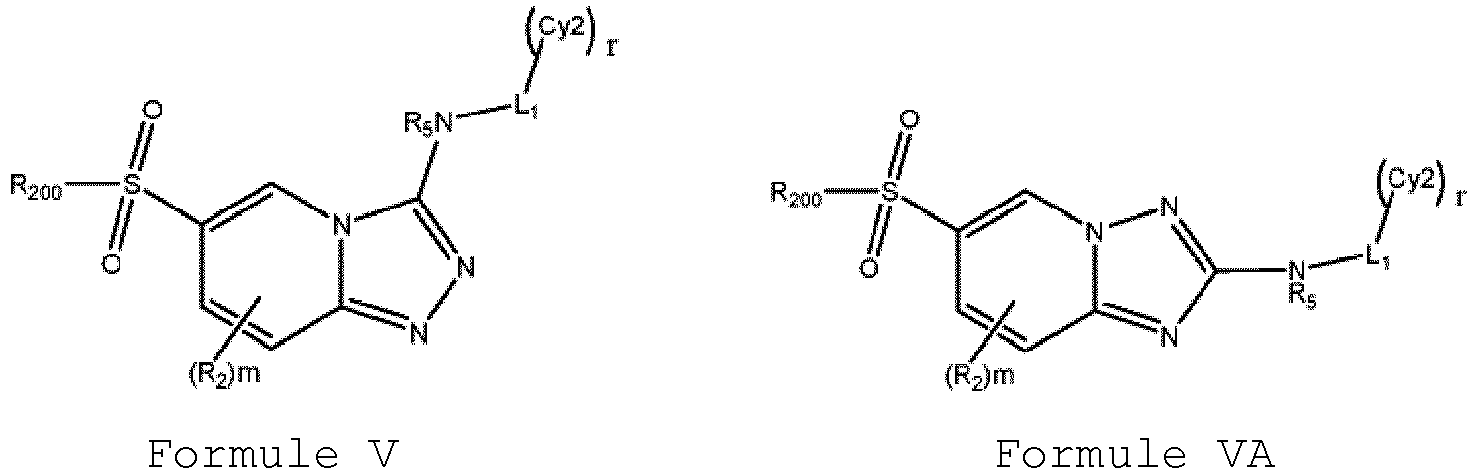 ou un sel pharmaceutiquement acceptable de celui-ci, oùm vaut 0, 1, 2 ou 3 ;r vaut 0, 1, 2 or 3 ;Cy2 est choisi parmi un aryle, un aryle substitué, un hétéroaryle, un hétéroaryle substitué, un hétérocyclique, un hétérocyclique substitué, un carbocyclique et un carbocyclique substitué ;L1 est absent ou est un alkyle en C1-C3 ;chaque R2 est choisi parmi un hydrogène, un halogène, un alkyle, un alkyle substitué, un hétéroalkyle, un hétéroalkyle substitué, un alcényle, un alcényle substitué, un alcynyle, un alcynyle substitué, un aliphatique, un aliphatique substitué, un aryle et un aryle substitué, -OR100, -NR100R101, -C(O)R100,-C(O)OR100, -C(O)NR100R101, -N(R100)C(O)R101, -S(O)2R100, -S(O)R100,-SR100, -S(O)2N(R100)R101, -CF3, -CN, -NO2, et -N3 ; R200 est R100 ou -N(R100)(R101) ;R5 est un hydrogène ; etchaque R100 et R101 est choisi parmi un alkyle, un alkyle substitué, un hétéroalkyle, un hétéroalkyle substitué, un alcényle, un alcényle substitué, un alcynyle, un alcynyle substitué, un aryle et un aryle substitué ;dans lequel chaque groupe substitué est substitué par un ou plusieurs groupes choisis parmi un groupe halogéno, alkyle, alcényle, alcynyle, aryle, hétérocyclyle, thiol, alkylthio, arylthio, alkylthioalkyle, arylthioalkyle, alkylsulfonyle, alkylsulfonylalkyle, arylsulfonylalkyle, alkoxy, aryloxy, un aralkoxy, aminocarbonyle, alkylaminocarbonyle, arylaminocarbonyle, alkoxycarbonyle, aryloxycarbonyle, halogénoalkyle, amino, trifluorométhyle, cyano, nitro, alkylamino, arylamino, alkylaminoalkyle, arylaminoalkyle, aminoalkylamino, hydroxy, alkoxyalkyle, carboxyalkyle, alkoxycarbonylalkyle, aminocarbonylalkyle, acyle, aralkoxycarbonyle, acide carboxylique, acide sulfonique, sulfonyle, acide phosphonique, aryle et hétéroaryle.
 - Composé selon la revendication 1, dans lequel R200 est un aryle ou un aryle substitué.
- Composé selon la revendication 1, dans lequel R200 est - N(R100)(R101).
- Composé selon l'une quelconque des revendications 1 à 3, dans lequel Cy2 est choisi parmi :


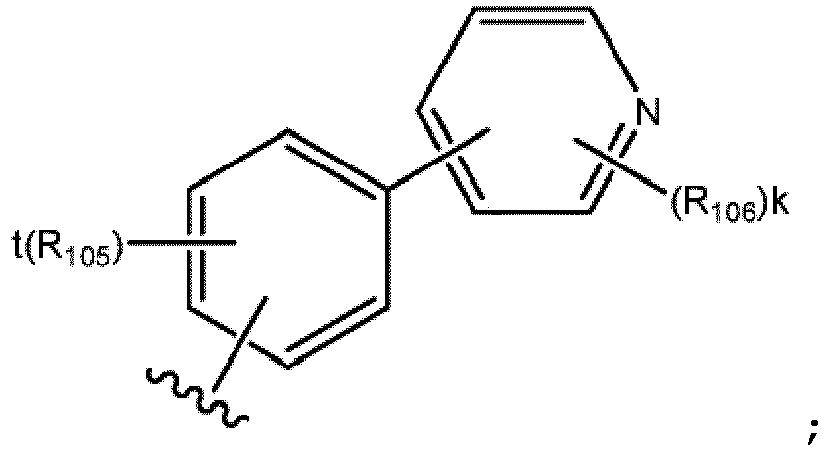 t vaut 1, 2, 3, 4 ou 5 ;k vaut 1, 2, 3 ou 4 ;chaque R105 et R106 est choisi indépendamment parmi un hydrogène, un halogène, un alkyle, un alkyle substitué, un hétéroalkyle, un hétéroalkyle substitué, un alcényle, un alcényle substitué, un alcynyle, un alcynyle substitué, un aryle et un aryle substitué ;
 - Composé choisi dans le Tableau A ou un sel pharmaceutiquement acceptable de celui-ci :


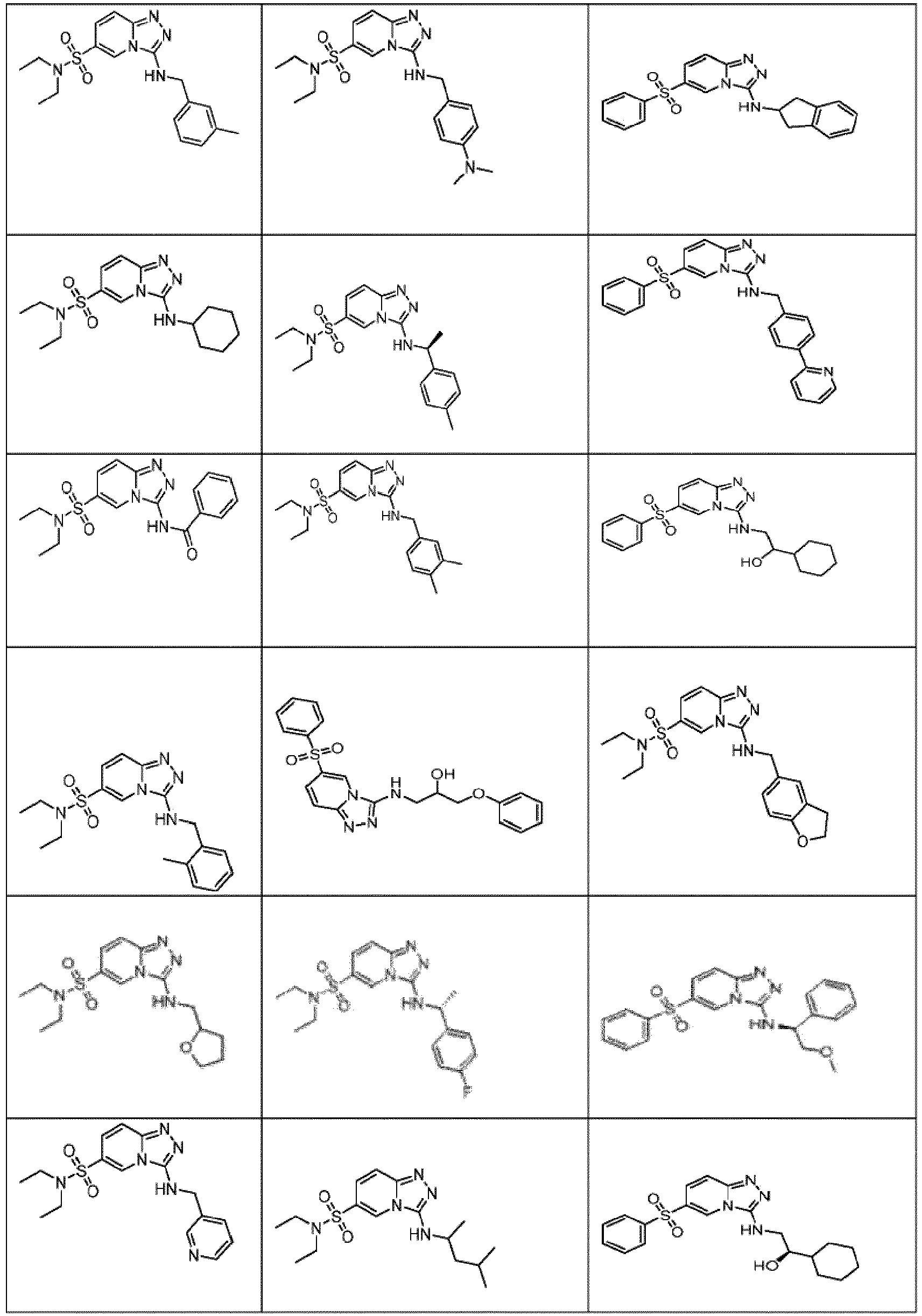

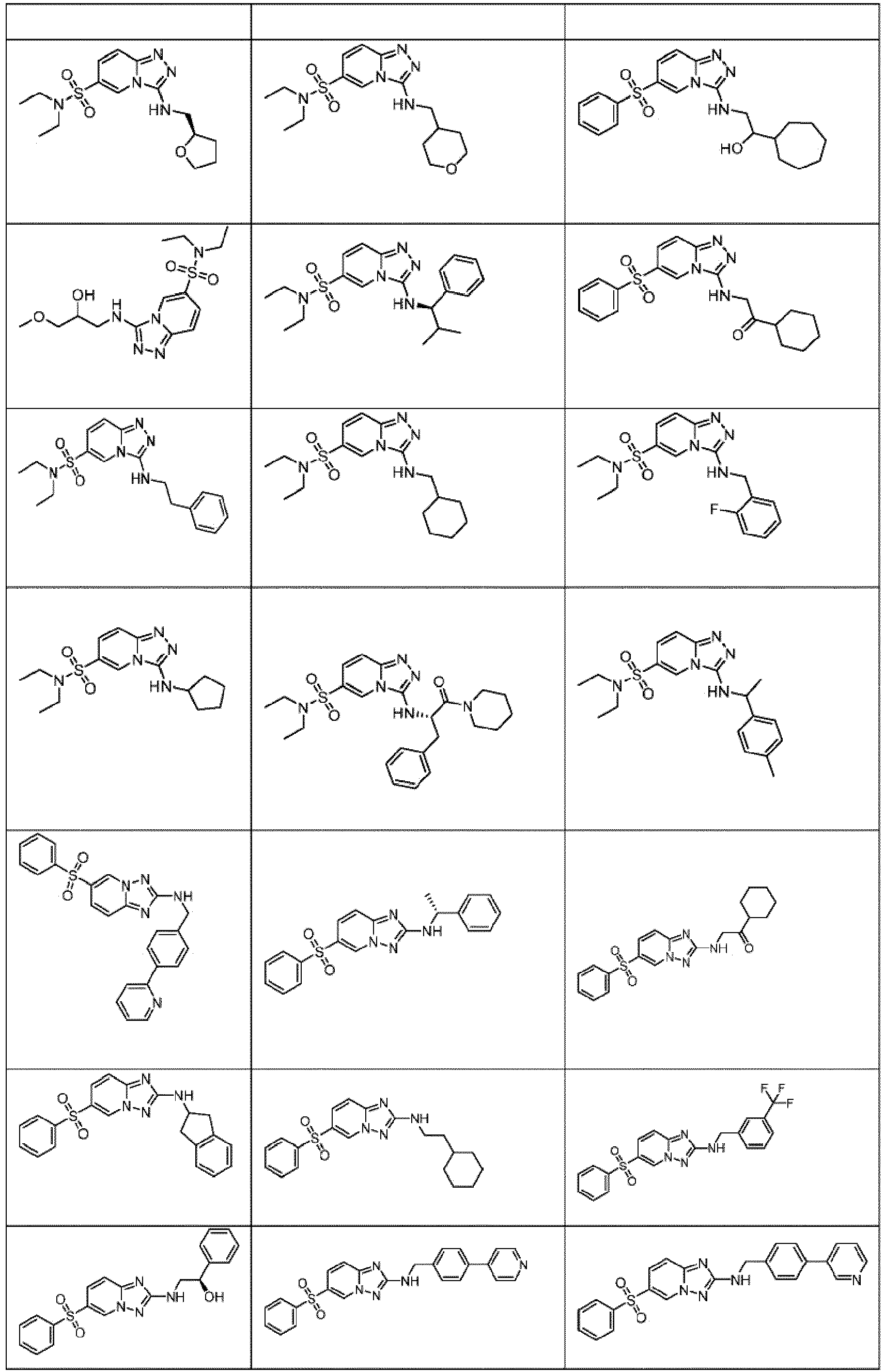
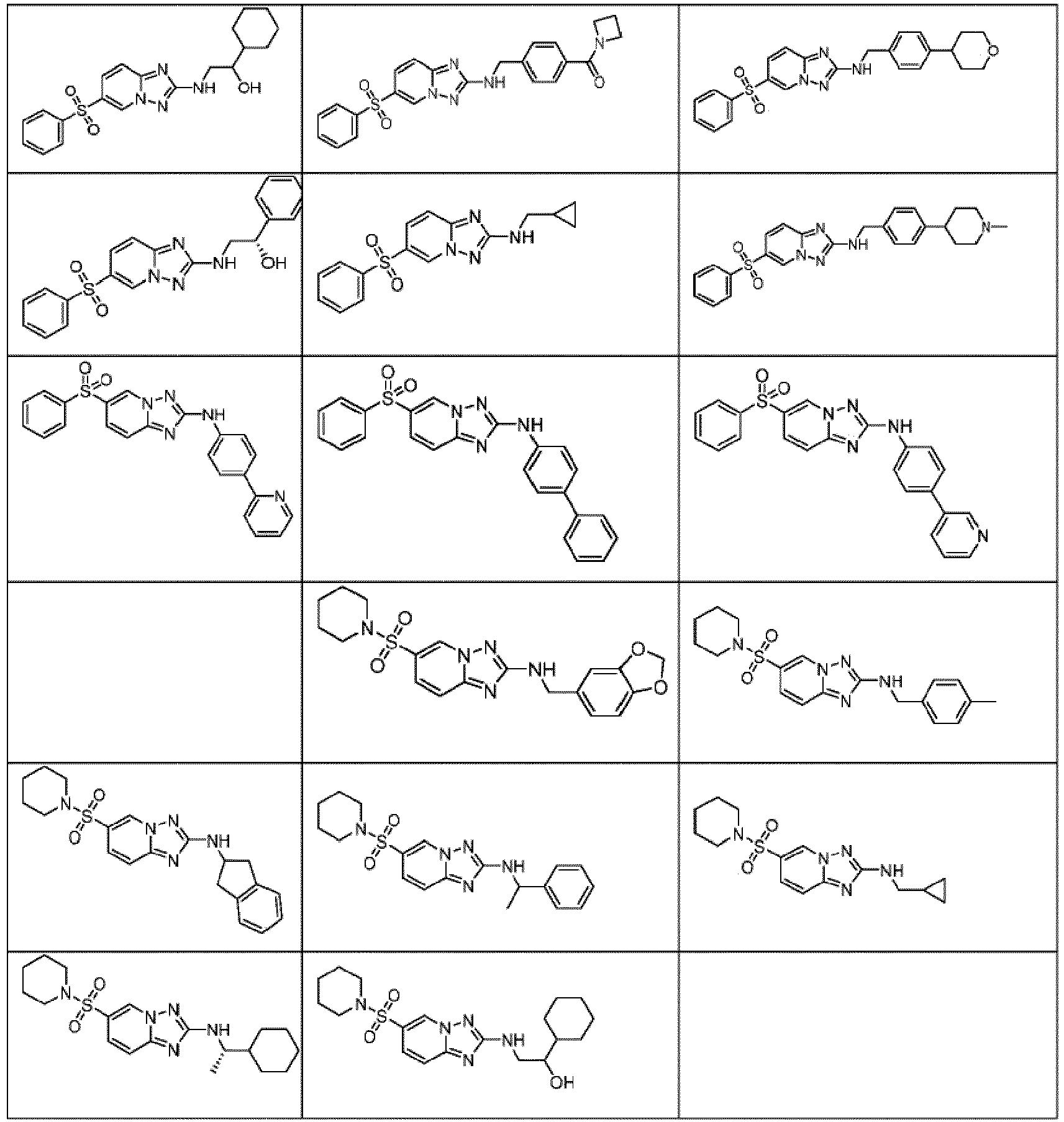
- Composé selon la revendication 5, ayant la formule
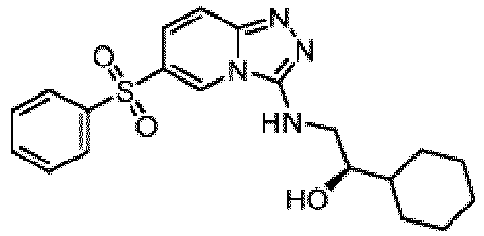
- Composé selon la revendication 5, ayant la formule

- Composé selon la revendication 5, ayant la formule

- Composé selon la revendication 5, ayant la formule

- Composé selon la revendication 5, ayant la formule

- Composé de la revendication 5, ayant la formule

- Composition pharmaceutique comprenant un composé selon l'une quelconque des revendications 1 à 11, et un excipient ou un support pharmaceutiquement acceptable.
- Composés selon l'une quelconque des revendications 1 à 11 destiné à être utilisé dans le traitement d'une maladie ou d'un trouble choisi(e) parmi la fibrose kystique, l'emphysème héréditaire, l'hémochromatose héréditaire, la constipation, l'asthme, la pancréatite, les troubles gastro-intestinaux, l'infertilité, les déficits de coagulation-fibrinolyse, l'angio-œdème héréditaire de type 1, l'hypercholestérolémie familiale, la chylomicronémie de type 1, l'abêtalipoprotéinémie, la maladie des cellules à inclusion/pseudo-Hurler, les mucopolysaccharidoses, la maladie de Sandhof/Tay-Sachs, la maladie de Crigler-Najjar de type II, la polyendocrinopathie/hyperinsulémie, le diabète sucré, le nanisme de Laron, le déficit en myléoperoxydase, l'hypoparathyroïdisme primaire, le mélanome, la glycanose CDG de type 1, l'emphysème héréditaire, l'hyperthyroïdisme congénital, l'ostéogenèse imparfaite, l'hypofibrinogénémie héréditaire, le déficit en ACT, le diabète insipide (DI), le DI neurophysaire, le DI néprogénique, le syndrome de Charcot-Marie-Tooth, la maladie de Perlizaeus-Merzbacher, la maladie d'Alzheimer, la maladie de Parkinson, la sclérose latérale amyotrophique, la paralysie supranucléaire progressive, la maladie de Pick, les troubles neurologiques liés à la polyglutamine, la dystrophie spongiforme et myotonique.
- Composé selon l'une quelconque des revendications 1 à 5, destiné à être utilisé dans le traitement de la fibrose kystique.
- Composé selon l'une quelconque des revendications 6 à 11, destiné à être utilisé dans le traitement de la fibrose kystique.
Applications Claiming Priority (2)
| Application Number | Priority Date | Filing Date | Title |
|---|---|---|---|
| US201462060311P | 2014-10-06 | 2014-10-06 | |
| PCT/US2015/054254 WO2016057522A1 (fr) | 2014-10-06 | 2015-10-06 | Composés triazolopyridine et méthodes pour le traitement de la fibrose kystique |
Publications (4)
| Publication Number | Publication Date |
|---|---|
| EP3204007A1 EP3204007A1 (fr) | 2017-08-16 |
| EP3204007A4 EP3204007A4 (fr) | 2018-05-16 |
| EP3204007B1 true EP3204007B1 (fr) | 2023-12-20 |
| EP3204007C0 EP3204007C0 (fr) | 2023-12-20 |
Family
ID=55632331
Family Applications (1)
| Application Number | Title | Priority Date | Filing Date |
|---|---|---|---|
| EP15849360.1A Active EP3204007B1 (fr) | 2014-10-06 | 2015-10-06 | Composés de la triazolopyridine et méthodes pour le traitement de la fibrose kystique |
Country Status (10)
| Country | Link |
|---|---|
| US (3) | US9573948B2 (fr) |
| EP (1) | EP3204007B1 (fr) |
| JP (1) | JP2017531037A (fr) |
| KR (1) | KR20170095814A (fr) |
| CN (1) | CN107106546A (fr) |
| AU (1) | AU2015328307B2 (fr) |
| BR (1) | BR112017007072A2 (fr) |
| ES (1) | ES2971157T3 (fr) |
| MX (1) | MX386826B (fr) |
| WO (1) | WO2016057522A1 (fr) |
Cited By (1)
| Publication number | Priority date | Publication date | Assignee | Title |
|---|---|---|---|---|
| US11851426B2 (en) | 2019-10-11 | 2023-12-26 | Incyte Corporation | Bicyclic amines as CDK2 inhibitors |
Families Citing this family (26)
| Publication number | Priority date | Publication date | Assignee | Title |
|---|---|---|---|---|
| WO2007079139A2 (fr) | 2005-12-28 | 2007-07-12 | Vertex Pharmaceuticals, Inc. | Formes solides de n-[2,4-bis(1,1-diméthyléthyl)-5-hydroxyphényl]-1,4-dihydro-4-oxoquinoléine-3-carboxamide |
| US8563573B2 (en) | 2007-11-02 | 2013-10-22 | Vertex Pharmaceuticals Incorporated | Azaindole derivatives as CFTR modulators |
| US8802868B2 (en) | 2010-03-25 | 2014-08-12 | Vertex Pharmaceuticals Incorporated | Solid forms of (R)-1(2,2-difluorobenzo[D][1,3]dioxo1-5-yl)-N-(1-(2,3-dihydroxypropyl-6-fluoro-2-(1-hydroxy-2-methylpropan2-yl)-1H-Indol-5-yl)-Cyclopropanecarboxamide |
| ES2608474T3 (es) | 2010-04-22 | 2017-04-11 | Vertex Pharmaceuticals Incorporated | Proceso de producción de compuestos indol cycloalkylcarboxamido |
| ES2885181T3 (es) | 2014-04-15 | 2021-12-13 | Vertex Pharma | Composiciones farmacéuticas para el tratamiento de enfermedades mediadas por el regulador de la conductancia transmembrana de fibrosis quística |
| KR20170095814A (ko) * | 2014-10-06 | 2017-08-23 | 플랫틀리 디스커버리 랩, 엘엘씨 | 트라이아졸로피리딘 화합물 및 낭성 섬유증의 치료 방법 |
| WO2019043635A1 (fr) | 2017-09-01 | 2019-03-07 | Richter Gedeon Nyrt. | Composés inhibiteurs de l'activité de d-amino acide oxydase |
| TWI877770B (zh) | 2018-02-27 | 2025-03-21 | 美商英塞特公司 | 作為a2a / a2b抑制劑之咪唑并嘧啶及三唑并嘧啶 |
| EP3810610A1 (fr) | 2018-05-18 | 2021-04-28 | Incyte Corporation | Dérivés de pyrimidine fusionnés utilisés en tant qu'inhibiteurs de a2a/a2b |
| WO2020010197A1 (fr) | 2018-07-05 | 2020-01-09 | Incyte Corporation | Dérivés de pyrazine fusionnés en tant qu'inhibiteurs d'a2a/a2b |
| US11066404B2 (en) | 2018-10-11 | 2021-07-20 | Incyte Corporation | Dihydropyrido[2,3-d]pyrimidinone compounds as CDK2 inhibitors |
| TWI829857B (zh) | 2019-01-29 | 2024-01-21 | 美商英塞特公司 | 作為a2a / a2b抑制劑之吡唑并吡啶及三唑并吡啶 |
| US11384083B2 (en) | 2019-02-15 | 2022-07-12 | Incyte Corporation | Substituted spiro[cyclopropane-1,5′-pyrrolo[2,3-d]pyrimidin]-6′(7′h)-ones as CDK2 inhibitors |
| TW202100520A (zh) | 2019-03-05 | 2021-01-01 | 美商英塞特公司 | 作為cdk2 抑制劑之吡唑基嘧啶基胺化合物 |
| WO2020205560A1 (fr) | 2019-03-29 | 2020-10-08 | Incyte Corporation | Composés sulfonylamides utilisés comme inhibiteurs de la cdk2 |
| CA3137152A1 (fr) * | 2019-04-18 | 2020-10-22 | The Johns Hopkins University | Derives de 2-amino-pyrazolyl-[1,2,4]triazolo[1,5a] pyridine substitues et leur utilisation |
| WO2020223469A1 (fr) | 2019-05-01 | 2020-11-05 | Incyte Corporation | Dérivés de n-(1-(méthylsulfonyl)pipéridin-4-yl)-4,5-di hydro-1h-imidazo[4,5-h]quinazolin-8-amine et composés apparentés utilisés en tant qu'inhibiteurs de kinase 2 dépendante des cyclines (cdk2) pour le traitement du cancer |
| US11447494B2 (en) | 2019-05-01 | 2022-09-20 | Incyte Corporation | Tricyclic amine compounds as CDK2 inhibitors |
| CA3150681A1 (fr) | 2019-08-14 | 2021-02-18 | Incyte Corporation | Composes imidazolyl-pyrimidinylamines utilises comme inhibiteurs de la cdk2 |
| WO2021094210A1 (fr) | 2019-11-12 | 2021-05-20 | Bayer Aktiengesellschaft | Dérivés de pyrazine carboxamide substitués utilisés en tant qu'antagonistes du récepteur de la prostaglandine ep3 |
| IL298603A (en) * | 2020-05-27 | 2023-01-01 | Ariel Prec Medicine Inc | Methods of treating cftr related diseases and disorders |
| AU2021362678A1 (en) | 2020-10-13 | 2023-05-04 | The Johns Hopkins University | SUBSTITUTED 4-([1,2,4]TRIAZOLO[1,5-a]PYRIDIN-6-YL)THIOPHENE-2-CARBOXAMIDE DERIVATIVES AND USE THEREOF |
| US11981671B2 (en) | 2021-06-21 | 2024-05-14 | Incyte Corporation | Bicyclic pyrazolyl amines as CDK2 inhibitors |
| US11976073B2 (en) | 2021-12-10 | 2024-05-07 | Incyte Corporation | Bicyclic amines as CDK2 inhibitors |
| US11746108B1 (en) * | 2022-06-13 | 2023-09-05 | Apm Therapeutics 1, Inc. | Triazolopyridine polymorph A |
| KR102766595B1 (ko) * | 2022-09-01 | 2025-02-12 | 단국대학교 천안캠퍼스 산학협력단 | 트리아졸로피리딘온계 화합물을 유효성분으로 포함하는 근감소증 예방 또는 치료용 약학 조성물 |
Family Cites Families (14)
| Publication number | Priority date | Publication date | Assignee | Title |
|---|---|---|---|---|
| US5508269A (en) | 1994-10-19 | 1996-04-16 | Pathogenesis Corporation | Aminoglycoside formulation for aerosolization |
| US6083922A (en) | 1996-04-02 | 2000-07-04 | Pathogenesis, Corp. | Method and a tobramycin aerosol formulation for treatment prevention and containment of tuberculosis |
| US5767068A (en) | 1997-02-13 | 1998-06-16 | Pathogenesis Corporation | Pure biologically active colistin, its components and a colistin formulation for treatment of pulmonary infections |
| US8354427B2 (en) * | 2004-06-24 | 2013-01-15 | Vertex Pharmaceutical Incorporated | Modulators of ATP-binding cassette transporters |
| US20090209577A1 (en) * | 2004-08-18 | 2009-08-20 | Pfizer Inc. | Novel Triazolopyridine Compounds |
| US8092996B2 (en) | 2004-09-16 | 2012-01-10 | Quest Diagnostics Investments Incorporated | Method for detecting cystic fibrosis |
| WO2008045393A2 (fr) * | 2006-10-11 | 2008-04-17 | Amgen Inc. | Composés d'imidazo- et de triazolo-pyridine et leurs procédés d'utilisation |
| CA2668305C (fr) * | 2006-11-03 | 2017-01-03 | Vertex Pharmaceuticals Incorporated | Derives d'azaindole comme modulateurs de cftr |
| CN102131389A (zh) * | 2008-06-20 | 2011-07-20 | 健泰科生物技术公司 | 三唑并吡啶jak抑制剂化合物和方法 |
| TWI453207B (zh) * | 2008-09-08 | 2014-09-21 | Signal Pharm Llc | 胺基三唑并吡啶,其組合物及使用其之治療方法 |
| EP2689778A1 (fr) | 2012-07-27 | 2014-01-29 | Pierre Fabre Medicament | Dérivés de type azaindazole ou diazaindazole pour le traitement de la douleur |
| EA026957B1 (ru) * | 2012-08-28 | 2017-06-30 | Янссен Сайенсиз Айрлэнд Юси | Конденсированные бициклические производные сульфамоила и их применение в качестве лекарственных препаратов для лечения гепатита b |
| US9550775B2 (en) * | 2013-03-14 | 2017-01-24 | Genentech, Inc. | Substituted triazolopyridines and methods of use thereof |
| KR20170095814A (ko) * | 2014-10-06 | 2017-08-23 | 플랫틀리 디스커버리 랩, 엘엘씨 | 트라이아졸로피리딘 화합물 및 낭성 섬유증의 치료 방법 |
-
2015
- 2015-10-06 KR KR1020177012352A patent/KR20170095814A/ko not_active Withdrawn
- 2015-10-06 BR BR112017007072A patent/BR112017007072A2/pt not_active Application Discontinuation
- 2015-10-06 CN CN201580063038.6A patent/CN107106546A/zh active Pending
- 2015-10-06 MX MX2017004471A patent/MX386826B/es unknown
- 2015-10-06 AU AU2015328307A patent/AU2015328307B2/en active Active
- 2015-10-06 ES ES15849360T patent/ES2971157T3/es active Active
- 2015-10-06 US US14/876,428 patent/US9573948B2/en active Active
- 2015-10-06 EP EP15849360.1A patent/EP3204007B1/fr active Active
- 2015-10-06 JP JP2017538184A patent/JP2017531037A/ja active Pending
- 2015-10-06 WO PCT/US2015/054254 patent/WO2016057522A1/fr not_active Ceased
-
2017
- 2017-01-19 US US15/409,991 patent/US9926315B2/en active Active
-
2018
- 2018-02-08 US US15/891,846 patent/US10472357B2/en active Active
Cited By (1)
| Publication number | Priority date | Publication date | Assignee | Title |
|---|---|---|---|---|
| US11851426B2 (en) | 2019-10-11 | 2023-12-26 | Incyte Corporation | Bicyclic amines as CDK2 inhibitors |
Also Published As
| Publication number | Publication date |
|---|---|
| KR20170095814A (ko) | 2017-08-23 |
| US20160096835A1 (en) | 2016-04-07 |
| US20180230146A1 (en) | 2018-08-16 |
| US10472357B2 (en) | 2019-11-12 |
| AU2015328307B2 (en) | 2019-11-21 |
| MX2017004471A (es) | 2017-11-20 |
| CA2963640A1 (fr) | 2016-04-14 |
| US20170233388A1 (en) | 2017-08-17 |
| AU2015328307A1 (en) | 2017-04-27 |
| ES2971157T3 (es) | 2024-06-03 |
| BR112017007072A2 (pt) | 2018-01-30 |
| MX386826B (es) | 2025-03-19 |
| EP3204007A1 (fr) | 2017-08-16 |
| US9573948B2 (en) | 2017-02-21 |
| JP2017531037A (ja) | 2017-10-19 |
| WO2016057522A1 (fr) | 2016-04-14 |
| EP3204007C0 (fr) | 2023-12-20 |
| CN107106546A (zh) | 2017-08-29 |
| US9926315B2 (en) | 2018-03-27 |
| EP3204007A4 (fr) | 2018-05-16 |
Similar Documents
| Publication | Publication Date | Title |
|---|---|---|
| EP3204007B1 (fr) | Composés de la triazolopyridine et méthodes pour le traitement de la fibrose kystique | |
| US10889576B2 (en) | Phthalazinone compounds and methods for the treatment of cystic fibrosis | |
| US9771327B2 (en) | Compounds and methods for the treatment of cystic fibrosis | |
| US9855249B2 (en) | Isoxazole compounds and methods for the treatment of cystic fibrosis | |
| CA2963640C (fr) | Composes triazolopyridine et methodes pour le traitement de la fibrose kystique | |
| HK1242575B (en) | Triazolopyridine compounds and methods for the treatment of cystic fibrosis | |
| HK1242575A1 (en) | Triazolopyridine compounds and methods for the treatment of cystic fibrosis | |
| WO2023244539A1 (fr) | Polymorphe a de triazolopyridine |
Legal Events
| Date | Code | Title | Description |
|---|---|---|---|
| STAA | Information on the status of an ep patent application or granted ep patent |
Free format text: STATUS: THE INTERNATIONAL PUBLICATION HAS BEEN MADE |
|
| PUAI | Public reference made under article 153(3) epc to a published international application that has entered the european phase |
Free format text: ORIGINAL CODE: 0009012 |
|
| STAA | Information on the status of an ep patent application or granted ep patent |
Free format text: STATUS: REQUEST FOR EXAMINATION WAS MADE |
|
| 17P | Request for examination filed |
Effective date: 20170406 |
|
| AK | Designated contracting states |
Kind code of ref document: A1 Designated state(s): AL AT BE BG CH CY CZ DE DK EE ES FI FR GB GR HR HU IE IS IT LI LT LU LV MC MK MT NL NO PL PT RO RS SE SI SK SM TR |
|
| AX | Request for extension of the european patent |
Extension state: BA ME |
|
| RIN1 | Information on inventor provided before grant (corrected) |
Inventor name: SMITH, PAUL T. Inventor name: NUGENT, RICHARD A. Inventor name: COLE, BRIDGET M. |
|
| DAV | Request for validation of the european patent (deleted) | ||
| DAX | Request for extension of the european patent (deleted) | ||
| A4 | Supplementary search report drawn up and despatched |
Effective date: 20180413 |
|
| RIC1 | Information provided on ipc code assigned before grant |
Ipc: A61K 31/4196 20060101ALI20180406BHEP Ipc: A61K 31/437 20060101AFI20180406BHEP Ipc: A61P 11/00 20060101ALI20180406BHEP Ipc: C07D 471/04 20060101ALI20180406BHEP |
|
| REG | Reference to a national code |
Ref country code: HK Ref legal event code: DE Ref document number: 1242575 Country of ref document: HK |
|
| STAA | Information on the status of an ep patent application or granted ep patent |
Free format text: STATUS: EXAMINATION IS IN PROGRESS |
|
| 17Q | First examination report despatched |
Effective date: 20190802 |
|
| RAP1 | Party data changed (applicant data changed or rights of an application transferred) |
Owner name: APM THERAPEUTICS 1, INC. |
|
| GRAP | Despatch of communication of intention to grant a patent |
Free format text: ORIGINAL CODE: EPIDOSNIGR1 |
|
| STAA | Information on the status of an ep patent application or granted ep patent |
Free format text: STATUS: GRANT OF PATENT IS INTENDED |
|
| INTG | Intention to grant announced |
Effective date: 20230331 |
|
| P01 | Opt-out of the competence of the unified patent court (upc) registered |
Effective date: 20230512 |
|
| GRAJ | Information related to disapproval of communication of intention to grant by the applicant or resumption of examination proceedings by the epo deleted |
Free format text: ORIGINAL CODE: EPIDOSDIGR1 |
|
| STAA | Information on the status of an ep patent application or granted ep patent |
Free format text: STATUS: EXAMINATION IS IN PROGRESS |
|
| GRAP | Despatch of communication of intention to grant a patent |
Free format text: ORIGINAL CODE: EPIDOSNIGR1 |
|
| STAA | Information on the status of an ep patent application or granted ep patent |
Free format text: STATUS: GRANT OF PATENT IS INTENDED |
|
| INTC | Intention to grant announced (deleted) | ||
| INTG | Intention to grant announced |
Effective date: 20230817 |
|
| GRAS | Grant fee paid |
Free format text: ORIGINAL CODE: EPIDOSNIGR3 |
|
| GRAA | (expected) grant |
Free format text: ORIGINAL CODE: 0009210 |
|
| STAA | Information on the status of an ep patent application or granted ep patent |
Free format text: STATUS: THE PATENT HAS BEEN GRANTED |
|
| AK | Designated contracting states |
Kind code of ref document: B1 Designated state(s): AL AT BE BG CH CY CZ DE DK EE ES FI FR GB GR HR HU IE IS IT LI LT LU LV MC MK MT NL NO PL PT RO RS SE SI SK SM TR |
|
| REG | Reference to a national code |
Ref country code: GB Ref legal event code: FG4D |
|
| REG | Reference to a national code |
Ref country code: CH Ref legal event code: EP |
|
| REG | Reference to a national code |
Ref country code: DE Ref legal event code: R096 Ref document number: 602015087039 Country of ref document: DE |
|
| REG | Reference to a national code |
Ref country code: IE Ref legal event code: FG4D |
|
| P04 | Withdrawal of opt-out of the competence of the unified patent court (upc) registered |
Effective date: 20240123 |
|
| U01 | Request for unitary effect filed |
Effective date: 20240119 |
|
| U07 | Unitary effect registered |
Designated state(s): AT BE BG DE DK EE FI FR IT LT LU LV MT NL PT SE SI Effective date: 20240126 |
|
| U1N | Appointed representative for the unitary patent procedure changed after the registration of the unitary effect |
Representative=s name: FRKELLY; IE |
|
| PG25 | Lapsed in a contracting state [announced via postgrant information from national office to epo] |
Ref country code: GR Free format text: LAPSE BECAUSE OF FAILURE TO SUBMIT A TRANSLATION OF THE DESCRIPTION OR TO PAY THE FEE WITHIN THE PRESCRIBED TIME-LIMIT Effective date: 20240321 |
|
| PG25 | Lapsed in a contracting state [announced via postgrant information from national office to epo] |
Ref country code: GR Free format text: LAPSE BECAUSE OF FAILURE TO SUBMIT A TRANSLATION OF THE DESCRIPTION OR TO PAY THE FEE WITHIN THE PRESCRIBED TIME-LIMIT Effective date: 20240321 |
|
| PG25 | Lapsed in a contracting state [announced via postgrant information from national office to epo] |
Ref country code: RS Free format text: LAPSE BECAUSE OF FAILURE TO SUBMIT A TRANSLATION OF THE DESCRIPTION OR TO PAY THE FEE WITHIN THE PRESCRIBED TIME-LIMIT Effective date: 20231220 Ref country code: NO Free format text: LAPSE BECAUSE OF FAILURE TO SUBMIT A TRANSLATION OF THE DESCRIPTION OR TO PAY THE FEE WITHIN THE PRESCRIBED TIME-LIMIT Effective date: 20240320 Ref country code: HR Free format text: LAPSE BECAUSE OF FAILURE TO SUBMIT A TRANSLATION OF THE DESCRIPTION OR TO PAY THE FEE WITHIN THE PRESCRIBED TIME-LIMIT Effective date: 20231220 |
|
| REG | Reference to a national code |
Ref country code: ES Ref legal event code: FG2A Ref document number: 2971157 Country of ref document: ES Kind code of ref document: T3 Effective date: 20240603 |
|
| PG25 | Lapsed in a contracting state [announced via postgrant information from national office to epo] |
Ref country code: IS Free format text: LAPSE BECAUSE OF FAILURE TO SUBMIT A TRANSLATION OF THE DESCRIPTION OR TO PAY THE FEE WITHIN THE PRESCRIBED TIME-LIMIT Effective date: 20240420 |
|
| PG25 | Lapsed in a contracting state [announced via postgrant information from national office to epo] |
Ref country code: CZ Free format text: LAPSE BECAUSE OF FAILURE TO SUBMIT A TRANSLATION OF THE DESCRIPTION OR TO PAY THE FEE WITHIN THE PRESCRIBED TIME-LIMIT Effective date: 20231220 |
|
| PG25 | Lapsed in a contracting state [announced via postgrant information from national office to epo] |
Ref country code: SK Free format text: LAPSE BECAUSE OF FAILURE TO SUBMIT A TRANSLATION OF THE DESCRIPTION OR TO PAY THE FEE WITHIN THE PRESCRIBED TIME-LIMIT Effective date: 20231220 |
|
| PG25 | Lapsed in a contracting state [announced via postgrant information from national office to epo] |
Ref country code: SM Free format text: LAPSE BECAUSE OF FAILURE TO SUBMIT A TRANSLATION OF THE DESCRIPTION OR TO PAY THE FEE WITHIN THE PRESCRIBED TIME-LIMIT Effective date: 20231220 Ref country code: SK Free format text: LAPSE BECAUSE OF FAILURE TO SUBMIT A TRANSLATION OF THE DESCRIPTION OR TO PAY THE FEE WITHIN THE PRESCRIBED TIME-LIMIT Effective date: 20231220 Ref country code: RO Free format text: LAPSE BECAUSE OF FAILURE TO SUBMIT A TRANSLATION OF THE DESCRIPTION OR TO PAY THE FEE WITHIN THE PRESCRIBED TIME-LIMIT Effective date: 20231220 Ref country code: IS Free format text: LAPSE BECAUSE OF FAILURE TO SUBMIT A TRANSLATION OF THE DESCRIPTION OR TO PAY THE FEE WITHIN THE PRESCRIBED TIME-LIMIT Effective date: 20240420 Ref country code: CZ Free format text: LAPSE BECAUSE OF FAILURE TO SUBMIT A TRANSLATION OF THE DESCRIPTION OR TO PAY THE FEE WITHIN THE PRESCRIBED TIME-LIMIT Effective date: 20231220 |
|
| PG25 | Lapsed in a contracting state [announced via postgrant information from national office to epo] |
Ref country code: PL Free format text: LAPSE BECAUSE OF FAILURE TO SUBMIT A TRANSLATION OF THE DESCRIPTION OR TO PAY THE FEE WITHIN THE PRESCRIBED TIME-LIMIT Effective date: 20231220 |
|
| PG25 | Lapsed in a contracting state [announced via postgrant information from national office to epo] |
Ref country code: PL Free format text: LAPSE BECAUSE OF FAILURE TO SUBMIT A TRANSLATION OF THE DESCRIPTION OR TO PAY THE FEE WITHIN THE PRESCRIBED TIME-LIMIT Effective date: 20231220 |
|
| REG | Reference to a national code |
Ref country code: DE Ref legal event code: R097 Ref document number: 602015087039 Country of ref document: DE |
|
| PLBE | No opposition filed within time limit |
Free format text: ORIGINAL CODE: 0009261 |
|
| STAA | Information on the status of an ep patent application or granted ep patent |
Free format text: STATUS: NO OPPOSITION FILED WITHIN TIME LIMIT |
|
| U20 | Renewal fee for the european patent with unitary effect paid |
Year of fee payment: 10 Effective date: 20241007 |
|
| 26N | No opposition filed |
Effective date: 20240923 |
|
| P05 | Withdrawal of opt-out of the competence of the unified patent court (upc) changed |
Free format text: CASE NUMBER: APP_3811/2024 Effective date: 20240126 |
|
| PG25 | Lapsed in a contracting state [announced via postgrant information from national office to epo] |
Ref country code: MC Free format text: LAPSE BECAUSE OF FAILURE TO SUBMIT A TRANSLATION OF THE DESCRIPTION OR TO PAY THE FEE WITHIN THE PRESCRIBED TIME-LIMIT Effective date: 20231220 |
|
| PG25 | Lapsed in a contracting state [announced via postgrant information from national office to epo] |
Ref country code: CY Free format text: LAPSE BECAUSE OF FAILURE TO SUBMIT A TRANSLATION OF THE DESCRIPTION OR TO PAY THE FEE WITHIN THE PRESCRIBED TIME-LIMIT; INVALID AB INITIO Effective date: 20151006 |
|
| PG25 | Lapsed in a contracting state [announced via postgrant information from national office to epo] |
Ref country code: HU Free format text: LAPSE BECAUSE OF FAILURE TO SUBMIT A TRANSLATION OF THE DESCRIPTION OR TO PAY THE FEE WITHIN THE PRESCRIBED TIME-LIMIT; INVALID AB INITIO Effective date: 20151006 |
|
| REG | Reference to a national code |
Ref country code: CH Ref legal event code: U11 Free format text: ST27 STATUS EVENT CODE: U-0-0-U10-U11 (AS PROVIDED BY THE NATIONAL OFFICE) Effective date: 20260325 |
|
| PGFP | Annual fee paid to national office [announced via postgrant information from national office to epo] |
Ref country code: GB Payment date: 20260325 Year of fee payment: 11 |
|
| PGFP | Annual fee paid to national office [announced via postgrant information from national office to epo] |
Ref country code: ES Payment date: 20260330 Year of fee payment: 11 |
|
| PGFP | Annual fee paid to national office [announced via postgrant information from national office to epo] |
Ref country code: IE Payment date: 20260324 Year of fee payment: 11 |
|
| PGFP | Annual fee paid to national office [announced via postgrant information from national office to epo] |
Ref country code: CH Payment date: 20260325 Year of fee payment: 11 |
|
| U21 | Renewal fee for the european patent with unitary effect paid with additional fee |
Year of fee payment: 11 Effective date: 20260319 |