EP3205676B1 - Verfahren zur herstellung von ethylen/alpha-olefincopolymeren mit verbesserter schmelzstärke und artikel daraus - Google Patents
Verfahren zur herstellung von ethylen/alpha-olefincopolymeren mit verbesserter schmelzstärke und artikel daraus Download PDFInfo
- Publication number
- EP3205676B1 EP3205676B1 EP17157437.9A EP17157437A EP3205676B1 EP 3205676 B1 EP3205676 B1 EP 3205676B1 EP 17157437 A EP17157437 A EP 17157437A EP 3205676 B1 EP3205676 B1 EP 3205676B1
- Authority
- EP
- European Patent Office
- Prior art keywords
- ethylene
- olefin copolymer
- reactor
- melt strength
- inventive
- Prior art date
- Legal status (The legal status is an assumption and is not a legal conclusion. Google has not performed a legal analysis and makes no representation as to the accuracy of the status listed.)
- Active
Links
Images
Classifications
-
- C—CHEMISTRY; METALLURGY
- C08—ORGANIC MACROMOLECULAR COMPOUNDS; THEIR PREPARATION OR CHEMICAL WORKING-UP; COMPOSITIONS BASED THEREON
- C08F—MACROMOLECULAR COMPOUNDS OBTAINED BY REACTIONS ONLY INVOLVING CARBON-TO-CARBON UNSATURATED BONDS
- C08F210/00—Copolymers of unsaturated aliphatic hydrocarbons having only one carbon-to-carbon double bond
- C08F210/16—Copolymers of ethene with alpha-alkenes, e.g. EP rubbers
-
- C—CHEMISTRY; METALLURGY
- C08—ORGANIC MACROMOLECULAR COMPOUNDS; THEIR PREPARATION OR CHEMICAL WORKING-UP; COMPOSITIONS BASED THEREON
- C08F—MACROMOLECULAR COMPOUNDS OBTAINED BY REACTIONS ONLY INVOLVING CARBON-TO-CARBON UNSATURATED BONDS
- C08F10/00—Homopolymers and copolymers of unsaturated aliphatic hydrocarbons having only one carbon-to-carbon double bond
- C08F10/02—Ethene
-
- C—CHEMISTRY; METALLURGY
- C08—ORGANIC MACROMOLECULAR COMPOUNDS; THEIR PREPARATION OR CHEMICAL WORKING-UP; COMPOSITIONS BASED THEREON
- C08J—WORKING-UP; GENERAL PROCESSES OF COMPOUNDING; AFTER-TREATMENT NOT COVERED BY SUBCLASSES C08B, C08C, C08F, C08G or C08H
- C08J3/00—Processes of treating or compounding macromolecular substances
- C08J3/20—Compounding polymers with additives, e.g. colouring
-
- C—CHEMISTRY; METALLURGY
- C08—ORGANIC MACROMOLECULAR COMPOUNDS; THEIR PREPARATION OR CHEMICAL WORKING-UP; COMPOSITIONS BASED THEREON
- C08J—WORKING-UP; GENERAL PROCESSES OF COMPOUNDING; AFTER-TREATMENT NOT COVERED BY SUBCLASSES C08B, C08C, C08F, C08G or C08H
- C08J3/00—Processes of treating or compounding macromolecular substances
- C08J3/20—Compounding polymers with additives, e.g. colouring
- C08J3/201—Pre-melted polymers
-
- C—CHEMISTRY; METALLURGY
- C08—ORGANIC MACROMOLECULAR COMPOUNDS; THEIR PREPARATION OR CHEMICAL WORKING-UP; COMPOSITIONS BASED THEREON
- C08J—WORKING-UP; GENERAL PROCESSES OF COMPOUNDING; AFTER-TREATMENT NOT COVERED BY SUBCLASSES C08B, C08C, C08F, C08G or C08H
- C08J5/00—Manufacture of articles or shaped materials containing macromolecular substances
- C08J5/18—Manufacture of films or sheets
-
- C—CHEMISTRY; METALLURGY
- C08—ORGANIC MACROMOLECULAR COMPOUNDS; THEIR PREPARATION OR CHEMICAL WORKING-UP; COMPOSITIONS BASED THEREON
- C08K—Use of inorganic or non-macromolecular organic substances as compounding ingredients
- C08K5/00—Use of organic ingredients
- C08K5/04—Oxygen-containing compounds
- C08K5/13—Phenols; Phenolates
- C08K5/134—Phenols containing ester groups
-
- C—CHEMISTRY; METALLURGY
- C08—ORGANIC MACROMOLECULAR COMPOUNDS; THEIR PREPARATION OR CHEMICAL WORKING-UP; COMPOSITIONS BASED THEREON
- C08K—Use of inorganic or non-macromolecular organic substances as compounding ingredients
- C08K5/00—Use of organic ingredients
- C08K5/49—Phosphorus-containing compounds
- C08K5/51—Phosphorus bound to oxygen
- C08K5/52—Phosphorus bound to oxygen only
-
- C—CHEMISTRY; METALLURGY
- C08—ORGANIC MACROMOLECULAR COMPOUNDS; THEIR PREPARATION OR CHEMICAL WORKING-UP; COMPOSITIONS BASED THEREON
- C08K—Use of inorganic or non-macromolecular organic substances as compounding ingredients
- C08K5/00—Use of organic ingredients
- C08K5/49—Phosphorus-containing compounds
- C08K5/51—Phosphorus bound to oxygen
- C08K5/52—Phosphorus bound to oxygen only
- C08K5/524—Esters of phosphorous acids, e.g. of H3PO3
-
- C—CHEMISTRY; METALLURGY
- C08—ORGANIC MACROMOLECULAR COMPOUNDS; THEIR PREPARATION OR CHEMICAL WORKING-UP; COMPOSITIONS BASED THEREON
- C08L—COMPOSITIONS OF MACROMOLECULAR COMPOUNDS
- C08L23/00—Compositions of homopolymers or copolymers of unsaturated aliphatic hydrocarbons having only one carbon-to-carbon double bond; Compositions of derivatives of such polymers
- C08L23/02—Compositions of homopolymers or copolymers of unsaturated aliphatic hydrocarbons having only one carbon-to-carbon double bond; Compositions of derivatives of such polymers not modified by chemical after-treatment
- C08L23/04—Homopolymers or copolymers of ethene
- C08L23/06—Polyethylene
-
- C—CHEMISTRY; METALLURGY
- C08—ORGANIC MACROMOLECULAR COMPOUNDS; THEIR PREPARATION OR CHEMICAL WORKING-UP; COMPOSITIONS BASED THEREON
- C08L—COMPOSITIONS OF MACROMOLECULAR COMPOUNDS
- C08L23/00—Compositions of homopolymers or copolymers of unsaturated aliphatic hydrocarbons having only one carbon-to-carbon double bond; Compositions of derivatives of such polymers
- C08L23/02—Compositions of homopolymers or copolymers of unsaturated aliphatic hydrocarbons having only one carbon-to-carbon double bond; Compositions of derivatives of such polymers not modified by chemical after-treatment
- C08L23/04—Homopolymers or copolymers of ethene
- C08L23/08—Copolymers of ethene
-
- C—CHEMISTRY; METALLURGY
- C08—ORGANIC MACROMOLECULAR COMPOUNDS; THEIR PREPARATION OR CHEMICAL WORKING-UP; COMPOSITIONS BASED THEREON
- C08L—COMPOSITIONS OF MACROMOLECULAR COMPOUNDS
- C08L23/00—Compositions of homopolymers or copolymers of unsaturated aliphatic hydrocarbons having only one carbon-to-carbon double bond; Compositions of derivatives of such polymers
- C08L23/02—Compositions of homopolymers or copolymers of unsaturated aliphatic hydrocarbons having only one carbon-to-carbon double bond; Compositions of derivatives of such polymers not modified by chemical after-treatment
- C08L23/04—Homopolymers or copolymers of ethene
- C08L23/08—Copolymers of ethene
- C08L23/0807—Copolymers of ethene with unsaturated hydrocarbons only containing four or more carbon atoms
- C08L23/0815—Copolymers of ethene with unsaturated hydrocarbons only containing four or more carbon atoms with aliphatic 1-olefins containing one carbon-to-carbon double bond
-
- C—CHEMISTRY; METALLURGY
- C08—ORGANIC MACROMOLECULAR COMPOUNDS; THEIR PREPARATION OR CHEMICAL WORKING-UP; COMPOSITIONS BASED THEREON
- C08F—MACROMOLECULAR COMPOUNDS OBTAINED BY REACTIONS ONLY INVOLVING CARBON-TO-CARBON UNSATURATED BONDS
- C08F2/00—Processes of polymerisation
- C08F2/04—Polymerisation in solution
- C08F2/06—Organic solvent
-
- C—CHEMISTRY; METALLURGY
- C08—ORGANIC MACROMOLECULAR COMPOUNDS; THEIR PREPARATION OR CHEMICAL WORKING-UP; COMPOSITIONS BASED THEREON
- C08J—WORKING-UP; GENERAL PROCESSES OF COMPOUNDING; AFTER-TREATMENT NOT COVERED BY SUBCLASSES C08B, C08C, C08F, C08G or C08H
- C08J2323/00—Characterised by the use of homopolymers or copolymers of unsaturated aliphatic hydrocarbons having only one carbon-to-carbon double bond; Derivatives of such polymers
- C08J2323/02—Characterised by the use of homopolymers or copolymers of unsaturated aliphatic hydrocarbons having only one carbon-to-carbon double bond; Derivatives of such polymers not modified by chemical after treatment
- C08J2323/04—Homopolymers or copolymers of ethene
- C08J2323/06—Polyethene
-
- C—CHEMISTRY; METALLURGY
- C08—ORGANIC MACROMOLECULAR COMPOUNDS; THEIR PREPARATION OR CHEMICAL WORKING-UP; COMPOSITIONS BASED THEREON
- C08J—WORKING-UP; GENERAL PROCESSES OF COMPOUNDING; AFTER-TREATMENT NOT COVERED BY SUBCLASSES C08B, C08C, C08F, C08G or C08H
- C08J2323/00—Characterised by the use of homopolymers or copolymers of unsaturated aliphatic hydrocarbons having only one carbon-to-carbon double bond; Derivatives of such polymers
- C08J2323/02—Characterised by the use of homopolymers or copolymers of unsaturated aliphatic hydrocarbons having only one carbon-to-carbon double bond; Derivatives of such polymers not modified by chemical after treatment
- C08J2323/04—Homopolymers or copolymers of ethene
- C08J2323/08—Copolymers of ethene
-
- C—CHEMISTRY; METALLURGY
- C08—ORGANIC MACROMOLECULAR COMPOUNDS; THEIR PREPARATION OR CHEMICAL WORKING-UP; COMPOSITIONS BASED THEREON
- C08L—COMPOSITIONS OF MACROMOLECULAR COMPOUNDS
- C08L23/00—Compositions of homopolymers or copolymers of unsaturated aliphatic hydrocarbons having only one carbon-to-carbon double bond; Compositions of derivatives of such polymers
- C08L23/02—Compositions of homopolymers or copolymers of unsaturated aliphatic hydrocarbons having only one carbon-to-carbon double bond; Compositions of derivatives of such polymers not modified by chemical after-treatment
- C08L23/18—Homopolymers or copolymers of hydrocarbons having four or more carbon atoms
- C08L23/20—Homopolymers or copolymers of hydrocarbons having four or more carbon atoms having four to nine carbon atoms
Definitions
- the instant invention relates to a process to produce enhanced melt strength ethylene/ ⁇ -olefin copolymers and articles thereof.
- melt strength ethylene-based copolymers are useful in a variety of applications, such as those requiring film strength during thermoforming or to increase production rates in processing.
- the melt strength of such ethylene/a-olefin copolymers may be improved by lightly cross-linking the ethylene/a-olefin copolymer using cross-linking agents such as peroxides, azide and silane coupling agents.
- the melt strength of such ethylene/a-olefin copolymers may be improved through oxygen tailoring of the resin.
- the melt strength of such ethylene/a-olefin copolymers may be improved through the incorporation of long chain branching in the copolymer backbone.
- Ethylene copolymers are disclosed in WO 02/074817 , WO 2011/019563 , US 6,114,457 and WO 01/62808 .
- the instant invention provides ethylene/a-olefin copolymers, blends thereof and films made therefrom.
- the instant invention provides an ethylene/a-olefin copolymer comprising: units derived from ethylene; and units derived from at least one ⁇ -olefin; wherein the ethylene/a-olefin copolymer has a density in the range of from 0.90 to 0.94 g/cc; a melt index (I 2 ) in the range of from 0.05 to 50 dg/min; an Mw/Mn of from 3 to 5; and from 300 to 350 vinyl unsaturations per 1,000,000 carbon atoms in the ethylene/a-olefin copolymer.
- the instant invention provides an ethylene/a-olefin copolymer and a process for producing an ethylene/ ⁇ -olefin copolymer in accordance with any of the preceding embodiments, except that the ethylene/a-olefin copolymer has a melt strength of at least 3.0 cN.
- the instant invention further provides a blend comprising the ethylene/a-olefin copolymer according to any one of the preceding embodiments and a second polymer selected from the group consisting of synthetic and natural polymers.
- the instant invention provides a blend according to any one of the preceding embodiments except that the second polymer is LDPE.
- the instant invention further provides a film comprising the ethylene/ ⁇ -olefin copolymer or blend according to any one of the preceding embodiments.
- the instant invention provides an ethylene/a-olefin copolymer, a process for producing an ethylene/ ⁇ -olefin copolymer, blend and film in accordance with any of the preceding embodiments, except that the enhanced melt strength ethylene/a-olefin copolymers has a density of at least 0.915 g/cc.
- the instant invention provides an ethylene/a-olefin copolymer, a process for producing an ethylene/ ⁇ -olefin copolymer, blend and film in accordance with any of the preceding embodiments, except that the one or more ⁇ -olefins are selected from the group consisting of C 3 to C 20 ⁇ -olefins.
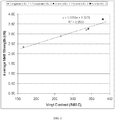
- Fig. 1 is a graph illustrating the average melt strength in cN versus the amount of vinyl unsaturation units per 1,000,000 carbon atoms and includes diamond data points for each of Inventive Examples 1, 2 and 3 and Comparative Examples 1 and 2, wherein Comparative Example 1 is shown by the solid diamond, Comparative Example 2 by the open diamond, Inventive Example 1 by the small solid square, Inventive Example 2 by the open square and Inventive Example 3 by the large solid square.
- the instant invention provides an ethylene/a-olefin copolymer, a process for producing an ethylene/a-olefin copolymer, a blend comprising the ethylene/a-olefin copolymer, and films made from such copolymers or blends.
- the ethylene/a-olefin copolymer according to the present invention comprises: units derived from ethylene; and units derived from at least one ⁇ -olefin; wherein the ethylene/a-olefin copolymer has a density in the range of from 0.90 to 0.94 g/cc; a melt index (I 2 ) in the range of from 0.05 to 50 dg/min; an Mw/Mn of from 3 to 5; and from 300 to 350 vinyl unsaturations per 1,000,000 carbon atoms in the ethylene/a-olefin copolymer.
- the density of the ethylene/a-olefin copolymer can be from a lower limit of 0.90, 0.91, 0.92, or 0.93 g/cc to an upper limit of 0.91, 0.92, 0.93 or 0.94 g/cc.
- the density of the ethylene/a-olefin copolymer may be in the range of from 0.90 to 0.94 g/cc, or in the alternative, the density of the ethylene/a-olefin copolymer may be in the range of from 0.91 to 0.93 g/cc, or in the alternative, the density of the ethylene/a-olefin copolymer may be in the range of from 0.91 to 0.92 g/cc.
- melt index (I 2 ) of the ethylene/a-olefin copolymer can be from a lower limit of 0.05, 0.1, 5, 15, 25, 35 or 45 g/10min to an upper limit of .0.1, 0.5, 10, 20, 30, 40 or 50 g/10min.
- the melt index (I 2 ) of the ethylene/a-olefin copolymer may be in the range of from 0.05 to 50 g/10min, or in the alternative, the melt index (I 2 ) of the ethylene/a-olefin copolymer may be in the range of from 0.5 to 10 g/10min, or in the alternative, the melt index (I 2 ) of the ethylene/a-olefin copolymer may be in the range of from 0.75 to 3 g/10min.
- the Mw/Mn of the ethylene/a-olefin copolymer can be from a lower limit of 3, 3.5, 4, or 4.5 to an upper limit of 3.5, 4, 4.5 or 5.
- the Mw/Mn of the ethylene/a-olefin copolymer may be in the range of from 3 to 5, or in the alternative, the Mw/Mn of the ethylene/a-olefin copolymer may be in the range of from 3.5 to 4.5, or in the alternative, the Mw/Mn of the ethylene/a-olefin copolymer may be in the range of from 3.7 to 4.4
- the vinyl unsaturation content of the ethylene/a-olefin copolymer may be in the range of from 325 to 350 vinyl unsaturations per 1,000,000 carbon atoms, or in the alternative, the vinyl unsaturation content of the ethylene/a-olefin copolymer may be in the range of from 330 to 350 vinyl unsaturations per 1,000,000 carbon atoms.
- the invention provides a process for producing an inventive ethylene/ ⁇ -olefin copolymer comprising the steps of: (1) polymerizing ethylene and one or more ⁇ -olefins in a polymerization reactor; (2) thereby producing an ethylene/ ⁇ -olefin copolymer having from 300 to 350 vinyl unsaturation units per 1,000,000 carbon atoms, a density in the range of from 0.90 to 0.94 g/cc; a melt index (I 2 ) in the range of from 0.05 to 50 dg/min; and a Mw/Mn of from 3 to 5.
- the polymerization step occurs in the presence of hydrogen level from 0.01 to 0.04 mole percent. All values and subranges from 0.01 to 0.04 mole percent hydrogen are included herein and disclosed herein; for example, the mole percent hydrogen in the polymerization reactor can be from a lower limit of 0.01, 0.015, 0.02, or 0.025 mole percent to an upper limit of 0.015, 0.02, 0.025 or 0.03 mole percent.
- the reactor hydrogen content may be in the range of from 0.01 to 0.04 mole percent, or in the alternative, the reactor hydrogen content may be in the range of from 0.02 to 0.03 mole percent.
- the polymerizing step occurs at a temperature from 205 to 240°C. All individual values and subranges from 205 to 240°C are included herein and disclosed herein; for example, the polymerizing step can be at a temperature from a lower limit of 205, 210, 215, 220, 225, 230, or 235°C to an upper limit 210, 215, 220, 225, 230, 235, or 240°C.
- the polymerizing step may be at a temperature in the range of from 205 to 240 °C, or in the alternative, the polymerizing step may be at a temperature in the range of from 205 to 230°C, or in the alternative, the polymerizing step may be at a temperature in the range of from 205 to 220 °C, or in the alternative, the polymerizing step may be at a temperature in the range of from 205 to 215°C.
- the inventive ethylene/a-olefin copolymer has a melt strength improved by at least 10% relative to an ethylene/a-olefin copolymer having substantially the same ethylene/a-olefin content and I 2 of the enhanced melt strength ethylene/ ⁇ -olefin copolymer but produced in a temperature in the range of less than 205°C and having less than 300 vinyl unsaturation units per 1,000,000 carbon atoms. All individual values and subranges from at least 10% improvement in melt strength are included herein and disclosed herein.
- the improvement in melt strength of the enhanced melt strength ethylene/a-olefin copolymer produced by the inventive process relative to that produced from a non-inventive process can be at least 10%, or in the alternative, the improvement in melt strength of the ethylene/ ⁇ -olefin copolymer can be at least 11%, or in the alternative, the improvement in melt strength of the ethylene/ ⁇ -olefin copolymer can be at least 12%, or in the alternative, the improvement in melt strength of the olefin copolymer can be at least 13%, or in the alternative, the improvement in melt strength of the ethylene/ ⁇ -olefin copolymer can be at least 14%, or in the alternative, the improvement in melt strength of the ethylene/ ⁇ -olefin copolymer can be at least 15%, or in the alternative, the improvement in melt strength of the ethylene/ ⁇ -olefin copolymer can be at least 17%, or in the alternative, the improvement in melt strength of the ethylene/ ⁇ -olef
- any conventional polymerization processes may be employed in the inventive process.
- Such conventional polymerization processes include, but are not limited to, solution polymerization process, gas phase polymerization process, slurry phase polymerization process, and combinations thereof using one or more conventional reactors e.g. loop reactors, isothermal reactors, fluidized bed gas phase reactors, stirred tank reactors, batch reactors in parallel, series, and/or any combinations thereof.
- the inventive process may, for example, utilize a solution-phase polymerization process using one or more loop reactors, isothermal reactors, and combinations thereof.
- the inventive process may utilize a solution phase polymerization process occurring in one or more well-stirred reactors such as one or more loop reactors or one or more spherical isothermal reactors at a temperature in the range of from at least 205°C, for example, from 205 to 300 °C, and at pressures in the range of from 300 to 1000 psi; for example, from 400 to 750 psi.
- the residence time in solution phase polymerization process is typically in the range of from 2 to 30 minutes; for example, from 10 to 20 minutes.
- Ethylene, solvent, multi-constituent catalyst composition, and optionally one or more comonomers are fed continuously to the reactor.
- Exemplary multi-constituent catalyst compositions in these embodiments include, for example, Ziegler-Natta catalysts, as described herein.
- Exemplary solvents include, but are not limited to, isoparaffins.
- ISOPAR E is commercially available under the name ISOPAR E from ExxonMobil Chemical Co., Houston, Texas.
- ISOPAR E is commercially available under the name ISOPAR E from ExxonMobil Chemical Co., Houston, Texas.
- the resultant mixture of the inventive ethylene/a-olefin copolymer and solvent is then removed from the reactor and the inventive ethylene/a-olefin copolymer is isolated.
- Solvent is typically recovered via a solvent recovery unit, i.e. heat exchangers and vapor liquid separator drum, and is then recycled back into the polymerization system.
- Reactor temperatures of at least 205 °C yielded a product having at 300 vinyl unsaturations per one million carbon atoms and having at least a 10% increase in melt strength in comparison to copolymers produced at temperatures below 205 °C while maintaining ethylene conversion in comparison to reaction temperatures below 205 °C.
- the polymerization step is conducted in a single stage solution reactor.
- the inventive process may be conducted utilizing a multi-constituent catalyst composition, as described herein, suitable for (co)polymerizing ethylene and one or more ⁇ -olefin comonomers, e.g. 1-octene, via a solution phase polymerization process in a loop reactor in accordance with the following procedure. All raw materials (ethylene, 1-octene) and the process solvent (an isoparaffinic solvent, for example ISOPAR E) are purified with molecular sieves before introduction into the reaction environment. Hydrogen is supplied as a high purity grade and is not further purified.
- the reactor monomer feed (ethylene) stream is pressurized via a mechanical compressor to a pressure that is above the reaction pressure, e.g.
- the solvent and comonomer (1-octene) feed is pressurized via a mechanical positive displacement pump to a pressure that is above the reaction pressure, e.g. 750 psig.
- the individual catalyst components are manually batch diluted to specified component concentrations with purified solvent (ISOPAR E) and pressured to a pressure that is above the reaction pressure, e.g. 750 psig. All reaction feed flows are measured with mass flow meters and independently controlled with computer automated valve control systems.
- the continuous solution polymerization reactor may consist of a liquid full, non-adiabatic, isothermal, circulating, loop. Independent control of all fresh solvent, monomer, comonomer, hydrogen, and catalyst component feeds is possible.
- the combined solvent, monomer, comonomer and hydrogen feed is temperature controlled to anywhere between 5°C to 50°C and typically 40°C by passing the feed stream through a heat exchanger.
- the fresh comonomer feed to the polymerization reactor is aligned to add comonomer to the recycle solvent.
- the total fresh feed to the polymerization reactor is injected into the reactor at, for example, two locations roughly with equal reactor volumes between each injection location.
- the fresh feed is controlled typically with each injector, for example, receiving half of the total fresh feed mass flow.
- the catalyst components are injected into the polymerization reactor through, for example, a specially designed injection inlet device and are combined into one mixed procatalyst/cocatalyst feed stream prior to injection into the reactor.
- the procatalyst component feed is computer controlled to maintain the reactor monomer concentration at a specified target.
- the cocatalyst component is fed based on calculated specified molar ratios to the procatalyst component.
- the feed streams are mixed with the circulating polymerization reactor contents with static mixing elements such as Kenics static mixing elements.
- the contents of the reactor are continuously circulated through heat exchangers responsible for removing much of the heat of reaction and with the temperature of the coolant side responsible for maintaining an isothermal reaction environment at the specified temperature. Circulation around the reactor loop can be provided by a screw pump.
- the effluent from the polymerization reactor (containing solvent, monomer, comonomer, hydrogen, catalyst components, and molten polymer) exits the reactor loop and enters a zone where it is contacted with a deactivating and acid scavenging agent (typically calcium stearate and the accompanying water of hydration) to stop the reaction and scavenge hydrogen chloride.
- a deactivating and acid scavenging agent typically calcium stearate and the accompanying water of hydration
- various additives such as antioxidants can be added at this point.
- the stream then goes through another set of static mixing elements such as Kenics static mixing elements to evenly disperse the catalyst kill and additives.
- the effluent (containing solvent, monomer, comonomer, hydrogen, catalyst components, and molten polymer) passes through a heat exchanger to raise the stream temperature in preparation for separation of the polymer from the other lower boiling reaction components.
- the stream then passes through a pressure let down control valve, which is responsible for maintaining the pressure of the reactor at a specified target.
- the stream then enters a two stage separation and devolatilization system where the polymer is removed from the solvent, hydrogen, and unreacted monomer and comonomer. Impurities are removed from the recycled before entering the reactor again.
- the separated and devolatilized polymer melt is, for example, pumped through a die specially designed for underwater pelletization, cut into uniform solid pellets, dried, and transferred into a hopper. After validation of initial polymer properties, the solid polymer pellets are transferred to storage devices.
- the portions removed in the devolatilization step may be recycled or destroyed.
- most of the solvent is recycled back to the reactor after passing through purification beds.
- This recycled solvent can still have unreacted co-monomer in it that is fortified with fresh co-monomer prior to re-entry to the reactor.
- This recycle solvent can still have some hydrogen which is then fortified with fresh hydrogen.
- the inventive process may be conducted using a multi-constituent catalyst system, as described herein, suitable for (co)polymerizing ethylene and one or more ⁇ -olefin comonomers, e.g. 1-octene, via a solution phase polymerization process in two adiabatic spherical reactors, linked together in series in accordance to the following procedure.
- a solvent e.g. an isoparaffinic solvent such as ISOPAR E.
- Impurities such as water, carbon dioxide, sulfurous compounds are removed from the feed streams, and the feed streams are cooled to temperature in the range of 5° C to 60° C, for example, approximately 13°C, before entering the reactor.
- the majority, approximately from 85 to 90 percent, of the reaction may occur in the first spherical reactor.
- the mixing may be achieved via circulating the polymer/procatalyst/cocatalyst/solvent/ethylene/co-monomer/hydrogen solution with one or more agitators equipped with mixing blades.
- the feed (ethylene/comonomer/solvent/hydrogen) may, for example, enter the reactor from the bottom and the procatalyst/cocatalyst may, for example, enter the reactor separately from the feed and also from the bottom.
- the first reactor temperature is in the range of from205°C to 240°C, for example, approximately 175°C
- the reactor pressure is in the range of from 400 psi to 1000 psi, for example, approximately 500 psi.
- the temperature of the second reactor, in series with the first increases to a temperature in the range of from 205°C to 240°C, for example, approximately 202° C with approximately from 10 to 15 percent of the remaining reaction occurring and no additional catalyst or monomers are added.
- Procatalyst/Co-catalyst Al/Ti molar feed ratio is set at value in the range of 0.5:1 to 3:1.
- the average reactor residence time is in the range of from 2 to 30 minutes, for example, approximately 8 minutes per spherical reactor prior to termination post-reactor by a fluid specially designed for that purpose.
- the solvent with unconverted ethylene monomer and 1-octene comonomer may be removed from the polymer solution via a two stage devolatilizer system, and then recycled. Impurities may be removed from the recycled stream before entering the reactor again.
- the polymer melt may, for example, be pumped through a die specially designed for underwater pelletization. The pellets are transferred to classifier screens to remove over and undersize particles. The finished pellets are then transferred to storage devices.
- a primary antioxidant is added after to the polymerization reactor product after such product is removed from the reactor and before the product is heated by post reactor heaters ("post-reactor").
- suitable primary antioxidants for use in embodiments of the inventive process include hindered phenolics (e.g., IRGANOX 1010, available from BASF).
- Some embodiments of the inventive process further include adding a secondary antioxidant to the post-reactor.
- suitable secondary antioxidants include phosphites (e.g., IRGAFOS 168, available from BASF).
- the invention further provides a process according to any of the foregoing embodiments wherein the ethylene/ ⁇ -olefin copolymer has a melt strength improved by at least 10% relative to an ethylene/a-olefin copolymer having substantially the same ethylene/ ⁇ -olefin content and I 2 of the ethylene/ ⁇ -olefin copolymer but produced in a temperature in the range of less than 205 °C in the presence of at least 1.8 times the amount of antioxidant used in preparing the ethylene/ ⁇ -olefin copolymer and having less than 300 vinyl unsaturation units per 1,000,000 carbon atoms.
- the multi-constituent catalyst system includes a Ziegler-Natta catalyst composition including a magnesium and titanium containing procatalyst and a cocatalyst.
- the procatalyst is a Ziegler Natta catalyst including a titanium compound supported on MgCl 2 .
- the cocatalyst is a triethylaluminum (TEA).
- the procatalyst may have a Ti:Mg ratio between 1.0:40 to 5.0:40, for example, 3.0:40.
- the procatalyst and the cocatalyst components can be contacted either before entering the reactor or in the reactor.
- the procatalyst may, for example, be any other titanium based Ziegler Natta catalyst.
- the Al:Ti molar ratio of cocatalyst component to procatalyst component can be from 0.5:1 to 10:1, for example 3:1.
- the multi-constituent catalyst system includes a Ziegler-Natta catalyst composition including a magnesium and titanium containing procatalyst and a cocatalyst.
- the procatalyst may, for example, comprise the reaction product of magnesium dichloride, an alkylaluminum dihalide, and a titanium alkoxide.
- the procatalyst may comprise the reaction product of:
- transition metal compounds include, for example, titanium tetrachloride, titanium trichloride, tetra(isopropoxy)-titanium, tetrabutoxytitanium, diethoxytitanium dibromide, dibutoxytitanium dichloride, tetraphenoxytitanium, tri-isopropoxy vanadium oxide, zirconium tetra-n-propoxide, mixtures thereof and the like.
- procatalyst components are combined in proportions sufficient to provide atomic ratios as previously mentioned.
- the foregoing pro-catalytic reaction product is prepared in the presence of an inert diluent.
- concentrations of catalyst components are such that when the essential components of the catalytic reaction product are combined, the resultant slurry is from about 0.005 to about 1.0 molar (moles/liter) with respect to magnesium.
- Exemplary suitable inert organic diluents include, but are not limited to, liquefied ethane, propane, isobutane, n-butane, n-hexane, the various isomeric hexanes, isooctane, paraffinic mixtures of alkanes having from 8 to 12 carbon atoms, cyclohexane, methylcyclopentane, dimethylcyclohexane, dodecane, industrial solvents composed of saturated or aromatic hydrocarbons such as kerosene, and naphthas.
- Exemplary suitable inert organic diluents are free of any olefin compounds and other impurities.
- Exemplary suitable inert organic diluents have boiling points in the range of from -50 °C to 200 °C.
- Mixing of the procatalyst components to provide the desired catalytic reaction product is advantageously prepared under an inert atmosphere such as nitrogen, argon or other inert gas at temperatures in the range of from 10°C to 50°C; for example, from 20°C to 40°C, provided that the magnesium halide support is prepared such that the reaction temperature does not exceed 35°C.
- an inert atmosphere such as nitrogen, argon or other inert gas at temperatures in the range of from 10°C to 50°C; for example, from 20°C to 40°C, provided that the magnesium halide support is prepared such that the reaction temperature does not exceed 35°C.
- the procatalyst composition serves as one component of a Ziegler-Natta catalyst composition, in combination with a cocatalyst.
- the cocatalyst is employed in a molar ratio based on titanium in the procatalyst of from 1:1 to 100:1; for example, in a molar ratio in the range of from 0.5:1 to 3:1.
- the instant invention further provides an ethylene/ ⁇ -olefin copolymer produced according to any of the foregoing inventive processes.
- the inventive ethylene/a-olefin copolymer may comprise from 10 to 50 percent by weight of units derived from one or more ⁇ -olefin comonomers. All individual values and subranges from 10 to 50 weight percent are included herein and disclosed herein; for example, the inventive ethylene/a-olefin copolymer can be from a lower limit of 10, 20, 30, or 40 percent by weight of units derived from one or more ⁇ -olefin comonomers to an upper limit of 20, 30, 40 or 50 percent by weight of units derived from one or more ⁇ -olefin comonomers.
- the weight percent of units derived from one or more ⁇ -olefin comonomers in the inventive ethylene/ ⁇ -olefin copolymer may be in the range of from 10 to 50, or in the alternative, the weight percent of units derived from one or more ⁇ -olefin comonomers in the inventive ethylene/ ⁇ -olefin copolymer may be in the range of from 20 to 40, or in the alternative, the weight percent of units derived from one or more ⁇ -olefin comonomers in the inventive ethylene/ ⁇ -olefin copolymer may be in the range of from 30 to 40.
- the ⁇ -olefin comonomers typically have no more than 20 carbon atoms.
- the ⁇ -olefin comonomers may preferably have 3 to 10 carbon atoms, and more preferably 3 to 8 carbon atoms.
- Exemplary ⁇ -olefin comonomers include, but are not limited to, propylene, 1-butene, 1-pentene, 1-hexene, 1-heptene, 1-octene, 1-nonene, 1-decene, and 4-methyl-1-pentene.
- the one or more ⁇ -olefin comonomers may be selected, for example, from the group consisting of propylene, 1-butene, 1-hexene, and 1-octene; or in the alternative, from the group consisting of 1-hexene and 1-octene.
- the ethylene/ ⁇ -olefin copolymer may have a melt strength of at least 3.0 cN. All individual values and subranges of at least 3.0 cN are included herein and disclosed herein.
- the ethylene/ ⁇ -olefin copolymer may have a melt strength of at least 3.0 cN, or in the alternative, the ethylene/ ⁇ -olefin copolymer may have a melt strength of at least 3.05 cN, or in the alternative, the ethylene/ ⁇ -olefin copolymer may have a melt strength of at least 3.08 cN, or in the alternative, the ethylene/ ⁇ -olefin copolymer may have a melt strength of at least 3.1 cN, or in the alternative, the ethylene/ ⁇ -olefin copolymer may have a melt strength of at least 3.12 cN.
- the instant invention provides a blend comprising the ethylene/ ⁇ -olefin copolymer produced according to the inventive process and at least one second polymer selected from the group consisting of synthetic and natural polymers.
- exemplary synthetic polymers useful in the inventive blend include low density polyethylene.
- Such low density polyethylene composition may have a density in the range of from 0.91 g/cm 3 to 0.94 g/cm 3 ; for example, from 0.915 g/cm 3 to 0.935 g/cm 3 , and a melt index (I 2 ) in the range of from 0.1 to 5 g/10 minutes; for example, from 0.2 to 2g/10 minutes.
- the blend may have a density in the rage of from 0.91 g/cm3to 0.94 g/cm 3 ; for example, from 0.915 g/cm 3 to 0.935 g/cm 3 , and a melt index (I 2 ) in the range of from 0.05 to 5 g/10 minutes; for example, from 0.1 to 2 g/10 minutes.
- the inventive ethylene/alpha-olefin copolymer may be blended with one or more additives.
- additives include, but are not limited to, antistatic agents, color enhancers, dyes, lubricants, fillers, pigments, primary antioxidants, secondary antioxidants, processing aids, UV stabilizers, and combinations thereof.
- the blend of the inventive ethylene/a-olefin copolymer with one or more additives may contain any amounts of additives.
- the blend of the inventive ethylene/a-olefin copolymer and one or more additives may compromise from about 0 to about 10 percent by the combined weight of such additives, based on the weight of the inventive ethylene/a-olefin copolymer and the one or more additives.
- the ethylene/a-olefin copolymer or blend thereof with one or more other polymers, for example LDPE, made by the inventive process may be used to manufacture films.
- films may include, but are not limited to, clarity shrink films, collation shrink films, cast stretch films, silage films, stretch hooder films, sealants, stand up pouch films, liner films, machine direction oriented films, and diaper backsheets.
- Suitable conversion techniques include, but are not limited to, blown film process, cast film process, tenter frame process, double bubble process, such as partially crosslinked or non-crosslinked, vertical or horizontal form fill and seal process. Such techniques are generally well known.
- the conversion technique includes, but is not limited to, the blown film process.
- the films according to the present invention may include at least one film layer, such as a monolayer film, or at least one layer in a multilayer film prepared by cast, blown, calendered, or extrusion coating processes.
- the inventive ethylene/a-olefin copolymer or blend thereof with one or more other polymers, for example LDPE may be used in a variety of films, including but not limited to clarity shrink films, collation shrink films, cast stretch films, silage films, stretch hooder films, sealants, stand up pouch films, liner films, machine direction oriented films, and diaper backsheets.
- the individual catalyst components were manually batch diluted to specified component concentrations with purified solvent (ISOPAR E) and pressured to a pressure that was above the reaction pressure, e.g. 750 psig.
- the catalyst used in preparing the Inventive and Comparative Examples was a Ziegler-Natta catalyst having a Ti to Mg molar ratio of 3 to 40 (designated in Table 1 as ZN-1).
- the co-catalyst was triethylaluminum (TEA).
- TAA triethylaluminum
- All reaction feed flows were measured with mass flow meters and independently controlled with computer automated valve control systems.
- the continuous solution polymerization reactor consists of a liquid full, non-adiabatic, isothermal, circulating, loop. Independent control of all fresh solvent, monomer, comonomer, hydrogen, and catalyst component feeds is possible.
- the combined solvent, monomer, comonomer and hydrogen feed is temperature controlled to anywhere between 5°C to 50°C and typically 40°C by passing the feed stream through a heat exchanger.
- the fresh comonomer feed to the polymerization reactor is aligned to add comonomer to the recycle solvent.
- the total fresh feed to the polymerization reactor is injected into the reactor at two locations roughly with equal reactor volumes between each injection location. The fresh feed is controlled typically with each injector receiving half of the total fresh feed mass flow.
- the catalyst components are injected into the polymerization reactor through a specially designed injection inlet device and are combined into one mixed procatalyst/cocatalyst feed stream prior to injection into the reactor.
- the cocatalyst component is fed based on calculated specified molar ratios to the procatalyst component.
- the feed streams are mixed with the circulating polymerization reactor contents with Kenics static mixing elements.
- the contents of the reactor are continuously circulated through heat exchangers responsible for removing much of the heat of reaction and with the temperature of the coolant side responsible for maintaining an isothermal reaction environment at the specified temperature. Circulation around the reactor loop is provided by a screw pump.
- the effluent from the polymerization reactor exits the reactor loop and enters a zone where it is contacted with a deactivating and acid scavenging agent (typically calcium stearate and the accompanying water of hydration) to stop the reaction and scavenge hydrogen chloride.
- a deactivating and acid scavenging agent typically calcium stearate and the accompanying water of hydration
- various additives such as antioxidants can be added at this point.
- the stream then goes through another set of Kenics static mixing elements to evenly disperse the catalyst kill and additives.
- the effluent (containing solvent, monomer, comonomer, hydrogen, catalyst components, and molten polymer) passes through a heat exchanger to raise the stream temperature in preparation for separation of the polymer from the other lower boiling reaction components.
- the stream then passes through a pressure let down control valve (responsible for maintaining the pressure of the reactor at a specified target).
- the stream then enters a two stage separation and devolatilization system where the polymer is removed from the solvent, hydrogen, and unreacted monomer and comonomer. Impurities are removed from the recycled stream before entering the reactor again.
- the separated and devolatilized polymer melt is pumped through a die specially designed for underwater pelletization, cut into uniform solid pellets, dried, and transferred into a hopper. After validation of initial polymer properties, the solid polymer pellets are transferred to storage devices.
- the portions removed in the devolatilization step may be recycled or destroyed.
- most of the solvent is recycled back to the reactor after passing through purification beds.
- the recycled solvent can still have unreacted co-monomer in it that is fortified with fresh co-monomer prior to re-entry to the reactor.
- the recycled solvent can still have some hydrogen which is then fortified with fresh hydrogen.
- Table 1 summarizes conditions for polymerization of the Inventive and Comparative Examples. Antioxidants used in the Inventive Examples 1-2 and Comparative Examples 1-2 are indicated in Table 1.
- Table 1 Comparative Example 1 Comparative Example 2 Inventive Example 1 Inventive Example 2 Reactor Conditions Catalyst ZN-1 ZN-1 ZN-1 ZN-1 Co-Catalyst TEA TEA TEA TEA Al/Ti 1.5 3 3 3 3 3 3 Ethylene Conversion 93.6 93.2 93.2 93.1 Comonomer Type 1-Octene 1-Octene 1-Octene 1-Octene Reactor Polymer Concentration (wt%) 22.3 21.8 21.9 21.8 Reactor Temperature, °C 175 193 210 210 Reactor Pressure, psi 725 725 725 725 H 2 level, mole % 0.2220 0.0754 0.0240 0.0243 Antioxidant added post-reactor IRGANOX-1010, ppm 193 194 193 107
- the densities of the Inventive and Comparative Examples do not substantially differ.
- the melt index, I 2 of each of Comparative Example 2 and Inventive Examples 1 - 3 do not substantially differ.
- the amount of vinyl unsaturations per million carbon atoms in the ethylene/a-olefin copolymer of Comparative Example 2 is greater than that of Comparative Example 1 but yet falls outside the inventive vinyl unsaturation range.
- Each of Inventive Examples 1 and 2 were produced at reactor temperatures equal to or greater than 205 °C and each of the Inventive Examples 1-2 exhibit an increase in melt strength of at least 10% over Comparative Example 2.
- Table 2 below, Melt Strength Enhancement, % Change, is calculated in comparison to the average melt strength of Comparative Example 2.
- Inventive Example 3 was an ethylene/octene copolymer, produced using a Ziegler-Natta catalyst, obtained from Nova Chemicals under the name SCLAIR FP120C.
- Test methods include the following:
- Samples for density measurements were prepared according to ASTM D 4703-10. Samples were pressed at 374°F (190°C) for five minutes at 10,000 psi (68 MPa). The temperature was maintained at 374°F (190°C) for the five minutes, and then the pressure was increased to 30,000 psi (207 MPa) for three minutes. This was followed by a one minute hold at 70°F (21°C) and 30,000 psi (207 MPa). Density measurements were made within one hour of sample pressing using ASTM D792-08, Method B.
- the lc1prf2_zz pulse sequence is shown in the Table 3.
- the chromatographic system consisted of a Polymer Laboratories Model PL-220. The column and carousel compartments were operated at 140 °C. Three Polymer Laboratories 10- ⁇ m Mixed-B columns were used with a solvent of 1,2,4 trichlorobenzene. The samples were prepared at a concentration of 0.1 g of polymer in 50 ml of solvent. The solvent used to prepare the samples contained 200 ppm of the antioxidant butylated hydroxytoluene (BHT). Samples were prepared by agitating lightly for 4 hours at 160 °C. The injection volume used was 100 microliters and the flow rate was 1.0 ml/min.
- BHT antioxidant butylated hydroxytoluene
- Mw and Mn weight-average, and number-average molecular weight for polyethylene
- the mathematical summation in the equations was done across the different elution slices of the GPC elution curve.
- the polydispersity of polymer molecular weight distribution was calculated as the ratio of Mw over Mn (Mw/Mn).
- the sample was drawn uniaxially to a set of accelerating nips located 100 mm below the die, with an acceleration of 2.4 mm/s 2 .
- the tensile force was recorded as a function of the take-up speed of the nip rolls.
- Melt strength was reported as the plateau force (cN) before the strand broke.
- Resins were compression-molded into "3 mm thick x 1 inch" circular plaques at 350°F (177 °C) for five minutes, under 1500 psi pressure in air. The sample was then taken out of the press, and placed on the counter to cool.
- a constant temperature frequency sweep was performed using a TA Instruments "Advanced Rheometric Expansion System (ARES)," equipped with 25 mm (diameter) parallel plates, under a nitrogen purge. The sample was placed on the plate, and allowed to melt for five minutes at 190°C. The plates were then closed to a gap of 2 mm, the sample trimmed (extra sample that extends beyond the circumference of the "25 mm diameter” plate is removed), and then the test was started. The method had an additional five minute delay built in, to allow for temperature equilibrium. The experiments were performed at 190°C over a frequency range of 0.1 to 100 rad/s. The strain amplitude was constant at 10%.
- RAS Advanced Rheometric Expansion System
- the stress response was analyzed in terms of amplitude and phase, from which the storage modulus (G'), loss modulus (G"), complex modulus (G*), complex viscosity ⁇ *, tan ( ⁇ ) or tan delta, viscosity at 0.1 rad/s (V0.1), the viscosity at 100 rad/s (V100), and the viscosity ratio (V0.1/V100) were calculated.
Landscapes
- Chemical & Material Sciences (AREA)
- Health & Medical Sciences (AREA)
- Chemical Kinetics & Catalysis (AREA)
- Medicinal Chemistry (AREA)
- Polymers & Plastics (AREA)
- Organic Chemistry (AREA)
- Engineering & Computer Science (AREA)
- Manufacturing & Machinery (AREA)
- Materials Engineering (AREA)
- Addition Polymer Or Copolymer, Post-Treatments, Or Chemical Modifications (AREA)
- Manufacture Of Macromolecular Shaped Articles (AREA)
- Compositions Of Macromolecular Compounds (AREA)
Claims (8)
- Ein Ethylen/α-Olefin-Copolymer, das Folgendes beinhaltet:Einheiten, abgeleitet von Ethylen; undEinheiten, abgeleitet von mindestens einem α-Olefin;wobei das Ethylen/α-Olefin-Copolymer eine Dichte im Bereich von 0,90 bis 0,94 g/cm3;einen Schmelzindex (I2) im Bereich von 0,05 bis 50 dg/min; eine Mw/Mn von 3 bis 5;und von 300 bis 350 Vinylungesättigtheiten pro 1 000 000 Kohlenstoffatomen in dem Ethylen/α-Olefin-Copolymer aufweist.
- Einer der vorhergehenden Ansprüche, wobei das Ethylen/α-Olefin-Copolymer eine Schmelzfestigkeit von mindestens 3,0 cN aufweist.
- Eine Mischung, die das Ethylen/α-Olefin-Copolymer gemäß einem der vorhergehenden Ansprüche und ein zweites Polymer, ausgewählt aus der Gruppe, bestehend aus synthetischen und natürlichen Polymeren, beinhaltet.
- Mischung gemäß Anspruch 3, wobei das zweite Polymer LDPE ist.
- Ein Film, der das Ethylen/α-Olefin-Copolymer gemäß Anspruch 1 und 2 beinhaltet.
- Ein Film, der die Mischung gemäß einem der Ansprüche 3-4 beinhaltet.
- Einer der vorhergehenden Ansprüche, wobei das Ethylen/α-Olefin-Copolymer eine Dichte von mindestens 0,915 g/cm3 aufweist.
- Einer der vorhergehenden Ansprüche, wobei das eine oder die mehreren α-Olefine aus der Gruppe ausgewählt sind, die aus C3- bis C20-α-Olefinen besteht.
Applications Claiming Priority (3)
| Application Number | Priority Date | Filing Date | Title |
|---|---|---|---|
| US201161468467P | 2011-03-28 | 2011-03-28 | |
| PCT/US2012/027312 WO2012134700A2 (en) | 2011-03-28 | 2012-03-01 | Process to produce enhanced melt strength ethylene/alpha-olefin copolymers and articles thereof |
| EP12711051.8A EP2691425B1 (de) | 2011-03-28 | 2012-03-01 | Verfahren zur herstellung von ethylen/alpha-olefincopolymeren mit verbesserter schmelzstärke und artikel daraus |
Related Parent Applications (2)
| Application Number | Title | Priority Date | Filing Date |
|---|---|---|---|
| EP12711051.8A Division EP2691425B1 (de) | 2011-03-28 | 2012-03-01 | Verfahren zur herstellung von ethylen/alpha-olefincopolymeren mit verbesserter schmelzstärke und artikel daraus |
| EP12711051.8A Division-Into EP2691425B1 (de) | 2011-03-28 | 2012-03-01 | Verfahren zur herstellung von ethylen/alpha-olefincopolymeren mit verbesserter schmelzstärke und artikel daraus |
Publications (2)
| Publication Number | Publication Date |
|---|---|
| EP3205676A1 EP3205676A1 (de) | 2017-08-16 |
| EP3205676B1 true EP3205676B1 (de) | 2019-10-02 |
Family
ID=45894653
Family Applications (2)
| Application Number | Title | Priority Date | Filing Date |
|---|---|---|---|
| EP12711051.8A Active EP2691425B1 (de) | 2011-03-28 | 2012-03-01 | Verfahren zur herstellung von ethylen/alpha-olefincopolymeren mit verbesserter schmelzstärke und artikel daraus |
| EP17157437.9A Active EP3205676B1 (de) | 2011-03-28 | 2012-03-01 | Verfahren zur herstellung von ethylen/alpha-olefincopolymeren mit verbesserter schmelzstärke und artikel daraus |
Family Applications Before (1)
| Application Number | Title | Priority Date | Filing Date |
|---|---|---|---|
| EP12711051.8A Active EP2691425B1 (de) | 2011-03-28 | 2012-03-01 | Verfahren zur herstellung von ethylen/alpha-olefincopolymeren mit verbesserter schmelzstärke und artikel daraus |
Country Status (10)
| Country | Link |
|---|---|
| US (2) | US9428636B2 (de) |
| EP (2) | EP2691425B1 (de) |
| JP (1) | JP6017532B2 (de) |
| KR (1) | KR101863985B1 (de) |
| CN (1) | CN103476810B (de) |
| BR (2) | BR112013021314B1 (de) |
| CA (1) | CA2828545C (de) |
| ES (2) | ES2628463T3 (de) |
| SG (1) | SG193451A1 (de) |
| WO (1) | WO2012134700A2 (de) |
Families Citing this family (25)
| Publication number | Priority date | Publication date | Assignee | Title |
|---|---|---|---|---|
| EP2691425B1 (de) * | 2011-03-28 | 2017-04-19 | Dow Global Technologies LLC | Verfahren zur herstellung von ethylen/alpha-olefincopolymeren mit verbesserter schmelzstärke und artikel daraus |
| US9290594B2 (en) | 2011-10-04 | 2016-03-22 | Dow Global Technologies Llc | System and process for olefin polymerization |
| EP2742995A1 (de) * | 2012-12-11 | 2014-06-18 | Construction Research & Technology GmbH | Kontinuierliches Verfahren zur Herstellung von Copolymeren |
| US20170152377A1 (en) | 2014-06-26 | 2017-06-01 | Dow Global Technologies Llc | Breathable films and articles incorporating same |
| CA2868640C (en) * | 2014-10-21 | 2021-10-26 | Nova Chemicals Corporation | Solution polymerization process |
| KR101792171B1 (ko) | 2014-12-08 | 2017-10-31 | 주식회사 엘지화학 | 우수한 용융 강도를 갖는 올레핀계 중합체 및 이를 포함하는 필름 |
| WO2016093549A2 (ko) * | 2014-12-08 | 2016-06-16 | 주식회사 엘지화학 | 우수한 용융 강도를 갖는 올레핀계 중합체 및 이를 포함하는 필름 |
| CN105984188B (zh) * | 2015-01-28 | 2018-12-07 | 中国石油化工股份有限公司 | 一种捆扎膜及其应用 |
| CN105985490A (zh) * | 2015-02-16 | 2016-10-05 | 中国石油天然气股份有限公司 | 耐热聚乙烯共聚物的制备方法及耐热聚乙烯共聚物、管材 |
| WO2017057964A1 (ko) * | 2015-09-30 | 2017-04-06 | 주식회사 엘지화학 | 비수성 전해액 및 이를 포함하는 리튬 이차전지 |
| EP3390469B1 (de) * | 2015-12-16 | 2024-09-04 | Dow Global Technologies LLC | Verfahren zur isomerreduzierung während der polymerisation und system zur durchführung davon |
| MX2018009327A (es) * | 2016-02-12 | 2018-11-09 | Dow Global Technologies Llc | Peliculas moldeadas y articulos realizados a partir de estas. |
| US10844210B2 (en) | 2016-03-31 | 2020-11-24 | Dow Global Technologies Llc | Modified polyethylene resins and method for making the same |
| EP3238938A1 (de) | 2016-04-29 | 2017-11-01 | Borealis AG | Maschinenlaufrichtungorientierte folie enthaltend multimodal ethylen-copolymer und mindestens zwei alpha-olefin comonomeren |
| KR102090812B1 (ko) | 2016-11-15 | 2020-03-18 | 주식회사 엘지화학 | 가공성이 우수한 에틸렌/알파-올레핀 공중합체 |
| WO2019014005A1 (en) * | 2017-07-14 | 2019-01-17 | Dow Global Technologies Llc | POLYMERIZATION AND ISOLATION OF LOW VISCOSITY POLYMERS USING PASTILLAGE TECHNOLOGY |
| CN111194257B (zh) | 2017-09-27 | 2022-06-10 | 陶氏环球技术有限责任公司 | 改性聚乙烯组合物和其制造方法 |
| WO2019212309A1 (ko) * | 2018-05-04 | 2019-11-07 | 주식회사 엘지화학 | 에틸렌/알파-올레핀 공중합체를 포함하는 접착제 조성물 |
| JP7331354B2 (ja) * | 2018-12-10 | 2023-08-23 | 日本ポリエチレン株式会社 | 積層体 |
| WO2020178010A1 (en) * | 2019-03-04 | 2020-09-10 | Borealis Ag | Polymerization process |
| JP7429788B2 (ja) * | 2019-12-26 | 2024-02-08 | ダウ グローバル テクノロジーズ エルエルシー | 改善されたバランスの硬化及び加工性を有するエチレン/アルファ-オレフィンインターポリマー系組成物 |
| DE102020124481A1 (de) * | 2020-09-21 | 2022-03-24 | Rehau Ag + Co | Flexible Schlauchleitung zum Transport eines Fluids |
| DE102020124950A1 (de) * | 2020-09-24 | 2022-03-24 | Rehau Ag + Co | Flexible Schlauchleitung zum Transport eines Fluids |
| WO2022094442A1 (en) | 2020-11-02 | 2022-05-05 | Dow Global Technologies Llc | Method of controlling alpha-olefin condensation in absorption media during polyolefin production |
| IL309627A (en) * | 2021-07-08 | 2024-02-01 | Borealis Ag | Polyethylene for use in the production of crosslinked polyethylene (pex) |
Family Cites Families (26)
| Publication number | Priority date | Publication date | Assignee | Title |
|---|---|---|---|---|
| CA703704A (en) | 1965-02-09 | Du Pont Of Canada Limited | Control of melt index of low pressure polyolefins via telomerization with hydrogen | |
| JPS59174603A (ja) | 1983-03-25 | 1984-10-03 | Asahi Chem Ind Co Ltd | エチレン系重合体の製法 |
| NL8301822A (nl) | 1983-05-21 | 1984-12-17 | Stamicarbon | Etheen polymerisatie katalysator en (co)polymerisatie van etheen met die katalysator. |
| US4508844A (en) | 1983-08-04 | 1985-04-02 | Exxon Research & Engineering Co. | Supported polyolefin catalyst for the polymerization of ethylene under high temperatures |
| DE3682928D1 (de) | 1985-03-08 | 1992-01-30 | Mitsubishi Petrochemical Co | Verfahren zum polymerisieren von aethylen. |
| JPH0737489B2 (ja) * | 1985-10-08 | 1995-04-26 | 三菱油化株式会社 | エチレンの重合法 |
| IT1190319B (it) * | 1986-04-17 | 1988-02-16 | Enichem Polimeri | Procedimento per la preparazione di polietilene a bassa o media densita' e catalizzatori adatti allo scopo |
| JPH0778092B2 (ja) | 1987-09-09 | 1995-08-23 | 住友化学工業株式会社 | オレフィンの重合方法 |
| JPH03197515A (ja) | 1989-12-26 | 1991-08-28 | Ube Ind Ltd | エチレンの重合及び共重合方法 |
| US5519098A (en) | 1991-10-03 | 1996-05-21 | Novacor Chemicals (International) Sa | Activation of catalyst in ethylene polymerization at high temperatures |
| JP3266942B2 (ja) | 1992-09-10 | 2002-03-18 | 住友化学工業株式会社 | エチレンの高温高圧重合方法 |
| JP3344015B2 (ja) * | 1993-08-23 | 2002-11-11 | 住友化学工業株式会社 | エチレン−αオレフィン共重合体及び該共重合体から成形されてなる成形体 |
| EP0709393A3 (de) | 1994-10-25 | 2003-04-16 | Tosoh Corporation | Olefinpolymerisationkatalysator und Verfahren zur Herstellung eines Olefinpolymers |
| JP3644095B2 (ja) * | 1994-10-25 | 2005-04-27 | 東ソー株式会社 | オレフィン重合触媒およびオレフィン重合体の製造方法 |
| JPH08225607A (ja) | 1995-02-20 | 1996-09-03 | Tosoh Corp | ポリオレフィンの製造方法 |
| US6114457A (en) * | 1997-02-07 | 2000-09-05 | Exxon Chemical Patents Inc. | High melt strength polyethylene compositions |
| CA2400665A1 (en) * | 2000-02-22 | 2001-08-30 | Univation Technologies, Llc | Process for the polymerization of ethylene and a small amount of a diene |
| MY137183A (en) * | 2001-03-16 | 2009-01-30 | Dow Global Technologies Inc | Method of making interpolymers and products made therefrom |
| US7456244B2 (en) * | 2006-05-23 | 2008-11-25 | Dow Global Technologies | High-density polyethylene compositions and method of making the same |
| CA2625385A1 (en) | 2007-04-04 | 2008-10-04 | Nova Chemicals Corporation | Produce packaging |
| BRPI0813083B1 (pt) * | 2007-04-10 | 2019-02-05 | Dow Global Technologies Inc | película de polietileno, artigo, método para produzir uma película de polietileno e película de multicamadas |
| US20090047491A1 (en) | 2007-08-16 | 2009-02-19 | Marc Scully | Ovenable Multilayered Film |
| BRPI0905682A2 (pt) * | 2008-07-10 | 2015-07-07 | Dow Global Technologies Inc | Composição de polietileno, processo para produzir um composição de polietileno, fibra, processo para preparar uma fibra, processo para fabricar um tecido e tecido |
| MX2012001837A (es) | 2009-08-10 | 2012-02-29 | Dow Global Technologies Llc | Ldpe para utilizarse como un componente de mezcla en aplicaciones de contraccion de pelicula. |
| US8653196B2 (en) * | 2010-01-11 | 2014-02-18 | Dow Global Technologies, Llc | Method for preparing polyethylene with high melt strength |
| EP2691425B1 (de) * | 2011-03-28 | 2017-04-19 | Dow Global Technologies LLC | Verfahren zur herstellung von ethylen/alpha-olefincopolymeren mit verbesserter schmelzstärke und artikel daraus |
-
2012
- 2012-03-01 EP EP12711051.8A patent/EP2691425B1/de active Active
- 2012-03-01 ES ES12711051.8T patent/ES2628463T3/es active Active
- 2012-03-01 CA CA2828545A patent/CA2828545C/en active Active
- 2012-03-01 ES ES17157437T patent/ES2761293T3/es active Active
- 2012-03-01 CN CN201280015925.2A patent/CN103476810B/zh active Active
- 2012-03-01 KR KR1020137025025A patent/KR101863985B1/ko active Active
- 2012-03-01 EP EP17157437.9A patent/EP3205676B1/de active Active
- 2012-03-01 JP JP2014502579A patent/JP6017532B2/ja active Active
- 2012-03-01 BR BR112013021314-0A patent/BR112013021314B1/pt active IP Right Grant
- 2012-03-01 SG SG2013069067A patent/SG193451A1/en unknown
- 2012-03-01 BR BR122019024772-2A patent/BR122019024772B1/pt active IP Right Grant
- 2012-03-01 US US14/001,209 patent/US9428636B2/en active Active
- 2012-03-01 WO PCT/US2012/027312 patent/WO2012134700A2/en not_active Ceased
-
2016
- 2016-07-21 US US15/216,473 patent/US9908956B2/en active Active
Non-Patent Citations (1)
| Title |
|---|
| None * |
Also Published As
| Publication number | Publication date |
|---|---|
| CA2828545A1 (en) | 2012-10-04 |
| JP2014514397A (ja) | 2014-06-19 |
| US20160326283A1 (en) | 2016-11-10 |
| WO2012134700A2 (en) | 2012-10-04 |
| JP6017532B2 (ja) | 2016-11-02 |
| BR112013021314B1 (pt) | 2020-05-12 |
| CN103476810B (zh) | 2017-04-05 |
| EP2691425A2 (de) | 2014-02-05 |
| BR112013021314A2 (pt) | 2016-10-25 |
| EP3205676A1 (de) | 2017-08-16 |
| CN103476810A (zh) | 2013-12-25 |
| ES2628463T3 (es) | 2017-08-02 |
| KR20140009397A (ko) | 2014-01-22 |
| ES2761293T3 (es) | 2020-05-19 |
| SG193451A1 (en) | 2013-10-30 |
| US20140011927A1 (en) | 2014-01-09 |
| WO2012134700A3 (en) | 2013-01-10 |
| CA2828545C (en) | 2019-11-19 |
| KR101863985B1 (ko) | 2018-06-01 |
| BR122019024772B1 (pt) | 2020-06-02 |
| US9908956B2 (en) | 2018-03-06 |
| US9428636B2 (en) | 2016-08-30 |
| EP2691425B1 (de) | 2017-04-19 |
Similar Documents
| Publication | Publication Date | Title |
|---|---|---|
| EP3205676B1 (de) | Verfahren zur herstellung von ethylen/alpha-olefincopolymeren mit verbesserter schmelzstärke und artikel daraus | |
| US11236179B2 (en) | High performances multimodal ultra high molecular weight polyethylene | |
| CN103228685B (zh) | 适用于收缩膜应用的乙烯/α-烯烃互聚物以及由其制备的制品 | |
| EP3102627B1 (de) | Polyethylenzusammensetzung und daraus hergestellte filme | |
| US20240301184A1 (en) | Polyethylene composition for biaxial orientation | |
| JP2019519662A (ja) | 低コモノマー組み込みに有用な触媒前駆体組成物およびその調製プロセス | |
| US8835569B2 (en) | Fractional melt index polyethylene composition and films made therefrom | |
| WO2024223630A1 (en) | Moulded articles |
Legal Events
| Date | Code | Title | Description |
|---|---|---|---|
| PUAI | Public reference made under article 153(3) epc to a published international application that has entered the european phase |
Free format text: ORIGINAL CODE: 0009012 |
|
| STAA | Information on the status of an ep patent application or granted ep patent |
Free format text: STATUS: THE APPLICATION HAS BEEN PUBLISHED |
|
| AC | Divisional application: reference to earlier application |
Ref document number: 2691425 Country of ref document: EP Kind code of ref document: P |
|
| AK | Designated contracting states |
Kind code of ref document: A1 Designated state(s): AL AT BE BG CH CY CZ DE DK EE ES FI FR GB GR HR HU IE IS IT LI LT LU LV MC MK MT NL NO PL PT RO RS SE SI SK SM TR |
|
| RIN1 | Information on inventor provided before grant (corrected) |
Inventor name: KARJALA, TERESA, P. Inventor name: BENSASON, SELIM Inventor name: SAVARGAONKAR, NILESH, R. Inventor name: EFFLER, LAWRENCE, J. Inventor name: ZHOU, ZHE Inventor name: DEMIRORS, MEHMET |
|
| STAA | Information on the status of an ep patent application or granted ep patent |
Free format text: STATUS: REQUEST FOR EXAMINATION WAS MADE |
|
| 17P | Request for examination filed |
Effective date: 20180214 |
|
| RBV | Designated contracting states (corrected) |
Designated state(s): AL AT BE BG CH CY CZ DE DK EE ES FI FR GB GR HR HU IE IS IT LI LT LU LV MC MK MT NL NO PL PT RO RS SE SI SK SM TR |
|
| STAA | Information on the status of an ep patent application or granted ep patent |
Free format text: STATUS: EXAMINATION IS IN PROGRESS |
|
| 17Q | First examination report despatched |
Effective date: 20180821 |
|
| GRAP | Despatch of communication of intention to grant a patent |
Free format text: ORIGINAL CODE: EPIDOSNIGR1 |
|
| STAA | Information on the status of an ep patent application or granted ep patent |
Free format text: STATUS: GRANT OF PATENT IS INTENDED |
|
| INTG | Intention to grant announced |
Effective date: 20190424 |
|
| GRAS | Grant fee paid |
Free format text: ORIGINAL CODE: EPIDOSNIGR3 |
|
| GRAA | (expected) grant |
Free format text: ORIGINAL CODE: 0009210 |
|
| STAA | Information on the status of an ep patent application or granted ep patent |
Free format text: STATUS: THE PATENT HAS BEEN GRANTED |
|
| AC | Divisional application: reference to earlier application |
Ref document number: 2691425 Country of ref document: EP Kind code of ref document: P |
|
| AK | Designated contracting states |
Kind code of ref document: B1 Designated state(s): AL AT BE BG CH CY CZ DE DK EE ES FI FR GB GR HR HU IE IS IT LI LT LU LV MC MK MT NL NO PL PT RO RS SE SI SK SM TR |
|
| REG | Reference to a national code |
Ref country code: GB Ref legal event code: FG4D |
|
| REG | Reference to a national code |
Ref country code: CH Ref legal event code: EP Ref country code: AT Ref legal event code: REF Ref document number: 1186085 Country of ref document: AT Kind code of ref document: T Effective date: 20191015 |
|
| REG | Reference to a national code |
Ref country code: DE Ref legal event code: R096 Ref document number: 602012064652 Country of ref document: DE |
|
| REG | Reference to a national code |
Ref country code: IE Ref legal event code: FG4D |
|
| REG | Reference to a national code |
Ref country code: NL Ref legal event code: FP |
|
| REG | Reference to a national code |
Ref country code: LT Ref legal event code: MG4D |
|
| REG | Reference to a national code |
Ref country code: AT Ref legal event code: MK05 Ref document number: 1186085 Country of ref document: AT Kind code of ref document: T Effective date: 20191002 |
|
| PG25 | Lapsed in a contracting state [announced via postgrant information from national office to epo] |
Ref country code: LV Free format text: LAPSE BECAUSE OF FAILURE TO SUBMIT A TRANSLATION OF THE DESCRIPTION OR TO PAY THE FEE WITHIN THE PRESCRIBED TIME-LIMIT Effective date: 20191002 Ref country code: SE Free format text: LAPSE BECAUSE OF FAILURE TO SUBMIT A TRANSLATION OF THE DESCRIPTION OR TO PAY THE FEE WITHIN THE PRESCRIBED TIME-LIMIT Effective date: 20191002 Ref country code: PL Free format text: LAPSE BECAUSE OF FAILURE TO SUBMIT A TRANSLATION OF THE DESCRIPTION OR TO PAY THE FEE WITHIN THE PRESCRIBED TIME-LIMIT Effective date: 20191002 Ref country code: NO Free format text: LAPSE BECAUSE OF FAILURE TO SUBMIT A TRANSLATION OF THE DESCRIPTION OR TO PAY THE FEE WITHIN THE PRESCRIBED TIME-LIMIT Effective date: 20200102 Ref country code: GR Free format text: LAPSE BECAUSE OF FAILURE TO SUBMIT A TRANSLATION OF THE DESCRIPTION OR TO PAY THE FEE WITHIN THE PRESCRIBED TIME-LIMIT Effective date: 20200103 Ref country code: LT Free format text: LAPSE BECAUSE OF FAILURE TO SUBMIT A TRANSLATION OF THE DESCRIPTION OR TO PAY THE FEE WITHIN THE PRESCRIBED TIME-LIMIT Effective date: 20191002 Ref country code: BG Free format text: LAPSE BECAUSE OF FAILURE TO SUBMIT A TRANSLATION OF THE DESCRIPTION OR TO PAY THE FEE WITHIN THE PRESCRIBED TIME-LIMIT Effective date: 20200102 Ref country code: PT Free format text: LAPSE BECAUSE OF FAILURE TO SUBMIT A TRANSLATION OF THE DESCRIPTION OR TO PAY THE FEE WITHIN THE PRESCRIBED TIME-LIMIT Effective date: 20200203 Ref country code: FI Free format text: LAPSE BECAUSE OF FAILURE TO SUBMIT A TRANSLATION OF THE DESCRIPTION OR TO PAY THE FEE WITHIN THE PRESCRIBED TIME-LIMIT Effective date: 20191002 Ref country code: AT Free format text: LAPSE BECAUSE OF FAILURE TO SUBMIT A TRANSLATION OF THE DESCRIPTION OR TO PAY THE FEE WITHIN THE PRESCRIBED TIME-LIMIT Effective date: 20191002 |
|
| REG | Reference to a national code |
Ref country code: ES Ref legal event code: FG2A Ref document number: 2761293 Country of ref document: ES Kind code of ref document: T3 Effective date: 20200519 |
|
| PG25 | Lapsed in a contracting state [announced via postgrant information from national office to epo] |
Ref country code: RS Free format text: LAPSE BECAUSE OF FAILURE TO SUBMIT A TRANSLATION OF THE DESCRIPTION OR TO PAY THE FEE WITHIN THE PRESCRIBED TIME-LIMIT Effective date: 20191002 Ref country code: CZ Free format text: LAPSE BECAUSE OF FAILURE TO SUBMIT A TRANSLATION OF THE DESCRIPTION OR TO PAY THE FEE WITHIN THE PRESCRIBED TIME-LIMIT Effective date: 20191002 Ref country code: IS Free format text: LAPSE BECAUSE OF FAILURE TO SUBMIT A TRANSLATION OF THE DESCRIPTION OR TO PAY THE FEE WITHIN THE PRESCRIBED TIME-LIMIT Effective date: 20200224 Ref country code: HR Free format text: LAPSE BECAUSE OF FAILURE TO SUBMIT A TRANSLATION OF THE DESCRIPTION OR TO PAY THE FEE WITHIN THE PRESCRIBED TIME-LIMIT Effective date: 20191002 |
|
| PG25 | Lapsed in a contracting state [announced via postgrant information from national office to epo] |
Ref country code: AL Free format text: LAPSE BECAUSE OF FAILURE TO SUBMIT A TRANSLATION OF THE DESCRIPTION OR TO PAY THE FEE WITHIN THE PRESCRIBED TIME-LIMIT Effective date: 20191002 |
|
| REG | Reference to a national code |
Ref country code: DE Ref legal event code: R097 Ref document number: 602012064652 Country of ref document: DE |
|
| PG2D | Information on lapse in contracting state deleted |
Ref country code: IS |
|
| PG25 | Lapsed in a contracting state [announced via postgrant information from national office to epo] |
Ref country code: RO Free format text: LAPSE BECAUSE OF FAILURE TO SUBMIT A TRANSLATION OF THE DESCRIPTION OR TO PAY THE FEE WITHIN THE PRESCRIBED TIME-LIMIT Effective date: 20191002 Ref country code: EE Free format text: LAPSE BECAUSE OF FAILURE TO SUBMIT A TRANSLATION OF THE DESCRIPTION OR TO PAY THE FEE WITHIN THE PRESCRIBED TIME-LIMIT Effective date: 20191002 Ref country code: DK Free format text: LAPSE BECAUSE OF FAILURE TO SUBMIT A TRANSLATION OF THE DESCRIPTION OR TO PAY THE FEE WITHIN THE PRESCRIBED TIME-LIMIT Effective date: 20191002 Ref country code: IS Free format text: LAPSE BECAUSE OF FAILURE TO SUBMIT A TRANSLATION OF THE DESCRIPTION OR TO PAY THE FEE WITHIN THE PRESCRIBED TIME-LIMIT Effective date: 20200202 |
|
| PLBE | No opposition filed within time limit |
Free format text: ORIGINAL CODE: 0009261 |
|
| STAA | Information on the status of an ep patent application or granted ep patent |
Free format text: STATUS: NO OPPOSITION FILED WITHIN TIME LIMIT |
|
| PG25 | Lapsed in a contracting state [announced via postgrant information from national office to epo] |
Ref country code: SM Free format text: LAPSE BECAUSE OF FAILURE TO SUBMIT A TRANSLATION OF THE DESCRIPTION OR TO PAY THE FEE WITHIN THE PRESCRIBED TIME-LIMIT Effective date: 20191002 Ref country code: SK Free format text: LAPSE BECAUSE OF FAILURE TO SUBMIT A TRANSLATION OF THE DESCRIPTION OR TO PAY THE FEE WITHIN THE PRESCRIBED TIME-LIMIT Effective date: 20191002 Ref country code: IT Free format text: LAPSE BECAUSE OF FAILURE TO SUBMIT A TRANSLATION OF THE DESCRIPTION OR TO PAY THE FEE WITHIN THE PRESCRIBED TIME-LIMIT Effective date: 20191002 |
|
| 26N | No opposition filed |
Effective date: 20200703 |
|
| PG25 | Lapsed in a contracting state [announced via postgrant information from national office to epo] |
Ref country code: MC Free format text: LAPSE BECAUSE OF FAILURE TO SUBMIT A TRANSLATION OF THE DESCRIPTION OR TO PAY THE FEE WITHIN THE PRESCRIBED TIME-LIMIT Effective date: 20191002 |
|
| REG | Reference to a national code |
Ref country code: CH Ref legal event code: PL |
|
| PG25 | Lapsed in a contracting state [announced via postgrant information from national office to epo] |
Ref country code: SI Free format text: LAPSE BECAUSE OF FAILURE TO SUBMIT A TRANSLATION OF THE DESCRIPTION OR TO PAY THE FEE WITHIN THE PRESCRIBED TIME-LIMIT Effective date: 20191002 |
|
| REG | Reference to a national code |
Ref country code: BE Ref legal event code: MM Effective date: 20200331 |
|
| PG25 | Lapsed in a contracting state [announced via postgrant information from national office to epo] |
Ref country code: LU Free format text: LAPSE BECAUSE OF NON-PAYMENT OF DUE FEES Effective date: 20200301 |
|
| PG25 | Lapsed in a contracting state [announced via postgrant information from national office to epo] |
Ref country code: LI Free format text: LAPSE BECAUSE OF NON-PAYMENT OF DUE FEES Effective date: 20200331 Ref country code: CH Free format text: LAPSE BECAUSE OF NON-PAYMENT OF DUE FEES Effective date: 20200331 Ref country code: IE Free format text: LAPSE BECAUSE OF NON-PAYMENT OF DUE FEES Effective date: 20200301 |
|
| PG25 | Lapsed in a contracting state [announced via postgrant information from national office to epo] |
Ref country code: BE Free format text: LAPSE BECAUSE OF NON-PAYMENT OF DUE FEES Effective date: 20200331 |
|
| GBPC | Gb: european patent ceased through non-payment of renewal fee |
Effective date: 20200301 |
|
| PG25 | Lapsed in a contracting state [announced via postgrant information from national office to epo] |
Ref country code: GB Free format text: LAPSE BECAUSE OF NON-PAYMENT OF DUE FEES Effective date: 20200301 |
|
| PG25 | Lapsed in a contracting state [announced via postgrant information from national office to epo] |
Ref country code: TR Free format text: LAPSE BECAUSE OF FAILURE TO SUBMIT A TRANSLATION OF THE DESCRIPTION OR TO PAY THE FEE WITHIN THE PRESCRIBED TIME-LIMIT Effective date: 20191002 Ref country code: MT Free format text: LAPSE BECAUSE OF FAILURE TO SUBMIT A TRANSLATION OF THE DESCRIPTION OR TO PAY THE FEE WITHIN THE PRESCRIBED TIME-LIMIT Effective date: 20191002 Ref country code: CY Free format text: LAPSE BECAUSE OF FAILURE TO SUBMIT A TRANSLATION OF THE DESCRIPTION OR TO PAY THE FEE WITHIN THE PRESCRIBED TIME-LIMIT Effective date: 20191002 |
|
| PG25 | Lapsed in a contracting state [announced via postgrant information from national office to epo] |
Ref country code: MK Free format text: LAPSE BECAUSE OF FAILURE TO SUBMIT A TRANSLATION OF THE DESCRIPTION OR TO PAY THE FEE WITHIN THE PRESCRIBED TIME-LIMIT Effective date: 20191002 |
|
| P01 | Opt-out of the competence of the unified patent court (upc) registered |
Effective date: 20230526 |
|
| PGFP | Annual fee paid to national office [announced via postgrant information from national office to epo] |
Ref country code: ES Payment date: 20250410 Year of fee payment: 14 |
|
| PGFP | Annual fee paid to national office [announced via postgrant information from national office to epo] |
Ref country code: FR Payment date: 20251231 Year of fee payment: 15 |
|
| PGFP | Annual fee paid to national office [announced via postgrant information from national office to epo] |
Ref country code: NL Payment date: 20260106 Year of fee payment: 15 |
|
| PGFP | Annual fee paid to national office [announced via postgrant information from national office to epo] |
Ref country code: DE Payment date: 20260102 Year of fee payment: 15 |