EP3206682B1 - Combinations comprising siponimod and laquinimod for the treatment of multiple sclerosis - Google Patents
Combinations comprising siponimod and laquinimod for the treatment of multiple sclerosis Download PDFInfo
- Publication number
- EP3206682B1 EP3206682B1 EP15784974.6A EP15784974A EP3206682B1 EP 3206682 B1 EP3206682 B1 EP 3206682B1 EP 15784974 A EP15784974 A EP 15784974A EP 3206682 B1 EP3206682 B1 EP 3206682B1
- Authority
- EP
- European Patent Office
- Prior art keywords
- laquinimod
- siponimod
- combination
- amount
- composition
- Prior art date
- Legal status (The legal status is an assumption and is not a legal conclusion. Google has not performed a legal analysis and makes no representation as to the accuracy of the status listed.)
- Not-in-force
Links
- GKWPCEFFIHSJOE-UHFFFAOYSA-N laquinimod Chemical compound OC=1C2=C(Cl)C=CC=C2N(C)C(=O)C=1C(=O)N(CC)C1=CC=CC=C1 GKWPCEFFIHSJOE-UHFFFAOYSA-N 0.000 title claims description 254
- 229960004577 laquinimod Drugs 0.000 title claims description 251
- KIHYPELVXPAIDH-HNSNBQBZSA-N 1-[[4-[(e)-n-[[4-cyclohexyl-3-(trifluoromethyl)phenyl]methoxy]-c-methylcarbonimidoyl]-2-ethylphenyl]methyl]azetidine-3-carboxylic acid Chemical compound CCC1=CC(C(\C)=N\OCC=2C=C(C(C3CCCCC3)=CC=2)C(F)(F)F)=CC=C1CN1CC(C(O)=O)C1 KIHYPELVXPAIDH-HNSNBQBZSA-N 0.000 title claims description 239
- 229950005693 siponimod Drugs 0.000 title claims description 236
- 238000011282 treatment Methods 0.000 title claims description 49
- 201000006417 multiple sclerosis Diseases 0.000 title description 40
- 239000000203 mixture Substances 0.000 claims description 72
- 201000008628 secondary progressive multiple sclerosis Diseases 0.000 claims description 62
- 208000007118 chronic progressive multiple sclerosis Diseases 0.000 claims description 61
- 239000003814 drug Substances 0.000 claims description 38
- 239000003937 drug carrier Substances 0.000 claims description 30
- 239000008194 pharmaceutical composition Substances 0.000 claims description 19
- 230000002265 prevention Effects 0.000 claims description 11
- 239000008247 solid mixture Substances 0.000 claims description 2
- 208000037265 diseases, disorders, signs and symptoms Diseases 0.000 description 32
- 229940079593 drug Drugs 0.000 description 31
- 241000699670 Mus sp. Species 0.000 description 24
- 201000010099 disease Diseases 0.000 description 24
- 230000000694 effects Effects 0.000 description 21
- 208000007400 Relapsing-Remitting Multiple Sclerosis Diseases 0.000 description 20
- 239000000902 placebo Substances 0.000 description 16
- 229940068196 placebo Drugs 0.000 description 16
- VKZRWSNIWNFCIQ-WDSKDSINSA-N (2s)-2-[2-[[(1s)-1,2-dicarboxyethyl]amino]ethylamino]butanedioic acid Chemical compound OC(=O)C[C@@H](C(O)=O)NCCN[C@H](C(O)=O)CC(O)=O VKZRWSNIWNFCIQ-WDSKDSINSA-N 0.000 description 15
- 210000003169 central nervous system Anatomy 0.000 description 15
- 150000003839 salts Chemical class 0.000 description 14
- 108010081690 Pertussis Toxin Proteins 0.000 description 13
- 201000002491 encephalomyelitis Diseases 0.000 description 13
- 230000003902 lesion Effects 0.000 description 13
- 208000024891 symptom Diseases 0.000 description 13
- 210000004698 lymphocyte Anatomy 0.000 description 11
- 238000002560 therapeutic procedure Methods 0.000 description 11
- 238000012360 testing method Methods 0.000 description 10
- 241001465754 Metazoa Species 0.000 description 9
- 238000002347 injection Methods 0.000 description 9
- 239000007924 injection Substances 0.000 description 9
- 230000002829 reductive effect Effects 0.000 description 9
- JNLIKIBISICTMS-PEJBKAKVSA-N (e)-but-2-enedioic acid;1-[[4-[(e)-n-[[4-cyclohexyl-3-(trifluoromethyl)phenyl]methoxy]-c-methylcarbonimidoyl]-2-ethylphenyl]methyl]azetidine-3-carboxylic acid Chemical compound OC(=O)\C=C\C(O)=O.CCC1=CC(C(\C)=N\OCC=2C=C(C(C3CCCCC3)=CC=2)C(F)(F)F)=CC=C1CN1CC(C(O)=O)C1.CCC1=CC(C(\C)=N\OCC=2C=C(C(C3CCCCC3)=CC=2)C(F)(F)F)=CC=C1CN1CC(C(O)=O)C1 JNLIKIBISICTMS-PEJBKAKVSA-N 0.000 description 8
- 208000032116 Autoimmune Experimental Encephalomyelitis Diseases 0.000 description 8
- 239000004480 active ingredient Substances 0.000 description 8
- 210000004556 brain Anatomy 0.000 description 8
- 208000012997 experimental autoimmune encephalomyelitis Diseases 0.000 description 8
- 230000001225 therapeutic effect Effects 0.000 description 8
- 238000002648 combination therapy Methods 0.000 description 7
- 208000035475 disorder Diseases 0.000 description 7
- 229960000556 fingolimod Drugs 0.000 description 7
- KKGQTZUTZRNORY-UHFFFAOYSA-N fingolimod Chemical compound CCCCCCCCC1=CC=C(CCC(N)(CO)CO)C=C1 KKGQTZUTZRNORY-UHFFFAOYSA-N 0.000 description 7
- 238000000034 method Methods 0.000 description 7
- 238000002360 preparation method Methods 0.000 description 7
- 238000009097 single-agent therapy Methods 0.000 description 7
- 239000003981 vehicle Substances 0.000 description 7
- 206010061218 Inflammation Diseases 0.000 description 6
- 230000006378 damage Effects 0.000 description 6
- 239000002552 dosage form Substances 0.000 description 6
- 230000004054 inflammatory process Effects 0.000 description 6
- 230000008901 benefit Effects 0.000 description 5
- 210000004369 blood Anatomy 0.000 description 5
- 239000008280 blood Substances 0.000 description 5
- 239000002775 capsule Substances 0.000 description 5
- 230000002490 cerebral effect Effects 0.000 description 5
- 210000001175 cerebrospinal fluid Anatomy 0.000 description 5
- 150000001875 compounds Chemical class 0.000 description 5
- 230000002757 inflammatory effect Effects 0.000 description 5
- 230000003993 interaction Effects 0.000 description 5
- 238000011084 recovery Methods 0.000 description 5
- 230000002195 synergetic effect Effects 0.000 description 5
- 208000023275 Autoimmune disease Diseases 0.000 description 4
- 108010005716 Interferon beta-1a Proteins 0.000 description 4
- 239000002253 acid Substances 0.000 description 4
- 239000003153 chemical reaction reagent Substances 0.000 description 4
- 238000011161 development Methods 0.000 description 4
- 238000003745 diagnosis Methods 0.000 description 4
- 230000006870 function Effects 0.000 description 4
- 230000036541 health Effects 0.000 description 4
- 230000003862 health status Effects 0.000 description 4
- -1 hemifumarate Chemical compound 0.000 description 4
- 210000002418 meninge Anatomy 0.000 description 4
- 230000037230 mobility Effects 0.000 description 4
- 230000000926 neurological effect Effects 0.000 description 4
- 230000000750 progressive effect Effects 0.000 description 4
- 230000009467 reduction Effects 0.000 description 4
- 241000282412 Homo Species 0.000 description 3
- 241000282414 Homo sapiens Species 0.000 description 3
- 108010005714 Interferon beta-1b Proteins 0.000 description 3
- 206010033799 Paralysis Diseases 0.000 description 3
- 201000005702 Pertussis Diseases 0.000 description 3
- ZMANZCXQSJIPKH-UHFFFAOYSA-N Triethylamine Chemical compound CCN(CC)CC ZMANZCXQSJIPKH-UHFFFAOYSA-N 0.000 description 3
- 230000001154 acute effect Effects 0.000 description 3
- 230000009286 beneficial effect Effects 0.000 description 3
- 230000001684 chronic effect Effects 0.000 description 3
- 239000002131 composite material Substances 0.000 description 3
- 230000001186 cumulative effect Effects 0.000 description 3
- 230000006735 deficit Effects 0.000 description 3
- 230000006866 deterioration Effects 0.000 description 3
- 230000008406 drug-drug interaction Effects 0.000 description 3
- 230000008030 elimination Effects 0.000 description 3
- 238000003379 elimination reaction Methods 0.000 description 3
- 239000012458 free base Substances 0.000 description 3
- 230000005021 gait Effects 0.000 description 3
- 238000002595 magnetic resonance imaging Methods 0.000 description 3
- 238000002483 medication Methods 0.000 description 3
- KKZJGLLVHKMTCM-UHFFFAOYSA-N mitoxantrone Chemical compound O=C1C2=C(O)C=CC(O)=C2C(=O)C2=C1C(NCCNCCO)=CC=C2NCCNCCO KKZJGLLVHKMTCM-UHFFFAOYSA-N 0.000 description 3
- 229960005027 natalizumab Drugs 0.000 description 3
- 230000004770 neurodegeneration Effects 0.000 description 3
- 206010063401 primary progressive multiple sclerosis Diseases 0.000 description 3
- 230000000451 tissue damage Effects 0.000 description 3
- 231100000827 tissue damage Toxicity 0.000 description 3
- 238000011269 treatment regimen Methods 0.000 description 3
- 206010003591 Ataxia Diseases 0.000 description 2
- OYPRJOBELJOOCE-UHFFFAOYSA-N Calcium Chemical compound [Ca] OYPRJOBELJOOCE-UHFFFAOYSA-N 0.000 description 2
- 108010072051 Glatiramer Acetate Proteins 0.000 description 2
- DGAQECJNVWCQMB-PUAWFVPOSA-M Ilexoside XXIX Chemical compound C[C@@H]1CC[C@@]2(CC[C@@]3(C(=CC[C@H]4[C@]3(CC[C@@H]5[C@@]4(CC[C@@H](C5(C)C)OS(=O)(=O)[O-])C)C)[C@@H]2[C@]1(C)O)C)C(=O)O[C@H]6[C@@H]([C@H]([C@@H]([C@H](O6)CO)O)O)O.[Na+] DGAQECJNVWCQMB-PUAWFVPOSA-M 0.000 description 2
- 108010083674 Myelin Proteins Proteins 0.000 description 2
- 102000006386 Myelin Proteins Human genes 0.000 description 2
- 208000012902 Nervous system disease Diseases 0.000 description 2
- 208000002193 Pain Diseases 0.000 description 2
- ZLMJMSJWJFRBEC-UHFFFAOYSA-N Potassium Chemical compound [K] ZLMJMSJWJFRBEC-UHFFFAOYSA-N 0.000 description 2
- 102000011011 Sphingosine 1-phosphate receptors Human genes 0.000 description 2
- 108050001083 Sphingosine 1-phosphate receptors Proteins 0.000 description 2
- 210000001744 T-lymphocyte Anatomy 0.000 description 2
- 208000027418 Wounds and injury Diseases 0.000 description 2
- 238000010521 absorption reaction Methods 0.000 description 2
- 239000004411 aluminium Substances 0.000 description 2
- 229910052782 aluminium Inorganic materials 0.000 description 2
- XAGFODPZIPBFFR-UHFFFAOYSA-N aluminium Chemical compound [Al] XAGFODPZIPBFFR-UHFFFAOYSA-N 0.000 description 2
- 238000010171 animal model Methods 0.000 description 2
- 238000013459 approach Methods 0.000 description 2
- 230000008512 biological response Effects 0.000 description 2
- 210000005013 brain tissue Anatomy 0.000 description 2
- 239000011575 calcium Substances 0.000 description 2
- 229910052791 calcium Inorganic materials 0.000 description 2
- 210000004027 cell Anatomy 0.000 description 2
- 230000008859 change Effects 0.000 description 2
- 239000003795 chemical substances by application Substances 0.000 description 2
- 208000010877 cognitive disease Diseases 0.000 description 2
- 230000007423 decrease Effects 0.000 description 2
- LDCRTTXIJACKKU-ONEGZZNKSA-N dimethyl fumarate Chemical compound COC(=O)\C=C\C(=O)OC LDCRTTXIJACKKU-ONEGZZNKSA-N 0.000 description 2
- 230000009266 disease activity Effects 0.000 description 2
- 238000009826 distribution Methods 0.000 description 2
- 206010016256 fatigue Diseases 0.000 description 2
- 208000010726 hind limb paralysis Diseases 0.000 description 2
- 150000004677 hydrates Chemical class 0.000 description 2
- 210000002865 immune cell Anatomy 0.000 description 2
- 230000001771 impaired effect Effects 0.000 description 2
- 230000008595 infiltration Effects 0.000 description 2
- 238000001764 infiltration Methods 0.000 description 2
- 208000014674 injury Diseases 0.000 description 2
- 229960004461 interferon beta-1a Drugs 0.000 description 2
- 210000001165 lymph node Anatomy 0.000 description 2
- 238000004519 manufacturing process Methods 0.000 description 2
- 229910052751 metal Inorganic materials 0.000 description 2
- 239000002184 metal Substances 0.000 description 2
- 150000002739 metals Chemical class 0.000 description 2
- 229960001156 mitoxantrone Drugs 0.000 description 2
- 210000005012 myelin Anatomy 0.000 description 2
- 229940126701 oral medication Drugs 0.000 description 2
- 238000007911 parenteral administration Methods 0.000 description 2
- 229910052700 potassium Inorganic materials 0.000 description 2
- 239000011591 potassium Substances 0.000 description 2
- 230000008569 process Effects 0.000 description 2
- 229910052708 sodium Inorganic materials 0.000 description 2
- 239000011734 sodium Substances 0.000 description 2
- 239000007787 solid Substances 0.000 description 2
- 239000012453 solvate Substances 0.000 description 2
- DUYSYHSSBDVJSM-KRWOKUGFSA-N sphingosine 1-phosphate Chemical compound CCCCCCCCCCCCC\C=C\[C@@H](O)[C@@H](N)COP(O)(O)=O DUYSYHSSBDVJSM-KRWOKUGFSA-N 0.000 description 2
- UTNUDOFZCWSZMS-YFHOEESVSA-N teriflunomide Chemical compound C\C(O)=C(/C#N)C(=O)NC1=CC=C(C(F)(F)F)C=C1 UTNUDOFZCWSZMS-YFHOEESVSA-N 0.000 description 2
- VZCYOOQTPOCHFL-UHFFFAOYSA-N trans-butenedioic acid Natural products OC(=O)C=CC(O)=O VZCYOOQTPOCHFL-UHFFFAOYSA-N 0.000 description 2
- 238000012546 transfer Methods 0.000 description 2
- 208000035657 Abasia Diseases 0.000 description 1
- QTBSBXVTEAMEQO-UHFFFAOYSA-M Acetate Chemical compound CC([O-])=O QTBSBXVTEAMEQO-UHFFFAOYSA-M 0.000 description 1
- 208000024806 Brain atrophy Diseases 0.000 description 1
- KRKNYBCHXYNGOX-UHFFFAOYSA-K Citrate Chemical compound [O-]C(=O)CC(O)(CC([O-])=O)C([O-])=O KRKNYBCHXYNGOX-UHFFFAOYSA-K 0.000 description 1
- 208000028698 Cognitive impairment Diseases 0.000 description 1
- 206010010947 Coordination abnormal Diseases 0.000 description 1
- 208000020401 Depressive disease Diseases 0.000 description 1
- 206010061818 Disease progression Diseases 0.000 description 1
- 108090000790 Enzymes Proteins 0.000 description 1
- 102000004190 Enzymes Human genes 0.000 description 1
- VZCYOOQTPOCHFL-OWOJBTEDSA-N Fumaric acid Chemical compound OC(=O)\C=C\C(O)=O VZCYOOQTPOCHFL-OWOJBTEDSA-N 0.000 description 1
- 208000034826 Genetic Predisposition to Disease Diseases 0.000 description 1
- VEXZGXHMUGYJMC-UHFFFAOYSA-N Hydrochloric acid Chemical compound Cl VEXZGXHMUGYJMC-UHFFFAOYSA-N 0.000 description 1
- CPELXLSAUQHCOX-UHFFFAOYSA-N Hydrogen bromide Chemical compound Br CPELXLSAUQHCOX-UHFFFAOYSA-N 0.000 description 1
- 108090000467 Interferon-beta Proteins 0.000 description 1
- 102000003996 Interferon-beta Human genes 0.000 description 1
- 108010050904 Interferons Proteins 0.000 description 1
- 102000014150 Interferons Human genes 0.000 description 1
- KDXKERNSBIXSRK-UHFFFAOYSA-N Lysine Natural products NCCCCC(N)C(O)=O KDXKERNSBIXSRK-UHFFFAOYSA-N 0.000 description 1
- 239000004472 Lysine Substances 0.000 description 1
- 241000124008 Mammalia Species 0.000 description 1
- AFVFQIVMOAPDHO-UHFFFAOYSA-N Methanesulfonic acid Chemical compound CS(O)(=O)=O AFVFQIVMOAPDHO-UHFFFAOYSA-N 0.000 description 1
- 229920000168 Microcrystalline cellulose Polymers 0.000 description 1
- 208000008238 Muscle Spasticity Diseases 0.000 description 1
- 208000025966 Neurological disease Diseases 0.000 description 1
- 206010060860 Neurological symptom Diseases 0.000 description 1
- 101100202644 Parasynechococcus marenigrum (strain WH8102) bsmB gene Proteins 0.000 description 1
- 201000001880 Sexual dysfunction Diseases 0.000 description 1
- 102100025750 Sphingosine 1-phosphate receptor 1 Human genes 0.000 description 1
- 101710155454 Sphingosine 1-phosphate receptor 1 Proteins 0.000 description 1
- 102100029802 Sphingosine 1-phosphate receptor 5 Human genes 0.000 description 1
- 101710155451 Sphingosine 1-phosphate receptor 5 Proteins 0.000 description 1
- 229920002472 Starch Polymers 0.000 description 1
- QAOWNCQODCNURD-UHFFFAOYSA-L Sulfate Chemical compound [O-]S([O-])(=O)=O QAOWNCQODCNURD-UHFFFAOYSA-L 0.000 description 1
- 206010044565 Tremor Diseases 0.000 description 1
- 206010047571 Visual impairment Diseases 0.000 description 1
- FHEAIOHRHQGZPC-KIWGSFCNSA-N acetic acid;(2s)-2-amino-3-(4-hydroxyphenyl)propanoic acid;(2s)-2-aminopentanedioic acid;(2s)-2-aminopropanoic acid;(2s)-2,6-diaminohexanoic acid Chemical compound CC(O)=O.C[C@H](N)C(O)=O.NCCCC[C@H](N)C(O)=O.OC(=O)[C@@H](N)CCC(O)=O.OC(=O)[C@@H](N)CC1=CC=C(O)C=C1 FHEAIOHRHQGZPC-KIWGSFCNSA-N 0.000 description 1
- 230000009471 action Effects 0.000 description 1
- 239000000654 additive Substances 0.000 description 1
- 230000002411 adverse Effects 0.000 description 1
- 150000001298 alcohols Chemical class 0.000 description 1
- 229960000548 alemtuzumab Drugs 0.000 description 1
- 208000026935 allergic disease Diseases 0.000 description 1
- VREFGVBLTWBCJP-UHFFFAOYSA-N alprazolam Chemical compound C12=CC(Cl)=CC=C2N2C(C)=NN=C2CN=C1C1=CC=CC=C1 VREFGVBLTWBCJP-UHFFFAOYSA-N 0.000 description 1
- 150000001412 amines Chemical class 0.000 description 1
- 150000001413 amino acids Chemical class 0.000 description 1
- 239000003708 ampul Substances 0.000 description 1
- 230000008485 antagonism Effects 0.000 description 1
- 239000000427 antigen Substances 0.000 description 1
- 108091007433 antigens Proteins 0.000 description 1
- 102000036639 antigens Human genes 0.000 description 1
- 229940057415 aubagio Drugs 0.000 description 1
- 230000001363 autoimmune Effects 0.000 description 1
- 230000006472 autoimmune response Effects 0.000 description 1
- 229940003504 avonex Drugs 0.000 description 1
- 230000003376 axonal effect Effects 0.000 description 1
- 210000003719 b-lymphocyte Anatomy 0.000 description 1
- SRSXLGNVWSONIS-UHFFFAOYSA-N benzenesulfonic acid Chemical class OS(=O)(=O)C1=CC=CC=C1 SRSXLGNVWSONIS-UHFFFAOYSA-N 0.000 description 1
- WPYMKLBDIGXBTP-UHFFFAOYSA-N benzoic acid Chemical compound OC(=O)C1=CC=CC=C1 WPYMKLBDIGXBTP-UHFFFAOYSA-N 0.000 description 1
- 229940021459 betaseron Drugs 0.000 description 1
- 230000002146 bilateral effect Effects 0.000 description 1
- 239000011230 binding agent Substances 0.000 description 1
- 230000008499 blood brain barrier function Effects 0.000 description 1
- 210000001218 blood-brain barrier Anatomy 0.000 description 1
- 230000037396 body weight Effects 0.000 description 1
- 210000000133 brain stem Anatomy 0.000 description 1
- 239000000969 carrier Substances 0.000 description 1
- 238000006243 chemical reaction Methods 0.000 description 1
- 239000011248 coating agent Substances 0.000 description 1
- 238000000576 coating method Methods 0.000 description 1
- 230000001149 cognitive effect Effects 0.000 description 1
- 230000003920 cognitive function Effects 0.000 description 1
- 230000000295 complement effect Effects 0.000 description 1
- 229940038717 copaxone Drugs 0.000 description 1
- 210000005257 cortical tissue Anatomy 0.000 description 1
- 239000003246 corticosteroid Substances 0.000 description 1
- 229960001334 corticosteroids Drugs 0.000 description 1
- 230000007850 degeneration Effects 0.000 description 1
- 238000013461 design Methods 0.000 description 1
- 239000003085 diluting agent Substances 0.000 description 1
- 229960004419 dimethyl fumarate Drugs 0.000 description 1
- 230000003292 diminished effect Effects 0.000 description 1
- 230000005750 disease progression Effects 0.000 description 1
- 231100000673 dose–response relationship Toxicity 0.000 description 1
- 238000001647 drug administration Methods 0.000 description 1
- 229940000406 drug candidate Drugs 0.000 description 1
- 239000000890 drug combination Substances 0.000 description 1
- 239000003777 experimental drug Substances 0.000 description 1
- 238000002474 experimental method Methods 0.000 description 1
- 229940077362 extavia Drugs 0.000 description 1
- 238000009472 formulation Methods 0.000 description 1
- 229960003776 glatiramer acetate Drugs 0.000 description 1
- 150000002334 glycols Chemical class 0.000 description 1
- 239000003979 granulating agent Substances 0.000 description 1
- 239000002955 immunomodulating agent Substances 0.000 description 1
- 229940121354 immunomodulator Drugs 0.000 description 1
- 239000003018 immunosuppressive agent Substances 0.000 description 1
- 238000001727 in vivo Methods 0.000 description 1
- 208000016290 incoordination Diseases 0.000 description 1
- 208000015181 infectious disease Diseases 0.000 description 1
- 230000004968 inflammatory condition Effects 0.000 description 1
- 208000027866 inflammatory disease Diseases 0.000 description 1
- 230000002401 inhibitory effect Effects 0.000 description 1
- 230000000977 initiatory effect Effects 0.000 description 1
- 229940079322 interferon Drugs 0.000 description 1
- 229960003161 interferon beta-1b Drugs 0.000 description 1
- 229960001388 interferon-beta Drugs 0.000 description 1
- 238000007918 intramuscular administration Methods 0.000 description 1
- 238000001990 intravenous administration Methods 0.000 description 1
- 230000007794 irritation Effects 0.000 description 1
- 229940047834 lemtrada Drugs 0.000 description 1
- 210000000265 leukocyte Anatomy 0.000 description 1
- 239000000314 lubricant Substances 0.000 description 1
- 238000011418 maintenance treatment Methods 0.000 description 1
- 229940049920 malate Drugs 0.000 description 1
- VZCYOOQTPOCHFL-UPHRSURJSA-N maleic acid Chemical compound OC(=O)\C=C/C(O)=O VZCYOOQTPOCHFL-UPHRSURJSA-N 0.000 description 1
- BJEPYKJPYRNKOW-UHFFFAOYSA-N malic acid Chemical compound OC(=O)C(O)CC(O)=O BJEPYKJPYRNKOW-UHFFFAOYSA-N 0.000 description 1
- 230000007246 mechanism Effects 0.000 description 1
- 230000010534 mechanism of action Effects 0.000 description 1
- 230000001404 mediated effect Effects 0.000 description 1
- 230000002503 metabolic effect Effects 0.000 description 1
- 230000008986 metabolic interaction Effects 0.000 description 1
- 235000019813 microcrystalline cellulose Nutrition 0.000 description 1
- 239000008108 microcrystalline cellulose Substances 0.000 description 1
- 229940016286 microcrystalline cellulose Drugs 0.000 description 1
- 150000007522 mineralic acids Chemical class 0.000 description 1
- 238000002156 mixing Methods 0.000 description 1
- 210000003205 muscle Anatomy 0.000 description 1
- 230000001537 neural effect Effects 0.000 description 1
- 210000004498 neuroglial cell Anatomy 0.000 description 1
- 230000006764 neuronal dysfunction Effects 0.000 description 1
- 239000003921 oil Substances 0.000 description 1
- 239000006186 oral dosage form Substances 0.000 description 1
- 150000007524 organic acids Chemical class 0.000 description 1
- 235000005985 organic acids Nutrition 0.000 description 1
- 230000001314 paroxysmal effect Effects 0.000 description 1
- 230000008506 pathogenesis Effects 0.000 description 1
- 230000007170 pathology Effects 0.000 description 1
- 108010027737 peginterferon beta-1a Proteins 0.000 description 1
- 238000011056 performance test Methods 0.000 description 1
- 210000005259 peripheral blood Anatomy 0.000 description 1
- 239000011886 peripheral blood Substances 0.000 description 1
- 239000000546 pharmaceutical excipient Substances 0.000 description 1
- 229940007060 plegridy Drugs 0.000 description 1
- 230000002516 postimmunization Effects 0.000 description 1
- 239000002243 precursor Substances 0.000 description 1
- XOFYZVNMUHMLCC-ZPOLXVRWSA-N prednisone Chemical compound O=C1C=C[C@]2(C)[C@H]3C(=O)C[C@](C)([C@@](CC4)(O)C(=O)CO)[C@@H]4[C@@H]3CCC2=C1 XOFYZVNMUHMLCC-ZPOLXVRWSA-N 0.000 description 1
- 229960004618 prednisone Drugs 0.000 description 1
- 230000003449 preventive effect Effects 0.000 description 1
- 208000037821 progressive disease Diseases 0.000 description 1
- 229940038850 rebif Drugs 0.000 description 1
- 108020003175 receptors Proteins 0.000 description 1
- 102000005962 receptors Human genes 0.000 description 1
- 230000008439 repair process Effects 0.000 description 1
- 238000011160 research Methods 0.000 description 1
- 230000000284 resting effect Effects 0.000 description 1
- 238000012552 review Methods 0.000 description 1
- 238000005070 sampling Methods 0.000 description 1
- 230000001953 sensory effect Effects 0.000 description 1
- 231100000872 sexual dysfunction Toxicity 0.000 description 1
- 159000000000 sodium salts Chemical group 0.000 description 1
- 239000002904 solvent Substances 0.000 description 1
- 208000018198 spasticity Diseases 0.000 description 1
- 241000894007 species Species 0.000 description 1
- 235000019698 starch Nutrition 0.000 description 1
- 150000003431 steroids Chemical class 0.000 description 1
- 235000000346 sugar Nutrition 0.000 description 1
- 150000008163 sugars Chemical class 0.000 description 1
- 239000000829 suppository Substances 0.000 description 1
- 239000000375 suspending agent Substances 0.000 description 1
- 230000002459 sustained effect Effects 0.000 description 1
- 238000002636 symptomatic treatment Methods 0.000 description 1
- 229940121136 tecfidera Drugs 0.000 description 1
- 229960000331 teriflunomide Drugs 0.000 description 1
- 210000001519 tissue Anatomy 0.000 description 1
- 230000001988 toxicity Effects 0.000 description 1
- 231100000419 toxicity Toxicity 0.000 description 1
- 239000003053 toxin Substances 0.000 description 1
- 230000001960 triggered effect Effects 0.000 description 1
- 229940079023 tysabri Drugs 0.000 description 1
- 210000001364 upper extremity Anatomy 0.000 description 1
- 208000029257 vision disease Diseases 0.000 description 1
- 230000000007 visual effect Effects 0.000 description 1
- 230000004382 visual function Effects 0.000 description 1
- 230000004393 visual impairment Effects 0.000 description 1
- 230000010330 visuo-spatial memory Effects 0.000 description 1
- XLYOFNOQVPJJNP-UHFFFAOYSA-N water Substances O XLYOFNOQVPJJNP-UHFFFAOYSA-N 0.000 description 1
Images


Classifications
-
- A—HUMAN NECESSITIES
- A61—MEDICAL OR VETERINARY SCIENCE; HYGIENE
- A61K—PREPARATIONS FOR MEDICAL, DENTAL OR TOILETRY PURPOSES
- A61K31/00—Medicinal preparations containing organic active ingredients
- A61K31/33—Heterocyclic compounds
- A61K31/395—Heterocyclic compounds having nitrogen as a ring hetero atom, e.g. guanethidine or rifamycins
- A61K31/397—Heterocyclic compounds having nitrogen as a ring hetero atom, e.g. guanethidine or rifamycins having four-membered rings, e.g. azetidine
-
- A—HUMAN NECESSITIES
- A61—MEDICAL OR VETERINARY SCIENCE; HYGIENE
- A61K—PREPARATIONS FOR MEDICAL, DENTAL OR TOILETRY PURPOSES
- A61K31/00—Medicinal preparations containing organic active ingredients
- A61K31/33—Heterocyclic compounds
- A61K31/395—Heterocyclic compounds having nitrogen as a ring hetero atom, e.g. guanethidine or rifamycins
- A61K31/435—Heterocyclic compounds having nitrogen as a ring hetero atom, e.g. guanethidine or rifamycins having six-membered rings with one nitrogen as the only ring hetero atom
- A61K31/47—Quinolines; Isoquinolines
- A61K31/4704—2-Quinolinones, e.g. carbostyril
-
- A—HUMAN NECESSITIES
- A61—MEDICAL OR VETERINARY SCIENCE; HYGIENE
- A61P—SPECIFIC THERAPEUTIC ACTIVITY OF CHEMICAL COMPOUNDS OR MEDICINAL PREPARATIONS
- A61P21/00—Drugs for disorders of the muscular or neuromuscular system
-
- A—HUMAN NECESSITIES
- A61—MEDICAL OR VETERINARY SCIENCE; HYGIENE
- A61P—SPECIFIC THERAPEUTIC ACTIVITY OF CHEMICAL COMPOUNDS OR MEDICINAL PREPARATIONS
- A61P25/00—Drugs for disorders of the nervous system
-
- A—HUMAN NECESSITIES
- A61—MEDICAL OR VETERINARY SCIENCE; HYGIENE
- A61P—SPECIFIC THERAPEUTIC ACTIVITY OF CHEMICAL COMPOUNDS OR MEDICINAL PREPARATIONS
- A61P25/00—Drugs for disorders of the nervous system
- A61P25/28—Drugs for disorders of the nervous system for treating neurodegenerative disorders of the central nervous system, e.g. nootropic agents, cognition enhancers, drugs for treating Alzheimer's disease or other forms of dementia
-
- A—HUMAN NECESSITIES
- A61—MEDICAL OR VETERINARY SCIENCE; HYGIENE
- A61P—SPECIFIC THERAPEUTIC ACTIVITY OF CHEMICAL COMPOUNDS OR MEDICINAL PREPARATIONS
- A61P37/00—Drugs for immunological or allergic disorders
-
- A—HUMAN NECESSITIES
- A61—MEDICAL OR VETERINARY SCIENCE; HYGIENE
- A61P—SPECIFIC THERAPEUTIC ACTIVITY OF CHEMICAL COMPOUNDS OR MEDICINAL PREPARATIONS
- A61P43/00—Drugs for specific purposes, not provided for in groups A61P1/00-A61P41/00
-
- A—HUMAN NECESSITIES
- A61—MEDICAL OR VETERINARY SCIENCE; HYGIENE
- A61K—PREPARATIONS FOR MEDICAL, DENTAL OR TOILETRY PURPOSES
- A61K2300/00—Mixtures or combinations of active ingredients, wherein at least one active ingredient is fully defined in groups A61K31/00 - A61K41/00
Definitions
- the present invention relates to combinations and pharmaceutical compositions as defined in the claims.
- MS Multiple sclerosis
- MS is mediated by some autoimmune process possibly triggered by infection and superimposed upon a genetic predisposition. It is a chronic inflammatory condition that damages the myelin of the central nervous system (CNS).
- CNS central nervous system
- the pathogenesis of MS is characterized by the infiltration of lymphocytes (i.e. autoreactive T-cells) from the circulation directed against myelin antigens into the CNS.
- lymphocytes i.e. autoreactive T-cells
- axonal loss occurs early in the course of the disease and can be extensive over time, leading to the subsequent development of progressive, permanent, neurologic impairment and, frequently, severe disability.
- Symptoms associated with the disease include fatigue, spasticity, ataxia, weakness, bladder and bowel disturbances, sexual dysfunction, pain, tremor, paroxysmal manifestations, visual impairment, psychological problems and cognitive dysfunction.
- RRMS relapsing-remitting multiple sclerosis
- SPMS is in general more difficult to treat.
- RMS relapsing MS
- these include the non-oral medications interferon beta 1-a (e.g. Avonex®, Rebif®, Plegridy®), interferon beta 1-b (Betaseron®, Extavia®), glatiramer acetate (Copaxone®), mitoxantrone (Novantrone®), natalizumab (Tysabri®) and alemtuzumab (Lemtrada®); and the oral medications fingolimod (Gilenya®), teriflunomide (Aubagio®) and dimethyl fumarate (Tecfidera®). Most of these medications are believed to act as immunomodulators. Mitoxantrone and natalizumab are believed to act as immunesuppressants. However, the mechanisms of action of each have been only partly elucidated.
- symptomatic treatment which refers to all therapies applied to improve the symptoms caused by the disease
- corticosteroids Treatment of acute relapses with corticosteroids. While steroids do not affect the course of MS over time, they can reduce the duration and severity of attacks in some subjects.
- Siponimod belongs to the class of drugs called sphingosine 1-phosphate (S1P) receptor modulators. Another member of said group is fingolimod (Gilenya®) which is marketed to treat RRMS.
- Siponimod has been tested in a phase II trial where it showed dose-dependent efficacy in treating RRMS (i.e. the BOLD trial) when given oral at a doses of 0.25 mg, 0.5 mg, 1.25 mg, 2 mg and 10 mg.
- S1P receptor modulators are known to block the capacity of leukocytes to migrate from lymph nodes into the peripheral blood. It can sequester lymphocytes in lymph nodes, preventing them from moving to the central nervous system for auto-immune responses in multiple sclerosis.
- siponimod crosses the blood-brain-barrier and may also have a direct beneficial effect on cells in the CNS.
- S1P receptor modulators have been reported to stimulate the repair process of glial cells and precursor cells after injury ( Alejandro Horga et al, Expert Rev Neurother 8(5), 699-714, 2008 ) which could form the basis of efficacy in SPMS.
- Laquinimod has been suggested as an oral formulation for the treatment of RRMS. It has been tested in two phase III trials where it showed efficacy in treating RRMS (i.e. the BRAVO trial and the ALLEGRO trial) when given oral at a dose of 0.6 mg once daily over a period of 24 months.
- Laquinimod and its sodium salt form are described, e.g. in US6077851 .
- the mechanism of action of laquinimod is not fully understood.
- a combination comprising the experimental drug laquinimod and the marketed drug fingolimod is tested in an animal model for RRMS (i.e. MOG-induced experimental autoimmune encephalomyelitis (EAE) in the C57BI/6 strain of mice).
- RRMS i.e. MOG-induced experimental autoimmune encephalomyelitis (EAE) in the C57BI/6 strain of mice.
- EAE MOG-induced experimental autoimmune encephalomyelitis
- the combination of natalizumab and interferon beta 1-a was observed to increase the risk of unanticipated side effects ( Rudick et al, New England Journal of Medicine, 354, 911-923, 2006 ; Kleinschmidt-DeMasters, New England Journal of Medicine, 353, 369-379, 2005 ; Langer-Gould, New England Journal of Medicine, 353, 369-379, 2005 ).
- natalizumab and interferon beta 1-a was observed to increase the risk of unanticipated side effects ( Rudick et al, New England Journal of Medicine, 354, 911-923, 2006 ; Kleinschmidt-DeMasters, New England Journal of Medicine, 353, 369-379, 2005 ; Langer-Gould, New England Journal of Medicine, 353, 369-379, 2005 ).
- the interaction between two drugs affect the intended therapeutic activity of each drug, but the interaction may increase the levels of toxic metabolites. The interaction may also heighten or lessen the side effects of each drug.
- combination therapy of siponimod and laquinimod offers significant benefits in the treatment, prevention or delay of progression of autoimmune diseases, particularly SPMS.
- combinations comprising siponimod and laquinimod are effective to treat MS in a damaged CNS (e.g. after disease outbreak / a relapse has occurred) and synergistically reduce the number of lymphocytes. Therefore it is expected e.g. that combinations comprising siponimod and laquinimod (i) are able to lessen inflammatory events, e.g. inflammation in the meninges, in the CNS of SPMS patients and/or (ii) effectively reduce the number and/or severity of relapses in SPMS patients.
- the invention provides a combination comprising siponimod and laquinimod for use in the treatment, prevention or delay of progression of secondary progressive multiple sclerosis.
- a further aspect of the invention relates to a combination comprising siponimod and laquinimod for the use as a medicament.
- Yet a further aspect of the invention relates to a combination comprising siponimod and laquinimod.
- Yet a further aspect of the invention relates to a pharmaceutical composition
- a pharmaceutical composition comprising siponimod and laquinimod and at least one pharmaceutically acceptable carrier.
- the present disclosure relates to a method for the treatment, prevention or delay of progression of secondary progressive multiple sclerosis in a subject in need of such treatment, which comprises administering to said subject a therapeutically effective amount of a combination comprising siponimod and laquinimod.
- Yet a further aspect of the present disclosure relates to a method for the treatment, prevention or delay of progression of secondary progressive multiple sclerosis in a subject in need of such treatment, which comprises
- Siponimod as used herein is understood to comprise the compound of formula (I) as well as the pharmaceutically acceptable salts, polymorphs, solvates and/or hydrates thereof.
- Siponimod as used herein has the IUPAC-name 1- ⁇ 4-[1-(( E )-4-cyclohexyl-3-trifluoromethyl-benzyloxyimino)-ethyl]-2-ethyl-benzyl ⁇ -azetidine-3-carboxylic acid (BAF312).
- siponimod is present in the form of siponimod free base or siponimod salt.
- Examples of pharmaceutically acceptable salts of siponimod include salts with inorganic acids, such as hydrochloride, hydrobromide and sulfate, salts with organic acids, such as acetate, fumarate, hemifumarate, maleate, benzoate, citrate, malate, methanesulfonate and benzenesulfonate salts, or, when appropriate, salts with metals such as sodium, potassium, calcium and aluminium, salts with amines, such as triethylamine and salts with dibasic amino acids, such as lysine.
- siponimod is siponimod hemifumarate.
- Laquinimod as used herein is understood to comprise the compound of formula (II) as well as the pharmaceutically acceptable salts, polymorphs, solvates and/or hydrates thereof.
- Laquinimod as used herein has the IUPAC-name 5-chloro-N-ethyl-4-hydroxy-1-methyl-2-oxo-N-phenyl-1,2-dihydroquinoline-3-carboxamide.
- laquinimod is present in the form of laquinimod free acid or laquinimod salt.
- pharmaceutically acceptable salts of laquinimod include salts with metals such as sodium, potassium, calcium and aluminium.
- laquinimod is laquinimod sodium.
- an “amount” or “dose” of siponimod or laquinimod as measured in milligrams refers to the milligrams of siponimod free base or laquinimod free acid present in a preparation, regardless of the form of the preparation.
- a “dose of 0.6 mg laquinimod” means the amount of laquinimod free acid in a preparation is 0.6 mg, regardless of the form of the preparation.
- the weight of the salt necessary to provide a dose of 0.6 mg laquinimod free acid would be greater than 0.6 mg (e.g., 0.64 mg) due to the presence of the additional salt ion.
- siponimod when siponimod is in the form of a salt, e.g. siponimod hemifumarate, the weight of the salt necessary to provide a dose of 0.5 mg siponimod free base would be greater than 0.5 mg due to the presence of the additional salt ion.
- a salt e.g. siponimod hemifumarate
- unit dose means a single drug administration entity/entities.
- 0.1-2.5mg/day includes 0.1 mg/day, 0.2 mg/day, 0.3 mg/day, etc. up to 2.5 mg/day.
- the invention relates to a combination comprising siponimod and laquinimod, such as a combined preparation or pharmaceutical composition, for simultaneous, separate or sequential use.
- combined preparation defines especially a "kit of parts" in the sense, that siponimod and laquinimod can be dosed independently, either in separate form or by use of different fixed combinations with distinguished amounts of the active ingredients.
- the ratio of the amount of laquinimod to the amount of siponimod to be administered in the combined preparation can be varied, e.g. in order to cope with the needs of a patient subpopulation to be treated or the needs of a single patient, which needs can be different due to age, sex, body weight, etc. of a patient.
- the parts of the kit of parts can be administered simultaneously or chronologically staggered, e.g. at different time points and with equal or different time intervals for any part of the kit of parts.
- additive-on therapy means an assemblage of reagents for use in therapy, the subject receiving the therapy begins a first treatment regimen of one or more reagents prior to beginning a second treatment regimen of one or more different reagents in addition to the first treatment regimen, so that not all of the reagents used in the therapy are started at the same time. For example, adding laquinimod therapy to a patient already receiving siponimod therapy.
- the administration of the combination comprising siponimod and laquinimod results in a beneficial, for example synergistic, therapeutic effect or in other surprising beneficial effects, for example fewer and/or weaker side effects, compared to a monotherapy applying only one of the active ingredients used in the combination comprising siponimod and laquinimod.
- a combination comprising siponimod and laquinimod which comprises subeffective doses of siponimod and laquinimod may achieve the same effect as effective doses of either compound alone.
- a combination comprising siponimod and laquinimod may achieve a higher therapeutic effect compared to a monotherapy with siponimod alone.
- a combination comprising siponimod and laquinimod, may achieve a higher therapeutic effect compared to a monotherapy with laquinimod alone.
- a further benefit is that lower doses of siponimod and laquinimod can be used as compared to a monotherapy applying only one of laquinimod or siponimod.
- the dosages used may not only be smaller, but may also be applied less frequently.
- the incidence of side effects may be diminished and/or the responder rate to therapies based on laquinimod or siponimod may be higher. All of this is in accordance with the desire and requirements of the patient to be treated.
- the invention provides a combination comprising siponimod and laquinimod, wherein siponimod and laquinimod are present in a therapeutically effective amount.
- the invention provides a combination comprising siponimod and laquinimod, wherein siponimod and laquinimod are present in an amount producing a synergistic therapeutic effect.
- the invention provides a combination comprising siponimod and laquinimod, wherein the amount of laquinimod in the combination is from 0.1 to 10 mg.
- the invention provides a combination comprising siponimod and laquinimod, wherein the amount of laquinimod in the combination is from 0.1 to 2.0 mg.
- the invention provides a combination comprising siponimod and laquinimod, wherein the amount of laquinimod in the combination is from 0.1 to 1.2 mg.
- the invention provides a combination comprising siponimod and laquinimod, wherein the amount of laquinimod in the combination is from 0.1 to 0.5 mg.
- the invention provides a combination comprising siponimod and laquinimod, wherein the amount of laquinimod in the combination is from 0.2 to 0.5 mg.
- the invention provides a combination comprising siponimod and laquinimod, wherein the amount of laquinimod in the combination is 1.2 mg.
- the invention provides a combination comprising siponimod and laquinimod, wherein the amount of laquinimod in the combination is 0.6 mg.
- the invention provides a combination comprising siponimod and laquinimod, wherein the amount of laquinimod in the combination is 0.5 mg.
- the invention provides a combination comprising siponimod and laquinimod, wherein the amount of laquinimod in the combination is 0.3 mg.
- the invention provides a combination comprising siponimod and laquinimod, wherein the amount of laquinimod in the combination is 0.25 mg.
- the invention provides a combination comprising siponimod and laquinimod, wherein laquinimod is laquinimod sodium.
- the invention provides a combination comprising siponimod and laquinimod, wherein the amount of siponimod in the combination is from 0.1 to 10 mg.
- the invention provides a combination comprising siponimod and laquinimod, wherein the amount of siponimod in the combination is from 0.1 to 2.0 mg.
- the invention provides a combination comprising siponimod and laquinimod, wherein the amount of siponimod in the combination is from 0.25 to 1.5 mg.
- the invention provides a combination comprising siponimod and laquinimod, wherein the amount of siponimod in the combination is from 0.5 to 1.5 mg.
- the invention provides a combination comprising siponimod and laquinimod, wherein the amount of siponimod in the combination is 2.0 mg.
- the invention provides a combination comprising siponimod and laquinimod, wherein the amount of siponimod in the combination is 1.5 mg.
- the invention provides a combination comprising siponimod and laquinimod, wherein the amount of siponimod in the combination is 1.0 mg.
- the invention provides a combination comprising siponimod and laquinimod, wherein the amount of siponimod in the combination is 0.5 mg.
- the invention provides a combination comprising siponimod and laquinimod, wherein siponimod is siponimod hemifumarate.
- compositions comprising siponimod and laquinimod:
- the invention also relates to a pharmaceutical composition
- a pharmaceutical composition comprising siponimod and laquinimod and at least one pharmaceutically acceptable carrier.
- a “pharmaceutically acceptable carrier” refers to a carrier or excipient that is suitable for use with humans and/or animals without undue adverse side effects (such as toxicity, irritation, and allergic response) commensurate with a reasonable benefit/risk ratio. It can be a pharmaceutically acceptable solvent, suspending agent or vehicle, for delivering the instant compounds to the subject.
- a pharmaceutical composition according to the invention is, preferably, suitable for enteral administration, such as oral or rectal administration; or parenteral administration, such as intramuscular, intravenous, nasal or transdermal administration, to a warm-blooded animal (human beings and animals) that comprises a therapeutically effective amount of the active ingredients and one or more suitable pharmaceutically acceptable carriers.
- compositions for oral administration are preferred.
- a composition for enteral or parenteral administration is, for example, a unit dosage form, such as a tablet, a capsule, a suppository or an ampoule.
- composition according to the invention may contain, e.g., from about 10% to about 100% of the therapeutically effective amount of the active ingredients.
- the invention provides a composition comprising siponimod and laquinimod and at least one pharmaceutically acceptable carrier, wherein the amount of laquinimod in the composition is from 0.1 to 10 mg.
- the invention provides a composition comprising siponimod and laquinimod and at least one pharmaceutically acceptable carrier, wherein the amount of laquinimod in the composition is from 0.1 to 2.0 mg.
- the invention provides a composition comprising siponimod and laquinimod and at least one pharmaceutically acceptable carrier, wherein the amount of laquinimod in the composition is from 0.1 to 1.2 mg.
- the invention provides a composition comprising siponimod and laquinimod and at least one pharmaceutically acceptable carrier, wherein the amount of laquinimod in the composition is from 0.1 to 0.5 mg.
- the invention provides a composition comprising siponimod and laquinimod and at least one pharmaceutically acceptable carrier, wherein the amount of laquinimod in the composition is from 0.2 to 0.5 mg.
- the invention provides a composition comprising siponimod and laquinimod and at least one pharmaceutically acceptable carrier, wherein the amount of laquinimod in the composition is 1.2 mg.
- the invention provides a composition comprising siponimod and laquinimod and at least one pharmaceutically acceptable carrier, wherein the amount of laquinimod in the composition is 0.6 mg.
- the invention provides a composition comprising siponimod and laquinimod and at least one pharmaceutically acceptable carrier, wherein the amount of laquinimod in the composition is 0.5 mg.
- the invention provides a composition comprising siponimod and laquinimod and at least one pharmaceutically acceptable carrier, wherein the amount of laquinimod in the composition is 0.3 mg.
- the invention provides a composition comprising siponimod and laquinimod and at least one pharmaceutically acceptable carrier, wherein the amount of laquinimod in the composition is 0.25 mg.
- the invention provides a composition comprising siponimod and laquinimod and at least one pharmaceutically acceptable carrier, wherein laquinimod is laquinimod sodium.
- the invention provides a composition comprising siponimod and laquinimod and at least one pharmaceutically acceptable carrier, wherein the amount of siponimod in the composition is from 0.1 to 10 mg.
- the invention provides a composition comprising siponimod and laquinimod and at least one pharmaceutically acceptable carrier, wherein the amount of siponimod in the composition is from 0.1 to 2.0 mg.
- the invention provides a composition comprising siponimod and laquinimod and at least one pharmaceutically acceptable carrier, wherein the amount of siponimod in the composition is from 0.25 to 1.5 mg.
- the invention provides a composition comprising siponimod and laquinimod and at least one pharmaceutically acceptable carrier, wherein the amount of siponimod in the composition is from 0.5 to 1.5 mg.
- the invention provides a composition comprising siponimod and laquinimod and at least one pharmaceutically acceptable carrier, wherein the amount of siponimod in the composition is 2.0 mg.
- the invention provides a composition comprising siponimod and laquinimod and at least one pharmaceutically acceptable carrier, wherein the amount of siponimod in the composition is 1.5 mg.
- the invention provides a composition comprising siponimod and laquinimod and at least one pharmaceutically acceptable carrier, wherein the amount of siponimod in the composition is 1.0 mg.
- the invention provides a composition comprising siponimod and laquinimod and at least one pharmaceutically acceptable carrier, wherein the amount of siponimod in the composition is 0.5 mg.
- the invention provides a composition comprising siponimod and laquinimod and at least one pharmaceutically acceptable carrier, wherein siponimod is siponimod hemifumarate.
- a pharmaceutical composition according to the invention is prepared in a manner known per se, e.g. by means of conventional mixing, granulating, coating, dissolving or lyophilizing processes.
- any of the usual pharmaceutical media may be employed, for example water, glycols, oils, alcohols, carriers, such as starches, sugars, or microcrystalline cellulose, diluents, granulating agents, lubricants, binders, disintegrating agents and the like. Because of their ease of administration, tablets and capsules represent the most advantageous oral dosage unit forms, in which case solid pharmaceutical carriers are obviously employed.
- the invention provides a pharmaceutical composition comprising siponimod and laquinimod and at least one pharmaceutically acceptable carrier, wherein the composition is a tablet or capsule.
- the invention provides a pharmaceutical composition comprising siponimod and laquinimod and at least one pharmaceutically acceptable carrier, wherein the composition is a tablet.
- the invention provides a pharmaceutical composition comprising siponimod and laquinimod and at least one pharmaceutically acceptable carrier, wherein the composition is a capsule.
- combinations comprising siponimod and laquinimod may be able to lessen inflammatory events, e.g. inflammation in the meninges, in the CNS of SPMS patients and/or (ii) effectively reduce the number and/or severity of relapses in SPMS patients.
- the combinations comprising siponimod and laquinimod can be for use in the treatment of an autoimmune disease, such as multiple sclerosis (MS), for example relapsing-remitting MS (RRMS), primary progressive MS (PPMS), secondary progressive MS (SPMS) and relapsing SPMS.
- MS multiple sclerosis
- RRMS relapsing-remitting MS
- PPMS primary progressive MS
- SPMS secondary progressive MS
- the siponimod of the present invention is preferably for use in the treatment of RRMS and/or SPMS, most preferably SPMS.
- SPMS is defined as "initial relapsing remitting disease course followed by progression with or without occasional relapses, minor remissions, and plateaus" ( Lublin, F.D., Reingold, S.C. (1996) Defining the clinical course of multiple sclerosis. Neurology, 46: 907-911 ).
- the diagnosis of MS with initial relapsing remitting disease course is defined by the 2010 Revised McDonald criteria ( Polman CH, Reingold S, Banwell B, et al. (2011). Diagnostic criteria for multiple sclerosis: 2010 revisions to the McDonald criteria. Ann Neurol; 68: 292-302 ).
- combinations comprising siponimod and laquinimod are for use in the treatment of SPMS patients characterized by a progressive increase in disability of at least 6 months' duration in the absence of relapses or independent of relapses.
- combinations comprising siponimod and laquinimod are for use in the treatment of SPMS patients having a disability status with an EDSS score of 2.0 to 8.0, more preferably 2.5 to 7.0, most preferably 3.0 to 6.5.
- EDSS stands for the Kurtzke Expanded Disability Status Scale, which is a method of quantifying disability in multiple sclerosis (cf. Table 1).
- the EDSS quantifies disability in eight Functional Systems (FS) and allows neurologists to assign a Functional System Score (FSS) in each of these.
- FS Functional Systems
- FSS Functional System Score
- Kurtzke defines functional systems as follows: pyramidal, cerebellar, brainstem, sensory, bowel and bladder, visual, cerebral, other.
- the Functional Systems are scored on a scale of 0 (low level of problems) to 5 (high level of problems) to best reflect the level of disability observed clinically.
- the "Other” category is not rated numerically, but measures disability related to a particular issue, like motor loss.
- EDSS scores below 4.0 are determined by the FS scores alone. People with EDSS scores of 4.0 and above have some degree of gait impairment. Scores between 4.0 and 9.5 are determined by both gait abilities and the FS scores. Table 1 - Kurtzke Expanded Disability Status Scale 0 Normal neurological exam (all grade 0 in Functional Systems (FS); cerebral grade 1 acceptable). 1 No disability, minimal signs in one FS (i.e. one grade 1 excluding cerebral grade 1). 1.5 No disability, minimal signs in more than one FS (more than one grade 1 excluding cerebral grade 1). 2.0 Minimal disability in one FS (one FS grade 2, others 0 or 1).
- (Usual FS equivalents are one grade 5 alone (others 0 or 1); or combinations of lesser grades usually exceeding specifications for step 4.0.) 5.5 Ambulatory without aid or rest for about 100 meters (325 ft); disability severe enough to impair full daily activities. (Usual FS equivalents are one grade 5 alone (others 0 or 1); or combinations of lesser grades usually exceeding specifications for step 4.0.) 6.0 Intermittent or constant unilateral assistance (cane, crutch or brace) required to walk about 100 meters (325 ft.) with or without resting. (Usual FS equivalents are combinations with more than two FS grade 3+.) 6.5 Constant bilateral assistance (canes, crutches or braces) required to walk about 20 meters (65 ft.).
- (Usual FS equivalents are combinations with more than one FS grade 4+.) 8.0 Essentially restricted to bed or chair or perambulated in wheelchair; but may be out of bed much of the day; retains many self-care functions; generally has effective use of arms. (Usual FS equivalents are combinations, generally grade 4+ in several systems.) 8.5 Essentially restricted to bed for much of the day; has some effective use of arm(s); retains some self-care functions. (Usual FS equivalents are combinations, generally grade 4+ in several systems.) 9.0 Helpless bed patient; can communicate and eat. (Usual FS equivalents are combinations, mostly grade 4.) 9.5 Totally helpless bed patient; unable to communicate or effectively eat/swallow. (Usual FS equivalents are combinations, almost all grade 4+.) 10 Death due to MS.
- treatment includes: (1) preventing or delaying the appearance of clinical symptoms of the state, disorder or condition developing in an animal, particularly a mammal and especially a human, that may be afflicted with or predisposed to the state, disorder or condition but does not yet experience or display clinical or subclinical symptoms of the state, disorder or condition; (2) inhibiting the state, disorder or condition (e.g. arresting, reducing or delaying the development of the disease, or a relapse thereof in case of maintenance treatment, of at least one clinical or subclinical symptom thereof); and/or (3) relieving the condition (i.e. causing regression of the state, disorder or condition or at least one of its clinical or subclinical symptoms).
- the benefit to a patient to be treated is either statistically significant or at least perceptible to the patient or to the physician. However, it will be appreciated that when a medicament is administered to a patient to treat a disease, the outcome may not always be effective treatment.
- the combinations comprising siponimod and laquinimod are effective to reduce a symptom of RRMS or SPMS, preferably SPMS.
- the symptom is an MRI-monitored multiple sclerosis disease activity, disability progression, brain atrophy, neuronal dysfunction, neuronal injury, neuronal degeneration, deterioration of visual function, impaired mobility, cognitive impairment, reduction of brain volume, deterioration in general health status, functional status and/or quality of life.
- the treatment comprises increasing the time to 3-month confirmed disability progression in patients with SPMS as measured by EDSS compared to untreated patients.
- Disability progression as measured by EDSS typically is defined as an increase from the baseline of at least 1 point (in patients with a baseline EDSS score of 3.0 to 5.0) or of at least 0.5 point (in patients with a baseline EDSS score of 5.5. to 6.5). To confirm that the progression is sustained, this increase must be present at a visit 3 months later.
- time to 3-month confirmed disability progression is increased by at least 10%.
- time to 3-month confirmed disability progression is increased by at least 25%.
- time to 3-month confirmed disability progression is increased by 20 to 75%.
- time to 3-month confirmed disability progression is increased by 10 to 75%.
- time to 3-month confirmed disability progression is increased by 25 to 50%.
- time to 3-month confirmed disability progression is increased by 25 to 40%.
- the combinations comprising siponimod and laquinimod of the present invention in patients with SPMS, delay worsening of impaired mobility, e.g. as assessed by the timed 25-foot walk test (T25-FW).
- T25-FW is a quantitative mobility and leg function performance test based on a timed 25-walk. The patient is directed to one end of a clearly marked 25-foot course and is instructed to walk 25 feet as quickly as possible, but safely. The time is calculated from the initiation of the instruction to start and ends when the patient has reached the 25-foot mark. The task is immediately repeated again by having the patient walk back the same distance.
- the T25-FW is one of three components of the Multiple Sclerosis Functional Composite (MSFC), a composite measure assessing upper extremity function, ambulation and cognitive function ( Fisher JS et al. for the National MS Society Clinical Outcomes Assessment Task Force (1999).
- MSFC Multiple Sclerosis Functional Composite
- the multiple sclerosis functional composite measure an integrated approach to MS clinical outcome assessment. Mult Scler; 5: 244-250 ).
- treatment comprises delaying the time to 3-month confirmed worsening of at least 20% from the baseline in the T25-FW compared to untreated patients.
- time to 3-month confirmed worsening of at least 20% from the baseline in the T25-FW compared to untreated patients is increased by at least 10%.
- time to 3-month confirmed worsening of at least 20% from the baseline in the T25-FW compared to untreated patients is increased by at least 25%.
- time to 3-month confirmed worsening of at least 20% from the baseline in the T25-FW compared to untreated patients is increased by 10 to 80%.
- time to 3-month confirmed worsening of at least 20% from the baseline in the T25-FW compared to untreated patients is increased by 20 to 80%.
- time to 3-month confirmed worsening of at least 20% from the baseline in the T25-FW compared to untreated patients is increased by 25 to 70%.
- time to 3-month confirmed worsening of at least 20% from the baseline in the T25-FW compared to untreated patients is increased by 25 to 50%.
- the combinations comprising siponimod and laquinimod, in patients with SPMS reduce the increase in T2 lesion volume, e.g. increase within 2 years of treatment from the baseline compared to untreated patients, as measured by Magnetic Resonance Imaging (MRI).
- T2 lesions are detected using MR-images that emphasize T2 contrast. T2 lesions represent new inflammatory activity.
- increase in T2 lesion volume within 2 years of treatment from the baseline is reduced compared to untreated patients by at least 10%.
- increase in T2 lesion volume within 2 years of treatment from the baseline is reduced compared to untreated patients by at least 25%.
- increase in T2 lesion volume within 2 years of treatment from the baseline is reduced compared to untreated patients by 10 to 100%.
- increase in T2 lesion volume within 2 years of treatment from the baseline is reduced compared to untreated patients by 20 to 100%.
- increase in T2 lesion volume within 2 years of treatment from the baseline is reduced compared to untreated patients by 25 to 90%.
- increase in T2 lesion volume within 2 years of treatment from the baseline is reduced compared to untreated patients by 30 to 80%.
- the combinations comprising siponimod and laquinimod decrease or inhibit reduction of brain volume in patients with SPMS, measured by percent brain volume change.
- the combinations comprising siponimod and laquinimod, in patients with SPMS increase a general health status or delay a deterioration of the general health status, as defined by the EQ-5D.
- EQ-5D is a standardized questionnaire used for measuring the general health status. It measures five domains (mobility, self-care, usual activity, pain/discomfort, anxiety/depression).
- the combinations comprising siponimod and laquinimod, in patients with SPMS increase or delay a reduction of the health-related quality of life as measured by the Multiple Sclerosis Impact Scale (MSIS-29), an instrument measuring the physical (20 items) and psychological (nine items) impact of multiple sclerosis.
- MSIS-29 Multiple Sclerosis Impact Scale
- the combinations comprising siponimod and laquinimod, in patients with SPMS reduce the annualized relapse rate.
- relapse rate refers to the number of confirmed relapses per unit time.
- annualized relapse rate refers to the mean value of the number of confirmed relapses of each patient multiplied by 365 and divided by the number of days that patient is on the drug.
- subject refers preferably to a human being, especially to a patient being diagnosed with MS, e.g. SPMS.
- terapéuticaally effective amount typically refers to an amount of an active ingredient or of a combination of active ingredients which, when administered to a subject, is sufficient to provide a therapeutic benefit, e.g. is sufficient for treating, preventing or delaying the progression of SPMS (e.g. the amount provides an amelioration of symptoms).
- the appropriate dosage of active ingredients will vary depending upon, for example, the solid form of the compound employed, the host, the mode of administration and the nature and severity of the condition being treated.
- an indicated daily dosage for laquinimod is in the range from about 0.1 to about 10 mg, e.g. from about 0.1 to about 2.0 mg or from about 0.1 to about 1.2 mg of laquinimod conveniently administered, for example, in divided doses up to four times a day (e.g. four times administration per day of the same unit dosage form of the combination comprising siponimod and laquinimod).
- an indicated daily dosage for siponimod is in the range from about 0.1 to about 10 mg, e.g. from about 0.1 to about 2.0 mg or from about 0.25 to about 1.5 mg of siponimod conveniently administered, for example, in divided doses up to four times a day (e.g. four times administration per day of the same unit dosage form of the combination comprising siponimod and laquinimod).
- a physician or clinician of ordinary skill can readily determine and prescribe the appropriate dosage regimen.
- Unit dosage forms of laquinimod may contain 0.1 - 10 mg laquinimod p.o.
- Unit dosage forms of siponimod may contain 0.1 - 10 mg siponimod p.o.
- Example 1.1 (Reference Example): Level of siponimod in cerebrospinal fluid (CSF) in mice
- mice Female C57BI/6 mice were treated daily with 3 mg/kg siponimod, p.o. for 8 days. 8 hours after the last administration, animals were sacrificed and the levels of siponimod were measured in blood, brain and CSF.
- Table 1 Data is summarized in Table 1 below. Shown are mean values of 3-5 animals and standard error of the mean (in brackets). Table 1: Strain and species Dose (mg/kg, qd) day sampling time conc siponimod (nM) (SEM) Blood Brain CSF C57BI/6 mice 3 8 8h 973.3 (62.1) 5552 (298) 7.2 (1) C57BI/6 mice, EAE 3 8 8h 1600 (79) 9193 (310) 17.7 (3.2)
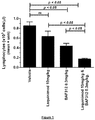
- Example 1.2 Use of siponimod. laquinimod and combinations thereof to reduce lymphocytes in MOG/CFA/Pertussis toxin-treated C57/BI6 mice
- mice Female C57BI/6 mice were subcutaneously immunized with 200 ⁇ g recombinant MOG1-125 in CFA followed by one i.p. injection of 100 ng Pertussis toxin. Two days later an additional i.p. injection of 100 ng pertussis toxin was administered. Three days after the first clinical symptoms, the mice were randomized to either vehicle, 0.3 mg/kg siponimod, 10 mg/kg laquinimod or 0.3 mg/kg siponimod + 10 mg/kg laquinimod and treated daily with said doses for 29 days.
- the MOG/CFA/Pertussis toxin-induced experimental autoimmune encephalomyelitis model in C57/BI6 mice is described in Quancard et al (Chem Biol. 19(9):1142-51, 2012 ).
- Results are shown in Figure 1 .
- Treatment with 10 mg/kg laquinimod did not significantly reduce lymphocytes.
- Treatment with 0.3 mg/kg siponimod reduced lymphocytes.
- a combination of 0.3 mg/kg siponimod + 10 mg/kg laquinimod demonstrated a synergistic effect on lymphocyte reduction.
- Statistical significance p ⁇ 0.05.
- Example 1.3 Use of siponimod, laquinimod and combinations thereof to treat MOG/CFA/Pertussis toxin- immunized experimental autoimmune encephalomyelitis (EAE) in C57/BI6 mice
- mice Female C57BI/6 mice were subcutaneously immunized with 200 ⁇ g recombinant MOG1-125 in CFA followed by one i.p. injection of 100 ng Pertussis toxin. Two days later an additional i.p. injection of 100 ng pertussis toxin was administered. Three days after the first clinical symptoms, the mice were randomized to either vehicle, 0.3 mg/kg siponimod, 10 mg/kg laquinimod or 0.3 mg/kg siponimod + 10 mg/kg laquinimod and treated daily with said doses for 30 days. Treatment initiated after severe CNSneurological disease and tissue damage has occurred. More specifically after that a severe CNS damage, which can be characterized by hind limb paralysis, had already occurred.
- Results are shown in Figure 2 .
- Treatment with 10 mg/kg laquinimod did not significantly improve disease burden (cumulative EAE score).
- Treatment with 0.3 mg/kg siponimod reduced disease burden (cumulative EAE score).
- a combination of 0.3 mg/kg siponimod + 10 mg/kg laquinimod demonstrated a significantly improve disease burden (cumulative EAE score) compared to vehicle-treated animals.
- Statistical significance p ⁇ 0.05.
- Example 1.4 Level of siponimod and laquinimod in blood and brain tissue during experimental autoimmune encephalomyelitis (EAE) in C57/BI6 mice
- mice Female C57BI/6 mice were subcutaneously immunized with 200 ⁇ g recombinant MOG1-125 in CFA followed by one i.p. injection of 100 ng Pertussis toxin. Two days later an additional i.p. injection of 100 ng pertussis toxin was administered. Mice were dosed with either vehicle, 0.3 mg/kg siponimod, 10 mg/kg laquinimod or 0.3 mg/kg siponimod + 10 mg/kg laquinimod for up to 21 days. Treatment initiated after immune cells have entered the CNS resulting in paralysis and localised tissue damage.
- Example 1.5 Use of siponimod, laquinimod and combinations thereof to treat MOG/CFA/Pertussis toxin- immunized experimental autoimmune encephalomyelitis (EAE) in C57/BI6 mice
- mice Female C57BI/6 mice were subcutaneously immunized with 200 ⁇ g recombinant MOG1-125 in CFA followed by one i.p. injection of 100 ng Pertussis toxin. Two days later an additional i.p. injection of 100 ng pertussis toxin was administered. Following infiltration of immune cells into the CNS to initiate tissue damage, the mice were randomized to either vehicle, 0.3 mg/kg siponimod, 10 mg/kg laquinimod or 0.3 mg/kg siponimod + 10 mg/kg laquinimod and treated daily with said doses for 21 days.
- Results are shown in Figure 4 .
- Treatment with 10 mg/kg laquinimod did not significantly improve daily disease severity.
- Treatment with 0.3 mg/kg siponimod transiently reduced neurological paralysis (days post-immunization 18-21), however, animals ultimately entered the chronic non-remitting phase.
- a combination of 0.3 mg/kg siponimod + 10 mg/kg laquinimod demonstrated a significantly improve disease burden compared to vehicle-treated animals.
- the recovery from neurological paralysis was significantly greater than either laquinimod or siponimod monotherapy.
- Statistical significance p ⁇ 0.05.
- the primary objective is to demonstrate the efficacy of a combination of siponimod and laquinimod relative to placebo in delaying the time to 3-month confirmed disability progression in patients with SPMS as measured by EDSS.
- the first key secondary objective is to demonstrate the efficacy of a combination of siponimod and laquinimod relative to placebo in delaying the time to 3-month confirmed worsening of at least 20% from the baseline in the timed 25-foot walk test (T25-FW).
- the second key secondary objective is to demonstrate the efficacy of a combination of siponimod and laquinimod relative to placebo in reducing the increase in T2 lesion volume from the baseline to the end of the study.
- the study population consists of ambulatory patients with an EDSS score of 3.0 to 6.5 and aged between 18 to 60 years with a diagnosis of MS with a secondary progressive disease course (SPMS).
- SPMS secondary progressive disease course
Landscapes
- Health & Medical Sciences (AREA)
- General Health & Medical Sciences (AREA)
- Chemical & Material Sciences (AREA)
- Veterinary Medicine (AREA)
- Medicinal Chemistry (AREA)
- Public Health (AREA)
- Pharmacology & Pharmacy (AREA)
- Life Sciences & Earth Sciences (AREA)
- Animal Behavior & Ethology (AREA)
- Epidemiology (AREA)
- Bioinformatics & Cheminformatics (AREA)
- Engineering & Computer Science (AREA)
- Nuclear Medicine, Radiotherapy & Molecular Imaging (AREA)
- General Chemical & Material Sciences (AREA)
- Chemical Kinetics & Catalysis (AREA)
- Organic Chemistry (AREA)
- Neurology (AREA)
- Neurosurgery (AREA)
- Biomedical Technology (AREA)
- Hospice & Palliative Care (AREA)
- Psychiatry (AREA)
- Orthopedic Medicine & Surgery (AREA)
- Physical Education & Sports Medicine (AREA)
- Immunology (AREA)
- Pharmaceuticals Containing Other Organic And Inorganic Compounds (AREA)
- Medicines That Contain Protein Lipid Enzymes And Other Medicines (AREA)
- Telephonic Communication Services (AREA)
- Medicinal Preparation (AREA)
Applications Claiming Priority (2)
| Application Number | Priority Date | Filing Date | Title |
|---|---|---|---|
| US201462064537P | 2014-10-16 | 2014-10-16 | |
| PCT/IB2015/057870 WO2016059571A1 (en) | 2014-10-16 | 2015-10-14 | Combinations comprising siponimod and laquinimod for the treatment of multiple sclerosis |
Publications (2)
| Publication Number | Publication Date |
|---|---|
| EP3206682A1 EP3206682A1 (en) | 2017-08-23 |
| EP3206682B1 true EP3206682B1 (en) | 2018-09-26 |
Family
ID=54352484
Family Applications (1)
| Application Number | Title | Priority Date | Filing Date |
|---|---|---|---|
| EP15784974.6A Not-in-force EP3206682B1 (en) | 2014-10-16 | 2015-10-14 | Combinations comprising siponimod and laquinimod for the treatment of multiple sclerosis |
Country Status (12)
| Country | Link |
|---|---|
| US (1) | US10537566B2 (ko) |
| EP (1) | EP3206682B1 (ko) |
| JP (1) | JP6731915B2 (ko) |
| KR (1) | KR20170068480A (ko) |
| CN (2) | CN114699409A (ko) |
| AU (1) | AU2015332037A1 (ko) |
| BR (1) | BR112017007414A2 (ko) |
| CA (1) | CA2964315A1 (ko) |
| ES (1) | ES2710460T3 (ko) |
| MX (1) | MX2017004808A (ko) |
| RU (1) | RU2017116740A (ko) |
| WO (1) | WO2016059571A1 (ko) |
Families Citing this family (13)
| Publication number | Priority date | Publication date | Assignee | Title |
|---|---|---|---|---|
| US11840565B2 (en) | 2016-12-29 | 2023-12-12 | University Of Miami | Methods and compositions for treating virus-associated inflammation |
| BR112020005445A2 (pt) * | 2017-09-20 | 2020-09-29 | University Of Miami | método para a detecção de proteínas do inflamassoma como biomarcadores de transtornos neurológicos |
| WO2020010273A1 (en) | 2018-07-03 | 2020-01-09 | University Of Miami | Compositions and methods for treating inflammasome related diseases or conditions |
| EP3972954A1 (en) * | 2019-05-21 | 2022-03-30 | Synthon B.V. | Siponimod maleic acid and fumaric acid salt |
| AU2020372647B2 (en) * | 2019-10-31 | 2026-02-05 | Idorsia Pharmaceuticals Ltd | Combination of a CXCR7 antagonist with an S1P1 receptor modulator |
| WO2021158845A1 (en) * | 2020-02-07 | 2021-08-12 | Argentum Pharmaceuticals Llc | Treatment and dosing regimen for s1p receptor modulator |
| WO2021158844A1 (en) * | 2020-02-07 | 2021-08-12 | Argentum Pharmaceuticals Llc | Treatment and dosing regimen for s1p receptor modulator |
| WO2021158843A1 (en) * | 2020-02-07 | 2021-08-12 | Argentum Pharmaceuticals Llc | Treatment and dosing regimen for s1p receptor modulator |
| WO2021158838A1 (en) | 2020-02-07 | 2021-08-12 | Argentum Pharmaceuticals Llc | Dosage regimen of an s1p receptor modulator |
| WO2021158839A1 (en) * | 2020-02-07 | 2021-08-12 | Argentum Pharmaceuticals Llc | Treatment and dosing regimen for s1p receptor modulator |
| WO2021158847A1 (en) * | 2020-02-07 | 2021-08-12 | Argentum Pharmaceuticals Llc | Treatment and dosing regimen for s1p receptor modulator |
| WO2021158841A1 (en) * | 2020-02-07 | 2021-08-12 | Argentum Pharmaceuticals Llc | Treatment and dosing regimen for s1p receptor modulator |
| CN113527250B (zh) * | 2020-04-16 | 2024-01-05 | 广东东阳光药业股份有限公司 | 辛波莫德中间体及其制备方法 |
Family Cites Families (5)
| Publication number | Priority date | Publication date | Assignee | Title |
|---|---|---|---|---|
| US6077851A (en) | 1998-04-27 | 2000-06-20 | Active Biotech Ab | Quinoline derivatives |
| WO2012078591A1 (en) * | 2010-12-07 | 2012-06-14 | Teva Pharmaceutical Industries Ltd. | Use of laquinimod for reducing fatigue, improving functional status, and improving quality of life in multiple sclerosis patients |
| CN106344576A (zh) * | 2011-10-12 | 2017-01-25 | 泰华制药工业有限公司 | 以拉喹莫德和芬戈莫德的组合治疗多发性硬化症 |
| EA201591507A1 (ru) * | 2013-02-15 | 2015-12-30 | Тева Фармасьютикал Индастриз Лтд. | Лечение рассеянного склероза лахинимодом |
| HK1213636A1 (zh) * | 2013-04-04 | 2016-07-08 | Novartis Ag | 识别病患对投予s1p受体调节剂之反应 |
-
2015
- 2015-10-14 CN CN202210376999.4A patent/CN114699409A/zh active Pending
- 2015-10-14 JP JP2017520503A patent/JP6731915B2/ja not_active Expired - Fee Related
- 2015-10-14 BR BR112017007414A patent/BR112017007414A2/pt not_active Application Discontinuation
- 2015-10-14 KR KR1020177009900A patent/KR20170068480A/ko not_active Withdrawn
- 2015-10-14 WO PCT/IB2015/057870 patent/WO2016059571A1/en not_active Ceased
- 2015-10-14 MX MX2017004808A patent/MX2017004808A/es unknown
- 2015-10-14 US US15/517,280 patent/US10537566B2/en not_active Expired - Fee Related
- 2015-10-14 ES ES15784974T patent/ES2710460T3/es active Active
- 2015-10-14 EP EP15784974.6A patent/EP3206682B1/en not_active Not-in-force
- 2015-10-14 CN CN201580056374.8A patent/CN107072988A/zh active Pending
- 2015-10-14 AU AU2015332037A patent/AU2015332037A1/en not_active Abandoned
- 2015-10-14 RU RU2017116740A patent/RU2017116740A/ru unknown
- 2015-10-14 CA CA2964315A patent/CA2964315A1/en not_active Abandoned
Non-Patent Citations (1)
| Title |
|---|
| None * |
Also Published As
| Publication number | Publication date |
|---|---|
| US10537566B2 (en) | 2020-01-21 |
| CN114699409A (zh) | 2022-07-05 |
| ES2710460T3 (es) | 2019-04-25 |
| CA2964315A1 (en) | 2016-04-21 |
| RU2017116740A (ru) | 2018-11-16 |
| JP6731915B2 (ja) | 2020-07-29 |
| JP2017531021A (ja) | 2017-10-19 |
| EP3206682A1 (en) | 2017-08-23 |
| WO2016059571A1 (en) | 2016-04-21 |
| AU2015332037A1 (en) | 2017-04-27 |
| BR112017007414A2 (pt) | 2017-12-19 |
| CN107072988A (zh) | 2017-08-18 |
| MX2017004808A (es) | 2017-07-26 |
| US20170304289A1 (en) | 2017-10-26 |
| KR20170068480A (ko) | 2017-06-19 |
Similar Documents
| Publication | Publication Date | Title |
|---|---|---|
| EP3206682B1 (en) | Combinations comprising siponimod and laquinimod for the treatment of multiple sclerosis | |
| JP2010511616A (ja) | 水素化ピリド(4,3−b)インドール(異性体)に基づいた認知機能および記憶を改善するための手段、当該手段に基づいた薬理学的手段、および当該手段の使用のための方法 | |
| AU2018383098B2 (en) | Cyclobenzaprine treatment for agitation, psychosis and cognitive decline in dementia and neurodegenerative conditions | |
| US20220023316A1 (en) | Methods for the treatment of depression | |
| CN102143687B (zh) | 4-氨基吡啶在改善具有脱髓鞘和其它神经系统状况的患者的神经-认知和/或神经-精神病学损伤中的用途 | |
| US12318380B2 (en) | Treatment of demyelinating diseases | |
| US20120129834A1 (en) | Serotonin receptor antagonists for use in the treatment of huntington's disease | |
| JP7788154B2 (ja) | 多発性硬化症患者の亜集団の処置のためのマシチニブ | |
| KR20150038072A (ko) | 라퀴니모드와 팜프리딘의 병용물에 의한 다발성 경화증의 치료 | |
| KR20190064583A (ko) | Chs-131로 다발성 경화증의 치료 | |
| CA3026770C (en) | Andrographolide treats progressive forms of multiple sclerosis | |
| EP1535616B1 (en) | Remedy for integration dysfunction syndrome | |
| RU2805061C2 (ru) | Лечение демиелинизирующих заболеваний | |
| WO2026077305A1 (zh) | 一种预防或治疗神经系统变性疾病的方法和药物组合 | |
| US20200038414A1 (en) | Methods of treating constipation using aminosterol compositions | |
| WO2023243659A1 (ja) | 線条体ストリオソームのドパミンd1シグナルを標的とした強迫性障害の薬物療法 | |
| WO2020094592A1 (en) | Compounds for treating negative symptoms and cognitive impairments | |
| JP2023181739A (ja) | Cadasil患者を処置するための医薬組成物および方法 |
Legal Events
| Date | Code | Title | Description |
|---|---|---|---|
| PUAI | Public reference made under article 153(3) epc to a published international application that has entered the european phase |
Free format text: ORIGINAL CODE: 0009012 |
|
| 17P | Request for examination filed |
Effective date: 20170516 |
|
| AK | Designated contracting states |
Kind code of ref document: A1 Designated state(s): AL AT BE BG CH CY CZ DE DK EE ES FI FR GB GR HR HU IE IS IT LI LT LU LV MC MK MT NL NO PL PT RO RS SE SI SK SM TR |
|
| AX | Request for extension of the european patent |
Extension state: BA ME |
|
| DAV | Request for validation of the european patent (deleted) | ||
| DAX | Request for extension of the european patent (deleted) | ||
| GRAP | Despatch of communication of intention to grant a patent |
Free format text: ORIGINAL CODE: EPIDOSNIGR1 |
|
| INTG | Intention to grant announced |
Effective date: 20180416 |
|
| GRAS | Grant fee paid |
Free format text: ORIGINAL CODE: EPIDOSNIGR3 |
|
| GRAA | (expected) grant |
Free format text: ORIGINAL CODE: 0009210 |
|
| AK | Designated contracting states |
Kind code of ref document: B1 Designated state(s): AL AT BE BG CH CY CZ DE DK EE ES FI FR GB GR HR HU IE IS IT LI LT LU LV MC MK MT NL NO PL PT RO RS SE SI SK SM TR |
|
| REG | Reference to a national code |
Ref country code: GB Ref legal event code: FG4D |
|
| REG | Reference to a national code |
Ref country code: CH Ref legal event code: EP |
|
| REG | Reference to a national code |
Ref country code: AT Ref legal event code: REF Ref document number: 1045181 Country of ref document: AT Kind code of ref document: T Effective date: 20181015 |
|
| REG | Reference to a national code |
Ref country code: IE Ref legal event code: FG4D |
|
| REG | Reference to a national code |
Ref country code: DE Ref legal event code: R096 Ref document number: 602015017179 Country of ref document: DE |
|
| REG | Reference to a national code |
Ref country code: NL Ref legal event code: MP Effective date: 20180926 |
|
| PG25 | Lapsed in a contracting state [announced via postgrant information from national office to epo] |
Ref country code: LT Free format text: LAPSE BECAUSE OF FAILURE TO SUBMIT A TRANSLATION OF THE DESCRIPTION OR TO PAY THE FEE WITHIN THE PRESCRIBED TIME-LIMIT Effective date: 20180926 Ref country code: RS Free format text: LAPSE BECAUSE OF FAILURE TO SUBMIT A TRANSLATION OF THE DESCRIPTION OR TO PAY THE FEE WITHIN THE PRESCRIBED TIME-LIMIT Effective date: 20180926 Ref country code: BG Free format text: LAPSE BECAUSE OF FAILURE TO SUBMIT A TRANSLATION OF THE DESCRIPTION OR TO PAY THE FEE WITHIN THE PRESCRIBED TIME-LIMIT Effective date: 20181226 Ref country code: NO Free format text: LAPSE BECAUSE OF FAILURE TO SUBMIT A TRANSLATION OF THE DESCRIPTION OR TO PAY THE FEE WITHIN THE PRESCRIBED TIME-LIMIT Effective date: 20181226 Ref country code: SE Free format text: LAPSE BECAUSE OF FAILURE TO SUBMIT A TRANSLATION OF THE DESCRIPTION OR TO PAY THE FEE WITHIN THE PRESCRIBED TIME-LIMIT Effective date: 20180926 Ref country code: GR Free format text: LAPSE BECAUSE OF FAILURE TO SUBMIT A TRANSLATION OF THE DESCRIPTION OR TO PAY THE FEE WITHIN THE PRESCRIBED TIME-LIMIT Effective date: 20181227 Ref country code: FI Free format text: LAPSE BECAUSE OF FAILURE TO SUBMIT A TRANSLATION OF THE DESCRIPTION OR TO PAY THE FEE WITHIN THE PRESCRIBED TIME-LIMIT Effective date: 20180926 |
|
| REG | Reference to a national code |
Ref country code: LT Ref legal event code: MG4D |
|
| PG25 | Lapsed in a contracting state [announced via postgrant information from national office to epo] |
Ref country code: AL Free format text: LAPSE BECAUSE OF FAILURE TO SUBMIT A TRANSLATION OF THE DESCRIPTION OR TO PAY THE FEE WITHIN THE PRESCRIBED TIME-LIMIT Effective date: 20180926 Ref country code: LV Free format text: LAPSE BECAUSE OF FAILURE TO SUBMIT A TRANSLATION OF THE DESCRIPTION OR TO PAY THE FEE WITHIN THE PRESCRIBED TIME-LIMIT Effective date: 20180926 Ref country code: HR Free format text: LAPSE BECAUSE OF FAILURE TO SUBMIT A TRANSLATION OF THE DESCRIPTION OR TO PAY THE FEE WITHIN THE PRESCRIBED TIME-LIMIT Effective date: 20180926 |
|
| REG | Reference to a national code |
Ref country code: AT Ref legal event code: MK05 Ref document number: 1045181 Country of ref document: AT Kind code of ref document: T Effective date: 20180926 |
|
| REG | Reference to a national code |
Ref country code: ES Ref legal event code: FG2A Ref document number: 2710460 Country of ref document: ES Kind code of ref document: T3 Effective date: 20190425 |
|
| PG25 | Lapsed in a contracting state [announced via postgrant information from national office to epo] |
Ref country code: PL Free format text: LAPSE BECAUSE OF FAILURE TO SUBMIT A TRANSLATION OF THE DESCRIPTION OR TO PAY THE FEE WITHIN THE PRESCRIBED TIME-LIMIT Effective date: 20180926 Ref country code: IS Free format text: LAPSE BECAUSE OF FAILURE TO SUBMIT A TRANSLATION OF THE DESCRIPTION OR TO PAY THE FEE WITHIN THE PRESCRIBED TIME-LIMIT Effective date: 20190126 Ref country code: EE Free format text: LAPSE BECAUSE OF FAILURE TO SUBMIT A TRANSLATION OF THE DESCRIPTION OR TO PAY THE FEE WITHIN THE PRESCRIBED TIME-LIMIT Effective date: 20180926 Ref country code: AT Free format text: LAPSE BECAUSE OF FAILURE TO SUBMIT A TRANSLATION OF THE DESCRIPTION OR TO PAY THE FEE WITHIN THE PRESCRIBED TIME-LIMIT Effective date: 20180926 Ref country code: RO Free format text: LAPSE BECAUSE OF FAILURE TO SUBMIT A TRANSLATION OF THE DESCRIPTION OR TO PAY THE FEE WITHIN THE PRESCRIBED TIME-LIMIT Effective date: 20180926 Ref country code: NL Free format text: LAPSE BECAUSE OF FAILURE TO SUBMIT A TRANSLATION OF THE DESCRIPTION OR TO PAY THE FEE WITHIN THE PRESCRIBED TIME-LIMIT Effective date: 20180926 Ref country code: CZ Free format text: LAPSE BECAUSE OF FAILURE TO SUBMIT A TRANSLATION OF THE DESCRIPTION OR TO PAY THE FEE WITHIN THE PRESCRIBED TIME-LIMIT Effective date: 20180926 |
|
| PG25 | Lapsed in a contracting state [announced via postgrant information from national office to epo] |
Ref country code: SK Free format text: LAPSE BECAUSE OF FAILURE TO SUBMIT A TRANSLATION OF THE DESCRIPTION OR TO PAY THE FEE WITHIN THE PRESCRIBED TIME-LIMIT Effective date: 20180926 Ref country code: SM Free format text: LAPSE BECAUSE OF FAILURE TO SUBMIT A TRANSLATION OF THE DESCRIPTION OR TO PAY THE FEE WITHIN THE PRESCRIBED TIME-LIMIT Effective date: 20180926 Ref country code: PT Free format text: LAPSE BECAUSE OF FAILURE TO SUBMIT A TRANSLATION OF THE DESCRIPTION OR TO PAY THE FEE WITHIN THE PRESCRIBED TIME-LIMIT Effective date: 20190126 |
|
| REG | Reference to a national code |
Ref country code: CH Ref legal event code: PL |
|
| REG | Reference to a national code |
Ref country code: BE Ref legal event code: MM Effective date: 20181031 |
|
| REG | Reference to a national code |
Ref country code: DE Ref legal event code: R097 Ref document number: 602015017179 Country of ref document: DE |
|
| PG25 | Lapsed in a contracting state [announced via postgrant information from national office to epo] |
Ref country code: LU Free format text: LAPSE BECAUSE OF NON-PAYMENT OF DUE FEES Effective date: 20181014 |
|
| REG | Reference to a national code |
Ref country code: IE Ref legal event code: MM4A |
|
| PG25 | Lapsed in a contracting state [announced via postgrant information from national office to epo] |
Ref country code: DK Free format text: LAPSE BECAUSE OF FAILURE TO SUBMIT A TRANSLATION OF THE DESCRIPTION OR TO PAY THE FEE WITHIN THE PRESCRIBED TIME-LIMIT Effective date: 20180926 Ref country code: MC Free format text: LAPSE BECAUSE OF FAILURE TO SUBMIT A TRANSLATION OF THE DESCRIPTION OR TO PAY THE FEE WITHIN THE PRESCRIBED TIME-LIMIT Effective date: 20180926 |
|
| PLBE | No opposition filed within time limit |
Free format text: ORIGINAL CODE: 0009261 |
|
| STAA | Information on the status of an ep patent application or granted ep patent |
Free format text: STATUS: NO OPPOSITION FILED WITHIN TIME LIMIT |
|
| PG25 | Lapsed in a contracting state [announced via postgrant information from national office to epo] |
Ref country code: LI Free format text: LAPSE BECAUSE OF NON-PAYMENT OF DUE FEES Effective date: 20181031 Ref country code: BE Free format text: LAPSE BECAUSE OF NON-PAYMENT OF DUE FEES Effective date: 20181031 Ref country code: CH Free format text: LAPSE BECAUSE OF NON-PAYMENT OF DUE FEES Effective date: 20181031 |
|
| 26N | No opposition filed |
Effective date: 20190627 |
|
| PG25 | Lapsed in a contracting state [announced via postgrant information from national office to epo] |
Ref country code: IE Free format text: LAPSE BECAUSE OF NON-PAYMENT OF DUE FEES Effective date: 20181014 Ref country code: SI Free format text: LAPSE BECAUSE OF FAILURE TO SUBMIT A TRANSLATION OF THE DESCRIPTION OR TO PAY THE FEE WITHIN THE PRESCRIBED TIME-LIMIT Effective date: 20180926 |
|
| PG25 | Lapsed in a contracting state [announced via postgrant information from national office to epo] |
Ref country code: MT Free format text: LAPSE BECAUSE OF NON-PAYMENT OF DUE FEES Effective date: 20181014 |
|
| PG25 | Lapsed in a contracting state [announced via postgrant information from national office to epo] |
Ref country code: TR Free format text: LAPSE BECAUSE OF FAILURE TO SUBMIT A TRANSLATION OF THE DESCRIPTION OR TO PAY THE FEE WITHIN THE PRESCRIBED TIME-LIMIT Effective date: 20180926 |
|
| PG25 | Lapsed in a contracting state [announced via postgrant information from national office to epo] |
Ref country code: MK Free format text: LAPSE BECAUSE OF NON-PAYMENT OF DUE FEES Effective date: 20180926 Ref country code: HU Free format text: LAPSE BECAUSE OF FAILURE TO SUBMIT A TRANSLATION OF THE DESCRIPTION OR TO PAY THE FEE WITHIN THE PRESCRIBED TIME-LIMIT; INVALID AB INITIO Effective date: 20151014 Ref country code: CY Free format text: LAPSE BECAUSE OF FAILURE TO SUBMIT A TRANSLATION OF THE DESCRIPTION OR TO PAY THE FEE WITHIN THE PRESCRIBED TIME-LIMIT Effective date: 20180926 |
|
| PGFP | Annual fee paid to national office [announced via postgrant information from national office to epo] |
Ref country code: GB Payment date: 20220922 Year of fee payment: 8 |
|
| PGFP | Annual fee paid to national office [announced via postgrant information from national office to epo] |
Ref country code: FR Payment date: 20220921 Year of fee payment: 8 |
|
| PGFP | Annual fee paid to national office [announced via postgrant information from national office to epo] |
Ref country code: IT Payment date: 20220927 Year of fee payment: 8 Ref country code: ES Payment date: 20221109 Year of fee payment: 8 Ref country code: DE Payment date: 20220621 Year of fee payment: 8 |
|
| P01 | Opt-out of the competence of the unified patent court (upc) registered |
Effective date: 20230514 |
|
| REG | Reference to a national code |
Ref country code: DE Ref legal event code: R119 Ref document number: 602015017179 Country of ref document: DE |
|
| GBPC | Gb: european patent ceased through non-payment of renewal fee |
Effective date: 20231014 |
|
| PG25 | Lapsed in a contracting state [announced via postgrant information from national office to epo] |
Ref country code: GB Free format text: LAPSE BECAUSE OF NON-PAYMENT OF DUE FEES Effective date: 20231014 |
|
| PG25 | Lapsed in a contracting state [announced via postgrant information from national office to epo] |
Ref country code: GB Free format text: LAPSE BECAUSE OF NON-PAYMENT OF DUE FEES Effective date: 20231014 Ref country code: FR Free format text: LAPSE BECAUSE OF NON-PAYMENT OF DUE FEES Effective date: 20231031 Ref country code: DE Free format text: LAPSE BECAUSE OF NON-PAYMENT OF DUE FEES Effective date: 20240501 |
|
| PG25 | Lapsed in a contracting state [announced via postgrant information from national office to epo] |
Ref country code: IT Free format text: LAPSE BECAUSE OF NON-PAYMENT OF DUE FEES Effective date: 20231014 |
|
| REG | Reference to a national code |
Ref country code: ES Ref legal event code: FD2A Effective date: 20241203 |
|
| PG25 | Lapsed in a contracting state [announced via postgrant information from national office to epo] |
Ref country code: IT Free format text: LAPSE BECAUSE OF NON-PAYMENT OF DUE FEES Effective date: 20231014 |
|
| PG25 | Lapsed in a contracting state [announced via postgrant information from national office to epo] |
Ref country code: ES Free format text: LAPSE BECAUSE OF NON-PAYMENT OF DUE FEES Effective date: 20231015 |
|
| PG25 | Lapsed in a contracting state [announced via postgrant information from national office to epo] |
Ref country code: ES Free format text: LAPSE BECAUSE OF NON-PAYMENT OF DUE FEES Effective date: 20231015 |