EP3208752A1 - Procédé d'analyse de données et procédé d'affichage de données - Google Patents
Procédé d'analyse de données et procédé d'affichage de données Download PDFInfo
- Publication number
- EP3208752A1 EP3208752A1 EP15861504.7A EP15861504A EP3208752A1 EP 3208752 A1 EP3208752 A1 EP 3208752A1 EP 15861504 A EP15861504 A EP 15861504A EP 3208752 A1 EP3208752 A1 EP 3208752A1
- Authority
- EP
- European Patent Office
- Prior art keywords
- data
- values
- indicator
- self
- output
- Prior art date
- Legal status (The legal status is an assumption and is not a legal conclusion. Google has not performed a legal analysis and makes no representation as to the accuracy of the status listed.)
- Withdrawn
Links
Images






Classifications
-
- G—PHYSICS
- G06—COMPUTING OR CALCULATING; COUNTING
- G06F—ELECTRIC DIGITAL DATA PROCESSING
- G06F30/00—Computer-aided design [CAD]
- G06F30/20—Design optimisation, verification or simulation
- G06F30/23—Design optimisation, verification or simulation using finite element methods [FEM] or finite difference methods [FDM]
-
- G—PHYSICS
- G06—COMPUTING OR CALCULATING; COUNTING
- G06F—ELECTRIC DIGITAL DATA PROCESSING
- G06F30/00—Computer-aided design [CAD]
-
- G—PHYSICS
- G06—COMPUTING OR CALCULATING; COUNTING
- G06F—ELECTRIC DIGITAL DATA PROCESSING
- G06F30/00—Computer-aided design [CAD]
- G06F30/20—Design optimisation, verification or simulation
-
- G—PHYSICS
- G06—COMPUTING OR CALCULATING; COUNTING
- G06N—COMPUTING ARRANGEMENTS BASED ON SPECIFIC COMPUTATIONAL MODELS
- G06N3/00—Computing arrangements based on biological models
- G06N3/02—Neural networks
- G06N3/08—Learning methods
-
- G—PHYSICS
- G06—COMPUTING OR CALCULATING; COUNTING
- G06N—COMPUTING ARRANGEMENTS BASED ON SPECIFIC COMPUTATIONAL MODELS
- G06N99/00—Subject matter not provided for in other groups of this subclass
-
- G—PHYSICS
- G06—COMPUTING OR CALCULATING; COUNTING
- G06F—ELECTRIC DIGITAL DATA PROCESSING
- G06F2111/00—Details relating to CAD techniques
- G06F2111/06—Multi-objective optimisation, e.g. Pareto optimisation using simulated annealing [SA], ant colony algorithms or genetic algorithms [GA]
-
- G—PHYSICS
- G06—COMPUTING OR CALCULATING; COUNTING
- G06F—ELECTRIC DIGITAL DATA PROCESSING
- G06F2111/00—Details relating to CAD techniques
- G06F2111/10—Numerical modelling
Definitions
- the present invention relates to a data analysis method and a data display method using a computer or the like targeting, in a plurality of input values and a plurality of output values having a predetermined relationship, two types of data, namely input data representing the plurality of input values and output data representing the plurality of output values.
- the present invention relates to a data analysis method and a data display method for facilitating the understanding of causality between the plurality of input values and the plurality of output values.
- Non-Patent Document 1 describes the use of self-organizing maps, and also describes that the objective functions and design variables can be displayed on self-organizing maps. Non-Patent Document 1 also teaches that by displaying the objective functions and the design variables side-by-side, not only it is possible to visually grasp the correlation between objective functions, it is also possible to understand the causality between objective functions and design variables.
- Non-Patent Document 1 Nippon Gomu Kyokaishi, Vol.85, 2012, p.289-295
- Non-Patent Document 1 describes analyzing the causality between characteristic values (output values) and design variables (input values) using self-organizing maps.
- an important problem in multi-purpose optimization relates to searching for design values that improve a plurality of characteristic values.
- distinguishing which design variables in design variable space improve a plurality of characteristic values is also an important problem.
- design variables and characteristic values in regular product design and it is difficult to distinguish which design variables contribute greatly to the characteristic values.
- there is a problem in that inexperienced analysts will not be able to understand causality even if the results are graphically presented.
- An object of the present invention is to solve the problems of the related art described above and provide a data analysis method and a data display method whereby, in cases where a plurality of input values (design variables) and a plurality of output values (characteristic values) exist, understanding of the causality between the input values (design variables) and the output values (characteristic values) is facilitated.
- a first aspect of the present invention provides a data analysis method targeting, in a plurality of input values and a plurality of output values having a predetermined relationship, two types of data, namely input data representing the plurality of input values and output data representing the plurality of output values.
- the method includes a step of finding at least one of a first indicator and a second indicator in objective function space, the plurality of output values being defined as an objective function.
- the first indicator is a distance from a preset value of values of at least two objective functions among values of a plurality of objective functions
- the second indicator is expressed as a ratio of values of at least two objective functions among values of a plurality of objective functions.
- the data analysis method further preferably includes the steps of generating a self-organizing map using the two types of data, namely the input data and the output data; setting a threshold value using at least one of the first indicator and the second indicator; and finding regions on the self-organizing map corresponding to the threshold value.
- the data analysis method further preferably includes a step of performing regression analysis using the regions on the self-organizing map corresponding to the threshold value.
- the data analysis method further preferably includes the steps of performing clustering processing using the regions on the self-organizing map corresponding to the threshold value; determining from the clustering processing if the regions are dividable into clusters; and when the regions are dividable into the clusters, generating a line using regression analysis on clusters for which a number of the regions is large.
- the input data representing the input values represents design variables of a structure and materials constituting the structure
- the output data representing the output values represents characteristic values of the structure and the materials constituting the structure.
- the output data includes a Pareto solution.
- a second aspect of the present invention provides a data display method targeting, in a plurality of input values and a plurality of output values having a predetermined relationship, two types of data, namely input data representing the plurality of input values and output data representing the plurality of output values.
- the method includes the steps of finding at least one of a first indicator and a second indicator in objective function space, the plurality of output values being defined as an objective function; displaying at least one of the first indicator and the second indicator together with the two types of data, namely the input data and the output data; generating a self-organizing map using the two types of data, namely the input data and the output data; setting a threshold value using at least one of the first indicator and the second indicator; finding regions on the self-organizing map corresponding to the threshold value; and marking and displaying the regions on the self-organizing map corresponding to the threshold value.
- the first indicator is a distance from a preset value of values of at least two objective functions among values of a plurality of objective functions
- the second indicator is expressed as a ratio of values of at least two objective functions among values of a plurality of objective functions.
- the data display method further preferably includes the steps of generating a self-organizing map using the two types of data, namely the input data and the output data; setting a threshold value using at least one of the first indicator and the second indicator; finding regions on the self-organizing map corresponding to the threshold value; and marking and displaying the regions on the self-organizing map corresponding to the threshold value.
- the data display method further preferably includes the steps of performing regression analysis using the regions on the self-organizing map corresponding to the threshold value; and displaying results of the regression analysis on the self-organizing map.
- the data display method further preferably includes the steps of performing clustering processing using the regions on the self-organizing map corresponding to the threshold value; determining from the clustering processing if the regions are dividable into clusters; and when the regions are dividable into the clusters, generating a line using regression analysis on clusters for which a number of the regions is large, and displaying the line represented by an approximation equation of the clusters on the self-organizing map.
- the input data representing the input values represents design variables of a structure and materials constituting the structure
- the output data representing the output values represents characteristic values of the structure and the materials constituting the structure.
- the output data includes a Pareto solution.
- inexperienced analysts in cases where a plurality of input values and a plurality of output values exist, inexperienced analysts, for example, can easily understand the causality between the input values and the output values. Additionally, according to the data display method of the present invention, in cases where a plurality of input values and a plurality of output values exist, inexperienced analysts, for example, can easily visually understand the causality between the input values and the output values.
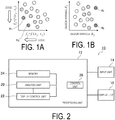
- FIG. 1A is a graph illustrating a relationship between two characteristic values.
- FIG. 1B is a graph illustrating a relationship between two design variables.
- two characteristic values f 1 and f 2 are functions of design variables x 1 and x 2 .
- design values represented by reference signs H 1 and H 2 depicted in FIG. 1 are preferable for the two characteristic values f 1 and f 2 .
- the design variables x 1 and x 2 have the relationship illustrated in FIG. 1B .
- the preferable design value H 1 is a value where the design variable x 1 and the design variable x 2 are large.
- the preferable design value H 2 is a value where the design variable x 1 is small and the design variable x 2 is large.
- the values of the design variables x 1 and x 2 , of the design value H 1 and the design value H 2 for which the characteristic values f 1 and f 2 are good differ.
- the value of the design variable x 2 is large, the characteristic values f 1 and f 2 will become good characteristics.
- the design variable x 2 is an important design variable for obtaining good characteristics of the characteristic values f 1 and f 2 .
- the characteristic values f 1 and f 2 are the lateral spring constant of the tire and the rolling resistance of the tire
- the design variables x 1 and x 2 are parameters related to the shape of the tire.
- an important problem in multi-purpose optimization relates to searching for design values that improve a plurality of characteristic values.
- distinguishing which design variables in design variable space improve a plurality of characteristic values is also an important problem.
- design variables and characteristic values in regular product design and it is difficult to distinguish which design variables contribute greatly to the characteristic values.
- FIGS. 1A and 1B the value of the design variable x 2 is an important design variable for obtaining good characteristics of the characteristic values f 1 and f 2 .
- the present invention seeks to eliminate the difficulties in understanding such causality.
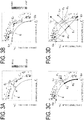
- FIG. 2 is a schematic drawing illustrating an example of a data processing device used in the data analysis method and the data display method according to the embodiment of the present invention.
- a data processing device 10 illustrated in FIG. 2 is used in the data analysis method and the data display method in the present embodiment. However, provided that the data analysis method and the data display method can be executed using software and a computer or similar hardware, a device other than the data processing device 10 may be used.
- I represents the number of input data
- m represents the number of output data.
- Pluralities of the input values and the characteristic values exist.
- the input values and the output values have a predetermined relationship. This predetermined relationship is causality which indicates that, for example, the input values and the output values are represented by functions.
- the input data representing the input values is a first data that represents a plurality of design variables of a structure and materials constituting the structure
- the output data representing the output values is a second data that represents a plurality of characteristic values of the structure and materials constituting the structure.
- I represents the number of design variables and m represents the number of characteristic values
- Characteristic value space corresponds to the output value space.
- a plurality of groups of these ten pieces of data exist.
- the number of groups in the data set is referred to as the data number. For example, if the data number is 100, 100 groups that each consist of ten pieces of data exist.
- the numbers of pieces of the input data and the output data are not particularly limited to ten pieces and, provided that a plurality is provided, may be any numbers.
- the output data (characteristic values) are the characteristic values, lateral spring constant, and rolling resistance of the tire
- the input data (design variables) are the shape of the tire and the physical properties such as the elastic modulus of the members constituting the tire.
- the output data (characteristic values) are the characteristic values, lift, and mass of the wing
- the input data (design variables) are the shape of the wing and the physical properties such as the elastic modulus of the members constituting the wing.
- the input data (design variables) representing the input values and the output data (characteristic values) representing the output values are not particularly limited to specific data and may include data obtained from simulations, optimization or similar computer calculations, measurement data from various testing, and Pareto solutions.
- the data processing device 10 includes a processing unit 12, an input unit 14, and a display unit 16.
- the processing unit 12 includes an analysis unit 20, a display control unit 22, a memory 24, and a control unit 26.
- the processing unit 12 also includes ROM and the like (not illustrated in the drawings).
- the processing unit 12 is controlled by the control unit 26.
- the analysis unit 20 is connected to the memory 24 in the processing unit 12, and the data of the analysis unit 20 is stored in the memory 24.
- the data set described above, which is input from outside the device is stored in the memory 24.
- the input unit 14 is an input device such as a mouse, keyboard, or the like whereby various information is input via commands of an operator.
- the display unit 16 displays, for example, graphs using the data set, results obtained by the analysis unit 20, and the like, and known various displays are used as the display unit 16. Additionally, the display unit 16 includes printers and similar devices for displaying various types of information on output media.
- the data processing device 10 functionally forms each part of the analysis unit 20 by executing programs (computer software) stored in the ROM or the like in the control unit 26.
- the data processing device 10 may be constituted by a computer in which each portion functions as a result of a program being executed as described above, or may be a dedicated device in which each portion is constituted by a dedicated circuit.
- the analysis unit 20 calculates, for the data set described above, at least one of a first indicator and a second indicator in objective function space, the plurality of output values (characteristic values) being defined as an objective function. Additionally, the analysis unit 20 generates self-organizing maps using the two types of data, namely the input data and the output data. The analysis unit 20 sets a threshold value for at least one of the first indicator and the second indicator, finds regions on the self-organizing map corresponding to the threshold value, and obtains position information on the self-organizing map of these regions. Furthermore, the analysis unit 20 generates image data in order to mark the regions corresponding to the threshold value. The analysis unit 20 performs regression analysis using the regions on the self-organizing map corresponding to the threshold value.
- the analysis unit 20 also performs clustering processing using the regions on the self-organizing map corresponding to the threshold value. From the clustering processing, the analysis unit 20 determines whether the regions are dividable into clusters. In cases where it is determined that the regions can be divided into clusters, a line is generated using regression analysis for the clusters for which the number of regions is large.
- the results obtained by the analysis unit 20 are stored in the memory 24, for example.
- the display control unit 22 causes the results obtained by the analysis unit 20 (e.g. self-organizing maps and the like) to be displayed on the display unit 16.
- the display control unit 22 also causes the Pareto solution to be read from the memory 24 and displayed on the display unit 16.
- the Pareto solution can be displayed in the form of a scatter diagram in which the characteristic values are shown on the axes. That is, the design variables are displayed in characteristic value space.
- the Pareto solution may be displayed in the form of a radar chart.
- the display control unit 22 may, for example, change at least one of the color, type, and size of symbols representing the values of the design variables depending on the values of the design variables.
- Information of the Pareto solution with the display mode that has been changed is stored in the memory 24.
- the display mode of the obtained Pareto solution is changed by the display control unit 22 and displayed by the display unit 16.
- the display control unit 22 includes a function for displaying a line connecting the Pareto solution for each value of the design variables.
- the display control unit 22 also includes a function for displaying a self-organizing map for each value of the characteristic values and each value of the design variables.
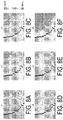
- FIG. 3A is a graph for explaining the first indicator.
- FIG. 3B is a graph for explaining the second indicator.
- FIG. 3A illustrates a Pareto solution for characteristic values f 1 and f 2 .
- Reference sign E represents the Pareto front.
- the characteristic values have preferable directions depending on the required specifications and the like. Examples thereof include a direction in which the value increases, a direction in which the value decreases, a direction in which the value approaches a predetermined value, and the like.
- a first indicator A is represented by a distance from a preset value of the values of at least two characteristic values (objective functions) among the values of the plurality of characteristic values (objective functions).
- the first indicator A is represented by the distance from a preset value, with respect to the characteristic values f 1 and f 2 .
- the first indicator A is the distance to a Pareto solution E 1 from the Pareto front E.
- the first indicator A is not limited to the distance from the Pareto front E.
- a value may be preset for the values of at least two objective functions, in this case, the characteristic values f 1 and f 2 , and the first indicator A may be the distance from this preset value.
- a second indicator B is expressed as a ratio of the values of at least two objective functions among the values of the plurality of objective functions and, in this case, is expressed as a ratio of the values of the characteristic values f 1 and f 2 .
- the second indicator B is expressed as a ratio of a distance B 2 between a Pareto solution E 2 and an extreme Pareto solution Ea to a distance B 1 between a Pareto solution E 2 and an extreme Pareto solution Eb.
- a distance along the Pareto front E may be calculated and used as the second indicator B.
- FIGS. 3C and 3D of the second indicator B obtained by calculating the distance along the Pareto front E.
- components that are identical to those in FIGS. 3A and 3B have been assigned the same reference signs, and detailed descriptions of those components have been omitted.
- the second indicator B can be calculated using a distance from an approximate straight line L 1 .
- the Pareto front E is linearly approximated to find the approximate straight line L 1 .
- a normal line L 2 orthogonal to the approximate straight line L 1 is found.
- Reference signs are changed with the normal line L 2 as a center axis. Specifically, a point of intersection Ph between the approximate straight line L 1 and the normal line L 2 is found.
- the extreme Pareto solution Ea side of the point of intersection Ph is set as minus and the extreme Pareto solution Eb side of the point of intersection Ph is set as plus.
- the second indicator B is found for a point P 2 .
- a normal line Lv that passes through the point P 2 and that is orthogonal to the approximate straight line L 1 is found.
- a point of intersection E 4 between the normal line Lv and the approximate straight line L 1 is found.
- a distance R 4 between the point of intersection Ph and the point of intersection E 4 is found.
- the point of intersection E 4 is on the extreme Pareto solution Eb side of the point of intersection Ph and, thus, is marked with a plus reference sign.
- the distance R 4 is the second indicator B.
- the position of the normal line L 2 is not particularly limited to a specific position provided that it is on the approximate straight line L 1 . Additionally, the point for which the second indicator B is found may be on the normal line L 2 .
- the self-organizing maps illustrated in FIGS. 4A to 4H can be generated by the analysis unit 20. As a result, causality between the characteristic values and the design variables can be depicted.
- the self-organizing maps may be generated using, for example, the method described in Japanese Patent No. 4339808 . As such, detailed description of the generation of the self-organizing maps is omitted.
- the self-organizing maps illustrated in FIGS. 4A to 4H are self-organizing maps that are generated for characteristic values F1 and F2 among the data set consisting of characteristic values F1 to F4 and design variables x1 to x6.
- FIG. 4A is a self-organizing map of the characteristic value F1
- FIG. 4A is a self-organizing map of the characteristic value F1
- FIG. 4A is a self-organizing map of the characteristic value F1
- FIG. 4A is a self-organizing map of the characteristic value F1
- FIG. 4A is a self-organizing map of the characteristic value
- FIG. 4B is a self-organizing map of the characteristic value F2.
- FIG. 4C is a self-organizing map of the design variable x1;
- FIG. 4D is a self-organizing map of the design variable x2;
- FIG. 4E is a self-organizing map of the design variable x3;
- FIG. 4F is a self-organizing map of the design variable x4;
- FIG. 4G is a self-organizing map of the design variable x5;
- FIG. 4H is a self-organizing map of the design variable x6.
- the characteristic values F1 and F2 are, for example, lateral spring constant and rolling resistance
- the design variables x1 to x6 are, for example, parameters related to the shape of the tire.
- FIG. 5 is a flowchart showing a method for drawing on the self-organizing map, in order of steps.
- the data set described above is prepared and the data set prepared in advance is directly input into the analysis unit 20 via the input unit 14, or is stored in the memory 24 via the input unit 14.
- the first indicator A or the second indicator B is calculated from the data set (step S10).
- self-organizing maps are generated using the data set (step S12).
- self-organizing maps such as those illustrated in FIGS. 4A to 4H , for example, are obtained.
- the threshold value is set using at least one of the first indicator A and the second indicator B (step S14).
- the threshold value is preferably from 1/5 to 1/7 of a maximum value of the first indicator A.
- the threshold value is preferably the median value.
- the regions on the self-organizing map corresponding to the threshold value are found. Then, the position information of the regions on the self-organizing map corresponding to the threshold value is stored in the memory 24, for example.
- image data is generated in order to place marks at the positions of the regions corresponding to the threshold value, on the basis of the position information of the regions.
- the display control unit 22 causes the self-organizing maps to be displayed on the display unit 16 together with the regions corresponding to the threshold value (step S16).
- the marks placed on the self-organizing maps are not particularly limited to specific marks and examples thereof include marks that change the color of cells, marks that change the size of the cells, and marks that change the shape of the cells of the self-organizing maps.
- FIG. 6A is a schematic drawing illustrating an example of the method for drawing on self-organizing maps.
- FIG. 6B is a schematic drawing illustrating another example of the method for drawing on self-organizing maps.
- FIG. 6A illustrates a portion of a self-organizing map in which a plurality of cells 50 constituting the self-organizing map are lined up side by side.
- the numerical values in the cells 50 indicate the values of the cells 50.
- the threshold value is set to 9.5 and the numerical values of the cells 50 are checked in the analysis unit 20 by scanning the cells 50 in the lateral direction V.
- a cell 52 preceding this cell 50 where the numerical value changes is determined to be a region corresponding to the threshold value. Then, the position information of the cell 52 is stored in the memory 24, for example. Thus, in the example illustrated in FIG. 6A , three cells 52 are obtained as the regions corresponding to the threshold value.
- the threshold value is set to 9.5 and the numerical values of the cells 50 are checked in the analysis unit 20 by scanning the cells 50 in the lateral direction V.
- the numerical value of the cells 50 changes from 10 to 9
- a space between the cell 50 having a numerical value of 10 and the cell 50 having a numerical value of 9 is determined as a region 54 corresponding to the threshold value.
- the position information of the region 54 is stored in the memory 24, for example.
- three regions 54 are obtained as the regions corresponding to the threshold value.
- the cells 50 are scanned in the lateral direction V, but the scanning direction is not limited thereto and may be any direction.
- the scanning direction may be a direction orthogonal to the lateral direction V.
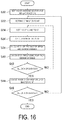
- FIGS. 7A to 7D and FIGS. 8A to 8F Examples of the results obtained through the data analysis method and the display method of the present embodiment are illustrated in FIGS. 7A to 7D and FIGS. 8A to 8F .
- FIG. 7A is a self-organizing map of the characteristic value F1 on which the first indicator is drawn; and FIG. 7B is a self-organizing map of the characteristic value F2 on which the first indicator is drawn.
- FIG. 7C is a self-organizing map of the first indicator on which the first indicator is drawn; and
- FIG. 7D is a self-organizing map of the second indicator on which the first indicator is drawn.
- FIG. 8A is a self-organizing map of the design variable x1 on which the first indicator is drawn; FIG.
- FIG. 8B is a self-organizing map of the design variable x2 on which the first indicator is drawn;
- FIG. 8C is a self-organizing map of the design variable x3 on which the first indicator is drawn;
- FIG. 8D is a self-organizing map of the design variable x4 on which the first indicator is drawn;
- FIG. 8E is a self-organizing map of the design variable x5 on which the first indicator is drawn; and
- FIG. 8F is a self-organizing map of the design variable x6 on which the first indicator is drawn.
- the design variable x1 has little effect on the characteristic values F1 and F2 as the characteristic values F1 and F2 do not change when the design variable x1 is changed. Thus, it is understood that the design variable x1 is not an important parameter for the characteristic values F1 and F2. Thus, by displaying the first indicator on the self-organizing maps of the design variables x1 to x6, causality between the characteristic values and the design variables can easily be understood and even inexperienced analysts can easily understand which factors are important among the design variables.
- the second indicator B can also be displayed on the self-organizing maps in the same manner as the first indicator A (see FIGS. 10A to 10J ).
- the analysis results obtained by the analysis unit 20 are displayed on the self-organizing maps, but the use of the analysis results obtained by the analysis unit 20 is not limited thereto, and the position information of the regions corresponding to the threshold value may be output from the device.
- analysts can view the self-organizing maps, on which the first indicator or the second indicator is displayed, using a device other than the data processing device 10, for example.
- the first indicator is displayed on the self-organizing maps of the characteristic values F1 and F2 and the design variables x1, x5, and x6 (see FIGS. 9A to 9E ), but the display method thereof is not particularly limited to a specific display method.
- the first indicator may be represented by a line 60 with arrows at the ends thereof.
- the line 60 is obtained in the analysis unit 20 by connecting the regions corresponding to the threshold value.
- the method by which the line 60 is obtained is not particularly limited to a specific method, and a configuration is possible in which a regression line is calculated from the regions corresponding to the threshold value using regression analysis, and arrows are affixed at both ends of the regression line.
- the arrows of the line 60 indicate the directions in which both of the characteristic values F1 and F2 are achieved in a compatible manner.
- FIGS. 10A and 10B are self-organizing maps of characteristic values on which the second indicator is drawn;
- FIGS. 10C to 10E are self-organizing maps of design variables on which the second indicator is drawn;
- FIGS. 10F and 10G are self-organizing maps of characteristic values on which the second indicator is drawn in an arrow shape;
- FIGS. 10H to 10J are self-organizing maps of design variables on which the second indicator is drawn in an arrow shape.
- the second indicator is displayed on the self-organizing maps of the characteristic values F1 and F2 and the design variables x1, x5, and x6 ( FIGS. 10A to 10E ).
- the second indicator may be displayed as a line 62 representing the second indicator, having an arrow affixed to an end thereof.
- the line 62 may be obtained in the analysis unit 20 by connecting the regions corresponding to the threshold value to make a line, and affixing an arrow to an end of the line.
- the method for obtaining the line 62 is not particularly limited to a specific method and the line 62 may be obtained using regression analysis in the same manner as the line 60 described above.
- the arrow of the line 62 is affixed to the end of the line 62 for which the first indicator A is decreasing.
- the distance to the Pareto solution shortens as the first indicator A decreases and, as such, the arrow of the line 62 indicates the direction in which both of the characteristic values F1 and F2 are achieved in a compatible manner.
- the second indicator by displaying the regions corresponding to the threshold value as the line 62 instead of as points, it is even easier to understand the causality between the characteristic values and the design variables.
- the direction in which the values are smaller is found in the self-organizing map of the first indicator A corresponding to the second indicator B. Specifically, in the self-organizing map of the first indicator A illustrated in FIG. 7C , an edge point N 1 and an edge point N 2 are found, and the value of the cell of the edge point N 1 and the value of the cell of the edge point N 2 are compared. Of the edge point N 1 and the edge point N 2 , the edge point with the smaller value of the cell is determined.
- the arrow is affixed to the line 62 of the self-organizing map of the design variable, on the side of the line 62 corresponding to the edge point with the smaller value of the edge points of the first indicator A.
- the arrow can be affixed to the line 62. Note that, by calculating these matters in the analysis unit 20, the finding of the edge points of the first indicator A corresponding to the second indicator B, and the affixing of the arrow to the side of the line 62 corresponding to the edge point where the value of the cell, of the cells at the edge points, is smaller can be automated.
- the design variable x1 is a parameter that does not contribute to the changing of the characteristic values F1 and F2. Additionally, as illustrated in FIGS. 10D and 10I , the value of the design variable x5 is also substantially unchanged along the marks. From this, it can be understood that the design variable x5 affects the characteristic values F1 and F2 differently with the first indicator A and the second indicator B.
- FIG. 11A is a schematic drawing illustrating an example of a self-organizing map before clustering processing
- FIG. 11B is a schematic drawing illustrating an example of a self-organizing map after clustering processing
- FIG. 11C is a schematic drawing illustrating an example of a self-organizing map not subjected to clustering processing.
- the self-organizing map 70 of FIG. 11A a case is illustrated in which there are two regions corresponding to the threshold value of the first indicator, namely a first region 72 and a second region 74.
- the analysis unit 20 performs the clustering processing and performs regression analysis and, thus, obtains the line 76 illustrated in FIG. 11B .
- the line 78 illustrated in FIG. 11C is obtained.
- Various clustering techniques can be used in the clustering processing. Examples thereof include single linkage methods, complete linkage methods, k-means methods, and the like.
- FIG. 12A illustrates an example of the clustering processing of a self-organizing map.
- FIG. 12B illustrates another example of the clustering processing of a self-organizing map.
- the first region 72 and the second region 74 exist in the self-organizing map 70 illustrated in FIG. 11A and, as such, results such as those illustrated in FIG. 11B are obtained depending on the clustering processing.
- K/5 where K is the width of the self-organizing map 70, is set as the threshold value.
- the region is considered to be a different cluster.
- the self-organizing map 70 illustrated in FIG. 11A as illustrated in FIG.
- the first region 72 and the second region 74 are distinguished as different clusters.
- regression analysis is performed for the first region 72 that has more regions and the line is generated.
- the line 76 illustrated in FIG. 11B can be obtained.
- the first region 72 and the second region 74 will be determined to belong to the same cluster and, thus, the clustering processing results illustrated in FIG. 12B will be obtained.
- the regression analysis will yield the line 78 illustrated in FIG. 11C , for example.
- FIG. 13 is a schematic drawing illustrating another example of a data processing device used in the data analysis method and the data display method according to an embodiment of the present invention.
- a data processing device 10a illustrated in FIG. 13 has the same configuration as the data processing device 10 illustrated in FIG. 1 . As such, detailed description of the data processing device 10a is omitted.
- the data processing unit 30 is connected to the analysis unit 20 in the data processing device 10a illustrated in FIG. 13 . Additionally, the memory 24 and the control unit 26 are connected to the data processing unit 30, and the data processing unit 30 is controlled by the control unit 26.
- the data processing unit 30 includes a condition setting unit 32, a model generating unit 34, a calculating unit 36, a Pareto solution searching unit 38, and a data generating unit 40.
- the data processing unit 30 generates a data set having a plurality of groups of two types of data, namely input data representing input values and output data representing output values. Note that, a configuration is possible in which the data set is directly input into the analysis unit 20 via the input unit 14, without being generated by the data processing unit 30, as described above. Additionally, a configuration is possible in which the data set is stored in the memory 24 via the input unit 14. In both of these cases, processing is carried out without the data processing unit 30 generating the data set. As such, it is not absolutely required that the data processing unit 30 generate the data set.
- each unit of the data processing unit 30 Various types of conditions and information necessary for displaying the Pareto solution as a scatter diagram or as a self-organizing map in characteristic value space (objective function space) are input and set in the condition setting unit 32.
- the various types of conditions and information are input via the input unit 14.
- the various types of conditions and information set in the condition setting unit 32 are stored in the memory 24.
- the data of the data set is set in the condition setting unit 32.
- a plurality of parameters defined as design variables among parameters defining the structure and the materials constituting the structure is set in the condition setting unit 32.
- variable factors such as load, and boundary conditions may be set as the design variables.
- a plurality of parameters defined as characteristic values (objective functions) among parameters defining the structure and the materials constituting the structure is set as the data of the data set.
- indicator for evaluating the structure and the materials constituting the structure such as cost may be used as the characteristic values.
- the "structure and the materials constituting the structure” do not refer to the structure alone, but rather to the entirety of the system that includes the structure or part of the system. Examples thereof include the parts constituting the structure, the assembly form of the structure, and the like.
- the characteristic values set in the condition setting unit 32 are physical quantities that are to be evaluated.
- the objective functions are functions for finding the physical quantities that are to be evaluated.
- the characteristic values are the characteristic values of a tire.
- the characteristic values are physical quantities that are to be evaluated as tire performance factors, and examples thereof include cornering power (CP), which is the lateral force at a slip angle of 1 degree, and which is an indicator of steering stability; cornering characteristics, which are an indicator of steering stability; the primary natural frequency of the tire, which is an indicator of ride comfort; rolling resistance, which is an indicator of rolling resistance; the lateral spring constant, which is an indicator of steering stability; wear energy of the tire tread member, which is an indicator of wear resistance; and the like.
- the objective functions are functions for finding these characteristic values.
- the objective functions have preferable directions as performance factors. Examples thereof include a direction in which the value increases, a direction in which the value decreases, a direction in which the value approaches a predetermined value, and the like.
- the design variables define the shape of the structure, the internal structure and the material characteristics of the structure, and the like.
- the design variables are a plurality of parameters among the material behavior of the tire, the shape of the tire, the cross-sectional shape of the tire, and the structure of the tire.
- the design variables include the curvature radius, which defines the crown shape in the tread portion of the tire; the belt width dimension of the tire, which defines the tire internal structure; and the like.
- Other examples include the filler dispersion shape, the filler volume fraction, and the like, which define the material characteristics of the tread portion.
- Constraint conditions are conditions for constraining the values of the objective functions to a predetermined range and constraining the values of the design variables to a predetermined range.
- information of vehicle specifications and the like is set for use in a vehicle traveling simulation.
- this information include traveling conditions such as the applied load of the tire and the rolling speed of the tire; conditions of the road surface on which the tire travels such as the uneven form and the coefficient of friction; and the like.
- Information for defining a nonlinear response relationship between the parameters of the design variables and the characteristic values is set in the condition setting unit 32.
- Numerical simulations such as FEM, theoretical equations, and approximation equations are included in the nonlinear response relationship.
- Models generated by a nonlinear response relationship, boundary conditions of those models, and simulation conditions and constraint conditions for the simulation when numerical simulations such as FEM are performed are set in the condition setting unit 32.
- optimization conditions are set for obtaining a Pareto solution. Examples of such conditions include conditions for Pareto solution searching and the like.
- the conditions for Pareto solution searching consist of the method for searching for the Pareto solution and various conditions in the Pareto solution searching.
- a genetic algorithm can be used as the method for searching for the Pareto solution. It is generally known that the search capability of genetic algorithms decreases as the number of objective functions increases. One method to solve this problem is increasing the number of individuals. On the other hand, if the number of individuals is increased and a Pareto solution search is performed, many Pareto solutions will be found. Accordingly, providing a method whereby the causality between a large amount of characteristic value data and design parameters is displayed in an easily recognizable manner is a problem, but the present invention solves this problem.
- a domain of the design variables is set in the condition setting unit 32.
- a discrete value used when contracting the Pareto solution (described later) is set in the condition setting unit 32.
- the model generating unit 34 generates various types of calculation models on the basis of the defined nonlinear response relationship.
- the nonlinear response relationship includes numerical simulations such as FEM as described above and, in this case, a mesh model based on the design parameters that represent the design variables and the characteristic value parameters that represent the characteristic values is generated in the model generating unit 34. Additionally, in cases where a theoretical equation or an approximation equation are used, a theoretical equation or an approximation equation based on the design parameters and the characteristic value parameters is generated. Note that when the structure is a tire, a tire model is generated. A simulation operation is performed in the calculating unit 36 using the tire model.
- the tire model generated in the model generating unit 34 is generated using the various types of design parameters set in the condition setting unit 32, a conventionally known generation method may be used to generate the tire model.
- a road surface model which constitutes the object on which the tire model rolls, is generated together with the tire model.
- a model in which the rim, wheel, and tire rotation axis on which the tire is mounted is reproduced may be used as the tire model.
- a model reproducing a vehicle on which the tire is mounted may be incorporated into the tire model.
- an integrated model including a tire model, a rim model, a wheel model, and a tire rotation axis model can be generated on the basis of preset boundary conditions.
- Each of these models is preferably a discrete model that can be numerically calculated.
- Examples thereof include finite element models and the like used in conventional finite element methods (FEM).
- FEM finite element methods
- the tire model when a tire design plan is found whereby, for example, tire wet performance and other tire performance factors are optimized, a model reproducing interposed objects present on the road surface may be generated in addition to the road surface model and the tire model.
- Examples of such an interposed object model include various models in which water, snow, mud, sand, gravel, ice, or the like on the road surface is reproduced, and this model is preferably generated as a discrete model that can be numerically calculated.
- the road surface model is not limited to models that reproduce flat road surfaces and, as necessary, models that reproduce road surface shapes that include surface irregularities may be generated.
- the calculating unit 36 calculates the characteristic values using the various models generated in the model generating unit 34. Thus, characteristic values for the desing variables are obtained. A Pareto solution exists in the characteristic values. The obtained characteristic values are stored in the memory 24. For example, the calculating unit 36 finds the behavior of the tire model, the forces acting on the tire model, or other physical quantities in chronological order when simulation conditions for reproducing the rolling motion of a tire rolling on a road surface are applied to the tire model, the road surface model, or the like generated in the model generating unit 34. The calculating unit 36 functions by, for example, executing a subroutine of a conventional finite element solver. Additionally, the calculating unit 36 solves theoretical equations, approximation equations, or the like and calculates the characteristic values when theoretical equations, approximation equations, or the like are generated in the model generating unit 34.
- the Pareto solution searching unit 38 searches for a Pareto solution from among the characteristic values obtained by the calculating unit 36 and calculates a Pareto solution depending on the Pareto solution search conditions set in the condition setting unit 32.
- the obtained Pareto solution is stored in the memory 24.
- Pareto solution means that, while a solution cannot be said to be superior to any other solution, no better solutions exist in a plurality of objective functions with trade-off relationships.
- a plurality of Pareto solutions exists as a set.
- the Pareto solution searching unit 38 searches for the Pareto solution using a genetic algorithm, for example.
- a conventional method in which the solution set is divided into a plurality of regions along the objective functions, and a multi-purpose GA is applied to each divided solution set can be used as the genetic algorithm.
- Examples thereof include Divided Range Multi-Objective GA (DRMOGA), Neighborhood Cultivation GA (NCGA), Distributed Cooperation model of MOGA and SOGA (DCMOGA), Non-dominated Sorting GA (NSGA), Non-dominated Sorting GA-II (NSGA2), Strength Pareto Evolutionary Algorithm-II (SPEAII), and the like.
- DRMOGA Divided Range Multi-Objective GA
- NCGA Neighborhood Cultivation GA
- DCMOGA Distributed Cooperation model of MOGA and SOGA
- NSGA Non-dominated Sorting GA
- NSGA2 Non-dominated Sorting GA-II
- SPEAII Strength Pareto Evolutionary Algorithm-II
- the solution set is required to be widely distributed in the solution space and a set of highly accurate Pareto solutions is required to be found.
- selection is performed in the Pareto solution searching unit 38 using, for example, a vector evaluated genetic algorithm (VEGA), a Pareto ranking method, or a tournament method.
- VEGA
- the nonlinear response relationship defined between the design variables (input values) and the characteristic values (output values), that is, the relationship used when the characteristic values are found using the design variables, is not limited to FEM and similar simulations, and theoretical equations and approximation equations such as those described above may be used.
- the values of the objective functions may be calculated using a simulation approximation equation.
- the Pareto solution can be obtained from experimental results obtained on the basis of a design of experiments using an approximation equation between the design variables and the objective functions, an example thereof being a simulation approximation equation.
- Conventional nonlinear functions obtained via a polynomial equation, or neural network can be used as this simulation approximation equation.
- the data generating unit 40 reads, from the memory 24, this objective function data and the Pareto solution obtained in the Pareto solution searching unit 38 and stored in the memory 24, and generates a data set consisting of groups of two types of data, namely data representing the design variables and data representing the characteristic values.
- the data set generated in the data generating unit 40 is stored in the memory 24.
- FIG. 14 is a flowchart illustrating an example of the data analysis method of the embodiment of the present invention, in order of steps.
- the design variables and the characteristic values for the target structure are set.
- the structure is a tire, for example.
- the shape parameter of the tire is set as the design variable for the tire.
- two characteristic values, namely rolling resistance and lateral spring constant are set.
- the shape parameter of the tire is the input and the rolling resistance and the lateral spring constant are the output.
- the manner in which the rolling resistance and the lateral spring constant change in response to the shape parameter of the tire is displayed.
- the shape parameter of the tire, the rolling resistance, and the lateral spring constant are set in the condition setting unit 32.
- the nonlinear response used when the characteristic values are found from the design variable is set (step S20). That is, the relationship between the design variable and the characteristic values is set.
- the type of nonlinear response is stored in the memory 24, for example.
- the relationship between the shape parameter of the tire and the rolling resistance and lateral spring constant is set.
- the set relationship is expressed using a nonlinear function such as a quadratic polynomial in which the shape parameter of the tire is a variable of the rolling resistance.
- the set relationship is expressed using a nonlinear function such as a quadratic polynomial in which the shape parameter of the tire is a variable of the lateral spring constant.
- the domain of the design variable is set (step S22).
- an upper limit value and a lower limit value are set for the parameter of the design variable.
- the value between the lower limit value and the upper limit value is continuous.
- an upper limit and a lower limit of size is set as the domain of the design variables, and the value between the lower limit value and the upper limit value is continuous.
- an upper limit and a lower limit of the elastic modulus is set as the domain of the design variable.
- the setting of the domain of the design variable is performed in the condition setting unit 32 and the set domain of the design is stored in the memory 24, for example.
- an upper limit value and a lower limit value are set for the shape parameter of the tire.
- model generation is performed in the model generating unit 34 on the basis of the nonlinear response relationship, and the characteristic values are calculated in the calculating unit 36 on the basis of the nonlinear response relationship set in step S20 (step S24).
- the set domain of the design variable is read from the memory 24 and the characteristic values are calculated.
- the results of calculating the characteristic values are stored in the memory 24, for example.
- a mesh model is generated in the model generating unit 34, and response to the input is simulated in the calculating unit 36 using FEM or the like. Specifically, the rolling resistance and lateral spring constant for the shape parameter of the tire is calculated.
- the results of calculating the characteristic values are subjected to optimization in the Pareto solution searching unit 38, in which the characteristic values are used as objective functions, and the Pareto solution is obtained (step S26).
- a genetic algorithm for example, is used to calculate this Pareto solution.
- the obtained Pareto solution is stored in the memory 24.
- the Pareto solution is calculated in the data processing device 10a and, then, the data set is generated in the data generating unit 40.
- Various types of data processing are performed in the analysis unit 20 using the generated data set. Thereafter, as necessary, self-organizing maps can be displayed on the display unit 16 by the display control unit 22 as described above.
- the data processing device 10a can display the regions based on the first indicator and the second indicator on self-organizing maps in the same manner as the data processing device 10 described above. As such, detailed description thereof is omitted. In this case as well, it is easier for inexperienced analysts to visually understand the causality between the input values and the output values, and to understand which design variables (input values) are important. Moreover, information that facilitates understanding can be obtained.
- FIG. 15 is a schematic drawing illustrating another example of a data processing device used in the data analysis method and the data display method according to an embodiment of the present invention.
- a data processing device 10b illustrated in FIG. 15 has the same configuration as the data processing device 10 illustrated in FIG. 1 . As such, detailed description of the data processing device 10b is omitted.
- the moving average processing unit 28 is connected to the analysis unit 20 in the data processing device 10b illustrated in FIG. 15 . Additionally, the memory 24 and the control unit 26 are connected to the moving average processing unit 28, and the moving average processing unit 28 is controlled by the control unit 26. Next, a description of the moving average processing method in the moving average processing unit 28 is given while referencing FIGS. 16 to 19 .
- FIG. 16 is a flowchart illustrating the moving average processing of the data analysis method of the embodiment of the present invention, in order of steps.
- the average section is a setting region for finding an average value of master points (described later) when the moving average processing is performed.
- the average region is appropriately set in accordance with the types of data of the input data (e.g. the number of input parameters) and the types of data of the output data (e.g. the number of output parameters) of the data set, and the shape and the like thereof are not particularly limited to a specific shape.
- the average space is, for example, a polygon such as a rectangle, a circle, or other two-dimensional shape.
- the average space is, for example, a polygonal prism such as a rectangular prism, a sphere, or other three-dimensional shape.
- the average space is, for example, a hypercube, a hypersphere, or the like.
- the size of the average section is not particularly limited to a specific size.
- the output value space may be normalized when the average section is set. That is, the characteristic value space (described later) may be normalized.
- Function w(r) of Equation (1) below can be used as the weight function of the average section.
- the function w(r) of Equation (1) is as shown in FIG. 17 .
- r 0 represents the size of the average section and r represents a distance between a master point and a slave point.
- ro is the radius of the circle
- ro is the radius of the hypersphere.
- the size of the average section is such that the distance r between the master point and the slave point is 1.0.
- the weight function is not limited to the function of Equation (1) above and, for example may be a constant value in the average section such as that represented by reference sign C in FIG. 17 .
- the value of the constant value is not particularly limited to a specific value, but is 1.0 in the example illustrated in FIG. 17 .
- at least one of the average section and the weight function may be changed depending on the density of the data in output value space.
- the master point is set from the input data constituted by the design variable (step S32).
- a slave point is set from the input data constituted by the design variable (step S34).
- the master point M is set from among the existing input data within the average section P.
- the points in the characteristic value space Q other than the master point M become slave points s.
- Data of the master point M is master data and data of the slave points s is slave data. As illustrated in FIG.
- a grid g may be set in the characteristic value space Q, and a point of intersection n on the grid g may be set as the master point M.
- the master point M need not correspond to existing input data.
- the size of the grid g is not particularly limited to a specific size, and can be appropriately set in accordance with the data number or the like.
- a distance r between the master point and the slave point in the characteristic value space Q is calculated (step S36).
- a conventional method for calculating the distance between two coordinates can be used to calculate the distance r.
- a weight value (W v ) is calculated using the weight function and this weight value (w v ) is stored in the memory 24, for example.
- a product value (W vX ) of the input data value and the weight value is calculated by multiplying the weight value (w v ) by each input data value of the input values (e.g. the design variable value (x)).
- the obtained product value (w v x) of the input data value and the weight value is stored in the memory 24, for example (step S38).
- the product value (w v x) of the input data value and the weight value is calculated for each input data. That is, the product value (w v x) of the design variable value (x) and the weight value is calculated for each design variable.
- a sum (W vtot ) of the weight values (w v ) and a sum (W v X tot ) of the product values (w v x) of the input data values and the weight value stored in step S38 are calculated for each input data (step S40).
- the sum (W vtot ) of the weight values (w v ) and the sum (W v X tot ) of the product values (w v x) of the input data values and the weight values at one master point M is obtained for each design variable.
- step S42 it is determined whether or not all of the groups of the data set, with the exception of the data of the data set used as the master point, have been subjected to calculation processing as slave points.
- the calculation processing of step S42 can be determined by, for example, comparing the data number of data set with the number of calculated slave data.
- step S42 in cases where the data of the data set, with the exception of the data used as the master point, is subjected to calculation processing as slave points, a value is obtained for each input data by dividing the sum (W v X tot ) of the product values (w v x) of the input data values and the weight values by the sum (W vtot ) of the weight values (W v ), that is, a value is obtained from W v X tot /W vtot .
- This value is set as the average value of the input data of the master point M for each input data, for example, the average value of the design variable of the master point M for each design variable, and is stored in the memory 24, for example (step S44).
- step S44 the average values of the design variables, centered on the master point M, can be obtained for each design variable in the average section P illustrated in FIGS. 18 and 19 .
- step S34 setting of the slave point
- step S40 calculation of the product of the weight and the design variable
- step S46 it is determined whether or not all of the groups of the data set have been subjected to calculation processing as master points M (step S46).
- the moving average processing is ended in cases where all of the groups of the data set have been subjected to calculation processing as the master point M in step S46.
- the calculation processing of step S42 can be determined by, for example, comparing the data number of data set with the number of calculated master points M. Note that in cases where the master point M is set as a point of intersection n of the grid g, the calculation processing of step S42 can be determined by, for example, comparing the number of intersections n with the number of calculated master points M.
- step S32 setting of the master point
- step S44 calculation of the average value of the master points
- variation and noise in the input data can be eliminated by performing the moving average processing of the input data in output value space. Thereafter, various types of data processing are performed in the analysis unit 20. Thereafter, as necessary, self-organizing maps can be displayed on the display unit 16 by the display control unit 22 as described above. Other than the point of performing the moving average processing on the data set, the data processing device 10b can display the regions based on the first indicator and the second indicator on self-organizing maps in the same manner as the data processing device 10 described above. As such, detailed description thereof is omitted. As described above, by performing the moving average processing, it is easier to find causality between the output values and the input data when the regions corresponding to the threshold value are displayed on self-organizing maps. In this case as well, it is easier for inexperienced analysts to visually understand the causality between the input values and the output values, and to understand which design variables (input values) are important. Moreover, information that facilitates understanding can be obtained.
- a data set prepared in advance is subjected to the moving average processing in the moving average processing unit 28, but the subject of the processing is not limited thereto.
- a configuration is possible in which a data processing unit 30 is provided, a Pareto solution is calculated in the data processing unit 30, and a data set including the calculated Pareto solution is subjected to the moving average processing in the moving average processing unit 28.
- the data processing unit 30 has the same configuration as the data processing device 10a of FIG. 13 and, as such, detailed description thereof is omitted.
- the data processing device 10c can display the regions based on the first indicator or the second indicator on self-organizing maps in the same manner as the data processing device 10. As such, detailed description thereof is omitted. In this case as well, it is easier for inexperienced analysts to visually understand the causality between the input values and the output values, and to understand which design variables (input values) are important. Moreover, information that facilitates understanding can be obtained.
Landscapes
- Engineering & Computer Science (AREA)
- Theoretical Computer Science (AREA)
- Physics & Mathematics (AREA)
- General Engineering & Computer Science (AREA)
- General Physics & Mathematics (AREA)
- Evolutionary Computation (AREA)
- Computer Hardware Design (AREA)
- Geometry (AREA)
- Software Systems (AREA)
- Mathematical Physics (AREA)
- Computing Systems (AREA)
- Biophysics (AREA)
- Life Sciences & Earth Sciences (AREA)
- Artificial Intelligence (AREA)
- Biomedical Technology (AREA)
- Health & Medical Sciences (AREA)
- Computational Linguistics (AREA)
- Data Mining & Analysis (AREA)
- General Health & Medical Sciences (AREA)
- Molecular Biology (AREA)
- Information Retrieval, Db Structures And Fs Structures Therefor (AREA)
- User Interface Of Digital Computer (AREA)
Applications Claiming Priority (2)
| Application Number | Priority Date | Filing Date | Title |
|---|---|---|---|
| JP2014234923A JP6561455B2 (ja) | 2014-11-19 | 2014-11-19 | データの分析方法およびデータの表示方法 |
| PCT/JP2015/082262 WO2016080394A1 (fr) | 2014-11-19 | 2015-11-17 | Procédé d'analyse de données et procédé d'affichage de données |
Publications (2)
| Publication Number | Publication Date |
|---|---|
| EP3208752A1 true EP3208752A1 (fr) | 2017-08-23 |
| EP3208752A4 EP3208752A4 (fr) | 2018-06-13 |
Family
ID=56013929
Family Applications (1)
| Application Number | Title | Priority Date | Filing Date |
|---|---|---|---|
| EP15861504.7A Withdrawn EP3208752A4 (fr) | 2014-11-19 | 2015-11-17 | Procédé d'analyse de données et procédé d'affichage de données |
Country Status (4)
| Country | Link |
|---|---|
| US (1) | US20170255721A1 (fr) |
| EP (1) | EP3208752A4 (fr) |
| JP (1) | JP6561455B2 (fr) |
| WO (1) | WO2016080394A1 (fr) |
Families Citing this family (19)
| Publication number | Priority date | Publication date | Assignee | Title |
|---|---|---|---|---|
| JP6589285B2 (ja) * | 2015-02-12 | 2019-10-16 | 横浜ゴム株式会社 | データの分析方法およびデータの表示方法 |
| US10449090B2 (en) | 2015-07-31 | 2019-10-22 | Allotex, Inc. | Corneal implant systems and methods |
| US11328106B2 (en) | 2018-04-22 | 2022-05-10 | Sas Institute Inc. | Data set generation for performance evaluation |
| US10878345B2 (en) * | 2018-04-22 | 2020-12-29 | Sas Institute Inc. | Tool for hyperparameter tuning |
| US11561690B2 (en) | 2018-04-22 | 2023-01-24 | Jmp Statistical Discovery Llc | Interactive graphical user interface for customizable combinatorial test construction |
| US11074483B2 (en) | 2018-04-22 | 2021-07-27 | Sas Institute Inc. | Tool for hyperparameter validation |
| US10503846B2 (en) * | 2018-04-22 | 2019-12-10 | Sas Institute Inc. | Constructing flexible space-filling designs for computer experiments |
| JP7215017B2 (ja) * | 2018-08-23 | 2023-01-31 | 横浜ゴム株式会社 | ゴム材料設計方法、ゴム材料設計装置、及びプログラム |
| JP7180520B2 (ja) * | 2019-04-17 | 2022-11-30 | 富士通株式会社 | 更新プログラム、更新方法および情報処理装置 |
| EP3990269B1 (fr) | 2019-07-12 | 2024-08-28 | Bridgestone Americas Tire Operations, LLC | Apprentissage automatique pour l'amélioration d'épissures |
| CN110502844B (zh) * | 2019-08-27 | 2023-04-07 | 中车株洲电力机车有限公司 | 一种轨道交通车辆噪声数字样机的优化设计方法 |
| JP6725928B1 (ja) * | 2020-02-13 | 2020-07-22 | 東洋インキScホールディングス株式会社 | 回帰モデル作成方法、回帰モデル作成装置、及び、回帰モデル作成プログラム |
| JP2022067566A (ja) * | 2020-10-20 | 2022-05-06 | 株式会社日立製作所 | 設計支援装置および設計支援方法 |
| CN117121009A (zh) * | 2021-03-18 | 2023-11-24 | 日本电气株式会社 | 推荐数据生成设备、控制方法和非暂时性计算机可读介质 |
| EP4310715A4 (fr) * | 2021-03-18 | 2025-03-19 | NEC Corporation | Dispositif de génération d'image de carte de propriétés physiques, procédé de commande et support non transitoire lisible par ordinateur |
| EP4310718A4 (fr) * | 2021-03-18 | 2025-03-19 | NEC Corporation | Dispositif de détection de matériau unique, procédé de commande et support non transitoire lisible par ordinateur |
| JP7815857B2 (ja) * | 2022-02-28 | 2026-02-18 | 富士電機株式会社 | 可視化装置、可視化方法及びプログラム |
| EP4506848A4 (fr) * | 2022-04-08 | 2025-09-10 | Nec Corp | Dispositif de génération de données de recommandation, procédé de génération de données de recommandation et support lisible par ordinateur non transitoire |
| WO2024147183A1 (fr) * | 2023-01-05 | 2024-07-11 | 富士通株式会社 | Programme de calcul, procédé de calcul et dispositif de traitement d'informations |
Family Cites Families (4)
| Publication number | Priority date | Publication date | Assignee | Title |
|---|---|---|---|---|
| JP4339808B2 (ja) * | 2005-03-31 | 2009-10-07 | 横浜ゴム株式会社 | 構造体の設計方法 |
| JP4888227B2 (ja) * | 2007-05-25 | 2012-02-29 | 横浜ゴム株式会社 | データ解析プログラム、データ解析装置、構造体の設計プログラム、および構造体の設計装置 |
| US9104963B2 (en) * | 2012-08-29 | 2015-08-11 | International Business Machines Corporation | Self organizing maps for visualizing an objective space |
| JP6248402B2 (ja) * | 2013-03-19 | 2017-12-20 | 横浜ゴム株式会社 | データの表示方法 |
-
2014
- 2014-11-19 JP JP2014234923A patent/JP6561455B2/ja active Active
-
2015
- 2015-11-17 WO PCT/JP2015/082262 patent/WO2016080394A1/fr not_active Ceased
- 2015-11-17 EP EP15861504.7A patent/EP3208752A4/fr not_active Withdrawn
- 2015-11-17 US US15/528,481 patent/US20170255721A1/en not_active Abandoned
Also Published As
| Publication number | Publication date |
|---|---|
| EP3208752A4 (fr) | 2018-06-13 |
| JP2016099737A (ja) | 2016-05-30 |
| US20170255721A1 (en) | 2017-09-07 |
| JP6561455B2 (ja) | 2019-08-21 |
| WO2016080394A1 (fr) | 2016-05-26 |
Similar Documents
| Publication | Publication Date | Title |
|---|---|---|
| US20170255721A1 (en) | Data Analysis Method and Data Display Method | |
| JP4888227B2 (ja) | データ解析プログラム、データ解析装置、構造体の設計プログラム、および構造体の設計装置 | |
| JP6589285B2 (ja) | データの分析方法およびデータの表示方法 | |
| JP2015022320A (ja) | データ処理方法および構造体の設計方法 | |
| JP5018116B2 (ja) | タイヤの設計方法およびタイヤの設計装置 | |
| JP5160146B2 (ja) | タイヤの設計方法 | |
| JP5160147B2 (ja) | タイヤの設計方法 | |
| JP4339808B2 (ja) | 構造体の設計方法 | |
| JP6586820B2 (ja) | タイヤの金型形状設計方法、タイヤの金型形状設計装置、およびプログラム | |
| JP7006174B2 (ja) | シミュレーション方法、その装置およびプログラム | |
| JP2020067964A (ja) | タイヤの金型形状設計方法、タイヤの金型形状設計装置、およびプログラム | |
| JP7328527B2 (ja) | タイヤモデル作成方法、タイヤ形状最適化方法、タイヤモデル作成装置、タイヤ形状最適化装置、およびプログラム | |
| US8086428B2 (en) | Tire design method | |
| JP2001287516A (ja) | タイヤの設計方法、タイヤ用加硫金型の設計方法、タイヤ用加硫金型の製造方法、タイヤの製造方法、タイヤの最適化解析装置及びタイヤの最適化解析プログラムを記録した記憶媒体 | |
| JP6676928B2 (ja) | タイヤモデル作成方法、タイヤ形状最適化方法、タイヤモデル作成装置、タイヤ形状最適化装置、およびプログラム | |
| Golanbari et al. | Machine learning applications in off-road vehicles interaction with terrain: An overview | |
| JP6349723B2 (ja) | シミュレーション方法、その装置およびプログラム | |
| JP2012045975A (ja) | タイヤモデル作成方法、及び、それを用いたタイヤ設計方法 | |
| JP5236301B2 (ja) | タイヤの設計方法 | |
| JP6248402B2 (ja) | データの表示方法 | |
| JP6565285B2 (ja) | 構造体の近似モデル作成方法、構造体の近似モデル作成装置、およびプログラム | |
| JP6544006B2 (ja) | 構造体の近似モデル作成方法、構造体の近似モデル作成装置、およびプログラム | |
| CN120724507B (zh) | 一种矿用宽体车轮胎冠部胎体轮廓设计方法和系统 | |
| JP2020201736A (ja) | タイヤの初期形状設計方法、タイヤの初期形状設計装置、およびプログラム | |
| JP7070076B2 (ja) | タイヤの使用条件頻度分布取得方法及び装置 |
Legal Events
| Date | Code | Title | Description |
|---|---|---|---|
| STAA | Information on the status of an ep patent application or granted ep patent |
Free format text: STATUS: THE INTERNATIONAL PUBLICATION HAS BEEN MADE |
|
| PUAI | Public reference made under article 153(3) epc to a published international application that has entered the european phase |
Free format text: ORIGINAL CODE: 0009012 |
|
| STAA | Information on the status of an ep patent application or granted ep patent |
Free format text: STATUS: REQUEST FOR EXAMINATION WAS MADE |
|
| 17P | Request for examination filed |
Effective date: 20170519 |
|
| AK | Designated contracting states |
Kind code of ref document: A1 Designated state(s): AL AT BE BG CH CY CZ DE DK EE ES FI FR GB GR HR HU IE IS IT LI LT LU LV MC MK MT NL NO PL PT RO RS SE SI SK SM TR |
|
| AX | Request for extension of the european patent |
Extension state: BA ME |
|
| DAV | Request for validation of the european patent (deleted) | ||
| DAX | Request for extension of the european patent (deleted) | ||
| RIC1 | Information provided on ipc code assigned before grant |
Ipc: G06N 3/08 20060101ALI20180503BHEP Ipc: G06F 17/50 20060101ALI20180503BHEP Ipc: G06N 99/00 20100101AFI20180503BHEP |
|
| A4 | Supplementary search report drawn up and despatched |
Effective date: 20180514 |
|
| STAA | Information on the status of an ep patent application or granted ep patent |
Free format text: STATUS: EXAMINATION IS IN PROGRESS |
|
| 17Q | First examination report despatched |
Effective date: 20200716 |
|
| STAA | Information on the status of an ep patent application or granted ep patent |
Free format text: STATUS: THE APPLICATION IS DEEMED TO BE WITHDRAWN |
|
| 18D | Application deemed to be withdrawn |
Effective date: 20201127 |