EP3209767B1 - Neuartiges aufreinigungsverfahren zur isolierung und kommerziellen herstellung von rekombinanter tnk-tpa (tenecteplase) - Google Patents
Neuartiges aufreinigungsverfahren zur isolierung und kommerziellen herstellung von rekombinanter tnk-tpa (tenecteplase) Download PDFInfo
- Publication number
- EP3209767B1 EP3209767B1 EP15852227.6A EP15852227A EP3209767B1 EP 3209767 B1 EP3209767 B1 EP 3209767B1 EP 15852227 A EP15852227 A EP 15852227A EP 3209767 B1 EP3209767 B1 EP 3209767B1
- Authority
- EP
- European Patent Office
- Prior art keywords
- tpa
- range
- tnk
- chromatography
- present
- Prior art date
- Legal status (The legal status is an assumption and is not a legal conclusion. Google has not performed a legal analysis and makes no representation as to the accuracy of the status listed.)
- Active
Links
Images






Classifications
-
- C—CHEMISTRY; METALLURGY
- C12—BIOCHEMISTRY; BEER; SPIRITS; WINE; VINEGAR; MICROBIOLOGY; ENZYMOLOGY; MUTATION OR GENETIC ENGINEERING
- C12N—MICROORGANISMS OR ENZYMES; COMPOSITIONS THEREOF; PROPAGATING, PRESERVING, OR MAINTAINING MICROORGANISMS; MUTATION OR GENETIC ENGINEERING; CULTURE MEDIA
- C12N9/00—Enzymes; Proenzymes; Compositions thereof; Processes for preparing, activating, inhibiting, separating or purifying enzymes
- C12N9/14—Hydrolases (3)
- C12N9/48—Hydrolases (3) acting on peptide bonds (3.4)
- C12N9/50—Proteinases, e.g. Endopeptidases (3.4.21-3.4.25)
- C12N9/64—Proteinases, e.g. Endopeptidases (3.4.21-3.4.25) derived from animal tissue
- C12N9/6421—Proteinases, e.g. Endopeptidases (3.4.21-3.4.25) derived from animal tissue from mammals
- C12N9/6424—Serine endopeptidases (3.4.21)
- C12N9/6456—Plasminogen activators
- C12N9/6459—Plasminogen activators t-plasminogen activator (3.4.21.68), i.e. tPA
-
- A—HUMAN NECESSITIES
- A61—MEDICAL OR VETERINARY SCIENCE; HYGIENE
- A61K—PREPARATIONS FOR MEDICAL, DENTAL OR TOILETRY PURPOSES
- A61K38/00—Medicinal preparations containing peptides
- A61K38/16—Peptides having more than 20 amino acids; Gastrins; Somatostatins; Melanotropins; Derivatives thereof
- A61K38/43—Enzymes; Proenzymes; Derivatives thereof
- A61K38/46—Hydrolases (3)
- A61K38/48—Hydrolases (3) acting on peptide bonds (3.4)
- A61K38/482—Serine endopeptidases (3.4.21)
-
- A—HUMAN NECESSITIES
- A61—MEDICAL OR VETERINARY SCIENCE; HYGIENE
- A61K—PREPARATIONS FOR MEDICAL, DENTAL OR TOILETRY PURPOSES
- A61K47/00—Medicinal preparations characterised by the non-active ingredients used, e.g. carriers or inert additives; Targeting or modifying agents chemically bound to the active ingredient
- A61K47/02—Inorganic compounds
-
- A—HUMAN NECESSITIES
- A61—MEDICAL OR VETERINARY SCIENCE; HYGIENE
- A61K—PREPARATIONS FOR MEDICAL, DENTAL OR TOILETRY PURPOSES
- A61K47/00—Medicinal preparations characterised by the non-active ingredients used, e.g. carriers or inert additives; Targeting or modifying agents chemically bound to the active ingredient
- A61K47/06—Organic compounds, e.g. natural or synthetic hydrocarbons, polyolefins, mineral oil, petrolatum or ozokerite
- A61K47/16—Organic compounds, e.g. natural or synthetic hydrocarbons, polyolefins, mineral oil, petrolatum or ozokerite containing nitrogen, e.g. nitro-, nitroso-, azo-compounds, nitriles, cyanates
- A61K47/18—Amines; Amides; Ureas; Quaternary ammonium compounds; Amino acids; Oligopeptides having up to five amino acids
- A61K47/183—Amino acids, e.g. glycine, EDTA or aspartame
-
- A—HUMAN NECESSITIES
- A61—MEDICAL OR VETERINARY SCIENCE; HYGIENE
- A61K—PREPARATIONS FOR MEDICAL, DENTAL OR TOILETRY PURPOSES
- A61K47/00—Medicinal preparations characterised by the non-active ingredients used, e.g. carriers or inert additives; Targeting or modifying agents chemically bound to the active ingredient
- A61K47/06—Organic compounds, e.g. natural or synthetic hydrocarbons, polyolefins, mineral oil, petrolatum or ozokerite
- A61K47/26—Carbohydrates, e.g. sugar alcohols, amino sugars, nucleic acids, mono-, di- or oligo-saccharides; Derivatives thereof, e.g. polysorbates, sorbitan fatty acid esters or glycyrrhizin
-
- A—HUMAN NECESSITIES
- A61—MEDICAL OR VETERINARY SCIENCE; HYGIENE
- A61P—SPECIFIC THERAPEUTIC ACTIVITY OF CHEMICAL COMPOUNDS OR MEDICINAL PREPARATIONS
- A61P9/00—Drugs for disorders of the cardiovascular system
-
- A—HUMAN NECESSITIES
- A61—MEDICAL OR VETERINARY SCIENCE; HYGIENE
- A61P—SPECIFIC THERAPEUTIC ACTIVITY OF CHEMICAL COMPOUNDS OR MEDICINAL PREPARATIONS
- A61P9/00—Drugs for disorders of the cardiovascular system
- A61P9/10—Drugs for disorders of the cardiovascular system for treating ischaemic or atherosclerotic diseases, e.g. antianginal drugs, coronary vasodilators, drugs for myocardial infarction, retinopathy, cerebrovascula insufficiency, renal arteriosclerosis
-
- C—CHEMISTRY; METALLURGY
- C12—BIOCHEMISTRY; BEER; SPIRITS; WINE; VINEGAR; MICROBIOLOGY; ENZYMOLOGY; MUTATION OR GENETIC ENGINEERING
- C12N—MICROORGANISMS OR ENZYMES; COMPOSITIONS THEREOF; PROPAGATING, PRESERVING, OR MAINTAINING MICROORGANISMS; MUTATION OR GENETIC ENGINEERING; CULTURE MEDIA
- C12N9/00—Enzymes; Proenzymes; Compositions thereof; Processes for preparing, activating, inhibiting, separating or purifying enzymes
- C12N9/14—Hydrolases (3)
- C12N9/48—Hydrolases (3) acting on peptide bonds (3.4)
- C12N9/50—Proteinases, e.g. Endopeptidases (3.4.21-3.4.25)
- C12N9/64—Proteinases, e.g. Endopeptidases (3.4.21-3.4.25) derived from animal tissue
- C12N9/6402—Proteinases, e.g. Endopeptidases (3.4.21-3.4.25) derived from animal tissue from non-mammals
- C12N9/6405—Proteinases, e.g. Endopeptidases (3.4.21-3.4.25) derived from animal tissue from non-mammals not being snakes
- C12N9/6408—Serine endopeptidases (3.4.21)
-
- C—CHEMISTRY; METALLURGY
- C12—BIOCHEMISTRY; BEER; SPIRITS; WINE; VINEGAR; MICROBIOLOGY; ENZYMOLOGY; MUTATION OR GENETIC ENGINEERING
- C12Y—ENZYMES
- C12Y304/00—Hydrolases acting on peptide bonds, i.e. peptidases (3.4)
- C12Y304/21—Serine endopeptidases (3.4.21)
- C12Y304/21068—Tissue plasminogen activator (3.4.21.68), i.e. tPA
Definitions
- Present invention is related to a novel process of isolation, purification and production of tissue plasminogen activator (TNK-tPA) from mammalian cells, more specifically from Chinese Hamster Ovary (CHO) cells.
- TNK-tPA tissue plasminogen activator
- Tenecteplase is a recombinant glycoprotein of serine protease family with six amino acids substitution in the native human tissue plasminogen activator (t-PA) with 17 disulphide bridges and having molecular weight of ⁇ 67kDa.
- the modifications made in native t-PA includes substitution of threonine 103 with asparagine, substitution of asparagine 117 with glutamine both within the kringle 1 domain, and the substitution of lysine, histidine and two arginine with tetra-alanine amino acids at 296-299 positions in the protease domain to make the resulting protein highly fibrin specific with longer plasma half life and 80% decreased susceptibility to degradation by plasminogen activator inhibitor-1 (PAI-1) compared to native t-PA.
- PAI-1 plasminogen activator inhibitor-1
- TNK in TNK-TPA refers to the sites of the t-PA molecule that have been modified i.e.T103; N117; and KHRR 296-299.
- the aforementioned modifications of TNK-tPA renders its use as an improved therapeutic agent for the treatment of acute myocardial infarction which has better therapeutic compliance because the greater fibrin specificity allows for faster and complete clot lysis with decreased bleeding complications and the long life-span permits a single bolus dose with less systemic fibrinolysis and lesser bleeding complications from the previous clot buster drugs.
- TNK-tPA The mechanism of TNK-tPA is initiated on binding of TNK-tPA to the fibrin component of the thrombus (blood clot) which selectively converts inalctive plasminogen into plasmin and consequently the resultant plasmin degrades the matrix of thrombus in occluded artery while conserving fibrinogen and minimizing systemic plasminogen activation due to its highly specific nature.
- TNK-tPA The benefits of TNK-tPA seen in myocardial infarction patients and the encouraging results from animal studies in the context of Acute Ischemic Stroke (AIS), suggested that TNK-tPA might prove to be a safer and more effective therapy than alteplase, the only drug approved by USFDA for AIS.
- AIS Acute Ischemic Stroke
- TNK-tPA the only drug approved by USFDA for AIS.
- several clinical trials evaluated the use of TNK-tPA in AIS and proved that TNK-tPA has a better pharmacological profile than alteplase and also suggested that it could be an effective and safe therapeutic option in treating AIS in patients reporting within 4.5 h after symptom onset.
- TNK-tPA has been considered for the treatment of patients with pulmonary embolism and several clinical trials showed promising outcomes. A large number of clinical trials are still being conducted to assess the complete conclusive picture of TNK-tPA in several indications.
- t-PA and its variants certain purification protocols are known in prior art e.g. purification by immuno affinity (anti-tPA goat polyclonal antibody), ion exchange, ethanol precipitation, reverse phase chromatography, chromatography on silica or anion exchange, such as diethylamino ethyl, ammonium sulphate precipitation, sephadex- G-75 etc.
- immuno affinity anti-tPA goat polyclonal antibody
- ion exchange e.g. purification by immuno affinity (anti-tPA goat polyclonal antibody), ion exchange, ethanol precipitation, reverse phase chromatography, chromatography on silica or anion exchange, such as diethylamino ethyl, ammonium sulphate precipitation, sephadex- G-75 etc.
- TNK t-PA Some of the approaches for the purification of TNK t-PA is listed in prior art includes WO 2011/015922 , sets out a purification process where series of ion exchange chromatography steps, immunoaffinity chromatography and ultrafiltration/diafiltration steps are used for purification of TNK-tPA.
- WO 2012/066569 A sets out a purification process primarily drawn to the use of hydrophobic interaction chromatography.
- Indian patent applications 1807/MUM/2006 and 3516/MUM/2010 describe methods for purifying TNK-tPA . In 1807/MUM/2006 the method comprises affinity chromatography and metal chelate chromatography.
- the method of 3516/MUM/2010 comprises two affinity chromatography steps followed by anion exchange chromatography with Capto Q resin.
- Sanchez et al. Biotechnology Final Project, 2013, Universitat Aut ⁇ noma de Barcelona
- an abstract which shows a process for the purification of TNK-tPA comprising three affinity chromatography steps and one viral clearance step.
- Behrouz J Neurol. 2014;261(6): 1069-72
- tenecteplase in ischemic stroke Furthermore, alteplase and tenecteplase are compared.
- the immune affinity chromatography used in the prior art is not suitable technique for commercial manufacturing of TNK-tPA. Not only it could raise lot of regulatory concerns but the cost of immune affinity chromatography media is also very high compared to conventional chromatography matrices owing to their use of monoclonal antibodies for preparation.
- Hydrophobic interaction chromatography described in certain prior art for TNK-tPA purification uses isopropyl alcohol (IPA) in the process which is an organic solvent and known for inducing aggregation and denaturation of proteins and may be considered as one of the disadvantages of the prior art.
- IPA isopropyl alcohol
- TNK-tPA is a highly unstable molecule and hence use of IPA in the purification process should be avoided as it may lead to the denaturation of the protein.
- the large volume usage of IPA at commercial scale would require recycling of IPA which again demands additional energy consumption and extra investment such as solvent recovery unit.
- the object of the present invention is to develop an efficient, robust, scalable, and commercially viable purification process for the production of TNK-tPA resulting yield not less than 60% and purity more than 95% as measured by Size exclusion chromatography.
- the present invention solves the object as claimed in the claims.
- the present invention relates to a novel process of isolating and purifying tissue plasminogen activator and its variants more specifically TNK-tPA from CHO cells and describes an industrially applicable, simple, cost effective, robust and highly efficient process of TNK-tPA purification.
- the present invention relates to a novel process of isolating and purifying TNK-tPA.
- the cell free harvest is obtained from the cells cultured in bioreactors.
- Table A List of symbols and abbreviations tPA Tissue Plasminogen Activator CHO Chinese Hamster Ovary kDa Kilo-Dalton PAI Plasminogen Activator Inhibitor AIS Acute Ischemic Stroke SDS PAGE Sodium Dodecyl Sulfate Polyacrylamide Gel Electrophoresis IPA Isopropyl Alcohol CHT Ceramic Hydroxy Apatite FF Fast Flow mM Milli Molar MTX Methotrexate EACA Epsilon-aminocaproic acid MES- Hydrate 2-(N-Morpholino) ethanesulfonic acid hydrate TFF Tangential Flow Filtration UF Ultrafiltration DF Diafiltration PES Polyethersulphone PV
- the present invention relates to a novel process of isolating and purifying TNK-tPA from CHO cells and describes an industrially applicable, simple, cost effective, robust and highly efficient process of TNK-tPA purification.
- the cell free harvest containing TNK-tPA may be obtained from perfusion technology based fermentation system by CHO cells.
- the harvest containing TNK-tPA may be filtered with 0.2 ⁇ and collected in sterile containers and stored at 2-8°C till further use.
- the cell free harvest containing TNK-tPA is subjected to affinity chromatography.
- the stationary phase of affinity chromatography is Blue Sepharose 6 FF.
- the column may be equilibrated by using a buffer comprising Phosphate buffer, sodium chloride and polysorbate 20 or their mixtures.
- the elution buffer or mobile phase employed for capture step (Affinity Chromatography is a combination of phosphate buffer, urea, and sodium chloride.
- the concentration of sodium phosphate in buffer used is preferably 20-40mM.
- the concentration of sodium chloride used in the buffer is preferably 1.5-2M.
- the concentration of urea in the buffer is preferably in the range of 2-3 molar.
- the pH of the elution buffer or mobile phase is preferably in the range of 7.2-7.4.
- the step optimized as capture chromatography in current invention selectively removes host cell proteins to an extent of 0.8 to 1.5 log, more specifically 1.0 log which helps in achieving final concentration of HCP in purified TNK-tPA preparation, below 100 ppm. Not only the host cell proteins (HCP) are reduced but process related impurities such as albumin, gentamycin, Methotrexate (MTX) etc. are also removed effectively by the capture chromatography described in present invention.
- HCP host cell proteins
- MTX Methotrexate
- step (ii) Subjecting the eluate of step (i) to affinity chromatography for additional purification of TNK-tPA to obtain an eluate containing primarily TNK-tPA.
- the eluate of step (i) is subjected to affinity chromatography.
- the stationary phase or column material is Lysine Hyper D.
- the equilibration buffer employed in Affinity chromatography step may be individually or in combination selected from Phosphate buffer, sodium chloride and polysorbate. More preferably the equilibration buffer is used in combination.
- the column may be eluted by a elution buffer or mobile being a combination of sodium acetate, urea and Epsilon-aminocaproic acid (EACA).
- EACA Epsilon-aminocaproic acid
- the pH of the affinity chromatography elution buffer may be done in the range of 4.5-5.
- the chromatography matrix employed for intermediate purification e.g. Affinity-II chromatography step is Lysine Hyper D.
- the concentration of sodium acetate in elution buffer is preferably in the range of 5-15 mM.
- the concentration of EACA in the buffer is preferably in the range of 0.1-0.2 M.
- the concentration of urea is preferably in the range of 2-3 M.
- the inventive merit of elution buffer by using EACA at acidic pH in this step is to provide the most suitable condition.
- the process of the present invention as set out herein is most suitable for viral inactivation and reduces the handling and material consumption by several folds. Approximately 2-4 log reduction of viral clearance and 1-1.5 log reduction of host cell proteins (HCP) are achieved by Affinity chromatography used in present invention. On an average the 1.69 log reduction with XMuLV and 4.30 log reduction with PRV are achieved by Affinity chromatography used in present invention.
- HCP host cell proteins
- the viral inactivation of the eluate obtain from step (ii) is conducted by low pH incubation, and chemical treatments. Chemical inactivation or viral inactivation is done by treating the sample sodium caprylate at low pH in the presence of Urea.
- the concentration of sodium caprylate is in the range of preferably 0.01% - 0.07% (w/v), more preferably 0.05%.
- the concentration of urea is preferably 2-3 M.
- the viral activation may also be carried out by incubating the sample preferably for a period of 40-80 minutes, in the temperature range of preferably in the range of 20-30°C.
- low pH is the choice and most widely used method of viral inactivation in purification processes.
- Low pH is known to inactivate enveloped viruses but it cannot inactivate highly resistant non enveloped viruses.
- the pH is in range from 4.0 to 4.7, more preferably in range from 4.3 to 4.7.
- composition of viral inactivation buffer described in present invention is optimized in such a manner that it could inactivate both enveloped and non enveloped viruses efficiently.
- Use of the chemicals/detergents, urea, EACA and low pH of the present invention makes the conditions lethal for enveloped and non enveloped viruses and makes the combination an optimum choice for inactivating highly resistant viruses.
- 5.65 log reduction with XMuLV and 5.38 log reduction with PRV are achieved by low pH and chemical inactivation of the present invention.
- step (iv) Subjecting the viral inactivated sample of step (iii) to a further affinity chromatography to obtain an eluate containing TNK-tPA;
- the viral inactivated sample of step (iii) is subjected to a further affinity chromatography.
- the stationary phase or column material of affinity chromatography is Ceramic Hydroxy Apatite (CHT).
- CHT Ceramic Hydroxy Apatite
- the stationary phase or column is eluted by a mobile phase or buffer comprising a combination of Phosphate buffer, 2-(N-Morpholino) ethanesulfonic acid hydrate (MES- Hydrate), sodium chloride and urea.
- the pH of the affinity chromatography elution buffer may be done at pH ranging from 6-9, preferably 6-8, more preferably 6-7.
- the mobile phase or elution buffer employed in Affinity chromatography step is preferably in the range of 5-15 mM.
- the concentration of urea is preferably in the range of 1-3 M.
- the concentration of MES- Hydrate used may be 2-20 mM in the buffer.
- Elution may be carried by increasing concentration of salt.
- the salt of this elution is sodium chloride and concentration of sodium chloride is in range of 0.1-1.0 M sodium chloride.
- the elution type used is linear salt gradient.
- Affinity chromatography used in present invention is to remove traces of impurities, specifically host cell DNA (HCD), host cell proteins(HCP) and viral impurities if any. Approximately 2-4 log reduction of viral clearance and 0.5 -1 log reduction of HCP is achieved using affinity-III chromatography mentioned in current invention. On an average 4.23 log reduction with XMuLV, 4.06 log reduction with PRV, 3.73 log reduction with Reo-3 and 2.97 log reduction with MMV are achieved by Affinity chromatography used in present invention.
- step (v) Subjecting the eluate of step (iv) to cation exchange chromatography to obtain an eluate containing highly purified preparation of TNK-tPA in formulation buffer;
- the cation exchange chromatography of the eluate of step (iv) is conducted by using Fractogel SO 3 .
- the equilibration buffer employed in cation exchange chromatography may be individually or in combination selected from group comprising phosphate buffer, urea, MES and sodium chloride, preferably the equilibration buffer is used in combination.
- the elution buffer or mobile phase employed in cation exchange chromatography is a in combination of L-Arginine, O-phosphoric acid and polysorbate-20.
- the mobile phase or elution buffer employed in cation exchange chromatography comprising L-Arginine present preferably in range from 250-350 mM, O-phosphoric acid present preferably in range from 0.6%-0.8% and polysorbate-20 present preferably in range from 0.04 to 0.05 %.
- the pH of the cation exchange chromatography elution buffer or mobile phase is preferably in the range 7.3- 7.5.
- the ion exchange chromatography is used as capture, intermediate and polishing chromatography to either remove bulk or traces of impurities.
- the cation exchange chromatography is somewhat used differently than it is conventionally used.
- the eluate of previous chromatography is directly loaded on to cation exchange chromatography to obtain the highly purified preparation of TNK-tPA in final formulation buffer containing arginine, orthophosphoric acid and polysorbate 20.
- the advantage of using cation exchange chromatography differently is that buffer exchange and simultaneous concentration and purification are achieved in a single step.
- prior art techniques like gel filtration chromatography and diafiltration using Tangential Flow Filtration (TFF) are employed for buffer exchange.
- step (vi) subjecting the eluate of step (v) to virus reduction filtration for removal of virus present;
- the virus filtration is performed after cation exchange chromatography.
- the nanofilter size is between 15- 20 nm.
- the nanofilter used is PES.
- the filtration performed after virus filtration may be selected from microfiltration, ultra filtration, nano filtration, macro filtration, tangential flow filtration, etc. More preferably the filtration is tangential flow filtration.
- XMuLV 3.40 log reduction with PRV
- 4.41 log reduction with Reo-3 4.76 log reduction with MMV are achieved by virus reduction filtration used in present invention.
- the Overall downstream process provides more than 15 log reduction with XMuLV, more than 17 log reduction with PRV, more than 8 log reduction with Reo-3, and more than 8 log reduction with MMV.
- TNK t-PA The most probable contaminant in the process of TNK t-PA would be CHO cell derived retrovirus and XMuLV represents a non-defective C type retrovirus for CHO cells, a more than 15 log reduction obtained for XMuLV is considered most relevant and gives a high assurance in terms of viral safety.
- step (vii) Concentrating the sample of step (vi) to obtain TNK-tPA.
- the filtrate obtained in step (vii) is subjected to tangential flow filtration.
- Ultra filtration membrane selected for this step may be of 5, 10, 30 or 50kDa.
- the ultra filtration membrane used is in the range of 5-30 kDa, more preferably the size of ultra filtration membrane used is 10 kDa.
- the Ultra filtration membrane used is preferably PES.
- the concentration of TNK-tPA retentate may be in the range of 1.0 ⁇ 0.4mg/ml to 7.0 ⁇ 0.4mg/ml. More preferably, the concentration of TNK-tPA may be in the range of 1.0 ⁇ 0.4mg/ml to 6.0 ⁇ 0.4mg/ml. Most preferably, the concentration of TNK-tPA is 5.5 ⁇ 0.4mg/ml.
- the TNK-tPA drug substance may preferably be obtained by sterile filtration of TFF Retentate using 0.2 ⁇ sterilizing grade filters made up of PES, PVDF, and Cellulose. More preferably sterile filter is made up of PES.
- the present invention also discloses a process, wherein the batch Affinity-I chromatography may also be operated in continuous mode using periodic counter current chromatography (PCC).
- PCC periodic counter current chromatography
- the use of PCC provides additional advantage e.g. reduced buffer consumption, increased productivity, steady state operation and better process controls.
- the present invention includes within its scope the use of inline buffer and chromatography load conditioning cum preparation by five pump based customized ⁇ KTA process system with a maximum flow rate of 600 L/h.
- the said activity can be performed by Flow feedback or pH-Flow feedback mode of control for buffer and chromatography load preparation of Affinity-I, II, III and IEC chromatography steps as mentioned in Example 1 to 4.
- the process of the present invention results in a purified product of TNK-tPA with increased yield and purity.
- the attributes of TNK-tPA obtained by the process of the present invention is set out in detail at Table B.
- Table B Results pertaining to Quality of TNK-tPA S.No.
- the process of the present invention is capable to remove or inactivate viruses as potential adventitious agents as assessed using a scaled down purification process.
- the high log clearance values obtained for XMuLV, PRV, Reo-3 , and MMV provides a very good assurance that any adventitious viruses which could not be detected, or might gain access to the production process, would be cleared/or inactivated, during highly capable purification process, mentioned in the current invention and thus reducing the overall risk to patient safety.
- TNK-tPA In addition to higher assurance of viral safety, the aforementioned improvements in the purification process of TNK-tPA are also beneficial in terms of decreased human intervention, lower capital and operational expenditures for higher yield TNK-tPA preparation.
- the disclosure also describes a pharmaceutical composition
- a pharmaceutical composition comprising the TNK-tPA retentate obtained from the process of present invention in liquid parenteral I.V formulation with pharmaceutically acceptable excipients for acute myocardial infarction and acute ischemic stroke.
- the pharmaceutical composition can comprise: Ingredient Concentration Tenecteplase 5 mg Arginine 55 mg Polysorbate - 20 0.43 mg Phosphoric Acid 17 mg Water for injection q.s to 1.0 ml
- TNK-tPA which can be obtained by a process of the present invention, wherein step (i) is as further defined herein, step (ii) is as further defined herein, step (iii) is as further defined herein, step (iv) is as further defined herein and step (v) is as further defined herein, which can be used in a method of treating acute myocardial infarction and acute ischemic stroke, wherein the TNK-tPA is in liquid parenteral I.V formulation.
- the cell free harvest containing TNK-tPA is subjected to Affinity chromatography column packed with Blue Sepharose FF. before loading, the Column is equilibrated with 5 Column Volume (CV) of equilibration buffer. The loading is stopped till column achieve saturation. The loading capacity of column is decided based on the Dynamic Binding Capacity (DBC) of column which is in range of 1 - 2 mg/ml. After loading, column is washed with equilibration buffer until loosely bound process and product related impurities were washed away in equilibration wash. For further removal of host cell proteins another wash buffer is used which is composed of urea, sodium chloride, sodium phosphate and polysorbate 20.
- DBC Dynamic Binding Capacity
- TNK-tPA is eluted using elution buffer containing 20-50 mM Sodium Phosphate, 1-2 M NaCl, 2-3 M urea, and 0.04-0.1 % polysorbate 20.
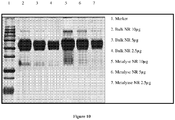
- Affinity-I eluate is filtered with 0.2 ⁇ m filter. Samples are withdrawn and analysed by reduced and non reduced SDS PAGE to know the purity profile and single chain/double chain content. Those who skilled in art can understand the criticality of single chain/double chain composition in final TNK-tPA drug substance.
- the present invention is advantageous due to direct capture of clarified harvest without mixing in large mixing tanks.
- Affinity-I Chromatography Eluate is diluted with affinity-II dilution or affinity chromatography equilibration buffer containing 20-50 mM Sodium Phosphate, 0.04-0.1 % polysorbate20 at pH 7.2 to reduce the conductivity up to less than 15 ms/cm.
- Diluted sample is clarified using 0.2 ⁇ filter and loaded on to Affinity-II chromatography.
- Column is washed with equilibration buffer to bring the UV280 absorbance to baseline.
- Affinity chromatography is optimized for removing process & product related impurities.
- the method of elution in this step is optimized in such a way that it complements to viral inactivation step and the composition with condition of elution buffer e.g. urea, EACA, and low pH are optimized to inline with viral inactivation.
- elution buffer e.g. urea, EACA, and low pH
- HCP host cell proteins
- the Elution of Affinity Chromatography is subjected to low pH and chemical inactivation using sodium caprylate. Mixture is incubated at 20 to 25°C for 60 min.
- sodium caprylate used is in very low amount that eliminates the need of large mixing vessels.
- sodium caprylate was used to inactivate viruses present in before capture chromatography where volumes are comparatively higher hence quantity of sodium caprylate required was also high.
- sodium Caprylate is added after second chromatography steps where volume to be handled is low and therefore requires less amount of sodium caprylate and much smaller vessel for handling.
- the use of sodium caprylate at pH 4.5 as compared to neutral or alkaline pH provides a more effective and robust viral inactivation in the process.
- TNK-tPA is recovered from the column by passing elution buffer containing 55 mg/ml L-Arginine, 17 mg/ml of orthophosphoric acid, 0.43 mg/ml Polysorbate 20 and pH 7.4.Cation exchange chromatography eluate is subjected to filtration for viral reduction and the resultant filtrate is further concentrated using Tangential Flow Filtration (TFF) system to achieve the final drug substance concentration.
- TNF Tangential Flow Filtration
- TFF Retentate After concentration the TFF Retentate is sterile filtered and kept at -20°C for further use.
- Drug substance produced by the purification process of present invention is thoroughly analyzed by the state of art and validated analytical procedures which includes but not limited to; Identity and purity check by SDS PAGE, Western Blot, N-terminal sequence analysis and peptide map, HCP determination using ELISA, Bioactivity and TNK-tPA quantification using clot lysis assay, Host cell DNA quantification using qPCR, Endotoxin quantification using LAL test, Aggregate and single chain/double chain content using size exclusion HPLC, Arginine content & Osmolality, Sialic acid, neutral sugars, type-I and type-II glycoforms analysis, Analysis of process related impurities e.g. Gentamycin, MTX, Urea, Sodium Caprylate, and EACA using in-house developed methods.
- a Periodic counter current chromatography (PCC) for affinity-I step has been performed with cell culture supernatant containing TNK-tPA from perfusion based bioreactor.
- PCC Periodic counter current chromatography
- dynamic binding capacity for affinity-I chromatography media were evaluated and based on the information obtained from break through analysis a three column PCC has been experimented on XK16- 5 ml BLUE SEPAHROSE FF.
- the chromatographic buffer compositions were kept same as mentioned in Example-1.
- the liquid mixtures prepared with the above system with defined recipes are suitable for purification of TNK-tPA at different chromatography stages as mentioned in Example-1 to 4.
Landscapes
- Health & Medical Sciences (AREA)
- Chemical & Material Sciences (AREA)
- Life Sciences & Earth Sciences (AREA)
- Engineering & Computer Science (AREA)
- Bioinformatics & Cheminformatics (AREA)
- Organic Chemistry (AREA)
- General Health & Medical Sciences (AREA)
- Medicinal Chemistry (AREA)
- Genetics & Genomics (AREA)
- Zoology (AREA)
- Wood Science & Technology (AREA)
- Biomedical Technology (AREA)
- Animal Behavior & Ethology (AREA)
- Public Health (AREA)
- Veterinary Medicine (AREA)
- Pharmacology & Pharmacy (AREA)
- Biochemistry (AREA)
- General Engineering & Computer Science (AREA)
- Epidemiology (AREA)
- Molecular Biology (AREA)
- General Chemical & Material Sciences (AREA)
- Chemical Kinetics & Catalysis (AREA)
- Microbiology (AREA)
- Biotechnology (AREA)
- Proteomics, Peptides & Aminoacids (AREA)
- Oil, Petroleum & Natural Gas (AREA)
- Gastroenterology & Hepatology (AREA)
- Immunology (AREA)
- Nuclear Medicine, Radiotherapy & Molecular Imaging (AREA)
- Cardiology (AREA)
- Heart & Thoracic Surgery (AREA)
- Inorganic Chemistry (AREA)
- Urology & Nephrology (AREA)
- Vascular Medicine (AREA)
- Peptides Or Proteins (AREA)
- Enzymes And Modification Thereof (AREA)
- Preparation Of Compounds By Using Micro-Organisms (AREA)
- Medicinal Preparation (AREA)
- Medicines That Contain Protein Lipid Enzymes And Other Medicines (AREA)
Claims (16)
- Verfahren zur Isolierung und Aufreinigung von TNK-tPA, umfassend die Schritte:(i) Durchführen einer Affinitätschromatographie an einem aus einer CHO-Zellkultur erhaltenen zellfreien Ertrag, um TNK-tPA zu fangen und ein Eluat zu erhalten, das partiell aufgereinigte TNK-tPA enthält;
wobei die Affinitätschromatographie Blue Sepharose 6 FF als eine stationäre Phase und eine mobile Phase umfasst, wobei die mobile Phase eine Mischung aus Natriumphosphatpuffer, Natriumchlorid und Harnstoff ist;(ii) Durchführen einer Affinitätschromatographie an dem Eluat aus Schritt (i) für eine zusätzliche Aufreinigung von TNK-tPA und Erhalt eines Eluats, das hauptsächlich TNK-tPA enthält;
wobei die Affinitätschromatographie Lysine Hyper D als eine stationäre Phase und eine mobile Phase umfasst, wobei die mobile Phase eine Mischung aus Natriumacetatpuffer, Harnstoff und epsilon-Aminocapronsäure (EACA) ist;(iii) Virus-Inaktivierung des Eluats aus Schritt (ii), um die Virus-inaktivierte Probe zu erhalten, wobei die Virus-Inaktivierung mit niedrigen pH und chemischer Inaktivierung durchgeführt wird, wobei die chemische Inaktivierung durch Behandeln der Probe mit Natriumcaprylat in Anwesenheit von Harnstoff durchgeführt wird;(iv) Durchführen einer weiteren Affinitätschromatographie-III an der Virus-inaktivierten Probe aus Schritt (iii) für zusätzliche Aufreinigung, um ein Eluat zu erhalten, das hauptsächlich stark aufgereinigte TNK-tPA enthält;
wobei die Affinitätschromatographie keramisches Hydroxylapatit (CHT) als eine stationäre Phase und eine mobile Phase umfasst, wobei die mobile Phase eine Mischung aus Phosphatpuffer, 2-(N-Morpholino)ethansulfonsäurehydrat (MES-Hydrat), Natriumchlorid und Harnstoff ist;(v) Durchführen einer Kationenaustauschchromotographie an dem Eluat aus Schritt (iv), um ein Eluat zu erhalten, das eine stark aufgereinigte Zubereitung von TNK-tPA enthält;
wobei die Kationenaustauschchromatographie Fractogel-SO3 als eine stationäre Phase und eine mobile Phase umfasst, wobei die mobile Phase eine Mischung aus L-Arginin, O-Phosphorsäure und Polysorbat-20 ist;(vi) Durchführen einer Virusreduktionsfiltration an dem Eluat aus Schritt (v) zum Entfernen von vorhandenem Virus; wobei die Virusfiltration mit einem Polyethersulphon (PES)-Nanofilter mit einer Größe im Bereich von 15-20 nm durchgeführt wird;(vii) Konzentrieren der Probe aus Schritt (vi) um TNK- tPA mittels Tangentialflussfiltration zu erhalten;
wobei die Ausbeute des Verfahrens mehr als 60% beträgt und die Reinheit der erhaltenen TNK-tPA mehr als 95% beträgt, gemessen mittels Größenausschlusschromatographie. - Verfahren nach Anspruch 1, wobei die Reinheit von TNK-tPA mehr als 95% anhand von Größenausschlusschromatographie beträgt, und wobei die anderen wesentlichen Qualitätsmerkmale sind:
SDS PAGE Es wurde keine zusätzliche Bande außer der Hauptbande beobachtet Monomer (%) mehr als 95% Einzelkettengehalt (%) mehr als 60 % Wirtszellprotein (HCP) (ppm) weniger als 100 Wirtszell-DNA (HCD) (ng/Dosis) weniger als 10 - Verfahren nach Anspruch 1, wobei in Schritt (i) das Natriumphosphat in einem Bereich von 20-40mM vorhanden ist, Natriumchlorid in einem Bereich von 1,5-2 M vorhanden ist und Harnstoff in einem Bereich von 2-3 M vorhanden ist;
wobei der pH der mobilen Phase in einem Bereich von 7.2-7.4 liegt. - Verfahren nach Anspruch 3, wobei die Affinitätschromatographie eine 0,8 - 1,5 log-Reduktion an Wirtszellproteinen (HCP) liefert.
- Verfahren nach Anspruch 1, wobei in Schritt (ii), das Natriumacetat in einem Bereich von 5-15 mM vorliegt, Harnstoff in einem Bereich von 2-3 M vorliegt und EACA in einem Bereich von 0,1-0,2 mM vorliegt,
wobei der pH der Affinitätschromatographie-mobilen Phase in einem Bereich von pH 4.5-5 liegt. - Verfahren nach Anspruch 5, wobei die Affinitätschromatographie zu einer 1-1.5 log-Reduktion an Wirtszellproteinen (HCP) und 1-4 log-Reduktion der Virus-Clearance führt;
wobei, bevorzugt, die Affinitätschromatographie zu mehr als 1.5 log-Reduktion mit XMuLV und zu mehr als 4 log-Reduktion mit PRV führt. - Verfahren nach Anspruch 1, wobei in Schritt (iii) Natriumcaprylat in dem Bereich 0.01% - 0.07% (Gew/Vol) vorliegt, bevorzugt im Bereich von 0.05%;
wobei die Konzentration an Harnstoff im Bereich von 2-3 M ist;
wobei die Virusinaktivierung durch Halten der Probe für eine Periode von 40-80 Minuten durchgeführt wird;
wobei das Halten der Probe bei einer Temperatur im Bereich von 20-30°C stattfindet. - Verfahren nach Anspruch 7, wobei der niedrige pH und die chemische Inaktivierung zu einer mehr als 5 log-Reduktion mit XMuLV und PRV führt.
- Verfahren nach Anspruch 1, wobei in Schritt (iv) der Phosphatpuffer in einem Bereich von 5-15 mM, MES-Hydrat in einem Bereich von 2-20 mM, Harnstoff in einem Bereich von 1-3 M vorliegt und Natriumchlorid in einem Bereich von 0,1 bis 0,5 M vorliegt;
wobei der pH der mobilen Phase in einem Bereich von 6 - 9 liegt;
wobei die bei der Affinitätschromatographie verwendete Elution ein linearer Salzgradient ist; wobei das Salz Natriumchlorid ist und die Konzentration des Natriumchlorid in einem Bereich von 0.1-1.0 M Natriumchlorid ist. - Verfahren nach Anspruch 9, wobei die Affinitätschromatographie zu einer 0.5-1 log-Reduktion an Wirtszellproteinen (HCP) und 2-4 log an Virus-Clearance führt,
oder wobei die Affinitätschromatographie zu einer mehr als 4 log-Reduktion mit XMuLV und PRV führt und zu mehr als einer 3 log-Reduktion mit MMV und Reo-3-Viren. - Verfahren nach Anspruch 1, wobei in Schritt (v) das L-Arginin in einem Bereich von 250-350 mM vorliegt, O-Phosphorsäure in einem Bereich von 0,6%-0,8% vorliegt und Polysorbat-20 in einem Bereich von 0,04 bis 0,05 % vorliegt;
wobei der pH der mobilen Phase in einem Bereich von 7.3 bis 7.5 liegt. - Verfahren nach Anspruch 11, wobei die Kationenaustauschchromatographie zu einer mehr als 1 log-Virus-Clearance mit MMV führt und zu mehr als einer 0.5 log-Clearance für Wirtszellproteine (HCP).
- Verfahren nach Anspruch 1, wobei in Schritt (vi) die Virusfiltration zu einer mehr als 4 log-Reduktion an XMuLV, zu einer mehr als 3 log-Reduktion an PRV, zu mehr als einer 4 log-Reduktion an Reo-3 und zu einer mehr als 4.5 log-Reduktion an MMV führt.
- Verfahren nach Anspruch 1, wobei in Schritt (vii) der Filter eine Ultrafiltrationsmembran ist,
wobei die Ultrafiltrationsmembran PES ist;
wobei die Größe der Ultrafiltrationsmembran in einem Bereich von 5-30 kDa ist, wobei bevorzugt die Größe der Ultrafiltrationsmembran 10 kDa ist,
wobei bevorzugt das Konzentrat TNK-tPA Retentat ist. - Verfahren nach Anspruch 1, wobei eine periodische Gegenstromchromatographie verwendet wird als Affinitäts-I-Chromatographie, wie in Schritt (i) von Anspruch 1 definiert.
- Verfahren nach Anspruch 1, wobei ein Inline-Conditioning-Ansatz verwendet wird zur Herstellung von Puffer und der Beladung für die Affinitäts-I-Chromatographie, wie in Schritt (i) von Anspruch 1 definiert, Affinitäts-II-Chromatographie, wie in Schritt (ii) von Anspruch 1 definiert, Affinitäts-III-Chromatographie (Mixed-Mode-Chromatographie MMC), wie in Schritt (iv) von Anspruch 1 definiert, und für die Ionenaustauschchromatographie, wie in Schritt (v) von Anspruch 1 definiert.
Priority Applications (1)
| Application Number | Priority Date | Filing Date | Title |
|---|---|---|---|
| PL15852227T PL3209767T3 (pl) | 2014-10-21 | 2015-10-19 | Nowy sposób oczyszczania do izolacji i komercyjnej produkcji zrekombinowanego tnk-tpa (tenekteplazy) |
Applications Claiming Priority (2)
| Application Number | Priority Date | Filing Date | Title |
|---|---|---|---|
| IN2343MU2014 | 2014-10-21 | ||
| PCT/IN2015/050137 WO2016063299A2 (en) | 2014-10-21 | 2015-10-19 | A novel purification process for isolation and commercial production of recombinant tnk-tpa (tenecteplase) |
Publications (3)
| Publication Number | Publication Date |
|---|---|
| EP3209767A2 EP3209767A2 (de) | 2017-08-30 |
| EP3209767A4 EP3209767A4 (de) | 2018-03-07 |
| EP3209767B1 true EP3209767B1 (de) | 2020-08-05 |
Family
ID=55761711
Family Applications (1)
| Application Number | Title | Priority Date | Filing Date |
|---|---|---|---|
| EP15852227.6A Active EP3209767B1 (de) | 2014-10-21 | 2015-10-19 | Neuartiges aufreinigungsverfahren zur isolierung und kommerziellen herstellung von rekombinanter tnk-tpa (tenecteplase) |
Country Status (16)
| Country | Link |
|---|---|
| US (1) | US10544408B2 (de) |
| EP (1) | EP3209767B1 (de) |
| JP (1) | JP7086601B2 (de) |
| AU (1) | AU2015334455B2 (de) |
| CL (1) | CL2017000952A1 (de) |
| CO (1) | CO2017004931A2 (de) |
| DK (1) | DK3209767T3 (de) |
| EA (1) | EA038482B1 (de) |
| ES (1) | ES2829923T3 (de) |
| LT (1) | LT3209767T (de) |
| MX (1) | MX383595B (de) |
| PE (1) | PE20171131A1 (de) |
| PL (1) | PL3209767T3 (de) |
| PT (1) | PT3209767T (de) |
| SA (1) | SA517381361B1 (de) |
| WO (1) | WO2016063299A2 (de) |
Families Citing this family (9)
| Publication number | Priority date | Publication date | Assignee | Title |
|---|---|---|---|---|
| GB201603291D0 (en) * | 2016-02-25 | 2016-04-13 | Binding Site Group The Ltd | Antibodies |
| GB201708262D0 (en) * | 2017-05-23 | 2017-07-05 | Binding Site Group Ltd | Assay for plasma cell associated disease |
| ES2991988T3 (es) | 2017-10-30 | 2024-12-05 | Takeda Pharmaceuticals Co | Detergentes compatibles con el medio ambiente para la inactivación de virus con envoltura lipídica |
| US20210214702A1 (en) * | 2018-06-01 | 2021-07-15 | Gennova Biopharmaceuticals Limited | Process for production of recombinant tnk-tpa by packed-bed perfusion system |
| WO2020016417A1 (en) * | 2018-07-19 | 2020-01-23 | Ichnos Sciences S.A. | Liquid antibody formulation |
| CN113337490B (zh) * | 2021-06-18 | 2022-01-07 | 广州铭康生物工程有限公司 | 一种大规模快速分离纯化rhTNK-tPA I/II型的方法 |
| CN115161308A (zh) * | 2022-06-13 | 2022-10-11 | 江苏丰华生物制药有限公司 | 一种注射用替奈普酶上清液的纯化方法 |
| CN115400089A (zh) * | 2022-08-19 | 2022-11-29 | 上海丰华天力通生物医药有限公司 | 一种含有组织型纤溶酶原激活剂改构体的药物组合物及其制备方法 |
| CN115386562A (zh) * | 2022-09-01 | 2022-11-25 | 江苏丰华生物制药有限公司 | 一种重组蛋白内毒素的去除方法 |
Family Cites Families (10)
| Publication number | Priority date | Publication date | Assignee | Title |
|---|---|---|---|---|
| US6506598B1 (en) * | 1999-04-26 | 2003-01-14 | Genentech, Inc. | Cell culture process |
| US20070014779A1 (en) * | 2002-11-14 | 2007-01-18 | Genentech, Inc. | Plasminogen activator variant formulations |
| WO2005014655A2 (en) * | 2003-08-08 | 2005-02-17 | Fresenius Kabi Deutschland Gmbh | Conjugates of hydroxyalkyl starch and a protein |
| BRPI0716143A2 (pt) * | 2006-08-29 | 2013-11-26 | Genentech Inc | Uso de tenecteplase para tratar derrame isquêmico agudo |
| CA2668347C (en) * | 2006-11-07 | 2017-06-20 | Genentech, Inc. | Tissue plasminogen activator variant uses |
| WO2011015922A1 (en) * | 2009-08-03 | 2011-02-10 | Avesthagen Limited | A highly efficient process of purification and production of recombinant tnk-tpa (tenecteplase) |
| EP3309168A1 (de) * | 2009-08-06 | 2018-04-18 | F. Hoffmann-La Roche AG | Verfahren für verbesserte virenentfernung bei der proteinaufreinigung |
| US9540426B2 (en) * | 2009-10-06 | 2017-01-10 | Bristol-Myers Squibb Company | Mammalian cell culture processes for protein production |
| EP2640834B1 (de) * | 2010-11-16 | 2017-06-28 | Cadila Healthcare Limited | Neues verfahren zur reinigung von tpa |
| JP6375112B2 (ja) * | 2010-12-23 | 2018-08-15 | ジェノヴァ バイオファーマシューティカルズ リミテッド | テネクテプラーゼの医薬組成物 |
-
2015
- 2015-10-19 PL PL15852227T patent/PL3209767T3/pl unknown
- 2015-10-19 EP EP15852227.6A patent/EP3209767B1/de active Active
- 2015-10-19 PE PE2017000520A patent/PE20171131A1/es unknown
- 2015-10-19 DK DK15852227.6T patent/DK3209767T3/da active
- 2015-10-19 ES ES15852227T patent/ES2829923T3/es active Active
- 2015-10-19 MX MX2017004470A patent/MX383595B/es unknown
- 2015-10-19 AU AU2015334455A patent/AU2015334455B2/en active Active
- 2015-10-19 WO PCT/IN2015/050137 patent/WO2016063299A2/en not_active Ceased
- 2015-10-19 PT PT158522276T patent/PT3209767T/pt unknown
- 2015-10-19 US US15/505,837 patent/US10544408B2/en active Active
- 2015-10-19 JP JP2017521506A patent/JP7086601B2/ja active Active
- 2015-10-19 EA EA201700217A patent/EA038482B1/ru unknown
- 2015-10-19 LT LTEP15852227.6T patent/LT3209767T/lt unknown
-
2017
- 2017-04-17 CL CL2017000952A patent/CL2017000952A1/es unknown
- 2017-04-18 SA SA517381361A patent/SA517381361B1/ar unknown
- 2017-05-17 CO CONC2017/0004931A patent/CO2017004931A2/es unknown
Non-Patent Citations (1)
| Title |
|---|
| None * |
Also Published As
| Publication number | Publication date |
|---|---|
| AU2015334455B2 (en) | 2020-05-21 |
| NZ731196A (en) | 2020-09-25 |
| SA517381361B1 (ar) | 2021-07-17 |
| WO2016063299A2 (en) | 2016-04-28 |
| ES2829923T3 (es) | 2021-06-02 |
| JP7086601B2 (ja) | 2022-06-20 |
| PE20171131A1 (es) | 2017-08-09 |
| PL3209767T3 (pl) | 2021-01-11 |
| US20180223270A1 (en) | 2018-08-09 |
| PT3209767T (pt) | 2020-11-09 |
| CL2017000952A1 (es) | 2018-05-25 |
| US10544408B2 (en) | 2020-01-28 |
| WO2016063299A3 (en) | 2016-06-09 |
| AU2015334455A1 (en) | 2017-05-18 |
| CO2017004931A2 (es) | 2017-08-10 |
| MX383595B (es) | 2025-03-14 |
| EA038482B1 (ru) | 2021-09-03 |
| EP3209767A2 (de) | 2017-08-30 |
| JP2018504366A (ja) | 2018-02-15 |
| MX2017004470A (es) | 2017-11-20 |
| EP3209767A4 (de) | 2018-03-07 |
| EA201700217A1 (ru) | 2017-10-31 |
| LT3209767T (lt) | 2020-11-25 |
| DK3209767T3 (da) | 2020-11-02 |
| BR112017006294A2 (pt) | 2017-12-12 |
Similar Documents
| Publication | Publication Date | Title |
|---|---|---|
| EP3209767B1 (de) | Neuartiges aufreinigungsverfahren zur isolierung und kommerziellen herstellung von rekombinanter tnk-tpa (tenecteplase) | |
| EP2560738B1 (de) | Einfaches verfahren zur simultanen beseitigung mehrerer unreinheiten aus kulturüberständen auf extrem geringe konzentrationen | |
| RU2590726C2 (ru) | Способ очистки витамин к-зависимых белков, таких как коагуляционный фактор ix | |
| CN105017412B (zh) | 一种从牛血清中分离高纯度牛血清白蛋白的方法 | |
| KR20110038634A (ko) | 응고 인자 viii을 정제하는 방법 | |
| US9663553B2 (en) | Integrated process for the production of therapeutics (human albumin, immunoglobulins, clotting factor VIII and clotting factor IX) from human plasma | |
| US10981975B2 (en) | Method for efficient purification of human serum albumin | |
| US20090130714A1 (en) | Process for purifying recombinanat tissue plasminogen activator (TPA) | |
| CN110066314A (zh) | 一种高效提高多聚体分离分辨率的亲和纯化工艺 | |
| CN107857811A (zh) | 一种人血白蛋白的制备工艺 | |
| US20240025950A1 (en) | Method of purification of recombinantly-produced rsv proteins in trimeric form | |
| AU2015248461B2 (en) | Novel purification process of gonadotropin | |
| NZ518692A (en) | Purified fibrinogen free of destabilising levels of plasminogen and other proteases obtained from a Fraction I paste | |
| KR101414897B1 (ko) | 다베포에틴 알파의 정제 방법 | |
| KR102528707B1 (ko) | 고순도의 히알루로니다제 정제 방법 | |
| CA2924981A1 (en) | Compositions comprising heterogeneous populations of recombinant human clotting factor xa proteins | |
| US20250257347A1 (en) | Coagulation factor x activating enzyme and use thereof | |
| NZ731196B2 (en) | A novel purification process for isolation and commercial production of recombinant tnk-tpa (tenecteplase) | |
| WO2011107299A9 (en) | Method for the manufacture of recombinant dspa alpha1 | |
| MX2007004244A (es) | Metodo para el aislamiento de haptoglobina. | |
| BR112017006294B1 (pt) | Processo para isolamento e purificação de tenecteplase (tnk-tpa) | |
| EP3271380B1 (de) | Verfahren zur reinigung knochenmorphogenetischer proteine | |
| KR102087823B1 (ko) | 친화성 크로마토그래피를 이용한 항체 또는 항체절편 정제 방법 | |
| EP3153522A1 (de) | Verfahren zur reinigung von erythropoietin und darbepoetin-alpha | |
| WO2011015922A1 (en) | A highly efficient process of purification and production of recombinant tnk-tpa (tenecteplase) |
Legal Events
| Date | Code | Title | Description |
|---|---|---|---|
| STAA | Information on the status of an ep patent application or granted ep patent |
Free format text: STATUS: THE INTERNATIONAL PUBLICATION HAS BEEN MADE |
|
| PUAI | Public reference made under article 153(3) epc to a published international application that has entered the european phase |
Free format text: ORIGINAL CODE: 0009012 |
|
| STAA | Information on the status of an ep patent application or granted ep patent |
Free format text: STATUS: REQUEST FOR EXAMINATION WAS MADE |
|
| 17P | Request for examination filed |
Effective date: 20170517 |
|
| AK | Designated contracting states |
Kind code of ref document: A2 Designated state(s): AL AT BE BG CH CY CZ DE DK EE ES FI FR GB GR HR HU IE IS IT LI LT LU LV MC MK MT NL NO PL PT RO RS SE SI SK SM TR |
|
| AX | Request for extension of the european patent |
Extension state: BA ME |
|
| DAV | Request for validation of the european patent (deleted) | ||
| DAX | Request for extension of the european patent (deleted) | ||
| A4 | Supplementary search report drawn up and despatched |
Effective date: 20180202 |
|
| RIC1 | Information provided on ipc code assigned before grant |
Ipc: C12N 1/14 20060101AFI20180129BHEP |
|
| STAA | Information on the status of an ep patent application or granted ep patent |
Free format text: STATUS: EXAMINATION IS IN PROGRESS |
|
| 17Q | First examination report despatched |
Effective date: 20181213 |
|
| GRAP | Despatch of communication of intention to grant a patent |
Free format text: ORIGINAL CODE: EPIDOSNIGR1 |
|
| STAA | Information on the status of an ep patent application or granted ep patent |
Free format text: STATUS: GRANT OF PATENT IS INTENDED |
|
| INTG | Intention to grant announced |
Effective date: 20200220 |
|
| GRAS | Grant fee paid |
Free format text: ORIGINAL CODE: EPIDOSNIGR3 |
|
| GRAA | (expected) grant |
Free format text: ORIGINAL CODE: 0009210 |
|
| STAA | Information on the status of an ep patent application or granted ep patent |
Free format text: STATUS: THE PATENT HAS BEEN GRANTED |
|
| AK | Designated contracting states |
Kind code of ref document: B1 Designated state(s): AL AT BE BG CH CY CZ DE DK EE ES FI FR GB GR HR HU IE IS IT LI LT LU LV MC MK MT NL NO PL PT RO RS SE SI SK SM TR |
|
| REG | Reference to a national code |
Ref country code: GB Ref legal event code: FG4D |
|
| REG | Reference to a national code |
Ref country code: CH Ref legal event code: EP |
|
| REG | Reference to a national code |
Ref country code: AT Ref legal event code: REF Ref document number: 1298745 Country of ref document: AT Kind code of ref document: T Effective date: 20200815 |
|
| REG | Reference to a national code |
Ref country code: DE Ref legal event code: R096 Ref document number: 602015057129 Country of ref document: DE |
|
| REG | Reference to a national code |
Ref country code: IE Ref legal event code: FG4D |
|
| REG | Reference to a national code |
Ref country code: CH Ref legal event code: NV Representative=s name: NOVAGRAAF INTERNATIONAL SA, CH |
|
| REG | Reference to a national code |
Ref country code: DK Ref legal event code: T3 Effective date: 20201028 |
|
| REG | Reference to a national code |
Ref country code: PT Ref legal event code: SC4A Ref document number: 3209767 Country of ref document: PT Date of ref document: 20201109 Kind code of ref document: T Free format text: AVAILABILITY OF NATIONAL TRANSLATION Effective date: 20201030 |
|
| REG | Reference to a national code |
Ref country code: SE Ref legal event code: TRGR |
|
| REG | Reference to a national code |
Ref country code: NL Ref legal event code: MP Effective date: 20200805 |
|
| REG | Reference to a national code |
Ref country code: GR Ref legal event code: EP Ref document number: 20200402893 Country of ref document: GR Effective date: 20201116 |
|
| PG25 | Lapsed in a contracting state [announced via postgrant information from national office to epo] |
Ref country code: NL Free format text: LAPSE BECAUSE OF FAILURE TO SUBMIT A TRANSLATION OF THE DESCRIPTION OR TO PAY THE FEE WITHIN THE PRESCRIBED TIME-LIMIT Effective date: 20200805 |
|
| REG | Reference to a national code |
Ref country code: NO Ref legal event code: T2 Effective date: 20200805 |
|
| PG25 | Lapsed in a contracting state [announced via postgrant information from national office to epo] |
Ref country code: BG Free format text: LAPSE BECAUSE OF FAILURE TO SUBMIT A TRANSLATION OF THE DESCRIPTION OR TO PAY THE FEE WITHIN THE PRESCRIBED TIME-LIMIT Effective date: 20201105 Ref country code: HR Free format text: LAPSE BECAUSE OF FAILURE TO SUBMIT A TRANSLATION OF THE DESCRIPTION OR TO PAY THE FEE WITHIN THE PRESCRIBED TIME-LIMIT Effective date: 20200805 Ref country code: FI Free format text: LAPSE BECAUSE OF FAILURE TO SUBMIT A TRANSLATION OF THE DESCRIPTION OR TO PAY THE FEE WITHIN THE PRESCRIBED TIME-LIMIT Effective date: 20200805 |
|
| REG | Reference to a national code |
Ref country code: NL Ref legal event code: FP |
|
| PG25 | Lapsed in a contracting state [announced via postgrant information from national office to epo] |
Ref country code: LV Free format text: LAPSE BECAUSE OF FAILURE TO SUBMIT A TRANSLATION OF THE DESCRIPTION OR TO PAY THE FEE WITHIN THE PRESCRIBED TIME-LIMIT Effective date: 20200805 Ref country code: RS Free format text: LAPSE BECAUSE OF FAILURE TO SUBMIT A TRANSLATION OF THE DESCRIPTION OR TO PAY THE FEE WITHIN THE PRESCRIBED TIME-LIMIT Effective date: 20200805 Ref country code: IS Free format text: LAPSE BECAUSE OF FAILURE TO SUBMIT A TRANSLATION OF THE DESCRIPTION OR TO PAY THE FEE WITHIN THE PRESCRIBED TIME-LIMIT Effective date: 20201205 |
|
| PG25 | Lapsed in a contracting state [announced via postgrant information from national office to epo] |
Ref country code: EE Free format text: LAPSE BECAUSE OF FAILURE TO SUBMIT A TRANSLATION OF THE DESCRIPTION OR TO PAY THE FEE WITHIN THE PRESCRIBED TIME-LIMIT Effective date: 20200805 Ref country code: RO Free format text: LAPSE BECAUSE OF FAILURE TO SUBMIT A TRANSLATION OF THE DESCRIPTION OR TO PAY THE FEE WITHIN THE PRESCRIBED TIME-LIMIT Effective date: 20200805 Ref country code: SM Free format text: LAPSE BECAUSE OF FAILURE TO SUBMIT A TRANSLATION OF THE DESCRIPTION OR TO PAY THE FEE WITHIN THE PRESCRIBED TIME-LIMIT Effective date: 20200805 |
|
| REG | Reference to a national code |
Ref country code: DE Ref legal event code: R097 Ref document number: 602015057129 Country of ref document: DE |
|
| PG25 | Lapsed in a contracting state [announced via postgrant information from national office to epo] |
Ref country code: AL Free format text: LAPSE BECAUSE OF FAILURE TO SUBMIT A TRANSLATION OF THE DESCRIPTION OR TO PAY THE FEE WITHIN THE PRESCRIBED TIME-LIMIT Effective date: 20200805 |
|
| REG | Reference to a national code |
Ref country code: ES Ref legal event code: FG2A Ref document number: 2829923 Country of ref document: ES Kind code of ref document: T3 Effective date: 20210602 |
|
| PLBE | No opposition filed within time limit |
Free format text: ORIGINAL CODE: 0009261 |
|
| STAA | Information on the status of an ep patent application or granted ep patent |
Free format text: STATUS: NO OPPOSITION FILED WITHIN TIME LIMIT |
|
| PG25 | Lapsed in a contracting state [announced via postgrant information from national office to epo] |
Ref country code: MC Free format text: LAPSE BECAUSE OF FAILURE TO SUBMIT A TRANSLATION OF THE DESCRIPTION OR TO PAY THE FEE WITHIN THE PRESCRIBED TIME-LIMIT Effective date: 20200805 Ref country code: LU Free format text: LAPSE BECAUSE OF NON-PAYMENT OF DUE FEES Effective date: 20201019 Ref country code: SK Free format text: LAPSE BECAUSE OF FAILURE TO SUBMIT A TRANSLATION OF THE DESCRIPTION OR TO PAY THE FEE WITHIN THE PRESCRIBED TIME-LIMIT Effective date: 20200805 |
|
| 26N | No opposition filed |
Effective date: 20210507 |
|
| PG25 | Lapsed in a contracting state [announced via postgrant information from national office to epo] |
Ref country code: SI Free format text: LAPSE BECAUSE OF FAILURE TO SUBMIT A TRANSLATION OF THE DESCRIPTION OR TO PAY THE FEE WITHIN THE PRESCRIBED TIME-LIMIT Effective date: 20200805 |
|
| PG25 | Lapsed in a contracting state [announced via postgrant information from national office to epo] |
Ref country code: MT Free format text: LAPSE BECAUSE OF FAILURE TO SUBMIT A TRANSLATION OF THE DESCRIPTION OR TO PAY THE FEE WITHIN THE PRESCRIBED TIME-LIMIT Effective date: 20200805 Ref country code: CY Free format text: LAPSE BECAUSE OF FAILURE TO SUBMIT A TRANSLATION OF THE DESCRIPTION OR TO PAY THE FEE WITHIN THE PRESCRIBED TIME-LIMIT Effective date: 20200805 |
|
| PG25 | Lapsed in a contracting state [announced via postgrant information from national office to epo] |
Ref country code: MK Free format text: LAPSE BECAUSE OF FAILURE TO SUBMIT A TRANSLATION OF THE DESCRIPTION OR TO PAY THE FEE WITHIN THE PRESCRIBED TIME-LIMIT Effective date: 20200805 |
|
| REG | Reference to a national code |
Ref country code: AT Ref legal event code: UEP Ref document number: 1298745 Country of ref document: AT Kind code of ref document: T Effective date: 20200805 |
|
| REG | Reference to a national code |
Ref country code: CH Ref legal event code: U11 Free format text: ST27 STATUS EVENT CODE: U-0-0-U10-U11 (AS PROVIDED BY THE NATIONAL OFFICE) Effective date: 20251101 |
|
| PGFP | Annual fee paid to national office [announced via postgrant information from national office to epo] |
Ref country code: NL Payment date: 20251021 Year of fee payment: 11 |
|
| PGFP | Annual fee paid to national office [announced via postgrant information from national office to epo] |
Ref country code: PT Payment date: 20251013 Year of fee payment: 11 |
|
| PGFP | Annual fee paid to national office [announced via postgrant information from national office to epo] |
Ref country code: DE Payment date: 20251026 Year of fee payment: 11 |
|
| PGFP | Annual fee paid to national office [announced via postgrant information from national office to epo] |
Ref country code: LT Payment date: 20251013 Year of fee payment: 11 Ref country code: GB Payment date: 20251117 Year of fee payment: 11 |
|
| PGFP | Annual fee paid to national office [announced via postgrant information from national office to epo] |
Ref country code: NO Payment date: 20251022 Year of fee payment: 11 |
|
| PGFP | Annual fee paid to national office [announced via postgrant information from national office to epo] |
Ref country code: AT Payment date: 20251021 Year of fee payment: 11 |
|
| PGFP | Annual fee paid to national office [announced via postgrant information from national office to epo] |
Ref country code: DK Payment date: 20251018 Year of fee payment: 11 Ref country code: IT Payment date: 20251021 Year of fee payment: 11 |
|
| PGFP | Annual fee paid to national office [announced via postgrant information from national office to epo] |
Ref country code: FR Payment date: 20251024 Year of fee payment: 11 |
|
| PGFP | Annual fee paid to national office [announced via postgrant information from national office to epo] |
Ref country code: TR Payment date: 20251017 Year of fee payment: 11 Ref country code: BE Payment date: 20251021 Year of fee payment: 11 Ref country code: GR Payment date: 20251015 Year of fee payment: 11 |
|
| PGFP | Annual fee paid to national office [announced via postgrant information from national office to epo] |
Ref country code: SE Payment date: 20251011 Year of fee payment: 11 Ref country code: CH Payment date: 20251101 Year of fee payment: 11 |
|
| PGFP | Annual fee paid to national office [announced via postgrant information from national office to epo] |
Ref country code: IE Payment date: 20251023 Year of fee payment: 11 Ref country code: CZ Payment date: 20251014 Year of fee payment: 11 |
|
| PGFP | Annual fee paid to national office [announced via postgrant information from national office to epo] |
Ref country code: PL Payment date: 20251012 Year of fee payment: 11 |
|
| PGFP | Annual fee paid to national office [announced via postgrant information from national office to epo] |
Ref country code: ES Payment date: 20251102 Year of fee payment: 11 |