EP3210718A2 - Unité de traitement pour une machine-outil et machine-outil comprenant une telle unité de traitement - Google Patents
Unité de traitement pour une machine-outil et machine-outil comprenant une telle unité de traitement Download PDFInfo
- Publication number
- EP3210718A2 EP3210718A2 EP17156971.8A EP17156971A EP3210718A2 EP 3210718 A2 EP3210718 A2 EP 3210718A2 EP 17156971 A EP17156971 A EP 17156971A EP 3210718 A2 EP3210718 A2 EP 3210718A2
- Authority
- EP
- European Patent Office
- Prior art keywords
- damping
- unit
- mass element
- chamber
- mass
- Prior art date
- Legal status (The legal status is an assumption and is not a legal conclusion. Google has not performed a legal analysis and makes no representation as to the accuracy of the status listed.)
- Withdrawn
Links
- 238000012545 processing Methods 0.000 title claims abstract description 47
- 238000013016 damping Methods 0.000 claims abstract description 192
- 238000003754 machining Methods 0.000 claims abstract description 50
- 239000007788 liquid Substances 0.000 claims description 64
- 238000012546 transfer Methods 0.000 claims description 16
- 230000007246 mechanism Effects 0.000 claims description 11
- 230000002093 peripheral effect Effects 0.000 claims description 11
- 230000009471 action Effects 0.000 claims description 5
- 230000005520 electrodynamics Effects 0.000 claims description 5
- 238000011161 development Methods 0.000 description 16
- 230000010355 oscillation Effects 0.000 description 13
- 230000000694 effects Effects 0.000 description 8
- 238000003801 milling Methods 0.000 description 6
- 239000000463 material Substances 0.000 description 5
- 230000007423 decrease Effects 0.000 description 4
- 239000002184 metal Substances 0.000 description 4
- 238000005496 tempering Methods 0.000 description 4
- 230000008859 change Effects 0.000 description 3
- 239000012530 fluid Substances 0.000 description 3
- 230000008901 benefit Effects 0.000 description 2
- 230000005540 biological transmission Effects 0.000 description 2
- 238000005520 cutting process Methods 0.000 description 2
- 230000001419 dependent effect Effects 0.000 description 2
- 238000013461 design Methods 0.000 description 2
- 238000006073 displacement reaction Methods 0.000 description 2
- 238000009826 distribution Methods 0.000 description 2
- 238000002474 experimental method Methods 0.000 description 2
- 238000007654 immersion Methods 0.000 description 2
- 238000004519 manufacturing process Methods 0.000 description 2
- 238000012986 modification Methods 0.000 description 2
- 230000004048 modification Effects 0.000 description 2
- 230000000704 physical effect Effects 0.000 description 2
- 230000004044 response Effects 0.000 description 2
- 238000010276 construction Methods 0.000 description 1
- 230000001627 detrimental effect Effects 0.000 description 1
- 238000007598 dipping method Methods 0.000 description 1
- 238000005553 drilling Methods 0.000 description 1
- 239000011346 highly viscous material Substances 0.000 description 1
- 230000010354 integration Effects 0.000 description 1
- 238000012423 maintenance Methods 0.000 description 1
- 239000000203 mixture Substances 0.000 description 1
- 230000003534 oscillatory effect Effects 0.000 description 1
- 238000007789 sealing Methods 0.000 description 1
- 238000003860 storage Methods 0.000 description 1
- 239000000725 suspension Substances 0.000 description 1
- 239000003190 viscoelastic substance Substances 0.000 description 1
Images


Classifications
-
- B—PERFORMING OPERATIONS; TRANSPORTING
- B23—MACHINE TOOLS; METAL-WORKING NOT OTHERWISE PROVIDED FOR
- B23Q—DETAILS, COMPONENTS, OR ACCESSORIES FOR MACHINE TOOLS, e.g. ARRANGEMENTS FOR COPYING OR CONTROLLING; MACHINE TOOLS IN GENERAL CHARACTERISED BY THE CONSTRUCTION OF PARTICULAR DETAILS OR COMPONENTS; COMBINATIONS OR ASSOCIATIONS OF METAL-WORKING MACHINES, NOT DIRECTED TO A PARTICULAR RESULT
- B23Q1/00—Members which are comprised in the general build-up of a form of machine, particularly relatively large fixed members
- B23Q1/25—Movable or adjustable work or tool supports
- B23Q1/26—Movable or adjustable work or tool supports characterised by constructional features relating to the co-operation of relatively movable members; Means for preventing relative movement of such members
-
- B—PERFORMING OPERATIONS; TRANSPORTING
- B23—MACHINE TOOLS; METAL-WORKING NOT OTHERWISE PROVIDED FOR
- B23Q—DETAILS, COMPONENTS, OR ACCESSORIES FOR MACHINE TOOLS, e.g. ARRANGEMENTS FOR COPYING OR CONTROLLING; MACHINE TOOLS IN GENERAL CHARACTERISED BY THE CONSTRUCTION OF PARTICULAR DETAILS OR COMPONENTS; COMBINATIONS OR ASSOCIATIONS OF METAL-WORKING MACHINES, NOT DIRECTED TO A PARTICULAR RESULT
- B23Q1/00—Members which are comprised in the general build-up of a form of machine, particularly relatively large fixed members
- B23Q1/25—Movable or adjustable work or tool supports
- B23Q1/44—Movable or adjustable work or tool supports using particular mechanisms
- B23Q1/50—Movable or adjustable work or tool supports using particular mechanisms with rotating pairs only, the rotating pairs being the first two elements of the mechanism
- B23Q1/54—Movable or adjustable work or tool supports using particular mechanisms with rotating pairs only, the rotating pairs being the first two elements of the mechanism two rotating pairs only
-
- B—PERFORMING OPERATIONS; TRANSPORTING
- B23—MACHINE TOOLS; METAL-WORKING NOT OTHERWISE PROVIDED FOR
- B23Q—DETAILS, COMPONENTS, OR ACCESSORIES FOR MACHINE TOOLS, e.g. ARRANGEMENTS FOR COPYING OR CONTROLLING; MACHINE TOOLS IN GENERAL CHARACTERISED BY THE CONSTRUCTION OF PARTICULAR DETAILS OR COMPONENTS; COMBINATIONS OR ASSOCIATIONS OF METAL-WORKING MACHINES, NOT DIRECTED TO A PARTICULAR RESULT
- B23Q5/00—Driving or feeding mechanisms; Control arrangements therefor
- B23Q5/02—Driving main working members
- B23Q5/04—Driving main working members rotary shafts, e.g. working-spindles
-
- F—MECHANICAL ENGINEERING; LIGHTING; HEATING; WEAPONS; BLASTING
- F16—ENGINEERING ELEMENTS AND UNITS; GENERAL MEASURES FOR PRODUCING AND MAINTAINING EFFECTIVE FUNCTIONING OF MACHINES OR INSTALLATIONS; THERMAL INSULATION IN GENERAL
- F16F—SPRINGS; SHOCK-ABSORBERS; MEANS FOR DAMPING VIBRATION
- F16F15/00—Suppression of vibrations in systems; Means or arrangements for avoiding or reducing out-of-balance forces, e.g. due to motion
- F16F15/02—Suppression of vibrations of non-rotating, e.g. reciprocating systems; Suppression of vibrations of rotating systems by use of members not moving with the rotating systems
-
- B—PERFORMING OPERATIONS; TRANSPORTING
- B23—MACHINE TOOLS; METAL-WORKING NOT OTHERWISE PROVIDED FOR
- B23C—MILLING
- B23C9/00—Details or accessories so far as specially adapted to milling machines or cutter
-
- B—PERFORMING OPERATIONS; TRANSPORTING
- B23—MACHINE TOOLS; METAL-WORKING NOT OTHERWISE PROVIDED FOR
- B23Q—DETAILS, COMPONENTS, OR ACCESSORIES FOR MACHINE TOOLS, e.g. ARRANGEMENTS FOR COPYING OR CONTROLLING; MACHINE TOOLS IN GENERAL CHARACTERISED BY THE CONSTRUCTION OF PARTICULAR DETAILS OR COMPONENTS; COMBINATIONS OR ASSOCIATIONS OF METAL-WORKING MACHINES, NOT DIRECTED TO A PARTICULAR RESULT
- B23Q1/00—Members which are comprised in the general build-up of a form of machine, particularly relatively large fixed members
- B23Q1/0009—Energy-transferring means or control lines for movable machine parts; Control panels or boxes; Control parts
- B23Q1/0018—Energy-transferring means or control lines for movable machine parts; Control panels or boxes; Control parts comprising hydraulic means
- B23Q1/0027—Energy-transferring means or control lines for movable machine parts; Control panels or boxes; Control parts comprising hydraulic means between moving parts between which an uninterrupted energy-transfer connection is maintained
- B23Q1/0036—Energy-transferring means or control lines for movable machine parts; Control panels or boxes; Control parts comprising hydraulic means between moving parts between which an uninterrupted energy-transfer connection is maintained one of those parts being a tool
-
- B—PERFORMING OPERATIONS; TRANSPORTING
- B23—MACHINE TOOLS; METAL-WORKING NOT OTHERWISE PROVIDED FOR
- B23Q—DETAILS, COMPONENTS, OR ACCESSORIES FOR MACHINE TOOLS, e.g. ARRANGEMENTS FOR COPYING OR CONTROLLING; MACHINE TOOLS IN GENERAL CHARACTERISED BY THE CONSTRUCTION OF PARTICULAR DETAILS OR COMPONENTS; COMBINATIONS OR ASSOCIATIONS OF METAL-WORKING MACHINES, NOT DIRECTED TO A PARTICULAR RESULT
- B23Q1/00—Members which are comprised in the general build-up of a form of machine, particularly relatively large fixed members
- B23Q1/70—Stationary or movable members for carrying working-spindles for attachment of tools or work
-
- B—PERFORMING OPERATIONS; TRANSPORTING
- B23—MACHINE TOOLS; METAL-WORKING NOT OTHERWISE PROVIDED FOR
- B23Q—DETAILS, COMPONENTS, OR ACCESSORIES FOR MACHINE TOOLS, e.g. ARRANGEMENTS FOR COPYING OR CONTROLLING; MACHINE TOOLS IN GENERAL CHARACTERISED BY THE CONSTRUCTION OF PARTICULAR DETAILS OR COMPONENTS; COMBINATIONS OR ASSOCIATIONS OF METAL-WORKING MACHINES, NOT DIRECTED TO A PARTICULAR RESULT
- B23Q11/00—Accessories fitted to machine tools for keeping tools or parts of the machine in good working condition or for cooling work; Safety devices specially combined with or arranged in, or specially adapted for use in connection with, machine tools
- B23Q11/0032—Arrangements for preventing or isolating vibrations in parts of the machine
-
- B—PERFORMING OPERATIONS; TRANSPORTING
- B23—MACHINE TOOLS; METAL-WORKING NOT OTHERWISE PROVIDED FOR
- B23Q—DETAILS, COMPONENTS, OR ACCESSORIES FOR MACHINE TOOLS, e.g. ARRANGEMENTS FOR COPYING OR CONTROLLING; MACHINE TOOLS IN GENERAL CHARACTERISED BY THE CONSTRUCTION OF PARTICULAR DETAILS OR COMPONENTS; COMBINATIONS OR ASSOCIATIONS OF METAL-WORKING MACHINES, NOT DIRECTED TO A PARTICULAR RESULT
- B23Q11/00—Accessories fitted to machine tools for keeping tools or parts of the machine in good working condition or for cooling work; Safety devices specially combined with or arranged in, or specially adapted for use in connection with, machine tools
- B23Q11/14—Methods or arrangements for maintaining a constant temperature in parts of machine tools
-
- F—MECHANICAL ENGINEERING; LIGHTING; HEATING; WEAPONS; BLASTING
- F16—ENGINEERING ELEMENTS AND UNITS; GENERAL MEASURES FOR PRODUCING AND MAINTAINING EFFECTIVE FUNCTIONING OF MACHINES OR INSTALLATIONS; THERMAL INSULATION IN GENERAL
- F16F—SPRINGS; SHOCK-ABSORBERS; MEANS FOR DAMPING VIBRATION
- F16F15/00—Suppression of vibrations in systems; Means or arrangements for avoiding or reducing out-of-balance forces, e.g. due to motion
-
- F—MECHANICAL ENGINEERING; LIGHTING; HEATING; WEAPONS; BLASTING
- F16—ENGINEERING ELEMENTS AND UNITS; GENERAL MEASURES FOR PRODUCING AND MAINTAINING EFFECTIVE FUNCTIONING OF MACHINES OR INSTALLATIONS; THERMAL INSULATION IN GENERAL
- F16F—SPRINGS; SHOCK-ABSORBERS; MEANS FOR DAMPING VIBRATION
- F16F15/00—Suppression of vibrations in systems; Means or arrangements for avoiding or reducing out-of-balance forces, e.g. due to motion
- F16F15/005—Suppression of vibrations in systems; Means or arrangements for avoiding or reducing out-of-balance forces, e.g. due to motion using electro- or magnetostrictive actuation means
-
- F—MECHANICAL ENGINEERING; LIGHTING; HEATING; WEAPONS; BLASTING
- F16—ENGINEERING ELEMENTS AND UNITS; GENERAL MEASURES FOR PRODUCING AND MAINTAINING EFFECTIVE FUNCTIONING OF MACHINES OR INSTALLATIONS; THERMAL INSULATION IN GENERAL
- F16F—SPRINGS; SHOCK-ABSORBERS; MEANS FOR DAMPING VIBRATION
- F16F7/00—Vibration-dampers; Shock-absorbers
- F16F7/10—Vibration-dampers; Shock-absorbers using inertia effect
- F16F7/1005—Vibration-dampers; Shock-absorbers using inertia effect characterised by active control of the mass
-
- F—MECHANICAL ENGINEERING; LIGHTING; HEATING; WEAPONS; BLASTING
- F16—ENGINEERING ELEMENTS AND UNITS; GENERAL MEASURES FOR PRODUCING AND MAINTAINING EFFECTIVE FUNCTIONING OF MACHINES OR INSTALLATIONS; THERMAL INSULATION IN GENERAL
- F16F—SPRINGS; SHOCK-ABSORBERS; MEANS FOR DAMPING VIBRATION
- F16F7/00—Vibration-dampers; Shock-absorbers
- F16F7/10—Vibration-dampers; Shock-absorbers using inertia effect
- F16F7/104—Vibration-dampers; Shock-absorbers using inertia effect the inertia member being resiliently mounted
-
- B—PERFORMING OPERATIONS; TRANSPORTING
- B23—MACHINE TOOLS; METAL-WORKING NOT OTHERWISE PROVIDED FOR
- B23C—MILLING
- B23C1/00—Milling machines not designed for particular work or special operations
- B23C1/12—Milling machines not designed for particular work or special operations with spindle adjustable to different angles, e.g. either horizontal or vertical
-
- B—PERFORMING OPERATIONS; TRANSPORTING
- B23—MACHINE TOOLS; METAL-WORKING NOT OTHERWISE PROVIDED FOR
- B23C—MILLING
- B23C2250/00—Compensating adverse effects during milling
- B23C2250/16—Damping vibrations
-
- B—PERFORMING OPERATIONS; TRANSPORTING
- B23—MACHINE TOOLS; METAL-WORKING NOT OTHERWISE PROVIDED FOR
- B23Q—DETAILS, COMPONENTS, OR ACCESSORIES FOR MACHINE TOOLS, e.g. ARRANGEMENTS FOR COPYING OR CONTROLLING; MACHINE TOOLS IN GENERAL CHARACTERISED BY THE CONSTRUCTION OF PARTICULAR DETAILS OR COMPONENTS; COMBINATIONS OR ASSOCIATIONS OF METAL-WORKING MACHINES, NOT DIRECTED TO A PARTICULAR RESULT
- B23Q2220/00—Machine tool components
- B23Q2220/006—Spindle heads
-
- F—MECHANICAL ENGINEERING; LIGHTING; HEATING; WEAPONS; BLASTING
- F16—ENGINEERING ELEMENTS AND UNITS; GENERAL MEASURES FOR PRODUCING AND MAINTAINING EFFECTIVE FUNCTIONING OF MACHINES OR INSTALLATIONS; THERMAL INSULATION IN GENERAL
- F16F—SPRINGS; SHOCK-ABSORBERS; MEANS FOR DAMPING VIBRATION
- F16F2224/00—Materials; Material properties
- F16F2224/02—Materials; Material properties solids
- F16F2224/0283—Materials; Material properties solids piezoelectric; electro- or magnetostrictive
-
- Y—GENERAL TAGGING OF NEW TECHNOLOGICAL DEVELOPMENTS; GENERAL TAGGING OF CROSS-SECTIONAL TECHNOLOGIES SPANNING OVER SEVERAL SECTIONS OF THE IPC; TECHNICAL SUBJECTS COVERED BY FORMER USPC CROSS-REFERENCE ART COLLECTIONS [XRACs] AND DIGESTS
- Y10—TECHNICAL SUBJECTS COVERED BY FORMER USPC
- Y10T—TECHNICAL SUBJECTS COVERED BY FORMER US CLASSIFICATION
- Y10T409/00—Gear cutting, milling, or planing
- Y10T409/30—Milling
- Y10T409/303976—Milling with means to control temperature or lubricate
-
- Y—GENERAL TAGGING OF NEW TECHNOLOGICAL DEVELOPMENTS; GENERAL TAGGING OF CROSS-SECTIONAL TECHNOLOGIES SPANNING OVER SEVERAL SECTIONS OF THE IPC; TECHNICAL SUBJECTS COVERED BY FORMER USPC CROSS-REFERENCE ART COLLECTIONS [XRACs] AND DIGESTS
- Y10—TECHNICAL SUBJECTS COVERED BY FORMER USPC
- Y10T—TECHNICAL SUBJECTS COVERED BY FORMER US CLASSIFICATION
- Y10T409/00—Gear cutting, milling, or planing
- Y10T409/30—Milling
- Y10T409/304312—Milling with means to dampen vibration
-
- Y—GENERAL TAGGING OF NEW TECHNOLOGICAL DEVELOPMENTS; GENERAL TAGGING OF CROSS-SECTIONAL TECHNOLOGIES SPANNING OVER SEVERAL SECTIONS OF THE IPC; TECHNICAL SUBJECTS COVERED BY FORMER USPC CROSS-REFERENCE ART COLLECTIONS [XRACs] AND DIGESTS
- Y10—TECHNICAL SUBJECTS COVERED BY FORMER USPC
- Y10T—TECHNICAL SUBJECTS COVERED BY FORMER US CLASSIFICATION
- Y10T409/00—Gear cutting, milling, or planing
- Y10T409/30—Milling
- Y10T409/306664—Milling including means to infeed rotary cutter toward work
- Y10T409/307672—Angularly adjustable cutter head
-
- Y—GENERAL TAGGING OF NEW TECHNOLOGICAL DEVELOPMENTS; GENERAL TAGGING OF CROSS-SECTIONAL TECHNOLOGIES SPANNING OVER SEVERAL SECTIONS OF THE IPC; TECHNICAL SUBJECTS COVERED BY FORMER USPC CROSS-REFERENCE ART COLLECTIONS [XRACs] AND DIGESTS
- Y10—TECHNICAL SUBJECTS COVERED BY FORMER USPC
- Y10T—TECHNICAL SUBJECTS COVERED BY FORMER US CLASSIFICATION
- Y10T409/00—Gear cutting, milling, or planing
- Y10T409/30—Milling
- Y10T409/309576—Machine frame
- Y10T409/309744—Machine frame including means to compensate for deformation
Definitions
- the present invention relates to a processing unit for a machine tool, in particular a numerically controlled machine tool or in particular a numerically controlled machine tool with a spindle device with a tool-carrying work spindle.
- machine tools or numerically controlled machine tools are known, on which workpieces can be machined by means of tools, in particular by machining.
- tools e.g. Milling machines, milling / turning machines, universal milling machines or machining centers, in particular with tool-carrying work spindles known.
- Such machine tools optionally comprise fixed or movable, a work spindle bearing machining units, which may be referred to as a spindle carriage, spindle head or headstock, for example.
- a generic machining unit is, for example, together with the drive mechanism of the spindle in the EP 1415 758 A1 described.
- the work performance of the machine tool can be achieved on the one hand by reducing downtime and on the other hand by increased processing efficiency during processing, for example by the highest possible removal rate during machining of the workpiece, which by faster feed during processing and / or by deeper immersion of the cutting tool in the workpiece can be reached. Since, however, larger oscillations of the tool occur during a larger chip removal rate during machining, a desired increase in productivity by increasing the chip removal volume usually has a detrimental effect on the machining precision and the achievable surface quality. In view of the above problems, it is an object of the present invention to enable an improved machining of a workpiece on a machine tool, in which both the highest possible machining precision with high achievable surface quality and also the highest possible productivity can be achieved with a high removal rate ,
- the invention is based on the idea of the invention to damp vibrations occurring during machining of the workpiece, so that at higher chip removal rate due to a vibration damping unit on the working spindle bearing machining unit of the machine tool and the associated vibration damping during machining of the workpiece at higher feed rates and / or deeper immersion of the tool in the workpiece to increase the productivity and performance of the machine tool yet advantageously a significantly increased machining precision and improved surface quality can be achieved.
- a machining unit for a machine tool which has a carrier head base and a tool-carrying work spindle holding spindle carrier head, wherein the processing unit is provided with a damping unit for damping vibrations occurring during the machining of a workpiece on the machine tool.
- the processing unit or in particular the spindle carrier head or preferably the carrier head base of the processing unit can be provided with a damping unit for this purpose. It has remarkably been found that although the entire carrier head base is slidably mounted, it is possible to provide a damping unit just there.
- this damping unit is provided as close as possible to the spindle carrier head, the machining precision of the workpiece can be greatly improved.
- the damping unit can be arranged on an outer side of a housing of the carrier head base.
- the damping unit is arranged on an outer side of the housing, no space is occupied in the interior of the housing of the carrier head base, which can be used for example for the transmission and / or a motor or drive.
- the damping unit is thus easy to reach, for example, for maintenance or for mounting or dismounting the same.
- the damping unit may be provided as a separate element, which can be grown as such or installed and removed.
- the damping unit can be mounted as a self-contained ensemble on the carrier head base and can thus be easily mounted, for example by means of screws or other fastening means to this and also be dismantled from this again.
- the damping unit can be adapted or replaced in accordance with the damping required for the workpiece to be machined.
- the spindle carrier head can be pivotably mounted about an axis running obliquely to the direction of displacement of the carriage, so that the tool holder can be pivoted from a position to a second position during pivoting.
- the damping unit may be provided such that this and the spindle carrier head during pivoting of the same or not substantially hinder.
- the damping unit can ensure a uniaxial damping, and in particular is adapted to attenuate an attenuation of vibrations in a main damping action direction
- the carrier head base is slidable with the carriage in the Z direction, preferably a damping in the direction of the Z axis can be ensured.
- a damping in these directions can be ensured.
- one or more damping units are designed such that vibrations in all directions can be damped or at least main components of the vibration directions can be damped.
- the damping unit can have at least one of the following types of damping: viscoelastic damping element, piezoelectric damping element, electrodynamic damping element and squeeze-film damping element.
- the damping unit can be based on a variety of types of damping known in the art.
- the previously described types of damping elements namely the viscoelastic damping element, the piezoelectric damping element, the electrodynamic damping element and the squeeze-film damping element, or a combination thereof, ensure the best damping properties with simultaneously small sizes.
- a viscoelastic damping element for example, a mass element, for example a piece of metal, is mounted on or attached to a highly viscous or viscoelastic material.
- a piezoelectric material is provided.
- the piezoelectric material is subjected to a voltage, so that this expands or shortens to counteract the vibration and thus to ensure a damping.
- Such piezoelectric damping elements are for example from the DE 699 24923 T2 known.
- one or more controllable linear actuators may be provided in order to counteract the oscillation occurring by controlling the linear actuator (s) in opposition to the oscillation.
- a liquid is forced from a first chamber area into a second chamber area and through the liquid transfer from the first to the second chamber area, for example, via a transfer chamber area or via connection areas - Ducts, a damping can be ensured.
- a damper is for example from the EP 0 164 220 A2 known.
- the damping unit may comprise a fluidic damping mechanism with a mass-spring system, in particular based on a squeeze-film damping and / or on the basis of a throttle flow damping.
- the damping unit preferably has a mass element which is pretensioned by means of springs and which is mounted so as to oscillate on guides in a main damping action direction.
- the mass element is mounted to vibrate in a fluid-sealed interior of the damping unit, and / or chamber areas of the interior are at least partially filled with a liquid, in particular with an oil.
- the damping unit is adapted to replace a mass element of the mass-spring system, insert spring elements of the mass-spring system or remove or replace, and / or to change a liquid of the fluidic damping mechanism.
- the damping unit may have a housing, with a chamber or an interior in which a spring element supported on a mass element is mounted swinging, wherein in the chamber (interior) a liquid is provided, which upon oscillation of the mass element of a first chamber region formed between the mass element and a chamber wall is transferred or transferable into a second chamber region formed between the mass element and the chamber wall.
- the mass element may be supported on a spring element, preferably suspended or in any way attached thereto.
- the spring element always brings the mass element in a rest position. When vibrations occur, this mass element is deflected and thus pushes a liquid from a first chamber (gap or gap-shaped chamber area) into a second chamber (gap or gap-shaped chamber area) due to the deflection of this changing volume of the first and second gap or chamber regions.
- the vibration of the mass member is deflected so that the first chamber portion between the chamber wall and the mass member is reduced and the second chamber area between the chamber wall and the mass member is increased, the one contained in the first chamber area Liquid is pressed into the second chamber area or sucked into the second chamber area by simultaneously increasing the volume of the second chamber area.
- At least one of the chamber regions may be formed on a lower side of the interior of the damping housing below the mass element oscillating in the axial direction.
- one or more of the chamber portions may be formed on an upper surface of the inner space of the damper housing above the mass element oscillating in the axial direction.
- the interior space may be at least partially filled with liquid, wherein at partial filling of the interior, the damping element is aligned with the processing unit such that the axial direction of vibration of the mass element is vertically or at least substantially vertically aligned (ie in particular in such a way that the chamber region or regions arranged on the underside are filled with liquid, for example in the case of a planar-shaped pinch-film gap in the region of the underside of the housing or on the underside of the interior).
- the oil used or the liquid from the lower chamber area or the lower gap can be pressed radially outwardly or sucked radially inwards.
- squeeze film effect is based on the oscillation of the mass element damping acting, which dampens vibrations on the processing unit via a rigid attachment of the damping element to the processing unit of the machine tool.
- the damping effect can be increased if the interior is completely filled with liquid, so that both upper and lower chamber areas or gaps, between which the mass element oscillates, are filled with liquid, as the "Squeeze-film effect" then out of phase at the top and bottom of the interior occurs at respective chamber areas or gaps, wherein on one side each liquid is pressed radially outward, when liquid is sucked radially inward on the opposite side and vice versa.
- the interior is preferably completely filled with liquid, in particular oil.
- the chamber (interior) in the circumferential direction may have a cylindrical shape and be bounded above and below by planar walls; the mass element in its circumferential direction have a cylindrical shape and also be bounded above and below by planar walls, wherein each between the opposite peripheral walls a transfer chamber area and between the respective upper side and lower side planar walls, an upper side or lower side chamber area (first, second chamber , or squish-film gap) is formed, which chamber areas each have a variable receiving volume due to the vibration of the mass element.
- Such a configuration essentially provides a cylindrical squeeze film damper in its top view, with an upper side variable chamber and a lower side variable chamber and an intermediate transfer chamber of cylindrical shape formed between the cylindrical outer wall of the mass element and the cylindrical inner wall of the chamber.
- the damping unit has a cylindrical housing, for. B. on the type of a drum, with a top and bottom and in the circumferential direction transversely extending cylindrical side walls.
- This mass element can be made of a metal, in particular a metal with high density.
- the selected liquid and also the selected mass of the mass element can be tuned to the expected vibration frequencies in such a machine tool.
- the mass element preferably has a mass of between 50 and 120 kg, advantageously between 75 and 150 kg, in particular 100 (+/- 5 kg).
- the mass element can be supported on the upper side and underside by at least one spring element and preferably with a plurality of spring elements.
- a spring element acts on the mass element, but just the mass element is supported on opposite sides, namely upper or lower side of each at least one spring element.
- the mass element is therefore held between at least two spring elements.
- simple coil springs can be used with predetermined to the expected vibration frequencies spring constants.
- these spring elements are supported between the upper side of the chamber (interior space) and upper side of the mass element and lower side of the mass element or underside of the chamber (interior space).
- the upper side in each case denotes the opposite side to a lower side.
- the top and bottom are each the sides delimiting the cylindrical side wall in the longitudinal direction.
- the underside of the chamber (interior) or of the housing of the damping unit thus forms a base, on which the damping unit can be attached.
- a plurality of opposing spring elements may be provided along the peripheral wall, which support the mass element on the top side and bottom side.
- the mass element can be stored very safe, especially tilt-safe.
- the spring element can be accommodated in a receiving bore on an upper side or lower side wall of the mass element and attached to the corresponding opposite wall of the chamber (interior).
- the end of the spring element eg, a coil spring
- the end of the spring element which is received in the receiving bore on the top or bottom wall of the mass element, not fixed to the mass element, but can simply plugged into this hole become.
- this is preferably fixedly connected to the inner wall of the chamber (interior) for secure attachment in the chamber (interior space) or protrudes into it and is held there in the chamber wall.
- longitudinal guide devices extending between the upper side of the chamber (interior space) and the underside of the chamber may be provided, so that the mass element is mounted oscillating only in the longitudinal direction, in particular in the direction of the guides.
- corresponding longitudinal guide means are provided on which the mass element is guided between an upper and lower side of the chamber (interior).
- the mass element is essentially, i. with the exception of manufacturing tolerances, slidably disposed only in the longitudinal direction in the chamber (interior) and thus ensures a uniaxial damping.
- the longitudinal guide devices can be formed by rods which project through openings extending between the top and bottom walls of the mass element.
- these rods are provided between the upper-side boundary wall of the chamber and the lower-side boundary wall of the chamber, and project through the mass element, from its top to its underside. As a result, a particularly secure guidance is ensured.
- the openings through which the rods project may be provided at uniform intervals along the circumference of the mass element. Similar to the springs described above, which are preferably provided along the circumference of the mass element, a balanced mass distribution and a secure guidance can be ensured by this symmetrical configuration with respect to the openings.
- a spring element in each case adjacent to each opening, may be provided.
- both namely the spring elements and the openings are provided along the circumference, wherein the springs, or the holes, in which the springs project, are each provided adjacent to such an opening, on a radially inner or outer side, but in particular on a radially inner side to the opening.
- the housing may be tempered. Since the viscosity of the liquid in the chamber depends on the temperature, it may be very advantageous to temper the housing and thus also to control the damping property via the temperature.
- the tempering can be coupled, for example, with a control device that measures the vibration frequencies occurring and by the temperature of the housing, the corresponding damping properties of the measured vibration frequencies adapts. Such a configuration is ensured for example by a corresponding control of the control device.
- a temperature of the housing is adjustable.
- a temperature control for adjusting the temperature of the housing to a vibration sensor, the vibration sensor signal for controlling the temperature of the housing of the temperature control is supplied.
- the temperature can also be varied controlled in order to control the desired damping behavior by adjusting the correspondingly required viscosity of the liquid.
- the housing may have a bottom surface, which is mounted on a damper stand, which is mounted on an outer wall of the carrier head base.
- the bottom surface of the housing is usually the underside of the housing. That is, the mass member vibrates in the longitudinal direction, d. H. vertical direction to the ground surface.
- the damping unit is mounted above this floor surface. In particular, the translational movement of the mass element may be perpendicular to the bottom surface.
- the damping device stand can have a standing surface for the housing and an attachment surface to the attachment surface of a carrier head base, wherein the base surface is aligned perpendicular to the direction of movement of the carrier head base and the attachment surface is aligned substantially parallel to the pivot axis of the spindle carrier head.
- This inclined housing surface is preferably aligned parallel to the pivot axis, so that the damping unit and the spindle carrier head do not abut each other when pivoting.
- the invention also proposes a machine tool with a processing unit according to at least one of the preceding aspects.
- the invention also proposes a machine tool with a carriage which can be displaced in a first direction on first axis guides with a workpiece holder, a second carriage which can be displaced on second axis guides in a second direction on second axis guides and which has axis guides running in a third direction Processing unit according to one of the previous aspects before.
- the processing unit or the longitudinally displaceable carriage of the processing unit is mounted on the axis guides extending in the Y direction of the second carriage.
- damping unit can also be provided independently of a machine tool or independently of a machining unit of a machine tool.
- a damping unit is proposed independently, which comprises a fluidic damping mechanism with a mass-spring system, in particular based on a squeeze-film damping and / or on the basis of a throttle flow damping.
- the proposed damping system is not limited to machine kinematics of machine tools, but can be used universally on all systems where vibrations are to be damped (eg on machines, Machine components, engine blocks, structures, structures, gears, vehicle bodies, etc.).
- FIG. 1 is an example of a known from the prior art machine tool 100 with exemplary five axes, comprising three linearly movable axes and two rotary axes shown.
- the machine tool 100 may be controllable via a numerical control, not shown, in particular for controlling the travel movements of the three linear axes and the two rotary axes for controlling a relative movement between the workpiece to be machined and the workpiece processing, recorded on a spindle of the machine tool 100 tool.
- a lower part 1a (machine bed) of a side view of an exemplary L-shaped frame 1 (machine frame) of the machine tool 100 by way of example a pair in the Y direction horizontally extending first axle guides 2 and perpendicular thereto to a side part 1b (machine stand) of the frame 1 of the machine tool 100 in the X direction horizontally extending second axle guides.
- a turntable 4a On a first (Y-axis) carriage 4 a Y-axis (first linear axis), which is mounted longitudinally displaceable or movable on the first axis guides 2 in the Y direction, a turntable 4a is arranged, on which a workpiece holder can be provided ,
- a workpiece to be machined can be held or clamped on the turntable 4a of the rotationally drivable rotary axis, which can be rotated about a vertical axis of rotation by rotating the rotary table 4a, preferably by at least 360 degrees or more and by means of the Y-axis can be moved linearly by moving the carriage 4 in the Y direction.
- a second (X-axis) carriage 5 of an X-axis (second linear axis), which can be displaced transversely in the X direction, which has a rod-shaped configuration in the height direction, for example
- Axle guides 6 a vertical Z-axis (third linear axis) along the entire height of the axle guides to keep 6.
- third axle guides 6 are provided in the example.
- machine tool 100 is further exemplified a processing unit 7 (milling head or spindle head, or headstock) on a Z-direction longitudinally displaceable or movably mounted third (Z-axis) carriage 9 of the vertical Z-axis held or mounted.
- the processing unit 7 has, for example, a carrier head base 8.
- the rear part of the carrier head base 8 is arranged on the third carriage 9 and is thus mounted vertically movable in the vertical direction of the machine tool on the third axis guides 6.
- the processing unit 7 can thus be moved linearly, for example, by means of the X-axis in the X-direction horizontally and transversely to the Y-direction and moved vertically linearly by moving the carriage 9 in the Z-direction by means of the Z-axis ,
- a spindle carrier head 10 (eg swivel head) is held by way of example, which carries a work spindle 11 on which a tool holder 12 is provided, on which a corresponding tool, for example a cutting tool, is provided. a drilling tool or milling tool for machining a workpiece clamped on the turntable 4a can be received.
- the spindle carrier head 10 is mounted so as to be pivotable, for example, about an oblique pivot axis S obliquely to the Z axis or obliquely to the third axis guides 6 or the direction of displacement of the third carriage 9 (see also FIG FIGS. 3A and 3B ), so that this between the in FIG. 1 shown first position with horizontally oriented spindle axis of the spindle 11 and a second position with vertically aligned spindle axis of the spindle 11 can be pivoted.
- the spindle 11 can be driven via a gear provided in the spindle carrier head 10 (see, for example FIG. 2 ).
- An exemplary processing unit 7 of a known from the prior art machine tool is in exemplary schematic representation in FIG. 2 shown.
- a motor 13 is arranged by way of example, which rotatably drives a shaft 14.
- a Zahnradensemble which forms a gear 15
- a rotational movement of the shaft 14 is transmitted to the spindle 11, with the tool holder 12 at the front end end (see. FIG. 1 ) is provided for rotatably rubbing a recorded on the tool holder 12 tool.
- FIGS. 3A and 3B is schematically the processing unit 7 from FIGS. 1 and 2 illustrated, wherein the carrier head base 8 is provided according to the invention with a damping unit 17, which is arranged only on the example of the top of the carrier head base 8.
- the invention is not limited to embodiments in which a damping unit 17 is disposed on top of the carrier head base 8, but one or more damping units may be located at other locations of the carrier head base 8, and / or attached the spindle carrier head 10th
- the present invention is not limited to machining units with pivot axis or with two mutually pivotable support sections, but can be extended to a variety of spindle-bearing machining units or spindle or milling heads with tool-carrying work spindles for machine tools.
- damping element 17 which is arranged on the outside of the housing of the processing unit 7.
- the present invention is not limited to such externally arranged damping elements 17, but one or more damping elements 17 may be integrated in the processing unit 7 and in particular in the interior of the processing unit 7 and the carrier head base 8 and / or the spindle carrier head 10 installed.
- damping elements may additionally or alternatively also be arranged at other locations of the machine tool 100, e.g. on the machine frame, on the machine bed, on the axle slide and / or on the turntable or on or adjacent to a workpiece clamping device.
- the damping element 17 of FIGS. 3A and 3B has, for example, a housing 18, with an exemplary cylindrical peripheral wall 19, an exemplary planar upper side wall 20 (cover section) and an exemplary planar lower side wall 21 (bottom section). These walls 19, 20, 21 form inside the housing 18 an exemplary cylindrical interior 22, may be provided in the vibration damping damping mechanisms or damping elements.
- the underside wall 21 of the housing 18 exemplarily forms the footprint of the damping unit 17 and is mounted by way of example on a schematically shown damping device stand 23.
- This damper stand 23 is for example a separate element and may be made of metal or plastic, for example.
- the damping device stand 23 has by way of example a fastening surface 24, by means of which the damping device stand 23 is fastened to a housing wall of the carrier head base 8.
- the damping device stand 23 has by way of example a standing surface 25, via which the lower side wall 21 of the housing 18 is fastened to the damping device stand 23.
- the standing surface 25 and the mounting surface 24 have, for example, angles of approximately 45 degrees to one another, in particular since a corresponding oblique surface on the upper side of the housing of the carrier head base 8 is also inclined.
- the mounting surface 24 and also the inclined surface on the upper side of the housing of the carrier head base 8 are substantially parallel to the pivot axis S, which for example obliquely with an angle of approximately 45 degrees to the Z-axis (see. FIG. 1 ) runs.
- the two angles give a total of 90 degrees, for example, so that the lower side wall 21 of the damping unit 17 is planar and the damping unit 17 is vertical (in embodiments a in whose interior 22 provided mass element 30 can be held translationally movable, for example in the vertical Z direction; FIG. 4 ).
- a damper stand 23 is not essential.
- the housing 18 of the damping unit can also be attached directly to a housing of the processing unit or the carrier head base 8 without the interposition of such a damper stand 23, or be arranged in the interior thereof.
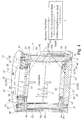
- An exemplary damping unit 17 according to a non-limiting exemplary embodiment is shown in a sectional view by way of example in FIG FIG. 4 shown.
- a "squeeze-film" based damping unit is proposed.
- the damping unit 17 is thus exemplified as a squeeze film damping element (which is also referred to as a so-called squeeze-film damper).
- a damping unit can also contain a viscoelastic damping element, an electrodynamic damping element and / or a piezoelectric damping element, or a combination thereof.
- the housing 18 of the damping unit 17 comprises in the present case substantially the exemplary cylindrical peripheral wall 19, and a longitudinally the inner space 22 upwardly bounding lid or lid portion 20 of the Forming the upper side wall and in the longitudinal direction of the interior 22 downwardly bounding bottom or bottom portion 21 which forms the bottom wall.
- the upper lid 20 of the housing 18 is provided, by way of example only, with a central plate element 27, which closes the interior 22 in a sealing and in particular liquid-tight manner by means of the screws 28 or other fastening means.
- the wall thickness of the plate member 27 may be selected such that a formed under the plate member 27 gap of Quetschfilmdämpfung can be adjusted with a desired gap width depending on the desired damping effect of Quetschfilmdämpfung.
- another gap width can be adjusted.
- liquid can be refilled or replaced in the interior 22.
- a mass element 30 constructed in the present case by way of example only consisting of two cylindrical disks 30a and 30b is arranged.
- the outer peripheral surface of the mass member 30 has a cylindrical shape and exemplifies the shape of the cylindrical inner peripheral surface of the housing 18 which defines the inner space 22 (outer peripheral wall of the inner space).
- the mass element 30 is held on the top side and bottom side respectively by an upper-side holding element 29 and a lower-side holding element 29 or between the upper and lower side holding elements 29.
- the holding elements 29 are each formed by way of example disk-shaped.
- These rods or guide elements 38 are provided at uniform intervals along the outer peripheral surface of the housing 18 and project through each in the
- Mass element 30 provided openings 39, which are provided at corresponding points of the mass element 30.
- the guide members 38 extend through openings 44 (e.g., bores) formed in the support members 29.
- the mass element 30 is thus freely slidably mounted with the holding elements 29 along the guide elements 38.
- the mass element 30 is held between spring elements 40, 41, wherein in each case lower spring elements 40 support the mass element 30 and press upper spring elements 41 on the mass element 30.
- the spring members 40 and 41 are respectively held in respective openings 43 (e.g., bores).
- the corresponding spring elements 40, 41 are formed by way of example as spiral springs, wherein in each case one end of the respective spiral spring is fixed to the cover or the bottom and the other end of the spiral spring is supported in an opening 43 or a base surface of the opening 43, for example without to be fixed on these.
- the respective upper side and lower side spring elements 40, 41 are respectively arranged in the vertical direction opposite each other and in extension to each other, wherein in each case a pair of upper and lower spring elements 40, 41 are arranged parallel to the openings 39 and the guide elements 38.
- a pair of formed from rod 38 and spring elements 40, 41 is provided in the circumferential direction along the housing 18 by way of example always.
- a gap Sp is formed, which forms an upper squeezed-film chamber portion 35 for receiving liquid, and between the lower-side wall 32 of the lower holding member 29 and the inner surface of the bottom portion 21st a further gap Sp is formed which forms a lower squeeze film chamber region 36 for receiving liquid.
- the upper and lower squeeze film chamber portions 35 and 36 are each formed with a transfer chamber portion 34 formed in remaining voids in the inner space 22 designed to absorb liquid.
- the transfer chamber region 34 is formed, for example, between the outer peripheral surface of the mass element 30 and the inner peripheral surface of the housing 18, which completely surrounds the mass element 30 in its circumferential direction, for example, and has a constant cross-section substantially in the present example.
- the mass element 30 vibrates in the event of vibration during the machining of a workpiece in the interior space 22 in the liquid along the guide elements 38 sliding up and down.
- the volume of the gap regions of the column Sp or the chamber regions 35 and 36 is varied, which increases in particular with upwardly moving mass element 30 of the lower gap Sp and increases the volume of the chamber portion 36 and the upper gap Sp is reduced and reduces the volume of the chamber portion 35, or whereby in particular when downwardly moving mass element 30 of the upper gap Sp increases and increases the volume of the chamber portion 35 and the lower gap Sp decreases and the volume of the chamber portion 36 decreases.
- Chamber volume of the upper gap or the chamber portion 35 is increased, and the liquid in the transfer chamber 34 is conveyed into the gap or sucked by a occurring in the gap, radial suction flow from the transfer chamber 34 into the gap (see the right detail on the right Bottom in FIG. 4 ).
- the mass element 30 moves up again, the chamber volume of the upper gap or the chamber region 35 is reduced and the liquid therein is conveyed into the transfer chamber region 34 or forced out into the transfer chamber 34 by a radial pressure flow occurring in the gap ( See the right detail on the bottom right in FIG. 4 ).
- At least one of the chamber regions may be formed on a lower side of the interior of the damping housing below the mass element oscillating in the axial direction.
- one or more of the chamber portions may be formed on an upper surface of the inner space of the damper housing above the mass element oscillating in the axial direction.
- the interior space may be at least partially filled with liquid, wherein at partial filling of the interior, the damping element is aligned with the processing unit such that the axial direction of vibration of the mass element is vertically or at least substantially vertically aligned (ie in particular in such a way that the chamber region or regions arranged on the underside are filled with liquid, for example in the case of a planar-shaped pinch-film gap in the region of the underside of the housing or on the underside of the interior).
- the oil used or the liquid from the lower chamber area or the lower gap can be pressed radially outwardly or sucked radially inwards.
- squeeze film effect is based on the oscillation of the mass element damping acting, which dampens vibrations on the processing unit via a rigid attachment of the damping element to the processing unit of the machine tool.
- the damping effect can be increased when the interior is completely filled with liquid, so that both upper and lower chamber areas or gaps between which the mass element oscillates, are filled with liquid, since the "squeeze film effect" then out of phase the top and the bottom of the interior occurs at corresponding chamber areas or gap, wherein on one side in each case liquid is pressed radially outward, when liquid is sucked radially inwardly on the opposite side and vice versa.
- the interior is preferably completely filled with liquid, in particular oil.
- the mass element preferably has a mass of between 50 and 120 kg, advantageously between 75 and 150 kg, in particular 100 (+/- 5) kg.
- the average gap width is particularly preferably less than 10 mm, or preferably less than 5 mm and in particular substantially 1 mm.
- the selected liquid, particularly preferably an oil, and also the selected mass of the mass element can be tuned to the expected vibration frequencies in such a machine tool.
- the housing 18 is tempered by way of example. Since the viscosity of the liquid in the chamber depends on the temperature, it is very advantageous to temper the housing 18 and thus also to control the damping property via the temperature. Thus, it can be ensured that the temperature of the liquid can be kept constant, so that the viscosity and thus the vibration damping behavior during the machining of the workpiece does not change over time, since the temperature-dependent viscosity of the liquid, in particular an oil, is kept constant.
- the tempering can be coupled, for example, with a control device which measures the oscillation frequencies occurring and adapts the corresponding damping properties to the measured oscillation frequencies by the tempering of the housing. Such a configuration is ensured for example by a corresponding control of the control device.
- the temperature can also be varied controlled in order to control the desired damping behavior by adjusting the correspondingly required viscosity of the liquid.
- the vibration damping behavior can be optimally adjusted by adjusting the type and / or number of springs, the average gap width of the squeeze film damping arrangement and by selecting the liquid or its viscosity and by adjusting or varying the viscosity by tempering, possibly based on a Control circuit with a connected to the temperature control vibration sensor.
- the present invention is not limited to the implementation of squeeze film damping.
- Mass-spring systems generally have the advantage that the prestressed oscillatory mass allows a particularly compact design with high power density.
- the damping behavior in the modular principle in fluid damping mechanisms with mass-spring systems can be easily adjusted by the mass of the mass element by the choice of material or the density of the material used suitable selectable (this can be a plurality of mass elements of the same size and shape in different masses are provided due to different densities and are replaced in the damping element) by the type and in particular number of springs used is variable to adjust the frequency range of the vibrations to be damped by the gap height of the column or the liquid chambers is adjustable (eg by adjustment or replacement of the upper plate element 27 and / or the holding elements 29) by the liquid used is selected as a function of viscosity, and / or by the viscosity of the liquid by adjusting the temperature of the damping unit or the chamber walls is adjustable or finely adjusted.
- a plurality of damping elements may be used, each with different compositions with respect to the mass of the mass element used, the gap heights used, the springs used (with respect to type and / or number), the liquid used and / or the temperature to be set of the tempered damping element to several To dampen natural frequencies to be damped machine system of the machine tool or the processing unit at the same time.
- the use of a plurality of damping elements can not only be used to attenuate a plurality of frequency ranges or different frequencies, but also makes it possible to attenuate different vibration directions when the damping elements are respectively arranged with different vibration directions of the spring-mass system on the processing unit.
- the guides (e.g., guide members 38) of the spring-mass system also allow for horizontally aligned vibration dampening or for dampening horizontal vibration.
- a mass of the individual damping elements can be reduced, so that a plurality of damping elements can each be made more compact and the overall volume of the individual damping elements can be reduced, so that advantageously a simple and space-saving attachment or integration of the damper on the machine tool or at the processing unit is made possible.
- the present invention makes it possible to enable improved machining of a workpiece on a machine tool, in which both the highest possible machining precision with a high achievable surface quality and also the highest possible productivity with a high removal rate can be achieved.
Landscapes
- Engineering & Computer Science (AREA)
- Mechanical Engineering (AREA)
- General Engineering & Computer Science (AREA)
- Physics & Mathematics (AREA)
- Acoustics & Sound (AREA)
- Aviation & Aerospace Engineering (AREA)
- Auxiliary Devices For Machine Tools (AREA)
- Machine Tool Units (AREA)
- Milling Processes (AREA)
- Jigs For Machine Tools (AREA)
Applications Claiming Priority (1)
| Application Number | Priority Date | Filing Date | Title |
|---|---|---|---|
| DE102016203116.3A DE102016203116A1 (de) | 2016-02-26 | 2016-02-26 | Bearbeitungseinheit für eine Werkzeugmaschine und Werkzeugmaschine mit einer derartigen Bearbeitungseinheit |
Publications (2)
| Publication Number | Publication Date |
|---|---|
| EP3210718A2 true EP3210718A2 (fr) | 2017-08-30 |
| EP3210718A3 EP3210718A3 (fr) | 2018-01-17 |
Family
ID=58094323
Family Applications (1)
| Application Number | Title | Priority Date | Filing Date |
|---|---|---|---|
| EP17156971.8A Withdrawn EP3210718A3 (fr) | 2016-02-26 | 2017-02-20 | Unité de traitement pour une machine-outil et machine-outil comprenant une telle unité de traitement |
Country Status (6)
| Country | Link |
|---|---|
| US (1) | US20170248190A1 (fr) |
| EP (1) | EP3210718A3 (fr) |
| JP (1) | JP2017164893A (fr) |
| KR (1) | KR20170101150A (fr) |
| CN (1) | CN107127587A (fr) |
| DE (1) | DE102016203116A1 (fr) |
Cited By (2)
| Publication number | Priority date | Publication date | Assignee | Title |
|---|---|---|---|---|
| WO2021005172A1 (fr) * | 2019-07-11 | 2021-01-14 | Gkn Aerospace Sweden Ab | Amortisseur pour fraiseuse |
| EP3967448A1 (fr) * | 2020-09-15 | 2022-03-16 | Präwema Antriebstechnik GmbH | Dispositif d'amortissement des vibrations d'une broche d'une machine-outil tournant autour d'un axe de rotation |
Families Citing this family (9)
| Publication number | Priority date | Publication date | Assignee | Title |
|---|---|---|---|---|
| TWI562855B (en) * | 2014-11-19 | 2016-12-21 | Ind Tech Res Inst | Clamping-positioning device and operating method thereof |
| CN107971547A (zh) * | 2017-11-18 | 2018-05-01 | 北京科技大学 | 分体式立卧两用数控摆动铣头 |
| KR102657712B1 (ko) * | 2019-03-27 | 2024-04-16 | 주식회사 디엔솔루션즈 | 공작기계 스핀들의 떨림 감쇠장치 및 이를 포함하는 공작기계 |
| CN111438394B (zh) * | 2020-05-20 | 2024-04-12 | 常州超普机械科技有限公司 | 一种可倾斜主轴数控铣床 |
| BR112023000137A2 (pt) * | 2020-07-07 | 2023-03-14 | Seti Tec | Dispositivo multitarefas |
| JP2023070091A (ja) * | 2021-11-03 | 2023-05-18 | ザ・ボーイング・カンパニー | ワークにおける機械励起振動を減衰させるためのシステム及び方法 |
| DE102021134593A1 (de) | 2021-12-23 | 2023-06-29 | Klingelnberg Gmbh | Werkzeugmaschine und Verfahren |
| CN116652259B (zh) * | 2023-07-27 | 2023-09-29 | 山西兴旺达锻压有限公司 | 一种大直径风电法兰螺栓孔定位标记线加工装置 |
| CN118023946A (zh) * | 2024-04-01 | 2024-05-14 | 安徽卓朴智能装备股份有限公司 | 一种单立柱四主轴箱运动机构 |
Citations (3)
| Publication number | Priority date | Publication date | Assignee | Title |
|---|---|---|---|---|
| EP0164220A2 (fr) | 1984-05-31 | 1985-12-11 | General Motors Corporation | Amortisseur à couche fluidique comprimée |
| EP1415758A1 (fr) | 2002-11-04 | 2004-05-06 | DECKEL MAHO Pfronten GmbH | Unité d'usinage pour machines à fraiser et à aléser programmable |
| DE69924923T2 (de) | 1998-07-06 | 2005-09-29 | Active Control Experts Inc., Cambridge | Aktiver piezo-elektrischer Dämpfer für Ski oder Snowboard |
Family Cites Families (20)
| Publication number | Priority date | Publication date | Assignee | Title |
|---|---|---|---|---|
| US1737048A (en) * | 1925-03-13 | 1929-11-26 | Gen Motors Res Corp | Steering mechanism |
| DE651502C (de) * | 1934-12-29 | 1937-10-14 | Auguste Louis Marie Antoine Ro | Schwingungsdaempfung |
| US2998867A (en) * | 1958-06-30 | 1961-09-05 | Cincinnati Milling Machine Co | Vibration damper |
| US3486585A (en) * | 1967-10-12 | 1969-12-30 | Cincinnati Milling Machine Co | Machine tool damping unit |
| US4641817A (en) * | 1983-04-05 | 1987-02-10 | Dunlop Limited | Vibration absorbing mountings |
| SU1184989A1 (ru) * | 1983-07-15 | 1985-10-15 | Savin Eduard | Антивибратор |
| FR2650355B1 (fr) * | 1989-07-28 | 1994-01-28 | Paulstra Gmbh | Perfectionnements aux dispositifs amortisseurs de vibrations |
| JPH0423239U (fr) * | 1990-06-13 | 1992-02-26 | ||
| DE69516459T2 (de) * | 1994-07-01 | 2000-09-21 | Bridgestone Corp., Tokio/Tokyo | Vorrichtung zur Schwingungsisolierung |
| US5743326A (en) * | 1994-10-05 | 1998-04-28 | Aesop, Inc. | Method of and apparatus for damping bending vibrations while achieving temperature control in beams and related |
| US5816373A (en) * | 1997-03-21 | 1998-10-06 | Honeywell Inc. | Pneumatic tuned mass damper |
| US6296093B1 (en) * | 1998-11-09 | 2001-10-02 | Lord Corportion | Vibration-damped machine and control method therefor |
| US6681908B2 (en) * | 2002-01-08 | 2004-01-27 | Honeywell International, Inc. | Adjustable tuned mass damper |
| JP4901271B2 (ja) * | 2006-04-04 | 2012-03-21 | 株式会社森精機製作所 | 工作機械のびびり振動抑制装置 |
| CZ302522B6 (cs) * | 2008-05-28 | 2011-06-29 | Trimill, A. S. | Ladený absolutní tlumic vibrací s nezatlumeným prvním stupnem |
| DE202010008061U1 (de) * | 2010-03-12 | 2010-10-07 | Fooke Gmbh | Werkzeugmaschine mit Dämpfung |
| CN101839066B (zh) * | 2010-06-11 | 2011-09-28 | 三一重工股份有限公司 | 末端软管装置、混凝土泵车及管道输送装置 |
| US8752811B2 (en) * | 2011-11-11 | 2014-06-17 | Fives Machining Systems, Inc. | Symmetrical head mounted tuned mass damper |
| ES2425994B1 (es) * | 2013-06-03 | 2014-06-20 | Soraluce, S. Coop. | Cabezal de máquina herramienta fresadora din�micamente estable |
| DE102014106926A1 (de) * | 2014-05-16 | 2015-11-19 | Schaudt Mikrosa Gmbh | Dämpfungseinrichtung für eine Spindel einer Schleifmaschine sowie Schleifmaschine mit einer Dämpfungseinrichtung |
-
2016
- 2016-02-26 DE DE102016203116.3A patent/DE102016203116A1/de not_active Ceased
-
2017
- 2017-02-20 EP EP17156971.8A patent/EP3210718A3/fr not_active Withdrawn
- 2017-02-21 JP JP2017029787A patent/JP2017164893A/ja not_active Withdrawn
- 2017-02-24 US US15/442,477 patent/US20170248190A1/en not_active Abandoned
- 2017-02-24 CN CN201710103579.8A patent/CN107127587A/zh active Pending
- 2017-02-24 KR KR1020170024889A patent/KR20170101150A/ko not_active Withdrawn
Patent Citations (3)
| Publication number | Priority date | Publication date | Assignee | Title |
|---|---|---|---|---|
| EP0164220A2 (fr) | 1984-05-31 | 1985-12-11 | General Motors Corporation | Amortisseur à couche fluidique comprimée |
| DE69924923T2 (de) | 1998-07-06 | 2005-09-29 | Active Control Experts Inc., Cambridge | Aktiver piezo-elektrischer Dämpfer für Ski oder Snowboard |
| EP1415758A1 (fr) | 2002-11-04 | 2004-05-06 | DECKEL MAHO Pfronten GmbH | Unité d'usinage pour machines à fraiser et à aléser programmable |
Cited By (4)
| Publication number | Priority date | Publication date | Assignee | Title |
|---|---|---|---|---|
| WO2021005172A1 (fr) * | 2019-07-11 | 2021-01-14 | Gkn Aerospace Sweden Ab | Amortisseur pour fraiseuse |
| US12233499B2 (en) | 2019-07-11 | 2025-02-25 | Gkn Aerospace Sweden Ab | Damper |
| EP3967448A1 (fr) * | 2020-09-15 | 2022-03-16 | Präwema Antriebstechnik GmbH | Dispositif d'amortissement des vibrations d'une broche d'une machine-outil tournant autour d'un axe de rotation |
| US12186850B2 (en) | 2020-09-15 | 2025-01-07 | Präwema Antriebstechnik GmbH | Device for damping the vibrations of a spindle of a machine tool, which spindle rotates about an axis of rotation |
Also Published As
| Publication number | Publication date |
|---|---|
| EP3210718A3 (fr) | 2018-01-17 |
| CN107127587A (zh) | 2017-09-05 |
| DE102016203116A1 (de) | 2017-08-31 |
| KR20170101150A (ko) | 2017-09-05 |
| US20170248190A1 (en) | 2017-08-31 |
| JP2017164893A (ja) | 2017-09-21 |
Similar Documents
| Publication | Publication Date | Title |
|---|---|---|
| EP3210718A2 (fr) | Unité de traitement pour une machine-outil et machine-outil comprenant une telle unité de traitement | |
| DE10029967B4 (de) | Vorrichtung zur Bearbeitung von optischen Werkstücken | |
| DE102007053350B4 (de) | Verfahren zur spanabhebenden Bearbeitung von Werkstücken | |
| DE60000169T2 (de) | Hochgeschwindigheitsherstellungseinheit für Bearbeitungsvorgänge | |
| EP3261791B1 (fr) | Procédé de réduction du broutage régénératif de machines à enlèvement de copeaux et une machine à enlèvement de copeaux | |
| EP2301712B1 (fr) | Support de pièce à usiner et machine-outil | |
| DE102009006797B4 (de) | Linsenbearbeitungsvorrichtung | |
| DE102005021638B4 (de) | Drehmaschine zur Bearbeitung von optischen Werkstücken | |
| DE102007025934B4 (de) | Werkzeugmaschine | |
| DE10348459A1 (de) | Vorrichtung zum Fräsen und Drehen | |
| DE102005052314A1 (de) | Fast-Tool-Anordnung, insbesondere für Drehmaschinen zur Bearbeitung von optischen Werkstücken | |
| EP0445404A2 (fr) | Dispositif de fabrication de trous forés avec chambrage | |
| EP3999273B1 (fr) | Machine-outil et procédé de laminage de pièces rotatives ayant des profilés en forme de rainure | |
| DE602005006142T2 (de) | Laserstanzmaschine | |
| DE2949538C2 (de) | Vorrichtung zum spitzenlosen Schleifen von rotationssymmetrischen Oberflächen an Werkstücken | |
| EP1832383B1 (fr) | Machine-outil | |
| EP0405111A2 (fr) | Bâti de machine-outil avec porte-à-faux | |
| CH692450A5 (de) | Programmgesteuerte Schleifmaschine. | |
| EP1466684A1 (fr) | Machine-outil pour l'usinage des pièces, en particulier des vilebrequins et des arbres à cames, avec au moins un outil pour le fraisage intérieur | |
| AT521951B1 (de) | Werkzeugmaschine | |
| EP0665074B1 (fr) | Arrangement de l'arbre dans une machine-outil | |
| DE69317530T2 (de) | Vorrichtung zur axialen Halterung eines rotierenden Körpers und Positionierungseinrichtung mit einer solchen Vorrichtung | |
| DE102006050426B4 (de) | Linsenbearbeitungsmaschine mit geteiltem Maschinenbett | |
| DE3720179C2 (de) | Steinbearbeitungsvorrichtung | |
| EP3181276A1 (fr) | Machine-outil et procede de traitement precis |
Legal Events
| Date | Code | Title | Description |
|---|---|---|---|
| PUAI | Public reference made under article 153(3) epc to a published international application that has entered the european phase |
Free format text: ORIGINAL CODE: 0009012 |
|
| STAA | Information on the status of an ep patent application or granted ep patent |
Free format text: STATUS: THE APPLICATION HAS BEEN PUBLISHED |
|
| AK | Designated contracting states |
Kind code of ref document: A2 Designated state(s): AL AT BE BG CH CY CZ DE DK EE ES FI FR GB GR HR HU IE IS IT LI LT LU LV MC MK MT NL NO PL PT RO RS SE SI SK SM TR |
|
| AX | Request for extension of the european patent |
Extension state: BA ME |
|
| PUAL | Search report despatched |
Free format text: ORIGINAL CODE: 0009013 |
|
| AK | Designated contracting states |
Kind code of ref document: A3 Designated state(s): AL AT BE BG CH CY CZ DE DK EE ES FI FR GB GR HR HU IE IS IT LI LT LU LV MC MK MT NL NO PL PT RO RS SE SI SK SM TR |
|
| AX | Request for extension of the european patent |
Extension state: BA ME |
|
| RIC1 | Information provided on ipc code assigned before grant |
Ipc: B23Q 1/54 20060101ALI20171208BHEP Ipc: B23C 1/12 20060101ALI20171208BHEP Ipc: F16F 7/108 20060101ALI20171208BHEP Ipc: B23Q 1/00 20060101ALI20171208BHEP Ipc: B23Q 11/00 20060101AFI20171208BHEP |
|
| STAA | Information on the status of an ep patent application or granted ep patent |
Free format text: STATUS: REQUEST FOR EXAMINATION WAS MADE |
|
| 17P | Request for examination filed |
Effective date: 20180717 |
|
| RBV | Designated contracting states (corrected) |
Designated state(s): AL AT BE BG CH CY CZ DE DK EE ES FI FR GB GR HR HU IE IS IT LI LT LU LV MC MK MT NL NO PL PT RO RS SE SI SK SM TR |
|
| STAA | Information on the status of an ep patent application or granted ep patent |
Free format text: STATUS: EXAMINATION IS IN PROGRESS |
|
| 17Q | First examination report despatched |
Effective date: 20200622 |
|
| STAA | Information on the status of an ep patent application or granted ep patent |
Free format text: STATUS: THE APPLICATION HAS BEEN WITHDRAWN |
|
| 18W | Application withdrawn |
Effective date: 20201026 |