EP3214221A1 - Composé d'uréthane thermodurcissable aqueux pour recouvrir un fil, et procédé de préparation de fil revêtu avec ce dernier - Google Patents
Composé d'uréthane thermodurcissable aqueux pour recouvrir un fil, et procédé de préparation de fil revêtu avec ce dernier Download PDFInfo
- Publication number
- EP3214221A1 EP3214221A1 EP14900100.0A EP14900100A EP3214221A1 EP 3214221 A1 EP3214221 A1 EP 3214221A1 EP 14900100 A EP14900100 A EP 14900100A EP 3214221 A1 EP3214221 A1 EP 3214221A1
- Authority
- EP
- European Patent Office
- Prior art keywords
- aqueous thermosetting
- thermosetting urethane
- urethane compound
- yarn
- compound
- Prior art date
- Legal status (The legal status is an assumption and is not a legal conclusion. Google has not performed a legal analysis and makes no representation as to the accuracy of the status listed.)
- Withdrawn
Links
- 229920001187 thermosetting polymer Polymers 0.000 title claims abstract description 127
- -1 urethane compound Chemical class 0.000 title claims abstract description 66
- 238000000576 coating method Methods 0.000 title claims abstract description 30
- 239000011248 coating agent Substances 0.000 title claims abstract description 26
- 238000000034 method Methods 0.000 title claims description 26
- 239000011148 porous material Substances 0.000 claims abstract description 59
- 229920002803 thermoplastic polyurethane Polymers 0.000 claims abstract description 40
- 239000002562 thickening agent Substances 0.000 claims abstract description 28
- 239000006260 foam Substances 0.000 claims abstract description 24
- 239000000314 lubricant Substances 0.000 claims abstract description 21
- 239000004088 foaming agent Substances 0.000 claims abstract description 18
- 238000004519 manufacturing process Methods 0.000 claims abstract description 17
- 239000000126 substance Substances 0.000 claims abstract description 16
- 229920002635 polyurethane Polymers 0.000 claims description 20
- 239000004814 polyurethane Substances 0.000 claims description 20
- 239000006224 matting agent Substances 0.000 claims description 19
- 239000000203 mixture Substances 0.000 claims description 15
- VYPSYNLAJGMNEJ-UHFFFAOYSA-N Silicium dioxide Chemical compound O=[Si]=O VYPSYNLAJGMNEJ-UHFFFAOYSA-N 0.000 claims description 14
- 239000000049 pigment Substances 0.000 claims description 9
- 239000002356 single layer Substances 0.000 claims description 9
- JOYRKODLDBILNP-UHFFFAOYSA-N Ethyl urethane Chemical compound CCOC(N)=O JOYRKODLDBILNP-UHFFFAOYSA-N 0.000 claims description 7
- 239000003431 cross linking reagent Substances 0.000 claims description 7
- 239000002270 dispersing agent Substances 0.000 claims description 7
- 238000005187 foaming Methods 0.000 claims description 7
- 239000000377 silicon dioxide Substances 0.000 claims description 7
- 239000003381 stabilizer Substances 0.000 claims description 7
- 150000003673 urethanes Chemical class 0.000 claims description 7
- 229920000058 polyacrylate Polymers 0.000 claims description 6
- 238000002156 mixing Methods 0.000 claims description 4
- 150000001875 compounds Chemical class 0.000 abstract description 38
- 239000004433 Thermoplastic polyurethane Substances 0.000 description 11
- 239000002365 multiple layer Substances 0.000 description 10
- 229920000728 polyester Polymers 0.000 description 9
- 239000010410 layer Substances 0.000 description 8
- 230000003247 decreasing effect Effects 0.000 description 6
- 239000004677 Nylon Substances 0.000 description 5
- 238000005299 abrasion Methods 0.000 description 5
- 229920001778 nylon Polymers 0.000 description 5
- 230000000704 physical effect Effects 0.000 description 5
- 239000011247 coating layer Substances 0.000 description 4
- 239000003086 colorant Substances 0.000 description 4
- 229920005989 resin Polymers 0.000 description 4
- 239000011347 resin Substances 0.000 description 4
- 239000000853 adhesive Substances 0.000 description 3
- 230000001070 adhesive effect Effects 0.000 description 3
- 230000015572 biosynthetic process Effects 0.000 description 3
- 230000000694 effects Effects 0.000 description 3
- PCHJSUWPFVWCPO-UHFFFAOYSA-N gold Chemical compound [Au] PCHJSUWPFVWCPO-UHFFFAOYSA-N 0.000 description 3
- 239000010931 gold Substances 0.000 description 3
- 229910052737 gold Inorganic materials 0.000 description 3
- 230000001965 increasing effect Effects 0.000 description 3
- 239000012770 industrial material Substances 0.000 description 3
- 239000007787 solid Substances 0.000 description 3
- 229920005992 thermoplastic resin Polymers 0.000 description 3
- LYCAIKOWRPUZTN-UHFFFAOYSA-N Ethylene glycol Chemical compound OCCO LYCAIKOWRPUZTN-UHFFFAOYSA-N 0.000 description 2
- UIIMBOGNXHQVGW-UHFFFAOYSA-M Sodium bicarbonate Chemical compound [Na+].OC([O-])=O UIIMBOGNXHQVGW-UHFFFAOYSA-M 0.000 description 2
- VJRITMATACIYAF-UHFFFAOYSA-N benzenesulfonohydrazide Chemical compound NNS(=O)(=O)C1=CC=CC=C1 VJRITMATACIYAF-UHFFFAOYSA-N 0.000 description 2
- 238000011156 evaluation Methods 0.000 description 2
- 238000001125 extrusion Methods 0.000 description 2
- 239000012948 isocyanate Substances 0.000 description 2
- 229920005862 polyol Polymers 0.000 description 2
- 150000003077 polyols Chemical class 0.000 description 2
- 229920005749 polyurethane resin Polymers 0.000 description 2
- 238000002360 preparation method Methods 0.000 description 2
- XLYOFNOQVPJJNP-UHFFFAOYSA-N water Substances O XLYOFNOQVPJJNP-UHFFFAOYSA-N 0.000 description 2
- 239000004156 Azodicarbonamide Substances 0.000 description 1
- OKTJSMMVPCPJKN-UHFFFAOYSA-N Carbon Chemical compound [C] OKTJSMMVPCPJKN-UHFFFAOYSA-N 0.000 description 1
- 239000004970 Chain extender Substances 0.000 description 1
- 239000004721 Polyphenylene oxide Substances 0.000 description 1
- 239000000654 additive Substances 0.000 description 1
- 150000001336 alkenes Chemical class 0.000 description 1
- XOZUGNYVDXMRKW-AATRIKPKSA-N azodicarbonamide Chemical compound NC(=O)\N=N\C(N)=O XOZUGNYVDXMRKW-AATRIKPKSA-N 0.000 description 1
- 235000019399 azodicarbonamide Nutrition 0.000 description 1
- 238000006243 chemical reaction Methods 0.000 description 1
- 238000007796 conventional method Methods 0.000 description 1
- 239000007822 coupling agent Substances 0.000 description 1
- 230000002950 deficient Effects 0.000 description 1
- 150000004985 diamines Chemical class 0.000 description 1
- 238000001035 drying Methods 0.000 description 1
- 230000002708 enhancing effect Effects 0.000 description 1
- 230000002349 favourable effect Effects 0.000 description 1
- 229910002804 graphite Inorganic materials 0.000 description 1
- 239000010439 graphite Substances 0.000 description 1
- 230000005484 gravity Effects 0.000 description 1
- WGCNASOHLSPBMP-UHFFFAOYSA-N hydroxyacetaldehyde Natural products OCC=O WGCNASOHLSPBMP-UHFFFAOYSA-N 0.000 description 1
- 239000000178 monomer Substances 0.000 description 1
- JFRJCQJVFMHZOO-QZHHGCDDSA-N n-(2-aminoethyl)-2-[4-[[2-[4-[[9-[(2r,3r,4s,5r)-3,4-dihydroxy-5-(hydroxymethyl)oxolan-2-yl]purin-6-yl]amino]phenyl]acetyl]amino]phenyl]acetamide Chemical compound C1=CC(CC(=O)NCCN)=CC=C1NC(=O)CC(C=C1)=CC=C1NC1=NC=NC2=C1N=CN2[C@H]1[C@H](O)[C@H](O)[C@@H](CO)O1 JFRJCQJVFMHZOO-QZHHGCDDSA-N 0.000 description 1
- JRZJOMJEPLMPRA-UHFFFAOYSA-N olefin Natural products CCCCCCCC=C JRZJOMJEPLMPRA-UHFFFAOYSA-N 0.000 description 1
- 239000002245 particle Substances 0.000 description 1
- 229920001610 polycaprolactone Polymers 0.000 description 1
- 239000004632 polycaprolactone Substances 0.000 description 1
- 239000004417 polycarbonate Substances 0.000 description 1
- 229920000515 polycarbonate Polymers 0.000 description 1
- 229920005906 polyester polyol Polymers 0.000 description 1
- 229920000570 polyether Polymers 0.000 description 1
- 230000000379 polymerizing effect Effects 0.000 description 1
- 239000000843 powder Substances 0.000 description 1
- 238000000197 pyrolysis Methods 0.000 description 1
- 229910000030 sodium bicarbonate Inorganic materials 0.000 description 1
- 239000002904 solvent Substances 0.000 description 1
Images
Classifications
-
- D—TEXTILES; PAPER
- D06—TREATMENT OF TEXTILES OR THE LIKE; LAUNDERING; FLEXIBLE MATERIALS NOT OTHERWISE PROVIDED FOR
- D06M—TREATMENT, NOT PROVIDED FOR ELSEWHERE IN CLASS D06, OF FIBRES, THREADS, YARNS, FABRICS, FEATHERS OR FIBROUS GOODS MADE FROM SUCH MATERIALS
- D06M15/00—Treating fibres, threads, yarns, fabrics, or fibrous goods made from such materials, with macromolecular compounds; Such treatment combined with mechanical treatment
- D06M15/19—Treating fibres, threads, yarns, fabrics, or fibrous goods made from such materials, with macromolecular compounds; Such treatment combined with mechanical treatment with synthetic macromolecular compounds
- D06M15/37—Macromolecular compounds obtained otherwise than by reactions only involving carbon-to-carbon unsaturated bonds
- D06M15/564—Polyureas, polyurethanes or other polymers having ureide or urethane links; Precondensation products forming them
-
- C—CHEMISTRY; METALLURGY
- C09—DYES; PAINTS; POLISHES; NATURAL RESINS; ADHESIVES; COMPOSITIONS NOT OTHERWISE PROVIDED FOR; APPLICATIONS OF MATERIALS NOT OTHERWISE PROVIDED FOR
- C09D—COATING COMPOSITIONS, e.g. PAINTS, VARNISHES OR LACQUERS; FILLING PASTES; CHEMICAL PAINT OR INK REMOVERS; INKS; CORRECTING FLUIDS; WOODSTAINS; PASTES OR SOLIDS FOR COLOURING OR PRINTING; USE OF MATERIALS THEREFOR
- C09D175/00—Coating compositions based on polyureas or polyurethanes; Coating compositions based on derivatives of such polymers
- C09D175/04—Polyurethanes
-
- D—TEXTILES; PAPER
- D02—YARNS; MECHANICAL FINISHING OF YARNS OR ROPES; WARPING OR BEAMING
- D02G—CRIMPING OR CURLING FIBRES, FILAMENTS, THREADS, OR YARNS; YARNS OR THREADS
- D02G3/00—Yarns or threads, e.g. fancy yarns; Processes or apparatus for the production thereof, not otherwise provided for
- D02G3/22—Yarns or threads characterised by constructional features, e.g. blending, filament/fibre
- D02G3/40—Yarns in which fibres are united by adhesives; Impregnated yarns or threads
- D02G3/404—Yarns or threads coated with polymeric solutions
-
- D—TEXTILES; PAPER
- D06—TREATMENT OF TEXTILES OR THE LIKE; LAUNDERING; FLEXIBLE MATERIALS NOT OTHERWISE PROVIDED FOR
- D06B—TREATING TEXTILE MATERIALS USING LIQUIDS, GASES OR VAPOURS
- D06B3/00—Passing of textile materials through liquids, gases or vapours to effect treatment, e.g. washing, dyeing, bleaching, sizing, impregnating
- D06B3/04—Passing of textile materials through liquids, gases or vapours to effect treatment, e.g. washing, dyeing, bleaching, sizing, impregnating of yarns, threads or filaments
-
- D—TEXTILES; PAPER
- D06—TREATMENT OF TEXTILES OR THE LIKE; LAUNDERING; FLEXIBLE MATERIALS NOT OTHERWISE PROVIDED FOR
- D06M—TREATMENT, NOT PROVIDED FOR ELSEWHERE IN CLASS D06, OF FIBRES, THREADS, YARNS, FABRICS, FEATHERS OR FIBROUS GOODS MADE FROM SUCH MATERIALS
- D06M11/00—Treating fibres, threads, yarns, fabrics or fibrous goods made from such materials, with inorganic substances or complexes thereof; Such treatment combined with mechanical treatment, e.g. mercerising
- D06M11/77—Treating fibres, threads, yarns, fabrics or fibrous goods made from such materials, with inorganic substances or complexes thereof; Such treatment combined with mechanical treatment, e.g. mercerising with silicon or compounds thereof
- D06M11/79—Treating fibres, threads, yarns, fabrics or fibrous goods made from such materials, with inorganic substances or complexes thereof; Such treatment combined with mechanical treatment, e.g. mercerising with silicon or compounds thereof with silicon dioxide, silicic acids or their salts
-
- D—TEXTILES; PAPER
- D06—TREATMENT OF TEXTILES OR THE LIKE; LAUNDERING; FLEXIBLE MATERIALS NOT OTHERWISE PROVIDED FOR
- D06M—TREATMENT, NOT PROVIDED FOR ELSEWHERE IN CLASS D06, OF FIBRES, THREADS, YARNS, FABRICS, FEATHERS OR FIBROUS GOODS MADE FROM SUCH MATERIALS
- D06M15/00—Treating fibres, threads, yarns, fabrics, or fibrous goods made from such materials, with macromolecular compounds; Such treatment combined with mechanical treatment
- D06M15/19—Treating fibres, threads, yarns, fabrics, or fibrous goods made from such materials, with macromolecular compounds; Such treatment combined with mechanical treatment with synthetic macromolecular compounds
- D06M15/21—Macromolecular compounds obtained by reactions only involving carbon-to-carbon unsaturated bonds
- D06M15/263—Macromolecular compounds obtained by reactions only involving carbon-to-carbon unsaturated bonds of unsaturated carboxylic acids; Salts or esters thereof
-
- D—TEXTILES; PAPER
- D06—TREATMENT OF TEXTILES OR THE LIKE; LAUNDERING; FLEXIBLE MATERIALS NOT OTHERWISE PROVIDED FOR
- D06M—TREATMENT, NOT PROVIDED FOR ELSEWHERE IN CLASS D06, OF FIBRES, THREADS, YARNS, FABRICS, FEATHERS OR FIBROUS GOODS MADE FROM SUCH MATERIALS
- D06M23/00—Treatment of fibres, threads, yarns, fabrics or fibrous goods made from such materials, characterised by the process
- D06M23/04—Processes in which the treating agent is applied in the form of a foam
-
- D—TEXTILES; PAPER
- D06—TREATMENT OF TEXTILES OR THE LIKE; LAUNDERING; FLEXIBLE MATERIALS NOT OTHERWISE PROVIDED FOR
- D06P—DYEING OR PRINTING TEXTILES; DYEING LEATHER, FURS OR SOLID MACROMOLECULAR SUBSTANCES IN ANY FORM
- D06P1/00—General processes of dyeing or printing textiles, or general processes of dyeing leather, furs, or solid macromolecular substances in any form, classified according to the dyes, pigments, or auxiliary substances employed
- D06P1/44—General processes of dyeing or printing textiles, or general processes of dyeing leather, furs, or solid macromolecular substances in any form, classified according to the dyes, pigments, or auxiliary substances employed using insoluble pigments or auxiliary substances, e.g. binders
-
- D—TEXTILES; PAPER
- D06—TREATMENT OF TEXTILES OR THE LIKE; LAUNDERING; FLEXIBLE MATERIALS NOT OTHERWISE PROVIDED FOR
- D06P—DYEING OR PRINTING TEXTILES; DYEING LEATHER, FURS OR SOLID MACROMOLECULAR SUBSTANCES IN ANY FORM
- D06P1/00—General processes of dyeing or printing textiles, or general processes of dyeing leather, furs, or solid macromolecular substances in any form, classified according to the dyes, pigments, or auxiliary substances employed
- D06P1/44—General processes of dyeing or printing textiles, or general processes of dyeing leather, furs, or solid macromolecular substances in any form, classified according to the dyes, pigments, or auxiliary substances employed using insoluble pigments or auxiliary substances, e.g. binders
- D06P1/52—General processes of dyeing or printing textiles, or general processes of dyeing leather, furs, or solid macromolecular substances in any form, classified according to the dyes, pigments, or auxiliary substances employed using insoluble pigments or auxiliary substances, e.g. binders using compositions containing synthetic macromolecular substances
- D06P1/5264—Macromolecular compounds obtained otherwise than by reactions involving only unsaturated carbon-to-carbon bonds
- D06P1/5285—Polyurethanes; Polyurea; Polyguanides
-
- D—TEXTILES; PAPER
- D06—TREATMENT OF TEXTILES OR THE LIKE; LAUNDERING; FLEXIBLE MATERIALS NOT OTHERWISE PROVIDED FOR
- D06M—TREATMENT, NOT PROVIDED FOR ELSEWHERE IN CLASS D06, OF FIBRES, THREADS, YARNS, FABRICS, FEATHERS OR FIBROUS GOODS MADE FROM SUCH MATERIALS
- D06M2101/00—Chemical constitution of the fibres, threads, yarns, fabrics or fibrous goods made from such materials, to be treated
- D06M2101/16—Synthetic fibres, other than mineral fibres
- D06M2101/30—Synthetic polymers consisting of macromolecular compounds obtained otherwise than by reactions only involving carbon-to-carbon unsaturated bonds
- D06M2101/32—Polyesters
-
- D—TEXTILES; PAPER
- D06—TREATMENT OF TEXTILES OR THE LIKE; LAUNDERING; FLEXIBLE MATERIALS NOT OTHERWISE PROVIDED FOR
- D06M—TREATMENT, NOT PROVIDED FOR ELSEWHERE IN CLASS D06, OF FIBRES, THREADS, YARNS, FABRICS, FEATHERS OR FIBROUS GOODS MADE FROM SUCH MATERIALS
- D06M2101/00—Chemical constitution of the fibres, threads, yarns, fabrics or fibrous goods made from such materials, to be treated
- D06M2101/16—Synthetic fibres, other than mineral fibres
- D06M2101/30—Synthetic polymers consisting of macromolecular compounds obtained otherwise than by reactions only involving carbon-to-carbon unsaturated bonds
- D06M2101/34—Polyamides
-
- D—TEXTILES; PAPER
- D06—TREATMENT OF TEXTILES OR THE LIKE; LAUNDERING; FLEXIBLE MATERIALS NOT OTHERWISE PROVIDED FOR
- D06M—TREATMENT, NOT PROVIDED FOR ELSEWHERE IN CLASS D06, OF FIBRES, THREADS, YARNS, FABRICS, FEATHERS OR FIBROUS GOODS MADE FROM SUCH MATERIALS
- D06M2200/00—Functionality of the treatment composition and/or properties imparted to the textile material
- D06M2200/35—Abrasion, pilling or fibrillation resistance
-
- D—TEXTILES; PAPER
- D10—INDEXING SCHEME ASSOCIATED WITH SUBLASSES OF SECTION D, RELATING TO TEXTILES
- D10B—INDEXING SCHEME ASSOCIATED WITH SUBLASSES OF SECTION D, RELATING TO TEXTILES
- D10B2331/00—Fibres made from polymers obtained otherwise than by reactions only involving carbon-to-carbon unsaturated bonds, e.g. polycondensation products
- D10B2331/10—Fibres made from polymers obtained otherwise than by reactions only involving carbon-to-carbon unsaturated bonds, e.g. polycondensation products polyurethanes
Definitions
- the present invention relates to an aqueous thermosetting urethane compound for yarn coating and a method of manufacturing coated yarn using the same, and more particularly to an aqueous thermosetting urethane compound for yarn coating and a method of manufacturing coated yarn using the same, wherein an aqueous thermosetting urethane compound, composed mainly of an aqueous thermosetting urethane resin, is prepared and applied in a single layer or in multiple layers on the surface of yarn, whereby the resulting coated yarn can exhibit superior physical properties and has low density.
- Yarn generally useful as an industrial material, has been utilized in a manner such that the surface of yarn is coated with a thermoplastic resin in order to increase the strength thereof.
- Such coated yarn is typically processed by coating polyester or nylon yarn with a thermoplastic resin such as PVC, PP, or thermoplastic polyurethane (TPU) through a die using an extruder.
- a thermoplastic resin such as PVC, PP, or thermoplastic polyurethane (TPU)
- thermoplastic resin When a typical thermoplastic resin is used, it is difficult to adjust the applied amount thereof, and especially, such a resin is difficult to apply in a small amount, and thus only coated yarn having a thickness of 1,000 deniers or more may be prepared, and additionally may exhibit poor durability or abrasion resistance.
- thermoplastic polyurethane compound composition for coated yarn wherein the thermoplastic polyurethane compound composition for use in the manufacture of coated yarn includes thermoplastic polyurethane, a thickener, and an olefin-based coupling agent.
- Korean Patent No. 10-1341055 discloses a composition for thermoplastic polyurethane yarn and a manufacturing method thereof, wherein thermoplastic polyurethane, a thickener, and a processing lubricant are mixed, melted, kneaded, dried, and aged, thus preparing a compound, after which the compound is placed in a co-extruder, and simultaneously any one resin selected from among thermoplastic polyurethane, polyester, nylon, and acryl is placed in another co-extruder, thereby obtaining thermoplastic polyurethane yarn having a multilayer structure configured such that the inner layer thereof is formed with the resin and the outer layer thereof is formed with the thermoplastic polyurethane compound.
- coated yarn Although comparatively thin coated yarn may be manufactured by the above conventional techniques, it has high density and thus makes it difficult to achieve lightness, and furthermore, the manufacture of coated yarn having various colors or functionalities (metallic appearance, changes with temperature, phosphorescence, color shift, etc.) is still difficult.
- an object of the present invention is to provide an aqueous thermosetting urethane compound for yarn coating and a method of manufacturing coated yarn using the same, wherein an aqueous thermosetting urethane compound, composed mainly of an aqueous thermosetting urethane resin, is prepared and applied in a single layer or in multiple layers on the surface of yarn, thus obtaining coated yarn that exhibits superior physical properties and has low density.
- the present invention provides an aqueous thermosetting urethane compound for yarn coating, comprising an aqueous thermosetting urethane resin and having pores.
- the aqueous thermosetting urethane compound comprises 100 parts by weight of an aqueous thermosetting urethane resin, 1.5 to 2.5 parts by weight of a thickener, and 6 to 12 parts by weight of a processing lubricant.
- the present invention provides a method of manufacturing aqueous thermosetting urethane-coated yarn, comprising: 1) mixing an aqueous thermosetting urethane resin with a thickener and a processing lubricant, thus preparing an aqueous thermosetting urethane compound having pores; and 2) coating the surface of yarn with the aqueous thermosetting urethane compound.
- the aqueous thermosetting urethane compound preferably has pores formed using a foam mixer or a chemical foaming agent so that the density thereof is adjusted to 0.3 to 0.6 g/cm 3 .
- the aqueous thermosetting urethane resin preferably comprises any one or a mixture of two or more selected from among aqueous thermosetting silicone-modified urethane, aqueous thermosetting polyurethane, and aqueous thermosetting polyacryl urethane.
- the thickener preferably comprises polyacrylate
- the processing lubricant preferably includes a matting agent, a foam stabilizer, a dispersant, and a crosslinking agent.
- the matting agent is preferably used in an amount of 2.5 to 3.5 parts by weight, and preferably includes silica.
- the aqueous thermosetting urethane compound for yarn coating is preferably added with 8 to 15 parts by weight of a pigment.
- an aqueous thermosetting urethane compound is composed mainly of an aqueous thermosetting urethane resin and is easy to control the viscosity thereof. Furthermore, since a coater having a typical nozzle at room temperature is used, rather than an extrusion process at a high temperature, a simple apparatus can be utilized, and high productivity can result.
- coated yarn has superior abrasion resistance and improved mechanical properties and durability, and can exhibit high thermal formability and adhesion, compared to yarn.
- the coated yarn includes the coating layer having pores, compared to conventional coated yarn, and thus has low density, thereby ensuring lightness and good touch and elasticity. Furthermore, when multiple-layer coated yarn is manufactured, it can be imparted with various colors or functionalities, and is thus useful in a variety of industrial materials.
- the present invention addresses coated yarn having desirable physical properties and low density, manufactured by preparing an aqueous thermosetting urethane compound composed mainly of an aqueous thermosetting urethane resin, and applying the aqueous thermosetting urethane compound in a single layer or in multiple layers on the surface of yarn.
- the present invention addresses coated yarn, wherein a compound having pores and a compound having relatively few pores are used together, thus ensuring flexibility while decreasing the density, and furthermore, enhancing surface strength, thereby attaining more desirable physical properties and applicability to various fields.
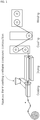
- FIG. 1 schematically illustrates a manufacturing process according to an embodiment of the present invention
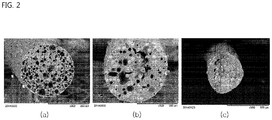
- FIG. 2 illustrates cross-sectional images of the coated yarn manufactured by the process of FIG. 1 (wherein (a) shows the results using a foam mixer, (b) shows the results using a chemical foaming agent, and (c) shows the results without a pore forming process)
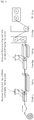
- FIG. 3 schematically illustrates a manufacturing process according to another embodiment of the present invention
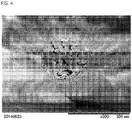
- FIG. 4 illustrates a cross-sectional image of the coated yarn manufactured by the process of FIG. 3 .
- the aqueous thermosetting urethane compound for use in yarn coating includes an aqueous thermosetting urethane resin and has pores.
- it comprises 100 parts by weight of an aqueous thermosetting urethane resin, 1.5 to 2.5 parts by weight of a thickener, and 6 to 12 parts by weight of a processing lubricant.
- 2.5 to 3.5 parts by weight of a matting agent may be further included.
- the aqueous thermosetting urethane compound for yarn coating is formed by mixing the aqueous thermosetting urethane resin as the main component with the thickener and the processing lubricant, and is then applied in a single layer or in multiple layers on the surface of yarn, such as polyester or nylon.
- thermosetting urethane resin Since the aqueous thermosetting urethane resin is used in the present invention, the requirement for a specific solvent is obviated, and the desired viscosity may be easily adjusted by the addition of the thickener while maintaining the required solid content.
- the aqueous thermosetting urethane resin includes any one or a mixture of two or more selected from among aqueous thermosetting silicone-modified urethane, aqueous thermosetting polyurethane, and aqueous thermosetting polyacryl urethane.
- the thickener is exemplified by polyacrylate, and the processing lubricant includes a matting agent, a foam stabilizer, a dispersant, and a crosslinking agent, among which the matting agent is used in an amount of 2.5 to 3.5 parts by weight, and preferably includes silica.
- the thickener is used to adjust the viscosity of the aqueous thermosetting urethane compound, and is added in an amount suitable for the thickness of the coating layer applied on the yarn.
- the thickener is preferably used in an amount of 1.5 to 2.5 parts by weight (PHR), based on 100 parts by weight of the aqueous thermosetting urethane resin.
- PHR weight to 2.5 parts by weight
- coating workability may be good.
- the viscosity is excessively high or low, it is difficult to carry out a uniform coating process.
- the processing lubricant which is added to the aqueous thermosetting urethane resin, functions to reduce the coefficient of friction between the nozzle and the aqueous thermosetting urethane compound coating layer when the coated yarn exits via the nozzle, so that no remnants are left behind on the nozzle, thus lowering defective rates. Furthermore, the adhesion between the aqueous thermosetting urethane compound and the yarn may be enhanced, thus ensuring good coatability.
- the processing lubricant is used in an amount of 6 to 12 parts by weight, based on 100 parts by weight of the aqueous thermosetting urethane resin, in order to maintain the above properties, and typically includes a matting agent, a foam stabilizer, a dispersant, and a crosslinking agent.
- the matting agent is used in an amount of 2.5 to 3.5 parts by weight in the present invention, and the amounts of the foam stabilizer, the dispersant, and the crosslinking agent may be appropriately controlled depending on the amount or kind of aqueous thermosetting urethane resin.
- the matting agent which is added to the aqueous thermosetting urethane resin, is preferably used in an amount of 2.5 to 3.5 parts by weight, based on 100 parts by weight of the aqueous thermosetting urethane resin.
- the matting agent plays a role in matting light reflected from the surface of the coated yarn, and is exemplified by amorphous inorganic silica having an average particle size of 20 ⁇ m or less to thereby form fine roughness on the surface of the coated yarn, so that incident light is scattered or matted, whereby the surface gloss of the coated yarn is made good.
- thermosetting urethane resin as the main component is appropriately mixed with the thickener and the processing lubricant, giving the aqueous thermosetting urethane compound.
- the aqueous thermosetting urethane compound includes a compound having relatively few pores and a compound having pores.
- the compound having few pores is a mixture of the above components, and the compound having pores is prepared by one of the following two methods.
- the compound has pores formed using a foam mixer so that the density thereof is adjusted to 0.3 to 0.6 g/cm 3 , or has pores formed through post foaming using a chemical foaming agent so that the density thereof is adjusted to 0.3 to 0.6 g/cm 3 .
- the foam mixer enables rapid rotation while forming pores in the aqueous thermosetting urethane compound, and the chemical foaming agent, such as an organic or inorganic foaming agent, is added to the aqueous thermosetting urethane compound to thus generate gas by a reaction such as pyrolysis, thereby forming pores.
- the organic foaming agent includes ADAC (azodicarbonamide) or SH (benzene sulfonyl hydrazide), and the inorganic foaming agent includes NaHCO 3 or expandable graphite.
- the aqueous thermosetting urethane compound having an appropriate density through the formation of pores using the foam mixer or the chemical foaming agent corresponds to the aqueous thermosetting urethane compound having pores according to the present invention
- the aqueous thermosetting urethane compound resulting from only mixing the components without the above processing corresponds to the aqueous thermosetting urethane compound having relatively few pores according to the present invention.
- thermosetting urethane compounds which are prepared to possess different numbers of pores, that is, different densities, are appropriately used together and applied on the yarn, whereby the coated yarn may be variously utilized.
- the aqueous thermosetting urethane compound may be applied in a single layer or in multiple layers on the surface of the yarn.
- aqueous thermosetting urethane compound may be provided in a single layer, as shown in FIG. 1 , the surface of the yarn is coated with the aqueous thermosetting urethane compound that was fed into the hopper, after which the yarn exits via the nozzle, and is dried, cooled, and wound, thereby completing the manufacture of the coated yarn.
- the yarn is primarily coated with the aqueous thermosetting urethane compound having pores, which was fed into the hopper, exits via the nozzle, and is then dried, after which the yarn is secondarily coated with the aqueous thermosetting urethane compound having relatively few pores, exits via the nozzle, and is then dried, cooled, and wound, thereby obtaining multiple-layer coated yarn.
- the aqueous thermosetting urethane compound having pores and the aqueous thermosetting urethane compound having relatively few pores are used together, thereby obtaining coated yarn configured such that the density is decreased but flexibility is ensured at the inner layer thereof, and the surface strength is enhanced at the outer layer thereof to thus exhibit superior physical properties and applicability to various fields.
- aqueous thermosetting silicone-modified urethane, aqueous thermosetting polyurethane, and aqueous thermosetting polyacryl urethane may be used alone or in combination to produce coated yarn, and the viscosity of the resulting composition is adjusted to a desired level using a thickener to manufacture as thin yarn as desired, and the coating thickness is variously adjusted as desired using a suitable nozzle.
- aqueous thermosetting polyurethane-coated yarn having a thickness of 250 deniers or less may be manufactured.
- the inner layer thereof is formed with pores through the introduction of air using a foam mixer or through post foaming using a chemical foaming agent, thus decreasing the density thereof and ensuring lightness and flexibility, after which the outer layer thereof is imparted with enhanced surface strength or various functionalities.
- a composition used to prepare an aqueous thermosetting polyurethane compound for coated yarn particularly a composition comprising aqueous thermosetting polyurethane, a thickener, and a processing lubricant, is specified below.
- the aqueous thermosetting polyurethane is provided in the form of being dispersed in water by polymerizing polyester polyol, polyether polyol, polycarbonate polyol, or polycaprolactone with aromatic isocyanate and aliphatic isocyanate, using monomer diamine or glycol as a chain extender.
- a thickener is used to improve productivity and matting effects upon preparation of the aqueous thermosetting polyurethane compound.
- the thickener is exemplified by polyacrylate.
- silica powder is used. These additives may be mixed before use.
- thermosetting polyurethane compound Solid content (%) Viscosity (cps, 25°C) Md100 (100% modulus) (kgf/cm) Coating workability Working rate (m/min) Surfaces tackiness Thickener (PHR) Matting agent (PHR) A 60 500-1000 5 Not workable Not workable Strong 0 0 B 30 200-300 50 Not workable Not workable Fair 0 0 A-1 60 20,000 5 Poor 30 Good 1.2 3 A-2 60 45,000 5 Good 300 Good 2.0 3 B-2 30 45,000 50 Good 150 Good 5.0 3 A-3 60 60,000 5 Poor 30 Good 3.0 3 B-3 30 60,000 50 Poor 20 Good 9.5 3
- the use of the matting agent in an amount of about 3.0 PHR resulted in good surface tackiness or gloss.
- a and B are typically useful aqueous thermosetting polyurethane resins
- A-1,2,3 or B-2,3 are compositions according to the present invention for use in the manufacturing method of the invention.
- the amount of water is comparatively low at high solid content, and thus the drying rate becomes favorable, ultimately increasing the working rate.
- the coated yarn using the chemical foaming agent had a density decreased by about 50%, compared to the coated yarn having no pores. Furthermore, the coated yarn using the foam mixer had a density decreased by 40%, compared to the coated yarn having no pores.
- the coated yarn using the foam mixer manifested excellent properties.
- the coated yarn according to the present invention has abrasion resistance superior to that of typical yarn (made of polyester, nylon, etc.), and may have improved mechanical properties and durability. Furthermore, it manifests excellent thermal formability and adhesion.
- Table 3 shows the components and the component ratios upon preparation of the aqueous thermosetting polyurethane compound (A-2 of Table 1) for coated yarn.
- Composition of the invention (parts by weight) Using foam mixer Using chemical foaming agent No pores Aqueous thermosetting polyurethane resin 90 90 90 Aqueous thermosetting silicone-modified urethane resin 10 10 10 Foam stabilizer 3 - - Dispersant 2 - - Chemical foaming agent - 3 - Pigment 10 10 10 Thickener 2 2 2 Matting agent 3 3 3 3 Crosslinking agent 3 3 3
- the density of the compound using the foam mixer could be adjusted depending on the air introduction ratio. If the density thereof is lower than 0.3, it is difficult to form pores in the coating process. In contrast, if the density is higher than 0.6, it is difficult to adjust the relative viscosity. Hence, when the ideal density is set within the range from 0.3 to 0.6 g/cm 3 , superior properties may result.
- the yarn is coated with the aqueous thermosetting urethane compound having the above composition, thereby obtaining coated yarn.
- the aqueous thermosetting polyurethane compound for coated yarn is applied on the surface of yarn (made of polyester, nylon, etc.).
- FIG. 2 illustrates the cross-sectional images of the coated yarn manufactured by the process of FIG. 1 (wherein (a) shows the results using a foam mixer, (b) shows the results using a chemical foaming agent, and (c) shows the results without a pore forming process).
- the aforementioned single-layer coated yarn (which is coated with either the compound having pores or the compound having few pores) is additionally coated with either the aqueous thermosetting polyurethane compound having relatively many pores or the aqueous thermosetting polyurethane compound having no pores, dried, cooled, and wound using a typical take-off unit.
- FIG. 4 illustrates the cross-sectional image of the two-layer coated yarn obtained by the process of FIG. 3 , wherein primary coating is performed in a manner such that a black color pigment is added using a foam mixer to adjust the density of the compound to 450 g/cm 3 and then the compound is applied using a 0.28 mm nozzle and then dried, and secondary coating is conducted in a manner such that the compound having no pores and a gold pearl pigment are added, applied using a 0.3 mm nozzle, dried, and cooled, resulting in the two-layer coated yarn.
- the first and the second compound having respective different colors may be applied, and the first or the second compound may be added with a functional pigment, as necessary, and then applied.
- the compound having pores When the compound having pores is used in the primary coating, the compound having no pores is used in the primary coating, whereby surface abrasion strength or mechanical properties may become more desirable, based on the results of Table 2.
- the coated yarn according to the present invention includes the coating layer having pores, compared to conventional coated yarn (coated with resin such as TPU, PVC, PP, etc.), and thus has low density, thereby ensuring lightness and good touch and elasticity. Furthermore, when the multiple-layer coated yarn is manufactured, it can be imparted with various colors or functionalities, and is thus useful in a variety of industrial materials.
Landscapes
- Engineering & Computer Science (AREA)
- Textile Engineering (AREA)
- Chemical & Material Sciences (AREA)
- Chemical Kinetics & Catalysis (AREA)
- Mechanical Engineering (AREA)
- Life Sciences & Earth Sciences (AREA)
- Materials Engineering (AREA)
- Wood Science & Technology (AREA)
- Organic Chemistry (AREA)
- Treatments For Attaching Organic Compounds To Fibrous Goods (AREA)
- Paints Or Removers (AREA)
Applications Claiming Priority (2)
| Application Number | Priority Date | Filing Date | Title |
|---|---|---|---|
| KR1020140109710A KR101561890B1 (ko) | 2014-08-22 | 2014-08-22 | 원사 코팅용 수성 열경화성 우레탄 컴파운드 및 이를 코팅한 코팅 원사의 제조방법 |
| PCT/KR2014/009716 WO2016027927A1 (fr) | 2014-08-22 | 2014-10-16 | Composé d'uréthane thermodurcissable aqueux pour recouvrir un fil, et procédé de préparation de fil revêtu avec ce dernier |
Publications (2)
| Publication Number | Publication Date |
|---|---|
| EP3214221A1 true EP3214221A1 (fr) | 2017-09-06 |
| EP3214221A4 EP3214221A4 (fr) | 2018-08-15 |
Family
ID=54428192
Family Applications (1)
| Application Number | Title | Priority Date | Filing Date |
|---|---|---|---|
| EP14900100.0A Withdrawn EP3214221A4 (fr) | 2014-08-22 | 2014-10-16 | Composé d'uréthane thermodurcissable aqueux pour recouvrir un fil, et procédé de préparation de fil revêtu avec ce dernier |
Country Status (6)
| Country | Link |
|---|---|
| US (1) | US20170268166A1 (fr) |
| EP (1) | EP3214221A4 (fr) |
| KR (1) | KR101561890B1 (fr) |
| CN (1) | CN106574435A (fr) |
| TW (1) | TWI572638B (fr) |
| WO (1) | WO2016027927A1 (fr) |
Cited By (1)
| Publication number | Priority date | Publication date | Assignee | Title |
|---|---|---|---|---|
| EP3690090A1 (fr) * | 2019-01-31 | 2020-08-05 | Yong Gun Kim | Procédé de fabrication de fibre haute ténacité et fibre haute ténacité ainsi fabriquée |
Families Citing this family (8)
| Publication number | Priority date | Publication date | Assignee | Title |
|---|---|---|---|---|
| US20170335509A1 (en) * | 2016-05-20 | 2017-11-23 | Duksung Co., Ltd. | Retroreflective yarns and the preparation method thereof |
| KR20170131230A (ko) * | 2016-05-20 | 2017-11-29 | 주식회사 덕성 | 재귀반사 원사 및 이의 제조방법 |
| KR101859181B1 (ko) * | 2016-06-02 | 2018-05-17 | 주식회사 덕성 | 다층 코팅 다색실 및 그 제조방법 |
| KR102082090B1 (ko) | 2019-12-09 | 2020-02-26 | 박희대 | 소수성 나노실리카가 배합된 열가소성 폴리우레탄 코팅 원사 |
| CN113186726B (zh) * | 2021-05-13 | 2022-09-09 | 福建永绘纺织有限公司 | 抗菌型竹炭纤维飞织鞋面 |
| CN113604924A (zh) * | 2021-08-21 | 2021-11-05 | 石俭平 | 一种聚氨酯包覆塑形纱和面料 |
| CN113737530A (zh) * | 2021-08-23 | 2021-12-03 | 合肥科天水性科技有限责任公司 | 一种水性聚氨酯集束编织线及其制备方法 |
| KR102852396B1 (ko) | 2023-01-10 | 2025-08-29 | 삼부정밀화학 주식회사 | 바이오매스 기반 tpu를 함유하는 열가소성 폴리우레탄수지 코팅 원사 |
Family Cites Families (18)
| Publication number | Priority date | Publication date | Assignee | Title |
|---|---|---|---|---|
| US1048763A (en) * | 1908-03-30 | 1912-12-31 | Hoechst Ag | Mixing-machine. |
| JPS5213599A (en) * | 1975-07-22 | 1977-02-01 | Kao Corp | Preparation of aqueous polyurethane emulsion |
| US4265972A (en) * | 1979-03-09 | 1981-05-05 | Bernard Rudner | Coated fibers and related process |
| JPS61258040A (ja) * | 1985-05-07 | 1986-11-15 | 大前 清司 | 樹脂コ−テイング糸とその織布 |
| JPS63128035A (ja) * | 1986-11-17 | 1988-05-31 | Mitsui Toatsu Chem Inc | 通気性防水膜 |
| US5120770A (en) * | 1989-11-29 | 1992-06-09 | Doyle Earl N | Use of liquid carbon dioxide as a blowing agent in the production of open-cell polyurethane foam |
| JPH0596597A (ja) * | 1991-10-05 | 1993-04-20 | Tsutsumi Seisakusho:Kk | 軟線材の製造方法 |
| GB9902955D0 (en) * | 1999-02-11 | 1999-03-31 | Hyperlast Ltd | Waterproofing of stitched articles |
| US9045845B2 (en) * | 2001-12-28 | 2015-06-02 | Chavanoz Industrie | Composite yarn, method for obtaining same and resulting textile structure |
| US20040109992A1 (en) * | 2002-12-09 | 2004-06-10 | Gribble Michael Y. | Process for applying a polyurethane dispersion based foam to an article |
| FR2862664B1 (fr) * | 2003-11-25 | 2006-03-17 | Chavanoz Ind | Fil composite comprenant un fil continu et une matrice comprenant un polymere mousse |
| JP4463051B2 (ja) * | 2003-12-24 | 2010-05-12 | ヤマウチ株式会社 | プレスベルトの製造方法 |
| KR100875709B1 (ko) * | 2008-03-20 | 2008-12-23 | 주식회사이퉁 | 열가소성 폴리우레탄 코팅 원사를 이용한 논슬립성 원단 |
| CN102121196B (zh) * | 2010-12-25 | 2012-03-28 | 江苏联宏纺织有限公司 | 一种基于芳砜纶织物的防水透气涂层工艺 |
| KR101318135B1 (ko) * | 2011-12-30 | 2013-10-15 | 박희대 | 코팅 원사용 열가소성 폴리우레탄 컴파운드의 조성물 |
| TW201328874A (zh) * | 2012-01-02 | 2013-07-16 | Singtex Ind Co Ltd | 具防絨、透氣及吸附之多孔性材料紡織品及其製備方法 |
| KR101341055B1 (ko) | 2012-12-26 | 2013-12-13 | 박희대 | 열가소성 폴리우레탄 원사의 조성물 및 그 제조방법 |
| KR101341054B1 (ko) | 2013-05-13 | 2013-12-13 | 박희대 | 코팅 원사의 제조방법 |
-
2014
- 2014-08-22 KR KR1020140109710A patent/KR101561890B1/ko active Active
- 2014-10-16 WO PCT/KR2014/009716 patent/WO2016027927A1/fr not_active Ceased
- 2014-10-16 EP EP14900100.0A patent/EP3214221A4/fr not_active Withdrawn
- 2014-10-16 US US15/505,332 patent/US20170268166A1/en not_active Abandoned
- 2014-10-16 CN CN201480081418.8A patent/CN106574435A/zh active Pending
-
2015
- 2015-08-18 TW TW104126906A patent/TWI572638B/zh active
Cited By (1)
| Publication number | Priority date | Publication date | Assignee | Title |
|---|---|---|---|---|
| EP3690090A1 (fr) * | 2019-01-31 | 2020-08-05 | Yong Gun Kim | Procédé de fabrication de fibre haute ténacité et fibre haute ténacité ainsi fabriquée |
Also Published As
| Publication number | Publication date |
|---|---|
| TW201615693A (zh) | 2016-05-01 |
| EP3214221A4 (fr) | 2018-08-15 |
| CN106574435A (zh) | 2017-04-19 |
| WO2016027927A1 (fr) | 2016-02-25 |
| TWI572638B (zh) | 2017-03-01 |
| KR101561890B1 (ko) | 2015-10-26 |
| US20170268166A1 (en) | 2017-09-21 |
Similar Documents
| Publication | Publication Date | Title |
|---|---|---|
| EP3214221A1 (fr) | Composé d'uréthane thermodurcissable aqueux pour recouvrir un fil, et procédé de préparation de fil revêtu avec ce dernier | |
| KR101318135B1 (ko) | 코팅 원사용 열가소성 폴리우레탄 컴파운드의 조성물 | |
| KR101341054B1 (ko) | 코팅 원사의 제조방법 | |
| US5242976A (en) | Composition for improving adhesion of vinylidene polyfluoride and non-compatible polymeric resins | |
| EP3037276B1 (fr) | Feuille de décoration | |
| US12031242B2 (en) | Hydrophobic nano-silica mixed thermoplastic polyurethane coated yarn | |
| US9914808B2 (en) | Masterbatch for thermoplastic polyurethane yarn and method for manufacturing thermoplastic polyurethane yarn using the same | |
| EP3594287A1 (fr) | Résine pour un fil de polyuréthane thermoplastique utilisant de la nanosilice et procédé de fabrication d'un fil de polyuréthane thermoplastique utilisant cette résine | |
| CN108641220A (zh) | 车衣隐形保护膜的pvc基材层及其制作工艺 | |
| KR101859181B1 (ko) | 다층 코팅 다색실 및 그 제조방법 | |
| US20060252320A1 (en) | Method of forming a PVC scrim fabric laminate having superior scuff and abrasion resistance | |
| KR101530149B1 (ko) | 기공을 가지는 코팅 원사용 컴파운드의 조성물 | |
| KR101935206B1 (ko) | 열가소성 폴리우레탄 원사 | |
| DE102021210254A1 (de) | Kaffeesatz als Additiv für Kunststoffmaterialien | |
| JP2019155687A (ja) | 化粧シートおよび化粧部材 | |
| KR102655195B1 (ko) | 고휘도 인테리어 필름 및 그 제조방법 | |
| CN101850642B (zh) | 仿球革高分子装饰膜的制备方法 | |
| CN118530502A (zh) | 一种用于载具的表皮材料及包含所述表皮材料的载具饰件 | |
| US20120295102A1 (en) | Multilayer structure, and a method for making the same | |
| CN117754945A (zh) | 一种改性低雾化聚氯乙烯车用内饰表皮及其制备方法 | |
| US20080095945A1 (en) | Method for Making Macromolecular Laminate | |
| KR101853075B1 (ko) | 압출 데코 몰딩재 및 그 제조방법 | |
| US20050170168A1 (en) | Sheet made of high molecular material and method for making same | |
| JP4757117B2 (ja) | 複層膜形成方法および塗装物品 | |
| KR20230039272A (ko) | 친환경 문틀 및 그 성형 방법 |
Legal Events
| Date | Code | Title | Description |
|---|---|---|---|
| PUAI | Public reference made under article 153(3) epc to a published international application that has entered the european phase |
Free format text: ORIGINAL CODE: 0009012 |
|
| 17P | Request for examination filed |
Effective date: 20170621 |
|
| AK | Designated contracting states |
Kind code of ref document: A1 Designated state(s): AL AT BE BG CH CY CZ DE DK EE ES FI FR GB GR HR HU IE IS IT LI LT LU LV MC MK MT NL NO PL PT RO RS SE SI SK SM TR |
|
| AX | Request for extension of the european patent |
Extension state: BA ME |
|
| DAX | Request for extension of the european patent (deleted) | ||
| A4 | Supplementary search report drawn up and despatched |
Effective date: 20180716 |
|
| RIC1 | Information provided on ipc code assigned before grant |
Ipc: D06M 23/04 20060101ALI20180709BHEP Ipc: D06M 101/32 20060101ALI20180709BHEP Ipc: D06M 11/79 20060101ALI20180709BHEP Ipc: D06M 101/34 20060101ALN20180709BHEP Ipc: D02G 3/40 20060101ALI20180709BHEP Ipc: D06P 1/44 20060101ALI20180709BHEP Ipc: D06M 15/263 20060101ALI20180709BHEP Ipc: D06M 15/564 20060101AFI20180709BHEP Ipc: D06P 1/52 20060101ALI20180709BHEP |
|
| 17Q | First examination report despatched |
Effective date: 20190605 |
|
| GRAP | Despatch of communication of intention to grant a patent |
Free format text: ORIGINAL CODE: EPIDOSNIGR1 |
|
| RIC1 | Information provided on ipc code assigned before grant |
Ipc: D06M 23/04 20060101ALI20200214BHEP Ipc: D06M 11/79 20060101ALI20200214BHEP Ipc: D06P 1/52 20060101ALI20200214BHEP Ipc: D06M 101/34 20060101ALN20200214BHEP Ipc: D06P 1/44 20060101ALI20200214BHEP Ipc: D06M 15/263 20060101ALI20200214BHEP Ipc: D06M 15/564 20060101AFI20200214BHEP Ipc: D02G 3/40 20060101ALI20200214BHEP Ipc: D06M 101/32 20060101ALI20200214BHEP |
|
| RIC1 | Information provided on ipc code assigned before grant |
Ipc: D06M 15/263 20060101ALI20200302BHEP Ipc: D06M 15/564 20060101AFI20200302BHEP Ipc: D02G 3/40 20060101ALI20200302BHEP Ipc: D06P 1/44 20060101ALI20200302BHEP Ipc: D06M 101/32 20060101ALI20200302BHEP Ipc: D06M 11/79 20060101ALI20200302BHEP Ipc: D06P 1/52 20060101ALI20200302BHEP Ipc: D06M 101/34 20060101ALN20200302BHEP Ipc: D06M 23/04 20060101ALI20200302BHEP |
|
| INTG | Intention to grant announced |
Effective date: 20200320 |
|
| STAA | Information on the status of an ep patent application or granted ep patent |
Free format text: STATUS: THE APPLICATION IS DEEMED TO BE WITHDRAWN |
|
| 18D | Application deemed to be withdrawn |
Effective date: 20200731 |