EP3219557A1 - Dispositif de coussin de sécurité gonflable latéral - Google Patents
Dispositif de coussin de sécurité gonflable latéral Download PDFInfo
- Publication number
- EP3219557A1 EP3219557A1 EP15858821.0A EP15858821A EP3219557A1 EP 3219557 A1 EP3219557 A1 EP 3219557A1 EP 15858821 A EP15858821 A EP 15858821A EP 3219557 A1 EP3219557 A1 EP 3219557A1
- Authority
- EP
- European Patent Office
- Prior art keywords
- bag
- air
- guide cloth
- inflator
- bag device
- Prior art date
- Legal status (The legal status is an assumption and is not a legal conclusion. Google has not performed a legal analysis and makes no representation as to the accuracy of the status listed.)
- Withdrawn
Links
Images




Classifications
-
- B—PERFORMING OPERATIONS; TRANSPORTING
- B60—VEHICLES IN GENERAL
- B60R—VEHICLES, VEHICLE FITTINGS, OR VEHICLE PARTS, NOT OTHERWISE PROVIDED FOR
- B60R21/00—Arrangements or fittings on vehicles for protecting or preventing injuries to occupants or pedestrians in case of accidents or other traffic risks
- B60R21/02—Occupant safety arrangements or fittings, e.g. crash pads
- B60R21/16—Inflatable occupant restraints or confinements designed to inflate upon impact or impending impact, e.g. air bags
- B60R21/20—Arrangements for storing inflatable members in their non-use or deflated condition; Arrangement or mounting of air bag modules or components
- B60R21/207—Arrangements for storing inflatable members in their non-use or deflated condition; Arrangement or mounting of air bag modules or components in vehicle seats
-
- B—PERFORMING OPERATIONS; TRANSPORTING
- B60—VEHICLES IN GENERAL
- B60R—VEHICLES, VEHICLE FITTINGS, OR VEHICLE PARTS, NOT OTHERWISE PROVIDED FOR
- B60R21/00—Arrangements or fittings on vehicles for protecting or preventing injuries to occupants or pedestrians in case of accidents or other traffic risks
- B60R21/02—Occupant safety arrangements or fittings, e.g. crash pads
- B60R21/16—Inflatable occupant restraints or confinements designed to inflate upon impact or impending impact, e.g. air bags
- B60R21/23—Inflatable members
- B60R21/231—Inflatable members characterised by their shape, construction or spatial configuration
- B60R21/23138—Inflatable members characterised by their shape, construction or spatial configuration specially adapted for side protection
-
- B—PERFORMING OPERATIONS; TRANSPORTING
- B60—VEHICLES IN GENERAL
- B60R—VEHICLES, VEHICLE FITTINGS, OR VEHICLE PARTS, NOT OTHERWISE PROVIDED FOR
- B60R21/00—Arrangements or fittings on vehicles for protecting or preventing injuries to occupants or pedestrians in case of accidents or other traffic risks
- B60R21/02—Occupant safety arrangements or fittings, e.g. crash pads
- B60R21/16—Inflatable occupant restraints or confinements designed to inflate upon impact or impending impact, e.g. air bags
- B60R21/23—Inflatable members
- B60R21/231—Inflatable members characterised by their shape, construction or spatial configuration
- B60R21/233—Inflatable members characterised by their shape, construction or spatial configuration comprising a plurality of individual compartments; comprising two or more bag-like members, one within the other
-
- B—PERFORMING OPERATIONS; TRANSPORTING
- B60—VEHICLES IN GENERAL
- B60R—VEHICLES, VEHICLE FITTINGS, OR VEHICLE PARTS, NOT OTHERWISE PROVIDED FOR
- B60R21/00—Arrangements or fittings on vehicles for protecting or preventing injuries to occupants or pedestrians in case of accidents or other traffic risks
- B60R21/02—Occupant safety arrangements or fittings, e.g. crash pads
- B60R21/16—Inflatable occupant restraints or confinements designed to inflate upon impact or impending impact, e.g. air bags
- B60R21/23—Inflatable members
- B60R21/231—Inflatable members characterised by their shape, construction or spatial configuration
- B60R21/2334—Expansion control features
- B60R21/2346—Soft diffusers
-
- B—PERFORMING OPERATIONS; TRANSPORTING
- B60—VEHICLES IN GENERAL
- B60R—VEHICLES, VEHICLE FITTINGS, OR VEHICLE PARTS, NOT OTHERWISE PROVIDED FOR
- B60R21/00—Arrangements or fittings on vehicles for protecting or preventing injuries to occupants or pedestrians in case of accidents or other traffic risks
- B60R21/02—Occupant safety arrangements or fittings, e.g. crash pads
- B60R21/16—Inflatable occupant restraints or confinements designed to inflate upon impact or impending impact, e.g. air bags
- B60R21/23—Inflatable members
- B60R21/231—Inflatable members characterised by their shape, construction or spatial configuration
- B60R21/23138—Inflatable members characterised by their shape, construction or spatial configuration specially adapted for side protection
- B60R2021/23146—Inflatable members characterised by their shape, construction or spatial configuration specially adapted for side protection seat mounted
-
- B—PERFORMING OPERATIONS; TRANSPORTING
- B60—VEHICLES IN GENERAL
- B60R—VEHICLES, VEHICLE FITTINGS, OR VEHICLE PARTS, NOT OTHERWISE PROVIDED FOR
- B60R21/00—Arrangements or fittings on vehicles for protecting or preventing injuries to occupants or pedestrians in case of accidents or other traffic risks
- B60R21/02—Occupant safety arrangements or fittings, e.g. crash pads
- B60R21/16—Inflatable occupant restraints or confinements designed to inflate upon impact or impending impact, e.g. air bags
- B60R21/23—Inflatable members
- B60R21/231—Inflatable members characterised by their shape, construction or spatial configuration
- B60R21/233—Inflatable members characterised by their shape, construction or spatial configuration comprising a plurality of individual compartments; comprising two or more bag-like members, one within the other
- B60R2021/23324—Inner walls crating separate compartments, e.g. communicating with vents
Definitions
- the present invention relates to a side air-bag device for restraining an occupant of an automobile or the like at side impact or the like, and in particular, to a side air-bag device including an air-bag whose interior is partitioned into a plurality of chambers.
- side air-bag devices are configured to inflate an air-bag (a side air-bag) to a side of an occupant with an inflator to restrain the body of the occupant with the inflated air-bag.
- a side air-bag an air-bag
- Japanese Unexamined Patent Application Publication No. 2012-56506 discloses a configuration for inflating the lower part of an air-bag, on which the waist of the occupant hits, earlier than the upper part.
- the interior of the air-bag is partitioned into three chambers of upper, middle, and lower, and gas from an inflator is supplied to the upper chamber and the lower chamber by a tubular diffuser.
- the diffuser has a tubular shape extending vertically.
- the inflator is disposed in this diffuser.
- the inflator is cylindrical and is disposed so that a gas ejection opening is at the lower end.
- the inflator can be vertically reversed from that of PTL 1 so that the gas ejection opening is located at the upper end of the inflator to supply a large quantity of gas to the upper chamber, thereby earlier inflating the upper chamber.
- Fig. 11 is a side view of an inflator 1 with stud bolts widely used.
- This inflator 1 is cylindrical and has gas ejection openings 1a at one end.
- a first stud bolt 2 is disposed in the vicinity of the gas ejection openings 1a, and a second stud bolt 3 is disposed substantially at the center in the longitudinal direction of the inflator 1.
- Figs. 12A and 12B are side views of an automobile front seat 4 including the inflator 1 illustrating a side surface of a seat back 4a in perspective view.
- the seat back 4a has a first bolt insertion hole 5 at an intermediate point in the vertical direction of the frame (seat-back frame) and a second bolt insertion hole 6 a predetermined distance above that.
- the first stud bolt 2 of the inflator 1 is inserted in the first bolt insertion hole 5, and the second stud bolt 3 is inserted in the second bolt insertion hole 6.
- the inflator 1 is fixed to the seat-back frame together with the side air-bag.
- the gas ejection openings 1a are disposed at the lower end of the inflator 1.
- Fig. 12B illustrates a state in which the inflator 1 is mounted upside down to the seat-back frame.
- the second stud bolt 3 of the inflator 1 is inserted in the first bolt insertion hole 5, and the first stud bolt 2 is inserted in the second bolt insertion hole 6.
- the gas ejection openings 1a is disposed at the upper end of the inflator 1.
- the second stud bolt 3 is located at an intermediate point of the inflator 1 in the longitudinal direction, the position of the lower end of the inflator 1 in Fig. 12B is lower by ⁇ h than that in Fig. 12A .
- the side surface of the seat back 4a in the vicinity of the lower end protrudes laterally by the diameter of the inflator 1.
- Patent Literature 1 Japanese Patent Publication No. 2012-56506
- a side air-bag device includes an air-bag, partition means that partitions an interior of the air-bag into at least two chambers, an upper chamber and a lower chamber, a cylindrical guide cloth disposed in a vertical direction in the air-bag, and an inflator disposed in the guide cloth and having a gas ejection opening at a lower end, wherein the guide cloth is open at a top, closed at a bottom, and has a gas outlet at a side near a lower part.
- the guide cloth has no seamed portion at a front surface.
- the guide cloth has no seamed portion at the bottom.
- the partition means is a partition panel, and at the front of the air-bag, the partition panel decreases in width toward the front.
- the partition panel is disposed to increase in height toward the front.
- a space is provided between a trailing edge of the partition panel and a trailing edge of the air-bag, and the guide cloth is inserted in the space.
- part of gas ejected downward from the inflator changes in flowing direction at the bottom of the guide cloth and flows toward the upper chamber.
- an inflator is disposed in a cylindrical guide cloth in an air-bag, and the inflator has a gas ejection opening at a lower end.
- This guide cloth is open at the top, closed at the bottom, and has a gas outlet at a side near a lower part. Since the bottom of the guide cloth is closed, gas ejected downward from the inflator can be changed in direction to supply a large quantity of gas to the upper chamber.
- the inflator has a gas ejection opening at the lower end, the inflator can be mounted also to a seat-back frame of existing design without changing in vertical position.
- the partition panel that partitions the air bag into an upper chamber and a lower chamber decreases in width toward the leading edge. Since the inflation thickness of the air-bag in the vicinity of the partition panel decreases toward the leading edge, resistance received when the air-bag inflates so as to enter between the occupant and the door is small.
- a side air-bag device according to an embodiment will be described hereinbelow.
- an air-bag 20 of the side air-bag device is configured to inflate along a window-side side portion of a front seat 10.
- This seat 10 includes a seat cushion 11, a seat back 12, and a head rest 13.
- the air-bag 20 is housed in a folded state on a side of the seat back 12 and is covered with a soft cover (not shown).
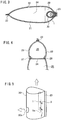
- This air-bag 20 is formed into a bag shape by overlapping two cloths (panels) 21 and 22 together and sewing up their peripheries with a seam 23, as illustrated in Figs. 2 to 4 .
- the interior thereof is partitioned by a partition panel 24 into an upper chamber 25 on the upper side and a lower chamber 26 on the lower side.
- This partition panel 24 is sewn to the panels 21 and 22 using seams 27 and 28.
- This partition panel 24 extends so as to be higher toward the leading edge (front edge) of the air-bag 20.
- a space 29 ( Fig. 3 ) communicating the upper and lower chambers 25 and 26 together is provided.
- the front portion of the partition panel 24 decreases in width toward the front of the car body. For that reason, when the air-bag 20 inflates, the vicinity of the front of the partition panel 24 decreases in thickness gradually toward the leading edge of the air-bag 20. Therefore, the resistance when the inflating air-bag 20 enters between the occupant and the door is small.
- This partition panel 24 extends so as to be higher toward the front. Therefore, the upper chamber 25 is quickly inflated and developed obliquely upward by the gas from the inflator 1 to restrain the upper part of the body of the occupant.
- a pipe-shaped guide cloth 30 extends vertically through the space 29.
- This guide cloth 30 is formed into a bottomed cylindrical shape by folding a cloth (panel), in which the inflator 1 is disposed.
- the cylindrical guide cloth 30 is open at the top, closed at the bottom, and has a gas outlet 30a at the lower side surface, as illustrated in Fig. 5 .
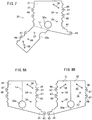
- Fig. 6A illustrates the guide cloth 30 in a flat spread state.
- the guide cloth 30 includes a first leaf 31 and a second leaf 32 of a substantially rectangular shape.
- the first leaf 31 and the second leaf 32 are made up of one cloth.
- a V-shaped cut portion 33 is formed between the first leaf 31 and the second leaf 32.
- Bolt insertion holes 34 and 35 and a slit 38 are provided on the right side of the first leaf 31.
- Bolt insertion holes 36 and 37 and a slit 39 are provided on the left side of the second leaf 32.
- the slits 38 and 39 are for use in inserting the inflator 1 into the cylindrical guide cloth 30.
- the first leaf 31 and the second leaf 32 have gas outlets 30a and 30a in the vicinity of the cut portion 33.
- the second leaf 32 has a bolt insertion hole 45 at the edge of the cut portion 33.
- the first leaf 31 and the second leaf 32 include extending pieces 41 and 42 extending along the cut portion 33. At the end of the extending piece 41 is provided a small hole 43, and at the end of the extending piece 42 is provided a small hole 44. A plurality of protruding edges 46 are provided around the peripheries of the first leaf 31 and the second leaf 32, and each edge 46 has a small hole 47. A positioning rod is inserted into each of the small holes 43, 44, and 47 when the guide cloth 30 is folded.
- an area around an edge of the cut portion 33 including the extending piece 42 is folded along a bend line L 1 of the guide cloth 30 so as to overlap with the second leaf 3, as illustrated in Fig. 6B .
- the second leaf 32 is folded into two along a bend line L 2 passing through the center of the second leaf 32 into the state illustrated in Fig. 7 .
- Fig. 8B is a back view of Fig. 8A .
- the first leaf 31 is folded back along a center line L 4 of the first leaf 31 from that state into the state illustrated in Figs. 9A and 9B.
- Fig. 9B is a back view of Fig. 9A .
- Fig. 10B is a back view of Fig. 10A .
- the folding ends.
- the bolt insertion holes 34 and 36 align, the bolt insertion holes 35, 37, and 45 align, and the slits 38 and 39 align.
- This folded guide cloth is put between the panels 21 and 22, and the outer peripheral seam 23 is formed to sew the panels 21 and 22 and the folded guide cloth 30 together.
- the seam 23 extends along a side in the vertical direction of the first and second leaves 31 and 32 of the guide cloth 30 to make the guide cloth 30 cylindrical.
- the panel 21 of the air-bag 20 has a slit (not shown) at a position aligned with the slits 38 and 39.
- This panel 21 has bolt insertion holes (not shown) at a position aligned with the bolt insertion holes 34 and 36 and at a position aligned with the bolt insertion holes 35, 37, and 45.
- This cylindrical guide cloth 30 is a double cylinder in which the first and second leaves 31 and 32 are wound double.
- This cylindrical guide cloth 30 is a bottomed cylinder whose bottom is closed threefold by the vicinity of the bend line L 5 , the vicinity of L 3 , and the vicinity of L 1 . At the front of the guide cloth 30, no seamed portion is present.
- outlets 30a of the first leaf 31 and the second leaf 32 are aligned and are open to the front of the vehicle on the lower side surface of the cylindrical guide cloth 30.
- the inflator 1 is inserted into the guide cloth 30 through the slit (not shown) of the panel 21 of the air-bag 20 and the slits 38 and 39 of the guide cloth 30.
- the stud bolt 2 is projected outside the air-bag 20 through the bolt insertion holes 45, 37, and 35 and the bolt insertion hole of the air-bag 20.
- the stud bolt 3 is projected outside the air-bag 20 through the bolt insertion holes 36 and 34 and the bolt insertion hole of the air-bag 20.
- the stud bolts 2 and 3 project outside the case (not shown) of the side air-bag device through the bolt insertion hole of the case.
- the air-bag 20 is folded, housed in the case, and covered with a module cover.
- the stud bolts 2 and 3 projecting from the case of the side air-bag device are inserted into the bolt insertion holes of the seat-back frame and are tightened with nuts.
- the air-bag 20, the inflator 1, and the case are fixed to the seat-back frame.
- gas from the gas ejection openings 1a is guided by the guide cloth 30 and flows upward in a large quantity.
- the gas flowing downward from the gas ejection openings 1a changes in flowing direction and flows into the upper chamber 25 in a large quantity.
- the upper chamber 25 inflates early.
- Gas flowing from the gas outlet 30a toward the front of the car body inflates the lower chamber 26.
- the thus-inflated air-bag 20 restrains the occupant.
- the front of the partition panel 24 is tapered, so that the inflation thickness of the air-bag 20 in the vicinity of the front of the partition panel 24 decreases toward the front. For that reason, resistance received when the air-bag 20 is developed between the occupant and the door is small. Since the partition panel 24 increases in height toward the front, the upper chamber 25 inflates forward, diagonally upward from the seat back to restrain the upper part of the body of the occupant.
- Fig. 13 illustrates a guide cloth 50 according to another embodiment.
- This guide cloth 50 includes an outer cloth 51 and an inner cloth 52.
- the outer cloth 51 has a gas outlet 51a at the lower front.
- the outer cloth 51 is formed by folding one cloth in two and sewing up the bottom with a seam 51b.
- the inner cloth 52 is formed by folding one cloth in two.
- the inner cloth 52 is inserted into the outer cloth 51, and the trailing edges thereof are sewn together with the panels 21 and 22 of the air-bag with an outer peripheral seam 23.
- the lower end of the inner cloth 52 is located in the vicinity of the bottom of the outer cloth 51.
- the guide cloth 50 has no seamed portion at the front.
- the present invention may be in a form other than illustrated.
- the interior of the air-bag 20 of the above embodiments is partitioned into two chambers, the upper chamber 25 and the lower chamber 26.
- a three-chamber structure in which an intermediate chamber is formed between the upper chamber and the lower chamber, or a multi-chamber structure having three or more chambers is possible.
- gas is introduced into the intermediate chamber via one or both of the upper chamber and the lower chamber.
Landscapes
- Engineering & Computer Science (AREA)
- Mechanical Engineering (AREA)
- Air Bags (AREA)
Applications Claiming Priority (2)
| Application Number | Priority Date | Filing Date | Title |
|---|---|---|---|
| JP2014230797A JP6467883B2 (ja) | 2014-11-13 | 2014-11-13 | サイドエアバッグ装置 |
| PCT/JP2015/074634 WO2016075991A1 (fr) | 2014-11-13 | 2015-08-31 | Dispositif de coussin de sécurité gonflable latéral |
Publications (2)
| Publication Number | Publication Date |
|---|---|
| EP3219557A1 true EP3219557A1 (fr) | 2017-09-20 |
| EP3219557A4 EP3219557A4 (fr) | 2018-06-13 |
Family
ID=55954086
Family Applications (1)
| Application Number | Title | Priority Date | Filing Date |
|---|---|---|---|
| EP15858821.0A Withdrawn EP3219557A4 (fr) | 2014-11-13 | 2015-08-31 | Dispositif de coussin de sécurité gonflable latéral |
Country Status (3)
| Country | Link |
|---|---|
| EP (1) | EP3219557A4 (fr) |
| JP (1) | JP6467883B2 (fr) |
| WO (1) | WO2016075991A1 (fr) |
Cited By (1)
| Publication number | Priority date | Publication date | Assignee | Title |
|---|---|---|---|---|
| US11964625B2 (en) | 2019-11-05 | 2024-04-23 | Joyson Safety Systems Japan G.K. | Side airbag and side airbag device |
Family Cites Families (6)
| Publication number | Priority date | Publication date | Assignee | Title |
|---|---|---|---|---|
| US20040124615A1 (en) * | 2001-06-08 | 2004-07-01 | Toshinori Tanase | Side air bag device |
| JP5273016B2 (ja) * | 2009-11-16 | 2013-08-28 | 豊田合成株式会社 | エアバッグ装置のガス分配構造 |
| JP5445083B2 (ja) * | 2009-12-04 | 2014-03-19 | タカタ株式会社 | サイドエアバッグ装置 |
| JP5252000B2 (ja) * | 2011-02-04 | 2013-07-31 | トヨタ自動車株式会社 | 車両用サイドエアバッグ装置 |
| JP5799909B2 (ja) * | 2012-07-19 | 2015-10-28 | トヨタ自動車株式会社 | 車両用サイドエアバッグ装置 |
| JP5998978B2 (ja) * | 2013-02-18 | 2016-09-28 | トヨタ自動車株式会社 | 車両用サイドエアバッグ装置 |
-
2014
- 2014-11-13 JP JP2014230797A patent/JP6467883B2/ja active Active
-
2015
- 2015-08-31 EP EP15858821.0A patent/EP3219557A4/fr not_active Withdrawn
- 2015-08-31 WO PCT/JP2015/074634 patent/WO2016075991A1/fr not_active Ceased
Cited By (1)
| Publication number | Priority date | Publication date | Assignee | Title |
|---|---|---|---|---|
| US11964625B2 (en) | 2019-11-05 | 2024-04-23 | Joyson Safety Systems Japan G.K. | Side airbag and side airbag device |
Also Published As
| Publication number | Publication date |
|---|---|
| EP3219557A4 (fr) | 2018-06-13 |
| JP6467883B2 (ja) | 2019-02-13 |
| WO2016075991A1 (fr) | 2016-05-19 |
| JP2016094079A (ja) | 2016-05-26 |
Similar Documents
| Publication | Publication Date | Title |
|---|---|---|
| JP5445083B2 (ja) | サイドエアバッグ装置 | |
| EP1832475B1 (fr) | Dispositif d'airbag lateral pour vehicule | |
| US8448981B2 (en) | Side airbag device for vehicle | |
| US7611164B2 (en) | Airbag apparatus | |
| US5570900A (en) | Side impact head air bag | |
| US8272667B2 (en) | Low-mount inflatable knee airbags having serial chambers | |
| US7896386B2 (en) | Vehicle knee airbag device and method of deploying vehicle knee airbag | |
| US7770918B2 (en) | Curtain airbag and vehicle | |
| EP2979933B1 (fr) | Appareil de coussin de sécurité gonflable d'extrémité latérale | |
| JP5176923B2 (ja) | サイドエアバッグ装置 | |
| US10780859B2 (en) | Passenger seat airbag and method of folding the same | |
| JPWO2011132316A1 (ja) | 車両用サイドエアバッグ装置 | |
| US20170088082A1 (en) | Head protection airbag device | |
| JP6623677B2 (ja) | エアバッグ及びエアバッグ装置 | |
| US9428134B2 (en) | Side airbag apparatus | |
| US10829080B2 (en) | Air bag device | |
| EP1698526A1 (fr) | Coussin gonflable | |
| US10071703B2 (en) | Head-protecting airbag device and folded-up body of head-protecting airbag | |
| JP2018070102A (ja) | 後席用エアバッグ | |
| US20150314746A1 (en) | Head protection air bag | |
| JP5312995B2 (ja) | 頭部保護エアバッグ装置 | |
| US20080036189A1 (en) | Airbag | |
| EP3219557A1 (fr) | Dispositif de coussin de sécurité gonflable latéral | |
| JP6291855B2 (ja) | 歩行者用エアバッグ装置及び自動車 | |
| JP2007055601A (ja) | エアバッグ |
Legal Events
| Date | Code | Title | Description |
|---|---|---|---|
| STAA | Information on the status of an ep patent application or granted ep patent |
Free format text: STATUS: THE INTERNATIONAL PUBLICATION HAS BEEN MADE |
|
| PUAI | Public reference made under article 153(3) epc to a published international application that has entered the european phase |
Free format text: ORIGINAL CODE: 0009012 |
|
| STAA | Information on the status of an ep patent application or granted ep patent |
Free format text: STATUS: REQUEST FOR EXAMINATION WAS MADE |
|
| 17P | Request for examination filed |
Effective date: 20170502 |
|
| AK | Designated contracting states |
Kind code of ref document: A1 Designated state(s): AL AT BE BG CH CY CZ DE DK EE ES FI FR GB GR HR HU IE IS IT LI LT LU LV MC MK MT NL NO PL PT RO RS SE SI SK SM TR |
|
| AX | Request for extension of the european patent |
Extension state: BA ME |
|
| DAV | Request for validation of the european patent (deleted) | ||
| DAX | Request for extension of the european patent (deleted) | ||
| A4 | Supplementary search report drawn up and despatched |
Effective date: 20180511 |
|
| RAP1 | Party data changed (applicant data changed or rights of an application transferred) |
Owner name: JOYSON SAFETY SYSTEMS JAPAN K.K. |
|
| RIC1 | Information provided on ipc code assigned before grant |
Ipc: B60R 21/207 20060101ALI20180504BHEP Ipc: B60R 21/231 20110101AFI20180504BHEP |
|
| STAA | Information on the status of an ep patent application or granted ep patent |
Free format text: STATUS: EXAMINATION IS IN PROGRESS |
|
| 17Q | First examination report despatched |
Effective date: 20220125 |
|
| 17Q | First examination report despatched |
Effective date: 20220128 |
|
| STAA | Information on the status of an ep patent application or granted ep patent |
Free format text: STATUS: THE APPLICATION IS DEEMED TO BE WITHDRAWN |
|
| 18D | Application deemed to be withdrawn |
Effective date: 20220608 |