EP3224222B1 - Verbundkeramik und verfahren deren herstellung - Google Patents
Verbundkeramik und verfahren deren herstellung Download PDFInfo
- Publication number
- EP3224222B1 EP3224222B1 EP15805695.2A EP15805695A EP3224222B1 EP 3224222 B1 EP3224222 B1 EP 3224222B1 EP 15805695 A EP15805695 A EP 15805695A EP 3224222 B1 EP3224222 B1 EP 3224222B1
- Authority
- EP
- European Patent Office
- Prior art keywords
- mol
- powder
- phase
- composition
- boron
- Prior art date
- Legal status (The legal status is an assumption and is not a legal conclusion. Google has not performed a legal analysis and makes no representation as to the accuracy of the status listed.)
- Active
Links
Images





Classifications
-
- C—CHEMISTRY; METALLURGY
- C04—CEMENTS; CONCRETE; ARTIFICIAL STONE; CERAMICS; REFRACTORIES
- C04B—LIME, MAGNESIA; SLAG; CEMENTS; COMPOSITIONS THEREOF, e.g. MORTARS, CONCRETE OR LIKE BUILDING MATERIALS; ARTIFICIAL STONE; CERAMICS; REFRACTORIES; TREATMENT OF NATURAL STONE
- C04B35/00—Shaped ceramic products characterised by their composition; Ceramics compositions; Processing powders of inorganic compounds preparatory to the manufacturing of ceramic products
- C04B35/515—Shaped ceramic products characterised by their composition; Ceramics compositions; Processing powders of inorganic compounds preparatory to the manufacturing of ceramic products based on non-oxide ceramics
- C04B35/56—Shaped ceramic products characterised by their composition; Ceramics compositions; Processing powders of inorganic compounds preparatory to the manufacturing of ceramic products based on non-oxide ceramics based on carbides or oxycarbides
- C04B35/563—Shaped ceramic products characterised by their composition; Ceramics compositions; Processing powders of inorganic compounds preparatory to the manufacturing of ceramic products based on non-oxide ceramics based on carbides or oxycarbides based on boron carbide
-
- C—CHEMISTRY; METALLURGY
- C04—CEMENTS; CONCRETE; ARTIFICIAL STONE; CERAMICS; REFRACTORIES
- C04B—LIME, MAGNESIA; SLAG; CEMENTS; COMPOSITIONS THEREOF, e.g. MORTARS, CONCRETE OR LIKE BUILDING MATERIALS; ARTIFICIAL STONE; CERAMICS; REFRACTORIES; TREATMENT OF NATURAL STONE
- C04B35/00—Shaped ceramic products characterised by their composition; Ceramics compositions; Processing powders of inorganic compounds preparatory to the manufacturing of ceramic products
- C04B35/515—Shaped ceramic products characterised by their composition; Ceramics compositions; Processing powders of inorganic compounds preparatory to the manufacturing of ceramic products based on non-oxide ceramics
- C04B35/58—Shaped ceramic products characterised by their composition; Ceramics compositions; Processing powders of inorganic compounds preparatory to the manufacturing of ceramic products based on non-oxide ceramics based on borides, nitrides, i.e. nitrides, oxynitrides, carbonitrides or oxycarbonitrides or silicides
-
- C—CHEMISTRY; METALLURGY
- C04—CEMENTS; CONCRETE; ARTIFICIAL STONE; CERAMICS; REFRACTORIES
- C04B—LIME, MAGNESIA; SLAG; CEMENTS; COMPOSITIONS THEREOF, e.g. MORTARS, CONCRETE OR LIKE BUILDING MATERIALS; ARTIFICIAL STONE; CERAMICS; REFRACTORIES; TREATMENT OF NATURAL STONE
- C04B35/00—Shaped ceramic products characterised by their composition; Ceramics compositions; Processing powders of inorganic compounds preparatory to the manufacturing of ceramic products
- C04B35/515—Shaped ceramic products characterised by their composition; Ceramics compositions; Processing powders of inorganic compounds preparatory to the manufacturing of ceramic products based on non-oxide ceramics
- C04B35/58—Shaped ceramic products characterised by their composition; Ceramics compositions; Processing powders of inorganic compounds preparatory to the manufacturing of ceramic products based on non-oxide ceramics based on borides, nitrides, i.e. nitrides, oxynitrides, carbonitrides or oxycarbonitrides or silicides
- C04B35/5805—Shaped ceramic products characterised by their composition; Ceramics compositions; Processing powders of inorganic compounds preparatory to the manufacturing of ceramic products based on non-oxide ceramics based on borides, nitrides, i.e. nitrides, oxynitrides, carbonitrides or oxycarbonitrides or silicides based on borides
- C04B35/58064—Shaped ceramic products characterised by their composition; Ceramics compositions; Processing powders of inorganic compounds preparatory to the manufacturing of ceramic products based on non-oxide ceramics based on borides, nitrides, i.e. nitrides, oxynitrides, carbonitrides or oxycarbonitrides or silicides based on borides based on refractory borides
-
- C—CHEMISTRY; METALLURGY
- C04—CEMENTS; CONCRETE; ARTIFICIAL STONE; CERAMICS; REFRACTORIES
- C04B—LIME, MAGNESIA; SLAG; CEMENTS; COMPOSITIONS THEREOF, e.g. MORTARS, CONCRETE OR LIKE BUILDING MATERIALS; ARTIFICIAL STONE; CERAMICS; REFRACTORIES; TREATMENT OF NATURAL STONE
- C04B35/00—Shaped ceramic products characterised by their composition; Ceramics compositions; Processing powders of inorganic compounds preparatory to the manufacturing of ceramic products
- C04B35/622—Forming processes; Processing powders of inorganic compounds preparatory to the manufacturing of ceramic products
- C04B35/626—Preparing or treating the powders individually or as batches ; preparing or treating macroscopic reinforcing agents for ceramic products, e.g. fibres; mechanical aspects section B
- C04B35/62605—Treating the starting powders individually or as mixtures
- C04B35/6261—Milling
-
- C—CHEMISTRY; METALLURGY
- C04—CEMENTS; CONCRETE; ARTIFICIAL STONE; CERAMICS; REFRACTORIES
- C04B—LIME, MAGNESIA; SLAG; CEMENTS; COMPOSITIONS THEREOF, e.g. MORTARS, CONCRETE OR LIKE BUILDING MATERIALS; ARTIFICIAL STONE; CERAMICS; REFRACTORIES; TREATMENT OF NATURAL STONE
- C04B35/00—Shaped ceramic products characterised by their composition; Ceramics compositions; Processing powders of inorganic compounds preparatory to the manufacturing of ceramic products
- C04B35/622—Forming processes; Processing powders of inorganic compounds preparatory to the manufacturing of ceramic products
- C04B35/626—Preparing or treating the powders individually or as batches ; preparing or treating macroscopic reinforcing agents for ceramic products, e.g. fibres; mechanical aspects section B
- C04B35/62605—Treating the starting powders individually or as mixtures
- C04B35/62625—Wet mixtures
- C04B35/6264—Mixing media, e.g. organic solvents
-
- C—CHEMISTRY; METALLURGY
- C04—CEMENTS; CONCRETE; ARTIFICIAL STONE; CERAMICS; REFRACTORIES
- C04B—LIME, MAGNESIA; SLAG; CEMENTS; COMPOSITIONS THEREOF, e.g. MORTARS, CONCRETE OR LIKE BUILDING MATERIALS; ARTIFICIAL STONE; CERAMICS; REFRACTORIES; TREATMENT OF NATURAL STONE
- C04B35/00—Shaped ceramic products characterised by their composition; Ceramics compositions; Processing powders of inorganic compounds preparatory to the manufacturing of ceramic products
- C04B35/622—Forming processes; Processing powders of inorganic compounds preparatory to the manufacturing of ceramic products
- C04B35/64—Burning or sintering processes
- C04B35/645—Pressure sintering
-
- C—CHEMISTRY; METALLURGY
- C09—DYES; PAINTS; POLISHES; NATURAL RESINS; ADHESIVES; COMPOSITIONS NOT OTHERWISE PROVIDED FOR; APPLICATIONS OF MATERIALS NOT OTHERWISE PROVIDED FOR
- C09K—MATERIALS FOR MISCELLANEOUS APPLICATIONS, NOT PROVIDED FOR ELSEWHERE
- C09K5/00—Heat-transfer, heat-exchange or heat-storage materials, e.g. refrigerants; Materials for the production of heat or cold by chemical reactions other than by combustion
- C09K5/08—Materials not undergoing a change of physical state when used
- C09K5/14—Solid materials, e.g. powdery or granular
-
- H—ELECTRICITY
- H01—ELECTRIC ELEMENTS
- H01B—CABLES; CONDUCTORS; INSULATORS; SELECTION OF MATERIALS FOR THEIR CONDUCTIVE, INSULATING OR DIELECTRIC PROPERTIES
- H01B1/00—Conductors or conductive bodies characterised by the conductive materials; Selection of materials as conductors
- H01B1/02—Conductors or conductive bodies characterised by the conductive materials; Selection of materials as conductors mainly consisting of metals or alloys
-
- H—ELECTRICITY
- H01—ELECTRIC ELEMENTS
- H01B—CABLES; CONDUCTORS; INSULATORS; SELECTION OF MATERIALS FOR THEIR CONDUCTIVE, INSULATING OR DIELECTRIC PROPERTIES
- H01B1/00—Conductors or conductive bodies characterised by the conductive materials; Selection of materials as conductors
- H01B1/04—Conductors or conductive bodies characterised by the conductive materials; Selection of materials as conductors mainly consisting of carbon-silicon compounds, carbon or silicon
-
- C—CHEMISTRY; METALLURGY
- C04—CEMENTS; CONCRETE; ARTIFICIAL STONE; CERAMICS; REFRACTORIES
- C04B—LIME, MAGNESIA; SLAG; CEMENTS; COMPOSITIONS THEREOF, e.g. MORTARS, CONCRETE OR LIKE BUILDING MATERIALS; ARTIFICIAL STONE; CERAMICS; REFRACTORIES; TREATMENT OF NATURAL STONE
- C04B2235/00—Aspects relating to ceramic starting mixtures or sintered ceramic products
- C04B2235/02—Composition of constituents of the starting material or of secondary phases of the final product
- C04B2235/30—Constituents and secondary phases not being of a fibrous nature
- C04B2235/38—Non-oxide ceramic constituents or additives
- C04B2235/3804—Borides
- C04B2235/3813—Refractory metal borides
-
- C—CHEMISTRY; METALLURGY
- C04—CEMENTS; CONCRETE; ARTIFICIAL STONE; CERAMICS; REFRACTORIES
- C04B—LIME, MAGNESIA; SLAG; CEMENTS; COMPOSITIONS THEREOF, e.g. MORTARS, CONCRETE OR LIKE BUILDING MATERIALS; ARTIFICIAL STONE; CERAMICS; REFRACTORIES; TREATMENT OF NATURAL STONE
- C04B2235/00—Aspects relating to ceramic starting mixtures or sintered ceramic products
- C04B2235/02—Composition of constituents of the starting material or of secondary phases of the final product
- C04B2235/30—Constituents and secondary phases not being of a fibrous nature
- C04B2235/38—Non-oxide ceramic constituents or additives
- C04B2235/3817—Carbides
- C04B2235/3821—Boron carbides
-
- C—CHEMISTRY; METALLURGY
- C04—CEMENTS; CONCRETE; ARTIFICIAL STONE; CERAMICS; REFRACTORIES
- C04B—LIME, MAGNESIA; SLAG; CEMENTS; COMPOSITIONS THEREOF, e.g. MORTARS, CONCRETE OR LIKE BUILDING MATERIALS; ARTIFICIAL STONE; CERAMICS; REFRACTORIES; TREATMENT OF NATURAL STONE
- C04B2235/00—Aspects relating to ceramic starting mixtures or sintered ceramic products
- C04B2235/02—Composition of constituents of the starting material or of secondary phases of the final product
- C04B2235/30—Constituents and secondary phases not being of a fibrous nature
- C04B2235/42—Non metallic elements added as constituents or additives, e.g. sulfur, phosphor, selenium or tellurium
- C04B2235/422—Carbon
- C04B2235/425—Graphite
-
- C—CHEMISTRY; METALLURGY
- C04—CEMENTS; CONCRETE; ARTIFICIAL STONE; CERAMICS; REFRACTORIES
- C04B—LIME, MAGNESIA; SLAG; CEMENTS; COMPOSITIONS THEREOF, e.g. MORTARS, CONCRETE OR LIKE BUILDING MATERIALS; ARTIFICIAL STONE; CERAMICS; REFRACTORIES; TREATMENT OF NATURAL STONE
- C04B2235/00—Aspects relating to ceramic starting mixtures or sintered ceramic products
- C04B2235/60—Aspects relating to the preparation, properties or mechanical treatment of green bodies or pre-forms
- C04B2235/602—Making the green bodies or pre-forms by moulding
-
- C—CHEMISTRY; METALLURGY
- C04—CEMENTS; CONCRETE; ARTIFICIAL STONE; CERAMICS; REFRACTORIES
- C04B—LIME, MAGNESIA; SLAG; CEMENTS; COMPOSITIONS THEREOF, e.g. MORTARS, CONCRETE OR LIKE BUILDING MATERIALS; ARTIFICIAL STONE; CERAMICS; REFRACTORIES; TREATMENT OF NATURAL STONE
- C04B2235/00—Aspects relating to ceramic starting mixtures or sintered ceramic products
- C04B2235/65—Aspects relating to heat treatments of ceramic bodies such as green ceramics or pre-sintered ceramics, e.g. burning, sintering or melting processes
- C04B2235/656—Aspects relating to heat treatments of ceramic bodies such as green ceramics or pre-sintered ceramics, e.g. burning, sintering or melting processes characterised by specific heating conditions during heat treatment
- C04B2235/6567—Treatment time
-
- C—CHEMISTRY; METALLURGY
- C04—CEMENTS; CONCRETE; ARTIFICIAL STONE; CERAMICS; REFRACTORIES
- C04B—LIME, MAGNESIA; SLAG; CEMENTS; COMPOSITIONS THEREOF, e.g. MORTARS, CONCRETE OR LIKE BUILDING MATERIALS; ARTIFICIAL STONE; CERAMICS; REFRACTORIES; TREATMENT OF NATURAL STONE
- C04B2235/00—Aspects relating to ceramic starting mixtures or sintered ceramic products
- C04B2235/65—Aspects relating to heat treatments of ceramic bodies such as green ceramics or pre-sintered ceramics, e.g. burning, sintering or melting processes
- C04B2235/658—Atmosphere during thermal treatment
- C04B2235/6581—Total pressure below 1 atmosphere, e.g. vacuum
-
- C—CHEMISTRY; METALLURGY
- C04—CEMENTS; CONCRETE; ARTIFICIAL STONE; CERAMICS; REFRACTORIES
- C04B—LIME, MAGNESIA; SLAG; CEMENTS; COMPOSITIONS THEREOF, e.g. MORTARS, CONCRETE OR LIKE BUILDING MATERIALS; ARTIFICIAL STONE; CERAMICS; REFRACTORIES; TREATMENT OF NATURAL STONE
- C04B2235/00—Aspects relating to ceramic starting mixtures or sintered ceramic products
- C04B2235/65—Aspects relating to heat treatments of ceramic bodies such as green ceramics or pre-sintered ceramics, e.g. burning, sintering or melting processes
- C04B2235/658—Atmosphere during thermal treatment
- C04B2235/6586—Processes characterised by the flow of gas
-
- C—CHEMISTRY; METALLURGY
- C04—CEMENTS; CONCRETE; ARTIFICIAL STONE; CERAMICS; REFRACTORIES
- C04B—LIME, MAGNESIA; SLAG; CEMENTS; COMPOSITIONS THEREOF, e.g. MORTARS, CONCRETE OR LIKE BUILDING MATERIALS; ARTIFICIAL STONE; CERAMICS; REFRACTORIES; TREATMENT OF NATURAL STONE
- C04B2235/00—Aspects relating to ceramic starting mixtures or sintered ceramic products
- C04B2235/70—Aspects relating to sintered or melt-casted ceramic products
- C04B2235/96—Properties of ceramic products, e.g. mechanical properties such as strength, toughness, wear resistance
- C04B2235/9607—Thermal properties, e.g. thermal expansion coefficient
Definitions
- the disclosure relates to composite ceramic compositions and ceramic materials made from the compositions and articles made therefrom.
- the composite ceramic compositions comprise boron, carbon, and at least one transitional metal.
- the compositions can also contain other functional phases, particularly related to phases containing both boron and carbon.
- Diamond and cubic boron nitride are the hardest materials, with hardness values exceeding 70 GPa Vicker's hardness (1kgf load). These hard materials are very difficult and expensive to make, and thus, are not typically utilized in bulk form. Boron carbide, tungsten carbide, and titanium carbide are other hard materials that are more easily formed, but have less wear resistance as compared to CBN and diamond.
- JP H04 144968 A discloses a composite ceramic composition having 3% of a borob carbide phase, 43% of a tumgsten boride pahse and 50% of a titanium boride phase.
- DE 1 027 883 discloses a composite based on boron carbide and comprising 10-50 vol% of a metal boride chosen among one or more of TiB 2 , VB 2 , CrB 2 , ZrB 2 , NbB 2 , Mo 2 B 5 , HfB 2 , TaB 2 or W 2 B 5 .
- Exemplary embodiments of the present disclosure provide composite ceramic compositions and ceramic materials made therefrom, and methods of making the same.
- the composite ceramic composition comprises boron, carbon, and at least one transition metal.
- the ceramic materials are electrically conductive, have a high hardness and/or high fracture toughness as compared to other ceramic materials, and/or have good thermal conductivity.
- composite ceramic compositions comprise a boron carbide phase, a tungsten boride phase, a transition metal boride phase comprising a boride of at least one metal chosen from chromium, niobium, and zirconium.
- composite ceramic compositions comprise a solid solution comprising titanium, tungsten, boron, and carbon, and at least one metal chosen from niobium, chromium, and zirconium; a boron carbide phase; a tungsten boride phase; and a transition metal boride phase.
- a method of forming ceramic composite materials comprises preparing a batch composition comprising batch components chosen from boron, carbon, and at least one transition metal, sintering the batch composition, and heat treating the sintered batch composition.
- Embodiments of the composite ceramic composition disclosed herein can provide high-temperature-resistant materials having a high toughness and chemical stability.
- auger mixing and extrusion equipment such as dies, barrels, and screw elements
- Further exemplary areas include metal cutting, for example hole making, milling, threading, and turning components, and friction stir welding.
- component parts with sufficient hardness to withstand the intended use thereof, without excessively wearing or fracturing.
- a wear resistant material that can withstand mechanical loadings.
- the disclosure relates to composite ceramic compositions including transitional metals ("TM”), boron (“B”), and carbon (“C”).
- compositions include a boron carbide phase, a tungsten (“W”) boride phase, and a transition metal boride phase.
- the composite ceramic composition may comprise carbon disposed in solid solution with at least the tungsten boride phase and the transition metal boride phase.
- the transition metals is chosen from, for example, chromium (“Cr”), niobium (“Nb”), titanium (“Ti”), and zirconium (“Zr”).
- exemplary composite ceramic compositions comprise a boron carbide phase, a tungsten boride phase, a transition metal boride phase comprising a boride of at least one metal chosen from Cr, Nb, and Zr.
- the transitional metal boride phase comprises borides of at least two metals chosen from Cr, Nb, and Zr.
- the transition metal boride phase may comprise at least one phase chosen from a CrB 2 phase, a Ti 0.5 Zr 0.5 B 2 phase, and an NbTiB 4 phase.
- the boron carbide phase comprises at least one phase chosen from a B 12 (BC 2 ) phase and a B 11.72 C 3.28 phase.
- the tungsten boride phase comprises at least one phase chosen from a W 2 B 5 phase and a WB 2 phase.
- the composite ceramic compositions may comprise a solid solution, for example comprising titanium, tungsten, boron, and/or carbon, and optionally at least one metal chosen from niobium, chromium, and zirconium.
- the composite ceramic compositions may comprise carbon disposed in solid solution with the boron carbide phase, the tungsten boride phase, and/or the transition metal boride phase.
- the compositions may be in the form of a solid body configured for use in a high-wear, high-stress, and/or abrasive environment.
- the compositions may be in the form dies, barrels, and/or screw elements of extrusion equipment.
- a composite ceramic composition may comprise a boron carbide phase, a tungsten boride phase, a transition metal boride phase, and a solid solution comprising titanium, tungsten, boron, and carbon, and at least one metal chosen from niobium, chromium, and zirconium.
- the transition metal boride phase may comprise at least one boride of at least one metal chosen from chromium, niobium, and zirconium.
- the carbon may be disposed in solid solution with the boron carbide phase, the tungsten boride phase, and the transition metal boride phase.
- the carbon in the composite ceramic compositions described herein may comprise graphite.
- the carbon in the composite ceramic compositions described herein may be free of graphite.
- the compositions have a boron to carbon ratio (B : C) ranging from 2 : 1 to 8 : 1, such as from about 3 : 1 to about 7 : 1, or from about 4 : 1 to about 6 : 1.
- B : C boron to carbon ratio
- compositions may have a boron to carbon ratio ranging from about 4.3 : 1 to about 5.8 : 1.
- providing carbon to the composite ceramic compositions in a certain amount or at a certain ratio with boron may result in the formation of (1) boron carbide phases, (2) mixed carbide phases in addition to the boride phases, (3) removal of oxide phases due to carbothermic reduction of oxides to the carbide state, and elimination of oxides through carbon-oxide gas phases, and/or (4) solid solutions of carbides and borides resulting in frustrated crystal structures. It should be noted, however, that one or more of these results may not be present according to at least certain embodiments of the disclosure.
- the compositions may have a transition metal to carbon molar ratio (TM : C) ranging from about 0.5 : 1 to about 4 : 1, such as from about 0.6 : 1 to about 3.5 : 1.
- TM : C transition metal to carbon molar ratio
- the compositions may have a transition metal to carbon molar ratio of from about 0.68 : 1 to about 3.06 : 1.
- exemplary composite ceramic compositions may comprise from about 0 to about 2 mol% Ti; from about 2 to about 25 mol% W; from about 66 to about 90 mol% B; from about 5 mol% to about 25 mol% C; and at least one additional component chosen from: about 0 mol% to about 25 mol% Nb; about 0 mol% to about 25 mol% Cr; and about 0 mol% to about 25 mol% Zr, wherein a total amount of the Ti, W, Nb, Cr, B, Zr, and C is 100 mol%.
- a composite ceramic composition may comprise about 3.7 to about 9.3 mol% Ti, about 4.9 to about 12.3 mol% W, about 59.0 to about 71.9 mol% B, about 10.1 mol% to about 16.7 mol% C, and at least one additional chosen from about 2.5 mol% Nb, about 10.3 mol% Cr, and about 2.5 mol% Zr, wherein the total amount of the Ti, W, Nb, Cr, B, and C is 100 mol%.
- ceramic materials may be formed by preparing a batch composition comprising batch components chosen from boron, carbon, and at least one transition metal as described herein, sintering the batch composition, and heat treating the batch composition.
- the batch composition may be prepared by mixing the batch components, milling the batch composition in a non-polar solvent for a period ranging from about 0.25 hours to about 170 hours, such as about .5 hours to about 48 hours.
- the batch composition may be milled in an organic solvent for a period of about 48 hours.
- the solvent may be removed from the milled batch composition, and the milled batch composition may be sintered.
- the step of sintering may be performed by any known method, such as, for example, in a hot press, such as a hot isostatic press.
- the hot press can be performed at a temperature of at least 1700°C, for example, 1800°C, at pressures of greater than 5 MPa.
- a step of heat treating the sintered batch composition may be performed. Heat treating the sintered batch composition may be by any known method, such as in a furnace, at a temperature of below about 1600°C.
- exemplary batch compositions may comprise (a) from about 13 to about 22.6 mol% Ti powder; (b) from about 15.4 to about 30.1 mol% W powder; and (c) at least one additional component chosen from: (i) about 7.6 mol% Nb powder, about 15.0 mol% boron powder, and about 50.4 mol% B 4 C powder; (ii) about 13.0 mol% CrB 2 powder and about 56.7 mol% B 4 C powder; (iii) about 22.6 mol% CrB 2 powder and about 24.7 mol% B 4 C powder; and (iv) about 8.9 mol% ZrB 2 powder and about 59.4 mol% B 4 C powder, wherein the total mol% of the powders (a), (b), and (b) in the batch composition is 100 mol%.
- the properties of the composite ceramic compositions may vary depending on, for example, amounts and/or types of the components and phases included therein. However, according to various embodiments, the amounts and types of components in the composite ceramic compositions may be chosen such that properties of hardness, toughness, and/or wear factor thereof are higher than the properties of the individual components thereof, i.e., the transitional metal borides and/or boron carbides.
- the composite ceramic compositions may have a Vickers hardness ranging from about 12 to about 32 GPa, at 1kgf, and a toughness ranging from about 2 to about 13 MPa*m 0.5 .
- the composite ceramic compositions may have a Vickers hardness ranging from about 13 to about 31 GPa, at 1kgf, and a toughness ranging from about 2.5 to about 12 MPa*m 0.5 .
- the composite ceramic compositions may have a Vickers hardness ranging from about 14 to about 30 GPa, at 1kgf, and a toughness ranging from about 3 to about 10 MPa*m 0.5 .
- the composite ceramic compositions may have a Vickers hardness of about 29 GP, at 1kgf, and a toughness of about 10 MPa*m 0.5 .
- the composite ceramic compositions may, according to various exemplary and non-limiting embodiments, comprise W 2 B 5 , which has been reported to form nano-laminates, to be electrically conducting, and to have a high thermal conductivity.
- the composite ceramic compositions comprising W 2 B 5 may have an electrical conductivity ranging from about 100 to about 300 S/m, such as about 150 to about 250 S/m, and a thermal conductivity ranging from about 5 to about 50 W/(m*K), such as about 20 to about 40 W/(m*K).
- the electrical conductivity may be about 200 S/M.
- the thermal conductivity may be about 30 W/(m*K).
- the ceramic materials made from the composite ceramic compositions may be electrically conducting, may have a high hardness and/or a high fracture toughness relative to other conventional ceramic materials, and may have a good thermal conductivity.
- the composite ceramic compositions may also have a metallic appearance, which may be important in the acceptance of the compositions in certain metal-dominated applications.
- the composite ceramic compositions may be useful for preparing components for use in high-wear, high-stress, and/or abrasive environments, such as commercial cutting tools, machining tools, geological drilling bits, hard particle processing, and ceramic processing.
- the composite ceramic compositions may be used to make forming dies, barrels, and/or screw elements of extrusion equipment.
- the composite ceramic compositions may be used to make a cutting implement, such as a drill bit or saw blade.
- the composite ceramic compositions may be used to make components for hole making, milling, threading, and/or turning for shaping metallic products.
- the present disclosure is not limited to such embodiments.
- the electrical conductivity of the composite ceramic composition is relevant at least because shaping ultra-hard ceramics is time consuming and requires expensive diamond tools, thus making electron discharge machining (EDM) and electrochemical machining (ECM) advantageous.
- Advanced structures such as twin screw elements and barrels and forming dies become very expensive to form without at least one of EDM and ECM technology, even when the ceramic body is formed nearly net-shaped.
- EDM and/or ECM technology can be used for hole drilling and slot cutting in extrusion dies, the slots form axially extending channel walls in an extrudate and can be laid out in various patterns such as square, rectangular, hexagonal, curved, other polygonal shapes, and combinations thereof.
- the ultra-hard attributes of the compositions is relevant at least because of the relationship to wear resistance and hardness. Having a high hardness in ceramic particulate processing is also relevant, at least because of the need for the processing equipment to withstand other hard materials. Having a high fracture toughness is relevant in wear applications, and generally in any structural component.
- Ranges can be expressed herein as from “about” one particular value, and/or to "about” another particular value. When such a range is expressed, examples include the exact value(s) as alternate start and/or end points. Similarly, when values are expressed as approximations, by use of the antecedent "about,” it will be understood that the particular value forms an additional embodiment. It will be further understood that the end points of each of the ranges are significant both in relation to the other endpoint, and independently of the other endpoint.
- X, Y, and Z can be construed as X only, Y only, Z only, or any combination of two or more items X, Y, and Z (e.g., XYZ, XYY, YZ, ZZ).
- a step of "heating at a temperature” is intended to convey that the environment surrounding what is being heated has a temperature as stated. For example, if a batch is heated in a furnace "at a temperature of about 1500°C,” it is intended to convey that the furnace is set a temperature of 1500°C, rather than that the batch itself necessarily reaches a temperature of 1500°C.
- FIG. 1 shows a tertiary phase diagram that illustrates molar ratios of carbon, boron, and transition metals (TM) included in Examples 1-5 of the present disclosure.
- Tables V, W, and X shown below, relate to batch components used in Examples 1-5.
- Table V identifies mole percentages of the components of each example shown in FIG. 1 .
- Table W compares mole percentages of transition metals to mole percentages of boron and carbon included in each example.
- Table X identifies wt%, vol%, and mol% of the batch components (powders) used to form Examples 1-5.
- Example 1 is the prior art chemistry reported by Telle et al., although the processing method differs from the reported method and is similar to the method utilized in the other examples in this disclosure.
- Example 2 has the same boron:TM ratio as Example 1, but has carbon addition ( FIG. 1 ).
- the boron precursor in Example 1 was amorphous boron powder, and the addition of boron and carbon in Example 2 was in the form of boron carbide.
- Example 3 has the same boron:carbon ratio, but has a different boron:TM ratio than Examples 1 and 2.
- Example 4 has similar boron:TM and boron:carbon ratios to Examples 3 and 5, but substitutes additional IVB transitional metal (zirconium) for the VIB transition metal (chromium) utilized in examples 1-3.
- Example 5 has similar boron:TM and boron:carbon ratios as Examples 3 and 4, but substitutes a VB transitional metal (niobium) for the VIB metal (chromium) utilized in examples 1-3.
- the four compositions of Examples 2-5 demonstrate a large chemistry range for the formation of the transitional metal boride - transitional metal carbide - boron carbide composites.
- Example 1-5 The batch components of Examples 1-5, as listed in Table X, were weighed and then ball milled on a roller mill using a hexane solvent. 1 ⁇ 4" tungsten carbide (Union Process media likely to be cemented carbide) was used as media for Examples 1-3 and 5. These batches were milled for 48 hrs. The hexane was removed from Examples 1-3, using a rotary evaporator at a rotation speed of 400 rpm and temperature of 68°C and the hexane was removed from Examples 4 and 5 by decanting the excess hexane and then drying in argon at 90°C. The resultant powders were then placed into an 18 mm graphite die lined with graphite foil coated with boron nitride.
- 1 ⁇ 4" tungsten carbide Union Process media likely to be cemented carbide
- Example 4 was ball milled with a hexane solvent and 3/32" tungsten carbide media. The media was removed by rinsing off with hexane through a stainless steel mesh colander. The batch material and hexane solvent was transferred to a crystallizing dish, and then placed in an argon atmosphere and heated to 90°C to evaporate the solvent. The resultant powder was then placed into an 18 mm graphite die lined with graphite foil coated with boron nitride.
- the graphite die for Examples 1-5 were sintered in a hot press (GT Advanced Technologies). In particular, the samples were heated to 1500°C and held for 2 hours, under vacuum. After the 2 hour soak the furnace was ramped up to 1900°C, the vacuum was turned off, and flowing argon was introduced. A pressure of 30 MPa was applied to the powder compact and the furnace was held at 1900°C, for 1 hour. All the examples were heat treated in a graphite vacuum furnace in argon at 1500°C, for 76hrs. Examples 1-5 were cooled to room temperature prior to being heat treated.
- X-ray diffraction X-ray diffraction
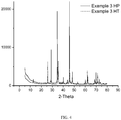
- FIGS. 2-6 present the XRD patterns for both hot pressed (“HP") and heat treated ("HT") compositions of Examples 1-5.
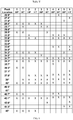
- the peaks for Examples 1-5 within the range of 27 to 45° Bragg angles are reported in Table Y shown FIG. 8 .
- Table Y allows for a +/-0.2° shift unless a doublet is reported, or if the peak is in between a doublet of another material. Exact identification of materials using x-ray diffraction becomes difficult in materials that have over lapping peaks or materials that form solid solutions resulting in shifts of the peaks.
- Table Z includes potential phases for Examples 1-5. Table Z also includes hardness (10 kg force), wear resistance, and toughness measurements for these compositions. Table Z Sample Identified Phases H (GPa) K IC (MPa*m .5 ) WRF Example 1 HP TiB 2 , WB 2 , WB 15 5.4 14 Example 1 HT W 2 B 5 , TiB 2 , (Ti 1.6 W 2.4 )B 4 Spalling 6.9 Example 2 HP WB 2 , TiB 2 , B 10 C Spalling 4.6 Example 2 HT W 2 B 5 , TiB 2 , B 12 (BC 2 ) 25 9.7 27 Example 3 HP WB 2 , CrB 2 , B 10 C Not Tested Not Tested Example 3 HT W 2 B 5 , CrB 2 , B 12 (BC 2 ), WB 22.5 2.4 9.0 Example 4 HP WB 2 , B 12 (BC 2 ), Ti 0.5 Zr 0.5 B 2 14 4.7 16 Example 4 HT WB 2 , B 11.72 C 3.28
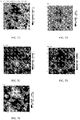
- FIGS. 6A-6E show electron dispersive spectroscopy (EDS) images for Example 2, taking using a microprobe, which illustrate concentration gradients for Boron, Carbon, Chromium, Titanium, and Tungsten, respectively.
- EDS electron dispersive spectroscopy
- microstructure as processed in the disclosed methods results in a chemically heterogeneous microstructures with features that are on the size scale of 10 to 100 ⁇ m.
- the grain sizes are smaller than the features and many of the features are composed of different phases.
- Vicker's hardness of Examples 1 - 3 was also measured using a 0.2 kilogram force load. This method resulted in very fine indentations and values of 19, 21, and 31 GPa for Examples 1, 2 and 3, respectively. Due to the size of the indentation, the error is high.
- Example 2-5 was measured using Vicker's indentation using the direct indentation method. A 10 kilogram force was utilized to indent the surface and the cracks extending from the surface were measured. Using this method, the Example 2 composition was shown to have an apparent toughness value of 9.7 MPa*m 1/2 .
- the hardness of Example 2 using a one kilogram force was 25 GPa and the Young's modulus was 402 GPa.
- the combination of a hardness value of 25 GPa and a toughness value of 9.7 MPa*m 1/2 results in a calculated wear resistance factor of 27 (K IC 3/4 * H 1/2 ), which is higher than the other materials reported other than CBN and diamond. Accordingly, the amounts of C and Cr included in Example 2 produced compositions having excellent hardness, toughness, and wear factor.
- Example 5 The results from Examples 2-5 also appear to indicate that Cr allows more carbon into the composition matrix of heat treated compositions than Zr and Nb, as indicated by the precipitation of carbon (graphite) in Examples 4 and 5, but not in Examples 2 and 3. As shown in Example 5, the included amount of Nb produced a composition having a higher hardness, and a slightly lower toughness and wear factor, as compared to Example 2.
- the present disclosure provides composite ceramic compositions that exhibit a high hardness, toughness, and wear factor.
- the compositions are also electrically conductive, which beneficially allow the compositions to be processed using electron discharge machining.
Landscapes
- Chemical & Material Sciences (AREA)
- Engineering & Computer Science (AREA)
- Ceramic Engineering (AREA)
- Manufacturing & Machinery (AREA)
- Organic Chemistry (AREA)
- Materials Engineering (AREA)
- Structural Engineering (AREA)
- Inorganic Chemistry (AREA)
- Physics & Mathematics (AREA)
- Chemical Kinetics & Catalysis (AREA)
- Combustion & Propulsion (AREA)
- Thermal Sciences (AREA)
- Ceramic Products (AREA)
- Electrical Discharge Machining, Electrochemical Machining, And Combined Machining (AREA)
Claims (14)
- Verbundkeramikzusammensetzung, umfassend:eine Borcarbidphase;eine Wolframboridphase; undeine Übergangsmetallboridphase, die ein Borid wenigstens eines Metalls ausgewählt aus Cr, Nb und Zr umfasst;wobei die Zusammensetzung ein Bor-zu-Kohlenstoff-Molverhältnis in dem Bereich von 2:1 bis 8:1 aufweist.
- Zusammensetzung gemäß Anspruch 1, wobei die Übergangsmetallboridphase Boride von wenigstens zwei Metallen ausgewählt aus Cr, Nb, Ti und Zr umfasst.
- Zusammensetzung gemäß einem der Ansprüche 1-2, ferner umfassend Kohlenstoff, der in fester Lösung mit wenigstens einem von der Borcarbidphase, der Wolframboridphase und der Übergangsmetallboridphase vorliegt.
- Zusammensetzung gemäß einem der Ansprüche 1-3, wobei die Übergangsmetallboridphase wenigstens eine Phase ausgewählt aus einer CrB2-Phase, einer Ti0,5Zr0,5B2-Phase und einer NbTiB4-Phase umfasst.
- Zusammensetzung gemäß einem der Ansprüche 1-4, wobei die Borcarbidphase wenigstens eine Phase ausgewählt aus einer B12(BC2)-Phase und einer B11,72C3,28-Phase umfasst.
- Zusammensetzung gemäß einem der Ansprüche 1-5, wobei die Wolframboridphase wenigstens eine Phase ausgewählt aus einer W2B5-Phase und einer WB2-Phase umfasst.
- Zusammensetzung gemäß einem der Ansprüche 1-6, wobei die Zusammensetzung ein Übergangsmetall-zu-Kohlenstoff-Molverhältnis von 0,5:1 bis 4:1 aufweist.
- Gegenstand, bestehend aus der Zusammensetzung gemäß einem der Ansprüche 1-7, wobei der Gegenstand wenigstens eines von einer/einem Extruderschnecke, Extrusionsdüse, Extrusionsplatte, Extrusionseinsatz, Extruderzylinder, Mischer, Förderschnecke, Extruderschneckengang oder einem anderen Extruderteil umfasst.
- Verfahren zur Herstellung einer Extrusionsdüse, umfassend:wenigstens eines von Elektronenentladungsbearbeitung (EDM) und elektrochemischer Bearbeitung (ECM) eines Düsenrohlings, der aus der Zusammensetzung gemäß einem der Ansprüche 1-7 besteht,wobei das wenigstens eine von EDM und ECM wenigstens eines von Lochbohren und Schlitzschneiden umfasst, wobei die Schlitze quadratische, rechteckige, hexagonale, gekrümmte, andere polygonale Formen und Kombinationen davon umfassen.
- Verbundkeramikzusammensetzung gemäß Anspruch 1, ferner umfassend:
eine feste Lösung umfassend Titan, Wolfram, Bor, Kohlenstoff und Verbindungen davon und wenigstens ein Metall ausgewählt aus Niob, Chrom und Zirkon. - Verbundkeramikzusammensetzung gemäß Anspruch 1, umfassend:3,7 bis 9,3 mol-% Ti;4,9 bis 12,3 mol-% W;59,0 bis 71,9 mol-% B;10,1 mol-% bis 16,7 mol-% C; undwenigstens eine Komponente ausgewählt aus Nb, Cr und Zr,wobei die Gesamtmenge von Ti, W, Nb, Cr, B, Zr und C wenigstens 95 mol-% beträgt.
- Verbundkeramikzusammensetzung gemäß Anspruch 11, umfassend:
wenigstens eine Komponente ausgewählt aus:2,5 mol-% Nb;10,3 mol-% Cr; und2,5 mol-% Zr. - Verfahren zur Herstellung eines Verbundkeramikgegenstands gemäß Anspruch 1 mit den folgenden Verfahrensschritten:Sintern einer Batch-Zusammensetzung; undWärmebehandeln der gesinterten Batch-Zusammensetzung,wobei die Batch-Zusammensetzung die folgenden Batch-Komponenten umfasst:(a) Ti-Pulver;(b) W-Pulver; und(c) wenigstens eine zusätzliche Komponente ausgewählt aus:(i) Nb-Pulver, Borpulver und B4C-Pulver;(ii) CrB2-Pulver und B4C-Pulver;(iii) CrB2-Pulver und B4C-Pulver; und(iv) ZrB2-Pulver und B4C-Pulver,wobei die Gesamt-mol-% der Pulver (a), (b) und (c) in der Batch-Zusammensetzung wenigstens 95 mol-% betragen,wobei die Zusammensetzung ein Bor-zu-Kohlenstoff-Molverhältnis in dem Bereich von 2:1 bis 8:1 aufweist.
- Verfahren gemäß Anspruch 13, wobei die Batch-Komponenten in den folgenden Mengen vorhanden sind:(a) 13 bis 22,6 mol-% Ti-Pulver;(b) 15,4 bis 30,1 mol-% W-Pulver; und(c) die wenigstens eine zusätzliche Komponente ausgewählt aus:(i) 7,6 mol-% Nb-Pulver, 15,0 mol-% Borpulver und 50,4 mol-% B4C-Pulver;(ii) 13,0 mol-% CrB2-Pulver und 56,7 mol-% B4C-Pulver;(iii) 22,6 mol-% CrB2-Pulver und 24,7 mol-% B4C-Pulver; und(iv) 8,9 mol-% ZrB2-Pulver und 59,4 mol-% B4C-Pulver.
Priority Applications (1)
| Application Number | Priority Date | Filing Date | Title |
|---|---|---|---|
| PL15805695T PL3224222T3 (pl) | 2014-11-26 | 2015-11-23 | Kompozycja kompozytu ceramicznego i sposób jej formowania |
Applications Claiming Priority (2)
| Application Number | Priority Date | Filing Date | Title |
|---|---|---|---|
| US201462084623P | 2014-11-26 | 2014-11-26 | |
| PCT/US2015/062120 WO2016085843A1 (en) | 2014-11-26 | 2015-11-23 | Composite ceramic composition and method of forming same |
Publications (2)
| Publication Number | Publication Date |
|---|---|
| EP3224222A1 EP3224222A1 (de) | 2017-10-04 |
| EP3224222B1 true EP3224222B1 (de) | 2019-05-08 |
Family
ID=54834937
Family Applications (1)
| Application Number | Title | Priority Date | Filing Date |
|---|---|---|---|
| EP15805695.2A Active EP3224222B1 (de) | 2014-11-26 | 2015-11-23 | Verbundkeramik und verfahren deren herstellung |
Country Status (7)
| Country | Link |
|---|---|
| US (1) | US10252946B2 (de) |
| EP (1) | EP3224222B1 (de) |
| JP (2) | JP6826799B2 (de) |
| CN (1) | CN107207360B (de) |
| MX (1) | MX385293B (de) |
| PL (1) | PL3224222T3 (de) |
| WO (1) | WO2016085843A1 (de) |
Families Citing this family (3)
| Publication number | Priority date | Publication date | Assignee | Title |
|---|---|---|---|---|
| TWI651293B (zh) * | 2017-11-23 | 2019-02-21 | 國立清華大學 | 韌性陶瓷材料 |
| WO2021247981A1 (en) * | 2020-06-04 | 2021-12-09 | SuperMetalix, Inc. | Metal boride ceramic composites and uses thereof |
| CN116199229B (zh) * | 2022-09-30 | 2025-06-13 | 崇义章源钨业股份有限公司 | 高流动性纯相二硼化钨及其制备方法 |
Citations (1)
| Publication number | Priority date | Publication date | Assignee | Title |
|---|---|---|---|---|
| DE1027883B (de) * | 1952-06-20 | 1958-04-10 | Norton Ges M B H Deutsche | Gesinterte Hartlegierungen und Verfahren zu deren Herstellung |
Family Cites Families (31)
| Publication number | Priority date | Publication date | Assignee | Title |
|---|---|---|---|---|
| US2613154A (en) | 1950-05-18 | 1952-10-07 | Norton Co | Mixed borides |
| JPS60103080A (ja) | 1983-11-10 | 1985-06-07 | 東洋鋼鈑株式会社 | 硼化物系超硬質材料 |
| DE3435345A1 (de) * | 1984-09-26 | 1986-04-03 | Max Planck-Gesellschaft zur Förderung der Wissenschaften e.V., 8000 München | Verfahren zur herstellung von carbid-borid-erzeugnissen und deren verwendung |
| JPS62153166A (ja) * | 1985-12-27 | 1987-07-08 | 旭硝子株式会社 | B↓4c系複合焼結体 |
| US4957884A (en) | 1987-04-27 | 1990-09-18 | The Dow Chemical Company | Titanium diboride/boron carbide composites with high hardness and toughness |
| JPS6487563A (en) * | 1987-09-30 | 1989-03-31 | Nippon Steel Corp | Nonoxide type composite ceramic sintered body |
| DE3733730C1 (de) * | 1987-10-06 | 1988-10-27 | Feldmuehle Ag | Gleit- oder Dichtelementepaarung und Verfahren zu deren Herstellung |
| US4859124A (en) | 1987-11-20 | 1989-08-22 | Ford Motor Company | Method of cutting using a titanium diboride body |
| US5108962A (en) | 1988-05-26 | 1992-04-28 | The Dow Chemical Company | Composition and method for producing boron carbide/titanium diboride composite ceramic powders using a boron carbide substrate |
| JPH04144968A (ja) * | 1990-10-03 | 1992-05-19 | Kobe Steel Ltd | 高硬度硼化チタン系セラミックス |
| JP3228517B2 (ja) | 1990-12-12 | 2001-11-12 | 皓一 新原 | 炭化ホウ素系複合焼結体 |
| US5427987A (en) | 1993-05-10 | 1995-06-27 | Kennametal Inc. | Group IVB boride based cutting tools for machining group IVB based materials |
| DE4320102A1 (de) | 1993-06-17 | 1994-12-22 | Kempten Elektroschmelz Gmbh | Verfahren zur Herstellung von polykristallinen dichten Formkörpern auf der Basis von Borcarbid durch drucklose Sinterung |
| US5554328A (en) | 1994-12-21 | 1996-09-10 | Composite Materials, Inc. | Method of making heat and impact resistant composite ceramic material |
| US5720910A (en) * | 1995-07-26 | 1998-02-24 | Vlajic; Milan D. | Process for the production of dense boron carbide and transition metal carbides |
| JP3074624B1 (ja) | 1999-04-16 | 2000-08-07 | 義之 宮橋 | ガラス廃材利用材の製造方法 |
| JP2003069283A (ja) * | 2001-08-23 | 2003-03-07 | Kumagai Gumi Co Ltd | 電磁シールド材料 |
| WO2003040060A1 (en) | 2001-11-06 | 2003-05-15 | National Institute Of Advanced Industrial Science And Technology | Boron carbide based sintered compact and method for preparation thereof |
| WO2005002742A1 (en) | 2003-02-07 | 2005-01-13 | Diamond Innovations, Inc. | Process equipment wear surfaces of extended resistance and methods for their manufacture |
| IL162676A (en) | 2004-06-22 | 2009-12-24 | Rafael Advanced Defense Sys | Process for manufacturing high density boron carbide articles |
| DE102006013729A1 (de) * | 2006-03-24 | 2007-10-04 | Esk Ceramics Gmbh & Co. Kg | Gesinterter Werkstoff, sinterfähige Pulvermischung, Verfahren zur Herstellung des Werkstoffs und dessen Verwendung |
| DE102006013746A1 (de) * | 2006-03-24 | 2007-09-27 | Esk Ceramics Gmbh & Co. Kg | Gesinterter verschleißbeständiger Werkstoff, sinterfähige Pulvermischung, Verfahren zur Herstellung des Werkstoffs und dessen Verwendung |
| US8124553B2 (en) * | 2007-01-30 | 2012-02-28 | Sumitomo Electric Hardmetal Corp. | Composite sintered body |
| CN101244937B (zh) * | 2007-02-16 | 2011-05-11 | 宝山钢铁股份有限公司 | 耐熔融金属浸蚀用纳米复合金属陶瓷粉体及其制造方法 |
| US20090041609A1 (en) * | 2007-08-07 | 2009-02-12 | Duz Volodymyr A | High-strength discontinuously-reinforced titanium matrix composites and method for manufacturing the same |
| US8025112B2 (en) | 2008-08-22 | 2011-09-27 | Tdy Industries, Inc. | Earth-boring bits and other parts including cemented carbide |
| GB0823328D0 (en) | 2008-12-22 | 2009-01-28 | Element Six Production Pty Ltd | Ultra hard/hard composite materials |
| KR20130004337A (ko) * | 2010-04-08 | 2013-01-09 | 가부시키가이샤 탕가로이 | 복합체 |
| US20130309468A1 (en) * | 2011-02-04 | 2013-11-21 | Tungaloy Corporation | Cbn sintered body tool and coated cbn sintered body tool |
| US8865301B2 (en) | 2012-01-26 | 2014-10-21 | The United States Of America, As Represented By The Secretary Of The Navy | Refractory metal boride ceramics and methods of making thereof |
| CN102757224A (zh) * | 2012-07-31 | 2012-10-31 | 中国科学院上海硅酸盐研究所 | 烧结制备致密碳化硼基陶瓷材料的方法 |
-
2015
- 2015-11-23 CN CN201580074489.XA patent/CN107207360B/zh active Active
- 2015-11-23 US US15/529,847 patent/US10252946B2/en active Active
- 2015-11-23 PL PL15805695T patent/PL3224222T3/pl unknown
- 2015-11-23 WO PCT/US2015/062120 patent/WO2016085843A1/en not_active Ceased
- 2015-11-23 JP JP2017528155A patent/JP6826799B2/ja active Active
- 2015-11-23 EP EP15805695.2A patent/EP3224222B1/de active Active
- 2015-11-23 MX MX2017006943A patent/MX385293B/es unknown
-
2021
- 2021-01-15 JP JP2021004889A patent/JP7039741B2/ja active Active
Patent Citations (1)
| Publication number | Priority date | Publication date | Assignee | Title |
|---|---|---|---|---|
| DE1027883B (de) * | 1952-06-20 | 1958-04-10 | Norton Ges M B H Deutsche | Gesinterte Hartlegierungen und Verfahren zu deren Herstellung |
Also Published As
| Publication number | Publication date |
|---|---|
| JP2021080161A (ja) | 2021-05-27 |
| JP7039741B2 (ja) | 2022-03-22 |
| EP3224222A1 (de) | 2017-10-04 |
| WO2016085843A1 (en) | 2016-06-02 |
| MX2017006943A (es) | 2018-01-17 |
| US20170260102A1 (en) | 2017-09-14 |
| MX385293B (es) | 2025-03-18 |
| US10252946B2 (en) | 2019-04-09 |
| CN107207360B (zh) | 2021-04-06 |
| JP6826799B2 (ja) | 2021-02-10 |
| PL3224222T3 (pl) | 2019-10-31 |
| JP2018502034A (ja) | 2018-01-25 |
| CN107207360A (zh) | 2017-09-26 |
Similar Documents
| Publication | Publication Date | Title |
|---|---|---|
| AU2010279557B2 (en) | Tough coated hard particles consolidated in a tough matrix material | |
| GB2560642A (en) | Sintered polycrystalline cubic boron nitride material | |
| US7459105B2 (en) | Nanostructured titanium monoboride monolithic material and associated methods | |
| JP7039741B2 (ja) | 複合セラミック組成物およびそれを形成する方法 | |
| JP2523452B2 (ja) | 高強度立方晶窒化ホウ素焼結体 | |
| CA2052977A1 (en) | High hardness, wear resistant materials | |
| JPH11302767A (ja) | 機械的特性に優れた超硬合金およびその製法 | |
| US5409868A (en) | Ceramic articles made of compositions containing borides and nitrides | |
| GB2537733A (en) | Polycrystalline abrasive constructions | |
| JP4830571B2 (ja) | cBN基超高圧焼結体 | |
| GB2591616A (en) | Polycrystalline cubic boron nitride material | |
| WO2008132674A2 (en) | Boron suboxide composite material | |
| WO2003057936A1 (en) | Metal carbide composite | |
| JP2022548040A (ja) | 焼結多結晶立方晶窒化ホウ素材料 | |
| Mehdikhani et al. | Synthesis and spark plasma sintering of TaC‒TaB2 nanocomposites | |
| Furushima et al. | Effect of sintering techniques on mechanical properties of WC-FeAl composites | |
| JP3092887B2 (ja) | 表面調質焼結合金及びその製造方法 | |
| JP2005194556A (ja) | 希土類含有焼結合金 | |
| JP2005097652A (ja) | 傾斜組織超硬合金およびその製造方法 | |
| JP5092237B2 (ja) | cBN基超高圧焼結体およびその製造方法 | |
| JPH1192852A (ja) | 粒内金属分散強化wc含有超硬合金およびその製法 | |
| JPH0710747B2 (ja) | ホウ化物―酸化ジルコニウム―炭窒化物系セラミックス材料 | |
| JP2025503741A (ja) | 超硬合金組成物 | |
| PL229677B1 (pl) | Kompozyt diamentowy z fazą wiążącą w postaci cermetalu i sposób jego wytwarzania | |
| PL235619B1 (pl) | Sposób otrzymywania spieku węglika wolframu |
Legal Events
| Date | Code | Title | Description |
|---|---|---|---|
| STAA | Information on the status of an ep patent application or granted ep patent |
Free format text: STATUS: THE INTERNATIONAL PUBLICATION HAS BEEN MADE |
|
| PUAI | Public reference made under article 153(3) epc to a published international application that has entered the european phase |
Free format text: ORIGINAL CODE: 0009012 |
|
| STAA | Information on the status of an ep patent application or granted ep patent |
Free format text: STATUS: REQUEST FOR EXAMINATION WAS MADE |
|
| 17P | Request for examination filed |
Effective date: 20170619 |
|
| AK | Designated contracting states |
Kind code of ref document: A1 Designated state(s): AL AT BE BG CH CY CZ DE DK EE ES FI FR GB GR HR HU IE IS IT LI LT LU LV MC MK MT NL NO PL PT RO RS SE SI SK SM TR |
|
| AX | Request for extension of the european patent |
Extension state: BA ME |
|
| DAV | Request for validation of the european patent (deleted) | ||
| DAX | Request for extension of the european patent (deleted) | ||
| STAA | Information on the status of an ep patent application or granted ep patent |
Free format text: STATUS: EXAMINATION IS IN PROGRESS |
|
| 17Q | First examination report despatched |
Effective date: 20180508 |
|
| GRAP | Despatch of communication of intention to grant a patent |
Free format text: ORIGINAL CODE: EPIDOSNIGR1 |
|
| STAA | Information on the status of an ep patent application or granted ep patent |
Free format text: STATUS: GRANT OF PATENT IS INTENDED |
|
| INTG | Intention to grant announced |
Effective date: 20181018 |
|
| RIN1 | Information on inventor provided before grant (corrected) |
Inventor name: ZIMMERMANN, JAMES WILLIAM Inventor name: CONWAY, BETHANY ROSE |
|
| GRAS | Grant fee paid |
Free format text: ORIGINAL CODE: EPIDOSNIGR3 |
|
| GRAJ | Information related to disapproval of communication of intention to grant by the applicant or resumption of examination proceedings by the epo deleted |
Free format text: ORIGINAL CODE: EPIDOSDIGR1 |
|
| GRAL | Information related to payment of fee for publishing/printing deleted |
Free format text: ORIGINAL CODE: EPIDOSDIGR3 |
|
| STAA | Information on the status of an ep patent application or granted ep patent |
Free format text: STATUS: EXAMINATION IS IN PROGRESS |
|
| GRAP | Despatch of communication of intention to grant a patent |
Free format text: ORIGINAL CODE: EPIDOSNIGR1 |
|
| STAA | Information on the status of an ep patent application or granted ep patent |
Free format text: STATUS: GRANT OF PATENT IS INTENDED |
|
| INTC | Intention to grant announced (deleted) | ||
| GRAA | (expected) grant |
Free format text: ORIGINAL CODE: 0009210 |
|
| STAA | Information on the status of an ep patent application or granted ep patent |
Free format text: STATUS: THE PATENT HAS BEEN GRANTED |
|
| INTG | Intention to grant announced |
Effective date: 20190313 |
|
| AK | Designated contracting states |
Kind code of ref document: B1 Designated state(s): AL AT BE BG CH CY CZ DE DK EE ES FI FR GB GR HR HU IE IS IT LI LT LU LV MC MK MT NL NO PL PT RO RS SE SI SK SM TR |
|
| REG | Reference to a national code |
Ref country code: GB Ref legal event code: FG4D |
|
| REG | Reference to a national code |
Ref country code: CH Ref legal event code: EP Ref country code: AT Ref legal event code: REF Ref document number: 1129903 Country of ref document: AT Kind code of ref document: T Effective date: 20190515 |
|
| REG | Reference to a national code |
Ref country code: DE Ref legal event code: R096 Ref document number: 602015030038 Country of ref document: DE |
|
| REG | Reference to a national code |
Ref country code: IE Ref legal event code: FG4D |
|
| REG | Reference to a national code |
Ref country code: NL Ref legal event code: MP Effective date: 20190508 |
|
| REG | Reference to a national code |
Ref country code: LT Ref legal event code: MG4D |
|
| PG25 | Lapsed in a contracting state [announced via postgrant information from national office to epo] |
Ref country code: HR Free format text: LAPSE BECAUSE OF FAILURE TO SUBMIT A TRANSLATION OF THE DESCRIPTION OR TO PAY THE FEE WITHIN THE PRESCRIBED TIME-LIMIT Effective date: 20190508 Ref country code: LT Free format text: LAPSE BECAUSE OF FAILURE TO SUBMIT A TRANSLATION OF THE DESCRIPTION OR TO PAY THE FEE WITHIN THE PRESCRIBED TIME-LIMIT Effective date: 20190508 Ref country code: SE Free format text: LAPSE BECAUSE OF FAILURE TO SUBMIT A TRANSLATION OF THE DESCRIPTION OR TO PAY THE FEE WITHIN THE PRESCRIBED TIME-LIMIT Effective date: 20190508 Ref country code: NL Free format text: LAPSE BECAUSE OF FAILURE TO SUBMIT A TRANSLATION OF THE DESCRIPTION OR TO PAY THE FEE WITHIN THE PRESCRIBED TIME-LIMIT Effective date: 20190508 Ref country code: ES Free format text: LAPSE BECAUSE OF FAILURE TO SUBMIT A TRANSLATION OF THE DESCRIPTION OR TO PAY THE FEE WITHIN THE PRESCRIBED TIME-LIMIT Effective date: 20190508 Ref country code: PT Free format text: LAPSE BECAUSE OF FAILURE TO SUBMIT A TRANSLATION OF THE DESCRIPTION OR TO PAY THE FEE WITHIN THE PRESCRIBED TIME-LIMIT Effective date: 20190908 Ref country code: NO Free format text: LAPSE BECAUSE OF FAILURE TO SUBMIT A TRANSLATION OF THE DESCRIPTION OR TO PAY THE FEE WITHIN THE PRESCRIBED TIME-LIMIT Effective date: 20190808 Ref country code: AL Free format text: LAPSE BECAUSE OF FAILURE TO SUBMIT A TRANSLATION OF THE DESCRIPTION OR TO PAY THE FEE WITHIN THE PRESCRIBED TIME-LIMIT Effective date: 20190508 Ref country code: FI Free format text: LAPSE BECAUSE OF FAILURE TO SUBMIT A TRANSLATION OF THE DESCRIPTION OR TO PAY THE FEE WITHIN THE PRESCRIBED TIME-LIMIT Effective date: 20190508 |
|
| PG25 | Lapsed in a contracting state [announced via postgrant information from national office to epo] |
Ref country code: BG Free format text: LAPSE BECAUSE OF FAILURE TO SUBMIT A TRANSLATION OF THE DESCRIPTION OR TO PAY THE FEE WITHIN THE PRESCRIBED TIME-LIMIT Effective date: 20190808 Ref country code: GR Free format text: LAPSE BECAUSE OF FAILURE TO SUBMIT A TRANSLATION OF THE DESCRIPTION OR TO PAY THE FEE WITHIN THE PRESCRIBED TIME-LIMIT Effective date: 20190809 Ref country code: RS Free format text: LAPSE BECAUSE OF FAILURE TO SUBMIT A TRANSLATION OF THE DESCRIPTION OR TO PAY THE FEE WITHIN THE PRESCRIBED TIME-LIMIT Effective date: 20190508 Ref country code: LV Free format text: LAPSE BECAUSE OF FAILURE TO SUBMIT A TRANSLATION OF THE DESCRIPTION OR TO PAY THE FEE WITHIN THE PRESCRIBED TIME-LIMIT Effective date: 20190508 |
|
| REG | Reference to a national code |
Ref country code: AT Ref legal event code: MK05 Ref document number: 1129903 Country of ref document: AT Kind code of ref document: T Effective date: 20190508 |
|
| PG25 | Lapsed in a contracting state [announced via postgrant information from national office to epo] |
Ref country code: EE Free format text: LAPSE BECAUSE OF FAILURE TO SUBMIT A TRANSLATION OF THE DESCRIPTION OR TO PAY THE FEE WITHIN THE PRESCRIBED TIME-LIMIT Effective date: 20190508 Ref country code: DK Free format text: LAPSE BECAUSE OF FAILURE TO SUBMIT A TRANSLATION OF THE DESCRIPTION OR TO PAY THE FEE WITHIN THE PRESCRIBED TIME-LIMIT Effective date: 20190508 Ref country code: SK Free format text: LAPSE BECAUSE OF FAILURE TO SUBMIT A TRANSLATION OF THE DESCRIPTION OR TO PAY THE FEE WITHIN THE PRESCRIBED TIME-LIMIT Effective date: 20190508 Ref country code: AT Free format text: LAPSE BECAUSE OF FAILURE TO SUBMIT A TRANSLATION OF THE DESCRIPTION OR TO PAY THE FEE WITHIN THE PRESCRIBED TIME-LIMIT Effective date: 20190508 Ref country code: CZ Free format text: LAPSE BECAUSE OF FAILURE TO SUBMIT A TRANSLATION OF THE DESCRIPTION OR TO PAY THE FEE WITHIN THE PRESCRIBED TIME-LIMIT Effective date: 20190508 Ref country code: RO Free format text: LAPSE BECAUSE OF FAILURE TO SUBMIT A TRANSLATION OF THE DESCRIPTION OR TO PAY THE FEE WITHIN THE PRESCRIBED TIME-LIMIT Effective date: 20190508 |
|
| REG | Reference to a national code |
Ref country code: DE Ref legal event code: R097 Ref document number: 602015030038 Country of ref document: DE |
|
| PG25 | Lapsed in a contracting state [announced via postgrant information from national office to epo] |
Ref country code: SM Free format text: LAPSE BECAUSE OF FAILURE TO SUBMIT A TRANSLATION OF THE DESCRIPTION OR TO PAY THE FEE WITHIN THE PRESCRIBED TIME-LIMIT Effective date: 20190508 Ref country code: IT Free format text: LAPSE BECAUSE OF FAILURE TO SUBMIT A TRANSLATION OF THE DESCRIPTION OR TO PAY THE FEE WITHIN THE PRESCRIBED TIME-LIMIT Effective date: 20190508 |
|
| PLBE | No opposition filed within time limit |
Free format text: ORIGINAL CODE: 0009261 |
|
| STAA | Information on the status of an ep patent application or granted ep patent |
Free format text: STATUS: NO OPPOSITION FILED WITHIN TIME LIMIT |
|
| PG25 | Lapsed in a contracting state [announced via postgrant information from national office to epo] |
Ref country code: TR Free format text: LAPSE BECAUSE OF FAILURE TO SUBMIT A TRANSLATION OF THE DESCRIPTION OR TO PAY THE FEE WITHIN THE PRESCRIBED TIME-LIMIT Effective date: 20190508 |
|
| 26N | No opposition filed |
Effective date: 20200211 |
|
| PG25 | Lapsed in a contracting state [announced via postgrant information from national office to epo] |
Ref country code: SI Free format text: LAPSE BECAUSE OF FAILURE TO SUBMIT A TRANSLATION OF THE DESCRIPTION OR TO PAY THE FEE WITHIN THE PRESCRIBED TIME-LIMIT Effective date: 20190508 |
|
| REG | Reference to a national code |
Ref country code: CH Ref legal event code: PL |
|
| PG25 | Lapsed in a contracting state [announced via postgrant information from national office to epo] |
Ref country code: LU Free format text: LAPSE BECAUSE OF NON-PAYMENT OF DUE FEES Effective date: 20191123 Ref country code: CH Free format text: LAPSE BECAUSE OF NON-PAYMENT OF DUE FEES Effective date: 20191130 Ref country code: MC Free format text: LAPSE BECAUSE OF FAILURE TO SUBMIT A TRANSLATION OF THE DESCRIPTION OR TO PAY THE FEE WITHIN THE PRESCRIBED TIME-LIMIT Effective date: 20190508 Ref country code: LI Free format text: LAPSE BECAUSE OF NON-PAYMENT OF DUE FEES Effective date: 20191130 |
|
| GBPC | Gb: european patent ceased through non-payment of renewal fee |
Effective date: 20191123 |
|
| PG25 | Lapsed in a contracting state [announced via postgrant information from national office to epo] |
Ref country code: IE Free format text: LAPSE BECAUSE OF NON-PAYMENT OF DUE FEES Effective date: 20191123 Ref country code: GB Free format text: LAPSE BECAUSE OF NON-PAYMENT OF DUE FEES Effective date: 20191123 |
|
| PG25 | Lapsed in a contracting state [announced via postgrant information from national office to epo] |
Ref country code: CY Free format text: LAPSE BECAUSE OF FAILURE TO SUBMIT A TRANSLATION OF THE DESCRIPTION OR TO PAY THE FEE WITHIN THE PRESCRIBED TIME-LIMIT Effective date: 20190508 |
|
| PG25 | Lapsed in a contracting state [announced via postgrant information from national office to epo] |
Ref country code: IS Free format text: LAPSE BECAUSE OF FAILURE TO SUBMIT A TRANSLATION OF THE DESCRIPTION OR TO PAY THE FEE WITHIN THE PRESCRIBED TIME-LIMIT Effective date: 20190908 |
|
| PG25 | Lapsed in a contracting state [announced via postgrant information from national office to epo] |
Ref country code: HU Free format text: LAPSE BECAUSE OF FAILURE TO SUBMIT A TRANSLATION OF THE DESCRIPTION OR TO PAY THE FEE WITHIN THE PRESCRIBED TIME-LIMIT; INVALID AB INITIO Effective date: 20151123 Ref country code: MT Free format text: LAPSE BECAUSE OF FAILURE TO SUBMIT A TRANSLATION OF THE DESCRIPTION OR TO PAY THE FEE WITHIN THE PRESCRIBED TIME-LIMIT Effective date: 20190508 |
|
| PGFP | Annual fee paid to national office [announced via postgrant information from national office to epo] |
Ref country code: BE Payment date: 20211015 Year of fee payment: 7 |
|
| PG25 | Lapsed in a contracting state [announced via postgrant information from national office to epo] |
Ref country code: MK Free format text: LAPSE BECAUSE OF FAILURE TO SUBMIT A TRANSLATION OF THE DESCRIPTION OR TO PAY THE FEE WITHIN THE PRESCRIBED TIME-LIMIT Effective date: 20190508 |
|
| P01 | Opt-out of the competence of the unified patent court (upc) registered |
Effective date: 20230527 |
|
| REG | Reference to a national code |
Ref country code: BE Ref legal event code: MM Effective date: 20221130 |
|
| PG25 | Lapsed in a contracting state [announced via postgrant information from national office to epo] |
Ref country code: BE Free format text: LAPSE BECAUSE OF NON-PAYMENT OF DUE FEES Effective date: 20221130 |
|
| PGFP | Annual fee paid to national office [announced via postgrant information from national office to epo] |
Ref country code: PL Payment date: 20230920 Year of fee payment: 9 |
|
| PGFP | Annual fee paid to national office [announced via postgrant information from national office to epo] |
Ref country code: FR Payment date: 20231010 Year of fee payment: 9 |
|
| PG25 | Lapsed in a contracting state [announced via postgrant information from national office to epo] |
Ref country code: FR Free format text: LAPSE BECAUSE OF NON-PAYMENT OF DUE FEES Effective date: 20241130 |
|
| PGFP | Annual fee paid to national office [announced via postgrant information from national office to epo] |
Ref country code: DE Payment date: 20251013 Year of fee payment: 11 |