EP3224883B1 - Électrolyte à grenat solide stabilisé et procédés associés - Google Patents
Électrolyte à grenat solide stabilisé et procédés associés Download PDFInfo
- Publication number
- EP3224883B1 EP3224883B1 EP15805038.5A EP15805038A EP3224883B1 EP 3224883 B1 EP3224883 B1 EP 3224883B1 EP 15805038 A EP15805038 A EP 15805038A EP 3224883 B1 EP3224883 B1 EP 3224883B1
- Authority
- EP
- European Patent Office
- Prior art keywords
- garnet
- lithium
- protonated
- composition
- solid
- Prior art date
- Legal status (The legal status is an assumption and is not a legal conclusion. Google has not performed a legal analysis and makes no representation as to the accuracy of the status listed.)
- Not-in-force
Links
Images



Classifications
-
- C—CHEMISTRY; METALLURGY
- C04—CEMENTS; CONCRETE; ARTIFICIAL STONE; CERAMICS; REFRACTORIES
- C04B—LIME, MAGNESIA; SLAG; CEMENTS; COMPOSITIONS THEREOF, e.g. MORTARS, CONCRETE OR LIKE BUILDING MATERIALS; ARTIFICIAL STONE; CERAMICS; REFRACTORIES; TREATMENT OF NATURAL STONE
- C04B35/00—Shaped ceramic products characterised by their composition; Ceramics compositions; Processing powders of inorganic compounds preparatory to the manufacturing of ceramic products
- C04B35/01—Shaped ceramic products characterised by their composition; Ceramics compositions; Processing powders of inorganic compounds preparatory to the manufacturing of ceramic products based on oxide ceramics
- C04B35/48—Shaped ceramic products characterised by their composition; Ceramics compositions; Processing powders of inorganic compounds preparatory to the manufacturing of ceramic products based on oxide ceramics based on zirconium or hafnium oxides, zirconates, zircon or hafnates
- C04B35/486—Fine ceramics
-
- H—ELECTRICITY
- H01—ELECTRIC ELEMENTS
- H01M—PROCESSES OR MEANS, e.g. BATTERIES, FOR THE DIRECT CONVERSION OF CHEMICAL ENERGY INTO ELECTRICAL ENERGY
- H01M10/00—Secondary cells; Manufacture thereof
- H01M10/05—Accumulators with non-aqueous electrolyte
- H01M10/052—Li-accumulators
- H01M10/0525—Rocking-chair batteries, i.e. batteries with lithium insertion or intercalation in both electrodes; Lithium-ion batteries
-
- H—ELECTRICITY
- H01—ELECTRIC ELEMENTS
- H01M—PROCESSES OR MEANS, e.g. BATTERIES, FOR THE DIRECT CONVERSION OF CHEMICAL ENERGY INTO ELECTRICAL ENERGY
- H01M10/00—Secondary cells; Manufacture thereof
- H01M10/05—Accumulators with non-aqueous electrolyte
- H01M10/056—Accumulators with non-aqueous electrolyte characterised by the materials used as electrolytes, e.g. mixed inorganic/organic electrolytes
- H01M10/0561—Accumulators with non-aqueous electrolyte characterised by the materials used as electrolytes, e.g. mixed inorganic/organic electrolytes the electrolyte being constituted of inorganic materials only
- H01M10/0562—Solid materials
-
- H—ELECTRICITY
- H01—ELECTRIC ELEMENTS
- H01M—PROCESSES OR MEANS, e.g. BATTERIES, FOR THE DIRECT CONVERSION OF CHEMICAL ENERGY INTO ELECTRICAL ENERGY
- H01M12/00—Hybrid cells; Manufacture thereof
- H01M12/08—Hybrid cells; Manufacture thereof composed of a half-cell of a fuel-cell type and a half-cell of the secondary-cell type
-
- H—ELECTRICITY
- H01—ELECTRIC ELEMENTS
- H01M—PROCESSES OR MEANS, e.g. BATTERIES, FOR THE DIRECT CONVERSION OF CHEMICAL ENERGY INTO ELECTRICAL ENERGY
- H01M4/00—Electrodes
- H01M4/02—Electrodes composed of, or comprising, active material
- H01M4/36—Selection of substances as active materials, active masses, active liquids
- H01M4/38—Selection of substances as active materials, active masses, active liquids of elements or alloys
- H01M4/381—Alkaline or alkaline earth metals elements
- H01M4/382—Lithium
-
- H—ELECTRICITY
- H01—ELECTRIC ELEMENTS
- H01M—PROCESSES OR MEANS, e.g. BATTERIES, FOR THE DIRECT CONVERSION OF CHEMICAL ENERGY INTO ELECTRICAL ENERGY
- H01M4/00—Electrodes
- H01M4/02—Electrodes composed of, or comprising, active material
- H01M4/36—Selection of substances as active materials, active masses, active liquids
- H01M4/38—Selection of substances as active materials, active masses, active liquids of elements or alloys
- H01M4/40—Alloys based on alkali metals
- H01M4/405—Alloys based on lithium
-
- H—ELECTRICITY
- H01—ELECTRIC ELEMENTS
- H01M—PROCESSES OR MEANS, e.g. BATTERIES, FOR THE DIRECT CONVERSION OF CHEMICAL ENERGY INTO ELECTRICAL ENERGY
- H01M4/00—Electrodes
- H01M4/02—Electrodes composed of, or comprising, active material
- H01M4/36—Selection of substances as active materials, active masses, active liquids
- H01M4/48—Selection of substances as active materials, active masses, active liquids of inorganic oxides or hydroxides
- H01M4/52—Selection of substances as active materials, active masses, active liquids of inorganic oxides or hydroxides of nickel, cobalt or iron
- H01M4/525—Selection of substances as active materials, active masses, active liquids of inorganic oxides or hydroxides of nickel, cobalt or iron of mixed oxides or hydroxides containing iron, cobalt or nickel for inserting or intercalating light metals, e.g. LiNiO2, LiCoO2 or LiCoOxFy
-
- H—ELECTRICITY
- H01—ELECTRIC ELEMENTS
- H01M—PROCESSES OR MEANS, e.g. BATTERIES, FOR THE DIRECT CONVERSION OF CHEMICAL ENERGY INTO ELECTRICAL ENERGY
- H01M4/00—Electrodes
- H01M4/86—Inert electrodes with catalytic activity, e.g. for fuel cells
- H01M4/90—Selection of catalytic material
- H01M4/9016—Oxides, hydroxides or oxygenated metallic salts
-
- H—ELECTRICITY
- H01—ELECTRIC ELEMENTS
- H01M—PROCESSES OR MEANS, e.g. BATTERIES, FOR THE DIRECT CONVERSION OF CHEMICAL ENERGY INTO ELECTRICAL ENERGY
- H01M8/00—Fuel cells; Manufacture thereof
- H01M8/08—Fuel cells with aqueous electrolytes
-
- C—CHEMISTRY; METALLURGY
- C04—CEMENTS; CONCRETE; ARTIFICIAL STONE; CERAMICS; REFRACTORIES
- C04B—LIME, MAGNESIA; SLAG; CEMENTS; COMPOSITIONS THEREOF, e.g. MORTARS, CONCRETE OR LIKE BUILDING MATERIALS; ARTIFICIAL STONE; CERAMICS; REFRACTORIES; TREATMENT OF NATURAL STONE
- C04B2235/00—Aspects relating to ceramic starting mixtures or sintered ceramic products
- C04B2235/02—Composition of constituents of the starting material or of secondary phases of the final product
- C04B2235/30—Constituents and secondary phases not being of a fibrous nature
- C04B2235/32—Metal oxides, mixed metal oxides, or oxide-forming salts thereof, e.g. carbonates, nitrates, (oxy)hydroxides, chlorides
- C04B2235/3201—Alkali metal oxides or oxide-forming salts thereof
- C04B2235/3203—Lithium oxide or oxide-forming salts thereof
-
- C—CHEMISTRY; METALLURGY
- C04—CEMENTS; CONCRETE; ARTIFICIAL STONE; CERAMICS; REFRACTORIES
- C04B—LIME, MAGNESIA; SLAG; CEMENTS; COMPOSITIONS THEREOF, e.g. MORTARS, CONCRETE OR LIKE BUILDING MATERIALS; ARTIFICIAL STONE; CERAMICS; REFRACTORIES; TREATMENT OF NATURAL STONE
- C04B2235/00—Aspects relating to ceramic starting mixtures or sintered ceramic products
- C04B2235/02—Composition of constituents of the starting material or of secondary phases of the final product
- C04B2235/30—Constituents and secondary phases not being of a fibrous nature
- C04B2235/32—Metal oxides, mixed metal oxides, or oxide-forming salts thereof, e.g. carbonates, nitrates, (oxy)hydroxides, chlorides
- C04B2235/3224—Rare earth oxide or oxide forming salts thereof, e.g. scandium oxide
- C04B2235/3227—Lanthanum oxide or oxide-forming salts thereof
-
- C—CHEMISTRY; METALLURGY
- C04—CEMENTS; CONCRETE; ARTIFICIAL STONE; CERAMICS; REFRACTORIES
- C04B—LIME, MAGNESIA; SLAG; CEMENTS; COMPOSITIONS THEREOF, e.g. MORTARS, CONCRETE OR LIKE BUILDING MATERIALS; ARTIFICIAL STONE; CERAMICS; REFRACTORIES; TREATMENT OF NATURAL STONE
- C04B2235/00—Aspects relating to ceramic starting mixtures or sintered ceramic products
- C04B2235/02—Composition of constituents of the starting material or of secondary phases of the final product
- C04B2235/30—Constituents and secondary phases not being of a fibrous nature
- C04B2235/32—Metal oxides, mixed metal oxides, or oxide-forming salts thereof, e.g. carbonates, nitrates, (oxy)hydroxides, chlorides
- C04B2235/3231—Refractory metal oxides, their mixed metal oxides, or oxide-forming salts thereof
- C04B2235/3251—Niobium oxides, niobates, tantalum oxides, tantalates, or oxide-forming salts thereof
-
- C—CHEMISTRY; METALLURGY
- C04—CEMENTS; CONCRETE; ARTIFICIAL STONE; CERAMICS; REFRACTORIES
- C04B—LIME, MAGNESIA; SLAG; CEMENTS; COMPOSITIONS THEREOF, e.g. MORTARS, CONCRETE OR LIKE BUILDING MATERIALS; ARTIFICIAL STONE; CERAMICS; REFRACTORIES; TREATMENT OF NATURAL STONE
- C04B2235/00—Aspects relating to ceramic starting mixtures or sintered ceramic products
- C04B2235/02—Composition of constituents of the starting material or of secondary phases of the final product
- C04B2235/30—Constituents and secondary phases not being of a fibrous nature
- C04B2235/32—Metal oxides, mixed metal oxides, or oxide-forming salts thereof, e.g. carbonates, nitrates, (oxy)hydroxides, chlorides
- C04B2235/3286—Gallium oxides, gallates, indium oxides, indates, thallium oxides, thallates or oxide forming salts thereof, e.g. zinc gallate
-
- C—CHEMISTRY; METALLURGY
- C04—CEMENTS; CONCRETE; ARTIFICIAL STONE; CERAMICS; REFRACTORIES
- C04B—LIME, MAGNESIA; SLAG; CEMENTS; COMPOSITIONS THEREOF, e.g. MORTARS, CONCRETE OR LIKE BUILDING MATERIALS; ARTIFICIAL STONE; CERAMICS; REFRACTORIES; TREATMENT OF NATURAL STONE
- C04B2235/00—Aspects relating to ceramic starting mixtures or sintered ceramic products
- C04B2235/02—Composition of constituents of the starting material or of secondary phases of the final product
- C04B2235/50—Constituents or additives of the starting mixture chosen for their shape or used because of their shape or their physical appearance
- C04B2235/54—Particle size related information
- C04B2235/5418—Particle size related information expressed by the size of the particles or aggregates thereof
- C04B2235/5436—Particle size related information expressed by the size of the particles or aggregates thereof micrometer sized, i.e. from 1 to 100 micron
-
- C—CHEMISTRY; METALLURGY
- C04—CEMENTS; CONCRETE; ARTIFICIAL STONE; CERAMICS; REFRACTORIES
- C04B—LIME, MAGNESIA; SLAG; CEMENTS; COMPOSITIONS THEREOF, e.g. MORTARS, CONCRETE OR LIKE BUILDING MATERIALS; ARTIFICIAL STONE; CERAMICS; REFRACTORIES; TREATMENT OF NATURAL STONE
- C04B2235/00—Aspects relating to ceramic starting mixtures or sintered ceramic products
- C04B2235/02—Composition of constituents of the starting material or of secondary phases of the final product
- C04B2235/50—Constituents or additives of the starting mixture chosen for their shape or used because of their shape or their physical appearance
- C04B2235/54—Particle size related information
- C04B2235/5418—Particle size related information expressed by the size of the particles or aggregates thereof
- C04B2235/5445—Particle size related information expressed by the size of the particles or aggregates thereof submicron sized, i.e. from 0,1 to 1 micron
-
- C—CHEMISTRY; METALLURGY
- C04—CEMENTS; CONCRETE; ARTIFICIAL STONE; CERAMICS; REFRACTORIES
- C04B—LIME, MAGNESIA; SLAG; CEMENTS; COMPOSITIONS THEREOF, e.g. MORTARS, CONCRETE OR LIKE BUILDING MATERIALS; ARTIFICIAL STONE; CERAMICS; REFRACTORIES; TREATMENT OF NATURAL STONE
- C04B2235/00—Aspects relating to ceramic starting mixtures or sintered ceramic products
- C04B2235/02—Composition of constituents of the starting material or of secondary phases of the final product
- C04B2235/50—Constituents or additives of the starting mixture chosen for their shape or used because of their shape or their physical appearance
- C04B2235/54—Particle size related information
- C04B2235/5463—Particle size distributions
- C04B2235/5472—Bimodal, multi-modal or multi-fraction
-
- C—CHEMISTRY; METALLURGY
- C04—CEMENTS; CONCRETE; ARTIFICIAL STONE; CERAMICS; REFRACTORIES
- C04B—LIME, MAGNESIA; SLAG; CEMENTS; COMPOSITIONS THEREOF, e.g. MORTARS, CONCRETE OR LIKE BUILDING MATERIALS; ARTIFICIAL STONE; CERAMICS; REFRACTORIES; TREATMENT OF NATURAL STONE
- C04B2235/00—Aspects relating to ceramic starting mixtures or sintered ceramic products
- C04B2235/02—Composition of constituents of the starting material or of secondary phases of the final product
- C04B2235/50—Constituents or additives of the starting mixture chosen for their shape or used because of their shape or their physical appearance
- C04B2235/54—Particle size related information
- C04B2235/5463—Particle size distributions
- C04B2235/5481—Monomodal
-
- C—CHEMISTRY; METALLURGY
- C04—CEMENTS; CONCRETE; ARTIFICIAL STONE; CERAMICS; REFRACTORIES
- C04B—LIME, MAGNESIA; SLAG; CEMENTS; COMPOSITIONS THEREOF, e.g. MORTARS, CONCRETE OR LIKE BUILDING MATERIALS; ARTIFICIAL STONE; CERAMICS; REFRACTORIES; TREATMENT OF NATURAL STONE
- C04B2235/00—Aspects relating to ceramic starting mixtures or sintered ceramic products
- C04B2235/70—Aspects relating to sintered or melt-casted ceramic products
- C04B2235/74—Physical characteristics
- C04B2235/76—Crystal structural characteristics, e.g. symmetry
- C04B2235/762—Cubic symmetry, e.g. beta-SiC
- C04B2235/764—Garnet structure A3B2(CO4)3
-
- H—ELECTRICITY
- H01—ELECTRIC ELEMENTS
- H01M—PROCESSES OR MEANS, e.g. BATTERIES, FOR THE DIRECT CONVERSION OF CHEMICAL ENERGY INTO ELECTRICAL ENERGY
- H01M10/00—Secondary cells; Manufacture thereof
- H01M10/05—Accumulators with non-aqueous electrolyte
- H01M10/058—Construction or manufacture
- H01M10/0585—Construction or manufacture of accumulators having only flat construction elements, i.e. flat positive electrodes, flat negative electrodes and flat separators
-
- H—ELECTRICITY
- H01—ELECTRIC ELEMENTS
- H01M—PROCESSES OR MEANS, e.g. BATTERIES, FOR THE DIRECT CONVERSION OF CHEMICAL ENERGY INTO ELECTRICAL ENERGY
- H01M2300/00—Electrolytes
- H01M2300/0002—Aqueous electrolytes
-
- H—ELECTRICITY
- H01—ELECTRIC ELEMENTS
- H01M—PROCESSES OR MEANS, e.g. BATTERIES, FOR THE DIRECT CONVERSION OF CHEMICAL ENERGY INTO ELECTRICAL ENERGY
- H01M2300/00—Electrolytes
- H01M2300/0017—Non-aqueous electrolytes
- H01M2300/0065—Solid electrolytes
- H01M2300/0068—Solid electrolytes inorganic
- H01M2300/0071—Oxides
-
- Y—GENERAL TAGGING OF NEW TECHNOLOGICAL DEVELOPMENTS; GENERAL TAGGING OF CROSS-SECTIONAL TECHNOLOGIES SPANNING OVER SEVERAL SECTIONS OF THE IPC; TECHNICAL SUBJECTS COVERED BY FORMER USPC CROSS-REFERENCE ART COLLECTIONS [XRACs] AND DIGESTS
- Y02—TECHNOLOGIES OR APPLICATIONS FOR MITIGATION OR ADAPTATION AGAINST CLIMATE CHANGE
- Y02E—REDUCTION OF GREENHOUSE GAS [GHG] EMISSIONS, RELATED TO ENERGY GENERATION, TRANSMISSION OR DISTRIBUTION
- Y02E60/00—Enabling technologies; Technologies with a potential or indirect contribution to GHG emissions mitigation
- Y02E60/10—Energy storage using batteries
-
- Y—GENERAL TAGGING OF NEW TECHNOLOGICAL DEVELOPMENTS; GENERAL TAGGING OF CROSS-SECTIONAL TECHNOLOGIES SPANNING OVER SEVERAL SECTIONS OF THE IPC; TECHNICAL SUBJECTS COVERED BY FORMER USPC CROSS-REFERENCE ART COLLECTIONS [XRACs] AND DIGESTS
- Y02—TECHNOLOGIES OR APPLICATIONS FOR MITIGATION OR ADAPTATION AGAINST CLIMATE CHANGE
- Y02E—REDUCTION OF GREENHOUSE GAS [GHG] EMISSIONS, RELATED TO ENERGY GENERATION, TRANSMISSION OR DISTRIBUTION
- Y02E60/00—Enabling technologies; Technologies with a potential or indirect contribution to GHG emissions mitigation
- Y02E60/30—Hydrogen technology
- Y02E60/50—Fuel cells
Definitions
- the disclosure relates to a solid garnet electrolyte article and to methods of making and using the solid garnet electrolyte article in an energy storage device.
- US2014/0287305 A1 discloses a lithium-garnet material containing electrolyte.
- Inorganic chemistry, vol 53, no.2, 21 Jan 2014, pages 931-934 discloses a Li + /N + exchange on a Garnet surface.
- a solid garnet electrolyte membrane as defined in claim 1.
- a composite electrolyte structure as defined in claim 7.
- the disclosure provides a solid garnet electrolyte article and to methods of making and using the solid garnet electrolyte article in an energy storage device.
- Air refers to chemical constituents occurring in earth's atmosphere, for example, dry air contains 78.09% nitrogen, 20.95% oxygen, 0.93% argon, 0.039% carbon dioxide, and small amounts of other gases. Humid air also includes water vapor.
- compositionally stable refers to the disclosed solid garnet composition, which composition once formed does not significantly change its composition, for example, when exposed to ambient atmosphere for several hrs or more.
- Air stable also refers to the disclosed solid garnet composition, which composition once formed does not significantly change its composition, for example, when exposed to air or ambient atmosphere for several hrs or more.
- Insensitive to carbon dioxide also refers to the disclosed solid garnet composition, which composition once formed does not significantly change its composition, for example, when exposed to air or ambient atmosphere containing carbon dioxide for several hrs or more.
- the term "about” also encompasses amounts that differ due to aging of a composition or formulation with a particular initial concentration or mixture, and amounts that differ due to mixing or processing a composition or formulation with a particular initial concentration or mixture.
- indefinite article “a” or “an” and its corresponding definite article “the” as used herein means at least one, or one or more, unless specified otherwise.
- compositions and methods of the disclosure can include any value or any combination of the values, specific values, more specific values, and preferred values described herein, including explicit or implicit intermediate values and ranges.
- the ceramic electrolyte must be stable against lithium metal contact.
- garnet phase electrolytes such as Li 7 La 3 Zr 2 O 12 (LLZO) have demonstrated both high lithium-ion conductivity (greater than 10 -4 S/cm) and stability against Li-metal contact ( Weppner, et. al., US 8,658,317 ).
- garnet materials are susceptible to forming an insulating film of lithium carbonate on exposure to ambient conditions (see Cheng, et. al., Phys. Chem. Chem. Phys., (2014) 16, 18294-18300 ). This insulating film can dominate the impedance of a cell if it is not removed. Cheng, et.
- LiOH Li 7 La 3 Zr 2 O 12 (LLZO) garnet according to the equation: Li 7 La 3 Zr 2 O 12 + xH 2 O ⁇ Li (7-x) H x La 3 Zr 2 O 12 + x LiOH
- the end product of the reaction sequence is an insulating surface film of lithium carbonate (Li 2 CO 3 ).
- Li 2 CO 3 lithium carbonate
- a similar reaction sequence was also observed for a LiLaTiO 3 electrolyte (see Boulant, et. al., Dalton Trans. (2010) 39 3968-3975 ).
- Li 2 CO 3 can be decomposed with HCl: Li 2 CO 3 + 2HCl ⁇ 2LiCl + H 2 O + CO 2
- the disclosed method can effectively clean the garnet surface of, for example, LiOH, Li 2 CO 3 , and like species.
- the disclosed method can also effectively regenerate a lithium ion active garnet surface for use, for example, in an energy storage article.
- the disclosure provides a solid garnet electrolyte article and to methods of making and using the solid garnet electrolyte article in an energy storage device.
- the disclosure provides an air stabilized solid garnet composition and a solid electrolyte article thereof, and the disclosure provides methods of making and using the composition and the stabilized solid garnet electrolyte article.
- the disclosure provides a method for passivating a solid lithium garnet electrolyte against surface fouling by ambient atmosphere.
- the disclosure provides a method for treating a solid lithium garnet electrolyte, which treatment method permits ambient handling or processing of the garnet electrolyte.
- the disclosure provides a method for regenerating, either in situ or ex situ, a passivated solid garnet electrolyte to produce an active lithium ion surface specie suitable for use in an energy storage device.
- the disclosure provides an example of in situ regeneration.
- the disclosure provides a solution treatment method of a solid garnet electrolyte that cleans Li 2 CO 3 from the surface, which can lead to improved cell performance.
- the disclosure provides a passivation method where a garnet membrane having lithium containing surface is converted to a garnet membrane product having a lithium-deficient surface, which product is stable to, for example, atmospheric moisture, oxygen, and carbon dioxide.
- the passivation method comprises an ion exchange of lithium ions of the garnet membrane with protons (i.e., Li + /H + exchange).
- the resulting super-protonated membrane can be handled under ambient conditions without concern for carbonate film formation.
- the super-protonated garnet can then be electrochemically converted back to a lithium-rich garnet with a lithium-containing electrode.
- the present disclosure is advantaged in several aspects, including for example:
- the disclosed treatment method eliminates a resistive carbonate surface layer on the garnet substrate, which eliminated resistive carbonate surface layer, and improves the performance of a cell including a garnet electrolyte.
- Example garnet electrolyte forms that can be treated according to the disclosed method include: a thin garnet membrane (e.g., less than 200 microns thick such as 150 microns, 100 microns, 50 microns, including intermediate values and ranges).
- the method of making involving acid treatment of, for example, the lithium garnet electrolyte can be accomplished with a brief exposure to the acid, for example, from 1 to 2 hrs at ambient temperature.
- the formation of lithium carbonate is at least temporarily mitigated and ambient air handling of the garnet membrane is now possible, and simplifies cell construction and lowers fabrication costs.
- the disclosure provides a solid garnet electrolyte membrane , comprising:
- the bulk lithium garnet can be, for example, of the formula Li 6.75 La 2.9 Ga 0.1 Nb 0.25 Zr 1.75 O 12 and the surface protonated garnet can be, for example, of the formula Li (6.75-x) H x La 2.9 Ga 0.1 Nb 0.25 Zr 1.75 O 12 , where x is from 0.1 to 6.75.
- the surface protonated garnet can be, for example, formed on opposite sides or faces of the acid treated solid garnet composition such as the large faces or small faces the treated membrane.
- the non-acid treated surfaces can be, for example, protected with a mask layer.
- the surface protonated garnet can be, for example, formed on the entire outer surface of the bulk lithium garnet.
- the solid garnet composition is a doped LLZO of the general formula Li 7-z La 3-y Ga y Zr 2-z Nb z O 12 (of the more specific formula Li 6.75 La 2.9 Ga 0.1 Zr 1.75 Nb 0.25 O 12 ) having a surface composition of the formula Li (7-z-x) H x La 3-y Ga y Zr 2-z Nb z O 12 (for example, of the formula of Li (6.75-x) H x La 2.9 Ga 0.1 Zr 1.75 Nb 0.25 O 12 ), where x is from 0.1 to 7, y is from 0.1 to 0.3, and z is from 0.1 to 0.3.
- Garnet pellet is one example of a suitable garnet.
- the disclosed compositions, and methods of making and use are suitable for all garnet membranes irrespective of the method of making the bulk garnet so long as the garnet is exposed to ambient atmospheric conditions, including, for example, water, carbon dioxide, or like entities, since the garnet, unless processed in accordance with the present disclosure will form a non-protonic passive layer.
- the protonated garnet on at least a portion of the exterior surface of the lithium garnet includes, for example, the entire exterior surface of the lithium garnet.
- the protonated garnet on at least a portion of the exterior surface of the lithium garnet includes, for example, a layer having a thickness of from 0.1 to 100 nm.
- the surface composition has a lithium concentration of from 0.1 to 46 mol%.
- the surface composition can be, for example, substantially free of an electrically insulating Li surface species, for example, from 0 to less than from 10 mol%.
- the surface composition comprises a surface free of at least one of LiOH, Li 2 CO 3 , or a combination thereof.
- the disclosure provides a composite electrolyte structure, comprising:
- the composite electrolyte structure can further comprise, for example, an aqueous catholyte situated between and in contact with the protected anode structure and the cathode.
- the cathode can be, for example, a lithium cobalt oxide compound of the formula LiCoO 2 .
- the disclosure provides a method of making the aforementioned solid garnet solid, comprising: contacting an air sensitive lithium containing solid garnet electrolyte with a protic acid to form a solid garnet electrolyte having a protonated surface.
- the protonated surface solid garnet composition is compositionally stable in air and insensitive to carbon dioxide.
- the protic acid can selected be, for example, from at least one of: a mineral acid, for example, HCl, H 3 PO 4 , HNO 3 , H 2 SO 4 , and like acids, or mixtures thereof, an organic acid, for example, acetic acid, or like organic acids, or mixtures thereof, or a combination of mineral and organic acids.
- a mineral acid for example, HCl, H 3 PO 4 , HNO 3 , H 2 SO 4 , and like acids, or mixtures thereof
- an organic acid for example, acetic acid, or like organic acids, or mixtures thereof, or a combination of mineral and organic acids.
- the method of making can further comprise, for example, contacting the air stable and carbon dioxide insensitive solid garnet electrolyte having the protonated surface with a source of lithium ions to regenerate the air sensitive lithium containing solid garnet electrolyte.
- the contacting with a source of lithium ions can be accomplished, for example, in a sealed cell structure, for example, treating the garnet electrolyte with a lithium ion source where the garnet electrolyte is in a sealed cell structure and not on a bare membrane.
- the source of lithium ions can be, for example, lithium metal.
- the disclosure provides a passivation method comprising: ion exchanging the lithium ions on the surface of an air sensitive lithium containing solid garnet membrane with protons to form an air stable and a carbon dioxide insensitive solid garnet electrolyte having a lithium-depleted protonated surface.
- Fig. 1 is a schematic (100) showing aspects of the disclosed method.
- a membrane (110) comprising an LLZO when exposed to ambient atmosphere or air (115) containing, for example, carbon dioxide and water, a surface layer containing LiOH and Li 2 CO 3 (120) and minor amounts of HLZO (130) can be formed on the exposed surface, that is, products of exposure of the LLZO to the ambient atmosphere.
- the atmosphere exposed surface can be rehabilitated by treating the affected surface with a suitable protic acid source (135) to form a membrane (140) having a protonated surface composition (e.g., on one or more faces of the membrane, on two opposite faces of the membrane; or fully surrounding or encapsulating the LLZO (110) as shown) or, for example, comprised of an HLZO layer that can be distinguished from the original minor amounts of HLZO in that the amount of proton exchange is substantially higher than the level of HLZO formed from ambient exposure.
- a suitable protic acid source (135) to form a membrane (140) having a protonated surface composition (e.g., on one or more faces of the membrane, on two opposite faces of the membrane; or fully surrounding or encapsulating the LLZO (110) as shown) or, for example, comprised of an HLZO layer that can be distinguished from the original minor amounts of HLZO in that the amount of proton exchange is substantially higher than the level of HLZO formed from ambient
- the HLZO layer formed from acid exposure can be called "super-protonated.”
- the super-protonated surface is less prone to further reaction with ambient moisture, which renders the surface stable against formation of a surface contamination layer (120) for a period of time exceeding several hours, permitting a substantial working time under ambient conditions.
- a pristine membrane (110) can be treated with a suitable protic acid source (135) to directly form a membrane (140) having a protonated surface composition (136) and without the appearance of LiOH and Li 2 CO 3 (120) surface contaminants and HLZO (130).
- a pristine membrane (110), for example, an LLZO or like membrane can be contacted or treated directly with a protic acid source (135) to form a membrane product (140) having bulk or interior composition (110), for example, an LLZO, and a protonated surface composition (136), for example, an HLZO, in the protic acid source contacted area(s).
- the product (140) and similarly contacted membranes are stabilized solid garnet electrolyte materials that can be further processed or handled in ambient atmosphere to make or assemble (145)(e.g., cell assembly) articles or devices that include the surface protonated garnet electrolyte product (140).
- an assembled cell (160) can include, for example, the above mentioned surface protonated garnet electrolyte product (140), a lithium metal source (150), and a glass tube or glass cylinder, or like vessel or separator (104), which combination permits lithium ion flux (155) from the lithium metal source (150) to and through the adjacent protonated surface composition (136).
- an assembled cell (160) can be cell tested (165) to measure the lithium ion flux and the longevity properties of the protonated surface composition (140).
- the protonated surface composition (140) e.g., the HLZO surface layer(s) composition is(are) substantially converted back into, i.e., regenerates, the original lithiated surface composition (110), or nearly so, on the LLZO bulk composition, which is in contact with a lithium ion source (150), or other like original composition, by the continuing Li + flux from the Li metal during the test (170) according to the reaction, for example: Li (7-x) H x La 3 Zr 2 O 12 + xLi + ⁇ Li 7 La 3 Zr 2 O 12 + xH +
- Example(s) demonstrate making, use, and analysis of the disclosed article in accordance with the above general procedures.
- a suitable starting garnet powder was made from oxide precursors, such as Li 2 CO 3 , LiOH, La 2 O 3 , ZrO 2 , Ga 2 O 3 , Nb 2 O 5 , Al 2 O 3 , AlOOH, and like components.
- the powders are thoroughly dry mixed with, for example, turbulent mixing for 30 to 60 min with ZrO 2 media, and wet mixed, for example, in a liquid carrier such as isopropanol (IPA) or de-ionized water.
- IPA isopropanol
- the starting components are first combined using a vibratory mixer for 1 to 2 hrs until the mixed components de-agglomerate. The batch was then ball milled for about 1 to 2 hrs for further mixing.
- a preferred total mixing time was, for example, less than 6 hrs.
- the resulting slurry was dried at 100 °C for 1 to 2 days.
- the dried powder was then ready for calcination.
- the calcination temperature depends on the composition. Low temperature compositions can be dried at, for example, 1000 °C to 1100 °C, whereas high temperature compositions can be up to 1200 °C.
- the dried powder was calcined at 1100 °C for 6 hrs to form a garnet structure having a cubic lithium garnet phase larger than 90%.
- the powder was then placed in a platinum crucible with a refractory sheet cover such as pure alumina.
- the garnet powder was then pressed without any addition to form dry thick pellets.
- the thick pellet was sintered in air with platinum protection to minimize the contact with air.
- the gallium and niobium bi-doped lithium garnet has a low sintering temperature from 1000 °C to 1200 °C depending on the doping levels, for example, each of gallium and niobium in the stoichiometric range of 0.1 to 0.5.
- a thin slice (or membrane) was cut from the pellet having a diameter of 27 mm and a thickness of 0.5 mm.
- the cut membranes are the specimens that were used in the cell test (see Example 3 below).
- An example of these compositions is Li 6.75 La 2.9 Ga 0.1 Nb 0.25 Zr 1.75 O 12 , which is an example of low level gallium doping, for example, gallium in the stoichiometric range of 0.1 to 0.5.
- the powder was milled by either dry ball or dry Jet mill.
- Ball milling was a very fast and low cost milling process.
- the powder After ball milling, the powder usually has a bi-modal distribution, such as 0.5 to 0.8 microns and 6 to 8 microns, with no agglomerates.
- the jet milling is a high energy process, and a very fine powder can be achieved by colliding particles or using an impact liner surface (such as ZrO 2 , alumina, tungsten, etc.). Lithium garnet calls for a ZrO 2 liner.
- the powder After jet milling, the powder usually has a mono-modal distribution with a D50 around 0.5 to 0.8 microns. However, the jet milled powder tends to form some agglomerates, and storage may require a sealed condition.
- a garnet cylindrical solid can be made by dry pressing. It is preferred that the powder has no agglomerates, so de-agglomeration may be necessary.
- Optimal sintering condition can depend on the composition.
- the sintering temperature can be, for example, from 1100 °C to 1180 °C for 2 to 15 hrs. This higher temperature and long holding time can significantly enhance the degree of sintering, although it is less economical and could cause grain growth.
- a preferred sintering condition was at a higher temperature but having a shorter holding time, or at a lower temperature but having a prolonged holding time.
- a typical sintering condition was 1120°C for 6 hrs for one composition, and 1180°C for 10 hrs for another composition. After sintering, the geometric density was measured to ensure the density was greater than 4.5 g/cc.
- the cylindrical solid of lithium garnet was mechanically cut into a thin disk using a precision diamond blade wet saw. It was observed that disk quality improves with a mineral oil cutting medium and a high cutting speed.
- the finished disk thickness was from 0.4 to 0.8 mm and has a 0.040 mm thickness variation across the disk. Further dry polishing is possible to achieve a thinner disk. Thin membranes are then cut to 27 mm in diameter by laser cutting for discharge testing of the cell, and to provide samples for ion conductivity.
- the lithium garnet composition was of the formula Li 6.75 La 2.9 Ga 0.1 Zr 1.75 Nb 0.25 O 12 having bi-doping.
- the powder was milled by ball milling, and can have a bi-modal particle size distribution where the smaller size was around 0.6 to 0.7 microns, and the larger size was around 7 to 8 microns.
- a bi-modal distribution was favorable for particle compaction during tapping.
- the quantitative height results of the cylindrical solids range from 12 mm (60 g) to 22 mm (80 g) after sintering.
- the diameter of the die was 1.5" (or 38.1 mm) and samples were explored at different sintering conditions for optimizing density and shrinkage under various conditions.
- An optimum sintering condition was about 1170 to 1180 °C for 6 to 15 hrs.
- a number of membranes, 0.5 mm thick, have been cut from these solids by diamond sawing.
- the quality of the slice can depend on the green quality. Defects due to imperfect packing will be reflected during the sintering process as point or line defects. Quality, thin membranes having flat, strong, hermetic and uniform thicknesses, can be achieved using the above mentioned preparative method.
- the ion conductivity of this composition was about 3 to 4 x 10 -4 S/cm.
- Garnet thin membrane A suitable starting garnet powder was made from oxide precursors, such as Li 2 CO 3 , LiOH, La 2 O 3 , ZrO 2 , Ga 2 O 3 , Nb 2 O 5 , Al 2 O 3 , AlOOH, and like components.
- oxide precursors such as Li 2 CO 3 , LiOH, La 2 O 3 , ZrO 2 , Ga 2 O 3 , Nb 2 O 5 , Al 2 O 3 , AlOOH, and like components.
- a solid state reaction can be used to form the garnet powder. The solid state reaction involves precursor mixing and calcination. This example has the composition of Li 6 . 75 La 2 . 9 Ga o . i Nb o . 25 Zr i . 75 0 i2 , the calcination temperature was 1100 °C for 6 hrs. After calcination, the powder had cubic lithium garnet phase over 90 wt%.
- the garnet powder was then dry-pressed to form a solid disk with diameter of about 38 mm and height about 20 to 40 mm.
- the sintering temperature was 1180 °C for 15 hrs. After sintering, the sample had the density of 4.78 g/cm3.
- the garnet solid was then mechanically cut into a thin slice (or membrane) using a precision diamond blade wet saw.
- the finished thickness was from 0.4 to 0.8 mm and had a 0.040 mm thickness variation across the disk.
- the thin membrane is flat, hermetic, and strong.
- the ion conductivity of the example was 3.65 x 10 -4 S/cm.
- the thin membranes were cut to 27 mm in diameter by laser. Further dry polishing is possible to achieve a thinner disk, such as less than 0.2 mm.
- Acid surface treatment of the sintered garnet membrane Extended acid treatment can result in substantial H + /Li + exchange.
- the garnet surface, bulk, or both can be "titrated" with a suitable acid to achieve a super-protonated surface or bulk composition. If the extent of exchange is sufficient, the garnet no longer behaves as a base, i.e., the aqueous pH no longer shifts to substantially basic when the protonated material is immersed in neutral water. If the garnet is sufficiently neutralized by acid, LiOH is not formed under ambient atmospheric exposure. Accordingly, the garnet no longer forms a lithium carbonate surface layer and can be freely handled in ambient conditions.
- Fig. 5 shows a TGA trace comparing an acid untreated garnet control (500) sample and an acid treated garnet (510) sample after ambient atmosphere and moisture exposure.
- the TGA conditions are 2 °C/min to 900 °C hold for 2 hrs and then cool to RT under flowing air.
- the control sample (500) shows a two-step weight loss having one step beginning below 200 °C and another step above 700 °C.
- the acid-soaked sample shows principally one step near 500 °C.
- the weight loss of the control sample may be attributable to adsorbed water below 200 °C, and to decomposition of lithium carbonate over 700 °C.
- the acid soaked sample weight loss near 500 °C may be attributed to loss of water from the protonated garnet, resulting in phase decomposition. As expected no carbonate loss was found for the treated sample.
- the TGA data indicate the significance of avoiding high temperature treatment for the proton-exchanged garnets; even conventional drying temperatures can lead to decomposition through water loss.
- the nominal composition of the acid-soaked sample was Li 5 H 1.75 La 2.9 Ga 0.1 Nb 0.25 Zr 1.75 O12.
- a mixed solution of LiPF 6 in ethylene carbonate (EC) and dimethyl carbonate (DMC) (EC/MDC 1/1 v/v, BASF) was used as anolyte.
- a mixed solution of 2M aqueous LiCl and 3M aqueous NH 4 Cl was used as catholyte.
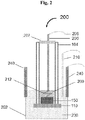
- Fig. 2 is a schematic in cross-section showing a test cell assembly (200) incorporating a lithium metal anode (150) in contact with a solid garnet electrolyte (110), the solid garnet electrolyte (110) further contacts an aqueous catholyte (230).
- test cell assembly (200) can include, for example;
- Fig. 3 compares an operating cell voltage for acid treated garnet pellets (diamonds, 310) and untreated garnet pellets (squares, 300) (control) as a function of current density.
- the improved performance of the acid treated garnet sample was apparent from the data shown in Fig. 3 , where the acid treated sample shows much lower polarization compared to the untreated sample. The difference in performance is attributed to the removal of the insulating lithium carbonate surface film in the acid treated sample.
- the current density of control garnet cell was increased to 0.1mA/cm2, the cell over polarized immediately within 1 second.
- the cell including the disclosed acid treated garnet pellet ran stably at current densities of 0.1mA/cm 2 , 0.5mA/cm 2 , and even 1.0 mA/cm 2 .
- Fig. 4 shows an exemplary operating cell voltage over time for an acid treated garnet pellet at high current density of 1.0 mA/cm 2 for 70+ hrs such as almost 100 hrs.
Landscapes
- Chemical & Material Sciences (AREA)
- Engineering & Computer Science (AREA)
- General Chemical & Material Sciences (AREA)
- Chemical Kinetics & Catalysis (AREA)
- Electrochemistry (AREA)
- Manufacturing & Machinery (AREA)
- Materials Engineering (AREA)
- Inorganic Chemistry (AREA)
- Ceramic Engineering (AREA)
- Condensed Matter Physics & Semiconductors (AREA)
- General Physics & Mathematics (AREA)
- Physics & Mathematics (AREA)
- Organic Chemistry (AREA)
- Structural Engineering (AREA)
- Composite Materials (AREA)
- Life Sciences & Earth Sciences (AREA)
- Sustainable Development (AREA)
- Sustainable Energy (AREA)
- Conductive Materials (AREA)
- Secondary Cells (AREA)
- Inorganic Compounds Of Heavy Metals (AREA)
- Battery Electrode And Active Subsutance (AREA)
Claims (13)
- Membre électrolytique de grenat solide, comprenant :une composition globale comprenant un grenat de lithium Li(7-z)La(3-y)GayZr(2-z)NbzO12 ;et une composition de surface comprenant un grenat protoné Li(7-z-x)HxLa(3-y)GayZr(2-z)NbzO12 sur au moins une partie de la surface extérieure du grenat de lithium, dans laquelle la partie protonée de surface du grenat est stable dans l'air et insensible au dioxyde de carbone du point de vue de la composition, et dans laquelle x vaut de 0,1 à 7, y vaut de 0,1 à 0,3, et z vaut de 0,1 à 0,3.
- Membrane électrolytique selon la revendication 1, dans laquelle le grenat de lithium est :
Li6.75La2.9Ga0.1Nb0.25Zr1.75O12 et le grenat protoné est Li(6.75-x)HxLa2.9Ga0.1Nb0.25Zr1.75O12, où x vaut de 0,1 à 6,75. - Membrane électrolytique selon la revendication 1, dans laquelle le grenat protoné sur au moins une partie de la surface extérieure du grenat de lithium comprend la totalité de la surface extérieure du grenat de lithium.
- Membrane électrolytique selon la revendication 1, dans laquelle le grenat protoné sur au moins une partie de la surface extérieure du grenat de lithium comprend une couche ayant une épaisseur comprise entre 0,1 et 100 nm.
- Membrane électrolytique selon la revendication 1, dans laquelle la composition de surface a une concentration en lithium comprise entre 0,1 et 46 % molaires.
- Membrane électrolytique selon la revendication 1, dans laquelle la composition de surface est sensiblement exempte d'une espèce de surface de Li électriquement isolant ou dans laquelle la composition de surface comprend une surface exempte d'au moins un composé parmi LiOH, Li2CO3, ou une combinaison de ceux-ci.
- Structure électrolytique composite, comprenant :
une structure anodique protégée comprenant :une première couche comprenant un électrolyte en céramique comprenant la membrane électrolytique de grenat solide selon la revendication 1 ;une seconde couche comprenant une source de lithium métallique, dans lequel la première couche et la seconde couche sont en contact physique ;et une cathode. - Structure électrolytique composite selon la revendication 7 comprenant en outre un catholyte aqueux situé entre la structure anodique protégée et la cathode, et en contact avec la structure anodique protégée.
- Structure électrolytique composite selon la revendication 7, dans laquelle la cathode est un composé à base d'oxyde de lithium et de cobalt.
- Procédé de fabrication de la membrane électrolytique de grenat solide selon la revendication 1, comprenant : la mise en contact d'un grenat contenant du lithium sensible à l'air avec un acide protique afin de former la membrane électrolytique de grenat solide ayant une composition de surface de grenat protoné.
- Procédé selon la revendication 10, selon lequel l'acide protique est choisi dans au moins un acide parmi : un acide minéral, un acide organique, ou une combinaison de ceux-ci.
- Procédé selon la revendication 10, comprenant en outre la mise en contact de la composition de grenat solide stable à l'air et insensible au dioxyde de carbone comportant la surface de grenat protoné avec une source d'ions lithium afin de régénérer le grenat solide contenant du lithium sensible à l'air.
- Procédé selon la revendication 12, selon lequel la mise en contact avec une source d'ions lithium est accomplie dans une structure cellulaire étanche.
Priority Applications (2)
| Application Number | Priority Date | Filing Date | Title |
|---|---|---|---|
| EP19193255.7A EP3595057B1 (fr) | 2014-11-26 | 2015-11-20 | Électrolyte solide stabilisé de grenat et procédés associés |
| EP23158487.1A EP4207376A3 (fr) | 2014-11-26 | 2015-11-20 | Électrolyte solide stabilisé à base de grenat et procédés associés |
Applications Claiming Priority (2)
| Application Number | Priority Date | Filing Date | Title |
|---|---|---|---|
| US201462084907P | 2014-11-26 | 2014-11-26 | |
| PCT/US2015/061777 WO2016085792A1 (fr) | 2014-11-26 | 2015-11-20 | Électrolyte à grenat solide stabilisé et procédés associés |
Related Child Applications (3)
| Application Number | Title | Priority Date | Filing Date |
|---|---|---|---|
| EP23158487.1A Division EP4207376A3 (fr) | 2014-11-26 | 2015-11-20 | Électrolyte solide stabilisé à base de grenat et procédés associés |
| EP19193255.7A Division EP3595057B1 (fr) | 2014-11-26 | 2015-11-20 | Électrolyte solide stabilisé de grenat et procédés associés |
| EP19193255.7A Division-Into EP3595057B1 (fr) | 2014-11-26 | 2015-11-20 | Électrolyte solide stabilisé de grenat et procédés associés |
Publications (2)
| Publication Number | Publication Date |
|---|---|
| EP3224883A1 EP3224883A1 (fr) | 2017-10-04 |
| EP3224883B1 true EP3224883B1 (fr) | 2019-10-16 |
Family
ID=54782838
Family Applications (3)
| Application Number | Title | Priority Date | Filing Date |
|---|---|---|---|
| EP19193255.7A Active EP3595057B1 (fr) | 2014-11-26 | 2015-11-20 | Électrolyte solide stabilisé de grenat et procédés associés |
| EP23158487.1A Pending EP4207376A3 (fr) | 2014-11-26 | 2015-11-20 | Électrolyte solide stabilisé à base de grenat et procédés associés |
| EP15805038.5A Not-in-force EP3224883B1 (fr) | 2014-11-26 | 2015-11-20 | Électrolyte à grenat solide stabilisé et procédés associés |
Family Applications Before (2)
| Application Number | Title | Priority Date | Filing Date |
|---|---|---|---|
| EP19193255.7A Active EP3595057B1 (fr) | 2014-11-26 | 2015-11-20 | Électrolyte solide stabilisé de grenat et procédés associés |
| EP23158487.1A Pending EP4207376A3 (fr) | 2014-11-26 | 2015-11-20 | Électrolyte solide stabilisé à base de grenat et procédés associés |
Country Status (5)
| Country | Link |
|---|---|
| US (4) | US10211481B2 (fr) |
| EP (3) | EP3595057B1 (fr) |
| JP (4) | JP2018502809A (fr) |
| CN (2) | CN107408680B (fr) |
| WO (1) | WO2016085792A1 (fr) |
Families Citing this family (45)
| Publication number | Priority date | Publication date | Assignee | Title |
|---|---|---|---|---|
| US9362546B1 (en) | 2013-01-07 | 2016-06-07 | Quantumscape Corporation | Thin film lithium conducting powder material deposition from flux |
| US10403931B2 (en) | 2013-10-07 | 2019-09-03 | Quantumscape Corporation | Garnet materials for Li secondary batteries and methods of making and using garnet materials |
| KR101592752B1 (ko) * | 2014-08-18 | 2016-02-12 | 현대자동차주식회사 | 가넷 분말, 이의 제조방법, 핫프레스를 이용한 고체전해질 시트 및 이의 제조방법 |
| KR20240059640A (ko) | 2015-04-16 | 2024-05-07 | 퀀텀스케이프 배터리, 인코포레이티드 | 고체 전해질 제조를 위한 리튬 함유 가넷 세터 플레이트 |
| JP2018528916A (ja) | 2015-07-21 | 2018-10-04 | クアンタムスケイプ コーポレイション | グリーンガーネット薄膜を流延及び焼結するプロセス及び材料 |
| JP6505846B2 (ja) * | 2015-08-21 | 2019-04-24 | 国立研究開発法人産業技術総合研究所 | プロトン伝導性複合酸化物およびそれを電解質として使用した燃料電池 |
| JP6464974B2 (ja) * | 2015-09-25 | 2019-02-06 | トヨタ自動車株式会社 | リチウム含有ガーネット型酸化物 |
| US9966630B2 (en) | 2016-01-27 | 2018-05-08 | Quantumscape Corporation | Annealed garnet electrolyte separators |
| JP2017199539A (ja) * | 2016-04-27 | 2017-11-02 | 日本特殊陶業株式会社 | 固体電解質構造体、リチウム電池、および、固体電解質構造体の製造方法 |
| JP6620770B2 (ja) * | 2016-05-27 | 2019-12-18 | トヨタ自動車株式会社 | 酸化物電解質焼結体、及び、当該酸化物電解質焼結体の製造方法 |
| US11158880B2 (en) | 2016-08-05 | 2021-10-26 | Quantumscape Battery, Inc. | Translucent and transparent separators |
| US11916200B2 (en) | 2016-10-21 | 2024-02-27 | Quantumscape Battery, Inc. | Lithium-stuffed garnet electrolytes with a reduced surface defect density and methods of making and using the same |
| CN110692159A (zh) | 2017-03-31 | 2020-01-14 | 密执安州立大学董事会 | 用于对固体电解质表面进行处理的系统和方法 |
| WO2018236394A1 (fr) | 2017-06-23 | 2018-12-27 | Quantumscape Corporation | Électrolytes de grenat remplis de lithium avec des inclusions de phase secondaire |
| US10347937B2 (en) | 2017-06-23 | 2019-07-09 | Quantumscape Corporation | Lithium-stuffed garnet electrolytes with secondary phase inclusions |
| WO2019090360A1 (fr) * | 2017-11-06 | 2019-05-09 | Quantumscape Corporation | Films minces de grenat remplis de lithium et pastilles présentant une surface oxyfluorée et/ou fluorée et procédés de fabrication et d'utilisation des films minces et des pastilles |
| KR102728661B1 (ko) * | 2018-09-06 | 2024-11-11 | 삼성전자주식회사 | 고체 전해질, 그 제조방법 및 이를 포함하는 이차전지 |
| JP7155944B2 (ja) * | 2018-11-28 | 2022-10-19 | セイコーエプソン株式会社 | 固体電解質、固体電解質の製造方法、二次電池、電子機器 |
| CN111384390A (zh) * | 2018-12-27 | 2020-07-07 | 中国科学院上海硅酸盐研究所 | 一种固体电解质表面的酸化反应改性方法 |
| US10923765B2 (en) * | 2018-12-31 | 2021-02-16 | Robert Bosch Gmbh | Lithium conducting ceramic oxide decontamination method |
| JP6929314B2 (ja) * | 2019-02-21 | 2021-09-01 | 株式会社豊田中央研究所 | 水素置換ガーネット型酸化物、焼結体の製造方法及び水素置換ガーネット型酸化物の製造方法 |
| US11600853B1 (en) | 2019-05-14 | 2023-03-07 | Ampcera Inc. | Systems and methods for storing, transporting, and handling of solid-state electrolytes |
| CN110395980B (zh) * | 2019-07-26 | 2022-02-11 | 深圳市富济新材料科技有限公司 | 多孔陶瓷材料、固体电解质材料及其制备方法和锂离子电池 |
| US12469876B2 (en) | 2020-01-15 | 2025-11-11 | Quantumscape Battery, Inc. | High green density ceramics for battery |
| CN113224374A (zh) * | 2020-01-21 | 2021-08-06 | 天津国安盟固利新材料科技股份有限公司 | 一种复合型电解质膜及其制备方法 |
| CN111786014A (zh) * | 2020-08-05 | 2020-10-16 | 长沙理工大学 | 一种超细粒度的石榴石型固体电解质粉体及其制备方法 |
| US12191444B2 (en) * | 2020-08-06 | 2025-01-07 | Samsung Electronics Co., Ltd. | All-solid secondary battery and method of manufacturing the same |
| US20220045355A1 (en) * | 2020-08-10 | 2022-02-10 | Corning Incorporated | Garnet-mgo composite thin membrane and method of making |
| KR102652246B1 (ko) * | 2020-10-27 | 2024-04-01 | 한국전자통신연구원 | 복합 전해질 필름을 포함하는 전고체 이차전지의 제조 방법 |
| KR102899216B1 (ko) | 2020-11-19 | 2025-12-11 | 삼성전자주식회사 | 전고체 전지 및 그 제조방법 |
| EP4009394B1 (fr) * | 2020-12-07 | 2023-12-06 | Saft | Electrodes negatives anti-dendrites, et cellules electrochimiques les contenant |
| CN112670561A (zh) * | 2020-12-09 | 2021-04-16 | 上海空间电源研究所 | 一种固态电解质表面缺陷改良方法及复合固态电解质膜制备方法 |
| KR20230147153A (ko) * | 2021-02-22 | 2023-10-20 | 코닝 인코포레이티드 | 조밀한 그린 테이프, 그 제조방법 및 용도 |
| KR20230156103A (ko) | 2021-03-09 | 2023-11-13 | 퀀텀스케이프 배터리, 인코포레이티드 | 급속 세라믹 가공 기술 및 장비 |
| CN113336547B (zh) * | 2021-04-22 | 2022-05-31 | 海南大学 | 一种氧化物型固体电解质薄膜及其制备方法 |
| US20230125144A1 (en) * | 2021-10-22 | 2023-04-27 | Corning Incorporated | Method for making uniform porous surface layer on garnet thin film |
| EP4479361B1 (fr) | 2022-02-14 | 2025-11-05 | QuantumScape Battery, Inc. | Procédés et appareils de traitement thermique rapide |
| CN114464878B (zh) * | 2022-02-15 | 2023-11-03 | 福建师范大学 | 一种石榴石电解质的表面改性方法及其应用 |
| EP4258379A1 (fr) * | 2022-04-08 | 2023-10-11 | The Swatch Group Research and Development Ltd | Batterie à electrolyte solide et son procédé de fabrication par déprotonation |
| EP4258380A1 (fr) * | 2022-04-08 | 2023-10-11 | The Swatch Group Research and Development Ltd | Batterie à electrolyte solide et son procédé de fabrication par protonation |
| CN115377469B (zh) * | 2022-08-26 | 2025-09-30 | 电子科技大学长三角研究院(湖州) | 一种基于质子取代的石榴石型质子导体及其制备方法 |
| EP4587406A1 (fr) | 2022-09-14 | 2025-07-23 | QuantumScape Battery, Inc. | Appareils de traitement et procédés d'utilisation |
| CN115340378B (zh) * | 2022-10-20 | 2023-02-03 | 江苏蓝固新能源科技有限公司 | 一种氧化物固态电解质及其制备方法以及一种锂离子电池 |
| CN116435589B (zh) * | 2023-05-18 | 2025-07-08 | 上海洗霸科技股份有限公司 | 一种空气稳定的固态电解质及其制备方法和应用 |
| CN118040024B (zh) * | 2024-02-28 | 2024-10-15 | 深圳欣界能源科技有限公司 | 复合材料、复合固态电解质膜及其制备方法和应用 |
Family Cites Families (18)
| Publication number | Priority date | Publication date | Assignee | Title |
|---|---|---|---|---|
| US9368775B2 (en) * | 2004-02-06 | 2016-06-14 | Polyplus Battery Company | Protected lithium electrodes having porous ceramic separators, including an integrated structure of porous and dense Li ion conducting garnet solid electrolyte layers |
| US7282295B2 (en) | 2004-02-06 | 2007-10-16 | Polyplus Battery Company | Protected active metal electrode and battery cell structures with non-aqueous interlayer architecture |
| DE102004010892B3 (de) | 2004-03-06 | 2005-11-24 | Christian-Albrechts-Universität Zu Kiel | Chemisch stabiler fester Lithiumionenleiter |
| DE102007030604A1 (de) | 2007-07-02 | 2009-01-08 | Weppner, Werner, Prof. Dr. | Ionenleiter mit Granatstruktur |
| US20120034528A1 (en) * | 2009-02-02 | 2012-02-09 | Recapping, Inc. | High energy density electrical energy storage devices |
| US8986895B2 (en) | 2009-02-04 | 2015-03-24 | Kabushiki Kaisha Toyota Chuo Kenkyusho | Garnet-type lithium ion-conducting oxide and all-solid-state lithium ion secondary battery containing the same |
| KR101216324B1 (ko) * | 2010-01-22 | 2012-12-27 | 도요타 지도샤(주) | 수계 전해액 전지의 부극 구조, 및 당해 부극 구조를 구비한 수계 전해액 전지 |
| JP5316512B2 (ja) * | 2010-10-29 | 2013-10-16 | 株式会社豊田中央研究所 | ガーネット型イオン伝導性酸化物及びその製造方法 |
| JP2012174655A (ja) * | 2011-02-24 | 2012-09-10 | Toyota Motor Corp | 空気電池用空気極及びその製造方法、並びに空気電池 |
| US9093717B2 (en) * | 2011-05-20 | 2015-07-28 | Board Of Trustees Of Michigan State University | Methods of making and using oxide ceramic solids and products and devices related thereto |
| JP6144007B2 (ja) * | 2011-06-29 | 2017-06-07 | 株式会社豊田中央研究所 | ガーネット型イオン伝導性酸化物及びその製造方法 |
| CN102280659A (zh) * | 2011-06-30 | 2011-12-14 | 清华大学 | 锂镧锆氧固体电解质材料及其制备方法与应用 |
| US8828574B2 (en) | 2011-11-15 | 2014-09-09 | Polyplus Battery Company | Electrolyte compositions for aqueous electrolyte lithium sulfur batteries |
| CN102617140B (zh) * | 2012-03-05 | 2014-08-06 | 内蒙古工业大学 | 一种锑掺杂的类石榴石结构的锂离子晶态固体电解质材料及其合成方法 |
| JP6206971B2 (ja) * | 2012-04-26 | 2017-10-04 | 日本碍子株式会社 | リチウム空気二次電池 |
| JP6063283B2 (ja) * | 2013-02-06 | 2017-01-18 | 日本特殊陶業株式会社 | 全固体電池、及び、全固体電池の製造方法 |
| WO2014153534A1 (fr) | 2013-03-21 | 2014-09-25 | University Of Maryland, College Park | Piles à conduction ionique dotées de matériaux électrolytes à l'état solide |
| JP2014220177A (ja) * | 2013-05-10 | 2014-11-20 | 日本碍子株式会社 | リチウムイオン伝導性固体電解質の製造方法 |
-
2015
- 2015-11-06 US US14/934,297 patent/US10211481B2/en active Active
- 2015-11-20 JP JP2017528177A patent/JP2018502809A/ja active Pending
- 2015-11-20 CN CN201580074490.2A patent/CN107408680B/zh active Active
- 2015-11-20 CN CN202011411819.9A patent/CN112563566A/zh active Pending
- 2015-11-20 EP EP19193255.7A patent/EP3595057B1/fr active Active
- 2015-11-20 EP EP23158487.1A patent/EP4207376A3/fr active Pending
- 2015-11-20 WO PCT/US2015/061777 patent/WO2016085792A1/fr not_active Ceased
- 2015-11-20 EP EP15805038.5A patent/EP3224883B1/fr not_active Not-in-force
-
2019
- 2019-01-07 US US16/241,277 patent/US11309581B2/en active Active
-
2021
- 2021-06-17 JP JP2021100720A patent/JP7621202B2/ja active Active
-
2022
- 2022-03-17 US US17/697,061 patent/US12580223B2/en active Active
- 2022-03-17 US US17/697,050 patent/US20220209288A1/en active Pending
-
2023
- 2023-02-28 JP JP2023029469A patent/JP2023081903A/ja active Pending
-
2024
- 2024-12-23 JP JP2024226125A patent/JP2025038209A/ja active Pending
Non-Patent Citations (1)
| Title |
|---|
| FRANCK GAM ET AL: "Reinvestigation of the Total Li + /H + Ion Exchange on the Garnet-Type Li 5 La 3 Nb 2 O 12", INORGANIC CHEMISTRY, vol. 53, no. 2, 21 January 2014 (2014-01-21), EASTON, US, pages 931 - 934, XP055546959, ISSN: 0020-1669, DOI: 10.1021/ic402326b * |
Also Published As
| Publication number | Publication date |
|---|---|
| US20160149260A1 (en) | 2016-05-26 |
| JP7621202B2 (ja) | 2025-01-24 |
| EP3595057A1 (fr) | 2020-01-15 |
| EP4207376A3 (fr) | 2023-12-20 |
| CN112563566A (zh) | 2021-03-26 |
| EP3595057B1 (fr) | 2023-05-03 |
| JP2025038209A (ja) | 2025-03-18 |
| EP3224883A1 (fr) | 2017-10-04 |
| WO2016085792A1 (fr) | 2016-06-02 |
| EP4207376A2 (fr) | 2023-07-05 |
| CN107408680A (zh) | 2017-11-28 |
| US10211481B2 (en) | 2019-02-19 |
| US20220209289A1 (en) | 2022-06-30 |
| CN107408680B (zh) | 2020-11-24 |
| JP2023081903A (ja) | 2023-06-13 |
| JP2021177485A (ja) | 2021-11-11 |
| US12580223B2 (en) | 2026-03-17 |
| JP2018502809A (ja) | 2018-02-01 |
| US20190148770A1 (en) | 2019-05-16 |
| US20220209288A1 (en) | 2022-06-30 |
| US11309581B2 (en) | 2022-04-19 |
Similar Documents
| Publication | Publication Date | Title |
|---|---|---|
| US12580223B2 (en) | Stabilized solid garnet electrolyte and methods thereof | |
| Luo et al. | Electrochemical properties and structural stability of Ga-and Y-co-doping in Li7La3Zr2O12 ceramic electrolytes for lithium-ion batteries | |
| KR101410844B1 (ko) | 알칼리 금속 티타네이트 및 그 합성방법 | |
| Rawlence et al. | On the chemical stability of post-lithiated garnet Al-stabilized Li 7 La 3 Zr 2 O 12 solid state electrolyte thin films | |
| Le et al. | Bi-layer lithium phosphorous oxynitride/aluminium substituted lithium lanthanum titanate as a promising solid electrolyte for long-life rechargeable lithium–oxygen batteries | |
| EP3778488A1 (fr) | Poudre céramique, corps fritté et batterie | |
| KR102403956B1 (ko) | 황화물 고체 전해질의 제조 방법 | |
| US20230295049A1 (en) | Li-metal oxide/garnet composite thin membrane and method of making | |
| US12341148B2 (en) | Method for making uniform porous surface layer on garnet thin film | |
| JP2016034883A (ja) | リチウムイオン伝導性無機化合物表面被覆llz系リチウムイオン伝導性酸化物 | |
| CN112436192A (zh) | 一种锂电池的空气稳定型石榴石固体电解质及制备方法 | |
| CN111592353A (zh) | 氢置换石榴石型氧化物、烧结体的制造方法和氢置换石榴石型氧化物的制造方法 | |
| Mori et al. | Grain boundary modification of Li3PO4 and Li3BO3 in garnet-type solid electrolyte for suppressing li dendrite growth | |
| EP3336936A1 (fr) | Procédé de préparation d'électrode négative pour batterie lithium et batterie lithium ion | |
| KR102206961B1 (ko) | 고체 전해질, 이의 제조 방법, 및 이를 포함하는 리튬 이차 전지 | |
| CN119009086A (zh) | 一种钠离子硫化物固态电解质及其制备方法 | |
| KR20250006044A (ko) | 니켈-풍부 캐소드 활물질의 제조 방법 및 캐소드 전극의 제조 방법 | |
| KR102965715B1 (ko) | 탄탈륨-알루미늄이 동시에 도핑된 고체전해질 및 그의 제조방법 | |
| CN116845365A (zh) | 一种立方晶系氯基富锂石榴石结构固体电解质及其制备方法 | |
| RU2358360C1 (ru) | Композиционный твердый электролит с проводимостью по ионам лития (варианты) | |
| JP2022171013A (ja) | 電解質組成物、電解質シート及び二次電池 | |
| JP2023015796A (ja) | 固体電解質、固体電解質製造用の粉末および固体電解質の製造方法 | |
| Huang et al. | Phase transformation from cubic to rhombohedral in doped Bi2O3-CaO system | |
| Narayanan et al. | Materials for All-Solid-State Lithium Ion Batteries |
Legal Events
| Date | Code | Title | Description |
|---|---|---|---|
| STAA | Information on the status of an ep patent application or granted ep patent |
Free format text: STATUS: THE INTERNATIONAL PUBLICATION HAS BEEN MADE |
|
| PUAI | Public reference made under article 153(3) epc to a published international application that has entered the european phase |
Free format text: ORIGINAL CODE: 0009012 |
|
| STAA | Information on the status of an ep patent application or granted ep patent |
Free format text: STATUS: REQUEST FOR EXAMINATION WAS MADE |
|
| 17P | Request for examination filed |
Effective date: 20170615 |
|
| AK | Designated contracting states |
Kind code of ref document: A1 Designated state(s): AL AT BE BG CH CY CZ DE DK EE ES FI FR GB GR HR HU IE IS IT LI LT LU LV MC MK MT NL NO PL PT RO RS SE SI SK SM TR |
|
| AX | Request for extension of the european patent |
Extension state: BA ME |
|
| DAV | Request for validation of the european patent (deleted) | ||
| DAX | Request for extension of the european patent (deleted) | ||
| STAA | Information on the status of an ep patent application or granted ep patent |
Free format text: STATUS: EXAMINATION IS IN PROGRESS |
|
| 17Q | First examination report despatched |
Effective date: 20180903 |
|
| GRAP | Despatch of communication of intention to grant a patent |
Free format text: ORIGINAL CODE: EPIDOSNIGR1 |
|
| STAA | Information on the status of an ep patent application or granted ep patent |
Free format text: STATUS: GRANT OF PATENT IS INTENDED |
|
| RIC1 | Information provided on ipc code assigned before grant |
Ipc: C04B 35/486 20060101ALI20190430BHEP Ipc: H01M 10/0585 20100101ALN20190430BHEP Ipc: H01M 4/38 20060101AFI20190430BHEP Ipc: H01M 10/0562 20100101ALI20190430BHEP Ipc: H01M 4/525 20100101ALI20190430BHEP |
|
| RIC1 | Information provided on ipc code assigned before grant |
Ipc: C04B 35/486 20060101ALI20190508BHEP Ipc: H01M 10/0585 20100101ALN20190508BHEP Ipc: H01M 4/38 20060101AFI20190508BHEP Ipc: H01M 10/0562 20100101ALI20190508BHEP Ipc: H01M 4/525 20100101ALI20190508BHEP |
|
| INTG | Intention to grant announced |
Effective date: 20190531 |
|
| GRAS | Grant fee paid |
Free format text: ORIGINAL CODE: EPIDOSNIGR3 |
|
| GRAA | (expected) grant |
Free format text: ORIGINAL CODE: 0009210 |
|
| STAA | Information on the status of an ep patent application or granted ep patent |
Free format text: STATUS: THE PATENT HAS BEEN GRANTED |
|
| AK | Designated contracting states |
Kind code of ref document: B1 Designated state(s): AL AT BE BG CH CY CZ DE DK EE ES FI FR GB GR HR HU IE IS IT LI LT LU LV MC MK MT NL NO PL PT RO RS SE SI SK SM TR |
|
| REG | Reference to a national code |
Ref country code: GB Ref legal event code: FG4D |
|
| REG | Reference to a national code |
Ref country code: CH Ref legal event code: EP |
|
| REG | Reference to a national code |
Ref country code: DE Ref legal event code: R096 Ref document number: 602015039976 Country of ref document: DE |
|
| REG | Reference to a national code |
Ref country code: IE Ref legal event code: FG4D |
|
| REG | Reference to a national code |
Ref country code: AT Ref legal event code: REF Ref document number: 1192167 Country of ref document: AT Kind code of ref document: T Effective date: 20191115 |
|
| REG | Reference to a national code |
Ref country code: NL Ref legal event code: MP Effective date: 20191016 |
|
| REG | Reference to a national code |
Ref country code: LT Ref legal event code: MG4D |
|
| REG | Reference to a national code |
Ref country code: AT Ref legal event code: MK05 Ref document number: 1192167 Country of ref document: AT Kind code of ref document: T Effective date: 20191016 |
|
| PG25 | Lapsed in a contracting state [announced via postgrant information from national office to epo] |
Ref country code: SE Free format text: LAPSE BECAUSE OF FAILURE TO SUBMIT A TRANSLATION OF THE DESCRIPTION OR TO PAY THE FEE WITHIN THE PRESCRIBED TIME-LIMIT Effective date: 20191016 Ref country code: PT Free format text: LAPSE BECAUSE OF FAILURE TO SUBMIT A TRANSLATION OF THE DESCRIPTION OR TO PAY THE FEE WITHIN THE PRESCRIBED TIME-LIMIT Effective date: 20200217 Ref country code: LV Free format text: LAPSE BECAUSE OF FAILURE TO SUBMIT A TRANSLATION OF THE DESCRIPTION OR TO PAY THE FEE WITHIN THE PRESCRIBED TIME-LIMIT Effective date: 20191016 Ref country code: NO Free format text: LAPSE BECAUSE OF FAILURE TO SUBMIT A TRANSLATION OF THE DESCRIPTION OR TO PAY THE FEE WITHIN THE PRESCRIBED TIME-LIMIT Effective date: 20200116 Ref country code: GR Free format text: LAPSE BECAUSE OF FAILURE TO SUBMIT A TRANSLATION OF THE DESCRIPTION OR TO PAY THE FEE WITHIN THE PRESCRIBED TIME-LIMIT Effective date: 20200117 Ref country code: BG Free format text: LAPSE BECAUSE OF FAILURE TO SUBMIT A TRANSLATION OF THE DESCRIPTION OR TO PAY THE FEE WITHIN THE PRESCRIBED TIME-LIMIT Effective date: 20200116 Ref country code: FI Free format text: LAPSE BECAUSE OF FAILURE TO SUBMIT A TRANSLATION OF THE DESCRIPTION OR TO PAY THE FEE WITHIN THE PRESCRIBED TIME-LIMIT Effective date: 20191016 Ref country code: LT Free format text: LAPSE BECAUSE OF FAILURE TO SUBMIT A TRANSLATION OF THE DESCRIPTION OR TO PAY THE FEE WITHIN THE PRESCRIBED TIME-LIMIT Effective date: 20191016 Ref country code: PL Free format text: LAPSE BECAUSE OF FAILURE TO SUBMIT A TRANSLATION OF THE DESCRIPTION OR TO PAY THE FEE WITHIN THE PRESCRIBED TIME-LIMIT Effective date: 20191016 Ref country code: NL Free format text: LAPSE BECAUSE OF FAILURE TO SUBMIT A TRANSLATION OF THE DESCRIPTION OR TO PAY THE FEE WITHIN THE PRESCRIBED TIME-LIMIT Effective date: 20191016 Ref country code: AT Free format text: LAPSE BECAUSE OF FAILURE TO SUBMIT A TRANSLATION OF THE DESCRIPTION OR TO PAY THE FEE WITHIN THE PRESCRIBED TIME-LIMIT Effective date: 20191016 |
|
| PG25 | Lapsed in a contracting state [announced via postgrant information from national office to epo] |
Ref country code: HR Free format text: LAPSE BECAUSE OF FAILURE TO SUBMIT A TRANSLATION OF THE DESCRIPTION OR TO PAY THE FEE WITHIN THE PRESCRIBED TIME-LIMIT Effective date: 20191016 Ref country code: IS Free format text: LAPSE BECAUSE OF FAILURE TO SUBMIT A TRANSLATION OF THE DESCRIPTION OR TO PAY THE FEE WITHIN THE PRESCRIBED TIME-LIMIT Effective date: 20200224 Ref country code: RS Free format text: LAPSE BECAUSE OF FAILURE TO SUBMIT A TRANSLATION OF THE DESCRIPTION OR TO PAY THE FEE WITHIN THE PRESCRIBED TIME-LIMIT Effective date: 20191016 |
|
| PG25 | Lapsed in a contracting state [announced via postgrant information from national office to epo] |
Ref country code: AL Free format text: LAPSE BECAUSE OF FAILURE TO SUBMIT A TRANSLATION OF THE DESCRIPTION OR TO PAY THE FEE WITHIN THE PRESCRIBED TIME-LIMIT Effective date: 20191016 |
|
| REG | Reference to a national code |
Ref country code: CH Ref legal event code: PL |
|
| REG | Reference to a national code |
Ref country code: DE Ref legal event code: R097 Ref document number: 602015039976 Country of ref document: DE |
|
| PG2D | Information on lapse in contracting state deleted |
Ref country code: IS |
|
| PG25 | Lapsed in a contracting state [announced via postgrant information from national office to epo] |
Ref country code: RO Free format text: LAPSE BECAUSE OF FAILURE TO SUBMIT A TRANSLATION OF THE DESCRIPTION OR TO PAY THE FEE WITHIN THE PRESCRIBED TIME-LIMIT Effective date: 20191016 Ref country code: CZ Free format text: LAPSE BECAUSE OF FAILURE TO SUBMIT A TRANSLATION OF THE DESCRIPTION OR TO PAY THE FEE WITHIN THE PRESCRIBED TIME-LIMIT Effective date: 20191016 Ref country code: LU Free format text: LAPSE BECAUSE OF NON-PAYMENT OF DUE FEES Effective date: 20191120 Ref country code: DK Free format text: LAPSE BECAUSE OF FAILURE TO SUBMIT A TRANSLATION OF THE DESCRIPTION OR TO PAY THE FEE WITHIN THE PRESCRIBED TIME-LIMIT Effective date: 20191016 Ref country code: EE Free format text: LAPSE BECAUSE OF FAILURE TO SUBMIT A TRANSLATION OF THE DESCRIPTION OR TO PAY THE FEE WITHIN THE PRESCRIBED TIME-LIMIT Effective date: 20191016 Ref country code: MC Free format text: LAPSE BECAUSE OF FAILURE TO SUBMIT A TRANSLATION OF THE DESCRIPTION OR TO PAY THE FEE WITHIN THE PRESCRIBED TIME-LIMIT Effective date: 20191016 Ref country code: ES Free format text: LAPSE BECAUSE OF FAILURE TO SUBMIT A TRANSLATION OF THE DESCRIPTION OR TO PAY THE FEE WITHIN THE PRESCRIBED TIME-LIMIT Effective date: 20191016 Ref country code: LI Free format text: LAPSE BECAUSE OF NON-PAYMENT OF DUE FEES Effective date: 20191130 Ref country code: CH Free format text: LAPSE BECAUSE OF NON-PAYMENT OF DUE FEES Effective date: 20191130 Ref country code: IS Free format text: LAPSE BECAUSE OF FAILURE TO SUBMIT A TRANSLATION OF THE DESCRIPTION OR TO PAY THE FEE WITHIN THE PRESCRIBED TIME-LIMIT Effective date: 20200216 |
|
| PLBE | No opposition filed within time limit |
Free format text: ORIGINAL CODE: 0009261 |
|
| REG | Reference to a national code |
Ref country code: BE Ref legal event code: MM Effective date: 20191130 |
|
| STAA | Information on the status of an ep patent application or granted ep patent |
Free format text: STATUS: NO OPPOSITION FILED WITHIN TIME LIMIT |
|
| PG25 | Lapsed in a contracting state [announced via postgrant information from national office to epo] |
Ref country code: SM Free format text: LAPSE BECAUSE OF FAILURE TO SUBMIT A TRANSLATION OF THE DESCRIPTION OR TO PAY THE FEE WITHIN THE PRESCRIBED TIME-LIMIT Effective date: 20191016 Ref country code: IT Free format text: LAPSE BECAUSE OF FAILURE TO SUBMIT A TRANSLATION OF THE DESCRIPTION OR TO PAY THE FEE WITHIN THE PRESCRIBED TIME-LIMIT Effective date: 20191016 Ref country code: SK Free format text: LAPSE BECAUSE OF FAILURE TO SUBMIT A TRANSLATION OF THE DESCRIPTION OR TO PAY THE FEE WITHIN THE PRESCRIBED TIME-LIMIT Effective date: 20191016 |
|
| 26N | No opposition filed |
Effective date: 20200717 |
|
| PG25 | Lapsed in a contracting state [announced via postgrant information from national office to epo] |
Ref country code: IE Free format text: LAPSE BECAUSE OF NON-PAYMENT OF DUE FEES Effective date: 20191120 |
|
| PG25 | Lapsed in a contracting state [announced via postgrant information from national office to epo] |
Ref country code: BE Free format text: LAPSE BECAUSE OF NON-PAYMENT OF DUE FEES Effective date: 20191130 Ref country code: SI Free format text: LAPSE BECAUSE OF FAILURE TO SUBMIT A TRANSLATION OF THE DESCRIPTION OR TO PAY THE FEE WITHIN THE PRESCRIBED TIME-LIMIT Effective date: 20191016 |
|
| PG25 | Lapsed in a contracting state [announced via postgrant information from national office to epo] |
Ref country code: CY Free format text: LAPSE BECAUSE OF FAILURE TO SUBMIT A TRANSLATION OF THE DESCRIPTION OR TO PAY THE FEE WITHIN THE PRESCRIBED TIME-LIMIT Effective date: 20191016 |
|
| PG25 | Lapsed in a contracting state [announced via postgrant information from national office to epo] |
Ref country code: MT Free format text: LAPSE BECAUSE OF FAILURE TO SUBMIT A TRANSLATION OF THE DESCRIPTION OR TO PAY THE FEE WITHIN THE PRESCRIBED TIME-LIMIT Effective date: 20191016 Ref country code: HU Free format text: LAPSE BECAUSE OF FAILURE TO SUBMIT A TRANSLATION OF THE DESCRIPTION OR TO PAY THE FEE WITHIN THE PRESCRIBED TIME-LIMIT; INVALID AB INITIO Effective date: 20151120 |
|
| PG25 | Lapsed in a contracting state [announced via postgrant information from national office to epo] |
Ref country code: TR Free format text: LAPSE BECAUSE OF FAILURE TO SUBMIT A TRANSLATION OF THE DESCRIPTION OR TO PAY THE FEE WITHIN THE PRESCRIBED TIME-LIMIT Effective date: 20191016 |
|
| PG25 | Lapsed in a contracting state [announced via postgrant information from national office to epo] |
Ref country code: MK Free format text: LAPSE BECAUSE OF FAILURE TO SUBMIT A TRANSLATION OF THE DESCRIPTION OR TO PAY THE FEE WITHIN THE PRESCRIBED TIME-LIMIT Effective date: 20191016 |
|
| P01 | Opt-out of the competence of the unified patent court (upc) registered |
Effective date: 20230520 |
|
| PGFP | Annual fee paid to national office [announced via postgrant information from national office to epo] |
Ref country code: GB Payment date: 20231013 Year of fee payment: 9 |
|
| PGFP | Annual fee paid to national office [announced via postgrant information from national office to epo] |
Ref country code: FR Payment date: 20231010 Year of fee payment: 9 Ref country code: DE Payment date: 20231010 Year of fee payment: 9 |
|
| REG | Reference to a national code |
Ref country code: DE Ref legal event code: R119 Ref document number: 602015039976 Country of ref document: DE |
|
| GBPC | Gb: european patent ceased through non-payment of renewal fee |
Effective date: 20241120 |
|
| PG25 | Lapsed in a contracting state [announced via postgrant information from national office to epo] |
Ref country code: DE Free format text: LAPSE BECAUSE OF NON-PAYMENT OF DUE FEES Effective date: 20250603 |
|
| PG25 | Lapsed in a contracting state [announced via postgrant information from national office to epo] |
Ref country code: GB Free format text: LAPSE BECAUSE OF NON-PAYMENT OF DUE FEES Effective date: 20241120 |
|
| PG25 | Lapsed in a contracting state [announced via postgrant information from national office to epo] |
Ref country code: FR Free format text: LAPSE BECAUSE OF NON-PAYMENT OF DUE FEES Effective date: 20241130 |