EP3225112B1 - Photosensitiser dispersion and use of the same - Google Patents
Photosensitiser dispersion and use of the same Download PDFInfo
- Publication number
- EP3225112B1 EP3225112B1 EP16163551.1A EP16163551A EP3225112B1 EP 3225112 B1 EP3225112 B1 EP 3225112B1 EP 16163551 A EP16163551 A EP 16163551A EP 3225112 B1 EP3225112 B1 EP 3225112B1
- Authority
- EP
- European Patent Office
- Prior art keywords
- weight
- dispersion
- range
- microemulsion
- photosensitizer
- Prior art date
- Legal status (The legal status is an assumption and is not a legal conclusion. Google has not performed a legal analysis and makes no representation as to the accuracy of the status listed.)
- Active
Links
- 0 NCC*CC(*1=O)=Cc2cccc3cccc1c23 Chemical compound NCC*CC(*1=O)=Cc2cccc3cccc1c23 0.000 description 5
- ZYGIGEGXTOFWSI-BLYNQTDBSA-N CCC(/C(/ON)=C\[C@@H](C)/C=C/C=O)OCC(C)C Chemical compound CCC(/C(/ON)=C\[C@@H](C)/C=C/C=O)OCC(C)C ZYGIGEGXTOFWSI-BLYNQTDBSA-N 0.000 description 1
- POTTZLPDQMIFQP-UHFFFAOYSA-N CCCCCC(CCO)CC(C1=O)=Cc2cccc3cccc1c23 Chemical compound CCCCCC(CCO)CC(C1=O)=Cc2cccc3cccc1c23 POTTZLPDQMIFQP-UHFFFAOYSA-N 0.000 description 1
- OURAFGFJLILXDX-UHFFFAOYSA-N CC[N](CC)(CC)CCOCCN(c1cc(C)c(C)cc1N=C1C(N2)=O)C1=NC2=O Chemical compound CC[N](CC)(CC)CCOCCN(c1cc(C)c(C)cc1N=C1C(N2)=O)C1=NC2=O OURAFGFJLILXDX-UHFFFAOYSA-N 0.000 description 1
- HSNKAQSYRHEKRS-UHFFFAOYSA-P Cc(cc1CC2CC[NH3+])c(C)cc1N=C(C(C1CC[NH3+])=O)C2=CC1=O Chemical compound Cc(cc1CC2CC[NH3+])c(C)cc1N=C(C(C1CC[NH3+])=O)C2=CC1=O HSNKAQSYRHEKRS-UHFFFAOYSA-P 0.000 description 1
- ADHGHVJHGYFPHJ-UHFFFAOYSA-N Cc(cc1N(CCOC)C2=NC(N3CCN)=O)c(C)cc1N=C2C3=O Chemical compound Cc(cc1N(CCOC)C2=NC(N3CCN)=O)c(C)cc1N=C2C3=O ADHGHVJHGYFPHJ-UHFFFAOYSA-N 0.000 description 1
- HESXUXBZOCXCJN-UHFFFAOYSA-N Cc(cc1N(CCOC)C2=NC(N3CCNC(N)=N)=O)c(C)cc1N=C2C3=O Chemical compound Cc(cc1N(CCOC)C2=NC(N3CCNC(N)=N)=O)c(C)cc1N=C2C3=O HESXUXBZOCXCJN-UHFFFAOYSA-N 0.000 description 1
- RMXNEUSNFBYTCE-UHFFFAOYSA-N Cc(cc1N(CC[N](C)(C)C)C2=NC(N3C)=O)c(C)cc1N=C2C3=O Chemical compound Cc(cc1N(CC[N](C)(C)C)C2=NC(N3C)=O)c(C)cc1N=C2C3=O RMXNEUSNFBYTCE-UHFFFAOYSA-N 0.000 description 1
- JXCHKZMNSSQIFT-UHFFFAOYSA-N OCC[N](CCO)(CCO)CC(C1=O)=Cc2cccc3c2c1ccc3 Chemical compound OCC[N](CCO)(CCO)CC(C1=O)=Cc2cccc3c2c1ccc3 JXCHKZMNSSQIFT-UHFFFAOYSA-N 0.000 description 1
Images


Classifications
-
- A—HUMAN NECESSITIES
- A01—AGRICULTURE; FORESTRY; ANIMAL HUSBANDRY; HUNTING; TRAPPING; FISHING
- A01N—PRESERVATION OF BODIES OF HUMANS OR ANIMALS OR PLANTS OR PARTS THEREOF; BIOCIDES, e.g. AS DISINFECTANTS, AS PESTICIDES OR AS HERBICIDES; PEST REPELLANTS OR ATTRACTANTS; PLANT GROWTH REGULATORS
- A01N25/00—Biocides, pest repellants or attractants, or plant growth regulators, characterised by their forms, or by their non-active ingredients or by their methods of application, e.g. seed treatment or sequential application; Substances for reducing the noxious effect of the active ingredients to organisms other than pests
-
- A—HUMAN NECESSITIES
- A61—MEDICAL OR VETERINARY SCIENCE; HYGIENE
- A61L—METHODS OR APPARATUS FOR STERILISING MATERIALS OR OBJECTS IN GENERAL; DISINFECTION, STERILISATION OR DEODORISATION OF AIR; CHEMICAL ASPECTS OF BANDAGES, DRESSINGS, ABSORBENT PADS OR SURGICAL ARTICLES; MATERIALS FOR BANDAGES, DRESSINGS, ABSORBENT PADS OR SURGICAL ARTICLES
- A61L2/00—Disinfection or sterilisation of materials or objects, in general; Accessories therefor
- A61L2/02—Disinfection or sterilisation of materials or objects, in general; Accessories therefor using physical processes
- A61L2/08—Radiation
- A61L2/088—Radiation using photocatalysts or photosensitisers
-
- A—HUMAN NECESSITIES
- A01—AGRICULTURE; FORESTRY; ANIMAL HUSBANDRY; HUNTING; TRAPPING; FISHING
- A01N—PRESERVATION OF BODIES OF HUMANS OR ANIMALS OR PLANTS OR PARTS THEREOF; BIOCIDES, e.g. AS DISINFECTANTS, AS PESTICIDES OR AS HERBICIDES; PEST REPELLANTS OR ATTRACTANTS; PLANT GROWTH REGULATORS
- A01N25/00—Biocides, pest repellants or attractants, or plant growth regulators, characterised by their forms, or by their non-active ingredients or by their methods of application, e.g. seed treatment or sequential application; Substances for reducing the noxious effect of the active ingredients to organisms other than pests
- A01N25/02—Biocides, pest repellants or attractants, or plant growth regulators, characterised by their forms, or by their non-active ingredients or by their methods of application, e.g. seed treatment or sequential application; Substances for reducing the noxious effect of the active ingredients to organisms other than pests containing liquids as carriers, diluents or solvents
- A01N25/04—Dispersions, emulsions, suspoemulsions, suspension concentrates or gels
-
- A—HUMAN NECESSITIES
- A01—AGRICULTURE; FORESTRY; ANIMAL HUSBANDRY; HUNTING; TRAPPING; FISHING
- A01N—PRESERVATION OF BODIES OF HUMANS OR ANIMALS OR PLANTS OR PARTS THEREOF; BIOCIDES, e.g. AS DISINFECTANTS, AS PESTICIDES OR AS HERBICIDES; PEST REPELLANTS OR ATTRACTANTS; PLANT GROWTH REGULATORS
- A01N25/00—Biocides, pest repellants or attractants, or plant growth regulators, characterised by their forms, or by their non-active ingredients or by their methods of application, e.g. seed treatment or sequential application; Substances for reducing the noxious effect of the active ingredients to organisms other than pests
- A01N25/30—Biocides, pest repellants or attractants, or plant growth regulators, characterised by their forms, or by their non-active ingredients or by their methods of application, e.g. seed treatment or sequential application; Substances for reducing the noxious effect of the active ingredients to organisms other than pests characterised by the surfactants
-
- A—HUMAN NECESSITIES
- A23—FOODS OR FOODSTUFFS; TREATMENT THEREOF, NOT COVERED BY OTHER CLASSES
- A23B—PRESERVATION OF FOODS, FOODSTUFFS OR NON-ALCOHOLIC BEVERAGES; CHEMICAL RIPENING OF FRUIT OR VEGETABLES
- A23B2/00—Preservation of foods or foodstuffs, in general
- A23B2/50—Preservation of foods or foodstuffs, in general by irradiation without heating
-
- A—HUMAN NECESSITIES
- A23—FOODS OR FOODSTUFFS; TREATMENT THEREOF, NOT COVERED BY OTHER CLASSES
- A23B—PRESERVATION OF FOODS, FOODSTUFFS OR NON-ALCOHOLIC BEVERAGES; CHEMICAL RIPENING OF FRUIT OR VEGETABLES
- A23B2/00—Preservation of foods or foodstuffs, in general
- A23B2/70—Preservation of foods or foodstuffs, in general by treatment with chemicals
- A23B2/725—Preservation of foods or foodstuffs, in general by treatment with chemicals in the form of liquids or solids
-
- A—HUMAN NECESSITIES
- A61—MEDICAL OR VETERINARY SCIENCE; HYGIENE
- A61K—PREPARATIONS FOR MEDICAL, DENTAL OR TOILETRY PURPOSES
- A61K41/00—Medicinal preparations obtained by treating materials with wave energy or particle radiation ; Therapies using these preparations
- A61K41/0057—Photodynamic therapy with a photosensitizer, i.e. agent able to produce reactive oxygen species upon exposure to light or radiation, e.g. UV or visible light; photocleavage of nucleic acids with an agent
-
- A—HUMAN NECESSITIES
- A61—MEDICAL OR VETERINARY SCIENCE; HYGIENE
- A61K—PREPARATIONS FOR MEDICAL, DENTAL OR TOILETRY PURPOSES
- A61K41/00—Medicinal preparations obtained by treating materials with wave energy or particle radiation ; Therapies using these preparations
- A61K41/0057—Photodynamic therapy with a photosensitizer, i.e. agent able to produce reactive oxygen species upon exposure to light or radiation, e.g. UV or visible light; photocleavage of nucleic acids with an agent
- A61K41/0071—PDT with porphyrins having exactly 20 ring atoms, i.e. based on the non-expanded tetrapyrrolic ring system, e.g. bacteriochlorin, chlorin-e6, or phthalocyanines
-
- A—HUMAN NECESSITIES
- A61—MEDICAL OR VETERINARY SCIENCE; HYGIENE
- A61K—PREPARATIONS FOR MEDICAL, DENTAL OR TOILETRY PURPOSES
- A61K6/00—Preparations for dentistry
-
- A—HUMAN NECESSITIES
- A61—MEDICAL OR VETERINARY SCIENCE; HYGIENE
- A61K—PREPARATIONS FOR MEDICAL, DENTAL OR TOILETRY PURPOSES
- A61K6/00—Preparations for dentistry
- A61K6/50—Preparations specially adapted for dental root treatment
- A61K6/52—Cleaning; Disinfecting
-
- A—HUMAN NECESSITIES
- A61—MEDICAL OR VETERINARY SCIENCE; HYGIENE
- A61K—PREPARATIONS FOR MEDICAL, DENTAL OR TOILETRY PURPOSES
- A61K6/00—Preparations for dentistry
- A61K6/60—Preparations for dentistry comprising organic or organo-metallic additives
- A61K6/62—Photochemical radical initiators
-
- A—HUMAN NECESSITIES
- A61—MEDICAL OR VETERINARY SCIENCE; HYGIENE
- A61K—PREPARATIONS FOR MEDICAL, DENTAL OR TOILETRY PURPOSES
- A61K6/00—Preparations for dentistry
- A61K6/60—Preparations for dentistry comprising organic or organo-metallic additives
- A61K6/69—Medicaments
-
- A—HUMAN NECESSITIES
- A61—MEDICAL OR VETERINARY SCIENCE; HYGIENE
- A61K—PREPARATIONS FOR MEDICAL, DENTAL OR TOILETRY PURPOSES
- A61K8/00—Cosmetics or similar toiletry preparations
- A61K8/02—Cosmetics or similar toiletry preparations characterised by special physical form
- A61K8/04—Dispersions; Emulsions
- A61K8/042—Gels
-
- A—HUMAN NECESSITIES
- A61—MEDICAL OR VETERINARY SCIENCE; HYGIENE
- A61K—PREPARATIONS FOR MEDICAL, DENTAL OR TOILETRY PURPOSES
- A61K8/00—Cosmetics or similar toiletry preparations
- A61K8/02—Cosmetics or similar toiletry preparations characterised by special physical form
- A61K8/04—Dispersions; Emulsions
- A61K8/06—Emulsions
- A61K8/068—Microemulsions
-
- A—HUMAN NECESSITIES
- A61—MEDICAL OR VETERINARY SCIENCE; HYGIENE
- A61K—PREPARATIONS FOR MEDICAL, DENTAL OR TOILETRY PURPOSES
- A61K8/00—Cosmetics or similar toiletry preparations
- A61K8/18—Cosmetics or similar toiletry preparations characterised by the composition
- A61K8/30—Cosmetics or similar toiletry preparations characterised by the composition containing organic compounds
- A61K8/40—Cosmetics or similar toiletry preparations characterised by the composition containing organic compounds containing nitrogen
- A61K8/41—Amines
-
- A—HUMAN NECESSITIES
- A61—MEDICAL OR VETERINARY SCIENCE; HYGIENE
- A61K—PREPARATIONS FOR MEDICAL, DENTAL OR TOILETRY PURPOSES
- A61K8/00—Cosmetics or similar toiletry preparations
- A61K8/18—Cosmetics or similar toiletry preparations characterised by the composition
- A61K8/30—Cosmetics or similar toiletry preparations characterised by the composition containing organic compounds
- A61K8/40—Cosmetics or similar toiletry preparations characterised by the composition containing organic compounds containing nitrogen
- A61K8/41—Amines
- A61K8/416—Quaternary ammonium compounds
-
- A—HUMAN NECESSITIES
- A61—MEDICAL OR VETERINARY SCIENCE; HYGIENE
- A61K—PREPARATIONS FOR MEDICAL, DENTAL OR TOILETRY PURPOSES
- A61K8/00—Cosmetics or similar toiletry preparations
- A61K8/18—Cosmetics or similar toiletry preparations characterised by the composition
- A61K8/30—Cosmetics or similar toiletry preparations characterised by the composition containing organic compounds
- A61K8/40—Cosmetics or similar toiletry preparations characterised by the composition containing organic compounds containing nitrogen
- A61K8/43—Guanidines
-
- A—HUMAN NECESSITIES
- A61—MEDICAL OR VETERINARY SCIENCE; HYGIENE
- A61K—PREPARATIONS FOR MEDICAL, DENTAL OR TOILETRY PURPOSES
- A61K8/00—Cosmetics or similar toiletry preparations
- A61K8/18—Cosmetics or similar toiletry preparations characterised by the composition
- A61K8/30—Cosmetics or similar toiletry preparations characterised by the composition containing organic compounds
- A61K8/49—Cosmetics or similar toiletry preparations characterised by the composition containing organic compounds containing heterocyclic compounds
- A61K8/4906—Cosmetics or similar toiletry preparations characterised by the composition containing organic compounds containing heterocyclic compounds with one nitrogen as the only hetero atom
- A61K8/4926—Cosmetics or similar toiletry preparations characterised by the composition containing organic compounds containing heterocyclic compounds with one nitrogen as the only hetero atom having six membered rings
-
- A—HUMAN NECESSITIES
- A61—MEDICAL OR VETERINARY SCIENCE; HYGIENE
- A61K—PREPARATIONS FOR MEDICAL, DENTAL OR TOILETRY PURPOSES
- A61K8/00—Cosmetics or similar toiletry preparations
- A61K8/18—Cosmetics or similar toiletry preparations characterised by the composition
- A61K8/30—Cosmetics or similar toiletry preparations characterised by the composition containing organic compounds
- A61K8/49—Cosmetics or similar toiletry preparations characterised by the composition containing organic compounds containing heterocyclic compounds
- A61K8/494—Cosmetics or similar toiletry preparations characterised by the composition containing organic compounds containing heterocyclic compounds with more than one nitrogen as the only hetero atom
-
- A—HUMAN NECESSITIES
- A61—MEDICAL OR VETERINARY SCIENCE; HYGIENE
- A61K—PREPARATIONS FOR MEDICAL, DENTAL OR TOILETRY PURPOSES
- A61K8/00—Cosmetics or similar toiletry preparations
- A61K8/18—Cosmetics or similar toiletry preparations characterised by the composition
- A61K8/30—Cosmetics or similar toiletry preparations characterised by the composition containing organic compounds
- A61K8/49—Cosmetics or similar toiletry preparations characterised by the composition containing organic compounds containing heterocyclic compounds
- A61K8/494—Cosmetics or similar toiletry preparations characterised by the composition containing organic compounds containing heterocyclic compounds with more than one nitrogen as the only hetero atom
- A61K8/4953—Cosmetics or similar toiletry preparations characterised by the composition containing organic compounds containing heterocyclic compounds with more than one nitrogen as the only hetero atom containing pyrimidine ring derivatives, e.g. minoxidil
-
- A—HUMAN NECESSITIES
- A61—MEDICAL OR VETERINARY SCIENCE; HYGIENE
- A61K—PREPARATIONS FOR MEDICAL, DENTAL OR TOILETRY PURPOSES
- A61K9/00—Medicinal preparations characterised by special physical form
- A61K9/10—Dispersions; Emulsions
- A61K9/107—Emulsions ; Emulsion preconcentrates; Micelles
- A61K9/1075—Microemulsions or submicron emulsions; Preconcentrates or solids thereof; Micelles, e.g. made of phospholipids or block copolymers
-
- A—HUMAN NECESSITIES
- A61—MEDICAL OR VETERINARY SCIENCE; HYGIENE
- A61L—METHODS OR APPARATUS FOR STERILISING MATERIALS OR OBJECTS IN GENERAL; DISINFECTION, STERILISATION OR DEODORISATION OF AIR; CHEMICAL ASPECTS OF BANDAGES, DRESSINGS, ABSORBENT PADS OR SURGICAL ARTICLES; MATERIALS FOR BANDAGES, DRESSINGS, ABSORBENT PADS OR SURGICAL ARTICLES
- A61L2/00—Disinfection or sterilisation of materials or objects, in general; Accessories therefor
- A61L2/02—Disinfection or sterilisation of materials or objects, in general; Accessories therefor using physical processes
- A61L2/08—Radiation
- A61L2/084—Visible light
-
- A—HUMAN NECESSITIES
- A61—MEDICAL OR VETERINARY SCIENCE; HYGIENE
- A61L—METHODS OR APPARATUS FOR STERILISING MATERIALS OR OBJECTS IN GENERAL; DISINFECTION, STERILISATION OR DEODORISATION OF AIR; CHEMICAL ASPECTS OF BANDAGES, DRESSINGS, ABSORBENT PADS OR SURGICAL ARTICLES; MATERIALS FOR BANDAGES, DRESSINGS, ABSORBENT PADS OR SURGICAL ARTICLES
- A61L2/00—Disinfection or sterilisation of materials or objects, in general; Accessories therefor
- A61L2/02—Disinfection or sterilisation of materials or objects, in general; Accessories therefor using physical processes
- A61L2/08—Radiation
- A61L2/10—Ultraviolet [UV] radiation
-
- A—HUMAN NECESSITIES
- A61—MEDICAL OR VETERINARY SCIENCE; HYGIENE
- A61P—SPECIFIC THERAPEUTIC ACTIVITY OF CHEMICAL COMPOUNDS OR MEDICINAL PREPARATIONS
- A61P1/00—Drugs for disorders of the alimentary tract or the digestive system
- A61P1/02—Stomatological preparations, e.g. drugs for caries, aphtae, periodontitis
-
- A—HUMAN NECESSITIES
- A61—MEDICAL OR VETERINARY SCIENCE; HYGIENE
- A61P—SPECIFIC THERAPEUTIC ACTIVITY OF CHEMICAL COMPOUNDS OR MEDICINAL PREPARATIONS
- A61P31/00—Antiinfectives, i.e. antibiotics, antiseptics, chemotherapeutics
-
- A—HUMAN NECESSITIES
- A61—MEDICAL OR VETERINARY SCIENCE; HYGIENE
- A61P—SPECIFIC THERAPEUTIC ACTIVITY OF CHEMICAL COMPOUNDS OR MEDICINAL PREPARATIONS
- A61P31/00—Antiinfectives, i.e. antibiotics, antiseptics, chemotherapeutics
- A61P31/04—Antibacterial agents
-
- A—HUMAN NECESSITIES
- A61—MEDICAL OR VETERINARY SCIENCE; HYGIENE
- A61P—SPECIFIC THERAPEUTIC ACTIVITY OF CHEMICAL COMPOUNDS OR MEDICINAL PREPARATIONS
- A61P31/00—Antiinfectives, i.e. antibiotics, antiseptics, chemotherapeutics
- A61P31/10—Antimycotics
-
- A—HUMAN NECESSITIES
- A61—MEDICAL OR VETERINARY SCIENCE; HYGIENE
- A61P—SPECIFIC THERAPEUTIC ACTIVITY OF CHEMICAL COMPOUNDS OR MEDICINAL PREPARATIONS
- A61P31/00—Antiinfectives, i.e. antibiotics, antiseptics, chemotherapeutics
- A61P31/12—Antivirals
-
- A—HUMAN NECESSITIES
- A61—MEDICAL OR VETERINARY SCIENCE; HYGIENE
- A61P—SPECIFIC THERAPEUTIC ACTIVITY OF CHEMICAL COMPOUNDS OR MEDICINAL PREPARATIONS
- A61P33/00—Antiparasitic agents
-
- A—HUMAN NECESSITIES
- A61—MEDICAL OR VETERINARY SCIENCE; HYGIENE
- A61Q—SPECIFIC USE OF COSMETICS OR SIMILAR TOILETRY PREPARATIONS
- A61Q11/00—Preparations for care of the teeth, of the oral cavity or of dentures; Dentifrices, e.g. toothpastes; Mouth rinses
-
- A—HUMAN NECESSITIES
- A61—MEDICAL OR VETERINARY SCIENCE; HYGIENE
- A61Q—SPECIFIC USE OF COSMETICS OR SIMILAR TOILETRY PREPARATIONS
- A61Q11/00—Preparations for care of the teeth, of the oral cavity or of dentures; Dentifrices, e.g. toothpastes; Mouth rinses
- A61Q11/02—Preparations for deodorising, bleaching or disinfecting dentures
-
- B—PERFORMING OPERATIONS; TRANSPORTING
- B65—CONVEYING; PACKING; STORING; HANDLING THIN OR FILAMENTARY MATERIAL
- B65B—MACHINES, APPARATUS OR DEVICES FOR, OR METHODS OF, PACKAGING ARTICLES OR MATERIALS; UNPACKING
- B65B55/00—Preserving, protecting or purifying packages or package contents in association with packaging
- B65B55/02—Sterilising, e.g. of complete packages
- B65B55/04—Sterilising wrappers or receptacles prior to, or during, packaging
- B65B55/08—Sterilising wrappers or receptacles prior to, or during, packaging by irradiation
-
- C—CHEMISTRY; METALLURGY
- C02—TREATMENT OF WATER, WASTE WATER, SEWAGE, OR SLUDGE
- C02F—TREATMENT OF WATER, WASTE WATER, SEWAGE, OR SLUDGE
- C02F1/00—Treatment of water, waste water, or sewage
- C02F1/30—Treatment of water, waste water, or sewage by irradiation
-
- C—CHEMISTRY; METALLURGY
- C02—TREATMENT OF WATER, WASTE WATER, SEWAGE, OR SLUDGE
- C02F—TREATMENT OF WATER, WASTE WATER, SEWAGE, OR SLUDGE
- C02F1/00—Treatment of water, waste water, or sewage
- C02F1/50—Treatment of water, waste water, or sewage by addition or application of a germicide or by oligodynamic treatment
-
- A—HUMAN NECESSITIES
- A23—FOODS OR FOODSTUFFS; TREATMENT THEREOF, NOT COVERED BY OTHER CLASSES
- A23V—INDEXING SCHEME RELATING TO FOODS, FOODSTUFFS OR NON-ALCOHOLIC BEVERAGES AND LACTIC OR PROPIONIC ACID BACTERIA USED IN FOODSTUFFS OR FOOD PREPARATION
- A23V2002/00—Food compositions, function of food ingredients or processes for food or foodstuffs
-
- A—HUMAN NECESSITIES
- A61—MEDICAL OR VETERINARY SCIENCE; HYGIENE
- A61K—PREPARATIONS FOR MEDICAL, DENTAL OR TOILETRY PURPOSES
- A61K2800/00—Properties of cosmetic compositions or active ingredients thereof or formulation aids used therein and process related aspects
- A61K2800/70—Biological properties of the composition as a whole
-
- A—HUMAN NECESSITIES
- A61—MEDICAL OR VETERINARY SCIENCE; HYGIENE
- A61L—METHODS OR APPARATUS FOR STERILISING MATERIALS OR OBJECTS IN GENERAL; DISINFECTION, STERILISATION OR DEODORISATION OF AIR; CHEMICAL ASPECTS OF BANDAGES, DRESSINGS, ABSORBENT PADS OR SURGICAL ARTICLES; MATERIALS FOR BANDAGES, DRESSINGS, ABSORBENT PADS OR SURGICAL ARTICLES
- A61L2103/00—Materials or objects being the target of disinfection or sterilisation
- A61L2103/05—Living organisms or biological materials
-
- A—HUMAN NECESSITIES
- A61—MEDICAL OR VETERINARY SCIENCE; HYGIENE
- A61L—METHODS OR APPARATUS FOR STERILISING MATERIALS OR OBJECTS IN GENERAL; DISINFECTION, STERILISATION OR DEODORISATION OF AIR; CHEMICAL ASPECTS OF BANDAGES, DRESSINGS, ABSORBENT PADS OR SURGICAL ARTICLES; MATERIALS FOR BANDAGES, DRESSINGS, ABSORBENT PADS OR SURGICAL ARTICLES
- A61L2103/00—Materials or objects being the target of disinfection or sterilisation
- A61L2103/23—Containers other than laboratory or medical, e.g. bottles or mail
-
- A—HUMAN NECESSITIES
- A61—MEDICAL OR VETERINARY SCIENCE; HYGIENE
- A61L—METHODS OR APPARATUS FOR STERILISING MATERIALS OR OBJECTS IN GENERAL; DISINFECTION, STERILISATION OR DEODORISATION OF AIR; CHEMICAL ASPECTS OF BANDAGES, DRESSINGS, ABSORBENT PADS OR SURGICAL ARTICLES; MATERIALS FOR BANDAGES, DRESSINGS, ABSORBENT PADS OR SURGICAL ARTICLES
- A61L2103/00—Materials or objects being the target of disinfection or sterilisation
- A61L2103/50—Textiles, e.g. bedwear or towels
-
- A—HUMAN NECESSITIES
- A61—MEDICAL OR VETERINARY SCIENCE; HYGIENE
- A61L—METHODS OR APPARATUS FOR STERILISING MATERIALS OR OBJECTS IN GENERAL; DISINFECTION, STERILISATION OR DEODORISATION OF AIR; CHEMICAL ASPECTS OF BANDAGES, DRESSINGS, ABSORBENT PADS OR SURGICAL ARTICLES; MATERIALS FOR BANDAGES, DRESSINGS, ABSORBENT PADS OR SURGICAL ARTICLES
- A61L2103/00—Materials or objects being the target of disinfection or sterilisation
- A61L2103/75—Room floors or walls
Definitions
- the present invention relates to a photosensitizer-containing dispersion and its use.
- VRSA vacomycin-resistant bacterial strains
- New approaches to combating resistant or multi-resistant germs are therefore on the one hand the search for new antidotes, for example antibiotics or antimicotics, and on the other hand the search for alternative inactivation options.
- a photosensitizer is excited by light of a certain wavelength.
- the excited photosensitizer can cause the formation of reactive oxygen species (ROS) cause, on the one hand radicals, for example superoxide anions, hydrogen peroxide or hydroxyl radicals, and / or on the other hand excited molecular oxygen, for example singlet oxygen, can be formed.
- ROS reactive oxygen species
- ROS reactive oxygen species
- Oxidation-sensitive molecules are, for example, molecules that contain double bonds or oxidation-sensitive groups such as phenols, sulfides or thiols. Unsaturated fatty acids in the membranes of bacteria are particularly susceptible to damage.
- the DE 602 22 421 T2 discloses an injectable galenic formulation for use in photodynamic diagnosis or therapy and its method of manufacture.
- the WO 2006/135344 A1 describes a photosensitizing composition and its uses.
- the WO 2009/123575 A1 also discloses a photosensitizing composition and its uses.
- the aim is to provide a photosensitizer-containing composition which ensures easy application and, in particular, at the same time shows good wetting properties even on hydrophobic surfaces.
- the photosensitizer-containing composition should preferably ensure improved adhesion of the photosensitizer.
- the effectiveness of the photosensitizer should preferably be improved.
- the photosensitizer-containing composition should essentially not hinder the excitation of the photosensitizer molecules contained in the composition by light of a certain wavelength.
- the object of the present invention is further achieved by the non-medical use of a dispersion according to one of claims 1 to 14 for inactivating microorganisms, which are preferably selected from the group consisting of viruses, archaea, bacteria, bacterial spores, fungi, fungal spores, protozoa, algae and blood-borne parasites can be selected.
- microorganisms which are preferably selected from the group consisting of viruses, archaea, bacteria, bacterial spores, fungi, fungal spores, protozoa, algae and blood-borne parasites can be selected.
- the object of the present invention is further achieved by providing a dispersion according to one of claims 1 to 14 for use according to claim 20 in photodynamic therapy for inactivating microorganisms, which are preferably selected from the group consisting of viruses, archaea, bacteria, bacterial spores, Fungi, fungal spores, protozoa, algae and blood-borne parasites can be selected.
- microorganisms which are preferably selected from the group consisting of viruses, archaea, bacteria, bacterial spores, Fungi, fungal spores, protozoa, algae and blood-borne parasites can be selected.
- a preferred embodiment of the dispersion according to the invention according to any one of claims 1 to 14 for use according to claim 20 is specified in dependent claim 21.
- the inventive method for inactivating microorganisms in the photodynamic therapy of a patient or in the photodynamic disinfection of a surface of an object or a room or in the photodynamic disinfection of a liquid preferably in the photodynamic disinfection of a surface of an object or in the photodynamic disinfection of a Liquid.
- the inventors have found that by providing a photosensitizer-containing dispersion according to the invention, a large number of different photosensitizer classes can also be applied efficiently to hydrophobic surfaces. Preferably, an amount of photosensitizer necessary for photodynamic inactivation can be applied to the surface to be treated.
- the dispersion according to the invention has sufficient wettability, even of hydrophobic surfaces, for different photosensitizer classes, so that the photosensitizer-containing dispersion according to the invention and thus the at least one photosensitizer contained therein can be distributed preferably evenly on the surface to be sterilized and preferably after application sticks.
- the inventors were surprised to find that the dispersion according to the invention does not reduce the photodynamic activity of the at least one photosensitizer contained therein.
- the photosensitizer-containing dispersion according to the invention exhibits little to no turbidity, as a result of which the irradiated electromagnetic radiation is hardly or not attenuated.
- the use of the at least one photosensitizer in the dispersion according to the invention surprisingly does not lead to any significant reduction in the yield of reactive oxygen species and / or singlet oxygen compared to the use of the pure photosensitizer.
- the highest possible yield of reactive oxygen species or singlet oxygen is desirable for antimicrobial effectiveness in photodynamic therapy or in the photodynamic cleaning of surfaces or liquids.
- ROS reactive oxygen species
- this comprises, in addition to the at least one photosensitizer, no further organic compounds which have unsaturated groups, for example in the form of double bonds and / or triple bonds, and no further organic compounds which have oxidizable groups, for example in the form of Thiol groups and / or aldehyde groups, since these radicals or groups react with singlet oxygen or the reactive oxygen species formed and can reduce the quantum yield.
- the photosensitizer dispersion according to the invention does not comprise any further oxidizable aromatics such as phenols, polyphenols, aniline or phenylenediamines, and no further activated amino acids such as histidine or tryptophan, no imidazole, no alkyl sulfides or no thioethers.
- Photosensitizers in the context of the invention are understood to mean compounds which absorb electromagnetic radiation, preferably visible light, UV light and / or infrared light, and then absorb reactive oxygen species (ROS), preferably free radicals and / or singlet oxygen, from triplet- Generate oxygen.
- ROS reactive oxygen species
- the term "photodynamic therapy” is understood to mean the light-induced inactivation of cells or microorganisms, which preferably include viruses, archae, bacteria, bacterial spores, fungi, fungal spores, protozoa, algae, blood-borne parasites or combinations thereof, on and / or in patients.
- the term "photodynamic disinfection” means the light-induced inactivation of microorganisms, which preferably include viruses, archaea, bacteria, bacterial spores, fungi, fungal spores, protozoa, algae, blood-borne parasites or combinations thereof, on surfaces of objects, rooms and / or food and / or in liquids, in particular in water, industrial water, gray water, rain water, process water, etc.
- the term “surface cleaning” is understood to mean the inactivation of microorganisms, which preferably include viruses, archaea, bacteria, bacterial spores, fungi, fungal spores, protozoa, algae, blood-borne parasites or combinations thereof, on the surfaces of objects, rooms and / or food.
- the term “surface cleaning and / or coating” does not include surfaces on a human or animal body, such as, for example, the skin; and / or in a human or animal body, such as the outer, apical side of the epithelium of a hollow organ.
- the term “inactivation” is understood to mean the reduction of the viability or the destruction of a microorganism, preferably its destruction.
- Light-induced inactivation can be determined, for example, by reducing the number of microorganisms after irradiating a defined initial amount of these microorganisms in the presence of a dispersion according to the invention.
- a reduction in viability is understood to mean that the number of microorganisms increases by at least 80.0%, preferably at least 99.0%, preferably at least 99.9%, more preferably by at least 99.99%, more preferably by at least 99.999%. , even more preferably by at least 99.9999%, is decreased.
- the number of microorganisms is extremely preferably reduced by more than 99.9 to 100%, preferably by more than 99.99 to 100%.
- the reduction in the number of microorganisms is in accordance with Boyce, JM and Pittet, D. ("Guidelines for hand hygiene in healthcare settings. Recommendations of the Healthcare Infection Control Practices Advisory Committee and the HIPAC / SHEA / APIC / IDSA Hand Hygiene Task Force," Am.J.lnfect.Control 30 (8), 2002, pages 1-46 ) given as a log 10 reduction factor.
- log 10 reduction factor is understood to mean the difference between the decadic logarithm of the number of microorganisms before and the decadic logarithm of the number of microorganisms after irradiation of these microorganisms with electromagnetic radiation in the presence of a dispersion according to the invention.
- Suitable methods for determining the log 10 reduction factor are, for example, in DIN EN 14885: 2007-01 "Chemical disinfectants and antiseptics - Application of European standards for chemical disinfectants and antiseptics” or in Rabenau, HF and Schwebke, I. ("Guideline of the German Association for Combating Virus Diseases (DVV) eV and the Robert Koch Institute (RKI) for testing chemical disinfectants for effectiveness against viruses in human medicine" Federal Health Gazette, Health Research , Health Protection 51 (8), (2008), pages 937 - 945 ) described.
- the log 10 reduction factor after irradiating microorganisms with electromagnetic radiation in the presence of a dispersion according to the invention is preferably at least 2 log 10 , preferably at least 3 log 10 , more preferably at least 4 log 10 , more preferably at least 4.5 log 10 , more preferably at least 5 log 10 , more preferably at least 6 log 10 , even more preferably at least 7 log 10 , even more preferably at least 7.5 log 10 .
- a reduction in the number of microorganisms after irradiation of these microorganisms with electromagnetic radiation in the presence of a dispersion according to the invention by 2 powers of ten, based on the initial amount of these microorganisms, means a log 10 reduction factor of 2 log 10 .
- the number of microorganisms after irradiating these microorganisms with electromagnetic radiation in the presence of a dispersion according to the invention is further preferred by at least 1 power of ten, more preferably by at least 2 powers of ten, more preferably by at least 3 powers of ten, preferably by at least 4 powers of ten, more preferably by at least 5 Powers of ten, more preferably by at least 6 powers of ten, even more preferably by at least 7 powers of ten, in each case based on the initial amount of these microorganisms.
- microorganisms is understood to mean in particular viruses, archaea, prokaryotic microorganisms such as fungi, protozoa, fungal spores, and unicellular algae.
- the microorganisms can be unicellular or multicellular, for example as mycelium.
- a photosensitizer dispersion according to the invention comprises (a) at least one photosensitizer.
- the at least one photosensitizer is positively charged, negatively charged, uncharged or a mixture thereof.
- the at least one photosensitizer preferably has at least one organic radical with a) at least one neutral, protonatable nitrogen atom and / or b) at least one positively charged nitrogen atom.
- the at least one photosensitizer is selected from the group consisting of phenalenones, curcumines, flavins and mixtures thereof.
- Suitable phenalenones are, for example, in the EP 2 678 035 A2 disclosed, the content of which is hereby incorporated by reference with regard to the structure and synthesis of suitable phenalenones.
- a suitable phenalenone derivative is preferably selected from the group consisting of the compounds of the formulas (2) to (25) and mixtures thereof:
- a suitable phenalenone derivative is preferably further selected from the group consisting of the compounds with the formulas (26) to (28) and mixtures thereof:
- a suitable phenalenone derivative is selected from the group consisting of the compounds with the formulas (2) to (28) and mixtures thereof.
- Suitable flavins are for example in EP 2 723 342 A1 , EP 2 723 743 A1 and EP 2 723 742 A1 disclosed, the content of which with regard to structure and synthesis of suitable flavins is hereby incorporated by reference.
- a suitable flavin derivative is preferably selected from the group consisting of the compounds having the formulas (32) to (49), (51) to (64) and mixtures thereof:
- Suitable curcumin are for example in the unpublished patent application EP 18152597.3 disclosed, the content of which is hereby incorporated by reference with regard to the structure and synthesis of suitable curcumins.
- a suitable curcumin derivative is selected, for example, from the group consisting of the compounds with the formulas (75) to (104b), (105) and mixtures thereof:
- Suitable curcumin derivatives and their preparation are, for example, in CA 2 888 140 A1 described, the content of which with regard to structure and synthesis of suitable curcumins is hereby incorporated by reference.
- curcumin-3,5-dione derivatives and their preparation are also in the EP 2 698 368 A1 described, the content of which with regard to structure and synthesis of suitable curcumins is hereby incorporated by reference.
- phenothiazinium dyes are, for example, new methylene blue (NMB; 3,7-bis (ethylamino) -2,8-dimethylphenothiazine-5-ium chloride), 1,9-dimethyl-methylene blue (DMMB; 3,7-bis ( dimethylamino) -1,9-dimethyl-diphenothiazin-5-ium - zinc chloride) or methylene green (Basic Green 5, [7- (dimethylamino) -4-nitrophenothiazin-3-ylidene] -dimethylazanium chloride).
- NMB new methylene blue
- DMMB 1,9-dimethyl-methylene blue
- Base Green 5 [7- (dimethylamino) -4-nitrophenothiazin-3-ylidene] -dimethylazanium chloride
- polymethine dyes are, for example, cyanine-5 (Cy5), cyanine-3 (Cy3) or indocyanine green (ICG).
- xanthene dyes are, for example, pyronin G, eosin B, eosin Y, rose bengal, erythrosin (E127) or phloxin B
- triphenylmethane dyes are, for example, patent blue V (4- [4,4'-bis (diethylamino) - ⁇ -hydroxy-benzhydryl] -6-hydroxy-benzene-1,3-disulfonic acid), malachite green (N, N, N ', N'-Tetramethyl-4,4'-diaminotriphenylcarbenium chloride), fuchsin (4 - [(4-aminophenyl) - (4-imino-1-cyclohexa-2,5-dienylidene) methyl] aniline hydrochloride), parafuchsin (4, 4 '- (4-iminocyclohexa-2,5-dienylidenemethylene) diani
- anthraquinone dyes are for example (1,2-dihydroxyanthraquinone) or indanthrene (6,15-dihydro-5,9,14,18-anthrazinetetron).
- porphyrin dyes are, for example, 5,10,15,20-tetrakis (1-methyl-4-pyridinio) porphyrin-tetra (p-toluenesulfonate) (TMPyP), or tetrakis (p-trimethylammonium phenyl) porphyrin chloride.
- phthalocyanine dyes are, for example, zinc phthalocyanine tetrasulfonate or tetrakis (p-trimethylammonium) phthalocyanine zinc chloride,
- indamine dyes are, for example, Safranin T (3,7-diamino-2,8-dimethyl-5-phenylphenazinium chloride) or phenosafranine (3,7-diamino-5-phenylphenazinium chloride)
- commercial sources for the aforementioned dyes are, for example, AppliChem GmbH (Darmstadt, DE), Frontier Scientific Inc. (Logan, UT, USA), GE Healthcare Europe GmbH (Freiburg, DE), Sigma-Aldrich Corporation (St. Louis, MO, USA) or Merck KGaA (Darmstadt, DE).
- Any suitable anion can be used as the counterion to the positively charged nitrogen atom.
- Anions are preferably used as a counterion to the positively charged nitrogen atom, which are selected from the group consisting of fluoride, chloride, bromide, iodide, sulfate, hydrogen sulfate, phosphate, dihydrogen phosphate, hydrogen phosphate, tosylate, mesylate, formate, acetate, propionate, butanoate, oxalate, Tartrate, fumarate, benzoate, citrate and / or mixtures thereof.
- the at least one photosensitizer is preferably selected from the group consisting of the compounds with the formulas (2) to (25), (32) to (49), (51) to (64), (75) to (105) and mixtures of which consists, selected.
- the dispersion preferably comprises the at least one photosensitizer in a concentration from a range from 0.1 ⁇ M to 1000 ⁇ M.
- a dispersion according to the invention furthermore comprises (b) at least one liquid, polar phase.
- the at least one liquid, polar phase is preferably present in the liquid state of aggregation at a temperature from a range from 0 ° C. to 100 ° C. and a pressure from a range from 800 to 1200 mbar.
- the at least one liquid, polar phase preferably comprises at least one polar solvent, preferably water.
- a dispersion according to the invention preferably comprises the at least one polar solvent, preferably water, in a proportion of at least 0.1% by weight, preferably of at least 0.5% by weight, more preferably of at least 1% by weight, more preferably of at least 4% by weight, more preferably of at least 10% by weight, more preferably of at least 35% by weight, more preferably of at least 50% by weight, more preferably of at least 51% by weight, in each case based on the total weight of the dispersion.
- the at least one polar solvent preferably water
- a dispersion according to the invention preferably comprises the at least one polar solvent, preferably water, in a proportion from a range from 0.1% by weight to 99.8% by weight, preferably from a range from 0.5% by weight to 99% by weight, more preferably from a range from 4% by weight to 98% by weight, more preferably from a range from 10% by weight to 97% by weight, more preferably from a range of 35 % By weight to 96% by weight, more preferably from a range from 50% by weight to 95% by weight, more preferably from a range from 51% by weight to 94% by weight, more preferably from a range from 53% by weight to 93% by weight, more preferably from a range from 70% by weight to 92% by weight, based in each case on the total weight of the dispersion.
- polar solvent preferably water
- a dispersion according to the invention furthermore comprises (c) at least one surfactant.
- a dispersion according to the invention preferably comprises the at least one surfactant in a proportion from a range from 0.1% by weight to 65% by weight, preferably from a range from 1% by weight to 55% by weight, more preferably from a range from 3% by weight to 50% by weight, more preferably from a range from 5% by weight to 41% by weight, more preferably from a range from 7% by weight to 37% by weight , more preferably from a range from 9% by weight to 30% by weight, more preferably from a range from 10% by weight to 27% by weight, based in each case on the total weight of the dispersion.
- the at least one surfactant is preferably selected from the group consisting of nonionic surfactants, anionic surfactants, cationic surfactants, amphoteric surfactants and mixtures thereof, preferably nonionic surfactants, anionic surfactants and mixtures thereof.
- the at least one surfactant preferably has an HLB value from a range from 4 to 40, preferably from a range from 5 to 20.
- the HLB value of a surfactant can, for example, according to the in Griffin, WC (1949) ("Classification of Surface-Active Agents by 'HLB”", J. Soc. Cosmet. Chem. 1 (5), pages 311 to 326 ) or the in Griffin, WC (1954) ("Calculation of HLB Values of Non-ionic Surfactants", J. Soc. Cosmet. Chem. 5 (4): pages 249-256 ) methods described can be determined.
- suitable nonionic surfactants are selected from the group consisting of polyalkylene glycol ethers, alkyl glucosides, alkyl polyglycosides, alkyl glycoside esters, and mixtures thereof.
- a combination of different polyalkylene glycol ethers is preferably used, for example with different alkyloxy units (- (O- [CH 2 ] x ) n -).
- Suitable polyalkylene glycol ethers are, for example, polyoxyethylene ethers of lauryl alcohol (dodecan-1-ol), polyoxyethylene ethers of cetyl alcohol (hexadecan-1-ol), polyoxyethylene ethers of stearyl alcohol (1-octadecanol), polyoxyethylene ethers of oleyl alcohol ((E) -octadec-9-ene-1 -ol) or polyoxyethylene ethers of mixtures of stearyl alcohol and cetyl alcohol, (cetyl stearyl alcohol).
- Suitable polyalkylene glycol ethers are commercially available, for example, under the trade names: Brij, Thesit, Cremophor, Genapol, Magrogol, Lutensol, etc.
- Suitable polyalkylene glycol ethers are, for example: Chemical name INCI name Trade name Polyoxyethylene (4) lauryl ether Laureth-4 (INCI) Brij® 30 Polyoxyethylene (9) lauryl ether Laureth-9 (INCI) Thesit® Polyoxyethylene (23) lauryl ether Laureth-23 (INCI) Brij® 35 Polyoxyethylene (2) cetyl ether Ceteth-2 (INCI) Brij® 52 Polyoxyethylene (10) cetyl ether Ceteth-10 (INCI) Brij® 56 Polyoxyethylene (20) cetyl ether Ceteth-20 (INCI) Brij® 58 Polyoxyethylene (6) cetyl stearyl ether Ceteareth-6 (INCI) Cremophor A6 Polyoxyethylene (20) cetyl stearyl ether Ceteareth-20 (INCI) Polyoxyethylene (25) cetyl stearyl ether Ceteareth-25 (INCI) Cremophor A25, Polyoxyethylene (2) stearyl ether Steareth-2 (IN
- Suitable alkyl glucosides are, for example, ethoxylated sorbitan fatty acid esters (polysorbates), which are commercially available, for example, under the trade name Tween® from Croda International Plc (Snaith, UK).
- Kosteran SQ / O VH is a sorbitan oleic acid ester with an average of 1.5 oleic acid molecules per molecule (sorbitan sesquioleate
- alkyl glucoside is, for example, PEG-80 sorbitan laurate, an ethoxylated sorbitan monoester of lauric acid with an average ethylene oxide content of 80 mol of ethylene oxide per molecule.
- PEG-80 sorbitan laurate is commercially available, for example, under the trade name Tween® 28 from Croda International Plc.
- Suitable alkyl glycoside esters are fatty acid esters of methyl or ethyl glycosides, for example methyl glycoside esters and ethyl glycoside esters, or sucrose esters.
- suitable anionic surfactants are selected from the group consisting of alkyl carboxylates, alkyl sulfonates, alkyl sulfates, alkyl phosphates, alkyl polyglycol ether sulfates, sulfonates of alkyl carboxylic acid esters, N-alkyl sarcosinates, and mixtures thereof.
- Suitable alkyl sulfonates preferably have 3-30 carbon atoms.
- a suitable alkyl sulfate is, for example, sodium dodecyl sulfate (SDS).
- Suitable alkyl polyglycol ether sulfates preferably have an alkyl radical with 6 to 22 carbon atoms, preferably 8 to 20 carbon atoms, and 1 to 10 ethylene oxide units, preferably 2 to 6 ethylene oxide units, in the ether part.
- a suitable N-alkyl sarcosinate is, for example, N-lauroyl sarcosinate.
- Suitable sulfonates of alkyl carboxylic acid esters preferably have 6 to 30 carbon atoms, preferably 8 to 20 carbon atoms.
- Suitable sulfonates of alkyl carboxylic acid esters preferably comprise at least one alkyl radical having 6 to 20 carbon atoms, preferably 8 to 18 carbon atoms, and an alkyl carboxylic acid radical having 2 to 10 carbon atoms, preferably 2 to 6 carbon atoms.
- the alkyl radical can contain polyoxyethylene (POE) groups.
- Suitable sulfonates of alkyl carboxylic acid esters are, for example, mono-alkyl ester sulfosuccinates or di-alkyl ester sulfosuccinates, e.g. dioctyl sodium sulfosuccinate.
- Suitable cationic surfactants are preferably quaternary alkylammonium salts, esterquats, acylated polyamines, benzylammonium salts or mixtures thereof.
- Suitable alkylammonium salts preferably have the general formula (VI): (R 1 ) (R 2 ) (R 3 ) (R 4 ) N + Z - (VI) where the organic radical R 1 is an alkyl radical which can be straight-chain or branched, preferably straight-chain, with 8 to 20 carbon atoms, preferably with 10 to 18 carbon atoms preferably with 12 to 16 carbon atoms, where the organic radicals R 2 , R 3 and R 4 are each independently an alkyl radical, which can be straight-chain or branched, preferably straight-chain, with 1 to 20 carbon atoms, preferably with 1 to 16 carbon atoms, more preferably with 1 to 12 carbon atoms, and where Z - denotes an anion which is preferably selected from the group consisting of fluoride, chloride, bromide, iodide, sulfate, hydrogen sulfate, phosphate, Dihydrogen phosphate, hydrogen phosphate, tosylate, mes
- the organic radical R 1 is preferably an alkyl radical selected from the group consisting of octyl, nonyl, decyl, undecyl, dodecyl, tridecyl, tetradecyl, pentadecyl, hexadecyl, heptadecyl, octadecyl, nonadecyl, eicosadecyl and combinations thereof, preferably dodecyl, tridecyl , Tetradecyl, pentadecyl, hexadecyl, and combinations thereof.
- the organic radicals R 2 , R 3 and R 4 are each independently an alkyl radical selected from the group consisting of methyl, ethyl, propyl, butyl, octyl, nonyl, decyl, undecyl, dodecyl, tridecyl, tetradecyl, pentadecyl , Hexadecyl, heptadecyl, octadecyl, nonadecyl, eicosadecyl and combinations thereof, preferably methyl, ethyl, propyl, butyl, dodecyl, tridecyl, tetradecyl, pentadecyl, hexadecyl and combinations thereof.
- a suitable alkylammonium salt of the general formula (VI) is a monoalkyltrimethylammonium salt of an anion, which is preferably selected from the group consisting of fluoride, chloride, bromide, iodide, sulfate, hydrogen sulfate, phosphate, dihydrogen phosphate, hydrogen phosphate, tosylate, mesylate, formate, acetate, Propionate, butanoate, oxalate, tartrate, fumarate, benzoate, citrate and / or mixtures thereof, is selected, the organic radical R 1 being an alkyl radical selected from the group consisting of octyl, nonyl, decyl, undecyl, dodecyl, tridecyl , Tetradecyl, pentadecyl, hexadecyl, heptadecyl, octadecyl, nonadecyl, eico
- a suitable alkylammonium salt of the general formula (VI) is a dialkyltrimethylammonium salt of an anion, which is preferably selected from the group consisting of fluoride, chloride, bromide, iodide, sulfate, hydrogen sulfate, phosphate, dihydrogen phosphate, hydrogen phosphate, tosylate, mesylate, formate, acetate, Propionate, butanoate, oxalate, tartrate, Fumarate, benzoate, citrate and / or mixtures thereof is selected, the organic radicals R 1 and R 2 each independently being an alkyl radical selected from the group consisting of octyl, nonyl, decyl, undecyl, dodecyl, tridecyl, tetradecyl , Pentadecyl, hexadecyl, heptadecyl, octadecyl, nonadec
- Suitable alkylammonium salts of the general formula (VI) are preferably dodecyltrimethylammonium bromide (DTAB) and / or didodecyldimethylammonium bromide (DDAB).
- Suitable ester quats include, for example, triethanolamine diesterquats, diethanolmethylamine diesterquats or mixtures thereof.
- Suitable esterquats can be prepared, for example, starting from triethanolamine or diethanolmethylamine, for example by esterifying diethanolmethylamine with one or two molecules of a fatty acid or, in the case of triethanolamine, with one, two or three molecules of a fatty acid, preferably with two molecules of a fatty acid, and then with methyl chloride , Methyl bromide or quaternized with dimethyl sulfate.
- the fatty acids used for esterification are fatty acids with 8 to 24 carbon atoms, which can be saturated or unsaturated.
- Suitable amphoteric surfactants preferably have both a negatively and a positively charged functional group.
- Suitable amphoteric surfactants are, for example, alkyl betaines of alkyl radicals with 8-20 carbon atoms, alkylsulfobetaines of alkyl radicals with 8-20 carbon atoms, lecithins or combinations thereof.
- Suitable amphoteric surfactants are, for example, CHAPS (3 - [(3-cholamidopropyl) dimethylammonio] -1-propanesulfonate), CHAPSO (3 - [(3-cholamidopropyl) dimethylammonio] -2-hydroxy-1-propanesulfonate), cocamidopropyl hydroxysultaine, 1,2 Di-n-octanoyl-sn-glycero-3-phosphocholine, 1,2-di-O-hexadecyl-sn-glycero-3-phosphocholine or cocamidopropyl betaine.
- a dispersion according to the invention preferably further comprises at least one alkanol with 2 to 12 carbon atoms and at least 1 OH group, preferably with 1 to 6 OH groups.
- a dispersion according to the invention preferably comprises the at least one alkanol in a proportion from a range from 0% by weight to 50% by weight, preferably from a range from 0.1% by weight to 40% by weight, more preferably from a range from 0.5% by weight to 35% by weight, more preferably from a range from 1% by weight to 30% by weight, more preferably from a range from 1.5% by weight to 25% %
- a range from 5% by weight to 20% by weight more preferably from a range from 7% by weight to 19% by weight, more preferably from a range of 10% by weight. -% to 17 wt .-%, each based on the total weight of the dispersion.
- the at least one alkanol having 2 to 12 carbon atoms is preferably used as the cosurfactant when using at least one anionic surfactant, cationic surfactant or amphoteric surfactant.
- Suitable alkanols are branched or unbranched, preferably unbranched, alkanols having 2 to 12 carbon atoms and at least 1 OH group, preferably 1 to 6 OH groups, preferably 1 to 3 OH groups, or mixtures thereof.
- Suitable alkanols are preferably branched or unbranched and have 2 to 12 carbon atoms, more preferably 4 to 10 carbon atoms.
- Suitable alkanols with 1 OH group are preferably selected from the group consisting of ethanol, 1-propanol, 2-propanol, 1-buthanol, 2-methyl-2-propanol, 1-pentanol, 3-methyl-1-butanol, 1 -Hexanol, 1-heptanol, 1-octanol, 1-nonanol, 1-decanol, 1-undecanol, 1-dodecanol, and mixtures thereof.
- Suitable unbranched alkanols with 2 or more OH groups are preferably selected from the group consisting of propane-1,2-diol (propylene glycol), propane-1,3-diol, butane-1,2 -diol, butane-1,3-diol, butane-1,4-diol, butane-2,3-diol, pentane-1,5-diol, octane-1,8-diol, propane-1,2,3 -triol (glycerine) or mixtures thereof is selected.
- the mass ratio of surfactants to alkanol is preferably from 4: 1 to 1: 4, preferably from 3: 1 to 1: 3, preferably from 2: 1 to 1: 2, more preferably 1: 1.
- one constituent of the dispersion according to the invention is preferably finely divided (dispersed phase) in another continuous component of the dispersion according to the invention (dispersion medium, coherent phase).
- a dispersion according to the invention is a dispersion which is thermodynamically stable at a temperature from a range from 2 to 50 ° C. and a pressure from a range from 800 to 1200 mbar, which comprises at least one liquid phase and preferably hardly, more preferably not, segregate.
- a dispersion according to the invention comprises or is a microemulsion, a gel, preferably a lyogel, or a mixture thereof, preferably a microemulsion and / or a lyogel.
- a dispersion according to the invention which comprises or is a microemulsion, a gel, preferably a lyogel, or a mixture thereof, at a temperature from a range from 2 to 50 ° C. and a pressure from a range from 800 up to 1200 mbar hardly, more preferably not, segregated within a period of preferably 1 to 5 years.
- the dispersion according to the invention comprises or is a microemulsion at a pressure from a range from 800 to 1200 mbar and a temperature from a range from 2 to 50.degree.
- the dispersed phase is preferably a liquid phase which is distributed in another liquid phase (dispersion medium), the at least one photosensitizer preferably being dissolved in the dispersed phase, the dispersion medium, or in both phases.
- a microemulsion according to the invention preferably further comprises at least one liquid, non-polar phase.
- the at least one liquid, non-polar phase is preferably present in the liquid state of aggregation at a temperature from a range from 0 ° C. to 100 ° C. and a pressure from a range from 800 to 1200 mbar.
- the at least one liquid, non-polar phase preferably comprises at least one non-polar solvent, preferably an aprotic-non-polar solvent.
- a microemulsion according to the invention preferably comprises the at least one non-polar solvent in a proportion of at least 0.1% by weight, preferably of at least 0.5% by weight, more preferably of at least 1% by weight, more preferably of at least 4% by weight, more preferably of at least 10% by weight, more preferably of at least 35% by weight, further preferably of at least 50% by weight, more preferably of at least 51% by weight, in each case based on the total weight of the microemulsion.
- a microemulsion according to the invention preferably comprises the at least one non-polar solvent in a proportion of from a range from 0.1% by weight to 99.8% by weight, preferably from a range from 0.5% by weight to 99% by weight. -%, more preferably from a range from 1% by weight to 96% by weight, more preferably from a range from 1.5% by weight to 90% by weight, more preferably from a range of 3% by weight. -% to 80% by weight, more preferably from a range from 5% by weight to 75% by weight, more preferably from a range from 10% by weight to 60% by weight, more preferably from a range from 12% by weight to 49% by weight, based in each case on the total weight of the microemulsion.
- the at least one non-polar solvent is preferably selected from the group consisting of alkanes having 6 to 30 carbon atoms, monocarboxylic acid esters having 4 to 20 carbon atoms, polycarboxylic acid esters having 6 to 20 carbon atoms and mixtures thereof.
- the aforementioned alkanes, monocarboxylic acid esters and polycarboxylic acid esters preferably have a solubility in the at least one polar solvent, preferably water, at a temperature from a range from 2 to 50 ° C and a pressure from a range from 800 to 1200 mbar of less than 1 g per liter polar solvent, preferably water. More preferably, the aforementioned alkanes, monocarboxylic acid esters and polycarboxylic acid esters are not soluble in the polar solvent, preferably water, at a temperature from a range from 10 to 25 ° C. and a pressure from a range from 800 to 1200 mbar.
- Suitable alkanes, monocarboxylic acid esters and polycarboxylic acid esters preferably have a boiling point (bp) of more than 80.degree. C., preferably more than 100.degree.
- Alkanes, monocarboxylic acid esters and polycarboxylic acid esters preferably have a melting point (mp) of below 20 ° C, preferably below 10 ° C, more preferably below 0 ° C.
- Suitable alkanes are preferably acyclic alkanes, which can be straight-chain or branched, with 5 to 30 carbon atoms, preferably with 6 to 25 carbon atoms, more preferably 8 to 20 carbon atoms, cyclic alkanes having 5 to 13 carbon atoms, more preferably 6 to 12 carbon atoms, or mixtures thereof.
- Suitable alkanes can be unsubstituted or substituted by fluorine atoms.
- Suitable fluorine-substituted alkanes are preferably perfluoroalkanes having 5 to 20 carbon atoms, for example perfluoroheptane, perfluorooctane, perfluorononane, perfluorodecane, perfluorodecalin or mixtures thereof.
- Suitable cyclic alkanes are preferably cyclohexane, cycloheptane, cyclooctane, cyclononane, cyclodecane, cycloundecane or mixtures thereof.
- Suitable cyclic alkanes can furthermore be substituted with acyclic alkyl radicals having 1 to 6 carbon atoms, for example methyl, ethyl, n-propyl, i-propyl, n-butyl, sec-butyl, tert-butyl, n-pentyl or combinations thereof and, for example, from the group consisting of ethylcyclopentane, Propylcyclopentan, n-Butylcyclopentan, sec-Butylcyclopentan, tert-Butylcyclopentan, n-pentylcyclopentane, methylcyclohexane, ethylcyclohexane, propylcyclohexane, n-butylcyclohexane, sec-butylcyclohexane, tert-butylcyclohexane, n-pentylcyclohexane , and mixtures
- Suitable acyclic alkanes are more preferably mixtures of liquid acyclic alkanes which have a melting point (mp) of not more than 20.degree.
- Suitable alkanes are preferably paraffin oils, more preferably white oils.
- Suitable white oils are, for example, medicinal white oils.
- Suitable liquid paraffins are, for example, in the CAS directory CAS-8012-95-1 or listed in the EINECS directory under EG 232-384-2. Their density is preferably 0.81-0.89 g / cm 3 . The boiling point of suitable liquid paraffins is more preferably above 250.degree.
- Suitable monocarboxylic acid esters are preferably esters of alkanols with preferably 1 to 10 carbon atoms and alkane monocarboxylic acids with preferably 2 to 16 carbon atoms, the monocarboxylic acid ester preferably having 4 to 20 carbon atoms.
- the aforementioned polycarboxylic acid esters with 6 to 20 carbon atoms preferably have 2 to 4 carboxy groups, which are preferably completely esterified.
- Suitable polycarboxylic acid esters are preferably diesters of alkanedicarboxylic acids having 4 to 8 carbon atoms and alkanols having 1 to 12 carbon atoms.
- Alkanedicarboxylic acids can preferably be substituted by OH groups.
- Suitable polycarboxylic acid esters are, for example, dimethyl succinate, diethyl succinate, dimethyl sebacate, diethyl sebacate, diethylhexyl adipate, diisononyl adipate, dimethyl tartrate, diethyl tartrate, diisopropyl tartrate or mixtures thereof.
- centers of chirality can be in the R or in the S configuration.
- the invention relates both to the use of optically pure compounds and to mixtures of stereoisomers, such as mixtures of enantiomers and mixtures of diasters, in any ratio.
- diethyl tartrate can be present as (2S, 3S) -tartaric acid diethyl ester, (2R, 3R) -tartaric acid diethyl ester, (2R, 3S) -tartaric acid diethyl ester or as a mixture thereof.
- a microemulsion is preferably an emulsion which is thermodynamically stable at a temperature from a range from 2 to 50 ° C and a pressure from a range from 800 to 1200 mbar and whose dispersed phase forms such small domains ("droplets") that visible Light is not scattered on them.
- a microemulsion according to the invention is preferably transparent.
- a microemulsion according to the invention preferably further comprises: (e) at least one alkanol selected from the group consisting of the above-mentioned alkanols with 2 to 12 carbon atoms and preferably with 1 to 6 OH groups and mixtures thereof.
- the at least one surfactant is preferably selected from the group consisting of the abovementioned anionic surfactants and mixtures thereof, and the microemulsion according to the invention further comprises at least one alkanol selected from the group consisting of the abovementioned alkanols having 2 to 12 carbon atoms and preferably with 1 to 6 OH groups and mixtures thereof is selected.
- a microemulsion according to the invention can preferably be an oil-in-water (O / W) microemulsion, a water-in-oil (W / O) microemulsion or a bicontinuous microemulsion, preferably an oil-in-water (O / W) microemulsion or a Water-in-oil (W / O) microemulsion, comprise or consist thereof.
- a bicontinuous microemulsion preferably comprises two domains, a hydrophobic and a hydrophilic domain in the form of extended domains lying next to one another and intertwined with one another, at the interface of which stabilizing surface-active surfactants are concentrated in a monomolecular layer.
- the microemulsion according to the invention can comprise or consist of an oil-in-water (O / W) microemulsion, the dispersed phase comprising at least one liquid, non-polar phase, which more preferably comprises at least one non-polar solvent selected from the group which is selected from the above alkanes having 6 to 30 carbon atoms, the above monocarboxylic acid ester having 4 to 20 carbon atoms, the above polycarboxylic acid ester having 6 to 20 carbon atoms, and mixtures thereof.
- the dispersion medium of the oil-in-water (O / W) microemulsion preferably comprises at least one polar solvent, preferably water.
- An oil-in-water (O / W) microemulsion according to the invention preferably comprises the at least one non-polar solvent in a proportion from a range from 0.1% by weight to 49.9% by weight, preferably from a range from 0, 5% by weight to 48% by weight, more preferably from a range from 1% by weight to 45% by weight, more preferably from a range from 3% by weight to 40% by weight, more preferably from a Range from 5% by weight to 35% by weight, more preferably from a range from 7% by weight to 30% by weight, in each case based on the total weight of the microemulsion.
- An oil-in-water (O / W) microemulsion according to the invention preferably further comprises the at least one polar solvent, preferably water, in a proportion from a range from 50% by weight to 99.8% by weight, preferably from one range from 51% by weight to 99% by weight, more preferably from a range from 52% by weight to 96% by weight, more preferably from a range from 53% by weight to 90% by weight, more preferably from a range from 54% by weight to 85% by weight, based in each case on the total weight of the microemulsion.
- the at least one polar solvent preferably water
- An oil-in-water (O / W) microemulsion according to the invention preferably further comprises the at least one surfactant in a proportion from a range from 0.1% by weight to 45% by weight, preferably from a range from 0.5% by weight % to 40% by weight, more preferably from a range from 1% by weight to 35% by weight, more preferably from a range from 3% by weight to 30% by weight, more preferably from a range from 5% by weight to 27% by weight, more preferably from a range of 7% by weight to 25% by weight, further preferably from a range of 10% by weight to 20% by weight, based in each case on the total weight of the microemulsion.
- An oil-in-water (O / W) microemulsion according to the invention preferably further comprises the at least one alkanol in a proportion from a range from 0% by weight to 50% by weight, preferably from a range from 0.1% by weight. % to 40% by weight, more preferably from a range from 0.5% by weight to 35% by weight, more preferably from a range from 1% by weight to 30% by weight, more preferably from a range of 1 , 5% by weight to 25% by weight, more preferably from a range from 5% by weight to 20% by weight, more preferably from a range from 7% by weight to 19% by weight, more preferably from a Range from 10% by weight to 17% by weight, based in each case on the total weight of the microemulsion.
- the microemulsion according to the invention can comprise or consist of a water-in-oil (W / O) microemulsion, the dispersed phase comprising at least one polar solvent, preferably water.
- the dispersion medium of the water-in-oil (W / O) microemulsion preferably comprises at least one liquid, non-polar phase, which more preferably comprises at least one non-polar solvent selected from the group consisting of the above-mentioned acyclic alkanes with 5 to 30 carbon atoms, the above cyclic alkanes having 5 to 13 carbon atoms, the above perfluoroalkanes having 5 to 20 carbon atoms, the above monocarboxylic acid ester having 4 to 20 carbon atoms, the above polycarboxylic acid ester having 6 to 20 carbon atoms and mixtures thereof.
- a water-in-oil (W / O) microemulsion according to the invention preferably comprises the at least one polar solvent, preferably water, in a proportion from a range from 0.1% by weight to 49.9% by weight, preferably from one Range from 0.5% by weight to 48% by weight, more preferably from a range from 1% by weight to 45% by weight, more preferably from a range from 3% by weight to 40% by weight, more preferably from a range from 5% by weight to 35% by weight, more preferably from a range from 7% by weight to 30% by weight, based in each case on the total weight of the microemulsion.
- polar solvent preferably water
- a water-in-oil (W / O) microemulsion according to the invention preferably further comprises the at least one non-polar solvent in a proportion from a range from 50% by weight to 99.8% by weight, preferably from a range from 51% by weight. -% to 99% by weight, more preferably from a range from 52% by weight to 96% by weight, further preferably from a range from 55% by weight to 90% by weight, more preferably from a range from 60% by weight to 80% by weight, based in each case on the total weight of the microemulsion.
- a water-in-oil (W / O) microemulsion according to the invention preferably further comprises the at least one surfactant and the at least one alkanol in the abovementioned proportions by weight, in each case based on the total weight of the microemulsion.
- a water-in-oil (W / O) microemulsion according to the invention or an oil-in-water (O / W) microemulsion according to the invention preferably further comprises at least one salt of a metal which is soluble in the at least one polar solvent, preferably water, which is derived from the Group consisting of metals from main groups 1 to 3 of the Periodic Table of the Elements, preferably alkali metals or alkaline earth metals, and at least one anion selected from the group consisting of fluoride, chloride, bromide, iodide, sulfate, hydrogen sulfate, Phosphate, dihydrogen phosphate, hydrogen phosphate, tosylate, mesylate, formate, acetate, propionate, butanoate, oxalate, tartrate, fumarate, benzoate, citrate and / or mixtures thereof, more preferably chloride, sulfate, hydrogen sulfate, formate, acetate,
- a water-in-oil (W / O) microemulsion according to the invention or an oil-in-water (O / W) microemulsion according to the invention preferably comprises the at least one soluble salt in a proportion from a range from 0% by weight to 20% by weight. -%, preferably from a range from 0.5% by weight to 15% by weight, more preferably from a range from 0.7% by weight to 10% by weight, more preferably from a range of 1% by weight. -% to 7% by weight, more preferably from a range of 1.5% by weight to 5% by weight, based in each case on the total weight of the microemulsion.
- the microemulsion according to the invention is preferably a monophase which is thermodynamically stable, more preferably at a temperature from a range from 2 to 50 ° C. and a pressure from a range from 800 to 1200 mbar.
- the microemulsion more preferably contains droplets with a droplet size of less than 350 nm, preferably of less than 100 nm, more preferably from a range from 1 nm up to and including 95 nm, more preferably from 5 nm up to and including 50 nm.
- the inventors have surprisingly found that the provision of at least one photosensitizer in a microemulsion, the at least one photosensitizer preferably being dissolved in the microemulsion, improves the application properties of the photosensitizer.
- the at least one photosensitizer can be provided in a concentrate that contains a higher concentration of the photosensitizer than is required, for example, for an application solution.
- a concentrate is also in the form of a microemulsion.
- the inventors have surprisingly found that a microemulsion according to the invention can be diluted with a multiple amount of water, preferably 4 to 16 times the amount of water, based in each case on the volume of the concentrate to be diluted, without the wettability of the dilution obtained being compared significantly worsened to the wettability of the concentrate.
- the dispersion comprises or is a gel, preferably a lyogel, at a pressure from a range from 800 to 1200 mbar and a temperature from a range from 2 to 50 ° C.
- the dispersed phase is preferably a solid component which is distributed in a liquid phase (dispersion medium).
- the at least one photosensitizer is preferably dissolved in the liquid phase.
- the solid component preferably forms a sponge-like, three-dimensional network, the pores of which are filled with a liquid (lyogel).
- the liquid component is thereby preferably immobilized in the solid component. Both components preferably penetrate each other completely (bicoherent).
- Suitable gel formers are preferably selected from the group consisting of polyacrylic acids, polyacrylamides, alginates, cellulose ethers, and mixtures.
- Suitable cellulose ethers are, for example, carboxymethyl cellulose (CMC), methyl cellulose (MC), ethyl cellulose (EC), hydroxyethyl cellulose (HEC), hydroxyethylmethyl cellulose (HEMC) or hydroxypropylmethyl cellulose (HPMC), hydroxyethyl-methyl-celluloses, hydroxypropyl-methyl-celluloses, celluloses, hydroxyethyl-celluloses. Carboxymethylhydroxyethyl celluloses or mixtures thereof.
- Suitable carboxyinyl polymers are, for example, polyacrylic acids, acrylate copolymers or mixtures thereof.
- a gel according to the invention preferably lyogel, preferably comprises the at least one gel former in a proportion from a range from 0.1% by weight to 49.9% by weight, preferably from a range from 0.5% by weight to 45% % By weight, more preferably from a range from 1% by weight to 41% by weight, more preferably from a range from 2% by weight to 37% by weight, more preferably from a range of 3% by weight to 25% by weight, more preferably from a range of 5% by weight to 15% by weight, based in each case on the total weight of the gel, preferably lyogel.
- a gel according to the invention preferably lyogel, preferably further comprises: (e) at least one pH-regulating substance, which is preferably an inorganic acid, organic acid, inorganic base, organic base, or a mixture thereof.
- the pH of the gel is preferably from 4 to 11, preferably from 6 to 10, at a temperature from a range from 2 to 50 ° C. and a pressure from a range from 800 to 1200 mbar.
- Suitable inorganic acids are, for example, phosphoric acid, sulfuric acid, hydrochloric acid or mixtures thereof.
- Suitable organic acids are, for example, acetic acid, sulfuric acid, toluenesulphonic acid, citric acid, barbituric acid, 4- (2-hydroxyethyl) -1-piperazineethanesulphonic acid, 4- (2-hydroxyethyl) -piperazine-1-propanesulphonic acid, 2- (N-morpholino) ethanesulphonic acid or Mixtures thereof.
- Suitable inorganic bases are, for example, phosphates, hydrogen phosphates, dihydrogen phosphates, sulfates, hydrogen sulfates, ammonia, NaOH, KOH or mixtures thereof.
- a suitable organic base is, for example, tris (hydroxymethyl) aminomethane, N-methylmorpholine, triethylamine, pyridine or mixtures thereof.
- a gel according to the invention preferably lyogel, preferably further comprises: (f) at least one, in the at least one polar solvent, preferably water, soluble salt of a metal which is selected from the group consisting of metals from main groups 1 to 3 of the Periodic Table of the Elements, preferably alkali metals or alkaline earth metals, and at least one anion selected from the group consisting of fluoride, chloride, bromide, iodide, sulfate, hydrogen sulfate, phosphate, dihydrogen phosphate, hydrogen phosphate, tosylate, mesylate, formate, acetate, propionate, butanoate, oxalate, tartrate, fumarate, benzoate, Citrate and / or mixtures thereof, more preferably chloride, sulfate, hydrogen sulfate, formate, acetate, benzoate, citrate and / or mixtures thereof, is selected.
- a metal which is selected from the group consist
- a gel according to the invention preferably lyogel, preferably comprises at least one soluble salt in a proportion from a range from 0% by weight to 20% by weight, preferably from a range from 0.5% by weight to 15% by weight, more preferably from a range from 0.7% by weight to 10% by weight, more preferably from a range from 1% by weight to 7% by weight, more preferably from a range from 1.5% by weight to 5% by weight, in each case based on the total weight of the gel according to the invention, preferably lyogel.
- the gel preferably lyogel, preferably has a dynamic viscosity from a range from 1000 Pas to 5000 Pas.
- the active or passive entry, attachment, and multiplication of pathogens into a host is known as infection.
- Sources of infectious particles are everywhere.
- the human body is colonized by a large number of microorganisms that are usually kept under control by normal metabolism and an intact immune system.
- the immune system is weakened, for example, there may be a strong increase in the number of pathogens and, depending on the type of pathogen, different disease symptoms.
- Medicine has specific antidotes ready for many pathogen-related diseases, for example antibiotics against bacteria or antimicotics against fungi or antivirals against viruses.
- these antidotes are used, the occurrence of resistant pathogens is increasingly observed, some of which are resistant to several antidotes at the same time.
- the occurrence of these resistant or multi-resistant pathogens has made the treatment of infectious diseases increasingly difficult.
- the clinical consequence of resistance is demonstrated by treatment failure, especially in immunocompromised patients.
- Single-cell or multicellular microorganisms can trigger infectious diseases.
- at least one pathogen-specific antidote for example antibiotic, antimicotic or virustatic
- the number of pathogens can be reduced and / or the pathogen can be inactivated.
- a pathogen-specific antidote can be applied systemically and / or topically.
- the pathogen-specific antidote is transferred into the blood and / or lymphatic system of the body to be treated and is thereby distributed throughout the body.
- Systemic uptake of the pathogen-specific antidote can lead to degradation of the antidote and / or side effects, for example due to a biochemical conversion (metabolism) of the antidote.
- the antidote is used where it is intended to have a therapeutic effect, for example on an infected area of skin, while the healthy skin is not stressed. Systemic side effects can thus be largely avoided.
- Superficial skin or soft tissue infections do not necessarily have to be treated with a systemic application of a pathogen-specific antidote, since the antidote can be applied directly to the infected skin areas.
- the pathogen-specific antidotes known to date have, in some cases, strong side effects and interactions, both with systemic and topical application. Furthermore, even with topical application, unreliable drug intake (compliance) by the patient, especially when using antibiotics, can lead to the development of resistance.
- An alternative here is the photodynamic inactivation of microorganisms, in which resistance to photodynamic inactivation is unknown. Regardless of the type of microorganisms to be controlled and the associated infectious diseases, the number of pathogens is reduced and / or the pathogens are killed. For example, mixtures of different microorganisms, for example fungi and bacteria or different bacterial strains, can be combated.
- the object of the present invention is also achieved by providing a dispersion according to one of claims 1 to 14 for use in photodynamic therapy for inactivating microorganisms, preferably from the group consisting of viruses, archaea, bacteria, bacterial spores, fungi, fungal spores , Protozoa, algae and blood-borne parasites, the dispersion is preferably used in the treatment and / or prophylaxis of a disease of the tooth tissue and / or the tooth-supporting apparatus.
- the method according to the invention for inactivating microorganisms is preferably carried out during the photodynamic disinfection of at least one surface of an object and / or at least one surface of a room.
- the microorganisms and the at least one photosensitizer are irradiated with electromagnetic radiation of suitable wavelength and energy density in the presence of at least one oxygen-releasing compound, preferably peroxide, and / or at least one oxygen-containing gas, preferably oxygen.
- the at least one oxygen-releasing compound and / or the at least one oxygen-containing gas can preferably be applied before or during step (B) of the process according to the invention.
- ROS reactive oxygen species
- the object of the present invention is also achieved by using at least one dispersion according to one of claims 1 to 14 for inactivating microorganisms, which preferably include viruses, archaea, bacteria, bacterial spores, fungi, fungal spores, protozoa, algae, blood-borne parasites or combinations thereof .
- microorganisms which preferably include viruses, archaea, bacteria, bacterial spores, fungi, fungal spores, protozoa, algae, blood-borne parasites or combinations thereof .
- a dispersion to be used according to the invention has a high yield of singlet oxygen after irradiation with electromagnetic radiation of suitable wavelength and energy density.
- the electromagnetic radiation is preferably in the visible spectral range, ultraviolet and / or infrared range.
- the electromagnetic radiation more preferably has a wavelength from a range from 280 to 1000 nm, more preferably from 380 to 1000 nm.
- the electromagnetic radiation more preferably has an energy density in a range from 1 ⁇ W / cm 2 to 1 kW / cm 2 , more preferably from 1 mW / cm 2 to 100 W / cm 2 , more preferably from 2 mW / cm 2 to 50 W / cm 2 , more preferably from 6 mW / cm 2 to 30 W / cm 2 , more preferably from 7 mW / cm 2 to 25 W / cm 2 .
- the irradiation time can be varied depending on the type of microorganisms and / or the severity of the infection.
- the irradiation time is preferably in a range from 1 ⁇ s to 1 h, more preferably from 1 ms to 1000 s.
- the EP 0 437 183 B1 or the WO 2013/172977 A1 described irradiation device can be used.
- the irradiation device preferably further comprises a device for releasing the at least one oxygen-containing compound, preferably peroxide, and / or the at least one oxygen-containing gas, preferably oxygen
- the electromagnetic radiation is preferably generated by a radiation source which is selected from the group consisting of artificial radiation sources, for example UV lamps, IR lamps, fluorescent lamps, light emitting diodes, lasers or chemical light.
- the inventors surprisingly found that at least one photosensitizer contained in the dispersion according to the invention has a high affinity for microorganisms.
- At least one photosensitizer contained in the dispersion according to the invention can effectively bind to microorganisms and locally generate sufficient singlet oxygen to inactivate, preferably kill, the microorganisms.
- the half-life of the locally formed singlet oxygen is significantly extended after exposure to electromagnetic radiation of suitable wavelength and energy density.
- the microorganisms are inactivated, preferably killed, by the reactive oxygen species (ROS) formed, preferably oxygen radicals and / or singlet oxygen.
- ROS reactive oxygen species
- the course of the activation of microorganisms or the decolonization is preferably accelerated by lengthening the half-life of the locally formed singlet oxygen after irradiation with electromagnetic radiation of suitable wavelength and energy density.
- the term “decolonization” means the removal, preferably complete removal, of microorganisms.
- Body surfaces for example skin or mucous membrane, of humans and animals, preferably mammals, can preferably be treated.
- at least one dispersion to be used according to the invention is used in the sterilization and / or decolonization of skin or soft tissue surfaces, the skin integrity preferably being retained.
- a dispersion to be used according to the invention is used for local and / or topical, preferably nasal, oral, anal, vaginal or dermal application.
- Topical application is also understood to mean application on or in the ear, preferably the outer ear.
- the outer ear includes the ear cartilage, the auricle, the earlobe, the external auditory canal or also the ear canal and the outside of the eardrum.
- Topical application is also understood to mean the application on or in the nose and / or the paranasal sinuses, such as, for example, the maxillary sinus, the frontal sinus and / or the sphenoid sinus.
- Topical application is also understood to mean application to the surface of the eye, preferably the outer, apical side of the epithelial layer of the cornea, and / or the outer surface of the appendix organs of the eye, preferably the lacrimal apparatus, the conjunctiva and / or the eyelids.
- the application on the outer, apical side of the epithelium of hollow organs for example the esophagus, the gastrointestinal tract, the gallbladder, the bile ducts, the larynx, the trachea, the bronchi, the fallopian tubes, the uterus, the vagina, ureter, bladder, or urethra.
- Topical application is also understood to mean the application on or in teeth, for example in a root canal and / or a root cavity and / or tooth fissure, or gingival pockets and / or bone pockets.
- At least one dispersion to be used according to the invention for the production of a pharmaceutical preparation in the prophylaxis and / or treatment of an infectious, preferably viral, bacterial and / or mycotic, skin disease which is preferably selected from the group consisting of staphylococcal scalded skin syndrome, impetigo, skin abscess, furuncle, carbuncle, phlegmon, cellulitis, acute lymphadenitis, pilonidal cyst, pyoderma, dermatitis purulenta, dermatitis septica, dermatitis suppurativa, erythrasma, erysipelas, acne vulgaris or fungal infection.
- an infectious, preferably viral, bacterial and / or mycotic, skin disease which is preferably selected from the group consisting of staphylococcal scalded skin syndrome, impetigo, skin abscess, furuncle, carbuncle, phlegmon, cellulitis,
- At least one dispersion to be used according to the invention is used for the production of a pharmaceutical preparation in wound healing, for example in healing disorders after surgical interventions.
- At least one dispersion to be used according to the invention is preferably used in the disinfection and / or reduction of the germ count in infected wounds.
- infectious, preferably viral, bacterial and / or mycotic diseases of the ear, the upper airways, the oral cavity, the throat, of the larynx, lower airways and / or esophagus preferably the predominance of pathogenic microorganisms is the main cause of infections in the oral cavity.
- biofilms such as plaque or dental plaque, consist of several complex layers and contain proteins, carbohydrates, phosphates and microorganisms.
- Dental plaque occurs particularly where tooth surfaces cannot be kept free of plaque by natural or artificial cleaning. This fact makes it difficult to find access to the microorganisms embedded in the biofilm.
- the method according to the invention and the use according to the invention are preferably suitable for an effective elimination of microorganisms in the root canal system of a human tooth, the root canals and dentinal tubules being understood.
- At least one dispersion to be used according to the invention is used when cleaning teeth, dentures and / or Braces used or used in nasal decolonization of microorganisms.
- MRSA methicillin-resistant Staphylococcus aureus
- At least one dispersion to be used according to the invention is used in the inactivation of microorganisms in a biological fluid, preferably a medical blood product.
- Suitable devices for irradiating a biological fluid are known to the person skilled in the art and are described, for example, in US Pat WO 99/43790 A1 , US 2009/0010806 A1 or the WO 2010/141564 A2 described.
- Suitable biological fluids include, for example, blood and blood products, including frozen fresh plasma, erythrocyte concentrate, platelet concentrate, granulocyte concentrate, platelet-rich plasma, stem cell preparations, concentrates of individual coagulation factors, human albumin, immunoglobulins, fibrin glue, antithrombin, protein C, protein or combinations thereof.
- At least one dispersion to be used according to the invention is used for the photodynamic disinfection of surfaces of all types.
- a photodynamic disinfection of surfaces causes a photodynamic inactivation of microorganisms on the treated surface.
- Suitable surfaces include, for example, surfaces made of plastic, metal, glass, textiles, wood, stone or combinations thereof.
- At least one dispersion according to the invention is used in photodynamic disinfection, surface cleaning and / or coating, preferably of medical products, electronic devices, hygiene articles, food packaging, food, furniture, building materials, or rooms, for example floors, walls and / or windows.
- Objects that have a thermally limited shelf life can only be inadequately sterilized because they lose their shape or become brittle at higher temperatures.
- the method according to the invention is used to avoid bacterial infection, for example before implantation or after decolonization, for example to prevent repopulation with pathogenic microorganisms, such as periodontal pathogenic microorganisms.
- the method according to the invention can also be used to decolonize surfaces.
- immunosuppressed patients are generally susceptible to infections, for example also from low bacterial counts.
- surfaces of medical products preferably medical aids or dental aids, more preferably invasive medical aids such as catheters, hollow probes, tubes or navel, must be disinfected before they can penetrate the human body.
- At least one dispersion according to the invention is used for inactivating microorganisms on surfaces of medical products, preferably invasive medical aids such as contact lenses, surgical instruments, dental drills, mouth mirrors, curettes, dental files, catheters, hollow probes, tubes or needles .
- invasive medical aids such as contact lenses, surgical instruments, dental drills, mouth mirrors, curettes, dental files, catheters, hollow probes, tubes or needles .
- the medical products are preferably selected from wound dressings, bandages, surgical instruments, catheters, hollow probes, tubes or needles.
- Medical products are also preferably understood to mean dental impressions, impression spoons, braces, bite splints or dentures, for example prostheses, crowns or implants, as well as for example hearing aids or contact lenses.
- the colonization of microorganisms on the treated surface is reduced, preferably prevented.
- the surface is preferably treated by spraying, brushing, spraying, spraying, dipping or combinations thereof.
- the irradiation can take place directly after the treatment of the surface with at least one dispersion according to the invention and / or at a later point in time, before or during the use of the treated object, for example a medical product.
- At least one dispersion according to the invention is used for inactivating microorganisms on surfaces of food packaging.
- Suitable food packaging includes, for example, containers made of glass, metal, plastic, paper, cardboard, or combinations thereof.
- Suitable containers can, for example, be treated with at least one dispersion according to the invention before being filled with a food or drink and then irradiated with a suitable radiation source which generates electromagnetic radiation of suitable wavelength and energy density. The corresponding food or drink can then be filled into the sterilized container and the container closed.
- At least one dispersion according to the invention is used to inactivate microorganisms on food surfaces.
- Suitable foods include, for example, foods such as meat, fish, eggs, seeds, seeds, nuts, berries, spices, fruit or vegetables, which can come into contact with pathogenic bacteria such as salmonella, clostridia, Escherichia coli or Camphylobacter species. Hatching eggs can preferably also be sterilized photodynamically.
- Gastrointestinal infections are a group of diseases that are mainly manifested by symptoms in the upper gastrointestinal tract such as vomiting, diarrhea and abdominal pain. Gastrointestinal infections are caused by viruses, bacteria, or parasites. The pathogens are usually ingested through contaminated water and / or contaminated food.
- gastrointestinal infections include, for example, Salmonella, Campylobacter species or Escherichia coli species such as.
- Salmonella for example, are bacteria that occur around the world. Salmonella is a typical food infection that causes diarrhea. The pathogens multiply in the gastrointestinal tract of humans and animals. Salmonella can multiply quickly on unrefrigerated foods. The bacteria can also get into the food through poor kitchen hygiene, for example through contaminated cutting boards and / or knives.
- Foods frequently contaminated with Salmonella are, for example, raw or not fully cooked eggs and egg products such as mayonnaise, creams or salads based on eggs or raw cake batter.
- Food that is frequently contaminated with salmonella also includes ice cream, raw meat, for example raw minced meat or tartare, and raw sausages, for example ground meat or salami. Vegetable foods can also be colonized with salmonella.
- Campylobacter for example, are bacteria that occur around the world and are contagious Cause diarrhea. Campylobacter species mainly live in the digestive tract of animals, which usually do not become sick themselves. Campylobacter are the most common bacterial pathogens causing diarrhea in Germany.
- Campylobacter The main source of infection for Campylobacter is the consumption of foods that are contaminated with the bacteria. The transmission often takes place via poultry meat. Campylobacter cannot reproduce in food, but Campylobacter can survive in the environment for some time. Poor kitchen hygiene can also lead to infection, for example from cutting boards and / or knives that are not adequately cleaned after raw meat has been prepared.
- Campylobacter Common foods contaminated with Campylobacter are, for example, insufficiently heated poultry meat and poultry products, raw milk or raw milk products, undercooked minced meat or fresh raw sausage types such as Mettwurst, and contaminated drinking water, for example from a well.
- EHEC Enterohaemorrhagic Escherichia coli
- ruminants such as cattle, sheep, goats, deer or deer.
- the bacteria are excreted in the faeces of infected animals. Since EHEC are relatively insensitive, they can survive in the environment for weeks. They are highly contagious and even a small amount of germs is enough for transmission.
- the fur of cattle and other ruminants can be contaminated with traces of faeces. By touching and stroking the animals, the bacteria can get to the hands and from there into the mouth. Playing in meadows where ruminants are kept, for example, also represents a risk of infection for children.
- surfaces of shoes for example soles
- surfaces of shoes can also be photodynamically disinfected in a simple manner.
- the method according to the invention is also suitable for the photodynamic disinfection of the surface of animal products, for example hides, leather, hair, fibers or wool.
- the EHEC bacteria can also stick to touched objects and be indirectly spread from there.
- Foods frequently contaminated with EHEC are, for example, raw milk and raw milk products, raw or insufficiently cooked meat products, such as ground beef (e.g. hamburgers) and spreadable raw sausages, e.g. tea sausage.
- Foods frequently contaminated with EHEC are also plant-based foods such as vegetables that have been contaminated with the pathogens through fertilization or through contaminated water, unpasteurized fruit juices made from contaminated fruit, seeds that are used to grow sprouts and all foods which the pathogen was transmitted directly or indirectly from contaminated food through contaminated hands or kitchen utensils.
- Clostridium difficile for example, is a bacterium that occurs around the world. In healthy people, Clostridium difficile is a harmless intestinal bacterium. If competing types of normal intestinal flora are suppressed by antibiotics, Clostridium difficile can multiply and produce toxins that can lead to a potentially life-threatening diarrheal disease, such as antibiotic-associated colitis, especially if antibiotic-associated diarrhea has already occurred.
- Clostridium difficile is one of the most common hospital germs (nosocomial pathogens).
- Clostridium difficile can form resistant permanent forms, so-called spores, through which the bacteria can survive for years outside of the gastrointestinal tract. Transmission can therefore also take place via objects and surfaces to which the pathogens adhere, such as toilets, doorknobs, handles and / or handrails.
- At least one dispersion according to the invention is used for inactivating microorganisms in a room, for example a clean room or an operating room.
- a room for example a clean room or an operating room.
- the room can be irradiated with a suitable radiation source that generates electromagnetic radiation of suitable wavelength and energy density, whereby existing microorganisms are inactivated.
- At least one dispersion according to the invention is used for inactivating microorganisms in a liquid or liquid preparations.
- suitable liquids or liquid preparations are, for example, emulsion paints, coolants, cooling lubricants, lubricants, brake fluids, paints, adhesives or oils.
- the liquid preparation is preferably an aqueous preparation.
- the liquid is preferably water.
- At least one dispersion according to the invention can be used for the treatment of water for the beverage and food industry, the pharmaceutical, chemical and cosmetic industries, and the electrical industry. Furthermore, at least one dispersion according to the invention can be used in the treatment of drinking water and rainwater, the treatment of waste water or in the treatment of water for use in air conditioning.
- Suitable objects are, for example, medical products, food packaging, hygiene articles, textiles, handles, handrails, contact lenses, building materials, bank notes, coins, gaming chips, cards, sports equipment, textiles, crockery, cutlery or electronic devices. Suitable objects are also devices or systems with water-carrying lines and / or water-carrying containers in which, for example, condensation occurs during operation of the device or the system.
- Suitable objects are, for example, seals, membranes, sieves, filters, containers and / or pipes of hot water generation systems, hot water distribution systems, heat exchangers, air conditioning systems, air humidifiers, cooling systems, refrigerators, vending machines, washing machines or dryers.
- microorganisms can get into an air conditioning system despite filtering the air supplied from the outside and exist there at least for a short time.
- the metabolic products of these microorganisms can lead to musty and musty smells.
- Microorganisms such as fungal spores and / or bacteria, which have reached the evaporator through the air, now find an ideal, humid and warm climate and can spread unhindered.
- the air conditioning system should be sterilized regularly and any microorganisms present should be killed using the method according to the invention.
- the filter housing and the adjoining air ducts of the air conditioning system can also be cleaned using the method according to the invention.
- the evaporator of the air conditioning system By cleaning the evaporator of the air conditioning system using the method according to the invention, unpleasant odors which arise from the air conditioning system can also be eliminated.
- Legionella for example, are bacteria that cause different clinical pictures in humans, such as flu-like symptoms or severe pneumonia. Legionella preferentially multiply at temperatures between 25 ° C and 45 ° C. The pathogens find good growth conditions due to the prevailing temperatures, particularly in artificial water systems such as water pipes in buildings. Legionella can also multiply well in deposits and / or coverings in a pipe system.
- the method according to the invention can therefore be used, for example, in combination with a method for removing the deposits and / or deposits.
- Legionella are transmitted through atomized, misted water.
- the droplets containing the pathogen can spread through the air and be inhaled.
- Possible sources of infection are, for example, hot water supplies, in particular showers, air humidifiers or taps, as well as cooling towers or air conditioning systems or other systems that atomize water into water droplets, for example mist generators, mist fountains, ornamental fountains or the like. Transmission is also possible in swimming pools via waterfalls, slides, hot tubs and / or fountains.
- An infection with Legionella is possible through the application of the Prevents the method according to the invention on surfaces of contaminated objects.
- the method according to the invention can be used, for example, in devices or systems with water-carrying lines and / or water-carrying containers, for example devices or systems that are used in fish farming.
- Epidemic fish diseases are a major economic threat to all intensively managed fish farms where useful fish are kept in confined spaces.
- Antibiotics and / or chemical additives are used to combat fish diseases.
- Slaked lime calcium hydroxide
- hydrogen peroxide hydrogen peroxide
- peracetic acid preparations copper sulfate
- chloramines sodium carbonate
- sodium chloride or formaldehyde are used as chemical additives.
- At least one dispersion to be used according to the invention can be used for the photodynamic disinfection of devices or systems in fish farming, for example fish tanks, ponds, pumps, filters, pipes, nets, hooks or floor mats will.
- fish and / or fish eggs can be sterilized photodynamically.
- terrariums, aquarium containers, sand, gravel and / or green plants can be photodynamically sterilized before and / or during their use.
- Suitable electronic devices include, for example, hotplates, remote controls, headphones, hands-free devices, headsets, mobile telephones, operating elements such as buttons, switches, touch screens or keyboards.
- Suitable building materials include, for example, concrete, glass, sand, gravel, wall cladding, plaster, screed or the like.
- Suitable wall coverings include, for example, wood paneling, tiles, solid wood panels, medium-density wood fiber panels, plywood panels, multiplex panels, fiber-reinforced concrete panels, plasterboard panels, gypsum fiber panels, wallpapers made of plastic, foam and / or cellulose
- At least one dispersion to be used according to the invention can be used to remove molds.
- a mold-afflicted surface with at least one Treated dispersion to be used according to the invention and then irradiated with a suitable radiation source which generates electromagnetic radiation of suitable wavelength and energy density, which subsequently leads to a reduction, preferably inactivation, of mold on the treated surface.
- the microorganisms and the at least one dispersion to be used according to the invention are irradiated with electromagnetic radiation of suitable wavelength and energy density in the presence of at least one oxygen-releasing compound, preferably peroxide, and / or at least one oxygen -containing gas, preferably oxygen.
- the at least one oxygen-releasing compound and / or the at least one oxygen-containing gas can preferably be applied before or during the irradiation with electromagnetic radiation of suitable wavelength and energy density.
- ROS reactive oxygen species
- the present invention relates to a photosensitizer dispersion according to aspect 1, wherein the at least one photosensitizer is positively charged, is negatively charged or uncharged, the at least one photosensitizer further preferably having at least one organic radical with a) at least one neutral, protonatable nitrogen atom and / or b) at least one positively charged nitrogen atom.
- the present invention relates to a photosensitizer dispersion according to one of aspects 1 to 2, wherein the at least one photosensitizer, the at least one photosensitizer is a phenalenone derivative selected from the group consisting of the compounds with the formulas ( 2) to (28) and mixtures thereof, the following is selected:
- the present invention relates to a photosensitizer dispersion according to one of aspects 1 to 3, wherein the at least one photosensitizer is a flavin derivative from the group consisting of the compounds with the formulas (32) to (49), (51 ) to (64) and mixtures thereof, the following is selected:
- the present invention relates to a photosensitizer dispersion according to one of aspects 1 to 4, wherein the at least one photosensitizer is a curcumin derivative selected from the group consisting of the compounds with the formulas (75) to (104b), (105) and mixtures thereof, the following is selected:
- the present invention relates to a photosensitizer dispersion according to one of aspects 1 to 5, wherein the at least one photosensitizer from the group consisting of the compounds with the formulas (2) to (28), (32) to (49 ), (51) to (64), (75) to (104b), (105) and mixtures thereof.
- the present invention relates to a photosensitizer dispersion according to one of aspects 1 to 6, wherein at least one anion is selected as the counterion to the positively charged nitrogen atom, which is selected from the group consisting of fluoride, chloride, bromide, iodide, sulfate, Hydrogen sulfate, phosphate, dihydrogen phosphate, hydrogen phosphate, tosylate, mesylate, formate, acetate, propionate, butanoate, oxalate, tartrate, fumarate, benzoate, citrate and mixtures thereof.
- at least one anion is selected as the counterion to the positively charged nitrogen atom, which is selected from the group consisting of fluoride, chloride, bromide, iodide, sulfate, Hydrogen sulfate, phosphate, dihydrogen phosphate, hydrogen phosphate, tosylate, mesylate, formate, acetate, propionate, butano
- the present invention relates to a photosensitizer dispersion according to one of aspects 1 to 7, wherein the dispersion contains the at least one photosensitizer in a concentration from a range from 0.1 ⁇ M to 1000 ⁇ M, preferably from a range from 1 ⁇ M to 750 ⁇ M, more preferably from a range from 2 ⁇ M to 500 ⁇ M.
- the present invention relates to a photosensitizer dispersion according to one of aspects 1 to 8, wherein the at least one liquid, polar phase comprises at least one polar solvent, preferably water.
- the present invention relates to a photosensitizer dispersion according to one of aspects 1 to 9, wherein the dispersion contains the at least one polar solvent, preferably water, in a proportion of at least 0.1% by weight, preferably of at least 0, 5% by weight, more preferably at least 1% by weight, more preferably at least 4% by weight, more preferably at least 10% by weight, more preferably at least 35% by weight, more preferably at least 50% by weight, more preferably at least 51% by weight, based in each case on the total weight of the dispersion.
- the dispersion contains the at least one polar solvent, preferably water, in a proportion of at least 0.1% by weight, preferably of at least 0, 5% by weight, more preferably at least 1% by weight, more preferably at least 4% by weight, more preferably at least 10% by weight, more preferably at least 35% by weight, more preferably at least 50% by weight, more preferably at least 51% by weight, based in each case on the total weight of the dispersion.
- the present invention relates to a photosensitizer dispersion according to one of aspects 1 to 10, wherein the dispersion contains the at least one polar solvent, preferably water, in a proportion of from 0.1% by weight to 99, 8% by weight, preferably from a range from 0.5% by weight to 99% by weight, more preferably from a range from 4% by weight to 98% by weight, more preferably from a range of 10 % To 97% by weight.
- the dispersion contains the at least one polar solvent, preferably water, in a proportion of from 0.1% by weight to 99, 8% by weight, preferably from a range from 0.5% by weight to 99% by weight, more preferably from a range from 4% by weight to 98% by weight, more preferably from a range of 10 % To 97% by weight.
- a range from 35% by weight to 96% by weight more preferably from a range from 50% by weight to 95% by weight, more preferably from a range from 51% by weight to 94% by weight %, more preferably from a range from 53% by weight to 93% by weight, more preferably from a range from 70% by weight to 92% by weight, based in each case on the total weight of the dispersion.
- the present invention relates to a photosensitizer dispersion according to one of aspects 1 to 11, wherein the at least one surfactant from the group consisting of the above-mentioned nonionic surfactants, the above-mentioned anionic surfactants, the above-mentioned cationic surfactants, the above-mentioned amphoteric surfactants and mixtures thereof, preferably the above-mentioned nonionic surfactants, the above-mentioned anionic surfactants and mixtures thereof.
- the present invention relates to a photosensitizer dispersion according to one of aspects 1 to 12, the dispersion preferably comprising the at least one surfactant in a proportion from a range from 0.1% by weight to 65% by weight a range from 1% by weight to 55% by weight, more preferably from a range from 3% by weight to 50% by weight, more preferably from a range from 5% by weight to 41% by weight , more preferably from a range from 7% by weight to 37% by weight, more preferably from a range from 9% by weight to 30% by weight, more preferably from a range from 10% by weight to 27 % By weight, based in each case on the total weight of the dispersion.
- the present invention relates to a photosensitizer dispersion according to one of aspects 1 to 13, wherein the nonionic surfactants from the group consisting of the abovementioned polyalkylene glycol ethers, the abovementioned alkyl glucosides, the abovementioned alkyl polyglycosides, the abovementioned alkyl glycoside esters and Mixtures thereof can be selected.
- the present invention relates to a photosensitizer dispersion according to one of aspects 1 to 14, wherein the anionic surfactants from the group consisting of the above-mentioned alkyl carboxylates, the above-mentioned alkyl sulfonates, the above-mentioned alkyl sulfates, the above-mentioned alkyl phosphates, the above-mentioned alkyl polyglycol ether sulfates, the above-mentioned sulfonates of alkyl carboxylic acid esters, the above-mentioned N-alkyl sarcosinates and mixtures thereof.
- the anionic surfactants from the group consisting of the above-mentioned alkyl carboxylates, the above-mentioned alkyl sulfonates, the above-mentioned alkyl sulfates, the above-mentioned alkyl phosphates, the above-mentione
- the present invention relates to a photosensitizer dispersion according to one of aspects 1 to 15, the cationic surfactants from the group consisting of the above-mentioned quaternary alkylammonium salts, from the above-mentioned esterquats, from the above-mentioned acylated polyamines the above benzylammonium salts and mixtures thereof.
- the present invention relates to a photosensitizer dispersion according to one of aspects 1 to 16, the dispersion furthermore having at least one liquid, non-polar phase comprising at least one non-polar solvent selected from the group consisting of the above-mentioned acyclic alkanes with 5 to 30 carbon atoms, the above-mentioned cyclic alkanes with 5 to 13 carbon atoms, the above-mentioned perfluoroalkanes with 5 to 20 carbon atoms, the above-mentioned monocarboxylic acid esters with preferably 4 to 20 carbon atoms, the above-mentioned polycarboxylic acid esters with preferably 6 to 20 carbon atoms, and Mixtures thereof is selected.
- the present invention relates to a photosensitizer dispersion according to one of aspects 1 to 17, wherein the dispersion contains the at least one non-polar solvent in a proportion of at least 0.1% by weight, preferably at least 0.5% by weight. %, more preferably of at least 1% by weight, more preferably of at least 4% by weight, more preferably of at least 10% by weight, more preferably of at least 35% by weight, more preferably of at least 50% by weight %, more preferably at least 51% by weight, based in each case on the total weight of the dispersion.
- the present invention relates to a photosensitizer dispersion according to one of aspects 1 to 18, wherein the dispersion contains the at least one non-polar solvent in a proportion of from 0.1% by weight to 99.8% by weight. %, preferably from a range from 0.5% by weight to 99% by weight, more preferably from a range from 1% by weight to 96% by weight, more preferably from a range from 1.5% by weight.
- -% to 90% by weight more preferably from a range from 3% by weight to 80% by weight, more preferably from a range from 5% by weight to 75% by weight, more preferably from a range from 10% by weight to 60% by weight, more preferably from a range from 12% by weight to 49% by weight, based in each case on the total weight of the dispersion.
- the present invention relates to a photosensitizer dispersion according to one of aspects 1 to 19, the dispersion furthermore containing at least one alkanol with 2 to 12 carbon atoms, and preferably with 1 to 6 OH groups.
- the present invention relates to a photosensitizer dispersion according to one of aspects 1 to 20, the dispersion having the at least one Alkanol in a proportion from a range from 0% by weight to 50% by weight, preferably from a range from 0.1% by weight to 40% by weight, more preferably from a range from 0.5% by weight.
- -% to 35% by weight more preferably from a range from 1% by weight to 30% by weight, more preferably from a range from 1.5% by weight to 25% by weight, more preferably from a range from 5% by weight to 20% by weight, more preferably from a range from 7% by weight to 19% by weight, more preferably from a range from 10% by weight to 17% by weight , each based on the total weight of the dispersion.
- the present invention relates to a photosensitizer dispersion according to one of aspects 1 to 21, the dispersion being an oil-in at a pressure from a range from 800 to 1200 mbar and a temperature from a range from 2 to 50 ° C
- Microemulsion comprises or consists of it.
- the present invention relates to a photosensitizer dispersion according to one of aspects 1 to 23, the dispersion being an oil-in-water (O / W) microemulsion, which preferably contains the at least one non-polar solvent in a proportion from one range from 0.1% by weight to 49.9% by weight, preferably from a range from 0.5% by weight to 48% by weight, more preferably from a range from 1% by weight to 45% by weight .%, more preferably from a range from 3% by weight to 40% by weight, more preferably from a range from 5% by weight to 35% by weight, more preferably from a range from 7% by weight to 30% by weight %
- the at least one polar solvent preferably water, in a proportion from a range from 50% by weight to 99.8% by weight, preferably from a range of 51 % By weight to 99% by weight, more preferably from a range of 52% by
- the present invention relates to a photosensitizer dispersion according to one of aspects 1 to 24, wherein the dispersion furthermore contains at least one pH-regulating substance, which is preferably an inorganic acid, organic acid, inorganic base, organic base, a salt thereof or a mixture thereof.
- at least one pH-regulating substance which is preferably an inorganic acid, organic acid, inorganic base, organic base, a salt thereof or a mixture thereof.
- the present invention relates to a photosensitizer dispersion according to one of aspects 1 to 25, wherein the dispersion furthermore comprises at least one gelling agent selected from the group consisting of the above-mentioned carboxyvinyl polymers, the above-mentioned polyacrylamides, the above-mentioned alginates, the above-mentioned cellulose ethers and mixtures thereof.
- the present invention relates to a photosensitizer dispersion according to one of aspects 1 to 26, the dispersion comprising a lyogel at a pressure from a range from 800 to 1200 mbar and a temperature from a range from 2 to 50 ° C or is.
- the present invention relates to a non-medical use of a dispersion according to one of aspects 1 to 27 for the photodynamic inactivation of microorganisms, which are preferably selected from the group consisting of viruses, archaea, bacteria, bacterial spores, fungi, fungal spores, protozoa, Algae and bloodborne parasites should be selected.
- microorganisms which are preferably selected from the group consisting of viruses, archaea, bacteria, bacterial spores, fungi, fungal spores, protozoa, Algae and bloodborne parasites should be selected.
- the present invention relates to a use according to aspect 28 for surface cleaning and / or surface coating of an object.
- the present invention relates to a use according to one of aspects 28 to 29 for surface cleaning and / or surface coating of medical products, food packaging, textiles, building materials, electronic devices, furniture or hygiene articles.
- the present invention relates to a use according to one of aspects 28 to 30 for disinfecting liquids.
- the present invention relates to a use according to one of aspects 28 to 31 for disinfecting food.
- Figure 1 shows the mean values of the contact angles measured in Example 1 of the photosensitizer-free microemulsions E1 to E4 and of aqueous ethanol solutions with the stated concentrations.
- Figure 2 shows the mean values of the measured contact angles measured in Example 1 of the dilution of a microemulsion E3 (DMS; TWEEN® 20 / 1,2-pentanediol (1: 3); water) with water.
- Figure 3 shows the time-resolved singlet oxygen spectra measured in Example 1 for the photosensitizer TMPyP in water (w), microemulsion E1 (E1) or microemulsion E2 (E2).
- Figure 4 shows the time-resolved singlet oxygen spectra measured in Example 1 for the photosensitizer SA-PN-01a in water (w), microemulsion E1 (E1) or microemulsion E2 (E2).
- Figure 5 shows the time-resolved singlet oxygen spectra measured in Example 1 for the photosensitizer FL-AS-H-1a in water (w), microemulsion E1 (E1) or microemulsion E2 (E2).
- Figure 6a shows the results of the phototoxicity tests measured in Example 1 for the photosensitizer SA-PN-01a in water in the specified concentrations.
- Figure 6b shows the results of the phototoxicity tests measured in Example 1 for the photosensitizer SA-PN-01a in microemulsion E2 (E2) in the specified concentrations.
- Figure 7 shows the mean values of the contact angles measured in Example 3 of the photosensitizer-free gels G2 and G3, to which the corresponding amount of the specified surfactant was added.
- Figure 8 shows the time-resolved singlet oxygen spectrum measured in Example 3 for the photosensitizer TMPyP in gel G3.
- Figure 9 shows the wavelength-resolved singlet oxygen spectrum measured in Example 3 for the photosensitizer TMPyP in gel G3.
- ES-MS were measured with a ThermoQuest Finnigan TSQ 7000 spectrometer, all HR-MS were determined on a ThermoQuest Finnigan MAT 95 (each Thermo Fisher Scientific Inc, Waltham, US) spectrometer, argon was used as the ionization gas for FAB ionization (Fast Atom Bombardment) . Melting points were measured using the Büchi SMP-20 melting point meter (Büchi Labortechnik GmbH, Essen, DE) Use of a glass capillary intended. All UV / Vis spectra were recorded with a Varian Cary 50 Bio UV / VIS spectrometer, fluorescence spectra with a Varian Cary Eclipse spectrometer. The solvents for absorption and emission measurements were purchased in special spectroscopic purity from Acros or Baker or Uvasol from Merck. Millipore water (18 M ⁇ , Milli QPlus) was used for all measurements.
- The% by weight of the constituents of the microemulsions E1 to E4 specified below each relate to the total weight of the corresponding microemulsion without photosensitizer.
- Microemulsion E1 Microemulsion consisting of DMS, SDS and 1-pentanol with a constant mass ratio of SDS to 1-pentanol of 1: 2 and water.
- DMS dimethyl succinate
- SDS sodium dodecyl sulfate
- Microemulsion E2 Microemulsion consisting of DMS, SDS and 1,2-pentanediol with a constant mass ratio of 1: 2 SDS to 1,2-pentanediol and water.
- DMS dimethyl succinate
- SDS sodium dodecyl sulfate
- Microemulsion E3 Microemulsion consisting of DMS, TWEEN® 20 and 1,2-pentanediol with a constant mass ratio of TWEEN® 20 to 1,2-pentanediol of 1: 3 and water.
- DMS dimethyl succinate
- TWEEN® 20 11.25 wt% 1,2-pentanediol 75.0 wt% water
- Microemulsion E4 Microemulsion consisting of DMS, TWEEN® 20 and 1,2-propanediol with a constant mass ratio of TWEEN® 20 to 1,2-propanediol of 1: 3 and water 10.0% by weight dimethyl succinate (DMS) 3.75 wt% TWEEN® 20 11.25 wt% 1,2-propanediol 75.0 wt% water
- DMS dimethyl succinate
- microemulsions E1 to E4 were initially produced without a photosensitizer, all components except water being weighed in and mixed one after the other. After a homogeneous mixture was obtained, the appropriate amount of water was added with constant stirring.
- microemulsion E4 100 g of microemulsion E4 is produced by weighing 3.75 g of TWEEN® 20, 11.25 g of 1,2-propanediol and 10 g of DMS. The resulting solution was stirred until a homogeneous mixture was obtained. Then 75 g of water were added with stirring.
- the photosensitizers were dissolved in the appropriate concentration in the respective microemulsion and stirred until the photosensitizer was completely dissolved.
- the wetting of surfaces by the microemulsions used was determined with the aid of the contact angle test.
- the above-mentioned emulsions without photosensitizer and photosensitizer-containing emulsions that use the photosensitizers TMPyP, SA-PN-01a, SA-PN-02a, SA-PN-24d, FL-AS-H-1a or FL -AS-H-2 was used.
- aqueous ethanol solutions with various ethanol concentrations from a range from 10% by weight to 90% by weight of ethanol were used as comparison solutions.
- the contact angle was determined using the DataPhysics OCA 35 contact angle measuring device from DataPhysics Instruments GmbH (Filderstadt, DE) according to the manufacturer's instructions.
- both the left and the right contact angle between the drop and the test surface were determined with the aid of the SCA 20 software from DataPhysics Instruments GmbH, and the mean value between the measured contact angles was calculated. Each measurement was repeated 4 times.
- Figure 1 shows the mean values of the measured contact angles for aqueous ethanol solutions with various ethanol concentrations from a range from 10% by weight to 80% by weight of ethanol.
- the various microemulsions with SDS and TWEEN® 20 showed a significantly reduced contact angle compared to pure water. More than 40% by weight of ethanol would have to be used in order to achieve comparable wetting of the glass surface used.
- microemulsion E3 can be diluted with about 8 times the amount of water without the contact angle of the dilution obtained increasing significantly in the test described above. Even a 16-fold dilution still shows sufficient wetting of the glass plate used in the test.
- microemulsions E1, E2 and E4 Similar results were obtained for microemulsions E1, E2 and E4 as well as for microemulsions E1 to E4, each containing 5 ⁇ M of one of the photosensitizers used TMPyP, SA-PN-01a, SA-PN-02a, SA-PN-24d, FL-AS- H-1a or FL-AS-H-2 was obtained.
- the absorption of the photosensitizers used TMPyP, SA-PN-01a and FL-AS-H-1a in the respective microemulsions E1 to E4 was determined by recording an absorption spectrum for a wavelength range from 250 nm to 600 nm.
- the photosensitizers SA-PN-01a and FL-AS-H-1a were dissolved in a concentration of 20 ⁇ M in water and in the respective microemulsion E1 to E4.
- the photosensitizer TMPyP was used in a concentration of 5 ⁇ M.
- the time-resolved singlet oxygen luminescence measurements were performed according to the method described in SY Egorov et al. The method described in 1999 was carried out A tunable laser system (model: NT242-SH / SFG, serial number: PGD048) from EKSPLA (Vilnius, Lithuania) was used to generate singlet oxygen. Part of the generated monochromatic laser beam was directed onto a photodiode, which served as a trigger signal for the time-correlated single photon measurement.
- the other part of the laser beam was applied to a 1 cm thick quartz cuvette (SUPRASIL, Type 101-QS, Hellma GmbH & Co. KG, Mühlheim, DE) in which the solution to be examined was arranged.
- SUPRASIL Type 101-QS, Hellma GmbH & Co. KG, Mühlheim, DE
- Singlet oxygen luminescence was carried out using a nitrogen-cooled photomultiplier (model R5509-42, Hamamatsu Photonics, Hamamatsu, Japan) and a multiscaler (7886S, FAST Com Tec GmbH, Oberhaching, Germany).
- the singlet oxygen luminescence was detected at a wavelength from a range from 1200 nm to 1400 nm using interference filters which were arranged in front of the photomultiplier.
- the time-resolved singlet oxygen spectra are exemplary for the respective photosensitizers TMPyP, SA-PN-01a and FL-AS-H-1a in the Figures 3 to 5 shown.
- Each of the photosensitizers used TMPyP, SA-PN-01 a and FL-AS-H-1 a generates singlet oxygen after exposure to electromagnetic radiation.
- the singlet oxygen formed has a significantly longer half-life in the respective microemulsion compared to water.
- the microemulsion extends the half-life of the singlet oxygen formed about twice as much as the half-life of the singlet oxygen formed in water, which is about 3.5 microseconds.
- the quantum yield of singlet oxygen in the microemulsions is at least twice as high as in water.
- MTT test was used to examine the phototoxicity of the microemulsions according to the invention.
- the detection of cell vitality by means of the MTT test is based on the reduction of the yellow, water-soluble dye 3- (4,5-dimethylthiazol-2-yl) -2,5-diphenyltetrazolium bromide (MTT, Sigma-Aldrich Chemie GmbH, Kunststoff, DE) in a blue-violet, water-insoluble 2,3,5-triphenyltetrazolium chloride (formazan).
- MTT is a membrane-permeable dye that is metabolized by mitochondrial dehydrogenases in living cells, eventually leading to the formation of formazan crystals.
- the formazan crystals can no longer pass through the membrane and accumulate in proliferating, undamaged cells.
- the dye was then quantified by colorimetric measurement at 550 nm in a multiwell spectrophotometer (ELISA reader).
- the amount of formazan formed was recorded as the optical density (OD value).
- the measured amount of formazan is directly proportional to the number of proliferating cells, so that this test is suitable for measuring the phototoxicity of the microemulsions used.
- a cell number was assigned to the measured OD value on the basis of a calibration curve prepared beforehand.
- the concentration of the respective photosensitizer TMPyP, SA-PN-01a, SA-PN-02a, SA-PN-24d, FL-AS-H-1a or FL-AS-H-2 in the microemulsions E1 to E4 was 0 ⁇ M , 10 ⁇ M, 25 ⁇ M, 50 ⁇ M, 100 ⁇ M, 250 ⁇ M and 500 ⁇ M.
- microemulsions E1 to E4 were included as controls without a photosensitizer.
- the microtiter plate was then irradiated for 40 s.
- the Blue V light source from Waldmann (Villingen-Schwenningen, Germany), which emits light from 380 to 480 nm (emission maximum at approx. 420 nm), was used for irradiation.
- the applied power was 20 mW / cm 2 .
- optical density (OD) at 550 nm was determined with the aid of a microtiter plate photometer (Model EAR 400 AT, SLT Laborinstruments Austria, Salzburg, AT).
- the dye After lysis of the cells and solubilization of the crystals, the dye can then be quantified by colorimetric measurement at 550 nm in a multiwell spectrophotometer (ELISA reader).
- ELISA reader multiwell spectrophotometer
- CFU colony forming units
- TMPyP can absorb 25 to 30 times more light. Therefore, the formation of singlet oxygen is lower at high concentrations of more than 100 ⁇ M and correspondingly concentrated aqueous solutions were only able to reduce the amount of E. coli and S. aureus by 2 log levels.
- TMPyP is used in one of the microemulsions E1 to E4, there is significantly less shielding. Therefore, the amount of singlet oxygen formed is higher at high concentrations of TMPyP (more than 100 ⁇ M to 500 ⁇ M) compared to aqueous solutions.
- the photosensitizers SA-PN-01a, SA-PN-02a and SA-PN-24d were more effective against E. coli and S. aureus when used in a microemulsion than when used in water.
- S. aureus was completely destroyed in water (reduction in the amount after irradiation of more than 6 log 10 levels) when using SA-PN-01a, SA-PN-02a and SA-PN-24d in a concentration from 50 to 500 ⁇ M.
- a concentration of 10 ⁇ M SA-PN-01 a in one of the microemulsions E1 to E4 is sufficient to reduce the amount of E. coli and S. aureus by 3 log10 levels after irradiation.
- Figure 6a shows the effect of an aqueous solution of the photosensitizer SA-PN-01 a in the specified concentrations on Staphylococcus aureus after irradiation (dashed bar) with the light source Blue V (irradiation time: 40 s).
- the applied power was 20 mW / cm in each case.
- Figure 6b shows an example of the effect of the photosensitizer SA-PN-01 a in microemulsion E2 in the specified concentrations on Staphylococcus aureus after irradiation (dashed bar) with the light source Blue V (irradiation time: 40 s).
- the applied power was 20 mW / cm in each case.
- colony-forming units of the surviving bacteria measured after the test according to the method published by Miles and Misra are shown, which are stated as colony-forming units per milliliter (CFU / ml).
- a concentration of 10 ⁇ M FL-AS-H-1a in one of the microemulsions E1 to E4 reduced the amount of E. coli and S. aureus by about 2 log 10 - Sufen measured.
- the oil-containing microemulsions E5 and E6 were also produced.
- Lutensol AO7 is commercially available from BASF SE (Ludwigshafen, DE). Lutensol AO7 is an ethoxylated mixture of fatty alcohols with 13 to 15 carbon atoms with an average of 7 hydroxide units (PEG 7).
- Kosteran SQ / O VH is commercially available from Dr. W. Kolb AG (Hedingen, CH).
- Kosteran SQ / O VH is a sorbitan oleic acid ester with an average of 1.5 oleic acid molecules per molecule (sorbitan sesquioleate).
- the absorption of the photosensitizer FL-AS-H-1 a used in the respective microemulsions E5 and E6 was determined by recording an absorption spectrum for a wavelength range from 250 nm to 600 nm as described in Example 1.
- the photosensitizer FL-AS-H-2 was dissolved in a concentration of 10 ⁇ M in the microemulsions E5 and E6 and in water.
- the absorption spectrum of FL-AS-H-2 in microemulsion E6 shows no shift in the spectrum compared to the spectrum measured in water. Only the intensity of the absorption signal is higher than in water or in microemulsion E5. Furthermore, an absorption spectrum of FL-AS-H-2 was measured in microemulsions E5 and E6 as well as in water after irradiation with different doses of light.
- the Blue V light source from Waldmann which emits light from 380 to 480 nm (emission maximum at approx. 420 nm), was used for irradiation.
- the applied light dose was from 5.5 J to 990 J.
- The% by weight of the constituents of gels G1 to G3 specified below each relate to the total weight of the aqueous stock solution used.
- Gel G1 (comparative example - no surfactant) component Amount [mL] Carbopol SF-1 (4% by weight aqueous solution) 6.25 Sodium hydroxide (2% by weight aqueous solution) 2 Sodium chloride (10% by weight aqueous solution) 4th
- the gelling agent used was Carbopol Aqua SF-1 polymer, an acrylate copolymer purchased from Lubrizol Corporation (Wickliffe, OH, USA).
- Gel G2 component Amount [mL] Carbopol SF-1 (4% by weight aqueous solution) 6.25 Sodium hydroxide (2% by weight aqueous solution) 2 Sodium chloride (20% by weight aqueous solution) 2 Brij 35 (6% by weight aqueous solution) 2
- the surfactant used was PLANTACARE 818 UP, a C8 to C16 fatty alcohol glucoside of D-glucopyranose, which was obtained from BASF SE (Ludwigshafen, DE).
- the surfactant has a length distribution of the fatty alcohol content of: C6 max. 0.5% C8 24-30% C10 15-22% C12 37-42% C14 12-18% C16 max. 4% on.
- the photosensitizer TMPyP used was added to the respective gel in a final concentration of 100 ⁇ M.
- the gels G1, G2 and G3 each with and without the photosensitizer TMPyP were transparent and showed pseudoelastic behavior.
- the gels G2 and G3 did not change their consistency after storage for 24 hours at 50 ° C. and at 0 ° C.
- the wetting of surfaces by the gels produced was determined using the contact angle test.
- the contact angle test was carried out as described in Example 1, a polyethylene test plate being used as the test surface.
- the proportion of surfactants was subsequently increased to 1.0% by weight, based on the total weight of the gel.
- the absorption of the photosensitizer TMPyP used in the respective gels G1 to G3 and in water was determined by recording an absorption spectrum for a wavelength range from 250 nm to 600 nm as described in Example 1.
- the photosensitizer TMPyP was dissolved in a concentration of 10 ⁇ M in gels G1 to G3 and in water.
- the absorption spectrum of TMPyP in gels G1 to G3 shows no shift in the spectrum compared to the spectrum measured in water.
- the measured decay time of the signal (t D ) was 7.4 microseconds.
- the wavelength-resolved singlet oxygen spectrum for the photosensitizer TMPyP is shown as an example in gel G3.
- the measured decay time of the singlet oxygen signal in the gel (7.4 ⁇ s) is significantly longer compared to the measured decay time of the singlet oxygen signal in water ( ⁇ 3.5 ⁇ s), so that the singlet oxygen formed in one of the tested gels G1 to G3 is longer effective.
Landscapes
- Health & Medical Sciences (AREA)
- Life Sciences & Earth Sciences (AREA)
- General Health & Medical Sciences (AREA)
- Veterinary Medicine (AREA)
- Animal Behavior & Ethology (AREA)
- Public Health (AREA)
- Epidemiology (AREA)
- Chemical & Material Sciences (AREA)
- Engineering & Computer Science (AREA)
- Oral & Maxillofacial Surgery (AREA)
- Birds (AREA)
- Toxicology (AREA)
- Wood Science & Technology (AREA)
- Zoology (AREA)
- Environmental Sciences (AREA)
- Dentistry (AREA)
- Plant Pathology (AREA)
- Pest Control & Pesticides (AREA)
- Agronomy & Crop Science (AREA)
- Medicinal Chemistry (AREA)
- Pharmacology & Pharmacy (AREA)
- Dispersion Chemistry (AREA)
- Organic Chemistry (AREA)
- Chemical Kinetics & Catalysis (AREA)
- Nuclear Medicine, Radiotherapy & Molecular Imaging (AREA)
- General Chemical & Material Sciences (AREA)
- Biophysics (AREA)
- Oncology (AREA)
- Communicable Diseases (AREA)
- Molecular Biology (AREA)
- Biochemistry (AREA)
- Water Supply & Treatment (AREA)
- Hydrology & Water Resources (AREA)
- Environmental & Geological Engineering (AREA)
- Food Science & Technology (AREA)
- Polymers & Plastics (AREA)
- Mechanical Engineering (AREA)
- Tropical Medicine & Parasitology (AREA)
- Virology (AREA)
- Bioinformatics & Cheminformatics (AREA)
Description
Die vorliegende Erfindung betrifft eine Photosensibilisator-haltige Dispersion sowie deren Verwendung.The present invention relates to a photosensitizer-containing dispersion and its use.
Durch das Auftreten immer neuer multiresistenter Bakterien-Isolate ist die Therapie bakterieller Erkrankungen schwieriger geworden. Zunehmend strengere Hygienestandards und eine weltweite Ausbreitung an nosokomialen Infektionen haben das Interesse für neue Präparate, Methoden und Anwendungen, die eine Ausbreitung von multiresistenten Keimen verhindern könnten, geweckt.With the emergence of new, multi-resistant bacterial isolates, the treatment of bacterial diseases has become more difficult. Increasingly stricter hygiene standards and a worldwide spread of nosocomial infections have aroused interest in new preparations, methods and applications that could prevent the spread of multi-resistant germs.
Die Forschung nach Alternativen zur Antibiotikatherapie ist von enormer Bedeutung für die Behandlung von Infektionen, die beispielsweise durch Bakterien verursacht werden, insbesondere infolge der Identifizierung und dem vermehrtem Auftreten vacomycinresistenter Bakterienstämme (VRSA) bereits im Jahr 2002 in Japan und den USA. In Europa wurde 2013 das erste VRSA Patientenisolat in Portugal erhalten.Research into alternatives to antibiotic therapy is of enormous importance for the treatment of infections caused, for example, by bacteria, especially as a result of the identification and increased occurrence of vacomycin-resistant bacterial strains (VRSA) as early as 2002 in Japan and the USA. In Europe, the first VRSA patient isolate was received in Portugal in 2013.
Auch die Zunahme von Resistenzen bei Pilzinfektionen gegenüber Antipilzpräparaten verschärft zusehends die Problematik bei der Behandlung von oberflächlichen Infektionen. Die klinische Konsequenz der Resistenz gegenüber Antipilzpräparaten zeigt sich durch ein Versagen der Behandlung, ganz besonders bei immunsupprimierten Patienten.The increase in resistance to antifungal preparations in fungal infections is also increasingly exacerbating the problem of treating superficial infections. The clinical consequence of resistance to antifungal drugs is demonstrated by treatment failure, particularly in immunocompromised patients.
Neue Ansätze zur Bekämpfung von resistenten bzw. multiresistenten Krankheitskeimen sind daher einerseits die Suche nach neuen Gegenmitteln, beispielsweise Antibiotika oder Antimikotika, und andererseits die Suche nach alternativen Inaktivierungsmöglichkeiten.New approaches to combating resistant or multi-resistant germs are therefore on the one hand the search for new antidotes, for example antibiotics or antimicotics, and on the other hand the search for alternative inactivation options.
Als alternatives Verfahren hat sich die photodynamische Inaktivierung von Mikroorganismen bewährt. Bei der photodynamischen Inaktivierung von Mikroorganismen spielen zwei photooxidative Prozesse eine entscheidende Rolle.The photodynamic inactivation of microorganisms has proven to be an alternative method. Two photo-oxidative processes play a decisive role in the photodynamic inactivation of microorganisms.
Ein Photosensibilisator wird durch Licht einer bestimmten Wellenlänge angeregt. Der angeregte Photosensibilisator kann die Bildung von reaktiven Sauerstoffspezies (ROS) bewirken, wobei einerseits Radikale, beispielsweise Superoxidanionen, Wasserstoffperoxid oder Hydroxylradikale, und/oder andererseits angeregter molekularer Sauerstoff, beispielsweise Singulett-Sauerstoff, gebildet werden können.A photosensitizer is excited by light of a certain wavelength. The excited photosensitizer can cause the formation of reactive oxygen species (ROS) cause, on the one hand radicals, for example superoxide anions, hydrogen peroxide or hydroxyl radicals, and / or on the other hand excited molecular oxygen, for example singlet oxygen, can be formed.
Bei beiden Reaktionen steht die Photooxidation von spezifischen Biomolekülen, die sich in direkter Nachbarschaft zu den reaktiven Sauerstoffspezies (ROS) befindet, im Vordergrund. Dabei findet insbesondere eine Oxidation von Lipiden und Proteinen statt, die beispielsweise als Bestandteile der Zellmembran von Mikroorganismen vorkommen. Durch die Zerstörung der Zellmembran wiederum kommt es zur Inaktivierung der betreffenden Mikroorganismen. Für Viren und Pilze wird ein ähnlicher Eliminationsprozess angenommen.In both reactions, the photo-oxidation of specific biomolecules, which are in direct proximity to the reactive oxygen species (ROS), is in the foreground. In particular, there is an oxidation of lipids and proteins that occur, for example, as components of the cell membrane of microorganisms. The destruction of the cell membrane in turn inactivates the relevant microorganisms. A similar elimination process is assumed for viruses and fungi.
Beispielsweise werden durch Singulett-Sauerstoff vorzugsweise oxidationsempfindliche Moleküle angegriffen. Oxidationsempfindliche Moleküle sind beispielsweise Moleküle, die Doppelbindungen oder oxidationsempfindliche Gruppen wie Phenole, Sulfide oder Thiole enthalten. Besonders anfällig für eine Schädigung sind insbesondere ungesättigte Fettsäuren in den Membranen von Bakterien.For example, molecules sensitive to oxidation are preferably attacked by singlet oxygen. Oxidation-sensitive molecules are, for example, molecules that contain double bonds or oxidation-sensitive groups such as phenols, sulfides or thiols. Unsaturated fatty acids in the membranes of bacteria are particularly susceptible to damage.
Die
Die
Viele aus dem Stand der Technik bekannte Photosensibilisatoren weisen jedoch nachteiligerweise eine nicht ausreichende Benetzungsfähigkeit von hydrophoben Oberflächen auf.However, many photosensitizers known from the prior art have the disadvantage that hydrophobic surfaces are not sufficiently wettable.
Somit soll eine Photosensibilisator-haltige Zusammensetzung bereitgestellt werden, die eine einfache Auftragbarkeit gewährleistet und insbesondere zugleich eine gute Benetzungsfähigkeit auch von hydrophoben Oberflächen zeigt.The aim is to provide a photosensitizer-containing composition which ensures easy application and, in particular, at the same time shows good wetting properties even on hydrophobic surfaces.
Weiterhin soll die Photosensibilisator-haltige Zusammensetzung nach dem Auftragen auf eine Oberfläche, vorzugsweise eine verbesserte Adhäsion des Photosensibilisators gewährleisten.Furthermore, after application to a surface, the photosensitizer-containing composition should preferably ensure improved adhesion of the photosensitizer.
Weiterhin soll vorzugsweise die Wirksamkeit des Photosensibilisators verbessert werden.Furthermore, the effectiveness of the photosensitizer should preferably be improved.
Dabei soll die Photosensibilisator-haltige Zusammensetzung im Wesentlichen nicht die Anregung der in der Zusammensetzung enthaltenen Photosensibilisator-Moleküle durch Licht einer bestimmten Wellenlänge behindern.The photosensitizer-containing composition should essentially not hinder the excitation of the photosensitizer molecules contained in the composition by light of a certain wavelength.
Die Aufgabe der vorliegenden Erfindung wird gelöst durch die Bereitstellung einer Photosensibilisator-haltigen Dispersion nach Anspruch 1, wobei die Dispersion:
- (a) wenigstens einen Photosensibilisator, der aus der Gruppe, die aus Phenalenonen, Curcuminen, Flavinen und Mischungen davon besteht, ausgewählt wird,
- (b) wenigstens eine flüssige, polare Phase, und
- (c) wenigstens ein Tensid
- (a) at least one photosensitizer selected from the group consisting of phenalenones, curcumines, flavins and mixtures thereof,
- (b) at least one liquid, polar phase, and
- (c) at least one surfactant
Bevorzugte Ausführungsformen der erfindungsgemäßen Dispersion sind in den Ansprüchen 1 bis 14 angegeben.Preferred embodiments of the dispersion according to the invention are given in
Die Aufgabe der vorliegenden Erfindung wird weiterhin gelöst durch die nicht-medizinische Verwendung einer Dispersion nach einem der Ansprüche 1 bis 14 zur Inaktivierung von Mikroorganismen, die vorzugsweise aus der Gruppe, die aus Viren, Archäeen, Bakterien Bakteriensporen, Pilzen, Pilzsporen, Protozoen, Algen und blutübertragbaren Parasiten besteht, ausgewählt werden.The object of the present invention is further achieved by the non-medical use of a dispersion according to one of
Bevorzugte Ausführungsformen der erfindungsgemäßen Verwendung sind in den abhängigen Ansprüchen 16 bis 18 spezifiziert.Preferred embodiments of the use according to the invention are specified in the dependent claims 16 to 18.
Die Aufgabe der vorliegenden Erfindung wird weiterhin gelöst durch die Bereitstellung eines nicht-medizinischen Verfahrens nach Anspruch 19 zur Inaktivierung von Mikroorganismen, die vorzugsweise aus der Gruppe, die aus Viren, Archäeen, Bakterien Bakteriensporen, Pilzen, Pilzsporen, Protozoen, Algen und blutübertragbaren Parasiten besteht, ausgewählt werden, wobei das Verfahren folgende Schritte umfasst:
- (A) Inkontaktbringen der Mikroorganismen mit einer Photosensibilisator-haltigen Dispersion nach einem der
Ansprüche 1 bis 14, und - (B) Bestrahlen der Mikroorganismen und des wenigstens einen Photosensibilisators mit elektromagnetischer Strahlung geeigneter Wellenlänge und Energiedichte.
- (A) bringing the microorganisms into contact with a photosensitizer-containing dispersion according to any one of
claims 1 to 14, and - (B) Irradiating the microorganisms and the at least one photosensitizer with electromagnetic radiation of suitable wavelength and energy density.
Die Aufgabe der vorliegenden Erfindung wird weiterhin gelöst durch die Bereitstellung einer Dispersion nach einem der Ansprüche 1 bis 14 zur Anwendung nach Anspruch 20 bei der photodynamischen Therapie zur Inaktivierung von Mikroorganismen, die vorzugsweise aus der Gruppe, die aus Viren, Archäeen, Bakterien, Bakteriensporen, Pilzen, Pilzsporen, Protozoen, Algen und blutübertragbaren Parasiten besteht, ausgewählt werden.The object of the present invention is further achieved by providing a dispersion according to one of
Eine bevorzugte Ausführungsform der erfindungsgemäßen Dispersion nach einem der Ansprüche 1 bis 14 zur Anwendung nach Anspruch 20 ist im abhängigen Anspruch 21 spezifiziert.A preferred embodiment of the dispersion according to the invention according to any one of
Vorzugsweise wird das erfindungsgemäße Verfahren zur Inaktivierung von Mikroorganismen bei der photodynamischen Therapie eines Patienten oder bei der photodynamischen Entkeimung einer Oberfläche eines Gegenstandes oder eines Raumes oder bei der photodynamischen Entkeimung einer Flüssigkeit, vorzugsweise bei der photodynamischen Entkeimung einer Oberfläche eines Gegenstandes oder bei der photodynamischen Entkeimung einer Flüssigkeit, durchgeführt.Preferably, the inventive method for inactivating microorganisms in the photodynamic therapy of a patient or in the photodynamic disinfection of a surface of an object or a room or in the photodynamic disinfection of a liquid, preferably in the photodynamic disinfection of a surface of an object or in the photodynamic disinfection of a Liquid.
Eine erfindungsgemäße Photosensibilisator-haltige Dispersion umfasst:
- (a) wenigstens einen Photosensibilisator,
- (b) wenigstens eine flüssige, polare Phase, und
- (c) wenigstens ein Tensid,
- (a) at least one photosensitizer,
- (b) at least one liquid, polar phase, and
- (c) at least one surfactant,
Die Erfinder haben festgestellt, dass durch die Bereitstellung einer erfindungsgemäßen Photosensibilisator-haltigen Dispersion eine Vielzahl unterschiedlicher Photosensibilisator-Klassen in effizienter Weise auch auf hydrophoben Oberflächen aufgebracht werden können. Vorzugsweise kann dabei eine für die photodynamische Inaktivierung notwendige Menge an Photosensibilisator auf der zu behandelnden Oberfläche aufgebracht werden.The inventors have found that by providing a photosensitizer-containing dispersion according to the invention, a large number of different photosensitizer classes can also be applied efficiently to hydrophobic surfaces. Preferably, an amount of photosensitizer necessary for photodynamic inactivation can be applied to the surface to be treated.
Weiterhin weist die erfindungsgemäße Dispersion für unterschiedliche Photosensibilisator-Klassen eine ausreichende Benetzbarkeit auch von hydrophoben Oberflächen auf, so dass die erfindungsgemäße Photosensibilisator-haltige Dispersion und somit der darin enthaltene wenigstens eine Photosensibilisator vorzugsweise gleichmäßig auf der zu entkeimenden Oberfläche verteilt werden kann und vorzugsweise nach dem Aufbringen haften bleibt.Furthermore, the dispersion according to the invention has sufficient wettability, even of hydrophobic surfaces, for different photosensitizer classes, so that the photosensitizer-containing dispersion according to the invention and thus the at least one photosensitizer contained therein can be distributed preferably evenly on the surface to be sterilized and preferably after application sticks.
Dadurch ist vorzugsweise gewährleistet, dass nach Bestrahlung der zu entkeimenden Oberfläche mit elektromagnetischer Strahlung geeigneter Wellenlänge und Energiedichte, vorzugsweise in Gegenwart von Sauerstoff und/oder einer sauerstoffabgebenden Verbindung, auf der zu entkeimenden Oberfläche anhaftende Mikroorganismen zuverlässig inaktiviert werden.This preferably ensures that after the surface to be sterilized is irradiated with electromagnetic radiation of suitable wavelength and energy density, preferably in the presence of oxygen and / or an oxygen-releasing compound, microorganisms adhering to the surface to be sterilized are reliably inactivated.
Darüber hinaus haben die Erfinder überrascht festgestellt, dass die erfindungsgemäße Dispersion die photodynamische Aktivität des darin enthaltenden wenigstens einen Photosensibilisators nicht verringert.In addition, the inventors were surprised to find that the dispersion according to the invention does not reduce the photodynamic activity of the at least one photosensitizer contained therein.
Die erfindungsgemäße Photosensibilisator-haltige Dispersion weist eine geringe bis keine Trübung auf, wodurch eingestrahlte elektromagnetische Strahlung kaum oder nicht abgeschwächt wird.The photosensitizer-containing dispersion according to the invention exhibits little to no turbidity, as a result of which the irradiated electromagnetic radiation is hardly or not attenuated.
Daher führt die Verwendung des wenigstens einen Photosensibilisators in der erfindungsgemäßen Dispersion im Vergleich zum Einsatz des reinen Photosensibilisators überraschenderweise zu keiner signifikanten Absenkung der Ausbeute an reaktiven Sauerstoffspezies und/oder Singulett-Sauerstoff.Therefore, the use of the at least one photosensitizer in the dispersion according to the invention surprisingly does not lead to any significant reduction in the yield of reactive oxygen species and / or singlet oxygen compared to the use of the pure photosensitizer.
Eine möglichst hohe Ausbeute an reaktiven Sauerstoffspezies oder Singulett-Sauerstoff ist für eine antimikrobielle Wirksamkeit bei der photodynamischen Therapie oder bei der photodynamischen Reinigung von Oberflächen oder Flüssigkeiten erwünscht.The highest possible yield of reactive oxygen species or singlet oxygen is desirable for antimicrobial effectiveness in photodynamic therapy or in the photodynamic cleaning of surfaces or liquids.
Eine stärkere Trübung führt zu einer signifikanten Reduzierung der Energie der eingestrahlten elektromagnetischen Strahlung. Darüber hinaus führt das Auftreten von Auslöschungsvorgängen ("Quenching") innerhalb einer Photosensibilisator-Zusammensetzung nach Bestrahlung mit elektromagnetischer Strahlung geeigneter Wellenlänge und Energiedichte zu einer Abgabe der aufgenommen Energie, üblicherweise durch das Auftreten von Fluoreszenzeffekten, strahlungsloser Relaxation und/oder Abgabe von Wärme an die Umgebung.Greater turbidity leads to a significant reduction in the energy of the radiated electromagnetic radiation. In addition, the occurrence of extinction processes ("quenching") within a photosensitizer composition after exposure to electromagnetic radiation of suitable wavelength and energy density leads to a release of the absorbed energy, usually through the occurrence of fluorescence effects, radiationless relaxation and / or release of heat to the Surroundings.
Dadurch kommt es zu einer signifikanten Verringerung der photodynamischen Effizienz, d.h. zu einer Verringerung der durch photodynamische Prozesse gebildeten reaktiven Sauerstoffspezies (ROS) und/oder des durch photodynamische Prozesse gebildeten angeregten molekularen Sauerstoffs.This leads to a significant reduction in photodynamic efficiency, i.e. a reduction in the reactive oxygen species (ROS) formed by photodynamic processes and / or in the excited molecular oxygen formed by photodynamic processes.
Bei einer bevorzugten Ausführungsform der erfindungsgemäßen Photosensibilisator-Dispersion umfasst diese neben dem wenigstens einen Photosensibilisator keine weiteren organischen Verbindungen, die ungesättigte Gruppen, beispielsweise in Form von Doppelbindungen und/oder Dreifachbindungen aufweisen, sowie keine weiteren organischen Verbindungen, die oxidierbare Gruppen, beispielsweise in Form von Thiol-Gruppen und/oder Aldehyd-Gruppen, aufweisen, da diese Reste oder Gruppen mit Singulett-Sauerstoff oder den gebildeten reaktiven Sauerstoff-Spezies reagieren und die Quantenausbeute reduzieren können.In a preferred embodiment of the photosensitizer dispersion according to the invention, this comprises, in addition to the at least one photosensitizer, no further organic compounds which have unsaturated groups, for example in the form of double bonds and / or triple bonds, and no further organic compounds which have oxidizable groups, for example in the form of Thiol groups and / or aldehyde groups, since these radicals or groups react with singlet oxygen or the reactive oxygen species formed and can reduce the quantum yield.
Beispielsweise umfasst die erfindungsgemäßen Photosensibilisator-Dispersion neben dem wenigstens einen Photosensibilisator keine weiteren oxidierbaren Aromaten wie Phenole, Polyphenole, Anilin oder Phenylendiamine, sowie keine weiteren aktivierten Aminosäuren, wie Histidin oder Tryptophan, kein Imidazol, keine Alkylsulfide oder keine Thioether.For example, in addition to the at least one photosensitizer, the photosensitizer dispersion according to the invention does not comprise any further oxidizable aromatics such as phenols, polyphenols, aniline or phenylenediamines, and no further activated amino acids such as histidine or tryptophan, no imidazole, no alkyl sulfides or no thioethers.
Als "Photosensibilisator" im Sinn der Erfindung werden Verbindungen verstanden, die elektromagnetische Strahlung, vorzugsweise sichtbares Licht, UV-Licht und/oder Infrarotlicht, absorbieren und sodann reaktive Sauerstoffspezies (ROS), vorzugsweise freie Radikale und/oder Singulett-Sauerstoff, aus Triplett-Sauerstoff erzeugen."Photosensitizers" in the context of the invention are understood to mean compounds which absorb electromagnetic radiation, preferably visible light, UV light and / or infrared light, and then absorb reactive oxygen species (ROS), preferably free radicals and / or singlet oxygen, from triplet- Generate oxygen.
Unter dem Begriff "photodynamische Therapie" wird erfindungsgemäß die lichtinduzierte Inaktivierung von Zellen oder Mikroorganismen, die vorzugsweise Viren, Archäeen, Bakterien, Bakteriensporen, Pilzen, Pilzsporen, Protozoen, Algen, blutübertragbaren Parasiten oder Kombinationen davon umfassen, auf und/oder in Patienten verstanden.According to the invention, the term "photodynamic therapy" is understood to mean the light-induced inactivation of cells or microorganisms, which preferably include viruses, archae, bacteria, bacterial spores, fungi, fungal spores, protozoa, algae, blood-borne parasites or combinations thereof, on and / or in patients.
Unter dem Begriff "photodynamische Entkeimung" wird erfindungsgemäß die lichtinduzierte Inaktivierung von Mikroorganismen, die vorzugsweise Viren, Archäeen, Bakterien, Bakteriensporen, Pilzen, Pilzsporen, Protozoen, Algen, blutübertragbaren Parasiten oder Kombinationen davon umfassen, auf Oberflächen von Gegenständen, Räumen und/oder Lebensmitteln und/oder in Flüssigkeiten, insbesondere in Wasser, Brauchwasser, Grauwasser, Regenwasser, Prozesswasser etc. verstanden.According to the invention, the term "photodynamic disinfection" means the light-induced inactivation of microorganisms, which preferably include viruses, archaea, bacteria, bacterial spores, fungi, fungal spores, protozoa, algae, blood-borne parasites or combinations thereof, on surfaces of objects, rooms and / or food and / or in liquids, in particular in water, industrial water, gray water, rain water, process water, etc.
Unter dem Begriff "Oberflächenreinigung" wird erfindungsgemäß die Inaktivierung von Mikroorganismen, die vorzugsweise Viren, Archäeen, Bakterien, Bakteriensporen, Pilzen, Pilzsporen, Protozoen, Algen, blutübertragbaren Parasiten oder Kombinationen davon umfassen, auf Oberflächen von Gegenständen, Räumen und/oder Lebensmitteln verstanden. Der Begriff "Oberflächenreinigung und/oder -beschichtung" umfasst erfindungsgemäß nicht Oberflächen auf einem menschlichen oder tierischen Körper, wie beispielsweise die Haut; und/oder in einem menschlichen oder tierischen Körper, wie beispielsweise die äußere, apikale Seite des Epithels eines Hohlorgans.According to the invention, the term "surface cleaning" is understood to mean the inactivation of microorganisms, which preferably include viruses, archaea, bacteria, bacterial spores, fungi, fungal spores, protozoa, algae, blood-borne parasites or combinations thereof, on the surfaces of objects, rooms and / or food. According to the invention, the term “surface cleaning and / or coating” does not include surfaces on a human or animal body, such as, for example, the skin; and / or in a human or animal body, such as the outer, apical side of the epithelium of a hollow organ.
Unter dem Begriff "Inaktivierung" wird erfindungsgemäß die Reduzierung der Lebensfähigkeit oder die Zerstörung eines Mikroorganismus, vorzugsweise dessen Zerstörung, verstanden. Eine lichtinduzierte Inaktivierung kann beispielsweise durch Verringerung der Anzahl von Mikroorganismen nach Bestrahlung einer definierten Ausgangsmenge dieser Mikroorganismen in Gegenwart einer erfindungsgemäßen Dispersion bestimmt werden.According to the invention, the term “inactivation” is understood to mean the reduction of the viability or the destruction of a microorganism, preferably its destruction. Light-induced inactivation can be determined, for example, by reducing the number of microorganisms after irradiating a defined initial amount of these microorganisms in the presence of a dispersion according to the invention.
Erfindungsgemäß wird unter einer Reduzierung der Lebensfähigkeit verstanden, dass die Anzahl der Mikroorganismen um wenigstens 80,0 %, vorzugsweise wenigstens 99,0 %, vorzugsweise wenigstens 99,9 %, weiter bevorzugt um wenigstens 99,99 %, weiter bevorzugt um wenigstens 99,999 %, noch weiter bevorzugt um wenigstens 99,9999 %, verringert wird. Äußerst bevorzugt wird die Anzahl der Mikroorganismen um mehr als 99,9 bis 100 %, vorzugsweise um mehr als 99,99 bis 100 % verringert wird.According to the invention, a reduction in viability is understood to mean that the number of microorganisms increases by at least 80.0%, preferably at least 99.0%, preferably at least 99.9%, more preferably by at least 99.99%, more preferably by at least 99.999%. , even more preferably by at least 99.9999%, is decreased. The number of microorganisms is extremely preferably reduced by more than 99.9 to 100%, preferably by more than 99.99 to 100%.
Vorzugsweise wird die Reduzierung der Anzahl der Mikroorganismen gemäß
Erfindungsgemäß wird unter dem Begriff "log10-Reduktionsfaktor" die Differenz zwischen dem dekadischen Logarithmus der Anzahl der Mikroorganismen vor und dem dekadischen Logarithmus der Anzahl der Mikroorganismen nach einer Bestrahlung dieser Mikroorganismen mit elektromagnetischer Strahlung in Gegenwart einer erfindungsgemäßen Dispersion verstanden.According to the invention, the term "log 10 reduction factor" is understood to mean the difference between the decadic logarithm of the number of microorganisms before and the decadic logarithm of the number of microorganisms after irradiation of these microorganisms with electromagnetic radiation in the presence of a dispersion according to the invention.
Geeignete Methoden zur Bestimmung des log10-Reduktionsfaktors sind beispielsweise in der DIN EN 14885:2007-01 "Chemische Desinfektionsmittel und Antiseptika - Anwendung Europäischer Normen für chemische Desinfektionsmittel und Antiseptika" oder in
Vorzugsweise beträgt der log10-Reduktionsfaktor nach einer Bestrahlung von Mikroorganismen mit elektromagnetischer Strahlung in Gegenwart einer erfindungsgemäßen Dispersion mindestens 2 log10, vorzugsweise mindestens 3 log10, weiter bevorzugt mindestens 4 log10, weiter bevorzugt mindestens 4,5 log10, weiter bevorzugt mindestens 5 log10, weiter bevorzugt mindestens 6 log10, noch weiter bevorzugt mindestens 7 log10, noch weiter bevorzugt mindestens 7,5 log10.The log 10 reduction factor after irradiating microorganisms with electromagnetic radiation in the presence of a dispersion according to the invention is preferably at least 2 log 10 , preferably at least 3 log 10 , more preferably at least 4 log 10 , more preferably at least 4.5 log 10 , more preferably at least 5 log 10 , more preferably at least 6 log 10 , even more preferably at least 7 log 10 , even more preferably at least 7.5 log 10 .
Beispielsweise bedeutet eine Reduktion der Anzahl der Mikroorganismen nach einer Bestrahlung dieser Mikroorganismen mit elektromagnetischer Strahlung in Gegenwart einer erfindungsgemäßen Dispersion um 2 Zehnerpotenzen, bezogen auf die Ausgangsmenge dieser Mikroorganismen, einen log10-Reduktionsfaktor von 2 log10.For example, a reduction in the number of microorganisms after irradiation of these microorganisms with electromagnetic radiation in the presence of a dispersion according to the invention by 2 powers of ten, based on the initial amount of these microorganisms, means a log 10 reduction factor of 2 log 10 .
Weiter bevorzugt wird die Anzahl der Mikroorganismen nach einer Bestrahlung dieser Mikroorganismen mit elektromagnetischer Strahlung in Gegenwart einer erfindungsgemäßen Dispersion um mindestens 1 Zehnerpotenz, weiter bevorzugt um mindestens 2 Zehnerpotenzen, weiter bevorzugt um mindestens 3 Zehnerpotenzen, vorzugsweise um mindestens 4 Zehnerpotenzen, weiter bevorzugt um mindestens 5 Zehnerpotenzen, weiter bevorzugt um mindestens 6 Zehnerpotenzen, noch weiter bevorzugt um mindestens 7 Zehnerpotenzen, jeweils bezogen auf die Ausgangsmenge dieser Mikroorganismen, verringert.The number of microorganisms after irradiating these microorganisms with electromagnetic radiation in the presence of a dispersion according to the invention is further preferred by at least 1 power of ten, more preferably by at least 2 powers of ten, more preferably by at least 3 powers of ten, preferably by at least 4 powers of ten, more preferably by at least 5 Powers of ten, more preferably by at least 6 powers of ten, even more preferably by at least 7 powers of ten, in each case based on the initial amount of these microorganisms.
Unter dem Begriff "Mikroorganismen" werden im Sinne der Erfindung insbesondere Viren, Archäeen, prokaryote Mikroorganismen, wie Pilze, Protozoen, Pilzsporen, einzellige Algen, verstanden. Die Mikroorganismen können dabei einzellig oder mehrzellig, beispielsweise als Pilzmycel, auftreten.For the purposes of the invention, the term “microorganisms” is understood to mean in particular viruses, archaea, prokaryotic microorganisms such as fungi, protozoa, fungal spores, and unicellular algae. The microorganisms can be unicellular or multicellular, for example as mycelium.
Eine erfindungsgemäße Photosensibilisator-Dispersion umfasst (a) wenigstens einen Photosensibilisator.A photosensitizer dispersion according to the invention comprises (a) at least one photosensitizer.
Bei einer bevorzugten Ausführungsform ist der wenigstens eine Photosensibilisator positiv geladen, negativ geladen, ungeladen oder eine Mischung davon. Weiter bevorzugt weist der wenigstens eine Photosensibilisator wenigstens einen organischen Rest mit a) wenigstens einem neutralen, protonierbaren Stickstoffatom und/oder b) wenigstens einem positiv geladenen Stickstoffatom auf.In a preferred embodiment, the at least one photosensitizer is positively charged, negatively charged, uncharged or a mixture thereof. The at least one photosensitizer preferably has at least one organic radical with a) at least one neutral, protonatable nitrogen atom and / or b) at least one positively charged nitrogen atom.
Erfindungsgemäß wird der wenigstens eine Photosensibilisator aus der Gruppe, die aus Phenalenonen, Curcuminen, Flavinen und Mischungen davon, besteht, ausgewählt.According to the invention, the at least one photosensitizer is selected from the group consisting of phenalenones, curcumines, flavins and mixtures thereof.
Geeignete Phenalenone werden beispielsweise in der
Vorzugsweise wird ein geeignetes Phenalenon-Derivat aus der Gruppe, die aus den Verbindungen mit den Formeln (2) bis (25) und Mischungen davon besteht, ausgewählt:


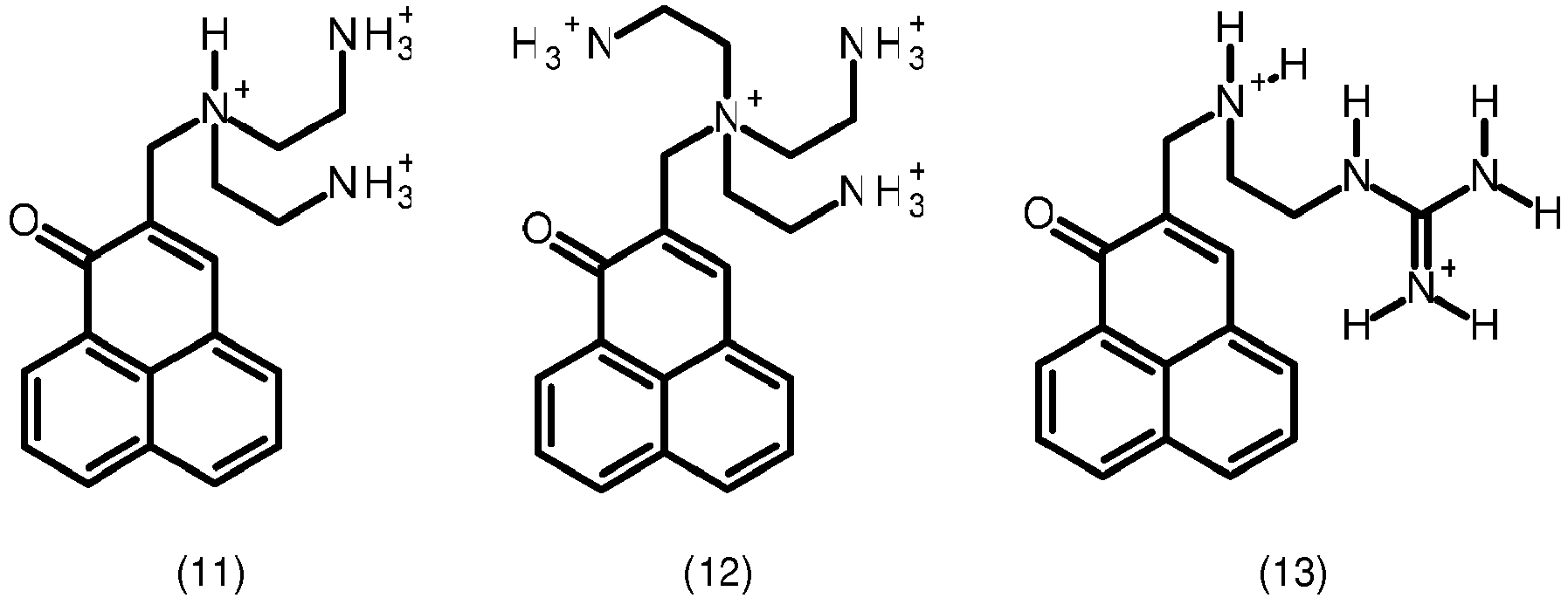


Vorzugsweise wird ein geeignetes Phenalenon-Derivat weiterhin aus der Gruppe, die aus den Verbindungen mit den Formeln (26) bis (28) und Mischungen davon besteht, ausgewählt:
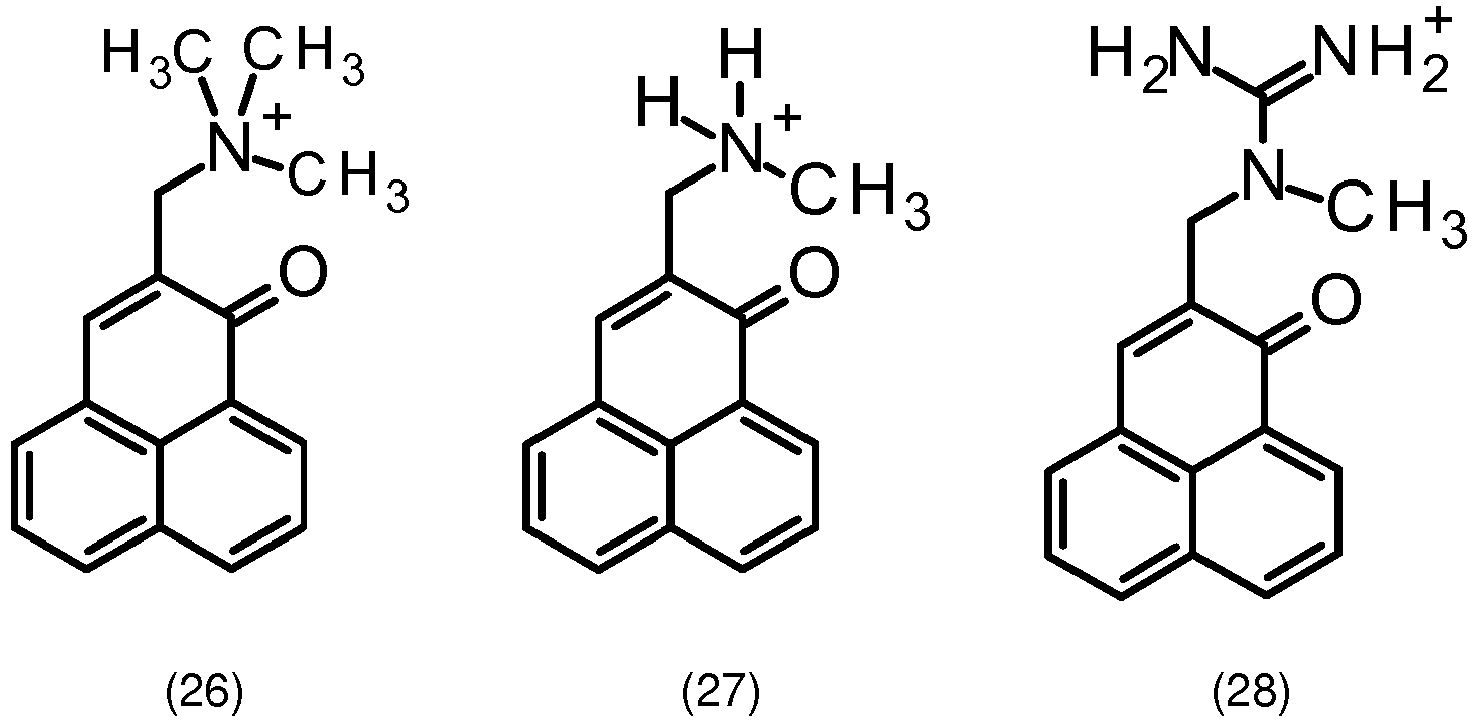
Weiter bevorzugt wird ein geeignetes Phenalenon-Derivat aus der Gruppe, die aus den Verbindungen mit den Formeln (2) bis (28) und Mischungen davon besteht, ausgewählt.More preferably, a suitable phenalenone derivative is selected from the group consisting of the compounds with the formulas (2) to (28) and mixtures thereof.
Geeignete Flavine werden beispielsweise in
Vorzugsweise wird ein geeignetes Flavin-Derivat aus der Gruppe, die aus den Verbindung mit den Formeln (32) bis (49), (51) bis (64) und Mischungen davon besteht, ausgewählt:


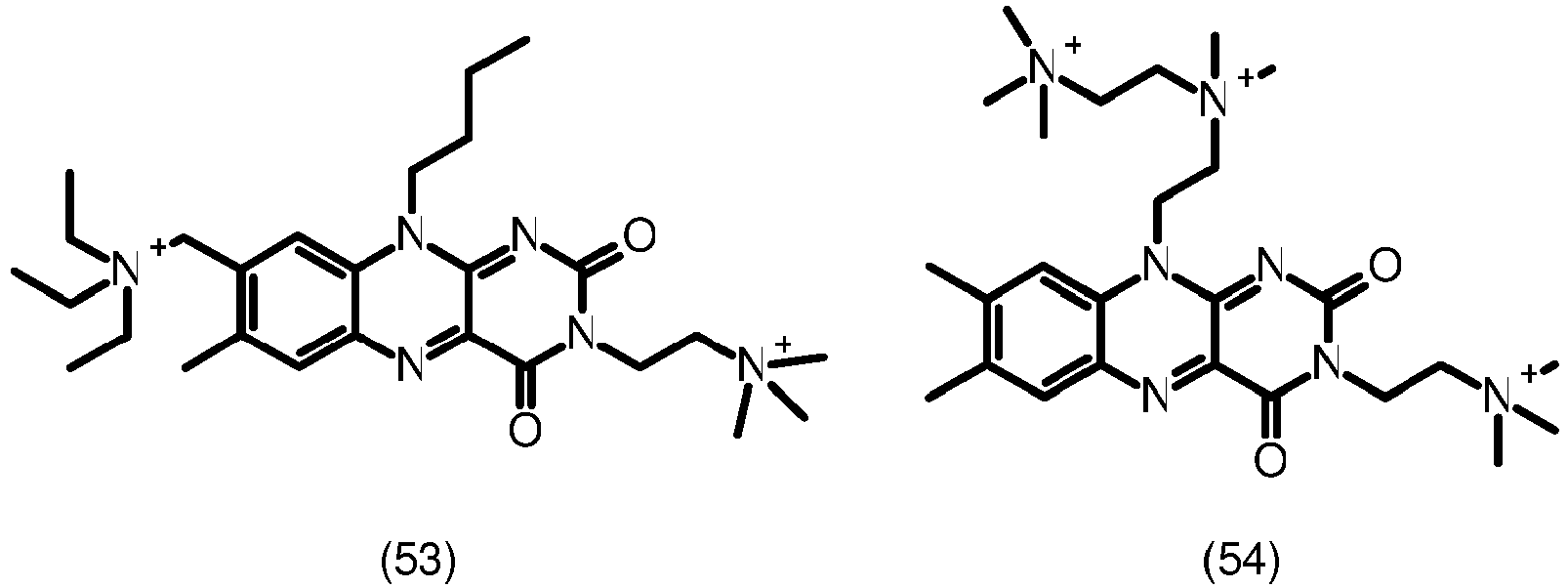


Geeignete Curcumine werden beispielsweise in der unveröffentlichten Patentanmeldung
Ein geeignetes Curcumin-Derivat wird beispielsweise aus der Gruppe, die aus den Verbindungen mit den Formeln (75) bis (104b), (105) und Mischungen davon besteht, ausgewählt:


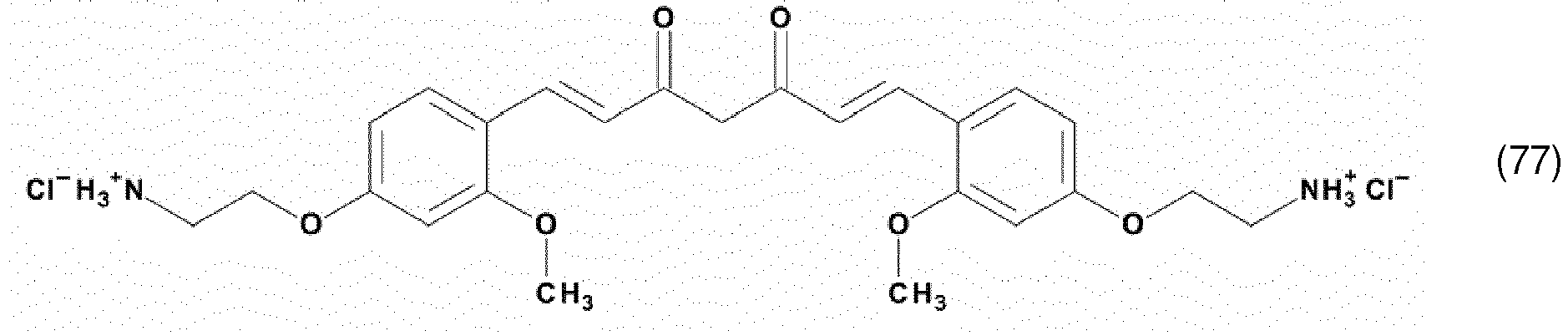

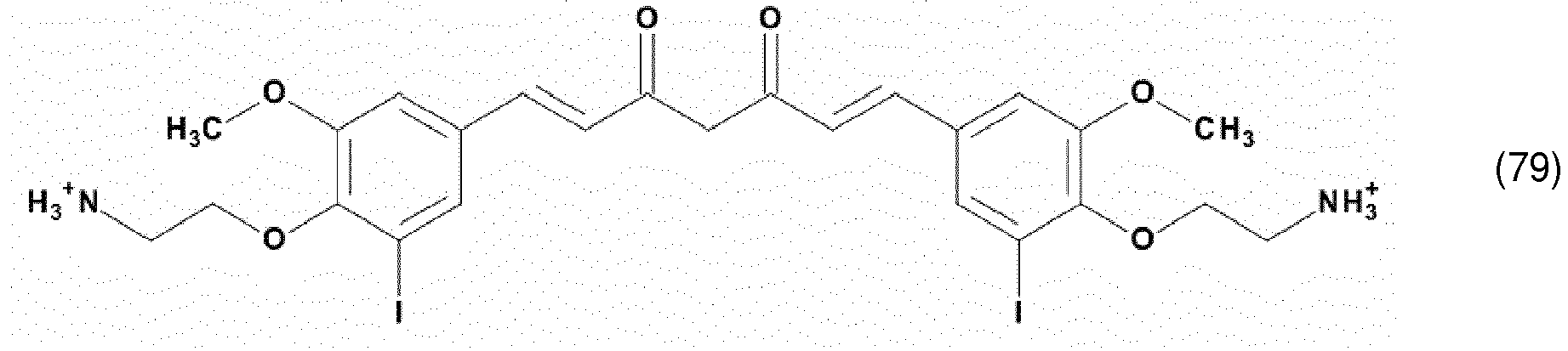
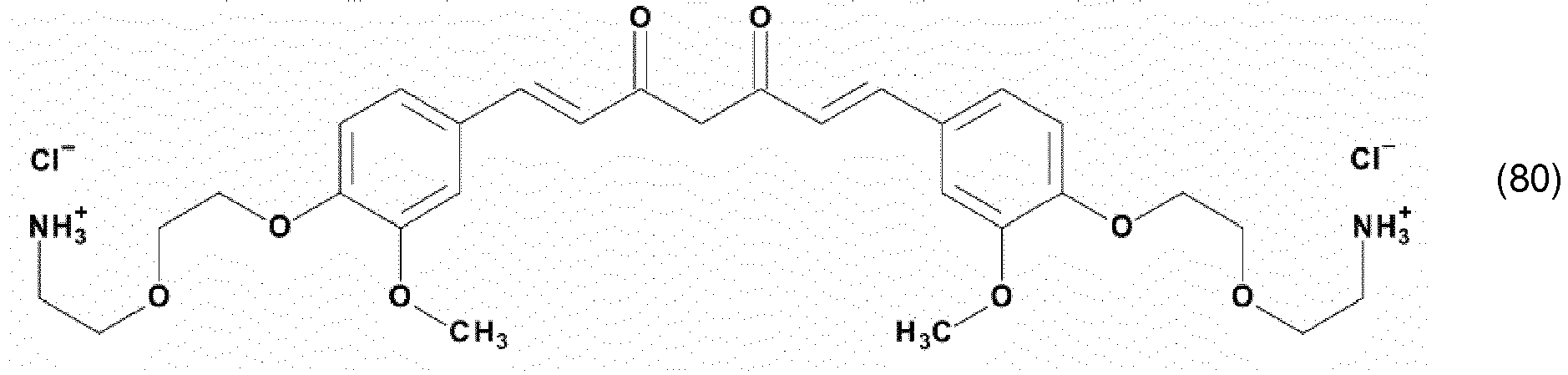


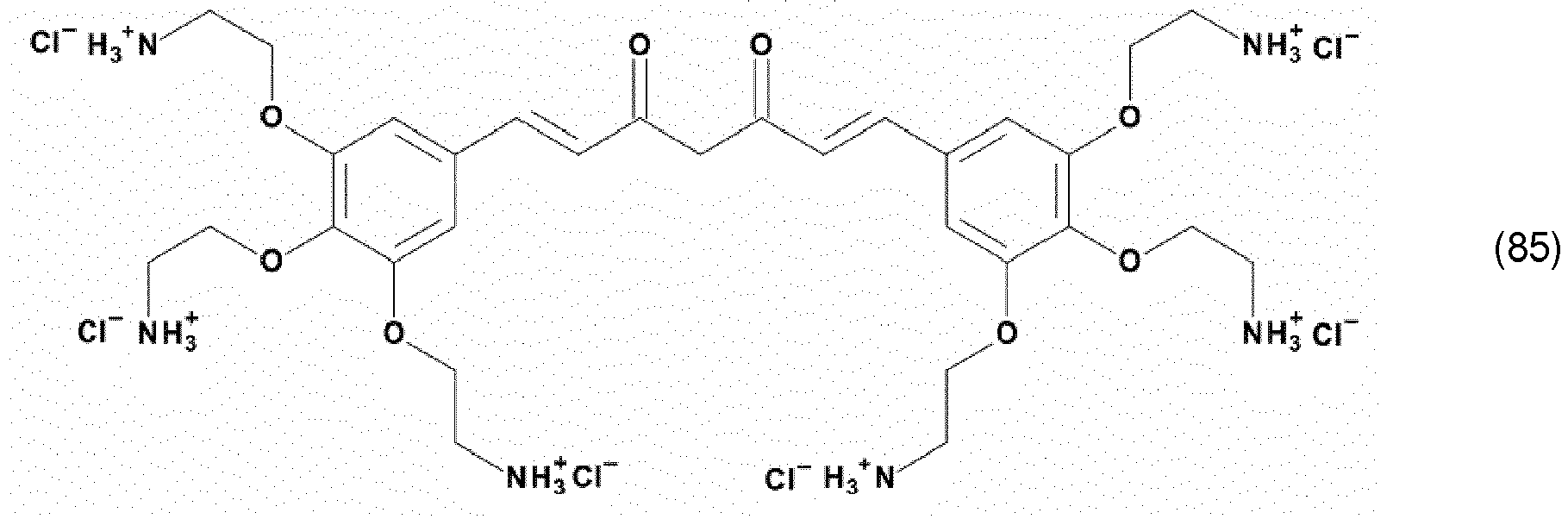
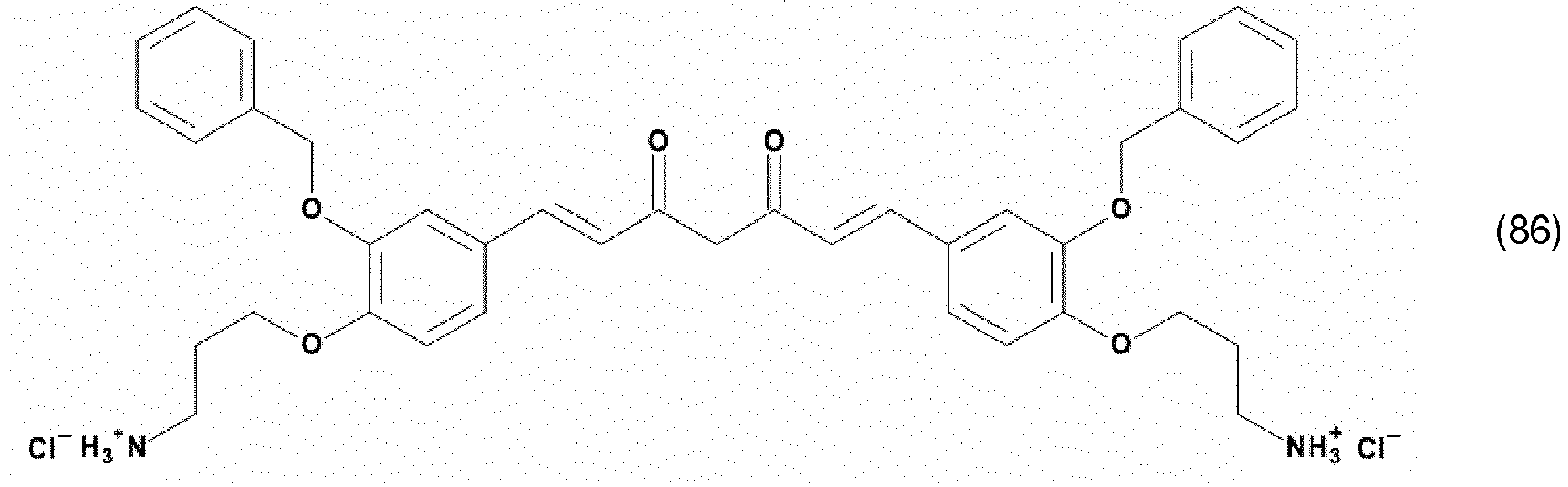


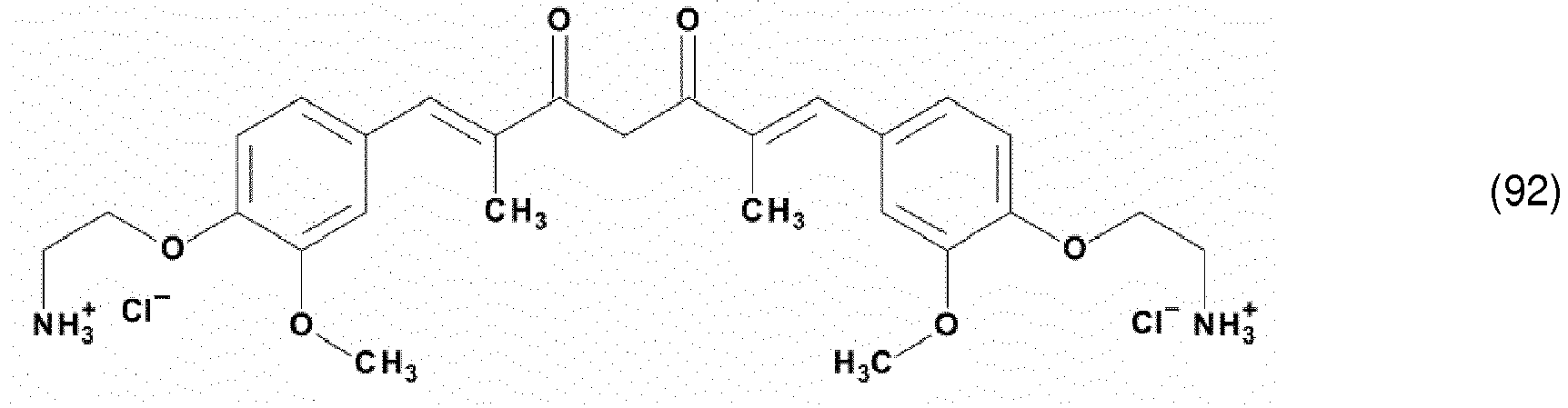


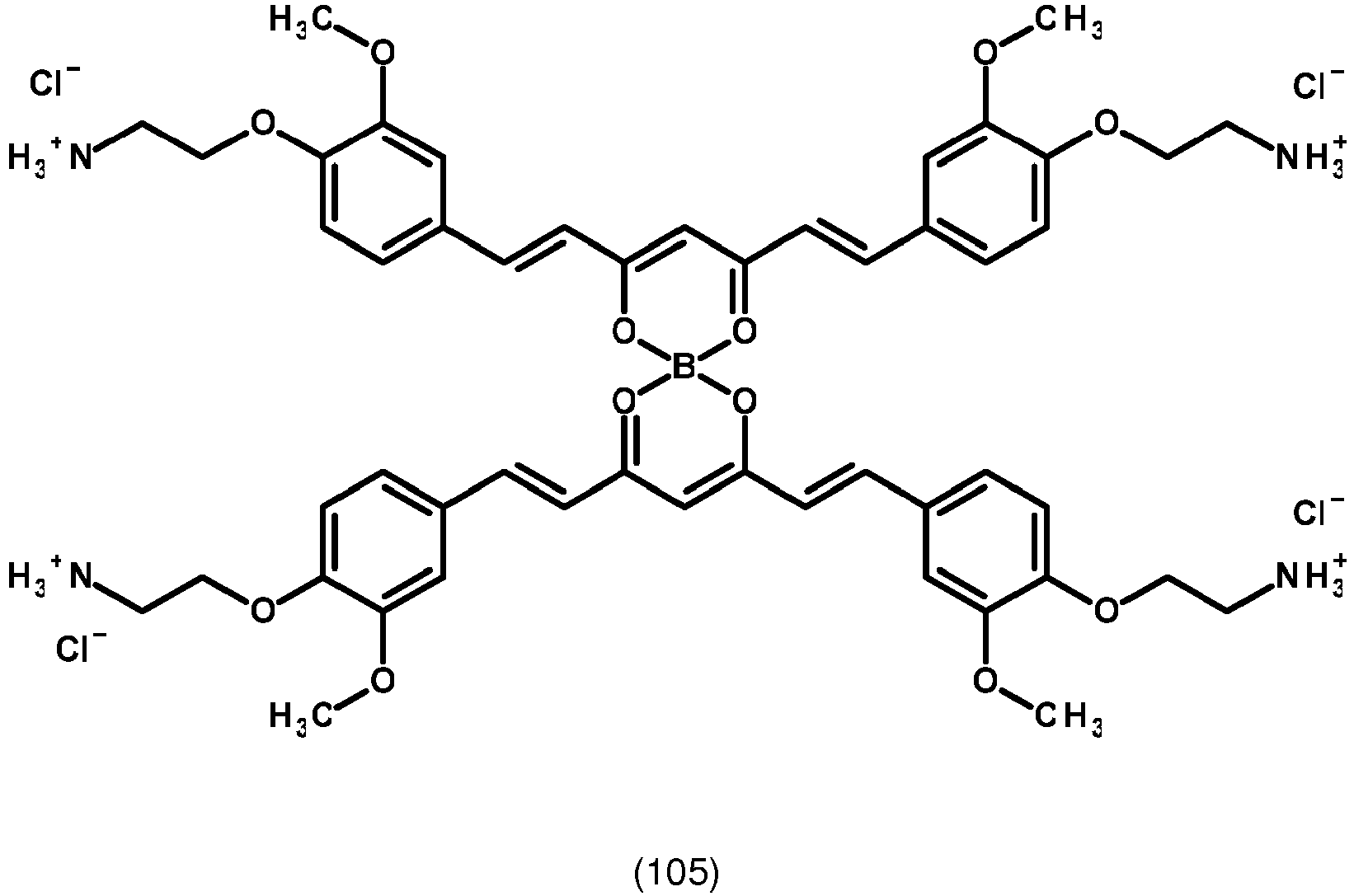
Geeignete Curcumin-Derivate und deren Herstellung werden beispielsweise in der
Geeignete Curcumin-3,5-dion-Derivate und deren Herstellung werden ebenfalls in der
Ein geeignetes Curcumin-Derivat und dessen Herstellung wird ebenfalls in
Kommerziell erhältliche Phenothiazinium-Farbstoffe sind beispielsweise Neu-Methylenblau (NMB; 3,7-Bis(ethylamino)-2,8-dimethylphenothiazin-5-iumchlorid), 1,9-Dimethyl-Methylenblau (DMMB; 3,7-Bis-(dimethylamino)-1,9-dimethyl-diphenothiazin-5-ium - Zinkchlorid) oder Methylengrün (Basic Green 5, [7-(Dimethylamino)-4-nitrophenothiazin-3-yliden]-dimethylazaniumchlorid).Commercially available phenothiazinium dyes are, for example, new methylene blue (NMB; 3,7-bis (ethylamino) -2,8-dimethylphenothiazine-5-ium chloride), 1,9-dimethyl-methylene blue (DMMB; 3,7-bis ( dimethylamino) -1,9-dimethyl-diphenothiazin-5-ium - zinc chloride) or methylene green (
Kommerziell erhältliche Polymethin-Farbstoffe sind beispielsweise Cyanin-5 (Cy5), Cyanin-3 (Cy3) oder Indocyaningrün (ICG).Commercially available polymethine dyes are, for example, cyanine-5 (Cy5), cyanine-3 (Cy3) or indocyanine green (ICG).
Kommerziell erhältliche Xanthen-Farbstoffe sind beispielsweise Pyronin G, Eosin B, Eosin Y, Rose Bengal, Erythrosin (E127) oder Phloxin B,
Kommerziell erhältliche Triphenylmethan-Farbstoffe sind beispielsweise Patentblau V (4-[4,4'-Bis(diethylamino)-α-hydroxy-benzhydryl]-6-hydroxy-benzol-1,3-disulfonsäure), Malachitgrün (N,N,N',N'-Tetramethyl-4,4'-diaminotriphenylcarbeniumchlorid), Fuchsin (4-[(4-Aminophenyl)-(4-imino-1-cyclohexa-2,5-dienylidene)methyl]anilinhydrochlorid), Parafuchsin (4,4'-(4-lminocyclohexa-2,5- dienylidenmethylen)dianilinhydrochlorid), Kristallviolett ((4-(4,4'-Bis(dimethylaminophenyl)benzhydryliden)cyclohexa-2,5-dien-1-yliden)dimethylammoniumchlorid).Commercially available xanthene dyes are, for example, pyronin G, eosin B, eosin Y, rose bengal, erythrosin (E127) or phloxin B,
Commercially available triphenylmethane dyes are, for example, patent blue V (4- [4,4'-bis (diethylamino) -α-hydroxy-benzhydryl] -6-hydroxy-benzene-1,3-disulfonic acid), malachite green (N, N, N ', N'-Tetramethyl-4,4'-diaminotriphenylcarbenium chloride), fuchsin (4 - [(4-aminophenyl) - (4-imino-1-cyclohexa-2,5-dienylidene) methyl] aniline hydrochloride), parafuchsin (4, 4 '- (4-iminocyclohexa-2,5-dienylidenemethylene) dianiline hydrochloride), crystal violet ((4- (4,4'-bis (dimethylaminophenyl) benzhydrylidene) cyclohexa-2,5-dien-1-ylidene) dimethylammonium chloride).
Kommerziell erhältliche Anthrachinon-Farbstoffe sind beispielsweise (1,2-Dihydroxyanthrachinon) oder Indanthren (6,15-Dihydro-5,9,14,18-anthrazinetetron). Kommerziell erhältliche Porphyrin-Farbstoffe sind beispielsweise 5,10,15,20-Tetrakis(1-methyl-4-pyridinio)porphyrin-tetra(p-toluenesulfonat) (TMPyP), oder Tetrakis(p-trimethylammoniumphenyl)porphyrinchlorid.Commercially available anthraquinone dyes are for example (1,2-dihydroxyanthraquinone) or indanthrene (6,15-dihydro-5,9,14,18-anthrazinetetron). Commercially available porphyrin dyes are, for example, 5,10,15,20-tetrakis (1-methyl-4-pyridinio) porphyrin-tetra (p-toluenesulfonate) (TMPyP), or tetrakis (p-trimethylammonium phenyl) porphyrin chloride.
Kommerziell erhältliche Phthalocyanin-Farbstoffe sind beispielsweise Zinkphthalocyanintetrasulfonat oder Tetrakis(p-trimethylammonium)phthalocyanin-Zinkchlorid,Commercially available phthalocyanine dyes are, for example, zinc phthalocyanine tetrasulfonate or tetrakis (p-trimethylammonium) phthalocyanine zinc chloride,
Kommerziell erhältliche Indamin-Farbstoffe sind beispielsweise Safranin T (3,7-Diamino-2,8-dimethyl-5-phenylphenaziniumchlorid) oder Phenosafranin (3,7-Diamino-5-phenylphenaziniumchloride)
Kommerzielle Bezugsquelle für vorgenannte Farbstoffe sind beispielsweise AppliChem GmbH (Darmstadt, DE), Frontier Scientific Inc. (Logan, UT, USA), GE Healthcare Europe GmbH (Freiburg, DE), Sigma-Aldrich Corporation (St. Louis, MO, USA) oder Merck KGaA (Darmstadt, DE).Commercially available indamine dyes are, for example, Safranin T (3,7-diamino-2,8-dimethyl-5-phenylphenazinium chloride) or phenosafranine (3,7-diamino-5-phenylphenazinium chloride)
Commercial sources for the aforementioned dyes are, for example, AppliChem GmbH (Darmstadt, DE), Frontier Scientific Inc. (Logan, UT, USA), GE Healthcare Europe GmbH (Freiburg, DE), Sigma-Aldrich Corporation (St. Louis, MO, USA) or Merck KGaA (Darmstadt, DE).
Als Gegenion zum positiv geladenen Stickstoffatom kann jedes geeignete Anion verwendet werden. Vorzugsweise werden als Gegenion zum positiv geladenen Stickstoffatom Anionen verwendet, die aus der Gruppe, die aus Fluorid, Chlorid, Bromid, lodid, Sulfat, Hydrogensulfat, Phosphat, Dihydrogenphosphat, Hydrogenphosphat, Tosylat, Mesylat, Formiat, Acetat, Propionat, Butanoat, Oxalat, Tartrat, Fumarat, Benzoat, Citrat und/oder Mischungen davon besteht.Any suitable anion can be used as the counterion to the positively charged nitrogen atom. Anions are preferably used as a counterion to the positively charged nitrogen atom, which are selected from the group consisting of fluoride, chloride, bromide, iodide, sulfate, hydrogen sulfate, phosphate, dihydrogen phosphate, hydrogen phosphate, tosylate, mesylate, formate, acetate, propionate, butanoate, oxalate, Tartrate, fumarate, benzoate, citrate and / or mixtures thereof.
Vorzugsweise wird der wenigstens eine Photosensibilisator aus der Gruppe, die aus den Verbindungen mit den Formeln (2) bis (25), (32) bis (49), (51) bis (64), (75) bis (105) und Mischungen davon besteht, ausgewählt.The at least one photosensitizer is preferably selected from the group consisting of the compounds with the formulas (2) to (25), (32) to (49), (51) to (64), (75) to (105) and mixtures of which consists, selected.
Vorzugsweise umfasst die Dispersion den wenigstens einen Photosensibilisator in einer Konzentration aus einem Bereich von 0,1 µM bis 1000 µM.The dispersion preferably comprises the at least one photosensitizer in a concentration from a range from 0.1 μM to 1000 μM.
Eine erfindungsgemäße Dispersion umfasst weiterhin (b) wenigstens eine flüssige, polare Phase.A dispersion according to the invention furthermore comprises (b) at least one liquid, polar phase.
Vorzugsweise liegt die wenigstens eine flüssige, polare Phase bei einer Temperatur aus einem Bereich von 0°C bis 100°C und einem Druck aus einem Bereich von 800 bis 1200 mbar im flüssigen Aggregatzustand vor.The at least one liquid, polar phase is preferably present in the liquid state of aggregation at a temperature from a range from 0 ° C. to 100 ° C. and a pressure from a range from 800 to 1200 mbar.
Vorzugsweise umfasst die wenigstens eine flüssige, polare Phase wenigstens ein polares Lösungsmittel, vorzugsweise Wasser.The at least one liquid, polar phase preferably comprises at least one polar solvent, preferably water.
Vorzugsweise umfasst eine erfindungsgemäße Dispersion das wenigstens eine polare Lösungsmittel, vorzugsweise Wasser, in einem Anteil von wenigstens 0,1 Gew.-%, vorzugsweise von wenigstens 0,5 Gew.-%, weiter bevorzugt von wenigstens 1 Gew.-%, weiter bevorzugt von wenigstens 4 Gew.-%, weiter bevorzugt von wenigstens 10 Gew.-%, weiter bevorzugt von wenigstens 35 Gew.-%, weiter bevorzugt von wenigstens 50 Gew.-%, weiter bevorzugt von wenigstens 51 Gew.-%, jeweils bezogen auf das Gesamtgewicht der Dispersion.A dispersion according to the invention preferably comprises the at least one polar solvent, preferably water, in a proportion of at least 0.1% by weight, preferably of at least 0.5% by weight, more preferably of at least 1% by weight, more preferably of at least 4% by weight, more preferably of at least 10% by weight, more preferably of at least 35% by weight, more preferably of at least 50% by weight, more preferably of at least 51% by weight, in each case based on the total weight of the dispersion.
Vorzugsweise umfasst eine erfindungsgemäße Dispersion das wenigstens eine polare Lösungsmittel, vorzugsweise Wasser, in einem Anteil von aus einem Bereich von 0,1 Gew.-% bis 99,8 Gew.-%, vorzugsweise aus einem Bereich von 0,5 Gew.-% bis 99 Gew.-%, weiter bevorzugt aus einem Bereich von 4 Gew.-% bis 98 Gew.-%, weiter bevorzugt aus einem Bereich von 10 Gew.-% bis 97 Gew.-%, weiter bevorzugt aus einem Bereich von 35 Gew.-% bis 96 Gew.-%, weiter bevorzugt aus einem Bereich von 50 Gew.-% bis 95 Gew.-%, weiter bevorzugt aus einem Bereich von 51 Gew.-% bis 94 Gew.-%, weiter bevorzugt aus einem Bereich von 53 Gew.-% bis 93 Gew.-%, weiter bevorzugt aus einem Bereich von 70 Gew.-% bis 92 Gew.-%, jeweils bezogen auf das Gesamtgewicht der Dispersion.A dispersion according to the invention preferably comprises the at least one polar solvent, preferably water, in a proportion from a range from 0.1% by weight to 99.8% by weight, preferably from a range from 0.5% by weight to 99% by weight, more preferably from a range from 4% by weight to 98% by weight, more preferably from a range from 10% by weight to 97% by weight, more preferably from a range of 35 % By weight to 96% by weight, more preferably from a range from 50% by weight to 95% by weight, more preferably from a range from 51% by weight to 94% by weight, more preferably from a range from 53% by weight to 93% by weight, more preferably from a range from 70% by weight to 92% by weight, based in each case on the total weight of the dispersion.
Eine erfindungsgemäße Dispersion umfasst weiterhin (c) wenigstens ein Tensid.A dispersion according to the invention furthermore comprises (c) at least one surfactant.
Vorzugsweise umfasst eine erfindungsgemäße Dispersion das wenigstens eine Tensid in einem Anteil aus einem Bereich von 0,1 Gew.-% bis 65 Gew.-%, vorzugsweise aus einem Bereich von 1 Gew.-% bis 55 Gew.-%, weiter bevorzugt aus einem Bereich von 3 Gew.-% bis 50 Gew.-%, weiter bevorzugt aus einem Bereich von 5 Gew.-% bis 41 Gew.-%, weiter bevorzugt aus einem Bereich von 7 Gew.-% bis 37 Gew.-%, weiter bevorzugt aus einem Bereich von 9 Gew.-% bis 30 Gew.-%, weiter bevorzugt aus einem Bereich von 10 Gew.-% bis 27 Gew.-%, jeweils bezogen auf das Gesamtgewicht der Dispersion.A dispersion according to the invention preferably comprises the at least one surfactant in a proportion from a range from 0.1% by weight to 65% by weight, preferably from a range from 1% by weight to 55% by weight, more preferably from a range from 3% by weight to 50% by weight, more preferably from a range from 5% by weight to 41% by weight, more preferably from a range from 7% by weight to 37% by weight , more preferably from a range from 9% by weight to 30% by weight, more preferably from a range from 10% by weight to 27% by weight, based in each case on the total weight of the dispersion.
Das wenigstens eine Tensid wird vorzugsweise aus der Gruppe, die aus nichtionischen Tensiden, anionischen Tensiden, kationischen Tensiden, amphoteren Tensiden und Mischungen davon, vorzugsweise nichtionischen Tensiden, anionischen Tensiden und Mischungen davon, besteht, ausgewählt.The at least one surfactant is preferably selected from the group consisting of nonionic surfactants, anionic surfactants, cationic surfactants, amphoteric surfactants and mixtures thereof, preferably nonionic surfactants, anionic surfactants and mixtures thereof.
Das wenigstens eine Tensid weist vorzugsweise einen HLB-Wert aus einem Bereich von 4 bis 40, vorzugsweise aus einem Bereich von 5 bis 20, auf. Der HLB-Wert eines Tensids kann beispielsweise gemäß der in
Vorzugsweise werden geeignete nichtionische Tenside aus der Gruppe, die aus Polyalkylenglycolether, Alkylglucoside, Alkylpolyglycoside, Alkylglycosidester, und Mischungen davon besteht, ausgewählt.Preferably, suitable nonionic surfactants are selected from the group consisting of polyalkylene glycol ethers, alkyl glucosides, alkyl polyglycosides, alkyl glycoside esters, and mixtures thereof.
Geeignete Polyalkylenglycolether weisen vorzugsweise die allgemeine Formel (I):
CH3-(CH2)m-(O-[CH2]x)n-OH, (I)
auf,
wobei m = 8 - 20, vorzugsweise 10 - 16, bedeutet, wobei n = 1 - 25 bedeutet, wobei x = 1, 2, 3 oder 4 bedeutet.Suitable polyalkylene glycol ethers preferably have the general formula (I):
CH 3 - (CH 2 ) m - (O- [CH 2 ] x ) n -OH, (I)
on,
where m = 8-20, preferably 10-16, where n = 1-25, where x = 1, 2, 3 or 4.
Vorzugsweise wird eine Kombination unterschiedlicher Polyalkylenglycolether verwendet, beispielsweise mit unterschiedlichen Alkyloxy-Einheiten (-(O-[CH2]x)n-).A combination of different polyalkylene glycol ethers is preferably used, for example with different alkyloxy units (- (O- [CH 2 ] x ) n -).
Geeignete Polyalkylenglycolether sind beispielsweise Polyoxyethylenether des Laurylalkohols (Dodecan-1-ol), Polyoxyethylenether des Cetylalkohols (Hexadecan-1-ol), Polyoxyethylenether des Stearylalkohols (1-Octadecanol), Polyoxyethylenether des Oleylalkohols ((E)-Octadec-9-en-1-ol) oder Polyoxyethylenether von Gemischen des Stearylalkohols und des Cetylalkohols, (Cetylstearylalkohol).Suitable polyalkylene glycol ethers are, for example, polyoxyethylene ethers of lauryl alcohol (dodecan-1-ol), polyoxyethylene ethers of cetyl alcohol (hexadecan-1-ol), polyoxyethylene ethers of stearyl alcohol (1-octadecanol), polyoxyethylene ethers of oleyl alcohol ((E) -octadec-9-ene-1 -ol) or polyoxyethylene ethers of mixtures of stearyl alcohol and cetyl alcohol, (cetyl stearyl alcohol).
Geeignete Polyalkylenglycolether sind beispielsweise unter den Handelsnamen: Brij, Thesit, Cremophor, Genapol, Magrogol, Lutensol etc. kommerziel erhältlich.Suitable polyalkylene glycol ethers are commercially available, for example, under the trade names: Brij, Thesit, Cremophor, Genapol, Magrogol, Lutensol, etc.
Geeignete Polyalkylenglycolether sind beispielsweise:
Geeignete Alkylglucoside sind beispielsweise ethoxylierte Sorbitanfettsäureester (Polysorbate), die beispielsweise unter dem Handelsname Tween® von Croda International Plc (Snaith, UK) kommerziell erhältlich sind.
Ein weiteres geeignetes Alkylglucosid ist beispielsweise das Tensid Kosteran SQ/O VH, das kommerziell von der Dr. W. Kolb AG (Hedingen, CH) erhältlich ist. Kosteran SQ/O VH ist ein Sorbitan-Ölsäureester mit durchschnittlich 1,5 Ölsäuremolekülen pro Molekül (Sorbitan SesquioleatAnother suitable alkyl glucoside is, for example, the surfactant Kosteran SQ / O VH, which is commercially available from Dr. W. Kolb AG (Hedingen, CH) is available. Kosteran SQ / O VH is a sorbitan oleic acid ester with an average of 1.5 oleic acid molecules per molecule (sorbitan sesquioleate
Ein weiteres geeignetes Alkylglucosid ist beispielsweise PEG-80 Sorbitanlaurat, ein ethoxylierter Sorbitanmonoester der Laurinsäure mit einem mittleren Ethylenoxid-Gehalt von 80 Mol Ethylenoxid pro Molekül. PEG-80 Sorbitanlaurat ist beispielsweise unter dem Handelsnamen Tween® 28 von Croda International Plc kommerziell erhältlich. Geeignete Alkylglycosidester sind Fettsäureester von Methyl- oder Ethylglykosiden, beispielsweise Methylglycosidester und Ethylglycosidester, oder Saccharoseester.Another suitable alkyl glucoside is, for example, PEG-80 sorbitan laurate, an ethoxylated sorbitan monoester of lauric acid with an average ethylene oxide content of 80 mol of ethylene oxide per molecule. PEG-80 sorbitan laurate is commercially available, for example, under the trade name Tween® 28 from Croda International Plc. Suitable alkyl glycoside esters are fatty acid esters of methyl or ethyl glycosides, for example methyl glycoside esters and ethyl glycoside esters, or sucrose esters.
Vorzugsweise werden geeignete anionische Tenside aus der Gruppe, die aus Alkylcarboxylaten, Alkylsulfonaten, Alkylsulfaten, Alkylphoshaten, Alkylpolyglykolethersulfaten, Sulfonaten von Alkylcarbonsäureestern, N-Alkyl-Sarkosinaten, und Mischungen davon besteht, ausgewählt.Preferably, suitable anionic surfactants are selected from the group consisting of alkyl carboxylates, alkyl sulfonates, alkyl sulfates, alkyl phosphates, alkyl polyglycol ether sulfates, sulfonates of alkyl carboxylic acid esters, N-alkyl sarcosinates, and mixtures thereof.
Geeignete Alkylcarboxylate weisen vorzugsweise die allgemeine Formel (II):
H3C-(CH3)a-CH2-COO- M+, (II)
auf,
wobei a = 5 - 21, vorzugsweise 8 - 16, bedeutet und wobei M+ ein wasserlösliches Kation, vorzugsweise Kation eines Alkalimetalls oder Ammonium, vorzugsweise Li+, Na+, K+ oder NH4 +, bedeutet.Suitable alkyl carboxylates preferably have the general formula (II):
H 3 C- (CH 3 ) a -CH 2 -COO - M + , (II)
on,
where a = 5-21, preferably 8-16, and where M + is a water-soluble cation, preferably a cation of an alkali metal or ammonium, preferably Li +, Na + , K + or NH 4 + .
Geeignete Alkylsulfonate weisen vorzugsweise 3-30 C-Atome auf. Geeignete Alkylsulfonate sind vorzugsweise Monoalkylsulfonate mit 8-20 C-Atomen, sekundäre Alkylsulfonate der allgemeinen Formel (III):

Geeignete Alkylsulfate weisen vorzugsweise mit der allgemeinen Formel (IV):
H3C-(CH3)d-CH2-O-SO3 - M+, (IV)
auf,
wobei d = 6 - 20, vorzugsweise 8 - 18, bedeutet und wobei M+ ein wasserlösliches Kation, vorzugsweise Kation eines Alkalimetalls oder Ammonium, vorzugsweise Li+, Na+, K+ oder NH4+ bedeutet.Suitable alkyl sulfates preferably have the general formula (IV):
H 3 C- (CH 3 ) d -CH 2 -O-SO 3 - M + , (IV)
on,
where d = 6-20, preferably 8-18, and where M + is a water-soluble cation, preferably a cation of an alkali metal or ammonium, preferably Li +, Na + , K + or NH4 + .
Ein geeignetes Alkylsulfat ist beispielsweise Natrium Dodecylsulfat (SDS).A suitable alkyl sulfate is, for example, sodium dodecyl sulfate (SDS).
Geeignete Alkylphosphate weisen vorzugsweise die allgemeine Formel (V):
H3C-(CH3)e-CH2-O-PO3 2- 2 x M+, (V)
auf,
wobei e = 6 - 20, vorzugsweise 8-18 bedeutet und wobei M+ ein wasserlösliches Kation, vorzugsweise Kation eines Alkalimetalls oder Ammonium, vorzugsweise Li+, Na+, K+ oder NH4 +, bedeutet.Suitable alkyl phosphates preferably have the general formula (V):
H 3 C- (CH 3 ) e -CH 2 -O-PO 3 2- 2 x M + , (V)
on,
where e = 6-20, preferably 8-18, and where M + is a water-soluble cation, preferably a cation of an alkali metal or ammonium, preferably Li +, Na + , K + or NH 4 + .
Geeignete Alkylpolyglykolethersulfate weisen vorzugsweise einen Alkylrest mit 6 bis 22 Kohlenstoffatomen, vorzugsweise 8 bis 20 Kohlenstoffatomen, auf und 1 bis 10 Ethylenoxideinheiten, vorzugsweise 2 bis 6 Ethylenoxideinheiten, im Etherteil auf.Suitable alkyl polyglycol ether sulfates preferably have an alkyl radical with 6 to 22 carbon atoms, preferably 8 to 20 carbon atoms, and 1 to 10 ethylene oxide units, preferably 2 to 6 ethylene oxide units, in the ether part.
Ein geeignetes N-Alkyl-Sarkosinat ist z.B. N-Lauroylsarcosinat.A suitable N-alkyl sarcosinate is, for example, N-lauroyl sarcosinate.
Geeignete Sulfonate von Alkylcarbonsäureestern weisen vorzugsweise 6 bis 30 Kohlenstoffatome, vorzugsweise 8 bis 20 Kohlenstoffatome, auf.Suitable sulfonates of alkyl carboxylic acid esters preferably have 6 to 30 carbon atoms, preferably 8 to 20 carbon atoms.
Vorzugsweise umfassen geeignete Sulfonate von Alkylcarbonsäureestern wenigstens einen Alkylrest mit 6 bis 20 Kohlenstoffatomen, vorzugsweise 8 bis 18 Kohlenstoffatomen, und einen Alkylcarbonsäurerest mit 2 bis 10 Kohlenstoffatomen, vorzugsweise 2 bis 6 Kohlenstoffatomen, auf. Der Alkylrest kann Polyoxyethylen-(POE)-gruppen enthalten.Suitable sulfonates of alkyl carboxylic acid esters preferably comprise at least one alkyl radical having 6 to 20 carbon atoms, preferably 8 to 18 carbon atoms, and an alkyl carboxylic acid radical having 2 to 10 carbon atoms, preferably 2 to 6 carbon atoms. The alkyl radical can contain polyoxyethylene (POE) groups.
Geeignete Sulfonate von Alkylcarbonsäureestern sind beispielsweise Mono-Alkylestersulfosuccinate oder Di-Alkylestersulfosuccinate, z.B. Dioctylnatriumsulfosuccinat.Suitable sulfonates of alkyl carboxylic acid esters are, for example, mono-alkyl ester sulfosuccinates or di-alkyl ester sulfosuccinates, e.g. dioctyl sodium sulfosuccinate.
Vorzugsweise sind geeignete kationische Tenside quartäre Alkylammoniumsalze, Esterquats, acylierte Polyamine, Benzylammoniumsalze oder Mischungen davon.Suitable cationic surfactants are preferably quaternary alkylammonium salts, esterquats, acylated polyamines, benzylammonium salts or mixtures thereof.
Geeignete Alkylammoniumsalze weisen vorzugsweise die allgemeine Formel (VI) auf:
(R1)(R2)(R3)(R4)N+ Z- (VI)
wobei der organische Rest R1 ein Alkylrest, der gradkettig oder verzweigt, vorzugsweise gradkettig, sein kann, mit 8 bis 20 C-Atomen, vorzugsweise mit 10 bis 18 C-Atomen, weiter bevorzugt mit 12 bis 16 C-Atomen, bedeutet, wobei die organischen Reste R2, R3, und R4 jeweils unanhängig voneinander ein Alkylrest, der gradkettig oder verzweigt, vorzugsweise gradkettig, sein kann, mit 1 bis 20 C-Atomen, vorzugsweise mit 1 bis 16 C-Atomen, weiter bevorzugt mit 1 bis 12 C-Atomen, bedeutet, und wobei Z- ein Anion bedeutet, das vorzugsweise aus der Gruppe, die aus Fluorid, Chlorid, Bromid, lodid, Sulfat, Hydrogensulfat, Phosphat, Dihydrogenphosphat, Hydrogenphosphat, Tosylat, Mesylat, Formiat, Acetat, Propionat, Butanoat, Oxalat, Tartrat, Fumarat, Benzoat, Citrat und/oder Mischungen davon besteht, ausgewählt wird.Suitable alkylammonium salts preferably have the general formula (VI):
(R 1 ) (R 2 ) (R 3 ) (R 4 ) N + Z - (VI)
where the organic radical R 1 is an alkyl radical which can be straight-chain or branched, preferably straight-chain, with 8 to 20 carbon atoms, preferably with 10 to 18 carbon atoms preferably with 12 to 16 carbon atoms, where the organic radicals R 2 , R 3 and R 4 are each independently an alkyl radical, which can be straight-chain or branched, preferably straight-chain, with 1 to 20 carbon atoms, preferably with 1 to 16 carbon atoms, more preferably with 1 to 12 carbon atoms, and where Z - denotes an anion which is preferably selected from the group consisting of fluoride, chloride, bromide, iodide, sulfate, hydrogen sulfate, phosphate, Dihydrogen phosphate, hydrogen phosphate, tosylate, mesylate, formate, acetate, propionate, butanoate, oxalate, tartrate, fumarate, benzoate, citrate and / or mixtures thereof is selected.
Vorzugsweise ist der organische Rest R1 ein Alkylrest, der aus der Gruppe, die aus Octyl, Nonyl, Decyl, Undecyl, Dodecyl, Tridecyl, Tetradecyl, Pentadecyl, Hexadecyl, Heptadecyl, Octadecyl, Nonadecyl, Eicosadecyl und Kombinationen davon, vorzugsweise Dodecyl, Tridecyl, Tetradecyl, Pentadecyl, Hexadecyl und Kombinationen davon, besteht, ausgewählt wird.The organic radical R 1 is preferably an alkyl radical selected from the group consisting of octyl, nonyl, decyl, undecyl, dodecyl, tridecyl, tetradecyl, pentadecyl, hexadecyl, heptadecyl, octadecyl, nonadecyl, eicosadecyl and combinations thereof, preferably dodecyl, tridecyl , Tetradecyl, pentadecyl, hexadecyl, and combinations thereof.
Vorzugsweise sind die organischen Reste R2, R3, und R4 jeweils unanhängig voneinander ein Alkylrest, der aus der Gruppe, die aus Methyl, Ethyl, Propyl, Butyl, Octyl, Nonyl, Decyl, Undecyl, Dodecyl, Tridecyl, Tetradecyl, Pentadecyl, Hexadecyl, Heptadecyl, Octadecyl, Nonadecyl, Eicosadecyl und Kombinationen davon, vorzugsweise Methyl, Ethyl, Propyl, Butyl, Dodecyl, Tridecyl, Tetradecyl, Pentadecyl, Hexadecyl und Kombinationen davon, besteht, ausgewählt werden.The organic radicals R 2 , R 3 and R 4 are each independently an alkyl radical selected from the group consisting of methyl, ethyl, propyl, butyl, octyl, nonyl, decyl, undecyl, dodecyl, tridecyl, tetradecyl, pentadecyl , Hexadecyl, heptadecyl, octadecyl, nonadecyl, eicosadecyl and combinations thereof, preferably methyl, ethyl, propyl, butyl, dodecyl, tridecyl, tetradecyl, pentadecyl, hexadecyl and combinations thereof.
Beispielsweise ist ein geeignetes Alkylammoniumsalz der allgemeinen Formel (VI) ein Monoalkyltrimethylammoniumsalz eines Anions, das vorzugsweise aus der Gruppe, die aus Fluorid, Chlorid, Bromid, lodid, Sulfat, Hydrogensulfat, Phosphat, Dihydrogenphosphat, Hydrogenphosphat, Tosylat, Mesylat, Formiat, Acetat, Propionat, Butanoat, Oxalat, Tartrat, Fumarat, Benzoat, Citrat und/oder Mischungen davon besteht, ausgewählt wird, wobei der organische Rest R1 ein Alkylrest, der aus der Gruppe, die aus Octyl, Nonyl, Decyl, Undecyl, Dodecyl, Tridecyl, Tetradecyl, Pentadecyl, Hexadecyl, Heptadecyl, Octadecyl, Nonadecyl, Eicosadecyl und Kombinationen davon, vorzugsweise Dodecyl, Tridecyl, Tetradecyl, Pentadecyl, Hexadecyl und Kombinationen davon, besteht, ausgewählt wird, ist und wobei die organischen Reste R2, R3 und R4 jeweils Methyl bedeuten.For example, a suitable alkylammonium salt of the general formula (VI) is a monoalkyltrimethylammonium salt of an anion, which is preferably selected from the group consisting of fluoride, chloride, bromide, iodide, sulfate, hydrogen sulfate, phosphate, dihydrogen phosphate, hydrogen phosphate, tosylate, mesylate, formate, acetate, Propionate, butanoate, oxalate, tartrate, fumarate, benzoate, citrate and / or mixtures thereof, is selected, the organic radical R 1 being an alkyl radical selected from the group consisting of octyl, nonyl, decyl, undecyl, dodecyl, tridecyl , Tetradecyl, pentadecyl, hexadecyl, heptadecyl, octadecyl, nonadecyl, eicosadecyl and combinations thereof, preferably dodecyl, tridecyl, tetradecyl, pentadecyl, hexadecyl and combinations thereof, is selected and where the organic radicals R 2 , R 3 and R 4 each represent methyl.
Beispielsweise ist ein geeignetes Alkylammoniumsalz der allgemeinen Formel (VI) ein Dialkyltrimethylammoniumsalz eines Anions, das vorzugsweise aus der Gruppe, die aus Fluorid, Chlorid, Bromid, lodid, Sulfat, Hydrogensulfat, Phosphat, Dihydrogenphosphat, Hydrogenphosphat, Tosylat, Mesylat, Formiat, Acetat, Propionat, Butanoat, Oxalat, Tartrat, Fumarat, Benzoat, Citrat und/oder Mischungen davon besteht, ausgewählt wird, wobei die organischen Rest R1 und R2 jeweils unabhängig voneinander ein Alkylrest, der aus der Gruppe, die aus Octyl, Nonyl, Decyl, Undecyl, Dodecyl, Tridecyl, Tetradecyl, Pentadecyl, Hexadecyl, Heptadecyl, Octadecyl, Nonadecyl, Eicosadecyl und Kombinationen davon, vorzugsweise Dodecyl, Tridecyl, Tetradecyl, Pentadecyl, Hexadecyl und Kombinationen davon, besteht, ausgewählt wird, bedeuten und wobei die organischen Reste R3 und R4 jeweils Methyl bedeuten.For example, a suitable alkylammonium salt of the general formula (VI) is a dialkyltrimethylammonium salt of an anion, which is preferably selected from the group consisting of fluoride, chloride, bromide, iodide, sulfate, hydrogen sulfate, phosphate, dihydrogen phosphate, hydrogen phosphate, tosylate, mesylate, formate, acetate, Propionate, butanoate, oxalate, tartrate, Fumarate, benzoate, citrate and / or mixtures thereof is selected, the organic radicals R 1 and R 2 each independently being an alkyl radical selected from the group consisting of octyl, nonyl, decyl, undecyl, dodecyl, tridecyl, tetradecyl , Pentadecyl, hexadecyl, heptadecyl, octadecyl, nonadecyl, eicosadecyl and combinations thereof, preferably dodecyl, tridecyl, tetradecyl, pentadecyl, hexadecyl and combinations thereof, is selected and where the organic radicals R 3 and R 4 are each methyl.
Geeignete Alkylammoniumsalz der allgemeinen Formel (VI) sind vorzugsweise Dodecyltrimethylammoniumbromid (DTAB) und/oder Didodecyldimethylammoniumbromid (DDAB).Suitable alkylammonium salts of the general formula (VI) are preferably dodecyltrimethylammonium bromide (DTAB) and / or didodecyldimethylammonium bromide (DDAB).
Geignete Esterquats umfassen beispielsweise Triethanolamin-diesterquats, Diethanolmethylamin-diesterquats oder Mischungen davon.Suitable ester quats include, for example, triethanolamine diesterquats, diethanolmethylamine diesterquats or mixtures thereof.
Geignete Esterquats können beispielsweise ausgehend von Triethanolamin oder Diethanolmethylamin hergestellt werden, indem man beispielsweise Diethanolmethylamin mit ein oder zwei Molekülen einer Fettsäuren oder im Falle des Triethanolamin mit ein, zwei oder drei Molekülen einer Fettsäure, vorzugsweise mit zwei Molekülen einer Fettsäure, verestert und anschließend mit Methylchlorid, Methylbromid oder mit Dimethylsulfat quaterniert. Als Fettsäuren setzt man zur Veresterung Fettsäuren mit 8 bis 24 Kohlenstoffatomen ein, die gesättigt oder ungesättigt sein können.Suitable esterquats can be prepared, for example, starting from triethanolamine or diethanolmethylamine, for example by esterifying diethanolmethylamine with one or two molecules of a fatty acid or, in the case of triethanolamine, with one, two or three molecules of a fatty acid, preferably with two molecules of a fatty acid, and then with methyl chloride , Methyl bromide or quaternized with dimethyl sulfate. The fatty acids used for esterification are fatty acids with 8 to 24 carbon atoms, which can be saturated or unsaturated.
Vorzugsweise besitzen geeignete amphotere Tenside sowohl eine negativ als auch eine positiv geladene funktionelle Gruppe. Geeignete amphotere Tenside sind beispielsweise Alkylbetaine von Alkylresten mit 8-20 C-Atomen, Alkylsulfobetaine von Alkylresten mit 8 - 20 C-Atomen, Lecithine oder Kombinationen davon.Suitable amphoteric surfactants preferably have both a negatively and a positively charged functional group. Suitable amphoteric surfactants are, for example, alkyl betaines of alkyl radicals with 8-20 carbon atoms, alkylsulfobetaines of alkyl radicals with 8-20 carbon atoms, lecithins or combinations thereof.
Geeignete amphotere Tenside sind beispielsweise CHAPS (3-[(3-Cholamidopropyl)dimethylammonio]-1-propansulfonat), CHAPSO (3-[(3-Cholamidopropyl)dimethylammonio]-2-hydroxy-1-propansulfonat), Cocamidopropylhydroxysultain, 1,2 Di-n-Octanoyl-sn-glycero-3-phosphocholin, 1,2-Di-O-hexadecyl-sn-glycero-3-phosphocholin oder Cocamidopropylbetain.Suitable amphoteric surfactants are, for example, CHAPS (3 - [(3-cholamidopropyl) dimethylammonio] -1-propanesulfonate), CHAPSO (3 - [(3-cholamidopropyl) dimethylammonio] -2-hydroxy-1-propanesulfonate), cocamidopropyl hydroxysultaine, 1,2 Di-n-octanoyl-sn-glycero-3-phosphocholine, 1,2-di-O-hexadecyl-sn-glycero-3-phosphocholine or cocamidopropyl betaine.
Eine erfindungsgemäße Dispersion umfasst vorzugsweise weiterhin wenigstens ein Alkanol mit 2 bis 12 Kohlenstoffatomen, und wenigstens 1 OH-Gruppe, vorzugsweise mit 1 bis 6 OH-Gruppen.A dispersion according to the invention preferably further comprises at least one alkanol with 2 to 12 carbon atoms and at least 1 OH group, preferably with 1 to 6 OH groups.
Vorzugsweise umfasst eine erfindungsgemäße Dispersion das wenigstens eine Alkanol in einem Anteil aus einem Bereich von 0 Gew.-% bis 50 Gew.-%, vorzugsweise aus einem Bereich von 0,1 Gew.-% bis 40 Gew.-%, weiter bevorzugt aus einem Bereich von 0,5 Gew.-% bis 35 Gew.-%, weiter bevorzugt aus einem Bereich von 1 Gew.-% bis 30 Gew.-%, weiter bevorzugt aus einem Bereich von 1,5 Gew.-% bis 25 Gew.-%, weiter bevorzugt aus einem Bereich von 5 Gew.-% bis 20 Gew.-%, weiter bevorzugt aus einem Bereich von 7 Gew.-% bis 19 Gew.-%, weiter bevorzugt aus einem Bereich von 10 Gew.-% bis 17 Gew.-%, jeweils bezogen auf das Gesamtgewicht der Dispersion.A dispersion according to the invention preferably comprises the at least one alkanol in a proportion from a range from 0% by weight to 50% by weight, preferably from a range from 0.1% by weight to 40% by weight, more preferably from a range from 0.5% by weight to 35% by weight, more preferably from a range from 1% by weight to 30% by weight, more preferably from a range from 1.5% by weight to 25% % By weight, more preferably from a range from 5% by weight to 20% by weight, more preferably from a range from 7% by weight to 19% by weight, more preferably from a range of 10% by weight. -% to 17 wt .-%, each based on the total weight of the dispersion.
Vorzugsweise wird das wenigstens eine Alkanol mit 2 bis 12 Kohlenstoffatomen bei Verwendung wenigstens eines anionischen Tensids, kationischen Tensids oder amphoteren Tensids als Cotensid verwendet.The at least one alkanol having 2 to 12 carbon atoms is preferably used as the cosurfactant when using at least one anionic surfactant, cationic surfactant or amphoteric surfactant.
Geeignete Alkanole sind verzweigte oder unverzweigte, vorzugsweise unverzweigte, Alkanole mit 2 bis 12 Kohlenstoffatomen und wenigstens 1 OH-Gruppe, vorzugsweise 1 bis 6 OH-Gruppen, vorzugsweise 1 bis 3 OH-Gruppen, oder Mischungen davon.Suitable alkanols are branched or unbranched, preferably unbranched, alkanols having 2 to 12 carbon atoms and at least 1 OH group, preferably 1 to 6 OH groups, preferably 1 to 3 OH groups, or mixtures thereof.
Vorzugsweise sind geeignete Alkanole verzweigt oder unverzweigt und weisen 2 bis 12 Kohlenstoffatome, weiter bevorzugt 4 bis 10 Kohlenstoffatome, auf.Suitable alkanols are preferably branched or unbranched and have 2 to 12 carbon atoms, more preferably 4 to 10 carbon atoms.
Geeignet Alkanole mit 1 OH-Gruppe werden vorzugsweise aus der Gruppe, die aus Ethanol, 1-Propanol, 2-Propanol, 1-Buthanol, 2-Methyl-2-propanol, 1-Pentanol, 3-Methyl-1-butanol, 1-Hexanol, 1-Heptanol, 1-Octanol, 1-Nonanol, 1-Decanol, 1-Undecanol, 1-Dodecanol, und Mischungen davon besteht, ausgewählt.Suitable alkanols with 1 OH group are preferably selected from the group consisting of ethanol, 1-propanol, 2-propanol, 1-buthanol, 2-methyl-2-propanol, 1-pentanol, 3-methyl-1-butanol, 1 -Hexanol, 1-heptanol, 1-octanol, 1-nonanol, 1-decanol, 1-undecanol, 1-dodecanol, and mixtures thereof.
Geeignet unverzweigte Alkanole mit 2 oder mehr OH-Gruppe, vorzugsweise 2 oder 3 OH-Gruppen, werden vorzugsweise aus der Gruppe, die aus Propan-1,2-diol (Propylenglycol) Propan-1,3-diol, Butan-1,2-diol, Butan-1,3-diol, Butan-1,4-diol, Butan-2,3-diol, Pentan-1,5-diol, Octan-1,8-diol, Propan-1,2,3-triol (Glycerin) oder Mischungen davon besteht, ausgewählt.Suitable unbranched alkanols with 2 or more OH groups, preferably 2 or 3 OH groups, are preferably selected from the group consisting of propane-1,2-diol (propylene glycol), propane-1,3-diol, butane-1,2 -diol, butane-1,3-diol, butane-1,4-diol, butane-2,3-diol, pentane-1,5-diol, octane-1,8-diol, propane-1,2,3 -triol (glycerine) or mixtures thereof is selected.
Vorzugsweise beträgt das Massenverhältnis von Tensiden zu Alkanol 4:1 bis 1:4, vorzugsweise von 3:1 bis 1:3, vorzugsweise von 2:1 bis 1:2, weiter bevorzugt 1:1.The mass ratio of surfactants to alkanol is preferably from 4: 1 to 1: 4, preferably from 3: 1 to 1: 3, preferably from 2: 1 to 1: 2, more preferably 1: 1.
Bei der erfindungsgemäßen Dispersion ist vorzugsweise ein Bestandteil der erfindungsgemäßen Dispersion fein verteilt (dispergierte Phase) in einem anderen kontinuierlichen Bestandteil der erfindungsgemäßen Dispersion (Dispersionsmedium, kohärente Phase).In the dispersion according to the invention, one constituent of the dispersion according to the invention is preferably finely divided (dispersed phase) in another continuous component of the dispersion according to the invention (dispersion medium, coherent phase).
Eine erfindungsgemäße Dispersion ist eine bei einer Temperatur aus einem Bereich von 2 bis 50°C und einem Druck aus einem Bereich von 800 bis 1200 mbar thermodynamisch stabile Dispersion, die wenigstens eine flüssige Phase umfasst und sich vorzugsweise kaum, weiter bevorzugt nicht, entmischt.A dispersion according to the invention is a dispersion which is thermodynamically stable at a temperature from a range from 2 to 50 ° C. and a pressure from a range from 800 to 1200 mbar, which comprises at least one liquid phase and preferably hardly, more preferably not, segregate.
Eine erfindungsgemäße Dispersion umfasst oder ist eine Mikroemulsion, ein Gel, vorzugsweise ein Lyogel, oder eine Mischung davon, vorzugsweise eine Mikroemulsion und/oder ein Lyogel.A dispersion according to the invention comprises or is a microemulsion, a gel, preferably a lyogel, or a mixture thereof, preferably a microemulsion and / or a lyogel.
Die Erfinder haben festgestellt, dass sich eine erfindungsgemäße Dispersion, die eine Mikroemulsion, ein Gel, vorzugsweise ein Lyogel, oder eine Mischung davon umfasst oder ist, bei einer Temperatur aus einem Bereich von 2 bis 50°C und einem Druck aus einem Bereich von 800 bis 1200 mbar innerhalb eines Zeitraums von vorzugsweise 1 bis 5 Jahren kaum, weiter bevorzugt nicht, entmischt.The inventors have found that a dispersion according to the invention, which comprises or is a microemulsion, a gel, preferably a lyogel, or a mixture thereof, at a temperature from a range from 2 to 50 ° C. and a pressure from a range from 800 up to 1200 mbar hardly, more preferably not, segregated within a period of preferably 1 to 5 years.
Bei einer alternativen Ausführungsform umfasst oder ist die erfindungsgemäße Dispersion bei einem Druck aus einem Bereich von 800 bis 1200 mbar und einer Temperatur aus einem Bereich von 2 bis 50°C eine Mikroemulsion.In an alternative embodiment, the dispersion according to the invention comprises or is a microemulsion at a pressure from a range from 800 to 1200 mbar and a temperature from a range from 2 to 50.degree.
Vorzugsweise ist bei einer Mikroemulsion die dispergierte Phase eine flüssige Phase, die in einer anderen flüssigen Phase (Dispersionsmedium) verteilt ist, wobei der wenigstens eine Photosensibilisator vorzugsweise in der dispergierten Phase, dem Dispersionsmedium, oder in beiden Phasen gelöst ist.In the case of a microemulsion, the dispersed phase is preferably a liquid phase which is distributed in another liquid phase (dispersion medium), the at least one photosensitizer preferably being dissolved in the dispersed phase, the dispersion medium, or in both phases.
Eine erfindungsgemäße Mikroemulsion, umfasst vorzugsweise weiterhin wenigstens eine flüssige, unpolare Phase. Vorzugsweise liegt die wenigstens eine flüssige, unpolare Phase bei einer Temperatur aus einem Bereich von 0°C bis 100°C und einem Druck aus einem Bereich von 800 bis 1200 mbar im flüssigen Aggregatzustand vor.A microemulsion according to the invention preferably further comprises at least one liquid, non-polar phase. The at least one liquid, non-polar phase is preferably present in the liquid state of aggregation at a temperature from a range from 0 ° C. to 100 ° C. and a pressure from a range from 800 to 1200 mbar.
Vorzugsweise umfasst die wenigstens eine flüssige, unpolare Phase wenigstens ein unpolares Lösungsmittel, vorzugsweise ein aprotisch-unpolares Lösungsmittel.The at least one liquid, non-polar phase preferably comprises at least one non-polar solvent, preferably an aprotic-non-polar solvent.
Vorzugsweise umfasst eine erfindungsgemäße Mikroemulsion das wenigstens eine unpolare Lösungsmittel in einem Anteil von wenigstens 0,1 Gew.-%, vorzugsweise von wenigstens 0,5 Gew.-%, weiter bevorzugt von wenigstens 1 Gew.-%, weiter bevorzugt von wenigstens 4 Gew.-%, weiter bevorzugt von wenigstens 10 Gew.-%, weiter bevorzugt von wenigstens 35 Gew.-%, weiter bevorzugt von wenigstens 50 Gew.-%, weiter bevorzugt von wenigstens 51 Gew.-%, jeweils bezogen auf das Gesamtgewicht der Mikroemulsion.A microemulsion according to the invention preferably comprises the at least one non-polar solvent in a proportion of at least 0.1% by weight, preferably of at least 0.5% by weight, more preferably of at least 1% by weight, more preferably of at least 4% by weight, more preferably of at least 10% by weight, more preferably of at least 35% by weight, further preferably of at least 50% by weight, more preferably of at least 51% by weight, in each case based on the total weight of the microemulsion.
Vorzugsweise umfasst eine erfindungsgemäße Mikroemulsion das wenigstens eine unpolare Lösungsmittel in einem Anteil von aus einem Bereich von 0,1 Gew.-% bis 99,8 Gew.-%, vorzugsweise aus einem Bereich von 0,5 Gew.-% bis 99 Gew.-%, weiter bevorzugt aus einem Bereich von 1 Gew.-% bis 96 Gew.-%, weiter bevorzugt aus einem Bereich von 1,5 Gew.-% bis 90 Gew.-%, weiter bevorzugt aus einem Bereich von 3 Gew.-% bis 80 Gew.-%, weiter bevorzugt aus einem Bereich von 5 Gew.-% bis 75 Gew.-%, weiter bevorzugt aus einem Bereich von 10 Gew.-% bis 60 Gew.-%, weiter bevorzugt aus einem Bereich von 12 Gew.-% bis 49 Gew.-%, jeweils bezogen auf das Gesamtgewicht der Mikroemulsion.A microemulsion according to the invention preferably comprises the at least one non-polar solvent in a proportion of from a range from 0.1% by weight to 99.8% by weight, preferably from a range from 0.5% by weight to 99% by weight. -%, more preferably from a range from 1% by weight to 96% by weight, more preferably from a range from 1.5% by weight to 90% by weight, more preferably from a range of 3% by weight. -% to 80% by weight, more preferably from a range from 5% by weight to 75% by weight, more preferably from a range from 10% by weight to 60% by weight, more preferably from a range from 12% by weight to 49% by weight, based in each case on the total weight of the microemulsion.
Vorzugsweise wird das wenigstens eine unpolare Lösungsmittel aus der Gruppe, die aus Alkanen mit 6 bis 30 Kohlenstoffatomen, Monocarbonsäureester mit 4 bis 20 Kohlenstoffatomen, Polycarbonsäureester mit 6 bis 20 Kohlenstoffatomen und Mischungen davon besteht, ausgewählt.The at least one non-polar solvent is preferably selected from the group consisting of alkanes having 6 to 30 carbon atoms, monocarboxylic acid esters having 4 to 20 carbon atoms, polycarboxylic acid esters having 6 to 20 carbon atoms and mixtures thereof.
Vorzugsweise weisen vorgenannte Alkane, Monocarbonsäureester und Polycarbonsäureester eine Löslichkeit in dem wenigstens einen polaren Lösungsmittel, vorzugsweise Wasser, bei einer Temperatur aus einem Bereich von 2 bis 50°C und einem Druck aus einem Bereich von 800 bis 1200 mbar von weniger als 1 g pro L polaren Lösungsmittel, vorzugsweise Wasser, auf. Weiter bevorzugt sind vorgenannte Alkane, Monocarbonsäureester und Polycarbonsäureester in dem polaren Lösungsmittel, vorzugsweise Wasser, bei einer Temperatur aus einem Bereich von 10 bis 25°C und einem Druck aus einem Bereich von 800 bis 1200 mbar nicht löslich.The aforementioned alkanes, monocarboxylic acid esters and polycarboxylic acid esters preferably have a solubility in the at least one polar solvent, preferably water, at a temperature from a range from 2 to 50 ° C and a pressure from a range from 800 to 1200 mbar of less than 1 g per liter polar solvent, preferably water. More preferably, the aforementioned alkanes, monocarboxylic acid esters and polycarboxylic acid esters are not soluble in the polar solvent, preferably water, at a temperature from a range from 10 to 25 ° C. and a pressure from a range from 800 to 1200 mbar.
Geeignete Alkane, Monocarbonsäureester und Polycarbonsäureester weisen vorzugsweise einen Siedepunkt (Sdp) von mehr als 80°C, vorzugsweise von mehr als 100°C auf. Vorzugsweise weisen Alkane, Monocarbonsäureester und Polycarbonsäureester einen Schmelzpunkt (Smp) von unterhalb 20°C, vorzugsweise von unterhalb 10°C, weiter bevorzugt von unterhalb 0°C, auf.Suitable alkanes, monocarboxylic acid esters and polycarboxylic acid esters preferably have a boiling point (bp) of more than 80.degree. C., preferably more than 100.degree. Alkanes, monocarboxylic acid esters and polycarboxylic acid esters preferably have a melting point (mp) of below 20 ° C, preferably below 10 ° C, more preferably below 0 ° C.
Geeignete Alkane sind vorzugsweise acyclische Alkane, die gradkettig oder verzweigt sein können, mit 5 bis 30 Kohlenstoffatomen, vorzugsweise mit 6 bis 25 Kohlenstoffatomen, weiter bevorzugt 8 bis 20 Kohlenstoffatomen, cyclische Alkane mit 5 bis 13 Kohlenstoffatomen, weiter bevorzugt 6 bis 12 Kohlenstoffatomen, oder Mischungen davon.Suitable alkanes are preferably acyclic alkanes, which can be straight-chain or branched, with 5 to 30 carbon atoms, preferably with 6 to 25 carbon atoms, more preferably 8 to 20 carbon atoms, cyclic alkanes having 5 to 13 carbon atoms, more preferably 6 to 12 carbon atoms, or mixtures thereof.
Geeignete Alkane können unsubstituiert oder mit Fluoratomen substituiert sein. Vorzugsweise sind geeignete Fluor-substituierte Alkane Perfluoralkane mit 5 bis 20 Kohlenstoffatomen, beispielsweise Perfluorheptan, Perfluoroctan, Perfluornonan, Perfluordecan, Perfluordecalin oder Mischungen davon.Suitable alkanes can be unsubstituted or substituted by fluorine atoms. Suitable fluorine-substituted alkanes are preferably perfluoroalkanes having 5 to 20 carbon atoms, for example perfluoroheptane, perfluorooctane, perfluorononane, perfluorodecane, perfluorodecalin or mixtures thereof.
Geeignete cyclische Alkane sind vorzugsweise Cyclohexan, Cycloheptan, Cyclooctan, Cyclononan, Cyclodecan, Cycloundecan oder Mischungen davon.Suitable cyclic alkanes are preferably cyclohexane, cycloheptane, cyclooctane, cyclononane, cyclodecane, cycloundecane or mixtures thereof.
Geeignete cyclische Alkane können weiterhin mit acyclischen Alkylresten mit 1 bis 6 Kohlenstoffatomen, beispielsweise Methyl, Ethyl, n-Propyl, i-Propyl, n-Butyl, sec.-Butyl, tert.-Butyl, n-Pentyl oder Kombinationen davon, substituiert sein und werden beispielsweise aus der Gruppe, die aus Ethylcyclopentan, Propylcyclopentan, n-Butylcyclopentan, sec-Butylcyclopentan, tert-Butylcyclopentan, n-Pentylcyclopentan, Methylcyclohexan, Ethylcyclohexan, Propylcyclohexan, n-Butylcyclohexan, sec-Butylcyclohexan, tert-Butylcyclohexan, n-Pentylcyclohexan, und Mischungen davon besteht, ausgewählt.Suitable cyclic alkanes can furthermore be substituted with acyclic alkyl radicals having 1 to 6 carbon atoms, for example methyl, ethyl, n-propyl, i-propyl, n-butyl, sec-butyl, tert-butyl, n-pentyl or combinations thereof and, for example, from the group consisting of ethylcyclopentane, Propylcyclopentan, n-Butylcyclopentan, sec-Butylcyclopentan, tert-Butylcyclopentan, n-pentylcyclopentane, methylcyclohexane, ethylcyclohexane, propylcyclohexane, n-butylcyclohexane, sec-butylcyclohexane, tert-butylcyclohexane, n-pentylcyclohexane , and mixtures thereof.
Geeignete acyclische Alkane sind weiter bevorzugt Mischungen flüssiger acyclischer Alkane, die einen Schmelzpunkt (Smp) von nicht mehr als 20°C aufweisen.Suitable acyclic alkanes are more preferably mixtures of liquid acyclic alkanes which have a melting point (mp) of not more than 20.degree.
Mischungen geeigneter Alkane sind vorzugsweise Parafinöle, weiter bevorzugt Weißöle. Geeignete Weißöle sind beispielsweise medizinische Weißöle.Mixtures of suitable alkanes are preferably paraffin oils, more preferably white oils. Suitable white oils are, for example, medicinal white oils.
Geeignete flüssige Paraffine sind beispielsweise im CAS-Verzeichnis unter
Geeignete Monocarbonsäureester sind vorzugsweise Ester von Alkanolen mit vorzugsweise 1 bis 10 Kohlenstoffatomen und Alkanmonocarbonsäuren mit vorzugsweise 2 bis 16 Kohlenstoffatomen, wobei der Monocarbonsäureester vorzugsweise 4 bis 20 Kohlenstoffatome aufweist.Suitable monocarboxylic acid esters are preferably esters of alkanols with preferably 1 to 10 carbon atoms and alkane monocarboxylic acids with preferably 2 to 16 carbon atoms, the monocarboxylic acid ester preferably having 4 to 20 carbon atoms.
Vorzugsweise weisen vorgenannte Polycarbonsäureester mit 6 bis 20 Kohlenstoffatomen 2 bis 4 Carboxy-Gruppen auf, die vorzugsweise vollständig verestert sind.The aforementioned polycarboxylic acid esters with 6 to 20 carbon atoms preferably have 2 to 4 carboxy groups, which are preferably completely esterified.
Geeignete Polycarbonsäureester sind vorzugsweise Diester von Alkandicarbonsäuren mit 4 bis 8 Kohlenstoffatomen, und Alkanolen mit 1 bis 12 Kohlenstoffatomen. Vorzugsweise können Alkandicarbonsäuren mit OH-Gruppen substituiert sein.Suitable polycarboxylic acid esters are preferably diesters of alkanedicarboxylic acids having 4 to 8 carbon atoms and alkanols having 1 to 12 carbon atoms. Alkanedicarboxylic acids can preferably be substituted by OH groups.
Geeignete Polycarbonsäureester sind beispielsweise Dimethylsuccinat, Diethylsuccinat, Dimethylsebacat, Diethylsebacat, Diethylhexyladipat, Diisononyladipat, Dimethyltartrat, Diethyltartrat, Diisopropyltartrat oder Mischungen davon.Suitable polycarboxylic acid esters are, for example, dimethyl succinate, diethyl succinate, dimethyl sebacate, diethyl sebacate, diethylhexyl adipate, diisononyl adipate, dimethyl tartrate, diethyl tartrate, diisopropyl tartrate or mixtures thereof.
Chiralitätszentren können, wenn nicht anders angegeben, in der R- oder in der S-Konfiguration vorliegen. Die Erfindung betrifft sowohl die Verwendung optisch reiner Verbindungen als auch Stereoisomerengemische, wie Enantiomerengemische und Diasteromerengemische, in jedem Verhältnis.Unless otherwise stated, centers of chirality can be in the R or in the S configuration. The invention relates both to the use of optically pure compounds and to mixtures of stereoisomers, such as mixtures of enantiomers and mixtures of diasters, in any ratio.
Beispielsweise kann Dieethyltartrat als (2S,3S)-Weinsäurediethylester, (2R,3R)-Weinsäurediethylester, (2R,3S)-Weinsäurediethylester oder als Mischung davon vorliegen.For example, diethyl tartrate can be present as (2S, 3S) -tartaric acid diethyl ester, (2R, 3R) -tartaric acid diethyl ester, (2R, 3S) -tartaric acid diethyl ester or as a mixture thereof.
Vorzugsweise ist eine Mikroemulsion eine Emulsion, die bei einer Temperatur aus einem Bereich von 2 bis 50°C und einem Druck aus einem Bereich von 800 bis 1200 mbar thermodynamisch stabil ist und deren dispergierte Phase derart kleine Domänen ("Tröpfchen") bildet, dass sichtbares Licht an ihnen nicht gestreut wird. Vorzugsweise ist eine erfindungsgemäße Mikroemulsion transparent.A microemulsion is preferably an emulsion which is thermodynamically stable at a temperature from a range from 2 to 50 ° C and a pressure from a range from 800 to 1200 mbar and whose dispersed phase forms such small domains ("droplets") that visible Light is not scattered on them. A microemulsion according to the invention is preferably transparent.
Vorzugsweise umfasst eine erfindungsgemäße Mikroemulsion, die vorzugsweise eine Öl-in-Wasser (O/W) Mikroemulsion, eine Wasser-in-ÖI (W/O) Mikroemulsion oder eine bikontinuierliche Mikroemulsion, vorzugsweise eine Öl-in-Wasser (O/W) Mikroemulsion oder eine Wasser-in-ÖI (W/O) Mikroemulsion, ist,:
- (a) wenigstens einen Photosensibilisator, der aus den oben genannten Phenalenonen, den oben genannten Curcuminen, den oben genannten Flavinen und Mischungen davon, weiter bevorzugt aus den Verbindungen mit den Formeln (2) bis (28), (32) bis (49), (51) bis (64), (75) bis (105) und Mischungen davon, besteht, ausgewählt wird,
- (b) wenigstens ein polares Lösungsmittel, vorzugsweise Wasser,
- (c) wenigstens ein Tensid, das aus der Gruppe, die aus den oben genannten nichtionischen Tensiden, den oben genannten anionischen Tensiden, den oben genannten kationischen Tensiden, den oben genannten amphoteren Tensiden und Mischungen davon, vorzugsweise aus den oben genannten nichtionischen Tensiden, den oben genannten anionischen Tensiden und Mischungen davon, besteht, ausgewählt wird, und
- (d) wenigstens ein unpolares Lösungsmittel, das weiter bevorzugt aus der Gruppe, die aus den oben genannten acyclischen Alkanen
mit 5bis 30 Kohlenstoffatomen, den oben genannten cyclischen Alkanenmit 5 bis 13 Kohlenstoffatomen, den oben genannten Perfluoralkanenmit 5bis 20 Kohlenstoffatomen, den oben genannten Monocarbonsäureester mit 4bis 20 Kohlenstoffatomen, den oben genannten Polycarbonsäureester mit 6bis 20 Kohlenstoffatomen und Mischungen davon besteht, ausgewählt wird.
- (A) at least one photosensitizer, which is composed of the above-mentioned phenalenones, the above-mentioned curcumin, the above-mentioned flavins and mixtures thereof, more preferably from the compounds with the formulas (2) to (28), (32) to (49) , (51) to (64), (75) to (105) and mixtures thereof, is selected,
- (b) at least one polar solvent, preferably water,
- (C) at least one surfactant selected from the group consisting of the above-mentioned nonionic surfactants, the above-mentioned anionic surfactants, the above said cationic surfactants, the abovementioned amphoteric surfactants and mixtures thereof, preferably from the abovementioned nonionic surfactants, the abovementioned anionic surfactants and mixtures thereof, is selected, and
- (d) at least one non-polar solvent, which is more preferably selected from the group consisting of the above-mentioned acyclic alkanes with 5 to 30 carbon atoms, the above-mentioned cyclic alkanes with 5 to 13 carbon atoms, the above-mentioned perfluoroalkanes with 5 to 20 carbon atoms, the above-mentioned monocarboxylic acid ester having 4 to 20 carbon atoms, the above-mentioned polycarboxylic acid ester having 6 to 20 carbon atoms and mixtures thereof.
Vorzugsweise umfasst eine erfindungsgemäße Mikroemulsion weiterhin:
(e) wenigstens ein Alkanol, das aus der Gruppe, die aus den oben genannten Alkanolen mit 2 bis 12 Kohlenstoffatomen und vorzugsweise mit 1 bis 6 OH-Gruppen und Mischungen davon besteht, ausgewählt wird.A microemulsion according to the invention preferably further comprises:
(e) at least one alkanol selected from the group consisting of the above-mentioned alkanols with 2 to 12 carbon atoms and preferably with 1 to 6 OH groups and mixtures thereof.
Vorzugsweise wird das wenigstens eine Tensid aus der Gruppe, die aus den oben genannten anionischen Tensiden und Mischungen davon besteht, ausgewählt und die erfindungsgemäße Mikroemulsion umfasst weiterhin wenigstens ein Alkanol, das aus der Gruppe, die aus den oben genannten Alkanolen mit 2 bis 12 Kohlenstoffatomen und vorzugsweise mit 1 bis 6 OH-Gruppen und Mischungen davon besteht, ausgewählt wird.The at least one surfactant is preferably selected from the group consisting of the abovementioned anionic surfactants and mixtures thereof, and the microemulsion according to the invention further comprises at least one alkanol selected from the group consisting of the abovementioned alkanols having 2 to 12 carbon atoms and preferably with 1 to 6 OH groups and mixtures thereof is selected.
Vorzugsweise kann eine erfindungsgemäße Mikroemulsion eine Öl-in-Wasser (O/W) Mikroemulsion, eine Wasser-in-ÖI (W/O) Mikroemulsion oder eine bikontinuierliche Mikroemulsion, vorzugsweise eine Öl-in-Wasser (O/W) Mikroemulsion oder eine Wasser-in-Öl (W/O) Mikroemulsion, umfassen oder daraus bestehen.A microemulsion according to the invention can preferably be an oil-in-water (O / W) microemulsion, a water-in-oil (W / O) microemulsion or a bicontinuous microemulsion, preferably an oil-in-water (O / W) microemulsion or a Water-in-oil (W / O) microemulsion, comprise or consist thereof.
Eine bikontinuierliche Mikroemulsion umfasst vorzugsweise zwei Domänen, eine hydrophobe und eine hydrophile Domäne in Form von ausgedehnten nebeneinander liegenden und ineinander verschlungenen Domänen, an deren Grenzfläche stabilisierende grenzflächenaktive Tenside in einer monomolekularen Schicht angereichert sind.A bicontinuous microemulsion preferably comprises two domains, a hydrophobic and a hydrophilic domain in the form of extended domains lying next to one another and intertwined with one another, at the interface of which stabilizing surface-active surfactants are concentrated in a monomolecular layer.
Die erfindungsgemäße Mikroemulsion kann bei einer alternativen Ausführungsform eine Öl-in-Wasser (O/W) Mikroemulsion umfassen oder daraus bestehen, wobei die dispergierte Phase wenigstens eine flüssige, unpolare Phase umfasst, die weiter bevorzugt wenigstens ein unpolares Lösungsmittel umfasst, das aus der Gruppe, die aus den oben genannten Alkanen mit 6 bis 30 Kohlenstoffatomen, den oben genannten Monocarbonsäureester mit 4 bis 20 Kohlenstoffatomen, den oben genannten Polycarbonsäureester mit 6 bis 20 Kohlenstoffatomen und Mischungen davon besteht, ausgewählt wird. Vorzugsweise umfasst das Dispersionsmedium der Öl-in-Wasser (O/W) Mikroemulsion wenigstens ein polares Lösungsmittel, vorzugsweise Wasser.In an alternative embodiment, the microemulsion according to the invention can comprise or consist of an oil-in-water (O / W) microemulsion, the dispersed phase comprising at least one liquid, non-polar phase, which more preferably comprises at least one non-polar solvent selected from the group which is selected from the above alkanes having 6 to 30 carbon atoms, the above monocarboxylic acid ester having 4 to 20 carbon atoms, the above polycarboxylic acid ester having 6 to 20 carbon atoms, and mixtures thereof. The dispersion medium of the oil-in-water (O / W) microemulsion preferably comprises at least one polar solvent, preferably water.
Vorzugsweise umfasst eine erfindungsgemäße Öl-in-Wasser (O/W) Mikroemulsion das wenigstens eine unpolare Lösungsmittel in einem Anteil aus einem Bereich vom 0,1 Gew.-% bis 49,9 Gew.-%, vorzugsweise aus einem Bereich von 0,5 Gew.-% bis 48 Gew.-%, weiter bevorzugt aus einem Bereich von 1 Gew.-% bis 45 Gew.%, weiter bevorzugt aus einem Bereich von 3 Gew.-% bis 40 Gew.%, weiter bevorzugt aus einem Bereich von 5 Gew.-% bis 35 Gew.%, weiter bevorzugt aus einem Bereich von 7 Gew.-% bis 30 Gew.%, jeweils bezogen auf das Gesamtgewicht der Mikroemulsion.An oil-in-water (O / W) microemulsion according to the invention preferably comprises the at least one non-polar solvent in a proportion from a range from 0.1% by weight to 49.9% by weight, preferably from a range from 0, 5% by weight to 48% by weight, more preferably from a range from 1% by weight to 45% by weight, more preferably from a range from 3% by weight to 40% by weight, more preferably from a Range from 5% by weight to 35% by weight, more preferably from a range from 7% by weight to 30% by weight, in each case based on the total weight of the microemulsion.
Vorzugsweise umfasst eine erfindungsgemäße Öl-in-Wasser (O/W) Mikroemulsion weiterhin das wenigstens eine polare Lösungsmittel, vorzugsweise Wasser, in einem Anteil aus einem Bereich vom 50 Gew.-% bis 99,8 Gew.-%, vorzugsweise aus einem Bereich von 51 Gew.-% bis 99 Gew.-%, weiter bevorzugt aus einem Bereich von 52 Gew.-% bis 96 Gew.%, weiter bevorzugt aus einem Bereich von 53 Gew.-% bis 90 Gew.%, weiter bevorzugt aus einem Bereich von 54 Gew.-% bis 85 Gew.%, jeweils bezogen auf das Gesamtgewicht der Mikroemulsion.An oil-in-water (O / W) microemulsion according to the invention preferably further comprises the at least one polar solvent, preferably water, in a proportion from a range from 50% by weight to 99.8% by weight, preferably from one range from 51% by weight to 99% by weight, more preferably from a range from 52% by weight to 96% by weight, more preferably from a range from 53% by weight to 90% by weight, more preferably from a range from 54% by weight to 85% by weight, based in each case on the total weight of the microemulsion.
Vorzugsweise umfasst eine erfindungsgemäße Öl-in-Wasser (O/W) Mikroemulsion weiterhin das wenigstens eine Tensid in einem Anteil aus einem Bereich von 0,1 Gew.-% bis 45 Gew.-%, vorzugsweise aus einem Bereich von 0,5 Gew.-% bis 40 Gew.-%, weiter bevorzugt aus einem Bereich von 1 Gew.-% bis 35 Gew.%, weiter bevorzugt aus einem Bereich von 3 Gew.-% bis 30 Gew.%, weiter bevorzugt aus einem Bereich von 5 Gew.-% bis 27 Gew.%, weiter bevorzugt aus einem Bereich von 7 Gew.-% bis 25 Gew.%, weiter bevorzugt aus einem Bereich von 10 Gew.-% bis 20 Gew.%, jeweils bezogen auf das Gesamtgewicht der Mikroemulsion.An oil-in-water (O / W) microemulsion according to the invention preferably further comprises the at least one surfactant in a proportion from a range from 0.1% by weight to 45% by weight, preferably from a range from 0.5% by weight % to 40% by weight, more preferably from a range from 1% by weight to 35% by weight, more preferably from a range from 3% by weight to 30% by weight, more preferably from a range from 5% by weight to 27% by weight, more preferably from a range of 7% by weight to 25% by weight, further preferably from a range of 10% by weight to 20% by weight, based in each case on the total weight of the microemulsion.
Vorzugsweise umfasst eine erfindungsgemäße Öl-in-Wasser (O/W) Mikroemulsion weiterhin das wenigstens ein Alkanol in einem Anteil aus einem Bereich von 0 Gew.-% bis 50 Gew.-%, vorzugsweise aus einem Bereich von 0,1 Gew.-% bis 40 Gew.%, weiter bevorzugt aus einem Bereich von 0,5 Gew.-% bis 35 Gew.%, weiter bevorzugt aus einem Bereich von 1 Gew.-% bis 30 Gew.%, weiter bevorzugt aus einem Bereich von 1,5 Gew.-% bis 25 Gew.%, weiter bevorzugt aus einem Bereich von 5 Gew.-% bis 20 Gew.%, weiter bevorzugt aus einem Bereich von 7 Gew.-% bis 19 Gew.%, weiter bevorzugt aus einem Bereich von 10 Gew.-% bis 17 Gew.%, jeweils bezogen auf das Gesamtgewicht der Mikroemulsion.An oil-in-water (O / W) microemulsion according to the invention preferably further comprises the at least one alkanol in a proportion from a range from 0% by weight to 50% by weight, preferably from a range from 0.1% by weight. % to 40% by weight, more preferably from a range from 0.5% by weight to 35% by weight, more preferably from a range from 1% by weight to 30% by weight, more preferably from a range of 1 , 5% by weight to 25% by weight, more preferably from a range from 5% by weight to 20% by weight, more preferably from a range from 7% by weight to 19% by weight, more preferably from a Range from 10% by weight to 17% by weight, based in each case on the total weight of the microemulsion.
Die erfindungsgemäße Mikroemulsion kann bei einer weiteren alternativen Ausführungsform eine Wasser-in-ÖI (W/O) Mikroemulsion umfassen oder daraus bestehen, wobei die dispergierte Phase wenigstens ein polares Lösungsmittel, vorzugsweise Wasser, umfasst. Vorzugsweise umfasst das Dispersionsmedium der Wasser-in-ÖI (W/O) Mikroemulsion wenigstens eine flüssige, unpolare Phase, die weiter bevorzugt wenigstens ein unpolares Lösungsmittel umfasst, das aus der Gruppe, die aus den oben genannten acyclischen Alkanen mit 5 bis 30 Kohlenstoffatomen, den oben genannten cyclischen Alkanen mit 5 bis 13 Kohlenstoffatomen, den oben genannten Perfluoralkanen mit 5 bis 20 Kohlenstoffatomen, den oben genannten Monocarbonsäureester mit 4 bis 20 Kohlenstoffatomen, den oben genannten Polycarbonsäureester mit 6 bis 20 Kohlenstoffatomen und Mischungen davon besteht, ausgewählt wird.In a further alternative embodiment, the microemulsion according to the invention can comprise or consist of a water-in-oil (W / O) microemulsion, the dispersed phase comprising at least one polar solvent, preferably water. The dispersion medium of the water-in-oil (W / O) microemulsion preferably comprises at least one liquid, non-polar phase, which more preferably comprises at least one non-polar solvent selected from the group consisting of the above-mentioned acyclic alkanes with 5 to 30 carbon atoms, the above cyclic alkanes having 5 to 13 carbon atoms, the above perfluoroalkanes having 5 to 20 carbon atoms, the above monocarboxylic acid ester having 4 to 20 carbon atoms, the above polycarboxylic acid ester having 6 to 20 carbon atoms and mixtures thereof.
Vorzugsweise umfasst eine erfindungsgemäße Wasser-in-ÖI (W/O) Mikroemulsion das wenigstens eine polare Lösungsmittel, vorzugsweise Wasser, in einem Anteil aus einem Bereich vom 0,1 Gew.-% bis 49,9 Gew.-%, vorzugsweise aus einem Bereich von 0,5 Gew.-% bis 48 Gew.-%, weiter bevorzugt aus einem Bereich von 1 Gew.-% bis 45 Gew.%, weiter bevorzugt aus einem Bereich von 3 Gew.-% bis 40 Gew.%, weiter bevorzugt aus einem Bereich von 5 Gew.-% bis 35 Gew.%, weiter bevorzugt aus einem Bereich von 7 Gew.-% bis 30 Gew.%, jeweils bezogen auf das Gesamtgewicht der Mikroemulsion.A water-in-oil (W / O) microemulsion according to the invention preferably comprises the at least one polar solvent, preferably water, in a proportion from a range from 0.1% by weight to 49.9% by weight, preferably from one Range from 0.5% by weight to 48% by weight, more preferably from a range from 1% by weight to 45% by weight, more preferably from a range from 3% by weight to 40% by weight, more preferably from a range from 5% by weight to 35% by weight, more preferably from a range from 7% by weight to 30% by weight, based in each case on the total weight of the microemulsion.
Vorzugsweise umfasst eine erfindungsgemäße Wasser-in-ÖI (W/O) Mikroemulsion weiterhin das wenigstens eine unpolare Lösungsmittel in einem Anteil aus einem Bereich vom 50 Gew.-% bis 99,8 Gew.-%, vorzugsweise aus einem Bereich von 51 Gew.-% bis 99 Gew.-%, weiter bevorzugt aus einem Bereich von 52 Gew.-% bis 96 Gew.%, weiter bevorzugt aus einem Bereich von 55 Gew.-% bis 90 Gew.%, weiter bevorzugt aus einem Bereich von 60 Gew.-% bis 80 Gew.%, jeweils bezogen auf das Gesamtgewicht der Mikroemulsion.A water-in-oil (W / O) microemulsion according to the invention preferably further comprises the at least one non-polar solvent in a proportion from a range from 50% by weight to 99.8% by weight, preferably from a range from 51% by weight. -% to 99% by weight, more preferably from a range from 52% by weight to 96% by weight, further preferably from a range from 55% by weight to 90% by weight, more preferably from a range from 60% by weight to 80% by weight, based in each case on the total weight of the microemulsion.
Vorzugsweise umfasst eine erfindungsgemäße Wasser-in-ÖI (W/O) Mikroemulsion weiterhin das wenigstens eine Tensid und das wenigstens eine Alkanol in den oben genannten Gewichtsanteilen, jeweils bezogen auf das Gesamtgewicht der Mikroemulsion.A water-in-oil (W / O) microemulsion according to the invention preferably further comprises the at least one surfactant and the at least one alkanol in the abovementioned proportions by weight, in each case based on the total weight of the microemulsion.
Vorzugsweise umfasst eine erfindungsgemäße Wasser-in-ÖI (W/O) Mikroemulsion oder eine erfindungsgemäße Öl-in-Wasser (O/W) Mikroemulsion weiterhin wenigstens ein in dem wenigstens einen polaren Lösungsmittel, vorzugsweise Wasser, lösliches Salz eines Metalls, das aus der Gruppe, die aus Metallen der 1. bis 3 Hauptgruppe des Periodensystems der Elemente, vorzugsweise Alkalimetallen oder Erdalkalimetallen, besteht, ausgewählt wird, und wenigstens eines Anions, das aus der Gruppe, die aus Fluorid, Chlorid, Bromid, lodid, Sulfat, Hydrogensulfat, Phosphat, Dihydrogenphosphat, Hydrogenphosphat, Tosylat, Mesylat, Formiat, Acetat, Propionat, Butanoat, Oxalat, Tartrat, Fumarat, Benzoat, Citrat und/oder Mischungen davon, weiter bevorzugt Chlorid, Sulfat, Hydrogensulfat, Formiat, Acetat, Benzoat, Citrat und/oder Mischungen davon, besteht, ausgewählt wird.A water-in-oil (W / O) microemulsion according to the invention or an oil-in-water (O / W) microemulsion according to the invention preferably further comprises at least one salt of a metal which is soluble in the at least one polar solvent, preferably water, which is derived from the Group consisting of metals from
Vorzugsweise umfasst eine erfindungsgemäße Wasser-in-ÖI (W/O) Mikroemulsion oder eine erfindungsgemäße Öl-in-Wasser (O/W) Mikroemulsion das wenigstens eine lösliche Salz in einem Anteil aus einem Bereich vom 0 Gew.-% bis 20 Gew.-%, vorzugsweise aus einem Bereich von 0,5 Gew.-% bis 15 Gew.-%, weiter bevorzugt aus einem Bereich von 0,7 Gew.-% bis 10 Gew.%, weiter bevorzugt aus einem Bereich von 1 Gew.-% bis 7 Gew.%, weiter bevorzugt aus einem Bereich von 1,5 Gew.-% bis 5 Gew.%, jeweils bezogen auf das Gesamtgewicht der Mikroemulsion.A water-in-oil (W / O) microemulsion according to the invention or an oil-in-water (O / W) microemulsion according to the invention preferably comprises the at least one soluble salt in a proportion from a range from 0% by weight to 20% by weight. -%, preferably from a range from 0.5% by weight to 15% by weight, more preferably from a range from 0.7% by weight to 10% by weight, more preferably from a range of 1% by weight. -% to 7% by weight, more preferably from a range of 1.5% by weight to 5% by weight, based in each case on the total weight of the microemulsion.
Vorzugsweise ist die erfindungsgemäße Mikroemulsion eine, weiter bevorzugt bei einer Temperatur aus einem Bereich von 2 bis 50°C und einem Druck aus einem Bereich von 800 bis 1200 mbar thermodynamisch stabile, Monophase.The microemulsion according to the invention is preferably a monophase which is thermodynamically stable, more preferably at a temperature from a range from 2 to 50 ° C. and a pressure from a range from 800 to 1200 mbar.
Weiter bevorzugt enthält die Mikroemulsion Tröpfchen mit einer Tröpfchengröße von kleiner als 350 nm, vorzugsweise von kleiner als 100 nm, weiter bevorzugt aus einem Bereich von einschließlich 1 nm bis einschließlich 95 nm, weiter bevorzugt von einschließlich 5 nm bis einschließlich 50 nm.The microemulsion more preferably contains droplets with a droplet size of less than 350 nm, preferably of less than 100 nm, more preferably from a range from 1 nm up to and including 95 nm, more preferably from 5 nm up to and including 50 nm.
Die Erfinder haben überraschend festgestellt, dass die Bereitstellung wenigstens eines Photosensibilisators in einer Mikroemulsion, wobei der wenigstens eine Photosensibilisator vorzugsweise in der Mikroemulsion gelöst ist, die Anwendungseigenschaften des Photosensibilisators verbessert.The inventors have surprisingly found that the provision of at least one photosensitizer in a microemulsion, the at least one photosensitizer preferably being dissolved in the microemulsion, improves the application properties of the photosensitizer.
Beispielsweise kann der wenigstens eine Photosensibilisator in einem Konzentrat bereitgestellt werden, dass eine höhere Konzentration des Photosensibilisators enthält als beispielsweise für eine Anwendungslösung erforderlich ist.For example, the at least one photosensitizer can be provided in a concentrate that contains a higher concentration of the photosensitizer than is required, for example, for an application solution.
Vorzugsweise liegt ein Konzentrat ebenfalls in Form einer Mikroemulsion vor. Die Erfinder haben überraschend festgestellt, dass eine erfindungsgemäße Mikroemulsion mit einer mehrfachen Menge Wasser, vorzugsweise 4-fachen bis 16 fachen Menge Wasser, jeweils bezogen auf das Volumen des zu verdünnenden Konzentrats, verdünnt werden kann, ohne dass die Benetzungsfähigkeit der erhaltenen Verdünnung sich im Vergleich zu der Benetzungsfähigkeit des Konzentrats signifikant verschlechtert.Preferably, a concentrate is also in the form of a microemulsion. The inventors have surprisingly found that a microemulsion according to the invention can be diluted with a multiple amount of water, preferably 4 to 16 times the amount of water, based in each case on the volume of the concentrate to be diluted, without the wettability of the dilution obtained being compared significantly worsened to the wettability of the concentrate.
Die einer alternativen Ausführungsform der erfindungsgemäßen Dispersion umfasst oder ist die Dispersion bei einem Druck aus einem Bereich von 800 bis 1200 mbar und einer Temperatur aus einem Bereich von 2 bis 50°C ein Gel, vorzugsweise ein Lyogel.In an alternative embodiment of the dispersion according to the invention, the dispersion comprises or is a gel, preferably a lyogel, at a pressure from a range from 800 to 1200 mbar and a temperature from a range from 2 to 50 ° C.
Vorzugsweise ist bei einem Gel, vorzugsweise Lyogel, die dispergierte Phase eine feste Komponente, die in einer flüssigen Phase (Dispersionsmedium) verteilt ist. Vorzugsweise ist der wenigstens eine Photosensibilisator in der flüssigen Phase gelöst.In the case of a gel, preferably lyogel, the dispersed phase is preferably a solid component which is distributed in a liquid phase (dispersion medium). The at least one photosensitizer is preferably dissolved in the liquid phase.
Vorzugsweise bildet die feste Komponente dabei ein schwammartiges, dreidimensionales Netzwerk, dessen Poren durch eine Flüssigkeit (Lyogel) ausgefüllt sind. Die flüssige Komponente ist dadurch in der festen Komponente vorzugsweise immobilisiert. Beide Komponenten durchdringen sich vorzugsweise dabei vollständig (bikohärent).The solid component preferably forms a sponge-like, three-dimensional network, the pores of which are filled with a liquid (lyogel). The liquid component is thereby preferably immobilized in the solid component. Both components preferably penetrate each other completely (bicoherent).
Vorzugsweise umfasst ein erfindungsgemäßes Gel, vorzugsweise Lyogel:
- (a) wenigstens einen Photosensibilisator, der aus der Gruppe, die aus den oben genannten Phenalenonen, den oben genannten Curcuminen, den oben genannten Flavinen und Mischungen davon, weiter bevorzugt aus den Verbindungen mit den Formeln (2) bis (25), (32) bis (49), (51) bis (64), (75) bis (105) und Mischungen davon, besteht, ausgewählt wird,
- (b) wenigstens ein polares Lösungsmittel, vorzugsweise Wasser,
- (c) wenigstens ein Tensid, das aus der Gruppe, die aus den oben genannten nichtionischen Tensiden, den oben genannten anionischen Tensiden, den oben genannten kationischen Tensiden, den oben genannten amphoteren Tensiden und Mischungen davon, vorzugsweise aus den oben genannten nichtionischen Tensiden, den oben genannten anionischen Tensiden und Mischungen davon, besteht, ausgewählt wird, und
- (d) wenigstens ein Gelbildner.
- (A) at least one photosensitizer selected from the group consisting of the above-mentioned phenalenones, the above-mentioned curcumines, the above-mentioned flavins and mixtures thereof, more preferably from the compounds with the formulas (2) to (25), (32 ) to (49), (51) to (64), (75) to (105) and mixtures thereof, is selected,
- (b) at least one polar solvent, preferably water,
- (C) at least one surfactant selected from the group consisting of the abovementioned nonionic surfactants, the abovementioned anionic surfactants, the abovementioned cationic surfactants, the abovementioned amphoteric surfactants and mixtures thereof, preferably from the abovementioned nonionic surfactants above-mentioned anionic surfactants and mixtures thereof, is selected, and
- (d) at least one gelling agent.
Geeignete Gelbildner werden vorzugsweise aus der Gruppe, die aus Polyacrylsäuren, Polyacrylamide, Alginaten, Celluloseether, und Mischungen besteht, ausgewählt.Suitable gel formers are preferably selected from the group consisting of polyacrylic acids, polyacrylamides, alginates, cellulose ethers, and mixtures.
Geeignete Celluloseether sind beispielsweise Carboxymethylcellulose (CMC), Methylcellulose (MC), Ethylcellulose (EC), Hydroxyethylcellulose (HEC), Hydroxyethylmethylcellulose (HEMC) oder Hydroxypropylmethylcellulose (HPMC), Hydroxyethyl-Methyl-Cellulosen, Hydroxypropyl-Methyl-Cellulosen, Ethylhydroxyethyl-Cellulosen, Carboxymethylhydroxyethyl-Cellulosen oder Mischungen davon.Suitable cellulose ethers are, for example, carboxymethyl cellulose (CMC), methyl cellulose (MC), ethyl cellulose (EC), hydroxyethyl cellulose (HEC), hydroxyethylmethyl cellulose (HEMC) or hydroxypropylmethyl cellulose (HPMC), hydroxyethyl-methyl-celluloses, hydroxypropyl-methyl-celluloses, celluloses, hydroxyethyl-celluloses. Carboxymethylhydroxyethyl celluloses or mixtures thereof.
Geeignete Carboxyyinylpolymere sind beispielsweise Polyacrylsäuren, Acrylat-Copolymere oder Mischungen davon.Suitable carboxyinyl polymers are, for example, polyacrylic acids, acrylate copolymers or mixtures thereof.
Vorzugsweise umfasst ein erfindungsgemäßes Gel, vorzugsweise Lyogel, den wenigstens einen Gelbildner in einem Anteil aus einem Bereich vom 0,1 Gew.-% bis 49,9 Gew.-%, vorzugsweise aus einem Bereich von 0,5 Gew.-% bis 45 Gew.-%, weiter bevorzugt aus einem Bereich von 1 Gew.-% bis 41 Gew.%, weiter bevorzugt aus einem Bereich von 2 Gew.-% bis 37 Gew.%, weiter bevorzugt aus einem Bereich von 3 Gew.-% bis 25 Gew.%, weiter bevorzugt aus einem Bereich von 5 Gew.-% bis 15 Gew.%, jeweils bezogen auf das Gesamtgewicht des Gels, vorzugsweise Lyogels.A gel according to the invention, preferably lyogel, preferably comprises the at least one gel former in a proportion from a range from 0.1% by weight to 49.9% by weight, preferably from a range from 0.5% by weight to 45% % By weight, more preferably from a range from 1% by weight to 41% by weight, more preferably from a range from 2% by weight to 37% by weight, more preferably from a range of 3% by weight to 25% by weight, more preferably from a range of 5% by weight to 15% by weight, based in each case on the total weight of the gel, preferably lyogel.
Vorzugsweise umfasst ein erfindungsgemäßes Gel, vorzugsweise Lyogel, weiterhin:
(e) wenigstens eine pH-regulierende Substanz., die vorzugsweise eine anorganische Säure, organische Säure, anorganische Base, organische Base, oder eine Mischung davon ist.A gel according to the invention, preferably lyogel, preferably further comprises:
(e) at least one pH-regulating substance, which is preferably an inorganic acid, organic acid, inorganic base, organic base, or a mixture thereof.
Vorzugsweise liegt der pH-Wert des Gels, vorzugsweise Lyogels, bei einer Temperatur aus einem Bereich von 2 bis 50°C und einem Druck aus einem Bereich von 800 bis 1200 mbar in einem Bereich von 4 bis 11, bevorzugt von 6 bis 10.The pH of the gel, preferably lyogel, is preferably from 4 to 11, preferably from 6 to 10, at a temperature from a range from 2 to 50 ° C. and a pressure from a range from 800 to 1200 mbar.
Geeignete anorganische Säuren sind beispielsweise Phosphorsäure, Schwefelsäure, Chlorwasserstoffsäure oder Mischungen davon.Suitable inorganic acids are, for example, phosphoric acid, sulfuric acid, hydrochloric acid or mixtures thereof.
Geeignete organische Säuren sind beispielsweise Essigsäure, Schwefelsäure, Toluensulfonsäure, Citronensäure, Barbitursäure, 4-(2-Hydroxyethyl)-1-piperazinethanesulfonsäure, 4-(2-Hydroxyethyl)-piperazin-1-propansulfonsäure, 2-(N-Morpholino)ethansulfonsäure oder Mischungen davon.Suitable organic acids are, for example, acetic acid, sulfuric acid, toluenesulphonic acid, citric acid, barbituric acid, 4- (2-hydroxyethyl) -1-piperazineethanesulphonic acid, 4- (2-hydroxyethyl) -piperazine-1-propanesulphonic acid, 2- (N-morpholino) ethanesulphonic acid or Mixtures thereof.
Geeignete anorganische Basen sind beispielsweise Phosphate, Hydrogenphosphate, Dihydrogenphosphate, Sulfate, Hydrogensulfate, Ammoniak, NaOH, KOH oder Mischungen davon.Suitable inorganic bases are, for example, phosphates, hydrogen phosphates, dihydrogen phosphates, sulfates, hydrogen sulfates, ammonia, NaOH, KOH or mixtures thereof.
Eine geeignete organische Base ist beispielsweise Tris(hydroxymethyl)-aminomethan, N-Methylmorpholin, Triethylamin, Pyridin oder Mischungen davon.A suitable organic base is, for example, tris (hydroxymethyl) aminomethane, N-methylmorpholine, triethylamine, pyridine or mixtures thereof.
Vorzugsweise umfasst ein erfindungsgemäßes Gel, vorzugsweise Lyogel, weiterhin:
(f) wenigstens ein, in dem wenigstens einen polaren Lösungsmittel, vorzugsweise Wasser, lösliches Salz eines Metalls, das aus der Gruppe, die aus Metallen der 1. bis 3 Hauptgruppe des Periodensystems der Elemente, vorzugsweise Alkalimetallen oder Erdalkalimetallen, besteht, ausgewählt wird, und wenigstens eines Anions, das aus der Gruppe, die aus Fluorid, Chlorid, Bromid, lodid, Sulfat, Hydrogensulfat, Phosphat, Dihydrogenphosphat, Hydrogenphosphat, Tosylat, Mesylat, Formiat, Acetat, Propionat, Butanoat, Oxalat, Tartrat, Fumarat, Benzoat, Citrat und/oder Mischungen davon, weiter bevorzugt Chlorid, Sulfat, Hydrogensulfat, Formiat, Acetat, Benzoat, Citrat und/oder Mischungen davon, besteht, ausgewählt wird.A gel according to the invention, preferably lyogel, preferably further comprises:
(f) at least one, in the at least one polar solvent, preferably water, soluble salt of a metal which is selected from the group consisting of metals from
Vorzugsweise umfasst ein erfindungsgemäßes Gel, vorzugsweise Lyogel, das wenigstens eine lösliche Salz in einem Anteil aus einem Bereich vom 0 Gew.-% bis 20 Gew.-%, vorzugsweise aus einem Bereich von 0,5 Gew.-% bis 15 Gew.-%, weiter bevorzugt aus einem Bereich von 0,7 Gew.-% bis 10 Gew.%, weiter bevorzugt aus einem Bereich von 1 Gew.-% bis 7 Gew.%, weiter bevorzugt aus einem Bereich von 1,5 Gew.-% bis 5 Gew.%, jeweils bezogen auf das Gesamtgewicht des erfindungsgemäßen Gels, vorzugsweise Lyogels.A gel according to the invention, preferably lyogel, preferably comprises at least one soluble salt in a proportion from a range from 0% by weight to 20% by weight, preferably from a range from 0.5% by weight to 15% by weight, more preferably from a range from 0.7% by weight to 10% by weight, more preferably from a range from 1% by weight to 7% by weight, more preferably from a range from 1.5% by weight to 5% by weight, in each case based on the total weight of the gel according to the invention, preferably lyogel.
Vorzugsweise weist das Gel, vorzugsweise Lyogel, eine dynamische Viskosität aus einem Bereich von 1000 Pas bis 5000 Pas auf.The gel, preferably lyogel, preferably has a dynamic viscosity from a range from 1000 Pas to 5000 Pas.
Das aktive oder passive Eindringen, Anhaften und Vermehren von Krankheitserregern in einen Wirt wird als Infektion bezeichnet. Quellen für infektiöse Partikel treten überall auf. So wird beispielsweise der menschliche Körper von einer großen Anzahl von Mikroorganismen besiedelt, die im Regelfall durch den normalen Metabolismus und ein intaktes Immunsystem unter Kontrolle gehalten werden. Allerdings kann es, beispielsweise bei einer Schwächung des Immunsystems, zu einer starken Vermehrung der Krankheiterreger kommen und je nach Art des Erregers zu unterschiedlichen Krankheitssymptomen. Die Medizin hält für viele Erreger-bedingte Krankheiten spezifische Gegenmittel bereit, beispielsweise Antibiotika gegen Bakterien oder Antimikotika gegen Pilze oder Virustatika gegen Viren. Allerdings ist bei der Verwendung dieser Gegenmittel vermehrt das Auftreten von resistenten Krankheitserregern zu beobachten, die teilweise gleichzeitig gegen mehrere Gegenmittel Resistenzen aufweisen. Durch das Auftreten dieser resistenten oder multiresistenten Krankheitserreger hat sich die Therapie von Infektionserkrankungen zunehmend erschwert. Die klinische Konsequenz der Resistenz zeigt sich durch ein Versagen der Behandlung, vor allem bei immunsupprimierten Patienten.The active or passive entry, attachment, and multiplication of pathogens into a host is known as infection. Sources of infectious particles are everywhere. For example, the human body is colonized by a large number of microorganisms that are usually kept under control by normal metabolism and an intact immune system. However, if the immune system is weakened, for example, there may be a strong increase in the number of pathogens and, depending on the type of pathogen, different disease symptoms. Medicine has specific antidotes ready for many pathogen-related diseases, for example antibiotics against bacteria or antimicotics against fungi or antivirals against viruses. However, when these antidotes are used, the occurrence of resistant pathogens is increasingly observed, some of which are resistant to several antidotes at the same time. The occurrence of these resistant or multi-resistant pathogens has made the treatment of infectious diseases increasingly difficult. The clinical consequence of resistance is demonstrated by treatment failure, especially in immunocompromised patients.
Einzellige oder mehrzellige Mikroorganismen können Auslöser von infektiösen Erkrankungen sein. Durch Applikation wenigstens eines Erreger-spezifischen Gegenmittels, beispielsweise Antibiotikum, Antimikotikum oder Virustatikum, kann die Anzahl der Erreger reduziert und/oder der Erreger inaktiviert werden. Die Applikation eines Erreger-spezifischen Gegenmittels kann systemisch und/oder topisch erfolgen.Single-cell or multicellular microorganisms can trigger infectious diseases. By applying at least one pathogen-specific antidote, for example antibiotic, antimicotic or virustatic, the number of pathogens can be reduced and / or the pathogen can be inactivated. A pathogen-specific antidote can be applied systemically and / or topically.
Bei der systemischen Applikation wird das Erreger-spezifische Gegenmittel in das Blut- und/oder Lymphsystem des zu behandelnden Körpers übertragen und hierüber im gesamten Körper verteilt. Bei einer systemischen Aufnahme des Erreger-spezifischen Gegenmittels kann es zu einem Abbau des Gegenmittels und/oder zu Nebenwirkungen, beispielsweise durch eine biochemische Umwandlung (Metabolisierung) des Gegenmittels, kommen.In the case of systemic application, the pathogen-specific antidote is transferred into the blood and / or lymphatic system of the body to be treated and is thereby distributed throughout the body. Systemic uptake of the pathogen-specific antidote can lead to degradation of the antidote and / or side effects, for example due to a biochemical conversion (metabolism) of the antidote.
Bei der topischen Applikation des Erreger-spezifischen Gegenmittels erfolgt die Anwendung des Gegenmittels dort, wo es therapeutisch wirken soll, beispielsweise auf einer infizierten Hautpartie, während die gesunde Haut nicht belastet wird. Somit können systemische Nebenwirkungen weitgehend vermieden werden.In the topical application of the pathogen-specific antidote, the antidote is used where it is intended to have a therapeutic effect, for example on an infected area of skin, while the healthy skin is not stressed. Systemic side effects can thus be largely avoided.
Oberflächliche Haut- oder Weichteilinfektionen müssen nicht notwendigerweise mit, einer systemischen Applikation eines Erreger-spezifischen Gegenmittels behandelt werden, da das Gegenmittel direkt auf die infizierte Hautpartien aufgetragen werden kann.Superficial skin or soft tissue infections do not necessarily have to be treated with a systemic application of a pathogen-specific antidote, since the antidote can be applied directly to the infected skin areas.
Die bisher bekannten Erreger-spezifischen Gegenmittel weisen sowohl bei systemischer als auch topischer Applikation teilweise starke Neben- und Wechselwirkungen auf. Darüber hinaus kann es auch bei topischer Applikation durch eine unzuverlässige Medikamenteneinnahme (Compliance) des Patienten, insbesondere bei Verwendung von Antibiotika, zur Resistenzbildung kommen.The pathogen-specific antidotes known to date have, in some cases, strong side effects and interactions, both with systemic and topical application. Furthermore, even with topical application, unreliable drug intake (compliance) by the patient, especially when using antibiotics, can lead to the development of resistance.
Eine Alternative stellt hier die photodynamische Inaktivierung von Mikroorganismen dar, bei der Resistenzen gegenüber der photodynamischen Inaktivierung unbekannt sind. Unabhängig von der Art der zu bekämpfenden Mikroorganismen und der damit verbundenen infektiösen Erkrankungen wird die Anzahl der Erreger reduziert und/oder die Erreger werden abtötet. Beispielsweise können Mischungen aus verschieden Mikroorganismen, beispielsweise Pilze und Bakterien oder unterschiedliche Bakterienstämme, bekämpft werden.An alternative here is the photodynamic inactivation of microorganisms, in which resistance to photodynamic inactivation is unknown. Regardless of the type of microorganisms to be controlled and the associated infectious diseases, the number of pathogens is reduced and / or the pathogens are killed. For example, mixtures of different microorganisms, for example fungi and bacteria or different bacterial strains, can be combated.
Die Aufgabe der vorliegenden Erfindung wird ebenfalls gelöst durch die Bereitstellung einer Dispersion nach einem der Ansprüche 1 bis 14 zur Anwendung bei der photodynamischen Therapie zur Inaktivierung von Mikroorganismen, die vorzugsweise aus der Gruppe, die aus Viren, Archäeen, Bakterien, Bakteriensporen, Pilzen, Pilzsporen, Protozoen, Algen und blutübertragbaren Parasiten besteht, ausgewählt werden, wobei die Dispersion vorzugsweise bei der Behandlung und/oder Prophylaxe einer Erkrankung des Zahngewebes und/oder des Zahnhalteapparates verwendet wird.The object of the present invention is also achieved by providing a dispersion according to one of
Die Aufgabe der vorliegenden Erfindung wird ebenfalls durch die Bereitstellung eines nicht-medizinischen Verfahrens zur photodynamischen Inaktivierung von Mikroorganismen, die vorzugsweise Viren, Archäeen, Bakterien, Bakteriensporen, Pilzen, Pilzsporen, Protozoen, Algen, blutübertragbaren Parasiten oder Kombinationen davon umfassen, gelöst, wobei das Verfahren folgende Schritte umfasst:
- (A) in Kontakt bringen der Mikroorganismen mit wenigstens einer Dispersion nach einem der Ansprüche 1 bis 14, und
- (B) Bestrahlen der Mikroorganismen und wenigstens eines, in der Dispersion enthaltenen Photosensibilisators mit elektromagnetischer Strahlung geeigneter Wellenlänge und Energiedichte.
- (A) bringing the microorganisms into contact with at least one dispersion according to one of
claims 1 to 14, and - (B) Irradiating the microorganisms and at least one photosensitizer contained in the dispersion with electromagnetic radiation of suitable wavelength and energy density.
Verzugsweise wird das erfindungsgemäße Verfahren zur Inaktivierung von Mikroorganismen bei der photodynamischen Entkeimung wenigstens einer Oberfläche eines Gegenstandes und/oder wenigstens einer Oberfläche eines Raumes durchgeführt.The method according to the invention for inactivating microorganisms is preferably carried out during the photodynamic disinfection of at least one surface of an object and / or at least one surface of a room.
Bei einer bevorzugten Ausführungsform des erfindungsgemäßen Verfahrens erfolgt die Bestrahlung der Mikroorganismen und des wenigstens einen Photosensibilisators mit elektromagnetischer Strahlung geeigneter Wellenlänge und Energiedichte in Gegenwart wenigstens einer Sauerstoff-abgebenden Verbindung, vorzugsweise Peroxid, und/oder wenigstens eines Sauerstoff-haltigen Gases, vorzugsweise Sauerstoff.In a preferred embodiment of the method according to the invention, the microorganisms and the at least one photosensitizer are irradiated with electromagnetic radiation of suitable wavelength and energy density in the presence of at least one oxygen-releasing compound, preferably peroxide, and / or at least one oxygen-containing gas, preferably oxygen.
Die wenigstens eine Sauerstoff-abgebende Verbindung und/oder das wenigstens eine Sauerstoff-haltige Gas können vorzugsweise vor, oder während Schritt (B) des erfindungsgemäßen Verfahrens appliziert werden.The at least one oxygen-releasing compound and / or the at least one oxygen-containing gas can preferably be applied before or during step (B) of the process according to the invention.
Durch eine zusätzliche Gabe von Sauerstoff in Form wenigstens einer Sauerstoff-haltigen Verbindung und/oder wenigstens eines Sauerstoff-haltigen Gases vor oder während der Bestrahlung der Mikroorganismen und des wenigstens einen Photosensibilisators mit elektromagnetischer Strahlung geeigneter Wellenlänge und Energiedichte wird die Ausbeute an entstandenen reaktiven Sauerstoffspezies (ROS), vorzugsweise Sauerstoffradikale und/oder Singulett-Sauerstoff erhöht.The yield of reactive oxygen species ( ROS), preferably oxygen radicals and / or singlet oxygen.
Die Aufgabe der vorliegenden Erfindung wir ebenfalls gelöst durch die Verwendung wenigstens einer Dispersion nach einem der Ansprüche 1 bis 14 zur Inaktivierung von Mikroorganismen, die vorzugsweise Viren, Archäeen, Bakterien, Bakteriensporen, Pilzen, Pilzsporen, Protozoen, Algen, blutübertragbaren Parasiten oder Kombinationen davon umfassen.The object of the present invention is also achieved by using at least one dispersion according to one of
Eine erfindungsgemäß zu verwendende Dispersion weist nach Bestrahlung mit elektromagnetischer Strahlung geeigneter Wellenlänge und Energiedichte eine hohe Ausbeute an Singulett-Sauerstoff auf.A dispersion to be used according to the invention has a high yield of singlet oxygen after irradiation with electromagnetic radiation of suitable wavelength and energy density.
Bei dem erfindungsgemäßen Verfahren und/oder der erfindungsgemäßen Verwendung liegt vorzugsweise die elektromagnetische Strahlung im sichtbaren Spektralbereich, ultravioletten und/oder infraroten Bereich. Weiter bevorzugt weist die elektromagnetische Strahlung eine Wellenlänge aus einem Bereich von 280 bis 1000 nm, weiter bevorzugt von 380 bis 1000 nm, auf.In the method according to the invention and / or the use according to the invention, the electromagnetic radiation is preferably in the visible spectral range, ultraviolet and / or infrared range. The electromagnetic radiation more preferably has a wavelength from a range from 280 to 1000 nm, more preferably from 380 to 1000 nm.
Weiter bevorzugt weist die elektromagnetische Strahlung eine Energiedichte aus einem Bereich von 1 µW/cm2 bis 1 kW/cm2, weiter bevorzugt von 1 mW/cm2 bis 100 W/cm2, weiter bevorzugt von 2 mW/cm2 bis 50 W/cm2, weiter bevorzugt von 6 mW/cm2 bis 30 W/cm2, weiter bevorzugt von 7 mW/cm2 bis 25 W/cm2, auf.The electromagnetic radiation more preferably has an energy density in a range from 1 μW / cm 2 to 1 kW / cm 2 , more preferably from 1 mW / cm 2 to 100 W / cm 2 , more preferably from 2 mW / cm 2 to 50 W / cm 2 , more preferably from 6 mW / cm 2 to 30 W / cm 2 , more preferably from 7 mW / cm 2 to 25 W / cm 2 .
Die Bestrahlungszeit kann in Abhängigkeit von der Art der Mikroorganismen und/oder der Schwere der Infektion variiert werden. Vorzugsweise liegt die Bestrahlungszeit in einem Bereich von 1 µs bis 1 h, weiter bevorzugt von 1 ms bis 1000 s.The irradiation time can be varied depending on the type of microorganisms and / or the severity of the infection. The irradiation time is preferably in a range from 1 μs to 1 h, more preferably from 1 ms to 1000 s.
Beispielsweise kann zur Bestrahlung eine in der
Vorzugsweise umfasst die Bestrahlungsvorrichtung weiterhin eine Vorrichtung zur Abgabe der wenigstens einen Sauerstoff-haltigen Verbindung, vorzugsweise Peroxid, und/oder des wenigstens einen Sauerstoff-haltigen Gases, vorzugsweise von Sauerstoff
Vorzugsweise wird die elektromagnetische Strahlung durch eine Strahlungsquelle erzeugt, die aus der Gruppe, die aus künstlichen Strahlungsquellen, beispielsweise UV-Lampe, IR-Lampe, Leuchtstofflampen, Leuchtdioden, Laser oder chemisches Licht, besteht, ausgewählt wird.The irradiation device preferably further comprises a device for releasing the at least one oxygen-containing compound, preferably peroxide, and / or the at least one oxygen-containing gas, preferably oxygen
The electromagnetic radiation is preferably generated by a radiation source which is selected from the group consisting of artificial radiation sources, for example UV lamps, IR lamps, fluorescent lamps, light emitting diodes, lasers or chemical light.
Darüber hinaus haben die Erfinder überraschenderweise festgestellt, dass wenigstens ein, in der erfindungsgemäßen Dispersion enthaltener Photosensibilisator eine hohe Affinität zu Mikroorganismen aufweist.In addition, the inventors surprisingly found that at least one photosensitizer contained in the dispersion according to the invention has a high affinity for microorganisms.
Auf Grund der Affinität kann wenigstens ein, in der erfindungsgemäßen Dispersion enthaltener Photosensibilisator an Mikroorganismen effektiv binden und lokal ausreichend Singulett-Sauerstoff erzeugen, um die Mikroorganismen zu inaktivieren, vorzugsweise abzutöten.Because of the affinity, at least one photosensitizer contained in the dispersion according to the invention can effectively bind to microorganisms and locally generate sufficient singlet oxygen to inactivate, preferably kill, the microorganisms.
Weiterhin wird durch die Bereitstellung des wenigstens einen Photosensibilisators in Form der erfindungsgemäßen Dispersion die Halbwertszeit des lokal gebildeten Singulett-Sauerstoffs nach Bestrahlung mit elektromagnetischer Strahlung geeigneter Wellenlänge und Energiedichte signifikant verlängert.Furthermore, by providing the at least one photosensitizer in the form of the dispersion according to the invention, the half-life of the locally formed singlet oxygen is significantly extended after exposure to electromagnetic radiation of suitable wavelength and energy density.
Nach Bestrahlung der erfindungsgemäßen Dispersion mit elektromagnetischer Strahlung geeigneter Wellenlänge und Energiedichte werden die Mikroorganismen durch die entstandenen reaktiven Sauerstoffspezies (ROS), vorzugsweise Sauerstoffradikale und/oder Singulett-Sauerstoff, inaktiviert, vorzugsweise abgetötet.After irradiating the dispersion according to the invention with electromagnetic radiation of suitable wavelength and energy density, the microorganisms are inactivated, preferably killed, by the reactive oxygen species (ROS) formed, preferably oxygen radicals and / or singlet oxygen.
Vorzugsweise wird durch eine Verlängerung der Halbwertszeit des lokal gebildeten Singulett-Sauerstoffs nach Bestrahlung mit elektromagnetischer Strahlung geeigneter Wellenlänge und Energiedichte der Verlauf der Anaktivierung von Mikroorganismen oder der Dekolonisation beschleunigt.The course of the activation of microorganisms or the decolonization is preferably accelerated by lengthening the half-life of the locally formed singlet oxygen after irradiation with electromagnetic radiation of suitable wavelength and energy density.
Erfindungsgemäß wird unter dem Begriff "Dekolonisation" das Entfernen, vorzugsweise vollständige Entfernen, von Mikroorganismen verstanden.According to the invention, the term “decolonization” means the removal, preferably complete removal, of microorganisms.
Vorzugsweise können Körperoberflächen, beispielsweise Haut oder Schleimhaut, von Menschen und Tieren, vorzugsweise Säugetieren, behandelt werden. Bei dieser bevorzugten Ausführungsform wird wenigstens eine erfindungsgemäß zu verwendende Dispersion bei der Entkeimung und/oder Dekolonisierung von Haut- oder Weichteiloberflächen verwendet, wobei vorzugsweise die Hautintegrität erhalten bleibt.Body surfaces, for example skin or mucous membrane, of humans and animals, preferably mammals, can preferably be treated. In this preferred embodiment, at least one dispersion to be used according to the invention is used in the sterilization and / or decolonization of skin or soft tissue surfaces, the skin integrity preferably being retained.
Bei einer weiter bevorzugten Ausführungsform wird eine erfindungsgemäß zu verwendende Dispersion zur lokalen und/oder topischen, vorzugsweise nasalen, oralen, analen, vaginalen oder dermalen, Applikation eingesetzt.In a further preferred embodiment, a dispersion to be used according to the invention is used for local and / or topical, preferably nasal, oral, anal, vaginal or dermal application.
Unter topischer Applikation wird auch die Anwendung am oder im Ohr, vorzugsweise Außenohr, verstanden. Das Außenohr umfasst den Ohrknorpel, die Ohrmuschel, das Ohrläppchen, den äußeren Gehörgang oder auch Ohrkanal und die Außenseite des Trommelfells.Topical application is also understood to mean application on or in the ear, preferably the outer ear. The outer ear includes the ear cartilage, the auricle, the earlobe, the external auditory canal or also the ear canal and the outside of the eardrum.
Unter topischer Applikation wird auch die Anwendung an oder in der Nase und/oder den Nasennebenhöhlen, wie beispielsweise der Kieferhöhle, der Stirnhöhle und/oder Keilbeinhöhle, verstanden.Topical application is also understood to mean the application on or in the nose and / or the paranasal sinuses, such as, for example, the maxillary sinus, the frontal sinus and / or the sphenoid sinus.
Unter topischer Applikation wird auch die Anwendung auf der Oberfläche des Auges, vorzugsweise der äußeren, apikalen Seite der Epithelschicht der Hornhaut, und/oder der äußeren Oberfläche der Anhangsorgane des Auges, vorzugsweise des Tränenapparates, der Bindehaut und/oder der Augenlider, verstanden.Topical application is also understood to mean application to the surface of the eye, preferably the outer, apical side of the epithelial layer of the cornea, and / or the outer surface of the appendix organs of the eye, preferably the lacrimal apparatus, the conjunctiva and / or the eyelids.
Unter topischer Applikation wird auch die Anwendung auf die äußere, apikale Seite des Epithels von Hohlorganen, beispielsweise der Speiseröhre, den Magen-Darm-Trakt, der Gallenblase, der Gallengänge, des Kehlkopfs, der Luftröhre, der Bronchien, der Eileiter, der Gebärmutter, der Vagina, der Harnleiter, der Harnblase, oder der Harnröhre, verstanden.With topical application, the application on the outer, apical side of the epithelium of hollow organs, for example the esophagus, the gastrointestinal tract, the gallbladder, the bile ducts, the larynx, the trachea, the bronchi, the fallopian tubes, the uterus, the vagina, ureter, bladder, or urethra.
Unter topischer Applikation wird auch die Anwendung an oder in Zähnen, beispielsweise in einem Wurzelkanal und/oder einer Wurzelkavität und/oder Zahnfissur, oder Zahnfleischtaschen und/oder Knochentaschen verstanden.Topical application is also understood to mean the application on or in teeth, for example in a root canal and / or a root cavity and / or tooth fissure, or gingival pockets and / or bone pockets.
Bei einer weiteren bevorzugten Ausführungsform wird wenigstens eine erfindungsgemäß zu verwendende Dispersion zur Herstellung einer pharmazeutischen Zubereitung bei der Prophylaxe und/oder Behandlung einer infektiösen, vorzugsweise viralen, bakteriellen und/oder mykotischen, Hautkrankheit, die vorzugsweise ausgewählt wird aus der Gruppe, die aus Staphylococcal scalded skin syndrome, Impetigo, Hautabszess, Furunkel, Karbunkel, Phlegmone, Cellulitis, Akute Lymphadenitis, Pilonidalzyste, Pyodermie, Dermatitis purulenta, Dermatitis septica, Dermatitis suppurativa, Erythrasma, Erysipelas, Akne vulgaris oder Pilzinfektion besteht, verwendet.In a further preferred embodiment, at least one dispersion to be used according to the invention for the production of a pharmaceutical preparation in the prophylaxis and / or treatment of an infectious, preferably viral, bacterial and / or mycotic, skin disease, which is preferably selected from the group consisting of staphylococcal scalded skin syndrome, impetigo, skin abscess, furuncle, carbuncle, phlegmon, cellulitis, acute lymphadenitis, pilonidal cyst, pyoderma, dermatitis purulenta, dermatitis septica, dermatitis suppurativa, erythrasma, erysipelas, acne vulgaris or fungal infection.
Bei einer weiteren bevorzugten Ausführungsform wird wenigstens eine erfindungsgemäß zu verwendende Dispersion zur Herstellung einer pharmazeutischen Zubereitung bei der Wundheilung, beispielsweise bei Heilungsstörungen nach chirurgischen Interventionen, verwendet.In a further preferred embodiment, at least one dispersion to be used according to the invention is used for the production of a pharmaceutical preparation in wound healing, for example in healing disorders after surgical interventions.
Vorzugsweise wird wenigstens eine erfindungsgemäß zu verwendende Dispersion bei der Entkeimung und/oder Reduktion der Keimzahl in infizierten Wunden verwendet.At least one dispersion to be used according to the invention is preferably used in the disinfection and / or reduction of the germ count in infected wounds.
Bei einer weiteren bevorzugten Ausführungsform wird wenigstens eine erfindungsgemäß zu verwendende Dispersion zur Herstellung einer pharmazeutischen Zubereitung bei der Prophylaxe und/oder Behandlung von infektiösen, vorzugsweise viralen, bakteriellen und/oder mykotischen, Erkrankungen des Ohrs, der oberen Luftwege, der Mundhöhle, des Rachens, des Kehlkopfes, der unteren Luftwege und/oder der Speiseröhre verwendet. Das Vorherrschen pathogener Mikroorganismen ist beispielsweise die Hauptursache für Infektionen in der Mundhöhle. Dabei tritt das Problem auf, dass die Mikroorganismen in äußerst komplex aufgebauten Biofilmen synergetisch organisiert sind. Diese Biofilme, beispielsweise Plaque oder Zahnbelag, bestehen aus mehreren, komplex aufgebauten Schichten und enthalten Eiweiße, Kohlenhydrate, Phosphate und Mikroorganismen. Zahnbelag entsteht besonders dort, wo Zahnflächen nicht durch natürliche oder künstliche Reinigung belagfrei gehalten werden können. Dieser Umstand macht es schwierig, einen Zugang zu den im Biofilm eingebundenen Mikroorganismen zu finden.In a further preferred embodiment, at least one dispersion to be used according to the invention for the production of a pharmaceutical preparation in the prophylaxis and / or treatment of infectious, preferably viral, bacterial and / or mycotic diseases of the ear, the upper airways, the oral cavity, the throat, of the larynx, lower airways and / or esophagus. For example, the predominance of pathogenic microorganisms is the main cause of infections in the oral cavity. The problem arises that the microorganisms are organized synergistically in extremely complex biofilms. These biofilms, such as plaque or dental plaque, consist of several complex layers and contain proteins, carbohydrates, phosphates and microorganisms. Dental plaque occurs particularly where tooth surfaces cannot be kept free of plaque by natural or artificial cleaning. This fact makes it difficult to find access to the microorganisms embedded in the biofilm.
Konventionelle Therapien, wie beispielsweise Antibiotika und Spüllösungen oder mechanische Zahnreinigung, können nur begrenzt eingesetzt werden, da sie entweder die Bakterien nicht direkt beeinflussen, beispielsweise bei der Zahnreinigung, nur schwer dosiert und appliziert werden können, beispielsweise bei Antibiotika und Spüllösungen, oder eine generelle Anwendung aufgrund von negativen Begleiterscheinungen nicht zu rechtfertigen ist.Conventional therapies, such as antibiotics and rinsing solutions or mechanical tooth cleaning, can only be used to a limited extent, as they either do not directly affect the bacteria, for example when cleaning teeth, are difficult to dose and apply, for example with antibiotics and rinsing solutions, or they can be used in general cannot be justified due to negative side effects.
Beispielsweise werden in den Vereinigten Staaten jährlich 20 Millionen Wurzelkanäle behandelt, wobei etwa mehr als 2 Millionen endodontische Wiederbehandlungen durchgeführt werden, die sich durch eine verbesserte Entkeimung der Wurzelkanäle vermeiden ließen.For example, in the United States, 20 million root canals are treated annually, with approximately more than 2 million endodontic retreatments that could be avoided by improved sterilization of the root canals.
Vorzugsweise eignen sich das erfindungsgemäße Verfahren und die erfindungsgemäße Verwendung zu einer wirkungsvollen Eliminierung von Mikroorganismen im Wurzelkanalsystem eines humanen Zahnes, wobei die Wurzelkanäle und Dentinkanälchen verstanden werden.The method according to the invention and the use according to the invention are preferably suitable for an effective elimination of microorganisms in the root canal system of a human tooth, the root canals and dentinal tubules being understood.
Bei einer bevorzugten Ausführungsform wird wenigstens eine erfindungsgemäß zu verwendende Dispersion zur Herstellung einer pharmazeutischen Zubereitung bei der Behandlung und/oder Prophylaxe einer infektiösen, vorzugsweise viralen, bakteriellen und/oder mykotischen, Erkrankung des Zahngewebes, vorzugsweise Plaque, Karies oder Pulpitis, und/oder infektiösen, vorzugsweise viralen, bakteriellen und/oder mykotischen, Erkrankung des Zahnhalteapparates, vorzugsweise Gingivitis, Paradontitis, Endodontitis oder Periimplantitis, verwendet.In a preferred embodiment, at least one dispersion to be used according to the invention for the production of a pharmaceutical preparation in the treatment and / or prophylaxis of an infectious, preferably viral, bacterial and / or mycotic disease of the tooth tissue, preferably plaque, caries or pulpitis, and / or infectious , preferably viral, bacterial and / or mycotic disease of the periodontium, preferably gingivitis, periodontitis, endodontitis or peri-implantitis, is used.
Bei einer weiteren bevorzugten Ausführungsform wird wenigstens eine erfindungsgemäß zu verwendende Dispersion bei der Reinigung von Zähnen, Zahnersatz und/oder
Zahnspangen verwendet oder bei der nasalen Dekolonisierung von Mikroorganismen verwendet.In a further preferred embodiment, at least one dispersion to be used according to the invention is used when cleaning teeth, dentures and / or
Braces used or used in nasal decolonization of microorganisms.
Beispielsweise besitzen Methicillin-resistente Staphylococcus aureus (MRSA)-Stämme eine monatelange Persistenz bei nasaler Kolonisierung sowie eine hohe Umweltresistenz. Daher reduziert eine nasale Dekolonisierung, d.h. Entfernung der Mikroorganismen, in der Regel auch die Kolonisation an anderen Körperstellen.For example, methicillin-resistant Staphylococcus aureus (MRSA) strains have months of persistence in the event of nasal colonization and high environmental resistance. Therefore, nasal decolonization, i.e. removal of the microorganisms, usually also reduces colonization in other parts of the body.
Bei einer weiteren bevorzugten Ausführungsform wird wenigstens eine erfindungsgemäß zu verwendende Dispersion bei der Inaktivierung von Mikroorganismen in einer biologischen Flüssigkeit, vorzugsweise medizinischen Blutprodukt, verwendet.In a further preferred embodiment, at least one dispersion to be used according to the invention is used in the inactivation of microorganisms in a biological fluid, preferably a medical blood product.
Geeignete Vorrichtungen zur Bestrahlung einer biologischen Flüssigkeit sind dem Fachmann bekannt und werden beispielsweise in der
Geeignete biologische Flüssigkeiten umfassen beispielsweise Blut und Blutprodukte, einschließlich gefrorenem Frischplasma, Erythrozyten-Konzentrat, Thrombozyten-Konzentrat, Granulozyten-Konzentrat, thrombozytenreiches Plasma, Stammzellpräparate, Konzentrate von einzelnen Gerinnungsfaktoren, Humanalbumin, Immunglobuline, Fibrinkleber, Antithrombin, Protein C, Protein S, Fibrinolytika oder Kombinationen davon.Suitable biological fluids include, for example, blood and blood products, including frozen fresh plasma, erythrocyte concentrate, platelet concentrate, granulocyte concentrate, platelet-rich plasma, stem cell preparations, concentrates of individual coagulation factors, human albumin, immunoglobulins, fibrin glue, antithrombin, protein C, protein or combinations thereof.
Bei einer bevorzugten Ausführungsform wird wenigstens eine erfindungsgemäß zu verwendende Dispersion zur photodynamischen Entkeimung von Oberflächen aller Art verwendet. Eine photodynamische Entkeimung von Oberflächen bewirkt eine photodynamische Inaktivierung von Mikroorganismen auf der behandelten Oberfläche.In a preferred embodiment, at least one dispersion to be used according to the invention is used for the photodynamic disinfection of surfaces of all types. A photodynamic disinfection of surfaces causes a photodynamic inactivation of microorganisms on the treated surface.
Geeignete Oberflächen umfassen beispielsweise Oberflächen aus Kunststoff, Metall, Glas, Textilien, Holz, Stein oder Kombinationen davon.Suitable surfaces include, for example, surfaces made of plastic, metal, glass, textiles, wood, stone or combinations thereof.
Weiter bevorzugt wird wenigstens eine erfindungsgemäße Dispersion bei der photodynamische Entkeimung, Oberflächenreinigung und/oder -beschichtung, vorzugsweise von Medizinprodukten, elektronische Geräte, Hygieneartikeln, Lebensmittelverpackungen, Lebensmitteln, Möbeln, Baustoffen, oder Räumen, beispielsweise Böden, Wänden und/oder Fenstern, verwendet.More preferably, at least one dispersion according to the invention is used in photodynamic disinfection, surface cleaning and / or coating, preferably of medical products, electronic devices, hygiene articles, food packaging, food, furniture, building materials, or rooms, for example floors, walls and / or windows.
Weiter bevorzugt werden Gegenstände behandelt, die eine thermisch begrenzte Haltbarkeit aufweisen, beispielsweise Gegenstände aus thermoplastischen Kunststoffen, oder von Desinfektionsmitteln angegriffen werden.It is further preferred to treat objects that have a thermally limited shelf life have, for example objects made of thermoplastics, or are attacked by disinfectants.
Gegenstände, die eine thermisch begrenzte Haltbarkeit aufweisen, können beispielsweise nur unzureichend sterilisiert werden, da sie bei höheren Temperaturen ihre Form verlieren oder spröde werden.Objects that have a thermally limited shelf life, for example, can only be inadequately sterilized because they lose their shape or become brittle at higher temperatures.
Darüber hinaus kann es bei einer unsachgemäßen und/oder übermäßigen Anwendung von Desinfektionsmitteln zu Resistenzbildung durch Selektion robuster Mikroorganismen kommen, wenn beispielsweise die Wirkstoffkonzentration und Einwirkzeit und damit die keimreduzierende Wirkung zu gering ist.In addition, the improper and / or excessive use of disinfectants can lead to the formation of resistance through the selection of robust microorganisms if, for example, the active ingredient concentration and exposure time and thus the germ-reducing effect is too low.
Bei einer weiter bevorzugten Ausführungsform wird das erfindungsgemäße Verfahren zur Vermeidung einer bakteriellen Infektion verwendet, beispielsweise vor einer Implantation oder nach erfolgter Dekolonisierung beispielsweise zur Vorbeugung vor der Neubesiedlung mit krankheitserregenden Mikroorganismen, wie beispielsweise paradontalpathogene Mikroorganismen.In a further preferred embodiment, the method according to the invention is used to avoid bacterial infection, for example before implantation or after decolonization, for example to prevent repopulation with pathogenic microorganisms, such as periodontal pathogenic microorganisms.
Zur Vermeidung von Infektionen durch Mikroorganismen kann das erfindungsgemäße Verfahren ebenfalls zur Dekolonisierung von Oberflächen verwendet werden.To avoid infections by microorganisms, the method according to the invention can also be used to decolonize surfaces.
Beispielsweise führt der Kontakt von immunsupprimierten Patienten mit kontaminierten Gegenständen häufig zur Ausbildung einer Infektion, da immunsupprimierte Patienten in der Regel anfällig sind gegenüber Infektionen, beispielsweise auch von geringen Keimzahlen. Insbesondere Oberflächen von Medizinprodukten, vorzugweise medizinischen Hilfsmitteln oder zahnmedizinischen Hilfsmitteln, weiter bevorzugt invasiven medizinischen Hilfsmitteln wie etwa Kathetern, Hohlsonden, Schläuchen oder Nabeln, müssen vor dem Eindringen in den menschlichen Körper desinfiziert werde.For example, the contact of immunosuppressed patients with contaminated objects often leads to the development of an infection, since immunosuppressed patients are generally susceptible to infections, for example also from low bacterial counts. In particular, surfaces of medical products, preferably medical aids or dental aids, more preferably invasive medical aids such as catheters, hollow probes, tubes or navel, must be disinfected before they can penetrate the human body.
Daher wird in einer weiteren bevorzugten Ausführungsform wenigstens eine erfindungsgemäße Dispersion zur Inaktivierung von Mikroorganismen auf Oberflächen von Medizinprodukten, vorzugsweise invasiven medizinischen Hilfsmitteln wie etwa Kontaktlinsen, chirurgische Instrumente, zahnmedizinische Bohrer, Mundspiegel, Küretten, zahnmedizinische Feilen, Kathetern, Hohlsonden, Schläuchen oder Nadeln, verwendet.Therefore, in a further preferred embodiment, at least one dispersion according to the invention is used for inactivating microorganisms on surfaces of medical products, preferably invasive medical aids such as contact lenses, surgical instruments, dental drills, mouth mirrors, curettes, dental files, catheters, hollow probes, tubes or needles .
Vorzugsweise werden die Medizinprodukte aus Wundauflagen, Verbände, chirurgische Instrumenten, Kathetern, Hohlsonden, Schläuchen oder Nadeln ausgewählt.The medical products are preferably selected from wound dressings, bandages, surgical instruments, catheters, hollow probes, tubes or needles.
Weiter bevorzugt werden unter Medizinprodukten auch zahnärztliche Abdrücke, Abdrucklöffel, Spangen, Aufbissschienen oder Zahnersatz, beispielsweise Prothesen, Kronen oder Implantate, sowie beispielsweise Hörgeräte oder Kontaktlinsen verstanden.Medical products are also preferably understood to mean dental impressions, impression spoons, braces, bite splints or dentures, for example prostheses, crowns or implants, as well as for example hearing aids or contact lenses.
Vorzugsweise wird durch eine Behandlung der Oberfläche von Gegenständen aller Art mit wenigstens einer erfindungsgemäßen Dispersion auf der Oberfläche von Medizinprodukten und nachfolgender Bestrahlung mit elektromagnetische Strahlung geeigneter Wellenlänge und Energiedichte die Besiedelung von Mikroorganismen auf der behandelten Oberflächen reduziert, vorzugsweise verhindert.Preferably, by treating the surface of objects of all kinds with at least one dispersion according to the invention on the surface of medical products and subsequent exposure to electromagnetic radiation of suitable wavelength and energy density, the colonization of microorganisms on the treated surface is reduced, preferably prevented.
Vorzugsweise erfolgt die Behandlung der Oberfläche durch Sprühen, Streichen, Spritzen, Sprayen, Tauchen oder Kombinationen davon.The surface is preferably treated by spraying, brushing, spraying, spraying, dipping or combinations thereof.
Die Bestrahlung kann dabei direkt nach der Behandlung der Oberfläche mit wenigstens einer erfindungsgemäßen Dispersion erfolgen und/oder zu einem späteren Zeitpunkt, vor oder während der Verwendung des behandelten Gegenstandes, beispielsweise Medizinproduktes.The irradiation can take place directly after the treatment of the surface with at least one dispersion according to the invention and / or at a later point in time, before or during the use of the treated object, for example a medical product.
Bei einer weiteren bevorzugten Ausführungsform wird wenigstens eine erfindungsgemäße Dispersion zur Inaktivierung von Mikroorganismen auf Oberflächen von Lebensmittelverpackungen verwendet.In a further preferred embodiment, at least one dispersion according to the invention is used for inactivating microorganisms on surfaces of food packaging.
Geeignete Lebensmittelverpackungen schließen beispielsweise Behälter aus Glas, Metall, Kunststoff, Papier, Karton oder Kombinationen davon ein.Suitable food packaging includes, for example, containers made of glass, metal, plastic, paper, cardboard, or combinations thereof.
Geeignete Behälter können beispielsweise vor dem Befüllen mit einem Lebensmittel oder Getränk mit wenigstens einer erfindungsgemäßen Dispersion behandelt und nachfolgend mit einer geeigneten Strahlenquelle, die elektromagnetische Strahlung geeigneter Wellenlänge und Energiedichte erzeugt, bestrahlt werden. Anschließend kann das entsprechende Lebensmittel oder Getränk in den entkeimten Behälter gefüllt und der Behälter verschlossen werden.Suitable containers can, for example, be treated with at least one dispersion according to the invention before being filled with a food or drink and then irradiated with a suitable radiation source which generates electromagnetic radiation of suitable wavelength and energy density. The corresponding food or drink can then be filled into the sterilized container and the container closed.
Bei einer weiteren bevorzugten Ausführungsform wird wenigstens eine erfindungsgemäße Dispersion zur Inaktivierung von Mikroorganismen auf Oberflächen von Lebensmitteln verwendet.In a further preferred embodiment, at least one dispersion according to the invention is used to inactivate microorganisms on food surfaces.
Geeignete Lebensmittel umfassen beispielsweise Lebensmittel wie Fleisch, Fisch, Eier, Samen, Saaten, Nüssen, Beeren, Gewürzen, Obst oder Gemüse, die mit pathogenen Bakterien wie etwa Salmonellen, Clostridien, Escherichia coli - oder Camphylobacter - Spezies in Kontakt kommen können. Vorzugsweise können ebenfalls Bruteier photodynamisch entkeimt werden.Suitable foods include, for example, foods such as meat, fish, eggs, seeds, seeds, nuts, berries, spices, fruit or vegetables, which can come into contact with pathogenic bacteria such as salmonella, clostridia, Escherichia coli or Camphylobacter species. Hatching eggs can preferably also be sterilized photodynamically.
Als Magen-Darm-Infektionen wird eine Gruppe von Erkrankungen bezeichnet, die sich hauptsächlich durch Symptome im oberen Magen-Darm-Trakt wie Erbrechen, Durchfälle und Bauchschmerzen äußern. Magen-Darm-Infektionen werden durch Viren, Bakterien oder Parasiten verursacht. Die Erreger werden meist über kontaminiertes Wasser und/oder kontaminierte Lebensmittel aufgenommen.Gastrointestinal infections are a group of diseases that are mainly manifested by symptoms in the upper gastrointestinal tract such as vomiting, diarrhea and abdominal pain. Gastrointestinal infections are caused by viruses, bacteria, or parasites. The pathogens are usually ingested through contaminated water and / or contaminated food.
Zu den bekanntesten Verursachern von Magen-Darm-Infektionen gehören beispielsweise Salmonellen, Campylobacter - Spezies oder Escherichia coli - Spezies wie z. B. enterohämorrhagische Escherichia coli (EHEC). Brechdurchfälle durch Lebensmittelvergiftungen werden vor allem durch Staphylokokken verursacht.The best-known causes of gastrointestinal infections include, for example, Salmonella, Campylobacter species or Escherichia coli species such as. B. Escherichia coli enterohaemorrhagic (EHEC). Vomiting diarrhea from food poisoning is primarily caused by staphylococci.
Am häufigsten gelangen Erreger von Magen-Darm-Infektionen, wie beispielsweise Salmonellen, über Lebensmittel in den Verdauungstrakt des Menschen. Die Erfinder haben festgestellt, dass durch das erfindungsgemäße Verfahren Mikroorganismen auf der Oberfläche von Lebensmitteln effizient beseitigen lassen.Most common gastrointestinal pathogens, such as salmonella, enter the human digestive tract through food. The inventors have found that the method according to the invention can efficiently eliminate microorganisms on the surface of food.
Salmonellen sind beispielsweise Bakterien, die weltweit vorkommen. Eine Salmonellen-Erkrankung ist eine typische Lebensmittelinfektion, die Durchfall verursacht. Die Erreger vermehren sich im Magen-Darm-Trakt von Menschen und Tieren. Salmonellen können sich schnell auf ungekühlten Lebensmitteln vermehren. Die Bakterien gelangen unter Umständen auch durch schlechte Küchenhygiene ins Essen, zum Beispiel über verunreinigte Schneidebretter und/oder Messer.Salmonella, for example, are bacteria that occur around the world. Salmonella is a typical food infection that causes diarrhea. The pathogens multiply in the gastrointestinal tract of humans and animals. Salmonella can multiply quickly on unrefrigerated foods. The bacteria can also get into the food through poor kitchen hygiene, for example through contaminated cutting boards and / or knives.
Häufig mit Salmonellen belastete Lebensmittel sind beispielsweise rohe, bzw. nicht vollständig durchgegarte Eier und Eiprodukte, wie beispielsweise Mayonnaise, Cremes oder Salate auf Eierbasis oder roher Kuchenteig. Häufig mit Salmonellen belastete Lebensmittel sind ebenfalls Speiseeis, rohes Fleisch, zum Beispiel rohes Hack oder Tatar, Rohwurstsorten, zum Beispiel Mett oder Salami. Auch pflanzliche Lebensmittel können mit Salmonellen besiedelt sein.Foods frequently contaminated with Salmonella are, for example, raw or not fully cooked eggs and egg products such as mayonnaise, creams or salads based on eggs or raw cake batter. Food that is frequently contaminated with salmonella also includes ice cream, raw meat, for example raw minced meat or tartare, and raw sausages, for example ground meat or salami. Vegetable foods can also be colonized with salmonella.
Campylobacter sind beispielsweise weltweit auftretende Bakterien, die ansteckende Durchfall-Erkrankungen auslösen. Campylobacter-Spezies leben vor allem im Verdauungstrakt von Tieren, die meist nicht selbst erkranken. Campylobacter sind in Deutschland die häufigsten bakteriellen Erreger von Durchfall-Erkrankungen.Campylobacter, for example, are bacteria that occur around the world and are contagious Cause diarrhea. Campylobacter species mainly live in the digestive tract of animals, which usually do not become sick themselves. Campylobacter are the most common bacterial pathogens causing diarrhea in Germany.
Die Hauptansteckungsquelle für Campylobacter ist der Verzehr von Lebensmitteln, die mit den Bakterien belastet sind. Häufig erfolgt die Übertragung über Geflügelfleisch. Zwar können sich Campylobacter in Lebensmitteln nicht vermehren, allerdings können Campylobacter einige Zeit in der Umwelt überleben. Auch mangelnde Küchenhygiene kann zu einer Ansteckung führen, beispielsweise über Schneidebretter und/oder Messer, die nach der Zubereitung von rohem Fleisch nicht ausreichend gereinigt werden.The main source of infection for Campylobacter is the consumption of foods that are contaminated with the bacteria. The transmission often takes place via poultry meat. Campylobacter cannot reproduce in food, but Campylobacter can survive in the environment for some time. Poor kitchen hygiene can also lead to infection, for example from cutting boards and / or knives that are not adequately cleaned after raw meat has been prepared.
Häufige mit Campylobacter belastet Lebensmittel sind beispielsweise nicht ausreichend erhitztes Geflügelfleisch und Geflügelprodukte, Rohmilch oder Rohmilchprodukte, nicht durchgegartes Hackfleisch oder frische Rohwurstsorten, wie beispielsweise Mettwurst, und verunreinigtes Trinkwasser, zum Beispiel aus einer Brunnenanlage.Common foods contaminated with Campylobacter are, for example, insufficiently heated poultry meat and poultry products, raw milk or raw milk products, undercooked minced meat or fresh raw sausage types such as Mettwurst, and contaminated drinking water, for example from a well.
Enterohämorrhagische Escherichia coli (EHEC) finden sich im Darm von Wiederkäuern wie Rindern, Schafen, Ziegen, Rehen oder Hirschen. Die Bakterien werden mit dem Kot infizierter Tiere ausgeschieden. Da EHEC relativ unempfindlich sind, können sie in der Umwelt wochenlang überleben. Sie sind hoch ansteckend und schon eine geringe Menge an Keimen reicht für eine Übertragung aus. Das Fell von Rindern und anderen Wiederkäuern kann mit Kotspuren verunreinigt sein. Durch Berühren und Streicheln der Tiere können die Bakterien an die Hände und von dort in den Mund gelangen. Auch das Spielen auf Wiesen, auf denen Wiederkäuer gehalten werden, stellt beispielsweise ein Ansteckungsrisiko für Kinder dar.Enterohaemorrhagic Escherichia coli (EHEC) are found in the intestines of ruminants such as cattle, sheep, goats, deer or deer. The bacteria are excreted in the faeces of infected animals. Since EHEC are relatively insensitive, they can survive in the environment for weeks. They are highly contagious and even a small amount of germs is enough for transmission. The fur of cattle and other ruminants can be contaminated with traces of faeces. By touching and stroking the animals, the bacteria can get to the hands and from there into the mouth. Playing in meadows where ruminants are kept, for example, also represents a risk of infection for children.
Durch Anwendung des erfindungsgemäßen Verfahrens können ebenfalls Oberflächen von Schuhen, beispielsweise Sohlen, auf einfache Weise photodynamisch entkeimt werden.By using the method according to the invention, surfaces of shoes, for example soles, can also be photodynamically disinfected in a simple manner.
Weiterhin haben die Erfinder festgestellt, dass das erfindungsgemäße Verfahren auch zur photodynamischen Entkeimung der Oberfläche von Tierprodukten, beispielsweise Fellen, Leder, Haaren, Fasern, oder Wolle, geeignet ist.Furthermore, the inventors have found that the method according to the invention is also suitable for the photodynamic disinfection of the surface of animal products, for example hides, leather, hair, fibers or wool.
Die EHEC-Bakterien können beispielsweise bei mangelnder Händehygiene auch auf berührten Gegenständen haften bleiben und von dort indirekt weiterverbreitet werden.In the case of poor hand hygiene, for example, the EHEC bacteria can also stick to touched objects and be indirectly spread from there.
Eine Übertragung auf den Menschen kann auch durch roh verzehrte oder unzureichend erhitzte Lebensmittel erfolgen. Häufig mit EHEC belastet Lebensmittel sind beispielsweise Rohmilch und Rohmilchprodukte, rohe oder nicht ausreichend durchgegarte Fleischerzeugnisse, wie beispielsweise Rinderhackfleisch (z.B. Hamburger) und streichfähige Rohwurstsorten, beispielsweise Teewurst. Häufig mit EHEC belastet Lebensmittel sindebenfalls pflanzliche Lebensmittel wie Gemüse, das durch Düngen oder über verunreinigtes Wasser mit den Erregern belastet wurden, unpasteurisierte Fruchtsäfte, die aus verunreinigtem Obst hergestellt wurden, Samen, die für das Ziehen von Sprossenkeimlingen verwendet werden, und alle Speisen, auf die der Erreger von verunreinigten Lebensmitteln direkt oder indirekt durch verunreinigte Hände oder Küchenutensilien übertragen wurde.It can also be transmitted to humans through eating raw or inadequately heated food. Foods frequently contaminated with EHEC are, for example, raw milk and raw milk products, raw or insufficiently cooked meat products, such as ground beef (e.g. hamburgers) and spreadable raw sausages, e.g. tea sausage. Foods frequently contaminated with EHEC are also plant-based foods such as vegetables that have been contaminated with the pathogens through fertilization or through contaminated water, unpasteurized fruit juices made from contaminated fruit, seeds that are used to grow sprouts and all foods which the pathogen was transmitted directly or indirectly from contaminated food through contaminated hands or kitchen utensils.
Clostridium difficile ist beispielsweise ein Bakterium, das weltweit vorkommt. Bei gesunden Menschen ist Clostridium difficile ein harmloses Darmbakterium. Werden konkurrierende Arten der normalen Darmflora durch Antibiotika zurückgedrängt, kann sich Clostridium difficile vermehren und Toxine produzieren, die zu einer unter Umständen lebensbedrohenden Durchfallserkrankung, beispielsweise Antibiotikaassoziierte Kolitis, führen können, insbesondere wenn bereits vorher eine Antibiotika-assoziierte Diarrhoe eingetreten ist.Clostridium difficile, for example, is a bacterium that occurs around the world. In healthy people, Clostridium difficile is a harmless intestinal bacterium. If competing types of normal intestinal flora are suppressed by antibiotics, Clostridium difficile can multiply and produce toxins that can lead to a potentially life-threatening diarrheal disease, such as antibiotic-associated colitis, especially if antibiotic-associated diarrhea has already occurred.
Clostridium difficile ist einer der häufigsten Krankenhauskeime (nosokomialen Erreger). Darüber hinaus kann Clostridium difficile widerstandsfähige Dauerformen, sogenannte Sporen, bilden, durch die die Bakterien auch außerhalb des Magen-Darm-Traktes ggf. jahrelang überleben können. Eine Übertragung kann deshalb auch über Gegenstände und Flächen erfolgen, an denen die Erreger haften, wie zum Beispiel Toiletten, Türklinken, Griffe und/oder Handläufe.Clostridium difficile is one of the most common hospital germs (nosocomial pathogens). In addition, Clostridium difficile can form resistant permanent forms, so-called spores, through which the bacteria can survive for years outside of the gastrointestinal tract. Transmission can therefore also take place via objects and surfaces to which the pathogens adhere, such as toilets, doorknobs, handles and / or handrails.
Die oben beschriebenen Probleme können bei Anwendung des erfindungsgemäßen Verfahrens vermieden werden, da krankheitsauslösende Erreger auf kontaminierten Flächen nach Anwendung des erfindungsgemäßen Verfahrens wirksam beseitigt werden.The problems described above can be avoided when using the method according to the invention, since pathogens that cause disease are effectively eliminated on contaminated surfaces after using the method according to the invention.
Bei einer weiteren bevorzugten Ausführungsform wird wenigstens eine erfindungsgemäße Dispersion zur Inaktivierung von Mikroorganismen in einem Raum, beispielsweise einem Reinraum oder einem Operationssaal verwendet. Nach Einbringen in den Raum, beispielsweise durch Vernebeln, Versprühen, Verspritzen oder Verdampfen, kann der Raum mit einer geeigneten Strahlenquelle, die elektromagnetische Strahlung geeigneter Wellenlänge und Energiedichte erzeugt, bestrahlt werden, wodurch vorhandene Mikroorganismen inaktiviert werden.In a further preferred embodiment, at least one dispersion according to the invention is used for inactivating microorganisms in a room, for example a clean room or an operating room. After introduction into the room, for example by misting, atomizing, spraying or vaporizing, the room can be irradiated with a suitable radiation source that generates electromagnetic radiation of suitable wavelength and energy density, whereby existing microorganisms are inactivated.
Bei einer weiteren bevorzugten Ausführungsform wird wenigstens eine erfindungsgemäße Dispersion zur Inaktivierung von Mikroorganismen in einer Flüssigkeit oder flüssige Zubereitungen verwendet. Geeignete Flüssigkeit oder flüssige Zubereitungen sind beispielsweise Dispersionsfarben, Kühlstoffe, Kühlschmierstoffe, Schmierstoffe, Bremsflüssigkeiten, Lacke, Klebstoffe, oder Ölen. Vorzugsweise ist die flüssige Zubereitung eine wässrige Zubereitung.In a further preferred embodiment, at least one dispersion according to the invention is used for inactivating microorganisms in a liquid or liquid preparations. Suitable liquids or liquid preparations are, for example, emulsion paints, coolants, cooling lubricants, lubricants, brake fluids, paints, adhesives or oils. The liquid preparation is preferably an aqueous preparation.
Vorzugsweise handelt es sich bei der Flüssigkeit um Wasser.The liquid is preferably water.
Dabei kann wenigstens eine erfindungsgemäße Dispersion zur Aufbereitung von Wasser für die Getränke- und Lebensmittelindustrie, die Pharma-, Chemie- und Kosmetikindustrie, die Elektroindustrie verwendet werden. Ferner kann wenigstens eine erfindungsgemäße Dispersion bei der Trinkwasser- und Regenwasseraufbereitung, der Behandlung von Abwasser oder bei der Aufbereitung von Wasser für den Einsatz in der Klimatechnik eingesetzt werden.At least one dispersion according to the invention can be used for the treatment of water for the beverage and food industry, the pharmaceutical, chemical and cosmetic industries, and the electrical industry. Furthermore, at least one dispersion according to the invention can be used in the treatment of drinking water and rainwater, the treatment of waste water or in the treatment of water for use in air conditioning.
Geeignete Gegenstände sind beispielsweise Medizinprodukte, Lebensmittelverpackungen, Hygieneartikel, Textilien, Handgriffe, Handläufe, Kontaktlinsen, Baustoffe, Geldscheine, Münzen, Spielchips, Karten, Sportgeräte, Textilien, Geschirr, Besteck, oder elektronische Geräte. Geeignete Gegenstände sind ebenfalls Geräte oder Anlagen mit wasserführenden Leitungen und/oder wasserführenden Behältern, bei denen beispielsweise während des Betriebs des Gerätes oder der Anlage Kondenswasserbildung auftritt.Suitable objects are, for example, medical products, food packaging, hygiene articles, textiles, handles, handrails, contact lenses, building materials, bank notes, coins, gaming chips, cards, sports equipment, textiles, crockery, cutlery or electronic devices. Suitable objects are also devices or systems with water-carrying lines and / or water-carrying containers in which, for example, condensation occurs during operation of the device or the system.
Geeignete Gegenstände sind beispielsweise Dichtungen, Membranen, Siebe, Filter, Behälter und/oder Rohre von Warmwassererzeugungsanlagen, Warmwasserverteilungsanlagen, Wärmeaustauschern, Klimaanlagen, Luftbefeuchtern, Kühlanlagen, Kühlschränken, Getränkeautomaten, Waschmaschinen oder Trocknern.Suitable objects are, for example, seals, membranes, sieves, filters, containers and / or pipes of hot water generation systems, hot water distribution systems, heat exchangers, air conditioning systems, air humidifiers, cooling systems, refrigerators, vending machines, washing machines or dryers.
Beispielsweise können geringe Mengen von Mikroorganismen trotz Filterung der von Außen zugeführten Luft in eine Klimaanlage gelangen und dort zumindest kurzzeitig existieren. Die Stoffwechselprodukte dieser Mikroorganismen können zu modrigen und muffigen Gerüchen führen.For example, small amounts of microorganisms can get into an air conditioning system despite filtering the air supplied from the outside and exist there at least for a short time. The metabolic products of these microorganisms can lead to musty and musty smells.
Weiterhin wird beispielsweise beim Betrieb einer Klimaanlage der Luft Feuchtigkeit entzogen und aufgefangen. Ein Großteil des Kondenswassers wird entfernt und läuft beispielsweise durch einen Kondenswasserablauf ab. Dennoch bleibt eine Restfeuchte auf der Oberfläche des Verdampfers der Klimaanlage zurück, insbesondere dann, wenn die Klimaanlage beispielsweise in einem PKW erst mit dem Abschalten des Motors ausgeschaltet wird und sich die Temperatur nicht mehr ausgleichen kann.Furthermore, when operating an air conditioning system, moisture is extracted from the air and captured. A large part of the condensation water is removed and runs off, for example, through a condensation water drain. Nevertheless, a residual moisture remains the surface of the evaporator of the air conditioning system, especially when the air conditioning system is only switched off in a car, for example, when the engine is switched off and the temperature can no longer equalize.
Durch die Luft auf den Verdampfer gelangte Mikroorganismen, beispielsweise Pilzsporen und/oder Bakterien, finden nun ein ideales, feucht-warmes Klima vor und können sich ungehindert ausbreiten.Microorganisms, such as fungal spores and / or bacteria, which have reached the evaporator through the air, now find an ideal, humid and warm climate and can spread unhindered.
Da beispielsweise Schimmelpilze ein Gesundheitsrisiko darstellen, sollte die Klimaanlage regelmäßig entkeimt und vorhandene Mikroorganismen durch Anwendung des erfindungsgemäßen Verfahrens abgetötet werden.Since, for example, molds represent a health risk, the air conditioning system should be sterilized regularly and any microorganisms present should be killed using the method according to the invention.
Bei einem Wechsel der Filter der Klimaanlage, beispielsweise Staub- und/oder Pollenfilter, kann weiterhin das Filtergehäuse und die angrenzenden Luftkanäle der Klimaanlage durch Anwendung des erfindungsgemäßen Verfahrens gereinigt werden. Mittels der Reinigung des Verdampfers der Klimaanlage durch Anwendung des erfindungsgemäßen Verfahrens können weiterhin Geruchsbelästigungen, die durch die Klimaanlage entstehen, beseitigt werden.When the filters of the air conditioning system are changed, for example dust and / or pollen filters, the filter housing and the adjoining air ducts of the air conditioning system can also be cleaned using the method according to the invention. By cleaning the evaporator of the air conditioning system using the method according to the invention, unpleasant odors which arise from the air conditioning system can also be eliminated.
Legionellen sind beispielsweise Bakterien, die beim Menschen unterschiedliche Krankheitsbilder verursachen, beispielsweise grippeartige Beschwerden oder schwere Lungenentzündungen. Legionellen vermehren sich vorzugsweise bei Temperaturen zwischen 25 °C und 45 °C. Besonders in künstlichen Wassersystemen wie Wasserleitungen in Gebäuden finden die Erreger aufgrund der vorherrschenden Temperaturen gute Wachstumsbedingungen. In Ablagerungen und/oder Belägen eines Rohrsystems können sich Legionellen ebenfalls gut vermehren. Daher kann das erfindungsgemäße verfahren beispielsweise in Kombination mit einem Verfahren zur Beseitigung der Ablagerungen und/oder Belägen verwendet werden.Legionella, for example, are bacteria that cause different clinical pictures in humans, such as flu-like symptoms or severe pneumonia. Legionella preferentially multiply at temperatures between 25 ° C and 45 ° C. The pathogens find good growth conditions due to the prevailing temperatures, particularly in artificial water systems such as water pipes in buildings. Legionella can also multiply well in deposits and / or coverings in a pipe system. The method according to the invention can therefore be used, for example, in combination with a method for removing the deposits and / or deposits.
Legionellen werden durch zerstäubtes, vernebeltes Wasser übertragen. Die erregerhaltigen Tröpfchen können sich in der Luft verbreiten und eingeatmet werden. Mögliche Ansteckungsquellen sind beispielsweise Warmwasserversorgungen, insbesondere Duschen, Luftbefeuchter oder Wasserhähne, ebenso Kühltürme oder Klimaanlagen oder sonstige Anlagen, die Wasser zu Wassertröpfchen zerstäuben, beispielsweise Nebelerzeuger, Nebelbrunnen, Zierspringbrunnen oder Ähnliches. Auch in Schwimmbädern ist über Wasserfälle, Rutschen, Warmsprudelbecken (Whirlpools) und/oder Fontänen eine Übertragung möglich. Eine Ansteckung mit Legionellen wird durch Anwendung des erfindungsgemäßen Verfahrens auf Oberflächen kontaminierter Gegenstände verhindert.Legionella are transmitted through atomized, misted water. The droplets containing the pathogen can spread through the air and be inhaled. Possible sources of infection are, for example, hot water supplies, in particular showers, air humidifiers or taps, as well as cooling towers or air conditioning systems or other systems that atomize water into water droplets, for example mist generators, mist fountains, ornamental fountains or the like. Transmission is also possible in swimming pools via waterfalls, slides, hot tubs and / or fountains. An infection with Legionella is possible through the application of the Prevents the method according to the invention on surfaces of contaminated objects.
Das erfindungsgemäße Verfahren kann beispielsweise in Geräten oder Anlagen mit wasserführenden Leitungen und/oder wasserführenden Behältern, beispielsweise Geräte oder Anlagen, die in der Fischzucht verwendet werden, angewendet werden.The method according to the invention can be used, for example, in devices or systems with water-carrying lines and / or water-carrying containers, for example devices or systems that are used in fish farming.
Epidemieartige Fischkrankheiten sind beispielsweise eine große wirtschaftliche Bedrohung für alle intensiv bewirtschafteten Fischfarmen, wo Nutzfische auf engem Raum gehalten werden. Zur Bekämpfung von Fischkrankheiten werden beispielsweise Antibiotika und/oder chemische Additive eingesetzt. Als chemische Additive werden beispielsweise Löschkalk (Calciumhydroxid), Wasserstoffperoxid, Peressigsäurepräparate, Kupfersulfat, Chloramine, Natriumcarbonat, Natriumchlorid oder Formaldehyd verwendet.Epidemic fish diseases, for example, are a major economic threat to all intensively managed fish farms where useful fish are kept in confined spaces. Antibiotics and / or chemical additives, for example, are used to combat fish diseases. Slaked lime (calcium hydroxide), hydrogen peroxide, peracetic acid preparations, copper sulfate, chloramines, sodium carbonate, sodium chloride or formaldehyde are used as chemical additives.
Um den Einsatz von Antibiotika und/oder oben genannte chemische Additive zu verringern, kann wenigstens eine erfindungsgemäß zu verwendende Dispersion zur photodynamischen Entkeimung von Geräten oder Anlagen der Fischzucht, beispielsweise Fischbecken, Teichen, Pumpen, Filtern, Rohren, Netzen, Haken oder Fußmatten, verwendet werden. Ebenso können beispielsweise Fische und/oder Fischeier photodynamisch entkeimt werden. Weiterhin können Terrarien, Aquarium-Behälter, Sand, Kies, und/oder Grünpflanzen vor und/oder während ihrer Verwendung photodynamisch entkeimt werden.In order to reduce the use of antibiotics and / or chemical additives mentioned above, at least one dispersion to be used according to the invention can be used for the photodynamic disinfection of devices or systems in fish farming, for example fish tanks, ponds, pumps, filters, pipes, nets, hooks or floor mats will. Likewise, for example, fish and / or fish eggs can be sterilized photodynamically. Furthermore, terrariums, aquarium containers, sand, gravel and / or green plants can be photodynamically sterilized before and / or during their use.
Geeignete elektronische Geräte umfassen beispielsweise Herdplatten, Fernbedienungen, Kopfhöhrer, Freisprecheinrichtungen, Headsets, Mobiltelefone, Bedienelemente, wie Knöpfe, Schalter, Touch-Screens, oder Tastaturen. Geeignete Baustoffe umfassen beispielsweise Beton, Glas, Sand, Kies, Wandverkleidungen, Putz, Estrich oder Ähnliches.Suitable electronic devices include, for example, hotplates, remote controls, headphones, hands-free devices, headsets, mobile telephones, operating elements such as buttons, switches, touch screens or keyboards. Suitable building materials include, for example, concrete, glass, sand, gravel, wall cladding, plaster, screed or the like.
Geeignete Wandverkleidung umfassen beispielsweise Holzvertäfelungen, Fliesen, Massivholzplatten, mitteldichte Holzfaserplatten, Sperrholzplatten, Multiplex-Platten, Faserbetonplatten, Gipskartonplatten, Gipsfaserplatten, Tapeten aus Kunststoff, Schaumstoff und/oder ZelluloseSuitable wall coverings include, for example, wood paneling, tiles, solid wood panels, medium-density wood fiber panels, plywood panels, multiplex panels, fiber-reinforced concrete panels, plasterboard panels, gypsum fiber panels, wallpapers made of plastic, foam and / or cellulose
Beispielsweise kann wenigstens eine erfindungsgemäß zu verwendende Dispersion zur Beseitigung von Schimmelpilzen verwendet werden.For example, at least one dispersion to be used according to the invention can be used to remove molds.
Vorzugsweise wird eine mit Schimmelpilz behaftete Oberfläche mit wenigstens einer erfindungsgemäß zu verwendenden Dispersion behandelt und nachfolgend mit einer geeigneten Strahlenquelle, die elektromagnetische Strahlung geeigneter Wellenlänge und Energiedichte erzeugt, bestrahlt werden, wodurch es nachfolgend zu einer Reduzierung, vorzugsweise Inaktivierung, von Schimmelpilz auf der behandelten Oberfläche kommt.Preferably, a mold-afflicted surface with at least one Treated dispersion to be used according to the invention and then irradiated with a suitable radiation source which generates electromagnetic radiation of suitable wavelength and energy density, which subsequently leads to a reduction, preferably inactivation, of mold on the treated surface.
Bei den vorgenannte bevorzugten Ausführungsform der erfindungsgemäßen Verwendung oder des erfindungsgemäßen Verfahrens erfolgt die Bestrahlung der Mikroorganismen und der wenigstens einen erfindungsgemäß zu verwendenden Dispersion mit elektromagnetischer Strahlung geeigneter Wellenlänge und Energiedichte in Gegenwart wenigstens einer Sauerstoff-abgebenden Verbindung, vorzugsweise Peroxid, und/oder wenigstens eines Sauerstoff-haltigen Gases, vorzugsweise Sauerstoff.In the aforementioned preferred embodiment of the use according to the invention or the method according to the invention, the microorganisms and the at least one dispersion to be used according to the invention are irradiated with electromagnetic radiation of suitable wavelength and energy density in the presence of at least one oxygen-releasing compound, preferably peroxide, and / or at least one oxygen -containing gas, preferably oxygen.
Die wenigstens eine Sauerstoff-abgebende Verbindung und/oder das wenigstens eine Sauerstoff-haltige Gas können vorzugsweise vor, oder während der Bestrahlung mit elektromagnetischer Strahlung geeigneter Wellenlänge und Energiedichte appliziert werden.The at least one oxygen-releasing compound and / or the at least one oxygen-containing gas can preferably be applied before or during the irradiation with electromagnetic radiation of suitable wavelength and energy density.
Durch eine zusätzliche Gabe von Sauerstoff in Form wenigstens einer Sauerstoff-haltigen Verbindung und/oder wenigstens eines Sauerstoff-haltigen Gases vor oder während der Bestrahlung der Mikroorganismen und des wenigstens einen Photosensibilisators mit elektromagnetischer Strahlung geeigneter Wellenlänge und Energiedichte wird die Ausbeute an entstandenen reaktiven Sauerstoffspezies (ROS), vorzugsweise Sauerstoffradikale und/oder Singulett-Sauerstoff erhöht..The yield of reactive oxygen species ( ROS), preferably oxygen radicals and / or singlet oxygen increased ..
Gemäß einem Aspekt 1 betrifft die vorliegende Erfindung eine Photosensibilisator-Dispersion umfassend:
- (a) wenigstens einen Photosensibilisator, der aus der Gruppe, die aus Phenalenonen, Curcuminen, Flavinen und Mischungen davon, besteht, ausgewählt wird,
- (b) wenigstens eine flüssige, polare Phase, und
- (c) wenigstens ein Tensid,
- (a) at least one photosensitizer selected from the group consisting of phenalenones, curcumines, flavins and mixtures thereof,
- (b) at least one liquid, polar phase, and
- (c) at least one surfactant,
Gemäß einem Aspekt 2 betrifft die vorliegende Erfindung eine Photosensibilisator-Dispersion gemäß Aspekt 1, wobei der wenigstens eine Photosensibilisator positiv geladen, negativ geladen oder ungeladen ist, wobei der wenigstens eine Photosensibilisator weiter bevorzugt wenigstens einen organischen Rest mit a) wenigstens einem neutralen, protonierbaren Stickstoffatom und/oder b) wenigstens einem positiv geladenen Stickstoffatom aufweist.According to one aspect 2, the present invention relates to a photosensitizer dispersion according to
Gemäß einem Aspekt 3 betrifft die vorliegende Erfindung eine Photosensibilisator-Dispersion gemäß einem der Aspekte 1 bis 2, wobei der wenigstens eine Photosensibilisator, wobei der wenigstens eine Photosensibilisator ein Phenalenon-Derivat ist, das aus der Gruppe, die aus den Verbindungen mit den Formeln (2) bis (28) und Mischungen davon besteht, ausgewählt wird:


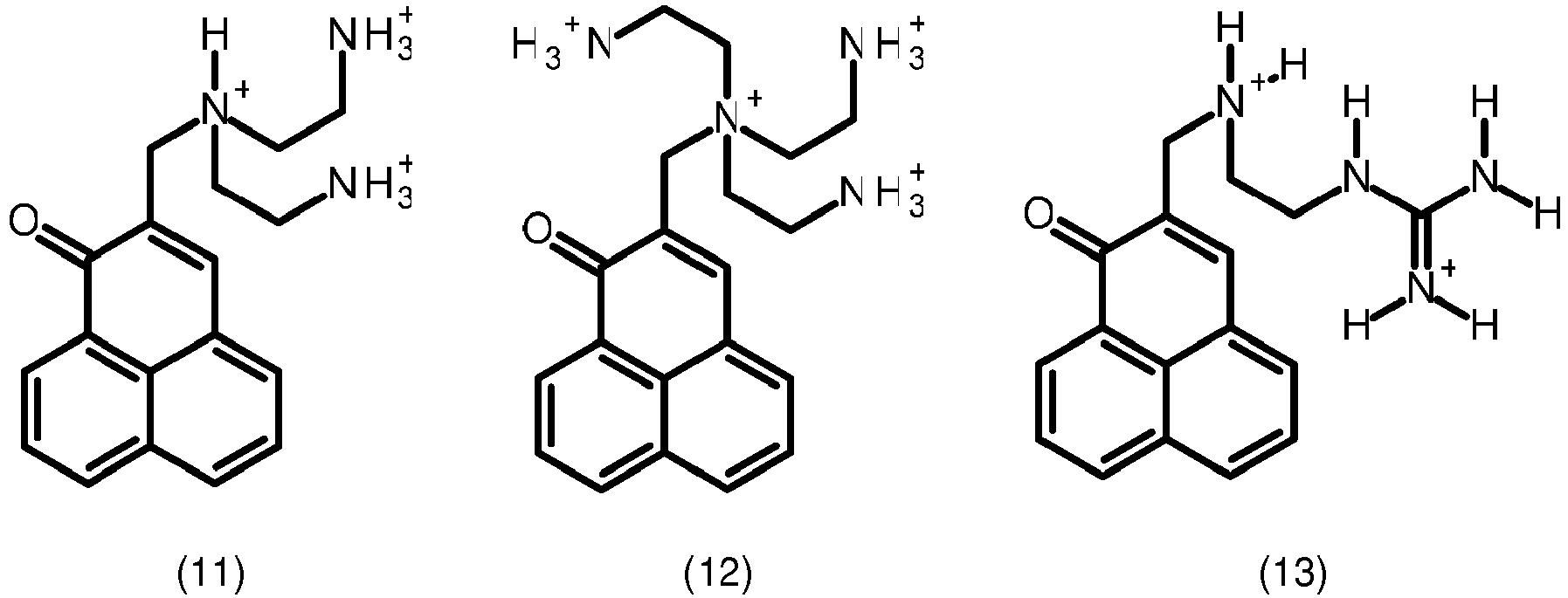


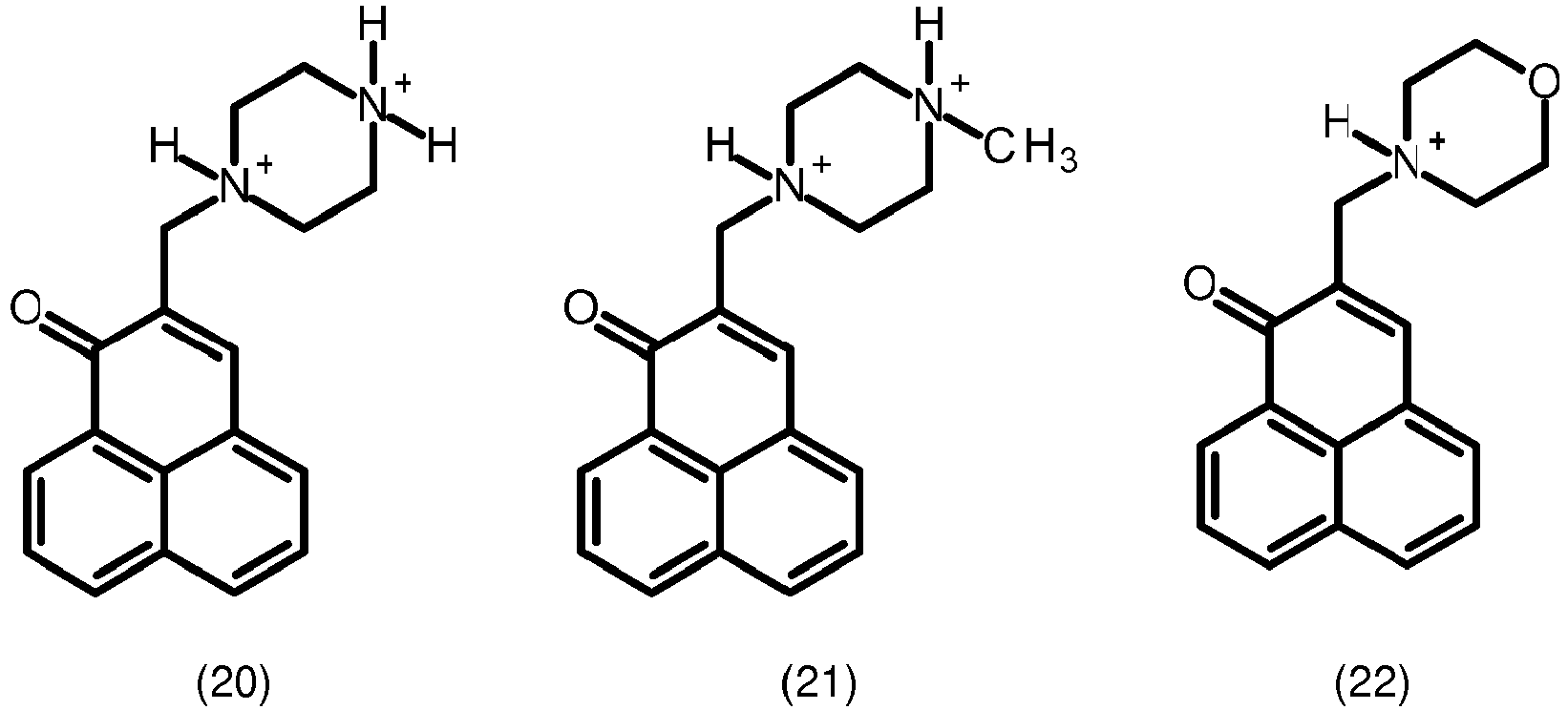

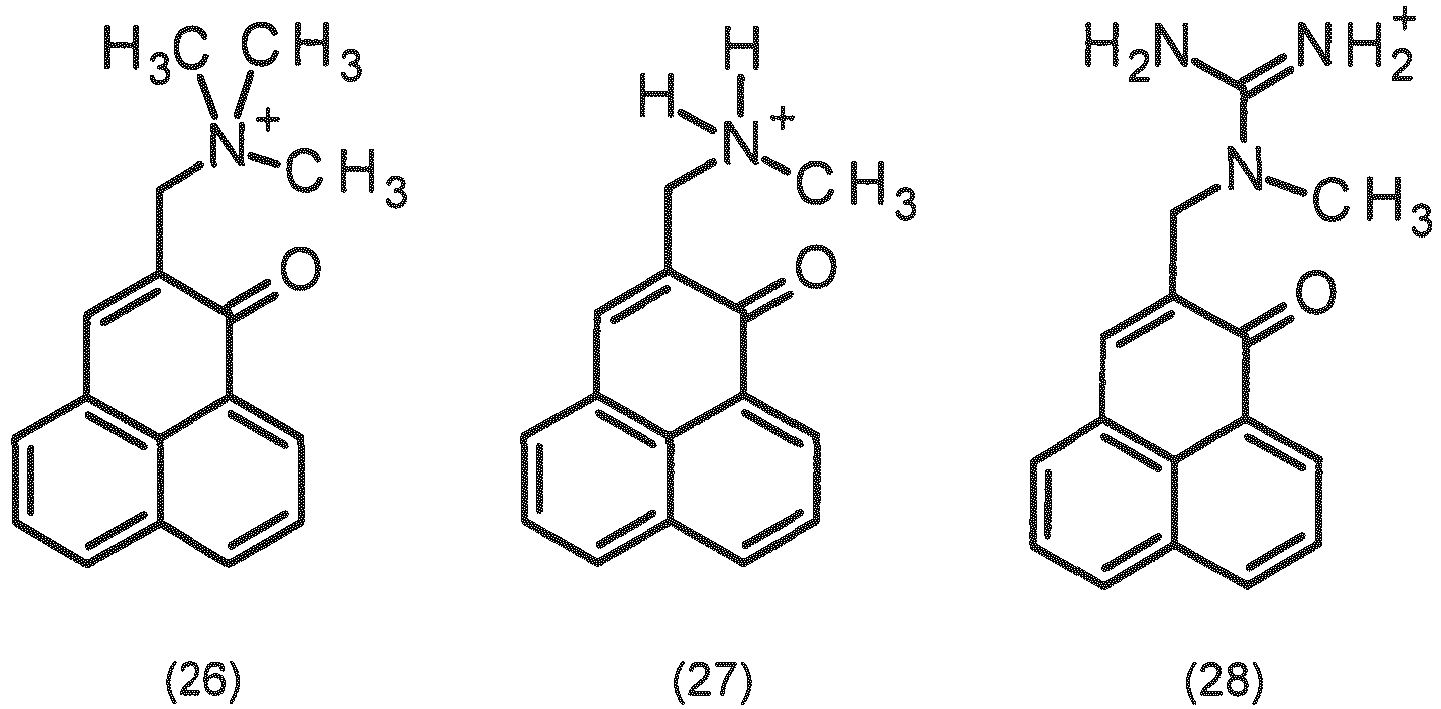
Gemäß einem Aspekt 4 betrifft die vorliegende Erfindung eine Photosensibilisator-Dispersion gemäß einem der Aspekte 1 bis 3, wobei der wenigstens eine Photosensibilisator ein Flavin-Derivat aus der Gruppe, die aus den Verbindung mit den Formeln (32) bis (49), (51) bis (64) und Mischungen davon besteht, ausgewählt wird:


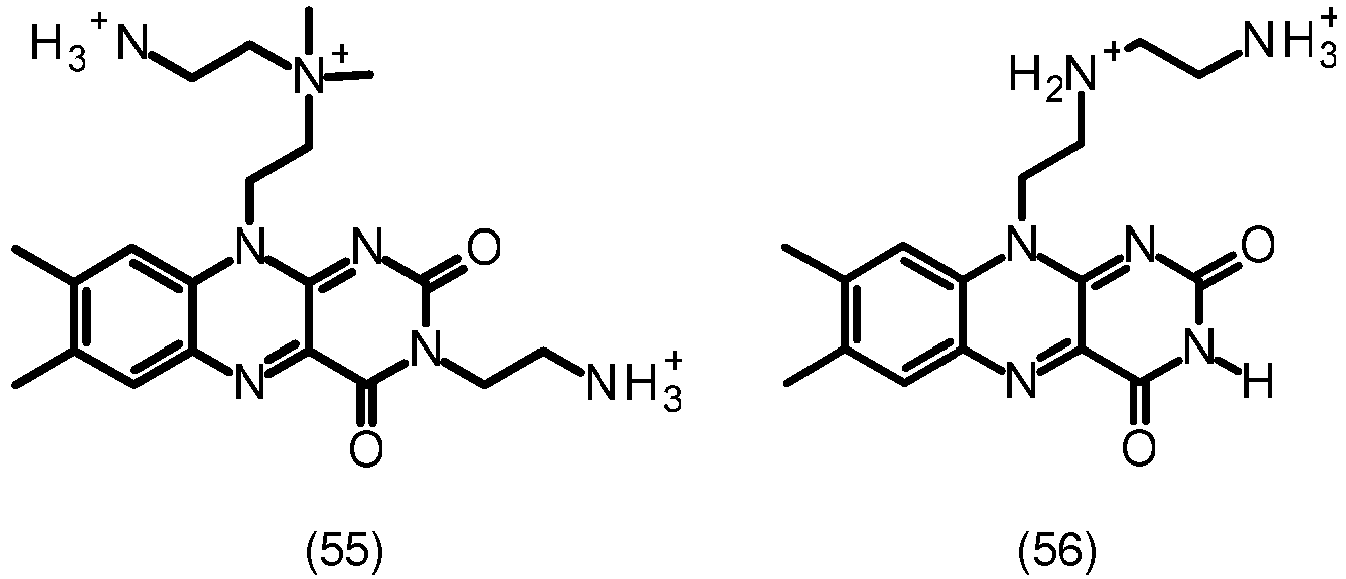
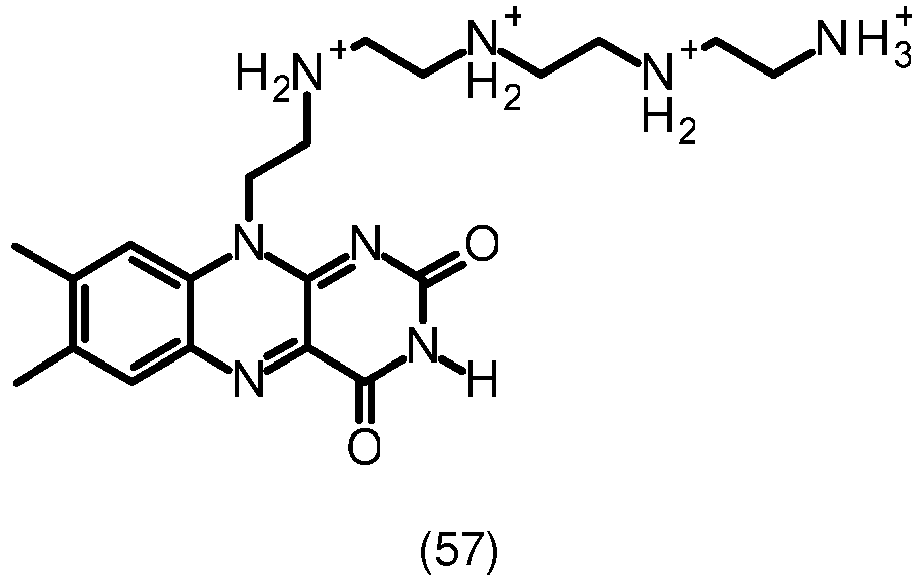


Gemäß einem Aspekt 5 betrifft die vorliegende Erfindung eine Photosensibilisator-Dispersion gemäß einem der Aspekte 1 bis 4, wobei der wenigstens eine Photosensibilisator ein Curcumin-Derivat, das aus der Gruppe, die aus den Verbindungen mit den Formeln (75) bis (104b), (105) und Mischungen davon besteht, ausgewählt wird:


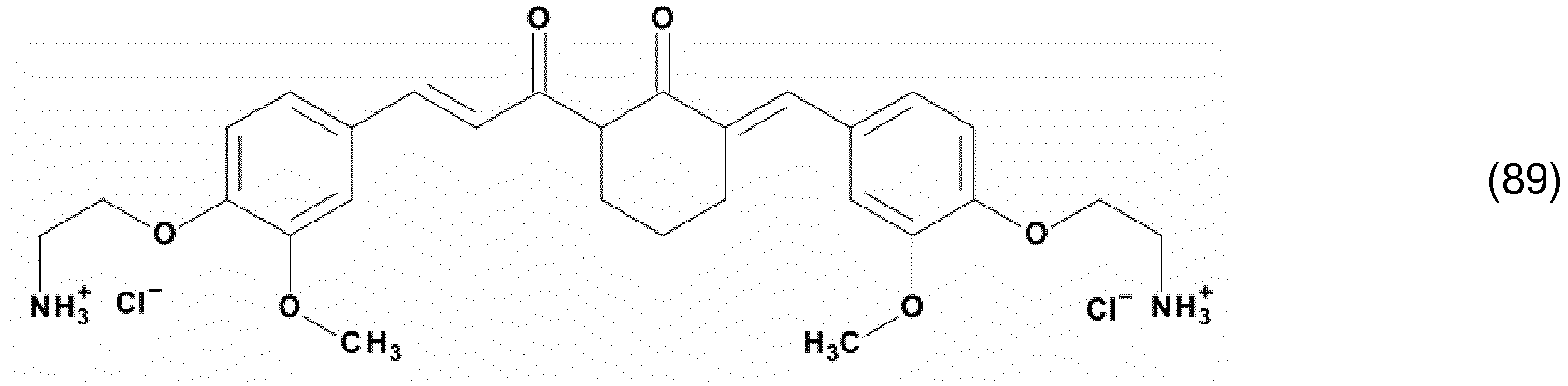


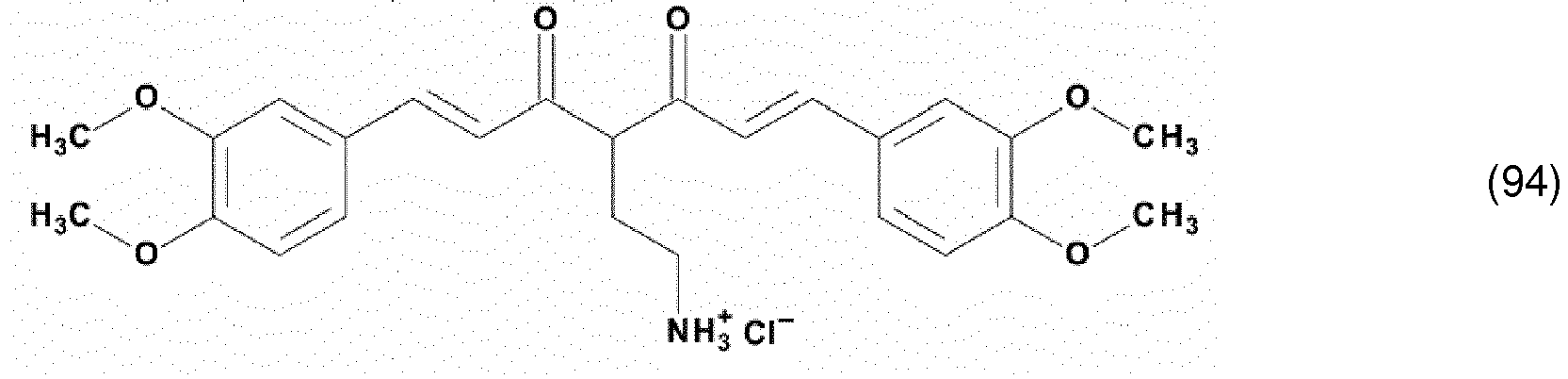


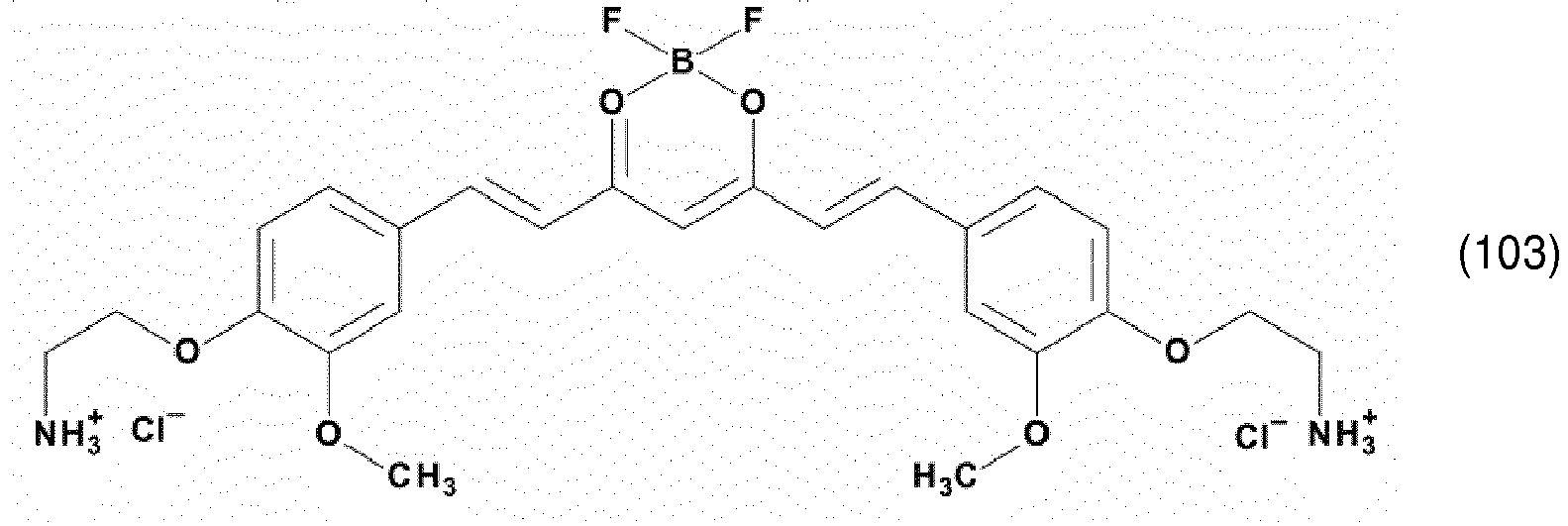
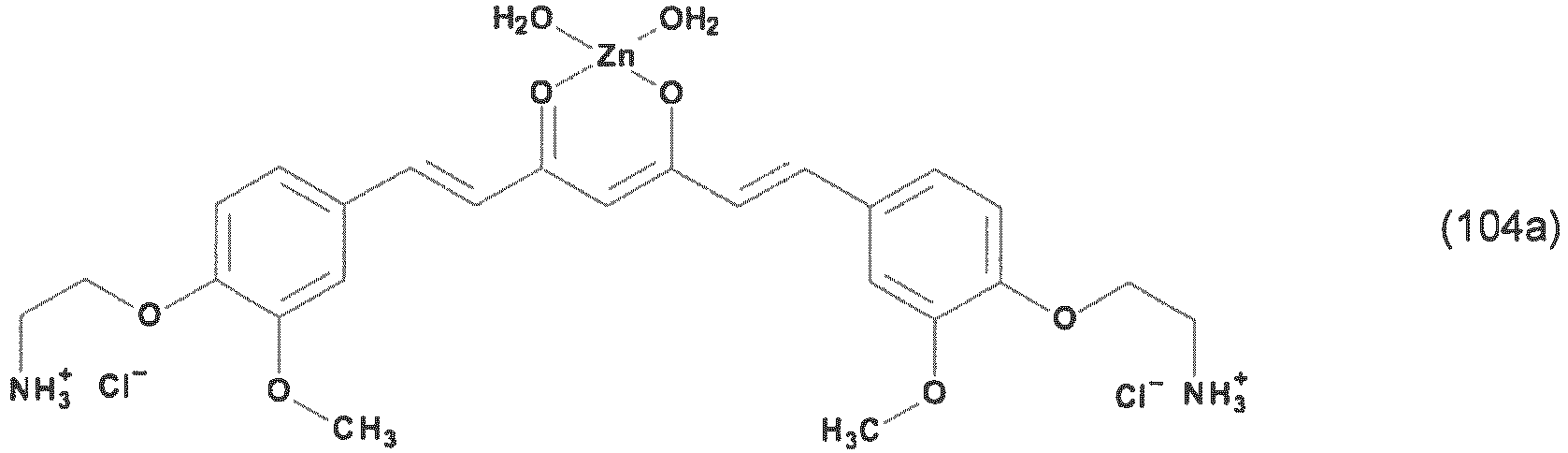
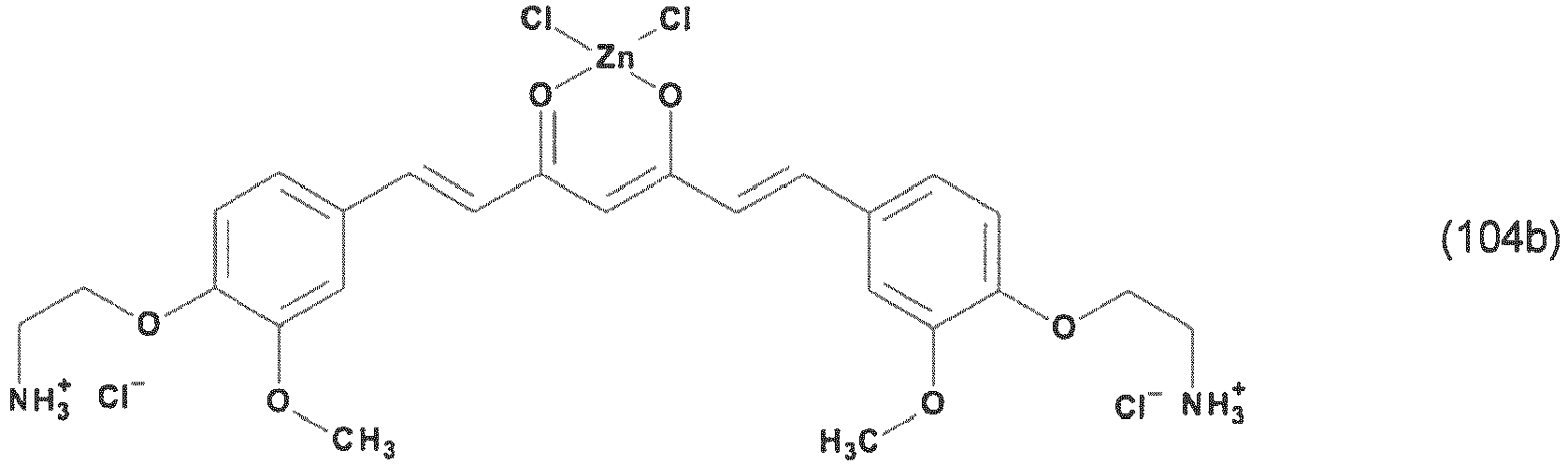

Gemäß einem Aspekt 6 betrifft die vorliegende Erfindung eine Photosensibilisator-Dispersion gemäß einem der Aspekte 1 bis 5, wobei der wenigstens eine Photosensibilisator aus der Gruppe, die aus den Verbindungen mit den Formeln (2) bis (28), (32) bis (49), (51) bis (64), (75) bis (104b), (105) und Mischungen davon besteht, ausgewählt wird.According to one aspect 6, the present invention relates to a photosensitizer dispersion according to one of
Gemäß einem Aspekt 7 betrifft die vorliegende Erfindung eine Photosensibilisator-Dispersion gemäß einem der Aspekte 1 bis 6, wobei als Gegenion zum positiv geladenen Stickstoffatom wenigstens ein Anion ausgewählt wird, das aus der Gruppe, die aus Fluorid, Chlorid, Bromid, lodid, Sulfat, Hydrogensulfat, Phosphat, Dihydrogenphosphat, Hydrogenphosphat, Tosylat, Mesylat, Formiat, Acetat, Propionat, Butanoat, Oxalat, Tartrat, Fumarat, Benzoat, Citrat und Mischungen davon besteht.According to one aspect 7, the present invention relates to a photosensitizer dispersion according to one of
Gemäß einem Aspekt 8 betrifft die vorliegende Erfindung eine Photosensibilisator-Dispersion gemäß einem der Aspekte 1 bis 7, wobei die Dispersion den wenigstens einen Photosensibilisator in einer Konzentration aus einem Bereich von 0,1 µM bis 1000 µM, vorzugsweise aus einem Bereich von 1 µM bis 750 µM, weiter bevorzugt aus einem Bereich von 2 µM bis 500 µM umfasst.According to one aspect 8, the present invention relates to a photosensitizer dispersion according to one of
Gemäß einem Aspekt 9 betrifft die vorliegende Erfindung eine Photosensibilisator-Dispersion gemäß einem der Aspekte 1 bis 8, wobei die wenigstens eine flüssige, polare Phase wenigstens ein polares Lösungsmittel, vorzugsweise Wasser, umfasst.According to one aspect 9, the present invention relates to a photosensitizer dispersion according to one of
Gemäß einem Aspekt 10 betrifft die vorliegende Erfindung eine Photosensibilisator-Dispersion gemäß einem der Aspekte 1 bis 9, wobei die Dispersion das wenigstens eine polare Lösungsmittel, vorzugsweise Wasser, in einem Anteil von wenigstens 0,1 Gew.-%, vorzugsweise von wenigstens 0,5 Gew.-%, weiter bevorzugt von wenigstens 1 Gew.-%, weiter bevorzugt von wenigstens 4 Gew.-%, weiter bevorzugt von wenigstens 10 Gew.-%, weiter bevorzugt von wenigstens 35 Gew.-%, weiter bevorzugt von wenigstens 50 Gew.-%, weiter bevorzugt von wenigstens 51 Gew.-%, jeweils bezogen auf das Gesamtgewicht der Dispersion, umfasst.According to one
Gemäß einem Aspekt 11 betrifft die vorliegende Erfindung eine Photosensibilisator-Dispersion gemäß einem der Aspekte 1 bis 10, wobei die Dispersion das wenigstens eine polare Lösungsmittel, vorzugsweise Wasser, in einem Anteil von aus einem Bereich von 0,1 Gew.-% bis 99,8 Gew.-%, vorzugsweise aus einem Bereich von 0,5 Gew.-% bis 99 Gew.-%, weiter bevorzugt aus einem Bereich von 4 Gew.-% bis 98 Gew.-%, weiter bevorzugt aus einem Bereich von 10 Gew.-% bis 97 Gew.-%. weiter bevorzugt aus einem Bereich von 35 Gew.-% bis 96 Gew.-%, weiter bevorzugt aus einem Bereich von 50 Gew.-% bis 95 Gew.-%, weiter bevorzugt aus einem Bereich von 51 Gew.-% bis 94 Gew.-%, weiter bevorzugt aus einem Bereich von 53 Gew.-% bis 93 Gew.-%, weiter bevorzugt aus einem Bereich von 70 Gew.-% bis 92 Gew.-%, jeweils bezogen auf das Gesamtgewicht der Dispersion, umfasst.According to one aspect 11, the present invention relates to a photosensitizer dispersion according to one of
Gemäß einem Aspekt 12 betrifft die vorliegende Erfindung eine Photosensibilisator-Dispersion gemäß einem der Aspekte 1 bis 11, wobei das wenigstens eine Tensid aus der Gruppe, die aus den oben genannten nichtionischen Tensiden, den oben genannten anionischen Tensiden, den oben genannten kationischen Tensiden, den oben genannten amphoteren Tensiden und Mischungen davon, vorzugsweise den oben genannten nichtionischen Tensiden, den oben genannten anionischen Tensiden und Mischungen davon, besteht, ausgewählt wird.According to one aspect 12, the present invention relates to a photosensitizer dispersion according to one of
Gemäß einem Aspekt 13 betrifft die vorliegende Erfindung eine Photosensibilisator-Dispersion gemäß einem der Aspekte 1 bis 12, wobei die Dispersion das wenigstens eine Tensid in einem Anteil aus einem Bereich von 0,1 Gew.-% bis 65 Gew.-%, vorzugsweise aus einem Bereich von 1 Gew.-% bis 55 Gew.-%, weiter bevorzugt aus einem Bereich von 3 Gew.-% bis 50 Gew.-%, weiter bevorzugt aus einem Bereich von 5 Gew.-% bis 41 Gew.-%, weiter bevorzugt aus einem Bereich von 7 Gew.-% bis 37 Gew.-%, weiter bevorzugt aus einem Bereich von 9 Gew.-% bis 30 Gew.-%, weiter bevorzugt aus einem Bereich von 10 Gew.-% bis 27 Gew.-%, jeweils bezogen auf das Gesamtgewicht der Dispersion, umfasst.According to one aspect 13, the present invention relates to a photosensitizer dispersion according to one of
Gemäß einem Aspekt 14 betrifft die vorliegende Erfindung eine Photosensibilisator-Dispersion gemäß einem der Aspekte 1 bis 13, wobei die nichtionischen Tenside aus der Gruppe, die aus den oben genannten Polyalkylenglycolethern, den oben genannten Alkylglucosiden, den oben genannten Alkylpolyglycosiden, den oben genannten Alkylglycosidestern und Mischungen davon besteht, ausgewählt werden.According to one aspect 14, the present invention relates to a photosensitizer dispersion according to one of
Gemäß einem Aspekt 15 betrifft die vorliegende Erfindung eine Photosensibilisator-Dispersion gemäß einem der Aspekte 1 bis 14, wobei die anionischen Tenside aus der Gruppe, die aus den oben genannten Alkylcarboxylaten, den oben genannten Alkylsulfonaten, den oben genannten Alkylsulfaten, den oben genannten Alkylphoshaten, den oben genannten Alkylpolyglykolethersulfaten, den oben genannten Sulfonaten von Alkylcarbonsäureestern, den oben genannten N-Alkyl-Sarkosinaten und Mischungen davon besteht, ausgewählt werden.According to one
Gemäß einem Aspekt 16 betrifft die vorliegende Erfindung eine Photosensibilisator-Dispersion gemäß einem der Aspekte 1 bis 15, wobei die kationische Tenside aus der Gruppe, die aus den oben genannten quartäre Alkylammoniumsalze, aus den oben genannten Esterquats, aus den oben genannten acylierte Polyamine, aus den oben genannten Benzylammoniumsalze und Mischungen davon besteht, ausgewählt werden. Gemäß einem Aspekt 17 betrifft die vorliegende Erfindung eine Photosensibilisator-Dispersion gemäß einem der Aspekte 1 bis 16, wobei die Dispersion weiterhin wenigstens eine flüssige, unpolare Phase aufweist, die wenigstens ein unpolares Lösungsmittel, das aus der Gruppe, die aus den oben genannten acyclischen Alkanen mit 5 bis 30 Kohlenstoffatomen, den oben genannten cyclischen Alkanen mit 5 bis 13 Kohlenstoffatomen, den oben genannten Perfluoralkanen mit 5 bis 20 Kohlenstoffatomen, den oben genannten Monocarbonsäureestern mit vorzugsweise 4 bis 20 Kohlenstoffatomen, den oben genannten Polycarbonsäureestern mit vorzugsweise 6 bis 20 Kohlenstoffatomen, und Mischungen davon ausgewählt wird, umfasst.According to one aspect 16, the present invention relates to a photosensitizer dispersion according to one of
Gemäß einem Aspekt 18 betrifft die vorliegende Erfindung eine Photosensibilisator-Dispersion gemäß einem der Aspekte 1 bis 17, wobei die Dispersion das wenigstens eine unpolare Lösungsmittel in einem Anteil von wenigstens 0,1 Gew.-%, vorzugsweise von wenigstens 0,5 Gew.-%, weiter bevorzugt von wenigstens 1 Gew.-%, weiter bevorzugt von wenigstens 4 Gew.-%, weiter bevorzugt von wenigstens 10 Gew.-%, weiter bevorzugt von wenigstens 35 Gew.-%, weiter bevorzugt von wenigstens 50 Gew.-%, weiter bevorzugt von wenigstens 51 Gew.-%, jeweils bezogen auf das Gesamtgewicht der Dispersion, umfasst.According to one aspect 18, the present invention relates to a photosensitizer dispersion according to one of
Gemäß einem Aspekt 19 betrifft die vorliegende Erfindung eine Photosensibilisator-Dispersion gemäß einem der Aspekte 1 bis 18, wobei die Dispersion das wenigstens eine unpolare Lösungsmittel in einem Anteil von aus einem Bereich von 0,1 Gew.-% bis 99,8 Gew.-%, vorzugsweise aus einem Bereich von 0,5 Gew.-% bis 99 Gew.-%, weiter bevorzugt aus einem Bereich von 1 Gew.-% bis 96 Gew.-%, weiter bevorzugt aus einem Bereich von 1,5 Gew.-% bis 90 Gew.-%, weiter bevorzugt aus einem Bereich von 3 Gew.-% bis 80 Gew.-%, weiter bevorzugt aus einem Bereich von 5 Gew.-% bis 75 Gew.-%, weiter bevorzugt aus einem Bereich von 10 Gew.-% bis 60 Gew.-%, weiter bevorzugt aus einem Bereich von 12 Gew.-% bis 49 Gew.-%, jeweils bezogen auf das Gesamtgewicht der Dispersion, umfasst.According to one aspect 19, the present invention relates to a photosensitizer dispersion according to one of
Gemäß einem Aspekt 20 betrifft die vorliegende Erfindung eine Photosensibilisator-Dispersion gemäß einem der Aspekte 1 bis 19, wobei die Dispersion weiterhin wenigstens ein Alkanol mit 2 bis 12 Kohlenstoffatomen, und vorzugsweise mit 1 bis 6 OH-Gruppen, enthält.According to one
Gemäß einem Aspekt 21 betrifft die vorliegende Erfindung eine Photosensibilisator-Dispersion gemäß einem der Aspekte 1 bis 20, wobei die Dispersion das wenigstens ein Alkanol in einem Anteil aus einem Bereich von 0 Gew.-% bis 50 Gew.-%, vorzugsweise aus einem Bereich von 0,1 Gew.-% bis 40 Gew.-%, weiter bevorzugt aus einem Bereich von 0,5 Gew.-% bis 35 Gew.-%, weiter bevorzugt aus einem Bereich von 1 Gew.-% bis 30 Gew.-%, weiter bevorzugt aus einem Bereich von 1,5 Gew.-% bis 25 Gew.-%, weiter bevorzugt aus einem Bereich von 5 Gew.-% bis 20 Gew.-%, weiter bevorzugt aus einem Bereich von 7 Gew.-% bis 19 Gew.-%, weiter bevorzugt aus einem Bereich von 10 Gew.-% bis 17 Gew.-%, jeweils bezogen auf das Gesamtgewicht der Dispersion, umfasst.According to one aspect 21, the present invention relates to a photosensitizer dispersion according to one of
Gemäß einem Aspekt 22 betrifft die vorliegende Erfindung eine Photosensibilisator-Dispersion gemäß einem der Aspekte 1 bis 21, wobei die Dispersion bei einem Druck aus einem Bereich von 800 bis 1200 mbar und einer Temperatur aus einem Bereich von 2 bis 50°C eine ÖI-in-Wasser (O/W) Mikroemulsion, eine Wasser-in-ÖI (W/O) Mikroemulsion oder eine bikontinuierliche Mikroemulsion, vorzugsweise eine ÖI-in-Wasser (O/W) Mikroemulsion oder eine Wasser-in-ÖI (W/O) Mikroemulsion, umfasst oder daraus besteht.According to one aspect 22, the present invention relates to a photosensitizer dispersion according to one of
Gemäß einem Aspekt 23 betrifft die vorliegende Erfindung eine Photosensibilisator-Dispersion gemäß einem der Aspekte 1 bis 22, wobei die Dispersion eine Mikroemulsion, vorzugsweise eine Öl-in-Wasser (O/W) Mikroemulsion, umfasst oder ist, die:
- (a) wenigstens einen Photosensibilisator, der aus der Gruppe, die aus den oben genannten Phenalenonen, den oben genannten Curcuminen, den oben genannten Flavinen und Mischungen davon, weiter bevorzugt aus den Verbindungen mit den Formeln (2) bis (25), (32) bis (49), (51) bis (64), (75) bis (105) und Mischungen davon, besteht, ausgewählt wird,
- (b) wenigstens ein polares Lösungsmittel, vorzugsweise Wasser,
- (c) wenigstens ein Tensid, das aus der Gruppe, die aus den oben genannten nichtionischen Tensiden, den oben genannten anionischen Tensiden, den oben genannten kationischen Tensiden, den oben genannten amphoteren Tensiden und Mischungen davon, vorzugsweise den oben genannten nichtionischen Tensiden, den oben genannten anionischen Tensiden und Mischungen davon, besteht, ausgewählt wird, und
- (d) wenigstens ein unpolares Lösungsmittel, das weiter bevorzugt aus der Gruppe, die aus den oben genannten acyclischen Alkanen
mit 5bis 30 Kohlenstoffatomen, den oben genannten cyclischen Alkanenmit 5 bis 13 Kohlenstoffatomen, den oben genannten Perfluoralkanenmit 5bis 20 Kohlenstoffatomen, den oben genannten Monocarbonsäureester mit 4bis 20 Kohlenstoffatomen, den oben genannten Polycarbonsäureester mit 6bis 20 Kohlenstoffatomen und Mischungen davon besteht, ausgewählt wird, und - (e) optional, wenigstens ein Alkanol, das aus der Gruppe, die aus den oben genannten Alkanolen mit 2 bis 12 Kohlenstoffatomen und vorzugsweise
mit 1 bis 6 OH-Gruppen und Mischungen davon besteht, ausgewählt wird,
- (A) at least one photosensitizer selected from the group consisting of the above-mentioned phenalenones, the above-mentioned curcumines, the above-mentioned flavins and mixtures thereof, more preferably from the compounds with the formulas (2) to (25), (32 ) to (49), (51) to (64), (75) to (105) and mixtures thereof, is selected,
- (b) at least one polar solvent, preferably water,
- (C) at least one surfactant selected from the group consisting of the abovementioned nonionic surfactants, the abovementioned anionic surfactants, the abovementioned cationic surfactants, the abovementioned amphoteric surfactants and mixtures thereof, preferably the abovementioned nonionic surfactants, the abovementioned mentioned anionic surfactants and mixtures thereof, is selected, and
- (d) at least one non-polar solvent, which is more preferably selected from the group consisting of the above-mentioned acyclic alkanes having 5 to 30 carbon atoms, the above-mentioned cyclic alkanes having 5 to 13 carbon atoms, the above said perfluoroalkanes having 5 to 20 carbon atoms, the above-mentioned monocarboxylic acid ester with 4 to 20 carbon atoms, the above-mentioned polycarboxylic acid ester with 6 to 20 carbon atoms and mixtures thereof, and
- (e) optionally, at least one alkanol which is selected from the group consisting of the above-mentioned alkanols with 2 to 12 carbon atoms and preferably with 1 to 6 OH groups and mixtures thereof,
Gemäß einem Aspekt 24 betrifft die vorliegende Erfindung eine Photosensibilisator-Dispersion gemäß einem der Aspekte 1 bis 23, wobei die Dispersion eine ÖI-in-Wasser (O/W) Mikroemulsion ist, die vorzugsweise das wenigstens eine unpolare Lösungsmittel in einem Anteil aus einem Bereich vom 0,1 Gew.-% bis 49,9 Gew.-%, vorzugsweise aus einem Bereich von 0,5 Gew.-% bis 48 Gew.-%, weiter bevorzugt aus einem Bereich von 1 Gew.-% bis 45 Gew.%, weiter bevorzugt aus einem Bereich von 3 Gew.-% bis 40 Gew.%, weiter bevorzugt aus einem Bereich von 5 Gew.-% bis 35 Gew.%, weiter bevorzugt aus einem Bereich von 7 Gew.-% bis 30 Gew.%, jeweils bezogen auf das Gesamtgewicht der Mikroemulsion, und vorzugsweise das wenigstens eine polare Lösungsmittel, vorzugsweise Wasser, in einem Anteil aus einem Bereich vom 50 Gew.-% bis 99,8 Gew.-%, vorzugsweise aus einem Bereich von 51 Gew.-% bis 99 Gew.-%, weiter bevorzugt aus einem Bereich von 52 Gew.-% bis 96 Gew.%, weiter bevorzugt aus einem Bereich von 53 Gew.-% bis 90 Gew.%, weiter bevorzugt aus einem Bereich von 54 Gew.-% bis 85 Gew.%, jeweils bezogen auf das Gesamtgewicht der Mikroemulsion, und vorzugsweise das wenigstens eine Tensid in einem Anteil aus einem Bereich von 0,1 Gew.-% bis 45 Gew.-%, vorzugsweise aus einem Bereich von 0,5 Gew.-% bis 40 Gew.-%, weiter bevorzugt aus einem Bereich von 1 Gew.-% bis 35 Gew.%, weiter bevorzugt aus einem Bereich von 3 Gew.-% bis 30 Gew.%, weiter bevorzugt aus einem Bereich von 5 Gew.-% bis 27 Gew.%, weiter bevorzugt aus einem Bereich von 7 Gew.-% bis 25 Gew.%, weiter bevorzugt aus einem Bereich von 10 Gew.-% bis 20 Gew.%, jeweils bezogen auf das Gesamtgewicht der Mikroemulsion, und optional weiterhin das wenigstens ein Alkanol in einem Anteil aus einem Bereich von 0 Gew.-% bis 50 Gew.-%, vorzugsweise aus einem Bereich von 0,1 Gew.-% bis 40 Gew.%, weiter bevorzugt aus einem Bereich von 0,5 Gew.-% bis 35 Gew.%, weiter bevorzugt aus einem Bereich von 1 Gew.-% bis 30 Gew.%, weiter bevorzugt aus einem Bereich von 1,5 Gew.-% bis 25 Gew.%, weiter bevorzugt aus einem Bereich von 5 Gew.-% bis 20 Gew.%, weiter bevorzugt aus einem Bereich von 7 Gew.-% bis 19 Gew.%, weiter bevorzugt aus einem Bereich von 10 Gew.-% bis 17 Gew.%, jeweils bezogen auf das Gesamtgewicht der Mikroemulsion.According to one aspect 24, the present invention relates to a photosensitizer dispersion according to one of aspects 1 to 23, the dispersion being an oil-in-water (O / W) microemulsion, which preferably contains the at least one non-polar solvent in a proportion from one range from 0.1% by weight to 49.9% by weight, preferably from a range from 0.5% by weight to 48% by weight, more preferably from a range from 1% by weight to 45% by weight .%, more preferably from a range from 3% by weight to 40% by weight, more preferably from a range from 5% by weight to 35% by weight, more preferably from a range from 7% by weight to 30% by weight % By weight, based in each case on the total weight of the microemulsion, and preferably the at least one polar solvent, preferably water, in a proportion from a range from 50% by weight to 99.8% by weight, preferably from a range of 51 % By weight to 99% by weight, more preferably from a range of 52% by weight to 96% by weight, more preferably from a range of 53% by weight to 90% by weight, more preferably from a range of 54% by weight to 85% by weight, in each case based on the total weight of the microemulsion, and preferably the at least one surfactant in a proportion from a range of 0.1% by weight % to 45% by weight, preferably from a range from 0.5% by weight to 40% by weight, more preferably from a range from 1% by weight to 35% by weight, more preferably from a range of 3% by weight to 30% by weight, more preferably from a range from 5% by weight to 27% by weight, more preferably from a range from 7% by weight to 25% by weight, more preferably from a range from 10% by weight to 20% by weight, based in each case on the total weight of the microemulsion, and optionally also the at least one alkanol in a proportion from a range from 0% by weight to 50% by weight, preferably from one range from 0.1% by weight to 40% by weight, more preferably from a range from 0.5% by weight to 35% by weight, more preferably from a range from 1% by weight to 30% by weight, more preferably from a region i from 1.5% by weight to 25% by weight, more preferably from a range of 5% by weight to 20% by weight, more preferably from a range of 7% by weight to 19% by weight, more preferably from a range from 10% by weight to 17% by weight, based in each case on the total weight of the microemulsion.
Gemäß einem Aspekt 25 betrifft die vorliegende Erfindung eine Photosensibilisator-Dispersion gemäß einem der Aspekte 1 bis 24, wobei die Dispersion weiterhin wenigstens eine pH-regulierende Substanz enthält, die vorzugsweise eine anorganische Säure, organische Säure, anorganische Base, organische Base, ein Salz davon oder eine Mischung davon ist.According to one
Gemäß einem Aspekt 26 betrifft die vorliegende Erfindung eine Photosensibilisator-Dispersion gemäß einem der Aspekte 1 bis 25, wobei die Dispersion weiterhin wenigstens einen Gelbildner, der aus der Gruppe, die aus den oben genannten Carboxyvinylpolymeren, den oben genannten Polyacrylamiden, den oben genannten Alginaten, den oben genannten Celluloseethern und Mischungen davon ausgewählt wird, umfasst.According to one aspect 26, the present invention relates to a photosensitizer dispersion according to one of
Gemäß einem Aspekt 27 betrifft die vorliegende Erfindung eine Photosensibilisator-Dispersion gemäß einem der Aspekte 1 bis 26, wobei die Dispersion bei einem Druck aus einem Bereich von 800 bis 1200 mbar und einer Temperatur aus einem Bereich von 2 bis 50°C ein Lyogel, umfasst oder ist.According to one aspect 27, the present invention relates to a photosensitizer dispersion according to one of
Gemäß einem Aspekt 28 betrifft die vorliegende Erfindung eine nicht-medizinische Verwendung einer Dispersion nach einem der Aspekte 1 bis 27 zur photodynamischen Inaktivierung von Mikroorganismen, die vorzugsweise aus der Gruppe, die aus Viren, Archäeen, Bakterien, Bakteriensporen, Pilzen, Pilzsporen, Protozoen, Algen und blutübertragbaren Parasiten besteht, ausgewählt werden.According to one aspect 28, the present invention relates to a non-medical use of a dispersion according to one of
Gemäß einem Aspekt 29 betrifft die vorliegende Erfindung eine Verwendung gemäß Aspekt 28 zur Oberflächenreinigung und/oder Oberflächenbeschichtung eines Gegenstandes.According to one aspect 29, the present invention relates to a use according to aspect 28 for surface cleaning and / or surface coating of an object.
Gemäß einem Aspekt 30 betrifft die vorliegende Erfindung eine Verwendung nach einem der Aspekte 28 bis 29, zur Oberflächenreinigung und/oder Oberflächenbeschichtung von Medizinprodukten, Lebensmittelverpackungen, Textilien, Baustoffen, elektronische Geräten, Möbeln oder Hygieneartikeln.According to one
Gemäß einem Aspekt 31 betrifft die vorliegende Erfindung eine Verwendung nach einem der Aspekte 28 bis 30, zur Entkeimung von Flüssigkeiten.According to one aspect 31, the present invention relates to a use according to one of aspects 28 to 30 for disinfecting liquids.
Gemäß einem Aspekt 32 betrifft die vorliegende Erfindung eine Verwendung nach einem der Aspekte 28 bis 31, zur Entkeimung von Lebensmitteln.According to one aspect 32, the present invention relates to a use according to one of aspects 28 to 31 for disinfecting food.
Gemäß einem Aspekt 33 betrifft die vorliegende Erfindung ein nicht-medizinisches Verfahren zur photodynamischen Inaktivierung von Mikroorganismen, die vorzugsweise Viren, Archäeen, Bakterien, Bakteriensporen, Pilzen, Pilzsporen, Protozoen, Algen, blutübertragbaren Parasiten oder Kombinationen davon umfassen, wobei das Verfahren folgende Schritte umfasst:
- (A) in Kontakt bringen der Mikroorganismen mit wenigstens einer Dispersion nach einem der Aspekte 1 bis 27, und
- (B) Bestrahlen der Mikroorganismen und wenigstens eines, in der Dispersion enthaltenen Photosensibilisators mit elektromagnetischer Strahlung geeigneter Wellenlänge und Energiedichte.
- (A) bringing the microorganisms into contact with at least one dispersion according to one of
aspects 1 to 27, and - (B) Irradiating the microorganisms and at least one photosensitizer contained in the dispersion with electromagnetic radiation of suitable wavelength and energy density.
Die Erfindung wird nachfolgend durch Figuren und Beispiele erläutert, ohne hierauf beschränkt zu sein.The invention is explained below by means of figures and examples, without being restricted thereto.
Alle verwendeten Chemikalien wurden von gängigen Anbietern käuflich erworben (TCI, ABCR, Acros, Merck und Fluka) und ohne weitere Reinigung eingesetzt. Lösemittel wurden vor Gebrauch destilliert und bei Bedarf auf übliche Art und Weise getrocknet. Trockenes DMF wurde bei Fluka (Taufkirchen, DE) käuflich erworben. Dünnschichtchromatographien wurden auf Dünnschicht-Aluminiumfolien, beschichtet mit Kieselgel 60 F254, der Firma Merck (Darmstadt, DE) durchgeführt. Präparative Dünnschichtchromatographien wurden auf kommerziell erhältlichen, mit Kieselgel 60 beschichteten Glasplatten (20cm x 20 cm, Carl Roth GmbH & Co. KG, Karlsruhe, DE)) durchgeführt. Die Verbindungen wurden durch UV-Licht (λ = 254 nm, 333 nm) und teilweise mit bloßem Auge detektiert oder mit Ninhydrin angefärbt. Chromatographien wurden mit Kieselgel (0.060 - 0.200) der Firma Acros (Waltham, US) durchgeführt. NMR-Spektren wurden auf einem Bruker-Spektrometer Avance 300 (300 MHz [1H-NMR], 75 MHz [13C-NMR]) (Bruker Corporation, Billerica, US) gemessen. Alle chemischen Verschiebungen sind in δ [ppm] relativ zum externen Standard (Tetramethylsilan, TMS) angegeben. Die Kopplungskonstanten sind jeweils in Hz angegeben; Charakterisierung der Signale: s = Singulett, d = Dublett, t = Triplett, m = Multiplett, dd = Dublett vom Dublett, br = breit. Die Integration bestimmt die relative Anzahl an Atomen. Die eindeutige Bestimmung der Signale in den Kohlenstoffspektren erfolgte mittels der DEPT-Methode (Pulswinkel: 135°). Fehlergrenzen: 0.01 ppm für 1 H-NMR, 0.1 ppm für 13C-NMR und 0.1 Hz für Kopplungskonstanten. Das verwendete Lösemittel ist jeweils für jedes Spektrum aufgeführt. Die IR-Spektren wurden an einem Biorad Spektrometer Excalibur FTS 3000 (Bio-Rad Laboratories GmbH, München, DE) aufgenommen. ES-MS wurden mit einem ThermoQuest Finnigan TSQ 7000 Spektrometer gemessen, sämtliche HR-MS auf einem ThermoQuest Finnigan MAT 95 (jeweils Thermo Fisher Scientific Inc, Waltham, US) Spektrometer ermittelt, Argon diente als lonisierungsgas für FAB-lonisierung (Fast Atom Bombardement). Schmelzpunkte wurden mit Hilfe des Schmelzpunktmessgerätes Büchi SMP-20 (Büchi Labortechnik GmbH, Essen, DE) unter Verwendung einer Glaskapillare bestimmt. Sämtliche UV/Vis-Spektren wurden mit einem Varian Cary 50 Bio UV/VIS Spektrometer, Fluoreszenzspektren mit einem Varian Cary Eclipse Spektrometer aufgenommen. Die Lösungsmittel für Absorbtions- und Emissionsmessungen wurden in spezieller spektroskopischer Reinheit von Acros oder Baker bzw. Uvasol von Merck gekauft. Milliporewasser (18 MΩ, Milli QPlus) wurde für alle Messungen verwendet.All chemicals used were purchased from common suppliers (TCI, ABCR, Acros, Merck and Fluka) and used without further purification. Solvents were distilled before use and, if necessary, dried in the usual way. Dry DMF was purchased from Fluka (Taufkirchen, DE). Thin-layer chromatographies were carried out on thin-layer aluminum foils coated with
In den nachfolgenden Beispielen wurden folgende Photosensibilisatoren verwendet:
- 1.) 5,10,15,20-tetrakis(1-Methyl-4-pyridyl)-porphyrin-tetra-(p-Toluensulfonat) (TMPyP, M = 1363.65 g/mol)

- 2.) 2-(4-Pyridinyl)methyl)-1 H-phenalen-1 -on-chlorid (SA-PN-01a, M = 307.78 g/mol),
Chlorid der Verbindung mit der Formel (24)
EP 2 678 035 A2 - 3a.) 10-[2-({[(tert-Butyl)oxy]carbonyl}amino)eth-1-yl]-7,8-dimethyl-[3H,10H]-benzo[g]pteridine-2,4-dion (Flavin 32a)

- 3b.) 10-(2-Aminoeth-1-yl)-7,8-dimethyl-[3H,10H]-benzo[g]pteridine-2,4-dion Hydrochlorid (FL-AS-H-1 a; M = 321.77 g/mol),
Chlorid der Verbindung mit der Formel (32)
- 4a) 3,10-Bis[2'-(tert-butyloxycarbonylamino)eth-1'-yl]7,8-dimethylbenzo[g]-pteridine-2,4-dion (Flavin 64a)

- 4b) 3,10-Bis(2'-aminoeth-1'-yl)-7,8-dimethylbenzo[g]pteridine-2,4-dion-dihydrochlorid (FL-AS-H-2; M = 401.29 g/mol),
Dichlorid der Verbindung (64)
- 5 Synthese der Verbindungen mit der Formel (26), (27), (28a) und (28):

- 5b) Trimethylamin, Ethanol, RT, über Nacht, 50°C, 5 h, 83 %;

- 5a) N-Methyl-N-(1-oxo-1 H-phenalen-2-yl)methanaminium-chlorid
Chlorid der Verbindung mit der Formel (27)
1H-NMR (300 MHz, CDCl3): δ[ppm] = 8.66 (d, J = 7.4 Hz, 1H), 8.28 - 8.20 (m, 2H), 8.08 (d, J= 8.3 Hz, 1H), 7.94 (d, J = 7.0 Hz, 1H), 7.80 (t, J = 7.7 Hz, 1H), 7.67 - 7.59 (m, 1H), 4.20 (s, 2H), 2.79 (s, 3H). - MS (ESI-MS, CH2Cl2 /MeOH + 10 mmol NH4OAc): e/z (%) = 224.1 (MH+, 100%); - Molekulargewicht (MW) = 224.28 + 35.45 g/mol; - Summenformel (MF) = C15H14NOCI. - 5b) N,N,N-trimethyl-1-(1-oxo-1H-phenalen-2-yl)methanaminium-chlorid (SA-PN-02a)
Chlorid der Verbindung mit der Formel (26)
1H-NMR (600 MHz, D2O): δ[ppm] = 8.02 (d,J= 8 Hz, 1H), 7.97 (d,J= 6.3 Hz, 1H), 7.92 (d, J = 8.2 Hz, 1H), 7.77 (s, 1H), 7.62 (d, J = 7 Hz, 1H), 7.50 (t,J= 7.8 Hz, 1H) 7.45 (t, J = 7.8 Hz, 1H), 4.12 (s, 2H), 2.98 (s, 9H).- MS (ESI-MS, CH2Cl2 /MeOH + 10 mmol NH4OAc): e/z (%) = 252.1 (100, M+); - MW = 287.79g/mol; - MF = G17H18NOG/; - 5c) 1-((1-oxo-1H-phenalen-2-yl)methyl)-1-methyl-2,3-di(tert-butoxycarbonyl)guanidin Verbindung mit der Formel (28a)

einem trockenen 25 mL Rundkolben wurde N,N'-di-Boc-N"-triflylguanidine (0,41 g, 1,05 mmol) in Dichloromethan (10 mL) vorgelegt. Triethylamin (0,3 g, 0,39 mL, 3 mmol) wurde langsam bei 2-5°C unter Feuchtigkeitsausschluss zugegeben. Verbindung 3 (130 mg, 0.5 mmol) wurde in einer Portion zugegeben. Nach 5 h Rühren bei Raumtemperatur wurde mit Dichlormethan (30 mL) verdünnt und die Lösung in einen Scheidetrichter überführt. Die organische Phase wurde mit wässrigem Kaliumhydrogensulfat (10 mL, 5%), gesättigter Natriumbicarbonat Lösung (10 mL) und gesättigter Kochsalzlösung (20 mL) gewaschen, über MgSO4 getrocknet, gefiltert und einrotiert. Das Rohprodukt wurde durch Säulenchromatographie mit Acetone/Petrolether 1:2 gereinigt und lieferte das Produkt als gelben Feststoff (0.21 g). Für weitere Reinigung wurde das Material in Aceton (1 mL) gelöst und mit Petrolether (14 mL) gefällt. Der Niederschlag wurde abgesaugt und mit Petrolether gewaschen.
1H-NMR (300 MHz, CDC/ 3): δ[ppm] = 8.63 (d, J = 7.3 Hz, 1H), 8.21 (d, J = 7.9 Hz, 1H), 8.03 (d, J = 8.2 Hz, 1H), 7.85 - 7.70 (m, 3H), 7.67 - 7.54 (m, 1H), 4.59 (s, 2H), 3.01 (s, 3H), 1.50 (s, 9H), 1.48 (s, 9H). - MS (ESI-MS, CH2Cl2 /MeOH + 10 mmol NH4OAc): e/z (%) = 466.1 (MH+, 100%); - MW = 465.53 g/mo/; - MF = C26H31N3O5 - 5d) 1-((1-oxo-1H-phenalen-2-yl)methyl)-1-methyl-guanidinium-chlorid (SA-PN-24d)
Chlorid der Verbindung mit der Formel (28)
1H-NMR (300 MHz, DMSO-d6): δ[ppm] = 8.60 - 8.47 (m, 4H), 8.33 - 8.24 (m, 2H), 8.16 - 8.09 (m, 2H), 7.98 - 7.89 (m, 2H), 7.84 - 7.73 (m, 4H), 7.57 - 7.48 (m, 7H), 4.55 - 4.42 (m, 4H), 3.05 (s, 6H). - MS (ESI-MS, CH2Cl2/MeOH + 10 mmol NH4OAc): e/z (%) = 266.1 (MH+, 100%); - MW = 266.3 + 35.45 = 301.75 g/mol; - MF = C16H16N3OCl
- 1.) 5,10,15,20-tetrakis (1-methyl-4-pyridyl) -porphyrin-tetra- (p-toluenesulfonate) (TMPyP, M = 1363.65 g / mol)
- 2.) 2- (4-Pyridinyl) methyl) -1 H-phenalen-1-one-chloride (SA-PN-01a, M = 307.78 g / mol),
Chloride of the compound with the formula (24)EP 2 678 035 A2 - 3a.) 10- [2 - ({[(tert -Butyl) oxy] carbonyl} amino) eth-1-yl] -7,8-dimethyl- [3H, 10H] -benzo [g] pteridine-2,4 -dione (flavin 32a )
- 3b.) 10- (2-Aminoeth-1-yl) -7,8-dimethyl- [3H, 10H] -benzo [g] pteridine-2,4-dione hydrochloride (FL-AS-H-1 a; M = 321.77 g / mol),
Chloride of the compound with the formula (32) - 4a) 3,10-bis [2 '- (tert-butyloxycarbonylamino) eth-1 ' -yl] 7,8-dimethylbenzo [g] -pteridine-2,4-dione (Flavin 64a )
- 4b) 3,10-bis (2'-aminoeth-1'-yl) -7,8-dimethylbenzo [g] pteridine-2,4-dione dihydrochloride (FL-AS-H-2; M = 401.29 g / mol),
Compound dichloride (64) - 5 Synthesis of the compounds with the formula (26), (27), (28a) and (28):
- 5b) trimethylamine, ethanol, RT, overnight, 50 ° C, 5 h, 83%;
- 5a) N-methyl-N- (1-oxo-1H-phenalen-2-yl) methanaminium chloride
Chloride of the compound with the formula (27)
1 H-NMR (300 MHz, CDCl 3 ): δ [ppm] = 8.66 (d, J = 7.4 Hz, 1H), 8.28 - 8.20 (m, 2H), 8.08 (d, J = 8.3 Hz, 1H), 7.94 (d, J = 7.0 Hz, 1H), 7.80 (t, J = 7.7 Hz, 1H), 7.67-7.59 (m, 1H), 4.20 (s, 2H), 2.79 (s, 3H). - MS (ESI-MS, CH 2 Cl 2 / MeOH + 10 mmol NH 4 OAc): e / z (%) = 224.1 (MH + , 100%); Molecular weight ( MW ) = 224.28 + 35.45 g / mol; - Molecular formula ( MF ) = C 15 H 14 NOCI. - 5b) N, N, N-trimethyl-1- (1-oxo-1H-phenalen-2-yl) methanaminium chloride (SA-PN-02a)
Chloride of the compound with the formula (26)
1 H-NMR (600 MHz, D 2 O): δ [ppm] = 8.02 (d, J = 8 Hz, 1H), 7.97 (d, J = 6.3 Hz, 1H), 7.92 (d, J = 8.2 Hz , 1H), 7.77 (s, 1H), 7.62 (d, J = 7 Hz, 1H), 7.50 (t, J = 7.8 Hz, 1H) 7.45 (t, J = 7.8 Hz, 1H), 4.12 (s, 2H), 2.98 (s, 9H) - MS (ESI-MS, CH 2 Cl 2 / MeOH + 10 mmol NH 4 OAc): e / z (%) = 252.1 (100, M +); - MW = 287.79 g / mol; - MF = G 17 H18NOG / ; - 5c) 1 - ((1-oxo-1H-phenalen-2-yl) methyl) -1-methyl-2,3-di (tert-butoxycarbonyl) guanidine compound with the formula (28a)
1 H-NMR (300 MHz, CDC / 3 ): δ [ppm] = 8.63 (d, J = 7.3 Hz, 1H), 8.21 (d, J = 7.9 Hz, 1H), 8.03 (d, J = 8.2 Hz , 1H), 7.85-7.70 (m, 3H), 7.67-7.54 (m, 1H), 4.59 (s, 2H), 3.01 (s, 3H), 1.50 (s, 9H), 1.48 (s, 9H). - MS (ESI-MS, CH 2 Cl 2 / MeOH + 10 mmol NH 4 OAc): e / z (%) = 466.1 (MH + , 100%); - MW = 465.53 g / mo / ; - MF = C 26 H 31 N 3 O 5 - 5d) 1 - ((1-oxo-1H-phenalen-2-yl) methyl) -1-methyl-guanidinium chloride (SA-PN-24d)
Chloride of the compound with the formula (28)
1 H-NMR (300 MHz, DMSO-d6): δ [ppm] = 8.60-8.47 (m, 4H), 8.33-8.24 (m, 2H), 8.16-8.09 (m, 2H), 7.98-7.89 (m , 2H), 7.84-7.73 (m, 4H), 7.57-7.48 (m, 7H), 4.55-4.42 (m, 4H), 3.05 (s, 6H). - MS (ESI-MS, CH 2 Cl 2 / MeOH + 10 mmol NH 4 OAc): e / z (%) = 266.1 (MH + , 100%); - MW = 266.3 + 35.45 = 301.75 g / mol; - MF = C 16 H 16 N 3 OCl
Die nachfolgend angegebenen Gew.-% der Bestandteile der Mikroemulsionen E1 bis E4 beziehen sich jeweils auf das Gesamtgewicht der entsprechenden Mikroemulsion ohne Photosensibilisator.The% by weight of the constituents of the microemulsions E1 to E4 specified below each relate to the total weight of the corresponding microemulsion without photosensitizer.
Mikroemulsion E1: Mikroemulsion bestehend aus DMS, SDS und 1-Pentanol mit einem konstanten Massenverhältnis SDS zu 1-Pentanol von 1:2 sowie Wasser.Microemulsion E1: Microemulsion consisting of DMS, SDS and 1-pentanol with a constant mass ratio of SDS to 1-pentanol of 1: 2 and water.
20,0 Gew.-% Dimethylsuccinat (DMS)
8,33 Gew.-% Natriumdodecylsulfat (SDS)
16,67 Gew.-% 1-Pentanol
55,0 Gew.-% Wasser20.0% by weight dimethyl succinate (DMS)
8.33% by weight sodium dodecyl sulfate (SDS)
16.67 wt% 1-pentanol
55.0 wt% water
Mikroemulsion E2: Mikroemulsion bestehend aus DMS, SDS und 1,2-Pentandiol mit einem konstanten Massenverhältnis von 1:2 SDS zu 1,2-Pentandiol sowie Wasser.Microemulsion E2: Microemulsion consisting of DMS, SDS and 1,2-pentanediol with a constant mass ratio of 1: 2 SDS to 1,2-pentanediol and water.
20,0 Gew.-% Dimethylsuccinat (DMS)
8,33 Gew.-% Natriumdodecylsulfat (SDS)
16,67 Gew.-% 1,2-Pentandiol
55,0 Gew.-% Wasser20.0% by weight dimethyl succinate (DMS)
8.33% by weight sodium dodecyl sulfate (SDS)
16.67
55.0 wt% water
Mikroemulsion E3: Mikroemulsion bestehend aus DMS, TWEEN® 20 und 1,2-Pentandiol mit einem konstanten Massenverhältnis TWEEN® 20 zu 1,2-Pentandiol von 1:3 sowie Wasser.Microemulsion E3: Microemulsion consisting of DMS,
10,0 Gew.-% Dimethylsuccinat (DMS)
3,75 Gew.-% TWEEN® 20
11,25 Gew.-% 1,2-Pentandiol
75,0 Gew.-% Wasser10.0% by weight dimethyl succinate (DMS)
3.75 wt
11.25
75.0 wt% water
Mikroemulsion E4: Mikroemulsion bestehend aus DMS, TWEEN® 20 und 1,2-Propandiol mit einem konstanten Massenverhältnis TWEEN® 20 zu 1,2-Propandiol von 1:3 sowie Wasser
10,0 Gew.-% Dimethylsuccinat (DMS)
3,75 Gew.-% TWEEN® 20
11,25 Gew.-% 1,2-Propandiol
75,0 Gew.-% WasserMicroemulsion E4: Microemulsion consisting of DMS,
10.0% by weight dimethyl succinate (DMS)
3.75 wt
11.25
75.0 wt% water
Die entsprechenden Mikroemulsionen E1 bis E4 wurden zunächst ohne Photosensibilisator hergestellt wobei alle Komponenten außer Wasser eingewogen wurden und nacheinander vermischt wurden. Nachdem eine homogene Mischung erhalten wurde, erfolgte die Zugabe der entsprechenden Menge Wasser unter ständigem Rühren.The corresponding microemulsions E1 to E4 were initially produced without a photosensitizer, all components except water being weighed in and mixed one after the other. After a homogeneous mixture was obtained, the appropriate amount of water was added with constant stirring.
Beispielsweise erfolgt die Herstellung von 100 g Mikroemulsion E4 durch Einwaage von 3.75g TWEEN® 20, 11.25 g 1,2-Propandiol und 10 g DMS. Die resultierende Lösung wurde bis zum Erhalt einer homogenen Mischung gerührt. Anschließend wurden 75 g Wasser unter Rühren hinzugegeben.For example, 100 g of microemulsion E4 is produced by weighing 3.75 g of
Für die weiteren Experimente wurden die Photosensibilisatoren in der entsprechenden Konzentration in der jeweiligen Mikroemulsion gelöst und solange gerührt, bis der Photosensibilisator vollständig gelöst war.For the further experiments, the photosensitizers were dissolved in the appropriate concentration in the respective microemulsion and stirred until the photosensitizer was completely dissolved.
Die Benetzung von Oberflächen durch die verwendeten Mikroemulsionen wurde mit Hilfe der Kontaktwinkel-Prüfung bestimmt.The wetting of surfaces by the microemulsions used was determined with the aid of the contact angle test.
Für die Kontaktwinkel-Prüfung wurden die oben angegebenen Emulsionen ohne Photosensibilisator sowie Photosensibilisator-haltige Emulsionen, die die Photosensibilisatoren TMPyP, SA-PN-01a, SA-PN-02a, SA-PN-24d, FL-AS-H-1a oder FL-AS-H-2 enthielten, verwendet.For the contact angle test, the above-mentioned emulsions without photosensitizer and photosensitizer-containing emulsions that use the photosensitizers TMPyP, SA-PN-01a, SA-PN-02a, SA-PN-24d, FL-AS-H-1a or FL -AS-H-2 was used.
Um die neuen Dispersionen mit konventionellen, Alkohol-haltigen Desinfektionslösungen zu vergleichen, wurden weiterhin wässrige Ethanol-Lösungen mit verschiedenen Ethanol-Konzentrationen aus einem Bereich von 10 Gew.-% Ethanol bis 90 Gew.-% Ethanol als Vergleichslösungen verwendet.In order to compare the new dispersions with conventional, alcohol-containing disinfecting solutions, aqueous ethanol solutions with various ethanol concentrations from a range from 10% by weight to 90% by weight of ethanol were used as comparison solutions.
Darüber hinaus wurden Verdünnungen der oben angegebenen Emulsionen ohne Photosensibilisator sowie Photosensibilisator-haltigen Emulsionen verwendet, bei denen die entsprechende Mikroemulsion in 5 Schritten bis zu einem Wassergehalt von 99 Gew.-% verdünnt wurde.In addition, dilutions of the above emulsions without photosensitizer and photosensitizer-containing emulsions were used in which the corresponding microemulsion was diluted in 5 steps up to a water content of 99% by weight.
Der Kontaktwinkel wurde mit Hilfe des Kontaktwinkelmessgerätes DataPhysics OCA 35 der Firma DataPhysics Instruments GmbH (Filderstadt, DE) gemäß Herstellerangaben bestimmt.The contact angle was determined using the
Für die Messung wurde jeweils 2.5 µL jeder zu testenden Lösung bei Raumtemperatur unter Vollklimatisierung (Temperatur: 25°C, Druck: 1013 mbar, relative Luftfeuchtigkeit: 50 %) mit einer automatischen Hamilton-Spritze auf einen Glasobjektträger als Prüfoberfläche in Form eines Tropfens aufgebracht und im zeitlichen Abstand von einer Sekunde fotografiert.For the measurement, 2.5 µL of each solution to be tested was applied to a glass slide as a test surface in the form of a drop at room temperature under full air conditioning (temperature: 25 ° C, pressure: 1013 mbar, relative humidity: 50%) using an automatic Hamilton syringe photographed every second.
Anschließend wurde für jede Aufnahme sowohl der linke als auch der rechte Kontaktwinkel zwischen Tropfen und Prüfoberfläche mit Hilfe der Software SCA 20 der Firma DataPhysics Instruments GmbH ermittelt sowie der Mittelwert zwischen den gemessenen Kontaktwinkeln berechnet. Jede Messung wurde jeweils 4-mal wiederholt.Subsequently, for each exposure, both the left and the right contact angle between the drop and the test surface were determined with the aid of the
Exemplarisch sind in
Die Mittelwerte der gemessenen Kontaktwinkel von Mikroemulsionen E1 bis E4, die jeweils 100 µm eines der verwendeten Photosensibilisatoren enthielten, wichen nur unwesentlich von den gemessenen Kontaktwinkeln der Photosensibilisator-freien Mikroemulsionen E1 bis E4 ab.The mean values of the measured contact angles of microemulsions E1 to E4, each containing 100 μm of one of the photosensitizers used, deviated only insignificantly from the measured contact angles of the photosensitizer-free microemulsions E1 to E4.
Die verschiedenenMikroemulsionen mit SDS und TWEEN® 20 zeigten einen signifikant reduzierten Kontaktwinkel im Vergleich zu reinem Wasser. Mehr als 40 Gew.-% Ethanol müssten verwendet werden, um eine vergleichbare Benetzung der verwendeten Glasoberfäche zu erreichen.The various microemulsions with SDS and
Der Effekt der Verdünnung einer Mikroemulsion mit Wasser ist exemplarisch in
Wie in
Ähnliche Ergebnisse wurden für die Mikroemulsionen E1, E2 und E4 sowie für Mikroemulsionen E1 bis E4, die jeweils 5 µM eines der verwendeten Photosensibilisatoren TMPyP, SA-PN-01a, SA-PN-02a, SA-PN-24d, FL-AS-H-1a oder FL-AS-H-2 aufwiesen, erhalten.Similar results were obtained for microemulsions E1, E2 and E4 as well as for microemulsions E1 to E4, each containing 5 µM of one of the photosensitizers used TMPyP, SA-PN-01a, SA-PN-02a, SA-PN-24d, FL-AS- H-1a or FL-AS-H-2 was obtained.
Die Absorption der verwendeten Photosensibilisatoren TMPyP, SA-PN-01a und FL-AS-H-1a in den jeweiligen Mikroemulsionen E1 bis E4 wurde durch Aufnahme eines Absorptions-Spektrums für einen Wellenlängebereich von 250nm bis 600 nm bestimmt.The absorption of the photosensitizers used TMPyP, SA-PN-01a and FL-AS-H-1a in the respective microemulsions E1 to E4 was determined by recording an absorption spectrum for a wavelength range from 250 nm to 600 nm.
Dazu wurden die Photosensibilisatoren SA-PN-01a und FL-AS-H-1a in einer Konzentration von 20 µM in Wasser und in der jeweiligen Mikroemulsion E1 bis E4 gelöst.For this purpose, the photosensitizers SA-PN-01a and FL-AS-H-1a were dissolved in a concentration of 20 μM in water and in the respective microemulsion E1 to E4.
Wegen der höheren Absorption von TMPyP in Lösung wurde der Photosensibilisator TMPyP jeweils in einer Konzentration von 5 µM verwendet.Because of the higher absorption of TMPyP in solution, the photosensitizer TMPyP was used in a concentration of 5 μM.
Absorptionsspektren wurden mit einem Varian Cary BIO UV/VIS/IR Spektrometer (Agilent Technologies Inc., Santa Clara, CA, USA) gemessen wobei eine 10 mm Hellma Quartz-Küvette (SUPRASIL, Type 101-QS, Hellma GmbH & Co. KG, Mühlheim, DE) verwendet wurde.Absorption spectra were measured with a Varian Cary BIO UV / VIS / IR spectrometer (Agilent Technologies Inc., Santa Clara, CA, USA) using a 10 mm Hellma quartz cuvette (SUPRASIL, Type 101-QS, Hellma GmbH & Co. KG, Mühlheim, DE) was used.
Die jeweils gemessenen Absorptionsspektren von TMPyP, SA-PN-01 a und FL-AS-H-1 a in den Mikroemulsionen E1 bis E4 sind innerhalb der Fehlergrenzen nahezu identisch zum entsprechenden Absorptionsspektren von TMPyP, SA-PN-01a und FL-AS-H-1a in Wasser.The respectively measured absorption spectra of TMPyP, SA-PN-01 a and FL-AS-H-1 a in the microemulsions E1 to E4 are almost identical to the corresponding absorption spectra of TMPyP, SA-PN-01a and FL-AS- H-1a in water.
Es gibt keine Unterschiede hinsichtlich der Intensität der Signale oder Veränderungen des Spektrums.There are no differences in the intensity of the signals or changes in the spectrum.
Die Bildung von Singulett-Sauerstoff nach Bestrahlung einer Photosensibilisator-haltigen Mikroemulsion wurde durch Zeit-aufgelöste Singulett-Sauerstoff Lumineszenzenzmessungen bestimmt.The formation of singlet oxygen after irradiation of a photosensitizer-containing microemulsion was determined by time-resolved singlet oxygen luminescence measurements.
Für die entsprechenden Messungen wurden jeweils 5 µM der verwendeten Photosensibilisatoren in Wasser oder den Emulsionen E1 bis E4 gelöst.For the corresponding measurements, 5 μM of the photosensitizers used were dissolved in water or in the emulsions E1 to E4.
Die Zeit-aufgelöste Singulett-Sauerstoff Lumineszenzenzmessungen wurde gemäß der in S. Y. Egorov et al. 1999 beschriebenen Methode durchgeführt
Zur Erzeugung von Singulett-Sauerstoff wurde ein stimmbares Lasersystem (Model: NT242-SH/SFG, Seriennummer: PGD048) der Firma EKSPLA (Vilnius, Lettland) verwendet. Ein Teil des erzeugten monochromatischen Laserstrahls wurde auf eine Photodiode gerichtet, die als Trigger-Signal für die Zeit-korrelierte Einzel-Photon-Messung diente.The time-resolved singlet oxygen luminescence measurements were performed according to the method described in SY Egorov et al. The method described in 1999 was carried out
A tunable laser system (model: NT242-SH / SFG, serial number: PGD048) from EKSPLA (Vilnius, Latvia) was used to generate singlet oxygen. Part of the generated monochromatic laser beam was directed onto a photodiode, which served as a trigger signal for the time-correlated single photon measurement.
Der andere Teil des Laserstrahls wurde auf eine 1 cm dicke Quartz-Küvette (SUPRASIL, Type 101-QS, Hellma GmbH & Co. KG, Mühlheim, DE), in der die zu untersuchende Lösung angeordnet war.The other part of the laser beam was applied to a 1 cm thick quartz cuvette (SUPRASIL, Type 101-QS, Hellma GmbH & Co. KG, Mühlheim, DE) in which the solution to be examined was arranged.
Die Bildung von Singulett-Sauerstoff wurde durch eine direkte Detektion der Zeit- und spektral-aufgelösten Singulett-Sauerstoff Lumineszenz nachgewiesen
Eine Singulett-Sauerstoff Lumineszenz wurde mittels eines Stickstoff-gekühlten Photomultipliers (Model R5509-42, Hamamatsu Photonics, Hamamatsu, Japan) und eines Multiscalers (7886S, FAST Com Tec GmbH, Oberhaching, Deutschland) durchgeführt.The formation of singlet oxygen was detected by direct detection of the time and spectrally resolved singlet oxygen luminescence
Singlet oxygen luminescence was carried out using a nitrogen-cooled photomultiplier (model R5509-42, Hamamatsu Photonics, Hamamatsu, Japan) and a multiscaler (7886S, FAST Com Tec GmbH, Oberhaching, Germany).
Die Singulett-Sauerstoff Lumineszenz wurde bei einer Wellenlänge aus einem Bereich von 1200 nm bis 1400 nm unter Verwendung von Interferenz-Filtern, die vor dem Photomultiplier angeordnet waren, nachgewiesen.The singlet oxygen luminescence was detected at a wavelength from a range from 1200 nm to 1400 nm using interference filters which were arranged in front of the photomultiplier.
Die Zeit-aufgelösten Singulett-Sauerstoff Spektren sind exemplarisch für die jeweiligen Photosensibilisatoren TMPyP, SA-PN-01a und FL-AS-H-1a in den
Eine Zusammenfassung des Singulett-Sauerstoff Nachweises ist in Tabelle 1 dargestellt.A summary of the singlet oxygen detection is shown in Table 1.
Jeder der verwendeten Photosensibilisatoren TMPyP, SA-PN-01 a und FL-AS-H-1 a erzeugt nach Bestrahlung mit elektromagnetischer Strahlung Singulett-Sauerstoff.Each of the photosensitizers used TMPyP, SA-PN-01 a and FL-AS-H-1 a generates singlet oxygen after exposure to electromagnetic radiation.
Der gebildete Singulett-Sauerstoff weist in der jeweiligen Mikroemulsion eine signifikant längere Halbwertszeit auf im Vergleich zu Wasser. Die Mikroemulsion verlängert die Halbwertszeit des gebildeten Singulett-Sauerstoffs etwa um das Doppelte im Vergleich zur Halbwertszeit des gebildeten Singulett-Sauerstoffs in Wasser, die etwa 3,5 µs beträgt.The singlet oxygen formed has a significantly longer half-life in the respective microemulsion compared to water. The microemulsion extends the half-life of the singlet oxygen formed about twice as much as the half-life of the singlet oxygen formed in water, which is about 3.5 microseconds.
Die Quantenausbeute an Singulett-Sauerstoff ist in den Mikroemulsionen wenigstens 2-mal so hoch im Vergleich zu Wasser.The quantum yield of singlet oxygen in the microemulsions is at least twice as high as in water.
Die Bildung von Singulett-Sauerstoff in den verwendeten Mikroemulsionen mit FL-AS-H-1a ist 5-mal und mit SA-PN-01a sogar 7-mal höher als in Wasser.
Zusammenfassend lässt sich feststellen, dass die Verwendung einer Mikroemulsion die Photophysik des verwendeten Photosensibilisators positiv beeinflusst.In summary, it can be stated that the use of a microemulsion has a positive effect on the photophysics of the photosensitizer used.
Signifikant größere Mengen an Singulett-Sauerstoff wurden in einer der verwendeten Mikroemulsionen gebildet und die Lichtabsorption des jeweils verwendeten Photosensibilisators in der Mikroemulsion blieb im Wesentlichen unverändert.Significantly larger amounts of singlet oxygen were formed in one of the microemulsions used and the light absorption of the photosensitizer used in each case in the microemulsion remained essentially unchanged.
Um die Phototoxizität der erfindungsgemäßen Mikroemulsionen zu untersuchen, wurde ein MTT-Test verwendet. Der Nachweis der Zellvitalität mittels MTT-Test beruht auf der Reduktion des gelben, wasserlöslichen Farbstoffs 3-(4,5-Dimethylthiazol-2-yl)-2,5-diphenyltetrazoliumbromid (MTT, Sigma-Aldrich Chemie GmbH, München, DE) in ein blauviolettes, wasserunlösliches 2,3,5-Triphenyltetrazoliumchlorid (Formazan). MTT ist ein membrangängiger Farbstoff, der durch mitochondriale Dehydrogenasen lebender Zellen metabolisiert wird, was schließlich zur Bildung von Formazan-Kristallen führt.An MTT test was used to examine the phototoxicity of the microemulsions according to the invention. The detection of cell vitality by means of the MTT test is based on the reduction of the yellow, water-soluble dye 3- (4,5-dimethylthiazol-2-yl) -2,5-diphenyltetrazolium bromide (MTT, Sigma-Aldrich Chemie GmbH, Munich, DE) in a blue-violet, water-insoluble 2,3,5-triphenyltetrazolium chloride (formazan). MTT is a membrane-permeable dye that is metabolized by mitochondrial dehydrogenases in living cells, eventually leading to the formation of formazan crystals.
Die Formazan-Kristalle sind nicht mehr membrangängig und akkumulieren in proliferierenden, ungeschädigten Zellen. Nach Lyse der Zellen und Solubilisierung der Kristalle wurde der Farbstoff anschließend durch colorimetrische Messung bei 550 nm in einem Multiwell-Spektrophotometer (ELISA-Reader) quantifiziert. Die gebildete Formazanmenge wurde als optische Dichte (OD-Wert) erfasst. Die gemessene Menge Formazan ist direkt proportional zu der Zahl der proliferierenden Zellen, so dass dieser Test zur Messung der Phototoxizität der verwendeten Mikroemulsionen geeignet ist. Anhand einer vorher erstellten Eichkurve wurde dem gemessenen OD-Wert eine Zellzahl zugeordnet.The formazan crystals can no longer pass through the membrane and accumulate in proliferating, undamaged cells. After lysis of the cells and solubilization of the crystals, the dye was then quantified by colorimetric measurement at 550 nm in a multiwell spectrophotometer (ELISA reader). The amount of formazan formed was recorded as the optical density (OD value). The measured amount of formazan is directly proportional to the number of proliferating cells, so that this test is suitable for measuring the phototoxicity of the microemulsions used. A cell number was assigned to the measured OD value on the basis of a calibration curve prepared beforehand.
Die Konzentration des jeweiligen Photosensibilisators TMPyP, SA-PN-01 a, SA-PN-02a, SA-PN-24d, FL-AS-H-1a oder FL-AS-H-2 in den Mikroemulsionen E1 bis E4 betrug 0 µM, 10 µM, 25 µM, 50 µM, 100 µM, 250 µM und 500 µM.The concentration of the respective photosensitizer TMPyP, SA-PN-01a, SA-PN-02a, SA-PN-24d, FL-AS-H-1a or FL-AS-H-2 in the microemulsions E1 to E4 was 0 μM , 10 µM, 25 µM, 50 µM, 100 µM, 250 µM and 500 µM.
Darüber hinaus wurden die jeweiligen Mikroemulsionen E1 bis E4 ohne Photosensibilisator als Kontrolle mitgeführt.In addition, the respective microemulsions E1 to E4 were included as controls without a photosensitizer.
Die Phototoxizitätsmessungen wurden an Escherichia coli (E. coli; ATCC-Nummer: 25922) und Staphylococcus aureus (S. aureus; ATCC-Nummer: 25923) wie von Mosmann (1983) beschrieben durchgeführt. (
25 µL einer über Nacht gewachsenen Suspension der verwendeten Bakterien in Müller-Hinton-Flüssigmedium (Merck KGaA, Darmstadt, Deutschland) mit einer optischen Dichte von 0,6 bei 600 nm wurden mit 25 µL der zu testenden Lösung bei Raumtemperatur für 10 Sekunden im Dunklen in einer 96-well Mikrotiterplatte (Cellstar, Greiner Bio-One, Frickenhausen, Deutschland) inkubiert.25 μL of an overnight suspension of the bacteria used in Müller-Hinton liquid medium (Merck KGaA, Darmstadt, Germany) with an optical density of 0.6 at 600 nm were mixed with 25 μL of the solution to be tested at room temperature for 10 seconds in the dark incubated in a 96-well microtiter plate (Cellstar, Greiner Bio-One, Frickenhausen, Germany).
Anschließend wurde die Mikrotiterplatte für 40 s bestrahlt. Zur Bestrahlung wurde die Lichtquelle Blue V der Firma Waldmann (Villingen-Schwenningen, Deutschland) genutzt, welche Licht von 380 bis 480 nm emittiert (Emissionsmaximum bei ca. 420 nm). Die applizierte Leistung betrug 20 mW/cm2.The microtiter plate was then irradiated for 40 s. The Blue V light source from Waldmann (Villingen-Schwenningen, Germany), which emits light from 380 to 480 nm (emission maximum at approx. 420 nm), was used for irradiation. The applied power was 20 mW / cm 2 .
Bei jedem Experiment wurden drei Kontrollen mitgeführt, um Nebeneffekte der Bestrahlung / des Photosensibilisators (PS) auf das Überleben der Bakterien auszuschließen: (i) kein PS, nur Licht (= Lichtkontrolle), (ii) kein Licht, nur PS (= Dunkelkontrolle) und (iii) weder Licht, noch PS (= Referenzkontrolle).Three controls were carried out in each experiment in order to rule out side effects of the irradiation / photosensitizer (PS) on the survival of the bacteria: (i) no PS, only light (= light control), (ii) no light, only PS (= dark control) and (iii) neither light nor PS (= reference control).
Nach Abschluss der Bestrahlung wurde in jede Vertiefung der Mikrotiterplatte 75 µl einer 25 Gew.-% igen SDS-Lösung hinzugegeben und die Bakterienzellen bei 37° C über Nacht im Brutschrank lysiert.After the end of the irradiation, 75 μl of a 25% strength by weight SDS solution were added to each well of the microtiter plate and the bacterial cells were lysed at 37 ° C. overnight in an incubator.
Schließlich wurde die optische Dichte (OD) bei 550 nm mit Hilfe eines Mikrotiterplattenphotometer (Model EAR 400 AT, SLT Laborinstruments Austria, Salzburg, AT) bestimmt.Finally, the optical density (OD) at 550 nm was determined with the aid of a microtiter plate photometer (Model EAR 400 AT, SLT Laborinstruments Austria, Salzburg, AT).
Nach Lyse der Zellen und Solubilisierung der Kristalle kann der Farbstoff anschließend durch colorimetrische Messung bei 550 nm in einem Multiwell-Spektrophotometer (ELISA-Reader) quantifiziert werden.After lysis of the cells and solubilization of the crystals, the dye can then be quantified by colorimetric measurement at 550 nm in a multiwell spectrophotometer (ELISA reader).
Die Bestimmung der koloniebildenden Einheiten (CFU) wurde gemäß der von Miles und Misra publizierten Methode durchgeführt (
In einem Konzentrationsbereich von 10 µM bis 100 µM des Photosensibilisators TMPyP sowohl in Wasser als auch in einer der verwendeten Mikroemulsionen E1 bis E4 wurde E. coli und S. aureus durch den bei der Bestrahlung gebildeten Singulett-Sauerstoff zerstört.In a concentration range from 10 μM to 100 μM of the photosensitizer TMPyP both in water and in one of the microemulsions E1 to E4 used, E. coli and S. aureus were destroyed by the singlet oxygen formed during the irradiation.
Bei einer Konzentration von mehr als 100 µM des Photosensibilisators TMPyP in Wasser tritt eine Abschirmwirkung auf. TMPyP kann 25- bis 30-mal mehr Licht absorbieren. Daher ist die Bildung Singulett-Sauerstoff bei hohen Konzentrationen von mehr als 100 µM geringer und entsprechend konzentrierte wässrige Lösungen konnten die Menge an E. coli und S. aureus nur um 2 log-Sufen reduzieren.At a concentration of more than 100 µM of the photosensitizer TMPyP in water, a shielding effect occurs. TMPyP can absorb 25 to 30 times more light. Therefore, the formation of singlet oxygen is lower at high concentrations of more than 100 µM and correspondingly concentrated aqueous solutions were only able to reduce the amount of E. coli and S. aureus by 2 log levels.
Im Unterschied dazu tritt bei Verwendung von TMPyP in einer der Mikroemulsionen E1 bis E4 eine signifikant geringere Abschirmung auf. Daher ist die Menge an gebildeten Singulett-Sauerstoff bei hohen Konzentrationen von TMPyP (mehr als 100 µM bis 500 µM) höher im Vergleich zu wässrigen Lösungen.In contrast, when TMPyP is used in one of the microemulsions E1 to E4, there is significantly less shielding. Therefore, the amount of singlet oxygen formed is higher at high concentrations of TMPyP (more than 100 µM to 500 µM) compared to aqueous solutions.
Entsprechend konzentrierte Mikroemulsionen mit TMPyP in einer Konzentration von mehr als 100 µM bis 500 µM konnten die Menge an E. coli und S. aureus nur um 5 log10-Sufen reduzieren.Correspondingly concentrated microemulsions with TMPyP in a concentration of more than 100 µM to 500 µM were only able to reduce the amount of E. coli and S. aureus by 5 log 10 levels.
Die Photosensibilisatoren SA-PN-01a, SA-PN-02a und SA-PN-24d waren gegenüber E. coli und S. aureus bei Verwendung in einer Mikroemulsion wirksamer als bei Verwendung in Wasser.The photosensitizers SA-PN-01a, SA-PN-02a and SA-PN-24d were more effective against E. coli and S. aureus when used in a microemulsion than when used in water.
S. aureus wurde in Wasser komplett zerstört (Reduzierung der Menge nach Bestrahlung von mehr als 6 log10-Sufen) bei Verwendung von SA-PN-01a, SA-PN-02a und SA-PN-24d in einer Konzentration aus einem Bereich von 50 bis 500 µM.S. aureus was completely destroyed in water (reduction in the amount after irradiation of more than 6 log 10 levels) when using SA-PN-01a, SA-PN-02a and SA-PN-24d in a concentration from 50 to 500 µM.
Bei Verwendung von SA-PN-01a in einer der Mikroemulsionen E1 bis E4 konnte bereits ab einer Konzentration von 25 µM SA-PN-01a eine Reduzierung der Menge an E. coli und S. aureus nach Bestrahlung von mehr als 6 log10-Sufen erreicht werden.When using SA-PN-01a in one of the microemulsions E1 to E4, a reduction in the amount of E. coli and S. aureus of more than 6 log 10 levels after irradiation was already possible from a concentration of 25 µM SA-PN-01a can be achieved.
Darüber hinaus ist eine Konzentration von 10 µM SA-PN-01 a in einer der Mikroemulsionen E1 bis E4 ausreichend, um nach Bestrahlung eine Reduzierung der Menge an E. coli und S. aureus von 3 log10-Sufen zu erreichen.In addition, a concentration of 10 μM SA-PN-01 a in one of the microemulsions E1 to E4 is sufficient to reduce the amount of E. coli and S. aureus by 3 log10 levels after irradiation.
In den
Als Kontrolle wurden zwei unbestrahlte Proben (schwarze Balken) mitgeführt, bei denen jeweils Staphylococcus aureus mit reinem Wasser ohne SA-PN-01 a (Konzentration: 0 µM) bzw. SA-PN-01 a in Wasser in einer Konzentration von 500 µM behandelt wurden.As controls, two non-irradiated samples (black bars) were carried out, each of which treated Staphylococcus aureus with pure water without SA-PN-01 a (concentration: 0 µM) or SA-PN-01 a in water at a concentration of 500 µM became.
Als Kontrolle wurden zwei unbestrahlte Proben (schwarze Balken) mitgeführt, bei denen jeweils Staphylococcus aureus mit Mikroemulsion E2 ohne SA-PN-01 a (Konzentration: 0 µM)bzw. SA-PN-01 a in Mikroemulsion E2 in einer Konzentration von 500 µM behandelt wurden.As a control, two unirradiated samples (black bars) were carried out, in each of which Staphylococcus aureus with microemulsion E2 without SA-PN-01 a (concentration: 0 μM) or. SA-PN-01 a were treated in microemulsion E2 in a concentration of 500 μM.
Dargestellt sind jeweils die nach dem Test gemäß der von Miles und Misra publizierten Methode gemessenen koloniebildenden Einheiten der überlebenden Bakterien, die als koloniebildenden Einheiten pro Milliliter (CFU/ml) angegeben sind.In each case, the colony-forming units of the surviving bacteria measured after the test according to the method published by Miles and Misra are shown, which are stated as colony-forming units per milliliter (CFU / ml).
Für den Photosensibilisator FL-AS-H-1 a wurden bei eine Konzentration von 10 µM FL-AS-H-1a in einer der Mikroemulsionen E1 bis E4 eine Reduzierung der Menge an E. coli und S. aureus von etwa 2 log10-Sufen gemessen.For the photosensitizer FL-AS-H-1 a, a concentration of 10 µM FL-AS-H-1a in one of the microemulsions E1 to E4 reduced the amount of E. coli and S. aureus by about 2 log 10 - Sufen measured.
Weiterhin wurden die ölhaltigen Mikroemulsionen E5 und E6 hergestellt.The oil-containing microemulsions E5 and E6 were also produced.
Die nachfolgend angegebenen Gew.-% der Bestandteile der Mikroemulsionen E5 bis E6 beziehen sich jeweils auf das Gesamtgewicht der entsprechenden Mikroemulsion ohne Photosensibilisator
- Mikroemulsion E5:
- 66 Gew.-% Dodecan
- 29 Gew.-% Lutensol AO7
- 5 Gew.-% Wasser
- Mikroemulsion E6:
- 66 Gew.-% Paraffinöl
- 4 Gew.-% Wasser
- 10 Gew.-% Lutensol AO 7
- 20 Gew.-% Kosteran SQ/O VH
- Microemulsion E5:
- 66 wt% dodecane
- 29 wt% Lutensol AO7
- 5 wt% water
- Microemulsion E6:
- 66% by weight paraffin oil
- 4 wt% water
- 10% by weight Lutensol AO 7
- 20% by weight Kosteran SQ / O VH
Das Tensid Lutensol AO7 ist kommerziell erhältlich von BASF SE (Ludwigshafen, DE). Lutensol AO7 ist ein ethoxyliertes Gemisch aus Fettalkoholen mit 13 bis 15 Kohlenstoffatomen mit durchschnittlich 7 Ehyloxideinheiten (PEG 7).The surfactant Lutensol AO7 is commercially available from BASF SE (Ludwigshafen, DE). Lutensol AO7 is an ethoxylated mixture of fatty alcohols with 13 to 15 carbon atoms with an average of 7 hydroxide units (PEG 7).
Das Tensid Kosteran SQ/O VH ist kommerziell erhältlich von der Dr. W. Kolb AG (Hedingen, CH). Kosteran SQ/O VH ist ein Sorbitan-Ölsäureester mit durchschnittlich 1,5 Ölsäuremolekülen pro Molekül (Sorbitan Sesquioleat).The surfactant Kosteran SQ / O VH is commercially available from Dr. W. Kolb AG (Hedingen, CH). Kosteran SQ / O VH is a sorbitan oleic acid ester with an average of 1.5 oleic acid molecules per molecule (sorbitan sesquioleate).
Die Absorption des verwendeten Photosensibilisators FL-AS-H-1 a in den jeweiligen Mikroemulsionen E5 und E6 wurde durch Aufnahme eines Absorptions-Spektrums für einen Wellenlängebereich von 250nm bis 600 nm wie unter Beispiel 1 beschreiben bestimmt. Der Photosensibilisators FL-AS-H-2 wurde dabei in einer Konzentration von 10 µM in den Mikroemulsionen E5 und E6 sowie in Wasser gelöst.The absorption of the photosensitizer FL-AS-H-1 a used in the respective microemulsions E5 and E6 was determined by recording an absorption spectrum for a wavelength range from 250 nm to 600 nm as described in Example 1. The photosensitizer FL-AS-H-2 was dissolved in a concentration of 10 μM in the microemulsions E5 and E6 and in water.
Das Absorptionsspektrum von FL-AS-H-2 in Mikroemulsion E6 zeigt keine Verschiebung des Spektrums im Vergleich zu dem im Wasser gemessenen Spektrum. Lediglich die Intensität des Absorptionssignals ist höher als in Wasser oder in Mikroemulsion E5. Weiterhin wurde eine Absorptionsspektrum von FL-AS-H-2 in Mikroemulsion E5 und E6 sowie in Wasser nach Bestrahlung mit unterschiedlichen Lichtdosen gemessen.The absorption spectrum of FL-AS-H-2 in microemulsion E6 shows no shift in the spectrum compared to the spectrum measured in water. Only the intensity of the absorption signal is higher than in water or in microemulsion E5. Furthermore, an absorption spectrum of FL-AS-H-2 was measured in microemulsions E5 and E6 as well as in water after irradiation with different doses of light.
Zur Bestrahlung wurde die Lichtquelle Blue V der Firma Waldmann genutzt, welche Licht von 380 bis 480 nm emittiert (Emissionsmaximum bei ca. 420 nm). Die applizierte Lichtdosis betrug von 5,5 J bis 990 J.The Blue V light source from Waldmann, which emits light from 380 to 480 nm (emission maximum at approx. 420 nm), was used for irradiation. The applied light dose was from 5.5 J to 990 J.
Es zeigte sich, dass der Photosensibilisators FL-AS-H-2 sowohl in Wasser als auch in den Mikroemulsionen E5 und E6 abgebaut wird. Der Abbau in Wasser erfolgt dabei signifikant schneller als in der jeweiligen Mikroemulsion E5 oder E6.It was found that the photosensitizer FL-AS-H-2 is degraded both in water and in the microemulsions E5 and E6. The degradation in water takes place significantly faster than in the respective microemulsion E5 or E6.
Die nachfolgend angegebenen Gew.-% der Bestandteile der Gele G1 bis G3 beziehen sich jeweils auf das Gesamtgewicht der verwendeten wässrigen Stammlösung.
Als Gelbildner wurde Carbopol Aqua SF-1 Polymer, ein Acrylat-Copolymer, das von der Lubrizol Corporation (Wickliffe, OH, USA) erworben wurde, verwendet.
Als Tensid wurde Brij 35, ein Polyoxyethylen (23) laurylether, der von der Firma Merck KGaA (Darmstadt, DE) bezogen wurde, verwendet.
Als Tensid wurde PLANTACARE 818 UP, ein C8 bis C16 Fettalkoholglukoside der D-Glucopyranose, das von der BASF SE (Ludwigshafen, DE) bezogen wurde, verwendet.The surfactant used was
Gemäß Herstellangaben weist das Tensid eine Verteilung der Länge des Fettalkoholanteils von:
Zu einer entsprechenden Menge einer 4 Gew.-% wässrigen Lösung von Carbopol Aqua SF-1 wurde in einem Messbecher zunächst die oben angegebenen Menge einer 2 Gew.-% wässrige Lösung NaOH unter Rühren portionsweise hinzugegeben. Nachdem sich ein klares Gel gebildet hatte, wurde die oben angegebene Menge einer Natriumchlorid Lösung zur Einstellung der Viskosität hinzugegeben.To a corresponding amount of a 4% by weight aqueous solution of Carbopol Aqua SF-1, the above-specified amount of a 2% by weight aqueous solution of NaOH was first added in portions in a measuring cup with stirring. After a clear gel had formed, the above-mentioned amount of a sodium chloride solution was added to adjust the viscosity.
Anschließend wurde die jeweils oben angegebene Menge einer 6 Gew.-% wässrige Lösung eines der oben angegebenen Tenside unter Rühren hinzugetropft.The amount of a 6% by weight aqueous solution of one of the surfactants indicated above was then added dropwise with stirring.
Der verwendete Photosensibilisator TMPyP wurde in einer Endkonzentration von 100 µM zu dem jeweiligen Gel hinzugegeben.The photosensitizer TMPyP used was added to the respective gel in a final concentration of 100 μM.
Die Gele G1, G2 und G3 jeweils mit und ohne Photosensibilisator TMPyP waren transparent und zeigten pseudoelastisches Verhalten.The gels G1, G2 and G3 each with and without the photosensitizer TMPyP were transparent and showed pseudoelastic behavior.
Weiterhin veränderten die Gele G2 und G3 bei 24 stündiger Lagerung bei 50°C sowie bei 0°C nicht ihre Konsistenz.Furthermore, the gels G2 and G3 did not change their consistency after storage for 24 hours at 50 ° C. and at 0 ° C.
Die Benetzung von Oberflächen durch die hergestellten Gele wurde mit Hilfe der Kontaktwinkelprüfung bestimmt.The wetting of surfaces by the gels produced was determined using the contact angle test.
Für die Kontaktwinkelprüfung wurden die oben angegebenen Gele ohne Photosensibilisator sowie Photosensibilisator-haltige Gele verwendet.The above-mentioned gels without photosensitizer and photosensitizer-containing gels were used for the contact angle test.
Die Kontaktwinkel-Prüfung wurde wie in Beispiel 1 beschrieben durchgeführt, wobei als Prüfoberfläche eine Polyethylen-Testplatte verwendet wurde.The contact angle test was carried out as described in Example 1, a polyethylene test plate being used as the test surface.
Exemplarisch sind in
Die Messungen zeigten, dass bei einem Anteil von 0,5 Gew.-%, bezogen auf das Gesamtgewicht des Gels, sich ein minimaler Kontaktwinkel und somit eine maximale Benetzung erzielen ließ.The measurements showed that with a proportion of 0.5% by weight, based on the total weight of the gel, a minimum contact angle and thus maximum wetting could be achieved.
Um ggf. vorhandenen Bakterienaggregate aufzulösen, wurden im Folgenden der Anteil der Tenside auf 1,0 Gew.-%, bezogen auf das Gesamtgewicht des Gels, erhöht.In order to dissolve any bacterial aggregates that may be present, the proportion of surfactants was subsequently increased to 1.0% by weight, based on the total weight of the gel.
Die Absorption des verwendeten Photosensibilisators TMPyP in den jeweiligen Gelen G1 bis G3 sowie in Wasser wurde durch Aufnahme eines Absorptions-Spektrums für einen Wellenlängebereich von 250nm bis 600 nm wie unter Beispiel 1 beschreiben bestimmt.The absorption of the photosensitizer TMPyP used in the respective gels G1 to G3 and in water was determined by recording an absorption spectrum for a wavelength range from 250 nm to 600 nm as described in Example 1.
Der Photosensibilisators TMPyP wurde dabei in einer Konzentration von 10 µM in den Gelen G1 bis G3 sowie in Wasser gelöst.The photosensitizer TMPyP was dissolved in a concentration of 10 μM in gels G1 to G3 and in water.
Das Absorptionsspektrum von TMPyP in den Gelen G1 bis G3 zeigt keine Verschiebung des Spektrums im Vergleich zu dem im Wasser gemessenen Spektrum.The absorption spectrum of TMPyP in gels G1 to G3 shows no shift in the spectrum compared to the spectrum measured in water.
Die Bildung von Singulett-Sauerstoff nach Bestrahlung einer Photosensibilisator-haltigen Mikroemulsion wurde durch Zeit-aufgelöste Singulett-Sauerstoff Lumineszenzenzmessungen wie unter Beispiel 1 beschrieben bestimmt.The formation of singlet oxygen after irradiation of a photosensitizer-containing microemulsion was determined by time-resolved singlet oxygen luminescence measurements as described under Example 1.
In den Gelen G1, G2 und G3 konnte in Gegenwart von TMPyP (10 µM Endkonzentration) nach Bestrahlung die Bildung von Singulett-Sauerstoff nachgewiesen werden.In gels G1, G2 and G3, the formation of singlet oxygen could be detected in the presence of TMPyP (10 μM final concentration) after irradiation.
In
Die gemessene Abklingzeit des Signals (tD) betrug 7,4 µs.
In
In
Der eindeutige Peak im Wellenlängen-aufgelösten Spektrum bei 1270 nm, zeigt eindeutig, dass nach Bestrahlung Singulett-Sauerstoff durch TMPyP im Gel gebildet wird.The clear peak in the wavelength-resolved spectrum at 1270 nm clearly shows that singlet oxygen is formed in the gel by TMPyP after irradiation.
Die gemessene Abklingzeit des Singulett-Sauerstoff-Signals im Gel (7,4 µs) ist im Vergleich zu der gemessenen Abklingzeit des Singulett-Sauerstoff-Signals in Wasser (~ 3.5 µs) signifikant verlängert, so dass der gebildete Singulett-Sauerstoff in einem der getesteten Gele G1 bis G3 länger wirksam ist.The measured decay time of the singlet oxygen signal in the gel (7.4 µs) is significantly longer compared to the measured decay time of the singlet oxygen signal in water (~ 3.5 µs), so that the singlet oxygen formed in one of the tested gels G1 to G3 is longer effective.
-
Butenandt J., Epple R., Wallenborn E.-U., Eker A.P.M., Gramlich V. und Carell T.: A comparative repair study of thymine- and uracil-photodimers with model compounds and a photolyase repair enzyme, Chem. Eur. J. 2000, Vol. 6, No. 1, Seiten 62 - 72 Butenandt J., Epple R., Wallenborn E.-U., Eker APM, Gramlich V. and Carell T .: A comparative repair study of thymine- and uracil-photodimers with model compounds and a photolyase repair enzyme, Chem. Eur. J. 2000, Vol. 6, No. 1, pages 62 - 72 -
Svoboda J., Schmaderer H. und König B.: Thiourea-enhanced flavin photooxidation of benzyl alcohol; Chem. Eur. J. 2008, 14, Seiten 1854 - 1865Svoboda J., Schmaderer H. and König B .: Thiourea-enhanced flavin photooxidation of benzyl alcohol; Chem. Eur. J. 2008, 14, pages 1854-1865 -
Egorov S.Y., Krasnovsky A.A., Bashtanov M.Y., Mironov E.A., Ludnikova T.A. und Kritsky M.S.; Photosensitization of singlet oxygen formation by pterins and flavins. Time-resolved studies of oxygen phosphorescence under laser excitation. Biochemistry (Mosc)1999, 64 (10), Seiten 1117 - 1121 Egorov SY, Krasnovsky AA, Bashtanov MY, Mironov EA, Ludnikova TA, and Kritsky MS; Photosensitization of singlet oxygen formation by pterins and flavins. Time-resolved studies of oxygen phosphorescence under laser excitation. Biochemistry (Mosc) 1999, 64 (10), pages 1117-1121
Claims (21)
- Dispersion,
comprising:(a) at least one photosensitizer selected from the group consisting of phenalenones, curcumins, flavins and mixtures thereof,(b) at least one liquid polar phase, and(c) at least one surfactant, andwherein the dispersion at a temperature from a range of 2 to 50°C and a pressure in a range of 800 to 1200 mbar comprises a microemulsion, a gel or a mixture thereof. - Dispersion according to Claim 1, wherein the at least one liquid polar phase comprises at least one polar solvent, preferably water.
- Dispersion according to either of Claims 1 and 2, wherein the at least one surfactant is selected from the group consisting of nonionic surfactants, anionic surfactants, cationic surfactants, amphoteric surfactants and mixtures thereof, preferably nonionic surfactants, anionic surfactants and mixtures thereof.
- Dispersion according to Claim 3, wherein cationic surfactants are selected from the group consisting of quaternary alkylammonium salts, esterquats, acylated polyamines, benzylammonium salts or mixtures thereof.
- Dispersion according to either of Claims 3 and 4, wherein nonionic surfactants are selected from the group consisting of polyalkylene glycol ethers, alkyl glucosides, alkyl polyglycosides, alkyl glycoside esters and mixtures thereof.
- Dispersion according to any of Claims 3 to 5, wherein anionic surfactants are selected from the group consisting of alkyl carboxylates, alkyl sulfonates, alkyl sulfates, alkyl phosphates, alkyl polyglycol ether sulfates, sulfonates of alkyl carboxylates, N-alkyl sarcosinates and mixtures thereof.
- Dispersion according to any of Claims 1 to 6, wherein the dispersion additionally comprises at least one liquid nonpolar phase, wherein the at least one liquid nonpolar phase comprises at least one nonpolar solvent preferably selected from the group consisting of alkanes having 6 to 30 carbon atoms, monocarboxylic esters having preferably 4 to 20 carbon atoms, polycarboxylic esters having preferably 6 to 20 carbon atoms and mixtures thereof.
- Dispersion according to any of Claims 1 to 7, wherein the dispersion additionally comprises at least one alkanol having 2 to 12 carbon atoms and preferably having 1 to 6 OH groups.
- Dispersion according to any of Claims 1 to 8, wherein the dispersion at a pressure from a range of 800 to 1200 mbar and a temperature from a range of 2 to 50°C comprises or is a microemulsion.
- Dispersion according to Claim 9, wherein the microemulsion comprises droplets having a droplet size of less than 350 nm.
- Dispersion according to Claim 9, wherein the microemulsion is an O/W microemulsion, a water-in-oil (W/O) microemulsion or a bicontinuous microemulsion.
- Dispersion according to any of Claims 1 to 6, wherein the dispersion additionally comprises at least one pH-regulating substance that is preferably an inorganic acid, organic acid, inorganic base, organic base, a salt thereof or a mixture thereof.
- Dispersion according to any of Claims 1 to 6 or 12, wherein the dispersion additionally comprises at least one gel-forming agent selected from the group of carboxyvinyl polymers, polyacrylamides, polyvinyl alcohols, acylated polyethylene amines, alginates, cellulose ethers and mixtures thereof.
- Dispersion according to any of Claims 1 to 6, 12 or 13, wherein the dispersion at a pressure from a range of 800 to 1200 mbar and a temperature from a range of 2 to 50°C comprises or is a gel.
- Non-medical use of a dispersion according to any of Claims 1 to 14 for the photodynamic inactivation of microorganisms preferably selected from the group consisting of viruses, archaea, bacteria, bacterial spores, fungi, fungal spores, protozoa, algae and blood-borne parasites.
- Non-medical use according to Claim 15 for the surface-cleaning and/or surface-coating of an article.
- Non-medical use according to either of Claims 15 and 16 for the surface-cleaning and/or surface-coating of medical devices, food packagings, foodstuffs, beverage packagings, beverage containers, textiles, building materials, electronic devices, household appliances, furniture, windows, floors, walls or toiletries.
- Non-medical use according to either of Claims 15 and 16 for the disinfection of liquids.
- Non-medical use for the photodynamic inactivation of microorganisms preferably comprising viruses, archaea, bacteria, bacterial spores, fungi, fungal spores, protozoa, algae, blood-borne parasites or combinations thereof, wherein the process comprises the following steps:(A) contacting the microorganisms with at least one dispersion according to any of Claims 1 to 14, and(B) irradiating the microorganisms and at least one photosensitizer present in the dispersion with electromagnetic radiation of suitable wavelength and energy density.
- Dispersion according to any of Claims 1 to 14 for use in photodynamic therapy for the inactivation of microorganisms preferably selected from the group consisting of viruses, archaea, bacteria, bacterial spores, fungi, fungal spores, protozoa, algae and blood-borne parasites.
- Dispersion according to any of Claims 1 to 14 for use according to Claim 20 in the treatment and/or prophylaxis of a pathology of the dental tissue and/or of the periodontium.
Priority Applications (17)
| Application Number | Priority Date | Filing Date | Title |
|---|---|---|---|
| ES16163551T ES2895851T3 (en) | 2016-04-01 | 2016-04-01 | Photosensitizer dispersion and use thereof |
| PT161635511T PT3225112T (en) | 2016-04-01 | 2016-04-01 | DISPERSION OF PHOTOSENSITIZERS AND USE OF IT |
| PL16163551T PL3225112T3 (en) | 2016-04-01 | 2016-04-01 | Photosensitizer dispersion and its application |
| EP16163551.1A EP3225112B2 (en) | 2016-04-01 | 2016-04-01 | Photosensitiser dispersion and use of the same |
| BR112018070133-5A BR112018070133B1 (en) | 2016-04-01 | 2017-03-31 | DISPERSION, USE OF IT AND METHOD FOR THE PHOTODYNAMIC INACTIVATION OF MICRO-ORGANISMS |
| CA3019623A CA3019623A1 (en) | 2016-04-01 | 2017-03-31 | Photosensitizer dispersion, and use thereof |
| RU2019101968A RU2766122C2 (en) | 2016-04-01 | 2017-03-31 | Photosensitizer dispersion and its application |
| AU2017240185A AU2017240185A1 (en) | 2016-04-01 | 2017-03-31 | Photosensitive dispersion and use thereof |
| PCT/EP2017/057763 WO2017167992A1 (en) | 2016-04-01 | 2017-03-31 | Photosensitive dispersion and use thereof |
| SG11201808617UA SG11201808617UA (en) | 2016-04-01 | 2017-03-31 | Photosensitizer dispersion, and use thereof |
| KR1020187031390A KR102476983B1 (en) | 2016-04-01 | 2017-03-31 | Photosensitive dispersion and its use |
| CN201780030800.XA CN109152358B (en) | 2016-04-01 | 2017-03-31 | Photosensitizer dispersion and its use |
| JP2019502153A JP7347798B2 (en) | 2016-04-01 | 2017-03-31 | Photosensitizer dispersion and its use |
| US16/089,626 US20190111168A1 (en) | 2016-04-01 | 2017-03-31 | Photosensitizer dispersion, and use thereof |
| AU2021221865A AU2021221865A1 (en) | 2016-04-01 | 2021-08-26 | Photosensitive dispersion and use thereof |
| JP2022142961A JP7501930B2 (en) | 2016-04-01 | 2022-09-08 | Photosensitizer dispersions and uses thereof |
| AU2024200362A AU2024200362A1 (en) | 2016-04-01 | 2024-01-19 | Photosensitive dispersion and use thereof |
Applications Claiming Priority (1)
| Application Number | Priority Date | Filing Date | Title |
|---|---|---|---|
| EP16163551.1A EP3225112B2 (en) | 2016-04-01 | 2016-04-01 | Photosensitiser dispersion and use of the same |
Publications (3)
| Publication Number | Publication Date |
|---|---|
| EP3225112A1 EP3225112A1 (en) | 2017-10-04 |
| EP3225112B1 true EP3225112B1 (en) | 2021-08-18 |
| EP3225112B2 EP3225112B2 (en) | 2025-03-26 |
Family
ID=55952933
Family Applications (1)
| Application Number | Title | Priority Date | Filing Date |
|---|---|---|---|
| EP16163551.1A Active EP3225112B2 (en) | 2016-04-01 | 2016-04-01 | Photosensitiser dispersion and use of the same |
Country Status (14)
| Country | Link |
|---|---|
| US (1) | US20190111168A1 (en) |
| EP (1) | EP3225112B2 (en) |
| JP (2) | JP7347798B2 (en) |
| KR (1) | KR102476983B1 (en) |
| CN (1) | CN109152358B (en) |
| AU (3) | AU2017240185A1 (en) |
| BR (1) | BR112018070133B1 (en) |
| CA (1) | CA3019623A1 (en) |
| ES (1) | ES2895851T3 (en) |
| PL (1) | PL3225112T3 (en) |
| PT (1) | PT3225112T (en) |
| RU (1) | RU2766122C2 (en) |
| SG (1) | SG11201808617UA (en) |
| WO (1) | WO2017167992A1 (en) |
Cited By (2)
| Publication number | Priority date | Publication date | Assignee | Title |
|---|---|---|---|---|
| DE102023105388B3 (en) | 2023-03-06 | 2024-05-29 | Multivac Sepp Haggenmüller Se & Co. Kg | Manufacturing a packaging from a photodynamic material web |
| EP4458804A1 (en) * | 2023-05-04 | 2024-11-06 | TriOptoTec GmbH | Method for producing an object, phenalen-1-one compound and use thereof |
Families Citing this family (31)
| Publication number | Priority date | Publication date | Assignee | Title |
|---|---|---|---|---|
| AU2012381990B2 (en) | 2012-06-04 | 2017-02-23 | Nutrien Ag Solutions (Canada) Inc. | Formulations containing paraffinic oil and anti-settling agent |
| US20230088251A1 (en) * | 2017-03-24 | 2023-03-23 | ChromaSol International LLC | Light-activated coating and materials |
| ES3025741T3 (en) * | 2017-08-16 | 2025-06-09 | Nutrien Ag Solutions Canada Inc | Photodynamic inhibition of microbial pathogens in plants |
| CN108042803B (en) * | 2017-12-19 | 2020-06-16 | 国家纳米科学中心 | Liposome dispersion liquid loaded with AIE molecules and preparation method and application thereof |
| CN109497058A (en) * | 2018-12-04 | 2019-03-22 | 四川赛华睿科技有限责任公司 | A kind of glyphosate synergist of effects enhancing and dose reducing |
| WO2020150831A1 (en) | 2019-01-25 | 2020-07-30 | Suncor Energy Inc. | Photosensitizer compounds, methods of manufacture and application to plants |
| CN109717352B (en) * | 2019-01-30 | 2022-07-05 | 广东温氏佳味食品有限公司 | Soup sterilization method, photosensitive water cooling system and application thereof |
| WO2020163965A1 (en) * | 2019-02-15 | 2020-08-20 | Suncor Energy Inc. | Photosensitizer and chelating agent combinations for use as insecticides |
| CN113677204B (en) | 2019-02-15 | 2024-03-05 | 桑科能源股份有限公司 | Use of protoporphyrin IX derivatives to improve plant health |
| US12589055B2 (en) | 2019-09-13 | 2026-03-31 | Dentsply Sirona Inc. | Dental composition |
| CN111067007A (en) * | 2019-12-26 | 2020-04-28 | 上海海洋大学 | A method of photodynamically killing Salmonella |
| CA3171324A1 (en) * | 2020-03-13 | 2021-09-16 | Nutri Co., Ltd. | Clostridiodes difficile growth inhibitor |
| DE102020110710A1 (en) | 2020-04-20 | 2021-10-21 | Airbus Operations Gmbh | Table device as well as passenger seat and vehicle cabin with a table device |
| US12324568B2 (en) * | 2020-04-27 | 2025-06-10 | Board Of Supervisors Of Louisiana State University And Agricultural And Mechanical College | Mouthwash to deliver dyes for dental imaging |
| US11007292B1 (en) | 2020-05-01 | 2021-05-18 | Uv Innovators, Llc | Automatic power compensation in ultraviolet (UV) light emission device, and related methods of use, particularly suited for decontamination |
| DE202020102560U1 (en) | 2020-05-06 | 2021-08-09 | Amc Ag Advanced Methods Of Coating | Bactericidal pressure sensitive adhesive paper |
| EP3933102A1 (en) * | 2020-06-29 | 2022-01-05 | Ortner Cleanroom Engineering GmbH | Textile fabric, clothing, method for its manufacturing, functionalization of a textile fabric surface and use of a photosensitizer bonded to the surface of a textile fabric |
| WO2022065942A1 (en) * | 2020-09-25 | 2022-03-31 | 가톨릭대학교 산학협력단 | Composition for coating medical device |
| US20220152251A1 (en) * | 2020-11-19 | 2022-05-19 | Mi2 Holdings LLC | Non-Aqueous PS/ICP Systems And Application To Surfaces |
| US20240075652A1 (en) * | 2020-12-29 | 2024-03-07 | Certainteed Gypsum, Inc. | Methods for manufacturing building boards |
| CN113234362B (en) * | 2021-04-26 | 2022-04-15 | 青岛职业技术学院 | Photosensitive antifouling coating based on alginate gel-sol and preparation method and application thereof |
| CN113274518A (en) * | 2021-05-24 | 2021-08-20 | 三明学院 | Photosensitive sterilization spray for automobile sterilization and sterilization method |
| FR3131180B1 (en) * | 2021-12-23 | 2024-07-26 | Univ Limoges | Use of phenylphenalenones as a selective herbicide |
| CN114403209A (en) * | 2021-12-27 | 2022-04-29 | 中国农业大学 | Processing method of plant-derived food raw materials |
| CN114403334A (en) * | 2022-02-15 | 2022-04-29 | 吉林大学 | Method for cold sterilization of fruit juice by curcumin-mediated photodynamic technology |
| JP2024075507A (en) * | 2022-11-22 | 2024-06-03 | 株式会社ニイタカ | Antiviral coating agent |
| CN116081761B (en) * | 2023-03-16 | 2024-02-20 | 杭州师范大学钱江学院 | Rural sewage treatment method and composite material used by same |
| WO2024200682A1 (en) * | 2023-03-31 | 2024-10-03 | Ondine International Ag | Photosensitizer compositions, devices, and methods of use for surface sanitization of processed food products |
| WO2024246147A1 (en) | 2023-06-02 | 2024-12-05 | Wella Germany Gmbh | Bleaching medium comprising a phenalenone |
| CN116649355B (en) * | 2023-06-05 | 2025-04-25 | 上海师范大学 | Application of phenothiazine derivative in preparation of drugs or preparations for inhibiting blue algae growth |
| CN119241418B (en) * | 2024-12-05 | 2025-05-23 | 西安欧得光电材料有限公司 | Rylene ketone derivative and electroluminescent device based on same |
Citations (6)
| Publication number | Priority date | Publication date | Assignee | Title |
|---|---|---|---|---|
| WO2004080396A2 (en) | 2003-03-07 | 2004-09-23 | The University Of Texas Md Anderson Cancer Center | Liposomal curcumin for treatment of cancer |
| CN100352430C (en) | 2005-03-09 | 2007-12-05 | 山东大学 | Self microemulsifying preparation of curcumin and its preparing process |
| DE60222421T2 (en) | 2001-07-17 | 2008-06-05 | Steba Biotech N.V. | INJECTABLE GALENIC FORMULATION FOR USE IN A PHOTODYNAMIC DIAGNOSIS OR THERAPY AND ITS PRODUCTION PROCESS |
| CN101869692A (en) | 2010-06-30 | 2010-10-27 | 姜运华 | Curcumin self-microemulsion and preparation method thereof |
| WO2012035480A2 (en) | 2010-09-15 | 2012-03-22 | Cadila Pharmaceuticals Limited | Pharmaceutical compositions of curcumin |
| CN102641237A (en) | 2012-05-15 | 2012-08-22 | 山东大学 | Curcumin microemulsion ion sensitive in situ gel preparation for intranasal administration and preparation method thereof |
Family Cites Families (40)
| Publication number | Priority date | Publication date | Assignee | Title |
|---|---|---|---|---|
| DK532877A (en) * | 1976-12-10 | 1978-06-11 | Elf Aquitaine | CONCENTRATE FOR THE PRODUCTION OF MICRO-EMISSION MICRO-EMISSIONS OF OIL AND WATER |
| EP0390743A1 (en) * | 1989-03-31 | 1990-10-03 | Ciba-Geigy Ag | Pesticides with improved effect |
| JP2860409B2 (en) * | 1989-12-28 | 1999-02-24 | 三菱レイヨン株式会社 | Manufacturing method of water-in-oil emulsion |
| EP0437183B1 (en) | 1990-01-09 | 1994-07-27 | Ciba-Geigy Ag | Light diffuser for a photodynamic therapy of tumours in the oesophagus of a patient |
| US5683625A (en) * | 1994-05-27 | 1997-11-04 | General Electric Company | Method of preparing microemulsions |
| WO1996029943A1 (en) | 1995-03-28 | 1996-10-03 | Eli Lilly And Company | Photodynamic therapy system and method |
| US6369394B1 (en) | 1998-02-26 | 2002-04-09 | Whatman Hemasure, Inc. | Method and apparatus for irradiating a biological fluid |
| US7186543B1 (en) * | 1998-07-21 | 2007-03-06 | Gambro Inc. | Preparation of vaccines using a photosensitizer and light |
| SG97168A1 (en) * | 1999-12-15 | 2003-07-18 | Ciba Sc Holding Ag | Photosensitive resin composition |
| CA2453237A1 (en) * | 2001-07-26 | 2003-02-06 | Ciba Specialty Chemicals Holding Inc. | Photosensitive resin composition |
| JP2004059728A (en) | 2002-07-29 | 2004-02-26 | Fuji Silysia Chemical Ltd | Photosensitization pigment-supporting silica gel and method for producing photosensitization pigment-supporting silica gel |
| US20060264423A1 (en) * | 2005-05-20 | 2006-11-23 | Bioenvision, Inc. | Methylene Blue Therapy of Viral Disease |
| US20090285766A1 (en) * | 2005-06-13 | 2009-11-19 | National University Of Singapore | Photosensitising Composition and Uses Thereof |
| CN100548284C (en) * | 2006-01-20 | 2009-10-14 | 中国科学院化学研究所 | A kind of hypocrellin microemulsion and preparation method thereof |
| US7829867B2 (en) | 2007-07-02 | 2010-11-09 | Caridianbct Biotechnologies, Llc | Apparatus for photo reduction of contaminants in blood and blood products with calibration means |
| US20090035725A1 (en) | 2007-08-02 | 2009-02-05 | Ondine International, Ltd. | Photodisinfection of oral cavity |
| CN102056629B (en) * | 2008-04-04 | 2013-06-05 | 新加坡国立大学 | A kind of photosensitive composition and its application |
| FR2934955B1 (en) | 2008-08-14 | 2011-07-08 | Commissariat Energie Atomique | ENCAPSULATION OF LIPOPHILIC OR AMPHIPHILIC THERAPEUTIC AGENTS IN NANOEMULSIONS |
| EP2204167A1 (en) * | 2009-01-05 | 2010-07-07 | Azad Pharma AG | Pharmaceutical microemulsion for preventing supramolecular aggregation of amphiphilic molecules |
| US8815931B2 (en) | 2009-04-28 | 2014-08-26 | Biolitec Pharma Marketing Ltd | Oral formulations for tetrapyrrole derivatives |
| US20120101427A1 (en) * | 2009-04-28 | 2012-04-26 | Gerard Farmer | Novel photosensitizer formulations for oral administration |
| PL2459248T3 (en) | 2009-06-02 | 2020-01-31 | Biolitec Unternehmensbeteiligungs Ii Ag | A NEW WAY TO REDUCE THE NUMBER OF MICRO-ORGANISM IN HUMAN BLOOD AND BLOOD PRODUCTS WITH ANTIMICROBIAL PHOTODYNAMIC THERAPY |
| HUE035716T2 (en) | 2009-07-17 | 2018-05-28 | Klox Tech Inc | Antibacterial oral composition |
| US20110144200A1 (en) * | 2009-12-14 | 2011-06-16 | Thomas Eidenberger | Combination of carotenoids and epi-lutein |
| FR2956320B1 (en) | 2010-02-17 | 2013-12-20 | Commissariat Energie Atomique | NANOEMULSION FOR THE ISSUE OF AT LEAST TWO AGENTS OF INTEREST |
| WO2012012616A1 (en) | 2010-07-21 | 2012-01-26 | Patty-Fu Giles | Photoactive vitamin nanoparticles for the treatment of chronic wounds |
| CN102451175B (en) * | 2010-11-01 | 2013-03-20 | 中国科学院大连化学物理研究所 | A composition of resveratrol and bioflavonoids and its preparation and application |
| DE102011012343A1 (en) | 2011-02-24 | 2012-08-30 | TriOpto Tec GmbH | Phenalen-1-one derivatives, process for the preparation and use thereof |
| WO2012141228A1 (en) | 2011-04-11 | 2012-10-18 | 株式会社ファルマエイト | Novel pyrazole derivative |
| DE102011105660A1 (en) | 2011-06-22 | 2012-12-27 | TriOpto Tec GmbH | Use of 10H-benzo [g] pteridine-2,4-dione derivatives |
| DE102011105657A1 (en) | 2011-06-22 | 2012-12-27 | TriOpto Tec GmbH | 10H-Benzo [g] pteridine-2,4-dione derivatives, process for the preparation and use thereof |
| DE102011105653A1 (en) | 2011-06-22 | 2012-12-27 | TriOpto Tec GmbH | 10H-Benzo [g] pteridine-2,4-dione derivatives, process for the preparation and use thereof |
| CN102283373B (en) * | 2011-08-30 | 2013-05-22 | 河南中大生物工程有限公司 | Method for producing curcumin preparation |
| KR20130094069A (en) * | 2012-02-15 | 2013-08-23 | 부산대학교병원 | Photo enhancer mixed surfactant and 5-aminolevulinic acid for photodynamic therapy |
| WO2013172977A1 (en) | 2012-05-16 | 2013-11-21 | Forsyth Dental Infirmary For Children | Handheld device for delivering photodynamic therapy |
| CN102670577B (en) * | 2012-05-18 | 2018-04-13 | 上海复旦张江生物医药股份有限公司 | A kind of photosensitiser composition, its application method and purposes |
| CN104903297A (en) | 2012-10-10 | 2015-09-09 | 绿色科技株式会社 | Novel Pyrazole Derivatives |
| US9365542B2 (en) * | 2012-10-26 | 2016-06-14 | Memorial Sloan-Kettering Cancer Center | Modulators of resistant androgen receptor |
| JP2015159819A (en) | 2014-02-25 | 2015-09-07 | 医療法人社団 吉岡歯科医院 | Light sterilization therapeutic device and light sterilization therapeutic photosensitizer used for the same |
| CN105288646A (en) * | 2015-10-09 | 2016-02-03 | 东南大学 | Photosensitizer phospholipid compound as well as pharmaceutical composition and application of photosensitizer phospholipid compound |
-
2016
- 2016-04-01 ES ES16163551T patent/ES2895851T3/en active Active
- 2016-04-01 PL PL16163551T patent/PL3225112T3/en unknown
- 2016-04-01 PT PT161635511T patent/PT3225112T/en unknown
- 2016-04-01 EP EP16163551.1A patent/EP3225112B2/en active Active
-
2017
- 2017-03-31 JP JP2019502153A patent/JP7347798B2/en active Active
- 2017-03-31 KR KR1020187031390A patent/KR102476983B1/en active Active
- 2017-03-31 SG SG11201808617UA patent/SG11201808617UA/en unknown
- 2017-03-31 RU RU2019101968A patent/RU2766122C2/en active
- 2017-03-31 AU AU2017240185A patent/AU2017240185A1/en not_active Abandoned
- 2017-03-31 US US16/089,626 patent/US20190111168A1/en not_active Abandoned
- 2017-03-31 CN CN201780030800.XA patent/CN109152358B/en not_active Expired - Fee Related
- 2017-03-31 WO PCT/EP2017/057763 patent/WO2017167992A1/en not_active Ceased
- 2017-03-31 BR BR112018070133-5A patent/BR112018070133B1/en not_active IP Right Cessation
- 2017-03-31 CA CA3019623A patent/CA3019623A1/en active Pending
-
2021
- 2021-08-26 AU AU2021221865A patent/AU2021221865A1/en not_active Abandoned
-
2022
- 2022-09-08 JP JP2022142961A patent/JP7501930B2/en active Active
-
2024
- 2024-01-19 AU AU2024200362A patent/AU2024200362A1/en not_active Abandoned
Patent Citations (6)
| Publication number | Priority date | Publication date | Assignee | Title |
|---|---|---|---|---|
| DE60222421T2 (en) | 2001-07-17 | 2008-06-05 | Steba Biotech N.V. | INJECTABLE GALENIC FORMULATION FOR USE IN A PHOTODYNAMIC DIAGNOSIS OR THERAPY AND ITS PRODUCTION PROCESS |
| WO2004080396A2 (en) | 2003-03-07 | 2004-09-23 | The University Of Texas Md Anderson Cancer Center | Liposomal curcumin for treatment of cancer |
| CN100352430C (en) | 2005-03-09 | 2007-12-05 | 山东大学 | Self microemulsifying preparation of curcumin and its preparing process |
| CN101869692A (en) | 2010-06-30 | 2010-10-27 | 姜运华 | Curcumin self-microemulsion and preparation method thereof |
| WO2012035480A2 (en) | 2010-09-15 | 2012-03-22 | Cadila Pharmaceuticals Limited | Pharmaceutical compositions of curcumin |
| CN102641237A (en) | 2012-05-15 | 2012-08-22 | 山东大学 | Curcumin microemulsion ion sensitive in situ gel preparation for intranasal administration and preparation method thereof |
Non-Patent Citations (2)
| Title |
|---|
| CHIGNELL COLIN F., PIOTR BILSKJ, KRZYSZTOF J. RESZKA, ANN G. MOTTEN, ROBERT H. SIK, THOMAS A. DAHL: "Spectral and Photochemical properties of Curcumin ", PHOTOCHEM & PHOTOBIOLOGY,, vol. 59, no. 3, 1 March 1994 (1994-03-01), US , pages 295 - 302, XP093096789, ISSN: 0031-8655, DOI: 10.1111/j.1751-1097.1994.tb05037.x |
| K.KALA ET AL.: "Kinetics of extracted bioactive components from mushrooms in artificial digestive juices", INTERNATIONAL JOURNAL OF FOOD PROPERTIES, vol. 20, no. 8, pages 1796 - 1817, XP055925620 |
Cited By (2)
| Publication number | Priority date | Publication date | Assignee | Title |
|---|---|---|---|---|
| DE102023105388B3 (en) | 2023-03-06 | 2024-05-29 | Multivac Sepp Haggenmüller Se & Co. Kg | Manufacturing a packaging from a photodynamic material web |
| EP4458804A1 (en) * | 2023-05-04 | 2024-11-06 | TriOptoTec GmbH | Method for producing an object, phenalen-1-one compound and use thereof |
Also Published As
| Publication number | Publication date |
|---|---|
| SG11201808617UA (en) | 2018-11-29 |
| BR112018070133B1 (en) | 2022-07-19 |
| KR20190015209A (en) | 2019-02-13 |
| BR112018070133A2 (en) | 2019-02-12 |
| AU2017240185A1 (en) | 2018-11-22 |
| EP3225112B2 (en) | 2025-03-26 |
| CN109152358B (en) | 2023-07-07 |
| JP2022188039A (en) | 2022-12-20 |
| US20190111168A1 (en) | 2019-04-18 |
| CN109152358A (en) | 2019-01-04 |
| EP3225112A1 (en) | 2017-10-04 |
| RU2019101968A (en) | 2020-07-24 |
| KR102476983B1 (en) | 2022-12-14 |
| JP2019515946A (en) | 2019-06-13 |
| RU2019101968A3 (en) | 2020-07-24 |
| AU2024200362A1 (en) | 2024-02-08 |
| AU2021221865A1 (en) | 2021-09-23 |
| JP7501930B2 (en) | 2024-06-18 |
| JP7347798B2 (en) | 2023-09-20 |
| RU2766122C2 (en) | 2022-02-08 |
| PL3225112T3 (en) | 2022-01-03 |
| WO2017167992A1 (en) | 2017-10-05 |
| CA3019623A1 (en) | 2017-10-05 |
| ES2895851T3 (en) | 2022-02-22 |
| PT3225112T (en) | 2021-09-16 |
Similar Documents
| Publication | Publication Date | Title |
|---|---|---|
| EP3225112B1 (en) | Photosensitiser dispersion and use of the same | |
| DE60025045T2 (en) | ANTIMICROBIAL COMPOSITION FORMED WITH ESSENTIAL OILS | |
| EP3135110B1 (en) | 1,7-diaryl-1,6-heptadien-3,5-dion derivatives, methods of making and using the same | |
| DE69922202T2 (en) | METHOD OF REMOVING NANOBAKTERIA | |
| DE2606519A1 (en) | DISINFECTING COMPOSITION | |
| EP4326068B1 (en) | Disinfection agent and its use | |
| DE2125893B2 (en) | Preparations for combating microorganisms and their use | |
| DE2321656A1 (en) | DETERGENT MIXTURES | |
| DE102021002147A1 (en) | Disinfectants and their use | |
| DE10030946A1 (en) | Cleaning and disinfection systems for medical instruments | |
| HK1244629B (en) | Photosensitiser dispersion and use of the same | |
| DE102010025932A1 (en) | Antiseptic based on bispyridiniumalkanes | |
| KR102129983B1 (en) | Skin disinfection composition | |
| HK1244629A1 (en) | Photosensitiser dispersion and use of the same | |
| DE102023115010B4 (en) | Detergents and/or disinfectants for washing and/or disinfecting | |
| DD300072A5 (en) | Disinfectant solution for improved germ killing | |
| DE19724102A1 (en) | Agent for rapid disinfection or decontamination of skin or hands | |
| RU2517031C1 (en) | Biocidal composition for soaking napkins | |
| EP1191016A1 (en) | Diquaternary ammonium compounds | |
| DD149678A1 (en) | IMPROVED WASHING, CLEANING AND DISINFECTANTS | |
| CN108902197A (en) | A kind of preparation method of the compound of mucus containing snail disinfection sanitizer | |
| DD299416A5 (en) | DISINFECTANT SUBSTANCE FOR INACTIVATING GERMIN | |
| DD299417A5 (en) | DISINFECTANT SOLUTION FOR MULTIVALENT RENEWAL REMOVAL | |
| DD299415A5 (en) | DISINFECTANT SUBSTANCE FOR RENOVATION OF PEEL | |
| DE1642062A1 (en) | Antimicrobial agents |
Legal Events
| Date | Code | Title | Description |
|---|---|---|---|
| PUAI | Public reference made under article 153(3) epc to a published international application that has entered the european phase |
Free format text: ORIGINAL CODE: 0009012 |
|
| STAA | Information on the status of an ep patent application or granted ep patent |
Free format text: STATUS: THE APPLICATION HAS BEEN PUBLISHED |
|
| AK | Designated contracting states |
Kind code of ref document: A1 Designated state(s): AL AT BE BG CH CY CZ DE DK EE ES FI FR GB GR HR HU IE IS IT LI LT LU LV MC MK MT NL NO PL PT RO RS SE SI SK SM TR |
|
| AX | Request for extension of the european patent |
Extension state: BA ME |
|
| STAA | Information on the status of an ep patent application or granted ep patent |
Free format text: STATUS: REQUEST FOR EXAMINATION WAS MADE |
|
| 17P | Request for examination filed |
Effective date: 20180404 |
|
| RBV | Designated contracting states (corrected) |
Designated state(s): AL AT BE BG CH CY CZ DE DK EE ES FI FR GB GR HR HU IE IS IT LI LT LU LV MC MK MT NL NO PL PT RO RS SE SI SK SM TR |
|
| STAA | Information on the status of an ep patent application or granted ep patent |
Free format text: STATUS: EXAMINATION IS IN PROGRESS |
|
| 17Q | First examination report despatched |
Effective date: 20180706 |
|
| REG | Reference to a national code |
Ref country code: HK Ref legal event code: DE Ref document number: 1244629 Country of ref document: HK |
|
| RAP1 | Party data changed (applicant data changed or rights of an application transferred) |
Owner name: TRIOPTOTEC GMBH |
|
| REG | Reference to a national code |
Ref country code: DE Ref legal event code: R079 Ref document number: 502016013634 Country of ref document: DE Free format text: PREVIOUS MAIN CLASS: A01N0025040000 Ipc: A61P0031040000 |
|
| RIC1 | Information provided on ipc code assigned before grant |
Ipc: A61K 6/69 20200101ALI20201223BHEP Ipc: A61P 33/00 20060101ALI20201223BHEP Ipc: A01N 25/04 20060101ALI20201223BHEP Ipc: A61P 1/02 20060101ALI20201223BHEP Ipc: A61P 31/10 20060101ALI20201223BHEP Ipc: A61P 31/04 20060101AFI20201223BHEP Ipc: A61K 6/52 20200101ALI20201223BHEP Ipc: A61K 8/49 20060101ALI20201223BHEP Ipc: A01P 1/00 20060101ALI20201223BHEP Ipc: A61K 6/62 20200101ALI20201223BHEP Ipc: A01N 25/30 20060101ALI20201223BHEP Ipc: A61K 8/43 20060101ALI20201223BHEP Ipc: A61K 8/41 20060101ALI20201223BHEP Ipc: A61Q 11/02 20060101ALI20201223BHEP Ipc: A61Q 11/00 20060101ALI20201223BHEP Ipc: A01N 25/00 20060101ALI20201223BHEP |
|
| GRAP | Despatch of communication of intention to grant a patent |
Free format text: ORIGINAL CODE: EPIDOSNIGR1 |
|
| STAA | Information on the status of an ep patent application or granted ep patent |
Free format text: STATUS: GRANT OF PATENT IS INTENDED |
|
| INTG | Intention to grant announced |
Effective date: 20210209 |
|
| GRAS | Grant fee paid |
Free format text: ORIGINAL CODE: EPIDOSNIGR3 |
|
| RIN1 | Information on inventor provided before grant (corrected) |
Inventor name: SPAETH, ANDREAS Inventor name: MUELLER, EVA Inventor name: KUNZ, WERNER Inventor name: KOENIG, BURKHARD Inventor name: JUNG, CHRISTIANE Inventor name: BAEUMLER, WOLFGANG |
|
| GRAA | (expected) grant |
Free format text: ORIGINAL CODE: 0009210 |
|
| STAA | Information on the status of an ep patent application or granted ep patent |
Free format text: STATUS: THE PATENT HAS BEEN GRANTED |
|
| AK | Designated contracting states |
Kind code of ref document: B1 Designated state(s): AL AT BE BG CH CY CZ DE DK EE ES FI FR GB GR HR HU IE IS IT LI LT LU LV MC MK MT NL NO PL PT RO RS SE SI SK SM TR |
|
| REG | Reference to a national code |
Ref country code: GB Ref legal event code: FG4D Free format text: NOT ENGLISH |
|
| REG | Reference to a national code |
Ref country code: CH Ref legal event code: EP |
|
| REG | Reference to a national code |
Ref country code: NL Ref legal event code: FP |
|
| REG | Reference to a national code |
Ref country code: DE Ref legal event code: R096 Ref document number: 502016013634 Country of ref document: DE |
|
| REG | Reference to a national code |
Ref country code: IE Ref legal event code: FG4D Free format text: LANGUAGE OF EP DOCUMENT: GERMAN Ref country code: AT Ref legal event code: REF Ref document number: 1421084 Country of ref document: AT Kind code of ref document: T Effective date: 20210915 |
|
| REG | Reference to a national code |
Ref country code: PT Ref legal event code: SC4A Ref document number: 3225112 Country of ref document: PT Date of ref document: 20210916 Kind code of ref document: T Free format text: AVAILABILITY OF NATIONAL TRANSLATION Effective date: 20210909 |
|
| REG | Reference to a national code |
Ref country code: SE Ref legal event code: TRGR |
|
| REG | Reference to a national code |
Ref country code: GR Ref legal event code: EP Ref document number: 20210402368 Country of ref document: GR Effective date: 20211013 |
|
| REG | Reference to a national code |
Ref country code: LT Ref legal event code: MG9D |
|
| PG25 | Lapsed in a contracting state [announced via postgrant information from national office to epo] |
Ref country code: RS Free format text: LAPSE BECAUSE OF FAILURE TO SUBMIT A TRANSLATION OF THE DESCRIPTION OR TO PAY THE FEE WITHIN THE PRESCRIBED TIME-LIMIT Effective date: 20210818 Ref country code: HR Free format text: LAPSE BECAUSE OF FAILURE TO SUBMIT A TRANSLATION OF THE DESCRIPTION OR TO PAY THE FEE WITHIN THE PRESCRIBED TIME-LIMIT Effective date: 20210818 Ref country code: NO Free format text: LAPSE BECAUSE OF FAILURE TO SUBMIT A TRANSLATION OF THE DESCRIPTION OR TO PAY THE FEE WITHIN THE PRESCRIBED TIME-LIMIT Effective date: 20211118 Ref country code: FI Free format text: LAPSE BECAUSE OF FAILURE TO SUBMIT A TRANSLATION OF THE DESCRIPTION OR TO PAY THE FEE WITHIN THE PRESCRIBED TIME-LIMIT Effective date: 20210818 Ref country code: LT Free format text: LAPSE BECAUSE OF FAILURE TO SUBMIT A TRANSLATION OF THE DESCRIPTION OR TO PAY THE FEE WITHIN THE PRESCRIBED TIME-LIMIT Effective date: 20210818 Ref country code: BG Free format text: LAPSE BECAUSE OF FAILURE TO SUBMIT A TRANSLATION OF THE DESCRIPTION OR TO PAY THE FEE WITHIN THE PRESCRIBED TIME-LIMIT Effective date: 20211118 |
|
| REG | Reference to a national code |
Ref country code: ES Ref legal event code: FG2A Ref document number: 2895851 Country of ref document: ES Kind code of ref document: T3 Effective date: 20220222 |
|
| PG25 | Lapsed in a contracting state [announced via postgrant information from national office to epo] |
Ref country code: LV Free format text: LAPSE BECAUSE OF FAILURE TO SUBMIT A TRANSLATION OF THE DESCRIPTION OR TO PAY THE FEE WITHIN THE PRESCRIBED TIME-LIMIT Effective date: 20210818 |
|
| PG25 | Lapsed in a contracting state [announced via postgrant information from national office to epo] |
Ref country code: DK Free format text: LAPSE BECAUSE OF FAILURE TO SUBMIT A TRANSLATION OF THE DESCRIPTION OR TO PAY THE FEE WITHIN THE PRESCRIBED TIME-LIMIT Effective date: 20210818 |
|
| REG | Reference to a national code |
Ref country code: DE Ref legal event code: R026 Ref document number: 502016013634 Country of ref document: DE |
|
| PLBI | Opposition filed |
Free format text: ORIGINAL CODE: 0009260 |
|
| PG25 | Lapsed in a contracting state [announced via postgrant information from national office to epo] |
Ref country code: SM Free format text: LAPSE BECAUSE OF FAILURE TO SUBMIT A TRANSLATION OF THE DESCRIPTION OR TO PAY THE FEE WITHIN THE PRESCRIBED TIME-LIMIT Effective date: 20210818 Ref country code: SK Free format text: LAPSE BECAUSE OF FAILURE TO SUBMIT A TRANSLATION OF THE DESCRIPTION OR TO PAY THE FEE WITHIN THE PRESCRIBED TIME-LIMIT Effective date: 20210818 Ref country code: RO Free format text: LAPSE BECAUSE OF FAILURE TO SUBMIT A TRANSLATION OF THE DESCRIPTION OR TO PAY THE FEE WITHIN THE PRESCRIBED TIME-LIMIT Effective date: 20210818 Ref country code: EE Free format text: LAPSE BECAUSE OF FAILURE TO SUBMIT A TRANSLATION OF THE DESCRIPTION OR TO PAY THE FEE WITHIN THE PRESCRIBED TIME-LIMIT Effective date: 20210818 Ref country code: AL Free format text: LAPSE BECAUSE OF FAILURE TO SUBMIT A TRANSLATION OF THE DESCRIPTION OR TO PAY THE FEE WITHIN THE PRESCRIBED TIME-LIMIT Effective date: 20210818 |
|
| PLAX | Notice of opposition and request to file observation + time limit sent |
Free format text: ORIGINAL CODE: EPIDOSNOBS2 |
|
| 26 | Opposition filed |
Opponent name: HENKEL AG & CO. KGAA Effective date: 20220517 |
|
| PG25 | Lapsed in a contracting state [announced via postgrant information from national office to epo] |
Ref country code: SI Free format text: LAPSE BECAUSE OF FAILURE TO SUBMIT A TRANSLATION OF THE DESCRIPTION OR TO PAY THE FEE WITHIN THE PRESCRIBED TIME-LIMIT Effective date: 20210818 |
|
| PLBB | Reply of patent proprietor to notice(s) of opposition received |
Free format text: ORIGINAL CODE: EPIDOSNOBS3 |
|
| REG | Reference to a national code |
Ref country code: BE Ref legal event code: MM Effective date: 20220430 |
|
| PG25 | Lapsed in a contracting state [announced via postgrant information from national office to epo] |
Ref country code: MC Free format text: LAPSE BECAUSE OF FAILURE TO SUBMIT A TRANSLATION OF THE DESCRIPTION OR TO PAY THE FEE WITHIN THE PRESCRIBED TIME-LIMIT Effective date: 20210818 Ref country code: LU Free format text: LAPSE BECAUSE OF NON-PAYMENT OF DUE FEES Effective date: 20220401 |
|
| PG25 | Lapsed in a contracting state [announced via postgrant information from national office to epo] |
Ref country code: BE Free format text: LAPSE BECAUSE OF NON-PAYMENT OF DUE FEES Effective date: 20220430 |
|
| PGFP | Annual fee paid to national office [announced via postgrant information from national office to epo] |
Ref country code: CZ Payment date: 20230327 Year of fee payment: 8 |
|
| PGFP | Annual fee paid to national office [announced via postgrant information from national office to epo] |
Ref country code: TR Payment date: 20230331 Year of fee payment: 8 Ref country code: PT Payment date: 20230328 Year of fee payment: 8 |
|
| P01 | Opt-out of the competence of the unified patent court (upc) registered |
Effective date: 20230519 |
|
| PGFP | Annual fee paid to national office [announced via postgrant information from national office to epo] |
Ref country code: NL Payment date: 20230417 Year of fee payment: 8 |
|
| PGFP | Annual fee paid to national office [announced via postgrant information from national office to epo] |
Ref country code: SE Payment date: 20230419 Year of fee payment: 8 Ref country code: GR Payment date: 20230418 Year of fee payment: 8 |
|
| PG25 | Lapsed in a contracting state [announced via postgrant information from national office to epo] |
Ref country code: HU Free format text: LAPSE BECAUSE OF FAILURE TO SUBMIT A TRANSLATION OF THE DESCRIPTION OR TO PAY THE FEE WITHIN THE PRESCRIBED TIME-LIMIT; INVALID AB INITIO Effective date: 20160401 |
|
| PG25 | Lapsed in a contracting state [announced via postgrant information from national office to epo] |
Ref country code: MK Free format text: LAPSE BECAUSE OF FAILURE TO SUBMIT A TRANSLATION OF THE DESCRIPTION OR TO PAY THE FEE WITHIN THE PRESCRIBED TIME-LIMIT Effective date: 20210818 Ref country code: CY Free format text: LAPSE BECAUSE OF FAILURE TO SUBMIT A TRANSLATION OF THE DESCRIPTION OR TO PAY THE FEE WITHIN THE PRESCRIBED TIME-LIMIT Effective date: 20210818 |
|
| PGFP | Annual fee paid to national office [announced via postgrant information from national office to epo] |
Ref country code: ES Payment date: 20240517 Year of fee payment: 9 |
|
| PGFP | Annual fee paid to national office [announced via postgrant information from national office to epo] |
Ref country code: AT Payment date: 20240417 Year of fee payment: 9 |
|
| PGFP | Annual fee paid to national office [announced via postgrant information from national office to epo] |
Ref country code: IT Payment date: 20240430 Year of fee payment: 9 |
|
| PG25 | Lapsed in a contracting state [announced via postgrant information from national office to epo] |
Ref country code: MT Free format text: LAPSE BECAUSE OF FAILURE TO SUBMIT A TRANSLATION OF THE DESCRIPTION OR TO PAY THE FEE WITHIN THE PRESCRIBED TIME-LIMIT Effective date: 20210818 |
|
| PG25 | Lapsed in a contracting state [announced via postgrant information from national office to epo] |
Ref country code: CZ Free format text: LAPSE BECAUSE OF NON-PAYMENT OF DUE FEES Effective date: 20240401 |
|
| PG25 | Lapsed in a contracting state [announced via postgrant information from national office to epo] |
Ref country code: CZ Free format text: LAPSE BECAUSE OF NON-PAYMENT OF DUE FEES Effective date: 20240401 |
|
| REG | Reference to a national code |
Ref country code: SE Ref legal event code: EUG |
|
| REG | Reference to a national code |
Ref country code: NL Ref legal event code: MM Effective date: 20240501 |
|
| PG25 | Lapsed in a contracting state [announced via postgrant information from national office to epo] |
Ref country code: PT Free format text: LAPSE BECAUSE OF NON-PAYMENT OF DUE FEES Effective date: 20241001 |
|
| PG25 | Lapsed in a contracting state [announced via postgrant information from national office to epo] |
Ref country code: PT Free format text: LAPSE BECAUSE OF NON-PAYMENT OF DUE FEES Effective date: 20241001 |
|
| PG25 | Lapsed in a contracting state [announced via postgrant information from national office to epo] |
Ref country code: NL Free format text: LAPSE BECAUSE OF NON-PAYMENT OF DUE FEES Effective date: 20240501 Ref country code: GR Free format text: LAPSE BECAUSE OF NON-PAYMENT OF DUE FEES Effective date: 20241104 |
|
| REG | Reference to a national code |
Ref country code: DE Ref legal event code: R081 Ref document number: 502016013634 Country of ref document: DE Owner name: JUFICO GMBH, DE Free format text: FORMER OWNER: TRIOPTOTEC GMBH, 93051 REGENSBURG, DE |
|
| PG25 | Lapsed in a contracting state [announced via postgrant information from national office to epo] |
Ref country code: NL Free format text: LAPSE BECAUSE OF NON-PAYMENT OF DUE FEES Effective date: 20240501 Ref country code: GR Free format text: LAPSE BECAUSE OF NON-PAYMENT OF DUE FEES Effective date: 20241104 |
|
| PUAH | Patent maintained in amended form |
Free format text: ORIGINAL CODE: 0009272 |
|
| STAA | Information on the status of an ep patent application or granted ep patent |
Free format text: STATUS: PATENT MAINTAINED AS AMENDED |
|
| 27A | Patent maintained in amended form |
Effective date: 20250326 |
|
| AK | Designated contracting states |
Kind code of ref document: B2 Designated state(s): AL AT BE BG CH CY CZ DE DK EE ES FI FR GB GR HR HU IE IS IT LI LT LU LV MC MK MT NL NO PL PT RO RS SE SI SK SM TR |
|
| REG | Reference to a national code |
Ref country code: DE Ref legal event code: R102 Ref document number: 502016013634 Country of ref document: DE |
|
| PGFP | Annual fee paid to national office [announced via postgrant information from national office to epo] |
Ref country code: PL Payment date: 20250220 Year of fee payment: 10 |
|
| PG25 | Lapsed in a contracting state [announced via postgrant information from national office to epo] |
Ref country code: GR Free format text: LAPSE BECAUSE OF FAILURE TO SUBMIT A TRANSLATION OF THE DESCRIPTION OR TO PAY THE FEE WITHIN THE PRESCRIBED TIME-LIMIT Effective date: 20250627 |
|
| PG25 | Lapsed in a contracting state [announced via postgrant information from national office to epo] |
Ref country code: GR Free format text: LAPSE BECAUSE OF NON-PAYMENT OF DUE FEES Effective date: 20241104 |
|
| PG25 | Lapsed in a contracting state [announced via postgrant information from national office to epo] |
Ref country code: PT Free format text: LAPSE BECAUSE OF FAILURE TO SUBMIT A TRANSLATION OF THE DESCRIPTION OR TO PAY THE FEE WITHIN THE PRESCRIBED TIME-LIMIT Effective date: 20250806 Ref country code: ES Free format text: LAPSE BECAUSE OF FAILURE TO SUBMIT A TRANSLATION OF THE DESCRIPTION OR TO PAY THE FEE WITHIN THE PRESCRIBED TIME-LIMIT Effective date: 20250326 |
|
| PG25 | Lapsed in a contracting state [announced via postgrant information from national office to epo] |
Ref country code: SE Free format text: LAPSE BECAUSE OF NON-PAYMENT OF DUE FEES Effective date: 20240402 |
|
| PG25 | Lapsed in a contracting state [announced via postgrant information from national office to epo] |
Ref country code: PT Free format text: LAPSE BECAUSE OF FAILURE TO SUBMIT A TRANSLATION OF THE DESCRIPTION OR TO PAY THE FEE WITHIN THE PRESCRIBED TIME-LIMIT Effective date: 20240401 |
|
| REG | Reference to a national code |
Ref country code: CH Ref legal event code: U11 Free format text: ST27 STATUS EVENT CODE: U-0-0-U10-U11 (AS PROVIDED BY THE NATIONAL OFFICE) Effective date: 20251027 |
|
| REG | Reference to a national code |
Ref country code: AT Ref legal event code: MM01 Ref document number: 1421084 Country of ref document: AT Kind code of ref document: T Effective date: 20250401 |
|
| PGFP | Annual fee paid to national office [announced via postgrant information from national office to epo] |
Ref country code: DE Payment date: 20251015 Year of fee payment: 10 |
|
| PGFP | Annual fee paid to national office [announced via postgrant information from national office to epo] |
Ref country code: GB Payment date: 20251029 Year of fee payment: 10 |
|
| PG25 | Lapsed in a contracting state [announced via postgrant information from national office to epo] |
Ref country code: AT Free format text: LAPSE BECAUSE OF NON-PAYMENT OF DUE FEES Effective date: 20250401 |
|
| PGFP | Annual fee paid to national office [announced via postgrant information from national office to epo] |
Ref country code: FR Payment date: 20251017 Year of fee payment: 10 |
|
| PGFP | Annual fee paid to national office [announced via postgrant information from national office to epo] |
Ref country code: CH Payment date: 20251024 Year of fee payment: 10 |
|
| PGFP | Annual fee paid to national office [announced via postgrant information from national office to epo] |
Ref country code: IE Payment date: 20251021 Year of fee payment: 10 |
|
| PG25 | Lapsed in a contracting state [announced via postgrant information from national office to epo] |
Ref country code: IT Free format text: LAPSE BECAUSE OF NON-PAYMENT OF DUE FEES Effective date: 20250401 |