EP3225277A1 - Procédé de fabrication de feuille présentant des parties saillantes en forme d'aiguille - Google Patents
Procédé de fabrication de feuille présentant des parties saillantes en forme d'aiguille Download PDFInfo
- Publication number
- EP3225277A1 EP3225277A1 EP17163663.2A EP17163663A EP3225277A1 EP 3225277 A1 EP3225277 A1 EP 3225277A1 EP 17163663 A EP17163663 A EP 17163663A EP 3225277 A1 EP3225277 A1 EP 3225277A1
- Authority
- EP
- European Patent Office
- Prior art keywords
- mold
- needle
- drug
- solution
- recessed portions
- Prior art date
- Legal status (The legal status is an assumption and is not a legal conclusion. Google has not performed a legal analysis and makes no representation as to the accuracy of the status listed.)
- Granted
Links
- 238000004519 manufacturing process Methods 0.000 title claims abstract description 36
- 238000011049 filling Methods 0.000 claims abstract description 68
- 238000009826 distribution Methods 0.000 claims abstract description 8
- 238000000034 method Methods 0.000 claims description 71
- 230000008569 process Effects 0.000 claims description 45
- 229920002050 silicone resin Polymers 0.000 claims description 8
- 238000002360 preparation method Methods 0.000 claims description 6
- 239000000243 solution Substances 0.000 description 162
- 239000003814 drug Substances 0.000 description 129
- 229940079593 drug Drugs 0.000 description 123
- 238000010521 absorption reaction Methods 0.000 description 44
- 239000000463 material Substances 0.000 description 42
- 229920000642 polymer Polymers 0.000 description 38
- 239000010410 layer Substances 0.000 description 26
- 229920005989 resin Polymers 0.000 description 17
- 239000011347 resin Substances 0.000 description 17
- 238000001035 drying Methods 0.000 description 15
- 230000015572 biosynthetic process Effects 0.000 description 14
- 239000007789 gas Substances 0.000 description 11
- 239000007788 liquid Substances 0.000 description 9
- 238000003825 pressing Methods 0.000 description 8
- 239000000126 substance Substances 0.000 description 8
- 238000005429 filling process Methods 0.000 description 7
- 238000012546 transfer Methods 0.000 description 7
- ZWEHNKRNPOVVGH-UHFFFAOYSA-N 2-Butanone Chemical compound CCC(C)=O ZWEHNKRNPOVVGH-UHFFFAOYSA-N 0.000 description 6
- MCMNRKCIXSYSNV-UHFFFAOYSA-N Zirconium dioxide Chemical compound O=[Zr]=O MCMNRKCIXSYSNV-UHFFFAOYSA-N 0.000 description 6
- 239000011248 coating agent Substances 0.000 description 6
- 238000000576 coating method Methods 0.000 description 6
- 230000000052 comparative effect Effects 0.000 description 6
- 238000010586 diagram Methods 0.000 description 6
- 238000010438 heat treatment Methods 0.000 description 6
- XLYOFNOQVPJJNP-UHFFFAOYSA-N water Substances O XLYOFNOQVPJJNP-UHFFFAOYSA-N 0.000 description 6
- 239000000853 adhesive Substances 0.000 description 5
- 230000001070 adhesive effect Effects 0.000 description 5
- 230000008859 change Effects 0.000 description 5
- 239000000203 mixture Substances 0.000 description 5
- 230000035699 permeability Effects 0.000 description 5
- -1 polydimethylsiloxane Polymers 0.000 description 5
- 239000002952 polymeric resin Substances 0.000 description 5
- 229920003002 synthetic resin Polymers 0.000 description 5
- 239000002245 particle Substances 0.000 description 4
- 239000012466 permeate Substances 0.000 description 4
- 239000002994 raw material Substances 0.000 description 4
- 230000003746 surface roughness Effects 0.000 description 4
- 108010010803 Gelatin Proteins 0.000 description 3
- OKKJLVBELUTLKV-UHFFFAOYSA-N Methanol Chemical compound OC OKKJLVBELUTLKV-UHFFFAOYSA-N 0.000 description 3
- 239000006087 Silane Coupling Agent Substances 0.000 description 3
- 239000002131 composite material Substances 0.000 description 3
- 238000006073 displacement reaction Methods 0.000 description 3
- 238000004090 dissolution Methods 0.000 description 3
- 238000005530 etching Methods 0.000 description 3
- 239000008273 gelatin Substances 0.000 description 3
- 229920000159 gelatin Polymers 0.000 description 3
- 235000019322 gelatine Nutrition 0.000 description 3
- 235000011852 gelatine desserts Nutrition 0.000 description 3
- 238000001020 plasma etching Methods 0.000 description 3
- 238000012545 processing Methods 0.000 description 3
- 229920000260 silastic Polymers 0.000 description 3
- 229910001220 stainless steel Inorganic materials 0.000 description 3
- 239000010935 stainless steel Substances 0.000 description 3
- 239000000758 substrate Substances 0.000 description 3
- 239000002344 surface layer Substances 0.000 description 3
- OWEGMIWEEQEYGQ-UHFFFAOYSA-N 100676-05-9 Natural products OC1C(O)C(O)C(CO)OC1OCC1C(O)C(O)C(O)C(OC2C(OC(O)C(O)C2O)CO)O1 OWEGMIWEEQEYGQ-UHFFFAOYSA-N 0.000 description 2
- 229920001612 Hydroxyethyl starch Polymers 0.000 description 2
- GUBGYTABKSRVRQ-PICCSMPSSA-N Maltose Natural products O[C@@H]1[C@@H](O)[C@H](O)[C@@H](CO)O[C@@H]1O[C@@H]1[C@@H](CO)OC(O)[C@H](O)[C@H]1O GUBGYTABKSRVRQ-PICCSMPSSA-N 0.000 description 2
- 239000004809 Teflon Substances 0.000 description 2
- 229920006362 Teflon® Polymers 0.000 description 2
- RTAQQCXQSZGOHL-UHFFFAOYSA-N Titanium Chemical compound [Ti] RTAQQCXQSZGOHL-UHFFFAOYSA-N 0.000 description 2
- 238000002835 absorbance Methods 0.000 description 2
- 239000003795 chemical substances by application Substances 0.000 description 2
- 238000012669 compression test Methods 0.000 description 2
- 239000004205 dimethyl polysiloxane Substances 0.000 description 2
- 235000013870 dimethyl polysiloxane Nutrition 0.000 description 2
- 239000013013 elastic material Substances 0.000 description 2
- 238000005516 engineering process Methods 0.000 description 2
- 229940050526 hydroxyethylstarch Drugs 0.000 description 2
- JVTAAEKCZFNVCJ-UHFFFAOYSA-N lactic acid Chemical compound CC(O)C(O)=O JVTAAEKCZFNVCJ-UHFFFAOYSA-N 0.000 description 2
- 238000003754 machining Methods 0.000 description 2
- 239000000155 melt Substances 0.000 description 2
- 239000007769 metal material Substances 0.000 description 2
- 239000003960 organic solvent Substances 0.000 description 2
- 239000000825 pharmaceutical preparation Substances 0.000 description 2
- 229940127557 pharmaceutical product Drugs 0.000 description 2
- 229920000435 poly(dimethylsiloxane) Polymers 0.000 description 2
- 229920003229 poly(methyl methacrylate) Polymers 0.000 description 2
- 239000004926 polymethyl methacrylate Substances 0.000 description 2
- 239000002904 solvent Substances 0.000 description 2
- 238000004528 spin coating Methods 0.000 description 2
- 239000007921 spray Substances 0.000 description 2
- 229910052719 titanium Inorganic materials 0.000 description 2
- 239000010936 titanium Substances 0.000 description 2
- 239000004925 Acrylic resin Substances 0.000 description 1
- 229920000178 Acrylic resin Polymers 0.000 description 1
- COXVTLYNGOIATD-HVMBLDELSA-N CC1=C(C=CC(=C1)C1=CC(C)=C(C=C1)\N=N\C1=C(O)C2=C(N)C(=CC(=C2C=C1)S(O)(=O)=O)S(O)(=O)=O)\N=N\C1=CC=C2C(=CC(=C(N)C2=C1O)S(O)(=O)=O)S(O)(=O)=O Chemical compound CC1=C(C=CC(=C1)C1=CC(C)=C(C=C1)\N=N\C1=C(O)C2=C(N)C(=CC(=C2C=C1)S(O)(=O)=O)S(O)(=O)=O)\N=N\C1=CC=C2C(=CC(=C(N)C2=C1O)S(O)(=O)=O)S(O)(=O)=O COXVTLYNGOIATD-HVMBLDELSA-N 0.000 description 1
- 229920002284 Cellulose triacetate Polymers 0.000 description 1
- LFQSCWFLJHTTHZ-UHFFFAOYSA-N Ethanol Chemical compound CCO LFQSCWFLJHTTHZ-UHFFFAOYSA-N 0.000 description 1
- WQZGKKKJIJFFOK-GASJEMHNSA-N Glucose Natural products OC[C@H]1OC(O)[C@H](O)[C@@H](O)[C@@H]1O WQZGKKKJIJFFOK-GASJEMHNSA-N 0.000 description 1
- AEMRFAOFKBGASW-UHFFFAOYSA-N Glycolic acid Natural products OCC(O)=O AEMRFAOFKBGASW-UHFFFAOYSA-N 0.000 description 1
- 102000008100 Human Serum Albumin Human genes 0.000 description 1
- 108091006905 Human Serum Albumin Proteins 0.000 description 1
- 229920002153 Hydroxypropyl cellulose Polymers 0.000 description 1
- 239000004698 Polyethylene Substances 0.000 description 1
- 239000004743 Polypropylene Substances 0.000 description 1
- 239000004793 Polystyrene Substances 0.000 description 1
- 229920001218 Pullulan Polymers 0.000 description 1
- 239000004373 Pullulan Substances 0.000 description 1
- 229920002385 Sodium hyaluronate Polymers 0.000 description 1
- NNLVGZFZQQXQNW-ADJNRHBOSA-N [(2r,3r,4s,5r,6s)-4,5-diacetyloxy-3-[(2s,3r,4s,5r,6r)-3,4,5-triacetyloxy-6-(acetyloxymethyl)oxan-2-yl]oxy-6-[(2r,3r,4s,5r,6s)-4,5,6-triacetyloxy-2-(acetyloxymethyl)oxan-3-yl]oxyoxan-2-yl]methyl acetate Chemical compound O([C@@H]1O[C@@H]([C@H]([C@H](OC(C)=O)[C@H]1OC(C)=O)O[C@H]1[C@@H]([C@@H](OC(C)=O)[C@H](OC(C)=O)[C@@H](COC(C)=O)O1)OC(C)=O)COC(=O)C)[C@@H]1[C@@H](COC(C)=O)O[C@@H](OC(C)=O)[C@H](OC(C)=O)[C@H]1OC(C)=O NNLVGZFZQQXQNW-ADJNRHBOSA-N 0.000 description 1
- 239000007864 aqueous solution Substances 0.000 description 1
- 239000012298 atmosphere Substances 0.000 description 1
- QVGXLLKOCUKJST-UHFFFAOYSA-N atomic oxygen Chemical compound [O] QVGXLLKOCUKJST-UHFFFAOYSA-N 0.000 description 1
- WQZGKKKJIJFFOK-VFUOTHLCSA-N beta-D-glucose Chemical compound OC[C@H]1O[C@@H](O)[C@H](O)[C@@H](O)[C@@H]1O WQZGKKKJIJFFOK-VFUOTHLCSA-N 0.000 description 1
- GUBGYTABKSRVRQ-QUYVBRFLSA-N beta-maltose Chemical compound OC[C@H]1O[C@H](O[C@H]2[C@H](O)[C@@H](O)[C@H](O)O[C@@H]2CO)[C@H](O)[C@@H](O)[C@@H]1O GUBGYTABKSRVRQ-QUYVBRFLSA-N 0.000 description 1
- 229920002988 biodegradable polymer Polymers 0.000 description 1
- 239000004621 biodegradable polymer Substances 0.000 description 1
- 239000001055 blue pigment Substances 0.000 description 1
- 150000001720 carbohydrates Chemical class 0.000 description 1
- KXKPYJOVDUMHGS-OSRGNVMNSA-N chondroitin sulfate Chemical compound CC(=O)N[C@H]1[C@H](O)O[C@H](OS(O)(=O)=O)[C@H](O)[C@@H]1O[C@H]1[C@H](O)[C@@H](O)[C@H](O)[C@@H](C(O)=O)O1 KXKPYJOVDUMHGS-OSRGNVMNSA-N 0.000 description 1
- 238000007906 compression Methods 0.000 description 1
- 230000006835 compression Effects 0.000 description 1
- 229920001577 copolymer Polymers 0.000 description 1
- 238000005520 cutting process Methods 0.000 description 1
- 230000003247 decreasing effect Effects 0.000 description 1
- 230000007547 defect Effects 0.000 description 1
- 238000011161 development Methods 0.000 description 1
- 229910003460 diamond Inorganic materials 0.000 description 1
- 239000010432 diamond Substances 0.000 description 1
- 229960003699 evans blue Drugs 0.000 description 1
- 238000001704 evaporation Methods 0.000 description 1
- 238000001914 filtration Methods 0.000 description 1
- 238000009472 formulation Methods 0.000 description 1
- 239000000499 gel Substances 0.000 description 1
- 239000008103 glucose Substances 0.000 description 1
- 239000001863 hydroxypropyl cellulose Substances 0.000 description 1
- 235000010977 hydroxypropyl cellulose Nutrition 0.000 description 1
- 229940071676 hydroxypropylcellulose Drugs 0.000 description 1
- 230000001771 impaired effect Effects 0.000 description 1
- 230000001678 irradiating effect Effects 0.000 description 1
- 239000004310 lactic acid Substances 0.000 description 1
- 235000014655 lactic acid Nutrition 0.000 description 1
- 239000004816 latex Substances 0.000 description 1
- 229920000126 latex Polymers 0.000 description 1
- 238000005259 measurement Methods 0.000 description 1
- 239000011259 mixed solution Substances 0.000 description 1
- 238000000465 moulding Methods 0.000 description 1
- 210000004400 mucous membrane Anatomy 0.000 description 1
- 239000012299 nitrogen atmosphere Substances 0.000 description 1
- CXQXSVUQTKDNFP-UHFFFAOYSA-N octamethyltrisiloxane Chemical compound C[Si](C)(C)O[Si](C)(C)O[Si](C)(C)C CXQXSVUQTKDNFP-UHFFFAOYSA-N 0.000 description 1
- 239000001301 oxygen Substances 0.000 description 1
- 229910052760 oxygen Inorganic materials 0.000 description 1
- 229920002120 photoresistant polymer Polymers 0.000 description 1
- 239000000049 pigment Substances 0.000 description 1
- 238000004987 plasma desorption mass spectroscopy Methods 0.000 description 1
- 239000000088 plastic resin Substances 0.000 description 1
- 229920000747 poly(lactic acid) Polymers 0.000 description 1
- 229920000515 polycarbonate Polymers 0.000 description 1
- 239000004417 polycarbonate Substances 0.000 description 1
- 229920000573 polyethylene Polymers 0.000 description 1
- 229920000139 polyethylene terephthalate Polymers 0.000 description 1
- 239000005020 polyethylene terephthalate Substances 0.000 description 1
- 239000004626 polylactic acid Substances 0.000 description 1
- 239000002861 polymer material Substances 0.000 description 1
- 229920001155 polypropylene Polymers 0.000 description 1
- 229920002223 polystyrene Polymers 0.000 description 1
- 108090000623 proteins and genes Proteins 0.000 description 1
- 102000004169 proteins and genes Human genes 0.000 description 1
- 235000019423 pullulan Nutrition 0.000 description 1
- 230000009467 reduction Effects 0.000 description 1
- 230000003252 repetitive effect Effects 0.000 description 1
- 238000007790 scraping Methods 0.000 description 1
- 229940010747 sodium hyaluronate Drugs 0.000 description 1
- YWIVKILSMZOHHF-QJZPQSOGSA-N sodium;(2s,3s,4s,5r,6r)-6-[(2s,3r,4r,5s,6r)-3-acetamido-2-[(2s,3s,4r,5r,6r)-6-[(2r,3r,4r,5s,6r)-3-acetamido-2,5-dihydroxy-6-(hydroxymethyl)oxan-4-yl]oxy-2-carboxy-4,5-dihydroxyoxan-3-yl]oxy-5-hydroxy-6-(hydroxymethyl)oxan-4-yl]oxy-3,4,5-trihydroxyoxane-2- Chemical compound [Na+].CC(=O)N[C@H]1[C@H](O)O[C@H](CO)[C@@H](O)[C@@H]1O[C@H]1[C@H](O)[C@@H](O)[C@H](O[C@H]2[C@@H]([C@@H](O[C@H]3[C@@H]([C@@H](O)[C@H](O)[C@H](O3)C(O)=O)O)[C@H](O)[C@@H](CO)O2)NC(C)=O)[C@@H](C(O)=O)O1 YWIVKILSMZOHHF-QJZPQSOGSA-N 0.000 description 1
- 238000003892 spreading Methods 0.000 description 1
- 230000007480 spreading Effects 0.000 description 1
- 239000013077 target material Substances 0.000 description 1
- 238000004506 ultrasonic cleaning Methods 0.000 description 1
- 239000004552 water soluble powder Substances 0.000 description 1
Images








Classifications
-
- A—HUMAN NECESSITIES
- A61—MEDICAL OR VETERINARY SCIENCE; HYGIENE
- A61M—DEVICES FOR INTRODUCING MEDIA INTO, OR ONTO, THE BODY; DEVICES FOR TRANSDUCING BODY MEDIA OR FOR TAKING MEDIA FROM THE BODY; DEVICES FOR PRODUCING OR ENDING SLEEP OR STUPOR
- A61M37/00—Other apparatus for introducing media into the body; Percutany, i.e. introducing medicines into the body by diffusion through the skin
- A61M37/0015—Other apparatus for introducing media into the body; Percutany, i.e. introducing medicines into the body by diffusion through the skin by using microneedles
-
- B—PERFORMING OPERATIONS; TRANSPORTING
- B29—WORKING OF PLASTICS; WORKING OF SUBSTANCES IN A PLASTIC STATE IN GENERAL
- B29C—SHAPING OR JOINING OF PLASTICS; SHAPING OF MATERIAL IN A PLASTIC STATE, NOT OTHERWISE PROVIDED FOR; AFTER-TREATMENT OF THE SHAPED PRODUCTS, e.g. REPAIRING
- B29C41/00—Shaping by coating a mould, core or other substrate, i.e. by depositing material and stripping-off the shaped article; Apparatus therefor
- B29C41/34—Component parts, details or accessories; Auxiliary operations
- B29C41/38—Moulds, cores or other substrates
-
- B—PERFORMING OPERATIONS; TRANSPORTING
- B29—WORKING OF PLASTICS; WORKING OF SUBSTANCES IN A PLASTIC STATE IN GENERAL
- B29C—SHAPING OR JOINING OF PLASTICS; SHAPING OF MATERIAL IN A PLASTIC STATE, NOT OTHERWISE PROVIDED FOR; AFTER-TREATMENT OF THE SHAPED PRODUCTS, e.g. REPAIRING
- B29C33/00—Moulds or cores; Details thereof or accessories therefor
- B29C33/38—Moulds or cores; Details thereof or accessories therefor characterised by the material or the manufacturing process
- B29C33/3842—Manufacturing moulds, e.g. shaping the mould surface by machining
-
- B—PERFORMING OPERATIONS; TRANSPORTING
- B29—WORKING OF PLASTICS; WORKING OF SUBSTANCES IN A PLASTIC STATE IN GENERAL
- B29C—SHAPING OR JOINING OF PLASTICS; SHAPING OF MATERIAL IN A PLASTIC STATE, NOT OTHERWISE PROVIDED FOR; AFTER-TREATMENT OF THE SHAPED PRODUCTS, e.g. REPAIRING
- B29C33/00—Moulds or cores; Details thereof or accessories therefor
- B29C33/38—Moulds or cores; Details thereof or accessories therefor characterised by the material or the manufacturing process
- B29C33/40—Plastics, e.g. foam or rubber
-
- B—PERFORMING OPERATIONS; TRANSPORTING
- B29—WORKING OF PLASTICS; WORKING OF SUBSTANCES IN A PLASTIC STATE IN GENERAL
- B29C—SHAPING OR JOINING OF PLASTICS; SHAPING OF MATERIAL IN A PLASTIC STATE, NOT OTHERWISE PROVIDED FOR; AFTER-TREATMENT OF THE SHAPED PRODUCTS, e.g. REPAIRING
- B29C33/00—Moulds or cores; Details thereof or accessories therefor
- B29C33/38—Moulds or cores; Details thereof or accessories therefor characterised by the material or the manufacturing process
- B29C33/40—Plastics, e.g. foam or rubber
- B29C33/405—Elastomers, e.g. rubber
-
- B—PERFORMING OPERATIONS; TRANSPORTING
- B29—WORKING OF PLASTICS; WORKING OF SUBSTANCES IN A PLASTIC STATE IN GENERAL
- B29C—SHAPING OR JOINING OF PLASTICS; SHAPING OF MATERIAL IN A PLASTIC STATE, NOT OTHERWISE PROVIDED FOR; AFTER-TREATMENT OF THE SHAPED PRODUCTS, e.g. REPAIRING
- B29C33/00—Moulds or cores; Details thereof or accessories therefor
- B29C33/42—Moulds or cores; Details thereof or accessories therefor characterised by the shape of the moulding surface, e.g. ribs or grooves
- B29C33/424—Moulding surfaces provided with means for marking or patterning
-
- B—PERFORMING OPERATIONS; TRANSPORTING
- B29—WORKING OF PLASTICS; WORKING OF SUBSTANCES IN A PLASTIC STATE IN GENERAL
- B29C—SHAPING OR JOINING OF PLASTICS; SHAPING OF MATERIAL IN A PLASTIC STATE, NOT OTHERWISE PROVIDED FOR; AFTER-TREATMENT OF THE SHAPED PRODUCTS, e.g. REPAIRING
- B29C41/00—Shaping by coating a mould, core or other substrate, i.e. by depositing material and stripping-off the shaped article; Apparatus therefor
- B29C41/02—Shaping by coating a mould, core or other substrate, i.e. by depositing material and stripping-off the shaped article; Apparatus therefor for making articles of definite length, i.e. discrete articles
-
- B—PERFORMING OPERATIONS; TRANSPORTING
- B29—WORKING OF PLASTICS; WORKING OF SUBSTANCES IN A PLASTIC STATE IN GENERAL
- B29C—SHAPING OR JOINING OF PLASTICS; SHAPING OF MATERIAL IN A PLASTIC STATE, NOT OTHERWISE PROVIDED FOR; AFTER-TREATMENT OF THE SHAPED PRODUCTS, e.g. REPAIRING
- B29C41/00—Shaping by coating a mould, core or other substrate, i.e. by depositing material and stripping-off the shaped article; Apparatus therefor
- B29C41/34—Component parts, details or accessories; Auxiliary operations
- B29C41/36—Feeding the material on to the mould, core or other substrate
-
- A—HUMAN NECESSITIES
- A61—MEDICAL OR VETERINARY SCIENCE; HYGIENE
- A61M—DEVICES FOR INTRODUCING MEDIA INTO, OR ONTO, THE BODY; DEVICES FOR TRANSDUCING BODY MEDIA OR FOR TAKING MEDIA FROM THE BODY; DEVICES FOR PRODUCING OR ENDING SLEEP OR STUPOR
- A61M37/00—Other apparatus for introducing media into the body; Percutany, i.e. introducing medicines into the body by diffusion through the skin
- A61M37/0015—Other apparatus for introducing media into the body; Percutany, i.e. introducing medicines into the body by diffusion through the skin by using microneedles
- A61M2037/0046—Solid microneedles
-
- A—HUMAN NECESSITIES
- A61—MEDICAL OR VETERINARY SCIENCE; HYGIENE
- A61M—DEVICES FOR INTRODUCING MEDIA INTO, OR ONTO, THE BODY; DEVICES FOR TRANSDUCING BODY MEDIA OR FOR TAKING MEDIA FROM THE BODY; DEVICES FOR PRODUCING OR ENDING SLEEP OR STUPOR
- A61M37/00—Other apparatus for introducing media into the body; Percutany, i.e. introducing medicines into the body by diffusion through the skin
- A61M37/0015—Other apparatus for introducing media into the body; Percutany, i.e. introducing medicines into the body by diffusion through the skin by using microneedles
- A61M2037/0053—Methods for producing microneedles
-
- B—PERFORMING OPERATIONS; TRANSPORTING
- B29—WORKING OF PLASTICS; WORKING OF SUBSTANCES IN A PLASTIC STATE IN GENERAL
- B29C—SHAPING OR JOINING OF PLASTICS; SHAPING OF MATERIAL IN A PLASTIC STATE, NOT OTHERWISE PROVIDED FOR; AFTER-TREATMENT OF THE SHAPED PRODUCTS, e.g. REPAIRING
- B29C39/00—Shaping by casting, i.e. introducing the moulding material into a mould or between confining surfaces without significant moulding pressure; Apparatus therefor
- B29C39/22—Component parts, details or accessories; Auxiliary operations
- B29C39/24—Feeding the material into the mould
-
- B—PERFORMING OPERATIONS; TRANSPORTING
- B29—WORKING OF PLASTICS; WORKING OF SUBSTANCES IN A PLASTIC STATE IN GENERAL
- B29K—INDEXING SCHEME ASSOCIATED WITH SUBCLASSES B29B, B29C OR B29D, RELATING TO MOULDING MATERIALS OR TO MATERIALS FOR MOULDS, REINFORCEMENTS, FILLERS OR PREFORMED PARTS, e.g. INSERTS
- B29K2105/00—Condition, form or state of moulded material or of the material to be shaped
- B29K2105/0005—Condition, form or state of moulded material or of the material to be shaped containing compounding ingredients
- B29K2105/0035—Medical or pharmaceutical agents
-
- B—PERFORMING OPERATIONS; TRANSPORTING
- B29—WORKING OF PLASTICS; WORKING OF SUBSTANCES IN A PLASTIC STATE IN GENERAL
- B29K—INDEXING SCHEME ASSOCIATED WITH SUBCLASSES B29B, B29C OR B29D, RELATING TO MOULDING MATERIALS OR TO MATERIALS FOR MOULDS, REINFORCEMENTS, FILLERS OR PREFORMED PARTS, e.g. INSERTS
- B29K2883/00—Use of polymers having silicon, with or without sulfur, nitrogen, oxygen, or carbon only, in the main chain, as mould material
-
- B—PERFORMING OPERATIONS; TRANSPORTING
- B29—WORKING OF PLASTICS; WORKING OF SUBSTANCES IN A PLASTIC STATE IN GENERAL
- B29K—INDEXING SCHEME ASSOCIATED WITH SUBCLASSES B29B, B29C OR B29D, RELATING TO MOULDING MATERIALS OR TO MATERIALS FOR MOULDS, REINFORCEMENTS, FILLERS OR PREFORMED PARTS, e.g. INSERTS
- B29K2995/00—Properties of moulding materials, reinforcements, fillers, preformed parts or moulds
- B29K2995/0037—Other properties
- B29K2995/007—Hardness
-
- B—PERFORMING OPERATIONS; TRANSPORTING
- B29—WORKING OF PLASTICS; WORKING OF SUBSTANCES IN A PLASTIC STATE IN GENERAL
- B29L—INDEXING SCHEME ASSOCIATED WITH SUBCLASS B29C, RELATING TO PARTICULAR ARTICLES
- B29L2007/00—Flat articles, e.g. films or sheets
- B29L2007/002—Panels; Plates; Sheets
-
- B—PERFORMING OPERATIONS; TRANSPORTING
- B29—WORKING OF PLASTICS; WORKING OF SUBSTANCES IN A PLASTIC STATE IN GENERAL
- B29L—INDEXING SCHEME ASSOCIATED WITH SUBCLASS B29C, RELATING TO PARTICULAR ARTICLES
- B29L2031/00—Other particular articles
- B29L2031/753—Medical equipment; Accessories therefor
- B29L2031/7544—Injection needles, syringes
-
- B—PERFORMING OPERATIONS; TRANSPORTING
- B29—WORKING OF PLASTICS; WORKING OF SUBSTANCES IN A PLASTIC STATE IN GENERAL
- B29L—INDEXING SCHEME ASSOCIATED WITH SUBCLASS B29C, RELATING TO PARTICULAR ARTICLES
- B29L2031/00—Other particular articles
- B29L2031/756—Microarticles, nanoarticles
Definitions
- the present invention relates to a manufacturing method of a sheet having needle-like protruding portions, and relates in particular to a method of manufacturing a sheet having needle-like protruding portions by shape transfer using a mold on which needle-like recessed portions are formed.
- a method of injecting medicine or the like from a biological surface that is, the skin or mucous membrane or the like
- a method of injecting medicine by using a transdermal absorption sheet on which needle-like protruding portions (hereinafter, referred also as "fine needles" or “microneedles”) of a high aspect ratio containing a drug are formed and inserting the fine needles into the skin has been performed.
- the drug needs to be mixed in; however, since many drugs are expensive, the drug needs to be contained intensively in the fine needles.
- a method of manufacturing the transdermal absorption sheet a method is known in which a polymer solution or the like is poured into a mold where needle-like recessed portions that are inverted shapes of the needle-like protruding portions are formed to transfer the shapes.
- a mold of a microneedle sheet in which through-holes passing through a base material are perforated at bottoms of the recessed portions, applying a solution in which a medicine is diluted first on the mold, scraping off excess solution with a squeegee or the like, drying the chemical solution and then applying a needle raw material.
- the sheet is highly accurately manufactured by drying and curing a thick liquid formed of a mixture of a target material and a base material while filling the liquid to a flexible substrate with centrifugal force.
- microneedle formation using the shape transfer with a needle-like recessed intaglio regardless of whether the chemical solution is contained or not, the polymer solution needs to be applied onto the needle-like recessed intaglio by some method.
- Japanese Patent Application Laid-Open No. 2011-078617 describes a manufacturing method of a microneedle sheet, in which a raw material is injected to recessed portions of a stamper.
- WO2014/077242 describes a manufacturing method of a transdermal absorption sheet including a process of filling a solution in needle-like recessed portions of a mold in a state that a nozzle and a mold front surface are brought into contact, and relatively moving the nozzle and the mold in the state that the nozzle and the mold are brought into contact with each other.
- WO2014/077242 similarly, while a chemical solution is efficiently filled by pressing a solution supply portion to a mold and performing discharge of only a required amount to needle-like recessed portions while preventing drying, since the chemical solution is filled in the needle-like recessed portions of the mold squashed by the solution supply portion, there is the problem that the volume of the needle-like recessed portions changes and the filling amount changes due to factors such as a mold crush angle, a pressing displacement amount and thickness variation. Therefore, efficient operations cannot be performed.
- the present invention is implemented in consideration of such a situation, and aims to provide a manufacturing method of a sheet having needle-like protruding portions, capable of preventing deformation of a mold when a chemical solution is filled and improving filling accuracy by optimizing hardness of the mold to be used.
- the present invention provides a manufacturing method of a sheet having needle-like protruding portions, including: a device preparation step of preparing a mold having needle-like recessed portions, and a solution supply device having a slit-like opening formed at a nozzle distal end portion; a filling step of supplying a solution from the solution supply device to the mold in a state that the nozzle distal end portion is pressed against a front surface of the mold, and filling the solution in the needle-like recessed portions; and a moving step of moving the solution supply device relatively to the mold in a state that the nozzle distal end portion is brought into contact with the front surface of the mold, wherein, as a hardness distribution in a thickness direction of the mold, an average value of a Young's modulus at a part within 40 ⁇ m from the front surface of the mold is 1.9 MPa or higher and 100 MPa or lower.
- the average value of the Young's modulus at the part within 40 ⁇ m from the front surface of the mold is in the above-described range, in the filling process and the moving process, even when the nozzle distal end portion is pressed against the front surface of the mold, it is possible to prevent the mold from being deformed and the volume of the needle-like recessed portions from being deformed.
- the nozzle distal end portion can be pressed into the mold front surface by a surface roughness amount so that a clearance between the nozzle distal end portion and the mold front surface can be eliminated, thereby the solution can be accurately filled in the needle-like recessed portions.
- the front surface of the mold refers to a surface where the needle-like recessed portions are formed. In the case that through-holes are provided on distal ends of the needle-like recessed portions, the front surface is a surface on a side where an opening is wide.
- the present invention provides a manufacturing method of a sheet having needle-like protruding portions, including: a device preparation step of preparing a mold having needle-like recessed portions, and a solution supply device having a blade; a solution supply step of supplying a solution from the solution supply device to a front surface of the mold; and a moving step of moving the blade relatively to the mold in a state that the blade is brought into contact with the front surface of the mold, wherein, as a hardness distribution in a thickness direction of the mold, an average value of a Young's modulus at a part within 40 ⁇ m from the front surface of the mold is 1.9 MPa or higher and 100 MPa or lower.
- the average value of the Young's modulus at the part within 40 ⁇ m from the front surface of the mold is in the above-described range, in the moving process, even when the blade is pressed against the front surface of the mold, it is possible to prevent the mold from being deformed and the volume of the needle-like recessed portions from being deformed.
- the upper limit of the average value of the Young's modulus at the part within 40 ⁇ m from the front surface of the mold to be 100 MPa or lower, the blade can be pressed into the mold front surface by a surface roughness amount so that a clearance between the blade and the mold front surface can be eliminated, thereby the solution can be accurately filled in the needle-like recessed portions.
- an average value of a Young's modulus in an entire thickness direction of the mold is 1.9 MPa or higher and 100 MPa or lower.
- the Young's modulus in the entire thickness direction of the mold to the above-described range, a shape change in the distal end of the needle-like recessed portion can be suppressed, thereby filling can be accurately performed.
- an average value of a Young's modulus at a part over 40 ⁇ m from the front surface of the mold is lower than the average value of the Young's modulus at the part within 40 ⁇ m from the front surface of the mold.
- the average value of the Young's modulus on a distal end side of the needle-like recessed portions of the mold is turned low, when the sheet having the needle-like protruding portions is released from the mold, it is possible to prevent the needle-like protruding portions from being damaged such as a scratch or a break of the needle-like protruding portions of the formed sheet.
- the mold is formed of silicone resin.
- the sheet having the needle-like protruding portions to be formed is a pharmaceutical product
- the sheet having the needle-like protruding portions can be manufactured while maintaining safety.
- the silicone resin is durable against pressure transfer, the number of uses (times of uses) of the mold can be increased, and a manufacturing cost can be lowered.
- the variation in a crush amount of the needle-like recessed portions due to a pressing amount of the nozzle distal end portion or the blade and the thickness variation among the molds can be reduced when the solution is filled in the needle-like recessed portions.
- filling accuracy can be improved.
- Fig. 1 is a perspective view of the fine needle (needle-like protruding portion) in a pyramid shape of the transdermal absorption sheet
- Fig. 2 is a sectional view thereof.
- an example of the needle-like protruding portion in a quadrangular pyramid shape is described; however, the shape is not limited to the quadrangular pyramid shape.
- a fine needle (needle-like protruding portion) 10 formed on the transdermal absorption sheet in order to stick the fine needle 10 to a skin surface to a depth of several 100 ⁇ m, it is preferable that (1) a distal end is sufficiently pointed and a diameter of the needle to enter into the skin is sufficiently small (an aspect ratio of length/diameter is high), and (2) the needle has sufficient strength (the needle does not bend or the like).
- a ridge line 10A of the fine needle 10 is in a shape of being curved toward an inner side of the fine needle. By attaining such a shape, while the distal end is sufficiently sharpened, the root is widened and the needle becomes hard to break.
- the ridge lines 10A and 10A of the fine needle in the quadrangular pyramid shape are extended outward from a quadrangular pyramid surface 10C between the ridge lines.
- one side X of a bottom surface is in a range of 0.1 ⁇ m or more and 1000 ⁇ m or less, and a height is 0.3 ⁇ m or more and 3000 ⁇ m or less. More preferably, one side X is in a range of 10 ⁇ m or more and 400 ⁇ m or less, and the height is 30 ⁇ m or more and 1200 ⁇ m or less.
- a maximum depth Z of a curve of the ridge line 10A is 0.04 ⁇ L or more and 0.2 ⁇ L or less.
- a curvature radius R of a fine needle distal end 10B indicating sharpness of the fine needle 10 is preferably 20 ⁇ m or less, and more preferably 15 ⁇ m or less.
- Figs. 1 and 2 illustrate the fine needle 10 in the quadrangular pyramid shape
- the fine needles in the conical shape and in other pyramid shapes such as a triangular pyramid are in a similar size.
- a diameter X of the bottom surface is preferably in the range of 0.1 ⁇ m or more and 1000 ⁇ m or less, and more preferably in the range of 50 ⁇ m or more and 500 ⁇ m or less.
- a maximum depth Z' of the curve of the conical surface is 0.04 ⁇ L' or more and 0.2 ⁇ L' or less.
- the transdermal absorption sheet is a protruding portion array in which the fine needles are arrayed in a two-dimensional array.
- a curvature radius R of the fine needle distal end 10B is 20 ⁇ m or less.
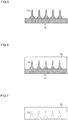
- Figs. 5 to 7 are drawings illustrating processes of fabricating the mold.
- an original plate for fabricating the mold for manufacturing the transdermal absorption sheet is fabricated first.
- an original plate 11 There are two kinds of fabrication methods of an original plate 11.
- the first method after applying photoresist onto a Si substrate, exposure and development are performed. Then, by performing etching such as RIE (reactive ion etching) or the like, an array of conical shape portions (needle-like protruding portions) 12 is fabricated on a front surface of the original plate 11.
- etching such as RIE (reactive ion etching) or the like
- an array of conical shape portions (needle-like protruding portions) 12 is fabricated on a front surface of the original plate 11. Note that, when performing the etching such as the RIE so as to form the conical shape portions on the front surface of the original plate 11, by performing the etching from an oblique direction while rotating the Si substrate, a conical shape can be formed.
- the second method is a method of forming the array of the needle-like structure portions 12 of a quadrangular pyramid or the like on the front surface of the original plate 11 by machining using a cutting tool such as a diamond tool.
- a mold 13 is fabricated from the original plate 11.
- the original plate 11 has a conical shape or a pyramid shape (a quadrangular pyramid, for example) with a sharp distal end.
- the following methods are conceivable as a method which can inexpensively manufacture the mold 13 while accurately transferring the shape of the original plate 11 to the mold 13 and releasing the mold 13 from the original plate 11.
- the first method includes the steps of: pouring a silicone resin which is prepared by adding a curing agent to PDMS (polydimethylsiloxane: Sylgard 184 made by Dow Corning Corp., Sylgard is a registered trademark), to the original plate 11; curing the resin by heat treatment at 100°C; and then releasing it from the original plate 11.
- the second method includes the steps of: pouring a UV (ultraviolet) curing resin which is curable by being irradiated with ultraviolet rays to the original plate 11; irradiating the resin with the ultraviolet rays in a nitrogen atmosphere; and then releasing it from the original plate 11.
- PDMS polydimethylsiloxane: Sylgard 184 made by Dow Corning Corp., Sylgard is a registered trademark
- the third method includes the steps of: pouring a solution prepared by dissolving plastic resin such as polystyrene or PMMA (polymethyl methacrylate) in an organic solvent to the original plate 11 to which a release agent has been applied; curing the solution by evaporating the organic solvent by drying, and then releasing it from the original plate 11.
- plastic resin such as polystyrene or PMMA (polymethyl methacrylate)
- the mold 13 on which needle-like recessed portions 15 having the inverted shape of the conical shapes or the pyramid shapes on the original plate 11 are two-dimensionally arrayed is fabricated.
- the mold 13 fabricated in this way is illustrated in Fig. 7 . Note that the mold 13 can be easily fabricated any number of times by any of the above-described methods.
- Fig. 8 illustrates an aspect of another preferable mold 13.
- the needle-like recessed portion 15 includes a tapered entrance portion 15A narrowed in a depth direction from the front surface of the mold 13, an intermediate recessed portion 15B having a fixed width in the depth direction, and a distal end recessed portion 15C tapered in the depth direction.
- a taper angle ⁇ of the taper is preferably, in a range of 10° to 20°.
- the entrance portion 15A having a tapered shape enables to easily fill a polymer solution in the needle-like recessed portion 15.
- Fig. 9 illustrates an aspect of a mold complex 18 which is more preferable when performing the manufacturing method of the transdermal absorption sheet.
- the mold complex 18 includes: the mold 13 with an air vent hole 15D formed at the distal end (bottom) of the needle-like recessed portion 15; and a gas permeable sheet 19 which is stuck to a back surface of the mold 13 and formed of a material that permeates a gas but does not permeate a liquid.
- the air vent hole 15D is formed as a through-hole that passes through the back surface of the mold 13.
- the back surface of the mold 13 refers to a surface on a side where the air vent hole 15D is formed.
- a transdermal absorption material solution filled in the needle-like recessed portions 15 is not permeated, and only the air existing in the needle-like recessed portions 15 can be discharged from the needle-like recessed portions 15.
- a transfer property (transferability) of transferring the shape of the needle-like recessed portions 15 to a transdermal absorption material is improved, and a sharper fine needle 10 can be formed.
- the range of 1 ⁇ m to 50 ⁇ m is preferable.
- a role as an air vent hole cannot be sufficiently achieved when it is shorter than 1 ⁇ m, and sharpness of the distal end portion of the molded fine needle 10 is impaired when it exceeds 50 ⁇ m.
- gas permeable sheet 19 formed of the material that permeates a gas but does not permeate a solution latex (Asahi Kasei Chemicals Corp.), for example, can be suitably used.
- the material to be used for the mold 13, in terms of a hardness distribution in a thickness direction of the mold 13, has a hardness of 1.9 MPa or higher and 100 MPa or lower as an average value of a Young's modulus at a part within 40 ⁇ m at least from a front surface side of the mold 13.
- the shape change of the mold 13 can be suppressed, and the material for forming the transdermal absorption sheet (also referred to as "transdermal absorption material", hereinafter) can be accurately filled in the needle-like recessed portions 15 of the mold 13.
- the solution is filled into the mold 13 by using a nozzle (slit nozzle) or a blade. At that time, in order not to leak the solution on a back side in the movement direction of the nozzle, it is required that the nozzle or the blade and the mold are brought into close contact with each other. Since a the mold has a variation in film thickness a base part for mounting the mold during filling of the solution has minute roughness, the mold has a variation in height and a surface roughness, each of which is 10 ⁇ m to 20 ⁇ m. On the other hand, the nozzle or the blade also has the roughness of 10 ⁇ m to 20 ⁇ m.
- the nozzle or the blade needs to be pushed into the mold by at least about 40 ⁇ m so as to deform the mold.
- each roughness is absorbed and the solution can be filled without leakage.
- the average value of the Young's modulus refers to a value obtained by separately measuring a Young's modulus for each of the layers, and calculating a weighting average value of the Young's modulus for each of the layers by using the film thickness of each layer.
- the mold is formed of: the material having a Young's modulus of "a” MPa and a thickness of A ⁇ m; the material having a Young's modulus of "b” MPa and a thickness of B ⁇ m; and the material having Young's modulus of "c” MPa and a thickness of C ⁇ m
- the average value of the Young's modulus is expressed by "(a ⁇ A + b ⁇ B + c ⁇ C) ⁇ (A + B + C)."
- the Young's modulus of each layer of the mold is measured in the following manner. First, a single mold is fabricated with a material of each layer under the same condition separately from the mold to perform filling.
- the Young's modulus is measured and calculated based on a load when displacement of 40 ⁇ m is given in a compression test for a side part of the needle-like recessed portions of the mold before filling the transdermal absorption material, using a micro-hardness meter HM2000 made by FISCHER INSTRUMENTS K.K. and a Berkovich indenter.
- the transdermal absorption material When filling the transdermal absorption material to the mold 13, in the state that the nozzle distal end portion or the blade is pressed against the front surface of the mold 13 so as to be brought into contact with the front surface of the mold 13, the transdermal absorption material is filled, and the mold 13 and a solution supply device (the nozzle or the blade) are moved, although the filing process is described later. If the Young's modulus of the front surface of the mold 13 is low, when the solution supply device is pressed, the mold 13 is deformed so that a volume of the needle-like recessed portions 15 is changed and the variation of the filling amount in the needle-like recessed portions 15 is generated.
- the average value of the Young's modulus at the part within 40 ⁇ m from the front surface side of the mold is preferably 1.9 MPa or higher, more preferably 2.5 MPa or higher, and even more preferably 3 MPa or higher. Also, it is preferably 100 MPa or lower, more preferably 50 MPa or lower, and even more preferably 35 MPa or lower.
- silicone resin or the like can be used as such a material. Since the silicone resin is durable against transfer by repetitive pressurization and detachability with a material is excellent, it can be suitably used. In addition, in the case that the manufactured sheet such as the transdermal absorption sheet is a pharmaceutical product, safety can be maintained. In addition, by using a material with high gas permeability, when filling the transdermal absorption material, the air existing in the recessed portions of the mold can be discharged from a mold side so that the needle-like protruding portions can be accurately manufactured.
- oxygen permeability representative of the gas permeability is preferably greater than 1 ⁇ 10 -12 (mL/s ⁇ m 2 ⁇ Pa), and further preferably greater than 1 ⁇ 10 -10 (mL/s ⁇ M 2 ⁇ Pa).
- the average value of the Young's modulus in the entire thickness direction can be 1.9 MPa or higher and 100 MPa or lower.
- the average value of the Young's modulus at the part over 40 ⁇ m from the front surface can be lower than the average value of the Young's modulus at the part within 40 ⁇ m.
- the mold 13 having a different (varying) Young's modulus in the thickness direction it can be fabricated by changing the resin to be poured into the original plate 11.
- the mold of the different Young's modulus may be manufactured in the following manner. After pouring the resin of the high Young's modulus (the resin to be the front surface side of the mold 13), curing and drying of the resin is performed. Then, the resin of the low Young's modulus (the resin to be the back surface side of the mold 13) is poured, and then, curing and drying of the resin is performed.
- the mold may also be manufactured by after pouring the resin of the low Young's modulus, then pouring the resin of the high Young's modulus, and simultaneously curing and drying both resins.
- the polymer solution which is a solution of the polymer resin to be the material of the transdermal absorption sheet used in the embodiment is described.
- a resin polymer used for the polymer solution it is preferable to use a resin with biocompatibility.
- a resin it is preferable to use saccharides such as glucose, maltose, pullulan, sodium chondroitin sulfate, sodium hyaluronate, hydroxypropyl cellulose or hydroxyethyl starch, protein such as gelatin, or a biodegradable polymer such as polylactic acid or lactic acid/glycolic acid copolymer.
- a gelatin-based material is adhesive with many release plates and has high gel strength as a material to be gelled, so that it can be closely attached with the release plate and a polymer sheet can be released using the release plate from the mold in a release process to be described later, and thus, it can be suitably utilized.
- a concentration is different depending on the material; however, the concentration that 10% to 50% of the resin polymer is contained in the solution is preferable.
- a solvent used in dissolution may be the one with volatility even when it is other than hot water, and methyl ethyl ketone (MEK) or alcohol or the like may be used.
- MEK methyl ethyl ketone
- the drug (medicine) to be supplied into the body according to a use can be dissolved together.
- the polymer solution in the case of using a watersoluble high polymer (gelatin or the like), it can be manufactured by dissolving watersoluble powder in water and then adding the medicine after dissolution. In the case that it is hard to be dissolved in water, heating may be performed for dissolution. While a temperature can be appropriately selected depending on a kind of a high polymer material, it is preferable to perform heating at the temperature of about 60°C or lower. In addition, in the case of using a high polymer (maltose or the like) melts with heat, the polymer solution can be manufactured by heating a raw material and the medicine to melt the row material. Regarding a heating temperature, it is preferable to perform heating at the temperature at which the raw material melts, and it is about 150°C specifically.
- the polymer solution containing the drug is called a drug-containing solution
- the polymer solution not containing the drug is called a non-drug-containing solution, as needed.
- Viscosity of the solution of the polymer resin is preferably 100 Pa ⁇ s or lower for the drug-containing solution, and more preferably 10 Pa ⁇ s or lower.
- the non-drug-containing solution it is preferably 2000 Pa ⁇ s or lower, and more preferably 1000 Pa ⁇ s or lower.
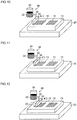
- the mold 13 having the two-dimensionally arrayed needle-like recessed portions 15 is placed on a base 20.
- a solution supply device 36 including a tank 30 that stores a drug-containing solution 22, piping 32 connected to the tank, and a nozzle 34 connected to the distal end of the piping 32 is prepared (a device preparation process).
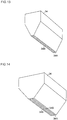
- Fig. 13 illustrates a schematic perspective view of the distal end portion of the nozzle.
- a lip portion 34A which is a flat surface and an opening 34B formed into a slit shape are provided.
- the opening 34B having the slit-shape, for example, the drug-containing solution 22 can be simultaneously filled into the plurality of needle-like recessed portions 15 constituting one column.
- the size (length and width) of the opening 34B is appropriately selected according to the number of the needle-like recessed portions 15 to be filled at one time.
- the drug-containing solution 22 can be filled into more needle-like recessed portions 15 at one time.
- productivity can be improved.
- Fig. 14 illustrates a schematic perspective view of a distal end portion of another nozzle.
- the lip portion 34A at the distal end of the nozzle 34 is provided with two openings 34B each of which is formed in a slit shape.
- the drug-containing solution 22 can be simultaneously filled into the plurality of needle-like recessed portions 15 constituting two columns.
- an elastic material or a metallic material can be used as the material used for the nozzle 34.
- the examples include Teflon (registered trademark), stainless steel, and titanium.
- a filling process is described with reference to Fig. 11 .
- the position of the opening 34B of the nozzle 34 is adjusted onto the needle-like recessed portions 15.
- the lip portion 34A of the nozzle 34 and the front surface of the mold 13 are brought into contact with each other.
- the drug-containing solution 22 is supplied from the solution supply device 36 to the mold 13, and the drug-containing solution 22 is filled into the needle-like recessed portions 15 from the opening 34B of the nozzle 34.
- the drug-containing solution 22 is simultaneously filled into the plurality of needle-like recessed portions 15 configuring one column.
- the needle-like recessed portions 15 can be filled one by one.
- the drug-containing solution 22 can be simultaneously filled into the plurality of needle-like recessed portions 15 configuring a plurality of columns, for every columns.
- the drug-containing solution 22 can be sucked by performing suction from the back surface of the mold 13, and filling of the drug-containing solution 22 into the needle-like recessed portions 15 can be accelerated.
- the solution supply device 36 is relatively moved in a direction perpendicular to a length direction of the opening 34B, and the nozzle 34 is moved to the needle-like recessed portions 15 not filled with the drug-containing solution 22.
- the position of the opening 34B of the nozzle 34 is adjusted onto the needle-like recessed portions 15.
- an example of moving the nozzle 34 is described; however, the mold 13 may be moved.
- the nozzle 34 can scrape off the drug-containing solution 22 remaining on the front surface other than the needle-like recessed portions 15 of the mold 13.
- the drug-containing solution 22 can be prevented from remaining anywhere other than the needle-like recessed portions 15 of the mold 13.
- the drug-containing solution 22 is filled into the 5 ⁇ 5 two-dimensionally arrayed needle-like recessed portions 15.
- the solution supply device 36 is moved to the adjacent 5 ⁇ 5 two-dimensionally arrayed needle-like recessed portions 15, and the filling process in Fig. 11 and the moving process in Fig. 12 are repeated.
- the drug-containing solution 22 is filled also to the adjacent 5 ⁇ 5 two-dimensionally arrayed needle-like recessed portions 15.
- an aspect may be such that the drug-containing solution 22 is filled into the needle-like recessed portions 15 while the nozzle 34 is moved, or (2) an aspect may be such that the nozzle 34 is tentatively made to stand still on the needle-like recessed portions 15 while the nozzle 34 is moved, the drug-containing solution 22 is filled, and the nozzle 34 is moved again after filling. Between the filling process and the moving process, the lip portion 34A of the nozzle 34 is in contact with the front surface of the mold 13.
- Fig. 15 is a partial enlarged view of the distal end of the nozzle 34 and the mold 13 while filling the drug-containing solution 22 into the needle-like recessed portions 15.
- a pressing force P2 which brings the nozzle 34 into contact with the front surface of the mold 13 to be equal to or greater than the pressurizing force P1 inside the nozzle 34.
- Fig. 16 is a partial enlarged view of the distal end of the nozzle 34 and the mold 13 while moving the nozzle 34.
- pressing force P3 which brings the nozzle 34 into contact with the front surface of the mold 13 be smaller than the pressing force P2 which brings the nozzle 34 into contact with the front surface of the mold 13 during filling. It is to reduce damages to the mold 13 and suppress deformation due to compression of the mold 13.
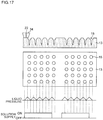
- Fig. 17 is an explanatory drawing illustrating a relation between a liquid pressure inside the nozzle and supply of the drug-containing solution.
- the supply of the drug-containing solution 22 is started before the nozzle 34 is positioned on the needle-like recessed portions 15. This enables to surely fill the drug-containing solution 22 into the needle-like recessed portions 15.
- the drug-containing solution 22 is continuously supplied to the mold 13.
- the supply of the drug-containing solution 22 to the mold 13 is stopped before the nozzle 34 is positioned on the needle-like recessed portions 15 constituting the fifth column. This enables to prevent the drug-containing solution 22 from overflowing from the needle-like recessed portions 15.
- the liquid pressure inside the nozzle 34 after the supply of the drug-containing solution 22 is started, the liquid pressure becomes high in an area where the nozzle 34 is not positioned at the needle-like recessed portions 15. On the other hand, when the nozzle 34 is positioned on the needle-like recessed portions 15, the drug-containing solution 22 is filled into the needle-like recessed portions 15, and the liquid pressure inside the nozzle 34 becomes low. Fluctuation of the liquid pressure is repeated.
- the nozzle 34 is moved to the adjacent plurality of needle-like recessed portions 15 constituted of the 5 ⁇ 5 array.
- solution supply when the nozzle 34 is moved to the adjacent plurality of needle-like recessed portions 15 constituted of the 5 ⁇ 5 array, it is preferable to stop the supply of the drug-containing solution 22.
- the drug-containing solution 22 is continuously supplied while the nozzle 34 is moved between them, the liquid pressure inside the nozzle 34 sometimes becomes too high. As a result, the drug-containing solution 22 sometimes overflows from the nozzle 34 to a part other than the needle-like recessed portions 15 of the mold 13. In order to suppress this problem, it is preferable to stop the supply of the drug-containing solution 22.
- the process advances to a process of forming a polymer sheet which has the needle-like protruding portions on the front surface, and includes a drug-containing layer configured by the drug-containing solution 22 and a non-drug-containing layer configured by the non-drug-containing solution.
- the needle-like protruding portion has the inverted shape of the needle-like recessed portion.
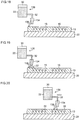
- FIGs. 18 to 20 are drawings illustrating the process of filling the drug-containing solution 22 to the needle-like recessed portions 15 using a solution supply device 136 including a blade 138.
- the mold 13 having the two-dimensionally arrayed needle-like recessed portions 15 is placed on the base 20.
- two sets of the 5 ⁇ 5 two-dimensionally arrayed needle-like recessed portions 15 are formed.
- the solution supply device 136 including the tank 30 that stores the drug-containing solution 22, the piping 32 connected to the tank 30, a nozzle 134 connected to the distal end of the piping 32, and the blade 138 is prepared.
- the drug-containing solution 22 is supplied from the solution supply device 136 to the mold 13 (solution supply process).
- the nozzle 134 has an opening formed into a slit shape as illustrated in Fig. 13 , and the drug-containing solution 22 can be supplied between the plurality of needle-like recessed portions 15 constituting one column and the blade 138.
- a supply method of the drug-containing solution 22 to the mold 13 is not limited to such a nozzle having the opening in the slit shape. Supply can also be performed by a dispenser or the like.
- the solution supply device 136 is moved relative to the mold 13 while bringing the blade 138 and the front surface of the mold 13 into contact with each other, and the drug-containing solution 22 supplied onto the mold 13 is moved to the needle-like recessed portions 15 not filled with the drug-containing solution 22 with the blade 138 (moving process).
- the blade 138 When moving the solution supply device 136, since it is moved while bringing the blade 138 and the front surface of the mold 13 into contact with each other, the blade 138 can scrape off the drug-containing solution 22 remaining on the front surface other than the needle-like recessed portions 15 of the mold 13.
- the drug-containing solution 22 can be prevented from remaining anywhere other than the needle-like recessed portions 15 of the mold 13. Note that, in the embodiment, the example in which the solution supply device 136 is moved is described; however, the mold 13 may be moved.
- the solution supply device 136 illustrated in Figs. 18 to 20 is integrated with the blade 138; however, they may be separately configured.
- the material used for the blade 138 As a material used for the blade 138, the material similar to the material used for the nozzle 34 can be used, and the elastic material or the metallic material can be used.
- the examples include Teflon (registered trademark), stainless steel, and titanium.
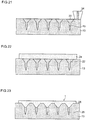
- FIG. 21 illustrates the process of filling the drug-containing solution 22 by bringing the distal end portion of the nozzle 34 into contact with the front surface of the mold 13.
- a non-drug-containing solution 24 is applied onto the drug-containing solution 22 by a dispenser or the like. In addition to coating by the dispenser, bar coating, spin coating and coating by a spray or the like can be adopted.
- a polymer sheet 1 composed of a drug-containing layer 26 and a non-drug-containing layer 28 is formed.
- the drug-containing solution 22 is filled in the needle-like recessed portions 15 of the mold 13.
- filling may be performed by bringing the distal end portion of the nozzle 34 into contact with the mold 13, or filling may be performed by bringing the blade into contact with the mold 13.
- the drug-containing solution 22 is dried and cured to form the drug-containing layer 26 inside the needle-like recessed portions 15.
- the drug-containing solution 22 can be filled to the distal end of the needle-like recessed portions 15.
- the non-drug-containing solution 24 is applied onto the drug-containing layer 26 by the dispenser.
- the dispenser bar coating, spin coating and coating by a spray or the like can be adopted. Since the drug-containing layer 26 is cured, the drug inside the drug-containing layer 26 can be suppressed from spreading to the non-drug-containing solution 24.
- the polymer sheet 1 composed of the drug-containing layer 26 and the non-drug-containing layer 28 is formed.
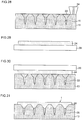
- a third aspect is described with reference to Figs. 28 to 31 .
- the drug-containing solution 22 is filled in the needle-like recessed portions 15 of the mold 13.
- filling may be performed in the state of bringing the distal end portion of the nozzle or the blade into contact with the mold 13.
- the non-drug-containing solution 24 is applied on a separate support (another support) 29.
- a material of the support 29 for example, polyethylene, polyethylene terephthalate, polycarbonate, polypropylene, an acrylic resin, and triacetylcellulose or the like may be used; however, the material is not limited to them.
- the non-drug-containing solution 24 formed on the support 29 is piled up (overlaid) on the mold 13 in which the drug-containing solution 22 has been filled in the needle-like recessed portions 15.
- the polymer sheet 1 composed of the drug-containing layer 26 and the non-drug-containing layer 28 is formed.
- a drying and curing process is a process of curing the drug-containing solution 22 inside the needle-like recessed portions 15 and/or the non-drug-containing solution 24 by drying the drug-containing solution 22 containing the solvent and/or the non-drug-containing solution 24.
- the process advances to a release process of releasing the polymer sheet 1 from the mold 13.
- the method of releasing the polymer sheet 1 from the mold 13 is not limited in particular. Upon releasing, it is desired that the needle-like protruding portions do not bend or get broken. Specifically, as illustrated in Fig. 32 , a sheet-like release plate 40 where an adhesive adhesion layer is formed is stuck onto the polymer sheet 1, and then release can be performed in a manner such that the release plate 40 is peeled off from an end portion. However, by that method, there is a possibility that the needle-like protruding portions bend. Therefore, as illustrated in Fig. 33 , the following method can be adopted in which a sucker (not shown in the figure) is placed on the polymer sheet 1, and then the release plate 40 is vertically pulling up while sucking it by the air can be applied.
- a sucker not shown in the figure
- the mold 13 is composed of a material in which the Young's modulus is increased on the front surface side (the side where the transdermal absorption material is filled) of the mold and the Young's modulus is decreased on the back surface side (the distal end side of the needle-like protruding portions of the transdermal absorption sheet) of the mold.
- Fig. 34 illustrates a transdermal absorption sheet 2 which is composed of the polymer sheet 1 released from the mold 13.
- the transdermal absorption sheet 2 includes the release plate 40, the drug-containing layer 26 formed on the release plate 40, and the layer 28 practically not containing the drug.
- Each needle-like protruding portion 4 of the transdermal absorption sheet 2 is configured by a conical base portion 5 and a needle portion 6 on the conical base portion 5, and the needle portion 6 mainly includes a needle portion having a conical shape or the pyramid shape and a body portion having a columnar shape or a rectangular columnar shape.
- the shape of the needle-like protruding portion 4 is not limited thereto.
- the original plate 11 was fabricated by machining so that the needle-like structure portions 12 each having a needle-like structure in the two-dimensional array of 10 columns ⁇ 10 rows at a pitch L of 1000 ⁇ m, on a front surface of a smooth Ni plate with a side length of 40 mm.
- the needle-like structure has a shape in which a cone 52 with a diameter D2 of 300 ⁇ m and a height H2 of 500 ⁇ m is formed on a truncated cone 50 with a diameter D1 of 500 ⁇ m at the bottom surface and a height HI of 150 ⁇ m, as illustrated in Part (A) and Part (B) in Fig. 35 .
- the materials the composite film (multilayer) includes: various kinds of silicone resin (SILASTIC MDX4-4210 made by Dow Corning Corp., MED-6019, MED-6015, MED-6010 made by Nusil Technology LLC); and the material prepared by surface-modifying zirconia particles using a silane coupling agent (Z-6040, Z-6043, or Z-6011, made by Dow Corning Corp.) in a water and methanol mixed solution containing 1 mass% of the silane coupling agent, filtrating the resultant, drying and comminuting the surface modified zirconia particles obtained by the filtration, and dispersing the surface modified zirconia particles in the silicone resin. Then, the composite film was formed from the prepared materials on the original plate 11 having the needle-like structure portions 12.
- silicone resin SILASTIC MDX4-4210 made by Dow Corning Corp., MED-6019, MED-6015, MED-6010 made by Nusil Technology LLC
- silane coupling agent Z-6040, Z-6043, or Z-6011, made by
- the composite film was thermally cured for five hours at 80°C to 200°C, and released from the original plate 11. Thereby an inverse article of the needle-like structure portions 12 was fabricated.
- the side where the opening of each needle-like recessed portion was wide was defined as the front surface of the mold and the surface including the through-holes (air vent holes) with the diameter of 30 ⁇ m was defined as the back surface of the mold.
- the mold with a rigidity distribution in the thickness direction was fabricated in the following manner. First, a film having a film thickness 40 ⁇ m and the Young's modulus which was greater than SILASTIC MDX4-4210 made by Dow Corning Corp. was fabricated on the original plate 11 as a mold front surface layer, and then, a film using SILASTIC MDX4-4210 made by Dow Corning Corp. was laminated as a mold back surface layer. The Young's modulus of the surface layer of the mold was increased by: adding MED-6019, MED-6015, MED-6010 made by Nusil Technology LLC, or a mixture of the three, or the mixture of the three after addition of the zirconia particles surface-modified by the silane coupling agent made by Dow Corning Corp. further to the mixture of the three; and adjusting a curing temperature and curing time.
- the drug-containing solution was prepared in the following manner. Hydroxyethyl starch (made by Fresenius Kabi AG) was dissolved with water and prepared into an aqueous solution of 8%. Then, to the resultant solution, 2 mass% of human serum albumin (made by Wako Pure Chemical Industries, Ltd.) and 0.7 mass% of Evans blue pigments (made by Wako Pure Chemical Industries, Ltd.) were added as the drug.
- a gas permeable film (NTF-8031 made by NITTO DENKO CORPORATION) with a side length of 15 mm was placed on a horizontal vacuum base, and the mold was placed on it such that the front surface is turned up.
- the gas permeable film and the mold were fixed to the vacuum base by sucking them from a mold back surface direction with a suction pressure of 50 kPa.
- a nozzle made of the stainless steel having a shape as illustrated in Fig. 13 was prepared. At the center of the lip portion having a length of 20 mm and a width of 2 mm, the slip shaped opening having a length of 12 mm and a width of 0.2 mm was formed. The nozzle was attached to a syringe.
- the nozzle was adjusted such that the opening was parallel with the first column configured by the plurality of needle-like recessed portions formed on the front surface of the mold.
- the nozzle was pressed to the mold with the pressure of 1.37 ⁇ 10 -2 N/mm 2 .
- the drug-containing solution was discharged from the opening for 10 seconds at 0.31 ⁇ L/sec by a dispenser.
- the movement of the nozzle was stopped at a position at the interval of 2 mm from the tenth column of the plurality of two-dimensionally arrayed needle-like recessed portions, in the direction opposite to the ninth column, and the nozzle was separated from the mold.
- the resultant was dried for 30 minutes at 30°C and 40 RH% inside a thermohygrostat bath to form the drug-containing layer. After drying, by imparting a tape with low adhesive power to the front surface of the mold and peeling the tape off from the mold, all the drug-containing layer stuck to the part other than the needle-like recessed portions of the mold was removed.
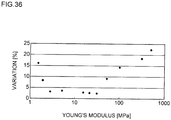
- the mold was fabricated so as to have a Young's modulus varying in the range from 1.5 MPa to 501.6 MPa as illustrated in Table 1.
- a single mold was fabricated under the same condition separately from the mold to perform filling, and the Young's modulus of the mold was measured and calculated from the load when displacement of 40 ⁇ m was given to the mold, in the compression test for the side part of the needle-like recessed portions of the mold before filling the transdermal absorption material, using the micro-hardness meter HM2000 made by FISCHER INSTRUMENTS K.K. and the Berkovich indenter.
- the transdermal absorption sheet was manufactured for five times, the filling amount was measured for each time, and the variation of the filling amount was evaluated.
Landscapes
- Engineering & Computer Science (AREA)
- Mechanical Engineering (AREA)
- Health & Medical Sciences (AREA)
- Manufacturing & Machinery (AREA)
- Heart & Thoracic Surgery (AREA)
- Animal Behavior & Ethology (AREA)
- Anesthesiology (AREA)
- Biomedical Technology (AREA)
- Dermatology (AREA)
- Hematology (AREA)
- Life Sciences & Earth Sciences (AREA)
- Medical Informatics (AREA)
- General Health & Medical Sciences (AREA)
- Public Health (AREA)
- Veterinary Medicine (AREA)
- Media Introduction/Drainage Providing Device (AREA)
- Medicinal Preparation (AREA)
- Materials For Medical Uses (AREA)
Applications Claiming Priority (1)
| Application Number | Priority Date | Filing Date | Title |
|---|---|---|---|
| JP2016068197A JP2017176460A (ja) | 2016-03-30 | 2016-03-30 | 針状凸部を有するシートの製造方法 |
Publications (2)
| Publication Number | Publication Date |
|---|---|
| EP3225277A1 true EP3225277A1 (fr) | 2017-10-04 |
| EP3225277B1 EP3225277B1 (fr) | 2019-02-20 |
Family
ID=58464260
Family Applications (1)
| Application Number | Title | Priority Date | Filing Date |
|---|---|---|---|
| EP17163663.2A Not-in-force EP3225277B1 (fr) | 2016-03-30 | 2017-03-29 | Procédé de fabrication de feuille présentant des parties saillantes en forme d'aiguilles |
Country Status (3)
| Country | Link |
|---|---|
| US (1) | US20170282417A1 (fr) |
| EP (1) | EP3225277B1 (fr) |
| JP (1) | JP2017176460A (fr) |
Cited By (1)
| Publication number | Priority date | Publication date | Assignee | Title |
|---|---|---|---|---|
| WO2026020198A1 (fr) * | 2024-07-24 | 2026-01-29 | Vaxxas Pty Limited | Fabrication de réseaux de microprojection à haute densité |
Families Citing this family (10)
| Publication number | Priority date | Publication date | Assignee | Title |
|---|---|---|---|---|
| GB0402131D0 (en) | 2004-01-30 | 2004-03-03 | Isis Innovation | Delivery method |
| WO2013053022A1 (fr) | 2011-10-12 | 2013-04-18 | The University Of Queensland | Dispositif de distribution |
| AU2016214968B2 (en) | 2015-02-02 | 2021-02-25 | Vaxxas Pty Limited | Microprojection array applicator and method |
| WO2017045031A1 (fr) | 2015-09-18 | 2017-03-23 | Vaxxas Pty Limited | Réseaux de micro-saillies comportant des micro-saillies ayant des profils à surface élevée |
| EP3355981B1 (fr) | 2015-09-28 | 2025-11-19 | Vaxxas Pty Limited | Réseau de microsaillies ayant des propriétés de pénétration de la peau améliorées et procédés associés |
| EP3606760B1 (fr) | 2017-03-31 | 2023-09-27 | Vaxxas Pty Limited | Dispositif et procédé de revêtement de surfaces |
| US11175128B2 (en) | 2017-06-13 | 2021-11-16 | Vaxxas Pty Limited | Quality control of substrate coatings |
| US11464957B2 (en) | 2017-08-04 | 2022-10-11 | Vaxxas Pty Limited | Compact high mechanical energy storage and low trigger force actuator for the delivery of microprojection array patches (MAP) |
| WO2019146277A1 (fr) * | 2018-01-25 | 2019-08-01 | 富士フイルム株式会社 | Méthode de production de feuille d'absorption transdermique |
| KR102247267B1 (ko) * | 2019-12-27 | 2021-05-03 | 대구가톨릭대학교산학협력단 | 마이크로 니들 제조 장치 및 방법 |
Citations (6)
| Publication number | Priority date | Publication date | Assignee | Title |
|---|---|---|---|---|
| JP2009241358A (ja) * | 2008-03-31 | 2009-10-22 | Fujifilm Corp | ニードルシートの製造方法 |
| EP2283809A1 (fr) * | 2009-06-03 | 2011-02-16 | BioSerenTach Co., Ltd. | Puce de micro-aiguilles à substrat poreux et son procédé de fabrication |
| JP2011078617A (ja) | 2009-10-08 | 2011-04-21 | Toray Eng Co Ltd | マイクロニードルシートのスタンパー及びその製造方法とそれを用いたマイクロニードルの製造方法 |
| US20140034838A1 (en) * | 2001-06-05 | 2014-02-06 | Mikro Systems, Inc. | Methods for Manufacturing Three-Dimensional Devices and Devices Created Thereby |
| WO2014077242A1 (fr) | 2012-11-13 | 2014-05-22 | 富士フイルム株式会社 | Procédé de fabrication d'une structure stratiforme d'absorption transdermique |
| JP2015100659A (ja) * | 2013-11-28 | 2015-06-04 | 日本写真印刷株式会社 | マイクロニードルシートの製造方法 |
Family Cites Families (9)
| Publication number | Priority date | Publication date | Assignee | Title |
|---|---|---|---|---|
| JPH04353406A (ja) * | 1991-05-30 | 1992-12-08 | Olympus Optical Co Ltd | プラスチック成形型 |
| JP2007130030A (ja) * | 2005-11-08 | 2007-05-31 | Toray Ind Inc | マイクロニードル、マイクロニードル集合体及びその製造方法 |
| JP5082239B2 (ja) * | 2005-12-28 | 2012-11-28 | 大日本印刷株式会社 | 触媒層−電解質膜積層体及びその製造方法 |
| US20090096136A1 (en) * | 2007-10-12 | 2009-04-16 | The Regents Of The University Of California | Thiol-ene based poly(alkylsiloxane) materials |
| CH699237B1 (de) * | 2008-07-24 | 2011-07-15 | Alpla Werke | Kunststoffformulierung und Verfahren zur Herstellung von Kunststoffflaschen in einem Zweistufen-Streckblasprozess. |
| JP2012069919A (ja) * | 2010-08-25 | 2012-04-05 | Toshiba Corp | 半導体装置の製造方法 |
| JP2015116335A (ja) * | 2013-12-18 | 2015-06-25 | 旭化成ケミカルズ株式会社 | 経皮薬剤投与システム及び経皮薬剤投与システムの製造方法 |
| JP6035273B2 (ja) * | 2014-04-07 | 2016-11-30 | 凸版印刷株式会社 | マイクロニードルチップ履歴管理システム |
| JP6207459B2 (ja) * | 2014-05-15 | 2017-10-04 | 富士フイルム株式会社 | 経皮吸収シートの製造方法 |
-
2016
- 2016-03-30 JP JP2016068197A patent/JP2017176460A/ja active Pending
-
2017
- 2017-03-29 EP EP17163663.2A patent/EP3225277B1/fr not_active Not-in-force
- 2017-03-29 US US15/472,287 patent/US20170282417A1/en not_active Abandoned
Patent Citations (7)
| Publication number | Priority date | Publication date | Assignee | Title |
|---|---|---|---|---|
| US20140034838A1 (en) * | 2001-06-05 | 2014-02-06 | Mikro Systems, Inc. | Methods for Manufacturing Three-Dimensional Devices and Devices Created Thereby |
| JP2009241358A (ja) * | 2008-03-31 | 2009-10-22 | Fujifilm Corp | ニードルシートの製造方法 |
| EP2283809A1 (fr) * | 2009-06-03 | 2011-02-16 | BioSerenTach Co., Ltd. | Puce de micro-aiguilles à substrat poreux et son procédé de fabrication |
| JP2011078617A (ja) | 2009-10-08 | 2011-04-21 | Toray Eng Co Ltd | マイクロニードルシートのスタンパー及びその製造方法とそれを用いたマイクロニードルの製造方法 |
| WO2014077242A1 (fr) | 2012-11-13 | 2014-05-22 | 富士フイルム株式会社 | Procédé de fabrication d'une structure stratiforme d'absorption transdermique |
| EP2921202A1 (fr) * | 2012-11-13 | 2015-09-23 | FUJIFILM Corporation | Procédé de fabrication d'une structure stratiforme d'absorption transdermique |
| JP2015100659A (ja) * | 2013-11-28 | 2015-06-04 | 日本写真印刷株式会社 | マイクロニードルシートの製造方法 |
Cited By (1)
| Publication number | Priority date | Publication date | Assignee | Title |
|---|---|---|---|---|
| WO2026020198A1 (fr) * | 2024-07-24 | 2026-01-29 | Vaxxas Pty Limited | Fabrication de réseaux de microprojection à haute densité |
Also Published As
| Publication number | Publication date |
|---|---|
| EP3225277B1 (fr) | 2019-02-20 |
| US20170282417A1 (en) | 2017-10-05 |
| JP2017176460A (ja) | 2017-10-05 |
Similar Documents
| Publication | Publication Date | Title |
|---|---|---|
| EP3225277B1 (fr) | Procédé de fabrication de feuille présentant des parties saillantes en forme d'aiguilles | |
| CN104780967B (zh) | 经皮吸收片的制造方法 | |
| EP3144030B1 (fr) | Feuille d'absorption transdermique et procédé de fabrication de feuille d'absorption transdermique | |
| JP6207459B2 (ja) | 経皮吸収シートの製造方法 | |
| JP4885816B2 (ja) | 機能性膜の製造方法および製造装置 | |
| EP3248593B1 (fr) | Procédé de production d'une feuille d'absorption transdermique | |
| US10814118B2 (en) | Transdermal absorption sheet | |
| EP3266493B1 (fr) | Feuille d'absorption transdermique et procédé de fabrication correspondant | |
| JP6751035B2 (ja) | 針状凸部を有するシートの製造方法 | |
| EP3278834B1 (fr) | Procédé de production d'une feuille d'absorption transdermique | |
| US10456569B2 (en) | Method of producing transdermal absorption sheet for medical use |
Legal Events
| Date | Code | Title | Description |
|---|---|---|---|
| PUAI | Public reference made under article 153(3) epc to a published international application that has entered the european phase |
Free format text: ORIGINAL CODE: 0009012 |
|
| STAA | Information on the status of an ep patent application or granted ep patent |
Free format text: STATUS: THE APPLICATION HAS BEEN PUBLISHED |
|
| AK | Designated contracting states |
Kind code of ref document: A1 Designated state(s): AL AT BE BG CH CY CZ DE DK EE ES FI FR GB GR HR HU IE IS IT LI LT LU LV MC MK MT NL NO PL PT RO RS SE SI SK SM TR |
|
| AX | Request for extension of the european patent |
Extension state: BA ME |
|
| STAA | Information on the status of an ep patent application or granted ep patent |
Free format text: STATUS: REQUEST FOR EXAMINATION WAS MADE |
|
| 17P | Request for examination filed |
Effective date: 20180320 |
|
| RBV | Designated contracting states (corrected) |
Designated state(s): AL AT BE BG CH CY CZ DE DK EE ES FI FR GB GR HR HU IE IS IT LI LT LU LV MC MK MT NL NO PL PT RO RS SE SI SK SM TR |
|
| GRAP | Despatch of communication of intention to grant a patent |
Free format text: ORIGINAL CODE: EPIDOSNIGR1 |
|
| STAA | Information on the status of an ep patent application or granted ep patent |
Free format text: STATUS: GRANT OF PATENT IS INTENDED |
|
| INTG | Intention to grant announced |
Effective date: 20180907 |
|
| RIN1 | Information on inventor provided before grant (corrected) |
Inventor name: KATAGIRI, YOSHINOBU Inventor name: OKANO, KEIO |
|
| GRAS | Grant fee paid |
Free format text: ORIGINAL CODE: EPIDOSNIGR3 |
|
| GRAA | (expected) grant |
Free format text: ORIGINAL CODE: 0009210 |
|
| STAA | Information on the status of an ep patent application or granted ep patent |
Free format text: STATUS: THE PATENT HAS BEEN GRANTED |
|
| AK | Designated contracting states |
Kind code of ref document: B1 Designated state(s): AL AT BE BG CH CY CZ DE DK EE ES FI FR GB GR HR HU IE IS IT LI LT LU LV MC MK MT NL NO PL PT RO RS SE SI SK SM TR |
|
| REG | Reference to a national code |
Ref country code: GB Ref legal event code: FG4D |
|
| REG | Reference to a national code |
Ref country code: CH Ref legal event code: EP |
|
| REG | Reference to a national code |
Ref country code: DE Ref legal event code: R096 Ref document number: 602017002170 Country of ref document: DE |
|
| REG | Reference to a national code |
Ref country code: AT Ref legal event code: REF Ref document number: 1097386 Country of ref document: AT Kind code of ref document: T Effective date: 20190315 |
|
| REG | Reference to a national code |
Ref country code: IE Ref legal event code: FG4D |
|
| REG | Reference to a national code |
Ref country code: LT Ref legal event code: MG4D Ref country code: NL Ref legal event code: MP Effective date: 20190220 |
|
| PG25 | Lapsed in a contracting state [announced via postgrant information from national office to epo] |
Ref country code: LT Free format text: LAPSE BECAUSE OF FAILURE TO SUBMIT A TRANSLATION OF THE DESCRIPTION OR TO PAY THE FEE WITHIN THE PRESCRIBED TIME-LIMIT Effective date: 20190220 Ref country code: ES Free format text: LAPSE BECAUSE OF FAILURE TO SUBMIT A TRANSLATION OF THE DESCRIPTION OR TO PAY THE FEE WITHIN THE PRESCRIBED TIME-LIMIT Effective date: 20190220 Ref country code: SE Free format text: LAPSE BECAUSE OF FAILURE TO SUBMIT A TRANSLATION OF THE DESCRIPTION OR TO PAY THE FEE WITHIN THE PRESCRIBED TIME-LIMIT Effective date: 20190220 Ref country code: PT Free format text: LAPSE BECAUSE OF FAILURE TO SUBMIT A TRANSLATION OF THE DESCRIPTION OR TO PAY THE FEE WITHIN THE PRESCRIBED TIME-LIMIT Effective date: 20190620 Ref country code: NO Free format text: LAPSE BECAUSE OF FAILURE TO SUBMIT A TRANSLATION OF THE DESCRIPTION OR TO PAY THE FEE WITHIN THE PRESCRIBED TIME-LIMIT Effective date: 20190520 Ref country code: FI Free format text: LAPSE BECAUSE OF FAILURE TO SUBMIT A TRANSLATION OF THE DESCRIPTION OR TO PAY THE FEE WITHIN THE PRESCRIBED TIME-LIMIT Effective date: 20190220 |
|
| PG25 | Lapsed in a contracting state [announced via postgrant information from national office to epo] |
Ref country code: RS Free format text: LAPSE BECAUSE OF FAILURE TO SUBMIT A TRANSLATION OF THE DESCRIPTION OR TO PAY THE FEE WITHIN THE PRESCRIBED TIME-LIMIT Effective date: 20190220 Ref country code: HR Free format text: LAPSE BECAUSE OF FAILURE TO SUBMIT A TRANSLATION OF THE DESCRIPTION OR TO PAY THE FEE WITHIN THE PRESCRIBED TIME-LIMIT Effective date: 20190220 Ref country code: NL Free format text: LAPSE BECAUSE OF FAILURE TO SUBMIT A TRANSLATION OF THE DESCRIPTION OR TO PAY THE FEE WITHIN THE PRESCRIBED TIME-LIMIT Effective date: 20190220 Ref country code: LV Free format text: LAPSE BECAUSE OF FAILURE TO SUBMIT A TRANSLATION OF THE DESCRIPTION OR TO PAY THE FEE WITHIN THE PRESCRIBED TIME-LIMIT Effective date: 20190220 Ref country code: BG Free format text: LAPSE BECAUSE OF FAILURE TO SUBMIT A TRANSLATION OF THE DESCRIPTION OR TO PAY THE FEE WITHIN THE PRESCRIBED TIME-LIMIT Effective date: 20190520 Ref country code: IS Free format text: LAPSE BECAUSE OF FAILURE TO SUBMIT A TRANSLATION OF THE DESCRIPTION OR TO PAY THE FEE WITHIN THE PRESCRIBED TIME-LIMIT Effective date: 20190620 Ref country code: GR Free format text: LAPSE BECAUSE OF FAILURE TO SUBMIT A TRANSLATION OF THE DESCRIPTION OR TO PAY THE FEE WITHIN THE PRESCRIBED TIME-LIMIT Effective date: 20190521 |
|
| REG | Reference to a national code |
Ref country code: AT Ref legal event code: MK05 Ref document number: 1097386 Country of ref document: AT Kind code of ref document: T Effective date: 20190220 |
|
| PG25 | Lapsed in a contracting state [announced via postgrant information from national office to epo] |
Ref country code: EE Free format text: LAPSE BECAUSE OF FAILURE TO SUBMIT A TRANSLATION OF THE DESCRIPTION OR TO PAY THE FEE WITHIN THE PRESCRIBED TIME-LIMIT Effective date: 20190220 Ref country code: DK Free format text: LAPSE BECAUSE OF FAILURE TO SUBMIT A TRANSLATION OF THE DESCRIPTION OR TO PAY THE FEE WITHIN THE PRESCRIBED TIME-LIMIT Effective date: 20190220 Ref country code: SK Free format text: LAPSE BECAUSE OF FAILURE TO SUBMIT A TRANSLATION OF THE DESCRIPTION OR TO PAY THE FEE WITHIN THE PRESCRIBED TIME-LIMIT Effective date: 20190220 Ref country code: AL Free format text: LAPSE BECAUSE OF FAILURE TO SUBMIT A TRANSLATION OF THE DESCRIPTION OR TO PAY THE FEE WITHIN THE PRESCRIBED TIME-LIMIT Effective date: 20190220 Ref country code: CZ Free format text: LAPSE BECAUSE OF FAILURE TO SUBMIT A TRANSLATION OF THE DESCRIPTION OR TO PAY THE FEE WITHIN THE PRESCRIBED TIME-LIMIT Effective date: 20190220 Ref country code: IT Free format text: LAPSE BECAUSE OF FAILURE TO SUBMIT A TRANSLATION OF THE DESCRIPTION OR TO PAY THE FEE WITHIN THE PRESCRIBED TIME-LIMIT Effective date: 20190220 Ref country code: RO Free format text: LAPSE BECAUSE OF FAILURE TO SUBMIT A TRANSLATION OF THE DESCRIPTION OR TO PAY THE FEE WITHIN THE PRESCRIBED TIME-LIMIT Effective date: 20190220 |
|
| REG | Reference to a national code |
Ref country code: DE Ref legal event code: R097 Ref document number: 602017002170 Country of ref document: DE |
|
| PG25 | Lapsed in a contracting state [announced via postgrant information from national office to epo] |
Ref country code: SM Free format text: LAPSE BECAUSE OF FAILURE TO SUBMIT A TRANSLATION OF THE DESCRIPTION OR TO PAY THE FEE WITHIN THE PRESCRIBED TIME-LIMIT Effective date: 20190220 Ref country code: LU Free format text: LAPSE BECAUSE OF NON-PAYMENT OF DUE FEES Effective date: 20190329 Ref country code: PL Free format text: LAPSE BECAUSE OF FAILURE TO SUBMIT A TRANSLATION OF THE DESCRIPTION OR TO PAY THE FEE WITHIN THE PRESCRIBED TIME-LIMIT Effective date: 20190220 |
|
| REG | Reference to a national code |
Ref country code: BE Ref legal event code: MM Effective date: 20190331 |
|
| PLBE | No opposition filed within time limit |
Free format text: ORIGINAL CODE: 0009261 |
|
| STAA | Information on the status of an ep patent application or granted ep patent |
Free format text: STATUS: NO OPPOSITION FILED WITHIN TIME LIMIT |
|
| PG25 | Lapsed in a contracting state [announced via postgrant information from national office to epo] |
Ref country code: AT Free format text: LAPSE BECAUSE OF FAILURE TO SUBMIT A TRANSLATION OF THE DESCRIPTION OR TO PAY THE FEE WITHIN THE PRESCRIBED TIME-LIMIT Effective date: 20190220 Ref country code: MC Free format text: LAPSE BECAUSE OF FAILURE TO SUBMIT A TRANSLATION OF THE DESCRIPTION OR TO PAY THE FEE WITHIN THE PRESCRIBED TIME-LIMIT Effective date: 20190220 |
|
| 26N | No opposition filed |
Effective date: 20191121 |
|
| PG25 | Lapsed in a contracting state [announced via postgrant information from national office to epo] |
Ref country code: IE Free format text: LAPSE BECAUSE OF NON-PAYMENT OF DUE FEES Effective date: 20190329 |
|
| PG25 | Lapsed in a contracting state [announced via postgrant information from national office to epo] |
Ref country code: BE Free format text: LAPSE BECAUSE OF NON-PAYMENT OF DUE FEES Effective date: 20190331 Ref country code: SI Free format text: LAPSE BECAUSE OF FAILURE TO SUBMIT A TRANSLATION OF THE DESCRIPTION OR TO PAY THE FEE WITHIN THE PRESCRIBED TIME-LIMIT Effective date: 20190220 |
|
| PG25 | Lapsed in a contracting state [announced via postgrant information from national office to epo] |
Ref country code: TR Free format text: LAPSE BECAUSE OF FAILURE TO SUBMIT A TRANSLATION OF THE DESCRIPTION OR TO PAY THE FEE WITHIN THE PRESCRIBED TIME-LIMIT Effective date: 20190220 |
|
| PGFP | Annual fee paid to national office [announced via postgrant information from national office to epo] |
Ref country code: DE Payment date: 20200317 Year of fee payment: 4 |
|
| PG25 | Lapsed in a contracting state [announced via postgrant information from national office to epo] |
Ref country code: MT Free format text: LAPSE BECAUSE OF NON-PAYMENT OF DUE FEES Effective date: 20190329 |
|
| PGFP | Annual fee paid to national office [announced via postgrant information from national office to epo] |
Ref country code: FR Payment date: 20200214 Year of fee payment: 4 |
|
| REG | Reference to a national code |
Ref country code: CH Ref legal event code: PL |
|
| PG25 | Lapsed in a contracting state [announced via postgrant information from national office to epo] |
Ref country code: LI Free format text: LAPSE BECAUSE OF NON-PAYMENT OF DUE FEES Effective date: 20200331 Ref country code: CH Free format text: LAPSE BECAUSE OF NON-PAYMENT OF DUE FEES Effective date: 20200331 |
|
| PG25 | Lapsed in a contracting state [announced via postgrant information from national office to epo] |
Ref country code: CY Free format text: LAPSE BECAUSE OF FAILURE TO SUBMIT A TRANSLATION OF THE DESCRIPTION OR TO PAY THE FEE WITHIN THE PRESCRIBED TIME-LIMIT Effective date: 20190220 |
|
| PG25 | Lapsed in a contracting state [announced via postgrant information from national office to epo] |
Ref country code: HU Free format text: LAPSE BECAUSE OF FAILURE TO SUBMIT A TRANSLATION OF THE DESCRIPTION OR TO PAY THE FEE WITHIN THE PRESCRIBED TIME-LIMIT; INVALID AB INITIO Effective date: 20170329 |
|
| REG | Reference to a national code |
Ref country code: DE Ref legal event code: R119 Ref document number: 602017002170 Country of ref document: DE |
|
| GBPC | Gb: european patent ceased through non-payment of renewal fee |
Effective date: 20210329 |
|
| PG25 | Lapsed in a contracting state [announced via postgrant information from national office to epo] |
Ref country code: GB Free format text: LAPSE BECAUSE OF NON-PAYMENT OF DUE FEES Effective date: 20210329 Ref country code: FR Free format text: LAPSE BECAUSE OF NON-PAYMENT OF DUE FEES Effective date: 20210331 Ref country code: DE Free format text: LAPSE BECAUSE OF NON-PAYMENT OF DUE FEES Effective date: 20211001 |
|
| PG25 | Lapsed in a contracting state [announced via postgrant information from national office to epo] |
Ref country code: MK Free format text: LAPSE BECAUSE OF FAILURE TO SUBMIT A TRANSLATION OF THE DESCRIPTION OR TO PAY THE FEE WITHIN THE PRESCRIBED TIME-LIMIT Effective date: 20190220 |