EP3234110B1 - PROCÉDÉS DE GÉNÉRATION DE CELLULES ß DÉRIVÉES DE CELLULES SOUCHES ET LEURS UTILISATIONS - Google Patents
PROCÉDÉS DE GÉNÉRATION DE CELLULES ß DÉRIVÉES DE CELLULES SOUCHES ET LEURS UTILISATIONS Download PDFInfo
- Publication number
- EP3234110B1 EP3234110B1 EP15871229.9A EP15871229A EP3234110B1 EP 3234110 B1 EP3234110 B1 EP 3234110B1 EP 15871229 A EP15871229 A EP 15871229A EP 3234110 B1 EP3234110 B1 EP 3234110B1
- Authority
- EP
- European Patent Office
- Prior art keywords
- cells
- cell
- jnk
- pancreatic
- agent
- Prior art date
- Legal status (The legal status is an assumption and is not a legal conclusion. Google has not performed a legal analysis and makes no representation as to the accuracy of the status listed.)
- Active
Links
Images

Classifications
-
- C—CHEMISTRY; METALLURGY
- C12—BIOCHEMISTRY; BEER; SPIRITS; WINE; VINEGAR; MICROBIOLOGY; ENZYMOLOGY; MUTATION OR GENETIC ENGINEERING
- C12N—MICROORGANISMS OR ENZYMES; COMPOSITIONS THEREOF; PROPAGATING, PRESERVING, OR MAINTAINING MICROORGANISMS; MUTATION OR GENETIC ENGINEERING; CULTURE MEDIA
- C12N5/00—Undifferentiated human, animal or plant cells, e.g. cell lines; Tissues; Cultivation or maintenance thereof; Culture media therefor
- C12N5/06—Animal cells or tissues; Human cells or tissues
- C12N5/0602—Vertebrate cells
- C12N5/0676—Pancreatic cells
-
- A—HUMAN NECESSITIES
- A61—MEDICAL OR VETERINARY SCIENCE; HYGIENE
- A61K—PREPARATIONS FOR MEDICAL, DENTAL OR TOILETRY PURPOSES
- A61K35/00—Medicinal preparations containing materials or reaction products thereof with undetermined constitution
- A61K35/12—Materials from mammals; Compositions comprising non-specified tissues or cells; Compositions comprising non-embryonic stem cells; Genetically modified cells
- A61K35/37—Digestive system
- A61K35/39—Pancreas; Islets of Langerhans
-
- C—CHEMISTRY; METALLURGY
- C12—BIOCHEMISTRY; BEER; SPIRITS; WINE; VINEGAR; MICROBIOLOGY; ENZYMOLOGY; MUTATION OR GENETIC ENGINEERING
- C12N—MICROORGANISMS OR ENZYMES; COMPOSITIONS THEREOF; PROPAGATING, PRESERVING, OR MAINTAINING MICROORGANISMS; MUTATION OR GENETIC ENGINEERING; CULTURE MEDIA
- C12N2500/00—Specific components of cell culture medium
- C12N2500/30—Organic components
- C12N2500/34—Sugars
-
- C—CHEMISTRY; METALLURGY
- C12—BIOCHEMISTRY; BEER; SPIRITS; WINE; VINEGAR; MICROBIOLOGY; ENZYMOLOGY; MUTATION OR GENETIC ENGINEERING
- C12N—MICROORGANISMS OR ENZYMES; COMPOSITIONS THEREOF; PROPAGATING, PRESERVING, OR MAINTAINING MICROORGANISMS; MUTATION OR GENETIC ENGINEERING; CULTURE MEDIA
- C12N2501/00—Active agents used in cell culture processes, e.g. differentation
- C12N2501/10—Growth factors
- C12N2501/117—Keratinocyte growth factors (KGF-1, i.e. FGF-7; KGF-2, i.e. FGF-12)
-
- C—CHEMISTRY; METALLURGY
- C12—BIOCHEMISTRY; BEER; SPIRITS; WINE; VINEGAR; MICROBIOLOGY; ENZYMOLOGY; MUTATION OR GENETIC ENGINEERING
- C12N—MICROORGANISMS OR ENZYMES; COMPOSITIONS THEREOF; PROPAGATING, PRESERVING, OR MAINTAINING MICROORGANISMS; MUTATION OR GENETIC ENGINEERING; CULTURE MEDIA
- C12N2501/00—Active agents used in cell culture processes, e.g. differentation
- C12N2501/10—Growth factors
- C12N2501/16—Activin; Inhibin; Mullerian inhibiting substance
-
- C—CHEMISTRY; METALLURGY
- C12—BIOCHEMISTRY; BEER; SPIRITS; WINE; VINEGAR; MICROBIOLOGY; ENZYMOLOGY; MUTATION OR GENETIC ENGINEERING
- C12N—MICROORGANISMS OR ENZYMES; COMPOSITIONS THEREOF; PROPAGATING, PRESERVING, OR MAINTAINING MICROORGANISMS; MUTATION OR GENETIC ENGINEERING; CULTURE MEDIA
- C12N2501/00—Active agents used in cell culture processes, e.g. differentation
- C12N2501/30—Hormones
- C12N2501/38—Hormones with nuclear receptors
- C12N2501/385—Hormones with nuclear receptors of the family of the retinoic acid recptor, e.g. RAR, RXR; Peroxisome proliferator-activated receptor [PPAR]
-
- C—CHEMISTRY; METALLURGY
- C12—BIOCHEMISTRY; BEER; SPIRITS; WINE; VINEGAR; MICROBIOLOGY; ENZYMOLOGY; MUTATION OR GENETIC ENGINEERING
- C12N—MICROORGANISMS OR ENZYMES; COMPOSITIONS THEREOF; PROPAGATING, PRESERVING, OR MAINTAINING MICROORGANISMS; MUTATION OR GENETIC ENGINEERING; CULTURE MEDIA
- C12N2501/00—Active agents used in cell culture processes, e.g. differentation
- C12N2501/30—Hormones
- C12N2501/38—Hormones with nuclear receptors
- C12N2501/395—Thyroid hormones
-
- C—CHEMISTRY; METALLURGY
- C12—BIOCHEMISTRY; BEER; SPIRITS; WINE; VINEGAR; MICROBIOLOGY; ENZYMOLOGY; MUTATION OR GENETIC ENGINEERING
- C12N—MICROORGANISMS OR ENZYMES; COMPOSITIONS THEREOF; PROPAGATING, PRESERVING, OR MAINTAINING MICROORGANISMS; MUTATION OR GENETIC ENGINEERING; CULTURE MEDIA
- C12N2501/00—Active agents used in cell culture processes, e.g. differentation
- C12N2501/70—Enzymes
- C12N2501/72—Transferases [EC 2.]
- C12N2501/727—Kinases (EC 2.7.)
-
- C—CHEMISTRY; METALLURGY
- C12—BIOCHEMISTRY; BEER; SPIRITS; WINE; VINEGAR; MICROBIOLOGY; ENZYMOLOGY; MUTATION OR GENETIC ENGINEERING
- C12N—MICROORGANISMS OR ENZYMES; COMPOSITIONS THEREOF; PROPAGATING, PRESERVING, OR MAINTAINING MICROORGANISMS; MUTATION OR GENETIC ENGINEERING; CULTURE MEDIA
- C12N2501/00—Active agents used in cell culture processes, e.g. differentation
- C12N2501/998—Proteins not provided for elsewhere
-
- C—CHEMISTRY; METALLURGY
- C12—BIOCHEMISTRY; BEER; SPIRITS; WINE; VINEGAR; MICROBIOLOGY; ENZYMOLOGY; MUTATION OR GENETIC ENGINEERING
- C12N—MICROORGANISMS OR ENZYMES; COMPOSITIONS THEREOF; PROPAGATING, PRESERVING, OR MAINTAINING MICROORGANISMS; MUTATION OR GENETIC ENGINEERING; CULTURE MEDIA
- C12N2501/00—Active agents used in cell culture processes, e.g. differentation
- C12N2501/999—Small molecules not provided for elsewhere
-
- C—CHEMISTRY; METALLURGY
- C12—BIOCHEMISTRY; BEER; SPIRITS; WINE; VINEGAR; MICROBIOLOGY; ENZYMOLOGY; MUTATION OR GENETIC ENGINEERING
- C12N—MICROORGANISMS OR ENZYMES; COMPOSITIONS THEREOF; PROPAGATING, PRESERVING, OR MAINTAINING MICROORGANISMS; MUTATION OR GENETIC ENGINEERING; CULTURE MEDIA
- C12N2506/00—Differentiation of animal cells from one lineage to another; Differentiation of pluripotent cells
- C12N2506/02—Differentiation of animal cells from one lineage to another; Differentiation of pluripotent cells from embryonic cells
-
- C—CHEMISTRY; METALLURGY
- C12—BIOCHEMISTRY; BEER; SPIRITS; WINE; VINEGAR; MICROBIOLOGY; ENZYMOLOGY; MUTATION OR GENETIC ENGINEERING
- C12N—MICROORGANISMS OR ENZYMES; COMPOSITIONS THEREOF; PROPAGATING, PRESERVING, OR MAINTAINING MICROORGANISMS; MUTATION OR GENETIC ENGINEERING; CULTURE MEDIA
- C12N2506/00—Differentiation of animal cells from one lineage to another; Differentiation of pluripotent cells
- C12N2506/45—Differentiation of animal cells from one lineage to another; Differentiation of pluripotent cells from artificially induced pluripotent stem cells
Definitions
- Type 1 diabetes and type 2 diabetes involve ⁇ cell destruction and/or ⁇ cell dysfunction.
- Diabetic patients particularly those suffering from type 1 diabetes, could potentially be cured through transplantation of ⁇ cells.
- cadaveric human islet transplantation can render patients insulin independent for 5 years or longer, such approach is limited due to the scarcity and quality of donor islets (Bellin et al., 2012).
- Generating an unlimited supply of human ⁇ cells from stem cells could provide therapy to millions of patients as only a single cell type, the ⁇ cell, likely needs to be produced, and the mode of delivery is well understood: transplantation to a vascularized location within the body with immunoprotection.
- stem-cell-derived ⁇ cells could be used for disease modeling in vitro or in vivo.
- the present invention is directed toward solutions to address this need, in addition to having other desirable characteristics.
- a method for generating stem cell-derived ⁇ (SC- ⁇ ) cells includes contacting a cell population comprising endocrine progenitor cells under conditions suitable to direct differentiation of said endocrine progenitor cells into said SC- ⁇ cells with an effective amount of an agent that decreases activity of c-Jun N-terminal kinase (JNK) in said endocrine progenitor cells, thereby generating said SC- ⁇ cells, wherein the endocrine progenitor cells comprise PDX1+/NKX6.1+/NEUROD1+/insulin+/glucagon-/somatostatin- cells, wherein the effective amount comprises a concentration between about 0.1 ⁇ m and about 110 ⁇ m, wherein the agent is SP600125.
- SC- ⁇ cells produced by methods described herein may exhibit one or more improved characteristics (e.g., stimulation index) in comparison with cells produced by the same method in the absence of the JNK inhibitor.
- RNA interference RNA interference
- the present invention is directed to generating SC- ⁇ cells, in particular SC- ⁇ cells that exhibit in vitro and in vivo function. More particularly, work described herein demonstrates that contacting endocrine progenitor cells progressing to SC- ⁇ cells in a directed differentiation protocol with an agent that decreases the level and/or activity of c-Jun terminal kinase (JNK) produces SC- ⁇ cells that exhibit a greater stimulation index relative to SC- ⁇ cells generated by the protocol in the absence of contact with the agent.
- JNK c-Jun terminal kinase
- “Differentiation” is the process by which an unspecialized ("uncommitted") or less specialized cell acquires the features of a specialized cell such as, for example, a pancreatic cell.
- a differentiated cell is one that has taken on a more specialized ("committed") position within the lineage of a cell.
- the term "committed”, when applied to the process of differentiation, refers to a cell that has proceeded in the differentiation pathway to a point where, under normal circumstances, it will continue to differentiate into a specific cell type or subset of cell types, and cannot, under normal circumstances, differentiate into a different cell type or revert to a less differentiated cell type.
- the lineage of a cell defines the heredity of the cell, i.e., which cells it came from and to what cells it can give rise.
- the lineage of a cell places the cell within a hereditary scheme of development and differentiation.
- a lineage-specific marker refers to a characteristic specifically associated with the phenotype of cells of a lineage of interest and can be used to assess the differentiation of an uncommitted cell to the lineage of interest.
- markers are nucleic acid or polypeptide molecules that are differentially expressed in a cell of interest. Differential expression means an increased level for a positive marker and a decreased level for a negative marker as compared to an undifferentiated cell.
- the detectable level of the marker nucleic acid or polypeptide is sufficiently higher or lower in the cells of interest compared to other cells, such that the cell of interest can be identified and distinguished from other cells using any of a variety of methods known in the art.
- a cell is "positive” or “+” for a specific marker when the specific marker is sufficiently detected in the cell.
- the cell is "negative” or “-” for a specific marker when the specific marker is not sufficiently detected in the cell.
- positive by FACS is usually greater than 2%
- the negative threshold by FACS is usually less than 1%.
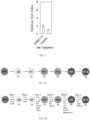
- the process of differentiating pluripotent stem cells into functional pancreatic endocrine cells (i.e., SC- ⁇ cells) in vitro may be viewed in some aspects as progressing through six consecutive stages, as is shown in the exemplary protocol depicted in FIG. 2A .
- “Stage 1” or “S1” refers to the first step in the differentiation process, the differentiation of pluripotent stem cells into cells expressing markers characteristic of definitive endoderm cells ("DE”, “Stage 1 cells” or “S1 cells”).
- Stage 2 refers to the second step, the differentiation of cells expressing markers characteristic of definitive endoderm cells into cells expressing markers characteristic of gut tube cells ("GT”, “Stage 2 cells” or “S2 cells”).
- Stage 3 refers to the third step, the differentiation of cells expressing markers characteristic of gut tube cells into cells expressing markers characteristic of pancreatic progenitor 1 cells ("PP1”, “Stage 3 cells” or “S3 cells”).
- Stage 4" refers to the fourth step, the differentiation of cells expressing markers characteristic of pancreatic progenitor 1 cells into cells expressing markers characteristic of pancreatic progenitor 2 cells (“PP2”, “Stage 4 cells” or “S4 cells”).
- “Stage 5" refers to the fifth step, the differentiation of cells expressing markers characteristic of pancreatic progenitor 2 cells into cells expressing markers characteristic of pancreatic endoderm cells and/or pancreatic endocrine progenitor cells ("EN", “Stage 5 cells” or “S5 cells”).
- “Stage 6” refers to the differentiation of cells expressing markers characteristic of pancreatic endocrine progenitor cells into cells expressing markers characteristic of pancreatic endocrine ⁇ cells (“SC- ⁇ cells”, “Stage 6 cells” or “S6 cells”). It should be appreciated, however, that not all cells in a particular population progress through these stages at the same rate, i.e., some cells may have progressed less, or more, down the differentiation pathway than the majority of cells present in the population.
- Definitive endoderm cells refers to cells which bear the characteristics of cells arising from the epiblast during gastrulation and which form the gastrointestinal tract and its derivatives.
- Definitive endoderm cells express at least one of the following markers: FOXA2 (also known as hepatocyte nuclear factor 3 ⁇ (“HNF3 ⁇ ”)), GATA4, SOX17, CXCR4, Brachyury, Cerberus, OTX2, goosecoid, C-Kit, CD99, and MIXL1. Markers characteristic of the definitive endoderm cells include CXCR4, FOXA2 and SOX17. Thus, definitive endoderm cells may be characterized by their expression of CXCR4, FOXA2 and SOX17. In addition, depending on the length of time cells are allowed to remain in Stage 1, an increase in HNF4 ⁇ may be observed.
- HNF3 ⁇ hepatocyte nuclear factor 3 ⁇
- Gut tube cells refers to cells derived from definitive endoderm that can give rise to all endodermal organs, such as lungs, liver, pancreas, stomach, and intestine. Gut tube cells may be characterized by their substantially increased expression of HNF4 ⁇ over that expressed by definitive endoderm cells. For example, a ten to forty fold increase in mRNA expression of HNF4 ⁇ may be observed during Stage 2.
- Pancreatic progenitor 1 cells refers to endoderm cells that give rise to the esophagus, lungs, stomach, liver, pancreas, gall bladder, and a portion of the duodenum. Pancreatic progenitor 1 cells express at least one of the following markers: PDX1, FOXA2, CDX2, SOX2, and HNF4 ⁇ . Pancreatic progenitor 1 cells may be characterized by an increase in expression of PDX1, compared to gut tube cells. For example, greater than fifty percent of the cells in Stage 3 cultures typically express PDX1.
- Pancreatic progenitor 2 cells refers to cells that express at least one of the following markers: PDX1, NKX6.1, HNF6, NGN3, SOX9, PAX4, PAX6, ISL1, gastrin, FOXA2, PTF1a, PROXl and HNF4 ⁇ . Pancreatic progenitor 2 cells may be characterized as positive for the expression of PDX1, NKX6.1, and SOX9.
- Pancreatic endocrine progenitor cells or “endocrine progenitor cells” are used interchangeably herein to refer to pancreatic endoderm cells capable of becoming a pancreatic hormone expressing cell.
- Pancreatic endocrine progenitor cells express at least one of the following markers: NGN3; NKX2.2; NeuroD1; ISL1; PAX4; PAX6; or ARX.
- Pancreatic endocrine progenitor cells may be characterized by their expression of NKX2.2 and NeuroD1.
- a "precursor thereof" as the term relates to a pancreatic endocrine progenitor cell refers to any cell that is capable of differentiating into a pancreatic endocrine progenitor cell, including for example, a pluripotent stem cell, a definitive endoderm cell, a gut tube cell, or a pancreatic progenitor cell, when cultured under conditions suitable for differentiating the precursor cell into the pancreatic pro endocrine cell.
- Pantendocrine cells refer to cells capable of expressing at least one of the following hormones: insulin, glucagon, somatostatin, ghrelin, and pancreatic polypeptide.
- markers characteristic of pancreatic endocrine cells include one or more of NGN3, NeuroDl, ISL1, PDX1, NKX6.1, PAX4, ARX, NKX2.2, and PAX6.
- Pancreatic endocrine cells expressing markers characteristic of ⁇ cells can be characterized by their expression of insulin and at least one of the following transcription factors: PDX1, NKX2.2, NKX6.1, NeuroDl, ISL1, HNF30, MAFA and PAX6.
- stem cell-derived ⁇ cell and "SC- ⁇ cell” are used interchangeably herein to refer to cells differentiated in vitro (e.g., from pluripotent stem cells) that display at least one marker indicative of a pancreatic ⁇ cell (e.g., PDX-1 or NKX6-1), expresses insulin, and display a GSIS response characteristic of an endogenous mature ⁇ cell both in vitro and in vivo.
- the GSIS response of the SC- ⁇ cells can be observed within two weeks of transplantation of the SC- ⁇ cell into a host (e.g., a human or animal).
- SC- ⁇ cells need not be derived (e.g., directly) from stem cells, as the methods of the disclosure are capable of deriving SC- ⁇ cells from any endocrine progenitor cell that expresses insulin or precursor thereof using any cell as a starting point (e.g., one can use embryonic stem cells, induced-pluripotent stem cells, progenitor cells, partially reprogrammed somatic cells (e.g., a somatic cell which has been partially reprogrammed to an intermediate state between an induced pluripotent stem cell and the somatic cell from which it was derived), multipotent cells, totipotent cells, a transdifferentiated version of any of the foregoing cells, etc, as the invention is not intended to be limited in this manner).
- any endocrine progenitor cell that expresses insulin or precursor thereof e.g., one can use embryonic stem cells, induced-pluripotent stem cells, progenitor cells, partially reprogrammed somatic cells (e.g.
- human cells are excluded that are derived from human embryonic stem cells obtained exclusively by a method necessitating the destruction of an embryo.
- the skilled artisan is well aware of such methods and how to avoid them for the purposes of generating SC- ⁇ cells according to the methods of the present invention.
- a method for generating stem cell-derived ⁇ (SC- ⁇ ) cells comprises contacting a cell population comprising endocrine progenitor cells under conditions suitable to direct differentiation of said endocrine progenitor cells into said SC- ⁇ cells with an effective amount of an agent that decreases activity of c-Jun N-terminal kinase (JNK) in said endocrine progenitor cells, thereby generating said SC- ⁇ cells, wherein the endocrine progenitor cells comprises PDX1+/NKX6.1+/NEUROD1+/insulin+/glucagon-/somatostatin- cells, wherein the effective amount comprises a concentration between about 0.1 ⁇ m and about 110 ⁇ m, wherein the agent is SP600125.
- JNK c-Jun N-terminal kinase
- Contacting refers to any means of introducing an agent (e.g., nucleic acids, peptides, ribozymes, antibodies, small molecules, etc.) into a target cell or an environment in which the cell is present (e.g., cell culture), including chemical and physical means, whether directly or indirectly.
- agent e.g., nucleic acids, peptides, ribozymes, antibodies, small molecules, etc.
- Contacting also is intended to encompass methods of exposing a cell, delivering to a cell, or "loading" a cell with an agent by viral or non-viral vectors, and wherein such agent is bioactive upon delivery. The method of delivery will be chosen for the particular agent and use.
- Parameters that affect delivery can include, inter alia, the cell type affected, and cellular location.
- contacting refers to exposing a cell or an environment in which the cell is located (e.g., cell culture medium) to at least one agent that decreases the level and/or activity of JNK.
- SC- ⁇ cells generated by contacting endocrine progenitor cells (or their precursors) directed to differentiate into SC- ⁇ cells according to any protocol will exhibit improved in vitro and in vivo function when contacted with an agent that decreases the activity of c-Jun N-terminal kinase (JNK).
- JNK c-Jun N-terminal kinase
- the endocrine progenitor cells are directed to differentiate into SC- ⁇ cells by contacting the endocrine progenitor cells under conditions that promote cell clustering with i) a transforming growth factor ⁇ (TGF- ⁇ ) signaling pathway inhibitor and ii) a thyroid hormone signaling pathway activator to induce the in vitro maturation of at least some of the endocrine progenitor cells into SC- ⁇ cells.
- TGF- ⁇ transforming growth factor ⁇
- a thyroid hormone signaling pathway activator to induce the in vitro maturation of at least some of the endocrine progenitor cells into SC- ⁇ cells.
- the endocrine progenitor cells may be optionally contacted with a protein kinase inhibitor (e.g., staurosporine).
- an “effective amount” of an agent refers to the amount sufficient to achieve a desired effect, e.g., when delivered to a cell or subject according to a selected administration form, route, and/or schedule.
- the absolute amount of a particular agent or composition that is effective may vary depending on such factors as the desired biological or pharmacological endpoint, the agent to be delivered, the target tissue, etc.
- an "effective amount” may be contacted with cells or administered in a single dose, or the desired effect may be achieved by use of multiple doses.
- an effective amount of a composition may be an amount sufficient to reduce the severity of or prevent one or more symptoms or signs of a disorder (e.g., diabetes).
- the effective amount of the agent that decreases the activity of JNK comprises a concentration of between about 0.1 ⁇ M and about 110 ⁇ M. In one embodiment, the effective amount of the agent comprises 1 ⁇ M.
- the endocrine progenitor cells (S5 cells) are contacted with 1 ⁇ M of SP600125 to generate SC- ⁇ cells exhibiting an improved in vitro or in vivo function.
- JNK c-Jun N-terminal Kinase
- JNK inhibitor can be small organic or inorganic molecules; saccharides; oligosaccharides; polysaccharides; biological macromolecules, e.g., peptides, proteins, and peptide analogs and derivatives; peptidomimetics; nucleic acids and nucleic acid analogs and derivatives (including but not limited to microRNAs, siRNAs, shRNAs, antisense RNAs, a ribozymes, and aptamers); an extract made from biological materials such as bacteria, plants, fungi, or animal cells; animal tissues; naturally occurring or synthetic compositions; and any combinations thereof.
- Exemplary JNK inhibitors include, but are not limited to, the JNK inhibitors of formula I as described in U.S. Patent No. 8,183,254 ; the benzothiazole derivatives according to formula I and tautomers, geometrical isomers, enantiomers, diastereomers, racemates and pharmaceutically acceptable salts thereof described in U.S. Patent Application Publication No. 2009/0176762 ; a JNK inhibitor sequence, chimeric peptide, or nucleic acid described in U.S. Patent No. 6,610,820 and U.S. Patent Application Publication No.
- cell-permeable peptides that bind to JNK and inhibit JNK activity or c-Jun activation including peptides having amino acid sequences of DTYRPKRPTT LNLFPQVPRS QDT (SEQ ID NO:1); EEPHKHRPTT LRLTTLGAQD S (SEQ ID NO:2); TDQSRPVQPF LNLTTPRKPR YTD (SEQ ID NO:3); or SDQAGLTTLR LTTPRHKHPE E (SEQ ID NO:4); c-Jun N-terminal kinase inhibiting compounds of formula I described in U.S. Patent No.
- JNK inhibitor of formula I described in PCT International Application Publication No. WO/2011/018417 ; an agent that inhibits MKK4 as described herein (e.g., MKK4 inhibitors); an agent that inhibits JNK interacting protein (JIP) (see for example, Chen T, et al. Biochem J.
- WO 1996/036642 a JIP-1 polypeptide that binds JNK as described in U.S. Patent Publications 2007/0003517 and 2002/0119135 , including a peptide having the amino acid sequence SGDTYRPKRPTTLNLFPQVPRSQDTLN (SEQ ID NO:5).
- a JNK inhibitor decreases the level and/or activity of JNK in cells contacted by at least 5%, 10%, 20%, 30%, 40%, 50%, 60%, 70%, 80%, 90%, or 95% relative to the level or activity of JNK in the cells in the absence of contact with the JNK inhibitor. While not required, a JNK inhibitor can completely inhibit the level and/or activity of JNK in the cells. It should be appreciated that the JNK inhibitors may decrease the level and/or activity of JNK in any cell in the population in which endocrine progenitor cells are differentiating into SC- ⁇ cells, including in the SC- ⁇ cells generated in the population, endocrine progenitor cells or any precursors thereof.
- an agent decreases the level and/or activity of JNK by inhibiting phosphorylation of JNK. It should be appreciated, however, that the agent may act via any mechanism which results in decreased level and/or activity of JNK.
- the level and/or activity of JNK may be decreased by decreasing the level and/or activity of mitogen-activated protein kinase kinase 4 (MKK4).
- MKK4 mitogen-activated protein kinase kinase 4
- MKK4 a member of the MAP kinase kinase family, directly phosphorylates and activates the c-Jun NH2-terminal kinases (JNK), in response to cellular stresses and proinflammatory cytokines.
- JNK is a member of the MAP kinase family and a key component of a stress activated protein kinase signaling pathway.
- Such agents may be referred to herein as MKK4 inhibitors.
- a MKK4 inhibitor may decrease the level and/or activity of JNK in cells contacted by at least 5%, 10%, 20%, 30%, 40%, 50%, 60%, 70%, 80%, 90%, or 95% relative to the level or activity of JNK in the cells in the absence of contact with the JNK inhibitor.
- the population of cells comprising the endocrine progenitor cells contacted in accordance with the method may comprise different cells types as the cells are differentiating into SC- ⁇ cells.
- a maximum amount of endocrine cells in the population contacted with a JNK inhibitor or MKK4 inhibitor differentiate into SC- ⁇ cells.
- between at least 5% and 65% of the endocrine cells in the population differentiate into SC- ⁇ cells.
- SC-B cells obtained by the method of generating SC-B cells
- An isolated non-native SC- ⁇ cell or population thereof generated according to a method described herein that exhibits a GSIS response both in vitro and in vivo is provided, wherein the isolated SC- ⁇ cell or population thereof exhibits a stimulation index of between about 1.4 and about 2.4.
- the isolated SC- ⁇ cell or population also exhibits at least one characteristic feature of a mature endogenous ⁇ cell (e.g., monohormonality).
- the isolated SC- ⁇ cell or population thereof produces between approximately 300 uIU to about 4000 uIU per 30 minute per 10 6 total cells incubation at a high glucose concentration.
- the SC- ⁇ cells disclosed herein share many distinguishing features of native ⁇ cells, but are different in certain aspects (e.g., gene expression profiles).
- the SC- ⁇ cell is non-native.
- “non-native” means that the SC- ⁇ cells are markedly different in certain aspects from ⁇ cells which exist in nature, i.e., native ⁇ cells. It should be appreciated, however, that these marked differences typically pertain to structural features which may result in the SC- ⁇ cells exhibiting certain functional differences, e.g., although the gene expression patterns of SC- ⁇ cells differs from native ⁇ cells, the SC- ⁇ cells behave in a similar manner to native ⁇ cells but certain functions may be altered (e.g., improved) compared to native ⁇ cells. For example, a higher frequency of SC- ⁇ cells respond to 20 mM glucose compared to the frequency of native ⁇ cells. Other differences between SC- ⁇ cells and native ⁇ cells would be apparent to the skilled artisan based on the data disclosed herein.
- the SC- ⁇ cells may exhibit at least one of the following characteristics of an endogenous mature pancreatic ⁇ cell: i) a response to multiple glucose challenges that resembles the response of endogenous islets (e.g., at least one, at least two, or at least three or more sequential glucose challenges); ii) a morphology that resembles the morphology of an endogenous ⁇ cell; iii) packaging of insulin into secretory granules or encapsulated crystalline insulin granules; iv) a stimulation index of greater than at least 1.4; v) cytokine-induced apoptosis in response to cytokines; vi) enhanced insulin secretion in response to known antidiabetic drugs (e.g., secretagogues); vii) monohormonal, i.e., they do not abnormally co-express other hormones, such as glucagon, somatostatin or pancreatic
- a microcapsule comprising the isolated SC- ⁇ cell or population thereof generated according to the method herein that exhibits a GSIS response both in vitro and in vivo, wherein the SC- ⁇ cell or population thereof exhibits a stimulation index of between about 1.4 and about 2.4 encapsulated therein is provided.
- a macroencapsulation device comprising the isolated SC- ⁇ cell or population thereof generated according to the method herein that exhibits a GSIS response both in vitro and in vivo, wherein the SC- ⁇ cell or population thereof exhibits a stimulation index of between about 1.4 and about 2.4 is also provided.
- a cell line comprising the isolated SC- ⁇ cell generated according to the method herein that exhibits a GSIS response both in vitro and in vivo, wherein the SC- ⁇ cell or population thereof exhibits a stimulation index of between about 1.4 and about 2.4 that stably expresses insulin is provided.
- An isolated SC- ⁇ cell or population thereof generated according to the methods herein, or a cell line comprising the isolated SC- ⁇ cell generated according to the method herein that exhibits a GSIS response both in vitro and in vivo, wherein the SC- ⁇ cell or population thereof exhibits a stimulation index of between about 1.4 and about 2.4 stably expresses insulin can be used in an assay (i) to identify one or more candidate agents which promote or inhibit a ⁇ cell fate selected from the group consisting of ⁇ cell proliferation, ⁇ cell replication, ⁇ cell death, ⁇ cell function, ⁇ cell susceptibility to immune attack, and ⁇ cell susceptibility to dedifferentiation or differentiation, or (ii) to identify one or more candidate agents which promote the differentiation of at least one insulin-positive endocrine cell or a precursor thereof into at least one SC- ⁇ cell.
- the assays typically involve contacting the isolated SC- ⁇ cell, population thereof, or the cell line, with one or more candidate agents to be assessed for its ability to i) promote or inhibit a ⁇ cell fate selected from the group consisting of ⁇ cell proliferation, ⁇ cell replication, ⁇ cell death, ⁇ cell function, ⁇ cell susceptibility to immune attack, and ⁇ cell susceptibility to dedifferentiation or differentiation, or ii) promoting the differentiation of at least one insulin-positive endocrine cell or a precursor thereof into at least one SC- ⁇ cell and assessing whether the candidate agent possesses the ability to i) promote or inhibit a ⁇ cell fate selected from the group consisting of ⁇ cell proliferation, ⁇ cell replication, ⁇ cell death, ⁇ cell function, ⁇ cell susceptibility to immune attack, and ⁇ cell susceptibility to dedifferentiation or differentiation, or ii) promoting the differentiation of at least one insulin-positive endocrine cell or a precursor thereof into at least one SC- ⁇ cell.
- the methods entail administering to a subject in need thereof an isolated population of SC- ⁇ cells or a microcapsule comprising SC- ⁇ cells encapsulated therein.
- the subject may be in need of additional ⁇ cells.
- the subject may have an increased risk of developing diabetes.
- An isolated population of SC- ⁇ cells generated by a method of the present invention can be for use in administering to a subject for treatment of type 1 or type 2 diabetes.
- the subject has, or has an increased risk of developing, a metabolic disorder.
- Administering to the subject may comprise implanting SC- ⁇ cells, a microcapsule comprising SC- ⁇ cells, or a macroencapsulation device comprising SC- ⁇ cells into the subject.
- the subject may be a human subject or an animal subject.
- the cells may be implanted as dispersed cells or formed into clusters that may be infused into the hepatic portal vein.
- Cells may be provided in biocompatible degradable polymeric supports, porous non-degradable devices or encapsulated to protect from host immune response.
- Cells may be implanted into an appropriate site in a recipient.
- the implantation sites include, for example, the liver, natural pancreas, renal subcapsular space, omentum, peritoneum, subserosal space, intestine, stomach, or a subcutaneous pocket.
- additional factors such as growth factors, antioxidants or anti-inflammatory agents, can be administered before, simultaneously with, or after the administration of the cells. These factors can be secreted by endogenous cells and exposed to the administered cells in situ. Implanted cells can be induced to differentiate by any combination of endogenous and exogenously administered growth factors known in the art.
- the amount of cells used in implantation depends on a number of various factors including the patient's condition and response to the therapy, and can be determined by one skilled in the art.
- the method of treatment described herein may further comprise incorporating the cells into a three-dimensional support prior to implantation.
- the cells can be maintained in vitro on this support prior to implantation into the patient.
- the support containing the cells can be directly implanted in the patient without additional in vitro culturing.
- the support can optionally be incorporated with at least one pharmaceutical agent that facilitates the survival and function of the transplanted cells.
- an artificial islet or pancreas comprising the SC- ⁇ cells generated according to the methods described herein is provided.
- An artificial pancreas is a device that encapsulates and nurtures islets of Langerhans to replace the islets and ⁇ cells destroyed by type 1 diabetes.
- An artificial pancreas may contain a million islets or more, and may be implanted in the peritoneal cavity or under the skin where it can respond to changing blood glucose levels by releasing hormones, such as insulin.
- An artificial pancreas may be made using living (e.g., glucose-sensing and insulin secreting islets) and nonliving components (e.g., to shield the islets from the diabetic's body and its destructive immune mechanism while permitting the islets to thrive).
- ⁇ cells may be used in any artificial pancreas.
- the artificial pancreas may comprise microencapsulated or coated islets comprising SC- ⁇ cells generated according to the methods herein.
- the artificial pancreas may comprise a macroencapsulation device into which islet cells comprising SC- ⁇ cells generated according to the methods herein are grouped together and encapsulated.
- the macroencapsulation device may comprise a PVA hydrogel sheet for an artificial pancreas of the present invention (Qi et al., 2004).
- the artificial islet may comprise SC- ⁇ cells generated according to the methods herein, along with other islet cells ( ⁇ , ⁇ , etc.) in the form of an islet sheet.
- the islet sheet comprises a layer of artificial human islets comprising the SC- ⁇ cells macroencapsulated within a membrane (e.g., of ultra-pure alginate).
- a membrane e.g., of ultra-pure alginate.
- the sheet membrane is reinforced with mesh and may be coated on the surface to prevent or minimize contact between the cells encapsulated inside and the transplantation recipient's host immune response. Oxygen, glucose, and other nutrients readily diffuse into the sheet through the membrane nurturing the islets, and hormones, such as insulin readily diffuse out.
- Additional examples of membranes designed for macroencapsulation/implantation of an artificial islet or pancreas can be found in the literature (Isayeva et al. 2003).
- Another example of a macroencapsulated implant suitable for an artificial islet or pancreas can be found in the literature (A direlien, et al. 2014).
- any embodiment of the invention e.g., any embodiment found within the prior art, can be explicitly excluded from the claims, regardless of whether the specific exclusion is recited in the specification.
- any agent may be excluded from the genus of JNK inhibitors.
- the invention includes embodiments in which the endpoints are included, embodiments in which both endpoints are excluded, and embodiments in which one endpoint is included and the other is excluded. It should be assumed that both endpoints are included unless indicated otherwise. Furthermore, it is to be understood that unless otherwise indicated or otherwise evident from the context and understanding of one of skill in the art, values that are expressed as ranges can assume any specific value or subrange within the stated ranges in different embodiments of the invention, to the tenth of the unit of the lower limit of the range, unless the context clearly dictates otherwise.
- the invention includes embodiments that relate analogously to any intervening value or range defined by any two values in the series, and that the lowest value may be taken as a minimum and the greatest value may be taken as a maximum.
- Numerical values include values expressed as percentages. For any embodiment of the invention in which a numerical value is prefaced by "about” or “approximately”, the invention includes an embodiment in which the exact value is recited. For any embodiment of the invention in which a numerical value is not prefaced by "about” or “approximately”, the invention includes an embodiment in which the value is prefaced by "about” or “approximately”.
- Approximately or “about” generally includes numbers that fall within a range of 1% or in some embodiments 5% of a number in either direction (greater than or less than the number) unless otherwise stated or otherwise evident from the context (except where such number would impermissibly exceed 100% of a possible value).
Landscapes
- Health & Medical Sciences (AREA)
- Life Sciences & Earth Sciences (AREA)
- Engineering & Computer Science (AREA)
- Biomedical Technology (AREA)
- Biotechnology (AREA)
- Chemical & Material Sciences (AREA)
- Zoology (AREA)
- Cell Biology (AREA)
- Bioinformatics & Cheminformatics (AREA)
- General Health & Medical Sciences (AREA)
- Genetics & Genomics (AREA)
- Wood Science & Technology (AREA)
- Organic Chemistry (AREA)
- Animal Behavior & Ethology (AREA)
- Public Health (AREA)
- Biochemistry (AREA)
- Veterinary Medicine (AREA)
- General Engineering & Computer Science (AREA)
- Microbiology (AREA)
- Epidemiology (AREA)
- Pharmacology & Pharmacy (AREA)
- Medicinal Chemistry (AREA)
- Virology (AREA)
- Immunology (AREA)
- Developmental Biology & Embryology (AREA)
- Physiology (AREA)
- Nutrition Science (AREA)
- Gastroenterology & Hepatology (AREA)
- Micro-Organisms Or Cultivation Processes Thereof (AREA)
- Medicines Containing Material From Animals Or Micro-Organisms (AREA)
Claims (5)
- Procédé de génération de cellules β dérivées de cellules souches (SC-β), le procédé comprenant la mise en contact d'une population cellulaire comprenant des cellules progénitrices endocriniennes dans des conditions appropriées pour diriger la différenciation desdites cellules progénitrices endocriniennes en lesdites cellules SC-β avec une quantité efficace d'un agent qui diminue l'activité de la kinase N-terminale c-Jun (JNK) dans lesdites cellules progénitrices endocriniennes, pour ainsi générer lesdites cellules SC-β, dans lequel les cellules progénitrices endocriniennes comprennent des cellules PDX1+/NKX6.1+/ NEUROD1+/insuline+/glucagon-/somatostatine-, dans lequel la quantité efficace comprend une concentration entre environ 0,1 µM et environ 110 µM, dans lequel l'agent est SP600125.
- Procédé selon la revendication 1, dans lequel entre au moins 5 % et 65 % des cellules endocriniennes dans la population se différencie en lesdites cellules SC-β.
- Procédé selon la revendication 1 ou la revendication 2, dans lequel l'activité de JNK est diminuée de 70 %.
- Procédé selon la revendication 1 ou la revendication 2, dans lequel l'activité de JNK est diminuée de 90 %.
- Procédé selon la revendication 1 ou la revendication 2, dans lequel l'activité de JNK est complètement inhibée par l'agent.
Priority Applications (1)
| Application Number | Priority Date | Filing Date | Title |
|---|---|---|---|
| EP24157048.0A EP4374863A3 (fr) | 2014-12-18 | 2015-12-18 | Procédés de génération de cellules bêta dérivées de cellules souches et leurs utilisations |
Applications Claiming Priority (2)
| Application Number | Priority Date | Filing Date | Title |
|---|---|---|---|
| US201462093999P | 2014-12-18 | 2014-12-18 | |
| PCT/US2015/066858 WO2016100909A1 (fr) | 2014-12-18 | 2015-12-18 | Procédés de génération de cellules β dérivées de cellules souches et leurs utilisations |
Related Child Applications (1)
| Application Number | Title | Priority Date | Filing Date |
|---|---|---|---|
| EP24157048.0A Division EP4374863A3 (fr) | 2014-12-18 | 2015-12-18 | Procédés de génération de cellules bêta dérivées de cellules souches et leurs utilisations |
Publications (3)
| Publication Number | Publication Date |
|---|---|
| EP3234110A1 EP3234110A1 (fr) | 2017-10-25 |
| EP3234110A4 EP3234110A4 (fr) | 2018-06-27 |
| EP3234110B1 true EP3234110B1 (fr) | 2024-02-28 |
Family
ID=56127730
Family Applications (2)
| Application Number | Title | Priority Date | Filing Date |
|---|---|---|---|
| EP24157048.0A Pending EP4374863A3 (fr) | 2014-12-18 | 2015-12-18 | Procédés de génération de cellules bêta dérivées de cellules souches et leurs utilisations |
| EP15871229.9A Active EP3234110B1 (fr) | 2014-12-18 | 2015-12-18 | PROCÉDÉS DE GÉNÉRATION DE CELLULES ß DÉRIVÉES DE CELLULES SOUCHES ET LEURS UTILISATIONS |
Family Applications Before (1)
| Application Number | Title | Priority Date | Filing Date |
|---|---|---|---|
| EP24157048.0A Pending EP4374863A3 (fr) | 2014-12-18 | 2015-12-18 | Procédés de génération de cellules bêta dérivées de cellules souches et leurs utilisations |
Country Status (5)
| Country | Link |
|---|---|
| US (2) | US10190096B2 (fr) |
| EP (2) | EP4374863A3 (fr) |
| DK (1) | DK3234110T3 (fr) |
| ES (1) | ES2985135T3 (fr) |
| WO (1) | WO2016100909A1 (fr) |
Families Citing this family (24)
| Publication number | Priority date | Publication date | Assignee | Title |
|---|---|---|---|---|
| KR102580225B1 (ko) | 2013-06-11 | 2023-09-20 | 프레지던트 앤드 펠로우즈 오브 하바드 칼리지 | SC-β 세포 및 조성물 그리고 그 생성 방법 |
| EP3739041A1 (fr) | 2014-03-27 | 2020-11-18 | The Salk Institute for Biological Studies | Compositions et procédés pour le traitement du diabète de type 1 et 2 et de troubles apparentés |
| ES2985135T3 (es) | 2014-12-18 | 2024-11-04 | Harvard College | Procedimientos para generar células ß derivadas de células madre y usos de las mismas |
| WO2016100930A1 (fr) | 2014-12-18 | 2016-06-23 | President And Fellows Of Harvard College | Procédés de production de lymphocytes b dérivés de cellules souches et leurs procédés d'utilisation |
| WO2016100898A1 (fr) | 2014-12-18 | 2016-06-23 | President And Fellows Of Harvard College | Protocole de différentiation dirigée in vitro sans sérum pour générer des cellules b dérivées de cellules souches et leurs utilisations |
| US20160175363A1 (en) * | 2014-12-18 | 2016-06-23 | President And Fellows Of Harvard College | Methods for generating stem cell-derived beta cells and uses thereof |
| WO2016138464A1 (fr) | 2015-02-27 | 2016-09-01 | Salk Institute For Biological Studies | Compositions progénitrices de reprogrammation et leurs procédés d'utilisation |
| CA3025344A1 (fr) | 2016-05-25 | 2017-11-30 | Salk Institute For Biological Studies | Compositions et procedes pour la production d'organoides et la modelisation de maladies |
| WO2018081401A1 (fr) * | 2016-10-26 | 2018-05-03 | Ichan School Of Medicine At Mount Sinai | Procédé d'augmentation de la prolifération cellulaire dans les cellules pancréatiques bêta, procédé de traitement et composition |
| CN118497104A (zh) | 2017-11-15 | 2024-08-16 | 沃泰克斯药物股份有限公司 | 胰岛细胞制备性组合物和使用方法 |
| WO2019100062A1 (fr) | 2017-11-20 | 2019-05-23 | Ichan School Of Medicine At Mount Sinai | Composés inhibiteurs de kinase, compositions et procédés d'utilisation |
| CN111819193A (zh) | 2018-01-05 | 2020-10-23 | 西奈山伊坎医学院 | 增加胰腺β细胞增殖的方法、治疗方法以及组合物 |
| SG11202006837XA (en) | 2018-01-18 | 2020-08-28 | Daiichi Sankyo Co Ltd | Dihydroindolizinone derivative |
| AU2019240065A1 (en) | 2018-03-20 | 2020-09-24 | Icahn School Of Medicine At Mount Sinai | Kinase inhibitor compounds and compositions and methods of use |
| US10869888B2 (en) | 2018-04-17 | 2020-12-22 | Innovative Cellular Therapeutics CO., LTD. | Modified cell expansion and uses thereof |
| EP3833365A4 (fr) | 2018-08-10 | 2022-05-11 | Vertex Pharmaceuticals Incorporated | Différenciation d'ilot dérivé de cellules souches |
| US12240915B2 (en) | 2018-08-30 | 2025-03-04 | Innovative Cellular Therapeutics Holdings, Ltd. | Chimeric antigen receptor cells for treating solid tumor |
| BR112021023389A2 (pt) | 2019-05-22 | 2022-02-01 | Cleveland Clinic Found | Geração de células de endoderma de intestino anterior dorsal e domínio anterior |
| WO2020247954A1 (fr) * | 2019-06-06 | 2020-12-10 | President And Fellows Of Harvard College | Compositions et procédés de maturation de cellules bêta dérivées de cellules souches |
| US12076343B2 (en) | 2020-02-19 | 2024-09-03 | Innovative Cellular Therapeutics Holdings, Ltd. | Engineered safety in cell therapy |
| WO2021216731A1 (fr) * | 2020-04-23 | 2021-10-28 | Innovative Cellular Therapeutics Holdings, Ltd. | Molécules de liaison polyspécifiques et leur utilisation en thérapie cellulaire |
| US12043654B2 (en) | 2020-06-02 | 2024-07-23 | Innovative Cellular Therapeutics Holdings, Ltd. | Anti-GCC antibody and CAR thereof for treating digestive system cancer |
| WO2024151541A1 (fr) | 2023-01-09 | 2024-07-18 | Sana Biotechnology, Inc. | Souris auto-immune présentant un diabète de type 1 |
| CN121604968A (zh) | 2023-05-22 | 2026-03-03 | 萨那生物科技公司 | 递送胰岛细胞的方法及相关方法 |
Family Cites Families (119)
| Publication number | Priority date | Publication date | Assignee | Title |
|---|---|---|---|---|
| US4391909A (en) | 1979-03-28 | 1983-07-05 | Damon Corporation | Microcapsules containing viable tissue cells |
| US7018419B2 (en) | 1994-05-20 | 2006-03-28 | Spielberg Theodore E | Microporous encapsulated endocrine cell disks, biconcave disks and multidimpled chambers for hormonal replacement |
| CA2217652A1 (fr) | 1995-04-07 | 1996-10-10 | Albert Einstein College Of Medicine Of Yeshiva University | Cellule .beta. de recombinaison et ses utilisations |
| US5736381A (en) | 1995-05-19 | 1998-04-07 | Davis; Roger J. | Cytokine-, stress-, and oncoprotein-activated human protein kinase kinases |
| US6043083A (en) | 1997-04-28 | 2000-03-28 | Davis; Roger J. | Inhibitors of the JNK signal transduction pathway and methods of use |
| JP3880795B2 (ja) | 1997-10-23 | 2007-02-14 | ジェロン・コーポレーション | フィーダー細胞を含まない培養物中で、霊長類由来始原幹細胞を増殖させるための方法 |
| US6667176B1 (en) | 2000-01-11 | 2003-12-23 | Geron Corporation | cDNA libraries reflecting gene expression during growth and differentiation of human pluripotent stem cells |
| US7410798B2 (en) | 2001-01-10 | 2008-08-12 | Geron Corporation | Culture system for rapid expansion of human embryonic stem cells |
| US6610820B1 (en) | 1999-10-12 | 2003-08-26 | University Of Lausanne | Cell-permeable peptide inhibitors of the JNK signal transduction pathway |
| US6436704B1 (en) | 2000-04-10 | 2002-08-20 | Raven Biotechnologies, Inc. | Human pancreatic epithelial progenitor cells and methods of isolation and use thereof |
| IL152741A0 (en) | 2000-05-17 | 2003-06-24 | Geron Corp | Neural progenitor cell populations |
| US6916640B2 (en) | 2000-10-12 | 2005-07-12 | Agency For Science, Technology And Research | Multi-layer cell encapsulation for tissue engineering |
| US6576464B2 (en) | 2000-11-27 | 2003-06-10 | Geron Corporation | Methods for providing differentiated stem cells |
| CA2435826A1 (fr) | 2001-01-24 | 2002-08-01 | The Government Of The United States Of America | Differenciation de cellules souches par rapport aux ilots pancreatiques |
| JP2004531262A (ja) | 2001-05-15 | 2004-10-14 | ラッパポート ファミリー インスチチュート フォア リサーチ イン ザ メディカル サイエンシズ | ヒト胚性幹細胞由来インスリン産生細胞 |
| US7432104B2 (en) | 2001-08-06 | 2008-10-07 | Bresgen Inc. | Methods for the culture of human embryonic stem cells on human feeder cells |
| WO2003033697A1 (fr) | 2001-10-18 | 2003-04-24 | Ixion Biotechnology, Inc. | Transformation de cellules souches et progenitrices du foie en cellules fonctionnelles du pancreas |
| US20030077256A1 (en) | 2001-10-19 | 2003-04-24 | Paul Czernichow | Pancreas regeneration using embryonic pancreatic cells |
| US7157278B2 (en) | 2001-12-04 | 2007-01-02 | Organogenesis, Inc. | Cultured cells from pancreatic islets |
| EP2292734A1 (fr) | 2001-12-07 | 2011-03-09 | Geron Corporation | Cellules hématopoïétiques à partir de cellules souches embryonnaires humaines |
| CN101240262A (zh) | 2001-12-07 | 2008-08-13 | 杰龙公司 | 源自人胚胎干细胞的胰岛细胞 |
| BR0311362A (pt) | 2002-05-28 | 2006-10-31 | Novocell Inc | métodos, composições e fatores de crescimento e de diferenciação para produzir células produtoras de insulina |
| US20060122104A1 (en) | 2002-05-28 | 2006-06-08 | Presnell Sharon C | Methods for in vitro expansion and transdifferentiation of human pancreatic acinar cells into insulin-producing cells |
| AU2003302702B2 (en) | 2002-12-05 | 2008-08-07 | Technion Research & Development Foundation Ltd. | Cultured human pancreatic islets, and uses thereof |
| WO2004058764A1 (fr) * | 2002-12-27 | 2004-07-15 | Bayer Healthcare Ag | Derives 4-phenyl-pyrimido [4,5-b]indoles |
| WO2004101565A2 (fr) | 2003-05-16 | 2004-11-25 | Eisai Co., Ltd. | Inhibiteurs des jnk |
| US7985585B2 (en) | 2004-07-09 | 2011-07-26 | Viacyte, Inc. | Preprimitive streak and mesendoderm cells |
| JP4819697B2 (ja) | 2003-12-23 | 2011-11-24 | ヴィアサイト,インコーポレイテッド | 胚体内胚葉 |
| US8647873B2 (en) | 2004-04-27 | 2014-02-11 | Viacyte, Inc. | PDX1 expressing endoderm |
| US7541185B2 (en) | 2003-12-23 | 2009-06-02 | Cythera, Inc. | Methods for identifying factors for differentiating definitive endoderm |
| US7625753B2 (en) | 2003-12-23 | 2009-12-01 | Cythera, Inc. | Expansion of definitive endoderm cells |
| US8586357B2 (en) | 2003-12-23 | 2013-11-19 | Viacyte, Inc. | Markers of definitive endoderm |
| US20050266554A1 (en) | 2004-04-27 | 2005-12-01 | D Amour Kevin A | PDX1 expressing endoderm |
| EP2377922B1 (fr) | 2004-04-27 | 2020-04-08 | Viacyte, Inc. | Endoderme exprimant PDX1 |
| EP2267116B1 (fr) | 2004-07-13 | 2017-05-31 | Asterias Biotherapeutics, Inc. | Milieu de croissance pour cellules souches embryonnaires de primates |
| JP5102030B2 (ja) | 2004-08-13 | 2012-12-19 | ユニバーシティ・オブ・ジョージア・リサーチ・ファウンデイション・インコーポレイテッド | ヒト胚性幹細胞における自己再生および分化のための組成物および方法 |
| EP1676574A3 (fr) | 2004-12-30 | 2006-07-26 | Johnson & Johnson Vision Care, Inc. | Procédé favorisant la survie des tissus ou cellules griffées |
| CA2613812A1 (fr) | 2005-01-31 | 2006-08-10 | Es Cell International Pte Ltd. | Differenciation dirigee de cellules souches embryonnaires et utilisations associees |
| CN101228264B (zh) | 2005-06-22 | 2017-12-26 | 阿斯特利亚斯生物治疗股份公司 | 使灵长类多能干细胞分化成心肌细胞系细胞 |
| JP5560391B2 (ja) | 2005-06-22 | 2014-07-23 | アステリアス バイオセラピューティクス インコーポレイテッド | ヒト胚性幹細胞の懸濁培養法 |
| WO2007031098A1 (fr) | 2005-09-12 | 2007-03-22 | Xigen S.A. | Inhibiteurs peptidiques permeables aux cellules de la voie de transduction de signal jnk |
| EP3584311A1 (fr) | 2005-10-27 | 2019-12-25 | Viacyte, Inc. | Endoderme d'intestin antérieur dorsal et ventral d'expression pdx-1 |
| WO2007075807A2 (fr) | 2005-12-20 | 2007-07-05 | Es Cell International Pte Ltd. | Procedes pour la differenciation dirigee de cellules souches embryonnaires |
| DE602007011409D1 (de) | 2006-01-20 | 2011-02-03 | Reneuron Inc | Verfahren für verbesserte zellproliferation von pankreas-vorläuferzellen in einer pankreaszellkultur |
| SG10201405107YA (en) | 2006-02-23 | 2014-10-30 | Viacyte Inc | Compositions and methods useful for culturing differentiable cells |
| DK2650359T3 (da) | 2006-03-02 | 2022-06-13 | Viacyte Inc | Endokrine prekursorceller, pancreatiske hormon-udtrykkende celler og fremstillingsfremgangsmåder |
| US7695965B2 (en) | 2006-03-02 | 2010-04-13 | Cythera, Inc. | Methods of producing pancreatic hormones |
| WO2007127927A2 (fr) | 2006-04-28 | 2007-11-08 | Lifescan, Inc. | Différentiation de cellules souches embryonnaires humaines |
| WO2007139929A2 (fr) | 2006-05-25 | 2007-12-06 | The Burnham Institute For Medical Research | Procédés de culture et de production de populations de cellules isolées de cellules souches embryonnaires humaines |
| US20090176762A1 (en) | 2006-06-02 | 2009-07-09 | Laboratoires Serono Sa | JNK Inhibitors for Treatment of Skin Diseases |
| WO2007149182A2 (fr) | 2006-06-19 | 2007-12-27 | Geron Corporation | Différenciation et enrichissement de cellules de type cellules des îlots pancréatiques à partir de cellules souches pluripotentes humaines |
| AU2007277364B2 (en) | 2006-07-26 | 2010-08-12 | Viacyte, Inc. | Methods of producing pancreatic hormones |
| ES2533566T3 (es) | 2006-12-29 | 2015-04-13 | The Regents Of The University Of Colorado, A Body Corporate | Diana diagnóstica y terapéutica para enfermedades autoinmunitarias y sus usos |
| US10167450B2 (en) | 2007-02-21 | 2019-01-01 | Sarl Endocells | Human pancreatic beta cell lines for diagnostic of diabetes |
| ES2537578T3 (es) | 2007-07-18 | 2015-06-09 | Lifescan, Inc. | Diferenciación de las células madre de embriones humanos |
| US9096832B2 (en) | 2007-07-31 | 2015-08-04 | Lifescan, Inc. | Differentiation of human embryonic stem cells |
| US7695963B2 (en) | 2007-09-24 | 2010-04-13 | Cythera, Inc. | Methods for increasing definitive endoderm production |
| US8623650B2 (en) | 2007-10-19 | 2014-01-07 | Viacyte, Inc. | Methods and compositions for feeder-free pluripotent stem cell media containing human serum |
| ATE523585T1 (de) | 2007-11-27 | 2011-09-15 | Lifescan Inc | Differenzierung menschlicher embryonaler stammzellen |
| EP2265603B1 (fr) | 2008-03-13 | 2014-05-07 | The General Hospital Corporation | Inhibiteurs de la voie de signalisation bmp |
| DK2283117T3 (da) | 2008-04-21 | 2014-01-20 | Viacyte Inc | Fremgangsmåde til oprensning af pancreatiske endodermceller afledt fra humane embryoniske stamceller |
| US8338170B2 (en) | 2008-04-21 | 2012-12-25 | Viacyte, Inc. | Methods for purifying endoderm and pancreatic endoderm cells derived from human embryonic stem cells |
| US8728812B2 (en) | 2008-04-22 | 2014-05-20 | President And Fellows Of Harvard College | Compositions and methods for promoting the generation of PDX1+ pancreatic cells |
| US8623648B2 (en) | 2008-04-24 | 2014-01-07 | Janssen Biotech, Inc. | Treatment of pluripotent cells |
| ES2392788T3 (es) | 2008-05-16 | 2012-12-13 | F. Hoffmann-La Roche Ag | Inhibidores de las JNK |
| KR101651661B1 (ko) | 2008-06-30 | 2016-08-26 | 얀센 바이오테크 인코포레이티드 | 만능 줄기 세포의 분화 |
| WO2010022395A2 (fr) | 2008-08-22 | 2010-02-25 | President And Fellows Of Harvard College | Procédés de reprogrammation de cellules |
| WO2010039647A2 (fr) | 2008-10-02 | 2010-04-08 | Mayo Foundation For Medical Education And Research | Inhibiteurs sélectifs des c-jun n-terminal kinases |
| MX2011004563A (es) | 2008-10-31 | 2011-06-01 | Centocor Ortho Biotech Inc | Diferenciacion de celulas madre embrionarias humanas al linaje endocrino pancreatico. |
| US8008075B2 (en) | 2008-11-04 | 2011-08-30 | Viacyte, Inc. | Stem cell aggregate suspension compositions and methods of differentiation thereof |
| JP2012508584A (ja) | 2008-11-14 | 2012-04-12 | ヴィアサイト,インコーポレイテッド | ヒト多能性幹細胞由来膵臓細胞のカプセル化 |
| PL2366022T3 (pl) | 2008-11-20 | 2016-11-30 | Sposoby i kompozycje do przyłączania i hodowli komórek na podłożach planarnych | |
| GB201111244D0 (en) | 2011-06-30 | 2011-08-17 | Konink Nl Akademie Van Wetenschappen Knaw | Culture media for stem cells |
| US9109245B2 (en) | 2009-04-22 | 2015-08-18 | Viacyte, Inc. | Cell compositions derived from dedifferentiated reprogrammed cells |
| CN107603943B (zh) | 2009-04-27 | 2019-10-11 | 威盛细胞有限公司 | 支持多能细胞生长的小分子和其方法 |
| WO2010135639A2 (fr) | 2009-05-21 | 2010-11-25 | Joslin Diabetes Center, Inc. | Compositions et procédés pour favoriser la maturité de cellules bêta |
| AU2010276402B2 (en) | 2009-07-20 | 2014-07-03 | Janssen Biotech, Inc. | Differentiation of human embryonic stem cells |
| ES2693088T3 (es) | 2009-07-20 | 2018-12-07 | Janssen Biotech, Inc. | Diferenciación de células madre embriónicas humanas |
| CN102471319B (zh) | 2009-08-10 | 2014-06-18 | 霍夫曼-拉罗奇有限公司 | Jnk的抑制剂 |
| CN102695790A (zh) | 2009-10-29 | 2012-09-26 | 詹森生物科技公司 | 多能干细胞 |
| AU2010333839C1 (en) | 2009-12-23 | 2016-07-21 | Janssen Biotech Inc. | Differentiation of human embryonic stem cells |
| CN107189979B (zh) | 2010-03-01 | 2021-05-04 | 詹森生物科技公司 | 纯化衍生自多能干细胞的细胞的方法 |
| EP2553086B1 (fr) | 2010-03-31 | 2017-04-19 | The Scripps Research Institute | Nouvelle programmation de cellules |
| US8927274B2 (en) | 2010-04-12 | 2015-01-06 | Technion Research & Development Foundation Limited | Populations of pancreatic progenitor cells and methods of isolating and using same |
| WO2011139628A1 (fr) | 2010-04-25 | 2011-11-10 | Mount Sinai School Of Medicine | Génération d'endoderme de l'intestin antérieur à partir de cellules pluripotentes |
| KR101986176B1 (ko) | 2010-05-12 | 2019-06-05 | 얀센 바이오테크 인코포레이티드 | 인간 배아 줄기 세포의 분화 |
| KR101877077B1 (ko) | 2010-08-09 | 2018-07-10 | 다케다 야쿠힌 고교 가부시키가이샤 | 췌호르몬-생성 세포의 제조 방법 |
| DK2603226T3 (da) | 2010-08-12 | 2021-06-07 | Janssen Biotech Inc | Behandling af diabetes med endokrine pankreas-prækursorceller |
| GB201014169D0 (en) | 2010-08-25 | 2010-10-06 | Cambridge Entpr Ltd | In vitro hepatic differentiation |
| WO2012030539A2 (fr) | 2010-08-31 | 2012-03-08 | Janssen Biotech, Inc. | Différenciation de cellules souches embryonnaires humaines |
| WO2012030540A2 (fr) | 2010-08-31 | 2012-03-08 | Janssen Biotech, Inc. | Différenciation de cellules souches pluripotentes |
| AU2011296381B2 (en) | 2010-08-31 | 2016-03-31 | Janssen Biotech, Inc. | Differentiation of human embryonic stem cells |
| US20120135015A1 (en) * | 2010-09-28 | 2012-05-31 | Baylor Research Institute | Induction of Pancreatic Stem Cells by Transient Overexpression of Reprogramming Factors and PDX1 Selection |
| EP2508607A1 (fr) * | 2011-04-07 | 2012-10-10 | Helmholtz-Zentrum für Infektionsforschung GmbH | Medicament for liver regeneration and for treatment of liver failure |
| WO2013018851A1 (fr) | 2011-08-02 | 2013-02-07 | 独立行政法人国立がん研究センター | Procédé d'induction de la différentiation hépatique à partir d'une cellule souche hépatique induite et d'une cellule progénitrice hépatique induite |
| ES2634457T3 (es) | 2011-10-18 | 2017-09-27 | Univercell Biosolutions | Producción de una línea de células beta humanas a partir de un páncreas postnatal temprano |
| US9388386B2 (en) | 2011-12-22 | 2016-07-12 | Janssen Biotech, Inc. | Differentiation of human embryonic stem cells into single hormonal insulin positive cells |
| AR090970A1 (es) | 2012-05-07 | 2014-12-17 | Janssen Biotech Inc | Diferenciacion de celulas madre humanas embrionarias en endodermo pancreatico |
| WO2013184888A1 (fr) | 2012-06-08 | 2013-12-12 | Janssen Biotech, Inc. | Différenciation des cellules souches embryonnaires d'origine humaine en cellules endocrines pancréatiques |
| KR20150030709A (ko) | 2012-06-14 | 2015-03-20 | 얀센 바이오테크 인코포레이티드 | 인간 배아 줄기 세포의 췌장 내분비 세포로의 분화 |
| JP6470687B2 (ja) * | 2012-09-03 | 2019-02-13 | ノヴォ ノルディスク アー/エス | 小分子を用いた多能性幹細胞からの膵臓内胚葉の作製 |
| WO2014105543A1 (fr) | 2012-12-31 | 2014-07-03 | Janssen Biotech, Inc. | Culture de cellules souches embryonnaires humaines à l'interface air-liquide en vue de la différenciation en cellules endocrines pancréatiques |
| RU2684215C2 (ru) | 2012-12-31 | 2019-04-04 | Янссен Байотек, Инк. | Способ получения панкреатических эндокринных клеток (варианты) и способ увеличения выхода бета-клеток |
| RU2687379C2 (ru) | 2012-12-31 | 2019-05-13 | Янссен Байотек, Инк. | Суспендирование и кластеризация плюрипотентных клеток человека с целью их дифференцировки в панкреатические эндокринные клетки |
| US11920160B2 (en) | 2013-02-22 | 2024-03-05 | Cedars-Sinai Medical Center | Pancreatic insulin-producing beta-cell lines derived from human pluripotent stem cells |
| US20140287944A1 (en) | 2013-02-26 | 2014-09-25 | President And Fellows Of Harvard College | Markers for functionally mature beta-cells and methods of using the same |
| JP6433974B2 (ja) | 2013-03-14 | 2018-12-05 | トレロ ファーマシューティカルズ, インコーポレイテッド | Jak2およびalk2阻害剤およびその使用方法 |
| US8859286B2 (en) | 2013-03-14 | 2014-10-14 | Viacyte, Inc. | In vitro differentiation of pluripotent stem cells to pancreatic endoderm cells (PEC) and endocrine cells |
| US20140329704A1 (en) | 2013-03-28 | 2014-11-06 | President And Fellows Of Harvard College | Markers for mature beta-cells and methods of using the same |
| KR102580225B1 (ko) | 2013-06-11 | 2023-09-20 | 프레지던트 앤드 펠로우즈 오브 하바드 칼리지 | SC-β 세포 및 조성물 그리고 그 생성 방법 |
| WO2015028614A1 (fr) * | 2013-08-30 | 2015-03-05 | Novo Nordisk A/S | Génération de cellules progénitrices endocrines à partir de cellules souches pluripotentes humaines à l'aide de petites molécules |
| JP6588969B2 (ja) | 2014-05-16 | 2019-10-09 | ヤンセン バイオテツク,インコーポレーテツド | 膵内分泌細胞内のmafa発現を強化するための小分子の使用 |
| EP3712254A1 (fr) | 2014-05-28 | 2020-09-23 | Children's Hospital Medical Center | Procédés et systèmes de conversion de cellules précurseurs dans des tissus gastriques à travers la différenciation dirigée |
| SG11201700874SA (en) | 2014-08-04 | 2017-03-30 | Takeda Pharmaceuticals Co | Method for proliferation of pancreatic progenitor cells |
| WO2016100930A1 (fr) | 2014-12-18 | 2016-06-23 | President And Fellows Of Harvard College | Procédés de production de lymphocytes b dérivés de cellules souches et leurs procédés d'utilisation |
| ES2985135T3 (es) | 2014-12-18 | 2024-11-04 | Harvard College | Procedimientos para generar células ß derivadas de células madre y usos de las mismas |
| US20160175363A1 (en) | 2014-12-18 | 2016-06-23 | President And Fellows Of Harvard College | Methods for generating stem cell-derived beta cells and uses thereof |
| US20160177268A1 (en) | 2014-12-18 | 2016-06-23 | President And Fellows Of Harvard College | Methods for generating augmented stem cell-derived beta cells and uses thereof |
| WO2016100898A1 (fr) | 2014-12-18 | 2016-06-23 | President And Fellows Of Harvard College | Protocole de différentiation dirigée in vitro sans sérum pour générer des cellules b dérivées de cellules souches et leurs utilisations |
-
2015
- 2015-12-18 ES ES15871229T patent/ES2985135T3/es active Active
- 2015-12-18 WO PCT/US2015/066858 patent/WO2016100909A1/fr not_active Ceased
- 2015-12-18 EP EP24157048.0A patent/EP4374863A3/fr active Pending
- 2015-12-18 EP EP15871229.9A patent/EP3234110B1/fr active Active
- 2015-12-18 US US14/975,255 patent/US10190096B2/en active Active
- 2015-12-18 DK DK15871229.9T patent/DK3234110T3/da active
-
2018
- 2018-12-07 US US16/213,950 patent/US10927350B2/en active Active
Non-Patent Citations (1)
| Title |
|---|
| ANNALISA NATALICCHIO ET AL: "Exendin-4 protects pancreatic beta cells from palmitate-induced apoptosis by interfering with GPR40 and the MKK4/7 stress kinase signalling pathway", DIABETOLOGIA, vol. 56, no. 11, 31 August 2013 (2013-08-31), BERLIN, DE, pages 2456 - 2466, XP055608346, ISSN: 0012-186X, DOI: 10.1007/s00125-013-3028-4 * |
Also Published As
| Publication number | Publication date |
|---|---|
| ES2985135T3 (es) | 2024-11-04 |
| EP3234110A4 (fr) | 2018-06-27 |
| US10927350B2 (en) | 2021-02-23 |
| EP4374863A2 (fr) | 2024-05-29 |
| HK1246342A1 (en) | 2018-09-07 |
| US20160186143A1 (en) | 2016-06-30 |
| US10190096B2 (en) | 2019-01-29 |
| DK3234110T3 (da) | 2024-05-13 |
| EP4374863A3 (fr) | 2024-09-04 |
| WO2016100909A1 (fr) | 2016-06-23 |
| EP3234110A1 (fr) | 2017-10-25 |
| US20190185817A1 (en) | 2019-06-20 |
Similar Documents
| Publication | Publication Date | Title |
|---|---|---|
| US10927350B2 (en) | Methods for generating stem cell-derived beta cells and uses thereof | |
| US12123023B2 (en) | Methods for generating stem cell-derived β cells and methods of use thereof | |
| US20240156874A1 (en) | Methods for generating stem cell-derived beta cells and uses thereof | |
| US20190119649A1 (en) | Methods for generating augmented stem cell-derived beta cells and uses thereof | |
| US20240158753A1 (en) | Serum-free in vitro directed differentiation protocol for generating stem cell-derived beta cells and uses thereof | |
| EP2310492B1 (fr) | Différenciation de cellules souches pluripotentes | |
| Arutyunyan et al. | Regenerative medicine of pancreatic islets | |
| JP6557147B2 (ja) | Hb9調節物を用いたヒト胚性幹細胞の膵臓内分泌細胞への分化 | |
| Jiang et al. | Human pluripotent stem cell-derived β cells: Truly immature islet β cells for type 1 diabetes therapy? | |
| Nihad et al. | Cell therapy research for Diabetes: Pancreatic β cell differentiation from pluripotent stem cells | |
| HK40111811A (en) | Methods for generating stem cell-derived beta cells and uses thereof | |
| HK1246342B (en) | METHODS FOR GENERATING STEM CELL-DERIVED ß CELLS AND USES THEREOF | |
| HK40057049A (en) | Methods for generating stem cell-derived b cells and methods of use thereof | |
| HK1249921A1 (en) | METHODS FOR GENERATING STEM CELL-DERIVED β CELLS AND METHODS OF USE THEREOF | |
| HK1249921B (zh) | 干细胞来源的β细胞的产生方法及其使用方法 | |
| Schroeder et al. | Stem Cell Applications for Pancreas Function | |
| HK1156665B (en) | Differentiation of pluripotent stem cells |
Legal Events
| Date | Code | Title | Description |
|---|---|---|---|
| STAA | Information on the status of an ep patent application or granted ep patent |
Free format text: STATUS: THE INTERNATIONAL PUBLICATION HAS BEEN MADE |
|
| PUAI | Public reference made under article 153(3) epc to a published international application that has entered the european phase |
Free format text: ORIGINAL CODE: 0009012 |
|
| STAA | Information on the status of an ep patent application or granted ep patent |
Free format text: STATUS: REQUEST FOR EXAMINATION WAS MADE |
|
| 17P | Request for examination filed |
Effective date: 20170718 |
|
| AK | Designated contracting states |
Kind code of ref document: A1 Designated state(s): AL AT BE BG CH CY CZ DE DK EE ES FI FR GB GR HR HU IE IS IT LI LT LU LV MC MK MT NL NO PL PT RO RS SE SI SK SM TR |
|
| AX | Request for extension of the european patent |
Extension state: BA ME |
|
| RIN1 | Information on inventor provided before grant (corrected) |
Inventor name: MELTON, DOUGLAS, A. Inventor name: MILLMAN, JEFFREY, R. |
|
| DAV | Request for validation of the european patent (deleted) | ||
| DAX | Request for extension of the european patent (deleted) | ||
| A4 | Supplementary search report drawn up and despatched |
Effective date: 20180530 |
|
| RIC1 | Information provided on ipc code assigned before grant |
Ipc: C12N 5/0735 20100101ALI20180524BHEP Ipc: C12N 5/071 20100101AFI20180524BHEP Ipc: A61K 35/39 20150101ALI20180524BHEP |
|
| REG | Reference to a national code |
Ref country code: HK Ref legal event code: DE Ref document number: 1246342 Country of ref document: HK |
|
| STAA | Information on the status of an ep patent application or granted ep patent |
Free format text: STATUS: EXAMINATION IS IN PROGRESS |
|
| 17Q | First examination report despatched |
Effective date: 20190731 |
|
| GRAP | Despatch of communication of intention to grant a patent |
Free format text: ORIGINAL CODE: EPIDOSNIGR1 |
|
| STAA | Information on the status of an ep patent application or granted ep patent |
Free format text: STATUS: GRANT OF PATENT IS INTENDED |
|
| INTG | Intention to grant announced |
Effective date: 20230922 |
|
| RIN1 | Information on inventor provided before grant (corrected) |
Inventor name: MILLMAN, JEFFREY, R. Inventor name: MELTON, DOUGLAS, A. |
|
| GRAS | Grant fee paid |
Free format text: ORIGINAL CODE: EPIDOSNIGR3 |
|
| GRAA | (expected) grant |
Free format text: ORIGINAL CODE: 0009210 |
|
| STAA | Information on the status of an ep patent application or granted ep patent |
Free format text: STATUS: THE PATENT HAS BEEN GRANTED |
|
| AK | Designated contracting states |
Kind code of ref document: B1 Designated state(s): AL AT BE BG CH CY CZ DE DK EE ES FI FR GB GR HR HU IE IS IT LI LT LU LV MC MK MT NL NO PL PT RO RS SE SI SK SM TR |
|
| REG | Reference to a national code |
Ref country code: GB Ref legal event code: FG4D |
|
| REG | Reference to a national code |
Ref country code: CH Ref legal event code: EP |
|
| REG | Reference to a national code |
Ref country code: DE Ref legal event code: R096 Ref document number: 602015087744 Country of ref document: DE |
|
| REG | Reference to a national code |
Ref country code: IE Ref legal event code: FG4D |
|
| REG | Reference to a national code |
Ref country code: DK Ref legal event code: T3 Effective date: 20240507 |
|
| P01 | Opt-out of the competence of the unified patent court (upc) registered |
Effective date: 20240418 |
|
| REG | Reference to a national code |
Ref country code: LT Ref legal event code: MG9D |
|
| PG25 | Lapsed in a contracting state [announced via postgrant information from national office to epo] |
Ref country code: IS Free format text: LAPSE BECAUSE OF FAILURE TO SUBMIT A TRANSLATION OF THE DESCRIPTION OR TO PAY THE FEE WITHIN THE PRESCRIBED TIME-LIMIT Effective date: 20240628 |
|
| REG | Reference to a national code |
Ref country code: NL Ref legal event code: MP Effective date: 20240228 |
|
| PG25 | Lapsed in a contracting state [announced via postgrant information from national office to epo] |
Ref country code: LT Free format text: LAPSE BECAUSE OF FAILURE TO SUBMIT A TRANSLATION OF THE DESCRIPTION OR TO PAY THE FEE WITHIN THE PRESCRIBED TIME-LIMIT Effective date: 20240228 |
|
| PG25 | Lapsed in a contracting state [announced via postgrant information from national office to epo] |
Ref country code: GR Free format text: LAPSE BECAUSE OF FAILURE TO SUBMIT A TRANSLATION OF THE DESCRIPTION OR TO PAY THE FEE WITHIN THE PRESCRIBED TIME-LIMIT Effective date: 20240529 |
|
| PG25 | Lapsed in a contracting state [announced via postgrant information from national office to epo] |
Ref country code: RS Free format text: LAPSE BECAUSE OF FAILURE TO SUBMIT A TRANSLATION OF THE DESCRIPTION OR TO PAY THE FEE WITHIN THE PRESCRIBED TIME-LIMIT Effective date: 20240528 Ref country code: NL Free format text: LAPSE BECAUSE OF FAILURE TO SUBMIT A TRANSLATION OF THE DESCRIPTION OR TO PAY THE FEE WITHIN THE PRESCRIBED TIME-LIMIT Effective date: 20240228 Ref country code: HR Free format text: LAPSE BECAUSE OF FAILURE TO SUBMIT A TRANSLATION OF THE DESCRIPTION OR TO PAY THE FEE WITHIN THE PRESCRIBED TIME-LIMIT Effective date: 20240228 |
|
| PG25 | Lapsed in a contracting state [announced via postgrant information from national office to epo] |
Ref country code: RS Free format text: LAPSE BECAUSE OF FAILURE TO SUBMIT A TRANSLATION OF THE DESCRIPTION OR TO PAY THE FEE WITHIN THE PRESCRIBED TIME-LIMIT Effective date: 20240528 Ref country code: NO Free format text: LAPSE BECAUSE OF FAILURE TO SUBMIT A TRANSLATION OF THE DESCRIPTION OR TO PAY THE FEE WITHIN THE PRESCRIBED TIME-LIMIT Effective date: 20240528 Ref country code: NL Free format text: LAPSE BECAUSE OF FAILURE TO SUBMIT A TRANSLATION OF THE DESCRIPTION OR TO PAY THE FEE WITHIN THE PRESCRIBED TIME-LIMIT Effective date: 20240228 Ref country code: LT Free format text: LAPSE BECAUSE OF FAILURE TO SUBMIT A TRANSLATION OF THE DESCRIPTION OR TO PAY THE FEE WITHIN THE PRESCRIBED TIME-LIMIT Effective date: 20240228 Ref country code: IS Free format text: LAPSE BECAUSE OF FAILURE TO SUBMIT A TRANSLATION OF THE DESCRIPTION OR TO PAY THE FEE WITHIN THE PRESCRIBED TIME-LIMIT Effective date: 20240628 Ref country code: HR Free format text: LAPSE BECAUSE OF FAILURE TO SUBMIT A TRANSLATION OF THE DESCRIPTION OR TO PAY THE FEE WITHIN THE PRESCRIBED TIME-LIMIT Effective date: 20240228 Ref country code: GR Free format text: LAPSE BECAUSE OF FAILURE TO SUBMIT A TRANSLATION OF THE DESCRIPTION OR TO PAY THE FEE WITHIN THE PRESCRIBED TIME-LIMIT Effective date: 20240529 Ref country code: FI Free format text: LAPSE BECAUSE OF FAILURE TO SUBMIT A TRANSLATION OF THE DESCRIPTION OR TO PAY THE FEE WITHIN THE PRESCRIBED TIME-LIMIT Effective date: 20240228 Ref country code: BG Free format text: LAPSE BECAUSE OF FAILURE TO SUBMIT A TRANSLATION OF THE DESCRIPTION OR TO PAY THE FEE WITHIN THE PRESCRIBED TIME-LIMIT Effective date: 20240228 |
|
| PG25 | Lapsed in a contracting state [announced via postgrant information from national office to epo] |
Ref country code: PT Free format text: LAPSE BECAUSE OF FAILURE TO SUBMIT A TRANSLATION OF THE DESCRIPTION OR TO PAY THE FEE WITHIN THE PRESCRIBED TIME-LIMIT Effective date: 20240628 Ref country code: PL Free format text: LAPSE BECAUSE OF FAILURE TO SUBMIT A TRANSLATION OF THE DESCRIPTION OR TO PAY THE FEE WITHIN THE PRESCRIBED TIME-LIMIT Effective date: 20240228 |
|
| REG | Reference to a national code |
Ref country code: AT Ref legal event code: MK05 Ref document number: 1661274 Country of ref document: AT Kind code of ref document: T Effective date: 20240228 |
|
| PG25 | Lapsed in a contracting state [announced via postgrant information from national office to epo] |
Ref country code: SE Free format text: LAPSE BECAUSE OF FAILURE TO SUBMIT A TRANSLATION OF THE DESCRIPTION OR TO PAY THE FEE WITHIN THE PRESCRIBED TIME-LIMIT Effective date: 20240228 Ref country code: PT Free format text: LAPSE BECAUSE OF FAILURE TO SUBMIT A TRANSLATION OF THE DESCRIPTION OR TO PAY THE FEE WITHIN THE PRESCRIBED TIME-LIMIT Effective date: 20240628 Ref country code: PL Free format text: LAPSE BECAUSE OF FAILURE TO SUBMIT A TRANSLATION OF THE DESCRIPTION OR TO PAY THE FEE WITHIN THE PRESCRIBED TIME-LIMIT Effective date: 20240228 Ref country code: LV Free format text: LAPSE BECAUSE OF FAILURE TO SUBMIT A TRANSLATION OF THE DESCRIPTION OR TO PAY THE FEE WITHIN THE PRESCRIBED TIME-LIMIT Effective date: 20240228 |
|
| REG | Reference to a national code |
Ref country code: DE Ref legal event code: R082 Ref document number: 602015087744 Country of ref document: DE Representative=s name: STRAUS, ALEXANDER, DIPL.-CHEM.UNIV. DR.PHIL., DE |
|
| PG25 | Lapsed in a contracting state [announced via postgrant information from national office to epo] |
Ref country code: SM Free format text: LAPSE BECAUSE OF FAILURE TO SUBMIT A TRANSLATION OF THE DESCRIPTION OR TO PAY THE FEE WITHIN THE PRESCRIBED TIME-LIMIT Effective date: 20240228 |
|
| PG25 | Lapsed in a contracting state [announced via postgrant information from national office to epo] |
Ref country code: CZ Free format text: LAPSE BECAUSE OF FAILURE TO SUBMIT A TRANSLATION OF THE DESCRIPTION OR TO PAY THE FEE WITHIN THE PRESCRIBED TIME-LIMIT Effective date: 20240228 Ref country code: EE Free format text: LAPSE BECAUSE OF FAILURE TO SUBMIT A TRANSLATION OF THE DESCRIPTION OR TO PAY THE FEE WITHIN THE PRESCRIBED TIME-LIMIT Effective date: 20240228 |
|
| PG25 | Lapsed in a contracting state [announced via postgrant information from national office to epo] |
Ref country code: AT Free format text: LAPSE BECAUSE OF FAILURE TO SUBMIT A TRANSLATION OF THE DESCRIPTION OR TO PAY THE FEE WITHIN THE PRESCRIBED TIME-LIMIT Effective date: 20240228 |
|
| PG25 | Lapsed in a contracting state [announced via postgrant information from national office to epo] |
Ref country code: SK Free format text: LAPSE BECAUSE OF FAILURE TO SUBMIT A TRANSLATION OF THE DESCRIPTION OR TO PAY THE FEE WITHIN THE PRESCRIBED TIME-LIMIT Effective date: 20240228 |
|
| PG25 | Lapsed in a contracting state [announced via postgrant information from national office to epo] |
Ref country code: SM Free format text: LAPSE BECAUSE OF FAILURE TO SUBMIT A TRANSLATION OF THE DESCRIPTION OR TO PAY THE FEE WITHIN THE PRESCRIBED TIME-LIMIT Effective date: 20240228 Ref country code: SK Free format text: LAPSE BECAUSE OF FAILURE TO SUBMIT A TRANSLATION OF THE DESCRIPTION OR TO PAY THE FEE WITHIN THE PRESCRIBED TIME-LIMIT Effective date: 20240228 Ref country code: RO Free format text: LAPSE BECAUSE OF FAILURE TO SUBMIT A TRANSLATION OF THE DESCRIPTION OR TO PAY THE FEE WITHIN THE PRESCRIBED TIME-LIMIT Effective date: 20240228 Ref country code: EE Free format text: LAPSE BECAUSE OF FAILURE TO SUBMIT A TRANSLATION OF THE DESCRIPTION OR TO PAY THE FEE WITHIN THE PRESCRIBED TIME-LIMIT Effective date: 20240228 Ref country code: CZ Free format text: LAPSE BECAUSE OF FAILURE TO SUBMIT A TRANSLATION OF THE DESCRIPTION OR TO PAY THE FEE WITHIN THE PRESCRIBED TIME-LIMIT Effective date: 20240228 Ref country code: AT Free format text: LAPSE BECAUSE OF FAILURE TO SUBMIT A TRANSLATION OF THE DESCRIPTION OR TO PAY THE FEE WITHIN THE PRESCRIBED TIME-LIMIT Effective date: 20240228 |
|
| REG | Reference to a national code |
Ref country code: ES Ref legal event code: FG2A Ref document number: 2985135 Country of ref document: ES Kind code of ref document: T3 Effective date: 20241104 |
|
| REG | Reference to a national code |
Ref country code: DE Ref legal event code: R097 Ref document number: 602015087744 Country of ref document: DE |
|
| PLBE | No opposition filed within time limit |
Free format text: ORIGINAL CODE: 0009261 |
|
| STAA | Information on the status of an ep patent application or granted ep patent |
Free format text: STATUS: NO OPPOSITION FILED WITHIN TIME LIMIT |
|
| 26N | No opposition filed |
Effective date: 20241129 |
|
| PG25 | Lapsed in a contracting state [announced via postgrant information from national office to epo] |
Ref country code: SI Free format text: LAPSE BECAUSE OF FAILURE TO SUBMIT A TRANSLATION OF THE DESCRIPTION OR TO PAY THE FEE WITHIN THE PRESCRIBED TIME-LIMIT Effective date: 20240228 |
|
| PG25 | Lapsed in a contracting state [announced via postgrant information from national office to epo] |
Ref country code: MC Free format text: LAPSE BECAUSE OF FAILURE TO SUBMIT A TRANSLATION OF THE DESCRIPTION OR TO PAY THE FEE WITHIN THE PRESCRIBED TIME-LIMIT Effective date: 20240228 |
|
| PG25 | Lapsed in a contracting state [announced via postgrant information from national office to epo] |
Ref country code: LU Free format text: LAPSE BECAUSE OF NON-PAYMENT OF DUE FEES Effective date: 20241218 |
|
| REG | Reference to a national code |
Ref country code: BE Ref legal event code: MM Effective date: 20241231 |
|
| PG25 | Lapsed in a contracting state [announced via postgrant information from national office to epo] |
Ref country code: BE Free format text: LAPSE BECAUSE OF NON-PAYMENT OF DUE FEES Effective date: 20241231 |
|
| REG | Reference to a national code |
Ref country code: CH Ref legal event code: U11 Free format text: ST27 STATUS EVENT CODE: U-0-0-U10-U11 (AS PROVIDED BY THE NATIONAL OFFICE) Effective date: 20260101 |
|
| PGFP | Annual fee paid to national office [announced via postgrant information from national office to epo] |
Ref country code: GB Payment date: 20251229 Year of fee payment: 11 |
|
| PGFP | Annual fee paid to national office [announced via postgrant information from national office to epo] |
Ref country code: IT Payment date: 20251219 Year of fee payment: 11 Ref country code: DK Payment date: 20251226 Year of fee payment: 11 |
|
| PGFP | Annual fee paid to national office [announced via postgrant information from national office to epo] |
Ref country code: FR Payment date: 20251226 Year of fee payment: 11 |
|
| PGFP | Annual fee paid to national office [announced via postgrant information from national office to epo] |
Ref country code: IE Payment date: 20251229 Year of fee payment: 11 |
|
| PGFP | Annual fee paid to national office [announced via postgrant information from national office to epo] |
Ref country code: ES Payment date: 20260102 Year of fee payment: 11 |
|
| PGFP | Annual fee paid to national office [announced via postgrant information from national office to epo] |
Ref country code: DE Payment date: 20251229 Year of fee payment: 11 |
|
| PGFP | Annual fee paid to national office [announced via postgrant information from national office to epo] |
Ref country code: CH Payment date: 20260101 Year of fee payment: 11 |
|
| PG25 | Lapsed in a contracting state [announced via postgrant information from national office to epo] |
Ref country code: CY Free format text: LAPSE BECAUSE OF FAILURE TO SUBMIT A TRANSLATION OF THE DESCRIPTION OR TO PAY THE FEE WITHIN THE PRESCRIBED TIME-LIMIT Effective date: 20240228 |