EP3239337A1 - Élément de moulage hpf présentant une excellente résistance au délaminage et son procédé de fabrication - Google Patents
Élément de moulage hpf présentant une excellente résistance au délaminage et son procédé de fabrication Download PDFInfo
- Publication number
- EP3239337A1 EP3239337A1 EP15873408.7A EP15873408A EP3239337A1 EP 3239337 A1 EP3239337 A1 EP 3239337A1 EP 15873408 A EP15873408 A EP 15873408A EP 3239337 A1 EP3239337 A1 EP 3239337A1
- Authority
- EP
- European Patent Office
- Prior art keywords
- steel sheet
- hpf
- article
- hot press
- delamination resistance
- Prior art date
- Legal status (The legal status is an assumption and is not a legal conclusion. Google has not performed a legal analysis and makes no representation as to the accuracy of the status listed.)
- Granted
Links
Images
Classifications
-
- C—CHEMISTRY; METALLURGY
- C22—METALLURGY; FERROUS OR NON-FERROUS ALLOYS; TREATMENT OF ALLOYS OR NON-FERROUS METALS
- C22C—ALLOYS
- C22C38/00—Ferrous alloys, e.g. steel alloys
- C22C38/18—Ferrous alloys, e.g. steel alloys containing chromium
- C22C38/38—Ferrous alloys, e.g. steel alloys containing chromium with more than 1.5% by weight of manganese
-
- C—CHEMISTRY; METALLURGY
- C21—METALLURGY OF IRON
- C21D—MODIFYING THE PHYSICAL STRUCTURE OF FERROUS METALS; GENERAL DEVICES FOR HEAT TREATMENT OF FERROUS OR NON-FERROUS METALS OR ALLOYS; MAKING METAL MALLEABLE, e.g. BY DECARBURISATION OR TEMPERING
- C21D9/00—Heat treatment, e.g. annealing, hardening, quenching or tempering, adapted for particular articles; Furnaces therefor
- C21D9/46—Heat treatment, e.g. annealing, hardening, quenching or tempering, adapted for particular articles; Furnaces therefor for sheet metals
-
- B—PERFORMING OPERATIONS; TRANSPORTING
- B32—LAYERED PRODUCTS
- B32B—LAYERED PRODUCTS, i.e. PRODUCTS BUILT-UP OF STRATA OF FLAT OR NON-FLAT, e.g. CELLULAR OR HONEYCOMB, FORM
- B32B15/00—Layered products comprising a layer of metal
- B32B15/01—Layered products comprising a layer of metal all layers being exclusively metallic
- B32B15/012—Layered products comprising a layer of metal all layers being exclusively metallic one layer being formed of an iron alloy or steel, another layer being formed of aluminium or an aluminium alloy
-
- C—CHEMISTRY; METALLURGY
- C21—METALLURGY OF IRON
- C21D—MODIFYING THE PHYSICAL STRUCTURE OF FERROUS METALS; GENERAL DEVICES FOR HEAT TREATMENT OF FERROUS OR NON-FERROUS METALS OR ALLOYS; MAKING METAL MALLEABLE, e.g. BY DECARBURISATION OR TEMPERING
- C21D8/00—Modifying the physical properties of ferrous metals or ferrous alloys by deformation combined with, or followed by, heat treatment
- C21D8/02—Modifying the physical properties of ferrous metals or ferrous alloys by deformation combined with, or followed by, heat treatment during manufacturing of plates or strips
-
- C—CHEMISTRY; METALLURGY
- C21—METALLURGY OF IRON
- C21D—MODIFYING THE PHYSICAL STRUCTURE OF FERROUS METALS; GENERAL DEVICES FOR HEAT TREATMENT OF FERROUS OR NON-FERROUS METALS OR ALLOYS; MAKING METAL MALLEABLE, e.g. BY DECARBURISATION OR TEMPERING
- C21D8/00—Modifying the physical properties of ferrous metals or ferrous alloys by deformation combined with, or followed by, heat treatment
- C21D8/02—Modifying the physical properties of ferrous metals or ferrous alloys by deformation combined with, or followed by, heat treatment during manufacturing of plates or strips
- C21D8/0221—Modifying the physical properties of ferrous metals or ferrous alloys by deformation combined with, or followed by, heat treatment during manufacturing of plates or strips characterised by the working steps
- C21D8/0226—Hot rolling
-
- C—CHEMISTRY; METALLURGY
- C21—METALLURGY OF IRON
- C21D—MODIFYING THE PHYSICAL STRUCTURE OF FERROUS METALS; GENERAL DEVICES FOR HEAT TREATMENT OF FERROUS OR NON-FERROUS METALS OR ALLOYS; MAKING METAL MALLEABLE, e.g. BY DECARBURISATION OR TEMPERING
- C21D8/00—Modifying the physical properties of ferrous metals or ferrous alloys by deformation combined with, or followed by, heat treatment
- C21D8/02—Modifying the physical properties of ferrous metals or ferrous alloys by deformation combined with, or followed by, heat treatment during manufacturing of plates or strips
- C21D8/0221—Modifying the physical properties of ferrous metals or ferrous alloys by deformation combined with, or followed by, heat treatment during manufacturing of plates or strips characterised by the working steps
- C21D8/0236—Cold rolling
-
- C—CHEMISTRY; METALLURGY
- C22—METALLURGY; FERROUS OR NON-FERROUS ALLOYS; TREATMENT OF ALLOYS OR NON-FERROUS METALS
- C22C—ALLOYS
- C22C21/00—Alloys based on aluminium
- C22C21/02—Alloys based on aluminium with silicon as the next major constituent
-
- C—CHEMISTRY; METALLURGY
- C22—METALLURGY; FERROUS OR NON-FERROUS ALLOYS; TREATMENT OF ALLOYS OR NON-FERROUS METALS
- C22C—ALLOYS
- C22C38/00—Ferrous alloys, e.g. steel alloys
- C22C38/001—Ferrous alloys, e.g. steel alloys containing N
-
- C—CHEMISTRY; METALLURGY
- C22—METALLURGY; FERROUS OR NON-FERROUS ALLOYS; TREATMENT OF ALLOYS OR NON-FERROUS METALS
- C22C—ALLOYS
- C22C38/00—Ferrous alloys, e.g. steel alloys
- C22C38/002—Ferrous alloys, e.g. steel alloys containing In, Mg, or other elements not provided for in one single group C22C38/001 - C22C38/60
-
- C—CHEMISTRY; METALLURGY
- C22—METALLURGY; FERROUS OR NON-FERROUS ALLOYS; TREATMENT OF ALLOYS OR NON-FERROUS METALS
- C22C—ALLOYS
- C22C38/00—Ferrous alloys, e.g. steel alloys
- C22C38/02—Ferrous alloys, e.g. steel alloys containing silicon
-
- C—CHEMISTRY; METALLURGY
- C22—METALLURGY; FERROUS OR NON-FERROUS ALLOYS; TREATMENT OF ALLOYS OR NON-FERROUS METALS
- C22C—ALLOYS
- C22C38/00—Ferrous alloys, e.g. steel alloys
- C22C38/04—Ferrous alloys, e.g. steel alloys containing manganese
-
- C—CHEMISTRY; METALLURGY
- C22—METALLURGY; FERROUS OR NON-FERROUS ALLOYS; TREATMENT OF ALLOYS OR NON-FERROUS METALS
- C22C—ALLOYS
- C22C38/00—Ferrous alloys, e.g. steel alloys
- C22C38/06—Ferrous alloys, e.g. steel alloys containing aluminium
-
- C—CHEMISTRY; METALLURGY
- C22—METALLURGY; FERROUS OR NON-FERROUS ALLOYS; TREATMENT OF ALLOYS OR NON-FERROUS METALS
- C22C—ALLOYS
- C22C38/00—Ferrous alloys, e.g. steel alloys
- C22C38/18—Ferrous alloys, e.g. steel alloys containing chromium
- C22C38/28—Ferrous alloys, e.g. steel alloys containing chromium with titanium or zirconium
-
- C—CHEMISTRY; METALLURGY
- C22—METALLURGY; FERROUS OR NON-FERROUS ALLOYS; TREATMENT OF ALLOYS OR NON-FERROUS METALS
- C22C—ALLOYS
- C22C38/00—Ferrous alloys, e.g. steel alloys
- C22C38/18—Ferrous alloys, e.g. steel alloys containing chromium
- C22C38/32—Ferrous alloys, e.g. steel alloys containing chromium with boron
-
- C—CHEMISTRY; METALLURGY
- C22—METALLURGY; FERROUS OR NON-FERROUS ALLOYS; TREATMENT OF ALLOYS OR NON-FERROUS METALS
- C22F—CHANGING THE PHYSICAL STRUCTURE OF NON-FERROUS METALS AND NON-FERROUS ALLOYS
- C22F1/00—Changing the physical structure of non-ferrous metals or alloys by heat treatment or by hot or cold working
- C22F1/04—Changing the physical structure of non-ferrous metals or alloys by heat treatment or by hot or cold working of aluminium or alloys based thereon
- C22F1/043—Changing the physical structure of non-ferrous metals or alloys by heat treatment or by hot or cold working of aluminium or alloys based thereon of alloys with silicon as the next major constituent
-
- C—CHEMISTRY; METALLURGY
- C23—COATING METALLIC MATERIAL; COATING MATERIAL WITH METALLIC MATERIAL; CHEMICAL SURFACE TREATMENT; DIFFUSION TREATMENT OF METALLIC MATERIAL; COATING BY VACUUM EVAPORATION, BY SPUTTERING, BY ION IMPLANTATION OR BY CHEMICAL VAPOUR DEPOSITION, IN GENERAL; INHIBITING CORROSION OF METALLIC MATERIAL OR INCRUSTATION IN GENERAL
- C23C—COATING METALLIC MATERIAL; COATING MATERIAL WITH METALLIC MATERIAL; SURFACE TREATMENT OF METALLIC MATERIAL BY DIFFUSION INTO THE SURFACE, BY CHEMICAL CONVERSION OR SUBSTITUTION; COATING BY VACUUM EVAPORATION, BY SPUTTERING, BY ION IMPLANTATION OR BY CHEMICAL VAPOUR DEPOSITION, IN GENERAL
- C23C2/00—Hot-dipping or immersion processes for applying the coating material in the molten state without affecting the shape; Apparatus therefor
- C23C2/02—Pretreatment of the material to be coated, e.g. for coating on selected surface areas
- C23C2/022—Pretreatment of the material to be coated, e.g. for coating on selected surface areas by heating
-
- C—CHEMISTRY; METALLURGY
- C23—COATING METALLIC MATERIAL; COATING MATERIAL WITH METALLIC MATERIAL; CHEMICAL SURFACE TREATMENT; DIFFUSION TREATMENT OF METALLIC MATERIAL; COATING BY VACUUM EVAPORATION, BY SPUTTERING, BY ION IMPLANTATION OR BY CHEMICAL VAPOUR DEPOSITION, IN GENERAL; INHIBITING CORROSION OF METALLIC MATERIAL OR INCRUSTATION IN GENERAL
- C23C—COATING METALLIC MATERIAL; COATING MATERIAL WITH METALLIC MATERIAL; SURFACE TREATMENT OF METALLIC MATERIAL BY DIFFUSION INTO THE SURFACE, BY CHEMICAL CONVERSION OR SUBSTITUTION; COATING BY VACUUM EVAPORATION, BY SPUTTERING, BY ION IMPLANTATION OR BY CHEMICAL VAPOUR DEPOSITION, IN GENERAL
- C23C2/00—Hot-dipping or immersion processes for applying the coating material in the molten state without affecting the shape; Apparatus therefor
- C23C2/04—Hot-dipping or immersion processes for applying the coating material in the molten state without affecting the shape; Apparatus therefor characterised by the coating material
- C23C2/12—Aluminium or alloys based thereon
-
- C—CHEMISTRY; METALLURGY
- C23—COATING METALLIC MATERIAL; COATING MATERIAL WITH METALLIC MATERIAL; CHEMICAL SURFACE TREATMENT; DIFFUSION TREATMENT OF METALLIC MATERIAL; COATING BY VACUUM EVAPORATION, BY SPUTTERING, BY ION IMPLANTATION OR BY CHEMICAL VAPOUR DEPOSITION, IN GENERAL; INHIBITING CORROSION OF METALLIC MATERIAL OR INCRUSTATION IN GENERAL
- C23C—COATING METALLIC MATERIAL; COATING MATERIAL WITH METALLIC MATERIAL; SURFACE TREATMENT OF METALLIC MATERIAL BY DIFFUSION INTO THE SURFACE, BY CHEMICAL CONVERSION OR SUBSTITUTION; COATING BY VACUUM EVAPORATION, BY SPUTTERING, BY ION IMPLANTATION OR BY CHEMICAL VAPOUR DEPOSITION, IN GENERAL
- C23C2/00—Hot-dipping or immersion processes for applying the coating material in the molten state without affecting the shape; Apparatus therefor
- C23C2/26—After-treatment
- C23C2/28—Thermal after-treatment, e.g. treatment in oil bath
-
- C—CHEMISTRY; METALLURGY
- C23—COATING METALLIC MATERIAL; COATING MATERIAL WITH METALLIC MATERIAL; CHEMICAL SURFACE TREATMENT; DIFFUSION TREATMENT OF METALLIC MATERIAL; COATING BY VACUUM EVAPORATION, BY SPUTTERING, BY ION IMPLANTATION OR BY CHEMICAL VAPOUR DEPOSITION, IN GENERAL; INHIBITING CORROSION OF METALLIC MATERIAL OR INCRUSTATION IN GENERAL
- C23C—COATING METALLIC MATERIAL; COATING MATERIAL WITH METALLIC MATERIAL; SURFACE TREATMENT OF METALLIC MATERIAL BY DIFFUSION INTO THE SURFACE, BY CHEMICAL CONVERSION OR SUBSTITUTION; COATING BY VACUUM EVAPORATION, BY SPUTTERING, BY ION IMPLANTATION OR BY CHEMICAL VAPOUR DEPOSITION, IN GENERAL
- C23C2/00—Hot-dipping or immersion processes for applying the coating material in the molten state without affecting the shape; Apparatus therefor
- C23C2/26—After-treatment
- C23C2/28—Thermal after-treatment, e.g. treatment in oil bath
- C23C2/285—Thermal after-treatment, e.g. treatment in oil bath for remelting the coating
-
- C—CHEMISTRY; METALLURGY
- C23—COATING METALLIC MATERIAL; COATING MATERIAL WITH METALLIC MATERIAL; CHEMICAL SURFACE TREATMENT; DIFFUSION TREATMENT OF METALLIC MATERIAL; COATING BY VACUUM EVAPORATION, BY SPUTTERING, BY ION IMPLANTATION OR BY CHEMICAL VAPOUR DEPOSITION, IN GENERAL; INHIBITING CORROSION OF METALLIC MATERIAL OR INCRUSTATION IN GENERAL
- C23C—COATING METALLIC MATERIAL; COATING MATERIAL WITH METALLIC MATERIAL; SURFACE TREATMENT OF METALLIC MATERIAL BY DIFFUSION INTO THE SURFACE, BY CHEMICAL CONVERSION OR SUBSTITUTION; COATING BY VACUUM EVAPORATION, BY SPUTTERING, BY ION IMPLANTATION OR BY CHEMICAL VAPOUR DEPOSITION, IN GENERAL
- C23C2/00—Hot-dipping or immersion processes for applying the coating material in the molten state without affecting the shape; Apparatus therefor
- C23C2/26—After-treatment
- C23C2/28—Thermal after-treatment, e.g. treatment in oil bath
- C23C2/29—Cooling or quenching
-
- C—CHEMISTRY; METALLURGY
- C23—COATING METALLIC MATERIAL; COATING MATERIAL WITH METALLIC MATERIAL; CHEMICAL SURFACE TREATMENT; DIFFUSION TREATMENT OF METALLIC MATERIAL; COATING BY VACUUM EVAPORATION, BY SPUTTERING, BY ION IMPLANTATION OR BY CHEMICAL VAPOUR DEPOSITION, IN GENERAL; INHIBITING CORROSION OF METALLIC MATERIAL OR INCRUSTATION IN GENERAL
- C23C—COATING METALLIC MATERIAL; COATING MATERIAL WITH METALLIC MATERIAL; SURFACE TREATMENT OF METALLIC MATERIAL BY DIFFUSION INTO THE SURFACE, BY CHEMICAL CONVERSION OR SUBSTITUTION; COATING BY VACUUM EVAPORATION, BY SPUTTERING, BY ION IMPLANTATION OR BY CHEMICAL VAPOUR DEPOSITION, IN GENERAL
- C23C2/00—Hot-dipping or immersion processes for applying the coating material in the molten state without affecting the shape; Apparatus therefor
- C23C2/34—Hot-dipping or immersion processes for applying the coating material in the molten state without affecting the shape; Apparatus therefor characterised by the shape of the material to be treated
- C23C2/36—Elongated material
- C23C2/40—Plates; Strips
-
- C—CHEMISTRY; METALLURGY
- C23—COATING METALLIC MATERIAL; COATING MATERIAL WITH METALLIC MATERIAL; CHEMICAL SURFACE TREATMENT; DIFFUSION TREATMENT OF METALLIC MATERIAL; COATING BY VACUUM EVAPORATION, BY SPUTTERING, BY ION IMPLANTATION OR BY CHEMICAL VAPOUR DEPOSITION, IN GENERAL; INHIBITING CORROSION OF METALLIC MATERIAL OR INCRUSTATION IN GENERAL
- C23C—COATING METALLIC MATERIAL; COATING MATERIAL WITH METALLIC MATERIAL; SURFACE TREATMENT OF METALLIC MATERIAL BY DIFFUSION INTO THE SURFACE, BY CHEMICAL CONVERSION OR SUBSTITUTION; COATING BY VACUUM EVAPORATION, BY SPUTTERING, BY ION IMPLANTATION OR BY CHEMICAL VAPOUR DEPOSITION, IN GENERAL
- C23C30/00—Coating with metallic material characterised only by the composition of the metallic material, i.e. not characterised by the coating process
Definitions
- the present invention relates to a method for manufacturing a hot press formed (HPF) article having excellent delamination resistance, and more particularly, to a hot press formed (HPF) article having excellent delamination resistance through control of a hardness ratio between an alloyed layer and a soft diffusion layer formed when alloy heat treating a hot dip aluminum plated steel sheet having a hot dip aluminum plating layer on the surface to a fixed value, and a method for manufacturing the same.
- a steel sheet for aluminum plating HPF (Hot Press Forming) is commonly manufactured by immersing a steel sheet having high hardenability in a plating bath with Al as a base, and a plated steel sheet having an Al plating layer on the surface is subsequently heat treated to be widely used in manufacturing articles for automobiles having a complex shape and strength of 1300 MPa or greater.
- the plating layer may have a structure having an alloyed layer including an intermetallic compound such as FeAl, Fe 2 Al 5 or the like as an upper layer, and a diffusion layer formed with 80% by weight to 95% by weight of Fe (hereinafter, compositions of steel components are all provided in % by weight) as a lower layer.
- the alloyed layer on the upper side in the plating layer may be brittle as compared to the diffusion layer, and is removed from the plating layer during press forming and adsorbed on a pressing surface, which may be disadvantageous, making continuous press forming difficult.
- a hot press formed (HPF) article prepared by forming a hot dip aluminum plating layer on a substrate steel sheet and high temperature forming thereafter
- the plating layer is formed to have a soft diffusion layer and a hard alloy layer, and a breakage may occur at an interface of the diffusion layer and the alloy layer during high temperature hot processing.
- the broken plating layer may accumulate on a mold in fine powder form, and in some cases, may adhere to the mold and cause various issues such as size changes in the hot press formed (HPF) article, surface dent occurrence, mold modification and cutting work, and additional costs may be incurred.
- the present invention has been made in view of the above, and an object of the present invention is to provide a formed article for HPF having excellent delamination resistance by managing a difference in hardnesses between an alloyed layer and a soft layer forming a hot dip aluminum alloy plating layer within a fixed value range.
- Another object of the present invention is to provide a method for manufacturing the hot press formed (HPF) article.
- an embodiment of the present invention provides a hot press formed (HPF) article having excellent delamination resistance, a hot dip aluminum plating layer being formed on a surface of a substrate steel sheet, wherein the substrate steel sheet includes, in % by weight, C: 0.18% to 0.25%, Si: 0.1% to 1.0%, Mn: 0.9% to 1.5%, P: 0.03% or less, S: 0.01% or less, Al: 0.01% to 0.05%, Cr: 0.05% to 0.5%, Ti: 0.01% to 0.05%, B: 0.001% to 0.005, N: 0.009% or less, and a remainder of Fe and other impurities; the plating layer is formed to have a soft diffusion layer and a hard alloy layer; and a tau layer is irregularly and discontinuously dispersed and distributed inside the alloy layer in an amount of 10% or greater based on the total area fraction so that a difference in hardnesses between the alloy layer and the diffusion layer may be 400 (Hv) or less.
- Hv hot press formed
- the substrate steel sheet may be a cold rolled steel sheet or a hot rolled steel sheet.
- the tau phase is preferably present in a range of 10% by area to 20% by area inside the alloy layer.
- the tau phase preferably has an aspect ratio in a range of 1 to 4.
- the tau phase having a size of 5 ⁇ m or less preferably occupies an area of 50% or greater with respect to the total tau phase fraction.
- the substrate steel sheet preferably further includes Mo+W in an amount of 0.001% to 0.5%.
- the substrate steel sheet preferably further includes a sum of one or more types of Nb, Zr or V in a range of 0.001% to 0.4%.
- the substrate steel sheet preferably further includes Cu+Ni in a range of 0.005% to 2.0%.
- the substrate steel sheet preferably further includes one or more types of Sb, Sn or Bi in an amount of 0.03% or less.
- Another embodiment of the present invention relates to a method for manufacturing a hot press formed (HPF) article having excellent delamination resistance, the method including preparing a steel sheet having steel components as above; hot dip aluminum plating the steel sheet by, after heating the steel sheet to a temperature of 550°C to 850°C, immersing the steel sheet in a hot dip aluminum plating bath maintained at a temperature of 640°C to 680°C and composed of, in % by weight, Si: 7% to 13%, Fe: less than 3%, and the remainder of Al and other unavoidable impurities; skin pass milling (SPM) the hot dip galvanized steel sheet with an elongation of 0.5% to 3% after cooling the hot dip galvanized steel sheet; alloying a hot dip aluminum plating layer on a surface of the hot dip aluminum plated steel sheet by heating the hot dip aluminum plated steel sheet to a temperature of 850°C to 950°C and maintaining the temperature for a certain period of time; and manufacturing a hot press formed (HPF
- the alloyed hot dip aluminum plating layer is formed to have a soft diffusion layer and a hard alloy layer; and preferably, a tau phases is irregularly and discontinuously dispersed and distributed inside the alloy layer in an amount of 10% or greater, based on the total area fraction.
- the substrate steel sheet may be a cold rolled steel sheet or a hot rolled steel sheet.
- the tau phase is preferably present in a range of 10% by area to 20% by area inside the alloy layer.
- the tau phase preferably has an aspect ratio in a range of 1 to 4.
- the tau phase having a size of 5 ⁇ m or less preferably occupies an area of 50% or greater with respect to the total tau phase fraction.
- Another embodiment of the present invention relates to a method for manufacturing a hot press formed (HPF) article having excellent delamination resistance, the method including skin pass milling (SPM) a hot dip aluminum plated steel sheet with an elongation of 0.5% to 3% on which a hot dip aluminum plating layer is formed; alloying a hot dip aluminum plating layer on a surface of the hot dip aluminum plated steel sheet by heating the hot dip aluminum plated steel sheet to a temperature of 850°C to 950°C and maintaining the temperature for a certain period of time; and manufacturing a hot press formed (HPF) product by rapidly cooling the alloyed hot dip aluminum plated steel sheet to a temperature of 300°C or lower while hot press forming the alloyed hot dip aluminum plated steel sheet.
- SPM skin pass milling
- HPF hot press formed
- the alloyed hot dip aluminum plating layer is formed to have a soft diffusion layer and a hard alloy layer; and preferably, a tau phases is irregularly and discontinuously dispersed and distributed inside the alloy layer in an amount of 10% or greater based on the total area fraction.
- the substrate steel sheet may be a cold rolled steel sheet or a hot rolled steel sheet.
- the tau phase is preferably present in a range of 10% by area to 20% by area inside the alloy layer.
- the tau phase preferably has an aspect ratio in a range of 1 to 4.
- the tau phase having a size of 5 ⁇ m or less preferably occupies an area of 50% or greater with respect to the total tau phase fraction.
- the present invention having a composition as described above is capable of decreasing a difference in hardnesses between an alloy layer and a soft layer by dispersing a soft tau phase into a relatively hard alloy layer, and as a result, a hot press formed (HPF) article having excellent delamination resistance can be effectively provided.
- HPF hot press formed
- stress formed in the plating layer may act on the hard alloy layer and the soft diffusion layer formed in the plating layer during a transfer thereof to a substrate steel sheet.
- the inventors of the present invention have discovered from their research results that the hard layer develops and spreads cracks since it does not sufficiently overcome deformation stress, while the soft diffusion layer prevents the spread of cracks by absorbing deformation stress caused by the processing.
- a tau phase in the alloy layer is relatively soft and suppresses the spreading of cracks, and delays the cracks from reaching an interface of the diffusion layer and the alloy layer.
- the inventors of the present invention have identified that the generation of powdering in high temperature processing may be suppressed when a difference in hardnesses between a diffusion layer and an alloy layer is controlled to a certain level or below, and moreover, the difference in hardnesses is influenced by tau phase distribution and the like in the hard layer, and is providing the present invention.
- the hot press formed (HPF) article of the present invention has a structure on which a hot dip aluminum plating layer is formed on a surface of a substrate steel sheet, and the substrate steel sheet includes, in % by weight, C: 0.18% to 0.25%, Si: 0.1% to 1.0%, Mn: 0.9% to 1.5%, P: 0.03% or less, S: 0.01% or less, Al: 0.01% to 0.05%, Cr: 0.05% to 0.5%, Ti: 0.01% to 0.05%, B: 0.001% to 0.005, N: 0.009% or less, and a remainder of Fe and other impurities.
- Specific steel components and reasons for limitation are as follows.
- C is an essential element increasing the strength of martensite.
- the C content is lower than 0.18%, sufficient strength for securing crashworthiness is difficult to obtain.
- the content is greater than 0.25%, impact toughness of a slab may be reduced, and weldability of the hot press formed (HPF) article may be reduced as well.
- the present invention preferably limits the content of C to 0.18% by weight to 0.25% by weight (hereinafter, simply referred to as %).
- Si is effective in material homogenization of steel after hot press forming (HPF), and may contribute to the production of a tau phase in a plating layer by being diffused to the plating layer during HPF heat treatment.
- the Si content is lower than 0.1%, sufficient effects in the material homogenization and the diffusion to the plating layer may not be obtained, and when the content is greater than 1.0%, favorable hot dip aluminum plated surface qualities may be difficult to secure due to Si oxides produced on the steel sheet surface during annealing, and therefore, Si is added in an amount of 1.0% or less.
- Mn is added to secure the hardenability of steel.
- Mn content is lower than 0.9%, sufficient hardenability is difficult to secure and bainite may resultantly be produced, and as a result, sufficient strength may be difficult to secure.
- content is greater than 1.5%, steel sheet manufacturing costs may be increased and bending properties of the hot press formed (HPF) article may be significantly reduced as well, since Mn is segregated inside the steel.
- the present invention preferably limits the Mn content to a range of 0.9% to 1.5%.
- P is an element inhibiting many properties of the hot press formed (HPF) article as a grain boundary segregation element, and is preferably added in as small an amount as possible.
- HPF hot press formed
- S is an element inhibiting bending properties and weldability of the formed article as impurities present in the steel, and is preferably added in as small an amount as possible.
- the S content is greater than 0.01%, bending properties, weldability and the like of the formed article may be degraded, and the upper limit is preferably limited to 0.01%.
- Al is added for deoxidation in steel manufacturing, which is similar to Si.
- Al needs to be added in an amount of 0.01% or greater, however, when the content is greater than 0.05%, a deoxidation effect may be saturated and surface qualities of a plating material may be inferior as well, and the upper limit is preferably limited to 0.05%.
- the present invention preferably limits the Cr content to a range of 0.05% to 0.5%.
- Ti is added for retaining a solid solution B essential to secure hardenability by bonding with nitrogen remaining as an impurity in the steel to produce TiN.
- the Ti content is lower than 0.01%, the effect is difficult to be sufficiently expected, and when the content is greater than 0.05%, the hardenability properties may be saturated, and steel manufacturing costs may be increased as well.
- the present invention preferably limits the Ti content to a range of 0.01% to 0.05%.
- B is added to secure hardenability in the hot press formed (HPF) article.
- B needs to be added in an amount of 0.001% or greater to realize the above-mentioned goal, and when the content is greater than 0.005%, the hardenability effect is saturated, and a hot rolling property significantly decreases as well. Accordingly, the present invention preferably limits the B content to a range of 0.001% to 0.005%.
- N is present as impurities in the steel, and is preferably added in as small an amount as possible.
- the N content is greater than 0.009%, steel surface defects may be caused, and the upper limit is preferably limited to 0.009%.
- a substrate steel sheet forming the hot press formed (HPF) article of the present invention may additionally contain the following components.
- Mo and W are elements for increasing hardenability and precipitation, and are highly effective in further securing high strength.
- the added sum of Mo and W is less than 0.001%, sufficient hardenability and precipitation strengthening effects may not be obtained, and when the sum of Mo and W is greater than 0.5%, the hardenability and precipitation effects may be saturated, and manufacturing costs may be increased as well.
- the present invention preferably limits the Mo+W content to a range of 0.001% to 0.5%.
- Nb, Zr and V are elements enhancing steel sheet strength, grain refinement and heat treatment properties.
- the content of one or more types of Nb, Zr and V is less than 0.001%, the effects as above are difficult to be expected, and when the content is greater than 0.4%, manufacturing costs may be increased excessively. Accordingly, the present invention preferably limits the content of these elements to 0.001% to 0.4%.
- Cu is an element enhancing strength by producing fine Cu precipitates
- Ni is an element efficient for increasing strength and enhancing heat treatment properties.
- target strength may not be sufficiently obtained, and when the content is greater than 2.0%, operability may be poor and manufacturing costs may be increased.
- the present invention preferably limits Cu+Ni to 0.005% to 2.0%.
- One or more types of Sb, Sn or Bi 0.03% or less
- Sb, Sn and Bi are grain boundary segregation elements, and may be thickened at an interface of a plating layer and substrate iron when undertaking HPF heating to enhance adhesive strength of the plating layer.
- Sb, Sn and Bi may contribute to the prevention of plating layer elimination during the hot press forming.
- Sb, Sn and Bi have similar properties, and therefore, these 3 elements may be mixed and used, and herein, employing the sum of one or more types in an amount of 0.03% or less is preferable. When a sum of these components is greater than 0.03%, there may be concern for degenerating brittleness in substrate iron during hot press forming.
- the hot press formed (HPF) article of the present invention has a hot dip aluminum plating layer formed on a surface of a substrate steel sheet having the above-described steel components, and as is commonly known in the art, such a plating layer is formed to have a soft diffusion layer and a hard alloy layer.
- an alloy plating layer structure of the iron-aluminum alloy plated article is simply described. After hot dip aluminum plating a steel sheet, the result is heat treated to form an alloy plating layer.
- the alloy plating layer is formed to have a diffusion layer and an alloy layer, and the diffusion layer is present between a substrate steel sheet and the alloy layer.
- the alloy layer is formed of Fe 2 Al 5 , an intermetallic compound, and a tau phase, and the tau phase is a Fe-Al-Si-based three-membered alloy phase, and is distributed inside the alloy layer.
- the alloyed layer is formed including a Fe 2 Al 5 matrix phase having brittleness and a tau phase(Fe-Al-Si-based alloy phase particle) having soft properties is also formed.
- hardness of the diffusion layer is normally a Vicker's hardness (load 1 g) level of 500, which is relatively soft, and the alloy layer is a Fe 2 Al 5 intermetallic compound, and is very hard with a Vicker's hardness (load 1 g) level of 900 to 1100. Accordingly, there is a large difference in hardnesses between the diffusion layer and the alloy layer, when a difference in hardnesses increases as above and external force is applied, cracks may develop and spread at an interface between the diffusion layer and the alloy layer failing to overcome deformation, and a problem of being delaminated to have a fine powder form occurs.
- the hot dip aluminum plating layer forming the hot press formed (HPF) article of the present invention is formed such that the diffusion layer and the alloy layer have a difference in hardnesses of 400 (Hv) or less.
- Hv hardnesses
- a method of including components such as Si, Mn, Ti and W steel components in the alloy layer in very small amounts may be used in the present invention, and when components such as above are included in a crystal lattice of an intermetallic compound, the compound may be crystalline and hardness may be decreased.
- the intermetallic compound base itself has strong bonding and high hardness, and hardness may be significantly decreased when including a specific element.
- surface tempering is carried out on the hot dip aluminum plated steel sheet by 0.5% to 3% prior to high temperature processing so as to facilitate alloy phase formation during high temperature heating and to facilitate the introduction of specific elements into the alloy phase.
- the inventors of the present invention have paid attention to a tau phase inside the alloy layer, a hard layer, and have identified that shapes and distribution of a tau phase have an influence on a lamination resistance properties, and delamination resistance is improved when a tau phase is irregularly and discontinuously dispersed and distributed in an amount of 10% or greater based on the total area fraction of the alloy layer.
- delamination ultimately occurs between the diffusion layer and the alloy layer, and when external force is applied causing the development and spread of cracks from the surface, the tau phase in the alloy layer first absorbs some of the external force.
- the tau phase being dispersed into the alloy layer is advantageous for stress dispersion, and therefore, dispersion needs to be irregular and discontinuous.
- the tau phase needs to be 10% or greater based on the area fraction of the whole alloy layer to exhibit an improvement effect, and when less than 10%, a stress dispersion effect may be insignificant.
- the tau phase area fraction in the alloy layer is managed to be within a 10% to 20% range.
- the tau phase has a shape advantageous for stress dispersion, and closer to a circular shape is more advantageous.
- the present invention preferably controls the tau phase aspect ratio to 1 to 4, and accordingly, delamination resistance may be more improved. More preferably, the aspect ratio is managed to be in a range of 1 to 2.
- a tau phase having a smaller size is more advantageous for stress dispersion.
- the tau phase is distributed in the alloy layer in various sizes, and in the present invention, having a tau phase with a size of 5 ⁇ m or less in 50% or greater with respect to the total tau phase fraction is preferable, and more excellent delamination resistance may be provided thereby.
- the method for preparing a hot press formed (HPF) article of the present invention includes preparing a steel sheet having steel components as above; hot dip aluminum plating the steel sheet by, after heating the steel sheet to a temperature of 550°C to 850°C, immersing the steel sheet in a hot dip aluminum plating bath maintained at a temperature of 640°C to 680°C and composed of, in % by weight, Si: 7% to 13%, Fe: less than 3%, and the remainder of Al and other unavoidable impurities; skin pass milling (SPM) the hot dip galvanized steel sheet with an elongation of 0.5% to 3% after cooling the hot dip galvanized steel sheet; alloying a hot dip aluminum plating layer on a surface of the hot dip aluminum plated steel sheet by heating the hot dip aluminum plated steel sheet to a temperature of 850°C to 950°C and maintaining the temperature for a certain period of time; and preparing a hot press formed (HPF) product by rapidly cooling the alloyed hot dip aluminum
- the steel sheet in the present invention may be a hot rolled steel sheet or a cold rolled steel sheet.
- the steel sheet is heated to a temperature of 550°C to 850°C, and then hot dip aluminum plated by being immersed in a hot dip aluminum plating bath maintained at a temperature of 640°C to 680°C and composed of, in % by weight, Si:7% to 13%, Fe: less than 3%, and the remainder of Al and other unavoidable impurities.
- the steel sheet is heated to a temperature of 550°C to 850°C in an annealing furnace.
- the goal of annealing the steel sheet is to readily process a steel sheet that has become hard from cold rolling, and is not to secure final physical properties.
- the annealing temperature is lower than 550°C, processing is difficult with a hardened structure, which may cause changes in sizes when a cutting process or a forming process is carried out.
- the annealing temperature being higher than 850°C is not suitable since heating facility degradation and waste of heat energy occur.
- the heated steel sheet is hot dip aluminum plated by being immersed in a hot dip aluminum plating bath, and herein, the temperature of the plating bath is preferably in a range of 640°C to 680°C.
- the temperature of the plating bath is determined considering phase transformation of the hot dip aluminum, and it is preferable to maintain a molten state when plating and rapidly phase transform a plating layer to a coagulated state after hot dipping.
- the temperature of the hot dip aluminum plating bath is less than 640°C, the aluminum plating bath is locally coagulated in a pot causing early coagulation of an aluminum plating layer plated on the steel sheet, and plating qualities may be poor.
- the temperature of the plating bath being greater than 680°C is not suitable since the plating bath may be quickly eroded.
- the hot dip aluminum plating bath may have a composition of 7% by weight to 13% by weight of Si, less than 3% by weight of Fe, and the remainder of aluminum and other impurities.
- Si participates in a reaction between iron and aluminum, and a Fe-Al-Si-based alloy layer is produced between the substrate steel sheet and the plating layer.
- a Fe-Al-Si alloy layer is known to suppress excessive production of a Fe-Al-based alloy layer.
- a diffusion reaction is involved when high temperature heat treating the aluminum plated steel sheet in a high temperature forming process, and therefore, Si among the plating bath components affects a structure and distribution of the alloy plating layer (alloy layer) after the high temperature forming.
- Si alloy plating layer
- plating layer formation is heterogeneous, and tau phase formation inside the alloy layer may be insufficient during the high temperature heat treatment as well.
- the Si content is greater than 13% by weight, the plating bath has a higher melting point and an alloy layer formation reaction is delayed in high temperature heat treatment, and a tau phase having target fractions, shapes and distribution may not be obtained.
- the hot dip aluminum plating bath includes Fe in an amount less than 3% by weight, and this is dissolved and comes from the substrate steel sheet and is in equilibrium within a solubility limit of iron in the aluminum.
- Fe is included in a plating bath solution in an amount of 3% by weight or greater, dross is formed in the plating bath and adheres on a surface of the plated steel sheet, which lowers surface plating qualities.
- a thickness of the plating layer obtained from the hot dip aluminum plating is preferably managed to be within a range of 20 ⁇ m to 40 ⁇ m in the present invention.
- a thickness of the plating layer may be part of an order or a request made by a customer and is not a controlling factor; however, a plating thickness affects alloy plating layer formation in high temperature forming.
- the plating layer has a thickness of less than 20 ⁇ m, the alloy plating layer may be relatively thin after high temperature forming, and an article may not be sufficiently protected from corrosion, and when a plating thickness is greater than 40 ⁇ m, defects such as a flow pattern frequently occur when plating, and the alloy plating layer is thickly formed in high temperature forming, which may cause a problem of facilitating delamination of the alloy plating layer.
- the hot dip galvanized steel sheet is skin pass milled (SPM) with an elongation of 0.5% to 3% after cooling the hot dip galvanized steel sheet.
- SPM skin pass milled
- the plated steel sheet that is aluminum plated by passing through the hot dip aluminum plating bath goes through an air knife controlling a coating amount of plating and a cooling process coagulating the hot dip aluminum plating layer.
- SPM skin pass milling continuously providing a surface function is carried out with an elongation of 0.5% to 3%.
- a main goal of the skin pass milling is to remove yield point elongation, correct a shape, or provide surface roughness.
- the inventors of the present invention have identified that, when forming an alloy plating layer during high temperature heat treatment, a tau phase may be irregularly dispersed and distributed inside the alloy plating layer by providing deformation to the plating layer through controlling skin pass elongation and rolling force.
- the aluminum plated steel sheet is inserted into a heating furnace having an atmospheric temperature in a range of 850°C to 950°C and heat treated at a temperature in a range of 850°C to 950°C.
- the atmospheric temperature of the heating furnace may not be the same as the temperature of the inserted steel sheet, and a core factor is the temperature of the steel sheet.
- controlling the atmospheric temperature is more convenient than directly controlling the temperature of the steel sheet.
- austenite homogenization of the steel structure may be insufficient.
- a temperature of the steel sheet greater than 950°C is advantageous for heating the plated steel sheet, but has a problem such as a waste of energy, and degradation of heating furnace facilities.
- the hot dip aluminum plating layer formed on the surface of the steel sheet is alloyed from high temperature heat treatment as described above.
- a hot dip aluminum plating layer formed with a soft diffusion layer and a hard alloy layer may be obtained, and the alloy layer may be formed to include a Fe 2 Al 5 matrix phase having brittleness and a tau phase(Fe-Al-Si-based alloy phase) having soft properties.
- the tau phases may be irregularly and discontinuously dispersed and distributed inside the alloy layer in an amount of 10% or greater, based on the total area fraction, and accordingly, a difference in hardnesses between the alloy layer and the soft layer may be controlled to 400 or less. More preferably, the tau phase is present in a range of 10% by area to 20% by area inside the alloy layer.
- the tau phase preferably has an aspect ratio in a range of 1 to 4.
- the tau phase having a size of 5 ⁇ m or less preferably occupies an area of 50% or greater with respect to the total tau phase fraction.
- total heating time is preferably within 30 minutes in the heat treatment.
- the total heating time is a maximum of 30 minutes in the above-mentioned temperature range, austenite structure homogenization is saturated, and when total heating time is longer than 30 minutes, a problem of a reduction in productivity may occur.
- time taken for the heated steel sheet to be transported from a furnace to a mold is preferably within 20 seconds.
- the transport time is longer than 20 seconds, the steel sheet temperature decreases to a ferrite transformation initiation temperature or lower, and target strength may not be obtained.
- the transport time is within 12 seconds.
- a hot press formed (HPF) product is manufactured by rapidly cooling the alloyed hot dip aluminum plated steel sheet to a temperature of 300°C or lower while hot press forming the alloyed hot dip aluminum plated steel sheet.
- the alloyed steel sheet is formed with a hot press mold of which inside is water-cooled, and the HPF processing is finished by removing the processed article from the mold after the temperature of the steel sheet is 300°C or lower. Removing the formed article from the mold at a steel sheet temperature of 300°C or higher after the hot dip press may cause deformation due to thermal stress.
- the cold rolled steel sheet was cut into fragments having a size of 120 mm x 200 mm to prepare specimens. Then, the prepared samples were degreased with kerosene and ultrasonic acetone to remove surface rolling oil and contaminants.
- the prepared samples were heated to a temperature of 780°C for a total heating time of 6 minutes, and then plated by being immersed in a hot dip aluminum plating bath at a temperature of 660°C, and herein, the coating amount of the plating layer was controlled to be 20 ⁇ m to 40 ⁇ m.
- the hot dip aluminum plating bath composition herein was formed to have 0% by weight to 13% by weight of Si, and a remainder of aluminum, Fe being inevitably eluted from the steel sheet, and other impurities, and skin pass elongation was controlled to be within a range of 0% to 3%.
- Table 1 lists specific hot dip aluminum plating conditions for the plated steel sheet specimens used in the tests. [Table 1] Plated Steel Sheet No.
- the plated steel sheets 1 to 4 exhibited favorable plating qualities; however, in the plated steel sheets 5 to 8, problems such as dross adherence after the hot dipping occurred. Particularly, the plated steel sheet 7 had poor plating surface quality due to excessive plating layer deformation.
- plated steel sheets 1 to 6 and 8 were heat treated at an atmospheric temperature of 930°C for a total holding time of 6 seconds. Then area fractions of components forming an alloy plating layer formed by the heat treatment were measured, and specifically, area fractions of a diffusion layer, Fe 2 Al 5 and a tau phase forming the alloy plating layer are shown in the following Table 2. As shown in the following Table 2, it was seen that Examples 1 to 4 prepared under the manufacturing process conditions of the present invention all had the tau phase area ratio of 10% or greater in the alloy plating layer. However, Comparative Examples 1 to 3 having the manufacturing process condition outside the scope of the present invention all had the tau phase area fraction of less than 10%. [Table 2] Plated Steel Sheet No.
- hardness is a Vicker's (Hv, 1 g) hardness value measured using a micro hardness tester under a 1 g load condition, and a difference in hardnesses was calculated and listed after each measured hardness of the diffusion layer and hardness of the alloy layer.
- the tau phase area ratio in the alloy layer was calculated as an area fraction using an image analyzer, and an area ratio of the tau phase having an average diameter of 5 ⁇ m or less, and an aspect ratio of the tau phase were also measured. The results are shown in the following Table 3.
- delamination resistance evaluation on the alloy layer in the following Table 3 was carried out such that an internal angle was formed to be 30 degrees using a 3 point bending tester, tape was attached to the inside and then removed, and a state of delamination smearing on the tape was evaluated. Specifically, the following evaluation criteria were used.
- Invention Examples 1 to 4 all had the tau phase area fraction of 10% or greater in the alloy layer, and in addition to this, the area surface of the tau phase having an average diameter of 5 ⁇ m or less and the aspect ratio of the tau phase satisfied the scope of the present invention. Accordingly, it was seen that a difference in hardnesses between the alloy layer and the diffusion layer became 400 (Hv) or less.
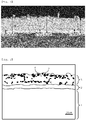
- FIG. 1 is a structural picture of a longitudinal section showing the plating layer of the plated steel sheet 3 of Invention Example 3
- FIG. 2 is a diagram of the structural picture of FIG. 1 .
- the tau phases (5) forming the alloy layer are irregularly and discontinuously formed inside the plating layer in the present invention. Having such tau phase distribution enables effective accomplishment of the above-described difference in hardnesses of 400 (Hv) or less between the alloy layer and the diffusion layer.
- reference numeral 1 represents a substrate steel sheet
- 2 represents a diffusion layer
- 3 represents an alloy layer
- 4 represents Fe 2 Al 5 and 5 represents a tau phase particle
- an alloy plating layer is formed combining the diffusion layer (2) and the alloy layer (3).
- Comparative Examples 1 to 3 having the manufacturing process outside the scope of the present invention all had a difference in hardnesses of greater than 400 (Hv) between the alloy layer and the diffusion layer, and accordingly, it was identified through Table 3 that delamination resistance was also degraded.
Landscapes
- Chemical & Material Sciences (AREA)
- Engineering & Computer Science (AREA)
- Materials Engineering (AREA)
- Mechanical Engineering (AREA)
- Metallurgy (AREA)
- Organic Chemistry (AREA)
- Physics & Mathematics (AREA)
- Thermal Sciences (AREA)
- Chemical Kinetics & Catalysis (AREA)
- Crystallography & Structural Chemistry (AREA)
- Oil, Petroleum & Natural Gas (AREA)
- Coating With Molten Metal (AREA)
- Heat Treatment Of Sheet Steel (AREA)
- Heat Treatment Of Articles (AREA)
- Other Surface Treatments For Metallic Materials (AREA)
Applications Claiming Priority (2)
| Application Number | Priority Date | Filing Date | Title |
|---|---|---|---|
| KR1020140189098A KR101569505B1 (ko) | 2014-12-24 | 2014-12-24 | 내박리성이 우수한 hpf 성형부재 및 그 제조방법 |
| PCT/KR2015/004327 WO2016104880A1 (fr) | 2014-12-24 | 2015-04-29 | Élément de moulage hpf présentant une excellente résistance au délaminage et son procédé de fabrication |
Publications (3)
| Publication Number | Publication Date |
|---|---|
| EP3239337A4 EP3239337A4 (fr) | 2017-11-01 |
| EP3239337A1 true EP3239337A1 (fr) | 2017-11-01 |
| EP3239337B1 EP3239337B1 (fr) | 2019-12-25 |
Family
ID=54868087
Family Applications (1)
| Application Number | Title | Priority Date | Filing Date |
|---|---|---|---|
| EP15873408.7A Active EP3239337B1 (fr) | 2014-12-24 | 2015-04-29 | Élément de moulage hpf présentant une excellente résistance au délaminage et son procédé de fabrication |
Country Status (8)
| Country | Link |
|---|---|
| US (1) | US10640840B2 (fr) |
| EP (1) | EP3239337B1 (fr) |
| JP (1) | JP6475824B2 (fr) |
| KR (1) | KR101569505B1 (fr) |
| CN (1) | CN106133179B (fr) |
| ES (1) | ES2775513T3 (fr) |
| MX (1) | MX383764B (fr) |
| WO (1) | WO2016104880A1 (fr) |
Cited By (6)
| Publication number | Priority date | Publication date | Assignee | Title |
|---|---|---|---|---|
| EP3889314A4 (fr) * | 2018-11-30 | 2021-11-10 | Posco | Tôle d'acier plaquée avec un alliage d'al-fe pour formage à la presse à chaud présentant une excellente résistance à la corrosion et une excellente résistance à la chaleur, pièce formée à la presse à chaud et procédé de fabrication associé |
| EP3933061A1 (fr) * | 2020-06-30 | 2022-01-05 | Hyundai Steel Company | Tôle d'acier pour presse a chaud et procede de fabrication |
| US11535916B2 (en) | 2017-12-05 | 2022-12-27 | Nippon Steel Corporation | Aluminum-based plated steel sheet, method of manufacturing aluminum-based plated steel sheet, and method of manufacturing component for vehicle |
| US12084734B2 (en) | 2020-12-18 | 2024-09-10 | Posco Co., Ltd | Plated steel sheets for hot press forming having excellent hydrogen brittleness resistance and impact resistance, hot press formed parts, and manufacturing methods thereof |
| US12252755B2 (en) | 2020-08-19 | 2025-03-18 | Thyssenkrupp Steel Europe Ag | Process for manufacturing a flat steel product having an aluminum-based corrosion-resistant coating, and flat steel product having an aluminum-based corrosion-resistant coating |
| US12584205B2 (en) | 2018-11-30 | 2026-03-24 | Posco | Steel sheet plated with Al—Fe alloy for hot press forming having excellent corrosion resistance and heat resistance, hot press formed part, and manufacturing method therefor |
Families Citing this family (14)
| Publication number | Priority date | Publication date | Assignee | Title |
|---|---|---|---|---|
| KR101696121B1 (ko) * | 2015-12-23 | 2017-01-13 | 주식회사 포스코 | 내수소지연파괴특성, 내박리성 및 용접성이 우수한 열간성형용 알루미늄-철 합금 도금강판 및 이를 이용한 열간성형 부재 |
| KR102075182B1 (ko) * | 2015-12-24 | 2020-02-10 | 주식회사 포스코 | 도금성이 우수한 고강도 용융 아연계 도금 강재 및 그 제조방법 |
| KR101858863B1 (ko) * | 2016-12-23 | 2018-05-17 | 주식회사 포스코 | 내식성 및 가공성이 우수한 용융 알루미늄계 도금강재 |
| KR102297297B1 (ko) | 2016-12-23 | 2021-09-03 | 주식회사 포스코 | 내식성이 우수한 알루미늄계 도금 강재, 이를 이용한 알루미늄계 합금화 도금 강재 및 이들의 제조방법 |
| WO2018158165A1 (fr) * | 2017-02-28 | 2018-09-07 | Tata Steel Ijmuiden B.V. | Procédé de fabrication d'une bande d'acier comprenant une couche de revêtement en alliage d'aluminium |
| KR102010048B1 (ko) | 2017-06-01 | 2019-10-21 | 주식회사 포스코 | 도장 밀착성과 도장 후 내식성이 우수한 열간 프레스 성형 부재용 강판 및 그 제조방법 |
| WO2018221991A1 (fr) * | 2017-06-01 | 2018-12-06 | 주식회사 포스코 | Tôle d'acier pour élément formé par pressage à chaud ayant une excellente adhérence de placage, et son procédé de fabrication |
| WO2018221992A1 (fr) * | 2017-06-01 | 2018-12-06 | 주식회사 포스코 | Tôle d'acier pour élément formé par pressage à chaud présentant une excellente adhérence de la peinture et une excellente résistance à la corrosion post-peinture, et son procédé de fabrication |
| WO2018221989A1 (fr) * | 2017-06-01 | 2018-12-06 | 주식회사 포스코 | Tôle d'acier pour élément formé à la presse à chaud présentant une excellente résistance à la fracture retardée par l'hydrogène, et son procédé de fabrication |
| KR102227111B1 (ko) * | 2018-11-30 | 2021-03-12 | 주식회사 포스코 | 열간성형 부재 및 그 제조방법 |
| KR102165223B1 (ko) | 2018-12-19 | 2020-10-13 | 주식회사 포스코 | 열간성형 후 충격특성이 우수한 열간성형용 도금강판, 열간성형 부재 및 이들의 제조방법 |
| CZ310333B6 (cs) * | 2019-12-20 | 2025-03-05 | Hyundai Steel Company | Za tepla lisovaná součást a způsob její výroby |
| DE102022123741A1 (de) | 2022-09-16 | 2024-03-21 | Thyssenkrupp Steel Europe Ag | FAL-beschichtetes Stahlblech für die Warmumformung |
| DE102023106688A1 (de) | 2023-03-17 | 2024-09-19 | Thyssenkrupp Steel Europe Ag | Geklebte Bauteilgruppe |
Family Cites Families (15)
| Publication number | Priority date | Publication date | Assignee | Title |
|---|---|---|---|---|
| FR2780984B1 (fr) | 1998-07-09 | 2001-06-22 | Lorraine Laminage | Tole d'acier laminee a chaud et a froid revetue et comportant une tres haute resistance apres traitement thermique |
| FR2790010B1 (fr) * | 1999-02-18 | 2001-04-06 | Lorraine Laminage | Procede d'aluminiage d'acier permettant d'obtenir une couche d'alliage interfaciale de faible epaisseur |
| CN100370054C (zh) * | 2001-06-15 | 2008-02-20 | 新日本制铁株式会社 | 镀有铝合金体系的高强度钢板以及具有优异的耐热性和喷漆后耐腐蚀性的高强度汽车零件 |
| JP3738754B2 (ja) | 2002-07-11 | 2006-01-25 | 日産自動車株式会社 | 電着塗装用アルミニウムめっき構造部材及びその製造方法 |
| KR20050121744A (ko) * | 2003-04-23 | 2005-12-27 | 수미도모 메탈 인더스트리즈, 리미티드 | 열간 프레스 성형품 및 그 제조 방법 |
| JP4325277B2 (ja) * | 2003-05-28 | 2009-09-02 | 住友金属工業株式会社 | 熱間成形法と熱間成形部材 |
| JP4288201B2 (ja) * | 2003-09-05 | 2009-07-01 | 新日本製鐵株式会社 | 耐水素脆化特性に優れた自動車用部材の製造方法 |
| JP4500124B2 (ja) * | 2004-07-23 | 2010-07-14 | 新日本製鐵株式会社 | ホットプレス用めっき鋼板の製造方法 |
| JP4964650B2 (ja) * | 2007-04-03 | 2012-07-04 | 新日本製鐵株式会社 | 加工後の耐食性に優れた溶融Al系めっき鋼板及びその製造方法 |
| JP5098864B2 (ja) * | 2008-07-11 | 2012-12-12 | 新日鐵住金株式会社 | 塗装後耐食性に優れた高強度自動車部材およびホットプレス用めっき鋼板 |
| JP5444650B2 (ja) * | 2008-07-11 | 2014-03-19 | 新日鐵住金株式会社 | ホットプレス用めっき鋼板及びその製造方法 |
| WO2010085983A1 (fr) | 2009-02-02 | 2010-08-05 | Arcelormittal Investigacion Y Desarrollo S.L. | Procédé de fabrication de pièces estampées revêtues et pièces préparées à partir de ce procédé |
| WO2011161833A1 (fr) * | 2010-06-21 | 2011-12-29 | 新日本製鐵株式会社 | Tôle d'acier aluminisé à chaud avec une excellente résistance au noircissement thermique, et son procédé de production |
| KR101829854B1 (ko) * | 2011-04-01 | 2018-02-20 | 신닛테츠스미킨 카부시키카이샤 | 도장 후 내식성이 우수한 핫 스탬핑 성형된 고강도 부품 및 그 제조 방법 |
| CN102851629B (zh) * | 2011-06-28 | 2015-09-02 | 鞍钢股份有限公司 | 一种热压成型用镀铝硅钢板及其制造方法 |
-
2014
- 2014-12-24 KR KR1020140189098A patent/KR101569505B1/ko active Active
-
2015
- 2015-04-29 JP JP2017513102A patent/JP6475824B2/ja active Active
- 2015-04-29 EP EP15873408.7A patent/EP3239337B1/fr active Active
- 2015-04-29 CN CN201580010470.9A patent/CN106133179B/zh active Active
- 2015-04-29 ES ES15873408T patent/ES2775513T3/es active Active
- 2015-04-29 WO PCT/KR2015/004327 patent/WO2016104880A1/fr not_active Ceased
- 2015-04-29 MX MX2017003551A patent/MX383764B/es unknown
-
2016
- 2016-08-29 US US15/250,022 patent/US10640840B2/en active Active
Cited By (7)
| Publication number | Priority date | Publication date | Assignee | Title |
|---|---|---|---|---|
| US11535916B2 (en) | 2017-12-05 | 2022-12-27 | Nippon Steel Corporation | Aluminum-based plated steel sheet, method of manufacturing aluminum-based plated steel sheet, and method of manufacturing component for vehicle |
| EP3889314A4 (fr) * | 2018-11-30 | 2021-11-10 | Posco | Tôle d'acier plaquée avec un alliage d'al-fe pour formage à la presse à chaud présentant une excellente résistance à la corrosion et une excellente résistance à la chaleur, pièce formée à la presse à chaud et procédé de fabrication associé |
| US12584205B2 (en) | 2018-11-30 | 2026-03-24 | Posco | Steel sheet plated with Al—Fe alloy for hot press forming having excellent corrosion resistance and heat resistance, hot press formed part, and manufacturing method therefor |
| EP3933061A1 (fr) * | 2020-06-30 | 2022-01-05 | Hyundai Steel Company | Tôle d'acier pour presse a chaud et procede de fabrication |
| US11225050B1 (en) | 2020-06-30 | 2022-01-18 | Hyundai Steel Company | Steel sheet for hot press and manufacturing method thereof |
| US12252755B2 (en) | 2020-08-19 | 2025-03-18 | Thyssenkrupp Steel Europe Ag | Process for manufacturing a flat steel product having an aluminum-based corrosion-resistant coating, and flat steel product having an aluminum-based corrosion-resistant coating |
| US12084734B2 (en) | 2020-12-18 | 2024-09-10 | Posco Co., Ltd | Plated steel sheets for hot press forming having excellent hydrogen brittleness resistance and impact resistance, hot press formed parts, and manufacturing methods thereof |
Also Published As
| Publication number | Publication date |
|---|---|
| WO2016104880A1 (fr) | 2016-06-30 |
| US20160376679A1 (en) | 2016-12-29 |
| JP2017532451A (ja) | 2017-11-02 |
| EP3239337A4 (fr) | 2017-11-01 |
| EP3239337B1 (fr) | 2019-12-25 |
| WO2016104880A8 (fr) | 2016-09-29 |
| US10640840B2 (en) | 2020-05-05 |
| KR101569505B1 (ko) | 2015-11-30 |
| MX2017003551A (es) | 2017-07-28 |
| JP6475824B2 (ja) | 2019-02-27 |
| MX383764B (es) | 2025-03-14 |
| CN106133179A (zh) | 2016-11-16 |
| ES2775513T3 (es) | 2020-07-27 |
| CN106133179B (zh) | 2018-03-09 |
Similar Documents
| Publication | Publication Date | Title |
|---|---|---|
| EP3239337B1 (fr) | Élément de moulage hpf présentant une excellente résistance au délaminage et son procédé de fabrication | |
| EP3239336B1 (fr) | Élément de moulage hpf présentant une excellente résistance au farinage au moment du moulage sous pression, et son procédé de fabrication | |
| KR101829854B1 (ko) | 도장 후 내식성이 우수한 핫 스탬핑 성형된 고강도 부품 및 그 제조 방법 | |
| TWI589709B (zh) | 熔融鍍鋅鋼板 | |
| EP3034641B1 (fr) | Tôle d'acier à ultra-haute résistance et son procédé de fabrication | |
| CN103827338B (zh) | 低密度高强度钢及制备所述钢的方法 | |
| KR101696069B1 (ko) | 내박리성이 우수한 hpf 성형부재 및 그 제조방법 | |
| US12330391B2 (en) | Steel sheet plated with Al—Fe for hot press forming having excellent corrosion resistance and spot weldability, and manufacturing method thereof | |
| EP3395979B1 (fr) | Tôle d'acier à base d'austénite plaquée d'aluminium fondu ayant d'excellentes propriétés de plaquage et de soudabilité et son procédé de fabrication | |
| JP6398967B2 (ja) | 表面外観及びめっき密着性に優れた高強度溶融めっき熱延鋼板およびその製造方法 | |
| KR102280093B1 (ko) | 내식성 및 용접성이 우수한 열간 프레스용 알루미늄-철계 도금 강판 및 그 제조방법 | |
| EP3889315A1 (fr) | Tôle d'acier plaquée à base de fer-aluminium pour formage à chaud ayant d'excellentes propriétés de fracture retardée à l'hydrogène et propriétés de soudage par points, et son procédé de fabrication | |
| JP4889212B2 (ja) | 高張力合金化溶融亜鉛めっき鋼板およびその製造方法 | |
| CN116529414A (zh) | 抗粉化性优异的高强度合金化热浸镀锌钢板及其制造方法 | |
| CN107109579A (zh) | 表面品质优异的高强度镀锌钢板用热轧钢板及其制造方法 | |
| JP2004211147A (ja) | 熱間プレス成形性に優れた亜鉛めっき鋼板および該鋼板を用いた熱間プレス成形部材の製法並びに高強度かつめっき外観に優れた熱間プレス成形部材 | |
| EP3889313A1 (fr) | Plaque d'acier plaqué à base d'aluminium pour presse à chaud ayant d'excellentes propriétés de résistance contre une rupture différée par l'hydrogène et de soudabilité par points, et son procédé de fabrication |
Legal Events
| Date | Code | Title | Description |
|---|---|---|---|
| STAA | Information on the status of an ep patent application or granted ep patent |
Free format text: STATUS: THE INTERNATIONAL PUBLICATION HAS BEEN MADE |
|
| TPAC | Observations filed by third parties |
Free format text: ORIGINAL CODE: EPIDOSNTIPA |
|
| PUAI | Public reference made under article 153(3) epc to a published international application that has entered the european phase |
Free format text: ORIGINAL CODE: 0009012 |
|
| STAA | Information on the status of an ep patent application or granted ep patent |
Free format text: STATUS: REQUEST FOR EXAMINATION WAS MADE |
|
| 17P | Request for examination filed |
Effective date: 20170421 |
|
| A4 | Supplementary search report drawn up and despatched |
Effective date: 20170901 |
|
| AK | Designated contracting states |
Kind code of ref document: A1 Designated state(s): AL AT BE BG CH CY CZ DE DK EE ES FI FR GB GR HR HU IE IS IT LI LT LU LV MC MK MT NL NO PL PT RO RS SE SI SK SM TR |
|
| AX | Request for extension of the european patent |
Extension state: BA ME |
|
| DAV | Request for validation of the european patent (deleted) | ||
| DAX | Request for extension of the european patent (deleted) | ||
| STAA | Information on the status of an ep patent application or granted ep patent |
Free format text: STATUS: EXAMINATION IS IN PROGRESS |
|
| 17Q | First examination report despatched |
Effective date: 20181005 |
|
| GRAP | Despatch of communication of intention to grant a patent |
Free format text: ORIGINAL CODE: EPIDOSNIGR1 |
|
| STAA | Information on the status of an ep patent application or granted ep patent |
Free format text: STATUS: GRANT OF PATENT IS INTENDED |
|
| INTG | Intention to grant announced |
Effective date: 20190710 |
|
| GRAS | Grant fee paid |
Free format text: ORIGINAL CODE: EPIDOSNIGR3 |
|
| GRAA | (expected) grant |
Free format text: ORIGINAL CODE: 0009210 |
|
| STAA | Information on the status of an ep patent application or granted ep patent |
Free format text: STATUS: THE PATENT HAS BEEN GRANTED |
|
| AK | Designated contracting states |
Kind code of ref document: B1 Designated state(s): AL AT BE BG CH CY CZ DE DK EE ES FI FR GB GR HR HU IE IS IT LI LT LU LV MC MK MT NL NO PL PT RO RS SE SI SK SM TR |
|
| REG | Reference to a national code |
Ref country code: GB Ref legal event code: FG4D |
|
| REG | Reference to a national code |
Ref country code: CH Ref legal event code: EP |
|
| REG | Reference to a national code |
Ref country code: AT Ref legal event code: REF Ref document number: 1217210 Country of ref document: AT Kind code of ref document: T Effective date: 20200115 |
|
| REG | Reference to a national code |
Ref country code: DE Ref legal event code: R096 Ref document number: 602015044450 Country of ref document: DE |
|
| REG | Reference to a national code |
Ref country code: IE Ref legal event code: FG4D |
|
| GRAT | Correction requested after decision to grant or after decision to maintain patent in amended form |
Free format text: ORIGINAL CODE: EPIDOSNCDEC |
|
| RAP2 | Party data changed (patent owner data changed or rights of a patent transferred) |
Owner name: POSCO |
|
| REG | Reference to a national code |
Ref country code: NL Ref legal event code: FP |
|
| PG25 | Lapsed in a contracting state [announced via postgrant information from national office to epo] |
Ref country code: SE Free format text: LAPSE BECAUSE OF FAILURE TO SUBMIT A TRANSLATION OF THE DESCRIPTION OR TO PAY THE FEE WITHIN THE PRESCRIBED TIME-LIMIT Effective date: 20191225 Ref country code: LV Free format text: LAPSE BECAUSE OF FAILURE TO SUBMIT A TRANSLATION OF THE DESCRIPTION OR TO PAY THE FEE WITHIN THE PRESCRIBED TIME-LIMIT Effective date: 20191225 Ref country code: GR Free format text: LAPSE BECAUSE OF FAILURE TO SUBMIT A TRANSLATION OF THE DESCRIPTION OR TO PAY THE FEE WITHIN THE PRESCRIBED TIME-LIMIT Effective date: 20200326 Ref country code: NO Free format text: LAPSE BECAUSE OF FAILURE TO SUBMIT A TRANSLATION OF THE DESCRIPTION OR TO PAY THE FEE WITHIN THE PRESCRIBED TIME-LIMIT Effective date: 20200325 Ref country code: BG Free format text: LAPSE BECAUSE OF FAILURE TO SUBMIT A TRANSLATION OF THE DESCRIPTION OR TO PAY THE FEE WITHIN THE PRESCRIBED TIME-LIMIT Effective date: 20200325 Ref country code: FI Free format text: LAPSE BECAUSE OF FAILURE TO SUBMIT A TRANSLATION OF THE DESCRIPTION OR TO PAY THE FEE WITHIN THE PRESCRIBED TIME-LIMIT Effective date: 20191225 Ref country code: LT Free format text: LAPSE BECAUSE OF FAILURE TO SUBMIT A TRANSLATION OF THE DESCRIPTION OR TO PAY THE FEE WITHIN THE PRESCRIBED TIME-LIMIT Effective date: 20191225 |
|
| REG | Reference to a national code |
Ref country code: LT Ref legal event code: MG4D |
|
| PG25 | Lapsed in a contracting state [announced via postgrant information from national office to epo] |
Ref country code: HR Free format text: LAPSE BECAUSE OF FAILURE TO SUBMIT A TRANSLATION OF THE DESCRIPTION OR TO PAY THE FEE WITHIN THE PRESCRIBED TIME-LIMIT Effective date: 20191225 Ref country code: RS Free format text: LAPSE BECAUSE OF FAILURE TO SUBMIT A TRANSLATION OF THE DESCRIPTION OR TO PAY THE FEE WITHIN THE PRESCRIBED TIME-LIMIT Effective date: 20191225 |
|
| PG25 | Lapsed in a contracting state [announced via postgrant information from national office to epo] |
Ref country code: AL Free format text: LAPSE BECAUSE OF FAILURE TO SUBMIT A TRANSLATION OF THE DESCRIPTION OR TO PAY THE FEE WITHIN THE PRESCRIBED TIME-LIMIT Effective date: 20191225 |
|
| REG | Reference to a national code |
Ref country code: ES Ref legal event code: FG2A Ref document number: 2775513 Country of ref document: ES Kind code of ref document: T3 Effective date: 20200727 |
|
| PG25 | Lapsed in a contracting state [announced via postgrant information from national office to epo] |
Ref country code: RO Free format text: LAPSE BECAUSE OF FAILURE TO SUBMIT A TRANSLATION OF THE DESCRIPTION OR TO PAY THE FEE WITHIN THE PRESCRIBED TIME-LIMIT Effective date: 20191225 Ref country code: PT Free format text: LAPSE BECAUSE OF FAILURE TO SUBMIT A TRANSLATION OF THE DESCRIPTION OR TO PAY THE FEE WITHIN THE PRESCRIBED TIME-LIMIT Effective date: 20200520 Ref country code: EE Free format text: LAPSE BECAUSE OF FAILURE TO SUBMIT A TRANSLATION OF THE DESCRIPTION OR TO PAY THE FEE WITHIN THE PRESCRIBED TIME-LIMIT Effective date: 20191225 |
|
| PG25 | Lapsed in a contracting state [announced via postgrant information from national office to epo] |
Ref country code: SK Free format text: LAPSE BECAUSE OF FAILURE TO SUBMIT A TRANSLATION OF THE DESCRIPTION OR TO PAY THE FEE WITHIN THE PRESCRIBED TIME-LIMIT Effective date: 20191225 Ref country code: SM Free format text: LAPSE BECAUSE OF FAILURE TO SUBMIT A TRANSLATION OF THE DESCRIPTION OR TO PAY THE FEE WITHIN THE PRESCRIBED TIME-LIMIT Effective date: 20191225 Ref country code: IS Free format text: LAPSE BECAUSE OF FAILURE TO SUBMIT A TRANSLATION OF THE DESCRIPTION OR TO PAY THE FEE WITHIN THE PRESCRIBED TIME-LIMIT Effective date: 20200425 |
|
| REG | Reference to a national code |
Ref country code: DE Ref legal event code: R097 Ref document number: 602015044450 Country of ref document: DE |
|
| PG25 | Lapsed in a contracting state [announced via postgrant information from national office to epo] |
Ref country code: DK Free format text: LAPSE BECAUSE OF FAILURE TO SUBMIT A TRANSLATION OF THE DESCRIPTION OR TO PAY THE FEE WITHIN THE PRESCRIBED TIME-LIMIT Effective date: 20191225 Ref country code: CZ Free format text: LAPSE BECAUSE OF FAILURE TO SUBMIT A TRANSLATION OF THE DESCRIPTION OR TO PAY THE FEE WITHIN THE PRESCRIBED TIME-LIMIT Effective date: 20191225 |
|
| PLBE | No opposition filed within time limit |
Free format text: ORIGINAL CODE: 0009261 |
|
| STAA | Information on the status of an ep patent application or granted ep patent |
Free format text: STATUS: NO OPPOSITION FILED WITHIN TIME LIMIT |
|
| PG25 | Lapsed in a contracting state [announced via postgrant information from national office to epo] |
Ref country code: MC Free format text: LAPSE BECAUSE OF FAILURE TO SUBMIT A TRANSLATION OF THE DESCRIPTION OR TO PAY THE FEE WITHIN THE PRESCRIBED TIME-LIMIT Effective date: 20191225 Ref country code: SI Free format text: LAPSE BECAUSE OF FAILURE TO SUBMIT A TRANSLATION OF THE DESCRIPTION OR TO PAY THE FEE WITHIN THE PRESCRIBED TIME-LIMIT Effective date: 20191225 |
|
| REG | Reference to a national code |
Ref country code: CH Ref legal event code: PL |
|
| 26N | No opposition filed |
Effective date: 20200928 |
|
| PG25 | Lapsed in a contracting state [announced via postgrant information from national office to epo] |
Ref country code: LI Free format text: LAPSE BECAUSE OF NON-PAYMENT OF DUE FEES Effective date: 20200430 Ref country code: LU Free format text: LAPSE BECAUSE OF NON-PAYMENT OF DUE FEES Effective date: 20200429 Ref country code: CH Free format text: LAPSE BECAUSE OF NON-PAYMENT OF DUE FEES Effective date: 20200430 |
|
| REG | Reference to a national code |
Ref country code: BE Ref legal event code: MM Effective date: 20200430 |
|
| PG25 | Lapsed in a contracting state [announced via postgrant information from national office to epo] |
Ref country code: BE Free format text: LAPSE BECAUSE OF NON-PAYMENT OF DUE FEES Effective date: 20200430 Ref country code: PL Free format text: LAPSE BECAUSE OF FAILURE TO SUBMIT A TRANSLATION OF THE DESCRIPTION OR TO PAY THE FEE WITHIN THE PRESCRIBED TIME-LIMIT Effective date: 20191225 |
|
| PG25 | Lapsed in a contracting state [announced via postgrant information from national office to epo] |
Ref country code: IE Free format text: LAPSE BECAUSE OF NON-PAYMENT OF DUE FEES Effective date: 20200429 |
|
| PG25 | Lapsed in a contracting state [announced via postgrant information from national office to epo] |
Ref country code: TR Free format text: LAPSE BECAUSE OF FAILURE TO SUBMIT A TRANSLATION OF THE DESCRIPTION OR TO PAY THE FEE WITHIN THE PRESCRIBED TIME-LIMIT Effective date: 20191225 Ref country code: MT Free format text: LAPSE BECAUSE OF FAILURE TO SUBMIT A TRANSLATION OF THE DESCRIPTION OR TO PAY THE FEE WITHIN THE PRESCRIBED TIME-LIMIT Effective date: 20191225 Ref country code: CY Free format text: LAPSE BECAUSE OF FAILURE TO SUBMIT A TRANSLATION OF THE DESCRIPTION OR TO PAY THE FEE WITHIN THE PRESCRIBED TIME-LIMIT Effective date: 20191225 |
|
| PG25 | Lapsed in a contracting state [announced via postgrant information from national office to epo] |
Ref country code: MK Free format text: LAPSE BECAUSE OF FAILURE TO SUBMIT A TRANSLATION OF THE DESCRIPTION OR TO PAY THE FEE WITHIN THE PRESCRIBED TIME-LIMIT Effective date: 20191225 |
|
| REG | Reference to a national code |
Ref country code: AT Ref legal event code: UEP Ref document number: 1217210 Country of ref document: AT Kind code of ref document: T Effective date: 20191225 |
|
| REG | Reference to a national code |
Ref country code: DE Ref legal event code: R081 Ref document number: 602015044450 Country of ref document: DE Owner name: POSCO CO., LTD, POHANG-SI, KR Free format text: FORMER OWNER: POSCO, POHANG-SI, GYEONGSANGBUK-DO, KR Ref country code: DE Ref legal event code: R081 Ref document number: 602015044450 Country of ref document: DE Owner name: POSCO CO., LTD, POHANG- SI, KR Free format text: FORMER OWNER: POSCO, POHANG-SI, GYEONGSANGBUK-DO, KR Ref country code: DE Ref legal event code: R081 Ref document number: 602015044450 Country of ref document: DE Owner name: POSCO HOLDINGS INC., KR Free format text: FORMER OWNER: POSCO, POHANG-SI, GYEONGSANGBUK-DO, KR |
|
| REG | Reference to a national code |
Ref country code: NL Ref legal event code: PD Owner name: POSCO HOLDINGS INC.; KR Free format text: DETAILS ASSIGNMENT: CHANGE OF OWNER(S), CHANGE OF LEGAL ENTITY; FORMER OWNER NAME: POSCO Effective date: 20221026 |
|
| REG | Reference to a national code |
Ref country code: GB Ref legal event code: 732E Free format text: REGISTERED BETWEEN 20221027 AND 20221102 |
|
| REG | Reference to a national code |
Ref country code: NL Ref legal event code: PD Owner name: POSCO CO., LTD; KO Free format text: DETAILS ASSIGNMENT: CHANGE OF OWNER(S), ASSIGNMENT; FORMER OWNER NAME: POSCO Effective date: 20221109 |
|
| REG | Reference to a national code |
Ref country code: ES Ref legal event code: PC2A Owner name: POSCO HOLDINGS INC. Effective date: 20230303 |
|
| REG | Reference to a national code |
Ref country code: AT Ref legal event code: PC Ref document number: 1217210 Country of ref document: AT Kind code of ref document: T Owner name: POSCO CO., LTD, KR Effective date: 20230228 |
|
| REG | Reference to a national code |
Ref country code: DE Ref legal event code: R081 Ref document number: 602015044450 Country of ref document: DE Owner name: POSCO CO., LTD, POHANG-SI, KR Free format text: FORMER OWNER: POSCO HOLDINGS INC., SEOUL, KR Ref country code: DE Ref legal event code: R081 Ref document number: 602015044450 Country of ref document: DE Owner name: POSCO CO., LTD, POHANG- SI, KR Free format text: FORMER OWNER: POSCO HOLDINGS INC., SEOUL, KR |
|
| PGFP | Annual fee paid to national office [announced via postgrant information from national office to epo] |
Ref country code: IT Payment date: 20250321 Year of fee payment: 11 |
|
| PGFP | Annual fee paid to national office [announced via postgrant information from national office to epo] |
Ref country code: DE Payment date: 20250320 Year of fee payment: 11 |
|
| PGFP | Annual fee paid to national office [announced via postgrant information from national office to epo] |
Ref country code: ES Payment date: 20250516 Year of fee payment: 11 |
|
| PGFP | Annual fee paid to national office [announced via postgrant information from national office to epo] |
Ref country code: AT Payment date: 20250320 Year of fee payment: 11 |
|
| PGFP | Annual fee paid to national office [announced via postgrant information from national office to epo] |
Ref country code: GB Payment date: 20260324 Year of fee payment: 12 |
|
| PGFP | Annual fee paid to national office [announced via postgrant information from national office to epo] |
Ref country code: NL Payment date: 20260324 Year of fee payment: 12 |
|
| PGFP | Annual fee paid to national office [announced via postgrant information from national office to epo] |
Ref country code: FR Payment date: 20260323 Year of fee payment: 12 |