EP3241378B1 - Basisstation eines zellularen netzwerks, verfahren zur verarbeitung in solch einer basisstation und zugehöriges benutzerendgerät - Google Patents
Basisstation eines zellularen netzwerks, verfahren zur verarbeitung in solch einer basisstation und zugehöriges benutzerendgerät Download PDFInfo
- Publication number
- EP3241378B1 EP3241378B1 EP15820175.6A EP15820175A EP3241378B1 EP 3241378 B1 EP3241378 B1 EP 3241378B1 EP 15820175 A EP15820175 A EP 15820175A EP 3241378 B1 EP3241378 B1 EP 3241378B1
- Authority
- EP
- European Patent Office
- Prior art keywords
- protocol
- base station
- radio
- lte
- manet
- Prior art date
- Legal status (The legal status is an assumption and is not a legal conclusion. Google has not performed a legal analysis and makes no representation as to the accuracy of the status listed.)
- Active
Links
Images

Classifications
-
- H—ELECTRICITY
- H04—ELECTRIC COMMUNICATION TECHNIQUE
- H04W—WIRELESS COMMUNICATION NETWORKS
- H04W16/00—Network planning, e.g. coverage or traffic planning tools; Network deployment, e.g. resource partitioning or cells structures
- H04W16/14—Spectrum sharing arrangements between different networks
-
- H—ELECTRICITY
- H04—ELECTRIC COMMUNICATION TECHNIQUE
- H04W—WIRELESS COMMUNICATION NETWORKS
- H04W72/00—Local resource management
- H04W72/12—Wireless traffic scheduling
- H04W72/1215—Wireless traffic scheduling for collaboration of different radio technologies
-
- H—ELECTRICITY
- H04—ELECTRIC COMMUNICATION TECHNIQUE
- H04W—WIRELESS COMMUNICATION NETWORKS
- H04W72/00—Local resource management
- H04W72/20—Control channels or signalling for resource management
- H04W72/23—Control channels or signalling for resource management in the downlink direction of a wireless link, i.e. towards a terminal
Definitions
- the present invention relates to the field of radiocommunications.
- the invention relates to a base station of a cellular network comprising radiofrequency transmission and reception means and adapted to establish, via said radiofrequency transmission/reception means, connections on uplink and downlink radiofrequency channels, by implementing a first radio communication protocol, with user terminals located within a radio cell associated with the base station; said base station being adapted to exchange, in accordance with the first radio protocol, data frames with user terminals on downlink and/or uplink radio channels, after having inserted at least one empty subframe therein, and said base station being adapted to synchronize the occurrence of said empty subframes with that of the empty subframes inserted by the other base stations of the cellular network, and to communicate, during the occurrence of the empty subframes, according to a second radio protocol, via said transmission/reception means, with at least one neighboring base station, said second protocol implemented by said base station being distinct from the first radio protocol implemented by said base station; the first radio protocol is an LTE type protocol, and the empty subframes are subframes of the "Almost Blank
- Such a base station is used in particular in cellular networks implementing the LTE (“Long Term Evolution”) standard, also known as 4G, from publication 10 of the corresponding 3 GPP standard (“3GPP Release 10”).
- LTE Long Term Evolution
- 4G Long Term Evolution
- ad-hoc mobile networks are wireless networks of radiofrequency transmitting/receiving nodes capable of organizing themselves among themselves, without a previously defined infrastructure, and are called MANET networks.
- relay stations IEEE 802.16j and 802.16m standards, 3GPP release 8
- 3GPP release 8 3GPP release 8
- these relay stations were designed for fixed or nomadic operation, without the possibility of generating or receiving data at the level of this equipment or of transmitting data between two user terminals without going through the base station.
- this equipment cannot be used by network subscribers to communicate.
- the base station and the user terminal each comprise a radio module and an associated processing module for communication in the cellular network and another radio module and another associated processing module for ad-hoc communication.
- the invention proposes a base station according to claim 1.
- the present description thus proposes the provision of a cellular network, not in accordance with the invention as claimed, according to a first protocol, for example the LTE radio protocol and a network according to a second protocol, for example a MANET radio protocol, which makes it possible to use the same radiofrequency equipment of the base station to communicate according to the LTE protocol with the user terminals and ensure interoperability with the 3GPP standard solutions (in particular the mobility function allowing a terminal to change connection base station is maintained), and to ensure the MANET networking of the MANET nodes comprising at least the base stations.
- a first protocol for example the LTE radio protocol
- a second protocol for example a MANET radio protocol
- the base station according to the invention is according to any one of claims 2 to 5.
- the present invention provides a treatment method according to claim 6.
- the present invention provides a user terminal according to claim 7.
- the user terminal according to the invention is according to claim 8.
- FIG. 1 represents an LTE 1 cellular telecommunications network comprising 2 base stations, also called eNodeB.
- At least some of these base stations 2 are mobile (e.g. they are mounted in vehicles).
- a base station 2 comprises at least one radio frequency antenna adapted to transmit radio frequency signals within a geographic area which is associated with the base station 2, and is hereinafter referred to as a radio cell, and to receive radio frequency signals.
- Each of these base stations 2 is adapted to implement, in accordance with the LTE protocol from its publication 10 (Release 10), radio communications with user terminals 3 located within its radio cell.
- Workstations 4 such as call servers, or computers, are further connected locally to the base station 2 in certain embodiments, for example by cable.
- a set of N mutually orthogonal subcarriers is assigned to each base station 2 to implement uplink LTE radiocommunications (from a user terminal 3 to the base station 2) and downlink LTE radiocommunications (from the base station 2 to a user terminal 3).
- N may be equal to 12 at a given time.
- the base station 2 is adapted to perform OFDMA (Orthogonal Frequency Division Multiple Access) coding of the digital data to be transmitted in the context of the LTE downlink communications, according to which the coded data, called OFDM symbols, are distributed over mutually orthogonal subcarriers.
- OFDMA Orthogonal Frequency Division Multiple Access
- LTE frames emitted by a base station 2 are of duration d, typically d is equal to 10 milliseconds (ms). They are divided into 10 subframes, each subframe of length 1.0 ms. Among these subframes are LTE subframes. Each LTE subframe is divided into two intervals (“slot”), each of 0.5 ms. A slot is composed of 6 or 7 successive OFDM symbols.
- the time/frequency space is divided into PRBs (Physical Resource Blocks).
- PRBs Physical Resource Blocks
- Resources are allocated by pair of PRBs, the PRBs of a pair being allocated in two consecutive time slots of the same subframe. Which in practice means that the allocation unit lasts 1 ms.
- the LTE standard as of its publication n°10, introduces empty subframes of traffic in the LTE frame, in order to reduce the impact of interference from main cells ("umbrella cells") which are on point microcells, in so-called heterogeneous networks (NetHet).
- This new type of LTE subframe is called ABS frame (in English "Almost Blanked Subframe").
- FIG. 2 is a view of an LTE frame transmitted by a base station 2 and comprising LTE subframes and at least one ABS subframe. This empty ABS subframe is imposed by the base station on all its carriers and positioned in the frame at a configurable location.
- the base station further requires user terminals communicating with it not to transmit via LTE during this ABS subframe.
- the invention proposes to exploit these empty ABS frames to set up a MANET network between the LTE base stations via a MANET type signaling protocol distinct from that of LTE but sharing the same time frame, using the same radiofrequency stage and able to use the same PHY layer (layer 1 of the OSI model).
- the MANET network is implemented in the embodiment described below on a set of subcarrier(s) named F MANET.
- This set of subcarrier(s) F MANET is the one used by all the base stations 2 for the MANET communication. These subcarriers have in one embodiment the same bandwidth (ie 15 Khz).
- the set F manet may be identical to the set of subcarriers of the LTE waveform, or have a non-zero intersection or a zero intersection with the set of subcarriers of the LTE waveform.
- a base station 2 thus comprises a processing block 20 shown in figure 3 suitable for processing signals radio frequency signals received by the antenna and to process signals before supplying them to the antenna for radio frequency transmission.
- the processing block 20 of a base station 2 comprises an RF radio frequency unit 21, a switch 22, an LTE block 23 and a processing module 24.
- the processing module 24 includes an IP router 29, an LTE access interface 27, an X2 block 28, a synchronization block 26, an LTE block 23 and a MANET block 25.
- LTE block 23, LTE access interface 27, X2 block 28 and MANET block 25 are each identified by a respective IP address.
- the RF unit 21 is on the one hand interfaced to the antenna and on the other hand to the switch 22, and comprises the radiofrequency stage of the base station, analog/digital and digital/analog converters and amplifiers.
- the RF unit 21 is thus adapted to provide the antenna with the LTE or MANET radiofrequency data to be transmitted which are provided to it by the switch 22, and to provide the switch 22 with the received useful signal.
- the RF unit 21 receives the radiofrequency signal provided by the antenna, amplifies it, filters it and downgrades the useful signal from the radiofrequency carrier into a baseband signal, digitizes it, then provides it to the switch 22.
- the RF unit 21 receives a useful signal provided by the switch 22 in digital form, de-digitizes it, modulates it with a radiofrequency carrier and delivers it to the antenna.
- the switch 22 for example a gigabit ethernet switch, is adapted to be controlled by the synchronization block 26 of the MANET block 24 so as to interface the MANET block 24 and the RF unit 21 during the period corresponding to the reception of an ABS subframe allocated to MANET communications and to interface the LTE block 23 and the RF unit 21 during a period corresponding to the reception of an LTE subframe or an ABS subframe not allocated to MANET communications.
- the LTE block 23 is adapted to implement the part of the LTE protocol specific to base stations, to execute the processing specific to the LTE waveform, in particular the processing relating to the LTE access and routing layers (layers 1, 2). and 3 of the OSI model) in transmission and reception, including LTE modulation/demodulation and LTE coding/decoding, to prepare and control the RF unit 21 for the transmission of LTE subframes and ABS subframes not allocated to MANET communications, in accordance with the fixed configuration of an LTE frame, and to process LTE subframes and ABS subframes not allocated to MANET communications received by the antenna and transmitted by the RF interface 21 when the switch 22 interfaces the LTE block 23 and the RF unit 21.
- the core network elements “EPC” in English “ Evolved Packet Core ”) of an LTE network, comprising equipment such as MME or SGW and making it possible in particular to be able to transport the communications received by a base station 2 to another base station 2, are integrated into the LTE access interface 27.
- the LTE access interface 27 is particularly suitable for, upon receipt of packets from the MANET network which have been delivered to it by the IP router 29, processing them and then providing the packets once processed, via the IP router 29, to the LTE block 23.
- the MANET block 25 is adapted to perform the processing specific to the selected MANET waveform, in particular the processing relating to the access and routing layers (layers 1, 2 and 3 of the OSI model) in transmission and reception, including MANET modulation/demodulation and MANET coding/decoding. It is adapted to prepare and control the RF unit 21 for the transmission of data during the period of the ABS subframes allocated to MANET communications, in accordance with the fixed configuration of an LTE frame, and to process the MANET data received by the antenna and transmitted by the RF interface 21 when the switch 22 interfaces the MANET block 25 and the RF unit 21 between them.
- the MANET block 25 is adapted to, after having demodulated and decoded MANET data packets from the useful signal provided by the switch 22, provide them to the IP router 29.
- the MANET block 25 is further adapted to receive each of the MANET data packets provided to it by the IP router 29 with the IP address of the recipient of the packet and the IP address of the MANET node making it possible to reach said recipient and which is closest to it according to the IP topology (OSI L3 layer), and to modulate and encode according to the MANET waveform by determining and indicating the MANET address (OSI L2) of the neighboring relay node and to provide the resulting data to the switch 22.
- OSI L3 layer IP topology
- the synchronization block 26 is adapted to control the switch 22 so as to interface the RF unit 21 to the LTE block 23 during the periods of the LTE frames corresponding to the LTE subframes and to the ABS subframes not allocated to the MANET communications and to interface the RF unit 21 to the MANET block 24 during the periods of the LTE frames corresponding to the ABS subframes allocated to the MANET communications.
- the learning of these respective periods is carried out by the synchronization block 26 in a preliminary phase described below.
- the IP router 29 comprises a data table defining the L3 topology of the IP addresses of the MANET network and of the networks reachable from the MANET network, and the L3 IP addressing plan of the LTE network. It also comprises an IP address correspondence table indicating for each of the base stations 2 of the network 1, the IP address of the LTE block of the base station 2 in correspondence with the IP address of the LTE access interface 27 of this base station 2, in correspondence with the IP address of the X2 proxy 28 and also in correspondence with the IP address of the MANET block 25 of this base station 2.
- the X2 block 28 is a proxy type device suitable for implementing, between base stations 2, the functions of the X2 protocol of the LTE standard, but via the MANET network comprising the base stations 2 meshed in an ad-hoc network according to the invention, in the context of point-to-multipoint exchanges (versus point-to-point in the LTE standard case).
- the exchanges between the X2 proxy 28 and the LTE block 23 comply with the usual X2 protocol.
- the X2 block 28 is adapted to detect, on the basis of the MANET exchanges implemented via the MANET block 25, at least one event: such an event is for example the appearance or disappearance of such a base station, a modification or a request for modification of at least one subcarrier used by an uplink or downlink LTE channel of such a base station, and to broadcast the indication of this event via the transmission of MANET data to the neighboring base stations.
- an event is for example the appearance or disappearance of such a base station, a modification or a request for modification of at least one subcarrier used by an uplink or downlink LTE channel of such a base station, and to broadcast the indication of this event via the transmission of MANET data to the neighboring base stations.
- the terminal context is provided by LTE block 23 to X2 block 28 of base station #1 where the user terminal comes from, and then transmitted via MANET to X2 block of base station #2.
- the X2 proxy 28 has a list of the IP addresses of all X2 proxies of the base stations in the network and determines, via MANET exchanges with neighboring base stations, which are the proxies of the neighboring base stations.
- the position of one or more empty subframes is predefined identically for all the base stations 2 of the network 1 and, according to the invention, among these empty subframes, one or more are reserved for MANET communications.
- subframes reserved for MANET communications can be inserted into the parts of LTE frames corresponding to LTE downlink or LTE uplink communication.
- each subframe No. 3 of the LTE frames is a subframe on which a gap is imposed for LTE data transmission both from the base stations 2 and from the user terminals 3 communicating with these stations via the LTE network and which is reserved for MANET communications.
- the configuration of the LTE frame comprising this position of one or more ABS subframes allocated to the MANET transit is predefined identically for all the base stations 2 of the network 1 and is recorded by the synchronization block 26 of each base station 2 and is also transmitted to the LTE block 23 and to the MANET block 25.
- This table is stored in the IP router 29 of each base station 2.
- Both MANET and LTE waveforms must be synchronized, within the same base station 2 and also between base stations 2, in order to share ABS frame time allocations without collision.
- the MANET waveform provides global synchronization to all base stations 2 and therefore also, indirectly (because via LTE blocks 23) for all LTE user terminals 3 of network 1.
- the MANET waveform synchronization mechanism is based for example on the periodic transmission of beacons in the MANET data transmitted on the set of frequency resources F MANET during the ABS subframes, which are used by the synchronization block 26, via the MANET block 25.
- the synchronization block 26 controls the switch 22 according to the synchronization indicated by these beacons.
- Successive synchronization commands, determined according to the successive beacons, are further transmitted at each base station 2 by the synchronization block 26 to the LTE module 23 which controls the preparation and transmission of the LTE frames according to these successive synchronization commands.
- the LTE frames are therefore transmitted at the same time by the different base stations 2.
- the ABS subframes are thus also transmitted at the same time, which allows communication between base stations 2 on the subcarrier named F MANET (or on all the subcarriers named F MANET ) according to the MANET protocol during the time corresponding to the ABS subframes allocated to MANET communications.
- ABS subframes can be configured either by configuration or via the X2 link.
- the periods of the ABS subframes allocated to this network must be common to all the base stations 2. This therefore requires that the basic configuration of the ABS subframes be defined in a common manner between the stations in a prior configuration phase of the network as described above.
- ABS subframes are allocated and possibly created (instead of LTE subframes), to increase only the local MANET transit capacity between two (or more) base stations, hereinafter referred to as a group of base stations, to the detriment however of their LTE access capacity.
- ABS subframes The increase or decrease of ABS subframes is done through a dynamic allocation managed by the X2 block 28, using, in its interface with the LTE block 23, the X2 protocol implemented on top of the statically defined subframes, to define the extension ABS subframes.
- This allocation protocol extends to all base stations in the group as well as to their 1-hop neighborhood.
- these additional ABS subframes become usable by each of the subgroups. These subframes may in particular be released.
- This acquisition and synchronization process is performed periodically.
- LTE mesh can also integrate user terminals in one embodiment
- radio frequency devices here a single RF unit is used for the MANET networking and the LTE networking
- This arrangement provides significant advantages in terms of size, both of the radio equipment and of the antenna system, and also of recurring cost for the production of these products.
- LTE technology is of course only one example and any type of cellular communications technology can be used to implement the invention.
- This approach makes it possible to retain the advantages of 4G mobile technologies (very high speed, high-performance PHY layer based on an OFDMA/SC-FDMA combination, QoS, etc.) while adding ad hoc or relay functionality.
- data to be transmitted are generated by workstation 1 named PC1, local to base station 2 named eNB1, and then transmitted in MANET communication by eNB1.
- MANET data are received by neighboring base station 2, named eNB3, and then relayed by LTE communication to LTE user terminal 3, which is attached to eNB3 and is the recipient of the data.
- data to be transmitted to a workstation 4, named PC4 and local to the base station 2 named eNB4 are generated by the workstation 1 named PC1, local to the base station 2 named eNB1, and then are transmitted in MANET communication by the eNB1.
- These MANET data are received by neighboring base station 2, named eNB3, and then relayed by LTE communication to eNB4, which delivers them to workstation PC4.
- the MANET network may further comprise, as additional node(s), one or more LTE user terminals among the user terminals 3.
- Such a user terminal comprises a radio frequency antenna adapted to transmit radio frequency signals and is adapted to implement with base stations 2, radio frequency communications compliant with the LTE protocol during the subframes of an LTE frame other than the subframes dedicated to MANET communications. It is further adapted to implement, during the ABS subframe(s) dedicated to MANET communications, communications compliant with the MANET protocol with other nodes of the MANET network (base stations or user terminals).
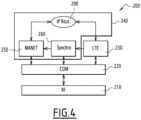
- Such a user terminal thus comprises in one embodiment, with reference to the figure 4 , a processing block 200 represented in figure 4 adapted to process radio frequency signals received by the antenna and to process signals before supplying them to the antenna for radio frequency transmission.
- the processing block 200 of such a user terminal comprises an RF radio frequency unit 210, a switch 220, an LTE block 230 and a processing module 240.
- the processing module 240 includes an IP router 290, an LTE block 230, a synchronization block 260 and a MANET block 250.
- LTE block 23 and MANET block 25 are each identified by a respective IP address.
- the operation of the RF radio frequency unit 210, the switch 220, the IP router 290 and the MANET block 250 is similar to that of the RF radio frequency unit 21, the switch 22, the IP router 29 and the MANET block 25 described above, respectively.
- LTE block 230 corresponds to that of LTE block 23, except that the part of the LTE protocol implemented therein is that relating to the terminal. user (and not that relating to the base station) and that there are no exchanges conforming to the X2 protocol implemented by the LTE block.
- the synchronization as driven by the synchronization block 260 to pace the MANET blocks 250, LTE 230 and the switch 220 is acquired by the synchronization block 260 from the LTE frame sent by the base station 2 to which the user terminal is attached in accordance with the LTE protocol (and not via a beacon in the MANET data).
- a single RF unit can be used by such a radio terminal to successively realize LTE radio communications and MANET radio communications.
Landscapes
- Engineering & Computer Science (AREA)
- Computer Networks & Wireless Communication (AREA)
- Signal Processing (AREA)
- Mobile Radio Communication Systems (AREA)
Claims (8)
- Basisstation (2) eines Mobilfunknetzes, umfassend Hochfrequenz-Sende- und- Empfangseinrichtungen (21) und das angepasst ist, um über die Hochfrequenz-Sende- und -Empfangseinrichtungen Verbindungen auf Uplink- und Downlink-Hochfrequenzkanälen herzustellen, indem sie ein erstes Funkkommunikationsprotokoll implementiert, mit Benutzerendgeräten, die sich innerhalb einer Funkzelle befinden, die mit der Basisstation assoziiert ist;wobei die Basisstation angepasst ist, um gemäß dem ersten Funkprotokoll Datenframes mit Benutzerendgeräten auf Downlink- und/oder Uplink-Funkkanälen auszutauschen, nachdem sie mindestens ein leeres Teilframe in diese eingefügt hat, undwobei die Basisstation dadurch gekennzeichnet ist, dass sie angepasst ist, um das Auftreten der leeren Teilframes mit dem Auftreten der von den anderen Basisstationen des Mobilfunknetzes eingefügten leeren Teilframes zu synchronisieren und während des Auftretens der leeren Teilframes gemäß einem zweiten Funkprotokoll über die Sende-/Empfangseinrichtungen mit mindestens einer benachbarten Basisstation zu kommunizieren, wobei sich das von der Basisstation implementierte zweite Protokoll von dem Funkprotokoll unterscheidet, das von der Basisstation implementiert wird;das erste Funkprotokoll ein LTE-ähnliches Protokoll ist und die leeren Teilframes Teilframes vom Typ "Almost Blanked Subframe" sind, die durch Konfiguration der Basisstation definiert sind; unddas zweite Protokoll ist ein Protokoll vom Typ MANET ist.
- Basisstation (2) nach Anspruch 1, die angepasst ist, um während des Auftretens der leeren Teilframes über die Sende-/Empfangseinrichtungen mit mehreren benachbarten Basisstationen gemäß dem zweiten Funkprotokoll auf einem gemeinsamen Funkfrequenzkanal zu kommunizieren.
- Basisstation (2) nach Anspruch 1 oder 2, die angepasst ist, um einen gemeinsamen Hochfrequenzkanal für die Kommunikation gemäß dem ersten und zweiten Protokoll zu verwenden.
- Basisstation (2) nach einem der vorherigen Ansprüche, die zu Folgendem angepasst ist:- Empfangen, über das zweite Protokoll, von Daten, die mindestens ein Ereignis von einem Erscheinen oder Verschwinden einer benachbarten Basisstation, einer Anfrage oder einer Änderung der Zuweisung eines von dem ersten Protokoll verwendeten Funkfrequenzkanals angeben, und- Verteilen, über das zweite Protokoll, der Angabe dieses Ereignisses auf dem gemeinsamen Funkfrequenzkanal zu den benachbarten Basisstationen während des Auftretens des/der leeren Teilframes, und/oder- Ändern, abhängig von dem Ereignis, mindestens eines von dem Uplink- oder Downlink-Kanal, die von der Basisstation für die Kommunikation mit den Endgeräten gemäß dem ersten Protokoll implementiert werden.
- Basisstation (2) nach einem der vorherigen Ansprüche, umfassend einen internen Zeitgeber, wobei die Basisstation angepasst ist, um in einer Anfangsphase auf dem gemeinsamen Funkkanal, der für das zweite Verfahren verwendet wird, mindestens eine Synchronisationsbake zu erfassen, um abhängig von mindestens der erfassten Synchronisationsbake den Sendezeitpunkt der nach dem ersten Protokoll gesendeten Frames und/oder die Zyklusdauer des internen Zeitgebers zu synchronisieren.
- Verarbeitungsverfahren in einer Basisstation (2) eines Mobilfunknetzes, umfassend Hochfrequenz-Sende- und -Empfangseinrichtungen und das angepasst ist, um über die Hochfrequenz-Sende- und -Empfangseinrichtungen Verbindungen auf Uplink- und Downlink-Hochfrequenzkanälen herzustellen, indem sie ein erstes Funkkommunikationsprotokoll implementiert, mit Benutzerendgeräten, die sich innerhalb einer Funkzelle befinden, die mit der Basisstation assoziiert ist; das Verfahren umfassend die folgenden Schritte, die von der Basisstation implementiert werden:- Austauschen, gemäß dem ersten Funkprotokoll Datenframes mit Benutzerendgeräten auf Downlink- und/oder Uplink-Funkkanälen, nachdem mindestens ein leerer Teilrahmen innerhalb jedes Frames eingefügt wurde, und
wobei das Verfahren dadurch gekennzeichnet ist, dass es die folgenden Schritte umfasst, die von der Basisstation implementiert werden:- synchronisieren des Auftretens der leeren Subframes mit dem Auftreten der leeren Subframes, die von den anderen Basisstationen des Mobilfunknetzes eingefügt werden;- während des Auftretens der leeren Teilframes, Kommunizieren, gemäß einem zweiten Funkprotokoll, über die Sende-/Empfangseinrichtungen mit mindestens einer benachbarten Basisstation, wobei sich das von der Basisstation implementierte zweite Protokoll von dem Funkprotokoll unterscheidet, das von der Basisstation implementiert wird;- das erste Funkprotokoll ein LTE-ähnliches Protokoll ist und die leeren Teilframes Teilframes vom Typ "Almost Blanked Subframe" sind, die durch Konfiguration der Basisstation definiert sind; und- das zweite Protokoll ist ein Protokoll vom Typ MANET ist. - Benutzerendgerät (3) eines Mobilfunknetzes, umfassend Hochfrequenz-Sende- und -Empfangseinrichtungen (210) und das angepasst ist, um über die Hochfrequenz-Sende- und -Empfangseinrichtungen (210) eine Verbindung mit mindestens einer Basisstation (2) auf Hochfrequenzkanälen herzustellen, indem es ein erstes Funkkommunikationsprotokoll implementiert;wobei das Benutzerendgerät angepasst ist, um gemäß dem ersten Funkprotokoll Daten mit mindestens der Basisstation auf den Funkfrequenzkanälen gemäß einer voreingestellten Framestruktur auszutauschen, in der mindestens ein festgelegtes leeres Teilframes für die Datenübertragung gemäß dem ersten Protokoll reserviert und gesperrt ist,wobei das Benutzerendgerät dadurch gekennzeichnet ist, dass es angepasst ist, um während des Auftretens der leeren Teilframes gemäß einem zweiten Funkprotokoll über die Sende-/Empfangseinrichtungen mit mindestens einem benachbarten Hochfrequenz-Sende-/Empfangsknoten zu kommunizieren, wobei sich das von dem Benutzerendgerät implementierte zweite Protokoll von dem Funkprotokoll unterscheidet, das von dem Benutzerendgerät implementiert wird;- das erste Funkprotokoll ein LTE-ähnliches Protokoll ist und die leeren Teilframes Teilframes vom Typ "Almost Blanked Subframe" sind, die durch Konfiguration definiert sind; und- das zweite Protokoll ist ein Protokoll vom Typ MANET ist.
- Benutzerendgerät nach Anspruch 7, das angepasst ist, um seine Kommunikation nach dem zweiten Protokoll abhängig vom Auftreten der nach dem ersten Protokoll ausgetauschten Frames zu synchronisieren.
Applications Claiming Priority (2)
| Application Number | Priority Date | Filing Date | Title |
|---|---|---|---|
| FR1403018A FR3031269B1 (fr) | 2014-12-29 | 2014-12-29 | Station de base d'un reseau cellulaire, procede de traitement dans une telle station de base et terminal utilisateur associe |
| PCT/EP2015/081352 WO2016107872A1 (fr) | 2014-12-29 | 2015-12-29 | Station de base d'un réseau cellulaire, procédé de traitement dans une telle station de base et terminal utilisateur associé |
Publications (2)
| Publication Number | Publication Date |
|---|---|
| EP3241378A1 EP3241378A1 (de) | 2017-11-08 |
| EP3241378B1 true EP3241378B1 (de) | 2024-09-11 |
Family
ID=52779704
Family Applications (1)
| Application Number | Title | Priority Date | Filing Date |
|---|---|---|---|
| EP15820175.6A Active EP3241378B1 (de) | 2014-12-29 | 2015-12-29 | Basisstation eines zellularen netzwerks, verfahren zur verarbeitung in solch einer basisstation und zugehöriges benutzerendgerät |
Country Status (4)
| Country | Link |
|---|---|
| EP (1) | EP3241378B1 (de) |
| ES (1) | ES2995334T3 (de) |
| FR (1) | FR3031269B1 (de) |
| WO (1) | WO2016107872A1 (de) |
Families Citing this family (2)
| Publication number | Priority date | Publication date | Assignee | Title |
|---|---|---|---|---|
| CN107509204B (zh) * | 2017-08-07 | 2023-05-12 | 国网福建省电力有限公司泉州供电公司 | LTE230系统和zigbee同频共存方法 |
| US10616877B2 (en) * | 2017-11-16 | 2020-04-07 | Huawei Technologies Co., Ltd. | Configuration of the initial active bandwidth part for initial network access |
Citations (5)
| Publication number | Priority date | Publication date | Assignee | Title |
|---|---|---|---|---|
| EP2254382A2 (de) * | 2009-05-22 | 2010-11-24 | Broadcom Corporation | Verfahren und System für integrierten Femtozell- und WLAN-Zugriffspunkt |
| WO2013052805A1 (en) * | 2011-10-07 | 2013-04-11 | Interdigital Patent Holdings Inc. | Method and apparatus for integrating different radio access technologies using carrier aggregation |
| US20130095789A1 (en) * | 2011-10-14 | 2013-04-18 | Ubiquisys Limited | Access point |
| US20130137423A1 (en) * | 2011-05-27 | 2013-05-30 | Qualcomm Incorporated | Allocating access to multiple radio access technologies via a multi-mode access point |
| WO2014113600A2 (en) * | 2013-01-16 | 2014-07-24 | Behzad Mohebbi | Methods and apparatus for hybrid access to a core network |
-
2014
- 2014-12-29 FR FR1403018A patent/FR3031269B1/fr active Active
-
2015
- 2015-12-29 ES ES15820175T patent/ES2995334T3/es active Active
- 2015-12-29 EP EP15820175.6A patent/EP3241378B1/de active Active
- 2015-12-29 WO PCT/EP2015/081352 patent/WO2016107872A1/fr not_active Ceased
Patent Citations (5)
| Publication number | Priority date | Publication date | Assignee | Title |
|---|---|---|---|---|
| EP2254382A2 (de) * | 2009-05-22 | 2010-11-24 | Broadcom Corporation | Verfahren und System für integrierten Femtozell- und WLAN-Zugriffspunkt |
| US20130137423A1 (en) * | 2011-05-27 | 2013-05-30 | Qualcomm Incorporated | Allocating access to multiple radio access technologies via a multi-mode access point |
| WO2013052805A1 (en) * | 2011-10-07 | 2013-04-11 | Interdigital Patent Holdings Inc. | Method and apparatus for integrating different radio access technologies using carrier aggregation |
| US20130095789A1 (en) * | 2011-10-14 | 2013-04-18 | Ubiquisys Limited | Access point |
| WO2014113600A2 (en) * | 2013-01-16 | 2014-07-24 | Behzad Mohebbi | Methods and apparatus for hybrid access to a core network |
Non-Patent Citations (1)
| Title |
|---|
| SHABBIR AHMED ET AL: "Mitigation of Reverse Intermodulation Products at Colocated Base Stations", IEEE TRANSACTIONS ON CIRCUITS AND SYSTEMS I: REGULAR PAPERS, IEEE, US, vol. 60, no. 6, 1 June 2013 (2013-06-01), pages 1608 - 1620, XP011511190, ISSN: 1549-8328, DOI: 10.1109/TCSI.2012.2221219 * |
Also Published As
| Publication number | Publication date |
|---|---|
| WO2016107872A1 (fr) | 2016-07-07 |
| FR3031269A1 (fr) | 2016-07-01 |
| EP3241378A1 (de) | 2017-11-08 |
| ES2995334T3 (en) | 2025-02-10 |
| FR3031269B1 (fr) | 2017-02-10 |
Similar Documents
| Publication | Publication Date | Title |
|---|---|---|
| US20160227496A1 (en) | Synchronization of device to device communication | |
| EP2559307B1 (de) | Multiplexverfahren für peer-to-peer (p2p)-kommunikation und wan-kommunikation | |
| EP3836649B1 (de) | Verfahren und vorrichtung zum senden/empfangen eines sidelink-synchronisationssignals in einem drahtloskommunikationssystem | |
| US12484036B2 (en) | Bandwidth part switching method, apparatus, and system | |
| JP7094985B2 (ja) | 異なるモードでのdmrs/pbchを通じたタイミングインジケーション | |
| JP2017520148A (ja) | D2d通信における異なるcp長の共存設定 | |
| JP2022544150A (ja) | サイドリンク同期信号についてのリソース選択およびオンデマンド要求 | |
| Robertazzi | Introduction to computer networking | |
| CN113412651A (zh) | 路侧同步设备之间的协调同步 | |
| US11758433B1 (en) | Managing hopping target wake times for wireless networks | |
| KR20070108426A (ko) | 다중 홉 중계방식의 광대역 무선 접속 통신시스템에서 중계서비스를 지원하기 위한 장치 및 방법 | |
| JP2020109985A (ja) | ピアツーピア(p2p)通信およびワイドエリアネットワーク(wan)通信の多重化 | |
| EP3241378B1 (de) | Basisstation eines zellularen netzwerks, verfahren zur verarbeitung in solch einer basisstation und zugehöriges benutzerendgerät | |
| CN114245388A (zh) | 融合5g接入和自组织网接入的一体化系统和方法 | |
| WO2017117811A1 (zh) | 信号的传输方法和终端设备 | |
| EP2403306A1 (de) | Koordinierte Integration von sekundären drahtlosen Kommunikationsendgeräten in einem primären drahtlosen Kommunikationsnetzwerk | |
| WO2023125417A1 (zh) | 通信方法、装置、计算机可读存储介质、计算机程序产品和芯片 | |
| FR3039740B1 (fr) | Procede de decouverte d'un noeud d'un reseau ad hoc, procede d'echange de donnees, systeme associe | |
| EP3262864B1 (de) | Aufbau eines x2-links unter verwendung virtueller endgeräte | |
| CN115885545B (zh) | 传输公共时间提前量ta的方法、终端设备和网络设备 | |
| JP6515083B2 (ja) | ユーザ端末及び通信制御方法 | |
| CN102404833A (zh) | 一种异构系统中干扰避免的方法和设备 | |
| WO2023050355A1 (zh) | 无线通信的方法、终端设备和网络设备 | |
| EP3324699B1 (de) | Verfahren zur bestimmung einer relais-konfiguration zwischen einem zugangspunkt und endgeräten in einer netzarchitektur | |
| RU2595546C2 (ru) | Система и способ связи, компьютерная программа и соответствующее средство хранения информации |
Legal Events
| Date | Code | Title | Description |
|---|---|---|---|
| STAA | Information on the status of an ep patent application or granted ep patent |
Free format text: STATUS: THE INTERNATIONAL PUBLICATION HAS BEEN MADE |
|
| PUAI | Public reference made under article 153(3) epc to a published international application that has entered the european phase |
Free format text: ORIGINAL CODE: 0009012 |
|
| STAA | Information on the status of an ep patent application or granted ep patent |
Free format text: STATUS: REQUEST FOR EXAMINATION WAS MADE |
|
| 17P | Request for examination filed |
Effective date: 20170628 |
|
| AK | Designated contracting states |
Kind code of ref document: A1 Designated state(s): AL AT BE BG CH CY CZ DE DK EE ES FI FR GB GR HR HU IE IS IT LI LT LU LV MC MK MT NL NO PL PT RO RS SE SI SK SM TR |
|
| AX | Request for extension of the european patent |
Extension state: BA ME |
|
| DAV | Request for validation of the european patent (deleted) | ||
| DAX | Request for extension of the european patent (deleted) | ||
| STAA | Information on the status of an ep patent application or granted ep patent |
Free format text: STATUS: EXAMINATION IS IN PROGRESS |
|
| 17Q | First examination report despatched |
Effective date: 20200414 |
|
| P01 | Opt-out of the competence of the unified patent court (upc) registered |
Effective date: 20230522 |
|
| GRAP | Despatch of communication of intention to grant a patent |
Free format text: ORIGINAL CODE: EPIDOSNIGR1 |
|
| STAA | Information on the status of an ep patent application or granted ep patent |
Free format text: STATUS: GRANT OF PATENT IS INTENDED |
|
| RIC1 | Information provided on ipc code assigned before grant |
Ipc: H04W 72/23 20230101ALN20240415BHEP Ipc: H04W 72/12 20090101ALI20240415BHEP Ipc: H04W 16/14 20090101AFI20240415BHEP |
|
| INTG | Intention to grant announced |
Effective date: 20240502 |
|
| GRAS | Grant fee paid |
Free format text: ORIGINAL CODE: EPIDOSNIGR3 |
|
| GRAA | (expected) grant |
Free format text: ORIGINAL CODE: 0009210 |
|
| STAA | Information on the status of an ep patent application or granted ep patent |
Free format text: STATUS: THE PATENT HAS BEEN GRANTED |
|
| AK | Designated contracting states |
Kind code of ref document: B1 Designated state(s): AL AT BE BG CH CY CZ DE DK EE ES FI FR GB GR HR HU IE IS IT LI LT LU LV MC MK MT NL NO PL PT RO RS SE SI SK SM TR |
|
| REG | Reference to a national code |
Ref country code: GB Ref legal event code: FG4D Free format text: NOT ENGLISH |
|
| REG | Reference to a national code |
Ref country code: CH Ref legal event code: EP |
|
| REG | Reference to a national code |
Ref country code: DE Ref legal event code: R096 Ref document number: 602015089874 Country of ref document: DE |
|
| REG | Reference to a national code |
Ref country code: IE Ref legal event code: FG4D Free format text: LANGUAGE OF EP DOCUMENT: FRENCH |
|
| REG | Reference to a national code |
Ref country code: NL Ref legal event code: FP |
|
| REG | Reference to a national code |
Ref country code: LT Ref legal event code: MG9D |
|
| PG25 | Lapsed in a contracting state [announced via postgrant information from national office to epo] |
Ref country code: NO Free format text: LAPSE BECAUSE OF FAILURE TO SUBMIT A TRANSLATION OF THE DESCRIPTION OR TO PAY THE FEE WITHIN THE PRESCRIBED TIME-LIMIT Effective date: 20241211 |
|
| PG25 | Lapsed in a contracting state [announced via postgrant information from national office to epo] |
Ref country code: GR Free format text: LAPSE BECAUSE OF FAILURE TO SUBMIT A TRANSLATION OF THE DESCRIPTION OR TO PAY THE FEE WITHIN THE PRESCRIBED TIME-LIMIT Effective date: 20241212 Ref country code: FI Free format text: LAPSE BECAUSE OF FAILURE TO SUBMIT A TRANSLATION OF THE DESCRIPTION OR TO PAY THE FEE WITHIN THE PRESCRIBED TIME-LIMIT Effective date: 20240911 |
|
| PG25 | Lapsed in a contracting state [announced via postgrant information from national office to epo] |
Ref country code: BG Free format text: LAPSE BECAUSE OF FAILURE TO SUBMIT A TRANSLATION OF THE DESCRIPTION OR TO PAY THE FEE WITHIN THE PRESCRIBED TIME-LIMIT Effective date: 20240911 |
|
| PG25 | Lapsed in a contracting state [announced via postgrant information from national office to epo] |
Ref country code: LV Free format text: LAPSE BECAUSE OF FAILURE TO SUBMIT A TRANSLATION OF THE DESCRIPTION OR TO PAY THE FEE WITHIN THE PRESCRIBED TIME-LIMIT Effective date: 20240911 |
|
| PG25 | Lapsed in a contracting state [announced via postgrant information from national office to epo] |
Ref country code: HR Free format text: LAPSE BECAUSE OF FAILURE TO SUBMIT A TRANSLATION OF THE DESCRIPTION OR TO PAY THE FEE WITHIN THE PRESCRIBED TIME-LIMIT Effective date: 20240911 |
|
| PG25 | Lapsed in a contracting state [announced via postgrant information from national office to epo] |
Ref country code: RS Free format text: LAPSE BECAUSE OF FAILURE TO SUBMIT A TRANSLATION OF THE DESCRIPTION OR TO PAY THE FEE WITHIN THE PRESCRIBED TIME-LIMIT Effective date: 20241211 |
|
| PG25 | Lapsed in a contracting state [announced via postgrant information from national office to epo] |
Ref country code: RS Free format text: LAPSE BECAUSE OF FAILURE TO SUBMIT A TRANSLATION OF THE DESCRIPTION OR TO PAY THE FEE WITHIN THE PRESCRIBED TIME-LIMIT Effective date: 20241211 Ref country code: NO Free format text: LAPSE BECAUSE OF FAILURE TO SUBMIT A TRANSLATION OF THE DESCRIPTION OR TO PAY THE FEE WITHIN THE PRESCRIBED TIME-LIMIT Effective date: 20241211 Ref country code: LV Free format text: LAPSE BECAUSE OF FAILURE TO SUBMIT A TRANSLATION OF THE DESCRIPTION OR TO PAY THE FEE WITHIN THE PRESCRIBED TIME-LIMIT Effective date: 20240911 Ref country code: HR Free format text: LAPSE BECAUSE OF FAILURE TO SUBMIT A TRANSLATION OF THE DESCRIPTION OR TO PAY THE FEE WITHIN THE PRESCRIBED TIME-LIMIT Effective date: 20240911 Ref country code: GR Free format text: LAPSE BECAUSE OF FAILURE TO SUBMIT A TRANSLATION OF THE DESCRIPTION OR TO PAY THE FEE WITHIN THE PRESCRIBED TIME-LIMIT Effective date: 20241212 Ref country code: FI Free format text: LAPSE BECAUSE OF FAILURE TO SUBMIT A TRANSLATION OF THE DESCRIPTION OR TO PAY THE FEE WITHIN THE PRESCRIBED TIME-LIMIT Effective date: 20240911 Ref country code: BG Free format text: LAPSE BECAUSE OF FAILURE TO SUBMIT A TRANSLATION OF THE DESCRIPTION OR TO PAY THE FEE WITHIN THE PRESCRIBED TIME-LIMIT Effective date: 20240911 |
|
| REG | Reference to a national code |
Ref country code: ES Ref legal event code: FG2A Ref document number: 2995334 Country of ref document: ES Kind code of ref document: T3 Effective date: 20250210 |
|
| REG | Reference to a national code |
Ref country code: AT Ref legal event code: MK05 Ref document number: 1723755 Country of ref document: AT Kind code of ref document: T Effective date: 20240911 |
|
| PG25 | Lapsed in a contracting state [announced via postgrant information from national office to epo] |
Ref country code: PT Free format text: LAPSE BECAUSE OF FAILURE TO SUBMIT A TRANSLATION OF THE DESCRIPTION OR TO PAY THE FEE WITHIN THE PRESCRIBED TIME-LIMIT Effective date: 20250113 Ref country code: IS Free format text: LAPSE BECAUSE OF FAILURE TO SUBMIT A TRANSLATION OF THE DESCRIPTION OR TO PAY THE FEE WITHIN THE PRESCRIBED TIME-LIMIT Effective date: 20250111 |
|
| PG25 | Lapsed in a contracting state [announced via postgrant information from national office to epo] |
Ref country code: RO Free format text: LAPSE BECAUSE OF FAILURE TO SUBMIT A TRANSLATION OF THE DESCRIPTION OR TO PAY THE FEE WITHIN THE PRESCRIBED TIME-LIMIT Effective date: 20240911 Ref country code: SM Free format text: LAPSE BECAUSE OF FAILURE TO SUBMIT A TRANSLATION OF THE DESCRIPTION OR TO PAY THE FEE WITHIN THE PRESCRIBED TIME-LIMIT Effective date: 20240911 |
|
| PG25 | Lapsed in a contracting state [announced via postgrant information from national office to epo] |
Ref country code: AT Free format text: LAPSE BECAUSE OF FAILURE TO SUBMIT A TRANSLATION OF THE DESCRIPTION OR TO PAY THE FEE WITHIN THE PRESCRIBED TIME-LIMIT Effective date: 20240911 Ref country code: EE Free format text: LAPSE BECAUSE OF FAILURE TO SUBMIT A TRANSLATION OF THE DESCRIPTION OR TO PAY THE FEE WITHIN THE PRESCRIBED TIME-LIMIT Effective date: 20240911 |
|
| PG25 | Lapsed in a contracting state [announced via postgrant information from national office to epo] |
Ref country code: PL Free format text: LAPSE BECAUSE OF FAILURE TO SUBMIT A TRANSLATION OF THE DESCRIPTION OR TO PAY THE FEE WITHIN THE PRESCRIBED TIME-LIMIT Effective date: 20240911 Ref country code: CZ Free format text: LAPSE BECAUSE OF FAILURE TO SUBMIT A TRANSLATION OF THE DESCRIPTION OR TO PAY THE FEE WITHIN THE PRESCRIBED TIME-LIMIT Effective date: 20240911 |
|
| PG25 | Lapsed in a contracting state [announced via postgrant information from national office to epo] |
Ref country code: SK Free format text: LAPSE BECAUSE OF FAILURE TO SUBMIT A TRANSLATION OF THE DESCRIPTION OR TO PAY THE FEE WITHIN THE PRESCRIBED TIME-LIMIT Effective date: 20240911 |
|
| REG | Reference to a national code |
Ref country code: DE Ref legal event code: R097 Ref document number: 602015089874 Country of ref document: DE |
|
| PG25 | Lapsed in a contracting state [announced via postgrant information from national office to epo] |
Ref country code: MC Free format text: LAPSE BECAUSE OF FAILURE TO SUBMIT A TRANSLATION OF THE DESCRIPTION OR TO PAY THE FEE WITHIN THE PRESCRIBED TIME-LIMIT Effective date: 20240911 |
|
| PG25 | Lapsed in a contracting state [announced via postgrant information from national office to epo] |
Ref country code: DK Free format text: LAPSE BECAUSE OF FAILURE TO SUBMIT A TRANSLATION OF THE DESCRIPTION OR TO PAY THE FEE WITHIN THE PRESCRIBED TIME-LIMIT Effective date: 20240911 |
|
| PLBE | No opposition filed within time limit |
Free format text: ORIGINAL CODE: 0009261 |
|
| STAA | Information on the status of an ep patent application or granted ep patent |
Free format text: STATUS: NO OPPOSITION FILED WITHIN TIME LIMIT |
|
| REG | Reference to a national code |
Ref country code: CH Ref legal event code: PL |
|
| PG25 | Lapsed in a contracting state [announced via postgrant information from national office to epo] |
Ref country code: LU Free format text: LAPSE BECAUSE OF NON-PAYMENT OF DUE FEES Effective date: 20241229 |
|
| 26N | No opposition filed |
Effective date: 20250612 |
|
| PG25 | Lapsed in a contracting state [announced via postgrant information from national office to epo] |
Ref country code: SE Free format text: LAPSE BECAUSE OF FAILURE TO SUBMIT A TRANSLATION OF THE DESCRIPTION OR TO PAY THE FEE WITHIN THE PRESCRIBED TIME-LIMIT Effective date: 20240911 |
|
| REG | Reference to a national code |
Ref country code: BE Ref legal event code: MM Effective date: 20241231 |
|
| PG25 | Lapsed in a contracting state [announced via postgrant information from national office to epo] |
Ref country code: BE Free format text: LAPSE BECAUSE OF NON-PAYMENT OF DUE FEES Effective date: 20241231 |
|
| PG25 | Lapsed in a contracting state [announced via postgrant information from national office to epo] |
Ref country code: CH Free format text: LAPSE BECAUSE OF NON-PAYMENT OF DUE FEES Effective date: 20241231 |
|
| PG25 | Lapsed in a contracting state [announced via postgrant information from national office to epo] |
Ref country code: IE Free format text: LAPSE BECAUSE OF NON-PAYMENT OF DUE FEES Effective date: 20241229 |
|
| PGFP | Annual fee paid to national office [announced via postgrant information from national office to epo] |
Ref country code: NL Payment date: 20251127 Year of fee payment: 11 |
|
| PGFP | Annual fee paid to national office [announced via postgrant information from national office to epo] |
Ref country code: GB Payment date: 20251229 Year of fee payment: 11 |
|
| PGFP | Annual fee paid to national office [announced via postgrant information from national office to epo] |
Ref country code: IT Payment date: 20251210 Year of fee payment: 11 |
|
| PGFP | Annual fee paid to national office [announced via postgrant information from national office to epo] |
Ref country code: FR Payment date: 20251230 Year of fee payment: 11 |
|
| PGFP | Annual fee paid to national office [announced via postgrant information from national office to epo] |
Ref country code: ES Payment date: 20260112 Year of fee payment: 11 |
|
| PGFP | Annual fee paid to national office [announced via postgrant information from national office to epo] |
Ref country code: DE Payment date: 20251231 Year of fee payment: 11 |