EP3241849A1 - Verfahren zur herstellung eines tnfr-fc-fusionsproteins mit einem zielgehalt an verunreinigungen - Google Patents
Verfahren zur herstellung eines tnfr-fc-fusionsproteins mit einem zielgehalt an verunreinigungen Download PDFInfo
- Publication number
- EP3241849A1 EP3241849A1 EP15875663.5A EP15875663A EP3241849A1 EP 3241849 A1 EP3241849 A1 EP 3241849A1 EP 15875663 A EP15875663 A EP 15875663A EP 3241849 A1 EP3241849 A1 EP 3241849A1
- Authority
- EP
- European Patent Office
- Prior art keywords
- tnfr
- content
- hydrophobic
- chromatogram peak
- fusion protein
- Prior art date
- Legal status (The legal status is an assumption and is not a legal conclusion. Google has not performed a legal analysis and makes no representation as to the accuracy of the status listed.)
- Pending
Links
Images
Classifications
-
- C—CHEMISTRY; METALLURGY
- C07—ORGANIC CHEMISTRY
- C07K—PEPTIDES
- C07K19/00—Hybrid peptides, i.e. peptides covalently bound to nucleic acids, or non-covalently bound protein-protein complexes
-
- C—CHEMISTRY; METALLURGY
- C07—ORGANIC CHEMISTRY
- C07K—PEPTIDES
- C07K14/00—Peptides having more than 20 amino acids; Gastrins; Somatostatins; Melanotropins; Derivatives thereof
- C07K14/435—Peptides having more than 20 amino acids; Gastrins; Somatostatins; Melanotropins; Derivatives thereof from animals; from humans
- C07K14/705—Receptors; Cell surface antigens; Cell surface determinants
- C07K14/715—Receptors; Cell surface antigens; Cell surface determinants for cytokines; for lymphokines; for interferons
- C07K14/7151—Receptors; Cell surface antigens; Cell surface determinants for cytokines; for lymphokines; for interferons for tumor necrosis factor [TNF], for lymphotoxin [LT]
-
- C—CHEMISTRY; METALLURGY
- C07—ORGANIC CHEMISTRY
- C07K—PEPTIDES
- C07K1/00—General methods for the preparation of peptides, i.e. processes for the organic chemical preparation of peptides or proteins of any length
- C07K1/14—Extraction; Separation; Purification
- C07K1/16—Extraction; Separation; Purification by chromatography
-
- C—CHEMISTRY; METALLURGY
- C07—ORGANIC CHEMISTRY
- C07K—PEPTIDES
- C07K14/00—Peptides having more than 20 amino acids; Gastrins; Somatostatins; Melanotropins; Derivatives thereof
- C07K14/435—Peptides having more than 20 amino acids; Gastrins; Somatostatins; Melanotropins; Derivatives thereof from animals; from humans
- C07K14/705—Receptors; Cell surface antigens; Cell surface determinants
-
- C—CHEMISTRY; METALLURGY
- C07—ORGANIC CHEMISTRY
- C07K—PEPTIDES
- C07K14/00—Peptides having more than 20 amino acids; Gastrins; Somatostatins; Melanotropins; Derivatives thereof
- C07K14/435—Peptides having more than 20 amino acids; Gastrins; Somatostatins; Melanotropins; Derivatives thereof from animals; from humans
- C07K14/705—Receptors; Cell surface antigens; Cell surface determinants
- C07K14/70578—NGF-receptor/TNF-receptor superfamily, e.g. CD27, CD30, CD40, CD95
-
- C—CHEMISTRY; METALLURGY
- C07—ORGANIC CHEMISTRY
- C07K—PEPTIDES
- C07K16/00—Immunoglobulins [IG], e.g. monoclonal or polyclonal antibodies
-
- C—CHEMISTRY; METALLURGY
- C07—ORGANIC CHEMISTRY
- C07K—PEPTIDES
- C07K2319/00—Fusion polypeptide
- C07K2319/30—Non-immunoglobulin-derived peptide or protein having an immunoglobulin constant or Fc region, or a fragment thereof, attached thereto
-
- C—CHEMISTRY; METALLURGY
- C07—ORGANIC CHEMISTRY
- C07K—PEPTIDES
- C07K2319/00—Fusion polypeptide
- C07K2319/32—Fusion polypeptide fusions with soluble part of a cell surface receptor, "decoy receptors"
Definitions
- the present invention relates to a method for preparing a TNFR-Fc fusion protein mixture containing a target content of hydrophobic chromatogram peak 3, and to a method for adjusting a content of hydrophobic chromatogram peak 3.
- the present invention relates to (a) a method for preparing a TNFR-Fc fusion protein mixture using a hydrophobic interaction chromatograph medium containing an aromatic functional group, which is pre-equilibrated with an equilibration buffer comprising sodium chloride or ammonium sulfate, and a sample containing a TNFR-Fc fusion protein mixture liquid produced from mammalian cells, and to a method for adjusting the hydrophobic chromatogram peak 3 content by hydrophobic interaction chromatography using an equilibration buffer containing a predetermined concentration of sodium chloride or ammonium sulfate.
- Etanercept is a biological inflammation modulator that functions as a competitive inhibitor of TNF- ⁇ , binding to cell surface TNF- ⁇ receptor, to inhibit TNF- ⁇ mediated immune responses.
- Etanercept is a macromolecule with a molecular weight of 150 kDa, and is a homodimer of two fusion proteins linked by disulfide bond, and each fusion protein consisting of a human soluble p75 TNF (tumor necrosis factor) receptor coupled to the Fc portion of human immunoglobulin G subclass 1 ( Goldenberg, Clinical Therapeutics, 21(1): 75-87, 1999 ; Moreland et al., Ann. Intern. Med., 130(6): 478-486, 1999 ).
- Etanercept is a TNF- ⁇ inhibitor used to treat rheumatoid arthritis, psoriasis, and ankylosing spondylitis, and is under clinical trials for the treatment of vasculitis, Alzheimer's disease, and Crohn's disease.
- the TNFR-Fc fusion protein can be prepared by fusing 235 amino acids of TNFR and 232 amino acids of Fc region, and when producing gene recombination technology, it exists in the form of a dimer and exhibits biological activity.
- TNFR is divided into 4 domains and a transmembrane region, and among the 235 amino acids consisting the same, the number of cysteine is 22, and such cysteine all forms disulfide bonds to form a three-dimensional structure.
- cysteines bind with each other at random, and thus they do not form disulfide bonds identical to those of a native protein.
- TNFR may be also partially truncated, and fail to form a correct TNFR-Fc dimer.
- TNFR-Fc with incorrect disulfide bonds cannot show the proper biological activity due to a drastic reduction in the binding ability to TNF- ⁇ . Further, when the entirety or a part of TNFR is truncated, it may also not exhibit such biological activity.
- TNFR-Fc dimers are produced using a recombinant DNA technology and an animal cell culture technique, active proteins, inactive proteins with incorrect disulfide bonds, aggregates, and truncated forms are produced at the same time, and thus a technique for isolating and purifying the proteins is needed.
- TNFR-Fc fusion protein which relates to a method for preparing an active form of TNFR-Fc fusion protein by using a method for producing a recombinant protein.
- hydrophobic interaction chromatography conventionally used for isolating TNFR-Fc fusion protein is merely designed to obtain high purity of an active form of TNFR-Fc fusion protein by removing and minimizing impurities except active forms of TNFR-Fc fusion protein, such as aggregates, disulfide-scrambled TNFR-Fc fusion protein, and truncated forms of TNFR-Fc fusion protein.
- a biosimilar is a material which is equivalent to existing approved products in terms of quality, safety, and efficacy, and specifically, only when it has a constitution similar to an originator product thereof in terms of ingredients and content of impurities, it can be used as a biomedical product.
- etanercept Pfizer
- peak 3 hydrophobic interaction chromatography peak 3
- the present inventors have made efforts to develop a method for preparing TNFR-Fc fusion protein containing a specific content of peak 3 through adjustment in producing TNFR-Fc fusion protein using hydrophobic interaction chromatography. As a result, they confirmed that TNFR-Fc fusion protein whose peak 3 content is adjusted to a level similar to conventional originator products can be produced by pre-equilibrating a hydrophobic interaction chromatograph (HIC) medium containing an aromatic functional group with an equilibration buffer comprising a predetermined concentration of sodium chloride, and loading and eluting a sample, thereby completing the present invention.
- HIC hydrophobic interaction chromatograph
- An object of the present invention is to provide a method for preparing a TNFR-Fc fusion protein mixture containing a target content of hydrophobic chromatogram peak 3, and a method for adjusting a content of hydrophobic chromatogram peak 3.
- the present invention provides a method for producing a TNFR-Fc fusion protein by using hydrophobic interaction chromatography, wherein a target content of hydrophobic chromatogram peak 3 is included by adjusting a content of hydrophobic chromatogram peak 3 by conducting hydrophobic interaction chromatography through equilibration with an equilibration buffer comprising a predetermined concentration of sodium chloride or ammonium sulfate.
- the disclosed method can be instrumentally applied for preparation of biomedical products comprising recombinant proteins such as etanercept which is produced by genetic recombination technique from animal cell culture.
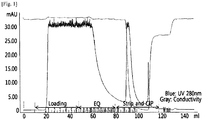
- Fig. 1 illustrates a chromatogram of an HIC Flow-Through process using Phenyl Sepharose High Performance resin according to an Example of the present invention.
- the present invention provides a method for preparing a TNFR-Fc fusion protein mixture containing a target content of hydrophobic chromatogram peak 3.
- the method is preferably performed comprising (a) injecting a sample containing a TNFR-Fc fusion protein mixture liquid produced from mammalian cells into a column filled with hydrophobic interaction chromatography (HIC) medium comprising an aromatic functional group, which is pre-equilibrated with an equilibration (EQ) buffer comprising sodium chloride or ammonium sulfate; and (b) collecting an eluate by eluting the protein with an elution buffer comprising sodium chloride or ammonium sulfate at the same concentration as that of the equilibration buffer.
- HIC hydrophobic interaction chromatography
- EQ equilibration
- TNFR-Fc fusion protein When the TNFR-Fc fusion protein is produced by a host cell transformed with an expression vector comprising a polynucleotide encoding the TNFR-Fc fusion protein, cysteines of TNFR protein bind with each other at random, and thus they do not form disulfide bonds identical to those of a native TNFR protein, or TNFR protein is also partially truncated, and thus fails to form a correct TNFR-Fc dimer, in addition to the formation of a dimer form of TNFR-Fc fusion protein that binds to TNF- ⁇ and shows a biological activity.
- These ingredients are shown as isolated peaks in the hydrophobic chromatogram, and the existing research has defined them as peaks 1 to 3, respectively.
- Each peak has been confirmed as including a truncated form of protein, an active form of protein, and other aggregates, or ingredients having low bioactivity such as disulfide-scrambled TNFR-Fc.
- TNFR-Fc fusion proteins including etanercept are sold as blockbuster pharmaceutical products.
- conventionally approved products for sale and for a clinical purpose contain 9% to 18% of peak 3, which may have influence on potency and/or pharmacology.
- equivalence to existing approved or originator products is required for biosimilar products to be approved.
- Said method of the present invention can be instrumentally applied for purifying an active form of TNFR-Fc fusion proteins to contain a target content of hydrophobic interaction chromatography peak 3 including aggregates, disulfide-scrambled TNFR-Fc fusion proteins, etc. in isolating the active form of TNFR-Fc fusion proteins from a mixture of TNFR-Fc fusion proteins by using hydrophobic interaction chromatography.
- the present invention has found for the first time that while hydrophobic interaction chromatography (HIC) has conventionally been used only for removing impurities, in the case where a sample containing a TNFR-Fc fusion protein mixture liquid produced from mammalian cells is equilibrated with salts at various concentrations, particularly sodium chloride, the hydrophobic interaction chromatography peak 3 content can be adjusted at a targeted level. This finding has not been reported.
- HIC hydrophobic interaction chromatography
- TNFR tumor necrosis factor receptor
- the TNFR protein includes TNFRI(p55) protein or TNFRII(p75) protein, preferably may be a TNFRII protein, but not limited thereto.
- the TNFRII may be interchangeable with TNFRSF1B (tumor necrosis factor receptor superfamily member 1B).
- the TNFRII protein may be a TNFRII protein having 4 domains and a transmembrane region and comprises 235 amino acids, but not limited thereto.
- Information about the TNFRI protein and TNFRII protein may be obtained from the known databases such as US NIH GenBank, and for example, it may be a protein having Accession number NP_001056 or P20333, but is not limited thereto.
- the TNFR protein has a biological activity of binding to TNF- ⁇ , of which overexpression in the human body is known to cause various diseases, and thus it can be used for the treatment of TNF- ⁇ -mediated diseases such as autoimmune diseases.
- TNF- ⁇ -mediated diseases such as autoimmune diseases.
- the immunoglobulin Fc region is fused with TNFR protein to prepare a fusion protein having increased half-life.
- TNFR tumor necrosis factor receptor
- Fc fusion protein means a product resulting from linkage of the entire or a part of TNFR protein with immunoglobulin Fc region by enzymatic action, or resulting from expression of two polypeptides into a single polypeptide by gene manipulation.
- the TNFR protein and the immunoglobulin Fc region may be directly linked with each other, or linked via a peptide linker, but is not limited thereto.
- TNFR-Fc fusion proteins may include etanercept.
- the TNFR-Fc fusion protein may be prepared by fusion of the entire or a part of TNFR protein with the immunoglobulin Fc region, and for example, by fusion of the amino acids from 1 to 235 positions of TNFRII protein with 232 amino acids of the immunoglobulin Fc region including a hinge region, but is not limited thereto.
- the TNFR-Fc fusion protein may be codon-optimized for expression in the host cells.
- the TNFR-Fc fusion protein may be a TNFR-Fc fusion protein codon-optimized for CHO cells, defined by the amino acid sequence of SEQ ID NO: 1 but is not limited thereto.
- the TNFR-Fc fusion protein includes a protein comprising the amino acid sequence of SEQ ID NO: 1, and all proteins having amino acid sequences having 70% or higher homology, preferably 80% or higher homology, more preferably 90% or higher homology, much more preferably 95% or higher homology, and most preferably 98% or higher homology with the sequence, as long as the proteins substantially have an activity of binding to TNF- ⁇ . It is apparent that any type of protein variants having a deletion, modification, substitution, or addition of some sequence may be within the scope of the present invention, as long as the sequence having the homology is an amino acid sequence having a biological activity that is substantially identical or corresponding to the TNFR (tumor necrosis factor receptor)-Fc fusion protein.
- the polynucleotide encoding the TNFR (tumor necrosis factor receptor)-Fc fusion protein includes a nucleotide sequence of SEQ ID NO: 2, and all nucleotide sequences having 70% or higher homology, preferably 80% or higher homology, more preferably 90% or higher homology, much more preferably 95% or higher homology, and most preferably 98% or higher homology with the sequence, as long as the nucleotide sequences substantially encode proteins having an activity of binding to TNF- ⁇ .
- nucleotide sequences encoding protein variants having a deletion, modification, substitution, or addition of some sequence may be within the scope of the present invention, as long as the sequence having the homology is a nucleotide sequence encoding an amino acid sequence having a biological activity that is substantially identical or corresponding to the TNFR-Fc fusion protein.
- codon was specifically optimized for CHO cells.
- immunoglobulin Fc region refers to a part of immunoglobulin that contains the heavy-chain constant region 2 (CH2), the heavy-chain constant region 3 (CH3), and a hinge region, excluding the variable regions of the heavy and light chains, the heavy-chain constant region 1(CH1) and the light-chain constant region 1 (CL1) of the immunoglobulin.
- the immunoglobulin Fc region of the present invention includes a native amino acid sequence, and a sequence derivative thereof.
- An amino acid sequence derivative is a sequence that is different from the native amino acid sequence due to a deletion, an insertion, a non-conservative, or conservative substitution or combinations thereof of one or more amino acid residues.
- the immunoglobulin Fc region may be a Fc region that is derived from IgG, IgM, IgE, IgA, or IgD, or that is made by combinations thereof or hybrids thereof.
- it is derived from IgG, which is known to enhance the half-life of binding proteins. More preferably, it is derived from IgG1, but is not limited thereto.
- a dimer or multimer may be formed from two or more fragments selected from the group consisting of IgG Fc, IgA Fc, IgM Fc, IgD Fc, and IgE Fc fragments.
- hybrid means that sequences encoding two or more immunoglobulin Fc regions of different origin are present in a single-chain immunoglobulin Fc region.
- domain hybrids may be composed of one to four domains selected from the group consisting of CH1, CH2, CH3, and CH4 of IgG Fc, IgM Fc, IgA Fc, IgE Fc, and IgD Fc, and may include the hinge region.
- IgG is also divided into IgG1, IgG2, IgG3, and IgG4 subclasses, and the present invention includes combinations and hybrids thereof.
- the TNFR-Fc fusion protein may be obtained by introducing the expression vector comprising the polynucleotide encoding the fusion protein into mammalian cells, and by then expressing it therein.
- the pCUCBin-mSig-TNFcept vector was used as the representative expression vector comprising the polynucleotide encoding the TNFR-Fc fusion protein, and transformed into CHO cells to express the TNFR-Fc fusion protein.
- the mixture of various forms of TNFR-Fc fusion proteins such as the active TNFR-Fc fusion protein, the truncated forms of TNFR-Fc fusion protein, the inactive TNFR-Fc fusion protein, or/and the TNFR-Fc fusion protein aggregate, etc. are included in the TNFR-Fc fusion proteins obtained by the above method.
- the preparation method of the present invention it is necessary to purify the inactive form of TNFR-Fc fusion protein as well as the active form thereof to be contained at a predetermined ratio.
- the content of peak 3 comprising fragments, the active fusion protein, purified aggregates, etc., and thus a target content of peak 3 can be adjusted.
- culture broth of mammalian cells further contains various proteins and the like in addition to a targeted protein.
- a sample containing a TNFR-Fc fusion protein mixture preferably produced from the mammalian cells may be prepared by being partially purified by affinity chromatography, anion chromatography, or both.
- affinity chromatography was conducted with culture broth of transfected CHO cells, anion chromatography was conducted with the eluate therefrom, and then the eluate therefrom was used as the sample.
- medium filling a column used in the hydrophobic interaction chromatography may include a phenyl group as an aromatic functional group.
- a column filled with Phenyl Sepgarose High Performance resin produced by GE Healthcare is used, but is not limited thereto.
- a target content of hydrophobic chromatogram peak 3 may be 9% to 18%.
- the hydrophobic chromatogram peak 3 content of the TNFR-Fc fusion protein mixture of said step (a) exceeds 20%, the peak 3 content can be lowered to approximately 9% to 18% by application of the method of the present invention and purification.
- said equilibration and elution buffers may comprise 7 mM to 15 mM sodium phosphate.
- a buffer containing 10 mM sodium phosphate is used, but is not limited thereto.
- said equilibration and elution buffers may have a pH of 6 to 8.5.
- a buffer having a pH beyond said range may cause denaturation of a target protein, and accordingly may be difficult to be used in hydrophobic interaction chromatography of recombinant protein.
- the preparation method of the present invention is characterized by adjusting the concentration of sodium chloride of the equilibration buffer according to the target content of hydrophobic chromatogram peak 3, wherein when the target content of hydrophobic chromatogram peak 3 is in a range of 2% to 17%, an equilibration buffer comprising sodium chloride at a concentration of 1 M to 1.4 M is used for the equilibration.
- equilibration buffer comprising 1.1 M sodium chloride enables the peak 3 content to fall to a range of 5.3% to 17%
- using an equilibration buffer comprising 1.2 M sodium chloride enables the peak 3 content to fall to a range of 2.9% to 15.7%
- using an equilibration buffer comprising 1.3 M sodium chloride enables the peak 3 content to fall to a range of 2.5% to 14.8%
- using an equilibration buffer comprising 1.4 M sodium chloride enables the peak 3 content to fall to a range of 2.2% to 13.7%.
- the preparation method of the present invention is characterized by adding ammonium sulfate of the equilibration buffer according to the target content of hydrophobic chromatogram peak 3, wherein when the hydrophobic chromatogram peak 3 content of the sample exceeds 45%, an equilibration buffer comprising ammonium sulfate at a concentration of 0.45 M to 0.55 M is used for the equilibration.
- the hydrophobic chromatogram peak 3 content can be lowered to approximately 10% by conducting hydrophobic interaction chromatography using the aforementioned equilibration buffer containing sodium chloride after lowering the peak 3 content to a range of 20% to 30% by conducting hydrophobic interaction chromatography followed by the equilibration with an equilibration buffer containing ammonium sulfate.
- the hydrophobic interaction chromatography can be conducted by sequential processes consisting of loading, equilibration, stripping, and cleaning in place (CIP).
- the stripping process is conducted to separate and elute all proteins remaining on the column, and buffers whose constitution is identical to the equilibration buffer excluding sodium chloride and ammonium sulfate may be used in the process.
- CIP is a process for managing devices in a safe and cost-efficient manner in producing biomedical products, and enables efficient removal of impurities from chromatography medium and reuse thereof.
- the CIP may be conducted by using 0.5 N sodium hydroxide solution, but is not limited thereto.
- CIP may be repeated many times as needed, but is not limited thereto.
- the present invention provides a method for adjusting a content of hydrophobic chromatogram peak 3 contained in etanercept, comprising: pre-equilibrating a hydrophobic interaction chromatography medium with an equilibration buffer comprising sodium chloride at a concentration of 1.0 M to 1.5 M or ammonium sulfate at a concentration of 0.45 M to 0.55 M; and loading a sample comprising a TNFR-Fc fusion protein prepared to have the same salt concentration as that of the pre-equilibrated hydrophobic interaction chromatography medium.
- the equilibration buffer has a pH of 6 to 8.5.
- the method of the present invention using an equilibration buffer comprising sodium chloride or ammonium sulfate is characterized by the peak 3 content of the final product adjusted to decrease compared with that of a loaded sample.
- the peak 3 content of the sample whose peak 3 content exceeds 20% may be decreased to a level of 2% to 17% by using an equilibration buffer comprising sodium chloride.
- the peak 3 content of the sample whose peak 3 content exceeds 45% is decreased to a level of 18% or less by using an equilibration buffer comprising ammonium sulfate.
- the pCUCBin-mSig-TNFcept vector including a gene encoding the TNFR-Fc fusion protein into CHO cells was transfected and cultured, and then affinity chromatography and anion chromatography were sequentially applied to culture broth of CHO cells selected by using MTX.
- affinity chromatography has been conducted as follows: a XK26 column (GE Healthcare) filled with MabSelect SuReTM (GE Healthcare), which is an affinity resin, has been equilibrated by being sufficiently washed with a buffer containing 20 mM Tris-HCI, pH 8.0, has been bound to the affinity resin by being washed with the prepared culture broth, and then has been eluted with an elution buffer at pH 3.0 to pH 3.4. The pH of the eluate has been adjusted to pH 7.0 to 8.0 by using 2 M Tris.
- anion chromatography has been conducted as follows: a LRC 15 column (Pall Life Sciences) filled with Fractogel EMD TMAE (Merck), which is an anion resin, has been equilibrated by being sufficiently washed with a buffer containing Tris at pH 7.5 to 8.5, has been bound to the anion resin by being washed with the eluate obtained from the affinity chromatography, and then has been eluted with a Tris elution buffer containing 100 mM to 200 mM sodium chloride.
- the HIC Flow-Through process which was applied to the eluate obtained by conducting the affinity chromatography and anion chromatography sequentially is set forth below.
- the peak 3 content obtained in the process has been measured using a linear gradient with buffer A (0.1 M sodium phosphate, pH 6.0, 1.8 M ammonium) and buffer B (0.1 M sodium phosphate, pH 6.0).
- EQ buffers containing 1.1 M to 1.4 M sodium chloride in 10 mM sodium phosphate have been prepared, and EQ buffer was adjusted to pH 6.3. Further, samples loaded in HIC have been prepared to include sodium phosphate and sodium chloride at the same concentration as that of the EQ buffer.
- a HIC Flow-Through process using Phenyl Sepharose High Performance resin consists of processes of loading, equilibration, stripping, and CIP as illustrated in Fig. 1 , and 10 mM sodium phosphate at pH 6.3 and 0.5 N sodium hydroxide were used as buffers for stripping and CIP, respectively.
- the eluate has been monitored by being collected at 50 mAU or more on the basis of absorbance at 280 nm to collect fractions by 5 column volume (CV) to be the EQ buffer, and Table 1 illustrates concentrations of sodium chloride using the resultants.
- Table 1 Conditions of Equilibration Buffer Peak 3 Content (%) Loaded Sample 21 10 mM sodium phosphate pH 6.3, 1.1 M sodium chloride 5.3 to 17.0 10 mM sodium phosphate pH 6.3, 1.2 M sodium chloride 2.9 to 15.7 10 mM sodium phosphate pH 6.3, 1.3 M sodium chloride 2.5 to 14.8 10 mM sodium phosphate pH 6.3, 1.4 M sodium chloride 2.2 to 13.7
- the peak 3 content As illustrated in Table 1, as a concentration of sodium chloride in use increases, the peak 3 content has shown the decreasing tendency, and as a result, it has been confirmed that the peak 3 content can be adjusted in a range of 2.2% to 17.0% according to a concentration of sodium chloride in use.
- EQ buffer containing 0.5 M sodium sulfate in a buffer containing 20 mM Tris-HCI at pH 8.0 was prepared. Further, samples loaded in HIC have been prepared to contain 20 mM Tris-HCI at pH 8.0 and 0.5 M ammonium sulfate.
- a HIC Flow-Through process has been conducted with a XK16 column (GE Healthcare) filled with Phenyl Sepharose High Performance resin (GE Healthcare) by 5 cm.
- the process consists of processes of loading, equilibration, stripping, and CIP, and 20 mM Tris-HIC at pH 7.0 and 0.5 N sodium hydroxide were used as buffers for stripping and CIP, respectively.
- the eluate has been monitored by being collected at 50 mAU or more on the basis of absorbance at 280 nm to collect fractions by 5 column volume (CV) to be the EQ buffer, and as a result, when a HIC Flow-Through process has been conducted with a loaded sample containing 46.1% of peak 3, the peak 3 content after the process has been confirmed to have been adjusted to a level of 12%.
Landscapes
- Chemical & Material Sciences (AREA)
- Health & Medical Sciences (AREA)
- Life Sciences & Earth Sciences (AREA)
- Organic Chemistry (AREA)
- Biochemistry (AREA)
- General Health & Medical Sciences (AREA)
- Medicinal Chemistry (AREA)
- Proteomics, Peptides & Aminoacids (AREA)
- Molecular Biology (AREA)
- Biophysics (AREA)
- Genetics & Genomics (AREA)
- Immunology (AREA)
- Gastroenterology & Hepatology (AREA)
- Toxicology (AREA)
- Zoology (AREA)
- Cell Biology (AREA)
- Analytical Chemistry (AREA)
- Peptides Or Proteins (AREA)
- Preparation Of Compounds By Using Micro-Organisms (AREA)
- Micro-Organisms Or Cultivation Processes Thereof (AREA)
- Chemical Kinetics & Catalysis (AREA)
Applications Claiming Priority (2)
| Application Number | Priority Date | Filing Date | Title |
|---|---|---|---|
| KR20140195766 | 2014-12-31 | ||
| PCT/KR2015/014393 WO2016108569A1 (ko) | 2014-12-31 | 2015-12-29 | 목적하는 함량으로 불순물을 포함하는 tnfr-fc 융합 단백질의 제조방법 |
Publications (2)
| Publication Number | Publication Date |
|---|---|
| EP3241849A1 true EP3241849A1 (de) | 2017-11-08 |
| EP3241849A4 EP3241849A4 (de) | 2018-06-20 |
Family
ID=56284628
Family Applications (1)
| Application Number | Title | Priority Date | Filing Date |
|---|---|---|---|
| EP15875663.5A Pending EP3241849A4 (de) | 2014-12-31 | 2015-12-29 | Verfahren zur herstellung eines tnfr-fc-fusionsproteins mit einem zielgehalt an verunreinigungen |
Country Status (11)
| Country | Link |
|---|---|
| US (1) | US10988527B2 (de) |
| EP (1) | EP3241849A4 (de) |
| JP (2) | JP6793996B2 (de) |
| KR (1) | KR102018608B1 (de) |
| AU (1) | AU2015372801B2 (de) |
| BR (1) | BR112017014224A2 (de) |
| IL (1) | IL253218B (de) |
| MX (1) | MX394035B (de) |
| RU (1) | RU2670166C1 (de) |
| SA (1) | SA517381861B1 (de) |
| WO (1) | WO2016108569A1 (de) |
Families Citing this family (2)
| Publication number | Priority date | Publication date | Assignee | Title |
|---|---|---|---|---|
| US11952399B2 (en) * | 2018-12-18 | 2024-04-09 | Amgen Inc. | Methods for purifying proteins |
| EP4408879A4 (de) * | 2021-09-28 | 2025-08-27 | Kashiv Biosciences Llc | Verbessertes verfahren zur reinigung von fusionsprotein |
Family Cites Families (12)
| Publication number | Priority date | Publication date | Assignee | Title |
|---|---|---|---|---|
| US7294481B1 (en) * | 1999-01-05 | 2007-11-13 | Immunex Corporation | Method for producing recombinant proteins |
| AU2006250120A1 (en) * | 2005-05-24 | 2006-11-30 | Ge Healthcare Bio-Sciences Ab | Regeneration of a chromatography matrix |
| JP2010516651A (ja) | 2007-01-17 | 2010-05-20 | メルク セローノ ソシエテ アノニム | Fc含有タンパク質の精製のための方法 |
| KR101753569B1 (ko) * | 2010-01-22 | 2017-07-04 | 베링거 인겔하임 인터내셔날 게엠베하 | Fc―함유 단백질을 정제하는 크로마토그래피 방법 |
| CN102382190B (zh) * | 2010-09-01 | 2014-04-09 | 山东新时代药业有限公司 | 分离和去除TNFR-Fc融合蛋白中寡聚体的方法 |
| EP2678030A4 (de) * | 2011-02-25 | 2015-02-18 | Merck Sharp & Dohme | Herstellung von n- und o-sialylierten tnfrii-fc-fusionsproteinen in hefe |
| EP2723759A4 (de) * | 2011-06-24 | 2015-01-28 | Reddys Lab Ltd Dr | Aufreinigung von chimärem protein |
| JP6280499B2 (ja) * | 2011-07-08 | 2018-02-14 | メルク・シャープ・アンド・ドーム・コーポレーションMerck Sharp & Dohme Corp. | Fc融合タンパク質の精製方法 |
| KR101454316B1 (ko) * | 2011-08-17 | 2014-10-27 | 한화케미칼 주식회사 | 활성형 TNFR-Fc 융합 단백질을 제조하는 방법 |
| SG11201401562RA (en) * | 2011-10-18 | 2014-09-26 | Coherus Biosciences Inc | Etanercept formulations stabilized with sodium chloride |
| AU2013315750B9 (en) * | 2012-09-11 | 2018-11-15 | Coherus Biosciences, Inc. | Correctly folded etanercept in high purity and excellent yield |
| WO2014102814A1 (en) * | 2012-12-31 | 2014-07-03 | Intas Biopharmaceuticals Limited | Process for the purification of fc fusion proteins |
-
2015
- 2015-12-29 US US15/541,111 patent/US10988527B2/en active Active
- 2015-12-29 KR KR1020150188455A patent/KR102018608B1/ko active Active
- 2015-12-29 WO PCT/KR2015/014393 patent/WO2016108569A1/ko not_active Ceased
- 2015-12-29 BR BR112017014224-4A patent/BR112017014224A2/pt not_active Application Discontinuation
- 2015-12-29 AU AU2015372801A patent/AU2015372801B2/en active Active
- 2015-12-29 IL IL253218A patent/IL253218B/en unknown
- 2015-12-29 EP EP15875663.5A patent/EP3241849A4/de active Pending
- 2015-12-29 RU RU2017124181A patent/RU2670166C1/ru active
- 2015-12-29 JP JP2017535373A patent/JP6793996B2/ja active Active
- 2015-12-29 MX MX2017008633A patent/MX394035B/es unknown
-
2017
- 2017-07-04 SA SA517381861A patent/SA517381861B1/ar unknown
-
2019
- 2019-07-10 JP JP2019128325A patent/JP2019172702A/ja active Pending
Also Published As
| Publication number | Publication date |
|---|---|
| US10988527B2 (en) | 2021-04-27 |
| JP2019172702A (ja) | 2019-10-10 |
| US20170369553A1 (en) | 2017-12-28 |
| MX2017008633A (es) | 2018-04-26 |
| KR20160081827A (ko) | 2016-07-08 |
| JP6793996B2 (ja) | 2020-12-02 |
| JP2018503630A (ja) | 2018-02-08 |
| NZ733388A (en) | 2018-11-30 |
| WO2016108569A1 (ko) | 2016-07-07 |
| RU2670166C1 (ru) | 2018-10-18 |
| SA517381861B1 (ar) | 2021-09-08 |
| KR102018608B1 (ko) | 2019-09-06 |
| BR112017014224A2 (pt) | 2018-03-06 |
| EP3241849A4 (de) | 2018-06-20 |
| AU2015372801B2 (en) | 2018-12-20 |
| MX394035B (es) | 2025-03-21 |
| IL253218B (en) | 2022-08-01 |
| IL253218A0 (en) | 2017-08-31 |
| AU2015372801A1 (en) | 2017-07-20 |
Similar Documents
| Publication | Publication Date | Title |
|---|---|---|
| JP6913066B2 (ja) | 高純度および優れた収率の正確に折り畳まれたエタネルセプト | |
| JP5372917B2 (ja) | 最適化されたTACI−Fc融合タンパク質 | |
| JP2022081654A (ja) | 低粘度の抗原結合タンパク質およびそれらの作製方法 | |
| US9279014B2 (en) | Methods for preparing an active TNFR-Fc fusion protein | |
| JP2022501357A (ja) | ヘテロ二量体多重特異性抗体を精製するための方法 | |
| MX2010009398A (es) | Proteinas de fusion de inmunoglobulinas purificadas y los metodos para su purificacion. | |
| CA2976623C (en) | Fc fusion high affinity ige receptor .alpha.-chain | |
| KR102578087B1 (ko) | 숙주세포 갈렉틴(galectins) 및 다른 오염물(contaminant)로부터 글리코실화 단백질을 정제하는 방법 | |
| AU2015214245B2 (en) | Use of cation-exchange chromatography in the flow-through mode to enrich post-translational modifications | |
| AU2015372801B2 (en) | Method for preparing tnfr-fc fusion protein containing target content of impurities | |
| NZ733388B (en) | Method for preparing tnfr-fc fusion protein containing target content of impurities | |
| JP2010516744A (ja) | 油体技術を用いたFc−融合タンパク質の精製 | |
| WO2023137143A1 (en) | Methods of contaminant removal from protein isolates | |
| CN104812776A (zh) | 制备新的长效人生长激素单体的方法 | |
| HK1163701A (en) | Purified immunoglobulin fusion proteins and methods of their purification |
Legal Events
| Date | Code | Title | Description |
|---|---|---|---|
| STAA | Information on the status of an ep patent application or granted ep patent |
Free format text: STATUS: THE INTERNATIONAL PUBLICATION HAS BEEN MADE |
|
| PUAI | Public reference made under article 153(3) epc to a published international application that has entered the european phase |
Free format text: ORIGINAL CODE: 0009012 |
|
| STAA | Information on the status of an ep patent application or granted ep patent |
Free format text: STATUS: REQUEST FOR EXAMINATION WAS MADE |
|
| 17P | Request for examination filed |
Effective date: 20170728 |
|
| AK | Designated contracting states |
Kind code of ref document: A1 Designated state(s): AL AT BE BG CH CY CZ DE DK EE ES FI FR GB GR HR HU IE IS IT LI LT LU LV MC MK MT NL NO PL PT RO RS SE SI SK SM TR |
|
| AX | Request for extension of the european patent |
Extension state: BA ME |
|
| DAV | Request for validation of the european patent (deleted) | ||
| DAX | Request for extension of the european patent (deleted) | ||
| A4 | Supplementary search report drawn up and despatched |
Effective date: 20180524 |
|
| RIC1 | Information provided on ipc code assigned before grant |
Ipc: C07K 19/00 20060101AFI20180517BHEP Ipc: C07K 14/705 20060101ALI20180517BHEP Ipc: C07K 16/00 20060101ALI20180517BHEP |
|
| STAA | Information on the status of an ep patent application or granted ep patent |
Free format text: STATUS: EXAMINATION IS IN PROGRESS |
|
| 17Q | First examination report despatched |
Effective date: 20200414 |
|
| GRAP | Despatch of communication of intention to grant a patent |
Free format text: ORIGINAL CODE: EPIDOSNIGR1 |
|
| STAA | Information on the status of an ep patent application or granted ep patent |
Free format text: STATUS: GRANT OF PATENT IS INTENDED |