EP3242964B1 - Elektrochemische oder fotoelektrochemische oxidation von 5-hydroxymethylfurfural zu 2,5-furandicarbonsäure und 2,5-diformylfuran - Google Patents
Elektrochemische oder fotoelektrochemische oxidation von 5-hydroxymethylfurfural zu 2,5-furandicarbonsäure und 2,5-diformylfuran Download PDFInfo
- Publication number
- EP3242964B1 EP3242964B1 EP16735346.5A EP16735346A EP3242964B1 EP 3242964 B1 EP3242964 B1 EP 3242964B1 EP 16735346 A EP16735346 A EP 16735346A EP 3242964 B1 EP3242964 B1 EP 3242964B1
- Authority
- EP
- European Patent Office
- Prior art keywords
- anode
- oxidation
- tempo
- hmf
- cathode
- Prior art date
- Legal status (The legal status is an assumption and is not a legal conclusion. Google has not performed a legal analysis and makes no representation as to the accuracy of the status listed.)
- Active
Links
Images





Classifications
-
- C—CHEMISTRY; METALLURGY
- C25—ELECTROLYTIC OR ELECTROPHORETIC PROCESSES; APPARATUS THEREFOR
- C25B—ELECTROLYTIC OR ELECTROPHORETIC PROCESSES FOR THE PRODUCTION OF COMPOUNDS OR NON-METALS; APPARATUS THEREFOR
- C25B3/00—Electrolytic production of organic compounds
- C25B3/20—Processes
- C25B3/23—Oxidation
-
- C—CHEMISTRY; METALLURGY
- C25—ELECTROLYTIC OR ELECTROPHORETIC PROCESSES; APPARATUS THEREFOR
- C25B—ELECTROLYTIC OR ELECTROPHORETIC PROCESSES FOR THE PRODUCTION OF COMPOUNDS OR NON-METALS; APPARATUS THEREFOR
- C25B11/00—Electrodes; Manufacture thereof not otherwise provided for
- C25B11/04—Electrodes; Manufacture thereof not otherwise provided for characterised by the material
- C25B11/042—Electrodes formed of a single material
- C25B11/043—Carbon, e.g. diamond or graphene
-
- C—CHEMISTRY; METALLURGY
- C25—ELECTROLYTIC OR ELECTROPHORETIC PROCESSES; APPARATUS THEREFOR
- C25B—ELECTROLYTIC OR ELECTROPHORETIC PROCESSES FOR THE PRODUCTION OF COMPOUNDS OR NON-METALS; APPARATUS THEREFOR
- C25B11/00—Electrodes; Manufacture thereof not otherwise provided for
- C25B11/04—Electrodes; Manufacture thereof not otherwise provided for characterised by the material
- C25B11/051—Electrodes formed of electrocatalysts on a substrate or carrier
-
- C—CHEMISTRY; METALLURGY
- C25—ELECTROLYTIC OR ELECTROPHORETIC PROCESSES; APPARATUS THEREFOR
- C25B—ELECTROLYTIC OR ELECTROPHORETIC PROCESSES FOR THE PRODUCTION OF COMPOUNDS OR NON-METALS; APPARATUS THEREFOR
- C25B11/00—Electrodes; Manufacture thereof not otherwise provided for
- C25B11/04—Electrodes; Manufacture thereof not otherwise provided for characterised by the material
- C25B11/051—Electrodes formed of electrocatalysts on a substrate or carrier
- C25B11/052—Electrodes comprising one or more electrocatalytic coatings on a substrate
-
- C—CHEMISTRY; METALLURGY
- C25—ELECTROLYTIC OR ELECTROPHORETIC PROCESSES; APPARATUS THEREFOR
- C25B—ELECTROLYTIC OR ELECTROPHORETIC PROCESSES FOR THE PRODUCTION OF COMPOUNDS OR NON-METALS; APPARATUS THEREFOR
- C25B11/00—Electrodes; Manufacture thereof not otherwise provided for
- C25B11/04—Electrodes; Manufacture thereof not otherwise provided for characterised by the material
- C25B11/051—Electrodes formed of electrocatalysts on a substrate or carrier
- C25B11/073—Electrodes formed of electrocatalysts on a substrate or carrier characterised by the electrocatalyst material
-
- C—CHEMISTRY; METALLURGY
- C25—ELECTROLYTIC OR ELECTROPHORETIC PROCESSES; APPARATUS THEREFOR
- C25B—ELECTROLYTIC OR ELECTROPHORETIC PROCESSES FOR THE PRODUCTION OF COMPOUNDS OR NON-METALS; APPARATUS THEREFOR
- C25B11/00—Electrodes; Manufacture thereof not otherwise provided for
- C25B11/04—Electrodes; Manufacture thereof not otherwise provided for characterised by the material
- C25B11/051—Electrodes formed of electrocatalysts on a substrate or carrier
- C25B11/073—Electrodes formed of electrocatalysts on a substrate or carrier characterised by the electrocatalyst material
- C25B11/075—Electrodes formed of electrocatalysts on a substrate or carrier characterised by the electrocatalyst material consisting of a single catalytic element or catalytic compound
- C25B11/081—Electrodes formed of electrocatalysts on a substrate or carrier characterised by the electrocatalyst material consisting of a single catalytic element or catalytic compound the element being a noble metal
-
- C—CHEMISTRY; METALLURGY
- C25—ELECTROLYTIC OR ELECTROPHORETIC PROCESSES; APPARATUS THEREFOR
- C25B—ELECTROLYTIC OR ELECTROPHORETIC PROCESSES FOR THE PRODUCTION OF COMPOUNDS OR NON-METALS; APPARATUS THEREFOR
- C25B11/00—Electrodes; Manufacture thereof not otherwise provided for
- C25B11/04—Electrodes; Manufacture thereof not otherwise provided for characterised by the material
- C25B11/051—Electrodes formed of electrocatalysts on a substrate or carrier
- C25B11/073—Electrodes formed of electrocatalysts on a substrate or carrier characterised by the electrocatalyst material
- C25B11/075—Electrodes formed of electrocatalysts on a substrate or carrier characterised by the electrocatalyst material consisting of a single catalytic element or catalytic compound
- C25B11/087—Photocatalytic compound
-
- C—CHEMISTRY; METALLURGY
- C25—ELECTROLYTIC OR ELECTROPHORETIC PROCESSES; APPARATUS THEREFOR
- C25B—ELECTROLYTIC OR ELECTROPHORETIC PROCESSES FOR THE PRODUCTION OF COMPOUNDS OR NON-METALS; APPARATUS THEREFOR
- C25B3/00—Electrolytic production of organic compounds
- C25B3/01—Products
- C25B3/07—Oxygen containing compounds
-
- C—CHEMISTRY; METALLURGY
- C25—ELECTROLYTIC OR ELECTROPHORETIC PROCESSES; APPARATUS THEREFOR
- C25B—ELECTROLYTIC OR ELECTROPHORETIC PROCESSES FOR THE PRODUCTION OF COMPOUNDS OR NON-METALS; APPARATUS THEREFOR
- C25B3/00—Electrolytic production of organic compounds
- C25B3/20—Processes
- C25B3/21—Photoelectrolysis
-
- C—CHEMISTRY; METALLURGY
- C25—ELECTROLYTIC OR ELECTROPHORETIC PROCESSES; APPARATUS THEREFOR
- C25B—ELECTROLYTIC OR ELECTROPHORETIC PROCESSES FOR THE PRODUCTION OF COMPOUNDS OR NON-METALS; APPARATUS THEREFOR
- C25B9/00—Cells or assemblies of cells; Constructional parts of cells; Assemblies of constructional parts, e.g. electrode-diaphragm assemblies; Process-related cell features
-
- C—CHEMISTRY; METALLURGY
- C25—ELECTROLYTIC OR ELECTROPHORETIC PROCESSES; APPARATUS THEREFOR
- C25B—ELECTROLYTIC OR ELECTROPHORETIC PROCESSES FOR THE PRODUCTION OF COMPOUNDS OR NON-METALS; APPARATUS THEREFOR
- C25B9/00—Cells or assemblies of cells; Constructional parts of cells; Assemblies of constructional parts, e.g. electrode-diaphragm assemblies; Process-related cell features
- C25B9/17—Cells comprising dimensionally-stable non-movable electrodes; Assemblies of constructional parts thereof
-
- C—CHEMISTRY; METALLURGY
- C25—ELECTROLYTIC OR ELECTROPHORETIC PROCESSES; APPARATUS THEREFOR
- C25B—ELECTROLYTIC OR ELECTROPHORETIC PROCESSES FOR THE PRODUCTION OF COMPOUNDS OR NON-METALS; APPARATUS THEREFOR
- C25B9/00—Cells or assemblies of cells; Constructional parts of cells; Assemblies of constructional parts, e.g. electrode-diaphragm assemblies; Process-related cell features
- C25B9/50—Cells or assemblies of cells comprising photoelectrodes; Assemblies of constructional parts thereof
-
- H—ELECTRICITY
- H01—ELECTRIC ELEMENTS
- H01G—CAPACITORS; CAPACITORS, RECTIFIERS, DETECTORS, SWITCHING DEVICES, LIGHT-SENSITIVE OR TEMPERATURE-SENSITIVE DEVICES OF THE ELECTROLYTIC TYPE
- H01G9/00—Electrolytic capacitors, rectifiers, detectors, switching devices, light-sensitive or temperature-sensitive devices; Processes of their manufacture
- H01G9/20—Light-sensitive devices
- H01G9/2027—Light-sensitive devices comprising an oxide semiconductor electrode
-
- H—ELECTRICITY
- H01—ELECTRIC ELEMENTS
- H01G—CAPACITORS; CAPACITORS, RECTIFIERS, DETECTORS, SWITCHING DEVICES, LIGHT-SENSITIVE OR TEMPERATURE-SENSITIVE DEVICES OF THE ELECTROLYTIC TYPE
- H01G9/00—Electrolytic capacitors, rectifiers, detectors, switching devices, light-sensitive or temperature-sensitive devices; Processes of their manufacture
- H01G9/20—Light-sensitive devices
- H01G9/2004—Light-sensitive devices characterised by the electrolyte, e.g. comprising an organic electrolyte
-
- Y—GENERAL TAGGING OF NEW TECHNOLOGICAL DEVELOPMENTS; GENERAL TAGGING OF CROSS-SECTIONAL TECHNOLOGIES SPANNING OVER SEVERAL SECTIONS OF THE IPC; TECHNICAL SUBJECTS COVERED BY FORMER USPC CROSS-REFERENCE ART COLLECTIONS [XRACs] AND DIGESTS
- Y02—TECHNOLOGIES OR APPLICATIONS FOR MITIGATION OR ADAPTATION AGAINST CLIMATE CHANGE
- Y02E—REDUCTION OF GREENHOUSE GAS [GHG] EMISSIONS, RELATED TO ENERGY GENERATION, TRANSMISSION OR DISTRIBUTION
- Y02E10/00—Energy generation through renewable energy sources
- Y02E10/50—Photovoltaic [PV] energy
- Y02E10/542—Dye sensitized solar cells
-
- Y—GENERAL TAGGING OF NEW TECHNOLOGICAL DEVELOPMENTS; GENERAL TAGGING OF CROSS-SECTIONAL TECHNOLOGIES SPANNING OVER SEVERAL SECTIONS OF THE IPC; TECHNICAL SUBJECTS COVERED BY FORMER USPC CROSS-REFERENCE ART COLLECTIONS [XRACs] AND DIGESTS
- Y02—TECHNOLOGIES OR APPLICATIONS FOR MITIGATION OR ADAPTATION AGAINST CLIMATE CHANGE
- Y02E—REDUCTION OF GREENHOUSE GAS [GHG] EMISSIONS, RELATED TO ENERGY GENERATION, TRANSMISSION OR DISTRIBUTION
- Y02E60/00—Enabling technologies; Technologies with a potential or indirect contribution to GHG emissions mitigation
- Y02E60/30—Hydrogen technology
- Y02E60/36—Hydrogen production from non-carbon containing sources, e.g. by water electrolysis
-
- Y—GENERAL TAGGING OF NEW TECHNOLOGICAL DEVELOPMENTS; GENERAL TAGGING OF CROSS-SECTIONAL TECHNOLOGIES SPANNING OVER SEVERAL SECTIONS OF THE IPC; TECHNICAL SUBJECTS COVERED BY FORMER USPC CROSS-REFERENCE ART COLLECTIONS [XRACs] AND DIGESTS
- Y02—TECHNOLOGIES OR APPLICATIONS FOR MITIGATION OR ADAPTATION AGAINST CLIMATE CHANGE
- Y02P—CLIMATE CHANGE MITIGATION TECHNOLOGIES IN THE PRODUCTION OR PROCESSING OF GOODS
- Y02P20/00—Technologies relating to chemical industry
- Y02P20/10—Process efficiency
- Y02P20/133—Renewable energy sources, e.g. sunlight
Definitions
- Photoelectrochemical cells can directly utilize photogenerated electron-hole pairs in semiconductor electrodes for fuel production as nature does through photosynthesis.
- fuels are formed by reduction reactions at the cathode which consume photoexcited electrons. Examples include the reduction of water to H 2 and the reduction of CO 2 to carbon-based fuels such as methanol and methane.
- oxidation reactions occur at the anode, consuming photogenerated holes.
- water oxidation to O 2 is used as the anode reaction, which is environmentally benign and does not require additional species in the electrolyte.
- HMF 5- hydroxymethylfurfural
- 2,5-furandicarboxylic acid can serve as a monomer to produce important polymeric materials such as polyethylene terephthalate and poly(ethylene 2,5-furandicarboxylate) and is considered a possible replacement for terephthalic acid.
- Another oxidation product of HMF, 2,5-diformylfuran (DFF) has the typical chemical properties of an aldehyde. Its applications include use in the synthesis of pharmaceuticals, antifungal agents, macrocyclic ligands, and organic conductors, as an intermediate and monomer for the synthesis of polymers and as a key building block for porous organic frameworks.
- US7052587B2 discusses a photoelectrode which has an electrically conductive surface in contact with an electrolyte solution, the surface being a doped tin oxide layer.
- US2012271060A1 discusses the oxidation of 5-hydroxymethylfurfural, an ester of 5-hydroxymethyl-furfural, 5-methylfurfural, 5-(chloromethyl)furfural, 5-methylfuroic acid, 5-(chloromethyl)furoic acid, 2,5-dimethylfuran using a catalyst based on both cobalt and manganese and containing a bromide. Cottier et al., Journal of Heterocyclic Chemistry, Vol. 32, No.
- Electrochemical cells and photoelectrochemical cells for the oxidation of HMF to FDCA and/or DFF are provided. Also provided are methods of using the cells to carry out the oxidation reactions.
- the present invention relates to the methods, electrochemical cells and photoelectrochemical cells of the claims.
- Electrochemical cells (EC) and photoelectrochemical cells (PEC) for the oxidation of HMF to FDCA and/or DFF are provided. Also provided are methods of using the cells to carry out the oxidation reactions.
- the cells and methods are able to substantially completely convert HMF, a common biomass-derived intermediate, into organic building block molecules that are useful in the production of a variety of chemicals.
- the oxidations can be conducted at ambient temperatures and pressures (e.g., about 23 °C and about 1 atm) and do not require the use of precious metal catalyst electrodes.
- ambient temperatures and pressures e.g., about 23 °C and about 1 atm
- the oxidation can replace the oxidation of water to oxygen, which is generally considered a low value product. This increases both the efficiency and utility of the PECs for solar fuel production.
- an electrochemical cell comprises an anode in an electrolyte solution comprising a solvent and HMF.
- the cell also includes a TEMPO mediator, which may be dissolved in the anode electrolyte solution or immobilized on the anode.
- a cell cathode in a cathode electrolyte solution is in electrical communication with the anode.
- the electrolyte solvents in the anode and cathode electrolyte solutions can be the same or different and the electrolyte solutions can be aqueous or non-aqueous.
- the operation of the EC is illustrated in FIG. 4B and described in detail in the examples. A more general description of electrochemical oxidation of HMF in an aqueous electrolyte solution is provided here.
- a voltage source is used to apply an anode potential to the anode and a potential difference is created between the anode and the cathode.
- a potential difference is created between the anode and the cathode.
- electrons flow from the anode to the cathode through an external wire.
- the electrons at the surface of the cathode undergo reduction reactions with species contained in the cathode electrolyte solution, while oxidation reactions occur at the anode.
- the TEMPO acts as an HMF oxidation mediator.
- the TEMPO mediator promotes the oxidation of HMF by oxidizing at the anode to form the oxoammonium cation (TEMPO + ), which is subsequently consumed by HMF oxidation.
- TEMPO + oxoammonium cation
- the oxidized HMF can go on to form FDCA at a high yield.
- Two pathways have been identified for the production of FDCA from HMF. Both pathways are shown in FIG. 1 .
- the oxidized HMF gives rise to 2,5-diformylfuran (DFF) as and intermediate, while in the other 5-hydroxymethyl-2-furan-carboxylic acid (HMFCA) is formed as an intermediate.
- DFF 2,5-diformylfuran
- HFCA 5-hydroxymethyl-2-furan-carboxylic acid
- the use of a TEMPO mediator results in the formation of DFF as the dominant intermediate in the production of FDCA. Therefore, if the anode reaction is carried out in an electrolyte solution that does not serve as an oxygen donor, such as acetonitrile, the oxidation reaction can be arrested at the DFF intermediate to provide DFF as a product in high yields.
- the anode in the EC may comprise catalytic precious metals or alloys of catalytic precious metals.
- the anode may comprise Au, Pt, Pd or alloys thereof.
- the TEMPO mediators act as oxidation mediators and catalysts, the anode need not comprise a precious metal, such as Au, Pt, or PD, if a TEMPO mediator is present. This makes is possible to use less expensive, non-precious metal electrode materials, such as carbon, conducting polymers and metal oxides.
- a photoelectrochemical cell comprises an anode in an anode electrolyte solution comprising HMF in an anode solvent.
- a TEMPO mediator is included in the cell.
- the TEMPO mediator can be dissolved in the anode electrolyte solution or immobilized on that anode.
- a cell cathode in a cathode electrolyte solution is in electrical communication with the anode.
- At least one of the anode and the cathode is a photoelectrode comprising an n-type or p-type semiconductor, respectively.
- the operation of the PEC is illustrated in FIG. 4A and described in detail in the examples. In this PEC, the anode is a photoanode.
- the photoanode comprising a semiconductor material is irradiated with electromagnetic radiation to create electron-hole pairs, which are separated in the photoanode.
- the electrons are then driven through an external wire from the photoanode to the cathode.
- a potential may be applied to the photoanode to help drive the PEC reactions. Electrons reaching the surface of the cathode undergo reduction reactions with species contained in the cathode electrolyte solution, while oxidation reactions occur at the surface the photoanode.
- a TEMPO mediator can be used to promote the oxidation of HMF to form FDCA through a DFF intermediate and an anode electrolyte solution that does not serve as an oxygen donor can be used to arrest the oxidation to form DFF in a high yield.
- the photoanode in the PEC may be composed of a variety of n-type semiconductors.
- the photoanode comprises n-type BiVO 4 and, in particular, nanoporous BiVO 4 .
- Methods of fabricating an n-type BiVO 4 photoanode are described in Kim, T. W. & Choi, K.-S. Nanoporous BiVO4 Photoanodes with Dual-Layer Oxygen Evolution Catalysts for Solar Water Splitting. Science 343, 990-994 (2014 ).
- the BiVO 4 photoanodes should be used without the oxygen evolution catalysts described in Kim et al.
- the cathode in the PEC of FIG. 4A is not a photocathode, a photocathode comprising a p-type semiconductor can be used instead of, or in addition to, a photoanode.
- the cathode reaction is illustrated by the reduction of water to H 2 .
- other cathode reactions are possible, including the reduction of carbon dioxide to form carbon based fuels, such as methanol or methane.
- the present electrochemical and photoelectrochemical oxidations of HMF can be carried out in electrolyte solutions at relatively low pH, compared to previous HMF oxidations, and still provide a high product yield.
- HMF can undergo oxidation at a pH of 12 or lower.
- the use of lower pH solutions is advantageous because HMF is more stable under these conditions.
- the electrolyte solutions may include a buffer, such as borate, to maintain a given pH.
- the TEMPO mediator may be 2,2,6,6-tetramethylpiperidine 1-oxyl (TEMPO) or a TEMPO derivative, where the derivatives retain the nitroxyl radical group but have different ring substituents.
- TEMPO derivatives can be selected based on their solubilities in a given electrolyte solution.
- Examples of TEMPO derivatives include, but are not limited to, 4-methoxy-2,2,6,6-tetramethylpiperidine-1-oxyl (4-MeO-TEMPO), 4-hydroxy-2,2,6,6-tetramethylpiperidine-1-oxyl (4-HO-TEMPO) and 4-acetamido-2,2,6,6-tetramethylpiperidine-1-oxyl (4-AcNH-TEMPO).
- HMF can be converted into DFF and/or FDCA with an HMF conversion of at least 90% and a product yield of at least 90%.
- Example 1 Electrochemical and Photoelectrochemical Oxidation of HMF to FDCA using a TEMPO Mediator
- This example demonstrates that electrochemical oxidation of HMF to FDCA using 2,2,6,6-tetramethylpiperidine 1-oxyl (TEMPO) as a mediator and catalyst can be achieved with nearly 100% yield and Faradaic efficiency at ambient pressure and temperature. It further demonstrates the construction of a PEC that utilizes solar energy for HMF oxidation as the anode reaction.
- n-type BiVO 4 was used as a photoanode to generate and separate electron-hole pairs. The photoexcited electrons were transferred to the Pt cathode for H 2 production while photogenerated holes were used at the BiVO 4 surface for HMF oxidation.
- the feasibility, advantage, and efficiency of TEMPO-mediated electrochemical and photoelectrochemical oxidation of HMF and its viability as the PEC anode reaction are discussed below.
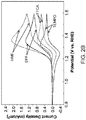
- Electrochemical oxidation For electrochemical oxidation of HMF in an aqueous medium, water oxidation can be the major competing reaction. Therefore, electrochemical oxidation of water, HMF, and TEMPO was first investigated using an Au working electrode in a 0.5 M borate buffer solution (pH 9.2) by linear sweep voltammetry (LSV) ( FIG. 2A ).
- LSV linear sweep voltammetry
- the LSV obtained without HMF and TEMPO shows an anodic current onset at 1.83 V vs. RHE, which was due to water oxidation to O 2 .
- a small oxidation peak around 1.6 V vs. RHE was due to the surface oxidation of the Au electrode.
- HMF oxidation occurs at a significantly more positive potential than TEMPO oxidation, it is due to the extremely poor kinetics of heterogeneous oxidation of HMF on the Au electrode, and, in fact, HMF oxidation is thermodynamically more favorable than TEMPO oxidation.
- TEMPO as a mediator and catalyst and by choosing an oxidation potential between the onset potentials of TEMPO oxidation and water oxidation, HMF oxidation can be achieved with a significantly decreased overpotential without competing with water oxidation.
- Oxidation of HMF is known to occur through two different pathways. One is through initial aldehyde oxidation, forming HMFCA as the intermediate, and the other is through initial alcohol oxidation, forming DFF as the intermediate ( FIG. 1 ). In most aerobic oxidation reactions, a pathway through HMFCA was dominantly observed. However, the present results showed that TEMPO-mediated HMF oxidation occurred through the formation of DFF.
- the oxidation kinetics of HMF, DFF, and FFCA by TEMPO + could be easily compared by CVs of TEMPO in solution with HMF, DFF, and FFCA. Since the oxidation rate of these species by TEMPO + is equivalent to the regeneration rate of TEMPO, the species with the fastest oxidation kinetics will cause the most significant enhancement in anodic current for TEMPO oxidation and also the most significant decrease in cathodic current for TEMPO + reduction.
- the CV comparison in FIG. 2B shows that the oxidation of HMF by TEMPO + is the fastest, and that of FFCA is the slowest, which agrees well with the yield profiles of DFF, FFCA, and FDCA shown in FIG. 2C .
- the FE for FDCA formation which requires 6 electron oxidation (HMF + 6OH - ⁇ FDCA + 4H 2 O + 6e - ), were calculated using equation (3), where F is the Faraday constant (96485 C/mol).
- the FE corresponding to the TEMPO-mediated FDCA formation shown in FIG. 2C at 40 C was calculated to be 94%.
- the high yield and FE for the FDCA formation which was achieved at ambient temperature and pressure in a mildly basic aqueous solution without consuming chemical oxidants or generating chemical waste, suggest that TEMPO-mediated electrochemical oxidation can be one of the most efficient, practical, and environmentally benign routes for the conversion of HMF to FDCA.
- the electrolyte can be acidified (pH ⁇ 3) to isolate FDCA as precipitates. This process did not affect the electrochemical activity of TEMPO for further use.
- FE % mol of FDCA formed Total charge passed / F ⁇ 6 ⁇ 100
- Photoelectrochemical oxidation using a PEC Based on these exciting results, a PEC using HMF oxidation as the anode reaction was constructed.
- an n-type nanoporous BiVO 4 electrode was used as a photoanode that absorbs photons to generate and separate electron-hole pairs. After separation, electrons are transferred to the Pt counter electrode to reduce water to H 2 while the holes reaching the surface of BiVO 4 are used for TEMPO-mediated HMF oxidation (equations 4-5).
- Equation (6) A 0.5 M borate buffer solution (pH 9.2) was used as the electrolyte with 7.5 mM TEMPO and 5.0 mM HMF added only to the anolyte, which was separated from the catholyte by fritted glass.
- Equations (4-6) show that, like water oxidation, HMF oxidation can offset the pH change at the cathode.
- the nanoporous BiVO 4 electrode used in this study was prepared using a method reported in a recent paper where it was used as a photoanode for a water splitting photoelectrochemical cell and demonstrated the highest applied bias photon-to-current efficiency among oxide-based photoelectrodes reported to date.
- the BiVO 4 electrode was coated with oxygen evolution catalysts (OEC) because the bare surface of BiVO 4 is poorly catalytic for water oxidation.
- OEC oxygen evolution catalysts
- the poorly catalytic surface of BiVO 4 for water oxidation is advantageous for maximizing TEMPO oxidation while suppressing water oxidation. Therefore, a bare BiVO 4 electrode without OEC layers was used as the photoanode for the PEC constructed in this study.
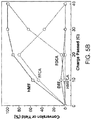
- the conversion (%) of HMF and yields (%) of oxidation products ( FIG. 3B ) look similar to those shown in FIG. 2C , which is expected because the oxidation kinetics of HMF by TEMPO + should be identical whether TEMPO + was produced electrochemically or photoelectrochemically.
- the final yield of FDCA at 40 C was > 99%.
- 1.04 V vs. RHE was chosen for the practical purpose of shortening the experiment time. However, a lower applied potential, such as 0.6 V vs. RHE, can be used.
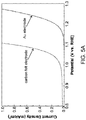
- Electrochemical oxidation using a carbon felt electrode typically, precious metals are used as catalytic electrodes because they are necessary to ensure favorable electrode-HMF interaction for direct HMF oxidation.
- TEMPO is used as a mediator, direct electrode-HMF interaction is no longer necessary, and, therefore, the need for precious metal electrodes may disappear if TEMPO oxidation can be achieved efficiently on inexpensive non-precious metal electrodes.
- TEMPO-mediated HMF oxidation was performed using carbon felt as the working electrode, which can also inherently offer high surface areas and may make electrochemical HMF oxidation more efficient and practical.
- the time required for the complete conversion is inversely proportional to the area of the electrode.
- the geometric area of the electrode was limited to 1 cm 2 due to the size of the divided cells used for experiments.
- the size of the electrode can be easily increased to shorten the conversion time when the cell is scaled up for practical use. Therefore, not the absolute conversion time but the selectivity and FE for the formation of FDCA, which do not depend on the electrode size, should be the critical factors to consider when evaluating the viability or practicality of electrochemical and photoelectrochemical HMF oxidation.
- Both electrochemical and photoelectrochemical oxidation of HMF demonstrated in this study resulted in the formation of FDCA as the only final product (100% selectivity) with 93-94% FE at ambient conditions.
- this example has demonstrated highly efficient electrochemical oxidation of HMF to FDCA using TEMPO as a mediator (yield ⁇ 99%, FE ⁇ 93%) in a pH 9.2 aqueous medium.
- TEMPO as a mediator
- the amount of overpotential necessary to initiate HMF oxidation was reduced significantly and the need for precious metal catalyst electrodes was eliminated.
- a photoelectrochemical cell that used TEMPO-mediated photoelectrochemical oxidation of HMF as the anode reaction was constructed. By using photogenerated holes in the VB of BiVO 4 for oxidation, the applied bias necessary to initiate TEMPO oxidation could be reduced considerably.
- Electrode preparation Au electrodes used as working electrodes were prepared by sputter coating 20 nm of titanium as an adhesion layer followed by 100 nm of gold on clean glass slides. Platinum electrodes used as counter electrodes were prepared by depositing 20 nm of titanium as an adhesion layer followed by 100 nm of platinum on clean glass slides by sputter coating. Carbon felt used as working electrodes was purchased from Alfa Aesar. Nanoporous BiVO 4 electrodes used as photoanodes were prepared following the procedure reported in a recent study. The geometric surface areas of all working electrodes were 1 cm 2 and all current densities reported in this study were calculated using the geometric area of the working electrode.
- LSV Linear sweep voltammetry
- CV Cyclic voltammetry
- LSVs of BiVO 4 under illumination LSVs of BiVO 4 for photooxidation of 7.5 mM TEMPO were obtained using simulated solar illumination obtained by Oriel LCS-100 with an AM 1.5G filter. All other conditions (e.g., electrochemical setup, solutions, and measurement conditions) were same as above. Illumination was achieved through the FTO substrate that was used as the substrate to deposit BiVO 4 electrodes. The power density of the incident light was calibrated to 100 mW/cm 2 at the surface of the FTO substrate (before the light penetrates FTO) by using a thermopile detector (International Light) and a NREL certified reference cell (Photo Emission Tech., Inc.).
- Quantitative oxidation product analysis In order to analyze oxidation products quantitatively and calculate yields and Faradaic efficiencies (FEs), TEMPO-mediated HMF oxidation was performed while applying a constant potential and passing 40 C.
- TEMPO-mediated HMF oxidation was performed while applying a constant potential and passing 40 C.
- the electrolyte was a 0.5 M borate buffer (pH 9.2) solution containing 7.5 mM TEMPO and 5 mM HMF.
- a three electrode-cell composed of a working electrode (Au, carbon felt or BiVO 4 ), a Pt counter electrode, and a Ag/AgCl (4M KCl) reference electrode was used in an H-shaped divided cell with fritted glass as the divider.
- a working electrode Au, carbon felt or BiVO 4
- Pt counter electrode a Ag/AgCl (4M KCl) reference electrode
- Ag/AgCl (4M KCl) reference electrode was used in an H-shaped divided cell with fritted glass as the divider.
- For photooxidation on BiVO 4 light was illuminated using the same setup described above. The electrochemical and photoelectrochemical oxidation were carried out at room temperature while stirring.
- the identification of the products and calculation of their concentration were determined from calibration curves by applying a standard solution of known concentration.
- the retention times for detected compounds were 23 min, 25.6 min, 30.7 min, 37 min and 46 min, for FDCA, HMFCA, FFCA, HMF and DFF, respectively.
- Example 2 Electrochemical Oxidation of HMF to DFF using a TEMPO Mediator
- This example illustrates the electrochemical oxidation of HMF to DFF using acetonitrile, which does not serve as an oxygen donor, as the solvent in the electrolyte solution.
- a three electrode-cell composed of an Au working electrode (geometric surface area, 1 cm 2 ), a Pt counter electrode, and an Ag/AgNO 3 non-aqueous reference electrode was used in an H-shaped divided cell with fritted glass as the divider.
- the cell was controlled by an SP-200 potentiostat/EIS (BioLogic Science Instrument).
- the electrolyte contained 5 mM HMF, 25 mM TEMPO, 15 mM 2,6-lutidine as a base and 0.1 M TBAH as a supporting electrolyte in acetonitrile.
- the electrolysis was monitored by high-performance liquid chromatography (HPLC) to calculate HMF conversion and yields of the products using a Shimadzu SCL-10A chromatograph with a UV-visible detector (Shimadzu SPD-10AV) set at 265 nm.
- HPLC high-performance liquid chromatography
- 10 ⁇ L of solution was taken out from the cell and analyzed.
- 5 mM sulfuric acid was used as a mobile phase in an isocratic mode. 1 h of equilibration was required before each first injection.
- the flow rate was 0.5 mL/min at 60 °C.
- 10 ⁇ L of samples/standards were directly injected on a 300 mm ⁇ 7.8 mm ICSep ICE-Coregel 87H3 column purchased from Transgenomic.
- the identification of the products and calculation of their concentrations were determined from calibration curves by applying a standard solution of known concentration prior to every HPLC run.
- the retention times for detected compounds were 37 min and 46 min for HMF
- HMF TEMPO-mediated electrochemical oxidation of HMF was achieved in acetonitrile media at 0.7 V vs. Ag/AgNO 3 . No tendency for over-oxidation of aldehydes to acids was observed. HMF was oxidized at room temperature with 96.7% HMF conversion and 94.7% of DFF yield after 15 C passed.
Landscapes
- Chemical & Material Sciences (AREA)
- Organic Chemistry (AREA)
- Engineering & Computer Science (AREA)
- Chemical Kinetics & Catalysis (AREA)
- Electrochemistry (AREA)
- Materials Engineering (AREA)
- Metallurgy (AREA)
- Power Engineering (AREA)
- Microelectronics & Electronic Packaging (AREA)
- Electrolytic Production Of Non-Metals, Compounds, Apparatuses Therefor (AREA)
- Hybrid Cells (AREA)
Claims (13)
- Verfahren zur TEMPO-vermittelten elektrochemischen Oxidation von 5-Hydroxymethylfurfural in einer elektrochemischen Zelle, umfassend: eine Anode in einer Anodenelektrolytlösung, 5-Hydroxymethylfurfural umfassend; einen an der Anode immobilisierten oder in der Anodenelektrolytlösung gelösten TEMPO-Mediator; und eine Kathode in einer Kathodenelektrolytlösung, das Verfahren umfassend: Anlegen eines Anodenpotentials an die Anode, wobei das Anodenpotential positiver ist als das Einsetzpotential für die Oxidation des TEMPO-Mediators, wobei TEMPO an der Anode oxidiert wird, um TEMPO+ zu bilden, welches die TEMPO-vermittelte Oxidation des 5-Hydroxymethylfurfurals induziert, um 2,5-Furandicarbonsäure, 2,5-Diformylfuran oder beides zu bilden.
- Verfahren nach Anspruch 1, wobei die Anode kein Platin, Palladium oder Gold umfasst.
- Elektrochemische Zelle, umfassend:eine Anode in einer Anodenelektrolytlösung, wobei die Anodenelektrolytlösung eine wässrige Lösung ist;5-Hydroxymethylfurfural, gelöst in der wässrigen Lösung;einen an der Anode immobilisierten oder in der wässrigen Lösung gelösten TEMPO-Mediator; undeine Kathode in einer Kathodenelektrolytlösung, wobei die Kathode in elektrischer Verbindung mit der Anode steht.
- Elektrochemische Zelle nach Anspruch 3, wobei der TEMPO-Mediator in der wässrigen Lösung gelöst ist.
- Verfahren zur photoelektrochemischen Oxidation von 5-Hydroxymethylfurfural in einer photoelektrochemischen Zelle, umfassend: eine Anode in einer Anodenelektrolytlösung, 5-Hydroxymethylfurfural umfassend; einen an der Anode immobilisierten oder in der Anodenelektrolytlösung gelösten TEMPO-Mediator; und eine Kathode in einer Kathodenelektrolytlösung, wobei zumindest eine von der Anode und der Kathode eine Photoelektrode ist, einen Halbleiter umfassend, das Verfahren umfassend: Aussetzen der zumindest einen Photoelektrode einer Strahlung, die absorbiert wird, um Elektron-Loch-Paare zu erzeugen, wobei Löcher zur Elektrolyt-Anoden-Grenzfläche transportiert werden, wo sie die Oxidation des 5-Hydroxymethylfurfurals zur Bildung von 2,5-Furandicarbonsäure, 2,5-Diformylfuran oder beiden induzieren und die Oxidation durch den TEMPO-Mediator vermittelt wird, und Elektronen zur Elektrolyt-Kathoden-Grenzfläche transportiert werden, wo sie eine Reduktionsreaktion induzieren.
- Verfahren nach Anspruch 5, wobei die Anode eine Photoanode ist, BiVO4 vom n-Typ umfassend.
- Photoelektrochemische Zelle, umfassend:eine Anode in einer Anodenelektrolytlösung, 5-Hydroxymethylfurfural umfassend;einen an der Anode immobilisierten oder in der Anodenelektrolytlösung gelösten TEMPO-Mediator; undeine Kathode in einer Kathodenelektrolytlösung;wobei zumindest eine von der Anode und der Kathode eine Photoelektrode ist, einen Halbleiter umfassend.
- Zelle nach Anspruch 3, wobei die Anodenelektrolytlösung eine wässrige Elektrolytlösung mit einem pH-Wert von weniger als 12 ist.
- Zelle nach Anspruch 3 oder 7, wobei die Anode kein Platin, Palladium oder Gold umfasst.
- Zelle nach Anspruch 7, wobei die Anode eine Photoanode ist, BiVO4 vom n-Typ umfassend.
- Zelle nach Anspruch 3, wobei der TEMPO-Mediator in der wässrigen Lösung gelöst ist.
- Elektrochemische Zelle, umfassendeine Anode in einer Anodenelektrolytlösung, wobei die Anodenelektrolytlösung eine nicht-wässrige Lösung ist, die nicht als ein Sauerstoffspender dient;5-Hydroxymethylfurfural, gelöst in der nicht-wässrigen Lösung, die nicht als ein Sauerstoffspender dient;einen an der Anode immobilisierten oder in der nicht-wässrigen Lösung, die nicht als ein Sauerstoffspender dient, gelösten TEMPO-Mediator; undeine Kathode in einer Kathodenelektrolytlösung, wobei die Kathode in elektrischer Verbindung mit der Anode steht.
- Zelle nach Anspruch 12, wobei der TEMPO-Mediator in der nicht-wässrigen Lösung gelöst ist, die nicht als ein Sauerstoffspender dient.
Applications Claiming Priority (2)
| Application Number | Priority Date | Filing Date | Title |
|---|---|---|---|
| US14/592,031 US9598780B2 (en) | 2015-01-08 | 2015-01-08 | Electrochemical and photoelectrochemical oxidation of 5-hydroxymethylfurfural to 2,5-furandicarboxylic acid and 2,5-diformylfuran |
| PCT/US2016/012312 WO2016112091A1 (en) | 2015-01-08 | 2016-01-06 | Electrochemical and photoelectrochemical oxidation of 5-hydroxymethylfurfural to 2,5-furandicarboxylic acid and 2,5-diformylfuran |
Publications (3)
| Publication Number | Publication Date |
|---|---|
| EP3242964A1 EP3242964A1 (de) | 2017-11-15 |
| EP3242964A4 EP3242964A4 (de) | 2018-11-14 |
| EP3242964B1 true EP3242964B1 (de) | 2021-11-03 |
Family
ID=56356381
Family Applications (1)
| Application Number | Title | Priority Date | Filing Date |
|---|---|---|---|
| EP16735346.5A Active EP3242964B1 (de) | 2015-01-08 | 2016-01-06 | Elektrochemische oder fotoelektrochemische oxidation von 5-hydroxymethylfurfural zu 2,5-furandicarbonsäure und 2,5-diformylfuran |
Country Status (6)
| Country | Link |
|---|---|
| US (3) | US9598780B2 (de) |
| EP (1) | EP3242964B1 (de) |
| BR (1) | BR112017014218B1 (de) |
| CA (1) | CA2971615C (de) |
| DK (1) | DK3242964T3 (de) |
| WO (1) | WO2016112091A1 (de) |
Families Citing this family (24)
| Publication number | Priority date | Publication date | Assignee | Title |
|---|---|---|---|---|
| US9885119B2 (en) | 2015-02-12 | 2018-02-06 | Wisconsin Alumni Research Foundation | Electrochemical and photoelectrochemical reduction of furfurals |
| US10787748B2 (en) * | 2015-05-21 | 2020-09-29 | Avantium Knowledge Centre B.V. | Process for the preparation of an aromatic dicarboxylic acid |
| WO2016186505A1 (en) | 2015-05-21 | 2016-11-24 | Avantium Knowledge Centre B.V. | Process for the purification of a carboxylic acid-containing composition |
| US10392715B2 (en) | 2016-08-29 | 2019-08-27 | Wisconsin Alumni Research Foundation | Electrochemical reductive amination of furfural-based molecules |
| US20190352784A1 (en) * | 2016-11-24 | 2019-11-21 | Avantium Knowledge Centre B.V. | Process for treating a furan-2,5-dicarboxylic acid composition |
| US10669639B2 (en) | 2017-09-05 | 2020-06-02 | Wisconsin Alumni Research Foundation | Eletrochemical oxidation of 5-hydroxymethylfurfural using copper-based anodes |
| US11142833B2 (en) * | 2017-10-09 | 2021-10-12 | Wisconsin Alumni Research Foundation | Electrochemical oxidation of aromatic aldehydes in acidic media |
| DE102017123797A1 (de) * | 2017-10-12 | 2019-04-18 | Synphabase Ag | Furandicarbonsäure |
| CN108130554A (zh) * | 2017-10-31 | 2018-06-08 | 天津工业大学 | 一种次氯酸钠电催化5-hmf制备fdca的方法 |
| CN108531936B (zh) * | 2018-04-29 | 2019-11-05 | 浙江工业大学 | 一种生物质类化合物电催化氧化制取2,5-呋喃二甲酸的方法 |
| DE102018208507A1 (de) | 2018-05-29 | 2019-12-05 | Südzucker AG | Anolytfraktion-katalysierte HMF-Herstellung |
| CN110106514B (zh) * | 2019-05-13 | 2020-09-29 | 浙江大学 | 一种5-羟甲基糠醛电化学氧化制备2,5-呋喃二甲酸的方法 |
| CN112921341B (zh) * | 2021-01-25 | 2022-06-21 | 北京化工大学 | 高效小分子催化氧化与产氢耦合的反应系统 |
| CN113755863B (zh) * | 2021-09-13 | 2022-05-06 | 中山大学 | 一种非贵金属催化剂同步电化学还原胺化和氧化醛基制备高值品的方法 |
| CN113861142B (zh) * | 2021-10-14 | 2023-04-07 | 新乡学院 | 一种2,5-呋喃二甲酸及其制备方法 |
| FR3129955B1 (fr) | 2021-12-03 | 2023-11-17 | Ifp Energies Now | Procédé d’électro-oxydation d’un composé furanique |
| CN114438525B (zh) * | 2022-01-24 | 2023-08-15 | 吉林大学 | 一种糠醛阴极电化学转化合成糠酸的方法 |
| CN114481170B (zh) * | 2022-01-24 | 2023-08-15 | 吉林大学 | 一种由糠醛线性成对电化学合成糠酸的方法 |
| CN114592204B (zh) * | 2022-03-08 | 2023-06-13 | 郑州大学 | 一种用于糠醛和5-羟甲基糠醛电氧化的装置及方法 |
| CN114574881B (zh) * | 2022-03-09 | 2024-04-09 | 厦门大学 | 一种电催化氧化醛醇类物质制备多元羧酸的方法 |
| CN114737215B (zh) * | 2022-03-31 | 2023-11-14 | 福建工程学院 | 一种镍钨复合电极的制备方法及其在电催化氧化中的应用 |
| EP4720370A1 (de) * | 2023-05-24 | 2026-04-08 | Technion Research & Development Foundation Limited | Photo-bio-elektrochemische zelle |
| CN119800383A (zh) * | 2024-12-31 | 2025-04-11 | 万华化学集团股份有限公司 | 一种成对电解法同时合成异辛醛和异辛酸的方法 |
| CN119985789B (zh) * | 2025-03-07 | 2025-09-19 | 中国科学院宁波材料技术与工程研究所 | 一种同时测定5-羟甲基糠醛及其氧化产物的方法 |
Family Cites Families (18)
| Publication number | Priority date | Publication date | Assignee | Title |
|---|---|---|---|---|
| PL161831B2 (pl) * | 1990-02-06 | 1993-08-31 | Univ Lodzki | Sposób otrzymywania kwasu 2,5-furanodikarboksytowego PL |
| JPH04362199A (ja) | 1991-06-06 | 1992-12-15 | Nec Corp | 電気めっき装置 |
| US7052587B2 (en) | 2003-06-27 | 2006-05-30 | General Motors Corporation | Photoelectrochemical device and electrode |
| KR20100097700A (ko) * | 2007-11-16 | 2010-09-03 | 아쿠아 다이아그노스틱 피티와이 엘티디 | 광전극 |
| WO2011043661A1 (en) | 2009-10-07 | 2011-04-14 | Furanix Technologies B.V. | Method for the preparation of 2,5-furandicarboxylic acid and for the preparation of the dialkyl ester of 2,5-furandicarboxylic acid |
| IT1401911B1 (it) * | 2010-08-06 | 2013-08-28 | Novamont Spa | Processo per la sintesi di acido 2,5-furandicarbossilico |
| WO2013049711A1 (en) * | 2011-09-29 | 2013-04-04 | Bio Architecture Lab, Inc. | Methods for preparing 2,5-furandicarboxylic acid |
| WO2013082110A1 (en) * | 2011-12-02 | 2013-06-06 | Bio2Electric, Llc | Reactor, process, and system for the oxidation of gaseous streams |
| US11566332B2 (en) * | 2012-03-06 | 2023-01-31 | Board Of Trustees Of Michigan State University | Electrocatalytic hydrogenation and hydrodeoxygenation of oxygenated and unsaturated organic compounds |
| US8969534B2 (en) | 2013-02-20 | 2015-03-03 | Wisconsin Alumni Research Foundataion | Selective aerobic alcohol oxidation method for conversion of lignin into simple aromatic compounds |
| US9435043B2 (en) * | 2014-04-14 | 2016-09-06 | California Institute Of Technology | Oxygen evolution reaction catalysis |
| US9856567B2 (en) | 2014-06-16 | 2018-01-02 | Wisconsin Alumni Research Foundation | Synthesis of high-surface-area nanoporous BiVO4 electrodes |
| US10633749B2 (en) * | 2014-07-23 | 2020-04-28 | Board Of Trustees Of Michigan State University | Electrolyzer reactor and related methods |
| US10431842B2 (en) | 2014-10-10 | 2019-10-01 | The Penn State Research Foundation | Ammonia-based thermoelectrochemical systems and methods |
| US10787748B2 (en) | 2015-05-21 | 2020-09-29 | Avantium Knowledge Centre B.V. | Process for the preparation of an aromatic dicarboxylic acid |
| US20180023199A1 (en) | 2016-07-19 | 2018-01-25 | Utah State University | Electrocatalytic hydrogen evolution and biomass upgrading |
| EP3366681A1 (de) | 2017-02-28 | 2018-08-29 | Nederlandse Organisatie voor toegepast- natuurwetenschappelijk onderzoek TNO | Herstellung von 2,5-furandicarbonsäure |
| US10669639B2 (en) | 2017-09-05 | 2020-06-02 | Wisconsin Alumni Research Foundation | Eletrochemical oxidation of 5-hydroxymethylfurfural using copper-based anodes |
-
2015
- 2015-01-08 US US14/592,031 patent/US9598780B2/en active Active
-
2016
- 2016-01-06 BR BR112017014218-0A patent/BR112017014218B1/pt active IP Right Grant
- 2016-01-06 WO PCT/US2016/012312 patent/WO2016112091A1/en not_active Ceased
- 2016-01-06 DK DK16735346.5T patent/DK3242964T3/da active
- 2016-01-06 EP EP16735346.5A patent/EP3242964B1/de active Active
- 2016-01-06 CA CA2971615A patent/CA2971615C/en active Active
-
2017
- 2017-02-01 US US15/421,750 patent/US10655233B2/en active Active
-
2020
- 2020-04-09 US US16/844,437 patent/US11136679B2/en active Active
Non-Patent Citations (1)
| Title |
|---|
| None * |
Also Published As
| Publication number | Publication date |
|---|---|
| CA2971615C (en) | 2022-11-29 |
| US20160201204A1 (en) | 2016-07-14 |
| US20170145572A1 (en) | 2017-05-25 |
| US10655233B2 (en) | 2020-05-19 |
| WO2016112091A1 (en) | 2016-07-14 |
| BR112017014218B1 (pt) | 2022-07-12 |
| EP3242964A1 (de) | 2017-11-15 |
| US9598780B2 (en) | 2017-03-21 |
| US11136679B2 (en) | 2021-10-05 |
| CA2971615A1 (en) | 2016-07-14 |
| US20200255960A1 (en) | 2020-08-13 |
| DK3242964T3 (da) | 2022-02-07 |
| BR112017014218A2 (en) | 2018-03-06 |
| EP3242964A4 (de) | 2018-11-14 |
Similar Documents
| Publication | Publication Date | Title |
|---|---|---|
| US11136679B2 (en) | Electrochemical and photoelectrochemical oxidation of 5-hydroxymethylfurfural to 2,5-furandicarboxylic acid and 2,5-diformylfuran | |
| Antón-García et al. | Photoelectrochemical hybrid cell for unbiased CO2 reduction coupled to alcohol oxidation | |
| Cha et al. | Combined biomass valorization and hydrogen production in a photoelectrochemical cell | |
| Lhermitte et al. | Alternative oxidation reactions for solar-driven fuel production | |
| US11427918B2 (en) | Electrochemical and photoelectrochemical reduction of furfurals | |
| Fang et al. | Electrocatalytic hydrogen peroxide production: advances, challenges, and future perspectives | |
| Liu et al. | Hematite photoanodes for solar water splitting: a detailed spectroelectrochemical analysis on the pH-dependent performance | |
| Martínez et al. | Paired electrolysis for simultaneous generation of synthetic fuels and chemicals | |
| Lopes et al. | An innovative photoelectrochemical lab device for solar water splitting | |
| Tateno et al. | Photoelectrochemical dimethoxylation of furan via a bromide redox mediator using a BiVO 4/WO 3 photoanode | |
| Hardwick et al. | Interfacial photoelectrochemical catalysis: solar‐induced green synthesis of organic molecules | |
| Lhermitte et al. | Direct photoelectrochemical oxidation of hydroxymethylfurfural on tungsten trioxide photoanodes | |
| Antoniadou et al. | Hydrogen and electricity generation by photoelectrochemical decomposition of ethanol over nanocrystalline titania | |
| Gill et al. | Enhancing electrochemical water oxidation toward H2O2 via carbonaceous electrolyte engineering | |
| US11473205B2 (en) | Electrochemical oxidation of aromatic aldehydes in acidic media | |
| Zhu et al. | Highly efficient photoelectrochemical alkene epoxidation on a dye-sensitized photoanode | |
| Özcan et al. | Photoelectrocatalytic selective oxidation of 4-methoxybenzyl alcohol in water by TiO2 supported on titanium anodes | |
| JP2014532812A (ja) | 酸素及び/又は水素の電気化学的発生のための装置及び方法 | |
| Antoniadou et al. | Photoelectrochemical oxidation of organic substances over nanocrystalline titania: Optimization of the photoelectrochemical cell | |
| Pahari et al. | In situ observation of photoelectrochemical water oxidation intermediates for selective biomass upgrading with simultaneous hydrogen production | |
| Hu et al. | In situ electrochemical regeneration of permanganate ion for sustainable oxidation reactions | |
| Li et al. | Electrochemical synthesis of thiazoles from 2, 5-dihydrothiazolines mediated by bromide/tetrachlorohydroquinone dual redox catalysts | |
| Carli et al. | Electrocatalytic Poly (3, 4-ethylenedioxythiophene) for Electrochemical Conversion of 5-Hydroxymethylfurfural | |
| Choi et al. | Electrochemical and photoelectrochemical oxidation of 5-hydroxymethylfurfural to 2, 5-furandicarboxylic acid and 2, 5-diformylfuran | |
| Bellardita et al. | Boosting high added-value chemicals formation by means of photoelectrocatalysis |
Legal Events
| Date | Code | Title | Description |
|---|---|---|---|
| STAA | Information on the status of an ep patent application or granted ep patent |
Free format text: STATUS: THE INTERNATIONAL PUBLICATION HAS BEEN MADE |
|
| PUAI | Public reference made under article 153(3) epc to a published international application that has entered the european phase |
Free format text: ORIGINAL CODE: 0009012 |
|
| STAA | Information on the status of an ep patent application or granted ep patent |
Free format text: STATUS: REQUEST FOR EXAMINATION WAS MADE |
|
| 17P | Request for examination filed |
Effective date: 20170619 |
|
| AK | Designated contracting states |
Kind code of ref document: A1 Designated state(s): AL AT BE BG CH CY CZ DE DK EE ES FI FR GB GR HR HU IE IS IT LI LT LU LV MC MK MT NL NO PL PT RO RS SE SI SK SM TR |
|
| AX | Request for extension of the european patent |
Extension state: BA ME |
|
| RIN1 | Information on inventor provided before grant (corrected) |
Inventor name: CHOI, KYOUNG-SHIN Inventor name: CHA, HYUN GIL |
|
| DAV | Request for validation of the european patent (deleted) | ||
| DAX | Request for extension of the european patent (deleted) | ||
| RIC1 | Information provided on ipc code assigned before grant |
Ipc: C25B 3/02 20060101AFI20180716BHEP |
|
| A4 | Supplementary search report drawn up and despatched |
Effective date: 20181016 |
|
| RIC1 | Information provided on ipc code assigned before grant |
Ipc: C25B 9/00 20060101ALI20181010BHEP Ipc: C25B 11/04 20060101ALI20181010BHEP Ipc: C25B 9/06 20060101ALI20181010BHEP Ipc: H01G 9/20 20060101ALI20181010BHEP Ipc: C25B 3/02 20060101AFI20181010BHEP Ipc: C25B 11/12 20060101ALI20181010BHEP |
|
| STAA | Information on the status of an ep patent application or granted ep patent |
Free format text: STATUS: EXAMINATION IS IN PROGRESS |
|
| 17Q | First examination report despatched |
Effective date: 20191028 |
|
| REG | Reference to a national code |
Ref country code: DE Ref legal event code: R079 Ref document number: 602016065710 Country of ref document: DE Free format text: PREVIOUS MAIN CLASS: C25B0003020000 Ipc: C25B0003070000 |
|
| RIC1 | Information provided on ipc code assigned before grant |
Ipc: H01G 9/20 20060101ALI20210503BHEP Ipc: C25B 11/087 20210101ALI20210503BHEP Ipc: C25B 11/081 20210101ALI20210503BHEP Ipc: C25B 11/052 20210101ALI20210503BHEP Ipc: C25B 11/043 20210101ALI20210503BHEP Ipc: C25B 9/50 20210101ALI20210503BHEP Ipc: C25B 9/17 20210101ALI20210503BHEP Ipc: C25B 3/23 20210101ALI20210503BHEP Ipc: C25B 3/21 20210101ALI20210503BHEP Ipc: C25B 3/07 20210101AFI20210503BHEP |
|
| GRAP | Despatch of communication of intention to grant a patent |
Free format text: ORIGINAL CODE: EPIDOSNIGR1 |
|
| STAA | Information on the status of an ep patent application or granted ep patent |
Free format text: STATUS: GRANT OF PATENT IS INTENDED |
|
| INTG | Intention to grant announced |
Effective date: 20210617 |
|
| GRAS | Grant fee paid |
Free format text: ORIGINAL CODE: EPIDOSNIGR3 |
|
| GRAA | (expected) grant |
Free format text: ORIGINAL CODE: 0009210 |
|
| STAA | Information on the status of an ep patent application or granted ep patent |
Free format text: STATUS: THE PATENT HAS BEEN GRANTED |
|
| AK | Designated contracting states |
Kind code of ref document: B1 Designated state(s): AL AT BE BG CH CY CZ DE DK EE ES FI FR GB GR HR HU IE IS IT LI LT LU LV MC MK MT NL NO PL PT RO RS SE SI SK SM TR |
|
| REG | Reference to a national code |
Ref country code: GB Ref legal event code: FG4D |
|
| REG | Reference to a national code |
Ref country code: AT Ref legal event code: REF Ref document number: 1444021 Country of ref document: AT Kind code of ref document: T Effective date: 20211115 Ref country code: CH Ref legal event code: EP |
|
| REG | Reference to a national code |
Ref country code: DE Ref legal event code: R096 Ref document number: 602016065710 Country of ref document: DE |
|
| REG | Reference to a national code |
Ref country code: IE Ref legal event code: FG4D |
|
| REG | Reference to a national code |
Ref country code: FI Ref legal event code: FGE |
|
| REG | Reference to a national code |
Ref country code: DK Ref legal event code: T3 Effective date: 20220203 |
|
| REG | Reference to a national code |
Ref country code: NL Ref legal event code: FP |
|
| REG | Reference to a national code |
Ref country code: LT Ref legal event code: MG9D |
|
| PG25 | Lapsed in a contracting state [announced via postgrant information from national office to epo] |
Ref country code: RS Free format text: LAPSE BECAUSE OF FAILURE TO SUBMIT A TRANSLATION OF THE DESCRIPTION OR TO PAY THE FEE WITHIN THE PRESCRIBED TIME-LIMIT Effective date: 20211103 Ref country code: LT Free format text: LAPSE BECAUSE OF FAILURE TO SUBMIT A TRANSLATION OF THE DESCRIPTION OR TO PAY THE FEE WITHIN THE PRESCRIBED TIME-LIMIT Effective date: 20211103 Ref country code: BG Free format text: LAPSE BECAUSE OF FAILURE TO SUBMIT A TRANSLATION OF THE DESCRIPTION OR TO PAY THE FEE WITHIN THE PRESCRIBED TIME-LIMIT Effective date: 20220203 |
|
| PG25 | Lapsed in a contracting state [announced via postgrant information from national office to epo] |
Ref country code: IS Free format text: LAPSE BECAUSE OF FAILURE TO SUBMIT A TRANSLATION OF THE DESCRIPTION OR TO PAY THE FEE WITHIN THE PRESCRIBED TIME-LIMIT Effective date: 20220303 Ref country code: SE Free format text: LAPSE BECAUSE OF FAILURE TO SUBMIT A TRANSLATION OF THE DESCRIPTION OR TO PAY THE FEE WITHIN THE PRESCRIBED TIME-LIMIT Effective date: 20211103 Ref country code: PT Free format text: LAPSE BECAUSE OF FAILURE TO SUBMIT A TRANSLATION OF THE DESCRIPTION OR TO PAY THE FEE WITHIN THE PRESCRIBED TIME-LIMIT Effective date: 20220303 Ref country code: PL Free format text: LAPSE BECAUSE OF FAILURE TO SUBMIT A TRANSLATION OF THE DESCRIPTION OR TO PAY THE FEE WITHIN THE PRESCRIBED TIME-LIMIT Effective date: 20211103 Ref country code: NO Free format text: LAPSE BECAUSE OF FAILURE TO SUBMIT A TRANSLATION OF THE DESCRIPTION OR TO PAY THE FEE WITHIN THE PRESCRIBED TIME-LIMIT Effective date: 20220203 Ref country code: LV Free format text: LAPSE BECAUSE OF FAILURE TO SUBMIT A TRANSLATION OF THE DESCRIPTION OR TO PAY THE FEE WITHIN THE PRESCRIBED TIME-LIMIT Effective date: 20211103 Ref country code: HR Free format text: LAPSE BECAUSE OF FAILURE TO SUBMIT A TRANSLATION OF THE DESCRIPTION OR TO PAY THE FEE WITHIN THE PRESCRIBED TIME-LIMIT Effective date: 20211103 Ref country code: GR Free format text: LAPSE BECAUSE OF FAILURE TO SUBMIT A TRANSLATION OF THE DESCRIPTION OR TO PAY THE FEE WITHIN THE PRESCRIBED TIME-LIMIT Effective date: 20220204 Ref country code: ES Free format text: LAPSE BECAUSE OF FAILURE TO SUBMIT A TRANSLATION OF THE DESCRIPTION OR TO PAY THE FEE WITHIN THE PRESCRIBED TIME-LIMIT Effective date: 20211103 |
|
| PG25 | Lapsed in a contracting state [announced via postgrant information from national office to epo] |
Ref country code: SM Free format text: LAPSE BECAUSE OF FAILURE TO SUBMIT A TRANSLATION OF THE DESCRIPTION OR TO PAY THE FEE WITHIN THE PRESCRIBED TIME-LIMIT Effective date: 20211103 Ref country code: SK Free format text: LAPSE BECAUSE OF FAILURE TO SUBMIT A TRANSLATION OF THE DESCRIPTION OR TO PAY THE FEE WITHIN THE PRESCRIBED TIME-LIMIT Effective date: 20211103 Ref country code: RO Free format text: LAPSE BECAUSE OF FAILURE TO SUBMIT A TRANSLATION OF THE DESCRIPTION OR TO PAY THE FEE WITHIN THE PRESCRIBED TIME-LIMIT Effective date: 20211103 Ref country code: EE Free format text: LAPSE BECAUSE OF FAILURE TO SUBMIT A TRANSLATION OF THE DESCRIPTION OR TO PAY THE FEE WITHIN THE PRESCRIBED TIME-LIMIT Effective date: 20211103 Ref country code: CZ Free format text: LAPSE BECAUSE OF FAILURE TO SUBMIT A TRANSLATION OF THE DESCRIPTION OR TO PAY THE FEE WITHIN THE PRESCRIBED TIME-LIMIT Effective date: 20211103 |
|
| REG | Reference to a national code |
Ref country code: DE Ref legal event code: R097 Ref document number: 602016065710 Country of ref document: DE |
|
| PG25 | Lapsed in a contracting state [announced via postgrant information from national office to epo] |
Ref country code: MC Free format text: LAPSE BECAUSE OF FAILURE TO SUBMIT A TRANSLATION OF THE DESCRIPTION OR TO PAY THE FEE WITHIN THE PRESCRIBED TIME-LIMIT Effective date: 20211103 |
|
| PLBE | No opposition filed within time limit |
Free format text: ORIGINAL CODE: 0009261 |
|
| STAA | Information on the status of an ep patent application or granted ep patent |
Free format text: STATUS: NO OPPOSITION FILED WITHIN TIME LIMIT |
|
| 26N | No opposition filed |
Effective date: 20220804 |
|
| PG25 | Lapsed in a contracting state [announced via postgrant information from national office to epo] |
Ref country code: AL Free format text: LAPSE BECAUSE OF FAILURE TO SUBMIT A TRANSLATION OF THE DESCRIPTION OR TO PAY THE FEE WITHIN THE PRESCRIBED TIME-LIMIT Effective date: 20211103 Ref country code: LU Free format text: LAPSE BECAUSE OF NON-PAYMENT OF DUE FEES Effective date: 20220106 |
|
| PG25 | Lapsed in a contracting state [announced via postgrant information from national office to epo] |
Ref country code: SI Free format text: LAPSE BECAUSE OF FAILURE TO SUBMIT A TRANSLATION OF THE DESCRIPTION OR TO PAY THE FEE WITHIN THE PRESCRIBED TIME-LIMIT Effective date: 20211103 |
|
| PG25 | Lapsed in a contracting state [announced via postgrant information from national office to epo] |
Ref country code: IE Free format text: LAPSE BECAUSE OF NON-PAYMENT OF DUE FEES Effective date: 20220106 |
|
| PG25 | Lapsed in a contracting state [announced via postgrant information from national office to epo] |
Ref country code: IT Free format text: LAPSE BECAUSE OF FAILURE TO SUBMIT A TRANSLATION OF THE DESCRIPTION OR TO PAY THE FEE WITHIN THE PRESCRIBED TIME-LIMIT Effective date: 20211103 |
|
| P01 | Opt-out of the competence of the unified patent court (upc) registered |
Effective date: 20230425 |
|
| PG25 | Lapsed in a contracting state [announced via postgrant information from national office to epo] |
Ref country code: HU Free format text: LAPSE BECAUSE OF FAILURE TO SUBMIT A TRANSLATION OF THE DESCRIPTION OR TO PAY THE FEE WITHIN THE PRESCRIBED TIME-LIMIT; INVALID AB INITIO Effective date: 20160106 |
|
| PG25 | Lapsed in a contracting state [announced via postgrant information from national office to epo] |
Ref country code: MK Free format text: LAPSE BECAUSE OF FAILURE TO SUBMIT A TRANSLATION OF THE DESCRIPTION OR TO PAY THE FEE WITHIN THE PRESCRIBED TIME-LIMIT Effective date: 20211103 Ref country code: CY Free format text: LAPSE BECAUSE OF FAILURE TO SUBMIT A TRANSLATION OF THE DESCRIPTION OR TO PAY THE FEE WITHIN THE PRESCRIBED TIME-LIMIT Effective date: 20211103 |
|
| PG25 | Lapsed in a contracting state [announced via postgrant information from national office to epo] |
Ref country code: MT Free format text: LAPSE BECAUSE OF FAILURE TO SUBMIT A TRANSLATION OF THE DESCRIPTION OR TO PAY THE FEE WITHIN THE PRESCRIBED TIME-LIMIT Effective date: 20211103 |
|
| PGFP | Annual fee paid to national office [announced via postgrant information from national office to epo] |
Ref country code: DK Payment date: 20250124 Year of fee payment: 10 Ref country code: FI Payment date: 20250124 Year of fee payment: 10 |
|
| PGFP | Annual fee paid to national office [announced via postgrant information from national office to epo] |
Ref country code: CH Payment date: 20250201 Year of fee payment: 10 Ref country code: AT Payment date: 20250122 Year of fee payment: 10 Ref country code: BE Payment date: 20250121 Year of fee payment: 10 |
|
| PGFP | Annual fee paid to national office [announced via postgrant information from national office to epo] |
Ref country code: FR Payment date: 20250127 Year of fee payment: 10 |
|
| PGFP | Annual fee paid to national office [announced via postgrant information from national office to epo] |
Ref country code: GB Payment date: 20250128 Year of fee payment: 10 |
|
| PGFP | Annual fee paid to national office [announced via postgrant information from national office to epo] |
Ref country code: TR Payment date: 20250102 Year of fee payment: 10 |
|
| PGFP | Annual fee paid to national office [announced via postgrant information from national office to epo] |
Ref country code: NL Payment date: 20260121 Year of fee payment: 11 |
|
| PGFP | Annual fee paid to national office [announced via postgrant information from national office to epo] |
Ref country code: DE Payment date: 20260121 Year of fee payment: 11 |