EP3246014A1 - Zahnpastazusammensetzung - Google Patents
Zahnpastazusammensetzung Download PDFInfo
- Publication number
- EP3246014A1 EP3246014A1 EP16737208.5A EP16737208A EP3246014A1 EP 3246014 A1 EP3246014 A1 EP 3246014A1 EP 16737208 A EP16737208 A EP 16737208A EP 3246014 A1 EP3246014 A1 EP 3246014A1
- Authority
- EP
- European Patent Office
- Prior art keywords
- wax
- comparative example
- balance balance
- tooth
- comparative
- Prior art date
- Legal status (The legal status is an assumption and is not a legal conclusion. Google has not performed a legal analysis and makes no representation as to the accuracy of the status listed.)
- Withdrawn
Links
Images

Classifications
-
- A—HUMAN NECESSITIES
- A61—MEDICAL OR VETERINARY SCIENCE; HYGIENE
- A61K—PREPARATIONS FOR MEDICAL, DENTAL OR TOILETRY PURPOSES
- A61K8/00—Cosmetics or similar toiletry preparations
- A61K8/18—Cosmetics or similar toiletry preparations characterised by the composition
- A61K8/92—Oils, fats or waxes; Derivatives thereof, e.g. hydrogenation products thereof
-
- A—HUMAN NECESSITIES
- A61—MEDICAL OR VETERINARY SCIENCE; HYGIENE
- A61K—PREPARATIONS FOR MEDICAL, DENTAL OR TOILETRY PURPOSES
- A61K8/00—Cosmetics or similar toiletry preparations
- A61K8/02—Cosmetics or similar toiletry preparations characterised by special physical form
-
- A—HUMAN NECESSITIES
- A61—MEDICAL OR VETERINARY SCIENCE; HYGIENE
- A61K—PREPARATIONS FOR MEDICAL, DENTAL OR TOILETRY PURPOSES
- A61K8/00—Cosmetics or similar toiletry preparations
- A61K8/18—Cosmetics or similar toiletry preparations characterised by the composition
- A61K8/19—Cosmetics or similar toiletry preparations characterised by the composition containing inorganic ingredients
- A61K8/24—Phosphorous; Compounds thereof
-
- A—HUMAN NECESSITIES
- A61—MEDICAL OR VETERINARY SCIENCE; HYGIENE
- A61K—PREPARATIONS FOR MEDICAL, DENTAL OR TOILETRY PURPOSES
- A61K8/00—Cosmetics or similar toiletry preparations
- A61K8/18—Cosmetics or similar toiletry preparations characterised by the composition
- A61K8/92—Oils, fats or waxes; Derivatives thereof, e.g. hydrogenation products thereof
- A61K8/922—Oils, fats or waxes; Derivatives thereof, e.g. hydrogenation products thereof of vegetable origin
-
- A—HUMAN NECESSITIES
- A61—MEDICAL OR VETERINARY SCIENCE; HYGIENE
- A61K—PREPARATIONS FOR MEDICAL, DENTAL OR TOILETRY PURPOSES
- A61K8/00—Cosmetics or similar toiletry preparations
- A61K8/18—Cosmetics or similar toiletry preparations characterised by the composition
- A61K8/92—Oils, fats or waxes; Derivatives thereof, e.g. hydrogenation products thereof
- A61K8/925—Oils, fats or waxes; Derivatives thereof, e.g. hydrogenation products thereof of animal origin
-
- A—HUMAN NECESSITIES
- A61—MEDICAL OR VETERINARY SCIENCE; HYGIENE
- A61K—PREPARATIONS FOR MEDICAL, DENTAL OR TOILETRY PURPOSES
- A61K8/00—Cosmetics or similar toiletry preparations
- A61K8/18—Cosmetics or similar toiletry preparations characterised by the composition
- A61K8/92—Oils, fats or waxes; Derivatives thereof, e.g. hydrogenation products thereof
- A61K8/927—Oils, fats or waxes; Derivatives thereof, e.g. hydrogenation products thereof of insects, e.g. shellac
-
- A—HUMAN NECESSITIES
- A61—MEDICAL OR VETERINARY SCIENCE; HYGIENE
- A61Q—SPECIFIC USE OF COSMETICS OR SIMILAR TOILETRY PREPARATIONS
- A61Q11/00—Preparations for care of the teeth, of the oral cavity or of dentures; Dentifrices, e.g. toothpastes; Mouth rinses
Definitions
- the present invention relates to a tooth-cleaning composition having a tooth-remineralizing effect.
- Caries begins with the adhesion of tooth decay bacteria, such as Streptococcus mutans, to the tooth surface for the formation of dental plaque, and organic acids produced by food metabolism by the tooth decay bacteria in the dental plaque demineralize dental enamel to cause an incipient caries condition.
- tooth decay bacteria such as Streptococcus mutans
- organic acids produced by food metabolism by the tooth decay bacteria in the dental plaque demineralize dental enamel to cause an incipient caries condition.
- Saliva remineralizes the demineralized part through the action of calcium and phosphorous in the saliva and thereby serves to return the tooth to the original condition. If the remineralization can sufficiently regenerate the demineralized tooth, the occurrence of caries can be suppressed.
- dentifrices containing a fluoride, or hydroxyapatite, one of calcium phosphates, having a crystal structure similar to the inorganic component of tooth, to promote the remineralization of the tooth are manufactured and distributed.
- the saliva or the use a dentifrice containing a fluoride or hydroxyapatite is not sufficient for the remineralization of the demineralized part, and there is a need for the development of oral compositions, such as a dentifrice, capable of sufficiently achieving the remineralization.
- an oral dentifrice containing hydroxyapatite or tricalcium phosphate having a particle diameter of 0.05 ⁇ m to 1.0 ⁇ m which is capable of repairing minute asperities on the tooth surface, protecting the tooth surface, preventing tooth decay, strengthening dentin, and having an enhanced whitening effect Patent Document 1
- an oral composition capable of allowing hydroxyapatite fine powder to long reside on the tooth surface by the incorporation of the hydroxyapatite fine powder in a water-soluble cellulose solution Patent Document 2
- an oral composition capable of remarkably promoting remineralization through the combined use of a sugar alcohol, such as xylitol, and dibasic calcium phosphate Patent Document 3
- an oral composition containing low-crystallinity hydroxyapatite which is capable of preventing disease and unpleasant feelings in oral cavity by adhering to oral bacteria for bacteria elimination
- an oral composition containing a calcium compound, such as hydroxyapatite Patent Document 1
- a chewing gum and the like containing xylitol, and calcium phosphate, noncrystalline calcium phosphate, or calcium phosphoryl oligosaccharide are also manufactured; however, they are not necessarily sufficient in remineralization.
- Patent Documents 10 and 11 there are proposed tooth-cleaning compositions capable of imparting gloss to teeth by containing wax
- Patent Document 12 a method for improving the astringency of an oral composition containing an astringent compound
- Patent Document 13 a method for suppressing the occurrence of astringency and metallic taste by incorporating wax in a tooth-cleaning composition having astringency and metallic taste
- Wax is present on the surface of animal and plant bodies, often acts as a protective coat, and is used for grazing in cosmetics and pharmaceutical products and the like after purification; however, it has no tooth-remineralizing action.
- An object of the present invention is to provide a tooth-cleaning composition having a high remineralizing effect on demineralized dental enamel.
- the present invention is specified by matters provided below.
- the tooth-cleaning composition of the present invention enables a remarkably enhancement in the remineralizing effect of a calcium phosphate.
- the tooth-cleaning composition of the present invention is excellent in the remineralization of demineralized dental enamel and can provide an excellent remineralizing effect even with a decreased content of the calcium phosphate.
- the tooth-cleaning composition of the present invention is not particularly limited provided that the composition contains a wax and a calcium phosphate and has a content of the calcium phosphate of 0.001 to 33% by mass; specific examples thereof can include a toothpaste, a toothpowder, or a liquid dentifrice.
- the calcium phosphate according to the present invention is not particularly limited provided that it is a calcium salt of phosphoric acid; examples thereof can include hydroxyapatite, tricalcium phosphate, and calcium monohydrogen phosphate; and these calcium phosphates may be used alone or in a combination of two or more thereof and may be hydrates thereof or those whose phosphorus and calcium are partly substituted by other elements, such as magnesium, zinc, titanium, sodium, and potassium.
- the calcium phosphate according to the present invention is preferably at least one selected from the group consisting of hydroxyapatite, tricalcium phosphate, and calcium monohydrogen phosphate in view of promoting remineralization.
- Hydroxyapatite as one of the calcium phosphates according to the present invention may be one obtained from bones of food fishes, such as salmon, pig bones, beef bones, and the like as natural hard tissues in addition to one synthesized by a conventional method.
- hydroxyapatite is stoichiometrically represented by the composition of Ca 10 (PO 4 ) 6 (OH) 2 ; however, the Ca/P molar ratio being not 1.67, which is non-stoichiometric, can also result in the exhibition of properties of hydroxyapatite and the assumption of an apatite structure.
- a synthetic hydroxyapatite having a Ca/P molar ratio of on the order of 1.4 to 1.8 is also encompassed in the hydroxyapatite according to the present invention.
- the hydroxyapatite used in the present invention may be crystalline, low-crystalline, or noncrystalline; however, it is preferably low-crystalline or noncrystalline hydroxyapatite in view of a caries-preventing effect (hereinafter, the low-crystalline hydroxyapatite and the noncrystalline hydroxyapatite are referred to as "amorphous hydroxyapatite").
- “Low-crystallinity” refers to crystallinity for which the X-ray diffraction peak is broad compared to that of high-crystalline powder
- noncrystallinity refers to crystallinity for which the X-ray diffraction pattern has a broad halo pattern and no diffraction pattern showing the character of a crystal is obtained.
- Such amorphous hydroxyapatite can be obtained, for example, by drying apatite synthesized by a wet synthesis method by lyophilization or drying at a temperature of 100°C or lower or by baking at a temperature of on the order of 300°C or lower.
- the content of hydroxyapatite in the tooth-cleaning composition of the present invention is 0.001 to 33% by mass based on the whole tooth-cleaning composition and is preferably 0.001 to 30% by mass, more preferably 0.01 to 20% by mass, still more preferably 0.1 to 20% by mass, based on the whole tooth-cleaning composition, in view of the remineralizing effect and sense of use thereof.
- Tricalcium phosphate as one of the calcium phosphates according to the present invention is also referred to as tribasic calcium phosphate, has the composition represented by the chemical formula: Ca 3 (PO 4 ) 2 , and is widely commonly used in pharmaceutical products and cosmetics as well as foods, sundry articles, the petrochemical industry, and the like.
- Examples of tricalcium phosphate used in the present invention include, but not limited to, a product conforming to the standards, such as Japanese Pharmaceutical Excipients, Japanese Standards of Quasi-drug Ingredients, and Japanese Cosmetic Ingredients Codex.
- Calcium monohydrogen phosphate as one of the calcium phosphates according to the present invention is also referred to as dibasic calcium phosphate, has the composition represented by the chemical formula: CaHPO 4 or CaHPO 4 •2H 2 O as its dehydrate, and is widely commonly used in pharmaceutical products, foods, cosmetics, industrial raw materials, and the like.
- Examples of calcium monohydrogen phosphate include, but not limited to, a product conforming to the standards, such as Japanese Standards and Criteria for Food and Food Additives, Japanese Pharmacopeia, and Japanese Standards of Quasi-drug Ingredients.
- the contents of tricalcium phosphate and calcium monohydrogen phosphate according to the present invention are 0.001 to 33% by mass based on the whole tooth-cleaning composition and are preferably 0.001 to 30% by mass, more preferably 0.01 to 20% by mass, still more preferably 0.1 to 20% by mass, based on the whole tooth-cleaning composition, in view of the remineralizing effect and sense of use thereof.
- Wax is an ester consisting typically of a higher fatty acid and a monohydric or dihydric higher alcohol, is solid or liquid and resembles fat and oil, but is stable to oxidation and hydrolysis.
- wax also includes substances not falling within the above definition, for example, sekiro (in Japanese) as another name of the hydrocarbon paraffin, and Japan wax, almost consisting of fat.
- Wax is classified into liquid wax and solid wax, and solid wax is divided into plant wax and animal wax.
- examples of the plant wax include carnauba wax, candelilla wax, rice bran wax, Japan wax, and sucrose wax
- examples of the animal wax include beeswax, spermaceti, and Chinese white insect wax.
- the wax according to the present invention refers to wax in the conventional broader sense.
- the wax according to the present invention is not particularly limited; preferred examples thereof can include shellac wax, Wang Li Guro, carnauba wax, sugar cane wax, bleached beeswax, bleached montan wax, rice bran wax, hydrogenated rice bran wax, spermaceti, deresin candelilla wax, candelilla wax, montan wax, paraffin wax, microcrystalline wax, Japan wax, oil seed wax, lanolin, beeswax, Chinese insect wax, cane wax, sucrose wax, and Chinese white insect wax.
- carnauba wax, candelilla wax, rice bran wax, beeswax, and Japan wax are preferable exemplified. These waxes may be used alone or in a combination of two or more thereof.
- Carnauba wax is a natural wax extracted from a type of palm.
- Carnauba wax used in the present invention may be a pale yellow to light brown one; specific examples thereof can include Special Carnauba Wax 1 from S. Kato & Co., Cerarica carnauba wax from CERARICA NODA Co., Ltd., Polishing Wax-105 from Freund Industrial Co., Ltd.
- Candelilla wax is a natural wax obtained from the stem of candelilla grass.
- Candelilla wax used in the present invention may be a pale yellow to light brown one; specific examples thereof can include purified candelilla wax MK-4 from Yokoseki Oil & Fat Industries Co., Ltd., Cerarica Candelilla Wax from CERARICA NODA Co., Ltd., Miki Chemical Industry & Co., Ltd., and Yamakei Sangyo Co., Ltd., and purified candelilla wax Toku-go from Cerica Noda Co., Ltd.
- waxes used in the present invention include, but not limited to, a product conforming to standards, such as Standards of the Japanese Pharmacopoeia, Japanese Standards and Criteria for Food and Food Additives, Japanese Standards of Cosmetic Ingredients, and Japanese Standards of Quasi-drug Ingredients.
- the amount of wax incorporated according to the present invention is not particularly limited; however, it is preferably 0.0001 to 30% by mass, more preferably 0.001 to 20% by mass, still more preferably 0.01 to 10% by mass, yet more preferably 0.01 to 5% by mass, based on the whole tooth-cleaning composition, in view of the promoting effect for remineralization and sense of use thereof.
- the tooth-cleaning composition contains a wax in addition to a calcium phosphate, which can remarkably enhance its remineralizing effect compared to that for the calcium phosphate alone.
- the tooth-cleaning composition of the present invention is excellent in the remineralization of demineralized dental enamel.
- a decreased content of a calcium phosphate can provide a remineralizing effect similar to or more than that by a high content of the calcium phosphate; thus, the calcium phosphate content in the tooth-cleaning composition can be decreased, if necessary, from the standpoint of improving sense of use and the relationship with other ingredients to be incorporated.
- the tooth-cleaning composition of the present invention may contain additives, such as an abrasive, a thickener, and a binder, commonly used in a tooth-cleaning composition, a wetting agent, a foaming agent, a perfume, a sweetener, a preservative, and various active ingredients, in addition to the above-described components. Specific examples of these components are shown below. In addition to the components shown below, proper components may be further incorporated depending on the purpose thereof, the type of the composition, and the like.
- additives such as an abrasive, a thickener, and a binder, commonly used in a tooth-cleaning composition, a wetting agent, a foaming agent, a perfume, a sweetener, a preservative, and various active ingredients, in addition to the above-described components. Specific examples of these components are shown below. In addition to the components shown below, proper components may be further incorporated depending on the purpose thereof, the type of the composition, and the like.
- abrasive examples include calcium carbonate, calcium pyrophosphate, silica such as abrasive precipitated silica or abrasive gel silica, calcium silicate, aluminum silicate, aluminum oxide, aluminum hydroxide, alumina, zeolite, titanium oxide, zirconium silicate, insoluble sodium metaphosphate, trimagnesium phosphate, magnesium carbonate, calcium sulfate, magnesium sulfate, polymethyl methacrylate, bentonite, and synthetic resin.
- silica such as abrasive precipitated silica or abrasive gel silica
- calcium silicate aluminum silicate, aluminum oxide, aluminum hydroxide, alumina, zeolite, titanium oxide, zirconium silicate, insoluble sodium metaphosphate, trimagnesium phosphate, magnesium carbonate, calcium sulfate, magnesium sulfate, polymethyl methacrylate, bentonite, and synthetic resin.
- thickener examples include hydroxyethylcellulose, sodium carboxymethylcellulose, carrageenan, carboxyvinyl polymer, xanthan gum, gelatin, pullulan, sodium alginate, sodium polyacrylate, polyvinyl alcohol, locust bean gum, guar gum, and hydroxypropylmethylcellulose.
- binder examples include methyl cellulose, propylene glycol alginate, pullulan, tragacanth gum, xanthan gum, pectin, Furcelleran, chitosan, polyethylene oxide, polyvinyl pyrrolidone, polyacrylic acid, polymethacrylic acid, peptone, casein, collagen, albumin, gum arabic, karaya gum, Eudragit, ethyl cellulose, cellulose acetate, sodium polyacrylate, polyvinyl alcohol, polyvinyl acetal-dimethylamino acetate, and cellulose acetate-dibutylhydroxypropyl ether.
- the emulsifier can include polyoxyethylene hydrogenated castor oil, sorbitan monostearate, glycerin fatty acid ester, propylene glycol fatty acid ester, alkyl glyceryl ether, polyoxyethylene sorbitol fatty acid ester, polysorbate, polyoxyethylene, lauromacrogol, sodium alkyl sulfate, alkyl phosphate ester, sodium alkylbenzene sulfonate, sodium N-acylsarcosinate, N-acylglutaminate, sucrose fatty acid ester, an alkyl glycoside, alkyl dimethyl amine oxide, and an alkyl betaine.
- the fat and oil component can include liquid paraffin, a higher alcohol such as cetyl alcohol and stearyl alcohol, a fatty acid ester such as isopropyl myristate, lanolin, a fatty acid, an ester compound such as octyldodecyl myristate, diisopropyl adipate, hexadecyl isostearate, and decyl oleate, squalane, squalene, a medium chain fatty acid triglyceride, and silicone.
- a higher alcohol such as cetyl alcohol and stearyl alcohol
- a fatty acid ester such as isopropyl myristate, lanolin
- a fatty acid such as isopropyl myristate, lanolin
- an ester compound such as octyldodecyl myristate, diisopropyl adipate, hexadecyl isostearate
- the alcohol can include a lower alcohol such as ethanol, propyl alcohol, isopropyl alcohol, butanol, and isobutanol and a polyhydric alcohol such as ethylene glycol, diethylene glycol, propylene glycol, dipropylene glycol, 1,3-butylene glycol, glycerin, 1,5-pentanediol, sorbit, and polyethylene glycol.
- a lower alcohol such as ethanol, propyl alcohol, isopropyl alcohol, butanol, and isobutanol
- a polyhydric alcohol such as ethylene glycol, diethylene glycol, propylene glycol, dipropylene glycol, 1,3-butylene glycol, glycerin, 1,5-pentanediol, sorbit, and polyethylene glycol.
- the surfactant can include: a nonionic surfactant, such as sorbitan fatty acid ester, glycerin fatty acid ester, decaglycerin fatty acid ester, polyglycerin fatty acid ester, decaglyceryl laurate, propylene glycol-pentaerythritol fatty acid ester, polyoxyethylene sorbitan fatty acid ester, polyoxyethylene glycerin fatty acid ester, polyoxyethylene sorbit fatty acid ester, polyethylene glycol fatty acid ester, sucrose fatty acid ester, polyoxyethylene alkyl ether, polyoxyethylene polyoxypropylene glycol, polyoxypropylene alkyl ether, polyoxyethylene polyoxypropylene alkyl ether, polyoxyethylene alkyl phenyl ether, polyoxyethylene castor oil-hydrogenated castor oil, polyoxyethylene lanolin-lanolin alcohol-bees wax derivative, polyoxyethylene alkyl amine-fatty acid amide,
- Examples of the pH adjustor can include: citric acid and a salt thereof, phosphoric acid and a salt thereof, malic acid and a salt thereof, gluconic acid and a salt thereof, maleic acid and a salt thereof, aspartic acid and a salt thereof, gluconic acid and a salt thereof, succinic acid and a salt thereof, glucuronic acid and a salt thereof, fumaric acid and a salt thereof, glutamic acid and a salt thereof, and adipic acid and a salt thereof; an inorganic acid such as hydrochloric acid; hydrofluoric acid; an alkali metal hydroxide such as sodium hydroxide and potassium hydroxide; and an amine such as triethanolamine, diethanolamine, and diisopropanolamine.
- the stabilizer can include: vitamin C, vitamin E, and a salt thereof; sodium sulfite, sodium pyrosulfite, sodium bisulfite, butylated hydroxytoluene,dibutylated hydroxytoluene, butylated hydroxyanisole, edetic acid or a salt thereof.
- wetting agent can include a polyhydric alcohol, such as glycerin, propylene glycol, polyethylene glycol, sorbitol, xylitol, ethylene glycol, 1,3-butylene glycol, and isopropylene glycol.
- a polyhydric alcohol such as glycerin, propylene glycol, polyethylene glycol, sorbitol, xylitol, ethylene glycol, 1,3-butylene glycol, and isopropylene glycol.
- foaming agent can include sodium lauryl sulfate, N-lauroyl sarcosine sodium, and a nonionic surfactant.
- Examples of the perfume can include an essential oil, such as menthol, peppermint, and spearmint, eucalyptus oil, orange oil, lemon oil, Wynn Dah green oil, clove oil, mint oil, thyme oil, sage oil, carvone, linalool, eugenol, anethole, and herb mint.
- an essential oil such as menthol, peppermint, and spearmint
- eucalyptus oil orange oil, lemon oil, Wynn Dah green oil, clove oil, mint oil, thyme oil, sage oil, carvone, linalool, eugenol, anethole, and herb mint.
- sweetener examples include saccharin sodium, aspartame, stevioside, neohesperidyl dihydrochalcone, glycyrrhizin, aspartyl phenylalanine methyl ester, acesulfame potassium, perillartine, p-methoxy cinnamic aldehyde, and xylitol.
- preservative examples include p-hydroxybenzoic ester, alkyldiaminoethylglycine hydrochloride, methylparaben, ethylparaben, and sodium benzoate.
- Examples of other medicinal components can include allantoin, tocopherol acetate, isopropyl phenol, triclosan, chlorhexidine, chlorophyll, flavonoid, tranexamic acid, hinokitiol, cetylpyridinium chloride, sodium fluoride, stannous fluoride, sodium monofluorophosphate, dextranase, mutanase, protease, aminocaproic acid, glycyrrhizic acid, glycyrrhetinic acid, azulene, allantoin, lysozyme chloride, cork tree bark extract, a polyphosphoric acid, and sodium chloride.
- the tooth-cleaning composition of the present invention can be produced by a conventional method for producing tooth-cleaning compositions, such as a toothpaste, a toothpowder, and a liquid dentifrice.
- a wax, a calcium phosphate, such as hydroxyapatite, tricalcium phosphate, or calcium monohydrogen phosphate, and other components may be added in any step of the production process.
- Toothpastes (Examples 1 to 123) and liquid dentifrice (Examples 124 to 135) in each of which any of various wax compositions and hydroxyapatite, tricalcium phosphate, or calcium monohydrogen phosphate were incorporated were prepared and subjected to a remineralization test.
- Each wax composition used was carnauba wax (Polishing Wax-105 from Freund Industrial Co., Ltd.), candelilla wax (purified candelilla wax Toku-go from Cerica NODA Co., Ltd.), rice bran wax (NC-1720 from Cerica Noda Co., Ltd.), beeswax (deodorized purified beeswax High acid from Cerica Noda Co., Ltd.), or Japan wax (Japan wax-100 from Cerica Noda Co., Ltd.).
- a phosphoric acid aqueous solution having a concentration of 30% by mass was dropwise added to a calcium hydroxide suspension under stirring until pH 10 was achieved, and the formed gelled substance was matured by standing at room temperature for 1 day. Thereafter, the gelled substance was filtered using a glass filter, and the remaining substance was dried in the air at 100°C to provide hydroxyapatite powder.
- the resultant hydroxyapatite powder had a maximum particle diameter of about 40 ⁇ m, a minimum particle diameter of about 0.05 ⁇ m, and an average particle diameter of about 5 ⁇ m. This hydroxyapatite powder was used.
- Tricalcium phosphate used was Tricalcium Phosphate (a food additive from Taihei Chemical Industrial Co. Ltd.).
- Calcium monohydrogen phosphate used was Calcium Hydrogen Phosphate (a food additive from Yoneyama Chemical Industry Co., Ltd.).
- Example 1 Example 2
- Example 3 Example 4
- Example 5 Example 6 Carnauba Wax 30.0 0.0001 - - - - Candelilla Wax - - 30.0 0.0001 - - Rice Bran Wax - - - 0.001 - Beeswax - - - - - 20.0 Japan Wax - - - - - - Hydroxyapatite 30.0 30.0 30.0 30.0 30.0 30.0 30.0 30.0 30.0 30.0 Glycerin 20.0 20.0 20.0 20.0 20.0 20.0 20.0 20.0 Carboxymethyl Cellulose 2.0 2.0 2.0 2.0 2.0 2.0 2.0 2.0 2.0 2.0 2.0 Silica 5.0 5.0 5.0 5.0 5.0 Polyethylene Glycol 3.0 3.0 3.0 3.0 3.0 Sodium Lauryl Sulfate 1.0 1.0 1.0 1.0 1.0 1.0 1.0 1.0 1.0 1.0 1.0 1.0 1.0 1.0 1.0 1.0 1.0 1.0 1.0 1.0 1.0 1.0 1.0 1.0 1.0 1.0 1.0
- Example 124 Example 125
- Example 126 Example 128
- Example 129 Carnauba Wax - - - 2.0 - Candelilla Wax 0.0001 0.2 - - - - Rice Bran Wax - - - - - 2.0 Beeswax - - 0.02 - - - Japan Wax - - - 0.001 - - Hydroxyapatite 10.0 5.0 1.0 0.1 0.001 - Tricalcium Phosphate - - - - - 10.0 Calcium Monohydrogen Phosphate - - - - - - - Xylitol 10.0 10.0 10.0 10.0 10.0 10.0 10.0 10.0 Carrageenan 1.0 1.0 1.0 1.0 1.0 1.0 1.0 1.0 1.0 1.0 1.0 1.0 1.0 Glycerin 10.0 10.0 10.0 10.0 10.0 10.0 10.0 10.0 Menthol 0.4 0.4 0.4 0.4 0.4 0.4 0.4 0.4
- a pre-prepared artificial incipient caries test sample was used.
- the coronal labial surface enamel of bovine front teeth was used for the preparation of the artificial incipient caries test sample.
- the enamel surface was abraded using #1000, #2400, and #4000 abrasive papers.
- the part to be tested of the abraded enamel surface was subjected to the preparation of an about 5 ⁇ 3 mm window using Nail Enamel (from Shiseido Co., Ltd.) and immersed in a 0.1 M lactate buffer solution (pH 4.8, 3.0 mmM CaCl 2 , 1.8 mmM KH 2 PO 4 , 1.0% CMC) at 37°C for 4 days to prepare artificial incipient caries.
- test control For a test control, one-half of the side of the coronal crown in the about 5 ⁇ 3 mm window was further masked using Nail Enamel (from Shiseido Co., Ltd.) to make a part to be compared (control).
- the toothpaste and the liquid dentifrice were each mixed with purified water to make a suspended solution, which was used as a test solution (a material to be tested).
- the artificial incipient caries test body prepared above was immersed in each test solution for 12 days; the test body was then cut to a thickness of about 500 ⁇ m so as to be parallel with the tooth axis using a micro cutter; and thereafter, the section was abraded to a parallel thin section having a thickness of about 100 ⁇ m under watering using #1000, #2400, and #4000 abrasive papers.
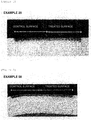
- CMR contact micro radiograph
- the remineralizing effect in the artificial incipient caries part was analyzed using a computer.
- the amount of the remineralized mineral was calculated based on the equation of Angmer et al. ( B. Angmer, D. Carlstrom and J.E. Glas: Studies on Ultrastructure of Dental Enemel IV: The Mineralization of normal Human Enamel, J. Ultrastructure. Res. 8, 12-23, 1963 ), and the mineral loss amount ⁇ Z (% volume mineral• ⁇ m) in the control and treated surfaces of each section was calculated according to the method of Damato et al. ( F.A. Damato, R. Stang and K.W. Stephen: Effect of Fluoride Concentration on Reminerelization of Carious Enamel: an in vitro pH-Cycling Study, Caries Res, 24, 174-180, 1990 ).
- Tables 42 to 45 shows the results of confirming the remineralizing effect of the tooth-cleaning compositions by the computer image analysis method.
- Example 12 Example 12 Remineralization Rate (%) 16.8 21.7 31.9 27.6 41.8 20.8 Example Example 13
- Example 14 Example 15
- Example 16 Example 17
- Example 19 Example 20
- Example 21 Example 22
- Example 23 Example 24 Remineralization Rate (%) 39.1 23.8 17.3 18.0 26.1 30.1
- Example 25 Example 26
- Example 27 Example 28
- Example 31 Example 32
- Example 34 Example 35
- Example 36 Remineralization Rate (%) Example 19
- Example 41 Remineralization Rate (%) 16.4 23.0 15.5 26.8 34.0 12.3
- Example 43 Example 44
- Example 46 Example 47
- Example 43 Example 44
- Example 45 Example 46
- Example Example 124 Example 125
- Example 126 Example 128
- Example Example 130 Example 131
- Example 132 Example 133
- Example 134 Example 135 Remineralization Rate (%) 15.0 18.5 17.3 6.7 13.5 11.2
- Example Comparative Example 78 Comparative Example 79 Comparative Example 80 Comparative Example 81 Comparative Example 82 Comparative Example 83 Remineralization Rate (%) 0.7 1.0 1.3 0.8 1.2 0.4
- Example Comparative Example 90 Comparative Example 91 Comparative Example 92 Comparative Example 93 Comparative Example 94 Comparative Example 95 Remineralization Rate (%) 11.0 10.0 9.6 8.2 4.8 6.7
- Example Comparative Example 96 Comparative Example 97 Comparative Example 98 Comparative Example
- the tooth-cleaning composition of the present invention is excellent in the remineralization of teeth, can be used in applications of various dentifrices, such as a toothpaste, a toothpowder, and a liquid dentifrice, and tooth remineralization in the oral cavity, and is high in industrial usefulness.
Landscapes
- Health & Medical Sciences (AREA)
- Life Sciences & Earth Sciences (AREA)
- Veterinary Medicine (AREA)
- Animal Behavior & Ethology (AREA)
- General Health & Medical Sciences (AREA)
- Public Health (AREA)
- Birds (AREA)
- Epidemiology (AREA)
- Chemical & Material Sciences (AREA)
- Oil, Petroleum & Natural Gas (AREA)
- Inorganic Chemistry (AREA)
- Oral & Maxillofacial Surgery (AREA)
- Zoology (AREA)
- Insects & Arthropods (AREA)
- Cosmetics (AREA)
Applications Claiming Priority (2)
| Application Number | Priority Date | Filing Date | Title |
|---|---|---|---|
| JP2015006938 | 2015-01-16 | ||
| PCT/JP2016/000154 WO2016114137A1 (ja) | 2015-01-16 | 2016-01-14 | 歯磨用組成物 |
Publications (2)
| Publication Number | Publication Date |
|---|---|
| EP3246014A1 true EP3246014A1 (de) | 2017-11-22 |
| EP3246014A4 EP3246014A4 (de) | 2018-06-13 |
Family
ID=56405685
Family Applications (1)
| Application Number | Title | Priority Date | Filing Date |
|---|---|---|---|
| EP16737208.5A Withdrawn EP3246014A4 (de) | 2015-01-16 | 2016-01-14 | Zahnpastazusammensetzung |
Country Status (8)
| Country | Link |
|---|---|
| US (1) | US10039698B2 (de) |
| EP (1) | EP3246014A4 (de) |
| JP (1) | JP6755453B2 (de) |
| KR (1) | KR101904165B1 (de) |
| CN (1) | CN107072935A (de) |
| CA (1) | CA2960007C (de) |
| RU (1) | RU2686753C2 (de) |
| WO (1) | WO2016114137A1 (de) |
Cited By (1)
| Publication number | Priority date | Publication date | Assignee | Title |
|---|---|---|---|---|
| AU2019265169B2 (en) * | 2018-05-09 | 2022-11-10 | Hysensbio | Toothpaste composition for alleviating dentin hypersensitivity |
Families Citing this family (5)
| Publication number | Priority date | Publication date | Assignee | Title |
|---|---|---|---|---|
| KR101956578B1 (ko) | 2018-05-09 | 2019-03-11 | 주식회사 하이센스바이오 | 상아질 지각과민증 완화를 위한 구강 청결용 조성물 |
| CN108618980A (zh) * | 2018-06-08 | 2018-10-09 | 叶绿芝生物科技(中山)有限公司 | 一种多功能液体牙膏 |
| CA3220437A1 (en) | 2021-05-20 | 2022-11-24 | Smile Makers, Llc | Oral hygiene compositions and methods of use |
| WO2023141140A1 (en) * | 2022-01-21 | 2023-07-27 | Dentia, Inc | Oral compositions for anticavity and remineralization use |
| KR102706862B1 (ko) | 2024-05-17 | 2024-09-19 | 로다움(주) | 미백 치약용 조성물 및 이의 제조방법 |
Family Cites Families (27)
| Publication number | Priority date | Publication date | Assignee | Title |
|---|---|---|---|---|
| US3767791A (en) * | 1971-06-03 | 1973-10-23 | Colgate Palmolive Co | Dental cream containing abrasive agglomerates |
| US5037639A (en) | 1989-05-24 | 1991-08-06 | American Dental Association Health Foundation | Methods and compositions for mineralizing calcified tissues |
| JPH07223930A (ja) | 1994-02-10 | 1995-08-22 | Sumitomo Osaka Cement Co Ltd | 歯磨組成物 |
| US20010007652A1 (en) | 1995-03-10 | 2001-07-12 | Yoshinori Takeda | Shellac composition and method for brushing teeth therewith |
| JP3669622B2 (ja) | 1995-03-10 | 2005-07-13 | エーザイ株式会社 | 歯磨き組成物 |
| JP3084607B2 (ja) | 1995-03-10 | 2000-09-04 | エーザイ株式会社 | 練歯磨き組成物 |
| JP4040705B2 (ja) | 1996-01-24 | 2008-01-30 | 株式会社サンギ | 口腔組成物 |
| JPH101427A (ja) | 1996-06-14 | 1998-01-06 | Eisai Co Ltd | 歯への細菌付着防止剤 |
| JPH1059814A (ja) | 1996-08-13 | 1998-03-03 | Kanebo Ltd | 口腔用組成物 |
| JPH1121219A (ja) | 1997-07-03 | 1999-01-26 | Lion Corp | 口腔用組成物 |
| JPH11349461A (ja) | 1998-06-09 | 1999-12-21 | Lion Corp | 歯磨組成物 |
| JP4199333B2 (ja) * | 1998-08-07 | 2008-12-17 | 宇部マテリアルズ株式会社 | 歯磨組成物 |
| JP3689803B2 (ja) | 1998-10-20 | 2005-08-31 | 株式会社ロッテ | 歯牙エナメル質の再石灰化促進剤及び口腔用組成物並びに飲食物 |
| JP2001122750A (ja) | 1999-10-20 | 2001-05-08 | Lion Corp | 口腔用組成物 |
| JP3971877B2 (ja) | 1999-10-25 | 2007-09-05 | 株式会社サンギ | 口腔用組成物 |
| JP2001302428A (ja) | 2000-04-20 | 2001-10-31 | Lion Corp | 歯牙被覆用組成物 |
| JP2002020254A (ja) | 2000-07-07 | 2002-01-23 | Lion Corp | 歯磨剤組成物 |
| JP4723068B2 (ja) | 2000-10-05 | 2011-07-13 | 日本ゼトック株式会社 | 口腔用組成物用基剤及び口腔用組成物 |
| JP2004018521A (ja) | 2002-06-19 | 2004-01-22 | Lion Corp | 口腔用組成物 |
| US7445769B2 (en) * | 2002-10-31 | 2008-11-04 | Cadbury Adams Usa Llc | Compositions for removing stains from dental surfaces and methods of making and using the same |
| JP4546139B2 (ja) | 2004-04-28 | 2010-09-15 | 株式会社サンギ | 口腔用組成物 |
| JP2006176463A (ja) * | 2004-12-24 | 2006-07-06 | Asahi Kasei Chemicals Corp | 口腔用組成物 |
| JP2006213668A (ja) | 2005-02-04 | 2006-08-17 | Kagoshima Univ | 再石灰化促進剤 |
| JP2007099632A (ja) | 2005-09-30 | 2007-04-19 | Sunstar Inc | 歯牙の再石灰化促進方法 |
| JP5521979B2 (ja) * | 2009-12-16 | 2014-06-18 | ライオン株式会社 | 口腔用組成物及び油性成分を多く含有する口腔用組成物の安定化方法 |
| AU2013267294A1 (en) * | 2012-06-01 | 2014-11-27 | Centrix, Inc. | Protective wax for bleached teeth |
| JP2014073989A (ja) | 2012-10-04 | 2014-04-24 | Sangi Co Ltd | 歯磨用組成物 |
-
2016
- 2016-01-14 KR KR1020177006627A patent/KR101904165B1/ko not_active Expired - Fee Related
- 2016-01-14 CA CA2960007A patent/CA2960007C/en not_active Expired - Fee Related
- 2016-01-14 RU RU2017107232A patent/RU2686753C2/ru not_active IP Right Cessation
- 2016-01-14 CN CN201680002489.3A patent/CN107072935A/zh active Pending
- 2016-01-14 US US15/510,648 patent/US10039698B2/en active Active
- 2016-01-14 WO PCT/JP2016/000154 patent/WO2016114137A1/ja not_active Ceased
- 2016-01-14 EP EP16737208.5A patent/EP3246014A4/de not_active Withdrawn
- 2016-01-14 JP JP2016569288A patent/JP6755453B2/ja active Active
Cited By (1)
| Publication number | Priority date | Publication date | Assignee | Title |
|---|---|---|---|---|
| AU2019265169B2 (en) * | 2018-05-09 | 2022-11-10 | Hysensbio | Toothpaste composition for alleviating dentin hypersensitivity |
Also Published As
| Publication number | Publication date |
|---|---|
| JPWO2016114137A1 (ja) | 2017-10-19 |
| US20170189287A1 (en) | 2017-07-06 |
| CN107072935A (zh) | 2017-08-18 |
| US10039698B2 (en) | 2018-08-07 |
| KR101904165B1 (ko) | 2018-10-05 |
| CA2960007C (en) | 2019-01-08 |
| RU2017107232A3 (de) | 2019-02-18 |
| CA2960007A1 (en) | 2016-07-21 |
| WO2016114137A1 (ja) | 2016-07-21 |
| RU2686753C2 (ru) | 2019-04-30 |
| RU2017107232A (ru) | 2019-02-18 |
| KR20170045246A (ko) | 2017-04-26 |
| EP3246014A4 (de) | 2018-06-13 |
| JP6755453B2 (ja) | 2020-09-16 |
Similar Documents
| Publication | Publication Date | Title |
|---|---|---|
| KR101703800B1 (ko) | 구강용 조성물 | |
| US9241883B2 (en) | Ionic complexes | |
| US10039698B2 (en) | Toothpaste composition | |
| RU2696495C2 (ru) | Средство для ухода за полостью рта и пищевой продукт или напиток | |
| KR102853539B1 (ko) | 구강 관리 제품 및 방법 | |
| EP3378466A1 (de) | Zusammensetzung zur verwendung in der mundhöhle | |
| US20150182427A1 (en) | Silica Abrasive-Free Dentifrice Composition | |
| CA3224694A1 (en) | Oral care compositions comprising hydroxyapatite | |
| WO2014054257A1 (ja) | 歯磨用組成物 | |
| JP5004505B2 (ja) | 口腔用組成物 | |
| HK1236393A1 (en) | Toothpaste composition | |
| CN119185087A (zh) | 口腔护理组合物及用途 | |
| JP2025089684A (ja) | シトルリン低減剤 |
Legal Events
| Date | Code | Title | Description |
|---|---|---|---|
| STAA | Information on the status of an ep patent application or granted ep patent |
Free format text: STATUS: THE INTERNATIONAL PUBLICATION HAS BEEN MADE |
|
| PUAI | Public reference made under article 153(3) epc to a published international application that has entered the european phase |
Free format text: ORIGINAL CODE: 0009012 |
|
| STAA | Information on the status of an ep patent application or granted ep patent |
Free format text: STATUS: REQUEST FOR EXAMINATION WAS MADE |
|
| 17P | Request for examination filed |
Effective date: 20170310 |
|
| AK | Designated contracting states |
Kind code of ref document: A1 Designated state(s): AL AT BE BG CH CY CZ DE DK EE ES FI FR GB GR HR HU IE IS IT LI LT LU LV MC MK MT NL NO PL PT RO RS SE SI SK SM TR |
|
| AX | Request for extension of the european patent |
Extension state: BA ME |
|
| DAV | Request for validation of the european patent (deleted) | ||
| DAX | Request for extension of the european patent (deleted) | ||
| A4 | Supplementary search report drawn up and despatched |
Effective date: 20180514 |
|
| RIC1 | Information provided on ipc code assigned before grant |
Ipc: A61K 8/92 20060101AFI20180508BHEP Ipc: A61K 8/24 20060101ALI20180508BHEP Ipc: A61Q 11/00 20060101ALI20180508BHEP |
|
| STAA | Information on the status of an ep patent application or granted ep patent |
Free format text: STATUS: EXAMINATION IS IN PROGRESS |
|
| 17Q | First examination report despatched |
Effective date: 20190809 |
|
| STAA | Information on the status of an ep patent application or granted ep patent |
Free format text: STATUS: THE APPLICATION IS DEEMED TO BE WITHDRAWN |
|
| 18D | Application deemed to be withdrawn |
Effective date: 20191220 |