EP3246032B1 - Pharmazeutische zusammensetzungen mit zoledronsaeure, kalzium und vitamin d, geeignet zur behandlung und/oder prophylaxe von erkrankungen des knochenstoffwechsels und von therapiebedingten nebenwirkungen wie hypokalzaemien - Google Patents
Pharmazeutische zusammensetzungen mit zoledronsaeure, kalzium und vitamin d, geeignet zur behandlung und/oder prophylaxe von erkrankungen des knochenstoffwechsels und von therapiebedingten nebenwirkungen wie hypokalzaemien Download PDFInfo
- Publication number
- EP3246032B1 EP3246032B1 EP17171880.2A EP17171880A EP3246032B1 EP 3246032 B1 EP3246032 B1 EP 3246032B1 EP 17171880 A EP17171880 A EP 17171880A EP 3246032 B1 EP3246032 B1 EP 3246032B1
- Authority
- EP
- European Patent Office
- Prior art keywords
- calcium
- vitamin
- zoledronic acid
- bone
- pharmaceutical compositions
- Prior art date
- Legal status (The legal status is an assumption and is not a legal conclusion. Google has not performed a legal analysis and makes no representation as to the accuracy of the status listed.)
- Active
Links
Images

Classifications
-
- A—HUMAN NECESSITIES
- A61—MEDICAL OR VETERINARY SCIENCE; HYGIENE
- A61K—PREPARATIONS FOR MEDICAL, DENTAL OR TOILETRY PURPOSES
- A61K31/00—Medicinal preparations containing organic active ingredients
- A61K31/59—Compounds containing 9, 10- seco- cyclopenta[a]hydrophenanthrene ring systems
- A61K31/593—9,10-Secocholestane derivatives, e.g. cholecalciferol, i.e. vitamin D3
-
- A—HUMAN NECESSITIES
- A61—MEDICAL OR VETERINARY SCIENCE; HYGIENE
- A61K—PREPARATIONS FOR MEDICAL, DENTAL OR TOILETRY PURPOSES
- A61K31/00—Medicinal preparations containing organic active ingredients
- A61K31/66—Phosphorus compounds
- A61K31/675—Phosphorus compounds having nitrogen as a ring hetero atom, e.g. pyridoxal phosphate
-
- A—HUMAN NECESSITIES
- A61—MEDICAL OR VETERINARY SCIENCE; HYGIENE
- A61K—PREPARATIONS FOR MEDICAL, DENTAL OR TOILETRY PURPOSES
- A61K33/00—Medicinal preparations containing inorganic active ingredients
- A61K33/06—Aluminium, calcium or magnesium; Compounds thereof, e.g. clay
-
- A—HUMAN NECESSITIES
- A61—MEDICAL OR VETERINARY SCIENCE; HYGIENE
- A61P—SPECIFIC THERAPEUTIC ACTIVITY OF CHEMICAL COMPOUNDS OR MEDICINAL PREPARATIONS
- A61P19/00—Drugs for skeletal disorders
-
- A—HUMAN NECESSITIES
- A61—MEDICAL OR VETERINARY SCIENCE; HYGIENE
- A61P—SPECIFIC THERAPEUTIC ACTIVITY OF CHEMICAL COMPOUNDS OR MEDICINAL PREPARATIONS
- A61P19/00—Drugs for skeletal disorders
- A61P19/08—Drugs for skeletal disorders for bone diseases, e.g. rachitism, Paget's disease
-
- A—HUMAN NECESSITIES
- A61—MEDICAL OR VETERINARY SCIENCE; HYGIENE
- A61P—SPECIFIC THERAPEUTIC ACTIVITY OF CHEMICAL COMPOUNDS OR MEDICINAL PREPARATIONS
- A61P19/00—Drugs for skeletal disorders
- A61P19/08—Drugs for skeletal disorders for bone diseases, e.g. rachitism, Paget's disease
- A61P19/10—Drugs for skeletal disorders for bone diseases, e.g. rachitism, Paget's disease for osteoporosis
-
- A—HUMAN NECESSITIES
- A61—MEDICAL OR VETERINARY SCIENCE; HYGIENE
- A61P—SPECIFIC THERAPEUTIC ACTIVITY OF CHEMICAL COMPOUNDS OR MEDICINAL PREPARATIONS
- A61P29/00—Non-central analgesic, antipyretic or antiinflammatory agents, e.g. antirheumatic agents; Non-steroidal antiinflammatory drugs [NSAID]
-
- A—HUMAN NECESSITIES
- A61—MEDICAL OR VETERINARY SCIENCE; HYGIENE
- A61P—SPECIFIC THERAPEUTIC ACTIVITY OF CHEMICAL COMPOUNDS OR MEDICINAL PREPARATIONS
- A61P3/00—Drugs for disorders of the metabolism
- A61P3/02—Nutrients, e.g. vitamins, minerals
-
- A—HUMAN NECESSITIES
- A61—MEDICAL OR VETERINARY SCIENCE; HYGIENE
- A61P—SPECIFIC THERAPEUTIC ACTIVITY OF CHEMICAL COMPOUNDS OR MEDICINAL PREPARATIONS
- A61P35/00—Antineoplastic agents
-
- A—HUMAN NECESSITIES
- A61—MEDICAL OR VETERINARY SCIENCE; HYGIENE
- A61P—SPECIFIC THERAPEUTIC ACTIVITY OF CHEMICAL COMPOUNDS OR MEDICINAL PREPARATIONS
- A61P9/00—Drugs for disorders of the cardiovascular system
- A61P9/06—Antiarrhythmics
-
- A—HUMAN NECESSITIES
- A61—MEDICAL OR VETERINARY SCIENCE; HYGIENE
- A61P—SPECIFIC THERAPEUTIC ACTIVITY OF CHEMICAL COMPOUNDS OR MEDICINAL PREPARATIONS
- A61P9/00—Drugs for disorders of the cardiovascular system
- A61P9/10—Drugs for disorders of the cardiovascular system for treating ischaemic or atherosclerotic diseases, e.g. antianginal drugs, coronary vasodilators, drugs for myocardial infarction, retinopathy, cerebrovascula insufficiency, renal arteriosclerosis
Definitions
- the present invention includes pharmaceutical compositions comprising zoledronic acid, calcium and vitamin D, which are suitable for the treatment and / or prophylaxis of therapy-related side effects such as hypocalcemia in diseases of the bone metabolism caused by the action of zoledronic acid.
- the treatment of diseases of the bone metabolism such as osteoporosis, tumor diseases including induced bone loss (CTIBL, cancer treatment-induced bone loss), Paget's disease, or hypocalcemia are an important focus of medical research.
- the human bone consists of an organic matrix that is combined with inorganic salts - mainly calcium and phosphate in the form of hydroxyapatite (Ca 3 (PO 4 ) 2 • Ca (OH) 2 ).
- inorganic salts - mainly calcium and phosphate in the form of hydroxyapatite (Ca 3 (PO 4 ) 2 • Ca (OH) 2 ).
- the basic principle of bone physiology in humans is a constant build-up and breakdown (bone turnover) of bone substance.
- Bone UP and DOWN construction as part of the ongoing remodeling is hormonal (mainly through estrogen, parathyroid hormone (PTH)) and through signal transduction pathways (mainly RANKL ("receptor activator of nuclear factor-kB ligand”) / OPG (osteoprotegerin) and Ca / PTH / vitamin D3).
- RANKL receptor activator of nuclear factor-kB ligand
- OPG osteoprotegerin
- micro-cracks are already described by Harold Frost in 1960 and are clearly delimited cracks 50-100 ⁇ m in length that occur primarily in the interstitial bone. As a rule, they are longer in the longitudinal axis than in the transversal axis, depending on the biomechanical load, they already arise during physiological, repetitive loads such as walking and running in the trabecular and cortical bones and occur significantly more frequently with age.
- micro-cracks remain clinically inapparent in the bone, as they are constantly being repaired and healed in the course of “remodeling”.
- the crack leads to apoptosis of osteocytes, which release factors such as RANKL. These trigger osteoclastic resorption, with subsequent osteoblastic bone augmentation.
- Osteoblasts, osteoclasts and osteocytes are essentially involved in the ongoing remodeling processes on bones. While osteoclasts break down bone, osteoblasts can grow bone.
- osteoblastic bone cultivation Ultimately, the role of osteocytes has not yet been clarified in detail. These are terminally differentiated cells of osteoblastic origin embedded in the bone, which are connected and communicate with one another. If the osteocyte foothills are injured, for example in the context of the microcracks described above, the osteoclastic resorption is initiated first, which in turn is followed by the osteoblastic bone cultivation.
- the WNT pathway for differentiating the osteoblasts and the PTH signal transduction pathway are primarily involved in bone cultivation.
- the differentiation of hematopoietic stem cells into osteoclasts is controlled via the RANKL / OPG signal transduction pathway.
- the osteoclasts are inhibited by zoledronic acid, with the result that no calcium is released from the bone.
- the bone serves as a calcium store for the human body and is therefore crucially involved in calcium phosphate homeostasis. By building up and breaking down bones, excess calcium reserves can be stored in the blood or made available again if necessary.
- the most common bone metabolism disease is osteoporosis.
- Diseases that affect bone metabolism are also Paget's disease, osteogenesis imperfecta, primary bone tumors such as multiple myeloma, plasmacytoma, osteosarcoma and bone metastases.
- primary bone tumors such as multiple myeloma, plasmacytoma, osteosarcoma and bone metastases.
- skeletal related events SRE or "skeletal-related complications”
- SRE includes acute events such as pathological bone fractures, spinal cord compression, bone pain or tumor-induced hypercalcemia as well as therapeutic interventions such as bone irradiation or surgical interventions on the bone, which can occur, for example, in patients with bone metastases or primary bone tumors.
- Osteoporosis causes a decrease in bone density, which together with the reduced bone quality leads to an increased risk of bone fractures. Osteoporosis is currently a measurable reduction in bone density of less than 2.5 standard deviations (so-called T-value or English T-score) in a healthy collective (women, 30 years old), measured using DXA (dual-energy X-ray absorptiometry) by the WHO Are defined. If a bone fracture has occurred, one speaks of overt osteoporosis. Osteoporosis is thus a systemic disease of the bone that often manifests itself as a fracture in the event of inadequate trauma.
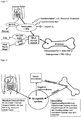
- the Figure 1 shows that only about a third of the amount of calcium available in the digestive tract is absorbed. 65-70% of the dietary calcium is excreted in the stool.
- the resorption process itself can also be influenced positively or negatively by various factors. For example, foods that are very highly fortified with phosphates can extremely hinder the absorption of calcium.
- the hormones that control calcium homeostasis include calcitonin, parathyroid hormone (parathyrin) and calcitriol (active form of vitamin D3).
- Calcitriol is essential to enable the absorption of calcium and phosphate in the small intestine.
- calcitriol increases the reabsorption of calcium in the kidneys and stimulates bone mineralization (incorporation of calcium into the bone matrix).
- the disease "osteoporosis” is diagnosed too late in many cases - usually only when an osteoporotic fracture (ie without a traumatic event) has already occurred, for example of the vertebral body, hip or wrist.
- vitamin D3 (1 ⁇ , 25-dihydroxycholecalciferol; calcitriol) promotes the absorption of calcium from the gastrointestinal tract into the blood.
- the maximum serum concentration is reached within three to six hours after ingestion.
- vitamin D promotes the absorption of calcium in the body. Overdosing can lead to vitamin D poisoning as the body stores vitamin D. Vitamin D poisoning can lead to severe demineralization of the bone, which leads to fractures.
- high serum calcium levels can lead to abnormal calcification of a wide variety of soft tissues.
- kidney stones can develop due to the increased renal excretion of calcium.
- a vitamin D deficiency means that less calcium from food gets into the blood due to reduced absorption from the intestine.
- Calcium and / or vitamin D deficiency is treated by supplementing with calcium and vitamin D-containing products.
- calcium and vitamin D is not without controversy.
- the calcium deficiency means an aggravation of the clinical picture with an increase in the risk of fractures.
- glucocorticoid therapy can lead to severe glucocorticoid- or corticoid-induced osteoporosis with fractures. With an administration of> 5 mg prednisone equivalent per day for> 3 months, preventive or therapeutic measures are recommended. A significant decrease in bone density is to be expected, especially in the first six months after the start of therapy, if the dose is increased significantly over the course of the therapy and if the dose is high, which must be taken into account in the treatment.
- Glucocorticoid-induced bone loss has several causes. At the beginning of therapy, glucocorticoids lead to an increase in bone resorption. Steroids inhibit the proliferation and function of osteoblasts and increase their apoptosis. As a result, they cause a reduced formation of new bones. At the same time, they lead to a negative calcium balance by inhibiting the intestinal calcium absorption and increasing urinary calcium excretion.
- Solid primary tumors such as breast, prostate, lung, intestinal or bone carcinoma (eg osteosarcoma) can manifest themselves in the bone and thus cause bone metastases or bone diseases.
- Bone metastases are settlements of primary tumors in the bones and can lead to pain and fractures there. Increased bone loss or an excessive production of inferior bone substance is responsible. This reduces the stability of the bones.
- Tumor-related bone complications show a high morbidity, an increased bone fracture rate, nerve compression and sometimes unbearable pain. If more calcium is released from the bones and released into the blood, tumor-induced hypercalcemia can develop.
- the proportion of patients with moderate or severe bone pain ( ⁇ 4 points in the BPI-SF [brief pain inventory, short form]) with metastatic breast, prostate, lung, intestinal or bone carcinoma (e.g. osteosarcoma) is over 80%, followed only by neuralgic pain with approx. 10%, by far the highest ( Cleeland, CS et al., Ann. Onc. 2005, 16: 972-980 ).
- multiple myeloma or “plasmacytoma” or “Kahler's disease” includes a cancer of the bone marrow in which the antibody-producing cells (plasma cells) are greatly increased. These malignant plasma cells multiply in an uncontrolled manner and form functionless antibodies or parts of them. The course of the disease can vary greatly, with moderate to highly malignant courses which, without treatment, can quickly lead to the death of the patient. The symptoms are caused by the growth of the cells or by the antibodies produced or their fragments, which can manifest themselves in bone pain, reduction in bone mass and in fractures, accompanied by an increased release of calcium into the blood, which leads to tumor-induced hypercalcemia can. The number of leukocytes decreases while the large number of antibodies is deposited in the tissue and leads to functional disorders of many organs, kidney failure and impaired blood circulation.
- Drug therapy for osteoporosis is primarily about stopping the pathological loss of bone mass.
- the negative balance (imbalance between the growth and breakdown of bone substance) can be balanced either antiresorptively, by inhibiting the osteoclasts (bone breakdown) or anabolically, by stimulating the osteoblasts (bone building). Only when the cultivation and degradation processes are in equilibrium again and there is an adequate supply of calcium and vitamin D is guaranteed, new bone mass can build up and the risk of osteoporotic fractures is reduced.
- osteoclastic bone resorption can be inhibited by bisphosphonates such as zoledronic acid, and on the other hand bone formation can be stimulated by anabolic drugs.
- bisphosphonates such as zoledronic acid
- bone formation can be stimulated by anabolic drugs.
- the recombinant 1-34 fragment of the parathyroid hormone is approved for the treatment of osteoporosis.
- Antiresorptives such as bisphosphonates are currently the standard for the treatment of metabolic bone diseases that require effective inhibition of bone loss. This includes the use of these substance classes for the treatment of osteoporosis as well as - with significantly higher doses and shorter treatment intervals - for the prevention of tumor-related skeletal complications.
- Bisphosphonates such as zoledronic acid bind to the bone and are ingested by mature osteoclasts. They inhibit the osteoclasts on the bone surface, i.e. bone breakdown is inhibited by the use of bisphosphonates.
- Zoledronic acid and its derivatives are usually used to treat the diseases mentioned above, such as osteoporosis or tumor-related bone diseases.
- the risk of hypocalcaemia is significantly increased if there is secondary hyperparathyroidism due to vitamin D deficiency.
- vitamin D deficiency more parathyroid hormone is released to compensate for the serum calcium level.
- Parathyroid hormone indirectly increases the calcium concentration in the blood plasma by activating the osteoclasts.
- the anti-resorptive therapy intensifies the hypocalcemia because the osteoclasts are inhibited.
- hypocalcaemia caused in this way can lead to cardiac arrhythmias and, in particularly severe cases, even death if the hypocalcaemia is not discovered and treated in good time.
- hypocalcaemia often goes undetected, since the calcium level in outpatient clinical treatment is not measured at short intervals as a laboratory parameter.
- a supplement with calcium and vitamin D is provided, which can prevent hypocalcemia during treatment with zoledronic acid.
- a neglected deficiency of calcium and vitamin D can also negatively affect the overall success of antiresorptive therapy, e.g. with zoledronic acid, and thus reduce the desired protection against new fractures or even increase the number of fractures if calcium and vitamin D supplementation is combined with antiresorptive therapy is omitted.
- WO 2008/116133 A1 discloses dosage regimens that include zoledronic acid and some of its derivatives in combination with calcium and vitamin D to reduce osteoporotic fractures (page 2, [007]) and a multi-component kit for a patient at risk for secondary osteoporotic fractures and a vitamin D deficiency, the kit containing vitamin D or its functional analogs, zoledronic acid or a functional analog and optionally calcium-containing components (page 2 [008]).
- WO 2008/116133 A1 does not disclose the treatment or prophylaxis of therapy-induced hypocalcemia, but rather excludes patients with hypocalcemia from the proposed study (pages 17-18, [0079]).
- the patient information on Zometa (FDA Prescribing Information, published at: https://www.drugs.com/pro/zometa.html, page 5 under the section "Hypocalcemia”) reveals, among other things, hypocalcemia as a possible side effect of treatment with Zometa containing the active substance zoledronic acid and a notice that calcium should be measured and hypocalcaemia corrected before treatment with Zometa. Patients should be adequately supplemented with calcium and vitamin D. The patient information does not disclose any indication of how the patients should be adequately supplemented.
- the present invention solves these problems and provides new pharmaceutical compositions of zoledronic acid and calcium and vitamin D and / or their derivatives in order to better treat therapy-related side effects such as hypocalcemia in diseases of the bone metabolism or to prevent these diseases and in this way ensure the optimal effect , as well as to prevent improper use or to prevent the latter.
- the invention relates to pharmaceutical compositions comprising zoledronic acid and calcium and vitamin D for use in the treatment and / or prophylaxis of hypocalcemia caused by zoledronic acid therapy in the treatment of osteoporosis, postmenopausal osteoporosis, overt osteoporosis, osteoporosis in men or women, thereby characterized in that the pharmaceutical composition comprising zoledronic acid and / or its derivative (s) in a dosage of 4-6mg, more preferably 5mg zoledronic acid is administered intravenously annually or every six months and the pharmaceutical composition (s) comprising calcium with a dosage of 400-600 mg per day, particularly preferably 500 mg per day, is administered orally and vitamin D is administered orally daily in a dosage of 800-1200 IU vitamin D, particularly preferably 1000 IU vitamin D.
- the invention relates to pharmaceutical compositions containing zoledronic acid and calcium and vitamin D for use in the treatment and / or prophylaxis of the hypocalcemia caused by zoledronic acid therapy in skeletal complications, in particular pathological fractures, radiation of the bone, spinal cord compression or surgical interventions on the bone, bone metastases , Pain in bone metastases, nerve entrapment or deformities due to one or more solid tumors such as breast cancer, prostate cancer, lung cancer or multiple myeloma, characterized in that zoledronic acid in a dosage of 3-5mg, more preferably 4mg zoledronic acid intravenously for 3-4 weeks of use and 400-600 mg calcium daily, particularly preferably 500 mg calcium daily and 800-1200 IU vitamin D daily, particularly preferably 1000 IU vitamin D daily, can be administered orally.
- the invention relates in further aspects to the use of derivatives of zoledronic acid, the treatment and / or prophylaxis of therapy-related side effects, various calcium compounds and vitamin D derivatives for use in the aforementioned exemplary embodiments, and pharmaceutically suitable auxiliaries and solvents.
- Zoledronic acid is a very effective antiresorptive and is used to treat diseases of the bone metabolism. Despite its effectiveness, treatment with zoledronic acid is burdened by considerable, sometimes severe side effects.
- the present invention provides pharmaceutical compositions which greatly improve the efficacy and safety of treatment with zoledronic acid.
- the pharmaceutical compositions include calcium and vitamin D.
- the Aclasta product information sheet (Novartis Pharma, medicinal product, contains 5 mg zoledronic acid as an infusion solution, which is administered once a year) only recommends adequate intake of calcium and vitamin D; the exact dosage is not specified.
- Aclasta is used to treat osteoporosis in postmenopausal women and adult men who are at increased risk of fractures, including those with a recent low-level hip fracture, to treat Paget's disease of the bone in adults, and to treat osteoporosis-related long-term systemic corticosteroid therapy in postmenopausal women and in adult men with an increased risk of fractures.
- Zometa Novartis Pharma, drug, contains 4mg / 5ml or 4mg / 100ml zoledronic acid as an infusion solution concentrate or infusion solution
- skeletal complications pathological fractures, vertebral body compression, radiation or bone surgery or tumor-induced hypercalcaemia
- tumor-induced hypercalcaemia with 4mg every 3-4 weeks used.
- the adequate total daily intake of calcium is 1000 mg. Calcium is absorbed through food, so that the required daily dose can be achieved with a diet rich in calcium. A calcium intake of more than 2500mg per day is required considered problematic because it can, among other things, increase the risk of developing kidney stones. Due to various publications on cardiovascular side effects from excessive calcium intake, many patients have refrained from consuming sufficient amounts of calcium, even under treatment with zoledronic acid.
- Supplementation with a pharmaceutical composition with 1000-1500mg calcium per day will lead to an oversupply of calcium with a sufficient calcium-containing diet, which increases the risk of cardiovascular side effects. Contrary to the study designs, which in the technical information from Aclasta contain a daily dose of 1000-1500 mg calcium, a lower dose is provided in the present invention in order to treat or prevent hypocalcemia and cardiovascular side effects.
- the preferred amount of calcium in the pharmaceutical composition is 400-600mg calcium per day, particularly preferably 500mg calcium per day, on the one hand to maintain a basic level of calcium even with a low-calcium diet and on the other hand not to get into the oversupply that comes with the risks mentioned connected and therefore unacceptable to patients.
- the preferred amount of calcium in the pharmaceutical composition is 400-600mg calcium per day, particularly preferably 500mg calcium per day, on the one hand to maintain a basic level of calcium even with a low-calcium diet and on the other hand not to get into the oversupply that comes with the risks mentioned connected and therefore unacceptable to patients.
- the average total intake is in the range of 490-1790 mg calcium per day.
- the vitamin D level is easy to measure.
- the combination according to the invention is provided for a vitamin D serum concentration which is not below 20 ng / ml (50 nmol / l serum).
- Supplementation with 400 IU vitamin D is not sufficient to keep the vitamin D level in the normal range of 31-60ng / ml serum when the pharmaceutical composition of zoledronic acid and calcium according to the invention is administered.
- the pharmaceutical composition according to the invention comprising zoledronic acid, calcium and vitamin D prevents hypocalcemia.
- zoledronic acid or “zoledronate” (C 5 H 10 N 2 O 7 P 2 ; [1-hydroxy-2- (imidazol-1-yl) ethylidene] diphosphonic acid, CAS number: 118072-93-8 ) also includes all known pharmaceutically acceptable derivatives of zoledronic acid.
- salts can be present as solvates such as hydrates, for example, or that zoledronic acid can be present as esters.
- Zoledronic acid can be provided in any pharmaceutically acceptable hydrochloric or acid form. Salts are preferred because membranes are less affected by salts.
- Preferred salts are in particular, without being restricted to them, zoledronic acid disodium salt tetrahydrate (C 5 H 8 N 2 Na 2 O 7 P 2 • 4H 2 O, CAS number: 165800-07-7 ), Zoledronic acid trisodium salt hydrate (C 5 H 7 N 2 Na 3 O 7 P 2 • H 2 O) 5 , CAS number: 165800-08-8 , Salts with monovalent Cations, especially zoledronate sodium and / or esters, especially ethyl, propyl, isopropyl, n-butyl and t-butyl esters.
- the pharmaceutical composition comprising zoledronic acid in the field of osteoporosis, postmenopausal osteoporosis, male or female osteoporosis is administered intravenously at 4-6 mg, preferably 5 mg per half year.
- the pharmaceutical composition comprising zoledronic acid is administered intravenously in the oncology field with 3-5 mg, preferably 4 mg for 3-4 weeks of use.
- calcium citrate or “calcium” encompasses all known pharmaceutically acceptable calcium compounds, in particular without being limited to calcium citrate, further designations: tricalcium citrate, TCC, tricalcium dicitrate, tricalcium-di- [2-hydroxy-1,2,3 propane tricarboxylate] tetrahydrate, E 333, C 12 H 10 Ca 3 O 14 , CAS numbers: 813-94-5 (anhydrous), 5785-44-4 (tetrahydrate); Calcium gluconate monohydrate (C 12 H 22 CaO 14 • H 2 O, CAS numbers: 299-28-5 (anhydrous) and 66905-23-5 (monohydrate)); Calcium lactate gluconate, a double salt of lactic and gluconic acid, which is available as a mixture, other names: CLG, calcium lactate gluconate, calcium lactogluconate, E 327, E 578, CAS numbers: 11116-97-5 , 814-80-2 (calcium lactate pentahydrate), 18016-24-5
- vitamin D includes vitamin D or its derivatives, in particular, without being limited to, vitamin D3 (cholecalciferol, C 27 H 44 O, CAS number: 67-97-0 ), Calcitriol (1,25-dihydroxyvitamin D3, 1 ⁇ , 25-dihydroxycholecalciferol, 1,25 (OH) 2 vitamin D3, 1,25 (OH) 2 D3, (5Z, 7E) - (1S, 3R) -9, 10-Seco cholesta-5,7,10 (19) -triene-1,3,25-triol, CAS number: 32222-06-3 ) or 1 ⁇ , 25-dihydroxycholecalciferol (biologically active form of vitamin D3), alphacalcidol (1 ⁇ -hydroxyvitamin D3), 24,25-dihydroxyvitamin D3 or calcifediol (25-hydroxyvitamin D3 25-hydroxycholecalciferol, CAS number: 19356-17-3 , IUPAC name: (6R) -6 - [
- Vitamin D supplements as well as zoledronic acid and calcium are commercially available and the processes for producing them are known to the person skilled in the art.
- compositions comprising zoledronic acid, calcium and vitamin D for use in the treatment and / or prophylaxis of hypocalcemia caused by zoledronic acid therapy in the treatment of osteoporosis, postmenopausal osteoporosis, overt osteoporosis, osteoporosis of men or women, which in a zoledronic acid concentration of 4 -6mg annually or every six months, more preferably 5mg annually or every six months and 400-600mg calcium daily, particularly preferably 500mg calcium daily and 800-1200 IU vitamin D, particularly preferably 1000 IU vitamin D administered orally daily.
- compositions comprising 3-5 mg, more preferably 4 mg zoledronic acid intravenously for 3-4 weeks of use and 400-600 mg calcium daily, particularly preferably 500 mg calcium daily and 800-1200 IU vitamin D, particularly preferably 1000 IU vitamin D for Use in the treatment and / or prophylaxis of zoledronic acid therapy-induced hypocalcemia in skeletal-related complications, in particular pathological fractures, spinal cord compression, radiation or surgery on the bone, pain in bone metastases due to solid tumors such as breast cancer, prostate cancer, lung cancer, multiple myeloma.
- the amounts of zoledronic acid given above are provided in an infusion solution of 5ml to 100ml, more preferably as 5ml infusion solution concentrate or as 100ml ready-to-use infusion solution in a pharmaceutically suitable solution such as isotonic saline solution, isotonic mannitol sodium citrate solution or other pharmaceutically suitable isotonic solutions .
- calcium and vitamin D are provided with pharmaceutically suitable auxiliaries, in particular lactose, starch, acidulants, in particular citric acid and malic acid, acid regulators, in particular sodium hydrogen carbonate and sodium carbonate, humectants, in particular sorbitol, xylitol and inulin, anti-caking agents, in particular tricalcium phosphate, fatty acids, in particular magnesium stearate, in particular magnesium salts natural and nature-identical and other flavors and aromas, sweeteners in particular sodium cyclamate, aspartame and sodium saccharin, maltodextrin, colorings, in particular beetroot juice powder and riboflavin 5'-phosphate, silicon dioxide in particular highly dispersed, silicon dioxide hydrate, phenylalanine, arabic gum, Sucrose, gelatin, corn starch, soybean oil, glycerol, DL-alpha-tocopherol, isomalt, sodium hydrogen carbonate, sodium dihydrogen carbonate, sodium
- zoledronic acid, calcium and / or vitamin D optionally with pharmaceutically suitable auxiliary substances and / or liquids, in particular as effervescent tablets, swallowable tablets or capsules, chewable tablets, effervescent granules, direct granules, drinking solutions, drops, sublingual sprays, as infusion solution concentrates, infusions, Solution for injection concentrates, solutions for injection or pre-filled syringes supplied individually or together.
- Vitamin D deficiency is a common diagnosis in osteological practice. At the start of therapy, 89 of 423 patients showed a vitamin D deficiency that was below the value of 20 ng / ml serum or 50 nmol / l.
- the maintenance dose was 1000 IU daily of vitamin D. A maintenance dose of 400 IU of vitamin D daily was not sufficient to keep the vitamin D level at the normal value.
- Table 1 shows that a maintenance dose of 1000 IU vitamin D is suitable for keeping the vitamin D level in the normal range: Table 1: patient Vitamin D initial value Vitamin D value with a maintenance dose of 1000 IU vitamin D daily 85 years, female 9.4 ng / ml 25.5 ng / ml 65 years, female 8.8 ng / ml 23.4 ng / ml 77 years, female 12.4 ng / ml 29.2 ng / ml 81 years, female 10.4 ng / ml 30.4 ng / ml 75 years, female 14.6 ng / ml 28.8 ng / ml 86 years, female 10.9 ng / ml 23.7 ng / ml 81 years, female 8.6 ng / ml 23.2 ng / ml 71 years, female 17.1 ng / ml 30.5 ng / ml
- the following table 2 shows in the left column in each case the daily intake of calcium through food in mg. Daily intake of less than 1000mg through food leads to a negative calcium balance. This results in secondary hyperparathyroidism and bone substance is lost. A daily supply of less than 500 mg calcium is associated with an increased fracture risk for non-vertebral fractures.
- the following patient case shows that the pharmaceutical composition according to the invention of 5 mg zoledronic acid administered intravenously annually, 500 mg calcium daily and 1000 IU vitamin D taken orally daily, effectively prevents therapy-related hypocalcemia caused by treatment with zoledronic acid.
- the values come from a 73-year-old patient with overt osteoporosis and a previous low-traumatic vertebral body fracture. Both the calcium values and the values for vitamin D are in the normal range when treated with the pharmaceutical compositions according to the invention.
- Table 4 The patients received 4 mg zoledronic acid / month, 500 mg calcium supplementation daily and 1000 IU vitamin D3 daily: Patient Calcium mmol / l 25 (OH) vitamin D3 serum level ⁇ g / l after weeks calcium 25 (OH) vitamin D3 serum levels; ⁇ g / l Calcium in Diet mg / day 1 2.09 17.2 16 2.14 37.1 1449 2 2.4 17.2 4th 2.31 24.3 979 3 2.02 12.1 16 2.22 25.2 958 4th 2.37 Not specified 8/16/20 2.46 / 2.46 / 2.32 33.1 after 20 weeks 702 5 2.36 Not specified 4/16/24 2.41 / 2.4 / 2.54 22.3 after 20 weeks 230 6th 2.4 Not specified 4/8/16 2.26 / 2.41 / 2.4 No answer / 19.8 / 22.8 952 7th 2.47 Not specified 4/9/13 2.26 / 2.4 / 2.36 40.3 after 13 weeks 1215 8th 2.42 22nd 8/12/16 2.34 / 2.41 / 2.4 Not specified
- a daily supplementation according to the invention with 500 mg calcium ensures a balanced calcium balance.
- PTH level secondary hyperparathyroid disumus
- hypocalcemia - induced by anti-resorptive therapy with zoledronic acid - are risk factors for the development of necrosis of the jawbone.
- the patients who were treated with the combination according to the invention were free from side effects, in particular no osteonecrosis of the jaw, non-healing wounds until the jaw dissolved, hypocalcemia, cardiovascular side effects such as myocardial infarction, atrial fibrillation, cardiac arrhythmias, convulsions and / or numbness.
Landscapes
- Health & Medical Sciences (AREA)
- Public Health (AREA)
- Pharmacology & Pharmacy (AREA)
- General Health & Medical Sciences (AREA)
- Chemical & Material Sciences (AREA)
- Veterinary Medicine (AREA)
- Animal Behavior & Ethology (AREA)
- Medicinal Chemistry (AREA)
- Life Sciences & Earth Sciences (AREA)
- Chemical Kinetics & Catalysis (AREA)
- Organic Chemistry (AREA)
- Nuclear Medicine, Radiotherapy & Molecular Imaging (AREA)
- General Chemical & Material Sciences (AREA)
- Engineering & Computer Science (AREA)
- Bioinformatics & Cheminformatics (AREA)
- Physical Education & Sports Medicine (AREA)
- Rheumatology (AREA)
- Orthopedic Medicine & Surgery (AREA)
- Epidemiology (AREA)
- Cardiology (AREA)
- Heart & Thoracic Surgery (AREA)
- Vascular Medicine (AREA)
- Pain & Pain Management (AREA)
- Urology & Nephrology (AREA)
- Inorganic Chemistry (AREA)
- Nutrition Science (AREA)
- Diabetes (AREA)
- Hematology (AREA)
- Obesity (AREA)
- Pharmaceuticals Containing Other Organic And Inorganic Compounds (AREA)
- Medicines That Contain Protein Lipid Enzymes And Other Medicines (AREA)
Description
- Die vorliegende Erfindung beinhaltet pharmazeutische Zusammensetzungen, umfassend Zoledronsäure, Kalzium und Vitamin D, die zur Behandlung und/oder Prophylaxe von therapiebedingten Nebenwirkungen wie Hypokalzämien bei Erkrankungen des Knochenstoffwechsels verursacht durch die Wirkung der Zoledronsäure, geeignet sind.
- Die Behandlung von Erkrankungen des Knochenstoffwechsels wie der Osteoporose, Tumorerkrankungen inklusive induziertem Knochenverlust (CTIBL, cancer treatmentinduced bone loss), Morbus Paget, oder der Hypokalzämie bilden einen bedeutenden Schwerpunkt in der medizinischen Forschung. Der menschliche Knochen besteht aus einer organischen Matrix, die mit anorganischen Salzen - vorwiegend Kalzium und Phosphat in Form von Hydroxylapatit (Ca3(PO4)2 • Ca(OH)2) kombiniert ist. Als Grundprinzip liegt der Knochenphysiologie beim Menschen ein ständiger Auf- und Abbau (bone turnover) von Knochensubstanz zugrunde. Knochen AUF- und AB-Bau im Rahmen des fortwährenden Remodellings ist dabei hormonell (im Wesentlichen durch Östrogen, Parathormon (PTH)) und durch Signaltransduktionswege (im Wesentlichen RANKL ("receptor activator of nuclear factor-kB ligand")/OPG (Osteoprotegerin) und Ca/PTH/Vitamin D3) reguliert. Während in der Kindheit und v.a. der Pubertät mehr Knochen auf- als abgebaut wird, kommt es im Alter, bei Frauen insbesondere während und nach der Menopause, zunehmend zum 'netto'-Knochenabbau.
- Im Laufe des menschlichen Lebens ist Knochen fortwährend physiologischen mechanischen Belastungen ausgesetzt und passt sich entsprechend an. Erstmals beschrieben wurde dies von Julius Wolff 1862 und das Wolffsche Gesetz stellt die Grundlage für das biomechanische Verständnis des Knochens dar. Wolff konnte bei der Untersuchung von Femurköpfen zeigen, dass der Knochen sich in seiner Form an die Funktion anpasst und bei dauerhafter Entlastung degeneriert. So wird im Rahmen des "Remodelling" nicht belasteter Knochen abgebaut, was in den 'Bed-rest'-Studien mit absoluter Bettruhe über einen Zeitraum von 60 Tagen untersucht wurde. Mechanisch stark belasteter Knochen wird hingegen entsprechend der Kraftlinien verstärkt, was beispielhaft an Unterarmknochen von Tennisspielern gezeigt werden konnte.
- Neben regelmäßigen Umbauvorgängen kommt es bei Krafteinwirkung auf den Knochen zu Mikroschäden oder Kontinuitätsunterbrechungen (Frakturen) mit und ohne Defektbildung, die narbenlos ausheilen können. Bei anorganischen Materialien führen repetitive Belastungen unterhalb der Bruchgrenze zur Materialermüdung/zum Materialermüdungsbruch, indem kleine Risse entstehen und wachsen, bis sie eine kritische Größe erreichen und das Material bricht. Als quasi-sprödes Material, das durch Ausbildung von kleinen Rissen (sogenannte "micro-cracks") Energie absorbiert, kann es Knochenfrakturen vermeiden. "Micro-cracks" wurden bereits 1960 von Harold Frost beschrieben und sind klar begrenzte Risse von 50-100µm Länge, die vornehmlich im interstitiellen Knochen auftreten. Sie sind in der Regel entsprechend der biomechanischen Belastung in der longitudinalen Achse länger als in der transversalen Achse, entstehen bereits bei physiologischen, repetitiven Belastungen wie Gehen und Laufen im trabekulären wie kortikalen Knochen und treten signifikant vermehrt im Alter auf.
- Im Knochen bleiben "micro-cracks" in der Regel klinisch inapparent, da sie fortwährend im Rahmen des "Remodelling" repariert und geheilt werden. Durch den Riss kommt es zur Apoptose von Osteozyten, welche Faktoren freisetzen, u.a. RANKL. Diese stoßen die osteoklastäre Resorption an, mit konsekutivem osteoblastärem Knochenanbau.
- Während gesunder Knochen das Fortschreiten von Mikroschäden verhindert und repariert, kann es im gealterten Knochen oder unter z.B. Suppression des "Remodellings" durch hoch potente antiresorptive Medikamente wie beispielsweise Bisphosphonate oder Anti-RANKL-Antikörpern zur Akkumulation und gegebenenfalls erhöhter Bruchanfälligkeit kommen, z.B. bei atypischen Femurfrakturen.
- Bei den fortwährend im Rahmen des Remodellings stattfindenden Umbauvorgängen am Knochen sind im Wesentlichen Osteoblasten, Osteoklasten und Osteozyten involviert. Während Osteoklasten den Knochen abbauen, können Osteoblasten den Knochen anbauen.
- Die Rolle der Osteozyten ist letztlich bis heute noch nicht bis ins Detail geklärt. Es handelt sich dabei um im Knochen eingemauerte terminal differenzierte Zellen osteoblastären Ursprungs, welche untereinander verbunden sind und kommunizieren. Kommt es zu Verletzungen der Osteozyten-Ausläufer, z.B. im Rahmen der oben beschriebenen Microcracks, wird zunächst die osteoklastäre Resorption initiiert, auf welche dann wiederum der osteoblastäre Knochenanbau folgt. Die Interaktion zwischen Osteoblasten, Osteoklasten und Osteozyten ist im Wesentlichen durch den RANKL/OPG-Signaltransduktionsweg (Differenzierung von Osteoklasten) und den WNT/DKK/SOST (WNT ist ein Signalprotein, welches sich aus dem Wingless (Wg) und Int-1-Protein zusammensetzt; DKK=Dickkopf; SOST=Symbol für das Protein Sclerostin))-Pathway (Differenzierung der Osteoblasten) gesteuert.
- Beim Knochenanbau sind vor allem der WNT-Pathway zur Differenzierung der Osteoblasten als auch der PTH-Signaltransduktionsweg involviert. Die Differenzierung von hämatopoetischen Stammzellen zu Osteoklasten wird über den RANKL/OPG-Signaltransduktionsweg gesteuert. Die Osteoklasten werden durch Zoledronsäure inhibiert mit der Folge, dass kein Kalzium aus dem Knochen freigesetzt wird.
- Der Knochen dient als Kalziumspeicher für den menschlichen Körper und ist somit entscheidend an der Kalzium-Phosphat-Homöostase beteiligt. Durch Knochenauf und - abbau können überschüssige Kalziumreserven aus dem Blut gespeichert oder auch im Bedarfsfall wieder zur Verfügung gestellt werden.
- Bei diversen Erkrankungen des Knochenstoffwechsels ist dieses empfindliche Gleichgewicht gestört. Die häufigste Erkrankung des Knochenstoffwechsels ist die Osteoporose. Erkrankungen, welche den Knochenstoffwechsel beeinflussen, sind ferner Morbus Paget, Osteogenesis imperfecta, primäre Knochentumore wie das multiple Myelom, Plasmozytom, Osteosarkom und Knochenmetastasen. Bei Komplikationen durch Knochenmetastasen/Knochentumore spricht man im englischen Sprachgebrauch von "skeletal related events" (SRE oder "skelettbezogene Komplikationen"). Der Begriff "skelettbezogene Komplikationen" (SRE) beinhaltet akute Ereignisse wie pathologische Knochenfrakturen, Rückenmarkskompression, Knochenschmerzen oder eine tumorinduzierte Hyperkalzämie sowie therapeutische Interventionen wie Knochenbestrahlung oder operative Eingriffe am Knochen, die zum Beispiel bei Patienten mit Knochenmetastasen oder primären Knochentumoren auftreten können.
- Osteoporose bewirkt eine Abnahme der Knochendichte, die zusammen mit der verringerten Knochenqualität zu einem vermehrten Knochenbruchrisiko führt. Als Osteoporose wird derzeit eine messbare Knochendichteminderung kleiner -2,5 Standardabweichungen (sogenannter T-Wert oder englisch T-score) von einem gesunden Kollektiv (Frauen, 30 Jahre), gemessen mittels DXA (dual-energy X-ray absorptiometry) von der WHO definiert. Durch einen stattgefundenen Knochenbruch spricht man von einer manifesten Osteoporose. Osteoporose ist somit eine systemische Erkrankung des Knochens, die sich häufig durch eine Fraktur bei inadäquatem Trauma manifestiert. In Deutschland sind ca. 6 Millionen Menschen von der Volkskrankheit Osteoporose betroffen und jährlich erleiden Osteoporosepatienten mehr als 720.000 Frakturen. Die postmenopausale Osteoporose ist die weitaus häufigste Ursache bei vertebralen und nicht-vertebralen Fragilitätsfrakturen. Das Risiko eine Fraktur zu erleiden steigt mit zunehmendem Alter erheblich an.
- Bereits in den ersten 5 Jahren nach der Menopause wird mit ausbleibender Östrogenproduktion ein individuell unterschiedlich starker Abbau der Knochenmasse beobachtet. Dabei kann der postmenopausale Knochenmasseverlust bis zu 15% pro Jahr betragen und führt bei Frauen mit geringer Spitzenknochenmasse sehr schnell zur ersten osteoporotischen Fraktur.
- Mangelhafte Kalziumzufuhr sowie ein dezimierter Vitamin D-Spiegel im Blut führen in der Bilanz zu einem Kalziumabbau im Knochen. Es ist außerdem zu erwarten, dass mit zunehmendem Alter weitere Pathomechanismen hinzukommen, die direkt oder indirekt den Knochenabbau fördern. Bis zum 65. Lebensjahr hat sich zum Beispiel die Fähigkeit Kalziumionen aus der Nahrung aufzunehmen um etwa 50% reduziert (im Vergleich zu Jugendlichen). Altersbedingte Begleiterkrankungen, wie Diabetes mellitus, eingeschränkte Nierenfunktion, Immobilität oder eine Therapie mit Glitazonen, sind nur einige Beispiele aus der langen Liste an Risikofaktoren, die nachweislich einen additiven Effekt auf den Knochenabbau haben und damit ein latentes Fortschreiten der Osteoporose fördern.
- Die
Figur 1 verdeutlicht, dass etwa nur ein Drittel der im Verdauungstrakt angebotenen Kalziummenge resorbiert wird. 65-70% des Nahrungskalziums wird mit dem Stuhl wieder ausgeschieden. Der Resorptionsvorgang selbst kann zusätzlich durch verschiedene Faktoren positiv oder negativ beeinflusst werden. Zum Beispiel Nahrungsmittel, die sehr stark mit Phosphaten angereichert sind, können die Aufnahme von Kalzium extrem behindern. - Zu den Hormonen, die die Kalzium-Homöostase steuern, zählen neben den Sexualhormonen (Östrogen, Testosteron) v.a. Calcitonin, Parathormon (Parathyrin) und Calcitriol (aktive Form von Vitamin D3). Calcitriol ist essentiell, um die Absorption von Kalzium und Phosphat im Dünndarm zu ermöglichen. Außerdem steigert Calcitriol die Rückresorption von Kalzium in den Nieren und stimuliert die Knochenmineralisation (Einbau von Kalzium in die Knochenmatrix).
- Beispielsweise entsteht eine negative Kalziumbilanz, wenn der Körper mehr Kalzium ausscheidet, als er über den Darm resorbieren kann. Sollte dieser Zustand über längere Zeit bestehen bleiben, kommt es zum verstärkten Knochenabbau und einem sekundären Hyperparathyreodismus. Um das "fehlende" Kalzium aus dem Knochen zu moblisieren, wird in der Nebenschilddrüse "Parathormon" gebildet. Wie in
Figur 2 dargestellt, stimuliert Parathormon den Knochenabbau und führt auf diese Weise zu einem Anstieg der Kalziumkonzentration im Blut. Die Kalziumkonzentration verbleibt im Blut somit relativ konstant zu Lasten des Knochens, der bei vorliegendem Kalziummangel für eine Erhöhung von Kalzium im Blut sein Kalzium spendet. -
Figur 3 zeigt eine Darstellung über die "Kalziumverluste im Alter": Bereits nach dem 40. Lebensjahr beginnt ein schleichender Knochendichteverlust bei Männern und Frauen von 2-3% pro Jahr. Zu einer enormen Steigerung der jährlichen Verluste kann es bei mehr als 20% der Frauen nach der Menopause kommen. Oftmals unbemerkt verlieren die betroffenen Frauen mehr als ein Viertel ihrer Knochenmasse (=Kalzium) in einem relativ kurzen Zeitraum und haben dadurch ein sehr hohes Risiko für Frakturen im Laufe ihres weiteren Lebens. Die Erkrankung "Osteoporose" wird in vielen Fällen zu spät diagnostiziert - meistens erst dann, wenn bereits eine osteoporotische Fraktur (d.h. ohne traumatisches Ereignis) zum Beispiel an Wirbelkörper, Hüft- oder Handgelenk aufgetreten ist. - Ein nicht zu unterschätzendes und zusätzliches Problem der betroffenen Männer und Frauen im Alter ab 50 Jahren ist die wachsende Kalzium-Lücke, die sich aus einer progredienten negativen Kalziumbilanz ergibt. Wie in
Figur 4 dargestellt ergibt sich im Alter eine zunehmende Diskrepanz zwischen dem täglichen Kalziumbedarf und der realen Aufnahme von Kalzium aus dem Gastrointestinaltrakt. Der altersbedingte hohe Bedarf an Kalzium wird im Wesentlichen durch folgende Faktoren beeinflusst: nachlassende Kalziumresorption im Gastrointestinaltrakt, kalziumarme Ernährung (wenig Milchprodukte), Vitamin D Mangel, wenig Bewegung, Kalziumspeicher "Knochen" soll wieder aufgefüllt werden (Aufbau neuer Knochenmasse), erhöhtes Parathormon im Blut (erhöhter Knochenabbau und Kalziumverluste) oder eingeschränkte Nierenfunktion (verminderte Kalzium-Rückresorption und weniger aktives Vitamin D). - Zum Ausgleich der natürlichen Kalziumverluste über Haut und Nieren sowie zur lebensnotwendigen Aufrechterhaltung eines konstanten Kalziumspiegels im Blut hat der menschliche Organismus letztendlich nur 2 Möglichkeiten:
- 1.) Kalzium aus dem "Kalziumspeicher Knochen" mobilisieren. Nachteil: Der dafür notwendige Abbau der Knochensubstanz kann langfristig zu Stabilitätsverlusten und Frakturen führen.
- 2.) Ausreichende Resorption von Kalzium aus dem Gastrointestinaltrakt und RückResorption von Kalzium in den Nieren. Beides wird durch Vitamin D gesteuert.
- Die biologisch aktive Form des Vitamins D3 (1α,25-Dihydroxycholecalciferol; Calcitriol) fördert die Aufnahme von Kalzium aus dem Gastrointestinaltrakt ins Blut. Die maximale Serumkonzentration wird innerhalb von drei bis sechs Stunden nach der Aufnahme erreicht. In der Summe führt Vitamin D zu einer Förderung der Aufnahme von Kalzium in den Körper. Eine Überdosierung kann zu einer Vitamin D-Vergiftung führen, da der Körper Vitamin D speichert. Die Vitamin D-Vergiftung kann zu einer starken Demineralisierung des Knochens führen, welche zu Frakturen führt. Gleichzeitig können hohe Kalziumserumkonzentrationen zu einer anormalen Kalzifizierung der verschiedensten weichen Gewebe führen. Zusätzlich können aufgrund der erhöhten renalen Kalziumausscheidung Nierensteine entstehen.
- Ein Vitamin D-Mangel führt aufgrund einer verminderten Resorption aus dem Darm dazu, dass weniger Kalzium aus der Nahrung ins Blut gelangt.
- Ein Kalzium- und/oder Vitamin D-Mangel wird durch die Supplementation mit Kalzium- und Vitamin D-haltigen Präparaten behandelt. Die Anwendung von Kalzium und Vitamin D ist jedoch nicht unumstritten. Weltweit werden Diskussionen zur Verträglichkeit von Kalzium geführt und einige Wissenschaftler sehen in der Kalziumsupplementation ein kardiovaskuläres Risiko. Es wird behauptet, Kalzium erhöhe das Risiko für kardiovaskuläre Ereignisse wie Herzinfarkt. In Deutschland hat diese Diskussion dazu geführt, dass die Kalziumsupplementation häufig unterbleibt.
- Für die Osteoporose bedeutet der Kalziummangel eine Verstärkung des Krankheitsbildes mit einer Erhöhung des Frakturrisikos.
- Bei der manifesten Osteoporose ist der Knochenmineralgehalt vermindert (T-Score: <-2,5) und es haben sich Frakturen ereignet, beispielsweise 1 bis 3 Wirbelkörperfrakturen.
- Eine Glukocorticoid-Langzeittherapie kann zu einer schweren glukocorticoid- oder corticoid-induzierten Osteoporose mit Frakturen führen. Bei einer Gabe von >5 mg Prednison-Äquivalent pro Tag über >3 Monate werden präventive bzw. therapeutische Maßnahmen empfohlen. Vor allem in den ersten sechs Monaten nach Therapiebeginn, bei erheblichen Dosissteigerungen im Verlauf und bei hochdosierter Langzeittherapie ist mit einer signifikanten Knochendichteabnahme zu rechnen, was in der Behandlung zu berücksichtigen ist. Der glukocorticoidinduzierte Knochenverlust hat mehrere Ursachen. Glukocorticoide führen am Beginn einer Therapie zu einer Steigerung der Knochenresorption. Steroide hemmen die Proliferation und Funktion von Osteoblasten und steigern deren Apoptose. Sie bewirken dadurch eine verminderte Knochenneubildung. Sie führen gleichzeitig zu einer negativen Kalziumbilanz durch Hemmung der intestinalen Kalziumresorption und Steigerung der Harn-Kalzium-Ausscheidung.
- Solide primäre Tumore wie beispielsweise Mamma-, Prostata-, Lungen-, Darm- oder Knochenkarzinom (z.B. Osteosarkom) können sich im Knochen manifestieren und somit Knochenmetastasen bzw. Knochenerkrankungen hervorrufen. Knochenmetastasen sind Absiedlungen primärer Tumore in die Knochen und können dort zu Schmerzen und Brüchen führen. Verantwortlich ist ein verstärkter Knochenabbau oder eine überschießende Produktion von minderwertiger Knochensubstanz. Das verringert die Stabilität der Knochen. Tumorbedingte Knochenkomplikationen zeigen eine hohe Morbidität, eine erhöhte Knochenbruchrate, Nervenkompressionen und teilweise unerträgliche Schmerzen. Wird vermehrt Kalzium aus dem Knochen freigesetzt und ins Blut abgegeben, kann sich eine tumorinduzierte Hyperkalzämie entwickeln. So ist beispielsweise der Anteil an Patienten mit moderaten oder starken Knochenschmerzen (≥ 4 Punkte im BPI-SF [brief pain inventory, short form]) mit metastasiertem Mamma-, Prostata-, Lungen-, Darm- oder Knochenkarzinom (z.B. Osteosarkom) mit über 80%, gefolgt erst von neuralgischen Schmerzen mit ca. 10%, mit Abstand am höchsten (Cleeland, C.S. et al., Ann. Onc. 2005, 16: 972-980).
- Der Begriff "Multiples Myelom" bzw. "Plasmozytom" oder "Kahler-Krankheit" beinhaltet eine Krebserkrankung des Knochenmarks, bei der die antikörperproduzierenden Zellen (Plasmazellen) stark vermehrt werden. Diese malignen Plasmazellen vermehren sich unkontrolliert und bilden funktionslose Antikörper oder Teile davon. Der Krankheitsverlauf kann sehr unterschiedlich sein mit moderaten bis zu hoch malignen Verläufen, die ohne Behandlung schnell zum Tod des Patienten führen. Die Symptome werden durch das Wachstum der Zellen verursacht oder durch die produzierten Antikörper bzw. deren Bruchstücken, die sich in Knochenschmerzen, Verringerung der Knochenmasse und in Frakturen manifestieren können, einhergehend mit einer erhöhten Freisetzung von Kalzium ins Blut, die zu tumor-induzierter Hyperkalzämie führen kann. Die Anzahl der Leukozyten nimmt ab, während sich die große Anzahl an Antikörpern im Gewebe ablagert und zu Funktionsstörungen vieler Organe, zu Nierenversagen und zur Beeinträchtigung der Durchblutung führt.
- Arzneimittel zur Behandlung von Erkrankungen des Knochenstoffwechsels sind bekannt. Bei der medikamentösen Therapie der Osteoporose geht es in erster Linie darum den pathologischen Knochenmasseverlust zu stoppen. Die negative Bilanz (Ungleichgewicht zwischen An- und Abbau von Knochensubstanz) kann entweder antiresorptiv, durch eine Hemmung der Osteoklasten (Knochenabbau) oder anabol, durch eine Stimulation der Osteoblasten (Knochenaufbau) ausgeglichen werden. Erst wenn An- und Abbauprozesse wieder im Gleichgewicht zueinander stehen und eine ausreichende Versorgung mit Kalzium und Vitamin D gewährleistet wird, kann sich neue Knochenmasse aufbauen und das Risiko für osteoporotische Frakturen reduziert werden.
- Zur Therapie der Osteoporose kann einerseits der osteoklastäre Knochenabbau durch Bisphosphonate wie Zoledronsäure gehemmt, andererseits durch anabole Medikamente der Knochenanbau stimuliert werden. Hier ist das rekombinante 1-34 Fragment des Parathormons zur Therapie der Osteoporose zugelassen.
- Antiresorptiva wie Bisphosphonate sind derzeit Standard zur Behandlung metabolischer Knochenerkrankungen, die eine effektive Hemmung des Knochenabbaus erforderlich machen. Hierzu zählt der Einsatz dieser Substanzklassen zur Behandlung der Osteoporose wie auch -mit deutlich höheren Dosen und kürzeren Behandlungsintervallen- zur Prävention von tumorbedingten Skelettkomplikationen.
- Bisphosphonate wie Zoledronsäure binden an den Knochen und werden von reifen Osteoklasten aufgenommen. Sie hemmen die Osteoklasten an der Knochenoberfläche, d.h. der Knochenabbau wird durch den Einsatz von Bisphosphonaten gehemmt.
- Zoledronsäure bzw. deren Derivate werden üblicherweise verwendet, um die oben genannten Erkrankungen wie Osteoporose oder tumorbedingte Knochenerkrankungen zu behandeln.
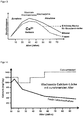
- Als Folge der Anwendung von Zoledronsäure und Hemmung der Osteoklasten, verbleibt das Kalzium im Knochen. Eine Stimulation des Knochenabbaus z.B. durch Parathormon wird, in Abhängigkeit von der im Knochen vorliegenden Zoledronsäure-Moleküle, mehr oder weniger stark verhindert. Gerade bei hochdosierter Anwendung von Zoledronsäure (z.B. 4mg/4 Wochen) in der Onkologie besteht die Gefahr einer Tumortherapie-induzierten Hypokalzämie. Eine Hypokalzämie liegt vor, wenn das Gesamtkalzium im Blutserum unter 2,2 mmol/l (9 mg/dl) liegt. Durch die medikamentöse Hemmung der Osteoklasten kann die Kalziumkonzentration im Blut nur noch über eine Zufuhr von Kalzium von außen (oral oder intravenös) ausgeglichen werden. Dies ist in
Figur 5 dargestellt. PTH aktiviert die Freisetzung von Kalzium aus dem Knochen, die allerdings durch die Hemmung der Osteoklasten durch die Zoledronsäure verhindert wird. Daher ist die Zufuhr von Kalzium von außen essentiell. - Die Hypokalzämie-Gefahr wird noch deutlich verstärkt, wenn ein sekundärer Hyperparathyreoidismus bei Vitamin D-Mangel vorliegt. Bei diesem häufigen Vitamin D-Mangelzustand wird zum Ausgleich des Serum-Kalziumspiegels vermehrt Parathormon ausgeschüttet. Parathormon erhöht indirekt die Kalziumkonzentration im Blutplasma durch Aktivierung der Osteoklasten.
- Durch die antiresorptive Therapie wird die Hypokalzämie verstärkt, da die Osteoklasten gehemmt werden.
- Insbesondere in der onkologischen Anwendung von Antiresorptiva wie Zoledronsäure kann sich eine Unterversorgung mit Kalzium und/oder Vitamin D auf dramatische Weise zuspitzen.
- Auf diese Weise verursachte Hypokalzämien können zu Herzrhythmusstörungen und bei besonders schweren Verläufen sogar zum Tod führen, wenn die Hypokalzämie nicht rechtzeitig entdeckt und behandelt wird. Hypokalzämien bleiben zudem vielfach unentdeckt, da der Kalziumspiegel in der ambulanten klinischen Behandlung nicht in engen Zeitabständen als Laborparameter gemessen wird. Um die therapiebedingte Nebenwirkung der Zoledronsäure "Hypokalzämie" abzuwenden, wird vorliegend eine Supplementation mit Kalzium und Vitamin D bereitgestellt, die eine Hypokalzämie bei der Behandlung mit Zoledronsäure verhindern kann.
- Eine unbeachtete Unterversorgung mit Kalzium und Vitamin D kann zudem den gesamten Erfolg einer antiresorptiven Therapie z.B. mit Zoledronsäure negativ beeinflussen und somit den gewünschten Schutz vor neuen Frakturen reduzieren bzw. die Anzahl der Frakturen sogar erhöhen, wenn die Kalzium und Vitamin D-Supplementation unter antiresorptiver Therapie unterlassen wird.
-
WO 2008/116133 A1 offenbart Dosierungsschemata, das Zoledronsäure und einige ihrer Derivate in Kombination mit Kalzium und Vitamin D beinhalten, um osteoporotische Frakturen zu reduzieren (Seite 2, [007]), sowie ein Multi-Komponenten-Kit für einen Patienten mit einem Risiko für sekundäre osteoporotische Frakturen und einem Vitamin D-Mangel, wobei das Kit Vitamin D oder deren funktionelle Analoge, Zoledronsäure oder ein funktionelles Analog und optional Kalzium-enthaltende Komponente enthält (Seite 2 [008]).WO 2008/116133 A1 offenbart nicht die Behandlung oder Prophylaxe von therapiebedingten Hypokalzämien, sondern schließt Patienten mit Hypokalzämien von der vorgeschlagenen Studie aus (Seiten 17-18, [0079]). - Die Patienteninformation zu Zometa (FDA-Prescribing Information, veröffentlicht unter: https://www.drugs.com/pro/zometa.html, Seite 5 unter dem Abschnitt "Hypocalcemia") offenbart u.a. die Hypokalzämie als mögliche Nebenwirkung bei der Behandlung mit Zometa, das den Wirkstoff Zoledronsäure enthält sowie den Hinweis, dass Kalzium gemessen werden und eine Hypokalzämie vor der Behandlung mit Zometa korrigiert werden sollte. Patienten sollten mit Kalzium und Vitamin D adäquat supplementiert werden. Einen Hinweis, wie die Patienten adäquat supplementiert werden sollen, offenbart die Patienteninformation nicht.
- Die vorliegende Erfindung löst diese Probleme und stellt neue pharmazeutische Zusammensetzungen von Zoledronsäure und Kalzium und Vitamin D und/oder deren Derivaten bereit, um therapiebedingte Nebenwirkungen wie Hypokalzämien bei Erkrankungen des Knochenstoffwechsels besser zu behandeln bzw. diesen Erkrankungen vorzubeugen und auf diese Weise die optimale Wirkung sicherzustellen, sowie unsachgemäßen Gebrauch zu verhindern oder letzteren vorzubeugen.
- In einem ersten Aspekt betrifft die Erfindung pharmazeutische Zusammensetzungen umfassend Zoledronsäure und Kalzium und Vitamin D zur Verwendung bei der Behandlung und/oder Prophylaxe der durch Zoledronsäure therapiebedingten Hypokalzämie bei der Behandlung von Osteoporose, postmenopausaler Osteoporose, manifester Osteoporose, Osteoporose des Mannes oder der Frau, dadurch gekennzeichnet, dass die pharmazeutische Zusammensetzung umfassend Zoledronsäure und/oder deren Derivat(e) in einer Dosierung von 4-6mg, stärker bevorzugt 5mg Zoledronsäure intravenös jährlich oder halbjährlich verabreicht wird und die pharmazeutische(n) Zusammensetzung(en) umfassend Kalzium mit einer Dosierung von 400-600mg pro Tag, besonders bevorzugt 500mg pro Tag oral verabreicht wird und Vitamin D in einer Dosierung von 800-1200 I.E. Vitamin D, besonders bevorzugt 1000 I.E. Vitamin D täglich oral verabreicht wird.
- In einem weiteren Aspekt betrifft die Erfindung pharmazeutische Zusammensetzungen enthaltend Zoledronsäure und Kalzium und Vitamin D zur Verwendung bei der Behandlung und/ oder Prophylaxe der durch Zoledronsäure therapiebedingten Hypokalzämie bei skelettbezogenen Komplikationen, insbesondere pathologischen Frakturen, Bestrahlung des Knochens, Rückenmarkskompression oder operativen Eingriffen am Knochen, Knochenmetastasen, Schmerzen bei Knochenmetastasen, Nerveneinklemmungen oder Deformierungen aufgrund eines oder mehrerer solider Tumore wie beispielsweise Brustkrebs, Prostatakrebs, Lungenkrebs oder multiplem Myelom, dadurch gekennzeichnet, dass Zoledronsäure in einer Dosierung von 3-5mg, stärker bevorzugt 4mg Zoledronsäure intravenös zur 3-4 wöchigen Anwendung und 400-600mg Kalzium täglich, besonders bevorzugt 500mg Kalzium täglich und 800-1200 I.E. Vitamin D täglich, besonders bevorzugt 1000 I.E. Vitamin D täglich oral verabreicht werden.
- Ferner betrifft die Erfindung in weiteren Aspekten die Verwendung von Derivaten der Zoledronsäure, die Behandlung und/oder Prophylaxe von therapiebedingten Nebenwirkungen, verschiedene Kalziumverbindungen und Vitamin D-Derivate zur Verwendung in den vorgenannten Ausführungsbeispielen, sowie pharmazeutisch geeignete Hilfsstoffe und Lösungsmittel.
- Zoledronsäure ist ein sehr wirksames Antiresorptivum und wird zur Behandlung von Erkrankungen des Knochenstoffwechsels angewendet. Trotz ihrer Wirksamkeit ist die Behandlung mit Zoledronsäure durch erhebliche, teils schwere Nebenwirkungen belastet. Die vorliegende Erfindung stellt pharmazeutische Zusammensetzungen bereit, die die Behandlung mit Zoledronsäure in puncto Wirksamkeit und Sicherheit erheblich verbessern. Die pharmazeutischen Zusammensetzungen umfassen neben Zoledronsäure Kalzium und Vitamin D.
- In der Fachinformation von Aclasta (Novartis Pharma, Arzneimittel, enthält 5mg Zoledronsäure als Infusionslösung, die einmal im Jahr verabreicht wird) wird lediglich eine ausreichende Einnahme von Kalzium und Vitamin D empfohlen, die genaue Dosierung wird nicht angegeben. Aclasta wird zur Behandlung der Osteoporose u.a. bei postmenopausalen Frauen und erwachsenen Männern mit einem erhöhten Risiko für Frakturen, einschließlich bei Patienten mit einer kürzlich erlittenen niedrig-traumatischen Hüftfraktur, zur Behandlung des Morbus Paget des Knochens bei Erwachsenen, sowie zur Behandlung der Osteoporose in Zusammenhang mit einer systemischen Langzeit Glukokortikoid-Therapie bei postmenopausalen Frauen und bei erwachsenen Männern mit einem erhöhten Frakturrisiko angewendet.
- Zometa (Novartis Pharma, Arzneimittel, enthält 4mg/5ml oder 4mg/100ml Zoledronsäure als Infusionslösungskonzentrat oder Infusionslösung) wird zur Prävention skelettbezogener Komplikationen (pathologische Frakturen, Wirbelkörperkompressionen, Bestrahlung oder Operation am Knochen oder tumorinduzierte Hyperkalzämie) bei erwachsenen Patienten mit fortgeschrittenen, auf das Skelett ausgedehnte Tumorerkrankungen, sowie zur Behandlung von erwachsenen Patienten mit tumorinduzierter Hyperkalzämie mit 4mg alle 3-4 Wochen angewendet.
- Die ausreichende tägliche Gesamtzufuhr an Kalzium beträgt 1000 mg. Über die Nahrung wird Kalzium aufgenommen, sodass bei kalziumreicher Ernährung die erforderliche Tagesdosis erreicht werden kann. Eine Kalziumzufuhr von mehr als 2500mg pro Tag wird als problematisch angesehen, weil sich dadurch unter anderem das Risiko für die Bildung von Nierensteinen erhöhen kann. Aufgrund diverser Veröffentlichungen über kardiovaskuläre Nebenwirkungen durch die übermäßige Einnahme von Kalzium, haben viele Patienten davon Abstand genommen, Kalzium in ausreichender Menge, selbst unter Behandlung mit Zoledronsäure, zu sich zu nehmen.
- Vielfach wird dadurch der Behandlungserfolg von Zoledronsäure insgesamt gefährdet und die kardiovaskulären Nebenwirkungen nun durch die Unterversorgung mit Kalzium hervorgerufen bzw. durch die starke Hemmung der Osteoklasten durch die Zoledronsäurebehandlung, die eine Resorption des Kalziums aus dem Knochen ins Blut hemmt.
- Dies führt zu Hypokalzämien, die kardiovaskuläre Nebenwirkungen hervorrufen. Im Prinzip wird damit genau das Gegenteil des erwünschten Erfolgs eintreten. Durch den Kalziummangel -nicht durch die Überversorgung mit Kalzium- treten nun vermehrt kardiovaskuläre Nebenwirkungen auf, die durch eine angemessene Versorgung mit Kalzium bei der Behandlung mit Zoledronsäure hätten verhindert werden können.
- Eine Supplementation mit einer pharmazeutischen Zusammensetzung mit 1000-1500mg Kalzium pro Tag wird bei ausreichend kalziumhaltiger Ernährung zu einer Überversorgung mit Kalzium führen, die das Risiko der kardiovaskulären Nebenwirkungen erhöht. Entgegen der Studiendesigns, die in der Fachinformation von Aclasta eine Tagesdosis von 1000-1500mg Kalzium beinhalten, wird in der vorliegenden Erfindung eine niedrigere Dosierung bereitgestellt, um Hypokalzämien und kardiovaskuläre Nebenwirkungen zu behandeln bzw. diesen vorzubeugen.
- Die bevorzugte Menge an Kalzium in der pharmazeutischen Zusammensetzung beträgt 400-600mg Kalzium pro Tag, besonders bevorzugt 500mg Kalzium pro Tag, um einerseits auch bei kalziumarmer Ernährung einen Grundspiegel an Kalzium zu erhalten und andererseits nicht in die Überversorgung zu geraten, die mit den genannten Risiken verbunden und demzufolge für die Patienten nicht akzeptabel ist. Dem Ergebnisbericht der in Deutschland durchgeführten "Nationale-Verzehrs-Studie II" zur Folge erreichen 46% der Männer und 55% der Frauen nicht die empfohlene tägliche Zufuhr von Kalzium. In der Altersgruppe zwischen 51-80 Jahre liegt die durchschnittliche Gesamtzufuhr in dem Bereich zwischen 490-1790 mg Kalzium pro Tag.
- 500mg Kalzium pro Tag sollen laut Fachinformation von Zometa eingenommen werden, allerdings in der Kombination mit 400 I.E. Vitamin D pro Tag. Die Studien für Zometa waren auf US-Patienten ausgerichtet. In den USA wird eine große Anzahl an Lebensmitteln mit Vitamin D supplementiert, so beispielsweise Milch, Orangensaft, Brotsorten oder Frühstücksflocken. In Deutschland und der EU ist dies im Wesentlichen nicht der Fall, so dass erfindungsgemäß eine höhere Menge an Vitamin D von 800-1200 I.E. pro Tag bereitgestellt wird, besonders bevorzugt 1000 I.E. Vitamin D pro Tag. Die höhere Menge an Vitamin D ist in der Lage, den Transport einer potentiell geringeren Menge an Kalzium aus dem Gastrointestinaltrakt ins Blut zu fördern und trotz der geringeren Menge an Kalzium zu einem ausreichenden Kalziumserumspiegel zu gelangen.
- Der Vitamin D-Spiegel ist gut messbar. Die erfindungsgemäße Kombination wird für eine Vitamin D Serum-Konzentration bereitgestellt, die nicht unter 20ng/ml (50nmol/l Serum) liegt.
- Bei einem schweren Mangel (<10ng/ml Serum) sollten 200.000 I.E. über 10 Tage und dann 20.000 I.E. wöchentlich substituiert werden. Bei einem deutlichen Mangel (10-20ng/ml Serum) sollte eine initiale Substitution von 100.000 I.E. erfolgen und dann eine Erhaltung von 20.000 I.E./Woche. Liegt ein Mangel (21-30ng/ml Serum) vor, sollte eine Substitution von 20.000 I.E./Woche erfolgen. Ist der normale Vitamin D-Spiegeln (31-60ng/ml Serum) erreicht, ist die tägliche erfindungsgemäße Substitution von 800-1200 I.E. Vitamin D, besonders bevorzugt 1000 I.E. anwendbar.
- Eine Supplementation mit 400 I.E. Vitamin D ist nicht ausreichend, um den Vitamin D-Spiegel im normalen Bereich von 31-60ng/ml Serum bei Verabreichung der erfindungsgemäßen pharmazeutischen Zusammensetzung von Zoledronsäure und Kalzium zu halten.
- Auf diese Weise werden durch die erfindungsgemäße pharmazeutische Zusammensetzung aus Zoledronsäure, Kalzium und Vitamin D Hypokalzämien verhindert.
- Der Begriff "Zoledronsäure" oder "Zoledronat" (C5H10N2O7P2; [1-Hydroxy-2-(imidazol-1-yl)ethyliden]diphosphonsäure, CAS-Nummer: 118072-93-8) umfasst zusätzlich alle bekannten pharmazeutisch verträglichen Derivate der Zoledronsäure. Dem Fachmann ist bekannt, dass Salze als Solvate wie beispielsweise Hydrate vorliegen können oder dass Zoledronsäure als Ester vorliegen kann. Zoledronsäure kann in jeder pharmazeutisch verträglichen Salz- oder Säureform bereitgestellt werden. Salze sind bevorzugt, da Membranen durch Salze weniger angegriffen werden. Bevorzugte Salze sind insbesondere, ohne darauf beschränkt zu sein, Zoledronsäure Dinatriumsalz Tetrahydrat (C5H8N2Na2O7P2•4H2O, CAS-Nummer: 165800-07-7), Zoledronsäure Trinatriumsalz Hydrat (C5H7N2Na3O7P2•H2O)5, CAS-Nummer: 165800-08-8, Salze mit einwertigen Kationen, insbesondere Zoledronat-Natrium und/oder Ester, insbesondere Ethyl-, Propyl-, Isopropyl-, n-Butyl- und t-Butyl-Ester.
- Erfindungsgemäß wird die pharmazeutische Zusammensetzung umfassend Zoledronsäure im Bereich Osteoporose, postmenopausaler Osteoporose, Osteoporose des Mannes oder der Frau mit 4-6mg, bevorzugt 5 mg pro Halb/-Jahr intravenös verabreicht.
- Erfindungsgemäß wird die pharmazeutische Zusammensetzung umfassend Zoledronsäure im Bereich Onkologie mit 3-5mg, bevorzugt 4mg zur 3-4wöchigen Anwendung intravenös verabreicht.
- Der Begriff "Kalzium" bzw. "Calcium" umfasst alle bekannten pharmazeutisch verträglichen Kalzium-Verbindungen, insbesondere ohne darauf beschränkt zu sein Kalziumzitrat, weitere Bezeichnungen: Tricalciumcitrat, TCC, Tricalciumdicitrat, Tricalcium-di-[2-hydroxy-1,2,3-propantricarboxylat]-Tetrahydrat, E 333, C12H10Ca3O14, CAS-Nummern: 813-94-5 (wasserfrei), 5785-44-4 (Tetrahydrat); Calciumgluconat-Monohydrat (C12H22CaO14 • H2O, CAS-Nummern: 299-28-5 (wasserfrei) und 66905-23-5 (Monohydrat)); Calciumlactatgluconat, ein Doppelsalz der Milch- und Gluconsäure, das als Gemisch vorliegt, weitere Bezeichnungen: CLG, Calciumlaktatglukonat, Calciumlaktoglukonat, E 327, E 578, CAS-Nummern: 11116-97-5, 814-80-2 (Calciumlactat-Pentahydrat), 18016-24-5 (Calciumgluconat-Monohydrat), oder Kalziumkarbonat CaCO3, CAS-Nummer: 471-34-1, Kalzium-Phosphat, Kalzium-Dihydrogenphosphat, Kalzium-Hydrogenphosphat, Kalzium-Hydrogenphosphat Dihydrat, Kalzium-Acetat, Kalzium-Ascorbat, Kalzium-Chloride, Kalzium-Glucoheptonat, Kalzium-Glycerophosphat und/oder Kalzium-Sulfat.
- Der Begriff "Vitamin D" umfasst Vitamin D oder dessen Derivate, insbesondere, ohne darauf beschränkt zu sein, Vitamin D3 (Cholecalciferol, C27H44O, CAS-Nummer: 67-97-0), Calcitriol (1,25-Dihydroxyvitamin D3, 1α,25-Dihydroxycholecalciferol, 1,25(OH)2Vitamin D3, 1,25(OH)2D3, (5Z,7E)-(1S,3R)-9,10-Seco cholesta-5,7,10(19)-trien-1,3,25-triol, CAS-Nummer: 32222-06-3) oder 1α,25-Dihydroxycholecalciferol (biologisch aktive Form von Vitamin D3), Alphacalcidol (1α-Hydroxyvitamin D3), 24,25-Dihydroxyvitamin D3 oder Calcifediol (25-Hydroxyvitamin D3 25-Hydroxycholecalciferol, CAS-Nummer: 19356-17-3, IUPAC-Name: (6R)-6-[(1R,3aR,4E,7aR)-4-[(2Z)-2-[(5S)-5-Hydroxy-2-methylidene-cyclohexylidene] ethylidene]-7a-methyl-2,3,3a,5,6,7-hexahydro-1H-inden-1-yl]-2-methylheptan-2-ol), Vitamin D2 (3β,5Z,7E,22E)-9,10-Secoergosta-5,7,10(19),22-tetraen-3-ol, Calciferol, Ergo-Calciferol, CAS-Nummer: 50-14-6 bzw. dessen biologisch aktive Formen.
- Sowohl Vitamin D-Präparate, als auch Zoledronsäure und Kalzium sind käuflich erwerblich und die Verfahren zur Herstellung derselben der Fachperson bekannt.
- Pharmazeutische Zusammensetzungen umfassend Zoledronsäure, Kalzium und Vitamin D zur Verwendung bei der Behandlung und/oder Prophylaxe der durch Zoledronsäure therapiebedingten Hypokalzämie bei der Behandlung von Osteoporose, postmenopausaler Osteoporose, manifester Osteoporose, Osteoporose des Mannes oder der Frau, die in einer Zoledronsäure-Konzentration von 4-6mg jährlich oder halbjährlich, stärker bevorzugt 5mg jährlich oder halbjährlich und 400-600mg Kalzium täglich, besonders bevorzugt 500mg Kalzium täglich und 800-1200 I.E. Vitamin D, besonders bevorzugt 1000 I.E. Vitamin D täglich oral verabreicht bereitgestellt werden.
- In einem weiteren Ausführungsbeispiel werden pharmazeutische Zusammensetzungen umfassend 3-5mg, stärker bevorzugt 4mg Zoledronsäure intravenös zur 3-4 wöchigen Anwendung und 400-600mg Kalzium täglich, besonders bevorzugt 500mg Kalzium täglich und 800-1200 I.E. Vitamin D, besonders bevorzugt 1000 I.E. Vitamin D zur Verwendung bei der Behandlung und/oder Prophylaxe der durch Zoledronsäure therapiebedingten Hypokalzämie bei skelettbezogenen Komplikationen, insbesondere pathologischen Frakturen, Rückenmarkskompressionen, Bestrahlung oder Operation am Knochen, Schmerzen bei Knochenmetastasen aufgrund von soliden Tumoren wie beispielsweise Mammakarzinom, Prostatakarzinom, Lungenkrebs, Multiplem Myelom bereitgestellt.
- In einem Ausführungsbeispiel werden die oben angegebenen Mengen Zoledronsäure in einer Infusionslösung von 5ml bis 100ml vor, stärker bevorzugt als 5ml Infusionslösungskonzentrat oder als 100ml Fertiginfusionslösung in einer pharmazeutisch geeigneten Lösung wie beispielsweise isotonischer Kochsalzlösung, isotonischer Mannitol-Natriumcitrat-Lösung oder anderen pharmazeutisch geeigneten isotonischen Lösungen bereitgestellt.
- In einem weiteren Ausführungsbeispiel werden Kalzium und Vitamin D mit pharmazeutisch geeigneten Hilfsstoffen bereitgestellt, insbesondere Lactose, Stärke, Säuerungsmitteln insbesondere Zitronensäure und Apfelsäure, Säureregulatoren insbesondere Natriumhydrogencarbonat und Natriumcarbonat, Feuchthaltemitteln insbesondere Sorbitol, Xylitol und Inulin, Trennmitteln insbesondere Tricalciumphosphat, Speisefettsäuren insbesondere Magnesiumsalze insbesondere Magnesiumstearat, natürliche und naturidentische und andere Aromen und Aromastoffe, Süßstoffe insbesondere Natrium-Cyclamat, Aspartam und Saccharin-Natrium, Maltodextrin, Farbstoffe insbesondere Rote-Bete-Saftpulver und Riboflavin-5'-phosphat, Siliciumdioxid insbesondere hochdispers, Siliciumdioxid hydrat, Phenylalanin, Arabisches Gummi, Saccharose, Gelatine, Maisstärke, Sojaöl, Glycerol, DL-alpha-Tocopherol, Isomalt, Natriumhydrogencarbonat, Natriumdihydrogencarbonat, Natriumcitrat, Natriumdihydrogencitrat, Carmellose Natrium, Acesulfam Kalium, Natriumascorbat, Triglyceride insbesondere mittelkettige, und/oder in pharmazeutisch verträglichen Flüssigkeiten, insbesondere Wasser, isotonischer Kochsalz- oder Glucoselösung oder anderen pharmazeutisch geeigneten Lösungen bereitgestellt.
- In einem weiteren Ausführungsbeispiel werden Zoledronsäure, Kalzium und/oder Vitamin D, gegebenenfalls mit pharmazeutisch geeigneten Hilfsstoffen und/oder Flüssigkeiten, insbesondere als Brausetabletten, Schlucktabletten oder -kapseln, Kautabletten, Brausegranulaten, Direktgranulaten, Trinklösungen, Tropfen, Sublingualsprays, als Infusionslösungskonzentrate, Fertiginfusionen, Injektionslösungskonzentraten, Injektionslösungen oder Fertigspritzen einzeln oder zusammen bereitgestellt.
- Die nachfolgenden Figuren und Beispiele dienen der Erläuterung ohne jedoch die Erfindung auf die Figuren oder Beispiele einzuschränken.
-
-
Figur 1 : zeigt eine Darstellung über die Kalziumzufuhr vom Gastrointestinaltrakt ins Blut und in den Knochen, sowie die beeinflussenden Faktoren, die eine Kalziumaufnahme fördern bzw. verringern. -
Figur 2 : zeigt die Folgen einer insuffizienten Kalziumaufnahme durch die Nahrung. -
Figur 3 : zeigt die Zu- und Abnahme der Knochenmasse im Verlauf des menschlichen Lebens und das erhöhte Knochenbruchrisiko im Alter mit Abnahme der Knochenmasse. -
Figur 4 : zeigt den erhöhten Kalziumbedarf mit zunehmenden Alter durch verringerte reale Kalziumaufnahme. -
Figur 5 : Eine Hypokalzämie liegt vor, wenn das Gesamtkalzium im Blutserum unter 2,2 mmol/l (9 mg/dl) liegt. Durch die medikamentöse Hemmung der Osteoklasten kann die Kalziumkonzentration im Blut nur noch über eine Zufuhr von Kalzium von außen (oral oder intravenös) ausgeglichen werden. Dies ist inFigur 5 dargestellt. - Ein Vitamin D-Mangel ist eine häufige Diagnose in der osteologischen Praxis. Zu Beginn der Therapie wiesen 89 von 423 Patienten einen Vitamin D-Mangel auf, der sich unter dem Wert von 20ng/ml Serum bzw. 50 nmol/l befand. Die Erhaltungsdosis betrug 1000 I.E. täglich Vitamin D. Eine Erhaltungsdosis von 400 I.E. Vitamin D täglich war nicht ausreichend, den Vitamin D-Spiegel auf dem Normwert zu halten.
- Tabelle 1 zeigt, dass eine Erhaltungsdosis von 1000 I.E. Vitamin D geeignet ist, den Vitamin D-Spiegel im Normbereich zu halten:
Tabelle 1: Patient Vitamin D-Anfangswert Vitamin D-Wert bei Erhaltungsdosis 1000 I.E. Vitamin D täglich 85 Jahre, weiblich 9,4ng/ml 25,5 ng/ml 65 Jahre, weilblich 8,8ng/ml 23,4 ng/ml 77 Jahre, weiblich 12,4 ng/ml 29,2 ng/ml 81 Jahre, weiblich 10,4ng/ml 30,4 ng/ml 75 Jahre, weiblich 14,6ng/ml 28,8 ng/ml 86 Jahre, weiblich 10,9ng/ml 23,7ng/ml 81 Jahre, weiblich 8,6 ng/ml 23,2ng/ml 71 Jahre, weiblich 17,1 ng/ml 30,5 ng/ml - Der Vitamin D-Spiegel von 37 weiteren Patienten wurde analysiert. Zu Beginn der Therapie lag bei etwa 51% der Patienten (n=19) ein Vitamin D Mangel [25(OH)VitD - Serumspiegel < 30ng/ml Serum bzw. 75 nmol/l] vor. Bei 27% der Patienten (n=10) lag der 25(OH)VitD - Serumspiegel unter 20ng/ml Serum bzw. 50 nmol/l (=schwerer Vitamin D Mangel). Die folgende Tabelle 2 zeigt in der jeweils linken Spalte die tägliche Aufnahme an Kalzium durch die Nahrung im mg. Die tägliche Zufuhr von weniger als 1000mg durch Nahrungsmittel führt zu einer negativen Kalziumbilanz. Daraus entwickelt sich ein sekundärer Hyperparathyreodismus und Knochensubstanz geht verloren. Eine tägliche Versorgung von weniger als 500mg Kalzium ist mit einem erhöhten Frakturrisiko für nicht-vertebrale Frakturen verbunden.


- Die folgende Patientenkasuistik zeigt, dass die erfindungsgemäße pharmazeutische Zusammensetzung von 5mg Zoledronsäure jährlich intravenös verabreicht, 500mg Kalzium täglich und 1000 I.E. Vitamin D täglich oral eingenommen, eine therapiebedingte Hypokalzämie, verursacht durch die Behandlung mit Zoledronsäure, wirksam verhindert. Die Werte stammen von einer 73 Jahre alten Patientin mit manifester Osteoporose und einer vorausgegangenen niedrig-traumatischen Wirbelkörperfraktur. Sowohl die Kalzium-Werte als auch die Werte für Vitamin D liegen bei der Behandlung mit den erfindungsgemäßen pharmazeutischen Zusammensetzungen im Normbereich.
-
Datum Ca in mmol/l 25(OH) Vitamin D3-Serumspiegel in ng/ml 21.08.12 2,21 30,40 12.03.13 2,36 28,40 08.08.13 2,27 47,30 18.02.14 2,27 34,30 24.07.14 2,23 34,30 19.03.15 2,25 39,10 23.02.16 2,32 29,00 - Die folgenden Daten von 10 onkologischen Patienten (Prostatakarzinom oder Mamakarzinom) in Tabelle 5 zeigen die Serumspiegel von Kalzium und Vitamin D3 bei Verabreichung von monatlich 4 mg Zoledronsäure, sowie der oralen Einnahme von 500 mg Kalzium täglich und 1000 I.E. Vitamin D3 täglich.
Tabelle 4: Die Patienten erhielten 4mg Zoledronsäure/Monat, 500mg Kalzium-Supplementation täglich und 1000 I.E. Vitamin D3 täglich: Patient/- in Kalzium mmol/l 25(OH) Vitamin D3-Serumspiegel µg/l nach Wochen Kalzium 25(OH) Vitamin D3-Serumspiegel; µg/l Kalzium in Ernährung mg/Tag 1 2,09 17,2 16 2,14 37,1 1449 2 2,4 17,2 4 2,31 24,3 979 3 2,02 12,1 16 2,22 25,2 958 4 2,37 Keine Angabe 8/16/20 2,46/2,46/2,32 33,1 nach 20 Wochen 702 5 2,36 Keine Angabe 4/16/24 2,41/2,4/2,54 22,3 nach 20 Wochen 230 6 2,4 Keine Angabe 4/8/16 2,26/2,41/2,4 Keine Angabe/19,8/22,8 952 7 2,47 Keine Angabe 4/9/13 2,26/2,4/2,36 40,3 nach 13 Wochen 1215 8 2,42 22 8/12/16 2,34/2,41/2,4 Keine Angabe 909 9 2,48 46,7 4/8/12/16 2,3/ 2,34/ 2,38/2,41 46,2/ keine Angabe/ keine Angabe/ 48,1 544 10 2,25 Keine Angabe 4/8/12/16 2,31/ 2,29/ 2,34/2,28 Keine Angabe 1250 Tabelle 5: Die folgenden Patienten in Tabelle 5 waren an Osteoporose erkrankt und erhielten 5 mg Zoledronsäure/Jahr, 500mg Kalzium-Supplementation täglich und 1000 I.E. Vitamin D3 täglich: Patient/- in Kalzium mmol/l 25(OH) Vitamin D3-Serumspiegel; µg/l nach Wochen Kalzium 25(OH) Vitamin D3-Serumspiegel; µg/l Kalzium in Ernährung mg/Tag 11 2,28 23,1 24 2,24 40,1 872 12 2,41 15 24 2,4 25,8 1866 13 2,4 21,5 24 2,37 28,6 738 14 2,32 31,3 24 2,44 45,4 800 - Bei einem 25(OH) Vitamin D - Serumspiegel < 20ng/ml liegt ein schwerer Vitamin D-Mangel vor, der nach der DVO-Leitlinie ein erhöhtes Frakturrisiko bedeutet. Die Daten in Beispiel 5 zeigen, dass die erfindungsgemäße Kombination geeignet ist, den Vitamin D- Spiegel über 20ng/ml bzw. 20µg/l zu normalisieren und dadurch das Frakturrisiko zu senken.
- Der Kalzium-Serumspiegel ist bei Patienten mit Osteoporose in der Regel im Normbereich. Bei onkologischen Patienten kann die Kalziumkonzentration im Blut ansteigen (=tumorinduzierte Hyperkalzämie) oder therapiebedingt absinken (therapie-induzierte Hypokalzämie). Patienten mit einer kalziumarmen Ernährung haben deshalb ein zusätzliches Hypokalzämie-Risiko. Eine erfindungsgemäße tägliche Supplementation mit 500 mg Kalzium sogt für eine ausgeglichene Kalziumbilanz.
- Ein erhöhter PTH-Spiegel (=sekundärer Hyperparathyreodisumus) sowie eine Hypokalzämie - induziert durch eine anti-resorptive Therapie mit Zoledronsäure - sind Risikofaktoren für die Entstehung einer Nekrose am Kieferknochen.
- Die Patienten, die mit der erfindungsgemäßen Kombination behandelt wurden, waren frei von Nebenwirkungen, insbesondere traten keine Kieferosteonekrosen, nicht heilende Wunden bis zur Auflösung des Kiefers, Hypokalzämien, kardiovaskuläre Nebenwirkungen wie Herzinfarkt, Vorhofflimmern, Herzrhythmusstörungen, Krämpfe und/oder Taubheitsgefühl auf.
- Es traten ferner keine skelettbezogenen Komplikationen, insbesondere keine pathologischen Frakturen, Bestrahlungen des Knochens, Rückenmarkskompressionen oder operative Eingriffe am Knochen, Knochenmetastasen, Schmerzen bei Knochenmetastasen, Nerveneinklemmungen oder Deformierungen aufgrund eines oder mehrerer solider Tumore wie beispielsweise Brustkrebs, Prostatakrebs, Lungenkrebs oder multiplem Myelom auf, sowie keine Frakturen.
Claims (9)
- Pharmazeutische Zusammensetzungen umfassend Zoledronsäure und Kalzium und Vitamin D zur Verwendung bei der Behandlung und/oder Prophylaxe der durch Zoledronsäure therapiebedingten Hypokalzämie bei der Behandlung von Osteoporose, postmenopausaler Osteoporose, manifester Osteoporose, Osteoporose des Mannes oder der Frau, dadurch gekennzeichnet, dass die pharmazeutische Zusammensetzung umfassend Zoledronsäure in einer Dosierung von 4-6mg, stärker bevorzugt 5mg Zoledronsäure intravenös jährlich oder halbjährlich verabreicht wird und die pharmazeutische(n) Zusammensetzung(en) umfassend Kalzium mit einer Dosierung von 400-600mg pro Tag, besonders bevorzugt 500mg pro Tag oral verabreicht wird und Vitamin D in einer Dosierung von 800-1200 I.E. Vitamin D, besonders bevorzugt 1000 I.E. Vitamin D täglich oral verabreicht wird.
- Pharmazeutische Zusammensetzungen enthaltend Zoledronsäure und Kalzium und Vitamin D zur Verwendung bei der Behandlung und/oder Prophylaxe der durch Zoledronsäure therapiebedingten Hypokalzämie bei skelettbezogenen Komplikationen, insbesondere pathologischen Frakturen, Bestrahlung des Knochens, Rückenmarkskompression oder operativen Eingriffen am Knochen, Knochenmetastasen, Schmerzen bei Knochenmetastasen, Nerveneinklemmungen oder Deformierungen aufgrund eines oder mehrerer solider Tumore wie beispielsweise Brustkrebs, Prostatakrebs, Lungenkrebs oder multiplem Myelom, dadurch gekennzeichnet, dass Zoledronsäure in einer Dosierung von 3-5mg, stärker bevorzugt 4mg Zoledronsäure intravenös zur 3-4 wöchigen Anwendung und 400-600mg Kalzium täglich, besonders bevorzugt 500mg Kalzium täglich und 800-1200 I.E. Vitamin D täglich, besonders bevorzugt 1000 I.E. Vitamin D täglich oral verabreicht werden.
- Pharmazeutische Zusammensetzungen enthaltend Zoledronsäure und Kalzium und Vitamin D zur Verwendung nach Anspruch 1-2, wobei Zoledronsäure pharmazeutisch geeignete Salze und/oder Ester umfasst, insbesondere Salze mit einwertigen Kationen, insbesondere Zoledronat-Natrium und/oder Ester, insbesondere Ethyl-, Propyl-, Isopropyl, n-Butyl- und t-Butyl-Ester.
- Pharmazeutische Zusammensetzungen enthaltend Zoledronsäure und Kalzium und Vitamin D zur Verwendung nach Anspruch 1-3, wobei Kalzium insbesondere Kalziumlaktatgluconat, Kalziumgluconat-Monohydrat, Kalziumlaktat-Pentahydrat, Kalziumzitrat, Kalziumzitrat-Tetrahydrat, Kalziumkarbonat, Kalzium-Phosphat, Kalzium-Dihydrogenphosphat, Kalzium-Hydrogenphosphat, Kalzium-Hydrogenphosphat Dihydrat, Kalzium-Acetat, Kalzium-Ascorbat, Kalzium-Chloride, Kalzium-Glucoheptonat, Kalzium-Glycerophosphat und/oder Kalzium-Sulfat umfasst.
- Pharmazeutische Zusammensetzungen enthaltend Zoledronsäure und Kalzium und Vitamin D zur Verwendung nach Anspruch 1-4, wobei Vitamin D insbesondere Vitamin D und/oder Vitamin D3 und/oder Vitamin D2 und/oder deren Derivate, insbesondere Calcitriol (1,25-Dihydroxyvitamin D3) oder 1α, 25-Dihydroxycholecalciferol, Alphacalcidol (1α-Hydroxyvitamin D3), 24,25-Dihydroxyvitamin D3, Calcifediol, Vitamin D2 und/oder Ergocalciferol umfasst.
- Pharmazeutische Zusammensetzungen enthaltend Zoledronsäure und Kalzium und Vitamin D zur Verwendung nach den Ansprüchen 1-5, zusätzlich umfassend pharmazeutisch geeignete Hilfsstoffe und/oder Flüssigkeiten oder Lösungsmittel.
- Pharmazeutische Zusammensetzungen enthaltend Zoledronsäure und Kalzium und Vitamin D zur Verwendung nach den Ansprüchen 1-6, wobei die Hilfsstoffe für die pharmazeutischen Zusammensetzungen Lactose, Stärke, Säuerungsmittel insbesondere Citronensäure, Apfelsäure, Säureregulatoren insbesondere Natriumhydrogencarbonat und Natriumcarbonat, Feuchthaltemitteln insbesondere Sorbitol, Xylitol und Inulin, Trennmitteln insbesondere Tricalciumphosphat, Speisefettsäuren insbesondere Magnesiumsalze insbesondere Magnesiumstearat, natürliche und naturidentische und andere Aromen und Aromastoffe, Süßstoffe insbesondere Natrium-Cyclamat, Aspartam und Saccharin-Natrium, Maltodextrin, Farbstoffe insbesondere Rote-Bete-Saftpulver und Riboflavin-5'-phosphat, Siliciumdioxid insbesondere hochdispers, Siliciumdioxid hydrat, Phenylalanin, Arabisches Gummi, Saccharose, Gelatine, Maisstärke, Sojaöl, Glycerol, DL-alpha-Tocopherol, Isomalt, Natriumhydrogencarbonat, Natriumdihydrogencarbonat, Natriumcitrat, Natriumdihydrogencitrat, Carmellose Natrium, Acesulfam Kalium, Natriumascorbat, Triglyceride insbesondere mittelkettige, und/oder in pharmazeutisch verträglichen Flüssigkeiten, insbesondere Wasser, isotonischer Kochsalz- oder Glucoselösung umfassen.
- Pharmazeutische Zusammensetzungen enthaltend Zoledronsäure und Kalzium und Vitamin D zur Verwendung den Ansprüchen 1-7, wobei die pharmazeutisch geeigneten Lösungsmittel oder Flüssigkeiten Wasser, isotonische Kochsalzlösung, isotonische Mannitol-Natriumacetatlösung oder Glucoselösung umfassen.
- Pharmazeutische Zusammensetzungen enthaltend Zoledronsäure und Kalzium und Vitamin D zur Verwendung nach den Ansprüchen 1-8, wobei die pharmazeutische Zusammensetzung umfassend Zoledronsäure als Infusion, Infusionslösungskonzentrat, Fertiginfusion oder Fertigspritze und die pharmazeutischen Zusammensetzungen umfassend Kalzium und/oder Vitamin D in fester oder flüssiger Form als Brausetablette, Schlucktablette oder -kapsel, Kautablette, Brausegranulat, Direktgranulat, Trinklösung, Tropfen, Sublingualspray, einzeln oder zusammen bereitgestellt wird.
Priority Applications (1)
| Application Number | Priority Date | Filing Date | Title |
|---|---|---|---|
| PL17171880T PL3246032T3 (pl) | 2016-05-20 | 2017-05-19 | Kompozycje farmaceutyczne z kwasem zoledronowym, wapniem i witaminą d, odpowiednie do leczenia i/lub profilaktyki chorób metabolicznych kości oraz działań ubocznych spowodowanych terapią, takich jak hipokalcemia |
Applications Claiming Priority (1)
| Application Number | Priority Date | Filing Date | Title |
|---|---|---|---|
| DE102016006446 | 2016-05-20 |
Publications (2)
| Publication Number | Publication Date |
|---|---|
| EP3246032A1 EP3246032A1 (de) | 2017-11-22 |
| EP3246032B1 true EP3246032B1 (de) | 2021-08-11 |
Family
ID=58800639
Family Applications (1)
| Application Number | Title | Priority Date | Filing Date |
|---|---|---|---|
| EP17171880.2A Active EP3246032B1 (de) | 2016-05-20 | 2017-05-19 | Pharmazeutische zusammensetzungen mit zoledronsaeure, kalzium und vitamin d, geeignet zur behandlung und/oder prophylaxe von erkrankungen des knochenstoffwechsels und von therapiebedingten nebenwirkungen wie hypokalzaemien |
Country Status (6)
| Country | Link |
|---|---|
| EP (1) | EP3246032B1 (de) |
| DE (1) | DE102017110957A1 (de) |
| DK (1) | DK3246032T3 (de) |
| ES (1) | ES2893753T3 (de) |
| PL (1) | PL3246032T3 (de) |
| PT (1) | PT3246032T (de) |
Family Cites Families (3)
| Publication number | Priority date | Publication date | Assignee | Title |
|---|---|---|---|---|
| CA2497353C (en) * | 2002-09-16 | 2012-08-28 | Novartis Ag | Method for preventing or reducing secondary fractures after hip fracture |
| EP2136814A4 (de) * | 2007-03-21 | 2012-05-30 | Univ Duke | Medikationskits und formulierungen zur verhütung, behandlung oder reduzierung von sekundären frakturen nach einer vorhergehenden fraktur |
| JP2017523220A (ja) * | 2014-08-07 | 2017-08-17 | オプコ アイルランド グローバル ホールディングス リミテッド | 25−ヒドロキシビタミンdを用いる補助的療法 |
-
2017
- 2017-05-19 PT PT171718802T patent/PT3246032T/pt unknown
- 2017-05-19 ES ES17171880T patent/ES2893753T3/es active Active
- 2017-05-19 PL PL17171880T patent/PL3246032T3/pl unknown
- 2017-05-19 DE DE102017110957.9A patent/DE102017110957A1/de not_active Withdrawn
- 2017-05-19 DK DK17171880.2T patent/DK3246032T3/da active
- 2017-05-19 EP EP17171880.2A patent/EP3246032B1/de active Active
Non-Patent Citations (1)
| Title |
|---|
| None * |
Also Published As
| Publication number | Publication date |
|---|---|
| DE102017110957A1 (de) | 2017-11-23 |
| ES2893753T3 (es) | 2022-02-10 |
| PT3246032T (pt) | 2021-10-18 |
| EP3246032A1 (de) | 2017-11-22 |
| PL3246032T3 (pl) | 2022-01-03 |
| DK3246032T3 (da) | 2021-10-11 |
Similar Documents
| Publication | Publication Date | Title |
|---|---|---|
| DE69629184T2 (de) | Verwendung von vitamin d2 oder vitamin d4-derivaten zur herstellung eines medikamentes zur behandlung des sekundären hyperparathyroidismus | |
| DE69233250T2 (de) | Kombinationen aus calzium und vitamin d | |
| DE69737066T2 (de) | Verwendung von aktivem Vitamin D analog zur Behandlung von Prostataerkrankungen | |
| EP2508083B1 (de) | Biologisch aktiver nahrungsmittelzusatz für osteoporoseprophylaxe | |
| US4997824A (en) | Combination of cholecalciferol derivatives for the treatment of renal bone disease | |
| KR20130135868A (ko) | 25-하이드록시비타민 d3을 사용한, 증가된 에오탁신과 관련된 질환의 치료 | |
| EP0819436B1 (de) | Pharmazeutische und diätetische Zusammensetzungen umfassend Natrium-, Kalium-, Magnesium- und Calciumionen und Enzymaktivatoren | |
| AU2012377476B2 (en) | Preparation and method for the prophylaxis and treatment of atypical osteoporosis | |
| DE10393906T5 (de) | Verfahren zur Erhöhung der Bioverfügbarkeit von Alendronat oder einem anderen Bisphosphonat durch Verabreichen einer Vordosis eines Vitamin D-Derivats | |
| AU2017203767B2 (en) | Method for filling bone cavity formations with calcium | |
| DE69301750T2 (de) | Verwendung von 1-Alpha,24(R)-Dihydroxy-22(E)-Dehydrovitamin-D3 zur Herstellung eines Arzneimittels zur Behandlung der Osteoporose | |
| EP3246032B1 (de) | Pharmazeutische zusammensetzungen mit zoledronsaeure, kalzium und vitamin d, geeignet zur behandlung und/oder prophylaxe von erkrankungen des knochenstoffwechsels und von therapiebedingten nebenwirkungen wie hypokalzaemien | |
| CN112386601B (zh) | 维生素d补充制剂及其应用 | |
| DE20321698U1 (de) | Medikament zur Erhöhung der Bioverfügbarkeit von Alendronat oder einem anderen Bisphosphonat durch Verabreichen einer Vordosis eines Vitamin-D-Derivats | |
| EP4501330A2 (de) | Pharmazeutische zusammensetzungen mit anti-rankl-antikörpern, kalzium und vitamin d, geeignet zur behandlung und/oder prophylaxe von erkrankungen des knochenstoffwechsels und von therapiebedingten nebenwirkungen wie hypokalzämien | |
| EP0374935B1 (de) | Präparat zum Vorbeugen gegen Knochenschwund und zur Behandlung von Knochenschwund | |
| EP1938825B1 (de) | Einsatz von natürlichem Zeolith in der Therapie und Prophylaxe der Osteoporose | |
| AU2015224406B2 (en) | Biologically active food additive for the prophylaxis of osteoporosis diseases | |
| Nuti et al. | Vitamin D and calcium supplements | |
| Rittinghaus et al. | The concept and treatment of osteoporosis | |
| US20160339063A1 (en) | Composition for preventing and healing compromised bone and a method of making same |
Legal Events
| Date | Code | Title | Description |
|---|---|---|---|
| PUAI | Public reference made under article 153(3) epc to a published international application that has entered the european phase |
Free format text: ORIGINAL CODE: 0009012 |
|
| STAA | Information on the status of an ep patent application or granted ep patent |
Free format text: STATUS: THE APPLICATION HAS BEEN PUBLISHED |
|
| AK | Designated contracting states |
Kind code of ref document: A1 Designated state(s): AL AT BE BG CH CY CZ DE DK EE ES FI FR GB GR HR HU IE IS IT LI LT LU LV MC MK MT NL NO PL PT RO RS SE SI SK SM TR |
|
| AX | Request for extension of the european patent |
Extension state: BA ME |
|
| STAA | Information on the status of an ep patent application or granted ep patent |
Free format text: STATUS: REQUEST FOR EXAMINATION WAS MADE |
|
| 17P | Request for examination filed |
Effective date: 20180514 |
|
| RBV | Designated contracting states (corrected) |
Designated state(s): AL AT BE BG CH CY CZ DE DK EE ES FI FR GB GR HR HU IE IS IT LI LT LU LV MC MK MT NL NO PL PT RO RS SE SI SK SM TR |
|
| STAA | Information on the status of an ep patent application or granted ep patent |
Free format text: STATUS: EXAMINATION IS IN PROGRESS |
|
| 17Q | First examination report despatched |
Effective date: 20181218 |
|
| GRAP | Despatch of communication of intention to grant a patent |
Free format text: ORIGINAL CODE: EPIDOSNIGR1 |
|
| STAA | Information on the status of an ep patent application or granted ep patent |
Free format text: STATUS: GRANT OF PATENT IS INTENDED |
|
| RIC1 | Information provided on ipc code assigned before grant |
Ipc: A61K 31/593 20060101AFI20210302BHEP Ipc: A61P 19/00 20060101ALI20210302BHEP Ipc: A61P 9/06 20060101ALI20210302BHEP Ipc: A61K 31/675 20060101ALI20210302BHEP Ipc: A61P 9/10 20060101ALI20210302BHEP Ipc: A61K 31/663 20060101ALI20210302BHEP Ipc: A61P 19/08 20060101ALI20210302BHEP Ipc: A61P 3/02 20060101ALI20210302BHEP Ipc: A61P 35/00 20060101ALI20210302BHEP Ipc: A61K 33/06 20060101ALI20210302BHEP Ipc: A61P 29/00 20060101ALI20210302BHEP Ipc: A61P 19/10 20060101ALI20210302BHEP |
|
| INTG | Intention to grant announced |
Effective date: 20210323 |
|
| GRAS | Grant fee paid |
Free format text: ORIGINAL CODE: EPIDOSNIGR3 |
|
| GRAA | (expected) grant |
Free format text: ORIGINAL CODE: 0009210 |
|
| STAA | Information on the status of an ep patent application or granted ep patent |
Free format text: STATUS: THE PATENT HAS BEEN GRANTED |
|
| RAP3 | Party data changed (applicant data changed or rights of an application transferred) |
Owner name: KARL, CHRISTOPH |
|
| RIN1 | Information on inventor provided before grant (corrected) |
Inventor name: KARL, CHRISTOPH Inventor name: THIEROLF, RUEDIGER |
|
| AK | Designated contracting states |
Kind code of ref document: B1 Designated state(s): AL AT BE BG CH CY CZ DE DK EE ES FI FR GB GR HR HU IE IS IT LI LT LU LV MC MK MT NL NO PL PT RO RS SE SI SK SM TR |
|
| REG | Reference to a national code |
Ref country code: CH Ref legal event code: EP |
|
| REG | Reference to a national code |
Ref country code: DE Ref legal event code: R096 Ref document number: 502017011143 Country of ref document: DE |
|
| REG | Reference to a national code |
Ref country code: IE Ref legal event code: FG4D Free format text: LANGUAGE OF EP DOCUMENT: GERMAN Ref country code: AT Ref legal event code: REF Ref document number: 1418669 Country of ref document: AT Kind code of ref document: T Effective date: 20210915 |
|
| REG | Reference to a national code |
Ref country code: DK Ref legal event code: T3 Effective date: 20211005 |
|
| REG | Reference to a national code |
Ref country code: PT Ref legal event code: SC4A Ref document number: 3246032 Country of ref document: PT Date of ref document: 20211018 Kind code of ref document: T Free format text: AVAILABILITY OF NATIONAL TRANSLATION Effective date: 20211008 |
|
| REG | Reference to a national code |
Ref country code: SE Ref legal event code: TRGR |
|
| REG | Reference to a national code |
Ref country code: NL Ref legal event code: FP |
|
| REG | Reference to a national code |
Ref country code: GR Ref legal event code: EP Ref document number: 20210402581 Country of ref document: GR Effective date: 20211111 |
|
| REG | Reference to a national code |
Ref country code: LT Ref legal event code: MG9D |
|
| PG25 | Lapsed in a contracting state [announced via postgrant information from national office to epo] |
Ref country code: NO Free format text: LAPSE BECAUSE OF FAILURE TO SUBMIT A TRANSLATION OF THE DESCRIPTION OR TO PAY THE FEE WITHIN THE PRESCRIBED TIME-LIMIT Effective date: 20211111 Ref country code: HR Free format text: LAPSE BECAUSE OF FAILURE TO SUBMIT A TRANSLATION OF THE DESCRIPTION OR TO PAY THE FEE WITHIN THE PRESCRIBED TIME-LIMIT Effective date: 20210811 Ref country code: FI Free format text: LAPSE BECAUSE OF FAILURE TO SUBMIT A TRANSLATION OF THE DESCRIPTION OR TO PAY THE FEE WITHIN THE PRESCRIBED TIME-LIMIT Effective date: 20210811 Ref country code: LT Free format text: LAPSE BECAUSE OF FAILURE TO SUBMIT A TRANSLATION OF THE DESCRIPTION OR TO PAY THE FEE WITHIN THE PRESCRIBED TIME-LIMIT Effective date: 20210811 Ref country code: BG Free format text: LAPSE BECAUSE OF FAILURE TO SUBMIT A TRANSLATION OF THE DESCRIPTION OR TO PAY THE FEE WITHIN THE PRESCRIBED TIME-LIMIT Effective date: 20211111 Ref country code: RS Free format text: LAPSE BECAUSE OF FAILURE TO SUBMIT A TRANSLATION OF THE DESCRIPTION OR TO PAY THE FEE WITHIN THE PRESCRIBED TIME-LIMIT Effective date: 20210811 |
|
| REG | Reference to a national code |
Ref country code: ES Ref legal event code: FG2A Ref document number: 2893753 Country of ref document: ES Kind code of ref document: T3 Effective date: 20220210 |
|
| PG25 | Lapsed in a contracting state [announced via postgrant information from national office to epo] |
Ref country code: LV Free format text: LAPSE BECAUSE OF FAILURE TO SUBMIT A TRANSLATION OF THE DESCRIPTION OR TO PAY THE FEE WITHIN THE PRESCRIBED TIME-LIMIT Effective date: 20210811 |
|
| REG | Reference to a national code |
Ref country code: DE Ref legal event code: R097 Ref document number: 502017011143 Country of ref document: DE |
|
| PG25 | Lapsed in a contracting state [announced via postgrant information from national office to epo] |
Ref country code: SM Free format text: LAPSE BECAUSE OF FAILURE TO SUBMIT A TRANSLATION OF THE DESCRIPTION OR TO PAY THE FEE WITHIN THE PRESCRIBED TIME-LIMIT Effective date: 20210811 Ref country code: SK Free format text: LAPSE BECAUSE OF FAILURE TO SUBMIT A TRANSLATION OF THE DESCRIPTION OR TO PAY THE FEE WITHIN THE PRESCRIBED TIME-LIMIT Effective date: 20210811 Ref country code: RO Free format text: LAPSE BECAUSE OF FAILURE TO SUBMIT A TRANSLATION OF THE DESCRIPTION OR TO PAY THE FEE WITHIN THE PRESCRIBED TIME-LIMIT Effective date: 20210811 Ref country code: EE Free format text: LAPSE BECAUSE OF FAILURE TO SUBMIT A TRANSLATION OF THE DESCRIPTION OR TO PAY THE FEE WITHIN THE PRESCRIBED TIME-LIMIT Effective date: 20210811 Ref country code: CZ Free format text: LAPSE BECAUSE OF FAILURE TO SUBMIT A TRANSLATION OF THE DESCRIPTION OR TO PAY THE FEE WITHIN THE PRESCRIBED TIME-LIMIT Effective date: 20210811 Ref country code: AL Free format text: LAPSE BECAUSE OF FAILURE TO SUBMIT A TRANSLATION OF THE DESCRIPTION OR TO PAY THE FEE WITHIN THE PRESCRIBED TIME-LIMIT Effective date: 20210811 |
|
| PLBE | No opposition filed within time limit |
Free format text: ORIGINAL CODE: 0009261 |
|
| STAA | Information on the status of an ep patent application or granted ep patent |
Free format text: STATUS: NO OPPOSITION FILED WITHIN TIME LIMIT |
|
| 26N | No opposition filed |
Effective date: 20220512 |
|
| PG25 | Lapsed in a contracting state [announced via postgrant information from national office to epo] |
Ref country code: SI Free format text: LAPSE BECAUSE OF FAILURE TO SUBMIT A TRANSLATION OF THE DESCRIPTION OR TO PAY THE FEE WITHIN THE PRESCRIBED TIME-LIMIT Effective date: 20210811 |
|
| PG25 | Lapsed in a contracting state [announced via postgrant information from national office to epo] |
Ref country code: MC Free format text: LAPSE BECAUSE OF FAILURE TO SUBMIT A TRANSLATION OF THE DESCRIPTION OR TO PAY THE FEE WITHIN THE PRESCRIBED TIME-LIMIT Effective date: 20210811 |
|
| PG25 | Lapsed in a contracting state [announced via postgrant information from national office to epo] |
Ref country code: IE Free format text: LAPSE BECAUSE OF NON-PAYMENT OF DUE FEES Effective date: 20220519 |
|
| P01 | Opt-out of the competence of the unified patent court (upc) registered |
Effective date: 20230530 |
|
| PG25 | Lapsed in a contracting state [announced via postgrant information from national office to epo] |
Ref country code: HU Free format text: LAPSE BECAUSE OF FAILURE TO SUBMIT A TRANSLATION OF THE DESCRIPTION OR TO PAY THE FEE WITHIN THE PRESCRIBED TIME-LIMIT; INVALID AB INITIO Effective date: 20170519 |
|
| PG25 | Lapsed in a contracting state [announced via postgrant information from national office to epo] |
Ref country code: MK Free format text: LAPSE BECAUSE OF FAILURE TO SUBMIT A TRANSLATION OF THE DESCRIPTION OR TO PAY THE FEE WITHIN THE PRESCRIBED TIME-LIMIT Effective date: 20210811 Ref country code: CY Free format text: LAPSE BECAUSE OF FAILURE TO SUBMIT A TRANSLATION OF THE DESCRIPTION OR TO PAY THE FEE WITHIN THE PRESCRIBED TIME-LIMIT Effective date: 20210811 |
|
| PG25 | Lapsed in a contracting state [announced via postgrant information from national office to epo] |
Ref country code: MT Free format text: LAPSE BECAUSE OF FAILURE TO SUBMIT A TRANSLATION OF THE DESCRIPTION OR TO PAY THE FEE WITHIN THE PRESCRIBED TIME-LIMIT Effective date: 20210811 |
|
| PGFP | Annual fee paid to national office [announced via postgrant information from national office to epo] |
Ref country code: NL Payment date: 20250317 Year of fee payment: 9 |
|
| PGFP | Annual fee paid to national office [announced via postgrant information from national office to epo] |
Ref country code: DE Payment date: 20250325 Year of fee payment: 9 |
|
| PGFP | Annual fee paid to national office [announced via postgrant information from national office to epo] |
Ref country code: ES Payment date: 20250606 Year of fee payment: 9 Ref country code: DK Payment date: 20250516 Year of fee payment: 9 |
|
| PGFP | Annual fee paid to national office [announced via postgrant information from national office to epo] |
Ref country code: LU Payment date: 20250516 Year of fee payment: 9 Ref country code: IT Payment date: 20250422 Year of fee payment: 9 Ref country code: BE Payment date: 20250410 Year of fee payment: 9 |
|
| PGFP | Annual fee paid to national office [announced via postgrant information from national office to epo] |
Ref country code: PT Payment date: 20250519 Year of fee payment: 9 |
|
| PGFP | Annual fee paid to national office [announced via postgrant information from national office to epo] |
Ref country code: GR Payment date: 20250416 Year of fee payment: 9 |
|
| PGFP | Annual fee paid to national office [announced via postgrant information from national office to epo] |
Ref country code: CH Payment date: 20250601 Year of fee payment: 9 |
|
| PGFP | Annual fee paid to national office [announced via postgrant information from national office to epo] |
Ref country code: AT Payment date: 20250425 Year of fee payment: 9 |
|
| PGFP | Annual fee paid to national office [announced via postgrant information from national office to epo] |
Ref country code: TR Payment date: 20250508 Year of fee payment: 9 |
|
| PGFP | Annual fee paid to national office [announced via postgrant information from national office to epo] |
Ref country code: SE Payment date: 20260312 Year of fee payment: 10 |
|
| PGFP | Annual fee paid to national office [announced via postgrant information from national office to epo] |
Ref country code: GB Payment date: 20260312 Year of fee payment: 10 |
|
| PGFP | Annual fee paid to national office [announced via postgrant information from national office to epo] |
Ref country code: FR Payment date: 20260309 Year of fee payment: 10 |
|
| PGFP | Annual fee paid to national office [announced via postgrant information from national office to epo] |
Ref country code: PL Payment date: 20260319 Year of fee payment: 10 |