EP3246442B1 - Composite textile insonorisant - Google Patents
Composite textile insonorisant Download PDFInfo
- Publication number
- EP3246442B1 EP3246442B1 EP17179777.2A EP17179777A EP3246442B1 EP 3246442 B1 EP3246442 B1 EP 3246442B1 EP 17179777 A EP17179777 A EP 17179777A EP 3246442 B1 EP3246442 B1 EP 3246442B1
- Authority
- EP
- European Patent Office
- Prior art keywords
- weight
- fibres
- dtex
- sound
- carrier ply
- Prior art date
- Legal status (The legal status is an assumption and is not a legal conclusion. Google has not performed a legal analysis and makes no representation as to the accuracy of the status listed.)
- Active
Links
Images


Classifications
-
- D—TEXTILES; PAPER
- D04—BRAIDING; LACE-MAKING; KNITTING; TRIMMINGS; NON-WOVEN FABRICS
- D04H—MAKING TEXTILE FABRICS, e.g. FROM FIBRES OR FILAMENTARY MATERIAL; FABRICS MADE BY SUCH PROCESSES OR APPARATUS, e.g. FELTS, NON-WOVEN FABRICS; COTTON-WOOL; WADDING ; NON-WOVEN FABRICS FROM STAPLE FIBRES, FILAMENTS OR YARNS, BONDED WITH AT LEAST ONE WEB-LIKE MATERIAL DURING THEIR CONSOLIDATION
- D04H1/00—Non-woven fabrics formed wholly or mainly of staple fibres or like relatively short fibres
- D04H1/40—Non-woven fabrics formed wholly or mainly of staple fibres or like relatively short fibres from fleeces or layers composed of fibres without existing or potential cohesive properties
- D04H1/58—Non-woven fabrics formed wholly or mainly of staple fibres or like relatively short fibres from fleeces or layers composed of fibres without existing or potential cohesive properties by applying, incorporating or activating chemical or thermoplastic bonding agents, e.g. adhesives
- D04H1/593—Non-woven fabrics formed wholly or mainly of staple fibres or like relatively short fibres from fleeces or layers composed of fibres without existing or potential cohesive properties by applying, incorporating or activating chemical or thermoplastic bonding agents, e.g. adhesives to layered webs
-
- G—PHYSICS
- G10—MUSICAL INSTRUMENTS; ACOUSTICS
- G10K—SOUND-PRODUCING DEVICES; METHODS OR DEVICES FOR PROTECTING AGAINST, OR FOR DAMPING, NOISE OR OTHER ACOUSTIC WAVES IN GENERAL; ACOUSTICS NOT OTHERWISE PROVIDED FOR
- G10K11/00—Methods or devices for transmitting, conducting or directing sound in general; Methods or devices for protecting against, or for damping, noise or other acoustic waves in general
- G10K11/16—Methods or devices for protecting against, or for damping, noise or other acoustic waves in general
- G10K11/162—Selection of materials
- G10K11/168—Plural layers of different materials, e.g. sandwiches
-
- B—PERFORMING OPERATIONS; TRANSPORTING
- B32—LAYERED PRODUCTS
- B32B—LAYERED PRODUCTS, i.e. PRODUCTS BUILT-UP OF STRATA OF FLAT OR NON-FLAT, e.g. CELLULAR OR HONEYCOMB, FORM
- B32B27/00—Layered products comprising a layer of synthetic resin
- B32B27/06—Layered products comprising a layer of synthetic resin as the main or only constituent of a layer, which is next to another layer of the same or of a different material
- B32B27/08—Layered products comprising a layer of synthetic resin as the main or only constituent of a layer, which is next to another layer of the same or of a different material of synthetic resin
-
- B—PERFORMING OPERATIONS; TRANSPORTING
- B32—LAYERED PRODUCTS
- B32B—LAYERED PRODUCTS, i.e. PRODUCTS BUILT-UP OF STRATA OF FLAT OR NON-FLAT, e.g. CELLULAR OR HONEYCOMB, FORM
- B32B27/00—Layered products comprising a layer of synthetic resin
- B32B27/32—Layered products comprising a layer of synthetic resin comprising polyolefins
-
- B—PERFORMING OPERATIONS; TRANSPORTING
- B32—LAYERED PRODUCTS
- B32B—LAYERED PRODUCTS, i.e. PRODUCTS BUILT-UP OF STRATA OF FLAT OR NON-FLAT, e.g. CELLULAR OR HONEYCOMB, FORM
- B32B27/00—Layered products comprising a layer of synthetic resin
- B32B27/36—Layered products comprising a layer of synthetic resin comprising polyesters
-
- B—PERFORMING OPERATIONS; TRANSPORTING
- B32—LAYERED PRODUCTS
- B32B—LAYERED PRODUCTS, i.e. PRODUCTS BUILT-UP OF STRATA OF FLAT OR NON-FLAT, e.g. CELLULAR OR HONEYCOMB, FORM
- B32B5/00—Layered products characterised by the non- homogeneity or physical structure, i.e. comprising a fibrous, filamentary, particulate or foam layer; Layered products characterised by having a layer differing constitutionally or physically in different parts
- B32B5/02—Layered products characterised by the non- homogeneity or physical structure, i.e. comprising a fibrous, filamentary, particulate or foam layer; Layered products characterised by having a layer differing constitutionally or physically in different parts characterised by structural features of a fibrous or filamentary layer
- B32B5/022—Non-woven fabric
-
- B—PERFORMING OPERATIONS; TRANSPORTING
- B32—LAYERED PRODUCTS
- B32B—LAYERED PRODUCTS, i.e. PRODUCTS BUILT-UP OF STRATA OF FLAT OR NON-FLAT, e.g. CELLULAR OR HONEYCOMB, FORM
- B32B5/00—Layered products characterised by the non- homogeneity or physical structure, i.e. comprising a fibrous, filamentary, particulate or foam layer; Layered products characterised by having a layer differing constitutionally or physically in different parts
- B32B5/02—Layered products characterised by the non- homogeneity or physical structure, i.e. comprising a fibrous, filamentary, particulate or foam layer; Layered products characterised by having a layer differing constitutionally or physically in different parts characterised by structural features of a fibrous or filamentary layer
- B32B5/024—Woven fabric
-
- B—PERFORMING OPERATIONS; TRANSPORTING
- B32—LAYERED PRODUCTS
- B32B—LAYERED PRODUCTS, i.e. PRODUCTS BUILT-UP OF STRATA OF FLAT OR NON-FLAT, e.g. CELLULAR OR HONEYCOMB, FORM
- B32B5/00—Layered products characterised by the non- homogeneity or physical structure, i.e. comprising a fibrous, filamentary, particulate or foam layer; Layered products characterised by having a layer differing constitutionally or physically in different parts
- B32B5/02—Layered products characterised by the non- homogeneity or physical structure, i.e. comprising a fibrous, filamentary, particulate or foam layer; Layered products characterised by having a layer differing constitutionally or physically in different parts characterised by structural features of a fibrous or filamentary layer
- B32B5/026—Knitted fabric
-
- B—PERFORMING OPERATIONS; TRANSPORTING
- B32—LAYERED PRODUCTS
- B32B—LAYERED PRODUCTS, i.e. PRODUCTS BUILT-UP OF STRATA OF FLAT OR NON-FLAT, e.g. CELLULAR OR HONEYCOMB, FORM
- B32B5/00—Layered products characterised by the non- homogeneity or physical structure, i.e. comprising a fibrous, filamentary, particulate or foam layer; Layered products characterised by having a layer differing constitutionally or physically in different parts
- B32B5/02—Layered products characterised by the non- homogeneity or physical structure, i.e. comprising a fibrous, filamentary, particulate or foam layer; Layered products characterised by having a layer differing constitutionally or physically in different parts characterised by structural features of a fibrous or filamentary layer
- B32B5/08—Layered products characterised by the non- homogeneity or physical structure, i.e. comprising a fibrous, filamentary, particulate or foam layer; Layered products characterised by having a layer differing constitutionally or physically in different parts characterised by structural features of a fibrous or filamentary layer the fibres or filaments of a layer being of different substances, e.g. conjugate fibres, mixture of different fibres
-
- B—PERFORMING OPERATIONS; TRANSPORTING
- B32—LAYERED PRODUCTS
- B32B—LAYERED PRODUCTS, i.e. PRODUCTS BUILT-UP OF STRATA OF FLAT OR NON-FLAT, e.g. CELLULAR OR HONEYCOMB, FORM
- B32B5/00—Layered products characterised by the non- homogeneity or physical structure, i.e. comprising a fibrous, filamentary, particulate or foam layer; Layered products characterised by having a layer differing constitutionally or physically in different parts
- B32B5/22—Layered products characterised by the non- homogeneity or physical structure, i.e. comprising a fibrous, filamentary, particulate or foam layer; Layered products characterised by having a layer differing constitutionally or physically in different parts characterised by the presence of two or more layers which are next to each other and are fibrous, filamentary, formed of particles or foamed
- B32B5/24—Layered products characterised by the non- homogeneity or physical structure, i.e. comprising a fibrous, filamentary, particulate or foam layer; Layered products characterised by having a layer differing constitutionally or physically in different parts characterised by the presence of two or more layers which are next to each other and are fibrous, filamentary, formed of particles or foamed one layer being a fibrous or filamentary layer
- B32B5/26—Layered products characterised by the non- homogeneity or physical structure, i.e. comprising a fibrous, filamentary, particulate or foam layer; Layered products characterised by having a layer differing constitutionally or physically in different parts characterised by the presence of two or more layers which are next to each other and are fibrous, filamentary, formed of particles or foamed one layer being a fibrous or filamentary layer another layer next to it also being fibrous or filamentary
-
- B—PERFORMING OPERATIONS; TRANSPORTING
- B32—LAYERED PRODUCTS
- B32B—LAYERED PRODUCTS, i.e. PRODUCTS BUILT-UP OF STRATA OF FLAT OR NON-FLAT, e.g. CELLULAR OR HONEYCOMB, FORM
- B32B5/00—Layered products characterised by the non- homogeneity or physical structure, i.e. comprising a fibrous, filamentary, particulate or foam layer; Layered products characterised by having a layer differing constitutionally or physically in different parts
- B32B5/22—Layered products characterised by the non- homogeneity or physical structure, i.e. comprising a fibrous, filamentary, particulate or foam layer; Layered products characterised by having a layer differing constitutionally or physically in different parts characterised by the presence of two or more layers which are next to each other and are fibrous, filamentary, formed of particles or foamed
- B32B5/24—Layered products characterised by the non- homogeneity or physical structure, i.e. comprising a fibrous, filamentary, particulate or foam layer; Layered products characterised by having a layer differing constitutionally or physically in different parts characterised by the presence of two or more layers which are next to each other and are fibrous, filamentary, formed of particles or foamed one layer being a fibrous or filamentary layer
- B32B5/28—Layered products characterised by the non- homogeneity or physical structure, i.e. comprising a fibrous, filamentary, particulate or foam layer; Layered products characterised by having a layer differing constitutionally or physically in different parts characterised by the presence of two or more layers which are next to each other and are fibrous, filamentary, formed of particles or foamed one layer being a fibrous or filamentary layer impregnated with or embedded in a plastic substance
-
- B—PERFORMING OPERATIONS; TRANSPORTING
- B32—LAYERED PRODUCTS
- B32B—LAYERED PRODUCTS, i.e. PRODUCTS BUILT-UP OF STRATA OF FLAT OR NON-FLAT, e.g. CELLULAR OR HONEYCOMB, FORM
- B32B7/00—Layered products characterised by the relation between layers; Layered products characterised by the relative orientation of features between layers, or by the relative values of a measurable parameter between layers, i.e. products comprising layers having different physical, chemical or physicochemical properties; Layered products characterised by the interconnection of layers
- B32B7/04—Interconnection of layers
- B32B7/12—Interconnection of layers using interposed adhesives or interposed materials with bonding properties
-
- B—PERFORMING OPERATIONS; TRANSPORTING
- B60—VEHICLES IN GENERAL
- B60R—VEHICLES, VEHICLE FITTINGS, OR VEHICLE PARTS, NOT OTHERWISE PROVIDED FOR
- B60R13/00—Elements for body-finishing, identifying, or decorating; Arrangements or adaptations for advertising purposes
- B60R13/08—Insulating elements, e.g. for sound insulation
-
- D—TEXTILES; PAPER
- D04—BRAIDING; LACE-MAKING; KNITTING; TRIMMINGS; NON-WOVEN FABRICS
- D04H—MAKING TEXTILE FABRICS, e.g. FROM FIBRES OR FILAMENTARY MATERIAL; FABRICS MADE BY SUCH PROCESSES OR APPARATUS, e.g. FELTS, NON-WOVEN FABRICS; COTTON-WOOL; WADDING ; NON-WOVEN FABRICS FROM STAPLE FIBRES, FILAMENTS OR YARNS, BONDED WITH AT LEAST ONE WEB-LIKE MATERIAL DURING THEIR CONSOLIDATION
- D04H1/00—Non-woven fabrics formed wholly or mainly of staple fibres or like relatively short fibres
- D04H1/40—Non-woven fabrics formed wholly or mainly of staple fibres or like relatively short fibres from fleeces or layers composed of fibres without existing or potential cohesive properties
- D04H1/42—Non-woven fabrics formed wholly or mainly of staple fibres or like relatively short fibres from fleeces or layers composed of fibres without existing or potential cohesive properties characterised by the use of certain kinds of fibres insofar as this use has no preponderant influence on the consolidation of the fleece
-
- D—TEXTILES; PAPER
- D04—BRAIDING; LACE-MAKING; KNITTING; TRIMMINGS; NON-WOVEN FABRICS
- D04H—MAKING TEXTILE FABRICS, e.g. FROM FIBRES OR FILAMENTARY MATERIAL; FABRICS MADE BY SUCH PROCESSES OR APPARATUS, e.g. FELTS, NON-WOVEN FABRICS; COTTON-WOOL; WADDING ; NON-WOVEN FABRICS FROM STAPLE FIBRES, FILAMENTS OR YARNS, BONDED WITH AT LEAST ONE WEB-LIKE MATERIAL DURING THEIR CONSOLIDATION
- D04H1/00—Non-woven fabrics formed wholly or mainly of staple fibres or like relatively short fibres
- D04H1/40—Non-woven fabrics formed wholly or mainly of staple fibres or like relatively short fibres from fleeces or layers composed of fibres without existing or potential cohesive properties
- D04H1/42—Non-woven fabrics formed wholly or mainly of staple fibres or like relatively short fibres from fleeces or layers composed of fibres without existing or potential cohesive properties characterised by the use of certain kinds of fibres insofar as this use has no preponderant influence on the consolidation of the fleece
- D04H1/4374—Non-woven fabrics formed wholly or mainly of staple fibres or like relatively short fibres from fleeces or layers composed of fibres without existing or potential cohesive properties characterised by the use of certain kinds of fibres insofar as this use has no preponderant influence on the consolidation of the fleece using different kinds of webs, e.g. by layering webs
-
- D—TEXTILES; PAPER
- D04—BRAIDING; LACE-MAKING; KNITTING; TRIMMINGS; NON-WOVEN FABRICS
- D04H—MAKING TEXTILE FABRICS, e.g. FROM FIBRES OR FILAMENTARY MATERIAL; FABRICS MADE BY SUCH PROCESSES OR APPARATUS, e.g. FELTS, NON-WOVEN FABRICS; COTTON-WOOL; WADDING ; NON-WOVEN FABRICS FROM STAPLE FIBRES, FILAMENTS OR YARNS, BONDED WITH AT LEAST ONE WEB-LIKE MATERIAL DURING THEIR CONSOLIDATION
- D04H1/00—Non-woven fabrics formed wholly or mainly of staple fibres or like relatively short fibres
- D04H1/40—Non-woven fabrics formed wholly or mainly of staple fibres or like relatively short fibres from fleeces or layers composed of fibres without existing or potential cohesive properties
- D04H1/42—Non-woven fabrics formed wholly or mainly of staple fibres or like relatively short fibres from fleeces or layers composed of fibres without existing or potential cohesive properties characterised by the use of certain kinds of fibres insofar as this use has no preponderant influence on the consolidation of the fleece
- D04H1/4382—Stretched reticular film fibres; Composite fibres; Mixed fibres; Ultrafine fibres; Fibres for artificial leather
- D04H1/43825—Composite fibres
- D04H1/43828—Composite fibres sheath-core
-
- D—TEXTILES; PAPER
- D04—BRAIDING; LACE-MAKING; KNITTING; TRIMMINGS; NON-WOVEN FABRICS
- D04H—MAKING TEXTILE FABRICS, e.g. FROM FIBRES OR FILAMENTARY MATERIAL; FABRICS MADE BY SUCH PROCESSES OR APPARATUS, e.g. FELTS, NON-WOVEN FABRICS; COTTON-WOOL; WADDING ; NON-WOVEN FABRICS FROM STAPLE FIBRES, FILAMENTS OR YARNS, BONDED WITH AT LEAST ONE WEB-LIKE MATERIAL DURING THEIR CONSOLIDATION
- D04H1/00—Non-woven fabrics formed wholly or mainly of staple fibres or like relatively short fibres
- D04H1/40—Non-woven fabrics formed wholly or mainly of staple fibres or like relatively short fibres from fleeces or layers composed of fibres without existing or potential cohesive properties
- D04H1/42—Non-woven fabrics formed wholly or mainly of staple fibres or like relatively short fibres from fleeces or layers composed of fibres without existing or potential cohesive properties characterised by the use of certain kinds of fibres insofar as this use has no preponderant influence on the consolidation of the fleece
- D04H1/4382—Stretched reticular film fibres; Composite fibres; Mixed fibres; Ultrafine fibres; Fibres for artificial leather
- D04H1/43835—Mixed fibres, e.g. at least two chemically different fibres or fibre blends
-
- D—TEXTILES; PAPER
- D04—BRAIDING; LACE-MAKING; KNITTING; TRIMMINGS; NON-WOVEN FABRICS
- D04H—MAKING TEXTILE FABRICS, e.g. FROM FIBRES OR FILAMENTARY MATERIAL; FABRICS MADE BY SUCH PROCESSES OR APPARATUS, e.g. FELTS, NON-WOVEN FABRICS; COTTON-WOOL; WADDING ; NON-WOVEN FABRICS FROM STAPLE FIBRES, FILAMENTS OR YARNS, BONDED WITH AT LEAST ONE WEB-LIKE MATERIAL DURING THEIR CONSOLIDATION
- D04H1/00—Non-woven fabrics formed wholly or mainly of staple fibres or like relatively short fibres
- D04H1/40—Non-woven fabrics formed wholly or mainly of staple fibres or like relatively short fibres from fleeces or layers composed of fibres without existing or potential cohesive properties
- D04H1/42—Non-woven fabrics formed wholly or mainly of staple fibres or like relatively short fibres from fleeces or layers composed of fibres without existing or potential cohesive properties characterised by the use of certain kinds of fibres insofar as this use has no preponderant influence on the consolidation of the fleece
- D04H1/4382—Stretched reticular film fibres; Composite fibres; Mixed fibres; Ultrafine fibres; Fibres for artificial leather
- D04H1/43838—Ultrafine fibres, e.g. microfibres
-
- D—TEXTILES; PAPER
- D04—BRAIDING; LACE-MAKING; KNITTING; TRIMMINGS; NON-WOVEN FABRICS
- D04H—MAKING TEXTILE FABRICS, e.g. FROM FIBRES OR FILAMENTARY MATERIAL; FABRICS MADE BY SUCH PROCESSES OR APPARATUS, e.g. FELTS, NON-WOVEN FABRICS; COTTON-WOOL; WADDING ; NON-WOVEN FABRICS FROM STAPLE FIBRES, FILAMENTS OR YARNS, BONDED WITH AT LEAST ONE WEB-LIKE MATERIAL DURING THEIR CONSOLIDATION
- D04H1/00—Non-woven fabrics formed wholly or mainly of staple fibres or like relatively short fibres
- D04H1/40—Non-woven fabrics formed wholly or mainly of staple fibres or like relatively short fibres from fleeces or layers composed of fibres without existing or potential cohesive properties
- D04H1/54—Non-woven fabrics formed wholly or mainly of staple fibres or like relatively short fibres from fleeces or layers composed of fibres without existing or potential cohesive properties by welding together the fibres, e.g. by partially melting or dissolving
-
- D—TEXTILES; PAPER
- D04—BRAIDING; LACE-MAKING; KNITTING; TRIMMINGS; NON-WOVEN FABRICS
- D04H—MAKING TEXTILE FABRICS, e.g. FROM FIBRES OR FILAMENTARY MATERIAL; FABRICS MADE BY SUCH PROCESSES OR APPARATUS, e.g. FELTS, NON-WOVEN FABRICS; COTTON-WOOL; WADDING ; NON-WOVEN FABRICS FROM STAPLE FIBRES, FILAMENTS OR YARNS, BONDED WITH AT LEAST ONE WEB-LIKE MATERIAL DURING THEIR CONSOLIDATION
- D04H1/00—Non-woven fabrics formed wholly or mainly of staple fibres or like relatively short fibres
- D04H1/40—Non-woven fabrics formed wholly or mainly of staple fibres or like relatively short fibres from fleeces or layers composed of fibres without existing or potential cohesive properties
- D04H1/54—Non-woven fabrics formed wholly or mainly of staple fibres or like relatively short fibres from fleeces or layers composed of fibres without existing or potential cohesive properties by welding together the fibres, e.g. by partially melting or dissolving
- D04H1/541—Composite fibres, e.g. sheath-core, sea-island or side-by-side; Mixed fibres
-
- D—TEXTILES; PAPER
- D04—BRAIDING; LACE-MAKING; KNITTING; TRIMMINGS; NON-WOVEN FABRICS
- D04H—MAKING TEXTILE FABRICS, e.g. FROM FIBRES OR FILAMENTARY MATERIAL; FABRICS MADE BY SUCH PROCESSES OR APPARATUS, e.g. FELTS, NON-WOVEN FABRICS; COTTON-WOOL; WADDING ; NON-WOVEN FABRICS FROM STAPLE FIBRES, FILAMENTS OR YARNS, BONDED WITH AT LEAST ONE WEB-LIKE MATERIAL DURING THEIR CONSOLIDATION
- D04H1/00—Non-woven fabrics formed wholly or mainly of staple fibres or like relatively short fibres
- D04H1/40—Non-woven fabrics formed wholly or mainly of staple fibres or like relatively short fibres from fleeces or layers composed of fibres without existing or potential cohesive properties
- D04H1/54—Non-woven fabrics formed wholly or mainly of staple fibres or like relatively short fibres from fleeces or layers composed of fibres without existing or potential cohesive properties by welding together the fibres, e.g. by partially melting or dissolving
- D04H1/559—Non-woven fabrics formed wholly or mainly of staple fibres or like relatively short fibres from fleeces or layers composed of fibres without existing or potential cohesive properties by welding together the fibres, e.g. by partially melting or dissolving the fibres being within layered webs
-
- D—TEXTILES; PAPER
- D04—BRAIDING; LACE-MAKING; KNITTING; TRIMMINGS; NON-WOVEN FABRICS
- D04H—MAKING TEXTILE FABRICS, e.g. FROM FIBRES OR FILAMENTARY MATERIAL; FABRICS MADE BY SUCH PROCESSES OR APPARATUS, e.g. FELTS, NON-WOVEN FABRICS; COTTON-WOOL; WADDING ; NON-WOVEN FABRICS FROM STAPLE FIBRES, FILAMENTS OR YARNS, BONDED WITH AT LEAST ONE WEB-LIKE MATERIAL DURING THEIR CONSOLIDATION
- D04H1/00—Non-woven fabrics formed wholly or mainly of staple fibres or like relatively short fibres
- D04H1/40—Non-woven fabrics formed wholly or mainly of staple fibres or like relatively short fibres from fleeces or layers composed of fibres without existing or potential cohesive properties
- D04H1/54—Non-woven fabrics formed wholly or mainly of staple fibres or like relatively short fibres from fleeces or layers composed of fibres without existing or potential cohesive properties by welding together the fibres, e.g. by partially melting or dissolving
- D04H1/56—Non-woven fabrics formed wholly or mainly of staple fibres or like relatively short fibres from fleeces or layers composed of fibres without existing or potential cohesive properties by welding together the fibres, e.g. by partially melting or dissolving in association with fibre formation, e.g. immediately following extrusion of staple fibres
-
- D—TEXTILES; PAPER
- D04—BRAIDING; LACE-MAKING; KNITTING; TRIMMINGS; NON-WOVEN FABRICS
- D04H—MAKING TEXTILE FABRICS, e.g. FROM FIBRES OR FILAMENTARY MATERIAL; FABRICS MADE BY SUCH PROCESSES OR APPARATUS, e.g. FELTS, NON-WOVEN FABRICS; COTTON-WOOL; WADDING ; NON-WOVEN FABRICS FROM STAPLE FIBRES, FILAMENTS OR YARNS, BONDED WITH AT LEAST ONE WEB-LIKE MATERIAL DURING THEIR CONSOLIDATION
- D04H1/00—Non-woven fabrics formed wholly or mainly of staple fibres or like relatively short fibres
- D04H1/40—Non-woven fabrics formed wholly or mainly of staple fibres or like relatively short fibres from fleeces or layers composed of fibres without existing or potential cohesive properties
- D04H1/58—Non-woven fabrics formed wholly or mainly of staple fibres or like relatively short fibres from fleeces or layers composed of fibres without existing or potential cohesive properties by applying, incorporating or activating chemical or thermoplastic bonding agents, e.g. adhesives
- D04H1/587—Non-woven fabrics formed wholly or mainly of staple fibres or like relatively short fibres from fleeces or layers composed of fibres without existing or potential cohesive properties by applying, incorporating or activating chemical or thermoplastic bonding agents, e.g. adhesives characterised by the bonding agents used
-
- D—TEXTILES; PAPER
- D04—BRAIDING; LACE-MAKING; KNITTING; TRIMMINGS; NON-WOVEN FABRICS
- D04H—MAKING TEXTILE FABRICS, e.g. FROM FIBRES OR FILAMENTARY MATERIAL; FABRICS MADE BY SUCH PROCESSES OR APPARATUS, e.g. FELTS, NON-WOVEN FABRICS; COTTON-WOOL; WADDING ; NON-WOVEN FABRICS FROM STAPLE FIBRES, FILAMENTS OR YARNS, BONDED WITH AT LEAST ONE WEB-LIKE MATERIAL DURING THEIR CONSOLIDATION
- D04H13/00—Other non-woven fabrics
- D04H13/001—Making non-woven fabrics from staple fibres, filaments or yarns, bonded to at least one web-like material, e.g. woven, knitted non-woven fabric, paper, leather, during consolidation
- D04H13/006—Making non-woven fabrics from staple fibres, filaments or yarns, bonded to at least one web-like material, e.g. woven, knitted non-woven fabric, paper, leather, during consolidation strengthened or consolidated by the use of bonding agents in solid or liquid form
-
- B—PERFORMING OPERATIONS; TRANSPORTING
- B32—LAYERED PRODUCTS
- B32B—LAYERED PRODUCTS, i.e. PRODUCTS BUILT-UP OF STRATA OF FLAT OR NON-FLAT, e.g. CELLULAR OR HONEYCOMB, FORM
- B32B2250/00—Layers arrangement
- B32B2250/02—2 layers
-
- B—PERFORMING OPERATIONS; TRANSPORTING
- B32—LAYERED PRODUCTS
- B32B—LAYERED PRODUCTS, i.e. PRODUCTS BUILT-UP OF STRATA OF FLAT OR NON-FLAT, e.g. CELLULAR OR HONEYCOMB, FORM
- B32B2250/00—Layers arrangement
- B32B2250/03—3 layers
-
- B—PERFORMING OPERATIONS; TRANSPORTING
- B32—LAYERED PRODUCTS
- B32B—LAYERED PRODUCTS, i.e. PRODUCTS BUILT-UP OF STRATA OF FLAT OR NON-FLAT, e.g. CELLULAR OR HONEYCOMB, FORM
- B32B2250/00—Layers arrangement
- B32B2250/20—All layers being fibrous or filamentary
-
- B—PERFORMING OPERATIONS; TRANSPORTING
- B32—LAYERED PRODUCTS
- B32B—LAYERED PRODUCTS, i.e. PRODUCTS BUILT-UP OF STRATA OF FLAT OR NON-FLAT, e.g. CELLULAR OR HONEYCOMB, FORM
- B32B2260/00—Layered product comprising an impregnated, embedded, or bonded layer wherein the layer comprises an impregnation, embedding, or binder material
- B32B2260/02—Composition of the impregnated, bonded or embedded layer
- B32B2260/021—Fibrous or filamentary layer
-
- B—PERFORMING OPERATIONS; TRANSPORTING
- B32—LAYERED PRODUCTS
- B32B—LAYERED PRODUCTS, i.e. PRODUCTS BUILT-UP OF STRATA OF FLAT OR NON-FLAT, e.g. CELLULAR OR HONEYCOMB, FORM
- B32B2260/00—Layered product comprising an impregnated, embedded, or bonded layer wherein the layer comprises an impregnation, embedding, or binder material
- B32B2260/04—Impregnation, embedding, or binder material
- B32B2260/046—Synthetic resin
-
- B—PERFORMING OPERATIONS; TRANSPORTING
- B32—LAYERED PRODUCTS
- B32B—LAYERED PRODUCTS, i.e. PRODUCTS BUILT-UP OF STRATA OF FLAT OR NON-FLAT, e.g. CELLULAR OR HONEYCOMB, FORM
- B32B2262/00—Composition or structural features of fibres which form a fibrous or filamentary layer or are present as additives
- B32B2262/02—Synthetic macromolecular fibres
- B32B2262/0223—Vinyl resin fibres
-
- B—PERFORMING OPERATIONS; TRANSPORTING
- B32—LAYERED PRODUCTS
- B32B—LAYERED PRODUCTS, i.e. PRODUCTS BUILT-UP OF STRATA OF FLAT OR NON-FLAT, e.g. CELLULAR OR HONEYCOMB, FORM
- B32B2262/00—Composition or structural features of fibres which form a fibrous or filamentary layer or are present as additives
- B32B2262/02—Synthetic macromolecular fibres
- B32B2262/0246—Acrylic resin fibres
-
- B—PERFORMING OPERATIONS; TRANSPORTING
- B32—LAYERED PRODUCTS
- B32B—LAYERED PRODUCTS, i.e. PRODUCTS BUILT-UP OF STRATA OF FLAT OR NON-FLAT, e.g. CELLULAR OR HONEYCOMB, FORM
- B32B2262/00—Composition or structural features of fibres which form a fibrous or filamentary layer or are present as additives
- B32B2262/02—Synthetic macromolecular fibres
- B32B2262/0253—Polyolefin fibres
-
- B—PERFORMING OPERATIONS; TRANSPORTING
- B32—LAYERED PRODUCTS
- B32B—LAYERED PRODUCTS, i.e. PRODUCTS BUILT-UP OF STRATA OF FLAT OR NON-FLAT, e.g. CELLULAR OR HONEYCOMB, FORM
- B32B2262/00—Composition or structural features of fibres which form a fibrous or filamentary layer or are present as additives
- B32B2262/02—Synthetic macromolecular fibres
- B32B2262/0261—Polyamide fibres
-
- B—PERFORMING OPERATIONS; TRANSPORTING
- B32—LAYERED PRODUCTS
- B32B—LAYERED PRODUCTS, i.e. PRODUCTS BUILT-UP OF STRATA OF FLAT OR NON-FLAT, e.g. CELLULAR OR HONEYCOMB, FORM
- B32B2262/00—Composition or structural features of fibres which form a fibrous or filamentary layer or are present as additives
- B32B2262/02—Synthetic macromolecular fibres
- B32B2262/0276—Polyester fibres
- B32B2262/0284—Polyethylene terephthalate [PET] or polybutylene terephthalate [PBT]
-
- B—PERFORMING OPERATIONS; TRANSPORTING
- B32—LAYERED PRODUCTS
- B32B—LAYERED PRODUCTS, i.e. PRODUCTS BUILT-UP OF STRATA OF FLAT OR NON-FLAT, e.g. CELLULAR OR HONEYCOMB, FORM
- B32B2262/00—Composition or structural features of fibres which form a fibrous or filamentary layer or are present as additives
- B32B2262/04—Cellulosic plastic fibres, e.g. rayon
-
- B—PERFORMING OPERATIONS; TRANSPORTING
- B32—LAYERED PRODUCTS
- B32B—LAYERED PRODUCTS, i.e. PRODUCTS BUILT-UP OF STRATA OF FLAT OR NON-FLAT, e.g. CELLULAR OR HONEYCOMB, FORM
- B32B2262/00—Composition or structural features of fibres which form a fibrous or filamentary layer or are present as additives
- B32B2262/12—Conjugate fibres, e.g. core/sheath or side-by-side
-
- B—PERFORMING OPERATIONS; TRANSPORTING
- B32—LAYERED PRODUCTS
- B32B—LAYERED PRODUCTS, i.e. PRODUCTS BUILT-UP OF STRATA OF FLAT OR NON-FLAT, e.g. CELLULAR OR HONEYCOMB, FORM
- B32B2262/00—Composition or structural features of fibres which form a fibrous or filamentary layer or are present as additives
- B32B2262/14—Mixture of at least two fibres made of different materials
-
- B—PERFORMING OPERATIONS; TRANSPORTING
- B32—LAYERED PRODUCTS
- B32B—LAYERED PRODUCTS, i.e. PRODUCTS BUILT-UP OF STRATA OF FLAT OR NON-FLAT, e.g. CELLULAR OR HONEYCOMB, FORM
- B32B2307/00—Properties of the layers or laminate
- B32B2307/10—Properties of the layers or laminate having particular acoustical properties
- B32B2307/102—Insulating
-
- B—PERFORMING OPERATIONS; TRANSPORTING
- B32—LAYERED PRODUCTS
- B32B—LAYERED PRODUCTS, i.e. PRODUCTS BUILT-UP OF STRATA OF FLAT OR NON-FLAT, e.g. CELLULAR OR HONEYCOMB, FORM
- B32B2307/00—Properties of the layers or laminate
- B32B2307/50—Properties of the layers or laminate having particular mechanical properties
-
- B—PERFORMING OPERATIONS; TRANSPORTING
- B32—LAYERED PRODUCTS
- B32B—LAYERED PRODUCTS, i.e. PRODUCTS BUILT-UP OF STRATA OF FLAT OR NON-FLAT, e.g. CELLULAR OR HONEYCOMB, FORM
- B32B2307/00—Properties of the layers or laminate
- B32B2307/70—Other properties
- B32B2307/718—Weight, e.g. weight per square meter
-
- B—PERFORMING OPERATIONS; TRANSPORTING
- B32—LAYERED PRODUCTS
- B32B—LAYERED PRODUCTS, i.e. PRODUCTS BUILT-UP OF STRATA OF FLAT OR NON-FLAT, e.g. CELLULAR OR HONEYCOMB, FORM
- B32B2307/00—Properties of the layers or laminate
- B32B2307/70—Other properties
- B32B2307/732—Dimensional properties
-
- B—PERFORMING OPERATIONS; TRANSPORTING
- B32—LAYERED PRODUCTS
- B32B—LAYERED PRODUCTS, i.e. PRODUCTS BUILT-UP OF STRATA OF FLAT OR NON-FLAT, e.g. CELLULAR OR HONEYCOMB, FORM
- B32B2307/00—Properties of the layers or laminate
- B32B2307/70—Other properties
- B32B2307/732—Dimensional properties
- B32B2307/734—Dimensional stability
-
- B—PERFORMING OPERATIONS; TRANSPORTING
- B32—LAYERED PRODUCTS
- B32B—LAYERED PRODUCTS, i.e. PRODUCTS BUILT-UP OF STRATA OF FLAT OR NON-FLAT, e.g. CELLULAR OR HONEYCOMB, FORM
- B32B2605/00—Vehicles
-
- B—PERFORMING OPERATIONS; TRANSPORTING
- B32—LAYERED PRODUCTS
- B32B—LAYERED PRODUCTS, i.e. PRODUCTS BUILT-UP OF STRATA OF FLAT OR NON-FLAT, e.g. CELLULAR OR HONEYCOMB, FORM
- B32B2605/00—Vehicles
- B32B2605/003—Interior finishings
-
- B—PERFORMING OPERATIONS; TRANSPORTING
- B60—VEHICLES IN GENERAL
- B60R—VEHICLES, VEHICLE FITTINGS, OR VEHICLE PARTS, NOT OTHERWISE PROVIDED FOR
- B60R13/00—Elements for body-finishing, identifying, or decorating; Arrangements or adaptations for advertising purposes
- B60R13/08—Insulating elements, e.g. for sound insulation
- B60R13/0815—Acoustic or thermal insulation of passenger compartments
-
- B—PERFORMING OPERATIONS; TRANSPORTING
- B60—VEHICLES IN GENERAL
- B60Y—INDEXING SCHEME RELATING TO ASPECTS CROSS-CUTTING VEHICLE TECHNOLOGY
- B60Y2304/00—Optimising design; Manufacturing; Testing
- B60Y2304/03—Reducing weight
-
- B—PERFORMING OPERATIONS; TRANSPORTING
- B60—VEHICLES IN GENERAL
- B60Y—INDEXING SCHEME RELATING TO ASPECTS CROSS-CUTTING VEHICLE TECHNOLOGY
- B60Y2306/00—Other features of vehicle sub-units
- B60Y2306/09—Reducing noise
Definitions
- the invention relates to a sound-absorbing textile composite.
- the invention further relates to a process for its preparation and its use for sound absorption in the automotive sector.
- US 5298694 A describes a method for sound absorption, in which an acoustically insulating nonwoven fabric is used, which has a proportion of microfibers (meltblown microfibers) mixed with a proportion of crimped bulking fibers.
- the microfibers have an average fiber diameter of less than 15 microns, preferably from 5 to 10 microns, and are distributed at a weight percent ratio of 40:60 to 95: 5 in the crimped staple fiber nonwoven.
- the acoustic effectiveness arises in this material structure in that the increased use of microfibers, a higher inner surface is achieved in the nonwoven fabric, so that the kinetic energy of the sound waves can be increasingly converted into heat energy.
- a disadvantage of the described nonwoven fabric is that the air flow resistance in the individual layers can not be regulated or specified so that the sound-absorbing properties of the acoustically insulating nonwoven fabric are not optimal.
- insulating materials for absorbing sound waves and thermal insulation from the DE 10163576 B4 known, which consist of two different thermoplastic matrix fibers (in the range of 0.8 and 1.7 dtex) and a thermoplastic melt fiber content (2.2 dtex). This achieves a mean fiber diameter of 1.3 dtex throughout the nonwoven fabric. It can be seen that a reduced use of binder fibers (10% of the fiber blend) produces a nonwoven fabric that has good drape properties and also has internal strength of the nonwoven fabric that is achieved due to both mechanical and thermal bonding. Due to the process, however, it is not possible to specifically adjust the acoustics of the insulation material. In addition, the absorption of the sound waves by the use of finer staple fibers can not be further improved because according to the current state of the art finer fibers less than 0.5 dtex can not be driven reliably on carding machines.
- EP 1058618 B1 describes a sound-absorbing thin-layer laminate which consists of an open-pored carrier layer and a second open-pored fiber layer.
- the open-pored carrier layer can either be a non-woven fabric having a weight per unit area of less than 2000 g / m 2 and a thickness of less than 50 mm or an ultralight plastic foam having a density of 16 to 32 kg / m 3 and a thickness of at least 6 mm.
- the second open-pore fiber layer is produced from melt-blown microfibers having a fiber diameter of preferably 2 to 5 ⁇ m.
- an air flow resistance of 500 to 4000 Ns / m 3 is described.
- the invention is based on the object to provide a sound-absorbing material, which at least partially eliminates the disadvantages of the prior art. So the acoustic absorption should be easily adjustable and the material should be produced with a high compressibility and a very good resilience and low weight per unit area. In addition, the sound absorbing material in the frequency range of 800 Hz to 2000 Hz, which is important for the automotive industry, should show very good acoustic absorption properties.
- the carrier layer Because of the appropriate selection of fine and coarse staple fibers it is possible to provide the carrier layer with a high compressibility and a high resilience, whereby the flow position on the carrier layer optimally brought into vibration and thus particularly efficient sound energy can be absorbed, according to the mode of action "bendable plate absorber".
- the textile composite according to the invention can be produced with high compressibility and good resilience with simultaneously low basis weights. So has the textile composite in one preferred embodiment of the invention has a compressibility of from 70% to 100%, more preferably from 75% to 100% and in particular from 80% to 100% and / or a recovery of from 70% to 100%, more preferably from 75% to 100% and in particular from 80% to 100%. In this way, the textile composite can be easily compressed and thus at the same time put very well in the given space, as it can jump up very well in the space through the good resilience. This allows installation even in installation spaces with difficult geometries and different thickness dimensions.
- the carrier layer may in principle be a woven, knitted, knitted fabric and / or a nonwoven fabric.
- the carrier layer is preferably a nonwoven according to DIN EN ISO 9092, whereby a nonwoven composite is formed.
- the fiber titer of the coarse staple fibers of the carrier layer is from 3 dtex to 12 dtex, and in particular from 3 dtex to 9 dtex.
- the coarse staple fibers give the textile composite the necessary structure and thus ensure that the textile composite remains dimensionally stable even when installed.
- the carrier layer according to the invention contains the coarse staple fibers in a proportion of 10% by weight to 90% by weight, more preferably 20% by weight to 90% by weight, more preferably 30% by weight 90% by weight, more preferably from 50% by weight to 90% by weight, even more preferably from 60% by weight to 90% by weight and in particular from 70% by weight to 90% by weight, based in each case on the total weight of the carrier layer ,
- the content of the coarse staple fibers is from 10% by weight to 85% by weight, more preferably from 20% by weight to 80% by weight, more preferably from 30% by weight 80% by weight, more preferably from 40% by weight to 80% by weight, even more preferably from 50% by weight to 80% by weight and in particular from 60% by weight to 80% by weight, based in each case on the total weight of the carrier layer ,
- the fiber titer of the fine staple fibers of the carrier layer of the textile composite according to the invention is from 0.5 dtex to 2.5 dtex, and in particular from 0.5 dtex to 2.0 dtex.
- the carrier layer according to the invention contains the fine staple fibers in a proportion of 10% by weight to 90% by weight, more preferably 10% by weight to 80% by weight, more preferably 10% by weight. up to 70% by weight, more preferably from 10% by weight to 60% by weight, even more preferably from 10% by weight to 50% by weight, even more preferably from 10% by weight to 40% by weight and in particular 10% by weight. % to 30 wt.%, in each case based on the total weight of the carrier layer.
- the carrier layer contains binder fibers as further fibers
- the content of fine staple fibers is from 10% by weight to 80% by weight, preferably from 10% by weight to 70% by weight, more preferably from 10% by weight to 60% by weight. more preferably from 10% to 50% by weight, more preferably from 10% to 40% by weight and especially from 10% to 30% by weight, based in each case on the total weight of the support layer.
- the framework fibers are staple fibers.
- the framework fibers are not or only slightly fused.
- Staple fibers have a defined fiber length, unlike filaments that theoretically have an infinite length.
- the fine and coarse staple fibers used as scaffold fibers preferably independently have a staple length of from 20 mm to 80 mm, more preferably from 25 mm to 80 mm, in particular from 30 mm to 80 mm.
- framework fibers natural fibers, synthetic fibers or mixtures thereof can be used.
- synthetic fibers are used as framework fibers.
- the fine and coarse staple fibers used as scaffold fibers independently contain at least one polymer selected from the group consisting of: polyacrylonitrile, polyvinyl alcohol, viscose, polyamides, in particular polyamide 6 and polyamide 6.6, preferably polyolefins and very particularly preferably polyester, in particular polyethylene terephthalate, polyethylene naphthalate and polybutylene terephthalate, mixtures and / or copolymers thereof.
- the framework fibers preferably contain the at least one polymer in a proportion of at least 90% by weight, more preferably at least 95% by weight, in particular more than 97% by weight.
- the framework fibers comprise at least one polymer selected from the group consisting of: polyester, in particular polyethylene terephthalate, polyamide and mixtures or copolymers thereof.
- the framework fiber is polyester fibers, in particular of polyethylene terephthalate. Advantage of this is the self-extinguishing burning behavior of Polyethylentherephtalats, which in turn is relevant for the use of textile composite in the automotive sector.
- the carrier layer may contain other fibers.
- the carrier layer preferably contains at least partially fused binder fibers as further fibers.
- binding fibers the usual fibers used for this purpose can be used, provided that they can be at least partially thermally fused.
- Binding fibers can be uniform fibers or else multicomponent fibers.
- Particularly suitable bonding fibers according to the invention are fibers in which the binding component has a melting point which is below the melting point of the framework fibers to be bonded, preferably below 250 ° C, more preferably from 70 to 235 ° C, even more preferably from 125 to 225 ° C, more preferably from 150 to 225 ° C.
- Suitable binder fibers are, in particular, fibers which comprise thermoplastic polyesters and / or copolyesters, in particular polybutylene terephthalate, polyolefins, in particular polypropylene, polyamides, polyvinyl alcohol, as well as their copolymers and mixtures, and / or consist of these polymers.
- binder fibers according to the invention are multicomponent fibers, preferably bicomponent fibers, in particular core / sheath fibers.
- Core / sheath fibers contain at least two fiber polymers having different softening and / or melting temperatures.
- the core / sheath fibers consist of these two fiber polymers. In this case, that component which has the lower softening and / or melting temperature is to be found in the core at the fiber surface (sheath) and that component which has the higher softening and / or melting temperature.
- the bonding function may be exerted by the materials disposed on the surface of the fibers.
- the coat The most diverse materials can be used.
- preferred materials for the sheath are polybutylene terephthalate, polyamide, polyethylene, copolyamides and / or copolyesters.
- the core also the most diverse materials can be used.
- Preferred materials for the core according to the invention are polyesters, in particular polyetylene terephthalate and / or polyethylene naphthalate and / or polyolefins.
- core-sheath binder fibers is preferred according to the invention, since in this way a particularly homogeneous distribution of the binder component in the nonwoven fabric can be achieved.
- the carrier layer contains binder fibers as further fibers
- the carrier layer preferably contains them in a proportion of 5% by weight to 50% by weight, more preferably 10% by weight to 50% by weight, even more preferably 10% by weight to 40% % By weight, in particular from 10% by weight to 30% by weight, in each case based on the total weight of the carrier layer.
- the carrier layer is bonded and solidified by the at least partially fused binder fibers.
- the partially fused binder fibers are fused without mechanical stress, for example with a continuous furnace. This is advantageous in that the nonwoven fabric can be made highly voluminous and does not lose volume due to mechanical action.
- the volume ratio air to fiber in the carrier layer is from 75: 1 to 250: 1, more preferably from 100: 1 to 225: 1, in particular from 125: 1 to 200: 1.
- the carrier layer is binder-bound, preferably in addition to the solidification with the Binding fibers.
- binders it is possible to use polyacrylates, polystyrenes, polyvinylacetate ethylenes, polyurethanes and mixtures thereof and copolymers.
- the carrier layer is so easily solidified that the sound-absorbing textile composite can be draped and compressed easily and can therefore be used in a wide variety of installation spaces.
- the flow layer may in principle be a woven, knitted fabric and knitted fabric and / or a nonwoven fabric.
- the carrier layer is preferably a nonwoven according to DIN EN ISO 9092, whereby a nonwoven composite is formed.
- a microporous flow position is a microporous layer to understand, which has a specific flow resistance, in particular of more than 250 Ns / m 3 , for example from 250 Ns / m 3 to 5000 Ns / m 3 , preferably from 250 Ns / m 3 to 4000 Ns / m 3 , more preferably from 250 Ns / m 3 to 3000 Ns / m 3 , in particular from 250 Ns / m 3 to 2000 Ns / m 3 .
- An advantage of the provision of the carrier layer with the flow position is that the sound absorption properties of the carrier layer can be improved. As a result, the weight per unit area of the carrier layer can be kept low and still obtain a product with excellent acoustic properties.
- the adjustment of the flow resistance of the flow layer can be obtained in a manner known to the person skilled in the art by targeted adjustment of the porosity or the density. Too porous a material would not cause enough friction on the fibers and so not enough kinetic energy could be converted into heat energy, whereby hardly any absorption is possible. If the material is too dense, the Sound waves on the material surface mainly reflected and thus could not be absorbed in the material.
- the flow layer contains microfibers with a titre of less than 10 ⁇ m, preferably from 0.5 ⁇ m to 5 ⁇ m, more preferably from 1 ⁇ m to 3 ⁇ m.
- An advantage of the use of microfibers is the fact that the small fiber diameter provides a very large inner surface in the nonwoven fabric, where the sound energy can be absorbed particularly well. Fibers of such fineness can be obtained in a simple manner, for example by the meltblown process (meltblown fibers), whereby a meltblown nonwoven fabric is formed.
- meltblown fibers meltblown fibers
- An advantage of the use of meltblown fibers is that they can be used to easily obtain nonwovens having a high density and good acoustic properties.
- Synthetic fibers are preferably used as microfibers for the flow position. These preferably have at least one polymer selected from the group consisting of: polyolefins, in particular polypropylene, polyethylene terephthalate, polyamide, mixtures and / or copolymers thereof.
- the microfibers preferably contain the abovementioned polymers, mixtures and / or copolymers thereof in an amount of at least 90% by weight, more preferably more than 95% by weight, in particular more than 97% by weight.
- the flow layer preferably has the microfibers in an amount of more than 50% by weight, more preferably more than 70% by weight, in particular more than 90% by weight, in each case based on the total weight of the flow layer.
- the textile composite according to the invention can consist only of carrier layer and flow layer.
- the textile composite is preferred however, further layers, in particular at least one cover layer arranged on the flow layer.
- the advantage of this is that the flow position can be better protected against damage.
- the use of melt-spun nonwovens as a cover layer has proven particularly suitable.
- the area weight of the cover layer is preferably less than 25 g / m 2 , for example from 12 g / m 2 to 17 g / m 2 .
- the cover layer consists of thermoplastic filaments, in particular polypropylene filaments.
- the carrier layer, the flow position and the possibly present cover layer can be arranged in various ways with each other.
- the layers are glued together by means of adhesive materials.
- a meltblown nonwoven fabric is used as the flow layer, then in a preferred embodiment of the invention the provision with the flow layer takes place in that the meltblown fibers are spun directly onto the carrier layer.
- the nonwoven composite in which no defined phase boundary between the carrier layer and the flow layer can be recognized. This allows the setting of a fiber fineness gradient in the boundary region of the carrier and the flow layer, which has an advantageous effect on the acoustic properties.
- the textile composite has a flow resistance of from 250 Ns / m 3 to 5000 Ns / m 3 , preferably from 250 Ns / m 3 to 4000 Ns / m 3 , more preferably from 250 Ns / m 3 to 3000 Ns / m 3 , in particular from 250 Ns / m 3 to 2000 Ns / m 3 , and / or from 350 Ns / m 3 to 5000 Ns / m 3 , preferably from 450 Ns / m 3 to 5000 Ns / m 3 , more preferably 550 Ns / m 3 to 5000 Ns / m 3 and / or 350 Ns / m 3 to 2000 Ns / m 3 , more preferably from 450 Ns / m 3 to 2000 Ns / m 3 , and in particular from 550 Ns / m 3 to 2000 Ns / m 3 , on.
- the textile composite has a flow resistance between 2000 Ns / m 3 and 5000 Ns / m 3 , for example from 2001 Ns / m 3 to 5000 Ns / m 3 .
- the flow resistance of the textile composite is composed of the flow resistance of the carrier layer and the flow layer.
- the flow position generally contributes a significantly higher proportion to the flow resistance. The adjustment of the flow resistance can therefore be done in a simple manner by selecting a suitable flow position with the desired flow resistance.
- the basis weight of the textile composite is preferably from 50 g / m 2 to 350 g / m 2 , more preferably from 100 g / m 2 to 300 g / m 2 , and especially from 150 g / m 2 to 250 g / m 2 .
- a lightweight textile composite can be provided which, in turn, can reduce emissions in the automobile due to weight savings.
- the thickness of the textile composite is preferably from 5 mm to 35 mm, more preferably from 10 mm to 30 mm, and especially from 15 mm to 25 mm. At thicknesses of at least 10 mm is advantageous that a high wall distance is generated, so that the medium-length acoustic sound waves of medium frequencies and the long sound waves of the low frequencies within the textile composite can be absorbed.
- the provision and / or production of at least one open-pored carrier layer can take place via the production processes known to the person skilled in the art, for example via production processes for dried staple fiber nonwovens.
- Production methods for the carrier layer which are suitable according to the invention are, for example, carding methods, as well as aerodynamic methods, such as the airlaid and airlaid method.
- the staple fibers are usually dissolved by means of worker turning rollers for single fiber and deposited as a pile. This can then be duplicated, for example via a cross-stacker to form single or multi-ply webs. If a nonwoven fabric with a fiber arrangement in random position are to be produced, in particular aerodynamic methods are suitable.
- the random orientation is advantageous since voluminous, pressure-elastic nonwovens can be obtained with low density at the same time.
- binder fibers are used, they can be heated up to the melting point, for example in a continuous furnace, and thus serve to solidify the nonwoven fabric.
- the thermal consolidation can take place before and / or after bonding between the carrier layer and the flow layer.
- Other contactless solidification types such as a binder order are possible.
- the nonwoven fabric is solidified without mechanical consolidation method, as this does not affect the bulkiness of the carrier layer.
- the flow position can likewise be produced by a manner known to the person skilled in the art.
- Especially preferred according to the invention are meltblown processes. The advantage of this is that in a simple way inexpensive fine fibers can be produced in one process step.
- the bonding of the carrier layer and the flow layer can be effected in a manner known to the person skilled in the art, for example by means of a hot-melt adhesive or a pressure-sensitive adhesive.
- the hot-melt adhesive or pressure-sensitive adhesive application is applied inline to the carrier layer and the flow position is likewise fed inline via unwinders.
- a meltblown nonwoven fabric is used as the microporous flow layer, then in a particularly preferred embodiment of the invention it is spun directly onto the carrier layer.
- a nonwoven composite in which no defined phase boundary between the carrier layer and the flow layer can be recognized.
- This allows the setting of a fiber fineness gradient in the boundary region of the carrier and the flow layer, which in turn has an advantageous effect on the acoustic properties.
- this can optionally be provided with a cover layer as described above. This is particularly advantageous for meltblown nonwovens.
- the textile composite according to the invention is outstandingly suitable for sound absorption in the automotive sector, for example as an acoustic component for the automotive interior and in particular as a sound-absorbing insert in trim parts of automobiles.
- a staple fiber nonwoven fabric having a basis weight of 200 g / m 2 and a thickness of 21 mm, which consists of fine PET staple fibers of 1.7 dtex and a fiber length of 38 mm and coarse PET staple fibers of a fineness of 3.3 dtex and a fiber length of 64 mm and PET / Co-PET bicomponent fibers of 4.4 dtex and a fiber length of 51 mm.
- the staple fiber nonwoven is both thermally and binder bonded.
- On this staple fiber nonwoven fabric is a polypropylene meltblown nonwoven fabric with a basis weight of 50 g / m 2 , a thickness of 0.5 mm and a mean fiber diameter of 2 microns, applied by means of spray adhesive.
- a staple fiber nonwoven fabric having a basis weight of 350 g / m 2 and a thickness of 20 mm, which consists of coarse polyolefin bicomponent fibers with a fineness of 17 dtex and a fiber length of 38 mm.
- a polypropylene meltblown nonwoven fabric with a basis weight of 50 g / m 2 , a thickness of 0.5 mm and a mean fiber diameter of 2 microns, applied by means of spray adhesive.
- a staple fiber nonwoven fabric having a basis weight of 330 g / m 2 and a thickness of 21 mm, which consists of 65% by weight of fine polypropylene meltblown fibers and 35% by weight of coarse PET staple fibers.
- a cover layer of 100 wt.% Polypropylene.
- a staple fiber nonwoven fabric having a basis weight of 200 g / m 2 and a thickness of 10 mm is prepared, which consists of 80% by weight of fine PET staple fibers of 0.6 dtex and 20% by weight of coarse PET staple fibers having a fineness of 4 , 4 dtex exists.
- Example 1 and Comparative Example 2 the flow resistances of the carrier layers and the flow layers were measured independently of one another and in combination according to DIN EN 29053. measurement samples Thickness in mm Flow resistance in Ns / m 3 Support layer Example 1 21.0 67 Support layer Comparative Example 2 20.0 10 Flow position Example 1 and 0.50 965 Comparative Example 2 example 1 22.0 1047 Comparative Example 2 21.0 1042
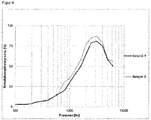
- Example 1 The sound absorption levels of Example 1, Comparative Example 2 and 3 were measured according to DIN EN ISO 10534-1, Part 1. The results are in FIG. 1 shown.
- Example 1 exhibits excellent acoustic absorption properties in the frequency range of 800 Hz to 2000 Hz, which is important for the automotive industry. At 1000 Hz, a sound absorption level of 45% was achieved, which is surprisingly high. Thus, only a value of 35% was measured at 1000 Hz in Comparative Example 2 at 1000 Hz and even only a value of 25% at 1000 Hz in the case of Comparative Example 3. Overall, in the frequency range from approximately 800 Hz to 2500 Hz, a surprisingly higher degree of sound absorption is possessed by the nonwoven composite according to the invention although the basis weight of Example 1 is lower compared to Comparative Examples 2 and 3.
- Example 1 As is known, the absorption capacity of a porous absorber is adjusted via the flow resistance in combination with the wall distance.
- the wall distances are the same for all examples, so that they can have no influence on the result. Looking at Example 1 and Comparative Example 2, it can be seen that the total flow resistances of Example 1 and Comparative Example 2 are very similar (see paragraph 3 above), so that this parameter can not be responsible for the unexpected improvement in the degree of sound absorption.
- this surprisingly higher level of sound absorption is due to a synergistic interaction between the fine fibers and the coarse fibers the carrier layer is due in combination with the flow position.
- the particular selection of fine staple fibers having a linear density from 0.3 dtex to 2.9 dtex, in particular from 0.5 dtex to 2.9 dtex, and coarse staple fibers having a denier of 3 dtex to 17 dtex in the Carrier layer allows the formation of a particularly suitable for sound absorption framework structure, which is itself able to absorb sound waves. Because the suitable selection of fine and coarse staple fibers makes it possible to provide the carrier layer with a high compressibility and a high resilience, whereby the carrier layer is optimally excited by the sound waves to vibrate and thus particularly efficient sound energy can be absorbed.
- the textile composite according to the invention acts as a flexible sheet absorber.
- Plate absorbers are highly efficient absorbers that can be precisely adjusted to the desired frequency ranges.
- the oscillating mass is realized by the mass of a foil or a thin plate.
- the suspension of the resonance system is the plate absorber in most cases, the suspension of the air cushion between the film or plate and back wall.
- the carrier layer acts as suspension.
- the following structure is preferably selected for the textile composite according to the invention: flow position - carrier layer - wall. Whereby the precisely defined very good compression and recovery properties of the carrier layer, the flow position can oscillate optimally on the carrier layer and thus additional internal losses in the spring volume, that is, within the carrier layer arise.
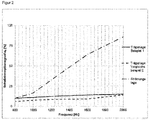
- the surprising synergistic effect of the above-described acoustic modes of action is also demonstrated by comparing the Figures 2 and 3 busy.
- the degree of sound absorption in the impedance tube (DIN EN ISO 10534) of the flow layer used in Example 1 and Comparative Example 2 according to the invention is compared with the carrier layer used in Example 1 according to the invention and with the carrier layer used in Comparative Example 2. It turns out that the carrier layers have approximately comparable sound absorption levels. While the flow situation has significantly higher levels of sound absorption. Thus, the carrier layer of Example 1 at 1000 Hz shows a sound absorption of about 11%, the carrier layer of Comparative Example 2 a sound absorption of about 8% and the flow position a sound absorption of about 23%.
- Example 1 according to the invention has significantly higher sound absorption levels than both the isolated flow position and Comparative Example 2.
- example 1 according to the invention at 1000 Hz shows a sound absorption coefficient of about 45%
- comparative example 2 a sound absorption coefficient of about 35%
- the flow position a sound absorption coefficient of about 23%.
- Example 4 fine fiber content of 80% by weight
- Example 5 fine fiber content of 50% by weight
- DSC Dynamic differential thermal analysis
- a measuring sample measuring 100 mm ⁇ 100 mm, a measuring plate having a length scale in mm, a metal plate measuring 120 mm ⁇ 120 mm and a cylindrical weight having a diameter of 55 mm and a mass of one kilogram are provided.
- the relative compressibility K r in% is:
- method A air direct current method
- the effective sample diameter is 100 mm and the air pressure corresponds to 1000 mbar.
Landscapes
- Engineering & Computer Science (AREA)
- Textile Engineering (AREA)
- Physics & Mathematics (AREA)
- Acoustics & Sound (AREA)
- Mechanical Engineering (AREA)
- Multimedia (AREA)
- Nonwoven Fabrics (AREA)
- Laminated Bodies (AREA)
- Soundproofing, Sound Blocking, And Sound Damping (AREA)
- Vehicle Interior And Exterior Ornaments, Soundproofing, And Insulation (AREA)
Claims (15)
- Composite textile absorbant le son, comprenant :a) au moins une couche support à pores ouverts, comprenant des fibres discontinues grossières ayant un titre de 3 dtex à 12 dtex en une proportion de :- 10 % en poids à 90 % en poids si la couche support ne contient pas de fibres de liaison, ou en une proportion de :- 10 % en poids à 85 % en poids si la couche support contient des fibres de liaison en tant que fibres supplémentaires, etdes fibres discontinues fines ayant un titre de 0,5 dtex à 2,5 dtex en tant que fibres structurales en une proportion de :- 10 % en poids à 90 % en poids si la couche support ne contient pas de fibres de liaison, ou en une proportion de :- 10 % en poids à 80 % en poids si la couche support contient des fibres de liaison en tant que fibres supplémentaires, etb) une couche d'écoulement microporeuse agencée sur la couche support, comprenant des microfibres ayant un diamètre de fibre inférieur à 10 µm,la résistance à l'écoulement du composite textile absorbant le son étant de 250 Ns/m3 à 5 000 Ns/m3, notamment de 250 Ns/m3 à 2 000 Ns/m3, caractérisé en ce que la couche support présente un rapport de volume entre l'air et les fibres de 75:1 à 250:1.
- Composite textile absorbant le son selon la revendication 1, caractérisé par une compressibilité de 70 % à 100 %, de manière davantage préférée de 75 % à 100 %, et notamment de 80 % à 100°, et/ou une résilience de 70 % à 100 %, de manière davantage préférée de 75 % à 100 %, et notamment de 80 % à 100 %.
- Composite textile absorbant le son selon la revendication 1 ou 2, caractérisé en ce que la couche support est un non-tissé.
- Composite textile absorbant le son selon une ou plusieurs des revendications précédentes, caractérisé en ce que la couche support contient des fibres de liaison au moins partiellement fondues, notamment des fibres noyau/enveloppe, en tant que fibres supplémentaires.
- Composite textile absorbant le son selon la revendication 1, 2 ou 3, caractérisé en ce que la couche support ne contient pas de fibres de liaison et la couche support contient les fibres discontinues grossières en une proportion de 50 % en poids à 90 % en poids, de manière davantage préférée de 60 % en poids à 90 % en poids, et notamment de 70 % en poids à 90 % en poids, à chaque fois par rapport au poids total de la couche support, ou en ce que la couche support contient des fibres de liaison en tant que fibres supplémentaires, et la proportion des fibres discontinues grossières est de 40 % en poids à 80 % en poids, de manière davantage préférée de 50 % en poids à 80 % en poids, et notamment de 60 % en poids à 80 % en poids, à chaque fois par rapport au poids total de la couche support.
- Composite textile absorbant le son selon la revendication 1, 2 ou 3, caractérisé en ce que la couche support ne contient pas de fibres de liaison et la couche support contient les fibres discontinues fines en une proportion de 10 % en poids à 50 % en poids, de manière davantage préférée de 10 % en poids à 40 % en poids, et notamment de 10 % en poids à 30 % en poids, à chaque fois par rapport au poids total de la couche support, ou en ce que la couche support contient des fibres de liaison en tant que fibres supplémentaires, et la proportion des fibres discontinues fines est de 10 % en poids à 50 % en poids, de manière davantage préférée de 10 % en poids à 40 % en poids, et notamment de 10 % en poids à 30 % en poids, à chaque fois par rapport au poids total de la couche support.
- Composite textile absorbant le son selon une ou plusieurs des revendications précédentes, caractérisé en ce que les fibres discontinues fines et grossières utilisées en tant que fibres structurales présentent indépendamment les unes des autres une longueur discontinue de 20 mm à 80 mm, de manière davantage préférée de 25 mm à 80 mm, notamment de 30 mm à 80 mm.
- Composite textile absorbant le son selon une ou plusieurs des revendications précédentes, caractérisé en ce que la couche support est liée par un liant, des polyacrylates, des polystyrènes, des polyacétates de vinyle-éthylènes, des polyuréthanes, ainsi que leurs mélanges et copolymères étant utilisés de préférence en tant que liant.
- Composite textile absorbant le son selon une ou plusieurs des revendications précédentes, caractérisé en ce que la couche support présente un rapport de volume entre l'air et les fibres de 100:1 à 225:1, notamment de 125:1 à 200:1.
- Composite textile absorbant le son selon une ou plusieurs des revendications précédentes, caractérisé en ce que la couche d'écoulement comprend des microfibres ayant un titre inférieur à 10 µm, de préférence de 0,5 µm à 5 µm, de manière encore davantage préférée de 1 µm à 3 µm, et notamment des fibres soufflées à l'état fondu.
- Composite textile absorbant le son selon une ou plusieurs des revendications précédentes, caractérisé par un degré d'absorption du son de 30 % à 100 %, de manière davantage préférée de 40 % à 100 %, de manière encore davantage préférée de 50 % à 100 %, à chaque fois à 1 000 Hz.
- Composite textile absorbant le son selon une ou plusieurs des revendications précédentes, caractérisé par un poids surfacique de 50 g/m2 à 350 g/m2, de manière davantage préférée de 100 g/m2 à 300 g/m2, et notamment de 150 g/m2 à 250 g/m2.
- Composite textile absorbant le son selon une ou plusieurs des revendications précédentes, caractérisé par une épaisseur de 5 mm à 35 mm, de manière davantage préférée de 10 mm à 30 mm, et notamment de 15 mm à 25 mm.
- Procédé de fabrication d'un composite textile ayant une résistance à l'écoulement de 250 Ns/m3 à 5 000 Ns/m3, notamment de 250 Ns/m3 à 2 000 Ns/m3, comprenant les étapes suivantes :e) la mise à disposition et/ou la fabrication d'au moins une couche support à pores ouverts comprenant des fibres discontinues grossières ayant un titre de 3 dtex à 17 dtex, et des fibres discontinues fines ayant un titre de 0,3 dtex à 2,9 dtex, notamment de 0,5 dtex à 2,9 dtex, en tant que fibres structurales, la couche support présentant un rapport de volume entre l'air et les fibres de 75:1 à 250:1 ;f) la mise à disposition et/ou la fabrication d'une couche d'écoulement microporeuse comprenant des microfibres ayant un diamètre de fibre inférieur à 10 µm ;g) l'agencement de la couche d'écoulement sur la couche support ;h) la liaison de la couche support et de la couche d'écoulement,et/ou comprenant les étapes suivantes :c') la mise à disposition et/ou la fabrication d'au moins une couche support à pores ouverts comprenant des fibres discontinues grossières ayant un titre de 3 dtex à 17 dtex, et des fibres discontinues fines ayant un titre de 0,3 dtex à 2,9 dtex, notamment de 0,5 dtex à 2,9 dtex, en tant que fibres structurales ;d') le filage d'un non-tissé soufflé à l'état fondu en tant que couche d'écoulement microporeuse comprenant des microfibres ayant un diamètre de fibre inférieur à 10 µm sur la couche support.
- Utilisation d'un composite textile absorbant le son selon une ou plusieurs des revendications 1 à 13 pour l'absorption du son dans le domaine automobile.
Priority Applications (8)
| Application Number | Priority Date | Filing Date | Title |
|---|---|---|---|
| BR102017022166-0A BR102017022166B1 (pt) | 2017-03-17 | 2017-10-16 | Compósito têxtil que absorve ruídos, processo para produção de um compósito têxtil e uso de um compósito têxtil que absorve ruídos |
| US15/803,890 US10825439B2 (en) | 2017-03-17 | 2017-11-06 | Sound-absorbing textile composite |
| CN201810216780.1A CN108621974B (zh) | 2017-03-17 | 2018-03-16 | 吸声纺织复合材料 |
| EP18162201.0A EP3375923B1 (fr) | 2017-03-17 | 2018-03-16 | Composite textile insonorisant |
| ES18162201T ES2876207T3 (es) | 2017-03-17 | 2018-03-16 | Material compuesto textil absorbente acústico |
| JP2018048854A JP6824920B2 (ja) | 2017-03-17 | 2018-03-16 | 吸音テキスタイル複合材 |
| MX2018003335A MX385039B (es) | 2017-03-17 | 2018-03-16 | Compuesto textil antiacustico. |
| KR1020180031039A KR102115163B1 (ko) | 2017-03-17 | 2018-03-16 | 흡음성 텍스타일 복합물 |
Applications Claiming Priority (2)
| Application Number | Priority Date | Filing Date | Title |
|---|---|---|---|
| DE102017002552.5A DE102017002552A1 (de) | 2017-03-17 | 2017-03-17 | Schallabsorbierendes Textilkomposit |
| EP17179635 | 2017-07-04 |
Publications (2)
| Publication Number | Publication Date |
|---|---|
| EP3246442A1 EP3246442A1 (fr) | 2017-11-22 |
| EP3246442B1 true EP3246442B1 (fr) | 2019-11-13 |
Family
ID=59366217
Family Applications (2)
| Application Number | Title | Priority Date | Filing Date |
|---|---|---|---|
| EP17179777.2A Active EP3246442B1 (fr) | 2017-03-17 | 2017-07-05 | Composite textile insonorisant |
| EP18162201.0A Active EP3375923B1 (fr) | 2017-03-17 | 2018-03-16 | Composite textile insonorisant |
Family Applications After (1)
| Application Number | Title | Priority Date | Filing Date |
|---|---|---|---|
| EP18162201.0A Active EP3375923B1 (fr) | 2017-03-17 | 2018-03-16 | Composite textile insonorisant |
Country Status (8)
| Country | Link |
|---|---|
| US (1) | US10825439B2 (fr) |
| EP (2) | EP3246442B1 (fr) |
| JP (1) | JP6824920B2 (fr) |
| KR (1) | KR102115163B1 (fr) |
| CN (1) | CN108621974B (fr) |
| BR (1) | BR102017022166B1 (fr) |
| ES (2) | ES2761887T3 (fr) |
| MX (1) | MX385039B (fr) |
Cited By (2)
| Publication number | Priority date | Publication date | Assignee | Title |
|---|---|---|---|---|
| IT202200016836A1 (it) | 2022-08-05 | 2024-02-05 | O R V Mfg S P A | Materiale fonoassorbente e metodo per realizzare tale materiale fonoassorbente |
| EP4316798A1 (fr) | 2022-08-05 | 2024-02-07 | O.R.V. Manufacturing S.p.A. | Matériau absorbant acoustique et procédé de fabrication d'un tel matériau absorbant acoustique |
Families Citing this family (11)
| Publication number | Priority date | Publication date | Assignee | Title |
|---|---|---|---|---|
| KR20200125588A (ko) * | 2018-02-22 | 2020-11-04 | 로우 앤드 보나 인코포레이티드 | 복합 방음 층 |
| CZ2018647A3 (cs) * | 2018-11-23 | 2020-06-03 | Reifenhäuser GmbH & Co. KG Maschinenfabrik | Objemná netkaná textilie se zvýšenou stlačitelností a zlepšenou schopností regenerace |
| CN109648958B (zh) * | 2018-11-28 | 2021-01-05 | 江苏优风环保科技有限公司 | 一种复合无纺织物及其制备方法和应用 |
| WO2020179753A1 (fr) * | 2019-03-07 | 2020-09-10 | 東レ株式会社 | Tissu non-tissé pour matériau absorbant acoustique ainsi que procédé de fabrication de celui-ci, et matériau absorbant acoustique |
| FR3097803B1 (fr) * | 2019-06-25 | 2021-07-16 | Treves Products Services & Innovation | Panneau de protection acoustique pour véhicule automobile |
| CN112810268B (zh) * | 2019-11-15 | 2023-08-22 | 科德宝两合公司 | 吸声纺织复合材料 |
| EP4253037B1 (fr) * | 2021-02-02 | 2024-12-11 | Toray Industries, Inc. | Corps stratifié de tissu non tissé pour matériau absorbant acoustique, et matériau absorbant acoustique |
| FR3124449A1 (fr) * | 2021-06-29 | 2022-12-30 | Treves Products, Services & Innovation | Ecran de protection acoustique et thermique pour véhicule automobile |
| US12263665B2 (en) | 2022-11-28 | 2025-04-01 | Johns Manville | Aerospace thermal acoustic fiberglass insulation useful in supporting applications |
| ES3053418T3 (en) * | 2023-04-04 | 2026-01-22 | Freudenberg Carl Kg | Sustainable sound-absorbing nonwoven |
| DE102023125511A1 (de) | 2023-09-20 | 2025-03-20 | Sandler Ag | Mehrschichtiger Schallabsorber, Verfahren zur Herstellung eines mehrschichtigen Schallabsorbers und Verwendung eines mehrschichtigen Schallabsorbers |
Family Cites Families (37)
| Publication number | Priority date | Publication date | Assignee | Title |
|---|---|---|---|---|
| GB1250479A (fr) | 1968-02-29 | 1971-10-20 | ||
| US4283457A (en) | 1979-11-05 | 1981-08-11 | Huyck Corporation | Laminate structures for acoustical applications and method of making them |
| US5298694A (en) | 1993-01-21 | 1994-03-29 | Minnesota Mining And Manufacturing Company | Acoustical insulating web |
| JPH08311759A (ja) | 1995-05-12 | 1996-11-26 | Kanebo Ltd | 内装材用不織布 |
| DE19654246B4 (de) * | 1996-12-23 | 2014-03-06 | Eldra Kunststofftechnik Gmbh | Innenausstattungsteil für Kraftfahrzeuge |
| CH693409A5 (de) * | 1998-11-12 | 2003-07-31 | Rieter Automotive Int Ag | Schallabsorbierendes Dünnschichtlaminat. |
| JP4128743B2 (ja) * | 1998-03-03 | 2008-07-30 | リーター アウトモーティブ (インターナツィオナール) アクティエン ゲゼルシャフト | 吸音性を有する薄層ラミネート |
| DE19821532A1 (de) | 1998-05-14 | 1999-11-25 | Hp Chemie Pelzer Res & Dev | Wärme- und schalldämmende Verkleidung für den Motorraum von Kraftfahrzeugen sowie ein Verfahren zu dessen Herstellung |
| US6160028A (en) * | 1998-07-17 | 2000-12-12 | The Procter & Gamble Company | Flame retardant microporous polymeric foams |
| JP3783827B2 (ja) * | 2000-01-26 | 2006-06-07 | 東洋紡績株式会社 | 掃除機用吸音不織布積層構造体 |
| JP3705419B2 (ja) * | 2000-11-27 | 2005-10-12 | 東洋紡績株式会社 | 軽量吸音材 |
| US6720098B2 (en) * | 2001-05-16 | 2004-04-13 | General Motors Corporation | Compressor arrangement for the operation of a fuel cell system |
| DE10163576B4 (de) | 2001-12-21 | 2006-07-20 | Sandler Ag | Isolations-Material |
| JP2004021246A (ja) | 2002-06-14 | 2004-01-22 | Junsei:Kk | 発泡体の粒子構造特定による吸音構造体 |
| US20050026527A1 (en) * | 2002-08-05 | 2005-02-03 | Schmidt Richard John | Nonwoven containing acoustical insulation laminate |
| EP1428656A1 (fr) * | 2002-12-09 | 2004-06-16 | Rieter Technologies A.G. | Elément d'habillage multicouche ultra-léger |
| US20060013996A1 (en) * | 2002-12-18 | 2006-01-19 | Kaneka Corporation | Laminated surface skin material and laminate for interior material |
| EP1611275A1 (fr) | 2003-03-31 | 2006-01-04 | Rieter Technologies A.G. | Materiau non-tisse a effet acoustique, destine a des elements de garniture pour vehicules |
| EP1677971A1 (fr) * | 2003-10-22 | 2006-07-12 | Auto Insulations Limited | Isolant composite |
| DE20320102U1 (de) * | 2003-12-23 | 2005-05-12 | Carcoustics Tech Center Gmbh | Mehrschichtiges, schallabsorbierendes Leichtbauteil, insbesondere für Kraftfahrzeuge |
| JP2006039379A (ja) | 2004-07-29 | 2006-02-09 | Nishikawa Rubber Co Ltd | 遮音性シート |
| JP2006047628A (ja) * | 2004-08-04 | 2006-02-16 | Toyobo Co Ltd | 吸音断熱材 |
| JP2006285086A (ja) * | 2005-04-04 | 2006-10-19 | Toyobo Co Ltd | 吸音断熱材 |
| JP2007279649A (ja) | 2006-03-14 | 2007-10-25 | Du Pont Toray Co Ltd | 吸音材 |
| US20080003907A1 (en) * | 2006-06-28 | 2008-01-03 | Samuel Keith Black | Facing Product for Vehicular Trim |
| JP3133470U (ja) * | 2007-04-27 | 2007-07-12 | 呉羽テック株式会社 | 吸音材 |
| JP2009184296A (ja) | 2008-02-08 | 2009-08-20 | Kurashiki Seni Kako Kk | 吸音材およびその製造方法 |
| US8403108B2 (en) * | 2009-06-12 | 2013-03-26 | Precision Fabrics Group, Inc. | Acoustically tunable sound absorption articles and methods of making same |
| DE202009010969U1 (de) | 2009-07-16 | 2010-12-02 | Odenwald-Chemie Gmbh | Schalldämpfelement |
| JP5760230B2 (ja) | 2010-12-27 | 2015-08-05 | 名古屋油化株式会社 | クッション性シート、吸音材及びフィルター、並びに上記クッション性シートの製造方法 |
| JP2012245925A (ja) * | 2011-05-30 | 2012-12-13 | Howa Textile Industry Co Ltd | 自動車用ボディーアンダーカバー |
| KR101289129B1 (ko) * | 2012-09-28 | 2013-07-23 | 웅진케미칼 주식회사 | 흡음성능이 우수한 흡음재 및 그 제조방법 |
| JP6761618B2 (ja) | 2013-12-23 | 2020-09-30 | 日本バイリーン株式会社 | 吸音材 |
| DE102014002232B4 (de) * | 2014-02-21 | 2019-10-02 | Carl Freudenberg Kg | Mikrofaser-Verbundvliesstoff |
| JP6486034B2 (ja) | 2014-08-26 | 2019-03-20 | 太進工業株式会社 | 複合吸音材料及びその製造方法、吸音性内装材 |
| CN105150637A (zh) * | 2015-10-09 | 2015-12-16 | 江苏工程职业技术学院 | 三明治结构的纺织废胶基纤维吸声复合材料及其制造方法 |
| JP6082145B1 (ja) * | 2016-03-24 | 2017-02-15 | 株式会社ヒロタニ | 車両用防音材及びその製造方法 |
-
2017
- 2017-07-05 EP EP17179777.2A patent/EP3246442B1/fr active Active
- 2017-07-05 ES ES17179777T patent/ES2761887T3/es active Active
- 2017-10-16 BR BR102017022166-0A patent/BR102017022166B1/pt active IP Right Grant
- 2017-11-06 US US15/803,890 patent/US10825439B2/en active Active
-
2018
- 2018-03-16 EP EP18162201.0A patent/EP3375923B1/fr active Active
- 2018-03-16 KR KR1020180031039A patent/KR102115163B1/ko active Active
- 2018-03-16 JP JP2018048854A patent/JP6824920B2/ja active Active
- 2018-03-16 MX MX2018003335A patent/MX385039B/es unknown
- 2018-03-16 ES ES18162201T patent/ES2876207T3/es active Active
- 2018-03-16 CN CN201810216780.1A patent/CN108621974B/zh active Active
Non-Patent Citations (1)
| Title |
|---|
| None * |
Cited By (3)
| Publication number | Priority date | Publication date | Assignee | Title |
|---|---|---|---|---|
| IT202200016836A1 (it) | 2022-08-05 | 2024-02-05 | O R V Mfg S P A | Materiale fonoassorbente e metodo per realizzare tale materiale fonoassorbente |
| EP4316798A1 (fr) | 2022-08-05 | 2024-02-07 | O.R.V. Manufacturing S.p.A. | Matériau absorbant acoustique et procédé de fabrication d'un tel matériau absorbant acoustique |
| US12597407B2 (en) | 2022-08-05 | 2026-04-07 | O.R.V. Manufacturing S.P.A. | Sound-absorbing material and method of making such a sound-absorbing material |
Also Published As
| Publication number | Publication date |
|---|---|
| KR20180106976A (ko) | 2018-10-01 |
| JP6824920B2 (ja) | 2021-02-03 |
| MX2018003335A (es) | 2019-09-11 |
| CN108621974B (zh) | 2021-11-23 |
| BR102017022166A2 (pt) | 2018-10-30 |
| EP3246442A1 (fr) | 2017-11-22 |
| EP3375923A1 (fr) | 2018-09-19 |
| BR102017022166B1 (pt) | 2022-11-22 |
| MX385039B (es) | 2025-03-14 |
| ES2761887T3 (es) | 2020-05-21 |
| CN108621974A (zh) | 2018-10-09 |
| ES2876207T3 (es) | 2021-11-12 |
| US10825439B2 (en) | 2020-11-03 |
| EP3375923B1 (fr) | 2021-04-28 |
| JP2018171907A (ja) | 2018-11-08 |
| US20180268800A1 (en) | 2018-09-20 |
| KR102115163B1 (ko) | 2020-05-26 |
Similar Documents
| Publication | Publication Date | Title |
|---|---|---|
| EP3375923B1 (fr) | Composite textile insonorisant | |
| DE102017002552A1 (de) | Schallabsorbierendes Textilkomposit | |
| DE69607164T2 (de) | Schalldämpfungsverfahren und schalldämmelement dafür | |
| DE69414549T2 (de) | Verfahren zur herstellung eines vliesstoffs und dadurch erhaltener vliesstoff | |
| DE69528076T2 (de) | Hochdichte faservliesfiltermedien | |
| EP0435001B1 (fr) | Laminé | |
| EP3058127B1 (fr) | Composite non-tissé volumineux et procédé de fabrication de celui-ci | |
| EP2692321B1 (fr) | Matelas d'accumulateur intermédiaire | |
| DE68913255T2 (de) | Wärmeisolierungsmaterialien aus kontinuierlichen Fäden. | |
| DE102005015550C5 (de) | Verwendung eines thermisch gebundenen Vliesstoffs | |
| DE4125250C2 (de) | Luftfiltermaterial zur Verwendung in einem Luftfilter | |
| EP1937886A1 (fr) | Tissu non tisse souple, doux et lie en certains endroits, pourvu de particules de matiere de charge, et procede de fabrication et d'utilisation dudit tissu | |
| EP1733088B1 (fr) | Non-tisse file-lie, a base de fibres polymeres et son utilisation | |
| EP3120997A1 (fr) | Non-tisse d'aerogel | |
| EP2573244B1 (fr) | Matériau d'absorption acoustique | |
| EP0910454B1 (fr) | Filtre antiparticules sous la forme d'une couche de non-tisse plisse | |
| EP4525796B1 (fr) | Pansement pour plaies | |
| EP3721965A1 (fr) | Milieu filtrant pourvu de non-tissé en tant que composite fibreux monocouche et procédé de fabrication d'un tel milieu filtrant | |
| EP3159056B1 (fr) | Milieu filtrant en polymère synthétique | |
| EP1321554B1 (fr) | Materiau d'isolation | |
| WO2006066601A1 (fr) | Piece support thermoformable | |
| DE10007556C2 (de) | Trägerkomponente für Formteile | |
| EP4008823B1 (fr) | Non-tissé gaufré pour habitacle de véhicule | |
| EP2006007B1 (fr) | Filtre à air doté d'une structure multicouche | |
| EP4442881B1 (fr) | Non-tissé durable absorbant le son |
Legal Events
| Date | Code | Title | Description |
|---|---|---|---|
| PUAI | Public reference made under article 153(3) epc to a published international application that has entered the european phase |
Free format text: ORIGINAL CODE: 0009012 |
|
| STAA | Information on the status of an ep patent application or granted ep patent |
Free format text: STATUS: REQUEST FOR EXAMINATION WAS MADE |
|
| 17P | Request for examination filed |
Effective date: 20170929 |
|
| AK | Designated contracting states |
Kind code of ref document: A1 Designated state(s): AL AT BE BG CH CY CZ DE DK EE ES FI FR GB GR HR HU IE IS IT LI LT LU LV MC MK MT NL NO PL PT RO RS SE SI SK SM TR |
|
| AX | Request for extension of the european patent |
Extension state: BA ME |
|
| RIN1 | Information on inventor provided before grant (corrected) |
Inventor name: RUTSCH, PETER Inventor name: WEIK, ANGELA Inventor name: VILLING-FALUSI, SANDRA |
|
| STAA | Information on the status of an ep patent application or granted ep patent |
Free format text: STATUS: EXAMINATION IS IN PROGRESS |
|
| 17Q | First examination report despatched |
Effective date: 20181008 |
|
| RIN1 | Information on inventor provided before grant (corrected) |
Inventor name: WEIK, ANGELA Inventor name: RUTSCH, PETER Inventor name: VILLING-FALUSI, SANDRA |
|
| GRAP | Despatch of communication of intention to grant a patent |
Free format text: ORIGINAL CODE: EPIDOSNIGR1 |
|
| STAA | Information on the status of an ep patent application or granted ep patent |
Free format text: STATUS: GRANT OF PATENT IS INTENDED |
|
| INTG | Intention to grant announced |
Effective date: 20190515 |
|
| GRAS | Grant fee paid |
Free format text: ORIGINAL CODE: EPIDOSNIGR3 |
|
| GRAA | (expected) grant |
Free format text: ORIGINAL CODE: 0009210 |
|
| STAA | Information on the status of an ep patent application or granted ep patent |
Free format text: STATUS: THE PATENT HAS BEEN GRANTED |
|
| AK | Designated contracting states |
Kind code of ref document: B1 Designated state(s): AL AT BE BG CH CY CZ DE DK EE ES FI FR GB GR HR HU IE IS IT LI LT LU LV MC MK MT NL NO PL PT RO RS SE SI SK SM TR |
|
| REG | Reference to a national code |
Ref country code: CH Ref legal event code: EP Ref country code: AT Ref legal event code: REF Ref document number: 1201754 Country of ref document: AT Kind code of ref document: T Effective date: 20191115 |
|
| REG | Reference to a national code |
Ref country code: DE Ref legal event code: R096 Ref document number: 502017002840 Country of ref document: DE |
|
| REG | Reference to a national code |
Ref country code: IE Ref legal event code: FG4D Free format text: LANGUAGE OF EP DOCUMENT: GERMAN |
|
| REG | Reference to a national code |
Ref country code: NL Ref legal event code: MP Effective date: 20191113 |
|
| REG | Reference to a national code |
Ref country code: LT Ref legal event code: MG4D |
|
| PG25 | Lapsed in a contracting state [announced via postgrant information from national office to epo] |
Ref country code: GR Free format text: LAPSE BECAUSE OF FAILURE TO SUBMIT A TRANSLATION OF THE DESCRIPTION OR TO PAY THE FEE WITHIN THE PRESCRIBED TIME-LIMIT Effective date: 20200214 Ref country code: NO Free format text: LAPSE BECAUSE OF FAILURE TO SUBMIT A TRANSLATION OF THE DESCRIPTION OR TO PAY THE FEE WITHIN THE PRESCRIBED TIME-LIMIT Effective date: 20200213 Ref country code: BG Free format text: LAPSE BECAUSE OF FAILURE TO SUBMIT A TRANSLATION OF THE DESCRIPTION OR TO PAY THE FEE WITHIN THE PRESCRIBED TIME-LIMIT Effective date: 20200213 Ref country code: PL Free format text: LAPSE BECAUSE OF FAILURE TO SUBMIT A TRANSLATION OF THE DESCRIPTION OR TO PAY THE FEE WITHIN THE PRESCRIBED TIME-LIMIT Effective date: 20191113 Ref country code: LV Free format text: LAPSE BECAUSE OF FAILURE TO SUBMIT A TRANSLATION OF THE DESCRIPTION OR TO PAY THE FEE WITHIN THE PRESCRIBED TIME-LIMIT Effective date: 20191113 Ref country code: SE Free format text: LAPSE BECAUSE OF FAILURE TO SUBMIT A TRANSLATION OF THE DESCRIPTION OR TO PAY THE FEE WITHIN THE PRESCRIBED TIME-LIMIT Effective date: 20191113 Ref country code: FI Free format text: LAPSE BECAUSE OF FAILURE TO SUBMIT A TRANSLATION OF THE DESCRIPTION OR TO PAY THE FEE WITHIN THE PRESCRIBED TIME-LIMIT Effective date: 20191113 Ref country code: PT Free format text: LAPSE BECAUSE OF FAILURE TO SUBMIT A TRANSLATION OF THE DESCRIPTION OR TO PAY THE FEE WITHIN THE PRESCRIBED TIME-LIMIT Effective date: 20200313 Ref country code: LT Free format text: LAPSE BECAUSE OF FAILURE TO SUBMIT A TRANSLATION OF THE DESCRIPTION OR TO PAY THE FEE WITHIN THE PRESCRIBED TIME-LIMIT Effective date: 20191113 Ref country code: NL Free format text: LAPSE BECAUSE OF FAILURE TO SUBMIT A TRANSLATION OF THE DESCRIPTION OR TO PAY THE FEE WITHIN THE PRESCRIBED TIME-LIMIT Effective date: 20191113 |
|
| REG | Reference to a national code |
Ref country code: ES Ref legal event code: FG2A Ref document number: 2761887 Country of ref document: ES Kind code of ref document: T3 Effective date: 20200521 |
|
| PG25 | Lapsed in a contracting state [announced via postgrant information from national office to epo] |
Ref country code: IS Free format text: LAPSE BECAUSE OF FAILURE TO SUBMIT A TRANSLATION OF THE DESCRIPTION OR TO PAY THE FEE WITHIN THE PRESCRIBED TIME-LIMIT Effective date: 20200313 Ref country code: HR Free format text: LAPSE BECAUSE OF FAILURE TO SUBMIT A TRANSLATION OF THE DESCRIPTION OR TO PAY THE FEE WITHIN THE PRESCRIBED TIME-LIMIT Effective date: 20191113 Ref country code: RS Free format text: LAPSE BECAUSE OF FAILURE TO SUBMIT A TRANSLATION OF THE DESCRIPTION OR TO PAY THE FEE WITHIN THE PRESCRIBED TIME-LIMIT Effective date: 20191113 |
|
| PG25 | Lapsed in a contracting state [announced via postgrant information from national office to epo] |
Ref country code: AL Free format text: LAPSE BECAUSE OF FAILURE TO SUBMIT A TRANSLATION OF THE DESCRIPTION OR TO PAY THE FEE WITHIN THE PRESCRIBED TIME-LIMIT Effective date: 20191113 |
|
| PG25 | Lapsed in a contracting state [announced via postgrant information from national office to epo] |
Ref country code: DK Free format text: LAPSE BECAUSE OF FAILURE TO SUBMIT A TRANSLATION OF THE DESCRIPTION OR TO PAY THE FEE WITHIN THE PRESCRIBED TIME-LIMIT Effective date: 20191113 Ref country code: RO Free format text: LAPSE BECAUSE OF FAILURE TO SUBMIT A TRANSLATION OF THE DESCRIPTION OR TO PAY THE FEE WITHIN THE PRESCRIBED TIME-LIMIT Effective date: 20191113 Ref country code: EE Free format text: LAPSE BECAUSE OF FAILURE TO SUBMIT A TRANSLATION OF THE DESCRIPTION OR TO PAY THE FEE WITHIN THE PRESCRIBED TIME-LIMIT Effective date: 20191113 |
|
| REG | Reference to a national code |
Ref country code: DE Ref legal event code: R097 Ref document number: 502017002840 Country of ref document: DE |
|
| PG25 | Lapsed in a contracting state [announced via postgrant information from national office to epo] |
Ref country code: SM Free format text: LAPSE BECAUSE OF FAILURE TO SUBMIT A TRANSLATION OF THE DESCRIPTION OR TO PAY THE FEE WITHIN THE PRESCRIBED TIME-LIMIT Effective date: 20191113 Ref country code: SK Free format text: LAPSE BECAUSE OF FAILURE TO SUBMIT A TRANSLATION OF THE DESCRIPTION OR TO PAY THE FEE WITHIN THE PRESCRIBED TIME-LIMIT Effective date: 20191113 |
|
| PLBE | No opposition filed within time limit |
Free format text: ORIGINAL CODE: 0009261 |
|
| STAA | Information on the status of an ep patent application or granted ep patent |
Free format text: STATUS: NO OPPOSITION FILED WITHIN TIME LIMIT |
|
| 26N | No opposition filed |
Effective date: 20200814 |
|
| PG25 | Lapsed in a contracting state [announced via postgrant information from national office to epo] |
Ref country code: SI Free format text: LAPSE BECAUSE OF FAILURE TO SUBMIT A TRANSLATION OF THE DESCRIPTION OR TO PAY THE FEE WITHIN THE PRESCRIBED TIME-LIMIT Effective date: 20191113 |
|
| PG25 | Lapsed in a contracting state [announced via postgrant information from national office to epo] |
Ref country code: MC Free format text: LAPSE BECAUSE OF FAILURE TO SUBMIT A TRANSLATION OF THE DESCRIPTION OR TO PAY THE FEE WITHIN THE PRESCRIBED TIME-LIMIT Effective date: 20191113 |
|
| REG | Reference to a national code |
Ref country code: CH Ref legal event code: PL |
|
| REG | Reference to a national code |
Ref country code: BE Ref legal event code: MM Effective date: 20200731 |
|
| PG25 | Lapsed in a contracting state [announced via postgrant information from national office to epo] |
Ref country code: IE Free format text: LAPSE BECAUSE OF NON-PAYMENT OF DUE FEES Effective date: 20200705 Ref country code: CH Free format text: LAPSE BECAUSE OF NON-PAYMENT OF DUE FEES Effective date: 20200731 Ref country code: LI Free format text: LAPSE BECAUSE OF NON-PAYMENT OF DUE FEES Effective date: 20200731 Ref country code: LU Free format text: LAPSE BECAUSE OF NON-PAYMENT OF DUE FEES Effective date: 20200705 |
|
| PG25 | Lapsed in a contracting state [announced via postgrant information from national office to epo] |
Ref country code: BE Free format text: LAPSE BECAUSE OF NON-PAYMENT OF DUE FEES Effective date: 20200731 |
|
| PG25 | Lapsed in a contracting state [announced via postgrant information from national office to epo] |
Ref country code: MT Free format text: LAPSE BECAUSE OF FAILURE TO SUBMIT A TRANSLATION OF THE DESCRIPTION OR TO PAY THE FEE WITHIN THE PRESCRIBED TIME-LIMIT Effective date: 20191113 Ref country code: CY Free format text: LAPSE BECAUSE OF FAILURE TO SUBMIT A TRANSLATION OF THE DESCRIPTION OR TO PAY THE FEE WITHIN THE PRESCRIBED TIME-LIMIT Effective date: 20191113 |
|
| PG25 | Lapsed in a contracting state [announced via postgrant information from national office to epo] |
Ref country code: MK Free format text: LAPSE BECAUSE OF FAILURE TO SUBMIT A TRANSLATION OF THE DESCRIPTION OR TO PAY THE FEE WITHIN THE PRESCRIBED TIME-LIMIT Effective date: 20191113 |
|
| P01 | Opt-out of the competence of the unified patent court (upc) registered |
Effective date: 20230503 |
|
| REG | Reference to a national code |
Ref country code: AT Ref legal event code: MM01 Ref document number: 1201754 Country of ref document: AT Kind code of ref document: T Effective date: 20220705 |
|
| PG25 | Lapsed in a contracting state [announced via postgrant information from national office to epo] |
Ref country code: AT Free format text: LAPSE BECAUSE OF NON-PAYMENT OF DUE FEES Effective date: 20220705 |
|
| PGFP | Annual fee paid to national office [announced via postgrant information from national office to epo] |
Ref country code: ES Payment date: 20250812 Year of fee payment: 9 |
|
| PGFP | Annual fee paid to national office [announced via postgrant information from national office to epo] |
Ref country code: DE Payment date: 20250728 Year of fee payment: 9 |
|
| PGFP | Annual fee paid to national office [announced via postgrant information from national office to epo] |
Ref country code: IT Payment date: 20250721 Year of fee payment: 9 |
|
| PGFP | Annual fee paid to national office [announced via postgrant information from national office to epo] |
Ref country code: GB Payment date: 20250722 Year of fee payment: 9 |
|
| PGFP | Annual fee paid to national office [announced via postgrant information from national office to epo] |
Ref country code: FR Payment date: 20250725 Year of fee payment: 9 |
|
| PGFP | Annual fee paid to national office [announced via postgrant information from national office to epo] |
Ref country code: CZ Payment date: 20260624 Year of fee payment: 10 Ref country code: TR Payment date: 20260617 Year of fee payment: 10 |