EP3246630A1 - Chambre de combustion tubulaire unique à vortex - Google Patents
Chambre de combustion tubulaire unique à vortex Download PDFInfo
- Publication number
- EP3246630A1 EP3246630A1 EP17166494.9A EP17166494A EP3246630A1 EP 3246630 A1 EP3246630 A1 EP 3246630A1 EP 17166494 A EP17166494 A EP 17166494A EP 3246630 A1 EP3246630 A1 EP 3246630A1
- Authority
- EP
- European Patent Office
- Prior art keywords
- combustor
- inlet
- fuel
- annulus
- liner
- Prior art date
- Legal status (The legal status is an assumption and is not a legal conclusion. Google has not performed a legal analysis and makes no representation as to the accuracy of the status listed.)
- Withdrawn
Links
- 239000000446 fuel Substances 0.000 claims abstract description 129
- 239000012530 fluid Substances 0.000 claims abstract description 49
- 238000000034 method Methods 0.000 claims description 17
- 239000007789 gas Substances 0.000 description 26
- MWUXSHHQAYIFBG-UHFFFAOYSA-N Nitric oxide Chemical compound O=[N] MWUXSHHQAYIFBG-UHFFFAOYSA-N 0.000 description 6
- 239000000203 mixture Substances 0.000 description 6
- 238000002485 combustion reaction Methods 0.000 description 5
- 238000013517 stratification Methods 0.000 description 4
- 230000008859 change Effects 0.000 description 3
- 238000002347 injection Methods 0.000 description 3
- 239000007924 injection Substances 0.000 description 3
- 230000008901 benefit Effects 0.000 description 2
- 238000010790 dilution Methods 0.000 description 2
- 239000012895 dilution Substances 0.000 description 2
- 238000004146 energy storage Methods 0.000 description 2
- VNWKTOKETHGBQD-UHFFFAOYSA-N methane Chemical compound C VNWKTOKETHGBQD-UHFFFAOYSA-N 0.000 description 2
- 230000004075 alteration Effects 0.000 description 1
- 230000015572 biosynthetic process Effects 0.000 description 1
- 238000010276 construction Methods 0.000 description 1
- 239000003344 environmental pollutant Substances 0.000 description 1
- 239000000284 extract Substances 0.000 description 1
- 239000007788 liquid Substances 0.000 description 1
- 239000003345 natural gas Substances 0.000 description 1
- 231100000719 pollutant Toxicity 0.000 description 1
- 238000010248 power generation Methods 0.000 description 1
- 230000008569 process Effects 0.000 description 1
- 230000009467 reduction Effects 0.000 description 1
- 238000006467 substitution reaction Methods 0.000 description 1
Images



Classifications
-
- F—MECHANICAL ENGINEERING; LIGHTING; HEATING; WEAPONS; BLASTING
- F23—COMBUSTION APPARATUS; COMBUSTION PROCESSES
- F23R—GENERATING COMBUSTION PRODUCTS OF HIGH PRESSURE OR HIGH VELOCITY, e.g. GAS-TURBINE COMBUSTION CHAMBERS
- F23R3/00—Continuous combustion chambers using liquid or gaseous fuel
- F23R3/02—Continuous combustion chambers using liquid or gaseous fuel characterised by the air-flow or gas-flow configuration
- F23R3/26—Controlling the air flow
-
- F—MECHANICAL ENGINEERING; LIGHTING; HEATING; WEAPONS; BLASTING
- F23—COMBUSTION APPARATUS; COMBUSTION PROCESSES
- F23R—GENERATING COMBUSTION PRODUCTS OF HIGH PRESSURE OR HIGH VELOCITY, e.g. GAS-TURBINE COMBUSTION CHAMBERS
- F23R3/00—Continuous combustion chambers using liquid or gaseous fuel
- F23R3/42—Continuous combustion chambers using liquid or gaseous fuel characterised by the arrangement or form of the flame tubes or combustion chambers
- F23R3/58—Cyclone or vortex type combustion chambers
-
- F—MECHANICAL ENGINEERING; LIGHTING; HEATING; WEAPONS; BLASTING
- F23—COMBUSTION APPARATUS; COMBUSTION PROCESSES
- F23R—GENERATING COMBUSTION PRODUCTS OF HIGH PRESSURE OR HIGH VELOCITY, e.g. GAS-TURBINE COMBUSTION CHAMBERS
- F23R3/00—Continuous combustion chambers using liquid or gaseous fuel
- F23R3/28—Continuous combustion chambers using liquid or gaseous fuel characterised by the fuel supply
- F23R3/34—Feeding into different combustion zones
-
- F—MECHANICAL ENGINEERING; LIGHTING; HEATING; WEAPONS; BLASTING
- F02—COMBUSTION ENGINES; HOT-GAS OR COMBUSTION-PRODUCT ENGINE PLANTS
- F02C—GAS-TURBINE PLANTS; AIR INTAKES FOR JET-PROPULSION PLANTS; CONTROLLING FUEL SUPPLY IN AIR-BREATHING JET-PROPULSION PLANTS
- F02C7/00—Features, components parts, details or accessories, not provided for in, or of interest apart form groups F02C1/00 - F02C6/00; Air intakes for jet-propulsion plants
- F02C7/22—Fuel supply systems
- F02C7/228—Dividing fuel between various burners
-
- F—MECHANICAL ENGINEERING; LIGHTING; HEATING; WEAPONS; BLASTING
- F23—COMBUSTION APPARATUS; COMBUSTION PROCESSES
- F23R—GENERATING COMBUSTION PRODUCTS OF HIGH PRESSURE OR HIGH VELOCITY, e.g. GAS-TURBINE COMBUSTION CHAMBERS
- F23R3/00—Continuous combustion chambers using liquid or gaseous fuel
- F23R3/28—Continuous combustion chambers using liquid or gaseous fuel characterised by the fuel supply
- F23R3/286—Continuous combustion chambers using liquid or gaseous fuel characterised by the fuel supply having fuel-air premixing devices
-
- F—MECHANICAL ENGINEERING; LIGHTING; HEATING; WEAPONS; BLASTING
- F23—COMBUSTION APPARATUS; COMBUSTION PROCESSES
- F23R—GENERATING COMBUSTION PRODUCTS OF HIGH PRESSURE OR HIGH VELOCITY, e.g. GAS-TURBINE COMBUSTION CHAMBERS
- F23R3/00—Continuous combustion chambers using liquid or gaseous fuel
- F23R3/42—Continuous combustion chambers using liquid or gaseous fuel characterised by the arrangement or form of the flame tubes or combustion chambers
- F23R3/44—Combustion chambers comprising a single tubular flame tube within a tubular casing
Definitions
- Gas turbine engines for use in power generation plants generally include a compressor, a combustor, and a turbine.
- the compressor may provide compressed air to a combustor, and the combustor may burn fuel in the presence of the compressed air to produce a hot gas.
- the hot gas may enter the turbine which expands the hot gas and extracts shaft power.
- Combustors may greatly contribute to the efficiency of a gas turbine engine. Generally, it is desirable for a combustor to produce lower emissions upon combusting fuel. It is also desirable to design a combustor that can adapt to the change of speed of inlet fluid, such as air, entering the combustor and/or change operating parameters based on the desired exhaust temperature of the hot gas that will enter the turbine of a gas turbine engine. For example, in order to control emissions and control exhaust temperature, combustors may inject a fuel into the compressed air stream at an inlet of the combustor based on the relative speed of the compressed air entering the inlet.
- inlet fluid such as air
- the metered fuel injection may allow the ratio of fuel to compressed air to be reduced, which in turn may allow for the reduction of emissions, as well as lower the exhaust temperature when the fuel is combusted.
- combustors must still provide a sufficient amount of fuel so that combustion will occur and not "flame out," while ensuring that a certain exhaust temperature is achieved. Accordingly, combustors may use a large amount of fuel to ensure proper combustion, which may result in high-level emissions, especially nitrogen oxide (NO x ) emissions. Because of this, combustors have not been able to greatly alter or throttle the exhaust temperature range of the hot gas exiting the combustor. Further, when combustors turndown from full power to an idled state, the emissions may be high during the idled state. Therefore, the combustors and gas turbine engines have had a small turndown capability while maintaining low emissions.
- NO x nitrogen oxide
- Combustors also contribute to the efficiency of Compressed Air Energy Storage (“CAES”) systems.
- CAES Compressed Air Energy Storage
- the ability for combustors to turndown from full power to an idled state greatly contributes to the efficiency of the system.
- current configurations of combustors may have difficulty achieving a large turndown range.
- Embodiments of the disclosure may provide a combustor.
- the combustor may comprise a housing that may further comprise an inner surface.
- the combustor may further comprise a liner disposed within the housing.
- the liner may include an outer surface, wherein the inner surface of the housing and the outer surface of the liner may define an inlet configured to receive an inlet fluid.
- the combustor may comprise an inlet splitter disposed in the inlet and may comprise a first face and a second face, wherein the first face and the housing define a first annulus and the second face and the liner define a second annulus.
- a fuel supply system may be circumferentially disposed about the housing and configured to selectively inject fuel into the first annulus and the second annulus.
- the fuel supply system may comprise a portion of a first fuel spoke disposed within the first annulus, and a portion of a second fuel spoke disposed within the second annulus.
- the combustor may further include a centerbody disposed radially inward within the housing of the combustor and axially spaced from an end of the combustor.
- the centerbody may comprise a plurality of struts radially extending from a central hub comprising a longitudinal axis.
- the centerbody may be configured to receive an axial flow of the inlet fluid and the fuel and may be configured to create fluid swirl.
- Embodiments of the disclosure may further provide a combustor.
- the combustor may comprise a housing comprising an inner surface and a liner disposed therein and comprising an outer surface that define an inlet configured to receive an inlet fluid.
- An inlet splitter may be disposed within the inlet, and the inlet splitter may be configured to divide the inlet into a first annulus and a second annulus.
- a fuel supply system may be circumferentially disposed about the housing of the combustor and may be configured to selectively inject fuel into the first and the second annulus.
- the combustor may further include a combustor can positioned downstream of the inlet and defined by an inner surface of the liner. The combustor can may be fluidly coupled to the inlet and configured to combust the fuel mixed with the inlet fluid to produce a hot gas.
- Embodiments of the disclosure may further provide a method of operating a combustor.
- the method may comprise positioning an inlet splitter within an inlet of the combustor, the inlet defined by an inner surface of a housing of the combustor and an outer surface of a liner positioned therein.
- the inlet splitter may divide the inlet of the combustor into a first annulus and a second annulus.
- the method may further include receiving an inlet fluid into the first annulus and the second annulus, and selectively injecting fuel into the first annulus.
- the method may include swirling the flow of inlet fluid and the fuel by a centerbody positioned downstream of the inlet.
- the centerbody may comprise struts radially positioned about a central hub.
- the method may further include combusting the fuel mixed with the inlet fluid in a combustor can to produce a hot gas at a desired exhaust temperature, the combustor can defined by an inner surface of the liner and axially positioned downstream of the centerbody.
- first and second features are formed in direct contact
- additional features may be formed interposing the first and second features, such that the first and second features may not be in direct contact.
- exemplary embodiments presented below may be combined in any combination of ways, i.e ., any element from one exemplary embodiment may be used in any other exemplary embodiment, without departing from the scope of the disclosure.
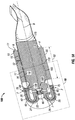
- FIG. 1A shows a partially sectioned perspective view of a combustor 100 for use in a gas turbine engine or in a compressed air energy storage (“CAES") system, according to one or more embodiments disclosed herein.
- the combustor 100 may receive an inlet fluid, such as compressed air A, from a compressor (not shown) of the gas turbine engine or CAES system.
- the combustor 100 may introduce a fuel F into the inlet fluid A and combust the fuel to produce a hot gas, which in turn exits the combustor 100 and enters a turbine (not shown) of the gas turbine engine.
- the combustor 100 may introduce natural gas, syngas, or other types of gaseous or liquid fuels into the inlet fluid A.
- the combustor 100 may include a generally cylindrical housing 10 that extends along a longitudinal axis 9 from a first end 5 of the combustor 100 to a second end 7 of the combustor.
- the housing 10 may include an inner surface 11.
- a liner 15 may be disposed within the housing 10 of the combustor, and may include an outer surface 16 and an inner surface 18.
- the inner surface 11 of the housing 10 and the outer surface 16 of the liner 15 may define an inlet 20 of the combustor 100, which is configured to receive the inlet fluid from the compressor or CAES system.
- the liner 15 may include a substantially straight portion 17 that is positioned at a width 12 from the housing 10.
- the liner 15 may also include a curved portion 22 that is configured to reverse the axial flow of fluid through the inlet 20 of the combustor 100.
- the curved portion 22 of the liner may be disposed adjacent the second end 7 of the combustor 100. While the inlet 20 may extend from the first end 5 of the combustor 100 to the second end 7 of the combustor, following the curved portion 22 of the liner 15, the inlet 20 may continue until the liner 15 reaches a centerbody 90, as will be discussed herein.
- the combustor 100 may include alternative combustor types such as an axial inflow-type combustor, can-type combustor, or an annular combustor where fluid flow is not reversed.
- An inlet splitter 25 may be disposed within the inlet 20 between the housing 10 and the liner 15, and may include a first face 30 and a second face 35.
- the inlet splitter 25 may be positioned to divide the inlet 20 into a first annulus 40 and a second annulus 45, wherein the first annulus 40 is defined as the area between the first face 30 of the inlet splitter 25 and the housing 10 of the combustor 100, and the second annulus 45 is defined as the area between the second face 35 of the inlet splitter 25 and the liner 15 of the combustor.
- Figure 1B illustrates an enlarged view of a portion 1B of the combustor 100, which more clearly shows a view of the inlet splitter 25, according to one or more embodiments.
- the inlet splitter 25 may be disposed within the inlet 20 of the combustor 100 at a first distance 50 from the housing 10, and a second distance 55 from the liner 15.
- the first distance 50 may be equal to the second distance 55, and the first annulus 40 and the second annulus 45 may have approximately the same cross-sectional area.
- the first distance 50 may be different from the second distance 55, where the first annulus 40 and the second annulus 45 have a different cross-sectional area.
- the first distance 50 of the inlet splitter 25 from the housing 10 may be equal to forty percent of the width 12 of the inlet 20, and the second distance 55 may be equal to sixty percent of the width 12 of the inlet 20.
- first and second distances 50, 55 of the inlet splitter 25 from the housing 10 and liner 15, respectively are contemplated. It is further contemplated that the first and second distances 50, 55 of the inlet splitter 25 may change along the longitudinal axis 9 of the combustor 100.
- the inlet splitter 25 may include a first end 60 and a second end 65 that is disposed within the inlet 20 of the combustor 100.
- the first end 60 of the inlet splitter may be axially disposed at a distance 62 from the first end 5 of the combustor.
- the first end 60 of the inlet splitter 25 and the first end 5 of the combustor 100 may be the same.
- the inlet splitter 25 may include a straight portion 26 and a curved portion 27 which mirrors the straight portion 17 and the curved portion 22 of the liner 15 of the combustor 100.
- the curved portion 27 of the inlet splitter 25 may cause the axial flow of fluid traveling through the inlet 20 (and the first annulus 40 and the second annulus 45) to be reversed.
- the fluid may have an axial flow in a first direction
- the fluid may have an axial flow in a second direction, which is opposite from the first direction.
- the inlet splitter 25 may not include a curved portion 22 and reverse the direction of the fluid flow.
- the inlet splitter 25 may extend along the length of the liner 15, as shown, until the inlet 20, and the second end 65 of the inlet splitter 25 reaches the centerbody 90 of the combustor 100. It is also contemplated that the inlet splitter 25 may terminate at a distance before reaching the centerbody 90, or proceed into the centerbody 90.
- a fuel supply system 70 may be circumferentially disposed about the housing 10 of the combustor 100, and may be configured to inject fuel (F) into the inlet 20 of the combustor 100.
- the fuel supply system 70 may be configured to selectively inject the fuel into the first annulus 40 and the second annulus 45 of the inlet 20.
- the fuel supply system 70 may include a first fuel spoke 75 that extends into the first annulus 40, and a second fuel spoke 80 that extends into both the first annulus 40 and the second annulus 45.
- the second fuel spoke 80 may extend into only the second annulus 45.
- the first fuel spoke 75 and the second fuel spoke 80 may provide a flowpath that allows the fuel to be injected into the first and second annuli 40, 45.
- the fuel supply system 70 may be configured to selectively inject an amount of the fuel into the first and second annuli 40, 45 based on the rate of inlet fluid entering the inlet 20 of the combustor 100.
- the fuel supply system 70 may also be configured to selectively inject an amount of the fuel into the first and second annuli 40, 45 based on the desired exhaust temperature of the hot gas to be produced by the combustor 100.
- the fuel supply system 70 may include a plurality of first fuel spokes 75 A-E and a plurality of second fuel spokes 80 A-F that are circumferentially disposed about the inlet splitter 25.
- the first fuel spokes 75 A-E may extend solely into the first annulus 40, while the second fuel spokes 80 A-F may extend into both the first and second annuli 40, 45.
- a plurality of fuel injection holes 85 may be disposed along or about the first fuel spokes 75 A-E and the second fuel spokes 80 A-F, and the fuel injection holes 85 may be through holes that are configured to allow the fuel to be injected into the first and/or second annuli 40, 45.
- the fuel supply system 70 may be configured to inject the fuel into only the first annulus 40 by injecting the fuel into only the first fuel spokes 75 A-E.
- the fuel system 70 only injects the fuel into the first annulus 40, stratification between premix fuel (fuel mixed with inlet fluid) and the inlet fluid occurs.
- the stratification of the combustor 100 fluids creates smaller regions of flammable mixture within the combustor 100. Accordingly, when the smaller regions of flammable mixture are combusted in the combustor 100 producing a hot gas, the exhaust temperature of the hot gas is reduced, and the amount of emissions is reduced.
- the fuel supply system 70 may be configured to inject the fuel into both the first annulus 40 and the second annulus 45 by injecting the fuel into the second fuel spokes 80 A-F or both the first and the second fuel spokes 75 A-E, 80 A-F.
- the first and the second annuli 40, 45 contain premix fuel, thereby resulting in a large region of flammable mixture within the combustor 100.
- the large region of flammable mixture produces hot gas with a greater exhaust temperature. Therefore, the combustor 100 has the ability to easily throttle between high and low exhaust temperatures by selectively injecting the fuel into the first or the second annulus 40,45.
- combustor inflow stratification could be accomplished in a variety of ways.
- a plurality of inlet splitters 25 may be disposed within the inlet 20, thereby creating more than two annuli within the combustor inlet 20.
- the fuel supply system 70 may include fuel spokes circumferentially disposed about the inlet splitters 25 and configured to selectively inject the fuel into any combination of annuli.
- the fuel supply system 70 may inject into the first annulus 40 only, thereby creating premix in the first annulus 40 only, it is also contemplated that the fuel supply system 70 may be configured to solely inject into the second annulus 45, thereby creating premix in the second annulus 45 only.
- the premix fuel and/or the inlet fluid may flow toward the centerbody 90, as shown in Figures 1A and 1B .
- the centerbody 90 may be disposed radially inward from the housing 10 of the combustor 100 and may be positioned at an end of the inlet 20 and at the second end 65 of the inlet splitter 25.
- the centerbody 90 may be disposed adjacent to the second end 7 of the combustor 100.
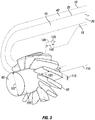
- FIG 3 shows a perspective view of the centerbody 90, according to one or more embodiments disclosed herein.
- the centerbody 90 may include a central hub 105 with a longitudinal axis 110 and a diameter 107.
- the longitudinal axis 110 of the centerbody 90 may be aligned with the longitudinal axis 9 (shown in Figure 1A ) of the combustor 100.
- the centerbody 90 may include a plurality of struts 95 that radially extend from the central hub 105.
- the struts 95 may extend into the inlet 20 of the combustor 100, and the struts 95 may have a thickness 115 and a length 120, and may be positioned at an angle ⁇ from the longitudinal axis 110 of the central hub 105.
- the struts 95 may include a significant thickness 115 at a trailing edge of the struts 95 that is unlike typical airfoil shapes used in swirl stabilized combustors to facilitate such swirl.
- the thickness 115 of the struts 95 may be between 0.25 inches and 0.75 inches or greater, depending on the size of the combustor 100.
- the angle ⁇ of the struts may be between about zero and about sixty-five degrees relative to the longitudinal axis 110.
- the struts 95 may extend partially into the inlet 20, and in another embodiment, the struts 95 may extend radially from the central hub 105 to the liner 15 of the inlet 20.
- the centerbody 90 may not include a central hub 105 and instead may include struts 95 that radially extend from the inner surface 18 of the liner 15 towards the centerline or the longitudinal axis 110 of the combustor 100.
- the fluids flowing through the centerbody 90 may exit the centerbody 90 with a swirling flow pattern.
- the premix fuel After the premix fuel exits the centerbody 90, the premix fuel enters a cavity 130 that is disposed within the housing 10 and disposed radially inward from the inner surface 18 of the liner 15 of the combustor 100.
- the cavity 130 may be fluidly coupled to the inlet 20.
- a portion of the inner surface 18 of the liner 15 may form an outer cavity wall 135 that defines the cavity 130, as shown in Figure 1B .
- the cavity 130 may include a diameter 140 and have a cavity length 145.
- the cavity 130 may further include a first cavity wall 150 and a second cavity wall 155 defined by the liner 15.
- the first cavity wall 150 may include a width 152, and the second cavity wall 155 may include a width 157.
- the width 157 of the second cavity wall 155 may be equal to 0.73 multiplied by first cavity wall width 152. In another embodiment the first and second cavity wall may be equal.
- the cavity 130 may be a ring area disposed radially inward from the inner surface of the liner 15 of the combustor and disposed downstream from the centerbody 90. In such embodiment, an outer diameter of the ring area is defined by the outer cavity wall 135, an inner diameter of the ring area is positioned at about the width 152 from the outer cavity wall 135, and the ring area has a thickness of the cavity length 145.
- a secondary fuel supply system 137 may include a plurality of orifices 138 that may be circumferentially disposed about the combustor 100, and more specifically about the housing 10 and the liner 15.
- the secondary fuel system 137 may inject fuel or premix fuel into the cavity 130 and may further include an ignitor to combust the premix fuel within the cavity 130.
- the cavity 130 may further act as a vortex pilot region, and may provide a stable shielded premixed pilot flame zone that enhances the operating limits of the main flow of the combustor 100 in comparison to a swirl stabilized only combustor.
- the premix fuel may enter the cavity 130 with smaller regions of flammable mixture (the stratified portion with premix fuel), which further stabilizes the premixed pilot flame zone to enhance the operating limits of the combustor 100.
- the potential smaller regions of flammable mixture entering into the centerbody 90 and the cavity 130 may result in lower combustor 100 exhaust temperature and lower the amount of pollutant emissions.
- the cavity length 145 may be varied based on the angle ⁇ of the struts 95, which are shown in Figure 3 .
- the length multiplier may be a value between 0.42 and 0.59.
- the premix fuel may enter into a neck region 160 defined by the liner 15.
- the neck region 160 may have a neck diameter 162 approximately equal to the cavity diameter 140 minus two multiplied by the width 157 of the second cavity wall 155.
- the premix fuel may enter a combustor can 165 defined by the inner surface 18 of the liner 15.
- the combustor can 165 may include a combustor can diameter 167.
- the combustor can 165 may be configured to combust the premix fuel thereby producing a hot gas for use in the turbine of the gas turbine engine.
- the combustor can 165 may include one or more dilution holes 170 disposed circumferentially about the liner 15, as shown in Figure 1A , which may be axially positioned downstream from the area of combustion within the combustor can 165.
- the dilution holes 170 may allow inlet fluid from the inlet 20 of the combustor 100 to enter the combustor can 165 post-combustion in order to reduce the exhaust temperature of the hot gas. After combustion, the hot gas may exit a combustor outlet 175.
- the method 200 may include positioning an inlet splitter 25 within an inlet 20 of the combustor, thereby dividing the inlet 20 of the combustor 100 into a first annulus 40 and a second annulus 45, as at 210.
- the method 200 may include receiving an inlet fluid into the inlet 20 and into the first annulus 40 and the second annulus 45, as at 220.
- the method 200 may include selectively injecting fuel into the first annulus 40 and the second annulus by a fuel system 70, as at 230.
- the fuel system 70 may adjust the amount of fuel provided to the first annulus 40 and the second annulus 45 based on a rate of inlet fluid received into the first annulus 40 and the second annulus 45, as at 240.
- the fuel system 70 may also adjust the amount of fuel provided to the first annulus 40 and the second annulus 45 based on a desired exhaust temperature of hot gas to exit the combustor 100, as at 250.
- the method 200 may further include swirling the inlet fluid and the fuel by a centerbody 90 positioned downstream of the inlet 20, as at 260.
- a plurality of struts 95 radially positioned about a central hub 105 of the centerbody 90 may be positioned at an angle between zero and sixty-five degrees relative to a longitudinal axis 110 of the central hub 105, as in 270.
- the method 200 may include receiving the swirled inlet fluid and fuel into a cavity 130, which is fluidly coupled with the inlet 20, as at 280.
- the method 200 may further include combusting the inlet fluid mixed with fuel in a combustor can 165 positioned downstream of the cavity 130, which thereby produces a hot gas for use by a turbine or a CAES system, as at 290.
Landscapes
- Engineering & Computer Science (AREA)
- Chemical & Material Sciences (AREA)
- Combustion & Propulsion (AREA)
- Mechanical Engineering (AREA)
- General Engineering & Computer Science (AREA)
Applications Claiming Priority (2)
| Application Number | Priority Date | Filing Date | Title |
|---|---|---|---|
| US201662323910P | 2016-04-18 | 2016-04-18 | |
| US15/478,257 US20170299189A1 (en) | 2016-04-18 | 2017-04-04 | Single can vortex combustor |
Publications (1)
| Publication Number | Publication Date |
|---|---|
| EP3246630A1 true EP3246630A1 (fr) | 2017-11-22 |
Family
ID=60038709
Family Applications (1)
| Application Number | Title | Priority Date | Filing Date |
|---|---|---|---|
| EP17166494.9A Withdrawn EP3246630A1 (fr) | 2016-04-18 | 2017-04-13 | Chambre de combustion tubulaire unique à vortex |
Country Status (3)
| Country | Link |
|---|---|
| US (1) | US20170299189A1 (fr) |
| EP (1) | EP3246630A1 (fr) |
| CN (1) | CN107305020A (fr) |
Families Citing this family (1)
| Publication number | Priority date | Publication date | Assignee | Title |
|---|---|---|---|---|
| FR3099547B1 (fr) * | 2019-07-29 | 2021-10-08 | Safran Aircraft Engines | Nez d'injecteur de carburant pour turbomachine comprenant une chambre de mise en rotation intérieurement délimitée par un pion |
Citations (6)
| Publication number | Priority date | Publication date | Assignee | Title |
|---|---|---|---|---|
| US4112676A (en) * | 1977-04-05 | 1978-09-12 | Westinghouse Electric Corp. | Hybrid combustor with staged injection of pre-mixed fuel |
| EP1010945A2 (fr) * | 1998-12-18 | 2000-06-21 | General Electric Company | Dispositif d'injection de carburant pour chambres de combustion de turbines à gaz |
| EP1371906A2 (fr) * | 2002-06-11 | 2003-12-17 | General Electric Company | Chemise tubulaire de chambre de combustion de turbine à gaz avec cavité pour la création de vortex piégés |
| JP2004077076A (ja) * | 2002-08-21 | 2004-03-11 | Mitsubishi Heavy Ind Ltd | 燃料供給機構 |
| US20100077759A1 (en) * | 2008-09-30 | 2010-04-01 | Arjun Singh | Tubular Fuel Injector for Secondary Fuel Nozzle |
| CN104315541A (zh) * | 2014-09-26 | 2015-01-28 | 北京华清燃气轮机与煤气化联合循环工程技术有限公司 | 燃烧室值班级喷嘴及使用该喷嘴的方法 |
Family Cites Families (4)
| Publication number | Priority date | Publication date | Assignee | Title |
|---|---|---|---|---|
| US5966937A (en) * | 1997-10-09 | 1999-10-19 | United Technologies Corporation | Radial inlet swirler with twisted vanes for fuel injector |
| US6935116B2 (en) * | 2003-04-28 | 2005-08-30 | Power Systems Mfg., Llc | Flamesheet combustor |
| CN101334175B (zh) * | 2008-07-28 | 2011-05-11 | 华北电力大学 | 实现高氢燃气轮机低NOx排放的方法和装置 |
| US9631815B2 (en) * | 2012-12-28 | 2017-04-25 | General Electric Company | System and method for a turbine combustor |
-
2017
- 2017-04-04 US US15/478,257 patent/US20170299189A1/en not_active Abandoned
- 2017-04-13 EP EP17166494.9A patent/EP3246630A1/fr not_active Withdrawn
- 2017-04-17 CN CN201710248514.2A patent/CN107305020A/zh active Pending
Patent Citations (6)
| Publication number | Priority date | Publication date | Assignee | Title |
|---|---|---|---|---|
| US4112676A (en) * | 1977-04-05 | 1978-09-12 | Westinghouse Electric Corp. | Hybrid combustor with staged injection of pre-mixed fuel |
| EP1010945A2 (fr) * | 1998-12-18 | 2000-06-21 | General Electric Company | Dispositif d'injection de carburant pour chambres de combustion de turbines à gaz |
| EP1371906A2 (fr) * | 2002-06-11 | 2003-12-17 | General Electric Company | Chemise tubulaire de chambre de combustion de turbine à gaz avec cavité pour la création de vortex piégés |
| JP2004077076A (ja) * | 2002-08-21 | 2004-03-11 | Mitsubishi Heavy Ind Ltd | 燃料供給機構 |
| US20100077759A1 (en) * | 2008-09-30 | 2010-04-01 | Arjun Singh | Tubular Fuel Injector for Secondary Fuel Nozzle |
| CN104315541A (zh) * | 2014-09-26 | 2015-01-28 | 北京华清燃气轮机与煤气化联合循环工程技术有限公司 | 燃烧室值班级喷嘴及使用该喷嘴的方法 |
Also Published As
| Publication number | Publication date |
|---|---|
| CN107305020A (zh) | 2017-10-31 |
| US20170299189A1 (en) | 2017-10-19 |
Similar Documents
| Publication | Publication Date | Title |
|---|---|---|
| JP6335903B2 (ja) | 火炎シート燃焼器ドーム | |
| EP1400753B1 (fr) | Brûleur de prémélange de turbine à gaz résistant au retour de flamme | |
| EP2815184B1 (fr) | Brûleur | |
| US8024932B1 (en) | System and method for a combustor nozzle | |
| EP2530382A2 (fr) | Injecteur de combustible | |
| JP2009133599A (ja) | 燃焼システム内における逆火/保炎を減少させるのを可能にする方法及びシステム | |
| JP2006300448A (ja) | ガスタービンの燃焼器 | |
| JP2009052877A (ja) | 半径方向の多段流路を備えたガスタービン予混合器及びガスタービンにおける空気とガスの混合方法 | |
| JP3903195B2 (ja) | 燃料ノズル | |
| EP3376109B1 (fr) | Buse à combustible bicombustible avec une extrémité injectant du combustible liquide | |
| EP3535528B1 (fr) | Procédé d'optimisation de buses de carburant de prémélange pour une turbine à gaz | |
| CN105940264B (zh) | 燃烧装置 | |
| US10823420B2 (en) | Pilot nozzle with inline premixing | |
| EP2730846A2 (fr) | Injecteur de carburant | |
| EP3535529B1 (fr) | Tube de combustion pour turbine à gaz et chambre de combustion | |
| US8596074B2 (en) | Gas turbine combustor | |
| US8881531B2 (en) | Gas turbine engine premix injectors | |
| US8596071B2 (en) | Method and apparatus for assembling a gas turbine engine | |
| JP6417620B2 (ja) | 燃焼器、ガスタービン | |
| JP2001254947A (ja) | ガスタービン燃焼器 | |
| EP3246630A1 (fr) | Chambre de combustion tubulaire unique à vortex | |
| JPH06101815A (ja) | 予混合燃焼用バーナ及び燃焼器 | |
| EP1852657A1 (fr) | Soupape d injection de carburant, chambre de combustion utilisant ladite soupape, et procede d injection de carburant pour ladite soupape | |
| JP5821553B2 (ja) | RQL方式の低NOx燃焼器 | |
| JP5991025B2 (ja) | バーナ及びガスタービン燃焼器 |
Legal Events
| Date | Code | Title | Description |
|---|---|---|---|
| PUAI | Public reference made under article 153(3) epc to a published international application that has entered the european phase |
Free format text: ORIGINAL CODE: 0009012 |
|
| STAA | Information on the status of an ep patent application or granted ep patent |
Free format text: STATUS: THE APPLICATION HAS BEEN PUBLISHED |
|
| AK | Designated contracting states |
Kind code of ref document: A1 Designated state(s): AL AT BE BG CH CY CZ DE DK EE ES FI FR GB GR HR HU IE IS IT LI LT LU LV MC MK MT NL NO PL PT RO RS SE SI SK SM TR |
|
| AX | Request for extension of the european patent |
Extension state: BA ME |
|
| STAA | Information on the status of an ep patent application or granted ep patent |
Free format text: STATUS: REQUEST FOR EXAMINATION WAS MADE |
|
| 17P | Request for examination filed |
Effective date: 20180516 |
|
| RBV | Designated contracting states (corrected) |
Designated state(s): AL AT BE BG CH CY CZ DE DK EE ES FI FR GB GR HR HU IE IS IT LI LT LU LV MC MK MT NL NO PL PT RO RS SE SI SK SM TR |
|
| STAA | Information on the status of an ep patent application or granted ep patent |
Free format text: STATUS: EXAMINATION IS IN PROGRESS |
|
| 17Q | First examination report despatched |
Effective date: 20180705 |
|
| GRAP | Despatch of communication of intention to grant a patent |
Free format text: ORIGINAL CODE: EPIDOSNIGR1 |
|
| STAA | Information on the status of an ep patent application or granted ep patent |
Free format text: STATUS: GRANT OF PATENT IS INTENDED |
|
| INTG | Intention to grant announced |
Effective date: 20190219 |
|
| STAA | Information on the status of an ep patent application or granted ep patent |
Free format text: STATUS: THE APPLICATION IS DEEMED TO BE WITHDRAWN |
|
| 18D | Application deemed to be withdrawn |
Effective date: 20190702 |