EP3247742B1 - Masses de formages ignifuges, contenant un co-condensat séquencé de polycarbonate contenant du siloxane - Google Patents
Masses de formages ignifuges, contenant un co-condensat séquencé de polycarbonate contenant du siloxane Download PDFInfo
- Publication number
- EP3247742B1 EP3247742B1 EP16700838.2A EP16700838A EP3247742B1 EP 3247742 B1 EP3247742 B1 EP 3247742B1 EP 16700838 A EP16700838 A EP 16700838A EP 3247742 B1 EP3247742 B1 EP 3247742B1
- Authority
- EP
- European Patent Office
- Prior art keywords
- weight
- moulding compositions
- bis
- compositions according
- component
- Prior art date
- Legal status (The legal status is an assumption and is not a legal conclusion. Google has not performed a legal analysis and makes no representation as to the accuracy of the status listed.)
- Active
Links
Images
Classifications
-
- C—CHEMISTRY; METALLURGY
- C08—ORGANIC MACROMOLECULAR COMPOUNDS; THEIR PREPARATION OR CHEMICAL WORKING-UP; COMPOSITIONS BASED THEREON
- C08L—COMPOSITIONS OF MACROMOLECULAR COMPOUNDS
- C08L83/00—Compositions of macromolecular compounds obtained by reactions forming in the main chain of the macromolecule a linkage containing silicon with or without sulfur, nitrogen, oxygen or carbon only; Compositions of derivatives of such polymers
- C08L83/10—Block- or graft-copolymers containing polysiloxane sequences
-
- C—CHEMISTRY; METALLURGY
- C08—ORGANIC MACROMOLECULAR COMPOUNDS; THEIR PREPARATION OR CHEMICAL WORKING-UP; COMPOSITIONS BASED THEREON
- C08G—MACROMOLECULAR COMPOUNDS OBTAINED OTHERWISE THAN BY REACTIONS ONLY INVOLVING UNSATURATED CARBON-TO-CARBON BONDS
- C08G64/00—Macromolecular compounds obtained by reactions forming a carbonic ester link in the main chain of the macromolecule
- C08G64/18—Block or graft polymers
- C08G64/186—Block or graft polymers containing polysiloxane sequences
-
- C—CHEMISTRY; METALLURGY
- C08—ORGANIC MACROMOLECULAR COMPOUNDS; THEIR PREPARATION OR CHEMICAL WORKING-UP; COMPOSITIONS BASED THEREON
- C08K—Use of inorganic or non-macromolecular organic substances as compounding ingredients
- C08K5/00—Use of organic ingredients
- C08K5/0008—Organic ingredients according to more than one of the "one dot" groups of C08K5/01 - C08K5/59
- C08K5/0041—Optical brightening agents, organic pigments
-
- C—CHEMISTRY; METALLURGY
- C08—ORGANIC MACROMOLECULAR COMPOUNDS; THEIR PREPARATION OR CHEMICAL WORKING-UP; COMPOSITIONS BASED THEREON
- C08K—Use of inorganic or non-macromolecular organic substances as compounding ingredients
- C08K5/00—Use of organic ingredients
- C08K5/02—Halogenated hydrocarbons
-
- C—CHEMISTRY; METALLURGY
- C08—ORGANIC MACROMOLECULAR COMPOUNDS; THEIR PREPARATION OR CHEMICAL WORKING-UP; COMPOSITIONS BASED THEREON
- C08K—Use of inorganic or non-macromolecular organic substances as compounding ingredients
- C08K5/00—Use of organic ingredients
- C08K5/36—Sulfur-, selenium-, or tellurium-containing compounds
- C08K5/41—Compounds containing sulfur bound to oxygen
- C08K5/42—Sulfonic acids; Derivatives thereof
-
- C—CHEMISTRY; METALLURGY
- C08—ORGANIC MACROMOLECULAR COMPOUNDS; THEIR PREPARATION OR CHEMICAL WORKING-UP; COMPOSITIONS BASED THEREON
- C08L—COMPOSITIONS OF MACROMOLECULAR COMPOUNDS
- C08L27/00—Compositions of homopolymers or copolymers of compounds having one or more unsaturated aliphatic radicals, each having only one carbon-to-carbon double bond, and at least one being terminated by a halogen; Compositions of derivatives of such polymers
- C08L27/02—Compositions of homopolymers or copolymers of compounds having one or more unsaturated aliphatic radicals, each having only one carbon-to-carbon double bond, and at least one being terminated by a halogen; Compositions of derivatives of such polymers not modified by chemical after-treatment
- C08L27/12—Compositions of homopolymers or copolymers of compounds having one or more unsaturated aliphatic radicals, each having only one carbon-to-carbon double bond, and at least one being terminated by a halogen; Compositions of derivatives of such polymers not modified by chemical after-treatment containing fluorine atoms
- C08L27/18—Homopolymers or copolymers or tetrafluoroethene
-
- C—CHEMISTRY; METALLURGY
- C08—ORGANIC MACROMOLECULAR COMPOUNDS; THEIR PREPARATION OR CHEMICAL WORKING-UP; COMPOSITIONS BASED THEREON
- C08L—COMPOSITIONS OF MACROMOLECULAR COMPOUNDS
- C08L69/00—Compositions of polycarbonates; Compositions of derivatives of polycarbonates
-
- C—CHEMISTRY; METALLURGY
- C08—ORGANIC MACROMOLECULAR COMPOUNDS; THEIR PREPARATION OR CHEMICAL WORKING-UP; COMPOSITIONS BASED THEREON
- C08G—MACROMOLECULAR COMPOUNDS OBTAINED OTHERWISE THAN BY REACTIONS ONLY INVOLVING UNSATURATED CARBON-TO-CARBON BONDS
- C08G77/00—Macromolecular compounds obtained by reactions forming a linkage containing silicon with or without sulfur, nitrogen, oxygen or carbon in the main chain of the macromolecule
- C08G77/42—Block-or graft-polymers containing polysiloxane sequences
- C08G77/448—Block-or graft-polymers containing polysiloxane sequences containing polycarbonate sequences
-
- C—CHEMISTRY; METALLURGY
- C08—ORGANIC MACROMOLECULAR COMPOUNDS; THEIR PREPARATION OR CHEMICAL WORKING-UP; COMPOSITIONS BASED THEREON
- C08K—Use of inorganic or non-macromolecular organic substances as compounding ingredients
- C08K3/00—Use of inorganic substances as compounding ingredients
- C08K3/18—Oxygen-containing compounds, e.g. metal carbonyls
- C08K3/20—Oxides; Hydroxides
- C08K3/22—Oxides; Hydroxides of metals
- C08K2003/2237—Oxides; Hydroxides of metals of titanium
-
- C—CHEMISTRY; METALLURGY
- C08—ORGANIC MACROMOLECULAR COMPOUNDS; THEIR PREPARATION OR CHEMICAL WORKING-UP; COMPOSITIONS BASED THEREON
- C08K—Use of inorganic or non-macromolecular organic substances as compounding ingredients
- C08K3/00—Use of inorganic substances as compounding ingredients
- C08K3/18—Oxygen-containing compounds, e.g. metal carbonyls
- C08K3/20—Oxides; Hydroxides
- C08K3/22—Oxides; Hydroxides of metals
- C08K2003/2237—Oxides; Hydroxides of metals of titanium
- C08K2003/2241—Titanium dioxide
-
- C—CHEMISTRY; METALLURGY
- C08—ORGANIC MACROMOLECULAR COMPOUNDS; THEIR PREPARATION OR CHEMICAL WORKING-UP; COMPOSITIONS BASED THEREON
- C08L—COMPOSITIONS OF MACROMOLECULAR COMPOUNDS
- C08L2201/00—Properties
- C08L2201/02—Flame or fire retardant/resistant
-
- C—CHEMISTRY; METALLURGY
- C08—ORGANIC MACROMOLECULAR COMPOUNDS; THEIR PREPARATION OR CHEMICAL WORKING-UP; COMPOSITIONS BASED THEREON
- C08L—COMPOSITIONS OF MACROMOLECULAR COMPOUNDS
- C08L2207/00—Properties characterising the ingredient of the composition
- C08L2207/53—Core-shell polymer
Definitions
- the present invention relates to flame-retardant molding compositions containing siloxane-containing polycarbonate block cocondensate and a process for the production of such molding compositions.
- the invention also relates to the use of these flame-retardant molding compositions in injection molding and extrusion applications.
- polysiloxane-polycarbonate block co-condensates have good properties in terms of low-temperature impact strength or low-temperature notched impact strength, chemical resistance and outdoor weathering resistance, as well as aging properties and flame resistance. They are partly in these properties. superior to conventional polycarbonates (homopolycarbonate based on bisphenol-A).
- cocondensates are industrially produced, starting from the monomers, mostly using the phase boundary process with phosgene.
- the production of these siloxane cocondensates by the melt transesterification process using diphenyl carbonate is also known.
- These processes have the disadvantage that the industrial plants used for this purpose are used for the production of standard polycarbonate and therefore have a large plant size.
- the production of special block co-condensates in these systems is often not economically viable because of the lower volume of these products.
- the starting materials required for the production of the cocondensates such as e.g. the polydimethylsiloxanes, affect the system, as they can lead to contamination of the system or the solvent circuits.
- poisonous feedstocks such as phosgene are required for production or, as in the melt transesterification process, require a lot of energy.
- polysiloxane carbonate block copolymers by the melt transesterification process from bisphenol, diaryl carbonate, silanol-terminated polysiloxanes and catalyst is in the U.S. 5,227,449 described.
- Polydiphenyl or polydimethylsiloxane telomers with silanol end groups are used as siloxane compounds.
- dimethylsiloxanes with silanol end groups in an acidic or basic medium with decreasing Chain length in contrast to diphenylsiloxane with silanol end groups, increasingly tend to self-condensation, so that incorporation into the resulting copolymer is made more difficult.
- the cyclic siloxanes formed in the process remain in the polymer and have an extremely disruptive effect in applications in the electrical / electronics sector.
- the US 4994510 describes siloxane-containing block co-condensates made of polycarbonate, which are characterized by good flame retardant properties.
- the US 4994510 describes the use of certain sulfonates as flame retardants.
- the block cocondensate compositions described in this application are not the subject of the present application.
- compositions of siloxane-containing block cocondensate and certain fluorinated polyolefins are described. These compositions are not part of the present application.
- the EP 0524731 describes copolycarbonates containing special siloxane units. These special structures are not the subject of the present application.
- the object was therefore to produce inexpensive molding compositions based on siloxane-containing block cocondensates which are distinguished by high flame resistance and high impact strength.
- cost-effective means that the block co-condensates are not processed using the phase boundary process, i.e. using phosgene and not starting from monomers such as bisphenol A and diphenyl carbonate.
- the block cocondensates according to the invention should, for example, be able to be produced starting from polycarbonates which are in principle commercially available.
- Another object of the present invention was to provide polycarbonate compositions with a combination of high toughness at low temperatures (e.g. tough behavior at -30 ° C in the Izod notched impact test; the energy absorption in the Izod notched impact test according to ISO 180 / 1A at 80 ⁇ 10 ⁇ 3 mm or on 80 x 10 x 4 mm rods should be at least 30 kJ / m 2 ) and a flame retardancy of UL 94 V-0 with a wall thickness of 1.5 mm.
- high toughness at low temperatures e.g. tough behavior at -30 ° C in the Izod notched impact test; the energy absorption in the Izod notched impact test according to ISO 180 / 1A at 80 ⁇ 10 ⁇ 3 mm or on 80 x 10 x 4 mm rods should be at least 30 kJ / m 2
- a flame retardancy of UL 94 V-0 with a wall thickness of 1.5 mm.
- siloxane-containing block cocondensates produced by a melt transesterification process which have a certain concentration of PTFE / PTFE blend and a polysulfonic acid salt and are characterized by a certain chlorine content, are characterized by high flame resistance in combination with excellent low-temperature impact strength .
- the molding compositions according to the invention can contain one or more further components.
- the molding compositions consist of components (A) to (G).
- the molding compositions consist of components A) to H).
- C 1 -C 4 -alkyl stands, for example, for methyl, ethyl, n-propyl, iso-propyl, n-butyl, sec-butyl, tert-butyl, C 1 -C 6 -alkyl above also for n-pentyl, 1-methylbutyl, 2-methylbutyl, 3-methylbutyl, neo-pentyl, 1-ethylpropyl, n-hexyl, 1,1-dimethylpropyl, 1,2-dimethylpropyl, 1-methylpentyl, 2-methylpentyl , 3-methylpentyl, 4-methylpentyl, 1,1-dimethylbutyl, 1,2-dimethylbutyl, 1,3-dimethylbutyl, 2,2-dimethylbutyl, 2,3-dimethylbutyl, 3,3-dimethylbutyl, 1-ethylbutyl, 2 -
- alkyl radicals in the corresponding hydroxyalkyl or aralkyl or alkylaryl radicals represent, for example, the alkylene radicals corresponding to the preceding alkyl radicals.
- Aryl stands for a carbocyclic aromatic radical having 6 to 34 skeletal carbon atoms. The same applies to the aromatic part of an arylalkyl radical, also known as an aralkyl radical, and to aryl components of more complex groups, such as, for example, arylcarbonyl radicals.
- Examples of “C 6 -C 34 aryl” are phenyl, o-, p-, m-tolyl, naphthyl, phenanthrenyl, anthracenyl or fluorenyl.
- the molding compositions according to the invention contain as component (A) at least one polysiloxane-polycarbonate block co-condensate comprising siloxane blocks of structure (1) and polycarbonate blocks.
- Structures of the formula (1) in which R 2 and R 3 are methyl are particularly preferred for the siloxane blocks. Structures of the formula (1) in which R 1 is H, p is 1 and X is isopropylidene are also particularly preferred.
- the polycarbonate blocks contained in the block cocondensate preferably have structural units which are derived from a diphenol of the general formula (2): HO-Z-OH (2) where Z is an aromatic radical with 6 to 30 C atoms, which can contain one or more aromatic nuclei, can be substituted and can contain aliphatic radicals or alkylaryls or heteroatoms as bridge members.
- Y is preferably C 1 to C 5 alkylene, C 2 to C 5 alkylidene, -O-, -SO-, -CO-, -S-, -SO 2 -, isopropylidene or oxygen, in particular isopropylidene.
- Suitable diphenols of the formula (2) are, for example, hydroquinone, resorcinol, bis (hydroxyphenyl) alkanes, bis (hydroxyphenyl) sulfides, bis (hydroxyphenyl) ethers, bis (hydroxyphenyl) ketones, bis (hydroxyphenyl) sulfones, bis (hydroxyphenyl) sulfoxides, ⁇ , ⁇ '-bis (hydroxyphenyl) diisopropylbenzenes, and their alkylated, ring-alkylated and ring-halogenated compounds.
- diphenols of the formula (2) are 4,4'-dihydroxydiphenyl, 2,2-bis- (4-hydroxyphenyl) -1-phenyl-propane, 1,1-bis- (4-hydroxyphenyl) -phenyl-ethane, 2,2-bis (4-hydroxyphenyl) propane, 2,2-bis (3-methyl, 4-hydroxyphenyl) propane, 2,4-bis (4-hydroxyphenyl) -2-methylbutane, 1,3 -Bis- [2- (4-hydroxyphenyl) -2-propyl] benzene (Bisphenol M), 2,2-bis- (3-methyl-4-hydroxyphenyl) -propane, bis- (3,5-dimethyl-4 hydroxyphenyl) methane, 2,2-bis (3,5-dimethyl-4-hydroxyphenyl) propane, bis (3,5-dimethyl-4-hydroxyphenyl) sulfone, 2,4-bis (3 , 5-dimethyl-4-hydroxyphenyl) -2-methylbutane and 1,3-bis
- Particularly preferred diphenols of the formula (2) are 2,2-bis (4-hydroxyphenyl) propane (BPA) and 2,2-bis (3-methyl, 4-hydroxyphenyl) propane.
- the polysiloxane-polycarbonate block cocondensates present according to the invention as component (A) can be prepared by using hydroxyaryloxy-terminated siloxanes of the formula (3) in which R 1 , R 2 and R 3 , X, n, m and p have the meaning already given for formula (1), with conventional aromatic polycarbonates in the melt at temperatures from 280 ° C to 400 ° C, preferably from 300 ° C to 390 ° C, more preferably from 320 ° C to 380 ° C and very particularly preferably from 330 ° C to 370 ° C and pressures of 0.001 mbar to 50 mbar, preferably 0.005 mbar to 40 mbar, particularly preferably 0.02 to 30 mbar and very particularly preferably 0.03 to 5 mbar, preferably in the presence of a catalyst.
- hydroxyaryloxy-terminated siloxanes of the formula (3) can be obtained according to the process described in US 2013/0267665 A1.
- siloxanes of the formula (3) with a molecular weight of 3,000 to 20,000 g / mol, particularly preferably 3,500 to 15,000 g / mol, each determined by means of gel permeation chromatography and BPA standard.
- Polycarbonates in the context of the present invention are both homopolycarbonates and copolycarbonates (also referred to together as (co) polycarbonates). These can be linear or branched in a known manner.
- the polycarbonates can be produced in a known manner by the melt transesterification process or the phase boundary process.
- Polycarbonates with molecular weights from 16,000 to 28,000 g / mol, particularly preferably from 17,000 to 27,000 g / mol and particularly preferably from 18,000 to 26,500 g / mol (measured according to the BPA standard) are used to produce the polysiloxane-polycarbonate block cocondensate present according to the invention .
- These polycarbonates preferably have a phenolic OH group content of 250 ppm to 1000 ppm, preferably 300 to 900, and particularly preferably 350 to 800 ppm.
- polycarbonates based on bisphenol A are used. These polycarbonates very particularly preferably contain phenol as an end group.
- Polycarbonates which are particularly suitable for producing the block cocondensates according to the invention are those which have been produced by the melt transesterification process. Polycarbonates whose production in DE 102008019503 is described.
- the rearrangement structures - or at least one of these structures - (I) to (IV) are built into the polymer chain of the block cocondensate, preferably into the polycarbonate blocks.
- the respective block cocondensate is subjected to total saponification and the corresponding degradation products of the formulas (Ia) to (IVa) are formed, the amount of which is determined with HPLC.
- HPLC HPLC
- the amount of the compound of the formula (Ia) released is preferably from 20 to 800 ppm, particularly preferably from 25 to 700 ppm and particularly preferably from 30 to 500 ppm.
- the amount of the compound of the formula (IIa) released in the process is preferably from 0 (i.e. below the detection limit of 10 ppm) to 100 ppm, particularly preferably from 0 to 80 ppm and particularly preferably from 0 to 50 ppm.
- the amount of the compound of the formula (IIIa) released is preferably 0 (i.e. below the detection limit of 10 ppm) to 800 ppm, more preferably 10 to 700 ppm and particularly preferably 20 to 600 ppm and very particularly preferably 30 to 350 ppm.
- the amount of the compound of the formula (IVa) released is preferably 0 (ie below the detection limit of 10 ppm) to 300 ppm, preferably 5 to 250 ppm and particularly preferably 10 to 200 ppm.
- the amount of the structures of the formulas (I) to (IV) is equated with the amount of the compounds of the formulas (Ia) to (IVa) released.
- the polysiloxane-polycarbonate block cocondensate present according to the invention preferably has a relative solution viscosity of 1.26 to 1.40, particularly preferably 1.27 to 1.38, and very particularly preferably 1.28 to 1.35, determined by measuring the relative solution viscosity in dichloromethane at a concentration of 5 g / l at 25 ° C with an Ubbeloh viscometer.
- the polysiloxane-polycarbonate block cocondensate present according to the invention preferably has a weight average molecular weight of 26,000 to 40,000 g / mol, particularly preferably 27,000 to 38,000 g / mol, and very particularly preferably 28,000 to 35,000 g / mol, each determined by measuring the relative solution viscosity in dichloromethane at a concentration of 5 g / l at 25 ° C with an Ubbeloh viscometer.
- the amount of polysiloxane-polycarbonate block cocondensate in the molding compositions according to the invention is preferably at least 50% by weight, particularly preferably at least 60% by weight, very particularly preferably at least 75% by weight.
- the content of siloxane blocks of structure (1) is preferably from 2 to 20% by weight, based on the total weight of the molding compositions.
- n and m in the siloxane blocks of structure (1) can be determined with the aid of 1 H-NMR or 29 Si NMR spectroscopy.
- the molding compositions according to the invention contain, as component (B), polytetrafluoroethylene (PTFE) or polytetrafluoroethylene blends (PTFE blends) which contain from 30 to 70% by weight of polytetrafluoroethylene (based on the PTFE blend).
- component (B) polytetrafluoroethylene (PTFE) or polytetrafluoroethylene blends (PTFE blends) which contain from 30 to 70% by weight of polytetrafluoroethylene (based on the PTFE blend).
- Suitable PTFE blends in the context of the invention are all physical mixtures of PTFE with a layer substance which envelops the PTFE chains and with polycarbonate or polyester carbonate and PTFE is compatible and leaves the fibril structure of the PTFE chains within the casing unchanged.
- Suitable substances are, for example, polyvinyl derivatives, preferably styrene acrylonitrile (SAN) and polyacrylates.
- SAN styrene acrylonitrile
- PTFE is present in proportions of 30 to 70% by weight, preferably 40-60% by weight, particularly preferably 40 to 55% by weight.
- Such blends are commercially available, for example, under the trade names Blendex (R) B449 (approx. 50% PTFE and approx.
- SAN from 80% styrene and 20% acrylonitrile
- Metablen (R) A-3800 approximately 40% PTFE CAS 9002-84-0 and approx. 60% methyl methacrylate / butyl acrylate copolymer CAS 25852-37-3) from Misubishi Rayon.
- the blends are prepared by mixing a PTFE emulsion with an emulsion of the suitable blend partner.
- the blend is obtained from the mixture obtained by a suitable process such as coagulation, freeze drying, spray drying, etc.
- PTFE blends are used in an amount of 0.05 to 0.30% by weight, based on the molding compound.
- Pure PTFE is used in powder form in an amount of 0.03 to 0.25% by weight, preferably 0.05 to 0.20% by weight, based on the total weight of the molding compound.
- Suitable tetrafluoroethylene polymers which can be used in powder form preferably have an average particle diameter of 100 to 1000 ⁇ m and densities of 2.0 g / cm 3 to 2.3 g / cm 3 .
- Suitable polytetrafluoroethylene powders are commercially available products and are offered, for example, by DuPont under the trade name Teflon (R) .
- the molding compositions according to the invention contain one or more sulfonic acid salts as component (C).
- alkali and alkaline earth metal salts of organic sulfonic acids such as, for example, diphenylsulfonic-3-sulfonic acid, diphenylsulfonic-3,3'-disulfonic acid, naphthalene trisulfonic acid, para-toluenesulfonic acid, 2,5-dichlorobenzenesulfonic acid and 2,4,5-trichlorobenzenesulfonic acid are preferred.
- Particularly preferred sulfonic acid salts of the formulas (4) and (5) are diphenyl sulfone sulfonate potassium salt and sodium p-toluenesulfonate (p-toluenesulfonic acid, sodium salt).
- the molding compositions according to the invention contain one or more UV absorbers as component (D).
- Suitable UV absorbers are for example in the EP 1 308 084 A1 , in the DE 102007011069 A1 as well as in the DE 10311063 A1 described.
- Particularly suitable ultraviolet absorbers are hydroxy-benzotriazoles, such as 2- (3 ', 5'-bis (1,1-dimethylbenzyl) -2'-hydroxyphenyl) -benzotriazole (Tinuvin® 234, BASF SE, Ludwigshafen), 2- (2'-Hydroxy-5 '- (tert-octyl) -phenyl) -benzotriazole (Tinuvin® 329, BASF SE, Ludwigshafen), 2- (2'-Hydroxy-3' - (2-butyl) - 5 '- (tert-butyl) -phenyl) -benzotriazole (Tinuvin® 350, BASF SE, Ludwigshafen), bis- (3- (2H-benztriazolyl) -2-hydroxy-5-tert-octyl) methane, (Tinuvin ® 360, BASF SE, Ludwigshafen), (2- (4,6-diphenyl-1,3,5-triazin-2-
- UV absorbers are 2- (2'-hydroxy-5 '- (tert-octyl) -phenyl) -benzotriazole (Tinuvin® 329, BASF SE, Ludwigshafen), bis- (3- (2H-benztriazolyl) - 2-hydroxy-5-tert.-octyl) methane, (Tinuvin® 360, BASF SE, Ludwigshafen) and 2- (3 ', 5'-bis (1,1-dimethylbenzyl) -2'-hydroxyphenyl) benzotriazole (Tinuvin® 234, BASF SE, Ludwigshafen), bis- (1,1-dimethylbenzyl) -2'-hydroxyphenyl) benzotriazole being very particularly preferred.
- the UV absorbers are preferably used in an amount of 0.05% by weight to 10.00% by weight, particularly preferably 0.10% by weight to 1.00% by weight, very particularly preferably 0.10 % By weight to 0.50% by weight and particularly preferably 0.10% by weight to 0.30% by weight, used in the molding compositions according to the invention.
- the molding compositions according to the invention contain one or more mold release agents as component (E).
- Esters of aliphatic long-chain carboxylic acids with mono- or polyvalent aliphatic and / or aromatic hydroxyl compounds are suitable as mold release agents.
- esters of polyhydric alcohols free, non-esterified OH groups can also be present.
- Aliphatic carboxylic acid esters suitable according to the invention are, for example: glycerol monostearate, palmityl palmitate and stearyl stearate. Mixtures of different carboxylic acid esters of the formula (6) can also be used.
- Carboxylic acid esters used with preference are esters of pentaerythritol, glycerol, trimethylolpropane, propanediol, stearyl alcohol, cetyl alcohol or myristyl alcohol with myristic, palmitic, stearic or montanic acid and mixtures thereof.
- pentaerythritol tetrastearate stearyl stearate and propanediol distearate or mixtures thereof and most preferably pentaerythritol tetrastearate.
- Aliphatic carboxylic acid esters suitable according to the invention are, for example, glycerol monostearate, palmityl palmitate and stearyl stearate. Mixtures of different carboxylic acid esters can also be used.
- Carboxylic acid esters used with preference are esters of pentaerythritol, glycerol, trimethylolpropane, propanediol, stearyl alcohol, cetyl alcohol or myristyl alcohol with myristic, palmitic, stearic or montanic acid and mixtures thereof.
- Pentaerythritol tetrastearate, stearyl stearate and propanediol distearate and mixtures thereof are particularly preferred. Pentaerythritol tetrastearate is very particularly preferred.
- the mold release agents are preferably used in concentrations of 0.00% by weight to 1.00% by weight, preferably 0.10% by weight to 0.75% by weight, particularly preferably 0.15% by weight to 0.60% by weight, and very particularly preferably 0.20% by weight to 0.50% by weight, based on the weight of the molding compound.
- the molding compositions according to the invention contain, as component (F), one or more thermal and / or processing stabilizers, preferably selected from the group of phosphates, phosphines, phosphites and phenolic antioxidants and mixtures thereof. These are preferably used in an amount of from 0.01% by weight to 0.10% by weight, based on the weight of the molding compositions.
- Suitable thermal stabilizers are triphenyl phosphite, diphenylalkyl phosphite, phenyldialkyl phosphite, tris (nonylphenyl) phosphite, trilauryl phosphite, trioctadecyl phosphite, distearylpentaerythritol diphosphite, tris (2,4-di-tert-butylphenyl) phosphite, 2,4-di-tert-butylphenyl-butylphenyl phosphite, diisol-bis (tert-butylphenyl) phosphite, diisol-bis (tert-butylphenyl) phosphite, diisol-bis (tert-butylphenyl) phosphite, diisol-butylphenyl pentaerythritol diphos
- Triphenylphosphine TPP
- Irgafos® 168 tris (2,4-di-tert-butylphenyl) phosphite
- tris nonylphenyl phosphite or mixtures thereof
- phenolic antioxidants such as alkylated monophenols, alkylated thioalkylphenols, hydroquinones and alkylated hydroquinones can be used as thermal stabilizers.
- Irganox® 1010 penentaerythritol 3- (4-hydroxy-3,5-di-tert-butylphenyl) propionate; CAS: 6683-19-8) and Irganox 1076® (2,6-di-tert-butyl-4- (octadecanoxycarbonylethyl) phenol
- Irganox® 1010 penentaerythritol 3- (4-hydroxy-3,5-di-tert-butylphenyl) propionate
- Irganox 1076® 2,6-di-tert-butyl-4- (octadecanoxycarbonylethyl) phenol
- Processing stabilizers based on phosphate can also be used.
- the phosphate preferably has the following structure (7) where R 10 , R 11 and R 12 independently of one another can stand for H, identical or different linear, branched or cyclic alkyl radicals, preferably C 1 -C 18 -alkyl radicals.
- Suitable phosphates are e.g. B. mono-, di- and trihexyl phosphate, triisooctyl phosphate and trinonyl phosphate.
- the preferred phosphate used is triisooctyl phosphate (tris-2-ethylhexyl phosphate). Mixtures of various mono-, di- and trialkyl phosphates can also be used.
- the phosphates can optionally be used in amounts of less than 0.05% by weight, preferably from 0.00005% by weight to 0.05% by weight, particularly preferably from 0.0002 to 0.05% by weight particularly preferably from 0.0005% by weight to 0.03% by weight and in particular from 0.001 to 0.0120% by weight, based on the total weight of the molding composition, are used.
- the molding compositions according to the invention can contain further additives, preferably in amounts from 0.10 to 8.00% by weight, particularly preferably from 0.20 to 3.00% by weight.
- the other additives are customary polymer additives, such as those in EP-A-0 839 623 , WO-A 96/15102 , EP-A 0 500 496 or " Plastics Additives Handbook ", Hans Zweifel, 5th Edition 2000, Hanser Verlag, Münch en described flame retardants, optical brighteners, flow improvers, inorganic pigments, colorants, mold release agents or processing aids.
- the substances already disclosed as components (A) to (F) of the present invention are expressly not part of component (G) in this context.
- flame retardants can be used as part of component (G).
- Such flame retardants are, for example: sodium or potassium perfluorobutane sulfate, sodium or potassium perfluoromethanesulfonate, sodium or potassium perfluorooctane sulfate, sodium or potassium 2,5-dichlorobenzene sulfate, sodium or potassium 2,4, 5-trichlorobenzene sulfate, sodium or potassium methyl phosphonate, sodium or potassium (2-phenyl-ethylene) -phosphonate, sodium or potassium pentachlorobenzoate, sodium or potassium 2,4,6-trichlorobenzoate, sodium or potassium 2,4 -dichlorobenzoate, lithium phenylphosphonate, sodium or potassium 2-formylbenzenesulfonate, sodium or potassium (N-benzenesulfonyl) -benzenesulfonamide, trisodium or tripo
- the molding compositions preferably contain one or more colorants, preferably comprising at least one chlorine-containing colorant.
- Colorants in the context of the invention are both dyes and pigments.
- Suitable colorants are, for example, sulfur-containing pigments such as cadmium red and cadmium yellow, iron cyanide-based pigments such as Berlin blue, oxide pigments such as titanium dioxide, zinc oxide, red iron oxide, black iron oxide, chromium oxide, titanium yellow, zinc-iron-based brown, titanium-cobalt-based Green, cobalt blue, copper-chromium-based black and copper-iron-based black or chromium-based pigments such as chromium yellow, phthalocyanine-derived dyes such as copper phthalocyanine blue and copper phthalocyanine green, condensed polycyclic dyes and pigments such as azo-based (e.g.
- nickel-azo yellow nickel-azo yellow
- Sulfur indigo dyes perinone-based, perylene-based, quinacridone-derived, dioxazine-based, isoindolinone-based and quinophthalone-derived derivatives, anthraquinone-based, heterocyclic systems.
- MACROLEX® Blue RR MACROLEX® Violet 3R
- MACROLEX® Violet B Lixess AG, Germany
- Sumiplast® Violet RR Sumiplast® Violet B
- Sumiplast® Blue OR Sumitomo Chemical Co., Ltd.
- Diaresin® Violet D Diaresin® Blue G, Diaresin® Blue N (Mitsubishi Chemical Corporation), Heliogen® Blue or Heliogen® Green (BASF SE, Germany).
- cyanine derivatives quinoline derivatives, anthraquinone derivatives, phthalocyanine derivatives and perinone derivatives are preferred.
- Chlorinated solvents can be used as part of component (G). Chlorinated haloalkanes and halogenated aromatics are suitable as chlorinated solvents.
- the molding compositions according to the invention can also contain, as component (H), one or more (co) polycarbonates which do not contain any siloxane units.
- Both homopolycarbonates and copolycarbonates are suitable for this. These can be linear or branched in a known manner.
- the polycarbonates can be produced in a known manner by the melt transesterification process or the phase boundary process.
- homo- and copolycarbonates with structural units which are derived from one or more diphenols of the general formula (2), in particular the general formula (2a), and very particularly preferably bisphenol A, as already described in Relationship with component (A) have been described.
- Homopolycarbonates based on bisphenol A are very particularly preferred.
- the molding compositions according to the invention have a chlorine content of 10 to 1000 ppm, preferably 20 to 800 ppm, and particularly preferably 50 to 500 ppm.
- the molding compositions according to the invention must have such a chlorine content in order to simultaneously show good fire behavior and excellent low-temperature impact strength.
- the chlorine content can be adjusted using various measures.
- chlorine-containing flame retardants are available. However, the use of such compounds is not preferred.
- the chlorine content can also be changed by using certain chlorine-containing salts.
- the chlorine content is adjusted via a chlorine-containing colorant contained in component (G).
- the chlorine content can be determined by means of a chlorine-containing pigment such as e.g. Chlorine-containing titanium dioxide can be adjusted.
- a chlorine-containing pigment such as e.g. Chlorine-containing titanium dioxide can be adjusted.
- a preferred pigment is titanium dioxide, which was produced by the chloride process. This is preferably used in an amount of 0.20 to 8.00% by weight, based on the molding compound.
- the chlorine content can furthermore be determined by means of colorants containing chlorine contained in component (G), in particular chlorine aromatics such as pigment green 7 (a polychlorocopper phthalocyanine; a chlorine-containing phthalocyanine dye) or Solvent Red 135 (8,9,10,11-tetrachloro-12h- phthaloperin-12-one; a chlorine-containing perinone dye).
- Chlorinated aromatics are preferably used in an amount of 0.01 to 0.50% by weight, based on the molding composition.
- the chlorine content can be changed in the molding compositions via chlorinated solvent fractions contained in component (G).
- solvents are e.g. chlorinated haloalkanes or halogenated aromatics.
- the molding compositions according to the invention containing components (A) to (C) and, if appropriate, one or more of components (D) to (H) are produced using conventional incorporation processes by combining, mixing and homogenizing the individual constituents, with homogenization in particular preferably being carried out in the melt takes place under the action of shear forces. If necessary, the merging and mixing take place before the melt homogenization using powder premixes.
- premixes which have been prepared from solutions of the mixture components in suitable solvents, with homogenization if necessary in solution and the solvent then removed.
- the components of the molding compositions according to the invention can be introduced by known processes or as a masterbatch.
- the individual components of the molding compositions can be brought together and mixed, homogenized and then extruded in conventional devices such as screw extruders (for example twin-screw extruders, ZSK), kneaders, Brabender or Banbury mills. After the extrusion, the extrudate can be cooled and shredded. Individual components can also be premixed and then the remaining starting materials can be added individually and / or also mixed.
- the molding compositions according to the invention can be processed into products or moldings by, for example, first extruding the molding compositions into granules as described and processing these granules by suitable methods to give various products or moldings in a known manner.
- the molding compositions according to the invention can in this context, for example, by hot pressing, spinning, blow molding, deep drawing, extrusion or injection molding into products or moldings, shaped objects such as toy parts, fibers, films, tapes, sheets such as solid sheets, multi-skin sheets, double wall sheets or corrugated sheets, vessels, pipes or other profiles.
- shaped objects such as toy parts, fibers, films, tapes, sheets such as solid sheets, multi-skin sheets, double wall sheets or corrugated sheets, vessels, pipes or other profiles.
- the use of multi-layer systems is also of interest.
- the application can take place at the same time or immediately after the shaping of the base body, e.g. by co-extrusion or multi-component injection molding. However, it can also be applied to the finished molded base body, e.g. by lamination with a film or by coating with a solution.
- Sheets made of base and optional cover layers / optional cover layers can be produced by (co) extrusion, direct skinning, direct coating, insert molding, film back injection molding, or other suitable processes known to the person skilled in the art.
- the molding compound which may have been pretreated, for example, by drying, is fed to the extruder and melted in the extruder's plasticizing system.
- the plastic melt is then pressed through a slot die or a web plate nozzle and deformed in the process, brought into the desired final shape in the nip of a smoothing calender and fixed in shape by mutual cooling on smoothing rollers and the ambient air.
- the temperatures required for extrusion of the composition are set, and the manufacturer's instructions can usually be followed. If the molding compounds contain, for example, polycarbonates with a high melt viscosity, these are normally processed at melt temperatures of 260 ° C. to 350 ° C.
- the cylinder temperatures of the plasticizing cylinder and the nozzle temperatures are set accordingly.
- thermoplastic melts of different compositions can be superimposed and thus multi-layer sheets or films can be produced (for coextrusion see for example EP-A 0 110 221 , EP-A 0 110 238 and EP-A-0 716 919 , for details of the adapter and nozzle procedure, see Johannaber / Ast: "Plastic machine operator”, Hanser Verlag, 2000 and in Kunststofftechnik society: “Coextruded films and sheets: future prospects, requirements, systems and production, quality assurance", VDI-Verlag, 1990 ).
- thermoplastic substrates With the thermoplastic substrates described above, moldings can also be produced by injection molding.
- the procedures for this are known and in " Injection molding handbook”, Friedrich Johannnaber / Walter Michaeli, Kunststoff; Vienna: Hanser, 2001, ISBN 3-446-15632-1 or " Instructions for the construction of injection molding tools ", Menges / Michaeli / Mohren, Kunststoff; Vienna: Hanser, 1999, ISBN 3-446-21258-2 described.
- Injection molding is a forming process that is used in plastics processing.
- the respective material or the molding compound is plasticized in an injection unit with an injection molding machine and injected into an injection molding tool.
- the cavity, the cavity, of the tool determines the shape and the surface structure of the finished component.
- Injection molding here includes all injection molding processes including multi-component injection molding and injection compression molding.
- injection molding and injection compression molding variants known in plastics processing are used to produce molded plastic parts.
- Conventional injection molding processes without injection compression molding are used in particular for the production of smaller injection-molded parts, in which short flow paths occur and moderate injection pressures can be used.
- the plastic compound is injected into a cavity formed between two closed, fixed mold plates and solidifies there.
- Injection compression molding processes differ from conventional injection molding processes in that the injection and / or solidification process is carried out with a movement of the mold plate.
- the mold plates are already slightly open before the injection process in order to compensate for the shrinkage that occurs during the subsequent solidification and the reduce the required spray pressure.
- a pre-enlarged cavity is therefore already present at the beginning of the injection process. Dip edges of the tool guarantee that the pre-enlarged cavity is still adequately sealed, even when the mold plates are slightly open.
- the plastic compound is injected into this pre-enlarged cavity and during this or afterwards it is pressed in the closing direction while executing a tool movement.
- Products, moldings or shaped objects preferred according to the invention are sheets, foils, pipes, glazing, for example car windows, windows of rail vehicles and aircraft, car sunroofs, safety panes, roofs or building glazing, lamp covers for the interior of vehicles and buildings, lamp covers for the exterior such as e.g. Covers for street lamps, visors, glasses, extrusion and solution films for displays or electric motors, including ski films, traffic light housings, traffic light covers, traffic light lenses which contain the molding compositions according to the invention.
- double-wall sheets or multi-wall sheets can also be used.
- further material parts can be contained in the products according to the invention.
- glazing can have sealing materials on the edge of the glazing.
- roofing can have, for example, metal components such as screws, metal pins or the like, which can be used to fasten or guide (in the case of folding or sliding roofs) the roofing elements.
- other materials can be combined with the molding compositions according to the invention, e.g. in 2-component injection molding.
- the corresponding component with IR-absorbing properties can thus be provided with an edge, which e.g. used for gluing.
- the relative solution viscosity of the block co-condensate is 1.30 (determined at a concentration of 5 g / l in dichloromethane at 25 ° C. using an Ubbelohde viscometer).
- the block cocondensate is produced from the polycarbonate component and the siloxane component using a reactive extrusion process:
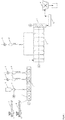
- the scheme of the experimental setup is Figure 1 refer to.
- FIG 1 shows a scheme for the preparation of the siloxane-containing block cocondensates.
- Polycarbonate and a catalyst masterbatch (see below) are metered into the twin-screw extruder (1) via the gravimetric feeds (4) and (5).
- the extruder (type ZSE 27 MAXX from Leistritz Extrusionstechnik GmbH, Nuremberg) is a co-rotating twin-screw extruder Vacuum zones to separate the vapors.
- the extruder consists of 11 housing parts (a to k) - see Figure 1 .
- the addition of polycarbonate and catalyst masterbatch takes place in housing part a and these components are melted in housing parts b and c.
- the liquid silicone component is added in the housing part d.
- the housing parts e and f serve to mix in the liquid silicone component.
- the housing parts g, h, i and j are provided with vent openings to remove the condensation products.
- Housing parts g and h are assigned to the first vacuum stage and housing parts i and j are assigned to the second vacuum stage.
- the vacuum in the first vacuum stage was between 250 and 500 mbar absolute pressure.
- the vacuum in the second vacuum stage is less than 1 mbar.
- the siloxane is placed in a tank (6) and fed to the extruder via a metering pump (7).
- the vacuum is generated by 2 vacuum pumps (8).
- the vapors are carried away from the extruder and collected in 2 condensers (9).
- the melt degassed in this way is fed via a line from the housing part k of the twin-screw extruder to a high-viscosity reactor (2).
- the high-viscosity reactor (2) is a self-cleaning device with two counter-rotating rotors arranged horizontally and axially parallel.
- the structure is in the European patent application EP0460466 described, see Fig. 7 there.
- the machine used has a rotor diameter of 187 mm and a length of 924 mm.
- the entire interior of the reactor has a volume of 44.6 liters.
- the high-viscosity reactor is also connected to a vacuum pump (8) and a condenser (9).
- the vacuum applied to the high viscosity reactor is 0.1 to 5 mbar.
- the block co-condensate is discharged via a discharge screw and then granulated (via a water bath (10) and granulator (11)).
- the molecular weight of the block cocondensate is controlled via the throughput.
- the throughput in the extruder / high-viscosity reactor combination is set so that the solution viscosity of the block co-condensate is eta rel 1.30 (determined at a concentration of 5 g / l in dichloromethane at 25 ° C. using an Ubbelohde viscometer).
- the catalyst masterbatch required to produce the block cocondensate is produced as follows:
- the catalyst is tetraphenylphosphonium phenoxide from Rhein Chemie Rheinau GmbH (Mannheim, Germany).
- the catalyst is used in the form of a masterbatch.
- Tetraphenylphosphonium phenoxide is used as a co-crystal with phenol and contains approx. 70% tetraphenylphosphonium phenoxide.
- the contents mentioned below refer to the product from Rhein Chemie (ie in the form of the co-crystal with phenol).
- the masterbatch is used in the form of a 0.25% dilution.
- the masterbatch is metered in at a ratio of 1:10 so that the catalyst content is 0.025% by weight based on the polycarbonate used.
- Blendex B449 (approx. 50% PTFE and approx. 50% SAN [made of 80% styrene and 20% acrylonitrile] from Chemtura.
- Diphenylsulfonsulfonate potassium salt Product name KSS-FR from Brenntag GmbH, Germany.
- Tinuvin® 234 bis- (1,1-dimethylbenzyl) -2'-hydroxyphenyl) -benzotriazole, BASF SE, Ludwigshafen is used as the UV absorber.
- Irgafos® 168 tris (2,4-di-tert-butyl-phenyl) phosphite, CAS 31570-04-4, BASF SE, Ludwigshafen) is used as the thermal stabilizer.
- the colorant used is carbon black (particle size approx. 17 nm) in the form of Black Pearls® 800 (CAS No. 1333-86-4) from Cabot Corp. used.
- Macrolex Red EG (Solvent Red 135, CAS No. 20749-68-2) from Lanxess AG, Leverkusen, is used as the colorant.
- Potassium perfluoro-1-butanesulfonate commercially available as Bayowet® C4 from Lanxess, Leverkusen, Germany, CAS no. 29420-49-3 is used.
- the additives were compounded on a twin-screw extruder from KrausMaffei Berstorff TYPE ZE25 at a barrel temperature of 260 ° C. or a melt temperature of 280 ° C. and a speed of 150 rpm with the amounts of additives specified in the examples.
- the granulate is dried in vacuo at 120 ° C for 3 hours and then processed on an Arburg 370 type injection molding machine with a 25 injection unit at a melt temperature of 300 ° C and a mold temperature of 80 ° C to give corresponding moldings.
- the starting materials specified in Table 1 are used in the specified concentrations.
- Examples 1 and 2 are examples according to the invention; Examples 3 to 6 are comparative examples.
- melt volume rate is determined according to ISO 1133 (at 300 ° C; 1.2 kg).
- the fire behavior is measured in accordance with UL 94V on bars measuring 127 mm x 12.7 mm x 3.0 mm and on bars measuring 127 x 12.7 x 1.5 mm.
- the mechanical properties are measured on 10 test rods with the dimensions 80 x 10 x 4 or 80 x 10 x 3 mm (thickness of the test rod see Table 2).
- Examples 1 and 2 according to the invention and comparative examples 3 to 6 are produced with the additives and raw materials given in Table 1 in the concentrations given (in% by weight) under the conditions given above.
- Table 1 ⁇ /u> component example 1
- Example 2 Example 3 (comparison)
- Example 4 (comparison)
- Example 5 (comparison)
- Example 6 (comparison)
- B) Blendex 0.15 - 0.60 0.15 0.40 -
- B PTFE powder - 0.08 - - - 0.3
- C 0.40 0.40 0.30 0.40 0.40 0.30
- D 0.27 0.27 0.27 0.27 0.27 0.27 0.27 0.27 0.27 (F) 0.10 0.10 0.10 0.10 0.10 Greeting 0.20 0.20 0.20 - 0.20 0.20
- the examples according to the invention have the combination of good fire behavior and excellent low-temperature notched impact strength, whereas the comparative examples, which have too low a chlorine content (Examples 4 and 6) or too high a content of component B (Examples 3 and 5), have weaknesses in the Fire behavior and / or have mechanical properties.
Landscapes
- Chemical & Material Sciences (AREA)
- Health & Medical Sciences (AREA)
- Chemical Kinetics & Catalysis (AREA)
- Medicinal Chemistry (AREA)
- Polymers & Plastics (AREA)
- Organic Chemistry (AREA)
- Compositions Of Macromolecular Compounds (AREA)
- Other Resins Obtained By Reactions Not Involving Carbon-To-Carbon Unsaturated Bonds (AREA)
Claims (12)
- Masses de moulage ignifuges, thermoplastiques, contenant(A) au moins un cocondensat à blocs polysiloxane-polycarbonate, comprenant des blocs de siloxane de structure (1)
 R1 représente H, Cl, Br ou C1-C4-alkyle,R2 et R3 sont choisis, indépendamment l'un de l'autre, parmi aryle, C1-C10-alkyle et C1-C10-alkylaryle,X représente une simple liaison, -CO-, -O-, C1-C6-alkylène, C2-C5-alkylidène, C5-C12-cycloalkylidène ou C6-C12-arylène, qui peut être condensé avec un autre cycle aromatique contenant des hétéroatomes,n représente une valeur moyenne 1 à 500,m représente une valeur moyenne 1 à 10 etp représente 0 ou 1 ;(B) 0,03 à 0,25% en poids de polytétrafluoréthylène ou 0,05 à 0,30% en poids de mélanges à base de polytétrafluoréthylène, qui contiennent 30 à 70% en poids de polytétrafluoréthylène et(C) 0,1 à 0,6% en poids d'au moins un sel d'acide sulfonique,caractérisées en ce que les masses de moulage présentent une teneur en chlore de 10 à 1000 ppm.
 - Masses de moulage selon la revendication 1, caractérisées en ce qu'un ou plusieurs colorants contenant du chlore sont contenus.
- Masses de moulage selon la revendication 2, caractérisées en ce que les masses de moulage contiennent au moins un colorant contenant du chlore de la classe des aromatiques chlorés et/ou de l'oxyde de titane préparé selon le procédé au chlorure.
- Masses de moulage selon l'une quelconque des revendications précédentes, caractérisées en ce que les masses de moulage contiennent au moins un aromatique chloré choisi parmi les classes des colorants de type phtalocyanine et des colorants de type périnone.
- Masses de moulage selon l'une quelconque des revendications précédentes, caractérisées en ce que du polytétrafluoroéthylène présentant un diamètre moyen de particule de 100 à 1000 µm est présent en tant que composant (B).
- Masses de moulage selon l'une quelconque des revendications 1 à 4, caractérisées en ce que les masses de moulage contiennent, en tant que composant (B), au moins un mélange à base de polytétrafluoroéthylène, le mélange à base de polytétrafluoroéthylène comprenant un noyau de polytétrafluoroéthylène et un revêtement constitué par au moins un dérivé de polyvinyle.
- Masses de moulage selon l'une quelconque des revendications précédentes, caractérisées en ce qu'au moins un sel de l'acide sulfonique des formules générales (4) et (5) est présent en tant que composant (C)

 R4, R5, R6 et R7 représentent à chaque fois, indépendamment les uns des autres, un radical C1-C6-alkyle,Me et M représentent à chaque fois un métal,a et n représentent 1, 2 ou 3,b et w représentent des nombres entiers de 0 à 5 etx et y représentent des nombres entiers de 0 à 4.
 - Masses de moulage selon l'une quelconque des revendications précédentes constituées par les composants (A), (B) et (C) et par(D) 0,00% en poids à 20,00% en poids d'un ou de plusieurs absorbants des UV ;(E) 0,00% en poids à 1,00% en poids d'un ou de plusieurs agents de démoulage ;(F) 0,00% en poids à 0,20% en poids d'un ou de plusieurs stabilisants thermiques et/ou de traitement ;(G) 0,00 à 10,00% en poids d'autres additifs, qui se distinguent des composants (B) à (F) ; et(H) 0,00 à 40,00% en poids d'un ou de plusieurs (co)-polycarbonates, qui ne présentent pas de motifs siloxane.
- Masses de moulage selon l'une quelconque des revendications précédentes, caractérisées en ce que le composant A est contenu en une quantité d'au moins 50% en poids dans les masses de moulage.
- Masses de moulage selon l'une quelconque des revendications précédentes, caractérisées en ce que le cocondensat à blocs de polysiloxane-polycarbonate présente des blocs de polycarbonate à base de bisphénol A.
- Masses de moulage selon l'une quelconque des revendications précédentes, caractérisées en ce que le cocondensat à blocs de polysiloxane-polycarbonate présente une ou plusieurs structures des formules (I), (II), (III) et (IV) :


 les cycles phényle sont non substitués ou monosubstitués ou disubstitués, indépendamment les uns des autres, par C1-C8-alkyle et/ou halogène,X représente une simple liaison, C1-C6-alkylène, C2-C5-alkylidène ou C5-C6-cycloalkylidène etles liaisons indiquées par --- dans les motifs structuraux (I) à (IV) font à chaque fois partie d'un groupe carboxyle.
 - Masses de moulage selon l'une quelconque des revendications précédentes, caractérisées en ce que la teneur en blocs siloxane de la structure (1) est de 2 à 20% en poids, par rapport au poids total des masses de moulage.
Applications Claiming Priority (2)
| Application Number | Priority Date | Filing Date | Title |
|---|---|---|---|
| EP15151810 | 2015-01-20 | ||
| PCT/EP2016/050876 WO2016116395A1 (fr) | 2015-01-20 | 2016-01-18 | Matières à mouler ignifugées contenant un cocondensat séquencé de polycarbonate contenant siloxane |
Publications (2)
| Publication Number | Publication Date |
|---|---|
| EP3247742A1 EP3247742A1 (fr) | 2017-11-29 |
| EP3247742B1 true EP3247742B1 (fr) | 2020-12-16 |
Family
ID=52432657
Family Applications (1)
| Application Number | Title | Priority Date | Filing Date |
|---|---|---|---|
| EP16700838.2A Active EP3247742B1 (fr) | 2015-01-20 | 2016-01-18 | Masses de formages ignifuges, contenant un co-condensat séquencé de polycarbonate contenant du siloxane |
Country Status (7)
| Country | Link |
|---|---|
| US (1) | US10487208B2 (fr) |
| EP (1) | EP3247742B1 (fr) |
| JP (1) | JP2018502970A (fr) |
| KR (1) | KR20170105567A (fr) |
| CN (1) | CN107207863B (fr) |
| TW (1) | TWI691552B (fr) |
| WO (1) | WO2016116395A1 (fr) |
Families Citing this family (2)
| Publication number | Priority date | Publication date | Assignee | Title |
|---|---|---|---|---|
| CN110072918B (zh) * | 2016-12-19 | 2021-10-22 | 科思创德国股份有限公司 | 借助相容剂制造含硅氧烷的嵌段共聚碳酸酯 |
| US20230331925A1 (en) * | 2020-09-23 | 2023-10-19 | Mitsubishi Gas Chemical Company, Inc. | Thermoplastic resin, composition, molded article, optical lens, and method for producing thermoplastic resin |
Family Cites Families (38)
| Publication number | Priority date | Publication date | Assignee | Title |
|---|---|---|---|---|
| US3189662A (en) | 1961-01-23 | 1965-06-15 | Gen Electric | Organopolysiloxane-polycarbonate block copolymers |
| US3419634A (en) | 1966-01-03 | 1968-12-31 | Gen Electric | Organopolysiloxane polycarbonate block copolymers |
| DE8233007U1 (de) | 1982-11-25 | 1983-03-24 | Röhm GmbH, 6100 Darmstadt | Polycarbonat-kunststofftafel |
| DE3244953C2 (de) | 1982-12-04 | 1984-11-29 | Röhm GmbH, 6100 Darmstadt | Verfahren zur Herstellung einer Hohlkammerkunststofftafel |
| DE3334782A1 (de) | 1983-04-19 | 1984-10-25 | Bayer Ag, 5090 Leverkusen | Verfahren zur herstellung von polydiorganosiloxanen mit hydroxyaryloxy-endgruppen |
| CA2026152C (fr) | 1989-10-30 | 2003-04-15 | Winfried G. Paul | Melanges de polycarbonate ignifuge |
| US4994510A (en) | 1990-04-05 | 1991-02-19 | General Electric Company | Poly(carbonate-siloxane) with reduced tendency to burn |
| DE4018069A1 (de) | 1990-06-06 | 1991-12-12 | Bayer Ag | Selbstreinigender reaktor/mischer mit grossem nutzvolumen |
| US5227449A (en) | 1990-07-02 | 1993-07-13 | Xerox Corporation | Photoconductive imaging members with polycarbonate binders |
| TW222292B (fr) | 1991-02-21 | 1994-04-11 | Ciba Geigy Ag | |
| EP0522751B1 (fr) | 1991-07-01 | 1998-04-01 | General Electric Company | Copolymères séquencés de polycarbonate-polysiloxane |
| EP0524731B1 (fr) | 1991-07-01 | 2002-03-13 | General Electric Company | Mélanges comprenant des copolymères blocs de polycarbonate-polysiloxane avec des polycarbonates ou des copolymères polyestercarbonates |
| KR0141577B1 (ko) | 1991-11-15 | 1998-07-01 | 홍고오 무쓰비 | 폴리카르보네이트 수지조성물 및 그 제조방법 |
| US5414054A (en) | 1994-06-01 | 1995-05-09 | Miles Inc. | Copolycarbonate having improved low-temperature impact strength |
| MX9703351A (es) | 1994-11-10 | 1997-08-30 | Basf Ag | Esteres 2-cianoacrilicos. |
| DE4443164A1 (de) * | 1994-12-05 | 1996-06-13 | Bayer Ag | Flammgeschützte, thermoplastische Polycarbonat-Formmassen |
| DE4444868A1 (de) | 1994-12-16 | 1996-06-20 | Bayer Ag | UV-geschützte, mehrschichtige Polycarbonatplatten |
| DE59702969D1 (de) | 1996-10-30 | 2001-03-08 | Ciba Sc Holding Ag | Stabilisatorkombination für das Rotomolding-Verfahren |
| DE19710081A1 (de) | 1997-03-12 | 1998-09-17 | Bayer Ag | Verfahren zur Herstellung von Polysiloxan-Polysiloxan-Polycarbonat-Blockcokondensaten |
| US6066700A (en) | 1997-03-12 | 2000-05-23 | Bayer Aktiengesellschaft | Process for the production of polysiloxane/polycarbonate block co-condensation products |
| US5821321A (en) | 1997-09-16 | 1998-10-13 | Bayer Corporation | Molding composition having improved impact strength |
| EP1308084A1 (fr) | 2002-10-02 | 2003-05-07 | Ciba SC Holding AG | Combinaison UV-absorbante avec un effet synergistique |
| DE10311063A1 (de) | 2003-03-13 | 2004-09-23 | Basf Ag | Verwendung einer Stabilisatormischung in thermoplastischen Formmassen |
| US20070072960A1 (en) | 2005-09-28 | 2007-03-29 | General Electric Company | Thermoplastic polycarbonate compositions, method of manufacture, and method of use thereof |
| US20070191519A1 (en) | 2006-02-14 | 2007-08-16 | General Electric Company | Halogen-free polycarbonate compositions and articles formed therefrom |
| US7728059B2 (en) | 2006-02-14 | 2010-06-01 | Sabic Innovative Plastics Ip B.V. | Polycarbonate compositions and articles formed therefrom |
| US7709581B2 (en) * | 2006-09-29 | 2010-05-04 | Sabic Innovative Plastics Ip B.V. | Polycarbonate-polysiloxane copolymer compositions and articles formed therefrom |
| US7524919B2 (en) * | 2006-09-29 | 2009-04-28 | Sabic Innovative Plastics Ip B.V. | Polycarbonate-polysiloxane copolymers, method of making, and articles formed therefrom |
| US20080119619A1 (en) | 2006-11-16 | 2008-05-22 | General Electric Company | Thermoplastic composition, method of making, and articles formed therefrom |
| DE102007011069A1 (de) | 2007-03-07 | 2008-09-11 | Bayer Materialscience Ag | Polycarbonatzusammensetzung enthaltend UV-Absorber |
| DE102008019503A1 (de) * | 2008-04-18 | 2009-10-22 | Bayer Materialscience Ag | Polycarbonate mit Umlagerungsstrukturen, cyclischen und linearen Oligomeren sowie verbessertem Fließverhalten |
| US20140234629A1 (en) * | 2011-11-08 | 2014-08-21 | Sabic Innovative Plastics Ip B.V. | High heat polycarbonate and siloxane copolycarbonate blends that provide ductile high heat options for flame retardant applications |
| US20130224462A1 (en) * | 2012-02-29 | 2013-08-29 | Sabic Innovative Plastics Ip B.V. | Thermoplastic compositions having low smoke, methods of their manufacture, and uses thereof |
| US9346949B2 (en) | 2013-02-12 | 2016-05-24 | Sabic Global Technologies B.V. | High reflectance polycarbonate |
| WO2013155046A1 (fr) * | 2012-04-10 | 2013-10-17 | Momentive Performance Materials Gmbh | Procédé pour produire des siloxanes fonctionnels à structure contrôlée |
| US9018286B2 (en) | 2012-05-24 | 2015-04-28 | Sabic Global Technologies B.V. | Flame retardant polycarbonate compositions, methods of manufacture thereof and articles comprising the same |
| US9309407B2 (en) | 2013-05-02 | 2016-04-12 | Sabic Global Technologies B.V. | Polycarbonate-siloxane copolymer flame retarded with a silicone based core shell modifier |
| TWI687485B (zh) * | 2015-01-20 | 2020-03-11 | 德商科思創德意志股份有限公司 | 包含玻璃纖維與含矽氧烷之聚碳酸酯嵌段共聚物的阻燃模塑組成物 |
-
2016
- 2016-01-18 TW TW105101329A patent/TWI691552B/zh not_active IP Right Cessation
- 2016-01-18 US US15/544,282 patent/US10487208B2/en active Active
- 2016-01-18 CN CN201680006519.8A patent/CN107207863B/zh active Active
- 2016-01-18 JP JP2017538235A patent/JP2018502970A/ja active Pending
- 2016-01-18 EP EP16700838.2A patent/EP3247742B1/fr active Active
- 2016-01-18 KR KR1020177022774A patent/KR20170105567A/ko not_active Withdrawn
- 2016-01-18 WO PCT/EP2016/050876 patent/WO2016116395A1/fr not_active Ceased
Non-Patent Citations (1)
| Title |
|---|
| None * |
Also Published As
| Publication number | Publication date |
|---|---|
| WO2016116395A1 (fr) | 2016-07-28 |
| TWI691552B (zh) | 2020-04-21 |
| TW201641606A (zh) | 2016-12-01 |
| CN107207863B (zh) | 2021-02-19 |
| US20180009986A1 (en) | 2018-01-11 |
| KR20170105567A (ko) | 2017-09-19 |
| US10487208B2 (en) | 2019-11-26 |
| JP2018502970A (ja) | 2018-02-01 |
| CN107207863A (zh) | 2017-09-26 |
| EP3247742A1 (fr) | 2017-11-29 |
Similar Documents
| Publication | Publication Date | Title |
|---|---|---|
| EP3247743B1 (fr) | Masses de formages ignifuges, contenant de la fibre de verre comprenant un co-condensat séquencé de polycarbonate contenant du siloxane | |
| EP2268706B1 (fr) | Polycarbonates à structures réarrangées, oligomères cycliques et linéaires et comportement d écoulement amélioré | |
| EP1657281B1 (fr) | Mélange de polycarbonate et de polyformal servant de matière pour mémoires de données optiques à absorption d'eau réduite | |
| WO2016162301A1 (fr) | Cocondensats à blocs, composés de polysiloxanes et de (co)polycarbonates à base de dihydroxydiphénylcycloalcane | |
| EP2483344B1 (fr) | Compositions de polycarbonate à stabilité améliorée à l'état fondu | |
| WO2016087477A1 (fr) | Compositions de polycarbonate contenant des cires de polyéthylène | |
| WO2011038841A1 (fr) | Compositions de polycarbonate aux propriétés optiques améliorées | |
| EP3247742A1 (fr) | Matières à mouler ignifugées contenant un cocondensat séquencé de polycarbonate contenant siloxane | |
| EP2831163A1 (fr) | Composition de polycarbonate aux propriétés optiques améliorées | |
| WO2017198808A1 (fr) | Compositions de polycarbonate contenant un acide carboxylique et des glycérol ou diglycérol esters correspondants | |
| WO2020201178A1 (fr) | Copolycarbonates séquencés contenant du siloxane à petite taille de domaine | |
| EP3838979B1 (fr) | Polycarbonate fusible aux propriétés optiques améliorées | |
| EP2742092B1 (fr) | Composition polymère remplie et plaque coextrudée étant obtenue à partir de celle-ci | |
| EP2981577B1 (fr) | (co)polycarbonates contenant un phtalimide, résistant aux températures élevées et présentant des propriétés rhéologiques améliorées | |
| EP4524200A1 (fr) | Melanges transparents de polycarbonate/polyacrylate | |
| WO2014161943A1 (fr) | (co)polycarbonates résistant aux températures élevées et présentant des propriétés rhéologiques améliorées | |
| WO2017097915A1 (fr) | Compositions de polycarbonate contenant de l'éther polyglycidylique |
Legal Events
| Date | Code | Title | Description |
|---|---|---|---|
| STAA | Information on the status of an ep patent application or granted ep patent |
Free format text: STATUS: THE INTERNATIONAL PUBLICATION HAS BEEN MADE |
|
| PUAI | Public reference made under article 153(3) epc to a published international application that has entered the european phase |
Free format text: ORIGINAL CODE: 0009012 |
|
| STAA | Information on the status of an ep patent application or granted ep patent |
Free format text: STATUS: REQUEST FOR EXAMINATION WAS MADE |
|
| 17P | Request for examination filed |
Effective date: 20170821 |
|
| AK | Designated contracting states |
Kind code of ref document: A1 Designated state(s): AL AT BE BG CH CY CZ DE DK EE ES FI FR GB GR HR HU IE IS IT LI LT LU LV MC MK MT NL NO PL PT RO RS SE SI SK SM TR |
|
| AX | Request for extension of the european patent |
Extension state: BA ME |
|
| DAV | Request for validation of the european patent (deleted) | ||
| DAX | Request for extension of the european patent (deleted) | ||
| GRAP | Despatch of communication of intention to grant a patent |
Free format text: ORIGINAL CODE: EPIDOSNIGR1 |
|
| STAA | Information on the status of an ep patent application or granted ep patent |
Free format text: STATUS: GRANT OF PATENT IS INTENDED |
|
| RAP1 | Party data changed (applicant data changed or rights of an application transferred) |
Owner name: COVESTRO DEUTSCHLAND AG |
|
| RAP1 | Party data changed (applicant data changed or rights of an application transferred) |
Owner name: COVESTRO INTELLECTUAL PROPERTY GMBH & CO. KG |
|
| INTG | Intention to grant announced |
Effective date: 20200908 |
|
| GRAS | Grant fee paid |
Free format text: ORIGINAL CODE: EPIDOSNIGR3 |
|
| GRAA | (expected) grant |
Free format text: ORIGINAL CODE: 0009210 |
|
| STAA | Information on the status of an ep patent application or granted ep patent |
Free format text: STATUS: THE PATENT HAS BEEN GRANTED |
|
| AK | Designated contracting states |
Kind code of ref document: B1 Designated state(s): AL AT BE BG CH CY CZ DE DK EE ES FI FR GB GR HR HU IE IS IT LI LT LU LV MC MK MT NL NO PL PT RO RS SE SI SK SM TR |
|
| REG | Reference to a national code |
Ref country code: GB Ref legal event code: FG4D Free format text: NOT ENGLISH |
|
| REG | Reference to a national code |
Ref country code: IE Ref legal event code: FG4D Free format text: LANGUAGE OF EP DOCUMENT: GERMAN |
|
| REG | Reference to a national code |
Ref country code: DE Ref legal event code: R096 Ref document number: 502016011972 Country of ref document: DE |
|
| REG | Reference to a national code |
Ref country code: AT Ref legal event code: REF Ref document number: 1345545 Country of ref document: AT Kind code of ref document: T Effective date: 20210115 |
|
| PG25 | Lapsed in a contracting state [announced via postgrant information from national office to epo] |
Ref country code: GR Free format text: LAPSE BECAUSE OF FAILURE TO SUBMIT A TRANSLATION OF THE DESCRIPTION OR TO PAY THE FEE WITHIN THE PRESCRIBED TIME-LIMIT Effective date: 20210317 Ref country code: FI Free format text: LAPSE BECAUSE OF FAILURE TO SUBMIT A TRANSLATION OF THE DESCRIPTION OR TO PAY THE FEE WITHIN THE PRESCRIBED TIME-LIMIT Effective date: 20201216 Ref country code: RS Free format text: LAPSE BECAUSE OF FAILURE TO SUBMIT A TRANSLATION OF THE DESCRIPTION OR TO PAY THE FEE WITHIN THE PRESCRIBED TIME-LIMIT Effective date: 20201216 Ref country code: NO Free format text: LAPSE BECAUSE OF FAILURE TO SUBMIT A TRANSLATION OF THE DESCRIPTION OR TO PAY THE FEE WITHIN THE PRESCRIBED TIME-LIMIT Effective date: 20210316 |
|
| REG | Reference to a national code |
Ref country code: NL Ref legal event code: MP Effective date: 20201216 |
|
| PG25 | Lapsed in a contracting state [announced via postgrant information from national office to epo] |
Ref country code: SE Free format text: LAPSE BECAUSE OF FAILURE TO SUBMIT A TRANSLATION OF THE DESCRIPTION OR TO PAY THE FEE WITHIN THE PRESCRIBED TIME-LIMIT Effective date: 20201216 Ref country code: BG Free format text: LAPSE BECAUSE OF FAILURE TO SUBMIT A TRANSLATION OF THE DESCRIPTION OR TO PAY THE FEE WITHIN THE PRESCRIBED TIME-LIMIT Effective date: 20210316 Ref country code: LV Free format text: LAPSE BECAUSE OF FAILURE TO SUBMIT A TRANSLATION OF THE DESCRIPTION OR TO PAY THE FEE WITHIN THE PRESCRIBED TIME-LIMIT Effective date: 20201216 |
|
| PG25 | Lapsed in a contracting state [announced via postgrant information from national office to epo] |
Ref country code: HR Free format text: LAPSE BECAUSE OF FAILURE TO SUBMIT A TRANSLATION OF THE DESCRIPTION OR TO PAY THE FEE WITHIN THE PRESCRIBED TIME-LIMIT Effective date: 20201216 Ref country code: NL Free format text: LAPSE BECAUSE OF FAILURE TO SUBMIT A TRANSLATION OF THE DESCRIPTION OR TO PAY THE FEE WITHIN THE PRESCRIBED TIME-LIMIT Effective date: 20201216 |
|
| REG | Reference to a national code |
Ref country code: LT Ref legal event code: MG9D |
|
| PG25 | Lapsed in a contracting state [announced via postgrant information from national office to epo] |
Ref country code: LT Free format text: LAPSE BECAUSE OF FAILURE TO SUBMIT A TRANSLATION OF THE DESCRIPTION OR TO PAY THE FEE WITHIN THE PRESCRIBED TIME-LIMIT Effective date: 20201216 Ref country code: SM Free format text: LAPSE BECAUSE OF FAILURE TO SUBMIT A TRANSLATION OF THE DESCRIPTION OR TO PAY THE FEE WITHIN THE PRESCRIBED TIME-LIMIT Effective date: 20201216 Ref country code: EE Free format text: LAPSE BECAUSE OF FAILURE TO SUBMIT A TRANSLATION OF THE DESCRIPTION OR TO PAY THE FEE WITHIN THE PRESCRIBED TIME-LIMIT Effective date: 20201216 Ref country code: CZ Free format text: LAPSE BECAUSE OF FAILURE TO SUBMIT A TRANSLATION OF THE DESCRIPTION OR TO PAY THE FEE WITHIN THE PRESCRIBED TIME-LIMIT Effective date: 20201216 Ref country code: RO Free format text: LAPSE BECAUSE OF FAILURE TO SUBMIT A TRANSLATION OF THE DESCRIPTION OR TO PAY THE FEE WITHIN THE PRESCRIBED TIME-LIMIT Effective date: 20201216 Ref country code: PT Free format text: LAPSE BECAUSE OF FAILURE TO SUBMIT A TRANSLATION OF THE DESCRIPTION OR TO PAY THE FEE WITHIN THE PRESCRIBED TIME-LIMIT Effective date: 20210416 Ref country code: SK Free format text: LAPSE BECAUSE OF FAILURE TO SUBMIT A TRANSLATION OF THE DESCRIPTION OR TO PAY THE FEE WITHIN THE PRESCRIBED TIME-LIMIT Effective date: 20201216 |
|
| PG25 | Lapsed in a contracting state [announced via postgrant information from national office to epo] |
Ref country code: PL Free format text: LAPSE BECAUSE OF FAILURE TO SUBMIT A TRANSLATION OF THE DESCRIPTION OR TO PAY THE FEE WITHIN THE PRESCRIBED TIME-LIMIT Effective date: 20201216 |
|
| REG | Reference to a national code |
Ref country code: CH Ref legal event code: PL |
|
| REG | Reference to a national code |
Ref country code: DE Ref legal event code: R097 Ref document number: 502016011972 Country of ref document: DE |
|
| PG25 | Lapsed in a contracting state [announced via postgrant information from national office to epo] |
Ref country code: LU Free format text: LAPSE BECAUSE OF NON-PAYMENT OF DUE FEES Effective date: 20210118 Ref country code: IS Free format text: LAPSE BECAUSE OF FAILURE TO SUBMIT A TRANSLATION OF THE DESCRIPTION OR TO PAY THE FEE WITHIN THE PRESCRIBED TIME-LIMIT Effective date: 20210416 Ref country code: MC Free format text: LAPSE BECAUSE OF FAILURE TO SUBMIT A TRANSLATION OF THE DESCRIPTION OR TO PAY THE FEE WITHIN THE PRESCRIBED TIME-LIMIT Effective date: 20201216 |
|
| REG | Reference to a national code |
Ref country code: BE Ref legal event code: MM Effective date: 20210131 |
|
| PLBE | No opposition filed within time limit |
Free format text: ORIGINAL CODE: 0009261 |
|
| STAA | Information on the status of an ep patent application or granted ep patent |
Free format text: STATUS: NO OPPOSITION FILED WITHIN TIME LIMIT |
|
| PG25 | Lapsed in a contracting state [announced via postgrant information from national office to epo] |
Ref country code: AL Free format text: LAPSE BECAUSE OF FAILURE TO SUBMIT A TRANSLATION OF THE DESCRIPTION OR TO PAY THE FEE WITHIN THE PRESCRIBED TIME-LIMIT Effective date: 20201216 |
|
| 26N | No opposition filed |
Effective date: 20210917 |
|
| PG25 | Lapsed in a contracting state [announced via postgrant information from national office to epo] |
Ref country code: LI Free format text: LAPSE BECAUSE OF NON-PAYMENT OF DUE FEES Effective date: 20210131 Ref country code: DK Free format text: LAPSE BECAUSE OF FAILURE TO SUBMIT A TRANSLATION OF THE DESCRIPTION OR TO PAY THE FEE WITHIN THE PRESCRIBED TIME-LIMIT Effective date: 20201216 Ref country code: CH Free format text: LAPSE BECAUSE OF NON-PAYMENT OF DUE FEES Effective date: 20210131 |
|
| PG25 | Lapsed in a contracting state [announced via postgrant information from national office to epo] |
Ref country code: ES Free format text: LAPSE BECAUSE OF FAILURE TO SUBMIT A TRANSLATION OF THE DESCRIPTION OR TO PAY THE FEE WITHIN THE PRESCRIBED TIME-LIMIT Effective date: 20201216 Ref country code: FR Free format text: LAPSE BECAUSE OF NON-PAYMENT OF DUE FEES Effective date: 20210216 Ref country code: IE Free format text: LAPSE BECAUSE OF NON-PAYMENT OF DUE FEES Effective date: 20210118 |
|
| PGFP | Annual fee paid to national office [announced via postgrant information from national office to epo] |
Ref country code: GB Payment date: 20211216 Year of fee payment: 7 |
|
| PG25 | Lapsed in a contracting state [announced via postgrant information from national office to epo] |
Ref country code: SI Free format text: LAPSE BECAUSE OF FAILURE TO SUBMIT A TRANSLATION OF THE DESCRIPTION OR TO PAY THE FEE WITHIN THE PRESCRIBED TIME-LIMIT Effective date: 20201216 |
|
| REG | Reference to a national code |
Ref country code: AT Ref legal event code: MM01 Ref document number: 1345545 Country of ref document: AT Kind code of ref document: T Effective date: 20210118 |
|
| PG25 | Lapsed in a contracting state [announced via postgrant information from national office to epo] |
Ref country code: AT Free format text: LAPSE BECAUSE OF NON-PAYMENT OF DUE FEES Effective date: 20210118 |
|
| PG25 | Lapsed in a contracting state [announced via postgrant information from national office to epo] |
Ref country code: IS Free format text: LAPSE BECAUSE OF FAILURE TO SUBMIT A TRANSLATION OF THE DESCRIPTION OR TO PAY THE FEE WITHIN THE PRESCRIBED TIME-LIMIT Effective date: 20210416 |
|
| PGFP | Annual fee paid to national office [announced via postgrant information from national office to epo] |
Ref country code: IT Payment date: 20211230 Year of fee payment: 7 |
|
| PG25 | Lapsed in a contracting state [announced via postgrant information from national office to epo] |
Ref country code: BE Free format text: LAPSE BECAUSE OF NON-PAYMENT OF DUE FEES Effective date: 20210131 |
|
| PG25 | Lapsed in a contracting state [announced via postgrant information from national office to epo] |
Ref country code: HU Free format text: LAPSE BECAUSE OF FAILURE TO SUBMIT A TRANSLATION OF THE DESCRIPTION OR TO PAY THE FEE WITHIN THE PRESCRIBED TIME-LIMIT; INVALID AB INITIO Effective date: 20160118 |
|
| PG25 | Lapsed in a contracting state [announced via postgrant information from national office to epo] |
Ref country code: CY Free format text: LAPSE BECAUSE OF FAILURE TO SUBMIT A TRANSLATION OF THE DESCRIPTION OR TO PAY THE FEE WITHIN THE PRESCRIBED TIME-LIMIT Effective date: 20201216 |
|
| GBPC | Gb: european patent ceased through non-payment of renewal fee |
Effective date: 20230118 |
|
| PG25 | Lapsed in a contracting state [announced via postgrant information from national office to epo] |
Ref country code: GB Free format text: LAPSE BECAUSE OF NON-PAYMENT OF DUE FEES Effective date: 20230118 |
|
| PG25 | Lapsed in a contracting state [announced via postgrant information from national office to epo] |
Ref country code: IT Free format text: LAPSE BECAUSE OF NON-PAYMENT OF DUE FEES Effective date: 20230118 |
|
| PG25 | Lapsed in a contracting state [announced via postgrant information from national office to epo] |
Ref country code: MK Free format text: LAPSE BECAUSE OF FAILURE TO SUBMIT A TRANSLATION OF THE DESCRIPTION OR TO PAY THE FEE WITHIN THE PRESCRIBED TIME-LIMIT Effective date: 20201216 |
|
| PG25 | Lapsed in a contracting state [announced via postgrant information from national office to epo] |
Ref country code: TR Free format text: LAPSE BECAUSE OF FAILURE TO SUBMIT A TRANSLATION OF THE DESCRIPTION OR TO PAY THE FEE WITHIN THE PRESCRIBED TIME-LIMIT Effective date: 20201216 |
|
| PG25 | Lapsed in a contracting state [announced via postgrant information from national office to epo] |
Ref country code: MT Free format text: LAPSE BECAUSE OF FAILURE TO SUBMIT A TRANSLATION OF THE DESCRIPTION OR TO PAY THE FEE WITHIN THE PRESCRIBED TIME-LIMIT Effective date: 20201216 |
|
| PGFP | Annual fee paid to national office [announced via postgrant information from national office to epo] |
Ref country code: DE Payment date: 20251216 Year of fee payment: 11 |