EP3254652A1 - Tampon mit konsolidierter faseriger anordnung und verfahren zur herstellung - Google Patents
Tampon mit konsolidierter faseriger anordnung und verfahren zur herstellung Download PDFInfo
- Publication number
- EP3254652A1 EP3254652A1 EP16193314.8A EP16193314A EP3254652A1 EP 3254652 A1 EP3254652 A1 EP 3254652A1 EP 16193314 A EP16193314 A EP 16193314A EP 3254652 A1 EP3254652 A1 EP 3254652A1
- Authority
- EP
- European Patent Office
- Prior art keywords
- web
- filaments
- meltspun
- staple
- fibers
- Prior art date
- Legal status (The legal status is an assumption and is not a legal conclusion. Google has not performed a legal analysis and makes no representation as to the accuracy of the status listed.)
- Granted
Links
- 238000004519 manufacturing process Methods 0.000 title abstract description 10
- 239000000835 fiber Substances 0.000 claims abstract description 99
- 239000002131 composite material Substances 0.000 claims abstract description 75
- 230000002745 absorbent Effects 0.000 claims abstract description 62
- 239000002250 absorbent Substances 0.000 claims abstract description 62
- 239000011800 void material Substances 0.000 claims abstract description 12
- 238000000034 method Methods 0.000 claims description 24
- 229920000742 Cotton Polymers 0.000 claims description 17
- 229920000297 Rayon Polymers 0.000 claims description 15
- XLYOFNOQVPJJNP-UHFFFAOYSA-N water Substances O XLYOFNOQVPJJNP-UHFFFAOYSA-N 0.000 claims description 13
- 238000007596 consolidation process Methods 0.000 claims description 10
- 239000000203 mixture Substances 0.000 claims description 6
- -1 polypropylene Polymers 0.000 claims description 6
- 230000000712 assembly Effects 0.000 claims description 5
- 238000000429 assembly Methods 0.000 claims description 5
- 239000004750 melt-blown nonwoven Substances 0.000 claims description 4
- 239000004952 Polyamide Substances 0.000 claims description 3
- 239000004698 Polyethylene Substances 0.000 claims description 3
- 239000004743 Polypropylene Substances 0.000 claims description 3
- 239000000853 adhesive Substances 0.000 claims description 3
- 230000001070 adhesive effect Effects 0.000 claims description 3
- 229920002647 polyamide Polymers 0.000 claims description 3
- 229920000573 polyethylene Polymers 0.000 claims description 3
- 229920000139 polyethylene terephthalate Polymers 0.000 claims description 3
- 239000005020 polyethylene terephthalate Substances 0.000 claims description 3
- 229920001155 polypropylene Polymers 0.000 claims description 3
- 239000004626 polylactic acid Substances 0.000 claims description 2
- 229920000747 poly(lactic acid) Polymers 0.000 claims 1
- 239000011162 core material Substances 0.000 description 8
- 239000000463 material Substances 0.000 description 8
- 238000003780 insertion Methods 0.000 description 5
- 230000037431 insertion Effects 0.000 description 5
- 230000008569 process Effects 0.000 description 5
- 230000015572 biosynthetic process Effects 0.000 description 3
- 238000001035 drying Methods 0.000 description 3
- 210000001124 body fluid Anatomy 0.000 description 2
- 238000002360 preparation method Methods 0.000 description 2
- 238000004886 process control Methods 0.000 description 2
- 239000002994 raw material Substances 0.000 description 2
- 239000004753 textile Substances 0.000 description 2
- 230000007704 transition Effects 0.000 description 2
- 238000004804 winding Methods 0.000 description 2
- 244000025254 Cannabis sativa Species 0.000 description 1
- 235000012766 Cannabis sativa ssp. sativa var. sativa Nutrition 0.000 description 1
- 235000012765 Cannabis sativa ssp. sativa var. spontanea Nutrition 0.000 description 1
- 229920002134 Carboxymethyl cellulose Polymers 0.000 description 1
- 240000000491 Corchorus aestuans Species 0.000 description 1
- 235000011777 Corchorus aestuans Nutrition 0.000 description 1
- 235000010862 Corchorus capsularis Nutrition 0.000 description 1
- 229920000433 Lyocell Polymers 0.000 description 1
- 239000000020 Nitrocellulose Substances 0.000 description 1
- 229920001131 Pulp (paper) Polymers 0.000 description 1
- 241000736285 Sphagnum Species 0.000 description 1
- FJWGYAHXMCUOOM-QHOUIDNNSA-N [(2s,3r,4s,5r,6r)-2-[(2r,3r,4s,5r,6s)-4,5-dinitrooxy-2-(nitrooxymethyl)-6-[(2r,3r,4s,5r,6s)-4,5,6-trinitrooxy-2-(nitrooxymethyl)oxan-3-yl]oxyoxan-3-yl]oxy-3,5-dinitrooxy-6-(nitrooxymethyl)oxan-4-yl] nitrate Chemical compound O([C@@H]1O[C@@H]([C@H]([C@H](O[N+]([O-])=O)[C@H]1O[N+]([O-])=O)O[C@H]1[C@@H]([C@@H](O[N+]([O-])=O)[C@H](O[N+]([O-])=O)[C@@H](CO[N+]([O-])=O)O1)O[N+]([O-])=O)CO[N+](=O)[O-])[C@@H]1[C@@H](CO[N+]([O-])=O)O[C@@H](O[N+]([O-])=O)[C@H](O[N+]([O-])=O)[C@H]1O[N+]([O-])=O FJWGYAHXMCUOOM-QHOUIDNNSA-N 0.000 description 1
- 238000010521 absorption reaction Methods 0.000 description 1
- 230000004075 alteration Effects 0.000 description 1
- 230000008901 benefit Effects 0.000 description 1
- 235000009120 camo Nutrition 0.000 description 1
- 239000001768 carboxy methyl cellulose Substances 0.000 description 1
- 235000010948 carboxy methyl cellulose Nutrition 0.000 description 1
- 239000008112 carboxymethyl-cellulose Substances 0.000 description 1
- 238000009960 carding Methods 0.000 description 1
- 235000005607 chanvre indien Nutrition 0.000 description 1
- 238000004140 cleaning Methods 0.000 description 1
- 238000011109 contamination Methods 0.000 description 1
- 238000013461 design Methods 0.000 description 1
- 238000010586 diagram Methods 0.000 description 1
- 239000012530 fluid Substances 0.000 description 1
- 239000011487 hemp Substances 0.000 description 1
- 230000036512 infertility Effects 0.000 description 1
- 239000000155 melt Substances 0.000 description 1
- 238000002156 mixing Methods 0.000 description 1
- 238000012986 modification Methods 0.000 description 1
- 230000004048 modification Effects 0.000 description 1
- 229920001220 nitrocellulos Polymers 0.000 description 1
- 239000004745 nonwoven fabric Substances 0.000 description 1
- 239000011087 paperboard Substances 0.000 description 1
- 238000012545 processing Methods 0.000 description 1
- 239000002964 rayon Substances 0.000 description 1
- 239000004627 regenerated cellulose Substances 0.000 description 1
- 230000004044 response Effects 0.000 description 1
- 238000000926 separation method Methods 0.000 description 1
- 238000010998 test method Methods 0.000 description 1
- 229920001169 thermoplastic Polymers 0.000 description 1
- 210000001215 vagina Anatomy 0.000 description 1
Images


Classifications
-
- A—HUMAN NECESSITIES
- A61—MEDICAL OR VETERINARY SCIENCE; HYGIENE
- A61F—FILTERS IMPLANTABLE INTO BLOOD VESSELS; PROSTHESES; DEVICES PROVIDING PATENCY TO, OR PREVENTING COLLAPSING OF, TUBULAR STRUCTURES OF THE BODY, e.g. STENTS; ORTHOPAEDIC, NURSING OR CONTRACEPTIVE DEVICES; FOMENTATION; TREATMENT OR PROTECTION OF EYES OR EARS; BANDAGES, DRESSINGS OR ABSORBENT PADS; FIRST-AID KITS
- A61F13/00—Bandages or dressings; Absorbent pads
- A61F13/15—Absorbent pads, e.g. sanitary towels, swabs or tampons for external or internal application to the body; Supporting or fastening means therefor; Tampon applicators
- A61F13/20—Tampons, e.g. catamenial tampons; Accessories therefor
- A61F13/2051—Tampons, e.g. catamenial tampons; Accessories therefor characterised by the material or the structure of the inner absorbing core
- A61F13/206—Tampons made of rolled-up material
-
- A—HUMAN NECESSITIES
- A61—MEDICAL OR VETERINARY SCIENCE; HYGIENE
- A61F—FILTERS IMPLANTABLE INTO BLOOD VESSELS; PROSTHESES; DEVICES PROVIDING PATENCY TO, OR PREVENTING COLLAPSING OF, TUBULAR STRUCTURES OF THE BODY, e.g. STENTS; ORTHOPAEDIC, NURSING OR CONTRACEPTIVE DEVICES; FOMENTATION; TREATMENT OR PROTECTION OF EYES OR EARS; BANDAGES, DRESSINGS OR ABSORBENT PADS; FIRST-AID KITS
- A61F13/00—Bandages or dressings; Absorbent pads
- A61F13/15—Absorbent pads, e.g. sanitary towels, swabs or tampons for external or internal application to the body; Supporting or fastening means therefor; Tampon applicators
- A61F13/20—Tampons, e.g. catamenial tampons; Accessories therefor
- A61F13/2082—Apparatus or processes of manufacturing
-
- A—HUMAN NECESSITIES
- A61—MEDICAL OR VETERINARY SCIENCE; HYGIENE
- A61F—FILTERS IMPLANTABLE INTO BLOOD VESSELS; PROSTHESES; DEVICES PROVIDING PATENCY TO, OR PREVENTING COLLAPSING OF, TUBULAR STRUCTURES OF THE BODY, e.g. STENTS; ORTHOPAEDIC, NURSING OR CONTRACEPTIVE DEVICES; FOMENTATION; TREATMENT OR PROTECTION OF EYES OR EARS; BANDAGES, DRESSINGS OR ABSORBENT PADS; FIRST-AID KITS
- A61F13/00—Bandages or dressings; Absorbent pads
- A61F13/15—Absorbent pads, e.g. sanitary towels, swabs or tampons for external or internal application to the body; Supporting or fastening means therefor; Tampon applicators
- A61F13/20—Tampons, e.g. catamenial tampons; Accessories therefor
- A61F13/2051—Tampons, e.g. catamenial tampons; Accessories therefor characterised by the material or the structure of the inner absorbing core
- A61F13/2054—Tampons, e.g. catamenial tampons; Accessories therefor characterised by the material or the structure of the inner absorbing core made by compressing a not-rolled web or pledged
-
- A—HUMAN NECESSITIES
- A61—MEDICAL OR VETERINARY SCIENCE; HYGIENE
- A61F—FILTERS IMPLANTABLE INTO BLOOD VESSELS; PROSTHESES; DEVICES PROVIDING PATENCY TO, OR PREVENTING COLLAPSING OF, TUBULAR STRUCTURES OF THE BODY, e.g. STENTS; ORTHOPAEDIC, NURSING OR CONTRACEPTIVE DEVICES; FOMENTATION; TREATMENT OR PROTECTION OF EYES OR EARS; BANDAGES, DRESSINGS OR ABSORBENT PADS; FIRST-AID KITS
- A61F13/00—Bandages or dressings; Absorbent pads
- A61F13/15—Absorbent pads, e.g. sanitary towels, swabs or tampons for external or internal application to the body; Supporting or fastening means therefor; Tampon applicators
- A61F13/20—Tampons, e.g. catamenial tampons; Accessories therefor
- A61F13/2051—Tampons, e.g. catamenial tampons; Accessories therefor characterised by the material or the structure of the inner absorbing core
- A61F13/2068—Tampons made from several layers
-
- A—HUMAN NECESSITIES
- A61—MEDICAL OR VETERINARY SCIENCE; HYGIENE
- A61F—FILTERS IMPLANTABLE INTO BLOOD VESSELS; PROSTHESES; DEVICES PROVIDING PATENCY TO, OR PREVENTING COLLAPSING OF, TUBULAR STRUCTURES OF THE BODY, e.g. STENTS; ORTHOPAEDIC, NURSING OR CONTRACEPTIVE DEVICES; FOMENTATION; TREATMENT OR PROTECTION OF EYES OR EARS; BANDAGES, DRESSINGS OR ABSORBENT PADS; FIRST-AID KITS
- A61F13/00—Bandages or dressings; Absorbent pads
- A61F13/15—Absorbent pads, e.g. sanitary towels, swabs or tampons for external or internal application to the body; Supporting or fastening means therefor; Tampon applicators
- A61F13/20—Tampons, e.g. catamenial tampons; Accessories therefor
- A61F13/2071—Tampons, e.g. catamenial tampons; Accessories therefor characterised by the material or the structure of the outer layer
-
- A—HUMAN NECESSITIES
- A61—MEDICAL OR VETERINARY SCIENCE; HYGIENE
- A61F—FILTERS IMPLANTABLE INTO BLOOD VESSELS; PROSTHESES; DEVICES PROVIDING PATENCY TO, OR PREVENTING COLLAPSING OF, TUBULAR STRUCTURES OF THE BODY, e.g. STENTS; ORTHOPAEDIC, NURSING OR CONTRACEPTIVE DEVICES; FOMENTATION; TREATMENT OR PROTECTION OF EYES OR EARS; BANDAGES, DRESSINGS OR ABSORBENT PADS; FIRST-AID KITS
- A61F13/00—Bandages or dressings; Absorbent pads
- A61F13/15—Absorbent pads, e.g. sanitary towels, swabs or tampons for external or internal application to the body; Supporting or fastening means therefor; Tampon applicators
- A61F13/20—Tampons, e.g. catamenial tampons; Accessories therefor
- A61F13/2082—Apparatus or processes of manufacturing
- A61F13/2085—Catamenial tampons
-
- A—HUMAN NECESSITIES
- A61—MEDICAL OR VETERINARY SCIENCE; HYGIENE
- A61F—FILTERS IMPLANTABLE INTO BLOOD VESSELS; PROSTHESES; DEVICES PROVIDING PATENCY TO, OR PREVENTING COLLAPSING OF, TUBULAR STRUCTURES OF THE BODY, e.g. STENTS; ORTHOPAEDIC, NURSING OR CONTRACEPTIVE DEVICES; FOMENTATION; TREATMENT OR PROTECTION OF EYES OR EARS; BANDAGES, DRESSINGS OR ABSORBENT PADS; FIRST-AID KITS
- A61F13/00—Bandages or dressings; Absorbent pads
- A61F13/15—Absorbent pads, e.g. sanitary towels, swabs or tampons for external or internal application to the body; Supporting or fastening means therefor; Tampon applicators
- A61F13/20—Tampons, e.g. catamenial tampons; Accessories therefor
- A61F13/34—Means for withdrawing tampons, e.g. withdrawal strings
-
- A—HUMAN NECESSITIES
- A61—MEDICAL OR VETERINARY SCIENCE; HYGIENE
- A61F—FILTERS IMPLANTABLE INTO BLOOD VESSELS; PROSTHESES; DEVICES PROVIDING PATENCY TO, OR PREVENTING COLLAPSING OF, TUBULAR STRUCTURES OF THE BODY, e.g. STENTS; ORTHOPAEDIC, NURSING OR CONTRACEPTIVE DEVICES; FOMENTATION; TREATMENT OR PROTECTION OF EYES OR EARS; BANDAGES, DRESSINGS OR ABSORBENT PADS; FIRST-AID KITS
- A61F13/00—Bandages or dressings; Absorbent pads
- A61F13/15—Absorbent pads, e.g. sanitary towels, swabs or tampons for external or internal application to the body; Supporting or fastening means therefor; Tampon applicators
- A61F13/53—Absorbent pads, e.g. sanitary towels, swabs or tampons for external or internal application to the body; Supporting or fastening means therefor; Tampon applicators characterised by the absorbing medium
-
- A—HUMAN NECESSITIES
- A61—MEDICAL OR VETERINARY SCIENCE; HYGIENE
- A61L—METHODS OR APPARATUS FOR STERILISING MATERIALS OR OBJECTS IN GENERAL; DISINFECTION, STERILISATION OR DEODORISATION OF AIR; CHEMICAL ASPECTS OF BANDAGES, DRESSINGS, ABSORBENT PADS OR SURGICAL ARTICLES; MATERIALS FOR BANDAGES, DRESSINGS, ABSORBENT PADS OR SURGICAL ARTICLES
- A61L15/00—Chemical aspects of, or use of materials for, bandages, dressings or absorbent pads
- A61L15/16—Bandages, dressings or absorbent pads for physiological fluids such as urine or blood, e.g. sanitary towels, tampons
- A61L15/22—Bandages, dressings or absorbent pads for physiological fluids such as urine or blood, e.g. sanitary towels, tampons containing macromolecular materials
- A61L15/225—Mixtures of macromolecular compounds
-
- D—TEXTILES; PAPER
- D01—NATURAL OR MAN-MADE THREADS OR FIBRES; SPINNING
- D01D—MECHANICAL METHODS OR APPARATUS IN THE MANUFACTURE OF ARTIFICIAL FILAMENTS, THREADS, FIBRES, BRISTLES OR RIBBONS
- D01D5/00—Formation of filaments, threads, or the like
- D01D5/08—Melt spinning methods
- D01D5/098—Melt spinning methods with simultaneous stretching
- D01D5/0985—Melt spinning methods with simultaneous stretching by means of a flowing gas (e.g. melt-blowing)
-
- D—TEXTILES; PAPER
- D04—BRAIDING; LACE-MAKING; KNITTING; TRIMMINGS; NON-WOVEN FABRICS
- D04H—MAKING TEXTILE FABRICS, e.g. FROM FIBRES OR FILAMENTARY MATERIAL; FABRICS MADE BY SUCH PROCESSES OR APPARATUS, e.g. FELTS, NON-WOVEN FABRICS; COTTON-WOOL; WADDING ; NON-WOVEN FABRICS FROM STAPLE FIBRES, FILAMENTS OR YARNS, BONDED WITH AT LEAST ONE WEB-LIKE MATERIAL DURING THEIR CONSOLIDATION
- D04H5/00—Non woven fabrics formed of mixtures of relatively short fibres and yarns or like filamentary material of substantial length
- D04H5/02—Non woven fabrics formed of mixtures of relatively short fibres and yarns or like filamentary material of substantial length strengthened or consolidated by mechanical methods, e.g. needling
- D04H5/03—Non woven fabrics formed of mixtures of relatively short fibres and yarns or like filamentary material of substantial length strengthened or consolidated by mechanical methods, e.g. needling by fluid jet
-
- A—HUMAN NECESSITIES
- A61—MEDICAL OR VETERINARY SCIENCE; HYGIENE
- A61F—FILTERS IMPLANTABLE INTO BLOOD VESSELS; PROSTHESES; DEVICES PROVIDING PATENCY TO, OR PREVENTING COLLAPSING OF, TUBULAR STRUCTURES OF THE BODY, e.g. STENTS; ORTHOPAEDIC, NURSING OR CONTRACEPTIVE DEVICES; FOMENTATION; TREATMENT OR PROTECTION OF EYES OR EARS; BANDAGES, DRESSINGS OR ABSORBENT PADS; FIRST-AID KITS
- A61F13/00—Bandages or dressings; Absorbent pads
- A61F13/15—Absorbent pads, e.g. sanitary towels, swabs or tampons for external or internal application to the body; Supporting or fastening means therefor; Tampon applicators
- A61F13/53—Absorbent pads, e.g. sanitary towels, swabs or tampons for external or internal application to the body; Supporting or fastening means therefor; Tampon applicators characterised by the absorbing medium
- A61F2013/530131—Absorbent pads, e.g. sanitary towels, swabs or tampons for external or internal application to the body; Supporting or fastening means therefor; Tampon applicators characterised by the absorbing medium being made in fibre but being not pulp
- A61F2013/530226—Absorbent pads, e.g. sanitary towels, swabs or tampons for external or internal application to the body; Supporting or fastening means therefor; Tampon applicators characterised by the absorbing medium being made in fibre but being not pulp with polymeric fibres
-
- A—HUMAN NECESSITIES
- A61—MEDICAL OR VETERINARY SCIENCE; HYGIENE
- A61F—FILTERS IMPLANTABLE INTO BLOOD VESSELS; PROSTHESES; DEVICES PROVIDING PATENCY TO, OR PREVENTING COLLAPSING OF, TUBULAR STRUCTURES OF THE BODY, e.g. STENTS; ORTHOPAEDIC, NURSING OR CONTRACEPTIVE DEVICES; FOMENTATION; TREATMENT OR PROTECTION OF EYES OR EARS; BANDAGES, DRESSINGS OR ABSORBENT PADS; FIRST-AID KITS
- A61F13/00—Bandages or dressings; Absorbent pads
- A61F13/15—Absorbent pads, e.g. sanitary towels, swabs or tampons for external or internal application to the body; Supporting or fastening means therefor; Tampon applicators
- A61F13/53—Absorbent pads, e.g. sanitary towels, swabs or tampons for external or internal application to the body; Supporting or fastening means therefor; Tampon applicators characterised by the absorbing medium
- A61F2013/530131—Absorbent pads, e.g. sanitary towels, swabs or tampons for external or internal application to the body; Supporting or fastening means therefor; Tampon applicators characterised by the absorbing medium being made in fibre but being not pulp
- A61F2013/530343—Absorbent pads, e.g. sanitary towels, swabs or tampons for external or internal application to the body; Supporting or fastening means therefor; Tampon applicators characterised by the absorbing medium being made in fibre but being not pulp being natural fibres
- A61F2013/53035—Absorbent pads, e.g. sanitary towels, swabs or tampons for external or internal application to the body; Supporting or fastening means therefor; Tampon applicators characterised by the absorbing medium being made in fibre but being not pulp being natural fibres of cotton
-
- A—HUMAN NECESSITIES
- A61—MEDICAL OR VETERINARY SCIENCE; HYGIENE
- A61F—FILTERS IMPLANTABLE INTO BLOOD VESSELS; PROSTHESES; DEVICES PROVIDING PATENCY TO, OR PREVENTING COLLAPSING OF, TUBULAR STRUCTURES OF THE BODY, e.g. STENTS; ORTHOPAEDIC, NURSING OR CONTRACEPTIVE DEVICES; FOMENTATION; TREATMENT OR PROTECTION OF EYES OR EARS; BANDAGES, DRESSINGS OR ABSORBENT PADS; FIRST-AID KITS
- A61F13/00—Bandages or dressings; Absorbent pads
- A61F13/15—Absorbent pads, e.g. sanitary towels, swabs or tampons for external or internal application to the body; Supporting or fastening means therefor; Tampon applicators
- A61F13/53—Absorbent pads, e.g. sanitary towels, swabs or tampons for external or internal application to the body; Supporting or fastening means therefor; Tampon applicators characterised by the absorbing medium
- A61F2013/530131—Absorbent pads, e.g. sanitary towels, swabs or tampons for external or internal application to the body; Supporting or fastening means therefor; Tampon applicators characterised by the absorbing medium being made in fibre but being not pulp
- A61F2013/530379—Absorbent pads, e.g. sanitary towels, swabs or tampons for external or internal application to the body; Supporting or fastening means therefor; Tampon applicators characterised by the absorbing medium being made in fibre but being not pulp comprising mixtures of fibres
-
- D—TEXTILES; PAPER
- D10—INDEXING SCHEME ASSOCIATED WITH SUBLASSES OF SECTION D, RELATING TO TEXTILES
- D10B—INDEXING SCHEME ASSOCIATED WITH SUBLASSES OF SECTION D, RELATING TO TEXTILES
- D10B2201/00—Cellulose-based fibres, e.g. vegetable fibres
- D10B2201/01—Natural vegetable fibres
- D10B2201/02—Cotton
-
- D—TEXTILES; PAPER
- D10—INDEXING SCHEME ASSOCIATED WITH SUBLASSES OF SECTION D, RELATING TO TEXTILES
- D10B—INDEXING SCHEME ASSOCIATED WITH SUBLASSES OF SECTION D, RELATING TO TEXTILES
- D10B2509/00—Medical; Hygiene
Definitions
- the present disclosure relates to an absorbent article, such as a tampon, and a consolidated fibrous assembly for use in same.
- Tampons are used to absorb bodily fluids.
- a typical tampon includes an absorbent core material and a permeable covering or overwrap that surrounds the absorbent core.
- the absorbent core and a permeable covering are together compressed into a cylindrical structure, sometimes referred to as a pledget, placed within an outer tube.
- An applicator may be placed in the outer tube adjacent to the absorbent core.
- Other versions do not use applicators.
- the tampon is inserted into the vagina and the compressed pledget is ejected out an insertion end of the outer tube.
- the covering can aid insertion into the vaginal cavity.
- the outer tube and applicator, if present, are withdrawn leaving the pledget and withdrawal cord in place.
- the absorbent core expands upon exposure to bodily fluids and also absorbs the fluids.
- Tampon manufacturing processes are complex and balance cost considerations with performance requirements. Significant cost pressure is placed upon tampon manufacturers and raw material suppliers. Efforts to realize costs savings have focused on productivity gains through greater process efficiencies along the supply chain. Other efforts focus on reducing the amount of raw material used per tampon, which should result in per unit cost savings. These cost saving measures are balanced against the performance requirements of the tampon that include sterility, safety, high absorbency, and ease of use.
- An embodiment of the present disclosure is a tampon.
- the tampon includes an outer carrier component including an inner surface that defines an internal void.
- the tampon also includes an absorbent component that is elongate along an axis and is disposed in the internal void.
- the absorbent component includes an outer surface that extends about the axis and faces the inner surface.
- the absorbent component further includes a composite fibrous web of staple cellulosic fibers and a meltspun web of filaments entangled with the web of staple cellulosic fibers.
- the composite fibrous web can be in a compressed configuration in the internal void such that at least portion of the outer surface of the absorbent component is defined by the meltspun web of filaments.
- the tampon can include a withdrawal cord coupled to the absorbent component and extending relative to the absorbent component in a direction away from the absorbent component.
- An embodiment of the present disclosure is a composite fibrous web configured to be compressed so as to transition into an absorbent component of a tampon.
- the composite fibrous web includes a meltspun web of filaments having a first side and a second side opposed to the first side along a thickness direction.
- the web of staple cellulosic fibers can be adjacent to one of the first and second sides of the meltspun web of filaments along the thickness direction and further extends along a length direction that is perpendicular to the thickness direction.
- the web of staple cellulosic fibers can be entangled with the filaments of the meltspun web so as to define the composite fibrous web.
- the composite fibrous web is configured to transition from a first uncompressed configuration into a second compressed configuration.
- the method includes the step of advancing a fibrous assembly along a machine direction toward a consolidation unit.
- the fibrous assembly including a fibrous web of staple cellulosic fibers and a meltspun web of filaments adjacent to the fibrous web of staple cellulosic fibers along a vertical direction that is perpendicular to the machine direction.
- the method includes the step of consolidating the fibrous assembly in the consolidation unit; such that, the fibrous web of staple cellulosic fibers are substantially entangled with the filaments of the meltspun web so as to define a composite fibrous web.
- embodiments of the present disclosure include an absorbent article, such as a tampon 10.
- the tampon 10 is elongate along an axis 2 and includes an insertion end 12 and a withdrawal end 14 spaced from the insertion end 12 along the axis 2.
- the tampon 10 includes an outer carrier component 16, illustrated as a tubular body, an absorbent component 40 disposed within the outer carrier component 16, and a withdraw cord 18 coupled to the absorbent component 40 and extending relative to the absorbent component 40 out the withdrawal end 14 of the tampon 10.
- the tampon 10 as illustrated includes an applicator 30 disposed in the internal void 24 and adjacent to the absorbent component 40. In some instances, the tampon 10 does not include the applicator 30. Tampons without applicators are referred to as digital tampons and tampons with applicators are called applicator tampons.
- the applicator 30 is an optional component and is not essential.
- the outer carrier component 16 includes an elongated tubular body 20 that defines an inner surface 22.
- the outer carrier component 16 includes opposed first and second end 26 and 28, respectively.
- the second end 28 can be a forward end, which can also define the tampon insertion end 12.
- the forward end 28 can be partially or substantially open such that absorbent component 40 can pushed out of the outer carrier component 16 during use.
- the outer carrier component 16 can be formed of paperboard or a polymeric material that is suitable for use as a hygiene article.
- the outer carrier component 16, and the tubular body 20, in particular, can help maintain the absorbent component in a compressed state as further explained below.
- the absorbent component 40 is disposed in the internal void 24 of the outer carrier component 16 in a compressed configuration.
- the absorbent component 40 can be elongate along the axis 2 and include a first end 42, a second end 44 opposed to the first end and 44, and an outer surface 46 that extends about the axis 2 and that faces the inner surface 22 of the outer carrier component 16.
- the absorbent component 40 can have a generally cylindrical shape when in the compressed configuration.
- the shape of the outer carrier component 16 can at least partially define the shape of the absorbent component 40.
- the shape of the outer carrier component 16 and the absorbent component 40 is not limited to a cylindrical shape or a circular cross-section shape. Other non-cylindrical shapes or non-circular cross-sectional shapes can be used, as needed.
- the absorbent component 40 includes a composite fibrous web 50 in a compressed configuration inside the outer carrier component 16.
- the composite fibrous web 50 includes a web of staple cellulosic fibers 80 and a meltspun web of filaments 60 that are entangled with the web of staple cellulosic fibers 80.
- the meltspun web of filaments 60 may be referred to as a "meltspun web 60".
- the web staple cellulosic fibers 80 may be referred to a "cellulosic staple fiber web 80".
- the composite fibrous web 50 is shown in Figure 2 in a folded, compressed configuration, such that the composite fibrous web 50 overlaps about itself.
- the composite fibrous web 50 is a two-layered structure, as further detailed below, portions of the meltspun web 60 are adjacent to each other and portions of the web of staple cellulosic fibers 80 are adjacent to each other when the composite fibrous web 50 is the folded configuration.
- an interface line 51 illustrates where adjacent portions of the cellulosic staple fiber web 80 abut when in the folded configuration.
- the composite fibrous web 50 is not limited to being compressed into a folded configuration as show in Figure 2 .
- the composite fibrous web 50 can have a spiral wound configuration whereby the composite fibrous web is wound about the axis 2 (not shown).
- the composite fibrous can be compressed along a direction offset with respect to a length of the absorbent component 40.
- the meltspun web 60 when the composite fibrous web 50 is compressed, can define a substantial portion of the outer surface 46 of the absorbent component 40.
- portions of the meltspun web 60 when the composite fibrous web 50 is in the folded configuration, portions of the meltspun web 60 are disposed outwardly to define a substantial portion of the outer surface 46 of the absorbent component 40.
- the meltspun web 60 can define a full or partial covering or overwrap for the cellulosic staple fiber web 80.
- the meltspun web 60 is substantially entangled with the cellulosic staple fiber web 80, thereby creating a covering that is monolithic with the absorbent component 40.
- the composite fibrous web 50 Prior to composite fibrous web 50 transitioning into the compressed configuration, the composite fibrous web 50 has uncompressed and planar configuration, similar to textile roll goods that can be wound, slit into desired shapes for assembly into the tampon.
- the composite fibrous web 50 includes a first layer of meltspun web of filaments 60 and a second layer of the web of staple cellulosic fibers 80.
- the meltspun web of filaments 60 has a first side 62 (also a web face 62) and a second side 64 (or web back 64) opposed to the first side 62 along a vertical direction V.
- the web of staple cellulosic fibers 80 has a first side 82 (also a web face 82) and a second side 84 (or web back 84) opposed to the first side 82 along the vertical direction V.
- the web of staple cellulosic fibers 80 is disposed adjacent to the second side 64 of the meltspun web of filaments 60 along the vertical direction V.
- the web of staple cellulosic fibers 80 can be disposed along the first side 62 as well.
- the meltspun web 60 is substantially entangled with the cellulosic staple fiber web 80 so as to define monolithic, composite fibrous web 50. More specifically, it is believed that portions of the web of staple cellulosic fibers are entangled with each other and with the filaments of the meltspun web 60.
- the composite fibrous web 50 is a hydro-entangled composite fibrous web.
- the meltspun web 60 is entangled with web of staple cellulosic fibers at an entanglement zone 55.
- a plurality of filaments of the meltspun web 50 are entangled and knotted with a plurality of the staple fiber of the web of staple cellulosic fibers 80 using the techniques described herein.
- the entanglement zone 55 is devoid of an adhesive, stitching, or combination thereof. In doing so, composite fibrous web 50 is constructed such that the meltspun web 60 is substantially integrated with the cellulosic web of fibers 80.
- the web of filaments are entangled with the staple cellulosic fibers such that if a one attempted to delaminate the meltspun web 60 from the web of cellulosic fibers 80, the would disrupt and destroy the structural integrity of the each individual web 60 and 80 would be destroyed.
- the strength of entanglement at the zone 55 is greater than the bond strength among individual fibers of each meltspun web 60 and web of cellulosic fibers 80.
- the web of meltspun filaments 60 and the web of cellulosic fibers 80 are not merely laying adjacent to each other. Rather, the web of meltspun filaments 60 and the web of cellulosic fibers 80 define a monolithic composite web 50 that includes filaments on one side, and staple fibers on the other side.
- the meltspun web 60 and web of staple cellulosic fibers 80 are substantially coplanar with respect each other.
- the composite fibrous web 50 can be an elongate material having a length L (see Figure 6 ) that extends along a machine direction MD, a width W along a cross direction CD that is perpendicular to the machine direction MD, and a thickness T that is perpendicular to the length L and the width W.
- the meltspun web 60 and web of staple cellulosic fibers 80 can be coplanar with respect each other along an entirety of the length L and the width W of composite fibrous web 50.
- the composite fibrous web 50 can be cut or formed into a pledget 52 (or pad) that includes the meltspun web 60 and web of cellulosic fibers 80.
- the withdrawal cord 18 can be coupled to pledget 52 as is known in the art.
- the pledget 52, or pad is compressed into the generally cylindrical shape of the absorbent component 40 as described above as shown in Figures 1 and 2 .
- the composite fibrous web 50 has a relatively low weight proportion of non-absorbent components relative to absorbent components.
- the composite fibrous web 50 has a basis weight in the range of about 100 grams per square meter to about 330 grams per square meter.
- the basis weight of the composite fibrous web 50 is in the range of about 150 grams per square meter to about 250 grams per square meter.
- the basis weight is in the range of about 170 grams per square meter to about 200 grams per square meter.
- the meltspun web 60 has a basis weight in the range of about 8 or about 10 grams per square meter to about 30 grams per square meter.
- the meltspun web 60 can have a basis weight could be as a low as about 2.5 or 5.0 grams per square meter. In one embodiment, the meltspun web 60 has a basis weight in the range of about 10 grams per square meter to about 18 grams per square meter.
- the cellulosic staple fiber web 80 which defines the absorbent component in the composite fibrous web 50, can have a basis weight in the range of about 85 grams per square meter to about 280 grams per square meter. Across the range of basis weights discussed above, in at least one example, the meltspun web 60 comprises about 2.5 % to about 15.0 % by weight of the composite fibrous web 50.
- the low proportion of the meltspun web 60 (the substantially non-absorbent material) relative to the cellulosic staple fiber web 80 (the absorbent material) facilitates the desired absorption characteristics of the absorbent component 40 in use.
- the percentage by weight as used herein is determined using the basis weight of the composite fibrous web 50 off of the processing line.
- the basis weight of the meltspun web 60 is its basis weight prior to consolidation with the cellulosic staple fiber web 80, as further detailed below.
- the basis weight referred to herein can be determined according to ISO 9073-1:1989, Textiles --Test methods for nonwovens -- Part 1: Determination of mass per unit area.”
- the meltspun web 60 can be any melt-processed nonwoven materials with spun filaments.
- the melt spun web 60 can be A) at least one spunbond nonwoven, B) at least one meltblown nonwoven, or C) a composite of the spunbond and meltblown nonwovens.
- One or a plurality of the meltspun materials can define the meltspun web 60.
- a spunbond nonwoven may include one or a plurality of spunbond layers defining the meltspun web 60.
- the meltspun web of filaments is a spunbond nonwoven.
- the meltspun web of filaments 60 can be formed using a range of thermoplastic polymers.
- the meltspun web can include polypropylene (PP) filaments, polyethylene terephthalate (PET) filaments, polyamide (PA) filaments, polyethylene (PE) filaments, or polylactic acid (PLA) filaments.
- the meltspun web 60 can include homogenous filaments, bicomponent filaments, or multi-component filaments.
- the cross-sectional shape of the filaments can be varied and include a circular, trilobal, multi-lobed shapes and other.
- the denier of filaments can range from about 0.5 to about 8 denier.
- the meltspun web 60 can be a thermally bonded web. Specifically, the meltspun web 60 can be a flat bonded web, a point bonded web, or a through-air bonded web. In one embodiment, the meltspun web 60 is a point bonded web. Point bonded webs define generally lower bonding surface areas and can be yield greater filament movement in response to applied forces, while still maintaining adequate dimensional stability. The point bond web can be referred to as a lightly bonded web. It is believed that light bonding facilitates entanglement with the web of cellulosic fibers due to increased fiber mobility that point bonding provides. As discussed above, the meltspun web 60 can have a basis weight in the range of about 2.5 or about 5.0 grams per square meter to about 30 grams per square meter.
- the web of cellulosic fibers 80 can be a dry laid fibrous assembly of staple fibers. Details concerning how the web of staple cellulosic fibers is formed are further discussed below.
- the web of staple cellulosic fibers includes synthetic of manmade cellulosic fiber and natural cellulosic fibers.
- Manmade cellulosic fibers include, but are not limited to: regenerated cellulose; viscose; rayon; lyocell; cellulose nitrate; carboxymethyl cellulose, and the like.
- Natural cellulosic fibers include, but are not limited to: cotton; wood pulp; jute; hemp; sphagnum, and the like.
- the web of staple cellulosic fibers are viscose fibers.
- the staple length can be about 5 mm to about 50 mm.
- the denier can be about 2 to about 6 and the staple fiber size of from about 15 microns to about 28 microns.
- the web of staple cellulosic fibers are cotton fibers.
- the cotton fibers When cotton fibers are used, the cotton fibers have a staple length of about 5 millimeters (mm) to about 30 mm.
- the cotton fibers can generally have a fiber size of about 150 microns to about 280 microns.
- the cotton fibers can also be bleached if desired.
- the web of staple cellulosic fibers includes a blend of viscose and cotton fibers.
- Suitable blends include a blend of about 15 % cotton to about 85 % viscose; about 70 % cotton to about 30 % viscose; about 60 % cotton to about 40 % viscose; about 25 % cotton to about 75 % viscose; and about 6 % cotton to about 94 % viscose.
- Other blends are possible.
- the composite fibrous web 50 is a hydro-entangled web that includes a thermally bonded meltspun web of filaments 60 and a web of staple cellulosic fibers entangled with the meltspun web of filaments 60.
- a hydro-entangled web has a basis weight in the range of about 100 grams per square meter to about 300 grams per square meter. In some embodiments, the basis weight is about 170 grams per square meter to about 200 grams per square meter.
- the meltspun web of filaments comprises about 2.50 % to about 15.0 % by weight of the hydro-entangled web.
- the meltspun web of filaments comprises about 5.0 % to about 12.0 % by weight of the hydro-entangled web.
- the cellulosic fibers are viscose fibers.
- the cellulosic fibers are cotton fibers.
- the cellulosic fibers include a blend of viscose and cotton fibers.
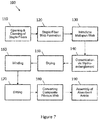
- the process 100 includes a fiber preparation step 110.
- step 110 bales of cellulosic fibers are opened and larger fiber tufts taken from the bale are reduced in size.
- the fiber preparation step may include a blending step where the tufts are further opened and a predetermined weight of fibers are deposited onto a conveyer.
- Optional coarse and fine opening phases further individualize the staple fiber.
- a feeding device introduces a loose, random assembly of staple fibers to web formation equipment, such as one or more cards.
- step 120 web formation transforms the random assembly of loose fibers into an ordered fibrous web via cards or airlaid machines, depending on fiber type and design considerations.
- One or more cross-lappers may be used to adjust the weight and/or fiber orientation.
- longitudinal lappers may be used.
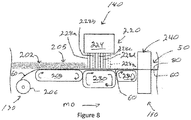
- Step 120 results in a fibrous web of staple fibers 202 ( Figure 8 ) that is advanced along the machine direction MD toward the next process step.
- the meltspun web 60 is introduced to the underside of the fibrous web of staple fibers 202 in step 140.
- Figure 8 illustrates a portion of the manufacturing line for making a tampon.
- the meltspun web 60 may be unwound from roll stock 206.
- a first conveyer 208 advances the meltspun web 60 and fibrous web of staple fibers 202 in the machine direction MD toward the consolidation unit 220.
- the meltspun web 60 and fibrous web of staple fibers 202 prior to consolidation can be referred to as a pre-entangled composite 205.
- the pre-entangled composite 205 is consolidated by unit 220.
- the fibrous web of staple fibers 202 are substantially entangled with the filaments of the meltspun web 60 so as to define the composite fibrous web 50.
- the consolidation unit 220 can be hydro-entanglement unit.
- the hydro-entanglement unit 220 includes a high pressure module 224 that includes a series water jet nozzle assemblies 228a, 228b, 228c, 228d....228 n that are spaced apart along the machine direction MD.
- the number of water nozzle jet assemblies can be about 2 to about 10. Four water jet nozzle assemblies are shown for illustrative purposes. More than four or less than four could be used.
- Each water jet nozzle assembly 228a-228d is configured to eject a plurality of high pressure water jets into the pre-entangled composite fibrous web 205.
- a forming surface or screen 230 carries the pre-entangled composite fibrous web 205 along each water jet nozzle assembly 228a-228d where high pressure jets of water cause the staple fibers to entangle with each other and with the filaments of the meltspun web 60.
- the hydro-entangling step 140 includes subjecting the pre-entangled composite fibrous web 205 water jets at a pressure of about 100 bar to about 300 bar.
- a second conveyer 234 advances the composite fibrous web 50 toward the next process step.
- the composite fibrous web 50 is introduced to a drying unit 240 to remove moisture from the composite fibrous web 50.
- the composite fibrous web 50 may have a basis weight in the range of about 100 grams per square meter to about 330 grams per square meter.
- the basis weight of the composite fibrous web 50 is in the range of about 150 grams per square meter to about 250 grams per square meter.
- the basis weight is in the range of about 170 grams per square meter to about 200 grams per square meter.
- the meltspun web 60 has a basis weight in the range of about 2.5 grams per square meter to about 30 grams per square meter.
- the cellulosic staple fiber web 80 which defines the absorbent component in the composite fibrous web 50, can have a basis weight in the range of about 85 grams per square meter to about 280 grams per square meter.
- the composite fibrous web 50 is configured so that the meltspun web 60 comprises about 2.5 % to about 15.0 % by weight of the composite fibrous web 50.
- step 160 includes winding the composite fibrous web 50 into roll-good form.
- step 170 includes slitting the composite fibrous web into strips of sliver or even wide goods.
- step 180 the slit composite fibrous webs 50 are converted into components for tampon assembly.
- the slits of the composite fibrous web 50 may be cut in to pledget 52, as described above.
- the withdrawal cord 18 may be coupled to the pledget 52.
- the tampon 10 is assembled in step 190.
- the pledget 52 is compressed into a cylindrically shaped body to define the absorbent component 40.
- the absorbent component 40 is then disposed in the outer carrier component 16 as illustrated in Figure 1 .
- optional applicators are disposed in the outer carrier component 16.
- the assembled tampon 10 is then packaged and prepared for shipment to the distributor.
- the methods described herein are efficient and require only one piece of machinery to produce the tampon product, i.e., they are continuous. In doing so, there are considerably fewer chances for the outer covering to become detached from the absorbent component, thereby reducing contamination and chances that the absorbent component may come into contact with a sensitive vaginal cavity. Further, another advantage of the present disclosure is that the methods described herein preclude the need for costly bale openers, fiber cleaning machines, carding machines, among others, at the point of tampon manufacture, thereby reducing material cost and capital requirements for tampon manufacturers.
Landscapes
- Health & Medical Sciences (AREA)
- Engineering & Computer Science (AREA)
- General Health & Medical Sciences (AREA)
- Epidemiology (AREA)
- Veterinary Medicine (AREA)
- Public Health (AREA)
- Life Sciences & Earth Sciences (AREA)
- Animal Behavior & Ethology (AREA)
- Heart & Thoracic Surgery (AREA)
- Vascular Medicine (AREA)
- Biomedical Technology (AREA)
- Manufacturing & Machinery (AREA)
- Textile Engineering (AREA)
- Hematology (AREA)
- Chemical & Material Sciences (AREA)
- Materials Engineering (AREA)
- Mechanical Engineering (AREA)
- Absorbent Articles And Supports Therefor (AREA)
Applications Claiming Priority (1)
| Application Number | Priority Date | Filing Date | Title |
|---|---|---|---|
| IN201621019956 | 2016-06-10 |
Publications (2)
| Publication Number | Publication Date |
|---|---|
| EP3254652A1 true EP3254652A1 (de) | 2017-12-13 |
| EP3254652B1 EP3254652B1 (de) | 2021-06-02 |
Family
ID=57130226
Family Applications (1)
| Application Number | Title | Priority Date | Filing Date |
|---|---|---|---|
| EP16193314.8A Active EP3254652B1 (de) | 2016-06-10 | 2016-10-11 | Tampon mit konsolidierter faseriger anordnung und verfahren zur herstellung |
Country Status (3)
| Country | Link |
|---|---|
| US (1) | US10905598B2 (de) |
| EP (1) | EP3254652B1 (de) |
| ES (1) | ES2885858T3 (de) |
Citations (5)
| Publication number | Priority date | Publication date | Assignee | Title |
|---|---|---|---|---|
| US3716430A (en) * | 1969-10-15 | 1973-02-13 | Mo Och Domsjoe Ab | Tampon and process and apparatus for making the same |
| EP0685213A2 (de) * | 1994-05-31 | 1995-12-06 | Kimberly-Clark Corporation | Tampon mit integrierter Verkleidung |
| US20060084345A1 (en) * | 2004-10-15 | 2006-04-20 | Michael Kann | Composite non-woven wiping/scrubbing fabric and method of manufacturing the same |
| EP1968513A1 (de) * | 2005-12-30 | 2008-09-17 | Kimberly-Clark Worldwide, Inc. | Saugfähiger tampon für die weibliche hygiene |
| US20120283684A1 (en) * | 2011-05-05 | 2012-11-08 | Alexander Schmidt-Foerst | Tampon Absorbent |
Family Cites Families (2)
| Publication number | Priority date | Publication date | Assignee | Title |
|---|---|---|---|---|
| US20030120225A1 (en) * | 2001-12-21 | 2003-06-26 | Kimberly-Clark Worldwide, Inc. | Therapeutic agent delivery labial pad |
| US8597267B2 (en) * | 2007-04-18 | 2013-12-03 | The Procter & Gamble Company | Tampon having at least one physical discontinuity |
-
2016
- 2016-09-29 US US15/280,709 patent/US10905598B2/en active Active
- 2016-10-11 ES ES16193314T patent/ES2885858T3/es active Active
- 2016-10-11 EP EP16193314.8A patent/EP3254652B1/de active Active
Patent Citations (5)
| Publication number | Priority date | Publication date | Assignee | Title |
|---|---|---|---|---|
| US3716430A (en) * | 1969-10-15 | 1973-02-13 | Mo Och Domsjoe Ab | Tampon and process and apparatus for making the same |
| EP0685213A2 (de) * | 1994-05-31 | 1995-12-06 | Kimberly-Clark Corporation | Tampon mit integrierter Verkleidung |
| US20060084345A1 (en) * | 2004-10-15 | 2006-04-20 | Michael Kann | Composite non-woven wiping/scrubbing fabric and method of manufacturing the same |
| EP1968513A1 (de) * | 2005-12-30 | 2008-09-17 | Kimberly-Clark Worldwide, Inc. | Saugfähiger tampon für die weibliche hygiene |
| US20120283684A1 (en) * | 2011-05-05 | 2012-11-08 | Alexander Schmidt-Foerst | Tampon Absorbent |
Also Published As
| Publication number | Publication date |
|---|---|
| US20170354545A1 (en) | 2017-12-14 |
| ES2885858T3 (es) | 2021-12-15 |
| EP3254652B1 (de) | 2021-06-02 |
| US10905598B2 (en) | 2021-02-02 |
Similar Documents
| Publication | Publication Date | Title |
|---|---|---|
| CA2717714C (en) | Tampon formed from a selectively needled nonwoven fabric web | |
| US9211217B2 (en) | Method of manufacturing tampons by forming a softwind with contact elements | |
| AU2018200407B2 (en) | Tampon method of manufacture | |
| KR0134905B1 (ko) | 분말 접착된 단층 랩을 갖는 탐폰 | |
| JP3219250B2 (ja) | 短繊維不織布及びそれを用いた吸収性物品 | |
| CN1254576C (zh) | 包含稳定化的长丝组合体的非织造织物结构体及其制造方法 | |
| US8845837B2 (en) | Method of manufacturing tampons | |
| RU2596128C2 (ru) | Упругий тампон и способ его изготовления | |
| EP3254652B1 (de) | Tampon mit konsolidierter faseriger anordnung und verfahren zur herstellung | |
| JPH101856A (ja) | 熱接着性不織布 | |
| US20020033222A1 (en) | Method and an apparatus for producing filamentous textile structures | |
| GB2522165B (en) | Method of manufacturing tampons with contact elements | |
| US20170035621A1 (en) | Tampons and methods of forming the same |
Legal Events
| Date | Code | Title | Description |
|---|---|---|---|
| PUAI | Public reference made under article 153(3) epc to a published international application that has entered the european phase |
Free format text: ORIGINAL CODE: 0009012 |
|
| STAA | Information on the status of an ep patent application or granted ep patent |
Free format text: STATUS: THE APPLICATION HAS BEEN PUBLISHED |
|
| AK | Designated contracting states |
Kind code of ref document: A1 Designated state(s): AL AT BE BG CH CY CZ DE DK EE ES FI FR GB GR HR HU IE IS IT LI LT LU LV MC MK MT NL NO PL PT RO RS SE SI SK SM TR |
|
| AX | Request for extension of the european patent |
Extension state: BA ME |
|
| STAA | Information on the status of an ep patent application or granted ep patent |
Free format text: STATUS: REQUEST FOR EXAMINATION WAS MADE |
|
| 17P | Request for examination filed |
Effective date: 20180613 |
|
| RBV | Designated contracting states (corrected) |
Designated state(s): AL AT BE BG CH CY CZ DE DK EE ES FI FR GB GR HR HU IE IS IT LI LT LU LV MC MK MT NL NO PL PT RO RS SE SI SK SM TR |
|
| STAA | Information on the status of an ep patent application or granted ep patent |
Free format text: STATUS: EXAMINATION IS IN PROGRESS |
|
| 17Q | First examination report despatched |
Effective date: 20200623 |
|
| GRAP | Despatch of communication of intention to grant a patent |
Free format text: ORIGINAL CODE: EPIDOSNIGR1 |
|
| STAA | Information on the status of an ep patent application or granted ep patent |
Free format text: STATUS: GRANT OF PATENT IS INTENDED |
|
| INTG | Intention to grant announced |
Effective date: 20201222 |
|
| GRAS | Grant fee paid |
Free format text: ORIGINAL CODE: EPIDOSNIGR3 |
|
| GRAA | (expected) grant |
Free format text: ORIGINAL CODE: 0009210 |
|
| STAA | Information on the status of an ep patent application or granted ep patent |
Free format text: STATUS: THE PATENT HAS BEEN GRANTED |
|
| REG | Reference to a national code |
Ref country code: CH Ref legal event code: EP |
|
| AK | Designated contracting states |
Kind code of ref document: B1 Designated state(s): AL AT BE BG CH CY CZ DE DK EE ES FI FR GB GR HR HU IE IS IT LI LT LU LV MC MK MT NL NO PL PT RO RS SE SI SK SM TR |
|
| REG | Reference to a national code |
Ref country code: GB Ref legal event code: FG4D |
|
| REG | Reference to a national code |
Ref country code: AT Ref legal event code: REF Ref document number: 1397751 Country of ref document: AT Kind code of ref document: T Effective date: 20210615 |
|
| REG | Reference to a national code |
Ref country code: IE Ref legal event code: FG4D |
|
| REG | Reference to a national code |
Ref country code: DE Ref legal event code: R096 Ref document number: 602016058737 Country of ref document: DE |
|
| REG | Reference to a national code |
Ref country code: LT Ref legal event code: MG9D |
|
| PG25 | Lapsed in a contracting state [announced via postgrant information from national office to epo] |
Ref country code: FI Free format text: LAPSE BECAUSE OF FAILURE TO SUBMIT A TRANSLATION OF THE DESCRIPTION OR TO PAY THE FEE WITHIN THE PRESCRIBED TIME-LIMIT Effective date: 20210602 Ref country code: LT Free format text: LAPSE BECAUSE OF FAILURE TO SUBMIT A TRANSLATION OF THE DESCRIPTION OR TO PAY THE FEE WITHIN THE PRESCRIBED TIME-LIMIT Effective date: 20210602 Ref country code: BG Free format text: LAPSE BECAUSE OF FAILURE TO SUBMIT A TRANSLATION OF THE DESCRIPTION OR TO PAY THE FEE WITHIN THE PRESCRIBED TIME-LIMIT Effective date: 20210902 Ref country code: HR Free format text: LAPSE BECAUSE OF FAILURE TO SUBMIT A TRANSLATION OF THE DESCRIPTION OR TO PAY THE FEE WITHIN THE PRESCRIBED TIME-LIMIT Effective date: 20210602 |
|
| REG | Reference to a national code |
Ref country code: NL Ref legal event code: MP Effective date: 20210602 |
|
| REG | Reference to a national code |
Ref country code: AT Ref legal event code: MK05 Ref document number: 1397751 Country of ref document: AT Kind code of ref document: T Effective date: 20210602 |
|
| PG25 | Lapsed in a contracting state [announced via postgrant information from national office to epo] |
Ref country code: LV Free format text: LAPSE BECAUSE OF FAILURE TO SUBMIT A TRANSLATION OF THE DESCRIPTION OR TO PAY THE FEE WITHIN THE PRESCRIBED TIME-LIMIT Effective date: 20210602 Ref country code: GR Free format text: LAPSE BECAUSE OF FAILURE TO SUBMIT A TRANSLATION OF THE DESCRIPTION OR TO PAY THE FEE WITHIN THE PRESCRIBED TIME-LIMIT Effective date: 20210903 Ref country code: NO Free format text: LAPSE BECAUSE OF FAILURE TO SUBMIT A TRANSLATION OF THE DESCRIPTION OR TO PAY THE FEE WITHIN THE PRESCRIBED TIME-LIMIT Effective date: 20210902 Ref country code: PL Free format text: LAPSE BECAUSE OF FAILURE TO SUBMIT A TRANSLATION OF THE DESCRIPTION OR TO PAY THE FEE WITHIN THE PRESCRIBED TIME-LIMIT Effective date: 20210602 Ref country code: SE Free format text: LAPSE BECAUSE OF FAILURE TO SUBMIT A TRANSLATION OF THE DESCRIPTION OR TO PAY THE FEE WITHIN THE PRESCRIBED TIME-LIMIT Effective date: 20210602 Ref country code: RS Free format text: LAPSE BECAUSE OF FAILURE TO SUBMIT A TRANSLATION OF THE DESCRIPTION OR TO PAY THE FEE WITHIN THE PRESCRIBED TIME-LIMIT Effective date: 20210602 |
|
| REG | Reference to a national code |
Ref country code: ES Ref legal event code: FG2A Ref document number: 2885858 Country of ref document: ES Kind code of ref document: T3 Effective date: 20211215 |
|
| PG25 | Lapsed in a contracting state [announced via postgrant information from national office to epo] |
Ref country code: SK Free format text: LAPSE BECAUSE OF FAILURE TO SUBMIT A TRANSLATION OF THE DESCRIPTION OR TO PAY THE FEE WITHIN THE PRESCRIBED TIME-LIMIT Effective date: 20210602 Ref country code: SM Free format text: LAPSE BECAUSE OF FAILURE TO SUBMIT A TRANSLATION OF THE DESCRIPTION OR TO PAY THE FEE WITHIN THE PRESCRIBED TIME-LIMIT Effective date: 20210602 Ref country code: EE Free format text: LAPSE BECAUSE OF FAILURE TO SUBMIT A TRANSLATION OF THE DESCRIPTION OR TO PAY THE FEE WITHIN THE PRESCRIBED TIME-LIMIT Effective date: 20210602 Ref country code: CZ Free format text: LAPSE BECAUSE OF FAILURE TO SUBMIT A TRANSLATION OF THE DESCRIPTION OR TO PAY THE FEE WITHIN THE PRESCRIBED TIME-LIMIT Effective date: 20210602 Ref country code: AT Free format text: LAPSE BECAUSE OF FAILURE TO SUBMIT A TRANSLATION OF THE DESCRIPTION OR TO PAY THE FEE WITHIN THE PRESCRIBED TIME-LIMIT Effective date: 20210602 Ref country code: NL Free format text: LAPSE BECAUSE OF FAILURE TO SUBMIT A TRANSLATION OF THE DESCRIPTION OR TO PAY THE FEE WITHIN THE PRESCRIBED TIME-LIMIT Effective date: 20210602 Ref country code: PT Free format text: LAPSE BECAUSE OF FAILURE TO SUBMIT A TRANSLATION OF THE DESCRIPTION OR TO PAY THE FEE WITHIN THE PRESCRIBED TIME-LIMIT Effective date: 20211004 Ref country code: RO Free format text: LAPSE BECAUSE OF FAILURE TO SUBMIT A TRANSLATION OF THE DESCRIPTION OR TO PAY THE FEE WITHIN THE PRESCRIBED TIME-LIMIT Effective date: 20210602 |
|
| REG | Reference to a national code |
Ref country code: DE Ref legal event code: R097 Ref document number: 602016058737 Country of ref document: DE |
|
| PLBE | No opposition filed within time limit |
Free format text: ORIGINAL CODE: 0009261 |
|
| STAA | Information on the status of an ep patent application or granted ep patent |
Free format text: STATUS: NO OPPOSITION FILED WITHIN TIME LIMIT |
|
| PG25 | Lapsed in a contracting state [announced via postgrant information from national office to epo] |
Ref country code: DK Free format text: LAPSE BECAUSE OF FAILURE TO SUBMIT A TRANSLATION OF THE DESCRIPTION OR TO PAY THE FEE WITHIN THE PRESCRIBED TIME-LIMIT Effective date: 20210602 |
|
| 26N | No opposition filed |
Effective date: 20220303 |
|
| PG25 | Lapsed in a contracting state [announced via postgrant information from national office to epo] |
Ref country code: AL Free format text: LAPSE BECAUSE OF FAILURE TO SUBMIT A TRANSLATION OF THE DESCRIPTION OR TO PAY THE FEE WITHIN THE PRESCRIBED TIME-LIMIT Effective date: 20210602 |
|
| REG | Reference to a national code |
Ref country code: CH Ref legal event code: PL |
|
| REG | Reference to a national code |
Ref country code: BE Ref legal event code: MM Effective date: 20211031 |
|
| PG25 | Lapsed in a contracting state [announced via postgrant information from national office to epo] |
Ref country code: MC Free format text: LAPSE BECAUSE OF FAILURE TO SUBMIT A TRANSLATION OF THE DESCRIPTION OR TO PAY THE FEE WITHIN THE PRESCRIBED TIME-LIMIT Effective date: 20210602 |
|
| PG25 | Lapsed in a contracting state [announced via postgrant information from national office to epo] |
Ref country code: LU Free format text: LAPSE BECAUSE OF NON-PAYMENT OF DUE FEES Effective date: 20211011 Ref country code: BE Free format text: LAPSE BECAUSE OF NON-PAYMENT OF DUE FEES Effective date: 20211031 |
|
| PG25 | Lapsed in a contracting state [announced via postgrant information from national office to epo] |
Ref country code: LI Free format text: LAPSE BECAUSE OF NON-PAYMENT OF DUE FEES Effective date: 20211031 Ref country code: CH Free format text: LAPSE BECAUSE OF NON-PAYMENT OF DUE FEES Effective date: 20211031 |
|
| PG25 | Lapsed in a contracting state [announced via postgrant information from national office to epo] |
Ref country code: IE Free format text: LAPSE BECAUSE OF NON-PAYMENT OF DUE FEES Effective date: 20211011 |
|
| PG25 | Lapsed in a contracting state [announced via postgrant information from national office to epo] |
Ref country code: HU Free format text: LAPSE BECAUSE OF FAILURE TO SUBMIT A TRANSLATION OF THE DESCRIPTION OR TO PAY THE FEE WITHIN THE PRESCRIBED TIME-LIMIT; INVALID AB INITIO Effective date: 20161011 |
|
| PG25 | Lapsed in a contracting state [announced via postgrant information from national office to epo] |
Ref country code: CY Free format text: LAPSE BECAUSE OF FAILURE TO SUBMIT A TRANSLATION OF THE DESCRIPTION OR TO PAY THE FEE WITHIN THE PRESCRIBED TIME-LIMIT Effective date: 20210602 |
|
| PG25 | Lapsed in a contracting state [announced via postgrant information from national office to epo] |
Ref country code: MK Free format text: LAPSE BECAUSE OF FAILURE TO SUBMIT A TRANSLATION OF THE DESCRIPTION OR TO PAY THE FEE WITHIN THE PRESCRIBED TIME-LIMIT Effective date: 20210602 |
|
| PG25 | Lapsed in a contracting state [announced via postgrant information from national office to epo] |
Ref country code: TR Free format text: LAPSE BECAUSE OF FAILURE TO SUBMIT A TRANSLATION OF THE DESCRIPTION OR TO PAY THE FEE WITHIN THE PRESCRIBED TIME-LIMIT Effective date: 20210602 |
|
| PG25 | Lapsed in a contracting state [announced via postgrant information from national office to epo] |
Ref country code: MT Free format text: LAPSE BECAUSE OF FAILURE TO SUBMIT A TRANSLATION OF THE DESCRIPTION OR TO PAY THE FEE WITHIN THE PRESCRIBED TIME-LIMIT Effective date: 20210602 |
|
| PGFP | Annual fee paid to national office [announced via postgrant information from national office to epo] |
Ref country code: DE Payment date: 20241020 Year of fee payment: 9 |
|
| PGFP | Annual fee paid to national office [announced via postgrant information from national office to epo] |
Ref country code: GB Payment date: 20241010 Year of fee payment: 9 |
|
| PGFP | Annual fee paid to national office [announced via postgrant information from national office to epo] |
Ref country code: FR Payment date: 20241020 Year of fee payment: 9 |
|
| PGFP | Annual fee paid to national office [announced via postgrant information from national office to epo] |
Ref country code: IT Payment date: 20241021 Year of fee payment: 9 Ref country code: ES Payment date: 20241121 Year of fee payment: 9 |