EP3255689A1 - Verfahren zur herstellung eines auf niobiumsäure basierenden ferroelektrischen dünnschichtelements - Google Patents
Verfahren zur herstellung eines auf niobiumsäure basierenden ferroelektrischen dünnschichtelements Download PDFInfo
- Publication number
- EP3255689A1 EP3255689A1 EP16746410.6A EP16746410A EP3255689A1 EP 3255689 A1 EP3255689 A1 EP 3255689A1 EP 16746410 A EP16746410 A EP 16746410A EP 3255689 A1 EP3255689 A1 EP 3255689A1
- Authority
- EP
- European Patent Office
- Prior art keywords
- thin film
- niobate
- ferroelectric thin
- etching
- etchant
- Prior art date
- Legal status (The legal status is an assumption and is not a legal conclusion. Google has not performed a legal analysis and makes no representation as to the accuracy of the status listed.)
- Granted
Links
Images



Classifications
-
- H—ELECTRICITY
- H10—SEMICONDUCTOR DEVICES; ELECTRIC SOLID-STATE DEVICES NOT OTHERWISE PROVIDED FOR
- H10N—ELECTRIC SOLID-STATE DEVICES NOT OTHERWISE PROVIDED FOR
- H10N30/00—Piezoelectric or electrostrictive devices
- H10N30/80—Constructional details
- H10N30/85—Piezoelectric or electrostrictive active materials
- H10N30/853—Ceramic compositions
- H10N30/8542—Alkali metal based oxides, e.g. lithium, sodium or potassium niobates
-
- H—ELECTRICITY
- H10—SEMICONDUCTOR DEVICES; ELECTRIC SOLID-STATE DEVICES NOT OTHERWISE PROVIDED FOR
- H10N—ELECTRIC SOLID-STATE DEVICES NOT OTHERWISE PROVIDED FOR
- H10N30/00—Piezoelectric or electrostrictive devices
- H10N30/01—Manufacture or treatment
- H10N30/07—Forming of piezoelectric or electrostrictive parts or bodies on an electrical element or another base
- H10N30/074—Forming of piezoelectric or electrostrictive parts or bodies on an electrical element or another base by depositing piezoelectric or electrostrictive layers, e.g. aerosol or screen printing
- H10N30/076—Forming of piezoelectric or electrostrictive parts or bodies on an electrical element or another base by depositing piezoelectric or electrostrictive layers, e.g. aerosol or screen printing by vapour phase deposition
-
- C—CHEMISTRY; METALLURGY
- C23—COATING METALLIC MATERIAL; COATING MATERIAL WITH METALLIC MATERIAL; CHEMICAL SURFACE TREATMENT; DIFFUSION TREATMENT OF METALLIC MATERIAL; COATING BY VACUUM EVAPORATION, BY SPUTTERING, BY ION IMPLANTATION OR BY CHEMICAL VAPOUR DEPOSITION, IN GENERAL; INHIBITING CORROSION OF METALLIC MATERIAL OR INCRUSTATION IN GENERAL
- C23C—COATING METALLIC MATERIAL; COATING MATERIAL WITH METALLIC MATERIAL; SURFACE TREATMENT OF METALLIC MATERIAL BY DIFFUSION INTO THE SURFACE, BY CHEMICAL CONVERSION OR SUBSTITUTION; COATING BY VACUUM EVAPORATION, BY SPUTTERING, BY ION IMPLANTATION OR BY CHEMICAL VAPOUR DEPOSITION, IN GENERAL
- C23C14/00—Coating by vacuum evaporation, by sputtering or by ion implantation of the coating forming material
- C23C14/06—Coating by vacuum evaporation, by sputtering or by ion implantation of the coating forming material characterised by the coating material
- C23C14/08—Oxides
-
- C—CHEMISTRY; METALLURGY
- C23—COATING METALLIC MATERIAL; COATING MATERIAL WITH METALLIC MATERIAL; CHEMICAL SURFACE TREATMENT; DIFFUSION TREATMENT OF METALLIC MATERIAL; COATING BY VACUUM EVAPORATION, BY SPUTTERING, BY ION IMPLANTATION OR BY CHEMICAL VAPOUR DEPOSITION, IN GENERAL; INHIBITING CORROSION OF METALLIC MATERIAL OR INCRUSTATION IN GENERAL
- C23C—COATING METALLIC MATERIAL; COATING MATERIAL WITH METALLIC MATERIAL; SURFACE TREATMENT OF METALLIC MATERIAL BY DIFFUSION INTO THE SURFACE, BY CHEMICAL CONVERSION OR SUBSTITUTION; COATING BY VACUUM EVAPORATION, BY SPUTTERING, BY ION IMPLANTATION OR BY CHEMICAL VAPOUR DEPOSITION, IN GENERAL
- C23C14/00—Coating by vacuum evaporation, by sputtering or by ion implantation of the coating forming material
- C23C14/22—Coating by vacuum evaporation, by sputtering or by ion implantation of the coating forming material characterised by the process of coating
- C23C14/34—Sputtering
-
- H—ELECTRICITY
- H10—SEMICONDUCTOR DEVICES; ELECTRIC SOLID-STATE DEVICES NOT OTHERWISE PROVIDED FOR
- H10N—ELECTRIC SOLID-STATE DEVICES NOT OTHERWISE PROVIDED FOR
- H10N30/00—Piezoelectric or electrostrictive devices
- H10N30/01—Manufacture or treatment
- H10N30/08—Shaping or machining of piezoelectric or electrostrictive bodies
- H10N30/082—Shaping or machining of piezoelectric or electrostrictive bodies by etching, e.g. lithography
-
- H—ELECTRICITY
- H10—SEMICONDUCTOR DEVICES; ELECTRIC SOLID-STATE DEVICES NOT OTHERWISE PROVIDED FOR
- H10N—ELECTRIC SOLID-STATE DEVICES NOT OTHERWISE PROVIDED FOR
- H10N30/00—Piezoelectric or electrostrictive devices
- H10N30/30—Piezoelectric or electrostrictive devices with mechanical input and electrical output, e.g. functioning as generators or sensors
-
- H—ELECTRICITY
- H10—SEMICONDUCTOR DEVICES; ELECTRIC SOLID-STATE DEVICES NOT OTHERWISE PROVIDED FOR
- H10N—ELECTRIC SOLID-STATE DEVICES NOT OTHERWISE PROVIDED FOR
- H10N30/00—Piezoelectric or electrostrictive devices
- H10N30/80—Constructional details
- H10N30/85—Piezoelectric or electrostrictive active materials
- H10N30/853—Ceramic compositions
-
- H—ELECTRICITY
- H10—SEMICONDUCTOR DEVICES; ELECTRIC SOLID-STATE DEVICES NOT OTHERWISE PROVIDED FOR
- H10P—GENERIC PROCESSES OR APPARATUS FOR THE MANUFACTURE OR TREATMENT OF DEVICES COVERED BY CLASS H10
- H10P50/00—Etching of wafers, substrates or parts of devices
- H10P50/69—Etching of wafers, substrates or parts of devices using masks for semiconductor materials
- H10P50/691—Etching of wafers, substrates or parts of devices using masks for semiconductor materials for Group V materials or Group III-V materials
Definitions
- the present invention relates to technologies regarding ferroelectric thin film devices and particularly to methods for manufacturing lead-free niobate-system ferroelectric thin film devices.
- Ferroelectrics are very attractive substances because of their peculiar characteristics (such as very high relative permittivity, and good pyroelectric, piezoelectric and ferroelectric properties). So, various devices (such as ceramic multilayer capacitors, pyroelectric devices, piezoelectric devices and ferroelectric memories) have been developed and put into use utilizing such peculiar properties.
- Typical ferroelectrics are perovskite materials such as barium titanate (BaTiO 3 ) and lead zirconate titanate (Pb(Zr 1-x Ti x )O 3 , PZT). Of these, lead zirconate titanates (PZTs) provide relatively excellent polarization and piezoelectric properties and are therefore most widely used.
- Lead-containing PZTs are specified hazardous substances.
- PZTs are exempt from the RoHS directive (the directive on the restriction of the use of specified hazardous substances in electrical and electronic equipment enforced by the European Union and Council of Europe).
- RoHS directive the directive on the restriction of the use of specified hazardous substances in electrical and electronic equipment enforced by the European Union and Council of Europe.
- Piezoelectric devices utilize the piezoelectric effect of a ferroelectric material, and are widely used as functional devices such as actuators and stress sensors. Actuators generate a displacement or vibration in response to an applied voltage to a ferroelectric (piezoelectric) material. Stress sensors generate a voltage in response to a strain produced in a piezoelectric material. Pyroelectric devices detect light (including infrared light) utilizing the pyroelectric effect of a ferroelectric material, and are widely used as infrared human body sensors, etc.
- Patent Literature 1 discloses a piezoelectric thin film device including, on a substrate, a lower electrode, a piezoelectric thin film and an upper electrode.
- a buffer layer of a perovskite crystal structure material is formed between the piezoelectric thin film and the lower electrode.
- the perovskite buffer layer is highly preferentially (001), (100), (010) or (111) oriented. According to this Patent Literature 1, the piezoelectric thin film device utilizing the lead-free lithium potassium sodium niobate thin film exhibits sufficient piezoelectric properties.
- Piezoelectric devices have a basic structure of a piezoelectric material sandwiched between two electrodes and are micro-fabricated into a beam shape or a tuning fork shape depending on their application. So, micro fabrication processes are important in order to put piezoelectric devices using lead-free piezoelectric materials to practical use.
- Patent Literature 2 discloses a method of processing a wafer having thereon a piezoelectric thin film of a chemical formula (K 1-x Na x )NbO 3 (where 0.4 ⁇ x ⁇ 0.7). The method includes the first step of ion etching the piezoelectric thin film on wafer in an Ar gas atmosphere and the second step of reactive ion etching the resulting wafer in a fluorine based reactive gas/Ar mixture atmosphere. According to this Patent Literature 2, a fine pattern of the piezoelectric thin film can be formed, thereby providing a highly reliable and low cost piezoelectric thin film device.
- Patent Literature 3 discloses a method for manufacturing a piezoelectric film device, which includes the steps of: forming a lower electrode on a substrate; forming, on the lower electrode, a piezoelectric film of an alkali niobate-based perovskite material represented by a chemical formula (K 1-x Na x )NbO 3 ; and wet-etching the piezoelectric film using a hydrogen fluoride-based etchant and a Cr film etch mask.
- the Cr mask and the lower electrode are not etched by the hydrogen fluoride-based etchant; therefore, the piezoelectric film alone can be selectively etched.
- a fine pattern of the piezoelectric film can be accurately formed in a short time.
- niobate-based ferroelectric materials such as potassium sodium niobate ((K 1-x Na x )NbO 3 ) are very promising as lead-free ferroelectric materials.
- niobate-based ferroelectric materials such as potassium sodium niobate ((K 1-x Na x )NbO 3 ) are very promising as lead-free ferroelectric materials.
- PZTs PZTs
- niobate-based ferroelectric materials are relatively new materials, and their micro fabrication techniques are still under development.
- the above-disclosed manufacturing techniques have the following disadvantages:
- the dry etching technique of the above Patent Literature 2 would achieve a high dimensional accuracy.
- this dry etching technique requires an expensive etching apparatus because it is a vacuum process.
- the technique has only a relatively low throughput.
- Patent Literature 3 The wet etching technique of the above Patent Literature 3 would achieve a relatively high throughput and therefore have an advantage over dry etching processes in terms of manufacturing cost.
- niobate-based ferroelectric materials are chemically stable and are therefore difficult to fine-etch using an etchant other than hydrogen fluoride-based etchants.
- Hydrogen fluoride-based etchants require very careful handling for safety reasons and the usable etch masks are limited.
- a method for manufacturing a niobate-system ferroelectric thin film device includes a lower electrode film formation step, a ferroelectric thin film formation step, an etch mask pattern formation step, and a ferroelectric thin film etching step.
- a lower electrode film formation step a lower electrode film is formed on a substrate.
- a ferroelectric thin film formation step a niobate-system ferroelectric thin film is formed on the lower electrode film.
- an etch mask is formed in a desired pattern on the niobate-system ferroelectric thin film.
- the niobate-system ferroelectric thin film is shaped into a desired fine pattern by wet etching using an etchant containing a predetermined chelating agent, an aqueous alkaline solution, and an aqueous hydrogen peroxide solution (referred to H 2 O 2 aq.).
- the predetermined chelating agent contains at least one selected from ethylenediamine tetra(methylene phosphonic acid) (referred to EDTMP), nitrilotris(methylene phosphonic acid) (referred to NTMP), cyclohexane diamine tetraacetic acid (referred to CyDTA), 1-hydroxyethane-1,1-diphosphonic acid(etidronic acid) (referred to HEDP), glycine-N,N-bis(methylene phosphonic acid) (referred to GBMP), diethylenetriamine penta(methylene phosphonic acid) (referred to DTPMP), and citric acid.
- the aqueous alkaline solution contains an aqueous ammonia solution (referred to NH 3 aq.).
- the present invention it is possible to wet etch a lead-free niobate-system ferroelectric thin film into a desired fine pattern with a high dimensional accuracy and at a lower cost than before. As a result, it is possible to provide a niobate-system ferroelectric thin film device in which a desired fine pattern of the ferroelectric thin film is formed at low manufacturing cost.
- niobate-system ferroelectric materials specifically, potassium sodium niobate ((K 1-x Na x )NbO 3 , KNN) and lithium niobate (LiNbO 3 , LN)] as lead-free ferroelectric materials that were expected to have pyroelectric or piezoelectric properties comparable to those of lead zirconate titanates (Pb(Zr 1-x Ti x )O 3 , PZT), and intensively investigated wet etching techniques usable for the niobate-system ferroelectric materials focused. After various investigations, the following results were obtained.
- Niobate-system ferroelectric materials are conventionally thought to be difficult to fine-etch using an etchant other than hydrogen fluoride-based etchants.
- niobate-system ferroelectric materials can be wet-etched using novel etchants containing a predetermined chelating agent, an aqueous alkaline solution and an aqueous hydrogen peroxide solution with high dimensional accuracy.
- silicon oxide films can be used as an etch mask because the new etchants do not contain hydrogen fluoride.
- Chelating agents are thought to be less harmful to the human body and environment. So, simpler and less inexpensive etching apparatuses can be used, thus considerably reducing manufacturing and equipment cost. Further, because cheap and commonly used silicon oxide films can be used as an etch mask, the etching process using this new etchant is simplified, thus considerably reducing manufacturing process cost.
- the present invention is based on these new findings.
- FIG. 1 is a schematic illustration showing an enlarged cross sectional view of first half manufacturing steps (from a first step to a ferroelectric thin film etching step) of a niobate-system ferroelectric thin film device according to the invention. While a cleaning step and a drying step are not described below, it is preferable that these steps are performed as needed.
- a substrate 11 is prepared.
- a material of the substrate 11 is not particularly limited, and may be properly selected based on applications of the pyroelectric or piezoelectric device.
- silicon Si
- SOI Silicon on Insulator
- quartz glass gallium arsenide
- GaAs gallium arsenide
- Al 2 O 3 sapphire
- metal such as stainless steel
- magnesium oxide MgO
- strontium titanate SrTiO 3
- an electrically conductive material is used as the substrate 11, its surface is preferably covered with an electrical insulating film (e.g. an oxide film).
- an electrical insulating film e.g. an oxide film
- thermal oxidation and chemical vapor deposition (CVD) are suitable.
- a lower electrode film 12 is formed on the substrate 11 (see FIG. 1(a) ).
- a material of the lower electrode film 12 there is no particular limitation on a material of the lower electrode film 12; however, platinum (Pt) and an alloy mainly containing platinum are preferable. Because Pt is inert to an etchant used in a later-described ferroelectric film etching step, Pt can be used as an etch stop.
- the arithmetic mean surface roughness (Ra) of the lower electrode film 12 is preferably 0.86 nm or less in order to achieve sufficient pyroelectric (or piezoelectric) performance of a later-formed niobate-system ferroelectric thin film 13.
- the niobate-system ferroelectric thin film 13 is formed on the lower electrode film 12 (see FIG. 1(a) ).
- KNN ((K 1-x Na x )NbO 3 , 0.4 ⁇ x ⁇ 0.7) is preferable as a material of the niobate-system ferroelectric thin film 13.
- Sputtering (with a use of a sintered KNN target) and electron beam deposition are preferable as a method for forming the niobate-system (KNN) ferroelectric thin film 13. This is because sputtering and electron beam deposition are excellent in terms of reproducibility, formation rate, running cost and orientation control of KNN crystal films.
- a crystal system of the niobate-system (KNN) ferroelectric thin film 13 is pseudo cubic or tetragonal and the (001) crystal plane is preferentially oriented parallel to a device forming surface.
- the KNN thin film 13 may contain, as impurities, lithium (Li), tantalum (Ta), antimony (Sb), calcium (Ca), copper (Cu), barium (Ba) and titanium (Ti) in a total amount of 5 atomic percent or less.
- LN LiNbO 3
- KNN KNN
- an etch mask used for later-described wet etching is formed on the ferroelectric thin film 13.
- a photoresist pattern 14 is formed on the ferroelectric thin film 13 using a photolithography process (see FIG. 1(b) ).
- an unpatterned etch mask film 15 is formed over the photoresist pattern 14 (see FIG. 1(c) ).
- a desired etch mask pattern 15' is formed using a lift-off process (see FIG. 1(d) ).
- etch mask layer 15 there is no particular limitation on a material of the etch mask layer 15 (etch mask pattern 15') so long as it has a sufficient resistance to later-described etchants.
- a sputtered noble metal film such as Au, Pt and Pd
- an oxide film such as silicon oxide
- a silicon oxide film e.g. SiO 2 film
- the etch mask pattern 15' may be formed using a process other than the above-described photolithography/lift-off process.
- the niobate-system ferroelectric thin film 13 is wet etched to form a fine pattern defined by the etch mask pattern 15'.
- the etchant used at this step preferably contains a chelating agent, an aqueous alkaline solution and an aqueous hydrogen peroxide solution and does not contain hydrogen fluoride (i.e., not containing fluorine ions).
- the use of such a hydrogen fluoride-free etchant reduces the safety cost conventionally needed to use hydrogen fluoride-based etchants.
- EDTMP ethylenediamine tetra(methylene phosphonic acid)
- NTMP nitrilotris(methylene phosphonic acid)
- CyDTA cyclohexane diamine tetraacetic acid
- HEDP 1-hydroxyethane-1,1-diphosphonic acid(etidronic acid)
- GBMP glycine-N,N-bis(methylene phosphonic acid)
- DTPMP diethylenetriamine penta(methylene phosphonic acid)
- citric acid may be preferably used.
- the molarity of the chelating agent in the etchant is preferably 0.001 M (mol/L) or more and 0.5 M (mol/L) or less, more preferably 0.003 M or more and 0.3 M or less, and even more preferably 0.01 M or more and 0.2 M or less.
- the molarity of the chelating agent is less than 0.001 M, the etching reaction activity is insufficient. When it exceeds 0.5 M, the etching reaction activity decreases.
- the molarity of the citric acid in the etchant is preferably 0.03 M (mol/L) or more and 1 M (mol/L) or less, more preferably 0.05 M or more and 0.7 M or less, and even more preferably 0.1 M or more and 0.6 M or less.
- the molarity of the citric acid is less than 0.03 M, the etching reaction activity is insufficient. When it exceeds 1 M, the etching reaction activity decreases.
- an aqueous alkaline solution and an H 2 O 2 aq. are preferably used.
- an NH 3 aq. an aqueous sodium hydroxide solution (NaOH aq.) and an aqueous potassium hydroxide solution (KOH aq.) may be used.
- it preferably contains mainly NH 3 aq..
- the etchant is prepared so as to have a hydrogen ion exponent (potential of hydrogen: pH) of preferably 7.5 or more and 12 or less, more preferably 8 or more and 10 or less.
- pH a hydrogen ion exponent
- the pH is less than 7.5, the etching reaction activity is insufficient. When it exceeds 10, the etching reaction activity begins to decrease. When it exceeds 12, the etching reaction activity further decreases and becomes saturated.
- the NH 3 concentration is preferably 3 M (mol/L) or more and 10 M (mol/L) or less, for example.
- the pH may be adjusted by adding a strong acid (e.g. hydrochloric acid) or a strong base (e.g. sodium hydroxide and potassium hydroxide).
- the concentration of the H 2 O 2 aq. is preferably 4 M (mol/L) or more and 9 M (mol/L) or less, more preferably 5 M or more and 8 M or less.
- the H 2 O 2 concentration is less than 4 M, the etching reaction activity is insufficient.
- it exceeds 9 M preparation of the etchant is difficult.
- the individual chemicals that constitute the etchant commercially available reagents may be used.
- the etchant to be used is preferably prepared immediately before the wet-etching process.
- the etchant When the etchant is prepared, particularly when it is prepared in a relatively large amount (e.g. 2 L or more), it is prepared preferably by a two-liquid mixing system in which a separately prepared concentrated solution containing the chelating agent and an NH 3 aq. (chelating agent/ammonia concentrated solution) is diluted and mixed with an H 2 O 2 aq..
- a separately prepared concentrated solution containing the chelating agent and an NH 3 aq. chelating agent/ammonia concentrated solution
- the chelating agent/ammonia concentrated solution is excellent in preservability and therefore can be prepared in advance.
- Preparation of the etchant by the two-liquid mixing system makes it possible to prepare a required amount of etchant immediately before the wet-etching process in an extremely short time, thereby significantly reducing the time that is required to complete the entire etching process (resulting in a further reduced process cost).
- the SiO 2 etch mask pattern 15' and the lower electrode film 12 are inert (resistant) to the above-described etchants; thus, the niobate-system ferroelectric thin film pattern 13' (which is a desired fine pattern of the niobate-system ferroelectric thin film 13) can be formed (see FIG. 1(e) ).
- the etching reaction activity can be enhanced by raising the etching temperature (etchant temperature) from a room temperature to a higher temperature.
- the etchant temperature is preferably 50°C or higher, more preferably 60°C or higher and even more preferably 80°C or higher. However, in view of operational safety, the etchant temperature is preferably lower than 100°C.
- etching reaction mechanism of the invention is not fully clarified. But, the chelating agent and the hydrogen peroxide by coexisting with each other would react with niobium to form a chemically very stable chelate peroxide (e.g. Nb-H 2 O 2 -EDTMP), which is probably effective in etching the niobate-system ferroelectric thin film 13.
- a chemically very stable chelate peroxide e.g. Nb-H 2 O 2 -EDTMP
- the etch mask pattern 15' is removed using an etchant for silicon oxide (e.g. buffered HF); thereby, a ferroelectric thin film-on-substrate 10 having a desired fine pattern of the niobate-system ferroelectric thin film 13 (the niobate-system ferroelectric thin film pattern 13') is formed (see FIG. 1(f) ).
- an etchant for silicon oxide e.g. buffered HF
- FIG. 2 is a schematic illustration showing an enlarged cross sectional view of latter half manufacturing steps (from a ferroelectric thin film etching step to a final step) of the niobate-system ferroelectric thin film device according to the invention.
- an upper electrode is formed on the niobate-system ferroelectric thin film having a desired fine pattern (niobate-system ferroelectric thin film pattern 13').
- a photoresist pattern 21 (corresponding to the reverse (negative) pattern of a later-formed upper electrode 22') is formed using a photolithography process.
- an upper electrode film 22 is formed over the photoresist pattern 21 (see FIG. 2(a) ).
- Suitable materials of the upper electrode film 22 (upper electrode 22') are, for example, aluminum (Al), gold (Au), nickel (Ni) and Pt.
- the substrate having the niobate-system ferroelectric thin film pattern 13' and the upper electrode 22' is diced into a chip of a niobate-system ferroelectric thin film device 20 (see FIG. 2(c) ).
- the reference numeral 11' designates the diced substrate of the chip 20
- numeral 12' designates the lower electrode in the chip 20.
- the KNN thin film-on-substrate 10 was fabricated according to the manufacturing steps illustrated in FIG. 1 .
- a 4-inch (100) Si wafer with thermal oxide Si wafer thickness of 0.525 mm; oxide thickness of 200 nm was used as the substrate 11.
- a 2.2-nm thick Ti layer was formed on the substrate 11 by RF magnetron sputtering in order to enhance adhesion between the substrate 11 and the lower electrode film 12.
- the lower electrode film 12 was formed by forming a 205-nm thick Pt layer on the Ti layer by RF magnetron sputtering (see FIG. 1(a) ).
- the sputtering conditions for the Ti adhesive layer and Pt lower electrode film 12 were as follows: targets of pure Ti (for the Ti layer) and pure Pt (for the Pt electrode); substrate temperature of 250°C; discharge power of 200 W; sputtering gas of Ar; and pressure of 2.5 Pa.
- the measured arithmetic mean surface roughness of the thus formed lower electrode film 12 was 0.86 nm or less.
- the sputtering was carried out using a RF sputtering machine (SH-350-T10, available from ULVAC, Inc.) (the same machine was used in all the remaining sputtering processes described below).
- the niobate-system ferroelectric thin film 13 was formed by forming approximately a 1.9- ⁇ m thick KNN ((K 0.35 Na 0.65 )NbO 3 ) thin film on the lower electrode film 12 by RF magnetron sputtering (see FIG. 1(a) ).
- a photoresist pattern 14 was formed on the KNN thin film 13 formed above by applying, exposing and developing a photoresist (OFPR-800, available from TOKYO OHKA KOGYO CO., LTD.) (see FIG. 1(b) ). Then, as an etch mask layer 15, an SiO 2 film having a thickness of 500 nm was formed by plasma CVD using a tetraethoxysilane (TEOS) material (see FIG. 1(c) ). Subsequently, the photoresist pattern 14 was removed or lifted off using a resist removing liquid (JELK series, available from Kanto Chemical Co., Inc.) to form an etch mask pattern 15' on the KNN thin film 13 (see FIG. 1(d) ).
- a resist removing liquid JELK series, available from Kanto Chemical Co., Inc.
- Etching test pieces (6 mm ⁇ 9 mm) were cut out from the thus fabricated substrate having thereon the KNN thin film 13 and the etch mask pattern 15'. Then, the KNN thin film pattern 13' was formed on each etching test piece by wet etching using a different test etchant and a different etching condition (see FIGs. 1(e) and 1(f) ).
- etchants were prepared from predetermined chelating agents, an NH 3 aq. (made by Kanto Chemical Co., Inc., reagent grade, content: 29%), and an H 2 O 2 aq. (made by Kanto Chemical Co., Inc., reagent grade, content: 35%).
- the predetermined chelating agents used were EDTMP (made by Chelest Corporation, purity: 90% or higher), NTMP (made by Tokyo Chemical Industry Co., Ltd., purity: 50% or higher), cyclohexane diamine tetraacetic acid monohydrate (CyDTA ⁇ H 2 O, made by Chelest Corporation), HEDP (Chelest Corporation, purity: 60% or higher), GBMP (made by Tokyo Chemical Industry Co., Ltd., purity: 97% or higher), DTPMP (made by Italmatch Japan Ltd., Dequest® 2060S), and citric acid monohydrate (made by Kanto Chemical Co., Ltd., purity: 99.5% or higher).
- an etchant containing ethylene diamine tetraacetic acid (EDTA, made by Wako Pure Chemical Industries, Ltd., for reagent research, purity: 99.5%) as the chelating agent was prepared referring to a presentation given at an academic lecture meeting (see the proceedings, 19a-D1-10, of the 74th Japan Society of Applied Physics Autumn Meeting, held in autumn 2013 at Doshisha University).
- EDTA ethylene diamine tetraacetic acid
- etching rate was studied.
- etchant temperature a mixture of 0.1 M of a chelating agent, 3.5 M of an NH 3 aq., and 7.5 M of an H 2 O 2 aq. was used.
- the initial pH of the etchant was 9.6 to 9.7.
- the etchant temperature was 70 to 95°C.
- FIG. 3 is a graph showing exemplary relationships between the etching rate and the etchant temperature. As shown in FIG. 3 , it is observed that with the etchant containing EDTMP as the chelating agent and the etchant containing NTMP as the chelating agent, the etching rate increases with increasing the etchant temperature (etching temperature). Also, it was separately observed that similar results were obtained with the etchants containing other chelating agents.
- Table 1 shows relationships between each chelating agent and the etching rate when the chelating agent concentration was 0.1 M, and the etchant temperature was 85°C (85 ⁇ 1°C). As seen from Table 1, it is observed that a sufficiently high etching rate is achieved with each chelating agent. It is also observed that the etchant according to the present invention exhibits an etching rate that is comparable to or higher than that of the reference etchant containing EDTA. Table 1: Relationships between Each Chelating Agent and Etching Rate (chelating agent concentration of 0.1 M, and etchant temperature of 85°C). Chelating Agent (0.1 M) Etchant Temperature Etching Rate (nm/min) EDTMP 85°C 67 NTMP 58 CyDTA 64 HEDP 63 GBMP 56 DTPMP 55 Citric Acid 55 EDTA 45
- a typical etching rate in a conventional dry-etching process ranges from 10 to 40 nm/min.
- the etching process according to the present invention is a wet-etching process and is capable of simultaneously etching far more workpieces than a dry-etching process. Assume that it simultaneously etches 10 times as many workpieces as those that can be handled by a single dry-etching machine. Then its throughput in manufacturing is equivalent to that of a dry-etching process with a 10 times higher etching rate.
- the invention has a sufficient advantage in terms of mass production efficiency. In other words, an etching rate of 10 nm/min or higher is enough to sufficiently contribute to manufacturing cost reduction.
- Influences of the concentration of the chelating agent in the etchant on the etching performance were studied.
- the etching performance on the KNN thin film was evaluated with the concentration of each chelating agent varied in a range from 0.0001 to 1.2 M.
- the concentration of the NH 3 aq. and the concentration of the H 2 O 2 aq. were the same as those of the above-described etchant (3.5 M and 7.5 M, respectively).
- the etchant temperature was 85 to 90°C, and the etching time was 30 minutes.
- the etching time of 30 minutes was estimated, based on the results of the etching testing above, to be a time required for the KNN thin film 13 having a thickness of approximately 1.9 ⁇ m to be sufficiently etched off to expose the lower electrode film 12 (herein, Pt film).
- each test piece was taken out and subjected to water washing and drying. Subsequently, the test piece was fractured and the fractured surface was observed with a scanning electron microscopy (SEM). The results are shown in FIGs. 4 to 7 .
- FIG. 4 shows SEM images showing exemplary etching results when the concentration of each chelating agent is 0.1 M. As shown in FIG. 4 (FIGs. 4(a)-4(f) ), it is observed that the KNN thin film 13 is sufficiently etched off by the 30-minute etching with each chelating agent.
- FIG. 5 shows SEM images showing exemplary etching results when CyDTA is used as the chelating agent.
- FIG. 5 FIG. 5 (FIGs. 5(a)-5(c) )
- the etching rate achieved with a CyDTA concentration of 0.0001 M on FIG. 5(a) is insufficient.
- a sufficient etching rate is achieved with a CyDTA concentration ranging from 0.001 to 0.5 M (see FIGs. 5(b) and 5(c) ).
- the etching rate decreased clearly with a CyDTA concentration of 0.7 M.
- results similar to those with CyDTA were obtained when the chelating agent was EDTMP, NTMP, HEDP, GBMP, or DTPMP.
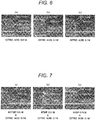
- FIG. 6 shows SEM images showing exemplary etching results when citric acid is used as the chelating agent.
- FIG. 6 FIG. 6
- the etching rate achieved with a citric acid concentration of 0.01 M on FIG. 6(a) is insufficient. Meanwhile, it is observed that a sufficient etching rate is achieved with a citric acid concentration ranging from 0.03 to 1 M (see FIGs. 6(b) and 6(c) ). However, the etching rate decreased clearly with a citric acid concentration of 1.2 M.
- FIG. 7 shows SEM images showing exemplary etching results when a plurality of chelating agents are used in combination.
- FIG. 7 FIG. 7 (FIGs. 7(a)-7(c) )
- a sufficient etching rate is achieved with a combination of "EDTMP + citric acid”, a combination of "NTMP + citric acid”, and a combination of "HEDP + citric acid”.
- results similar to those shown in FIGs. 7(a)-7(c) were achieved with other combinations of chelating agents.
- H 2 O 2 concentration in the etchant Influences of the H 2 O 2 concentration in the etchant on the etching performance were studied.
- the other components of the etchant was 0.1 M of EDTMP and 3.5 M of an NH 3 aq.. It was observed that the H 2 O 2 concentration had the least influence on the etching rate at 4 to 9 M and that the etching rate decreased clearly with an H 2 O 2 concentration less than 4 M.
- the photoresist pattern 21 was formed over the KNN thin film pattern 13' patterned by the above-described invention's wet etching process. Then, a 100-nm thick Pt layer was formed as the upper electrode film 22 over the photoresist pattern 21 by RF magnetron sputtering (see FIG. 2(a) ).
- the sputtering condition for the upper electrode film 22 was similar to that for the lower electrode film 12 and was as follows: target of pure Pt; substrate temperature of 250°C; discharge power of 200 W; sputtering gas of Ar; and pressure of 2.5 Pa.
- the upper electrode 22' was formed on the KNN thin film pattern 13' by removing the photoresist pattern 21 with acetone cleaning (lift off) (see FIG. 2(b) ). Accordingly, the KNN thin film device chip 20 was obtained (see FIG. 2(c) ).
- FIG. 8 is a graph showing exemplary relationships between the polarization value and the applied voltage of the KNN thin film device fabricated according to the present invention and the standard sample.
- the KNN thin film device in FIG. 8 was micro-fabricated with an etchant for which EDTMP was used.
- the polarization hysteresis loop of the KNN thin film device fabricated according to the invention almost completely matches that of the standard sample, which means there is no substantial difference in polarization between the two samples.
- Difference in the permittivity between the KNN thin film device fabricated according to the invention and the standard sample was as small as about 1%. This degree of difference is within a range of sample to sample variation and measurement error. Thus, there is practically no difference between the two samples.
- the leakage current difference too, was within the range of sample to sample variation and measurement error. Again, there is practically no difference between the two samples.
- ferroelectric characteristics measurements demonstrate that ferroelectric thin films can be fine patterned by the invention's etching process without deteriorating their ferroelectric characteristics.
- a single crystalline substrate (10 mm ⁇ 10 mm ⁇ 0.5 mm) of lithium niobate (LiNbO 3 , LN) was prepared.
- a photoresist pattern 14 was formed on the LN single crystalline substrate.
- an SiO 2 film having a thickness of 500 nm was formed by plasma CVD using a TEOS (tetraethoxysilane) material.
- an etch mask pattern 15' was formed by a lift-off process.
- the etchant preparation method was investigated.
- a KNN thin film laminated substrate was used as is the case with Examination 1.
- etchants were prepared, each from 0.4 M of citric acid, 3.5 M of an NH 3 aq., and 7.5 M of an H 2 O 2 aq. by two different methods (the volume was 2 L each).
- Etchant B a separately prepared citric acid/ammonia concentrated solution (citric acid of 1.43 M/ammonia of 12.5 M) was added to the H 2 O 2 aq.
- the time required to mix the reagents was measured for each etchant.
- Etchant A the time from the start of the mixing and stirring of the three reagents to the completion of the melting of the citric acid (visually judged) was approximately 30 minutes.
- Etchant B the time from the start of the mixing and stirring of the two reagents to the completion of the homogenous mixing (visually judged) was approximately 30 seconds.
- Etchant B' An etchant prepared by the two-reagent mixing system and preserved for a week
- Etchant B another etchant freshly prepared from a citric acid/ammonia concentrated solution that had been preserved for a week
- Etchant B' failed to etch the KNN thin film, while Etchant B" exhibited an etching performance that is equivalent to those of Etchant A and Etchant B. Based on this examination 3, it was concluded that the etchant itself should be preferably prepared immediately before the wet-etching process, while the chelating agent/ammonium concentrated solution is excellent in preservability.
Landscapes
- Chemical & Material Sciences (AREA)
- Engineering & Computer Science (AREA)
- Materials Engineering (AREA)
- Chemical Kinetics & Catalysis (AREA)
- Mechanical Engineering (AREA)
- Metallurgy (AREA)
- Organic Chemistry (AREA)
- Manufacturing & Machinery (AREA)
- Ceramic Engineering (AREA)
- Weting (AREA)
- Semiconductor Memories (AREA)
Applications Claiming Priority (2)
| Application Number | Priority Date | Filing Date | Title |
|---|---|---|---|
| JP2015020309 | 2015-02-04 | ||
| PCT/JP2016/051389 WO2016125579A1 (ja) | 2015-02-04 | 2016-01-19 | ニオブ酸系強誘電体薄膜素子の製造方法 |
Publications (3)
| Publication Number | Publication Date |
|---|---|
| EP3255689A1 true EP3255689A1 (de) | 2017-12-13 |
| EP3255689A4 EP3255689A4 (de) | 2018-10-03 |
| EP3255689B1 EP3255689B1 (de) | 2019-12-04 |
Family
ID=56563930
Family Applications (1)
| Application Number | Title | Priority Date | Filing Date |
|---|---|---|---|
| EP16746410.6A Active EP3255689B1 (de) | 2015-02-04 | 2016-01-19 | Verfahren zur herstellung einer niobatsystem-ferroelektrischen dünnschichtvorrichtung |
Country Status (5)
| Country | Link |
|---|---|
| US (2) | US10199564B2 (de) |
| EP (1) | EP3255689B1 (de) |
| JP (1) | JP6715780B2 (de) |
| TW (1) | TW201634395A (de) |
| WO (1) | WO2016125579A1 (de) |
Families Citing this family (4)
| Publication number | Priority date | Publication date | Assignee | Title |
|---|---|---|---|---|
| EP3255689B1 (de) * | 2015-02-04 | 2019-12-04 | Sumitomo Chemical Company Limited | Verfahren zur herstellung einer niobatsystem-ferroelektrischen dünnschichtvorrichtung |
| JP6683972B2 (ja) * | 2016-08-26 | 2020-04-22 | 学校法人法政大学 | 半導体装置とその製造方法および半導体積層物 |
| US10251272B2 (en) | 2017-06-30 | 2019-04-02 | Intel Corporation | Microelectronic devices designed with ultra-high-k dielectric capacitors integrated with package substrates |
| JP7811855B2 (ja) * | 2022-02-02 | 2026-02-06 | 関東化学株式会社 | エッチング液組成物およびエッチング方法 |
Family Cites Families (31)
| Publication number | Priority date | Publication date | Assignee | Title |
|---|---|---|---|---|
| US5194117A (en) * | 1990-02-27 | 1993-03-16 | At&T Bell Laboratories | Lithium niobate etchant |
| US5466389A (en) * | 1994-04-20 | 1995-11-14 | J. T. Baker Inc. | PH adjusted nonionic surfactant-containing alkaline cleaner composition for cleaning microelectronics substrates |
| JP2000281470A (ja) * | 1999-04-01 | 2000-10-10 | Sumitomo Special Metals Co Ltd | セラミックスの表面改質剤 |
| KR19990082725A (ko) | 1998-04-08 | 1999-11-25 | 포만 제프리 엘 | 페로브스카이트형산화물박막표면의에칭및/또는세정공정및그에칭용액 |
| KR100369872B1 (ko) | 1998-07-24 | 2003-01-30 | 스미토모 도큐슈 긴조쿠 가부시키가이샤 | 자기 헤드와 그 제조 방법 |
| JP4661005B2 (ja) | 2000-09-05 | 2011-03-30 | 和光純薬工業株式会社 | Ti系膜用エッチング剤及びエッチング方法 |
| US6544431B2 (en) * | 2001-01-16 | 2003-04-08 | Triquint Technology Holding Co. | Thin film lithium niobate structure and method of making the same |
| US7163018B2 (en) * | 2002-12-16 | 2007-01-16 | Applied Materials, Inc. | Single wafer cleaning method to reduce particle defects on a wafer surface |
| US6900063B2 (en) | 2003-10-17 | 2005-05-31 | Intel Corporation | Methods and apparatuses for producing a polymer memory device |
| JP2005142911A (ja) | 2003-11-07 | 2005-06-02 | Seiko Epson Corp | 弾性表面波チップの製造方法およびその製造方法により製造した弾性表面波チップ並びに弾性表面波デバイス |
| JP2007019302A (ja) | 2005-07-08 | 2007-01-25 | Hitachi Cable Ltd | 圧電薄膜素子及びそれを用いたアクチュエータ並びにセンサ |
| JP5309454B2 (ja) * | 2006-10-11 | 2013-10-09 | 富士通セミコンダクター株式会社 | 半導体装置の製造方法 |
| US20100112728A1 (en) * | 2007-03-31 | 2010-05-06 | Advanced Technology Materials, Inc. | Methods for stripping material for wafer reclamation |
| JP5080858B2 (ja) | 2007-05-17 | 2012-11-21 | 太陽誘電株式会社 | 圧電薄膜共振器およびフィルタ |
| DE102008040258A1 (de) * | 2008-07-08 | 2010-01-14 | Psylock Gmbh | Verfahren und Vorrichtung zur Verbesserung biometrischer Identifizierungssysteme |
| JP2010161330A (ja) | 2008-12-08 | 2010-07-22 | Hitachi Cable Ltd | 圧電薄膜素子 |
| JP5471612B2 (ja) | 2009-06-22 | 2014-04-16 | 日立金属株式会社 | 圧電性薄膜素子の製造方法及び圧電薄膜デバイスの製造方法 |
| JP5510162B2 (ja) | 2010-07-30 | 2014-06-04 | 日立金属株式会社 | 圧電体薄膜ウェハの製造方法、圧電体薄膜素子、及び圧電体薄膜デバイス |
| JP5556514B2 (ja) * | 2010-09-06 | 2014-07-23 | 日立金属株式会社 | 圧電体薄膜ウェハの製造方法、圧電体薄膜素子、及び圧電体薄膜デバイス |
| JP5644671B2 (ja) | 2011-05-24 | 2014-12-24 | 日立金属株式会社 | 圧電膜素子の製造方法 |
| JP2013016776A (ja) | 2011-06-06 | 2013-01-24 | Hitachi Cable Ltd | 圧電膜素子の製造方法、及び圧電体デバイスの製造方法 |
| JP2013102089A (ja) * | 2011-11-09 | 2013-05-23 | Adeka Corp | チタン酸鉛系材料用エッチング剤組成物 |
| JP5897436B2 (ja) * | 2012-09-13 | 2016-03-30 | 住友化学株式会社 | 圧電体薄膜付き基板の製造方法、及び圧電体薄膜素子の製造方法 |
| JP2014058988A (ja) | 2012-09-14 | 2014-04-03 | Nsk Ltd | トロイダル型無段変速機 |
| JP2014060267A (ja) | 2012-09-18 | 2014-04-03 | Hitachi Metals Ltd | 圧電膜素子及びそれを備えた圧電膜デバイス |
| JP6196797B2 (ja) | 2013-04-16 | 2017-09-13 | 住友化学株式会社 | 圧電体薄膜積層基板及び圧電体薄膜素子 |
| US9324931B2 (en) | 2013-05-14 | 2016-04-26 | Tdk Corporation | Piezoelectric device |
| EP2843723B1 (de) | 2013-08-29 | 2018-01-31 | Sumitomo Chemical Company Limited | Verfahren zur Herstellung von ferroelektrischer Dünnschichtvorrichtung mit Niobat-System |
| JP6366952B2 (ja) * | 2013-08-29 | 2018-08-01 | 住友化学株式会社 | ニオブ酸系強誘電体薄膜素子の製造方法 |
| JP6173845B2 (ja) | 2013-09-09 | 2017-08-02 | 住友化学株式会社 | 圧電体薄膜素子の製造方法 |
| EP3255689B1 (de) * | 2015-02-04 | 2019-12-04 | Sumitomo Chemical Company Limited | Verfahren zur herstellung einer niobatsystem-ferroelektrischen dünnschichtvorrichtung |
-
2016
- 2016-01-19 EP EP16746410.6A patent/EP3255689B1/de active Active
- 2016-01-19 WO PCT/JP2016/051389 patent/WO2016125579A1/ja not_active Ceased
- 2016-01-19 US US15/548,543 patent/US10199564B2/en active Active
- 2016-01-19 JP JP2016573264A patent/JP6715780B2/ja active Active
- 2016-01-29 TW TW105102889A patent/TW201634395A/zh unknown
-
2018
- 2018-12-12 US US16/217,455 patent/US10658569B2/en not_active Expired - Fee Related
Also Published As
| Publication number | Publication date |
|---|---|
| US20190115525A1 (en) | 2019-04-18 |
| EP3255689B1 (de) | 2019-12-04 |
| JP6715780B2 (ja) | 2020-07-01 |
| JPWO2016125579A1 (ja) | 2017-11-16 |
| WO2016125579A1 (ja) | 2016-08-11 |
| TW201634395A (zh) | 2016-10-01 |
| EP3255689A4 (de) | 2018-10-03 |
| US20180026176A1 (en) | 2018-01-25 |
| US10199564B2 (en) | 2019-02-05 |
| US10658569B2 (en) | 2020-05-19 |
Similar Documents
| Publication | Publication Date | Title |
|---|---|---|
| EP3333912B1 (de) | Verfahren zur herstellung von ferroelektrischer dünnschichtvorrichtung mit niobat-system | |
| US9685603B2 (en) | Method for manufacturing niobate-system ferroelectric thin film device | |
| US10658569B2 (en) | Method for manufacturing niobate-system ferroelectric thin-film device | |
| JP2012033693A (ja) | 圧電体薄膜ウェハの製造方法、圧電体薄膜素子、及び圧電体薄膜デバイス | |
| US9882546B2 (en) | Alkali-niobate-based piezoelectric thin film element | |
| JP6173845B2 (ja) | 圧電体薄膜素子の製造方法 | |
| EP3276689B1 (de) | Herstellungsverfahren für ein auf niobat basierendes ferroelektrisches dünnschichtelement | |
| US20160365504A1 (en) | Piezoelectric thin film element, method for manufacturing the same, and electronic device including piezoelectric thin film element | |
| EP3279955B1 (de) | Verfahren zur herstellung einer ferroelektrischen dünnschichtvorrichtung | |
| US10211044B2 (en) | Method for manufacturing ferroelectric thin film device | |
| JP2014207394A (ja) | 圧電体薄膜積層基板の製造方法および圧電体薄膜素子の製造方法 |
Legal Events
| Date | Code | Title | Description |
|---|---|---|---|
| STAA | Information on the status of an ep patent application or granted ep patent |
Free format text: STATUS: THE INTERNATIONAL PUBLICATION HAS BEEN MADE |
|
| PUAI | Public reference made under article 153(3) epc to a published international application that has entered the european phase |
Free format text: ORIGINAL CODE: 0009012 |
|
| STAA | Information on the status of an ep patent application or granted ep patent |
Free format text: STATUS: REQUEST FOR EXAMINATION WAS MADE |
|
| 17P | Request for examination filed |
Effective date: 20170904 |
|
| AK | Designated contracting states |
Kind code of ref document: A1 Designated state(s): AL AT BE BG CH CY CZ DE DK EE ES FI FR GB GR HR HU IE IS IT LI LT LU LV MC MK MT NL NO PL PT RO RS SE SI SK SM TR |
|
| AX | Request for extension of the european patent |
Extension state: BA ME |
|
| DAV | Request for validation of the european patent (deleted) | ||
| DAX | Request for extension of the european patent (deleted) | ||
| A4 | Supplementary search report drawn up and despatched |
Effective date: 20180830 |
|
| RIC1 | Information provided on ipc code assigned before grant |
Ipc: C23C 14/08 20060101ALI20180824BHEP Ipc: H01L 41/316 20130101ALI20180824BHEP Ipc: H01L 41/09 20060101ALI20180824BHEP Ipc: H01L 41/113 20060101ALI20180824BHEP Ipc: H01L 21/308 20060101ALI20180824BHEP Ipc: H01L 41/332 20130101AFI20180824BHEP Ipc: C23C 14/34 20060101ALI20180824BHEP Ipc: H01L 41/187 20060101ALI20180824BHEP Ipc: H02N 2/00 20060101ALI20180824BHEP |
|
| GRAP | Despatch of communication of intention to grant a patent |
Free format text: ORIGINAL CODE: EPIDOSNIGR1 |
|
| STAA | Information on the status of an ep patent application or granted ep patent |
Free format text: STATUS: GRANT OF PATENT IS INTENDED |
|
| RIC1 | Information provided on ipc code assigned before grant |
Ipc: H01L 41/332 20130101AFI20190523BHEP Ipc: H01L 41/187 20060101ALI20190523BHEP |
|
| INTG | Intention to grant announced |
Effective date: 20190605 |
|
| RIN1 | Information on inventor provided before grant (corrected) |
Inventor name: KUROIWA, KENJI Inventor name: NOGUCHI, MASAKI Inventor name: SHIBATA, KENJI Inventor name: WATANABE, KAZUTOSHI Inventor name: HORIKIRI, FUMIMASA Inventor name: SUENAGA, KAZUFUMI |
|
| GRAS | Grant fee paid |
Free format text: ORIGINAL CODE: EPIDOSNIGR3 |
|
| GRAA | (expected) grant |
Free format text: ORIGINAL CODE: 0009210 |
|
| STAA | Information on the status of an ep patent application or granted ep patent |
Free format text: STATUS: THE PATENT HAS BEEN GRANTED |
|
| AK | Designated contracting states |
Kind code of ref document: B1 Designated state(s): AL AT BE BG CH CY CZ DE DK EE ES FI FR GB GR HR HU IE IS IT LI LT LU LV MC MK MT NL NO PL PT RO RS SE SI SK SM TR |
|
| REG | Reference to a national code |
Ref country code: GB Ref legal event code: FG4D |
|
| REG | Reference to a national code |
Ref country code: CH Ref legal event code: EP |
|
| REG | Reference to a national code |
Ref country code: AT Ref legal event code: REF Ref document number: 1210511 Country of ref document: AT Kind code of ref document: T Effective date: 20191215 |
|
| REG | Reference to a national code |
Ref country code: DE Ref legal event code: R096 Ref document number: 602016025575 Country of ref document: DE |
|
| REG | Reference to a national code |
Ref country code: IE Ref legal event code: FG4D |
|
| REG | Reference to a national code |
Ref country code: NL Ref legal event code: MP Effective date: 20191204 |
|
| REG | Reference to a national code |
Ref country code: LT Ref legal event code: MG4D |
|
| PG25 | Lapsed in a contracting state [announced via postgrant information from national office to epo] |
Ref country code: LT Free format text: LAPSE BECAUSE OF FAILURE TO SUBMIT A TRANSLATION OF THE DESCRIPTION OR TO PAY THE FEE WITHIN THE PRESCRIBED TIME-LIMIT Effective date: 20191204 Ref country code: BG Free format text: LAPSE BECAUSE OF FAILURE TO SUBMIT A TRANSLATION OF THE DESCRIPTION OR TO PAY THE FEE WITHIN THE PRESCRIBED TIME-LIMIT Effective date: 20200304 Ref country code: FI Free format text: LAPSE BECAUSE OF FAILURE TO SUBMIT A TRANSLATION OF THE DESCRIPTION OR TO PAY THE FEE WITHIN THE PRESCRIBED TIME-LIMIT Effective date: 20191204 Ref country code: LV Free format text: LAPSE BECAUSE OF FAILURE TO SUBMIT A TRANSLATION OF THE DESCRIPTION OR TO PAY THE FEE WITHIN THE PRESCRIBED TIME-LIMIT Effective date: 20191204 Ref country code: SE Free format text: LAPSE BECAUSE OF FAILURE TO SUBMIT A TRANSLATION OF THE DESCRIPTION OR TO PAY THE FEE WITHIN THE PRESCRIBED TIME-LIMIT Effective date: 20191204 Ref country code: GR Free format text: LAPSE BECAUSE OF FAILURE TO SUBMIT A TRANSLATION OF THE DESCRIPTION OR TO PAY THE FEE WITHIN THE PRESCRIBED TIME-LIMIT Effective date: 20200305 Ref country code: NO Free format text: LAPSE BECAUSE OF FAILURE TO SUBMIT A TRANSLATION OF THE DESCRIPTION OR TO PAY THE FEE WITHIN THE PRESCRIBED TIME-LIMIT Effective date: 20200304 |
|
| PG25 | Lapsed in a contracting state [announced via postgrant information from national office to epo] |
Ref country code: RS Free format text: LAPSE BECAUSE OF FAILURE TO SUBMIT A TRANSLATION OF THE DESCRIPTION OR TO PAY THE FEE WITHIN THE PRESCRIBED TIME-LIMIT Effective date: 20191204 Ref country code: HR Free format text: LAPSE BECAUSE OF FAILURE TO SUBMIT A TRANSLATION OF THE DESCRIPTION OR TO PAY THE FEE WITHIN THE PRESCRIBED TIME-LIMIT Effective date: 20191204 |
|
| PG25 | Lapsed in a contracting state [announced via postgrant information from national office to epo] |
Ref country code: AL Free format text: LAPSE BECAUSE OF FAILURE TO SUBMIT A TRANSLATION OF THE DESCRIPTION OR TO PAY THE FEE WITHIN THE PRESCRIBED TIME-LIMIT Effective date: 20191204 |
|
| PG25 | Lapsed in a contracting state [announced via postgrant information from national office to epo] |
Ref country code: PT Free format text: LAPSE BECAUSE OF FAILURE TO SUBMIT A TRANSLATION OF THE DESCRIPTION OR TO PAY THE FEE WITHIN THE PRESCRIBED TIME-LIMIT Effective date: 20200429 Ref country code: EE Free format text: LAPSE BECAUSE OF FAILURE TO SUBMIT A TRANSLATION OF THE DESCRIPTION OR TO PAY THE FEE WITHIN THE PRESCRIBED TIME-LIMIT Effective date: 20191204 Ref country code: RO Free format text: LAPSE BECAUSE OF FAILURE TO SUBMIT A TRANSLATION OF THE DESCRIPTION OR TO PAY THE FEE WITHIN THE PRESCRIBED TIME-LIMIT Effective date: 20191204 Ref country code: NL Free format text: LAPSE BECAUSE OF FAILURE TO SUBMIT A TRANSLATION OF THE DESCRIPTION OR TO PAY THE FEE WITHIN THE PRESCRIBED TIME-LIMIT Effective date: 20191204 Ref country code: CZ Free format text: LAPSE BECAUSE OF FAILURE TO SUBMIT A TRANSLATION OF THE DESCRIPTION OR TO PAY THE FEE WITHIN THE PRESCRIBED TIME-LIMIT Effective date: 20191204 Ref country code: ES Free format text: LAPSE BECAUSE OF FAILURE TO SUBMIT A TRANSLATION OF THE DESCRIPTION OR TO PAY THE FEE WITHIN THE PRESCRIBED TIME-LIMIT Effective date: 20191204 |
|
| PG25 | Lapsed in a contracting state [announced via postgrant information from national office to epo] |
Ref country code: SK Free format text: LAPSE BECAUSE OF FAILURE TO SUBMIT A TRANSLATION OF THE DESCRIPTION OR TO PAY THE FEE WITHIN THE PRESCRIBED TIME-LIMIT Effective date: 20191204 Ref country code: SM Free format text: LAPSE BECAUSE OF FAILURE TO SUBMIT A TRANSLATION OF THE DESCRIPTION OR TO PAY THE FEE WITHIN THE PRESCRIBED TIME-LIMIT Effective date: 20191204 Ref country code: IS Free format text: LAPSE BECAUSE OF FAILURE TO SUBMIT A TRANSLATION OF THE DESCRIPTION OR TO PAY THE FEE WITHIN THE PRESCRIBED TIME-LIMIT Effective date: 20200404 |
|
| REG | Reference to a national code |
Ref country code: CH Ref legal event code: PL |
|
| REG | Reference to a national code |
Ref country code: DE Ref legal event code: R097 Ref document number: 602016025575 Country of ref document: DE |
|
| REG | Reference to a national code |
Ref country code: AT Ref legal event code: MK05 Ref document number: 1210511 Country of ref document: AT Kind code of ref document: T Effective date: 20191204 |
|
| PG25 | Lapsed in a contracting state [announced via postgrant information from national office to epo] |
Ref country code: MC Free format text: LAPSE BECAUSE OF FAILURE TO SUBMIT A TRANSLATION OF THE DESCRIPTION OR TO PAY THE FEE WITHIN THE PRESCRIBED TIME-LIMIT Effective date: 20191204 |
|
| PLBE | No opposition filed within time limit |
Free format text: ORIGINAL CODE: 0009261 |
|
| STAA | Information on the status of an ep patent application or granted ep patent |
Free format text: STATUS: NO OPPOSITION FILED WITHIN TIME LIMIT |
|
| REG | Reference to a national code |
Ref country code: BE Ref legal event code: MM Effective date: 20200131 |
|
| PG25 | Lapsed in a contracting state [announced via postgrant information from national office to epo] |
Ref country code: DK Free format text: LAPSE BECAUSE OF FAILURE TO SUBMIT A TRANSLATION OF THE DESCRIPTION OR TO PAY THE FEE WITHIN THE PRESCRIBED TIME-LIMIT Effective date: 20191204 Ref country code: LU Free format text: LAPSE BECAUSE OF NON-PAYMENT OF DUE FEES Effective date: 20200119 |
|
| 26N | No opposition filed |
Effective date: 20200907 |
|
| PG25 | Lapsed in a contracting state [announced via postgrant information from national office to epo] |
Ref country code: AT Free format text: LAPSE BECAUSE OF FAILURE TO SUBMIT A TRANSLATION OF THE DESCRIPTION OR TO PAY THE FEE WITHIN THE PRESCRIBED TIME-LIMIT Effective date: 20191204 Ref country code: PL Free format text: LAPSE BECAUSE OF FAILURE TO SUBMIT A TRANSLATION OF THE DESCRIPTION OR TO PAY THE FEE WITHIN THE PRESCRIBED TIME-LIMIT Effective date: 20191204 Ref country code: SI Free format text: LAPSE BECAUSE OF FAILURE TO SUBMIT A TRANSLATION OF THE DESCRIPTION OR TO PAY THE FEE WITHIN THE PRESCRIBED TIME-LIMIT Effective date: 20191204 Ref country code: BE Free format text: LAPSE BECAUSE OF NON-PAYMENT OF DUE FEES Effective date: 20200131 Ref country code: CH Free format text: LAPSE BECAUSE OF NON-PAYMENT OF DUE FEES Effective date: 20200131 Ref country code: LI Free format text: LAPSE BECAUSE OF NON-PAYMENT OF DUE FEES Effective date: 20200131 |
|
| PG25 | Lapsed in a contracting state [announced via postgrant information from national office to epo] |
Ref country code: IE Free format text: LAPSE BECAUSE OF NON-PAYMENT OF DUE FEES Effective date: 20200119 |
|
| PGFP | Annual fee paid to national office [announced via postgrant information from national office to epo] |
Ref country code: GB Payment date: 20211223 Year of fee payment: 7 |
|
| PGFP | Annual fee paid to national office [announced via postgrant information from national office to epo] |
Ref country code: DE Payment date: 20211230 Year of fee payment: 7 |
|
| PG25 | Lapsed in a contracting state [announced via postgrant information from national office to epo] |
Ref country code: TR Free format text: LAPSE BECAUSE OF FAILURE TO SUBMIT A TRANSLATION OF THE DESCRIPTION OR TO PAY THE FEE WITHIN THE PRESCRIBED TIME-LIMIT Effective date: 20191204 Ref country code: MT Free format text: LAPSE BECAUSE OF FAILURE TO SUBMIT A TRANSLATION OF THE DESCRIPTION OR TO PAY THE FEE WITHIN THE PRESCRIBED TIME-LIMIT Effective date: 20191204 Ref country code: CY Free format text: LAPSE BECAUSE OF FAILURE TO SUBMIT A TRANSLATION OF THE DESCRIPTION OR TO PAY THE FEE WITHIN THE PRESCRIBED TIME-LIMIT Effective date: 20191204 |
|
| PGFP | Annual fee paid to national office [announced via postgrant information from national office to epo] |
Ref country code: IT Payment date: 20211230 Year of fee payment: 7 Ref country code: FR Payment date: 20220118 Year of fee payment: 7 |
|
| PG25 | Lapsed in a contracting state [announced via postgrant information from national office to epo] |
Ref country code: MK Free format text: LAPSE BECAUSE OF FAILURE TO SUBMIT A TRANSLATION OF THE DESCRIPTION OR TO PAY THE FEE WITHIN THE PRESCRIBED TIME-LIMIT Effective date: 20191204 |
|
| REG | Reference to a national code |
Ref country code: DE Ref legal event code: R079 Ref document number: 602016025575 Country of ref document: DE Free format text: PREVIOUS MAIN CLASS: H01L0041332000 Ipc: H10N0030082000 |
|
| REG | Reference to a national code |
Ref country code: DE Ref legal event code: R119 Ref document number: 602016025575 Country of ref document: DE |
|
| GBPC | Gb: european patent ceased through non-payment of renewal fee |
Effective date: 20230119 |
|
| PG25 | Lapsed in a contracting state [announced via postgrant information from national office to epo] |
Ref country code: GB Free format text: LAPSE BECAUSE OF NON-PAYMENT OF DUE FEES Effective date: 20230119 Ref country code: DE Free format text: LAPSE BECAUSE OF NON-PAYMENT OF DUE FEES Effective date: 20230801 |
|
| PG25 | Lapsed in a contracting state [announced via postgrant information from national office to epo] |
Ref country code: FR Free format text: LAPSE BECAUSE OF NON-PAYMENT OF DUE FEES Effective date: 20230131 |
|
| PG25 | Lapsed in a contracting state [announced via postgrant information from national office to epo] |
Ref country code: IT Free format text: LAPSE BECAUSE OF NON-PAYMENT OF DUE FEES Effective date: 20230119 |