EP3256830B1 - Appareil multi-plate et procede de verification du systeme de freinage de véhicules terrestres avec au moins deux axes - Google Patents
Appareil multi-plate et procede de verification du systeme de freinage de véhicules terrestres avec au moins deux axes Download PDFInfo
- Publication number
- EP3256830B1 EP3256830B1 EP16713986.4A EP16713986A EP3256830B1 EP 3256830 B1 EP3256830 B1 EP 3256830B1 EP 16713986 A EP16713986 A EP 16713986A EP 3256830 B1 EP3256830 B1 EP 3256830B1
- Authority
- EP
- European Patent Office
- Prior art keywords
- vehicle
- detection
- stress
- plate
- braking
- Prior art date
- Legal status (The legal status is an assumption and is not a legal conclusion. Google has not performed a legal analysis and makes no representation as to the accuracy of the status listed.)
- Active
Links
Images



Classifications
-
- G—PHYSICS
- G01—MEASURING; TESTING
- G01L—MEASURING FORCE, STRESS, TORQUE, WORK, MECHANICAL POWER, MECHANICAL EFFICIENCY, OR FLUID PRESSURE
- G01L5/00—Apparatus for, or methods of, measuring force, work, mechanical power, or torque, specially adapted for specific purposes
- G01L5/28—Apparatus for, or methods of, measuring force, work, mechanical power, or torque, specially adapted for specific purposes for testing brakes
- G01L5/288—Measuring the force necessary to rotate a braked wheel
-
- G—PHYSICS
- G01—MEASURING; TESTING
- G01M—TESTING STATIC OR DYNAMIC BALANCE OF MACHINES OR STRUCTURES; TESTING OF STRUCTURES OR APPARATUS, NOT OTHERWISE PROVIDED FOR
- G01M17/00—Testing of vehicles
- G01M17/007—Wheeled or endless-tracked vehicles
- G01M17/04—Suspension or damping
Definitions
- the present invention relates to an apparatus and a method for checking the braking system in land vehicles with rubber treaded wheels; more in particular, the apparatus for the checking of the braking system is suited to vehicles with more than two axles.
- the safety of a road vehicle depends on the control ability thereof, in particular on the ability thereof to stop, especially in emergency conditions.
- a running vehicle is braked by the force which develops between the wheels thereof and the road surface; such force is generated due to the effect of the friction developed when each wheel is in turn broken down by the (disc or drum) braking system of the vehicle.
- the braking ability of a vehicle hence depends on the correct combination of multiple elements.
- the present invention deals with the check of the correct operation of the braking system on the whole, hence with reference not only to the operation thereof in stationary conditions, but also to the actual interactions which show up with the vehicle chassis and with the ground in dynamic conditions.
- the rules provide a periodic check of the braking ability of vehicles.
- Two apparatuses currently exist for determining braking efficiency: a rollers apparatus and a platform system.
- the former of the two provides motor-driven rollers, which drive the vehicle wheels into rotation; actuating the braking system, a resistant torque is produced on the axle which drives the rollers: measuring such torque it is possible to obtain the braking force of the system.
- the latter provides floating instrumented "plates", overall referred to as platforms, wherein it is possible to measure both the vertical force applied onto the platform (action of the actual or apparent weight of the vehicle), and the horizontal force (vehicle motion and braking forces).
- the roller system has the advantage of a greater repeatability in the measuring, it is more compact and less expensive; however, it allows to perform a measuring of the braking force in an extremely "synthetic" and theoretical manner.
- a measuring of the braking force in an extremely "synthetic" and theoretical manner.
- the platform system - despite being less repeatable and also bulkier and more expensive - allows, however, to simulate in a more precise manner the dynamics of the actual braking, including the load displacement effects onto the individual wheels.
- the braking efficiency depends on the sum of the efficiencies of each individual wheel, and braking safety also depends on the correct balancing of such forces: this condition is detectable only with the platform system.
- each plate detects exclusively its own relevant axle, for which it has been suitably arranged and positioned.
- the object of the present invention is to provide a multi-platform system which allows to overcome the described problems and, in particular, to allow the check of the braking system on land vehicles with more than two wheel axles, exceeding the limits of the specific inter-axle distances.
- a checking system of a braking system consists of a plurality of detection plates, aligned according to a testing direction (that is, the motion direction of the vehicle) on two parallel paths arranged at a typical crosswise distance, equal to the average of the wheel track of the vehicles to be checked.
- Each detection plate in a way known per se, comprises an upper resting plate mounted integral with a support frame which is housed above or within a seat embedded in the reference plane (that is, the vehicle running ground).
- the upper plate hence ends flush with the reference plane or it has ascending/descending slides, so that the vehicle wheels can go thereon continuously.
- the upper surfaces of the plates must be mutually coplanar with a maximum tolerance of +/-5 mm.
- the resting surface of the plates must have a friction coefficient equal to at least 0.6 even in wet conditions.
- a connection mechanism between the plate and the frame defines a detection device of the stresses acting on the plate, for example through a suitable arrangement of strain gauges.
- each plate is furthermore configured for detecting both vertical stresses, hence mainly the weight acting on the plate, and horizontal stresses. Horizontal stresses are substantially attributable to the horizontal force generated by the vehicle, through the tyres, due to the ascending movement thereof onto the plate and of subsequent braking.
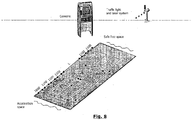
- Fig. 8 shows an exemplifying embodiment according to the invention.
- the system provides a series of detection plates, arranged continuously or preferably discontinuously (that is, two separate groups for the front array and the rear array), with a mutual distance of 5 mm.
- the illustrated system is provided for three-axle vehicles, with axle distance L + 2 metres between the first (front) axle and the second axle and an overall axle distance not exceeding X.
- the outer crosswise lane is at most of 2800 mm while the inner one is minimum of 800 mm.
- the single plates are 1100 mm long so as to be able to operate with vehicles with a minimum axle distance of 1100 mm and wheels having a maximum diameter of 1020 mm.
- the arrangement of the single detection plate is not relevant per se for the teaching of the invention. It will hence be possible to use a brake test plate of a known type, suited to detect (for example by suitably arranged load cells) the horizontal forces and the vertical forces acting thereon.
- An electronic checking unit simultaneously detects the stress signals coming from all the plates, coordinating them in an original manner with each other.
- the computing processing determines and manages this situation of change of the detection plate during the data acquisition period.
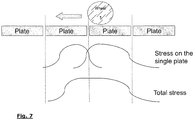
- the computing process operates by integrating the measurements detected on two (or more) subsequent plates when it is detected that an axle has moved from one plate to the other (or to multiple plates).
- this operation consists, in the simplest mode, in summing the horizontal forces detected between two subsequent plates affected by the same wheel axle during the braking space; this sum (or integration in more general terms) must hence be performed only in the condition in which the passage of the two wheels of an axle from one plate to the subsequent one is detected.
- the checking unit must determine, within the time window of the braking action (hence after the braking start instant), what are the plates from which a wheel has come off and what are the plates onto which a wheel has got on, based on the detection of the vertical stress mainly due to the vehicle weight.
- the checking unit performs a sum or integration of the horizontal stress readings detected by these two plates P n and P n+1 .
- the detection plates and the processing unit are used also for performing a check of the dampening system of the vehicle.
- a motor vehicle in order to guarantee a certain driving comfort and allow maximum adherence also in conditions of uneven roads, the wheels of a motor vehicle are not rigidly fastened to the vehicle structure, but are mounted on a suspension system.
- a motor vehicle can be modelled from a dynamic point of view as a system in which the tyre is represented by a mass connected with a spring in parallel to a dampener at the suspension; the suspension in turn is represented by a spring in parallel to a dampener (shock absorber), connected to the rigid structure of the vehicle which is provided with an own mass, the road surface makes up the stress or applied mechanic force.
- Fig.9 represents the model of a 4-wheel vehicle wherein:
- the roughness of a road prompts the suspension, through Kwheels, to vibrate; in turn Ksuspension couples the movements of the suspension with those of the vehicle body; in first approximation the suspension vibrates, uncoupling the road roughness to leave the vehicle body substantially stationary.
- the mass of the suspension, coupled through Ksuspension and Kwheels, behaves like a resonating system which has an own frequency.
- the vibration of the suspension produces a periodic change of the vertical force on the wheel: such change is highest in correspondence of the resonance frequency of the suspension.
- the suspension has a fundamental importance also in the management of the vehicle stability during a steering: the moment generated during a swerve changes the distribution of the vertical forces and hence the distribution of the same between the 4 vehicle suspensions.
- the load change on the suspensions changes the position of the mass centre of the vehicle, for example raising it, and consequently the distribution of the forces into a dangerous positive circle, reducing the vertical force on the single wheel enough to prevent the correct operation thereof.
- the detection plate system ix instead exploited to be able to provide - together with the braking information - also an important indication on the operation of the suspension system.
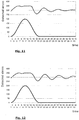
- the parameters to be acquired are the ones indicated in fig. 10 : for each wheel, the vertical force at rest Fv(i) rest , the maximum horizontal force Fh(i) max , the first two peaks of maximum vertical force Fv(i) max and Fv(i) max2 and the first two peaks of minimum vertical force Fv(i) min and Fv(i) min2 .
- the second system ( fig. 12 ) has a trend of the curve of the forces not equally effective with respect to the first system ( fig. 11 ), denouncing some operation anomaly of the suspensions.
Landscapes
- Physics & Mathematics (AREA)
- General Physics & Mathematics (AREA)
- Force Measurement Appropriate To Specific Purposes (AREA)
- Braking Arrangements (AREA)
Claims (6)
- Système à multiples plaques pour contrôler la capacité de freinage de véhicules motorisés avec au moins deux essieux de roues, comprenant des paires de plaques de détection alignées selon une direction de déplacement sur deux chemins parallèles espacés par une distance associée à la trace de roue, dans lequel chaque plaque de détection a au moins une surface de support configurée avec des moyens de détection aptes à détecter des composantes horizontale (Fh(i)) et verticale (Fv(i)) d'une contrainte transférée par les roues de véhicule à une telle surface, caractérisé en ce que :- au moins trois paires de plaques de détection alignées sont fournies, dimensionnées et espacées mutuellement de façon à empêcher les roues d'un seul essieu de reposer simultanément sur deux paires de plaques de détection et que les roues de plusieurs essieux ne reposent pas simultanément sur une même paire de plaques de détection ;- une unité de contrôle est en outre fournie qui détecte le développement dans le temps desdites composantes horizontale (Fh(i)) et verticale (Fv(i)) de la contrainte et qui détermine quand les roues d'un essieu montent ou descendent d'une plaque de détection unique (Pn) sur la base de pics de mesure de ladite composante verticale (Fv(i)) de la contrainte ;- ladite unité de contrôle a des moyens de traitement de données aptes à intégrer au fil du temps les mesures de ladite composante horizontale (Fh(i)) de la contrainte sur une première plaque de détection (Pn) et sur la plaque subséquente (Pn+1) lorsqu'il est détecté, dans une plage temporelle de mesure de freinage (tw1- tw2), que ladite composante verticale (Fv(i)) de la contrainte sur ladite première plaque de détection (Pn) subit une réduction importante et que ladite composante verticale (Fv(i)) de la contrainte sur ladite plaque de détection subséquente (Pn+1) subit une augmentation importante.
- Système à multiples plaques selon la revendication 1,
caractérisé en ce que lesdits moyens de traitement de données sont également aptes à détecter le temps écoulé entre le temps de détection initial (t0) d'une composante verticale de la contrainte sur une première plaque (P1) et un temps de détection initial (t1) d'une composante verticale de la contrainte sur une plaque subséquente (P2) pour déterminer une vitesse d'entrée de véhicule dans le système de contrôle. - Système à multiples plaques selon la revendication 1 ou 2,
caractérisé en ce que ladite unité de contrôle comprend également des moyens d'entrée de données au moyen desquels le nombre (N) des essieux de véhicule est fourni en entrée auxdits moyens de traitement de données, de telle sorte que le temps est déterminé auquel le Nième pic de la composante verticale de la contrainte est détecté par une première plaque (P1) desdites plaques de détection et un signal audible/visible est fourni à un opérateur pour démarrer l'action de freinage et la plage temporelle de mesure de l'action de freinage (tw1-tw2). - Procédé de contrôle d'un système de freinage d'un véhicule terrestre équipé d'au moins deux essieux de roues, comprenant les étapes consistant à entraîner un véhicule à se déplacer sur un système à multiples plaques selon l'une quelconque des revendications précédentes et à effectuer une détection des composantes verticale et horizontale des contraintes transférée par les roues du véhicule aux surfaces de détection des plaques de détection, caractérisé en ce que :- en détectant la différence temporelle entre un pic de la composante verticale (Fv(i)) desdites contraintes sur une première plaque de détection (P1) et sur une plaque subséquente (P2), la vitesse d'entrée du véhicule est déterminée sur le système ;- en fournissant en entrée le nombre (N) d'essieux du véhicule, le temps est déterminé auquel le Nième pic de la composante verticale de la contrainte est détecté par ladite première plaque de détection (P1) et par conséquent le début d'une plage temporelle de mesure de l'action de freinage (tw1-tw2) est déterminé ;- les contraintes sur lesdites plaques de détection dans ladite plage temporelle de mesure de l'action de freinage (tw1- tw2) sont détectées ;- les mesures de ladite composante horizontale de la contrainte (Fh(i)) sur une plaque de détection (Pn) et sur la plaque subséquente (Pn+1) sont intégrées dans le temps lorsqu'il est détecté, dans ladite plage temporelle de mesure de l'action de freinage (tw1-tw2), que ladite composante verticale (Fv(1)) de la contrainte sur ladite plaque de détection (Pn) subit une réduction importante et ladite composante verticale (Fv(1)) de la contrainte sur ladite plaque de détection subséquente (Pn+1) subit une augmentation importante.
- Procédé selon la revendication 4, dans lequel, avant ladite plage temporelle de mesure de l'action de freinage (tw1-tw2), ladite composante horizontale (Fh(i)) de la contrainte sur le système à multiples plaques est détectée pour vérifier qu'elle n'a pas de composantes dans la direction de déplacement du véhicule et dans la direction opposée.
- Procédé selon la revendication 4 ou 5, dans lequel sont acquis pour chacune des roues de véhicule
le paramètre de force verticale au repos Fv(i)rest, et
pendant le temps de freinage, les paramètres maximaux de force verticale au repos Fv(i)max, les premiers deux pics de force verticale maximale Fv(i)max et Fv(i)max2 et les premiers deux pics de force verticale minimale Fv(i)min et Fv(i)min2
afin de déterminer en outre ensuite un état de fonctionnement de l'agencement de suspension de véhicule caractérisé par lesdits paramètres.
Applications Claiming Priority (2)
| Application Number | Priority Date | Filing Date | Title |
|---|---|---|---|
| ITVA20150002 | 2015-02-11 | ||
| PCT/IB2016/050687 WO2016128899A2 (fr) | 2015-02-11 | 2016-02-10 | Appareil multi-plaques et procédé permettant de vérifier le système de freinage de véhicules terrestres dotés d'au moins deux essieux |
Publications (2)
| Publication Number | Publication Date |
|---|---|
| EP3256830A2 EP3256830A2 (fr) | 2017-12-20 |
| EP3256830B1 true EP3256830B1 (fr) | 2019-12-04 |
Family
ID=52633529
Family Applications (1)
| Application Number | Title | Priority Date | Filing Date |
|---|---|---|---|
| EP16713986.4A Active EP3256830B1 (fr) | 2015-02-11 | 2016-02-10 | Appareil multi-plate et procede de verification du systeme de freinage de véhicules terrestres avec au moins deux axes |
Country Status (3)
| Country | Link |
|---|---|
| EP (1) | EP3256830B1 (fr) |
| ES (1) | ES2783648T3 (fr) |
| WO (1) | WO2016128899A2 (fr) |
Cited By (1)
| Publication number | Priority date | Publication date | Assignee | Title |
|---|---|---|---|---|
| EP4102200B1 (fr) * | 2021-06-07 | 2023-12-27 | Vamag S.r.l. | Système multiplateforme pour vérifier l'appareil de freinage de véhicules terrestres dotés d'au moins deux essieux |
Families Citing this family (2)
| Publication number | Priority date | Publication date | Assignee | Title |
|---|---|---|---|---|
| IT201600130259A1 (it) * | 2016-12-22 | 2018-06-22 | Vamag Srl | Banco prova a piattaforme a carreggiata variabile |
| CN108020370B (zh) * | 2017-12-29 | 2024-02-20 | 盘天(厦门)智能交通有限公司 | 一种组合式称台铺装结构 |
Family Cites Families (3)
| Publication number | Priority date | Publication date | Assignee | Title |
|---|---|---|---|---|
| NL8304330A (nl) * | 1983-12-15 | 1985-07-01 | Koni Bv | Inrichting voor het beproeven van de schokdempers van een automobiel. |
| US5305636A (en) * | 1993-02-12 | 1994-04-26 | Hunter Engineering Company | Plate brake tester and method |
| US5979230A (en) * | 1997-05-20 | 1999-11-09 | Hunter Engineering Company | Brake in motion plate brake tester and method |
-
2016
- 2016-02-10 ES ES16713986T patent/ES2783648T3/es active Active
- 2016-02-10 WO PCT/IB2016/050687 patent/WO2016128899A2/fr not_active Ceased
- 2016-02-10 EP EP16713986.4A patent/EP3256830B1/fr active Active
Non-Patent Citations (1)
| Title |
|---|
| PANKAJ POKHRIYAL: "Automotive Design", 25 April 2012 (2012-04-25), XP055479220, Retrieved from the Internet <URL:http://web.iitd.ac.in/~achawla/public_html/736/17-brakes.pdf> [retrieved on 20180529] * |
Cited By (1)
| Publication number | Priority date | Publication date | Assignee | Title |
|---|---|---|---|---|
| EP4102200B1 (fr) * | 2021-06-07 | 2023-12-27 | Vamag S.r.l. | Système multiplateforme pour vérifier l'appareil de freinage de véhicules terrestres dotés d'au moins deux essieux |
Also Published As
| Publication number | Publication date |
|---|---|
| WO2016128899A2 (fr) | 2016-08-18 |
| ES2783648T3 (es) | 2020-09-17 |
| WO2016128899A3 (fr) | 2016-11-10 |
| EP3256830A2 (fr) | 2017-12-20 |
Similar Documents
| Publication | Publication Date | Title |
|---|---|---|
| US6257054B1 (en) | Portable roller dynamometer and vehicle testing method | |
| CN105716879B (zh) | 一种带离合器的车辆abs检验台 | |
| US7392693B2 (en) | Test stand for motor vehicles | |
| JPH10281942A (ja) | 車両部品運動特性試験装置及び車両部品運動特性試験方法 | |
| CN103162905B (zh) | 一种车辆质心高度测量方法 | |
| CN101363751A (zh) | 用于测定行驶中的汽车的载荷的方法和装置 | |
| US10337936B2 (en) | Dynamometer having a chassis to chassis load measurement device | |
| CN102853886B (zh) | 一种车辆动态称重方法以及装置 | |
| WO2016128899A2 (fr) | Appareil multi-plaques et procédé permettant de vérifier le système de freinage de véhicules terrestres dotés d'au moins deux essieux | |
| JPH02105023A (ja) | 車両計量方法および装置 | |
| RU2297932C1 (ru) | Способы диагностирования тормозной системы автомобиля, оборудованного антиблокировочной системой (варианты), способ диагностирования тормозной системы автомобиля и устройство для осуществления способов | |
| CN105954542A (zh) | 一种全自动汽车车速检测设备 | |
| RU2279361C1 (ru) | Испытательный стенд | |
| KR20070113464A (ko) | 타이어 동하중 반경 측정 장치 및 방법 | |
| CN103171490A (zh) | 一种道路车辆弯道侧翻预警方法及预警系统 | |
| JP2009504483A (ja) | 荷重感知車輪サポートナックル組立及び使用方法 | |
| RU2365516C1 (ru) | Способ оценки тормозной эффективности и устойчивости автомобиля, оборудованного антиблокировочной системой, способ оценки работоспособности антиблокировочной системы автомобиля и устройство для осуществления способов | |
| IT202100014741A1 (it) | Sistema multipiastra per la verifica del sistema frenante di veicoli terrestri con almeno due assi | |
| RU213401U1 (ru) | Стенд контроля технического состояния колесных транспортных средств с обгонной муфтой | |
| Muthoriq et al. | A method for measuring tire characteristic using brake tester | |
| RU2276026C1 (ru) | Испытательный стенд | |
| US12434943B2 (en) | Beam climber active brake health monitoring system | |
| Senabre et al. | Comparative analysis of various brake testers used in Ministry of Transport facilities, such as: bank of roller testers and dynamometric platform testers | |
| RU2241618C1 (ru) | Испытательный стенд | |
| Jilek et al. | The formation of car skid at a safe speed by reducing the radial response of car wheels |
Legal Events
| Date | Code | Title | Description |
|---|---|---|---|
| STAA | Information on the status of an ep patent application or granted ep patent |
Free format text: STATUS: THE INTERNATIONAL PUBLICATION HAS BEEN MADE |
|
| PUAI | Public reference made under article 153(3) epc to a published international application that has entered the european phase |
Free format text: ORIGINAL CODE: 0009012 |
|
| STAA | Information on the status of an ep patent application or granted ep patent |
Free format text: STATUS: REQUEST FOR EXAMINATION WAS MADE |
|
| 17P | Request for examination filed |
Effective date: 20170908 |
|
| AK | Designated contracting states |
Kind code of ref document: A2 Designated state(s): AL AT BE BG CH CY CZ DE DK EE ES FI FR GB GR HR HU IE IS IT LI LT LU LV MC MK MT NL NO PL PT RO RS SE SI SK SM TR |
|
| AX | Request for extension of the european patent |
Extension state: BA ME |
|
| DAV | Request for validation of the european patent (deleted) | ||
| DAX | Request for extension of the european patent (deleted) | ||
| STAA | Information on the status of an ep patent application or granted ep patent |
Free format text: STATUS: EXAMINATION IS IN PROGRESS |
|
| 17Q | First examination report despatched |
Effective date: 20180604 |
|
| GRAP | Despatch of communication of intention to grant a patent |
Free format text: ORIGINAL CODE: EPIDOSNIGR1 |
|
| STAA | Information on the status of an ep patent application or granted ep patent |
Free format text: STATUS: GRANT OF PATENT IS INTENDED |
|
| INTG | Intention to grant announced |
Effective date: 20190621 |
|
| GRAS | Grant fee paid |
Free format text: ORIGINAL CODE: EPIDOSNIGR3 |
|
| GRAA | (expected) grant |
Free format text: ORIGINAL CODE: 0009210 |
|
| STAA | Information on the status of an ep patent application or granted ep patent |
Free format text: STATUS: THE PATENT HAS BEEN GRANTED |
|
| AK | Designated contracting states |
Kind code of ref document: B1 Designated state(s): AL AT BE BG CH CY CZ DE DK EE ES FI FR GB GR HR HU IE IS IT LI LT LU LV MC MK MT NL NO PL PT RO RS SE SI SK SM TR |
|
| REG | Reference to a national code |
Ref country code: GB Ref legal event code: FG4D |
|
| REG | Reference to a national code |
Ref country code: CH Ref legal event code: EP |
|
| REG | Reference to a national code |
Ref country code: AT Ref legal event code: REF Ref document number: 1209973 Country of ref document: AT Kind code of ref document: T Effective date: 20191215 |
|
| REG | Reference to a national code |
Ref country code: DE Ref legal event code: R096 Ref document number: 602016025507 Country of ref document: DE |
|
| REG | Reference to a national code |
Ref country code: IE Ref legal event code: FG4D |
|
| REG | Reference to a national code |
Ref country code: NL Ref legal event code: MP Effective date: 20191204 |
|
| REG | Reference to a national code |
Ref country code: LT Ref legal event code: MG4D |
|
| PG25 | Lapsed in a contracting state [announced via postgrant information from national office to epo] |
Ref country code: LT Free format text: LAPSE BECAUSE OF FAILURE TO SUBMIT A TRANSLATION OF THE DESCRIPTION OR TO PAY THE FEE WITHIN THE PRESCRIBED TIME-LIMIT Effective date: 20191204 Ref country code: BG Free format text: LAPSE BECAUSE OF FAILURE TO SUBMIT A TRANSLATION OF THE DESCRIPTION OR TO PAY THE FEE WITHIN THE PRESCRIBED TIME-LIMIT Effective date: 20200304 Ref country code: FI Free format text: LAPSE BECAUSE OF FAILURE TO SUBMIT A TRANSLATION OF THE DESCRIPTION OR TO PAY THE FEE WITHIN THE PRESCRIBED TIME-LIMIT Effective date: 20191204 Ref country code: SE Free format text: LAPSE BECAUSE OF FAILURE TO SUBMIT A TRANSLATION OF THE DESCRIPTION OR TO PAY THE FEE WITHIN THE PRESCRIBED TIME-LIMIT Effective date: 20191204 Ref country code: LV Free format text: LAPSE BECAUSE OF FAILURE TO SUBMIT A TRANSLATION OF THE DESCRIPTION OR TO PAY THE FEE WITHIN THE PRESCRIBED TIME-LIMIT Effective date: 20191204 Ref country code: NO Free format text: LAPSE BECAUSE OF FAILURE TO SUBMIT A TRANSLATION OF THE DESCRIPTION OR TO PAY THE FEE WITHIN THE PRESCRIBED TIME-LIMIT Effective date: 20200304 Ref country code: GR Free format text: LAPSE BECAUSE OF FAILURE TO SUBMIT A TRANSLATION OF THE DESCRIPTION OR TO PAY THE FEE WITHIN THE PRESCRIBED TIME-LIMIT Effective date: 20200305 |
|
| PG25 | Lapsed in a contracting state [announced via postgrant information from national office to epo] |
Ref country code: HR Free format text: LAPSE BECAUSE OF FAILURE TO SUBMIT A TRANSLATION OF THE DESCRIPTION OR TO PAY THE FEE WITHIN THE PRESCRIBED TIME-LIMIT Effective date: 20191204 Ref country code: RS Free format text: LAPSE BECAUSE OF FAILURE TO SUBMIT A TRANSLATION OF THE DESCRIPTION OR TO PAY THE FEE WITHIN THE PRESCRIBED TIME-LIMIT Effective date: 20191204 |
|
| PG25 | Lapsed in a contracting state [announced via postgrant information from national office to epo] |
Ref country code: AL Free format text: LAPSE BECAUSE OF FAILURE TO SUBMIT A TRANSLATION OF THE DESCRIPTION OR TO PAY THE FEE WITHIN THE PRESCRIBED TIME-LIMIT Effective date: 20191204 |
|
| PG25 | Lapsed in a contracting state [announced via postgrant information from national office to epo] |
Ref country code: EE Free format text: LAPSE BECAUSE OF FAILURE TO SUBMIT A TRANSLATION OF THE DESCRIPTION OR TO PAY THE FEE WITHIN THE PRESCRIBED TIME-LIMIT Effective date: 20191204 Ref country code: RO Free format text: LAPSE BECAUSE OF FAILURE TO SUBMIT A TRANSLATION OF THE DESCRIPTION OR TO PAY THE FEE WITHIN THE PRESCRIBED TIME-LIMIT Effective date: 20191204 Ref country code: NL Free format text: LAPSE BECAUSE OF FAILURE TO SUBMIT A TRANSLATION OF THE DESCRIPTION OR TO PAY THE FEE WITHIN THE PRESCRIBED TIME-LIMIT Effective date: 20191204 Ref country code: CZ Free format text: LAPSE BECAUSE OF FAILURE TO SUBMIT A TRANSLATION OF THE DESCRIPTION OR TO PAY THE FEE WITHIN THE PRESCRIBED TIME-LIMIT Effective date: 20191204 Ref country code: PT Free format text: LAPSE BECAUSE OF FAILURE TO SUBMIT A TRANSLATION OF THE DESCRIPTION OR TO PAY THE FEE WITHIN THE PRESCRIBED TIME-LIMIT Effective date: 20200429 |
|
| PG25 | Lapsed in a contracting state [announced via postgrant information from national office to epo] |
Ref country code: SM Free format text: LAPSE BECAUSE OF FAILURE TO SUBMIT A TRANSLATION OF THE DESCRIPTION OR TO PAY THE FEE WITHIN THE PRESCRIBED TIME-LIMIT Effective date: 20191204 Ref country code: IS Free format text: LAPSE BECAUSE OF FAILURE TO SUBMIT A TRANSLATION OF THE DESCRIPTION OR TO PAY THE FEE WITHIN THE PRESCRIBED TIME-LIMIT Effective date: 20200404 Ref country code: SK Free format text: LAPSE BECAUSE OF FAILURE TO SUBMIT A TRANSLATION OF THE DESCRIPTION OR TO PAY THE FEE WITHIN THE PRESCRIBED TIME-LIMIT Effective date: 20191204 |
|
| REG | Reference to a national code |
Ref country code: DE Ref legal event code: R097 Ref document number: 602016025507 Country of ref document: DE |
|
| REG | Reference to a national code |
Ref country code: AT Ref legal event code: MK05 Ref document number: 1209973 Country of ref document: AT Kind code of ref document: T Effective date: 20191204 |
|
| REG | Reference to a national code |
Ref country code: ES Ref legal event code: FG2A Ref document number: 2783648 Country of ref document: ES Kind code of ref document: T3 Effective date: 20200917 |
|
| REG | Reference to a national code |
Ref country code: CH Ref legal event code: PL |
|
| PLBE | No opposition filed within time limit |
Free format text: ORIGINAL CODE: 0009261 |
|
| STAA | Information on the status of an ep patent application or granted ep patent |
Free format text: STATUS: NO OPPOSITION FILED WITHIN TIME LIMIT |
|
| REG | Reference to a national code |
Ref country code: BE Ref legal event code: MM Effective date: 20200229 |
|
| PG25 | Lapsed in a contracting state [announced via postgrant information from national office to epo] |
Ref country code: LU Free format text: LAPSE BECAUSE OF NON-PAYMENT OF DUE FEES Effective date: 20200210 Ref country code: DK Free format text: LAPSE BECAUSE OF FAILURE TO SUBMIT A TRANSLATION OF THE DESCRIPTION OR TO PAY THE FEE WITHIN THE PRESCRIBED TIME-LIMIT Effective date: 20191204 Ref country code: MC Free format text: LAPSE BECAUSE OF FAILURE TO SUBMIT A TRANSLATION OF THE DESCRIPTION OR TO PAY THE FEE WITHIN THE PRESCRIBED TIME-LIMIT Effective date: 20191204 |
|
| 26N | No opposition filed |
Effective date: 20200907 |
|
| PG25 | Lapsed in a contracting state [announced via postgrant information from national office to epo] |
Ref country code: SI Free format text: LAPSE BECAUSE OF FAILURE TO SUBMIT A TRANSLATION OF THE DESCRIPTION OR TO PAY THE FEE WITHIN THE PRESCRIBED TIME-LIMIT Effective date: 20191204 Ref country code: AT Free format text: LAPSE BECAUSE OF FAILURE TO SUBMIT A TRANSLATION OF THE DESCRIPTION OR TO PAY THE FEE WITHIN THE PRESCRIBED TIME-LIMIT Effective date: 20191204 Ref country code: LI Free format text: LAPSE BECAUSE OF NON-PAYMENT OF DUE FEES Effective date: 20200229 Ref country code: PL Free format text: LAPSE BECAUSE OF FAILURE TO SUBMIT A TRANSLATION OF THE DESCRIPTION OR TO PAY THE FEE WITHIN THE PRESCRIBED TIME-LIMIT Effective date: 20191204 Ref country code: CH Free format text: LAPSE BECAUSE OF NON-PAYMENT OF DUE FEES Effective date: 20200229 |
|
| PG25 | Lapsed in a contracting state [announced via postgrant information from national office to epo] |
Ref country code: IE Free format text: LAPSE BECAUSE OF NON-PAYMENT OF DUE FEES Effective date: 20200210 |
|
| PG25 | Lapsed in a contracting state [announced via postgrant information from national office to epo] |
Ref country code: BE Free format text: LAPSE BECAUSE OF NON-PAYMENT OF DUE FEES Effective date: 20200229 |
|
| GBPC | Gb: european patent ceased through non-payment of renewal fee |
Effective date: 20200304 |
|
| PG25 | Lapsed in a contracting state [announced via postgrant information from national office to epo] |
Ref country code: GB Free format text: LAPSE BECAUSE OF NON-PAYMENT OF DUE FEES Effective date: 20200304 |
|
| PG25 | Lapsed in a contracting state [announced via postgrant information from national office to epo] |
Ref country code: TR Free format text: LAPSE BECAUSE OF FAILURE TO SUBMIT A TRANSLATION OF THE DESCRIPTION OR TO PAY THE FEE WITHIN THE PRESCRIBED TIME-LIMIT Effective date: 20191204 Ref country code: MT Free format text: LAPSE BECAUSE OF FAILURE TO SUBMIT A TRANSLATION OF THE DESCRIPTION OR TO PAY THE FEE WITHIN THE PRESCRIBED TIME-LIMIT Effective date: 20191204 Ref country code: CY Free format text: LAPSE BECAUSE OF FAILURE TO SUBMIT A TRANSLATION OF THE DESCRIPTION OR TO PAY THE FEE WITHIN THE PRESCRIBED TIME-LIMIT Effective date: 20191204 |
|
| PG25 | Lapsed in a contracting state [announced via postgrant information from national office to epo] |
Ref country code: MK Free format text: LAPSE BECAUSE OF FAILURE TO SUBMIT A TRANSLATION OF THE DESCRIPTION OR TO PAY THE FEE WITHIN THE PRESCRIBED TIME-LIMIT Effective date: 20191204 |
|
| P01 | Opt-out of the competence of the unified patent court (upc) registered |
Effective date: 20230421 |
|
| PGFP | Annual fee paid to national office [announced via postgrant information from national office to epo] |
Ref country code: ES Payment date: 20240301 Year of fee payment: 9 |
|
| PGFP | Annual fee paid to national office [announced via postgrant information from national office to epo] |
Ref country code: DE Payment date: 20240116 Year of fee payment: 9 |
|
| PGFP | Annual fee paid to national office [announced via postgrant information from national office to epo] |
Ref country code: FR Payment date: 20240116 Year of fee payment: 9 |
|
| REG | Reference to a national code |
Ref country code: DE Ref legal event code: R119 Ref document number: 602016025507 Country of ref document: DE |
|
| PG25 | Lapsed in a contracting state [announced via postgrant information from national office to epo] |
Ref country code: DE Free format text: LAPSE BECAUSE OF NON-PAYMENT OF DUE FEES Effective date: 20250902 |
|
| PG25 | Lapsed in a contracting state [announced via postgrant information from national office to epo] |
Ref country code: FR Free format text: LAPSE BECAUSE OF NON-PAYMENT OF DUE FEES Effective date: 20250228 |
|
| REG | Reference to a national code |
Ref country code: ES Ref legal event code: FD2A Effective date: 20260327 |
|
| PG25 | Lapsed in a contracting state [announced via postgrant information from national office to epo] |
Ref country code: ES Free format text: LAPSE BECAUSE OF NON-PAYMENT OF DUE FEES Effective date: 20250211 |
|
| PGFP | Annual fee paid to national office [announced via postgrant information from national office to epo] |
Ref country code: IT Payment date: 20260121 Year of fee payment: 11 |