EP3260331A1 - Dispositif de traitement d'informations - Google Patents
Dispositif de traitement d'informations Download PDFInfo
- Publication number
- EP3260331A1 EP3260331A1 EP16752264.8A EP16752264A EP3260331A1 EP 3260331 A1 EP3260331 A1 EP 3260331A1 EP 16752264 A EP16752264 A EP 16752264A EP 3260331 A1 EP3260331 A1 EP 3260331A1
- Authority
- EP
- European Patent Office
- Prior art keywords
- user
- control
- hand
- control unit
- unit
- Prior art date
- Legal status (The legal status is an assumption and is not a legal conclusion. Google has not performed a legal analysis and makes no representation as to the accuracy of the status listed.)
- Withdrawn
Links
Images






















Classifications
-
- G—PHYSICS
- G06—COMPUTING OR CALCULATING; COUNTING
- G06F—ELECTRIC DIGITAL DATA PROCESSING
- G06F3/00—Input arrangements for transferring data to be processed into a form capable of being handled by the computer; Output arrangements for transferring data from processing unit to output unit, e.g. interface arrangements
- G06F3/01—Input arrangements or combined input and output arrangements for interaction between user and computer
- G06F3/017—Gesture based interaction, e.g. based on a set of recognized hand gestures
-
- B—PERFORMING OPERATIONS; TRANSPORTING
- B60—VEHICLES IN GENERAL
- B60K—ARRANGEMENT OR MOUNTING OF PROPULSION UNITS OR OF TRANSMISSIONS IN VEHICLES; ARRANGEMENT OR MOUNTING OF PLURAL DIVERSE PRIME-MOVERS IN VEHICLES; AUXILIARY DRIVES FOR VEHICLES; INSTRUMENTATION OR DASHBOARDS FOR VEHICLES; ARRANGEMENTS IN CONNECTION WITH COOLING, AIR INTAKE, GAS EXHAUST OR FUEL SUPPLY OF PROPULSION UNITS IN VEHICLES
- B60K35/00—Instruments specially adapted for vehicles; Arrangement of instruments in or on vehicles
- B60K35/10—Input arrangements, i.e. from user to vehicle, associated with vehicle functions or specially adapted therefor
-
- B—PERFORMING OPERATIONS; TRANSPORTING
- B60—VEHICLES IN GENERAL
- B60K—ARRANGEMENT OR MOUNTING OF PROPULSION UNITS OR OF TRANSMISSIONS IN VEHICLES; ARRANGEMENT OR MOUNTING OF PLURAL DIVERSE PRIME-MOVERS IN VEHICLES; AUXILIARY DRIVES FOR VEHICLES; INSTRUMENTATION OR DASHBOARDS FOR VEHICLES; ARRANGEMENTS IN CONNECTION WITH COOLING, AIR INTAKE, GAS EXHAUST OR FUEL SUPPLY OF PROPULSION UNITS IN VEHICLES
- B60K35/00—Instruments specially adapted for vehicles; Arrangement of instruments in or on vehicles
- B60K35/20—Output arrangements, i.e. from vehicle to user, associated with vehicle functions or specially adapted therefor
- B60K35/21—Output arrangements, i.e. from vehicle to user, associated with vehicle functions or specially adapted therefor using visual output, e.g. blinking lights or matrix displays
- B60K35/22—Display screens
-
- B—PERFORMING OPERATIONS; TRANSPORTING
- B60—VEHICLES IN GENERAL
- B60R—VEHICLES, VEHICLE FITTINGS, OR VEHICLE PARTS, NOT OTHERWISE PROVIDED FOR
- B60R16/00—Electric or fluid circuits specially adapted for vehicles and not otherwise provided for; Arrangement of elements of electric or fluid circuits specially adapted for vehicles and not otherwise provided for
- B60R16/02—Electric or fluid circuits specially adapted for vehicles and not otherwise provided for; Arrangement of elements of electric or fluid circuits specially adapted for vehicles and not otherwise provided for electric constitutive elements
-
- G—PHYSICS
- G02—OPTICS
- G02B—OPTICAL ELEMENTS, SYSTEMS OR APPARATUS
- G02B27/00—Optical systems or apparatus not provided for by any of the groups G02B1/00 - G02B26/00, G02B30/00
- G02B27/01—Head-up displays
- G02B27/0101—Head-up displays characterised by optical features
-
- G—PHYSICS
- G06—COMPUTING OR CALCULATING; COUNTING
- G06F—ELECTRIC DIGITAL DATA PROCESSING
- G06F3/00—Input arrangements for transferring data to be processed into a form capable of being handled by the computer; Output arrangements for transferring data from processing unit to output unit, e.g. interface arrangements
- G06F3/01—Input arrangements or combined input and output arrangements for interaction between user and computer
-
- G—PHYSICS
- G06—COMPUTING OR CALCULATING; COUNTING
- G06F—ELECTRIC DIGITAL DATA PROCESSING
- G06F3/00—Input arrangements for transferring data to be processed into a form capable of being handled by the computer; Output arrangements for transferring data from processing unit to output unit, e.g. interface arrangements
- G06F3/01—Input arrangements or combined input and output arrangements for interaction between user and computer
- G06F3/016—Input arrangements with force or tactile feedback as computer generated output to the user
-
- G—PHYSICS
- G06—COMPUTING OR CALCULATING; COUNTING
- G06F—ELECTRIC DIGITAL DATA PROCESSING
- G06F3/00—Input arrangements for transferring data to be processed into a form capable of being handled by the computer; Output arrangements for transferring data from processing unit to output unit, e.g. interface arrangements
- G06F3/01—Input arrangements or combined input and output arrangements for interaction between user and computer
- G06F3/048—Interaction techniques based on graphical user interfaces [GUI]
- G06F3/0487—Interaction techniques based on graphical user interfaces [GUI] using specific features provided by the input device, e.g. functions controlled by the rotation of a mouse with dual sensing arrangements, or of the nature of the input device, e.g. tap gestures based on pressure sensed by a digitiser
- G06F3/0488—Interaction techniques based on graphical user interfaces [GUI] using specific features provided by the input device, e.g. functions controlled by the rotation of a mouse with dual sensing arrangements, or of the nature of the input device, e.g. tap gestures based on pressure sensed by a digitiser using a touch-screen or digitiser, e.g. input of commands through traced gestures
-
- G—PHYSICS
- G06—COMPUTING OR CALCULATING; COUNTING
- G06F—ELECTRIC DIGITAL DATA PROCESSING
- G06F3/00—Input arrangements for transferring data to be processed into a form capable of being handled by the computer; Output arrangements for transferring data from processing unit to output unit, e.g. interface arrangements
- G06F3/16—Sound input; Sound output
- G06F3/167—Audio in a user interface, e.g. using voice commands for navigating, audio feedback
-
- G—PHYSICS
- G06—COMPUTING OR CALCULATING; COUNTING
- G06V—IMAGE OR VIDEO RECOGNITION OR UNDERSTANDING
- G06V40/00—Recognition of biometric, human-related or animal-related patterns in image or video data
- G06V40/10—Human or animal bodies, e.g. vehicle occupants or pedestrians; Body parts, e.g. hands
- G06V40/107—Static hand or arm
- G06V40/113—Recognition of static hand signs
-
- G—PHYSICS
- G06—COMPUTING OR CALCULATING; COUNTING
- G06V—IMAGE OR VIDEO RECOGNITION OR UNDERSTANDING
- G06V40/00—Recognition of biometric, human-related or animal-related patterns in image or video data
- G06V40/20—Movements or behaviour, e.g. gesture recognition
- G06V40/28—Recognition of hand or arm movements, e.g. recognition of deaf sign language
-
- B—PERFORMING OPERATIONS; TRANSPORTING
- B60—VEHICLES IN GENERAL
- B60K—ARRANGEMENT OR MOUNTING OF PROPULSION UNITS OR OF TRANSMISSIONS IN VEHICLES; ARRANGEMENT OR MOUNTING OF PLURAL DIVERSE PRIME-MOVERS IN VEHICLES; AUXILIARY DRIVES FOR VEHICLES; INSTRUMENTATION OR DASHBOARDS FOR VEHICLES; ARRANGEMENTS IN CONNECTION WITH COOLING, AIR INTAKE, GAS EXHAUST OR FUEL SUPPLY OF PROPULSION UNITS IN VEHICLES
- B60K2360/00—Indexing scheme associated with groups B60K35/00 or B60K37/00 relating to details of instruments or dashboards
- B60K2360/11—Instrument graphical user interfaces or menu aspects
- B60K2360/111—Instrument graphical user interfaces or menu aspects for controlling multiple devices
-
- B—PERFORMING OPERATIONS; TRANSPORTING
- B60—VEHICLES IN GENERAL
- B60K—ARRANGEMENT OR MOUNTING OF PROPULSION UNITS OR OF TRANSMISSIONS IN VEHICLES; ARRANGEMENT OR MOUNTING OF PLURAL DIVERSE PRIME-MOVERS IN VEHICLES; AUXILIARY DRIVES FOR VEHICLES; INSTRUMENTATION OR DASHBOARDS FOR VEHICLES; ARRANGEMENTS IN CONNECTION WITH COOLING, AIR INTAKE, GAS EXHAUST OR FUEL SUPPLY OF PROPULSION UNITS IN VEHICLES
- B60K2360/00—Indexing scheme associated with groups B60K35/00 or B60K37/00 relating to details of instruments or dashboards
- B60K2360/11—Instrument graphical user interfaces or menu aspects
- B60K2360/115—Selection of menu items
-
- B—PERFORMING OPERATIONS; TRANSPORTING
- B60—VEHICLES IN GENERAL
- B60K—ARRANGEMENT OR MOUNTING OF PROPULSION UNITS OR OF TRANSMISSIONS IN VEHICLES; ARRANGEMENT OR MOUNTING OF PLURAL DIVERSE PRIME-MOVERS IN VEHICLES; AUXILIARY DRIVES FOR VEHICLES; INSTRUMENTATION OR DASHBOARDS FOR VEHICLES; ARRANGEMENTS IN CONNECTION WITH COOLING, AIR INTAKE, GAS EXHAUST OR FUEL SUPPLY OF PROPULSION UNITS IN VEHICLES
- B60K2360/00—Indexing scheme associated with groups B60K35/00 or B60K37/00 relating to details of instruments or dashboards
- B60K2360/146—Instrument input by gesture
- B60K2360/1464—3D-gesture
-
- B—PERFORMING OPERATIONS; TRANSPORTING
- B60—VEHICLES IN GENERAL
- B60K—ARRANGEMENT OR MOUNTING OF PROPULSION UNITS OR OF TRANSMISSIONS IN VEHICLES; ARRANGEMENT OR MOUNTING OF PLURAL DIVERSE PRIME-MOVERS IN VEHICLES; AUXILIARY DRIVES FOR VEHICLES; INSTRUMENTATION OR DASHBOARDS FOR VEHICLES; ARRANGEMENTS IN CONNECTION WITH COOLING, AIR INTAKE, GAS EXHAUST OR FUEL SUPPLY OF PROPULSION UNITS IN VEHICLES
- B60K35/00—Instruments specially adapted for vehicles; Arrangement of instruments in or on vehicles
- B60K35/20—Output arrangements, i.e. from vehicle to user, associated with vehicle functions or specially adapted therefor
- B60K35/21—Output arrangements, i.e. from vehicle to user, associated with vehicle functions or specially adapted therefor using visual output, e.g. blinking lights or matrix displays
- B60K35/23—Head-up displays [HUD]
-
- B—PERFORMING OPERATIONS; TRANSPORTING
- B60—VEHICLES IN GENERAL
- B60K—ARRANGEMENT OR MOUNTING OF PROPULSION UNITS OR OF TRANSMISSIONS IN VEHICLES; ARRANGEMENT OR MOUNTING OF PLURAL DIVERSE PRIME-MOVERS IN VEHICLES; AUXILIARY DRIVES FOR VEHICLES; INSTRUMENTATION OR DASHBOARDS FOR VEHICLES; ARRANGEMENTS IN CONNECTION WITH COOLING, AIR INTAKE, GAS EXHAUST OR FUEL SUPPLY OF PROPULSION UNITS IN VEHICLES
- B60K35/00—Instruments specially adapted for vehicles; Arrangement of instruments in or on vehicles
- B60K35/20—Output arrangements, i.e. from vehicle to user, associated with vehicle functions or specially adapted therefor
- B60K35/26—Output arrangements, i.e. from vehicle to user, associated with vehicle functions or specially adapted therefor using acoustic output
-
- G—PHYSICS
- G02—OPTICS
- G02B—OPTICAL ELEMENTS, SYSTEMS OR APPARATUS
- G02B27/00—Optical systems or apparatus not provided for by any of the groups G02B1/00 - G02B26/00, G02B30/00
- G02B27/01—Head-up displays
- G02B27/0101—Head-up displays characterised by optical features
- G02B2027/0138—Head-up displays characterised by optical features comprising image capture systems, e.g. camera
-
- G—PHYSICS
- G06—COMPUTING OR CALCULATING; COUNTING
- G06F—ELECTRIC DIGITAL DATA PROCESSING
- G06F2203/00—Indexing scheme relating to G06F3/00 - G06F3/048
- G06F2203/038—Indexing scheme relating to G06F3/038
- G06F2203/0381—Multimodal input, i.e. interface arrangements enabling the user to issue commands by simultaneous use of input devices of different nature, e.g. voice plus gesture on digitizer
Definitions
- the present invention relates to an information processing device.
- PTL 1 describes a control device of in-vehicle equipment which superimposes and displays, on a head up display (HUD), the control menu of the in-vehicle equipment and the projected image of the driver's hand placed on the control unit, and thereby allows the driver to control the control unit while viewing the projected image to simplify and facilitate the selection control of the in-vehicle equipment so that such control will not interfere with the driving of the vehicle.
- HUD head up display
- an in-vehicle device comprises: a gesture detection unit which recognizes a position of a user's hand located within a predetermined range; an output information control unit which controls output information to be output to a display unit; and an in-vehicle device control unit which receives an input from a control unit equipped in a vehicle and thereby controls the in-vehicle device, wherein: when the gesture detection unit detects that the user's hand has been placed at a predetermined position for a given length of time, the output information control unit triggers the display unit to display candidates of an operation to be executed by the in-vehicle device control unit by associating the candidates with motions of the user's hand; and when the gesture detection unit detects that the user's hand has been placed at the predetermined position for a given length of time and the user's hand has thereafter been moved from the predetermined position, the output information control unit changes a selection method or a control guide of the operation to be executed by the in-vehicle device control
- the present invention it is possible to improve the safety and controllability of the control of in-vehicle equipment by a driver who is driving a vehicle.
- Fig. 1 is a configuration diagram of an in-vehicle device 101 in this embodiment.
- An in-vehicle device control unit 102 is the part that controls the overall operation of the in-vehicle device 101, and realizes the functions as a messenger application 113 and an output information control unit 114 by performing operations according to programs related to the messenger application 113 and the output information control unit 114 stored in a storage unit (not shown).
- the in-vehicle device 101 may also be loaded with applications other than the messenger application 113 and the output information control unit 114, and these programs may also be stored in a storage unit at the time of factory shipment, or may be stored in the storage unit through the user's selection via a communication unit 107, or via an externally connected IF (not shown) such as a USB terminal.
- the in-vehicle device control unit 102 controls the basic operation as a car navigation system, and additionally controls the contents to be output based on the various types of input information.
- a sensing unit 103 is the part that detects the distance between the user's hand and a sensor, and detects the waving (or moving) of the user's hand, and is configured, for example, from a sensor such as an infrared distance sensor, a laser distance sensor, an ultrasonic distance sensor, a distance image sensor, an electrolytic sensor, or an image sensor, a microcomputer which performs data processing, and software that runs on the microcomputer.
- a sensor such as an infrared distance sensor, a laser distance sensor, an ultrasonic distance sensor, a distance image sensor, an electrolytic sensor, or an image sensor
- a microcomputer which performs data processing, and software that runs on the microcomputer.
- the sensors to be used in the sensing unit 103 and any sensor may be used so as long as it has a function of being able to obtain a signal for detecting the distance to the user's hand and detecting the waving of the user's hand.
- a gesture detection unit 104 Based on the sensor data obtained from the sensing unit 103, a gesture detection unit 104 detects whether the user placed one's hand at a certain position, and whether a predetermined gesture (for instance, hand waving motion in a vertical/horizontal direction) was performed. For example, the user's hand placement is detected by analyzing whether a predetermined sensor value has continued for a given length of time, and the gesture operation is detected by analyzing the difference between the response times of the hand detection results between a plurality of sensors.
- a predetermined gesture for instance, hand waving motion in a vertical/horizontal direction
- a switch control unit 105 is a hardware switch for controlling the in-vehicle device, and may be a button-pressing type, or a jog-dial type.
- a touch control unit 106 sends the touched coordinates to the in-vehicle device control unit 102, and controls the in-vehicle device.
- a microphone 115 acquires sounds within the vehicle.
- a voice recognition unit 116 converts the speech from the input sound data into a text code string.
- a communication unit 107 is connected to an outside network, and inputs/outputs various types of information. For example, the communication unit 107 inputs navigation-related information and sends/receives messages.
- An external switch control unit 117 is a switch control unit installed at a location that is different from the location of the in-vehicle device 101, and considered may be a steering switch mounted near the steering wheel, or a commander switch mounted on the center console of the vehicle.
- a display unit 108 is a device for presenting video information to the user, and, for instance, is a device comprising a display device such as an LCD (Liquid Crystal Display), and an arithmetic processing device and a memory which are required for the display processing of video contents and GUI (Graphical User Interface).
- a display device such as an LCD (Liquid Crystal Display)
- arithmetic processing device and a memory which are required for the display processing of video contents and GUI (Graphical User Interface).
- An external display unit 109 is a display that is installed at a location within the vehicle which is different from the location of the in-vehicle device 101 and displays videos.
- the external display unit 109 may be a head up display (HUD) mounted at the anterior of the driver's seat.
- An HUD can display various types of information while allowing the scenery ahead of the driver (user) to pass therethrough.
- a sound output unit 110 is the part that outputs sounds or voices.
- a speaker 111 outputs sound from the sound output unit 110.
- a tactile IF output unit 112 is the part that conveys some type of tactile information to the user, and, for instance, is configured from an ultrasonic array formed from a plurality of ultrasonic elements, and conveys the spatial pressure of an arbitrary distance of the device. Otherwise, an air blower may be provided to yield the same effect. Moreover, the tactile IF output unit 112 may also be configured from an oscillator mounted near the steering wheel to cause the entire steering wheel to vibrate, and there is no particular limitation regarding the constituent elements.
- a messenger application 113 sends and receives messages to and from the communication unit 107, stores the input messages, and outputs such messages. Moreover, when sending a message, the messenger application 113 sends the outbound message to the communication unit 107.
- An output information control unit 114 controls the contents to be output to the display unit 108 or the external display unit 109.
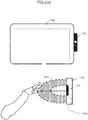
- Fig. 2(a) shows an installation example of the sensing unit 103.
- the sensing unit 103 is mounted on the driver's side in a right-side steering wheel vehicle relative to the display unit 108, and can detect the distance information of an object from the spot of the sensor element, and the movement of the object. Consequently, as shown in the lower diagram of Fig. 2(a) , the space between the in-vehicle device 101 and the user is divided into a plurality of areas, and in which area the user's hand exists can be detected in detail. As shown in the lower diagram, the space is divided into an area 201 that is close to the sensor position, and an area 202 that is even closer to the sensor position. Note that the number of sensor elements, installation position, and areas to be detected are not limited to this example.
- the messenger application 113 when the messenger application 113 is to output videos or voices to output units such as the display unit 108, the external display unit 109, and the speaker 111, the messenger application 113 sends video or voice information to the output information control unit 114, and the output information control unit 114 determines whether or not to output the received information to the foregoing output units.
- the messenger application 113 outputs videos to the display unit 108
- the messenger application 113 outputs voices will be used.
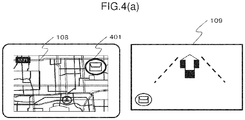
- the output information control unit 114 displays a navigation screen and an icon 401 of the messenger application 113 on the display unit 108 (center display in this example) as shown in Fig. 4(a) when the operation is started.
- the messenger application 113 is executed in the background by the in-vehicle device control unit 102 together with the activation of the in-vehicle device 101, and is activated by the output information control unit 114 when the touch control unit 106 detects a touch control of touching the icon 401, or the gesture detection unit 104 detects the user's prescribed gesture operation (for instance, hand waving in the leftward direction in front of the sensor).
- the output information control unit 114 displays a navigation screen and a screen related to the messenger application 113 on the external display unit 109 (HUD in this example) when the operation is started.
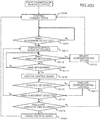
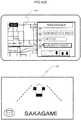
- the messenger application 113 When a message is received from the outside via the communication unit 107 (S301), the messenger application 113 outputs a sound effect to notify an incoming message, displays the total number of received messages on the external display unit 109 as shown with an icon 402 of Fig. 4(b) , and notifies the user that the number of unread messages has increased.
- the output information control unit 114 switches the display to a screen for using the application by activating the messenger application 113 as shown in Fig. 4(c) (S304).
- the messenger application 113 thereafter outputs voice information which reads the received messages in order from the oldest message (S305).
- Fig. 4(c) is a display example when using the half screen of the display unit 108 as the screen of the messenger application 113.
- the messenger application 113 When the touch control unit 106 detects that the user touched an area of an icon 403 on Fig. 4(c) , the messenger application 113 causes the display unit 108 to display a screen for performing the respective controls of stamp reply, fixed phrase reply, free speech reply, and message return/forward from the left side of the area of the icon 403. Moreover, while the voice information is being output in S305, the messenger application 113 causes the external display unit 109 to display the current number of unread messages as with an icon 404 in the lower diagram of Fig. 4(c) , and the name of the sender of the message that is being read.
- the messenger application 113 causes the speaker 111 to output voice information so that the latest message among the unread messages is read (S308).
- the messenger application 113 When no such gesture operation is detected, the messenger application 113 continues to output the voice information so that the unread messages are read in order from the oldest message (S307), and, when the reading of the latest message is finished, enters a reply control standby state while causing the display unit 108 and the external display unit 109 to continue displaying the last sender as shown in Fig. 4(d) (S309).
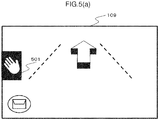
- the messenger application 113 displays an icon 501, which indicates that a gesture-based reply control can be performed, on the external display unit 109 as shown in Fig. 5(a) .
- the messenger application 113 outputs a sound effect to notify the user that the hand placement position is erroneous.
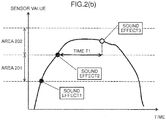
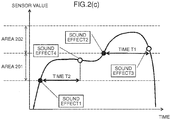
- Fig. 2(b) and Fig. 2(c) are diagrams showing in detail the relation of the detection state of the user's hand and the output of sound effects.
- Fig. 2(b) and Fig. 2(c) respectively represent the time axis and the sensor value of the sensing unit 103, and show the boundary for determining whether the sensor value falls within the area 201 or the area 202.
- Fig. 2(b) shows an example where the user stretches one's hand toward the area 202, and places one's hand in the area 202 for a given length of time.
- the gesture detection unit 104 detects that the user's hand entered the area 201
- the gesture detection unit 104 outputs a sound effect 1.
- the gesture detection unit 104 detects that the user's hand entered the area 202
- the gesture detection unit 104 outputs a sound effect 2.
- the gesture detection unit 104 continues to detect that the user's hand is in the area 202 for a time T1 or longer (for instance, for 0.5 seconds or longer)
- the gesture detection unit 104 outputs a sound effect 3, and switches the screen of the external display unit 109 as explained with reference to S311.
- Fig. 2(c) shows an example where the user continues to place one's hand in the area 201.
- the gesture detection unit 104 outputs the sound effect 1 upon detecting that the user's hand entered the area 201, and outputs a sound effect 4 upon detecting that the user's hand is in the area 201 for a time T2 or longer (for instance, for 0.3 seconds or longer). If the user's hand is subsequently detected in the area 202, the same process as the example of Fig. 2(b) is performed.
- the control of placing one's hand in the area 202 for the time T1 or longer is sometimes simply referred to as "hand placement".
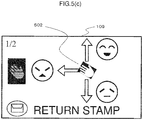
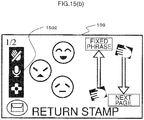
- Fig. 5(c) shows an example of a case where a control menu, which enables the user to perform a stamp reply, is displayed.
- the icon 502 is a control guide which means that, when the user performs a gesture in the upward, leftward or downward direction while placing one's hand over the icon 502, the corresponding stamp can be selected.
- the display of 1/2 at the upper left corner refers to the total number of pages of the displayed stamp candidates, and the current page.
- the displayed contents of the external display unit 109 are switched to the displayed contents shown in Fig. 5(d) (S315).
- the icon 503 represents the stamp candidates that can currently be selected.
- the icon 504 represents that the corresponding control will be performed when the gesture control corresponding to the displayed direction (upward hand waving or downward hand waving) is performed.
- the display of "fixed phrase” means switching the reply method to a fixed phrase reply
- the display of "next page” means switching the stamp candidates from those displayed with the icon 503 to the next candidate group.
- the messenger application 113 erases the control guide from the screen of the external display unit 109, and makes a transition to the reply control standby state of S309 (S320).
- the messenger application 113 displays the contents of the reply control result (selected stamp in this example) on the display unit 108, displays the name of the user who sent the reply on the external display unit 109, and reads the reply message.
- this operation flow is an explanation of a representative example of the operation of the in-vehicle device 101 of the present invention, and the operation, display, and sound effect are not limited to this example.
- the present invention is not limited thereto, and can be applied to the overall control of the in-vehicle device control unit 102 of selecting a plurality of options.
- Fig. 3(b) shows a simplified version of the operation flow. The basic operation is as explained above, and, while the explanation of the operation in each step is the same as those with the same step number of Fig. 3(a) , S316 of Fig. 3(b) does not have to be limited to vertical hand waving, and may also accept various controls, such as the control using a steering switch.
- the configuration may also be such that the message is read at the same time that the message is received, or the contents of the received message may be displayed on the external display unit 109. Consequently, it will be easier for the user to comprehend the message.
- the configuration may also be such that at the reply control standby it can be accepted at any time without waiting for the reading of the latest message to be finished. Consequently, the user may send a reply at any time.
- the configuration may be such that the tactile sensation is presented in mid air in such area by the tactile IF unit 112.
- the configuration may be such that the pressure points of an ultrasonic device array appear on the boundary of the areas, or a tactile sensation is given on the vertical line of the area using an air blower. Consequently, the user can place one's hand in the area while looking straight ahead, and can send a reply safely even though such control is performed while driving.
- the configuration may also be such that the transition is made to the reply method selection state (stamp, fixed phrase, free speech or the like) before the foregoing transition. Consequently, the user can select one's preferred reply method at the time that the reply control is started.
- the user's gesture is accepted after the user's hand placement is detected and the control guide is displayed on the external display unit 109 in this example
- the user's gesture may also be accepted from a given length of time before (for instance, 0.2 seconds before) displaying the control guide. Consequently, once the user becomes familiar with the control and learns which gesture corresponds to which control, the control can be performed without having to display unnecessary screens on the external display unit 109, and the control time can also be shortened.
- the configuration may also be such that the process proceeds to S320 upon detecting a predetermined control (for instance, hand waving motion in the left direction, switch control, or the like) prior to satisfying the foregoing condition. Consequently, the user can switch the display of the external display unit 109 to a navigation screen at one's desired timing.
- a predetermined control for instance, hand waving motion in the left direction, switch control, or the like
- control guide displayed on the external display unit 109 and the gesture direction are not limited to 3 directions, and arbitrary directions and number of directions may be used.
- directions in which the gesture control can be easily performed while sitting in the driver's seat may be set. For example, if the user's gesture is made in the direction of the steering wheel, the user's hand may hit the steering wheel while driving the vehicle and, therefore, a gesture in such direction is excluded as an option.
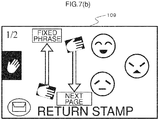
- the configuration may be such that whether the steering wheel of the vehicle to be driven is a right-side steering wheel or a left-side steering wheel can be set in advance using the setting screen and, when the steering wheel is a left-side steering wheel, the control guide displayed on the external display unit 109 indicates the 3 directions of upward, downward and rightward as shown in Fig. 7(a) and Fig. 7(b) .
- Fig. 7(a) and Fig. 7(b) correspond to Fig. 5(c) and Fig. 5(d) , respectively.
- the hand to be used for the gesture will change depending on the location where the steering wheel is mounted, the display and direction of the icons are also changed. Furthermore, because the visibility of the various icons will change depending on the position of the steering wheel, the use may also individually change the setting. Consequently, the user can perform controls based on gestures that can be easily performed according to the steering wheel installation position for each vehicle model, and the user can effortlessly perform various controls based on gestures while sitting in the driver's seat.
- the configuration may also be such that the placement of the user's hand can be performed at a plurality of locations, without limiting the hand placement position to one location as in this example.
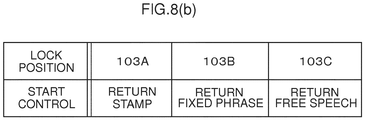
- the reply method may be decided depending on which sensor detected the user's hand placement.
- a stamp reply is sent when the sensor 103A detects the user's hand placement
- a fixed phrase reply is sent when the sensor 103B detects the user's hand placement
- a free speech reply is sent when the sensor 103C detects the user's hand placement. Consequently, the user can quickly select the reply method and perform the reply control.
- the user may also designate in advance which sensor corresponds to which method.
- the configuration may also be such that a camera is used for the sensing unit 103 as shown in Fig. 9 to detect the approach and gesture of the user's hand.
- the images of predetermined hand shapes are learned in advance, and the user's hand placement is detected from the pattern recognition of the learned data, irrespective of the distance and position of the user's hand.
- a plurality of hand shapes may be detected during the user's hand placement (901A to 903C), and the reply method may thereby be selected. Consequently, the user will be able to start the reply control without reaching out one's hand in front of the sensing unit 103 and performing any gesture operation.
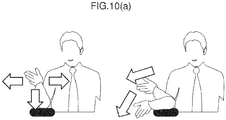
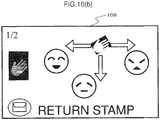
- the configuration may also be such that the direction and number of gestures to be accepted are changed according to the position and posture of the user's hand upon detecting the user's hand placement. For example, as shown in Fig. 10(a) , in a state where the user is placing one's elbow on an elbow rest and raising one's hand, when the user's hand placement is detected, gestures in the leftward, downward and rightward directions are recognized as shown in Fig. 10(b) . This is because, in the user's posture described above, it would be difficult for the user to make a gesture in the upward direction and, therefore, gestures in the 3 directions of leftward, downward and rightward are recognized. Furthermore, the configuration may also be such that the user can set in advance which gestures are to be recognized. Consequently, the user can perform gesture controls based on unrestricted postures.
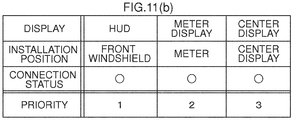
- the configuration may also be such that the location of display and the displayed contents are changed according to the connection status or the installation position of the various devices.
- the gesture control guide is displayed at the center of the screen as shown in Fig. 11(a) .
- the processing of managing the installation position and the connection status of a plurality of displays and deciding the priority is performed. While the basic rule is to display the control guide on the display with the highest priority, in cases where the HUD cannot be used due to a malfunction or other reasons, the control guide is displayed on the display of the next highest priority.
- the time of displaying the guide may be shortened or the amount of information to be displayed may be reduced according to the priority.
- the priority may be set based on various methods; for instance, the priority may be set at the time of factory shipment or time of sales, set by the user with a setting screen (not shown), or programmed in the in-vehicle terminal so that the priority is determined from the characteristics of the display that is connected to the in-vehicle terminal.
- the configuration may also be such that the priority is increased according to the installation position. Consequently, when a device such as the HUD to display the control guide cannot be used, the control guide can be displayed on a substitute device to enable the user to perform controls.
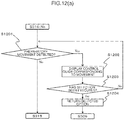
- the configuration may also be such that other control means (voice recognition control, switch control or the like) capable of controlling the in-vehicle device 101 may also be used without limitation to the gesture control.
- Fig. 12(a) shows the operation flow in the foregoing case.
- the control guide as shown in Fig. 12(b) is displayed on the external display unit 109.
- An icon 1201 shows that the upper icon can be used for selecting the option of gesture, the middle icon can be used for selecting the option of voice recognition, and the lower icon can be used for selecting the option of switch, respectively.
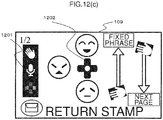
- the display switches to the screen as shown in Fig. 12(c) .
- the icon 1201 notifies the user that the steering controller control is active by changing the color of the icon.
- the display 1202 shows the candidates of stamps corresponding to the respective buttons of the steering controller. A reply control based on the corresponding stamp is performed according to the pressed button of the steering controller. Note that the display returns to the screen of Fig. 12(b) when a given length of time elapses, or the contact sensor of the steering controller is no longer responding.
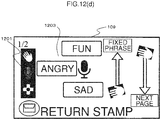
- the display switches to the screen as shown in Fig. 12(d) .
- the icon 1201 shows that the voice recognition is in a standby state
- the display 1203 shows that, by speaking words corresponding to the respective messages, the corresponding stamp can be selected.
- a reply control of the corresponding stamp is performed.
- the icon to be sent may also be displayed alongside the message so that user can know, at a glance, which icon will be sent.
- control means can be switched even midway during their controls if a start trigger of the respective controls is detected.
- a gesture control based on a vertical hand waving in such state is also accepted. Consequently, when the user is to send a reply, the user is not limited to a single control means, and may freely select the control means for performing the reply control according to the driving status, or according to the user's preference.
- the user upon switching the respective control means, by presenting to the user which control means is currently operable and how to perform such control, the user can quickly perform the control intuitively without any hesitation.
- the configuration may also be such that the control contents that can be performed when the user places one's hand are changed according to the operation status of the application being controlled by the in-vehicle device 101.
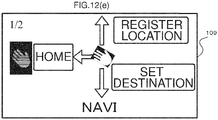
- Fig. 12(e) shows an example of presenting, as navigation-related controls as the available choices, the route setting to the user's home, registration of the current location, and voice-based setting of the destination, when the application running in the background is only a navigation application.
- Fig. 12(f) shows an example of presenting, as available choices, the control of stopping the music, skipping to the next song, or skipping to the previous song when the user places one's hand during music playback.
- Fig. 12(e) shows an example of presenting, as navigation-related controls as the available choices, the route setting to the user's home, registration of the current location, and voice-based setting of the destination, when the application running in the background is only a navigation application.
- Fig. 12(f) shows an example of presenting, as available choices, the control of stopping the
- 12(g) shows an example of presenting, as available choices, the control of listening to the details of traffic jam information, rerouting to the destination, or changing the destination when the user places one's hand upon receiving traffic jam information or the like. Consequently, the user can quickly select various controls according to the status of application being controlled by the in-vehicle device 101 while the user is driving the vehicle.
- the user can, intuitively and quickly, perform controls while looking straight ahead even while driving the vehicle. Specifically, the user can quickly switch the display of the messenger application and perform the control of skipping message while looking straight ahead. Moreover, in cases of controls of selecting a plurality of options, the user can select one's intended option while looking straight ahead and confirming the contents of the available choices. Furthermore, once the user becomes familiar with the controls, the user will be able to select the options without having to view the display, and the user will be able to perform controls more safely and quickly.
- Fig. 13 is a configuration diagram of the in-vehicle device 101 in this embodiment.
- a vehicle information input unit 118, a control means control unit 119, a workload estimation unit 120, and a map DB (database) 121 have been added.
- the vehicle information input unit 118, the control means control unit 119, and the workload estimation unit 120 exhibit the functions as the vehicle information input unit 118, the control means control unit 119, and the workload estimation unit 120 as a result of the in-vehicle device control unit 102 performing operations according to the programs stored in the storage unit (not shown).
- the vehicle information input unit 118 is the part that acquires information related to the vehicle that is being driven, and, for instance, is connected to the vehicle via a CAN (Control Area Network), and acquires information related to vehicle speed, accelerator position, brake position, turn signal, and steering angle.
- CAN Controller Area Network
- the control means control unit 119 controls to which control the control input from the gesture detection unit 104 or the voice recognition unit 116, or the various switch control units should be reflected.
- the workload estimation unit 120 estimates the user's workload in the driving operation. For example, in addition to the various input signals from the vehicle information input unit 118 described above, the workload estimation unit 120 integrates information input from the communication unit 107 (map information, type of road that the vehicle is traveling on, distance to preceding vehicle, and so on), and defines the workload level as four stages (None, Low, Medium, High).
- “None” is a state where the vehicle is waiting at a traffic light or the vehicle is on autopilot and being driven based on ACC (Adaptive Cruise Control) or the like where the driver is not required to perform any special control
- "Low” is a state where the vehicle is being driven on a straight road with no obstacles in the periphery
- “Medium” is a state where the vehicle is being driven at a certain speed or faster and a steering wheel control is constantly required, or a state of making a turn at an intersection
- “High” is a state where the user is required to perform an important driving operation to avoid an accident.
- the map DB 121 is a database which stores map information.
- the operation of the in-vehicle device 101 of this embodiment is now explained in detail.
- the basic operation is the same as the operation explained in Embodiment 1, but this embodiment is unique in that the operation is controlled according to the output of the workload estimation unit 120.
- the in-vehicle device control unit 102 has defined in advance the workload level output from the workload estimation unit 120 and the control means that can be controlled and the displayed contents that can be presented, at the respective workload levels.
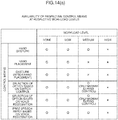
- Fig. 14(a) to Fig. 14(d) show the foregoing definitions.
- Fig. 14(a) shows whether or not the respective control means can be used in the respective workload levels.
- the workload level is "None” or “Low”
- all control means described in Embodiment 1 can be used for sending a reply.
- the workload level is "High”
- all controls are prohibited.
- the workload is "Medium”
- the display of the hand placement control guide and the subsequent selection of options based on a gesture control are prohibited. Because a hand placement control is a control means that forces the user to perform one-handed driving, this control is prohibited in circumstances where the user should concentrate on the driving operation.
- the external display unit 109 of this embodiment displays the current workload level as shown with the icon 1503 of Fig. 15(a).
- Fig. 15(a) shows that the workload level is "Medium", and a display showing that the hand placement control is prohibited, as shown with the icon 1501, is indicated to notify the user that a control using one's hand cannot be performed.
- the user's hand placement is detected in this state, the display or color of the icon 1501 is changed, and a warning sound or warning message is output, to emphasize the fact that no hand placement control may be performed, and to urge the user to immediately stop his/her hand placement.
- the user can comprehend the current workload status, and it is possible to prevent, as much as possible, the user from removing one's hand from the steering wheel for a long time as a result of attempting to display the control guide even though the user is required to perform the steering wheel control.
- free speech reply based on voice recognition that does not require the use of a hand and a hand waving gesture that can be completed with an instant control can be used even when the workload level is "Medium”.
- Fig. 15(b) shows that, among the icons of the three types of control means, the selection control based on hand placement and gesture is prohibited.
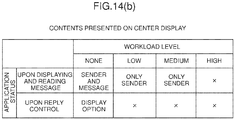
- Fig. 14(b) shows the definitions related to the workload level and the output contents of the center display. Foremost, when the workload level is "None", the messenger application 113 displays the entire text of the message. Moreover, when the user is sending a reply based on basic controls such as touching the control icon on the screen, all options such as the stamp candidates are also displayed. When the workload is "Low” or “Medium”, the text of the message is not displayed, and only the name of the sender of the message is displayed. Moreover, the control system using a touch control is also not displayed.
- the screen of the messenger application 113 is also turned off, and a warning message corresponding to the situation (for instance, "Keep distance!) is displayed.
- the workload level switches to "None" midway during the foregoing control
- the user may also perform such control based on a touch control on the center display in consideration of the status of the control guide displayed on the HUD. For example, as shown in Fig. 16(a) , in a state where the user is performing a stamp reply on the HUD, information of the contents and arrangement of the stamp candidates is maintained and additionally displayed on the center display as shown in Fig. 16(b) .
- the stamp candidates 1601 and the arrangement thereof on the screen of the HUD are maintained, the stamp candidates are displayed on the center display as shown with reference numeral 1602. Furthermore, the contents of 1602 are arranged on the driver's side so that it would be easier for the driver to perform controls, and select the stamp to be sent based on a touch control. Moreover, the remaining stamp candidates are arranged on the screen at a position that is far from the driver's side as shown with 1603.
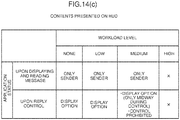
- Fig. 14(c) shows the definitions related to the workload level and the output contents of the HUD. Foremost, when the workload level is "None” or “Low”, the name of the sender is displayed when the message is being read, and the control guide when sending a reply is displayed. When the workload level is “Medium”, a message to the effect that a hand placement control is prohibited is displayed, or the screen of the control is maintained and displayed only when the workload level changes from “Low” to “Medium”. When the workload level is "High”, a warning message corresponding to the situation (for instance, "Keep distance!) is displayed.
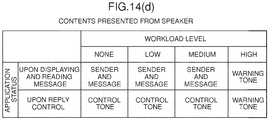
- Fig. 14(d) shows the definitions related to the workload level and the sound output from the speaker.
- the workload level is "None” to “Medium”
- the control sound or the reading voice at such time is output.
- the workload level is "High”
- only a warning sound is output. Note that, even when a message is being read, the output thereof is stopped. The stopped message that was being read is resumed and once again read from the beginning once the workload level becomes lower.
- the configuration may also be such that the user's hand placement detection algorithm and the feedback method are changed according to the workload level. For example, when the workload level is "Low” and the hand placement is detected when the user places one's hand for 0.5 seconds or longer, in cases where the workload level is "None”, the setting is changed such that the hand placement is detected when the user places one's hand for 2 seconds or longer. Furthermore, when the workload level is "None", the feedback of hand placement based on a sound output is discontinued.
- the hand placement detection algorithm which was devised so that the user can perform controls quickly and while looking straight ahead while driving can prevent erroneous detection based on operations other than hand placement operations, such as touch controls, by giving consideration to the fact that touch controls and taking one's eyes off the road are permitted while the vehicle is stopped.
- the user can perform controls based on various means and receive more information when the user has much leeway such as when the vehicle is stopped, and the user can perform safe driving by preventing the user from focusing on other controls other than the driving operation in situations where the user should be concentrating on the driving operation.
- the present invention is not limited thereto, and may also be applied to devices such as a personal computer, digital signage, construction machinery, aircraft, or monitoring operator device that comprise a display unit and a control means.
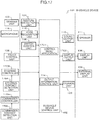
- Fig. 17 is a configuration diagram of the in-vehicle device 101 in this embodiment.
- a control menu application 1701 a display output unit 1702, a steering controller 1703, a steering contact detection unit 1704, a commander controller 1705, and a commander contact detection unit 1706 have been added.
- the control menu application 1701 is software for displaying a control menu on the display unit 108 and the external display unit 109 according to the programs stored in the storage unit (not shown).
- the display output unit 1702 has a function of outputting video signals to the display unit 108 in cases where a display device that is not built into the in-vehicle device 101 is used as the display unit 108.
- the steering controller 1703 is a switch part that is mounted on the steering wheel, and is used by the user for inputting controls. Moreover, the steering contact detection unit 1704 detects whether the user's hand has come into contact with the switch part of the steering controller 1703.
- the commander controller 1705 is a switch part that is mounted on the in-vehicle instrument panel or center console, and is used by the user for inputting controls. Moreover, the commander contact detection unit 1706 detects whether the user's hand has come into contact with the switch part of the commander controller 1705.
- Fig. 18 shows the appearance of a cockpit in this embodiment.
- the display unit 108 is mounted at the center of the instrument panel, and touch controls can be performed with the touch control unit 106. Moreover, a sensing unit 103 for detecting gestures is provided at the upper right part of the display unit 108.
- the external display unit 109 is configured from an HUD, and can display various types of information while allowing the scenery ahead of the driver (user) to pass therethrough.
- the steering controller 1703 is provided in the steering wheel. Moreover, the commander controller 1705 is provided on the center console.
- the operation of the in-vehicle device 101 of this embodiment is now explained.
- the basic operation is the same as the operation explained in Embodiment 1, but this embodiment is unique in that the displayed contents of the display unit 108 and the external display unit 109 are changed based on the hand waving in the upward direction and the downward direction relative to the sensing unit 103, and that the shape of the control menu and control guide displayed on the external display unit 109 is changed according to the hand motion that is detected by the sensing unit 103.
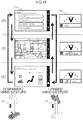
- Fig. 19 shows a state where the displayed contents of the display unit 108 and the external display unit 109 are changed based on the hand waving in the upward direction and the downward direction relative to the sensing unit 103.
- the respective screens of (A), (B) and (C) of Fig. 19 represent the display in the screen mode controlled by the control menu application 1701, and (A) shows an audio control mode, (B) shows a navigation control mode, and (C) shows an air-conditioning control mode.
- the screen of the display unit 108 and the external display unit 109 switches from (A) to (B), from (B) to (C), and from (C) to (A) of Fig. 19 .
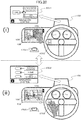
- Fig. 20 shows a state where the user is performing controls based on gestures and the steering controller 1703 in the (B) navigation control mode.
- the gesture control menu 2001 is displayed on the external display unit 109, and, by moving one's hand in one direction among upward, downward and leftward from the hand placement position, the user can select the item corresponding to that direction.
- the steering controller control menu 2002 is displayed as shown in (ii) of Fig. 20 .
- the state shown in (ii) of Fig. 20 shows a state where the user is performing controls based on gestures and the steering controller 1703 in the (B) navigation control mode.
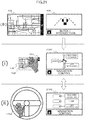
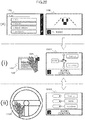
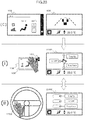
- Fig. 21 , Fig. 22 , and Fig. 23 show the screen transition of the external display unit 109 in the series of operations explained with reference to Fig. 19 and Fig. 20 .
- Fig. 21 shows the screen transition of the (B) navigation control mode
- Fig. 22 shows the screen transition of the (A) audio control mode
- Fig. 23 shows the screen transition of the (C) air-conditioning control mode.
- Fig. 24 shows the detailed movement in the screen of the external display unit 109 in the (B) navigation control mode.
- the gesture control menu 2001 is displayed on the external display unit 109.
- the user moves one's hand in the upward direction from the hand placement position, as shown in 2401 of Fig. 24 , only the item corresponding to the upward direction is displayed for a predetermined time, and, based on this display, the user can confirm that the intended item has been selected.
- a predetermined time elapses from the display of 2401
- the display of the external display unit 109 returns to the state before the user's hand placement. Note that the movement is the same for the steering controller control menu 2002.
- Fig. 26(a) is a table showing the correspondence of the gesture detection status and the control device in the in-vehicle device 101 of this embodiment.
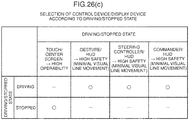
- Fig. 26(c) is a table showing the correspondence of the control device and the display device according to a state where the vehicle is moving and a state where the vehicle is stopped.
- the output information control unit 114 of this embodiment determines the control device and the display device to be used in the control of a predetermined menu according to Fig. 26(a) and Fig. 26(c) .
- the output information control unit 114 determines that the user is attempting to perform a control with a gesture. Moreover, when the user's hand is removed from the sensing unit 103, the output information control unit 114 determines that the user is attempting to perform a control with the steering controller 1703. Note that, for vehicles that are not equipped with the steering controller 1703, the output information control unit 114 may determine that the user is attempting to perform a control with another control device such as a commander controller 1705 that is equipped in the vehicle. Based on the foregoing determination, the output information control unit 114 instructs the control menu application 1701 to output a predetermined screen. It is thereby possible to display the control menu and control guide that are suitable for the control device to be controlled by the user, and an effect is yielded in that the user can smoothly perform controls using the intended control device.
- the output information control unit 114 determines that the user is attempting to perform controls by using gestures, the steering controller 1703 and the commander controller 1705 while the vehicle is moving, the output information control unit 114 displays the control menu on the external display unit 109 (HUD). Consequently, because the user can visually confirm the control menu with minimal line of sight movement from the state of visually recognizing the forward view of the vehicle, an effect is yielded in that the influence on the driving operation caused by the control of the control menu can be suppressed.
- HUD external display unit 109
- a touch panel with high controllability which enables detailed controls with the user's fingertips may also be permitted.
- a touch panel with high controllability which enables detailed controls with the user's fingertips may also be permitted.
- a touch panel with high controllability which enables detailed controls with the user's fingertips may also be permitted.
- a touch panel with high controllability which enables detailed controls with the user's fingertips may also be permitted.
- a touch panel in a state where the steering controller control menu 2002 is being displayed on the external display unit 109
- a advanced menu as shown in 2501 of Fig. 25 may be displayed on the display unit 108, and controls may be performed based on touch control.
- the display of the display unit 108 may be turned off, and the steering controller control menu 2002 may be displayed once again on the external display unit 109. Consequently, an effect is yielded in that the user can switch to a touch panel control and perform controls efficiently based on a touch control in circumstances where the driving operation will not be hindered, such as when the
- the display of the steering controller control menu 2002 may feel bothersome when the user wishes to perform the driving operation with the hand that was returned to the steering.
- a simplified menu in which the part where the menu is to be displayed in the external display unit 109 is reduced in size as shown in 2701 of Fig. 27 may be displayed, and the steering controller control menu 2002 may be displayed when the steering contact detection unit 1704 detects that the user has touched the switch of the steering controller 1703.
- Fig. 28 shows the appearance of the control of the in-vehicle device 101 in this embodiment.
- a screen where the commander control menu 2801 is displayed on the external display unit 109 when the user places one's hand near the commander controller 1705 has been added.
- a camera is used as the sensing unit 103 as shown in Fig. 9 .
- the sensing unit 103 of this embodiment detects in which direction the user's hand is moving in the periphery of the sensing unit 103. Note that, so as long as it is possible to detect in which direction the user's hand is moving, the sensing unit 103 may be a sensing device other than a camera.
- Fig. 28 shows a state where the user is performing controls based on gestures, the steering controller 1703 and the commander controller 1705 in the (B) navigation control mode.
- the steering controller control menu 2002 is displayed as shown in (i) of Fig. 28 .
- the control menu 2801 of the commander controller 1705 is displayed as shown in (ii) of Fig. 28 .
- the user can select one item in correspondence with the rotary controlled equipped in the commander controller 1705.
- Fig. 26(b) is a table showing the selection of the control device according to the position and moving direction of the hand in the in-vehicle device 101 of this embodiment.
- the output information control unit 114 of this embodiment decides the control device to be used for the control of a predetermined menu according to Fig. 26(b) .
- the output information control unit 114 determines that the user is attempting to perform a control with a gesture. Moreover, when the user's hand moves from the sensing unit 103 in the direction or to the position of the steering controller 1703, the output information control unit 114 determines that the user is attempting to perform the control with the steering controller 1703. Furthermore, when the user's hand moves from the sensing unit 103 in the direction or to the position of the commander controller 1705, the output information control unit 114 determines that the user is attempting to perform the control with the commander controller 1705. Note that the steering controller 1703 and the commander controller 1705 may be other control devices equipped in the vehicle.
- the output information control unit 114 instructs the control menu application 1701 to output a predetermined screen. It is thereby possible to display the control menu and control guide that are suitable for the control device to be controlled by the user, and an effect is yielded in that the user can smoothly perform controls using the intended control device.
- the determination may also be made based on the user's finger-pointing direction detected by the sensing unit 103 rather than based on the direction or position that the user's hand moved from the sensing unit 103.
- the sensing unit 103 may detect that the user pointed one's finger to the air-conditioning control panel 2901 in the state shown in (i) of Fig. 29 , and the steering controller control menu 2302 for air-conditioning control may be displayed on the external display unit 109 based on the foregoing detection. Consequently, an effect is yielded in that the intended control menu can be displayed even more smoothly without the user having to place one's hand over the sensing unit 103 even once.
Landscapes
- Engineering & Computer Science (AREA)
- Theoretical Computer Science (AREA)
- General Engineering & Computer Science (AREA)
- Physics & Mathematics (AREA)
- General Physics & Mathematics (AREA)
- Human Computer Interaction (AREA)
- Mechanical Engineering (AREA)
- Transportation (AREA)
- Chemical & Material Sciences (AREA)
- Combustion & Propulsion (AREA)
- Multimedia (AREA)
- Health & Medical Sciences (AREA)
- General Health & Medical Sciences (AREA)
- Optics & Photonics (AREA)
- Audiology, Speech & Language Pathology (AREA)
- Computer Vision & Pattern Recognition (AREA)
- Psychiatry (AREA)
- Social Psychology (AREA)
- User Interface Of Digital Computer (AREA)
- Instrument Panels (AREA)
Applications Claiming Priority (2)
| Application Number | Priority Date | Filing Date | Title |
|---|---|---|---|
| JP2015031324A JP6426025B2 (ja) | 2015-02-20 | 2015-02-20 | 情報処理装置 |
| PCT/JP2016/052916 WO2016132876A1 (fr) | 2015-02-20 | 2016-02-01 | Dispositif de traitement d'informations |
Publications (2)
| Publication Number | Publication Date |
|---|---|
| EP3260331A1 true EP3260331A1 (fr) | 2017-12-27 |
| EP3260331A4 EP3260331A4 (fr) | 2018-09-05 |
Family
ID=56688843
Family Applications (1)
| Application Number | Title | Priority Date | Filing Date |
|---|---|---|---|
| EP16752264.8A Withdrawn EP3260331A4 (fr) | 2015-02-20 | 2016-02-01 | Dispositif de traitement d'informations |
Country Status (5)
| Country | Link |
|---|---|
| US (1) | US10466800B2 (fr) |
| EP (1) | EP3260331A4 (fr) |
| JP (1) | JP6426025B2 (fr) |
| CN (1) | CN107107841B (fr) |
| WO (1) | WO2016132876A1 (fr) |
Cited By (3)
| Publication number | Priority date | Publication date | Assignee | Title |
|---|---|---|---|---|
| EP3298475A1 (fr) * | 2015-05-21 | 2018-03-28 | Audi AG | Système de commande et procédé pour faire fonctionner un système de commande pour un véhicule à moteur |
| US20210016789A1 (en) * | 2018-03-07 | 2021-01-21 | Audi Ag | Method for operating a motor vehicle having an autopilot system, and motor vehicle |
| WO2021050492A1 (fr) * | 2019-09-12 | 2021-03-18 | Continental Automotive Systems, Inc. | Bouton avec caractéristique de prévisualisation d'affichage |
Families Citing this family (26)
| Publication number | Priority date | Publication date | Assignee | Title |
|---|---|---|---|---|
| JP6426025B2 (ja) * | 2015-02-20 | 2018-11-21 | クラリオン株式会社 | 情報処理装置 |
| JP6224029B2 (ja) * | 2015-05-21 | 2017-11-01 | 富士通テン株式会社 | 画像処理装置および画像処理方法 |
| JP2018182616A (ja) * | 2017-04-18 | 2018-11-15 | 京セラ株式会社 | 電子機器、制御方法、およびプログラム |
| WO2018193579A1 (fr) * | 2017-04-20 | 2018-10-25 | 矢崎総業株式会社 | Dispositif de reconnaissance d'image |
| JP6508846B2 (ja) * | 2017-06-02 | 2019-05-08 | 本田技研工業株式会社 | 車両制御システム、車両制御方法、およびプログラム |
| JP7080598B2 (ja) * | 2017-07-21 | 2022-06-06 | ソニーセミコンダクタソリューションズ株式会社 | 車両制御装置および車両制御方法 |
| JP6266833B1 (ja) | 2017-07-28 | 2018-01-24 | 京セラ株式会社 | 電子機器、プログラムおよび制御方法 |
| KR101951426B1 (ko) * | 2017-08-08 | 2019-02-22 | 엘지전자 주식회사 | 차량에 구비된 차량 제어 장치 및 차량의 제어방법 |
| CN109491496A (zh) * | 2017-09-12 | 2019-03-19 | 精工爱普生株式会社 | 头部佩戴型显示装置和头部佩戴型显示装置的控制方法 |
| JP2019028973A (ja) * | 2017-12-20 | 2019-02-21 | 京セラ株式会社 | 電子機器、プログラムおよび制御方法 |
| JP7136199B2 (ja) * | 2018-04-17 | 2022-09-13 | 株式会社ソシオネクスト | ジェスチャ認識方法及びジェスチャ認識装置 |
| US10850746B2 (en) | 2018-07-24 | 2020-12-01 | Harman International Industries, Incorporated | Coordinating delivery of notifications to the driver of a vehicle to reduce distractions |
| EP3991067B1 (fr) | 2019-06-26 | 2025-02-26 | Google LLC | Rétroaction d'état d'authentification basée sur un radar |
| DE102019210912A1 (de) * | 2019-07-23 | 2021-01-28 | Brose Fahrzeugteile Se & Co. Kommanditgesellschaft, Bamberg | Verstellvorrichtung und Verfahren für die fremdkraftbetätigte Verstellung eines Verstellteils an einem Fahrzeug auf Basis wenigstens eines Bedienereignisses |
| JP7316383B2 (ja) | 2019-07-26 | 2023-07-27 | グーグル エルエルシー | Imuおよびレーダーを介した認証管理 |
| US11868537B2 (en) | 2019-07-26 | 2024-01-09 | Google Llc | Robust radar-based gesture-recognition by user equipment |
| JP7346595B2 (ja) | 2019-07-26 | 2023-09-19 | グーグル エルエルシー | レーダーベースのジェスチャー認識の状況感知型制御 |
| KR102661485B1 (ko) | 2019-08-30 | 2024-04-29 | 구글 엘엘씨 | 일시정지된 레이더 제스처에 대한 시각적 표시자 |
| WO2021040745A1 (fr) | 2019-08-30 | 2021-03-04 | Google Llc | Procédés d'entrée pour dispositifs mobiles |
| JP2021102357A (ja) * | 2019-12-24 | 2021-07-15 | トヨタ自動車株式会社 | 車載機器操作装置 |
| WO2021131959A1 (fr) | 2019-12-27 | 2021-07-01 | ソニーグループ株式会社 | Dispositif de traitement d'informations, procédé de traitement d'informations et programme de traitement d'informations |
| JP7484756B2 (ja) * | 2021-02-05 | 2024-05-16 | 株式会社デンソー | 表示システム |
| JP2023055163A (ja) * | 2021-10-05 | 2023-04-17 | 株式会社デンソー | 表示装置、画像の表示方法および画像の表示プログラム |
| CN114205759B (zh) * | 2021-11-30 | 2023-03-07 | 上海赫千电子科技有限公司 | 一种车载以太网显示屏的显示控制方法 |
| JP2024164515A (ja) * | 2023-05-15 | 2024-11-27 | 株式会社東海理化電機製作所 | ユーザインタフェースシステム、制御装置、およびコンピュータプログラム |
| EP4527661A1 (fr) * | 2023-09-20 | 2025-03-26 | Bayerische Motoren Werke Aktiengesellschaft | Procédé et appareil de détection d'une entrée d'un utilisateur d'un véhicule |
Family Cites Families (54)
| Publication number | Priority date | Publication date | Assignee | Title |
|---|---|---|---|---|
| US9239673B2 (en) * | 1998-01-26 | 2016-01-19 | Apple Inc. | Gesturing with a multipoint sensing device |
| JP2005174356A (ja) * | 2000-02-01 | 2005-06-30 | Toshiba Corp | 方向検出方法 |
| US7821541B2 (en) * | 2002-04-05 | 2010-10-26 | Bruno Delean | Remote control apparatus using gesture recognition |
| KR100575906B1 (ko) * | 2002-10-25 | 2006-05-02 | 미츠비시 후소 트럭 앤드 버스 코포레이션 | 핸드 패턴 스위치 장치 |
| JP3752246B2 (ja) * | 2003-08-11 | 2006-03-08 | 学校法人慶應義塾 | ハンドパターンスイッチ装置 |
| JP2005297810A (ja) * | 2004-04-13 | 2005-10-27 | Denso Corp | 車両用表示システム及びプログラム |
| EP1764674B1 (fr) * | 2005-09-14 | 2012-06-13 | Volkswagen AG | Dispositif d'introduction |
| JP2009042796A (ja) * | 2005-11-25 | 2009-02-26 | Panasonic Corp | ジェスチャー入力装置および方法 |
| JP2007302223A (ja) * | 2006-04-12 | 2007-11-22 | Hitachi Ltd | 車載装置の非接触入力操作装置 |
| US8094189B2 (en) * | 2007-01-30 | 2012-01-10 | Toyota Jidosha Kabushiki Kaisha | Operating device |
| EP2174461B1 (fr) | 2007-07-23 | 2010-11-24 | Telefonaktiebolaget LM Ericsson (publ) | Procédé et appareil à usage dans un réseau de communications |
| US8165886B1 (en) * | 2007-10-04 | 2012-04-24 | Great Northern Research LLC | Speech interface system and method for control and interaction with applications on a computing system |
| DE102008051757A1 (de) | 2007-11-12 | 2009-05-14 | Volkswagen Ag | Multimodale Benutzerschnittstelle eines Fahrerassistenzsystems zur Eingabe und Präsentation von Informationen |
| JP4692937B2 (ja) * | 2008-09-29 | 2011-06-01 | 株式会社デンソー | 車載用電子機器操作装置 |
| JP5247389B2 (ja) * | 2008-12-01 | 2013-07-24 | 富士通テン株式会社 | ディスプレイ装置 |
| JP2010184600A (ja) | 2009-02-12 | 2010-08-26 | Autonetworks Technologies Ltd | 車載用ジェスチャースイッチ装置 |
| JP2010215194A (ja) | 2009-03-19 | 2010-09-30 | Hyundai Motor Co Ltd | 車載機器の操作装置 |
| JP5648207B2 (ja) * | 2009-09-04 | 2015-01-07 | 現代自動車株式会社 | 車両用操作装置 |
| KR20110055062A (ko) * | 2009-11-19 | 2011-05-25 | 삼성전자주식회사 | 로봇 시스템 및 그 제어 방법 |
| JP2011118725A (ja) | 2009-12-04 | 2011-06-16 | Sharp Corp | 情報処理機器、情報処理方法および情報処理プログラム |
| JP5348425B2 (ja) * | 2010-03-23 | 2013-11-20 | アイシン・エィ・ダブリュ株式会社 | 表示装置、表示方法、及び表示プログラム |
| KR101334107B1 (ko) * | 2010-04-22 | 2013-12-16 | 주식회사 굿소프트웨어랩 | 차량용 멀티미디어 제어를 위한 사용자 인터페이스 장치 및 방법 |
| US8810509B2 (en) * | 2010-04-27 | 2014-08-19 | Microsoft Corporation | Interfacing with a computing application using a multi-digit sensor |
| US9014911B2 (en) * | 2011-11-16 | 2015-04-21 | Flextronics Ap, Llc | Street side sensors |
| US20120224060A1 (en) * | 2011-02-10 | 2012-09-06 | Integrated Night Vision Systems Inc. | Reducing Driver Distraction Using a Heads-Up Display |
| US9015639B2 (en) * | 2011-02-11 | 2015-04-21 | Linkedin Corporation | Methods and systems for navigating a list with gestures |
| US20120260287A1 (en) * | 2011-04-07 | 2012-10-11 | Sony Corporation | Personalized user interface for audio video display device such as tv |
| US20120312956A1 (en) * | 2011-06-11 | 2012-12-13 | Tom Chang | Light sensor system for object detection and gesture recognition, and object detection method |
| US8891868B1 (en) * | 2011-08-04 | 2014-11-18 | Amazon Technologies, Inc. | Recognizing gestures captured by video |
| EP2986014A1 (fr) * | 2011-08-05 | 2016-02-17 | Samsung Electronics Co., Ltd. | Procédé pour commander un appareil électronique sur la base d'une reconnaissance vocale et d'une reconnaissance de mouvement et appareil électronique appliquant celui-ci |
| DE102011112447A1 (de) * | 2011-09-03 | 2013-03-07 | Volkswagen Aktiengesellschaft | Verfahren und Anordnung zum Bereitstellen einer graphischen Nutzerschnittstelle, insbesondere in einem Fahrzeug |
| US9383579B2 (en) * | 2011-10-12 | 2016-07-05 | Visteon Global Technologies, Inc. | Method of controlling a display component of an adaptive display system |
| WO2013136776A1 (fr) * | 2012-03-15 | 2013-09-19 | パナソニック株式会社 | Dispositif de traitement d'opération d'entrée gestuelle |
| US9448635B2 (en) * | 2012-04-16 | 2016-09-20 | Qualcomm Incorporated | Rapid gesture re-engagement |
| US20130275924A1 (en) * | 2012-04-16 | 2013-10-17 | Nuance Communications, Inc. | Low-attention gestural user interface |
| TW201419036A (zh) * | 2012-11-06 | 2014-05-16 | Pixart Imaging Inc | 感測元件陣列、控制感測裝置的方法以及相關電子裝置 |
| JP6030430B2 (ja) * | 2012-12-14 | 2016-11-24 | クラリオン株式会社 | 制御装置、車両及び携帯端末 |
| US20140181759A1 (en) * | 2012-12-20 | 2014-06-26 | Hyundai Motor Company | Control system and method using hand gesture for vehicle |
| JP5372273B2 (ja) | 2013-03-07 | 2013-12-18 | 富士通テン株式会社 | ディスプレイ装置 |
| JP2014174818A (ja) | 2013-03-11 | 2014-09-22 | Panasonic Corp | 電子装置 |
| JP6253077B2 (ja) * | 2013-04-22 | 2017-12-27 | 株式会社ユピテル | 装置及びプログラム |
| JP2014215649A (ja) * | 2013-04-23 | 2014-11-17 | アルプス電気株式会社 | 入力装置 |
| JP5472842B2 (ja) * | 2013-04-26 | 2014-04-16 | 株式会社デンソー | 車両用操作装置 |
| US20140368423A1 (en) * | 2013-06-17 | 2014-12-18 | Nvidia Corporation | Method and system for low power gesture recognition for waking up mobile devices |
| JP5486721B2 (ja) | 2013-06-18 | 2014-05-07 | キヤノン株式会社 | 表示制御装置及び表示制御装置の制御方法、プログラム、記憶媒体 |
| JP6113281B2 (ja) * | 2013-07-05 | 2017-04-12 | クラリオン株式会社 | 情報処理装置 |
| US20160023604A1 (en) * | 2013-07-08 | 2016-01-28 | LightSpeed Automotive Technology | Head-Up Display Controller |
| KR101558354B1 (ko) * | 2013-11-13 | 2015-10-20 | 현대자동차 주식회사 | 차량용 블라인드 콘트롤 시스템 |
| KR101534745B1 (ko) * | 2013-12-31 | 2015-07-07 | 현대자동차 주식회사 | 제스처 인식 장치 |
| KR101556521B1 (ko) * | 2014-10-06 | 2015-10-13 | 현대자동차주식회사 | 휴먼 머신 인터페이스 장치, 그를 가지는 차량 및 그 제어 방법 |
| DE102014116292A1 (de) * | 2014-11-07 | 2016-05-12 | Visteon Global Technologies, Inc. | System zur Informationsübertragung in einem Kraftfahrzeug |
| WO2016102268A1 (fr) * | 2014-12-22 | 2016-06-30 | Volkswagen Ag | Barre digitale et application de la barre digitale |
| JP6426025B2 (ja) * | 2015-02-20 | 2018-11-21 | クラリオン株式会社 | 情報処理装置 |
| US10589676B2 (en) * | 2016-06-02 | 2020-03-17 | Magna Electronics Inc. | Vehicle display system with user input display |
-
2015
- 2015-02-20 JP JP2015031324A patent/JP6426025B2/ja active Active
-
2016
- 2016-02-01 WO PCT/JP2016/052916 patent/WO2016132876A1/fr not_active Ceased
- 2016-02-01 US US15/551,308 patent/US10466800B2/en active Active
- 2016-02-01 CN CN201680004230.2A patent/CN107107841B/zh active Active
- 2016-02-01 EP EP16752264.8A patent/EP3260331A4/fr not_active Withdrawn
Cited By (5)
| Publication number | Priority date | Publication date | Assignee | Title |
|---|---|---|---|---|
| EP3298475A1 (fr) * | 2015-05-21 | 2018-03-28 | Audi AG | Système de commande et procédé pour faire fonctionner un système de commande pour un véhicule à moteur |
| US10599226B2 (en) | 2015-05-21 | 2020-03-24 | Audi Ag | Operating system and method for operating an operating system for a motor vehicle |
| US20210016789A1 (en) * | 2018-03-07 | 2021-01-21 | Audi Ag | Method for operating a motor vehicle having an autopilot system, and motor vehicle |
| US11767025B2 (en) * | 2018-03-07 | 2023-09-26 | Audi Ag | Method for operating a motor vehicle having an autopilot system, and motor vehicle |
| WO2021050492A1 (fr) * | 2019-09-12 | 2021-03-18 | Continental Automotive Systems, Inc. | Bouton avec caractéristique de prévisualisation d'affichage |
Also Published As
| Publication number | Publication date |
|---|---|
| JP2016153250A (ja) | 2016-08-25 |
| JP6426025B2 (ja) | 2018-11-21 |
| US10466800B2 (en) | 2019-11-05 |
| WO2016132876A1 (fr) | 2016-08-25 |
| CN107107841B (zh) | 2020-03-31 |
| CN107107841A (zh) | 2017-08-29 |
| US20180059798A1 (en) | 2018-03-01 |
| EP3260331A4 (fr) | 2018-09-05 |
Similar Documents
| Publication | Publication Date | Title |
|---|---|---|
| US10466800B2 (en) | Vehicle information processing device | |
| EP3395600B1 (fr) | Dispositif embarqué | |
| EP3165994B1 (fr) | Dispositif de traitement d'informations | |
| US12187120B2 (en) | Control system and method using in-vehicle gesture input | |
| US9881605B2 (en) | In-vehicle control apparatus and in-vehicle control method | |
| US20180232057A1 (en) | Information Processing Device | |
| US12008168B2 (en) | Method for operating a mobile terminal using a gesture recognition and control device, gesture recognition and control device, motor vehicle, and an output apparatus that can be worn on the head | |
| US9103691B2 (en) | Multimode user interface of a driver assistance system for inputting and presentation of information | |
| RU2466038C2 (ru) | Система транспортного средства с функциональной возможностью помощи | |
| US12056939B2 (en) | Control system using in-vehicle gesture input | |
| US9703472B2 (en) | Method and system for operating console with touch screen | |
| US20140281964A1 (en) | Method and system for presenting guidance of gesture input on a touch pad | |
| CN108349389A (zh) | 操纵设备和用于在机动车中接收由使用者输入的字符串的方法 | |
| CN108153411A (zh) | 用于与图形用户界面交互的方法和装置 | |
| US11113550B2 (en) | Method and device for reminding a driver to start at a light signal device with variable output function | |
| CN108417061B (zh) | 用于识别至少一个信号装置的信号状态的方法和装置 | |
| US12361759B2 (en) | Control apparatus allowing a user to input operations | |
| KR20230157614A (ko) | 차량용 제스처 인식 시스템 및 그 제어 방법 | |
| JP2020177315A (ja) | 電子装置 |
Legal Events
| Date | Code | Title | Description |
|---|---|---|---|
| STAA | Information on the status of an ep patent application or granted ep patent |
Free format text: STATUS: THE INTERNATIONAL PUBLICATION HAS BEEN MADE |
|
| PUAI | Public reference made under article 153(3) epc to a published international application that has entered the european phase |
Free format text: ORIGINAL CODE: 0009012 |
|
| STAA | Information on the status of an ep patent application or granted ep patent |
Free format text: STATUS: REQUEST FOR EXAMINATION WAS MADE |
|
| 17P | Request for examination filed |
Effective date: 20170920 |
|
| AK | Designated contracting states |
Kind code of ref document: A1 Designated state(s): AL AT BE BG CH CY CZ DE DK EE ES FI FR GB GR HR HU IE IS IT LI LT LU LV MC MK MT NL NO PL PT RO RS SE SI SK SM TR |
|
| AX | Request for extension of the european patent |
Extension state: BA ME |
|
| DAV | Request for validation of the european patent (deleted) | ||
| DAX | Request for extension of the european patent (deleted) | ||
| A4 | Supplementary search report drawn up and despatched |
Effective date: 20180807 |
|
| RIC1 | Information provided on ipc code assigned before grant |
Ipc: G06F 3/0488 20130101ALI20180801BHEP Ipc: B60R 16/02 20060101AFI20180801BHEP Ipc: B60K 35/00 20060101ALI20180801BHEP Ipc: G06F 3/01 20060101ALI20180801BHEP |
|
| STAA | Information on the status of an ep patent application or granted ep patent |
Free format text: STATUS: EXAMINATION IS IN PROGRESS |
|
| 17Q | First examination report despatched |
Effective date: 20201104 |
|
| GRAP | Despatch of communication of intention to grant a patent |
Free format text: ORIGINAL CODE: EPIDOSNIGR1 |
|
| STAA | Information on the status of an ep patent application or granted ep patent |
Free format text: STATUS: GRANT OF PATENT IS INTENDED |
|
| INTG | Intention to grant announced |
Effective date: 20210720 |
|
| STAA | Information on the status of an ep patent application or granted ep patent |
Free format text: STATUS: THE APPLICATION IS DEEMED TO BE WITHDRAWN |
|
| 18D | Application deemed to be withdrawn |
Effective date: 20211201 |