EP3260433A1 - Neuartige synthetische tonzusammensetzung mit hohlkugel und verfahren zur herstellung davon - Google Patents
Neuartige synthetische tonzusammensetzung mit hohlkugel und verfahren zur herstellung davon Download PDFInfo
- Publication number
- EP3260433A1 EP3260433A1 EP16752655.7A EP16752655A EP3260433A1 EP 3260433 A1 EP3260433 A1 EP 3260433A1 EP 16752655 A EP16752655 A EP 16752655A EP 3260433 A1 EP3260433 A1 EP 3260433A1
- Authority
- EP
- European Patent Office
- Prior art keywords
- synthetic clay
- clay composition
- composition
- weight
- spheres
- Prior art date
- Legal status (The legal status is an assumption and is not a legal conclusion. Google has not performed a legal analysis and makes no representation as to the accuracy of the status listed.)
- Withdrawn
Links
- 239000000203 mixture Substances 0.000 title claims abstract description 179
- 239000004927 clay Substances 0.000 title claims abstract description 178
- 238000000034 method Methods 0.000 title claims abstract description 14
- XLYOFNOQVPJJNP-UHFFFAOYSA-N water Substances O XLYOFNOQVPJJNP-UHFFFAOYSA-N 0.000 claims abstract description 28
- 229910001868 water Inorganic materials 0.000 claims abstract description 24
- PEDCQBHIVMGVHV-UHFFFAOYSA-N Glycerine Chemical compound OCC(O)CO PEDCQBHIVMGVHV-UHFFFAOYSA-N 0.000 claims description 69
- 239000011344 liquid material Substances 0.000 claims description 52
- VYPSYNLAJGMNEJ-UHFFFAOYSA-N Silicium dioxide Chemical compound O=[Si]=O VYPSYNLAJGMNEJ-UHFFFAOYSA-N 0.000 claims description 45
- QXJJQWWVWRCVQT-UHFFFAOYSA-K calcium;sodium;phosphate Chemical compound [Na+].[Ca+2].[O-]P([O-])([O-])=O QXJJQWWVWRCVQT-UHFFFAOYSA-K 0.000 claims description 41
- 239000000463 material Substances 0.000 claims description 39
- 235000011187 glycerol Nutrition 0.000 claims description 34
- 238000002474 experimental method Methods 0.000 claims description 23
- RNFJDJUURJAICM-UHFFFAOYSA-N 2,2,4,4,6,6-hexaphenoxy-1,3,5-triaza-2$l^{5},4$l^{5},6$l^{5}-triphosphacyclohexa-1,3,5-triene Chemical compound N=1P(OC=2C=CC=CC=2)(OC=2C=CC=CC=2)=NP(OC=2C=CC=CC=2)(OC=2C=CC=CC=2)=NP=1(OC=1C=CC=CC=1)OC1=CC=CC=C1 RNFJDJUURJAICM-UHFFFAOYSA-N 0.000 claims description 22
- 230000000844 anti-bacterial effect Effects 0.000 claims description 22
- 239000000701 coagulant Substances 0.000 claims description 22
- 239000003063 flame retardant Substances 0.000 claims description 22
- 229920003023 plastic Polymers 0.000 claims description 20
- 239000004033 plastic Substances 0.000 claims description 20
- 238000002156 mixing Methods 0.000 claims description 13
- 238000012360 testing method Methods 0.000 claims description 13
- -1 silver ions Chemical class 0.000 claims description 12
- 230000008859 change Effects 0.000 claims description 11
- 229910052709 silver Inorganic materials 0.000 claims description 10
- 239000004332 silver Substances 0.000 claims description 10
- 238000001035 drying Methods 0.000 claims description 9
- 230000004660 morphological change Effects 0.000 claims description 9
- 238000004898 kneading Methods 0.000 claims description 6
- 239000000126 substance Substances 0.000 claims description 6
- BQCADISMDOOEFD-UHFFFAOYSA-N Silver Chemical compound [Ag] BQCADISMDOOEFD-UHFFFAOYSA-N 0.000 claims description 4
- 229940065115 grapefruit extract Drugs 0.000 claims description 4
- JDLKFOPOAOFWQN-VIFPVBQESA-N Allicin Natural products C=CCS[S@](=O)CC=C JDLKFOPOAOFWQN-VIFPVBQESA-N 0.000 claims description 2
- 239000006000 Garlic extract Substances 0.000 claims description 2
- 229910021536 Zeolite Inorganic materials 0.000 claims description 2
- JDLKFOPOAOFWQN-UHFFFAOYSA-N allicin Chemical compound C=CCSS(=O)CC=C JDLKFOPOAOFWQN-UHFFFAOYSA-N 0.000 claims description 2
- 235000010081 allicin Nutrition 0.000 claims description 2
- SHFGJEQAOUMGJM-UHFFFAOYSA-N dialuminum dipotassium disodium dioxosilane iron(3+) oxocalcium oxomagnesium oxygen(2-) Chemical compound [O--].[O--].[O--].[O--].[O--].[O--].[O--].[O--].[Na+].[Na+].[Al+3].[Al+3].[K+].[K+].[Fe+3].[Fe+3].O=[Mg].O=[Ca].O=[Si]=O SHFGJEQAOUMGJM-UHFFFAOYSA-N 0.000 claims description 2
- HNPSIPDUKPIQMN-UHFFFAOYSA-N dioxosilane;oxo(oxoalumanyloxy)alumane Chemical compound O=[Si]=O.O=[Al]O[Al]=O HNPSIPDUKPIQMN-UHFFFAOYSA-N 0.000 claims description 2
- 235000020706 garlic extract Nutrition 0.000 claims description 2
- 229940094952 green tea extract Drugs 0.000 claims description 2
- 235000020688 green tea extract Nutrition 0.000 claims description 2
- 239000010451 perlite Substances 0.000 claims description 2
- 235000019362 perlite Nutrition 0.000 claims description 2
- 239000010457 zeolite Substances 0.000 claims description 2
- 239000004576 sand Substances 0.000 description 37
- 230000000052 comparative effect Effects 0.000 description 24
- 239000007788 liquid Substances 0.000 description 24
- 239000000843 powder Substances 0.000 description 20
- 230000035807 sensation Effects 0.000 description 17
- 235000019615 sensations Nutrition 0.000 description 17
- 239000004615 ingredient Substances 0.000 description 14
- 239000002245 particle Substances 0.000 description 12
- 239000011521 glass Substances 0.000 description 10
- 239000000428 dust Substances 0.000 description 9
- 238000005259 measurement Methods 0.000 description 9
- 238000000465 moulding Methods 0.000 description 9
- 239000004005 microsphere Substances 0.000 description 8
- 239000005388 borosilicate glass Substances 0.000 description 7
- 230000014759 maintenance of location Effects 0.000 description 7
- IUVCFHHAEHNCFT-INIZCTEOSA-N 2-[(1s)-1-[4-amino-3-(3-fluoro-4-propan-2-yloxyphenyl)pyrazolo[3,4-d]pyrimidin-1-yl]ethyl]-6-fluoro-3-(3-fluorophenyl)chromen-4-one Chemical compound C1=C(F)C(OC(C)C)=CC=C1C(C1=C(N)N=CN=C11)=NN1[C@@H](C)C1=C(C=2C=C(F)C=CC=2)C(=O)C2=CC(F)=CC=C2O1 IUVCFHHAEHNCFT-INIZCTEOSA-N 0.000 description 6
- DNIAPMSPPWPWGF-UHFFFAOYSA-N Propylene glycol Chemical compound CC(O)CO DNIAPMSPPWPWGF-UHFFFAOYSA-N 0.000 description 6
- 239000000654 additive Substances 0.000 description 6
- 239000002585 base Substances 0.000 description 6
- 230000003247 decreasing effect Effects 0.000 description 6
- 239000012153 distilled water Substances 0.000 description 6
- 238000004519 manufacturing process Methods 0.000 description 6
- 230000000704 physical effect Effects 0.000 description 6
- 238000002360 preparation method Methods 0.000 description 6
- 239000013585 weight reducing agent Substances 0.000 description 6
- 238000009736 wetting Methods 0.000 description 6
- 239000011230 binding agent Substances 0.000 description 5
- 229920000620 organic polymer Polymers 0.000 description 5
- 239000012188 paraffin wax Substances 0.000 description 5
- 230000000996 additive effect Effects 0.000 description 4
- 239000003242 anti bacterial agent Substances 0.000 description 4
- 229920001971 elastomer Polymers 0.000 description 4
- 230000001953 sensory effect Effects 0.000 description 4
- 239000002904 solvent Substances 0.000 description 4
- CSCPPACGZOOCGX-UHFFFAOYSA-N Acetone Chemical compound CC(C)=O CSCPPACGZOOCGX-UHFFFAOYSA-N 0.000 description 3
- 239000004372 Polyvinyl alcohol Substances 0.000 description 3
- 229920002472 Starch Polymers 0.000 description 3
- YXFVVABEGXRONW-UHFFFAOYSA-N Toluene Chemical compound CC1=CC=CC=C1 YXFVVABEGXRONW-UHFFFAOYSA-N 0.000 description 3
- 235000013871 bee wax Nutrition 0.000 description 3
- 239000012166 beeswax Substances 0.000 description 3
- 230000008901 benefit Effects 0.000 description 3
- 239000000919 ceramic Substances 0.000 description 3
- 239000011248 coating agent Substances 0.000 description 3
- 230000000694 effects Effects 0.000 description 3
- 239000000839 emulsion Substances 0.000 description 3
- 239000012634 fragment Substances 0.000 description 3
- 229910052751 metal Inorganic materials 0.000 description 3
- 239000002184 metal Substances 0.000 description 3
- VLKZOEOYAKHREP-UHFFFAOYSA-N n-Hexane Chemical compound CCCCCC VLKZOEOYAKHREP-UHFFFAOYSA-N 0.000 description 3
- 229920002401 polyacrylamide Polymers 0.000 description 3
- 229920002451 polyvinyl alcohol Polymers 0.000 description 3
- 238000003825 pressing Methods 0.000 description 3
- 239000010453 quartz Substances 0.000 description 3
- HUAUNKAZQWMVFY-UHFFFAOYSA-M sodium;oxocalcium;hydroxide Chemical compound [OH-].[Na+].[Ca]=O HUAUNKAZQWMVFY-UHFFFAOYSA-M 0.000 description 3
- 239000002689 soil Substances 0.000 description 3
- 235000019698 starch Nutrition 0.000 description 3
- 241000894006 Bacteria Species 0.000 description 2
- 244000180278 Copernicia prunifera Species 0.000 description 2
- 235000010919 Copernicia prunifera Nutrition 0.000 description 2
- LFQSCWFLJHTTHZ-UHFFFAOYSA-N Ethanol Chemical compound CCO LFQSCWFLJHTTHZ-UHFFFAOYSA-N 0.000 description 2
- UQSXHKLRYXJYBZ-UHFFFAOYSA-N Iron oxide Chemical compound [Fe]=O UQSXHKLRYXJYBZ-UHFFFAOYSA-N 0.000 description 2
- 239000004166 Lanolin Substances 0.000 description 2
- TWRXJAOTZQYOKJ-UHFFFAOYSA-L Magnesium chloride Chemical compound [Mg+2].[Cl-].[Cl-] TWRXJAOTZQYOKJ-UHFFFAOYSA-L 0.000 description 2
- FOIXSVOLVBLSDH-UHFFFAOYSA-N Silver ion Chemical compound [Ag+] FOIXSVOLVBLSDH-UHFFFAOYSA-N 0.000 description 2
- 239000000853 adhesive Substances 0.000 description 2
- 230000001070 adhesive effect Effects 0.000 description 2
- VSCWAEJMTAWNJL-UHFFFAOYSA-K aluminium trichloride Chemical compound Cl[Al](Cl)Cl VSCWAEJMTAWNJL-UHFFFAOYSA-K 0.000 description 2
- 229910021538 borax Inorganic materials 0.000 description 2
- 235000013339 cereals Nutrition 0.000 description 2
- 239000003795 chemical substances by application Substances 0.000 description 2
- 238000000576 coating method Methods 0.000 description 2
- 150000001875 compounds Chemical class 0.000 description 2
- 238000001739 density measurement Methods 0.000 description 2
- 239000000806 elastomer Substances 0.000 description 2
- 239000003792 electrolyte Substances 0.000 description 2
- 238000011156 evaluation Methods 0.000 description 2
- 235000013312 flour Nutrition 0.000 description 2
- 238000009413 insulation Methods 0.000 description 2
- 235000019388 lanolin Nutrition 0.000 description 2
- 229940039717 lanolin Drugs 0.000 description 2
- 229940057995 liquid paraffin Drugs 0.000 description 2
- 239000003921 oil Substances 0.000 description 2
- 230000003287 optical effect Effects 0.000 description 2
- 229920002239 polyacrylonitrile Polymers 0.000 description 2
- 229920005989 resin Polymers 0.000 description 2
- 239000011347 resin Substances 0.000 description 2
- 239000005060 rubber Substances 0.000 description 2
- CDBYLPFSWZWCQE-UHFFFAOYSA-L sodium carbonate Substances [Na+].[Na+].[O-]C([O-])=O CDBYLPFSWZWCQE-UHFFFAOYSA-L 0.000 description 2
- 235000010339 sodium tetraborate Nutrition 0.000 description 2
- 239000000243 solution Substances 0.000 description 2
- 239000008107 starch Substances 0.000 description 2
- 239000001993 wax Substances 0.000 description 2
- DSEKYWAQQVUQTP-XEWMWGOFSA-N (2r,4r,4as,6as,6as,6br,8ar,12ar,14as,14bs)-2-hydroxy-4,4a,6a,6b,8a,11,11,14a-octamethyl-2,4,5,6,6a,7,8,9,10,12,12a,13,14,14b-tetradecahydro-1h-picen-3-one Chemical compound C([C@H]1[C@]2(C)CC[C@@]34C)C(C)(C)CC[C@]1(C)CC[C@]2(C)[C@H]4CC[C@@]1(C)[C@H]3C[C@@H](O)C(=O)[C@@H]1C DSEKYWAQQVUQTP-XEWMWGOFSA-N 0.000 description 1
- 229920000742 Cotton Polymers 0.000 description 1
- 229920000103 Expandable microsphere Polymers 0.000 description 1
- 108010010803 Gelatin Proteins 0.000 description 1
- 241000233805 Phoenix Species 0.000 description 1
- 239000002202 Polyethylene glycol Substances 0.000 description 1
- GWEVSGVZZGPLCZ-UHFFFAOYSA-N Titan oxide Chemical compound O=[Ti]=O GWEVSGVZZGPLCZ-UHFFFAOYSA-N 0.000 description 1
- 238000010521 absorption reaction Methods 0.000 description 1
- 229940037003 alum Drugs 0.000 description 1
- DIZPMCHEQGEION-UHFFFAOYSA-H aluminium sulfate (anhydrous) Chemical compound [Al+3].[Al+3].[O-]S([O-])(=O)=O.[O-]S([O-])(=O)=O.[O-]S([O-])(=O)=O DIZPMCHEQGEION-UHFFFAOYSA-H 0.000 description 1
- KGBXLFKZBHKPEV-UHFFFAOYSA-N boric acid Chemical compound OB(O)O KGBXLFKZBHKPEV-UHFFFAOYSA-N 0.000 description 1
- 239000004327 boric acid Substances 0.000 description 1
- DQXBYHZEEUGOBF-UHFFFAOYSA-N but-3-enoic acid;ethene Chemical compound C=C.OC(=O)CC=C DQXBYHZEEUGOBF-UHFFFAOYSA-N 0.000 description 1
- AXCZMVOFGPJBDE-UHFFFAOYSA-L calcium dihydroxide Chemical compound [OH-].[OH-].[Ca+2] AXCZMVOFGPJBDE-UHFFFAOYSA-L 0.000 description 1
- 239000000920 calcium hydroxide Substances 0.000 description 1
- 229910001861 calcium hydroxide Inorganic materials 0.000 description 1
- 235000011116 calcium hydroxide Nutrition 0.000 description 1
- 239000001913 cellulose Substances 0.000 description 1
- 229920002678 cellulose Polymers 0.000 description 1
- 239000012185 ceresin wax Substances 0.000 description 1
- 238000004140 cleaning Methods 0.000 description 1
- 239000003086 colorant Substances 0.000 description 1
- 229920001577 copolymer Polymers 0.000 description 1
- 230000001419 dependent effect Effects 0.000 description 1
- 230000008021 deposition Effects 0.000 description 1
- 238000013461 design Methods 0.000 description 1
- 238000010586 diagram Methods 0.000 description 1
- 238000003912 environmental pollution Methods 0.000 description 1
- 235000019441 ethanol Nutrition 0.000 description 1
- 239000005038 ethylene vinyl acetate Substances 0.000 description 1
- 239000000945 filler Substances 0.000 description 1
- 239000010419 fine particle Substances 0.000 description 1
- 239000000796 flavoring agent Substances 0.000 description 1
- 239000006260 foam Substances 0.000 description 1
- 235000013355 food flavoring agent Nutrition 0.000 description 1
- 230000008014 freezing Effects 0.000 description 1
- 238000007710 freezing Methods 0.000 description 1
- 229920000159 gelatin Polymers 0.000 description 1
- 239000008273 gelatin Substances 0.000 description 1
- 235000019322 gelatine Nutrition 0.000 description 1
- 235000011852 gelatine desserts Nutrition 0.000 description 1
- 238000000227 grinding Methods 0.000 description 1
- 238000010438 heat treatment Methods 0.000 description 1
- 230000005660 hydrophilic surface Effects 0.000 description 1
- 238000010348 incorporation Methods 0.000 description 1
- 238000002347 injection Methods 0.000 description 1
- 239000007924 injection Substances 0.000 description 1
- 230000003993 interaction Effects 0.000 description 1
- 229910000358 iron sulfate Inorganic materials 0.000 description 1
- BAUYGSIQEAFULO-UHFFFAOYSA-L iron(2+) sulfate (anhydrous) Chemical compound [Fe+2].[O-]S([O-])(=O)=O BAUYGSIQEAFULO-UHFFFAOYSA-L 0.000 description 1
- 230000009191 jumping Effects 0.000 description 1
- 229910001629 magnesium chloride Inorganic materials 0.000 description 1
- 235000011147 magnesium chloride Nutrition 0.000 description 1
- 239000004200 microcrystalline wax Substances 0.000 description 1
- 235000019808 microcrystalline wax Nutrition 0.000 description 1
- 238000012986 modification Methods 0.000 description 1
- 230000004048 modification Effects 0.000 description 1
- 239000003607 modifier Substances 0.000 description 1
- 230000000877 morphologic effect Effects 0.000 description 1
- 238000009740 moulding (composite fabrication) Methods 0.000 description 1
- 235000019645 odor Nutrition 0.000 description 1
- 235000019198 oils Nutrition 0.000 description 1
- 239000000049 pigment Substances 0.000 description 1
- 229920001200 poly(ethylene-vinyl acetate) Polymers 0.000 description 1
- 229920001223 polyethylene glycol Polymers 0.000 description 1
- 229920002689 polyvinyl acetate Polymers 0.000 description 1
- 230000009257 reactivity Effects 0.000 description 1
- 230000009467 reduction Effects 0.000 description 1
- 238000011160 research Methods 0.000 description 1
- 150000003839 salts Chemical class 0.000 description 1
- 239000000377 silicon dioxide Substances 0.000 description 1
- WXMKPNITSTVMEF-UHFFFAOYSA-M sodium benzoate Chemical compound [Na+].[O-]C(=O)C1=CC=CC=C1 WXMKPNITSTVMEF-UHFFFAOYSA-M 0.000 description 1
- 239000004299 sodium benzoate Substances 0.000 description 1
- 235000010234 sodium benzoate Nutrition 0.000 description 1
- 229910000029 sodium carbonate Inorganic materials 0.000 description 1
- 239000004328 sodium tetraborate Substances 0.000 description 1
- 239000007787 solid Substances 0.000 description 1
- 238000003756 stirring Methods 0.000 description 1
- 239000004575 stone Substances 0.000 description 1
- 239000004616 structural foam Substances 0.000 description 1
- 239000002562 thickening agent Substances 0.000 description 1
- OGIDPMRJRNCKJF-UHFFFAOYSA-N titanium oxide Inorganic materials [Ti]=O OGIDPMRJRNCKJF-UHFFFAOYSA-N 0.000 description 1
- 230000001988 toxicity Effects 0.000 description 1
- 231100000419 toxicity Toxicity 0.000 description 1
- BSVBQGMMJUBVOD-UHFFFAOYSA-N trisodium borate Chemical compound [Na+].[Na+].[Na+].[O-]B([O-])[O-] BSVBQGMMJUBVOD-UHFFFAOYSA-N 0.000 description 1
- 238000002525 ultrasonication Methods 0.000 description 1
- 238000009834 vaporization Methods 0.000 description 1
- 230000008016 vaporization Effects 0.000 description 1
- 238000005406 washing Methods 0.000 description 1
Images






Classifications
-
- B—PERFORMING OPERATIONS; TRANSPORTING
- B44—DECORATIVE ARTS
- B44C—PRODUCING DECORATIVE EFFECTS; MOSAICS; TARSIA WORK; PAPERHANGING
- B44C3/00—Processes, not specifically provided for elsewhere, for producing ornamental structures
- B44C3/04—Modelling plastic materials, e.g. clay
-
- C—CHEMISTRY; METALLURGY
- C04—CEMENTS; CONCRETE; ARTIFICIAL STONE; CERAMICS; REFRACTORIES
- C04B—LIME, MAGNESIA; SLAG; CEMENTS; COMPOSITIONS THEREOF, e.g. MORTARS, CONCRETE OR LIKE BUILDING MATERIALS; ARTIFICIAL STONE; CERAMICS; REFRACTORIES; TREATMENT OF NATURAL STONE
- C04B26/00—Compositions of mortars, concrete or artificial stone, containing only organic binders, e.g. polymer or resin concrete
- C04B26/02—Macromolecular compounds
-
- C—CHEMISTRY; METALLURGY
- C04—CEMENTS; CONCRETE; ARTIFICIAL STONE; CERAMICS; REFRACTORIES
- C04B—LIME, MAGNESIA; SLAG; CEMENTS; COMPOSITIONS THEREOF, e.g. MORTARS, CONCRETE OR LIKE BUILDING MATERIALS; ARTIFICIAL STONE; CERAMICS; REFRACTORIES; TREATMENT OF NATURAL STONE
- C04B33/00—Clay-wares
- C04B33/02—Preparing or treating the raw materials individually or as batches
- C04B33/04—Clay; Kaolin
-
- C—CHEMISTRY; METALLURGY
- C04—CEMENTS; CONCRETE; ARTIFICIAL STONE; CERAMICS; REFRACTORIES
- C04B—LIME, MAGNESIA; SLAG; CEMENTS; COMPOSITIONS THEREOF, e.g. MORTARS, CONCRETE OR LIKE BUILDING MATERIALS; ARTIFICIAL STONE; CERAMICS; REFRACTORIES; TREATMENT OF NATURAL STONE
- C04B38/00—Porous mortars, concrete, artificial stone or ceramic ware; Preparation thereof
-
- C—CHEMISTRY; METALLURGY
- C08—ORGANIC MACROMOLECULAR COMPOUNDS; THEIR PREPARATION OR CHEMICAL WORKING-UP; COMPOSITIONS BASED THEREON
- C08K—Use of inorganic or non-macromolecular organic substances as compounding ingredients
- C08K5/00—Use of organic ingredients
- C08K5/04—Oxygen-containing compounds
- C08K5/05—Alcohols; Metal alcoholates
- C08K5/053—Polyhydroxylic alcohols
-
- C—CHEMISTRY; METALLURGY
- C08—ORGANIC MACROMOLECULAR COMPOUNDS; THEIR PREPARATION OR CHEMICAL WORKING-UP; COMPOSITIONS BASED THEREON
- C08L—COMPOSITIONS OF MACROMOLECULAR COMPOUNDS
- C08L101/00—Compositions of unspecified macromolecular compounds
Definitions
- the present invention relates to a synthetic clay composition which does not harden and thus can be repeatedly shaped without water while maintaining the shape for a long time and, particularly, to a novel synthetic clay composition and a method for preparing the same, the synthetic clay composition being soluble in water so as to be easily washed, being highly safe for the human body, being light, being able to be repeatedly newly shaped as desired, having such an outstanding shape retention potential so as to maintain a molded shape for a long time as it is, and being able to be used for play such as throwing.
- the molding composition for handcraft of Korean Patent No. 231408 is prepared by blending water, salt, flour powder, starch, stone dust, aluminum sulfate, oil, borax, magnesium chloride, sodium benzoate, titanium oxide, and dye at an appropriate ratio, followed by stirring, and heating and forming, whereby the composition has the advantage of being easily kneaded even with a small amount of water, can be prevented from freezing and putrefaction, is capable of maintaining moisture, and is nice to touch due to flour powder and starch.
- Korean Patent Publication No. 2004-361 pertains to a method for manufacturing viscous sand which can repeatedly be molded and dispersed according to a degree of force applied thereto.
- 80 to 90 % by weight of sand is heated to 75 to 90°C, fed with 0.5 to 3.5 % by weight of carnauba, and mixed while the temperature is maintained until the carnauba is melted to coat the sand.
- 8 to 12 % by weight of beeswax and 1.5 to 4.5 % by weight of lanolin are added to the coated sand and maintained at 55 to 70°C so that the beeswax and lanolin are melted to coat the sand therewith, after which the sand is slowly cooled.
- the viscous sand of US 6,235,070 and the sand material mixture of Korean Patent No. 598001 are common in that they comprise sand grains and a binder.
- the binder forms a coating on the sand grains and is selected from the group consisting of beeswax, ceresin wax, microcrystalline wax, and a mixture of ozokerite and paraffin wax.
- These sand material mixtures can be used as toy materials, education materials, and materials for simulated architectural design and landscape architecture in museums and aquariums, etc.
- the malleable play material compound resembling loose soil of US 5,873,933 comprises a malleable amorphous binder and a quantity of sand.
- the binder comprises soluble cellulose, polyvinyl alcohol, propylene glycol, water, sodium borate, and sodium carbonate.
- the mixture in which the malleable binder is combined with a great quantity of sand has an unusual tactile characteristic and a granular malleable amorphous property.
- the functional synthetic clay capable of being naturally cured and releasing scent upon pressing disclosed in Korean Patent Publication No. 2006-11619 , is prepared by mixing polyvinyl alcohol and ethylene vinyl acetate as base materials, polyacrylonitrile powder and heat-expandable microspheres which are hollow spheres having low density as fillers, a thickener, glycerin, a retarder, and other additives at room temperature and elevated temperatures.
- paraffin-coated viscous sand were problematic in that the paraffin would smeare on floors, hands, cloths, etc., causing significant inconvenience, made it difficult to separate bacteria and dust therefrom when bacteria and dust were stuck at the sand or clay, easily putrefied to emit odors, and gave an unpleasant sticky tactile feel.
- Korean Patent Nos. 10-0874091 and 10-1178944 discloses air clay comprising a base material such as sand dust prepared by finely grinding sand and glycerin. When pulled, the air clay is stretched with the concomitant absorption of air thereinto, thereby becoming loose and soft like clouds, cotton, or snow. On the other hand, when agglomerated by force, the air clay returns back to dense, rigid clay shape while the absorbed air is released.
- Korean Patent No. 10-1178944 describes an improved clay composition that has various properties so that it is utilized for various purposes and is modified in surface and physical properties so that it is imparted with functionality such as antibacterial activity.
- This clay composition comprises porous diatomite powder (first base material) and an amphipathic, that is, a hydrophilic and lipophilic liquid material, and optionally a second base material, smaller in size than the first base material, endowing various properties.
- Both the air clay and the improved clay composition, developed by the present applicant, can be repetitively molded without water and can maintain constant physical properties for a long period of time without being hardened. While the air clay and composition developed by the present applicant retains properties that cannot be found in conventional clay and synthetic clay compositions, these patented inventions do not have a shape retention potential enough to maintain a molded shape as it is for a long time or to facilitate play such as throwing with agglomerates of the clay.
- Hollow spheres which are globular particles with a vacant interior, are low in density.
- plastic hollow spheres composed of organic polymers are widely known.
- Recent active research has diversified kinds of hollow sphere materials such as ceramic hollow spheres, metal hollow spheres, etc.
- hollow glass spheres made of the glass ingredient silica have attracted intensive attention because of their low density and excellent flame resistance and heat insulation. They are commercially manufactured on a mass scale by, for example, 3M, Emerson, etc.
- Hollow glass spheres find applications as a high-strength, low-density additive in a variety of materials such as resins, structural foam, elastomers, etc.
- Hollow glass spheres are commercially available such as those sold by Sinosteel Maanshan New Material Technology Co., Ltd., China, in the trade name of 'Hollow Glass Microspheres', which is made of soda-lime borosilicate glass; by 3M, U. S. A. in the trade name of 'Glassbubbles'; and by Potters Industries LLC, U. S. A. in the name of 'Q-cel®'.
- the purpose of the present invention is to provide a synthetic clay composition having new properties of being water soluble enough to be easily washed, being very safe to the human body, being very light, being able to be repeatedly molded for a long period of time without water, and having an excellent shape retention potential enough to maintain a molded shape without change for a long time or to enable play such as throwing with agglomerates of the clay, and a preparation method thereof.
- the present invention provides a synthetic clay composition that is water soluble and ranges in density from greater than 0 g/cm 3 to 0.6 g/cm 3 with a density change of 10 % or less before and after a drying test.
- the synthetic clay composition preferably ranges in density from greater than 0 g/cm 3 to 0.4 g/cm 3 and more particularly from greater than 0 g/cm 3 to 0.2 g/cm 3 .
- the synthetic clay composition of the present invention exhibits a weight change of about 2 % or less, particularly about 1 % or less, and more particularly about 0 % before and after a morphological change experiment.
- the synthetic clay composition of the present invention may comprise hollow spheres and a liquid material capable of being kneaded together with the hollow spheres.
- the hollow spheres are particularly hollow glass spheres.
- the hollow glass spheres particularly have a density from greater than 0 g/cm 3 to 0.6 g/cm 3 , and more particularly from greater than 0g/cm 3 to 0.4 g/cm 3 .
- the hollow spheres are plastic hollow spheres.
- the liquid material may comprise glycerin.
- the synthetic clay composition of the present invention may particularly further comprise a coagulant.
- the synthetic clay composition of the present invention may further comprise an antibacterial material as needed.
- the present invention provides a method for preparing a synthetic clay composition, comprising the steps of mixing hollow spheres with a liquid material able to be kneaded together with hollow spheres and kneading the mixture sufficiently until the mixture reaches a stable homogeneous phase.
- the preparation method of the present invention may further comprise the steps of adding a coagulant in combination with the liquid material to the hollow spheres and mixing them.
- the preparation method of the present invention may further comprise the steps of adding an antibacterial material to the liquid material, as needed and dissolving the antibacterial material prior to mixing.
- clay refers to an aggregate of fine particles, covering all clay properties such as moldable clay and viscous mud, malleable sand that disperses when touched, and aggregates of fine powders.
- the novel synthetic clay composition of the present invention is water soluble enough to be easily washed, is very safe to the human body, and very light.
- the novel synthetic clay keeps its property with almost no mass changes even when it is left for a long period of time, and thus can be repeatedly molded for a long period of time without water.
- the synthetic clay composition has an excellent shape retention potential to facilitate play such as throwing with ball-like agglomerates of the clay.
- the synthetic clay composition of the present invention can be utilized not only as play clay with which children repeatedly try to make various moldings, but also in new play such as ball games, ball fights, etc. because children can agglomerate the synthetic clay composition and throw it.
- the synthetic clay composition of the present invention has an excellent shape retention potential, the article molded from the clay composition can remain intact for a long period of time. Accordingly, the synthetic clay composition may be used for molding and modeling of exhibition works and art works that should be exhibited for a long period of time. Being very light, the synthetic composition may be made into sculptures that can be installed anywhere.
- the synthetic clay composition of the present invention is soluble in water (hydrophilic) enough to be easily washed and highly safe to the human body.
- the synthetic clay composition of the present invention is very light, ranges in density from greater than 0 g/cm 3 to 0.6 g/cm 3 , particularly from greater than 0 g/cm 3 to 0.4 g/cm 3 , and more particularly from greater than 0 g/cm 3 to 0.2 g/cm 3 .
- the synthetic clay composition of the present invention shows a density change of about 10 %, particularly about 8 %, and more particularly about 4 % before and after a drying test (drying at 25°C for 96 hours).
- a clay composition should undergo little density change attributed to the vaporization of some components in the clay composition even when it is long dried or left unattended.
- the synthetic clay composition of the present invention has a weight change of 2 % or less before and after a morphological change experiment. This means that in the course of playing therewith, the clay composition well agglomerates without producing dust and the molding of the clay composition is unlikely to crumble by external force.
- the synthetic clay composition of the present invention comprises hollow spheres.
- the hollow spheres are globular particles with a vacant interior and are of low density.
- the synthetic clay composition of the present invention may comprise hollow glass spheres as the hollow spheres.
- Hollow glass spheres known as a material having a low density and excellent flame resistance and heat insulation, are used as an additive for various resins, foams, elastomers, etc. Hollow glass spheres are manufactured on mass scales by 3M, Emerson, etc. In the present invention, commercially available hollow glass spheres may be employed. In one embodiment of the present invention, 'Hollow Glass Microspheres H Series', which is hollow glass spheres made of soda-lime borosilicate glass, manufactured by Sinosteel Maanshan New Material Technology Co., Ltd., was used. As they are of lower density, hollow glass spheres are lighter than other types.
- the hollow glass spheres used in the present invention have a density of greater than 0 g/cm 3 to 0.6 g/cm 3 .
- Hollow glass spheres with a lower density have the advantage of producing a lighter product, but suffer from the disadvantage of increased cost.
- selection may be made of hollow glass spheres having an appropriate density within the said range, as needed.
- hollow glass spheres particularly having a density of from greater than 0 g/cm 3 to 0.4 g/cm 3 and more particularly from greater than 0 g/cm 3 to 0.2 g/cm 3 may be used.
- the synthetic clay composition of the present invention employing the hollow glass spheres are flame resistant and exhibit good plasticity, high rigidity, and an environment-friendly property of being safe for the human body.
- plastic hollow spheres may be used as the hollow spheres.
- Plastic hollow spheres enjoy the advantage of being much lighter than other types and basically have a 10-fold smaller density than hollow glass spheres. Having far lower flash point than that of hollow glass spheres, however, plastic hollow spheres (average flash point of approximately 200°C) must be mixed with a large quantity of liquid material to increase the flash point to the extent that children can safely play therewith.
- a flame retardant may be added in order to decrease the flammability of the synthetic clay composition.
- the amount of the flame retardant may be adjusted depending on the desired degree of reduction in flammability and is particularly about 50 parts by weight or greater, based on the total weight of the synthetic clay composition, exclusive of the flame retardant. Meanwhile, plastic hollow spheres are advantageous in terms of high elasticity.
- the synthetic clay composition of the present invention may employ various hollow spheres, which are globular particles with a vacant interior and are of low density without limitations to material types, including ceramic hollow spheres and metal hollow spheres as well as hollow glass spheres or plastic hollow spheres.
- the synthetic clay composition of the present invention comprises a liquid material capable of being kneaded together with the hollow spheres.
- the liquid material useful in the present invention can be completely mixed and kneaded along with hollow spheres to form a stable homogeneous phase.
- the liquid material is highly reactive to the surface of the hollow spheres, the hollow spheres and the liquid material are mixed and kneaded to form a stable homogeneous phase, meaning that the liquid material is constantly deposited on the hollow spheres, and thus independent hollow spheres are difficult to observe.
- the liquid material unless highly reactive to the surface of the hollow spheres, is deposited only on a part of the surface of the hollow spheres or is not deposited at all. In this case, hollow spheres are independently observed, reflecting the problem that the kneading is improperly completed such that there is no increase in the viscosity of the clay composition even when an additional amount of the liquid material is added.
- a lipophilic liquid material is suitable.
- a hydrophilic liquid material is suitable for a hydrophilic surface of the hollow spheres.
- the liquid material may be, for example, propylene glycol, polyethylene glycol, polyvinyl alcohol, boric acid, an aqueous adhesive (e.g., PVAc, etc.), a rubber adhesive, paraffin, liquid paraffin, wax, glycerin, gelatin, viscous oil, a combination thereof, or a mixture thereof with water.
- aqueous adhesive e.g., PVAc, etc.
- a rubber adhesive e.g., paraffin, liquid paraffin, wax, glycerin, gelatin, viscous oil, a combination thereof, or a mixture thereof with water.
- the synthetic clay composition of the present invention may particularly comprise hollow glass spheres in an amount of about 50 to about 95 % by weight and a liquid material in an amount of about 4 to about 50 % by weight, based on the total weight thereof. Also, the synthetic clay composition of the present invention may comprise plastic hollow spheres in an amount of about 10 to about 65 % by weight and a liquid material in an amount of about 30 to about 80 % by weight, based on the total weight thereof (flame retardant exclusive if present). If the content of the liquid material is too small relative to that of hollow spheres, weight sensation and viscosity are decreased and a user's hands are apt to be coated with powder. On the other hand, too large a content of the liquid material relative to that of hollow spheres increases weight sensation and may cause the user's hands to be coated with liquid or both liquid and powders.
- the synthetic clay composition of the present invention may particularly further comprise a coagulant.
- a coagulant is an agent that is added to liquid to induce solid particles suspended in the liquid to aggregate into small lumps.
- the coagulant include inorganic electrolytes such as slaked lime, alum, aluminum chloride, iron oxide (III), iron sulfate (II), etc., and organic polymers, such as starches, and polyacrylamide and derivatives thereof. Both the inorganic electrolytes and the organic polymers may be used, with preference for organic polymers such as polyacrylamide and derivatives thereof.
- the synthetic clay composition of the present invention may comprise a coagulant in an amount of greater than 0 % by weight to about 10 % by weight on the basis of the total weight thereof (flame retardant exclusive if present).
- the synthetic clay composition of the present invention may further comprise an antibacterial agent as needed.
- the antibacterial agent may particularly be a natural antibacterial material.
- the natural antibacterial material may be, for example, silver products including silver ions, silver nanoparticles, etc.; a grapefruit extract; a garlic extract containing allicin; or a green tea extract, and at least one selected from the group consisting of the natural antibacterial materials may be contained in the composition.
- the term "silver” means a silver product including silver ions, silver nanoparticles, etc.
- the antibacterial material may be contained in an amount sufficient to exert antibacterial activity. Depending on types of the antibacterial material, the content of the antibacterial material in the composition may vary.
- a higher content of the antibacterial agent exhibits better antibacterial effects and persistency, but increases the production cost. Accordingly, it is preferable that a maximum antibacterial effect would be elicited with a minimum amount of antibacterial materials.
- silver ions are used as an antibacterial material. When silver ions are used, they may more particularly be impregnated into a porous substance.
- the porous substance may be diatomite, zeolite, or perlite.
- the composition can exert and maintain antibacterial activity at a level of 94 % or higher.
- the antibacterial material may be contained in an amount of about 0.5 to about 10 % by weight based on the total weight of the composition (flame retardant exclusive if present).
- a grapefruit extract DF-100TM
- its content may particularly range from about 0.1 to about 10 % by weight, based on the total weight of the composition (flame retardant exclusive if present).
- the grapefruit extract is readily dissolved in the liquid material and thus may particularly be contained as a solution in the liquid material in the composition of the present invention.
- the synthetic clay composition of the present invention may further comprise an additive such as a property modifier, a colorant, a flavoring agent, etc.
- the preparation method of the present invention comprises the steps of mixing hollow spheres with a liquid material able to be kneaded along with hollow spheres and kneading the mixture sufficiently until the mixture reaches a stable homogeneous phase.
- a coagulant may be added in combination with the liquid material to the hollow spheres and mixed.
- an antibacterial material, and an additive may be added to and dissolved in the liquid material before mixing and kneading with the hollow spheres.
- a flame retardant may be further added. The flame retardant may be added in an appropriate step as required. For instance, the flame retardant may be added alone or in combination with the liquid material after the liquid material is mixed with the hollow spheres, or may be dissolved in the liquid material and then mixed with the hollow spheres.
- the hollow spheres are added with the liquid material and optionally with other additives and then kneaded to complete incorporation therebetween, thereby affording synthetic clay in which the different ingredients form a stable homogeneous phase.
- individual ingredients are admixed and then transferred to a kneader.
- a coagulant is added so that the resulting mixture becomes an entirely thickened emulsion that is thicker and strongly viscous.
- a pigment such as a fluorescent, a thermochromic dye, a phosphorescent, etc. or an additional functional agent such as a coating agent (liquid paraffin, wax, etc.) for providing a smooth touch sensation may be admixed with the liquid material after or before the kneading step.
- hollow glass spheres having a density of 0.2 g/cm 3 , 35.0 g of a liquid material, and 3.0 g of a coagulant were mixed and kneaded to obtain a synthetic clay composition.
- the hollow glass spheres were "Hollow Glass Microspheres H20" (manufactured by Sinosteel Maanshan New Material Technology Co., Ltd., China), made of soda-lime borosilicate glass, having a density of 0.2 g/cm 3 . Glycerin was used as the liquid material.
- the organic polymer "HANFLOC (POLYACRYLAMIDE EMULSION) HA-Series” manufactured by Hansol Chemical, Korea was used.
- the molded matter of the resulting synthetic clay composition maintained its shape as it was when it was molded into a sculpture and even when it was molded into balls and used for throwing.
- Synthetic clay compositions were prepared in the same manner as in Working Example A1, with the exception that ingredients were mixed as shown in Table 1, below. TABLE 1a Working Ex. Hollow glass sphere Glycerin Coagulant Total Wt. Commerciality Remark Wt.(g) Wt.% Wt.(g) Wt.% Wt.(g) Wt.% A1 20.0 34.5 35.0 60.3 3.0 5.2 58.0 Poor Molding and playing possible, but liquid smeared on the hand, sticky sensation A2 20.0 40.8 26.0 53.1 3.0 6.1 49.0 Poor Molding and playing possible, but liquid smeared on the hand, slippery sensation A3 20.0 50.0 17.0 42.5 3.0 7.5 40.0 Moderate poor Molding and playing possible, but liquid smeared on the hand, slightly slippery A4 20.0 60.6 10.0 30.3 3.0 9.1 33.0 Moderate good Suitable, but somewhat strong viscous sensation, liquid smeared when continued to be touched A5 24.0 64.9 10.0 27.0 3.0
- Synthetic clay compositions were prepared in the same manner as in Working Example A1, with the exception that 'Hollow Glass Microspheres H40' (manufactured by Sinosteel Maanshan New Material Technology Co., Ltd., China) having a density of 0.4 g/cm 3 were used as the hollow glass spheres, and the ingredients were used as shown in Table 1b, below. TABLE 1b Working Ex. Hollow glass sphere Glycerin Coagulant Total Wt.
- Synthetic clay compositions were prepared in the same manner as in Working Example A1, with the exception that 'Hollow Glass Microspheres H46' (manufactured by Sinosteel Maanshan New Material Technology Co., Ltd., China) having a density of 0.46 g/cm 3 were used as the hollow glass spheres, and the ingredients were used as shown in Table 1c, below. TABLE 1c Working Ex. Hollow glass sphere Glycerin Coagulant Total Wt.
- Synthetic clay compositions were prepared in the same manner as in Working Example A1, with the exception that 'Hollow Glass Microspheres H60' (manufactured by Sinosteel Maanshan New Material Technology Co., Ltd., China) having a density of 0.6 g/cm 3 were used as the hollow glass spheres, and the ingredients were used as shown in Table 1d, below. TABLE 1d Working Ex. Hollow glass sphere Glycerin Coagulant Total Wt.
- Synthetic clay compositions were prepared in the same manner as in Working Example A1, with the exception that plastic hollow spheres were used instead of the hollow glass spheres and the ingredients were used as shown in Table 1e, below.
- plastic hollow spheres Expancel® Microspheres 461 DET 40 d25 Model (manufactured by Akzo Nobel, Netherlands), made of an acryl copolymer, having a particle size (d0.5) of 35 to 55 ⁇ m and a net density of 25 ⁇ 3 kg/m 3 was used. The flame retardant was accounted for by ESCON-773(manufactured by ESC, Korea). TABLE 1e Working Ex. Plastic hollow sphere Glycerin Coagulant Total Wt.
- Viscous synthetic clay compositions were prepared in the same manner as in Working Example A1, with the exception that the ingredients were used as shown in Table 2, below.
- Viscous synthetic clay compositions were prepared in the same manner as in Working Example B1, with the exception that the ingredients were used as shown in Table 2, below.
- a synthetic clay composition was prepared according to the composition and method described in Example 1 of Korean Patent Publication No. 2006-11619 in which hollow polyacrylonitrile powder was used as a base material.
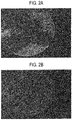
- FIGS. 2A and 2B are microscopic images of a mixture of the hollow glass spheres 'Hollow Glass Microspheres H20' having a density of 0.2 g/cm 3 and the liquid material glycerin in accordance with an embodiment of the present invention, with 100x and 200 x magnification, respectively.
- No independent hollow glass spheres were observed as the liquid material was evenly deposited on the surface of the hollow glass spheres. That is, in the synthetic clay composition according to an embodiment of the present invention, the hollow spheres and the liquid material were mixed and kneaded to form a stable homogeneous phase.
- the contact angle measurement was to analyze samples or liquids for physical properties and surface states through contact angle and wetting energy.
- effects attributed to interaction between borosilicate and glycerin were evaluated using contact angle measurement.
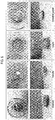
- the instrument used to measure contact angles was Phoenix 300 (manufactured by SEO, Korea). A 2 ⁇ m cylinder needle was used. First, samples including borosilicate glass, slide glass, and quartz were washed for 30 min using ultrasonication. After wash, drops of glycerin were loaded using the cylinder needle. Measurement results of contact angles and wetting energy between the samples and glycerin are depicted in FIG. 3 and summarized in Table 5, below.
- the clay composition increased in viscosity with the increase of the content of the liquid material glycerin.
- the overall desired properties of the synthetic clay composition were preferably obtained.
- plastic hollow spheres were employed, a mixture of about 10 to about 65 % by weight of plastic hollow spheres and about 30 to about 80 % by weight of the liquid material on the basis of the total weight of the composition (flame retardant exclusive if present) was observed to impart preferable overall physical properties to the synthetic clay composition.
- the composition was withdrawn from the mold to give a sample for density measurement (see FIG. 4 ).
- the sample's weight was measured to the extent of four decimal points, and the sample was measured for diameter and height using a Vernier calipers to calculate the volume of the sample.
- the density was calculated by the measured weight of the sample by the volume.
- Samples from Comparative Examples 1 to 9 had a density as high as or higher than 0.9 g/cm 3 whereas samples from Working Examples A10 to A12, B10 to B12, C10 to C12, and D13 to D15 had a density as low as or lower than 0.6 g/cm 3 . Of them, samples from Working Examples A10 to A12, and B10 to B12 had a density as low as or lower than 0.4 g/cm 3 , and samples from D13 to D15 had a density as low as or lower than 0.2 g/cm 3 .
- compositions of all the Working Examples changed in density within 10 % before and after the drying test so that they did not harden, but remained almost intact even after they were long dried or left alone.
- compositions of Comparative Examples 10, 12, and 13 exhibited very large density changes to the extent of 45.13 %, 74.58 %, and 45.64 %, respectively, and hardened.
- the compositions were considered to contain significant amounts of ingredients, which have high density and are easily vaporizable.
- the clay compositions were measured for solubility in five solvents. In 5 ml of each of acetone, toluene, hexane, ethyl alcohol, and distilled water was placed 2 g of each of the clay compositions, followed by observation for 10 min with the naked eye to examine whether the clay compositions were dissolved. For the clay compositions having a density of 0.1 g/cm 3 or lower, 10 ml of each of the solvents were used.
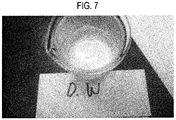
- FIG. 7 shows the dissolved synthetic clay compositions of the Working Examples of the present invention in distilled water, with clay particles dispersed and homogeneously mixed in the distilled water. It was revealed from the experiment results that the synthetic clay compositions of all of the Working Examples are water soluble.
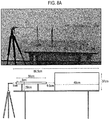
- FIGS. 8A and 8B photographic images and rough dimensions of the morphological change experiment installment are shown.
- a pipe acryl pipe
- the reason of using the pipe 1.4 cm in inner diameter and 2.0 cm in outer diameter is to measure the extent of crumbling on the basis of the product size accounting for fineness (a range in which fine details could be expressed for sculpturing).
- the synthetic clay composition of the present invention is water soluble, easy to wash, highly safe for the human body, and very light with a density ranging from greater than 0 g/cm 3 to 0.6 g/cm 3 .
- the clay compositions of the present invention exhibit a density change of 10 % or less after a drying test so that they can be used as play clay that can be repeatedly molded into various shapes even after being dried or left for a long period of time. Having an excellent shape retention potential, the clay compositions of the present invention can also maintain a molded shape without change for a long time and allows play such as throwing with agglomerates of the clay.
- the synthetic clay composition of the present invention retains various properties including those of light and viscous clay, malleable soil, sand, etc. and thus can be used broadly for play, education, and sculpturing, instead of conventional clay, sand, clay, rubber clay, and paper clay.
Landscapes
- Chemical & Material Sciences (AREA)
- Engineering & Computer Science (AREA)
- Ceramic Engineering (AREA)
- Organic Chemistry (AREA)
- Materials Engineering (AREA)
- Structural Engineering (AREA)
- Dispersion Chemistry (AREA)
- Health & Medical Sciences (AREA)
- Chemical Kinetics & Catalysis (AREA)
- Medicinal Chemistry (AREA)
- Polymers & Plastics (AREA)
- Compositions Of Macromolecular Compounds (AREA)
- Toys (AREA)
- Life Sciences & Earth Sciences (AREA)
- Molecular Biology (AREA)
- Nanotechnology (AREA)
Applications Claiming Priority (3)
| Application Number | Priority Date | Filing Date | Title |
|---|---|---|---|
| KR20150024431 | 2015-02-17 | ||
| KR1020160016319A KR20160101669A (ko) | 2015-02-17 | 2016-02-12 | 중공구체를 함유하는 새로운 인조 점토 조성물 및 이의 제조방법 |
| PCT/KR2016/001503 WO2016133325A1 (ko) | 2015-02-17 | 2016-02-15 | 중공구체를 함유하는 새로운 인조 점토 조성물 및 이의 제조방법 |
Publications (2)
| Publication Number | Publication Date |
|---|---|
| EP3260433A1 true EP3260433A1 (de) | 2017-12-27 |
| EP3260433A4 EP3260433A4 (de) | 2018-08-29 |
Family
ID=56884786
Family Applications (1)
| Application Number | Title | Priority Date | Filing Date |
|---|---|---|---|
| EP16752655.7A Withdrawn EP3260433A4 (de) | 2015-02-17 | 2016-02-15 | Neuartige synthetische tonzusammensetzung mit hohlkugel und verfahren zur herstellung davon |
Country Status (4)
| Country | Link |
|---|---|
| US (1) | US10654310B2 (de) |
| EP (1) | EP3260433A4 (de) |
| JP (1) | JP6531185B2 (de) |
| KR (3) | KR20160101669A (de) |
Families Citing this family (6)
| Publication number | Priority date | Publication date | Assignee | Title |
|---|---|---|---|---|
| JP6671675B1 (ja) * | 2019-09-05 | 2020-03-25 | 有限会社アドバンス | 工作用粘土 |
| KR102191164B1 (ko) * | 2020-05-22 | 2020-12-15 | (주)다빈치스컬프쳐 | 조형성과 질감이 우수한 인조점토 조성물 |
| CN112121760B (zh) * | 2020-08-21 | 2023-02-10 | 浙江农林大学 | 一种室内景观模型建材的制备方法 |
| KR102812964B1 (ko) * | 2021-12-23 | 2025-05-27 | 조수민 | 다중 플레이용 제기 |
| CN114591025B (zh) * | 2022-03-30 | 2023-08-29 | 石家庄市长安育才建材有限公司 | 一种微生物自修复混凝土的制备方法 |
| KR20250052933A (ko) | 2023-10-12 | 2025-04-21 | 박민지 | 섬유를 이용한 인조점토 조성물 및 이를 포함하는 인조점토 |
Family Cites Families (31)
| Publication number | Priority date | Publication date | Assignee | Title |
|---|---|---|---|---|
| JPS506432A (de) * | 1973-05-18 | 1975-01-23 | ||
| JPH0670734B2 (ja) * | 1988-11-01 | 1994-09-07 | 紫香楽教材粘土株式会社 | 軽量粘土 |
| JP3764780B2 (ja) * | 1996-07-05 | 2006-04-12 | 日本製粉株式会社 | 軽量粘土 |
| KR100231408B1 (ko) | 1996-11-19 | 1999-11-15 | 유태원 | 수공예용 조형재조성물 |
| SE511814C2 (sv) | 1997-03-17 | 1999-11-29 | Deltasand Ab | Sandmaterialblandning, sätt att framställa samt använding av densamma |
| JP3076528B2 (ja) * | 1997-03-26 | 2000-08-14 | 株式会社日本教材製作所 | 軽量粘土 |
| ES2177985T3 (es) | 1997-06-12 | 2002-12-16 | Norbert Beermann | Cuerpo de arena rigido, procedimiento para su produccion, su utilizacion y procedimiento para la produccion de granos de arena revestidos decera. |
| US5873933A (en) | 1997-07-17 | 1999-02-23 | Mattel, Inc | Malleable play material compound resembling loose soil |
| JPH11209156A (ja) * | 1998-01-20 | 1999-08-03 | Pajiko:Kk | 耐水性軽量粘土 |
| US5972092A (en) | 1998-08-07 | 1999-10-26 | Mattel, Inc. | Lightweight modeling play composition |
| JP2001131329A (ja) | 1999-11-08 | 2001-05-15 | Pajiko:Kk | 軽量粘土 |
| JP2001234081A (ja) | 2000-02-21 | 2001-08-28 | Pajiko:Kk | 造形用軽量粘土 |
| JP2002356366A (ja) * | 2001-05-31 | 2002-12-13 | Toshiyuki Yamamuro | 粘 土 |
| JP3597490B2 (ja) * | 2001-05-31 | 2004-12-08 | 敏之 山室 | 軽量粘土およびその製造方法 |
| EP1433819A4 (de) * | 2001-03-16 | 2005-12-07 | Infua Co Ltd | Leichter ton und verfahren zu seiner herstellung |
| JP3558342B2 (ja) * | 2002-03-15 | 2004-08-25 | 敏之 山室 | 軽量粘土およびその製造方法 |
| KR20040000361A (ko) | 2003-07-18 | 2004-01-03 | 김응주 | 점도를 갖는 모래의 제조 방법 및 이러한 모래를 사용한입체 학습 방법 |
| KR100831831B1 (ko) | 2004-07-30 | 2008-05-28 | 조영균 | 자연경화 및 가압에 의한 향방출형 기능성 인조점토의 제조방법 |
| KR100619840B1 (ko) * | 2005-02-23 | 2006-09-13 | 주식회사 엑스티아이 | 저점도 경량 점토 조성물 |
| US20070100052A1 (en) * | 2005-10-27 | 2007-05-03 | Lai On Products Industrial, Ltd. | Clay modeling composition |
| TW200718671A (en) | 2005-11-14 | 2007-05-16 | Infua Co Ltd | Light modeling material |
| JP5128783B2 (ja) * | 2006-04-17 | 2013-01-23 | 株式会社ヨコオ | 高周波用誘電体材料 |
| GB0609409D0 (en) * | 2006-05-12 | 2006-06-21 | Ici Plc | Plaster levelling compositions |
| JP2007331971A (ja) * | 2006-06-14 | 2007-12-27 | Hideyuki Kuwayama | 耐水性と接着性を有する粘土 |
| KR100845027B1 (ko) * | 2007-01-17 | 2008-07-18 | 주식회사 엑스티아이 | 친환경 경량 점토 조성물 및 이의 제조 방법 |
| JP2008201966A (ja) * | 2007-02-21 | 2008-09-04 | Seido:Kk | 有機粘土、模型作成用有機粘土セット及び石膏模型の製造方法 |
| KR100874091B1 (ko) | 2007-08-16 | 2008-12-16 | 조정용 | 공기점토 및 이의 제조방법 |
| JP2009263504A (ja) * | 2008-04-25 | 2009-11-12 | Hideyuki Kuwayama | 造形素材 |
| KR101178944B1 (ko) * | 2010-08-19 | 2012-08-31 | (주)엠씨에이샌드 | 굳지 않는 점토 조성물 및 이의 제조방법 |
| US9192625B1 (en) * | 2011-07-01 | 2015-11-24 | Mangala Joshi | Antimicrobial nanocomposite compositions, fibers and films |
| KR101462031B1 (ko) * | 2012-03-22 | 2014-11-18 | 주식회사 도너랜드 | 공작용 인공점토 조성물 |
-
2016
- 2016-02-12 KR KR1020160016319A patent/KR20160101669A/ko not_active Ceased
- 2016-02-15 US US15/550,746 patent/US10654310B2/en active Active
- 2016-02-15 EP EP16752655.7A patent/EP3260433A4/de not_active Withdrawn
- 2016-02-15 JP JP2017561223A patent/JP6531185B2/ja not_active Expired - Fee Related
-
2017
- 2017-10-31 KR KR1020170143398A patent/KR20170124508A/ko not_active Ceased
-
2018
- 2018-06-29 KR KR1020180075869A patent/KR20180077145A/ko not_active Ceased
Also Published As
| Publication number | Publication date |
|---|---|
| KR20160101669A (ko) | 2016-08-25 |
| JP2018513756A (ja) | 2018-05-31 |
| US10654310B2 (en) | 2020-05-19 |
| EP3260433A4 (de) | 2018-08-29 |
| US20180037052A1 (en) | 2018-02-08 |
| KR20180077145A (ko) | 2018-07-06 |
| JP6531185B2 (ja) | 2019-06-12 |
| KR20170124508A (ko) | 2017-11-10 |
Similar Documents
| Publication | Publication Date | Title |
|---|---|---|
| US10654310B2 (en) | Synthetic clay composition containing hollow sphere and method for preparing the same | |
| KR101178944B1 (ko) | 굳지 않는 점토 조성물 및 이의 제조방법 | |
| US8460455B2 (en) | Air clay and method of manufacturing the same | |
| EP2054128B1 (de) | Materialzusammensetzung und herstellungsverfahren dafür | |
| CN104349909A (zh) | 模型复合物及其制备和使用的方法 | |
| EP1141135B1 (de) | Feste oberflächenmaterialien erhältlich aus wässrigen latexdispersionen von thermoplastischen polymeren | |
| GB2124237A (en) | Slow-release perfume composition | |
| EP3279281B1 (de) | Multifunktionelle tonzusammensetzung | |
| CA3020675A1 (en) | Composition | |
| KR100619840B1 (ko) | 저점도 경량 점토 조성물 | |
| CN113727685A (zh) | 包含阳离子交换树脂的伤口密封粉末 | |
| KR100680750B1 (ko) | 조형용 경량 점토 조성물 | |
| JP5474443B2 (ja) | 添加粒子及び添加粒子連結体 | |
| CN107189336B (zh) | 一种美容棒abs专用料 | |
| KR101639766B1 (ko) | 현무암가루를 이용한 굳지않는 점토 및 그 제조방법 | |
| TWI859571B (zh) | 可降解微珠及其製備方法與應用 | |
| JP3076528B2 (ja) | 軽量粘土 | |
| US20040101559A1 (en) | Novel pharmaceutical formulations | |
| JPH09286719A (ja) | コンドーム用防着剤組成物及び同組成物を塗布したコ ンドーム | |
| JPH03162465A (ja) | 塗料用配合剤 | |
| JPH09286721A (ja) | コンドーム用防着剤組成物及び同組成物を塗布したコ ンドーム | |
| MXPA99010277A (en) | Cosmetic composition in the form of po |
Legal Events
| Date | Code | Title | Description |
|---|---|---|---|
| PUAI | Public reference made under article 153(3) epc to a published international application that has entered the european phase |
Free format text: ORIGINAL CODE: 0009012 |
|
| STAA | Information on the status of an ep patent application or granted ep patent |
Free format text: STATUS: REQUEST FOR EXAMINATION WAS MADE |
|
| 17P | Request for examination filed |
Effective date: 20170917 |
|
| AK | Designated contracting states |
Kind code of ref document: A1 Designated state(s): AL AT BE BG CH CY CZ DE DK EE ES FI FR GB GR HR HU IE IS IT LI LT LU LV MC MK MT NL NO PL PT RO RS SE SI SK SM TR |
|
| AX | Request for extension of the european patent |
Extension state: BA ME |
|
| DAV | Request for validation of the european patent (deleted) | ||
| DAX | Request for extension of the european patent (deleted) | ||
| RIC1 | Information provided on ipc code assigned before grant |
Ipc: C04B 38/00 20060101ALI20180719BHEP Ipc: C08K 5/053 20060101ALI20180719BHEP Ipc: C04B 26/02 20060101ALI20180719BHEP Ipc: B44C 3/04 20060101ALI20180719BHEP Ipc: C04B 33/04 20060101AFI20180719BHEP Ipc: C08L 101/00 20060101ALI20180719BHEP |
|
| A4 | Supplementary search report drawn up and despatched |
Effective date: 20180727 |
|
| STAA | Information on the status of an ep patent application or granted ep patent |
Free format text: STATUS: THE APPLICATION IS DEEMED TO BE WITHDRAWN |
|
| 18D | Application deemed to be withdrawn |
Effective date: 20190226 |