EP3263264A1 - Elektrochemische bearbeitungsvorrichtung und elektrochemisches bearbeitungsverfahren - Google Patents
Elektrochemische bearbeitungsvorrichtung und elektrochemisches bearbeitungsverfahren Download PDFInfo
- Publication number
- EP3263264A1 EP3263264A1 EP16755684.4A EP16755684A EP3263264A1 EP 3263264 A1 EP3263264 A1 EP 3263264A1 EP 16755684 A EP16755684 A EP 16755684A EP 3263264 A1 EP3263264 A1 EP 3263264A1
- Authority
- EP
- European Patent Office
- Prior art keywords
- workpiece
- tool electrode
- electrochemical machining
- direction current
- current pulses
- Prior art date
- Legal status (The legal status is an assumption and is not a legal conclusion. Google has not performed a legal analysis and makes no representation as to the accuracy of the status listed.)
- Withdrawn
Links
Images



Classifications
-
- B—PERFORMING OPERATIONS; TRANSPORTING
- B23—MACHINE TOOLS; METAL-WORKING NOT OTHERWISE PROVIDED FOR
- B23H—WORKING OF METAL BY THE ACTION OF A HIGH CONCENTRATION OF ELECTRIC CURRENT ON A WORKPIECE USING AN ELECTRODE WHICH TAKES THE PLACE OF A TOOL; SUCH WORKING COMBINED WITH OTHER FORMS OF WORKING OF METAL
- B23H3/00—Electrochemical machining, i.e. removing metal by passing current between an electrode and a workpiece in the presence of an electrolyte
- B23H3/02—Electric circuits specially adapted therefor, e.g. power supply, control, preventing short circuits
-
- B—PERFORMING OPERATIONS; TRANSPORTING
- B23—MACHINE TOOLS; METAL-WORKING NOT OTHERWISE PROVIDED FOR
- B23H—WORKING OF METAL BY THE ACTION OF A HIGH CONCENTRATION OF ELECTRIC CURRENT ON A WORKPIECE USING AN ELECTRODE WHICH TAKES THE PLACE OF A TOOL; SUCH WORKING COMBINED WITH OTHER FORMS OF WORKING OF METAL
- B23H3/00—Electrochemical machining, i.e. removing metal by passing current between an electrode and a workpiece in the presence of an electrolyte
- B23H3/04—Electrodes specially adapted therefor or their manufacture
-
- B—PERFORMING OPERATIONS; TRANSPORTING
- B23—MACHINE TOOLS; METAL-WORKING NOT OTHERWISE PROVIDED FOR
- B23H—WORKING OF METAL BY THE ACTION OF A HIGH CONCENTRATION OF ELECTRIC CURRENT ON A WORKPIECE USING AN ELECTRODE WHICH TAKES THE PLACE OF A TOOL; SUCH WORKING COMBINED WITH OTHER FORMS OF WORKING OF METAL
- B23H3/00—Electrochemical machining, i.e. removing metal by passing current between an electrode and a workpiece in the presence of an electrolyte
- B23H3/10—Supply or regeneration of working media
-
- B—PERFORMING OPERATIONS; TRANSPORTING
- B23—MACHINE TOOLS; METAL-WORKING NOT OTHERWISE PROVIDED FOR
- B23H—WORKING OF METAL BY THE ACTION OF A HIGH CONCENTRATION OF ELECTRIC CURRENT ON A WORKPIECE USING AN ELECTRODE WHICH TAKES THE PLACE OF A TOOL; SUCH WORKING COMBINED WITH OTHER FORMS OF WORKING OF METAL
- B23H5/00—Combined machining
- B23H5/02—Electrical discharge machining combined with electrochemical machining
-
- B—PERFORMING OPERATIONS; TRANSPORTING
- B23—MACHINE TOOLS; METAL-WORKING NOT OTHERWISE PROVIDED FOR
- B23H—WORKING OF METAL BY THE ACTION OF A HIGH CONCENTRATION OF ELECTRIC CURRENT ON A WORKPIECE USING AN ELECTRODE WHICH TAKES THE PLACE OF A TOOL; SUCH WORKING COMBINED WITH OTHER FORMS OF WORKING OF METAL
- B23H7/00—Processes or apparatus applicable to both electrical discharge machining and electrochemical machining
- B23H7/26—Apparatus for moving or positioning electrode relatively to workpiece; Mounting of electrode
- B23H7/28—Moving electrode in a plane normal to the feed direction, e.g. orbiting
-
- B—PERFORMING OPERATIONS; TRANSPORTING
- B23—MACHINE TOOLS; METAL-WORKING NOT OTHERWISE PROVIDED FOR
- B23H—WORKING OF METAL BY THE ACTION OF A HIGH CONCENTRATION OF ELECTRIC CURRENT ON A WORKPIECE USING AN ELECTRODE WHICH TAKES THE PLACE OF A TOOL; SUCH WORKING COMBINED WITH OTHER FORMS OF WORKING OF METAL
- B23H2300/00—Power source circuits or energization
- B23H2300/10—Pulsed electrochemical machining
- B23H2300/12—Positive and negative pulsed electrochemical machining
Definitions
- the present invention relates to an electrochemical machining device and electrochemical machining method.
- Electrolyte jet machining (refer to non-patent publication 1 and patent publications 1 and 2 below) is known as one type of electrochemical machining.
- Electrolyte jet machining is a method for selectively machining only directly below jet flow of an electrolyte, by discharging electrolyte from a nozzle and applying a voltage to a gap between the nozzle and a workpiece. In this case, the nozzle acts as a tool electrode. At the time of electrochemical machining, a voltage is applied between electrodes so that a workpiece becomes an anode, and electric current flows via an electrolytic solution.
- This machining method has the advantage that since the machining principle is electrolytic action, which is a chemical reaction, it is possible to machine a workpiece regardless of hardness as long as it is a conductive material, and affected layers or residual stress, burrs and cracks etc. do not arise. It is also possible to perform maskless machining of an arbitrary shape by scanning a nozzle.
- Non-patent publication 2 Non-patent publication 2 below.
- the present inventors have therefore disclosed being able to perform mirror finishing in an arbitrary shape by scanning a nozzle (tool electrode) at high speed and through multiple reciprocations (non-patent publication 3 below).
- non-patent publication 4 shows attempts to achieve machining precision through the use of electrochemical machining using ultrashort pulse current that utilizes formation of an electrical double layer on an electrode surface.
- a main object of the present invention is to provide technology that can improve roughness of a machined surface while keeping relative scanning speed of a tool electrode with respect to a workpiece low.
- An electrochemical machining device for machining a surface of a workpiece using electrochemical machining comprising a power source, a tool electrode, an electrolytic solution supply section, and charge control means, wherein the power source applies a voltage, for making current for electrochemical machining flow, between the tool electrode and the workpiece, the tool electrode is arranged apart from the workpiece, and is capable of being scanned relatively along a surface direction of the workpiece, the electrolytic solution supply section can supply electrolytic solution for electrochemical machining between the tool electrode and the workpiece, and the charge control means eliminates electrical charge that has accumulated between the tool electrode and the workpiece as a result of voltage application from the power source.
- electrochemical machining device of aspect 2 wherein an upper limit of absolute value of pulse width for the pulse current is set short enough to apply mirror finishing to a surface of the workpiece, and current density of the current for electrochemical machining is set high enough for application of the mirror finishing.
- electrochemical machining device of any one of aspects 1-9, wherein at least part of a surface of the workpiece has a curvature that is not 0, and opposing area of the workpiece and the tool electrode is made small enough, within a range of the opposing area, to be able to regard distribution of distance between the tool electrode and the workpiece as substantially constant regardless of the curvature.
- An electrochemical machining method that uses the electrochemical machining device of any one of aspects 1-11 comprising a step of making a current for electrochemical machining flow between the tool electrode and the workpiece using the power source, a step of scanning the tool electrode relatively along the surface direction of the workpiece, a step of supplying electrolytic solution between the tool electrode and the workpiece using the electrolytic solution supply section, and a step of eliminating electrical charge that has accumulated between the tool electrode and the workpiece using the charge control means.
- a surface roughness adjustment method that uses the electrochemical machining device of any one of aspects 1-11 comprising a step of making a current for electrochemical machining flow between the tool electrode and the workpiece using the power source, a step of scanning the tool electrode relatively along the surface direction of the workpiece, a step of supplying electrolytic solution between the tool electrode and the workpiece using the electrolytic solution supply section, and a step of adjusting surface roughness of the workpiece surface by controlling electrical charge that has accumulated between the tool electrode and the workpiece using the charge control means
- An electrochemical machining device comprising a tool electrode arranged apart from the workpiece, an electrolytic solution that is filled between the workpiece and the tool electrode, and a power source for supplying forward direction current pulses and reverse direction current pulses between the workpiece and the tool electrode, wherein in the electrochemical machining device that carries out electrochemical machining by relatively scanning the tool electrode workpiece and the workpiece, peak value of the reverse direction current pulses is made lower than peak value of the forward direction current pulses, and pulse width of the reverse direction current pulses is set wider than pulse width of the forward direction current pulses.
- An electrochemical machining device comprising a tool electrode arranged apart from the workpiece, an electrolytic solution that fills the gap between the workpiece and the tool electrode, and a power source for supplying forward direction current pulses and reverse direction current pulses between the workpiece and the tool electrode, wherein in the electrochemical machining device that carries out electrochemical machining by relatively scanning the tool electrode workpiece and the workpiece, peak value of the reverse direction current pulses is made higher than peak value of the forward direction current pulses, and pulse width of the reverse direction current pulses is set narrower than pulse width of the forward direction current pulses.
- An electrochemical machining device comprising a tool electrode arranged apart from the workpiece, an electrolytic solution that fills the gap between the workpiece and the tool electrode, and a power source for supplying forward direction current pulses and reverse direction current pulses between the workpiece and the tool electrode, wherein in the electrochemical machining device that carries out electrochemical machining by relatively scanning the tool electrode workpiece and the workpiece, pulse width of the reverse direction current pulses is set to less than or equal to pulse width of the forward direction current pulses, and when switching from the reverse direction current pulses to the forward direction current pulses an idle period is provided.
- An electrochemical machining device comprising a tool electrode arranged apart from the workpiece, an electrolytic solution that fills the gap between the workpiece and the tool electrode, and a power source for supplying forward direction current pulses and reverse direction current pulses between the workpiece and the tool electrode, wherein in the electrochemical machining device that carries out electrochemical machining by relatively scanning the tool electrode workpiece and the workpiece, with respect to forward direction electrical charge that is supplied between the workpiece and the tool electrode by the forward direction current pulses, reverse direction electrical charge that is supplied between the workpiece and the tool electrode by the reverse direction current pulses is set so as to become small, and when switching from the reverse direction current pulses to the forward direction current pulses an idle period is provided.
- An electrochemical machining device comprising a tool electrode arranged apart from the workpiece, an electrolytic solution that fills the gap between the workpiece and the tool electrode, and a power source for supplying forward direction current pulses and reverse direction current pulses between the workpiece and the tool electrode, wherein in the electrochemical machining device that carries out electrochemical machining by relatively scanning the tool electrode workpiece and the workpiece, a ratio (A/B) of forward direction electrical charge (A) that is supplied between the workpiece and the tool electrode by the forward direction current pulses, and reverse direction electrical charge (B) that is supplied between the workpiece and the tool electrode by the reverse direction current pulses, is set so as to become larger as speed of the scanning becomes faster.
- An electrochemical machining device comprising a tool electrode arranged apart from the workpiece, an electrolytic solution that fills the gap between the workpiece and the tool electrode, and a power source for supplying forward direction current pulses between the workpiece and the tool electrode, wherein in the electrochemical machining device that carries out electrochemical machining by relatively scanning the tool electrode workpiece and the workpiece, a duty factor for applying the forward direction current pulses is set so as to become larger as speed of the scanning becomes faster.
- An electrochemical machining device comprising a tool electrode arranged apart from the workpiece, an electrolytic solution that fills the gap between the workpiece and the tool electrode, and a power source for supplying forward direction current pulses and reverse direction current pulses between the workpiece and the tool electrode, wherein in the electrochemical machining device that carries out electrochemical machining by relatively scanning the tool electrode workpiece and the workpiece, pulse width of the reverse direction current pulses is set so as to become smaller, with respect to pulse width of the forward direction current pulses, as speed of the scanning becomes faster.
- machining device for machining a workpiece 1 (refer to Fig. 1 ) from a surface side thereof using so-called electrolyte jet machining, and in particular is a preferred device in finish machining of a workpiece surface.
- the machining device of this embodiment comprises a power source 10, tool electrode 20, an electrolytic solution supply section 30 and charge control means 40 as basic elements (refer to Fig. 1 ).
- This machining device is additionally provided with a workpiece support section 50 and a scanning drive section 60.
- the power source 10 applies a voltage, for making current for electrochemical machining flow, between the tool electrode 20 and a workpiece 1.
- one electrode of the power source 10 is electrically connected to the tool electrode 20
- another electrode of the power source 10 is electrically connected to the workpiece 1, and it is possible to apply a given voltage between the two.
- the power source 10 of this embodiment uses a pulse waveform voltage (pulse voltage) as a voltage to be applied, and in this way it is possible to make current having a pulse waveform (refer to practical example 1 and 2 which will be described later) flow between electrodes.
- a pulse waveform voltage pulse voltage
- a constant current source that makes a current value that has been designated by the charge control means 40 flow between electrodes is used, but a constant voltage source may also be used as long as the necessary current value can be obtained.
- a so-called high-speed bipolar power source for example, as the power source 10 of this embodiment.
- an upper limit of absolute value for pulse width of the pulse current is set small enough that mirror finishing can be applied to a surface of the workpiece 1.
- a lower limit for current density is set to a value at which machining marks are finished to a mirror surface while the tool electrode is at rest. What level of current density and pulse width should be set to make it possible to accomplish mirror finishing can be determined by experimentation, for example.
- current density is obtained by dividing electrical current by an opposing area of the tool electrode and the workpiece.
- the mirror finishing is machining that makes surface roughness small, for example, machining to make surface roughness Rz 0.3 ⁇ m or less.
- An upper limit for the absolute value of pulse width is, for example, 150 ⁇ s to 100 ⁇ s. However, the present invention is not limited to these numerical values.
- the tool electrode 20 is arranged apart from the workpiece 1, and is capable of being scanned relatively along a surface direction of the workpiece 1.
- the tool electrode 20 of this example is provided with a base portion 21 and a tip portion 22.
- the base portion 21 is formed in a hollow cylindrical shape, and connected to piping 32 (described later) of the electrolytic solution supply section 30 which is constructed so as to feed electrolytic solution to the tip portion 22.
- the tip portion 22 extends from a tip side of the base portion 21 in the direction of the workpiece 1 (downward direction in Fig. 1 ).
- the tip portion 22 is also formed in a hollow cylindrical shape, so as to be able to discharge a jet of electrolytic solution 3 (described later) to the workpiece 1 (refer to Fig. 2 ).
- a jet of electrolytic solution 3 (described later) to the workpiece 1 (refer to Fig. 2 ).
- Fig. 2 only portions of the tip portion 22 are shown enlarged.
- the flow state of the electrolytic solution 3 in Fig. 2 is only shown schematically and is not an accurate depiction.
- the tool electrode 20 of this embodiment has the function of a nozzle for so-called electrolyte jet machining.
- material for the tool electrode 20 various materials can be used as long as it is conductive, and has the necessary mechanical strength.
- these materials are suitable since they are difficult to electrolyze even if a reverse direction voltage (voltage that makes the workpiece a cathode) is applied.
- an opposing area of the workpiece 1 and the tool electrode 20 is preferably "sufficiently small that distance between the tool electrode 20 and the workpiece 1 within this opposing area is effectively uniform regardless of the curvature". If this is done it is possible to apply appropriate mirror finishing even to a workpiece having a non-flat surface to be machined, by scanning the machined surface. Making the distance between the workpiece 1 and the tool electrode 20 constant, and sufficiently narrow (for example, making a gap of 1mm or less, more preferably 0.5mm or less) is preferable for the realization of mirror finishing. Accordingly, using a tool electrode 20 that has a small opposing area like this contributes to satisfying these gap conditions.
- the electrolytic solution supply section 30 can supply electrolytic solution for electrochemical machining between the tip portion 22 of the tool electrode 20 and the surface to be machined of the workpiece 1 (upper surface in Fig. 1 ).
- the electrolytic solution supply section 30 of this embodiment is provided with a tank 31, piping 32, a pump 33 and a sink 34.
- the tank 31 is a section for accumulating electrolytic solution 3 for electrochemical machining.
- electrolytic solution 3 for electrochemical machining.
- the piping 32 connects between the tank 31 and the base portion 21 of the tool electrode 20.
- the pump 33 is attached at some point along the piping 32, and can feed electrolytic solution 3 to the tool electrode 20 in an appropriate flow amount.
- a so-called gear pump has been used as the pump 33, but this is not restrictive.
- the sink 34 is a section that temporarily holds electrolytic solution that has been supplied towards the workpiece 1.
- a drain section 341 for discharging electrolytic solution 3 that has been supplied is formed in the sink 34. Electrolytic solution 3 that has been discharged from the sink 34 is recovered using an appropriate method that is not illustrated.
- the charge control means 40 is a functional element for eliminating electrical charge that has accumulated between the tool electrode 20 and the workpiece 1 as a result of voltage application from the power source 10. More specifically, the charge control means 40 of this embodiment is implemented as a controller (for example, a function generator) for adjusting a current waveform (for example, current pulse width, peak value, pulse frequency etc.) attributable to voltage from the power source 10. As an actual device structure, the charge control means 40 may be part of the functions within the power source 10. Basically, the charge control means is not restricted to a mechanical structure as long as it is capable of exhibiting the necessary functions, and can also be implemented, for example, using a combination of a computer and computer programs, and does not need to exist as a single element.
- a controller for example, a function generator
- the charge control means 40 of this embodiment is configured to eliminate electrical charge that has accumulated between the electrodes based on a duty factor of pulse current. Detailed operation of the charge control means 40 (specifically a current waveform) will be described later using practical example 1 and 2.
- the workpiece support section 50 is for supporting the workpiece 1 which constitutes the object of electrochemical machining, and with this embodiment is constructed using a machining table.
- the scanning drive section 60 comprises an XZ direction drive section 61 and a Y direction drive section 62 with this embodiment.
- the XZ direction drive section 61 can move the tool electrode 20 at a given speed in an X direction (left to right direction in Fig. 1 ), and in a Z direction (up and down direction in Fig. 1 ).
- the Y direction drive section 62 can move the workpiece support section 50 at a given speed in a Y direction (a direction perpendicular to the sheet of Fig. 1 ), via the sink 34. Control of operations such as scanning speed and scanning direction of the scanning drive section 60 can be implemented by a controller, not illustrated. Using the scanning drive section 60, with this embodiment it is possible to scan the tool electrode 20 relative to the workpiece 1 in an arbitrary direction within an XY plane.
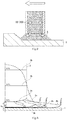
- Fig. 3 shows potential distribution within a jet flow and current density distribution on the workpiece surface, for the electrolytic solution 3 that has been jetted out from a cylindrical nozzle acting as a tool electrode. With electrochemical machining current density at opposing portions of the tool electrode and the workpiece is high, and current density is lowered moving away from that area.
- Reference numeral 3a in Fig. 3 schematically represents current density distribution of the electrolytic solution 3 that exists between the workpiece 1 and the tool electrode 20 (omitted from within Fig. 3 ).
- reference numerals 3b in Fig. 3 schematically represent equipotential surfaces, and here reference numeral V 0 is power source voltage applied between the electrodes (in a case where the workpiece side constitutes an anode).
- a machining amount per unit time in the case of low current density is significantly inferior compared to the case of high current density. If scanning speed is raised, sojourn time of the electrolytic solution jet for a single scan (namely the duration for which electrochemical machining using the opposed electrode is carried out) becomes short, and the effect of the low current region becomes small. As a result, it can be considered that surface roughness improves with increase in scanning speed, as disclosed in previously described nonpatent publication 3.
- an electrolytic reaction does not occur if an electrical double layer is not sufficiently formed.
- elution of the workpiece is confined to a high current density portion directly below the tool electrode by turning off pulse current (namely, turning off machining voltage).
- Electrical charge of the electrical double layer is then discharged in an idle period after a pulse has been turned off, and the next pulse is applied. At this time if the idle time is not sufficient electrical charge of the electrical double layer will not be completely discharged, and an electrolytic reaction will occur even in a low current density region.
- machining current short pulses by making machining current short pulses and providing a sufficient idle time it is possible to confine elution of the workpiece to only a high current density region, and even in cases of scanning at low speed it should be possible to obtain a machining surface having a good surface roughness.
- current density so as not to be able to obtain a mirror surface at the time the tool electrode is at rest is provisionally known, it is preferable to set a time for which a workpiece is exposed to that type of low current density region to short pulse width machining current when an electrode has been scanned, so as to be shorter than a time in which machining at that low current density will occur.
- the tool electrode 20 is scanned relatively within an XY plane with respect to the workpiece 1 using the scanning drive section 60. In this way the surface of the workpiece 1 is machined in the scanning direction, and it is possible to improve the surface roughness. It should be noted that with this embodiment a Z direction position of the tool electrode 20 is fixed during machining, and is adjusted as required.
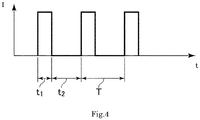
- Pulse width t 1 is made a constant value such a 100 ⁇ s, and grooving is carried out on the workpiece 1 by scanning the tool electrode 20 while varying pulse idle time t 2 and scanning speed.
- Reference numeral T in Fig. 4 shows pulse period at this time.
- the workpiece 1 is made an anode and the direction of current flowing from the workpiece 1 to the tool electrode 20 is made the vertical axis direction in Fig. 4 .
- DC direct current
- SUS304 was used as the workpiece 1.
- maximum height roughness Rz was measured and averaged at four different locations within a machined surface.
- AC in table 1 shows pulse waveform (alternating current waveform) used in practical example 2.
- Practical example 2 is configured so that in period t 3 (refer to Fig. 6 ) a reverse direction voltage is applied, and reverse direction current flows.
- alternating current flowing between electrodes has a forward direction current component (time t 1 ) that flows, with the workpiece 1 as an anode, from the workpiece 1 to the tool electrode 20, and a reverse direction current component (time t 3 ) that flows, with the workpiece as a cathode, from the tool electrode 20 to the workpiece 1.
- pulse width t 1 to make the workpiece 1 an anode was made constant at 100 ⁇ s
- time t 3 to make the workpiece 1 a cathode was varied, and the effect of AC current duty factor and scanning speed on surface roughness was investigated.
- the charge control means 40 preferably controls output from the power source 10 so that a value obtained by integrating forward direction current with respect to application time of that current (t 1 in Fig. 6 ) (forward direction electrical charge) and a value obtained by integrating reverse direction current with respect to application time of that current (t 3 in Fig. 6 ) (reverse direction electrical charge) become substantially equal.
- a value obtained by integrating forward direction current with respect to application time of that current (t 1 in Fig. 6 ) (forward direction electrical charge) and a value obtained by integrating reverse direction current with respect to application time of that current (t 3 in Fig. 6 ) (reverse direction electrical charge) become substantially equal.
- the charge control means 40 preferably sets a peak value for the reverse direction current component lower than a peak value for the forward direction current component. This is because, generally, if current density is low a proportion of current that is used in removing material on the anode is reduced, and to the extent of that reduction a proportion that is used in oxygen generation and oxidation reactions is increased. In this way it is possible to reduce amount of electrolysis of the tool electrode 20 when reverse direction current flows, and to reduce running cost of the device.
- the reverse direction current pulse width In a case where peak value of the reverse direction current component is set lower than the peak value of the forward direction current component, it is preferable to set the reverse direction current pulse width longer than the forward direction current pulse width in order to sufficiently discharge electrical charge that has been charged in to the electrical double layer. In this way it is possible to increase machining speed to the maximum limit in a range that does not cause unnecessary electrolysis at the tool electrode 20.
- discharging electrical charge of the electrical double layer is an objective purpose, and accumulating electrical charge of a reverse polarity in the electrical double layer is not the purpose in the embodiment. It is therefore preferable to set the pulse width to an upper limit value without reverse direction electrical charge exceeding forward direction electrical charge.
- the charge control means 40 may insert a current idle period between the forward direction current component and the reverse direction current component of the alternating current.
- the current idle period is capable of being inserted during period t 1 in Fig. 6 or in period t 3 , and is a period in which voltage or current becomes 0.
- the reverse direction pulse width (period t 3 ) is preferably set to level such that reverse direction electrical charge does not exceed the forward direction electrical charge
- these phenomena have variations depending on the state of the electrode gap.
- the potential distribution in Fig. 3 is as ideal as possible, and in actual fact erosion products exist, and considerable unevenness exists on the surface profile. There is therefore a possibility of the reverse direction electrical charge exceeding the forward direction electrical charge locally. It is therefore possible, for example, to use this current idle period as an adjustment element.
- reverse direction current is applied after forward direction current application, and after the current idle period has been provided, forward direction current is applied as the next cycle.
- Reverse direction pulse width (period t 3 ) at this time is set so that reverse direction electrical charge becomes about, for example, 2/3 of the forward direction electrical charge, and after that the current idle period is provided. In this way, even if local dispersion is considered, the reverse direction electrical charge does not exceed the forward direction electrical charge, and it is possible to avoid reverse charging into the electrical double layer.
- the opposing area of the workpiece 1 and the tool electrode 20 is preferable to fully cover a surface area to be machined of the workpiece 1 over a fine section span by scanning, and it is also preferable to make a distance between the tool electrode and the workpiece, within the range of the opposing area, small enough that there is no significant lack of uniformity due to the curvature of the workpiece.
- the charge control means 40 of the first embodiment can be configured to change control content in order to eliminate electrical charge, in accordance with scanning of the tool electrode 20. For example, by changing control content in order to eliminate electrical charge in accordance with machining conditions such as distance between electrodes, opposed area of the tool electrode and the workpiece, electrolytic solution supply amount etc. it is possible to carry out more appropriate mirror finishing. Also, by using conditions that are contrary to appropriate conditions for mirror finishing, it is possible to form a partially non-mirrored surface.
- the tool electrode 20 is scanned.
- relative speed between the tool electrode 20 and the workpiece 1 is lowered at locations where scanning is turned around and locations where machining direction has been changed.
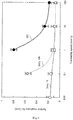
- scanning speed on the horizontal axis of Fig. 5 and Fig. 7 is changed, in this vicinity it tends to result in nonuniform machining having a rough surface.
- a rod shaped tool electrode 220 is used instead of the nozzle shaped tool electrode 20 (refer to Fig. 9 ).
- One pole of the power source 10 is electrically connected to both ends of the tool electrode 220 by means of two specified fixtures 221.
- the other pole of the power source 10 is electrically connected to the workpiece 1, similarly to the previously described first embodiment.
- the tool electrode 220 of this embodiment is arranged so as to be substantially parallel to the surface of the workpiece 1, and is capable of scanning along the surface of the workpiece 1.
- the electrolytic solution (not illustrated) in the second embodiment is previously filled between the tool electrode 220 and the surface of the workpiece 1 using a suitable electrolytic bath (not illustrated).
- the workpiece 1 is machined in a state of being immersed in electrolytic solution.
- electrolytic solution may also be supplied to the electrode gap using suitable blowing means.
- Being parallel to the workpiece 1 and the tool electrode 220 is preferable, and if the distance between electrodes varies in the vertical direction it becomes difficult to implement uniform electrochemical machining.
- the tool electrode 220 is held and electrically connected at upper and lower parts by fixtures 221, so that it is difficult for vibration and deformation of the tool electrode 220 to happen.
- this is not at all limiting, and the tool electrode 220 may be held by only one of the upper and lower fixtures 221.
- a wire electrode that is used in a so-called wire electric discharge machine as the tool electrode 220.
- a wire electrode in order to achieve compatibility with a wire electric discharge machine, it is possible for a wire electrode to be used in the both machining actions. For example, after performing wire electric discharge machining on the workpiece 1 and then finishing the surface, it is possible to perform further finishing on the finished machined surface after electric discharge machining, with electrochemical machining using the same wire electrode.
- a block shaped tool electrode 320 is used instead of the nozzle shaped tool electrode 20 (refer to Fig. 10 ).
- One pole of the power source 10 (omitted from Fig. 10 ) is electrically connected to the tool electrode 320.
- the other pole of the power source 10 is electrically connected to the workpiece 1, similarly to the previously described first embodiment.
- the tool electrode 320 of this embodiment can be scanned along the surface of the workpiece 1 with the surface of the tool electrode 320 facing the workpiece 1.
- the electrolytic solution of the third embodiment is supplied between the tool electrode 320 and the workpiece 1 by a nozzle 36.
- the third embodiment similarly to the previously described first embodiment, there is the advantage that it is possible to carry out mirror finishing of the workpiece while suppressing scanning speed, by eliminating electrical charge of the electrical double layer using the charge control means 40. Also, by using alternating current it is possible to expect improvements in machining speed of the electrochemical machining.
- An electrochemical machining device comprising:
- An electrochemical machining device comprising:
- An electrochemical machining device comprising:
- An electrochemical machining device comprising:
- An electrochemical machining device comprising; a tool electrode arranged apart from the workpiece, an electrolytic solution that fills the gap between the workpiece and the tool electrode, and a power source for supplying forward direction current pulses and reverse direction current pulses between the workpiece and the tool electrode, wherein in the electrochemical machining device that carries out electrochemical machining by relatively scanning the tool electrode and the workpiece, a ratio (A/B) of forward direction electrical charge (A) that is supplied between the workpiece and the tool electrode by the forward direction current pulses, and reverse direction electrical charge (B) that is supplied between the workpiece and the tool electrode by the reverse direction current pulses, is set so as to become bigger as speed of the scanning becomes faster.
- An electrochemical machining device comprising:
- An electrochemical machining device comprising:
Landscapes
- Engineering & Computer Science (AREA)
- Chemical & Material Sciences (AREA)
- Chemical Kinetics & Catalysis (AREA)
- Electrochemistry (AREA)
- Mechanical Engineering (AREA)
- Manufacturing & Machinery (AREA)
- Electrical Discharge Machining, Electrochemical Machining, And Combined Machining (AREA)
Applications Claiming Priority (2)
| Application Number | Priority Date | Filing Date | Title |
|---|---|---|---|
| JP2015037547 | 2015-02-27 | ||
| PCT/JP2016/055802 WO2016136940A1 (ja) | 2015-02-27 | 2016-02-26 | 電解加工装置及び電解加工方法 |
Publications (2)
| Publication Number | Publication Date |
|---|---|
| EP3263264A1 true EP3263264A1 (de) | 2018-01-03 |
| EP3263264A4 EP3263264A4 (de) | 2018-11-14 |
Family
ID=56789486
Family Applications (1)
| Application Number | Title | Priority Date | Filing Date |
|---|---|---|---|
| EP16755684.4A Withdrawn EP3263264A4 (de) | 2015-02-27 | 2016-02-26 | Elektrochemische bearbeitungsvorrichtung und elektrochemisches bearbeitungsverfahren |
Country Status (5)
| Country | Link |
|---|---|
| US (1) | US20180029151A1 (de) |
| EP (1) | EP3263264A4 (de) |
| JP (1) | JP6195030B2 (de) |
| CN (1) | CN107206517B (de) |
| WO (1) | WO2016136940A1 (de) |
Families Citing this family (11)
| Publication number | Priority date | Publication date | Assignee | Title |
|---|---|---|---|---|
| TW201924832A (zh) * | 2017-12-01 | 2019-07-01 | 財團法人金屬工業研究發展中心 | 電化學加工的對刀裝置及其對刀方法 |
| KR102150300B1 (ko) * | 2018-07-17 | 2020-09-01 | 전북대학교산학협력단 | 금속 내부 곡선 가공 시스템 |
| CN110000435B (zh) * | 2019-03-25 | 2023-09-26 | 广东工业大学 | 一种基于光致导电电极板的电化学加工装置及其电化学加工方法 |
| CN110539044B (zh) * | 2019-09-26 | 2024-09-03 | 南方科技大学 | 一种火花辅助化学刻蚀微结构的方法和装置 |
| CN113564650B (zh) * | 2021-07-26 | 2022-07-26 | 广东工业大学 | 一种电沉积方法和电沉积装置 |
| CN114178636A (zh) * | 2022-01-13 | 2022-03-15 | 任洪香 | 一种压电陶瓷振动与电化学放电同步的加工装置 |
| CN115476010A (zh) * | 2022-10-21 | 2022-12-16 | 中国航空制造技术研究院 | 一种止推螺母油膜槽电解加工装置及方法 |
| US20240286213A1 (en) * | 2023-01-06 | 2024-08-29 | Illinois Tool Works Inc. | Systems and methods for electrochemical machining |
| CN116197471B (zh) * | 2023-03-30 | 2025-06-17 | 南京航空航天大学 | 反拷电极实现极小加工间隙电解铣削的工艺方法 |
| CN116786921A (zh) * | 2023-07-07 | 2023-09-22 | 西安昆仑工业(集团)有限责任公司 | 一种膛线射流电解加工工具及其加工方法 |
| CN120095247B (zh) * | 2025-03-25 | 2025-11-18 | 清华大学 | 电化学放电加工工艺的构建系统及方法 |
Family Cites Families (17)
| Publication number | Priority date | Publication date | Assignee | Title |
|---|---|---|---|---|
| JPS4616571B1 (de) * | 1968-02-09 | 1971-05-07 | ||
| JP2547886B2 (ja) * | 1990-05-09 | 1996-10-23 | 隆久 増沢 | パルス電流による電解加工法及びその装置 |
| WO1997003781A2 (en) * | 1995-07-18 | 1997-02-06 | Philips Electronics N.V. | Method of electrochemical machining by bipolar pulses |
| JPH1043948A (ja) * | 1996-07-30 | 1998-02-17 | Shizuoka Seiki Co Ltd | 電解加工による仕上げ加工方法 |
| US6402931B1 (en) * | 1998-05-18 | 2002-06-11 | Faraday Technology Marketing Group, Llc | Electrochemical machining using modulated reverse electric fields |
| US6558231B1 (en) * | 2000-10-17 | 2003-05-06 | Faraday Technology Marketing Goup, Llc | Sequential electromachining and electropolishing of metals and the like using modulated electric fields |
| JP4194849B2 (ja) * | 2001-05-08 | 2008-12-10 | コーニンクレッカ フィリップス エレクトロニクス エヌ ヴィ | 両極性パルスを用い陰極析出物を除去する方法 |
| JP2004358585A (ja) * | 2003-06-03 | 2004-12-24 | Japan Science & Technology Agency | 電解加工用電極、電解加工装置および電解加工方法 |
| US20050145506A1 (en) * | 2003-12-29 | 2005-07-07 | Taylor E. J. | Electrochemical etching of circuitry for high density interconnect electronic modules |
| US20050247569A1 (en) * | 2004-05-07 | 2005-11-10 | Lamphere Michael S | Distributed arc electroerosion |
| US20060201823A1 (en) * | 2005-02-24 | 2006-09-14 | Zdeblick William J | Method and system of electrochemical machining |
| US7394040B2 (en) * | 2006-03-31 | 2008-07-01 | General Electric Company | Electromachining process and apparatus |
| US7741576B2 (en) * | 2007-05-11 | 2010-06-22 | General Electric Company | Apparatus and method for hybrid machining a workpiece |
| US8236162B2 (en) * | 2008-09-30 | 2012-08-07 | General Electric Company | Electroerosion machining system and method for electrode wear compensation |
| CN101817108A (zh) * | 2010-03-24 | 2010-09-01 | 江苏大学 | 掩模电极的光电化学微刻蚀加工方法及装置 |
| CN102909446A (zh) * | 2012-11-01 | 2013-02-06 | 东北林业大学 | 一种电解液与微细磨料复合去除内交叉微小孔毛刺的装置 |
| US10022812B2 (en) * | 2014-10-09 | 2018-07-17 | General Electric Company | Methods for the electroerosion machining of high-performance metal alloys |
-
2016
- 2016-02-26 US US15/553,923 patent/US20180029151A1/en not_active Abandoned
- 2016-02-26 JP JP2017502509A patent/JP6195030B2/ja active Active
- 2016-02-26 WO PCT/JP2016/055802 patent/WO2016136940A1/ja not_active Ceased
- 2016-02-26 CN CN201680008386.8A patent/CN107206517B/zh active Active
- 2016-02-26 EP EP16755684.4A patent/EP3263264A4/de not_active Withdrawn
Also Published As
| Publication number | Publication date |
|---|---|
| US20180029151A1 (en) | 2018-02-01 |
| JP6195030B2 (ja) | 2017-09-13 |
| EP3263264A4 (de) | 2018-11-14 |
| JPWO2016136940A1 (ja) | 2017-05-25 |
| WO2016136940A1 (ja) | 2016-09-01 |
| CN107206517A (zh) | 2017-09-26 |
| CN107206517B (zh) | 2020-01-14 |
Similar Documents
| Publication | Publication Date | Title |
|---|---|---|
| EP3263264A1 (de) | Elektrochemische bearbeitungsvorrichtung und elektrochemisches bearbeitungsverfahren | |
| Liao et al. | A study to achieve a fine surface finish in Wire-EDM | |
| US9987699B2 (en) | Electrochemical system and method for electropolishing hollow metal bodies | |
| Lee et al. | A study of the characteristics for electrochemical micromachining with ultrashort voltage pulses | |
| Kock et al. | Electrochemical micromachining with ultrashort voltage pulses–a versatile method with lithographical precision | |
| US20110303553A1 (en) | Electrochemical system and method for machining strongly passivating metals | |
| Singh et al. | Fabrication of micro-slits using W-ECDM process with textured wire surface: An experimental investigation on kerf overcut reduction and straightness improvement | |
| US11118283B2 (en) | Sequenced pulse reverse waveform surface finishing of additively manufactured parts | |
| Nakano et al. | Wire electrochemical finishing of wire electrical discharge machined surface of highly alloyed materials with insoluble precipitates | |
| Zhang et al. | Realization of high-precision electrochemical machining by active use of hydrogen bubbles generated in non-machining area | |
| EP2045366B1 (de) | Verfahren zur vakuumkompressionsmikroplasmaoxidation und vorrichtung zur durchführung des verfahrens | |
| Furuyama et al. | Surface finishing achieved by ECM with a moving wire electrode | |
| Karim et al. | Novel electropolishing of pure metallic titanium in choline Chloride-Based various organic solvents | |
| CN110919115B (zh) | 利用磷酸乙醇混合电解液的微细电解线切割抛光方法 | |
| Gao et al. | Wire electrochemical micromachining of high-aspect ratio microstructures on stainless steel 304 with 270-μm thickness | |
| CN111151831A (zh) | 双极性电解放电加工工件的方法及实施装置 | |
| US20080099343A1 (en) | Electrochemical machining method and apparatus | |
| Ogawa et al. | Research on ECM Finishing Process using Wire Electrode | |
| Panda et al. | Performance improvement of electrochemical micromachining employing pulse width modulation | |
| CN204370036U (zh) | 一种汽车金属零部件用电解抛光装置 | |
| CN1231615C (zh) | 碳钢和不锈钢的连续电解酸洗与除鳞 | |
| JP5809137B2 (ja) | 被加工品を電解加工する電解加工方法 | |
| CN102581398A (zh) | 电化学加工的方法 | |
| JP2018202503A (ja) | 複合加工装置 | |
| Sun et al. | The applications of CM-ECM technology to metal surface finishing |
Legal Events
| Date | Code | Title | Description |
|---|---|---|---|
| STAA | Information on the status of an ep patent application or granted ep patent |
Free format text: STATUS: THE INTERNATIONAL PUBLICATION HAS BEEN MADE |
|
| PUAI | Public reference made under article 153(3) epc to a published international application that has entered the european phase |
Free format text: ORIGINAL CODE: 0009012 |
|
| STAA | Information on the status of an ep patent application or granted ep patent |
Free format text: STATUS: REQUEST FOR EXAMINATION WAS MADE |
|
| 17P | Request for examination filed |
Effective date: 20170817 |
|
| AK | Designated contracting states |
Kind code of ref document: A1 Designated state(s): AL AT BE BG CH CY CZ DE DK EE ES FI FR GB GR HR HU IE IS IT LI LT LU LV MC MK MT NL NO PL PT RO RS SE SI SK SM TR |
|
| AX | Request for extension of the european patent |
Extension state: BA ME |
|
| DAV | Request for validation of the european patent (deleted) | ||
| DAX | Request for extension of the european patent (deleted) | ||
| A4 | Supplementary search report drawn up and despatched |
Effective date: 20181016 |
|
| RIC1 | Information provided on ipc code assigned before grant |
Ipc: B23H 3/06 20060101ALI20181010BHEP Ipc: B23H 3/02 20060101AFI20181010BHEP Ipc: B23H 3/10 20060101ALI20181010BHEP Ipc: B23H 7/28 20060101ALI20181010BHEP |
|
| STAA | Information on the status of an ep patent application or granted ep patent |
Free format text: STATUS: EXAMINATION IS IN PROGRESS |
|
| 17Q | First examination report despatched |
Effective date: 20201218 |
|
| STAA | Information on the status of an ep patent application or granted ep patent |
Free format text: STATUS: THE APPLICATION IS DEEMED TO BE WITHDRAWN |
|
| 18D | Application deemed to be withdrawn |
Effective date: 20220618 |