EP3264390B1 - Procédé de détermination efficace spectrale d'informations d'environnement collectives pour la conduite autonome et/ou coopérative, véhicule rapporteur et autre véhicule à utiliser selon le procédé - Google Patents
Procédé de détermination efficace spectrale d'informations d'environnement collectives pour la conduite autonome et/ou coopérative, véhicule rapporteur et autre véhicule à utiliser selon le procédé Download PDFInfo
- Publication number
- EP3264390B1 EP3264390B1 EP17178210.5A EP17178210A EP3264390B1 EP 3264390 B1 EP3264390 B1 EP 3264390B1 EP 17178210 A EP17178210 A EP 17178210A EP 3264390 B1 EP3264390 B1 EP 3264390B1
- Authority
- EP
- European Patent Office
- Prior art keywords
- vehicle
- report
- reporting
- vehicles
- unequipped
- Prior art date
- Legal status (The legal status is an assumption and is not a legal conclusion. Google has not performed a legal analysis and makes no representation as to the accuracy of the status listed.)
- Active
Links
Images

Classifications
-
- G—PHYSICS
- G07—CHECKING-DEVICES
- G07C—TIME OR ATTENDANCE REGISTERS; REGISTERING OR INDICATING THE WORKING OF MACHINES; GENERATING RANDOM NUMBERS; VOTING OR LOTTERY APPARATUS; ARRANGEMENTS, SYSTEMS OR APPARATUS FOR CHECKING NOT PROVIDED FOR ELSEWHERE
- G07C5/00—Registering or indicating the working of vehicles
- G07C5/008—Registering or indicating the working of vehicles communicating information to a remotely located station
-
- G—PHYSICS
- G08—SIGNALLING
- G08G—TRAFFIC CONTROL SYSTEMS
- G08G1/00—Traffic control systems for road vehicles
- G08G1/09—Arrangements for giving variable traffic instructions
- G08G1/0962—Arrangements for giving variable traffic instructions having an indicator mounted inside the vehicle, e.g. giving voice messages
- G08G1/0967—Systems involving transmission of highway information, e.g. weather, speed limits
- G08G1/096766—Systems involving transmission of highway information, e.g. weather, speed limits where the system is characterised by the origin of the information transmission
- G08G1/096791—Systems involving transmission of highway information, e.g. weather, speed limits where the system is characterised by the origin of the information transmission where the origin of the information is another vehicle
-
- G—PHYSICS
- G08—SIGNALLING
- G08G—TRAFFIC CONTROL SYSTEMS
- G08G1/00—Traffic control systems for road vehicles
- G08G1/16—Anti-collision systems
- G08G1/161—Decentralised systems, e.g. inter-vehicle communication
- G08G1/163—Decentralised systems, e.g. inter-vehicle communication involving continuous checking
-
- G—PHYSICS
- G08—SIGNALLING
- G08G—TRAFFIC CONTROL SYSTEMS
- G08G1/00—Traffic control systems for road vehicles
- G08G1/16—Anti-collision systems
- G08G1/166—Anti-collision systems for active traffic, e.g. moving vehicles, pedestrians, bikes
-
- H—ELECTRICITY
- H04—ELECTRIC COMMUNICATION TECHNIQUE
- H04W—WIRELESS COMMUNICATION NETWORKS
- H04W4/00—Services specially adapted for wireless communication networks; Facilities therefor
- H04W4/30—Services specially adapted for particular environments, situations or purposes
- H04W4/40—Services specially adapted for particular environments, situations or purposes for vehicles, e.g. vehicle-to-pedestrians [V2P]
- H04W4/46—Services specially adapted for particular environments, situations or purposes for vehicles, e.g. vehicle-to-pedestrians [V2P] for vehicle-to-vehicle communication [V2V]
-
- G—PHYSICS
- G08—SIGNALLING
- G08G—TRAFFIC CONTROL SYSTEMS
- G08G1/00—Traffic control systems for road vehicles
- G08G1/22—Platooning, i.e. convoy of communicating vehicles
-
- H—ELECTRICITY
- H04—ELECTRIC COMMUNICATION TECHNIQUE
- H04W—WIRELESS COMMUNICATION NETWORKS
- H04W4/00—Services specially adapted for wireless communication networks; Facilities therefor
- H04W4/02—Services making use of location information
- H04W4/024—Guidance services
-
- H—ELECTRICITY
- H04—ELECTRIC COMMUNICATION TECHNIQUE
- H04W—WIRELESS COMMUNICATION NETWORKS
- H04W4/00—Services specially adapted for wireless communication networks; Facilities therefor
- H04W4/02—Services making use of location information
- H04W4/029—Location-based management or tracking services
-
- H—ELECTRICITY
- H04—ELECTRIC COMMUNICATION TECHNIQUE
- H04W—WIRELESS COMMUNICATION NETWORKS
- H04W84/00—Network topologies
- H04W84/02—Hierarchically pre-organised networks, e.g. paging networks, cellular networks, WLAN [Wireless Local Area Network] or WLL [Wireless Local Loop]
- H04W84/10—Small scale networks; Flat hierarchical networks
- H04W84/12—WLAN [Wireless Local Area Networks]
Definitions
- the invention relates to a method for spectrally efficient determination of collective environment information for cooperative and/or autonomous driving, in which a vehicle equipped with a communication module and environment monitoring means creates a report on a recognized vehicle not equipped with a communication module and sends it to the others sends to vehicles moving or located in the area in question. It is pointed out that the proposal shows which method can be used to achieve dissemination with the highest possible spectral efficiency. The proposal further relates to a reporting vehicle and another vehicle for use in the method.
- LTE-V LTE-V
- D2D Device-to-Device
- Typical communication scenarios are security scenarios, traffic efficiency scenarios and infotainment.
- the following scenarios are mentioned for the area of safety: "Cooperative Forward Collision Warning", “Pre-Crash Sensing/Warning”, “Hazardous Location Warning”.
- the vehicles exchange information such as position, direction and speed, as well as parameters such as size and weight.
- Other information that is transmitted concerns intention information such as “vehicle intends to overtake”, “vehicle is turning left/right”, etc., which are interesting for the cooperative driving.
- Sensor data is often transmitted in the process. If there is a dangerous situation and the driver does not react, the car could brake automatically, so that an accident is avoided or at least the consequences of the inevitable accident are minimized.
- planning this is the area of driving in a convoy of vehicles, it is planned, for example, to report information about the planned braking behavior from the front to the rear in order to avoid rear-end collisions.
- the 802.11p standard was developed specifically for communication between vehicles and for communication between a vehicle and stationary components at the edge of the road.
- the main goals when using the 802.11p standard are to increase road safety and create reliable emergency services. This also increases the requirements for such a standard. High reliability and the lowest possible latency (data exchange within hundredths of a millisecond) are required.
- the 802.11p standard uses the physical layer of the 802.11a to provide the physical and technical properties of the connection. In Germany, the Federal Network Agency has released the frequency range between 5.850 GHz and 5.925 GHz for WLAN transmission in Car-to-X communication.
- a method for automatic and/or assisted vehicle guidance in which position-related information about roadway properties is recorded from a large number of vehicles by means of environment sensors and location sensors.
- the information is transmitted to a database using vehicle-to-X communication.
- the information stored in the database is constantly updated and/or supplemented by the transmitted information.
- the stored information is used to be transmitted to at least one vehicle which is driving through a roadway section associated with the information.
- a decision is made either in the vehicle itself or in a computer assigned to the database as to whether the roadway section can be driven through automatically and/or with assistance by a vehicle using environment sensors and an autonomous control device.
- a motor vehicle communication module is known in which, in addition to short-range radio connection modules, imaging and/or distance-measuring sensors such as cameras or lasers or radar are also accommodated.
- a device that has a detection unit that detects an object in the vicinity of an automotive vehicle.
- a control unit receives communication information of a communication device and determines whether the communication information includes information relevant to the object from the device.
- the control unit transmits detected object information to another communication device if no relevant information for the object has yet been received. In the other case, the control unit refrains from transmitting the detected object information to this communication device if relevant information for the object has already been received.
- a method for generating a message with vehicle operating parameters involves measuring Operating parameters of an unequipped vehicle using monitors present on an equipped vehicle that is in proximity to the unequipped vehicle. Generating a message containing the measured bare vehicle operating parameters at the equipped vehicle; and transmitting the measured bare vehicle operating parameter message from the equipped vehicle to the surrounding vehicles to notify the surrounding vehicles of the bare vehicle operating parameters inform.
- the following mobile radio technologies can currently be used for vehicle-to-vehicle communication: 3GPP-based UMTS, HSPA, LTE, and the upcoming 5G standards.
- 3GPP-based UMTS 3GPP-based UMTS
- HSPA High Speed Packet Access
- LTE Long Term Evolution
- 5G 5th Generationан ⁇
- the invention therefore deals with the problem of efficient channel use when implementing the idea of collective perception for cooperative/autonomous driving.
- This object is achieved by a method for determining collective environment information for cooperative and/or autonomous driving according to claim 1 and a vehicle for use in the method according to claim 4.
- the communicator-equipped vehicle that first reports on a non-communicator-equipped vehicle broadcasts the report to the other vehicles moving or located in the area concerned.
- the receipt of this report by the additional vehicles results in the additional vehicles sending an acknowledgment back to the reporting vehicle, meaning that they themselves then refrain from sending their own report on the non-equipped vehicle if they use this vehicle themselves with their have recognized means of observation.
- With the confirmation message they indicate that they are satisfied with the report on the unequipped vehicle.
- An advantageous measure according to the invention is that the reporting vehicle which first recognizes the non-equipped vehicle, ie from which it has not previously received a report from another vehicle, assigns a unique identification to the non-equipped vehicle and adds this identification to the report.
- the unique identification of the non-equipped vehicle is important to avoid confusion and conflicting reports about the same non-equipped vehicle.
- the further vehicles in the confirmation that is sent back to the reporting vehicle, return the unique identification of the non-equipped vehicle together with a hash value of the received report in the confirmation to the reporting vehicle.
- the reporting vehicle is able to use the hash value to recognize whether the report has reached the other vehicle without being falsified.
- the hash value consists of significantly less data than the actual report.
- An advantageous measure according to the invention is that the reporting vehicle sends a logoff message to the other vehicles and/or the central computer when it leaves the relevant area. Then, a vehicle that in turn recognizes the non-equipped vehicle will continue reporting on the non-equipped vehicle, preferably continuing to use the previously assigned unique identification of the non-equipped vehicle. In this way, the reporting of the non-equipped vehicle is quickly resumed when the reporting vehicle leaves the area in question.
- the other vehicles receive the log-off message and can be prepared to meet a vehicle that is not equipped. You can use the earlier reports to locate the non-equipped vehicle.
- Another very advantageous measure is when the unique identification is derived at least from the observed position of the non-equipped vehicle. It is then possible for the other vehicles to keep a targeted lookout for the non-equipped vehicle in order to be able to continue reporting on the vehicle more quickly. Since the reports on non-equipped vehicles can be kept in such a way that they do not allow any conclusions to be drawn about the vehicle owner, i.e. the license plate is not used as identification, this measure should be less problematic in terms of data protection.
- a reporting vehicle for use in the method according to the invention, it is advantageous that it is equipped with computing means, a communication module and surroundings monitoring means, with the computing means creating a report on a vehicle not equipped with a communication module if the surroundings monitoring means detect the unequipped vehicle in a relevant area have recognized.
- the computing means are designed to assign a unique identification to the non-equipped vehicle and add this identification to the report.
- the communication module is preferably arranged in such a way that it sends the report to the other vehicles moving or located in the relevant area and/or to a central server.
- the communications module will be configured to await confirmation from at least one other vehicle that received the report, by which the other vehicle indicates that it will refrain from making its own report of the non-equipped vehicle, prior to further reporting on the non-equipped vehicle equipped to send. This ensures that the reports are not sent in vain when there is no other vehicle in the area.
- the computing means are arranged to assign a unique identification to the non-equipped vehicle and add this identification to the report.
- the communication module is designed to send a logout message to the other vehicles and/or the central server when the reporting vehicle leaves the relevant area.
- the additional vehicle is equipped with computing means, a communication module and means for observing the surroundings.
- the communication module is configured to return an acknowledgment message to the reporting vehicle when it has received an unequipped vehicle report, the acknowledgment message indicating that the communication module is further configured to refrain from making its own unequipped vehicle report in that case send vehicle.
- this reduces the network load and more transmission capacity is available for other data transmissions. The effort involved in evaluating the reports for the other vehicles is also reduced.
- the communication means are designed to send back the unambiguous identification of the non-equipped vehicle together with a hash value of the report to the reporting vehicle in the confirmation message.
- the hash value makes it possible to check whether the report has arrived unadulterated and also keeps the confirmation message small.
- the computing means and the communication module of the other vehicle are advantageously designed according to the invention to continue reporting on the vehicle that is not equipped if the environment monitoring means detect the vehicle that is not equipped and a log-off message has been received from the reporting vehicle, with the computing means preferably being designed the previously assigned unique continue to use the identification of the non-equipped vehicle for the continuation of the reporting.
- the vehicle has a position-determining means with which the position of the non-equipped vehicle is determined or estimated in terms of location and/or time. This is relevant if the identification for the non-equipped vehicle is intended to indicate the location of the non-equipped vehicle, or at least to be derived from the location.
- the position determination means can preferably be implemented in the form of the vehicle navigation system that is often already installed in the vehicle. It is then possible for the other vehicles to keep a targeted lookout for the non-equipped vehicle in order to be able to continue reporting on the vehicle more quickly.
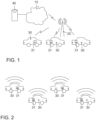
- FIG. 1 shows the principle of vehicle communication using mobile radio.
- the vehicles are provided with reference number 30.
- vehicle is understood as a collective term for motor vehicles with internal combustion engines or electric motors, for bicycles or other vehicles powered by muscle power, for vehicles with one, two, three, four or more wheels. Be it for motorcycles, passenger cars, trucks, buses, agricultural vehicles or construction machinery. The list is not exhaustive and also includes other vehicle categories.
- the vehicles in 1 are each equipped with an on-board unit 31, which serves as a transmitting and receiving unit for mobile communication. All messages from the vehicles (uplink) and to the vehicles (downlink) are either routed via a base station 20 that serves a mobile radio cell or, in the case of direct vehicle communication (sidelink), exchanged directly between the vehicles. If the vehicles are within this mobile radio cell, they are registered or logged in at the base station 20 . If they leave the mobile radio cell, they are handed over to the neighboring cell (handover) and accordingly logged off or logged off at the base station 20 .
- the base station 20 also provides access to the Internet, so that the vehicles 30 or all other mobile radio users in the mobile radio cell are supplied with Internet data.
- There is also a central computer 40 that can be reached via the Internet 10 or another wide area network WAN, which serves as a database for the collective environment perception according to the invention.
- ETSI TS 136 213 V13.0.0 2016-05
- Evolved Universal Terrestrial Radio Access E-UTRA
- Physical layer procedures 3GPP TS 36.213 version 13.0.0 Release 13
- FIG. 2 shows oncoming vehicles 30 whose on-board units 31 are designed as WLAN communication modules.
- the IEEE 802.11p standard was developed for vehicle-to-vehicle communication.
- the vehicles involved in a relevant area are linked to form an ad hoc WLAN network.
- the main goals of the development of the IEEE 802.11p standard are to increase road safety and create reliable emergency services. High reliability and the lowest possible latency (data exchange within hundredths of a millisecond) are the main requirements.
- the IEEE 802.11p specification uses the physical layer of IEEE 802.11a to provide the physical and technical properties of the connection.
- the approved frequency range for this specification is between 5.850 GHz and 5.925 GHz.
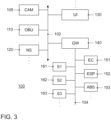
- Reference number 151 designates an engine control device.
- Reference numeral 152 corresponds to an ESP controller, and reference numeral 153 designates an ABS controller.
- Other control units such as the transmission control unit, airbag control unit, etc. can be present in the motor vehicle.
- Such control units are typically networked using the CAN bus system (Controller Area Network) 104, which is standardized as an ISO standard, ISO 11898. Since a wide variety of sensors are installed in the motor vehicle and these are no longer only connected to individual control units, such sensor data is also transmitted via the bus system 104 to the individual control units. Examples of sensors in motor vehicles are wheel speed sensors, steering angle sensors, acceleration sensors, yaw rate sensors, tire pressure sensors, distance sensors, etc.
- the various sensors with which the vehicle is equipped are in figure 3 denoted by reference numerals 161, 162, 163.
- the modern motor vehicle can also have other components, such as video cameras 105, e.g.
- a radar device for the implementation of a radar cruise control or for the implementation of a distance warning or collision warning device is also mentioned as an example of further components.
- Driver assistance systems have been available for a number of years, which use radar, lidar or video sensors to record the driving environment and interpret it Sensor data form an internal representation of the driving situation and, based on this knowledge, carry out increasingly sophisticated functions such as informing and warning the driver through to targeted interventions in vehicle guidance.
- Sensor data form an internal representation of the driving situation and, based on this knowledge, carry out increasingly sophisticated functions such as informing and warning the driver through to targeted interventions in vehicle guidance.
- longitudinal guidance on well-structured roads such as motorways can be carried out automatically for a large part of the time by an ACC system (Adaptive Cruise Control) equipped with radar sensors.
- ACC system Adaptive Cruise Control
- the user interface assembly 130 is also often equipped with a rotary/push switch that allows the driver to select the various menus that are displayed on a cockpit display.
- a touch-sensitive display also falls into this category. Even the voice input for the operating support falls into this range.
- a navigation system 120 which is also installed in the area of the cockpit, is often distinguished from this.
- the route which is shown on a map, can of course also be shown on the display in the cockpit.
- Other components such as a hands-free device, can be present, but are not shown in detail.
- Reference number 110 also designates an on-board unit.
- This on-board unit 110 corresponds to a communication module via which the vehicle can receive and send mobile data. As described, this can be a cellular communication module, e.g. B. according to the LTE-V standard or a WLAN module according to the IEEE 802.11p specification.
- the devices in the passenger compartment are also networked with one another via a bus system, which is denoted by the reference number 102 .
- a bus system which is denoted by the reference number 102 .
- It can be e.g. B. the high-speed CAN bus system according to the ISO 11898-2 standard, but here in the variant for data transmission with a higher data rate between infotainment devices.
- Gateway 140 is provided for the purpose of transmitting vehicle-relevant sensor data via communication module 110 to another vehicle or to central computer 40 . This is connected to the two different bus systems 102 and 104 .
- the gateway 140 is designed to convert the data that it receives via the CAN bus 104 in such a way that they are converted into the transmission format of the high-speed CAN bus 102 so that they can be distributed in the packets specified there.
- the communication module 110 is also equipped to receive these data packets and in turn to convert them into the transmission format of the corresponding communication standard used.
- the gateway 140 can also be used as a computing resource for other tasks.
- the method according to the invention for collective environment perception is in 4 illustrated.
- the case is considered in which vehicles are traveling on public roads.
- Figure 4a the situation is shown that a vehicle FZ1 has broken down and is standing on the side of the road. It thus represents an obstacle to the flow of traffic. The following traffic should be warned of this obstacle as far as possible. This is made possible by radio communication between the vehicles. Flowing traffic is only warned in an area around the obstacle.
- a road is divided into sections in which the radio communication is forwarded.
- a section can typically have a length of 200 to 600 meters.
- the road-side units can be installed on the side of the road to divide the road into sections.
- the road-side units are denoted by the reference number 50.
- the road can be simply cartographically divided into sections.
- the navigation systems 120 of the vehicles would thus in each case monitor the position of the vehicle and look up the section in which the vehicle is located on the map.
- FIG 4a it is shown that the vehicles FZ2 and FZ3 are traveling on the side of the road on which the broken-down vehicle FZ1 is also parked.
- An oncoming vehicle FZ4 is also shown.
- the example shows that the vehicles FZ2, FZ3, FZ4 are all equipped with an on-board unit 31 and monitoring means 32.
- the breakdown vehicle is not equipped with an on-board unit, nor with monitoring equipment.
- the vehicle FZ2 passes the breakdown vehicle FZ1. Since no vehicle has yet reported on the non-equipped vehicle FZ1, this task falls to the vehicle FZ2, since it is the first vehicle to recognize the vehicle FZ1.
- vehicle FZ2 recognizes that the vehicle FZ1 is not equipped, consists in sending a request by radio to the vehicle FZ1 on the call channel provided for this purpose. If there is no response to this, vehicle FZ2 should assume that vehicle FZ1 is not equipped with a communication module.
- the enumeration is not meant to be exhaustive, further or other vehicle characteristics can be recorded in the report.
- the vehicle FZ2 issues an identification for the non-equipped vehicle and adds this identification to the report.
- the identification can take many forms, for example it can be an identification number, an identification word, an identification pictogram or any other suitable form of identification.
- the identification by the position of the vehicle is mentioned. In the case of stationary vehicles, the location is sufficient as a position indication. In the case of moving vehicles, the time reference can be added to the location information, or one of the other options can be selected. Again, the list is not meant to be exhaustive.
- Vehicle FZ2 then sends the report to the other vehicles on the relevant road section. This is preferably done in broadcast form, so the report is broadcast to all vehicles that can receive it without having to address it individually.
- the sidelink channel Physical Sidelink Broadcast CHannel PSBCH is available in the LTE-V communication system for such transmissions.
- All participating stations are registered in the WLAN ad-hoc network and the report can also be sent to all participating stations in broadcast or multicast transmission mode.
- the procedures developed in IEEE 802.11p are used, which enable vehicle information to be sent to all participants in the area.
- explicit reference is made to the 802.11p standard.
- the broadcast of the report on vehicle FZ1 is in Figure 4a marked by reference number 1.
- the report goes to both vehicles in route sections FZ3 and FZ4.
- the vehicles FZ3 and FZ4 send a confirmation message back to the reporting vehicle FZ1.
- the relevant broadcasts Acknowledgment message are marked with reference numerals 2 and 3. This is preferably done in the unicast transmission type, ie addressed specifically for the reporting vehicle FZ2.
- the sidelink channel Physical Sidelink Shared CHannel PSSCH is available for this.
- the content of the confirmation message preferably consists of the identification for the vehicle as received in the report and the hash value of the received report.
- a hash value is calculated using a hash function, like a checksum, it provides a quantity that can be used to quickly determine whether the report received actually corresponds to the report sent. Errors in the report or falsifications of the report can thus be quickly recognized and exposed on the side of the reporting vehicle FZ2.
- Vehicle FZ2 then regularly sends a report to vehicle FZ1. This can be done at short intervals, e.g. at intervals of 2s. If other vehicles enter the route section, they also confirm receipt of the report. Each vehicle that confirms the report also indicates that it is satisfied with the report and thus refrains from sending its own report.
- the vehicles FZ2 to FZ4 move and pass the vehicle FZ1. A short time later they leave the section of the route in which the vehicle FZ1 is standing.
- FIG 4b now shows what is happening in terms of reporting on vehicle FZ1.
- Vehicle FZ2 has just left the section of road where vehicle FZ1 is standing. This also ends its function as a reporting vehicle. Vehicle FZ2 therefore sends a logout message to the other vehicles FZ3, FZ4 and FZ5 in the route section when it leaves the route section. In the meantime, the vehicle FZ5 has just arrived on the section of road in question.
- the deregistration message is again sent in broadcast form to the other vehicles.
- the deregistration message also contains the identification for the vehicle FZ1.
- the process of sending the unsubscribe message is in Figure 4b provided with the reference number 4. All vehicles on the route section are now informed that no further reports will be broadcast about vehicle FZ1.
- vehicle FZ3 the first vehicle that recognizes vehicle FZ1 will therefore report on this vehicle itself. In the example shown, this role falls to vehicle FZ3, since it passes vehicle FZ1 next. For this reason, vehicle FZ3 at 5 sends a report in broadcast form to the other vehicles on the route section. In this case, however, it uses the same identification for vehicle FZ1 in its own report that it previously received in the reports from vehicle FZ2. This also simplifies the management of the reports in the vehicles and it is easier to create a database with the reports.
- the other two Vehicles FZ4 and FZ5 send their confirmation messages to the reporting vehicle FZ3 at 6 and 7 as previously explained.
- the proposed method and associated devices can be implemented in various forms of hardware, software, firmware, special purpose processors or a combination thereof.
- Specialty processors can include Application Specific Integrated Circuits (ASICs), Reduced Instruction Set Computers (RISC), and/or Field Programmable Gate Arrays (FPGAs).
- ASICs Application Specific Integrated Circuits
- RISC Reduced Instruction Set Computers
- FPGAs Field Programmable Gate Arrays
- the proposed method and device is implemented as a combination of hardware and software.
- the software is preferably installed as an application program on a program storage device.
- it is a computer platform based machine that includes hardware such as one or more central processing units (CPU), random access memory (RAM), and one or more input/output (I/O) interfaces.
- An operating system is typically also installed on the computer platform.
- the various processes and functions described here can be part of the application program or a part that is executed via the operating system.
Landscapes
- Physics & Mathematics (AREA)
- General Physics & Mathematics (AREA)
- Life Sciences & Earth Sciences (AREA)
- Atmospheric Sciences (AREA)
- Engineering & Computer Science (AREA)
- Computer Networks & Wireless Communication (AREA)
- Signal Processing (AREA)
- Traffic Control Systems (AREA)
- Mobile Radio Communication Systems (AREA)
Claims (9)
- Procédé de détermination d'informations d'environnement collectives, en particulier pour la conduite coopérative et/ou autonome, dans lequel- un véhicule rapporteur (FZ2), équipé d'un module de communication (110) et de moyens d'observation de l'environnement (32), envoie une requête par radio à un véhicule (FZ1) sur un canal d'appel prévu à cet effet lorsque les moyens d'observation de l'environnement (32) ont reconnu le véhicule (FZ1) dans une zone concernée, et reconnaît le véhicule (FZ1) comme n'étant pas équipé d'un module de communication lorsqu'aucune réponse n'est reçue ;- le véhicule rapporteur (FZ2) établit un rapport concernant le véhicule reconnu (FZ1) non équipé d'un module de communication (110), une identification unique étant associée au véhicule non équipé (FZ1) et cette identification étant ajoutée au rapport, et envoie (①) le rapport à d'autres véhicules (FZ3, FZ4, FZ5) se trouvant dans la zone concernée ;- les autres véhicules (FZ3, FZ4, FZ5) qui reçoivent le rapport renvoient (②, ③) un message de confirmation au véhicule rapporteur (FZ2) et s'abstiennent eux-mêmes d'envoyer leur propre rapport concernant le véhicule non équipé (FZ1) ;- le véhicule rapporteur (FZ2) envoie (④) un message de déconnexion aux autres véhicules (FZ3, FZ4, FZ5) lorsqu'il quitte la zone concernée ; et- un véhicule qui reconnaît à son tour le véhicule non équipé (FZ1) et qui a reçu un message de déconnexion en provenance du véhicule rapporteur (FZ2), poursuit (⑤) l'établissement du rapport concernant le véhicule non équipé (FZ1), et continue d'utiliser l'identification unique précédemment attribuée au véhicule non équipé (FZ1) .
- Procédé selon la revendication 1, dans lequel les autres véhicules (FZ3, FZ4, FZ5) renvoient au véhicule rapporteur (FZ2), dans le message d'accusé de réception, l'identification unique du véhicule non équipé (FZ1) en même temps qu'une valeur de hachage du rapport.
- Procédé selon l'une quelconque des revendications 1 à 2, dans lequel l'identification unique est déduite au moins de la position observée du véhicule non équipé (FZ1) .
- Véhicule destiné à être utilisé dans le procédé selon l'une quelconque des revendications 1 à 3, comportant des moyens de calcul (140), un module de communication (110) et des moyens d'observation de l'environnement (32), dans lequel- le véhicule est conçu pour envoyer une requête par radio sur un canal d'appel prévu à cet effet à un véhicule (FZ1) reconnu par le moyen d'observation de l'environnement (32) dans une zone concernée, et le véhicule reconnu (FZ1) est reconnu comme n'étant pas équipé d'un module de communication lorsqu'aucune réponse n'est reçue, et dans lequel les moyens de calcul (140) sont conçus pour établir un rapport concernant le véhicule (FZ1) non équipé d'un module de communication (110), une identification unique étant associée au véhicule non équipé (FZ1) et cette identification étant ajoutée au rapport ;- le module de communication (110) est conçu pour recevoir un tel rapport en provenance d'autres véhicules (FZ3, FZ4, FZ5) se trouvant dans la zone concernée et équipés de modules de communication (110) et de moyens d'observation de l'environnement (32), pour renvoyer ensuite (②, ③) un message de confirmation au véhicule rapporteur (FZ2) et s'abstenir d'envoyer son propre rapport concernant le véhicule non équipé (FZ1), et pour envoyer (①) le rapport établi à d'autres véhicules (FZ3, FZ4, FZ5) se trouvant dans la zone concernée lorsque le module de communication n'a pas reçu un tel rapport en provenance d'autres véhicules (FZ3, FZ4, FZ5) se trouvant dans la zone concernée et équipés de modules de communication (110) et de moyens d'observation de l'environnement (32), pour envoyer (④) un message de déconnexion aux autres véhicules (FZ3, FZ4, FZ5) lorsque le véhicule rapporteur (FZ2) quitte la zone concernée, et- les moyens de calcul (140) et le module de communication (110) sont conçus pour poursuivre (⑤) l'établissement du rapport concernant le véhicule non équipé (FZ1) lorsque les moyens d'observation de l'environnement (32) reconnaissent le véhicule non équipé (FZ1) et qu'un message de déconnexion a été reçu en provenance du véhicule rapporteur (FZ2), les moyens de calcul (140) étant conçus pour continuer d'utiliser l'identification unique précédemment attribuée au véhicule non équipé (FZ1) pour poursuivre l'établissement du rapport.
- Véhicule selon la revendication 4, dans lequel le module de communication (110) est conçu pour renvoyer au véhicule rapporteur (FZ2), dans le message d'accusé de réception, l'identification unique du véhicule non équipé (FZ1) en même temps qu'une valeur de hachage du rapport.
- Véhicule selon l'une quelconque des revendications 4 ou 5, dans lequel les moyens d'observation de l'environnement (32) comprennent au moins l'un des composants suivants- capteur radar,- caméra vidéo- caméra stéréoscopique- caméra plénoptique- capteur lidar,- capteur laser,- capteur à ultrasons et- capteur d'inclinaison.
- Véhicule selon l'une quelconque des revendications 4 à 6, dans lequel le module de communication (110) est conçu pour permettre une communication directe avec le véhicule dans le système radio mobile LTE-V (Long Term Evolution Vehicle) ou dans le système radio mobile 5G ou pour permettre une communication directe avec le véhicule selon la norme WLAN IEEE 802.11p.
- Véhicule selon l'une quelconque des revendications 4 à 7, comportant en outre un moyen de détermination de position permettant de déterminer ou d'estimer la position du véhicule non équipé dans le domaine spatial et/ou temporel.
- Véhicule selon la revendication 8, dans lequel le moyen de détermination de position est un système de navigation de véhicule (120).
Applications Claiming Priority (1)
| Application Number | Priority Date | Filing Date | Title |
|---|---|---|---|
| DE102016211750.5A DE102016211750B4 (de) | 2016-06-29 | 2016-06-29 | Verfahren zur spektral-effizienten Ermittlung von kollektiver Umfeld-Information für das kooperative und/oder autonome Fahren, sowie berichtendes Fahrzeug und weiteres Fahrzeug zur Verwendung bei dem Verfahren |
Publications (3)
| Publication Number | Publication Date |
|---|---|
| EP3264390A2 EP3264390A2 (fr) | 2018-01-03 |
| EP3264390A3 EP3264390A3 (fr) | 2018-01-10 |
| EP3264390B1 true EP3264390B1 (fr) | 2023-06-14 |
Family
ID=59362889
Family Applications (1)
| Application Number | Title | Priority Date | Filing Date |
|---|---|---|---|
| EP17178210.5A Active EP3264390B1 (fr) | 2016-06-29 | 2017-06-27 | Procédé de détermination efficace spectrale d'informations d'environnement collectives pour la conduite autonome et/ou coopérative, véhicule rapporteur et autre véhicule à utiliser selon le procédé |
Country Status (4)
| Country | Link |
|---|---|
| US (1) | US10388082B2 (fr) |
| EP (1) | EP3264390B1 (fr) |
| CN (1) | CN107545756B (fr) |
| DE (1) | DE102016211750B4 (fr) |
Families Citing this family (15)
| Publication number | Priority date | Publication date | Assignee | Title |
|---|---|---|---|---|
| EP3351025B1 (fr) * | 2015-09-17 | 2020-04-08 | Telefonaktiebolaget LM Ericsson (publ) | Dispositif de communication, premier noeud radio, second noeud radio, procédés associés pour déterminer s'il faut autoriser ou non un premier véhicule à dépasser un peloton de véhicules |
| US10176524B1 (en) * | 2015-10-26 | 2019-01-08 | Allstate Insurance Company | Vehicle-to-vehicle incident information collection |
| US11362882B2 (en) * | 2017-08-25 | 2022-06-14 | Veniam, Inc. | Methods and systems for optimal and adaptive urban scanning using self-organized fleets of autonomous vehicles |
| US10540892B1 (en) * | 2017-10-26 | 2020-01-21 | State Farm Mutual Automobile Insurance Company | Technology for real-time detection and mitigation of remote vehicle anomalous behavior |
| US10789848B2 (en) * | 2018-04-20 | 2020-09-29 | Toyota Jidosha Kabushiki Kaisha | Multi-level hybrid vehicle-to-anything communications for cooperative perception |
| CN110660269B (zh) * | 2018-06-29 | 2022-07-15 | 比亚迪股份有限公司 | 车辆、云端服务器、降低交通事故的方法和装置 |
| CN109143215A (zh) * | 2018-08-28 | 2019-01-04 | 重庆邮电大学 | 一种基于双目视觉与v2x通信的协同预警设备与方法 |
| EP3621327B8 (fr) * | 2018-09-04 | 2022-05-18 | Volkswagen Aktiengesellschaft | Procédé d'estimation anticipée des conditions de transmission d'une communication entre deux partenaires de communication, dispositif de mise en oeuvre des étapes, véhicule ainsi que programme informatique |
| US11495028B2 (en) * | 2018-09-28 | 2022-11-08 | Intel Corporation | Obstacle analyzer, vehicle control system, and methods thereof |
| CN111188549B (zh) * | 2018-11-15 | 2023-06-27 | 西安中兴新软件有限责任公司 | 一种应用于车辆的防撞方法和装置 |
| WO2020149714A1 (fr) * | 2019-01-18 | 2020-07-23 | 엘지전자 주식회사 | Procédé de division de message cpm utilisant un tri d'états d'objet |
| CN111751818B (zh) * | 2019-03-26 | 2025-10-03 | 深圳市赛格导航科技股份有限公司 | 一种基于lte-v和毫米波雷达技术的车载自动目标追踪系统 |
| KR102645057B1 (ko) | 2019-04-10 | 2024-03-11 | 현대자동차주식회사 | 차량의 군집 주행 정보 출력 장치 및 방법 |
| KR20220145460A (ko) * | 2021-04-21 | 2022-10-31 | 삼성전자주식회사 | 차량에 탑재된 전자 장치 및 그 동작 방법 |
| US20240395083A1 (en) * | 2023-05-25 | 2024-11-28 | Nxp B.V. | Data processing system and method for cooperative vehicle malfunction detection in a fleet of vehicles |
Citations (1)
| Publication number | Priority date | Publication date | Assignee | Title |
|---|---|---|---|---|
| US6681157B2 (en) * | 1999-05-31 | 2004-01-20 | Komatsu Ltd. | Vehicle interference prevention device |
Family Cites Families (32)
| Publication number | Priority date | Publication date | Assignee | Title |
|---|---|---|---|---|
| DE19643454C2 (de) * | 1996-10-10 | 2003-08-21 | Mannesmann Ag | Verfahren und Vorrichtung zur Übermittlung von Daten zur Verkehrslagebeurteilung |
| WO2003096128A2 (fr) * | 2002-03-14 | 2003-11-20 | Eices Research, Inc. | Systeme cooperatif d'identification pour vehicules |
| US7277028B1 (en) * | 2003-10-20 | 2007-10-02 | Garth Janke | Method and system for inter-vehicular communications and information reporting |
| EP1836861A4 (fr) * | 2005-01-11 | 2010-08-25 | Telcordia Tech Inc | Procede d'etablissement et d'organisation d'un reseau pair a pair sans fil ad-hoc |
| US7427929B2 (en) * | 2005-10-12 | 2008-09-23 | Toyota Motor Engineering & Manufacturing North America, Inc. | Method and apparatus for previewing conditions on a highway |
| JP4971625B2 (ja) * | 2005-11-14 | 2012-07-11 | 富士通テン株式会社 | 運転支援装置および運転情報算出システム |
| JP4905075B2 (ja) * | 2006-11-14 | 2012-03-28 | 株式会社デンソー | 車車間通信に用いられる通信装置、及び、そのプログラム |
| JP4929114B2 (ja) * | 2007-09-28 | 2012-05-09 | 日産自動車株式会社 | 車両用情報報知装置、情報提供システム、情報報知方法 |
| JP5245392B2 (ja) * | 2007-12-21 | 2013-07-24 | 株式会社Jvcケンウッド | 車載器、情報の出力方法および情報提供システム |
| JP4941287B2 (ja) * | 2007-12-28 | 2012-05-30 | 株式会社Jvcケンウッド | 車載器,出力可否判定方法,道路通信システムおよびプログラム |
| JP4999989B2 (ja) * | 2008-04-30 | 2012-08-15 | 三菱電機株式会社 | 車載通信装置および路車間−車々間通信連携システム |
| JP5299688B2 (ja) * | 2009-06-03 | 2013-09-25 | アイシン精機株式会社 | 車両周辺監視方法及び車両周辺監視装置 |
| DE102009060358A1 (de) | 2009-12-24 | 2011-06-30 | Volkswagen AG, 38440 | Kommunikationssystem für Kraftfahrzeuge |
| DE102010029465A1 (de) | 2010-05-28 | 2011-12-01 | Continental Teves Ag & Co. Ohg | Integration von Fahrzeugsicherheitskommunikationskomponenten in eine Kamera |
| CN201749568U (zh) * | 2010-08-12 | 2011-02-16 | 北京航空航天大学 | 一种用于警示驾驶员的车路协同装置 |
| US9140560B2 (en) * | 2011-11-16 | 2015-09-22 | Flextronics Ap, Llc | In-cloud connection for car multimedia |
| CN102469422A (zh) * | 2010-11-18 | 2012-05-23 | 上海启电信息科技有限公司 | 一种车载无线通信装置 |
| JP2013037676A (ja) * | 2011-07-12 | 2013-02-21 | Nissan Motor Co Ltd | 車両情報提供装置及び車両情報管理システム |
| JP5999178B2 (ja) * | 2012-05-14 | 2016-09-28 | トヨタ自動車株式会社 | 車両用ネットワークの通信管理装置及び通信管理方法 |
| DE102012023498B4 (de) | 2012-12-03 | 2024-10-10 | Continental Autonomous Mobility Germany GmbH | Verfahren und System zur selbsttätigen und/oder assistierenden Fahrzeugführung |
| RU2625522C2 (ru) * | 2013-03-15 | 2017-07-14 | Кобра Электроникс Корпорейшн | Система мобильной связи и способ анализа предупреждений, связанных с автомобильным движением |
| US9403482B2 (en) * | 2013-11-22 | 2016-08-02 | At&T Intellectual Property I, L.P. | Enhanced view for connected cars |
| US9349293B2 (en) * | 2014-02-07 | 2016-05-24 | Here Global B.V | Method and apparatus for providing vehicle synchronization to facilitate a crossing |
| EP3114574A4 (fr) * | 2014-03-03 | 2018-03-07 | Inrix, Inc. | Détection d'obstructions de circulation |
| US9688199B2 (en) * | 2014-03-04 | 2017-06-27 | Magna Electronics Inc. | Vehicle alert system utilizing communication system |
| WO2015148579A1 (fr) * | 2014-03-24 | 2015-10-01 | Omalley Matthew | Systèmes et procédés de gestion de trafic dans un réseau mobile |
| US9460625B2 (en) * | 2014-04-08 | 2016-10-04 | Denso International America, Inc. | Proxy DSRC basic safety message for unequipped vehicles |
| US9997077B2 (en) * | 2014-09-04 | 2018-06-12 | Honda Motor Co., Ltd. | Vehicle operation assistance |
| EP3204927B1 (fr) * | 2014-10-10 | 2021-01-13 | Continental Teves AG & Co. OHG | Procédé pour exploiter un serveur central et procédé pour utiliser une carte de règles de circulation |
| CN204375133U (zh) * | 2015-02-05 | 2015-06-03 | 厦门市美亚柏科信息股份有限公司 | 一种基于无线移动通信网络的信息采集系统 |
| US10071748B2 (en) * | 2015-09-17 | 2018-09-11 | Sony Corporation | System and method for providing driving assistance to safely overtake a vehicle |
| CN205265929U (zh) * | 2015-12-09 | 2016-05-25 | 江苏大学 | 一种5g车联网中可多网接入的obu系统 |
-
2016
- 2016-06-29 DE DE102016211750.5A patent/DE102016211750B4/de not_active Expired - Fee Related
-
2017
- 2017-06-27 EP EP17178210.5A patent/EP3264390B1/fr active Active
- 2017-06-28 US US15/635,431 patent/US10388082B2/en active Active
- 2017-06-29 CN CN201710513090.8A patent/CN107545756B/zh active Active
Patent Citations (1)
| Publication number | Priority date | Publication date | Assignee | Title |
|---|---|---|---|---|
| US6681157B2 (en) * | 1999-05-31 | 2004-01-20 | Komatsu Ltd. | Vehicle interference prevention device |
Also Published As
| Publication number | Publication date |
|---|---|
| EP3264390A2 (fr) | 2018-01-03 |
| US10388082B2 (en) | 2019-08-20 |
| CN107545756A (zh) | 2018-01-05 |
| DE102016211750B4 (de) | 2019-06-19 |
| EP3264390A3 (fr) | 2018-01-10 |
| US20180005460A1 (en) | 2018-01-04 |
| CN107545756B (zh) | 2021-09-03 |
| DE102016211750A1 (de) | 2018-01-04 |
Similar Documents
| Publication | Publication Date | Title |
|---|---|---|
| EP3264390B1 (fr) | Procédé de détermination efficace spectrale d'informations d'environnement collectives pour la conduite autonome et/ou coopérative, véhicule rapporteur et autre véhicule à utiliser selon le procédé | |
| EP3830523B1 (fr) | Procédé pour la mise à jour d'une carte des environs, dispositifs pour l'exécution côté véhicule d'étapes du procédé, véhicule, dispositif pour l'exécution côté ordinateur central d'étapes du procédé ainsi que support de stockage lisible par ordinateur | |
| DE102008036131B4 (de) | Verfahren und Vorrichtung zur Erkennung der Verkehrssituation in einer Fahrzeugumgebung | |
| EP2732603B1 (fr) | Procédé et système de communication pour la réception de données lors d'une communication sans fil véhicule à environnement | |
| EP3338252B1 (fr) | Dispositifs, procédé et logiciel pour produire des informations sur une intention de conduite probable | |
| EP3204926B1 (fr) | Procédé pour utiliser une carte de règles de circulation | |
| EP3350792B1 (fr) | Dispositif, procédé et programme d'ordinateur pour fournir des informations concernant la fin d'un embouteillage par une interface de véhicule à véhicule | |
| EP3853831B1 (fr) | Procédé de coordination d'un peloton de véhicules, unité d'évaluation, véhicule et peloton de véhicules | |
| DE102019127975A1 (de) | Fahrzeug-zu-infrastruktur-(v2i-) nachrichtenübermittlungssystem | |
| DE102019106881A1 (de) | Verringerung der Kanalüberlastung in der Kommunikation zwischen Fahrzeugen | |
| DE102016122686A1 (de) | Verfahren zum Informieren eines Verkehrsteilnehmers über eine Verkehrssituation | |
| EP3371022A1 (fr) | Procédés et systèmes de régulation pour la détermination d'un intervalle entre deux véhicules pour un changement de file d'un véhicule | |
| EP3853830B1 (fr) | Procédé de coordination d'un peloton de véhicules, unité d'évaluation, véhicule et peloton de véhicules | |
| WO2009027253A1 (fr) | Système de contrôle de trafic | |
| EP3204925A1 (fr) | Procédé pour utiliser une carte de règles de circulation | |
| WO2013185997A1 (fr) | Procédé de vérification et/ou de préparation de paquets de données et appareil de commande mis au point pour la mise en œuvre dudit procédé | |
| DE102017120708B4 (de) | Adaptive sendeleistungsregelung für fahrzeugkommunikation | |
| DE102013224167A1 (de) | Verfahren und Steuer- und Erfassungseinrichtung zum Plausibilisieren einer Falschfahrt eines Kraftfahrzeugs | |
| DE102020102955B4 (de) | Verfahren zum Steuern eines Trägerfahrzeugs | |
| DE102021129448B4 (de) | Verfahren, systeme und vorrichtungen zur einführung eines fahrzeug-warndreieck-reflektors, der mit allem vereinbar ist | |
| DE102012207859A1 (de) | Verfahren zur Erstellung eines Fahrprofils | |
| DE102010054080B4 (de) | Relevanzbeurteilung in einem Car2X-Netzwerk | |
| WO2018177665A1 (fr) | Système de notification dans un véhicule pour notifier un incident dans le véhicule et procédé de notification d'un incident dans un véhicule | |
| DE102018110570A1 (de) | Verfahren und System zum gezielten Übermitteln einer Nachricht | |
| DE102012207864A1 (de) | Verfahren zum Reduzieren einer Staugefahr |
Legal Events
| Date | Code | Title | Description |
|---|---|---|---|
| PUAI | Public reference made under article 153(3) epc to a published international application that has entered the european phase |
Free format text: ORIGINAL CODE: 0009012 |
|
| STAA | Information on the status of an ep patent application or granted ep patent |
Free format text: STATUS: THE APPLICATION HAS BEEN PUBLISHED |
|
| PUAL | Search report despatched |
Free format text: ORIGINAL CODE: 0009013 |
|
| AK | Designated contracting states |
Kind code of ref document: A2 Designated state(s): AL AT BE BG CH CY CZ DE DK EE ES FI FR GB GR HR HU IE IS IT LI LT LU LV MC MK MT NL NO PL PT RO RS SE SI SK SM TR |
|
| AX | Request for extension of the european patent |
Extension state: BA ME |
|
| AK | Designated contracting states |
Kind code of ref document: A3 Designated state(s): AL AT BE BG CH CY CZ DE DK EE ES FI FR GB GR HR HU IE IS IT LI LT LU LV MC MK MT NL NO PL PT RO RS SE SI SK SM TR |
|
| AX | Request for extension of the european patent |
Extension state: BA ME |
|
| RIC1 | Information provided on ipc code assigned before grant |
Ipc: G08G 1/16 20060101ALI20171205BHEP Ipc: G08G 1/0967 20060101AFI20171205BHEP |
|
| STAA | Information on the status of an ep patent application or granted ep patent |
Free format text: STATUS: REQUEST FOR EXAMINATION WAS MADE |
|
| 17P | Request for examination filed |
Effective date: 20180710 |
|
| RBV | Designated contracting states (corrected) |
Designated state(s): AL AT BE BG CH CY CZ DE DK EE ES FI FR GB GR HR HU IE IS IT LI LT LU LV MC MK MT NL NO PL PT RO RS SE SI SK SM TR |
|
| STAA | Information on the status of an ep patent application or granted ep patent |
Free format text: STATUS: EXAMINATION IS IN PROGRESS |
|
| 17Q | First examination report despatched |
Effective date: 20200507 |
|
| GRAP | Despatch of communication of intention to grant a patent |
Free format text: ORIGINAL CODE: EPIDOSNIGR1 |
|
| STAA | Information on the status of an ep patent application or granted ep patent |
Free format text: STATUS: GRANT OF PATENT IS INTENDED |
|
| INTG | Intention to grant announced |
Effective date: 20230109 |
|
| GRAS | Grant fee paid |
Free format text: ORIGINAL CODE: EPIDOSNIGR3 |
|
| GRAA | (expected) grant |
Free format text: ORIGINAL CODE: 0009210 |
|
| STAA | Information on the status of an ep patent application or granted ep patent |
Free format text: STATUS: THE PATENT HAS BEEN GRANTED |
|
| AK | Designated contracting states |
Kind code of ref document: B1 Designated state(s): AL AT BE BG CH CY CZ DE DK EE ES FI FR GB GR HR HU IE IS IT LI LT LU LV MC MK MT NL NO PL PT RO RS SE SI SK SM TR |
|
| REG | Reference to a national code |
Ref country code: CH Ref legal event code: EP |
|
| REG | Reference to a national code |
Ref country code: DE Ref legal event code: R096 Ref document number: 502017014915 Country of ref document: DE |
|
| REG | Reference to a national code |
Ref country code: AT Ref legal event code: REF Ref document number: 1579795 Country of ref document: AT Kind code of ref document: T Effective date: 20230715 |
|
| REG | Reference to a national code |
Ref country code: LT Ref legal event code: MG9D |
|
| REG | Reference to a national code |
Ref country code: NL Ref legal event code: MP Effective date: 20230614 |
|
| PG25 | Lapsed in a contracting state [announced via postgrant information from national office to epo] |
Ref country code: SE Free format text: LAPSE BECAUSE OF FAILURE TO SUBMIT A TRANSLATION OF THE DESCRIPTION OR TO PAY THE FEE WITHIN THE PRESCRIBED TIME-LIMIT Effective date: 20230614 Ref country code: NO Free format text: LAPSE BECAUSE OF FAILURE TO SUBMIT A TRANSLATION OF THE DESCRIPTION OR TO PAY THE FEE WITHIN THE PRESCRIBED TIME-LIMIT Effective date: 20230914 Ref country code: ES Free format text: LAPSE BECAUSE OF FAILURE TO SUBMIT A TRANSLATION OF THE DESCRIPTION OR TO PAY THE FEE WITHIN THE PRESCRIBED TIME-LIMIT Effective date: 20230614 |
|
| PG25 | Lapsed in a contracting state [announced via postgrant information from national office to epo] |
Ref country code: RS Free format text: LAPSE BECAUSE OF FAILURE TO SUBMIT A TRANSLATION OF THE DESCRIPTION OR TO PAY THE FEE WITHIN THE PRESCRIBED TIME-LIMIT Effective date: 20230614 Ref country code: NL Free format text: LAPSE BECAUSE OF FAILURE TO SUBMIT A TRANSLATION OF THE DESCRIPTION OR TO PAY THE FEE WITHIN THE PRESCRIBED TIME-LIMIT Effective date: 20230614 Ref country code: LV Free format text: LAPSE BECAUSE OF FAILURE TO SUBMIT A TRANSLATION OF THE DESCRIPTION OR TO PAY THE FEE WITHIN THE PRESCRIBED TIME-LIMIT Effective date: 20230614 Ref country code: LT Free format text: LAPSE BECAUSE OF FAILURE TO SUBMIT A TRANSLATION OF THE DESCRIPTION OR TO PAY THE FEE WITHIN THE PRESCRIBED TIME-LIMIT Effective date: 20230614 Ref country code: HR Free format text: LAPSE BECAUSE OF FAILURE TO SUBMIT A TRANSLATION OF THE DESCRIPTION OR TO PAY THE FEE WITHIN THE PRESCRIBED TIME-LIMIT Effective date: 20230614 Ref country code: GR Free format text: LAPSE BECAUSE OF FAILURE TO SUBMIT A TRANSLATION OF THE DESCRIPTION OR TO PAY THE FEE WITHIN THE PRESCRIBED TIME-LIMIT Effective date: 20230915 |
|
| PG25 | Lapsed in a contracting state [announced via postgrant information from national office to epo] |
Ref country code: FI Free format text: LAPSE BECAUSE OF FAILURE TO SUBMIT A TRANSLATION OF THE DESCRIPTION OR TO PAY THE FEE WITHIN THE PRESCRIBED TIME-LIMIT Effective date: 20230614 |
|
| PG25 | Lapsed in a contracting state [announced via postgrant information from national office to epo] |
Ref country code: SK Free format text: LAPSE BECAUSE OF FAILURE TO SUBMIT A TRANSLATION OF THE DESCRIPTION OR TO PAY THE FEE WITHIN THE PRESCRIBED TIME-LIMIT Effective date: 20230614 |
|
| PG25 | Lapsed in a contracting state [announced via postgrant information from national office to epo] |
Ref country code: IS Free format text: LAPSE BECAUSE OF FAILURE TO SUBMIT A TRANSLATION OF THE DESCRIPTION OR TO PAY THE FEE WITHIN THE PRESCRIBED TIME-LIMIT Effective date: 20231014 |
|
| PG25 | Lapsed in a contracting state [announced via postgrant information from national office to epo] |
Ref country code: SM Free format text: LAPSE BECAUSE OF FAILURE TO SUBMIT A TRANSLATION OF THE DESCRIPTION OR TO PAY THE FEE WITHIN THE PRESCRIBED TIME-LIMIT Effective date: 20230614 Ref country code: SK Free format text: LAPSE BECAUSE OF FAILURE TO SUBMIT A TRANSLATION OF THE DESCRIPTION OR TO PAY THE FEE WITHIN THE PRESCRIBED TIME-LIMIT Effective date: 20230614 Ref country code: RO Free format text: LAPSE BECAUSE OF FAILURE TO SUBMIT A TRANSLATION OF THE DESCRIPTION OR TO PAY THE FEE WITHIN THE PRESCRIBED TIME-LIMIT Effective date: 20230614 Ref country code: PT Free format text: LAPSE BECAUSE OF FAILURE TO SUBMIT A TRANSLATION OF THE DESCRIPTION OR TO PAY THE FEE WITHIN THE PRESCRIBED TIME-LIMIT Effective date: 20231016 Ref country code: IS Free format text: LAPSE BECAUSE OF FAILURE TO SUBMIT A TRANSLATION OF THE DESCRIPTION OR TO PAY THE FEE WITHIN THE PRESCRIBED TIME-LIMIT Effective date: 20231014 Ref country code: EE Free format text: LAPSE BECAUSE OF FAILURE TO SUBMIT A TRANSLATION OF THE DESCRIPTION OR TO PAY THE FEE WITHIN THE PRESCRIBED TIME-LIMIT Effective date: 20230614 Ref country code: CZ Free format text: LAPSE BECAUSE OF FAILURE TO SUBMIT A TRANSLATION OF THE DESCRIPTION OR TO PAY THE FEE WITHIN THE PRESCRIBED TIME-LIMIT Effective date: 20230614 |
|
| REG | Reference to a national code |
Ref country code: CH Ref legal event code: PL |
|
| REG | Reference to a national code |
Ref country code: BE Ref legal event code: MM Effective date: 20230630 |
|
| PG25 | Lapsed in a contracting state [announced via postgrant information from national office to epo] |
Ref country code: PL Free format text: LAPSE BECAUSE OF FAILURE TO SUBMIT A TRANSLATION OF THE DESCRIPTION OR TO PAY THE FEE WITHIN THE PRESCRIBED TIME-LIMIT Effective date: 20230614 |
|
| PG25 | Lapsed in a contracting state [announced via postgrant information from national office to epo] |
Ref country code: LU Free format text: LAPSE BECAUSE OF NON-PAYMENT OF DUE FEES Effective date: 20230627 |
|
| PG25 | Lapsed in a contracting state [announced via postgrant information from national office to epo] |
Ref country code: MC Free format text: LAPSE BECAUSE OF FAILURE TO SUBMIT A TRANSLATION OF THE DESCRIPTION OR TO PAY THE FEE WITHIN THE PRESCRIBED TIME-LIMIT Effective date: 20230614 |
|
| REG | Reference to a national code |
Ref country code: DE Ref legal event code: R097 Ref document number: 502017014915 Country of ref document: DE |
|
| REG | Reference to a national code |
Ref country code: IE Ref legal event code: MM4A |
|
| PG25 | Lapsed in a contracting state [announced via postgrant information from national office to epo] |
Ref country code: MC Free format text: LAPSE BECAUSE OF FAILURE TO SUBMIT A TRANSLATION OF THE DESCRIPTION OR TO PAY THE FEE WITHIN THE PRESCRIBED TIME-LIMIT Effective date: 20230614 Ref country code: LU Free format text: LAPSE BECAUSE OF NON-PAYMENT OF DUE FEES Effective date: 20230627 |
|
| PG25 | Lapsed in a contracting state [announced via postgrant information from national office to epo] |
Ref country code: IE Free format text: LAPSE BECAUSE OF NON-PAYMENT OF DUE FEES Effective date: 20230627 |
|
| PLBE | No opposition filed within time limit |
Free format text: ORIGINAL CODE: 0009261 |
|
| STAA | Information on the status of an ep patent application or granted ep patent |
Free format text: STATUS: NO OPPOSITION FILED WITHIN TIME LIMIT |
|
| PG25 | Lapsed in a contracting state [announced via postgrant information from national office to epo] |
Ref country code: IE Free format text: LAPSE BECAUSE OF NON-PAYMENT OF DUE FEES Effective date: 20230627 Ref country code: DK Free format text: LAPSE BECAUSE OF FAILURE TO SUBMIT A TRANSLATION OF THE DESCRIPTION OR TO PAY THE FEE WITHIN THE PRESCRIBED TIME-LIMIT Effective date: 20230614 Ref country code: CH Free format text: LAPSE BECAUSE OF NON-PAYMENT OF DUE FEES Effective date: 20230630 |
|
| PG25 | Lapsed in a contracting state [announced via postgrant information from national office to epo] |
Ref country code: SI Free format text: LAPSE BECAUSE OF FAILURE TO SUBMIT A TRANSLATION OF THE DESCRIPTION OR TO PAY THE FEE WITHIN THE PRESCRIBED TIME-LIMIT Effective date: 20230614 |
|
| 26N | No opposition filed |
Effective date: 20240315 |
|
| PG25 | Lapsed in a contracting state [announced via postgrant information from national office to epo] |
Ref country code: SI Free format text: LAPSE BECAUSE OF FAILURE TO SUBMIT A TRANSLATION OF THE DESCRIPTION OR TO PAY THE FEE WITHIN THE PRESCRIBED TIME-LIMIT Effective date: 20230614 Ref country code: IT Free format text: LAPSE BECAUSE OF FAILURE TO SUBMIT A TRANSLATION OF THE DESCRIPTION OR TO PAY THE FEE WITHIN THE PRESCRIBED TIME-LIMIT Effective date: 20230614 Ref country code: BE Free format text: LAPSE BECAUSE OF NON-PAYMENT OF DUE FEES Effective date: 20230630 |
|
| REG | Reference to a national code |
Ref country code: AT Ref legal event code: MM01 Ref document number: 1579795 Country of ref document: AT Kind code of ref document: T Effective date: 20230627 |
|
| PG25 | Lapsed in a contracting state [announced via postgrant information from national office to epo] |
Ref country code: AT Free format text: LAPSE BECAUSE OF NON-PAYMENT OF DUE FEES Effective date: 20230627 |
|
| PG25 | Lapsed in a contracting state [announced via postgrant information from national office to epo] |
Ref country code: AT Free format text: LAPSE BECAUSE OF NON-PAYMENT OF DUE FEES Effective date: 20230627 |
|
| PG25 | Lapsed in a contracting state [announced via postgrant information from national office to epo] |
Ref country code: BG Free format text: LAPSE BECAUSE OF FAILURE TO SUBMIT A TRANSLATION OF THE DESCRIPTION OR TO PAY THE FEE WITHIN THE PRESCRIBED TIME-LIMIT Effective date: 20230614 |
|
| PG25 | Lapsed in a contracting state [announced via postgrant information from national office to epo] |
Ref country code: BG Free format text: LAPSE BECAUSE OF FAILURE TO SUBMIT A TRANSLATION OF THE DESCRIPTION OR TO PAY THE FEE WITHIN THE PRESCRIBED TIME-LIMIT Effective date: 20230614 |
|
| PGFP | Annual fee paid to national office [announced via postgrant information from national office to epo] |
Ref country code: DE Payment date: 20250630 Year of fee payment: 9 |
|
| PGFP | Annual fee paid to national office [announced via postgrant information from national office to epo] |
Ref country code: GB Payment date: 20250617 Year of fee payment: 9 |
|
| PGFP | Annual fee paid to national office [announced via postgrant information from national office to epo] |
Ref country code: FR Payment date: 20250624 Year of fee payment: 9 |
|
| PG25 | Lapsed in a contracting state [announced via postgrant information from national office to epo] |
Ref country code: CY Free format text: LAPSE BECAUSE OF FAILURE TO SUBMIT A TRANSLATION OF THE DESCRIPTION OR TO PAY THE FEE WITHIN THE PRESCRIBED TIME-LIMIT; INVALID AB INITIO Effective date: 20170627 |
|
| PG25 | Lapsed in a contracting state [announced via postgrant information from national office to epo] |
Ref country code: HU Free format text: LAPSE BECAUSE OF FAILURE TO SUBMIT A TRANSLATION OF THE DESCRIPTION OR TO PAY THE FEE WITHIN THE PRESCRIBED TIME-LIMIT; INVALID AB INITIO Effective date: 20170627 |
|
| PG25 | Lapsed in a contracting state [announced via postgrant information from national office to epo] |
Ref country code: TR Free format text: LAPSE BECAUSE OF FAILURE TO SUBMIT A TRANSLATION OF THE DESCRIPTION OR TO PAY THE FEE WITHIN THE PRESCRIBED TIME-LIMIT Effective date: 20230614 |