EP3267455A1 - Système de sécurité - Google Patents
Système de sécurité Download PDFInfo
- Publication number
- EP3267455A1 EP3267455A1 EP17179418.3A EP17179418A EP3267455A1 EP 3267455 A1 EP3267455 A1 EP 3267455A1 EP 17179418 A EP17179418 A EP 17179418A EP 3267455 A1 EP3267455 A1 EP 3267455A1
- Authority
- EP
- European Patent Office
- Prior art keywords
- emergency button
- door
- emergency
- central
- security system
- Prior art date
- Legal status (The legal status is an assumption and is not a legal conclusion. Google has not performed a legal analysis and makes no representation as to the accuracy of the status listed.)
- Granted
Links
Images








Classifications
-
- H—ELECTRICITY
- H01—ELECTRIC ELEMENTS
- H01H—ELECTRIC SWITCHES; RELAYS; SELECTORS; EMERGENCY PROTECTIVE DEVICES
- H01H3/00—Mechanisms for operating contacts
- H01H3/02—Operating parts, i.e. for operating driving mechanism by a mechanical force external to the switch
- H01H3/022—Emergency operating parts, e.g. for stop-switch in dangerous conditions
-
- E—FIXED CONSTRUCTIONS
- E05—LOCKS; KEYS; WINDOW OR DOOR FITTINGS; SAFES
- E05B—LOCKS; ACCESSORIES THEREFOR; HANDCUFFS
- E05B65/00—Locks or fastenings for special use
- E05B65/10—Locks or fastenings for special use for panic or emergency doors
- E05B65/108—Electronically controlled emergency exits
Definitions
- the invention relates to a security system for unlocking at least one door lock, in particular for escape route security, wherein the security system comprises a triggering element, in particular an emergency button.
- the triggering element comprises a manually operable actuating element, wherein the actuating element for unlocking at least one locking mechanism of a door lock is actuated.
- the security system includes a central escape route control.
- the central escape route control includes a central emergency button.
- the central emergency button comprises an emergency button actuating element, wherein the emergency button actuating element for releasing the at least one locking mechanism can be actuated.
- the safety systems include at least one emergency button and a door lock.
- a central emergency button can be provided in the security system with which multiple door locks can be unlocked.
- the central emergency buttons used in practice are not one-fault-safe.
- the central emergency button comprises a first digital emergency processing unit and a second digital emergency processing unit.
- the first and second emergency processing units may each include a processor.
- the first and / or the second emergency processing unit may each be designed as a microprocessor or microcontroller.
- the first and second emergency processing units may each comprise a nonvolatile memory.
- An emergency button electronic unit of the central emergency button may include the first and second emergency processing units.
- the emergency button electronics unit may include a third digital emergency button processing unit.
- the third emergency processing unit may include a processor.
- the third emergency processing unit may be designed as a microprocessor or microcontroller.
- the third emergency processing unit may comprise a non-volatile memory and / or have access to a non-volatile memory.
- the security system may include the locking mechanism.
- the locking mechanism may, for. B. electromechanical or purely electromagnetic.
- the locking mechanism includes z. B. at least one coil.
- a control of the locking mechanism for locking or unlocking can be realized in particular in a switching off or on an electrical power supply.
- the electrical power supply can be used to supply the coil with electric current.
- An electromagnetic locking mechanism is exemplary in the DE100 50 111 C1 described.
- An electromechanical locking mechanism has a mechanical connection to the door in the locked state. In the unlocked state, the mechanical connection can be canceled or canceled.
- the electromechanical locking mechanism z. B. a locking element, d. H. a latch or a door latch, which is in the unlocked state of the door latch in a retracted position. In the retracted position, the locking element is disengaged from the door. In the locked state, the locking element is engaged with the door.
- the locking mechanism is constructed in the manner of a door opener. Ie. the locking mechanism comprises a latch element. In the locked state of the door lock is a door latch of the door engaged with the locking mechanism. In the unlocked state, the latch element releases the door latch so that the door latch, in particular by pressure on the door, can disengage from the locking mechanism.
- Switching off the electrical power supply preferably leads to an unlocked state of the door lock.
- the control of the locking mechanism realized for unlocking the door lock by switching off the electrical power supply.
- switching on the electrical power supply leads to a locked state of the door lock.
- the driving of the locking mechanism for locking is realized by turning on the electric power supply.
- the security system may alternatively be configured without the locking mechanism.
- the security system merely actuates the locking mechanism.
- the security system turns on or off the electrical power to the locking mechanism, or causes the electrical power to be turned on or off.
- a “locking or unlocking control” is also present when the security system receives feedback about the state of the locking mechanism.
- a “lock or unlock control” is also present when, as detected by the feedback, the lock mechanism does not conform to the desired condition and therefore an alarm is issued and / or a retry attempt is made to reach the desired condition ,
- the security system may include a door lock control. If a door lock control is provided, the door lock control preferably controls the lock mechanism. For this purpose, the door lock control can switch the electrical power supply for the locking mechanism on and off.
- the security system may include the door lock control but not the lock mechanism.
- the Mosverrieglungs tortureung is formed in this case as a door lock adapter.
- the door locking adapter serves to use the security system according to the invention already mounted locking mechanisms.
- the door lock comprises the locking mechanism and, if present, the door lock control.
- the security system comprises the door lock.
- the door lock or the locking mechanism may be integrated in a mechanical lock.
- a user can be any person using the security system.
- a user can, for. B. be a guest who wants to escape through the door secured by the security system.
- An operator serves to operate the security system.
- the operator has access to a security system of the security system and / or may be opposite to the security device Authenticate security system, in particular to operate the security system.
- the watch device may be configured as a PC or a monitor.
- the cancellation condition can be achieved.
- the actuation signal is understood to be the signal which is generated by the user by the actuation of the actuation element in order to unlock the door lock and to clear the escape route.
- the security system is used in particular for escape route security.
- the security system thus serves to release the escape route. Ie. the actuation of the actuator leads to an unlocking without an authentication of the user.
- the unlocking can be immediate or delayed.
- the triggering element is preferably designed as a emergency button.
- the actuating element corresponds to the actuating element of the emergency button.
- the triggering element may be formed as a panic bar assembly.
- the actuator is formed in this case as a panic bar.
- the triggering element can be designed as a fitting assembly.
- the actuator z. B. formed as a door handle.
- the door lock control and the trigger element are connected to a first bus system.
- a connection to a bus system is understood below to mean an immediate connection, so that a component connected to the bus system is to be regarded as a subscriber of the bus system with its own bus address.
- the door lock control and the trigger element are connected to each other via the first bus system.
- the trigger element can directly control the locking mechanism for unlocking.
- the triggering element causes a triggering of the locking mechanism for unlocking.
- initiating a control is meant, in particular, the transmission of a message via the first or a second bus system which contains information and / or a command which causes the direct or indirect receiver of the message to carry out the activation.
- the sender of the message initiates the activation.
- an indirect drive is understood. So z. B. the trigger element send a message via the first bus system to the door lock control, whereupon the door lock control drives the locking mechanism for unlocking.
- the triggering element can initiate the unlocking of the locking mechanism in a time-delayed manner.
- the door lock controller may include a first processing means and a second processing means.
- the first and / or the second processing means may each comprise a processor.
- the first and / or the second processing means may, for. B. each be designed as microprocessors - or microcontroller.
- the first and / or the second processing means may each comprise a non-volatile memory.
- a first door lock switch is actuated.
- a second door lock switch is actuated.
- the actuation, in particular the opening, of the first door lock switch is sufficient to switch off the electrical power supply for the locking mechanism.
- the actuation, in particular the opening, of the second door lock switch is sufficient to switch off the electrical power supply for the locking mechanism.
- both the first and the second processing means actuate the locking mechanism for unlocking.
- both the first and the second door lock switch are preferably actuated.
- Each of the first and second emergency processing units may independently detect a signal via an operation of an emergency button operation member.
- the first emergency processing unit detects a first signal via the operation of the emergency button operation member
- the second emergency processing unit detects a second signal via the operation of the emergency button operation member.
- the first and second emergency processing units may then each independently cause the door lock mechanism to be unlocked. For this purpose, in particular, at least one message in which the first and / or the second emergency processing unit informs about the presence of the first or second signal via the operation of the emergency button actuating element, is sent.
- the first emergency processing unit informs the first processing means and the second emergency processing unit informs the second processing means.
- both the first and the second processing means control the locking mechanism for unlocking, so turn off the electrical power supply.
- the first emergency processing unit always sends the message about the presence of a signal via the actuation of the emergency operating element.
- the Message may include the information of the first and the second emergency processing unit.
- the central escape route control in particular the central emergency button, can be connected to the second bus system.
- the connection between the central escape route control and the door lock control may be at least one bus system, in particular at least the second bus system.
- the door lock control is preferably connected to the first bus system.
- the door lock control may preferably not be connected to the second bus system.
- the connection between the central escape route control and the door lock control may include the first and second bus systems.
- a control device can be connected both to the first bus system and to the second bus system.
- the controller may forward messages from the central escape route controller to the door lock controller.
- the control device can adapt the format of the message to the first bus system, but leave the message untouched.
- the control device may be designed to cause a non-safety-relevant activation of the locking mechanism for unlocking or locking.
- control device may control the door lock mechanism for unlocking upon receipt of a positive authentication signal or cause such a drive.
- the control device can be connected or connectable to an access control system.
- the access control system may be connected or connectable to the first bus system.
- the access control system can, for. Example, a reader, a key switch, a keyboard for entering a code or a lock cylinder of a mechanical lock, in particular a self-locking panic lock, include or be designed.
- the control device may, for. B. trigger the door lock mechanism for unlocking at a predetermined time or cause such control.
- the unlocking at a predetermined time can be provided if z. B. in a time window per day the door should be unlocked.
- the control device can lock the door to automatically re-lock after expiration to trigger a predetermined period or cause such a drive.
- This can be z.
- the predetermined period of time may be stored in the security system.
- the predetermined period of time may be selectable by an operator.
- the predetermined period of time may in particular some, z. B. ten, seconds, some, z. B. five, minutes or even some, z. B. eight hours correspond.
- the operator can deposit the predetermined period of time through a parameterization program.
- control device directly activates the locking mechanism for automatic re-locking after receiving a signal about a closed state of the door or causes such a control.
- the closed state of the door may be detectable by at least one door condition monitoring device.
- the central escape route controller may include an identification device.
- the identification device may serve to cause activation of the locking mechanism for locking after the operation of the central emergency button. If the central emergency button has been actuated and then the locking mechanism was activated for unlocking, it is electronically prevented, in particular by the door lock control, to the presence of a Aufhebebonditionung that the locking mechanism of the door lock can be controlled to lock.
- the cancellation condition can be achieved by an operation of the identification device.
- the operation of the identification device may include input of a code, wireless or wired transmission of code, recognition of a key by rotation, recognition of personal features such as fingerprint or iris.
- the central escape route controller may include a keypad, a key switch, a fingerprint sensor, or a reader as an identification device.
- the actuation of the emergency button actuation element is operable to move the emergency button actuation element from an initial position to an actuation position.
- the Notfalltasterbetuschistselement is mechanically movable.
- the signal is generated via the actuation of the emergency button actuation element. This allows the emergency button actuator to give the user in a simple way a feedback on the operation.
- the emergency button actuating element after actuation always without manual action is movable from the actuation position to the starting position.
- the Notfalltasterbetuschistselement can by the restoring means z. B. be moved to a triggering of the return means or immediately after the end of the manual operation in the starting position.
- the return means may be a spring.
- an actuation of the emergency button actuation element always takes place without mechanical detents. In this case, when actuated, the emergency button actuating element can remain in the starting position or be moved to the starting position immediately after the end of the manual actuation.
- the re-actuation of the emergency button actuator element can only cause an unlocking of the door lock, unless the door lock is already in the unlocked state. If the door lock is already in the unlocked state and if the emergency button actuating element is actuated, in particular the locking mechanism is not actuated. The door lock remains in the unlocked state.
- the security system comprises a plurality of locking mechanisms or is connectable to a plurality of locking mechanisms. It may be that as a result of the operation of the central emergency button all locking mechanisms are controlled for unlocking. It may be that the security system includes multiple door lock controls. It may be that as a result of the operation of the central emergency button all door lock controls to control the respective locking mechanism for unlocking.
- the security system can be stored in the security system, preferably in the door lock controls the security system, whether unlocking as a result of actuation of the central emergency button is allowed.
- an operator can make the deposit.
- the operator z. B. set a parameterization program, which door lock is to be unlocked as a result of pressing the central emergency button.
- the door lock controller may first check whether unlocking is permitted following actuation of the central emergency button. Only when the unlocking is permitted as a result of actuation of the central emergency button, does the door lock control actuate the locking mechanism for unlocking. If, on the other hand, unlocking is not permitted as a result of actuation of the central emergency button, activation of the locking mechanism for unlocking is omitted. This procedure is particularly useful if all door locking controls of the security system are notified by pressing the central emergency button.
- the central emergency button on at least one door lock control of the security system, preferably several door lock controls the security system, particularly preferably all door lock control of the security system, sent a message regarding the operation of the central emergency button.
- at least a part of the notified door lock controls may actuate the respective lock mechanism for unlocking.
- the security system comprises several central escape route controllers.
- one of the central escape route controllers may be provided for placement in the guardroom.
- Another central escape route control may be provided for placement in a nurse's room.
- the security system may include multiple central emergency buttons.
- a selectivity with respect to a release of the door locks as a result of the operation of the different emergency button is given.
- the security system in particular in the door lock controls can be stored, as a result of the operation of which central emergency button a control for unlocking the locking mechanism takes place.
- z. B. in the door lock control a list with the central emergency buttons can be stored, as a result, the locking mechanism is to be controlled for unlocking.
- the list is z. B. created by an operator in the parameterization program sets the selectivity of the central emergency button to the door locks. This procedure is particularly useful if all door locking controls of the security system are notified by pressing the central emergency button of the security system.
- the identification device may serve, alternatively or additionally, to achieve a cancellation condition: As a result of the actuation of the trip element in situ, it may be prevented electronically due to the actuation signal generated by the actuation of the trip element a cancellation condition, a locking mechanism of the door lock for locking is controlled.
- an allowable cancellation signal which contributes to the achievement of the cancellation condition, can be generated only after the lapse of the predetermined time interval.
- authentication to the identification device within the predetermined time interval does not result in an allowable cancellation signal contributes to the achievement of the cancellation condition.
- a lapse of the predetermined time interval at the central escape route control, in particular at the central emergency button can be displayed optically.
- the central escape route control, in particular the central emergency button include lighting means.
- the illuminants may be controllable in at least two groups.
- the lighting means can be designed as multi-color lighting means, so that the different information can be displayed as different light patterns.
- a delay of the unlocking in consequence of the actuation of the triggering element can be represented with the lighting means.
- the conditions a.) To c.) are not sufficient to reach the cancellation condition and thus to allow the locking mechanism to lock. Rather, it may be that the cancellation condition is only reached if, in addition, it is deposited electronically in the security system, in particular, that the existence of conditions a.) To c.) To achieve the cancellation condition is permissible.
- the deposit of the admissibility of can be made to an operator.
- the filing of the admissibility can be done with the aid of a parameterization program. In the parameterization program, the operator can manually set whether the conditions a.) To c.) For reaching the cancellation condition are allowable. In particular, for each door lock control, it may be individually definable whether the conditions a.) To c.) For reaching the cancellation condition are permissible.
- central escape route controllers If several central escape route controllers are provided, then it can be stored in which identification device an authentication for fulfilling the condition c.) Is permissible.
- the deposit can be made individually for each door lock control in particular.
- the triggering element on site may include lighting.
- the bulbs can be displayed in different ways, whether a control of the locking mechanism for unlocking by an operation of the central emergency button or by an actuation of the trigger element was done.
- an on-site operator can immediately perceive whether the cancellation condition or a cancellation condition needs to be achieved.
- the illuminants can represent different information, the illuminants can be divided into at least two groups be controllable.
- the lighting means can be designed as multi-color lighting means, so that the different information can be displayed as different light patterns.
- the central escape route control may comprise a first operating element.
- the first control element is used to deactivate the trigger element.
- the triggering element can be brought into the deactivated state by an actuation of the first operating element, provided that the triggering element is in the activated state.
- a control of the locking mechanism for unlocking the door lock In the activated state, the locking mechanism is actuated to unlock the door lock as a result of actuation of the actuating element.
- An actuation of the first control element may comprise an authentication, in particular an input of a code, a wireless or wired transmission of a code, a recognition of a key by rotation, a recognition of personal characteristics, such as fingerprint or iris.
- the first control element can be designed, for example, as a keypad, as a key switch, as a fingerprint sensor or as a reader.
- the central escape route control may include a second control element.
- the triggering element can be transferred by an actuation of the second operating element in the activated state, provided that the triggering element is in the deactivated state. To operate the second control, it may not be necessary for authentication to occur.
- the second control z. B. be designed as a button.
- the central escape route control and the triggering element can be connected to one another via at least one bus system, in particular via at least one second bus system.
- the central escape route control may be connected to the second bus system.
- the triggering element may be connected to the second bus system.
- the triggering element may be connected to the first bus system, but not to the second bus system.
- the connection between the central escape route control and the triggering element can thus comprise the second bus system or the first and the second bus system.
- the second bus system may in particular be a LON or LAN bus.
- the first bus system may in particular be a CAN or DCW bus.
- control device can be particularly preferably connected both to the first bus system and to the second bus system.
- the control device can receive messages from the forward central escape route control to the trigger element.
- the control device can adapt the format of the message to the first bus system, but leave the message untouched.
- the central escape route control and / or the connection of the central escape route control with the triggering element can be monitored for errors especially in the deactivated state of the triggering element. If an error is detected during monitoring, the triggering element is transferred to the activated state.
- the error may in particular be a fault or failure of the central emergency button and / or a fault or interruption of the connection, in particular of the bus system.
- a life sign signal of the first emergency processing unit and the second emergency processing unit may be repetitively sent via the connection to the trigger element.
- the trigger element can check the reception of the sign of life signals. In the event of a single or multiple failure of at least the sign of life signal of the first emergency processing unit or of the second emergency processing unit, the triggering element itself transfers into the activated state.
- the activated state and / or the deactivated state of the trigger element is stored in the trigger element electronically.
- the trigger element can be converted into the activated state, in that the trigger element changes the state from "deactivated” to "activated”.
- the trigger element can store and change a variable which can assume a deactivation value and an activation value.
- the triggering element In the deactivated state, the triggering element is preferably always supplied with electrical current.
- An electronics unit of the triggering element is in the deactivated state in particular able to receive signals and / or send messages.
- first and / or the second control element are electrically connected via the central emergency button with the trigger element.
- the first and / or the second control element are not connected to the second bus system.
- a first deactivating circuit and a second deactivating circuit can be opened or closed. It may be that a deactivation signal of a first deactivating circuit from the first emergency digital processing unit of the central emergency button and a deactivation signal of a second deactivating circuit from the second digital emergency processing unit of the central emergency button are detected.
- at least one message in which the first and / or the second emergency processing unit informs about the presence of the first or second deactivation signal is sent to the triggering element.
- the triggering element is transferred to the deactivated state only when the triggering element has been informed of both the presence of the first deactivation signal and the presence of the second deactivation signal.
- a signal on the actuation of the second operating element can be detected or processed by the third emergency processing unit. After detecting or processing the signal via an actuation of the second operating element, a message for activation can be sent to the triggering element.
- the central emergency button and the second control element are preferably connected via a bus, in particular an I 2 C bus.
- the first and / or the second control element are formed processor-free. Characterized in that the signals on the operation of the first and / or second control element are detected or processed by the Notfalltasterelektronikü, it is not necessary that the deactivation module has its own intelligence, eg. B. in the form of at least one processor.
- the central escape route control may include a delay element.
- the activation of the locking mechanism for unlocking can be delayed by a first delay time duration.
- An operation of the delay element within the first delay period causes an extension of the delay of a drive of the locking mechanism.
- An operation of the delay element may comprise an authentication, in particular an input of a code, a wireless or wired transmission of a code, a recognition of a key by rotation, a recognition of personal characteristics, such as fingerprint or iris.
- a manual operation can therefore be done by a physical contact or contactless.
- the delay element may be designed, for example, as a keypad, as a key switch, as a fingerprint sensor or as a reader.
- the central escape route control comprises a termination element for terminating the delay. If the termination element is operated, the delay is terminated and the locking mechanism is activated directly for unlocking. To operate the termination element, it may not be necessary to authenticate. So the termination element z. B. be designed as a button.
- the delay element and / or the termination element are electrically connected via the central emergency button with the trigger element.
- the delay element and / or the termination element are not connected to the second bus system.
- a signal via the actuation of the delay element and / or the termination element is detected or processed by the central emergency button.
- the central emergency button can include the digital emergency button electronics unit.
- a signal about the actuation of the delay element and / or the termination element can be detected or processed in particular by the third emergency processing unit. After detecting or processing the signal via actuation of the delay element, a delay extension message may be sent to the trigger element. After detecting or processing the signal via an actuation of the termination element, a delay completion message may be sent to the trigger element.
- the central emergency button and the delay element and / or the termination element are preferably connected via a bus, in particular an I 2 C bus.
- the delay element and / or the termination element are formed processor-free. Characterized in that the signals on the operation of the delay element and / or the termination element are detected or processed by the Notfalltasterelektronikü, it is not necessary that the delay module has its own intelligence, eg. B. in the form of at least one processor.
- a multi-door display device and the central escape route control, in particular the central emergency button can be connected to one another via a third bus system.
- the third bus system may be configured as a CAN bus or a DCW bus.
- the central escape route control, in particular the central emergency button, and the multi-door display device can be connected to the third bus system.
- the central emergency button may forward messages of the control device, the trigger element and / or the door lock control to the multi-door display device.
- the central emergency button can change the format of the message. It is also conceivable to connect several multi-door display devices to the third bus system.
- the central escape route control can be modular.
- the central escape route control may include an emergency module.
- the emergency module may include the identification device in addition to the central emergency button.
- the central escape route controller may include a deactivation module.
- the deactivation module may comprise the first control element and the second control element.
- the central escape route control may include a delay module.
- the delay module may comprise the delay element and the termination element.
- the deactivation module and / or the delay module can be arranged in a common escape route control housing together with the emergency module and in particular fixed.
- the emergency module may include a first mounting plate that secures the emergency module to the escape route control housing.
- the deactivation module may include a second mounting plate that secures the deactivation module to the escape route control housing.
- the deceleration module may include a third mounting plate that secures the deceleration module to the escape route control housing.
- the central emergency push-button and the identification device are mechanically fastened to one another via the first fastening plate.
- the first and the second operating element are mechanically fastened to one another via the second fastening plate.
- the delay element and the termination element are fastened to one another by means of the third attachment plate.
- the emergency module and / or the deactivation module may be securable at various locations in the escape route control housing.
- the arrangement of the modules in the escape route control housing is variable.
- the modules can be arranged side by side in different orders.
- each module can be arranged on the right, left or in the middle.
- the emergency module is arrangeable both on the left and on the right of the deactivation module in the F.tweg horrungsgephaseuse.
- the multi-door display device can be arranged in the escape route control housing.
- the escape route control housing may include attachment options for variably securing the modules and / or the multi-door display device.
- the mounting options can be designed as a perforated strip or as a slot.
- the emergency module, the deactivation module and / or the delay module may have a display area.
- the display area is provided on the first, second and / or third mounting plate.
- the display area can be used to display symbols that explain the function of the modules.
- at least one optical light can be provided for displaying states of the security system.
- the optical light can be provided in at least one of the display areas and / or be provided behind at least one of the display areas such that the light emitted by the optical lights is visible on the display area.
- the emergency module, the deactivation module and / or the delay module may comprise at least one optical light.
- an authentication means is hereinafter a mechanical key, an electro-mechanical key, a mobile code storage device, for.
- the security system according to the invention may comprise the authentication means.
- the suitable authentication means differ from one another at the delay element and at the first operating element.
- the appropriate authentication means on the delay element and on the identification device may differ from each other.
- the suitable authentication means on the first operating element and on the identification device may differ from one another.
- the suitable authentication means differ from one another at the delay element, the first operating element and at the identification device.
- a different key or code is required in each case.
- the authentication means are designed in the manner of a master key system.
- a first authentication means authentications may be possible on a first number of elements selected from the delay element, first control element and / or the identification device, while with a second authentication means authentifications may be made on a second number of elements selected from the delay element, first control element and / or the identification device are possible, wherein the second number is less than the first number.
- the second number can also be one.
- both the identification device, the first control element and the delay element can be operated.
- a second authentication means only the delay element and / or the identification device can be operated, while with the second authentication means not the first control can be operated. So z. B.
- the central emergency button is used to control the optical light.
- the central emergency button serves to control an optical light of the deactivation module and / or the delay module.
- the central emergency button can be connected to the optical lamp of the deactivation module and / or the delay module via a bus.
- the central emergency button is connected to the optical lamp of the deactivation module and / or the delay module via the bus, through which the emergency button is connected to the second control element, the delay element and / or the termination element.
- the central escape route control may comprise lighting means for optically displaying the first delay time period.
- the visualization of the first delay time period allows the operator to easily recognize whether and how long the operator remains to extend the delay, in particular by operating the delay element.
- the illumination means for optically displaying the first delay time period can be controlled in such a way that as the first delay time progresses, more or fewer bulbs light up and / or that as the first delay time progresses, more or fewer bulbs illuminate in one color.
- the central escape route controller may comprise light sources for optically displaying the second delay time period.
- the lighting means can be controlled in such a way that with a progression of the second delay time period, increasing or decreasing number of lighting means illuminate and / or that with a progression of the second delay time duration, increasing or decreasing number of lighting means illuminate in one color.
- the same bulbs that optically represent the first delay time period can optically represent the second delay time period.
- the representation of the first and the second delay time period may differ from one another. This gives the operator a feedback about which delay period expires.
- the second delay time period can be represented in such a way that the visual representation of the time sequence is interrupted by a pattern which symbolizes a time sequence.
- the emergency module may include the lighting means.
- the central emergency button comprises lighting means for optically displaying the first and / or second delay time duration.
- the lighting means which serve for optical representation of the first and / or the second delay time period, can serve to visually represent that the suspend condition can be reached by an operation of the identification device.
- the lighting means which serve to visualize the first and / or the second delay time period, can represent whether the operation of the identification device, the cancellation condition is achievable.
- the lighting means can preferably be controlled individually at least in two groups, particularly preferably individually.
- the lighting means are designed as multiple color lamps.
- the lighting means can be designed in particular as a multi-color LED.
- each lamp has a plurality of individual LEDs.
- the lighting means are designed as RGB LEDs.
- the different colors are partly generated by the simultaneous light emission of the individual LED of the multi-color LED. In this case, different colors can be generated by different light components of the individual LEDs.
- the lighting means can be controlled in such a way that light can be emitted by the lighting means in at least two, preferably in at least three, more preferably in at least four different colors.
- the bulbs can emit red, green, yellow and blue light. Due to the different colors, different states of the security system can be displayed particularly well.
- the lighting means can be connected to a bus, in particular a ring bus.
- the central escape route control in particular a digital emergency processing unit of the central emergency button, can control the lighting means.
- the third digital emergency processing unit controls the lighting means.
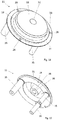
- the central emergency button comprises a light guide.
- the light guide can serve to direct the light emitted by the bulbs light in the direction of the operator visible surface of the central emergency button.
- the light guide is preferred formed such that the different control of the at least two groups of lighting means is visible to the operator.
- the optical waveguide can have optical waveguide regions which are assigned to each group of illuminants. If light sources can be controlled individually, then each light source which can be controlled individually can be assigned an optical waveguide region. Particularly preferably, each lighting means can be controlled individually and each lighting means is associated with an optical waveguide area.
- each light guide area may comprise a light area.
- emitting light of a luminous means substantially only illuminates the associated luminous area.
- the bulbs are located in the direction of the surface of the trigger element centrally under the light areas.
- the visible to the operator surface of the light guide may be configured, for example, as a circular ring.
- the luminous regions may in particular correspond in each case to a sector of the circular ring.
- the bulbs can be arranged in a ring.
- the light guide may annularly surround the emergency button actuator.
- recesses are provided between the light guide regions.
- the recesses in the light guide are provided so that the light sources, which can be controlled differently, can not be conducted from one to the other light guide area.
- the recesses are located between the groups of bulbs, in particular the individual bulbs.
- the light guide areas are located in the direction of the surface of the trigger element on the bulbs.
- the light guide regions preferably each comprise an expanding section.
- the expanding portion may serve to propagate the light emitted from the associated illuminant. As a result, the emitted light can be distributed over the associated luminous area.
- the spreading section can be in a projection z. B. in the form of a trapezoid, in particular in the form of an isosceles trapezoid.
- the area of the spread-out end of the expanding section corresponds in particular in size and / or shape to the illuminated area. As a result, the emitted light can be distributed particularly well over the associated luminous area.
- the expanding section is preferably arranged in the direction of the surface of the triggering element over the lighting means. As a result, the light emitted by the light sources reaches the light guide particularly well.
- the optical waveguide region has a forwarding section to the light pipe, wherein the light of the lighting means can be conducted through the forwarding section to the spreading section.
- the forwarding section is thus arranged between the spreading section and the associated lighting means.
- the relaying section serves to forward the light emitted by the lighting device to the expanding section.
- the forwarding portion may spread at least less than the spreading portion.
- the forwarding section may have mutually parallel edges in the direction of the light pipe.
- the forwarding portion may be provided when the optical fiber is a plate, for. B. the mounting plate or a board, penetrates. Since the spreading section starts near the luminous area through the relaying section, the optical waveguide can have a small footprint at the height of the plate to be penetrated. Thus, a stability of the plate can be ensured.
- the light guide is preferably formed in one piece.
- the light guide can also be formed of the same material.
- the light guide is monolithic.
- the light guide is formed in particular of translucent material.
- the optical waveguide region may have a connecting section.
- the connection section can serve to connect the light guide regions to each other.
- the connecting regions of the optical waveguide regions merge integrally, particularly preferably monolithically, into one another.
- the light of the lighting means can preferably be conducted through the spreading section to the connection section.
- the connecting portion can connect in the direction of the light pipe to the expanding portion.
- the connecting portion may have the luminous area.
- the connection areas together may include the user-facing surface.
- the connecting portion may have a depth of 2 mm to 6 mm, preferably 3 mm to 5 mm, particularly preferably 3.5 mm to 4.5 mm.
- the recesses are particularly deeply formed, so that the light guide regions are particularly largely separated.
- the depth of the connecting portion still allows a mechanically stable one-piece optical fiber.
- the light guide surrounds the emergency button actuator.
- the light guide and the emergency button actuator can be concentric be arranged to each other.
- the light guide can the emergency button actuator z. B. surrounded annularly.
- the light guide has a contact surface for the emergency button actuating element.
- the contact surface can hold the emergency button actuating element in particular positively against an actuating direction.
- the return means presses the emergency button actuator against the abutment surface.
- the return means may serve to return the emergency button actuator after actuation to the home position.
- the return means moves the emergency button actuator back to the starting position without manual intervention.
- the emergency button actuator can return to the home position immediately after the operation.
- the central emergency button can comprise at least one board, preferably at least two boards.
- the central emergency button comprises an emergency button switch.
- the emergency button switch may be actuatable by the emergency button actuator.
- the emergency button switch can in particular serve to generate at least one signal via the actuation of the emergency button actuating element.
- the emergency switch can be integrated on the board or on one of the boards in a circuit.
- the emergency button switch can end in particular on one of the boards.
- the emergency button switch is used on actuation of the actuating element for generating at least two signals via the actuation of the emergency button actuating element.
- the signals can be generated by interrupting at least a first and a second circuit.
- the emergency button can be arranged on a first board.
- the first emergency processing unit and / or the second emergency processing unit are arranged on a second board.
- both an arrangement on an upper side or on an underside of the second circuit board is conceivable.
- the signals via the operation of the emergency button actuator element are detectable by the first emergency processing unit and / or the second emergency processing unit wirelessly.
- the first emergency processing unit and / or the second emergency processing unit may be electrically connected to the emergency button switch without any wires.
- the first and second emergency processing units and the emergency push button switch are electrically connected to each other by plugs. Conductor tracks go from the plug the emergency button switch on the first board and / or from the plug lead tracks go to the emergency processing units on the second board.
- first and the second circuit board are connected to one another such that the first and the second circuit board are arranged at a fixed distance mechanically immovable to each other.
- first and the second circuit board are connected to one another such that the first and the second circuit board are arranged at a fixed distance mechanically immovable to each other.
- fastening means may be provided for connecting the first and the second board with each other.
- the boards may be interconnected by bolts.
- the bolts can be detachable, z. B. by one or more screws, be arranged in the central emergency button.
- the third emergency processing unit is arranged on the second board.
- the emergency button after the operation of the actuator without manual action of an operating position to return to a starting position and / or be restless actuated.
- the emergency button switch a reset device, for. B. a spring element having.
- the bulbs may possibly be arranged. Additionally or alternatively, at least one acoustic alarm device can be arranged on the circuit board, in particular on the first circuit board.
- the central emergency button from a front surface, in particular from a dome of the front surface of the actuating element from a construction height AH of less than 48 mm, preferably less than 46 mm, more preferably less than 44 mm.
- the construction height means the construction height which extends from the dome in the direction of installation.
- a lower limit may be limited by the technically feasible.
- the assembly height AH may comprise at least 29 mm, preferably at least 27 mm, particularly preferably at least 25 mm.
- the central emergency button comprises a mounting plate for attachment. Through the mounting plate, the central emergency button z. B. be fastened to the mounting plate.
- the central emergency button can be constructed such that a built-in part of the emergency button or central emergency button extends from the mounting plate in the direction of actuation, the mounting part in a flush box with a diameter of 60 mm and a depth of 41 mm can be arranged.
- the first board and the second board are arranged one behind the other.
- One behind the other means in this case in installation direction.
- the first board is disposed between the front of the Notfalltasterbetutzutzselements and the second board.
- the emergency button on the first circuit board integrated into a circuit. Additionally or alternatively, the emergency button switch on the first board may end.
- a Notfalltasterschalter can be used, which extends from the underside of the mounting plate is less than 15 mm, preferably less than 12 mm, more preferably less than 10 mm from the bottom of the mounting plate in the installation direction.
- a lower limit for the distance may be due to the technical feasibility.
- the extension can be as low as possible, for. B. at least 9 mm, preferably at least 7 mm, more preferably at least 5 mm.
- the emergency button switch can extend from an upper side of the mounting plate against the installation direction between 1 mm and 5 mm, preferably between 2 mm and 4 mm.
- a lower limit for the distance may be due to the technical feasibility.
- the distance MP can be as low as possible, for. B. at least 17 mm, preferably at least 15 mm, more preferably at least 10 mm.
- the Notfalltasterbet2011 instituteselement and / or the Notfalltasterschalter are designed such that an operator can operate the Notfalltasterbet für Trentselement and / or the Notfalltasterschalter only without rotation about an axis. More preferably, the operator can operate the emergency button actuator and / or the emergency button only without rotation.
- the emergency button actuator and / or the emergency button switch z. B. only translationally movable.
- the emergency button actuation element has at least one guide means.
- the guide means serves to guide the emergency button actuator element during actuation of the emergency button actuating element.
- the guide means only allows a translational movement of the emergency button actuating element.
- the emergency button actuator may include an actuator.
- the actuating means is used to actuate the emergency button switch.
- the emergency button switch can rest against the actuating means during actuation.
- the guide means may be arranged parallel to an actuating means of the emergency button actuating element. Additionally or alternatively, the guide means may be arranged parallel to the emergency switch.
- the emergency button switch can be arranged eccentrically to an imaginary axis, in particular to a symmetry and / or center axis, the emergency button actuator. It is possible to provide the guide means centrally in the emergency button actuator in this case.
- the guide means is arranged eccentrically to an imaginary axis, in particular to a symmetry and / or center axis, the emergency button actuator. It is possible that the emergency button switch is arranged in this case on the imaginary axis.
- the actuating means may also be provided centrally in the emergency button actuator.
- the emergency button actuating element comprises a plurality of guide means, preferably at least three guide means.
- the plurality of guide means may be arranged parallel to each other.
- the guide means may in particular be arranged around the emergency button switch.
- the emergency button actuator may include a bottom.
- the at least one guide means may extend rod-shaped from the underside.
- the at least guide means can be received and guided in a guide sleeve.
- the guide sleeve may in particular be connected to the mounting plate.
- each guide means may be guided in a guide sleeve.
- the plurality of guide means and / or the plurality of guide sleeves may be formed differently.
- a guide means and / or a guide sleeve may be formed longer than another guide means or guide sleeve.
- the particularly well-guided guide means may serve the actual guidance of the emergency button actuating element, while the at least one other guide means essentially prevents only one rotation of the emergency button actuating element.
- at least one guide sleeve can extend at least to the first circuit board, preferably through the first circuit board.
- the return means has a cavity.
- the actuating means and / or the emergency button can be arranged at least partially.
- the actuating means may be formed protruding.
- the actuating means protrudes from the underside of the actuating element.
- the actuating means may be circular-cylindrical.
- the actuating means may be formed with a hollow interior.
- a light source may be provided in the emergency button switch. Light rays that are emitted from the light source can propagate through the hollow interior. The light rays may be visible to a user through an illumination area of the emergency button actuator.
- the emergency button actuator may comprise a base of opaque material.
- the main body may be formed of plastic.
- the main body may comprise an opening. This allows the Illuminier Scheme be enabled.
- the main body may be formed homogeneously.
- a translucent, in particular translucent insert can be arranged. The insert can be fixed in the opening, in particular pressed. The light from the light source can be directed through the insert.
- a user can be any person who uses the security system 1.
- a user can, for. B. be a guest who wants to escape through the secured by the security system 1 door.
- An operator serves to operate the safety system.
- B. authenticate to the security system.
- the operator can z. B. be a member of a security guard. Particularly preferably, the operator can set the security system 1.
- actuation of the emergency button is understood to mean “actuation of the actuating element of the emergency button”.
- a connection to a bus system is understood below to mean an immediate connection, so that a component connected to the bus system is to be regarded as a subscriber of the bus system with its own bus address.
- initiating a control is meant, in particular, the transmission of a message via a first and / or second bus system which contains information and / or a command which causes the direct or indirect receiver of the message to carry out the activation.
- the sender of the message initiates the activation.
- an indirect drive is understood.
- the message can in particular correspond to a bus telegram.
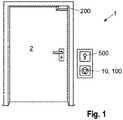
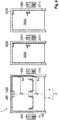
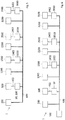
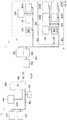
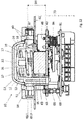
- FIGS. 1 to 6 sections of safety systems 1 according to the invention are shown.
- the cutouts of security systems 1, which in the FIGS. 1 to 6 are also connected to a central escape route control 300.
- An example of such an escape route controller 300 is shown in FIGS FIGS. 7 and 8th shown.
- FIGS. 1 and 2 a detail of a first embodiment of a security system 1 according to the invention for a door 2 is shown.
- the door 2 is not part of the security system 1 according to the invention.
- the security system 1 according to the invention comprises a door lock 200 and an emergency button 10.
- the emergency button 10 comprises a control device 100.
- the emergency button 10 is assigned a key switch 500.
- the security system 1 may include the key switch 500.
- the security system 1, in particular the emergency button 10 have a key-operated door, via which a connection with the key switch 500 can be produced.
- the key switch 500 is electrically connected or connectable to the emergency button 10 via a connection 402.
- the connection 402 is shown as a dashed arrow to indicate that signals are applied via a position of a key inserted into the key switch 500 to an electronic unit 24 of the emergency button 10.
- the key switch 500 may also be connected to the first bus system 400 (not shown). This alternative applies to all embodiments.
- the emergency button 10 is adapted to send to the door lock 200 as a result of an operation of the emergency button 10, a message on the first bus system 400 and thereby cause an unlocking of the door lock.
- the message as a result of pressing the emergency button 10 can be delayed.
- the security system 1 in particular the emergency button 10, can be connectable to a fire detector (not shown). In the presence of a fire alarm signal, the security system 1 also causes an unlocking of the door lock 200.
- the control device 100 does not perform safety-relevant functions: Thus, the control device 100 can cause an unlocking of the door lock 200 for authorized persons.
- the control device 100 can be connectable to an access control system, not shown.
- the access control system can in particular be connected or connectable to the first bus system 400.
- the control device 100 receives from the access control system, in particular via the bus system 400, a positive authentication signal via the authentication that has taken place. After that causes the Control device 100 unlocking the door lock 200.
- the access control system can, for. Example, a reader, a key switch, a keyboard for entering a code or a lock cylinder of a mechanical lock, in particular a self-locking panic lock, include or be designed.
- control device 100 may automatically cause a release of the door lock 200 at a predetermined time or after a predetermined period of time, z. B. if in a time window per day the door should be unlocked.
- the control device 100 can automatically initiate re-locking after a predetermined period of time has elapsed.
- the control device 100 can also receive an access signal of the access control system and / or measure the length of the positive authentication signal. By the access signal or the length of the authentication signal, the control device 100 can adjust the length of the predetermined time period. So a person z. For example, hold an ID card long in front of the reader or turn the key for a long time. This signals that the predetermined period of time should correspond to a long time previously stored in the control device 100. If the person holds the ID card shortly in front of the reader or if the user turns the key briefly, it is signaled that the predetermined period of time should correspond to a short time previously stored in the control device 100.
- a first door condition monitor 204 and a second door condition monitor 206 detect whether the door 2 is open or closed.
- the control device 100 at least indirectly receives a signal from the door condition monitoring devices 204, 206. If the door lock 200 has been unlocked due to a positive authentication signal, the control device 100 can immediately and automatically re-lock the door lock 200 as soon as the control device 100 uses the door condition monitoring devices 204, 206 is the information that the door is initially opened and now closed again.
- the emergency button 10 comprises an acoustic alarm transmitter 23 and lighting means 41 (see also FIG FIG. 13 ).
- the lighting means 41 serve to represent the locking or unlocking state of the door lock 200 and thus serve as a display device.
- the lighting means 41 are used for optical representation of a time-delayed unlocking of the door lock 200 as a result of actuation of the emergency button 10 and thus serve as a display device.
- the bulbs 41 are used for optical representation of a Alarm state after receiving the fire alarm or as a result of pressing the emergency button 10 and thus serve as a display.
- the bulbs 41 are used for visual display when a previously described re-locking fails.
- the control device 100 controls the audible alarm 23 to issue an audible alarm when a hazard is present, i. H. if a fire alarm signal was received or the emergency button 10 was pressed.
- the controller 100 controls the audible alarm 23 to issue an audible alarm when a re-lock fails.
- the controller 100 controls the bulbs 41 to indicate the latch state of the door latch 200 to optically display a time-delayed release and / or to issue an optical alarm when a fire alarm signal is received or the emergency button 10 is actuated or when re-locked fails.
- the control device 100 in the unlocked state of the door latch 200, can monitor the opening of the door by means of the door state monitors 204, 206.
- the controller 100 may, if desired, issue an audible alarm if the door 2 has been opened during the unlocked state of the door lock 200, at least if there is no positive authentication signal. This can be monitored when someone opens the door, even if the door is unlocked.
- Emergency button 10 may include at least one additional output.
- the control device 100 can control via the output other components that are connectable to the security system 1 according to the invention, for. B. a room lamp.
- the parameters for executing said functions of the control device 100 are stored. So z.
- the parameters for the lighting means may include flashing frequencies, colors to be emitted, color intensities and / or light patterns.
- the control device 100 can communicate via a radio module 64 with a mobile communication device.
- the parameterization with the aid of a watch device 301 via a second bus system 401 take place (s. FIGS.
- a parameterization program is to be provided which is based on a Communication device, z.
- a Communication device As a personal computer, a mobile phone and / or a tablet, is executable. The operator can set the parameters using the parameterization program.
- FIG. 2 the structure of the door lock 200 and the emergency button 10 is shown in more detail.
- the emergency button 10 has a first emergency button processing unit 20, a second emergency button processing unit 21, and a third emergency button processing unit 22.
- the first, second and third emergency button processing units 20, 21, 22 are each designed as microprocessors or microcontrollers.
- the first and second emergency button processing units 20, 21 comprise nonvolatile memory.
- the third emergency button processing unit 22 includes a non-volatile memory and / or has access to a non-volatile memory.
- the first, second and third emergency button processing units 20, 21, 22 are collectively referred to as the electronic unit 24 of the emergency button 10.
- the first emergency button processing unit 20 serves as the first processing unit 103 of the control device 100.
- the second emergency button processing unit 21 serves as the second processing unit 104 of the control device 100.
- the third emergency button processing unit 22 serves as the third processing unit 105 of the control device 100.
- the first and second emergency button processing units 20, 21 serve to execute the safety-related functions of the emergency button.
- the third emergency button processing unit 22 or processing unit 105 is used to execute the non-safety-relevant functions.
- the safety-relevant functions include the cause of unlocking in case of danger.
- Non-safety-related functions include the remaining functions listed above.
- an actuating element 11 Upon actuation of the emergency button 10, an actuating element 11 is moved from an initial position 11.I to an actuation position 11.II, as a result of which a switch 63 is actuated (see also FIG Figures 12 . 13 ). As a result, a first and a second actuation signal are generated. Thereby, a first and a second circuit (not shown) are opened. A signal about the opening of the first circuit is detected by the first emergency button processing unit 20. A signal on the opening of the second circuit is detected by the second emergency button processing unit 21.
- the actuating signal is understood to be the signal generated by the user by the actuation of the actuating element in order to unlock the door lock and to enable the escape route.
- the first emergency button processing unit 20 and the second emergency button processing unit 21 each independently initiate unlocking of the door latch 200 after detecting the operation signal via the first bus system 400.
- the second emergency button processing unit 21 thus acts redundantly with the first emergency button processing unit 20.
- the door lock 200 includes a door lock controller 201.
- the door lock controller 201 includes a first processing means 202 and a second processing means 203.
- the first and second processing means 202, 203 are collectively referred to as an electronic device 207.
- the first and the second processing means 202, 203 are each designed as a microprocessor or microcontroller.
- the first and the second processing means 202, 203 may each control a locking mechanism 205 of the door lock 200 for unlocking.
- d. H As a result of the operation of the emergency button 10 or upon receipt of a fire alarm signal, both the first processing means 202 and the second processing means 203 control the locking mechanism 205 for unlocking.
- the second processing means 203 is thus redundant to the first processing means 202. By this construction, one-error security is achieved.
- the locking mechanism 205 is electromechanically formed.
- the locking mechanism 205 includes z. B. an electromechanically actuated latch member (not shown) which locks a door latch of the door 2 in the locked state of the door lock 200 and releases in the unlocked state of the door lock 200.
- the first and second processing means 202, 203 turn on an electric current to the interlock mechanism 205.
- the first and the second processing means 202, 203 switch off an electric current for the locking mechanism 205.
- a processing means 202, 203 for this purpose a separate switch is assigned. Opening only one of the switches will turn off the power to the latching mechanism 205.
- the door lock controller 201 receives feedback about the state of the lock mechanism 205 via a lock mechanism state monitor, not shown. Specifically, a position of an armature of a spool of the lock mechanism 205 is monitored. If the state of the door lock 205 does not correspond to the desired state, an alarm is output. Additionally or Alternatively, this case, a renewed attempt to achieve the target state.
- the first and second emergency button processing units 20, 21 communicate with the first and second processing means 202, 203 via the first bus system 400 by means of a message.
- the message may include the message about being actuated or a control command for unlocking.
- the first emergency button processing unit 20 informs the first processing means 202 and the second emergency button processing unit 21 of the second processing means 203.
- the first and second emergency button processing units 20, 21 cause both the first and second processing means 202, 203 to set the lock mechanism 205 to unlock, so turn off the electrical power.
- the presence of a fire alarm signal is detected by the first and second emergency button processing units 20, 21.
- the first and second emergency button processing units 20, 21 cause the locking mechanism 205 to be triggered by the door lock controller 201 by a message to the first and second processing means 202, 203.
- the first emergency button processing unit 20 informs the first processing means 202 and the second emergency button processing unit 21 of the second processing means 203.
- the first and second emergency button processing units 20, 21 cause both the first and second processing means 202, 203 to set the lock mechanism 205 to unlock, so turn off the electrical power.
- the actuation of the emergency button 10 or the presence of a fire alarm signal can be sent in a message from one of the two emergency button processing units 20, 21, the first emergency button processing unit 20 writing a first part of the message and the second emergency button processing unit 21 writing a second part of the message.
- the first and second processing means 202, 203 are responsible for at least a part of the message.
- the emergency button processing units 20, 21, 22 and the first and second processing means 202, 203 may receive messages via the first bus system 400, respectively.
- the electronic unit 24 and the door lock controller 201 may each be assigned a bus address.
- the first and second emergency button processing units 20, 21 monitor each other. If an error is detected, the electronic unit 24, in particular the intact emergency button processing unit 20, 21, causes the first and the second processing means 202, 203 to actuate the door locking mechanism 205 for unlocking.
- the first and second processing means 202, 203 monitor themselves each other. If an error is detected, at least the intact processing means 202, 203 actuates the locking mechanism 205 for unlocking. Also, in case of a failure of the bus system 400, the locking mechanism 205 is driven to release from the door lock controller 201. For this purpose, and for checking the first and second emergency button processing units 20, 21, a sign-of-life signal of the first and second emergency button processing units 20, 21 is regularly sent to the door lock controller 201.
- the locking mechanism 205 is activated for unlocking by the first and the second processing means 202, 203.
- the first and second processing means 202, 203 communicate with each other when the door lock controller 201 has received a message about the operation of the emergency button 10 and / or the presence of a fire alarm signal. If only the first processing means 202 or the second processing means 203 determines that the emergency button 10 has been actuated or a fire alarm signal is present, the determining processing means 202, 203 actuates the door lock mechanism 205 for unlocking and initiates that the other processing means 202, 203 also control the Door lock mechanism 205 activates for unlocking. An error and a fault always include a failure of the respective component.
- the locking mechanism 205 automatically transitions to the unlocked state.
- the security system 1 emits an audible and / or visual alarm, in particular by means of the control device 100.
- the actuation signal When the actuation signal has been generated, it is electronically prevented that the door lock 200 is transferred into the locked state without the presence of a cancellation condition. This prevents the door from being locked while a hazardous condition persists.
- an electronic detection is integrated in the electronic device 207. The electronic detection is converted into an operating state as a result of the actuation of the actuating element 11, which serves to release the escape route. In the operating state, the control of the door lock 200 is prevented for locking.
- the electronic determination comprises a first program code.
- the first program code includes a first variable or has access to a first variable. In an initial state of the electronic determination, the first variable is set to an initial value. In the actuated state, the first variable is set to an actuation value, by which the actuation of the door lock 200 is prevented for locking.
- the first variable can be binary.
- the electronic determination becomes one Initial state transferred back. For this purpose, the value of the first variable is set to the initial value. In the initial state of the electronic detection, a control of the door lock 200 is allowed for locking.
- the first program code detects the first value of the first variable and allows latching of the door latch 200 when the value of the first variable is equal to the output value and prevents latching of the door latch 200 when the value of the first variable corresponds to the actuation value.
- the electronic determination is stored both in the first processing means 202 and redundantly in the second processing means 203.
- the first program code is stored in the first processing means 202.
- the first variable is stored in the nonvolatile memory of the first processing means 202.
- a second program code with the same functionality as the first program code is stored in the second processing means 203.
- the first variable is redundantly stored in the nonvolatile memory of the second processing means 203.
- the first variable is additionally stored in the first emergency button processing unit 20 and the second emergency button processing unit 21, respectively, in the non-volatile memories.
- the first variable in the first and second emergency button processing units 20, 21 is transferred from the initial value to the operation value.
- the changed value of the first variable is transmitted to the electronic device 207 via the bus system 400.
- the emergency button 10 repeatedly sends the actuation value of the first variable to the electronic device 207.
- the transmission can take place at regular time intervals, in particular together with the sign of life signal.
- the actuating element 11 is designed non-latching.
- the actuating element 11 is transferred in the actuation of the starting position 11.I in the operating position 11.II (s. FIG. 11 ).
- the actuator 11 moves back to the starting position 11.I by the force of a return spring 12 formed as a spring back (s. FIG. 12 . 13 ).
- the actuation of the actuating element 11 is translational.
- the cancellation action at the emergency button 10 is performed by operating the operation member 11. As a result, a cancellation signal is generated, which corresponds to the actuation signal.
- the control device 100 can recognize whether an actuation of the Emergency button 10 is used to unlock the door lock 200 or a cancellation action is present, a further signal must be generated to achieve the cancellation condition at the same time.
- An operator authenticates for this purpose. The authentication is done by inserting and turning a key in the key switch 500. The operation of the actuator 11 and the authentication must overlap in time. Ie. the operator must hold the key in the rotated state while the actuator 11 is in the operating position 11.II. The actuator 11 must return to the home position 11.I while the key is in the rotated state. The course of action is sufficient to achieve the cancellation condition.
- the cancellation condition can be achieved in at least one further manner, namely by elapse of a predetermined time interval. So z. B. after 60 seconds after the last generation of the actuation signal, the cancellation condition be achieved, if the door 2 has remained closed. An authentication on the key switch 500 and a cancellation action on the emergency button 10 are not necessary in this case.
- the first and second door condition monitoring devices 204, 206 are provided to detect, with one-shot security, that the door 2 has remained permanently closed due to the operation of the emergency button 10.
- the door condition monitoring devices 204, 206 are preferably designed differently.
- the first door condition monitor 204 may be e.g. B. be designed as a door contact.
- the second door condition monitor 206 may be e.g. B. be designed as a case contact.
- z. B. at least one of the door condition monitoring magnetically, z. B. as a reed switch, monitor the state of the door 2.
- the door lock controller 201 receives a signal from each of the first and second door condition monitors 204, 206 as to whether the door 2 is open or closed. Only if during the predetermined time interval, neither of the first door condition monitor 204 nor the second door condition monitor 206 has sent a signal on the opening of the door, the cancellation condition can be achieved by elapse of the predetermined time interval.
- the door lock controller 201 includes a timer to measure the predetermined time interval.
- the door lock controller 201 starts the timer in response to the operation of the emergency button 10. If the door lock controller 201 receives a signal of the first or second door state monitor 204, 206 that the door has been opened during the predetermined time interval, a cancel action must be taken at the emergency button 10 done. In this case, the elapse of the predetermined time interval is insufficient.
- the length of the predetermined time interval is stored in the door lock controller 201.
- the door lock controller 201 checks whether reaching the cancellation condition by lapse of the predetermined time interval is allowed before the door lock controller 201 drives the lock mechanism 205 to lock.
- an operator during commissioning of the security system d. H. before starting the operation of the security system 1, deposit whether an elapse of the predetermined time interval without opening the door 2 is permissible as a cancellation condition and thus leads to a re-locking of the door 2.
- the deposit can be made in the emergency button 10.
- a check of the permissibility, a lapse of the predetermined time interval, and a lack of a signal from the first and second door state monitors 204, 206 about opening the door 2 is sufficient to achieve the cancellation condition.
- the door lock controller 201 communicates the open or closed state of the door via the bus 400 to the emergency button 10 and / or to the control device 100.
- the electronics unit 24 includes a timer. In the electronics unit 24, a first delay period can be stored. If the door lock 200 is to be unlocked in a time-delayed manner, the electronic unit 24 waits for the first delay time after the generation of the actuation signal before the first and second emergency button processing units 20, 21 communicate with the door lock control 201 via the first bus system 400 to initiate unlocking ,
- the third processing unit 105 causes the FIG. 1 and 2 described non-safety unlocking and locking the door lock 200, z. B. unlocking after receiving the authentication signal, at a predetermined time or after a predetermined period of time or a lock after a predetermined period of time or immediately after closing the door 2. For this purpose communicates the third processing unit 105 via the first bus system 400 with the door lock control 201. The communication may, for. B. information or a control command that causes the door lock control 201 to control the locking mechanism for unlocking or locking. If the control device 100 is connected to the second bus system (see FIG. Fig. 7 ), the third processing unit 105 serves to forward messages from and / or to a central escape route controller 300.
- the third emergency button processing unit 22 controls the audible alarm generator 23 and the lighting means 41.
- the processing means 202, 203 If at least one of the processing means 202, 203 provides that the locking mechanism 205 has assumed the unlocked state, the processing means 202, 203 sends a corresponding signal via the bus 400 to the electronic unit 24.
- the electronic device 207 is connected to the door condition monitoring device 204, 206 or connectable and receive signals about an open or closed state of the door from the door condition monitors 204, 206.
- control device 100 the door lock control 2021 and / or the emergency button 10 execute are executable with the aid of software modules.
- program codes are stored, by means of which the functions are executable.
- FIG. 3 represents a variant of the in the FIGS. 1 and 2
- the control device 100 is formed separately from the emergency button 10 and the door lock 200.
- the control device 100 may, for. B. in a hat rail housing (not shown) may be arranged.
- the control device 100 is not integrated in an emergency button 10 or in a door lock 200.
- the control device 100 may be provided for placement in a technical room.
- the first bus system 400 connects the control device 100, the door lock 200 and the emergency button 10 with each other.
- the key switch 500 is electrically connected or connectable to the emergency button 10 via a connection 402.
- the structure and the function correspond to the first embodiment, wherein the functions associated with the FIGS. 1 and 2 are described with the aid of the control device 100 or the processing units 103, 104, 105, of the control device 100 of the FIG. 3 be executed and the functions that to the FIGS. 1 and 2 are executed by the emergency button 10.
- the first and second emergency button processing units 20, 21 detect the operation signal, communicate with the first and second buttons as a result of an operation of the emergency button 10 second processing means 202, 203 via the first bus system 400, thus causing the interlocking mechanism 205 to be driven by the door interlock controller 201.
- the actions for achieving on-fail safety are performed by the first and second emergency button processing units 20, 21.
- the first variable is in the stored first and second emergency button processing unit 20, 21 and is transmitted from there to the door lock control 201.
- the emergency button 10 includes the timer for determining the first delay time period.
- the control device 100 is connected or connectable to the second bus system 401.
- the third processing unit 105 causes the FIG. 1 and 2 described non-safety unlocking and locking the door lock 200, z. B. unlocking after receiving the authentication signal, at a predetermined time or after a predetermined period of time or an automatic re-locking after a predetermined period of time or immediately after closing the door. 2
- the first, second and third processing units 103, 104, 105 are each designed as a microprocessor or microcontroller.
- the first, second, and third processing units 103, 104, 105 together constitute processing electronics 101.
- the first and second processing units 103, 104 comprise nonvolatile memory.
- the third processing unit 105 comprises a non-volatile memory and / or has access to a non-volatile memory.
- a fire alarm signal can be received by both the control device 100 and the emergency button 10.
- the presence of a fire alarm signal is detected by the first and the second emergency button processing unit 20, 21 for the emergency button 10 or by the first and the second processing unit 103, 104 for the control device 100.
- both the control device 100 with the aid of the first and the second processing unit 103, 104 and the emergency button 10 with the aid of the first and the second emergency button processing unit 20, 21 can cause an unlocking of the door lock 200.
- communication takes place via the first bus system 400 with the door lock control 201.
- the control device 100 is informed via the first bus system 400 when the emergency button 10 causes an unlocking of the door lock 200, that is, as a result of an actuation of the emergency button 10 or after receiving a fire alarm signal.
- the control device 100 is also informed about a time-delayed unlocking of the door lock 200 as a result of the operation of the emergency button 10.
- the control device 100 is informed of the locking and unlocking state of the door latch 200.
- the control device 100 is informed of the open or closed state of the door 2.
- the control device 100 causes a triggering of the alarm transmitter 23 and the lighting means 41 for the to FIGS. 1 and 2 described acoustic alarms and visual representations.
- the control device 100 with the electronic unit 24, in particular with the third emergency button processing unit 22, via the first bus system 400 communicate.
- the third emergency button processing unit 22 then controls the alarm transmitter 23 or the lighting means 41.
- the parameters for the alarm transmitter 23 and the lighting means 41 are stored in the control device 100.
- Door lock 200 includes door status monitors 204, 206.
- door status monitors 204, 206 may be connected to first bus system 400 or directly to emergency button 10 and / or controller 100.
- At least one further emergency button may be connected to the first bus system 400, which is designed without the control device 100.
- the other emergency button is like the emergency button 10 in FIG. 3 trained and can cause the unlocking of the door lock 200 when actuated.
- the further emergency button corresponds in structure and functionality to the emergency button 10 of the FIG. 3 ,
- At least one further door lock may be connected to the first bus system 400.
- the further door lock is like the door lock 200 in FIG. 2 or 3 trained and can also be unlocked upon actuation of the emergency button 10.
- the further door lock corresponds in structure and in the functionality of the door locks 200 of FIGS. 1 to 3 ,
- FIG. 4 a detail of a third embodiment of a security system 1 according to the invention with several emergency buttons 10, 1010, 2010, 3010 is shown.
- the security system 1 comprises a plurality of door locks 200, 1200, 2200, 3200.
- Each emergency button 10, 1010, 2010, 3010 is assigned a key switch 500, 1500, 2500, 3500.
- the safety system 1 serves to arrange the emergency buttons 10, 1010, 2010, 3010 and door locks 200, 1200, 2200, 3200 on different doors 2, 2002, 3002.
- the doors 2, 2002, 3002 are not part of the security system 1 according to the invention
- Emergency buttons 10, 1010, 2010, 3010 are connected to the first bus system 400 and thus correspond to a number of emergency buttons 10, 1010, 2010, 3010.
- the door locks 200, 1200, 2200, 3200 are connected to the first bus system 400 and correspond to one Number of door locks 200, 1200, 2200, 3200.
- the emergency buttons 10, 1010 are associated with the door locks 200, 1200.
- the emergency button 2010 is assigned to the door lock 2200.
- Emergency button 3010 is associated with door lock 3200.
- the two door locks 200, 1200 unlocked, but not the door locks 2200, 3200. If the emergency button is pressed in 2010, then only the Door lock 2200 unlocked. Accordingly, when the emergency button 3010 is operated, only the door latch 3200 is unlocked.
- the door locks 200, 1200, 2200, 3200 are selectively unlocked.
- the emergency buttons 10, 1010 may be provided for placement on a two-leaf door 2.
- a door lock 200, 1200 is to be arranged in each case on a door leaf 3, 4 of the door 2.
- the emergency button 2010 and the door lock 2200 are provided to be arranged on another door 2002.
- the emergency button 3020 and the door latch 3200 are to be arranged on a door 3002 as in FIG FIG. 4 shown.
- the security system 1 off FIG. 4 can also for from FIG. 4 deviating selective unlocking be adjustable.
- At one too FIG. 4 deviating example setting is only one associated door lock 200, 1200, 2200, 3200 unlocked upon actuation of one of the emergency button 10,1010, 2010, 3010 respectively.
- one emergency button 10, 1010, 2010, 3010 is assigned in each case only one door lock 200, 1200, 2200, 3200.
- the security system 1 is suitable for two double-leaf doors, each with a door lock 200, 1200, 2200, 3200 per door leaf.
- the security system 1 can be set so that upon actuation of an emergency button 10, 1010, 2010, 3010 all door locks 200, 1200, 2200, 3200 are unlocked.
- a security system 1 may comprise a number of emergency buttons 10, 1010, 2010, 3010, which does not coincide with the number of door locks 200, 1200, 2200, 3200.
- the door 2 is designed to be single-winged and one of the emergency buttons 10, 1010 or one of the door locks 200, 1200 is missing.
- each emergency button 10, 1010, 2010, 3010 is connected to a respective emergency button 10, 1010, 2010, 3010 associated key switch 500, 1500, 2500, 3500 via a connection 402, 1402, 2402 or 3402 electrically connected or connectable.
- the key switches 500, 1500, 2500, 3500 are connected to the first bus system 400 (not shown).
- the first bus system 400 is connected to only a single controller 100.
- the structure and functions of the door locks 200, 1200, 2200, 3200 correspond to the structure and functions of the door lock 200 of Figures 2 and 3
- the structure and functions of the emergency button 10 the construction and functions of the emergency button 10 of FIG. 2 and the structure and functions of the emergency button 1010, 2010, 3010 the structure and functions of the emergency button 10 of FIG. 3
- the reference numerals from the Figures 2 and 3 are used. It is understood that each of the door locks 200, 1200, 2200, 3200 include its own door locking mechanism, own processing means, etc. and the emergency buttons 10, 1010, 2010, 3010 each own emergency button processing units, alarm, bulbs, switches and actuators.
- the assignment of emergency buttons 10, 1010, 2010, 3010 can be done to the door locks 200, 1200, 2200, 3200, when commissioning the security system 1, ie before the start of operation of the security system 1, an assignment of emergency buttons 10, 1010 , 2010, 3010 made to the door locks 200, 1200, 2200, 3200.
- one of the door locks 200, 1200, 2200, 3200 is in each case transferred to an assignment mode.
- a deliberate action is taken at the emergency buttons 10, 1010, 2010, 3010.
- the conscious action may be carried out as an actuation of the actuating element 11 of the respective emergency button 10, 1010, 2010, 3010.
- the interlocking mode of the door interlock 200, 1200, 2200, 3200 is ended.
- z. B first transferred the door lock 200 in the assignment mode and then the emergency button 10, 1010 operated, whereby the assignment of the emergency button 10, 1010 to the door lock 200 is carried out. Then, the assignment mode of the door lock 200 is ended. Subsequently, z. B. the door lock 1200 transferred to the assignment mode and then the emergency button 10, 1010 operated, whereby the assignment of the emergency button 10, 1010 to the door lock 1200 is carried out.
- the assignment mode of the door lock 1200 is ended.
- the door lock 2200 is transferred to the assignment mode and then the emergency button 2010 is actuated, whereby the assignment of the emergency button 2010 to the door lock 2200 takes place.
- the assignment mode of the door lock 2200 is ended. Accordingly, it can then be moved with the door lock 3200 and the emergency button 3010.
- the assignment of the assignment in the respective door interlocks 200, 1200, 2200, 3200 takes place respectively in the first digital processing means 202 and redundantly in the second digital processing means 203, in particular in the non-volatile memories of the processing means 202, 203.
- the emergency button 10 communicates with all door locks 200, 1200, 2200, 3200 of the first bus system 400.
- the door locks 200, 1200, 2200, 3200 check each based on the deposit, whether the respective door lock 200, 1200, 2200, 3200 has been assigned to the actuated emergency button 10. Only in the case of the assignment then control the associated door locks 200, 1200 to the respective door lock mechanism 205.
- the door locks 200, 1200, 2200, 3200 which are assigned to the fire alarm signal receiving emergency button 10, 1010, 2010, 3010, unlocked.
- a first delay time period is stored in that emergency button 10, 1010, 2010, 3010.
- the deposit takes place when the safety system 1 is commissioned by the parameterization program.
- a different first delay time period can be stored by the operator.
- the emergency button 10 stores a first delay time period, which differs from the first delay time duration, which is stored in the emergency button 2010.
- the emergency buttons 1010, 3010 are to initiate a release of the associated door locks 2200 and 3200 without delay, so that in the emergency buttons 1010, 3010 no first delay period or a first delay period of 0 s is stored.
- the security system 1 may be configured such that in the emergency windows 10, 1010, 2010, 3010, the same door lock 200, 1200, 2200, 3200 are assigned, always the same first delay time period is stored.
- the parameterization program allows the operator only a common setting.
- the control device 100 takes over the non-safety-relevant functions for unlocking and locking all door locks 200, 1200, 2200, 3200, as previously FIG. 1 and 2 described.
- the control device 100 with the door locks 200, 1200, 2200, 3200 selectively communicate.
- the control device 100 is deposited, which access control system which door lock 200, 1200, 2200, 3200 is assigned, so that when a positive authentication signal of an access control system only the associated (s) door lock (s) 200, 1200, 2200, 3200 are unlocked. It is also stored in the control device 100, if and when yes, which door lock 200, 1200, 2200, 3200 is to be unlocked at what predetermined time.
- the deposits may be made differently for each door latch 200, 1200, 2200, 3200 or for the groups of door locks 200, 1200, 2200, 3200 to be arranged on a door 2, 2002, 3002.
- the deposit is made with the aid of the parameterization program by the operator during commissioning.
- the control device 100 causes an acoustic and visual alarm as a result of the operation of a emergency button 10, 1010, 2010, 3010 is also output in the at least one further emergency button 10, 1010, 2010, 3010, the same door lock 200, 1200, 2200, 3200 as the actuated emergency button 10, 1010, 2010, 3010 is assigned. Is in the embodiment of FIGS. 4 and 5 z. B. the emergency button 10 is actuated, the control device 100 causes by communication with the electronics unit 24 of the emergency button 1010 that the acoustic alarm generator 23 and the bulbs 41 of the emergency button 1010 issue an audible or visual alarm.
- the control device 100 causes the first Delay period, with which the unlocking is caused, is also shown in the at least one further emergency button 10, 1010, 2010, 3010, the same door lock 200, 1200, 2200, 3200 as the operated emergency button 10, 1010, 2010, 3010 assigned.
- the control device 100 communicates with the electronics unit 24 of the at least one further emergency button 1010, 2010, 3010 or controls the lighting means 41 of the emergency button 10, in which the control device 100 is integrated.
- the control device 100 may be the non-safety-related assignment for selective communication, for. B. the assignment of an access control system to a door lock 200, 1200, 2200, 3200 make a bus address.
- the subscribers of the first bus system 400 each have an adjustment device for the manual setting of a bus address.
- the adjustment device may include DIP switches. At least the users of the first bus system 400 who have the same setting on the setting device are automatically assigned to each other. In order to be able to assign different bus addresses to subscribers with the same setting, subscribers of the first bus system 400 have different key figures from which different bus addresses are configured with the aid of the setting made.
- the bus address detected by means of the setting is for the emergency buttons 10, 1010, 2010, 3010 and for the door locks 200, 1200, 2200, 3200, only one more bus address which the emergency buttons 10, 1010, 2010, 3010 and Use the door interlocks 200, 1200, 2200, 3200 next to the bus address used in safety-related communication.
- the control device 100 can prevent an unlocking of a further door lock 200, 1200, 2200, 3200 until a condition is present, provided that no danger exists. If the condition is met, the control device 100 causes the unlocking of the further door lock 200, 1200, 2200, 3200. In this way, the control device 100 with a plurality of door locks 200, 1200, 2200, 3200 communicate so that a lock is formed.
- the door 2002 may be located at an entrance to a room and the door 3002 may be located at an exit of the same room.
- the controller 100 may cause the door latch 2200 to unlock upon the presence of a positive door latch 2200 authentication signal.
- the control device 100 can prevent the unlocking of the door lock 3200 until a condition exists. If the condition is present, then the control device 100 causes an unlocking of the door lock 3200.
- the condition may be, for. B. to a lock-time interval or the achievement of a measured variable, such as room temperature, humidity, air purity or number of people in the room act.
- the control device 100 can this purpose with a Meter connected or connectable.
- the condition may include closing the first opened door 2002, which is measurable by the door condition monitors 204, 206.
- the condition and the door locks 2200, 3200 involved in the lock can be stored in the control device 100. The deposit can be made by the operator using the parameterization program.
- FIG. 6 is a variant of the in the FIGS. 4 and 5 illustrated section of the security system 1 shown.
- the control device 100 is formed separately from the emergency buttons 10, 1010, 2010, 3010 and the door locks 200, 1200, 2200, 3200.
- the first bus system 400 connects the control device 100 to the door locks 200, 1200, 2200, 3200 and the emergency buttons 10, 1010, 2010, 3010.
- the control device 100 of FIG. 6 corresponds in structure to the control device 100 of FIG. 3
- the emergency button 10 of the FIG. 6 corresponds in construction to the emergency button 10 of the FIG. 3
- the structure and the functionalities previously agreed FIG. 5 are described, the structure and the functionalities of the security system 1 of FIG. 6 ,
- the door locks 200, 1200, 2200, 3200, the emergency buttons 10, 1010, 2010, 3010 and possibly the control device 100 act as subscribers of a single first bus system 400, only the cables of the bus system 400 are necessary so that the participants can communicate with each other.
- the security system 1 has only a few cables.
- the bus system 400 may include at least two cables for communication and at least two cables for power.
- the bus system 400 has exactly two cables for communication and two cables for the power supply.
- a power supply can be integrated as a connection to a power grid at any point of the bus system 400.
- the power supply can be provided as an independent component of the security system 1 outside the emergency button 10 or the emergency button 10, 1010, 2010, 3010 and the door lock 200 and the door locks 200, 1200, 2200, 3200.
- the security system 1 in the physical structure is flexible.
- the electronic button only prevents the electronic button 10 from being actuated. 1010, 2010, 3010 associated door locks 200, 1200, 2200, 3200 are locked. Achieving the cancellation condition allows the locking of the door lock (s) 200, 1200, 2200, 3200 associated with the actuated emergency button 10, 1010, 2010, 3010.
- the time overlapping condition is Actuation of the actuating element 11 of that emergency button 10, 1010, 2010, 3010, which was previously operated, and the authentication of the emergency button 10, 1010, 2010, 3010 associated key button 500, 1500, 2500, 3500 necessary.
- At least this action sequence is necessary for the door lock 200, 1200, 2200, 3200 associated with the actuated emergency button 10, 1010, 2010, 3010, in which at least one of the door condition monitoring devices 204, 206 has detected that the door 2 or one of the door leaves 3, 4 was opened after pressing the emergency button 10.
- the cancellation condition can be achieved by the lapse of the predetermined time interval.
- the cancellation condition z. B. be reached after 60 seconds after the last operation of the emergency button 10.
- the deposit can z. B. in the emergency windows 10, 1010, 2010, 3010 done.
- the length of the predetermined time interval can be individually adjustable. This can be a minimum length, z. B. 60 s, be predetermined for the predetermined time interval.
- the deposit is made by the parameterization program.
- FIG. 7 a fifth embodiment of the security system 1 according to the invention is shown.
- the fifth embodiment includes the security system 1 according to the first embodiment of the FIGS. 1 and 2 , That is, the emergency button 10 including the control device 100 is connected to the door latch 200 via the bus system 400.
- the key switch 500 is connected via a connection 402 with the emergency button 10 or connectable.
- further components 301, 510 are provided in comparison to the first exemplary embodiment.
- the central escape route control 300 already part of the embodiments of the FIGS. 1 and 2 is, is shown explicitly.
- the security system 1 includes the central escape route controller 300.
- the central escape route controller 300 is provided to be located remotely from the door 2.
- the central escape route control 300 z. B. together with a watch 301, which may be formed as a monitor or personal computer, and / or a multi-door display device 350 (s. Fig. 10 ) to be arranged in a guardroom.
- the watch device 301 is optionally part of the security system 1 according to the invention.
- the watch device 301 can be connectable to the security system 1 according to the invention.
- the central escape route control 300 has a modular structure.
- An emergency module 310 includes a first attachment plate 311.
- the first attachment plate 311 receives a central emergency button 302 and an identification device 312 exemplified as a key switch.
- the central emergency pushbutton 302 and the identification device 312 are mechanically rigidly connected to one another.
- the central emergency button 302 serves to unlock the door lock 200 as a result of actuation of the central emergency button 302.
- the central emergency button 302 away from the door 2 the door latch 200 can be unlocked.
- the unlocking as a result of the operation of the central emergency button 302 is done with a one-fault security.
- the operation of the central emergency button 302 is thus suitable for the danger.
- a deactivation module 320 comprises a first control element 322 embodied as a key pushbutton and a second control element 323 configured as a pushbutton.
- the first control element 322 serves to deactivate the emergency pushbutton 10.
- the emergency pushbutton 10 is deactivated Condition convicted. If the emergency button 10 is in a deactivated state, an unlocking of the door lock 200 is omitted as a result of an actuation of the emergency button 10.
- the second operating element 323 serves to activate the emergency button 10.
- the emergency button 10 is in the deactivated state and becomes the second operating element Pressed 323, the emergency button 10 is transferred to an activated state.
- the deactivation module comprises a second mounting plate 321.
- the second mounting plate 321 serves to receive the first and the second operating element 322, 323.
- the second mounting plate 321 connects the first and the second operating element 322, 323 mechanically rigidly together.
- a retardation module 330 includes a third attachment plate 331.
- the third attachment plate 331 receives a retardation element 332.
- the delay element 332 is exemplified as a key switch.
- the delay element 332 serves to further delay the unlocking of the door lock 200 within the first delay duration.
- the delay module 330 includes a termination element 333, which is designed as a button.
- the termination element 333 is at the third Attached mounting plate 331.
- the termination element 333 is mechanically rigidly connected to the delay element 332 by means of the third attachment plate 331. By actuating the termination element 333, the delay of the unlocking of the door lock 200 can be terminated.
- the central escape route controller 300 includes a one-way open escape route control housing 340 in which the emergency module 310, the deactivation module 320, and the delay module 330 are disposed.
- the deactivation module 320 and the delay module 330 are optional components of the central escape route safety device 300.
- the multi-door display device 350 can also be arranged.
- the escape route control enclosure 340 may mechanically secure the emergency module 310, the deactivation module 320, and the delay module 330.
- the emergency module 310, the deactivation module 320 and the delay module 330 are each individually secured to the escape route control housing 340, in particular screwed.
- For attachment to the escape route control housing 340 serve the first mounting plate 311 for the emergency module 310, the second mounting plate 321 for the deactivation module 320 and / or the third mounting plate 331 for the delay module 330.
- the escape route control housing 340 and the modules 310, 320, 330 are configured such that various sequences in which the modules 310, 320, 330 can be arranged next to one another are possible. So z. B.
- a central emergency exit device 300 not shown, for.
- the emergency module 310 may be located between the deactivation module 320 and the delay module 330.
- exemplary central escape route control 300 a free space, delay module 330 in the middle and emergency module 310 on the right can be arranged on the left. The clearance is due to the absence of the deactivation module 320 and is hidden by a plate.
- the escape route control housing 340 may include rails for inserting the modules 310, 320, 330.
- the escape route control housing 340 may have attachment options, e.g. As perforated strips or slots, for variable attachment of the module 310, 320, 330 have.
- a purely schematically illustrated display area 314, 324 and 334 is provided on the first mounting plate 311, on the second mounting plate 321 and on the third mounting plate 331.
- optical lights for indicating states of the security system 1 in the display areas 314, 324, 334 may be provided.
- the security system 1 further includes an audio and video module 510.
- the audio and video module 510 is provided for placement near the door 2 that can be latched by the door latch 200. If the audio and video module 510 is unlocked, an operator in the guardroom can speak with the user in front of the door 2 and view the room near the door 2.
- the central emergency button 302 similar to the emergency button 10 is constructed.
- the central emergency button 302 includes an emergency button electronics unit 308.
- the emergency button electronics unit 308 includes a first emergency processing unit 303, a second emergency processing unit 304 and a third emergency processing unit 305.
- the first, second and third emergency processing units 303, 304, 305 are each configured as a microprocessor or microcontroller.
- the first and second emergency processing units 303, 304 comprise nonvolatile memory.
- the third emergency processing unit 305 has a non-volatile memory and / or has access to a non-volatile memory.
- the central emergency button 302 is actuated by actuating an emergency button actuator 306.
- a Notfalltasterschalter 307 is actuated.
- a first and a second signal are generated.
- a first and a second circuit (not shown) are opened.
- a signal on the opening of the first circuit is detected by the first emergency processing unit 303.
- a signal on the opening of the second circuit is detected by the second emergency processing unit 304.
- the central emergency button 302 is connected to a second bus system 401. As in FIG. 9 As shown, the control device 100 is also connected to the second bus system 401.
- the second bus system 401 is a different type of bus system than the first bus system 400.
- the second bus system 401 may be configured as a LON or LAN bus and the first bus system 400 as a CAN or DCW bus.
- the emergency button 10 comprises the control device 100.
- the emergency button 10 and the door latch 200, which in FIG. 9 are mapped correspond to the emergency button 10 and the door lock 200 of FIG. 2 ,
- control device 100, the emergency button 10 and the door lock 200 according to the FIG. 3 educated.
- control device 100, the emergency button 10 and the door lock 200 are connected to each other via the first bus system 400, wherein the control device 100 is connected to the second bus system 401.
- the control device 100 receives messages from the central escape route safety device 300 via the second bus system 401.
- the control device 100 forwards the messages the first bus system to other participants of the first bus system 400 on.
- the message may in particular include information relating to actuation of the central emergency button 302, the key switch 312, the first operating element 322, the second operating element 323, the delay element 332 and / or the termination element 333 or a control command as a result of actuation of one of the aforementioned elements 302 , 312, 322, 323, 332, 333.
- a forwarding to the emergency button 10 in which the control device 100 is integrated is dispensed with. For example, conducts according to the FIG.
- the controller 100 forwards the message to the door latch 200. If the control device 100 and the emergency button 10 are connected via the first bus system 400, then the control device 100 forwards the message to the emergency button 10 and / or the door lock 200. The controller 100 adapts the message to the format of the first bus system 400. Security-relevant messages are otherwise left untouched.
- the central emergency button 302 If the central emergency button 302 has been actuated, then the first emergency processing unit 303 and redundantly the second emergency processing unit 304 unlock the door lock 200. In this case, the central emergency button 302 communicates with the door lock control 201, in particular the first and the second processing means 202, via the control device 100. 203. The first and second processing means 202, 203 then control the locking mechanism 205. Previously, the first and second processing units 103, 104 forwarded the message. Here, the control device 100 has left the content of the message untouched.
- the central emergency button 302 has an input for receiving a fire alarm signal. When the fire alarm signal is received, the central emergency push button 302 causes the door lock 200 to be unlocked.
- the first and second emergency processing units 303, 304 communicate with the door lock control 201 via the control device 100, namely via the first and second processing units 103, 104. Like previously described.
- a signal via an actuation of the key switch 312 of the first module 310 is received by the emergency button electronics unit 308, in particular the third emergency processing unit 305.
- the emergency button electronics unit 308 sends a message regarding the operation of the key switch 312 via the second bus system 401 to the control device 100.
- the control device 100 forwards the message to the first bus system 400.
- the emergency button actuator 306 is non-latching.
- the emergency button actuating element 306 is identical to the actuating element 11 of the emergency button 10 (see FIG. FIGS. 13 to 15 ).
- the emergency operating member 306 is transferred in the actuation from an initial position to an actuated position (analog FIG. 11 ).
- the emergency operating member 306 moves back to the initial position by the force of a return means formed as a spring (analog FIG. 11 ).
- the actuation of the emergency operating element 306 is translational.
- the electronic device 207 prevents the door lock 200 from being returned to the locked state without the existence of a cancellation condition.
- the cancellation condition after actuation of the central emergency button 302 can be achieved by operating the key switch 312. In particular, an actuation of the key switch 312 is sufficient to achieve the cancellation condition.
- the cancellation condition can be reached in a further manner as a result of an actuation of the emergency button 10. If the door state monitoring devices 204, 206 have detected that the door 2 has remained permanently closed after the emergency button 10 has been actuated is, the cancellation condition can be achieved by elapse of a predetermined time interval and a cancellation treatment at the central escape route controller 300 after the predetermined time interval.
- the cancellation treatment may correspond to an authentication at the central escape route controller 300, in particular an actuation of the key switch 312. By the Aufhe abstraction, z. As the operation of the key switch 312, a Aufhebesignal is generated.
- the cancel signal is forwarded to the door lock controller 201 via the control device 100. An authentication on the key switch 500 and a cancellation action on the emergency button 10 are not necessary in this case.
- the door lock controller 201 checks whether reaching the canceling condition by passing the predetermined time interval and authenticating to the central escape route controller 300 with the door 2 kept closed is allowed before the door lock controller 201 drives the lock mechanism 205 to lock. Thus, an operator during the commissioning of the security system 1 deposit whether a lapse of the predetermined time interval without opening the door 2 and the additional operation of the key switch 312 is permitted as a cancellation condition and thus leads to a re-locking of the door 2.
- a check of the permissibility, an elapse of the predetermined time interval, an actuation of the key switch 312 after the predetermined time interval and the fact that during the predetermined time interval, neither of the first door condition monitor 204 nor the second door condition monitor 206, a door opening signal has been sent is sufficient to achieve the cancellation condition.
- This variant can z. B. be selected by the operator, if only the lapse of the predetermined time interval remains closed with the door 2 the operator not sure enough. The operator can select and save this variant by means of the parameterization program.
- the elapse of the predetermined time interval with the door 2 closed is visually displayed on the central escape route controller 300.
- the lighting means 313 are for indicating that the predetermined time interval has elapsed without receiving a signal on the opening of the door 2 within the predetermined time interval.
- the visual display tells the operator that the door 2 can be locked by authentication to the central escape route controller 300.
- the door lock 200 can also be locked by the same operation of the key switch 312. Also, the possibility to achieve locking of the door lock 200 by actuating the key switch 312 after termination of the fire alarm signal is optically indicated by the lighting means 313.
- the control device 100 forwards messages from the emergency button 10 and / or the door lock 200 via the second bus system 401.
- the control device 100 adjusts the message to the format of the second bus system 401.
- the control device 100 sends information about the state of the emergency button 10 and / or the door lock 200 via the second bus system 401.
- the central escape route controller 300 and the multi-door display device 350 may be connected to a third bus system 403 (see FIG. Fig. 10 ).
- the multi-door indicator 350 can visually indicate the locking and unlocking state of the door lock 200.
- one of the door locks 200, 200 ', 1200', 2200 'of the security system 1 are unlocked.
- the unlocking with the help of Multi-door indicator 350 is not one-error-safe.
- the third bus system 403 may be the same type of bus system as the first bus system 400, e.g. B. to a CAN or DCW bus.
- the control device 100 forwards via the second bus system 401 to the central escape route controller 300 when the emergency button 10 waits a first delay period before the emergency button 10 causes the door lock controller 201 to actuate the lock mechanism 205 for unlocking.
- the first delay time period is visually displayed at the central escape route controller 300.
- the central emergency button 302 is constructed according to the emergency button 10, as it is the Figures 13 . 16, 17 is described.
- the lighting means 313 of the central emergency button 302 are actuated by the emergency button electronic unit 308. With the progress of the first delay period, less bulbs 313 in the same color light up. For example, fewer bulbs 313 in a first color and increasingly many bulbs 313 in a second color may shine.
- the lighting means 41 of the emergency button 10 are driven in an identical manner to optically represent the first delay time period.
- the operator can actuate the delay element 332.
- the operator turns a key in the key switch, which serves as a delay element 332.
- An actuation of the delay element 332 is detected by the emergency button electronics unit 308, in particular the third emergency processing unit 305.
- a corresponding message is sent via the second bus system 401 and possibly the first bus system 400.
- the emergency button 10 receives the message.
- the emergency button 10 terminates the first delay time period and starts with a second delay time period.
- the second delay period e.g. B. 180 s, is longer than the first delay period.
- the emergency button 10 initiates the unlocking of the door lock 200.
- the second delay time period is determined in the emergency button 10 by means of the same timer used to determine the first delay time period.
- the key of the delay element 322 need not remain rotated. Rather, a single turn of the key is sufficient to start the second delay period.
- the second delay time period is visualized at the central escape route controller 300 and at the emergency button 10.
- the visual representation at the central escape route control 300 is similar to the visual display at the emergency button 10.
- fewer bulbs 41, 313 shine in the same color.
- fewer bulbs 41, 313 in a first color and increasingly many bulbs 41, 313 may shine in a second color.
- a time lapse pattern may be repetitively added within the second delay time period, e.g. B. a circumferential color point or a circumferential color window (see description to FIG. 16, 17 ) are visually displayed.
- the emergency electronics unit 308 detects the actuation of the termination element 333 and sends a message regarding the actuation of the termination element 333 via the second bus system 401. This causes the emergency electronics unit to initiate 308 the emergency button 10 not to delay the unlocking, but to cause immediate unlocking the Matverrieglung 200.
- the termination element 333 is non-latching. A single actuation of the termination element 333 is sufficient to complete the delay of the initiation of the unlocking.
- the emergency button 10 can be transferred by an operation of the first control element 322 in the deactivated state.
- the operator turns a key in the key switch, which serves as a first operating element 322.
- Actuation of the first operating element 322 is detected by the emergency button electronics unit 308.
- a first and a second deactivation circuit are opened or closed.
- the opening or closing of the first deactivation circuit is detected by the first emergency processing unit 303.
- the opening or closing of the second deactivation circuit is detected by the second emergency processing unit 304.
- the first and the second emergency processing units 303, 304 communicate with the emergency button 10 via the second bus system 401. If the first bus system 400 is located between the emergency button 10 and the central emergency button 302, the control device 100 sends the message to the first and the second emergency processing unit 303 , 304 continue. When forwarding, the format is changed, but the content remains unchanged.
- the activated state and the deactivated state are stored electronically in the emergency button 10.
- the key in the first control 322 need not remain rotated during the disabled state. Rather, a single turn of the key is sufficient to disable the emergency button 10.
- the deactivation remains until the second operating element 323 is actuated.
- the actuation of the second operating element 323 can be detected by the emergency button electronic unit 308, in particular the third emergency processing unit 305.
- the emergency electronics unit 308 sends a message regarding the actuation of the second operating element 323 via the second bus system 401 and optionally via the first bus system 400 to the emergency button 10, whereupon the emergency button 10 is transferred to the activated state.
- the second control 323 is not latching. Characterized in that the activated and the deactivated state is stored in the emergency button 10, a single actuation of the second operating element 323 is sufficient to bring the emergency button 10 in the activated state.
- the central escape route control 300 comprises a bus 341, via which the emergency electronics unit 308, in particular the third emergency processing unit 305, can detect signals of the second operating element 323, the delay element 332 and the termination element 333.
- the emergency electronic unit 308 serves as the intelligence of the entire central escape route controller 300. Only the emergency electronic unit 308 includes microprocessors.
- the deactivation module 320 and / or the delay module 322 may be configured processor-free.
- the bus 341 may be configured as an I 2 C bus.
- a second variable can be stored in the first emergency button processing unit 20 and redundantly in the second emergency button processing unit 21, in particular in the non-volatile memories.
- the second variable can be binary. If the emergency button 10 is in the deactivated state, then the second variable is set to a deactivation value. If the emergency button 10 is in the activated state, the second variable is set to an activation value. As a result of an actuation of the first operating element 322, the second variable is set to the deactivation value. As a result of an actuation of the second operating element 323, the second variable is set to the activation value.
- the emergency button 10 checks the value of the second variable. If the emergency button detects that the emergency button 10 is deactivated, a communication of the emergency button 10 with the door lock control 201 is prevented in order to cause an unlocking 200.
- the first emergency processing unit 303 and the second emergency processing unit 304 mutually monitor for errors. If an error is detected, a message is sent via the second bus system 401.
- the emergency button 10 receives the message and then transfers itself to the activated state if the emergency button 10 is in the disabled state is located. For this purpose, the emergency button 10 changes the value of the second variable to the activation value.
- the first emergency processing unit 303 and the second emergency processing unit 304 repeatedly, in particular at regular intervals, send a sign of life signal via the second bus system 401.
- the emergency button 10 receives the sign of life signals. Leaves a sign of life signal once or several times, then the emergency button 10 is transferred to the activated state, if the emergency button 10 is in the deactivated state.
- the emergency button 10 transfers to the activated state if the emergency button 10 is in the deactivated state.
- the operation of the emergency button 10 in the deactivated state is displayed on the central escape route controller 300, on the watch device 301 and / or on the multi-door display device 350. If a danger situation actually exists, then the emergency button 10 can be converted by the operator into the activated state by the operator actuating the second operating element 323, or the door lock can be directly actuated by the operator for unlocking. For this purpose, the operator can actuate the central emergency button 302. Whether a hazard exists, the operator z. B. perceive via the audio and video module 510. As a result, increased security is achieved.
- the deactivation can z. B. be made at night in a department store. Furthermore, it is conceivable to use the deactivatable emergency button 10 in a building in which people with an impaired state of mind live. Emergency buttons 10 can also be used on doors accessible to people with impaired mental state, eg. On a psychiatry or dementia ward.
- the emergency button 10 If the emergency button 10 is actuated in the deactivated state and then the emergency button 10 is transferred to the activated state, the emergency button 10 which has been actuated in the deactivated state does not lead to unlocking of the door lock 200 even after the transfer to the activated state deactivated state, operation of the emergency button 10 remains ineffective. This is due, on the one hand, to the fact that the actuating element 11 and the switch 63 are non-latching. On the other hand, the operation of the emergency button 10 was not stored in the disabled state 10 in the disabled state. The door lock controller 201 receives no message regarding the operation of the emergency button 10 in the deactivated state. The electronic detection was therefore not transferred to the operating state. This ensures that not directly with the activation of the emergency button 10, the door lock 100 is unlocked, z. B. because long before the emergency button 10 was pressed. As a result, an increased building security is achieved.
- the audio and video module 510 may be switched on during the first and / or the second delay time period.
- the emergency button 10 releases the audio and video module 510 at the beginning of the first and / or second delay period.
- the audio and video module 510 is enabled by the emergency button 10 when the emergency button 10 is operated in the disabled state.
- the emergency button 10 communicates via the second bus system 401 and optionally via the first bus system 400 with the audio and video module 510.
- the emergency button 10 is only deactivated when the audio and video module 510 is unlockable. If the audio and video module 510 part of the security system 1 according to the invention, then a deactivation can be omitted if the audio and video module 510 z. B. is not functional and / or the connection to the audio and video module 510 is disturbed. This does not apply if the security system 1 does not comprise an audio and video module 510, but a monitoring system separate from the security system 1 is provided in the building.
- the emergency button 10 delays the cause of the unlocking only by the first and / or second delay time period when the audio and video module 510 is unlockable. If the audio and video module 510 part of the security system 1 according to the invention, then a delay can be omitted if the audio and video module 510 z. B. is not functional and / or the connection to the audio and video module is disturbed. This does not apply if the security system 1 does not comprise an audio and video module 510, but a monitoring system separate from the security system 1 is provided in the building.
- FIG. 10 a further embodiment of a security system 1 according to the invention is shown.
- the security system 1 comprises a central escape route controller 300, which operates according to the FIGS. 7 and 8th is constructed. Key buttons 500, 500 ', 1500, 1500', 2500 associated with the respective emergency buttons 10, 10 ', 1010, 1010', 2010 are not shown for the sake of clarity.
- the central escape route controller 300 is connected to the second bus system 401. To the second bus system 401, a first subsystem 5 and a second subsystem 6 are connected.
- the two subsystems 5, 6 each comprise a first bus system 400, 400 '.
- Emergency buttons 10, 1010 and 10 ', 1010', 2010 'and door locks 200 and 200', 1200 ', 2200' are respectively connected to the respective first bus system 400, 400 '.
- the first bus systems 400, 400 ' are the same bus system type, eg. B. order a CAN or a DCW bus.
- the second bus system 401 is another type of bus system, e.g. B. a LON or LAN bus.
- the security system 1 comprises the multi-door display device 350.
- the multi-door display device 350 may e.g. B. visually indicate which door lock 200 or 200 ', 1200', 2200 'is in the unlocked state and which door lock is in the unlocked state. With the aid of the multi-door display device 350, an operator can perform a non-safety-relevant locking and unlocking of individual door locks 200 or 200 ', 1200', 2200 'of the security system 1.
- Each subsystem 5, 6 comprises only one control device 100, 100 '.
- the control device 100, 100 'of the respective subsystem 5, 6 is connected to the second bus system 401.
- the control device 100 of the first subsystem 5 is connected to the emergency buttons 10, 1010 and the door lock 200 of the first subsystem 5 via the first bus system 400.
- the control device 100 'of the second subsystem 6 is integrated in an emergency button 10' of the second subsystem 6 and connected to the remaining emergency buttons 1010 ', 2010' and the door locks 200 ', 1200', 2200 'of the further first bus system 400'.
- a first emergency button 10 and a second emergency button 1010 are provided. If one of the emergency buttons 10, 1010 is actuated, then the actuated emergency button 10, 1010 respectively causes an unlocking of the door lock 200.
- a first emergency button 10 ', a second emergency button 1010' and a third emergency button 2010 ' are provided.
- the first emergency button 10 ' is actuated, only one unlocking of the first door lock 200' is initiated.
- the second emergency button 1010 'only one unlocking of the second door lock 1200' and upon actuation of the third emergency button 2010 'only one unlocking of the third door lock 2200' causes.
- an inventive security system 1 z. B. without the first or the second subsystem 5, 6 be configured.
- the only or additional subsystem z. B. one of the in the FIGS. 1 to 6 be provided described safety systems 1 according to the invention.
- the design and functions of the emergency buttons 10, 10 ', 1010, 1010', 2010 'and the door locks 200, 200', 1200 ', 2200' are formed according to the preceding embodiments, as far as not described below in addition or deviating.
- each of the door locks 200, 200 ', 1200', 2200 'of the security system 1 is deposited, whether an actuation of the central emergency button 302 unlocking the respective door lock 200, 200'1200', 2200 'takes place. So z. B. the door locks 200, 200 ', 2200' allow unlocking as a result of actuation of the central emergency button 302, the door lock 1200 ', however, not.
- the central emergency button 302 is operated, the door lock controls 201 of the door locks 200, 200 ', 2200' control the respective lock mechanism 205 for unlocking. On the other hand, such a control is omitted in the door lock 1200 '.
- the deposit as to whether the door lock 200, 200'1200 ', 2200' is unlocked as a result of actuation of the central emergency button 302 takes place when the safety system 1 is put into operation by the operator.
- the deposit is made by the parameterization program.
- each of the emergency buttons 10, 1010, 10 '. 1010 ', 2010' is deposited, whether upon actuation of the first operating element 322 a transfer to the deactivated state for the respective emergency button 10, 1010, 10 '. 1010 ', 2010' is allowed or not.
- the emergency button 10, 10 ', 2010' be transferred in response to an actuation of the first control element 322 in the deactivated state, the emergency button 1010, 1010 ', however, not.
- the emergency buttons 10, 1010, 10 '. 1010 ', 2010' of the security system 1 decide based on the deposit on the authorization for deactivation, whether the respective emergency button 10, 1010, 10 ', 1010', 2010 'transferred itself as a result of the operation of the first control element 322 in the deactivated state or Not.
- this may be a third variable.
- the third variable may be binary.
- the third variable is stored in the non-volatile memory of the respective first and second emergency button processing units 20, 21 of each emergency button 10, 1010, 10 ', 1010', 2010 '. If deactivation is permitted for the respective emergency button 10, 1010, 10 ', 1010', 2010 ', the third variable assumes a first value. If deactivation is prohibited for the respective emergency button 10, 1010, 10 ', 1010', 2010 ', the third variable assumes a second value.
- the emergency button 10, 1010, 10 ', 1010', 2010 ' checks the value of the third variable before the emergency button 10, 1010, 10', 1010 ', 2010' deactivates and deactivates only if the third variable is the first value Has.
- the deposit whether the emergency button 10, 1010, 10 ', 1010', 2010 'should be deactivated, takes place at startup of the security system 1 by the operator. This is stored with the aid of a parameterization program.
- each of the emergency buttons 10, 1010, 10 '. 1010 ', 2010' is deposited, whether on actuation of the delay element 332 of the respective emergency button 10, 1010, 10 '. 1010 ', 2010' the release of the emergency button 10, 1010, 10 '. 1010 ', 2010' associated door locks 200, 200 ', 1200', 2200 'delayed by a second delay period or not.
- the second delay time is for the respective emergency buttons 10, 1010, 10 '. 1010 ', 2010' different lengths adjustable and in the security system 1, in particular in the emergency buttons 10, 1010, 10 ', 1010', 2010 ', deposited.
- the admission of the delay by the second delay time period and, if necessary, the length of the second delay time duration can only be used for groups of emergency buttons 10, 1010, 10 '. 1010 ', 2010', which are associated with a door lock 200, 200 ', 1200', 2200 'or a door 2, 2002, 3002, be individually adjustable.
- the setting and the deposit are made by the operator using the parameterization program.
- the emergency button 1010, 10 ', 1010' As the emergency button 10, 2010 'in response to an actuation of the delay element 332, the release of the door locks 200 and 2200' further delay, the emergency button 1010, 10 ', 1010', however, not.
- the length of the second delay time period for the emergency button 10 is different from the length of the second delay time period for the emergency button 2010 'selected.
- the emergency button 10 delays from the actuation of the delay element 332 the release by that second delay time period, which is stored in the emergency button 10 . If the emergency button is' actuated in 2010 and the delay element 332 is actuated within the first delay period, which is stored for the emergency button 2010 ', then the emergency button 2010' delays from the actuation of the emergency button Delay element 332 the release by the second delay time, which is deposited in the emergency button 2010 'and which differs from the second delay time for the emergency button 10.
- the emergency button 1010 delays the release by the first delay time period stored for the emergency button 1010. If the delay element 332 is actuated during the first delay time period of the emergency button 1010, then the unlocking is not delayed by a second delay time since this delay is not permitted for the emergency button 1010, but the emergency button 1010 immediately becomes unlocked after the first delay time 200 cause.
- the emergency buttons 10 ', 1010' delay the unlocking of the associated door lock 200 'or 1200' not at all. For emergency buttons 10 ', 1010', neither a first delay time nor a second delay time is allowed. Instead of a non-admission of a delay by the first and / or the second delay time period, a time duration of 0 s can also be stored.
- An actuation of the termination element 333 stops any delay of the unlocking.
- the emergency buttons 10, 1010, 10 '. 1010 ', 2010' of the security system 1 decide on the basis of the deposit as to how to proceed.
- the first and / or the second delay time period can only be selected up to a maximum, permanently predetermined time duration.
- the operator can selectively store for which emergency button 10, 1010, 1010 ', 2010' which release condition is permitted.
- the cancellation condition for the on-site termination is always allowed.
- reaching the cancellation condition selectively by lapse of the predetermined time interval or reaching the cancellation condition by lapse of the predetermined time interval and subsequent operation of the identification device 312 with the door 2 closed may be selectively allowed or not.
- the deposit as to whether the emergency button 10 can be deactivated upon actuation of the first operating element 322 determines whether the emergency button 10 should delay the release by a second delay period when the delay element 332 is actuated, the length of the first and second delay periods, the deposit of the cancellation condition, and / or the deposit, whether the door lock 200 is to be unlocked upon actuation of the central emergency button 302, can also for the security system 1 according to the embodiment of FIGS. 7 to 9 be made.
- central escape route controllers 300, 300 ' can also be connected to the second bus system 401.
- a central escape route control 300 may be provided for placement in a guardroom, and another central escape route control 300 'may be provided for placement in a nursing room.
- the first to fourth embodiments of the security system 1 according to the invention also have a second bus system 401 and a central escape route control 300, even if the second bus system 401 and the central escape route control are not shown.
- the control device 100 and the central escape route controller 300 are each connected to the second bus system 401.
- the central escape route control can, as in the FIGS. 7 and 8th be formed represented.
- embodiments of the security system 1 according to the invention are conceivable in which the first to fourth exemplary embodiments additionally comprise the missing components 301, 510 at least partially. If the security system 1 is designed for a plurality of doors, each door can be assigned an audio and video module 510.
- the emergency buttons 1010, 2010, 3010, which do not include the control device 100, and the door locks 200, 1200, 2200, 3200 are not connected to the second bus system 401.
- FIGS. 1 to 10 are the door locks 200, 200 ', 1200, 1200', 2200, 2200 ', 3200 part of the security system according to the invention 1.
- the door lock controllers 201 are each connected to the Locking mechanism 205 and possibly the door condition monitoring devices 204, 206 connectable. Unlocking the door latch 200 in this case does not take place in the security system 1, but part of the security system 1 is that the door lock controller 201 controls the lock mechanism 205, ie, the door lock controller 201 turns on or off the electric power to the lock mechanism 205.
- each "activation of the locking mechanism for locking or unlocking" are used.
- FIGS. 11 to 13 an emergency button 10 is shown.
- the in FIG. 11 Emergency button 10 shown is as emergency button 10, 10 ', 1010, 1010', 2010, 3010 in one of the security systems 1 of the invention FIGS. 1 to 10 can be used or used.
- the emergency button 10 comprises the actuating element 11.
- the actuating element 11 can move from the starting position 11 FIG. 11 is moved to the operating position 11.II, which in FIG. 11 is indicated. In FIG. 12 the actuator 11 is also in the starting position 11.I.
- the switch 63 In the operating position 11.II, the switch 63 is actuated.
- the switch 63 likewise changes from a first 63.I to a second position 63.II, as in FIG FIG. 12 indicated.
- the actuator 11 After actuation, the actuator 11 returns immediately and without manual intervention in the starting position 11.I back.
- a return means 12 designed as a spring is provided in the emergency button 10. Also, the switch 63 returns after the operation immediately and without manual intervention in the first position 63.I back.
- the emergency button 10 comprises at least a first circuit board 60. This makes it possible to design the emergency button 10 in a compact and reliable manner.
- the emergency button 10 has from a top 32 of a front surface 19 of the actuating element 11 in the installation direction a mounting height AH of less than 48 mm, preferably less than 45 mm, more preferably less than 43 mm.
- the switch 63 is mounted on the first board 60.
- the first and second circuits are interrupted on the first board 60 by the operation of the switch 63.
- the emergency button 10 also includes a second board 61. On the second board 61, the first, the second and the third emergency button processing unit 20, 21, 22 are arranged. The arrangement of the first, second and third emergency button processing units 20, 21, 22 is independent of whether the first, second and third emergency button processing units 20, 21, 22 serve as the processing unit 103, 104, 105 of the control apparatus 100.
- the opening of the first and second electric circuit can be detected by the first and second emergency button processing units 20, 21, respectively.
- the first and second circuit boards 60, 61 are connected to one another via plugs 68.
- the first and second boards 60, 61 are arranged at a fixed distance from each other.
- bolts 69 are provided, which fastened by means of screws 70, the first and the second board 60, 61 with each other at a fixed distance from each other (s. FIG. 13 ).
- the first and second boards 60, 61 are arranged parallel to each other.
- the emergency button 10 includes a mounting plate 62.
- the mounting plate 62 is also disposed at a fixed distance from the first and second circuit boards 60, 61.
- bolts 71 are provided which connect the mounting plate 62 to the first circuit board 61 via screws 72.
- the mounting plate 62 is used for attachment to a flush-mounted box.
- the flush-mounted box can have a diameter of 60 mm and a depth of 41 mm.
- the part of the emergency button 10 extending from the mounting plate 62 in the installation direction is referred to as the mounting part 73.
- the built-in part 73 has a diameter of less than 60 mm and a depth of less than 33 mm, preferably less than 31 mm, particularly preferably less than 29 mm. This provides enough space for cables in the flush-mounted box.
- the distance MP from a lower side of the mounting plate 62 to an upper side of the second board 62 is less than 22 mm, preferably less than 20 mm, particularly preferably less than 17 mm.
- the mounting plate 62 can also be used for attachment to a cover element of a surface-mounted housing (not shown).
- the abovementioned distances apply in particular to an emergency button, in which the Bluetooth module 64, unlike the representation in the figures, is fastened on an underside of the second circuit board 61.
- the canceling action performed immediately at the emergency button 10 is performed without rotational movement of the operating member 11 and the switch 63.
- the switch 63 is formed such that the switch 63 is free of rotation.
- the switch 63 has a height SH of less than 20 mm, preferably less than 17 mm, particularly preferably less than 15 mm.
- the actuating element 11 has rod-shaped guide means 35.
- the guide means 35 are guided in guide sleeves 65.
- the guide sleeves 65 are connected to the mounting plate 62. To achieve good guidance, one of the guide sleeves 65 extends through the first board 60.
- the guide means 35 are arranged parallel to the switch 63.
- the guide means 35 prevent a rotational movement of the actuating element 11 about an imaginary axis 701, which extends in the actuating direction 700.
- the actuating element 11 is only translationally movable.
- the actuating element 11 has an actuating means 36.
- the actuating means 36 is in the form of a circular cylinder. This ensures that always the actuating means 36 actuates the switch 63.
- a first and a second switching element 74, 75 of the switch are always actuated simultaneously (s. FIG. 13 ). By the first switching element 74 of the first circuit and the second switching element 75, the second circuit is opened.
- the actuating means 36 is formed with a hollow interior 38.
- a light source (not shown) is arranged in the switch 63. The light emitted by the light source is directed through the hollow interior 38 to the top 32 of the front surface 19 of the actuator 11 where the light passes through the actuator 11.
- the dome 32 thus serves as Illuminier Scheme 32 of the actuating element eleventh
- the actuating element 11 may comprise an opaque base body 33.
- the main body 33 may be provided with an opening deviating from the illustration in the figures.
- an unillustrated translucent, in particular translucent insert can be arranged in the opening.
- the insert can be fixed in the opening, in particular pressed. As a result, the actuating element 11 can be produced particularly easily.
- the front surface 19 is partially conical.
- the Illuminier Scheme 32 forms the top of the truncated cone.
- the Illuminier Scheme 32 projects against the actuating direction 700 from a cover 14 of the emergency button 10 out. As a result, the light leaving the illuminating area 32 is clearly visible laterally from the emergency button 10.
- the return means 12 has a cavity 37.
- the actuating means 36 of the actuating element 11 and the switch 36 protrude with the first and the second switching element 74, 75. This results in a space-saving arrangement.
- the Bluetooth module 64 is disposed between the first and second boards 60, 61.
- the Bluetooth module 64 is used for parameterization.
- the Bluetooth module 64 is attached to a side facing away from the actuating element 11 of the second board 61. As a result, the distance of the first and the second circuit board 60, 61 can be further reduced.
- a sabotage switch 66 is disposed on the first board 60. Due to the low construction height, an actuating extension 67 of the sabotage switch 66 is passed through the mounting plate 62. The actuating extension 67 rests directly against the cover 14 of the emergency button 10.
- the emergency button 10 can, despite the low construction height AH, comprise the functions described above and thus be designed intelligently.
- the above-described functions are executed by means of a program code stored in at least one of the processing units 103, 104, 105.
- the emergency button 10 has a covering means 13.
- the cover 13 is transparent and covers the front surface 19 of the actuator 11 from. As a result, the covering means 13 prevents the direct contact of the operating member 11 by a user.
- the cover 13 serves as a mental obstacle for the user.
- the cover 13 remains nondestructive in an operation of the emergency button 10.
- the cover 13 moves at an operation of the emergency button 10 from a starting position 13.1 in an operating position 13.II.
- the actuator 11 is actuated only indirectly via the cover 13 by the user.
- the covering means 13 is arranged undetachably in the emergency button 10. This ensures that a user can not abusive remove the cover 13.
- the covering means 13 is firmly connected to the actuating element 11.
- the covering means 13 extensions 27, which in FIG. 13 are shown.
- the actuating element 11 has holes 28 through which the extensions 27 are guided and materially connected to the actuating element 11.
- the actuating element 11 has a flange-like section 31, on which the covering means 13 is fastened.
- the flange-like portion 31 has the holes 28.
- the flange-like portion 31 serves as a stop of the actuating element 11 in the actuating direction 700.
- the actuating element 11 reaches the actuating position 11.II, when the flange-like portion 31 abuts against the mounting plate 62 or on the guide sleeves 65.
- the flange-like portion 31 serves as a stop of the actuating element 11 against the actuating direction 700.
- the actuating element 11 reaches the starting position 11.I, when the flange-like portion 31 rests against a light guide 40.
- the light guide 40 holds the actuator 11 against the force of the return means 12.
- the light guide 40 has a contact surface 51.
- the light guide 40 is fixed to the mounting plate 62. As a result, the actuator 11 is held against the force of the return means 12 even when the lid 14 is removed.
- the light guide 40 has a flange 52, with which the light guide 40 is fixed to the mounting plate 62 (s. Fig. 17 ).
- the light guide 40 is fixed to the mounting plate 62 by the same screws 72, by which the mounting plate 62 is fixed to the first board 60.
- the covering means 13 may be formed as an elastic film which spans the actuating element 11.
- the distance between the actuation position 11.II and the starting position 11.I and the distance between the actuation position 13.11 and the starting position 13.I correspond to each other.
- the cover 13 is moved back to the starting position 13.I.
- the return means 12 transfers the covering means 13 indirectly via the actuating element 11 into the starting position 13.I.
- the covering means 13 and the actuating element 11 each have a circular cross-section.
- the lid 14 has a circular recess 15.
- the covering means 13 protrudes counter to the actuating direction 700 through the recess 15.
- the actuating element 11 protrudes through the recess 15th
- the recess 15, the actuating element 11 and the covering means 13 have a common imaginary axis 701.
- the recess 15, the actuator 11 and the cover 13 are arranged concentrically.
- the covering means 13 has an actuating surface 17, which is spaced from the front surface 19 of the actuating element 11. Also, the covering means 13 has a side surface 16 which is formed spaced from the side surface 18 of the actuating element 11.
- the transparent cover 13 can protrude far from the lid 14, while the partially opaque actuator 11 protrudes from the lid 14 only to a small extent.
- the light guide 40 which terminates substantially flush with the lid 14, even for obliquely standing in front of the emergency button 10 user remains clearly visible.
- the Optical fiber deviates a maximum of ⁇ 3 mm, preferably a maximum of ⁇ 2 mm, more preferably ⁇ 1 mm from a plan conclusion with the lid 14 from.
- the emergency button 10 is operable for the user with the flat hand.
- the cover 13 in the operating position 13.II plan with the cover 14 or the cover 13 is in the operating position 13.II against the operating direction 700 of the cover 14 out.
- the distance ABS corresponds to the starting position 13.1 and the operating position 13.II at most the distance DF of a projection 30 of the actuating surface 17 to the cover 14.
- the amount of the distance AB of the operating position 11.II and the starting position 11.I corresponds at most to Distance DF.
- the distance ABS and the amount of the distance AB correspond to the distance DF.
- the emergency button 10 comprises lighting means 41.
- the lighting means 41 serve to indicate the unlocked and locked state of the door lock 200.
- the bulbs 41 indicate the unlocked and locked state of the associated door latch or door locks 200, 1200, 2200, 3200.
- the lighting means 41 are arranged concentrically around the actuating element 11. For example, the unlocked state is indicated by the green light and the locked state by the red light. In particular, all bulbs 41 emit the same light to indicate the locked and unlocked states, at least if there is no danger.
- the lighting means 41 can be controlled in at least two groups. Due to the different control z. Example, possible by the user more states of the security system 1 are displayed. Due to the additional display options, the user and / or the operator in a compact and simple way without additional display means a variety of states can be displayed. As a result, the security of the security system 1 is increased.
- FIG. 13 are shown by the exemplary existing eight individual light sources 41 six individual light sources, of which three bulbs are provided with the reference numerals 41 a, 41 b, 41 c.
- the individual lamps are referred to below as 41 a, 41 b, 41 c, etc.
- Each of the individually controllable groups of lighting means 41 may comprise only a single lighting means 41 a, 41 b, 41 c, and so on.
- each lamp 41 a, 41 b, 41 c, etc. individually controllable.
- Each lamp 41 a, 41 b, 41 c, etc. is each formed as an RGB LED.
- the bulbs 41 a, 41 b, 41 c, etc. are controlled so that each bulb 41 a, 41 b, 41 c, etc. at least four different, preferably at least five different colors can emit. This may be z. B. to red, blue, yellow, green and pink light act.
- the lighting means 41 are driven by the third emergency button processing unit 22.
- the emergency button processing unit 22 and the lighting means 41 are connected to a ring bus (not shown).
- the lighting means 41 are arranged on the first circuit board 60.
- the acoustic alarm transmitter 23 is arranged on the first circuit board 60.
- the acoustic alarm generator 23 is controlled by the third emergency button processing unit 22.
- the emergency button 10 can not indicate the unlocked state until all the emergency button 10 associated door locks 200, 1200 are in the unlocked state.
- the unlocked state is displayed only when the entire escape door width of the two leaves 3, 4 is available for escape.
- the emergency button 10 indicates the unlocked state already when one of the door locks 200, 1200 or all door locks of a door leaf 3, 4 are in the unlocked state.
- the possibility of escape is displayed as early as possible when one of the door leaves 3, 4 is unlocked.
- the options can be selected by the operator.
- z. B. a switch (not shown) may be provided in the security system 1.
- the lighting means 41 can indicate whether a fire alarm signal is present or whether an actuation signal has been generated.
- the lighting means 41 can be controlled in such a way that the progression of the time delay of the unlocking is indicated by the lighting means 41 after the generation of the actuating signal. This emit z. B. increasingly less bulbs 41 light a color, especially red light.
- an error can be represented by the lighting means 41.
- the thus representable error may be an error of the security system 1.
- the control device 100, the door lock control 200 or the first or the second emergency button processing unit 20, 21 of the security system 1 has been inoperable, defective, failed, deliberately switched off or removed.
- the fault may be an error of the alarm system connected to the safety system 1 which is not ready, defective, failed, deliberately switched off or removed.
- the optical fiber 40 includes a plurality of optical fiber portions 44 (see FIGS FIGS. 16 and 17 ). Each of the lighting means 41 a, 41 b, 41 c, etc. is assigned in each case an optical fiber region 44.
- the light guide 40 can be thoughtfully divided into the light guide regions 44. Recesses 46 are provided between the light guide regions 44. Through the recesses 46, the light essentially remains in the light guide regions 44.
- Each optical waveguide region 44 has a forwarding section 48.
- the forwarding section 48 is arranged in the transmission direction 702 above the lighting means 41.
- the transmission direction 702 takes place counter to the actuation direction 700.
- the forwarding section 48 serves for light conduction up to an expanding section 45 of the light guide region 44.
- the expanding section 45 spreads in the transmission direction 702.
- the expanding section 45 adjoins the forwarding section 48 in the transmission direction 702.
- the expanding portion 45 serves to broaden the light beam of the emitted light.
- the relaying section 48 widens less than the spreading section 45.
- the light guide 40 is integrally formed.
- the light guide 40 is of the same material, in particular monolithic, formed.
- the light guide 40 is formed of translucent material.
- the light guide regions 44 have a connection section 49.
- the connecting section 49 adjoins the expanding section 45 in the transmission direction 702.
- the connecting sections 49 of the optical waveguide regions 44 are integrally connected to one another in such a way that the one-piece and material-uniform optical waveguide 40 results.
- the connecting portions may have a depth of 2 mm to 6 mm, preferably 3 mm to 5 mm, particularly preferably 3.5 mm to 4.5 mm.
- the light of one of the lighting means 41a, 41b, 41c, etc. is almost limited to a luminous area 50a, 50b, 50c, 50d, 50e, 50f, 50g, 50h on the user-facing surface 47 of the light guide 40.
- each optical waveguide region 44 comprises a luminous region 50a, 50b, 50c, 50d, 50e, 50f, 50g, 50h.
- the surface 47 of the light guide 40 corresponds to a circular ring.
- the luminous areas 50a, 50b, 50c, 50d, 50e, 50f, 50g, 50h are configured as sectors of the circular ring.
- the associated luminous area 50a, 50b, 50c, 50d, 50e, 50f, 50g, 50h is illuminated.
- the circular ring encloses the actuating element 11.
- the lighting means 41 can be controlled in such a way that at least one lighting means 41a, 41b, 41c, etc., the light of one color and at least one further lighting means 41a, 41b, 41c, etc. simultaneously emits the light of a different color.
- the luminous regions 50a, 50b, 50e, 50f can indicate light of one color
- the luminous regions 50c, 50d, 50g and 50h indicate light of a further color.
- the luminous areas 50a, 50b, 50e, 50f z. B. are continuously lit, the luminous areas 50c, 50d, 50g and 50h of bulbs 41 that emit flashing light, be illuminated.
- the luminous areas 50a, 50b, 50e, 50f are illuminated by the light of a first color and the luminous areas 50c, 50d, 50g and 50h are illuminated by the light of a second color; then illuminating the luminous regions 50a, 50h, 50d, 50e from the light of the first color and the luminous regions 50b, 50c, 50f and 50g from the light of the second color; Subsequently, the luminous areas 50h, 50g, 50d, 50c illuminated by the light of the first color and the luminous areas 50a, 50b, 50e and 50f from the light of the second color, the impression of a circumferential color window arises.
- the opposing luminous regions 50 ie the luminous regions 50, which lie on a straight line passing through the imaginary axis 701, in FIG. 14 namely 50a and 50e or 50b and 50f or 50c and 50g or 50d and 50h, are preferably illuminated in the same way, ie in the same color and the same blinking frequency.
- the pattern is also for diagonally before the emergency button 10 standing user to imagine, even if obscured by the actuator 11, at least one of the opposing light emitting areas 50.
- the illumination area 32 protrudes at most 10 mm, preferably at most 7 mm, particularly preferably at most 5 mm above the light guide 40.
- the emergency button 10 may include a brightness sensor (not shown).
- the brightness sensor measures the ambient brightness of the emergency button 10. If the ambient brightness decreases, the light intensity of the light emitted by the lighting means 41 is also reduced.
- the Bluetooth module 64 parameters can be set via a mobile communication device, for. B. in which way the bulbs are to be controlled in which state of the security system 1.
- the parameters include the flashing frequencies of the lighting means 41, whether a continuous or a flashing light is to be emitted, which state is to be displayed by which color.
- the settings are stored after the parameterization in an electronic memory of the security system 1, in particular the control device 100. Also, displaying certain For safety reasons, states can not be selected by the operator and must always be stored in the electronic memory.
- the operator may himself select conditions of the security system 1 that the operator wishes to display through the bulbs 41. For this purpose, colors and / or patterns can be emitted by the lighting means 41, which are not assigned to a predetermined state. For example, the operator may choose which condition the operator would like to see through blue light.
- the parameterization via the monitoring device 301 is possible.
- the change in the state of the door lock 200 is then displayed after the door lock controller 201 has communicated the state change to the control device 100.
- the control device 100 then controls the lighting means 41 or causes a control of the lighting means 41.
- a plurality of initialization views are generated in succession at fixed time intervals by the lighting means 41.
- possible enabled functions of the control device 100 are displayed.
- the emergency buttons 10, 1010, 2010, 3010 and door locks 200, 1200, 2200, 3200 which can be integrated into the security system 1 are displayed, the status being displayed as faultless / faulty / non-existent.
- a third initialization view displays the status of inputs and outputs.
- the central emergency button 302 is constructed almost identical to the emergency button 10.
- the actuating element 11 corresponds in function and structure to the emergency button actuating element 306.
- the switch 63 corresponds to the emergency button switch 307.
- the central emergency button 302 likewise comprises a return means corresponding to the return means 12.
- the central emergency button 302 comprises a first and a second board and / or a mounting plate, which are constructed according to the first board 60, the second board 61 and the mounting plate 62 and interconnected.
- the alarm device 309 and the lighting means 313 are arranged corresponding to the alarm transmitter 23 and the lighting means 41.
- the first to third emergency processing units 303, 304, 305 are arranged.
- the emergency button switch 307 terminates on the first board of the central emergency button 302. Upon actuation of the emergency button switch 307, a first and a second circuit are opened on the first board, which is wirelessly detectable by the first and the second emergency processing unit 303, 304. For this purpose, the first and the second board are connected via connectors.
- the light guide of the central emergency button 302 corresponds in structure and function to the light guide 40.
- the light sources 313 can be controlled in accordance with the light sources 41.
- a covering means 13 corresponding to the covering means 13 is configured differently or is missing.
- the lighting means 313 are not used in particular for the optical representation of a locking state of a emergency button 10.
- the lighting means 313 are used for optical representation of the first and the second delay time period and / or for optical representation that a Aufhe abstraction is possible.
- the safety system 1 does not necessarily have to have all the functions described in the description of at least one of the FIGS. 1 to 10 is mentioned, can perform. Rather, although in the security system 1, the functions that in the description of at least one of FIGS. 1 to 10 are mentioned, deposited. However, to be able to perform the functions, the functions must be enabled. This is done by the control device 100 communicating with a communication module 801.
- the communication module 801 is implemented as a smart card.
- the communication module 801 comprises a memory in which at least one code for activating at least one function is stored.
- the communication module 801 includes a microprocessor that serves only to encrypt the code.
- the communication module 801 is inserted into a receptacle 77 of the control device 100 (s. Fig.
- the communication module 801 is held mechanically and / or non-positively mechanically in the receptacle 77.
- the communication module 801 is electrically contacted by the arrangement in the receptacle 77, so that the control device 100 can read the at least one code from the communication module 801.
- the control device 100 and the communication module 801 are in this case wired (not shown).
- control device 100 To read the code, the control device 100 first has to obtain access to the communication module 801 with the aid of a password. The controller 100 must decrypt the at least one code before the function can be enabled. By activating the function, the program code, with the aid of which the function is executable, is released.
- the program code With the aid of which the function is executable, is released. If the program code is stored on the emergency button 10 and the control device 100 and the emergency button 10 are connected to each other by the first bus system 400, then the control device 100 initiates a release in the emergency button 10 via the first bus system 400 after reading the code of the communication module 801 the program code in the door lock controller 201 stored, the control device 100 causes after reading the code of the communication module 801 an activation in the door lock control 201 via the first bus system 801st
- a code can unlock one function or several functions, in particular function blocks.
- the parameterization program can only set parameters for the functions that were previously enabled. Only these parameters are displayed on the screen.
- the function remains unlocked only when the code is read again from the communication module 801 repeatedly, in particular at regular time intervals.
- predetermined, non-adjustable time intervals can be stored in the control device 100. After expiration of the predetermined time interval, the control device 100 blocks the function if the associated code could not be read out of the communication module 801. If the function is performed by the emergency button 10, which is connected to the control device 100 via the first bus system 400, the control device 100 causes the function to be disabled via the first bus system 400. When the function is performed by the door lock controller 201 connected to the controller 100 via the first bus system 400, the controller 100 causes the function to be disabled via the first bus system 400.
- the communication module 801 is referred to below as the mother module 801.
- the further communication module 802 is referred to below as an auxiliary module.
- the auxiliary module 802 is designed as a chip card.
- the auxiliary module 802 comprises a memory in which at least one code for activating the additional function is stored.
- the auxiliary module 802 includes a microprocessor that serves only to encrypt the code.
- the code Code3, which is stored on the auxiliary module 802, is read out by the control device 100 (see FIG. Fig. 18b ).
- the control device 100 first has to obtain access to the auxiliary module 802 by means of a password.
- the controller 100 must decrypt the at least one code before the function can be enabled.
- Code3 of the Auxiliary module 802 is stored in a memory 107 of the controller 100 (see FIG. Fig. 18c ). Thereafter, the code of the auxiliary module 802 is deleted on the auxiliary module 802 (s. Fig. 18c ).
- the auxiliary module 802 is removed from the receptacle 77. Thereafter, the mother module 801 is inserted into the receptacle 77 (s. Fig. 18d ).
- the code of the auxiliary module 802 is stored on the mother module 801 (see FIG. Fig. 18d ).
- the code is deleted from the memory of the controller 100 (see FIG. Fig. 18d ). The additional function will be unlocked.
- a mother module 801 the code is not stored in the control device 100 (see FIG. Fig. 18a, d ).
- the code is not deleted. Rather, the mother module 801 serves for permanent placement in the receptacle 77.
- the codes Code1, Code2, Code3 stored on the mother module 801 are read out repetitively.
- the control device 100 decides on the basis of an identifier K801, K802 of the communication module 801, 802, whether it is a mother module 801 or an auxiliary module 802.
- the identifier K801, K802 is electronically stored in particular on the mother module 801 and the auxiliary module 802.
- the identifier K801 of the mother module 801 differs from the identifier K802 of the auxiliary module 802.
- the insertion and removal from the receptacle 77 takes place manually.
- the remaining processes are automatic.
- the insertion and removal from the receptacle 77 may be reserved to an operator.
- the receptacle 77 is arranged inaccessible to an unauthorized user.
- the sabotage switch 66 is actuated in an unauthorized attempt to get to the recording.
- the recording can between the first board 60 and the second board 61, z. B. on an underside of the first board 60 may be arranged.
- a mother module 801 In order for the security system 1 to function, a mother module 801 must be arranged in a receptacle 77 of the security system 1. So that the security system 1 remains functional for longer than the predetermined time interval, the mother module 801 must remain in the receptacle 77.
- Each emergency button 10, 10 ', 1010, 1010', 2010, 2010 ', 3010 comprises a receptacle 77. Exactly one parent module 801 is necessary and provided for each first bus system 400, 400' of the security system 1. Only when the mother module 801 is inserted into the receptacle of a emergency button 10, 10 ', 1010, 1010', 2010, 2010 ', 3010, the emergency button 10, 10', 1010, 1010 ', 2010, 2010', 3010 simultaneously serves as control device 100 for the corresponding first bus system 400, 400 '.
- the other emergency buttons 10, 10 ', 1010, 1010', 2010, 2010 ', 3010 of the security system 1, in whose reception there is no mother module 801, are indeed the same program codes as in the control device 100 deposited. Without mother module 801, however, the program codes are not enabled, so that the remaining emergency buttons 10, 10 ', 1010, 1010', 2010, 2010 ', 3010 can not serve as a control device 100. Characterized in that the mother module 801 is in the receptacle 77, the emergency button 10, 10 ', 1010, 1010', 2010, 2010 ', 3010 serves as a control device 100th
- control device 100 is to be formed separately from the emergency buttons 10, 10 ', 1010, 1010', 2010, 2010 ', 3010 and the door locks 200, 200', 1200, 1200 ', 2200, 2200', 3200, then a mother module is formed 801 inserted into a receptacle 77 of the processing electronics 101.
- the processing electronics 101 are able to perform the functions of the control device 100.
- the security system 1 comprises a plurality of subsystems 5, 6 and thus a plurality of first bus systems 400, 400 ', the security system 1 comprises exactly the same number of parent modules 801, 801' as there are subsystems 5, 6 (see FIG. FIG. 10 ).
- the emergency button 10 ' which communicates with the mother module 801', and the processing electronics 101 of the control device 100 FIG. 10 that communicates with the mother module 801 are also provided to be connected to the second bus system 401.
- the parent module 801 'of the second subsystem 6 may include a code for selectively associating the door locks 200', 1200 ', 2200' with the emergency buttons 10 ', 1010', 2010 '.
- the code for selective assignment of door locks to emergency buttons on the mother module 801 for the subsystem 5 is not necessary.
- the communication module 801, 801 ', 802 may have a gap 803, through which a particular self-adhesive tape is guided.
- the self-adhesive tape is used for manual removal of the communication module 801, 801 ', 802 from the receptacle 77.
- the self-adhesive tape comprises information about the functions that can be unlocked by the codes stored on the respective communication module 801, 801', 802.
- the information may be a color code, a QR code and / or a bar code.
- the communication module 801, 801 ', 802 may be formed as a smart card with a flexible portion. Part of the exception 77 outstanding part of the chip card may be provided with the information, ie the color code, the QR code and / or the bar code.
- mother module 801 can be used again in a receptacle 77 of another security system 1 according to the invention.
Landscapes
- Business, Economics & Management (AREA)
- Emergency Management (AREA)
- Lock And Its Accessories (AREA)
Applications Claiming Priority (2)
| Application Number | Priority Date | Filing Date | Title |
|---|---|---|---|
| DE102016112224 | 2016-07-04 | ||
| DE102017100472 | 2017-01-11 |
Publications (2)
| Publication Number | Publication Date |
|---|---|
| EP3267455A1 true EP3267455A1 (fr) | 2018-01-10 |
| EP3267455B1 EP3267455B1 (fr) | 2023-03-08 |
Family
ID=59383933
Family Applications (1)
| Application Number | Title | Priority Date | Filing Date |
|---|---|---|---|
| EP17179418.3A Active EP3267455B1 (fr) | 2016-07-04 | 2017-07-03 | Système de sécurité |
Country Status (2)
| Country | Link |
|---|---|
| EP (1) | EP3267455B1 (fr) |
| DE (1) | DE102017114791A1 (fr) |
Cited By (2)
| Publication number | Priority date | Publication date | Assignee | Title |
|---|---|---|---|---|
| CN109920502A (zh) * | 2019-02-13 | 2019-06-21 | 重庆市中医院 | 一种患者信息记录系统和方法 |
| EP3543965A1 (fr) * | 2018-03-22 | 2019-09-25 | dormakaba Deutschland GmbH | Ensemble serrure |
Citations (5)
| Publication number | Priority date | Publication date | Assignee | Title |
|---|---|---|---|---|
| EP1065577A2 (fr) * | 1999-06-27 | 2001-01-03 | GEZE GmbH | Dispositif de sécurité pour au moins une porte, de préférence pour sorties de secours |
| DE10050111C1 (de) | 2000-10-09 | 2002-08-08 | Dorma Gmbh & Co Kg | Verriegelungsvorrichtung |
| EP1842991A2 (fr) * | 2006-04-08 | 2007-10-10 | ASSA ABLOY Sicherheitstechnik GmbH | Terminal de bouton-poussoir d'urgence avec affichage combiné |
| EP2725172A2 (fr) * | 2012-10-25 | 2014-04-30 | ASSA ABLOY Sicherheitstechnik GmbH | Procédé de fonctionnement d'un dispositif de voie de sauvetage et agencement de voie de sauvetage |
| DE102014113647A1 (de) * | 2014-09-22 | 2016-03-24 | Assa Abloy Sicherheitstechnik Gmbh | Fluchtwegsicherungseinrichtung |
Family Cites Families (1)
| Publication number | Priority date | Publication date | Assignee | Title |
|---|---|---|---|---|
| DE102014113135A1 (de) * | 2014-09-11 | 2016-03-17 | Pilz Gmbh & Co. Kg | Überwachter adaptierbarer Notausschalter |
-
2017
- 2017-07-03 EP EP17179418.3A patent/EP3267455B1/fr active Active
- 2017-07-03 DE DE102017114791.8A patent/DE102017114791A1/de not_active Withdrawn
Patent Citations (5)
| Publication number | Priority date | Publication date | Assignee | Title |
|---|---|---|---|---|
| EP1065577A2 (fr) * | 1999-06-27 | 2001-01-03 | GEZE GmbH | Dispositif de sécurité pour au moins une porte, de préférence pour sorties de secours |
| DE10050111C1 (de) | 2000-10-09 | 2002-08-08 | Dorma Gmbh & Co Kg | Verriegelungsvorrichtung |
| EP1842991A2 (fr) * | 2006-04-08 | 2007-10-10 | ASSA ABLOY Sicherheitstechnik GmbH | Terminal de bouton-poussoir d'urgence avec affichage combiné |
| EP2725172A2 (fr) * | 2012-10-25 | 2014-04-30 | ASSA ABLOY Sicherheitstechnik GmbH | Procédé de fonctionnement d'un dispositif de voie de sauvetage et agencement de voie de sauvetage |
| DE102014113647A1 (de) * | 2014-09-22 | 2016-03-24 | Assa Abloy Sicherheitstechnik Gmbh | Fluchtwegsicherungseinrichtung |
Cited By (3)
| Publication number | Priority date | Publication date | Assignee | Title |
|---|---|---|---|---|
| EP3543965A1 (fr) * | 2018-03-22 | 2019-09-25 | dormakaba Deutschland GmbH | Ensemble serrure |
| EP3543965B1 (fr) | 2018-03-22 | 2022-07-06 | dormakaba Deutschland GmbH | Ensemble serrure et procédé pour la vérification d'un ensemble serrure |
| CN109920502A (zh) * | 2019-02-13 | 2019-06-21 | 重庆市中医院 | 一种患者信息记录系统和方法 |
Also Published As
| Publication number | Publication date |
|---|---|
| DE102017114791A1 (de) | 2018-01-25 |
| EP3267455B1 (fr) | 2023-03-08 |
Similar Documents
| Publication | Publication Date | Title |
|---|---|---|
| EP3267451B1 (fr) | Système de sécurité | |
| EP4138104B1 (fr) | Système de sécurité | |
| DE69324357T2 (de) | Überwachungs- und alarmvorrichtung für räume. | |
| DE4138078A1 (de) | Tuersicherheitssystem | |
| EP4016572B1 (fr) | Élément de déclenchement | |
| EP2518747A1 (fr) | Bouton d'urgence, terminal d'urgence, utilisation d'un affichage dans un bouton d'urgence et procédé d'actionnement d'un bouton d'urgence | |
| EP3267452B1 (fr) | Système de sécurité | |
| EP3267455B1 (fr) | Système de sécurité | |
| EP3267454B1 (fr) | Système de sécurité | |
| DE102017114782A1 (de) | Nottaster | |
| EP1400936B2 (fr) | Dispositif de surveillance et de sécurité pour portes, fenêtres et similaires | |
| DE102017114783A1 (de) | Sicherheitssystem | |
| DE102017114781A1 (de) | Auslöseelement | |
| EP3267449B1 (fr) | Système de sécurité | |
| EP3267457B1 (fr) | Système de sécurité | |
| DE102017100471A1 (de) | Sicherheitssystem | |
| DE4331665A1 (de) | Türbeschlag mit Alarmanlage | |
| EP3267453B1 (fr) | Système de sécurité | |
| DE102005063321B4 (de) | Steuereinrichtung mit Handbedienung für Verstellantriebe | |
| DE10118120C1 (de) | Beleuchtungssystem für Handhaben | |
| EP2998491B1 (fr) | Dispositif de sécurité d'issue de secours | |
| DE4423171A1 (de) | Vorrichtung zum Scharfschalten und zum zwangsläufigen Unscharfschalten einer Alarmanlage | |
| DE19940522A1 (de) | Außenüberwachungssystem |
Legal Events
| Date | Code | Title | Description |
|---|---|---|---|
| PUAI | Public reference made under article 153(3) epc to a published international application that has entered the european phase |
Free format text: ORIGINAL CODE: 0009012 |
|
| STAA | Information on the status of an ep patent application or granted ep patent |
Free format text: STATUS: THE APPLICATION HAS BEEN PUBLISHED |
|
| AK | Designated contracting states |
Kind code of ref document: A1 Designated state(s): AL AT BE BG CH CY CZ DE DK EE ES FI FR GB GR HR HU IE IS IT LI LT LU LV MC MK MT NL NO PL PT RO RS SE SI SK SM TR |
|
| AX | Request for extension of the european patent |
Extension state: BA ME |
|
| STAA | Information on the status of an ep patent application or granted ep patent |
Free format text: STATUS: REQUEST FOR EXAMINATION WAS MADE |
|
| 17P | Request for examination filed |
Effective date: 20180709 |
|
| RBV | Designated contracting states (corrected) |
Designated state(s): AL AT BE BG CH CY CZ DE DK EE ES FI FR GB GR HR HU IE IS IT LI LT LU LV MC MK MT NL NO PL PT RO RS SE SI SK SM TR |
|
| STAA | Information on the status of an ep patent application or granted ep patent |
Free format text: STATUS: EXAMINATION IS IN PROGRESS |
|
| 17Q | First examination report despatched |
Effective date: 20201006 |
|
| GRAP | Despatch of communication of intention to grant a patent |
Free format text: ORIGINAL CODE: EPIDOSNIGR1 |
|
| STAA | Information on the status of an ep patent application or granted ep patent |
Free format text: STATUS: GRANT OF PATENT IS INTENDED |
|
| INTG | Intention to grant announced |
Effective date: 20220608 |
|
| GRAJ | Information related to disapproval of communication of intention to grant by the applicant or resumption of examination proceedings by the epo deleted |
Free format text: ORIGINAL CODE: EPIDOSDIGR1 |
|
| STAA | Information on the status of an ep patent application or granted ep patent |
Free format text: STATUS: EXAMINATION IS IN PROGRESS |
|
| GRAP | Despatch of communication of intention to grant a patent |
Free format text: ORIGINAL CODE: EPIDOSNIGR1 |
|
| STAA | Information on the status of an ep patent application or granted ep patent |
Free format text: STATUS: GRANT OF PATENT IS INTENDED |
|
| INTC | Intention to grant announced (deleted) | ||
| INTG | Intention to grant announced |
Effective date: 20221025 |
|
| GRAS | Grant fee paid |
Free format text: ORIGINAL CODE: EPIDOSNIGR3 |
|
| GRAA | (expected) grant |
Free format text: ORIGINAL CODE: 0009210 |
|
| STAA | Information on the status of an ep patent application or granted ep patent |
Free format text: STATUS: THE PATENT HAS BEEN GRANTED |
|
| AK | Designated contracting states |
Kind code of ref document: B1 Designated state(s): AL AT BE BG CH CY CZ DE DK EE ES FI FR GB GR HR HU IE IS IT LI LT LU LV MC MK MT NL NO PL PT RO RS SE SI SK SM TR |
|
| REG | Reference to a national code |
Ref country code: GB Ref legal event code: FG4D Free format text: NOT ENGLISH |
|
| REG | Reference to a national code |
Ref country code: CH Ref legal event code: EP Ref country code: AT Ref legal event code: REF Ref document number: 1553144 Country of ref document: AT Kind code of ref document: T Effective date: 20230315 |
|
| REG | Reference to a national code |
Ref country code: DE Ref legal event code: R096 Ref document number: 502017014475 Country of ref document: DE |
|
| REG | Reference to a national code |
Ref country code: IE Ref legal event code: FG4D Free format text: LANGUAGE OF EP DOCUMENT: GERMAN |
|
| REG | Reference to a national code |
Ref country code: LT Ref legal event code: MG9D |
|
| REG | Reference to a national code |
Ref country code: NL Ref legal event code: MP Effective date: 20230308 |
|
| PG25 | Lapsed in a contracting state [announced via postgrant information from national office to epo] |
Ref country code: RS Free format text: LAPSE BECAUSE OF FAILURE TO SUBMIT A TRANSLATION OF THE DESCRIPTION OR TO PAY THE FEE WITHIN THE PRESCRIBED TIME-LIMIT Effective date: 20230308 Ref country code: NO Free format text: LAPSE BECAUSE OF FAILURE TO SUBMIT A TRANSLATION OF THE DESCRIPTION OR TO PAY THE FEE WITHIN THE PRESCRIBED TIME-LIMIT Effective date: 20230608 Ref country code: LV Free format text: LAPSE BECAUSE OF FAILURE TO SUBMIT A TRANSLATION OF THE DESCRIPTION OR TO PAY THE FEE WITHIN THE PRESCRIBED TIME-LIMIT Effective date: 20230308 Ref country code: LT Free format text: LAPSE BECAUSE OF FAILURE TO SUBMIT A TRANSLATION OF THE DESCRIPTION OR TO PAY THE FEE WITHIN THE PRESCRIBED TIME-LIMIT Effective date: 20230308 Ref country code: HR Free format text: LAPSE BECAUSE OF FAILURE TO SUBMIT A TRANSLATION OF THE DESCRIPTION OR TO PAY THE FEE WITHIN THE PRESCRIBED TIME-LIMIT Effective date: 20230308 Ref country code: ES Free format text: LAPSE BECAUSE OF FAILURE TO SUBMIT A TRANSLATION OF THE DESCRIPTION OR TO PAY THE FEE WITHIN THE PRESCRIBED TIME-LIMIT Effective date: 20230308 |
|
| PG25 | Lapsed in a contracting state [announced via postgrant information from national office to epo] |
Ref country code: SE Free format text: LAPSE BECAUSE OF FAILURE TO SUBMIT A TRANSLATION OF THE DESCRIPTION OR TO PAY THE FEE WITHIN THE PRESCRIBED TIME-LIMIT Effective date: 20230308 Ref country code: NL Free format text: LAPSE BECAUSE OF FAILURE TO SUBMIT A TRANSLATION OF THE DESCRIPTION OR TO PAY THE FEE WITHIN THE PRESCRIBED TIME-LIMIT Effective date: 20230308 Ref country code: GR Free format text: LAPSE BECAUSE OF FAILURE TO SUBMIT A TRANSLATION OF THE DESCRIPTION OR TO PAY THE FEE WITHIN THE PRESCRIBED TIME-LIMIT Effective date: 20230609 Ref country code: FI Free format text: LAPSE BECAUSE OF FAILURE TO SUBMIT A TRANSLATION OF THE DESCRIPTION OR TO PAY THE FEE WITHIN THE PRESCRIBED TIME-LIMIT Effective date: 20230308 |
|
| PG25 | Lapsed in a contracting state [announced via postgrant information from national office to epo] |
Ref country code: SM Free format text: LAPSE BECAUSE OF FAILURE TO SUBMIT A TRANSLATION OF THE DESCRIPTION OR TO PAY THE FEE WITHIN THE PRESCRIBED TIME-LIMIT Effective date: 20230308 Ref country code: RO Free format text: LAPSE BECAUSE OF FAILURE TO SUBMIT A TRANSLATION OF THE DESCRIPTION OR TO PAY THE FEE WITHIN THE PRESCRIBED TIME-LIMIT Effective date: 20230308 Ref country code: PT Free format text: LAPSE BECAUSE OF FAILURE TO SUBMIT A TRANSLATION OF THE DESCRIPTION OR TO PAY THE FEE WITHIN THE PRESCRIBED TIME-LIMIT Effective date: 20230710 Ref country code: EE Free format text: LAPSE BECAUSE OF FAILURE TO SUBMIT A TRANSLATION OF THE DESCRIPTION OR TO PAY THE FEE WITHIN THE PRESCRIBED TIME-LIMIT Effective date: 20230308 Ref country code: CZ Free format text: LAPSE BECAUSE OF FAILURE TO SUBMIT A TRANSLATION OF THE DESCRIPTION OR TO PAY THE FEE WITHIN THE PRESCRIBED TIME-LIMIT Effective date: 20230308 |
|
| PG25 | Lapsed in a contracting state [announced via postgrant information from national office to epo] |
Ref country code: SK Free format text: LAPSE BECAUSE OF FAILURE TO SUBMIT A TRANSLATION OF THE DESCRIPTION OR TO PAY THE FEE WITHIN THE PRESCRIBED TIME-LIMIT Effective date: 20230308 Ref country code: PL Free format text: LAPSE BECAUSE OF FAILURE TO SUBMIT A TRANSLATION OF THE DESCRIPTION OR TO PAY THE FEE WITHIN THE PRESCRIBED TIME-LIMIT Effective date: 20230308 Ref country code: IS Free format text: LAPSE BECAUSE OF FAILURE TO SUBMIT A TRANSLATION OF THE DESCRIPTION OR TO PAY THE FEE WITHIN THE PRESCRIBED TIME-LIMIT Effective date: 20230708 |
|
| REG | Reference to a national code |
Ref country code: DE Ref legal event code: R097 Ref document number: 502017014475 Country of ref document: DE |
|
| PLBE | No opposition filed within time limit |
Free format text: ORIGINAL CODE: 0009261 |
|
| STAA | Information on the status of an ep patent application or granted ep patent |
Free format text: STATUS: NO OPPOSITION FILED WITHIN TIME LIMIT |
|
| PG25 | Lapsed in a contracting state [announced via postgrant information from national office to epo] |
Ref country code: SI Free format text: LAPSE BECAUSE OF FAILURE TO SUBMIT A TRANSLATION OF THE DESCRIPTION OR TO PAY THE FEE WITHIN THE PRESCRIBED TIME-LIMIT Effective date: 20230308 Ref country code: DK Free format text: LAPSE BECAUSE OF FAILURE TO SUBMIT A TRANSLATION OF THE DESCRIPTION OR TO PAY THE FEE WITHIN THE PRESCRIBED TIME-LIMIT Effective date: 20230308 |
|
| 26N | No opposition filed |
Effective date: 20231211 |
|
| PG25 | Lapsed in a contracting state [announced via postgrant information from national office to epo] |
Ref country code: MC Free format text: LAPSE BECAUSE OF FAILURE TO SUBMIT A TRANSLATION OF THE DESCRIPTION OR TO PAY THE FEE WITHIN THE PRESCRIBED TIME-LIMIT Effective date: 20230308 |
|
| PG25 | Lapsed in a contracting state [announced via postgrant information from national office to epo] |
Ref country code: MC Free format text: LAPSE BECAUSE OF FAILURE TO SUBMIT A TRANSLATION OF THE DESCRIPTION OR TO PAY THE FEE WITHIN THE PRESCRIBED TIME-LIMIT Effective date: 20230308 |
|
| REG | Reference to a national code |
Ref country code: BE Ref legal event code: MM Effective date: 20230731 |
|
| PG25 | Lapsed in a contracting state [announced via postgrant information from national office to epo] |
Ref country code: LU Free format text: LAPSE BECAUSE OF NON-PAYMENT OF DUE FEES Effective date: 20230703 |
|
| GBPC | Gb: european patent ceased through non-payment of renewal fee |
Effective date: 20230703 |
|
| PG25 | Lapsed in a contracting state [announced via postgrant information from national office to epo] |
Ref country code: LU Free format text: LAPSE BECAUSE OF NON-PAYMENT OF DUE FEES Effective date: 20230703 |
|
| REG | Reference to a national code |
Ref country code: IE Ref legal event code: MM4A |
|
| PG25 | Lapsed in a contracting state [announced via postgrant information from national office to epo] |
Ref country code: GB Free format text: LAPSE BECAUSE OF NON-PAYMENT OF DUE FEES Effective date: 20230703 |
|
| PG25 | Lapsed in a contracting state [announced via postgrant information from national office to epo] |
Ref country code: IT Free format text: LAPSE BECAUSE OF FAILURE TO SUBMIT A TRANSLATION OF THE DESCRIPTION OR TO PAY THE FEE WITHIN THE PRESCRIBED TIME-LIMIT Effective date: 20230308 Ref country code: FR Free format text: LAPSE BECAUSE OF NON-PAYMENT OF DUE FEES Effective date: 20230731 Ref country code: BE Free format text: LAPSE BECAUSE OF NON-PAYMENT OF DUE FEES Effective date: 20230731 |
|
| PG25 | Lapsed in a contracting state [announced via postgrant information from national office to epo] |
Ref country code: IE Free format text: LAPSE BECAUSE OF NON-PAYMENT OF DUE FEES Effective date: 20230703 |
|
| PG25 | Lapsed in a contracting state [announced via postgrant information from national office to epo] |
Ref country code: IE Free format text: LAPSE BECAUSE OF NON-PAYMENT OF DUE FEES Effective date: 20230703 |
|
| REG | Reference to a national code |
Ref country code: AT Ref legal event code: MM01 Ref document number: 1553144 Country of ref document: AT Kind code of ref document: T Effective date: 20230703 |
|
| PG25 | Lapsed in a contracting state [announced via postgrant information from national office to epo] |
Ref country code: AT Free format text: LAPSE BECAUSE OF NON-PAYMENT OF DUE FEES Effective date: 20230703 |
|
| PG25 | Lapsed in a contracting state [announced via postgrant information from national office to epo] |
Ref country code: AT Free format text: LAPSE BECAUSE OF NON-PAYMENT OF DUE FEES Effective date: 20230703 |
|
| PG25 | Lapsed in a contracting state [announced via postgrant information from national office to epo] |
Ref country code: BG Free format text: LAPSE BECAUSE OF FAILURE TO SUBMIT A TRANSLATION OF THE DESCRIPTION OR TO PAY THE FEE WITHIN THE PRESCRIBED TIME-LIMIT Effective date: 20230308 |
|
| PG25 | Lapsed in a contracting state [announced via postgrant information from national office to epo] |
Ref country code: BG Free format text: LAPSE BECAUSE OF FAILURE TO SUBMIT A TRANSLATION OF THE DESCRIPTION OR TO PAY THE FEE WITHIN THE PRESCRIBED TIME-LIMIT Effective date: 20230308 |
|
| PG25 | Lapsed in a contracting state [announced via postgrant information from national office to epo] |
Ref country code: CY Free format text: LAPSE BECAUSE OF FAILURE TO SUBMIT A TRANSLATION OF THE DESCRIPTION OR TO PAY THE FEE WITHIN THE PRESCRIBED TIME-LIMIT; INVALID AB INITIO Effective date: 20170703 |
|
| PG25 | Lapsed in a contracting state [announced via postgrant information from national office to epo] |
Ref country code: HU Free format text: LAPSE BECAUSE OF FAILURE TO SUBMIT A TRANSLATION OF THE DESCRIPTION OR TO PAY THE FEE WITHIN THE PRESCRIBED TIME-LIMIT; INVALID AB INITIO Effective date: 20170703 |
|
| PGFP | Annual fee paid to national office [announced via postgrant information from national office to epo] |
Ref country code: DE Payment date: 20250722 Year of fee payment: 9 |
|
| PGFP | Annual fee paid to national office [announced via postgrant information from national office to epo] |
Ref country code: CH Payment date: 20250801 Year of fee payment: 9 |
|
| PG25 | Lapsed in a contracting state [announced via postgrant information from national office to epo] |
Ref country code: TR Free format text: LAPSE BECAUSE OF FAILURE TO SUBMIT A TRANSLATION OF THE DESCRIPTION OR TO PAY THE FEE WITHIN THE PRESCRIBED TIME-LIMIT Effective date: 20230308 |