EP3268126B1 - Nouvelle configuration et son utilisation dans un procédé de synthèse de carbamates d'alkyle à partir d'alcool alkylique et d'urée dans un réacteur tubulaire - Google Patents
Nouvelle configuration et son utilisation dans un procédé de synthèse de carbamates d'alkyle à partir d'alcool alkylique et d'urée dans un réacteur tubulaire Download PDFInfo
- Publication number
- EP3268126B1 EP3268126B1 EP16722710.7A EP16722710A EP3268126B1 EP 3268126 B1 EP3268126 B1 EP 3268126B1 EP 16722710 A EP16722710 A EP 16722710A EP 3268126 B1 EP3268126 B1 EP 3268126B1
- Authority
- EP
- European Patent Office
- Prior art keywords
- urea
- reactor
- tubular reactor
- alcohol
- alkyl
- Prior art date
- Legal status (The legal status is an assumption and is not a legal conclusion. Google has not performed a legal analysis and makes no representation as to the accuracy of the status listed.)
- Active
Links
Images
Classifications
-
- C—CHEMISTRY; METALLURGY
- C07—ORGANIC CHEMISTRY
- C07C—ACYCLIC OR CARBOCYCLIC COMPOUNDS
- C07C269/00—Preparation of derivatives of carbamic acid, i.e. compounds containing any of the groups, the nitrogen atom not being part of nitro or nitroso groups
-
- B—PERFORMING OPERATIONS; TRANSPORTING
- B01—PHYSICAL OR CHEMICAL PROCESSES OR APPARATUS IN GENERAL
- B01J—CHEMICAL OR PHYSICAL PROCESSES, e.g. CATALYSIS OR COLLOID CHEMISTRY; THEIR RELEVANT APPARATUS
- B01J19/00—Chemical, physical or physico-chemical processes in general; Their relevant apparatus
- B01J19/24—Stationary reactors without moving elements inside
- B01J19/2415—Tubular reactors
-
- B—PERFORMING OPERATIONS; TRANSPORTING
- B01—PHYSICAL OR CHEMICAL PROCESSES OR APPARATUS IN GENERAL
- B01J—CHEMICAL OR PHYSICAL PROCESSES, e.g. CATALYSIS OR COLLOID CHEMISTRY; THEIR RELEVANT APPARATUS
- B01J19/00—Chemical, physical or physico-chemical processes in general; Their relevant apparatus
- B01J19/24—Stationary reactors without moving elements inside
- B01J19/245—Stationary reactors without moving elements inside placed in series
-
- C—CHEMISTRY; METALLURGY
- C07—ORGANIC CHEMISTRY
- C07C—ACYCLIC OR CARBOCYCLIC COMPOUNDS
- C07C271/00—Derivatives of carbamic acids, i.e. compounds containing any of the groups, the nitrogen atom not being part of nitro or nitroso groups
- C07C271/06—Esters of carbamic acids
- C07C271/08—Esters of carbamic acids having oxygen atoms of carbamate groups bound to acyclic carbon atoms
- C07C271/10—Esters of carbamic acids having oxygen atoms of carbamate groups bound to acyclic carbon atoms with the nitrogen atoms of the carbamate groups bound to hydrogen atoms or to acyclic carbon atoms
- C07C271/12—Esters of carbamic acids having oxygen atoms of carbamate groups bound to acyclic carbon atoms with the nitrogen atoms of the carbamate groups bound to hydrogen atoms or to acyclic carbon atoms to hydrogen atoms or to carbon atoms of unsubstituted hydrocarbon radicals
-
- C—CHEMISTRY; METALLURGY
- C07—ORGANIC CHEMISTRY
- C07C—ACYCLIC OR CARBOCYCLIC COMPOUNDS
- C07C68/00—Preparation of esters of carbonic or haloformic acids
-
- C—CHEMISTRY; METALLURGY
- C07—ORGANIC CHEMISTRY
- C07C—ACYCLIC OR CARBOCYCLIC COMPOUNDS
- C07C69/00—Esters of carboxylic acids; Esters of carbonic or haloformic acids
- C07C69/96—Esters of carbonic or haloformic acids
-
- B—PERFORMING OPERATIONS; TRANSPORTING
- B01—PHYSICAL OR CHEMICAL PROCESSES OR APPARATUS IN GENERAL
- B01J—CHEMICAL OR PHYSICAL PROCESSES, e.g. CATALYSIS OR COLLOID CHEMISTRY; THEIR RELEVANT APPARATUS
- B01J2219/00—Chemical, physical or physico-chemical processes in general; Their relevant apparatus
- B01J2219/00002—Chemical plants
- B01J2219/00027—Process aspects
- B01J2219/00029—Batch processes
-
- B—PERFORMING OPERATIONS; TRANSPORTING
- B01—PHYSICAL OR CHEMICAL PROCESSES OR APPARATUS IN GENERAL
- B01J—CHEMICAL OR PHYSICAL PROCESSES, e.g. CATALYSIS OR COLLOID CHEMISTRY; THEIR RELEVANT APPARATUS
- B01J2219/00—Chemical, physical or physico-chemical processes in general; Their relevant apparatus
- B01J2219/00002—Chemical plants
- B01J2219/00027—Process aspects
- B01J2219/00033—Continuous processes
-
- B—PERFORMING OPERATIONS; TRANSPORTING
- B01—PHYSICAL OR CHEMICAL PROCESSES OR APPARATUS IN GENERAL
- B01J—CHEMICAL OR PHYSICAL PROCESSES, e.g. CATALYSIS OR COLLOID CHEMISTRY; THEIR RELEVANT APPARATUS
- B01J2219/00—Chemical, physical or physico-chemical processes in general; Their relevant apparatus
- B01J2219/00049—Controlling or regulating processes
- B01J2219/00051—Controlling the temperature
-
- B—PERFORMING OPERATIONS; TRANSPORTING
- B01—PHYSICAL OR CHEMICAL PROCESSES OR APPARATUS IN GENERAL
- B01J—CHEMICAL OR PHYSICAL PROCESSES, e.g. CATALYSIS OR COLLOID CHEMISTRY; THEIR RELEVANT APPARATUS
- B01J2219/00—Chemical, physical or physico-chemical processes in general; Their relevant apparatus
- B01J2219/24—Stationary reactors without moving elements inside
Definitions
- the present invention relates to an improved catalyst free process for synthesis of alkyl carbamates.
- DMC Dimethyl carbonate
- Dialkyl carbonates like dimethyl carbonate (DMC), diethyl carbonate (DEC), dipropyl carbonate (DPC), dibutyl carbonate (DBC) are having potential applications in lithium battery as an electrolyte and can be prepared from urea and corresponding alkyl alcohol.
- first step will be the conversion of urea and alkyl alcohol to corresponding carbamate derivative. This is a non-catalytic equilibrium limited reaction.
- the conventional processes use stirred reactors which often limit the conversion and adversely influence selectivity.
- Alkyl carbamate (for example methyl carbamate MC) synthesis by urea alcoholysis has been reported in literature with both catalytic/non-catalytic routes.
- the non-catalytic processes known in the art for urea alcoholysis however produced low yields of carbamates since these are equilibrium reactions.
- the further developments used tubular reactors using catalyst to enhance the conversion rate as well as yield.
- GB 982.785 discloses a catalyst-free process for the synthesis of alkyl carbamate in a cascade reactor with 99% yield and process in a stirred reactor with above 90% selectivity.
- US8338634 discloses a method for the synthesis of alkyl carbamates by reacting urea with a hydroxyl group containing compound in the presence of a catalyst.
- the catalyst comprises of a catalytically active component and a catalyst support.
- the reaction is carried out in a reactor, which may be a tubular reactor.
- the reaction may be continuous, semi-continuous or batch-wise.
- the ammonia formed during the reaction is removed from the reactor by appropriate means to shift the reaction equilibrium to the product side.
- US20150315134 discloses a process for synthesis of methyl carbamate and dimethyl carbonate (DMC) in a reactor.
- the urea and methanol or methyl carbamate and methanol are fed into a reactor.
- the feed are put into a reactor vessel containing expanded slurry bed of solid catalyst particles suspended in a suspension liquid or in a packed bed of solid catalyst.
- the present inventors observed that there is a scope to provide urea alcoholysis reaction in a tubular reactor with simplified configuration/integrated system, in catalyst free environment, with near complete conversion of urea by stripping the ammonia formed and thus removing the equilibrium limitation.
- Yet another objective is to synthesize further the di-alkyl carbonates, a useful intermediate.
- the present invention provides a catalyst free process for synthesis of alkyl carbamate, comprising reacting urea and an alcohol in a tubular reactor under autogeneous pressure to provide more than 90% selectivity towards alkyl carbamate, wherein said process is carried out in an integrated system of at least one tubular reactor, heated externally, and a stripper in series, and wherein said tubular reactor and said stripper are arranged in series to reduce the equilibrium limitations of the reaction and drive the reaction in forward direction.
- Another embodiment of the invention is characterized by a tubular reactor with a novel, simple configuration/ integrated system for a catalyst free process for the synthesis of alkyl carbamate comprising at least one tubular reactor, heated externally, for reacting urea and alcohol and a stripper for removal of ammonia formed during the said process, wherein said tubular column and said stripper are arranged in series to attain equilibrium conversion.
- Still another embodiment of the invention is characterized in that the tubular rectors of the present invention provide adequate residence time to drive the reaction in the forward direction and achieve equilibrium conversion.
- Yet another embodiment of the invention is characterized in that the present invention provides further synthesis of dialkyl carbonates by reacting the alkyl carbamate so formed with an alcohol in said integrated tubular system.
- a preferred embodiment of the present invention is characterized in that the alcohol is selected from methanol, ethanol, 1-propanol, 2-propanol, 1-butanol, 2-butanol, tert-butanol, pentanol and its isomers, hexanol and its isomers, their higher homologues or their isomers.
- Another preferred embodiment of the present invention is characterized in that the temperature of the reaction mixture is in the range of 150-250°C.
- Still another embodiment of the present invention is characterized in that urea and alcohol in mole ratio 10 to 50 are fed in to the tubular reactor at a feed rate of 5-25 ml/min.
- Yet another embodiment of the present invention is characterized in that said process can be carried out continuously, semi continuously or batch wise.
- Another embodiment of the present invention is characterized in that the process further comprises reacting said alkyl carbamate with an alcohol to obtain dialkyl carbonate in said integrated system.
- Still another embodiment of the present invention is characterized by an integrated system for a catalyst free process for the synthesis of alkyl carbamate comprising at least one tubular reactor, heated externally, for reacting urea and alcohol and a stripper for removal of ammonia formed during the said process, wherein said tubular reactor and said stripper are arranged in series to reduce the equilibrium limitations of the reaction and drive the reaction in forward direction.
- An embodiment of the present invention is characterized in that the integrated system further comprises DMC reactor, wherein said alkyl carbamate obtained is reacted with alcohol vapours to obtain di alkyl carbonates.
- Yet another embodiment of the present invention is characterized in that the diameter of the tubular reactors is 1/2 (approximately 12.7 millimetres) and the length is in the range of 4 to 9 metres to achieve adequate residence time and high conversion rate of urea.
- the temperature of the tubular reactor is in the range 150-250°C.
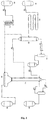
- Fig: 1 depicts the configuration of tubular reactor - stripper.
- the present invention discloses reaction process for synthesis of alkyl carbamate using urea and alcohol in a catalyst free environment and in an integrated system comprising a tubular reactor, wherein said tubular reactor is sized in such a way that it provides adequate residence time for the reaction to complete and achieve equilibrium conversion. Further, the tubular reactors are provided with stripper in series such that the ammonia formed during the reaction is drawn out under reduced pressure which enables the reversible reaction to proceed in the forward reaction and eliminates the excess use of the raw material thereby making the process cost effective.
- the present invention relates to a catalyst free process for synthesis of alkyl carbamate within an integrated system of at least one tubular reactor and a stripper in series, comprising reacting urea and an alcohol in said tubular reactor under autogenous pressure; wherein said process provides > 90% selectivity towards alkyl carbamate.
- the process of the present invention further comprises synthesis of di-alkyl carbonates, a useful intermediate, by reacting the alkyl carbamate formed with an alcohol in a DMC reactor column of the integrated system with a stripper in series.
- the process comprises reacting said alkyl carbamate and said di-alkyl carbonate in an additional tubular reactor with a stripper in series of the integrated system to obtain alkyl-N-alkyl carbamate with removal of carbondioxide and an alcohol which can be recycled/reused.
- the alcohol can be selected from, but is not limited to, methanol, ethanol, 1-propanol, 2-propanol, 1-butanol, 2-butanol, tert-butanol, pentanol and its isomers, hexanol and its isomers, their higher homologues or their isomers.
- the reaction for the synthesis of alkyl carbamates can be carried out continuously, semi-continuously or batch-wise.
- the order of the addition of the raw materials to the reactor is not critical, and the best way to add the material can be determined in orienting experiments.
- the ammonia formed during the reaction is removed from the tubular reactor using stripper arranged in series continuously or intermittently to shift the reaction equilibrium to the product side.
- reaction of urea and alcohol can be performed in a single tubular reactor or in multiple tubular reactors for complete conversion of urea with 95% selectivity towards Alkyl carbamates in a residence time of less than an hour..
- the temperature of the process in the tubular reactor for synthesis of alkyl carbamate is maintained at 150-250 °C, preferably 160-200°C, under autogenous pressure of about 5-30 bar.
- the ingredients urea and alcohol are fed in to the tubular reactor at a feed rate of 5-25 ml/min to obtain alkyl carbamate.
- the mole ratio of urea to alcohol is in the range of 10 to 50.
- the temperature for preparation of di-alkyl carbonate is in the range of 150 to 200°C and pressure maintained with help of Back pressure regulator is in the range of 15 to 30 bar.
- the tubular reactors can be of the material that can withstand the parameters of the reaction process without corrosion, crumbling and no reactivity towards the raw material used. Typically, the tubular reactors are sized in such a way that it provides adequate residence time and achieves equilibrium conversion. The dimensions of the tubular reactor are preferably 0.5 inch (12.7 millimetre) in diameter and 4m -9m in length.
- the present invention provides a configuration/integrated system wherein second stripper can be avoided, or second reactor can be attached to the reactor for the synthesis of Di alky carbonate in the next step.
- the integrated system of the present invention comprises:
- the catalyst free process for the synthesis of alkyl carbamate using an integrated system comprising at least one tubular column and a stripper in series comprises the steps of:
- the disclosed arrangement is shown in figure 1 .
- Urea is dissolved in alcohol in the urea - methanol feed vessel (1).
- the mixture is fed to the tubular reactor (2) at a particular feed rate.
- the tubular reactor (2) is heated externally under autogenous pressure to carry out a synthesis reaction producing alkyl carbamate and ammonia.
- the ammonia is removed from the tubular reactor (2) by means of the striper (3).
- the tubular reactor (2) and the stripper (3) are arranged in series to reduce the equilibrium limitations of the reaction and drive the reaction in forward direction.
- Alkyl carbamate obtained from the tubular reactor (2) is reacted with alcohol vapors in the DMC reactor (5) to obtain dialkyl carbonates.
- the alcohol vapors are obtained from the DMC reactor (5), arranged below the reactive distillation column (4), where the superheated alcohol is received from the alcohol feed vessel (6) and heated by the alcohol preheater and vaporizer (7). Dialkyl carbonate produced in the reaction in the distillation column (4) is collected in the top vessel (8) whereas the by products produced are collected in the bottom vessel (9).
- the simple and stable configuration of the integrated system comprising of at least one tubular reactor of said dimensions and stripper arranged in series to remove the ammonia formed during the production of alkyl carbamate from urea and alcohol provides adequate residence time for the reaction to go to completion by reducing the equilibrium limitations and driving the reaction in forward reaction to achieve > 90% selectivity towards alkyl carbamate.
- the alkyl carbamate produced by the process of the present invention can be used in the synthesis of isocyanates, urethane foams, coatings, as pesticides and insecticides.
- dialkyl carbonates obtained as intermediates in the further embodiment of the process find application as electrolytes in Lithium batteries, solvents etc.
- Example 1 The individual weights of ingredients in urea - methanol mixture were kept unchanged from Example 1. Similarly, the dimensions of the reactor, temperature inside reactor and the flow rate of the mixture were kept unchanged. The change from the Example 1 was the pressure of the reactor, which was maintained at 23 bar using back pressure regulator mounted downstream of the tubular reactor. HPLC analysis showed 78.4% urea conversion and GC analysis showed 95.8% MC selectivity.
- the ingredient mixure and the dimensions of the reactor were kept unchanged.
- the temperature inside the reactor was maintained at 180 °C.
- the flow rate of urea and methanol mixture was kept 7.5ml/min through the reactor, as in the Example 3.
- the pressure of the reactor was maintained at 28.5 bar using back pressure regulator mounted downstream of the tubular reactor.
- HPLC analysis showed 76% urea conversion and GC analysis showed 92.5% MC selectivity.
- the typical length of the reactor was chosen to be 9 meters.
- the temperature inside the reactor was maintained at 180 °C.
- the flow rate of urea and methanol mixture was adjusted at 12.3ml/min through the reactor.
- the pressure of the reactor was maintained at 28 bar.
- HPLC analysis showed 64% urea conversion and GC analysis showed 88% MC selectivity.
- Example 5 The typical length of the reactor and the temperature of the reactor were kept unchanged from Example 5.
- the mixture of urea and methanol was pumped at flow rate of 6.2 ml/min through the reactor.
- the pressure of the reactor was maintained at 28 bar using back pressure regulator mounted downstream of the tubular reactor.
- HPLC analysis showed 79% urea conversion and GC analysis showed 90% MC selectivity.
- the only variable was the flow rate which was kept at 24.6 ml/min through the reactor.
- the pressure of the reactor was maintained at 28 bar.
- HPLC analysis showed 53% urea conversion and GC analysis showed 88% MC selectivity.
- the temperature inside the reactor was maintained at 170 °C.
- the flow rate of the mixture was chosen to 18 ml/min through the reactor.
- the pressure of the reactor was maintained at 23 bar.
- HPLC analysis showed 88.3% urea conversion and GC analysis showed 92.9% MC selectivity.
- the typical length of the reactor was unchanged 9 meter.
- the temperature inside the reactor was maintained at 170 °C.
- the reaction flow rate was selected to be 18 ml/min through the reactor.
- the pressure of the reactor was maintained at 23 bar.
- HPLC analysis showed 93% urea conversion and GC analysis showed 99.4% MC selectivity.
- Example 10 all of the variables were same as in Example 8 and 9. HPLC analysis showed 90.8% urea conversion and GC analysis showed 97.2% MC selectivity.
- urea was dissolved into ethanol, propanol and butanol in different proportions.
- the outer diameter of the tubular reactor was 1/2" (12.7 millimetre) whereas the reactor length was chosen to be 4 meters throughout the experiment. The mixture is maintained between 185 - 190 degree.
Landscapes
- Chemical & Material Sciences (AREA)
- Organic Chemistry (AREA)
- Chemical Kinetics & Catalysis (AREA)
- Organic Low-Molecular-Weight Compounds And Preparation Thereof (AREA)
Claims (10)
- Un processus sans catalyseur pour la synthèse de carbamate d'alkyle, comprenant la réaction d'urée et d'un alcool dans un réacteur tubulaire sous pression autogène pour fournir une sélectivité de plus de 90 % vis-à-vis du carbamate d'alkyle, ledit processus étant réalisé dans un système intégré constitué d'au moins un réacteur tubulaire, chauffé extérieurement, et d'une colonne de rectification en série, et ledit réacteur tubulaire et ladite colonne de rectification étant montés en série pour réduire les contraintes d'équilibre de la réaction et entraîner la réaction.
- Le processus sans catalyseur selon la revendication 1, l'alcool étant choisi parmi le méthanol, l'éthanol, le propan-1-ol, le propan-2-ol, le butan-1-ol, le butan-2-ol, le tert-butanol, le pentanol et ses isomers, l'hexanol et ses isomers, leurs homologues supérieurs et leurs isomères.
- Le processus selon la revendication 1, une température du mélange de réaction se situant entre 150 et 250 C.
- Le processus sans catalyseur selon la revendication 1, de l'urée et de l'alcool dans un rapport molaire de situant entre 1:10 et 1:50 étant introduits dans le réacteur tubulaire à un rythme d'introduction de 5-25 ml/min.
- Le processus sans catalyseur selon la revendication 1, ledit processus pouvant être réalisé en continu, en semi-continu ou par lots.
- Le processus sans catalyseur selon la revendication 1, le processus consistant également à faire réagir ledit carbamate d'alkyle avec un alcool pour obtenir pour obtenir du carbonate de dialkyle dans ledit système intégré.
- Le processus sans catalyseur selon la revendication 1, ladite colonne de rectification extrayant l'ammoniaque formé pendant ledit processus.
- Le processus sans catalyseur selon la revendication 1, ledit carbamate d'alkyle obtenu est mis à réagir avec des vapeurs d'alcool pour obtenir des carbonates de dialkyle.
- Le processus sans catalyseur selon l'une quelconque des revendications précédentes, un diamètre des réacteurs tubulaires étant de 1/2" (environ 12.7 millimètres) et une longueur se situant entre 4 et 9 mètres pour atteindre le temps de séjour adéquat et un taux de conversion élevé de l'urée.
- Le processus sans catalyseur selon l'une quelconque des revendications précédentes, la température du réacteur tubulaire se situant entre 150 et 250 C.
Applications Claiming Priority (2)
| Application Number | Priority Date | Filing Date | Title |
|---|---|---|---|
| IN678DE2015 | 2015-03-13 | ||
| PCT/IN2016/050084 WO2016147204A1 (fr) | 2015-03-13 | 2016-03-11 | Nouvelle configuration et son utilisation dans un procédé de synthèse de carbamates d'alkyle à partir d'alcool alkylique et d'urée dans un réacteur tubulaire |
Publications (2)
| Publication Number | Publication Date |
|---|---|
| EP3268126A1 EP3268126A1 (fr) | 2018-01-17 |
| EP3268126B1 true EP3268126B1 (fr) | 2020-10-14 |
Family
ID=55969188
Family Applications (1)
| Application Number | Title | Priority Date | Filing Date |
|---|---|---|---|
| EP16722710.7A Active EP3268126B1 (fr) | 2015-03-13 | 2016-03-11 | Nouvelle configuration et son utilisation dans un procédé de synthèse de carbamates d'alkyle à partir d'alcool alkylique et d'urée dans un réacteur tubulaire |
Country Status (7)
| Country | Link |
|---|---|
| US (1) | US10487048B2 (fr) |
| EP (1) | EP3268126B1 (fr) |
| JP (1) | JP6864629B2 (fr) |
| KR (1) | KR102723345B1 (fr) |
| CN (1) | CN107771174A (fr) |
| ES (1) | ES2845695T3 (fr) |
| WO (1) | WO2016147204A1 (fr) |
Family Cites Families (8)
| Publication number | Priority date | Publication date | Assignee | Title |
|---|---|---|---|---|
| GB982785A (en) * | 1962-05-23 | 1965-02-10 | Grace W R & Co | A process for the preparation of carbamic acid esters |
| US6392078B1 (en) * | 2000-06-12 | 2002-05-21 | Catalytic Distillation Technologies | Process and catalyst for making dialkyl carbonates |
| US7074951B2 (en) * | 2004-03-12 | 2006-07-11 | Ryu J Yong | Process for making dialkyl carbonates |
| KR100899058B1 (ko) * | 2004-04-08 | 2009-05-25 | 캐털리틱 디스틸레이션 테크놀로지스 | 디알킬 카보네이트의 제조 방법 |
| CN101518729B (zh) | 2008-02-26 | 2013-04-24 | 拜耳材料科技(中国)有限公司 | 用于氨基甲酸烷基酯合成的催化剂及其制备方法和用途 |
| EP2917172B1 (fr) | 2012-11-09 | 2019-06-19 | Council of Scientific & Industrial Research | Synthèse de carbamate de méthyle et de carbonate de diméthyle (dmc) en présence de gaz inerte de réextraction ou de vapeurs surchauffées, et réacteur associé |
| CN103254101B (zh) * | 2013-04-03 | 2015-12-23 | 中北大学 | 制备氨基甲酸甲酯的方法及设备 |
| US10118110B2 (en) * | 2013-08-02 | 2018-11-06 | Asahi Kasei Chemicals Corporation | Reaction method accompanied by production of gas component |
-
2016
- 2016-03-11 CN CN201680023631.2A patent/CN107771174A/zh active Pending
- 2016-03-11 EP EP16722710.7A patent/EP3268126B1/fr active Active
- 2016-03-11 ES ES16722710T patent/ES2845695T3/es active Active
- 2016-03-11 WO PCT/IN2016/050084 patent/WO2016147204A1/fr not_active Ceased
- 2016-03-11 JP JP2017548265A patent/JP6864629B2/ja active Active
- 2016-03-11 US US15/558,072 patent/US10487048B2/en active Active
- 2016-03-11 KR KR1020177028773A patent/KR102723345B1/ko active Active
Non-Patent Citations (1)
| Title |
|---|
| None * |
Also Published As
| Publication number | Publication date |
|---|---|
| EP3268126A1 (fr) | 2018-01-17 |
| JP2018507902A (ja) | 2018-03-22 |
| KR20180011064A (ko) | 2018-01-31 |
| US20180079714A1 (en) | 2018-03-22 |
| ES2845695T3 (es) | 2021-07-27 |
| WO2016147204A1 (fr) | 2016-09-22 |
| KR102723345B1 (ko) | 2024-10-28 |
| US10487048B2 (en) | 2019-11-26 |
| JP6864629B2 (ja) | 2021-04-28 |
| CN107771174A (zh) | 2018-03-06 |
Similar Documents
| Publication | Publication Date | Title |
|---|---|---|
| EP2231587B1 (fr) | Procédé de préparation de bétaïnes | |
| JP6559067B2 (ja) | 不活性ガス又は過熱蒸気を用いた除去下におけるカルバミン酸メチル及び炭酸ジメチル(dmc)の合成並びにそのための反応器 | |
| EP3476838B1 (fr) | Procédé de préparation d'azoxystrobine | |
| EP3489216B1 (fr) | Procédé de fabrication de composé chloroformiate | |
| EP3539941B1 (fr) | Procédé de préparation triméthylolpropane | |
| US4448999A (en) | Process for the preparation of 2-aminopropanediol-1,3(serinol) | |
| EP0437258B1 (fr) | Méthode pour la préparation d'uréthanes aromatiques | |
| US11111205B2 (en) | Process for preparing alkanediol and dialkyl carbonate | |
| JPH0672982A (ja) | アルキルモノ−及びジイソシアネートの製法 | |
| EP1433772B1 (fr) | Procédé pour la préparation de 2-(alkyl)cycloalcénone | |
| EP4212533A1 (fr) | Procédé de préparation de dérivés de purine | |
| US20190084921A1 (en) | Method of preparation of 4-isopropylamino-1-butanol | |
| KR20220101115A (ko) | 하이드록삼산의 합성을 위한 연속 유동 프로세스 | |
| CN113861027A (zh) | 一种连续流合成氯甲酸酯类化合物的方法 | |
| US10487048B2 (en) | Configuration and its use in process for synthesis of alkyl carbamates from alkyl alcohol and urea in a tubular reactor | |
| KR20150001667A (ko) | 알릴 알코올의 제조방법 및 이에 의하여 제조된 알릴 알코올 | |
| RU2359958C2 (ru) | Способ получения n-алкил-о-алкилкарбаматов | |
| JP2022505786A (ja) | ヒドロキシエチルピペラジンの生成 | |
| Karmatskaya et al. | Environmentally friendly method of producing carbamates by transesterification: kinetics and mechanism | |
| CN110683952B (zh) | 使用氧化胺制备二碳酸二烷基酯的方法 | |
| EP2975018A1 (fr) | Procédé de nitrosation de phénol | |
| JP2001316332A (ja) | ジアルキルカーボネート製造方法 | |
| JP3981186B2 (ja) | 1,3−ジメチル−2−イミダゾリジノンの製造方法 | |
| JP2000344715A (ja) | 非対称炭酸エステルの製造方法 | |
| JP2003146921A (ja) | パーフルオロアルキル化合物の製造方法 |
Legal Events
| Date | Code | Title | Description |
|---|---|---|---|
| STAA | Information on the status of an ep patent application or granted ep patent |
Free format text: STATUS: THE INTERNATIONAL PUBLICATION HAS BEEN MADE |
|
| PUAI | Public reference made under article 153(3) epc to a published international application that has entered the european phase |
Free format text: ORIGINAL CODE: 0009012 |
|
| STAA | Information on the status of an ep patent application or granted ep patent |
Free format text: STATUS: REQUEST FOR EXAMINATION WAS MADE |
|
| 17P | Request for examination filed |
Effective date: 20171013 |
|
| AK | Designated contracting states |
Kind code of ref document: A1 Designated state(s): AL AT BE BG CH CY CZ DE DK EE ES FI FR GB GR HR HU IE IS IT LI LT LU LV MC MK MT NL NO PL PT RO RS SE SI SK SM TR |
|
| AX | Request for extension of the european patent |
Extension state: BA ME |
|
| DAV | Request for validation of the european patent (deleted) | ||
| DAX | Request for extension of the european patent (deleted) | ||
| STAA | Information on the status of an ep patent application or granted ep patent |
Free format text: STATUS: EXAMINATION IS IN PROGRESS |
|
| 17Q | First examination report despatched |
Effective date: 20190121 |
|
| GRAP | Despatch of communication of intention to grant a patent |
Free format text: ORIGINAL CODE: EPIDOSNIGR1 |
|
| STAA | Information on the status of an ep patent application or granted ep patent |
Free format text: STATUS: GRANT OF PATENT IS INTENDED |
|
| INTG | Intention to grant announced |
Effective date: 20200124 |
|
| GRAJ | Information related to disapproval of communication of intention to grant by the applicant or resumption of examination proceedings by the epo deleted |
Free format text: ORIGINAL CODE: EPIDOSDIGR1 |
|
| STAA | Information on the status of an ep patent application or granted ep patent |
Free format text: STATUS: EXAMINATION IS IN PROGRESS |
|
| GRAJ | Information related to disapproval of communication of intention to grant by the applicant or resumption of examination proceedings by the epo deleted |
Free format text: ORIGINAL CODE: EPIDOSDIGR1 |
|
| GRAP | Despatch of communication of intention to grant a patent |
Free format text: ORIGINAL CODE: EPIDOSNIGR1 |
|
| GRAP | Despatch of communication of intention to grant a patent |
Free format text: ORIGINAL CODE: EPIDOSNIGR1 |
|
| STAA | Information on the status of an ep patent application or granted ep patent |
Free format text: STATUS: GRANT OF PATENT IS INTENDED |
|
| INTC | Intention to grant announced (deleted) | ||
| INTG | Intention to grant announced |
Effective date: 20200618 |
|
| GRAS | Grant fee paid |
Free format text: ORIGINAL CODE: EPIDOSNIGR3 |
|
| GRAA | (expected) grant |
Free format text: ORIGINAL CODE: 0009210 |
|
| STAA | Information on the status of an ep patent application or granted ep patent |
Free format text: STATUS: THE PATENT HAS BEEN GRANTED |
|
| AK | Designated contracting states |
Kind code of ref document: B1 Designated state(s): AL AT BE BG CH CY CZ DE DK EE ES FI FR GB GR HR HU IE IS IT LI LT LU LV MC MK MT NL NO PL PT RO RS SE SI SK SM TR |
|
| REG | Reference to a national code |
Ref country code: GB Ref legal event code: FG4D |
|
| REG | Reference to a national code |
Ref country code: AT Ref legal event code: REF Ref document number: 1323047 Country of ref document: AT Kind code of ref document: T Effective date: 20201015 Ref country code: CH Ref legal event code: EP |
|
| REG | Reference to a national code |
Ref country code: DE Ref legal event code: R096 Ref document number: 602016045796 Country of ref document: DE |
|
| REG | Reference to a national code |
Ref country code: DE Ref legal event code: R082 Ref document number: 602016045796 Country of ref document: DE Representative=s name: MEISSNER BOLTE PATENTANWAELTE RECHTSANWAELTE P, DE |
|
| REG | Reference to a national code |
Ref country code: IE Ref legal event code: FG4D |
|
| REG | Reference to a national code |
Ref country code: NL Ref legal event code: FP |
|
| REG | Reference to a national code |
Ref country code: AT Ref legal event code: MK05 Ref document number: 1323047 Country of ref document: AT Kind code of ref document: T Effective date: 20201014 |
|
| PG25 | Lapsed in a contracting state [announced via postgrant information from national office to epo] |
Ref country code: NO Free format text: LAPSE BECAUSE OF FAILURE TO SUBMIT A TRANSLATION OF THE DESCRIPTION OR TO PAY THE FEE WITHIN THE PRESCRIBED TIME-LIMIT Effective date: 20210114 Ref country code: PT Free format text: LAPSE BECAUSE OF FAILURE TO SUBMIT A TRANSLATION OF THE DESCRIPTION OR TO PAY THE FEE WITHIN THE PRESCRIBED TIME-LIMIT Effective date: 20210215 Ref country code: RS Free format text: LAPSE BECAUSE OF FAILURE TO SUBMIT A TRANSLATION OF THE DESCRIPTION OR TO PAY THE FEE WITHIN THE PRESCRIBED TIME-LIMIT Effective date: 20201014 Ref country code: FI Free format text: LAPSE BECAUSE OF FAILURE TO SUBMIT A TRANSLATION OF THE DESCRIPTION OR TO PAY THE FEE WITHIN THE PRESCRIBED TIME-LIMIT Effective date: 20201014 Ref country code: GR Free format text: LAPSE BECAUSE OF FAILURE TO SUBMIT A TRANSLATION OF THE DESCRIPTION OR TO PAY THE FEE WITHIN THE PRESCRIBED TIME-LIMIT Effective date: 20210115 |
|
| REG | Reference to a national code |
Ref country code: LT Ref legal event code: MG4D |
|
| PG25 | Lapsed in a contracting state [announced via postgrant information from national office to epo] |
Ref country code: BG Free format text: LAPSE BECAUSE OF FAILURE TO SUBMIT A TRANSLATION OF THE DESCRIPTION OR TO PAY THE FEE WITHIN THE PRESCRIBED TIME-LIMIT Effective date: 20210114 Ref country code: PL Free format text: LAPSE BECAUSE OF FAILURE TO SUBMIT A TRANSLATION OF THE DESCRIPTION OR TO PAY THE FEE WITHIN THE PRESCRIBED TIME-LIMIT Effective date: 20201014 Ref country code: LV Free format text: LAPSE BECAUSE OF FAILURE TO SUBMIT A TRANSLATION OF THE DESCRIPTION OR TO PAY THE FEE WITHIN THE PRESCRIBED TIME-LIMIT Effective date: 20201014 Ref country code: IS Free format text: LAPSE BECAUSE OF FAILURE TO SUBMIT A TRANSLATION OF THE DESCRIPTION OR TO PAY THE FEE WITHIN THE PRESCRIBED TIME-LIMIT Effective date: 20210214 Ref country code: AT Free format text: LAPSE BECAUSE OF FAILURE TO SUBMIT A TRANSLATION OF THE DESCRIPTION OR TO PAY THE FEE WITHIN THE PRESCRIBED TIME-LIMIT Effective date: 20201014 Ref country code: SE Free format text: LAPSE BECAUSE OF FAILURE TO SUBMIT A TRANSLATION OF THE DESCRIPTION OR TO PAY THE FEE WITHIN THE PRESCRIBED TIME-LIMIT Effective date: 20201014 |
|
| PG25 | Lapsed in a contracting state [announced via postgrant information from national office to epo] |
Ref country code: HR Free format text: LAPSE BECAUSE OF FAILURE TO SUBMIT A TRANSLATION OF THE DESCRIPTION OR TO PAY THE FEE WITHIN THE PRESCRIBED TIME-LIMIT Effective date: 20201014 |
|
| REG | Reference to a national code |
Ref country code: DE Ref legal event code: R097 Ref document number: 602016045796 Country of ref document: DE |
|
| REG | Reference to a national code |
Ref country code: ES Ref legal event code: FG2A Ref document number: 2845695 Country of ref document: ES Kind code of ref document: T3 Effective date: 20210727 |
|
| PG25 | Lapsed in a contracting state [announced via postgrant information from national office to epo] |
Ref country code: CZ Free format text: LAPSE BECAUSE OF FAILURE TO SUBMIT A TRANSLATION OF THE DESCRIPTION OR TO PAY THE FEE WITHIN THE PRESCRIBED TIME-LIMIT Effective date: 20201014 Ref country code: EE Free format text: LAPSE BECAUSE OF FAILURE TO SUBMIT A TRANSLATION OF THE DESCRIPTION OR TO PAY THE FEE WITHIN THE PRESCRIBED TIME-LIMIT Effective date: 20201014 Ref country code: LT Free format text: LAPSE BECAUSE OF FAILURE TO SUBMIT A TRANSLATION OF THE DESCRIPTION OR TO PAY THE FEE WITHIN THE PRESCRIBED TIME-LIMIT Effective date: 20201014 Ref country code: SM Free format text: LAPSE BECAUSE OF FAILURE TO SUBMIT A TRANSLATION OF THE DESCRIPTION OR TO PAY THE FEE WITHIN THE PRESCRIBED TIME-LIMIT Effective date: 20201014 Ref country code: SK Free format text: LAPSE BECAUSE OF FAILURE TO SUBMIT A TRANSLATION OF THE DESCRIPTION OR TO PAY THE FEE WITHIN THE PRESCRIBED TIME-LIMIT Effective date: 20201014 Ref country code: RO Free format text: LAPSE BECAUSE OF FAILURE TO SUBMIT A TRANSLATION OF THE DESCRIPTION OR TO PAY THE FEE WITHIN THE PRESCRIBED TIME-LIMIT Effective date: 20201014 |
|
| PLBE | No opposition filed within time limit |
Free format text: ORIGINAL CODE: 0009261 |
|
| STAA | Information on the status of an ep patent application or granted ep patent |
Free format text: STATUS: NO OPPOSITION FILED WITHIN TIME LIMIT |
|
| PG25 | Lapsed in a contracting state [announced via postgrant information from national office to epo] |
Ref country code: DK Free format text: LAPSE BECAUSE OF FAILURE TO SUBMIT A TRANSLATION OF THE DESCRIPTION OR TO PAY THE FEE WITHIN THE PRESCRIBED TIME-LIMIT Effective date: 20201014 |
|
| 26N | No opposition filed |
Effective date: 20210715 |
|
| PG25 | Lapsed in a contracting state [announced via postgrant information from national office to epo] |
Ref country code: MC Free format text: LAPSE BECAUSE OF FAILURE TO SUBMIT A TRANSLATION OF THE DESCRIPTION OR TO PAY THE FEE WITHIN THE PRESCRIBED TIME-LIMIT Effective date: 20201014 Ref country code: AL Free format text: LAPSE BECAUSE OF FAILURE TO SUBMIT A TRANSLATION OF THE DESCRIPTION OR TO PAY THE FEE WITHIN THE PRESCRIBED TIME-LIMIT Effective date: 20201014 |
|
| REG | Reference to a national code |
Ref country code: CH Ref legal event code: PL |
|
| GBPC | Gb: european patent ceased through non-payment of renewal fee |
Effective date: 20210311 |
|
| PG25 | Lapsed in a contracting state [announced via postgrant information from national office to epo] |
Ref country code: SI Free format text: LAPSE BECAUSE OF FAILURE TO SUBMIT A TRANSLATION OF THE DESCRIPTION OR TO PAY THE FEE WITHIN THE PRESCRIBED TIME-LIMIT Effective date: 20201014 |
|
| REG | Reference to a national code |
Ref country code: BE Ref legal event code: MM Effective date: 20210331 |
|
| PG25 | Lapsed in a contracting state [announced via postgrant information from national office to epo] |
Ref country code: CH Free format text: LAPSE BECAUSE OF NON-PAYMENT OF DUE FEES Effective date: 20210331 Ref country code: LU Free format text: LAPSE BECAUSE OF NON-PAYMENT OF DUE FEES Effective date: 20210311 Ref country code: LI Free format text: LAPSE BECAUSE OF NON-PAYMENT OF DUE FEES Effective date: 20210331 Ref country code: GB Free format text: LAPSE BECAUSE OF NON-PAYMENT OF DUE FEES Effective date: 20210311 Ref country code: FR Free format text: LAPSE BECAUSE OF NON-PAYMENT OF DUE FEES Effective date: 20210331 Ref country code: IE Free format text: LAPSE BECAUSE OF NON-PAYMENT OF DUE FEES Effective date: 20210311 |
|
| PG25 | Lapsed in a contracting state [announced via postgrant information from national office to epo] |
Ref country code: IS Free format text: LAPSE BECAUSE OF FAILURE TO SUBMIT A TRANSLATION OF THE DESCRIPTION OR TO PAY THE FEE WITHIN THE PRESCRIBED TIME-LIMIT Effective date: 20210214 |
|
| PG25 | Lapsed in a contracting state [announced via postgrant information from national office to epo] |
Ref country code: BE Free format text: LAPSE BECAUSE OF NON-PAYMENT OF DUE FEES Effective date: 20210331 |
|
| PG25 | Lapsed in a contracting state [announced via postgrant information from national office to epo] |
Ref country code: CY Free format text: LAPSE BECAUSE OF FAILURE TO SUBMIT A TRANSLATION OF THE DESCRIPTION OR TO PAY THE FEE WITHIN THE PRESCRIBED TIME-LIMIT Effective date: 20201014 |
|
| P01 | Opt-out of the competence of the unified patent court (upc) registered |
Effective date: 20230529 |
|
| PG25 | Lapsed in a contracting state [announced via postgrant information from national office to epo] |
Ref country code: HU Free format text: LAPSE BECAUSE OF FAILURE TO SUBMIT A TRANSLATION OF THE DESCRIPTION OR TO PAY THE FEE WITHIN THE PRESCRIBED TIME-LIMIT; INVALID AB INITIO Effective date: 20160311 |
|
| PG25 | Lapsed in a contracting state [announced via postgrant information from national office to epo] |
Ref country code: MK Free format text: LAPSE BECAUSE OF FAILURE TO SUBMIT A TRANSLATION OF THE DESCRIPTION OR TO PAY THE FEE WITHIN THE PRESCRIBED TIME-LIMIT Effective date: 20201014 |
|
| PG25 | Lapsed in a contracting state [announced via postgrant information from national office to epo] |
Ref country code: MT Free format text: LAPSE BECAUSE OF FAILURE TO SUBMIT A TRANSLATION OF THE DESCRIPTION OR TO PAY THE FEE WITHIN THE PRESCRIBED TIME-LIMIT Effective date: 20201014 |
|
| PGFP | Annual fee paid to national office [announced via postgrant information from national office to epo] |
Ref country code: DE Payment date: 20250303 Year of fee payment: 10 |
|
| PGFP | Annual fee paid to national office [announced via postgrant information from national office to epo] |
Ref country code: NL Payment date: 20250319 Year of fee payment: 10 |
|
| PGFP | Annual fee paid to national office [announced via postgrant information from national office to epo] |
Ref country code: IT Payment date: 20250304 Year of fee payment: 10 |
|
| PGFP | Annual fee paid to national office [announced via postgrant information from national office to epo] |
Ref country code: ES Payment date: 20250403 Year of fee payment: 10 |
|
| PG25 | Lapsed in a contracting state [announced via postgrant information from national office to epo] |
Ref country code: TR Free format text: LAPSE BECAUSE OF FAILURE TO SUBMIT A TRANSLATION OF THE DESCRIPTION OR TO PAY THE FEE WITHIN THE PRESCRIBED TIME-LIMIT Effective date: 20201014 |