EP3272334A1 - Forme posologique pharmaceutique pour l'administration orale d'un inhibiteur de la famille bcl-2 - Google Patents
Forme posologique pharmaceutique pour l'administration orale d'un inhibiteur de la famille bcl-2 Download PDFInfo
- Publication number
- EP3272334A1 EP3272334A1 EP17181461.9A EP17181461A EP3272334A1 EP 3272334 A1 EP3272334 A1 EP 3272334A1 EP 17181461 A EP17181461 A EP 17181461A EP 3272334 A1 EP3272334 A1 EP 3272334A1
- Authority
- EP
- European Patent Office
- Prior art keywords
- cancer
- dosage form
- active ingredient
- pharmaceutically acceptable
- weight
- Prior art date
- Legal status (The legal status is an assumption and is not a legal conclusion. Google has not performed a legal analysis and makes no representation as to the accuracy of the status listed.)
- Granted
Links
Images


Classifications
-
- A—HUMAN NECESSITIES
- A61—MEDICAL OR VETERINARY SCIENCE; HYGIENE
- A61K—PREPARATIONS FOR MEDICAL, DENTAL OR TOILETRY PURPOSES
- A61K9/00—Medicinal preparations characterised by special physical form
-
- A—HUMAN NECESSITIES
- A61—MEDICAL OR VETERINARY SCIENCE; HYGIENE
- A61K—PREPARATIONS FOR MEDICAL, DENTAL OR TOILETRY PURPOSES
- A61K31/00—Medicinal preparations containing organic active ingredients
- A61K31/33—Heterocyclic compounds
- A61K31/395—Heterocyclic compounds having nitrogen as a ring hetero atom, e.g. guanethidine or rifamycins
- A61K31/535—Heterocyclic compounds having nitrogen as a ring hetero atom, e.g. guanethidine or rifamycins having six-membered rings with at least one nitrogen and one oxygen as the ring hetero atoms, e.g. 1,2-oxazines
- A61K31/5375—1,4-Oxazines, e.g. morpholine
- A61K31/5377—1,4-Oxazines, e.g. morpholine not condensed and containing further heterocyclic rings, e.g. timolol
-
- A—HUMAN NECESSITIES
- A61—MEDICAL OR VETERINARY SCIENCE; HYGIENE
- A61K—PREPARATIONS FOR MEDICAL, DENTAL OR TOILETRY PURPOSES
- A61K31/00—Medicinal preparations containing organic active ingredients
- A61K31/63—Compounds containing para-N-benzenesulfonyl-N-groups, e.g. sulfanilamide, p-nitrobenzenesulfonyl hydrazide
- A61K31/635—Compounds containing para-N-benzenesulfonyl-N-groups, e.g. sulfanilamide, p-nitrobenzenesulfonyl hydrazide having a heterocyclic ring, e.g. sulfadiazine
-
- A—HUMAN NECESSITIES
- A61—MEDICAL OR VETERINARY SCIENCE; HYGIENE
- A61K—PREPARATIONS FOR MEDICAL, DENTAL OR TOILETRY PURPOSES
- A61K9/00—Medicinal preparations characterised by special physical form
- A61K9/0012—Galenical forms characterised by the site of application
- A61K9/0053—Mouth and digestive tract, i.e. intraoral and peroral administration
-
- A—HUMAN NECESSITIES
- A61—MEDICAL OR VETERINARY SCIENCE; HYGIENE
- A61K—PREPARATIONS FOR MEDICAL, DENTAL OR TOILETRY PURPOSES
- A61K9/00—Medicinal preparations characterised by special physical form
- A61K9/14—Particulate form, e.g. powders, Processes for size reducing of pure drugs or the resulting products, Pure drug nanoparticles
-
- A—HUMAN NECESSITIES
- A61—MEDICAL OR VETERINARY SCIENCE; HYGIENE
- A61K—PREPARATIONS FOR MEDICAL, DENTAL OR TOILETRY PURPOSES
- A61K9/00—Medicinal preparations characterised by special physical form
- A61K9/14—Particulate form, e.g. powders, Processes for size reducing of pure drugs or the resulting products, Pure drug nanoparticles
- A61K9/141—Intimate drug-carrier mixtures characterised by the carrier, e.g. ordered mixtures, adsorbates, solid solutions, eutectica, co-dried, co-solubilised, co-kneaded, co-milled, co-ground products, co-precipitates, co-evaporates, co-extrudates, co-melts; Drug nanoparticles with adsorbed surface modifiers
- A61K9/146—Intimate drug-carrier mixtures characterised by the carrier, e.g. ordered mixtures, adsorbates, solid solutions, eutectica, co-dried, co-solubilised, co-kneaded, co-milled, co-ground products, co-precipitates, co-evaporates, co-extrudates, co-melts; Drug nanoparticles with adsorbed surface modifiers with organic macromolecular compounds
-
- A—HUMAN NECESSITIES
- A61—MEDICAL OR VETERINARY SCIENCE; HYGIENE
- A61K—PREPARATIONS FOR MEDICAL, DENTAL OR TOILETRY PURPOSES
- A61K9/00—Medicinal preparations characterised by special physical form
- A61K9/20—Pills, tablets, discs, rods
-
- A—HUMAN NECESSITIES
- A61—MEDICAL OR VETERINARY SCIENCE; HYGIENE
- A61K—PREPARATIONS FOR MEDICAL, DENTAL OR TOILETRY PURPOSES
- A61K9/00—Medicinal preparations characterised by special physical form
- A61K9/20—Pills, tablets, discs, rods
- A61K9/2004—Excipients; Inactive ingredients
- A61K9/2013—Organic compounds, e.g. phospholipids, fats
-
- A—HUMAN NECESSITIES
- A61—MEDICAL OR VETERINARY SCIENCE; HYGIENE
- A61K—PREPARATIONS FOR MEDICAL, DENTAL OR TOILETRY PURPOSES
- A61K9/00—Medicinal preparations characterised by special physical form
- A61K9/20—Pills, tablets, discs, rods
- A61K9/2004—Excipients; Inactive ingredients
- A61K9/2022—Organic macromolecular compounds
- A61K9/2027—Organic macromolecular compounds obtained by reactions only involving carbon-to-carbon unsaturated bonds, e.g. polyvinyl pyrrolidone, poly(meth)acrylates
-
- A—HUMAN NECESSITIES
- A61—MEDICAL OR VETERINARY SCIENCE; HYGIENE
- A61K—PREPARATIONS FOR MEDICAL, DENTAL OR TOILETRY PURPOSES
- A61K9/00—Medicinal preparations characterised by special physical form
- A61K9/20—Pills, tablets, discs, rods
- A61K9/2095—Tabletting processes
-
- A—HUMAN NECESSITIES
- A61—MEDICAL OR VETERINARY SCIENCE; HYGIENE
- A61K—PREPARATIONS FOR MEDICAL, DENTAL OR TOILETRY PURPOSES
- A61K9/00—Medicinal preparations characterised by special physical form
- A61K9/48—Preparations in capsules, e.g. of gelatin, of chocolate
- A61K9/4833—Encapsulating processes; Filling of capsules
-
- A—HUMAN NECESSITIES
- A61—MEDICAL OR VETERINARY SCIENCE; HYGIENE
- A61P—SPECIFIC THERAPEUTIC ACTIVITY OF CHEMICAL COMPOUNDS OR MEDICINAL PREPARATIONS
- A61P35/00—Antineoplastic agents
-
- A—HUMAN NECESSITIES
- A61—MEDICAL OR VETERINARY SCIENCE; HYGIENE
- A61P—SPECIFIC THERAPEUTIC ACTIVITY OF CHEMICAL COMPOUNDS OR MEDICINAL PREPARATIONS
- A61P35/00—Antineoplastic agents
- A61P35/02—Antineoplastic agents specific for leukemia
-
- A—HUMAN NECESSITIES
- A61—MEDICAL OR VETERINARY SCIENCE; HYGIENE
- A61K—PREPARATIONS FOR MEDICAL, DENTAL OR TOILETRY PURPOSES
- A61K2121/00—Preparations for use in therapy
Definitions
- the present invention relates to a pharmaceutical dosage form for oral administration of Bcl-2 family inhibitors, a method of preparing the dosage form and a method of treating proliferative disorders.
- Proteins of the Bcl-2 family enable cells to evade apoptosis. These proteins are implicated in cancer and other proliferative diseases. They are often upregulated in cancer cells, where they sequester and neutralize proapoptotic proteins, thus enabling the survival of the cancer cells despite the presence of apoptosis-triggering signals. Consequently inhibitors of Bcl-2 family proteins are useful candidates for cancer therapy. Several inhibitors have been described, for example in WO 2007/040650 .
- a preferred Bcl-2 family inhibitor is N-(4-(4-((2-(4-chlorophenyl)-5,5-dimethyl-1-cyclohex-1-en-1-yl)methyl)piperazin-1-yl)benzoyl)-4-(((1R)-3-(morpholin-4-yl)-1-((phenyl-sulfanyl)methyl)propyl)amino)-3-((trifluoromethyl)sulfonyl)benzenesulfonamide (ABT-263), the preparation of which is described in US 2007/0027135 . The molecular structure of ABT-263 is depicted below:
- a measure of the potential usefulness of an oral dosage form of a pharmaceutical agent is the bioavailability observed after oral administration of the dosage form.
- Various factors can affect the bioavailability of a drug when administered orally. These factors include aqueous solubility, drug absorption throughout the gastrointestinal tract, dosage strength and first-pass effect. Aqueous solubility is one of the most important of these factors.
- a solid dosage form is usually preferred over a liquid dosage form.
- oral solid dosage forms of a drug provide a lower bioavailability than oral solutions of the drug.
- Solid solutions are preferred physical systems because the components therein readily form liquid solutions when contacted with a liquid medium such as gastric juice.
- the ease of dissolution may be attributed at least in part to the fact that the energy required for dissolution of the components from a solid solution is less than that required for the dissolution of the components from a crystalline or microcrystalline solid phase. It is, however, important that the drug released from the solid solution remains water-solubilized in the aqueous fluids of the gastrointestinal tract; otherwise, the drug may precipitate in the gastrointestinal tract, resulting in low bioavailability.
- WO 01/00175 discloses mechanically stable pharmaceutical dosage forms which are solid solutions of active ingredients in an auxiliary agent matrix.
- the matrix contains a homopolymer or a copolymer of N-vinyl pyrrolidone and a liquid or semi-solid surfactant.
- WO 00/57854 discloses mechanically stable pharmaceutical dosage forms for peroral administration which contain at least one active compound, at least one thermo-plastically mouldable, matrix-forming auxiliary and more than 10% and up to 40% by weight of a surface-active substance that has an HLB of between 2 and 18, is liquid at 20°C, or has a drop point at between 20 °C and 50°C.
- US 2005/0208082 discloses a solubilizing composition comprising a mixture of vitamin E TPGS and linoleic acid.
- the solubilizing composition is used to disperse a lipophile in an aqueous phase.
- the lipophile may be a therapeutically effective lipophile such as lipophilic vitamins, coenzyme Q10, carotenoids, alpha-lipoic acid or essential fatty acids.
- US 2005/0236236 discloses pharmaceutical compositions for administration of hydrophobic drugs, particularly steroids.
- the pharmaceutical compositions include a hydrophobic drug, a vitamin E substance and a surfactant.
- the reference claims a synergistic effect between the hydrophobic drug and the vitamin E substance.
- ABT-263 Due to the presence of a sulfanyl group in its molecular structure, ABT-263 is prone to oxidation to sulfoxides which do not retain the therapeutic effect of ABT-263. For this reasons, oral liquid solutions of ABT-263 have been prepared immediately prior to use.
- a solid dispersion of ABT-263 and at least one pharmaceutically acceptable polymer not only shows adequate bioavailability after oral administration but also results in a storage-stable, ready-to-use dosage form.
- the ABT-263 molecule despite its essentially non-crystalline amorphous state, is largely resistant against oxidation even in presence of only a minor amount of antioxidant or the absence of an antioxidant.
- "Essentially non-crystalline amorphous state” means no more than 5%, preferably no more than 2% crystallinity, determined by X-ray diffraction analysis, and most preferably no detectable crystallinity, determined by polarization microscopy.
- the invention relates to a pharmaceutical dosage form which comprises a solid dispersion product comprising a pharmaceutically active ingredient, at least one pharmaceutically acceptable polymer, and at least one pharmaceutically acceptable solubilizer, said pharmaceutically active ingredient being N-(4-(4-((2-(4-chlorophenyl)-5,5-dimethyl-1-cyclohex-1-en-1-yl)methyl)piperazin-1-yl)benzoyl)-4-(((1R)-3-(morpholin-4-yl)-1-((phenylsulfanyl)methyl)propyl)amino)-3-((trifluoromethyl)sulfonyl)benzenesulfonamide, a salt, hydrate or solvate thereof.
- the active ingredient is present as a solid dispersion or as a solid solution.
- solid dispersion defines a system in a solid state (as opposed to a liquid or gaseous state) comprising at least two components, wherein one component is dispersed evenly throughout the other component or components.
- the active ingredient or combination of active ingredients is dispersed in a matrix comprised of the pharmaceutically acceptable polymer(s) and pharmaceutically acceptable solubilizers.
- solid dispersion encompasses systems having small particles, typically of less than 1 ⁇ m in diameter, of one phase dispersed in another phase.
- a solid dispersion is a homogeneous, glassy system in which a solute is dissolved in a glassy solvent. Glassy solutions and solid solutions are preferred physical systems. These systems do not contain any significant amounts of active ingredients in their crystalline or microcrystalline state, as evidenced by thermal analysis (DSC) or X-ray diffraction analysis (WAXS).
- the dosage forms according to the invention are characterized by an excellent stability and, in particular, exhibit high resistance against recrystallization or decomposition of the active ingredient(s).
- the dosage forms of the present invention exhibit a release and absorption behaviour that is characterized by high attainable AUC (area under the plasma concentration-time curve from 0 to 48 hours or other indicated time intervals), high attainable C max (maximum plasma concentration), and low T max (time to reach maximum plasma concentration).
- AUC means "Area Under the Curve” and is used in its normal meaning, i.e., as the area under the plasma concentration-time curve.
- AUC 0-48 and “AUC 0-24” refer to the area under the plasma concentration-time curve from 0 to 48 hours or from 0 hours to 24 hours, respectively.
- the dispersion formed upon contact with an aqueous liquid may also be useful as such, for example as oral liquid dosage form or parenteral injections.
- the solid dispersion product comprises
- the dosage form of the invention may consist entirely of solid dispersion product, additives and adjuvants are usually used in formulating the solid dispersion product into the dosage forms.
- the dosage form comprises at least 10% by weight, preferably at least 40% by weight, and most preferred at least 45% by weight, of solid dispersion product, based on the total weight of the solid dosage form.
- a single dosage form of the invention contains the equivalent of about 50 mg to about 1000 mg, preferably about 75 mg to about 600 mg, in particular about 100 mg to about 500 mg, of ABT-263.
- the inventive dosage form comprises ABT-263 or a combination of ABT-263 with one or more other Bcl-2 family inhibitors.
- the dosage form may comprise a combination of ABT-263 and at least one further active ingredient.
- ABT-263 may exist as acid addition salts, basic addition salts or zwitterions. Salts of ABT-263 are prepared during their isolation or following their purification. Acid addition salts are those derived from the reaction of ABT-263 with acid. Accordingly, salts including the acetate, adipate, alginate, bicarbonate, citrate, aspartate, benzoate, benzenesulfonate (besylate), bisulfate, butyrate, camphorate, camphorsulfonate, digluconate, formate, fumarate, glycerophosphate, glutamate, hemisulfate, heptanoate, hexanoate, hydrochloride, hydrobromide, hydroiodide, lactobionate, lactate, maleate, mesitylenesulfonate, methanesulfonate, naphthylenesulfonate, nicotinate, oxalate, pamoate, pect
- the pharmaceutically active ingredient is selected from the group consisting of the free base, the sodium salt and the dihydrochloride of ABT-263, or combinations thereof. In a preferred embodiment the pharmaceutically active ingredient is the free base of ABT-263.
- solubilizer refers to a pharmaceutically acceptable non-ionic surfactant.
- the solubilizer may effectuate an instantaneous emulsification of the active ingredient released from the dosage form and/or prevent precipitation of the active ingredient in the aqueous fluids of the gastrointestinal tract.
- a single solubilizer as well as combinations of solubilizers may be used.
- the solubilizer may be selected from the group consisting on non-ionic solubilizers, anionic solubilizers and combinations thereof.
- the solid dispersion product comprises a combination of two or more pharmaceutically acceptable solubilizers.
- the pharmaceutically acceptable non-ionic solubilizer is selected from the group consisting of polyol fatty acid esters, polyalkoxylated polyol fatty acid esters, polyalkoxylated fatty alcohol ethers, tocopheryl compounds or mixtures of two or more thereof, and the pharmaceutically acceptable anionic solubilizer is selected from the group consisting of alkyl sulfates, alkylcarboxylates, alkylbenzole sulfates and secondary alkane sulfonates.
- Preferred non-ionic solubilizers are selected from sorbitan fatty acid esters, polyalkoxylated fatty acid esters such as, for example, polyalkoxylated glycerides, polyalkoxylated sorbitan fatty acid esters or fatty acid esters of polyalkylene glycols, polyalkoxylated ethers of fatty alcohols, tocopheryl compounds or mixtures of two or more thereof.
- a fatty acid chain in these compounds ordinarily comprises from 8 to 22 carbon atoms.
- the polyalkylene oxide blocks comprise on average from 4 to 50 alkylene oxide units, preferably ethylene oxide units, per molecule.
- Suitable sorbitan fatty acid esters are sorbitan monolaurate, sorbitan monopalmitate, sorbitan monostearate (Span® 60), sorbitan monooleate (Span® 80), sorbitan tristearate, sorbitan trioleate, sorbitan monostearate, sorbitan monolaurate or sorbitan monooleate.
- Suitable polyalkoxylated sorbitan fatty acid esters are polyoxyethylene (20) sorbitan monolaurate, polyoxyethylene (20) sorbitan monopalmitate, polyoxyethylene (20) sorbitan monostearate, polyoxyethylene (20) sorbitan monooleate (Tween® 80), polyoxyethylene (20) sorbitan tristearate (Tween® 65), polyoxyethylene (20) sorbitan trioleate (Tween® 85), polyoxyethylene (4) sorbitan monostearate, polyoxyethylene (4) sorbitan monolaurate or polyoxyethylene (4) sorbitan monooleate.
- Suitable polyalkoxylated glycerides are obtained for example by alkoxylation of natural or hydrogenated glycerides or by transesterification of natural or hydrogenated glycerides with polyalkylene glycols.
- Commercially available examples are polyoxyethylene glycerol ricinoleate 35, polyoxyethylene glycerol trihydroxystearate 40 (Cremophor® RH40, BASF AG) and polyalkoxylated glycerides like those obtainable under the proprietary names Gelucire® and Labrafil® from Gattefosse, e .
- Gelucire® 44/14 (lauroyl macrogol 32 glycerides prepared by transesterification of hydrogenated palm kernel oil with PEG 1500), Gelucire® 50/13 (stearoyl macrogol 32 glycerides, prepared by transesterification of hydrogenated palm oil with PEG 1500) or Labrafil M1944 CS (oleoyl macrogol 6 glycerides prepared by transesterification of apricot kernel oil with PEG 300).
- a suitable fatty acid ester of polyalkylene glycols is, for example, PEG 660 hydroxystearic acid (polyglycol ester of 12-hydroxystearic acid (70 mol %) with 30 mol % ethylene glycol).
- Suitable polyalkoxylated ethers of fatty alcohols are, for example, PEG (2) stearyl ether (Brij® 72), macrogol 6 cetylstearyl ether or macrogol 25 cetylstearyl ether.
- the tocopheryl compound corresponds to the formula below wherein Z is a linking group, R 1 and R 2 are, independently of one another, hydrogen or C 1 -C 4 alkyl and n is an integer from 5 to 100, preferably 10 to 50.
- Z is the residue of an aliphatic dibasic acid such as glutaric, succinic, or adipic acid.
- both R 1 and R 2 are hydrogen.
- the preferred tocopheryl compound is alpha tocopheryl polyethylene glycol succinate, which is commonly abbreviated as vitamin E-TPGS.
- Vitamin E-TPGS is a water-soluble form of natural-source vitamin E prepared by esterifying d-alpha-tocopheryl acid succinate with polyethylene glycol 1000.
- Vitamin E-TPGS is available from Eastman Chemical Company, Kingsport, TN, USA, or from Cognis (Düsseldorf, Germany) and is listed in the US Pharmacopeia and National Formulary (NF).
- the pharmaceutically acceptable solubilizer is selected from the group consisting of tocopheryl compounds having a polyalkylene glycol moiety (such as ⁇ -tocopheryl polyethylene glycol succinate), sorbitan fatty acid esters (such as sorbitan monolaurate) and polyoxyethylene sorbitan fatty acid esters (such as polyoxyethylene sorbitan monolaurate) and combinations of two or more thereof.
- tocopheryl compounds having a polyalkylene glycol moiety such as ⁇ -tocopheryl polyethylene glycol succinate
- sorbitan fatty acid esters such as sorbitan monolaurate
- polyoxyethylene sorbitan fatty acid esters such as polyoxyethylene sorbitan monolaurate
- the dosage form comprises at least one pharmaceutically acceptable non-ionic solubilizer and at least one pharmaceutically acceptable anionic solubilizer.
- the pharmaceutically acceptable non-ionic solubilizer is selected from the group consisting of sorbitan fatty acid esters, polyoxyethylene sorbitan fatty acid esters and ⁇ -tocopheryl polyethylene glycol succinate (also referred to herein as Vitamin E-TPGS or Vit. E-TPGS); and the pharmaceutically acceptable anionic solubilizer is sodium laurylsulfate (also referred to herein as SDS).
- ABT-263 such as the dihydrochloride of ABT-263.
- Formation of a ABT-263 solid solution can be promoted by incorporating a non-volatile solvent for the pharmaceutically active ingredient into the solid dispersion product.
- the non-volatile solvent is suitably selected from solvents with high dissolving power for ABT-263, which are liquid at ambient temperature and ambient pressure.
- Nonlimiting examples of suitable solvents comprise liquid polyethylene glycols, e.g., polyethylene glycol 400 (PEG-400); N-methylpyrrolidone; 1,3-bis(pyrrolidon-1-yl)-butane; and propylene glycol.
- a preferred solvent is propylene glycol.
- the amount of the non-volatile solvent to be used should not be so high as to compromise the mechanical properties of the solid dispersion product and usually is 2% to 10% by weight, based on the weight of the solid dispersion product, e . g ., 3% to 5% by weight.
- the pharmaceutically acceptable polymer may be selected from water-soluble polymers, water-dispersible polymers or water-swellable polymers or any mixture thereof. Polymers are considered water-soluble if they form a clear homogeneous solution in water. When dissolved at 20°C in an aqueous solution at 2% (w/v), the water-soluble polymer preferably has an apparent viscosity of 1 to 5000 mPa.s, more preferably of 1 to 700 mPa.s, and most preferably of 5 to 100 mPa.s. Water-dispersible polymers are those that, when contacted with water, form colloidal dispersions rather than a clear solution. Upon contact with water or aqueous solutions, water-swellable polymers typically form a rubbery gel.
- the pharmaceutically acceptable polymer employed in the invention has a Tg of at least 40°C, preferably at least +50°C, most preferably from 80°C to 180°C.
- Tg means glass transition temperature.
- Tg values for the homopolymers may be taken from " Polymer Handbook", 2nd Edition by J. Brandrup and E.H. Immergut, Editors, published by John Wiley & Sons, Inc., 1975 .
- the final solid dispersion product has a Tg of 20°C or higher, preferably 25°C or higher, more preferably 30°C or higher and most preferred 40°C or higher, e.g., a Tg from about 45°C to about 60°C.
- preferred pharmaceutically acceptable polymers can be selected from the group comprising homopolymers and copolymers of N-vinyl lactams, especially homopolymers and copolymers of N-vinyl pyrrolidone, e .
- polyvinylpyrrolidone PVP
- copolymers of N-vinyl pyrrolidone and vinyl acetate or vinyl propionate cellulose esters and cellulose ethers, in particular methylcellulose and ethylcellulose, hydroxyalkylcelluloses, in particular hydroxypropylcellulose, hydroxyalkylalkylcelluloses, in particular hydroxypropylmethylcellulose, cellulose phthalates or succinates, in particular cellulose acetate phthalate and hydroxypropylmethylcellulose phthalate, hydroxypropylmethylcellulose succinate or hydroxypropylmethylcellulose acetate succinate; high molecular polyalkylene oxides such as polyethylene oxide and polypropylene oxide and copolymers of ethylene oxide and propylene oxide, polyvinyl alcohol-polyethylene glycol-graft copolymers (available as Kollicoat® IR from BASF AG, Ludwigshafen, Germany); polyacrylates and polymethacrylates such as methacrylic acid/ethacrylate
- homopolymers or copolymers of N-vinyl pyrrolidone in particular a copolymer of N-vinyl pyrrolidone and vinyl acetate, are preferred.
- a particularly preferred polymer is a copolymer of 60% by weight of the copolymer, N-vinyl pyrrolidone and 40% by weight of the copolymer, vinyl acetate.
- a further polymer which can be suitably used is Kollidon® SR (available from BASF AG, Ludwigshafen, Germany) which comprises a mixture of PVP and polyvinylacetate.
- the solid dispersion product of the pharmaceutically active ingredient may be prepared by a variety of methods.
- the solid dispersion product is prepared by melt-extrusion.
- the solid dispersion product is a melt-processed, solidified mixture.
- the melt-extrusion process comprises the steps of preparing a homogeneous melt of the active ingredient or the combination of active ingredients, the pharmaceutically acceptable polymer and the solubilizers, and cooling the melt until it solidifies.
- Melting means a transition into a liquid or rubbery state in which it is possible for one component to become homogeneously embedded in the other. Typically, one component will melt and the other components will dissolve in the melt, thus forming a solution. Melting usually involves heating above the softening point of the pharmaceutically acceptable polymer.
- the preparation of the melt can take place in a variety of ways.
- the mixing of the components can take place before, during or after the formation of the melt.
- the components can be mixed first and then melted or simultaneously mixed and melted.
- the melt is homogenized in order to disperse the active ingredients efficiently.
- it may be convenient first to melt the pharmaceutically acceptable polymer and then to admix and homogenize the active ingredients.
- the melt temperature is in the range of 70°C to 250°C, preferably 80°C to 180°C, most preferably 100°C to 140°C.
- the active ingredients can be employed as such or as a solution or dispersion in a suitable solvent such as alcohols, aliphatic hydrocarbons or esters.
- a suitable solvent such as alcohols, aliphatic hydrocarbons or esters.
- Another solvent which can be used is liquid carbon dioxide.
- the solvent is removed, e . g ., evaporated, upon preparation of the melt.
- solid dispersions of the pharmaceutically active ingredient can also be prepared with a non-volatile solvent for the pharmaceutically active ingredient as previously mentioned.
- additives may be included in the melt, for example flow regulators such as colloidal silica; lubricants, bulking agents (fillers), disintegrants, plasticizers, stabilizers such as antioxidants, light stabilizers, radical scavengers, or stabilizers against microbial attack.
- extruders or kneaders include single screw extruders, intermeshing screw extruders or else multiscrew extruders, preferably twin screw extruders, which can be corotating or counterrotating and, optionally, equipped with kneading disks or other screw elements for mixing or dispersing the melt.
- working temperatures will also be determined by the kind of extruder or the kind of configuration within the extruder used.
- Part of the energy needed to melt, mix and dissolve the components in the extruder can be provided by heating elements.
- the friction and shearing of the material in the extruder may also provide a substantial amount of energy to the mixture and aid in the formation of a homogeneous melt of the components.
- the extrudate exiting from the extruder ranges from pasty to viscous.
- the extrudate Before allowing the extrudate to solidify, the extrudate may be directly shaped into virtually any desired shape. Shaping of the extrudate may be conveniently carried out by a calender with two counter-rotating rollers with mutually matching depressions on their surface. A broad range of tablet forms can be attained by using rollers with different forms of depressions. If the rollers do not have depressions on their surface, films can be obtained.
- the extrudate is moulded into the desired shape by injection-moulding.
- the extrudate is subjected to profile extrusion and cut into pieces, either before (hot-cut) or after solidification (cold-cut).
- foams can be formed if the extrudate contains a propellant such as a gas, e.g., carbon dioxide, or a volatile compound, e.g., a low molecular-weight hydrocarbon, or a compound that is thermally decomposable to a gas.
- a propellant such as a gas, e.g., carbon dioxide, or a volatile compound, e.g., a low molecular-weight hydrocarbon, or a compound that is thermally decomposable to a gas.
- the propellant is dissolved in the extrudate under the relatively high pressure conditions within the extruder and, when the extrudate emerges from the extruder die, the pressure is suddenly released. Thus the solvability of the propellant is decreased and/or the propellant vaporises so that a foam is formed.
- the resulting solid solution product is milled or ground to granules.
- the granules may then be filled into capsules or may be compacted.
- Compacting means a process whereby a powder mass comprising the granules is densified under high pressure in order to obtain a compact with low porosity, e . g ., a tablet. Compression of the powder mass is usually done in a tablet press, more specifically in a steel die between two moving punches.
- the solid dosage form contains at least one additive selected from flow regulators, disintegrants, bulking agents and lubricants.
- At least one additive selected from flow regulators, disintegrants, bulking agents (fillers) and lubricants is preferably used in compacting the granules.
- Disintegrants promote a rapid disintegration of the compact in the stomach and keep the liberated granules separate from one another.
- Suitable disintegrants are crosslinked polymers such as crosslinked polyvinyl pyrrolidone and crosslinked sodium carboxymethyl cellulose.
- Suitable bulking agents also referred to as "fillers” are selected from mannitol, lactose, calcium hydrogen phosphate, microcrystalline cellulose (Avicel®), magnesium oxide, potato or corn starch, isomalt, polyvinyl alcohol.
- Suitable flow regulators are selected from highly dispersed silica (Aerosil®) (also referred to herein as colloidal silicone dioxide), and animal or vegetable fats or waxes.
- a lubricant is preferably used in compacting the granules.
- Suitable lubricants are selected from polyethylene glycol (e . g ., having a molecular weight of from 1000 to 6000), magnesium and calcium stearates, sodium stearyl fumarate, talc, and the like.
- additives for example dyes such as azo dyes, organic or inorganic pigments such as aluminium oxide or titanium dioxide, or dyes of natural origin; stabilizers such as antioxidants, light stabilizers, radical scavengers, or stabilizers against microbial attack.
- dyes such as azo dyes, organic or inorganic pigments such as aluminium oxide or titanium dioxide, or dyes of natural origin
- stabilizers such as antioxidants, light stabilizers, radical scavengers, or stabilizers against microbial attack.
- antioxidants comprise Vitamin E or derivatives thereof (e.g., Vitamin E-TPGS), butylhydroxytoluene (BTH), cysteine and ascorbic acid or derivatives thereof.
- the ABT-263 molecule is sensitive to thermal and/or oxidative degradation, giving rise to several degradation products, the exact structure of which has not been completely elucidated. It is believed that the major degradation products are sulfoxides formed by oxidation of the sulfanyl group of ABT-263.
- the tentative formula of the sulfoxide degradation product is shown below. It is apparent to the skilled person that the sulphur atom constitutes an asymmetry centre, giving rise to various diastereomeric forms, all of which should be included in the term "sulfoxide degradation products".
- the dosage form comprises less than 1.5% by weight of sulfoxide decomposition products of the active ingredient, more preferably less than 1.2% and most preferably less than 0.9% by weight of sulfoxide decomposition products of the active ingredient, relative to the weight of the active ingredient.
- a further aspect of the invention relates to a method of preparing a solid dosage form according to the invention, wherein a) a homogeneous melt of the pharmaceutically active ingredient, a salt, hydrate or solvate thereof, of the at least one pharmaceutically acceptable polymer and of the at least one solubilizer is prepared, and b) the melt is allowed to solidify to obtain a solid dispersion product.
- the method additionally comprises grinding said solid dispersion product and compressing said solid dispersion product into a tablet.
- Dosage forms according to the invention may be provided as dosage forms consisting of several layers, for example laminated or multilayer tablets. They can be in open or closed form. "Closed dosage forms" are those in which one layer is completely surrounded by at least one other layer. Multilayer forms have the advantage that two active ingredients which are incompatible with one another can be processed, or that the release characteristics of the active ingredient(s) can be controlled. For example, it is possible to provide an initial dose by including an active ingredient in one of the outer layers, and a maintenance dose by including the active ingredient in the inner layer(s). Multilayer tablet types may be produced by compressing two or more layers of granules. Alternatively, multilayer dosage forms may be produced by a process known as "coextrusion".
- the process comprises the preparation of at least two different melt compositions as explained above, and passing these molten compositions into a joint coextrusion die.
- the shape of the coextrusion die depends on the required drug form. For example, dies with a plain die gap, called slot dies, and dies with an annular slit are suitable.
- the dosage form In order to facilitate the intake of such a dosage form by a mammal, it is advantageous to give the dosage form an appropriate shape. Large tablets that can be swallowed comfortably are therefore preferably elongated rather than round in shape.
- a film coat on the tablet further contributes to the ease with which it can be swallowed.
- a film coat also improves taste and provides an elegant appearance.
- the film coat may be an enteric coat.
- the film coat usually includes a polymeric film-forming material such as hydroxypropylmethylcellulose, hydroxypropylcellulose, and acrylate or methacrylate copolymers.
- the film coat may further comprise a plasticizer, e.g., polyethylene glycol, a surfactant, e.g., a Tween® type, and optionally a pigment, e . g ., titanium dioxide or iron oxides.
- the film-coating may also comprise talc as anti-adhesive.
- the film coat usually accounts for less than about 5% by weight of the dosage form.
- the method additionally comprises grinding said solid dispersion product and filling said solid dispersion product into a capsule shell.
- Suitable materials for capsule shells are known in the art, and comprise for example gelatin, gums such as carrageenan or gellan, and cellulose or cellulose derivatives such as hydroxypropylmethylcellulose.
- the dosage form is used for treating a disease during which is overexpressed one or more of antiapoptotic Bcl-2 protein, antiapoptotic Bcl-X L protein and antiapoptotic Bcl-w protein.
- the dosage form is used in a method for treating diseases of abnormal cell growth and/or dysregulated apoptosis, particularly proliferative disorders, comprising administering the dosage form to a subject in need thereof, and/or is used for manufacturing of a medicament for treating diseases of abnormal cell growth and/or dysregulated apoptosis, particularly proliferative disorders, wherein the treatment comprises administering the dosage form to a subject in need thereof.
- the dosage forms of the invention are useful for treating proliferative disorders, especially tumors or cancers.
- the proliferative disorder may be selected from the group consisting of mesothelioma, bladder cancer, pancreatic cancer, skin cancer, cancer of the head or neck, cutaneous or intraocular melanoma, ovarian cancer, breast cancer, uterine cancer, carcinoma of the fallopian tubes, carcinoma of the endometrium, carcinoma of the cervix, carcinoma of the vagina, carcinoma of the vulva, bone cancer, cervical cancer, colon cancer, rectal cancer, cancer of the anal region, stomach cancer, gastrointestinal (gastric, colorectal and duodenal) cancer, chronic lymphocytic leukemia, acute lymphocytic leukemia, esophageal cancer, cancer of the small intestine, cancer of the endocrine system, cancer of the thyroid gland, cancer of the parathyroid gland, cancer of the adrenal gland, sarcoma of soft tissue, cancer of the urethra, cancer
- the exact dose and frequency of administration depends on the particular condition being treated, the age, weight and general physical condition of the particular patient as well as other medication the individual may be taking, as is well known to those skilled in the art.
- the pharmaceutical dosage form of the present invention may be administered together with additional pharmaceutically active ingredients or comprise additional pharmaceutically active ingredients.
- Said additional pharmaceutically active ingredients may be compounds which are known to be useful for the treatment of proliferative disorders, either alone or in combination with other compounds.
- Combination therapies illustratively include administration of a composition of the present invention concomitantly with one or more of bortezomib, carboplatin, cisplatin, cyclophosphamide, dacarbazine, dexamethasone, docetaxel, doxorubicin, etoposide, fludarabine, irinotecan, paclitaxel, rapamycin, rituximab, vincristine and the like, for example with a polytherapy such as CHOP (cyclophosphamide + doxorubicin + vincristine + prednisone), RCVP (rituximab + cyclophosphamide + vincristine + prednisone), R-CHOP (rituximab + CHOP) or DA-EPOCH-R (dose-adjusted etoposide, prednisone, vincristine, cyclophosphamide
- a composition of the invention can be administered in combination therapy with one or more therapeutic agents that include, but are not limited to, alkylating agents, angiogenesis inhibitors, antibodies, antimetabolites, antimitotics, antiproliferatives, antivirals, aurora kinase inhibitors, other apoptosis promoters (for example, Bcl-xL, Bcl-w and Bfl-1 inhibitors), activators of a death receptor pathway, Bcr-Abl kinase inhibitors, BiTE (bi-specific T-cell engager) antibodies, antibody-drug conjugates, biological response modifiers, cyclin-dependent kinase (CDK) inhibitors, cell cycle inhibitors, cyclooxygenase-2 (COX-2) inhibitors, dual variable domain binding proteins (DVDs), human epidermal growth factor receptor 2 (ErbB2 or HER/2neu) receptor inhibitors, growth factor inhibitors, heat shock protein (HSP)-90 inhibitors, histone deacetylase (HDAC)
- BiTE antibodies are bi-specific antibodies that direct T-cells to attack cancer cells by simultaneously binding the two cells. The T-cell then attacks the target cancer cell.
- Examples of BiTE antibodies include, but are not limited to, adecatumumab (Micromet MT201), blinatumomab (Micromet MT103) and the like.
- adecatumumab Micromet MT201
- blinatumomab Micromet MT103
- one of the mechanisms by which T-cells elicit apoptosis of the target cancer cell is by exocytosis of cytolytic granule components, which include perforin and granzyme B.
- Bcl-2 has been shown to attenuate the induction of apoptosis by both perforin and granzyme B.
- siRNAs are molecules having endogenous RNA bases or chemically modified nucleotides. The modifications do not abolish cellular activity, but rather impart increased stability and/or increased cellular potency. Examples of chemical modifications include phosphorothioate groups, 2'-deoxynucleotide, 2'-OCH 3 -containing ribonucleotides, 2'-F-ribonucleotides, 2'-methoxyethyl ribonucleotides, combinations thereof and the like.
- the siRNA can have varying lengths (e.g., 10-200 bps) and structures (e.g., hairpins, single/double strands, bulges, nicks/gaps, mismatches) and are processed in cells to provide active gene silencing.
- a double-stranded siRNA (dsRNA) can have the same number of nucleotides on each strand (blunt ends) or asymmetric ends (overhangs). The overhang of 1-2 nucleotides can be present on the sense and/or the antisense strand, as well as present on the 5'- and/ or the 3'-ends of a given strand.
- siRNAs targeting Mcl-1 have been shown to enhance the activity of ABT-263 or ABT-737 in various tumor cell lines ( Tse et al. (2008) Cancer Res. 68:3421-3428 and references therein).
- Multivalent binding proteins are binding proteins comprising two or more antigen binding sites. Multivalent binding proteins are engineered to have the three or more antigen binding sites and are generally not naturally occurring antibodies.
- the term "multispecific binding protein” means a binding protein capable of binding two or more related or unrelated targets.
- Dual variable domain (DVD) binding proteins are tetravalent or multivalent binding proteins binding proteins comprising two or more antigen binding sites. Such DVDs may be monospecific ( i.e ., capable of binding one antigen) or multispecific ( i.e ., capable of binding two or more antigens).
- DVD binding proteins comprising two heavy-chain DVD polypeptides and two light-chain DVD polypeptides are referred to as DVD Ig's.
- Each half of a DVD Ig comprises a heavy-chain DVD polypeptide, a light-chain DVD polypeptide, and two antigen binding sites.
- Each binding site comprises a heavy -chain variable domain and a light-chain variable domain with a total of 6 CDRs involved in antigen binding per antigen binding site.
- Alkylating agents include altretamine, AMD-473, AP-5280, apaziquone, bendamustine, brostallicin, busulfan, carboquone, carmustine (BCNU), chlorambucil, CloretazineTM (laromustine, VNP 40101M), cyclophosphamide, dacarbazine, estramustine, fotemustine, glufosfamide, ifosfamide, KW-2170, lomustine (CCNU), mafosfamide, melphalan, mitobronitol, mitolactol, nimustine, nitrogen mustard N-oxide, ranimustine, temozolomide, thiotepa, treosulfan, trofosfamide and the like.
- Angiogenesis inhibitors include epidermal growth factor receptor (EGFR) inhibitors, endothelial-specific receptor tyrosine kinase (Tie-2) inhibitors, insulin growth factor-2 receptor (IGFR-2) inhibitors, matrix metalloproteinase-2 (MMP-2) inhibitors, matrix metalloproteinase-9 (MMP-9) inhibitors, platelet-derived growth factor receptor (PDGFR) inhibitors, thrombospondin analogs, vascular endothelial growth factor receptor tyrosine kinase (VEGFR) inhibitors and the like.
- EGFR epidermal growth factor receptor
- Tie-2 insulin growth factor-2 receptor
- MMP-2 matrix metalloproteinase-2
- MMP-9 matrix metalloproteinase-9
- PDGFR platelet-derived growth factor receptor
- VEGFR vascular endothelial growth factor receptor tyrosine kinase
- Antimetabolites include AlimtaTM (pemetrexed disodium, LY231514, MTA), 5-azacitidine, XelodaTM (capecitabine), carmofur, LeustatTM (cladribine), clofarabine, cytarabine, cytarabine ocfosfate, cytosine arabinoside, decitabine, deferoxamine, doxifluridine, eflornithine, EICAR (5-ethynyl-1- ⁇ -D-ribofuranosylimidazole-4-carboxamide), enocitabine, ethenylcytidine, fludarabine, 5-fluorouracil (5-FU) alone or in combination with leucovorin, GemzarTM (gemcitabine), hydroxyurea, AlkeranTM (melphalan), mercaptopurine, 6-mercaptopurine riboside, methotrexate, mycophenolic acid
- Antivirals include ritonavir, hydroxychloroquine and the like.
- Aurora kinase inhibitors include ABT-348, AZD-1152, MLN-8054, VX-680, aurora A-specific kinase inhibitors, aurora B-specific kinase inhibitors, pan-aurora kinase inhibitors and the like.
- Bcl-2 family protein inhibitors other than ABT-263 include AT-101 ((-)gossypol), GenasenseTM Bcl-2-targeting antisense oligonucleotide (G3139 or oblimersen), IPI-194, IPI-565, N-(4-(4-((4'-chloro(1,1'-biphenyl)-2-yl)methyl)piperazin-1-yl)benzoyl)-4-((1R)-3-(dimethylamino)-1-((phenylsulfanyl)methyl)propyl)amino)-3-nitrobenzenesulfonamide) (ABT-737), GX-070 (obatoclax) and the like.
- Bcr-Abl kinase inhibitors include dasatinib (BMS-354825), GleevecTM (imatinib) and the like.
- CDK inhibitors include AZD-5438, BMI-1040, BMS-387032, CVT-2584, flavopyridol, GPC-286199, MCS-5A, PD0332991, PHA-690509, seliciclib (CYC-202 or R-roscovitine), ZK-304709 and the like.
- COX-2 inhibitors include ABT-963, ArcoxiaTM (etoricoxib), BextraTM (valdecoxib), BMS-347070, CelebrexTM (celecoxib), COX-189 (lumiracoxib), CT-3, DeramaxxTM (deracoxib), JTE-522, 4-methyl-2-(3,4-dimethylphenyl)-1-(4-sulfamoylphenyl)-1H-pyrrole, MK-663 (etoricoxib), NS-398, parecoxib, RS-57067, SC-58125, SD-8381, SVT-2016, S-2474, T-614, VioxxTM (rofecoxib) and the like.
- EGFR inhibitors include ABX-EGF, anti-EGFR immunoliposomes, EGF-vaccine, EMD-7200, ErbituxTM (cetuximab), HR3, IgA antibodies, IressaTM (gefitinib), TarcevaTM (erlotinib or OSI-774), TP-38, EGFR fusion protein, TykerbTM (lapatinib) and the like.
- ErbB2 receptor inhibitors include CP-724714, CI-1033 (canertinib), HerceptinTM (trastuzumab), TykerbTM (lapatinib), OmnitargTM (2C4, petuzumab), TAK-165, GW-572016 (ionafamib), GW-282974, EKB-569, PI-166, dHER2 (HER2 vaccine), APC-8024 (HER2 vaccine), anti-HER/2neu bispecific antibody, B7.her2IgG3, AS HER2 trifunctional bispecific antibodies, mAB AR-209, mAB 2B-1 and the like.
- Histone deacetylase inhibitors include depsipeptide, LAQ-824, MS-275, trapoxin, suberoylanilide hydroxamic acid (SAHA), TSA, valproic acid and the like.
- HSP-90 inhibitors include 17AAG, CNF-101, CNF-1010, CNF-2024, 17-DMAG, geldanamycin, IPI-504, KOS-953, MycograbTM (human recombinant antibody to HSP-90), nab-17AAG, NCS-683664, PU24FCl, PU-3, radicicol, SNX-2112, STA-9090, VER-49009 and the like.
- Inhibitors of apoptosis proteins include HGS-1029, GDC-0145, GDC-0152, LCL-161, LBW-242 and the like.
- Antibody-drug conjugates include anti-CD22-MC-MMAF, anti-CD22-MC-MMAE, anti-CD22-MCC-DM1, CR-011-vcMMAE, PSMA-ADC, MEDI-547, SGN-19A, SGN-35, SGN-75 and the like.
- Activators of death receptor pathway include TRAIL and antibodies or other agents that target TRAIL or death receptors (e.g ., DR4 and DR5) such as apomab, conatumumab, ETR2-ST01, GDC0145 (lexatumumab), HGS-1029, LBY-135, PRO-1762, trastuzumab and the like.
- Kinesin inhibitors include Eg5 inhibitors such as AZD-4877 and ARRY-520, CENPE inhibitors such as GSK-923295A, and the like.
- JAK2 inhibitors include CEP-701 (lesaurtinib), XL019, INCB-018424 and the like.
- MEK inhibitors include ARRY-142886, ARRY-438162, PD-325901, PD-98059 and the like.
- mTOR inhibitors include AP-23573, CCI-779, everolimus, RAD-001, rapamycin, temsirolimus, ATP-competitive TORC1/TORC2 inhibitors, including PI-103, PP242, PP30 and Torin 1, and the like.
- Non-steroidal anti-inflammatory drugs include AmigesicTM (salsalate), DolobidTM (diflunisal), MotrinTM (ibuprofen), OrudisTM (ketoprofen), RelafenTM (nabumetone), FeldeneTM (piroxicam), ibuprofen cream, AleveTM and NaprosynTM (naproxen), VoltarenTM (diclofenac), IndocinTM (indomethacin), ClinorilTM (sulindac), TolectinTM (tolmetin), LodineTM (etodolac), ToradolTM (ketorolac), DayproTM (oxaprozin) and the like.
- PDGFR inhibitors include CP-673451, CP-868596 and the like.
- Platinum chemotherapeutics include cisplatin, EloxatinTM (oxaliplatin), eptaplatin, lobaplatin, nedaplatin, ParaplatinTM (carboplatin), picoplatin, satraplatin and the like.
- Polo-like kinase inhibitors include BI-2536 and the like.
- Phosphoinositide-3 kinase inhibitors include wortmannin, LY-294002, XL-147, CAL-120, ONC-21, AEZS-127, ETP-45658, PX-866, GDC-0941, BGT226, BEZ235, XL765 and the like.
- Thrombospondin analogs include ABT-510, ABT-567, ABT-898, TSP-1 and the like.
- VEGFR inhibitors include AvastinTM (bevacizumab), ABT-869, AEE-788, AngiozymeTM (a ribozyme that inhibits angiogenesis (Ribozyme Pharmaceuticals (Boulder, CO) and Chiron (Emeryville, CA)), axitinib (AG-13736), AZD-2171, CP-547632, IM-862, MacugenTM (pegaptanib), NexavarTM (sorafenib, BAY43-9006), pazopanib (GW-786034), vatalanib (PTK-787 or ZK-222584), SutentTM (sunitinib or SU-11248), VEGF trap, ZactimaTM (vandetanib or ZD-6474) and the like.
- AngiozymeTM a ribozyme that inhibits angiogenesis
- axitinib AG-13736
- AZD-2171 CP-547632
- Antibiotics include intercalating antibiotics such as aclarubicin, actinomycin D, amrubicin, annamycin, AdriamycinTM (doxorubicin), BlenoxaneTM (bleomycin), daunorubicin, CaelyxTM and MyocetTM (liposomal doxorubicin), elsamitrucin, epirubicin, glarubicin, idarubicin, mitomycin C, nemorubicin, neocarzinostatin, peplomycin, pirarubicin, rebeccamycin, stimalamer, streptozocin, ValstarTM (valrubicin), zinostatin and the like.
- antibiotics such as aclarubicin, actinomycin D, amrubicin, annamycin, AdriamycinTM (doxorubicin), BlenoxaneTM (bleomycin), daunorubicin, CaelyxTM and MyocetTM (liposomal doxorubicin
- Topoisomerase inhibitors include aclarubicin, 9-aminocamptothecin, amonafide, amsacrine, becatecarin, belotecan, BN-80915, CamptosarTM (irinotecan hydrochloride), camptothecin, CardioxaneTM (dexrazoxane), diflomotecan, edotecarin, EllenceTM and PharmorubicinTM (epirubicin), etoposide, exatecan, 10-hydroxycamptothecin, gimatecan, lurtotecan, mitoxantrone, orathecin, pirarbucin, pixantrone, rubitecan, sobuzoxane, SN-38, tafluposide, topotecan and the like.
- Antibodies include AvastinTM (bevacizumab), CD40-specific antibodies, chTNT-1/B, denosumab, ErbituxTM (cetuximab), Humax-CD4TM (zanolimumab), IGF1R-specific antibodies, lintuzumab, PanorexTM (edrecolomab), RencarexTM (WX G250), RituxanTM (rituximab), ticilimumab, trastuzumab, CD20 antibodies types I and II and the like.
- Hormonal therapies include ArimidexTM (anastrozole), AromasinTM (exemestane), arzoxifene, CasodexTM (bicalutamide), CetrotideTM (cetrorelix), degarelix, deslorelin, DesopanTM (trilostane), dexamethasone, DrogenilTM (flutamide), EvistaTM (raloxifene), AfemaTM (fadrozole), FarestonTM (toremifene), FaslodexTM (fulvestrant), FemaraTM (letrozole), formestane, glucocorticoids, HectorolTM (doxercalciferol), RenagelTM (sevelamer carbonate), lasofoxifene, leuprolide acetate, MegaceTM (megestrol), MifeprexTM (mifepristone), NilandronTM (nilutamide), tamoxifen including NolvadexTM (tamoxi
- Deltoids and retinoids include seocalcitol (EB1089 or CB1093), lexacalcitol (KH1060), fenretinide, PanretinTM (alitretinoin), tretinoin including AtragenTM (liposomal tretinoin), TargretinTM (bexarotene), LGD-1550 and the like.
- PARP inhibitors include ABT-888, olaparib, KU-59436, AZD-2281, AG-014699, BSI-201, BGP-15, INO-1001, ONO-2231 and the like.
- Plant alkaloids include vincristine, vinblastine, vindesine, vinorelbine and the like.
- Proteasome inhibitors include VelcadeTM (bortezomib), MG132, NPI-0052, PR-171 and the like.
- immunologicals include interferons and other immune-enhancing agents.
- Interferons include interferon alpha, interferon alpha-2a, interferon alpha-2b, interferon beta, interferon gamma-1a, ActimmuneTM (interferon gamma-1b), interferon gamma-n1, combinations thereof and the like.
- Other agents include Alfaferone (IFN- ⁇ ), BAM-002 (oxidized glutathione), BeromunTM (tasonermin), BexxarTM (tositumomab), CampathTM (alemtuzumab), CTLA4 (cytotoxic lymphocyte antigen 4), dacarbazine, denileukin, epratuzumab, GranocyteTM (lenograstim), lentinan, leukocyte alpha interferon, imiquimod, MDX-010 (anti-CTLA-4), melanoma vaccine, mitumomab, molgramostim, MylotargTM (gemtuzumab ozogamicin), NeupogenTM (filgrastim), OncoVAC-CL, OvarexTM (oregovomab), pemtumomab (Y-muHMFG1), ProvengeTM (sipuleucel-T), sargaramostim, sizofiran, teceleukin, The
- Biological response modifiers are agents that modify defense mechanisms of living organisms or biological responses, such as survival, growth or differentiation of tissue cells to direct them to have anti-tumor activity, and include krestin, lentinan, sizofiran, picibanil, PF-3512676 (CpG-8954), ubenimex and the like.
- Pyrimidine analogs include cytarabine (cytosine arabinoside, ara C or arabinoside C), doxifluridine, FludaraTM (fludarabine), 5-FU (5-fluorouracil), floxuridine, GemzarTM (gemcitabine), TomudexTM (raltitrexed), triacetyluridine, TroxatylTM (troxacitabine) and the like.
- Purine analogs include LanvisTM (thioguanine), PurinetholTM (mercaptopurine) and the like.
- Antimitotic agents include batabulin, epothilone D (KOS-862), N-(2-((4-hydroxyphenyl)amino)pyridin-3-yl)-4-methoxybenzenesulfonamide, ixabepilone (BMS-247550), paclitaxel, TaxotereTM (docetaxel), larotaxel (PNU-100940, RPR-109881 or XRP-9881), patupilone, vinflunine, ZK-EPO (synthetic epothilone) and the like.
- Ubiquitin ligase inhibitors include MDM2 inhibitors such as nutlins, NEDD8 inhibitors such as MLN4924, and the like.
- compositions of this invention can also be used as radiosensitizers that enhance the efficacy of radiotherapy.
- radiotherapy include, but are not limited to, external beam radiotherapy (XBRT), teletherapy, brachytherapy, sealed-source radiotherapy, unsealed-source radiotherapy and the like.
- a composition of the present invention can be administered in combination therapy with one or more antitumor or chemotherapeutic agents selected from AbraxaneTM (ABI-007), ABT-100 (farnesyl transferase inhibitor), AdvexinTM (Ad5CMV-p53 vaccine or contusugene ladenovec), AltocorTM or MevacorTM (lovastatin), AmpligenTM (poly(I)-poly(C12U), a synthetic RNA), AptosynTM (exisulind), ArediaTM (pamidronic acid), arglabin, L-asparaginase, atamestane (1-methyl-3,17-dione-androsta-1,4-diene), AvageTM (tazarotene), AVE-8062 (combretastatin derivative), BEC2 (mitumomab), cachectin or cachexin (tumor necrosis factor), CanvaxinTM (melanoma vaccine), Ce
- Formulations of various compositions were produced as shown in Table 1 below.
- ABT-263 was mixed in a blender with a pre-granulated mixture of Copovidone (copolymer of N-vinyl pyrrolidone and vinyl acetate) and the solubilizer(s). Where indicated, 1% of colloidal silicon dioxide was added to improve flow properties.
- the powdery mixture was extruded in a Leistritz micro 18 GMP-extruder at an extrusion temperature as shown in Table 1.
- Absolute bioavailability compares the bioavailability (estimated as the area under the curve, or AUC) of the active drug in systemic circulation following oral administration with the bioavailability of the same drug following intravenous administration.
- AUC area under the curve
- extrudates as described in Example 1 were milled and filled into capsules. Each capsule contained 50 mg ABT-263.
- Blood samples were obtained from each animal prior to dosing and at convenient time points chosen among 0.25, 0.5, 1.0, 1.5, 2, 3, 4, 6, 9, 12, 15, 24, 36 and 48 hours after drug administration.
- the plasma was separated from the red cells by centrifugation and frozen (-30°C) until analysis.
- Concentrations of ABT-263 were determined by reverse phase HPLC-MS/MS following liquid-liquid extraction of the plasma samples.
- the area under the curve (AUC) was calculated by the trapezoidal method over the time course of the study. Each dosage form was evaluated in a group containing 5 dogs; the values reported are averages for each group of dogs.
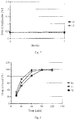
- Formulations 6 or 8 of ABT 263 as defined in Table 1 were administered to fasted or fed dogs in dosages corresponding to the amounts of ABT-263 as indicated in Fig. 1 and Fig. 2 . Subsequently, the plasma concentrations of ABT-263 were determined from blood samples taken at the indicated time points.
- open and closed symbols represent fed or fasted dogs, respectively. Squares, triangles and circles represent a dose of 50 mg, 100 mg, or 200 mg ABT-263, respectively.
- ABT-263 plasma concentrations of ABT-263 were higher when administered to fed dogs. This effect was more prominent at higher dosages of 100 mg and 200 mg. In fed dogs a dose linearity could be observed. AUC values of Formulation 6 in fasted dogs were 40-60% lower than in fed dogs. When Formulation 8 was administered AUC values were approximately 30% lower in fasted dogs.
- Fed dogs received orally one of the following two formulations as one capsule containing Formulation 13 or Formulation 10 as indicated in Table 1, equivalent to an amount of 50 mg ABT-263.
- the plasma concentrations of ABT-263 were determined from blood samples taken at the time points as indicated in Fig. 3 , which shows the mean plasma concentration of five dogs treated with Formulation 13 or Formulation 10, respectively.
- the formulations were chemically stable as content and impurity levels remained unchanged upon storage.
- the formulations 2, 3, 12, 4, 9, 11, 10, 13 and 14 as defined in Table 1 were assessed for sulfoxide formation in an accelerated stability study, using exposure in an open dish at a relative humidity of 40°C/75%.
- the sulfoxide content was determined at the beginning of the experiment (less than 0.8% in all cases), after 1 week, 3 weeks and 6 weeks for the formulations referred to in Fig. 4 , and at time points chosen among 4 weeks, 5 weeks and 7 weeks for the formulations referred to in Fig. 5 .
- Example 6 Crystallinity of ABT-263 extrudates upon prolonged storage
- Table 5 Physical stability (crystallinity) Time 0 weeks 1 week 3 weeks 6 weeks 1 month Storage conditions open dish 40°C/75% RH 1.5 oz HDPE bottles, closed, 40°C/75% RH 2 detected (++) detected (++) detected (++) detected (++) detected (++) 3 detected (++) detected (++) detected (++) detected (++) detected (++) detected (++) 12 not detected not detected not detected not detected not detected 4 not detected detected (+) detected (++) detected (++) detected (++) 9 detected (+) not detected not detected detected (+) detected (+) detected (+) detected (+) detected (+) detected (++) detected (++) detected (++) detected (++) 10 detected (+) detected (+) detected (+) detected (+) detected (+) detected (+) detected (+) 13 not detected not detected not detected not detected not detected 14 not detected not detected not detected not detected not detected not detected (+) few crystals detected (++) numerous crystals
- Example 2 Following the procedure of Example 1, an extrudate was obtained from the solid dispersion product ingredients listed in Table 6 below. Extrudates from Example 1 was milled and the powder was blended with the tableting excipients listed in Table 6. A single punch tablet press was used to prepare tablets containing 50 mg of ABT-263. Table 6: Tablet composition Formulation 16 17 18 Extrudate (ABT-263 free base:Copovidone: Vitamin E-TPGS:Coll.Silicone Dioxide 10:79:10:1) 98% 83% 83% Croscarmellose Sodium 15% Mannitol 15% Coll. Silicone Dioxide 1.0% 1.0% 1.0% Sodium stearyl fumarate 1.0% 1.0% 1.0% Total tablet mass 510.2 mg 602.4 mg 602.4 mg
- the tablets were immersed in 0.1N HCl at a temperature of 37°C (to mimic stomach conditions) and stirred by paddle rotation at a speed of 75 rounds per minute (rpm).
- the amount of released ABT-263 was determined at various time points by HPLC-UV/VIS. The results are shown in Fig. 8 .
- the present invention is further defined by the following items:
Landscapes
- Health & Medical Sciences (AREA)
- Life Sciences & Earth Sciences (AREA)
- General Health & Medical Sciences (AREA)
- Veterinary Medicine (AREA)
- Chemical & Material Sciences (AREA)
- Animal Behavior & Ethology (AREA)
- Medicinal Chemistry (AREA)
- Pharmacology & Pharmacy (AREA)
- Public Health (AREA)
- Epidemiology (AREA)
- Bioinformatics & Cheminformatics (AREA)
- Engineering & Computer Science (AREA)
- Physiology (AREA)
- Nutrition Science (AREA)
- Organic Chemistry (AREA)
- Nuclear Medicine, Radiotherapy & Molecular Imaging (AREA)
- Chemical Kinetics & Catalysis (AREA)
- General Chemical & Material Sciences (AREA)
- Biophysics (AREA)
- Molecular Biology (AREA)
- Hematology (AREA)
- Oncology (AREA)
- Medicinal Preparation (AREA)
- Pharmaceuticals Containing Other Organic And Inorganic Compounds (AREA)
- Medicines That Contain Protein Lipid Enzymes And Other Medicines (AREA)
- Acyclic And Carbocyclic Compounds In Medicinal Compositions (AREA)
Applications Claiming Priority (4)
| Application Number | Priority Date | Filing Date | Title |
|---|---|---|---|
| US18513009P | 2009-06-08 | 2009-06-08 | |
| EP10742875.7A EP2440177B1 (fr) | 2009-06-08 | 2010-06-08 | Forme posologique pharmaceutique pour l'administration orale d'un inhibiteur de la famille de bcl-2 |
| EP15184904.9A EP2982366B1 (fr) | 2009-06-08 | 2010-06-08 | Forme posologique pharmaceutique pour l'administration orale d'un inhibiteur de la famille bcl-2 |
| PCT/IB2010/001659 WO2010143074A2 (fr) | 2009-06-08 | 2010-06-08 | Forme posologique pharmaceutique pour l'administration orale d'un inhibiteur de la famille de bcl-2 |
Related Parent Applications (3)
| Application Number | Title | Priority Date | Filing Date |
|---|---|---|---|
| EP10742875.7A Division EP2440177B1 (fr) | 2009-06-08 | 2010-06-08 | Forme posologique pharmaceutique pour l'administration orale d'un inhibiteur de la famille de bcl-2 |
| EP15184904.9A Division-Into EP2982366B1 (fr) | 2009-06-08 | 2010-06-08 | Forme posologique pharmaceutique pour l'administration orale d'un inhibiteur de la famille bcl-2 |
| EP15184904.9A Division EP2982366B1 (fr) | 2009-06-08 | 2010-06-08 | Forme posologique pharmaceutique pour l'administration orale d'un inhibiteur de la famille bcl-2 |
Publications (2)
| Publication Number | Publication Date |
|---|---|
| EP3272334A1 true EP3272334A1 (fr) | 2018-01-24 |
| EP3272334B1 EP3272334B1 (fr) | 2019-03-06 |
Family
ID=43063251
Family Applications (3)
| Application Number | Title | Priority Date | Filing Date |
|---|---|---|---|
| EP15184904.9A Active EP2982366B1 (fr) | 2009-06-08 | 2010-06-08 | Forme posologique pharmaceutique pour l'administration orale d'un inhibiteur de la famille bcl-2 |
| EP10742875.7A Active EP2440177B1 (fr) | 2009-06-08 | 2010-06-08 | Forme posologique pharmaceutique pour l'administration orale d'un inhibiteur de la famille de bcl-2 |
| EP17181461.9A Not-in-force EP3272334B1 (fr) | 2009-06-08 | 2010-06-08 | Forme posologique pharmaceutique pour l'administration orale d'un inhibiteur de la famille bcl-2 |
Family Applications Before (2)
| Application Number | Title | Priority Date | Filing Date |
|---|---|---|---|
| EP15184904.9A Active EP2982366B1 (fr) | 2009-06-08 | 2010-06-08 | Forme posologique pharmaceutique pour l'administration orale d'un inhibiteur de la famille bcl-2 |
| EP10742875.7A Active EP2440177B1 (fr) | 2009-06-08 | 2010-06-08 | Forme posologique pharmaceutique pour l'administration orale d'un inhibiteur de la famille de bcl-2 |
Country Status (37)
| Country | Link |
|---|---|
| US (6) | US9642796B2 (fr) |
| EP (3) | EP2982366B1 (fr) |
| JP (2) | JP5872459B2 (fr) |
| KR (2) | KR101751216B1 (fr) |
| CN (2) | CN102802606A (fr) |
| AR (2) | AR077021A1 (fr) |
| AU (1) | AU2010258367B2 (fr) |
| BR (2) | BRPI1012831B1 (fr) |
| CA (1) | CA2763441C (fr) |
| CL (1) | CL2011003054A1 (fr) |
| CO (1) | CO6480964A2 (fr) |
| CR (1) | CR20170037A (fr) |
| CY (1) | CY1119663T1 (fr) |
| DK (2) | DK2440177T3 (fr) |
| DO (2) | DOP2011000375A (fr) |
| EC (1) | ECSP12011580A (fr) |
| ES (2) | ES2551860T3 (fr) |
| HR (2) | HRP20151342T1 (fr) |
| HU (2) | HUE025638T2 (fr) |
| IL (2) | IL216494A (fr) |
| LT (1) | LT2982366T (fr) |
| MX (1) | MX2011013164A (fr) |
| MY (1) | MY159824A (fr) |
| NO (1) | NO2982366T3 (fr) |
| NZ (1) | NZ597241A (fr) |
| PE (2) | PE20160043A1 (fr) |
| PL (2) | PL2440177T3 (fr) |
| PT (2) | PT2440177E (fr) |
| RU (2) | RU2711359C2 (fr) |
| SG (1) | SG176264A1 (fr) |
| SI (2) | SI2982366T1 (fr) |
| SM (1) | SMT201500317B (fr) |
| TW (2) | TWI471321B (fr) |
| UA (1) | UA104471C2 (fr) |
| UY (1) | UY32695A (fr) |
| WO (1) | WO2010143074A2 (fr) |
| ZA (1) | ZA201108853B (fr) |
Families Citing this family (23)
| Publication number | Priority date | Publication date | Assignee | Title |
|---|---|---|---|---|
| TWI471321B (zh) | 2009-06-08 | 2015-02-01 | 亞培公司 | Bcl-2族群抑制劑之口服醫藥劑型 |
| BR112012031516A2 (pt) | 2010-06-09 | 2016-11-08 | Abbott Lab | dispersões sólidas contendo inibidores de quinase |
| TWI535712B (zh) | 2010-08-06 | 2016-06-01 | 阿斯特捷利康公司 | 化合物 |
| UA113500C2 (xx) | 2010-10-29 | 2017-02-10 | Одержані екструзією розплаву тверді дисперсії, що містять індукуючий апоптоз засіб | |
| CA3152557A1 (fr) * | 2010-10-29 | 2012-05-03 | Abbvie Inc. | Dispersions solides contenant un agent induisant l'apoptose |
| PT2643322T (pt) | 2010-11-23 | 2017-11-13 | Abbvie Inc | Sais e formas cristalinas de um agente indutor de apoptose |
| ES2603129T3 (es) | 2010-11-23 | 2017-02-23 | Abbvie Ireland Unlimited Company | Métodos de tratamiento utilizando inhibidores selectivos de Bcl-2 |
| KR102191562B1 (ko) * | 2012-11-07 | 2020-12-15 | 에스케이바이오팜 주식회사 | 난용성 약물의 고체분산체 및 이의 제조방법 |
| WO2014160071A1 (fr) * | 2013-03-14 | 2014-10-02 | St. Jude Children's Research Hospital | Procédés et compositions pour le traitement de cancers dépendants à la glutamine |
| US20140275082A1 (en) | 2013-03-14 | 2014-09-18 | Abbvie Inc. | Apoptosis-inducing agents for the treatment of cancer and immune and autoimmune diseases |
| WO2015051252A1 (fr) * | 2013-10-03 | 2015-04-09 | Duke University | Compositions et méthodes destinées à traiter les cancers ayant une activité jak2 |
| JP2017509337A (ja) * | 2014-03-12 | 2017-04-06 | ノバルティス アーゲー | イムノコンジュゲートを作製する抗体を修飾するための特定部位 |
| WO2015193309A1 (fr) * | 2014-06-18 | 2015-12-23 | F. Hoffmann-La Roche Ag | Nouvelle composition pharmaceutique comprenant des tensioactifs non ioniques |
| CN105616419A (zh) * | 2014-11-07 | 2016-06-01 | 江苏豪森药业集团有限公司 | 含有细胞周期蛋白抑制剂固体分散体的药物组合物及其制备方法 |
| WO2017148837A1 (fr) | 2016-02-29 | 2017-09-08 | F. Hoffmann-La Roche Ag | Compositions de formes galéniques comprenant un inhibiteur de la tyrosine kinase de bruton |
| TWI773730B (zh) | 2017-02-22 | 2022-08-11 | 瑞典商阿斯特捷利康公司 | 治療性樹枝狀聚合物 |
| US11872237B2 (en) * | 2018-12-28 | 2024-01-16 | Ascentage Pharma (Suzhou) Co., Ltd. | Pharmaceutical composition and preparation method thereof |
| KR20220098755A (ko) | 2019-11-05 | 2022-07-12 | 애브비 인코포레이티드 | 나비토클락스를 사용한 골수섬유증 및 mpn 관련 장애 치료에 사용하기 위한 투약 레지멘 |
| JP7849296B2 (ja) * | 2020-02-24 | 2026-04-21 | グアンジョウ・ルペン・ファーマシューティカル・カンパニー・リミテッド | Bcl2阻害剤を含むホットメルト押出し固体分散体 |
| CN114533677A (zh) * | 2020-11-25 | 2022-05-27 | 苏州亚盛药业有限公司 | 固体分散体、制剂、其制备方法及其应用 |
| CN116847835A (zh) * | 2021-01-08 | 2023-10-03 | 赛罗斯制药有限公司 | 利用固定剂量的他米巴罗汀的治疗方案 |
| CN113520995B (zh) * | 2021-08-16 | 2023-03-10 | 海南鑫开源医药科技有限公司 | 一种离子敏感型眼用原位凝胶、其制备方法及应用 |
| WO2023172958A1 (fr) * | 2022-03-08 | 2023-09-14 | Onkosxcel Therapeutics, Llc | Formulations stables de talabostat |
Citations (6)
| Publication number | Priority date | Publication date | Assignee | Title |
|---|---|---|---|---|
| WO2000057854A2 (fr) | 1999-03-25 | 2000-10-05 | Basf Aktiengesellschaft | Formes d'administration pharmaceutiques mecaniquement stables, qui contiennent des substances tensioactives liquides ou semi-solides |
| WO2001000175A1 (fr) | 1999-06-25 | 2001-01-04 | Basf Aktiengesellschaft | Formes d'administration pharmaceutiques mecaniquement stables, contenant des agents tensioactifs liquides ou semi-solides |
| US20050208082A1 (en) | 2004-03-20 | 2005-09-22 | Papas Andreas M | Aqueous emulsions of lipophile solubilized with vitamin E TPGS and linoleic acid |
| US20050236236A1 (en) | 2004-04-26 | 2005-10-27 | Muhammad Farooq | Pad retaining clips |
| US20070027135A1 (en) | 2005-05-12 | 2007-02-01 | Milan Bruncko | Apoptosis promoters |
| WO2009073835A1 (fr) * | 2007-12-06 | 2009-06-11 | Abbott Laboratories | Compositions de abt-263 par voie orale pour traiter le cancer |
Family Cites Families (58)
| Publication number | Priority date | Publication date | Assignee | Title |
|---|---|---|---|---|
| US5665379A (en) * | 1990-09-28 | 1997-09-09 | Pharmacia & Upjohn Aktiebolag | Lipid particle forming matrix, preparation and use thereof |
| GB9309509D0 (en) * | 1993-05-07 | 1993-06-23 | Merck Patent Gmbh | Thrombin inhibitors |
| IL111004A (en) * | 1993-09-30 | 1998-06-15 | American Home Prod | Oral formulations of rapamycin |
| US5536729A (en) * | 1993-09-30 | 1996-07-16 | American Home Products Corporation | Rapamycin formulations for oral administration |
| JPH09510182A (ja) * | 1993-11-17 | 1997-10-14 | エルディーエス・テクノロジーズ・インコーポレーテッド | カプセル封入されたドラッグデリバリー用透明液 |
| US5759548A (en) * | 1993-11-30 | 1998-06-02 | Lxr Biotechnology Inc. | Compositions which inhibit apoptosis, methods of purifying the compositions and uses thereof |
| GB9405304D0 (en) * | 1994-03-16 | 1994-04-27 | Scherer Ltd R P | Delivery systems for hydrophobic drugs |
| US5538737A (en) * | 1994-11-30 | 1996-07-23 | Applied Analytical Industries, Inc. | Oral compositions of H2 -antagonists |
| FR2736550B1 (fr) | 1995-07-14 | 1998-07-24 | Sandoz Sa | Composition pharmaceutique sous la forme d'une dispersion solide comprenant un macrolide et un vehicule |
| US6964946B1 (en) * | 1995-10-26 | 2005-11-15 | Baker Norton Pharmaceuticals, Inc. | Oral pharmaceutical compositions containing taxanes and methods of treatment employing the same |
| US5891469A (en) | 1997-04-02 | 1999-04-06 | Pharmos Corporation | Solid Coprecipitates for enhanced bioavailability of lipophilic substances |
| BE1011899A6 (fr) * | 1998-04-30 | 2000-02-01 | Ucb Sa | Compositions pharmaceutiques gelifiables utilisables. |
| US6267985B1 (en) * | 1999-06-30 | 2001-07-31 | Lipocine Inc. | Clear oil-containing pharmaceutical compositions |
| US6294192B1 (en) * | 1999-02-26 | 2001-09-25 | Lipocine, Inc. | Triglyceride-free compositions and methods for improved delivery of hydrophobic therapeutic agents |
| US6982281B1 (en) * | 2000-11-17 | 2006-01-03 | Lipocine Inc | Pharmaceutical compositions and dosage forms for administration of hydrophobic drugs |
| US6309663B1 (en) * | 1999-08-17 | 2001-10-30 | Lipocine Inc. | Triglyceride-free compositions and methods for enhanced absorption of hydrophilic therapeutic agents |
| US20060183776A9 (en) * | 2000-03-03 | 2006-08-17 | Eisai Co., Ltd. | Liquid dosage formulations of donepezil |
| US20020055631A1 (en) * | 2000-09-20 | 2002-05-09 | Augeri David J. | N-acylsulfonamide apoptosis promoters |
| AR031130A1 (es) | 2000-09-20 | 2003-09-10 | Abbott Lab | N-acilsulfonamidas promotoras de la apoptosis |
| ES2248231T3 (es) * | 2001-01-31 | 2006-03-16 | Pfizer Products Inc. | Derivados de eteres utiles como inhibidores de las isozimas pde4. |
| GB0123400D0 (en) * | 2001-09-28 | 2001-11-21 | Novartis Ag | Organic compounds |
| EP1471887B1 (fr) * | 2002-02-04 | 2010-04-21 | Elan Pharma International Ltd. | Compositions nanoparticulaires a stabilisateur superficiel de lysozyme |
| BRPI0307786B8 (pt) * | 2002-02-26 | 2021-05-25 | Astrazeneca Ab | composição farmacêutica, método para preparar a mesma, métodos para inibir a taxa de precipitação do agente da solução no trato gi, e para reduzir variabilidade inter-pacientes no que se refere à biodisponibilidade e/ou concentrações plásmáticas do agente, e, uso de um celulose éter solúvel em água ou de um éster de um celulose éter solúvel em água |
| JO2479B1 (en) * | 2002-04-29 | 2009-01-20 | ميرك شارب اند دوم ليمتد | Rates for the activity of the chemokine receptor of tetrahydrobranyl cycloneptil tetrahydrobredo predine |
| US20060177430A1 (en) * | 2002-12-20 | 2006-08-10 | Chakshu Research Inc | Treatment of ocular disorders with ophthalmic formulations containing methylsulfonylmethane as a transport enhancer |
| US20050048112A1 (en) | 2003-08-28 | 2005-03-03 | Jorg Breitenbach | Solid pharmaceutical dosage form |
| US8025899B2 (en) * | 2003-08-28 | 2011-09-27 | Abbott Laboratories | Solid pharmaceutical dosage form |
| US8377952B2 (en) | 2003-08-28 | 2013-02-19 | Abbott Laboratories | Solid pharmaceutical dosage formulation |
| WO2005049593A2 (fr) | 2003-11-13 | 2005-06-02 | Abbott Laboratories | Promoteurs de l'apoptose contenant n-acylsulfonamide |
| US7973161B2 (en) * | 2003-11-13 | 2011-07-05 | Abbott Laboratories | Apoptosis promoters |
| FR2875409B1 (fr) * | 2004-09-17 | 2010-05-07 | Sanofi Aventis | Composition pharmaceutique comprenant une dispersion solide a matrice polymere comprenant une phase continue de polydextrose et une phase continue d'un polymere autre que du polydextrose |
| CN1706371B (zh) | 2005-05-27 | 2010-11-10 | 沈阳药科大学 | 一种高效的马蔺子素制剂及其制备方法 |
| WO2007043057A2 (fr) | 2005-10-11 | 2007-04-19 | Yissum, Research Development Company Of The Hebrew University Of Jerusalem | Compositions administrables par voie intra-nasale |
| EP1959926A1 (fr) * | 2005-10-25 | 2008-08-27 | Abbott Laboratories | Preparation comprenant un medicament faiblement soluble dans l'eau et son procede d'utilisation |
| US7151188B1 (en) | 2005-11-16 | 2006-12-19 | General Electric Company | Process for the production of mercaptoalkylalkoxysilanes |
| CA2652345A1 (fr) * | 2006-05-15 | 2007-11-22 | Encysive Pharmaceuticals, Inc. | Methodes et compositions pour le traitement de l'apnee du sommeil et applications connexes |
| JP2009542664A (ja) * | 2006-06-30 | 2009-12-03 | シェーリング コーポレイション | P53活性を増大させる置換されたピペリジンの使用の方法 |
| EP1880715A1 (fr) * | 2006-07-19 | 2008-01-23 | Abbott GmbH & Co. KG | Composition de solubilisation acceptable sur le plan pharmaceutique et forme posologique contenant celle-ci |
| JP5277168B2 (ja) * | 2006-09-05 | 2013-08-28 | アボット・ラボラトリーズ | 血小板過剰を治療するbclインヒビター |
| US20080182845A1 (en) * | 2006-11-16 | 2008-07-31 | Abbott Laboratories | Method of preventing or treating organ, hematopoietic stem cell or bone marrow transplant rejection |
| RU2351352C2 (ru) | 2007-04-09 | 2009-04-10 | Закрытое акционерное общество "Санкт-Петербургский институт фармации" | Твердая нанокомпозиция для доставки биологически активных веществ |
| WO2008124878A1 (fr) | 2007-04-13 | 2008-10-23 | Cryptopharma Pty Ltd | Composés non stéroïdiens |
| JP2011500569A (ja) * | 2007-10-12 | 2011-01-06 | マサチューセッツ インスティテュート オブ テクノロジー | ワクチンナノテクノロジー |
| CN101220008B (zh) | 2008-01-21 | 2011-04-27 | 中国科学院广州生物医药与健康研究院 | 化合物abt-263的合成方法 |
| US8168784B2 (en) * | 2008-06-20 | 2012-05-01 | Abbott Laboratories | Processes to make apoptosis promoters |
| US8728516B2 (en) * | 2009-04-30 | 2014-05-20 | Abbvie Inc. | Stabilized lipid formulation of apoptosis promoter |
| US8362013B2 (en) | 2009-04-30 | 2013-01-29 | Abbvie Inc. | Salt of ABT-263 and solid-state forms thereof |
| US20100278921A1 (en) * | 2009-04-30 | 2010-11-04 | Fischer Cristina M | Solid oral formulation of abt-263 |
| US20100297194A1 (en) * | 2009-04-30 | 2010-11-25 | Nathaniel Catron | Formulation for oral administration of apoptosis promoter |
| US20100280031A1 (en) | 2009-04-30 | 2010-11-04 | Paul David | Lipid formulation of apoptosis promoter |
| US8546399B2 (en) * | 2009-05-26 | 2013-10-01 | Abbvie Inc. | Apoptosis inducing agents for the treatment of cancer and immune and autoimmune diseases |
| TWI532484B (zh) | 2009-06-08 | 2016-05-11 | 艾伯維有限公司 | 包含凋亡促進劑之固態分散劑 |
| TWI471321B (zh) | 2009-06-08 | 2015-02-01 | 亞培公司 | Bcl-2族群抑制劑之口服醫藥劑型 |
| KR20120052937A (ko) * | 2009-06-18 | 2012-05-24 | 아보트 러보러터리즈 | 안정한 나노입자형 약물 현탁액 |
| BR112012006252A2 (pt) | 2009-09-20 | 2017-05-23 | Abbott Lab | "formas cristalinas de abt-263 e solvatos para o uso no tratamento de doenças relacionadas á proteína bcl-2". |
| US8927009B2 (en) | 2009-12-22 | 2015-01-06 | Abbvie Inc. | ABT-263 capsule |
| CN101798292A (zh) | 2010-03-29 | 2010-08-11 | 无锡好芳德药业有限公司 | ABT-263衍生的新型Bcl-2蛋白抑制剂的制备 |
| EP2776603B1 (fr) | 2011-11-11 | 2019-03-06 | SiO2 Medical Products, Inc. | Revêtement de passivation, de protection de ph ou à pouvoir lubrifiant pour conditionnement pharmaceutique, processus et appareil de revêtement |
-
2010
- 2010-06-07 TW TW99118493A patent/TWI471321B/zh not_active IP Right Cessation
- 2010-06-07 TW TW103146100A patent/TWI540132B/zh active
- 2010-06-08 KR KR1020127000350A patent/KR101751216B1/ko not_active Expired - Fee Related
- 2010-06-08 BR BRPI1012831-0A patent/BRPI1012831B1/pt not_active IP Right Cessation
- 2010-06-08 PT PT107428757T patent/PT2440177E/pt unknown
- 2010-06-08 PL PL10742875T patent/PL2440177T3/pl unknown
- 2010-06-08 NZ NZ597241A patent/NZ597241A/en not_active IP Right Cessation
- 2010-06-08 MX MX2011013164A patent/MX2011013164A/es active IP Right Grant
- 2010-06-08 RU RU2015141869A patent/RU2711359C2/ru active
- 2010-06-08 EP EP15184904.9A patent/EP2982366B1/fr active Active
- 2010-06-08 JP JP2012514556A patent/JP5872459B2/ja not_active Expired - Fee Related
- 2010-06-08 CN CN2010800349262A patent/CN102802606A/zh active Pending
- 2010-06-08 ES ES10742875.7T patent/ES2551860T3/es active Active
- 2010-06-08 UY UY0001032695A patent/UY32695A/es active IP Right Grant
- 2010-06-08 UA UAA201200189A patent/UA104471C2/uk unknown
- 2010-06-08 SG SG2011087715A patent/SG176264A1/en unknown
- 2010-06-08 BR BR122018076978-5A patent/BR122018076978B1/pt active IP Right Grant
- 2010-06-08 ES ES15184904.9T patent/ES2651307T3/es active Active
- 2010-06-08 MY MYPI2011005920A patent/MY159824A/en unknown
- 2010-06-08 AR ARP100102011A patent/AR077021A1/es not_active Application Discontinuation
- 2010-06-08 SI SI201031605T patent/SI2982366T1/en unknown
- 2010-06-08 NO NO15184904A patent/NO2982366T3/no unknown
- 2010-06-08 RU RU2011154143/15A patent/RU2568599C2/ru active
- 2010-06-08 US US12/796,000 patent/US9642796B2/en active Active
- 2010-06-08 HU HUE10742875A patent/HUE025638T2/en unknown
- 2010-06-08 EP EP10742875.7A patent/EP2440177B1/fr active Active
- 2010-06-08 CR CR20170037A patent/CR20170037A/es unknown
- 2010-06-08 WO PCT/IB2010/001659 patent/WO2010143074A2/fr not_active Ceased
- 2010-06-08 PE PE2015002532A patent/PE20160043A1/es unknown
- 2010-06-08 LT LTEP15184904.9T patent/LT2982366T/lt unknown
- 2010-06-08 PT PT151849049T patent/PT2982366T/pt unknown
- 2010-06-08 PE PE2011002058A patent/PE20121084A1/es active IP Right Grant
- 2010-06-08 CN CN201610756594.8A patent/CN106074391A/zh active Pending
- 2010-06-08 KR KR1020177016486A patent/KR101791404B1/ko not_active Expired - Fee Related
- 2010-06-08 HU HUE15184904A patent/HUE035727T2/en unknown
- 2010-06-08 CA CA2763441A patent/CA2763441C/fr not_active Expired - Fee Related
- 2010-06-08 HR HRP20151342TT patent/HRP20151342T1/hr unknown
- 2010-06-08 EP EP17181461.9A patent/EP3272334B1/fr not_active Not-in-force
- 2010-06-08 DK DK10742875.7T patent/DK2440177T3/en active
- 2010-06-08 PL PL15184904T patent/PL2982366T3/pl unknown
- 2010-06-08 AU AU2010258367A patent/AU2010258367B2/en not_active Ceased
- 2010-06-08 DK DK15184904.9T patent/DK2982366T3/en active
- 2010-06-08 SI SI201031076T patent/SI2440177T1/sl unknown
-
2011
- 2011-11-20 IL IL216494A patent/IL216494A/en active IP Right Grant
- 2011-12-01 ZA ZA2011/08853A patent/ZA201108853B/en unknown
- 2011-12-02 CL CL2011003054A patent/CL2011003054A1/es unknown
- 2011-12-05 DO DO2011000375A patent/DOP2011000375A/es unknown
- 2011-12-28 CO CO11180119A patent/CO6480964A2/es active IP Right Grant
-
2012
- 2012-01-06 EC EC2012011580A patent/ECSP12011580A/es unknown
-
2015
- 2015-04-26 IL IL238477A patent/IL238477A/en active IP Right Grant
- 2015-12-17 SM SM201500317T patent/SMT201500317B/it unknown
-
2016
- 2016-01-12 JP JP2016003239A patent/JP6129999B2/ja not_active Expired - Fee Related
-
2017
- 2017-03-07 DO DO2017000057A patent/DOP2017000057A/es unknown
- 2017-03-22 US US15/466,673 patent/US20170189426A1/en not_active Abandoned
- 2017-10-05 AR ARP170102786A patent/AR109816A2/es unknown
- 2017-12-06 CY CY20171101285T patent/CY1119663T1/el unknown
- 2017-12-07 HR HRP20171902TT patent/HRP20171902T1/hr unknown
-
2019
- 2019-05-17 US US16/415,651 patent/US20190269704A1/en not_active Abandoned
-
2020
- 2020-12-04 US US17/112,742 patent/US20210093649A1/en not_active Abandoned
-
2021
- 2021-12-20 US US17/645,244 patent/US20220110951A1/en not_active Abandoned
-
2023
- 2023-08-29 US US18/457,738 patent/US20240197757A1/en not_active Abandoned
Patent Citations (7)
| Publication number | Priority date | Publication date | Assignee | Title |
|---|---|---|---|---|
| WO2000057854A2 (fr) | 1999-03-25 | 2000-10-05 | Basf Aktiengesellschaft | Formes d'administration pharmaceutiques mecaniquement stables, qui contiennent des substances tensioactives liquides ou semi-solides |
| WO2001000175A1 (fr) | 1999-06-25 | 2001-01-04 | Basf Aktiengesellschaft | Formes d'administration pharmaceutiques mecaniquement stables, contenant des agents tensioactifs liquides ou semi-solides |
| US20050208082A1 (en) | 2004-03-20 | 2005-09-22 | Papas Andreas M | Aqueous emulsions of lipophile solubilized with vitamin E TPGS and linoleic acid |
| US20050236236A1 (en) | 2004-04-26 | 2005-10-27 | Muhammad Farooq | Pad retaining clips |
| US20070027135A1 (en) | 2005-05-12 | 2007-02-01 | Milan Bruncko | Apoptosis promoters |
| WO2007040650A2 (fr) | 2005-05-12 | 2007-04-12 | Abbott Laboratories | Promoteurs d'apoptose |
| WO2009073835A1 (fr) * | 2007-12-06 | 2009-06-11 | Abbott Laboratories | Compositions de abt-263 par voie orale pour traiter le cancer |
Non-Patent Citations (6)
| Title |
|---|
| CHEOL-MIN PARK ET AL: "Discovery of an orally bioavailable small molecule inhibitor of prosurvival B-cell lymphoma 2 proteins", JOURNAL OF MEDICINAL CHEMISTRY, vol. 51, no. 21, 13 November 2008 (2008-11-13), AMERICAN CHEMICAL SOCIETY, WASHINGTON, US, pages 6902 - 6915, XP002574160, ISSN: 0022-2623, [retrieved on 20081008], DOI: 10.1021/JM800669S * |
| J. BRANDRUP AND E.II. IMMERGUT,: "Polymer Handbook, 2nd Edition", 1975, JOHN WILEY & SONS, INC. |
| L.H. SPERLING,: "Introduction to Physical Polymer Science, 2nd Edition", 1992, JOHN WILEY & SONS, INC. |
| SUTTON ET AL., J. IMMUNOL., vol. 158, 1997, pages 5783 - 5790 |
| TSE CHRISTIN ET AL: "ABT-263: A potent and orally bioavailable Bcl-2 family inhibitor", CANCER RESEARCH, vol. 68, no. 9, May 2008 (2008-05-01), pages 3421 - 3428, XP002601345, ISSN: 0008-5472 * |
| TSE ET AL., CANCER RES., vol. 68, 2008, pages 3421 - 3428 |
Also Published As
Similar Documents
| Publication | Publication Date | Title |
|---|---|---|
| US20240197757A1 (en) | Pharmaceutical dosage form for oral administration of a bcl 2 family inhibitor | |
| US20100311751A1 (en) | Solid dispersions containing an apoptosis-promoting agent | |
| HK1249041A1 (en) | Pharmaceutical dosage form for oral administration of a bcl-2 family inhibitor | |
| HK1249041B (en) | Pharmaceutical dosage form for oral administration of a bcl-2 family inhibitor | |
| HK1220902B (en) | Pharmaceutical dosage form for oral administration of a bcl-2 family inhibitor |
Legal Events
| Date | Code | Title | Description |
|---|---|---|---|
| PUAI | Public reference made under article 153(3) epc to a published international application that has entered the european phase |
Free format text: ORIGINAL CODE: 0009012 |
|
| STAA | Information on the status of an ep patent application or granted ep patent |
Free format text: STATUS: THE APPLICATION HAS BEEN PUBLISHED |
|
| AC | Divisional application: reference to earlier application |
Ref document number: 2982366 Country of ref document: EP Kind code of ref document: P Ref document number: 2440177 Country of ref document: EP Kind code of ref document: P |
|
| AK | Designated contracting states |
Kind code of ref document: A1 Designated state(s): AL AT BE BG CH CY CZ DE DK EE ES FI FR GB GR HR HU IE IS IT LI LT LU LV MC MK MT NL NO PL PT RO SE SI SK SM TR |
|
| AX | Request for extension of the european patent |
Extension state: BA ME RS |
|
| RAP1 | Party data changed (applicant data changed or rights of an application transferred) |
Owner name: ABBVIE DEUTSCHLAND GMBH & CO. KG |
|
| STAA | Information on the status of an ep patent application or granted ep patent |
Free format text: STATUS: REQUEST FOR EXAMINATION WAS MADE |
|
| 17P | Request for examination filed |
Effective date: 20180718 |
|
| RBV | Designated contracting states (corrected) |
Designated state(s): AL AT BE BG CH CY CZ DE DK EE ES FI FR GB GR HR HU IE IS IT LI LT LU LV MC MK MT NL NO PL PT RO SE SI SK SM TR |
|
| RIC1 | Information provided on ipc code assigned before grant |
Ipc: A61K 9/20 20060101ALI20180816BHEP Ipc: A61K 9/00 20060101AFI20180816BHEP Ipc: A61K 31/635 20060101ALI20180816BHEP Ipc: A61K 31/5377 20060101ALI20180816BHEP Ipc: A61K 9/14 20060101ALI20180816BHEP Ipc: A61K 9/48 20060101ALI20180816BHEP |
|
| GRAP | Despatch of communication of intention to grant a patent |
Free format text: ORIGINAL CODE: EPIDOSNIGR1 |
|
| STAA | Information on the status of an ep patent application or granted ep patent |
Free format text: STATUS: GRANT OF PATENT IS INTENDED |
|
| INTG | Intention to grant announced |
Effective date: 20180926 |
|
| REG | Reference to a national code |
Ref country code: HK Ref legal event code: DE Ref document number: 1249041 Country of ref document: HK |
|
| GRAS | Grant fee paid |
Free format text: ORIGINAL CODE: EPIDOSNIGR3 |
|
| GRAA | (expected) grant |
Free format text: ORIGINAL CODE: 0009210 |
|
| STAA | Information on the status of an ep patent application or granted ep patent |
Free format text: STATUS: THE PATENT HAS BEEN GRANTED |
|
| AC | Divisional application: reference to earlier application |
Ref document number: 2440177 Country of ref document: EP Kind code of ref document: P Ref document number: 2982366 Country of ref document: EP Kind code of ref document: P |
|
| AK | Designated contracting states |
Kind code of ref document: B1 Designated state(s): AL AT BE BG CH CY CZ DE DK EE ES FI FR GB GR HR HU IE IS IT LI LT LU LV MC MK MT NL NO PL PT RO SE SI SK SM TR |
|
| REG | Reference to a national code |
Ref country code: GB Ref legal event code: FG4D |
|
| REG | Reference to a national code |
Ref country code: CH Ref legal event code: EP Ref country code: AT Ref legal event code: REF Ref document number: 1103585 Country of ref document: AT Kind code of ref document: T Effective date: 20190315 |
|
| REG | Reference to a national code |
Ref country code: DE Ref legal event code: R096 Ref document number: 602010057484 Country of ref document: DE |
|
| REG | Reference to a national code |
Ref country code: IE Ref legal event code: FG4D |
|
| REG | Reference to a national code |
Ref country code: NL Ref legal event code: MP Effective date: 20190306 |
|
| REG | Reference to a national code |
Ref country code: LT Ref legal event code: MG4D |
|
| PG25 | Lapsed in a contracting state [announced via postgrant information from national office to epo] |
Ref country code: NO Free format text: LAPSE BECAUSE OF FAILURE TO SUBMIT A TRANSLATION OF THE DESCRIPTION OR TO PAY THE FEE WITHIN THE PRESCRIBED TIME-LIMIT Effective date: 20190606 Ref country code: FI Free format text: LAPSE BECAUSE OF FAILURE TO SUBMIT A TRANSLATION OF THE DESCRIPTION OR TO PAY THE FEE WITHIN THE PRESCRIBED TIME-LIMIT Effective date: 20190306 Ref country code: LT Free format text: LAPSE BECAUSE OF FAILURE TO SUBMIT A TRANSLATION OF THE DESCRIPTION OR TO PAY THE FEE WITHIN THE PRESCRIBED TIME-LIMIT Effective date: 20190306 Ref country code: SE Free format text: LAPSE BECAUSE OF FAILURE TO SUBMIT A TRANSLATION OF THE DESCRIPTION OR TO PAY THE FEE WITHIN THE PRESCRIBED TIME-LIMIT Effective date: 20190306 |
|
| PG25 | Lapsed in a contracting state [announced via postgrant information from national office to epo] |
Ref country code: HR Free format text: LAPSE BECAUSE OF FAILURE TO SUBMIT A TRANSLATION OF THE DESCRIPTION OR TO PAY THE FEE WITHIN THE PRESCRIBED TIME-LIMIT Effective date: 20190306 Ref country code: LV Free format text: LAPSE BECAUSE OF FAILURE TO SUBMIT A TRANSLATION OF THE DESCRIPTION OR TO PAY THE FEE WITHIN THE PRESCRIBED TIME-LIMIT Effective date: 20190306 Ref country code: BG Free format text: LAPSE BECAUSE OF FAILURE TO SUBMIT A TRANSLATION OF THE DESCRIPTION OR TO PAY THE FEE WITHIN THE PRESCRIBED TIME-LIMIT Effective date: 20190606 Ref country code: GR Free format text: LAPSE BECAUSE OF FAILURE TO SUBMIT A TRANSLATION OF THE DESCRIPTION OR TO PAY THE FEE WITHIN THE PRESCRIBED TIME-LIMIT Effective date: 20190607 Ref country code: NL Free format text: LAPSE BECAUSE OF FAILURE TO SUBMIT A TRANSLATION OF THE DESCRIPTION OR TO PAY THE FEE WITHIN THE PRESCRIBED TIME-LIMIT Effective date: 20190306 |
|
| REG | Reference to a national code |
Ref country code: AT Ref legal event code: MK05 Ref document number: 1103585 Country of ref document: AT Kind code of ref document: T Effective date: 20190306 |
|
| PG25 | Lapsed in a contracting state [announced via postgrant information from national office to epo] |
Ref country code: PT Free format text: LAPSE BECAUSE OF FAILURE TO SUBMIT A TRANSLATION OF THE DESCRIPTION OR TO PAY THE FEE WITHIN THE PRESCRIBED TIME-LIMIT Effective date: 20190706 Ref country code: ES Free format text: LAPSE BECAUSE OF FAILURE TO SUBMIT A TRANSLATION OF THE DESCRIPTION OR TO PAY THE FEE WITHIN THE PRESCRIBED TIME-LIMIT Effective date: 20190306 Ref country code: IT Free format text: LAPSE BECAUSE OF FAILURE TO SUBMIT A TRANSLATION OF THE DESCRIPTION OR TO PAY THE FEE WITHIN THE PRESCRIBED TIME-LIMIT Effective date: 20190306 Ref country code: RO Free format text: LAPSE BECAUSE OF FAILURE TO SUBMIT A TRANSLATION OF THE DESCRIPTION OR TO PAY THE FEE WITHIN THE PRESCRIBED TIME-LIMIT Effective date: 20190306 Ref country code: SK Free format text: LAPSE BECAUSE OF FAILURE TO SUBMIT A TRANSLATION OF THE DESCRIPTION OR TO PAY THE FEE WITHIN THE PRESCRIBED TIME-LIMIT Effective date: 20190306 Ref country code: CZ Free format text: LAPSE BECAUSE OF FAILURE TO SUBMIT A TRANSLATION OF THE DESCRIPTION OR TO PAY THE FEE WITHIN THE PRESCRIBED TIME-LIMIT Effective date: 20190306 Ref country code: EE Free format text: LAPSE BECAUSE OF FAILURE TO SUBMIT A TRANSLATION OF THE DESCRIPTION OR TO PAY THE FEE WITHIN THE PRESCRIBED TIME-LIMIT Effective date: 20190306 Ref country code: AL Free format text: LAPSE BECAUSE OF FAILURE TO SUBMIT A TRANSLATION OF THE DESCRIPTION OR TO PAY THE FEE WITHIN THE PRESCRIBED TIME-LIMIT Effective date: 20190306 |
|
| PG25 | Lapsed in a contracting state [announced via postgrant information from national office to epo] |
Ref country code: SM Free format text: LAPSE BECAUSE OF FAILURE TO SUBMIT A TRANSLATION OF THE DESCRIPTION OR TO PAY THE FEE WITHIN THE PRESCRIBED TIME-LIMIT Effective date: 20190306 Ref country code: PL Free format text: LAPSE BECAUSE OF FAILURE TO SUBMIT A TRANSLATION OF THE DESCRIPTION OR TO PAY THE FEE WITHIN THE PRESCRIBED TIME-LIMIT Effective date: 20190306 |
|
| REG | Reference to a national code |
Ref country code: DE Ref legal event code: R097 Ref document number: 602010057484 Country of ref document: DE |
|
| PG25 | Lapsed in a contracting state [announced via postgrant information from national office to epo] |
Ref country code: AT Free format text: LAPSE BECAUSE OF FAILURE TO SUBMIT A TRANSLATION OF THE DESCRIPTION OR TO PAY THE FEE WITHIN THE PRESCRIBED TIME-LIMIT Effective date: 20190306 Ref country code: IS Free format text: LAPSE BECAUSE OF FAILURE TO SUBMIT A TRANSLATION OF THE DESCRIPTION OR TO PAY THE FEE WITHIN THE PRESCRIBED TIME-LIMIT Effective date: 20190706 |
|
| REG | Reference to a national code |
Ref country code: DE Ref legal event code: R119 Ref document number: 602010057484 Country of ref document: DE |
|
| PLBE | No opposition filed within time limit |
Free format text: ORIGINAL CODE: 0009261 |
|
| STAA | Information on the status of an ep patent application or granted ep patent |
Free format text: STATUS: NO OPPOSITION FILED WITHIN TIME LIMIT |
|
| PG25 | Lapsed in a contracting state [announced via postgrant information from national office to epo] |
Ref country code: DK Free format text: LAPSE BECAUSE OF FAILURE TO SUBMIT A TRANSLATION OF THE DESCRIPTION OR TO PAY THE FEE WITHIN THE PRESCRIBED TIME-LIMIT Effective date: 20190306 Ref country code: MC Free format text: LAPSE BECAUSE OF FAILURE TO SUBMIT A TRANSLATION OF THE DESCRIPTION OR TO PAY THE FEE WITHIN THE PRESCRIBED TIME-LIMIT Effective date: 20190306 |
|
| REG | Reference to a national code |
Ref country code: CH Ref legal event code: PL |
|
| 26N | No opposition filed |
Effective date: 20191209 |
|
| GBPC | Gb: european patent ceased through non-payment of renewal fee |
Effective date: 20190608 |
|
| PG25 | Lapsed in a contracting state [announced via postgrant information from national office to epo] |
Ref country code: SI Free format text: LAPSE BECAUSE OF FAILURE TO SUBMIT A TRANSLATION OF THE DESCRIPTION OR TO PAY THE FEE WITHIN THE PRESCRIBED TIME-LIMIT Effective date: 20190306 |
|
| REG | Reference to a national code |
Ref country code: BE Ref legal event code: MM Effective date: 20190630 |
|
| PG25 | Lapsed in a contracting state [announced via postgrant information from national office to epo] |
Ref country code: TR Free format text: LAPSE BECAUSE OF FAILURE TO SUBMIT A TRANSLATION OF THE DESCRIPTION OR TO PAY THE FEE WITHIN THE PRESCRIBED TIME-LIMIT Effective date: 20190306 |
|
| PG25 | Lapsed in a contracting state [announced via postgrant information from national office to epo] |
Ref country code: GB Free format text: LAPSE BECAUSE OF NON-PAYMENT OF DUE FEES Effective date: 20190608 Ref country code: DE Free format text: LAPSE BECAUSE OF NON-PAYMENT OF DUE FEES Effective date: 20200101 Ref country code: IE Free format text: LAPSE BECAUSE OF NON-PAYMENT OF DUE FEES Effective date: 20190608 |
|
| PG25 | Lapsed in a contracting state [announced via postgrant information from national office to epo] |
Ref country code: LU Free format text: LAPSE BECAUSE OF NON-PAYMENT OF DUE FEES Effective date: 20190608 Ref country code: LI Free format text: LAPSE BECAUSE OF NON-PAYMENT OF DUE FEES Effective date: 20190630 Ref country code: CH Free format text: LAPSE BECAUSE OF NON-PAYMENT OF DUE FEES Effective date: 20190630 Ref country code: BE Free format text: LAPSE BECAUSE OF NON-PAYMENT OF DUE FEES Effective date: 20190630 |
|
| PG25 | Lapsed in a contracting state [announced via postgrant information from national office to epo] |
Ref country code: FR Free format text: LAPSE BECAUSE OF NON-PAYMENT OF DUE FEES Effective date: 20190630 |
|
| PG25 | Lapsed in a contracting state [announced via postgrant information from national office to epo] |
Ref country code: CY Free format text: LAPSE BECAUSE OF FAILURE TO SUBMIT A TRANSLATION OF THE DESCRIPTION OR TO PAY THE FEE WITHIN THE PRESCRIBED TIME-LIMIT Effective date: 20190306 |
|
| PG25 | Lapsed in a contracting state [announced via postgrant information from national office to epo] |
Ref country code: HU Free format text: LAPSE BECAUSE OF FAILURE TO SUBMIT A TRANSLATION OF THE DESCRIPTION OR TO PAY THE FEE WITHIN THE PRESCRIBED TIME-LIMIT; INVALID AB INITIO Effective date: 20100608 Ref country code: MT Free format text: LAPSE BECAUSE OF FAILURE TO SUBMIT A TRANSLATION OF THE DESCRIPTION OR TO PAY THE FEE WITHIN THE PRESCRIBED TIME-LIMIT Effective date: 20190306 |
|
| PG25 | Lapsed in a contracting state [announced via postgrant information from national office to epo] |
Ref country code: MK Free format text: LAPSE BECAUSE OF FAILURE TO SUBMIT A TRANSLATION OF THE DESCRIPTION OR TO PAY THE FEE WITHIN THE PRESCRIBED TIME-LIMIT Effective date: 20190306 |