EP3277676B1 - Dérivés de la quinazoline substitués utilisés comme inhibiteurs d'adn méthyltransférase - Google Patents
Dérivés de la quinazoline substitués utilisés comme inhibiteurs d'adn méthyltransférase Download PDFInfo
- Publication number
- EP3277676B1 EP3277676B1 EP16711848.8A EP16711848A EP3277676B1 EP 3277676 B1 EP3277676 B1 EP 3277676B1 EP 16711848 A EP16711848 A EP 16711848A EP 3277676 B1 EP3277676 B1 EP 3277676B1
- Authority
- EP
- European Patent Office
- Prior art keywords
- alkyl
- aryl
- heterocycle
- optionally substituted
- compound
- Prior art date
- Legal status (The legal status is an assumption and is not a legal conclusion. Google has not performed a legal analysis and makes no representation as to the accuracy of the status listed.)
- Active
Links
Classifications
-
- C—CHEMISTRY; METALLURGY
- C07—ORGANIC CHEMISTRY
- C07D—HETEROCYCLIC COMPOUNDS
- C07D401/00—Heterocyclic compounds containing two or more hetero rings, having nitrogen atoms as the only ring hetero atoms, at least one ring being a six-membered ring with only one nitrogen atom
- C07D401/14—Heterocyclic compounds containing two or more hetero rings, having nitrogen atoms as the only ring hetero atoms, at least one ring being a six-membered ring with only one nitrogen atom containing three or more hetero rings
-
- A—HUMAN NECESSITIES
- A61—MEDICAL OR VETERINARY SCIENCE; HYGIENE
- A61P—SPECIFIC THERAPEUTIC ACTIVITY OF CHEMICAL COMPOUNDS OR MEDICINAL PREPARATIONS
- A61P35/00—Antineoplastic agents
Definitions
- the present invention relates to substituted quinazoline derivatives useful as DNA methyltransferase (DNMT) inhibitors, notably in the treatment of cancer.
- DNMT DNA methyltransferase
- DNMTs DNA methyltransferases
- Two families of catalytically active DNMTs have been identified: DNMT1, responsible for DNA methylation maintenance during replication, and DNMT3A and 3B, responsible for de novo DNA methylation.
- DNMTs add a methyl group on the carbon-5 position of the deoxycytosine at the CpG site in the DNA by using S-adenosyl-L-methionine (AdoMet) as methyl donor ( Jurkowska et al. ChemBioChem 2011, 12, 206 ).
- DNMT inhibitors can be divided into two families: nucleoside analogues and nonnucleosides. The first are the most active ones.
- DNMT DNA methyltransferase
- the present invention concerns thus a compound of the following formula (I): or a pharmaceutically acceptable salt or solvate thereof,
- the term "pharmaceutically acceptable” is intended to mean what is useful to the preparation of a pharmaceutical composition, and what is generally safe and non-toxic, for a pharmaceutical use.
- pharmaceutically acceptable salt or solvate is intended to mean, in the framework of the present invention, a salt or solvate of a compound which is pharmaceutically acceptable, as defined above, and which possesses the pharmacological activity of the corresponding compound.
- the pharmaceutically acceptable salts comprise:
- Acceptable solvates for the therapeutic use of the compounds of the present invention include conventional solvates such as those formed during the last step of the preparation of the compounds of the invention due to the presence of solvents.
- solvates due to the presence of water these solvates are also called hydrates) or ethanol.
- (C 1 -C 6 )alkyl refers to a straight or branched saturated hydrocarbon chain containing from 1 to 6 carbon atoms including, but not limited to, methyl, ethyl, n-propyl, iso-propyl, n-butyl, iso-butyl, sec-butyl, t-butyl, n-pentyl, n-hexyl, and the like.
- (C 2 -C 6 )alkenyl refers to a straight or branched unsaturated hydrocarbon chain containing from 2 to 6 carbon atoms and comprising at least one double bond, notably one double bond, including, but not limited to, ethenyl, propenyl, butenyl, pentenyl, hexenyl and the like. It can be in particular an allyl group.
- aryl refers to an aromatic hydrocarbon group comprising preferably 6 to 10 carbon atoms and comprising one or more, notably 1 or 2, fused rings, such as, for example, a phenyl or naphtyl group.
- fused rings such as, for example, a phenyl or naphtyl group.
- it will be a phenyl group.
- aryl-(C 1 -C 6 )alkyl refers to an aryl group as defined above bound to the molecule via a (C 1 -C 6 )alkyl group as defined above.
- the aryl-(C 1 -C 6 )alkyl group is a benzyl group.
- (C 1 -C 6 )alkyl-aryl refers to a (C 1 -C 6 )alkyl group as defined above bound to the molecule via an aryl group as defined above. In particular, it can be a tolyl group (-PhCH 3 ).
- heterocycle refers to a saturated, unsaturated or aromatic hydrocarbon monocycle or polycycle (comprising fused, bridged or spiro rings), such as a bicycle, in which one or more, advantageously 1 to 4, and more advantageously 1 or 2, carbon atoms have each been replaced with a heteroatom selected from nitrogen, oxygen and sulphur atoms, and notably being a nitrogen atom.
- the heterocycle comprises 5 to 15, notably 5 to 10 atoms in the ring(s).
- Each ring of the heterocycle has advantageously 5 or 6 members.
- the heterocycle is a saturated, unsaturated or aromatic hydrocarbon monocycle or bicycle (comprising fused, bridged or spiro rings, notably fused rings), each cycle having 5 or 6 members and 1 to 4, notably 1 or 2, carbon atoms having each been replaced with a nitrogen or oxygen atom, notably a nitrogen atom.
- a heterocycle can be notably thiophene, furan, pyrrole, imidazole, pyrazole, oxazole, isoxazole, thiazole, isothiazole, triazoles (1,2,3-triazole and 1,2,4-triazole), benzofuran, indole, benzothiophene, benzimidazole, indazole, benzoxazole, benzisoxazole, benzothiazole, benzisothiazole, pyridine, pyrimidine, pyridazine, pyrazine, triazine, quinoline, isoquinoline, quinoxaline, quinazoline, piperidine, piperazine, triazinane, morpholine, pyrrolidine, dihydropyridines, dihydropyrimidines (notably 1,2-dihydropyrimidine), dihydropyridazines, dihydropyrazines, dihydrotriazines,
- nitrogen-containing heterocycle refers to a heterocycle as defined above containing at least one nitrogen atom.
- Such a nitrogen-containing heterocycle is thus a saturated, unsaturated or aromatic hydrocarbon monocycle or polycycle (comprising fused, bridged or spiro rings), such as a bicycle, in which one or more, advantageously 1 to 4, and more advantageously 1 or 2, carbon atoms have each been replaced with a heteroatom selected from nitrogen, oxygen and sulphur atoms, at least one of the heteroatom(s) being a nitrogen atom, and notably all the heteroatoms are nitrogen.
- the heterocycle comprises 5 to 15, notably 5 to 10 atoms in the ring(s).
- Each ring of the heterocycle has advantageously 5 or 6 members.
- the heterocycle is a saturated, unsaturated or aromatic hydrocarbon monocycle or bicycle (comprising fused, bridged or spiro rings, notably fused rings), each cycle having 5 or 6 members, in which one carbon atom has been replaced with a nitrogen atom and optionally 1 to 3, notably 1, additional carbon atom(s) has/have each been replaced with a nitrogen or oxygen atom, notably a nitrogen atom.
- a nitrogen-containing heterocycle can be notably pyrrole, imidazole, pyrazole, oxazole, isoxazole, thiazole, isothiazole, triazoles (1,2,3-triazole and 1,2,4-triazole), indole, benzimidazole, indazole, benzoxazole, benzisoxazole, benzothiazole, benzisothiazole, pyridine, pyrimidine, pyridazine, pyrazine, triazine, quinoline, isoquinoline, quinoxaline, quinazoline, piperidine, piperazine, triazinane, morpholine, pyrrolidine, dihydropyridines, dihydropyrimidines (notably 1,2-dihydropyrimidine), dihydropyridazines, dihydropyrazines, dihydrotriazines, tetrahydropyridines, tetrahydropyrim
- heterocycle-(C 1 -C 6 )alkyl refers to a heterocycle group as defined above bound to the molecule via a (C 1 -C 6 )alkyl group as defined above.
- heteroaryl refers to an aromatic heterocycle as defined above.
- the heteroaryl is an aromatic hydrocarbon monocycle or bicycle (i.e. comprising two fused rings), each cycle having 5 or 6 members, notably 6 members, and 1 to 4, notably 1 or 2, carbon atoms having each been replaced with a nitrogen or oxygen atom, notably a nitrogen atom.
- a heteroaryl can be notably thiophene, furan, pyrrole, imidazole, pyrazole, oxazole, isoxazole, thiazole, isothiazole, triazoles (1,2,3-triazole and 1,2,4-triazole), benzofuran, indole, benzothiophene, benzimidazole, indazole, benzoxazole, benzisoxazole, benzothiazole, benzisothiazole, pyridine, pyrimidine, pyridazine, pyrazine, triazine, quinoline, isoquinoline, quinoxaline, quinazoline, etc.
- nitrogen-containing heteroaryl refers to an aromatic nitrogen-containing heterocycle as defined above.
- the nitrogen-containing heteroaryl is an aromatic hydrocarbon monocycle or bicycle (i.e. comprising two fused rings), each cycle having 5 or 6 members, notably 6 members, in which one carbon atom has been replaced with a nitrogen atom and optionally 1 to 3, notably 1, additional carbon atom(s) has/have each been replaced with a nitrogen or oxygen atom, notably a nitrogen atom.
- a nitrogen-containing heteroaryl can be notably pyrrole, imidazole, pyrazole, oxazole, isoxazole, thiazole, isothiazole, triazoles (1,2,3-triazole and 1,2,4-triazole), indole, benzimidazole, indazole, benzoxazole, benzisoxazole, benzothiazole, benzisothiazole, pyridine, pyrimidine, pyridazine, pyrazine, triazine, quinoline, isoquinoline, quinoxaline, quinazoline, etc.
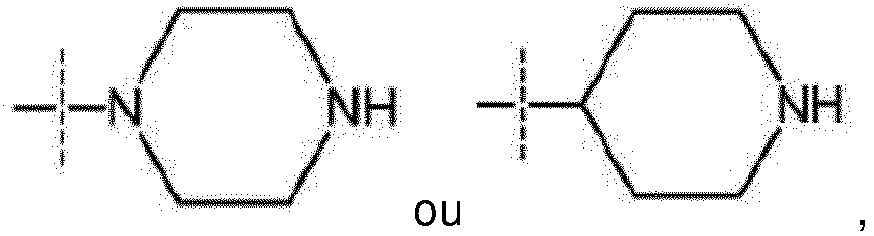
- piperidinediyl refers to a divalent piperidine moiety. It can be in particular
- piperazinediyl refers to a divalent piperazine moiety. It can be in particular
- pyrrolidinediyl refers to a divalent pyrrolidine moiety. It can be in particular or such as
- divalent monoglycosyl refers to a divalent monosaccharide moiety in its cyclic form. This monosaccharide will be advantageously linked by two of its oxygen atoms.
- the monosaccharide is a pentose (deoxyribose, ribose, arabinose, xylose, lyxose, ribulose, xylulose), a hexose (allose, altrose, galactose, glucose, gulose, idose, mannose, talose, fructose, psicose, sorbose, tagatose), fucose or rhamnose, in their D or L forms.
- the monosaccahride is advantageously a hexose in its pyranose form such as allose, altrose, galactose, glucose, gulose, idose, mannose, talose, fructose, psicose, sorbose or tagatose, notably allose, altrose, galactose, glucose, gulose, idose, mannose or talose, and in particular glucose.
- the divalent monoglycosyl will be advantageously a group such as (glucose moieties).
- halogen refers to a fluorine, bromine, chlorine or iodine atom.
- the formula (I) of the present invention comprises two bonds ------. According to a particular embodiment, one of them is a single bond and the other is a double bond.
- the compounds of the present invention can be selected from compounds A to H, notably from compounds A to G, described in the experimental part below and the pharmaceutically acceptable salts and solvates thereof (notably the hydrochloride thereof).
- the present invention relates also to a compound of formula (I) as defined above, for use as a drug, notably intended for the treatment of cancer.
- the present invention also relates to the use of a compound of formula (I) as defined above, for the manufacture of a drug, notably intended for the treatment of cancer.
- the cancer may be more particularly colon cancer, breast cancer, kidney cancer, liver cancer, pancreatic cancer, prostate cancer, glioblastoma, non-small cell lung cancer, neuroblastoma, inflammatory myofibroblastic tumor, leukemia (acute myeloid leukemia, myelodysplastic syndrome, chronic myelomonocytic leukemia), melanoma, diffuse B-cell lymphoma or anaplastic large-cell lymphoma.
- leukemia acute myeloid leukemia, myelodysplastic syndrome, chronic myelomonocytic leukemia
- melanoma diffuse B-cell lymphoma or anaplastic large-cell lymphoma.
- the compound of formula (I) as defined above can be used as a DNA methylation inhibitor, in particular as a DNMT inhibitor.
- DNA methylation inhibitor and "DNMT inhibitor” refers to molecules that are able to reduce or inhibit the DNA methylation and the DNA methyltransferase activity respectively.
- DNMT inhibitor Preferentially, the use of a DNMT inhibitor according to the invention makes it possible to suppress the activity of said DNMT.
- the present invention also relates to a pharmaceutical composition
- a pharmaceutical composition comprising at least one compound of formula (I) as defined above and at least one pharmaceutically acceptable excipient.
- compositions according to the invention may be formulated notably for oral administration or for injection, wherein said compositions are intended for mammals, including humans.
- the pharmaceutical composition can be administered orally by means of tablets and gelatin capsules.
- the main active ingredient is mixed with a pharmaceutical vehicle such as gelatin, starch, lactose, magnesium stearate, talc, gum arabic and the like.
- a pharmaceutical vehicle such as gelatin, starch, lactose, magnesium stearate, talc, gum arabic and the like.
- the tablets may be coated with sucrose or with other suitable materials, or they may be treated in such a way that they have a prolonged or delayed activity and they continuously release a predetermined amount of active principle.
- a preparation in gelatin capsules is obtained by mixing the active ingredient with a diluent and pouring the mixture obtained into soft or hard gelatin capsules.
- aqueous suspensions, isotonic saline solutions or sterile and injectable solutions which contain pharmacologically compatible dispersing agents and/or wetting agents are used.
- the active ingredient may be administered in unit dosage forms of administration, in mixture with standard pharmaceutical carriers, to animals or to humans.
- the compounds of the invention as active ingredients may be used in doses ranging between 0.01 mg and 1000 mg per day, given in a single dose once per day or administered in several doses throughout the day, for example twice a day in equal doses.
- the dose administered per day advantageously is between 5 mg and 500 mg, even more advantageously between 10 mg and 200 mg. It may be necessary to use doses outside these ranges as determined by the person skilled in the art.
- compositions according to the invention may further comprise at least one other active ingredient, such as an anticancer agent.
- the present invention relates also to a pharmaceutical composition
- a pharmaceutical composition comprising:
- the present invention also relates to a pharmaceutical composition as defined above for use as a drug, notably intended for the treatment of cancer.
- the present invention also relates to methods for the preparation of the compounds of formula (I) according to the invention, as set out in the appended claims.
- the LG 1 and LG 2 groups can be in particular a halogen atom such as a bromine or chlorine.
- the reaction between the compounds of formula (II) and (III) can be carried out in the presence of a base, such as K 2 CO 3 .
- a catalytic amount of KI can also be added to the reaction medium.
- R 8 can represent in particular H or a N-protecting group, notably a N-protecting group.
- protecting group refers to a chemical group which selectively blocks a reactive site in a multifunctional compound so as to allow selectively performing a chemical reaction on another unprotected reactive site.
- N-protecting group refers to those groups intended to protect an amine function (notably a primary amine function) against undesirable reactions (such as a disubstitution of the primary amine function) during synthetic procedures. Commonly used N-protecting groups are disclosed in Greene, "Protective Groups In Organic Synthesis," (John Wiley & Sons, New York (1981)). An amine function protected by a N-protecting group can be a carbamate, an amide, a sulfonamide, an N-alkyl derivative, an amino acetal derivative, a N-benzyl derivative, an imine derivative, an enamine derivative or a N-heteroatom derivative.
- N-protecting groups include formyl; benzyl (Bn); -CO-R 9 such as acetyl (Ac), pivaloyl (Piv or Pv) or benzoyl (Bz); -CO 2 -R 9 such as tbutyloxycarbonyl (Boc), trichloroethoxycarbonyl (TROC), allyloxycarbonyl (Alloc) or benzyloxycarbonyl (Cbz or Z); -SO 2 -R 9 such as phenylsulfonyl or 2-nitrobenzenesulfonyl (Nos or Ns); and the like, with R 9 representing a (C 1 -C 6 )alkyl optionally substituted with one or several halogen atoms such as F or Cl; a (C 2 -C 6 )alkenyl such as an allyl; an aryl, such as a phenyl, optionally substituted with NO 2 ; or an
- the step of deprotecting the nitrogen atom bearing the N-protecting group can be carried out by methods well known to the one skilled in the art, notably as disclosed in Greene, "Protective Groups In Organic Synthesis," (John Wiley & Sons, New York (1981)).
- the N-protecting group will be in particular 2-nitrobenzenesulfonyl (Nos or Ns). It can be deprotected in the presence of thiophenol.
- the compound of formula (II) can be prepared by reacting a compound of formula Q-Hal with a compound of formula HX 1 -(CH 2 ) n1 -W 3 where:
- This reaction can be performed optionally in the presence of a base.
- This reaction can be performed in the presence of a base such as K 2 CO 3 , DIPEA or triethylamine.
- a base such as K 2 CO 3 , DIPEA or triethylamine.
- the carbonyl function of the compound of formula (IV) can be activated in the form of a triazole, notably by reaction with POCl 3 and triazole (more particularly 1,2,3-triazole) preferably in the presence of a base such as triethylamine, or also in the form of a halogen, such as a chlorine, notably by reaction with POCl 3 .
- This reaction can be carried out in the presence of a base, such as K 2 CO 3 .
- a catalytic amount of KI can also be added to the reaction medium.
- the compound of formula (IV) can be prepared by reacting a compound of the following formula (VI):
- This reaction can be carried out in the presence of a base such as NaH.
- the salification or solvatation step can be carried out by methods well known to the one skilled in the art, in particular by reaction of the compound of formula (I) obtained in step (1) with a pharmaceutically acceptable acid (organic or inorganic acid), base (organic or inorganic acid) or solvent, as defined previously.
- a pharmaceutically acceptable acid organic or inorganic acid
- base organic or inorganic acid
- solvent solvent
- the solvent can be notably the solvent used in the last step of the preparation of the compound according to the invention, in particular the solvent used in step (1).
- steps (1) and (2) can be carried out in a single step, without isolating intermediate compounds.
- reaction between the compounds of formula (XI) and HOR 101 or HNR 102 R 103 can be carried out in the presence of sodium.
- the salification or solvatation step can be carried out by methods well known to the one skilled in the art, in particular by reaction of the compound of formula (I) obtained in step (i) with a pharmaceutically acceptable acid (organic or inorganic acid), base (organic or inorganic acid) or solvent, as defined previously.
- a pharmaceutically acceptable acid organic or inorganic acid
- base organic or inorganic acid
- solvent solvent
- the solvent can be notably the solvent used in the last step of the preparation of the compound according to the invention, in particular the solvent used in step (i).
- steps (i) and (ii) can be carried out in a single step, without isolating intermediate compounds.
- the compound according to the present invention obtained by one of the methods described above can be separated from the reaction medium by methods well known to the one skilled in the art, such as by extraction, evaporation of the solvent or by precipitation or crystallisation (followed by filtration).
- This compound can also be purified if necessary by methods well known to the one skilled in the art, such as by recrystallization, by distillation, by chromatography on a column of silica gel or by high performance liquid chromatography (HPLC).
- methods well known to the one skilled in the art such as by recrystallization, by distillation, by chromatography on a column of silica gel or by high performance liquid chromatography (HPLC).
- N -diethylethylenediamine 200 ⁇ L; 1.4 mmol was added sodium (5 mg; 0.22mmol) and the mixture was stirred under utrasonication until complete disparition of sodium fragments (10 to 15min) then 13 (9 mg; 15 ⁇ mol) in N,N- diethylethylenediamine (50 ⁇ L) was added and the reaction mixture was stirred at 70°C for 12 h.
- the mixture was diluted with methanol (1ml) and TFA (17 ⁇ L, 022mmol) was added.
- the solution was purified by reversed phase HPLC using a linear acetonitrile gradient with 0.02% of TFA (0 ⁇ 50 % CH 3 CN) to afford Compound D as a white powder (3.6 mg; 5.5 ⁇ mol; 36 %).
- Trifluoroacetic acid (50.75 mmol, 5.78 g, 3.90 mL, 78 eq.) was added at 0°C to 17 (0.65 mmol, 400 mg, 1 eq.). The resulting solution was stirred at 115°C for 30 min, then TFA was removed under vacuum providing a crude that was suspended in H 2 O at 0°C. The resulting suspension was basified with saturated solutions of Na 2 CO 3 and NaHCO 3 until pH 9-10, and then the suspension was filtrated to give a crude product that was purified by a silica gel column eluting with a mixture AcOEt/MeOH/NH 3 (95:5:0.5) to get 19 as a white powder (quantitative yield).
- a mixture of 4-chloroquinoline ( 36 ) (2.44 mmol, 400 mg, 1 eq.) and ethanolamine (9.78 mmol, 597.3 mg, 0.588 mL, 4 eq.) was placed in a 2.5 mL microwave reaction vessel equipped with a magnetic stirrer. The reaction vessel was then placed in the cavity of the microwave reactor. The temperature was raised to 140°C and the vessel was irradiated for 22 min at the same temperature (the reaction temperature was modulated through the power switch and measured through the internal infrared sensor of the microwave apparatus). After the completion of the reaction, the mixture was cooled at room temperature and transferred with methanol in a flask of 50 mL.
- DNMT3A enzyme inhibition was adapted from the restriction-based fluorescence assay protocol described in Ceccaldi et al. (ChemBioChem 2011, 12, 1337-45 ). Briefly, a 5'-labelled biotin oligonucleotide is hybridized to its complementary strand labelled with 6-carboxyfluorescein at the 3'-end into a 384 well microplate (black Optiplates; Perkin Elmer) pre-coated with avidin. The duplex contains a unique CpG site overlapping with a restriction site of a methylation sensitive restriction enzyme.
- the human C-terminal DNMT3A (a.a. 623-908), produced as described in Gros et al.
- the formula used to calculate the percentage of inhibition is [(X-Y) / X] x 100, where X is the signal determined in the absence of the inhibitor and Y is the signal obtained in the presence of the inhibitor.
- concentration at which 50 % of efficacy of inhibition is observed was determined by analysis of a concentration range of the tested compound in triplicates.
- the non-linear regression fittings with sigmoidal dose-response (variable slope) were performed with GraphPad Prism 4.03 (GraphPad Software).
- His-DNMT1 (182kDa, human) was cloned, expressed and purified as described in Halby et al. (ChemBioChem 2012, 13, 157-65 ). The reaction was performed in a 10 ⁇ L total reaction volume in low volume NBS TM 384-well microplates (Corning), containing the tested compound (up to 1% DMSO), 1 ⁇ M of a SAM/[methyl- 3 H] SAM (3TBq/mmol, PerkinElmer) mix in a ratio of 3-to-1 (isotopic dilution 1*:3), 0.3 ⁇ M of biotinylated hemimethylated DNA duplex (5'-GAT m CGC m CGATG m CG m CGAAT m CG m CGAT m CGATG m CGAT-3' and BIOT-5'-ATCGCATCGATCGCGATTCGCGCATCGGCGATC-3'), and 90nM of DNMT1 in methylation buffer (20mM HEPES pH
- KG-1 human leukemia cells were obtained from the ATCC (USA) and cultivated in RPMI 1640 medium (with HEPES and Glutamine, BE12-115F, Lonza, France) supplemented with, respectively, 20% and 15% foetal calf serum (Lonza, France), at 37°C and under 5% CO 2 .
- RPMI 1640 medium with HEPES and Glutamine, BE12-115F, Lonza, France
- foetal calf serum Lonza, France
- 2 ⁇ 10 4 cells are seeded at day 0 in a 96 wells plate.
- the compounds to be tested stored at -20°C as 10 -2 M stock solution in 100% DMSO, are freshly diluted on day 1 in RPMI 1640 medium, before adding a dose range of 3.2 nM to 10 ⁇ M to the cells.
- cell viability was evaluated by determining the level of ATP released by viable cells.
- EC 50 values were determined with curve fitting analysis method (non linear regression model with a sigmoid dose response, variable Hill slope coefficient) provided by the Prism Software (GraphPad). Results were expressed as average EC 50 values (concentration of tested compound that inhibits 50% of the maximum effect for the considered compound).
- KG-1 cell line stably transfected with the luciferase Firefly (Luc+ from pGL3 by Promega) reporter gene under the control of the CMV promoter (from pEGFP-N1 by Clontech) partially methylated (50%), is seeded at 20,000 cell per well in 96-well plate.
- the induction of the promoter is measured by quantification of luciferase with the Britelite TM assay system (Perkin Elmer) according to the manufacturer protocol. The luminescence is measured on EnVision TM Multilabel Plate Reader (Perkin Elmer) and the data are expressed in induction factor compared to the DMSO control condition.
Landscapes
- Chemical & Material Sciences (AREA)
- Organic Chemistry (AREA)
- Health & Medical Sciences (AREA)
- General Chemical & Material Sciences (AREA)
- Medicinal Chemistry (AREA)
- Nuclear Medicine, Radiotherapy & Molecular Imaging (AREA)
- Chemical Kinetics & Catalysis (AREA)
- Pharmacology & Pharmacy (AREA)
- Life Sciences & Earth Sciences (AREA)
- Animal Behavior & Ethology (AREA)
- General Health & Medical Sciences (AREA)
- Public Health (AREA)
- Veterinary Medicine (AREA)
- Pharmaceuticals Containing Other Organic And Inorganic Compounds (AREA)
Claims (15)
- Composé répondant à la formule (I) suivante :
 ou un sel pharmaceutiquement acceptable ou un solvate de celui-ci,dans lequel :-
- - - - - - représente une liaison simple ou une double liaison à condition que les deux liaisons- - - - - - ne représentent pas une double liaison en même temps,- n1 vaut 1 ou 2 et n2 vaut 0, 1 ou 2, à condition que n2 ≠ 0 lorsque X2 = O ou NR2 ;- Q représente - W représente un pipéridinediyle ou un pipérazinediyle,- X1 représente NR1, où R1 est H ;- X2 représente O, NR2 ou une liaison,- X3 représente :▪ N lorsque
- - - - - X3 représente une double liaisonX3, et ▪ NR3 lorsque
- - - - - X3 représente une liaison simpleX3, - X4 représente :▪ O ou NR4 lorsque
- - - - - X4 représente une double liaisonX4, et ▪ OR4 ou NR4R5 lorsque
- - - - - X4 représente une liaison simpleX4, - Y1 et Y2 représentent, indépendamment l'un de l'autre, un atome d'halogène, R100, OR101 ou NR102R103, à condition qu'au moins l'un de Y1 et Y2 représente un groupe autre que H,- R0 représente H ; CHO ; CO2-(alkyle en C1 à C6); ou un alkyle en C1 à C6 éventuellement substitué par CHO, CO2H ou CO2-(alkyle en C1 à C6),- R1 et R2 représentent, indépendamment l'un de l'autre, H ou un alkyle en C1 à C6,- R3 et R4 représentent, indépendamment l'un de l'autre, H, un alkyle en C1 à C6, un aryle, un hétérocycle, -(alkyle en C1 à C6)-X5-aryle ou -(alkyle en C1 à C6)-X5-hétérocycle, avec X5 représentant une liaison, O, S ou NR6 et chaque fragment aryle ou hétérocycle étant éventuellement substitué,- R5 et R6 représentent, indépendamment l'un de l'autre, H ou un alkyle en C1 à C6,- R100, R101, R102 et R103 représentent, indépendamment les uns des autres, H, un aryle éventuellement substitué, un hétérocycle éventuellement substitué, ou -(alkyle en C1 à C6)-X6-A1, avec X6 représentant une liaison, O, S ou NR104 et A1 représentant H, un alkyle en C1 à C6, un aryle éventuellement substitué ou un hétérocycle éventuellement substitué,
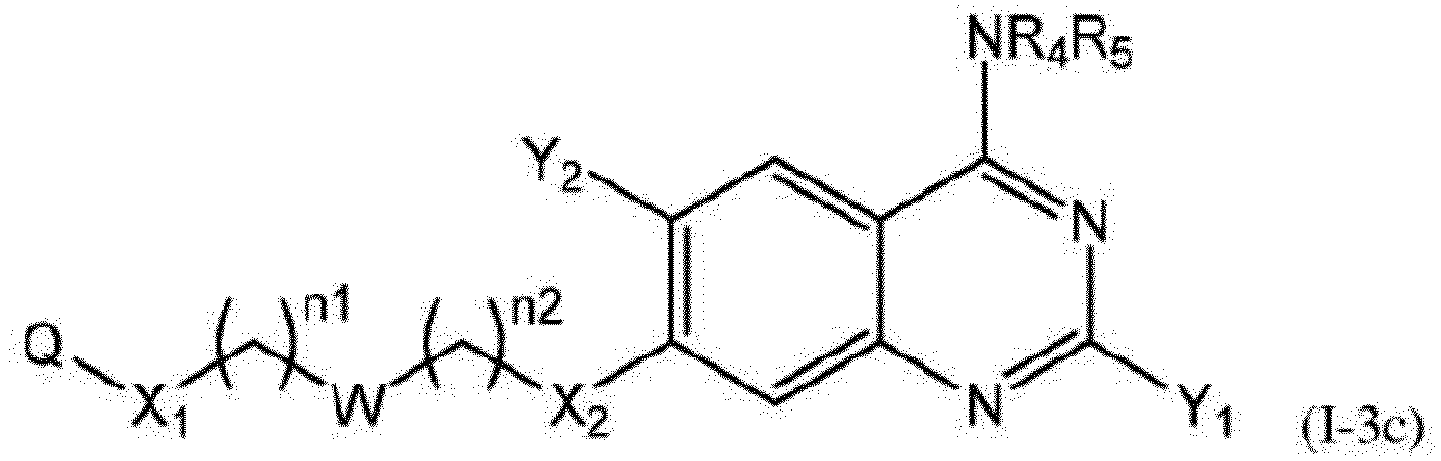
ou, pour les groupes R102 et R103, R102 et R103 forment ensemble, avec l'atome d'azote qui les porte, un hétérocycle éventuellement substitué, et- R104 représente H ou un alkyle en C1 à C6. - Composé selon la revendication 1, dans lequel c'est un composé répondant à la formule (I-3c) ou (I-4c) suivante :

- Composé selon l'une quelconque des revendications 1 et 2, dans lequel :- X2 représente une liaison ou O, et- W représente

- Composé selon l'une quelconque des revendications 1 à 3, dans lequel R3 et R4 représentent, indépendamment l'un de l'autre, H, un alkyle en C1 à C6, un aryle, un hétérocycle, -(alkyle en C1 à C6)-X5-aryle ou -(alkyle en C1 à C6)-X5-hétérocycle,chaque fragment aryle ou hétérocycle étant éventuellement substitué par un ou plusieurs groupes choisis parmi un halogène ; un oxo (=O) ; NO2 ; OR11 ; NR12R13 ; C(O)R14 ; CO2R15 ; OC(O)R16 ; C(O)NR17R18 ; NR19C(O)R20 ; S(O)R50 ; S(O)2R51 ; S(O)2NR52R53 ; un alkyle en C1 à C6 éventuellement substitué par un ou plusieurs groupes choisis parmi un halogène, OR21, NR22R23, C(O)R24, CO2R25, OC(O)R26, C(O)NR27R28, NR29C(O)R30, S(O)R54, S(O)2R55 et S(O)2R56R57 ; et un aryle or un aryl-alkyle en C1 à C6 éventuellement substitué par un ou plusieurs groupes choisis parmi un halogène, OR31, NR32R33, C(O)R34, CO2R35, OC(O)R36, C(O)NR37R38, NR39C(O)R40, S(O)R58, S(O)2R59 et S(O)2R60R61,avec R11 à R40 et R50 à R61 représentant, indépendamment les uns des autres, H ou un alkyle en C1 à C6.
- Composé selon la revendication 4, dans lequel R3 et R4 représentent, indépendamment l'un de l'autre, H, un alkyle en C1 à C6, un aryle, un hétérocycle, -(alkyle en C1 à C6)-X5-aryle ou -(alkyle en C1 à C6)-X5-hétérocycle ; tels que H, un alkyle en C1 à C6, un aryle, un hétérocycle, un aryl-alkyle en C1 à C6, un hétérocycle-alkyle en C1 à C6, -(alkyle en C1 à C6)-NH-aryle ou -(alkyle en C1 à C6)-NH-hétérocycle ;
chaque fragment aryle ou hétérocycle étant éventuellement substitué par un ou plusieurs groupes choisis parmi un halogène ; OR11 ; NR12R13 ; un alkyle en C1 à C6 éventuellement substitué par un ou plusieurs groupes choisis parmi un halogène, OR21 et NR22R23 ; et un aryle or un aryl-alkyle en C1 à C6 éventuellement substitué par un ou plusieurs groupes choisis parmi un halogène, OR31 et NR32R33. - Composé selon l'une quelconque des revendications 1 à 5, dans lequel Y1 et Y2 représentent, indépendamment l'un de l'autre, un atome d'halogène, OR101 ou NR102R103, à condition qu'au moins l'un de Y1 et Y2 représente un groupe autre que H,où R100, R101, R102 et R103 représentent, indépendamment les uns des autres, H, un aryle éventuellement substitué, un hétérocycle éventuellement substitué, ou -(alkyle en C1 à C6)-X6-A1, avec X6 représentant une liaison, O, ou NR104 , par exemple une liaison ou NR104, et A1 représentant H, un alkyle en C1 à C6, un aryle éventuellement substitué ou un hétérocycle éventuellement substitué,ou, pour les groupes R102 et R103, R102 et R103 forment ensemble, avec l'atome d'azote qui les porte, un hétérocycle éventuellement substitué, etoù l'aryle éventuellement substitué et l'hétérocycle éventuellement substitué sont éventuellement substitués par un ou plusieurs groupes choisis parmi un halogène ; un oxo (=O) ; NO2; OR11; NR12R13; C(O)R14; CO2R15 ; OC(O)R16 ; C(O)NR17R18; NR19C(O)R20; S(O)R50 ; S(O)2R51 ; S(O)2NR52R53 ; un alkyle en C1 à C6 éventuellement substitué par un ou plusieurs groupes choisis parmi un halogène, OR21, NR22R23, C(O)R24, CO2R25, OC(O)R26, C(O)NR27R28, NR29C(O)R30, S(O)R54, S(O)2R55 et S(O)2R56R57 ; et un aryle or un aryl-alkyle en C1 à C6 éventuellement substitué par un ou plusieurs groupes choisis parmi un halogène, OR31, NR32R33, C(O)R34, CO2R35, OC(O)R36, C(O)NR37R38, NR39C(O)R40, S(O)R58, S(O)2R59 et S(O)2R60R61,avec R11 à R40 et R50 à R61 représentant, indépendamment les uns des autres, H ou un alkyle en C1 à C6.
- Composé selon la revendication 6, dans lequel Y1 représente H, un atome d'halogène ou NR102R103, et Y2 représente H ou OR101, à condition qu'au moins l'un de Y1 et Y2 représente un groupe autre que H, avecR101 représentant H, un alkyle en C1 à C6, un aryle, un aryl-alkyle en C1 à C6 ou un alkyle-aryl en C1 à C6 ; etR102 et R103 représentant indépendamment l'un de l'autre, H, un alkyle en C1 à C6, un aryle, un hétérocycle, un aryl-alkyle en C1 à C6, un hétérocycle-alkyle en C1 à C6 ou -(alkyle en C1 à C6)-NR104-A1 ;ou R102 et R103 formant ensemble, avec l'atome d'azote qui les porte, un hétérocycle, et où chaque fragment aryle et hétérocycle est éventuellement substitué par un ou plusieurs groupes choisis parmi un halogène, un oxo (=O), un alkyle en C1 à C6, un aryle et un aryl-alkyle en C1 à C6.
- Composé selon la revendication 4, 5, 6 ou 7 dans lequel l'aryle est un phényle ou un naphtyle, et l'hétérocycle est un monocycle ou un bicycle hydrocarboné saturé, insaturé ou aromatique, chaque cycle ayant 5 ou 6 éléments et 1 à 4 atomes de carbone ayant été remplacés par un atome d'azote ou d'oxygène.
- Composé selon l'une quelconque des revendications 1 à 8, dans lequel il est choisi parmi les composés suivants :
A 
B 
C 
D 
E 
F 
G 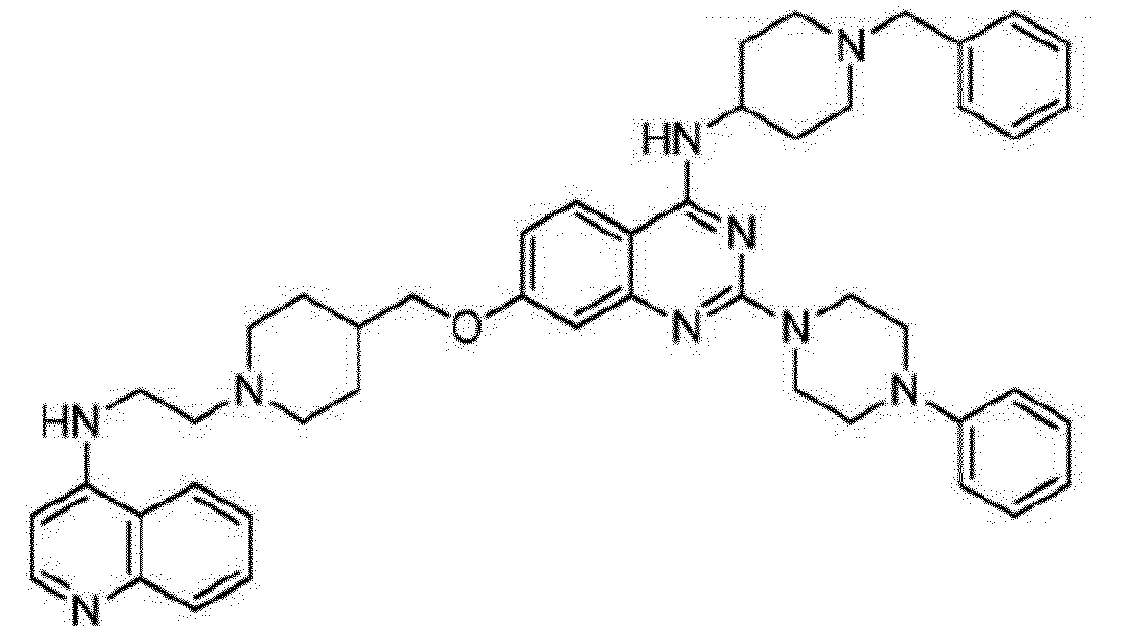
H 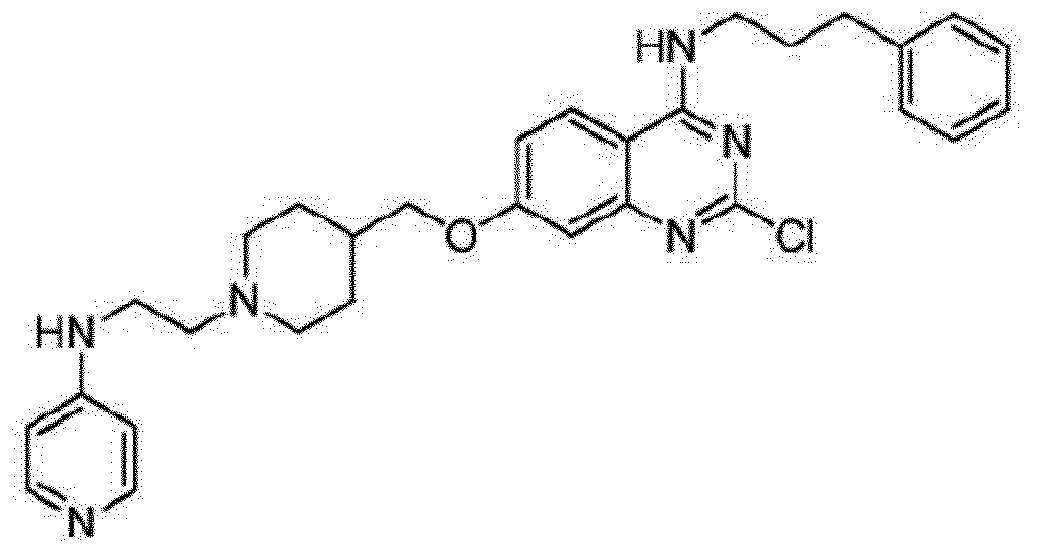
- Composé selon l'une quelconque des revendications 1 à 9 pour une utilisation en tant que médicament.
- Composé selon l'une quelconque des revendications 1 à 9 pour une utilisation dans le traitement d'un cancer.
- Composition pharmaceutique comprenant au moins un composé répondant à la formule (I) selon l'une quelconque des revendications 1 à 9 et au moins un excipient pharmaceutiquement acceptable.
- Composition pharmaceutique comprenant ;(i) au moins un composé répondant à la formule (I) selon l'une quelconque des revendications 1 à 9, et(ii) au moins un autre principe actif, tels qu'un agent anticancéreux,sous la forme d'un produit combiné pour une utilisation simultanée, séparée ou séquentielle.
- Procédé pour préparer un composé répondant à la formule (I) selon la revendication 1 ou un sel pharmaceutiquement acceptable ou un solvate de celui-ci, comprenant :(1)la mise en réaction d'un composé répondant à la formule (II) suivante :



à condition que :▪ lorsque W1 représente LG1, alors W2 représente
 ▪ lorsque W1 représente
et(2)la salification ou la solvatation éventuelle du composé obtenu à l'étape (1) pour donner un sel pharmaceutiquement acceptable ou un solvate d'un composé répondant à la formule (I) tel que défini dans la revendication 1. - Procédé pour préparer un composé répondant à la formule (I) selon la revendication 1, dans lequel au moins l'un de Y1 et Y2 représente un groupe OR101 ou NR102R103, ou un sel pharmaceutiquement acceptable ou un solvate de celui-ci, comprenant :(i) la mise en réaction du composé répondant à la formule (XI) suivante :
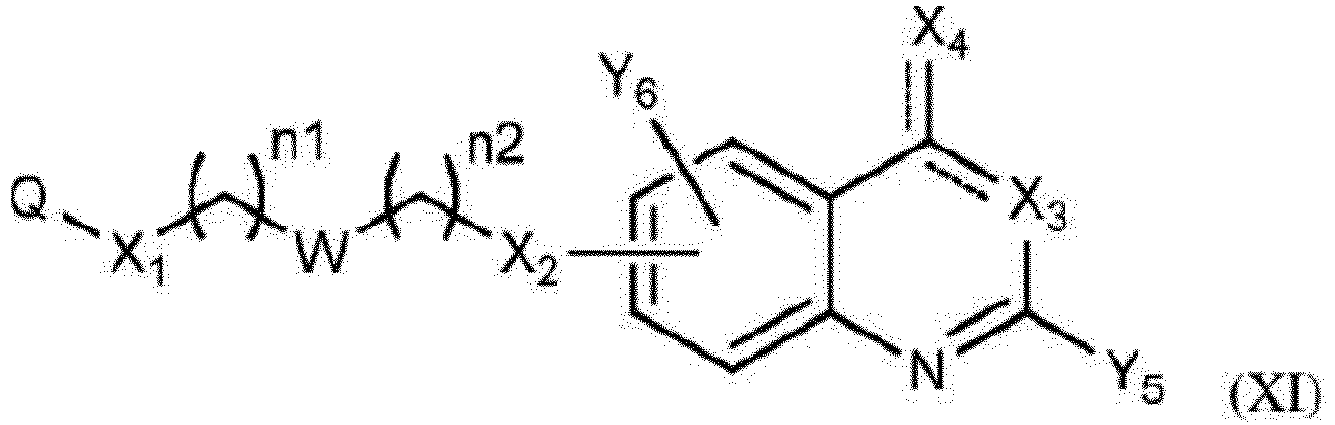 (ii) la salification ou la solvatation éventuelle du composé obtenu à l'étape (i) pour donner un sel pharmaceutiquement acceptable ou un solvate d'un composé répondant à la formule (I) tel que défini dans la revendication 1 dans lequel au moins l'un de Y1 et Y2 représente un groupe OR101 ou NR102R103.
Applications Claiming Priority (2)
| Application Number | Priority Date | Filing Date | Title |
|---|---|---|---|
| EP15305431 | 2015-03-25 | ||
| PCT/EP2016/056734 WO2016151144A1 (fr) | 2015-03-25 | 2016-03-25 | Dérivés de quinazoline substitués utilisés en tant qu'inhibiteurs de l'adn-méthyltransférase |
Publications (2)
| Publication Number | Publication Date |
|---|---|
| EP3277676A1 EP3277676A1 (fr) | 2018-02-07 |
| EP3277676B1 true EP3277676B1 (fr) | 2023-03-22 |
Family
ID=52807764
Family Applications (1)
| Application Number | Title | Priority Date | Filing Date |
|---|---|---|---|
| EP16711848.8A Active EP3277676B1 (fr) | 2015-03-25 | 2016-03-25 | Dérivés de la quinazoline substitués utilisés comme inhibiteurs d'adn méthyltransférase |
Country Status (3)
| Country | Link |
|---|---|
| US (1) | US10450299B2 (fr) |
| EP (1) | EP3277676B1 (fr) |
| WO (1) | WO2016151144A1 (fr) |
Families Citing this family (6)
| Publication number | Priority date | Publication date | Assignee | Title |
|---|---|---|---|---|
| LT2420498T (lt) | 2006-09-26 | 2017-10-25 | Celgene Corporation | 5-pakeistieji chinazolinono dariniai, kaip priešvėžiniai agentai |
| RS56770B1 (sr) | 2011-03-11 | 2018-04-30 | Celgene Corp | Čvrste forme 3-(5-amino-2-metil-4-okso-4h-hinazolin-3-il)-piperidin-2,6-diona i njihove farmaceutske smeše i upotrebe |
| CN104755472A (zh) | 2012-09-04 | 2015-07-01 | 细胞基因公司 | 3-(5-氨基-2-甲基-4-氧代喹唑啉-3(4h)-基)哌啶-2,6-二酮的同位素体及其制备方法 |
| CN108299398B (zh) * | 2018-04-27 | 2021-04-02 | 广州富瑞价值医疗健康产业有限公司 | 一种具有抗肿瘤活性含咔唑的喹唑啉衍生物及其制药用途 |
| EP4204418A1 (fr) | 2020-08-28 | 2023-07-05 | Arvinas Operations, Inc. | Composés de dégradation de protéine de fibrosarcome rapidement accéléré et leurs procédés d'utilisation |
| EP4584258A1 (fr) | 2022-09-07 | 2025-07-16 | Arvinas Operations, Inc. | Composés de dégradation de fibrosarcome rapidement accéléré (raf) et procédés d'utilisation associés |
Family Cites Families (3)
| Publication number | Priority date | Publication date | Assignee | Title |
|---|---|---|---|---|
| GB9323290D0 (en) * | 1992-12-10 | 1994-01-05 | Zeneca Ltd | Quinazoline derivatives |
| WO2008020302A2 (fr) * | 2006-08-17 | 2008-02-21 | Pfizer Products Inc. | Composés hétéro-aromatiques à base de quinoline |
| JP6567505B2 (ja) | 2013-09-19 | 2019-08-28 | ピエール、ファーブル、メディカマン | キナゾリン誘導体およびdnaメチルトランスフェラーゼ阻害剤としてのその使用 |
-
2016
- 2016-03-25 WO PCT/EP2016/056734 patent/WO2016151144A1/fr not_active Ceased
- 2016-03-25 EP EP16711848.8A patent/EP3277676B1/fr active Active
- 2016-03-25 US US15/560,883 patent/US10450299B2/en active Active
Also Published As
| Publication number | Publication date |
|---|---|
| US10450299B2 (en) | 2019-10-22 |
| WO2016151144A1 (fr) | 2016-09-29 |
| US20180118717A1 (en) | 2018-05-03 |
| EP3277676A1 (fr) | 2018-02-07 |
Similar Documents
| Publication | Publication Date | Title |
|---|---|---|
| US10450299B2 (en) | Substituted quinazoline derivatives as DNA methyltransferase inhibitors | |
| US9951044B2 (en) | Quinazoline derivatives and their use as DNA methyltransferase inhibitors | |
| EP2432776B1 (fr) | Méthylsulfanylpyrimidines utiles en tant qu'agents anti-inflammatoires, analgésiques, et anti-épileptiques | |
| ES2593331T3 (es) | Dihidropirazolonas sustituidas y su uso como inhibidores de la HIF-prolil-4-hidroxilasa | |
| Mohamed et al. | Synthesis, antimicrobial activity and molecular modeling study of 3-(5-amino-(2H)-1, 2, 4-triazol-3-yl]-naphthyridinones as potential DNA-gyrase inhibitors | |
| EP2410855A1 (fr) | Procédé de préparation d'alogliptine | |
| JP2009518360A (ja) | イソキノリン誘導体 | |
| WO2018086547A1 (fr) | Dérivé du cycle pyrimidine aromatique à substitution en position 2, préparation et application associées | |
| ES2436433T3 (es) | Proceso para la preparación de 5-(2-amino-pirimidin-4-il)-2-aril-1H-pirrol-3-carboxamidas | |
| WO2023005280A1 (fr) | Préparation et utilisation d'un dérivé d'aminopyrimidine ciblant de manière sélective cdk9 | |
| EP3760633B1 (fr) | Composé d'oxazino-quinazoline et de type oxyzino-quinazoline, son procédé de préparation et ses applications | |
| CN117069696A (zh) | 一种双靶点小分子抑制剂及其制备方法和应用 | |
| EP4045494B1 (fr) | Synthèse de 6-méthyl-n1-(4-(pyridin-3-yl)pyrimidin-2-yl)benzène-1,3-diamine | |
| WO2010004198A2 (fr) | Derives anticancereux, leur preparation et leur application en therapeutique | |
| KR20000032633A (ko) | 신규의 피리미딘 유도체 및 그의 제조방법 | |
| Liu et al. | Synthesis and Anti‐HBV Activities Evaluation of New Ethyl 8‐Imidazolylmethyl‐7‐hydroxyquinoline‐3‐carboxylate Derivatives in vitro | |
| CN113880814B (zh) | 一种嘧啶胺类化合物及应用 | |
| Moustafa et al. | Design, synthesis, biological and molecular docking studies of some o-hydroxycyanopyridine derivatives | |
| CN116143708A (zh) | 一种多取代苯并氮杂芳基衍生物及其用途 | |
| KR102335637B1 (ko) | 신규한 cdk7 억제 화합물 및 이의 약제학적으로 허용가능한 염 | |
| EP3089966B1 (fr) | Nouveaux analogues de biphényle comme inhibiteurs doubles de l'aromatase et de la sulfatase | |
| JP4328873B2 (ja) | 放射線増感剤 | |
| EP4739397A1 (fr) | Dérivés de pyrazole fusionnés en tant qu'inhibiteurs d'usp1 | |
| EP0685467A1 (fr) | Nouveau derive de pyrimidine et composition medicinale | |
| KR101116754B1 (ko) | 히스톤 디아세틸라제 저해활성을 갖는 6-아미노-ν-하이드록시헥산아마이드 화합물 및 이의 제조방법 |
Legal Events
| Date | Code | Title | Description |
|---|---|---|---|
| STAA | Information on the status of an ep patent application or granted ep patent |
Free format text: STATUS: THE INTERNATIONAL PUBLICATION HAS BEEN MADE |
|
| PUAI | Public reference made under article 153(3) epc to a published international application that has entered the european phase |
Free format text: ORIGINAL CODE: 0009012 |
|
| STAA | Information on the status of an ep patent application or granted ep patent |
Free format text: STATUS: REQUEST FOR EXAMINATION WAS MADE |
|
| 17P | Request for examination filed |
Effective date: 20171025 |
|
| AK | Designated contracting states |
Kind code of ref document: A1 Designated state(s): AL AT BE BG CH CY CZ DE DK EE ES FI FR GB GR HR HU IE IS IT LI LT LU LV MC MK MT NL NO PL PT RO RS SE SI SK SM TR |
|
| AX | Request for extension of the european patent |
Extension state: BA ME |
|
| DAV | Request for validation of the european patent (deleted) | ||
| DAX | Request for extension of the european patent (deleted) | ||
| STAA | Information on the status of an ep patent application or granted ep patent |
Free format text: STATUS: EXAMINATION IS IN PROGRESS |
|
| 17Q | First examination report despatched |
Effective date: 20200422 |
|
| GRAP | Despatch of communication of intention to grant a patent |
Free format text: ORIGINAL CODE: EPIDOSNIGR1 |
|
| STAA | Information on the status of an ep patent application or granted ep patent |
Free format text: STATUS: GRANT OF PATENT IS INTENDED |
|
| INTG | Intention to grant announced |
Effective date: 20221026 |
|
| GRAS | Grant fee paid |
Free format text: ORIGINAL CODE: EPIDOSNIGR3 |
|
| GRAA | (expected) grant |
Free format text: ORIGINAL CODE: 0009210 |
|
| STAA | Information on the status of an ep patent application or granted ep patent |
Free format text: STATUS: THE PATENT HAS BEEN GRANTED |
|
| AK | Designated contracting states |
Kind code of ref document: B1 Designated state(s): AL AT BE BG CH CY CZ DE DK EE ES FI FR GB GR HR HU IE IS IT LI LT LU LV MC MK MT NL NO PL PT RO RS SE SI SK SM TR |
|
| REG | Reference to a national code |
Ref country code: GB Ref legal event code: FG4D |
|
| REG | Reference to a national code |
Ref country code: CH Ref legal event code: EP |
|
| REG | Reference to a national code |
Ref country code: IE Ref legal event code: FG4D |
|
| REG | Reference to a national code |
Ref country code: DE Ref legal event code: R096 Ref document number: 602016078418 Country of ref document: DE |
|
| REG | Reference to a national code |
Ref country code: AT Ref legal event code: REF Ref document number: 1555240 Country of ref document: AT Kind code of ref document: T Effective date: 20230415 |
|
| REG | Reference to a national code |
Ref country code: LT Ref legal event code: MG9D |
|
| REG | Reference to a national code |
Ref country code: NL Ref legal event code: MP Effective date: 20230322 |
|
| PG25 | Lapsed in a contracting state [announced via postgrant information from national office to epo] |
Ref country code: RS Free format text: LAPSE BECAUSE OF FAILURE TO SUBMIT A TRANSLATION OF THE DESCRIPTION OR TO PAY THE FEE WITHIN THE PRESCRIBED TIME-LIMIT Effective date: 20230322 Ref country code: NO Free format text: LAPSE BECAUSE OF FAILURE TO SUBMIT A TRANSLATION OF THE DESCRIPTION OR TO PAY THE FEE WITHIN THE PRESCRIBED TIME-LIMIT Effective date: 20230622 Ref country code: LV Free format text: LAPSE BECAUSE OF FAILURE TO SUBMIT A TRANSLATION OF THE DESCRIPTION OR TO PAY THE FEE WITHIN THE PRESCRIBED TIME-LIMIT Effective date: 20230322 Ref country code: LT Free format text: LAPSE BECAUSE OF FAILURE TO SUBMIT A TRANSLATION OF THE DESCRIPTION OR TO PAY THE FEE WITHIN THE PRESCRIBED TIME-LIMIT Effective date: 20230322 Ref country code: HR Free format text: LAPSE BECAUSE OF FAILURE TO SUBMIT A TRANSLATION OF THE DESCRIPTION OR TO PAY THE FEE WITHIN THE PRESCRIBED TIME-LIMIT Effective date: 20230322 |
|
| REG | Reference to a national code |
Ref country code: AT Ref legal event code: MK05 Ref document number: 1555240 Country of ref document: AT Kind code of ref document: T Effective date: 20230322 |
|
| PG25 | Lapsed in a contracting state [announced via postgrant information from national office to epo] |
Ref country code: SE Free format text: LAPSE BECAUSE OF FAILURE TO SUBMIT A TRANSLATION OF THE DESCRIPTION OR TO PAY THE FEE WITHIN THE PRESCRIBED TIME-LIMIT Effective date: 20230322 Ref country code: NL Free format text: LAPSE BECAUSE OF FAILURE TO SUBMIT A TRANSLATION OF THE DESCRIPTION OR TO PAY THE FEE WITHIN THE PRESCRIBED TIME-LIMIT Effective date: 20230322 Ref country code: FI Free format text: LAPSE BECAUSE OF FAILURE TO SUBMIT A TRANSLATION OF THE DESCRIPTION OR TO PAY THE FEE WITHIN THE PRESCRIBED TIME-LIMIT Effective date: 20230322 |
|
| PG25 | Lapsed in a contracting state [announced via postgrant information from national office to epo] |
Ref country code: SM Free format text: LAPSE BECAUSE OF FAILURE TO SUBMIT A TRANSLATION OF THE DESCRIPTION OR TO PAY THE FEE WITHIN THE PRESCRIBED TIME-LIMIT Effective date: 20230322 Ref country code: RO Free format text: LAPSE BECAUSE OF FAILURE TO SUBMIT A TRANSLATION OF THE DESCRIPTION OR TO PAY THE FEE WITHIN THE PRESCRIBED TIME-LIMIT Effective date: 20230322 Ref country code: PT Free format text: LAPSE BECAUSE OF FAILURE TO SUBMIT A TRANSLATION OF THE DESCRIPTION OR TO PAY THE FEE WITHIN THE PRESCRIBED TIME-LIMIT Effective date: 20230724 Ref country code: ES Free format text: LAPSE BECAUSE OF FAILURE TO SUBMIT A TRANSLATION OF THE DESCRIPTION OR TO PAY THE FEE WITHIN THE PRESCRIBED TIME-LIMIT Effective date: 20230322 Ref country code: EE Free format text: LAPSE BECAUSE OF FAILURE TO SUBMIT A TRANSLATION OF THE DESCRIPTION OR TO PAY THE FEE WITHIN THE PRESCRIBED TIME-LIMIT Effective date: 20230322 Ref country code: AT Free format text: LAPSE BECAUSE OF FAILURE TO SUBMIT A TRANSLATION OF THE DESCRIPTION OR TO PAY THE FEE WITHIN THE PRESCRIBED TIME-LIMIT Effective date: 20230322 |
|
| REG | Reference to a national code |
Ref country code: CH Ref legal event code: PL |
|
| PG25 | Lapsed in a contracting state [announced via postgrant information from national office to epo] |
Ref country code: SK Free format text: LAPSE BECAUSE OF FAILURE TO SUBMIT A TRANSLATION OF THE DESCRIPTION OR TO PAY THE FEE WITHIN THE PRESCRIBED TIME-LIMIT Effective date: 20230322 Ref country code: PL Free format text: LAPSE BECAUSE OF FAILURE TO SUBMIT A TRANSLATION OF THE DESCRIPTION OR TO PAY THE FEE WITHIN THE PRESCRIBED TIME-LIMIT Effective date: 20230322 Ref country code: IS Free format text: LAPSE BECAUSE OF FAILURE TO SUBMIT A TRANSLATION OF THE DESCRIPTION OR TO PAY THE FEE WITHIN THE PRESCRIBED TIME-LIMIT Effective date: 20230722 |
|
| REG | Reference to a national code |
Ref country code: BE Ref legal event code: MM Effective date: 20230331 |
|
| PG25 | Lapsed in a contracting state [announced via postgrant information from national office to epo] |
Ref country code: LU Free format text: LAPSE BECAUSE OF NON-PAYMENT OF DUE FEES Effective date: 20230325 |
|
| REG | Reference to a national code |
Ref country code: DE Ref legal event code: R097 Ref document number: 602016078418 Country of ref document: DE |
|
| PG25 | Lapsed in a contracting state [announced via postgrant information from national office to epo] |
Ref country code: MC Free format text: LAPSE BECAUSE OF FAILURE TO SUBMIT A TRANSLATION OF THE DESCRIPTION OR TO PAY THE FEE WITHIN THE PRESCRIBED TIME-LIMIT Effective date: 20230322 |
|
| REG | Reference to a national code |
Ref country code: IE Ref legal event code: MM4A |
|
| PLBE | No opposition filed within time limit |
Free format text: ORIGINAL CODE: 0009261 |
|
| STAA | Information on the status of an ep patent application or granted ep patent |
Free format text: STATUS: NO OPPOSITION FILED WITHIN TIME LIMIT |
|
| PG25 | Lapsed in a contracting state [announced via postgrant information from national office to epo] |
Ref country code: SI Free format text: LAPSE BECAUSE OF FAILURE TO SUBMIT A TRANSLATION OF THE DESCRIPTION OR TO PAY THE FEE WITHIN THE PRESCRIBED TIME-LIMIT Effective date: 20230322 Ref country code: MC Free format text: LAPSE BECAUSE OF FAILURE TO SUBMIT A TRANSLATION OF THE DESCRIPTION OR TO PAY THE FEE WITHIN THE PRESCRIBED TIME-LIMIT Effective date: 20230322 Ref country code: LI Free format text: LAPSE BECAUSE OF NON-PAYMENT OF DUE FEES Effective date: 20230331 Ref country code: IE Free format text: LAPSE BECAUSE OF NON-PAYMENT OF DUE FEES Effective date: 20230325 Ref country code: DK Free format text: LAPSE BECAUSE OF FAILURE TO SUBMIT A TRANSLATION OF THE DESCRIPTION OR TO PAY THE FEE WITHIN THE PRESCRIBED TIME-LIMIT Effective date: 20230322 Ref country code: CZ Free format text: LAPSE BECAUSE OF FAILURE TO SUBMIT A TRANSLATION OF THE DESCRIPTION OR TO PAY THE FEE WITHIN THE PRESCRIBED TIME-LIMIT Effective date: 20230322 Ref country code: CH Free format text: LAPSE BECAUSE OF NON-PAYMENT OF DUE FEES Effective date: 20230331 |
|
| 26N | No opposition filed |
Effective date: 20240102 |
|
| PG25 | Lapsed in a contracting state [announced via postgrant information from national office to epo] |
Ref country code: BE Free format text: LAPSE BECAUSE OF NON-PAYMENT OF DUE FEES Effective date: 20230331 |
|
| PG25 | Lapsed in a contracting state [announced via postgrant information from national office to epo] |
Ref country code: IT Free format text: LAPSE BECAUSE OF FAILURE TO SUBMIT A TRANSLATION OF THE DESCRIPTION OR TO PAY THE FEE WITHIN THE PRESCRIBED TIME-LIMIT Effective date: 20230322 |
|
| REG | Reference to a national code |
Ref country code: DE Ref legal event code: R082 Ref document number: 602016078418 Country of ref document: DE Representative=s name: NOVAGRAAF BREVETS, FR Ref country code: DE Ref legal event code: R081 Ref document number: 602016078418 Country of ref document: DE Owner name: UNIVERSITA'DEGLI STUDI DI ROMA "LA SAPIENZA", IT Free format text: FORMER OWNERS: CENTRE NATIONAL DE LA RECHERCHE SCIENTIFIQUE (CNRS), PARIS, FR; PIERRE FABRE MEDICAMENT, BOULOGNE-BILLANCOURT, FR; UNIVERSITA'DEGLI STUDI DI ROMA "LA SAPIENZA", ROMA, IT Ref country code: DE Ref legal event code: R081 Ref document number: 602016078418 Country of ref document: DE Owner name: PIERRE FABRE MEDICAMENT, FR Free format text: FORMER OWNERS: CENTRE NATIONAL DE LA RECHERCHE SCIENTIFIQUE (CNRS), PARIS, FR; PIERRE FABRE MEDICAMENT, BOULOGNE-BILLANCOURT, FR; UNIVERSITA'DEGLI STUDI DI ROMA "LA SAPIENZA", ROMA, IT Ref country code: DE Ref legal event code: R081 Ref document number: 602016078418 Country of ref document: DE Owner name: CENTRE NATIONAL DE LA RECHERCHE SCIENTIFIQUE (, FR Free format text: FORMER OWNERS: CENTRE NATIONAL DE LA RECHERCHE SCIENTIFIQUE (CNRS), PARIS, FR; PIERRE FABRE MEDICAMENT, BOULOGNE-BILLANCOURT, FR; UNIVERSITA'DEGLI STUDI DI ROMA "LA SAPIENZA", ROMA, IT |
|
| PG25 | Lapsed in a contracting state [announced via postgrant information from national office to epo] |
Ref country code: BG Free format text: LAPSE BECAUSE OF FAILURE TO SUBMIT A TRANSLATION OF THE DESCRIPTION OR TO PAY THE FEE WITHIN THE PRESCRIBED TIME-LIMIT Effective date: 20230322 |
|
| PG25 | Lapsed in a contracting state [announced via postgrant information from national office to epo] |
Ref country code: BG Free format text: LAPSE BECAUSE OF FAILURE TO SUBMIT A TRANSLATION OF THE DESCRIPTION OR TO PAY THE FEE WITHIN THE PRESCRIBED TIME-LIMIT Effective date: 20230322 |
|
| PGFP | Annual fee paid to national office [announced via postgrant information from national office to epo] |
Ref country code: FR Payment date: 20250328 Year of fee payment: 10 |
|
| PGFP | Annual fee paid to national office [announced via postgrant information from national office to epo] |
Ref country code: GB Payment date: 20250327 Year of fee payment: 10 |
|
| PGFP | Annual fee paid to national office [announced via postgrant information from national office to epo] |
Ref country code: DE Payment date: 20250425 Year of fee payment: 10 |
|
| PG25 | Lapsed in a contracting state [announced via postgrant information from national office to epo] |
Ref country code: CY Free format text: LAPSE BECAUSE OF FAILURE TO SUBMIT A TRANSLATION OF THE DESCRIPTION OR TO PAY THE FEE WITHIN THE PRESCRIBED TIME-LIMIT; INVALID AB INITIO Effective date: 20160325 |
|
| PG25 | Lapsed in a contracting state [announced via postgrant information from national office to epo] |
Ref country code: HU Free format text: LAPSE BECAUSE OF FAILURE TO SUBMIT A TRANSLATION OF THE DESCRIPTION OR TO PAY THE FEE WITHIN THE PRESCRIBED TIME-LIMIT; INVALID AB INITIO Effective date: 20160325 |
|
| PG25 | Lapsed in a contracting state [announced via postgrant information from national office to epo] |
Ref country code: GR Free format text: LAPSE BECAUSE OF FAILURE TO SUBMIT A TRANSLATION OF THE DESCRIPTION OR TO PAY THE FEE WITHIN THE PRESCRIBED TIME-LIMIT; INVALID AB INITIO Effective date: 20160325 |
|
| PG25 | Lapsed in a contracting state [announced via postgrant information from national office to epo] |
Ref country code: TR Free format text: LAPSE BECAUSE OF FAILURE TO SUBMIT A TRANSLATION OF THE DESCRIPTION OR TO PAY THE FEE WITHIN THE PRESCRIBED TIME-LIMIT Effective date: 20230322 |