EP3279092A1 - Appareil d'inertage de réservoir de carburant catalytique pour aéronef - Google Patents
Appareil d'inertage de réservoir de carburant catalytique pour aéronef Download PDFInfo
- Publication number
- EP3279092A1 EP3279092A1 EP17183835.2A EP17183835A EP3279092A1 EP 3279092 A1 EP3279092 A1 EP 3279092A1 EP 17183835 A EP17183835 A EP 17183835A EP 3279092 A1 EP3279092 A1 EP 3279092A1
- Authority
- EP
- European Patent Office
- Prior art keywords
- fuel tank
- reactant
- aircraft
- inert gas
- air
- Prior art date
- Legal status (The legal status is an assumption and is not a legal conclusion. Google has not performed a legal analysis and makes no representation as to the accuracy of the status listed.)
- Withdrawn
Links
- 239000002828 fuel tank Substances 0.000 title claims abstract description 116
- 230000003197 catalytic effect Effects 0.000 title description 2
- 239000000376 reactant Substances 0.000 claims abstract description 70
- 239000011261 inert gas Substances 0.000 claims abstract description 54
- 239000003054 catalyst Substances 0.000 claims abstract description 40
- 239000000446 fuel Substances 0.000 claims abstract description 35
- 238000006243 chemical reaction Methods 0.000 claims abstract description 16
- 238000000034 method Methods 0.000 claims abstract description 12
- 239000000463 material Substances 0.000 claims abstract description 7
- 238000001704 evaporation Methods 0.000 claims abstract description 3
- 239000003570 air Substances 0.000 claims description 79
- XLYOFNOQVPJJNP-UHFFFAOYSA-N water Substances O XLYOFNOQVPJJNP-UHFFFAOYSA-N 0.000 claims description 26
- 239000000203 mixture Substances 0.000 claims description 15
- 239000006227 byproduct Substances 0.000 claims description 14
- CURLTUGMZLYLDI-UHFFFAOYSA-N Carbon dioxide Chemical compound O=C=O CURLTUGMZLYLDI-UHFFFAOYSA-N 0.000 claims description 13
- QVGXLLKOCUKJST-UHFFFAOYSA-N atomic oxygen Chemical compound [O] QVGXLLKOCUKJST-UHFFFAOYSA-N 0.000 claims description 13
- 239000007789 gas Substances 0.000 claims description 13
- 239000001301 oxygen Substances 0.000 claims description 13
- 229910052760 oxygen Inorganic materials 0.000 claims description 13
- 239000012080 ambient air Substances 0.000 claims description 11
- 238000001816 cooling Methods 0.000 claims description 10
- IJGRMHOSHXDMSA-UHFFFAOYSA-N Atomic nitrogen Chemical compound N#N IJGRMHOSHXDMSA-UHFFFAOYSA-N 0.000 claims description 8
- 229910002092 carbon dioxide Inorganic materials 0.000 claims description 7
- 239000001569 carbon dioxide Substances 0.000 claims description 6
- JCXJVPUVTGWSNB-UHFFFAOYSA-N nitrogen dioxide Inorganic materials O=[N]=O JCXJVPUVTGWSNB-UHFFFAOYSA-N 0.000 claims description 2
- 239000012528 membrane Substances 0.000 description 8
- 230000007613 environmental effect Effects 0.000 description 7
- 238000000926 separation method Methods 0.000 description 7
- 230000009467 reduction Effects 0.000 description 6
- 239000012510 hollow fiber Substances 0.000 description 4
- 229910052757 nitrogen Inorganic materials 0.000 description 3
- 239000012071 phase Substances 0.000 description 3
- 239000007788 liquid Substances 0.000 description 2
- 239000000047 product Substances 0.000 description 2
- 238000004378 air conditioning Methods 0.000 description 1
- 230000004075 alteration Effects 0.000 description 1
- -1 but not limited to Chemical compound 0.000 description 1
- 238000006555 catalytic reaction Methods 0.000 description 1
- 238000009833 condensation Methods 0.000 description 1
- 230000005494 condensation Effects 0.000 description 1
- 230000007423 decrease Effects 0.000 description 1
- 239000000835 fiber Substances 0.000 description 1
- 230000001939 inductive effect Effects 0.000 description 1
- 238000009434 installation Methods 0.000 description 1
- 230000007246 mechanism Effects 0.000 description 1
- 239000010970 precious metal Substances 0.000 description 1
- 238000002360 preparation method Methods 0.000 description 1
- 230000001902 propagating effect Effects 0.000 description 1
- 238000006467 substitution reaction Methods 0.000 description 1
- 239000012808 vapor phase Substances 0.000 description 1
Images

Classifications
-
- B—PERFORMING OPERATIONS; TRANSPORTING
- B64—AIRCRAFT; AVIATION; COSMONAUTICS
- B64D—EQUIPMENT FOR FITTING IN OR TO AIRCRAFT; FLIGHT SUITS; PARACHUTES; ARRANGEMENT OR MOUNTING OF POWER PLANTS OR PROPULSION TRANSMISSIONS IN AIRCRAFT
- B64D37/00—Arrangements in connection with fuel supply for power plant
- B64D37/32—Safety measures not otherwise provided for, e.g. preventing explosive conditions
-
- B—PERFORMING OPERATIONS; TRANSPORTING
- B01—PHYSICAL OR CHEMICAL PROCESSES OR APPARATUS IN GENERAL
- B01J—CHEMICAL OR PHYSICAL PROCESSES, e.g. CATALYSIS OR COLLOID CHEMISTRY; THEIR RELEVANT APPARATUS
- B01J19/00—Chemical, physical or physico-chemical processes in general; Their relevant apparatus
- B01J19/14—Production of inert gas mixtures; Use of inert gases in general
-
- B—PERFORMING OPERATIONS; TRANSPORTING
- B01—PHYSICAL OR CHEMICAL PROCESSES OR APPARATUS IN GENERAL
- B01J—CHEMICAL OR PHYSICAL PROCESSES, e.g. CATALYSIS OR COLLOID CHEMISTRY; THEIR RELEVANT APPARATUS
- B01J4/00—Feed or outlet devices; Feed or outlet control devices
- B01J4/001—Feed or outlet devices as such, e.g. feeding tubes
-
- B—PERFORMING OPERATIONS; TRANSPORTING
- B01—PHYSICAL OR CHEMICAL PROCESSES OR APPARATUS IN GENERAL
- B01J—CHEMICAL OR PHYSICAL PROCESSES, e.g. CATALYSIS OR COLLOID CHEMISTRY; THEIR RELEVANT APPARATUS
- B01J4/00—Feed or outlet devices; Feed or outlet control devices
- B01J4/008—Feed or outlet control devices
-
- B—PERFORMING OPERATIONS; TRANSPORTING
- B64—AIRCRAFT; AVIATION; COSMONAUTICS
- B64D—EQUIPMENT FOR FITTING IN OR TO AIRCRAFT; FLIGHT SUITS; PARACHUTES; ARRANGEMENT OR MOUNTING OF POWER PLANTS OR PROPULSION TRANSMISSIONS IN AIRCRAFT
- B64D37/00—Arrangements in connection with fuel supply for power plant
- B64D37/02—Tanks
-
- B—PERFORMING OPERATIONS; TRANSPORTING
- B64—AIRCRAFT; AVIATION; COSMONAUTICS
- B64D—EQUIPMENT FOR FITTING IN OR TO AIRCRAFT; FLIGHT SUITS; PARACHUTES; ARRANGEMENT OR MOUNTING OF POWER PLANTS OR PROPULSION TRANSMISSIONS IN AIRCRAFT
- B64D37/00—Arrangements in connection with fuel supply for power plant
- B64D37/34—Conditioning fuel, e.g. heating
-
- F—MECHANICAL ENGINEERING; LIGHTING; HEATING; WEAPONS; BLASTING
- F02—COMBUSTION ENGINES; HOT-GAS OR COMBUSTION-PRODUCT ENGINE PLANTS
- F02M—SUPPLYING COMBUSTION ENGINES IN GENERAL WITH COMBUSTIBLE MIXTURES OR CONSTITUENTS THEREOF
- F02M21/00—Apparatus for supplying engines with non-liquid fuels, e.g. gaseous fuels stored in liquid form
- F02M21/02—Apparatus for supplying engines with non-liquid fuels, e.g. gaseous fuels stored in liquid form for gaseous fuels
- F02M21/06—Apparatus for de-liquefying, e.g. by heating
-
- F—MECHANICAL ENGINEERING; LIGHTING; HEATING; WEAPONS; BLASTING
- F02—COMBUSTION ENGINES; HOT-GAS OR COMBUSTION-PRODUCT ENGINE PLANTS
- F02M—SUPPLYING COMBUSTION ENGINES IN GENERAL WITH COMBUSTIBLE MIXTURES OR CONSTITUENTS THEREOF
- F02M27/00—Apparatus for treating combustion-air, fuel, or fuel-air mixture, by catalysts, electric means, magnetism, rays, sound waves, or the like
- F02M27/02—Apparatus for treating combustion-air, fuel, or fuel-air mixture, by catalysts, electric means, magnetism, rays, sound waves, or the like by catalysts
-
- A—HUMAN NECESSITIES
- A62—LIFE-SAVING; FIRE-FIGHTING
- A62C—FIRE-FIGHTING
- A62C3/00—Fire prevention, containment or extinguishing specially adapted for particular objects or places
- A62C3/06—Fire prevention, containment or extinguishing specially adapted for particular objects or places of highly inflammable material, e.g. light metals, petroleum products
- A62C3/065—Fire prevention, containment or extinguishing specially adapted for particular objects or places of highly inflammable material, e.g. light metals, petroleum products for containers filled with inflammable liquids
-
- A—HUMAN NECESSITIES
- A62—LIFE-SAVING; FIRE-FIGHTING
- A62C—FIRE-FIGHTING
- A62C3/00—Fire prevention, containment or extinguishing specially adapted for particular objects or places
- A62C3/07—Fire prevention, containment or extinguishing specially adapted for particular objects or places in vehicles, e.g. in road vehicles
- A62C3/08—Fire prevention, containment or extinguishing specially adapted for particular objects or places in vehicles, e.g. in road vehicles in aircraft
-
- B—PERFORMING OPERATIONS; TRANSPORTING
- B01—PHYSICAL OR CHEMICAL PROCESSES OR APPARATUS IN GENERAL
- B01J—CHEMICAL OR PHYSICAL PROCESSES, e.g. CATALYSIS OR COLLOID CHEMISTRY; THEIR RELEVANT APPARATUS
- B01J2204/00—Aspects relating to feed or outlet devices; Regulating devices for feed or outlet devices
- B01J2204/002—Aspects relating to feed or outlet devices; Regulating devices for feed or outlet devices the feeding side being of particular interest
-
- B—PERFORMING OPERATIONS; TRANSPORTING
- B01—PHYSICAL OR CHEMICAL PROCESSES OR APPARATUS IN GENERAL
- B01J—CHEMICAL OR PHYSICAL PROCESSES, e.g. CATALYSIS OR COLLOID CHEMISTRY; THEIR RELEVANT APPARATUS
- B01J2204/00—Aspects relating to feed or outlet devices; Regulating devices for feed or outlet devices
- B01J2204/005—Aspects relating to feed or outlet devices; Regulating devices for feed or outlet devices the outlet side being of particular interest
-
- B—PERFORMING OPERATIONS; TRANSPORTING
- B01—PHYSICAL OR CHEMICAL PROCESSES OR APPARATUS IN GENERAL
- B01J—CHEMICAL OR PHYSICAL PROCESSES, e.g. CATALYSIS OR COLLOID CHEMISTRY; THEIR RELEVANT APPARATUS
- B01J2204/00—Aspects relating to feed or outlet devices; Regulating devices for feed or outlet devices
- B01J2204/007—Aspects relating to the heat-exchange of the feed or outlet devices
-
- Y—GENERAL TAGGING OF NEW TECHNOLOGICAL DEVELOPMENTS; GENERAL TAGGING OF CROSS-SECTIONAL TECHNOLOGIES SPANNING OVER SEVERAL SECTIONS OF THE IPC; TECHNICAL SUBJECTS COVERED BY FORMER USPC CROSS-REFERENCE ART COLLECTIONS [XRACs] AND DIGESTS
- Y02—TECHNOLOGIES OR APPLICATIONS FOR MITIGATION OR ADAPTATION AGAINST CLIMATE CHANGE
- Y02T—CLIMATE CHANGE MITIGATION TECHNOLOGIES RELATED TO TRANSPORTATION
- Y02T10/00—Road transport of goods or passengers
- Y02T10/10—Internal combustion engine [ICE] based vehicles
- Y02T10/30—Use of alternative fuels, e.g. biofuels
-
- Y—GENERAL TAGGING OF NEW TECHNOLOGICAL DEVELOPMENTS; GENERAL TAGGING OF CROSS-SECTIONAL TECHNOLOGIES SPANNING OVER SEVERAL SECTIONS OF THE IPC; TECHNICAL SUBJECTS COVERED BY FORMER USPC CROSS-REFERENCE ART COLLECTIONS [XRACs] AND DIGESTS
- Y02—TECHNOLOGIES OR APPLICATIONS FOR MITIGATION OR ADAPTATION AGAINST CLIMATE CHANGE
- Y02T—CLIMATE CHANGE MITIGATION TECHNOLOGIES RELATED TO TRANSPORTATION
- Y02T50/00—Aeronautics or air transport
- Y02T50/40—Weight reduction
Definitions
- the subject matter disclosed herein generally relates to fuel tank inerting systems for aircraft and, more particularly, to fuel tank inerting systems configured to supply inert gas in an aircraft.
- aircraft pneumatic systems including, air conditioning systems, cabin pressurization and cooling, and fuel tank inerting systems are powered by engine bleed air.
- pressurized air from an engine of the aircraft is provided to a cabin through a series of systems that alter the temperatures and pressures of the pressurized air.
- the source of energy is the pressure of the air itself.
- the air bled from engines may be used for environmental control systems, such as used to supply air to the cabin and to other systems within an aircraft. Additionally, the air bled from engines may be supplied to inerting apparatuses to provide inert gas to a fuel tank. In other cases, the air may be sourced from compressed RAM air.
- air separation module Regardless of the source, the air is passed through a porous hollow fiber membrane tube bundle known as an "air separation module.”
- a downstream flow control valve is controlled or passively operating to apply back pressure on the air separation module to force some amount of air through the membrane as opposed to flowing though the tube. Oxygen passes more easily through the membrane, leaving only nitrogen enriched air to continue through the flow control valve into the fuel tank.
- air separation modules employ a dedicated ram air heat exchanger in conjunction with a bypass valve.
- aircraft fuel tank inerting systems include a fuel tank having fuel therein, an evaporator container fluidly connected to the fuel tank and arranged to receive inerting fuel from the fuel tank, the evaporator container evaporating the inerting fuel to generate a first reactant, a second reactant source arranged to supply a second reactant, and a catalyst fluidly connected to the evaporator container and arranged to receive the first reactant and the second reactant, wherein the catalyst includes a catalyst material to induce a chemical reaction between the first reactant and the second reactant to generate an inert gas, wherein the inert gas is supplied into an ullage of the fuel tank.
- further embodiments of the aircraft fuel tank inerting systems may include that the second reactant source is a source of gas containing oxygen.
- further embodiments of the aircraft fuel tank inerting systems may include that the second reactant source is at least one of (i) bleed air from an aircraft engine, (ii) cabin air, or (iii) high pressure air extracted or bled from an engine.
- further embodiments of the aircraft fuel tank inerting systems may include that the evaporator container includes a heater arranged to evaporate the inerting fuel within the evaporator container to generate the first reactant.
- further embodiments of the aircraft fuel tank inerting systems may include a controller arranged to supply an amount of inert gas into the ullage of the fuel tank to maintain a higher pressure within the ullage as compared to ambient air pressure during a descent phase of aircraft operation.
- further embodiments of the aircraft fuel tank inerting systems may include a heat exchanger arranged downstream from the catalyst and arranged receive a catalyzed mixture from the catalyst wherein a portion of the catalyzed mixture condenses into a byproduct.
- further embodiments of the aircraft fuel tank inerting systems may include that the byproduct is water.
- further embodiments of the aircraft fuel tank inerting systems may include a water separator positioned downstream from the heat exchanger and arranged to separate the water from the catalyzed mixture.
- further embodiments of the aircraft fuel tank inerting systems may include that the heat exchanger receives cooling air from a cool air source.
- further embodiments of the aircraft fuel tank inerting systems may include that the catalyst receives cooling air from the cool air source.
- further embodiments of the aircraft fuel tank inerting systems may include a fan located downstream from the catalyst and controlled to boost a gas stream pressure of the inert gas.
- further embodiments of the aircraft fuel tank inerting systems may include a mixer arranged to mix the first reactant and the second reactant prior to entry into the catalyst.
- further embodiments of the aircraft fuel tank inerting systems may include that the mixer is one of a jet pump or an ejector.
- further embodiments of the aircraft fuel tank inerting systems may include that the fuel tank is a primary fuel tank of the aircraft, the inerting system comprising at least one additional fuel tank, wherein the inert gas is supplied to a ullage of the at least one additional fuel tank.
- further embodiments of the aircraft fuel tank inerting systems may include that the first reactant is vaporized fuel, the second reactant is oxygen-rich air, and the inert gas is a combination of nitrogen and carbon dioxide.
- methods of supplying inert gas into an ullage of fuel tanks on an aircraft include generating a first reactant using an evaporator container and supplying said first reactant to a catalyst, supplying a second reactant to the catalyst to induce a chemical reaction between the first reactant and the second reactant to generate an inert gas, and supplying the inert gas into the ullage of the fuel tank.
- further embodiments of the methods may include that the second reactant is sourced from at least one of (i) bleed air from an engine of the aircraft, (ii) cabin air, or (iii) high pressure air extracted or bled from an engine.
- further embodiments of the methods may include supplying an amount of inert gas into the ullage of the fuel tank to maintain a higher pressure within the ullage as compared to ambient air pressure during a descent phase of aircraft operation.
- further embodiments of the methods may include condensing out a byproduct from a catalyze mixture prior to supplying the inert gas into the ullage of the fuel tank.
- further embodiments of the methods may include boosting a gas stream pressure of the inert gas to maintain a supply of inert gas into the ullage of the fuel tank.
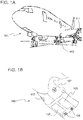
- an aircraft 101 can include one or more bays 103 beneath a center wing box.
- the bay 103 can contain and/or support one or more components of the aircraft 101.
- the aircraft 101 can include environmental control systems and/or fuel inerting systems within the bay 103.
- the bay 103 includes bay doors 105 that enable installation and access to one or more components (e.g., environmental control systems, fuel inerting systems, etc.).
- air that is external to the aircraft 101 can flow into one or more environmental control systems within the bay doors 105 through one or more ram air inlets 107.
- the air may then flow through the environmental control systems to be processed and supplied to various components or locations within the aircraft 101 (e.g., passenger cabin, fuel inerting systems, etc.).
- Some air may be exhaust through one or more ram air exhaust outlets 109.
- the aircraft 101 includes one or more engines 111,
- the engines 111 are typically mounted on wings of the aircraft 101, but may be located at other locations depending on the specific aircraft configuration. In some aircraft configurations, air can be bled from the engines 111 and supplied to environmental control systems and/or fuel inerting systems, as will be appreciated by those of skill in the art.
- Embodiments provided herein provide reduced volume and/or weight characteristics of air separation modules for aircraft. Further, embodiments provided herein can prevent humid air from entering fuel tanks of the aircraft, thus preventing various problems that may arise with some fuel system components.
- the typical hollow fiber membrane separator is replaced by a catalytic system (e.g., CO 2 generation system), which can be, for example, smaller, lighter, and/or more efficient than the typical fiber membrane separators. That is, in accordance with embodiments of the present disclosure, the use of hollow fiber membrane separators may be eliminated.
- a catalytic system e.g., CO 2 generation system
- a function of fuel tank flammability reduction systems in accordance with embodiments of the present disclosure is accomplished by reacting a small amount of fuel vapor (e.g., a "first reactant") with a source of gas containing oxygen (e.g., a "second reactant").
- the product of the reaction is carbon dioxide and water vapor.
- the source of the second reactant e.g., oxygen-rich air
- a catalyst material is used to induce a chemical reaction, including, but not limited to, precious metal materials.
- the carbon dioxide that results from the reaction is an inert gas that is combined with nitrogen naturally found in fresh/ambient air, and is directed back within a fuel tack to create an inert environment within the fuel tank, thus reducing a flammability of the fuel tank.
- the fuel tank flammability reduction or inerting systems of the present disclosure can provide a functionality such that no water vapor enters the fuel tanks during descent stages of flight of an aircraft. This can be accomplished by controlling a flow rate of inert gas into the fuel tank so that a positive pressure is continuously maintained in the fuel tank.
- FIG. 2 is a schematic illustration of a flammability reduction or inerting system 200 utilizing a catalytic reaction to produce inert gas in accordance with an embodiment of the present disclosure.
- the inerting system 200 includes a fuel tank 202 having fuel 204 therein. As the fuel 204 is consumed during operation of one or more engines, an ullage 206 forms within the fuel tank 202. To reduce flammability risks associated with vaporized fuel that may form within the ullage 206, an inert gas can be generated and fed into the ullage 206.
- an inerting fuel 208 can be extracted from the fuel tank 202 and into an evaporator container 210.
- the amount of fuel 204 that is extracted into the evaporator container 210 i.e., the amount of inerting fuel 208) can be controlled by an evaporator container valve 212, such as a float valve.
- the inerting fuel 208 which may be in liquid form when pulled from the fuel tank 202, can be vaporized within the evaporator container 210 using a heater 214, such as an electric heater, to generate a first reactant 216.
- the first reactant 216 is a vaporized portion of the inerting fuel 208 located within the evaporator container 210.
- the first reactant 216 is mixed with a second reactant 218 which is sourced from a second reactant source 220.
- the second reactant 218 is oxygen-rich air that is catalyzed with the first reactant 216 to generate an inert gas to be supplied into the ullage 206 of the fuel tank 202.
- the second reactant 218 can come from any source on an aircraft that is at a pressure greater than ambient, including, but not limited to bleed air from an engine, cabin air, high pressure air extracted or bled from an engine, etc. (i.e., any second reactant source 220 can take any number of configurations and/or arrangements).
- the first reactant 216 within the evaporator container 210 and the second reactant 218 can be directed into a catalyst 222 by and/or through a mixer 224, which, in some embodiments, may be an ejector or jet pump.
- the mixer 224 will mix the first and second reactants 216, 218 into a mixed air stream 225.
- the catalyst 222 can be temperature controlled to ensure a desired chemical reaction efficiency such that an inert gas can be efficiently produced by the inerting system 200 from the mixed air stream 225. Accordingly, cooling air 226 can be provided to the catalyst 222 to achieve a desired thermal condition for the chemical reaction within the catalyst 222.
- the cooling air 226 can be sourced from a cool air source 228.
- a catalyzed mixture 230 leaves the catalyst 222 and is passed through a heat exchanger 232.
- the heat exchanger 232 operates as a condenser on the catalyzed mixture 230 to separate out an inert gas 234 and a byproduct 236.
- a cooling air is supplied into the heat exchanger 232 to achieve the condensing functionality.
- a cooling air 226 can be sourced from the same cool air source 228 as that provided to the catalyst 222, although in other embodiments the cool air sources for the two components may be different.
- the byproduct 236 may be water vapor, and thus in the present configuration shown in FIG. 2 , a water separator 238 is provided downstream of the heat exchanger 232 to extract the water vapor from the catalyzed mixture 230, thus leaving only the inert gas 234 to be provided to the ullage 206 of the fuel tank 202.
- the inerting system 200 can include additional components including, but not limited to, a fan 240, a flame arrestor 242, and a controller 244.
- Various other components can be included without departing from the scope of the present disclosure. Further, in some embodiments, certain of the included components may be optional and/or eliminated.
- the fan 240 and/or the water separator 238 can be omitted.
- the controller 244 can be in operable communication with one or more sensors 246 and valves 248 to enable control of the inerting system 200.
- flammability reduction is achieved by the inerting system 200 by utilizing the catalyst 222 to induce a chemical reaction between oxygen (second reactant 218) and fuel vapor (first reactant 216) to produce carbon dioxide (inert gas 234) and water in vapor phase (byproduct 236).
- the source of the second reactant 218 e.g., oxygen
- the fuel vapor (first reactant 216) is created by draining a small amount of fuel 204 from the fuel tank 202 (e.g., a primary aircraft fuel tank) into the evaporator container 210.
- the inerting fuel 208 within the evaporator container 210 is heated using the electric heater 214.
- the first reactant 216 (e.g., fuel vapor) is removed from the evaporator container 210 by using the mixer 224 to induce a suction pressure that pulls the first reactant 216 out of the evaporator container 210.
- the mixer 224 utilizes the elevated pressure of the second reactant source 220 to induce a secondary flow within the mixer 224 which is sourced from the evaporator container 210. Further, as noted above, the mixer 224 is used to mix the two gas streams (first and second reactants 216, 218) together to form the mixed air stream 225.
- the mixed air stream 225 (e.g., fuel vapor and oxygen or air) is then introduced to the catalyst 222, inducing a chemical reaction that transforms the mixed air stream 225 (e.g., separates) into the inert gas 234 and the byproduct 236 (e.g., carbon dioxide and water vapor). It is noted that any other gas species that are present in the mixed air stream 225 (for example, nitrogen) will not react and will thus pass through the catalyst 222 unchanged.
- the catalyst 222 is in a form factor that acts as a heat exchanger.
- one non-limiting configuration may be a plate fin heat exchanger wherein the hot side of the heat exchanger would be coated with the catalyst material.
- the cold side of the catalyst heat exchanger can be fed with the cooling air 226 from the cool air source 228 (e.g., ram air or some other source of cold air).
- the air through the cold side of the catalyst heat exchanger can be controlled such that the temperature of the hot mixed gas stream 225 is hot enough to sustain the chemical reaction desired within the catalyst 222, but cool enough to remove the heat generated by the exothermic reaction, thus maintaining aircraft safety and materials from exceeding maximum temperature limits.
- the chemical reaction process within the catalyst 222 can produce byproducts, including water in vapor form. It may be undesirable to have water (in any form) enter the fuel tank 202. Accordingly, water byproduct 236 can be removed from the product gas stream (i.e., inert gas 234) through condensation. To achieve this, catalyzed mixture 230 enters the heat exchanger 232 that is used to cool the catalyzed mixture 230 such that the byproduct 236 can be removed (e.g., a majority of the water vapor condenses and drops out of the catalyzed mixture 230). The byproduct 236 (e.g., liquid water) can then be drained overboard. An optional water separator 238 can be used to accomplish this function.
- a flow control valve 248 located downstream of the heat exchanger 232 and optional water separator 238 can meter the flow of the inert gas 234 to a desired flow rate.
- An optional boost fan 240 can be used to boost the gas stream pressure of the inert gas 234 to overcome a pressure drop associated with ducting between the outlet of the heat exchanger 232 and the discharge of the inert gas 234 into the fuel tank 202.
- the flame arrestor 242 at an inlet to the fuel tank 202 is arranged to prevent any potential flames from propagating into the fuel tank 202.
- aircraft fuel tanks e.g., fuel tank 202
- the fuel tank 202 includes a vent 250.
- pressure inside the fuel tank 202 is very low and is roughly equal to ambient pressure.
- the pressure inside the fuel tank 202 needs to rise to equal ambient pressure at sea level (or whatever altitude the aircraft is landing at). This requires gas entering the fuel tank 202 from outside to equalize the pressure.
- water vapor can be carried by the ambient air into the fuel tank 202.
- the inerting system 200 can repressurize the fuel tank 202 with the inert gas 234 generated by the inerting system 200. This is accomplished by using the valves 248.
- one of the valves 248 may be a flow control valve 252 that is arranged fluidly downstream from the catalyst 222.
- the flow control valve 252 can be used to control the flow of inert gas 234 into the fuel tank 202 such that a slightly positive pressure is always maintained in the fuel tank 202. Such positive pressure can be prevent ambient air from entering the fuel tank 202 from outside during descent and therefore prevent water from entering the fuel tank 202.
- the controller 244 can be operably connected to the various components of the inerting system 200, including, but not limited to, the valves 248 and the sensors 246.
- the controller 244 can be configured to receive input from the sensors 246 to control the valves 248 and thus maintain appropriate levels of inert gas 234 within the ullage 206. Further, the controller 244 can be arranged to ensure an appropriate amount of pressure within the fuel tank 202 such that, during a descent of an aircraft, ambient air does not enter the ullage 206 of the fuel tank 202.
- the inerting system 200 can supply inert gas to multiple fuel tanks on an aircraft. As shown in the embodiment of FIG. 2 , an inerting supply line 254 fluidly connects the fuel tank 202 to the evaporator container 210. After the inert gas 234 is generated, the inert gas 234 will flow through a fuel tank supply line 256 to supply the inert gas 234 to the fuel tank 202 and, optionally, additional fuel tanks 258, as schematically shown.
- embodiments of the present disclosure provide efficient mechanisms for generating inert gas and supplying such inert gas into fuel tanks of aircraft. Further, advantageously, embodiments provided herein can prevent ambient air (possibly containing water) from entering an aircraft fuel tank.
- a controller of an inerting system as described herein can supply inert gas into the fuel tank to maintain a desired pressure (e.g., providing a higher pressure within the fuel tank than ambient pressures).
- a controller of an inerting system as described herein can supply inert gas into the fuel tank to maintain a desired pressure (e.g., providing a higher pressure within the fuel tank than ambient pressures).
- a desired pressure e.g., providing a higher pressure within the fuel tank than ambient pressures.
- Such increased pressure can be employed within the fuel tank to prevent ingress of oxygen-rich air (e.g., ambient air). This may be particularly useful during a descent phase of flight of an aircraft as the ambient pressures increase as the altitude decreases.
Landscapes
- Engineering & Computer Science (AREA)
- Chemical & Material Sciences (AREA)
- Aviation & Aerospace Engineering (AREA)
- Chemical Kinetics & Catalysis (AREA)
- Organic Chemistry (AREA)
- Combustion & Propulsion (AREA)
- Mechanical Engineering (AREA)
- General Engineering & Computer Science (AREA)
- General Chemical & Material Sciences (AREA)
- Oil, Petroleum & Natural Gas (AREA)
- Physical Or Chemical Processes And Apparatus (AREA)
- Production Of Liquid Hydrocarbon Mixture For Refining Petroleum (AREA)
Applications Claiming Priority (1)
| Application Number | Priority Date | Filing Date | Title |
|---|---|---|---|
| US201662370316P | 2016-08-03 | 2016-08-03 |
Publications (1)
| Publication Number | Publication Date |
|---|---|
| EP3279092A1 true EP3279092A1 (fr) | 2018-02-07 |
Family
ID=59485288
Family Applications (1)
| Application Number | Title | Priority Date | Filing Date |
|---|---|---|---|
| EP17183835.2A Withdrawn EP3279092A1 (fr) | 2016-08-03 | 2017-07-28 | Appareil d'inertage de réservoir de carburant catalytique pour aéronef |
Country Status (3)
| Country | Link |
|---|---|
| US (2) | US20180037334A1 (fr) |
| EP (1) | EP3279092A1 (fr) |
| CN (1) | CN110077604A (fr) |
Cited By (9)
| Publication number | Priority date | Publication date | Assignee | Title |
|---|---|---|---|---|
| CN109850168A (zh) * | 2018-12-31 | 2019-06-07 | 北京航空航天大学 | 飞机热管理系统的油箱冷却子系统 |
| EP3539901A1 (fr) * | 2018-03-14 | 2019-09-18 | Hamilton Sundstrand Corporation | Mise en service d'un système de génération de gaz d'inertage catalytique avec recyclage pour avion |
| EP3543141A1 (fr) * | 2018-03-19 | 2019-09-25 | Hamilton Sundstrand Corporation | Source d'air refroidi pour un condenseur d'inertage catalytique |
| EP3543142A1 (fr) * | 2018-03-23 | 2019-09-25 | Hamilton Sundstrand Corporation | Réacteur de recyclage interne d'inertage catalytique |
| EP3546372A1 (fr) * | 2018-03-29 | 2019-10-02 | Hamilton Sundstrand Corporation | Prérefroidissement de vaporisation de carburant à utiliser avec un inertage catalytique de réservoir de carburant |
| EP3549869A1 (fr) * | 2018-04-04 | 2019-10-09 | Hamilton Sundstrand Corporation | Surveillance de dégradation de catalyseur de système d'inertage catalytique |
| US10850861B2 (en) | 2018-12-11 | 2020-12-01 | Hamilton Sunstrand Corporation | Catalytic fuel tank inerting apparatus for aircraft |
| US11254439B2 (en) | 2018-12-11 | 2022-02-22 | Hamilton Sundstrand Corporation | Catalytic fuel tank inerting apparatus for aircraft |
| US12129045B2 (en) | 2019-07-18 | 2024-10-29 | Parker-Hannifin Corporation | Sparging evaporator with porous media for fuel enrichment in catalytic inerting system |
Families Citing this family (9)
| Publication number | Priority date | Publication date | Assignee | Title |
|---|---|---|---|---|
| US10640227B2 (en) | 2016-08-03 | 2020-05-05 | Hamilton Sundstrand Corporation | Catalytic fuel tank inerting apparatus for aircraft |
| US11679893B2 (en) | 2018-10-02 | 2023-06-20 | Hamilton Sundstrand Corporation | Pressurized inerting system |
| US11628947B2 (en) * | 2018-10-04 | 2023-04-18 | Hamilton Sundstrand Corporation | Catalytic fuel tank inerting apparatus for aircraft |
| WO2020096954A1 (fr) | 2018-11-07 | 2020-05-14 | Parker-Hannifin Corporation | Système d'inertage catalytique à enrichissement en vapeur de carburant |
| CN109573073B (zh) * | 2018-12-20 | 2021-10-29 | 中国航空工业集团公司金城南京机电液压工程研究中心 | 一种飞行器燃油箱绿色惰化系统中的除湿装置 |
| CN109774953A (zh) * | 2019-01-22 | 2019-05-21 | 南京航空航天大学 | 一种飞机燃油箱耗氧型惰化系统 |
| US11155358B2 (en) * | 2019-04-02 | 2021-10-26 | Hamilton Sundstrand Corporation | Catalytic fuel tank inerting systems for aircraft |
| US10939592B2 (en) * | 2019-06-14 | 2021-03-02 | Intel Corporation | Liquid cooling system with sub atmospheric pressure coolant |
| CN111185156A (zh) * | 2019-12-25 | 2020-05-22 | 中国航空工业集团公司金城南京机电液压工程研究中心 | 一种钛锡复合氧化物负载的贵金属催化剂及其制备方法 |
Citations (4)
| Publication number | Priority date | Publication date | Assignee | Title |
|---|---|---|---|---|
| GB1395691A (en) * | 1973-10-05 | 1975-05-29 | Garrett Corp | Fuel tank inerting system |
| GB2374007A (en) * | 2001-04-04 | 2002-10-09 | Kidde Plc | Fire / explosion protection system and method, using inert gas produced in low temperature catalytic oxidation of organic fuel |
| US20080099618A1 (en) * | 2006-10-17 | 2008-05-01 | Honeywell International Inc. | Oxygen removal system |
| US20080128048A1 (en) * | 2006-11-15 | 2008-06-05 | Honeywell International Inc. | Advanced carbon dioxide fuel tank inerting system |
Family Cites Families (6)
| Publication number | Priority date | Publication date | Assignee | Title |
|---|---|---|---|---|
| US2938576A (en) * | 1955-07-07 | 1960-05-31 | British Oxygen Co Ltd | Means for supplying gases to the fuel systems of aircraft |
| US3847298A (en) * | 1972-03-20 | 1974-11-12 | Garrett Corp | Fuel tank inerting system |
| US6604558B2 (en) * | 2001-01-05 | 2003-08-12 | L'Air Liquide Société Anonyme à Directoire et Conseil de Surveillance pour l'Étude et l'Exploitation des Procedes Georges Claude | Aircraft fuel inerting system for an airport |
| KR101224458B1 (ko) * | 2006-06-30 | 2013-01-22 | 엘지디스플레이 주식회사 | 유기발광다이오드 표시장치 및 그의 구동방법 |
| GB201303527D0 (en) * | 2013-02-28 | 2013-04-10 | Airbus Uk Ltd | Aircraft inerting system |
| US9592905B2 (en) * | 2014-11-03 | 2017-03-14 | Hamilton Sunstrand Corporation | Fuel intelligent crossfeed valve for detecting leakage in aircraft fuel tanks |
-
2017
- 2017-07-18 US US15/652,454 patent/US20180037334A1/en not_active Abandoned
- 2017-07-28 EP EP17183835.2A patent/EP3279092A1/fr not_active Withdrawn
-
2018
- 2018-01-26 US US15/880,639 patent/US20180155048A1/en not_active Abandoned
-
2019
- 2019-01-25 CN CN201910072596.9A patent/CN110077604A/zh active Pending
Patent Citations (4)
| Publication number | Priority date | Publication date | Assignee | Title |
|---|---|---|---|---|
| GB1395691A (en) * | 1973-10-05 | 1975-05-29 | Garrett Corp | Fuel tank inerting system |
| GB2374007A (en) * | 2001-04-04 | 2002-10-09 | Kidde Plc | Fire / explosion protection system and method, using inert gas produced in low temperature catalytic oxidation of organic fuel |
| US20080099618A1 (en) * | 2006-10-17 | 2008-05-01 | Honeywell International Inc. | Oxygen removal system |
| US20080128048A1 (en) * | 2006-11-15 | 2008-06-05 | Honeywell International Inc. | Advanced carbon dioxide fuel tank inerting system |
Cited By (17)
| Publication number | Priority date | Publication date | Assignee | Title |
|---|---|---|---|---|
| US10967985B2 (en) | 2018-03-14 | 2021-04-06 | Hamilton Sundstrand Corporation | Startup of a catalytic inerting system with recycle |
| EP3539901A1 (fr) * | 2018-03-14 | 2019-09-18 | Hamilton Sundstrand Corporation | Mise en service d'un système de génération de gaz d'inertage catalytique avec recyclage pour avion |
| EP3543141A1 (fr) * | 2018-03-19 | 2019-09-25 | Hamilton Sundstrand Corporation | Source d'air refroidi pour un condenseur d'inertage catalytique |
| EP3543142A1 (fr) * | 2018-03-23 | 2019-09-25 | Hamilton Sundstrand Corporation | Réacteur de recyclage interne d'inertage catalytique |
| US10479522B2 (en) | 2018-03-23 | 2019-11-19 | Hamilton Sundstrand Corporation | Internal recycle reactor for catalytic inerting |
| EP3546372A1 (fr) * | 2018-03-29 | 2019-10-02 | Hamilton Sundstrand Corporation | Prérefroidissement de vaporisation de carburant à utiliser avec un inertage catalytique de réservoir de carburant |
| US11046449B2 (en) | 2018-03-29 | 2021-06-29 | Hamilton Sundstrand Corporation | Precooling for fuel vaporization in use with catalytic fuel tank inerting |
| EP3549869A1 (fr) * | 2018-04-04 | 2019-10-09 | Hamilton Sundstrand Corporation | Surveillance de dégradation de catalyseur de système d'inertage catalytique |
| US11472566B2 (en) | 2018-04-04 | 2022-10-18 | Hamilton Sundstrand Corporation | Catalyst decay monitoring of catalytic inerting system |
| US10858119B2 (en) | 2018-04-04 | 2020-12-08 | Hamilton Sundstrand Corporation | Catalyst decay monitoring of catalytic inerting system |
| US10850861B2 (en) | 2018-12-11 | 2020-12-01 | Hamilton Sunstrand Corporation | Catalytic fuel tank inerting apparatus for aircraft |
| US11130590B2 (en) | 2018-12-11 | 2021-09-28 | Hamilton Sundstrand Corporation | Catalytic fuel tank inerting apparatus for aircraft |
| US11254439B2 (en) | 2018-12-11 | 2022-02-22 | Hamilton Sundstrand Corporation | Catalytic fuel tank inerting apparatus for aircraft |
| US11745892B2 (en) | 2018-12-11 | 2023-09-05 | Hamilton Sundstrand Corporation | Catalytic fuel tank inerting apparatus for aircraft |
| CN109850168A (zh) * | 2018-12-31 | 2019-06-07 | 北京航空航天大学 | 飞机热管理系统的油箱冷却子系统 |
| CN109850168B (zh) * | 2018-12-31 | 2020-12-01 | 北京航空航天大学 | 飞机热管理系统的油箱冷却子系统 |
| US12129045B2 (en) | 2019-07-18 | 2024-10-29 | Parker-Hannifin Corporation | Sparging evaporator with porous media for fuel enrichment in catalytic inerting system |
Also Published As
| Publication number | Publication date |
|---|---|
| CN110077604A (zh) | 2019-08-02 |
| US20180037334A1 (en) | 2018-02-08 |
| US20180155048A1 (en) | 2018-06-07 |
Similar Documents
| Publication | Publication Date | Title |
|---|---|---|
| EP3279092A1 (fr) | Appareil d'inertage de réservoir de carburant catalytique pour aéronef | |
| US11148823B2 (en) | Catalytic fuel tank inerting apparatus for aircraft | |
| US20180155050A1 (en) | Catalytic fuel tank inerting apparatus for aircraft | |
| US20180222598A1 (en) | Catalytic fuel tank inerting apparatus for aircraft | |
| US20180148188A1 (en) | Catalytic fuel tank inerting apparatus for aircraft | |
| US20180148190A1 (en) | Catalytic fuel tank inerting apparatus for aircraft | |
| US20180148191A1 (en) | Catalytic fuel tank inerting apparatus for aircraft | |
| EP3587276B1 (fr) | Système d'inertage de réservoir de carburant catalytique | |
| US20180155047A1 (en) | Catalytic fuel tank inerting apparatus for aircraft | |
| EP3360794B1 (fr) | Dispositif avec un catalysateur pour d'inertage de reservoirs d'aéronef | |
| US20180148189A1 (en) | Catalytic fuel tank inerting apparatus for aircraft | |
| US20210047048A1 (en) | Catalyst decay monitoring of catalytic inerting system | |
| EP3904218B1 (fr) | Système d'inertage de réservoir de carburant catalytique | |
| EP3666661A1 (fr) | Appareil d'inertage de réservoir de carburant catalytique pour aéronef | |
| EP3718901B1 (fr) | Systèmes d'inertage de réservoir de carburant catalytique pour aéronef | |
| EP3666663B1 (fr) | Appareil d'inertage de réservoir de carburant catalytique pour aéronef | |
| EP3882156B1 (fr) | Système d'inertage de réservoir de carburant catalytique | |
| EP3828085B1 (fr) | Commande de température de sortie d'air de cabine d'aéronef pour des opérations en aval |
Legal Events
| Date | Code | Title | Description |
|---|---|---|---|
| PUAI | Public reference made under article 153(3) epc to a published international application that has entered the european phase |
Free format text: ORIGINAL CODE: 0009012 |
|
| STAA | Information on the status of an ep patent application or granted ep patent |
Free format text: STATUS: THE APPLICATION HAS BEEN PUBLISHED |
|
| AK | Designated contracting states |
Kind code of ref document: A1 Designated state(s): AL AT BE BG CH CY CZ DE DK EE ES FI FR GB GR HR HU IE IS IT LI LT LU LV MC MK MT NL NO PL PT RO RS SE SI SK SM TR |
|
| AX | Request for extension of the european patent |
Extension state: BA ME |
|
| STAA | Information on the status of an ep patent application or granted ep patent |
Free format text: STATUS: THE APPLICATION IS DEEMED TO BE WITHDRAWN |
|
| 18D | Application deemed to be withdrawn |
Effective date: 20180808 |