EP3281925A1 - Couche intermédiaire pour verre feuilleté, verre feuilleté, procédé de production de rouleau gaufreur, et procédé de production de couche intermédiaire pour verre feuilleté - Google Patents
Couche intermédiaire pour verre feuilleté, verre feuilleté, procédé de production de rouleau gaufreur, et procédé de production de couche intermédiaire pour verre feuilleté Download PDFInfo
- Publication number
- EP3281925A1 EP3281925A1 EP16776678.1A EP16776678A EP3281925A1 EP 3281925 A1 EP3281925 A1 EP 3281925A1 EP 16776678 A EP16776678 A EP 16776678A EP 3281925 A1 EP3281925 A1 EP 3281925A1
- Authority
- EP
- European Patent Office
- Prior art keywords
- laminated glass
- interlayer film
- recesses
- embossing roll
- mol
- Prior art date
- Legal status (The legal status is an assumption and is not a legal conclusion. Google has not performed a legal analysis and makes no representation as to the accuracy of the status listed.)
- Granted
Links
Images
Classifications
-
- B—PERFORMING OPERATIONS; TRANSPORTING
- B32—LAYERED PRODUCTS
- B32B—LAYERED PRODUCTS, i.e. PRODUCTS BUILT-UP OF STRATA OF FLAT OR NON-FLAT, e.g. CELLULAR OR HONEYCOMB, FORM
- B32B17/00—Layered products essentially comprising sheet glass, or glass, slag, or like fibres
- B32B17/06—Layered products essentially comprising sheet glass, or glass, slag, or like fibres comprising glass as the main or only constituent of a layer, next to another layer of a specific material
- B32B17/10—Layered products essentially comprising sheet glass, or glass, slag, or like fibres comprising glass as the main or only constituent of a layer, next to another layer of a specific material of synthetic resin
- B32B17/10005—Layered products essentially comprising sheet glass, or glass, slag, or like fibres comprising glass as the main or only constituent of a layer, next to another layer of a specific material of synthetic resin laminated safety glass or glazing
- B32B17/1055—Layered products essentially comprising sheet glass, or glass, slag, or like fibres comprising glass as the main or only constituent of a layer, next to another layer of a specific material of synthetic resin laminated safety glass or glazing characterized by the resin layer, i.e. interlayer
-
- B—PERFORMING OPERATIONS; TRANSPORTING
- B32—LAYERED PRODUCTS
- B32B—LAYERED PRODUCTS, i.e. PRODUCTS BUILT-UP OF STRATA OF FLAT OR NON-FLAT, e.g. CELLULAR OR HONEYCOMB, FORM
- B32B17/00—Layered products essentially comprising sheet glass, or glass, slag, or like fibres
- B32B17/06—Layered products essentially comprising sheet glass, or glass, slag, or like fibres comprising glass as the main or only constituent of a layer, next to another layer of a specific material
- B32B17/10—Layered products essentially comprising sheet glass, or glass, slag, or like fibres comprising glass as the main or only constituent of a layer, next to another layer of a specific material of synthetic resin
- B32B17/10005—Layered products essentially comprising sheet glass, or glass, slag, or like fibres comprising glass as the main or only constituent of a layer, next to another layer of a specific material of synthetic resin laminated safety glass or glazing
- B32B17/10807—Making laminated safety glass or glazing; Apparatus therefor
- B32B17/10899—Making laminated safety glass or glazing; Apparatus therefor by introducing interlayers of synthetic resin
- B32B17/10935—Making laminated safety glass or glazing; Apparatus therefor by introducing interlayers of synthetic resin as a preformed layer, e.g. formed by extrusion
-
- B—PERFORMING OPERATIONS; TRANSPORTING
- B32—LAYERED PRODUCTS
- B32B—LAYERED PRODUCTS, i.e. PRODUCTS BUILT-UP OF STRATA OF FLAT OR NON-FLAT, e.g. CELLULAR OR HONEYCOMB, FORM
- B32B17/00—Layered products essentially comprising sheet glass, or glass, slag, or like fibres
- B32B17/06—Layered products essentially comprising sheet glass, or glass, slag, or like fibres comprising glass as the main or only constituent of a layer, next to another layer of a specific material
- B32B17/10—Layered products essentially comprising sheet glass, or glass, slag, or like fibres comprising glass as the main or only constituent of a layer, next to another layer of a specific material of synthetic resin
- B32B17/10005—Layered products essentially comprising sheet glass, or glass, slag, or like fibres comprising glass as the main or only constituent of a layer, next to another layer of a specific material of synthetic resin laminated safety glass or glazing
- B32B17/1055—Layered products essentially comprising sheet glass, or glass, slag, or like fibres comprising glass as the main or only constituent of a layer, next to another layer of a specific material of synthetic resin laminated safety glass or glazing characterized by the resin layer, i.e. interlayer
- B32B17/10559—Shape of the cross-section
-
- B—PERFORMING OPERATIONS; TRANSPORTING
- B24—GRINDING; POLISHING
- B24B—MACHINES, DEVICES, OR PROCESSES FOR GRINDING OR POLISHING; DRESSING OR CONDITIONING OF ABRADING SURFACES; FEEDING OF GRINDING, POLISHING, OR LAPPING AGENTS
- B24B5/00—Machines or devices designed for grinding surfaces of revolution on work, including those which also grind adjacent plane surfaces; Accessories therefor
- B24B5/36—Single-purpose machines or devices
- B24B5/37—Single-purpose machines or devices for grinding rolls, e.g. barrel-shaped rolls
-
- B—PERFORMING OPERATIONS; TRANSPORTING
- B24—GRINDING; POLISHING
- B24C—ABRASIVE OR RELATED BLASTING WITH PARTICULATE MATERIAL
- B24C11/00—Selection of abrasive materials or additives for abrasive blasts
-
- B—PERFORMING OPERATIONS; TRANSPORTING
- B24—GRINDING; POLISHING
- B24C—ABRASIVE OR RELATED BLASTING WITH PARTICULATE MATERIAL
- B24C3/00—Abrasive blasting machines or devices; Plants
- B24C3/32—Abrasive blasting machines or devices; Plants designed for abrasive blasting of particular work, e.g. the internal surfaces of cylinder blocks
-
- B—PERFORMING OPERATIONS; TRANSPORTING
- B24—GRINDING; POLISHING
- B24C—ABRASIVE OR RELATED BLASTING WITH PARTICULATE MATERIAL
- B24C7/00—Equipment for feeding abrasive material; Controlling the flowability, constitution, or other physical characteristics of abrasive blasts
- B24C7/0046—Equipment for feeding abrasive material; Controlling the flowability, constitution, or other physical characteristics of abrasive blasts the abrasive material being fed in a gaseous carrier
- B24C7/0053—Equipment for feeding abrasive material; Controlling the flowability, constitution, or other physical characteristics of abrasive blasts the abrasive material being fed in a gaseous carrier with control of feed parameters, e.g. feed rate of abrasive material or carrier
- B24C7/0061—Equipment for feeding abrasive material; Controlling the flowability, constitution, or other physical characteristics of abrasive blasts the abrasive material being fed in a gaseous carrier with control of feed parameters, e.g. feed rate of abrasive material or carrier of feed pressure
-
- B—PERFORMING OPERATIONS; TRANSPORTING
- B29—WORKING OF PLASTICS; WORKING OF SUBSTANCES IN A PLASTIC STATE IN GENERAL
- B29C—SHAPING OR JOINING OF PLASTICS; SHAPING OF MATERIAL IN A PLASTIC STATE, NOT OTHERWISE PROVIDED FOR; AFTER-TREATMENT OF THE SHAPED PRODUCTS, e.g. REPAIRING
- B29C59/00—Surface shaping of articles, e.g. embossing; Apparatus therefor
- B29C59/02—Surface shaping of articles, e.g. embossing; Apparatus therefor by mechanical means, e.g. pressing
- B29C59/04—Surface shaping of articles, e.g. embossing; Apparatus therefor by mechanical means, e.g. pressing using rollers or endless belts
-
- B—PERFORMING OPERATIONS; TRANSPORTING
- B29—WORKING OF PLASTICS; WORKING OF SUBSTANCES IN A PLASTIC STATE IN GENERAL
- B29C—SHAPING OR JOINING OF PLASTICS; SHAPING OF MATERIAL IN A PLASTIC STATE, NOT OTHERWISE PROVIDED FOR; AFTER-TREATMENT OF THE SHAPED PRODUCTS, e.g. REPAIRING
- B29C59/00—Surface shaping of articles, e.g. embossing; Apparatus therefor
- B29C59/02—Surface shaping of articles, e.g. embossing; Apparatus therefor by mechanical means, e.g. pressing
- B29C59/04—Surface shaping of articles, e.g. embossing; Apparatus therefor by mechanical means, e.g. pressing using rollers or endless belts
- B29C59/046—Surface shaping of articles, e.g. embossing; Apparatus therefor by mechanical means, e.g. pressing using rollers or endless belts for layered or coated substantially flat surfaces
-
- B—PERFORMING OPERATIONS; TRANSPORTING
- B32—LAYERED PRODUCTS
- B32B—LAYERED PRODUCTS, i.e. PRODUCTS BUILT-UP OF STRATA OF FLAT OR NON-FLAT, e.g. CELLULAR OR HONEYCOMB, FORM
- B32B17/00—Layered products essentially comprising sheet glass, or glass, slag, or like fibres
- B32B17/06—Layered products essentially comprising sheet glass, or glass, slag, or like fibres comprising glass as the main or only constituent of a layer, next to another layer of a specific material
- B32B17/10—Layered products essentially comprising sheet glass, or glass, slag, or like fibres comprising glass as the main or only constituent of a layer, next to another layer of a specific material of synthetic resin
- B32B17/10005—Layered products essentially comprising sheet glass, or glass, slag, or like fibres comprising glass as the main or only constituent of a layer, next to another layer of a specific material of synthetic resin laminated safety glass or glazing
- B32B17/10009—Layered products essentially comprising sheet glass, or glass, slag, or like fibres comprising glass as the main or only constituent of a layer, next to another layer of a specific material of synthetic resin laminated safety glass or glazing characterized by the number, the constitution or treatment of glass sheets
- B32B17/10036—Layered products essentially comprising sheet glass, or glass, slag, or like fibres comprising glass as the main or only constituent of a layer, next to another layer of a specific material of synthetic resin laminated safety glass or glazing characterized by the number, the constitution or treatment of glass sheets comprising two outer glass sheets
-
- B—PERFORMING OPERATIONS; TRANSPORTING
- B32—LAYERED PRODUCTS
- B32B—LAYERED PRODUCTS, i.e. PRODUCTS BUILT-UP OF STRATA OF FLAT OR NON-FLAT, e.g. CELLULAR OR HONEYCOMB, FORM
- B32B17/00—Layered products essentially comprising sheet glass, or glass, slag, or like fibres
- B32B17/06—Layered products essentially comprising sheet glass, or glass, slag, or like fibres comprising glass as the main or only constituent of a layer, next to another layer of a specific material
- B32B17/10—Layered products essentially comprising sheet glass, or glass, slag, or like fibres comprising glass as the main or only constituent of a layer, next to another layer of a specific material of synthetic resin
- B32B17/10005—Layered products essentially comprising sheet glass, or glass, slag, or like fibres comprising glass as the main or only constituent of a layer, next to another layer of a specific material of synthetic resin laminated safety glass or glazing
- B32B17/1055—Layered products essentially comprising sheet glass, or glass, slag, or like fibres comprising glass as the main or only constituent of a layer, next to another layer of a specific material of synthetic resin laminated safety glass or glazing characterized by the resin layer, i.e. interlayer
- B32B17/10559—Shape of the cross-section
- B32B17/10577—Surface roughness
- B32B17/10587—Surface roughness created by embossing
-
- B—PERFORMING OPERATIONS; TRANSPORTING
- B32—LAYERED PRODUCTS
- B32B—LAYERED PRODUCTS, i.e. PRODUCTS BUILT-UP OF STRATA OF FLAT OR NON-FLAT, e.g. CELLULAR OR HONEYCOMB, FORM
- B32B17/00—Layered products essentially comprising sheet glass, or glass, slag, or like fibres
- B32B17/06—Layered products essentially comprising sheet glass, or glass, slag, or like fibres comprising glass as the main or only constituent of a layer, next to another layer of a specific material
- B32B17/10—Layered products essentially comprising sheet glass, or glass, slag, or like fibres comprising glass as the main or only constituent of a layer, next to another layer of a specific material of synthetic resin
- B32B17/10005—Layered products essentially comprising sheet glass, or glass, slag, or like fibres comprising glass as the main or only constituent of a layer, next to another layer of a specific material of synthetic resin laminated safety glass or glazing
- B32B17/1055—Layered products essentially comprising sheet glass, or glass, slag, or like fibres comprising glass as the main or only constituent of a layer, next to another layer of a specific material of synthetic resin laminated safety glass or glazing characterized by the resin layer, i.e. interlayer
- B32B17/10761—Layered products essentially comprising sheet glass, or glass, slag, or like fibres comprising glass as the main or only constituent of a layer, next to another layer of a specific material of synthetic resin laminated safety glass or glazing characterized by the resin layer, i.e. interlayer containing vinyl acetal
-
- B—PERFORMING OPERATIONS; TRANSPORTING
- B32—LAYERED PRODUCTS
- B32B—LAYERED PRODUCTS, i.e. PRODUCTS BUILT-UP OF STRATA OF FLAT OR NON-FLAT, e.g. CELLULAR OR HONEYCOMB, FORM
- B32B3/00—Layered products comprising a layer with external or internal discontinuities or unevennesses, or a layer of non-planar shape; Layered products comprising a layer having particular features of form
- B32B3/26—Layered products comprising a layer with external or internal discontinuities or unevennesses, or a layer of non-planar shape; Layered products comprising a layer having particular features of form characterised by a particular shape of the outline of the cross-section of a continuous layer; characterised by a layer with cavities or internal voids ; characterised by an apertured layer
- B32B3/28—Layered products comprising a layer with external or internal discontinuities or unevennesses, or a layer of non-planar shape; Layered products comprising a layer having particular features of form characterised by a particular shape of the outline of the cross-section of a continuous layer; characterised by a layer with cavities or internal voids ; characterised by an apertured layer characterised by a layer comprising a deformed thin sheet, i.e. the layer having its entire thickness deformed out of the plane, e.g. corrugated, crumpled
-
- B—PERFORMING OPERATIONS; TRANSPORTING
- B32—LAYERED PRODUCTS
- B32B—LAYERED PRODUCTS, i.e. PRODUCTS BUILT-UP OF STRATA OF FLAT OR NON-FLAT, e.g. CELLULAR OR HONEYCOMB, FORM
- B32B3/00—Layered products comprising a layer with external or internal discontinuities or unevennesses, or a layer of non-planar shape; Layered products comprising a layer having particular features of form
- B32B3/26—Layered products comprising a layer with external or internal discontinuities or unevennesses, or a layer of non-planar shape; Layered products comprising a layer having particular features of form characterised by a particular shape of the outline of the cross-section of a continuous layer; characterised by a layer with cavities or internal voids ; characterised by an apertured layer
- B32B3/30—Layered products comprising a layer with external or internal discontinuities or unevennesses, or a layer of non-planar shape; Layered products comprising a layer having particular features of form characterised by a particular shape of the outline of the cross-section of a continuous layer; characterised by a layer with cavities or internal voids ; characterised by an apertured layer characterised by a layer formed with recesses or projections, e.g. hollows, grooves, protuberances, ribs
-
- B—PERFORMING OPERATIONS; TRANSPORTING
- B32—LAYERED PRODUCTS
- B32B—LAYERED PRODUCTS, i.e. PRODUCTS BUILT-UP OF STRATA OF FLAT OR NON-FLAT, e.g. CELLULAR OR HONEYCOMB, FORM
- B32B38/00—Ancillary operations in connection with laminating processes
- B32B38/06—Embossing
-
- B—PERFORMING OPERATIONS; TRANSPORTING
- B32—LAYERED PRODUCTS
- B32B—LAYERED PRODUCTS, i.e. PRODUCTS BUILT-UP OF STRATA OF FLAT OR NON-FLAT, e.g. CELLULAR OR HONEYCOMB, FORM
- B32B7/00—Layered products characterised by the relation between layers; Layered products characterised by the relative orientation of features between layers, or by the relative values of a measurable parameter between layers, i.e. products comprising layers having different physical, chemical or physicochemical properties; Layered products characterised by the interconnection of layers
- B32B7/02—Physical, chemical or physicochemical properties
-
- E—FIXED CONSTRUCTIONS
- E06—DOORS, WINDOWS, SHUTTERS, OR ROLLER BLINDS IN GENERAL; LADDERS
- E06B—FIXED OR MOVABLE CLOSURES FOR OPENINGS IN BUILDINGS, VEHICLES, FENCES OR LIKE ENCLOSURES IN GENERAL, e.g. DOORS, WINDOWS, BLINDS, GATES
- E06B3/00—Window sashes, door leaves, or like elements for closing wall or like openings; Layout of fixed or moving closures, e.g. windows in wall or like openings; Features of rigidly-mounted outer frames relating to the mounting of wing frames
- E06B3/66—Units comprising two or more parallel glass or like panes permanently secured together
- E06B3/6608—Units comprising two or more parallel glass or like panes permanently secured together without separate spacing elements
-
- E—FIXED CONSTRUCTIONS
- E06—DOORS, WINDOWS, SHUTTERS, OR ROLLER BLINDS IN GENERAL; LADDERS
- E06B—FIXED OR MOVABLE CLOSURES FOR OPENINGS IN BUILDINGS, VEHICLES, FENCES OR LIKE ENCLOSURES IN GENERAL, e.g. DOORS, WINDOWS, BLINDS, GATES
- E06B3/00—Window sashes, door leaves, or like elements for closing wall or like openings; Layout of fixed or moving closures, e.g. windows in wall or like openings; Features of rigidly-mounted outer frames relating to the mounting of wing frames
- E06B3/66—Units comprising two or more parallel glass or like panes permanently secured together
- E06B3/677—Evacuating or filling the gap between the panes ; Equilibration of inside and outside pressure; Preventing condensation in the gap between the panes; Cleaning the gap between the panes
- E06B3/6775—Evacuating or filling the gap during assembly
-
- B—PERFORMING OPERATIONS; TRANSPORTING
- B23—MACHINE TOOLS; METAL-WORKING NOT OTHERWISE PROVIDED FOR
- B23P—METAL-WORKING NOT OTHERWISE PROVIDED FOR; COMBINED OPERATIONS; UNIVERSAL MACHINE TOOLS
- B23P15/00—Making specific metal objects by operations not covered by a single other subclass or a group in this subclass
- B23P15/24—Making specific metal objects by operations not covered by a single other subclass or a group in this subclass dies
-
- B—PERFORMING OPERATIONS; TRANSPORTING
- B24—GRINDING; POLISHING
- B24C—ABRASIVE OR RELATED BLASTING WITH PARTICULATE MATERIAL
- B24C1/00—Methods for use of abrasive blasting for producing particular effects; Use of auxiliary equipment in connection with such methods
-
- B—PERFORMING OPERATIONS; TRANSPORTING
- B24—GRINDING; POLISHING
- B24C—ABRASIVE OR RELATED BLASTING WITH PARTICULATE MATERIAL
- B24C1/00—Methods for use of abrasive blasting for producing particular effects; Use of auxiliary equipment in connection with such methods
- B24C1/006—Methods for use of abrasive blasting for producing particular effects; Use of auxiliary equipment in connection with such methods using material without particles or pellets for deburring, removal of extended surface areas or jet milling of local recessions, e.g. grooves
-
- B—PERFORMING OPERATIONS; TRANSPORTING
- B24—GRINDING; POLISHING
- B24C—ABRASIVE OR RELATED BLASTING WITH PARTICULATE MATERIAL
- B24C1/00—Methods for use of abrasive blasting for producing particular effects; Use of auxiliary equipment in connection with such methods
- B24C1/08—Methods for use of abrasive blasting for producing particular effects; Use of auxiliary equipment in connection with such methods for polishing surfaces, e.g. smoothing a surface by making use of liquid-borne abrasives
-
- B—PERFORMING OPERATIONS; TRANSPORTING
- B29—WORKING OF PLASTICS; WORKING OF SUBSTANCES IN A PLASTIC STATE IN GENERAL
- B29C—SHAPING OR JOINING OF PLASTICS; SHAPING OF MATERIAL IN A PLASTIC STATE, NOT OTHERWISE PROVIDED FOR; AFTER-TREATMENT OF THE SHAPED PRODUCTS, e.g. REPAIRING
- B29C48/00—Extrusion moulding, i.e. expressing the moulding material through a die or nozzle which imparts the desired form; Apparatus therefor
- B29C48/25—Component parts, details or accessories; Auxiliary operations
- B29C48/88—Thermal treatment of the stream of extruded material, e.g. cooling
-
- B—PERFORMING OPERATIONS; TRANSPORTING
- B29—WORKING OF PLASTICS; WORKING OF SUBSTANCES IN A PLASTIC STATE IN GENERAL
- B29K—INDEXING SCHEME ASSOCIATED WITH SUBCLASSES B29B, B29C OR B29D, RELATING TO MOULDING MATERIALS OR TO MATERIALS FOR MOULDS, REINFORCEMENTS, FILLERS OR PREFORMED PARTS, e.g. INSERTS
- B29K2029/00—Use of polyvinylalcohols, polyvinylethers, polyvinylaldehydes, polyvinylketones or polyvinylketals or derivatives thereof as moulding material
- B29K2029/14—Polyvinylacetals
-
- B—PERFORMING OPERATIONS; TRANSPORTING
- B32—LAYERED PRODUCTS
- B32B—LAYERED PRODUCTS, i.e. PRODUCTS BUILT-UP OF STRATA OF FLAT OR NON-FLAT, e.g. CELLULAR OR HONEYCOMB, FORM
- B32B2605/00—Vehicles
- B32B2605/006—Transparent parts other than made from inorganic glass, e.g. polycarbonate glazings
-
- B—PERFORMING OPERATIONS; TRANSPORTING
- B60—VEHICLES IN GENERAL
- B60J—WINDOWS, WINDSCREENS, NON-FIXED ROOFS, DOORS, OR SIMILAR DEVICES FOR VEHICLES; REMOVABLE EXTERNAL PROTECTIVE COVERINGS SPECIALLY ADAPTED FOR VEHICLES
- B60J1/00—Windows; Windscreens; Accessories therefor
- B60J1/001—Double glazing for vehicles
-
- B—PERFORMING OPERATIONS; TRANSPORTING
- B60—VEHICLES IN GENERAL
- B60J—WINDOWS, WINDSCREENS, NON-FIXED ROOFS, DOORS, OR SIMILAR DEVICES FOR VEHICLES; REMOVABLE EXTERNAL PROTECTIVE COVERINGS SPECIALLY ADAPTED FOR VEHICLES
- B60J1/00—Windows; Windscreens; Accessories therefor
- B60J1/02—Windows; Windscreens; Accessories therefor arranged at the vehicle front, e.g. structure of the glazing, mounting of the glazing
-
- Y—GENERAL TAGGING OF NEW TECHNOLOGICAL DEVELOPMENTS; GENERAL TAGGING OF CROSS-SECTIONAL TECHNOLOGIES SPANNING OVER SEVERAL SECTIONS OF THE IPC; TECHNICAL SUBJECTS COVERED BY FORMER USPC CROSS-REFERENCE ART COLLECTIONS [XRACs] AND DIGESTS
- Y10—TECHNICAL SUBJECTS COVERED BY FORMER USPC
- Y10T—TECHNICAL SUBJECTS COVERED BY FORMER US CLASSIFICATION
- Y10T428/00—Stock material or miscellaneous articles
- Y10T428/24—Structurally defined web or sheet [e.g., overall dimension, etc.]
- Y10T428/24479—Structurally defined web or sheet [e.g., overall dimension, etc.] including variation in thickness
- Y10T428/2457—Parallel ribs and/or grooves
Definitions
- the present invention relates to an interlayer film for a laminated glass having recesses in the shape of engraved lines on both surfaces to exhibit excellent deaeration properties in production of a laminated glass and suppressing formation of a moire pattern when unwound from a rolled body thereof.
- the present invention also relates to a laminated glass including the interlayer film for a laminated glass, a method for producing an embossing roll suitably used for production of the interlayer film for a laminated glass, and a method for producing the interlayer film for a laminated glass.
- a laminated glass including two glass plates integrated through an interlayer film for a laminated glass containing plasticized polyvinyl butyral is widely used, particularly, for vehicle windshields.
- the interlayer film for a laminated glass therefore has fine protrusions and recesses formed on the surface for the purpose of ensuring the deaeration properties in production of a laminated glass.
- the recesses each have a groove shape with a continuous bottom and such recesses are regularly adjacent and parallel to each other (hereafter, also referred to as "recesses in the shape of engraved lines"), remarkably excellent deaeration properties can be exhibited.
- an interlayer film for a laminated glass unwound from a rolled body is cut into an appropriate size, and the resulting interlayer film for a laminated glass is sandwiched between at least two glass plates.
- the obtained laminate is placed in a rubber bag and vacuum suctioned so that the glass plates and the interlayer film are preliminarily pressure bonded while air remaining therebetween is removed.
- the laminate is pressurized with heat, for example, in an autoclave for final pressure bonding (e.g., Patent Literature 1).
- the interlayer film for a laminated glass having recesses in the shape of engraved lines however suffers a streaky optical interference image called a moire pattern when unwound from a rolled body thereof.
- the moire pattern formed tires operator's eyes in the production process of a laminated glass including alignment of glass plates and the interlayer film, leading to lower work efficiency.
- a moire phenomenon is known to occur in the interlayer film for a laminated glass due to regularly arranged embosses on both surfaces of the interlayer film, and various means for preventing the moire phenomenon have been proposed (see Patent Literatures 2 and 3, for example).
- a moire pattern that is formed when an interlayer film for a laminated glass having recesses in the shape of engraved lines is unwound from a rolled body thereof is however different in characteristics from conventionally known moire phenomena. For example, it is not observed before the interlayer film is wound into a rolled body and it disappears when heated. Such a moire pattern cannot be prevented by conventionally proposed means.
- the present invention aims to provide, in consideration of the state of the art, an interlayer film for a laminated glass having recesses in the shape of engraved lines on both surfaces to exhibit excellent deaeration properties in production of a laminated glass and suppressing formation of a moire pattern when unwound from a rolled body thereof.
- the present invention also aims to provide a laminated glass including the interlayer film for a laminated glass, a method for producing an embossing roll suitably used for production of the interlayer film for a laminated glass, and a method for producing the interlayer film for a laminated glass.
- the present invention relates to an interlayer film for a laminated glass, having a large number of recesses on both surfaces, the recesses each having a groove shape with a continuous bottom and being regularly adjacent and parallel to each other, the interlayer film having a glossiness on a surface with the large number of recesses measured in conformity with JIS Z 8741-1997 of higher than 3% or a haze value measured in conformity with JIS K 7105-1981 of 87% or lower.
- the present inventors studied about why an interlayer film for a laminated glass having recesses in the shape of engraved lines after storage as a rolled body suffers a moire pattern when unwound from the rolled body.
- the moire pattern is caused by a contact between protrusions corresponding to the recesses in the shape of engraved lines when the interlayer film is wound into a rolled body.
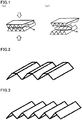
- protrusions corresponding to the recesses in the shape of engraved lines are made in contact with each other ( Fig. 1(a) ). Since the rolled body is stressed in the normal direction of the roll core due to a tensile force upon rolling, contact points of the protrusions are deformed.
- the shape of engraved lines on one surface of the interlayer film for a laminated glass is transferred to the other surface ( Fig. 1(b) ).
- Such a transferred shape of engraved lines on the front surface and the shape of engraved lines on the back surface have the same pitch and angle, so that a moire pattern is presumably formed when light permeates through the interlayer film for a laminated glass unwound from the rolled body.
- the present inventors found out that when the glossiness on the surface of the interlayer film for a laminated glass is higher than a predetermined value or when the haze value of the interlayer film for a laminated glass is not higher than a predetermined value, formation of a moire pattern when the interlayer film for a laminated glass is unwound from the rolled body can be suppressed.
- the present invention was thus completed.
- the moire pattern is presumably reduced by suppressing reduction in the light transmittance due to the pattern of protrusions and recesses because the moire pattern originates from the cyclic rise and fall of the light transmittance on the surface of the film due to the recesses and protrusions.
- the interlayer film for a laminated glass of the present invention has a large number of recesses on both surfaces.
- the recesses each have a groove shape with a continuous bottom, and adjacent recesses each having a groove shape with a continuous bottom are regularly parallel to each other.
- ease of deaeration upon pressure bonding of a laminate including an interlayer film for a laminated glass interposed between two glass plates closely relates to the continuousness and smoothness of the bottoms of the recesses.
- the continuousness of the bottoms is further improved to markedly increase the deaeration properties.
- regularly parallel means that adjacent recesses each having the groove shape mentioned above may be parallel to each other at equal intervals, or adjacent recesses in the shape of engraved lines are parallel to each other, but all of adjacent recesses in the shape of engraved lines are not necessarily parallel to each other at equal intervals.
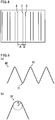
- Fig. 2 and Fig. 3 each are a view schematically illustrating an exemplary interlayer film for a laminated glass in which recesses each having a groove shape are parallel to each other at equal intervals.
- Fig. 4 is a view schematically illustrating an exemplary interlayer film for a laminated glass in which recesses each having a groove shape are parallel to each other at unequal intervals.
- an interval A between a recess 1 and a recess 2 is different from an interval B between the recess 1 and a recess 3.
- the groove shape does not necessarily have a straight line shape and may be a wave or zigzag, as long as the recesses are regularly adjacent and parallel to each other.
- the surface having the recesses has a 75° specular gloss measured in conformity with JIS Z 8741-1997 of higher than 3%.
- the surface having the recesses with a glossiness of higher than 3% can suppress formation of a moire pattern when the film is unwound from a rolled body thereof.
- the glossiness is preferably 4% or higher, still more preferably 7% or higher.
- the glossiness of the interlayer film may be dependent on the irradiation from a light source of a gloss meter. Specifically, the glossiness may change depending on the angle of the groove shape of each recess of the interlayer film for a laminated glass relative to the irradiation direction of the light source.
- the minimum glossiness obtained by changing the angle of the groove shape of each recess of the interlayer film for a laminated glass relative to the irradiation direction of the light source is preferably used as the glossiness of the interlayer film for a laminated glass of the present invention.
- the glossiness of higher than 3% needs to be achieved on either one surface.
- the glossiness is preferably higher than 3% on both surfaces.
- the glossiness can be measured by the method of measurement 2 described in JIS Z 8741-1997 with a gloss meter (e.g., "GM-26PRO” available from Murakami Color Research Laboratory).
- a gloss meter e.g., "GM-26PRO” available from Murakami Color Research Laboratory.
- the interlayer film for a laminated glass of the present invention has a haze value measured in conformity with JIS K 7105-1981 of 87% or lower.
- the interlayer film for a laminated glass with the haze value on the surface having the recesses of 87% or lower can suppress formation of a moire pattern when unwound from a rolled body thereof.
- the haze value is preferably 84% or lower, more preferably 82% or lower.
- the haze value can be measured by the method described in JIS K 7105-1981 with a haze and transmittance meter (e.g., "HM-150” available from Murakami Color Research Laboratory).
- a haze and transmittance meter e.g., "HM-150” available from Murakami Color Research Laboratory.
- the lower limit of the roughness (Rz) of the surface having the recesses is preferably 10 ⁇ m, while the upper limit thereof is preferably 65 ⁇ m. With the roughness (Rz) of 10 ⁇ m or more, remarkably excellent deaeration properties can be exhibited. With the roughness (Rz) of 65 ⁇ m or less, a moire phenomenon upon unwinding of the film can be reduced.
- the lower limit of the roughness (Rz) is more preferably 15 ⁇ m, while the upper limit thereof is more preferably 50 ⁇ m. The lower limit is still more preferably 25 ⁇ m, while the upper limit is still more preferably 40 ⁇ m.
- the roughness (Rz) of recesses as used herein refers to a ten-point average roughness (Rz) of the obtained interlayer film, determined by a method in conformity with JIS B-0601 (1994) as defined in JIS B-0601(1994) "Surface roughness - definition and indications".
- the roughness (Rz) of the recesses can be measured using, for example, a "Surfcorder SE300" available from Kosaka Laboratory Ltd. as a measuring instrument.
- the measurement is performed using a stylus profilometer at a cut-off value of 2.5 mm, a standard length of 2.5 mm, an evaluation length of 12.5 mm, and a measurement rate of 0.5 mm/s, with a stylus having a tip radius of 2 ⁇ m and a tip angle of 60°.
- the measurement environment is 23°C and 30 RH%.
- the stylus is moved in a direction perpendicular to the direction of grooves in the shape of engraved lines.
- the recesses on the surface has an interval Sm of preferably 450 ⁇ m or less, more preferably 400 ⁇ m or less, still more preferably 350 ⁇ m or less, particularly preferably 250 ⁇ m or less. With such an interval, an autohesion force between faces of the interlayer film for a laminated glass when the interlayer film for a laminated glass is wound into a rolled body is reduced, facilitating unwinding of the film from the rolled body.
- the interval Sm of the recesses as used herein means the average interval (Sm) of the recesses on the surface of the obtained interlayer film, measured by a method in conformity with JIS B-0601 (1994) as defined in JIS B-0601 (1994) "Surface roughness - definition and indications".
- the interval Sm of the recesses can be measured using a "Surfcorder SE300" available from Kosaka Laboratory Ltd. as a measuring instrument.
- the measurement is performed using a stylus profilometer at a cut-off value of 2.5 mm, a standard length of 2.5 mm, an evaluation length of 12.5 mm, and a measurement rate of 0.5 mm/s, with a stylus having a tip radius of 2 ⁇ m and a tip angle of 60°.
- the measurement environment is 23°C and 30 RH%.
- the stylus is moved in a direction perpendicular to the direction of grooves in the shape of engraved lines.
- the recesses in the shape of engraved lines on one surface and the recesses in the shape of engraved lines on the other surface form an intersection angle ⁇ of preferably 10° or more.
- an intersection angle ⁇ is more preferably 20° or more, still more preferably 45° or more, particularly preferably 90°.
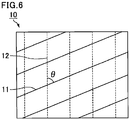
- Fig. 6 is a view schematically explaining the intersection angle ⁇ . In Fig.
- an interlayer film for a laminated glass 10 has recesses 11 each having a groove shape with a continuous bottom illustrated in solid lines on a first surface and recesses 12 each having a groove shape with a continuous bottom illustrated in dotted lines on a second surface.
- the intersection angle ⁇ refers to an intersection angle formed between the recesses 11 each having a groove shape with a continuous bottom illustrated in solid lines and the recesses 12 each having a groove shape with a continuous bottom illustrated in dotted lines.
- intersection angle ⁇ is measured for example by observing the interlayer film for a laminated glass visually or using an optical microscope.
- the intersection angle ⁇ between the recesses each having a groove shape with a continuous bottom on the first surface and the recesses each having a groove shape with a continuous bottom on the second surface is measured by drawing in ink straight lines parallel to the recesses on both surfaces and measuring the acute angle formed between the straight lines using a protractor.
- the intersection angle ⁇ can be measured by photographing the enlarged surface and measuring the acute angle using image processing software.
- top portions of protrusions formed in accordance with the recesses in the shape of engraved lines may each have either a planar shape as illustrated in Fig. 2 or a non-planar shape as illustrated in Fig. 3 .
- fine protrusions and recesses may be further formed on the plane of the top portion.
- the protrusions may have either the same height or different heights and the recesses may have either the same depth or different depths as long as the recesses each have a continuous bottom.
- the radius of rotation R of the protrusions is preferably 120 ⁇ m or less, more preferably 100 ⁇ m or less, still more preferably 40 ⁇ m or less, particularly preferably 25 ⁇ m or less.
- the radius of rotation R of the protrusions is preferably 50 ⁇ m or more, more preferably 120 ⁇ m or more, still more preferably 200 ⁇ m or more, particularly preferably 300 ⁇ m or more, because stress is dispersed upon contact of protrusions corresponding to recesses in the shape of engraved lines when the interlayer film for a laminated glass is wound into a rolled body to prevent the shape of engraved lines on one surface from being transferred to the other surface, thereby further suppressing formation of a moire pattern.
- the radius of rotation R of each protrusion can be measured as follows.
- the interlayer film is cut in a direction perpendicular to the direction of the recesses in the shape of engraved lines and in the thickness direction of the film.
- the cross section is observed using a microscope (e.g., "DSX-100" available from Olympus Corporation) and photographed at a magnification of 277 times.
- the obtained image is enlarged to 50 ⁇ /20 mm for analysis using measurement software included in accessory software.
- the radius of an inscribed circle at the apex of the protrusion is determined as the radius of rotation of the protrusion.
- the measurement is performed in an environment at 23°C and 30 RH%.
- Fig. 5(b) shows a view schematically explaining the radius of rotation R of the protrusion.
- the radius of rotation R is a radius of a circle in contact with the tip portion of a protrusion 22.
- Any method may be employed to set the glossiness of the surface of the interlayer film for a laminated glass to exceed 3% or set the haze value of the interlayer film for a laminated glass to 87% or lower and to provide recesses in the shape of engraved lines on both surfaces.
- a method including: a first step of providing fine protrusions and recesses to the film surface to set the glossiness of the surface of the interlayer film for a laminated glass to exceed 3% or to set the haze value of the interlayer film for a laminated glass to 87% or lower; and a second step of providing recesses in the shape of engraved lines.
- the first step of setting the glossiness of the surface of the interlayer film for a laminated glass to exceed 3% or the haze value of the interlayer film for a laminated glass to 87% or lower is not particularly limited, and is performed by forming fine protrusions and recesses by, for example, an embossing roll method, a calender roll method, a profile extrusion method, or an embossing method in which melt fracture phenomena are controlled.
- the first step can be carried out by the following Production Example 1 or Production Example 2.
- Production Example 1 is an embossing roll method in which an embossing roll prepared by a specific production method is used. Specifically, an embossing roll is produced by a production process including: a step of forming protrusions and recesses on a metal roll by blasting with an abrasive material (embossing roll production step 1); grinding a portion of each protrusion on the metal roll provided with the protrusions and recesses into a flat surface portion (embossing roll production step 2); and forming protrusions and recesses on the metal roll by blasting with an abrasive material finer than the abrasive material used in the embossing roll production step 1 (embossing roll production step 3).
- the embossing roll is used to set the glossiness of the surface of the interlayer film for a laminated glass to exceed 3% or to set the haze value to 87% or lower.
- the metal roll used in the embossing roll production step 1 is made of a metal such as iron, carbon steel, alloy steel, nickel-chromium steel, or chromium steel. Among these, preferred is a roll made of carbon steel or alloy steel for its excellent durability.
- a surface of the metal roll is blasted with an abrasive material made of aluminum oxide, silicon oxide, or the like to form protrusions and recesses on the metal roll surface.
- an abrasive material made of aluminum oxide, silicon oxide, or the like to form protrusions and recesses on the metal roll surface.
- aluminum oxide is suitable as an abrasive material.
- the grain size of the abrasive material used in the embossing roll production step 1 is preferably F20 to F120, more preferably F30 to F80 as defined in JIS R6001 (1998).
- blasting is performed until desired roughness is obtained, usually at a discharge pressure of 40 ⁇ 10 4 to 15 ⁇ 10 5 Pa.
- each protrusion formed on the metal roll in the embossing roll production step 1 is ground (partial grinding) into a flat surface portion. Specifically, the upper portion of each protrusion formed on the metal roll is uniformly ground to be smoothened by the partial grinding. This treatment can eliminate excessively large protrusions on the surface of the metal roll.
- aluminum oxide or silicon carbide of F200 to F220 or #240 to #2000, preferably #400 to #1000 specified in JIS can be used as a grinding stone for partial grinding in the embossing roll production step 2.
- sandpaper can be used as a grinding stone.
- protrusions and recesses are formed by blasting with an abrasive material finer than the abrasive material used in the embossing roll production step 1.
- blasting is performed with an abrasive material made of aluminum oxide, silicon oxide, or the like.
- the discharge pressure in the blasting is typically 40 ⁇ 10 4 to 15 ⁇ 10 5 Pa.
- the grain size of the abrasive material used in the embossing roll production step 3 is preferably F150 to F360 or #240 to #700, more preferably #240 to #400 as defined in JIS R6001 (1998).
- the use of an abrasive material with such a grain size achieves the desired glossiness or haze value.
- the abrasive material used in the embossing roll production step 3 preferably has a grain diameter at a cumulative height of 3% in conformity with JIS R6001 (1998) of 150 ⁇ m or less, more preferably 125 ⁇ m or less, still more preferably 103 ⁇ m or less.
- the grain diameter at a cumulative height of 3% within the above preferable range enables formation of fine protrusions and recesses on the ground part of the roll, so that the glossiness or haze value of the resulting interlayer film for laminated glass is prevented from being excessively high.
- the abrasive material used in the embossing roll production step 3 preferably has a grain diameter at a cumulative height of 94% in conformity with JIS R6001 (1998) of 11 ⁇ m or more, more preferably 20 ⁇ m or more.
- the grain diameter at a cumulative height of 94% within the above preferable range, protrusions and recesses to be formed on the ground part of the roll can have at least a certain size, so that the interlayer film obtained has a high glossiness or haze value.
- the abrasive material used in the embossing roll production step 3 preferably has a grain diameter at a cumulative height of 3% in conformity with JIS R6001 (1998) satisfying the above preferable range and a grain diameter at a cumulative height of 94% in conformity with JIS R6001 (1998) satisfying the above preferable range.
- the grain size, grain diameter at a cumulative height of 3%, and grain diameter at a cumulative height of 94% are preferably measured by an electrical resistance test method.
- the embossing roll may be subjected to metal plating for rust proofing.
- metal plating for rust proofing.
- Particularly preferred is chemical plating because uniform plating thickness can be achieved.
- the embossing roll produced by the production method is used to set the glossiness of the surface of the interlayer film for a laminated glass to exceed 3% or to set the haze value to 87% or lower by an embossing roll method.
- Conditions of the embossing roll method may be as follows: a film temperature of 80°C, an embossing roll temperature of 145°C, a linear velocity of 10 m/min, and a linear pressure within a range of 1 to 100 kN/m.
- Production Example 2 is an embossing method in which melt fracture phenomena are controlled. This method adjusts the cooling rate of an interlayer film for a laminated glass formed of a resin composition for forming an interlayer film for a laminated glass after extrusion from a die.
- a film extruded from a die is cooled in a cooling water tank.
- the cooling rate of the film can be adjusted to thereby control the glossiness or haze value of a first shape to be formed.
- the first shape satisfying the intended glossiness or haze value can be formed by shortening the distance from the die to the cooling water tank and increasing the cooling rate of the film to increase the value of the glossiness or haze value.
- the distance between the die and the cooling water tank is preferably 250 mm or shorter, more preferably 200 mm or shorter, still more preferably 150 mm or shorter, particularly preferably 100 mm or shorter, most preferably 50 mm or shorter.
- Preferred ranges of other conditions for film formation in Production Example 2 are as follows: an extrusion amount per die width of 100 to 700 kg/hr ⁇ m, a surface temperature of the film immediately after extrusion from the die of 140°C to 260°C, a resin pressure at the die inlet of 30 to 160 kgf/cm 2 , and a water temperature in the water tank for cooling the film of 20°C to 30°C. Each condition is controlled to achieve the desired extrusion amount and Rz value.
- the second step of forming the recesses in the shape of engraved lines is not particularly limited, and is performed by, for example, an embossing roll method, a calender roll method, or a profile extrusion method.
- the embossing roll method is preferred because the state where the recesses in the shape of engraved lines are adjacent and parallel to each other can be easily achieved.
- the interlayer film for a laminated glass of the present invention may have a single layer structure consisting of one resin layer or a multilayer structure including two or more resin layers laminated together.
- the interlayer film for a laminated glass of the present invention may include, as two or more resin layers mentioned above, a first resin layer and a second resin layer having different characteristics.
- Such an interlayer film for a laminated glass can have various properties which are hardly achieved by a single layer structure.
- the resin layer preferably contains a thermoplastic resin.
- thermoplastic resin examples include polyvinylidene fluoride, polytetrafluoroethylene, vinylidene fluoride-propylene hexafluoride copolymers, polyethylene trifluoride, acrylonitrile-butadiene-styrene copolymers, polyester, polyether, polyamide, polycarbonate, polyacrylate, polymethacrylate, polyvinyl chloride, polyethylene, polypropylene, polystyrene, polyvinyl acetal, and ethylene-vinyl acetate copolymers.
- the resin layer preferably contains polyvinyl acetal or an ethylene-vinyl acetate copolymer, more preferably contains polyvinyl acetal.
- the polyvinyl acetal can be prepared, for example, by acetalization of polyvinyl alcohol with an aldehyde.
- the polyvinyl alcohol can be produced, for example, by saponification of polyvinyl acetate.
- the polyvinyl alcohol commonly has a degree of saponification within a range of 70 to 99.8 mol%.
- the polyvinyl alcohol has an average degree of polymerization of preferably 200 or more, more preferably 500 or more, still more preferably 1,700 or more, particularly preferably more than 1,700, and preferably 5,000 or less, more preferably 4,000 or less, still more preferably 3,000 or less, particularly preferably less than 3,000.
- average degree of polymerization is equal to or more than the lower limit, a laminated glass to be obtained has higher penetration resistance.
- the average degree of polymerization is equal to or less than the upper limit, formation of an interlayer film is facilitated.
- the average degree of polymerization of the polyvinyl alcohol can be obtained by the method in conformity with JIS K6726 "Testing methods for polyvinyl alcohol".
- the carbon number of an acetal group contained in the polyvinyl acetal is not particularly limited.
- the aldehyde for use in production of the polyvinyl acetal is not particularly limited.
- the lower limit of the carbon number of the acetal group in the polyvinyl acetal is preferably 3, and the upper limit thereof is preferably 6.
- an interlayer film has a sufficiently low glass transition temperature, and bleeding out of a plasticizer can be prevented.
- the carbon number of the aldehyde is 6 or less, synthesis of the polyvinyl acetal can be facilitated to ensure the productivity.
- the C3-C6 aldehyde may be a linear or branched aldehyde, and examples thereof include n-butyraldehyde and n-valeraldehyde.
- the aldehyde is not particularly limited. Commonly, the aldehyde is preferably a C1-C10 aldehyde.
- the C1-C10 aldehyde include propionaldehyde, n-butyraldehyde, isobutyraldehyde, n-valeraldehyde, 2-ethylbutyraldehyde, n-hexylaldehyde, n-octylaldehyde, n-nonylaldehyde, n-decylaldehyde, formaldehyde, acetaldehyde, and benzaldehyde.
- propionaldehyde n-butyraldehyde, isobutyraldehyde, n-hexylaldehyde, and n-valeraldehyde
- propionaldehyde n-butyraldehyde
- isobutyraldehyde n-hexylaldehyde
- n-valeraldehyde more preferred are propionaldehyde, n-butyraldehyde, and isobutyraldehyde
- n-butyraldehyde propionaldehyde, n-butyraldehyde, and isobutyraldehyde, and still more preferred is n-butyraldehyde.
- These aldehydes may be used alone or in combination of two or more thereof.
- the hydroxy group content of the polyvinyl acetal is preferably 10 mol% or higher, more preferably 15 mol% or higher, still more preferably 18 mol% or higher, and preferably 40 mol% or lower, more preferably 35 mol% or lower.
- an interlayer film has a higher adhesion force.
- an interlayer film has high flexibility and is easily handled.
- the hydroxy group content of the polyvinyl acetal is a value in percentage of the mole fraction obtained by dividing the amount of ethylene groups to which hydroxy groups are bonded by the total amount of ethylene groups of the main chain.
- the amount of ethylene groups to which hydroxy groups are bonded can be determined, for example, by measurement in conformity with JIS K6726 "Testing methods for polyvinyl alcohol” or in conformity with ASTM D1396-92.
- the degree of acetylation (acetyl group content) of the polyvinyl acetal is preferably 0.1 mol% or more, more preferably 0.3 mol% or more, still more preferably 0.5 mol% or more, and preferably 30 mol% or less, more preferably 25 mol% or less, still more preferably 20 mol% or less.
- the degree of acetylation is equal to or more than the lower limit
- the polyvinyl acetal has high compatibility with a plasticizer.
- an interlayer film and a laminated glass to be obtained have high damp resistance.
- the degree of acetylation is a value in percentage of the mole fraction obtained by subtracting the amount of ethylene groups to which acetal groups are bonded and the amount of ethylene groups to which hydroxy groups are bonded from the total amount of ethylene groups of the main chain and then dividing the obtained value by the total amount of ethylene groups of the main chain.
- the amount of ethylene groups to which acetal groups are bonded can be measured, for example, in conformity with JIS K6728 "Testing methods for polyvinyl butyral" or in conformity with ASTM D1396-92.
- the degree of acetalization of the polyvinyl acetal is preferably 50 mol% or more, more preferably 53 mol% or more, still more preferably 60 mol% or more, particularly preferably 63 mol% or more, and preferably 85 mol% or less, more preferably 75 mol% or less, still more preferably 70 mol% or less.
- the degree of acetalization is equal to or more than the lower limit, the polyvinyl acetal has high compatibility with a plasticizer.
- the degree of acetalization is equal to or less than the upper limit, a reaction time necessary for production of the polyvinyl acetal is short.
- the degree of acetalization is a value in percentage of the mole fraction obtained by dividing the amount of ethylene groups to which acetal groups are bonded by the total amount of ethylene groups of the main chain.
- the degree of acetalization can be calculated by measuring the degree of acetylation and the hydroxy group content by the method in conformity with JIS K6728 "Testing methods for polyvinyl butyral" or the method in conformity with ASTM D1396-92, calculating their mole fractions from the obtained measurement results, and subsequently subtracting the mole fractions of the degree of acetylation and the hydroxy group content from 100 mol%.
- the hydroxy group content, the degree of acetalization (degree of butyralization), and the degree of acetylation are preferably calculated from results of measurement by the method in conformity with JIS K6728 "Testing methods for polyvinyl butyral".
- the polyvinyl acetal is a polyvinyl butyral resin
- the hydroxy group content, the degree of acetalization (degree of butyralization), and the degree of acetylation are preferably calculated from results of measurement by the method in conformity with JIS K6728 "Testing methods for polyvinyl butyral”.
- the resin layer preferably contains polyvinyl acetal and a plasticizer.
- plasticizer may be used as long as it is commonly used in interlayer films for a laminated glass.
- plasticizers such as monobasic organic acid esters and polybasic organic acid esters, and phosphoric acid plasticizers such as organophosphate compounds and organophosphite compounds.
- organic plasticizers examples include triethylene glycol-di-2-ethylhexanoate, triethylene glycol-di-2-ethylbutyrate, triethylene glycol-di-n-heptanoate, tetraethylene glycol-di-2-ethylhexanoate, tetraethylene glycol-di-2-ethylbutyrate, tetraethylene glycol-di-n-heptanoate, diethylene glycol-di-2-ethylhexanoate, diethylene glycol-di-2-ethylbutyrate, and diethylene glycol-di-n-heptanoate.
- the resin layer contains preferably triethylene glycol-di-2-ethylhexanoate, triethylene glycol-di-2-ethylbutyrate, or triethylene glycol-di-n-heptanoate, more preferably triethylene glycol-di-2-ethylhexanoate.
- the plasticizer content is not particularly limited.
- the plasticizer content based on 100 parts by mass of the thermoplastic resin is preferably 25 parts by mass or more, more preferably 30 parts by mass or more, and preferably 80 parts by mass or less, more preferably 70 parts by mass or less.
- a laminated glass to be obtained has higher penetration resistance.
- an interlayer film has higher transparency.
- the resin layer preferably contains an adhesion modifier.
- the resin layer to be in contact with a glass plate in production of a laminated glass preferably contains an adhesion modifier.
- an alkali metal salt or an alkaline earth metal salt is preferably used.
- the adhesion modifier include salts such as potassium, sodium, and magnesium salts.
- an acid forming the salts examples include organic carboxylic acids such as octylic acid, hexylic acid, 2-ethylbutyric acid, butyric acid, acetic acid, and formic acid, and inorganic acids such as hydrochloric acid and nitric acid.
- organic carboxylic acids such as octylic acid, hexylic acid, 2-ethylbutyric acid, butyric acid, acetic acid, and formic acid
- inorganic acids such as hydrochloric acid and nitric acid.
- the resin layer to be in contact with a glass plate preferably contains magnesium salt as an adhesion modifier because the adhesion force between the glass plate and the resin layer can be easily adjusted in production of a laminated glass.
- the resin layer may optionally contain additives such as an antioxidant, a light stabilizer, a modified silicone oil as an adhesion modifier, a flame retardant, an antistatic agent, a damp proofing agent, a heat ray reflecting agent, and a heat ray absorbing agent.
- additives such as an antioxidant, a light stabilizer, a modified silicone oil as an adhesion modifier, a flame retardant, an antistatic agent, a damp proofing agent, a heat ray reflecting agent, and a heat ray absorbing agent.
- the thickness of the interlayer film for a laminated glass of the present invention is not particularly limited.
- the thickness of the interlayer film is preferably 0.1 mm or more, more preferably 0.25 mm or more, and preferably 3 mm or less, more preferably 1.5 mm or less, from a practical standpoint and from the viewpoint of sufficiently enhancing heat shielding properties.
- a laminated glass to be obtained has high penetration resistance.
- the interlayer film for a laminated glass of the present invention may be produced by any method.
- a conventionally known method can be employed in production of the interlayer film.
- a thermoplastic resin and other optional components to be contained, such as the component X are kneaded and molded into an interlayer film. Extrusion molding is suitable for continuous production and is therefore preferred for production of the interlayer film.
- the interlayer film for a laminated glass of the present invention includes, as two or more resin layers mentioned above, at least a first resin layer and a second resin layer, and polyvinyl acetal contained in the first resin layer (hereafter, referred to as polyvinyl acetal A) has a hydroxy group content different from that of polyvinyl acetal contained in the second resin layer (hereafter, referred to as polyvinyl acetal B).
- an interlayer film for a laminated glass to be provided can have various properties which are hardly achieved by a single layer structure.
- the first resin layer in a case where the first resin layer is interposed between two second resin layers and the polyvinyl acetal A has a lower hydroxy group content than the polyvinyl acetal B, the first resin layer tends to have a lower glass transition temperature than the second resin layer. As a result, the first resin layer is softer than the second resin layer, leading to higher sound insulation properties of the interlayer film for a laminated glass.
- the first resin layer In a case where the first resin layer is interposed between two second resin layers and the polyvinyl acetal A has a higher hydroxy group content than the polyvinyl acetal B, the first resin layer tends to have a higher glass transition temperature than the second resin layer. As a result, the first resin layer is harder than the second resin layer, leading to higher penetration resistance of the interlayer film for a laminated glass.
- the plasticizer content (hereafter, referred to as content A) of the first resin layer based on 100 parts by mass of the polyvinyl acetal is preferably different from the plasticizer content (hereafter, referred to as content B) of the second resin layer based on 100 parts by mass of the polyvinyl acetal.
- content A plasticizer content
- content B plasticizer content of the second resin layer based on 100 parts by mass of the polyvinyl acetal.
- the first resin layer In a case where the first resin layer is interposed between two second resin layers and the content A is lower than the content B, the first resin layer tends to have a higher glass transition temperature than the second resin layer. As a result, the first resin layer is harder than the second resin layer, leading to higher penetration resistance of the interlayer film for a laminated glass.
- the combination of two or more resin layers included in the interlayer film for a laminated glass of the present invention may be, for example, a sound insulation layer as the first resin layer and a protective layer as the second resin layer with an aim of improving the sound insulation properties of a laminated glass to be obtained.
- the sound insulation layer contains polyvinyl acetal X and a plasticizer
- the protective layer contains polyvinyl acetal Y and a plasticizer.
- the resulting interlayer film for a laminated glass (hereafter, also referred to as a sound insulation interlayer film) can have excellent sound insulation properties.
- the sound insulation interlayer film is more specifically described in the following.
- the sound insulation layer imparts sound insulation properties.
- the sound insulation layer preferably contains the polyvinyl acetal X and a plasticizer.
- the polyvinyl acetal X can be prepared by acetalization of polyvinyl alcohol with an aldehyde.
- the polyvinyl alcohol is commonly obtained by saponifying polyvinyl acetate.
- the lower limit of the average degree of polymerization of the polyvinyl alcohol is preferably 200, and the upper limit thereof is preferably 5,000.
- the polyvinyl alcohol has an average degree of polymerization of 200 or more, a sound insulation interlayer film to be obtained can have better penetration resistance.
- the polyvinyl alcohol has an average degree of polymerization of 5,000 or less, formability of a sound insulation layer can be ensured.
- the lower limit is more preferably 500 and the upper limit is more preferably 4,000.
- the average degree of polymerization of the polyvinyl alcohol is obtained by a method in conformity with JIS K6726 "Testing methods for polyvinyl alcohol".
- the lower limit of the carbon number of the aldehyde used for acetalization of the polyvinyl alcohol is preferably 4, and the upper limit thereof is preferably 6.
- a sound insulation interlayer film for a laminated glass to be obtained can stably contain a sufficient amount of a plasticizer.
- the sound insulation interlayer film can exhibit excellent sound insulation properties.
- bleeding out of the plasticizer can be prevented.
- the aldehyde has a carbon number of 6 or less, synthesis of the polyvinyl acetal X can be facilitated, ensuring the productivity.
- the C4-C6 aldehyde may be a linear or branched aldehyde, and examples thereof include n-butyraldehyde and n-valeraldehyde.
- the upper limit of the hydroxy group content of the polyvinyl acetal X is preferably 30 mol%.
- the sound insulation layer can contain a plasticizer in an amount needed for exhibiting sound insulation properties, and bleeding out of the plasticizer can be prevented.
- the upper limit of the hydroxy group content of the polyvinyl acetal X is more preferably 28 mol%, still more preferably 26 mol%, particularly preferably 24 mol%, and the lower limit thereof is preferably 10 mol%, more preferably 15 mol%, still more preferably 20 mol%.
- the hydroxy group content of the polyvinyl acetal X is a value in percentage of the mole fraction (mol%) obtained by dividing the amount of ethylene groups to which hydroxy groups are bonded by the total amount of ethylene groups of the main chain.
- the amount of ethylene groups to which hydroxy groups are bonded can be determined by measuring the amount of ethylene groups to which hydroxy groups are bonded in the polyvinyl acetal X by the method in conformity with JIS K6728 "Testing methods for polyvinyl butyral".
- the lower limit of the acetal group content of the polyvinyl acetal X is preferably 60 mol%, and the upper limit thereof is preferably 85 mol%.
- the sound insulation layer has higher hydrophobicity and can contain a plasticizer in an amount needed for exhibiting sound insulation properties. Moreover, bleeding out of the plasticizer and whitening can be prevented.
- the polyvinyl acetal X has an acetal group content of 85 mol% or less, synthesis of the polyvinyl acetal X can be facilitated, ensuring the productivity.
- the lower limit of the acetal group content of the polyvinyl acetal X is more preferably 65 mol%, still more preferably 68 mol% or more.
- the acetal group content can be obtained by measuring the amount of ethylene groups to which acetal groups are bonded in the polyvinyl acetal X by the method in conformity with JIS K6728 "Testing methods for polyvinyl butyral".
- the lower limit of the acetyl group content of the polyvinyl acetal X is preferably 0.1 mol%, and the upper limit thereof is preferably 30 mol%.
- the sound insulation layer can contain a plasticizer in an amount needed for exhibiting sound insulation properties, and bleeding out of the plasticizer can be prevented.
- the acetyl group content of the polyvinyl acetal X is 30 mol% or less, the sound insulation layer can have higher hydrophobicity, preventing whitening.
- the lower limit of the acetyl group content is more preferably 1 mol%, still more preferably 5 mol%, particularly preferably 8 mol%, and the upper limit thereof is more preferably 25 mol%, still more preferably 20 mol%.
- the acetyl group content is a value in percentage of the mole fraction (mol%) obtained by subtracting the amount of ethylene groups to which acetal groups are bonded and the amount of ethylene groups to which hydroxy groups are bonded from the total amount of ethylene groups of the main chain and then dividing the obtained value by the total amount of ethylene groups of the main chain.
- the polyvinyl acetal X is preferably a polyvinyl acetal having an acetyl group content of 8 mol% or more or a polyvinyl acetal having an acetyl group content of less than 8 mol% and an acetal group content of 65 mol% or more because the sound insulation layer can readily contain a plasticizer in an amount needed for exhibiting sound insulation properties.
- the polyvinyl acetal X is more preferably a polyvinyl acetal having an acetyl group content of 8 mol% or more or a polyvinyl acetal having an acetyl group content of less than 8 mol% and an acetal group content of 68 mol% or more.
- the lower limit of the plasticizer content of the sound insulation layer based on 100 parts by mass of the polyvinyl acetal X is preferably 45 parts by mass, and the upper limit thereof is preferably 80 parts by mass.
- the plasticizer content is 45 parts by mass or more, the sound insulation layer can exhibit high sound insulation properties.
- the plasticizer content is 80 parts by mass or less, reduction in the transparency and adhesiveness of an interlayer film for a laminated glass to be obtained due to bleeding out of the plasticizer can be prevented.
- the lower limit of the plasticizer content is more preferably 50 parts by mass, still more preferably 55 parts by mass, and the upper limit thereof is more preferably 75 parts by mass, still more preferably 70 parts by mass.
- the lower limit of the thickness is preferably 50 ⁇ m. Having a thickness of 50 ⁇ m or more, the sound insulation layer can exhibit enough sound insulation properties.
- the lower limit of the thickness of the sound insulation layer is more preferably 80 ⁇ m.
- the upper limit thereof is not particularly limited. In consideration of the thickness as an interlayer film for a laminated glass, the upper limit is preferably 300 ⁇ m.
- the sound insulation layer may have one end and the other end on an opposite side of the one end, and may have a shape in which the thickness of the other end is greater than the thickness of the one end.
- the sound insulation layer preferably has a wedge portion in a cross-sectional shape in the thickness direction.
- the lower limit of the minimum thickness of the sound insulation layer is preferably 50 ⁇ m. Having the minimum thickness of 50 ⁇ m or more, the sound insulation layer can exhibit enough sound insulation properties.
- the lower limit of the minimum thickness of the sound insulation layer is more preferably 80 ⁇ m, still more preferably 100 ⁇ m.
- the upper limit of the maximum thickness of the sound insulation layer is not particularly limited.
- the upper limit is preferably 300 ⁇ m in consideration of the thickness as an interlayer film for a laminated glass.
- the upper limit of the maximum thickness of the sound insulation layer is more preferably 220 ⁇ m.
- the protective layer prevents bleeding out of the plasticizer contained in a large amount in the sound insulation layer to prevent reduction in the adhesiveness between the interlayer film for a laminated glass and the glass plate, and imparts penetration resistance to the interlayer film for a laminated glass.
- the protective layer preferably contains, for example, a plasticizer and the polyvinyl acetal Y, more preferably a plasticizer and the polyvinyl acetal Y having a higher hydroxy group content than the polyvinyl acetal X.
- the polyvinyl acetal Y can be prepared by acetalization of polyvinyl alcohol with an aldehyde.
- the polyvinyl alcohol is commonly obtained by saponifying polyvinyl acetate.
- the lower limit of the average degree of polymerization of the polyvinyl alcohol is preferably 200, and the upper limit thereof is preferably 5,000.
- the polyvinyl alcohol has an average degree of polymerization of 200 or more, an interlayer film for a laminated glass to be obtained can have better penetration resistance.
- the polyvinyl alcohol has an average degree of polymerization of 5,000 or less, formability of a protective layer can be ensured.
- the lower limit is more preferably 500 and the upper limit is more preferably 4,000.
- the lower limit of the carbon number of the aldehyde used for acetalization of the polyvinyl alcohol is preferably 3, and the upper limit thereof is preferably 4.
- the aldehyde has a carbon number of 3 or more, an interlayer film for a laminated glass to be obtained has higher penetration resistance.
- productivity of the polyvinyl acetal Y is improved.
- the C3-C4 aldehyde may be a linear or branched aldehyde, and examples thereof include n-butyraldehyde.
- the upper limit of the hydroxy group content of the polyvinyl acetal Y is preferably 33 mol%, and the lower limit thereof is preferably 28 mol%.
- the polyvinyl acetal Y has a hydroxy group content of 33 mol% or lower, whitening of an interlayer film for a laminated glass to be obtained can be prevented.
- the polyvinyl acetal Y has a hydroxy group content of 28 mol% or more, an interlayer film for a laminated glass to be obtained has higher penetration resistance.
- the lower limit of the acetal group content of the polyvinyl acetal Y is preferably 60 mol%, and the upper limit thereof is preferably 80 mol%.
- a protective layer to be obtained can contain a plasticizer in an amount needed for exhibiting enough penetration resistance.
- the acetal group content is 80 mol% or less, the adhesion force between the protective layer and the glass plate can be ensured.
- the lower limit of the acetal group content is more preferably 65 mol%, and the upper limit thereof is more preferably 69 mol%.
- the upper limit of the acetyl group content of the polyvinyl acetal Y is preferably 7 mol%.
- a protective layer to be obtained can have higher hydrophobicity, thereby preventing whitening.
- the upper limit of the acetyl group content is more preferably 2 mol%, and the lower limit thereof is preferably 0.1 mol%.
- the hydroxy group contents, acetal group contents, and acetyl group contents of the polyvinyl acetals A, B, and Y can be measured by the same methods as those in the case of the polyvinyl acetal X.
- the lower limit of the plasticizer content of the protective layer based on 100 parts by mass of the polyvinyl acetal Y is preferably 20 parts by mass, and the upper limit thereof is preferably 45 parts by mass.
- the plasticizer content is 20 parts by mass or more, the penetration resistance can be ensured.
- the plasticizer content is 45 parts by mass or less, bleeding out of the plasticizer can be prevented, thereby preventing reduction in the transparency and adhesiveness of an interlayer film for a laminated glass to be obtained.
- the lower limit of the plasticizer content is more preferably 30 parts by mass, still more preferably 35 parts by mass, and the upper limit thereof is more preferably 43 parts by mass, still more preferably 41 parts by mass.
- the plasticizer content of the protective layer is preferably lower than the plasticizer content of the sound insulation layer.
- the hydroxy group content of the polyvinyl acetal Y is preferably higher than the hydroxy group content of the polyvinyl acetal X, more preferably higher by 1 mol% or more, still more preferably higher by 5 mol% or more, particularly preferably higher by 8 mol% or more. Adjustment of the hydroxy group contents of the polyvinyl acetal X and polyvinyl acetal Y enables control of the plasticizer contents of the sound insulation layer and the protective layer, so that the sound insulation layer has a lower glass transition temperature. As a result, a laminated glass to be obtained has higher sound insulation properties.
- the plasticizer content of the sound insulation layer (hereafter, also referred to as content X) based on 100 parts by mass of the polyvinyl acetal X is preferably higher than the plasticizer content of the protective layer (hereafter, also referred to as content Y) based on 100 parts by mass of the polyvinyl acetal Y, more preferably higher by 5 parts by mass or more, still more preferably higher by 15 parts by mass or more, particularly preferably higher by 20 parts by mass or more. Adjustment of the content X and content Y lowers the glass transition temperature of the sound insulation layer. As a result, a laminated glass to be obtained has still higher sound insulation properties.
- the protective layer may have any thickness, provided that it can fulfill the role as the protective layer.
- the protective layer is preferably as thick as possible to prevent the protrusions and recesses from being transferred to the interface with the sound insulation layer directly in contact with the protective layer.
- the lower limit of the thickness of the protective layer having a rectangular cross-sectional shape is preferably 100 ⁇ m, more preferably 300 ⁇ m, still more preferably 400 ⁇ m, particularly preferably 450 ⁇ m.
- the upper limit of the thickness of the protective layer is not particularly limited. In order to ensure the thickness of the sound insulation layer enough to achieve sufficient sound insulation properties, the upper limit of the protective layer is practically about 500 ⁇ m.
- the protective layer may have one end and the other end on an opposite side of the one end, and may have a shape in which the thickness of the other end is greater than the thickness of the one end.
- the protective layer preferably has a wedge portion in a cross-sectional shape in the thickness direction.
- the protective layer may have any thickness, provided that it can fulfill the role as the protective layer.
- the protective layer is preferably as thick as possible to prevent the protrusions and recesses from being transferred to the interface with the sound insulation layer directly in contact with the protective layer.
- the lower limit of the minimum thickness of the protective layer is preferably 100 ⁇ m, more preferably 300 ⁇ m, still more preferably 400 ⁇ m, particularly preferably 450 ⁇ m.
- the upper limit of the maximum thickness of the protective layer is not particularly limited. In order to ensure the thickness of the sound insulation layer enough to achieve sufficient sound insulation properties, the upper limit of the protective layer is practically about 1,000 ⁇ m, preferably 800 ⁇ m.
- the interlayer film for a laminated glass of the present invention may have one end and the other end on an opposite side of the one end.
- the one end and the other end are end portions on both sides facing each other in the interlayer film.
- the thickness of the other end is preferably greater than the thickness of the one end.
- a laminated glass prepared using the interlayer film for a laminated glass of the present invention having such a shape where the thickness is different between one end and the other end can be suitably used in a head-up display. In this case, occurrence of double images can be effectively suppressed.
- the interlayer film for a laminated glass of the present invention may have a wedge cross-sectional shape.
- a head-up display can perform image display without occurrence of double images by adjusting wedge angle ⁇ of the wedge shape according to the mounting angle of the laminated glass.
- the lower limit of the wedge angle ⁇ is preferably 0.1 mrad, more preferably 0.2 mrad, still more preferably 0.3 mrad, and the upper limit thereof is preferably 1 mrad, more preferably 0.9 mrad, from the viewpoint of further suppressing the occurrence of double images.
- the produced interlayer film may have a shape having the minimum thickness in a region slightly inward from the end on the thinner side (specifically, when the distance from one end to the other end is defined as X, a region within a distance of 0X to 0.2X inward from the end on the thinner side) and having the maximum thickness in a region slightly inward from the end on the thicker side (specifically, when the distance from one end to the other end is defined as X, a region within a distance of 0X to 0.2X inward from the end on the thicker side).
- X a region within a distance of 0X to 0.2X inward from the end on the thicker side
- the sound insulation interlayer film may be produced by any method.
- the sound insulation interlayer film can be produced, for example, by a method of forming the sound insulation layer and protective layer as sheet materials by a conventional film-forming method such as extrusion, calendering, or pressing and then stacking the obtained sheet materials.
- the present invention also encompasses a laminated glass including the interlayer film for a laminated glass of the present invention interposed between a pair of glass plates.
- the glass plate may be a commonly used transparent glass plate.
- examples thereof include inorganic glass plates such as float glass plates, polished glass plates, figured glass plates, meshed glass plates, wired glass plates, colored glass plates, heat-absorbing glass plates, heat-reflecting glass plates, and green glass plates.
- An ultraviolet shielding glass plate including an ultraviolet shielding coat layer on a glass surface may also be used.
- organic plastic plates made of polyethylene terephthalate, polycarbonate, polyacrylate, or the like.
- the glass plates may include two or more types of glass plates.
- the laminated glass may be a laminated glass including the interlayer film for a laminated glass of the present invention between a transparent float glass plate and a colored glass plate such as a green glass plate.
- the glass plates may include two or more glass plates with different thicknesses.
- the present invention can provide an interlayer film for a laminated glass having recesses in the shape of engraved lines on both surfaces to exhibit excellent deaeration properties in production of a laminated glass and suppressing formation of a moire pattern when unwound from a rolled body thereof.
- the present invention also can provide a laminated glass including the interlayer film for a laminated glass, a method for producing an embossing roll suitably used for production of the interlayer film for a laminated glass, and a method for producing the interlayer film for a laminated glass.
- Polyvinyl alcohol having an average degree of polymerization of 1,700 was acetalized with n-butyraldehyde to give polyvinyl butyral (acetyl group content: 1 mol%, butyral group content: 69 mol%, hydroxy group content: 30 mol%).
- polyvinyl butyral acetyl group content: 1 mol%, butyral group content: 69 mol%, hydroxy group content: 30 mol%).
- To 100 parts by mass of the polyvinyl butyral was added 40 parts by mass of triethylene glycol-di-2-ethylhexanoate (3GO) as a plasticizer, and kneaded well with a mixing roll to give a resin composition.
- 3GO triethylene glycol-di-2-ethylhexanoate
- the obtained resin composition was extruded from an extruder to form an interlayer film for a laminated glass with a uniform thickness.
- Fine protrusions and recesses were formed on both surfaces (first surface and second surface) of the interlayer film for a laminated glass to adjust the glossiness of the surface.
- embossing roll production step 1 blasting was performed on the surface of a metal roll using a #36 abrasive material made of aluminum oxide at a discharge pressure of 50 ⁇ 10 4 Pa. After the embossing roll production step 1, the ten-point average roughness Rz of the roll surface measured in conformity with JIS B-0601 (1994) was 65 ⁇ m.
- embossing roll production step 2 partial grinding was performed using a #400 to #1000 grinding stone. After the embossing roll production step 2, the ten-point average roughness Rz of the roll surface measured in conformity with JIS B-0601 (1994) was 40 ⁇ m.
- blasting was performed using #320 abrasive material made of aluminum oxide at a discharge pressure of 50 ⁇ 10 4 Pa, thereby preparing an embossing roll.
- a pair of thus prepared embossing rolls was used as a device for transferring a pattern of protrusions and recesses to form fine protrusions and recesses on both surfaces of the obtained interlayer film for a laminated glass.
- the transferring conditions employed here were a temperature of the interlayer film for a laminated glass of 80°C, a temperature of the rolls of 145°C, a linear velocity of 10 m/min, a line width of 1.5 m, and a linear pressure of 1 to 100 kN/m.
- the ten-point average roughness (Rz) of the film surface after the formation of fine protrusions and recesses measured in conformity with JIS B-0601 was 12 ⁇ m.
- the obtained interlayer film had an average thickness of 760 ⁇ m.
- protrusions and recesses each having a groove shape with a continuous bottom by the following procedure.
- the interlayer film for a laminated glass after the first step was passed through the device for transferring a pattern of protrusions and recesses, thereby forming protrusions and recesses where recesses each having a groove shape with a continuous bottom are parallel to each other at equal intervals on the first surface of the interlayer film for a laminated glass.
- the transferring conditions employed here were a temperature of the interlayer film for a laminated glass of 70°C, a temperature of the rolls of 140°C, a linear velocity of 10 m/min, and a linear pressure to 1 to 100 kN/m for producing the desired roughness.
- the same operations were performed on the second surface of the interlayer film for a laminated glass to form recesses each having a groove shape with a continuous bottom.
- the intersection angle formed between the recesses each having a groove shape (shape of an engraved line) with a continuous bottom on the first surface and the recesses each having a groove shape (shape of an engraved line) with a continuous bottom on the second surface was set to 20°.
- the glossiness was measured using a gloss meter ("GM-26PRO" available from Murakami Color Research Laboratory) by the method of measurement 2 described in JIS Z 8741-1997.
- the interlayer film for a laminated glass was left to stand on a sample table, and the glossiness was measured while the interlayer film for a laminated glass was rotated so that the angle of the groove shape of each recess relative to the irradiation direction of a light source was changed.
- the minimum glossiness was taken as the glossiness of the interlayer film for a laminated glass of the present invention.
- the ten-point average roughness (Rz) on both surfaces of the obtained interlayer film for a laminated glass was measured by the method in conformity with JIS B-0601 (1994) using "Surfcorder SE300" available from Kosaka Laboratory Ltd.
- the measurement was performed using a stylus profilometer at a cut-off value of 2.5 mm, a standard length of 2.5 mm, an evaluation length of 12.5 mm, and a measurement rate of 0.5 mm/s, with a stylus having a tip radius of 2 ⁇ m and a tip angle of 60°.
- the measurement environment was 23°C and 30 RH%.
- the stylus was moved in a direction perpendicular to the groove direction of engraved lines.
- the Sm values of the first surface and second surface of the obtained interlayer film for a laminated glass were measured using a "Surfcorder SE300" available from Kosaka Laboratory Ltd.
- the measurement was performed using a stylus profilometer at a cut-off value of 2.5 mm, a standard length of 2.5 mm, an evaluation length of 12.5 mm, and a measurement rate of 0.5 mm/s, with a stylus having a tip radius of 2 ⁇ m and a tip angle of 60°.
- the measurement environment was 23°C and 30 RH%.
- the stylus was moved in a direction perpendicular to the direction of grooves in the shape of engraved lines.
- the haze value was measured by the method described in JIS K 7105-1981 with a haze and transmittance meter ("HM-150" available from Murakami Color Research Laboratory).
- HM-150 haze and transmittance meter
- An interlayer film for a laminated glass was obtained in the same manner as in Example 1, except that the conditions for forming recesses in the shape of engraved lines in the second step were changed.
- An interlayer film for a laminated glass was obtained in the same manner as in Example 1, except that the grain size of the abrasive material used in the embossing roll production step 3 in which an embossing roll for forming the first shape was produced was changed to #800.
- Polyvinyl alcohol having an average degree of polymerization of 1,700 was acetalized with n-butyraldehyde to give polyvinyl butyral (acetyl group content: 1 mol%, butyral group content: 69 mol%, hydroxy group content: 30 mol%).
- polyvinyl butyral acetyl group content: 1 mol%, butyral group content: 69 mol%, hydroxy group content: 30 mol%).
- To 100 parts by mass of the polyvinyl butyral were added 40 parts by mass of triethylene glycol-di-2-ethylhexanoate (3GO) as a plasticizer, and the mixture was mixed well with a mixing roll to give a resin composition.
- 3GO triethylene glycol-di-2-ethylhexanoate
- an interlayer film for a laminated glass was formed under the conditions including the extrusion amount per die width of 440 kg/hr ⁇ m, the surface temperature of the film immediately after extrusion from the die of 200°C, the resin pressure at the die inlet of 80 kgf/cm 2 , and the water temperature in the water tank for cooling the film of 20°C to 30°C in the embossing method in which melt fracture phenomena are controlled, and at the same time, fine protrusions and recesses were formed on both surfaces of the interlayer film for a laminated glass.
- the distance from the die to the surface of the cooling water tank was set to 100 mm.
- the obtained interlayer film for a laminated glass had a thickness of 760 ⁇ m.
- the Rz value measured by the same method as in Example 1 after formation of the fine protrusions and recesses was 18 ⁇ m.
- the obtained interlayer film for a laminated glass with fine protrusions and recesses was subjected to the second step in the same manner as in Example 1, except that the conditions for forming recesses in the shape of engraved lines were changed. An interlayer film for a laminated glass was thus obtained.
- An interlayer film for a laminated glass was obtained in the same manner as in Example 7, except that conditions for forming recesses in the shape of engraved lines were changed.
- An interlayer film for a laminated glass was obtained in the same manner as in Example 7, except that the distance from the die to the surface of the cooling water tank was changed to 200 mm in the embossing method in which melt fracture phenomena are controlled.
- An interlayer film for a laminated glass was obtained in the same manner as in Example 1, except that the polyvinyl butyral used had a composition as shown in Table 2 and the conditions for forming the recesses in the shape of engraved lines in the second step were changed.
- An interlayer film for a laminated glass was obtained in the same manner as in Comparative Example 1, except that the polyvinyl butyral used had a composition as shown in Table 2 and the conditions for forming the recesses in the shape of engraved lines in the second step were changed.
- An interlayer film for a laminated glass was obtained in the same manner as in Comparative Example 2, except that the polyvinyl butyral used had a composition as shown in Table 2 and the conditions for forming the recesses in the shape of engraved lines were changed.
- the interlayer film for a laminated glass obtained in each of the examples and comparative examples was cut to prepare a test sample with a size of 50 mm in length and 50 mm in width. Three pieces of thus obtained test samples were stacked to give a laminate.
- the laminate was left to stand on a 1.5-mm-thick PVB sheet that was placed on an even glass plate for the purpose of allowing uniform application of a load, with a release paper interposed between the laminate and the PVB sheet.
- the release paper was prepared by coating base paper with silicone as releasing treatment.
- a glass plate of 6-kg weight was placed on the laminate with a release paper interposed therebetween.
- the release paper was prepared by coating base paper with silicone as releasing treatment.
- the moire test was performed as follows.
- the interlayer film for a laminated glass was set at a position of 1 m from a lamp, and 20 evaluators visually observed the interlayer film from a position on the opposite side of the lamp across the interlayer film and obliquely at an angle of 45°.
- the number of people who noticed a moire pattern and the number of people who felt that the moire pattern was unpleasant were counted.
- Example 1 2 3 4 5 6 7 8 9 10 Compositon of interlayer film Polyvinyl butyral resin Average degree of polymerization of PVA - 1700 1700 1700 1700 1700 1700 1700 1700 1700 1700 1700 1700 Degree of butyralization mol% 69 69 69 69 69 69 69 69 69 69 69 69 69 69 69 69 Degree of acetylation mol% 1 1 1 1 1 1 1 1 Hydroxy group content mol% 30 30 30 30 30 30 30 30 30 30 30 30 Amount Parts by mass 100 100 100 100 100 100 100 100 100 100 100 100 100 100 100 100 100 100 100 100 100 100 100 100 100 100 100 100 100 100 100 100 100 100 100 100 100 100 100 100 100 100 100 100 100 100 100 100 100 100 100 100 100 100 100 100 100 100 100 100 100 100 100 100 100 100 100 100 100 100 100 100 100 100 100 100 100 100 100 100 100 100 100 100 100 100 100 100 100 100 100 100 100 100 100 100 100 100 100 100 100 100 100 100 100 100 100 100
- Polyvinyl alcohol having an average degree of polymerization of 1,700 was acetalized with n-butyraldehyde to give polyvinyl butyral (acetyl group content: 1 mol%, butyral group content: 69 mol%, hydroxy group content: 30 mol%).
- polyvinyl butyral acetyl group content: 1 mol%, butyral group content: 69 mol%, hydroxy group content: 30 mol%).
- To 100 parts by mass of the polyvinyl butyral was added 36 parts by mass of triethylene glycol-di-2-ethylhexanoate (3GO) as a plasticizer, and the mixture was sufficiently kneaded with a mixing roll to prepare a resin composition for a protective layer.
- 3GO triethylene glycol-di-2-ethylhexanoate
- Polyvinyl alcohol having an average degree of polymerization of 3,000 was acetalized with n-butyraldehyde to give polyvinyl butyral (acetyl group content: 12.5 mol%, butyral group content: 64.2 mol%, hydroxy group content: 23.3 mol%).
- polyvinyl butyral acetyl group content: 12.5 mol%, butyral group content: 64.2 mol%, hydroxy group content: 23.3 mol%).
- To 100 parts by mass of the polyvinyl butyral was added 76.5 parts by mass of triethylene glycol-di-2-ethylhexanoate (3GO) as a plasticizer, and the mixture was sufficiently kneaded with a mixing roll to prepare a resin composition for an intermediate layer.
- 3GO triethylene glycol-di-2-ethylhexanoate
- the obtained resin composition for an intermediate layer and resin composition for a protective layer were coextruded using a co-extruder to form an interlayer film for a laminated glass having a triple layer structure including a first protective layer made of the resin composition for a protective layer, an intermediate layer made of the resin composition for an intermediate layer, and a second protective layer made of the resin composition for a protective layer, stacked in the stated order.
- the extrusion conditions were set such that the first and second protective layers each had a thickness of 350 ⁇ m and the intermediate layer had a thickness of 100 ⁇ m in an interlayer film for a laminated glass to be obtained after formation of protrusions and recesses.
- the protrusions and recesses were formed on the interlayer film for a laminated glass in the same manner as in Example 1, except that the type of the blasting material used in the embossing roll production step 3 in which the embossing roll for forming the first shape was produced was changed and the pressure upon transferring the pattern of protrusions and recesses was adjusted so that the desired Rz value was achieved.
- the protrusions and recesses on the both surfaces were measured.
- a resin composition for an intermediate layer and a resin composition for a protective layer were obtained in the same manner as in Example 15.
- the obtained resin composition for intermediates layer and resin composition for a protective layer were coextruded using a co-extruder to form an interlayer film for a laminated glass having a triple layer structure including a first protective layer made of the resin composition for a protective layer, an intermediate layer made of the resin composition for an intermediate layer, and a second protective layer made of the resin composition for a protective layer, stacked in the stated order.
- the first shape was provided concurrently with the formation of the interlayer film for a laminated glass.
- an interlayer film for a laminated glass was formed under the conditions including the extrusion amount per width of the die of 440 kg/hr ⁇ m, the surface temperature of the film immediately after extrusion from the die of 200°C, the resin pressure at the die inlet of 80 kgf/cm 2 , and the water temperature in the water tank for cooling the film of 20°C to 30°C.
- fine protrusions and recesses were formed on both surfaces of the interlayer film for a laminated glass.
- the distance from the die to the surface of the cooling water tank was set to 100 mm.
- the obtained interlayer film for a laminated glass with fine protrusions and recesses was subjected to the second step in the same manner as in Example 1, except that the conditions for forming the recesses in the shape of engraved lines were changed. An interlayer film for a laminated glass was thus obtained.
- the first protective layer and second protective layer of the obtained interlayer film for a laminated glass each had a thickness of 350 ⁇ m and the intermediate layer had a thickness of 100 ⁇ m.
- An interlayer film for a laminated glass was produced in the same manner as in Example 15, except that the polyvinyl butyral used had a composition as shown in Table 3 or 4 and that the type of the blasting material used in the embossing roll production step 3 in which an embossing roll for forming the first shape was produced and the pressure upon transferring of the pattern of protrusions and recesses were adjusted so that the desired Rz value was achieved.
- the protrusions and recesses on each surface of the obtained interlayer film for a laminated glass were measured.
- An interlayer film for a laminated glass was obtained in the same manner as in Example 15, except that the grain size of the abrasive material used in the embossing roll production step 3 in which an embossing roll for forming the first shape was produced was changed to #800.
- An interlayer film for a laminated glass was obtained in the same manner as in Example 16, except that the distance from the die to the surface of the cooling water tank in the embossing method in which melt fracture phenomena are controlled was changed to 200 mm.
- the present invention can provide an interlayer film for a laminated glass having recesses in the shape of engraved lines on both surfaces to exhibit excellent deaeration properties in production of a laminated glass and suppressing formation of a moire pattern when unwound from a rolled body thereof.
- the present invention can also provide a laminated glass including the interlayer film for a laminated glass, a method for producing an embossing roll suitably used for production of the interlayer film for a laminated glass, and a method for producing the interlayer film for a laminated glass.
Landscapes
- Engineering & Computer Science (AREA)
- Mechanical Engineering (AREA)
- Civil Engineering (AREA)
- Structural Engineering (AREA)
- Joining Of Glass To Other Materials (AREA)
- Shaping Of Tube Ends By Bending Or Straightening (AREA)
- Laminated Bodies (AREA)
Priority Applications (1)
| Application Number | Priority Date | Filing Date | Title |
|---|---|---|---|
| EP24175442.3A EP4461710A1 (fr) | 2015-04-10 | 2016-04-08 | Couche intermédiaire pour verre feuilleté, verre feuilleté, procédé de production de rouleau gaufreur, et procédé de production de couche intermédiaire pour verre feuilleté |
Applications Claiming Priority (2)
| Application Number | Priority Date | Filing Date | Title |
|---|---|---|---|
| JP2015081180 | 2015-04-10 | ||
| PCT/JP2016/061516 WO2016163512A1 (fr) | 2015-04-10 | 2016-04-08 | Couche intermédiaire pour verre feuilleté, verre feuilleté, procédé de production de rouleau gaufreur, et procédé de production de couche intermédiaire pour verre feuilleté |
Related Child Applications (2)
| Application Number | Title | Priority Date | Filing Date |
|---|---|---|---|
| EP24175442.3A Division-Into EP4461710A1 (fr) | 2015-04-10 | 2016-04-08 | Couche intermédiaire pour verre feuilleté, verre feuilleté, procédé de production de rouleau gaufreur, et procédé de production de couche intermédiaire pour verre feuilleté |
| EP24175442.3A Division EP4461710A1 (fr) | 2015-04-10 | 2016-04-08 | Couche intermédiaire pour verre feuilleté, verre feuilleté, procédé de production de rouleau gaufreur, et procédé de production de couche intermédiaire pour verre feuilleté |
Publications (3)
| Publication Number | Publication Date |
|---|---|
| EP3281925A1 true EP3281925A1 (fr) | 2018-02-14 |
| EP3281925A4 EP3281925A4 (fr) | 2019-05-01 |
| EP3281925B1 EP3281925B1 (fr) | 2024-07-17 |
Family
ID=57072103
Family Applications (2)
| Application Number | Title | Priority Date | Filing Date |
|---|---|---|---|
| EP24175442.3A Pending EP4461710A1 (fr) | 2015-04-10 | 2016-04-08 | Couche intermédiaire pour verre feuilleté, verre feuilleté, procédé de production de rouleau gaufreur, et procédé de production de couche intermédiaire pour verre feuilleté |
| EP16776678.1A Active EP3281925B1 (fr) | 2015-04-10 | 2016-04-08 | Couche intermédiaire pour verre feuilleté, verre feuilleté, procédé de production de rouleau gaufreur, et procédé de production de couche intermédiaire pour verre feuilleté |
Family Applications Before (1)
| Application Number | Title | Priority Date | Filing Date |
|---|---|---|---|
| EP24175442.3A Pending EP4461710A1 (fr) | 2015-04-10 | 2016-04-08 | Couche intermédiaire pour verre feuilleté, verre feuilleté, procédé de production de rouleau gaufreur, et procédé de production de couche intermédiaire pour verre feuilleté |
Country Status (13)
| Country | Link |
|---|---|
| US (2) | US10933612B2 (fr) |
| EP (2) | EP4461710A1 (fr) |
| JP (2) | JP6815865B2 (fr) |
| KR (2) | KR102259449B1 (fr) |
| CN (3) | CN107406312B (fr) |
| AU (1) | AU2016246975A1 (fr) |
| BR (1) | BR112017020542B1 (fr) |
| CA (1) | CA2977440A1 (fr) |
| MX (2) | MX2017012972A (fr) |
| RU (1) | RU2017135253A (fr) |
| TW (2) | TWI694919B (fr) |
| WO (1) | WO2016163512A1 (fr) |
| ZA (1) | ZA201706426B (fr) |
Cited By (1)
| Publication number | Priority date | Publication date | Assignee | Title |
|---|---|---|---|---|
| EP3392222A4 (fr) * | 2015-12-18 | 2019-08-21 | Sekisui Chemical Co., Ltd. | Couche intermédiaire pour verre feuilleté, corps de cylindre, et verre feuilleté |
Families Citing this family (14)
| Publication number | Priority date | Publication date | Assignee | Title |
|---|---|---|---|---|
| WO2018121685A1 (fr) * | 2016-12-29 | 2018-07-05 | Saint-Gobain Glass France | Film pvb pour affichage tête haute (ath), moule de formage et procédé de formage correspondants |
| KR20190135463A (ko) * | 2017-03-31 | 2019-12-06 | 세키스이가가쿠 고교가부시키가이샤 | 합판 유리용 중간막, 합판 유리용 중간막의 제조 방법, 및 합판 유리 |
| RU2735209C1 (ru) * | 2017-05-24 | 2020-10-28 | Сэн-Гобэн Гласс Франс | Многослойное стекло и способ получения многослойного стекла |
| WO2019058953A1 (fr) * | 2017-09-20 | 2019-03-28 | 日本ゼオン株式会社 | Feuille de résine thermoplastique et stratifié |
| KR102237614B1 (ko) * | 2019-08-09 | 2021-04-07 | 에스케이씨 주식회사 | 접합용 필름 및 이를 포함하는 광투과 적층체 |
| CN114206610A (zh) | 2019-08-09 | 2022-03-18 | Skc株式会社 | 接合用膜及包括其的透光层叠体 |
| KR102231719B1 (ko) * | 2019-11-13 | 2021-03-23 | 에스케이씨 주식회사 | 접합용 필름 및 이를 포함하는 광투과 적층체 |
| KR102363361B1 (ko) * | 2019-12-31 | 2022-02-14 | 에스케이씨 주식회사 | 접합용 필름 및 이를 포함하는 광투과 적층체 |
| JP7673645B2 (ja) * | 2020-01-29 | 2025-05-09 | 日本ゼオン株式会社 | 成形シート及び成形シートの製造方法、並びに、光学素子の製造方法 |
| KR102332194B1 (ko) * | 2020-02-27 | 2021-11-26 | 에스케이씨 주식회사 | 접합용 필름 및 이를 포함하는 광투과 적층체 |
| JP7733574B2 (ja) * | 2020-03-30 | 2025-09-03 | 積水化学工業株式会社 | 合わせガラス用中間膜及び合わせガラス |
| CN111853519A (zh) * | 2020-08-07 | 2020-10-30 | 深圳市锦瑞新材料股份有限公司 | 一种复合板材表面亮哑一体处理方法及复合板材 |
| TWI836555B (zh) * | 2021-08-23 | 2024-03-21 | 美商愛玻索立克公司 | 基板及包括其的封裝基板 |
| JP7822168B2 (ja) * | 2021-12-15 | 2026-03-02 | スタンレー電気株式会社 | 透光性樹脂部材 |
Family Cites Families (39)
| Publication number | Priority date | Publication date | Assignee | Title |
|---|---|---|---|---|
| EP0185863B1 (fr) | 1984-12-24 | 1989-05-03 | Hüls Troisdorf Aktiengesellschaft | Procédé pour fabriquer des feuilles, notamment à base de polyvinyl-butyral à adhésivité superficielle minimale |
| WO1987002977A1 (fr) * | 1985-11-08 | 1987-05-21 | Showa Denko Kabushiki Kaisha | Couche intermediaire pour verre de securite |
| KR900001904A (ko) * | 1988-07-29 | 1990-02-27 | 지정환 | 겹겹솜의 수지 가공방법 |
| JPH05147981A (ja) * | 1991-06-28 | 1993-06-15 | Sekisui Chem Co Ltd | 合わせガラス用中間膜 |
| JPH0655449A (ja) * | 1992-08-03 | 1994-03-01 | Hino Motors Ltd | ショットブラスト加工を利用したワークの表面仕上げ方法 |
| US5455103A (en) * | 1994-01-24 | 1995-10-03 | Monsanto Company | Rough-surfaced interlayer |
| JPH07292133A (ja) * | 1994-04-22 | 1995-11-07 | Sumitomo Chem Co Ltd | 透明板貼合用メタクリル系樹脂フィルム |
| JPH0826789A (ja) | 1994-07-22 | 1996-01-30 | Sekisui Chem Co Ltd | 合わせガラス用中間膜及びその製造装置並びにその製造方法 |
| JP3414592B2 (ja) * | 1996-03-07 | 2003-06-09 | 積水化学工業株式会社 | 合わせガラス用中間膜 |
| JPH1017338A (ja) | 1996-06-28 | 1998-01-20 | Sekisui Chem Co Ltd | 合わせガラス用中間膜 |
| EP0935958B1 (fr) * | 1998-02-17 | 2004-03-31 | SWISS CAPS Rechte und Lizenzen AG | Cylindre de formage et méthode d'usinage des cylindres de formage |
| JP2000007390A (ja) | 1998-06-18 | 2000-01-11 | Sekisui Chem Co Ltd | 合わせガラス用中間膜 |
| US6093471A (en) | 1999-02-08 | 2000-07-25 | Solutia Inc. | Polyvinyl butyral sheet |
| JP2000290046A (ja) * | 1999-04-09 | 2000-10-17 | Sekisui Chem Co Ltd | 合わせガラス用中間膜及びその製造方法 |
| JP2000296555A (ja) * | 1999-04-15 | 2000-10-24 | Sekisui Chem Co Ltd | エンボスロール及びエンボス付き合わせガラス用中間膜の製造方法 |
| JP2000319045A (ja) | 1999-05-06 | 2000-11-21 | Sekisui Chem Co Ltd | 合わせガラス用中間膜及び合わせガラス |
| BR0012098B1 (pt) * | 1999-07-01 | 2009-05-05 | camada intermediária para vidros laminados. | |
| TW524784B (en) * | 1999-07-01 | 2003-03-21 | Sekisui Chemical Co Ltd | Interlayer for laminated glass and laminated glass |
| JP2001163641A (ja) * | 1999-12-07 | 2001-06-19 | Sekisui Chem Co Ltd | 熱可塑性樹脂中間膜 |
| JP2002104846A (ja) | 2000-07-27 | 2002-04-10 | Sekisui Chem Co Ltd | 合わせガラス用中間膜 |
| JP2002037648A (ja) * | 2000-07-27 | 2002-02-06 | Sekisui Chem Co Ltd | 合わせガラス用中間膜及び合わせガラス |
| JP3953270B2 (ja) | 2000-11-20 | 2007-08-08 | 積水化学工業株式会社 | エンボスロールの製造方法 |
| ES2197738B1 (es) | 2001-02-15 | 2005-03-16 | Productos Refractarios Asturianos Para La Siderurgia, S.A. | Sistema para reparar los frontales de piquera en alto horno. |
| JP3895950B2 (ja) * | 2001-08-01 | 2007-03-22 | 積水化学工業株式会社 | 合わせガラス用中間膜 |
| JP2003212614A (ja) * | 2002-01-21 | 2003-07-30 | Sekisui Chem Co Ltd | 合わせガラス用中間膜 |
| JP4287109B2 (ja) * | 2002-09-02 | 2009-07-01 | 大日本印刷株式会社 | エンボスロールの製造方法、及びエンボスロール |
| EP1876016A1 (fr) * | 2006-07-07 | 2008-01-09 | Kuraray Europe GmbH | Feuille en plastique gaufré pour vitrage feuilleté |
| JP4324183B2 (ja) * | 2006-08-01 | 2009-09-02 | 積水化学工業株式会社 | エンボスロール及び合わせガラス用中間膜 |
| US20080254302A1 (en) | 2007-04-13 | 2008-10-16 | David Paul Bourcier | Multiple layer polymer interlayers having a melt fractured surface |
| RU68504U1 (ru) | 2007-08-02 | 2007-11-27 | Общество с ограниченной ответственностью "НПО Протэкт" | Технологическая линия для получения сетчатого полимерного материала |
| JP2009084127A (ja) * | 2007-10-02 | 2009-04-23 | Bridgestone Corp | 合わせガラス中間膜用エチレン−酢酸ビニル共重合体樹脂フィルムロールの製造方法、及びこれにより得られる合わせガラス中間膜用エチレン−酢酸ビニル共重合体樹脂フィルムロール |
| JP5163943B2 (ja) | 2008-02-26 | 2013-03-13 | 住友化学株式会社 | 防眩フィルム、防眩性偏光板および画像表示装置 |
| JP5481306B2 (ja) * | 2010-07-30 | 2014-04-23 | 富士フイルム株式会社 | 積層体、光学フィルムおよびそれらの製造方法、偏光板、画像晶表示装置、立体画像表示システム |
| BR112015002011B1 (pt) * | 2012-08-02 | 2021-06-08 | Sekisui Chemical Co., Ltd | filme de intercamadas para um vidro laminado |
| CN113858713B (zh) * | 2013-08-01 | 2023-10-13 | 积水化学工业株式会社 | 层合玻璃用中间膜及层合玻璃 |
| WO2015016366A1 (fr) | 2013-08-01 | 2015-02-05 | 積水化学工業株式会社 | Couche intermédiaire pour verre feuilleté et verre feuilleté |
| RU2693803C2 (ru) * | 2013-08-01 | 2019-07-04 | Секисуй Кемикал Ко., Лтд. | Лобовое стекло транспортного средства |
| RU2687660C2 (ru) * | 2013-08-01 | 2019-05-15 | Секисуй Кемикал Ко., Лтд. | Промежуточный слой ламинированного стекла и ламинированное стекло |
| KR102444376B1 (ko) * | 2014-09-30 | 2022-09-16 | 세키스이가가쿠 고교가부시키가이샤 | 합판 유리용 중간막, 합판 유리 및 합판 유리용 중간막의 제조 방법 |
-
2016
- 2016-04-08 TW TW105111161A patent/TWI694919B/zh active
- 2016-04-08 US US15/554,247 patent/US10933612B2/en active Active
- 2016-04-08 CN CN201680015520.7A patent/CN107406312B/zh active Active
- 2016-04-08 MX MX2017012972A patent/MX2017012972A/es unknown
- 2016-04-08 TW TW109113871A patent/TWI732539B/zh active
- 2016-04-08 CN CN202310019514.0A patent/CN116038455A/zh active Pending
- 2016-04-08 BR BR112017020542-4A patent/BR112017020542B1/pt active IP Right Grant
- 2016-04-08 AU AU2016246975A patent/AU2016246975A1/en not_active Abandoned
- 2016-04-08 KR KR1020197025729A patent/KR102259449B1/ko active Active
- 2016-04-08 RU RU2017135253A patent/RU2017135253A/ru not_active Application Discontinuation
- 2016-04-08 CN CN202110369856.6A patent/CN113292259B/zh active Active
- 2016-04-08 EP EP24175442.3A patent/EP4461710A1/fr active Pending
- 2016-04-08 CA CA2977440A patent/CA2977440A1/fr not_active Abandoned
- 2016-04-08 KR KR1020177025050A patent/KR102020132B1/ko active Active
- 2016-04-08 JP JP2016531732A patent/JP6815865B2/ja active Active
- 2016-04-08 EP EP16776678.1A patent/EP3281925B1/fr active Active
- 2016-04-08 WO PCT/JP2016/061516 patent/WO2016163512A1/fr not_active Ceased
-
2017
- 2017-09-22 ZA ZA2017/06426A patent/ZA201706426B/en unknown
- 2017-10-09 MX MX2023003671A patent/MX2023003671A/es unknown
-
2020
- 2020-12-21 JP JP2020211453A patent/JP7101237B2/ja active Active
-
2021
- 2021-01-13 US US17/148,069 patent/US11318718B2/en active Active
Cited By (2)
| Publication number | Priority date | Publication date | Assignee | Title |
|---|---|---|---|---|
| EP3392222A4 (fr) * | 2015-12-18 | 2019-08-21 | Sekisui Chemical Co., Ltd. | Couche intermédiaire pour verre feuilleté, corps de cylindre, et verre feuilleté |
| US11186068B2 (en) | 2015-12-18 | 2021-11-30 | Sekisui Chemical Co., Ltd. | Interlayer for laminated glass, roll body, and laminated glass |
Also Published As
Similar Documents
| Publication | Publication Date | Title |
|---|---|---|
| US11318718B2 (en) | Interlayer for laminated glass, laminated glass, production method for embossing roll, and production method for interlayer for laminated glass | |
| EP3851275B1 (fr) | Couche intercalaire pour verre feuilleté, verre feuilleté et procédé de production d'une couche intercalaire pour verre feuilleté | |
| EP3130569B1 (fr) | Film intermédiaire de verre de pare-brise de véhicule, corps laminé, et verre de pare-brise de véhicule | |
| EP3330238B1 (fr) | Film intermédiaire pour verre feuilleté, procédé de production d'un film intermédiaire pour verre feuilleté et verre feuilleté | |
| EP3205632A1 (fr) | Film intermédiaire pour verre feuilleté, et verre feuilleté | |
| EP3202738B1 (fr) | Film intermédiaire de verre feuilleté et verre feuilleté | |
| EP3284731B1 (fr) | Film intermédiaire pour verre feuilleté, et verre feuilleté | |
| EP3130568A1 (fr) | Film intermédiaire pour verre feuilleté, corps laminé, verre feuilleté, et procédé de production de verre feuilleté | |
| EP3789357B1 (fr) | Couche intermédiaire pour verre feuilleté et verre feuilleté | |
| EP3438069B1 (fr) | Couche intermédiaire pour verre feuilleté et verre feuilleté |
Legal Events
| Date | Code | Title | Description |
|---|---|---|---|
| STAA | Information on the status of an ep patent application or granted ep patent |
Free format text: STATUS: THE INTERNATIONAL PUBLICATION HAS BEEN MADE |
|
| PUAI | Public reference made under article 153(3) epc to a published international application that has entered the european phase |
Free format text: ORIGINAL CODE: 0009012 |
|
| STAA | Information on the status of an ep patent application or granted ep patent |
Free format text: STATUS: REQUEST FOR EXAMINATION WAS MADE |
|
| 17P | Request for examination filed |
Effective date: 20171106 |
|
| AK | Designated contracting states |
Kind code of ref document: A1 Designated state(s): AL AT BE BG CH CY CZ DE DK EE ES FI FR GB GR HR HU IE IS IT LI LT LU LV MC MK MT NL NO PL PT RO RS SE SI SK SM TR |
|
| AX | Request for extension of the european patent |
Extension state: BA ME |
|
| DAV | Request for validation of the european patent (deleted) | ||
| DAX | Request for extension of the european patent (deleted) | ||
| RIC1 | Information provided on ipc code assigned before grant |
Ipc: C03C 27/12 20060101AFI20181121BHEP Ipc: B32B 17/10 20060101ALI20181121BHEP |
|
| A4 | Supplementary search report drawn up and despatched |
Effective date: 20190328 |
|
| RIC1 | Information provided on ipc code assigned before grant |
Ipc: B32B 17/10 20060101ALI20190322BHEP Ipc: C03C 27/12 20060101AFI20190322BHEP |
|
| STAA | Information on the status of an ep patent application or granted ep patent |
Free format text: STATUS: EXAMINATION IS IN PROGRESS |
|
| 17Q | First examination report despatched |
Effective date: 20211015 |
|
| GRAP | Despatch of communication of intention to grant a patent |
Free format text: ORIGINAL CODE: EPIDOSNIGR1 |
|
| STAA | Information on the status of an ep patent application or granted ep patent |
Free format text: STATUS: GRANT OF PATENT IS INTENDED |
|
| INTG | Intention to grant announced |
Effective date: 20240227 |
|
| GRAS | Grant fee paid |
Free format text: ORIGINAL CODE: EPIDOSNIGR3 |
|
| GRAA | (expected) grant |
Free format text: ORIGINAL CODE: 0009210 |
|
| STAA | Information on the status of an ep patent application or granted ep patent |
Free format text: STATUS: THE PATENT HAS BEEN GRANTED |
|
| AK | Designated contracting states |
Kind code of ref document: B1 Designated state(s): AL AT BE BG CH CY CZ DE DK EE ES FI FR GB GR HR HU IE IS IT LI LT LU LV MC MK MT NL NO PL PT RO RS SE SI SK SM TR |
|
| P01 | Opt-out of the competence of the unified patent court (upc) registered |
Free format text: CASE NUMBER: APP_34213/2024 Effective date: 20240607 |
|
| REG | Reference to a national code |
Ref country code: GB Ref legal event code: FG4D |
|
| REG | Reference to a national code |
Ref country code: CH Ref legal event code: EP |
|
| REG | Reference to a national code |
Ref country code: DE Ref legal event code: R096 Ref document number: 602016088446 Country of ref document: DE |
|
| REG | Reference to a national code |
Ref country code: IE Ref legal event code: FG4D |
|
| REG | Reference to a national code |
Ref country code: NL Ref legal event code: FP |
|
| REG | Reference to a national code |
Ref country code: LT Ref legal event code: MG9D |
|
| PG25 | Lapsed in a contracting state [announced via postgrant information from national office to epo] |
Ref country code: PT Free format text: LAPSE BECAUSE OF FAILURE TO SUBMIT A TRANSLATION OF THE DESCRIPTION OR TO PAY THE FEE WITHIN THE PRESCRIBED TIME-LIMIT Effective date: 20241118 |
|
| REG | Reference to a national code |
Ref country code: AT Ref legal event code: MK05 Ref document number: 1703999 Country of ref document: AT Kind code of ref document: T Effective date: 20240717 |
|
| PG25 | Lapsed in a contracting state [announced via postgrant information from national office to epo] |
Ref country code: PT Free format text: LAPSE BECAUSE OF FAILURE TO SUBMIT A TRANSLATION OF THE DESCRIPTION OR TO PAY THE FEE WITHIN THE PRESCRIBED TIME-LIMIT Effective date: 20241118 |
|
| PG25 | Lapsed in a contracting state [announced via postgrant information from national office to epo] |
Ref country code: NO Free format text: LAPSE BECAUSE OF FAILURE TO SUBMIT A TRANSLATION OF THE DESCRIPTION OR TO PAY THE FEE WITHIN THE PRESCRIBED TIME-LIMIT Effective date: 20241017 |
|
| PG25 | Lapsed in a contracting state [announced via postgrant information from national office to epo] |
Ref country code: FI Free format text: LAPSE BECAUSE OF FAILURE TO SUBMIT A TRANSLATION OF THE DESCRIPTION OR TO PAY THE FEE WITHIN THE PRESCRIBED TIME-LIMIT Effective date: 20240717 Ref country code: PL Free format text: LAPSE BECAUSE OF FAILURE TO SUBMIT A TRANSLATION OF THE DESCRIPTION OR TO PAY THE FEE WITHIN THE PRESCRIBED TIME-LIMIT Effective date: 20240717 Ref country code: GR Free format text: LAPSE BECAUSE OF FAILURE TO SUBMIT A TRANSLATION OF THE DESCRIPTION OR TO PAY THE FEE WITHIN THE PRESCRIBED TIME-LIMIT Effective date: 20241018 |
|
| PG25 | Lapsed in a contracting state [announced via postgrant information from national office to epo] |
Ref country code: BG Free format text: LAPSE BECAUSE OF FAILURE TO SUBMIT A TRANSLATION OF THE DESCRIPTION OR TO PAY THE FEE WITHIN THE PRESCRIBED TIME-LIMIT Effective date: 20240717 |
|
| PG25 | Lapsed in a contracting state [announced via postgrant information from national office to epo] |
Ref country code: LV Free format text: LAPSE BECAUSE OF FAILURE TO SUBMIT A TRANSLATION OF THE DESCRIPTION OR TO PAY THE FEE WITHIN THE PRESCRIBED TIME-LIMIT Effective date: 20240717 |
|
| PG25 | Lapsed in a contracting state [announced via postgrant information from national office to epo] |
Ref country code: IS Free format text: LAPSE BECAUSE OF FAILURE TO SUBMIT A TRANSLATION OF THE DESCRIPTION OR TO PAY THE FEE WITHIN THE PRESCRIBED TIME-LIMIT Effective date: 20241117 Ref country code: AT Free format text: LAPSE BECAUSE OF FAILURE TO SUBMIT A TRANSLATION OF THE DESCRIPTION OR TO PAY THE FEE WITHIN THE PRESCRIBED TIME-LIMIT Effective date: 20240717 |
|
| PG25 | Lapsed in a contracting state [announced via postgrant information from national office to epo] |
Ref country code: HR Free format text: LAPSE BECAUSE OF FAILURE TO SUBMIT A TRANSLATION OF THE DESCRIPTION OR TO PAY THE FEE WITHIN THE PRESCRIBED TIME-LIMIT Effective date: 20240717 |
|
| PG25 | Lapsed in a contracting state [announced via postgrant information from national office to epo] |
Ref country code: ES Free format text: LAPSE BECAUSE OF FAILURE TO SUBMIT A TRANSLATION OF THE DESCRIPTION OR TO PAY THE FEE WITHIN THE PRESCRIBED TIME-LIMIT Effective date: 20240717 Ref country code: RS Free format text: LAPSE BECAUSE OF FAILURE TO SUBMIT A TRANSLATION OF THE DESCRIPTION OR TO PAY THE FEE WITHIN THE PRESCRIBED TIME-LIMIT Effective date: 20241017 |
|
| PG25 | Lapsed in a contracting state [announced via postgrant information from national office to epo] |
Ref country code: RS Free format text: LAPSE BECAUSE OF FAILURE TO SUBMIT A TRANSLATION OF THE DESCRIPTION OR TO PAY THE FEE WITHIN THE PRESCRIBED TIME-LIMIT Effective date: 20241017 Ref country code: PL Free format text: LAPSE BECAUSE OF FAILURE TO SUBMIT A TRANSLATION OF THE DESCRIPTION OR TO PAY THE FEE WITHIN THE PRESCRIBED TIME-LIMIT Effective date: 20240717 Ref country code: NO Free format text: LAPSE BECAUSE OF FAILURE TO SUBMIT A TRANSLATION OF THE DESCRIPTION OR TO PAY THE FEE WITHIN THE PRESCRIBED TIME-LIMIT Effective date: 20241017 Ref country code: LV Free format text: LAPSE BECAUSE OF FAILURE TO SUBMIT A TRANSLATION OF THE DESCRIPTION OR TO PAY THE FEE WITHIN THE PRESCRIBED TIME-LIMIT Effective date: 20240717 Ref country code: IS Free format text: LAPSE BECAUSE OF FAILURE TO SUBMIT A TRANSLATION OF THE DESCRIPTION OR TO PAY THE FEE WITHIN THE PRESCRIBED TIME-LIMIT Effective date: 20241117 Ref country code: HR Free format text: LAPSE BECAUSE OF FAILURE TO SUBMIT A TRANSLATION OF THE DESCRIPTION OR TO PAY THE FEE WITHIN THE PRESCRIBED TIME-LIMIT Effective date: 20240717 Ref country code: GR Free format text: LAPSE BECAUSE OF FAILURE TO SUBMIT A TRANSLATION OF THE DESCRIPTION OR TO PAY THE FEE WITHIN THE PRESCRIBED TIME-LIMIT Effective date: 20241018 Ref country code: FI Free format text: LAPSE BECAUSE OF FAILURE TO SUBMIT A TRANSLATION OF THE DESCRIPTION OR TO PAY THE FEE WITHIN THE PRESCRIBED TIME-LIMIT Effective date: 20240717 Ref country code: ES Free format text: LAPSE BECAUSE OF FAILURE TO SUBMIT A TRANSLATION OF THE DESCRIPTION OR TO PAY THE FEE WITHIN THE PRESCRIBED TIME-LIMIT Effective date: 20240717 Ref country code: BG Free format text: LAPSE BECAUSE OF FAILURE TO SUBMIT A TRANSLATION OF THE DESCRIPTION OR TO PAY THE FEE WITHIN THE PRESCRIBED TIME-LIMIT Effective date: 20240717 Ref country code: AT Free format text: LAPSE BECAUSE OF FAILURE TO SUBMIT A TRANSLATION OF THE DESCRIPTION OR TO PAY THE FEE WITHIN THE PRESCRIBED TIME-LIMIT Effective date: 20240717 |
|
| PG25 | Lapsed in a contracting state [announced via postgrant information from national office to epo] |
Ref country code: DK Free format text: LAPSE BECAUSE OF FAILURE TO SUBMIT A TRANSLATION OF THE DESCRIPTION OR TO PAY THE FEE WITHIN THE PRESCRIBED TIME-LIMIT Effective date: 20240717 Ref country code: RO Free format text: LAPSE BECAUSE OF FAILURE TO SUBMIT A TRANSLATION OF THE DESCRIPTION OR TO PAY THE FEE WITHIN THE PRESCRIBED TIME-LIMIT Effective date: 20240717 Ref country code: SM Free format text: LAPSE BECAUSE OF FAILURE TO SUBMIT A TRANSLATION OF THE DESCRIPTION OR TO PAY THE FEE WITHIN THE PRESCRIBED TIME-LIMIT Effective date: 20240717 |
|
| REG | Reference to a national code |
Ref country code: DE Ref legal event code: R097 Ref document number: 602016088446 Country of ref document: DE |
|
| PG25 | Lapsed in a contracting state [announced via postgrant information from national office to epo] |
Ref country code: EE Free format text: LAPSE BECAUSE OF FAILURE TO SUBMIT A TRANSLATION OF THE DESCRIPTION OR TO PAY THE FEE WITHIN THE PRESCRIBED TIME-LIMIT Effective date: 20240717 |
|
| PG25 | Lapsed in a contracting state [announced via postgrant information from national office to epo] |
Ref country code: CZ Free format text: LAPSE BECAUSE OF FAILURE TO SUBMIT A TRANSLATION OF THE DESCRIPTION OR TO PAY THE FEE WITHIN THE PRESCRIBED TIME-LIMIT Effective date: 20240717 |
|
| PG25 | Lapsed in a contracting state [announced via postgrant information from national office to epo] |
Ref country code: SK Free format text: LAPSE BECAUSE OF FAILURE TO SUBMIT A TRANSLATION OF THE DESCRIPTION OR TO PAY THE FEE WITHIN THE PRESCRIBED TIME-LIMIT Effective date: 20240717 |
|
| PGFP | Annual fee paid to national office [announced via postgrant information from national office to epo] |
Ref country code: GB Payment date: 20250227 Year of fee payment: 10 |
|
| PLBE | No opposition filed within time limit |
Free format text: ORIGINAL CODE: 0009261 |
|
| STAA | Information on the status of an ep patent application or granted ep patent |
Free format text: STATUS: NO OPPOSITION FILED WITHIN TIME LIMIT |
|
| 26N | No opposition filed |
Effective date: 20250422 |
|
| PGFP | Annual fee paid to national office [announced via postgrant information from national office to epo] |
Ref country code: DE Payment date: 20250305 Year of fee payment: 10 |
|
| PG25 | Lapsed in a contracting state [announced via postgrant information from national office to epo] |
Ref country code: SE Free format text: LAPSE BECAUSE OF FAILURE TO SUBMIT A TRANSLATION OF THE DESCRIPTION OR TO PAY THE FEE WITHIN THE PRESCRIBED TIME-LIMIT Effective date: 20240717 |
|
| REG | Reference to a national code |
Ref country code: CH Ref legal event code: H13 Free format text: ST27 STATUS EVENT CODE: U-0-0-H10-H13 (AS PROVIDED BY THE NATIONAL OFFICE) Effective date: 20251125 |
|
| PG25 | Lapsed in a contracting state [announced via postgrant information from national office to epo] |
Ref country code: LU Free format text: LAPSE BECAUSE OF NON-PAYMENT OF DUE FEES Effective date: 20250408 |
|
| PG25 | Lapsed in a contracting state [announced via postgrant information from national office to epo] |
Ref country code: MC Free format text: LAPSE BECAUSE OF FAILURE TO SUBMIT A TRANSLATION OF THE DESCRIPTION OR TO PAY THE FEE WITHIN THE PRESCRIBED TIME-LIMIT Effective date: 20240717 |
|
| PG25 | Lapsed in a contracting state [announced via postgrant information from national office to epo] |
Ref country code: CH Free format text: LAPSE BECAUSE OF NON-PAYMENT OF DUE FEES Effective date: 20250430 |
|
| PG25 | Lapsed in a contracting state [announced via postgrant information from national office to epo] |
Ref country code: IE Free format text: LAPSE BECAUSE OF NON-PAYMENT OF DUE FEES Effective date: 20250408 |
|
| PG25 | Lapsed in a contracting state [announced via postgrant information from national office to epo] |
Ref country code: IT Free format text: LAPSE BECAUSE OF NON-PAYMENT OF DUE FEES Effective date: 20250408 |
|
| PGFP | Annual fee paid to national office [announced via postgrant information from national office to epo] |
Ref country code: BE Payment date: 20260317 Year of fee payment: 11 |
|
| PGFP | Annual fee paid to national office [announced via postgrant information from national office to epo] |
Ref country code: NL Payment date: 20260317 Year of fee payment: 11 |
|
| PGFP | Annual fee paid to national office [announced via postgrant information from national office to epo] |
Ref country code: FR Payment date: 20260309 Year of fee payment: 11 |